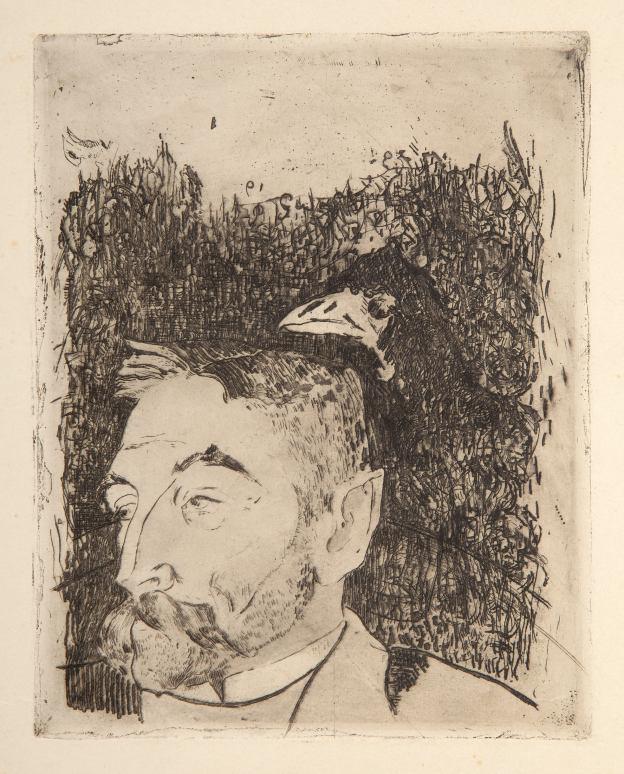
Stéphane Mallarmé (1842-1898) is an important Symbolist poet of the last half of the 19th century in France. Throughout his writing career, Mallarmé helped formulate and express the rising anti-naturalism in contemporary art. This movement’s inclinations mainly took the form of Symbolism – that is, the fascination with many types of literature and the inclination to draw upon these sources for inspiration in dreams and visions. Although Mallarmé’s poetry is verbally dense and difficult with fleeting imagery, the poet was influential in modern art circles. The poet hosted a weekly salon in Paris known as “les jeudis” which provided a social network for many leading modern thinkers and practitioners, such as Édouard Manet, Edgar Degas, Odilon Redon, Paul Gauguin and Edvard Munch.
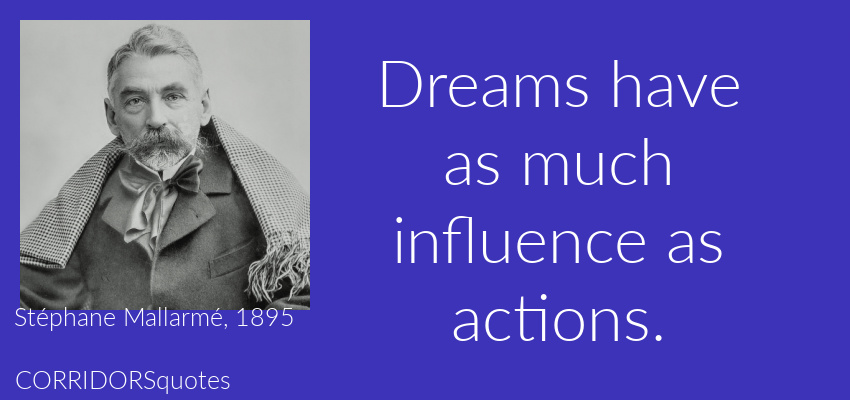
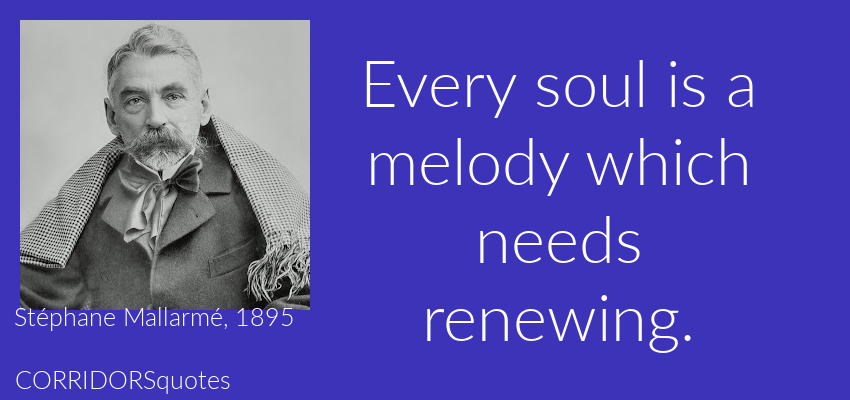
Dreams have as much influence as actions.
Mallarmé was born in Paris in 1842 into a family of civil servants. His mother died when he was 5 years old and his younger sister when he was 15. It was around the time of his sister’s death that Mallarmé wrote his first poetic essays, influenced by Romantics and early Symbolist writers and poets Victor Hugo, Théophile Gautier, Charles Baudelaire and Edgar Allan Poe. His first poems were published in 1862. Mallarmé earned a teaching certificate in the English language, studied in London and married a young German woman he met in France. Mallarmé began a teaching career in 1863 in Tournon in the Ardèche, where his daughter was born in 1864. He also was teaching in Besançon and Avignon. Outside of Paris, Mallarmé did not prosper as a teacher and viewed his assignments with disdain as necessary modes of employment. The young man turned to poetry as a means of escape. It was between 1863 and 1866 that Mallarmé wrote some of his renown poems: Brise marine, L’Azur, Les Fleurs, a version of L’Après-midi d’un faune. His collection of poems published in Le Parnasse contemporain in 1866 led to Mallarmé’s first notoriety.
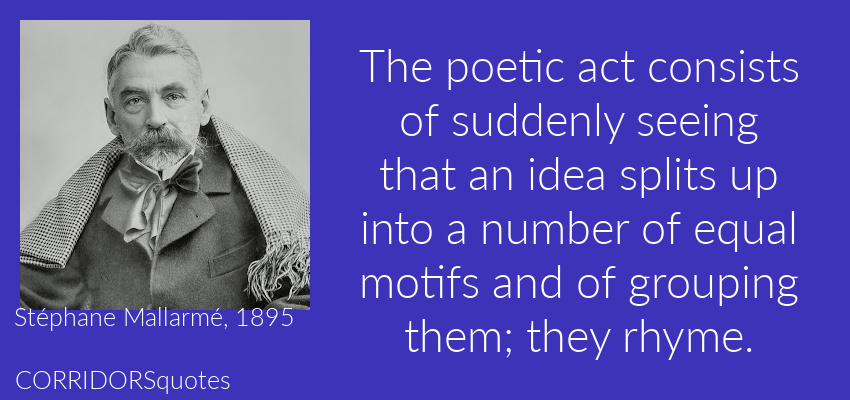
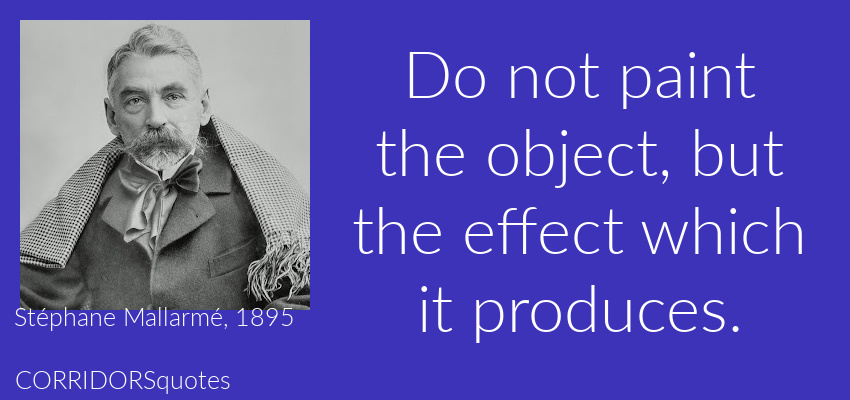
The poetic act consists of suddenly seeing that an idea splits up into a number of equal motifs and of grouping them; they rhyme.
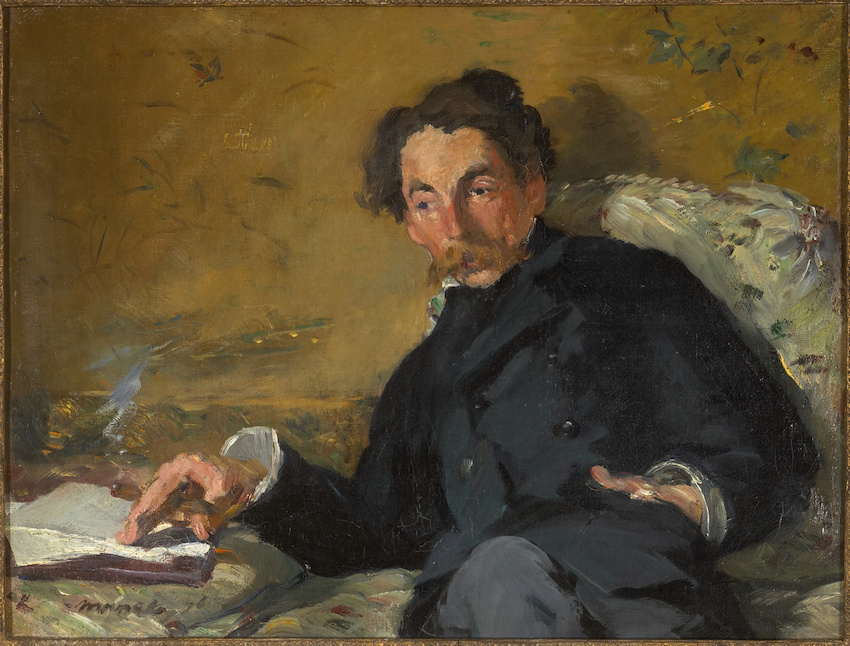
In 1871, Mallarmé, now a father of a family with two children, was assigned to teach in Paris and settled near the new Saint-Lazare train station. His social network of artists and writers blossomed in this period. In 1873 Mallarmé met Édouard Manet who soon illustrated Mallarmé’s translation of American writer Edgar Allan Poe’s Raven, published in 1875. In 1876 Manet painted his portrait that is now in the Musée d’Orsay.
Édouard Manet, Stéphane Mallarmé, poet. 1876, oil on canvas, 27.2 x 35.7 cm, Musée d’Orsay.
Mallarmé’s 8-year-old son died prematurely at the end of the 1870s and Manet died a few short years later in 1883. Mallarmé formed new friendships with Berthe Morisot and her daughter Julie Manet, whose guardian Mallarmé became at the death of his parents. Mallarmé also became friends with other leading avant-garde artists and poets such as Claude Monet and Pierre-Auguste Renoir. To the general reader, Mallarmé was criticized as a crazy poet who used unintelligible verse. Yet to avant-garde literati such as Paul Verlaine and Joris-Karl Huysmans, Mallarmé’s demanding poetry they publicly admired.
In 1892 appeared Vers et Prose, a major collection of Mallarmé’s poems. The frontispiece was a lithographed portrait by James Abbott McNeill Whistler, with whom Mallarmé was a close friend. In the early 1890s Mallarmé came into contact with the “Nabis,” young Post-Impressionists such as Pierre Bonnard, Maurice Denis and particularly Édouard Vuillard. In the 1890’s Mallarmé’s Paris salon was frequented by the young Paul Valéry.
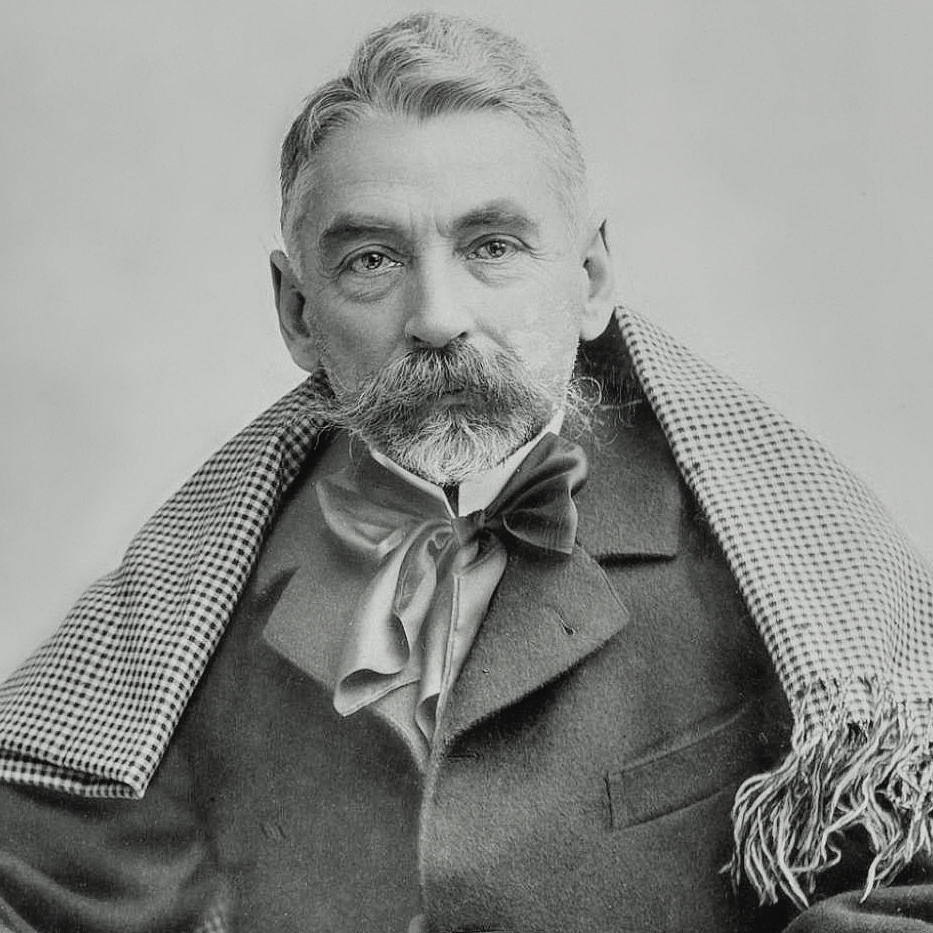
Stéphane Mallarmé, 1896, by Nadar.
At 51 years old, in 1893, Mallarmé retired from teaching and stayed in his small house of Valvins. He died there on September 9, 1898, at the age of 56. In these final years, Mallarmé’s recognition and fame remained high. It was part of the vivacity and dynamism of literary and artistic circles for which Mallarmé had been one of its inspirations since the 1870s. In 1896 Mallarmé’s influence included his being elected as Prince des poètes and inheriting the seat occupied by the recently deceased Paul Verlaine.
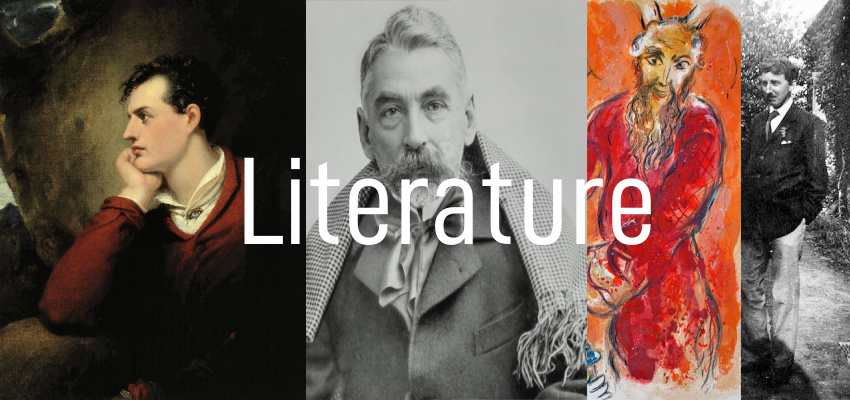
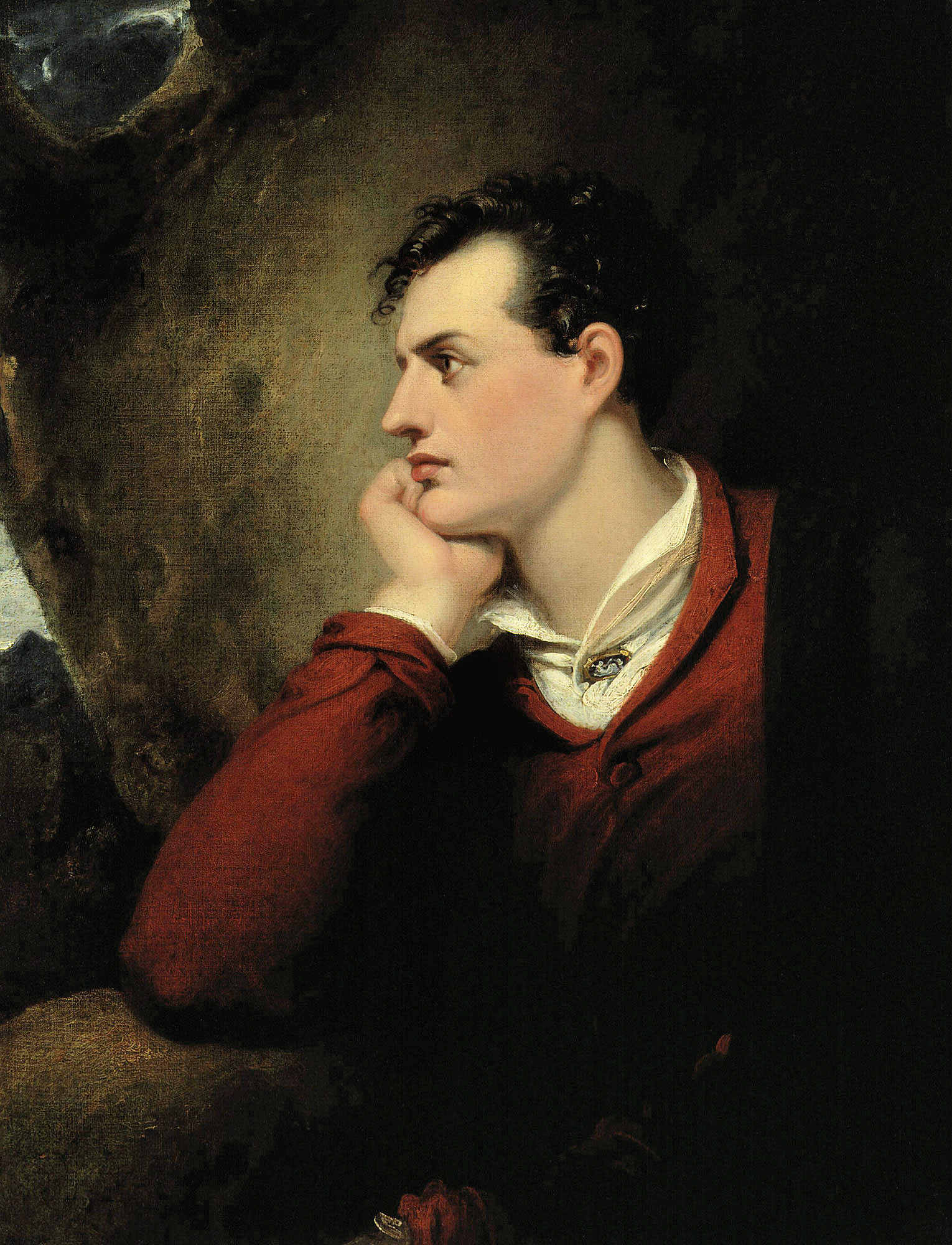
FEATURE Image: Lord Byron in Albanian Dress, 1813, Thomas Phillips (1770-1856). Public Domain.
George Gordon (Lord Byron) by Richard Westall (1765-1836). National Portrait Gallery, London.
Lord Byron (George Gordon), 1788-1824, Letter to poet Thomas Moore, October 28, 1815. Byron’s Letters and Journals, vol. 4 (1973-81; edited by Leslie A. Marchand).
Lord Byron (George Gordon), 1788-1824, Byron’s Letters and Journals, vol. 8 (1973-81; edited by Leslie A. Marchand).
Out of chaos God made a world, and out of high passions comes a people. Lord Byron (George Gordon), 1788-1824, Byron was describing the early nationalist fervor in Italy for which the poet played an active role. Byron’s Letters and Journals, vol. 8 (1973-81; edited by Leslie A. Marchand).
I do detest everything that is not perfectly mutual. Lord Byron (George Gordon), 1788-1824, Letter, October 21, 1813. Byron’s Letters and Journals, vol. 3 (1973-81; edited by Leslie A. Marchand).
I only go out to get me a fresh appetite for being alone. Lord Byron (George Gordon), 1788-1824, Journal, December 12, 1813. Byron’s Letters and Journals, vol. 3 (1973-81; edited by Leslie A. Marchand).
Lord Byron (George Gordon), 1788-1824, Journal, March 22, 1814. Byron’s Letters and Journals, vol. 3 (1973-81; edited by Leslie A. Marchand).
In solitude, where we are LEAST alone. Lord Byron (George Gordon), 1788-1824, Childe Harold, canto 3, stanza 90.
Lord Byron in Albanian Dress, 1813, Thomas Phillips (1770-1856). Public Domain
Lord Byron (George Gordon), 1788-1824, Byron’s Letters and Journals, vol. 8 (1973-81; edited by Leslie A. Marchand).
Lord Byron (George Gordon), 1788-1824, Byron’s Letters and Journals, volume 9, edited by Leslie A. Marchand, 1979. The journal entry was written on Byron’s final journey to aid the Greek revolt.
If we must have a tyrant, let him at least be a gentleman who has been bred to the business, and let us fall by the axe and not by the butcher’s cleaver. Lord Byron (George Gordon), 1788-1824, Letter, February 21, 1820 to John Murray, publisher. Byron’s Letters and Journals, volume 7, edited by Leslie A. Marchand, 1973-1981.
Are we aware of our obligations to a mob? It is the mob that labour in your fields and serve in your houses–that man your navy, and recruit your army–that have enabled you to defy the world, and can also defy you when neglect and calamity have driven them to despair. You may call the people a mob; but do not forget that a mob too often speaks the sentiments of the people. Lord Byron (George Gordon), 1788-1824, First speech to the House of Lords, February 27, 1812 on the topic of Luddite machine-wreckers.
The French courage proceeds from vanity—the German from phlegm—the Turkish from fanaticism & opium—the Spanish from pride—the English from coolness—the Dutch from obstinacy—the Russian from insensibility—but the Italian from anger. Lord Byron (George Gordon), 1788-1824, Letter, August 31, 1820, to publisher John Murray. Published in Byron’s Letters and Journals, volume 7, ed. Leslie A. Marchand , 1973-1981.
It is by far the most elegant worship, hardly excepting the Greek mythology. What with incense, pictures, statues, altars, shrines, relics, and the real presence, confession, absolution, –there is something sensible to grasp at. Besides, it leaves no possibility of doubt; for those who swallow their Deity, really and truly, in transubstantiation, can hardly find any thing else otherwise than easy of digestion. Lord Byron (George Gordon), 1788-1824, Letter, March 8, 1822 to poet Thomas Moore. Byron explained that he was bringing up one of his own daughters, Allegra, a Catholic.
It is useless to tell one not to reason but to believe — you might as well tell a man not to wake but sleep. Lord Byron (George Gordon), 1788-1824, Detached Thoughts, no. 96, 1821-22.
I would rather…have a nod from an American, than a snuff box from an emperor. Lord Byron (George Gordon), 1788-1824, letter, June 8, 1822, to poet Thomas Moore.
The thorns which I have reap’d are of the tree I planted; they have torn me, and I bleed. I should have known what fruit would spring from such a seed. Lord Byron (George Gordon), 1788-1824, Childe Harold’s Pilgrimage, Canto IV, Stanza 10 (1818).
FEATURE image: The poet John Keats, c. 1822, by William Hilton after Joseph Severn (1819), oil on canvas, 30 in. x 25 in., Nation Portrait Gallery, London. Public Domain.
John Keats’s first book of poems was published in 1817 when the English poet was 22 years old. From an early age, Keats, studying under the literary Rev. John Clarke, became a passionate reader of poetry and was introduced to the theater and music which he loved. Though both of his parents had died by the time Keats was in his early teens, their respectable estate never reached him in his short lifetime. His guardian sent the minor Keats to work in the medical field. But in 1813, the young Keats abandoned that apprenticeship for another — and began to write poetry.
Keats’ early poetic mentor was Leigh Hunt (1784-1859), editor of the Examiner, who introduced Keats to great established poets such as William Hazlitt (1778-1830), Charles Lamb (1775-1834), and Percy Bysshe Shelley (1792-1822). Keats also made the acquaintance of painter Benjamin Robert Haydon (1786-1846) and made other intimate lifelong friends. In 1816 Keats wrote his first major sonnet (On First Looking into Chapman’s Homer) in which he laid out an ambitious plan for his poetry.
In 1817 Keats wrote the 4,000-line Endymion though, ever a perfectionist, Keats considered it merely a poetic exercise. Keats soon isolated himself consciously from others to benefit his art. His over-riding quest was to seek his artistic individuality and poetic voice.
In 1818 external personal and professional events circumscribed Keats’ precious independence. First, his poetry for political rather than artistic reasons was ridiculed in the press. But more problematic for the brave Keats was that some of his immediate family members had become suddenly destitute or died. Keats’ spring and summer walking tour in 1818 of England, Scotland, and Ireland resulted in Keats’s personal inspiration but a chronically weakened state of physical health. In those same months, the 23-year-old poet had fallen in love with the vivacious, pretty and thoroughly nonliterary 18-year-old Fanny Brawne (1800-1865). They soon became engaged, but Keats’ inferior health and his strained to nonexistent finances impeded their getting married which frustrated Keats.
In the rapidly reached final period of his life and poetic career, Keats wrote several of his masterpieces. In 1819 Keats wrote, one after another, The Eve of St. Agnes, La Belle Dame Sans Merci, his Odes (including Ode To a Grecian Urn), Lamia, and several major sonnets. These poems possess the characteristics of Keats’ mature work—that of grace, sensuality, and sympathetic objectivity. It sets before the reader the conflicting and contradictory nature of existence, signaling a “both-and” experience of living in the world, including grappling with the problem of good and evil. Keats writes plainly in a letter in that period about life’s suffering—it is a “world…full of misery and heartbreak, pain, sickness and oppression.”
Weakened by tuberculosis, Keats’ health took a bad turn in February 1820 so much so that the poet realized he was dying. By that fall he traveled to Italy seeking a milder climate for his health. He stayed in Rome until the end came. On February 23, 1821 —like his mother and brother before him— Keats died of tuberculosis. The 25-year-old poet was buried in the Protestant Cemetery in Rome.
Despite his gallant reluctance to yield to bitterness or despair for his life’s wasteful circumstances, with death died Keats’ ambitious plans of renewed poetic achievement and an ongoing passionate love for Fanny Brawne. Although today’s reader can continue to savor John Keats’ poems and letters prior to his having stopped writing at 24 years old, what might have been in terms of the English Romantic poet’s fully realized potential is to offer a conjecture about one of the English language’s greatest poets.
SOURCES: The Norton Anthology of English Literature, Third Edition, Volume 2, W.W. Norton & company, Inc. New York, 1974.
John Keats, Walter Jackson Bate, The Belknap Press of Harvard University Press, Cambridge, Massachusetts, 1964.
John Keats (detail) by Joseph Severn (1793-1879), 1819.
Quotations.
John Keats, letter to his brother and sister, Spring 1819. While we are laughing, the seed of trouble is put into the wide arable land of events. While we are laughing it sprouts, it grows and suddenly bears a poison fruit which we must pluck.
Letter to his brother George Keats (1797-1841) and sister-in-law Georgiana Augusta Wylie Keats (1798-1879). Married in England in May 1818, the Keats departed for America going to Kentucky and southeastern Illinois by way of Philadelphia and Pittsburgh. The Keats are buried in Cave Hill Cemetery in Louisville, Kentucky. Mrs. Keats re-married after the poet’s brother died during experiences of serious financial setbacks. Do you not see how necessary a world of pains and troubles is to school an intelligence and make it a soul?
The poet suffered from– and died of– tuberculosis at the age of 25 years. Letter to his fiancée, Fanny Brawne, March 1, 1820. Health is my expected Heaven.
Letter to his brothers, George and Thomas Keats, January 13-19, 1818. Letters of John Keats, no. 37, edited by Frederick Page, 1954. There is nothing stable in the world; uproar’s your only music.
Endymion, Preface (1818). The complete line is: “This may be speaking too presumptuously, and may deserve a punishment: but no feeling man will be forward to inflict it: he will leave me alone, with the conviction that there is not a fiercer hell than the failure in a great object.”
The Fall of Hyperion – A Dream. Canto 1, first lines. Fanatics have their dreams, wherewith they weaveA paradise for a sect.
Letter, August 23, 1819, Letters of John Keats, no. 144, ed. Frederick Page, 1954. I will give you the definition of a proud man: he is a man who has neither vanity nor wisdom—one filled with hatreds cannot be vain, neither can he be wise.
Letter to George Keats, February 19, 1819. A Man’s life of any worth is a continual allegory–and very few eyes can see the Mystery of his life–a life like the scriptures, figurative–which such people can no more make out than they can the Hebrew Bible…Shakespeare led a life of Allegory; his works are the comments on it.
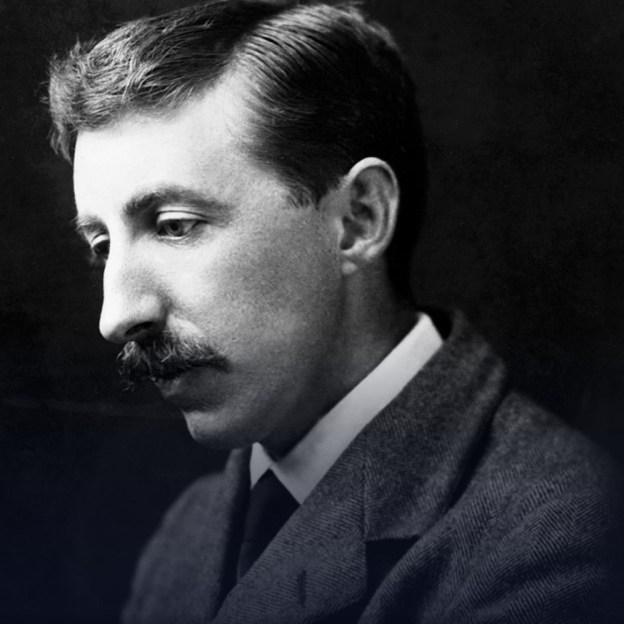
FEATURE image: E.M. Forster. Public Domain. Edward Morgan Forster was born in London in 1879. He wrote numerous short stories, essays, biographies and plays, although he is best known for his novels, particularly A Room With A View (1908), Howards End (1910), and A Passage to India (1924), all of which have been made into award-winning feature films. Forster was nominated for a score of Nobel Prizes for Literature. He died in 1970.
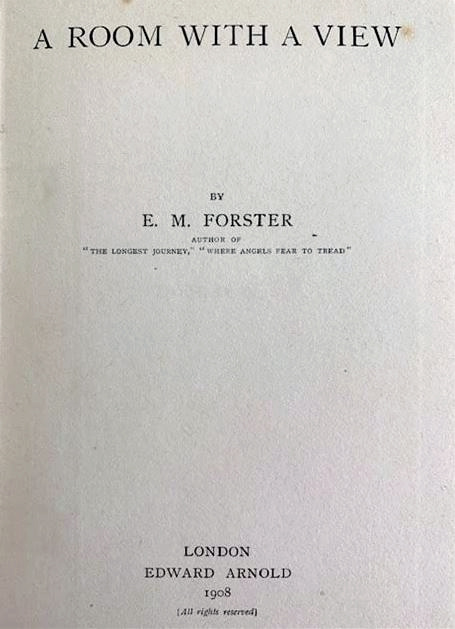
E. M. Forster by Dora Carrington (1893-1932), oil on canvas, 1920. Public Domain.Title page, first edition, 1908. Public Domain. First edition, 1908. Public Domain.
Edward Morgan Forster (1879–1970) is an English novelist, short story writer, and essayist.
The heart of Forster’s literary work is humanist in nature as his characters depict—whether in Where Angels Fear to Tread (1905), A Room with a View (1908), his masterpiece Howards End (1910), his most successful work A Passage to India (1924), Maurice (1971), and others — the honest pursuit of personal tracks and connections in the face of first looking to impress or please the inevitable and constantly mutating restrictions of contemporary society.
In A Room With a View it is 1907 and young English girl Lucy Honeychurch — “a young lady with a quantity of dark hair and a very pretty, pale, undeveloped face”– is staying at an Italian pension with her cousin and chaperone, Miss Charlotte Bartlett while on holiday in and around Florence.
At dinner in the pension they meet some other English guests: a reverend, two older Miss Alans, a writer Miss Lavish, and a Mr. Emerson and his handsome adult son, George. They discuss the merits and practicalities of having a room with a view in Florence.
The next day while touring the city Lucy faints in the Piazza della Signoria having witnessed a stabbing and is rescued by handsome George. After they establish this connection George and Lucy are together again to join a group tour of the nearby countryside. Eventually finding themselves alone, George embraces Lucy and they kiss. This is witnessed by Miss Bartlett who cuts short her and Lucy’s visit to Florence.
After visiting the Vyses in Rome, Lucy and Miss Bartlett have returned to Surrey in England. Lucy accepts one of the marriage proposals from snobby Cecil Vyse, a drawing room match. By happenstance of personal connection, George and his father, Mr. Emerson, had made passing acquaintance with Cecil at the National Gallery in London which led to Cecil inviting them to take up residence in a rental house next door to Lucy Honeychurch. Lucy immediately recalls the Emersons and their personal connection in Florence, especially with George. But her escape to Rome and then to Windy Corner, her home in Surrey, added to her being uncomfortable with their renewed intimate presence, particularly since she is just engaged to Cecil, her “Fiasco” as Lucy’s brother Freddy calls him.
Lucy rebuffs George as she ultimately breaks her engagement with Cecil with plans for herself to travel to Greece. Meantime, George has made plans of his own to leave. At this juncture, Lucy admits her feelings for George and cancels her trip. George and Lucy elope to Florence. They take “a room with the view” with the promise of living happily thereafter. Forster observed: “Passion does not blind. No. Passion is sanity, and the woman you love, she is the only person you will ever really understand.”
E.M. Forster. National Portrait Gallery, London. Public Domain.
Chapter III: Music, Violets, and the Letter “S” (15 quotes).
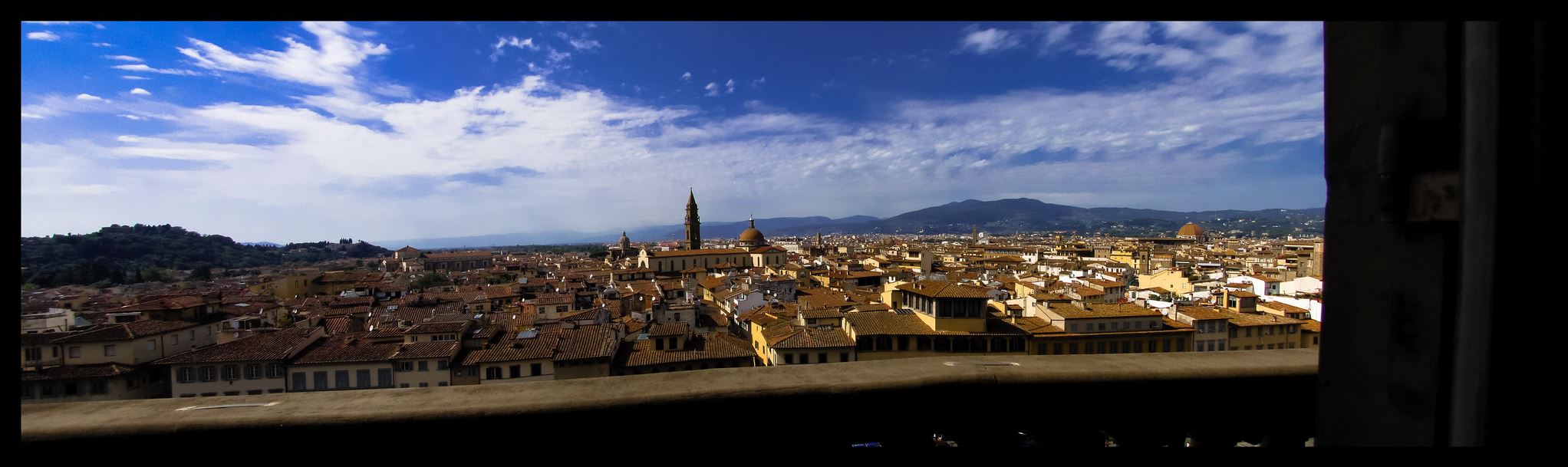
Loggia dei Lanzi – Piazza della Signoria, Florence – seen from the Uffizi Gallery by ell brown. This image was marked with a CC BY-NC-SA 2.0 license.
Chapter IV: Fourth Chapter (5 quotes).
Piazza della Signoria, in front the Fountain of Neptune (Florence, Tuscany, Italy) – 800055 by Belpaese.nl. This image was marked with a CC BY-NC-ND 2.0 license.
Chapter V: Possibilities of a Pleasant Outing (10 quotes).
Chapter VI: The Reverend Arthur Beebe, the Reverend Cuthbert Eager, Mr. Emerson, Mr. George Emerson, Miss Eleanor Lavish, Miss Charlotte Bartlett, and Miss Lucy Honeychurch Drive Out in Carriages to See a View; Italians Drive Them (6 quotes).
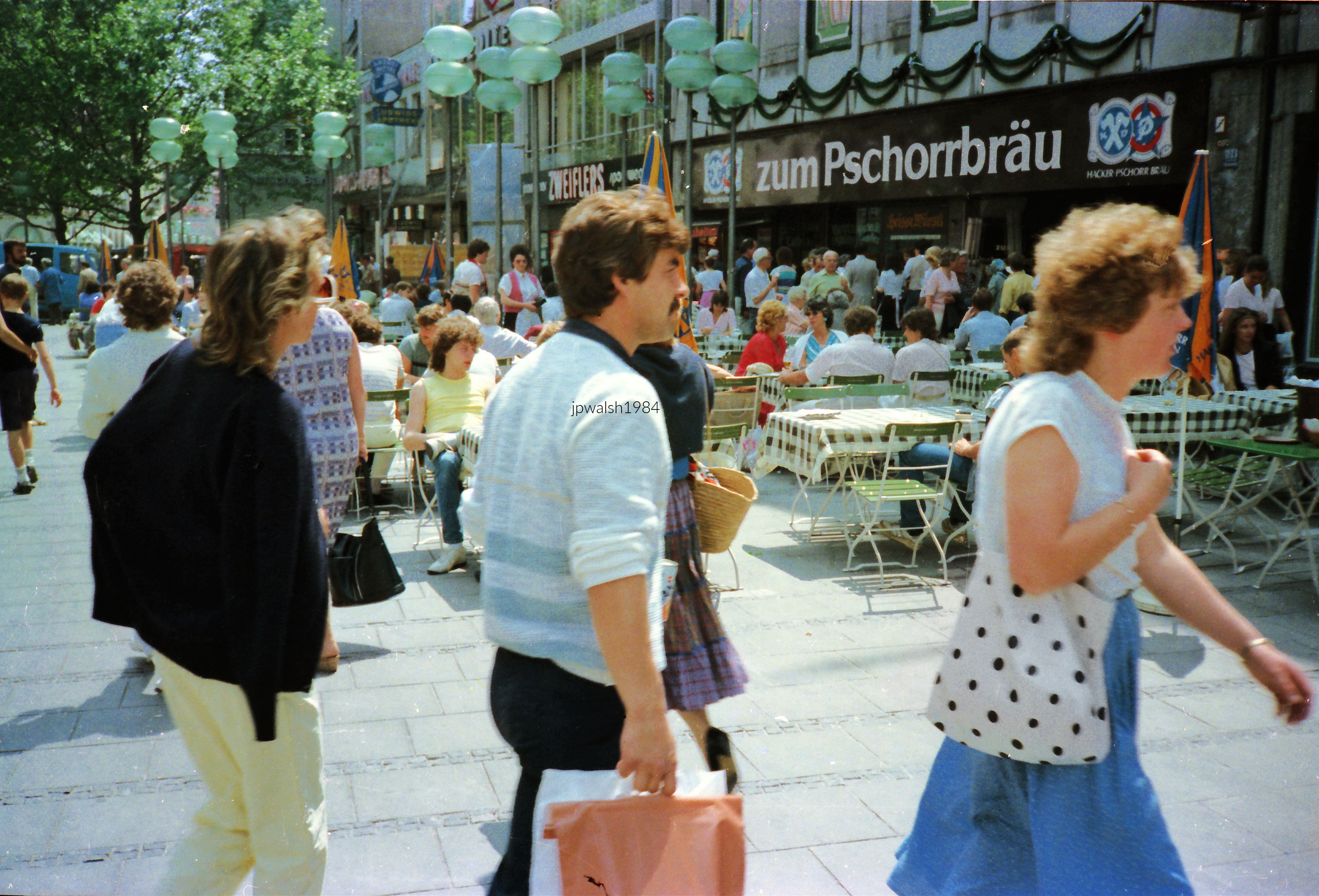
FEATURE image: July 1984. Marienplatz, Munich, Germany. 7.91mb 91%
Photographs and text by John P. Walsh.
Introduction
A Continent Explored
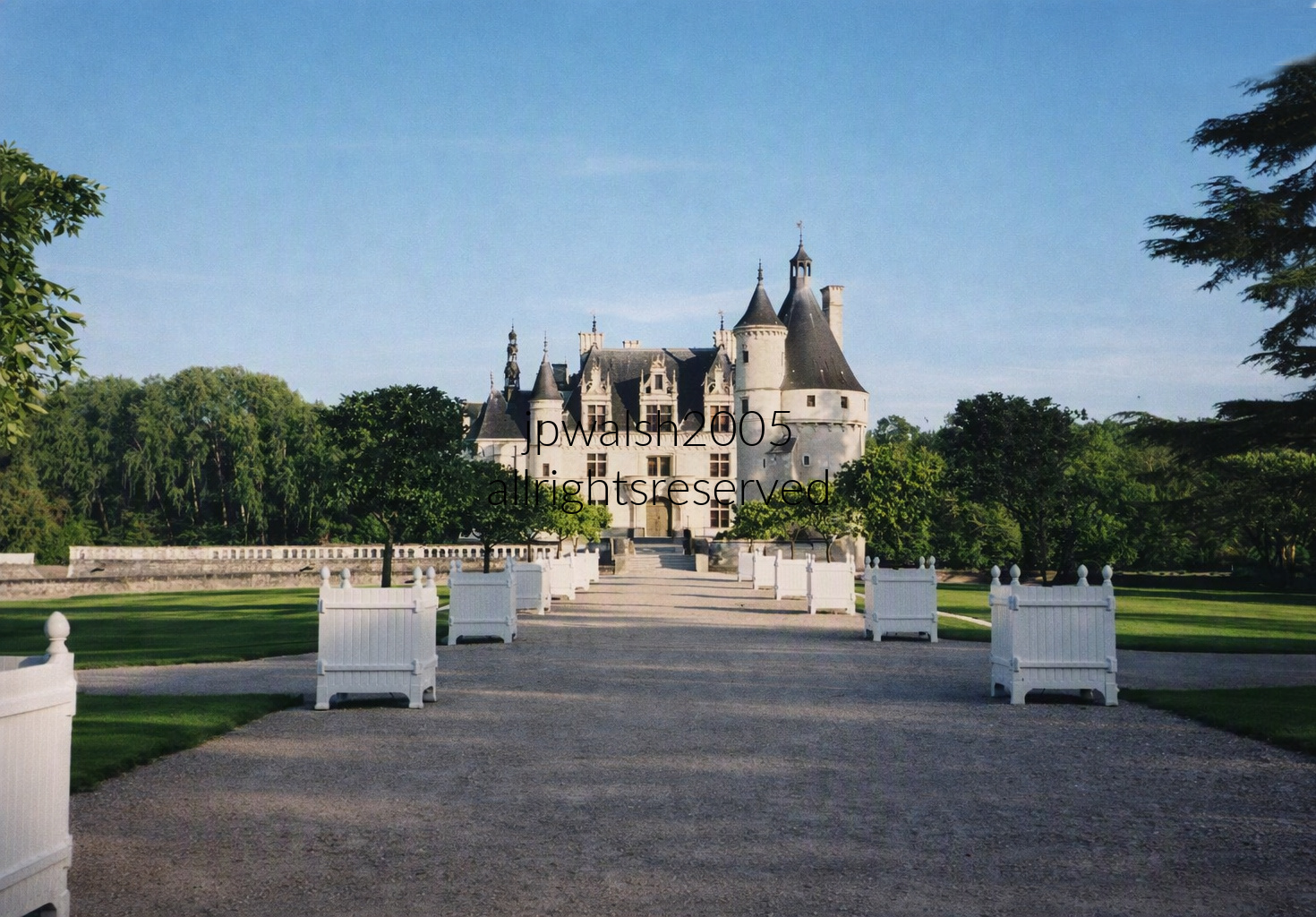
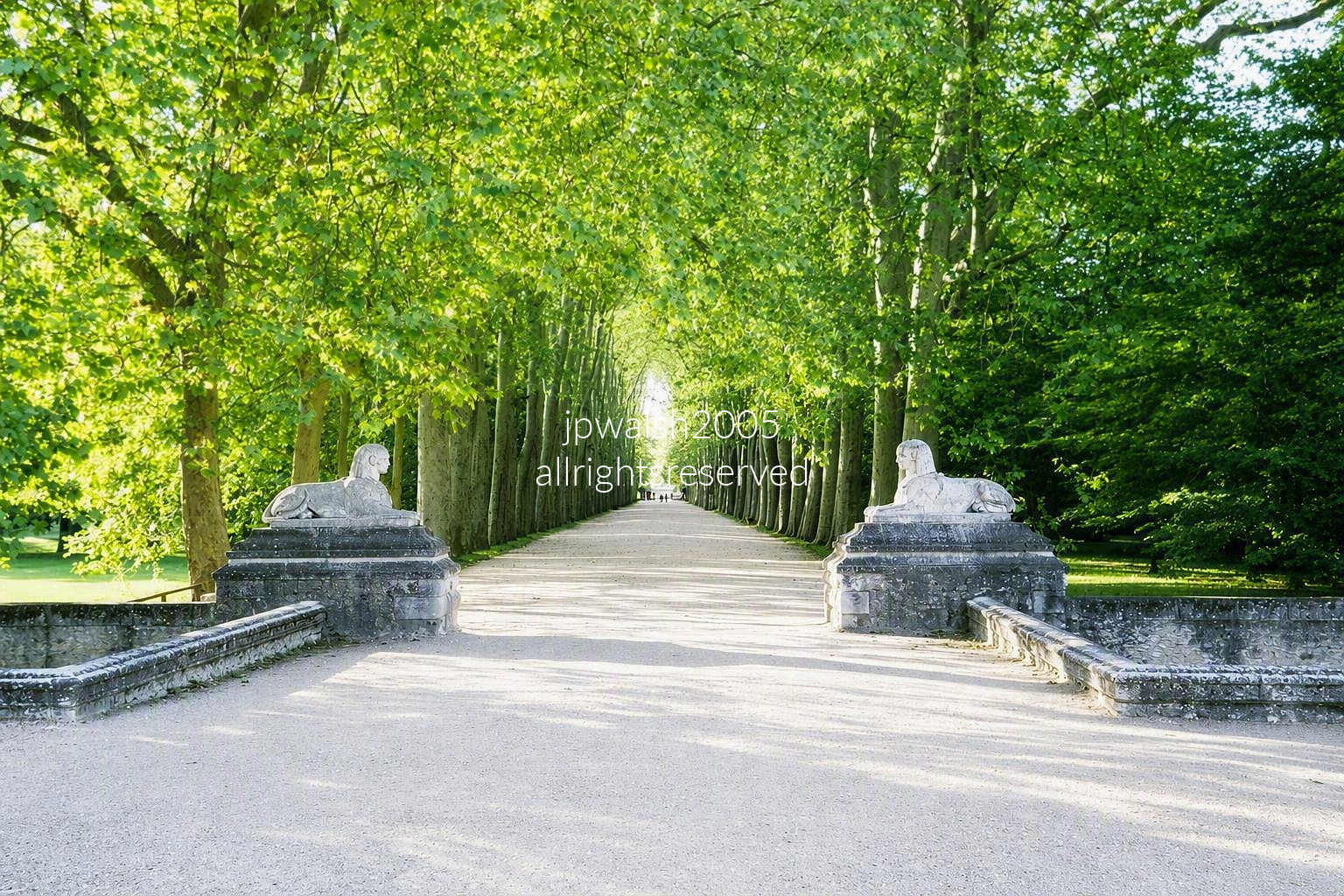
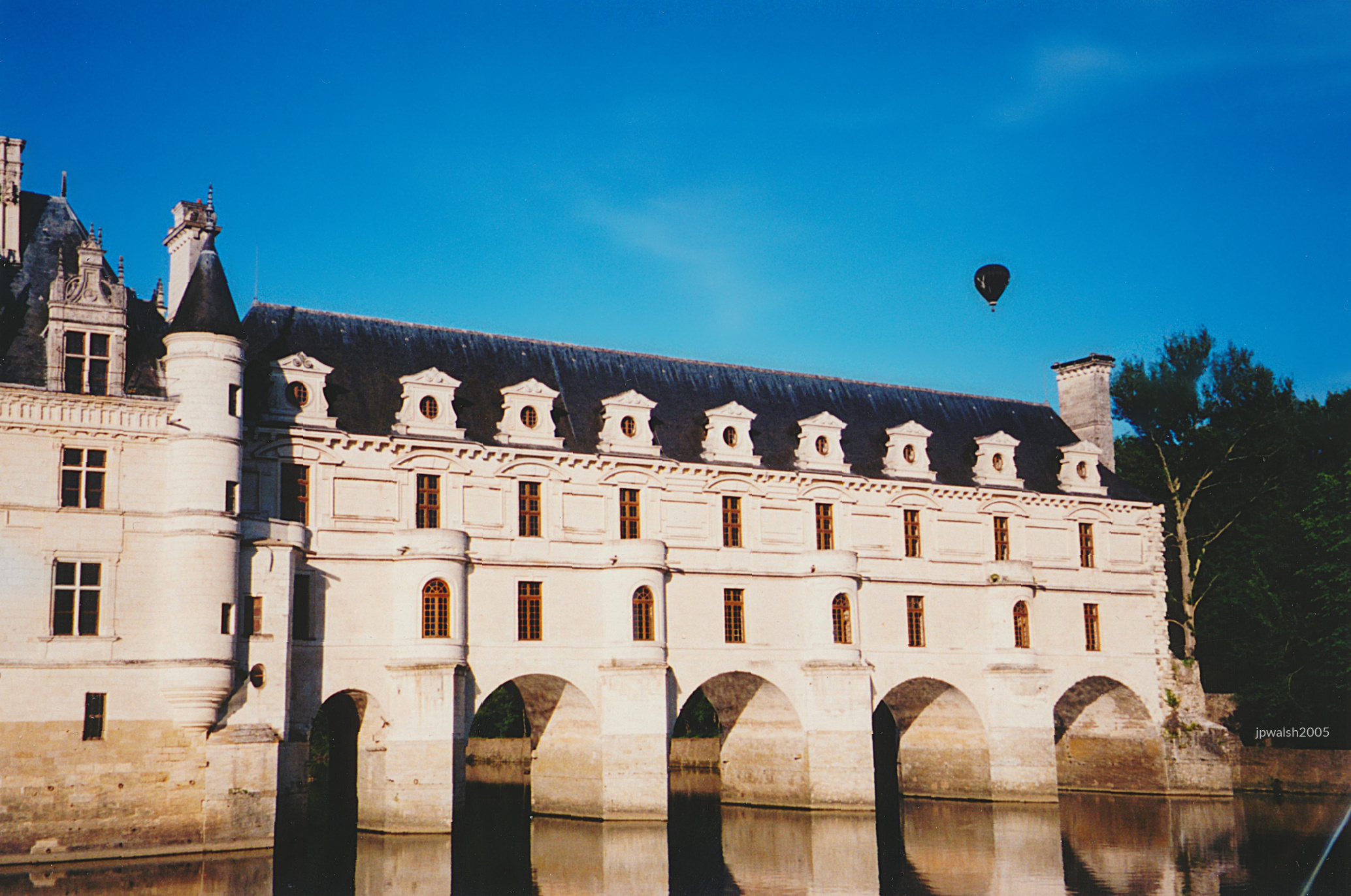
From December 1976 through May 2005, I made thirteen distinct journeys across Europe, the British Isles, and Iceland, spending well over a year on the continent in total. Those travels carried me from the volcanic landscapes surrounding Reykjavík to the historic plains and forests of Russia in St. Petersburg and Moscow; from Spain’s arid highlands and Sicily’s winding hills to the stony isolation of the Aran Islands and the broad green expanses of Overijssel. Each journey was driven by a lifelong fascination with European art, history, culture, and geography. Along the way, I lived with family in Torino, visited the Walsh homeland in Dublin and Wexford, wrote a medieval history research paper at Trinity College Dublin, and conducted research in Paris for my M.A. thesis in art history.
World-Class Collections, Architecture, and Masterpieces
My academic fascination with art history naturally dictated my itinerary, leading me to the world-class museums and monumental artistic achievements of Europe.
In the British Isles, my path began in England, exploring the vast collections of London’s National Gallery and tracing historical portraiture at the National Portrait Gallery. It was a landscape punctuated by grand architecture, where the sonorous, echoingbells of St. Paul’s Cathedral boomed in Blackfriars.Crossing the Channel into France, I immersed myself in the sweeping galleries of the Louvre, studied the transition into modernity at the Musée d’Orsay, and sought out the airy brilliance of the Musée Marmottan Monet and the grounded weight of the Rodin Museum. In Paris, I also visited the historic Jeu de Paume and marveled at the medieval unicorn tapestries and the original, revolution-scarred royal heads of Notre-Dame Cathedral housed within the Cluny Museum, before venturing outward to examine the regional collections and artistic heritage kept in Strasbourg, Bourges, Dijon, and beyond. My travels across France became a masterclass in grand design and architecture, as I explored the opulence of the Palais de Versailles and the historic retreat of Malmaison, alongside the sprawling, magnificent châteaux of Bussy-Rabutin, Blois, Chenonceau, and Châteaudun. This continental heritage of great houses and palazzi continued seamlessly across borders, tracking an evolution of wealth, power, and domestic artistry that stretched from the pioneering Flamboyant Gothic layout of thePalais Jacques Cœurin Bourges to the baroque prince-bishop opulence of the Salzburg Residenz, down to the severe, finely paneled heritage of thePalazzo Rotingonear Lake Garda, and culminating in the majestic imperial frameworks of Vienna and St. Petersburg.
Spain offered a brilliant immersion into both classical and twentieth-century masterworks. In Madrid, I walked the unparalleled galleries of the Museo del Prado to study the Spanish masters, before confronting the raw, shattering power of Pablo Picasso’s Guernica then inside the Casón del Buen Retiro. Journeying inland to the historic city of Toledo, I entered the interior of the Church of Santo Tomé to stand before El Greco’s towering, visionary masterpiece, The Burial of the Count of Orgaz.
Italy became a profound multi-city study of form, color, and classical engineering, defined by the romance of the winding canals of Venice. In Florence, I encountered the sculptural genius of the Renaissance at the Bargello, walked the monumental corridors of the Uffizi, and stood before the sheer majesty of Michelangelo’s David at the Accademia, before entering the New Sacristy of the Medici Chapels to contemplate the powerful, melancholic weight of his allegorical figures of Day, Night, Dawn, and Dusk carved into the ducal tombs. Moving north to Milan, I entered the Pinacoteca di Brera, and sat before the fragile, enduring fresco of Leonardo da Vinci’s The Last Supper at Santa Maria delle Grazie. A side trip from Florence carried me to Pisa, where I climbed the Leaning Tower, stepping out onto the stone ledge to take in the exact vertiginous view Galileo utilized during his groundbreaking physics experiments in the late 1580s. Returning to the main trail, in Siena, my journey focused on the distinctive medieval Sienese school, entering the cathedral to marvel at the revolutionary drama carved into Nicola Pisano’s monumental marble pulpit, before stepping into the Cathedral Museum (Museo dell’Opera del Duomo) to study the panels of Duccio’s Maestä. Afterward, I crossed into the Piazza del Campo—the beautifully designed, shell-shaped square where they hold the historic Palio horse race—and entered the Palazzo Pubblico to sit in council chamber contemplation before Ambrogio Lorenzetti’s towering murals of Good and Bad Government. Further south, I explored the unrivaled classical treasures of the National Archaeological Museum in Naples, before exploring the region in the shadow of Mount Vesuvius, walking through the preserved, tragic architecture of Pompeii and the intimate, beautifully carbonized coastal villas of neighboring Herculaneum.
In the Germanic and alpine lands, this survey of European masters continued. In Munich, I balanced the historical gravity of the Alte Pinakothek with the nineteenth-century visions of the Neue Pinakothek. Traveling to Vienna, I entered the palatial Kunsthistorisches Museum to view the historic imperial collections, while Switzerland drew me to the prominent galleries of the Kunsthaus Zürich.
My journey eventually brought me to the Low Countries, following the distinct Northern light. In Amsterdam, I walked the expansive galleries of the Rijksmuseum to find Rembrandt and Vermeer, before confronting the raw, emotional brushwork at the Van Gogh Museum. A short journey to Haarlem brought me face-to-face with the lively, expressive portraits at the Frans Hals Museum.
Finally, the artistic and cultural threads of my travel converged completely in Rome. Here, the journey culminated within the monumental treasury of the Vatican Museums, where I walked through the vibrant Stanze of Raphael and stood beneath Michelangelo’s towering achievements on the ceiling and Last Judgment of the Sistine Chapel. Emerging from the museums, I confronted the sheer immensity of St. Peter’s Basilica, inside and outside, a colossal monument of stone and scale that leaves one breathless. Yet the city’s finest artistic achievements were also seamlessly integrated into its public spaces: standing before the intense, theatrical marble mastery of Bernini’s Saint Teresa at Santa Maria della Vittoria, and left wondering before the monumental, fiercely carved gaze of Michelangelo’s Moses at San Pietro in Vincoli.
Pilgrimage and Faith
These travels gradually became pilgrimages as well. I followed the paths of saints and holy figures across the continent: Bernadette in Lourdes to her convent in Nevers, where her serene, intact body rests on display inside a glass-and-bronze casket—though a closer look reveals the delicate, lifelike wax mask applied to her face to soften the toll of the centuries. From there, I spent time with Jane de Chantal in Monthelon, never intentionally chasing Joan of Arc, but rather finding that she repeatedly found me, her presence unexpectedly woven into the fabric of almost every French city I crossed. Normandy brought me to Thérèse of Lisieux, the “Little Flower,” while Paray-le-Monial led me to Margaret Mary Alacoque. Even Paris had its deep historical layers, taking me all the way back to the very foundation of the city at the resting place of its first bishop and martyr, Saint Denis.
Indeed, Europe has a knack for letting history sneak up on you. Across the entire continent, profound historical and sacred sites aren’t tucked away in cordoned-off museums; they are seamlessly woven into the chaos of everyday modern life. You can be grabbing an espresso, catching a local bus, or ducking into a neighborhood parish to escape the heat, only to realize you are standing exactly where a world-altering life unfolded whether in one’s lifetime or centuries, millennia, ago.
The deeper I went, the more these ordinary cities and towns felt enriched by the sacred ground resting in plain sight within them. In Rome, I walked the ancient paths of St. Paul, St. Lawrence, the Apostle Peter, Ignatius of Loyola, and the Vatican II popes, before descending into the shadows of the catacombs, emerging from those subterranean depths to walk directly onto the ancient, basalt paving stones of the Appian Way. and standing before the raw majesty of the Colosseum, recalling the unyielding faith of the early persecuted Christians. From there, I headed into the serene hills of Assisi to find Francis and Clare, stepping inside the monumental basilica to trace the very dawn of the Renaissance through the dramatic narrative murals of Giotto and the fragile, ancient mastery of Cimabue. In Germany, I followed the footsteps of Blessed Rupert Mayer in Munich, confronted the ultimate sacrifice made by Saint Titus Brandsma at Dachau Concentration Camp, and stood before the imperial shrine of Blessed Emperor Charlemagne in Aachen Cathedral.
Crossing over to the UK and Ireland, I paid my respects to Thomas Becket in Canterbury, visited the resting place of Laurence O’Toole in Dublin, and explored the peaceful isolation of St. Kevin’s hermitage in Glendalough. I even found a French connection in Pontigny with Edmund of Canterbury.
In Siena, I visited Catherine of Siena, and in Torino, stood in quiet awe before the Holy Shroud in the Duomo. During my stay in Torino, I routinely caught Mass at La Crocetta, totally oblivious at the time that I was stepping on the exact same floorboards and receiving communion at the same altar rail frequented by its most famous parishioner, the future Saint Pier Giorgio Frassati. Down in Naples, I joined the faithful at the Duomo di San Gennaro, staring at the altar where a third-century bishop’s crusted blood still manages to puzzle the modern world by liquefying on cue.
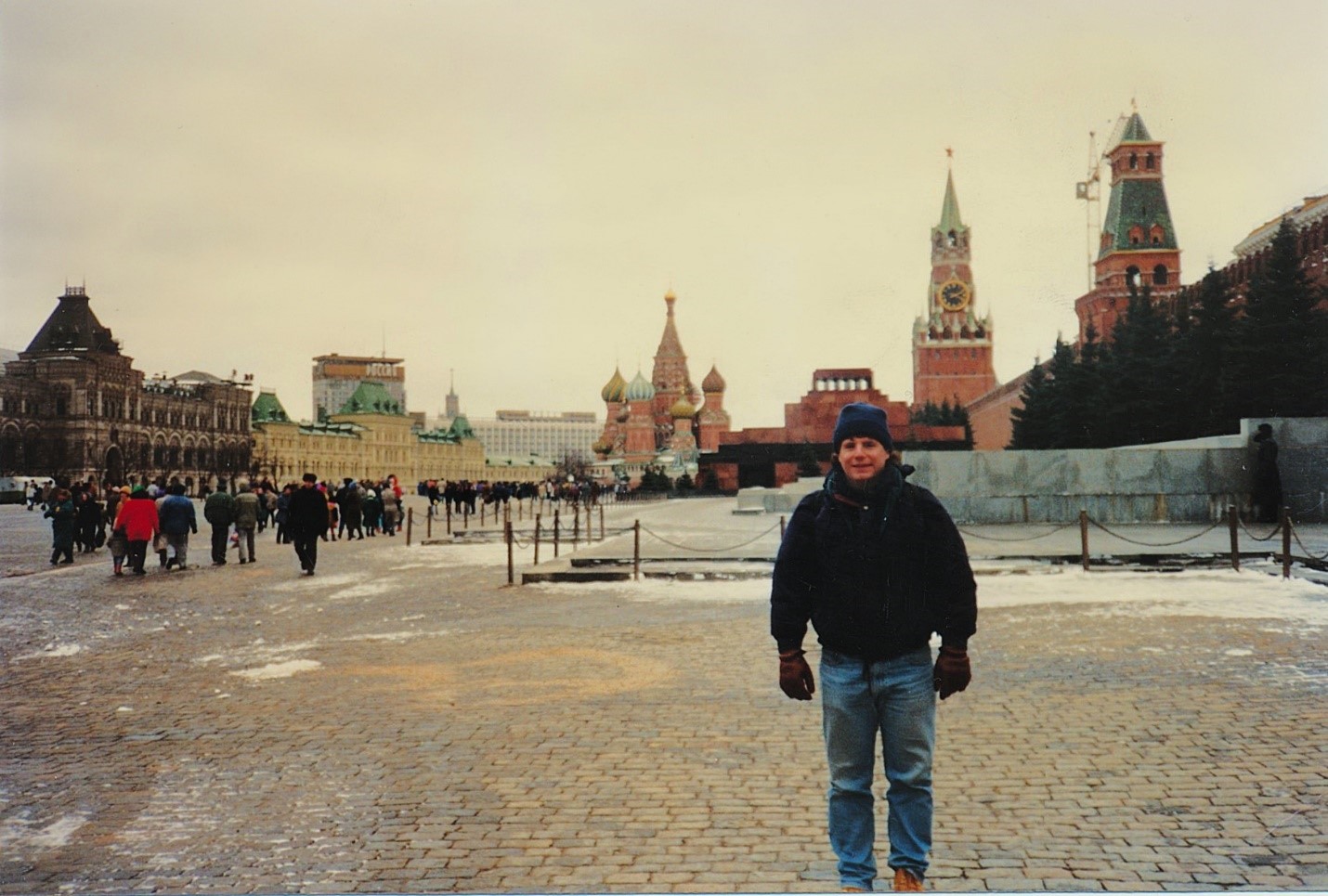
My journey to Sicily included a visit to the magnificent Cathedral of Monreale to see the reliquary of St. Louis—placed there by his younger brother, Charles of Anjou, after the King of France’s death in 1270. In Nicosia I stayed in a small house directly across the street from Blessed Felix, an 18th-century Capuchin friar from Sicily, canonized by Benedict XVI in 2005. Of course, the trail wasn’t exclusively reserved for the canonized. The journey was punctuated by towering secular figures who shook the world just as deeply, with Anne Frank’s hiding place in Amsterdam serving as the ultimate, heartbreaking example. Further east, the journey stretched into the sweeping, severe scales of Russia, where the staggering historical weight of Moscow’s Red Square and the monumental breadth of the Winter Palace Square in St. Petersburg left an indelible impression of imperial and modern history. Ultimately, whether sacred or secular, every single one of these sites doubles as a major global tourist attraction. They are places where history, faith, and the steady hum of everyday travelers constantly cross paths. And honestly, the list just keeps going from there.
Landscapes, Meals, and Daily Life
Beyond history and pilgrimage, Europe engaged every sense. Countless meals, enjoyed alone or shared with family and friends from Paris to Rome to Russia, nourished both body and spirit and remain vivid in memory decades later. I hiked through the landscapes of Ireland, France, Germany, Italy, and Sicily, experiencing everything from rugged coastlines, mountain trails, and Europe’s most active, prehistoric-looking volcano (Mount Etna)to rolling countryside and remote valleys. Even recreation became part of the cultural experience, with swims in the municipal pools of Paris, Turin, and Madrid.
A Musical Europe
Music formed another thread running through these years of travel. I attended classical performances at renowned venues such as Paris’s Salle Pleyel, Turin’s Teatro Regio, and Dublin’s RDS, while also seeking out period-instrument concerts, sacred choral performances in historic churches, and open-air folk, brass, and waltz music from Galway to Vienna. Some of the most memorable moments were unexpectedly intimate: sitting at Maurice Ravel‘s piano in Montfort-l’Amaury, attending an afternoon salon concert at the Hôtel des Invalides, hearing music within Salzburg’s Mirabell Palace, listening to historic church organs resonate through Paris, Strasbourg, Amsterdam, and Haarlem, and experiencing the raw power and emotion of flamenco in Seville.
Memorable Nights at the Theatre
The theatre was equally unforgettable. During my first European trip in 1976, I saw A Chorus Line and Jesus Christ Superstar, but also attended a major production of Tom Stoppard’s Jumpers at London’s newly opened Lyttelton Theatre, starring Sir Michael Hordern, Julie Covington, and Julian Glover. I also saw the National Theatre’s production of Peter Shaffer’s Equus at the Albery Theatre, featuring Colin Blakely. In 1978, I watched Paul Scofield in Ronald Harwood’s A Family at the Theatre Royal Haymarket, shortly before he returned to the National Theatre to create the role of Antonio Salieri in the world-premiere production of Amadeus. The following year brought further theatrical highlights, including John Inman in Charley’s Aunt at the Adelphi Theatre and the revival of the musical Canterbury Tales at the Shaftesbury Theatre. That same year at Trinity College Dublin, I saw a young Brendan Gleeson appear in a production at the school centered on immigration to America.
A Personal Atlas
Taken together, these thirteen journeys became far more than a series of trips. They formed a personal atlas of Europe, the British Isles, and the North Atlantic, woven from art, history, faith, music, theatre, scholarship, family connections, and exploration. Across nearly three decades, they provided immense personal joy, lasting friendships, spiritual enrichment, and a lifetime of intellectual discovery.
Paris and London; Canterbury— (December 1976-January 1977):
Photographer unknown. Fair use.
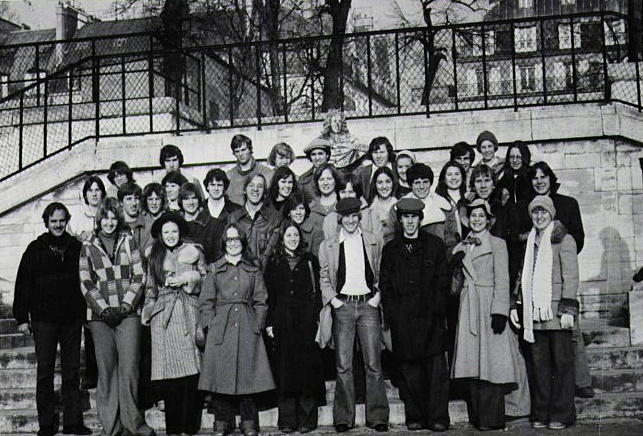
Paris, Square Nadar, December 1976. Senior class trip. I’m in the second row, third from the right. Much of what appears in this photograph has since vanished. The steps and landscaped setting were swept away when Square Nadar was extensively redesigned, but the original pedestal visible at upper right survived the transformation. Today it supports the modern full-length bronze statue of the Chevalier de la Barre, installed in 2001. De la Barre, a 19-year-old French nobleman, was tortured, beheaded, and burned in 1766 after being convicted of blasphemy. The original 1905 monument by sculptor Armand Bloch was melted down under the Vichy regime during World War II, leaving its stone base empty for decades. At the time this photograph was taken in December 1976, that absence had been filled only by a smaller stone bust depicting the young Chevalier in his characteristic 18th-century wig. For many years, this modest interim memorial stood watch over the steps, preserving his presence until the monument was finally restored in a new form at the dawn of the 21st century.
Choosing Paris and London
Each year the senior class at Benet Academy spent Christmas break in London. In September 1976, the travel agent—“The World Is Your Schoolhouse,” as I recall—offered an alternative: replace some of the week in London with two nights in Paris. The group voted, and Paris won.
First Encounter with Gothic Architecture
In Paris, our first stop from Orly was Notre‑Dame Cathedral. Walking inside my first Gothic interior, my jaw simply dropped. That moment set the tone for what it meant to me to travel in Europe.
Chaperones and Ground Rules
We were chaperoned by two English teachers and their wives. The rule was simple: you could stay up all night if you wished, but you had to be at breakfast the next morning for that day’s touring.
Touring Paris
We visited the Louvre, Jeu de Paume, Eiffel Tower, the exterior of the soon‑to‑open Pompidou Center, the Arc de Triomphe, Sacré‑Cœur, and wandered the oldest streets of the Latin Quarter in search of its street life, medieval architecture, and student canteens. It whetted my appetite for future European travel.
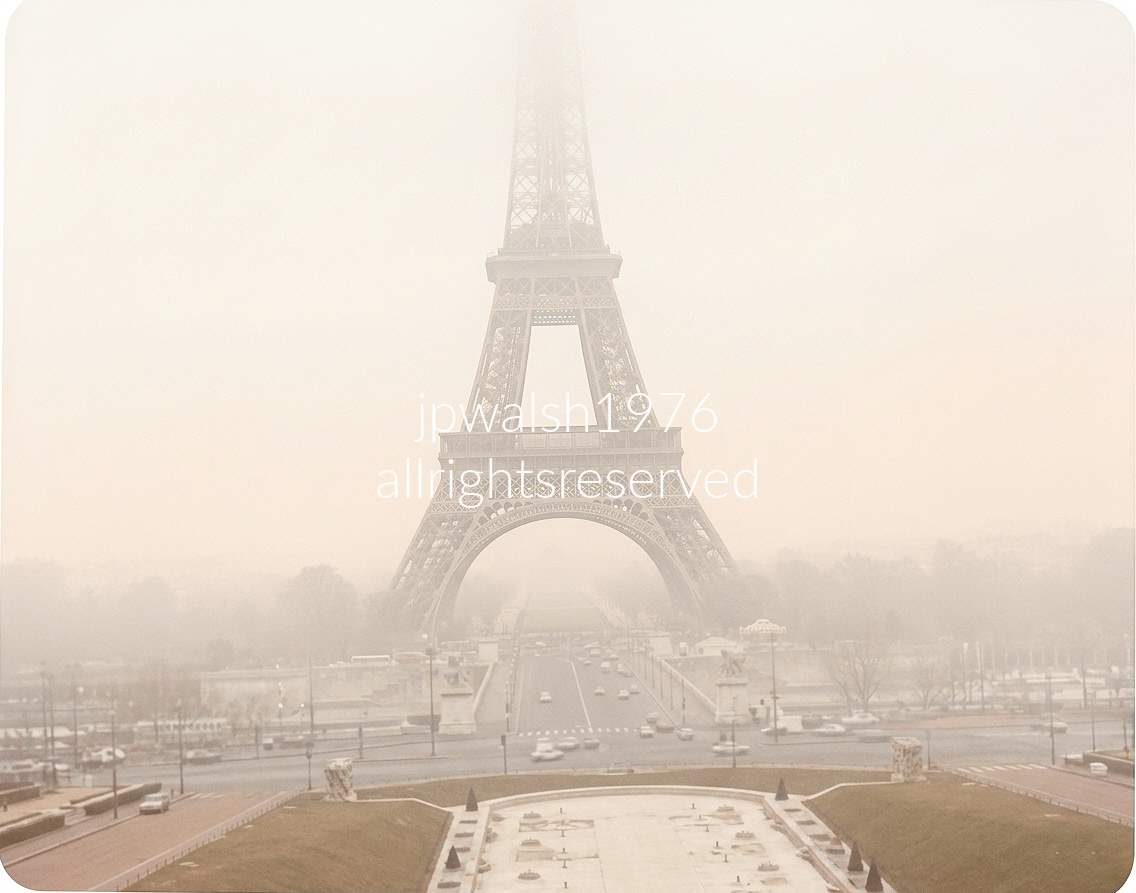
The deep freeze of late December 1976 created the exact meteorological conditions required to generate this heavy, persistent fog across Paris. While the ground and the water in the nearby Seine River were still releasing residual heat and moisture, the surrounding air temperatures were rapidly plummeting below freezing. When that rising moisture traveled upward and hit the freezing upper air currents, it instantly reached its dew point and condensed into a thick, dense cloud layer, slicing the upper architecture of the monument completely out of view while keeping the base visible.
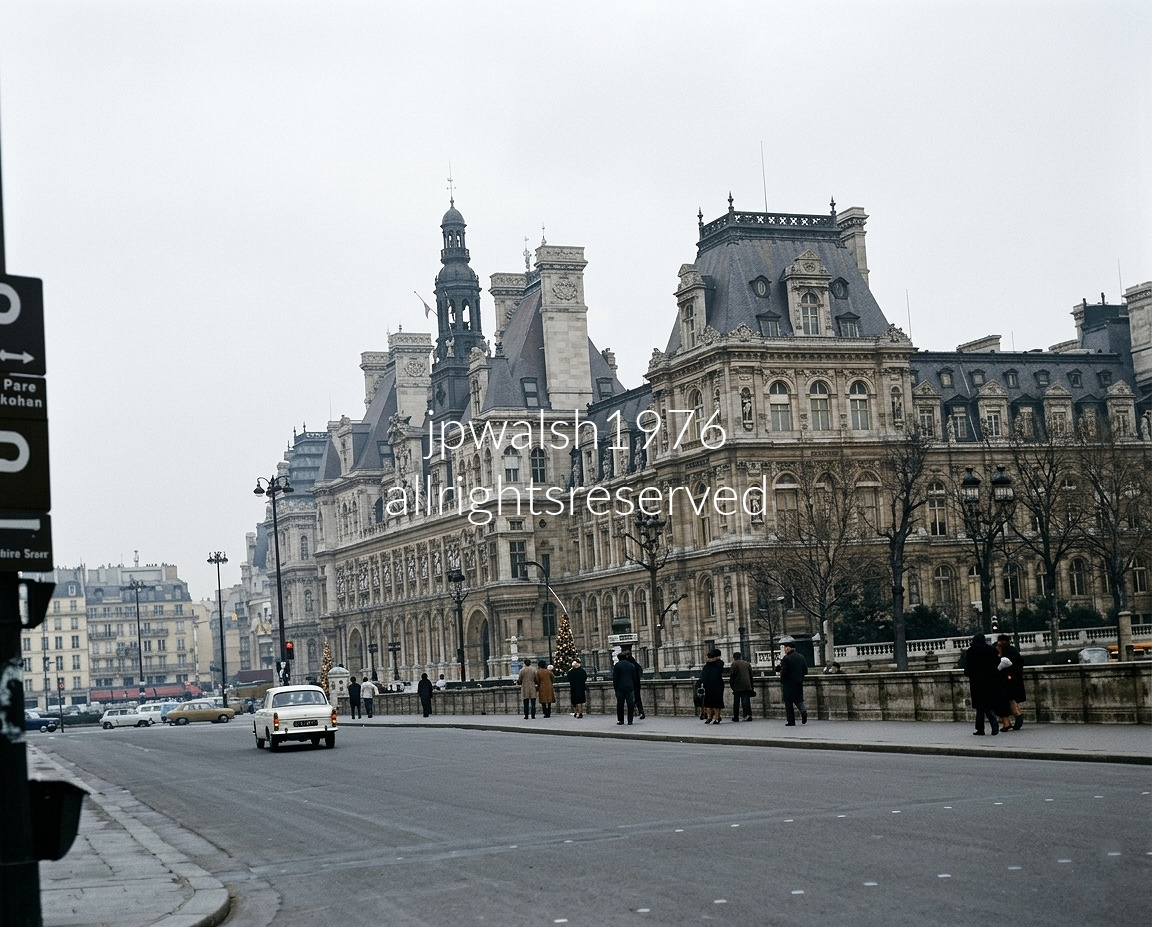
December 1976. Hôtel de Ville.
Crossing to England
In the morning we took a charter bus to Calais, ferried across the English Channel to Dover, and stopped in Canterbury, arriving late afternoon on December 28—the eve of St. Thomas Becket’s feast day, marking his martyrdom in Canterbury Cathedral in 1170, a major pilgrimage center since the 12th century. By nightfall we reached London.
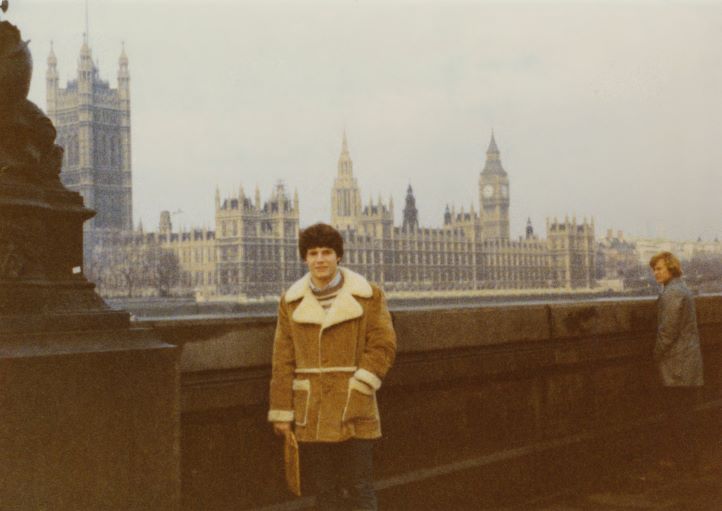
London, South Bank, December 1976. I’m in there somewhere walking briskly. Photographer unknown. Fair use. December 1976. Houses of Parliament, London.
London’s Theatrical Immersion
What struck me most in London was the sheer amount of theatre we chose to see: A Chorus Line, Equus, Jesus Christ Superstar, and Tom Stoppard’s new production of Jumpers. It was an unexpected cultural overload, and a defining part of the trip for me.
Food and Local Experiences
A group of us tried the strict 16th century “medieval feast” at the Gore Hotel at 190 Queen’s Gate, South Kensington, and later an East End Indian restaurant, widening our sense of the city’s food culture. Some of us even made speeches at Speakers’ Corner in Hyde Park.
Historic Sites and City Landmarks
We visited Windsor Castle, Hampton Court, Westminster Abbey, St. Paul’s Cathedral, the Tower of London, watched the changing of the Horse Guard at Buckingham Palace, and shopped at Harrods and Selfridge’s on Oxford Street.
Lessons in Travel
From this trip I learned several principles for fitting international travel into a busy life:
Keep it short.
Go off‑season when possible.
Be well prepared, and return to the same destination if it rewards repetition — as Samuel Johnson put it, “When a man is tired of London, he is tired of life; for there is in London all that life can afford.”
August 1978. Knappogue Castle, County Clare, Ireland. The castle tower was built in 1467. Author with Irish singer. 1.05mb
Three Weeks Across England, Wales, and Ireland (1978)
In 1978, I spent three weeks in England, Wales, and Ireland with my family on an American Express tour. London offered more theatre—Paul Scofield, Robert Morley—along with the British Museum, Westminster Abbey, Hampton Court, the Tube, and other staples of the city.
England and Wales: Castles, Cathedrals, and Cities
We visited Warwick Castle, Bath, Oxford, Bristol, Coventry, Stratford‑upon‑Avon, Salisbury, Chester, Liverpool, Llanfairpwllgwyngyll (the longest place name in Wales), and Holyhead, among many others.
Crossing to Ireland
We crossed the Irish Sea by ferry to Dún Laoghaire and continued to Jurys Hotel in Ballsbridge, where we stayed several days.
Touring Ireland
Our route took us south to Glendalough, New Ross (the Kennedy family homestead), Wexford, Waterford, Cork, the Blarney Stone, Killarney, the Ring of Kerry, and the Dingle Peninsula—including beach locations used in Ryan’s Daughter. We continued to the Cliffs of Moher, Cong and its surroundings (The Quiet Man locations), Limerick, and more.
Stonehenge (3100 B.C.)
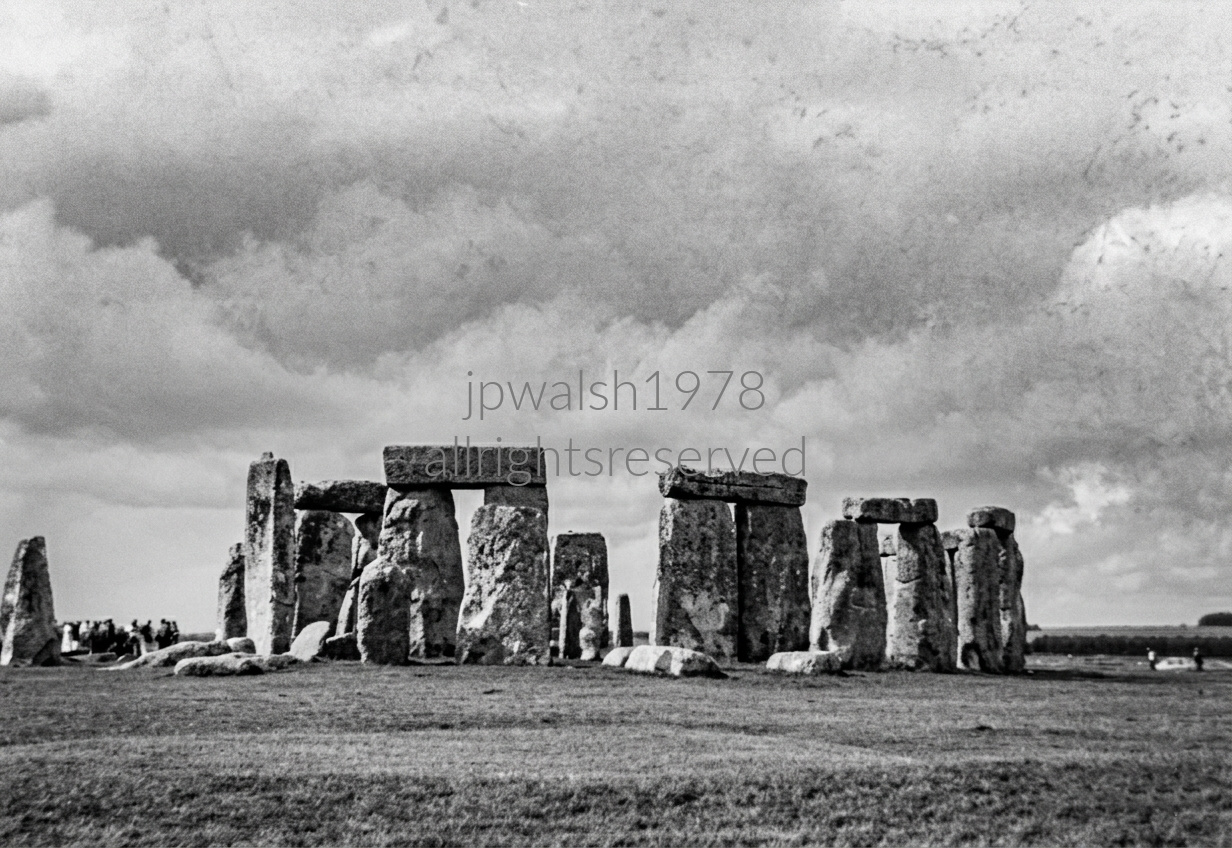
August 1978. Stonehenge.
On the wide sweep of Salisbury Plain in Wiltshire, a prehistoric megalithic circle rises from the grasslands, its stones aligned with the movements of the sun. Two miles west of Amesbury, the monument endures as a precise solar calendar left by builders who recorded nothing in writing.
August 1978.
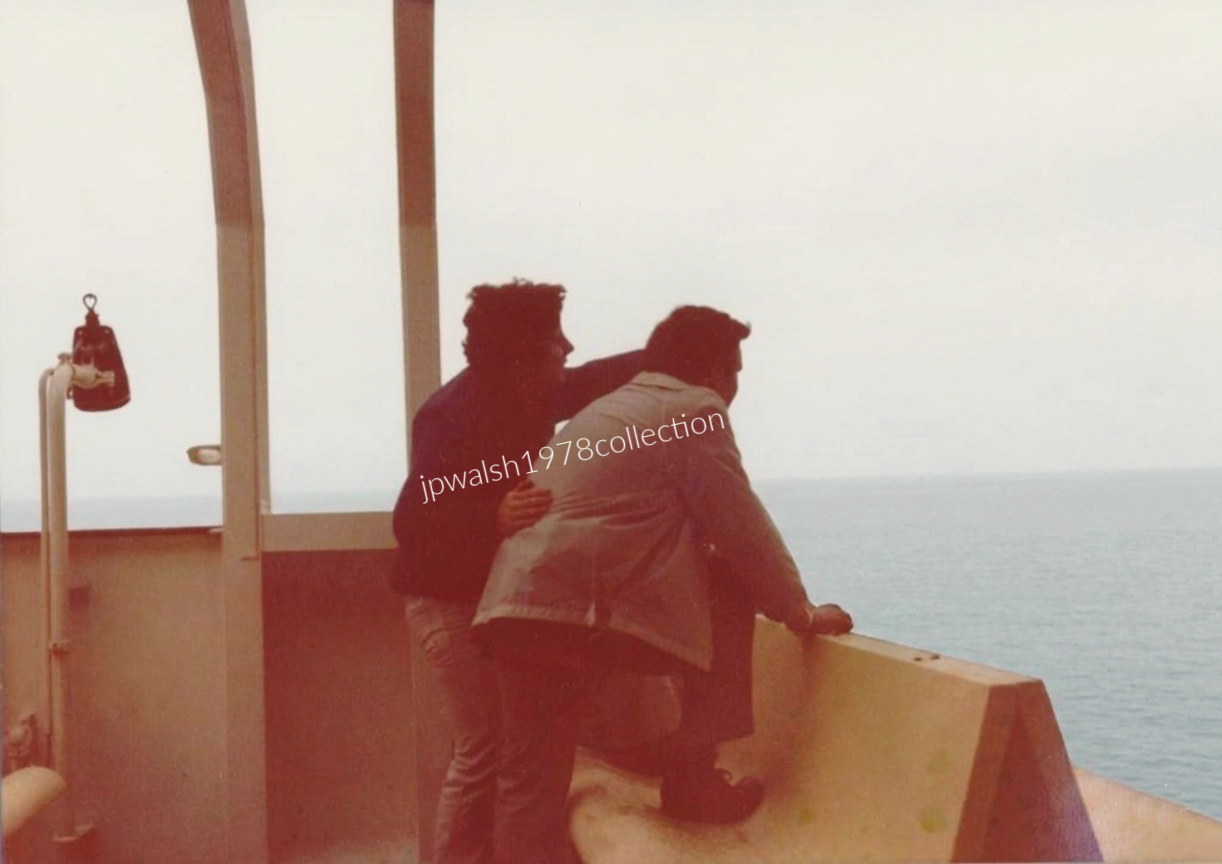
Me with my dad crossing the Irish Sea on the TS Avalon — a converted car ferry with all the charm and clatter of late‑1970s maritime engineering that was the backbone of the Holyhead–Dún Laoghaire run. It wasn’t glamorous, but it was unmistakable: steel decks, salt wind, and a steady churn across the channel that defined the era’s travel rhythm.
August 1978.
Me seated on a stone boundary wall directly outside the famous, historic thatched cottages on Main Street in Adare, County Limerick, Ireland. Built in the 1820s by the Earl of Dunraven for estate workers, these iconic thatched-roof buildings are protected architectural heritage landmarks. Today, they make Adare celebrated as one of the most picturesque villages in Ireland.
Ireland—Dublin (Summer 1979):
Trinity College (1592)
June 1979. I was studying medieval Irish history at Trinity College, Dublin, Ireland.
A Modernist Landmark at Trinity College
Opened in 1967, the Berkeley Library stands at Trinity College, Ireland’s oldest university, founded in 1592 by Queen Elizabeth I. Located in the heart of Dublin, the building is a clear example of Brutalist architecture—exposed concrete, a monochrome palette, steel, timber, and glass—reflecting a mid‑20th‑century move away from nostalgic styles in the United Kingdom.
Naming and Intellectual Legacy
The library was named for George Berkeley (1685–1753), the 18th‑century philosopher whose ideas on perception and reality anticipate aspects of Albert Einstein’s work. Berkeley had been a Trinity fellow and, fittingly, a former librarian of the college. He is also the namesake of the University of California, Berkeley and Berkeley College at Yale University.
Renaming in 2023
In 2023, Trinity’s governing board removed Berkeley’s name from the library after acknowledging his role as a slave owner and defender of slavery. The decision marked a significant reassessment of institutional commemoration.
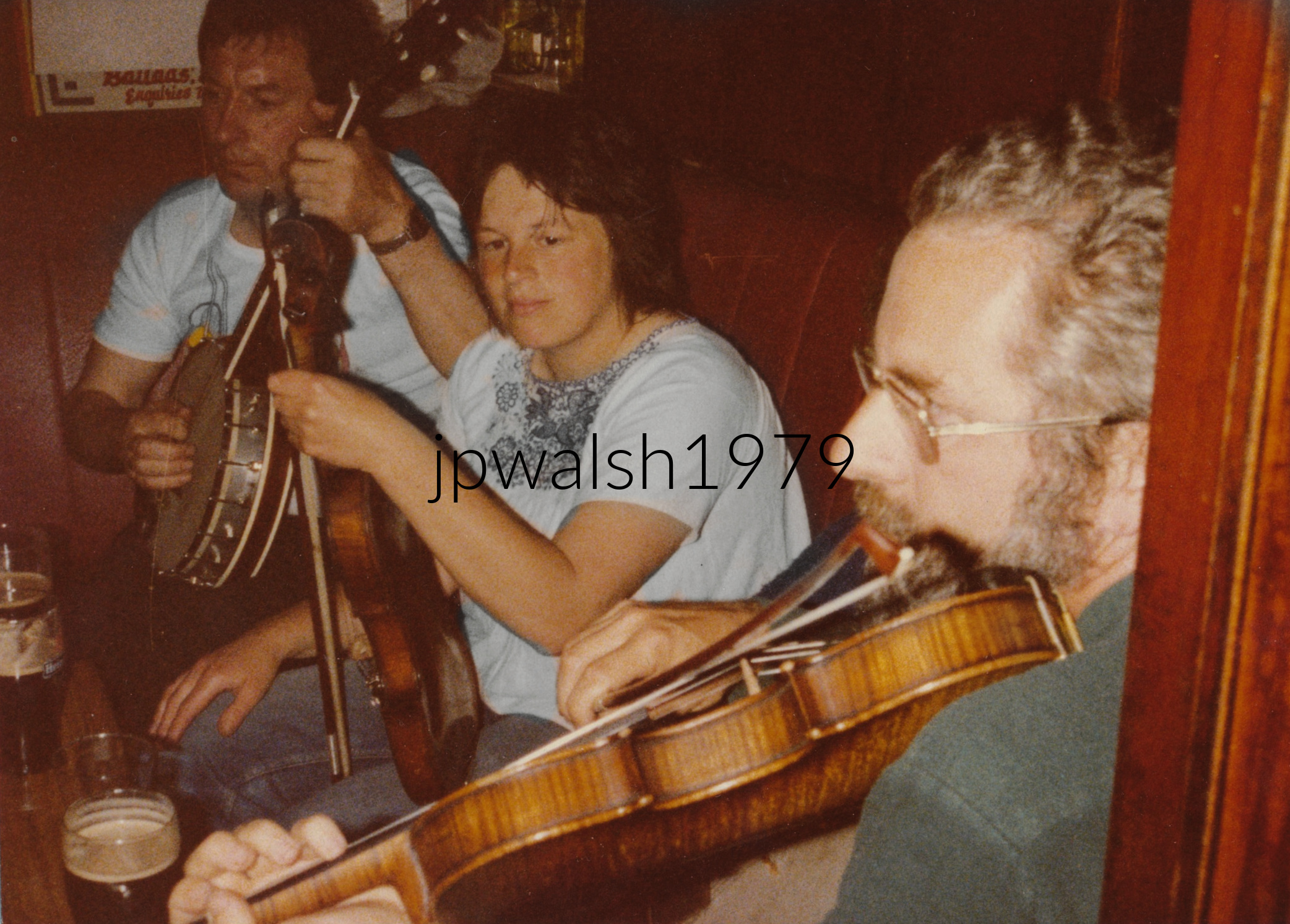
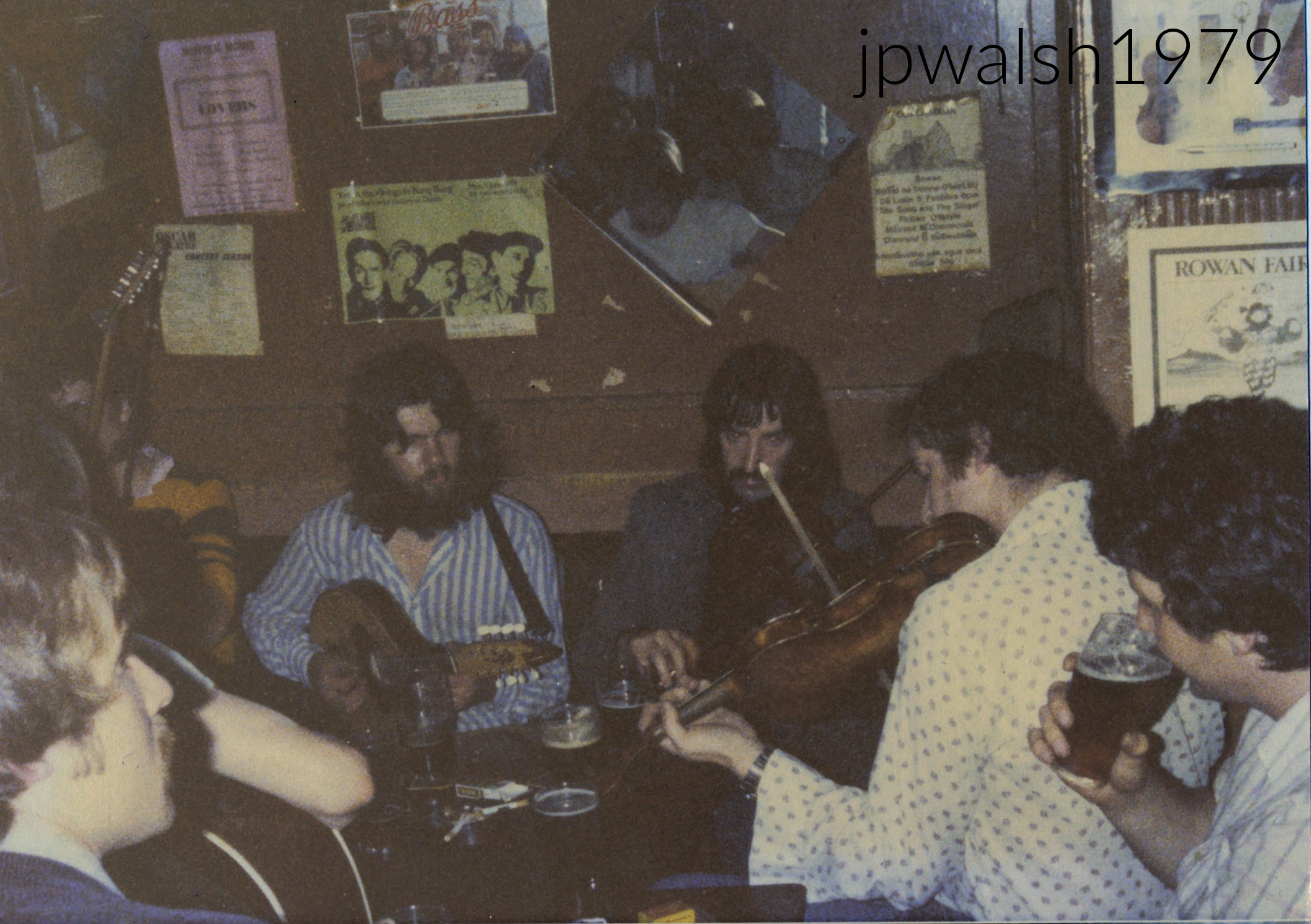
June 1979. O’Donoghue’s, Dublin.June 1979. O’Donoghue’s, 15 Merrion Row, Dublin, Ireland. June 1979. at O’Donoghue’s. 35%.A popular pub since the 1930s closely associated with Irish traditional music. It is where the Irish folk group, The Dubliners, got their start in the 1960s.
Jury’s Hotel (1963)
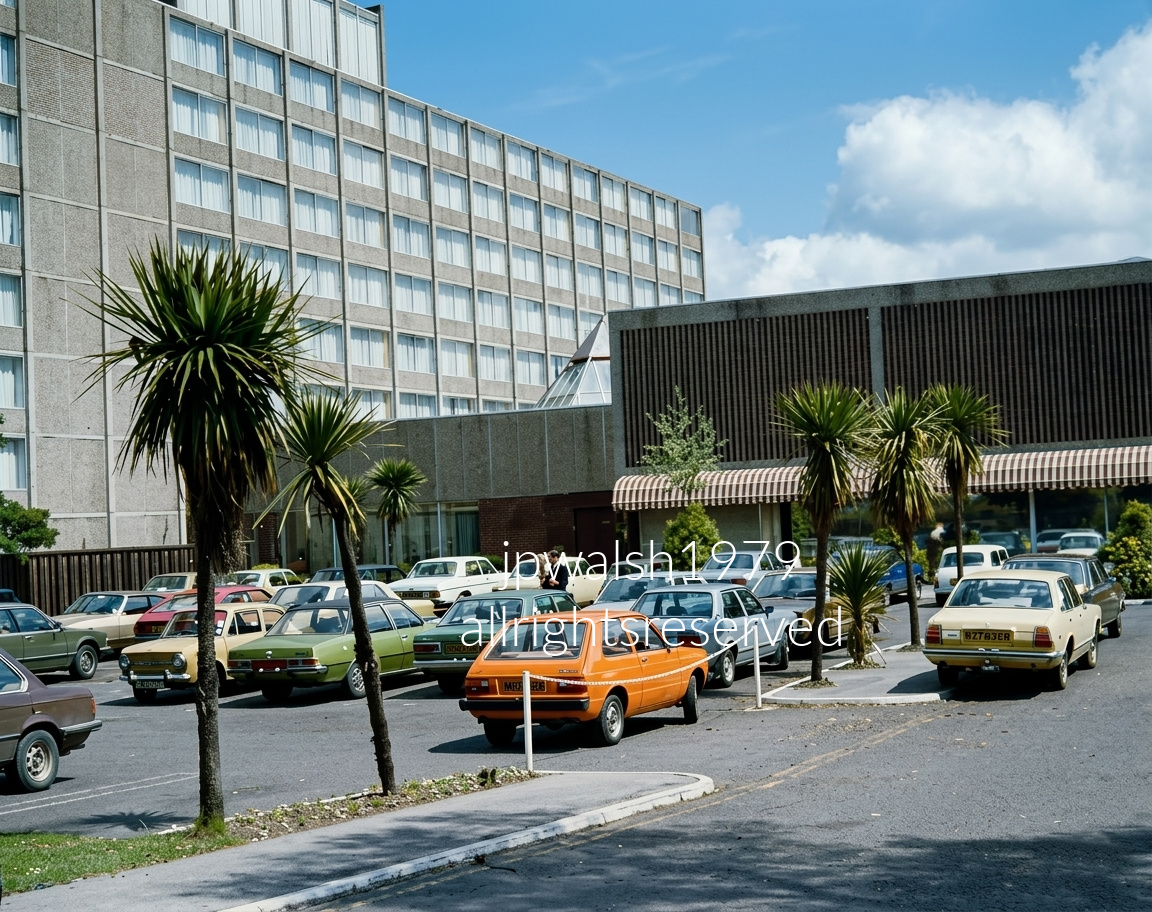
July 1979 — The original Jury’s Hotel (later the Ballsbridge Hotel) on Pembroke Road in Ballsbridge, Dublin, built in 1963 as a joint venture with Aer Lingus to serve as the city’s premier modern Intercontinental‑class hotel. Rebranded as Jury’s in the early 1970s, the property became a landmark of Dublin’s first wave of post‑war functionalist modernism—its tall, modular, concrete‑gridded guestroom wing rising on the left. The b lining the parking dividers evoke the unmistakable aesthetic of John Hinde‑era postcards, while the dense lineup of 1970s European family cars—saloon cruisers and a bright yellow hatchback centered in the frame—anchors the scene firmly in the mid‑to‑late decade.
The hotel closed permanently in 2019 and was purchased by the U.S. Department of State. The entire 4.2‑acre brutalist complex was subsequently demolished, and the U.S. government is now investing to construct a new, highly secure embassy compound on the site. The palm trees, the concrete modernist façade, and the mid‑century hospitality landscape captured in this photograph are gone—replaced by a fortified American diplomatic zone.
July 1979 — Signage on the foot path commute from Sandymount to Trinity College.
St. Stephen’s Green (1163; 1880)
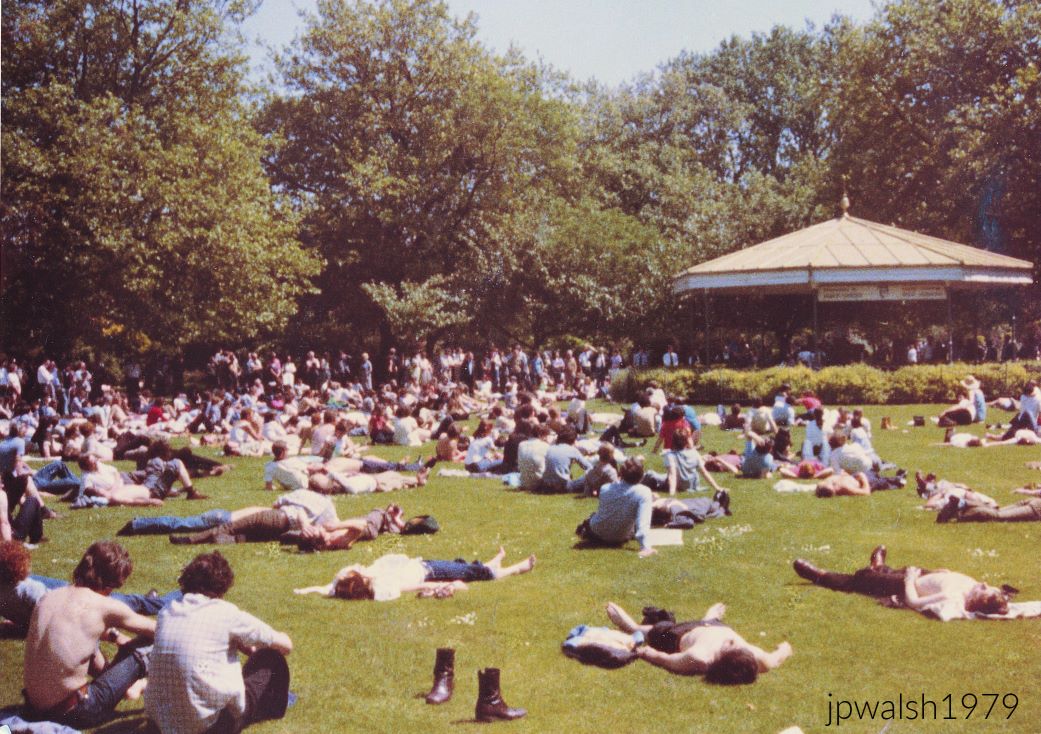
June 1979. Lunchtime concert in St. Stephen’s Green, Dublin.
Restricted Access in the Early 19th Century
In the early nineteenth century, St. Stephen’s Green was reserved exclusively for the gentry. An iron gate installed in 1815 was kept locked, with keys issued only to local residents. Working‑class Dubliners and the poor were barred entirely.
Opening the Green to the Public
Access remained restricted until 1877, when Lord Ardilaun (Arthur Guinness, 1840–1915) secured legislation in Parliament to open the Green to the public. He also funded the redesign and layout of the park in 1880, giving it the form recognizable today.
A Cross‑Section of Dublin Life
Nearly a century later, in 1979, the Green drew a broad cross‑section of Dubliners—university students, professionals, tradesmen, families, and visitors—a democratic contrast to its earlier exclusivity.
What is filmed on July 3, 1975 was very much like what was happening in the same place in 1979. The area surrounding the bandstand proved particularly popular with the park goers. Sunny St Stephen’s Green, Ireland 1975. https://www.youtube.com/watch?v=bbFU6ogKdB8 – retrieved November 7, 2024.
U.S. Embassy (1964)
June 1979. U.S. Embassy, Dublin.
A Modernist Landmark in Ballsbridge
Known officially as the Chancery Building at 42 Elgin Road, the U.S. Embassy occupies one of Dublin’s most prestigious addresses and stands as one of the city’s signature modernist structures. It opened in May 1964 on a triangular plot between Elgin and Pembroke Roads in Ballsbridge. I walked past it daily in the summer of 1979 on my way from Sandymount to Trinity College and the National Library.
Design and Symbolism
Designed by John M. Johansen (1916–2012), a Harvard professor, and Irish architect Michael Scott (1905–1989), the embassy’s circular form was conceived as an homage to ancient Celtic monuments—especially Newgrange—as well as round stone forts and Martello towers. Its geometry also referenced the original Stars and Stripes, with 13 stars symbolizing the original states.
Security and Expansion
By 2024, the embassy had erected tall perimeter gates and purchased the former Jurys Hotel site to begin constructing a new, larger embassy, marking a significant expansion after sixty years at the Elgin Road location.
Historic Postal Strike Parade, O’Connell Street (1979)
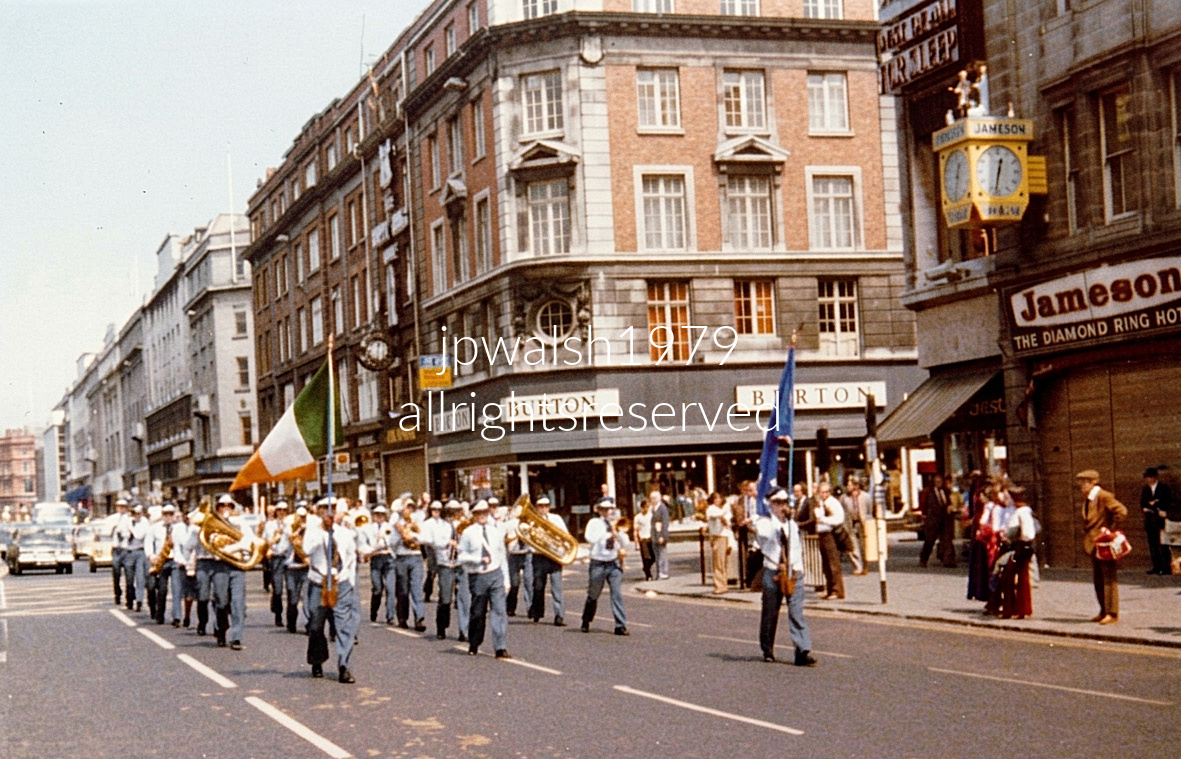
June 1979. Postal strike parade, Dublin, Ireland.
Start of the 1979 Strike
The strike by the Irish Post Office Workers Union began on February 19, 1979 and lasted 18 weeks. The 1979 Irish postal strike was the longest in the country’s history and the first major national postal dispute since the 1922 Postal Strike. Mail delivery stopped entirely, so during that early summer I could neither send nor receive correspondence normally to and from the U.S. Slowly we found ways around the stoppage: handing correspondence to American contacts returning stateside who could post them there— effective for outbound mail, but useless for anything coming the other way.
End of the 1979 Strike
When the strike ended in late June, postal workers received an average raise of £10. Although deliveries resumed on June 18, the system remained backlogged for months.
Delayed Acceptance of Mail
First‑class mail was not accepted again until July 9, and packages not until July 18. For all practical purposes, the service stayed functionally disabled throughout the entire sojourn.
In summer 1979, we went frequently to E. Borza Fish and Chips in Sandymount, across from Sandymount Green. The busy Borza family shop at 5 Sandymount Green, run for many years by Bruno and Angela Borza, served generations of locals for more than fifty years before closing permanently in early 2019. The takeaway began frying fresh fish and hand‑cut Maris Piper potatoes at this location in 1965. An archival television segment filmed in 1979 showed the Borzas buying fresh whiting at the morning Dublin fish market to supply their popular trade.
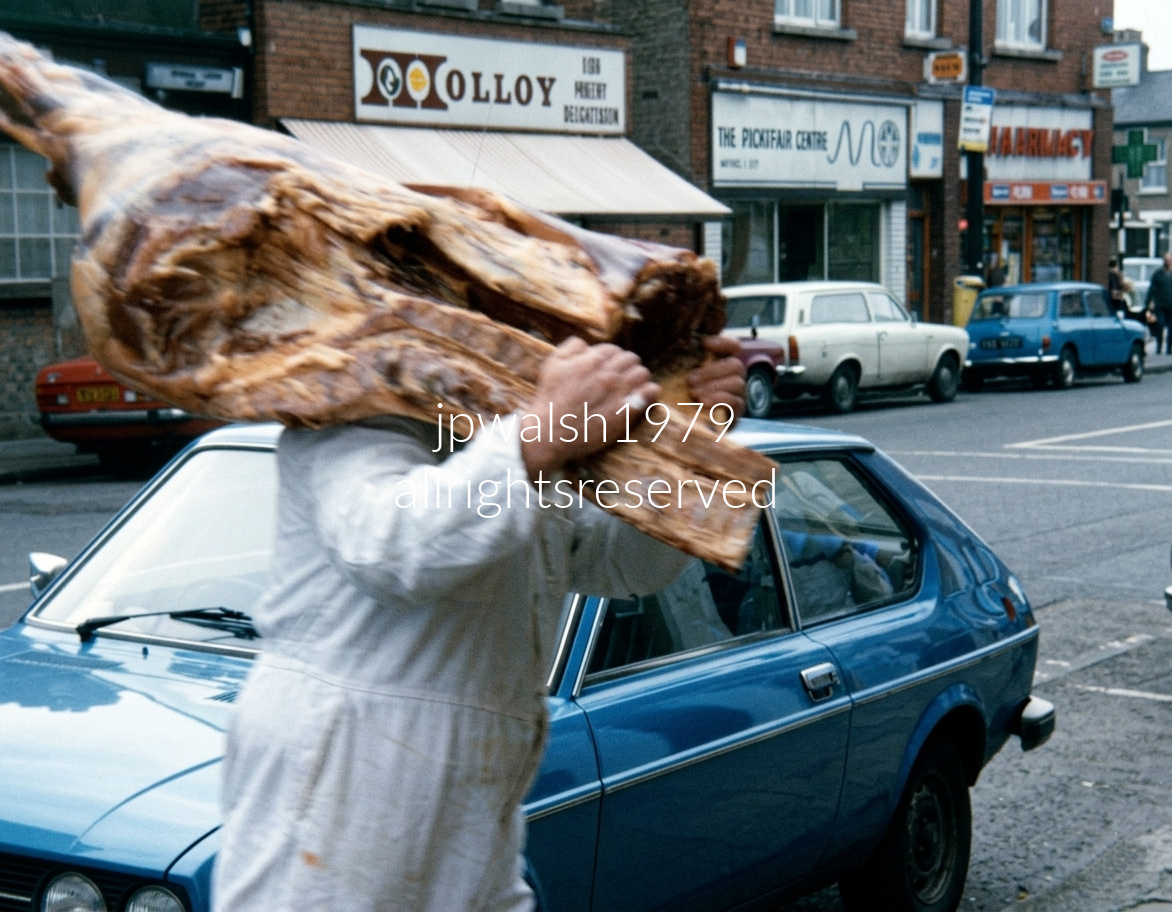
June 1979. Butcher shop, Sandymount.
Glendalough, 6th century
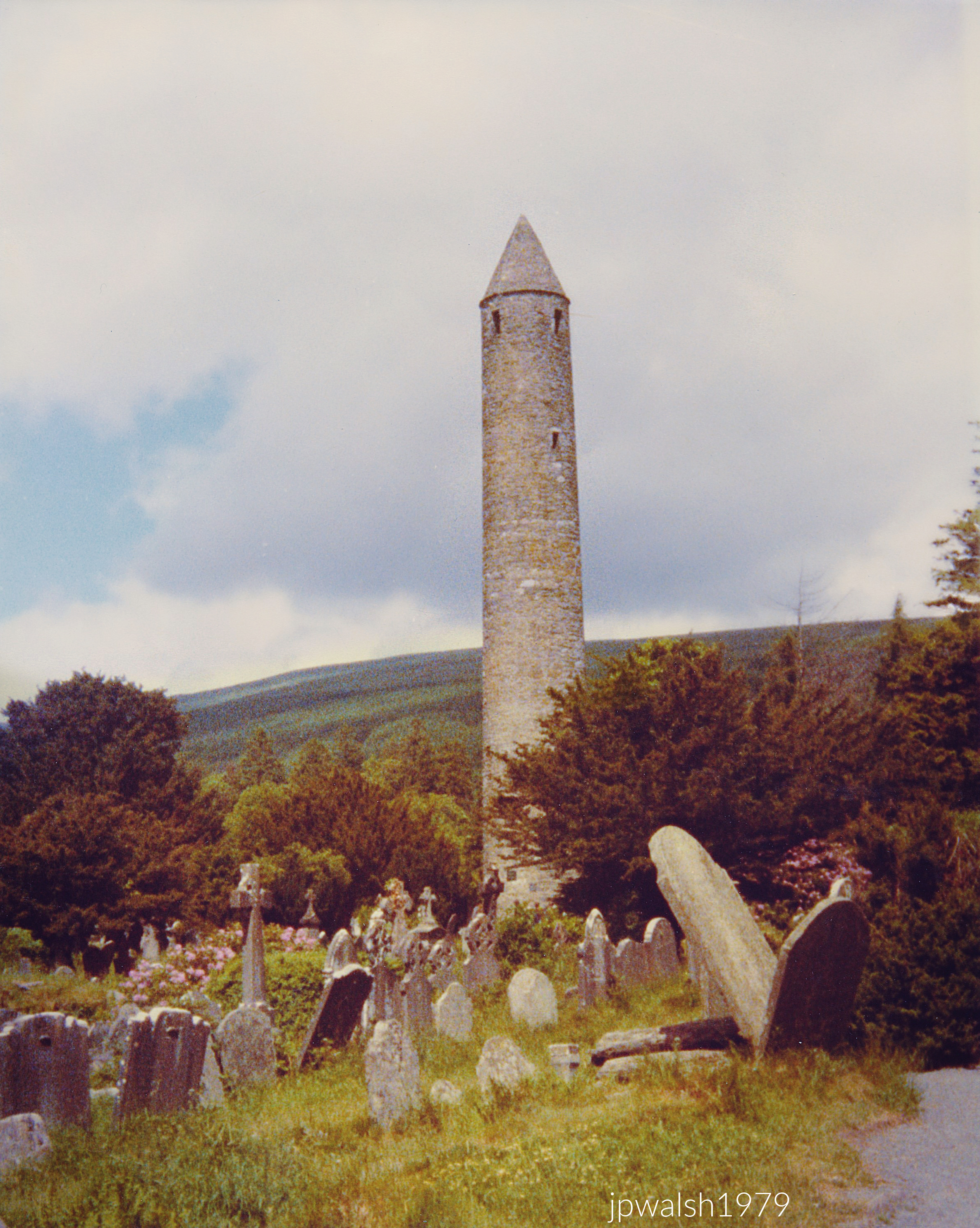
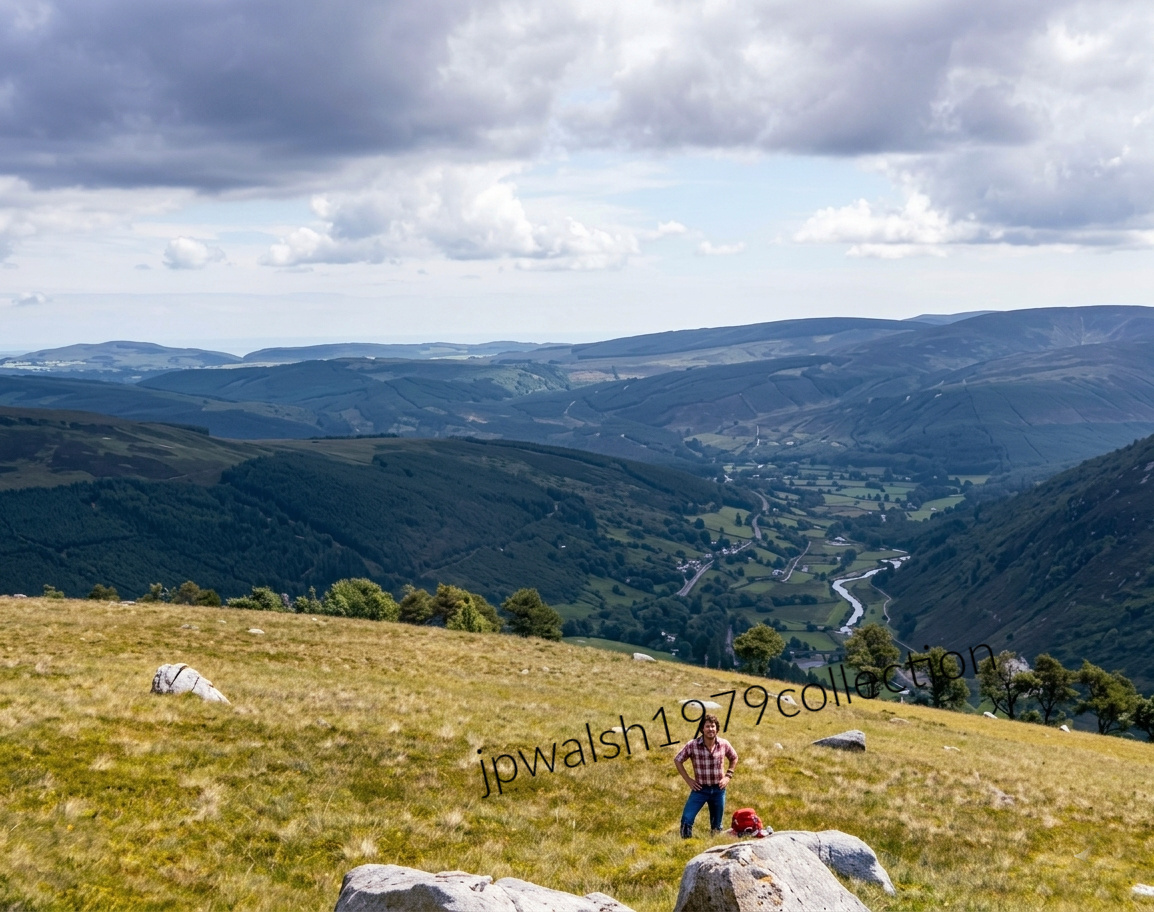
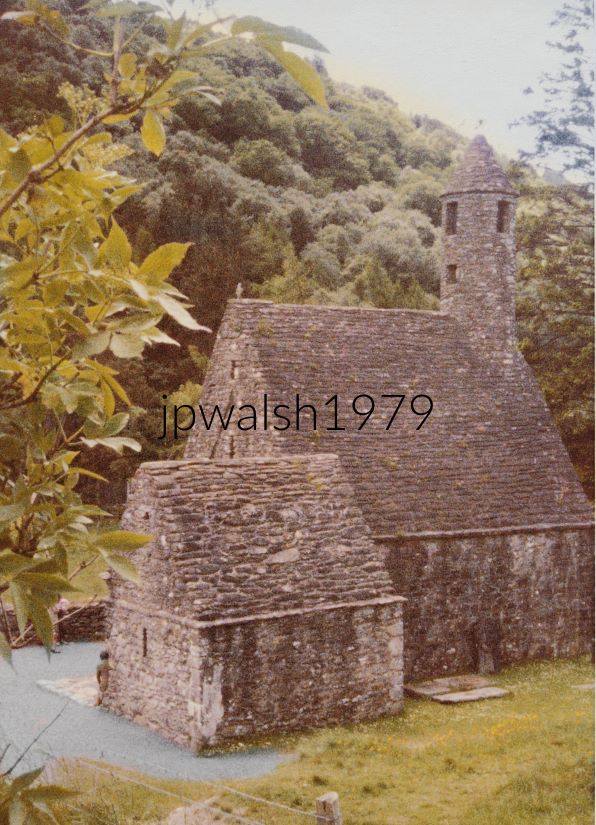
June 1979. The round tower at Glendalough in Wicklow County is a monastic settlement founded in the 6th century by St. Kevin (C. 498-618). June 1979. At our arrival, we hiked the hills above the monastic settlement of Glendalough.June 1979. St. Kevin’s Church, Glendalough.
Functions and Structure of the Tower
The tower served multiple purposes: bell tower, lookout (two of its four compass‑point windows mark this), marker for visitors, storehouse, and refuge during attack. Rising nearly 100 feet, it has an entrance set about five feet above ground level. Built of mica‑slate and granite, it once contained six timber floors, with its four stories connected by a network of ladders and windows. The conical rooftop, rebuilt in 1876, used the original stones.
Two Visits, Two Experiences
In 1978, I visited the monastic settlement in relative ease and comfort with my family. The following year was entirely different. My roommate and I hitchhiked from Sandymount in Dublin to Enniskerry, slept outdoors near Powerscourt, and then walked much of the way into the wilderness of Sugar Loaf Mountain along the Old Military Road, built by the British during Wolfe Tone’s 1798 rebellion. Alone among sheep and peat bogs—the Liffey’s source lies here—we finally caught a ride to Laragh, stopped at Patsy’s for tea and scones, and continued to the hostel at the monastic site. After a beautiful first day, rain arrived that evening and stayed. We took the bus back to Dublin, showered, changed at the chalets, and later walked with two friends to Sandymount House on a busy Sunday night, settling in for talk and a couple of unforgettable Guinness pours.
St. Kevin of Glendalough
St. Kevin—my younger brother’s namesake—lived in the 6th century and is often compared to St. Francis of Assisi. Like Francis, Kevin wore rough clothing, slept on stones, ate sparingly, went barefoot, and devoted himself to prayer. He shared an extraordinary closeness to nature; animals and birds were his regular companions. St. Kevin of Glendalough was canonized in 1903 by Pope Pius X.
Galway City
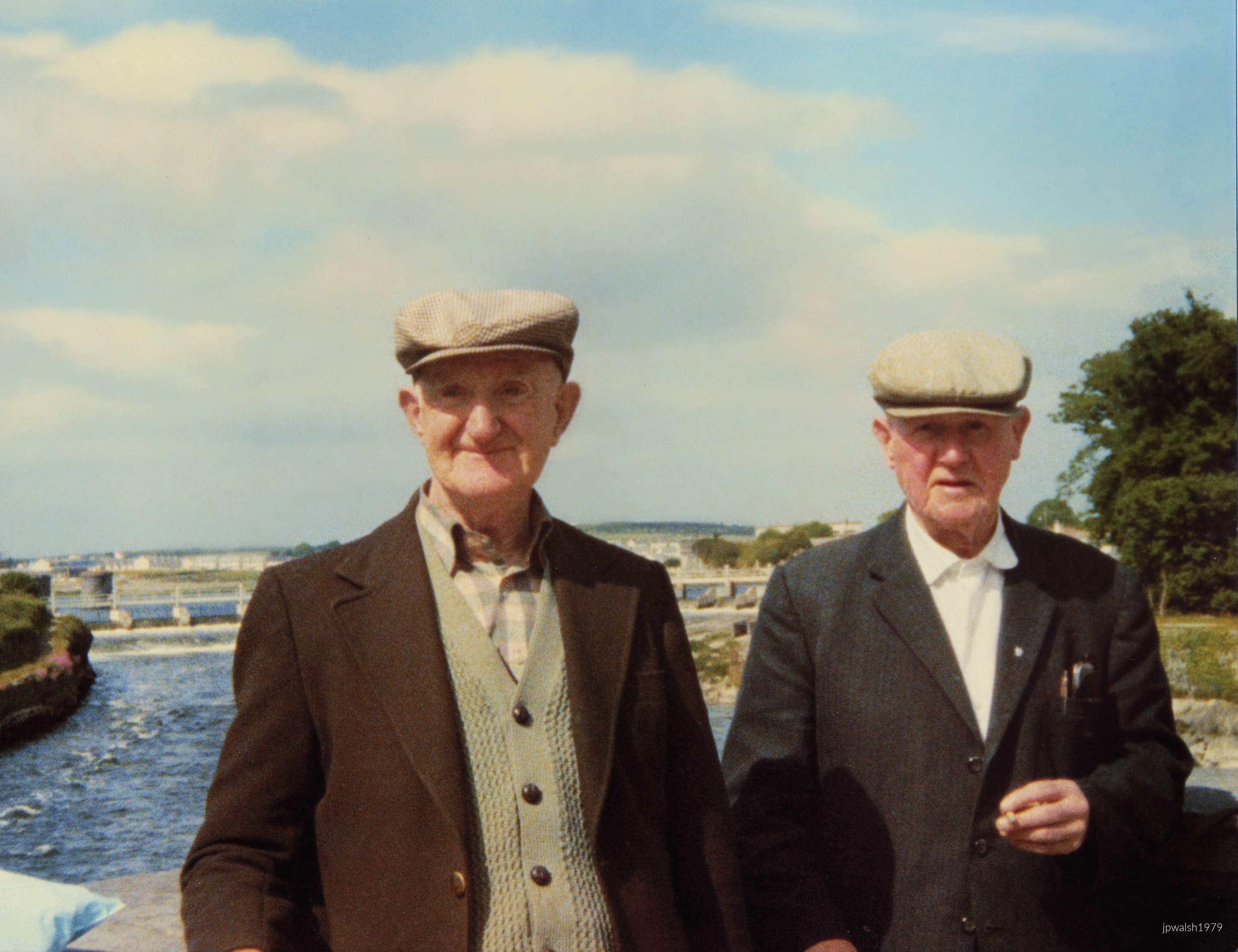
July 1979. Galway City. On the Salmon Weir Bridge over the River Corrib. July 1979. Galway City Farmers’ market.
Galway City to the Aran Islands
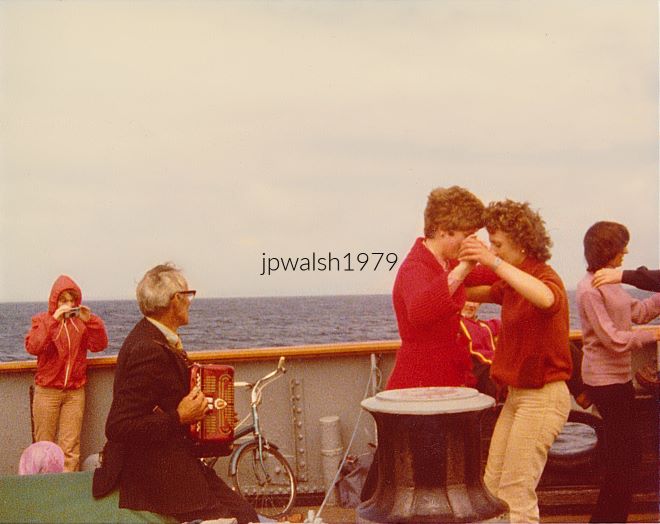
July 1979. Dancing and music as passengers traveled on the Galway Bay ferry to the Aran Islands.July 1979. Ferry from Galway to the Aran Islands.July 1979. Outbound Galway Bay.July 1979. Ferry from Galway to the Aran Islands.
Inishmore (Aran Islands)
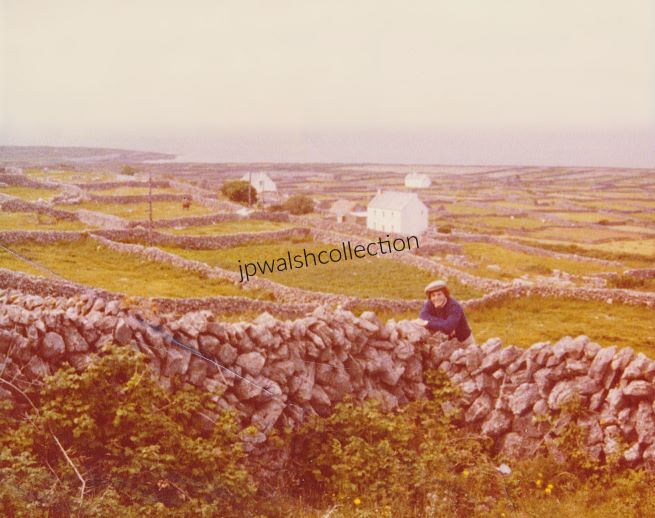
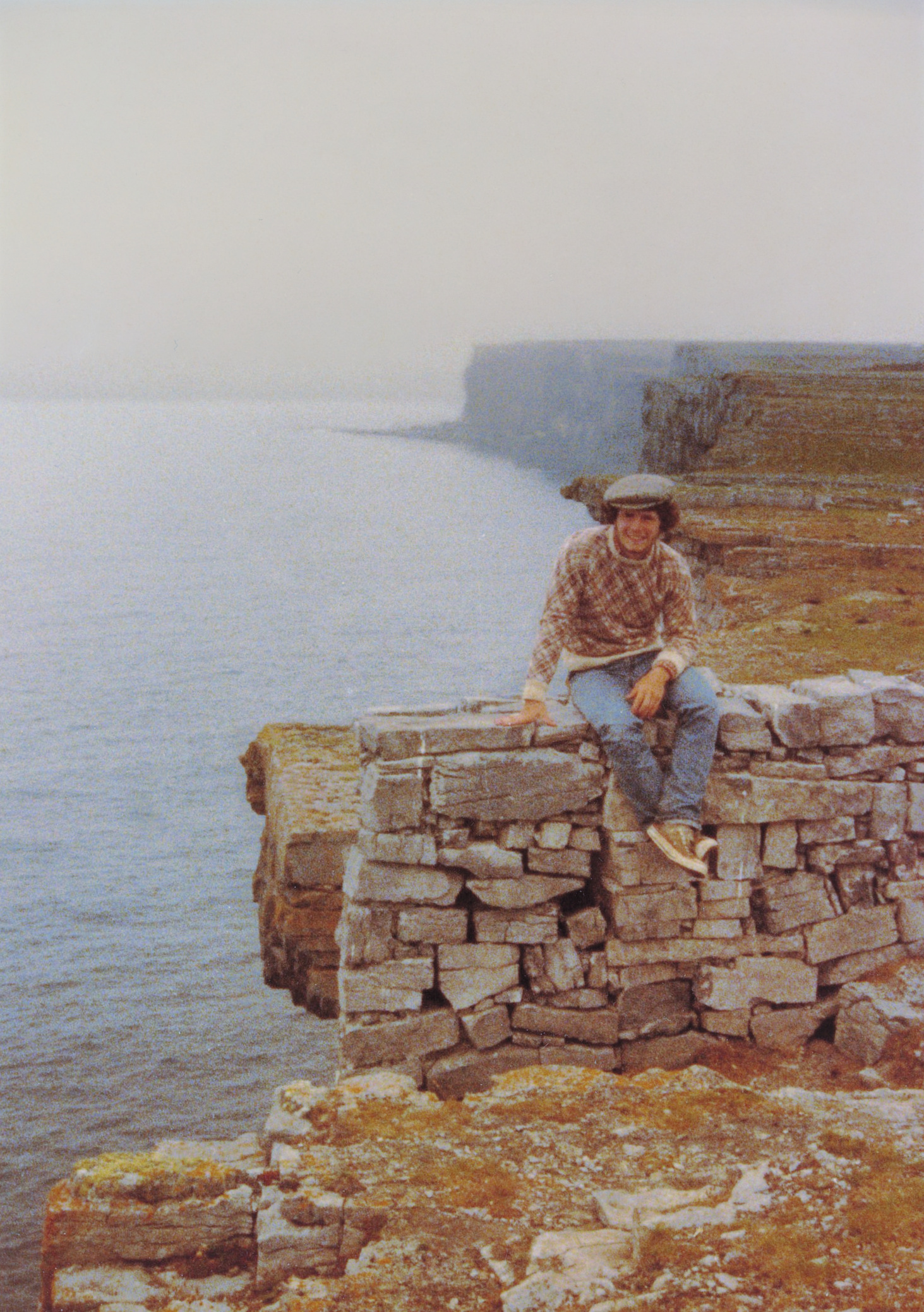
July 1979. Inishmore.
Dun Aengus (1100 B.C.), Inishmore
July 1979. Dun Aengus. The vertical drop from this edge straight down to the Atlantic and the craggy rocks below is 330 feet.
Inis Mór: The Largest Aran Island
Inis Mór, the largest of the three Aran Islands in Galway Bay, covers 12 square miles and has a population of under 1,000. It is part of the official Gaeltacht, where Irish remains the predominant language of the home.
Landscape and Local Life
The photograph shows the island’s typical rocky terrain, a defining feature of the Aran landscape. Late in a long day of touring, I stopped into a busy pub filled with locals for a Guinness. I was eventually after unsuccessfully catching the bartender’s eye for a while—an unhurried rhythm befitting the island.
Dún Aengus
The prehistoric hill fort of Dún Aengus, perched on the cliffs of Inis Mór, is one of Ireland’s most dramatic archaeological sites. Roughly half of the circular fort has fallen into the Atlantic Ocean 330 feet below. Excavations show that the fort dates back to at least 1100 B.C., anchoring the island’s human history deep in the prehistoric era.
July 1979. Dun Aengus. The Atlantic coast on Inishmore.
France — Paris.
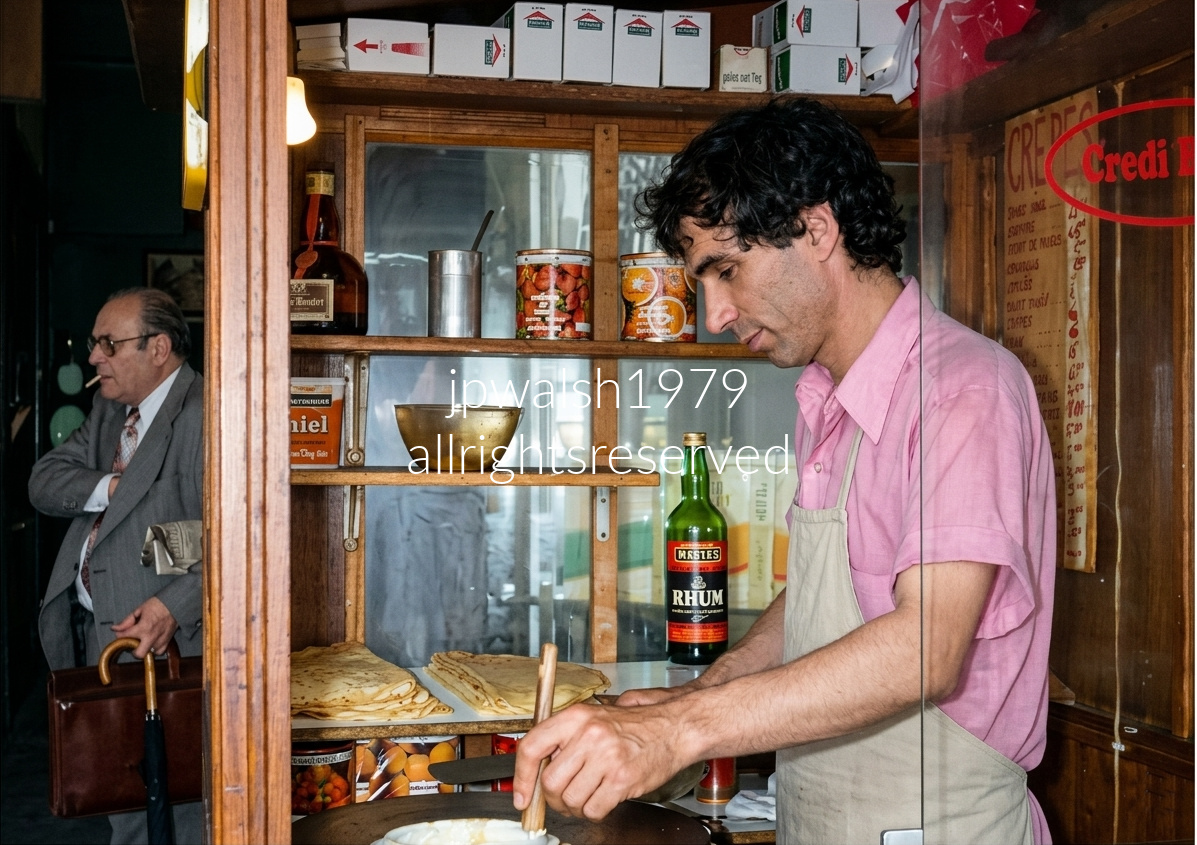
July 1979. Paris.
Left Bank crêperie stand, Paris — a traditional crêpier works the hot cast‑iron billig with a wooden rozell, spreading batter in perfect circles. Behind him, shelves brim with classic ingredients for sweet and flambéed crêpes; a bottle labeled “RHUM” catches the eye, ready for a fiery Crêpe Suzette. To the left, a customer in a suit smokes. On the right window, a red stamp‑style sign trimming off the final “-t” reads “Crédit…,” the familiar Parisian joke that ends “est mort”—credit is dead, cash only. The scene glows with the timeless rhythm of street craft and café wit, a snapshot of everyday artistry on the Left Bank in the last summer of the 1970’s.
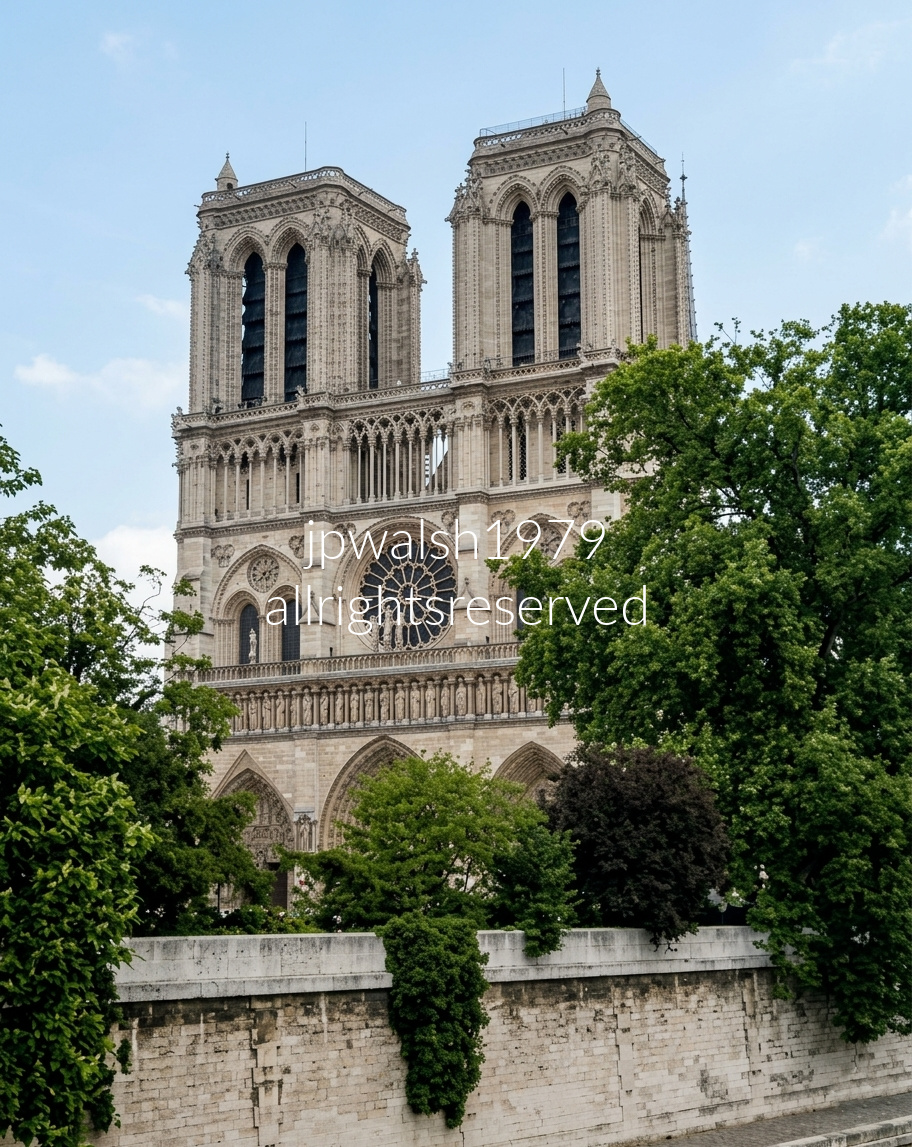
July 1979. Notre Dame. July 1979. Paris.
Boulevard de Clichy in the Montmartre area of Paris, France. The crowded, rising path flanked by historic Haussmann‑style architecture is Rue de Steinkerque, which leads on foot directly to the Sacré‑Cœur Basilica, perched atop the Montmartre hill.
July 1979. Paris.
Place du Tertre in the Montmartre district of Paris, France. The background features the historic Belle Époque‑era restaurant and cabaret La Crémaillère 1900, which was refitted in 1926 into the traditional dining and performance venue seen today.
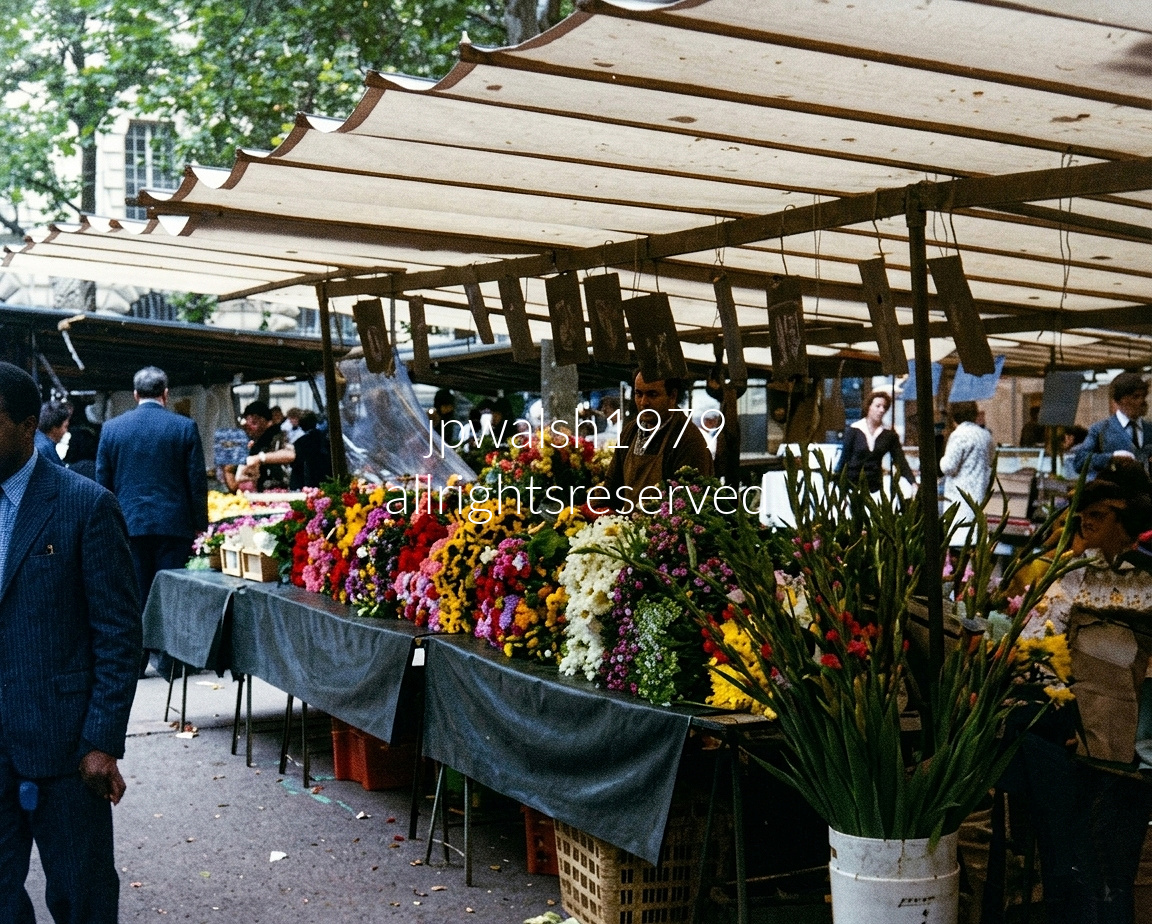
July 1979. Paris.
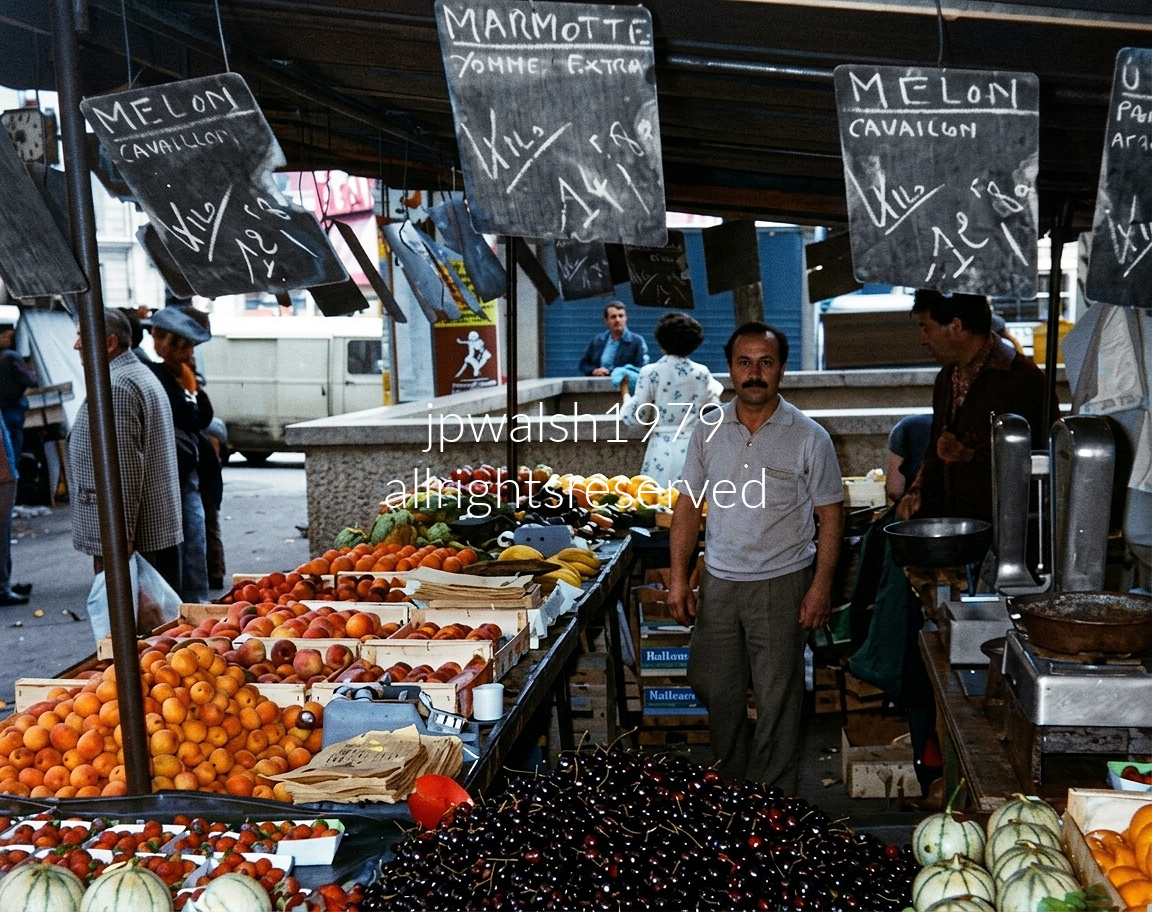
Under cream-colored canvas canopies with scalloped brown trim, the open-air stalls of Marché Maubert line Place Maubert in Paris’s 5th arrondissement. Founded in 1547, this is one of the city’s oldest neighborhood markets. Here, vendors lay out massive, vibrant bundles of fresh-cut French blossoms alongside generous piles of regional produce, featuring summer standouts like sweet Charentais melons from Cavaillon. Peeking out in the background, the classic stone masonry, wrought-iron balconies, and tall windows of historic Latin Quarter apartment buildings surround the bustling square through the chestnut trees.
July 1979. Paris.
England — London.
July 1979. London.
Trafalgar Square, London. Nelson’s Column, built between 1840 and 1843, commemorates Admiral Horatio Nelson, who died securing victory at the Battle of Trafalgar in 1805. Rising roughly seventeen stories, the monument is anchored by four monumental bronze lions sculpted by Sir Edwin Landseer and installed in 1867. The surrounding square, laid out in the 1820s by architect John Nash, remains one of London’s central public gathering spaces and a major cultural landmark.
July 1979. British Museum, London.
Elgin Marbles (447 -432 BCE). The left side of the East Pediment of the Parthenon unfolds as a rising sequence of divine presences, each catching the first light of Helios as dawn breaks over the world. Reading left to right, the sculptural group moves from the surge of cosmic energy to the calm poise of Olympian order:
Helios, the Sun God, bursts into the scene at the far left, his chariot horses straining upward as they emerge from the sea’s horizon — the visual metaphor for sunrise. His powerful, forward‑driving motion sets the tempo for the entire pediment.
Next reclines Dionysus — sometimes interpreted as Heracles — a youthful, muscular figure resting with effortless confidence, his body turned toward the unfolding drama at the pediment’s center.
To his right sit the serene pair of Demeter and Persephone — though some scholars propose Leto and Artemis instead. Their quiet, composed presence anchors the composition, embodying divine stillness in contrast to Helios’s kinetic surge.
Standing beside them is Iris, the fleet‑footed messenger goddess. Her drapery clings in wind‑swept folds as she moves with purposeful grace, a subtle transition figure leading the eye toward the central birth scene of Athena.
Italy – May 1983:
Florence
May 1983. Florence, Italy.
Michelangelo’s David in Florence
Michelangelo’s David, carved c. 1501–1504, has stood in the Galleria dell’Accademia since 1873.
Symbol of Florentine Liberty
The biblical David became a civic emblem for Florence, representing the defense of civil liberties embedded in the 1494 republican constitution — an independent city‑state resisting pressure from larger regional powers and the ambitions of the Medici family.
Rome
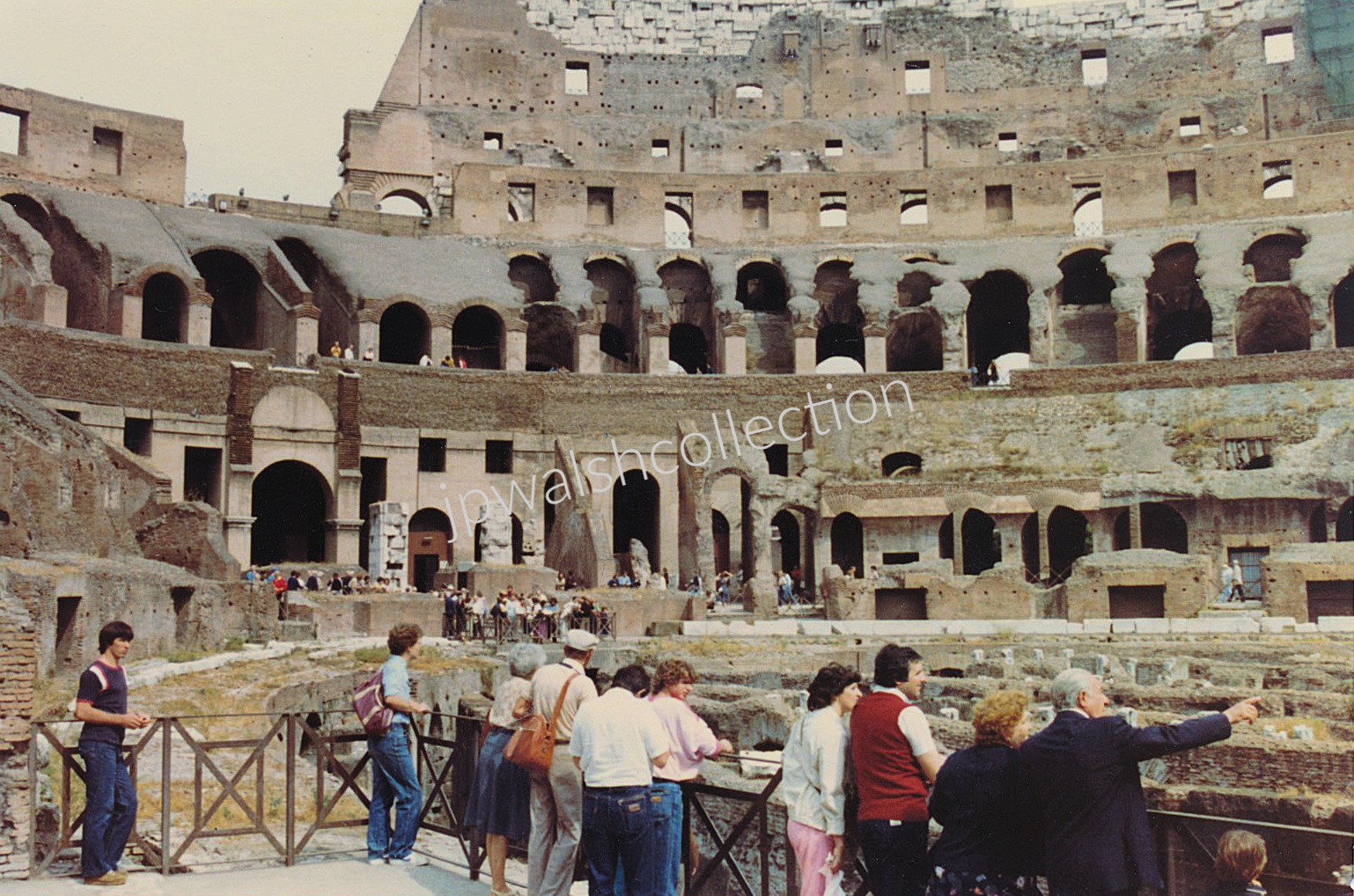
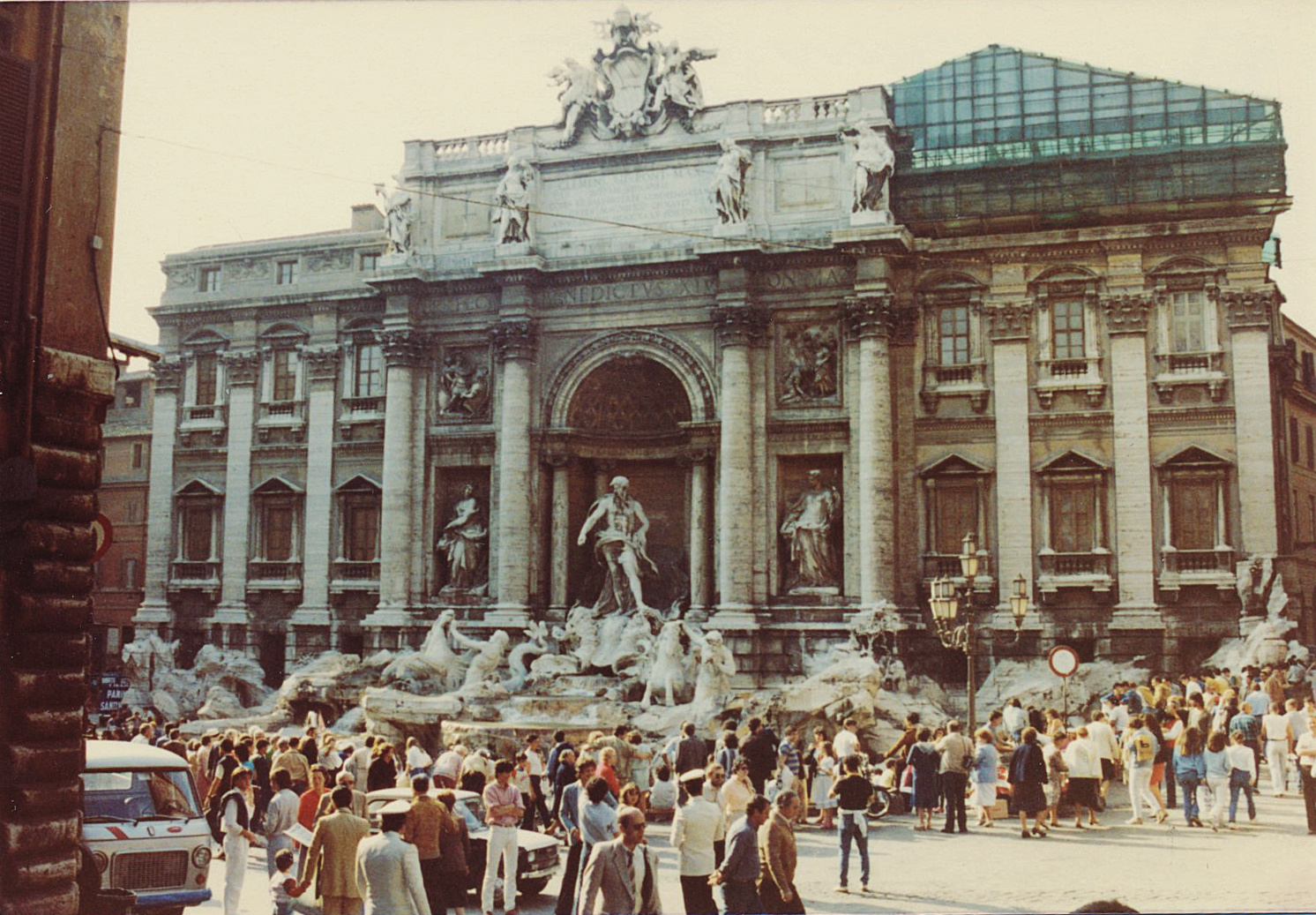
May 1983. Colosseum, Rome.May 1983. Trevi Fountain, Rome.
La Dolce Vita, 1960
Federico Fellini’s La Dolce Vita (1960) features an ensemble cast led by Marcello Mastroianni and Anita Ekberg. According to Ekberg, the famous Trevi Fountain scene was filmed in late January. Mastroianni’s character, Marcello Rubini, is a tabloid journalist drifting through Rome in a fruitless search for its “sweet life.” The news photographer Paparazzo (played by Walter Santesso) gave rise to the modern term paparazzi for intrusive celebrity photographers.
Three Coins Tradition
“The tradition is that you throw one coin if you want to return to Italy, two coins for romance, or three coins if you want to get married.”
Three Coins in the Fountain, 1954
Filmed in De Luxe color and Cinemascope, Sol Siegel’s Three Coins in the Fountain (1954) follows three American women finding romance in Rome. Shot on location, it won Academy Awards for Best Cinematography (Milton Krasner) and Best Song (Jule Styne and Sammy Cahn). Though narratively thin, it was a major box‑office success. Nominated for Best Picture, the film starred Dorothy McGuire, Maggie McNamara, Jean Peters, Rossano Brazzi, Louis Jourdan, and Clifton Webb. Variety praised it for “warmth, humor, a rich dose of romance and almost incredible pictorial appeal.”
Europe— Summer 1984:
France—Paris.
Eiffel Tower (1889)
June 1984. Eiffel Tower, Paris, 7th arr., France. 15%
Galeries Nationales du Grand Palais (1900)
June 1984. “Tresors de l’ancien Nigéria,” Galeries Nationales du Grand Palais, May 16 – July 23, 1984. Paris. 15%June 1984. Paris.
Intersection of Rue de Turenne and Rue de Parc-Royal (3rd).
Fontaine des Mers (1840)
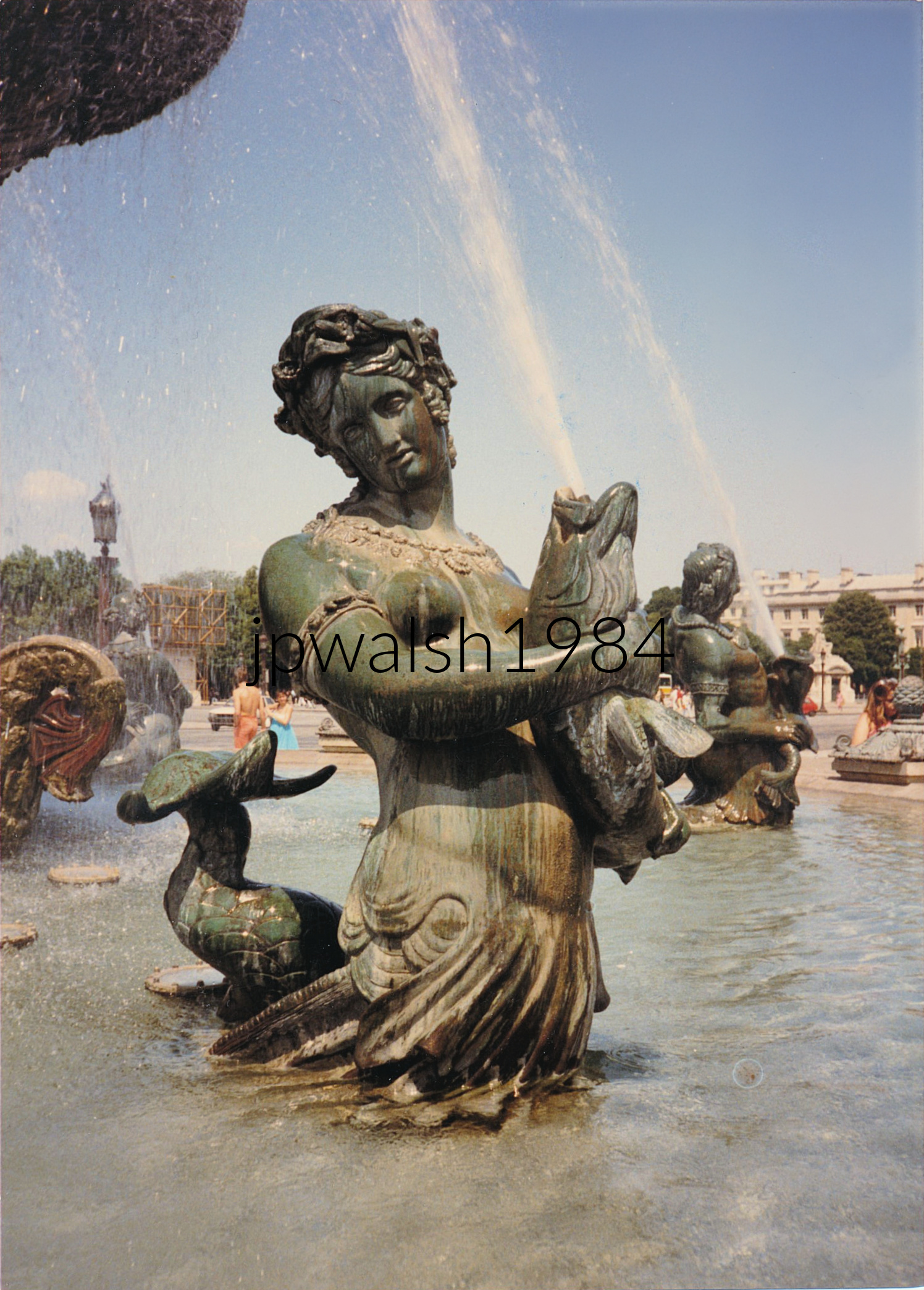
June 1984. Fontaine des Mers, Place de la Concorde, Paris. Two monumental fountains in this largest square in Paris were designed by Jacques Ignace Hittorff (1792-1867) and completed in 1840.
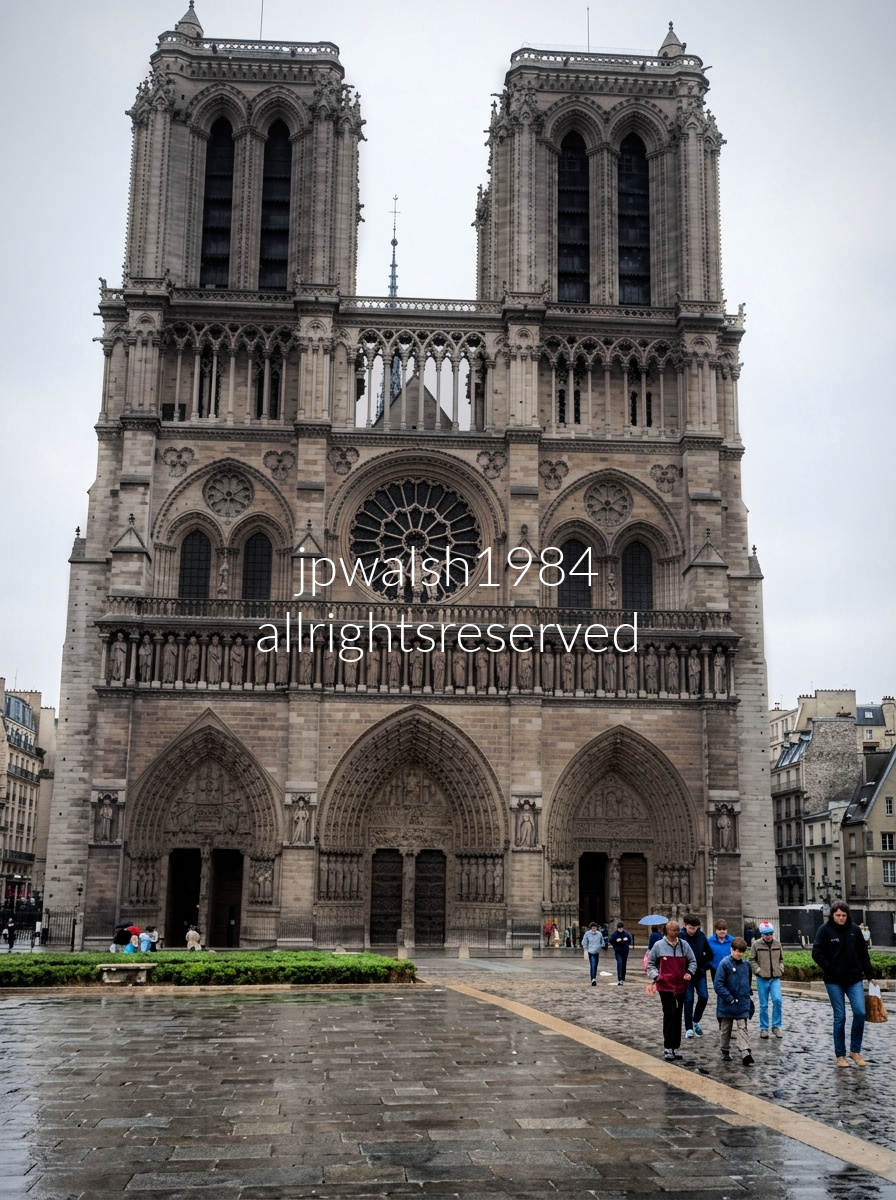
The year 1984 was a milestone period for travel to France when 1.9 million Americans visited France in 1984, setting a historic, record-breaking tourism high for the country up to that point. This era cemented Notre-Dame as a textbook example of “mass tourism,” prompting the city to permanently reconsider how crowd management, safety, and tour buses utilized the historic Île de la Cité island.
June 1984. Notre Dame de Paris on a sunny day.
In 1984, France welcomed 1.9 million American visitors, and Paris itself saw roughly four million total tourists—numbers that still allowed the city to function as a city rather than a global attraction system. By 2025, France drew more than five million American visitors, a 17 percent jump from 2024, and Paris tried to absorb an astonishing 38 to 40 million tourists. At that scale, Paris doesn’t just feel like Disneyland—it operates like one today, because the math forces it to.
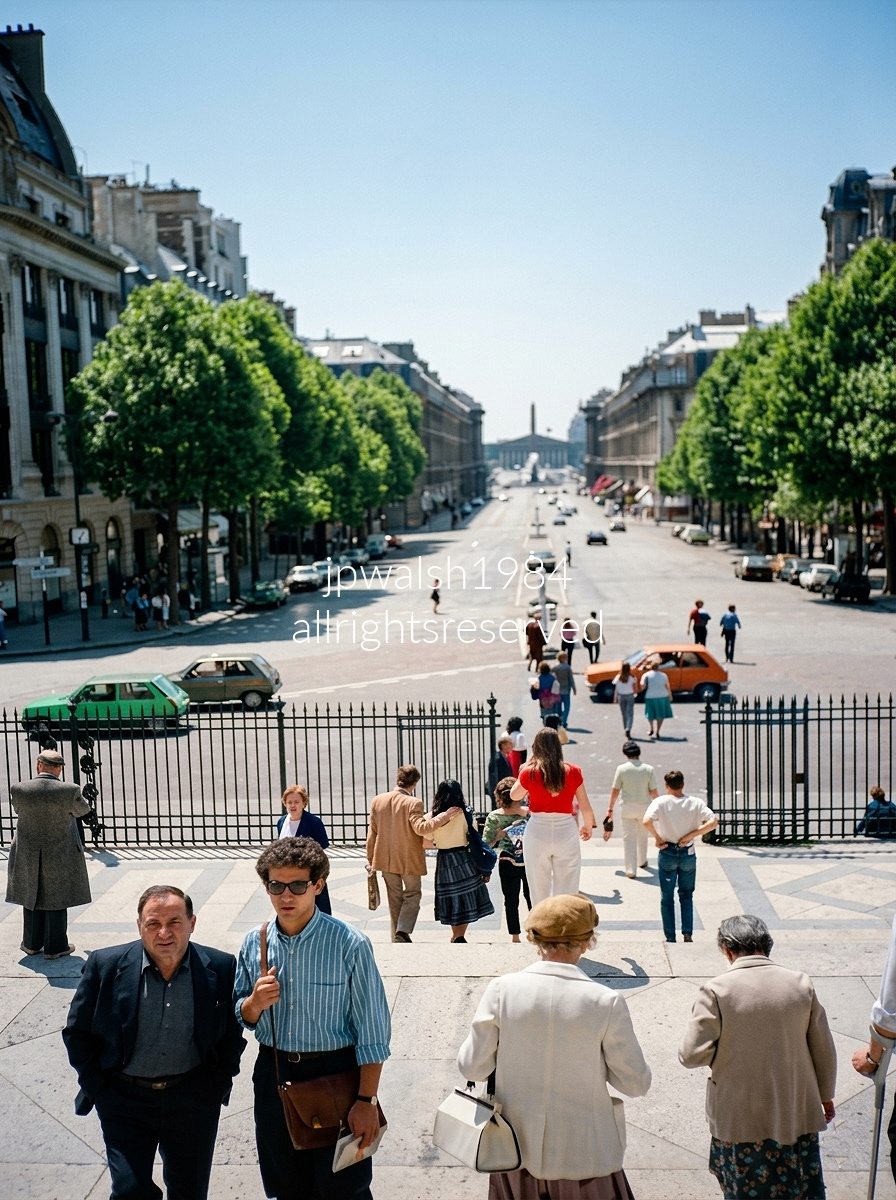
Before smartphones, selfie sticks, massive security barriers, and advanced computerized reservation queues, visiting Paris in 1984 was a quieter, more spontaneous experience. The mid‑80s city still moved at a local neighborhood rhythm: cafés unhurried, façades weathered, streets shaped by everyday life rather than global tourism flows.
Sunday morning in Paris from the steps of the Église de la Madeleine (Madeleine Church), looking directly straight down Rue Royale toward the Place de la Concorde.
France—Versailles.
June 1984. Grand Trianon, Versailles.
The Grand Trianon: Interior & Architectural Identity
Interior of the Grand Trianon, the royal retreat within the Versailles estate. Its signature look comes from pink and green‑veined Languedoc marble, crisp parquet floors, and large multi‑paned arched doors opening toward an outdoor balustrade—a refined, geometric vocabulary that defines the building’s style.
A Royal Escape from Court Life
Set about a 30‑minute walk northwest of the main palace, the Grand Trianon served as Louis XIV’s private sanctuary—an escape from the suffocating etiquette, constant surveillance, and crowds of the Versailles court. Here, the king could move more freely, host select guests, and enjoy a quieter, more intimate environment.
Hardouin‑Mansart’s 1687 Design
Built in 1687 by royal architect Jules Hardouin‑Mansart, the Grand Trianon reflects his mastery of classical proportion and restrained ornament. Louis XIV personally supervised the project, shaping the building’s layout and insisting on architectural features that reinforced its elegance and openness.
The Peristyle: Louis XIV’s Mandate
One of the château’s defining elements is the Peristyle—the open‑air, columned gallery linking the two wings. Louis XIV mandated its inclusion, creating a breezy passage that frames long axial views of the gardens and dissolves the boundary between architecture and landscape.
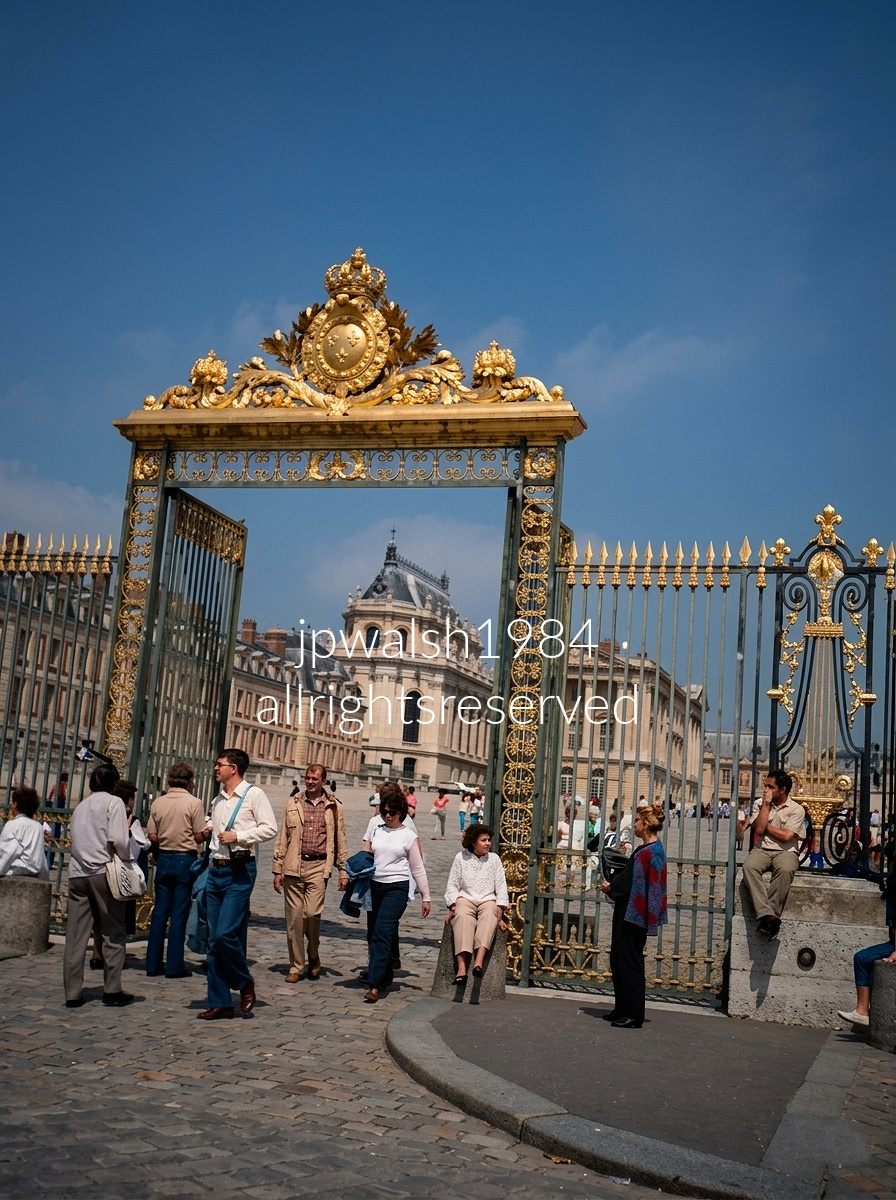
June 1984. Outer Gate of Honour, Versailles.
The Gate of Honour: Versailles’ Outer Threshold
The Gate of Honour (Grille d’Honneur) forms the outermost barrier between the Versailles palace grounds and the city square. For decades, especially through the 1980s, this was effectively the main entry point: the inner Royal Gate had been destroyed by revolutionaries in 1794 and would not be rebuilt until 2008. Visitors passed through this outer gate and walked directly into the full sweep of the main courtyard up to the palace façade.
Hardouin‑Mansart’s 1680 Design and Revolutionary Damage
The original Gate of Honour was designed around 1680 by Jules Hardouin‑Mansart, Louis XIV’s First Architect. Like many architectural elements of Versailles, it was breached and destroyed during the French Revolution, leaving the palace’s front approach visually and symbolically open.
Louis‑Philippe’s 1830s Reconstruction
The ornate gate seen today is not Louis XIV’s original design but a 19th‑century reconstruction. Under King Louis‑Philippe, the Gate of Honour was redesigned, heavily modified, and installed in the 1830s as part of his broader effort to reshape Versailles into a museum dedicated to “all the glories of France.” Its elaborate gilding and decorative program reflect this later royal vision rather than the Sun King’s.
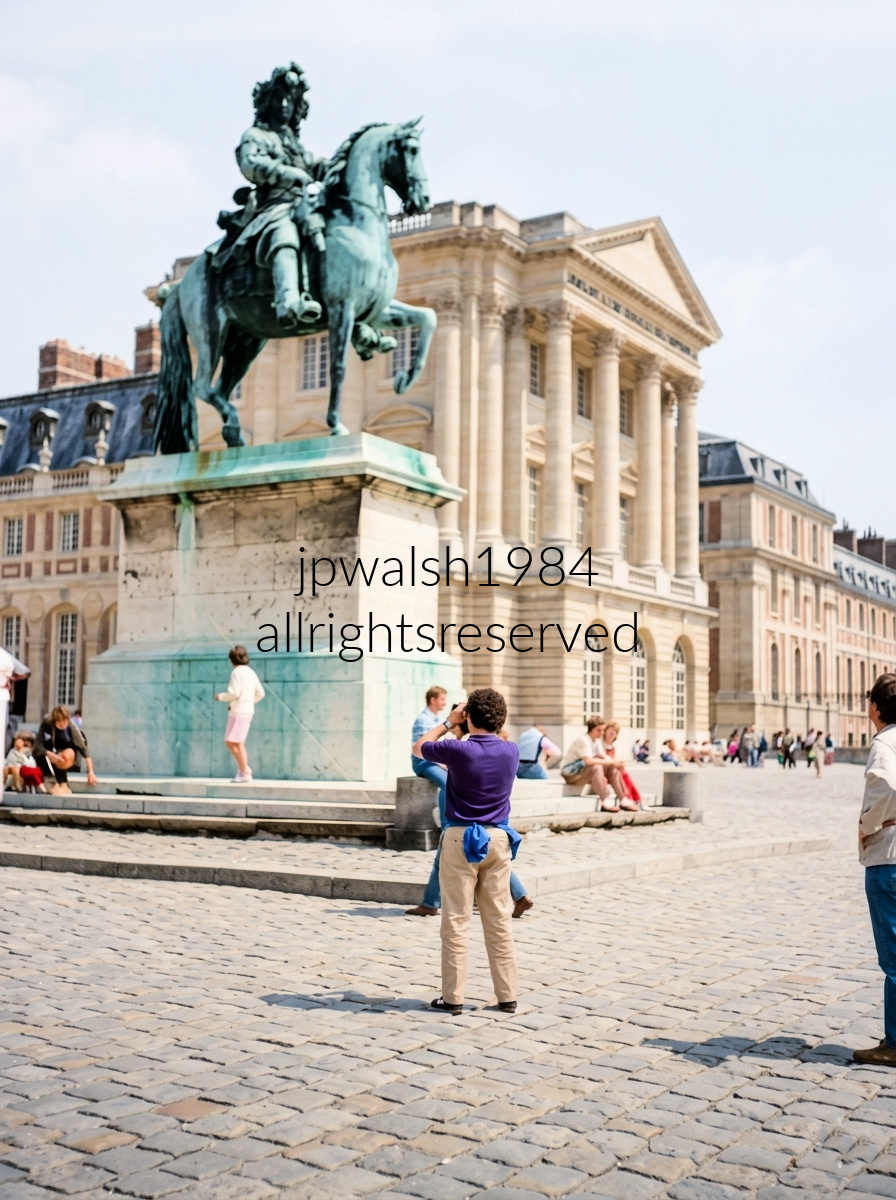
June 1984. Statue of Louis XIV.
Equestrian Statue of Louis XIV in the Cour d’Honneur (Court of Honor) at the Palace of Versailles, with the palace’s Gabriel Wing—designed by the premier royal architect Ange-Jacques Gabriel in the 1770s—behind. The statue was commissioned by King Louis-Philippe in the 1830’’s and created by artists Pierre Cartellier and Louis Petitot.
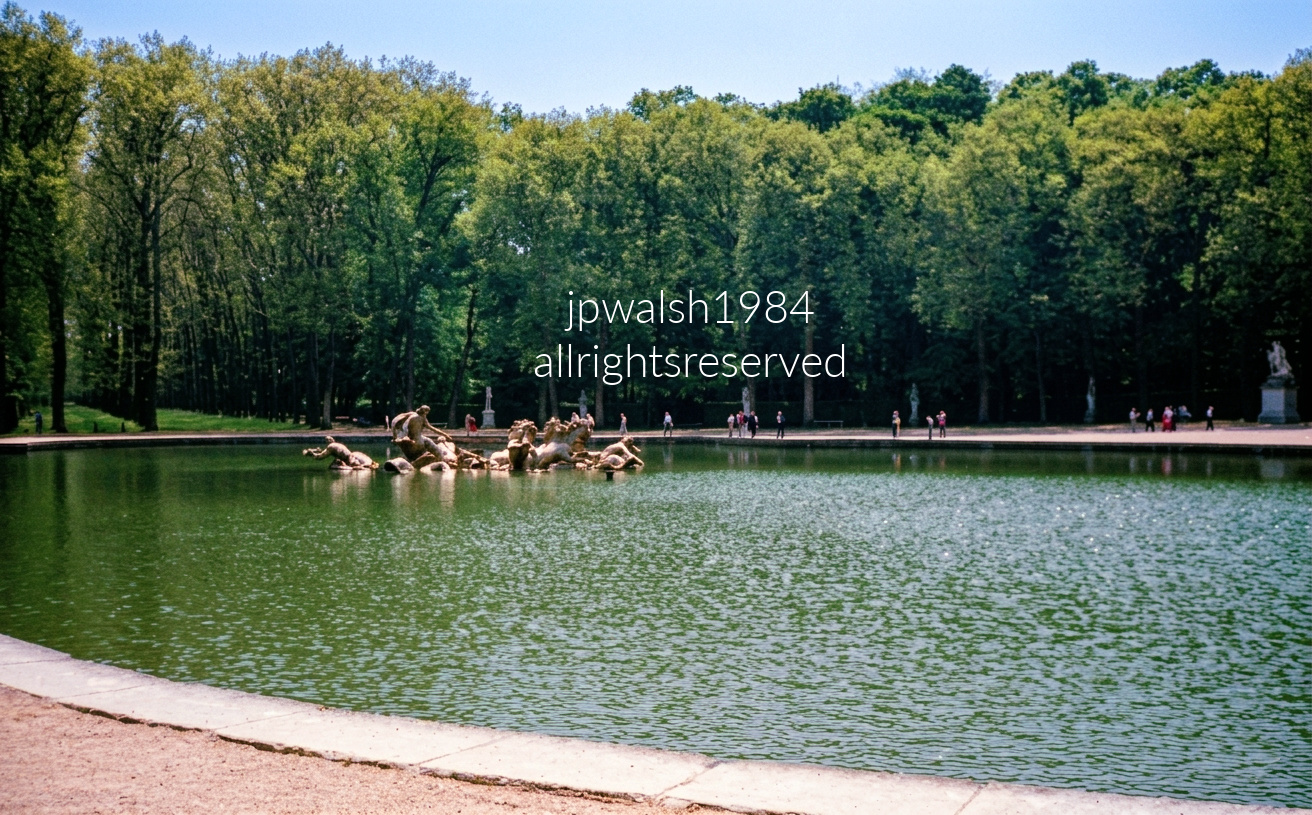
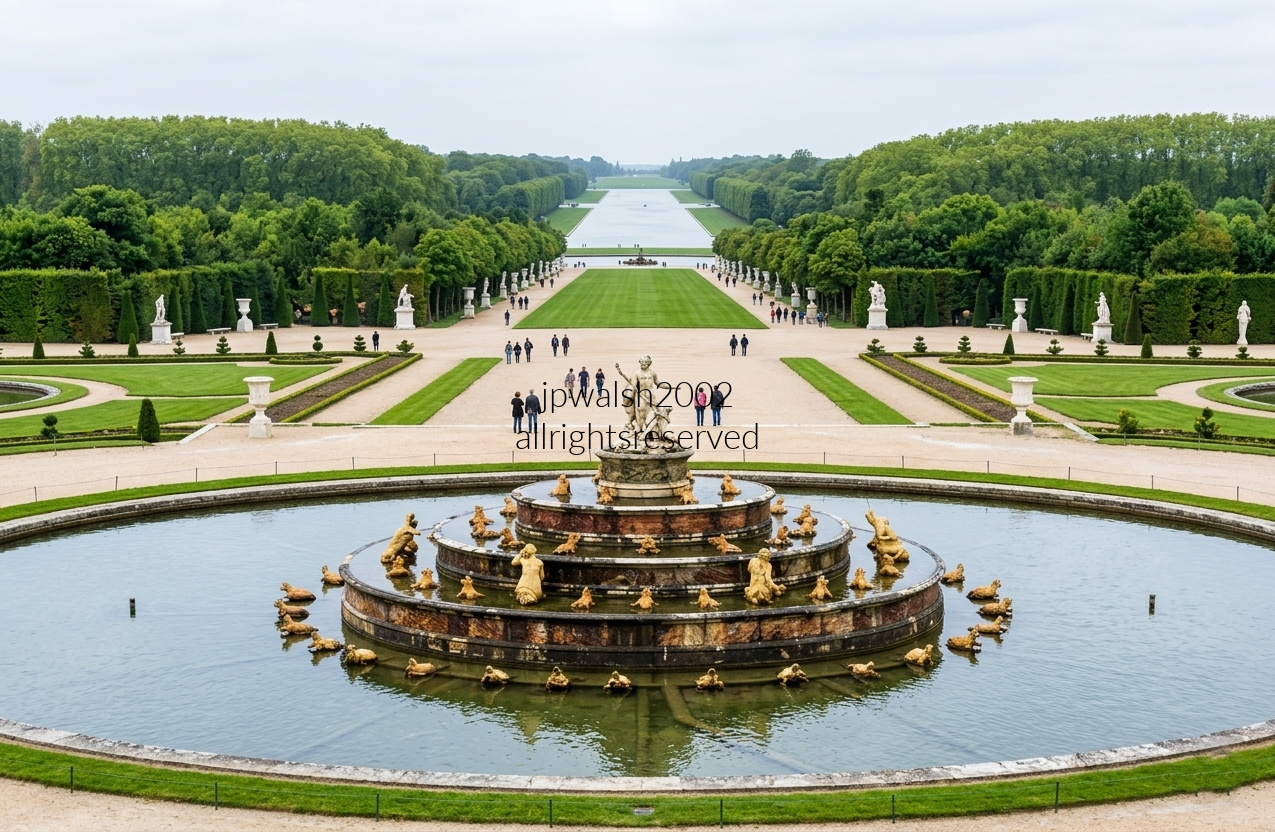
June 1984. Versailles. Bassin d’Apollon (Apollo Fountain)
Origins of the Basin
The Bassin d’Apollon sits along the central axis of the Gardens of Versailles, but for its first decades it was nothing more than a modest pond dug under Louis XIII between 1639 and 1668—a quiet, unadorned stretch of water before the Sun King transformed it.
Creation of the Apollo Fountain
Between 1668 and 1671, sculptor Jean‑Baptiste Tuby—working under Louis XIV—created the dramatic ensemble of Apollo rising from the water in his horse‑drawn chariot. The fountain became a central symbol of the king’s identity, projecting the Sun King’s power across the gardens.
The 1999 Storm and Destruction
The trees visible in this photograph belonged to the old, mixed plantings that once surrounded the basin. Nearly all were destroyed during the Christmas 1999 storm, when hurricane‑force winds—up to 130 mph—tore through Versailles for more than two hours. The disaster wiped out 80 percent of the estate’s rare and historic trees, including specimens dating back to Napoleon and Marie Antoinette.
Restoration to Louis XIV’s Original Plan
Because the pre‑1999 groves were a patchwork of mismatched species added during 19th‑century repairs, historians and landscapers used the devastation as a reset. They replanted the groves using the exact oak and linden layouts specified in Louis XIV’s 17th‑century blueprints, restoring the perimeter lines and axial geometry the Sun King originally intended.
Germany—Munich & Environs.
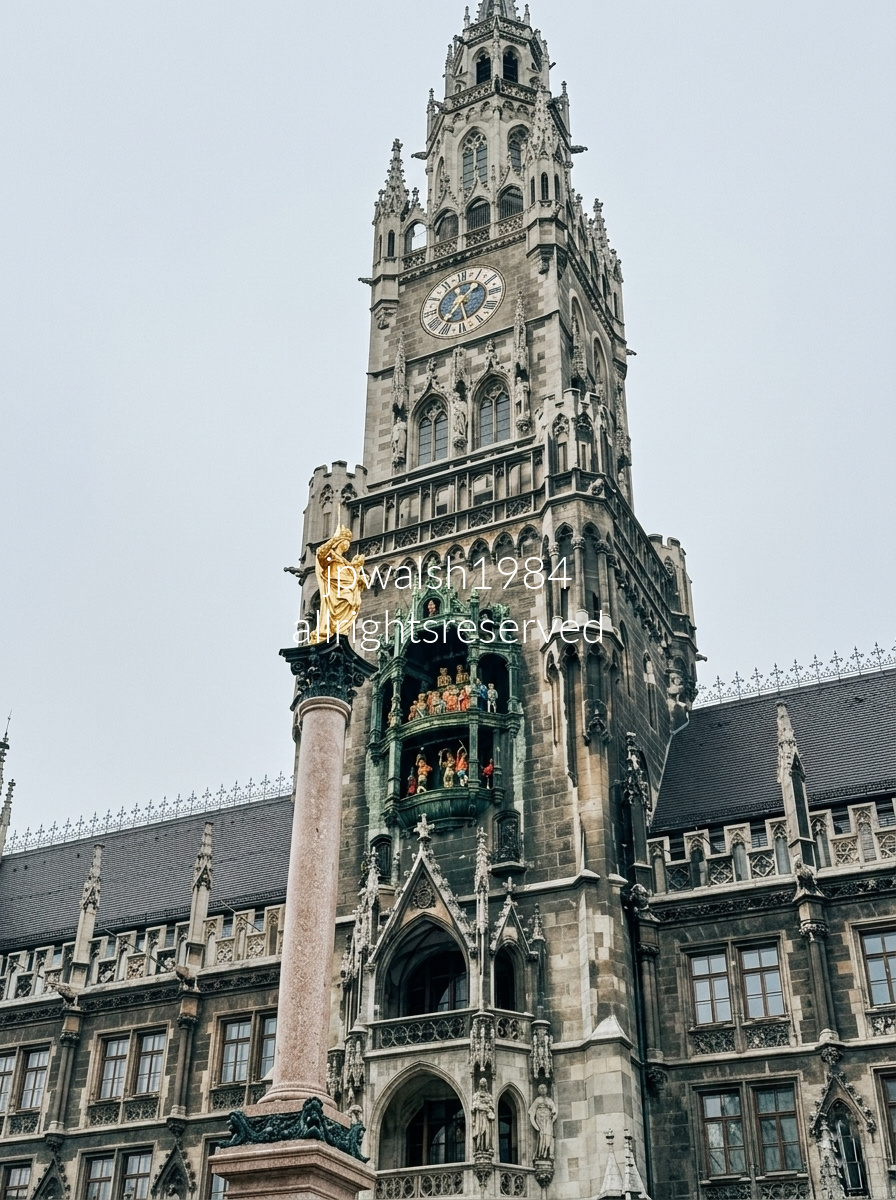
July 1984. Munich Germany. Marienplatz. July 1984. Marienplatz, Munich, Germany.
The Origins and Evolution of Marienplatz
The central square known as Marienplatz is in the heart of Munich, Germany. It was originally laid out in 1158. When open-air market activities were officially relocated down the street to the larger Viktualienmarkt in 1807, the city officially renamed it in 1854 as Marienplatz (Mary’s Square) in honor of the Virgin Mary—the patron saint of Bavaria.
Structure of the New Town Hall
The building is The New Town Hall (Neues Rathaus), erected in the Flemish Gothic Revival style between 1867 and 1909. Nestled in the center of the tower is the famous Rathaus-Glockenspiel.
Post-War Damage and the Original Renaissance Masterpiece
Though the Rathaus was severely damaged in World War II and required meticulous reconstruction, the golden statue of the Virgin Mary itself survived intact despite the massive Allied bombing. It stands as a 100% genuine Renaissance original, cast in 1590 by sculptor Hubert Gerhard.
The Modern Olympic Overhaul
A major transformation occurred just ahead of the 1972 Munich Olympic Games, where the Marienplatz was transformed into the pedestrian-only civic zone that exists today.
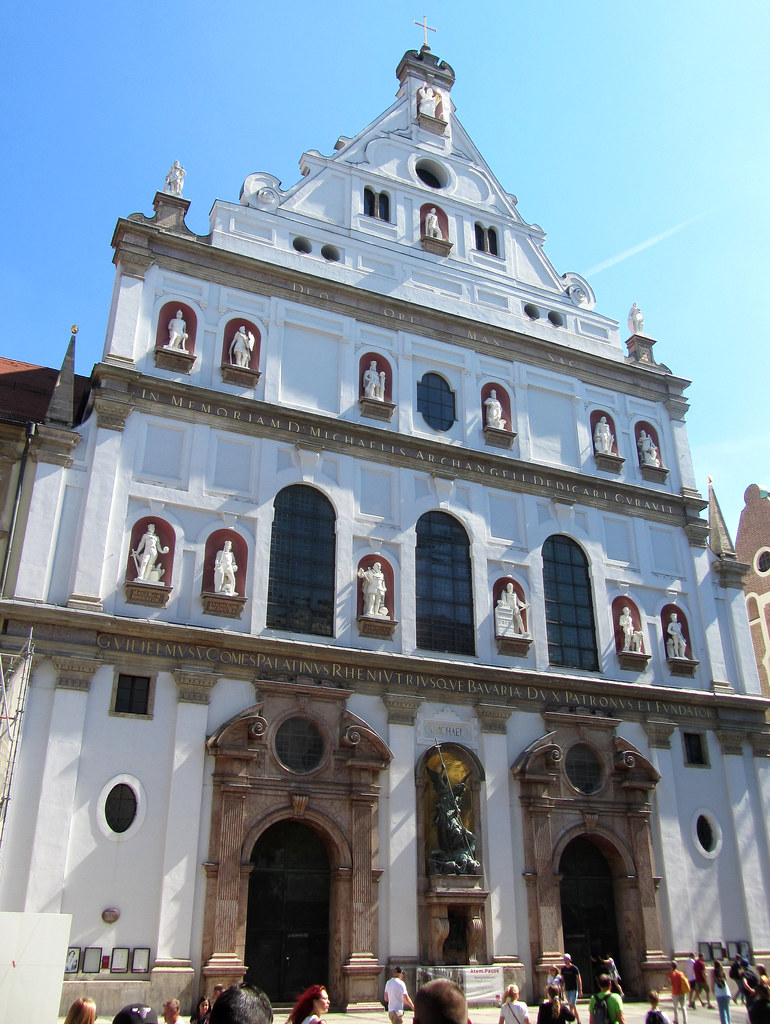
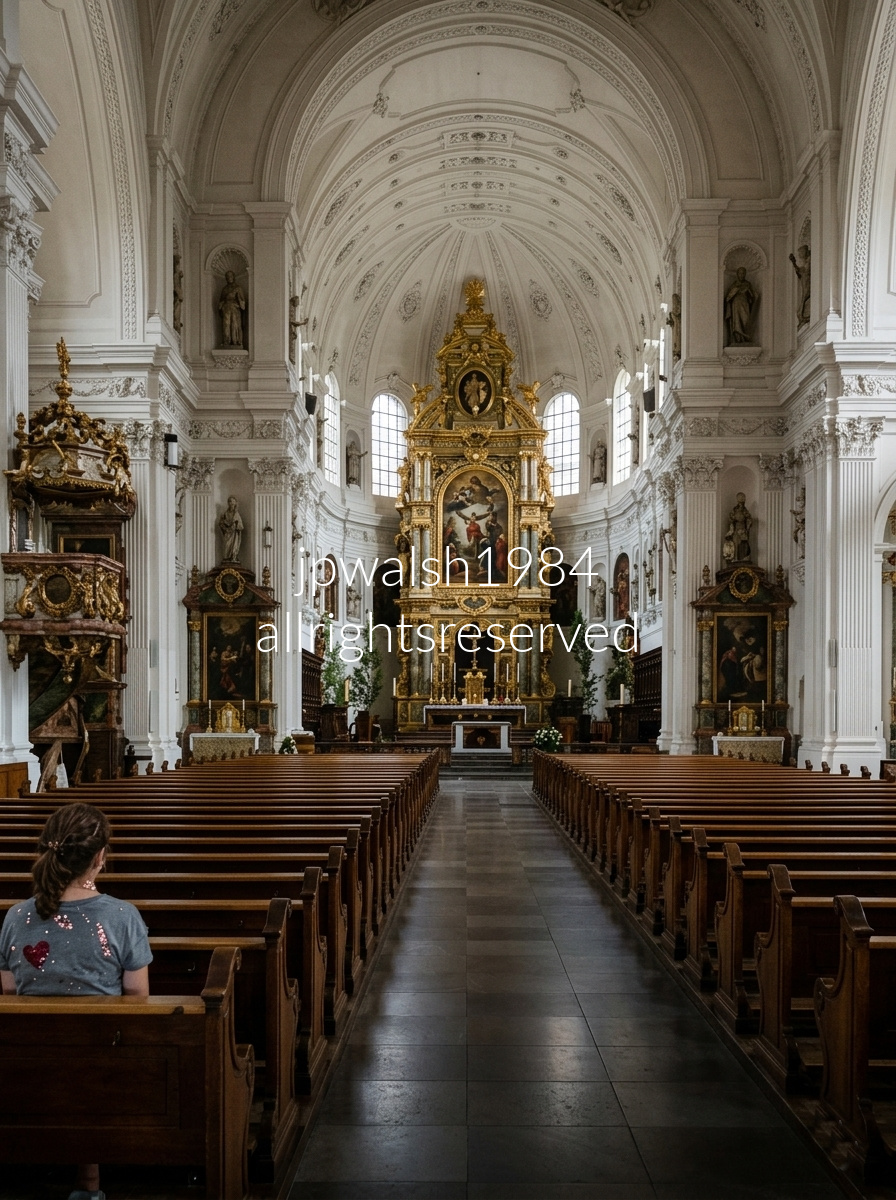
St. Michael’s Church (Michaelskirche), a historic Jesuit sanctuary located in the heart of Munich, Germany, stands as a masterpiece of ecclesiastical architecture. Commissioned by Duke Wilhelm V and constructed between 1583 and 1597, it is recognized as the largest Renaissance church north of the Alps, and its design profoundly shaped the evolution of Southern German Baroque architecture. The expansive nave is crowned by a world-renowned, monumental barrel-vaulted ceiling built entirely without internal pillar supports—a structural feat second in scale only to St. Peter’s Basilica in Rome. Anchoring the far end of the sanctuary is a magnificent, three-tiered high altar designed by Friedrich Sustris, which frames a prominent central altarpiece by Christoph Schwarz depicting the Archangel Michael triumphing over the rebel angels. Beneath the main floor lies the historic Wittelsbach Crypt, serving as the final resting place for numerous Bavarian monarchs, most notably King Ludwig II.
Beyond its architectural prominence, St. Michael’s maintains a deeply profound, historic connection to the German anti-Nazi resistance through Father Alfred Delp, S.J. The young Jesuit priest began his formal priestly ministry within these walls when he was ordained on June 24, 1937, by Munich’s celebrated Cardinal Michael von Faulhaber who delivered his famous anti-Nazi Advent sermons in 1933 which largely defined his ongoing critical tone towards the regime. Father Delp frequently ascended the pulpit of St. Michael’s to deliver powerful sermons that, alongside the courageous ministry of his fellow Jesuit Father Rupert Mayer, openly condemned the total incompatibility of National Socialist ideology with Christian values. This vocal opposition eventually led Delp to join the Kreisau Circle, a clandestine network of dissidents drafting plans for a humanitarian, Christian social order to rebuild Germany following the anticipated collapse of the Third Reich. Implicated in the wider resistance movements, Delp was arrested by the Gestapo in July 1944 and subsequently executed by hanging at Berlin-Plötzensee prison on February 2, 1945. In recognition of his enduring martyrdom, the Archdiocese of Munich and Freising has formally initiated the diocesan phase for Father Delp’s beatification process, ensuring that St. Michael’s continues to honor him as one of its most courageous historic voices.
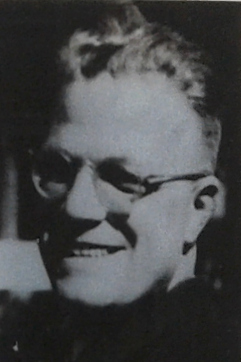
Father Rupert Mayer, S.J., was another legendary Jesuit priest whose life, anti-Nazi defiance, and legacy are completely intertwined with St. Michael’s Church in Munich, where he served as a close mentor, colleague, and inspirational figure to the younger Father Alfred Delp. His relentless courage earned Fr. Mayer the title “The Apostle of Munich.” Long before the rise of the Third Reich, Father Mayer was a celebrated national war hero; serving as a military chaplain in World War I, he lost his left leg to a grenade explosion while shielding a wounded soldier, becoming the first German clergyman to be awarded the Iron Cross First Class. When Adolf Hitler became Chancellor in 1933, Mayer immediately utilized his pulpit at St. Michael’s to preach against the Nazi movement, famously declaring that a practicing Catholic could not systematically align with National Socialism. Initially terrified of turning the immensely popular priest into a martyr, the Gestapo issued public speaking bans, which Fr. Mayer deliberately defied, leading to multiple arrests. In November 1939, as World War II broke out, the regime transferred him to the Sachsenhausen concentration camp for months of solitary confinement. Still fearful that his potential death in the camp would ignite a massive Catholic uprising in Munich, the Nazis eventually exiled him under strict house arrest at Ettal Abbey. Having survived the war, Father Mayer returned to his beloved Michaelskirche, but tragically suffered a fatal stroke and collapsed while preaching a moving All Saints’ Day sermon at the altar during Mass on November 1, 1945. Unlike Alfred Delp, whose ashes were scattered by the Gestapo to prevent the creation of a gravesite shrine, Father Rupert Mayer was laid to rest inside the lower floor of the Bürgersaal Church immediately next door to St. Michael’s. On May 3, 1987, Pope Saint John Paul II beatified Rupert Mayer at Munich’s Olympic Stadium before traveling downtown to pray at his tomb, which remains a major pilgrimage site drawing thousands of daily visitors.
Father Rupert Mayer, outspoken critic of the Nazis 1876-1945, in a mugshot from Landsberg am Lech. Public Domain under Article 72 of Germany’s copyright law because as a mugshot it is a non-work eligible only for “neighboring rights” (which only last 50 years), not copyright.
Dachau Concentration Camp, 1933-1945
July 1984. Dachau Concentration Camp, Upper Bavaria. The original iron gate.
The Camp’s Iconic Gate
Dachau’s entrance bore the iron slogan “Arbeit Macht Frei,” a phrase used across several Nazi camps. The gate became one of the site’s most recognizable symbols of coercion and deception. In 2014, the original gate was stolen, later recovered, and replaced with a replica to preserve the memorial landscape.
Memorial to the Prisoners of Dachau
The sculpture below by Yugoslav artist Nandor Glid (1924–1997) honors the prisoners held at Dachau from 1933 to 1945. A Holocaust survivor himself, Glid had been a forced laborer; his father and most of his family were murdered at Auschwitz.
July 1984. me at Dachau Concentration Camp.
Neuschwanstein Castle, 1869-1886
July 1984. Neuschwanstein Castle, Hohenschwangau, Germany.
Royal Project in the Alps
Neuschwanstein Castle was built from 1869 to 1886 for King Ludwig II as a personal retreat shaped by his fascination with medieval legend and Wagnerian opera.
A Fairy‑Tale Silhouette
Its white limestone façades, tall towers, and cliff‑edge perch above Hohenschwangau create the theatrical, storybook profile that later inspired countless romantic castle designs, including Disneyland’s Sleeping Beauty Castle, completed in 1955.
Interiors of Myth and Pageantry
Inside, the rooms follow the same staged aesthetic, with murals drawn from Germanic myth and elaborate neo‑Romanesque and neo‑Gothic detailing.
Switzerland.
Lucerne.
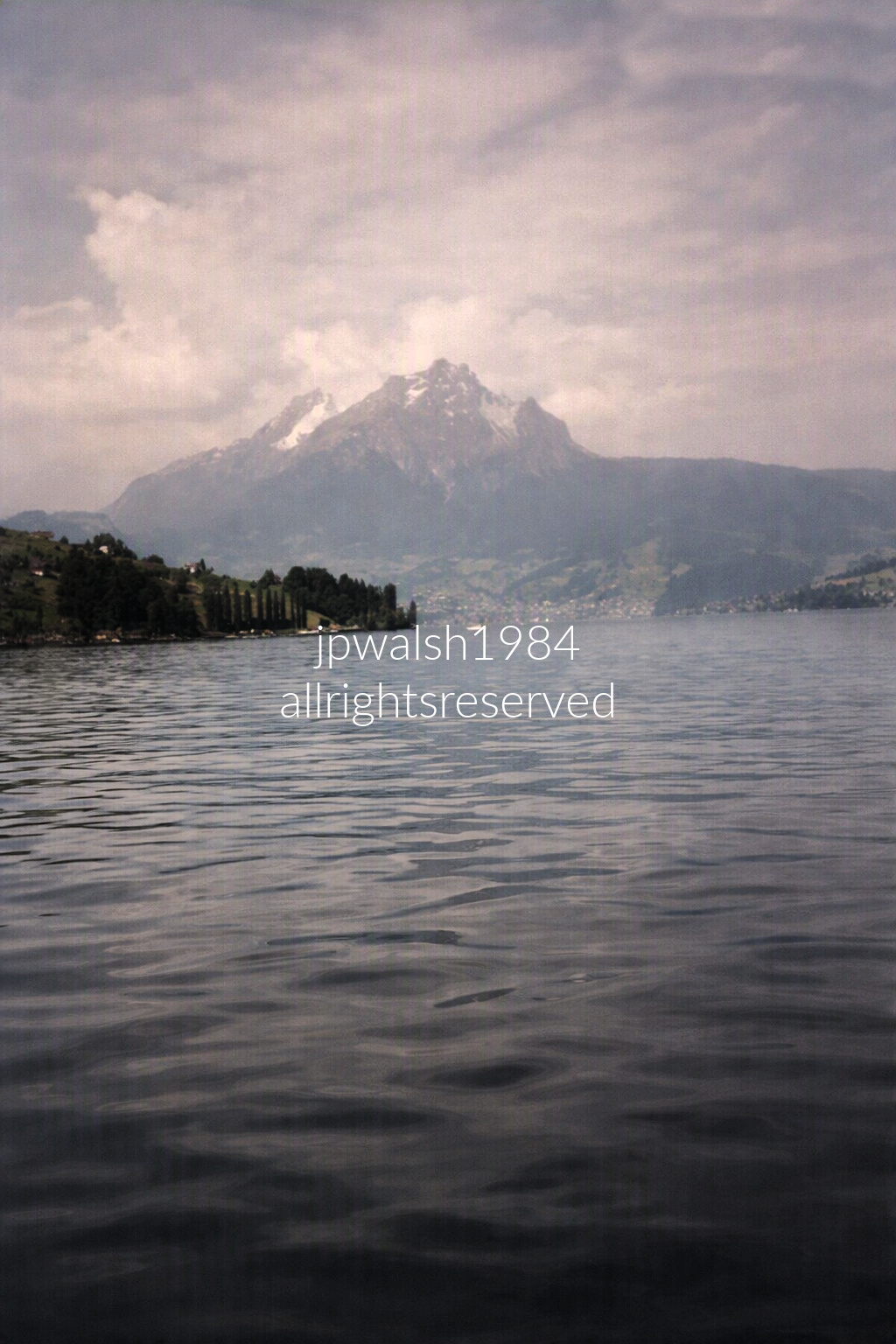
June 1984. Lucerne, Switzerland. 6.12mb 99%June 1984. Lucerne, Switzerland.
On Lake Lucerne (Vierwaldstättersee), looking directly toward Mount Pilatus in Central Switzerland. The calm water and low, overcast light flatten the scene into a silvery plane, while the mountain’s rugged mass rises through haze and legend—long associated with medieval tales of dragons and Pontius Pilate’s restless spirit.
June 1984. Mt. Pilatus.
A cab view of the Pilatus Railway (Pilatusbahn), which runs from the valley station of Alpnachstad up to the summit of Mount Pilatus near Lucerne in Switzerland. The Pilatus Railway officially was put into operation on June 4, 1889. Although there have been historical upgrades from steam (1889-1937) to electrification the train cars still ride on the exact same steel rack rails installed back in 1889 and use 1,500-volt DC overhead catenary power line system that has been powering the mountain track since 1937. This legendary transit line is famous for being the steepest cogwheel railway in the world, featuring an astonishing maximum gradient of 48%.
Austria.
Vienna
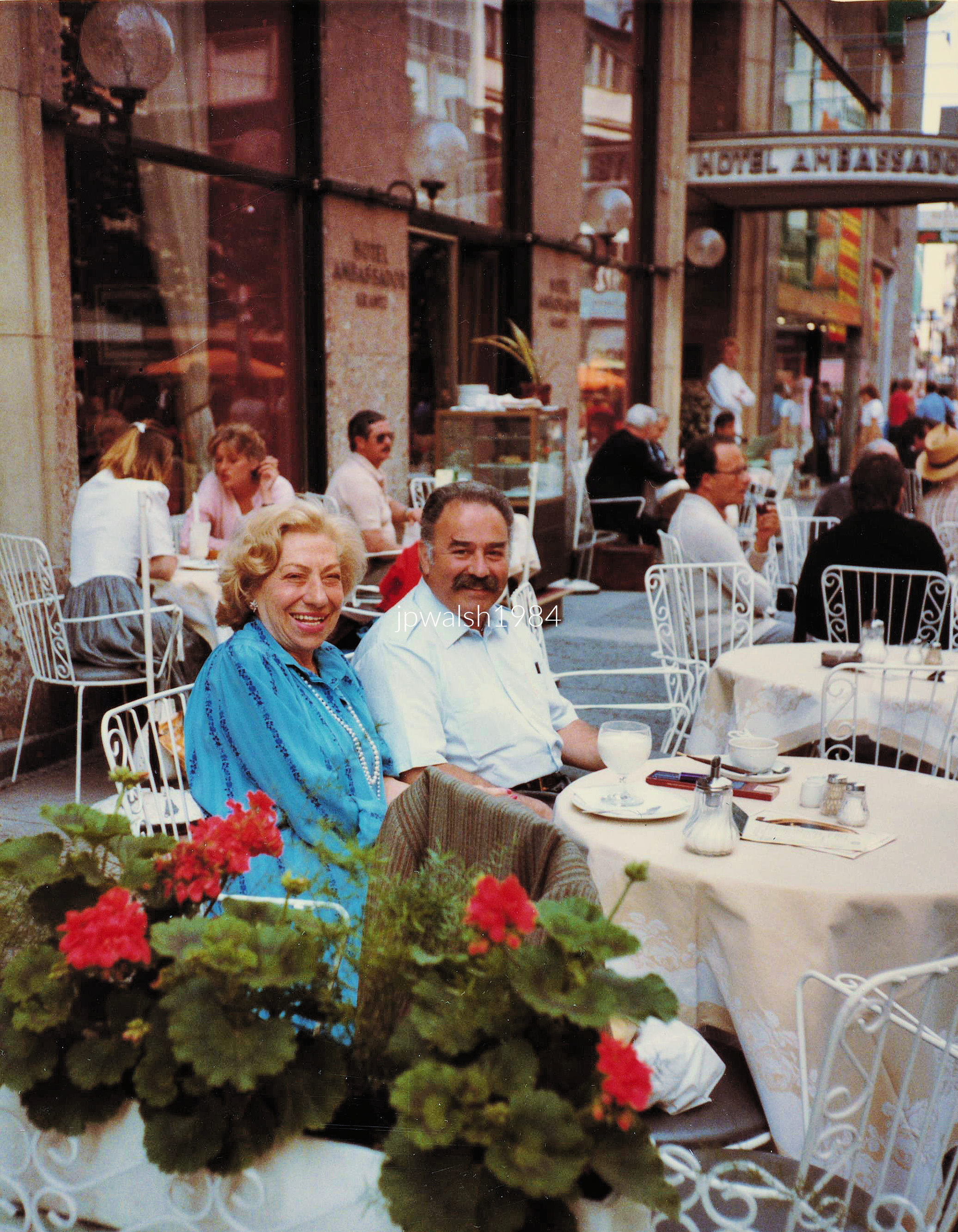
June 1984. Hotel Ambassador, Kärntner Straße 22, Neuer Markt 5, Wien (Vienna). June 1984. Vienna, Austria.
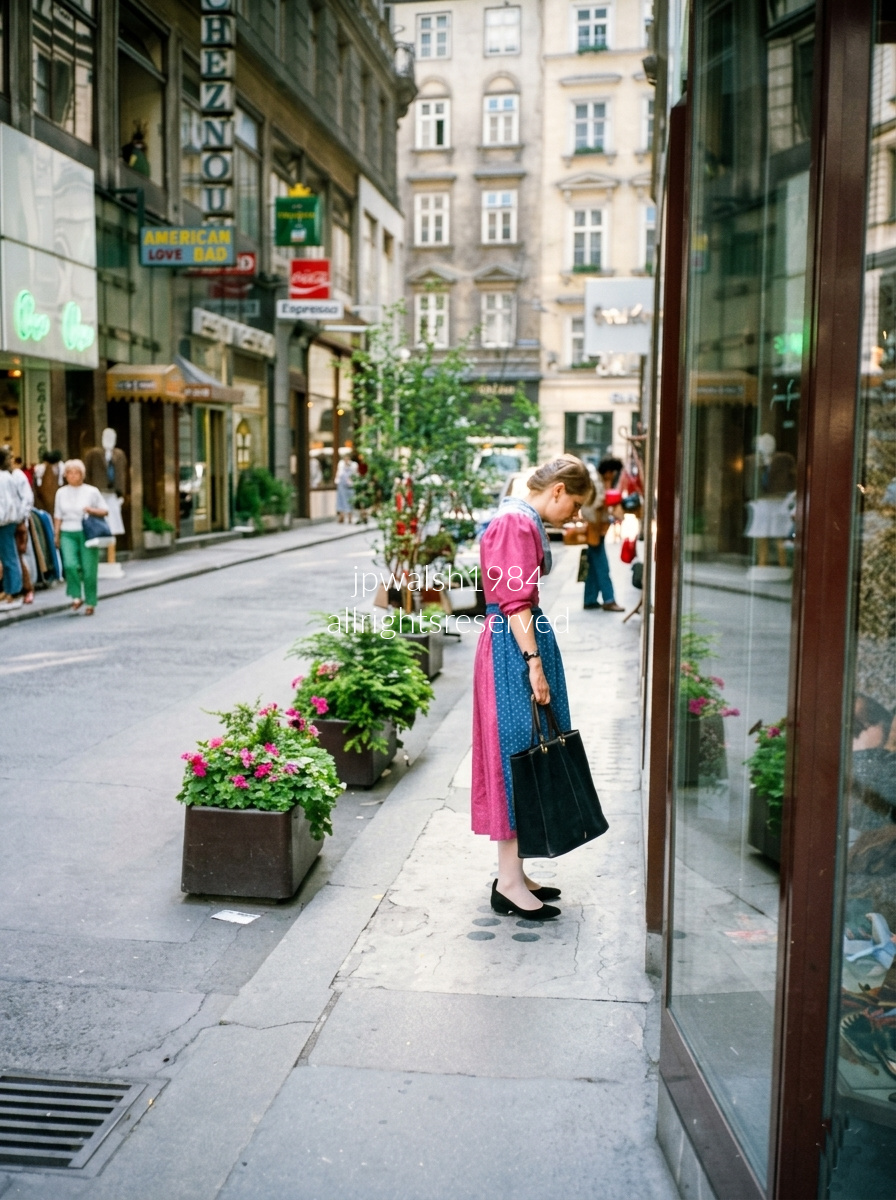
Kärntner Durchgang, a narrow pedestrian cut‑through just off Kärntner Straße in Vienna’s 1st District, carries a dense layer of nightlife and architectural history. The green neon on the left marks the old Cabaret Chez Nous at Kärntner Straße 10, once a classic cabaret and now a contemporary nightlife venue. Just beyond the glowing “American Love Bar” sign sits the discreet entrance to Loos American Bar at Kärntner Durchgang 10 — the legendary 1908 cocktail bar designed by Adolf Loos.
Except for the interruptions of World War I and World War II, Loos’s tiny, jewel‑box interior has operated continuously since 1908, making it Vienna’s first true American‑style cocktail bar. Its reputation drew generations of artists and filmmakers, including Orson Welles during the shooting of The Third Man, adding another layer of cinematic lore to this short, atmospheric passageway.
June 1984. Vienna.
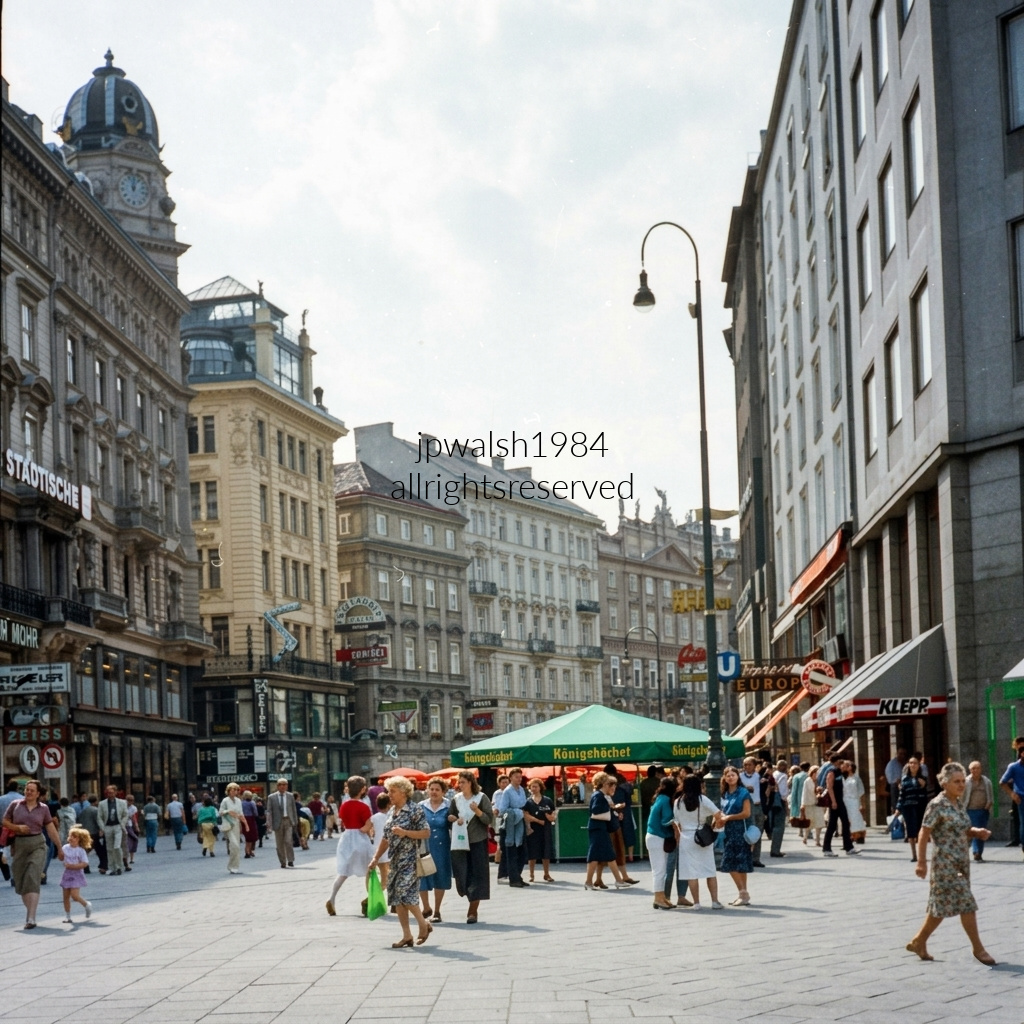
Graben, the iconic pedestrian boulevard in Vienna’s Innere Stadt, unfolds between historic façades and late‑19th‑century elegance. In the left background, the domed clock tower crowns Ankerhaus at Graben 10, an ornate flourish designed by Otto Wagner. The “Städtische” sign on the far left marks the Wiener Städtische insurance building, a familiar anchor along the street. On the right edge, the clean gray geometry of the Grabenhof—also shaped in part by Wagner—frames the scene with its disciplined lines. Evident is Graben’s blend of architectural theater and everyday movement, a crossroads where Vienna’s modern pulse meets its turn‑of‑the‑century grandeur.
June 1984. Vienna.
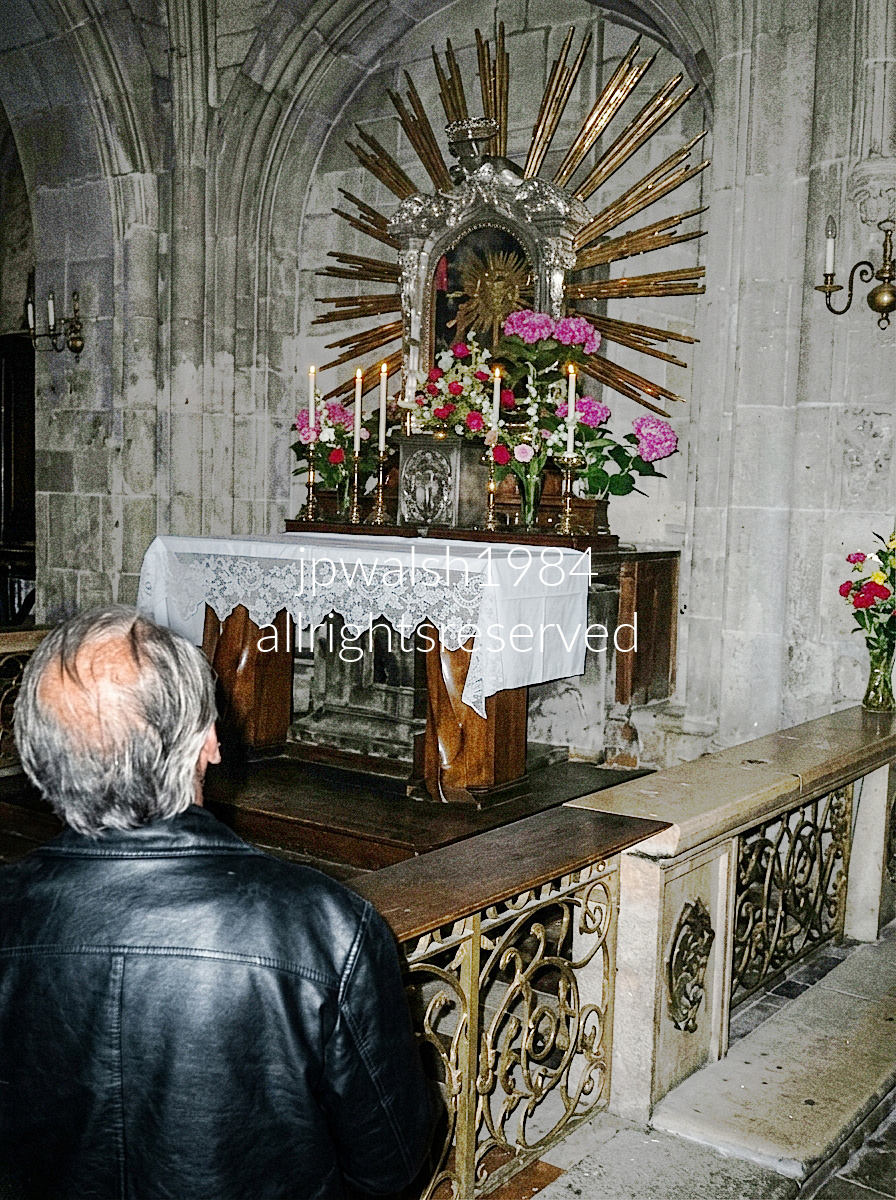
A moment of reflection inside St. Stephen’s Cathedral (Stephansdom) in Vienna, Austria. Positioned directly in front of him is the highly revered Maria Pötsch Icon Altar. This sacred Byzantine-style icon depicts the Virgin Mary pointing toward the infant Jesus. Dating back to 1676, it became legendary throughout the Habsburg Empire after it reportedly shed miraculous tears in the small town of Máriapócs, Hungary. The icon is framed within a magnificent, radiating gilded sunburst crown, beautifully accented by fresh floral arrangements and glowing white devotional tapers. The altar sits beneath a beautifully carved, late-Gothic stone baldachin (known as the Öchsel-Baldachin), highlighted by the intricate stone archways and historical balustrades typical of the cathedral’s famous architecture.
Pötsch is the Germanized spelling and pronunciation of Pócs, the village in northeastern Hungary where the icon was painted in 1676. The icon was transferred from its home village to Vienna in 1697 under the direct imperial decree of Habsburg Emperor Leopold I. On November 4, 1696, parishioners attending Mass in the small, impoverished Hungarian village of Pócs witnessed real tears flowing from the eyes of the painted icon. The weeping event reoccurred repeatedly over the following weeks. Recognizing the immense religious and psychological value of such an artifact during a time when the Habsburg Empire was locked in a brutal, high-stakes war with the Ottoman Empire, Emperor Leopold I ordered the icon to be permanently moved to the imperial capital. The was from the village church over the fierce protests of the local Hungarian population and it took months to arrive to Vienna because huge crowds gathered everywhere along the route to venerate and touch the image. It was formally installed above the high altar of St. Stephen’s Cathedral on December 1, 1697, in a massive ceremony attended by the Imperial Family.
Shortly after its arrival, imperial troops led by Prince Eugene of Savoy scored a decisive, historic victory over the invading Ottoman forces at the Battle of Zenta. Because the entire Viennese populace had been praying aggressively to the new icon for protection, the unexpected military triumph was widely attributed to the intercession of Our Lady of Pötsch, cementing its status as an official protector of the city. Curiously, while a duplicate copy was eventually sent to appease the villagers of Máriapócs — and that copy subsequently began to weep as well – this original icon housed in Vienna has never shed a single miraculous tear since the day it left Hungarian soil.
June 1984. Vienna.
Leaning against the railing above the stairs descending to Kärntner Straße, one of Vienna’s most famous pedestrian shopping avenues, the scene glows with nighttime storefront light. Across the backdrop, classic European retail signs stack in bright neon: the red Huber Tricot emblem with its stylized female silhouette, the mark of Austria’s iconic lingerie brand; Salamander, the long‑running European shoe chain; Bally, the Swiss luxury label; and Boecker, once a major German fashion department store with a prominent Vienna presence. The mix of signage, glow, and movement captures Kärntner Straße’s blend of retail tradition and urban theater at night.
July 1984. Vienna.
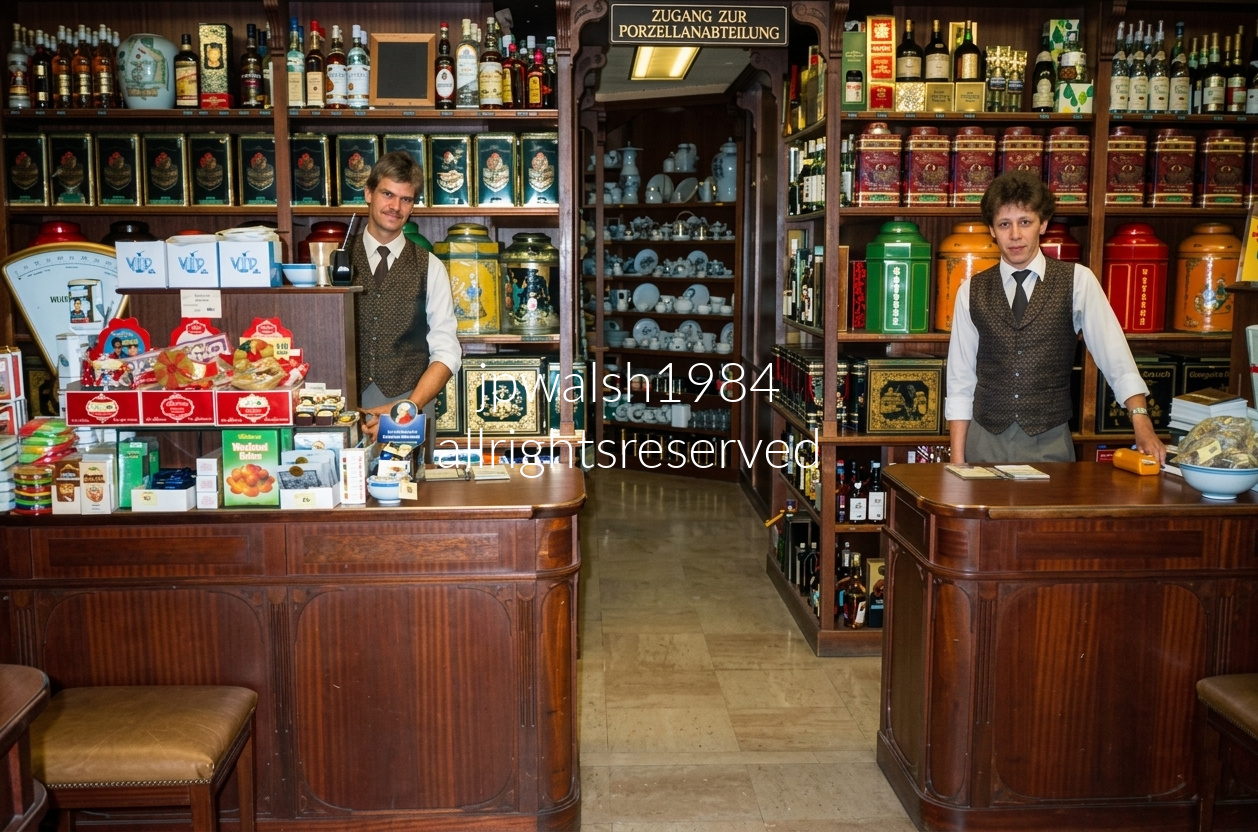
Schönbichler Teehandlung (Schönbichler Tea Shop) at Wollzeile 4, 1010 Vienna, Austria Established in 1870, it is one of Vienna’s most famous and historic specialty shops, renowned for its extensive selection of premium loose-leaf teas, spirits, and colonial wares. The German sign visible above the central passage archway reads “Zugang zur Porzellanabteilung”, which translates to “Access to the Porcelain Department,” leading customers toward their collection of fine teaware and ceramics housed in the back room.
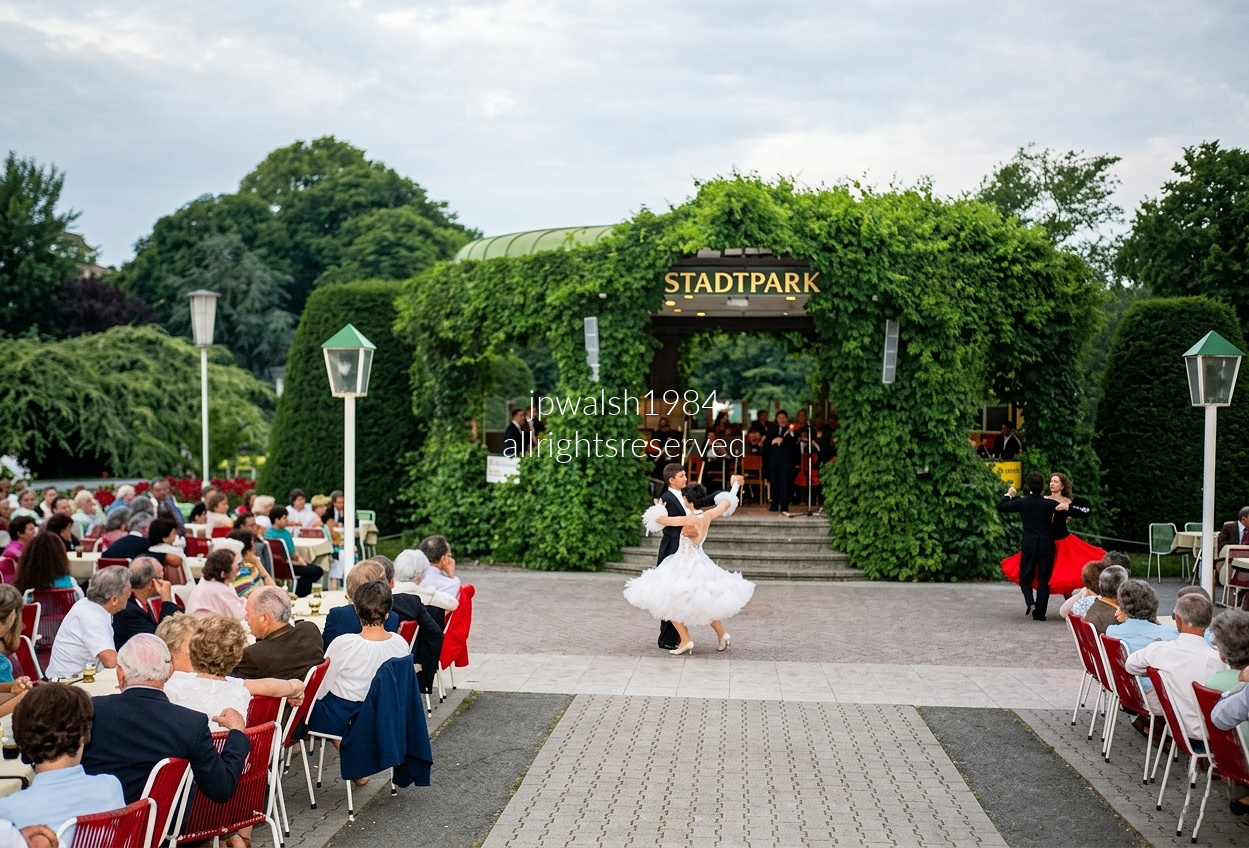
June 1984. Stadtpark, Vienna.
Vienna’s First Public Park
A timeless evening in Stadtpark, Vienna’s first public park, opened on August 20, 1862. The 28‑acre landscape was drafted by painter Joseph Selleny and realized by municipal gardener Rudolf Siebeck, who embraced the romantic English‑garden tradition—sweeping lawns, winding paths, weeping willows, and reflective ponds.
Monuments to Vienna’s Musical Legacy
Stadtpark is home to the iconic gilded bronze Johann Strauss II Monument (unveiled in 1921), alongside monuments honoring Franz Schubert, Anton Bruckner, and Franz Lehár—a sculptural map of Vienna’s musical heritage.
Historic Pavilions and Exhibition Relics
Scattered through the park are smaller cast‑iron pavilions, including a notable one purchased from the 1851 London World Exhibition, a reminder of Vienna’s 19th‑century cosmopolitan ambitions. The ivy‑covered structure in my photograph sheltering the orchestra is one of the park’s central open‑air performance fixtures.
The Kursalon and the Waltz King
The park’s grandest architectural presence is the adjacent Kursalon Hübner, where I’m standing for this photograph. Built between 1865 and 1867 by Johann Garben in an opulent Italian Renaissance historicist style, the building became inseparable from Vienna’s musical identity after Johann Strauss II—the “Waltz King”—gave his first concert on these grounds on October 15, 1868, forever establishing Stadtpark and the Kursalon as the epicenter of the Viennese Waltz tradition.
Salzburg.
July 1984. Pitter Keller, Salzburg, Austria. July 1984. Steps directly above the “Sound of Music” steps in the Mirabell Palace Gardens. Salzburg, Austria. 3.12mb
Schloss Hellbrunn (1613-1619)
July 1984. Part of the waterpark at Schloss Hellbrunn near Morzg south of Salzburg, Austria.
At the Trick Fountain
I stand at left with Dr. Len Biallas seated beside me and his wife Martha nearby.
A Prince‑Archbishop’s Villa
Built between 1613–19 as the Prince‑Archbishop of Salzburg’s daytime retreat, the palace sits ten minutes by car—or under an hour on foot—from the city center.
Jeux d’Eau
The schloss is famed for its watergames, including this dining tableau where jets hidden in the stone seats spray unsuspecting guests.
Mythological Program
Greek and Roman themes shape the fountains throughout the grounds, a vivid expression of the Mannerist imagination.
Vorderer Gosausee and the town of Gosau
July 1984. Vorderer Gosausee, Austria.
The Vorderer Gosausee and steep slopes of the Dachstein massif in the Salzkammergut region. This specific photo was shot from the wooden docks of the Gosausee Boat Rental (Bootsverleih), located at the northern tip of Vorderer Gosausee. The distinct wooden rowboats shown in the foreground—like the one tagged with license number 63845—are part of the local rental fleet used by visitors to row across the lake during the summer. The lake and the nearby town of Gosau are nestled deep within Austria’s scenic Salzkammergut region, located just a short detour off the historic routes connecting Salzburg and Graz.
Wolfgangsee
July 1984. Wolfgangsee, Austria.
Wolfgangsee and the Schafberg
Nestled in Austria’s Salzkammergut region, the Shores of Wolfgangsee (Lake Wolfgang) reflect the grandeur of the Schafberg, a 1,783‑meter peak forming the northern edge of the Limestone Alps. Its mirror‑still waters and mountain backdrop define one of Europe’s most iconic alpine landscapes.
Rise of the Sommerfrische
In the late 19th century, the lake became a centerpiece of the Sommerfrische—the summer retreat movement that drew Vienna’s elite to the mountains. When Emperor Franz Joseph I established his seasonal residence in nearby Bad Ischl, aristocrats, industrialists, and artists followed, transforming Wolfgangsee into a cultural haven.
Artists and the Alpine Muse
Among those captivated were composers Johannes Brahms and Alban Berg, who found inspiration in the tranquil setting. Writers and painters joined them, turning the lakeside villages into creative enclaves that blended leisure with artistic pursuit.
The SchafbergBahn and Tourism Boom
The opening of the SchafbergBahn cog railway in 1893 made the summit accessible to tourists, accelerating the lake’s transformation into a bustling alpine resort. Steamboat excursions and panoramic climbs and descents became hallmarks of the Wolfgangsee experience.
By the 1930s, Wolfgangsee had evolved into an international destination, welcoming celebrities and royals—including the Duke of Windsor in 1937—who came to savor its serene waters and mountain air.
Belgium.
Brussels
June 1984. Grand’ Place, Brussels, Belgium.1.03mb
Guild Houses on the Grand’ Place
The buildings in the photograph — Le Roy d’Espagne, La Brouette, Le Sac, La Louve, Le Cornet, and Le Renard — are among the historic guild houses that define the square’s architectural ensemble.
Six Centuries of Construction
The Grand’ Place evolved over roughly 600 years, from the 1000s to the 1600s, creating the dense mix of medieval, Renaissance, and Baroque façades seen today.
Destruction and Rebuilding After 1695
During the Nine Years’ War, French bombardment in 1695 destroyed most of the square. The guild houses were rebuilt in the 17th and 18th centuries, giving the Grand’ Place its present appearance.
A UNESCO World Heritage Site
Designated a UNESCO World Heritage Site in 1998, the Grand’ Place is widely regarded as one of the most beautiful urban squares in the world.
June 1984. Grand’ Place, Brussels, Belgium.
Grand-Place (Grote Markt) in Brussels, Belgium, looking along the sidewalk outside the ornate baroque guildhouses
Brussels, Belgium. The foreground showcases the meticulously manicured sunken garden beds, pathways, and fountains designed by the renowned landscape architect René Pechère during urban renewal efforts in the 1950s. Soaring in the background distance is the iconic 315‑foot Gothic spire of the Brussels Town Hall, located in the Grand‑Place.
Waterloo
June 1984. Waterloo.
Center of Wellington’s Line
This vantage point looks straight down the Allied‑Coalition center under the Duke of Wellington, facing south toward Napoleon’s army. The road cutting through the field is the Chaussée de Charleroi (today’s Route N5), the main axis of Napoleon’s plan to drive north, seize Brussels, and split the Allied and Prussian forces.
La Haye Sainte: The Breakwater
The white, walled farm complex beside the road is La Haye Sainte, held on June 18 by the King’s German Legion (expatriated Hanoverians). This fortified farmhouse became the immovable center of Wellington’s line, blocking the French advance up the main road for most of the day.
D’Erlon’s Assault and the Heavy Cavalry Counter‑Charge
The east field (left) was the killing ground for Count d’Erlon’s I Corps early that afternoon. Across this slope, British heavy cavalry—including the Scots Greys—launched their legendary, chaotic counter‑charge, smashing d’Erlon’s infantry columns before overextending and being cut down in turn.
Ney’s Mass Cavalry Attacks
The rising west field (right) hosted Marshal Ney’s massive cavalry charges. Wellington’s infantry met them in a checkerboard of roughly 20 defensive squares, each holding 500–1,000 men. The French horsemen funneled through narrow gaps, unable to break the squares and instead becoming trapped, jumbled, and exposed to disciplined musket fire. It was like as Agincourt all over again.
Portrait of the Duke of Wellington, by Sir Thomas Lawrence, c. 1815–1816, Apsley House, Apsley House, London. Public Domain.
The creation of the Lion’s Mound between 1820 and 1826 permanently reshaped the original 1815 battlefield. King William I of the Netherlands ordered the monument to mark the exact spot where his son, the Prince of Orange, was wounded. To build the 141‑foot conical hill, engineers with 2,000 workers moved an enormous volume of earth—roughly 300,000 to 400,000 cubic meters—an amount equal to over 40,000 standard dump truck loads packed back-to-back—by scraping and excavating the battlefield itself rather than importing soil. In doing so, they erased key contours, slopes, and defensive features that had defined Wellington’s position during the Battle of Waterloo. The alteration was so drastic that when Wellington returned in 1827, he reportedly reacted with fury, declaring, “They have altered my field of battle!”
Italy.
Rome
July 1984. St. Peter’s Square, Vatican City, Rome, Italy. July 1984. Trying on eyewear at a sidewalk vendor, Rome, Italy.
Forum
July 1984. Colosseum from Via Sacra with columns and wall of the Temple of Venus and Roma.
Temple of Hadrian
The Temple of Hadrian was begun in 121 under Emperor Hadrian (76–138) and inaugurated by him in 135. Construction was completed in 141 by Emperor Antoninus Pius (86–161).
The Colosseum
The Colosseum held between 50,000 and 85,000 spectators. Its construction began in 72 under Emperor Vespasian (9–79) and was finished in 80 A.D. under Emperor Titus (39–81).
July 1984. The Forum, Rome.
Temple of the Dioscuri
It was a very hot day. The three distant columns are the remains of the Temple of the Dioscuri, dedicated to the mythological twins — the Gemini, sons of Jupiter (Zeus) and Leda. Their cult reached Rome from Greece by way of Sicily, where Greek culture has deep roots.
House of the Vestals
Statues from the House of the Vestals stand in the foreground.
Venice
July 1984. Piazzetta San Marco, Venice, Italy.
Piazzetta San Marco and Its Columns
Between the Palazzo Ducale and the Biblioteca Marciana, the Piazzetta San Marco links St. Mark’s Square to the lagoon. The original pair of granite columns, erected in 1268 (these are modern copies), carry St. Theodore on one and the winged lion of St. Mark on the other.
View Toward San Giorgio Maggiore
Across the lagoon stands San Giorgio Maggiore, designed by Andrea Palladio (1508–1580) and built between 1566 and 1610.
Vantage Point
The photograph was taken from the upper story of St. Mark’s Basilica.
Rialto Bridge, July 1984
Newlyweds on the Rialto Bridge in Venice, Italy. I was photographing from the city’s oldest bridge — built 1588–1591 — when, by sheer chance, I recognized a fellow Loyola Academy teacher standing there. PhilS. was with his wife, celebrating their honeymoon.
July 1984. Grand Canal from Rialto Bridge, Venice, Italy.
Florence
July 1984. Pazzi Chapel, Florence, Italy.
My Visit
This was one of the first places I tried to see upon arriving in Florence, but it was closed for repairs — and this vantage point was as close as I could get.
Pazzi Chapel, Early Renaissance Florence
In 1429, Andrea Pazzi—whose wealth rivaled the Medici—assembled the funds to build this chapel. Its geometrical design is attributed to Filippo Brunelleschi (1377–1446), with construction beginning in 1442 and finishing in 1478.
Setting and Significance
The Pazzi Chapel, set in the cloister on the south side of the Franciscan Basilica di Santa Croce (consecrated 1443), is regarded as an early Renaissance masterpiece.
July 1984. Ponte Vecchio in Florence, Italy,
The History and Structure of Ponte Vecchio
A bridge has crossed the Arno at this point since ancient Roman times. Built in 1345, the Ponte Vecchio, is the one bridge in Florence to have been spared destruction in World War II. Its collection of shops built along its edges is a design dating back to the medieval period. The three arches in the middle of the bridge reveal the stanchions of the covered walkway above, which is the bridge-length enclosed Vasari Corridor built by Giorgio Vasari in 1565. This allowed the ruling class to travel across the bridge without mingling with the public.
Evolution from Butcher Shops to Luxury Jewelers
In 1442, the Florentine government ordered the city’s butchers and tanners to move onto the bridge. Eventually, these shop owners built the chaotic and picturesque overhanging back-rooms that jut out over the water, supported only by wooden brackets and poles. In the mid-1590s, Grand Duke Ferdinando I evicted the butchers and decreed that only goldsmiths, jewelers, and silversmiths could rent the bridge shops—establishing the luxury commercial hub that has remained unchanged to this day.
The Architectural Landmarks of the Background Skyline
In the background, rising above the dense cityscape of Florence, is the slender, gothic bell tower (campanile) of the Badia Fiorentina, an ancient monastery church founded in the 10th century. Its distinctive hexagonal spire sits just a short distance from the Palazzo Vecchio. Further to the right, crowning the background hills, is the Renaissance dome of the San Frediano in Cestello church.
Background Bridges
The bridge closest to the Ponte Vecchio is Ponte Santa Trinita. Renowned for its elegant Renaissance architecture, it features distinct elliptical arches originally designed by Bartolomeo Ammannati in the late 16th century with input from Michelangelo. It was meticulously reconstructed in the 1950s after being destroyed by retreating German forces during World War II.
Further down the river, Ponte alla Carraia is a five-arched stone bridge that dates to its 1340s reconstruction. Known colloquially as the “New Bridge” when it was built after the Ponte Vecchio, it connects the central city to the vibrant Oltrarno district. Like Ponte Santa Trinita, it was rebuilt following the devastation of World War II.
July 1984. Florence.
A Renaissance Axis of Alignment
In 1250, the Servants of Mary (Servi di Maria) built a small church at the northeastern edge of Florence’s historic center, establishing the religious anchor that would shape the street’s future.
The monks deliberately cleared and planned the street as a direct, theatrical corridor linking their basilica to the Piazza del Duomo. The straight, perfectly calibrated line of Via dei Servi pioneered early Renaissance ideas of structural harmony and urban design.
Processional Street Life
This alignment allowed pilgrims, citizens, and religious processions to move seamlessly between the two sacred sites, turning the street into a daily stage of civic and devotional movement.
Brunelleschi’s Urban Leverage
In 1419, Filippo Brunelleschi used the geometry of Via dei Servi to anchor his design for the Ospedale degli Innocenti, introducing classical columns and arches to create a monumental civic square at the street’s north end.
July 1984. In Assisi, Italy, traveling with my Canadian friends.
Europe— Summer 1985:
France.
Beaune
June 1985. Beaune, France. The man in the middle told me he had been a French soldier in combat in World War I (1914-1918). June 1985. Beaune.
Italy.
Sicily
July 1985. The bridge above Nicosia, Sicily was built by Arabs 1000 years ago during the Emirate of Sicily, an Islamic Kingdom, that ruled on the island of Sicily between 831 and 1091. I am with my cousin Filippo. I traced my genealogy on my mother’s mother’s side going back in Italy in a direct unbroken line into the 16th century.
Torino
July 1985. Torino, Italy, visiting with family. My cousin Filippo in the middle was an engineer who was acting president of the Politecnico di Torino at that time. July 1985. Torino (Turin), Italy.
Spain.
Madrid
June 1985. Tapas. Madrid, Spain.June 1985. Madrid.
Looking south through the Arco de Toledo (1790), Juan de Villanueva’s neoclassical gateway frames the long merchant artery of Calle de Toledo as it leaves the southwestern corner of Plaza Mayor. In the distance, the Colegiata de San Isidro rises with its twin 17th‑century baroque bell towers, anchoring the vista with a burst of vertical grandeur.
June 1985. Madrid.
Calle de la Luna (Moon Street), located in the vibrant Malasaña (specifically Universidad) neighborhood of Madrid, Spain. The shot looks down the narrow and noisy street toward the intersection with Corredera Baja de San Pablo.
Córdoba
June 1985. Córdoba.June 1985. Córdoba.
View from the battlements of the Alcázar of the Christian Monarchs in Córdoba, Spain, overlooking the densely vegetated banks of the Guadalquivir River as it winds through the heart of the city and across Andalusia before reaching the Atlantic near Seville. The vantage point overlooks the Roman Bridge of Córdoba — Puente Romano — whose origins date to the 1st century BCE, built under Emperor Augustus when Córdoba was a major Roman colony, making the span roughly 2,000 years old.
June 1985. Córdoba.
Siesta at Instalaciones Deportivas Cajasur in Córdoba, Andalusia, where a quiet afternoon settles over the neighborhood sports grounds. The left‑side banner identifies Cajasur, the long‑standing regional bank that built, sponsored, and managed these community athletic facilities across the province. In the background, the distinct block of peach‑colored apartment buildings — a familiar landmark of the Fuensanta district — stretches across the scene, framing the complex with its signature neighborhood architecture.
Valencia
June 1995. Valencia. .
Playa de las Arenas blends seamlessly into Playa de la Malvarrosa.
Toledo
June 1985. Toledo.
The Hospital de Santa Cruz—a 16th‑century charitable hospital and orphanage now home to the Museo de Santa Cruz—stands behind one of Spain’s earliest and most influential Plateresque portals. Designed by Alonso de Covarrubias, the stone façade blends late Gothic intricacy with emerging Renaissance clarity. Above the doorway, a vivid relief shows St. Helen discovering the True Cross, with Cardinal Pedro González de Mendoza kneeling at left, honoring the patron who envisioned the institution. Master builder Enrique Egas laid out the structure in the form of a cross, and its interiors still boast serene courtyards, a monumental Renaissance staircase, and superb Mudéjar and Renaissance coffered ceilings. It opened as the Museo de Santa Cruz in 1961.
Sevilla
JJune-July 1985 Sevilla.
Aerial view looking southeast from the upper belfry of La Giralda, the famed bell tower of the Seville Cathedral in Seville, Andalusia. Immediately below the ledge lies Plaza de la Virgen de los Reyes, its cobblestones opening around the historic fountain and ornate lamp post of the Fuente de la Plaza de la Virgen de los Reyes. To the left stands the Palacio Arzobispal, identifiable by its reddish‑orange and yellow baroque façade. Cutting across the center of the photograph, the fortified battlements, castellated walls, and broad tiled roofs form the northern defensive perimeter of the Real Alcázar of Seville. In the distance, the prominent twin towers are the North and South Towers of the Plaza de España, framing the vast semi‑circular brick palace complex built for the 1929 Ibero‑American Exposition.
The Netherlands.
Oudewater
August 1985. Oudewater.
Oudewater in the Netherlands is a small and remarkably preserved historic city in the Utrecht province founded in 1265 and known worldwide for its singular role in the history of the European witch trials. During the waves of witchcraft hysteria in the 16th and 17th centuries, people traveled from across Europe to be weighed here. As witches in order to fly were believed to be weightless, a normal body weight proved innocence. Emperor Charles V granted Oudewater the exclusive right to issue legally binding certificates of a “natural body weight” and because the Dutch city refused to manipulate its scales, no one weighed at the Heksenwaag was ever condemned—making it a rare safe haven. The scales still operate today as a museum. The city center remains defined by classic Dutch canal rings, humpback stone bridges, and Renaissance‑style stepped‑gable brick houses, its 17th‑century street plan exceptionally intact thanks to its escape from wartime destruction.
Iceland.
Gullfoss
August 1985. Gullfoss waterfall, Iceland. It is in the canyon of the Hvítá river in southwest Iceland.
Europe— France, Belgium, Netherlands (December 1989):
Belgium.
Brugges
December 1989. Brugges, Belgium.
Belfort of Bruges
The 272‑foot‑tall Belfort, dating to the 13th century, is one of Europe’s earliest surviving works of medieval urban public architecture.
Later Additions
Its tallest octagonal upper stage was added in the 1480s, and in the 16th century the tower received its carillon, completing the profile that dominates Bruges today.
Netherlands.
Haarlem
December 1989. Haarlem, Netherlands. 2.01mb
Smedestraat. In the background is the Grote Kerk or Sint-Bavokerk completed in 1520.
Amsterdam
December 1989. Amsterdam.
Corner of the Herengracht canal at Beulingstraat street. Behind these buildings built between 1614 and 1680 is the spires of the Neo-Gothic building (1881) of De Krijtberg church.
December 1989. A lunch to remember on a rainy afternoon in Beaune, France. 25%. Today it is Domaine des Vins.
Strasbourg
December 1989. Musée de l’Œuvre-Notre-Dame, Strasbourg, France.December 1989. Barrage Vauban (1690) on River Ill, Petite France, Strasbourg, France. 1.86mbDecember 1989. Barrage Vauban (1690) on River Ill, Petite France, Strasbourg, France. 1.96 mb.
Construction and Materials (1686–1690)
The barrage, built of pink Vosges sandstone, stretches 390 feet and rests on 13 arches. It was constructed between 1686 and 1690 by French engineer Jacques de Tirade (1646–1720), following plans drawn by his colleague, the military engineer Vauban (1633–1707).
Military Purpose
The structure’s primary function was defensive. In wartime, it acted as a lock, raising the river’s water level so that land outside Strasbourg would flood, rendering approaches to the city impassable to enemy forces.
Use in the Franco‑Prussian War
This tactic was employed again during the Franco‑Prussian War in 1870, demonstrating the barrage’s continued strategic value long after its 17th‑century construction.
Paris
December 1989. Notre Dame.
Dijon
December 1989. Saint‑Philibert Church (12th-16th centuries) in central Dijon.
12th‑Century Romanesque Core and 16th‑Century Gothic Additions
The lower porch and nave framework retain their heavy, rounded 12th‑century Romanesque form. The carved stone spire and upper gable were added in the 16th century, giving the church its hybrid profile.
Parish of the Winemakers
For centuries, Saint‑Philibert served Dijon’s winemakers; the annual grape harvest was formally proclaimed from its porch.
Revolutionary Decommissioning
The French Revolution ended 500 years of worship, transferring the building to civic control. Across two centuries, the structure functioned as a military stable, a saltpeter workshop, and later a municipal salt storehouse. The church has remained closed since 1979.
Merovingian Cemetery
Archaeological excavations revealed a 6th‑century Merovingian burial ground beneath the site.
Feb-March 1992. Dijon.
Place Grangier, Dijon – Hôtel des Postes (1909)
On the left stands the Louis XIII‑style Hôtel des Postes de Dijon, the city’s grand 1909 post‑office building that anchors Place Grangier with its sculpted stonework and formal symmetry.
Notre‑Dame of Dijon (13th Century)
Straight down the street rises the steeple of Notre‑Dame de Dijon, begun in the early 13th century and celebrated as a masterpiece of High Gothic architecture. In an expanding quarter of local merchants and craftsmen, it replaced a smaller 12th‑century Romanesque chapel.
Ingenious Gothic Engineering
Because the church had to fit within a cramped medieval market district, its unknown architect couldn’t rely on sweeping flying buttresses. Instead, they devised a structural system that channels the weight of the massive stone roof onto heavy interior pillars, maximizing floor space and giving the western façade its distinctive rectangular form lined with 51 sculpted gargoyles.
Living Traditions
Visitors come for the Gothic stonework and 13th‑century stained glass, but also for two beloved local icons: the 11th‑century Black Madonna (Notre‑Dame de Bon‑Espoir) and la Chouette, the carved stone owl on the north exterior wall, rubbed for good luck by generations of Dijonnais.
Feb-March 1992. Notre Dame de Dijon. Gargoyles.
Europe— France, Low Countries, Germany(February-March 1992):
Aachen Cathedral (Aachener Dom, or Kaiserdom) presents a layered architectural timeline. Under the domed roof at the left, the Palatine Chapel (Pfalzkapelle) stands as Charlemagne’s great imperial project, built around 796–805 AD. Its octagonal core, marble revetments, and heavy Roman‑inspired geometry anchor the entire complex.
Rising around it are the Gothic additions of the Middle Ages—lofty choir, traceried windows, and towers that stretch the cathedral upward into the vertical language of high medieval architecture. Together, the Carolingian nucleus and the later Gothic envelope form one of Europe’s most unusual and historically charged sacred ensembles.
Prüm
February 1992. Prüm, Westeifel in western Germany.
Prüm and Its Monastic Origins
This was the site of Prüm Abbey, a Benedictine foundation established in the 8th century. Behind me stands the Sankt‑Salvator‑Basilika, completed in 1721. The surviving monastery buildings beside it now serve as a high school.
Relics and Early Power
Mentioned by Pepin (714–768) in a 762 deed, the church preserves the relic of the sandals of Jesus Christ, a gift Pepin received from the pope. Over the following centuries, the monastery grew wealthy, though not without reversals. Its abbot held the rank of prince of the Holy Roman Empire, ruling dozens of towns, villages, and hamlets — a status that drew increasing attention from secular powers eager to control it.
Strife, Resistance, and Decline
Despite internal disputes and external pressure — even from the pope — Prüm’s more than 50 abbots refused to submit to outside authority until the late 16th century. Afterward, the abbey came under the archbishops‑electors of Trier, entering another period of prosperity that lasted until the French Revolution.
Revolution, Dissolution, and Modern Era
In 1794, French troops occupied Prüm and annexed it to France. Soon after, Napoleon Bonaparte dissolved the monastery and sold its assets. During the 19th century, Prüm became part of modern Germany within Rhineland‑Palatinate. In World War II, most of the town was destroyed by bombing and ground combat.
February-March 1992. Rur Reservoir (Rurtalsperre) in western Germany
Overlook of the Rur Reservoir
An elevated vantage over the Rur Reservoir (Rurtalsperre) in western Germany reveals one of the country’s largest artificial lakes, created by damming the Rur River. This view faces the curving Schammenauel section of the water, seen from the hills above Heimbach or nearby Simmerath in North Rhine‑Westphalia.
Along the shoreline, the densely forested slopes mark the core protected zones of Eifel National Park—a landscape of broad deciduous woods, rolling uplands, and long panoramic trails that sweep across the highlands near the Belgian border.
The Netherlands.
Amsterdam
February 1992. Wijde Heisteeg & Singel, Amsterdam, the Netherlands.
The photograph is taken from the stone bridge crossing the Singel canal, looking directly down the mouth of the narrow Wijde Heisteeg alleyway. This historic vantage point sits right on the edge of Amsterdam’s famous Negen Straatjes (Nine Streets) shopping district.
The central, dark-toned building dominating the frame is Singel 390, historically christened “De Bouwkonst.” Designed and constructed in 1699 by famed architect Anthonie Turck, this property serves as a stellar example of late 17th-century Dutch Baroque architecture. Rather than a typical curved silhouette, it boasts a grand, elevated straight-top neck gable flanked by sandstone scrollwork ornaments, completed by a rich, ornate door frame at the street level.
The surrounding buildings showcase a textbook evolution of the canal belt. To the right of the alley, the property on the corner features a narrower, flowing bell-shaped gable (klokgevel), which sits immediately adjacent to a functional, triangular spout gable (tuitgevel) historically associated with regional merchant warehouses. On the right bank of the intersecting waterway stands a grand, taller block of 18th-century townhomes detailed with multi-pane windows and decorative crown moldings. Like many waterfront structures throughout the canal ring, these residences incorporate a subtle, deliberate forward tilt, allowing heavy goods to be hoisted safely via upper pulley hooks without colliding into the brickwork facade
February 1992. Amsterdam.
This photograph captures the historic intersection of Nieuwezijds Voorburgwal 300-306 in the heart of Amsterdam, looking directly into the mouth of the narrow Rosmarijnsteeg alleyway. The photograph showcases a stunning row of classic Dutch gabled facades. On the left corner stands the iconic tilted house at Nieuwezijds Voorburgwal 304, featuring a deep 17th-century timber skeleton. Sinking into the soft, swampy soil of the city’s reclaimed land, it displays a severe, classic forward and sideways lean. Directly beside it rests Nieuwezijds Voorburgwal 300, a beautifully slim, green-painted facade constructed around 1750 that features elegant white decorative trim and a distinctively raised circular cornice mold. Flanking the right side of the alley is the stately red-brick block at Nieuwezijds Voorburgwal 304-306, historically known for the Mouritz storefront. This complex is formed by an older 17th-century corner parcel and a larger 18th-century structure built partly as a cargo warehouse, both later crowned with elegant 19th-century bell gables.
Delft
February 1992. Delft.
Founded around 1240, Oude Kerk is Delft’s oldest parish, and inside lies the family crypt of Johannes Vermeer, the city’s most famous painter, who lived and died within these same narrow blocks. The tower’s tilt is no romantic accident: when builders began the massive structure in 1325, there wasn’t enough room, so they filled in part of the Oude Delft canal to create a foundation. The ground immediately gave way and the tower drifted off‑plumb.
Rather than abandon the project, the masons tried to correct the lean mid‑construction. As they built upward, they subtly pulled the upper courses back toward vertical, leaving the tower with its distinctive, almost imperceptible kink in the top half — a medieval engineering compromise still legible in stone.
Vollenhove
February 1992. Kerkplein 15, 8325 BV Vollenhove, Netherlands
The early‑17th‑century structure, built around 1613, is one of Delft’s clearest examples of the Dutch Renaissance: a compact façade pushed forward by its stepped gable, striped with alternating brick and pale stone speklagen, and trimmed with carved semicircular scallop‑shell reliefs above each window. Deep dark‑red wooden shutters punctuate the masonry, giving the front elevation its sharp, disciplined rhythm.
Historically, the building housed the elite Franse School, where children of local nobility and merchant families studied French, mathematics, and refined social training meant to prepare them for trade and governance.
Maastricht
February 1992. Maastricht.
The Bisschopsmolen (The Bishop’s Mill), located in the heart of Maastricht, Netherlands. whose large wooden mill wheel is powered by the Jeker River. It holds the distinction of being the oldest still-functioning watermill in the Netherlands, with original historical roots dating back as far as the 7th to 11th centuries.
Belgium.
Tournai
February 1992. Tournai, Belgium.7.94mb87%
Romanesque Row on Rue Barre‑Saint‑Brice
These late‑12th‑century houses (c. 1175–1200) in Tournai are among the oldest surviving private Romanesque burgess dwellings in Western Europe, built entirely of thick local blue limestone.
Hallmarks of Romanesque Civil Architecture
Their round‑arched windows, divided by slender stone colonnettes, and their heavy masonry walls make them rare, intact examples of Romanesque domestic construction rather than ecclesiastical work.
Survival Through Wartime Bombing
Despite severe bombing of Tournai by German forces in 1940 and Allied forces in 1944, this row endured largely because, in addition to pure luck, its massive stone construction resisted destruction far better than the timber‑framed buildings around it.
Feb-March 1992. Tournai.
Vieux Marché aux Poteries street looking toward the towering Belfry of Tournai (Beffroi de Tournai) in Tournai, Belgium. The freestanding medieval bell tower stands 72 meters tall and holds the title of the oldest belfry in Belgium, dating back to 1188. At left is the dark, large stone Notre-Dame Cathedral (Cathédrale Notre-Dame de Tournai).
February 1992. Tournai, Belgium.
Grand‑Place of Tournai
On Tournai’s Grand‑Place, the prominent stone landmark crowned with a red pyramidal roof and corner turrets is the Church of Saint Quentin, an exceptional example of Gallo‑Romanesque architecture whose origins reach back to the 12th century.
Just to the right of the church entrance stands the Statue of Christine de Lalaing, a 19th‑century bronze honoring the Princess of Espinoy, celebrated for her fierce defense of Tournai during the 1581 siege by Spanish forces.
In the far distance, peeking above the rooftops to the left, rises the top of the Belfry of Tournai—recognized as the oldest civic belfry in Belgium and a defining vertical marker of the city’s medieval skyline.
Chapel of the Ladrerie du Val d’Orcq (1153)
February 1992. The 12th century chapel of the Ladrerie du Val d’Orcq in Tournai, Belgium,
Romanesque Origins on the Road to Lille
Situated along the old road to Lille, the church’s Romanesque chevet was built in 1153. The structure was enlarged in the 1690s, but its medieval profile remains intact.
Rubble‑Stone Construction
Built of rubble stone and roofed with tiles set on stone corbels, the chapel has retained its original appearance and continues to serve as an active parish.
Legacy of the Bonne Maison du Val
The building stands as the last witness to the large medieval Bonne Maison du Val leper colony, once dependent on the Tournai magistrate and cathedral chapter, and destroyed under Louis XIV.
West Portal and Bell Tower
The small west‑front portal, with its harped jambs and basket‑handle arch, is topped by a niche of matching form. The nave roof is crowned by a square bell tower with a pyramidal cap.
Historic Monument Status
The sanctuary was officially classified as a historic monument in 1936, securing its preservation.
Ghent
Feb-March 1992. Ghent.
The Three Towers of Ghent
This photograph captures Ghent’s famous “Three Towers” aligned along a single architectural axis—one of the city’s most iconic sightlines.
Saint Nicholas’ Church (Sint‑Niklaaskerk) dominates the right side of the frame, its massive Scheldt Gothic stonework rising above the street in broad, muscular tiers.
Further down the road, perfectly centered, stands the Belfry of Ghent, its slender silhouette crowned with the golden dragon weather vane that has watched over the city since the Middle Ages.
In the far distance, closing the perspective, is Saint Bavo’s Cathedral (Sint‑Baafskathedraal), identifiable by its flatter, square‑topped tower anchoring the end of the axis.
This classic viewpoint is taken from Sint‑Michielsbrug (St. Michael’s Bridge), built ahead of Ghent’s 1913 World’s Fair. It remains the only place in the city where all three historic towers align in a perfect straight line.
The Belfry of Ghent rises from its lower rectangular base, directly connected to the Cloth Hall (Lakenhalle) — a 15th‑century structure that once served as headquarters for the city’s prosperous textile guilds.
To the left, behind the scaffolding, stands the Ghent City Hall (Stadhuis), constructed between 1519 and 1618, its façade blending earlier Flamboyant Gothic ornament with the later restraint of Renaissance design.
Peeking out just beyond the right flank of the Belfry is Sint‑Niklaaskerk, a Scheldt Gothic church begun in the early 13th century, its stonework tinted by the river’s blue‑gray hues and its towers helping dominate the city’s historic center skyline.
Feb-March 1992. Ghent.
Looking out across a sea of historic orange-tiled gabled rooftops, the cityscape of Ghent, Belgium is dominated by the twin Romanesque towers and central pointed spire of Sint-Jacobskerk (St. James’ Church), founded in 1093. Visible in the lower-left foreground are portions of the imposing Gravensteen (Castle of the Counts), the medieval fortress built in 1180 that remains one of Ghent’s most iconic landmarks.
Feb-March 1992. Ghent.
Panoramic view of Ghent, Belgium, looking northeast across the historic Patershol and Gravensteen districts. Dominating the upper right is the Grote Vleeshuis (Great Butchers’ Hall), a landmark market building dating to the early 15th century, while the small spire at far right is the ridge turret of the Sint-Veerleplein fish market complex. The canal at lower left traces part of the medieval water network that once protected the Gravensteen. In the background, the white high-rise apartment towers of the Watersportbaan development rise above the historic skyline. Viewed from atop the castle walls, the relationship between fortress and city becomes strikingly clear: homes and streets follow the edges of former defensive waterways, revealing how the medieval neighborhood grew directly from the castle’s original layout. The dense cluster of red-tiled roofs below forms Patershol, a remarkably preserved quarter that evolved from a medieval religious enclave to an affluent residential district, later declined into a 19th-century industrial neighborhood, and today stands as one of Ghent’s most vibrant culinary and cultural centers.
Feb-March 1992. Ghent.
Ghent, Belgium as seen from the south walls of the Gravensteen. The Post Office Tower is at left, rising above the Korenmarkt. The Graslei Waterfront (Left Bank) line the left-hand bank of the winding river canal. St. Michael’s Church (Upper Right) si the flat-topped, uncompleted stone tower . The Leie River Bend sweeps rightward away as it runs through the heart of the old city toward St. Michael’s Bridge.
Feb-March 1992. Ghent, Belgium. Butchers’ Hall.
Historic city center of Ghent, Belgium, looking out along the River Leie from the Grasbrug bridge). The long, monumental stone structure lining the water on the right side of the image is the Great Butchers’ Hall (Groot Vleeshuis) dating back to the early 15th century. This expansive hall served cobtinuously as a centralized, covered meat market from 1407 to 1884, nearly 480 years..
Feb-March 1992. Ghent, Belgium.
The Graslei on the Leie River forms Ghent’s medieval harbor, a waterfront where guildhouses once oversaw grain, textile, and river‑borne trade moving through Flanders. On the left stands the Guildhouse of the Free Masons, built around 1526 in a late Gothic mode, its narrow façade and pointed detailing rising sharply over the quay. On the right, the broader House of the Grain Measurers (1698) shows its Baroque confidence in brick and stone — stepped gable, carved garlands, symmetrical windows, and the large ornamental stone wreath crowning the peak. Above them, the slender clock tower of the Former Post Office (1898–1910) threads upward in an eclectic Neo‑Gothic style, a 19th‑century vertical accent woven into the medieval skyline.
Antwerp
February 1992. Rubens House, 1610. Antwerp, Belgium 7.39mb 99%
Rubens’s Transformation of a Flemish House
A short walk from Antwerp’s center, the Rubens House began as an older Flemish residence that Peter Paul Rubens (1577–1640) purchased in 1610 and reshaped into an Italianate palazzo. Its plan combined the family home, the artist’s studio, a monumental portico, and the interior courtyard on today’s Wapper street.
Courtyard and Baroque Garden
The courtyard, pictured above, opens into the Baroque garden designed by Rubens himself, completing the palazzo’s blend of Flemish domestic architecture and Italian Renaissance influence.
Family Life and Loss
Rubens married Isabella Brandt (1591–1626) in 1610, and the couple had three children before Isabella died of plague at age 34.
From Private Residence to Public Museum
Centuries later, Antwerp acquired the house in 1937 and opened it to the public in 1946, preserving Rubens’s home and studio as a civic museum.
Feb-March 1992. Antwerp, Belgium.
Handschoenmarkt and the Cathedral of Our Lady
On Antwerp’s cobblestone Handschoenmarkt (Glove Market), a row of historic guild houses—each crowned with traditional step‑gabled façades—frames the square with the city’s signature medieval heritage. The plaza looks directly toward the Cathedral of Our Lady, begun in 1352 and completed nearly two centuries later, its soaring Gothic tower rising above the market like a stone beacon.
Tongeren
Feb-March 1992. Tongeren.
The Mosan Gothic polychrome wood Pietà (c. 1380) inside the Basilica of Our Lady (Onze-Lieve-Vrouwebasiliek) in Tongeren sits in a blaze of color and sorrow: Mary cradling the lifeless Christ, their carved forms still carrying the soft medieval pigments that once glowed under candlelight. At the base, a small framed handwritten card in old Dutch reads “O, ghy allen die hier ghaet…” — a devotional line drawn from Lamentations 1:12, inviting anyone who passes to pause and reckon with the weight of the scene.
The sculpture rests on an architectural oak panel cabinet, its dark grain anchoring the figure against the basilica’s pale limestone walls. Behind it hangs a rich blue fabric drapery edged with a hand‑stitched gold‑accented border, a deliberate backdrop that heightens the Pietà’s emotional gravity and its place within Tongeren’s long sacred history.
The story behind the Pietà (Our Lady of Sorrows)
The Feast of Our Lady of Sorrows, celebrated on September 15, commemorates the Seven Sorrows of the Virgin Mary, particularly her suffering during Christ’s Passion. It remains one of the Church’s principal Marian observances, linking Mary’s maternal grief to Christ’s redemptive mission. While the theological foundations of the devotion are found in the New Testament accounts of Calvary and other episodes in Christ’s life, the formal devotion to Mary’s sorrows emerged within medieval monastic spirituality, notably among the Benedictines and later the Servites, beginning around the 11th century.
Marian devotion flourished during the 12th and 13th centuries, especially in France, alongside the construction of Gothic cathedrals such as those at Chartres and Paris. During this period, Christian spirituality increasingly emphasized the human experiences of Christ’s life and Passion. Reflection on Mary’s grief at the foot of the Cross provided believers with a powerful means of contemplating the emotional and spiritual weight of the Crucifixion. If Christ’s suffering was understood as the instrument of redemption, Mary’s sorrow came to exemplify the human response of faithful participation in that sacrifice, embodying the meaning of compassion, literally “suffering with.”
Mary’s role within this devotion is unique because her relationship to Christ’s mission is fundamentally maternal. The Feast of Our Lady of Sorrows highlights this dimension most clearly in the Gospel account of the Crucifixion. When Jesus says to her, “Woman, behold your son,” referring to the disciple John, Christian tradition has long interpreted the moment as an expansion of Mary’s motherhood beyond Christ alone. Because she stood united with her Son in His suffering, she came to be understood as the spiritual Mother of the Church and, by extension, of all believers. In this theological vision, Mary is often associated with the New Eve, just as Christ is the New Adam, and the Cross, once an instrument of death, becomes the Tree of Life through which redemption enters the world.
Feb-March 1992. Tongeren.
The late‑19th‑century nave window in the Basilica of Our Lady (Onze‑Lieve‑Vrouwebasiliek) in Tongeren carries a dense, chronological sweep of Biblical narrative, with an unmistakable emphasis on episodes from the lives of the Virgin Mary and Jesus. Its tall Gothic Revival panels stack scene after scene in crisp, story‑driven order, each vignette rendered with the saturated reds, blues, and gilded accents characteristic of the period’s monumental ecclesiastical glass.
Crafted between 1890 and 1900 during the basilica’s major restoration campaigns, the window belongs to the ambitious revival program that reshaped much of Limburg’s church glazing. The work reflects the hand of leading Belgian and Flemish master glass studios active at the time — most prominently Stalins & Janssens of Antwerp, whose workshop supplied much of the region’s large‑scale Gothic Revival glass. Their signature precision appears here in the disciplined figure modeling, the architectural canopies framing each narrative, and the luminous enamel work that drives the storytelling forward.
Kortrijk
February 1992. Kortrijk, Belgium.
Landmark Ensemble
The Broel Towers and the Broel Bridge span the Leie River at the heart of Kortrijk, their limestone‑and‑sandstone massing forming the last intact survivors of the city’s medieval defensive walls. Though the pair reads as twins from the riverbank, each tower carries its own chronology and military logic.
Southern Tower — Speytore (1385)
The Southern Tower, or Speytore, rose in 1385 as part of the fortified perimeter around the first castle of the Counts of Flanders. Built to oversee and regulate commercial ship traffic on the Leie, it functioned as a river‑control post — a watchpoint for the flow of goods, tolls, and movement along Kortrijk’s main waterway. The best‑documented flows were grain and textile raw materials, with Kortrijk and nearby Ghent acting as mandatory trading stops under Flemish staple rights.
Northern Tower — Ingelborchtoren (1415)
The Northern Tower, completed in 1415, served a wholly different purpose. Known as the Ingelborchtoren, it was engineered as a fortified arms depot, its thick walls designed to store and withstand the weight and recoil of heavy artillery and early cannons — a military vault rather than a lookout.
Broel Bridge — Medieval Arches, Modern Survival
The stone arches of the Broelbrug also date to 1385, tying the ensemble together. Though the bridge itself was destroyed in both World Wars during intense fighting, it was faithfully reconstructed each time. The two medieval towers, remarkably, survived each conflict intact — standing today as Kortrijk’s most recognizable historic silhouettes and a rare, continuous link to its fortified past.
Zwolle
February-March 1992. Zwolle.
Side exterior of the Grote of Sint‑Michaëlskerk in the historic center of Zwolle, where the church’s massive Late Gothic masonry meets a small, unmistakable 17th‑century outbuilding: In Den Hoofdwacht, the former city guardhouse built in 1614, attached directly to the south flank and marked by its red‑and‑white patterned shutters. The site’s sacred history reaches back to 765, with a stone Romanesque church rising here around 1200. As Zwolle grew into a prosperous Hanseatic trading hub, the structure was transformed between 1406 and 1466 into a broad, three‑aisled hall church in the Lower Rhine Gothic style, defined by its tall interior volumes and restrained vertical articulation.
From 1897 to 2006, Sint‑Michaëlskerk safeguarded the reliquary of Thomas à Kempis, the devotional writer who spent nearly his entire adult life at the nearby Mount St. Agnes monastery composing works including The Imitation of Christ. In 2006, the shrine was transferred to the Basilica of Our Lady of the Assumption (Onze Lieve Vrouwe ten Hemelopneming) elsewhere in Zwolle, where it remains today.
February-March 1992. Zwolle.
Looking across the lawn of Ter Pelkwijkpark toward the monumental Sassenpoort (Sassen Gate) in Zwolle, Netherlands. The gate was constructed between 1406 and 1409, while the Wilhelminafontein (Wilhelmina Fountain), visible in the foreground, was installed in 1898 to commemorate the inauguration of Queen Wilhelmina of the Netherlands.
February-March 1992. Zwolle.
This stained-glass window is a classic example of Dutch Golden Age glass painting, a style widely produced between 1580 and 1630. Its imagery reflects Zwolle’s deep medieval ties to the Roman Catholic world. For centuries the city was a renowned center of the Modern Devotion (Devotio Moderna) movement associated with figures such as Thomas à Kempis, and it remained under the authority of the Prince-Bishops of Utrecht. The left panel displays the historic arms of the Sticht Utrecht: a silver cross on a red field (gules, a cross argent), a symbol closely linked to the bishopric that governed Zwolle and much of Overijssel throughout the Middle Ages. The right panel features a heron, traditionally an emblem of Christian vigilance and a familiar symbol within Catholic iconography. Although Zwolle officially embraced Calvinism in 1580, banning Catholic worship and transferring churches to Protestant control, much of the population remained privately Catholic. For generations, many worshipped in hidden schuilkerken, or clandestine churches, tucked away in homes, attics, and rural estates, preserving older traditions long after the Reformation reshaped public religious life.
France.
Auchonvillers: Beaumont-Hamel Newfoundland Memorial
February 1992. World War I trenches at Beaumont-Hamel Newfoundland Memorial.
Preserved World War I Trenches
The grass‑covered depressions are actual preserved World War I trenches, left untouched since the end of the war. They still mark the front lines as they were on July 1, 1916, when there was fierce fighting during the first day of the Battle of the Somme.
At this sector, the Royal Newfoundland Regiment was nearly destroyed in the opening morning of the July 1 assault. That day remains the bloodiest in the history of the British Army, with 57,470 casualties — including 19,240 dead — recorded. The regiment’s near‑total loss stands as the battle’s worst single‑unit catastrophes and among the highest proportional casualty rates suffered by any individual unit in the entire war.
Scottish Units from Beaumont
From nearby Beaumont, Scottish battalions joined the attack; by nightfall, roughly 90% of these men were dead, a measure of the battle’s ferocity.
February 1992. Beaumont-Hamel. These are reconstructed trenches.
Thiepval
Feb-March 1992. Thiepval.
Just 5 kilometers (3 miles) apart, Thiepval and Beaumont-Hamel are inseparably linked to the Battle of the Somme’s opening day on July 1, 1916, the bloodiest day in British Army history. At Beaumont-Hamel, the Royal Newfoundland Regiment was devastated, with only 68 of roughly 800 men answering roll call the next morning. At Thiepval, British forces suffered catastrophic losses attacking the heavily defended ridge and Schwaben Redoubt, objectives not secured until months later. Today, Beaumont-Hamel preserves the battlefield’s original trenches and shell-scarred landscape, while the towering Thiepval Memorial bears the names of more than 72,000 British and South African soldiers who died on the Somme and have no known grave.
Amiens
February-March 1992. Amiens Cathedral.
Russia & Finland — January 1993:
Moscow
January 1993. Landing in Russia. January 1993. Red Square, Moscow, Russia. January 1993. View of upper hall of Belorusskaya (Belarus) Metro Station (Koltsevaya Line) (Moscow, Russia).
Memorial to Belarusian Partisans, 1941–1944
Below the ceiling molding in the passageway stands a statue depicting Belarusian partisans who resisted Nazi Germany from 1941 to 1944, carrying out military and political operations under direction from Moscow. January 1993 — 35%
January 1993. Lenin’s Tomb, Moscow, Russia.
Lenin’s Mausoleum, Moscow
The structure is the mausoleum of Vladimir Lenin (1870–1924), whose preserved body has been on public display since shortly after his death in January 1924. Within days, Soviet architect Alexey Shchusev (1873–1949) was tasked with creating a building suitable for public viewing.
The 1930 Constructivist Design
In 1930, Shchusev completed the mausoleum seen today, built of marble, porphyry, granite, and labradorite. From 1953 to 1961, the embalmed body of Joseph Stalin (1878–1953) was placed beside Lenin, then removed by Nikita Khrushchev (1894–1971) and reburied in the nearby Kremlin Wall cemetery.
Architectural Character
While drawing on forms from ancient mausoleums, the tomb’s design is an experiment in early Constructivism, expressing Soviet modernism through strict geometry and monumental massing. 35%
January 1993. GUM department store, Moscow, Russia.
GUM on Red Square
GUM is the principal department store in cities of the former Soviet Union and, during the Soviet era, operated as the State Department Store with a single vendor — the State.
Origins and Construction, 1890–93
The best‑known GUM is the Red Square complex, built from 1890 to 1893 by architect Alexander Pomerantsev (1849–1918) and engineer Vladimir Shukhov (1853–1939) as the Upper Trading Rows. By 1917, the building held roughly 1,200 stores.
Architecture and Influence
The trapezoid‑shaped structure, with its steel framework and glass roof, is Moscow’s answer to London’s Crystal Palace (1851) and later influenced elements of La Samaritaine in Paris (1907).
Earlier Trading History
The site has been a planned commercial zone since the reign of Catherine II (1729–1796). Its earlier buildings, designed by Giacomo Quarenghi (1744–1817), were destroyed in the 1812 Fire of Moscow during Napoleon’s invasion.
Soviet Period and Reopening
After 1917, GUM was nationalized, then closed in 1928 and converted into office space under Stalin. It did not reopen as a consumer goods store until after 1953. 50%
January 1993. Novoslobodskaya station (Ring Line), Moscow, Russia.
Novoslobodskaya Station, 1952
The station, known for its 32 stained‑glass panels, opened on January 30, 1952 on the Koltsevaya Line, between Belorusskaya and Prospekt Mira. Though the man at center is an American tourist, the surrounding men on the platform are Russian.
Post‑Soviet Aftermath
After the fall of the Soviet Union, a broad sell‑off followed — uniforms, insignia, and other state effects were dispersed into private hands. 55%
January 1993. Red Square, Moscow, Russia. Left to right: State Historical Museum. GUM store. 50%January 1993. Saint Basil’s Cathedral (1555-1561), Red Square, Moscow, Russia. The Orthodox church was constructed by order of Ivan the Terrible (1530-1584). January 1993. Detsky Mir, Lubyanka Square, Moscow, Russia.
Detsky Mir on Lubyanka Square
On Lubyanka Square in central Moscow stands Detsky Mir (“Children’s World”), Russia’s largest toy and children’s goods store.
Construction and Opening, 1957
Architect Alexey Nikolayevich Dushkin (1904–1977) — known for his Moscow Metro and railway designs — spent three years building Detsky Mir in an eclectic blend of post‑Stalin Soviet architectural styles. The children’s emporium opened on June 6, 1957.
A Curious Neighbor: The KGB
Across the square stood the massive KGB headquarters, fronted by a 15‑ton monument to its Bolshevik founder Felix Dzerzhinsky (1877–1926). Sculpted in 1958 by Yevgeny Vuchetich (1908–1974), the statue was torn down on August 22, 1991, leaving an empty pedestal — now gone as well.
January 1993. Bolshoi Theatre (1825), Moscow, Russia.
Opening and Design, 1825
The Bolshoi (“Big”) Theatre opened on January 18, 1825. Its main building — rebuilt and renovated many times — is one of Moscow’s defining landmarks. Architect Joseph Bové (1784–1834) designed the original structure while overseeing Moscow’s reconstruction after the Fire of 1812 during the Napoleonic Wars.
Imperial Aesthetic Rules
During a visit to the city, Czar Alexander I (1777–1825) ordered that Moscow’s rebuilt architecture use only pale, limited colors, a decree reflected in the Bolshoi’s exterior.
Sculptural Program
The quadriga — a chariot drawn by four horses atop the portico — was sculpted by Peter Clodt von Jürgensburg (1805–1867), adding a signature neoclassical element to the façade.
Stage History
The Bolshoi premiered Tchaikovsky’s Swan Lake in March 1877, anchoring its reputation as a major center of Russian ballet and opera.
Institutional Legacy
The Bolshoi Ballet and Bolshoi Opera remain among the world’s oldest and most renowned performing companies. 50%
January 1993, Moscow, Russia.
Tverskaya Street in central Moscow — once Gorky Street during the Soviet era — stretches toward Pushkin Square from the direction of Manezhnaya Square. In the center stands the Central Telegraph Building at Tverskaya 7, designed by Ivan Rerberg and completed in 1927. Its Constructivist‑meets‑Art Deco façade is defined by the strong verticals of its corner tower, which historically carried an early Soviet globe emblem. The perspective captures the rise of the street as it moves north, with the Telegraph Building anchoring the axis of one of Moscow’s most important boulevards.
January 1993, Moscow, Russia.
Bryusov Lane and Yeliseyevsky Lane in the Tverskoy District of Moscow — the view follows the gentle bend where Bryusov Lane curves right and begins running parallel to Tverskaya Street toward the Moscow Conservatory. The prominent yellow corner building is the administrative wing of the Church of the Resurrection of the Word on Uspensky Vrazhek, formally addressed at Bryusov Lane 15/2. Its bright façade anchors the intersection, marking the transition from the quieter residential lanes to the cultural corridor leading toward the Conservatory.
January 1993, Assumption Cathedral, Moscow, Russia.
Cathedrals Square
Just east of the Great Kremlin Palace lies Cathedrals Square.
Assumption Cathedral
Facing the river, the cathedral served as the coronation church of the czars and the burial place of the patriarchs.
Napoleon’s Occupation
In 1812, Napoleon’s forces used the church as stables, burned icons for firewood, and stole more than 1,000 pounds of gold and silver.
Fioravanti’s Design
Built 1475–79 by Ridolfo “Aristotele” Fioravanti of Bologna, the five‑dome, six‑column structure is the Kremlin’s largest church.
Vladimir–Suzdal Style
Its curved zakomara gables and mid‑wall column belt reflect traditional Russian forms from the Vladimir–Suzdal princedom.
Later Frescos
The interior frescos date from 1500 and 1642.
January 1993. Moscow, Russia. Assumption Cathedral. Northern portal.
Late‑Imperial Restorations
The cathedral underwent major restoration campaigns in the 1890s and 1910s.
Bolshevik Closure
After the 1917 Revolution, the new government closed all Kremlin churches and converted the cathedral into a museum.
Final Easter Service
Lenin permitted one last Easter service in 1918 before full secularization.
Return to the Church
In 1991, the cathedral was restored to the Russian Orthodox Church.
January 1993. Moscow, Russia. Eleven-domed Church of the Nativity,the oldest church inside the Kremlin (1394), and the Church of the Deposition of the Robe (Timia Esthita) of the Holy Virgin (1486).
Kremlin Museums
Both the church and Cathedrals Square now form part of the Kremlin Museums. Once eleven churches stood within the Kremlin; today six remain.
The Robe of the Theotokos
The relic, first recorded in 473 A.D., was believed to protect Constantinople in the 9th century and Moscow in the 15th; it is preserved today in Zugdidi, Western Georgia.
Patriarch’s Chapel
The Church of the Deposition of the Robe originally served as the private chapel of the Patriarch of Moscow and all Rus’.
Royal Possession
In the mid‑17th century, the Russian royal family assumed control of the church.
January 1993. Moscow, Russia. The Archangel Cathedral
Archangel Dedication
Named for St. Michael the Archangel, the cathedral was built 1505–09 by Alevisio Novi of Milan, invited to Moscow by Ivan III.
Burial Cathedral
It served as the burial place of Muscovite rulers from Ivan Kalita (died 1341) to Aleksey Mikhailovich (died 1676).
Italian Renaissance Detail
Its Northern Italian decorative program was widely copied across 16th‑century Russia.
Rublev Attribution
Inside, the icon of the Archangel Michael is attributed to Andrei Rublev.
January 1993. Me at the door of the Archangel Cathedral, Kremlin, Moscow, Russia. January 1993. Moskovskaya Ploshchad (Moscow Square).
Moskovskaya Square is A major square in St. Petersburg, formerly Leningrad.
House of Soviets
Built 1936–41, the building was described by Stephen Sennott as “the purest form of totalitarian monumentality.”
Trotsky’s Architecture
Architect Noy Trotsky adapted his constructivist background to Stalin’s preferred neoclassicism.
Unrealized Plans
A Palace of Youth, a Palace of the Red Army and Navy, and triumphal arches were planned but halted by World War II.
Lenin Monument
A Lenin statue on a granite pedestal was installed in front of the House of Soviets in 1970.
Seat of City Governance
The building housed the Soviet of People’s Deputies, then the city’s main legislative body; it remains St. Petersburg’s largest office building and one the largest in Russia..
Monumental Scale
The main facade is 721.78 feet long and 164.04 feet high, while the RSFSR emblem on the roof stands 36.09 feet tall.
Siege of Leningrad
The House of Soviets stood on the front line when Nazi forces invaded and besieged the city in 1941.
St Petersburg.
January 1993. Palace Square, St. Petersburg, Russia.
Rastrelli’s Imperial Winter Residence (1754–1762)
The Winter Palace, built between 1754 and 1762, served as the winter residence of the Russian czars until the early 20th century. It was designed by Francesco Bartolomeo Rastrelli (1700–1771), an Italian architect born in Paris who moved to St. Petersburg in 1716. Rastrelli also designed the Smolny Convent (1748–1764). The palace’s interior has been repeatedly redesigned by various architects over the centuries.
The Alexander Column (1830–1834)
At the center of Palace Square rises the Alexander Column, designed by Auguste de Montferrand (1786–1858) and constructed between 1830 and 1834, during the same period he was building St. Isaac’s Cathedral (1816–1858). The column, made of red Finnish granite, stands 154 feet high and weighs roughly 700 tons. It commemorates Russia’s victory over Napoleon in the War of 1812. The angel at the top bears the face of Czar Alexander I (1777–1825) and symbolizes peace in Europe after Napoleon’s defeat.
Symbol of Imperial Power
To ordinary Russians, the Winter Palace long represented the visible power of the empire. It became the stage for several watershed events in modern Russian history:
Bloody Sunday in 1905,
the opening of the first State Duma in 1906,
and the capture of the palace by revolutionaries in 1917, after which it became part of the public Hermitage Museum.
January 1993. Church on the Spilled Blood (1883-1907), Saint Petersburg, Russia.
Site and Purpose
The Church of the Resurrection of Jesus Christ in Saint Petersburg stands on the spot where Czar Alexander II (1818–1881) was assassinated in March 1881. Built between 1883 and 1907 in the Russian Revival style, it was commissioned by the Romanov family as a memorial to the slain ruler.
Alexander II and the Political Climate
Alexander II freed the serfs in 1861 and abolished capital punishment, yet his government remained autocratic, resisting liberal reforms. Beginning in 1879, he became the target of repeated assassination attempts, culminating in the fatal attack of March 1881.
The Assassination, March 1881
While riding near the Griboyedov Canal, a bomb was thrown beneath the czar’s carriage, killing a Cossack guard and injuring others. Alexander II survived the blast, but a second attacker — Ignatiy Grinevitsky — detonated a bomb at close range. Mortally wounded, the czar was taken to the Winter Palace (today’s Hermitage), where he died.
The People’s Will and Aftermath
The radical group The People’s Will (Narodnaya Volya) claimed responsibility. They sought political liberty and land reform from the autocratic regime. Although Alexander II had signed an order establishing a Duma, his successor Alexander III (1845–1894) rescinded it and renewed repression through the Okhrana, the Imperial secret police.
The Smolny Convent complex centers on the turquoise‑and‑white Smolny Cathedral, located on Ploshchad Rastrelli along the Neva River in Saint Petersburg.
Rastrelli’s Elizabethan Baroque Masterpiece
Designed by Francesco Bartolomeo Rastrelli, the cathedral is a pinnacle of Elizabethan Baroque, distinguished by its vivid façade and brilliant silver‑domed cupolas.
Symmetry of the Convent Ensemble
The view from the central square faces the main cathedral, flanked symmetrically by residential wings, monastic cells, and onion‑domed corner towers of the convent school grid.
Imperial Foundations
Commissioned in 1748 by Empress Elizabeth as a potential retirement convent, the complex later became the Smolny Institute, Russia’s first educational institution for noble women.
Role in the 1917 Revolution
During the Russian Revolution, Vladimir Lenin used the Smolny complex as his strategic headquarters, giving the site a central place in revolutionary history.
January 1993. St. Petersburg, Russia.
Above: The Spit of Vasilievsky Island (Strelka) in Saint Petersburg, with one of the two Rostral Columns rising at left. Built in 1810 by French architect Thomas de Thomon, the 32‑meter column is decorated with ship prows symbolizing Russia’s naval victories, and its base features a monumental stone figure representing the Volkhov River. Across the Neva in the distant center stands the golden dome of Saint Isaac’s Cathedral, one of the world’s largest domed basilicas. The open, snow‑dusted plaza in the foreground marks the point where the Neva divides into the Bolshaya and Malaya branches, historically the maritime and trading hub of the old Russian Empire.
January 1993. Street scene, St. Petersburg, Russia.
Tram and Manufacturer
The tram numbered 8148 is an articulated LVS‑86 (ЛВС‑86) unit, built in 1991 by the Petersburg Tram Mechanical Plant (PTMZ) and assigned to Tram Depot No. 8.
Street Architecture
On the right side of the street stands a neoclassical building marked by grand columns and arched windows—features typical of the imperial architectural vocabulary found throughout central Saint Petersburg.
January 1993.Street scene, St. Petersburg, Russia.
Above: Vosstaniya Square (Ploshchad Vosstaniya), a major crossroads in central Saint Petersburg, sits at the junction of Nevsky Prospekt, Ligovsky Prospekt, and the forecourt of the Moskovsky Railway Station. The sweeping curved building with classical columns on the right is the Vosstaniya Square Metro Station, built in the grand Soviet Empire style. On the left, a temporary billboard marks the 50th anniversary of the lifting of the Siege of Leningrad (1943–1993), reading “Подвиг твой, Ленинград, бессмертен!” (“Your exploit, Leningrad, is immortal!”). Long a transportation and cultural hub, the square once held the Sign of the Cross Church, which stood on the metro station’s footprint before its removal in the Soviet era.
January 1993.Street scene, St. Petersburg, Russia.
Above: At the intersection of Mikhaylovskaya Street and Malaya Sadovaya Street near Manezhnaya Square, the view runs along the edge of the Mikhailovsky Garden / Klenovaya Alley complex in central Saint Petersburg. The high wall sign on the left reads “СТОП” (“STOP”), a standard Soviet‑era marker for controlled intersections. The pale yellow façades with white trim reflect the uniform 18th–19th‑century imperial architecture typical of the city’s historic core. On the right, a dense winter row of bare trees marks the boundary of one of Saint Petersburg’s central garden squares, situated near the State Russian Museum and the Field of Mars.
Pushkin
january 1993. Russia right after the fall of the USSR (1917-1992). January 1993. Catherine Palace.
Origins Under Catherine I (1718)
The palace at Tsarskoe Selo (“Tsar’s Village”)—today Pushkin, fifteen miles south of St. Petersburg—was begun in 1718 by Johann Friedrich Braunstein for Catherine I Alekseevna Mikhailova (1684–1727), the second wife and consort of Peter the Great. Catherine I succeeded him as Empress of Russia from 1725 to 1727, establishing the site as an imperial residence.
Expansion Under Empress Elizabeth (1740s–1750s)
During the reign of Peter the Great’s daughter, Empress Elizabeth (1709–1762), the palace was dramatically enlarged. Imperial architect Mikhail Zemtsov (1688–1743) designed a new structure beginning in 1744. In 1745, his pupil Andrey Vasilievich Kvasov (c.1720–c.1770), working with Savva Ivanovich Chevakinsky (1709–c.1774), expanded the building further.
Rastrelli’s Baroque Masterpiece
The palace reached its full expression under Francesco Bartolomeo Rastrelli, who completed it in a full‑blown Baroque style. The exterior stretched 326 yards, articulated with double columns and abundant statuary—an unmistakable statement of imperial grandeur.
Catherine the Great’s Summer Residence
Catherine the Great (1729–1796) used the palace every summer. She commissioned architect Charles Cameron (1745–1812) to remodel several rooms in the neoclassical style, creating the refined interiors associated with her reign.
Destruction and Restoration
Much of the palace and its contents were lost during World War II, with restoration proceeding slowly in the decades that followed. Today’s Catherine Palace is the result of extensive postwar reconstruction layered atop its 18th‑century foundations.
January 1993. Catherine Palace, Pushkin, Russia.
France — Burgundy (September 1993):
September 1993. Bourgogne.
Cluny
September 1993. German tourists in Jean de Bourbon (Abbot of Cluny from 1456 to 1485)private Flamboyant Gothic funeral chapel in Cluny III.
Founding and Early Influence
Founded in 910, Cluny Abbey grew into one of Europe’s most powerful Benedictine centers, influencing not only monastic but general church life through its strict liturgical discipline and far‑reaching network of dependent houses.
Construction of Cluny III
The abbey’s third and final church, Cluny III, was begun in 1088 under Abbot Hugh of Semur (1024–1109). Designed by Hézelon de Liège, it expanded Cluny’s architectural ambition into a monumental basilica of unprecedented scale.
Architectural Dominance
For centuries, Cluny III stood as the largest church in Europe, a physical expression of monastic authority and centralized organization. Its dominance lasted until the 16th century, when the new St. Peter’s Basilica in Rome surpassed it.
When Cluny III Was Destroyed
Cluny III — the vast Romanesque church begun in 1088 — survived until 1790, when the French Revolution targeted monastic institutions as symbols of aristocratic and ecclesiastical power. Revolutionary authorities sacked the abbey, seized its property, and sold much of the structure as building stone.
What Happened to the Building
After 1790, the abbey church was systematically demolished. Only fragments of Cluny III survive today — a small portion of the transept, some monastic buildings, and archaeological remains.
Cluny Abbey
Historic Cluny Abbey stands in the town of Cluny in Saône‑et‑Loire, Burgundy.
Eau Bénite Tower and Clock Tower (both c. 1095)
The octagonal Eau Bénite Tower—capping the south transept—is one of the few surviving original elements of Cluny III.
Beneath the tower’s right side sits the smaller, rounded medieval Clock Tower.
Scale of Cluny III
At its destruction during the French Revolution, Cluny III was the second‑largest church in Christendom after St. Peter’s in Rome.
18th‑Century Abbey Buildings
The multi‑winged complex with red‑tiled roofs in the foreground represents the 18th‑century classical abbey buildings and monastic palace.
Tour des Fromages (11th century) Viewpoint
The photo was taken from the top platform of the 11th‑century Tour des Fromages, a former watchtower offering a panoramic view over the abbey roofs toward the Burgundy hills.
Château de Bussy-Rabutin
September 1993. Château de Bussy-Rabutin is in the commune of Bussy-le-Grand, in the Côte-d’Or department, Bourgogne, about 37 miles (one hour by car) northwest of Dijon.
Medieval Foundations and Early Rebuilding
The castle was founded in the 12th century by Renaudin de Bussy and rebuilt in the 14th century, establishing the core medieval structure that still anchors the site.
Renaissance Additions
In the 1520s, Renaissance galleries were added, giving the château its first major stylistic expansion. Further alterations followed during the reigns of Henri II (1547–1559) and Louis XIII (1610–1643), layering new architectural ambitions onto the older estate.
Bussy‑Rabutin’s Exile
Roger de Rabutin, Comte de Bussy (1618–1693), fell into disgrace at court and was ordered by Louis XIV to withdraw to his estate. During this enforced exile, he wrote his Histoire amoureuse des Gaules, a chronicle of courtly love affairs that generated even more scandal. The book earned him a stay in the Bastille, after which he was released on the condition that he return to silence and self‑exile at the château—where he lived for the next 17 years.
A Life and Legacy at the Château
Bussy‑Rabutin died at the château in 1693. Along with the setting, his remarkable collection of portraits—depicting historical and contemporary French figures—was a highlight of our visit, each image serving as a visual prompt for the stories he told and the world he inhabited.
Restoration and State Ownership
The château was restored in the 19th century and acquired by the French state in 1929, securing its preservation and opening its layered history to modern visitors.
Pontigny (1114)
September 1993. Abbey of Pontigny, France, 12th century, south view.
The commune and famous Cistercian Pontigny Abbey were founded in 1114 by Hugh of Mâcon as the second daughter house of Cîteaux Abbey in Burgundy, France.
September 1993. Abbey of Pontigny, France, 12th century, le chevet (apse).It is the largest intact Cistercian church in the world.September 1993. Abbey of Pontigny, France, 12th century, north aisle.
The main structure of Pontigny Abbey’s church—including the porch, side aisles, and nave—was built between 1137 and 1150. The nave contains the first ribbed vault constructed in Burgundy, marking a key step in the region’s shift from Romanesque to early Gothic engineering. In the 1190s, the original flat chevet was demolished and replaced with the Gothic choir that still stands today.
Abbaye de Fontenay (1118)
September 1993. Preserved cloister gallery of the Abbaye de Fontenay, near Montbard.
Founding & Identity
Founded in 1118 by Saint Bernard of Clairvaux, Fontenay is one of Europe’s oldest and most intact Cistercian abbeys. Its architecture embodies the order’s strict commitment to simplicity and austerity, avoiding decorative carving, stained glass, or any visual excess that might distract from prayer and work.
Romanesque Structure/Monastic Function
The Romanesque arches and vaulted ceilings frame the central cloister courtyard, a calm, geometric core that organizes monastic life.
This courtyard linked the church, chapter house, and scriptorium, serving as a quiet passageway for reading, reflection, and meditative walking—an architectural expression of the Cistercian pursuit of ordered, contemplative living.
Bourges
September 1993. Palais Jacques Coeur (completed 1453), Bourges, France. September 1993. Bourges Cathedral.
Construction of the High Gothic masterpiece began around 1195 under Archbishop Henri de Sully. On this site, on Christmas Day 1137, King Louis VII was crowned alongside his young wife, Eleanor of Aquitaine. In April 1422, during the Hundred Years’ War, the future Charles VII—then the “King of Bourges”—married Marie d’Anjou inside this cathedral before later being crowned at Reims in 1429. The building endured major upheavals: Protestant Huguenots captured Bourges in the 1560s and heavily desecrated the cathedral, and during the French Revolution in 1791 it was converted into a “Temple of Reason.” Through all of this turmoil, the cathedral’s celebrated 13th‑century stained‑glass windows survived intact.
Nevers
September 1993. Nevers, France, at the Loire River next to its 12th century ramparts.
September 1993. Nevers, France, at St. Gildard Convent.
The historic courtyard of the Convent of Saint Gildard in Nevers, France, serves as the heart of the motherhouse of the Sisters of Charity of Nevers, the religious community where Saint Bernadette Soubirous of Lourdes lived as a nun from 1866 until her death at the age of 35 in 1879. Today, the convent remains both a small active religious community and a pilgrimage destination, welcoming visitors who come to honor the saint of Lourdes whose incorrupt body rests in the chapel. Founded in 1680, the congregation transferred its central house permanently to Saint Gildard in Nevers in 1856.
At the center of the courtyard stands a stone statue of Saint Bernadette, depicted in her religious habit and absorbed in prayer. In the mid-19th century, the bishop of Nevers entrusted this site of a former 13th-century Benedictine abbey and priory, largely destroyed in the French Revolution, to the Sisters of Charity, who dismantled the remnants and used the ancient stone blocks to construct the foundations and walls of the new Saint Gildard motherhouse and novitiate. In July 1866, after spending 8 years in Lourdes following the 18 Marian apparitions, Bernadette arrived here to spend the remaining thirteen years of her life as a nun.
The convent has been preserved in its original 19th-century architectural form so that with its courtyard, stone facades, tall windows, and slate roofs, it appears remarkably similar to how it looked when Bernadette lived here.
The Sisters of Charity of Nevers, formally known as the Sisters of Charity and Christian Instruction, were founded by a Benedictine priest who intentionally designed the order of local young women to care for the sick, feed the poor, and educate young, impoverished girls in late 17th-century France. The sisters had been working in Lourdes for a decade when Bernadette was born in 1844. In Lourdes, they followed their charism by operating the local poorhouse, a small hospital infirmary for the destitute, and a charitable elementary school specifically for impoverished young girls. Bernadette became an indigent resident of the sisters’ poorhouse. Under their care, she finally learned to read and write and received religious instruction. During this period, in the midst of the grotto apparitions, Bernadette received her First Holy Communion at these Sisters’ hospice chapel on June 3, 1858. Eight years later, she entered the congregation and traveled the hundreds of kilometers to Nevers.
When Bernadette arrived at Saint Gildard, the convent housed roughly 300 sisters, including administrators, novices, postulants, retired members, and those receiving medical care. Suffering from chronic illness, including severe tuberculosis, Bernadette spent much of her time assigned to the infirmary community. She died there in 1879 after a prolonged illness.
By the beginning of the 20th century, the Sisters of Charity of Nevers numbered in the several thousand and operated missions across France and abroad. Today, as is the story with most religious communities in the wake of Vatican II, the order boasts a total of about 150 -250 members worldwide. While there were 300 sisters at Saint Gildard in Bernadette’s day, less than 10 sisters remain today. Almost ironically, the legacy of an active and educated congregation is best known for one of its least educated and inactive members.
St. Pierre-le-Moûtier
September 1993. St. Pierre de St.-Pierre-le-Moûtier.
The Window and Its Setting
This stained‑glass window captures one of the most electrifying moments in the epic of Joan of Arc. It is part of a modern cycle in the town church of Saint‑Pierre de Saint‑Pierre‑le‑Moûtier, crafted in the mid‑20th century by the Mauméjean brothers. The artwork commemorates an event that unfolded in this very town — and inside this very church — during the Hundred Years’ War.
The Assault on Saint‑Pierre‑le‑Moûtier
On November 4, 1429, Joan led a French royal force to seize Saint‑Pierre‑le‑Moûtier, a fortified stronghold held by Anglo‑Burgundian troops. The attack stalled under fierce resistance. French soldiers broke formation and began to fall back. Amid the chaos, Joan’s officer Jean d’Aulon — wounded during the fighting — suddenly realized she had been left almost alone near the moat with only a handful of men.
Joan’s Defiance and Her “Fifty Thousand”
D’Aulon mounted a horse, rode to her, and urged her to retreat before she was killed or captured. Joan removed her helmet and shouted that she was not alone. The window preserves her words across its lower banners: “+ J’AI EN MA / COMPAGNIE . . CINQVANTE MILLE / DE MES GENS.” She claimed she had fifty thousand of her people with her — the heavenly host of angels she believed fought at her side. D’Aulon saw only four or five soldiers, but Joan’s unshakable resolve reignited the army.
The Turning of the Battle
Joan ordered her men to gather wood and brush to build a makeshift bridge across the moat. The retreating French troops saw The Maid standing her ground, turned back, and launched a sudden, overwhelming assault that broke the defenses and captured the town. The upper portion of the window shows Joan on her white horse in the heat of battle, while the faces gathered in the arc above represent the “fifty thousand” she invoked — angels, Saint Michael, and the voices she believed guided her.
Aftermath and Joan’s Devotion
Following the victory, Joan prevented her troops from sacking the town. She then spent several days praying inside this church before marching on to her next campaign, leaving behind both a military triumph and a moment of mystic conviction that the Mauméjean window preserves with vivid force.
Paray-le-Monial
September 1993—Chapel of the Apparitions, Paray-le-Monial, France.
Setting and Monastic Background
Located in southern Burgundy’s Charolais‑Brionnais region, Paray‑le‑Monial reflects more than a thousand years of monastic influence. A Benedictine abbey was founded here in 973, and the Cluniac monks served as lords of the town until the 1789 Revolution, leaving the region dense with Romanesque churches and monastic architecture.
The Pilgrimage Center
Visitors often gravitate to the 12th‑century Basilica and the 16th‑century Tour Saint‑Nicolas, but the spiritual core for pilgrims is the Chapel of the Apparitions at the Convent of the Visitation Sainte‑Marie. Here, Margaret Mary Alacoque received four major visions of the Sacred Heart of Jesus, establishing the chapel as an international pilgrimage site.
Pilgrimage Experience
During our two‑day stay, we lodged with pilgrims from several countries. Meals were taken in common, conversations moved across languages, and reflections were shared within a living devotional tradition that has persisted for centuries.
The Visitation Community
The Visitation nuns of 17th‑century Paray‑le‑Monial—many from aristocratic families—belonged to an order founded by Jeanne de Chantal (1571–1641), emphasizing gentleness, interior devotion, and service to the sick and poor. Margaret Mary, of humble origins from nearby Verosvres, entered the convent on May 25, 1671, and professed final vows on November 6, 1672. Among the roughly forty nuns, some had little interest in mystical experiences, and few welcomed visionaries.
The Visions (1673–1676)
Between 1673 and 1676, Christ appeared to Margaret Mary in this chapel, presenting His heart and requesting a feast in its honor on the Friday after Corpus Christi. Each vision carried a distinct message. In late 1674, Christ promised her an understanding spiritual director. In 1675, the convent received Père Claude de la Colombière (1641–1682), a young Jesuit from Paris—shrewd, brilliant, and decisive. He confirmed her path and maintained contact with La Mère de Saumaise, the prudent convent superior who ordered Margaret Mary to record her experiences in letters that survive today.
In one letter, Margaret Mary recounts Christ’s assurance of a faithful guardian angel placed at her side: “Ma fille, ne t’afflige pas, car je te veux donner un gardien fidèle qui t’accompagnera partout et t’assistera dans toutes tes nécessités intérieures…”
Formation of the Devotion
By 1686, as novice mistress, Margaret Mary instructed her novices to place images of the Sacred Heart on the altar. The practice spread through the community, giving visual form to a devotion that would eventually become global.
Later Recognition
Margaret Mary died in 1690 at age 43. She was beatified in 1864 by Pius IX and canonized in 1920 by Benedict XV. Claude de la Colombière was beatified in 1929 by Pius XI and canonized in 1992 by John Paul II.
Auxerre
September 1993. Auxerre clock and belfry (15th century), Auxerre, France.
Gallo‑Roman Origins
Auxerre began as the flourishing Gallo‑Roman center Autissiodorum. The Via Agrippa, a major first‑century road, ran directly through the settlement and crossed the Yonne, anchoring the town in the imperial transportation network.
Rise of a Christian Center
Auxerre became a bishop’s seat in the 200s and later a provincial capital of the Roman Empire. By the 400s, it had developed into a cathedral town, marking its transition from Roman administrative hub to Christian stronghold.
Medieval Expansion
A “modern” Auxerre emerged in the 11th–12th centuries, defined and protected by a state‑of‑the‑art fortified wall. This medieval enclosure shaped the town’s footprint and still influences its street plan.
The Clock Tower
In the Old Town, the Clock Tower has been marking time since the 15th century. It began life as a prison before becoming a clock and belfry. A chamber attached to the tower houses the mechanism installed in 1483, crafted by a clockmaker known only as Jean.
September 1993. Capitals, Gislebertus (active 1120-1135), Autun, France.1.44mb
Autun Cathedral Sculpture
The artist executed the decoration of Autun Cathedral, including these capitals. Here, Deb views three kings sleep beneath their counterpane, roused by an angel’s single touch.
Romanesque to Gothic Transition
When the cathedral’s sculptural program was completed around 1135, church architecture was beginning its shift toward the Gothic, the style that would define medieval French building for the next 250 years — including Notre‑Dame de Paris in 1163.
September 1993. Autun, France.
Autun Below
The city spreading out below the towers is Autun, looking northwest toward the Arroux River valley and the distant hills.
Cathedral Facade Towers
The stone towers at the right edge of the frame belong to the facade of Autun Cathedral (Cathédrale Saint‑Lazare d’Autun).
Romanesque Style
These twin towers are Romanesque, marked by rounded arches, heavy masonry, and the sturdy forms typical of medieval Burgundy.
12th‑Century Construction
Ground broke around 1120, and the core building campaign concluded around 1146.
September 1993. Inside Cathédrale Saint-Lazare d’Autun (1120-1146). Statue St. Bernadette Soubirous (1844-1879). Autun, France. The statue depicts her later in life wearing the traditional dark habit and white wimple of her religious order. She is shown in a posture of deep, serene prayer, holding a rosary between her clasped hands—a direct nod to how she always prayed the rosary with the Virgin Mary during the apparitions in the grotto.1.15 mbSeptember 1993. Autun cathedral.
West Portal — Saint‑Lazare Cathedral, Autun
The west entrance of Saint‑Lazare Cathedral in Autun, Burgundy, is anchored by one of the defining masterworks of Romanesque sculpture: the Last Judgment tympanum carved by Gislebertus between ca. 1120 and 1135. His signature—Gislebertus hoc fecit (“Gislebertus made this”)—appears directly beneath Christ’s feet, an extraordinary act of artistic self‑assertion in the 12th century.
Romanesque Mastery and 19th‑Century Restoration
The tympanum’s expressive carving, with its elongated figures and dramatic cosmic scale, remains one of the most celebrated achievements of Romanesque art. The original stone trumeau, however, did not survive intact; centuries of wear and damage led to its replacement with the present 19th‑century reconstruction during major restoration campaigns.
A Threshold Crossed by Pilgrims and Power Brokers
For nearly 900 years, this doorway has been crossed by millions of medieval pilgrims traveling the routes of Burgundy. It has also served as a stage for notable historical figures:
Napoleon Bonaparte passed through these doors in March 1815 during the Hundred Days on his return from Elba.
Charles‑Maurice de Talleyrand‑Périgord, Bishop of Autun from 1788 to 1791, walked through this portal frequently—and ordered the Romanesque sculpture covered in plaster, dismissing it as “barbaric.” His act, meant to hide it from 18th‑century taste, ironically saved the tympanum from destruction during the Revolution.
Pope Pius VII entered the cathedral in 1804 while traveling across France to crown Napoleon Emperor in Paris.
King Charles VII visited in the 15th century, accompanied by Chancellor Nicolas Rolin, the powerful Burgundian patron who commissioned Jan van Eyck’s Madonna of Chancellor Rolin—a painting that originally hung inside this very church.
Monthelon
September 1993. Château de Monthelon.
Château de Monthelon
In the commune of Monthelon, Burgundy’s Saône‑et‑Loire department, the Château de Monthelon rises as a 15th‑century fortress turned residence. Its rectangular plan, steep tile roofs, and corner towers reflect the late‑medieval balance between defense and domestic comfort. Once a tactical stronghold, it gradually softened into a rural estate surrounded by farmland and quiet hills.
Saint Jane Frances de Chantal
After her husband, Baron de Chantal, died in a hunting accident in 1601, the young widow Jane Frances de Chantal was forced by her father‑in‑law, Guy de Rabutin, to manage the château under his harsh rule. Amid grief and tyranny, she turned her suffering into compassion—caring for the sick and poor around Monthelon. Her years here shaped her spiritual resolve and led to her meeting with Saint Francis de Sales. Guided by his counsel, she left Monthelon in 1610 to co-found the Order of the Visitation, later canonized for her faith and mercy.
The Cross and Renewal
In front of the castle stands a roadside crucifix—one of countless croix de mission erected in the 19th century after the Revolution. These mission crosses marked the revival of Catholic devotion in rural France, symbols of endurance and renewal echoing the saint’s own story.
Monthelon Today
Now reborn as Le Château de Monthelon, the site hosts scores of artists each year in an international creative residency. The medieval stones that once sheltered a grieving widow now house painters, sculptors, and performers—continuing the château’s long tradition of transformation and spirit.
Clamecy
September 1993. Yonne River at Clamecy.
Clamecy, a historic commune in the Nièvre department of Burgundy, sits where the Yonne River runs alongside the Canal du Nivernais. For nearly four centuries, the town was celebrated as the logging capital of France: timber cut in the Morvan forests was floated down this exact river system to supply Paris, operating continuously from the mid‑16th century into the early 20th century. The boat cruising the water is a recreational canal pleasure barge, part of the region’s modern leisure navigation. The photograph is composed from a scenic terrace overlook within Parc Vauvert, the city’s beautiful municipal park and flower garden.
Vézelay
September 1993. Vézelay, France.
Vézelay and the Long Road to Sainte‑Marie‑Madeleine
It took 24 years for me to reach this Burgundian hilltown. I first learned of its Romanesque Basilica of Sainte‑Marie‑Madeleine, built in 1120, from Kenneth Clark’s Civilisation book and television series in 1969. I tried to visit in 1985 as a day trip from Dijon, but the route wasn’t direct.
Arrival at Last, 1993
In 1993, we rented a car and finally made the drive, staying at this relais just below the hill. The basilica — long imagined — was now just up the road.
One afternoon we had an extraordinary meal at L’Espérance, in the Vézelay countryside. Within its easy formal atmosphere, its graceful and exacting service, and its supra‑creative courses, I learned what it means to dine in a three‑star Michelin restaurant: to order, receive, and appreciate a culinary work of art.
Marc Meneau (1943–2020) oversaw everything — the kitchen, the room, the rhythm — and afterward received our thanks with quiet generosity. It was clear why he was counted among the great chefs of the world.
September 1993. Vézelay, France.
Because Vézelay Abbey holds some of the most celebrated Romanesque sculpture in Europe—especially its vast 12th‑century narthex tympanum of the Mission of the Apostles—we spent significant time in the basilica. Vézelay is a cradle of medieval faith and a historic launching point for the Second Crusade as well as the Camino de Santiago pilgrimage.
September 1993. Vézelay Abbey church, Vézelay, France.
On March 31, 1146, Saint Bernard delivered his fiercest sermon outside the gates of Vézelay Abbey, calling Europe to the Second Crusade. Standing on a hillside beside King Louis VII and Queen Eleanor of Aquitaine, he drove thousands of knights to enlist. The crowd’s fervor ran so high that they ran out of cloth for crusader crosses, and Bernard tore strips from his own monastic robes to supply more.
Quarré-les-Tombes
September 1993. Quarré‑les‑Tombes.
St. George’s Church
The Church of St. George stands at the center of historic Quarré‑les‑Tombes in Burgundy, on a sanctuary site dating to the 7th or 8th century.
18th‑Century Reconstruction
In the 18th century, Curé Blaise Bégon led a major renovation that enlarged the nave and transept and completely rebuilt the bell tower.
19th‑Century Facade
Further work under Curé Henry in the 19th century gave the church its final neo‑Romanesque facade.
Merovingian Sarcophagi
Seen over the low wall are ancient Merovingian limestone sarcophagi surrounding base of the church—over 112 coffins dating from the 8th to 10th centuries.
Empty Burials
Historically, as many as 2,000 sarcophagi crowded the churchyard; when excavated, all were found completely empty.
La Charité-sur-Loire
September 1993. La Charité-sur-Loire.
Rampart View Over the Loire River
From the historic Ramparts of La Charité‑sur‑Loire, the panorama drops directly over the town’s medieval slate rooftops to the Loire River and the iconic Pont de Pierre. Situated in the Nièvre department of Burgundy, La Charité‑sur‑Loire grew around a massive 11th‑century Cluniac priory, becoming a fortified stronghold and a major gateway along the pilgrimage route to Santiago de Compostela.
A Strategic Bridge Through the Ages
The stone bridge spanning the Loire’s wide, shallow channels was built in 1520 by Prior Jean de la Magdeleine de Ragny. As one of the few permanent fortified crossings of the Loire, it became a fiercely contested military chokepoint. Less than a century earlier, its wooden predecessor was so heavily fortified by Anglo‑Burgundian forces that Joan of Arc famously laid siege to the town in 1429—and failed to capture it. Today, the Pont de Pierre stands as one of the oldest and most beautiful historic bridges along the entire Loire.
Wine Country at the Town’s Heart
Just upriver from heavyweight appellations like Sancerre and Pouilly‑Fumé, La Charité‑sur‑Loire anchors its own dedicated wine sub‑region: the Côtes de la Charité. The surrounding vineyards trace their origins to the Middle Ages, when Benedictine monks of the great priory cultivated these slopes. Their wines were so esteemed that they were shipped downriver to be served at the royal courts of the Dukes of Burgundy in Paris.
Revival After Catastrophe
Though the historic vineyards were nearly wiped out in the late 19th century by the catastrophic phylloxera plague, a syndicate of local vignerons revived the ancient slopes in the 1980s. Today, winemakers from neighboring Sancerre regularly acquire parcels along the Côtes de la Charité to craft distinctive, small‑batch bottles that honor the region’s deep medieval roots.
Reims
September 1993. Palais du Tau, Reims: la Salle du Goliath.
Archbishop’s Palace Beside the Coronation Cathedral
The Palais du Tau served as the residence of the Archbishop of Reims, standing directly beside Notre‑Dame de Reims, the cathedral where the kings of France were crowned. Its history is inseparable from the monarchy: French kings stayed here the night before their coronation and returned afterward for the ceremonial banquet.
A Millennium of Coronation Banquets
The first recorded coronation banquet at the palace took place in 990, and the last in 1825, marking nearly nine centuries of royal ritual anchored to this building.
Medieval Chapel and Gothic Reconstruction
The palace chapel, dating from 1207, is the principal medieval survivor. The rest of the palace was rebuilt in Gothic style between 1498 and 1509, reshaping the structure to match the cathedral’s architectural language.
Baroque Transformation
Between 1671 and 1710, Jules Hardouin‑Mansart (1646–1708) and Robert de Cotte (1656–1735) transformed the palace into its present Baroque form, giving the Palais du Tau the monumental appearance seen today.
France—Paris (December 1996):
Exterior Église Saint-Paul-Saint-Louis. Photo by Mbzt / Wikimedia Commons / CC BY-SA
Baroque Breakthrough in the Marais
The Église Saint‑Paul‑Saint‑Louis rose between 1627 and 1641, commissioned by King Louis XIII, who personally laid the foundation stone. Jesuit architects Étienne Martellange and François Derand modeled its bold façade and soaring interior on Rome’s Church of the Gesù, marking Paris’s first full embrace of Baroque architecture. Cardinal Richelieu celebrated the inaugural mass on May 9, 1641, sealing the church’s political and spiritual stature.
Foundations, Crypts, and Notable Burials
The church stands on ground once occupied by Saint‑Paul‑des‑Champs, its cemetery tied to figures such as François Rabelais and François Mansart. Beneath the Baroque nave lie crypts holding 17th‑ and 18th‑century Jesuits, a quiet record of the order’s long presence in the Marais.
Royal Relics and Revolutionary Upheaval
For decades the church safeguarded the Hearts of Louis XIII and Louis XIV, relics later desecrated during the French Revolution, when anti‑royalist fury swept through Paris’s religious institutions.
Delacroix and the Romantic Revival
In 1827, Eugène Delacroix received the commission for Christ in the Garden of Olives, a dramatic Romantic canvas that still hangs inside the church, adding a 19th‑century artistic layer to the Jesuit Baroque.
War, Occupation, and Survival
The surrounding Marais, long the heart of Paris’s Jewish quarter, suffered deeply under Nazi occupation. While nearby buildings were targeted, the church itself survived both World Wars structurally intact, remaining a steady spiritual anchor through decades of turmoil.
Claude Monet, Nympheas,1915, Musée_Marmottan Paris. Public Domain.
A Hidden Treasure in the 16th Arrondissement
The Musée Marmottan Monet sits quietly in a residential pocket near the Bois de Boulogne, far from the crowds that pack the Louvre or Orsay. Inside this former private mansion is the world’s largest collection of works by Claude Monet, the leading public collection of Berthe Morisot, and luminous pieces by Renoir, Degas, Manet, Pissarro, and Rodin.
From Hunting Lodge to Private Mansion
The building began as a hunting lodge for the Duke of Valmy, later purchased in 1882 by Jules Marmottan. His son, Paul Marmottan, transformed the property into a refined private residence and assembled a distinguished collection of Renaissance and Napoleonic art.
A Gift to the Nation
Upon Paul’s death, he bequeathed the mansion and his collection to the Académie des Beaux‑Arts, which opened it as a museum in 1934. The institution retained the intimate scale of a private home, giving visitors the rare feeling of wandering through a collector’s salon rather than a state museum.
Monet’s Legacy Arrives
In 1966, Michel Monet, the painter’s son and heir, donated his father’s personal collection—a monumental act that reshaped the museum’s identity. Masterworks such as Impression, Sunrise anchor the galleries, offering an unparalleled look at Monet’s evolution from early landscapes to late, immersive water‑lily canvases.
Catacombs of Paris. Photo by Shadowgate / Wikimedia Commons / CC BY 2.0
Bone‑Walled Passage
A dim, narrow corridor in the Paris Catacombs, its left and right walls built entirely from human remains. Neatly banded rows of skulls form decorative borders against thousands of tightly stacked femurs and tibias. An open iron gate frames a small inscribed stone marker deeper in the passage.
Overflowing Cemeteries
By the late 18th century, Parisian graveyards had become dangerously overfilled. Shallow burials leaked into water wells and streets, producing toxic odors and contaminating water supplies. In 1785, officials began exhuming millions of remains and transferring them into these abandoned limestone quarries beneath the city that were permanently closed in 1776.
Haussmann’s Disruptions
The bones shown here were moved from Saint‑Laurent on August 17, 1863, during Baron Haussmann’s massive urban redesign. Although the Catacombs formally stopped receiving cemetery clearances around 1860, isolated transfers continued when new boulevards required structural excavation.
A Final Resting Place
These later deposits—rare but necessary—mark the end of Paris’s centuries‑long struggle with overcrowded burial grounds. The Catacombs became both a sanitary solution and a monumental archive of the city’s dead.
France—Paris & Versailles (March 2002):
Paris.
Louvre Museum (1793)
March 2002. The Louvre (Statue of Winged Victory, c. 200 BCE), Paris. France. March 2002. Room 702 (Salle Daru) in the Denon Wing, home to the Louvre’s grand 19th‑century French masterpieces. The monumental canvas dominating the right wall is Jacques‑Louis David’s Coronation of Napoleon, the era’s most iconic display of imperial spectacle.March 2002. Salle 700 (Salle Mollien) in the Denon Wing of the Louvre, where the museum stages its most dramatic works of French Romanticism. The commanding canvas on the left is Eugène Delacroix’s Death of Sardanapalus (1827), a whirlwind of color, chaos, and theatrical violence that defined the movement’s rebellious spirit.
Pont Marie (1635)
March 2002. Pont Marie (1635), Paris, France.
View Toward the Right Bank
Looking from the Île Saint‑Louis toward the Right Bank, one sees one of Paris’s oldest surviving stone bridges. It was the first bridge built after early‑17th‑century aristocrats pushed for development of the island to extend their neighborhood across the Seine.
Pont Marie: Early 17th‑Century Construction
The Pont Marie, begun in 1614 and opened in stages through the 1630s, is among the oldest bridges in Paris. In its early decades, houses stood directly on the bridge, a common practice before modern traffic and safety concerns made such construction impractical.
Connection to the Left Bank
The Pont‑de‑la‑Tournelle, which continued the line of the Pont Marie, was completed in 1654, linking the Île Saint‑Louis to the Left Bank and completing the island’s integration into the city’s circulation.
Enduring Structure
The bridge’s structure has remained substantially unchanged since the 18th century. Each pedimented arch is distinct, and the niches in the abutments—designed to hold statuary—have always remained empty, giving the Pont Marie its slightly austere, unfinished character.
Opéra
March 2002. Paris Square d’Estienne d’Orves. (9th arr.) 404 kb 65%March 2002. Luxembourg Gardens.
The Jardin du Luxembourg stretches eastward toward the Panthéon, its neoclassical dome rising over the Latin Quarter and anchoring the long axial view. Symmetrically manicured rows of horse‑chestnut trees lines the central pelouse, while a circular flower bed at the base of the statue adds a burst of color to the gravel paths. Scattered throughout are the park’s signature sage‑green steel chairs — the Chaises du Luxembourg — arranged for public use along the walkways. On the right stands the 1868 bronze Statue of the Greek Actor (L’Acteur Grec) by Charles‑Arthur Bourgeois, elevated on a tall stone pedestal and set against the ordered geometry of one of Paris’s most iconic gardens.
Versailles.
March 2002. Château de Versailles, Versailles, France. 140kb 65%
Dourdan.
March 2002. Market.
Les Halles de Dourdan in France near Paris has served as the town’s commercial anchor for nearly eight centuries. Regional farmers and market traders still load their trucks and head into Dourdan on major market days, just as their predecessors did when the first market hall was built on this site in 1228. That original structure—an enormous timber frame later expanded in the 1480s—stood until 1829, when centuries of use left the medieval wood dangerously decayed. The town voted to demolish it and erect the current hall, completed in 1836. Nearly two hundred years later, La Halle remains the beating economic heart of Dourdan, hosting its traditional Wednesday and Saturday morning markets and drawing in farmers, fruit sellers, and traveling poultry merchants from places like Voves to offer fresh cheeses, local meats, and seasonal produce.
Looking across the Apollo Basin (Bassin d’Apollon) in the foreground toward the stone retaining wall, there are the dark ornamental lead sculptures by Jean‑Baptiste Tuby depicting Apollo rising in his chariot from the water. On the center-left side of the frame stands the monumental western façade of the Palace of Versailles (Château de Versailles), with its uniform Classical columns, arched windows, and flat balustrade roofline.
Le Nôtre’s Formal Garden Geometry
The formal boundary walls of greenery reflect André Le Nôtre’s classic jardin à la française design, emphasizing strict geometry and controlled sightlines across the landscape.
The Royal Way and the Historic Axis
On the right, the Royal Way (L’Allée Royale)—historically the Tapis Vert (Green Carpet)—forms a massive tree‑lined promenade that slopes gently, guiding the eye from the basin toward the Latona Fountain and the palace steps. This east‑west axis traces back to the earliest layout of Versailles, when it was still a modest brick hunting lodge under King Louis XIII.
October 2002. Latona Fountain (Bassin de Latone).October 2002. Latona Fountain (Bassin de Latone).
Latona on the Grand Axis
Directly along the east–west spine between the palace and the Apollo Fountain, the Latona basin anchors the royal vista with tiered marble and gilded lead figures from Ovid’s Metamorphoses.
Myth as Royal Allegory
The sculptural group shows Latona shielding Apollo and Diana from the insolent peasants of Lycia — a tale Louis XIV weaponized as a warning to his own nobility.
A View Toward the Tapis Vert
The fountain’s western viewpoint carries the eye across the garden’s central axis toward the Tapis Vert and the autumn woodlands that frame the Green Carpet.
Le Nôtre’s Original Conception
André Le Nôtre planned the basin’s layout in the 1660s, establishing the geometric logic that later expansions would amplify.
Marsy Brothers’ First Sculptural Program
Work began around 1665–1666, with the central figures completed by 1670 by Gaspard and Balthazard Marsy, whose crisp modeling set the fountain’s narrative tone.
Hardouin‑Mansart’s 1686 Transformation
In 1686, Jules Hardouin‑Mansart re‑engineered the fountain with massive tiered restructuring, heightening its theatrical scale and axial dominance.
A Stage for Royal Power
Built as a centerpiece for court entertainments, the Latona Fountain declared Louis XIV’s absolutist ideology in stone, water, and myth. Having survived the Fronde, Louis XIV chose Latona’s story to signal that rebellion against the crown would be met with humiliation and divine retribution.
October 2002. Versailles.
Set in the meticulously landscapedGardens of Versailles (Jardins du Château de Versailles), the view looks across the Mirror Basin (Bassin du Miroir)—the curved stone water basin designed by Jules Hardouin‑Mansart in 1702. The vantage point overlooks the formal parterres, manicured topiary lawns, and open sandy pathways that define the historic royal estate.
The French Pavilion — Louis XV’s Hidden Retreat
Set within the French Garden of the Petit Trianon, the French Pavilion (Pavillon français) is one of Versailles’ most refined hidden gems. Commissioned by King Louis XV at the urging of Madame de Pompadour, it was built between 1749 and 1750 as a light, intimate escape from the rigid etiquette of the main palace. The king used it as a private dining and salon space, enjoying fresh produce from his nearby botanical gardens and dairy.
Gabriel’s Early Neoclassical Perfection
Designed by royal architect Ange‑Jacques Gabriel, the pavilion is celebrated as an early, flawless transition into Neoclassicism. Its plan centers on a circular rotunda flanked by four symmetrical square wings. The exterior features fluted Corinthian columns, floor‑to‑ceiling arched windows, and a balustraded roofline adorned with playful sculptures of children and seasonal flower vases.
Formal French Garden Geometry
In front of the pavilion stretch symmetrical avenues lined with manicured, leafless trees surrounding a sunken tapis vert, the embodiment of jardin à la française geometry. The circular stone water basin in the foreground is one of four matching pools punctuating the long green lawns. Set flush into the ground, it holds a central pedestal with a lead sculpture group of three playful children interacting with waterfowl and fish, crafted by Jules‑Antoine Rousseau.
Paris.
October 2002. The photograph captures the Seine at its most characteristic—historic bridges, active quays, and the Left and Right Banks meeting at one of Paris’s oldest crossings.
Seine River Toward the Pont des Arts
Looking downriver from Pont Neuf, the view opens toward the elegant span of the Pont des Arts, completed in 1804. A blue‑and‑white Bateau Mouche tour boat rests along the Left Bank, while the unmistakable silhouette of the Eiffel Tower rises over the skyline in the distance. On the Right Bank, the riverside roadway is the Voie Georges‑Pompidou, running parallel to the water’s edge.
Louvre (1st arrondissement)
October 2002. Louvre.
Monumental stone archways and a covered vaulted passageway of the Louvre Palace (Palais du Louvre) frame a direct view into the Cour Napoléon toward the Louvre Pyramid in Paris, France. Massive fluted Classical columns rise from heavy rectangular pedestals, supporting grand semicircular arches adorned with circular medallions (roundels) and detailed relief carvings. Through the central arch, the bright open courtyard comes into view, with the geometric glass‑and‑metal Louvre Pyramid—designed by modernist architect I.M. Pei and completed in 1989—positioned perfectly at the center of the composition.
October 2002. Louvre.
Wide-angle view of the iconic Louvre Museum courtyard (Cour Napoléon, 1852–1857) in Paris, France, rendered in a crisp, classic monochrome style. On the left side, the famous large glass-and-metal Louvre Pyramid rises majestically, its intricate diamond-shaped grid pattern sharply defined, while a smaller companion glass pyramid structure (both outdoor structures, 1989) sits further back toward the center-right of the plaza. Numerous distant visitors and tourists are scattered throughout the wide open courtyard and a dense crowd is visible in the far background near a water fountain display. Stretching across the middle to the right background is the monumental, ornate facade of the Louvre Palace (1546–1870s). The architecture is highly detailed, showcasing classic Renaissance and Baroque features including a repetitive series of elegant archways, detailed window trims, sculptural reliefs, and a distinct mansard roofline.
Le Marais (3rd arrondissement)
October 2002. Anne Fontaine, 12 Rue des Francs Bourgeois, 75003 Paris 204 kb 65%
The second Anne Fontaine boutique to open in Paris debuted in the Marais in the late 1990s and remained in operation until its closure in 2019.
Palais-Bourbon
October 2002. Au Petit Tonneau, 20, rue Surcouf, Paris (7th arr.). 65%October 2002. Kitchen, Au Petit Tonneau, 20, rue Surcouf, Paris. October 2002. Rue Surcouf, Paris. 400kb 75%. A wonderful, fleeting moment of classic Parisian daily life right before a major wave of modernization hit the block.
La Pagode (1895)
October 2002. La Pagode, 57 bis rue de Babylone and rue Monsieur, Paris, 7th arr., France. 65%
A Parisian Pagoda Born of Japonisme
In 1895, M. Morin, an executive at Le Bon Marché, sought a distinctive gift for his wife. By then, japonisme—the influence of Japanese art and aesthetics on French fine and popular arts—had been flourishing since the 1860s and was at its height in the 1890s. Building a real pagoda beside their Paris home became a fashionable and logical expression of that cultural moment.
Design, Construction, and Setting
Materials were shipped from Asia and reassembled in Paris under the direction of architect Alexandre Marcel (1860–1928). The pagoda rose at 57 bis, rue de Babylone, on the corner with rue Monsieur in the 7th arrondissement, an unexpected sight in the middle of a residential neighborhood. It featured an array of Japanese elements—stone figures of dragons, lions, buddhas, and birds, along with distinctive Asian‑style rooflines.
Cinema and Later History
In 1930, the pagoda was converted into a 400‑seat cinema, later becoming an art‑house theatre in the 1970s. After 85 years of operation, it closed in 2015, ending one of Paris’s most unusual architectural afterlives.
Sources: 1000 Buildings of Paris, Kathy Borrus (2003), p. 275; cinematreasures.org (retrieved January 4, 2023).
9th arrondissement
October 2002. Notre Dame de Lorette.
Neoclassical Portico at Rue Laffitte
The Church of Notre‑Dame‑de‑Lorette commands the intersection of Rue de Châteaudun and Rue Fléchier with its grand Neoclassical portico. The camera faces north‑northeast up the gentle rise of Rue Laffitte, a straight visual corridor terminating at the church’s monumental façade.
Architecture and Dedication
Designed by Louis‑Hippolyte Lebas and built between 1823 and 1836, the structure channels early Christian basilicas of Rome. Across the entablature’s frieze runs the Latin dedication BEATAE • MARIAE • VIRGINI • LAVRETANAE—“To the Blessed Virgin Mary of Loreto.”
Pediment and Sculptural Program
Atop the triangular pediment stand three statues by Charles René Laitié, personifying Faith, Charity, and Hope. Below them, the tympanum relief—The Homage to the Virgin by Charles‑François Lebœuf‑Nanteuil—depicts angels venerating Mary.
Historic Events and Notable Baptisms
Inside this church, Georges Bizet and Claude Monet were baptized in 1838 and 1840. During the violent climax of the Paris Commune in May 1871, revolutionaries seized the building and converted it into a makeshift military tribunal and prison network, where religious figures were interrogated before the “Bloody Week” executions.
October 2002. Rue de La Rochefoucauld, 9th arr.
Nouvelle Athènes: The 19th‑Century Artistic Core
This street sits in the heart of Nouvelle Athènes, the neighborhood that became Paris’s artistic epicenter in the 19th century. Within a few blocks of this exact location lived and worked towering cultural figures—Victor Hugo, Frédéric Chopin, George Sand, and Eugène Delacroix—all part of the neighborhood’s dense constellation of writers, musicians, and painters.
Gustave Moreau’s Home and Studio
The building on the right, marked by its hanging banner, is the historic residence and studio of Gustave Moreau at 14 Rue de La Rochefoucauld. Before his death in 1898, Moreau meticulously designed the interior to preserve his life’s work, transforming it into a national museum. The house is renowned for its monumental 19th‑century spiral staircase and its vast, atmospheric studio spaces.
A Crucible for Modern Art
Inside this very building, Moreau taught and mentored artists who would redefine modern painting. Among them were Henri Matisse and Georges Rouault, whose breakthroughs in Fauvism and early Modernism were shaped directly under Moreau’s guidance. The site remains one of Paris’s most important artistic landmarks. see – Homepage | Musée Gustave Moreau
October 2002. Hotel Chopin, Paris.
The entrance of the historic Hôtel Chopin where we stayed in Paris at46 Passage Jouffroy in Paris’s 9th arrondissement, a charming survivor from 1846 and one of the oldest continuously operating hotels in the city. Built alongside the iron‑and‑glass Passage Jouffroy—the first Parisian arcade constructed entirely of those materials—the hotel sits in a corridor Chopin himself regularly walked to reach the nearby Pleyel piano showrooms. A long‑lived Parisian legend claims he used Hôtel Chopin for secret meetings with George Sand, though no evidence confirms it, leaving the story as one of the passage’s most enduring romantic myths.
2nd
October 2002. Rue Saint-Marc looking east-northeast down the street from the junction intersecting with Rue Feydeau and Rue des Panoramas.
Crossroads at the Passage des Panoramas
This crossroads marks the entrance to the Passage des Panoramas, with Rue des Panoramas feeding directly into the historic arcade. Though it appears today as a typical Parisian street, this exact site was once a major cultural flashpoint in the early 19th century.
Robert Fulton’s Panoramic Towers
In the early 1800s, American inventor Robert Fulton lived and worked here while awaiting French review of his submarine, torpedo, and steamboat prototypes. During that period, he constructed two enormous 50‑foot‑wide rotunda towers displaying immersive, 360‑degree panoramic paintings of cities such as Paris, Rome, and Jerusalem. These spectacles became a sensation and permanently gave both the street and the adjoining passage their name: Panoramas.
Birthplace of Modern Enclosed Shopping
The entrance also marks a milestone in commercial history. In 1817, the Passage des Panoramas became the first enclosed shopping arcade in Paris to be outfitted with gas lighting, establishing a model for the modern shopping mall.
Malmaison
October 2002. Château de Malmaison.
Origins and Early Manor
The Château de Malmaison began as a modest country house built in the early 17th century, long before it became entwined with the fortunes of the Napoleonic Empire.
Joséphine’s Purchase and Consular Transformation
When Joséphine Bonaparte bought Malmaison in April 1799, during Napoleon’s Egyptian campaign, it was considered a dilapidated rural estate. Between 1800 and 1802, she commissioned architects Charles Percier and Pierre Fontaine to renovate and expand it into the refined Consular style that defines the château today. During these same years, Malmaison functioned—alongside the Tuileries—as a de facto seat of government for the Consulate.
Joséphine’s Sanctuary After the Divorce
Following their 1809 divorce, Napoleon ceded Malmaison entirely to Joséphine. She made it her permanent refuge, living there until her death in May 1814, surrounded by the gardens and interiors she had shaped.
Napoleon’s Farewell After Waterloo
After his defeat at Waterloo in 1815, Napoleon returned briefly to Malmaison for a somber farewell to Joséphine’s memory before departing for his final exile on Saint Helena.
Royal Ownership and the First Consulate Museum
In 1842, the château was purchased by Queen Mother Maria Christina of Spain, who used it as a residence. She later sold it to Napoleon III—Joséphine’s grandson—who transformed the estate into the first museum dedicated to the Consulate era.
War Damage and Fragmentation
During the Franco‑Prussian War of 1870, Malmaison suffered heavy damage: combat scarred the estate, gardens were partly destroyed, and the interiors vandalized. The French state sold the ruined property in 1877 to developers, who subdivided the grounds.
Osiris and the Château’s Salvation
In 1896, philanthropist Daniel Iffla, known as Osiris purchased the surviving château and its remaining six hectares—what was left of Joséphine’s domain. He financed a full restoration and donated Malmaison to the French State in 1903, securing its preservation for future generations.
Saint-Germain-en-Laye
Above and below: Musée départemental Maurice Denis (historically known as Le Prieuré) located in Saint-Germain-en-Laye, France. The Nabi artist and theorist lived there from 1910 until his death on November 13, 1943, following an automobile accident in Paris. He thoroughly restored the premises, renamed it “Le Prieuré” (The Priory), and settled in with his family.
Évreux
October 2002. Évreux Cathedral.
North Transept and Choir
Exterior view of the north transept and choir of Évreux Cathedral in Normandy, where two stacked High Gothic lancet windows display intricate bar‑tracery characteristic of the Rayonnant phase. Gargoyles, corner flying buttresses, and a manicured lawn framed by a low stone boundary wall form a quiet courtyard garden around the structure.
Medieval Origins and Rebuilding
The cathedral’s earliest Romanesque foundation began in the 10th century. After a catastrophic fire in 1119, when Henry I of England burned the town and its early church to the ground, major reconstruction continued steadily through the 17th century, reshaping the building across multiple architectural eras.
Centuries of Conflict
Évreux Cathedral endured repeated turmoil during the Hundred Years’ War, the French Revolution, and World War II. In June 1940, Luftwaffe carpet‑bombing devastated the historic city center, threatening the cathedral’s most treasured artworks.
Saving the 14th‑Century Glass
In a remarkable act of foresight, curators and local historians removed and hid the cathedral’s world‑famous 14th‑century stained glass—including the legendary golden‑hued Jaune d’Évreux—in underground vaults before the bombing began. Their efforts preserved one of France’s greatest Gothic glass ensembles.
October 2002. Évreux Cathedral.
Gothic Giants vs. Flamboyant Finesse
While the Gothic Giants of Normandy are Rouen Cathedral, Coutances Cathedral, and Bayeux Cathedral, Évreux stands apart for its elaborate, hyper-detailed Flamboyant Gothic style. Its exterior bursts with intricate stone tracery, sharp pointed arches, a commanding rose window, and a forest of decorative spires—hallmarks of Late Medieval French architecture.
North Transept Portal — The Flamboyant Masterwork
The façade in this photo—the North Transept Portal—is widely regarded as a masterpiece of late Flamboyant Gothic design. The stone carving unfurls in delicate, flame‑like lacework, a level of complexity so rare that Évreux is often cited as one of the style’s purest expressions.
A Treasury of Glass
Évreux’s greatest claim to fame lies inside: 70 exceptional stained‑glass windows spanning the 13th to 16th centuries. The cathedral is globally renowned for the Jaune d’Évreux—a revolutionary 14th‑century silver‑stain technique producing a luminous golden hue found almost nowhere else. Its soaring choir showcases the earlier Rayonnant Gothic style, a brilliant counterpoint to the flamboyant exterior.
October 2002. Évreux Cathedral.
Apsidal Chapel—also known as the Chapelle de la Mère de Dieu or Lady Chapel—stands at the easternmost end of Évreux Cathedral in Normandy. Its masterfully preserved stained‑glass windows were commissioned under Bishop Jean de Balue with the support of King Louis XI and installed between 1467 and 1469. They represent a peak transitional moment in French Gothic art, blending the structural dynamism of Flamboyant Gothic framing with the refined, expressive portraiture influenced by contemporary Parisian panel painting.
The three central lancets form a unified theological cycle centered on the life, death, and glorification of the Virgin Mary, interwoven with prominent political figures of the 15th century. The left window depicts The Coronation of the Virgin. The center window shows the Virgin holding the Infant Christ, surrounded by a dense narrative program illustrating the Life of Christ, arranged around a vivid Tree of Jesse tracing Christ’s royal lineage. The right window presents the Annunciation alongside the Resurrection of Christ, completing one of the most sophisticated Marian ensembles of late medieval Normandy.
October 2002. Évreux Cathedral.
The choir clerestory windows of Évreux Cathedral were installed between roughly 1320 and 1400 and exemplify the pure High Gothic (Rayonnant) style. Their elongated proportions and placement above the open gallery arches of the triforium were engineered to saturate the upper reaches of the church with deep, gemstone‑colored light. This upper tier of glass is world‑famous among art historians for its pioneering use of silver stain, a newly discovered chemical innovation of the era that allowed artists to paint a vivid, transparent yellow directly onto clear glass, transforming both the palette and expressive possibilities of medieval stained‑glass design.
Lisieux
October 2002. Basilica of Sainte-Thérèse in Lisieux, France.
Architecture and Style
The Basilica of Sainte‑Thérèse in Lisieux is built in a Neo‑Byzantine–Romano style closely inspired by the Sacré‑Cœur in Paris. Its exterior is defined by massive towers, intricate arcade arches, and a monumental central dome that dominates the surrounding hillside.
Pilgrimage Significance
Drawing roughly 2 million visitors and pilgrims each year, it is the second most important pilgrimage destination in France after Lourdes. Though St. Thérèse of Lisieux is not buried here—her primary tomb is at the nearby Carmel of Lisieux where she lived—one of her arm bones, a major relic, is permanently enshrined in a reliquary in the basilica’s south transept.
Family Legacy
The basilica also houses the tombs of Saints Louis and Zélie Martin, Thérèse’s parents, who are buried in the crypt, making the site a central locus of devotion for pilgrims honoring the Martin family.
October 2002. Les Buissonnets, Lisieux, France.
Les Buissonnets, at 22 Chemin des Buissonnets in Lisieux, Normandy, is the historic brick home where St. Thérèse of Lisieux spent her childhood. The Martin family moved here in November 1877 after the death of her mother, Zélie Martin, in Alençon. Thérèse lived in this house from age four until she left at fifteen to enter the Carmel of Lisieux in 1888, beginning the religious life that would define her legacy.
October 2002. Return flight on Air France.
France—Paris, Versailles, Île-de-France, Centre-Val de Loire (May 2005):
Versailles.
May 2005. Debbie at Château de Versailles. Courtyard. 65%
Deb stands directly inside the Marble Court (Cour de Marbre), the innermost courtyard at the heart of the Palave of Versailles in France. Because this photo was taken in 2005, the space surrounding the visitor is entirely wide open. The inner golden Royal Gate had not yet been rebuilt (it was added three years later, in 2008), allowing tourists during this era to walk straight up to the oldest wings of the palace.The background showcases the original hunting lodge built by Louis XIII, which was later embellished by Louis XIV. It features a distinctive Louis XIII style of architecture, characterized by a striking combination of red brick, white stone dressing, and high, sloped blue-slate roofs. The upper balconies are supported by grand marble columns and adorned with intricate gilded wrought-iron railings. Dozens of classical busts on brackets line the facade between the windows. High up on the central pediment is the palace’s famous golden clock, historically used to regulate court life.
May 2005. Château de Versailles. Parterre du Midi.
I’m posed on a stone terrace, leaning against a thick, weathered balustrade overlooking the Versailles Orangerie and the long south wing of the palace. Below is the manicured Orangerie parterre—rows of precisely shaped potted orange trees and exotic plants arranged in tight geometric patterns. Monumental arched stone arcades, designed by Jules Hardouin‑Mansart, frame this lower garden and anchor its symmetry.
Stretching across the horizon behind me is the palace’s French Classical façade: a rusticated ground floor, a grand étage noble with tall arched windows divided by pilasters, and a flat roofline concealed behind a decorative balustrade. To the left, the terrace continues into long, geometric topiary gardens lined with perfectly manicured cone‑shaped evergreens.
Paris.
Musée d’Orsay (1900; 1986)
May 2005. Musee d’Orsay, Paris.
Going in to see Le néo-impressionnisme, de Seurat à Paul Klee, from March 15 to July 10, 2005. The large show made clear to me that there may be many disciples – here, painters of trendy 1890’s Pointillism – but few masters. 65%
Medici Fountain (1630)
May 2005. Medici Fountain (1630), Luxembourg Gardens, Paris, France. 2.49mb
Medici’s Palace and Early Construction (1623–1630)
Alongside the Left Bank palace built for Marie de’ Medici (1575–1642) by architect Salomon de Brosse (1571–1626) between 1623 and 1630, a fountain and grotto were created as part of the same program. The work was likely executed by Tommaso Francini (1571–1651), an Italian water‑works engineer invited to France in 1598 by Henry IV, who married Marie in 1600.
Decline Through the 18th and Early 19th Centuries
By the 19th century, after passing through several owners, the fountain had fallen into disrepair—its neglect accelerated by the court’s relocation to Versailles, shifting tastes, and the upheavals of the French Revolution.
Napoleonic Restoration
Under Napoleon I (1769–1826), attention returned to the site. The grotto was restored, marking the first significant intervention after decades of decline.
Mid‑19th‑Century Changes
By the 1850s, the old orangerie behind the fountain was demolished, along with its adjoining arcades. Urban planning soon reshaped the area further: in 1864, Baron Haussmann (1809–1891) pushed Rue de Médicis through the neighborhood, requiring the fountain to be moved roughly 90 feet deeper into the park.
Transformation of the Basin and New Sculpture (1866)
The original simple basin and water spout were replaced with an elongated basin. In 1866, a dramatic sculptural group—Polyphemus surprising Acis and Galatea, by Auguste Ottin (1811–1890)—was added, giving the fountain its present theatrical centerpiece.
Addition of the Fontaine de Léda
A second fountain, the Fontaine de Léda, built in 1806 under Napoleon and relocated from another neighborhood, was installed directly behind the Medici Fountain. The two structures now form mutually supporting stone walls, creating the layered architectural effect seen today.
Barbizon
May 2005. Barbizon.
The historic Grande Rue of Barbizon, a village in Seine‑et‑Marne at the edge of the Forest of Fontainebleau, appears much as it did when mid‑19th‑century artists like Théodore Rousseau and Jean‑François Millet walked this street. Its modest stone houses and the neighboring old‑growth woods formed the everyday landscape that inspired the Barbizon School’s breakthrough in naturalistic painting.
Maintenon.
Château de Maintenon
May 2005. The Château de Maintenon in France.
Medieval Core and Later Additions
The château developed between the 13th and 18th centuries, beginning with its square keep in the 1200s and later augmented by round towers as the complex expanded over subsequent centuries.
Royal Purchases and Rebuilding
In the early 16th century, the estate was purchased by Jean Cottereau, treasurer to Louis XII (1462–1515). It was later acquired in 1674 by Madame de Maintenon (1635–1719)—first the king’s mistress, then his secret second wife—who rebuilt and reshaped the property. Louis XIV once remarked, “Madame de Maintenon knows how to love. There would be great pleasure in being loved by her.” Historians accept that their secret marriage occurred sometime between October 1683 and January 1684.
Cour d’Honneur, Moat, and Gardens
The château’s wings frame a formal cour d’honneur, beyond which lies a moat fed by the Eure. Past the moat stretch the parterre and park, culminating in an aqueduct designed by Vauban that crosses the Canal de l’Eure and transports water to the fountains at the Palace of Versailles.
A Literary Retreat
In later centuries, the château became a favored retreat of François‑René de Chateaubriand (1768–1848), who admired its distinctive atmosphere.
May 2005. The Château de Maintenon.
The Chateau of Maintenon was essentially a massive Renaissance renovation and partial tear-down. The large, massive round towers flanking the main body are built from a mixture of stone and red brick, a stylistic combination that evolved across the 14th through 16th centuries. They feature high pepperpot (conical) roofs and dormer windows, balancing their original defensive layout with later decorative updates. Flanking the later Renaissance central stone gate structure are two decorative corbelled turrets (or échauguettes) that project outwards from the upper stories. The left and central portions of the corps de logis (the main residential wing) reflect the distinct architecture of the French Renaissance. That replaced the older medieval severe defensive structures designed to withstand sieges.
Chartres.
May 2005. La Maison Picassiette, Chartres.
La Maison Picassiette in Chartres, with the spire of the famous cathedral visible from its grounds, is one of the world’s most extraordinary works of naïve art and mosaic architecture. The house was transformed by Raymond Isidore (1900–1964), a local cemetery caretaker and road worker who devoted more than three decades to covering nearly every surface of his home with intricate mosaics. Working with an estimated 15 tons of broken crockery, porcelain fragments, and discarded glass collected from local dumps, Isidore created a dazzling environment of colorful murals and decorative designs. His neighbors mockingly dubbed him “Picassiette,” a play on the French phrase pique-assiette, meaning a scavenger or “plate picker,” a nickname that ultimately became inseparable from the remarkable landmark he built by hand.
May 2005. La Maison Picassiette, Chartres.May 2005. Cathédrale Notre-Dame de Chartres.
Taken from Jardin de Sakuraï, this view looks west-southwest along 35 Rue du Faubourg Guillaume toward the historic center of Chartres, France, where the world-famous Cathédrale Notre-Dame de Chartres dominates the skyline. This High Gothic masterpiece is instantly recognizable for its asymmetrical spires, soaring flying buttresses, and expansive green copper roof. From this eastern vantage point, the cathedral’s two towering western spires rise at the far left. Following the roofline to the right, the large projecting cross-shaped section in the middle is the north transept façade. Beyond it, the lower rounded end of the church, encircled by an impressive ring of flying buttresses, forms the apse, the cathedral’s eastern termination. Together, these elements reveal the monumental scale and architectural complexity that have made Chartres one of the most celebrated cathedrals in Europe.
Chenonceaux.
Château de Chenonceau
May 2005. Château de Chenonceau (16th century), France.May 2005. looking towards the entrance from the Château.
The sphinxes are not original to Chenonceau. They were installed there in the 19th century by Count René de Villeneuve and came from the nearby Château de Chanteloup after that estate was dismantled.
May 2005. Château de Chenonceau (16th century), France.
Renaissance Construction Over the Cher
Built between 1514 and 1522 on the foundations of an old mill, the château was later extended across the river Cher in two major phases: the bridge (1556–1559) designed by Philibert de l’Orme, and the gallery (1570–1576) designed by Jean Bullant.
Diane de Poitiers and the Gardens
Diane de Poitiers (1500–1566), mistress of Henry II, occupied Chenonceau after the king gifted it to her. She commissioned the bridge and laid out the château’s formal gardens, shaping much of its early Renaissance character.
May 2005. Deb and me at Château de Chenonceau in France. Diane de Poitiers at 25 years old by Jean Clouet (1480-1541).
Catherine de’ Medici’s Takeover
After Henry II’s unexpected sudden death in a ceremonial joust, Catherine de’ Medici (1519–1589)—his queen and mother of three future kings—swiftly seized Chenonceau and expelled Diane, making the château her own political and architectural stage.
May 2005. Château de Chenonceau (16th century), France.
Châteaudun.
Château de Châteaudun (c. 1170)
May 2005. Château de Châteaudun.
First Castle of the Loire
The Château de Châteaudun is often called the “first castle of the Loire Valley” for travelers arriving from Paris.
12th‑Century Keep
Perched 60 meters above the Loir River, the circular tower—built c.1170–1180 for Thibaut V of Blois—is the oldest and most intact part of the fortress.
Fortress Engineering
The keep’s thick limestone walls contain two ring corridors lined with arrow loops; it originally had no ground‑floor entrance, accessible only by a removable ladder to a doorway 10 meters above the ground.
Jean de Dunois
In 1439, Charles of Orléans granted the county to his half‑brother Jean de Dunois, famed companion of Joan of Arc during the lifting of the Siege of Orléans.
Flamboyant Gothic Wing
After the wars, Dunois transformed the fortress into a princely residence, adding a Flamboyant Gothic wing in the 1450s–1460s.
Sainte‑Chapelle and Keep Apartments
Between 1451 and 1454, Dunois built a private Gothic chapel—one of only seven surviving Sainte‑Chapelles in France—housing surviving twelve life‑size 15th‑century painted statues. He also converted the top floor of the 12th‑century keep into his private library and residential apartments.
Longueville Wing
His descendants, the Dukes of Longueville, expanded the complex in the 16th century, adding large windows and decorative open‑loggia staircases, overlooking a courtyard.
Later Turmoil and Modern Restoration
The castle served as refuge after the 1723 town fire, was ransacked during the Revolution, used as barracks, and damaged by Prussian troops in 1870. The French State acquired the property in 1938 and launched a major restoration, preserving this castle between medieval defense and Renaissance luxury.
Blois
Royal Château de Blois
May 2005. Blois.
Architectural Significance of the Francis I Wing
The Royal Château de Blois (Château Royal de Blois) showcases its monumental exterior known as the Facade of the Loggias (Façade des Loges), which forms the outward-facing wall of the castle’s famous Francis I Wing. This structure is celebrated as a textbook masterpiece representing the birth of the French Renaissance. Built between 1515 and 1524 for King Francis I, this magnificent facade was constructed directly against the fortress’s old medieval ramparts.
Italian Design and the Top Floor Gallery
The design was heavily inspired by the grand Vatican Palace loggias in Rome engineered by Donato Bramante. The structure features columns, pilasters, decorative moldings, and rows of open, deeply recessed niches and window balconies spanning multiple stories. Crowning the top tier is an elevated, open-air arcaded gallery covered by a steep slate roof, which historically allowed the royal court to stroll leisurely while enjoying sweeping views of central Blois. On the far right stands a massive, ornate defensive tower structure retrofitted with Renaissance details and lanterns.
Royal Eras and the Post-Revolutionary Overhaul
When Louis XII became King of France (1498–1515), he chose Blois as his primary royal residence. He constructed a separate, adjoining brick-and-stone wing showcasing a transitional Late Gothic style. Upon taking the throne, Francis I launched this subsequent Renaissance expansion to satisfy his extravagant architectural tastes. Following the French Revolution, the castle was ransacked, abandoned, and scheduled for demolition. It was ultimately saved from destruction by being repurposed as a functional military barracks.
The Intrigues of the Wars of Religion
On the morning of December 23, 1588, at the height of the French Wars of Religion, the ambush and assassination of Henri I, Duke of Guise, took place inside the very Francis I wing shown in the photo. This event stands as the most famous and dramatic episode in the history of the château. The Duke of Guise was the charismatic and wildly popular leader of the Catholic League. He had grown so powerful that he effectively controlled Paris, forcing the reigning monarch, King Henry III, to flee the capital to Blois.
Paul Delaroche, 1834, oil on canvas 22 in. x 39 in., Musée Condé, Chantilly. The painting depicts King Henry III stepping out from behind a curtain to survey the death of his rival, the Duke of Guise. Gathered around are eight members of the King’s elite guard, the “Forty-Five,” who committed the murder. The right side of the composition focuses entirely on the blood-soaked body of the duke lying on the floor.
The Ambush of the Duke of Guise
Henry III called a meeting of the Estates-General (parliament) at the Château de Blois in a desperate bid to negotiate peace. However, the Duke of Guise arrived overconfident, using his political leverage to treat the King like a mere puppet. Fearing he was about to lose his throne entirely, Henry III decided on a ruthless, preemptive strike.
Under the pretense of summoning him to a private council meeting, the King lured the Duke into the royal apartments. As the Duke walked through the King’s bedchamber toward the adjacent cabinet vieux (private study), he walked straight into the trap. Henry III had stationed his personal elite bodyguards—a fierce group of Gascon swordsmen known as The Forty-Five—who ambushed the Duke and stabbed him over and over with daggers and swords. The Duke was quickly overwhelmed and collapsed dead at the foot of the King’s bed. To completely crush the rival faction, the King ordered the Duke’s brother, the Cardinal of Guise, to be arrested and murdered within the castle walls of Blois the very next day.
Pontlevoy.
May 2005.
Pontlevoy Abbey
Historic Pontlevoy Abbey stands in the commune of Pontlevoy in Loir‑et‑Cher, Centre‑Val de Loire.
Saint‑Pierre Steeple
The prominent stone steeple on the left belongs to Église Saint‑Pierre; its masonry dates to the 11th–12th centuries, with the upper bell tower partly rebuilt in the 15th century.
19th‑Century Spire
The tall stone spire crowning the tower was added in the 19th century.
Monastic Complex
The larger buildings with grand mansard and slate roofs form the historic Benedictine monastery and college grounds.
May 2005. Pontlevoy Abbey.
11th‑Century Foundation
A Benedictine abbey was founded here in the 11th century by a local knight, along with its early Gothic church.
Richelieu’s Abbacy
In the early 17th century, Cardinal Richelieu—no mere honorary abbot—ordered repairs, updates, and a reinforcement of the monastic community.
Royal Military Academy
By the 1770s, the small monastery school was elevated by Louis XVI into one of France’s royal military academies, operating until the Revolution.
Cedar of 1776
The great cedar was planted in 1776 in honor of the new king, Louis XVI. 65%
Post‑Revolution College
In 1792, the revolutionary government abolished the military academy, and the complex became a private secular college rather than a stone quarry. Throughout the 1800s, Pontlevoy operated as a competitive, conservative boarding school for the wealthy, producing provincial officials, scholars, priests, and soldiers.
Village Expansion
Its popularity led affluent families to build the large slate‑roofed houses that still frame the village streets.
1944 Fire Damage
As German forces retreated in 1944, they set fire to the site; the blaze caused heavy damage, though the main chapel and major 18th‑century wings survived. After the war, the Marquis de Vibraye family sold the property to private investors involved in international education.
Study Abroad Campus
Today, the 18th‑century complex serves as an international study‑abroad hub, hosting European and American university students for language, history, and cultural programs.
May 2005. Interior, St. Pierre Gothic Church, Pontlevoy, France. The church is over 1000 years old. 65%
1034 Vow and Foundation
The Church of St. Peter stands within the Pontlevoy Abbey complex. The site’s spiritual origin dates to 1034, when Gelduin of Chaumont vowed to build a monastery after surviving a shipwreck.
Romanesque Core
Heavy rounded arches and robust stone columns in the lower nave preserve the early Romanesque structure.
14th‑Century Damage
English forces damaged the Romanesque church in the mid‑14th century, prompting major reconstruction.
In the late 18th century, the nave wall was dismantled, leaving the choir and transept as the parish church.
Revolution, 1944 Survival, Monument Historique
The monks were expelled during the Revolution; in 1944, retreating German troops set fire to the abbey, though the church’s core survived, preserving its historic interior columns, old wooden gallery balcony, and 12th-century chapel architecture. Today, the church is a classified French Monument Historique.
Pithiviers
May 2005. Pithiviers, France.
Place du Martroi in the heart of Pithiviers, France, centered on the town’s Monument aux Morts, the war memorial dedicated in 1923 and sculpted by Charles Malfray with its base and layout designed by his brother, architect Henri Malfray. In the Middle Ages, this site, whose name means “field” or “necropolis of martyrs,” was used for public executions. Rising behind the square is Église Saint-Salomon-et-Saint-Grégoire, first consecrated around 1080 by Raynier de Flandres, Bishop of Orléans. Although damaged by a major fire during the Hundred Years’ War in 1428 and later pillaged by Protestants in 1562 during the French Wars of Religion, the church was extensively restored in the 17th century, giving it a Renaissance and Classical appearance layered over its Gothic structure. Parts of the original church survive, including the former apse, now used as a chapel. The church’s steeple was replaced in the mid-19th century, and the building has been protected as a French Monument Historique since 1912. It is dedicated to two revered figures: Saint Gregory of Nicopolis, the Armenian bishop and hermit whose relics are preserved here, and Saint Salomon, the martyred 9th-century King of Brittany. Completing the scene, the ground floors of the historic townhouses lining the square house local businesses, including the bakery Aux Délices du Martroi and a neighborhood shoe shop (Chaussures).
Pithiviers in north-central France has a history stretching back more than two millennia, evolving from an ancient Gallic crossroads into a fortified medieval town, a favored stopping place for French kings, and a center renowned for its regional culinary traditions. Yet the town is also linked to one of the darkest chapters in French history. During the Second World War, the Pithiviers internment camp, administered by the collaborationist Vichy regime under Nazi supervision, became a major transit center for Jewish families arrested throughout France. From Pithiviers railway station, six deportation convoys carried thousands of men, women, and children to Auschwitz-Birkenau, where most perished. In all, approximately 25 percent of France’s Jewish population fell victim in the Shoah. More than 11,000 Jewish children and 65,000 women and men were deported from France to German concentration and extermination camps, making Pithiviers both a witness to centuries of French history and a place of enduring remembrance. see – Pithiviers Train Station – Mémorial de la Shoah — Memorialmuseums – retrieved September 8, 2026.
Médan.
May 2005. Zola house, Médan.
Entry façade of the Maison d’Émile Zola, located at 26 Rue Pasteur, 78670 Médan, France.
The cartouche at the top reads: “Administration Générale de l’Assistance Publique à Paris – Fondation Émile Zola – 1906.” Following the author’s death, his widow, Alexandrine Zola, donated the country estate to the Paris public hospital system in 1905 to serve as a convalescent home for nursing mothers and infants.
Zola originally purchased this country retreat in 1878 using royalties from his acclaimed novel L’Assommoir, living and working here for nearly 24 years. It is here that he composed masterpieces such as Nana (1880), Germinal (1885), La Terre (1887), La Bête humaine (1890), and La Débâcle (1892).
Zola did not die at this estate; he passed away on September 29, 1902, from carbon monoxide poisoning caused by a blocked chimney flue at his winter apartment since 1889 at 21 Rue de Bruxelles in Paris (where he wrote J’accuse in 1898)—an event still viewed with suspicion due to his political activism in the Dreyfus Affair. Initially interred at Montmartre Cemetery, his remains were officially transferred to the Panthéon on June 4, 1908.
Pointoise.
May 2005. Western façade of Pontoise Cathédrale Saint-Maclou from Rue de la Coutellerie.1.33mb
Romanesque Foundations (Early 12th Century)
The apse, built in the early 12th century, is fully Romanesque in massing and profile. By the mid‑to‑late 12th century, the vault of the ambulatory and the transept windows introduced the first Gothic elements, marking the church’s gradual architectural transition.
Gothic Development (15th Century)
The flamboyant Gothic façade, added in the 15th century, reshaped the western front with its characteristic tracery and vertical emphasis.
Expansion of the North Aisle (1525)
In 1525, the north aisle was replaced by a double aisle bordered by chapels, and a new portal was opened onto the Place du Grand‑Martroy, extending the church’s urban presence.
Lemercier and the Western Tower (1552)
In 1552, Pierre Lemercier—first in a distinguished line of Pontoise architects—undertook the completion of the western façade tower by constructing its dome, establishing the silhouette recognizable today.
South Aisle and Structural Reinforcement (16th Century)
Throughout the 16th century, the south aisle was bordered by a belt of chapels. Large columns replaced the thinner medieval supports, and the upper windows were rebuilt, strengthening the structure while updating its lighting scheme.
Chancel Reconstruction (1585)
In 1585, the pillars of the chancel were rebuilt, completing a century of structural and stylistic modernization.
Elevation to Cathedral Status (1966)
By the time Saint‑Maclou became a cathedral in 1966, when Pontoise was elevated to diocesan status, the church had already accumulated seven centuries of architectural evolution. see – https://ville-pontoise.fr/la-cathedrale-saint-maclou– retrieved March 5, 2025.
Houdan.
May 2005. Houdan, France.
Origins of the Houdan Chicken
The Houdan chicken, an old French breed, rose to prominence when its breeders became the royal suppliers to the French kings at Versailles, beginning under Louis XIII (1601–1643). Its reputation for quality made it a staple of courtly cuisine.
Peak Production in the 19th Century
With the arrival of the railroads, demand surged. Records from 1872–1873 note more than 600,000 Houdan chickens sold—an industrial‑scale success for a bird that had once been a regional specialty.
Decline and Revival
World War I nearly erased the breed; large breeders vanished, and the Houdan chicken almost disappeared entirely. It was reintroduced in 1927, restoring a small but enduring lineage.
A Gastronomic Stop: La Poularde
We ate a memorable déjeuner at La Poularde, a gastronomique destination that still serves the historic French repast built around this storied bird—proof that culinary heritage sometimes survives more wars than the chickens themselves. see – see – https://www.fondazioneslowfood.com/en/ark-of-taste-slow-food/houdan-chicken/ – retrieved March 5, 2025.
May 2005. Houdan, France.
Looking north along Rue de la Porte d’Épernon, the Donjon de Houdan rises over the historic center of Houdan (Yvelines). Built in the early 12th century, the keep served as the core of a larger defensive complex until 1591, when the French Wars of Religion triggered the demolition of the surrounding medieval castle. By the late 18th century it stood largely as a relic, and in 1793 revolutionaries ordered its destruction as a symbol of “feudalism.” The attempt failed: its 3.5‑meter‑thick stone walls proved too dense to tear down, leaving the tower as one of the region’s most stubborn survivors.
May 2005. Houdan, France.
In the late Middle Ages, Houdan became an immensely wealthy agricultural trading town supplying grain and poultry to Paris. The scale and elaborate detailing of the Hôtel du Lys serve as a physical record of that wealth, showing how elite merchant residences and upscale travelers’ inns evolved along the highly trafficked royal route to Paris.
Bièvres.
May 2005. Bièvres, France.
A Visit to Bièvres
We visited Bièvres, about eight miles southwest of Paris, because of its association with the Symbolist artist Odilon Redon (1840–1916). The village rises gently from a crossroads, and locals still recall Redon’s summer stays there after 1909—proof that even Symbolists leave footprints.
Lunch at the Tabac de Mairie
Before exploring, we had a leisurely déjeuner at Tabac de Mairie, the sidewalk café at 2 Rue Léon Mignotte, just off to the left of the photograph. The meal was excellent, the service brisk, and the atmosphere very much “small French town that knows exactly who it is.”
May 2005. Gravesite of Symbolist artist Odilon Redon. Bièvres, France.
Redon and Camille in Bièvres
Redon and his wife Camille Falte (1860–1925) are interred together in the village cemetery. When Redon’s natal home of Peyrelebade was sold in 1897, the couple adopted Villa Juliette in Bièvres—acquired from Camille’s half‑sister—as their retreat from Paris. It became their refuge, their summer base, and occasionally their escape hatch from the Paris art world.
Retreats and Return
During World War I, Redon withdrew for long stretches to his native Southwest France. But in the end, he returned to Bièvres—at least in the way artists often do: by being brought back after death. Camille lived nine years longer than Redon, outlasting him before joining him there in the cemetery of the village they had made their second home.
Other posts featuring more of My Street Photography: Europe 1970s-2000s:
FEATURE image: Eugène Atget, Place Saint-Médard, 1889-99.
Eugène Atget in an anonymously-taken photograph.
Eugène Atget, Photographer’s Studio, c. 1910.
Atget was born in 1857 near Bordeaux (Libourne) and after his parents died in 1862, the 5-year-old boy was brought up by his grandparents in Bordeaux. Atget received a solid education and, similar to Paul Gauguin, eventually went to sea in the merchant navy and later, in 1878, settled in Paris where he aspired to be a dramatic actor. For the next decade, Atget was a traveling thespian in the Paris theaters. Even after he left Paris and the theater profession in 1888 to become a fine arts painter in the provinces, Atget always considered himself to be an actor. By 1890, his brief painting career over, Atget was back in Paris where he decided to become a documentary photographer.
There is a portrait of Eugène Atget (1857-1927) by Berenice Abbott created in 1927 that can be found here: https://www.icp.org/browse/archive/constituents/eug%C3%A8ne-atget?all/all/all/all/0. The portrait was taken in Berenice Abbott’s studio after Atget had recently taken up photography again. In August 1927, he died. It was at Man Ray’s suggestion that Berenice Abbott introduced herself to Atget in 1925 and began taking photographs of him. Of her subject she observed: “[Atget] will be remembered as an urbanist historian, a genuine romanticist, a lover of Paris, a Balzac of the camera, from whose work we can weave a large tapestry of French civilization.” (quoted in Paris Eugène Atget 1857-1927, Taschen, 2000, p. 22).
Eugène Atget, Children Playing, Luxembourg Gardens, c.1898. Atget created many photographs with people in them, including this straightforward portrayal of Parisian life that also serves as a document of historical interest.
Eugène Atget, The Old School of Medicine, Rue de la Bûcherie, 1898. Near the cathedral Notre Dame de Paris and the Place Maubert, between La Seine and Boulevard Saint-Germain, Rue de la Bûcherie is one of the oldest Left Bank streets. In the Middle Ages discarded meats were prepared here to feed the poor. The dome of this sixteenth-century building built for the University of Paris housed an auditorium in which classes were held. In Atget’s time it was a hotel that housed a street-level wine shop. After 1910 it became a school dormitory and a library after that. Today, the Old School of Medicine has been restored to original appearance.
Eugène Atget, Façade, St-Julien-le-Pauvre, 1898. The chapel on this site since the sixth century was destroyed in the ninth century by the Normans. Remnants of a twelfth century church that was sacked by students in 1524 remain after the church was reconstructed in 1651. During the French Revolution the church was used to store and sell various stock, and rededicated as a church in 1826. When Atget photographed it, St Julien-le-Pauvre was a Melkite Catholic Church which it is today. The arch at the top of Atget’s photograph is a camera effect from the glass plate not being covered by the lens. The church guard is seated to one side of the main door. The buildings to the side of the passageway in the photograph are largely gone today.
Eugène Atget, Place Saint-Médard, 1889-99.
Eugène Atget, Hôtel de Brinvilliers, Rue Charles V, 1900.
Eugène Atget, Au Bon Puits, rue Michel-Le-Comte, 1901.
Eugène Atget, Lampshade Seller, rue Lepic, 1901.
Eugène Atget, Ragpicker, avenue des Gobelins, 1901.
Eugène Atget, Fountains at Juvisy, 1902.
Eugène Atget, Petit Bacchus, rue-St-Louis-en-l’Ile, 1901-02.
Eugène Atget, detail, Petit Bacchus, rue-St-Louis-en-l’Ile, 1901-02.
Eugène Atget, The Temple of Love, the Petit Trianon, 1902.
Eugène Atget, Paris Antique Store, Rue du Faubourg-Saint-Honoré, 1902.
Eugène Atget, Façade du no 2 , Place du Caire, 1903.
Eugène Atget, Courtyard of Farewells, Fontainebleau, 1903.
Eugène Atget, Ancienne Barrière (tollgate) du Trône, Paris, 1903-04.
Eugène Atget, France Triumphant, Versailles, 1904.
Eugène Atget, Palais-Royal, Paris, 1904-05.
Eugène Atget, Tree Roots, Saint Cloud Park, 1906.
Eugène Atget, Rue Sainte Opportune, Paris, 1908 (or 1912).
Eugène Atget, Water Lilies, before 1911.
Eugène Atget, Old Courtyard, rue Quincampoix, 1908 or 1912.
Eugène Atget, Entrée du passage de la Réunion, 1 et 3 Rue du Maure, 3° arrondissement, 1911.
Eugène Atget, Tinsmith’s Shop, rue de la Reynie, 1912.
Eugène Atget, Dress shop, rue de la Corderie, 1920.
Eugène Atget, Hairdresser’s shop, boulevard de Strasbourg, 1912.
Eugène Atget, Ragpicker’s Hut, 1912.
Eugène Atget, Old Mill, Charenton, 1915.
Eugène Atget, Reflecting Pool, Saint-Cloud, 1915-19.