Category Archives: Literature – Britain

BRITAIN. Lord Byron, George Gordon (1788-1824), Romantic Poet.

FEATURE Image: Lord Byron in Albanian Dress, 1813, Thomas Phillips (1770-1856). Public Domain.
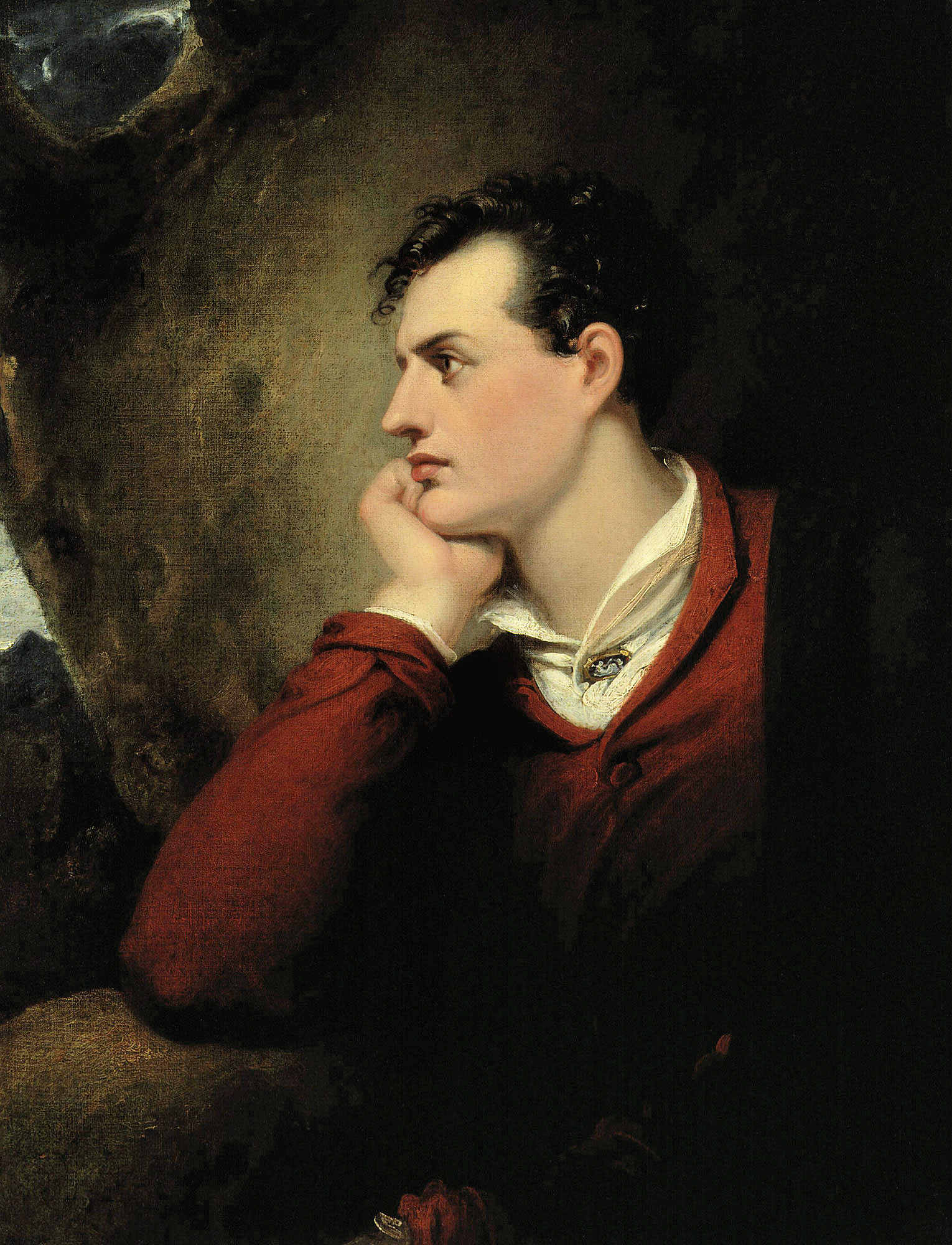
George Gordon (Lord Byron) by Richard Westall (1765-1836). National Portrait Gallery, London.

Lord Byron (George Gordon), 1788-1824, Letter to poet Thomas Moore, October 28, 1815. Byron’s Letters and Journals, vol. 4 (1973-81; edited by Leslie A. Marchand).

Lord Byron (George Gordon), 1788-1824, Byron’s Letters and Journals, vol. 8 (1973-81; edited by Leslie A. Marchand).

Out of chaos God made a world, and out of high passions comes a people. Lord Byron (George Gordon), 1788-1824, Byron was describing the early nationalist fervor in Italy for which the poet played an active role. Byron’s Letters and Journals, vol. 8 (1973-81; edited by Leslie A. Marchand).

I do detest everything that is not perfectly mutual. Lord Byron (George Gordon), 1788-1824, Letter, October 21, 1813. Byron’s Letters and Journals, vol. 3 (1973-81; edited by Leslie A. Marchand).

I only go out to get me a fresh appetite for being alone. Lord Byron (George Gordon), 1788-1824, Journal, December 12, 1813. Byron’s Letters and Journals, vol. 3 (1973-81; edited by Leslie A. Marchand).

Lord Byron (George Gordon), 1788-1824, Journal, March 22, 1814. Byron’s Letters and Journals, vol. 3 (1973-81; edited by Leslie A. Marchand).

In solitude, where we are LEAST alone. Lord Byron (George Gordon), 1788-1824, Childe Harold, canto 3, stanza 90.

Lord Byron in Albanian Dress, 1813, Thomas Phillips (1770-1856). Public Domain

Lord Byron (George Gordon), 1788-1824, Byron’s Letters and Journals, vol. 8 (1973-81; edited by Leslie A. Marchand).

Lord Byron (George Gordon), 1788-1824, Byron’s Letters and Journals, volume 9, edited by Leslie A. Marchand, 1979. The journal entry was written on Byron’s final journey to aid the Greek revolt.

If we must have a tyrant, let him at least be a gentleman who has been bred to the business, and let us fall by the axe and not by the butcher’s cleaver. Lord Byron (George Gordon), 1788-1824, Letter, February 21, 1820 to John Murray, publisher. Byron’s Letters and Journals, volume 7, edited by Leslie A. Marchand, 1973-1981.
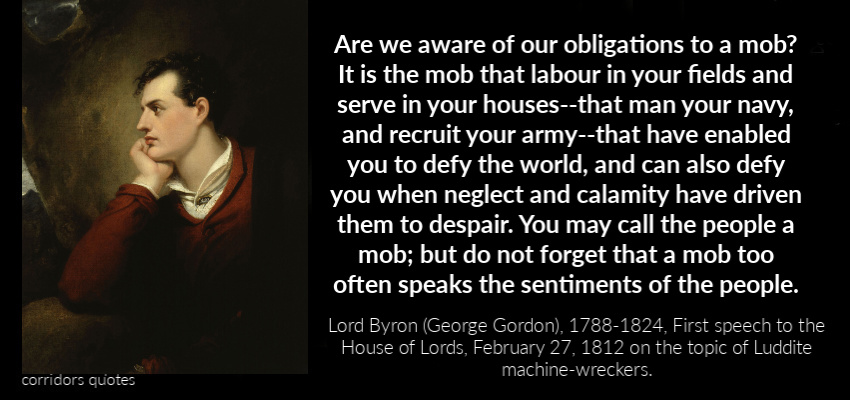
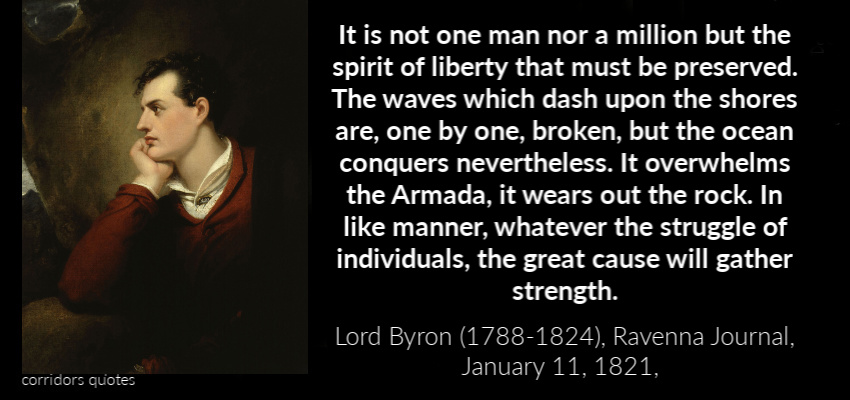
Are we aware of our obligations to a mob? It is the mob that labour in your fields and serve in your houses–that man your navy, and recruit your army–that have enabled you to defy the world, and can also defy you when neglect and calamity have driven them to despair. You may call the people a mob; but do not forget that a mob too often speaks the sentiments of the people. Lord Byron (George Gordon), 1788-1824, First speech to the House of Lords, February 27, 1812 on the topic of Luddite machine-wreckers.
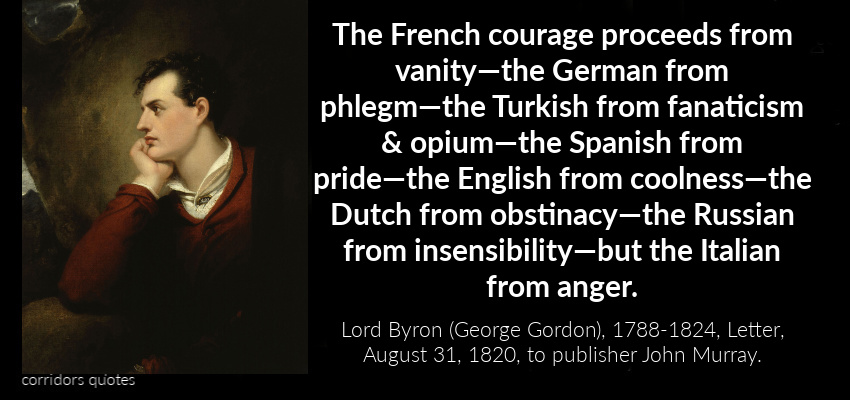
The French courage proceeds from vanity—the German from phlegm—the Turkish from fanaticism & opium—the Spanish from pride—the English from coolness—the Dutch from obstinacy—the Russian from insensibility—but the Italian from anger. Lord Byron (George Gordon), 1788-1824, Letter, August 31, 1820, to publisher John Murray. Published in Byron’s Letters and Journals, volume 7, ed. Leslie A. Marchand , 1973-1981.

It is by far the most elegant worship, hardly excepting the Greek mythology. What with incense, pictures, statues, altars, shrines, relics, and the real presence, confession, absolution, –there is something sensible to grasp at. Besides, it leaves no possibility of doubt; for those who swallow their Deity, really and truly, in transubstantiation, can hardly find any thing else otherwise than easy of digestion. Lord Byron (George Gordon), 1788-1824, Letter, March 8, 1822 to poet Thomas Moore. Byron explained that he was bringing up one of his own daughters, Allegra, a Catholic.

It is useless to tell one not to reason but to believe — you might as well tell a man not to wake but sleep. Lord Byron (George Gordon), 1788-1824, Detached Thoughts, no. 96, 1821-22.

I would rather…have a nod from an American, than a snuff box from an emperor. Lord Byron (George Gordon), 1788-1824, letter, June 8, 1822, to poet Thomas Moore.

The thorns which I have reap’d are of the tree
I planted; they have torn me, and I bleed.
I should have known what fruit would spring from such a seed.
Lord Byron (George Gordon), 1788-1824, Childe Harold’s Pilgrimage, Canto IV, Stanza 10 (1818).

BRITAIN. John Keats (1795-1821) Poet.

FEATURE image: The poet John Keats, c. 1822, by William Hilton after Joseph Severn (1819), oil on canvas, 30 in. x 25 in., Nation Portrait Gallery, London. Public Domain.

John Keats’s first book of poems was published in 1817 when the English poet was 22 years old. From an early age, Keats, studying under the literary Rev. John Clarke, became a passionate reader of poetry and was introduced to the theater and music which he loved. Though both of his parents had died by the time Keats was in his early teens, their respectable estate never reached him in his short lifetime. His guardian sent the minor Keats to work in the medical field. But in 1813, the young Keats abandoned that apprenticeship for another — and began to write poetry.

Keats’ early poetic mentor was Leigh Hunt (1784-1859), editor of the Examiner, who introduced Keats to great established poets such as William Hazlitt (1778-1830), Charles Lamb (1775-1834), and Percy Bysshe Shelley (1792-1822). Keats also made the acquaintance of painter Benjamin Robert Haydon (1786-1846) and made other intimate lifelong friends. In 1816 Keats wrote his first major sonnet (On First Looking into Chapman’s Homer) in which he laid out an ambitious plan for his poetry.

In 1817 Keats wrote the 4,000-line Endymion though, ever a perfectionist, Keats considered it merely a poetic exercise. Keats soon isolated himself consciously from others to benefit his art. His over-riding quest was to seek his artistic individuality and poetic voice.

In 1818 external personal and professional events circumscribed Keats’ precious independence. First, his poetry for political rather than artistic reasons was ridiculed in the press. But more problematic for the brave Keats was that some of his immediate family members had become suddenly destitute or died. Keats’ spring and summer walking tour in 1818 of England, Scotland, and Ireland resulted in Keats’s personal inspiration but a chronically weakened state of physical health. In those same months, the 23-year-old poet had fallen in love with the vivacious, pretty and thoroughly nonliterary 18-year-old Fanny Brawne (1800-1865). They soon became engaged, but Keats’ inferior health and his strained to nonexistent finances impeded their getting married which frustrated Keats.

In the rapidly reached final period of his life and poetic career, Keats wrote several of his masterpieces. In 1819 Keats wrote, one after another, The Eve of St. Agnes, La Belle Dame Sans Merci, his Odes (including Ode To a Grecian Urn), Lamia, and several major sonnets. These poems possess the characteristics of Keats’ mature work—that of grace, sensuality, and sympathetic objectivity. It sets before the reader the conflicting and contradictory nature of existence, signaling a “both-and” experience of living in the world, including grappling with the problem of good and evil. Keats writes plainly in a letter in that period about life’s suffering—it is a “world…full of misery and heartbreak, pain, sickness and oppression.”

Weakened by tuberculosis, Keats’ health took a bad turn in February 1820 so much so that the poet realized he was dying. By that fall he traveled to Italy seeking a milder climate for his health. He stayed in Rome until the end came. On February 23, 1821 —like his mother and brother before him— Keats died of tuberculosis. The 25-year-old poet was buried in the Protestant Cemetery in Rome.

Despite his gallant reluctance to yield to bitterness or despair for his life’s wasteful circumstances, with death died Keats’ ambitious plans of renewed poetic achievement and an ongoing passionate love for Fanny Brawne. Although today’s reader can continue to savor John Keats’ poems and letters prior to his having stopped writing at 24 years old, what might have been in terms of the English Romantic poet’s fully realized potential is to offer a conjecture about one of the English language’s greatest poets.

SOURCES: The Norton Anthology of English Literature, Third Edition, Volume 2, W.W. Norton & company, Inc. New York, 1974.

John Keats, Walter Jackson Bate, The Belknap Press of Harvard University Press, Cambridge, Massachusetts, 1964.

John Keats (detail) by Joseph Severn (1793-1879), 1819.

Quotations.

John Keats, letter to his brother and sister, Spring 1819. While we are laughing, the seed of trouble is put into the wide arable land of events. While we are laughing it sprouts, it grows and suddenly bears a poison fruit which we must pluck.

Letter to his brother George Keats (1797-1841) and sister-in-law Georgiana Augusta Wylie Keats (1798-1879). Married in England in May 1818, the Keats departed for America going to Kentucky and southeastern Illinois by way of Philadelphia and Pittsburgh. The Keats are buried in Cave Hill Cemetery in Louisville, Kentucky. Mrs. Keats re-married after the poet’s brother died during experiences of serious financial setbacks. Do you not see how necessary a world of pains and troubles is to school an intelligence and make it a soul?

The poet suffered from– and died of– tuberculosis at the age of 25 years. Letter to his fiancée, Fanny Brawne, March 1, 1820. Health is my expected Heaven.

Letter to his brothers, George and Thomas Keats, January 13-19, 1818. Letters of John Keats, no. 37, edited by Frederick Page, 1954. There is nothing stable in the world; uproar’s your only music.

Endymion, Preface (1818). The complete line is: “This may be speaking too presumptuously, and may deserve a punishment: but no feeling man will be forward to inflict it: he will leave me alone, with the conviction that there is not a fiercer hell than the failure in a great object.”

The Fall of Hyperion – A Dream. Canto 1, first lines. Fanatics have their dreams, wherewith they weave A paradise for a sect.

Letter, August 23, 1819, Letters of John Keats, no. 144, ed. Frederick Page, 1954. I will give you the definition of a proud man: he is a man who has neither vanity nor wisdom—one filled with hatreds cannot be vain, neither can he be wise.

Letter to George Keats, February 19, 1819. A Man’s life of any worth is a continual allegory–and very few eyes can see the Mystery of his life–a life like the scriptures, figurative–which such people can no more make out than they can the Hebrew Bible…Shakespeare led a life of Allegory; his works are the comments on it.

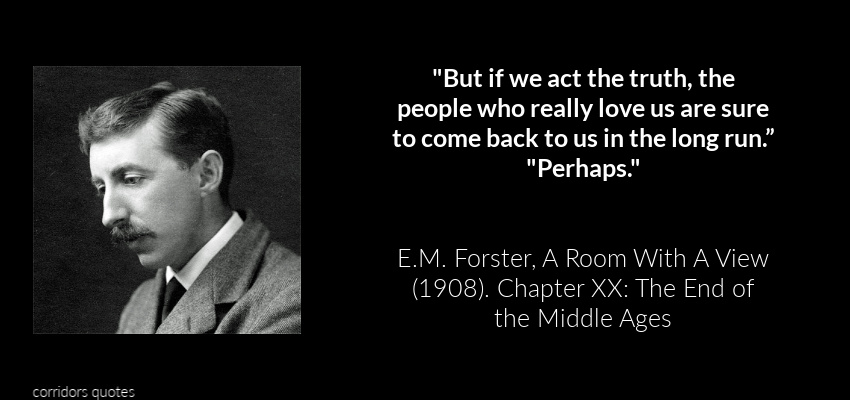
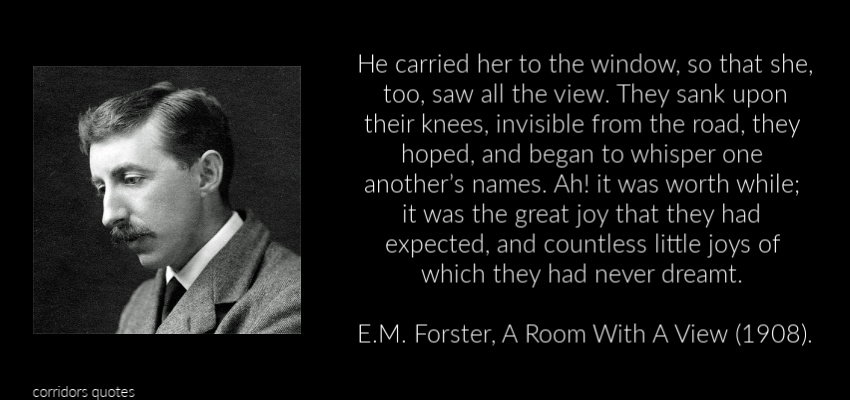
BRITAIN. E.M. Forster (1879-1970), A ROOM WITH A VIEW (1908).

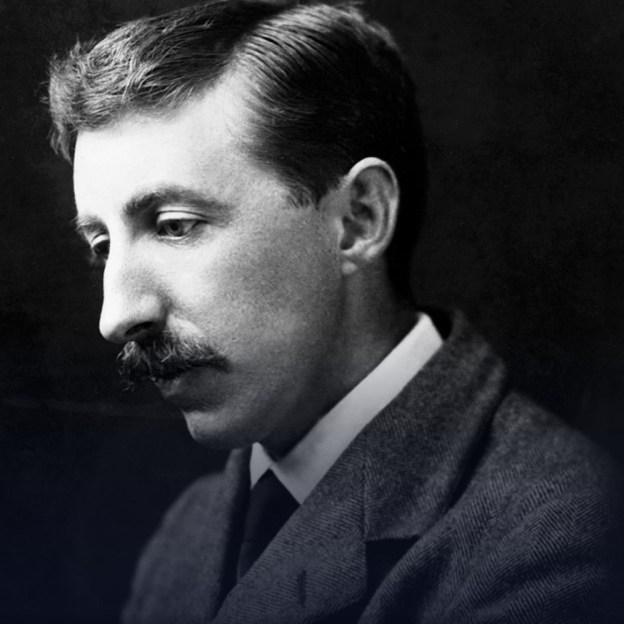
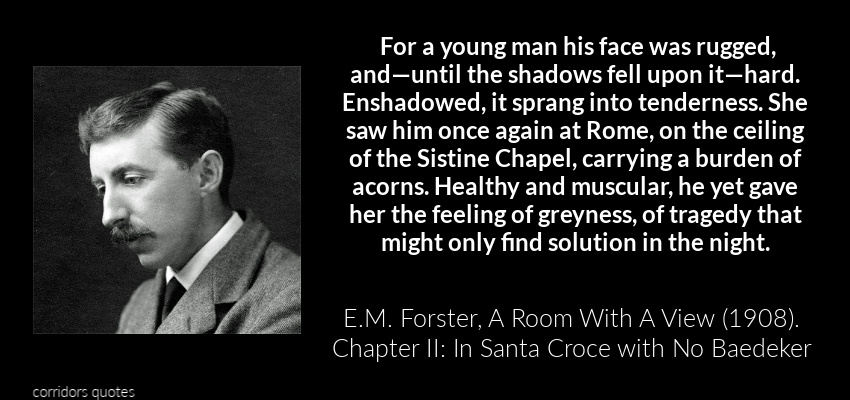
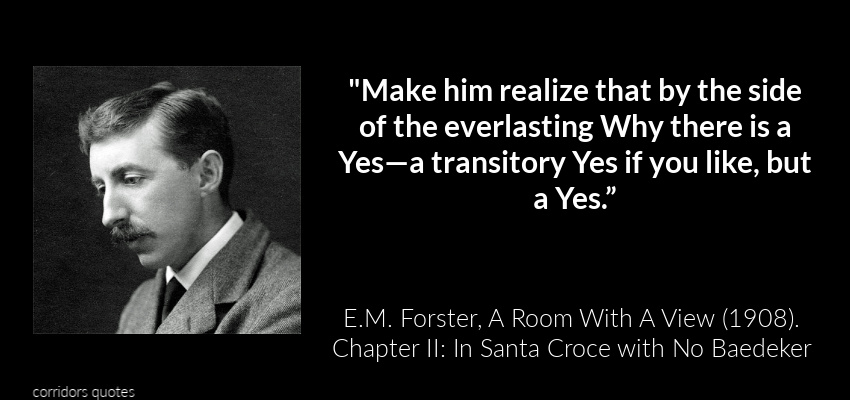
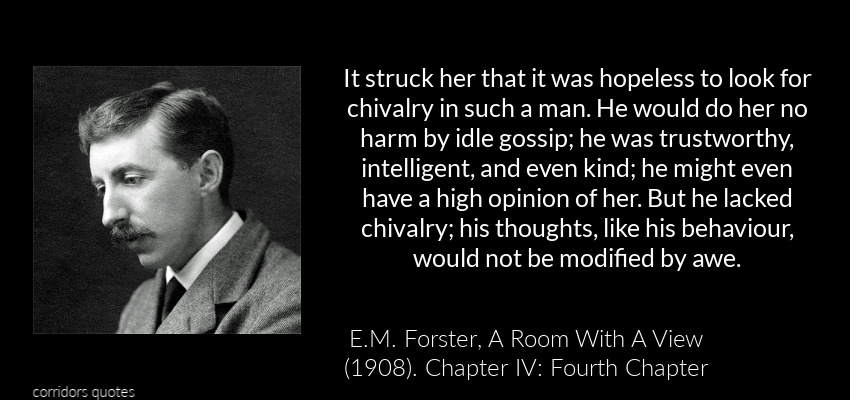
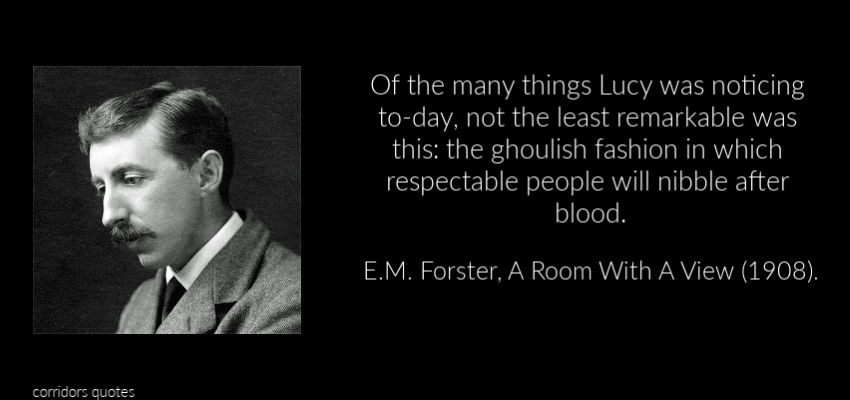
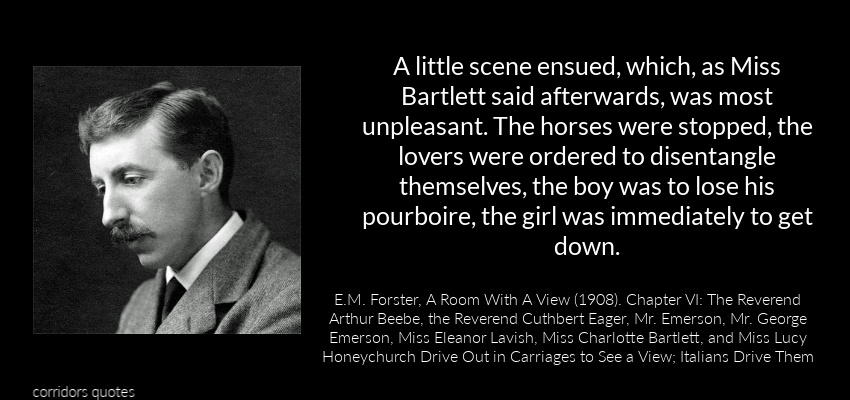
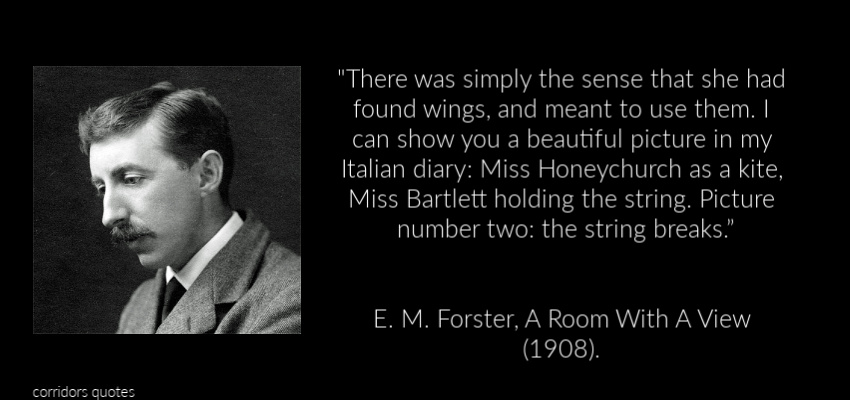
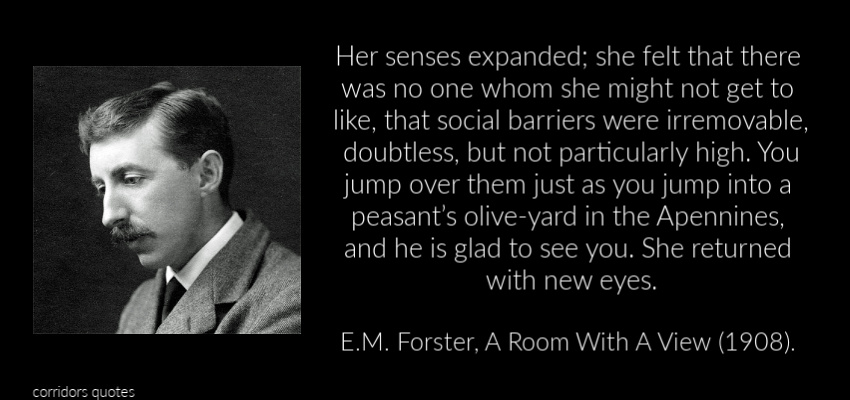
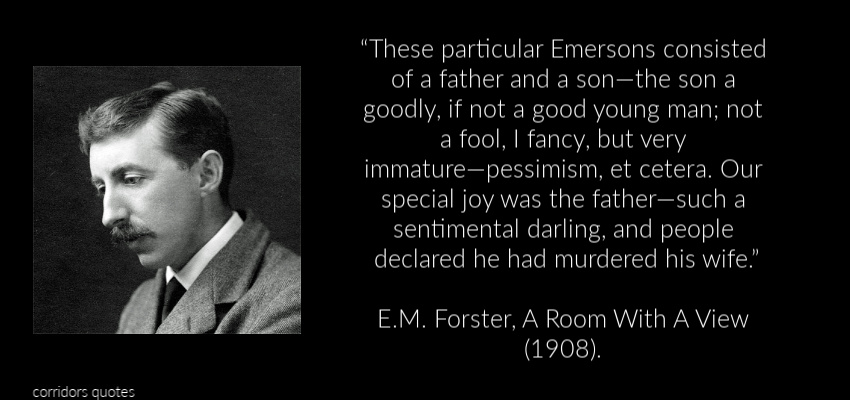
FEATURE image: E.M. Forster. Public Domain. Edward Morgan Forster was born in London in 1879. He wrote numerous short stories, essays, biographies and plays, although he is best known for his novels, particularly A Room With A View (1908), Howards End (1910), and A Passage to India (1924), all of which have been made into award-winning feature films. Forster was nominated for a score of Nobel Prizes for Literature. He died in 1970. 

E. M. Forster by Dora Carrington (1893-1932), oil on canvas, 1920. Public Domain.
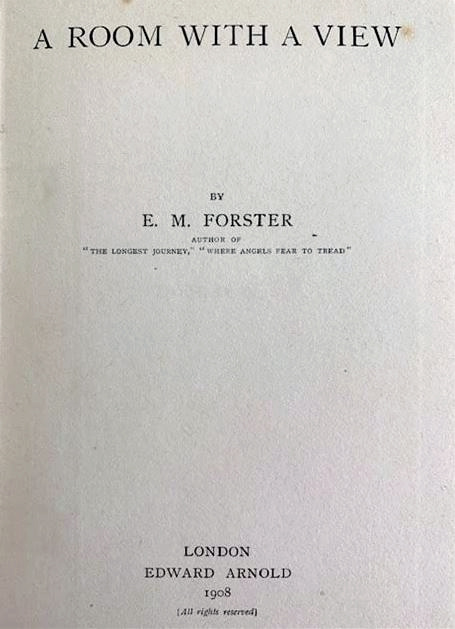
Title page, first edition, 1908. Public Domain.
First edition, 1908. Public Domain.

Edward Morgan Forster (1879–1970) is an English novelist, short story writer, and essayist.

The heart of Forster’s literary work is humanist in nature as his characters depict—whether in Where Angels Fear to Tread (1905), A Room with a View (1908), his masterpiece Howards End (1910), his most successful work A Passage to India (1924), Maurice (1971), and others — the honest pursuit of personal tracks and connections in the face of first looking to impress or please the inevitable and constantly mutating restrictions of contemporary society.

In A Room With a View it is 1907 and young English girl Lucy Honeychurch — “a young lady with a quantity of dark hair and a very pretty, pale, undeveloped face”– is staying at an Italian pension with her cousin and chaperone, Miss Charlotte Bartlett while on holiday in and around Florence.

At dinner in the pension they meet some other English guests: a reverend, two older Miss Alans, a writer Miss Lavish, and a Mr. Emerson and his handsome adult son, George. They discuss the merits and practicalities of having a room with a view in Florence.

The next day while touring the city Lucy faints in the Piazza della Signoria having witnessed a stabbing and is rescued by handsome George. After they establish this connection George and Lucy are together again to join a group tour of the nearby countryside. Eventually finding themselves alone, George embraces Lucy and they kiss. This is witnessed by Miss Bartlett who cuts short her and Lucy’s visit to Florence.

After visiting the Vyses in Rome, Lucy and Miss Bartlett have returned to Surrey in England. Lucy accepts one of the marriage proposals from snobby Cecil Vyse, a drawing room match. By happenstance of personal connection, George and his father, Mr. Emerson, had made passing acquaintance with Cecil at the National Gallery in London which led to Cecil inviting them to take up residence in a rental house next door to Lucy Honeychurch. Lucy immediately recalls the Emersons and their personal connection in Florence, especially with George. But her escape to Rome and then to Windy Corner, her home in Surrey, added to her being uncomfortable with their renewed intimate presence, particularly since she is just engaged to Cecil, her “Fiasco” as Lucy’s brother Freddy calls him.

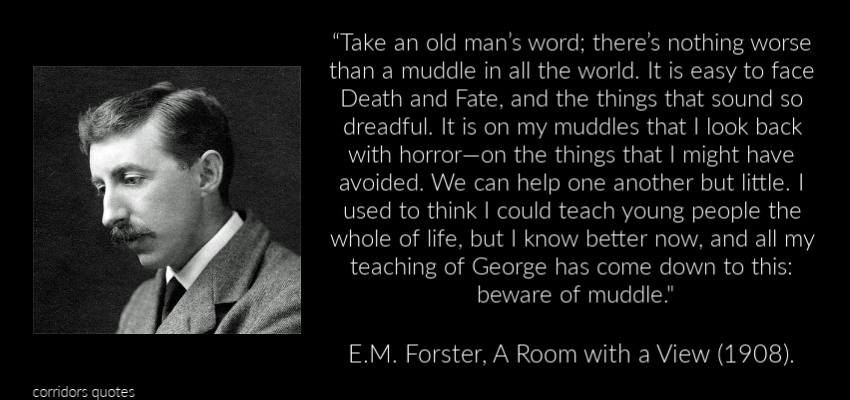
Lucy rebuffs George as she ultimately breaks her engagement with Cecil with plans for herself to travel to Greece. Meantime, George has made plans of his own to leave. At this juncture, Lucy admits her feelings for George and cancels her trip. George and Lucy elope to Florence. They take “a room with the view” with the promise of living happily thereafter. Forster observed: “Passion does not blind. No. Passion is sanity, and the woman you love, she is the only person you will ever really understand.”

E.M. Forster. National Portrait Gallery, London. Public Domain.

PART 1.

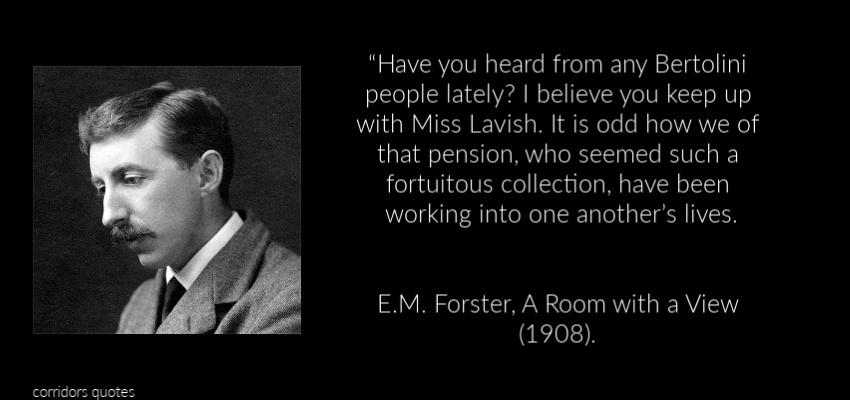
Chapter I: The Bertolini (7 quotes).

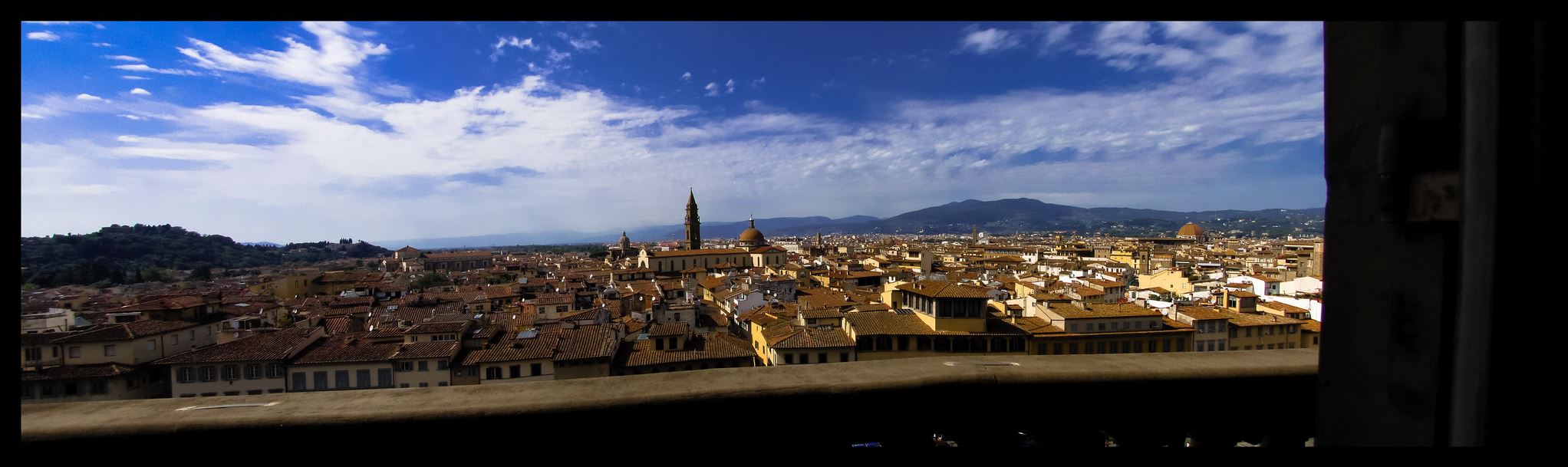
Firenze – A Room with a View
by Flavio~This image was marked with a CC BY 2.0 license.
The Lucy Honeychurch and Charlotte Bartlett #strideby.” by hypercatalecta is licensed under CC BY-NC-SA 2.0.

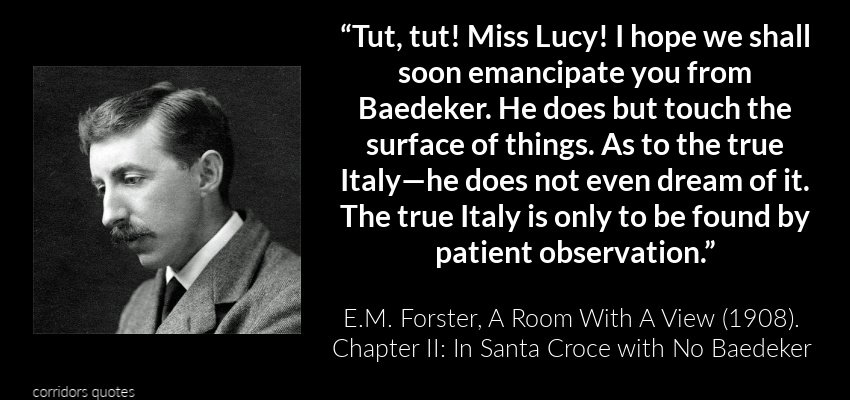
Chapter II: In Santa Croce with No Baedeker (17 quotes).

Basilica of Santa Croce, Firenze
by *Jezza. This image was marked with a CC BY-NC-ND 2.0 license.
Santa Croce – Firenze 2015
by Francesco CescoP Pradella. This image was marked with a CC BY-ND 2.0 license.

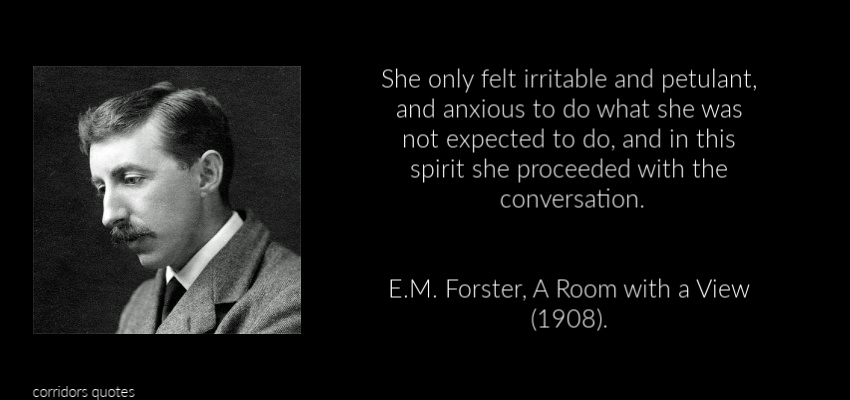
Chapter III: Music, Violets, and the Letter “S” (15 quotes).

Loggia dei Lanzi – Piazza della Signoria, Florence – seen from the Uffizi Gallery by ell brown. This image was marked with a CC BY-NC-SA 2.0 license.

Chapter IV: Fourth Chapter (5 quotes).

Piazza della Signoria, in front the Fountain of Neptune (Florence, Tuscany, Italy) – 800055
by Belpaese.nl. This image was marked with a CC BY-NC-ND 2.0 license.

Chapter V: Possibilities of a Pleasant Outing (10 quotes).

Campagna presso Fiesole
by giorgiorodano46. This image was marked with a CC BY-NC 2.0 license.

Chapter VI: The Reverend Arthur Beebe, the Reverend Cuthbert Eager, Mr. Emerson, Mr. George Emerson, Miss Eleanor Lavish, Miss Charlotte Bartlett, and Miss Lucy Honeychurch Drive Out in Carriages to See a View; Italians Drive Them (6 quotes).

Chapter VII: They Return (10 quotes).

Fiesole
by giorgiorodano46. This image was marked with a CC BY-NC 2.0 license.

PART 2.

Chapter VIII: Medieval (14 quotes).

Chapter IX: Lucy As a Work of Art (11 quotes).

Cotswold Cottage
by Maia C. This image was marked with a CC BY-NC-ND 2.0 license.

Chapter X: Cecil as a Humourist (11 quotes).

The gardens of Athelhampton House in Dorset
by Anguskirk. This image was marked with a CC BY-NC-ND 2.0 license.

Chapter XI: In Mrs. Vyse’s Well-Appointed Flat (9 quotes).

Chapter XII: Twelfth Chapter (9 quotes)

English Wet Forest” by tredford04 is licensed under CC BY-NC-SA 2.0.

Chapter XIII: How Miss Bartlett’s Boiler Was So Tiresome (13 quotes)

English sitting room” by quinet is licensed under CC BY 2.0.

Chapter XIV: How Lucy Faced the External Situation Bravely (9 quotes)

Water in English Gardens (19 of 33) | RHS Gardens in Autumn, Wisley, Surrey, England” by ukgardenphotos is licensed under CC BY-NC-ND 2.0.

Chapter XV: The Disaster Within (20 quotes)

Chapter XVI: Lying to George (11 quotes)

Chapter XVII: Lying to Cecil (14 quotes)

Last of the Summer Flowers, Wisley Gardens, Surrey, UK | English Flower Borders (36 of 50)” by ukgardenphotos is licensed under CC BY-NC-ND 2.0.

Chapter XVIII: Lying to Mr. Beebe, Mrs. Honeychurch, Freddy, and The Servants (18 quotes)

Chapter XIX: Lying to Mr. Emerson (25 quotes)

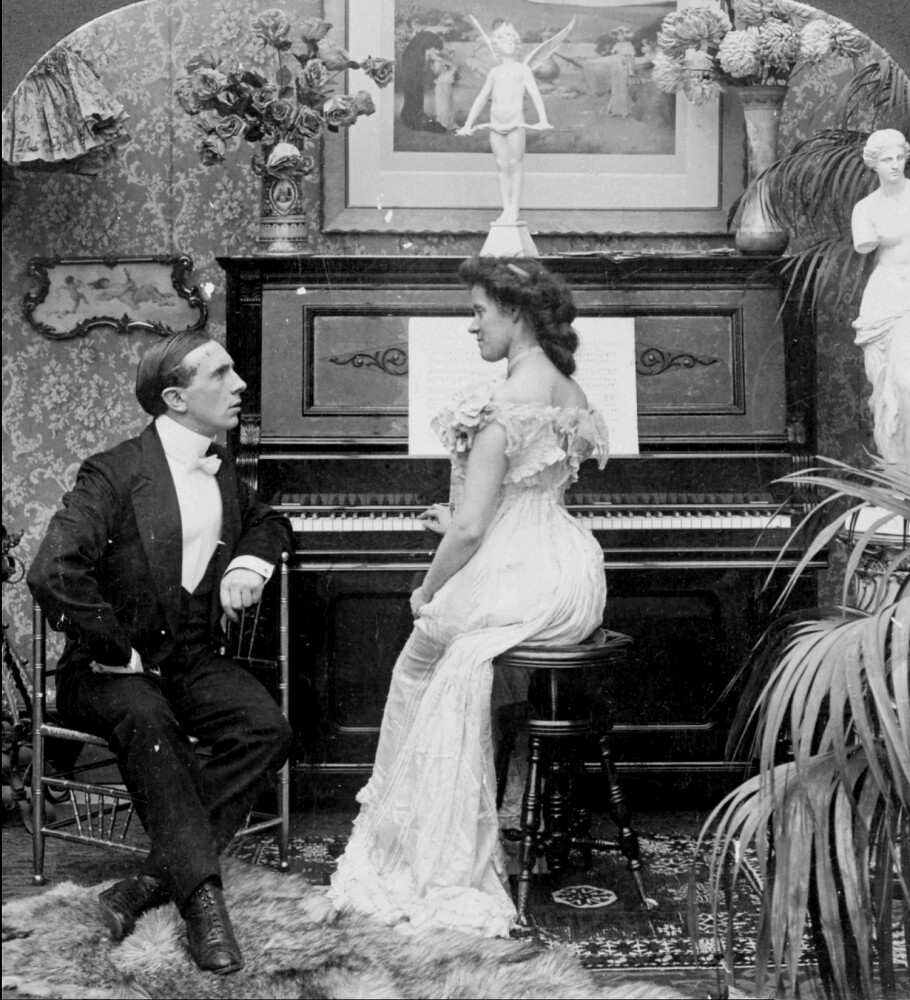
(animated stereo) Victorian Courtship, 1903” by Thiophene_Guy is licensed under CC BY-NC-SA 2.0.

Chapter XX: The End of the Middle Ages (11 quotes)

Firenze: Windows of the Palazzo Veccio by Flavio~. This image was marked with a CC BY 2.0 license.