

FEATURE image: Viewers near Chicago, Illinois, of the Total Eclipse of the Sun, April 8, 2024. Author’s photograph. All rights reserved.
On Monday, April 8, 2024, a total solar eclipse crossed North America, passing over Mexico, the United States, and Canada. The path of the eclipse first entered into Mexico then into the United States in Texas and into Canada in southern Ontario province. In the U.S., the solar eclipse’s “path of totality” traveled through Oklahoma, Arkansas, Missouri, Illinois, Kentucky, Indiana, Ohio, Pennsylvania, New York, Vermont, New Hampshire, and Maine. The central event took less than two hours. See – https://science.nasa.gov/eclipses/future-eclipses/eclipse-2024/where-when/ – retrieved April 8, 2024. In the U.S. over 30 million people resided in the path of the April 8, 2024 solar eclipse. The next total solar eclipse in the mainland U.S. and Canada won’t be for more than 20 years. See – https://www.nytimes.com/live/2024/04/08/science/total-solar-eclipse#what-to-know-about-the-great-north-american-eclipse – retrieved April 9, 2024. The last total solar eclipse across the U.S. was August 21, 2017 and, before that, one must return to the 1970’s for a total solar eclipse in the U.S. though their paths do not begin to match the 2024 event in terms of crossing the center of the country.
Yet, a “total eclipse of the sun” is, if not one of science’s misnomers, clearly one of nature’s optical illusions. If 1.3 million Earths can fit in the sun (https://www.iflscience.com/how-many-earths-can-fit-inside…) and 50 moons can fit in the Earth (https://www.reference.com/…/many-moons-fit-inside-earth…) then 65 MILLION moons would fit in the sun. That science can learn much from the tiny moon “covering” the sun – more akin to a visual pinprick – can only be limited despite the belief (like the ancients) that it signifies more. Yet as Einstein’s Theory of Relativity demonstrates (i.e., that light bends by gravity) even a limited empirical physical footprint’s significance such as a solar eclipse can be outsized to learned points greater than its intrinsic data range – that is when viewed and processed by the universe’s most vast body – the human imagination.
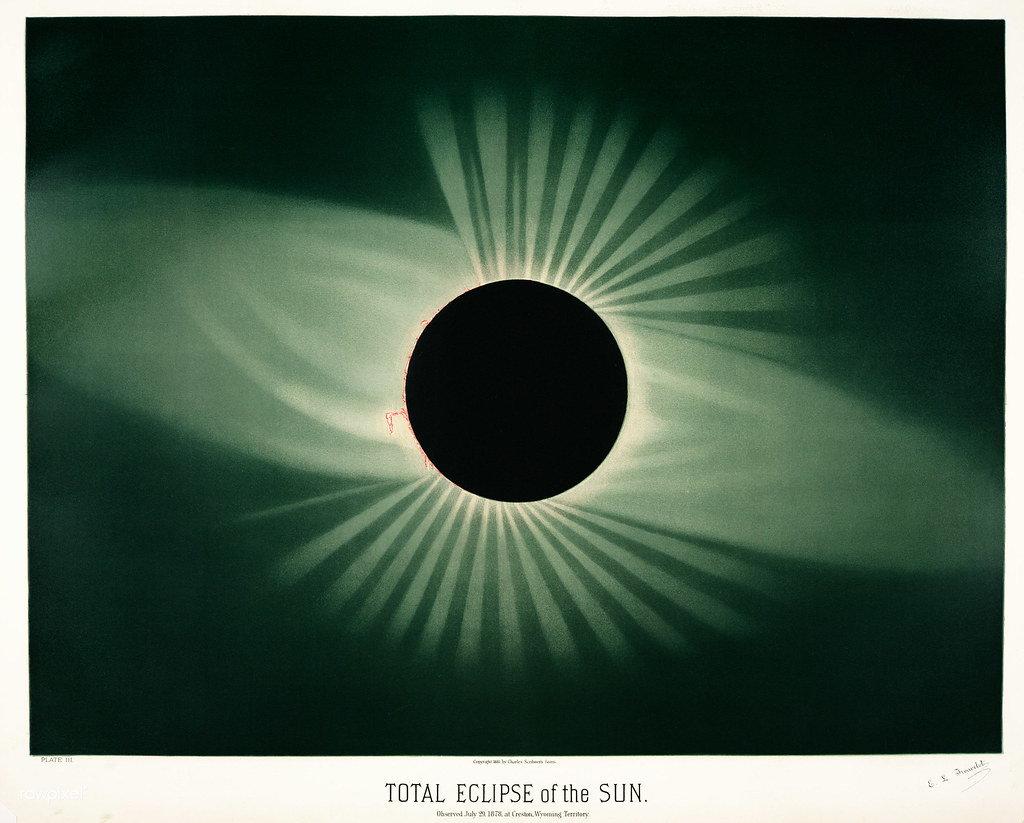
Total eclipse of the sun from the Trouvelot astronomical drawings (1881-1882). “Total eclipse of the sun from the Trouvelot<br />astronomical drawings (1881-1882) by <a href=’https://www.rawpixel.com/search/etienne leopold trouvelot?&page=1′>E. L. Trouvelot</a> (1827-1895)” by Free Public Domain Illustrations by rawpixel is licensed under CC BY 2.0.

Solar eclipse watchers near Chicago, April 8, 2024. Author’s photograph. All rights reserved.
In the media, everything is hyped and what’s important is ignored; as if earth’s tiny moon is going to block the solar system’s sun. At best it’s a dim overcast for 5 minutes where, afterwards, many express some disappointment in the drama of expectations. A lunar eclipse (that happened March 25, 2024) is more interesting for the masses of naked-eye low-tech earthlings. As far as a cosmic event, the solar eclipse is eagerly anticipated whatever its scale as it will contribute to science and scientific knowledge based on its rare natural phenomenon and the development of astronomers’ newest tools. Yet humankind’s imagination by itself is the more interesting aspect of the cosmos, starting here on earth, and ascending to the stars and planets.

