McDonald’s very first franchise restaurant on its original site, 1955 (replica, 1985). It is slated to be razed by McDonald’s Corporation immediately. Author’s photograph taken May 6, 2018.
By John P. Walsh
A closed-down weather-beaten replica of the very first McDonald’s franchise restaurant started by Ray Kroc (1902-1984) on April 15, 1955 standing on its original site in Des Plaines, Illinois, is slated to be demolished by McDonald’s Corporation with its land donated or possibly sold.
It was not long ago that McDonald’s touted that approximately one in every eight American workers had been employed by the company (Source: McDonald’s estimate in 1996) and that even today McDonald’s hires around 1 million workers in the U.S. every year. By 1961 there were 230 McDonald’s franchises in the United States. In 2017 there was 37, 241 McDonald’s restaurants worldwide. Not only historians and historic preservationists decry the imminent demolition of the first McDonald’s restaurant in Des Plaines, Illinois, just west of Chicago, but others impressed by its direct significance to the growth and impact to U.S. labor history as well as the American restaurant industry and American automotive culture in the post-World War II era. Further, McDonald’s restaurants today reach into 121 other countries around the world influencing and being influenced by global cuisine. That all of this cultural and business import was born on a now-threatened patch of land on Lee Street in Des Plaines, Illinois, is impressive.
It appears that if and when McDonald’s follows through on its November 2017 decision to raze the building and give up the site, this originally-designed McDonald’s restaurant on Ray Kroc’s original site in Des Plaines will be forever lost. The story of how that planned demolition of this unique piece of Americana came to be began 35 years ago. It was on March 3, 1984 that after 29 years of continual operation the original franchise restaurant on the original site was permanently closed and demolished. Founder and former McDonald’s Corporation chairman Ray Kroc had died less than six weeks before in January 1984 at 81 years old in San Diego, California.
The McDonald’s restaurant brand opened its first burger bar called McDonald’s Bar-B-Q in California in 1940 – and, by 1953, brothers Maurice and Richard McDonald started a small franchise business in Phoenix, Arizona and Downey, California. Today’s nationwide and global franchise empire that serves 75 burgers every second (Source: McDonald’s Operations and Training Manual) began when Oak Park, Illinois-born Ray Kroc, a paper-cup-turned-milkshake-machine salesman, convinced the McDonald brothers to let him franchise their business nationwide. Kroc offered to manage the franchises in the U.S., excepting the brothers’ first franchises in Arizona and California, and the pair were to receive a tiny percentage of gross sales nationwide in return.
Historic photograph from 1955 of the original Des Plaines McDonald’s restaurant which was demolished in 1984. A replica restaurant was built in 1985 based on architectural plans of later McDonald’s restaurants. That replica on the historic site is awaiting immediate demolition announced by McDonald’s in late 2017. Fair Use.
Kroc’s first walk-up franchise McDonald’s restaurant at the “Five Corners” intersection in Des Plaines, Illinois, served an assembly-line format menu of hamburgers, cheeseburgers, french fries and a selection of drinks. In 1955, he founded McDonald’s System, Inc., a predecessor of the McDonald’s Corporation, and six years later bought the exclusive rights to the McDonald’s name and operating system. By 1961, Ray Kroc’s vision had clearly paid off for the now 59-year-old former paper cup salesman. That same year, Kroc bought out the McDonald brothers for $2.7 million and launched his strict training program, later called “Hamburger University, ” in nearby Elk Grove Village, Illinois, at another of his 230 new McDonald’s restaurants. Ray Kroc’s original vision was that there should be 1,000 McDonald’s restaurants in the United States. When Kroc died in January 1984, his goal had been exceeded six fold — there were 6,000 McDonald’s restaurants in the U.S. and internationally in 1980.
The Des Plaines suburban location of Ray Kroc’s very first McDonald’s franchise retains its relatively humble setting even as the McDonald’s Corporation it spawned earns $27 billion in annual sales making it the 90th-largest economy in the world (Source: SEC). Kroc, the milkshake machine salesman who convinced the McDonald brothers to let him franchise their fast-food operation nationwide, saw his original McDonald’s franchise at 400 Lee St. in Des Plaines open for business until, shortly after his death, it closed on Saturday, March 3, 1984.
Ray Kroc (1902-1984) photographed with an artist’s rendering of his highly successful McDonald’s franchise restaurant. The franchise started in Des Plaines, Illinois, in April 1955 and has had a significant impact on U.S. labor history and the American restaurant industry and automotive culture in the post-World war II era. Fair Use.
In 1984 there were no plans to preserve the site – its golden arches and road sign had been carted away – but a public outcry prompted McDonald’s in 1985 to return the restaurant’s restored original sign designed by Andrew Bork and Joe Sicuro of Laco Signs of Libertyville, Illinois, and dedicate a restaurant replica that still exists today on the original site though it is now slated for demolition. The historic red neon-lettered sign turned on for the opening of Kroc’s first store on April 15, 1955 – there is one similar to it preserved in The Henry Ford museum in Dearborn, Michigan dating from 1960 – proclaimed “McDonald’s Hamburgers” and “We Have Sold Over 1 Million” and, intersecting with an iconic golden arch displayed a neon-animated “Speedee” chef, the fast food chain’s original mascot. (The clown figure of Ronald McDonald first appeared in 1963).
Newspaper advertisement announcing the opening of Ray Kroc’s first McDonald’s in Des Plaines, Illinois, in 1955. It featured the franchise’s first mascot, Speedee, who was significant to the assembly-line format menu and prevailing automobile culture. Fair Use. Historic photograph of Ray Kroc’s first McDonald’s restaurant in Des Plaines, Illinois, on opening day, April 15, 1955. Fair Use. The replica of McDonald’s first franchise restaurant is missing its golden arches, “McDonald’s” sign over the entrance and its original 1955 Speedee neon lettered sign. They were dismantled and removed in January 2018 by McDonald’s to an undisclosed location out of public view. Photo by author, May 6, 2018.
The day after the original restaurant closed – Sunday, March 4, 1984 – a McDonald’s restaurant franchise moved across the street into a state-of-the-art new building on a site that once accommodated a Howard Johnson’s and, after that, a Ground Round. The full-service McDonald’s in Des Plaines, Illinois, today continues to operate out of that 1984 building. It may confuse the visitor which exactly is the original site of the first McDonald’s as the newer 1984 building not on the first site displays inside a high-relief metal sign that reads: “The national chain of McDonald’s was born on this spot with the opening of this restaurant.” Though undated, it is signed by Ray Kroc which points to it being brought over from the original restaurant when it was closed. At the replica restaurant on the original site two metal plaques (dated April 15, 1985) properly proclaim: “Ray A. Kroc, founder of McDonald’s Corporation, opened his first McDonald’s franchise (the ninth McDonald’s drive-in in the U.S.) on this site, April 15, 1955.”
A few months after the first franchise restaurant was closed and demolished in 1984, the parcel of land on which it sat – it had only always been leased since 1955 – was purchased by McDonald’s at the same time they announced plans for the replica landmark restaurant.
The original architectural plans by architect Robert Stauber from the mid1950’s were lost, so 1980’s planners applied architectural drawings of McDonald’s restaurants built in the late 1950’s for the replica. Its kitchen included refurbished equipment brought out of storage, including the restaurant’s original six-foot grill. It also displayed one of Ray Kroc’s original multimixers like the ones he sold to Maurice and Richard McDonald that started a fast-food partnership in the 1950’s which by the mid-1960’s inspired many well-known copy cats of McDonald’s model, including Burger King, Burger Chef, Arbys, KFC, and Hardee’s.
Soda fountain multimixer. Fair Use.
The original restaurant had been remodeled several times during its almost 30 years of operation but never had much in the way of indoor seating or a drive-through. It did feature a basement and furnace built for Chicago’s four seasons and was used by the replica museum to exhibit items. The McDonald’s Museum was open for tours until September 2008 when the site experienced record-setting flooding from the nearby Des Plaines River. In April 2013 another record flood in Des Plaines submerged the McDonald’s Museum and produced serious speculation that the site would be moved or permanently closed.
An aerial view during the April 2013 Des Plaines River flood shows the partially submerged replica first McDonald’s franchise restaurant (at right) with its original Speedee neon sign. Thesign was first lit on April 15, 1955, a Friday Night. Photo: Chris Walker, Chicago Tribune, April 19, 2013. Fair Use.
In mid-July 2017, only four years since the last significant flood, the area experienced its worst flooding on record. In November 2017 McDonald’s announced it would raze the replica restaurant structure and by May 2018 the site had had its utilities disconnected and its golden arches, Speedee sign, and main entrance McDonald’s sign dismantled and removed. These historically valuable items were taken by McDonald’s out of public view to an undisclosed location. Once again, and this time more seriously it appears, the prospect of pleas by Des Plaines municipal authorities, historic preservationists, social media and others for McDonald’s Corporation to preserve the site intact is murky at best.
FEATURE image: Hawker-Siddeley Blue Steel was started privately in 1954. A contract was placed in 1956 for a stand-off missile to carry a thermonuclear device with a 1 megaton yield by the British Ministry of Supply. Blue Steel was powered by two Armstrong Siddeley Motors that were ignited on launch and enabled the missile to fly at supersonic speed. The missile was constructed of stainless steel with surfaces manufactured of titanium steel. Blue Steel first entered service in 1962 and remained as Britain’s nuclear deterrent until 1970. (see- https://www.rafmuseum.org.uk/research/collections/hawker-siddeley-blue-steel/) “Hawker Siddeley Blue Steel” by hugh llewelyn is licensed under CC BY-SA 2.0.
By John P. Walsh, dated August 9, 2017
In addition to Twitter, the media tells us that U.S. President Donald J. Trump loves to watch a lot of TV. Has he seen the film: Virtual JFK (2008)?
“Does it matter,” the film’s narrator states, “who is president on issues of war and peace? Can a president make a decisive difference in matters of war and peace? Can a president decisively lead his country into war or keep his country out of war? Or are the forces that drive nations into conflict far more impersonal (and) out of the control of any human being, even a president?”
Donald J. Trump and John F. Kennedy. Similar to JFK in the Cuban Missile Crisis in 1962, Trump in 2017 must use the military and moral strength of the U.S. to seek and find a conclusion so that North Korea changes course on their nuclear weapons peacefully. Fair use.
Nine nations stockpile around 16,300 nuclear weapons. The U.S. possesses less than half of them.
In 2014 nine nations around the world—including North Korea—have around 16,300 nuclear weapons. Estimates are that North Korea’s arsenal today may be about 20 warheads or higher. In descending order of warhead amounts, the other nuclear states are Russia (8,000 warheads), the U.S.A. (7,300), France (300), China (250), the UK (225), India and Pakistan (about 100 each) and Israel (80).
According to the National Security Archive, the last tactical nuclear weapons left Cuba in December 1962. For a rogue state such as North Korea to possess nuclear weapons is dangerous and unpredictable to the region and world.
Like JFK in the Cuban Missile Crisis in 1962, the U.S. must use its military and moral strength to seek and find a conclusion so that North Korea changes course on their nuclear weapons peacefully. Exactly what that change should look like is an important debate not explored here, but the U.S. must not or never start or provoke a nuclear war to achieve it.
Kennedy prepared for nuclear war during the Cuban Missile Crisis, but always carefully stayed away from pulling the trigger. There can be no close analogy between Cuba, 90 miles off American shores, in 1962 and North Korea, over 6,000 miles away, in 2017.
The Cold War by the early 1960’s had become a well-worn competitive geopolitical game that hadn’t completely played itself out. The Russians built a wall in Berlin in 1961; Kennedy quarantined Cuba in 1962. In the Cuban Missile Crisis, the missiles were clearly Russian nukes. In 2017 what sources can Trump hold accountable for the North Korean weapons deployment in addition to the rogue regime? China? Russia? Iran? If Pyongyang is as remote and obscure today as the Kremlin was in Kennedy’s time, today’s political and military equations appear to be more tangled and complicated.
JFK: “It will be worse before it gets better.”
Any calculations for war must include those who may or will get killed – and how many. Is American “hyper” power any good if its allies are casualties on a massive scale? No nuclear exchange must result with a hermit kingdom dictator who is not a friend of the U.S. or its allies in the region – especially if war may incalculably spread.
If the U.S. has allies in the true meaning of the word then an attack on them by North Korea (or China or Russia) is equal to an attack on the homeland – otherwise what’s the point of the U.S. having allies at all? The U.S. must protect its allies in the region to the highest degree so to defend and preserve its esteemed alliances. In this ongoing dangerous politico-military standoff there are ramifications with severe strong risk for the U.S. as a global superpower and markedly in East Asia. North Korea must somehow stand down for there to be success from the perspective of the U.S and its allies.
Similar to the Cuban Missile Crisis that endured for 13 straight days—the Korean crisis has gone on arguably for over 60 years — patience and cool-headed leadership joined to a calibration of carrot and stick (preferring the carrot) should serve as worthwhile qualities so to craft a necessarily peaceful and successful outcome.
“Because of the ingenuity of science and man’s own inability to control his relations one with another,” said JFK in 1961 in Virtual JFK, “we happen to live in the most dangerous time in the history of the human race.” The film states that experienced military advisers believed that whenever Americans committed military force – they won the conflict.
Kennedy avoided war –and was almost impeached for it.
But as frequent and strong pressure by many advisers is put on Kennedy to commit the U.S. to a war, the president time and again chose to avoid both conventional and nuclear war.
It may not be well remembered today but after the failure of the Bay of Pigs in 1961, there was talk of John Kennedy’s impeachment for incompetence. Many in his own Democratic party wouldn’t support him because they had convinced themselves he wasn’t a serious political leader.
JFK: “The United States as the world knows will never start a war.”
In 2017 the defeat of 33-year-old Kim Jong-un’s nuclear threat short of war will not be simply a victory for the status quo but a step forward in terms of American leadership in that part of the world.
Carrot and stick
An actual war –even if nonnuclear and limited which is improbable -– cannot be in any civilized people’s self-interest. Certainly if Kim started a nuclear war, which is very remote but possible, war would come. As Trump stated plainly, on August 8, 2017, the U.S. response would be with “fire and fury.”
President Trump issues a stern warning to North Korea after the latest missile news, saying the nation “best not make any more threats to the United States.”
In October 1962 Kennedy’s speech to the nation on the Cuban Missile Crisis included his own “fiery” rhetoric:
“Third: It shall be the policy of this nation to regard any nuclear missile launched from Cuba against any nation in the Western Hemisphere as an attack on the United States, requiring a full retaliatory response upon the Soviet Union.”
JFK concluded with the overall purpose of his actions: “Our goal is not the victory of might, but the vindication of right – not peace at the expense of freedom, but both peace and freedom, here in this hemisphere, and we hope, around the world. God willing, that goal will be achieved.”
In 2017 we may look for a resolution to the North Korea crisis where history repeats itself.
All through the Cold War Kennedy looked into the face of strategic MAD (Mutually Assured Destruction) without blinking and then chose to evoke the better angels of our nature. At the United Nations in his first year as president (September 25, 1961) Kennedy exhorted the world’s representatives: “Together we shall save our planet – or together we shall perish in its flames. Save it we can. Save it we must. Then shall we earn the eternal thanks of mankind and, as peacemakers, the eternal blessing of God.”
President Trump would do well to aspire to the same.
FEATURE image: Walter Cronkite in November 1983 by photographer Bernard Gotfryd (1924-2016). Library of Congress. Public Domain.
By John P. Walsh, November 4, 2016.
INTRODUCTION
The date of November 4, 2016 is American newsman Walter Cronkite’s 100th birthday. The CBS News anchor died in 2009 at 92 years old. Employed with CBS News since 1950, Cronkite anchored the CBS Evening News from April 1962 to Friday, March 6, 1981. Walter Cronkite lived by professional journalistic standards that appear to be largely out of favor in 2016.
Working in times as exhilarating and turbulent as our own, the mustached newsman came nightly into Americans’ living rooms for decades and became lionized as “the most trusted man in America” in viewer polls. This was not, in Cronkite’s case, any hollow accolade. Because of its accuracy and in-depth reporting, Cronkite’s broadcast was, after 1967 until his retirement, the top-rated news program on television.
Since grade school I have been a news junkie and, along with Cronkite’s broadcast in those same years, I frequently tuned in the nightly newscasts of Howard K. Smith at ABC (originally at CBS) and John Chancellor at NBC. To quote Bob Dylan, this year’s Nobel laureate in Literature: The Times They Are a-Changin’. In 2016 there is an obvious conflation of journalism and partisan American politics at many important media outlets, including Cronkite’s own diverse and venerable CBS News.
What, if any, is or should be the line of advocacy and objectivity in journalism? The formula promulgated in and by the media today appears ill-fitted to Cronkite’s inveterate viewpoint for the journalistic duty to objective reporting. What would centenarian Walter Cronkite say about the spectrum of media bias as practiced in 2016?
In honor of Walter Cronkite’s 100th birthday, here are Cronkite quotations germane to the subject:
I am in a position to speak my mind. And that is what I propose to do. SOURCE: UN Address (1999). “For many years, I did my best to report on the issues of the day in as objective a manner as possible. When I had my own strong opinions, as I often did, I tried not to communicate them to my audience. Now, however, my circumstances are different. I am in a position to speak my mind. And that is what I propose to do. Those of us who are living today can influence the future of civilization. We can influence whether our planet will drift into chaos and violence, or whether through a monumental educational and political effort we will achieve a world of peace under a system of law where individual violators of that law are brought to justice.”
In seeking truth you have to get both sides of a story. SOURCE:
There is no such thing as a little freedom. Either you are all free or you are not free. SOURCE:
American military journalists undergoing combat flight training for bombing missions in 1943. Left to right: Gladwin Hill, William Wade, Robert Post, Walter Cronkite, Homer Bigart, and Paul Manning.Cronkite in 1943- This work is in the public domain in the United States because it is a work prepared by an officer/employee of the U.S. Government as part of official duties under terms of Title 17 Chapter 1 Section 105 of the US Code.
Success is more permanent when you achieve it without destroying your principles. SOURCE: Reader’s Digest, Quotable Quotes: Wit and Wisdom from the Greatest Minds of Our Time (2012).
I think it is absolutely essential in a democracy to have competition in the media, a lot of competition, and we seem to be moving away from that. SOURCE: https://www.npr.org/templates/story/story.php?storyId=106796633 John Nichols, The Nation: Walter Cronkite America’s Anchorman, July 20, 2009. “I think it is absolutely essential in a democracy to have competition in the media, a lot of competition, and we seem to be moving away from that,” Cronkite told me the last time we spoke about media issues.
Objective journalism and an opinion column are about as similar as the Bible and Playboy magazine. SOURCE:
There’s a little more ego involved in these jobs than people might realize. SOURCE:
I am neither a Republican nor Democrat. I am a registered independent because I find that I cast my votes not on the basis of party loyalty but on the issues of the moment and my assessment of the candidates. SOURCE:
Walter Cronkite anchored the top-rated news broadcast from 1967 to 1981 when the mustached newsman retired. This is the title card for the “CBS Evening News with Walter Cronkite” on April 4, 1968, the night Martin Luther King, Jr. was assassinated. Cronkite April 4, 1968 news card-fair use-
The photo bite was invented before the sound bite. SOURCE: Cronkite, A Reporter’s Life, 1996.
I think that being liberal, in the true sense, is being non-doctrinaire, non-dogmatic, non-committed to a cause but examining each case on its merits. Being left of center is another thing; it’s a political position. I think most newspapermen by definition have to be liberal. If they’re not liberal, by my definition of it, then they can hardly be good newspapermen. If they’re preordained dogmatists for a cause, then they can’t be very good journalists. SOURCE:
If that is what makes us liberals, so be it, just as long as in reporting the news we adhere to the first ideals of good journalism – that news reports must be fair, accurate and unbiased. SOURCE:
It is not the reporter’s job to be a patriot or to presume to determine where patriotism lies. His job is to relate the facts. SOURCE:
It is a seldom proffered argument as to the advantages of a free press that it has a major function in keeping the government itself informed as to what the government is doing. SOURCE:
Breaking news of the assassination of President Kennedy on Friday, November 22, 1963. CBS News Bulletin card- This image consists only of simple geometric shapes or text. It does not meet the threshold of Originalityneeded for copyright protection, and is therefore in the public domain.
CBS was ten minutes into its live broadcast of the soap opera As the World Turns when a “CBS News Bulletin” bumper slide abruptly broke into the broadcast at 1:40 pm, ten minutes after the assassination took place in Dallas.
Over this slide, Cronkite began reading what would be the first of three audio-only bulletins that were filed in the next twenty minutes: “Here is a bulletin from CBS News. In Dallas, Texas, three shots were fired at President Kennedy’s motorcade in downtown Dallas. The first reports say that President Kennedy has been seriously wounded by this shooting.”
Walter Cronkite in Vietnam to cover the Tet Offensive, 1968.Cronkite in Vietnam, February 20, 1968-Public Domain-NARA via WikiCommons. This image or file is in the public domain because it contains materials that originally came from the U.S. Marine Corps.
Vietnam. Walter Cronkite and a CBS Camera crew use a jeep for a dolly during an interview with the commanding officer of the 1st Battalion, 1st Marines, during the Battle of Hue City.Cronkite Vietnam interview-Public Domain- Department of Defense. Department of the Navy. U.S. Marine Corps. National Archives at College Park.
Walter Cronkite was so known for his extensive coverage of the U.S. space program. Cronkite gets a taste for moon walking at the reduced gravity simulator at NASA’s Langley Research Center in August, 1968.Moon Walking-Public Domain-NASA.gov.
Walter Cronkite reporting on television a debate during the 1976 presidential election. Cronkite on television in 1976-This work is from the U.S. News & World Reportcollection at the Library of Congress. According to the library, there are no known copyright restrictions on the use of this work. See WikiCommons.
The ethic of the journalist is to recognize one’s prejudices, biases, and avoid getting them into print. SOURCE:
By the 1956 campaign year the public’s fascination with television created a new phenomenon. The people frequently showed more interest in the television reporters than the candidates. SOURCE: Cronkite, A Reporter’s Life, 1996.
Freedom of the press is not just important to democracy, it is democracy. SOURCE:
Walter Cronkite interviews President John F. Kennedy on Labor Day, September 2, 1963 in Hyannis Port, Massachusetts. (Mrs. Cronkite is in the foreground). They appeared on a special program of the CBS Evening News.Kennedy and Cronkite- Public Domain-NARA record: 4538278)
Cronkite challenged the president about the “hot war” in Vietnam which already “seems to parallel other famous debacles.” President Kennedy, citing 47 personnel killed in Vietnam, agreed that the situation was “very ominous.” Kennedy went on to say that calls to withdraw from Vietnam were “wholly wrong.”
They also discussed civil rights, including school integration and the march on Washington only days before (August 28, 1963) and the movement’s potential impact on Kennedy’s re-election chances.
Cronkite asked Kennedy what he believed were the major issues of the 1964 presidential election campaign. Kennedy replied that they were national security, education, and jobs.
The president specifically cited chronic unemployment that he believed was addressed by his tax cut and various job training programs. Also discussed was the Nuclear Test Ban Treaty that the U.S. signed on august 5, 1963 with Great Britain and the U.S.S.R. The treaty which banned nuclear weapons testing in the atmosphere, in outer space, and under water was confirmed in the U.S. Senate afew weeks later and signed by kennedy on October 7, 1963.
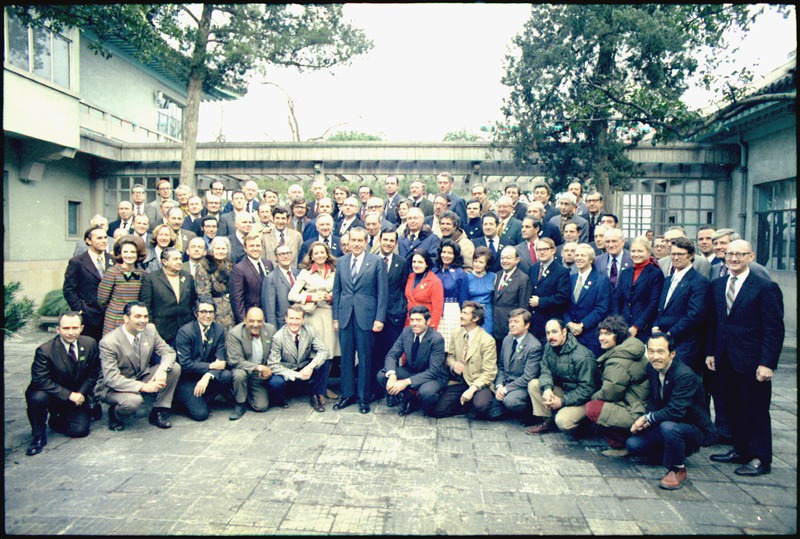
Journalists pose with President Nixon on February 28, 1972, including Walter Cronkite, in Shanghai, China. (same image below, cropped).
Cronkite behind Nixon’s right shoulder in China. Nixon in China -Public Domain-NARA via WikiCommons.
Journalists Walter Cronkite, Eric Sevareid, and Bob Schieffer interviewing President Gerald R. Ford in the Blue Room of the White House on April 21, 1975 for CBS News. Ford and Cronkite-photographer Unknown- Gerald R. Ford White House Photographs (NARA: 1756311).
Three days before Walter Cronkite’s retirement, on March 3, 1981, 65-year-old Cronkite greets 70-year-old President Ronald Reagan for an interview at the White House. There would be an assassination attempt on Reagan just a few weeks later, on March 30, 1981, in Washington, D.C. To preserve jis journalistic independence, one tactic Cronkite used was to have the journalist enter an interview from one side of a room and the interviewee (often a politician) to enter from the other. Reagan and Cronkite-Public Domain- Courtesy Ronald Reagan Library, PD as official government record.
The relationship that still exists between politics and television: a standoff between an attempt to manipulate the medium and the medium’s determination not to be manipulated. SOURCE: Cronkite, A Reporter’s Life, 1996.
Putting it as strongly as I can, the failure to give free airtime for our political campaigns endangers our democracy. SOURCE: Free the Airwaves! (November 4, 2002). “In our country, third-party candidates throughout the years have said there is not a dime’s worth of difference between the candidates from the major parties. Well, that is clearly a campaign canard. But it may appear to be true if the public’s knowledge of the important differences between candidates is limited to what the public sees and hears on television. Putting it as strongly as I can, the failure to give free airtime for our political campaigns endangers our democracy.”
I regret that, in our attempt to establish some standards, we didn’t make them stick. We couldn’t find a way to pass them on to another generation, really. SOURCE:
We cannot defer this responsibility to posterity. Time will not wait. SOURCE:
Walter Cronkite congratulates graduates via video on May 11, 2007 during the Sporing convocation at the Walter Cronkite School of Journalism and Mass Communication (Grady Memorial Auditorium). Walter Cronkite (November 4, 1916, Saint Joseph, MO – July 17, 2009, Manhattan, New York City).“2007 Spring Convocation” by ASU_Cronkite is licensed under CC BY-NC-SA 2.0 .
CBS newsman Walter Cronkite speaks at a ceremony at the National Air and Space Museum in Washington celebrating the 35th anniversary of Apollo 11 in 2004.Cronkite at NASM in 2004 -This photograph is in the public domainin the United States because it was solely created by NASA. NASA copyright policy states that “NASA material is not protected by copyright unless noted”.
“”In the absence of anything else, he came up with ‘That’s the way it is.'” But that too ruffled feathers, (Sanford “Sandy”) Socolow said. “(CBS News President Richard) Salant’s attitude was, ‘We’re not telling them that’s the way it is. We can’t do that in 15 minutes,’ which was the length of the show in those days. ‘That’s not the way it is.'”Still, Cronkite persisted and that’s the way it was from then on.”
Photograph credits: Cronkite at NASM in 2004 -This photograph is in the public domainin the United States because it was solely created by NASA. NASA copyright policy states that “NASA material is not protected by copyright unless noted”. Cronkite in 1943- This work is in the public domain in the United States because it is a work prepared by an officer/employee of the U.S. Government as part of official duties under terms of Title 17 Chapter 1 Section 105 of the US Code. Cronkite April 4, 1968 news card-fair use- CBS News Bulletin card-This image consists only of simple geometric shapes or text. It does not meet the threshold of Originalityneeded for copyright protection, and is therefore in the public domain. Cronkite in Vietnam, February 20, 1968-Public Domain-NARA via WikiCommons. This image or file is in the public domain because it contains materials that originally came from the U.S. Marine Corps. Cronkite Vietnam interview-Public Domain- Department of Defense. Department of the Navy. U.S. Marine Corps. National Archives at College Park. Moon Walking-Public Domain-NASA.gov. Cronkite on television in 1976-This work is from the U.S. News & World Reportcollection at the Library of Congress. According to the library, there are no known copyright restrictions on the use of this work. See WikiCommons. Kennedy and Cronkite- Public Domain-NARA record: 4538278) Nixon in China -Public Domain-NARA via WikiCommons. Ford and Cronkite-photographer Unknown- Gerald R. Ford White House Photographs (NARA: 1756311. Reagan and Cronkite-Public Domain- Courtesy Ronald Reagan Library, PD as official government record. “2007 Spring Convocation” by ASU_Cronkite is licensed under CC BY-NC-SA 2.0 . Cronkite at helm-Public Domain- Senior Chief Photographer’s Mate Terry A. Cosgrove – http://www.navy.mil/navydata/navy_legacy_hr.asp?id=243
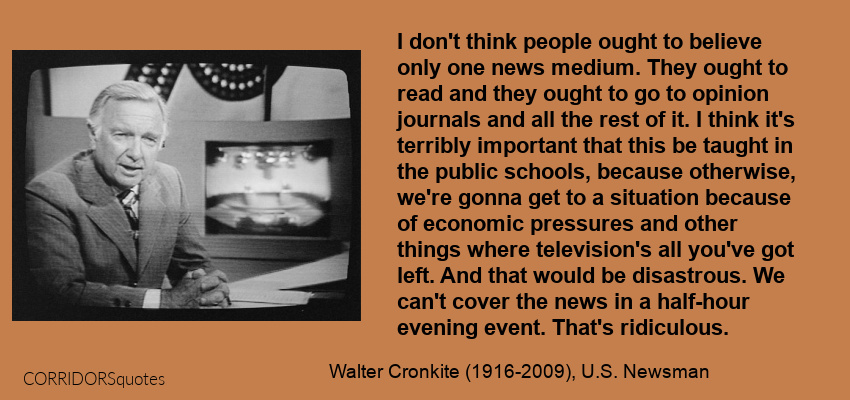
I don’t think people ought to believe only one news medium. They ought to read and they ought to go to opinion journals and all the rest of it. I think it’s terribly important that this be taught in the public schools, because otherwise, we’re gonna get to a situation because of economic pressures and other things where television’s all you’ve got left. And that would be disastrous. We can’t cover the news in a half-hour evening event. That’s ridiculous. SOURCE:
They never change a man who’s leading in the ratings. SOURCE: Conversations with Cronkite: Walter Cronkite and Don Carleton, University of Texas at Austin, 2010, p. 173.
The most important thing about the [Chet]Huntley-[David]Brinkley lead is that NBC’s very alert, strong public relations and press department sold the idea that they were just dominant in the news….That claim was vastly overdrawn in relation to the actual rating difference between NBC and CBS, which was, most of the time, within one point. SOURCE: Conversations with Cronkite: Walter Cronkite and Don Carleton, University of Texas at Austin, 2010, p. 173.
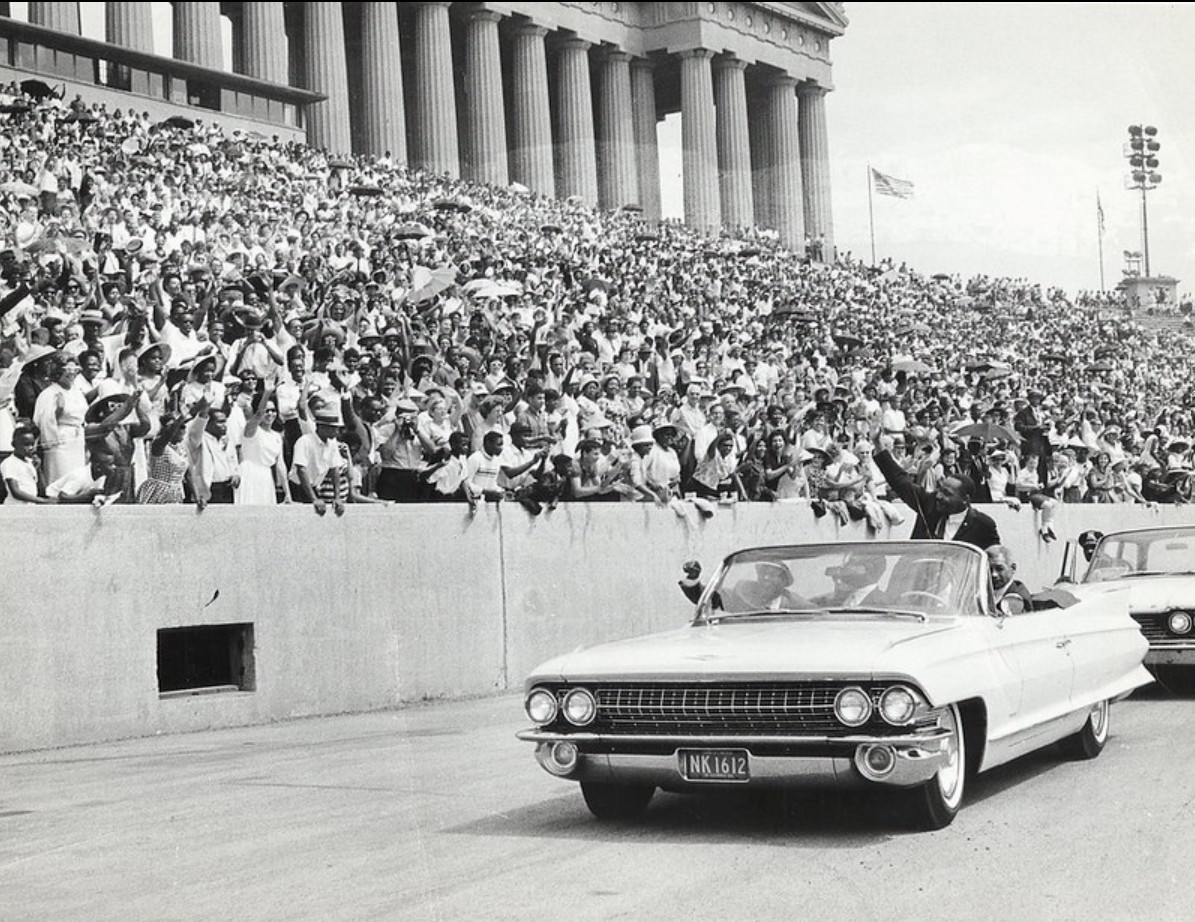
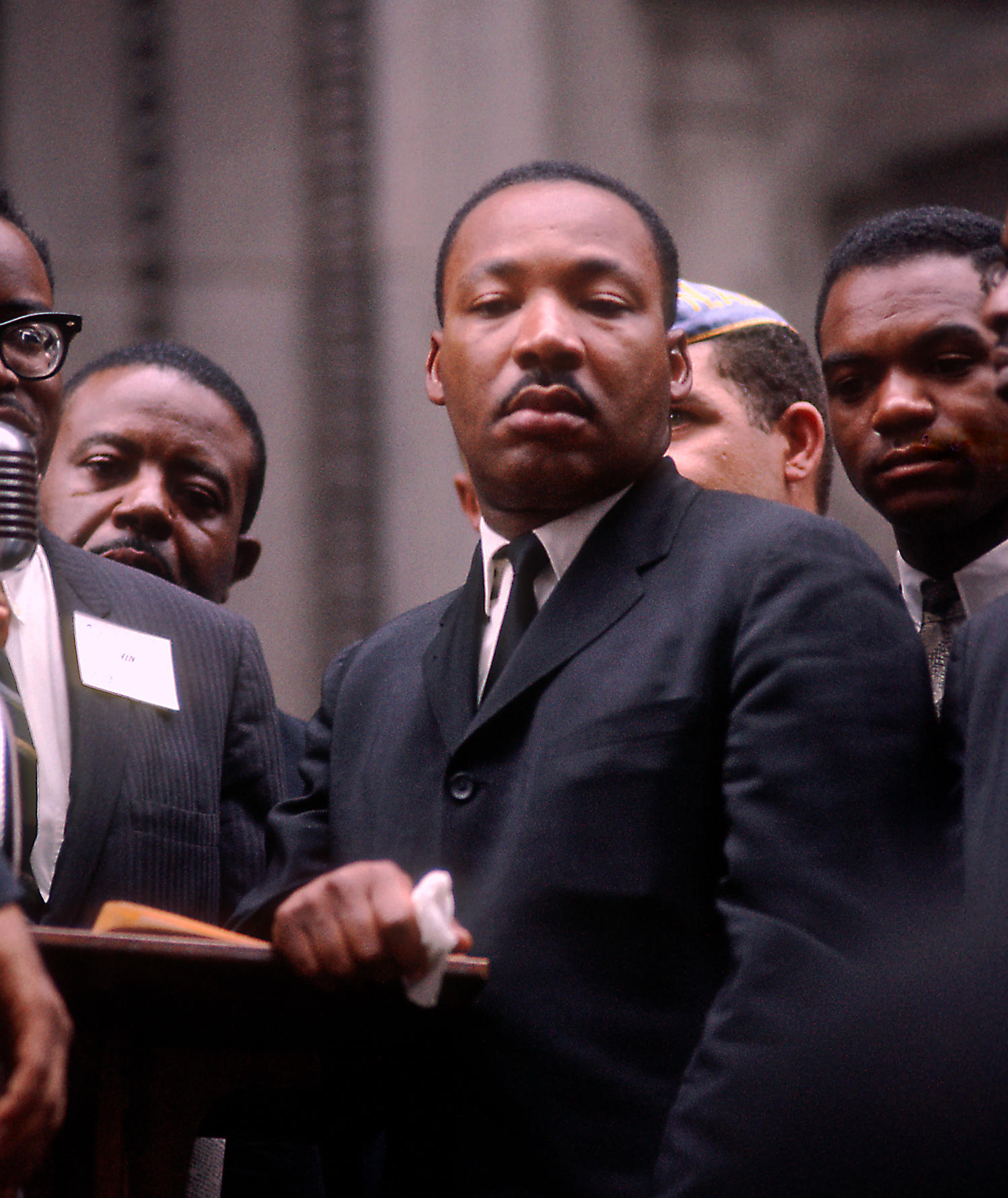
FEATURE image: At Chicago’s City Hall, Dr. Martin Luther King Jr. and Chicago Freedom Movement leaders, July 10, 1966. Following a speech in front of thousands at Soldier Field and a march downtown, Dr. King presented Mayor Daley with fourteen demands for a racially open city.
August 5, 2016 – by John P. Walsh.
Released on July 4, 1966 The Lovin’ Spoonful’s “Summer in the City” reached number one on the Billboard Hot 100in August 1966 and stayed there for three consecutive weeks.1 “Hot town, summer in the city, back of my neck getting dirty and gritty, been down, isn’t it a pity, doesn’t seem to be a shadow in the city. All around, people looking half dead, walking on the sidewalk, hotter than a match head…”
In Chicago in 1966 Dr. King promised a summer of nonviolence but that didn’t stop a white Chicago policeman from shooting and killing a 21-year-old Puerto Rican on June 10, 1966 and sparking a riot of the victim’s neighbors who looted stores, torched squad cars and assaulted firefighters called out to quell the blazes. A month earlier Stokely Carmichael, elected by a razor-thin margin over John Lewis to lead the Student Nonviolent Coordinating Committee, pronounced a new Black Power movement that ended that organization’s interracial efforts.
While the Chicago Freedom Movement remained staunchly interracial King warned Daley on July 9, 1966 that the mayor’s aloofness towards fundamental improvements for African-Americans in Chicago could lead to more radical black groups making their own demands. Since black Chicagoans were, despite a fair housing ordinance, mostly restricted to the ghetto where landlords charged higher rents to a captive market, King’s allies believed open access to Chicago’s real estate market was necessary to tackle larger problems of slums, unemployment, and underprivileged schools.
Chicago, Illinois, summer 1966 (AP Photo). In the foreground is the Shangri-La with its parking garage and deck at 222 N. State Street. Billed on its matchbooks as “the world’s most romantic restaurant” the Far Eastern/Polynesian themed establishment opened in 1944 and closed in 1968. The 65-story Marina Towers (background) opened in 1963. When completed in 1968 the twin towers were both the tallest residential buildings and the tallest reinforced concrete structures in the world.
Released on July 4, 1966, The Lovin’ Spoonful’s “Summer in the City” reached number one on the Billboard Hot 100 in August 1966 and stayed there for three consecutive weeks.
January 2016. Chicago. 2.42mb DSC_0075 (1)Author’s photograph.
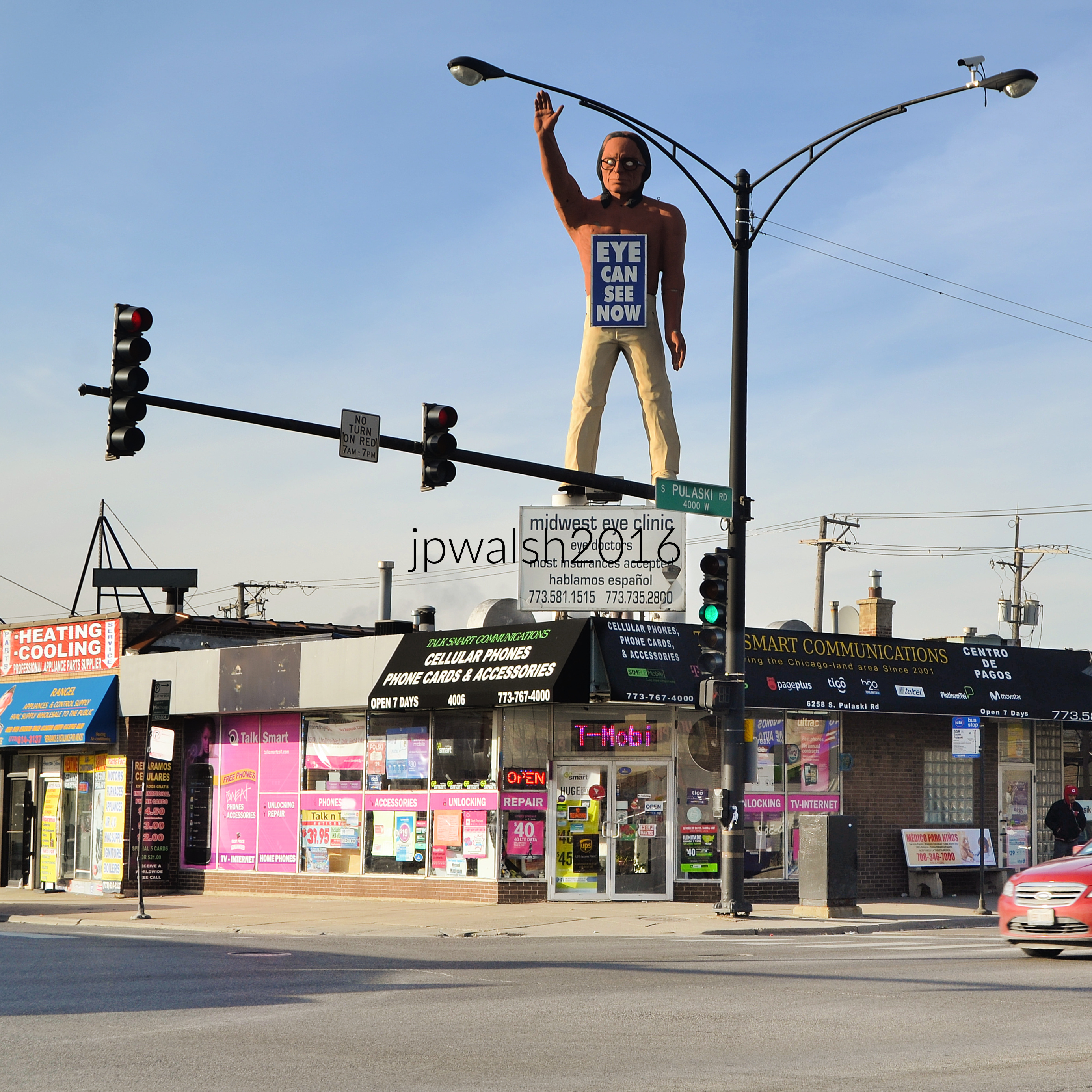
The 45‑foot fiberglass “Geronimo” statue at 63rd and Pulaski in Chicago was installed in 1966, and present during the Civil Rights marches led by Dr. King for fair housing and integration. The figure faces east toward predominantly Black neighborhoods such as Englewood, while the area west of it was then largely white and resistant to integration. Originally purchased from an Arizona reservation by the building’s owner, the statue first advertised a tobacco shop before becoming the landmark for an eye care clinic in the West Lawn neighborhood.
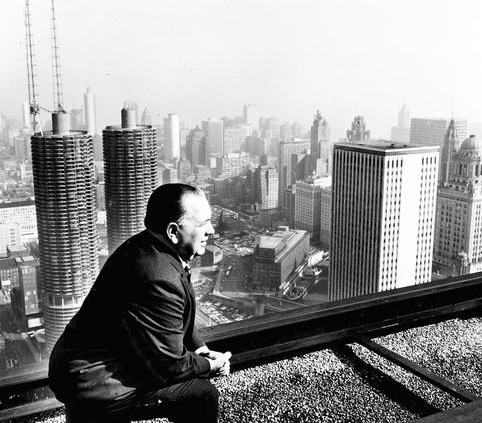
Mayor Richard J. Daley views the Chicago skyline in 1966 from atop the new Daley Center. Daley was focused on downtown development in the mid-1960’s and viewed King largely as an outsider with his own political agenda who simplified complex urban social problems for which Chicago was not completely at fault.
Martin Luther King Jr., with Stokely Carmichael in Mississippi in 1966. Although King saw Carmichael as a most promising young leader, in May 1966 Carmichael declared a new Black Power movement that ended the Student Nonviolent Coordinating Committee’s interracial efforts. The Chicago Freedom Movement to which King was attached stayed staunchly interracial.
Dr. King exits the tenement apartment at 1550 S. Hamlin on Chicago’s West Side where his family stayed during the Chicago Freedom Movement in 1966. American Friends Service Committee found that white and black families paid about the same in monthly rent but whites earned half as much more as what blacks earned. They found that for the same money blacks on average lived in about 15% less space (3.35 to 3.95 rooms). King looked to solve these and other socioeconomic discrepancies in his 1966 Chicago sojourn.
1550 S. Hamlin on Chicago’s West Side, the redeveloped site where King and his family stayed during the Chicago Freedom Movement in 1966. Screenshot October 29, 2018.
Mathias “Paddy” Bauler who in 1955 famously quipped that “Chicago ain’t ready for a reform mayor”2 was still an active Northside Chicago alderman in 1966. To some Chicagoans, Bauler’s colorful quip should have been Mayor Daley’s prevailing opinion towards open housing. In July and August 1966 King’s street marches into the white-only neighborhoods of Gage Park, Marquette Park and Chicago Lawn3 were intended to showcase the Chicago Freedom Movement’s reform message of open housing.
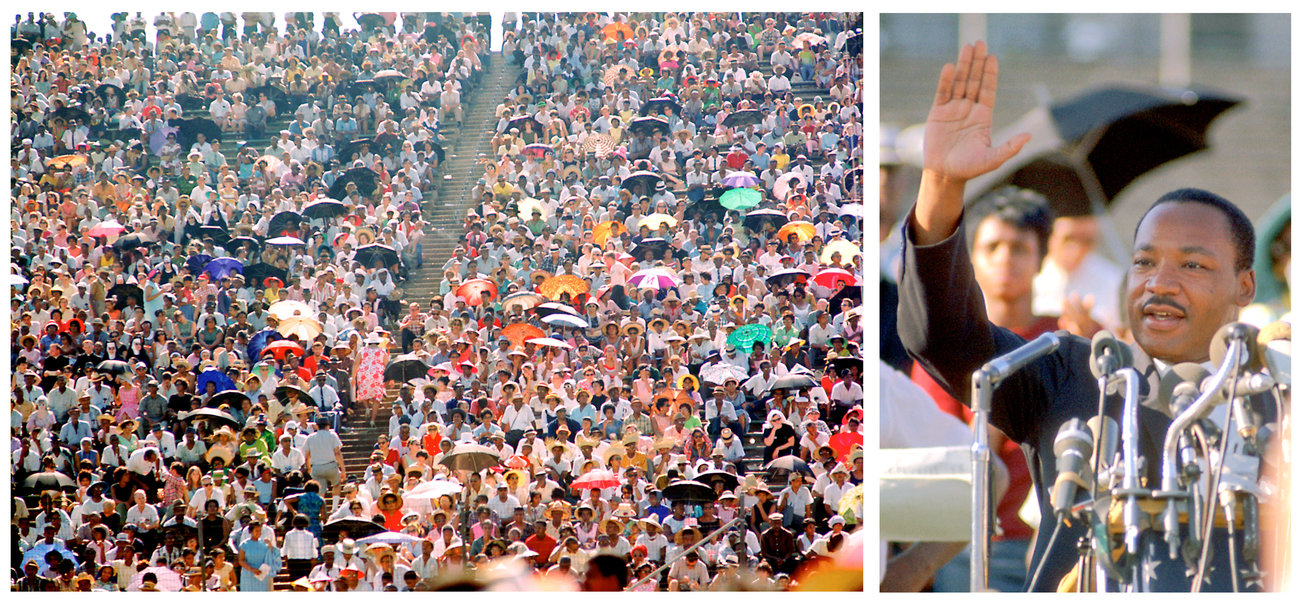
Following a rally at Soldier Field on Sunday, July 10, 1966 where King spoke to thousands of supporters including these words, “we will no longer sit idly by in agonizing deprivation and wait on others to provide our freedom,”4 he then led thousands on a march to City Hall. Marching peacfully three miles from the lakefront into downtown, King posted the Chicago Freedom Movement’s fourteen demands for a racially open city at City Hall. The next day Daley met with King but the pair, who personally respected one another, floundered at an impasse.
King was impatient for direct action but Daley was passive and noncommittal. Afterwards King made clear to Daley that these were 14 demands, not suggestions. From Daley’s viewpoint, King was a public relations disaster for Chicago because he was an outsider articulating simple solutions to complex and not always only local social problems. King indicated an inclination that it was time to march into the neighborhoods.
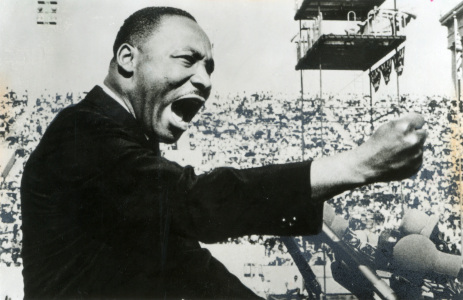
Sunday, July 10, 1966, Martin Luther King Jr. delivers a 12-page speech at a rally for civil rights at Soldier Field in Chicago that drew tens of thousands of supporters of open housing, better education and increased employment opportunities for the city’s black community. Photo: the Sun-Times archives.
The crowd and Dr. King at the Chicago Freedom Movement rally on Sunday, July 10, 1966, at Soldier Field. Photograph by Bernard Kleina.
Following a rally for civil rights at Soldier Field in Chicago where Dr. King addressed the crowd on Sunday, July 10, 1966, thousands marched through downtown Chicago to City Hall.
The march ended when the list of demands was nailed to the door of Chicago’s City Hall.
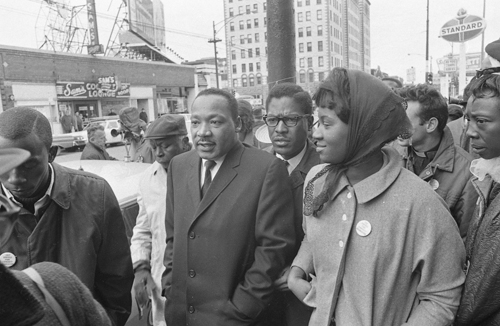
Dr. Martin Luther King Jr. at Chicago’s City Hall on July 10, 1966.
King met with a passive and noncommittal Daley in City Hall on Monday, July 11, 1966 (this photo, March 24, 1966). The antagonists met infrequently in 1966 to address The Chicago Freedom Movement’s issues and each time King left with vague, piecemeal promises for change.
On July 14, 1966, three days after the Daley-King meeting, a drifter named Richard Speck tortured, raped, and murdered eight female student nurses from South Chicago Community Hospital on the south side of Chicago. Speck, born in an Illinois farm town in 1941, lived in Dallas for the last 15 years and, running from the law there, only arrived into Chicago in April 1966. In the pall of a July heatwave, the serial killer was on the loose in the city for three days – a police sketch plastered everywhere in newspapers and on TV – until he was arrested on July 17, 1966. These gruesome killings were called “The Crime of the Century” and added panic, gloom and a general fear to an already tense city.5
Two weeks later, on August 1, 1966, in Austin, Texas, Charles Whitman, shot 49 victims from the bell tower of the University of Texas, killing 17 – and brought the term “mass shooting” into the American popular discourse.
These violent crimes precipitated ramped-up tension in Chicago and the nation in the hot and muggy summer of 1966. Already gripped by an escalating Vietnam War as well as massive civil rights movements, women’s rights movements, youth counter-cultural movements, and even radical church reform (“Vatican II”) movements, American society was swiftly and increasingly wrapped into a tight fist of revolutionary social change whose resistance to it tended to exacerbate the possibility of what King called “social disaster.”
Violent crimes of mass murderers Richard Speck in Chicago in midJuly 1966 and Charles Whitman in Texas in August 1966 worked to ramp-up tension people felt in Chicago during the long, hot summer of 1966.
Speck’s horrendous crimes came in the same week when Chicago police shot and killed two black Chicagoans, including a pregnant 14-year-old girl, during riots on the predominantly black West Side that Daley blamed on King. King denied any such connection and told Daley that if it wasn’t for the Chicago Freedom Movement’s preaching nonviolence those riots would have mushroomed into another Watts. To King’s way of thinking these disturbances among a swath of the city’s population should serve as the clarion call to Daley to act boldly on behalf of the black community and begin to enact the 14 demands brought to him to make Chicago a racially open city.6
Instead Daley’s response was to mobilize 4,000 members of the National Guard to restore law and order. In the wake of the violence—with police brutality blamed by the police on the rioters—another meeting between Daley and King took place where they agreed on a handful of reforms– (1) to establish a citizen’s advisory committee on police and community relations; (2) that grassroots workers go door to door in riot-affected areas to advise calm; and, (3) a new investment to build more swimming pools in black areas.
King was unimpressed with what he considered Daley’s lackadaisical approach and local media mocked the mayor’s feeble plan.
“Get Ready” by Smokey Robinson was recorded by The Temptations in December 1965 and released in February 1966. It landed at no.1 on the Billboard R&B singles chart and reached no. 29 on the Billboard Hot 100 pop chart. The up-tempo dance number was led by the falsetto of The Temptations’ Eddie Kendricks. Since The Temptations were formed in Detroit, Michigan, in 1961, the male vocal group has proven to be one of rock history’s most enduring groups who are unparalleled in their artistic and commercial success.
For his part, King started “walking,” that is, organizing marches into the city’s largely white neighborhoods adjacent to black ones so to highlight the need for open housing. KIng also re-started talks with Chicago gang members to convince them to forsake violence and join his nonviolent racially integrated movement.7
Since Daley viewed Chicago as having more accomplishments than problems in the area of race relations and that, further, the Mayor publicly considered the outsider King to be a selfish agitator, many white residents of soon-to-be-marched-upon city neighborhoods assumed Daley would take their side.
But Daley’s politics of law and order and incremental social change succeeded in alienating almost everyone. In the Chicago mayoral election in 1967 black voter turnout and support for Daley disappeared and did not return for him in subsequent mayoral contests in 1971 or 1975. Meanwhile, white residents felt the fatal sting of being “betrayed”8 by the city powers as Daley did not stop the marches from going forward.
The north edge of Marquette Park in early 2016. Photograph by author.
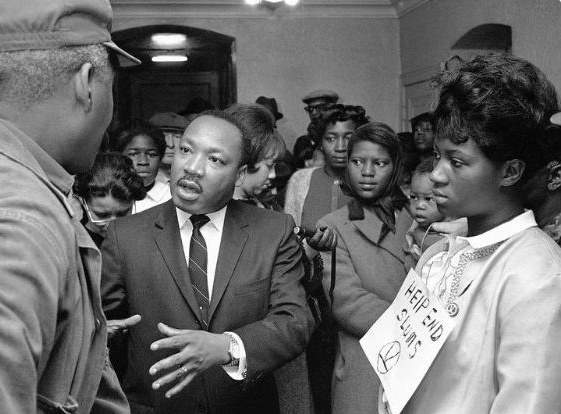
The Rev. Martin Luther King and Chicago building janitor Robert DeBose, left, discuss the eviction of families from the building. DeBose contended the families were evicted for not paying rent. fair use.
The first march was on Saturday, July 16, 1966 when a group of 120 demonstrators marched from Englewood into Marquette Park “for a picnic.” The next day, Sunday, July 17, 1966 about 200 marchers, taunted by neighborhood whites, held a prayer vigil outside a Gage Park church. Almost two weeks later, on Thursday, July 28, 1966, protesters began an all-night vigil at 63rd Street and Kedzie Avenue at a realty company that systematically discriminated against black buyers looking to move into Gage Park. The realtors had been reported to the Chicago Commission on Human Relations but nothing happened. White counter demonstrators appeared and with nightfall Chicago police struck a deal for the lawful open housing (or open occupancy) protesters to file into paddy wagons for safe escort back to the ghetto.
Dr. King attended two marches in Marquette Park on August 5, 1966 and, shown here, South Deering on August 21, 1966.
Movement leaders Al Raby (left), James Bevel (second from right) and Jesse Jackson (center) protest in front of the Chicago Real Estate Board in downtown Chicago.
Chicago Lawn white hecklers during a Chicago Freedom Movement march in summer 1966.
Chicago Police in Marquette Park on August 5, 1966. Their presence did not prevent severe rioting by white mobs that day.
On July 30, 1966 about 250 open housing protesters, furious about the recent night’s humiliation, looked to return to the same southwest side intersection. They were met by bottles and rocks thrown by whites so that the protesters retreated again east of Ashland Avenue into Englewood. When demonstrators marched out of Englewood again on July 31, 1966 more than 500 whites met them as the protesters crossed Ashland Avenue on 63rd Street. Armed with cherry bombs, rocks, bricks, and bottles, the surly mob grew to over 4,000 whites where they burned cars and injured around 50 open-occupancy protesters, including a first grade teacher hit by a projectile.
Rev. Martin Luther King Jr. and Rev. Jesse Jackson in Chicago on August 19, 1966. King holds a Chicago Daily News with a headline that reads “City Seeks To Cut Marches.” (AP Photo/Larry Stoddard) fair use.
On August 2, 1966, Daley met with white homeowner groups from the southwest side. In addition for calling for law and order from blacks and whites, the mayor acknowledged the open housing protesters had a legal right to march. Daley, through an intermediary, sent King modest housing improvement and integration proposals which King rejected and Daley implemented anyway. Daley next sent to an embattled King some local black aldermen who opposed the Chicago Freedom Movement but carried more substantial housing and employment offers from City Hall. The city government hoped that King, who was known to be looking for a way out of Chicago with a tangible victory, might accept a negotiated pact and call an end to the campaign. With these serious talks going on between Daley and King, the late summer marches for open housing continued under an increasingly vicious white backlash.
A white mob attacks a car during the Rev. Dr. Martin Luther King Jr’s August. 5, 1966 march to Marquette Park. Photo by Bernard Kleina.
White rioters encountering Chicago police at a Clark gas station in Marquette Park on August 5, 1966. A Confederate flag is on the right. Photo by Bernard Kleina.
Whites moving east on 63rd Street to confront marchers on the way to Marquette Park on August 5, 1966. The Clark gas station in the background is the site of the photos by Bernard Kleina.
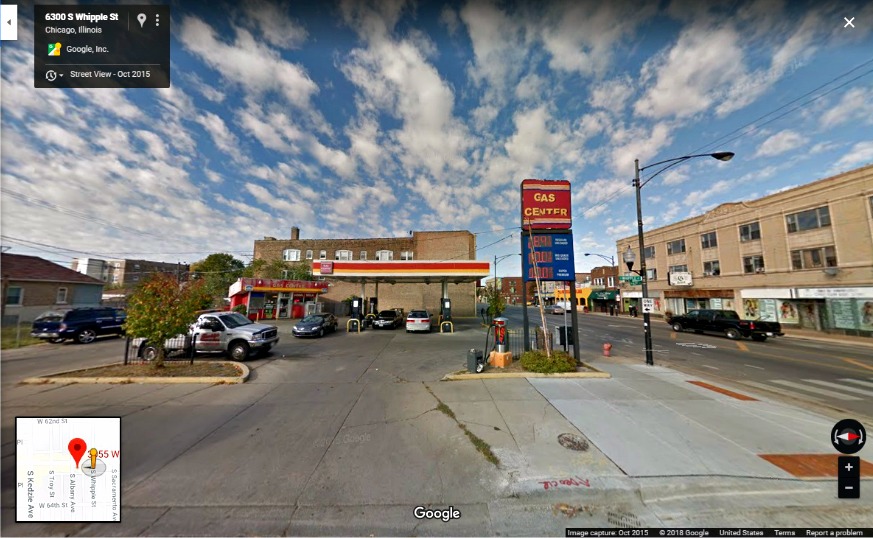
The infrastructure of the former Clark gas station still exists today on 63rd street (July 2018). Screen shot dated October 29, 2018.
The old Clark gas station looking east on 63rd Street at Whipple. Screenshot October 29, 2018.
On Friday, August 5, 1966, Al Raby and Mahalia Jackson led a group of about 500 open occupancy protesters into Marquette Park in south Chicago Lawn. A white mob of over 10,000 had gathered there and verbally abused the marchers and then turned physically violent. King, who up to this point had not participated in these marches, arrived and joined the march on the north side of the park. It was here, between Francisco and Mozart Streets south of Marquette Road that Martin Luther King was struck in the head behind the right ear by a baseball-sized rock and felled to one knee.
The open housing marchers, angry and disgusted, made their way the short distance out of the park and towards 63rd and Kedzie where King dodged a knife thrown at him. The crowd began to shout “Kill him!” as well as other racially charged epithets and about 2,500 whites now started throwing bottles, burned cars, smashed bus windows and clashed with police for the next five hours.
King with (from left) Mahalia Jackson, Jesse Jackson, and Al Raby at the New Friendship Baptist Church at 848 W 71st St in Chicago —the staging point for the 3 and a half miles walk to Marquette Park —on August 4, 1966. Photo: Chicago Tribune.
Marching south down Kedzie Avenue to Marquette Park in Chicago on August 5, 1966. Bourne Chapel is located at 6541 S. Kedzie, just two blocks from the park. Today the funeral home is gone. The yellow-brick building housing Tony’s Barber Shop in 1966 is still there today, though the barber shop business is gone. Photo by Bernard Kleina.
Rev. Martin Luther King Jr. falls after being struck by a rock from a taunting white mob in Marquette Park in Chicago on August 5, 1966. King would also dodge a knife hurled at him in the park. King soberly reacted by saying: “Oh, I’ve been hit so many times I’m immune to it.”
Vandals overturn a car before the August 5 march in Marquette Park. Photograph by Jim Klepitsch.
Rev. Martin Luther King Jr. with supporters in Marquette Park shortly after someone hurled a rock that hit him in the head. Photo by Bernard Kleina.
Martin Luther King, Jr.’s comments on that day’s violence entered the annals of civil rights and American history and marks a failing grade for Chicago: “I’ve been in many demonstrations across the south, but I can say I have never seen – even in Mississippi and Alabama – mobs as hostile and hate-filled as I’ve seen in Chicago. I think the people from Mississippi ought to come to Chicago to learn how to hate.”9
A permanent memorial to Dr. King and the Chicago Freedom Movement was erected in Marquette Park on August 5, 2016 for the 50th anniversary of the Marquette Park marches. This MLK Living Memorial at 67th Street and Kedzie Avenue includes a bench to contemplate the 300 tiles created by Chicagoans of all ages representing their understanding of “Home” and representations of a diverse community who continue to work to advance Dr. King’s vision of peace and justice.
In Chicago on Sept. 15, 1966, the Rev. Martin Luther King Jr, characterized an open housing agreement reached with Mayor Richard Daley and civic, business and religious leaders “a one-round victory.” King had named Chicago his first target in the North for racial equality in January 1966.
In 1960 virtually no blacks – only 7 according to that year’s U.S. Census– lived among a white population of 100,000 in Gage Park/Chicago Lawn/Marquette Park areas – cited in American Pharoah: Mayor Richard J. Daley His Battle for Chicago and the Nation, Adam Cohen and Elizabeth Taylor, Little Brown and Company, New York, 2000, p. 392. Fifty years after the Marquette Park march in 2016, the surrounding neighborhood of Chicago Lawn is a very different place from the all-white enclave King encountered. Whites now account for just 4.5 percent of the neighborhood’s population, according to the U.S. Census Bureau. African-Americans make up 49 percent and Hispanics 45 percent –http://chicago.suntimes.com/news/mitchell-rev-martin-luther-king-still-bringing-us-together/- retrieved August 5, 2016.
Results of West Side riots – American Pharoah, p. 389; Substance of 14 demands – Ibid., p. 385.
Media mock Daley’s plan and King re-engages gang members– Ibid., 389-391.
Black voter support declines – Black Politics in Chicago, William J. Grimshaw, Loyola University Presas, 1980, p. 25; whites feel “betrayed” – American Pharoah, p. 394.
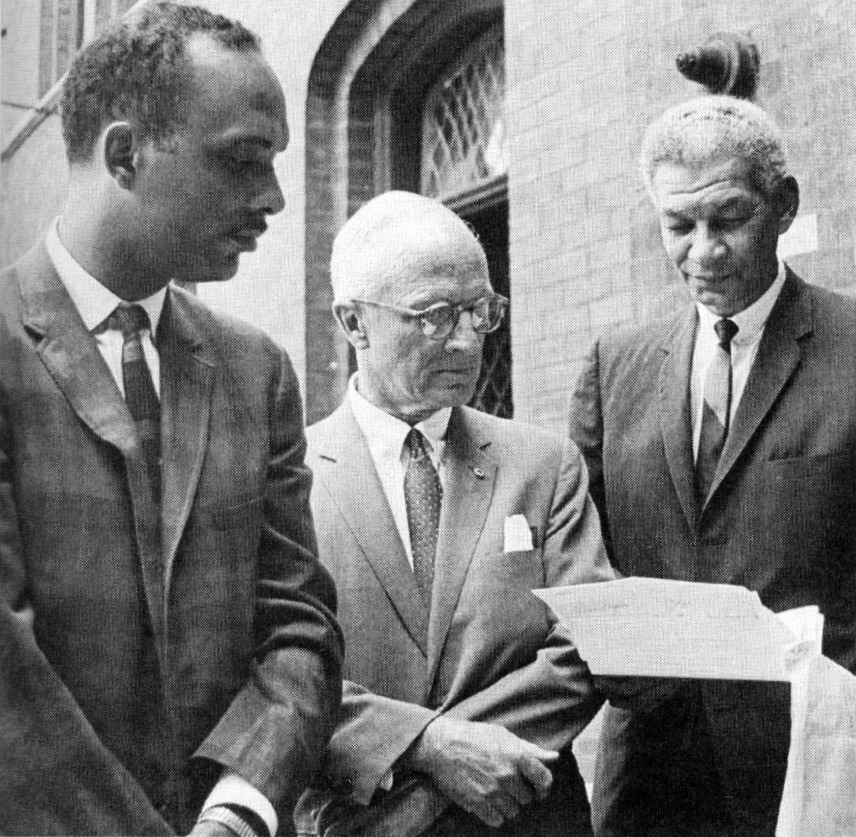
Chicago public school teacher Al Raby (left) of the CCCO and Edwin “Bill” Berry (right) of the Chicago Urban League inspect the open-housing agreement reached in Chicago in late August 1966 with Ross Beatty (center) of the Chicago Real Estate Board. It contained mostly broad volunteer promises for modest integration in all Chicago neighborhoods by the end of 1967, a mayoral election year. At an August 26, 1966 meeting at a downtown hotel with King and Daley both present — and after city faith leaders promised their resolute support of the agreement — Ross Beatty only tepidly endorsed the plan: “Well,” he confessed, “we’ll do all we can, but I don’t know how I can do it.”
June 19, 2022: Video in Marquette Park in Chicago of the Living Memorial taken during my visit.
The Dr. Martin Luther King Living Memorial is on the north side of Marquette Park in Chicago where the park is bisected by busy Kedzie Avenue. It was near this location that Dr. King, as he led protesters into the park during the historic Chicago Freedom Movement march on August 5, 1966, so to protest for open housing, was struck in the head and felled to the ground by a projectile thrown at him by angry white mobs who had gathered and were throwing bottles, rocks and bricks.
The memorial was dedicated on the 50th anniversary of the march (August 5, 2016). It is composed of a plaza, low seating wall, and three carved brick rectangular obelisks by artists Sonja Henderson and John Pittman Weber. The sculptural reliefs depict Dr. King and other prominent community members who marched with him that day.
If you liked this blog post , please visitParts 1 and Part 2 in the series here:
By John Walsh – 4:00 pm Chicago time, April 27, 2016.
Despite the corporate media’s unabashed favoritism for Hillary Clinton when reporting the news – it is reminiscent of the Cold War days when Americans were told about the partisan propaganda at Pravda (a frightening journalistic prospect should it ever arrive in some form to America) – the delegate count from April 26, 2016’s five primaries (4 closed and 1 hybrid) comes down to this: a net gain of 52 PLEDGED delegates for Hillary Clinton over Bernie Sanders– or around 2% of the total needed to reach the magic number of 2383 to become the Democratic presidential nominee.
As of April 27, 2016, Bernie Sanders had 1299 PLEDGED delegates and Hillary Clinton 1632 PLEDGED delegates. Neither candidate will likely reach 2,383 delegates– that is, not without the party SUPERdelegates of which Clinton has 519 and Sanders has 39.
It should be well known that the Democratic Party’s nominating process as it is presently constituted is a jimied system, bloated on big money and favoring the status quo, and that its category SUPERdelegates have and will flock to Clinton.
The SUPERdelegates’ reasons to support Clinton may reflect but also transcend her qualifications to be president. The special category of delegates can also work to aid a candidate’s success who may or may not be able to win outright these primaries even under present rules deemed fair.
In Connecticut’s closed primary on April 26, for instance, Clinton won a net gain of 2 PLEDGED delegates over Sanders based on the people’s vote in that contest but she also received an additional 15 SUPERdelegates there (Bernie picked up zero in the state). In Connecticut Hillary won over 170,000 votes to gain 27 PLEDGED delegates and Sanders won over 153,000 votes to gain 25 PLEDGED delegates – or about 6,300 voters per delegate. Yet Clinton picked up those additional 15 SUPERdelegates cast by 15 fellow Americans whose vote, in this case, has a power equivalent to a bloc of 95,000 ordinary Connecticut voters and, further, basically ginned up the Clinton vote by almost 50%.
This sort of election process flouts the enshrined “one man/woman, one vote” rule. rather it is a hybrid of the ordinary voter and a handful of special voters who can beknight a candidate and those happy few in the ordinary voter pool who agree with them.
The present Clinton delegate lead and the corporate media reporting that she is the “presumptive nominee” is part chimera as it is based very much on the SUPERdelegate regime and its establishment clique. Democratic Party; my foot.
Bernie Sanders in West Virginia has a 30-point lead in voter polls over Hillary Clinton for the May 10, 2016 primary. Yet they so far split the number of pledged SUPERdelegates though no votes have even been counted.
On April 26, 2016 Hillary Clinton won Pennsylvania’s primary by 20% in the popular vote over Sanders yet was awarded 1,800% more in SUPERdelegate votes.
It should be expected that in states where Hillary Clinton won the popular vote and most of the PLEDGED delegates that she would pick up more of these SUPERdelegates.
Yet such was not the case in 2016 in New Hampshire, Colorado, Minnesota, Oklahoma, Maine, “Dems Abroad,” Michigan, Utah, Alaska, Hawaii, Washington, Wisconsin, and Rhode Island. In these 12 states (and one constituency) it was Bernie Sanders who won the popular vote and the most PLEDGED delegates but Clinton who picked up all or most of the SUPERdelegates – an additional 77 of them in fact.
In a nomination process for president based on delegate count –which delegates? – this kind of system appears or is “rigged.” Voting results in other states exacerbates the perception of politburo-like favoritism at the DNC and its SUPERdelegate regime. Namely, that when Clinton won the popular vote and most PLEDGED delegates she also still gained all or most of the SUPERdelegates. What gives, America?
Norman Rockwell (American, 1894-1978), Freedom of Speech, 1943.
In all of April 26’s five primary states, Clinton picked up 63 SUPERdelegates and Bernie Sanders picked up one (in Maryland, a state he lost).
Sanders won over 1.1 million votes for his one SUPERdelegate and Clinton won about 27,000 votes for each of hers.
SUPERdelegates are where the action is!
If this is the manner in which the Democrats nominate their party’s presidential candidate it works as a deleterious effect for that candidate’s legitimacy for the general election.
Unfortunately, it is likely some or all of these wildly unfair SUPERdelegates will facilitate the nomination of either Sanders or Clinton unless one of those candidates achieves the magic number of 2,383 in PLEDGED delegates. This is a worthy goal which still remains possible – especially for Clinton.
There are 1209 PLEDGED delegates on the table in the final 14 contests and a much smaller indeterminate number of UNPLEDGED delegates (about 195).
Based on PLEDGED delegates, Hillary Clinton would need to win from this point onward 751 of them (62%) and Sanders 1084 of them (89%). These are high and higher electoral numbers for each so one of them secures 2383 in PLEDGED delegates.
Hillary’s challenge to go into the convention with enough PLEDGED delegates has an outside hope to be realistically achievable but it remains likely she will need SUPERdelegates to put her over the top as the party’s standard bearer.
So, if an incomplete slate of PLEDGED delegates is all one needs to be nominated, why not nominate Sanders?
Under this arcane and untrustworthy nominating system, Hillary appears to hold most of the political cards. Sanders can fight on and look to bargain for platform items but the Clinton people will be looking over his shoulder to his voters.
How many of Bernie’s voters do they need to win the general election in November? From that point, deals can be brokered. If Clintonites can peel off enough Bernie voters outright with corporate media-driven stories about party unity and fear mongering over Donald Trump, then any Clinton-Sanders deal may be difficult. But if enough Bernie supporters getting on board for Clinton is problematic –if they clamor for Sanders to be the nominee or on the ticket, or that more of their political beliefs be incorporated into the 2016 Democratic Party platform suchas on campaign finance reform, breaking up the big banks, free public university education, universal medical insurance, a fracking ban, a $15 minimum wage, etc.– all positions spurned by Clinton and her voters – then things should get hugely interesting in Philadelphia in July.
Further, for each of the 14 upcoming primary contests – from Indiana on May 3 to Washington, D.C. on June 14 – Clinton already has 106 SUPERdelegates committed to her candidacy (Bernie has 8). Not a single vote by the people has been counted in any of those places. Welcome to the party.
FEATURE image: Rev. Dr. Martin Luther King Jr. is joined (from left) by Rev. Ralph D. Abernathy, James Forman, Rev. Jesse L. Douglas, and John Lewis at a march for voting rights in Alabama in 1965. King would come to Chicago in January 1966. Fair Use.
By John P. Walsh
The first nonviolent civil rights campaign in the North led by the Southern Christian Leadership Conference (SCLC) started in Chicago, Illinois, on January 5, 1966—50 years ago this month.
The multi-pronged campaign was Rev. Dr. Martin Luther King Jr.’s first major effort outside the South and the first following the Civil Rights Act of 1964 and Voting Rights Act of 1965. King’s coming to Chicago was greatly influenced by the Watts riots in August 1965 where those deadly six days demonstrated to King and the nation the high cost in human lives and property associated with deep discontentment in the black community over isolating and chronic high unemployment, substandard housing, and inadequate schools.
King’s consideration to come to Chicago in 1966 was further energized by national issues activated by a local focus: in this case, King’s broad support for recent Federal complaints brought by the Chicago Coordinating Council of Community Organizations (CCCO) alleging segregation in the Chicago public schools. As there was a huge new Federal aid package for those public schools in the nation which desegregated by the start of the 1965-1966 school year, a charge of segregation in a state in the north and in the nation’s second largest city was unexpected, provocative, and dangerous to the natural progression of the status quo.
Led by former school teacher Albert Raby (on KIng’s right), the CCCO was a coalition of a number of disparate and sometimes contentious groups including the local branches of CORE, the Catholic Interracial Council, and the Urban League, among others. Here, King and Raby meet the Chicago press along with SCLC leader Bayard Rustin (on King’s left).
The status quo in Chicago, at least in terms of its politics, was embodied in one man: Mayor Richard J. Daley (1902-1976). King’s intention to come to Chicago instead of to another big northern city was that he figured to find in Mayor Daley a powerful ally to his civil rights movement. Already Daley vocalized agreement in principle with King’s message of open housing and racial justice, but King’s potential challenge to any aspect of the mayor’s absolute political power never gained Daley’s sympathy or recognition.
Many in Chicago’s local civil rights community, however, welcomed Dr. King’s presence in Chicago in 1966. Activists like Dick Gregory (1932-2017) had marched on City Hall — and into the Bridgeport neighborhood to Daley’s home — dozens of times but to no avail in terms of tangible policy changes for blacks in a city where blacks constituted 25% of its population. Perhaps the efforts of Dr.King in Chicago could break the deadlock.
The U.S. Commission on Civil Rights had recently labeled Chicago “the most residentially segregated city in the nation” but Daley chose to see it differently. There was no legal segregation in Chicago and Daley believed it was simply a “city of neighborhoods.” The 63-year-old Daley also felt that if government handouts were not downright un-American then, by 1965, big Federal programs should be administered at the local or city level and not from Washington. Daley’s calculation, a lawyer since 1934, always included his concern for the augmentation and not diminishment of his political power.
Stevie Wonder’s single “Uptight (Everything’s Alright)” was released in late November 1965 and peaked at no. 3 on the Billboard Hot 100 in early 1966 and was no. 1 on the Billboard R&B Singles chart for 5 weeks. Co-written by 15-year-old Stevie Wonder, the song was a watershed for his career. It was one of three singles in the early-mid1960’s that peaked in the top 40 on both charts and “Uptight (Everything’s Alright)” also launched the next stage of Wonder’s recording career into the second half of the 1960’s.1920’s flats in Bridgeport in 2015, the Chicago neighborhood of Mayor Richard J. Daley.Chicago slums, 1950.
While Daley’s home rule views appealed to some Chicagoans, other Chicago neighborhoods stayed in flux. There had been a longstanding mistrust, for example, between poor West Side residents—most of whom were black and concentrated by the mid1960’s into a vast ghetto—and a largely white Chicago police and fire departments. In the summer of 1965 street riots in West Garfield Park effectively produced the integration of 40 of 132 firehouses where calls for integration had been resisted since the early 1950’s.
The City of Chicago’s contrariness to aspects of President Johnson’s Great Society carried into the office of Chicago’s Education chief Benjamin C. Willis (1901-1988). In October 1965 Willis defied federal mandates for the release of requested materials as well as blocked the use of new national achievement tests in city public schools. This led to Chicago being temporarily denied their part of the massive $1.3 billion federal aid to schools program.
Benjamin C. Willis in 1963.
The overall alliance of Mayor Daley and President Johnson was strong in late 1965 so that the federal aid money called into question was restored within the week. Further, the federal official who had challenged the political power structure by citing Daley’s public schools for contempt of Federal segregation mandates was swiftly punished with a demotion.
President Lyndon B. Johnson (r.) meets with Chicago Mayor Richard J. Daley in the White House, April 21, 1966. Photograph by Yoichi Okamoto (1915-1985).
It was into this political hothouse that Dr. King decided to build a civil rights campaign for open housing, jobs, and educational opportunity for African-Americans which in October 1965 Daley announced he welcomed with open arms.
Meanwhile Daley was also mobilizing local black and other elected officials in Chicago to establish their own community action programs to co-opt or sideline any of King’s anticipated civil rights initiatives and efforts. This important time when Dr. King came to live and work in Chicago from January to August 1966 and its immediate legacy came to be called the “Chicago Freedom Movement.”
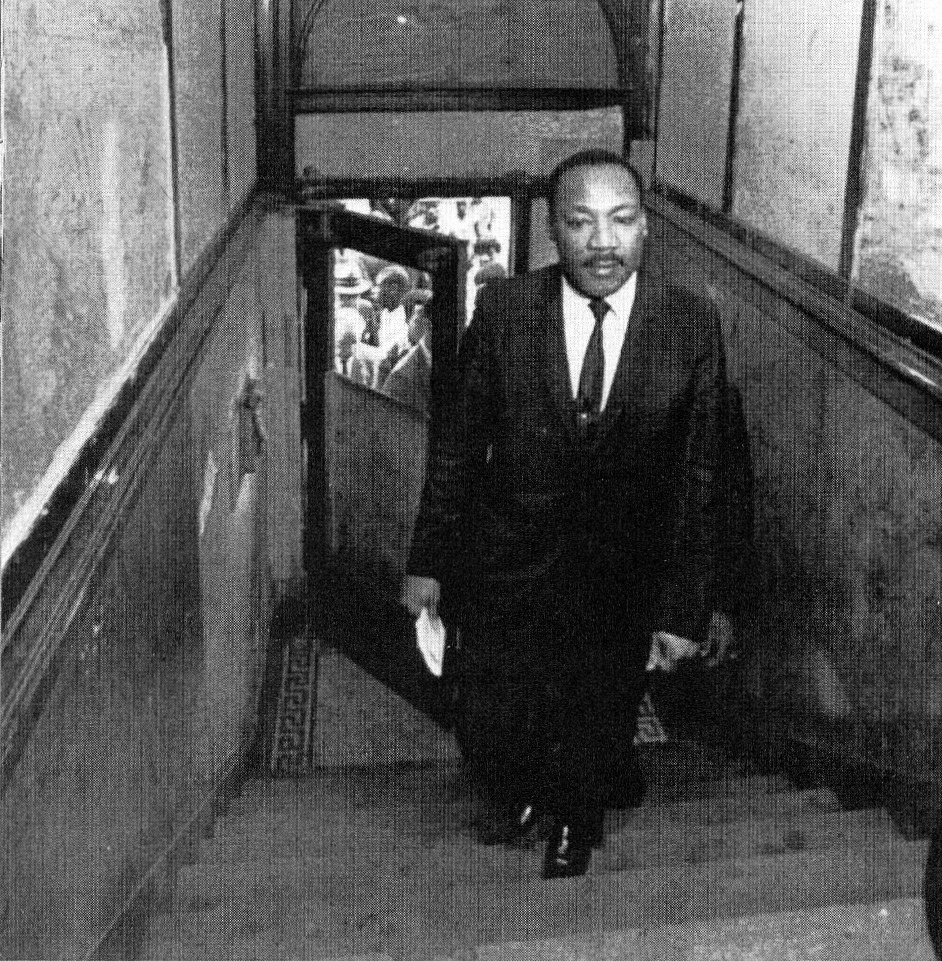
In January of 1966, Martin Luther King, Jr., arrives into the tenement apartment on the West Side to begin the Chicago Campaign. The nine-month campaign gave birth to bringing before the nation its widespread issues of poverty and racial injustice. As King mounted these steps into the cold, rundown set of rooms, he was equally walking into the complex politics, problems and hurdles associated with this big northern city whose Democratic mayor, Richard J. Daley, was known as “Boss.”
It was on Wednesday, January 26, 1966, that Martin Luther King, Jr. and Coretta Scott King (1927-2006) installed themselves into a West Side apartment in a low-income Chicago neighborhood on the West Side.
At the outset the SCLC and their allies were political outsiders in Chicago and mainly sought an amenable agreement with the established political powers in a city embodied by 63-year-old Richard J. Daley, its mayor since 1955.
In the middle of the cold and brutal Chicago winter King humbly began his campaign by stating that he was looking to study the city’s social conditions.
King wanted to know which nonviolent campaign tactics—whether it was street marches, voter registration drives, rallies, fund raisers, or something else—would be effective to progress the objectives of job creation, open housing, educational opportunity for African-Americans and, by summer of 1966, slum clean-up and a citizen’s review board for police brutality and misconduct.
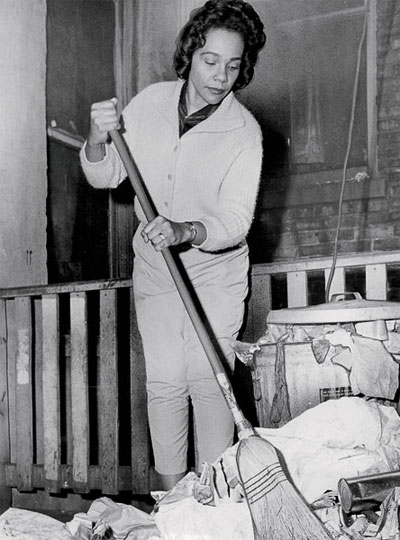
Martin Luther King Jr. and wife Coretta Scott King after moving into an apartment at 1550 S. Hamlin Avenue in Chicago on January 26, 1966. King moved into the tenement apartment to highlight segregated housing conditions in Chicago and launch a campaign to end slums in the city. — Chicago Tribune, Feb. 24, 1966.With furniture provided from local second-hand stores, Martin and Coretta Scott King are pictured on the first day in their Chicago Lawndale apartment on 1550 S. Hamlin Avenue. King’s first act in Chicago in January 1966 gained national media attention which helped to publicize the conditions of Chicago slum apartments. Photograph by John Tweedle. Martin Luther King Jr. helps remove a window frame while renovating an apartment at 1321 S. Loman Ave., in Chicago in 1966. King moved into a West Side apartment to highlight housing segregation issues in Chicago. — Luigi Mendicino, Chicago Tribune, Feb. 24, 1966. he SCLC and CCCO together with the Westside Federation became extralegal ‘trustees’ of the building with the tenants paying their rent to the SCLC, which used the money to make repairs. Male tenants of the building were hired as laborers and paid King’s proposed new minimum wage, $2.00 per hour. (The minimum wage in 1966 was $1.25.) King told Betty Washington, a reporter for the Defender, that the experiment of taking over that building would give Movement leaders insight into “the kind of social planning that might reverse this trend of degradation of our nation’s cities and contribute to the kind of community awareness that will bring new life and new hope to the slums of this city.” Photograph by Luigi Mendicino, Chicago Tribune, February 24, 1966. Coretta Scott King at the Homan Avenue tenement in Chicago in 1966 tenement her husband’s campaign had taken control of and worked to repair. It was about 5 minutes by car from the King home on Hamlin. In 1966 when Dr. Martin Luther King, Jr. and Coretta Scott King lived in Chicago on the West Side at 1550 S. Hamlin Avenue Dr. King preached at Stone Temple Baptist Church at 3622 W. Douglas Boulevard, a ten-minute walk away. Built in 1926 as a synagogue in the North Lawndale neighborhood the building became a Baptist church in 1954. Already in the 1950’s and early 1960’s Dr. King had delivered several speeches at Stone Temple MB Church in his civil rights efforts and used the church during his 1966 Chicago residency as a base for his civil rights and fair housing advocacy. His efforts led to the signing of the 1968 Fair Housing Act on April 11, 1968, a week after his assassination. Today, Stone Temple is led by Bishop Derrick M. Fitzpatrick, the grandson of Rev. James Marcellus, the church’s founder. PHOTO: “Stone Temple MB Church” by reallyboring is licensed under CC BY-NC-ND 2.0. see – https://stonetemplegreenteam.org/stone-temple-church – retrieved September 2, 2025.
“Baby Scratch My Back” written and performed by “swamp blues” singer Slim Harpo (1924-1970) was a number one hit playing on the radio in 1966.
As King spoke about a “closed society” in Chicago, the elected political power structure out of the Mayor’s office maintained an omnipotent grip on city services as a vicious circle of poverty in some black neighborhoods was permitted to exist. It was complicated by the Mayor’s public assertions that there “were no ghettos” in Chicago though Black citizens were de facto restricted to living in only certain of Daley’s “city of neighborhoods.”
King’s outsider status—which at first was understood as a mostly useful factor among Chicago’s civil rights activists—also worked to undermine King’s effectiveness in Chicago throughout 1966.
King and his circle were unfamiliar with Chicago’s vast size and complicated demographics. Also, perhaps unexpectedly, opposition to King’s efforts didn’t always fall cleanly along racial lines.
Whether coming from whites or Blacks, resentment to the Atlanta-based minister in Chicago usually always revolved around his being viewed as an interloper and potential power rival.
Dr. Joseph H. Jackson (1905-1990), president of the National Baptist Convention, U.S.A., Inc., and pastor of Olivet Baptist Church in Chicago was bitterly opposed to the Chicago Freedom Movement and made rancorous attacks against Dr. King while he was in Chicago. In 1963 Dr. Jackson was booed off the stage with Mayor Daley at an NAACP rally in Grant Park in 1963.
Support from Chicago Black ministers, a natural political base for King, was frequently blunted in 1966 by intimidating reminders from City Hall that this or that certain church would be having its building or fire code inspection coming up.
Moreover, big cities across the nation, including Chicago, were looking to receive a huge influx of money out of Washington, D.C. including part of a new $2.3 billion anti-slum program (about 17 billion in 2015 dollars). This huge infusion of money to Chicago was part of programs for infrastructure and social services marking President Lyndon B. Johnson’s “Great Society.”
King was politely pressured by city officals to forego what could only be seen as futile and time-wasting efforts of trash drives and meetings so to allow the Chicago mayor and his allies to get down to the serious work of eliminating city slums by, as Daley announced, no later than the end of 1967.
Daley’s home-court advantage and enormous financial support from the Democratic U.S. president and Congress gave Dr. King’s civil rights operation among the poor and dispossessed an appearance of superfluity, if not outright meddling.
Tactically, on every front, Daley tried to match King’s organizational efforts often by simply buying off King’s allies.
When King filled the International Amphitheatre on South Halsted Street with 12,000 Black celebrities and supporters on March 12, 1966 for a rally, Daley led 70,000 marchers and 350,000 spectators down State Street in the St. Patrick’s Day parade a few days later.
Mayor Richard Daley leading the St. Patrick’s Day Parade on State Street in 1963.
After the SCLC took a supra-legal action to seize a dilapidated tenement building, Daley limited his response which left King to deal with all the legal and public relations headaches.
King was not naïve about his own position. He did not want the Chicago Freedom Movement to become politicized. Daley had a mayoral primary in February 1967— he was running unopposed for a fourth four-year term. Some King allies in Chicago wanted an opposition candidate to Boss Daley, something that had never materialized to that point, and coalesce around the Chicago Freedom Movement to run against the mayor.
King refused the idea. Despite the political leeway, Daley worked continuously in 1966 to limit and even sideline King’s efforts in Chicago. King’s hope that the Irish-American big city northern mayor would risk or trade political power for King’s agenda of social justice and civil rights on behalf of the city’s African-Americans —historically a full third of the population —was mostly dashed in 1966.
Daley’s selective embraces of King never offset the mayor’s overall strategy to restrain the civil rights leader’s efficacy in Chicago. At the same time Daley did not want his restraint of King to impact or curb the broad voter support that the Daley administration had.
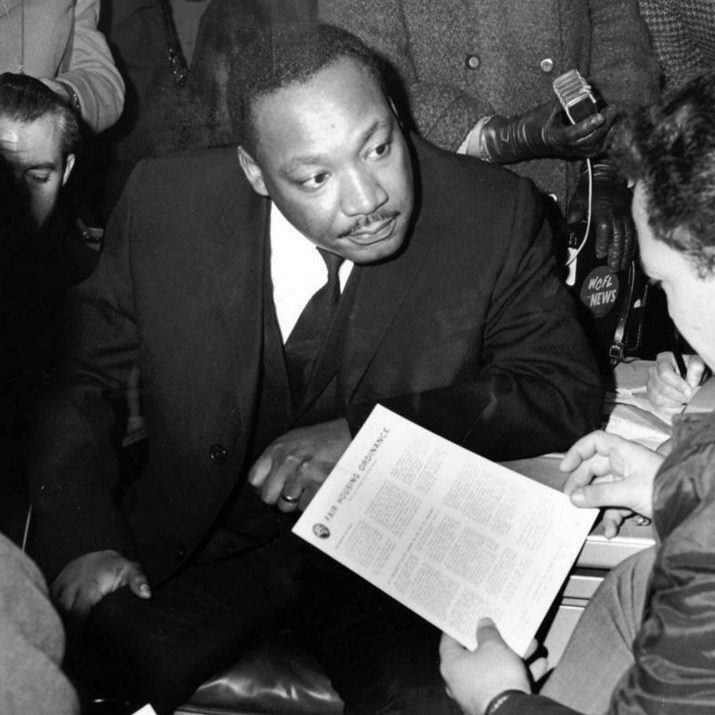
Civil rights leader Rev. Martin Luther King Jr. discusses fair housing with Gilbert Balin, of G. Balin Inc. real estate agents in Chicago. King and the Southern Christian Leadership Conference launched a campaign to end slums in the city, which would become known as the Chicago Freedom Movement. — Jack Mulcahy, Chicago Tribune, Nov. 3, 1966.
Regardless of Daley’s defensive efforts, King did not lose sight of his message of improved housing, education and economic development for African-Americans in Chicago. At this still early juncture of his time in Chicago, KIng carried on with his own civil rights campaign leaving any direct confrontation with Mayor Daley possibly for the future.
One SCLC initiative that scored quick success was a project started in February 1966 headed by Rev. Jesse Jackson (1941-2026) called Operation Breadbasket (renamed by Jackson Operation PUSH after King’s death). Within months there were several hundred new Black hires in Chicago-area businesses by way of this action.
Rev. Jackson at an Operation Breadbasket event, May 9, 1970. Photo by Chris Holmes.Dr. King and his wife, Coretta Scott King, lived and worked in Chicago for about 9 months in 1966 which gave birth to the Chicago Freedom Movement. King spent those first late winter into early spring months in Chicago getting to know the city and formulating a plan. In addition to the Hamlin (apartment building) “trusteeship” and Operation Breadbasket, King visited with Black and white leaders including the powerful mayor, Richard M. Daley (1902-1976), and the leader of the Nation of Islam, Elijah Muhammad (1897-1975). He also worked to convert gang members to the philosophy of non-violence and met with a large variety of community groups. Here he walks with members of the East Garfield Park Community Organization. Photograph by John Tweedle. Fair Use.
King’s months-long presence in Chicago in 1966 could also be credited for prompting Mayor Daley to establish new city programs. Daley also hosted various “summits” with clergy, labor and business leaders with the agenda to combat poverty and racism in Chicago.
In August 1966, Daley, with the support of the Chicago Freedom Movement, accepted the departure of public schools Chief Benjamin Willis and the appointment of James F. Redmond, a racial progressive, who served in that capacity until 1975. Still, Daley considered only white men for the post and overlooked two qualified Black candidates.
One thing Dr. King considered a key effort to improve African-American lives in the ghetto was to transform gang members into nonviolent civil rights activists. When a gunfight at a SCLC meeting in May 1966 broke out between Blackstone Rangers and East Side Disciples that ended King’s official initiative in this direction for the present.
Meanwhile, Richard J. Daley continued his downtown redevelopment. In March 1966 Daley announced a $200 million package for mass transit and made sure the Civic Federation — a good government watchdog group — was there to endorse it. In addition to Loop and North Michigan Avenue redevelopment, Daley dedicated in May 1966 the Civic Center, soon to be graced by the iconic Picasso sculpture in 1967.
Now the long, hot days of the Chicago summer were on the doorstep. Many in the city wondered at the start of summer 1966 to what extent Dr. King’s plans might add to the heat.
King’s apartment during 1966 in Chicago at 1550 South Hamlin Avenue was damaged during the riots that followed his assassination on April 4, 1968 and eventually demolished. The site was a vacant lot until the construction in 2011 of Dr. King Legacy Apartments designed by the architecture firm Johnson + Lee. the $18 million, 45-apartment complex also features commercial spaces along its 16th Street frontage, including the new home of the Fair Housing Exhibit Center.Painted mural of the image of Dr. Martin Luther King, Jr. and his tenement apartment in Chicago’s North Lawndale by nationally-renowned Afro-Indian muralist, Paul Collins. It is the centerpiece of the Fair Housing Exhibit Center.
I came to see that so many people who supported, morally and even financially, what we were doing in Birmingham and Selma were really outraged against the extremist behavior of Bull Connor and Jim Clark toward Negroes rather than believing in genuine equality for Negroes. And I think this is what we’ve gotta see now, and this is what makes the struggle much more difficult. Rev. Dr. Martin Luther King, Jr. (1929-1968), “The Other America” speech, Stanford University, April 14, 1967.We who engage in nonviolent direct action are not the creators of the tension. We merely bring to the surface the hidden tension that is already alive. Rev. Dr. Martin Luther King, Jr. (1929-1968), Letter From Birmingham Jail, 1963.I have earnestly opposed violent tension, but there is a type of constructive, nonviolent tension which is necessary for growth. Rev. Dr. Martin Luther King, Jr. (1929-1968), Letter From Birmingham Jail, 1963.
(29.52 minutes) On Christmas Eve, December 24, 1967, the Rev. Dr. Martin Luther King, Jr. delivered his Christmas Sermon on Peace and Nonviolence in his pastorate, Ebenezer Baptist Church in Atlanta, Georgia. It is also known as A Christmas Sermon on Peace and Peace on Earth Sermon.
For many people this is their very favorite of Dr. King’s sermons. It was broadcast by the Canadian Broadcasting Corporation as the fifth and final part of the 1967 Massey Lecture Series. In the sermon, Dr. King articulates the values and tactics of his broad and long-term vision of nonviolence as the path to world peace. At one point Dr. King states: “In 1963, on a sweltering August afternoon, we stood in Washington, D.C. and talked to the nation about many things. Toward the end of that afternoon, I tried to talk to the nation about a dream that I had had, and I must confess to you today that not long after talking about that dream I started seeing it turn into a nightmare. I remember the first time I saw that dream turn into a nightmare, just a few weeks after I had talked about it. It was when four beautiful, unoffending, innocent Negro girls were murdered in a church in Birmingham, Alabama. I watched that dream turn into a nightmare as I moved through the ghettos of the nation and saw my black brothers and sisters perishing on a lonely island of poverty in the midst of a vast ocean of material prosperity and saw the nation doing nothing to grapple with the Negroes’ problem of poverty. I saw that dream turn into a nightmare as I watched my black brothers and sisters in the midst of anger and understandable outrage, in the midst of their hurt, in the midst of their disappointment, turn to misguided riots to try to solve that problem. I saw that dream turn into a nightmare as I watched the war in Vietnam escalating, and as I saw so-called military advisors, 16,000 strong, turn into fighting soldiers until today over 500,000 American boys are fighting on Asian soil. Yes, I am personally the victim of deferred dreams, of blasted hopes, but in spite of that I close today by saying I still have a dream, because, you know, you can’t give up in life. If you lose hope, somehow you lose that vitality that keeps life moving, you lose that courage to be, that quality that helps you go on in spite of all. And so today I still have a dream.”
Martin Luther King, Jr., San Francisco, June 30, 1964. “Martin Luther King, Jr. San Francisco June 30 1964” by geoconklin2001 is licensed under CC BY-NC-ND 2.0.I hope that the president didn’t mean to equate nonviolent demonstrations with a riot, and I think it is time for this country to see the distinction between the two…I think demonstrations must continue, but I think riots must end. Rev. Dr. Martin Luther King, Jr. (1929-1968), interview from Chicago with Meet The Press, August 21, 1966. Cited in The Eclipse of Equality: Arguing America on Meet the Press, Solon Simmons, Stanford University Press, 2013, p. 160-61.I contend that we are not doing more harm than good in demonstrations, because I think demonstrations serve the purpose of bringing the issues out in the open. I have never felt that demonstrations could actually solve the problem. They dramatize the existence of certain social ills that could very easily be ignored if you did not have demonstrations. I think the initial reaction to demonstrations is always negative….Ultimately society must condemn the robber and not the robbed. It must protect the robbed, and this is where we are in these demonstrations, and I am still convinced that there is nothing more powerful to dramatize a social evil than the tramp, tramp of marching feet. Rev. Dr. Martin Luther King, Jr. (1929-1968), interview from Chicago with Richard Valeriani (NBC News), August 9, 1966. Cited in The Eclipse of Equality: Arguing America on Meet the Press, Solon Simmons, Stanford University Press, 2013, p. 161.The toughminded person always examines the facts before he reaches conclusions; in short, he postjudges. The softminded person reaches a conclusion before he has examined the first fact; in short, he prejudges and is prejudiced. Rev. Dr. Martin Luther King, Jr. (1929-1968), “A tough mind and a tender heart,” Strength to Love (1963).Softminded individuals among us feel that the only way to deal with oppression is by adjusting to it. Softminded acquiescence is cowardly. Rev. Dr. Martin Luther King, Jr. (1929-1968), “A tough mind and a tender heart,” Strength to Love (1963).We do not need to look far to detect the dangers of softmindedness. Dictators, capitalizing on softmindedness, have led men to acts of barbarity and terror that are unthinkable in civilized society. Rev. Dr. Martin Luther King, Jr. (1929-1968), “A tough mind and a tender heart,” Strength to Love (1963).There is little hope for us until we become toughminded enough to break loose from the shackles of prejudice, half truths, and downright ignorance….A nation or a civilization that continues to produce softminded men purchases its own spiritual death on an installment plan. Rev. Dr. Martin Luther King, Jr. (1929-1968), “A tough mind and a tender heart,” Strength to Love (1963).This undue gullibility is also seen in the tendency of many readers to accept the printed word of the press as final truth. Few people realize that even our authentic channels of information – the press, the platform, and in many instances the pulpit – do not give us objective and unbiased truth. Rev. Dr. Martin Luther King, Jr. (1929-1968), “A tough mind and a tender heart,” Strength to Love (1963).This undue gullibility is also seen in the tendency of many readers to accept the printed word of the press as final truth. Few people realize that even our authentic channels of information – the press, the platform, and in many instances the pulpit – do not give us objective and unbiased truth. Rev. Dr. Martin Luther King, Jr. (1929-1968), “A tough mind and a tender heart,” Strength to Love (1963).Somewhere, we must come to see that social progress never rolls in on the wheels of inevitability. It comes through the tireless efforts and the persistent work of dedicated individuals. And without this hard work, time itself becomes an ally of the primitive forces of social stagnation. And so we must help time and we must realize THAT THE TIME IS ALWAYS RIGHT TO DO RIGHT. “The Other America” speech at Stanford University on April 14, 1967.
In “The Other America” speech Dr. King presents “two Americas” – one that is “beautiful” and the “other America ” that is an “arena of blasted hopes and dreams.” In these remarks on racism and civil rights in American society, Dr. King explains that his campaign is about people who “are seeking to make America one nation.”“Tribute to Martin Luther King, Jr.” by U.S. Embassy New Delhi is licensed under CC BY-ND 2.0.Open to our quest for freedom [is] nonviolent resistance, that combines toughmindedness and tenderheartedness and avoids the complacency and do-nothingness of the softminded and the violence and bitterness of the hardhearted. Rev. Dr. Martin Luther King, Jr. (1929-1968), “A tough mind and a tender heart,” Strength to Love (1963).God is neither hardhearted nor softminded. He is toughminded enough to transcend the world; he is tenderhearted enough to live in it. Rev. Dr. Martin Luther King, Jr. (1929-1968), “A tough mind and a tender heart,” Strength to Love (1963).I have a dream that my four little children will one day live in a nation where they will not be judged by the color of their skin but by the content of their character. I have a dream today! Rev. Dr. Martin Luther King, Jr. (1929-1968), “I Have a Dream” speech, August 28, 1963, at the Lincoln Memorial, Washington D.C.We cannot walk alone. And as we walk, we must make the pledge that we shall always march ahead. We cannot turn back. Rev. Dr. Martin Luther King, Jr. (1929-1968), “I Have a Dream” speech, August 28, 1963, at the Lincoln Memorial, Washington D.C.
By John P. Walsh Posted December 6, 2014. updated: October 2, 2015; updated: February 14, 2018 (Parkland high school shooting — at least 17 killed, suspect in custody, Florida sheriff says).
On a typical day in the United States, not all firearms (a.k.a. guns) are used for “hunting,” “sport” or to “protect one’s family” as stated by President Obama in his press conference on October 1, 2015 at the White House in the wake of the mass shooting at Umpqua College in Roseburg, Oregon.
At last report, 10 people were killed (including the gunman) and 7 others critically wounded in that recent school shooting. It is the 44th mass killing incident in the U.S. in 2015 with three months to go.
Since the tragic and disturbing Columbine massacre in 1999 (13 killed; 21 wounded) there have cropped up in intervals of about one per week mass shootings in the U.S., not all of them school shootings, that have gained intense media attention: the Fort Hood shooting (November 5, 2009), the Gabby Giffords shooting (January 8, 2011), the Aurora movie theater shooting (July 20, 2012),the Wisconsin Sikh temple shooting (Aug. 6, 2012), the Sandy Hook elementary school shooting (Dec. 14, 2012), the Navy Yard shooting (Sept. 16, 2013), the Kansas Jewish Community Center shooting (April 14, 2014), the Charleston Church shooting (June 18, 2015), the Chattanooga recruiting center shooting (July 16, 2015) and now the Roseburg community college shooting.
A 2013 report cited 547 lives were taken between 1983 and 2012 in 78 public mass shootings. From 2013 into 2015 there were an additional 142 mass shootings (25 of them suicides or attempted suicides) in schools.
Everyday in America guns are used to kill about 80 people and wound 300 more. For accidental gun shootings, 3 people die and another 30 are wounded everyday.
Media Coverage
In the wake of this carnage, the mainstream media coverage felt a bit different this time — almost as if this kind of thing could have been happening for the first time — or that they were somehow having to start over in their approach.
Reporters seemed to embody a deeper scrutiny of, or despair at, this latest school massacre only four weeks since the murder by gunfire of TV reporter 24-year-old Alison Parker and TV cameraman 27-year-old Adam Ward In Virginia.
A shot from the shooting of Alison Parker and Adam Ward on August 26, 2015. Fair Use.
Popular support for “Gun Control”?
A Pew Research Center study released on August 13, 2015, shows a large majority of Americans in support of several specific gun policy proposals: ˙79% favor laws to prevent people with mental illness from purchasing guns. ˙70% support the creation of a federal database to track all gun sales. ˙57% support a ban on assault-style weapons. ˙85% of Americans favor expanded background checks (88% of Democrats and 79% of Republicans).
President Obama hinted in his press conference at another finding in the August Pew Research study when he said, “I would particularly ask America’s gun owners — who are using those guns properly, safely, to hunt, for sport, for protecting their families — to think about whether your views are properly being represented by the organization that suggests it’s speaking for you.”
His comment was a not-too-subtle reference to the National Rifle Association (NRA) which the Pew Study finds the public has some shifting opinions about.
While mass shooting crimes are, statistically, a snippet of America’s real field of action for gun violence, they are an especially destructive form in itself and its repercussions for the wider community. In addition to a national discussion about the mind or “profile” of a mass murderer (usually devolving into mental health concerns and/or ignorance about a reliable profile), the impact on the local or national community is less explored.
At his press conference, President Obama predicted a routine counter-punch to his gun control comments and it came swiftly. Reported by media outlets including WGN Chicago as a top story, gun-rights advocate Mike Huckabee stated the president was wrong for trying to “exploit” the Oregon shooting and that another mass killing should have no serious effect on the public debate about gun ownership in the U.S.
Yet impacts of a mass shooting are never as simple as its politics. Deleterious effects from gun violence extend to the victims and their families, and into the wider community.
Active Shooter Drills
Even extremely realistic school-shooting simulations known as “active-shooter” drills staged by local law enforcement agencies using school grounds, staff and students as actors are censured as counterproductive by psychologists and security specialists. Although the best way to help first responders prepare for gun-related violence on campus, the mere simulation of gun violence causes psychological distress among students and their families and work to make death tolls worse.
A student actor participating in the extremely realistic “active shooter drills” staged by law enforcement on campus grounds around the nation. Advocates say it helps first responders better prepare. Critics claim it could actually make death tolls worse. Fair Use.
Gun crime: homicides, suicides, and mass shootings
In 2011, 68% of homicides in the U.S. were gun crimes, even though these and all other crimes have dropped by almost 40% since 1993. Americans, however, continue to view gun crime as a pervasive and even worsening problem.
In 2011, 11,068 people died in gun homicides in the U.S. That number reflects a steep decline in gun homicides since the 1980’s. Yet statistics support the conclusion that more guns and access to them results in more gun violence, including murder crimes.
Media coverage of gun homicides is found mainly in densely-populated urban areas where there is, presumably, a higher concentration of guns. Mass shootings, however, frequently occur in rural or suburban settings.
Based on the level of shock associated with shootings, Post Traumatic Stress Disorder (PTSD) are the long-lasting psychological consequences of all those directly experiencing or witnessing any part of a mass shooting. This especially pertains to children.
Does gun access cause more suicide?
The most annual gun deaths in the U.S. are neither homicides, mass shootings or accidents. They are suicides.
In 2011, according to the Centers for Disease Control and Prevention (CDC), 19,990 people died by suicide with a firearm. Those yearly numbers are consistent at least since the 1990’s.
The Suicide by Édouard Manet, c. 1880, Foundation E.G. Bührle, Zurich, Switzerland. Public Domain.
Does gun access lead to more suicides? That gun suicides are less common in states where gun ownership requires criminal and mental illness background checks point to that link.
It is obvious that by having access to a gun, the risk of having an accident increases -– but is that true for homicide and suicide?
Suicide attempts by guns are almost always fatal while suicide attempts using other methods result in death about 6% of the time. That data confirms that a firearm’s effectiveness as a lethal weapon is undeniable. It precludes the desperate person any second thoughts.
Males arrested for 75% of all crimes
Arrest statistics make clear that it is not the criminal’s age or race but gender that the law-abiding citizen should fear. Males are arrested for 75% of all crimes. These criminal acyvities fall into three braod categories, including violent crime; property crime; and, assault.
Access to guns aids this criminal facility.
Guns and domestic abuse
For example, in a survey of battered women nearly 72% reported that guns had been used against them and to threaten to kill them.
For women who are abused (and not killed) 16% live in homes with a gun.
Abused women that were killed, about 50% lived in a home with a gun.
Statistics suggest that access to a gun is a risk factor for homicide in abusive relationships. This situation is beginning to be taken up by law enforcement in police interviews with battered women.
Mass shootings are a tiny percentage of all gun homicide. Further, the frequency and impact of mass shootings has not increased in the last 35 years at least.
Should focus be on the mentally ill to reduce most gun crime?
To focus public safety on the mentally ill in reaction to these horrific gun crimes is likely to produce small effect on their recurrence.
Several studies have shown that the mentally ill require good health care, though its funding is relatively scarce. During the Great Recession of 2008, budget cuts for mental health amounted to almost $2 billion. Despite the lack of resources and high profile political and media focus, the mentally ill are responsible for only about 5% of all crimes and even less for those involving guns.
Each week 30% of all gun deaths in the U.S. are children
Drug and alcohol abusers engage in violent acts seven times more than the mentally ill. Funding for substance abuse programs should be even more important to gun safety advocates based on those statistics.
The link between gun violence and domestic batterers is far greater than with the mentally ill. Of those 80 people killed by guns in a typical week in the U.S., 30% are children.
After non-gun accidents, gun shootings are the leading cause of death of children in the U.S.
In 2009 there existed an estimated 310 million civilian guns (handguns, rifles, shotguns) in the U.S. and 2012 sales added $6 billion more.
Increased buying has hiked up privately-owned firearms by about 40% since 1994 when there were 192 million guns.
The exact number of concentrations of firearms in the U.S. is unknown. About 50% of Americans report at least one gun in the home. Gun ownership in the U.S. is heavily skewed to older white men.
The U.S. has more guns per capita than any land mass in the world. Poor countries in Central America, for example, record higher gun homicide rates than in the U.S.. But among developed nations, no country has more guns per person in private hands– nor a higher gun homicide rate– than in the United States.
The gun industry is prospering today. To paraphrase Charles Erwin Wilson, the Defense Secretary under President Eisenhower: “What is good for Sturm, Ruger & Co. is good for the nation.” There is some truth to it.
In 2012, the gun industry added $31.6 billion to the U.S. economy due to job creation and new sales taxes. The gun industry employs about 98,750 workers and 111,000 more workers as suppliers and retailers, such as Walmart.
While recreational use seems to be driving record sales, there is a darker side to the proliferation of gun ownership. As one gun advocate’s recent proclamation alludes– that “the (gun) industry has entered a golden era, a renaissance of gun ownership that transcends a dedicated segment of Americans who consider firearms a natural part of their lives”– it often equally ends those natural lives sooner than nature intends.
Despite guns crimes, the prospect for meaningful gun control in the U.S. is bleak.
Fewer than half of Americans think that gun laws should be stricter. Another half believes they are already too strict or just about right.
In a culture where money defines free speech and guns rights are enshrined in the U.S. Constitution’s second amendment, the prosperous gun industry and its supporters which is no less than half of the U.S. population will not be surrendering its arms soon.
Gun safety measures may have a more receptive audience than attempts at gun control. These include background checks.
The mindset of some gun-rights advocates may work to divide gun owners’ attitudes about select gun control measures. That may be part of President Obama’s comments for law-abiding gun owners to reflect on “the organization that suggests it’s speaking for you.”
Controversial ideologies and opinion polls on guns
A controversial example of a mindset is the so-called NRA embrace of “insurrectionist ideology.” This asserts that the intent of the second amendment is to permit American citizens to shoot and kill federal agents and law enforcement officers in the event that they believe those agents are attempting to facilitate or impose some form of government tyranny.
Regarding the NRA specifically, Americans are divided on the organization: ˙40% think the organization is too influential over gun laws. ˙52% say it has too little or the right amount of influence.
While opinions on the NRA are entrenched and polarized, there is slight but significant movement on another issue pertaining to guns.
In 2015 Americans did an about face on the question as to whether it was more important to control gun ownership (50%) or protect the right of Americans to own guns (47%). ˙57% of whites favor gun rights over gun control. ˙75% of blacks favor gun control over gun rights. ˙72% of Hispanics favor gun control over gun rights.
Changing demographics and marginally shifting American opinion on gun control may be the sliver of hope President Obama perceived when he said in his October 1 news conference: “It will require that the American people, individually, whether you are a Democrat or a Republican or an independent, when you decide to vote for somebody, are making a determination as to whether this cause of continuing death for innocent people should be a relevant factor in your decision. If you think this is a problem, then you should expect your elected officials to reflect your views.”
President Barack Obama speaks at his press conference, Oct. 1, 2015. White House photo-Public Domain.
While polls find that over 60% of the public thinks background checks are a good idea, neither the gun industry nor gun owners want the extra burden. In an almost $32 billion-a-year industry ($6 billion in sales), background checks would be a major government intrusion.
As long as the number of gun fatalities is status quo, there likely will be no new impetus for gun control. In places like Arizona, Colorado, the District of Columbia, Michigan, Nevada and Oregon, the rate of gun deaths has exceeded traffic fatalities and they are on par with each other in Ohio and Pennsylvania. It is the choice of individuals and society–50% of which are gun owners and 95% of which own cars -–as to whether around 30,000 fatalities for each category of combustibles is a fair and acceptable human cost for their unbridled use.
Even if, as Russ Thurman writes, “Gun ownership has gone mainstream…It’s the fun factor of firearms that has been restored to the culture,” this cannot be the responsible gun owner’s sole matter of importance when discussing this uniquely American issue.