Tag Archives: #Saints

St. Francis of Assisi at Greccio: Material Piety and the Formation of the Crèche Tradition.

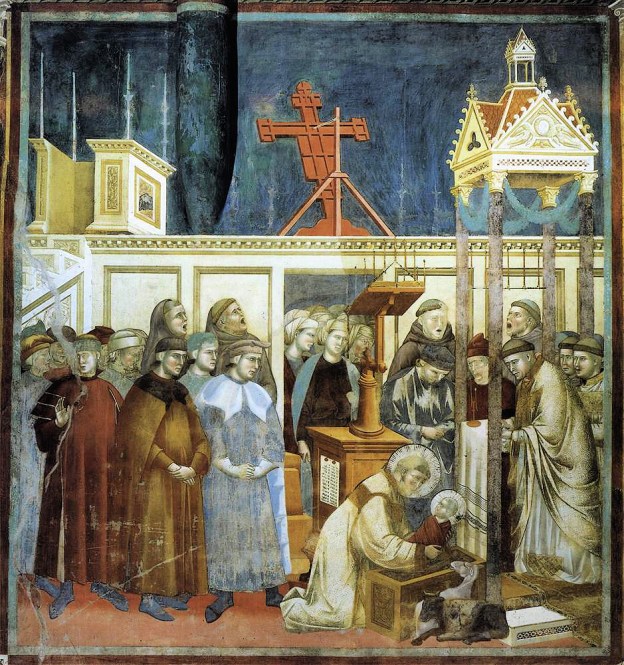
FEATURE Image: Institution of the Crib at Greccio, c. 1297-1300, a fresco by Giotto, depicts St. Francis of Assisi preparing the first Christmas crib at Greccio in 1223. It is part of the Legend of Saint Francis fresco cycle located on the walls of the Upper Basilica of San Francesco in Assisi, Italy. Giotto keeps the ox and ass that Francis insisted on having, though the artist places the event inside a magnificent church or basilica rather than the rustic cave on a cliff where the event historically took place. Public Domain.

Greccio, 1223: St. Francis and the first Christmas Crèche

In Advent of 1223, in the hill town of Greccio—about sixty miles south of Assisi—St. Francis of Assisi created the world’s first crèche, a living reconstruction of Bethlehem’s manger in his mountain hermitage there in central Italy. His simple arrangement of straw, a feeding trough, and an image of the Christ Child became the model for the Nativity scenes that endure in homes, churches, and beyond more than 800 years later.

Francis’s love of nature shaped the scene. He included the ox and ass, traditional symbols absent from the Gospels but long present in Christian imagination. Giotto’s late 13th century fresco later fixed these animals in Western iconography, following Francis’s interpretation, placing the animals beside the manger even though the biblical texts of Luke and Matthew specify only the feeding trough.
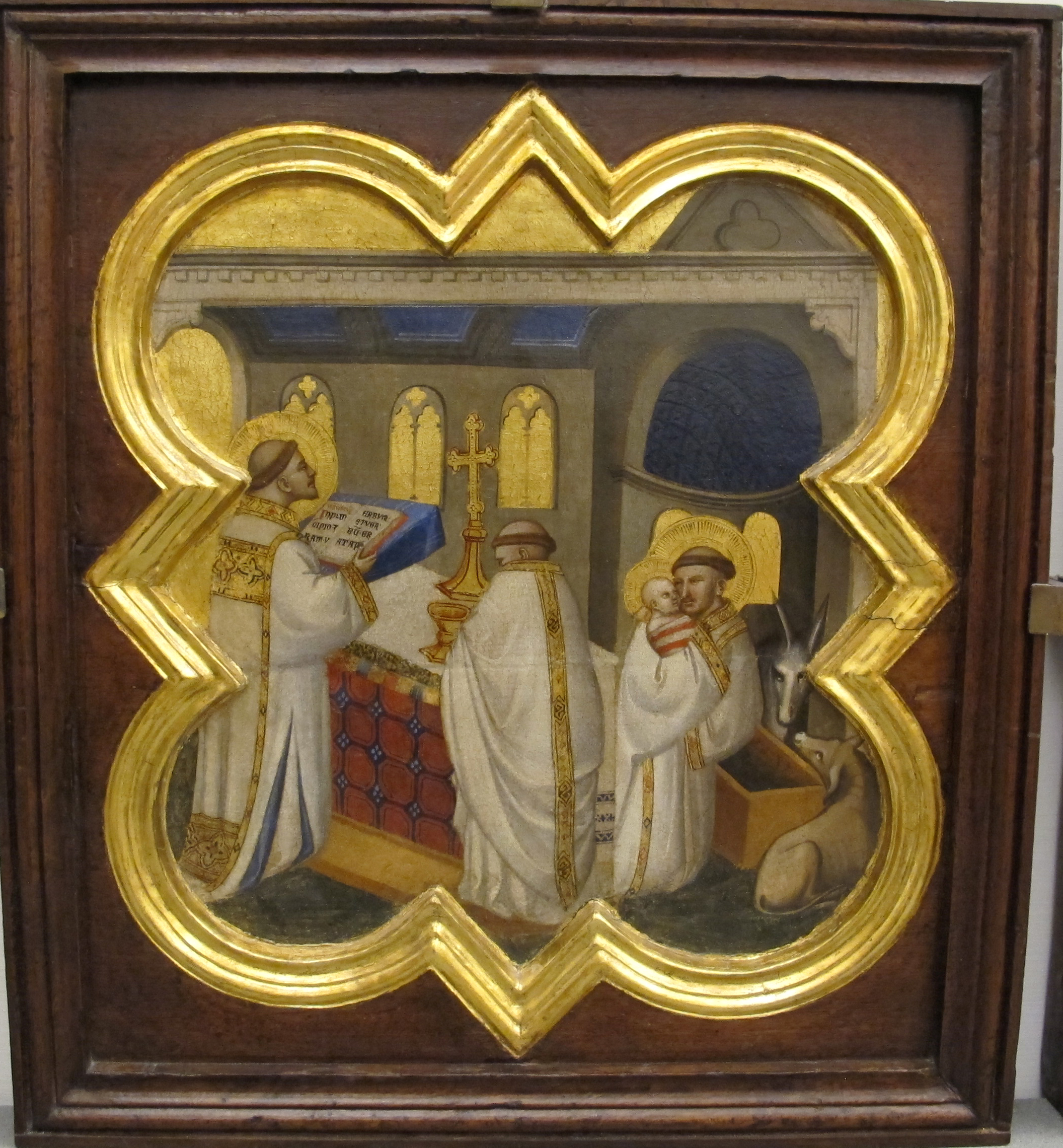
The Nativity at Greccio, Taddeo Gaddi, c. 1328–1330, Galleria dell’Accademia, Florence. Painted originally for the sacristy cupboard doors of Santa Croce in Florence, this small tempera panel adapts Giotto’s monumental fresco into an intimate narrative scene. Gaddi heightens the architectural enclosure and concentrates on the emotional responses of the witnesses as the miracle unfolds, translating his master’s broad spatial drama into a finely detailed, smaller‑scale devotional image. Reproduction of this image is permitted for personal use or study by the Italian Ministry of Heritage and Culture.

Francis’s Character and the Moment of 1223

As a young man, Francis was talkative, restless, and eager for answers. He often worked out problems by speaking until he was spent. By 1223, nearing death, he acted with directness and simplicity. Days before the Greccio crèche, Pope Honorius III formally approved the Franciscan Rule (November 29, 1223), which relieved Francis of administrative duties. The crèche was, in part, an act of gratitude. Before he departed Rome with the papal bull Solet annuere (Latin for “The Apostolic See is accustomed to grant”) issued at the Apostolic Palace of St. John Lateran confirming the rule, Francis asked the pope for his approval for his idea of recreating a manger to represent outwardly the poverty of Christ. Francis may have been thinking about the Nativity Plays that were popular in his youth but had been suppressed which featured the manger. This may have been why Francis asked the pope’s permission, which he granted although there was a Christmas crib in Rome at that time at Santa Maria in Trastevere.

Francis’s affinity for nature shaped his spirituality. He often described himself and his brothers through gentle animal metaphors. As the Franciscan movement, founded in 1209, spread rapidly, he had a dream of himself as a black hen trying to care for an overwhelming number of chicks. The Franciscan Order experienced explosive, unprecedented growth in St. Francis’s lifetime. Starting with the handful of followers in 1209, it expanded into a massive international movement so that by 1223 there was estimated 5,000 to 10,000 friars. Even before 1223, Francis urged the brothers to feed animals and birds at Christmas so that all creation could share in the feast.

The Christmas Vigil at Greccio in 1223

The Greccio crèche was prepared about two weeks before Christmas, near the Third Sunday of Advent. With his friend John Vellita of Greccio—“a man of good repute but of better life,” as Thomas of Celano writes—Francis arranged real straw, a manger, and an image of the Christ Child in a cave above the town, near the small cloister built on the cliff that Master Vellita had given to the friars. Francis said he had long considered how he wished to mark the birth of the Son of God on earth, wanting to see with his own eyes the poverty and hardship Christ chose to embrace for humanity’s sake. Meditation on the circumstances of the Nativity came naturally to him, shaped by his devotion to the Blessed Virgin Mary and devotion to her obedience to God’s will, and that it led him to reflect on the Passion as well. From the moment of His birth to His death on the Cross thirty‑three years later, the life of the Son of God on earth was marked by danger, vulnerability, and suffering.
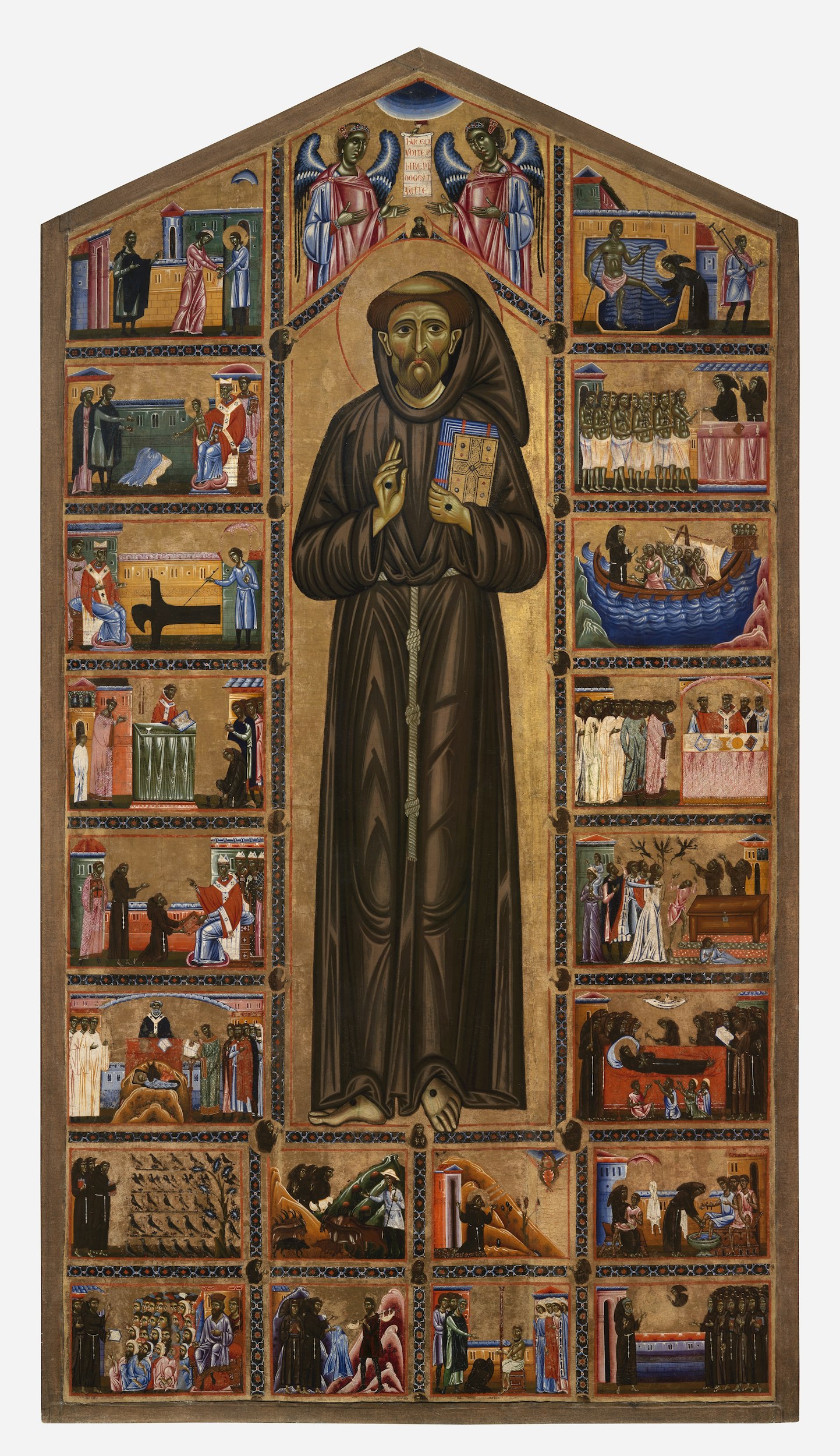
St. Francis and Twenty Stories from his Life (“Bardi Altarpiece”), 1245-1250, tempera and gold on wood, Coppo di Marcovaldo (c. 1225 – c.1276), attributed, Bardi Chapel of Santa Croce in Florence, Italy. While the main panel features Francis surrounded by 20 narrative scenes, one of the smaller narrative compartments specifically documents his life and actions at Greccio. It represents one of the earliest surviving visual documents of the Franciscan story within 20 years of St. Francis’s death at 44 or 45 years old in 1226. see – Coppo di Marcovaldo, Bardi Panel – Santa Croce – retrieved July 18, 2026.

The Greccio Vigil of 1223

On Christmas Eve in 1223, the people of Greccio gathered with the friars, carrying lighted torches as Vigil hymns rose through the mountain air. At Midnight Mass—celebrated in the cave where an altar was placed over the manger—Francis acted as deacon, proclaimed the Gospel, and preached in what Thomas of Celano describes as a “strong, glad, clear and ringing voice” urging all to seek the highest good.

When Francis lifted the figure of the Christ Child, witnesses said the scene seemed to come alive. St Bonaventure relates John Vellita’s story that the carved infant appeared to be sleeping, but when Francis took the figure into his arms, the child woke, seemed to smile and stroked with its tiny hands Francis’s beard and coarse habit. People gathered pieces of straw as relics, and stories of healings and blessings—touching both people and animals—circulated afterward.

For Vellita, the miraculous moment was not surprising. Francis, he said, had spent a lifetime awakening the Divine Child in hearts that had grown cold, indifferent, or spiritually asleep. The Vigil stretched late into the early morning, and those who participated returned home in joy when Greccio was transformed into a second Bethlehem.
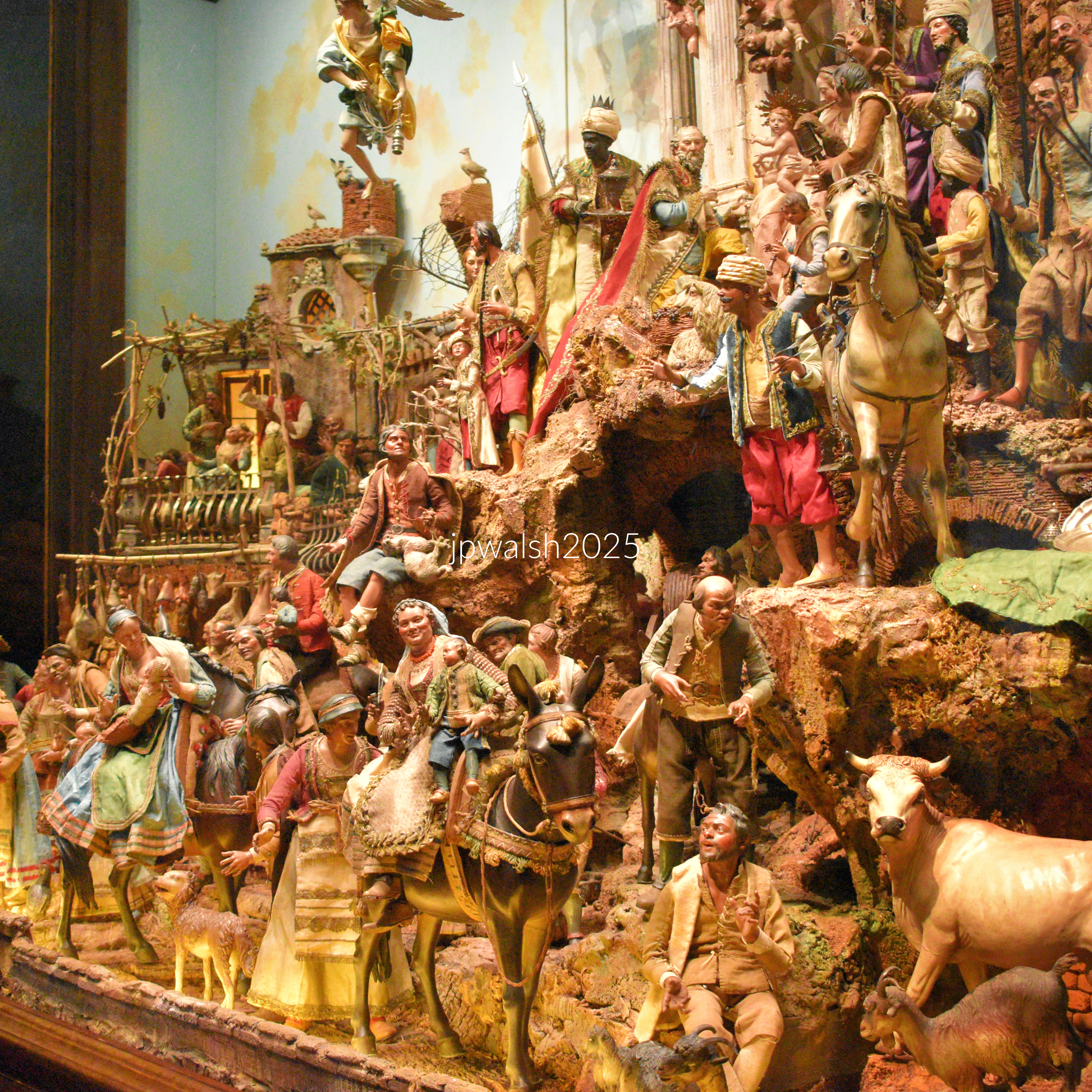
From minimal elements of straw, a manger, ox and ass and Christ Child arranged under Francis’s direction, the tradition of the crèche gradually expanded. Centuries later it produced elaborate displays such as the eighteenth‑century Neapolitan crèche shown recently at the Art Institute of Chicago, featuring nearly two hundred carved and clothed figures. Author’s photograph. All rights reserved. 98% 7.84mb DSC_9937

The Chapel of the Nativity Today

The site of the first crèche is now a chapel known as the Chapel of the Nativity (Cappella del Presepio). The cave where Francis staged the living nativity has been a place of prayer for centuries. Its altar stands directly over the bare rock where Francis placed the manger and hay. The surrounding walls preserve luminous 14th‑century frescoes depicting both the Bethlehem Nativity and the reenactment at Greccio.

For Francis—the Poverello, the “little poor one”—the humility of the Incarnation, the Son of God born among animals in a feeding trough, was the perfect beginning to a life that would lead to the Cross. After that Midnight Mass, Francis composed a canticle for the Christmas Octave. While St. Francis is most famous for his major Canticle of the Creatures composed in autumn 1225, he did compose this specific, minor canticle—historically categorized as Psalm 15 of his Office of the Passion—which directly references his Christmas experience at Greccio. In his minor canticle/psalm, Francis combined biblical texts and his own poetry to capture the spirit of the Nativity. The text explicitly highlights the humble birth that he sought to recreate physically in Greccio in December 1223:

Rejoice to God our Helper; shout unto God living and
true with the voice of triumph.
For the Lord is high, terrible, a great King over all the earth.
For the most holy Father of Heaven our everlasting King
sent His beloved Son from on high
And He was born of the Blessed Virgin, holy Mary.
He shall cry to Me, Thou art my Father, and I will make
Him My First-born
High over the kings of the earth.
In the day-time the Lord has commanded His mercy; and
a canticle to Him in the night
This is the day which the Lord has made; let us rejoice
and be glad in it
For the beloved and most holy Child has been given us,
born for us by the wayside
And laid in a manger because He had no room in the inn.
Glory to God in the highest, and on earth peace to men
of good will
Let the heavens rejoice and the earth be glad; let the sea
be moved and the fullness of it
The fields shall rejoice and all that is in them.
Sing to the Lord a new canticle; sing to the Lord all
the earth
For the Lord is great and exceedingly to be praised; He is
to be feared above all the gods
Bring to the Lord O ye kindreds of the Gentiles, bring to
the Lord glory and honor
Bring to the Lord glory unto His name. Bring your own
bodies and bear His holy cross
And follow His most holy precepts unto the end.
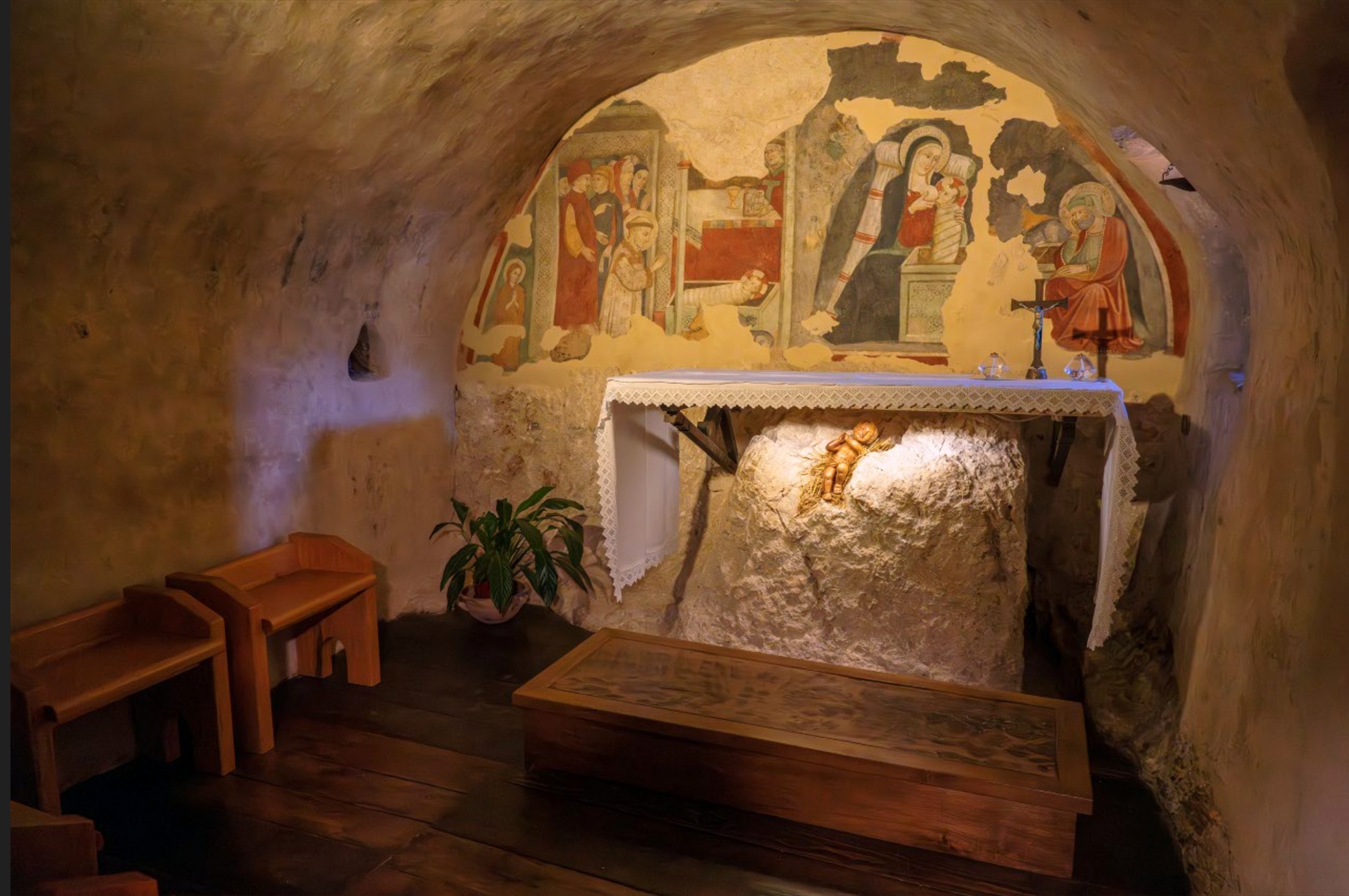
Chapel in Greccio, Italy, at the site of the first live Nativity in 1223. A place of prayer for centuries, the frescos date from the 14th century. Francis’s bond with the natural world shaped the way he understood God and himself. He insisted on placing the apocryphal ox and ass in the crèche, not out of sentimentality, but because he loved these ordinary working animals and saw in them a quiet dignity. He refused to ride horses—once symbols of his youthful chivalric ambitions—and chose instead to travel by donkey, even when ill, accepting the slow, leveling pace of a beast of burden. He called himself “Brother Ass,” a wry acknowledgment of his stubborn, uncooperative body and a reminder that humility begins with admitting one’s limits. In the Chapel of the First Live Nativity at Greccio, witnesses later recalled that when deacon Francis preached he grew so animated that he seemed to dance and even imitate the sounds of animals, swept up in the joy of the moment. “Chapel of the First Live Nativity” by Fiat 500e is licensed under CC BY 4.0.

Francis’s Christmas Vision for All Creation

For St. Francis of Assisi Christmas was always the “feast of feasts.”

Asked what he would request of Emperor Frederick II, then consolidating power in Italy, Francis replied that he wished for a law requiring people to put out food for animals at Christmas and to give domestic animals extra feed so that all creation could celebrate.

In 1225, when Christmas fell on a Friday, a traditional fast day, the brothers insisted on fasting, Francis ordered them to eat meat so freely that “even the walls would be greasy,” insisting that the feast of the Nativity overrode penitential custom.

Withdrawal, Final Journeys, and the Stigmata

After the Rule’s approval in November 1223 —its earlier 1221 version judged by the Curia as too severe—Francis withdrew from leadership and spent the winter of 1223–24 in the hermitage near Greccio. The Rule that finally passed had itself gone through a rejected draft, and even the version written at Fonte Colombo, later called the “Sinai” of the Franciscan Order, only partially reflected Francis’s original vision. One detail shows how the Rule was softened for practical governance: the Primitive Rule of 1209 allowed a friar one tunic; the 1221 Rule permitted two; the 1223 Rule allowed two, plus a cape and sandals. The Rule had been reshaped to meet others’ expectations, forcing Francis to relinquish some of his most cherished ideals and, in effect, surrender the brethren to new hands.

Observers later described his behavior in these final years as erratic, but he had simply turned inward, following a lifelong instinct toward self‑examination as he confronted his faults and the limits of his strength. There was poignancy in his departure from leadership. The new administration was not a man content with “a book and an ink‑horn and one pen and one signet,” but one who collected books and studied church law. Francis held no official role in the order he had founded, was ill, and was personally desolate as he questioned the direction the brothers were taking. In humility he asked what an “ideal” leader should be at all, and he surrendered the order’s future to God. “Lord,” Francis cried, “I commit to you the family you have given me. I cannot lead them any longer myself!” He determined to write up a Will or Testament with which to appeal to the brothers with his reminiscences of the early days and its ideals. It was his final message to his Franciscans. After this document, Francis said no more.

In summer 1224, he traveled to Mount La Verna for the feasts of the Assumption (August 15) and St. Michael (September 29), fasting for forty days. On September 14, the Feast of the Exaltation of the Cross, he saw a seraphic figure with six wings. From this vision he received the stigmata, becoming the first known stigmatic since St. Paul. He died on October 3, 1226, at the Portiuncula in Assisi, at age forty‑four. Two years later, on July 16, 1228, Pope Gregory IX canonized him in Assisi as a saint of the Roman Catholic Church.
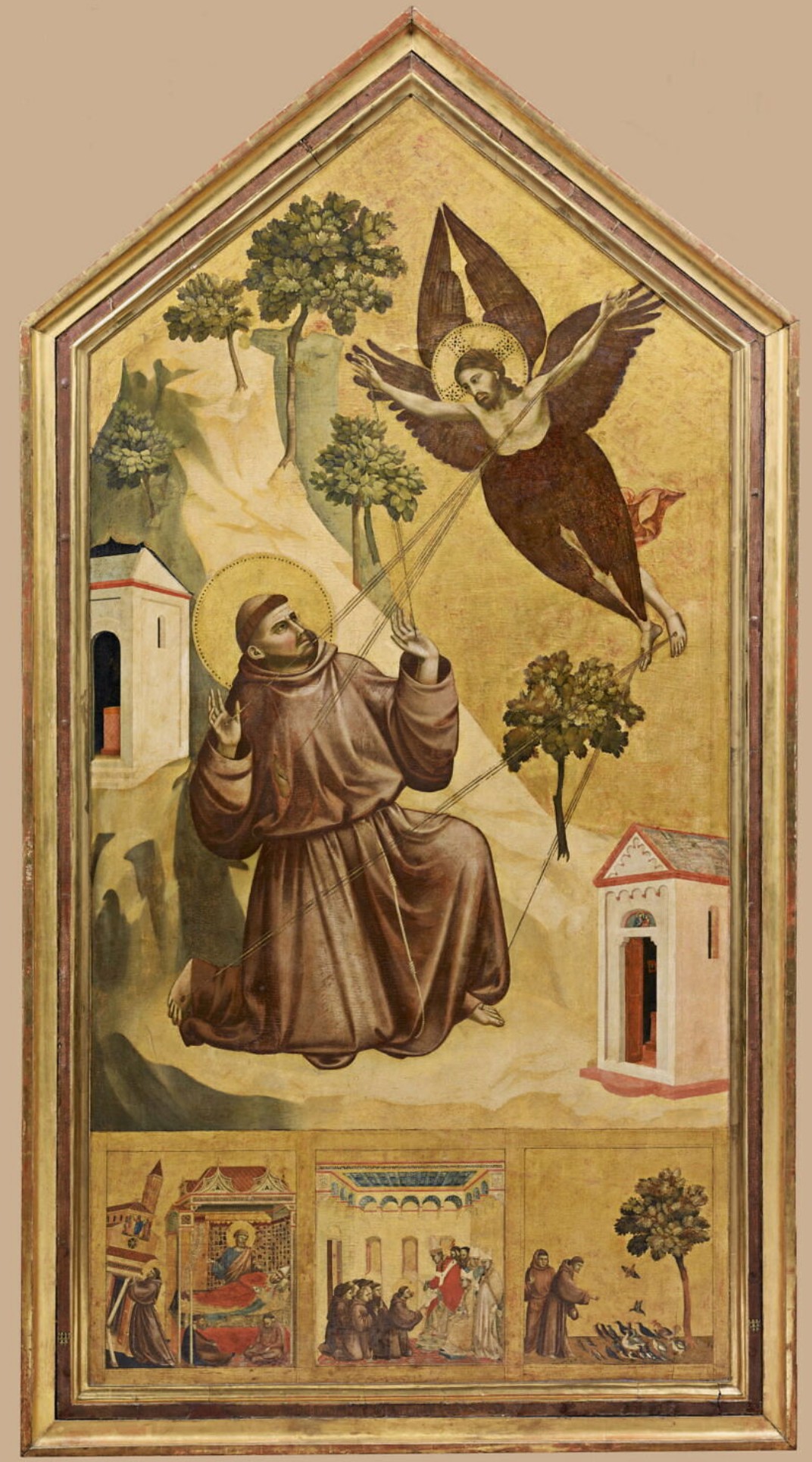
St. Francis receives the stigmata, 1300 / 1325, Giotto, 3.14 x 1.62 m, Louvre, Paris, originally Church of San Francesco, Pisa, Italy, choir or transept chapel, then a pillar near the high altar (cited by Vasari in 1568) – Saint François d’Assise recevant les stigmates – Louvre site des collections – retrieved July 18, 2026. In the main panel, Saint Francis kneels on the rocky cliffs while above him Christ appears in the form of a six-winged seraph. Thin golden rays stream from Christ’s wounds to Francis’s hands, feet, and side, physically marking him with the wounds of the crucifixion.

The liturgical Feast of the Exaltation of the Holy Cross—also called the Triumph of the Cross—is a major Christian feast celebrated on September 14 which honors the cross used in the crucifixion of Jesus Christ. It is viewed not as an instrument of execution, but a symbol of divine love, salvation, and victory over death. The feast is observed by Roman Catholics, Eastern Orthodox Christians, Anglicans, and Lutherans worldwide.

As the Church, in 2026, eagerly anticipates the 800th anniversary of the Transitus—the passing of St. Francis of Assisi on October 3, 1226—we look to the physical wounds that marked his radical devotion. When the 44- or 45-year-old saint died, he lay as he requested on the bare ground outside the Portiuncula. He was blind, naked, and infirm, yet completely fulfilled by his joyful evangelical marriage to Lady Poverty. In the West, the most notable historical event associated with the Feast of the Exaltation of the Holy Cross established in the early 4th century is that Saint Francis of Assisi received the stigmata on September 14, 1224. That event took place during a period of intense prayer and fasting on the remote mountaintop of Mount La Verna in Tuscany, Italy. According to early historical accounts, St. Francis had a vision of a crucified, six-winged seraph angel, after which the physical wounds of Christ’s crucifixion spontaneously appeared on his hands, feet, and side (the the official liturgical Feast of the Stigmata of St. Francis is celebrated on September 17).

Giotto’s Saint Francis Receiving the Stigmata in the Louvre is a monumental tempera and gold panel that represents a critical turning point in Western art, bridging the medieval Byzantine tradition with Proto-Renaissance realism. The work captures a profound, miraculous moment, divided between the main heavenly vision Francis experienced on Mount La Verna and a predella of supporting narrative scenes. The predella panels depict, from left to right: The Dream of Innocent III, in which the pope envisions Francis holding up a collapsing church; The Pope Approving the Statutes of the Order, confirming the formal Franciscan rule; and Saint Francis Preaching to the Birds, celebrating his legendary spiritual bond with nature.

In this painting, Giotto revolutionized art by introducing anatomical weight, psychological realism, and precise three-dimensional space to a medium long defined by flatness and the Maniera Greca. The panel effectively mapped out the visual language of the Early Italian Renaissance, demonstrating that divine themes could be powerfully conveyed through Western naturalism. Though the combined “Crucified Seraph” was not Giotto’s invention—it had already taken shape in late 13th-century Franciscan theology, especially in Bonaventure’s Legenda Maior—the artist radically advanced the figure and the history of art in several remarkable ways.

First, the transmission of the stigmata is rendered as precise, vector‑like golden rays linking Christ’s wounds to Francis’s body. Second, Christ’s torso is humanized through fleshy softness, chiaroscuro modeling, and real anatomical weight; the figure turns in space, oriented directly toward Francis. Third, Giotto introduces psychological exchange: Christ’s head tilts downward, his gaze meeting Francis’s. The result is no longer a generic emblem but an intimate, dramatic encounter between two individuals—an unprecedented fusion of theology, vision, and naturalism.

see – [Visiteurs devant Saint François d’Assise recevant les stigmates de Giotto] – Louvre site des collections. Photograph by Pierre Jahan – retrieved July 18, 2026.
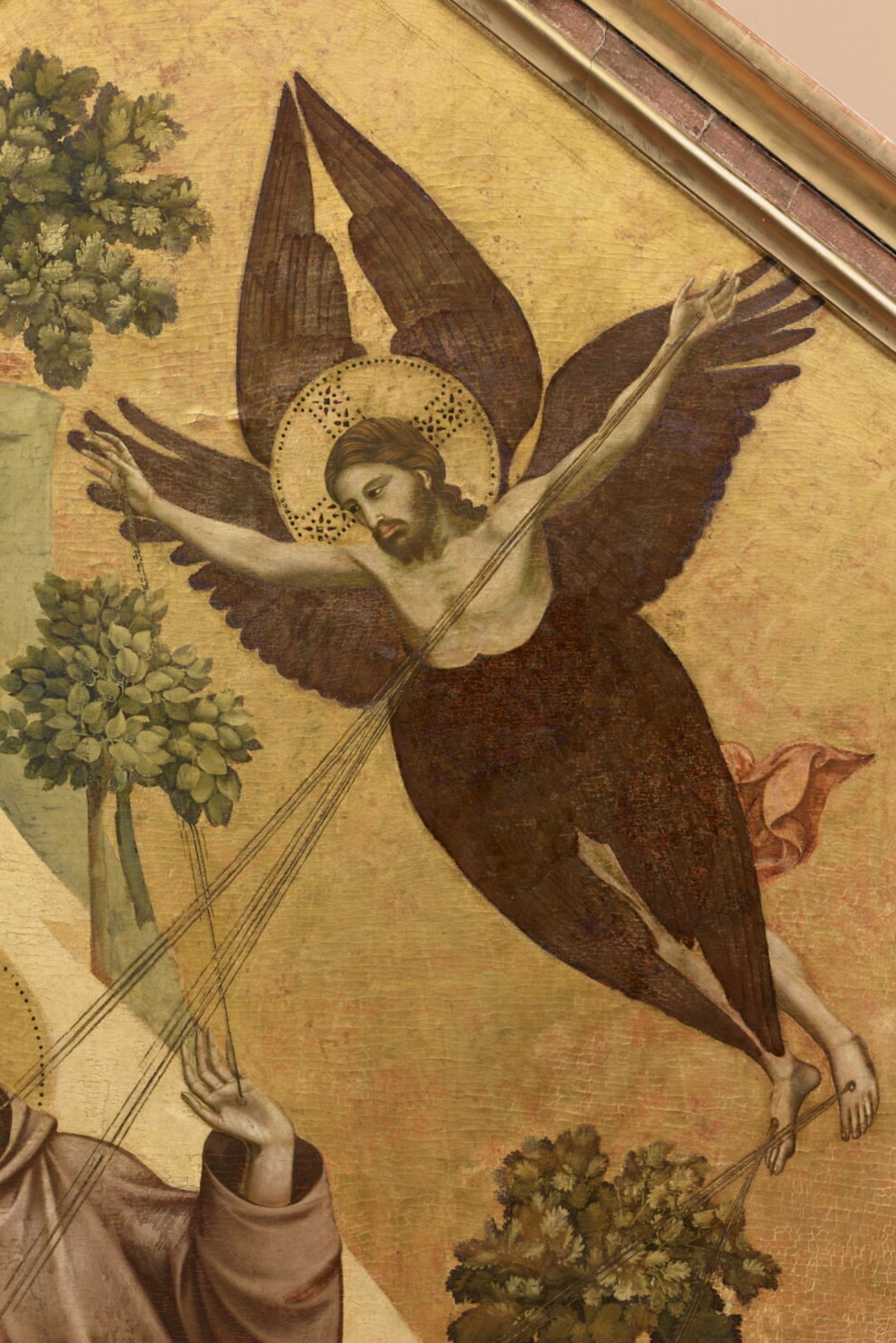

In Bonaventure’s Legenda Maior, which recounts Francis seeing a seraph bearing the likeness of a man crucified—a symbol of Francis becoming an Alter Christus, transformed not through physical martyrdom but through spiritual fire.

This detail from Giotto’s Saint Francis Receiving the Stigmata presents a highly complex and deeply symbolic figure of Christ, remarkable for the way it synthesizes multiple biblical, theological, and visual sources. The image fuses two distinct scriptural beings. In Isaiah’s vision of the Seraphim (Isaiah 6:2), each seraph possesses six wings—two covering the face, two covering the feet, and two for flight. Giotto follows this iconography precisely, folding wings around the head and lower body. At the same time, he overlays the fiery seraph with the human body of the crucified Christ, visualizing exactly what Francis’s biographers describe at Mount La Verna in 1224: a heavenly messenger appearing as both blazing seraph and suffering savior.

Randall Thompson’s “Nativity According to St. Luke”

According to The Harvard Crimson’s 1961 review, Randall Thompson composed Nativity According to St. Luke for the 200th anniversary of Christ Church. The work functions as a musical pageant rather than a theatrical drama—seven devotional tableaux form a serene polyptych of the Nativity.

The music, written for chamber orchestra, organ, chorus, and pageant figures, is unadorned and calmly joyful. A rustic fugue propels the shepherds toward Bethlehem where they greet the Child with an awkward, affectionate dance. Mary sings a lullaby while Joseph sleeps beside her.  Simeon prophesies. A boys’ choir offers a hushed Noel. The chorus answers with a broad, antiphonal Alleluia. The scenes are spare, serene, and reverent.

SOURCES:

Augustine Thompson, Francis of Assisi (Ithaca: Cornell University Press, 2012), 39, 55–56, 108–111.

Johannes Jørgensen, St. Francis of Assisi (Garden City, NY: Image Books, 1955), 216–17, 243.

Nesta De Robeck, The Life of St. Francis of Assisi: Herald of the Great King (Assisi, Italy: Casa Editrice Francescana Frati Minori Conventuali, 1975), 94–99.

John R. H. Moorman, Saint Francis of Assisi (Chicago: Franciscan Herald Press, 1987), 98–101.

John R. H. Moorman, Richest of Poor Men: The Spirituality of St. Francis of Assisi (Huntington, IN: Our Sunday Visitor, Inc.), 31–36.

Michael de la Bedoyere, Francis: A Biography of the Saint of Assisi (Garden City, NJ: Image Books, 1964), 219–22.


The Man Who Struck a Saint and Became One: St. Peregrine Laziosi’s Journey from Political Fury to Patron Saint of Cancer Patients, Whose National Shrine Is in Chicago.

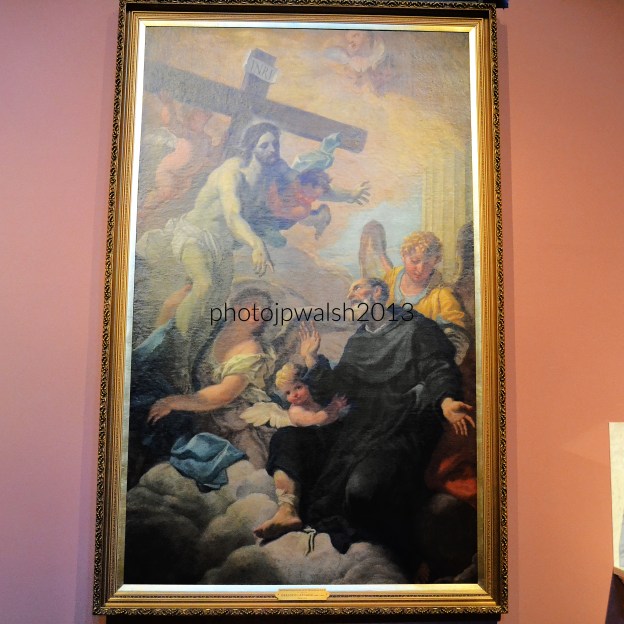
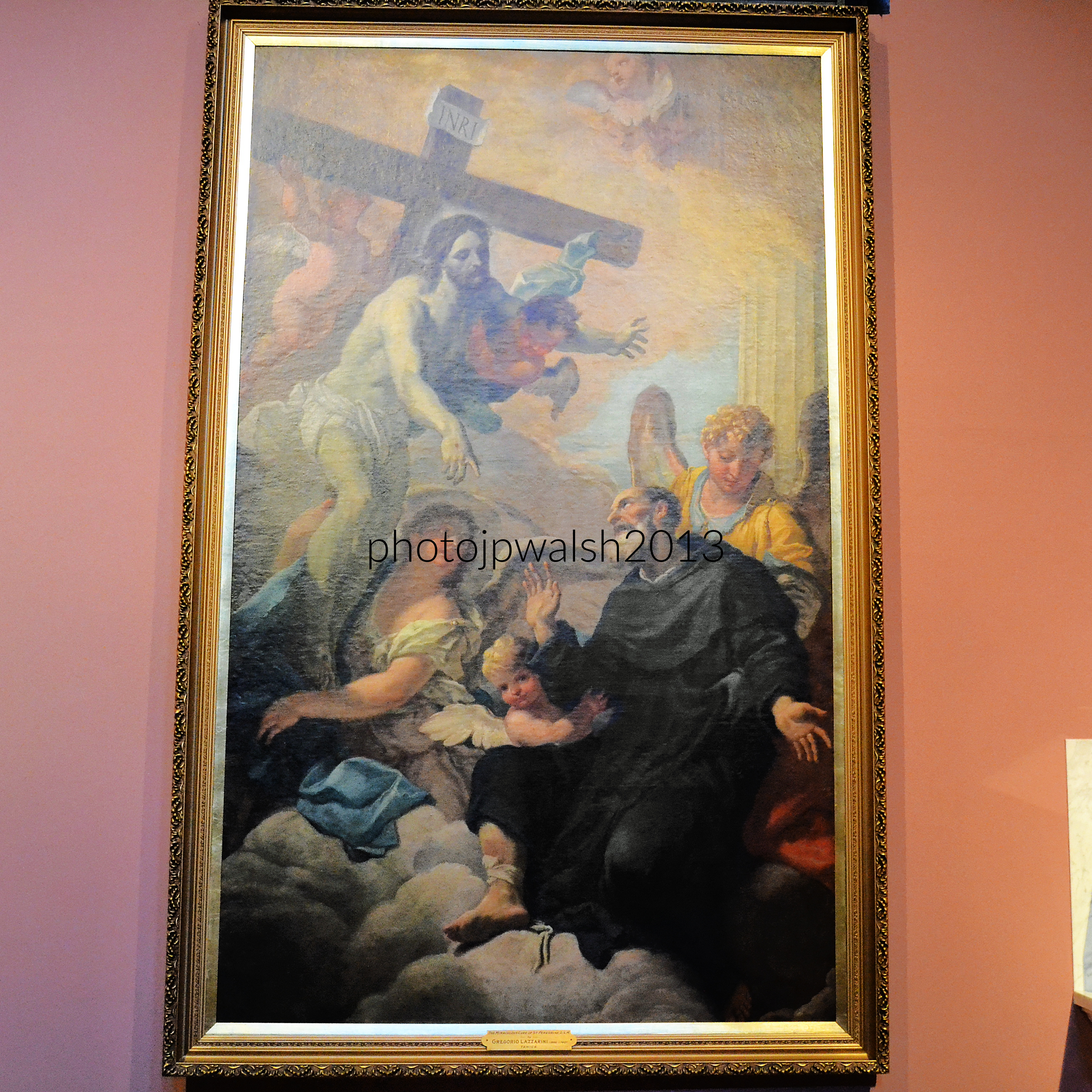
FEATURE image: At the National Shrine of St. Peregrine at Our Lady of Sorrows Basilica on Chicago’s west side is a painting attributed to the late 17th century painter, Gregorio Lazzarini (1665-1740) entitled Jesus the Healer; St. Peregrine, OSM the Helper. December 2013. Author’s photograph. 3.89mb DSC_0218 (1).

St. Peregrine Laziosi’s enduring significance lies in his transformation from a hot-headed opponent of the Church into a holy servant whose own miraculous healing from a cancerous tumor made him a lasting symbol of hope, healing, and intercession for those facing cancer and other life-threatening illnesses. His medieval life story is connected to the continuing ministry of his shrine in Chicago.

Peregrine Laziosi grew up in Forli near Ravenna in Italy. Peregrine came from a very wealthy family who lived in the town in which half the population was for being part of the Papal States and half were against. Peregrine’s family, and thus Peregrine as a young man, was against the pope’s political rule.

Pope Alexander IV (1254-1261), pope at the time of the birth of Saint Peregrine, is depicted in a fresco in San Marco in Milan, Italy. On September 26, 1255, Alexander IV had canonized Saint Clare of Assisi, founder of the second order of Franciscans, known as the Poor Clares. The following month, on October 29, 1255, Alexander IV, in his bull Benigna Operatio, declared that the stigmata of Saint Francis of Assisi (who was canonized in 1228) was a fact of the pope’s “own knowledge.” Public domain.

Guelphs and Ghibellines.

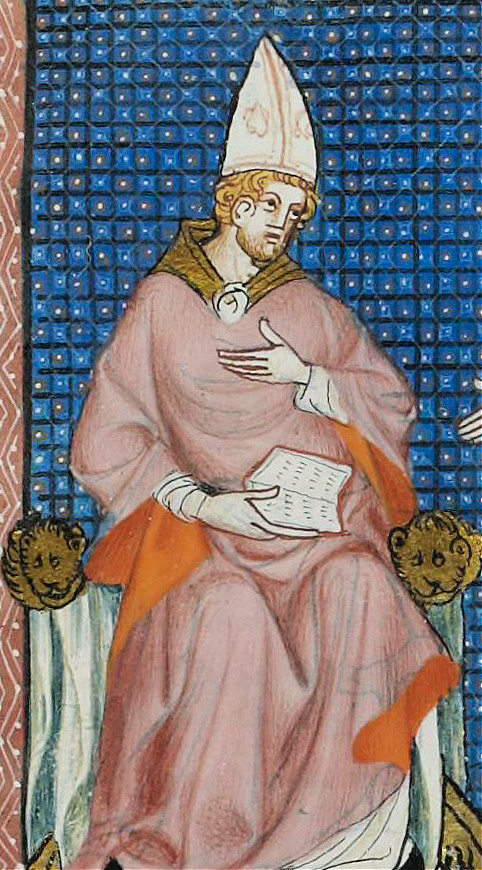
14th century Illumination on parchment of Pope Martin IV, c. 1335. From the manuscript Vie et miracles de saint Louis. Bibliothèque Nationale de France. Born Simon de Brion (c. 1210 –1285), Martin IV was the last French pope to stay in Rome before the papacy moved to Avignon. He ruled the Papal States from 1281 to 1285. Public Domain.

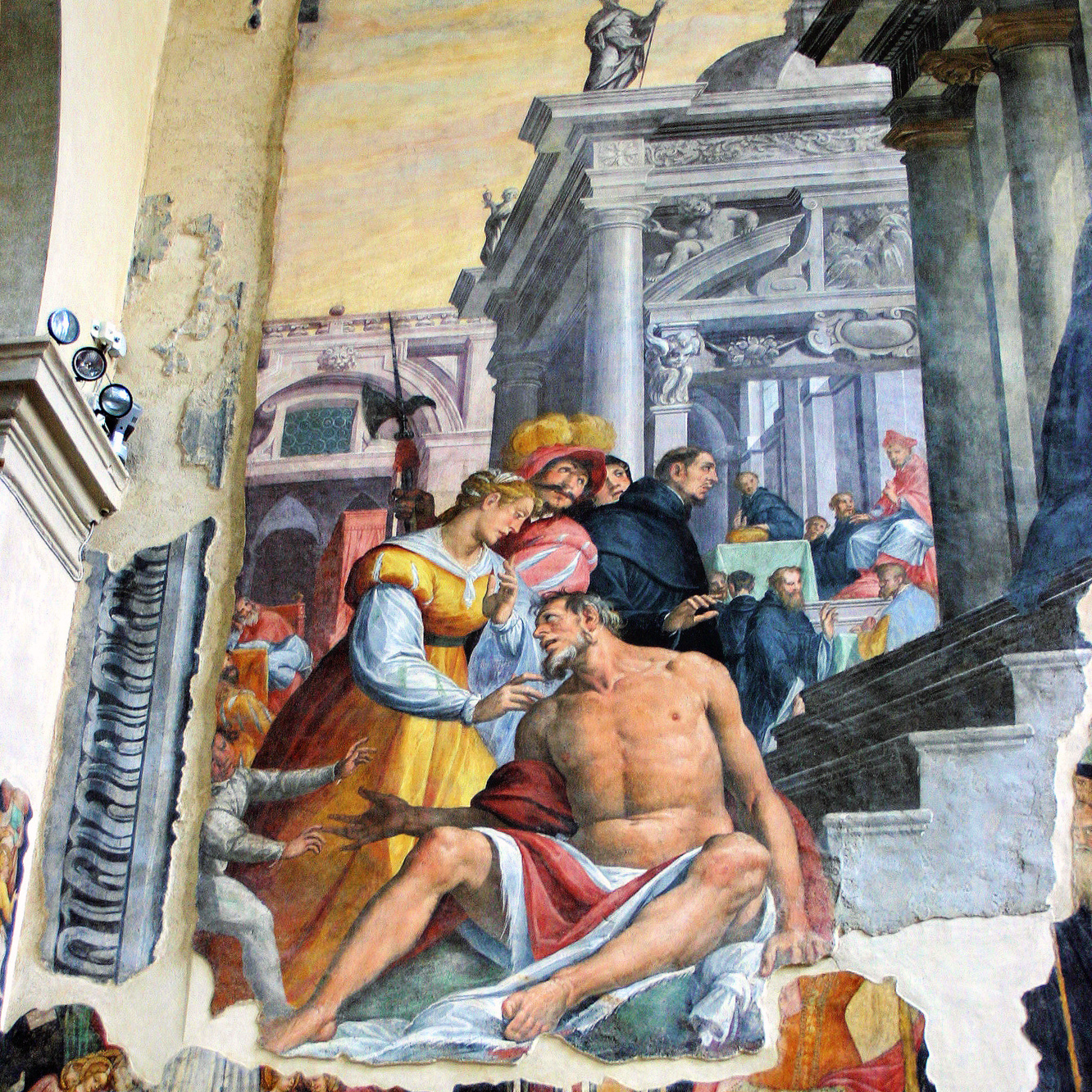
Filippo Benizzi (1233-1285), fifth general superior of the Servants of Mary (Servite Order), was assigned by Pope Martin IV to go to Forli to try to bring together the two sides. The Servites were a mendicant order that embraced poverty and devoted to preaching and encouraging devotion to the Virgin Mary. General Superior Benizzi was the Order’s chief propagator and organizer. In Forli, the pro-pope group was called Guelphs and pro-Holy Roman Emperor group was called Ghibellines. A political meeting was called where Fr. Benizzi would meet the two sides. Benizzi is also reputed to have healed a leper when in the town by giving him his tunic to wear. The Guelphs represented the interests of wealthy merchants, bankers, and urban elites who viewed the Empire as a threat to their free trade and dominance. This group later split into Black (radical) Guelphs and White (moderate) Guelphs. The Ghibellines represented the landed aristocracy who favored traditional hierarchical structures and sought imperial protection against the expanding papal states that fostered smaller, autonomous communes and free trade practices representing the “new money” merchant class.

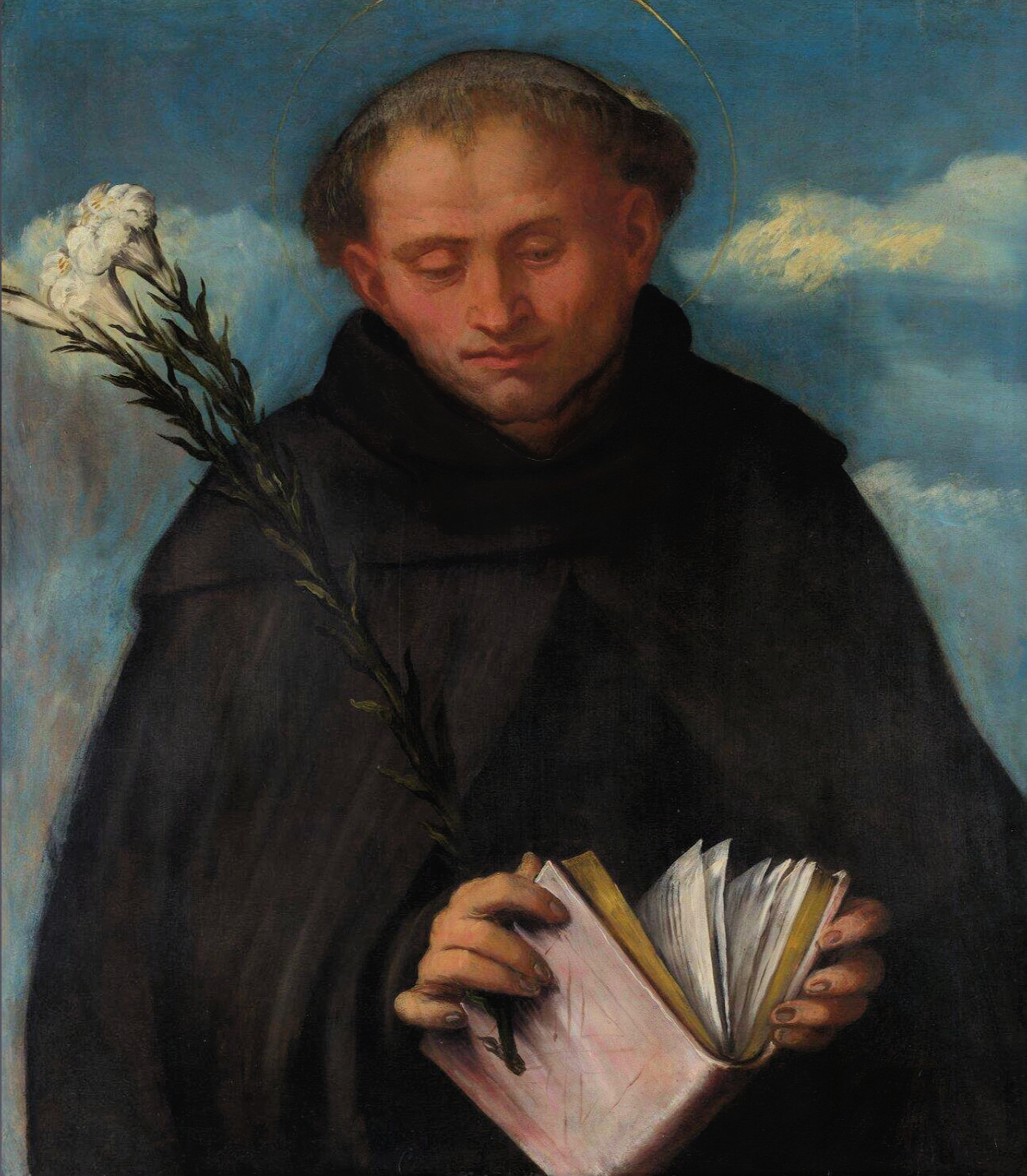
Saint Filippo Benizzi, Girolamo Romanino (c,1484-c.1560), c.1524, High Altarpiece, S. Alessandro, Brescia. oil on wood, 74.2 × 64.9 cm, The National Gallery London. Benizzi wears the black scapular, tunic and cowl of his Order. Saint Filippo Benizzi’s body is in the church of the Servants of Mary in Todi, Umbria. He was beatified by Pope Leo X in 1516 and made a saint by Pope Clement X in 1671. see – Girolamo Romanino | Saint Filippo Benizzi | NG297.5 | National Gallery, London – retrieved Jan. 27, 2026.

St. Peregrine born in Forlì, Italy, came from a wealthy family aligned against papal political authority during the bitter Guelph-Ghibelline conflicts. As an 18-year-old, he joined a hostile crowd confronting St. Filippo Benizzi, the Servite leader and papal representative, and even struck him physically. Peregrine repented and moved by Benizzi’s forgiveness and charity, joined the Servite Order, and eventually became a priest.

At the meeting, the crowds that gathered spewed insults at the friar and 18-year-old Peregrine, son of a Ghibelline leader, was among them. They chased the Servite General out of Forli with insults and violence and Peregrine physically struck him. Soon after, Peregrine regretted his violent actions and sought out his victim to apologize. Filippo Benizzi greeted Peregrine with charity which made a lasting impression on the young man. A few years later, Peregrine Laziosi joined the Servites in Siena and became a priest.

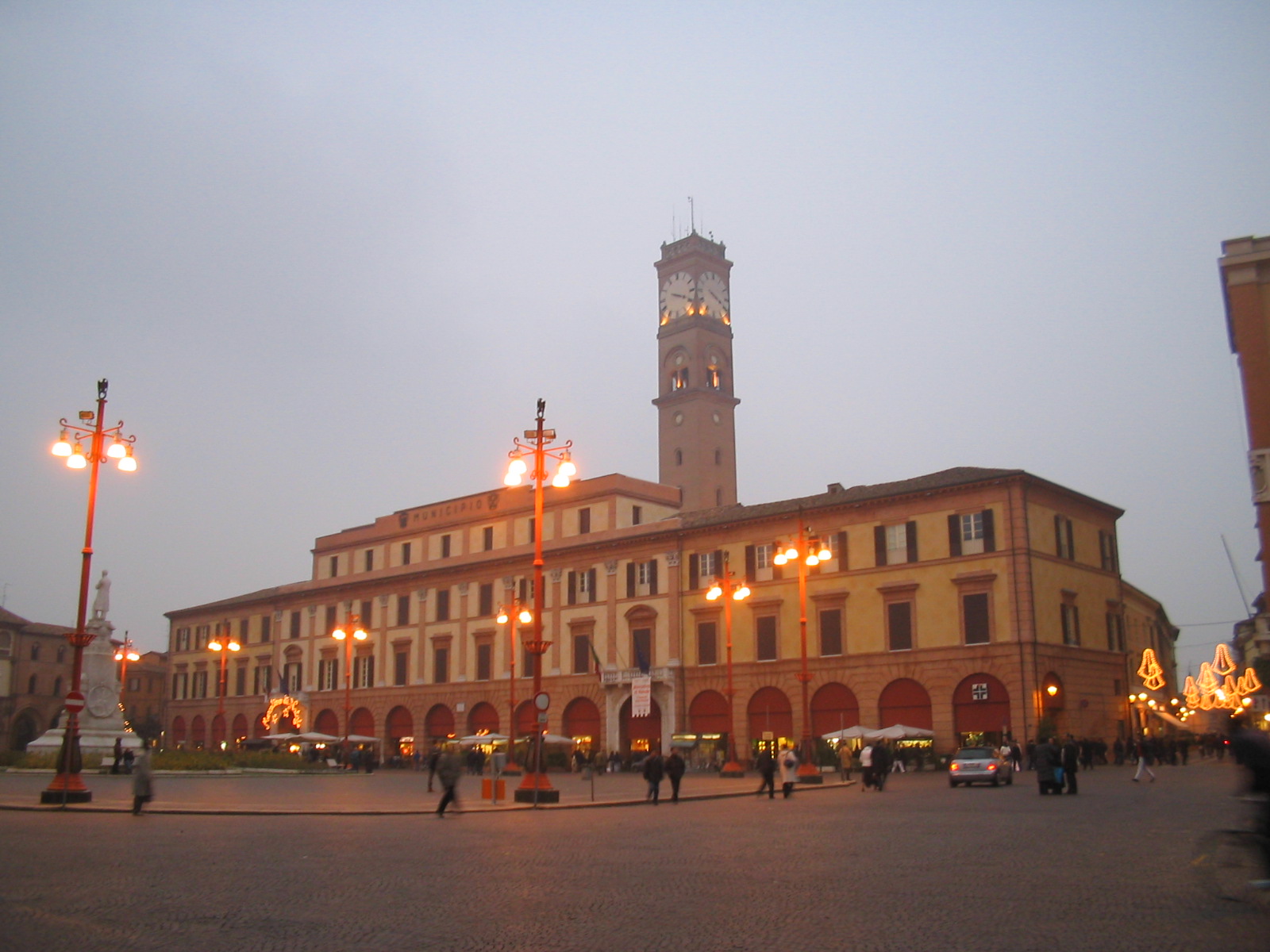
Piazza Aurelio Saffi (main square), Forli, Italy. PHOTO: “Main square SAFFI Forli Italy December-2004” by Ivanwiki is licensed under CC BY-SA 3.0.

Peregrine was sent back to Forli, founded a new Servite house, and became popular for his preaching and well known for charitable work.

Returning to Forlì, Peregrine founded a Servite house and became known for a lifetime of preaching and charitable works.

Miraculous cure.

Saints are often famous for their miracle-working powers. In the case of St Peregrine, he is known for being the recipient of a miracle. At 60 years old, Peregrine found he had a cancerous tumor on his right leg. The doctors had given up hope of a cure and decided to amputate the leg. The night before the operation St. Peregrine had a vision. It is the one depicted in the shrine’s painting: St. Peregrine seeing Jesus descend from the cross to touch and heal his leg.

The artwork depicts the healing miracle of his tumorous leg experienced by St. Peregrine Laziosi.

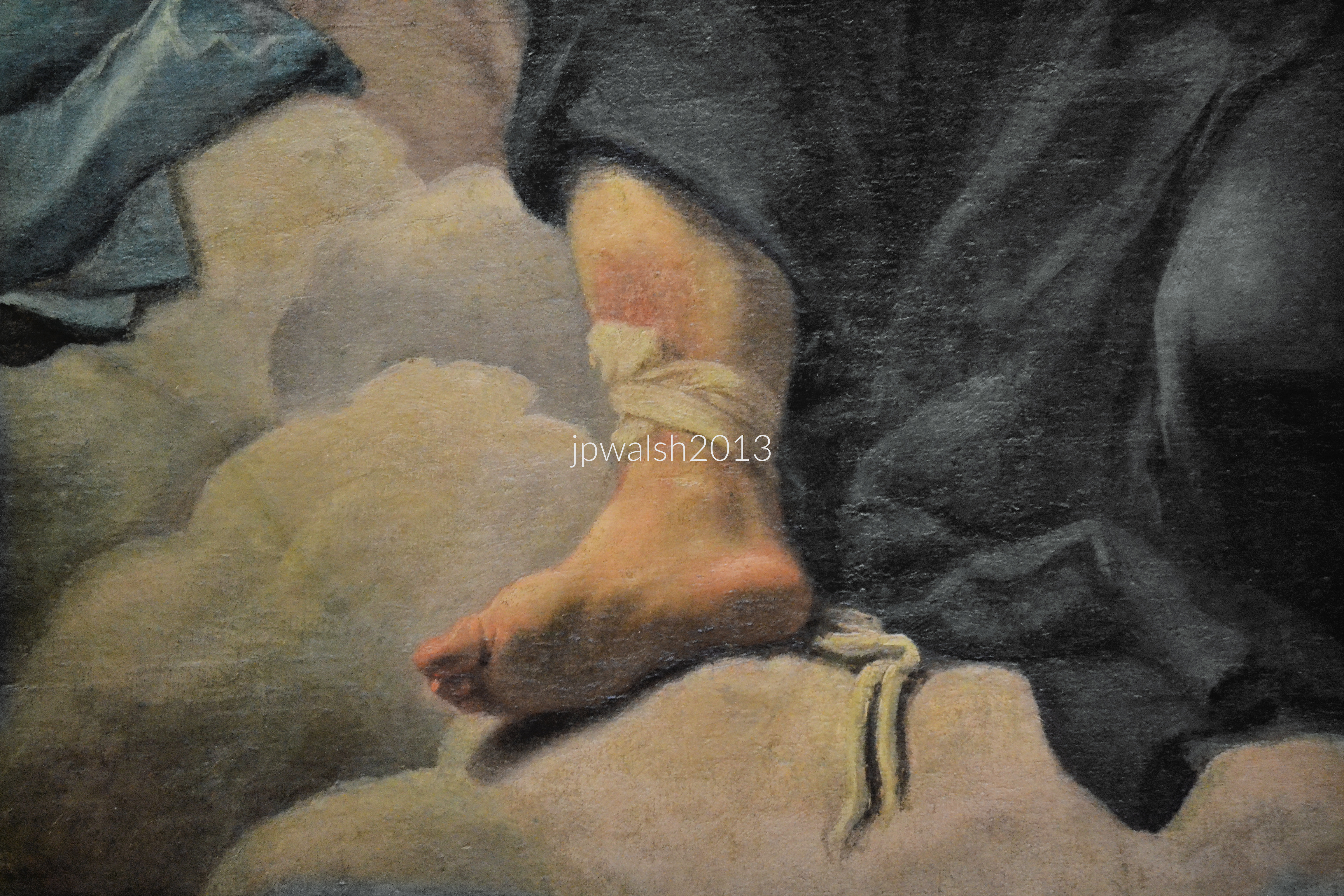
Detail of painting depicting St. Peregrine’s tumorous leg that was miraculously cured by Jesus Christ in a vision in 1320. Author’s photograph. 5.09mb DSC_0246 (1)

When the doctors arrived the next day to perform the operation, they found that Peregrine had been completely cured, an event unexplained by medical science. The news spread like wildfire through the town. St. Peregrine died of fever 25 years later on May 1, 1345, in his mid 80’s. After his death people who were sick and cured attributed it to St. Peregrine’s miraculous intercession, particularly when it was a life-threatening disease. His saintly cult grew – Peregrine is patron saint of cancer and other life-threatening maladies – and his image often shows him exposing his own tumorous leg that was miraculously cured by Christ.

Around age sixty, Peregrine developed a cancerous tumor in his leg, and doctors planned an amputation. On the eve of the operation, he experienced a vision of Christ descending from the Cross and healing him. The next day, the tumor had disappeared, a cure described as unexplained by medical science.

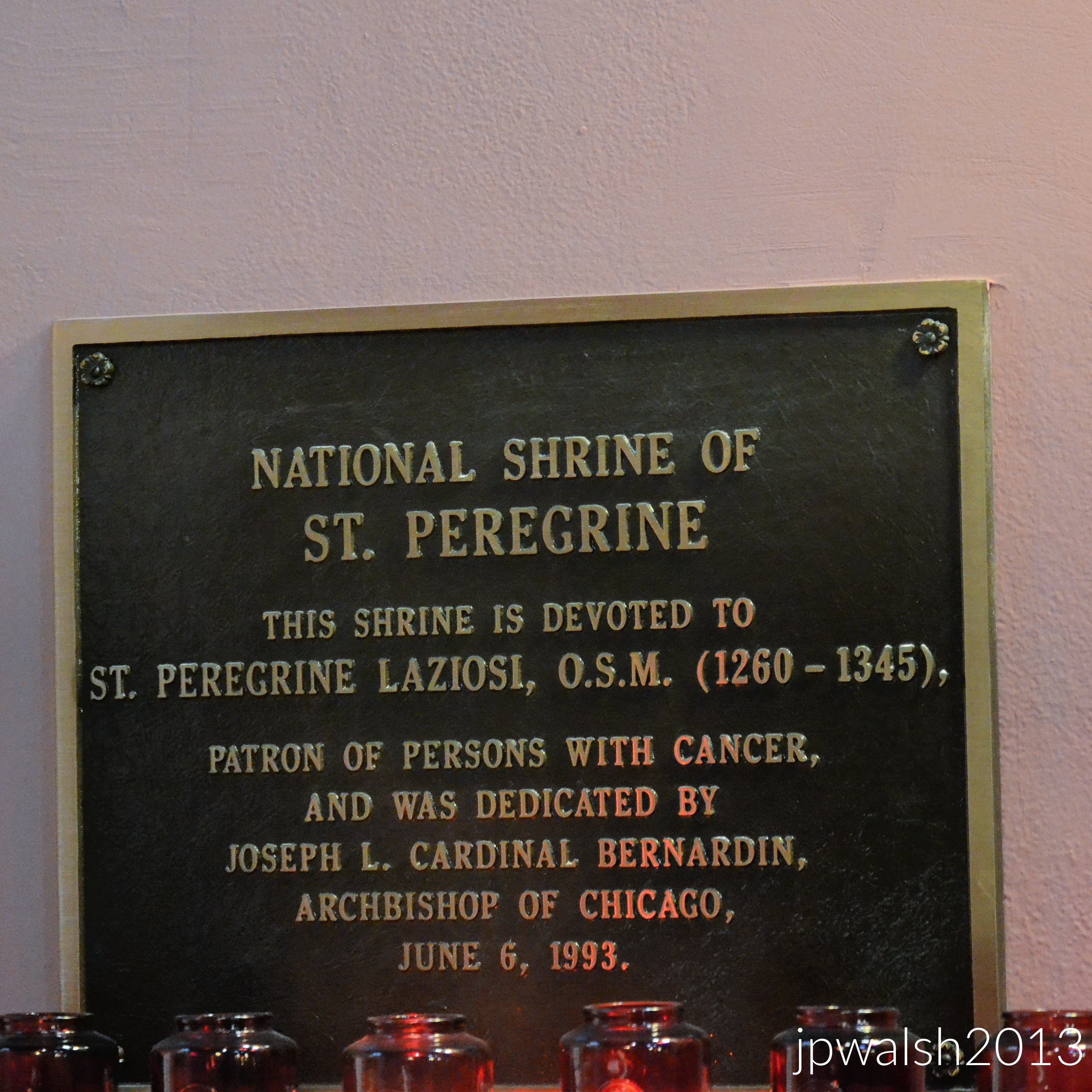
The shrine through prayer, blessing, pilgrimage, reconciliation and evangelization, accompanies those persons who live with serious illness, traditionally cancer, and their caregivers, as they seek to find healing, support, peace and God in their daily lives. There is also a relic of St. Peregrine Laziosi at the shrine. Author’s photograph. 2.74mbDSC_0260 (1)

After his death in 1345, devotion to St. Peregrine grew as many attributed healings to his intercession were made. He became the patron saint of cancer patients and those suffering from other grave illnesses, often depicted exposing his miraculously healed leg.

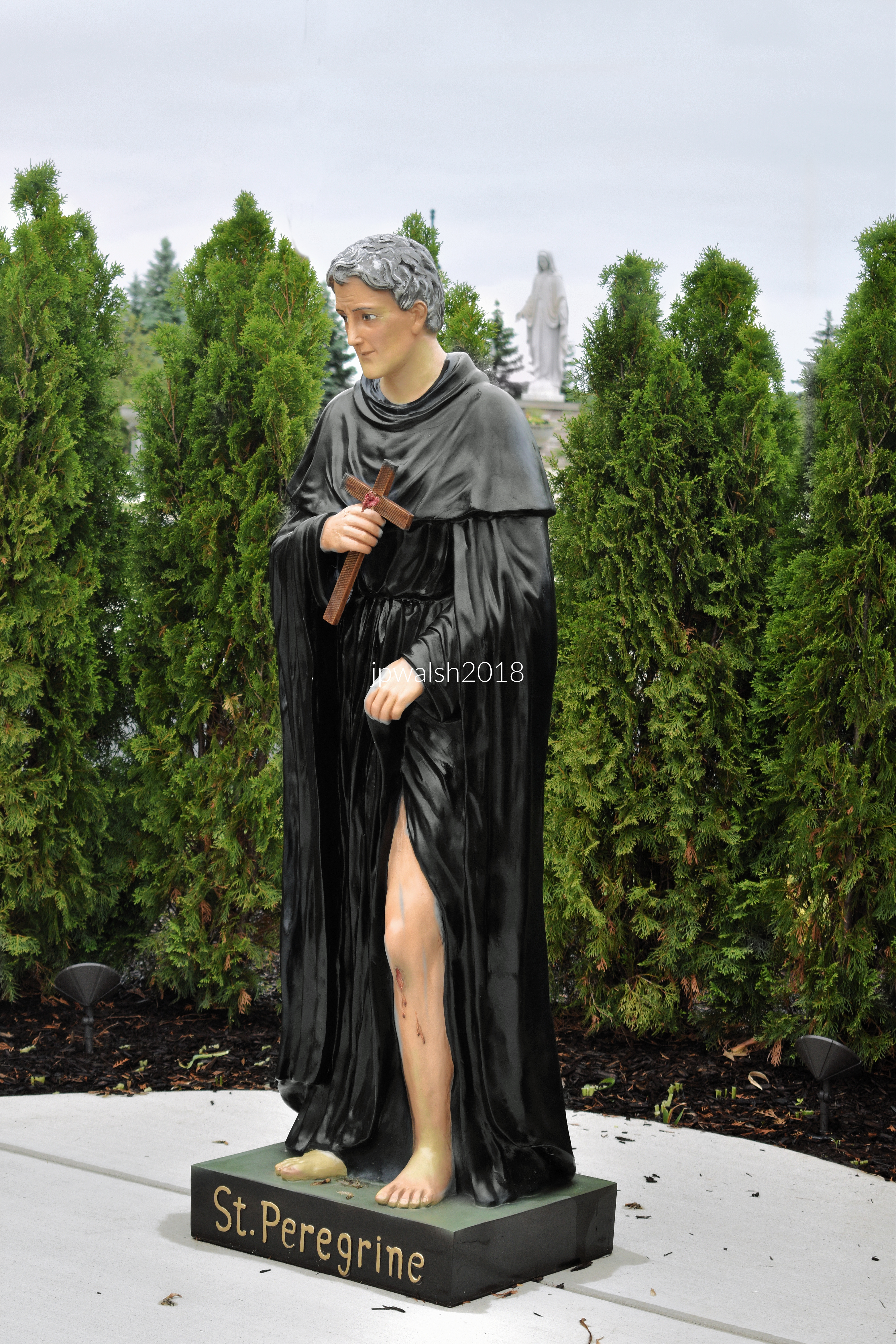
Statue of St. Peregrine Laziosi in an outdoor garden near to the Shrine of Christ’s Passion, St. John, Indiana. June 2018. Author’s photograph. 89% 7.93mb DSC_9062

From Oxford to Rome: How St. John Henry Newman (1801-1890) Followed Conscience in Search of Religious Truth.

N.B. – Vatican City, July 31, 2025 (UPI) — Pope Leo XIV will bestow St. John Henry Newman, the influential 19th-century Anglican convert, with the honor of “Doctor of the Church” [today].” Cardinal Newman was beatified by Pope Benedict XVI in 2010 and canonized by Pope Francis in 2019. With Pope Leo XIV’s action Card. St. Newman is now one of 38 “Doctors of the Church” whose ranks include four women. St. John Henry Newman became the first saint canonized from Britain since 1976.

FEATURE image: Photographic portrait, John Henry Cardinal Newman, 1880.

Canonized in 2019 and later declared a Doctor of the Church, Newman is a thinker whose relevance extends well beyond the 19th century.

 John Henry Newman, Oratory of St. Philip Neri, Birmingham, England.  London; New York; Bombay; Calcutta: Longmans, Green. Newman’s method of composing a sermon was to do so by heart and then write it down afterwards. English theologian James Mozley (1813-1878) who was active in the Oxford Movement, observed about these sermons: “A sermon of Mr. Newman’s enters into our feelings, ideas, and modes of viewing things. Persons look into Mr. Newman’s sermons and see their own thoughts in them.”

John Henry Newman was one of the most influential Christian thinkers of the modern era, whose journey from Anglican leader to Catholic cardinal, combined with his profound writings on truth, conscience, faith, reason, and holiness, continues to offer a model for navigating religious, intellectual, and cultural divisions.

Introduction by John P. Walsh

John Henry Newman (1801-1890) was a theologian and poet who was first an Anglican priest and later a Roman Catholic priest and cardinal. In the 1830’s and until his conversion to Catholicism in 1845, Newman was a leading figure in the Oxford Movement. They were a group of Anglicans who looked to create a bridge between the Church of England and the Catholic Church by adopting many Catholic beliefs and liturgical rituals from before the English Reformation. Newman eventually came to believe for himself that these religious efforts proved insufficient and he left the Anglican Communion for the Catholic Church in 1845. Already an articulate and influential religious leader in Britain, Newman’s decision brought with it the burden of having upset his friends as well as being challenged by them and others for his changed religious opinions on polemical grounds. Newman, a longtime writer and speaker, responded after a while with his now-celebrated Apologia Pro Vita Sua (1865–1866), which served as a defense of his religious opinions after he quit his position as Anglican vicar at Oxford. Newman, a 19th-century master of English prose and poetry, had already published The Idea of a University (1852) and went on to publish Grammar of Assent (1870) as well as several poems, some of which were set to music or served as hymns. In 1879, at the age of 78 years old, Pope Leo XIII named Newman a cardinal for his work on behalf of the Catholic Church in England as well as his having co-founded the Catholic University of Ireland in 1854, which today as University College Dublin is Ireland’s largest institution of higher learning. On October 13, 2019, John Henry Newman was canonized a Catholic saint at the Vatican by Pope Francis. St. John Henry Newman became the first saint canonized from Britain since 1976. In remarks by Prince Charles who led the British delegation to the Vatican for Newman’s canonization, the Prince of Wales said: “In the age in which he [Newman] attains sainthood, his example is needed more than ever – for the manner in which, at his best, he could advocate without accusation, could disagree without disrespect and, perhaps most of all, could see differences as places of encounter rather than exclusion.” London-born Cardinal Newman died in England in 1890 at 89 years old. He founded the Oratory at Birmingham in 1848 and through his writings spoke to many about the issues of faith, education, and conscience.

John Henry Newman began as an Anglican priest and leading figure in the Oxford Movement before converting to Catholicism in 1845. Newman became a major Catholic intellectual, publishing influential works on education, belief, doctrine, and the development of Christian thought.

A given opinion, as held by several individuals, even when of the most congenial views, is as distinct as are their faces. Oxford University sermons, 1843.

It is as absurd to argue men, as to torture them, into believing. Oxford University sermon, December 11, 1831.

His conversion cost him friendships and provoked controversy, prompting him to write Apologia Pro Vita Sua, one of the great religious autobiographies and defenses of conscience.

From the age of fifteen, dogma has been the fundamental principle of my religion: I know of no other religion; I cannot enter into the idea of any other sort of religion; religion, as a mere sentiment, is to me a dream and a mockery. Apologia Pro Vita Sua, 1864.

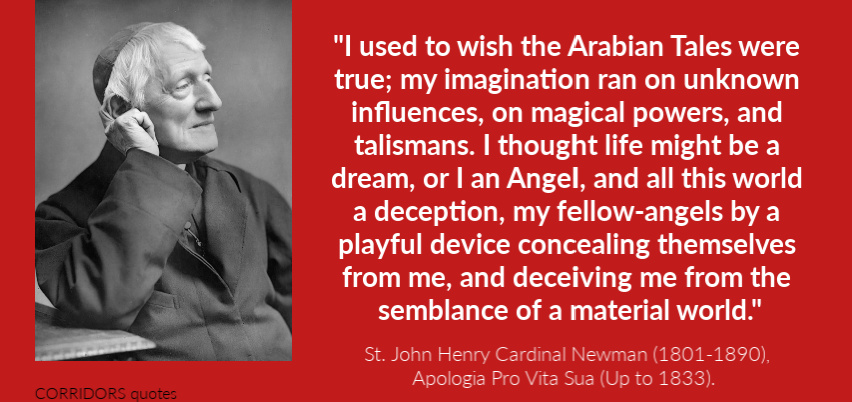
I used to wish the Arabian Tales were true; my imagination ran on unknown influences, on magical powers, and talismans. I thought life might be a dream, or I an Angel, and all this world a deception, my fellow-angels by a playful device concealing themselves from me, and deceiving me from the semblance of a material world. Apologia Pro Vita Sua (Up to 1833).

I was brought up from a child to take great delight in reading the Bible; but I had formed no religious convictions till I was fifteen. Of course I had perfect knowledge of my Catechism. Apologia Pro Vita Sua (Up to 1833).

I read Joseph Milner’s Church History, and was nothing short of enamoured of the long extracts from St. Augustine and the other Fathers which I found there. I read them as being the religion of the primitive Christians. Apologia Pro Vita Sua (Part III).

I read Newton on the Prophecies, and in consequence became most firmly convinced that the Pope was the Antichrist predicted by Daniel, St. Paul and St. John. My imagination was stained by the effects of this doctrine up to the year 1843. Apologia Pro Vita Sua (Part III).

There are virtues indeed, which the world is not fitted to judge about or to uphold, such as faith, hope and charity; but it can judge about Truthfulness; it can judge about the natural virtues, and truthfulness is one of them. Natural virtues may also become supernatural; Truthfulness is such… Apologia Pro Vita Sua (Part II).

Newman sought truth above party loyalty, holiness above comfort, and intellectual honesty above ideological conformity.

John Newman, 1841, Thomas Robinson Green?, collotype, 7 5/8 in. x 10 in. (195 mm x 255 mm). National Portrait Gallery, St Martin’s Place, London. https://www.npg.org.uk/collections/search/portrait/mw39717/John-Newman?LinkID=mp03281&wPage=1&role=sit&rNo=21

Catholics on the other hand shade and soften the awful antagonism between good and evil, which is one of their dogmas, by holding that there are different degrees of justification, that there is a great difference in point of gravity between sin and sin, that there is a possibility and the danger of falling away, and that there is no certain knowledge given to anyone that he is simply in a state of grace, and much less that he is to persevere to the end. Apologia Pro Vita Sua (Part III).

Let us seek the grace of a cheerful heart, an even temper, sweetness, gentleness, and brightness of mind, as well as walking in His light, and by His grace. Let us pray to Him to give us the ever-abundant, ever-springing love, which overpowers and sweeps away the vexations of life by its own richness and strength, and which above all unites us to Him, Who is the fountain and center of all mercy, loving kindness and joy. 17, Religious Joy (Sermon for Christmas Day), 1868.

Ex Umbris et Imaginibus in Veritatem! (From shadows and symbols into the truth!) Epitaph at Edgbaston.

He believed faith and reason worked together and rejected both blind skepticism and rigid rationalism. His writings emphasize the importance of truthfulness, conscience, reverence, humility, and intellectual integrity. His famous hymn Lead, Kindly Light emerged from a difficult period of illness, uncertainty, and spiritual reflection.

Lead, kindly Light, amid the encircling gloom; Lead thou me on! The night is dark, and I am far from home; Lead thou me on! Keep thou my feet: I do not ask to see the distant scene; one step enough for me. The Pillar of the Cloud, 1833.

Lead, Kindly Light is a hymn with words written in 1833 by Saint John Henry Newman as a poem titled “The Pillar of the Cloud.” The impetus for the poem was that young Newman, traveling in Italy, became ill and found himself stranded in Palermo, Sicily, without any passage out for almost a month.

To occupy his time, the 32-year-old Newman visited the many churches in Palermo but only when they were dark, abandoned and silent. Newman, then still an Anglican, didn’t attend any services.

Newman finally got a ship to England that sailed direct for Marseilles yet, between Corsica and Sardinia, the ship lay idle for a week from lack of wind. It was just at that point in his far-flung journey that the words, Lead Kindly Light, articulated themselves in Newman’s mind as he ached to go home.

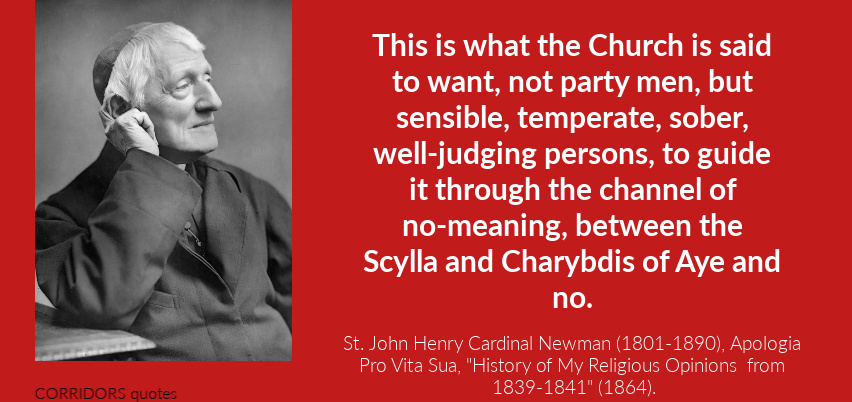
This is what the Church is said to want, not party men, but sensible, temperate, sober, well-judging persons, to guide it through the channel of no-meaning, between the Scylla and Charybdis of Aye and no. St. John Henry Cardinal Newman (1801-1890), Apologia Pro Vita Sua, “History of My Religious Opinions from 1839-1841” (1864).

John Henry Cardinal Newman, 1881, Sir John Everett Millais, 1st Baronet, President Royal Academy of Arts (1829-1896). National Portrait Gallery, London: https://www.npg.org.uk/collections/search/portrait/mw07727/John-Newman

Nature was a parable: Scripture was an allegory: pagan literature, philosophy, and mythology, properly understood, were but a preparation for the Gospel. St. John Henry Cardinal Newman (1801-1890), Apologia Pro Vita Sua, “History of My Religious Opinions from 1839-1841” (1864).

The Greek poets and sages were in a certain sense prophets; for “thoughts beyond their thought to those high bards were given.” St. John Henry Cardinal Newman (1801-1890), Apologia Pro Vita Sua, “History of My Religious Opinions from 1839-1841” (1864).

Holy Church in her sacraments and her hierarchical appointments, will remain even to the end of the world. Her mysteries are but expressions in human language of truths to which the human mind is unequal. St. John Henry Cardinal Newman (1801-1890), Apologia Pro Vita Sua, “History of My Religious Opinions from 1839-1841” (1864).

We may not speak of [Jesus] as we speak of any individual man, acting from and governed by a human intelligence within Him, but He was God, acting not only as God, but now through the flesh also, when He would. St. John Henry Cardinal Newman (1801-1890), Parochial and Plain Sermons, volume 6.

[Prophetic tradition] permeates the Church like an atmosphere, irregular in shape from its very profusion and exuberance. St. John Henry Cardinal Newman (1801-1890), Lectures on the Prophetical Office of the Church (1837).

Newman viewed disagreement as an opportunity for encounter rather than exclusion, a theme highlighted by then-Prince Charles at his canonization.

John Newman by George Richmond, chalk, 1844, 16 1/4 in. x 13 1/4 in. (413 mm x 337 mm), National Portrait Gallery, St Martin’s Place, London. https://www.npg.org.uk/collections/search/portrait/mw04655/John-Newman

John Henry Newman, after 1844. https://archive.org/details/newmanfran00barruoft/page/48/mode/2up?view=theater

The more claim an idea has to be considered living, the more various will be its aspects; and the more social and political is its nature, the more complicated and subtle will be its issues. St. John Henry Cardinal Newman (1801-1890), An Essay on the Development of Christian Doctrine.

And such mainly is the way in which all men, gifted or not gifted, commonly reason – not by rule, but by an inward faculty. St. John Henry Cardinal Newman (1801-1890), Fifteen Sermons preached before the University of Oxford.

If we insist upon being as sure as is conceivable, in every step of our course, we must be content to creep along the ground, and can never soar. St. John Henry Cardinal Newman (1801-1890), Fifteen Sermons preached before the University of Oxford.

If we are intended for great ends, we are called to great hazards; and, whereas we are given absolute certainty in nothing, we must in all things choose between doubt and inactivity. St. John Henry Cardinal Newman (1801-1890), Fifteen Sermons preached before the University of Oxford.

I am what I am, or I am nothing. I cannot think, reflect, or judge about my being, without starting from the very point which I am concluding…I cannot avoid being sufficient for myself, for I cannot make myself anything else, and to change me is to destroy me. St. John Henry Cardinal Newman (1801-1890), The Grammar of Assent (1870).

John Newman, 1864, McLean & Haes, albumen carte-de-visite, 3 5/8 in. x 2 1/4 in. (93 mm x 57 mm). National Portrait Gallery, St Martin’s Place, London. https://www.npg.org.uk/collections/search/portrait/mw125777/John-Newman?LinkID=mp03281&role=sit&rNo=10

A man who said “I cannot trust a cable, I must have an iron bar,” would, in certain given cases, be irrational and unreasonable: so too is a man who says I must have a rigid demonstration, not moral demonstration, of religious truth. St. John Henry Cardinal Newman (1801-1890), Letters & Diaries, volume 21.

We differ in our sense and use of the word “certain.” I use it of minds, you of propositions. I fully grant the uncertainty of all conclusions in your sense of the word, but I maintain that minds may in my sense be certain of conclusions which are uncertain in yours. St. John Henry Cardinal Newman (1801-1890), Letter to William Froude, April 29, 1879.

There is a great attempt to bring a new theory of Papal Infallibility, which would make it a mortal sin not to hold the Temporal Power necessary to the papacy. No one answers them and multitudes are being carried away. The pope gives ear to them and the consequence is there is a very extreme prejudice in the highest quarters at Rome against such as me. St. John Henry Cardinal Newman (1801-1890), Letter to James Hope Scott, April 11, 1867.

Really and truly I am NOT a theologian. A theologian is one who has mastered theology…and a hundred things besides. And this I am not and never shall be. St. John Henry Cardinal Newman (1801-1890), Letter to Maria Giberne, February 10, 1869.

To write theology is like dancing on the tight-rope some hundred feet above ground: it is hard to keep from falling, and the fall is great. St. John Henry Cardinal Newman (1801-1890), Letter to Emily Bowles, April 16, 1866.

Cardinal Henry Edward Manning is not a theologian, the pope is not a theologian, and therefore theology has gone out of fashion. I don’t profess to be a theologian, but at all events I should have been able to show a side of the Catholic religion more theological, more exact, than theirs. St. John Henry Cardinal Newman (1801-1890), Letter to Lord Blatchford, February 5, 1875.

There was true private judgment in the primitive and medieval schools. There are no schools now, no private judgment (in the religious sense of the phrase), no freedom of opinion. That is, no exercise of the intellect. This is a way of things which in God’s own time, will work its own cure of necessity. St. John Henry Cardinal Newman (1801-1890), Letter to Emily Bowles, May 19, 1863.

John Newman, c. 1845, Richard Woodman, after Sir William Charles Ross, stipple engraving, 11 1/2 in. x 9 1/2 in. (291 mm x 241 mm) plate size, National Portrait Gallery, St Martin’s Place, London. https://www.npg.org.uk/collections/search/portrait/mw198540/John-Newman?LinkID=mp03281&wPage=1&role=sit&rNo=24

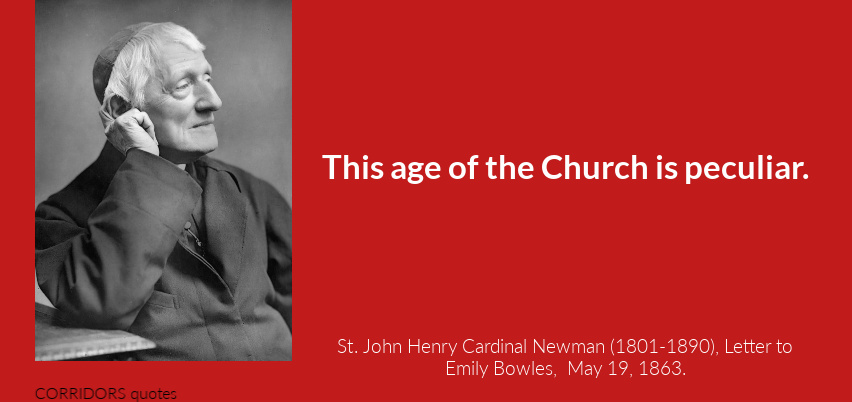
This age of the Church is peculiar. St. John Henry Cardinal Newman (1801-1890), Letter to Emily Bowles, May 19, 1863.

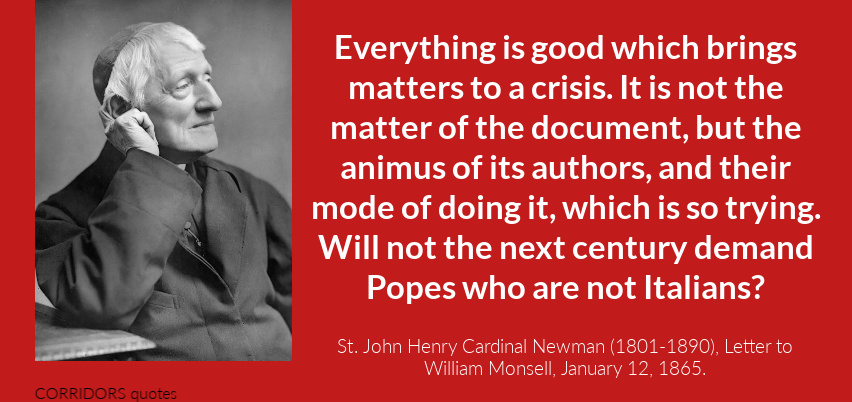
Everything is good which brings matters to a crisis. It is not the matter of the document, but the animus of its authors, and their mode of doing it, which is so trying. Will not the next century demand Popes who are not Italians? St. John Henry Cardinal Newman (1801-1890), Letter to William Monsell, January 12, 1865.

The Fathers made me a Catholic, and I am not going to kick down the ladder by which I ascended into the Church. It is a ladder quite as serviceable for that purpose now, as it was twenty years ago. St. John Henry Cardinal Newman (1801-1890), Letter to Rev. E. B. Pusey, D.D.

He maintained an independent mind, sometimes criticizing excesses and abuses within church governance while remaining deeply loyal to Catholic doctrine.

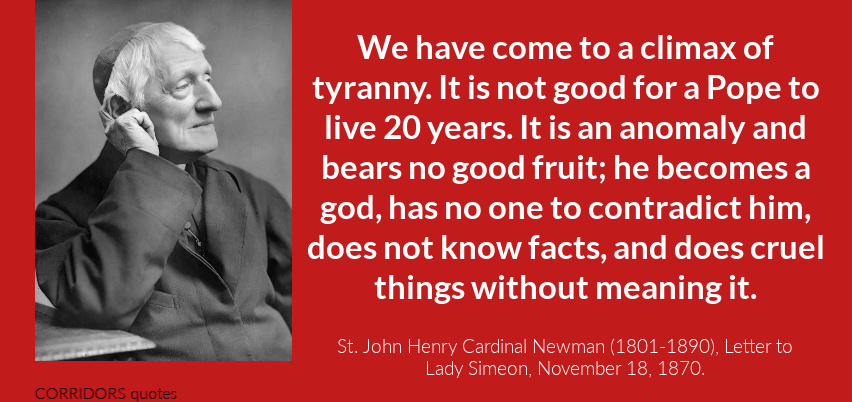
We have come to a climax of tyranny. It is not good for a Pope to live 20 years. It is an anomaly and bears no good fruit; he becomes a god, has no one to contradict him, does not know facts, and does cruel things without meaning it. St. John Henry Cardinal Newman (1801-1890), Letter to Lady Simeon, November 18, 1870.

There is no evil without its alleviation. St. John Henry Cardinal Newman (1801-1890), Letter to Bishop David Moriarty, November 14, 1866.

To be at once infallible in religion and a despot in temporals is perhaps too great for mortal man. St. John Henry Cardinal Newman (1801-1890), Letter to Mrs. William Frounde, January 2, 1871.

Truth is the guiding principle of theology and theological inquiries; devotion and edification, of worship; and of government, expedience. St. John Henry Cardinal Newman (1801-1890), The Via Media of the Anglican Church Illustrated in Lectures, Letters and Tracts written between 1830 and 1841.

The instrument of theology is reasoning; of worship, our emotional nature; of rule, command and coercion. Further, as man is, reasoning tends to rationalism; devotion to superstition and enthusiasm; and power to ambition and tyranny. St. John Henry Cardinal Newman (1801-1890), The Via Media of the Anglican Church Illustrated in Lectures, Letters and Tracts written between 1830 and 1841.

Now all of us are sinners, all of us have need to come to God as the Publican did; every one, if he does but search his heart, and watch his conduct, and try to do his duty, will find himself to be full of sins which provoke God’s wrath. I do not mean to say that all men are equally sinners; some are wilful sinners, and of them there is no hope, till they repent; others sin, but they try to avoid sinning, pray to God to make them better, and come to church to be made better; but all men are quite sinners enough to make it their duty to behave as the Publican. Every one ought to come into Church as the Publican did, to say in his heart, “Lord, I am not worthy to enter this sacred place; my only plea for coming is the merits of Jesus Christ my Saviour.” St. John Henry Cardinal Newman (1801-1890), Sermon, Reverence in Worship, October 30, 1836 (PPS-8).

To believe and not to revere, to worship familiarly and at one’s ease, is an anomaly and a prodigy unknown even to false religions, to say nothing of the true one…Worship, forms of worship — such as bowing the knee, taking off the shoes, keeping silence, a prescribed dress and the like — are considered as necessary for a due approach to God. Parochial and Plain Sermons, Vol. VIII — “Reverence in Worship,” October 30, 1836.

[Christ] is not past, He is present now. And though He is not seen, He is here. The same God who walked the water, who did miracles, etc., is in the Tabernacle. We come before Him, we speak to Him just as He was spoken to 1800 years ago, etc. This [is] how He counteracts time and the world… It is this that makes devotion in lives. It is the life of our religion. We are brought into the unseen world. St. John Henry Cardinal Newman (1801-1890), SN 127: May 25, 1856.

To consider the world in its length and breadth, its various history, the many races of man, their starts, their fortunes, their mutual alienation, their conflicts; and then their ways, habits, governments, forms of worship; their enterprises, their aimless courses, their random achievements and acquirements, the impotent conclusion of long-standing facts, the tokens so faint and broken of a superintending design, the blind evolution of what turn out to be great powers or truths, the progress of things, as if from unreasoning elements, not towards final causes, the greatness and littleness of man, his far-reaching aims, his short duration, the curtain hung over his futurity, the disappointments of life, the defeat of good, the success of evil, physical pain, mental anguish, the prevalence and intensity of sin, the pervading idolatries, the corruptions, the dreary hopeless irreligion, that condition of the whole race, so fearfully yet exactly described in the Apostle’s words, “having no hope and without God in the world,”—all this is a vision to dizzy and appal; and inflicts upon the mind the sense of a profound mystery, which is absolutely beyond human solution. St. John Henry Cardinal Newman (1801-1890), Apologia Pro Vita Sua, Chapter 5: Position of My Mind Since 1845.

What shall be said to this heart-piercing, reason-bewildering fact? I can only answer, that either there is no Creator, or this living society of men is in a true sense discarded from His presence. Did I see a boy of good make and mind, with the tokens on him of a refined nature, cast upon the world without provision, unable to say whence he came, his birth-place or his family connections, I should conclude that there was some mystery connected with his history, and that he was one, of whom, from one cause or other, his parents were ashamed. Thus only should I be able to account for the contrast between the promise and the condition of his being. And so I argue about the world;—if there be a God, since there is a God, the human race is implicated in some terrible aboriginal calamity. It is out of joint with the purposes of its Creator. This is a fact, a fact as true as the fact of its existence; and thus the doctrine of what is theologically called original sin becomes to me almost as certain as that the world exists, and as the existence of God. St. John Henry Cardinal Newman (1801-1890), Apologia Pro Vita Sua, Chapter 5: Position of My Mind Since 1845.

On October 13, 2019 in Rome then-Prince Charles attended the canonization of St. John Henry Newman (1801-1890) by Pope Francis. On July 31, 2025 Cardinal Newman—English Catholic theologian, academic, philosopher, historian, writer, and poet—was declared Doctor of the Church by Pope Leo XIV. On September 4, 2025, King Charles III became the first British monarch to visit the Oratory of St. Philip Neri in Birmingham which served as headquarters for the 19th century Catholic cardinal’s life and activities. On his visit, Charles III viewed the cardinal’s library as well as his personal items and the room where Newman died which has remained unchanged. John Henry Newman was born in London and grew up in the Church of England. He became an Anglican priest in 1825 and a leader of the Oxford Movement which sought affinities with Roman Catholicism. In 1845, in his mid-40’s, Newman became a Catholic and studied in Rome where he became a Catholic priest. Newman was always a prolific writer of letters, sermons and articles, and this continued throughout his life. The Cardinal often fell between the cracks – Anglicans mistrusting his Catholic “betrayal” and Catholics mistrusting his having been an Anglican. A cloud lifted in 1879 when Newman was named a cardinal of the Roman Church by Pope Leo XIII (1878-1903). After Rome, Newman returned to England in 1847 and founded the first English Oratory in 1848 here in Birmingham. Newman was soon joined by other English converts, including Father Wilfrid Faber (1814-1863) who Newman sent to London to establish its Oratory in 1849. After Newman was made a Cardinal in 1879, he lived at the Birmingham Oratory and died there in 1890. In 2008 Newman’s grave was opened so to move his remains into the Birmingham Oratory. But his wooden coffin was found to have disintegrated and no bones were found.

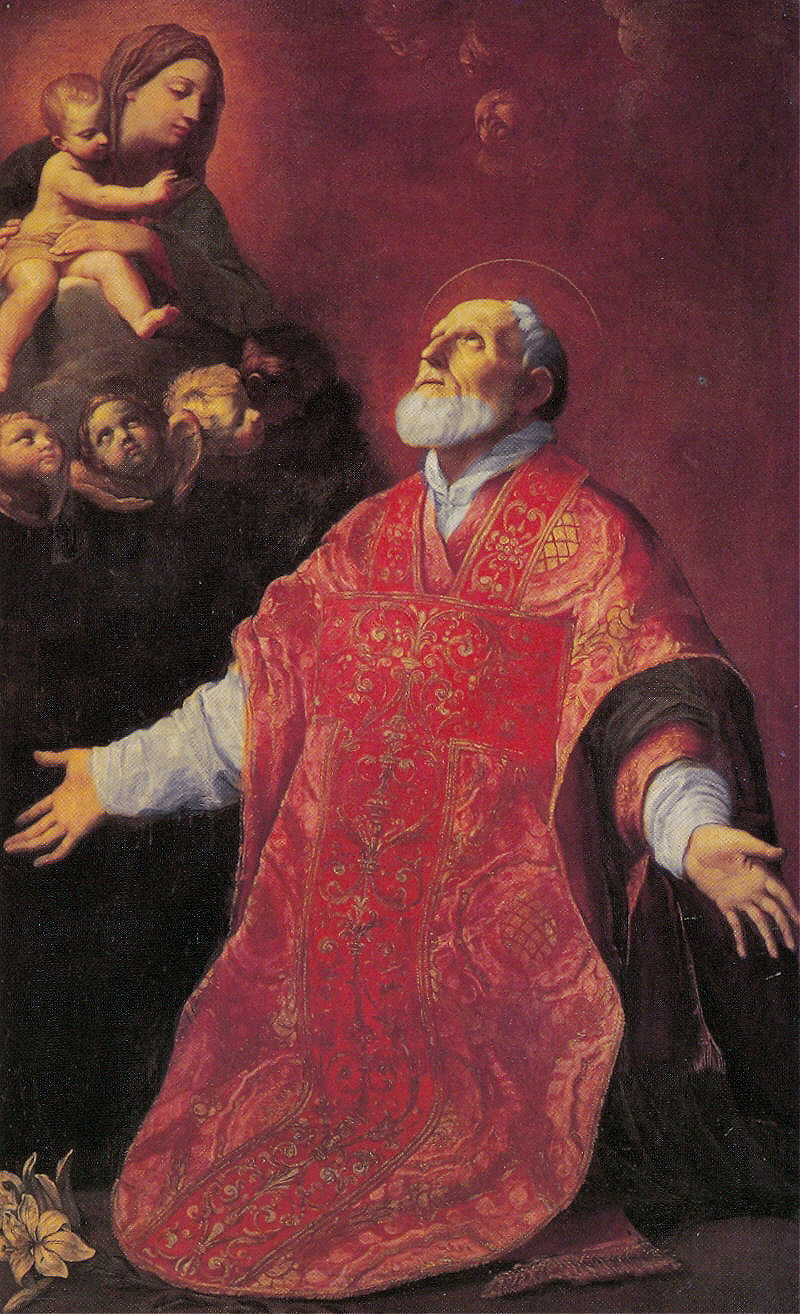
St. Philip Neri, Birmingham Oratory.

St. Philip Neri (1515-1595) who founded the Oratory in Rome in 1550 came from Florence where his family were Tuscan nobles who practicied the learned professions. Like some saints do, Philip tore up these family pedigrees in preference for the poor and itinerant. Once in Rome Philip never made study his central occupation and was reticent to talk about it, but he surprised professional scholars not only by his natural wit and humor but his learned depth and the clearness of his theological thinking and knowledge.

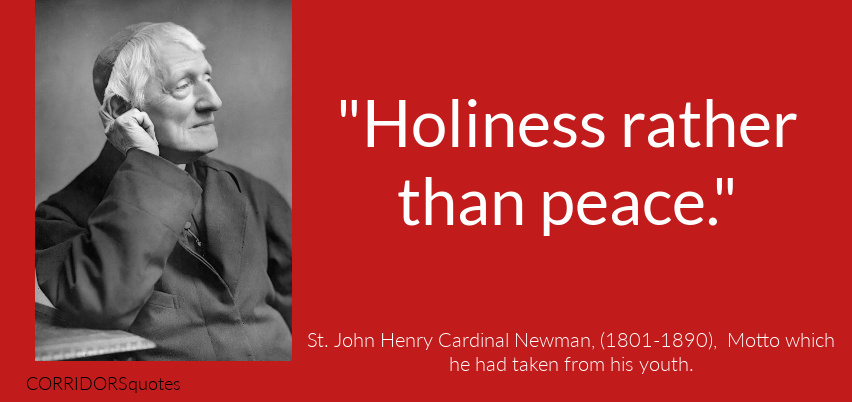
“Holiness rather than peace.” St. John Henry Cardinal Newman, (1801-1890), Motto which he had taken from his youth.

His lifelong motto was “Holiness rather than peace,” reflecting his belief that truth and sanctity mattered more than comfort or popularity.

This explanatory article may be periodically updated.