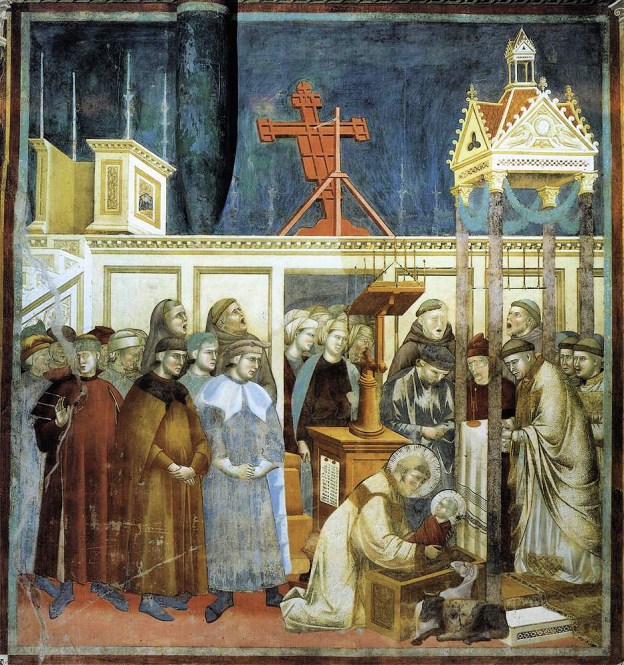
FEATURE Image: Institution of the Crib at Greccio, c. 1297-1300, a fresco by Giotto, depicts St. Francis of Assisi preparing the first Christmas crib at Greccio in 1223. It is part of the Legend of Saint Francis fresco cycle located on the walls of the Upper Basilica of San Francesco in Assisi, Italy. Giotto keeps the ox and ass that Francis insisted on having, though the artist places the event inside a magnificent church or basilica rather than the rustic cave on a cliff where the event historically took place. Public Domain.
Greccio, 1223: St. Francis and the first Christmas Crèche
In Advent of 1223, in the hill town of Greccio—about sixty miles south of Assisi—St. Francis of Assisi created the world’s first crèche, a living reconstruction of Bethlehem’s manger in his mountain hermitage there in central Italy. His simple arrangement of straw, a feeding trough, and an image of the Christ Child became the model for the Nativity scenes that endure in homes, churches, and beyond more than 800 years later.
Francis’s love of nature shaped the scene. He included the ox and ass, traditional symbols absent from the Gospels but long present in Christian imagination. Giotto’s late 13th century fresco later fixed these animals in Western iconography, following Francis’s interpretation, placing the animals beside the manger even though the biblical texts of Luke and Matthew specify only the feeding trough.
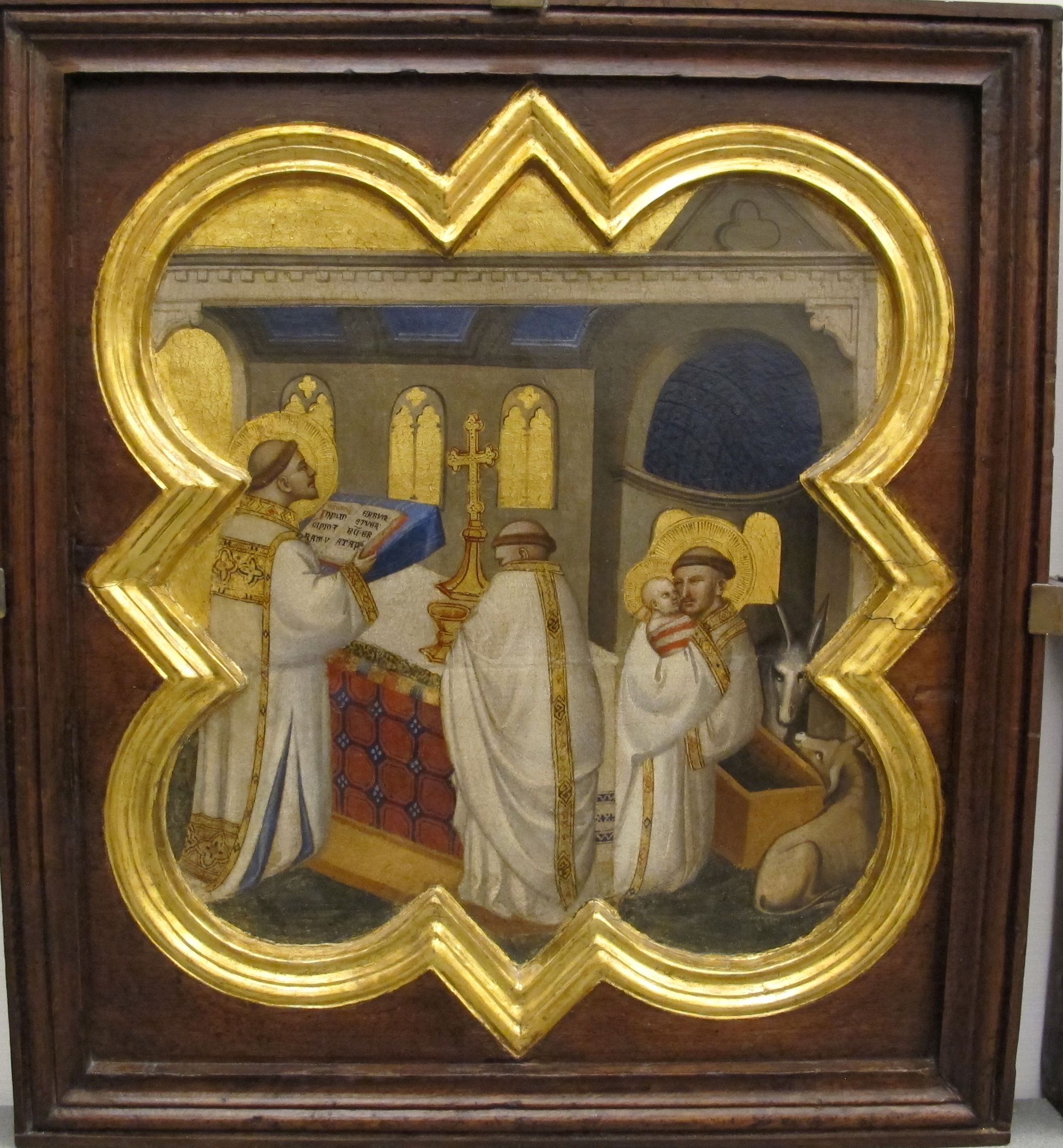
The Nativity at Greccio, Taddeo Gaddi, c. 1328–1330, Galleria dell’Accademia, Florence. Painted originally for the sacristy cupboard doors of Santa Croce in Florence, this small tempera panel adapts Giotto’s monumental fresco into an intimate narrative scene. Gaddi heightens the architectural enclosure and concentrates on the emotional responses of the witnesses as the miracle unfolds, translating his master’s broad spatial drama into a finely detailed, smaller‑scale devotional image. Reproduction of this image is permitted for personal use or study by the Italian Ministry of Heritage and Culture.
Francis’s Character and the Moment of 1223
As a young man, Francis was talkative, restless, and eager for answers. He often worked out problems by speaking until he was spent. By 1223, nearing death, he acted with directness and simplicity. Days before the Greccio crèche, Pope Honorius III formally approved the Franciscan Rule (November 29, 1223), which relieved Francis of administrative duties. The crèche was, in part, an act of gratitude. Before he departed Rome with the papal bull Solet annuere (Latin for “The Apostolic See is accustomed to grant”) issued at the Apostolic Palace of St. John Lateran confirming the rule, Francis asked the pope for his approval for his idea of recreating a manger to represent outwardly the poverty of Christ. Francis may have been thinking about the Nativity Plays that were popular in his youth but had been suppressed which featured the manger. This may have been why Francis asked the pope’s permission, which he granted although there was a Christmas crib in Rome at that time at Santa Maria in Trastevere.
Francis’s affinity for nature shaped his spirituality. He often described himself and his brothers through gentle animal metaphors. As the Franciscan movement, founded in 1209, spread rapidly, he had a dream of himself as a black hen trying to care for an overwhelming number of chicks. The Franciscan Order experienced explosive, unprecedented growth in St. Francis’s lifetime. Starting with the handful of followers in 1209, it expanded into a massive international movement so that by 1223 there was estimated 5,000 to 10,000 friars. Even before 1223, Francis urged the brothers to feed animals and birds at Christmas so that all creation could share in the feast.
The Christmas Vigil at Greccio in 1223
The Greccio crèche was prepared about two weeks before Christmas, near the Third Sunday of Advent. With his friend John Vellita of Greccio—“a man of good repute but of better life,” as Thomas of Celano writes—Francis arranged real straw, a manger, and an image of the Christ Child in a cave above the town, near the small cloister built on the cliff that Master Vellita had given to the friars. Francis said he had long considered how he wished to mark the birth of the Son of God on earth, wanting to see with his own eyes the poverty and hardship Christ chose to embrace for humanity’s sake. Meditation on the circumstances of the Nativity came naturally to him, shaped by his devotion to the Blessed Virgin Mary and devotion to her obedience to God’s will, and that it led him to reflect on the Passion as well. From the moment of His birth to His death on the Cross thirty‑three years later, the life of the Son of God on earth was marked by danger, vulnerability, and suffering.
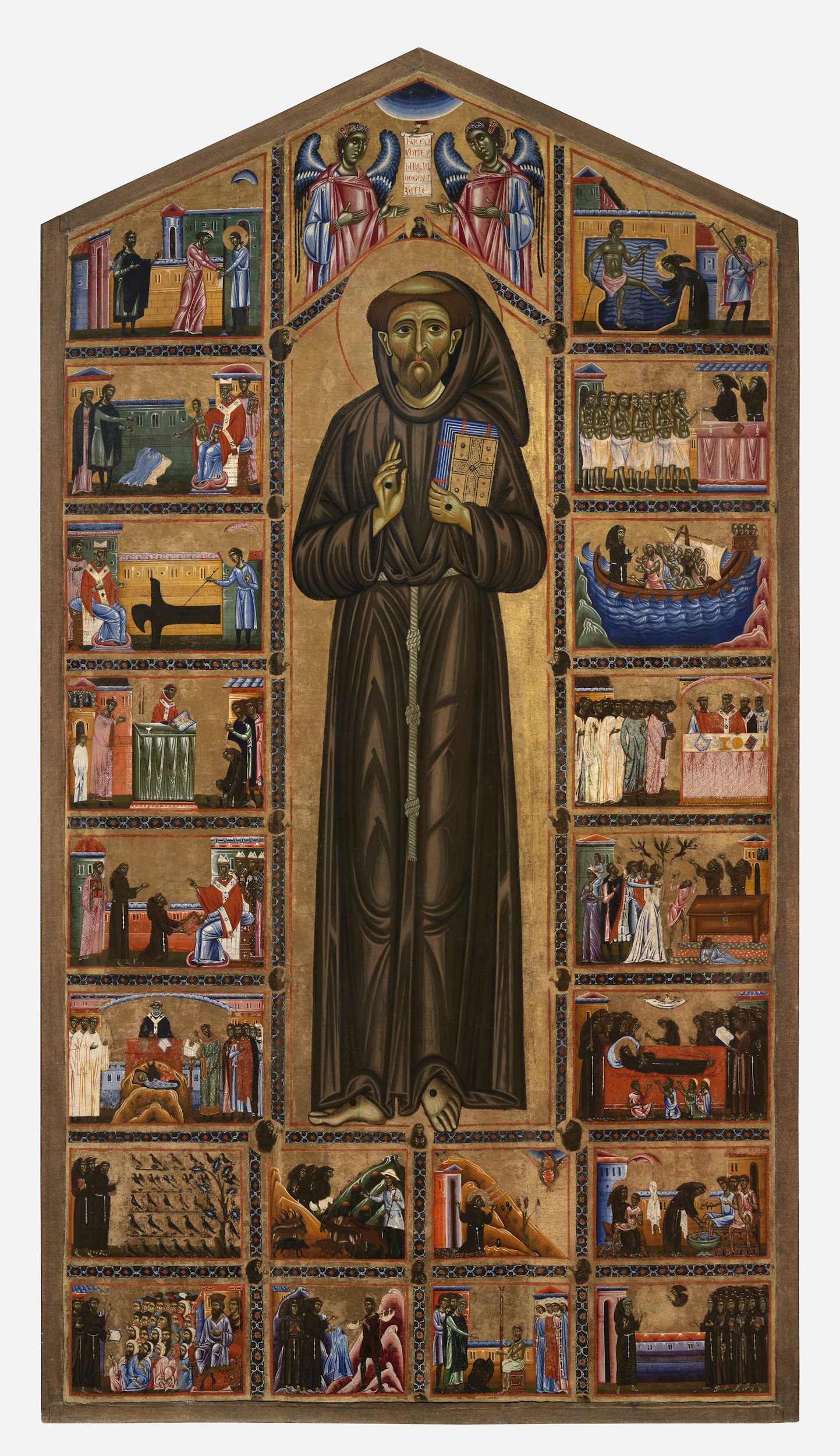
St. Francis and Twenty Stories from his Life (“Bardi Altarpiece”), 1245-1250, tempera and gold on wood, Coppo di Marcovaldo (c. 1225 – c.1276), attributed, Bardi Chapel of Santa Croce in Florence, Italy. While the main panel features Francis surrounded by 20 narrative scenes, one of the smaller narrative compartments specifically documents his life and actions at Greccio. It represents one of the earliest surviving visual documents of the Franciscan story within 20 years of St. Francis’s death at 44 or 45 years old in 1226. see – Coppo di Marcovaldo, Bardi Panel – Santa Croce – retrieved July 18, 2026.
The Greccio Vigil of 1223
On Christmas Eve in 1223, the people of Greccio gathered with the friars, carrying lighted torches as Vigil hymns rose through the mountain air. At Midnight Mass—celebrated in the cave where an altar was placed over the manger—Francis acted as deacon, proclaimed the Gospel, and preached in what Thomas of Celano describes as a “strong, glad, clear and ringing voice” urging all to seek the highest good.
When Francis lifted the figure of the Christ Child, witnesses said the scene seemed to come alive. St Bonaventure relates John Vellita’s story that the carved infant appeared to be sleeping, but when Francis took the figure into his arms, the child woke, seemed to smile and stroked with its tiny hands Francis’s beard and coarse habit. People gathered pieces of straw as relics, and stories of healings and blessings—touching both people and animals—circulated afterward.
For Vellita, the miraculous moment was not surprising. Francis, he said, had spent a lifetime awakening the Divine Child in hearts that had grown cold, indifferent, or spiritually asleep. The Vigil stretched late into the early morning, and those who participated returned home in joy when Greccio was transformed into a second Bethlehem.
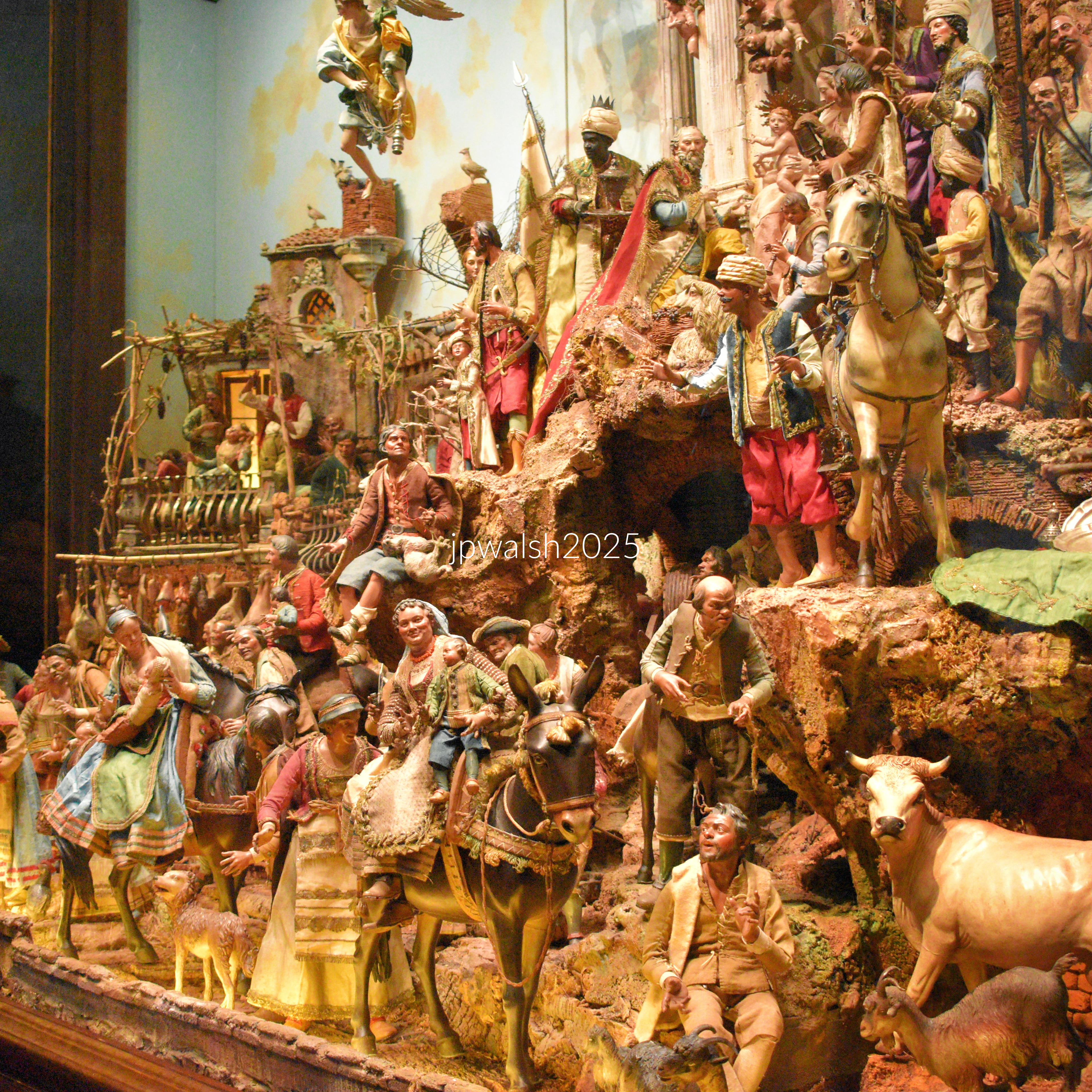
From minimal elements of straw, a manger, ox and ass and Christ Child arranged under Francis’s direction, the tradition of the crèche gradually expanded. Centuries later it produced elaborate displays such as the eighteenth‑century Neapolitan crèche shown recently at the Art Institute of Chicago, featuring nearly two hundred carved and clothed figures. Author’s photograph. All rights reserved. 98% 7.84mb DSC_9937
The Chapel of the Nativity Today
The site of the first crèche is now a chapel known as the Chapel of the Nativity (Cappella del Presepio). The cave where Francis staged the living nativity has been a place of prayer for centuries. Its altar stands directly over the bare rock where Francis placed the manger and hay. The surrounding walls preserve luminous 14th‑century frescoes depicting both the Bethlehem Nativity and the reenactment at Greccio.
For Francis—the Poverello, the “little poor one”—the humility of the Incarnation, the Son of God born among animals in a feeding trough, was the perfect beginning to a life that would lead to the Cross. After that Midnight Mass, Francis composed a canticle for the Christmas Octave. While St. Francis is most famous for his major Canticle of the Creatures composed in autumn 1225, he did compose this specific, minor canticle—historically categorized as Psalm 15 of his Office of the Passion—which directly references his Christmas experience at Greccio. In his minor canticle/psalm, Francis combined biblical texts and his own poetry to capture the spirit of the Nativity. The text explicitly highlights the humble birth that he sought to recreate physically in Greccio in December 1223:
Rejoice to God our Helper; shout unto God living and
true with the voice of triumph.
For the Lord is high, terrible, a great King over all the earth.
For the most holy Father of Heaven our everlasting King
sent His beloved Son from on high
And He was born of the Blessed Virgin, holy Mary.
He shall cry to Me, Thou art my Father, and I will make
Him My First-born
High over the kings of the earth.
In the day-time the Lord has commanded His mercy; and
a canticle to Him in the night
This is the day which the Lord has made; let us rejoice
and be glad in it
For the beloved and most holy Child has been given us,
born for us by the wayside
And laid in a manger because He had no room in the inn.
Glory to God in the highest, and on earth peace to men
of good will
Let the heavens rejoice and the earth be glad; let the sea
be moved and the fullness of it
The fields shall rejoice and all that is in them.
Sing to the Lord a new canticle; sing to the Lord all
the earth
For the Lord is great and exceedingly to be praised; He is
to be feared above all the gods
Bring to the Lord O ye kindreds of the Gentiles, bring to
the Lord glory and honor
Bring to the Lord glory unto His name. Bring your own
bodies and bear His holy cross
And follow His most holy precepts unto the end.
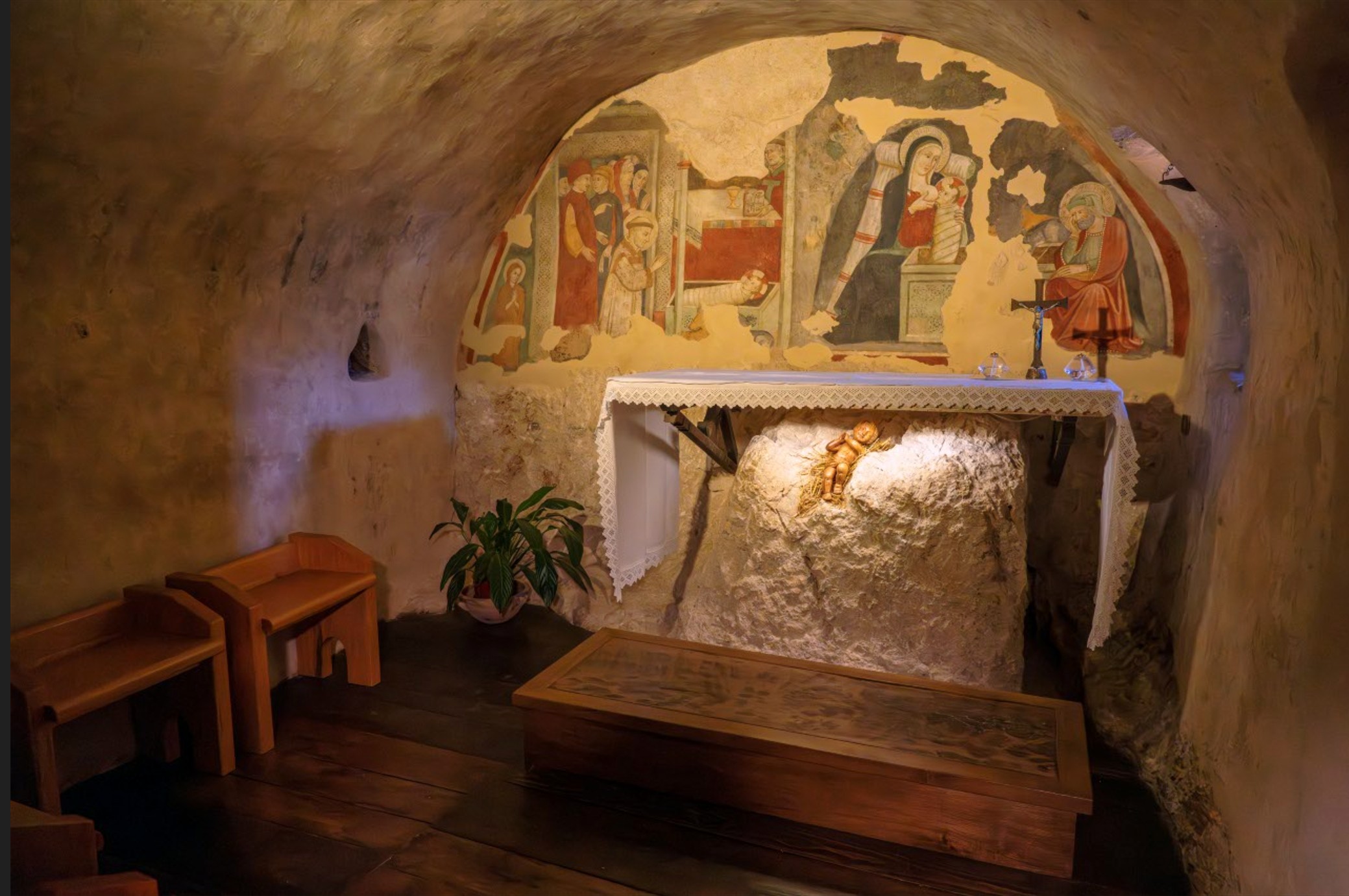
Chapel in Greccio, Italy, at the site of the first live Nativity in 1223. A place of prayer for centuries, the frescos date from the 14th century. Francis’s bond with the natural world shaped the way he understood God and himself. He insisted on placing the apocryphal ox and ass in the crèche, not out of sentimentality, but because he loved these ordinary working animals and saw in them a quiet dignity. He refused to ride horses—once symbols of his youthful chivalric ambitions—and chose instead to travel by donkey, even when ill, accepting the slow, leveling pace of a beast of burden. He called himself “Brother Ass,” a wry acknowledgment of his stubborn, uncooperative body and a reminder that humility begins with admitting one’s limits. In the Chapel of the First Live Nativity at Greccio, witnesses later recalled that when deacon Francis preached he grew so animated that he seemed to dance and even imitate the sounds of animals, swept up in the joy of the moment. “Chapel of the First Live Nativity” by Fiat 500e is licensed under CC BY 4.0.
Francis’s Christmas Vision for All Creation
For St. Francis of Assisi Christmas was always the “feast of feasts.”
Asked what he would request of Emperor Frederick II, then consolidating power in Italy, Francis replied that he wished for a law requiring people to put out food for animals at Christmas and to give domestic animals extra feed so that all creation could celebrate.
In 1225, when Christmas fell on a Friday, a traditional fast day, the brothers insisted on fasting, Francis ordered them to eat meat so freely that “even the walls would be greasy,” insisting that the feast of the Nativity overrode penitential custom.
Withdrawal, Final Journeys, and the Stigmata
After the Rule’s approval in November 1223 —its earlier 1221 version judged by the Curia as too severe—Francis withdrew from leadership and spent the winter of 1223–24 in the hermitage near Greccio. The Rule that finally passed had itself gone through a rejected draft, and even the version written at Fonte Colombo, later called the “Sinai” of the Franciscan Order, only partially reflected Francis’s original vision. One detail shows how the Rule was softened for practical governance: the Primitive Rule of 1209 allowed a friar one tunic; the 1221 Rule permitted two; the 1223 Rule allowed two, plus a cape and sandals. The Rule had been reshaped to meet others’ expectations, forcing Francis to relinquish some of his most cherished ideals and, in effect, surrender the brethren to new hands.
Observers later described his behavior in these final years as erratic, but he had simply turned inward, following a lifelong instinct toward self‑examination as he confronted his faults and the limits of his strength. There was poignancy in his departure from leadership. The new administration was not a man content with “a book and an ink‑horn and one pen and one signet,” but one who collected books and studied church law. Francis held no official role in the order he had founded, was ill, and was personally desolate as he questioned the direction the brothers were taking. In humility he asked what an “ideal” leader should be at all, and he surrendered the order’s future to God. “Lord,” Francis cried, “I commit to you the family you have given me. I cannot lead them any longer myself!” He determined to write up a Will or Testament with which to appeal to the brothers with his reminiscences of the early days and its ideals. It was his final message to his Franciscans. After this document, Francis said no more.
In summer 1224, he traveled to Mount La Verna for the feasts of the Assumption (August 15) and St. Michael (September 29), fasting for forty days. On September 14, the Feast of the Exaltation of the Cross, he saw a seraphic figure with six wings. From this vision he received the stigmata, becoming the first known stigmatic since St. Paul. He died on October 3, 1226, at the Portiuncula in Assisi, at age forty‑four. Two years later, on July 16, 1228, Pope Gregory IX canonized him in Assisi as a saint of the Roman Catholic Church.
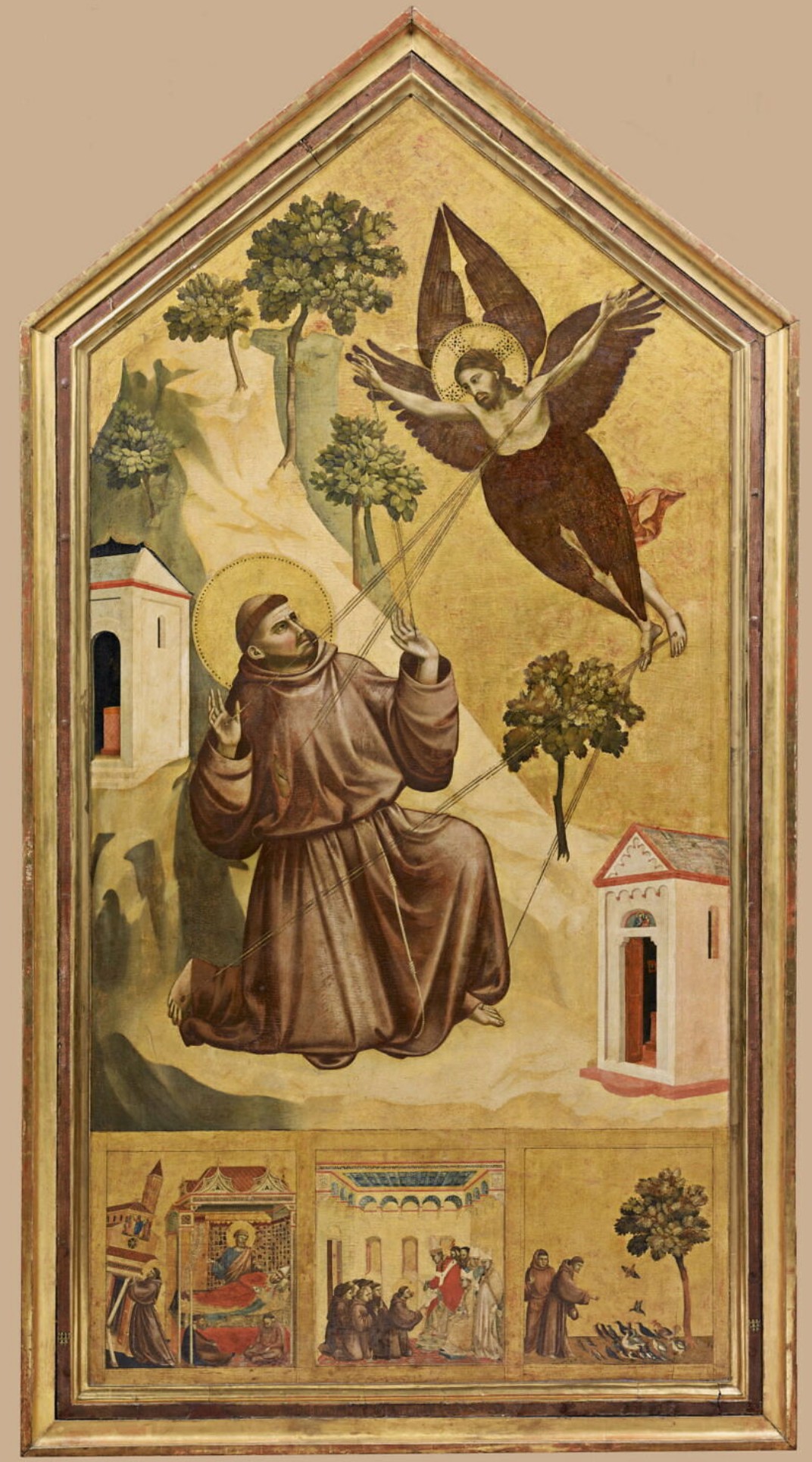
St. Francis receives the stigmata, 1300 / 1325, Giotto, 3.14 x 1.62 m, Louvre, Paris, originally Church of San Francesco, Pisa, Italy, choir or transept chapel, then a pillar near the high altar (cited by Vasari in 1568) – Saint François d’Assise recevant les stigmates – Louvre site des collections – retrieved July 18, 2026. In the main panel, Saint Francis kneels on the rocky cliffs while above him Christ appears in the form of a six-winged seraph. Thin golden rays stream from Christ’s wounds to Francis’s hands, feet, and side, physically marking him with the wounds of the crucifixion.
The liturgical Feast of the Exaltation of the Holy Cross—also called the Triumph of the Cross—is a major Christian feast celebrated on September 14 which honors the cross used in the crucifixion of Jesus Christ. It is viewed not as an instrument of execution, but a symbol of divine love, salvation, and victory over death. The feast is observed by Roman Catholics, Eastern Orthodox Christians, Anglicans, and Lutherans worldwide.
As the Church, in 2026, eagerly anticipates the 800th anniversary of the Transitus—the passing of St. Francis of Assisi on October 3, 1226—we look to the physical wounds that marked his radical devotion. When the 44- or 45-year-old saint died, he lay as he requested on the bare ground outside the Portiuncula. He was blind, naked, and infirm, yet completely fulfilled by his joyful evangelical marriage to Lady Poverty. In the West, the most notable historical event associated with the Feast of the Exaltation of the Holy Cross established in the early 4th century is that Saint Francis of Assisi received the stigmata on September 14, 1224. That event took place during a period of intense prayer and fasting on the remote mountaintop of Mount La Verna in Tuscany, Italy. According to early historical accounts, St. Francis had a vision of a crucified, six-winged seraph angel, after which the physical wounds of Christ’s crucifixion spontaneously appeared on his hands, feet, and side (the the official liturgical Feast of the Stigmata of St. Francis is celebrated on September 17).
Giotto’s Saint Francis Receiving the Stigmata in the Louvre is a monumental tempera and gold panel that represents a critical turning point in Western art, bridging the medieval Byzantine tradition with Proto-Renaissance realism. The work captures a profound, miraculous moment, divided between the main heavenly vision Francis experienced on Mount La Verna and a predella of supporting narrative scenes. The predella panels depict, from left to right: The Dream of Innocent III, in which the pope envisions Francis holding up a collapsing church; The Pope Approving the Statutes of the Order, confirming the formal Franciscan rule; and Saint Francis Preaching to the Birds, celebrating his legendary spiritual bond with nature.
In this painting, Giotto revolutionized art by introducing anatomical weight, psychological realism, and precise three-dimensional space to a medium long defined by flatness and the Maniera Greca. The panel effectively mapped out the visual language of the Early Italian Renaissance, demonstrating that divine themes could be powerfully conveyed through Western naturalism. Though the combined “Crucified Seraph” was not Giotto’s invention—it had already taken shape in late 13th-century Franciscan theology, especially in Bonaventure’s Legenda Maior—the artist radically advanced the figure and the history of art in several remarkable ways.
First, the transmission of the stigmata is rendered as precise, vector‑like golden rays linking Christ’s wounds to Francis’s body. Second, Christ’s torso is humanized through fleshy softness, chiaroscuro modeling, and real anatomical weight; the figure turns in space, oriented directly toward Francis. Third, Giotto introduces psychological exchange: Christ’s head tilts downward, his gaze meeting Francis’s. The result is no longer a generic emblem but an intimate, dramatic encounter between two individuals—an unprecedented fusion of theology, vision, and naturalism.
see – [Visiteurs devant Saint François d’Assise recevant les stigmates de Giotto] – Louvre site des collections. Photograph by Pierre Jahan – retrieved July 18, 2026.
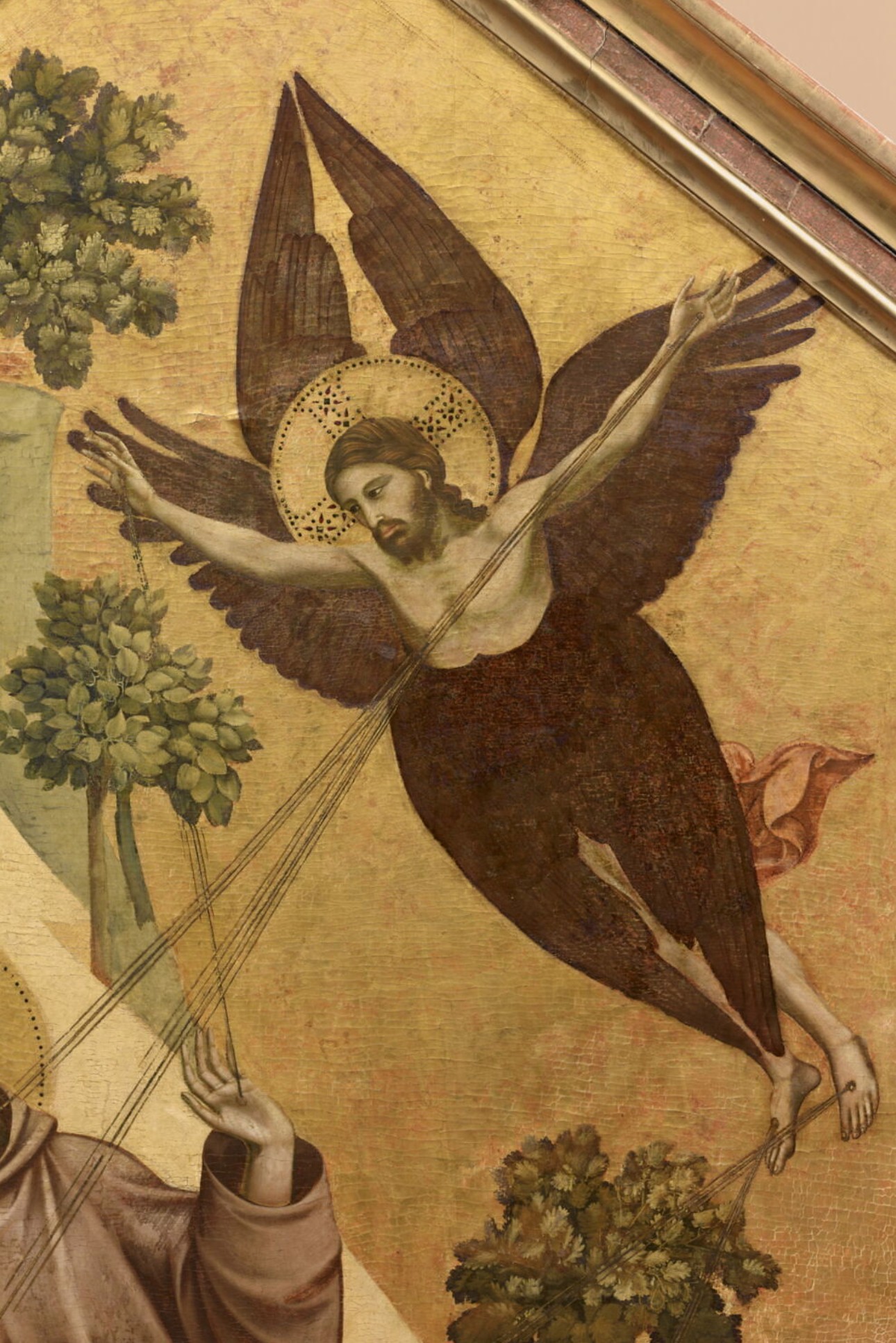
In Bonaventure’s Legenda Maior, which recounts Francis seeing a seraph bearing the likeness of a man crucified—a symbol of Francis becoming an Alter Christus, transformed not through physical martyrdom but through spiritual fire.
This detail from Giotto’s Saint Francis Receiving the Stigmata presents a highly complex and deeply symbolic figure of Christ, remarkable for the way it synthesizes multiple biblical, theological, and visual sources. The image fuses two distinct scriptural beings. In Isaiah’s vision of the Seraphim (Isaiah 6:2), each seraph possesses six wings—two covering the face, two covering the feet, and two for flight. Giotto follows this iconography precisely, folding wings around the head and lower body. At the same time, he overlays the fiery seraph with the human body of the crucified Christ, visualizing exactly what Francis’s biographers describe at Mount La Verna in 1224: a heavenly messenger appearing as both blazing seraph and suffering savior.
Randall Thompson’s “Nativity According to St. Luke”
According to The Harvard Crimson’s 1961 review, Randall Thompson composed Nativity According to St. Luke for the 200th anniversary of Christ Church. The work functions as a musical pageant rather than a theatrical drama—seven devotional tableaux form a serene polyptych of the Nativity.
The music, written for chamber orchestra, organ, chorus, and pageant figures, is unadorned and calmly joyful. A rustic fugue propels the shepherds toward Bethlehem where they greet the Child with an awkward, affectionate dance. Mary sings a lullaby while Joseph sleeps beside her. Simeon prophesies. A boys’ choir offers a hushed Noel. The chorus answers with a broad, antiphonal Alleluia. The scenes are spare, serene, and reverent.
SOURCES:
Augustine Thompson, Francis of Assisi (Ithaca: Cornell University Press, 2012), 39, 55–56, 108–111.
Johannes Jørgensen, St. Francis of Assisi (Garden City, NY: Image Books, 1955), 216–17, 243.
Nesta De Robeck, The Life of St. Francis of Assisi: Herald of the Great King (Assisi, Italy: Casa Editrice Francescana Frati Minori Conventuali, 1975), 94–99.
John R. H. Moorman, Saint Francis of Assisi (Chicago: Franciscan Herald Press, 1987), 98–101.
John R. H. Moorman, Richest of Poor Men: The Spirituality of St. Francis of Assisi (Huntington, IN: Our Sunday Visitor, Inc.), 31–36.
Michael de la Bedoyere, Francis: A Biography of the Saint of Assisi (Garden City, NJ: Image Books, 1964), 219–22.