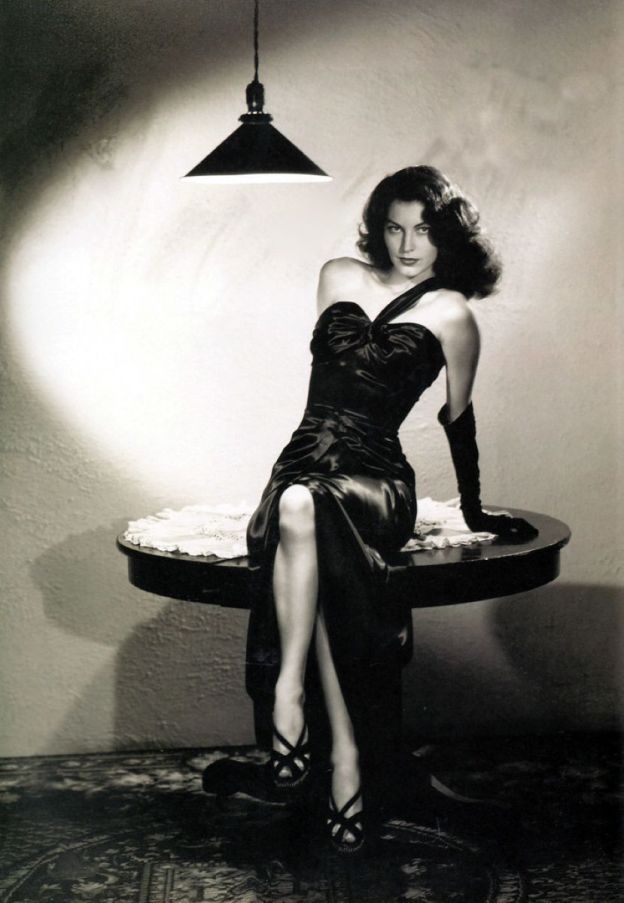
FEATURE: Twenty-three-year-oldAva Gardner was a noir icon in the making when, in 1946, she sat beneath a hard cone of light, her satin gown, long gloves, and crisp shadows distilled into pure mid-century glamour. Cross‑legged on the polished table, she projects cool, controlled noir magnetism—elegance with an undercurrent of danger. Captured by veteran Universal studio portrait photographer Ed Esterbrook, this iconic image served as the primary promotional portrait for Robert Siodmak’s 1946 masterpiece, The Killers. Distributed globally across newspapers, movie magazines, lobby cards, and posters, it introduced Gardner to the public as Hollywood’s definitive femme fatale and launched her into overnight stardom. On the Universal film sets, cinematographer Elwood Bredell shaped the movie’s high-contrast lighting, carving sharp, expressionistic shadows while giving Gardner’s skin a luminous, dangerous sheen. Bringing this lethal on-screen look to life was the actress in a famous, custom-made asymmetrical black satin gown crafted by Universal’s legendary chief costume designer, Vera West. Together, all these elements froze a moment in time that remains one of the most recognizable and enduring symbols of cinematic post-war noir glamour. PHOTO: “Ava Gardner in The Killers, 1946” by thefoxling is licensed under CC BY-NC-SA 2.0.
A Film Noir Breakthrough
Eighty years ago today—August 28, 1946—Robert Siodmak’s The Killers exploded onto American movie screens, instantly becoming a film noir sensation. It launched Burt Lancaster into overnight stardom after producer Mark Hellinger couldn’t land his first choice, Wayne Morris, and it introduced Ava Gardner as Hollywood’s definitive femme fatale. Adapted from Ernest Hemingway’s 1927 existential and grim short story, the film follows a washed-up ex-boxer who waits calmly in a dark room for hitmen to kill him, utterly undone by Gardner’s double-crossing allure. Though Anthony Veiller received official screen credit, the script carried major, uncredited writing contributions from future directing icons Richard Brooks and John Huston, while Miklós Rózsa’s tense, four-note brass score sharpened its fatalistic mood.
The complete, dramatic original motion picture score for the 1946 film noir classic The Killers, composed by the legendary Miklós Rózsa. The soundtrack includes the famous, tense instrumental tracks that heightened the movie’s fatalistic mood, alongside the nightclub torch song performed with vocals by Ava Gardner herself.
Hollywood at Peak Attendance
Moviegoing in 1946 was at its absolute historic height, drawing a staggering 90 million weekly admissions. However, ticket prices had nearly doubled since before the war. This spike made post-war audiences far more selective, pushing major studios away from cheap “B-movies” and toward full-length, high-production features—frequently shot in vibrant Technicolor and paired as double features to ensure patrons got their money’s worth.
Universal Pictures tried to reinvent itself by merging with independents, including Hellinger’s banner, which produced The Killers for under $1 million and earned more than $3 million. Emboldened to meet the new demand, the studio chased prestige cinema, dropped its old B‑pictures and many longtime stars, and merged with International Pictures to form Universal‑International—but audiences mostly shrugged, and by decade’s end the company was losing money.
The Return to What Audiences Wanted
Veteran executive Edward Muhl, who had been with Universal since 1927, stepped up as general manager to steady the studio before officially becoming Head of Production in 1953. He steered the company back toward what mainstream American audiences reliably embraced: lucrative, low-budget comedy franchises like Ma and Pa Kettle (10 films, 1947–1957) and Francis the Talking Mule (7 films, 1950–1956), alongside a steady, highly profitable output of escapist Technicolor action-adventure films.
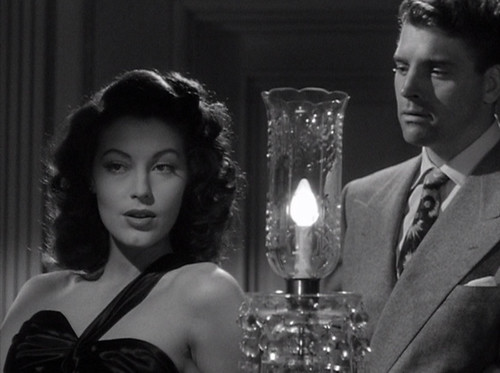
Film still from the production of The Killers (1946) captures the charged chemistry between Ava Gardner as Kitty Collins and Burt Lancaster, making his debut as Ole “The Swede” Andreson. Their first meeting is a textbook noir seduction: the doomed protagonist instantly, helplessly drawn into the orbit of the femme fatale who will seal his fate. At the center of the frame, cinematographer Elwood Bredell turns a crystal oil lamp into a diegetic light source—a glowing boundary between the two characters that casts soft illumination across Gardner’s face while dropping the rest of the room into deep, moody shadow. She’s wearing Vera West’s asymmetrical black satin gown—the same one from the famous publicity portrait—and on screen the heavy satin drinks the light, turning her into the ultimate femme fatale. PHOTO: “Ava Gardner y Burt Lancaster” by afevrier is licensed under CC BY-NC-SA 2.0.
This video short captures the electric first meeting between Ava Gardner and Burt Lancaster in the 1946 film noir classic The Killers, highlighting her sultry debut scene as Kitty Collins. The clip showcases Ava Gardner’s mesmerizing screen presence that audiences will remember as she delivers her smooth, fatalistic dialogue directly to the spellbound Swede. KITTY COLLINS: “How wonderful of you, I could never bear to see a man I really cared for being hurt.”
“She can’t sing, she can’t act, she can’t talk. She’s terrific!”– Louis B. Mayer on Ava Gardner.
Before The Killers, Ava Gardner was hopelessly stuck in Hollywood limbo. MGM head Louis B. Mayer had signed the 19-year-old North Carolina newcomer in 1941 purely based on her breathtaking physical photos. For five long years, she drifted through more than twenty films as an uncredited extra, barely noticed by the industry.
The Killers changed everything. Producer Mark Hellinger fought to cast the 23-year-old as Kitty Collins, freeing her from MGM’s rigid, squeaky-clean star-making machinery and handing her a role with genuine dramatic weight. Dressed in Vera West’s iconic, asymmetrical black satin gown, Gardner used her natural magnetism, smoldering gaze, and quiet confidence to completely command the visual frame. On the silver screen, she crafted a cold, calculating siren who seamlessly weaponized vulnerability to orchestrate a massive double-cross.
When the film became a box-office triumph in August 1946, audiences and critics were instantly transfixed. Gardner and Lancaster became overnight A-list sensations. Suddenly, she wasn’t just a glamorous face in the gossip columns—she was a legitimate actress widely praised for her dramatic depth and dangerous screen presence.
MGM moved fast to exploit her newly minted star power. Gone were the uncredited bit parts; instead, Gardner was vaulted into high-profile late-1940s productions like The Hucksters (1947) opposite Clark Gable, One Touch of Venus (1948), and The Bribe (1949). By the turn of the decade, MGM’s publicity office was completely overwhelmed, processing more than 3,000 fan photo requests per week for Hollywood’s ultimate new siren.
The original theatrical movie poster for The Killers (1946) pulses with classic film noir energy, dominated by bold red typography and the striking tagline: “TENSE! TAUT! TERRIFIC!” Public Domain. The poster had a valid copyright notice, as seen on the bottom left corner. However, the copyright for the artwork was not renewed, as was required by American copyright law to extend/maintain protection for works published 1963 or earlier. In order to maintain copyright protection, the poster would have had to be renewed 28 years after publication, in either 1973 or 1974. Because it was not renewed, copyright lapsed at that time. Note that the poster art is a distinct work from the film it represents and had to be renewed separately.
SOURCE: The Universal Story, Clive Hirschhorn, Crown Publishers, Inc. New York, 1983, pp. 156-64.
This explanatory article may be periodically updated.
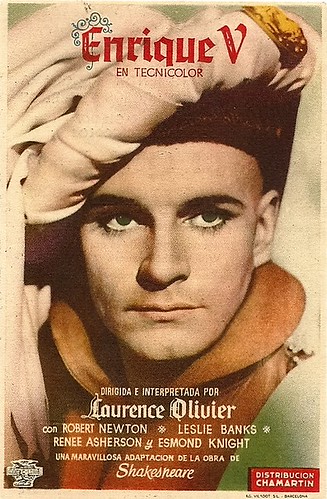
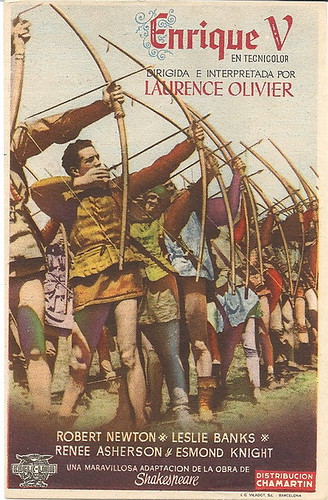
Feature Image: Movie poster in Spanish for Laurence Olivier’s 1944 Technicolor adaptation of William Shakespeare’s play, Henry V (1599). Produced in Ireland to serve as a British morale-boosting propaganda tool during WWII, the film achieved global distribution through theatrical releases and subsequent re-releases and is today frequently used in university studies (e.g., Cambridge Core) on cinematic Shakespeare. Photo: “Enrique V” by Kirby York is marked with Public Domain Mark 1.0.
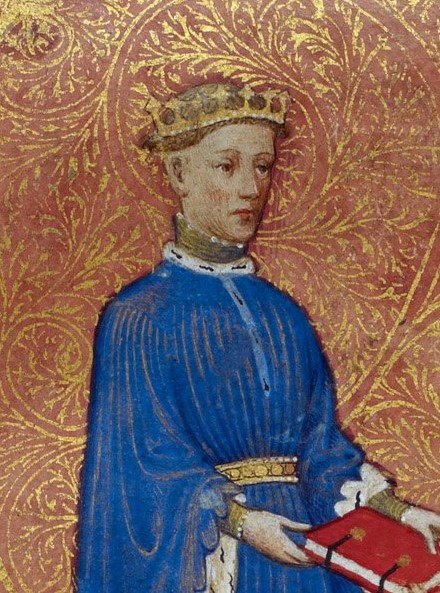
Henry V in the Regement of Princes, c. 1411–1413. Henry V died in 1422 at the age of 35, likely from dysentery contracted in the unsanitary conditions of his military camp. In his will, he named his brother, John of Bedford, as regent for his infant son, the future Henry VI, who would not be crowned in his own right until 1437. Although the Treaty of Troyes had positioned Henry V to inherit the French crown, he never became King of France; Charles VI outlived him, preventing the succession. His son, Henry VI—often described as gentle, passive, and averse to violence and warfare—proved unable to sustain his father’s hard‑won claims. His authority in France collapsed, and at home he was deposed in March 1461 by the Yorkist Edward IV. A brief restoration in 1470 returned him to the throne, but only for months; Henry VI was permanently deposed and killed in May 1471. Public Domain.
William Shakespeare likely wrote Henry V in spring 1599. The play dramatizes the 28-year-old English king’s campaign to claim the French throne, culminating in his victory at Agincourt on October 15, 1415—a battlefield I visited in 1993, still largely unchanged after six centuries. Henry based his claim on his ancestor Edward III, and his triumph was aided by a France divided by civil war between Burgundians and Orléanists.
At the Battle of Agincourt (1415), roughly 80% of Henry V’s army were longbowmen—an overwhelming concentration of missile power that defined the fight. Henry deployed thousands of archers along his flanks and center, unleashing relentless, high‑velocity arrow storms that tore through the densely packed, heavily armored French ranks. Behind their sharpened stakes, these archers acted as an offensive engine, cutting down waves of advancing knights before they ever reached English lines. The result was one of military history’s most lopsided victories. Estimates suggest 6,000–10,000 French dead—including more than ninety nobles—against only a few hundred English losses. French formations collapsed, morale shattered, and an army that outnumbered the English by as much as six to one simply disintegrated. Agincourt proved that disciplined, trained, often low‑born archers could annihilate superior numbers of elite, armored cavalry. It didn’t just win a battle—it rewrote the rules of medieval warfare. Photo: “Enrique V (3)” by Kirby York is marked with Public Domain Mark 1.0.
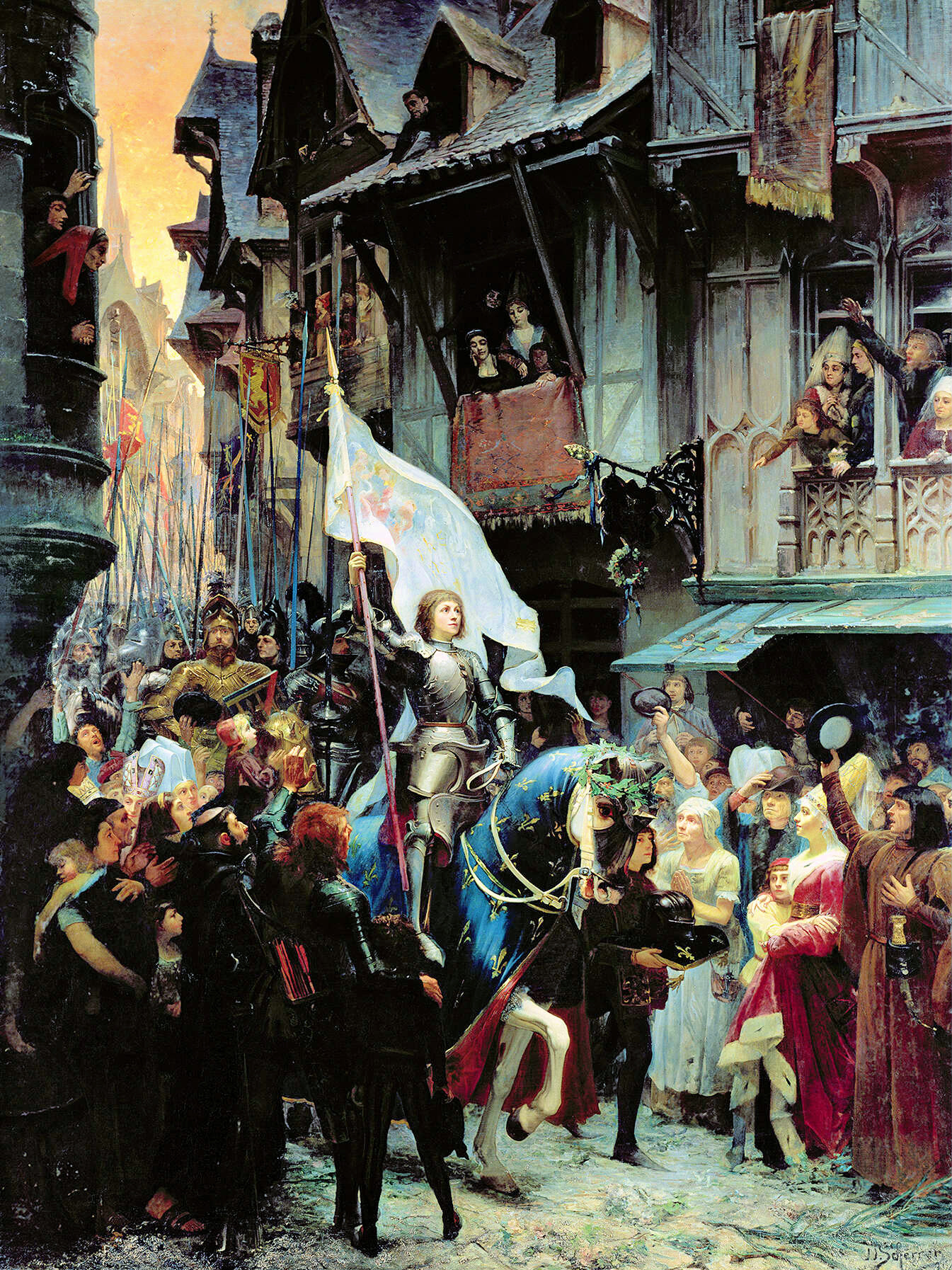
Entrée de Jeanne d’Arc à Orléans (“Entrance of Joan of Arc into Orléans”), painted in 1887 by the academic artist Jacques Scherrer (1855-1916), portrays Joan’s triumphant arrival in Orléans on May 8, 1429, after she lifted the city’s siege during the Hundred Years’ War. Her victory set in motion the campaign that culminated in the Dauphin’s coronation as King Charles VII at Reims on July 17, 1429. Public Domain.
Within fifteen years, Jeanne la Pucelle—Joan of Arc—led Orléanist and Armagnac forces to lift the siege of Orléans in 1429. Captured by Burgundians in 1430, she was handed to the English and condemned by their puppet ecclesiastical court before being burned in Rouen. Henry’s 1415 victory enabled the 1420 Treaty of Troyes, which disinherited the Dauphin, named Henry regent and heir to Charles VI, and arranged his marriage to Catherine of Valois, sister of the future Charles VII. On July 17, 1429, after Joan’s visions and military successes, she stood beside the Dauphin as he was crowned at Reims. By 1453, the French had expelled the English entirely from France.
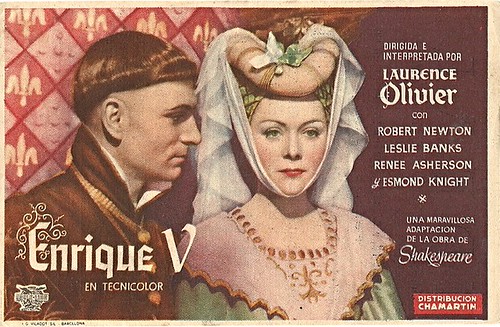
The 1944 Technicolor film follows a performance of Shakespeare’s history play at the Globe in 1603 as it evolves toward a sharper, more realistic style. Laurence Olivier’s bold, experimental film adaptation—directing and starring in the title role—reimagined Shakespeare for the screen centuries after the play’s premiere. The production became a landmark of cinematic Shakespeare, celebrated for its visual flair and Olivier’s command of film technique, especially in the sweeping, meticulously staged battle sequences.(8) William Walton : Henry V : Touch her soft lips and part. Film clips. – YouTube (https://www.youtube.com/watch?v=pnQl4Wj8NXc) – retrieved April 23, 2026.
The play Henry V emerged during an intensely creative year for Shakespeare and was likely among the first plays staged at the new Globe Theatre. Though often read as patriotic, it also probes the ethical and personal costs of war, exposing its brutality and questioning the justice of Henry’s campaign. Laurence Olivier’s 1944 Technicolor adaptation transformed the play into wartime propaganda to bolster British morale and later earned recognition as a landmark Shakespearean film. Its iconic score was composed by William Walton.
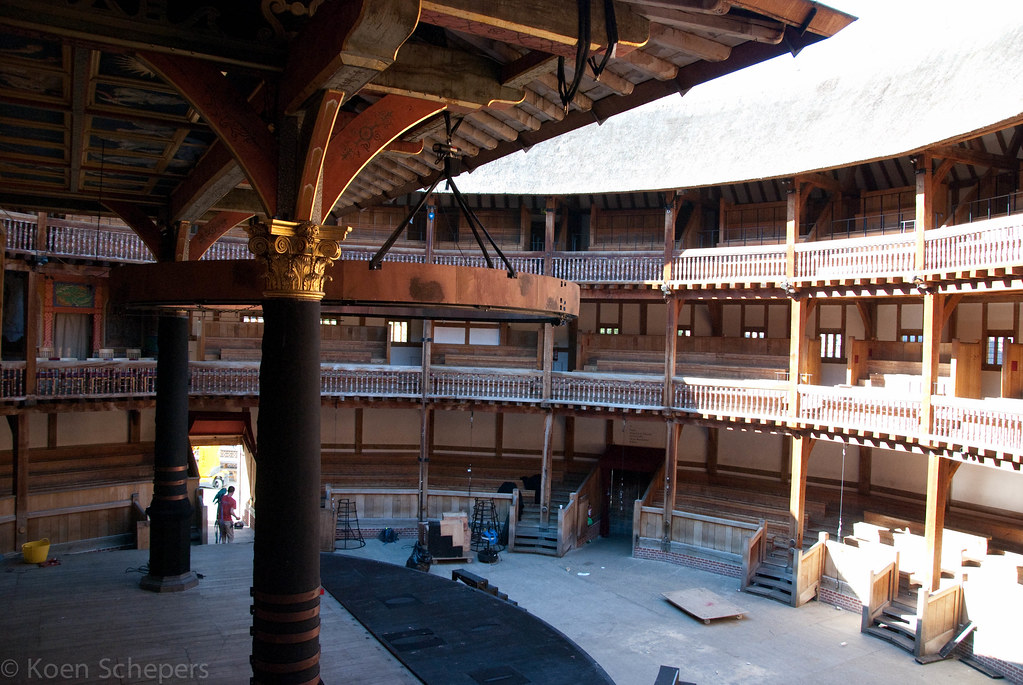
The original Globe Theatre opened in summer of 1599 in Southwark, London, built by the Lord Chamberlain’s Men which was the company William Shakespeare wrote for and part-owned. It is widely believed that the first play by Shakespeare performed at the Globe was Julius Caesar, likely alongside Henry V and As You Like It. Today’s Globe Theatre in London is the third Globe. see – Globe Theatre | About us | Discover | Shakespeare’s Globe – retrieved April 23, 2026. Photo: “Shakespeare’s Globe” by Werkmens is licensed under CC BY-NC-ND 2.0.
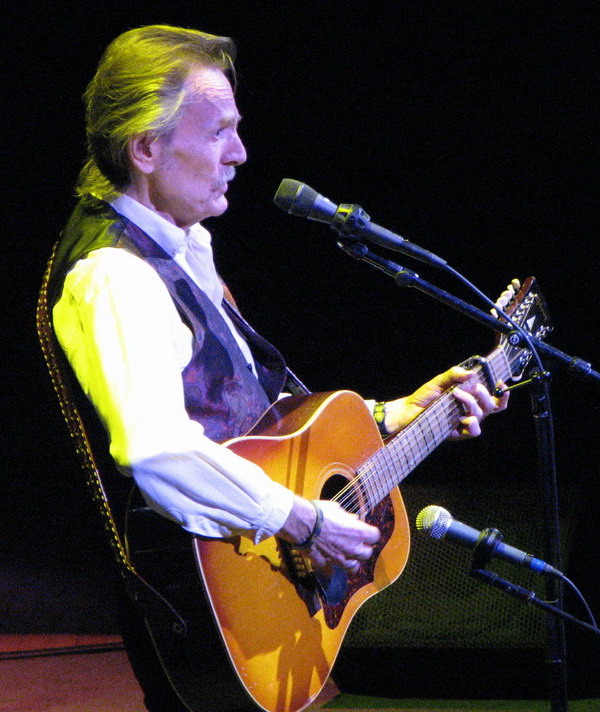
Canadian singer-songwriter Gordon Lightfoot began releasing solo albums in 1966. The first six were on United Artists label and sold moderately well (up to 200,000 copies). Switching to Reprise in 1969 his debut album with the label, Sit Down Young Stranger, coincided with his first U.S. hit, If You Could Read My Mind, in 1970 and became Lightfoot’s first Gold album. This was followed by Lightfoot’s second Gold album (Platinum today) and no.1 single both called Sundown in 1974. The Wreck of the Edmund Fitzgerald – a true story of an ore vessel named after a Milwaukee, Wisconsin, civic leader, that sank in a Lake Superior storm in November 1975 – was Lightfoot’s next big hit appearing on Summertime Dream, a 1976 album that has gone Platinum.1
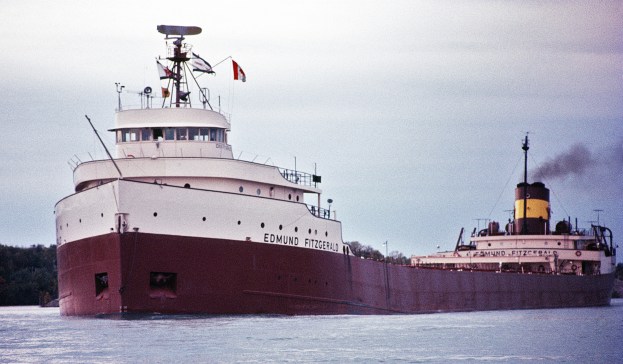
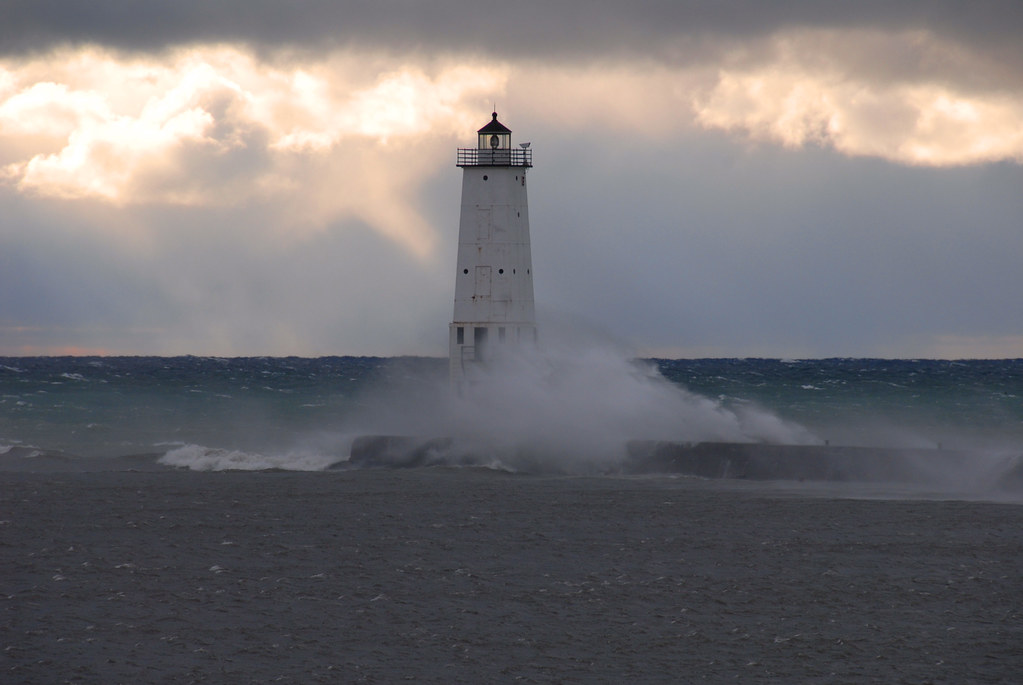
On November 10, 1975, during basically the colliding of two freshwater storms on Lake Superior, the largest of the five Great Lakes, the SS Edmund Fitzgerald, in service since 1958 and, when launched, the largest ship on the Great Lakes at over 700 feet long, went down into deep waters. For a cargo ship that should have normally expected more decades of service, the sinking caused the loss of its entire crew of 29 men. At 7 p.m. on November 10, 1975, the Fitzgerald radioed another cargo ship, the Anderson, telling them that, despite losing their radar, they were “holding their own.” Shortly thereafter the Fitzgerald was lost.
Location of the SS Edmund Fitzgerald wreck in Lake Superior approximately 17 miles (27 kilometers) north-northwest of Whitefish Point, Michigan. The ship now rests beneath about 535 feet (165 meters) of water and is considered a protected gravesite.2
Recovery Efforts involved the U.S. Navy and U.S. Coast Guard.
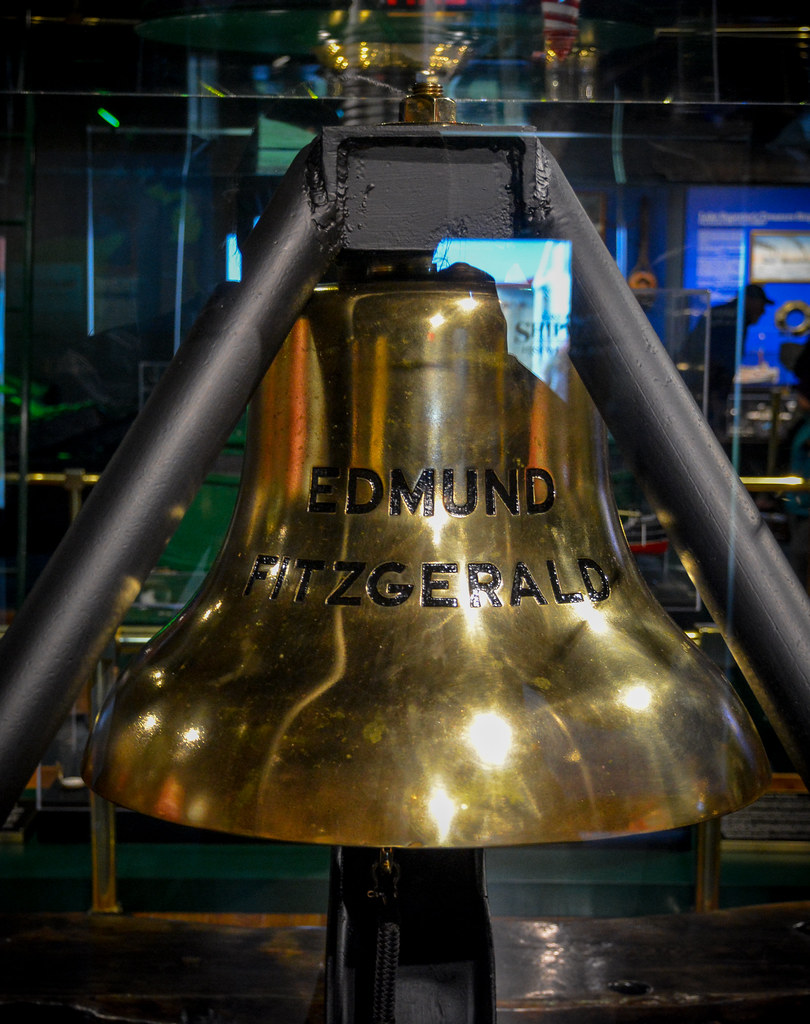
Whitefish Point, located on the southeastern shore of Lake Superior in Michigan, houses the Great Lakes Shipwreck Museum, which holds memorial events for the SS Edmund Fitzgerald each November. The wreck’s location, being 17 miles north-northwest of the point, places it beyond safe navigation lines, illustrating why the ship never reached shelter that fateful night. On a personal note, I have had the opportunity to visit the Great Lakes Shipwreck Museum in Whitefish Point, Michigan that contains the bell from the SS Edmund Fitzgerald recovered in 1995.3
The ultimate cause and circumstances of the wreck of the SS Edmund Fitzgerald in Lake Superior remain a mystery, weather conditions surrounding the sinking are well known – extraordinarily severe storm conditions, including 60 m.p.h. winds, towering waves of 25-30 feet, and heavy thick ice, which impacted possible structural vulnerabilities of the large, nearly 20-year-old cargo ship. The exact sequence of the events leading to the sinking are also unknown, as no distress signal detailing mechanical failure was received, so that the wreck has been attributed to adverse weather and lake conditions that impacted the vessel suddenly.4
The disaster, unlike the other hundreds of shipwrecks that have taken place on the Great Lakes, has entered into American mythology with Gordon Lightfoot’s ballad The Wreck of the Edmund Fitzgerald, written within a couple weeks after the disaster that same November 1975. Though the song by a bestselling recording artist about a recent shipwreck carried some risk where it was too early to know every fact, the verses are meticulously based on news stories of the basics that were known. By Lightfoot’s 7th studio album, Don Quixote, released in 1972, the Canadian singer-songwriter had begun in earnest to explore nautical themes. The Wreck of the Edmund Fitzgerald, released in June 1976 on Lightfoot’s 11th studio album, Summertime Dream, stayed on the same course.
Summertime Dream was released in June 1976 and peaked at no. 12 on the Billboard 200 (no. 1 on Canada Top Albums). The Wreck of the Edmund Fitzgerald was the album’s second track and, in August 1976, became its second single peaking at no. 2 in the U.S. and no. 1 in Canada.
The song was getting local airplay from the album in Minnesota, Wisconsin, and Michigan. Its popularity led to its release as a single in August 1976 and became Lightfoot’s biggest and most unlikely hit record commemorating the sinking of a transport cargo ship with its lives lost from less than a year before. The six-and-one-half minute folk rock song reached no. 1 in Canada and no. 2 in the U.S. where it was kept out of the top spot by Rod Stewart’s Tonight’s the Night. After the song’s release, Lightfoot never lost contact with the surviving family members of that shipwreck. Gordon Lightfoot, who was born in a town on Lake Simcoe in Ontario, Canada, died less than 90 miles away on Lake Ontario in Toronto in May 2023 at 84 years old.
The legend lives on from the Chippewa on down Of the big lake, they called Gitche Gumee The lake, it is said, never gives up her dead When the skies of November turn gloomy With a load of iron ore, twenty-six thousand tons more Than the Edmund Fitzgerald weighed empty That good ship and true was a bone to be chewed When the gales of November came early
The ship was the pride of the American side Coming back from some mill in Wisconsin As the big freighters go, it was bigger than most With a crew and good captain well seasoned Concluding some terms with a couple of steel firms When they left fully loaded for Cleveland And later that night when the ship’s bell rang Could it be the north wind they’d been feeling?
The wind in the wires made a tattle-tale sound And a wave broke over the railing And every man knew, as the captain did too ‘Twas the witch of November come stealing The dawn came late, and the breakfast had to wait When the gales of November came slashin’ When afternoon came, it was freezin’ rain In the face of a hurricane west wind
When suppertime came, the old cook came on deck sayin’ “Fellas, it’s too rough to feed ya” At seven p.m., a main hatchway caved in, he said “Fellas, it’s been good to know ya” The captain wired in he had water comin’ in And the good ship and crew was in peril And later that night when his lights went outta sight Came the wreck of the Edmund Fitzgerald
Does anyone know where the love of God goes When the waves turn the minutes to hours? The searchers all say they’d have made Whitefish Bay If they’d put 15 more miles behind her They might have split up or they might have capsized They may have broke deep and took water And all that remains is the faces and the names Of the wives and the sons and the daughters
Lake Huron rolls, Superior sings In the rooms of her ice-water mansion Old Michigan steams like a young man’s dreams The islands and bays are for sportsmen And farther below Lake Ontario Takes in what Lake Erie can send her And the iron boats go as the mariners all know With the gales of November remembered
In a musty old hall in Detroit, they prayed In the Maritime Sailors’ Cathedral The church bell chimed ’til it rang twenty-nine times For each man on the Edmund Fitzgerald The legend lives on from the Chippewa on down Of the big lake, they call Gitche Gumee Superior, they said, never gives up her dead When the gales of November come early
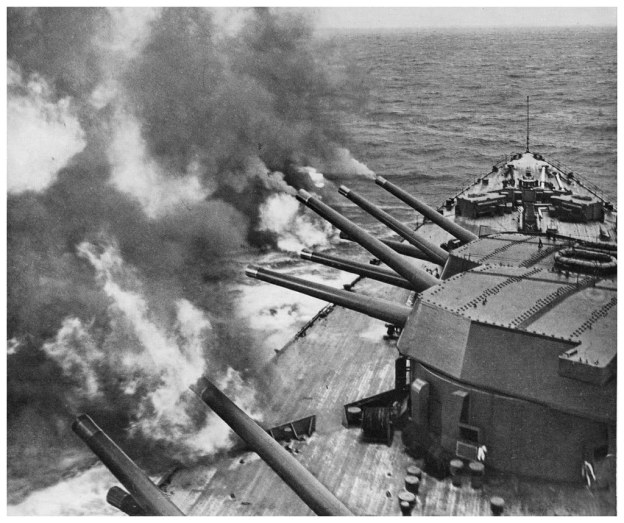
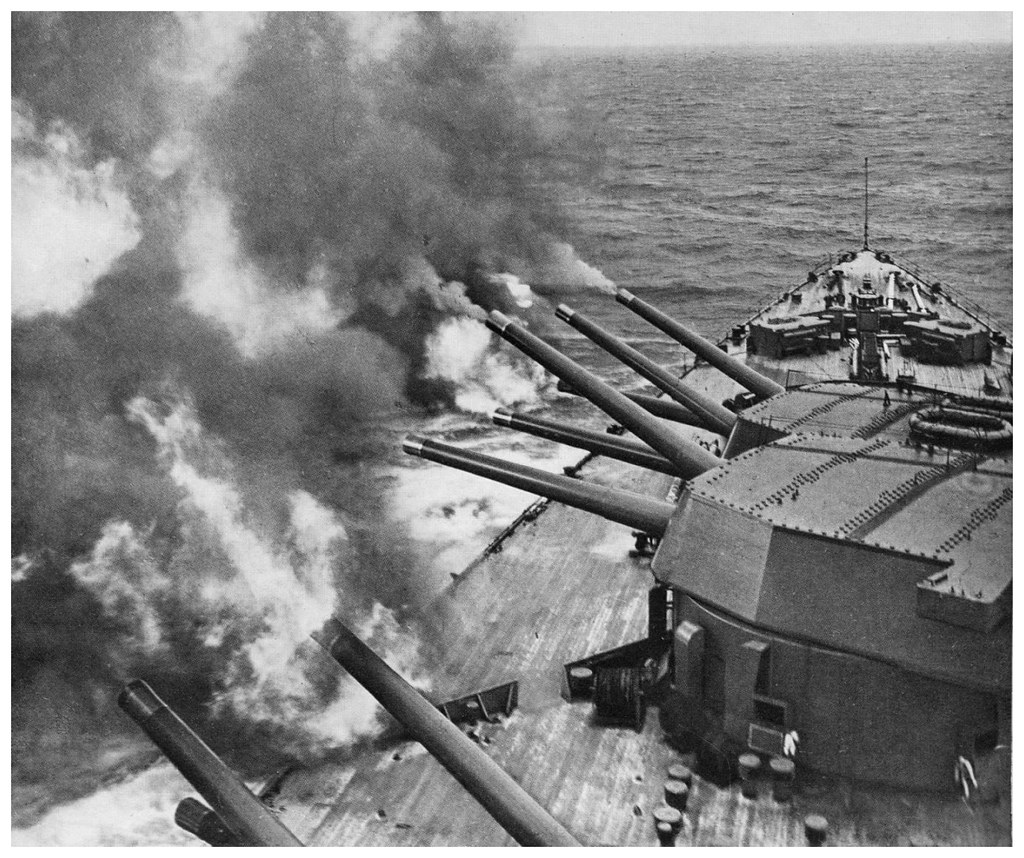
FEATURE image: HMS Rodney unloading her guns. HMS Rodney’s 16-inch guns played a pivotal role at the last battle with the Bismarck in the North Atlantic in May 1941. The British battleship’s powerful broadsides at the Bismarck caused significant structural damage that sunk the German warship. “HMS Rodney lightens her load sometime in the 1930’s.” by WWII in View is marked with Public Domain Mark 1.0.
In 1941 the Allies determined the war would need to be won in the Atlantic.1From 1939 to 1945 the Battle of the Atlantic was the longest continuous military campaign in World War II. It stemmed from the start of the war in Europe with Hitler’s invasion of Poland on September 1, 1939, and the declaration of war by France and Britain on the Third Reich. This was followed by the Battle of Britain and Fall of France in 1940 and the Allies’ declaration of war on Italy on June 10, 1941. The United States, as a non-belligerent and working through its neutrality laws, aided the Allies, namely Britain, through cash and carry and lend-lease purchases of large amounts of American-made armaments as well as providing reconnaissance to the British navy and air force who were in the fight against German U-boats and battleships aggressively attacking and sinking the merchant ships headed for Britain.
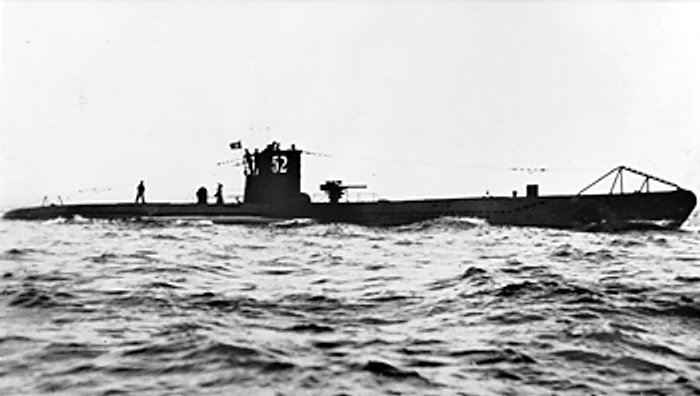
German submarine U-52. Public Domain.
A massive nearly square-shaped zone of conflict surrounded Great Britain and Iceland with its approximate boundaries from the southeast coast of Greenland across the Atlantic to France and north between Britain and Norway and back around Iceland towards Greenland. Since Denmark was occupied by German forces, the United States in April 1941 occupied their abandoned colony of Greenland and designated it as part of the Western hemisphere to categorize American non-belligerent military activity as self-defense. The Americans took the same approach with Iceland sending troops as a forward, if ostensibly defensive, posture.2
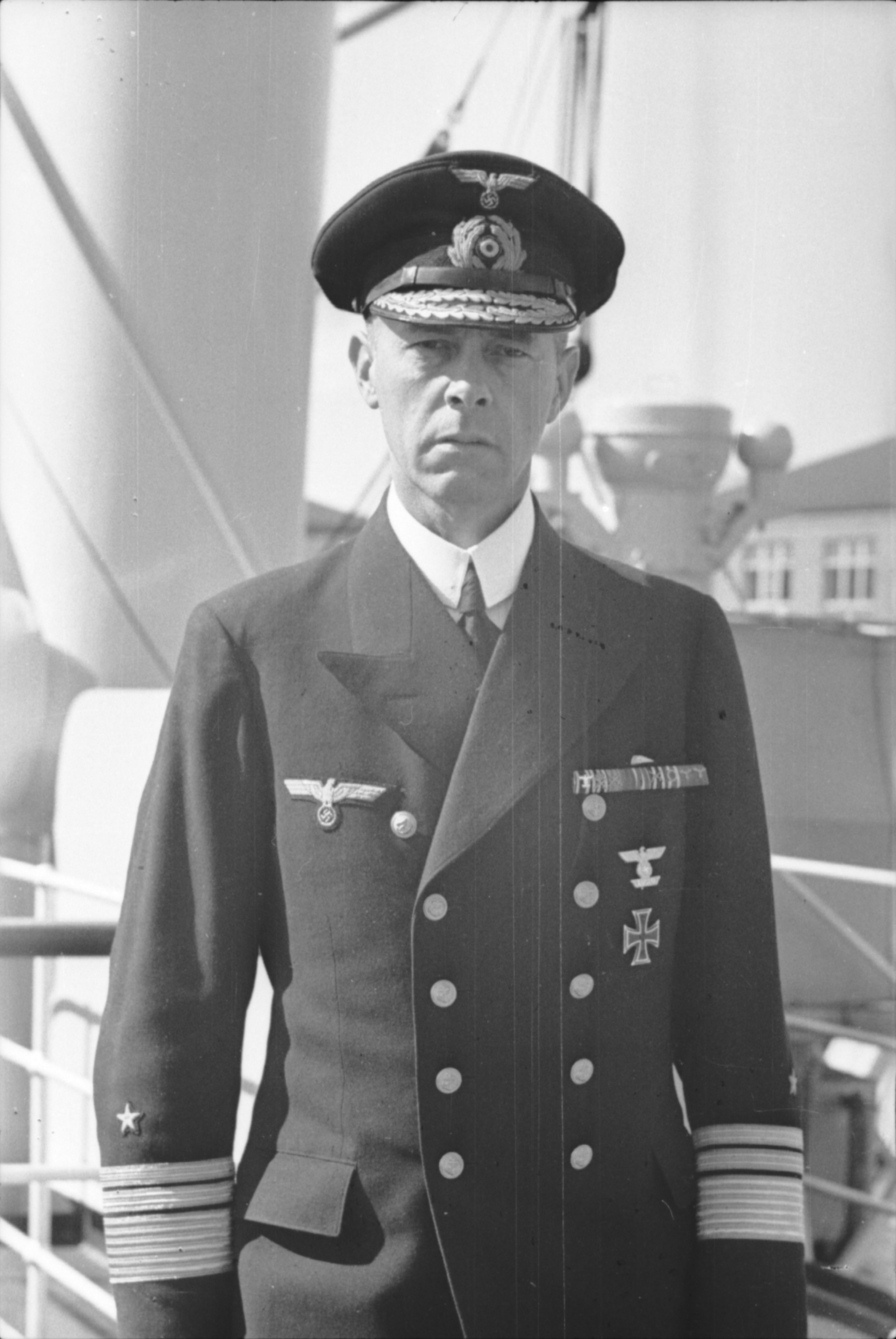
This situation brought the navies of the United States, Canada and Great Britain together as the Allies provided escort to the merchant ships into a combat zone with the German Kriegsmarine (navy), specifically U-boats (submarines) and warships, as well as the Luftwaffe (air force), who were severely disrupting the supply line. The commanders of the opposing forces were both World War I veterans. Vice-Admiral Gilbert O. Stephenson (1878-1972), a pioneer of anti-submarine techniques in the First World War, was training commander of the British escort groups while Admiral Karl Dönitz (1891-1980), whose navy career began before the Great War was the commander of the German U-boat fleet.
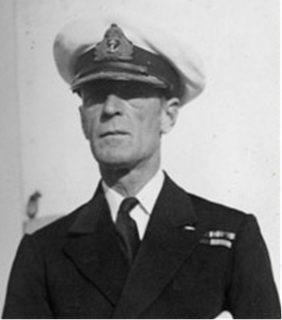
Vice-Admiral Gilbert O. Stephenson, 1929. Stephenson who served in World War I was recalled at the start of World War II and aided in the evacuation of Dunkirk. In 1940 Stephenson was tasked with setting up the training base at Tobermory on the Isle of Mull in the Scottish Inner Hebrides. Stephenson was a noteworthy disciplinarian, and his training vision and methods had an influence within the service after the war ended. The Vice-Admiral believed the most important priorities for trainees were, in order, (1) to instill the will to win; (2) to accept discipline; (3) to execute a highly competent administration; and, (4) to display technical proficiency. Public domain.
German officer Karl Dönitz on the U-39 during World War I. Public domain.
Until the attack on Pearl Harbor by Japan on December 7, 1941 the United States was a non-belligerent and Hitler wanted to keep it that way. Germany was mounting its invasion of Russia called Operation Barbarossa, which, involving almost 4 million troops, was the largest offensive operation in military history. For American internationalists looking for a way into the war in 1941, American neutrality and Lend-Lease laws along with public opinion complicated that desire. American opinion, markedly isolationist through the 1930’s and into the early 1940’s, was, in spring and summer 1941, split on whether the U.S. should escort merchant marine vessels while a large majority was against entering the war. Most Americans polled believed the United States had already been doing too much for Britain.3 In April 1941, after a year of the largest armament production program in U.S. history, President Roosevelt decided for American patrols comprised of ships and airplanes, rather than escorts or convoys, to insure the delivery of needed supplies to Britain and other Allied combatants. The mission, started without diplomatic or public fanfare, gave solely reconnaissance aid to Britain. This role in an expanding territory in the Atlantic was justified by FDR as hemispheric self-defense from the Nazis. This position was reinforced by Roosevelt in a fireside chat with the American people on May 27, 1941. By then the Bismarck was under attack and sunk. FDR’s rationale was based on the premise that the “supreme purpose” of the Axis powers was to achieve world domination by its control of the high seas and the capture of Great Britain was key to that endeavor.4
In 1941, before America’s entry as a belligerent into World War II, President Roosevelt aided the Allies with immense U.S. armament production sent to Britain and American patrols in the North Atlantic to provide intelligence to the British navy to assure their safe delivery to Britain. Further, FDR worked within the parameters of U.S. laws as well as listening to, and helping shape, the American people’s sentiments as to how much to aid Britain short of war.President Roosevelt with Microphones, September 11, 1941 (NARA). “Public Domain: President Roosevelt with Microphones, September 11, 1941 (NARA)” by pingnews.com is marked with Public Domain Mark 1.0.
In the face of these American patrols that FDR spoke of, Hitler was, after the fall of Denmark, Norway, the Low Countries, and France, looking east. The Germans were on the offensive from Yugoslavia to Greece to North Africa. Though the invasion of Britain was off, the Atlantic remained under siege. In April and May 1941 German wolfpacks (coordinated attacks by U-boats on convoys) took a heavy toll on British merchant shipping in the combat zone south of Iceland.5
May 24, 1941.
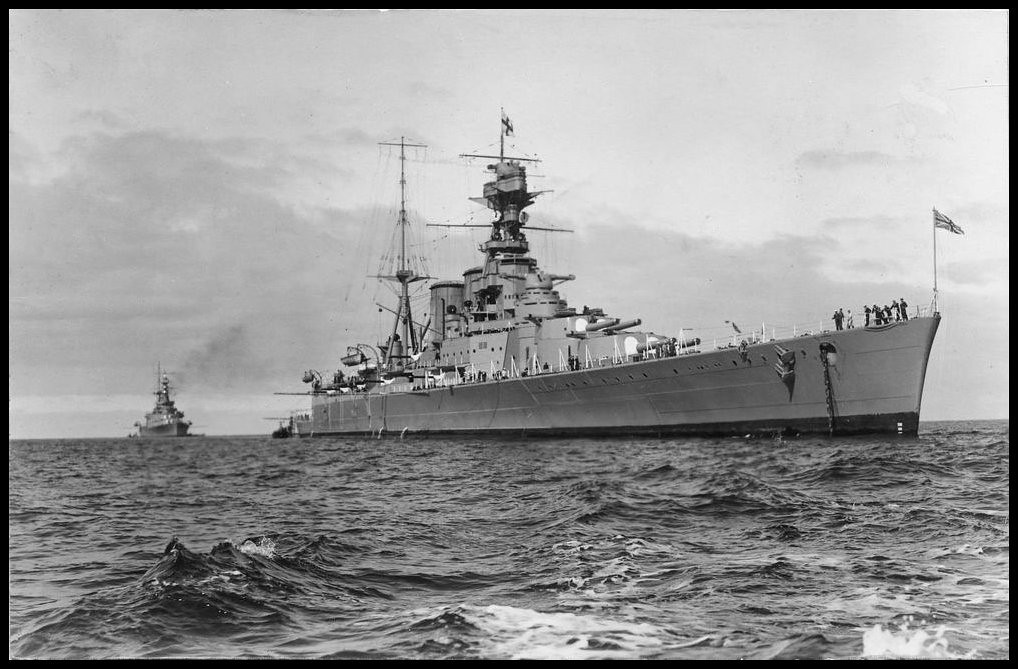
On May 24, 1941, the German battleship Bismarck, accompanied by the cruiser Prinz Eugen, left Norway for the Atlantic. The British intercepted the German ships in the Denmark Strait between Greenland and Iceland, but the Bismarck fought back and sank the HMS Hood, the biggest battlecruiser in the world at that time, which exploded with the loss of 1,415 of its crew. The sinking of the Hood marked what remains the single greatest loss of life in Royal Navy history.
The battle also damaged the Prince of Wales. The Bismarck,under the command of Günther Lütjens (1887-1941), continued its passage south to the convoy routes but had sustained battle damage to its fuel tanks which led to subsequent flooding. Pursued by the damaged Prince of Wales and cruisers Norfolk and Suffolk, the Bismarck, traveling more slowly and trailing oil, changed course to head to Brest for ship repairs. In short order, the Bismarck turned on the British pursuers to allow the Prinz Eugen to escape into the Atlantic.
British battleship Hood. The biggest battleship in the British navy, the Hood was sunk in the Denmark Strait by the German Bismarck on May 24, 1941, with a staggering British loss of 1,415 crew lives. “H.M.S. Hood 1924” by State Library of South Australia is licensed under CC BY 2.0.
The film is recorded from the Prinz Eugen with Bismarck firing.
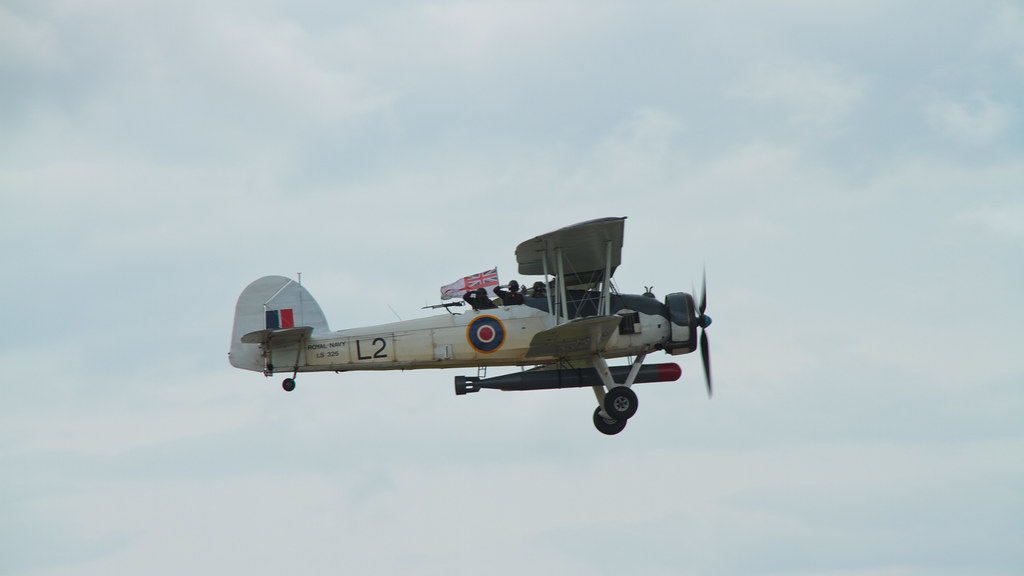
That evening, Fairey Swordfish planes— a resilient British torpedo bomber biplane that originated in the early 1930s —took off from the Home Fleet’s aircraft carrier Victorious for its first attack on the Bismarck. They engaged the warship but without important effect. For the next 31 hours, since the sinking of the Hood, the Bismarck eluded the English fleet which was looking for it further to the west.
Commander Lütjens was not aware that the British had lost him. In the early hours of May 25, 1941, he broke radio silence to send a coded message to Germany. Though its content was indecipherable, the British heard it and observed that the German commander had stopped communicating with Wilhelmhaven in Germany and began talking with Paris. This was a break that allowed the British to figure closely the actual vicinity of the enemy warship and that it was heading to France. British warships in search of the Bismarck were provided the new coordinates and the orders to pursue accordingly. This included King George V and Norfolk to be joined by a flotilla of 5 destroyers under the command of Captain Philip Vian (1894-1968).
British Captain Philip Vian in 1940. Taken before 1957, this work created by the United Kingdom Government is in the Public Domain.
May 26, 1941.
At 10 a.m. the Bismarck was spotted by an American pilot in one of the American-made Catalinas provided by Roosevelt to the British war effort. Flying out of a base in Northern Ireland, the plane was part of a squadron that had been assigned a specific search area for the Bismarck. It was piloted by American Ensign Leonard “Tuck” Smith (1915-2006) whose role was to familiarize RAF Pilot Officer, Dennis Briggs, with the plane’s controls. Though revealed long after the war’s end, Smith was credited with being the first person to spot the Bismarck before the final battle. He was awarded the Navy’s Distinguished Flying Cross for his role in the sinking of the Bismarck. Leaving in the middle of the night on May 26, 1941, the weather was bad with a ceiling of about 100 feet. According to Smith’s report, it took six hours to reach the search area. As soon as they spotted the Bismarck, they came under intense anti-aircraft fire from the warship and Smith had to take violent evasive action to escape getting blown out of the sky. Smith and the crew soon lost contact with the battleship, but their messages as to its precise location had been received. British ships and planes soon converged on an intercept course. Already the aircraft carrier Ark Royal had sent scouting planes and a pair of Swordfish spotted the enemy warship shortly after Smith did. When Smith landed his Catalina back in Northern Ireland at 9: 30 p.m., 18 hours after having taken off, it would be just 12 more hours that the 35,000-ton Bismarck would be at the bottom of the Atlantic Ocean.
After the Bismarck’s location was known, Captain Philip Vian’s flotilla that was to join King George V in the search for Bismarck, changed course and headed directly for the Bismarck. Three days earlier, on May 23, 1941, the British naval formation known as Force H had left Gibraltar for convoy duties that included the aircraft carrier HMS Ark Royal, battlecruiser Renown, and light cruiser Sheffield. On May 26, 1941, Force H set course to intercept the Bismarck.
Starting late on Monday, May 26, 1941, the last battle of the German battleship Bismarck started in the Atlantic Ocean The ship was sunk about 350 miles west of the port city of Brest in France. At 2:50 p.m. on May 26, 1941, fifteen Fairey Swordfish planes took off from the aircraft carrier HMS Ark Royal to attack the Bismarck.
The attack failed and the British cruiser Sheffield fell under friendly fire. The British staked everything on one more attack to stop the Bismarck before it could safely enter into Brest harbor the next day. At 7:10 p.m., a second sortie of 15 Swordfish planes took off from the HMS Ark Royal armed with conventional torpedoes. At 8:47 p.m., these Swordfish began their attack. The Bismarck received a direct hit but it was not mortal. A second torpedo hit the ship’s stern that jammed and disabled the battleship’s rudders crippling it. The King George V and HMS Rodney joined the fray from the northwest about 6.00 p.m. and, at 10:00 p.m., the Sheffield directed Captain Vian’s destroyers towards the target where they harassed an unmaneuverable Bismarck with torpedo attacks through the night.
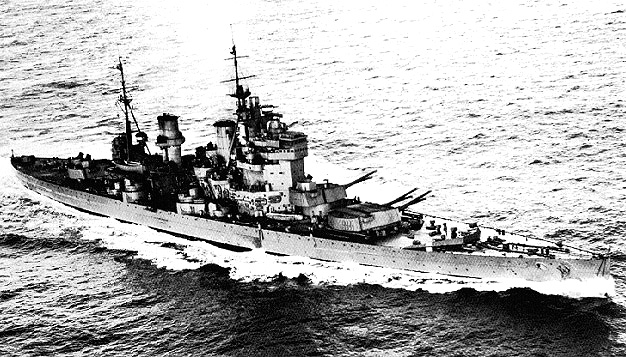
The battleship HMS King George V in 1941. Commanded by Admiral Sir John Tovey, it was one of the ships which sank the Bismarck. Public Domain.
May 27, 1941.
The next day, Tuesday, May 27, 1941, the Bismarck, unable to steer or repair the rudder, expected an attack from the British battleships. At 8:30 a.m., they readied battle stations. At 8:43 a.m. the HMS Rodney and HMS King George V, joined by cruisers and destroyers, including the HMS Norfolk and HMS Dorsetshire, spotted the Bismarck. At 8:47 a.m., from a distance of over 10 miles, the battleship HMS Rodney opened fire commencing the final battle. Though Bismarck returned fire, with its disabled rudder, its gun platforms were unstable due to uncontrollable movements on a rising sea in gale-force winds. At two minutes past 9 a.m. the HMS Rodney unloaded its 16-inch guns and hit the Bismarck’s forward superstructure, severely damaging the bridge, command facilities, fire control, and observation posts, as well as killing most of the warship’s senior officers. Both HMS Rodney and HMS King George V engaged Bismarck in heavy gunfire with increasing precision as British shells dismantled the ship’s command structure and gun turrets making the Bismarck a floating hulk. With Bismarck’s ability to return fire random and infrequent the British warships came into closer range for the German warship’s final neutralization. HMS Norfolk and HMS Dorsetshire joined HMS Rodney to fire on Bismarck with its 8 -inch guns and torpedoes. With its four main gun turrets inoperable, at 9.31 a.m., the Bismarck had lost the capacity to fight back with orders down the chain of German officers to scuttle and abandon the ship.
Nearly 3,000 projectiles were used against the Bismarck to achieve this outcome in the final battle. In the final stages of the battle the British ships surrounded the Bismarck in a crossfire that overpowered the German crew. In addition to significant structural damage, this intense continuous British gunfire set off fires on the Bismarck that caused secondary explosions.
Following the battle with the Bismarck, the HMS Rodney continued its service in World War II. In November 1942, the HMS Rodney provided naval gunfire support in Operation Torch for the Allied landings of North Africa. In 1943 during the Italian Campaign the HMS Rodney provided support for the Allied landing in Sicily (Operation Husky). In 1944, as part of Operation Neptune (the navy component of Operation Overlord), the HMS Rodney provided gunfire support during the D-Day Normandy beach landings. Following the war, in 1948, the HMS Rodney was sold for scrap. “HMS Rodney lightens her load sometime in the 1930’s.” by WWII in View is marked with Public Domain Mark 1.0.
The British kept firing, the HMS Rodney at point-blank range and the King George V from a greater distance to lob in shells. At 10:05 a.m., the Bismarck was sunk. In the battle’s last stage, the British torpedoes tore holes in the Bismarck’s hull hastening the ship’s decline into the sea. Of the Bismarck’s crew of 2, 200 men only 114 survived. The Luftwaffe that the Bismarck hoped would intervene was not able to fly in meaningful number due to bad weather. The British left the rescue mission with hundreds of German sailors still in the water as a German U-boat periscope had been spotted.
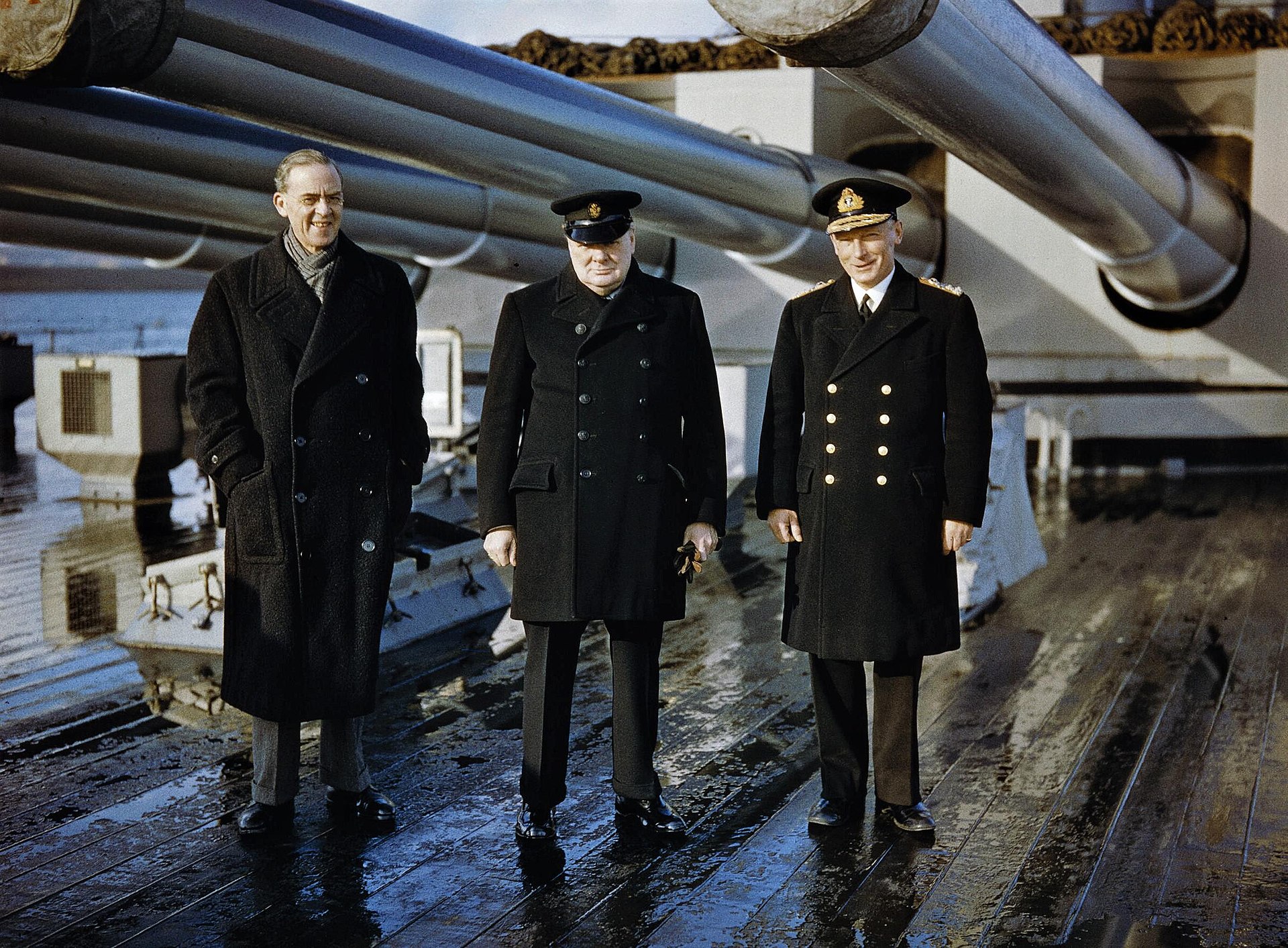
Winston Churchill with the Lord Privy Seal, Sir Stafford Cripps, and the Commander-in-Chief Home Fleet, Admiral Sir John Tovey, on the quarterdeck of HMS KING GEORGE V at Scapa Flow, 11 October 1942. Adm. Tovey who made the above observations about the Bismarck served as Commander in Chief of the Home Fleet from 1940 to 1943 and served as Commander in Chief, Nore from 1943 to 1946. Adm. Tovey was First and Principal Naval Aide de Campe to the King from January 1945. Public Domain.
After the sinking, Admiral John Tovey (1885-1971) said: “The Bismarck had put up a most gallant fight against impossible odds worthy of the old days of the Imperial German Navy, and she went down with her colours flying.”6
Sink the Bismarck! is a 1960 black-and-white CinemaScope British war film based on the 1959 book The Last Nine Days of the Bismarck by C. S. Forester. It stars Kenneth More and Dana Wynter and was directed by Lewis Gilbert. Norman Shelley was the uncredited voice of Winston Churchill: “I want to make it unmistakably clear that there is absolutely nothing as vital to the nation at this moment as the destruction of the Bismarck. You are authorized to employ any means at your disposal regardless of risk and regardless of the price that must be paid. This is a battle we cannot afford to lose. I don’t care how you do it, you must sink the Bismarck!“
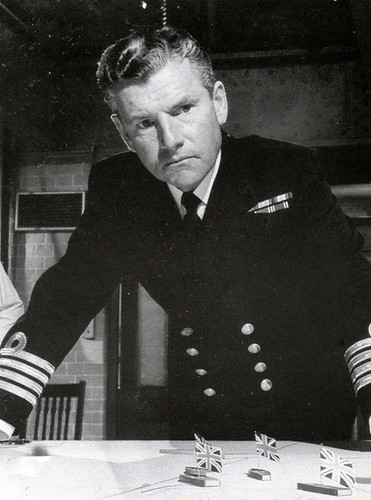
In 1960 the British black-and-white film production, Sink the Bismarck!, was a hit in the United States and, after its first run, regularly broadcast on TV through the 1960’s and 1970’s in reruns. It co-starred Kenneth More as Captain Jonathan Shepard who coordinates the hunt for Bismarck aided by Women’s Royal Naval Service Second Officer Anne Davis (Dana Wynter). More had served as a Royal Navy lieutenant on HMS Victorious during World War II. “Kenneth More, ‘Sink the Bismarck’, 1960” by thefoxling is licensed under CC BY-NC-SA 2.0.
FOOTNOTES:
1. Freedom From Fear: The American People In Depression and War, 1929-1945, David M. Kennedy, NY: Oxford University Press, 1999, pp. 490 and 493.
2. Freedom from Fear, p. 492.
3. Operation Barbarossa – Freedom from Fear, p. 495; polls- Ibid., p. 491.
4. Freedom from Fear, pp. 492-493.
5. The Reluctant Belligerent: American Entry Into World War II, 2nd edition, Robert A. Divine, NY: John Wiley & Sons, 1979, p. 117.
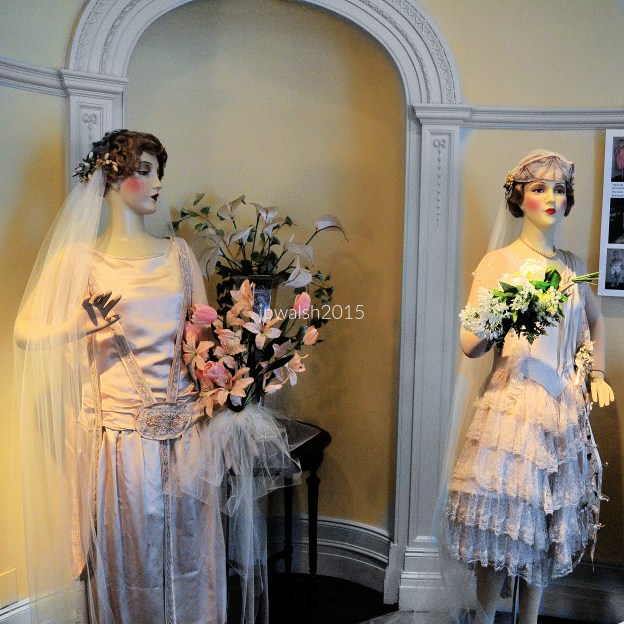
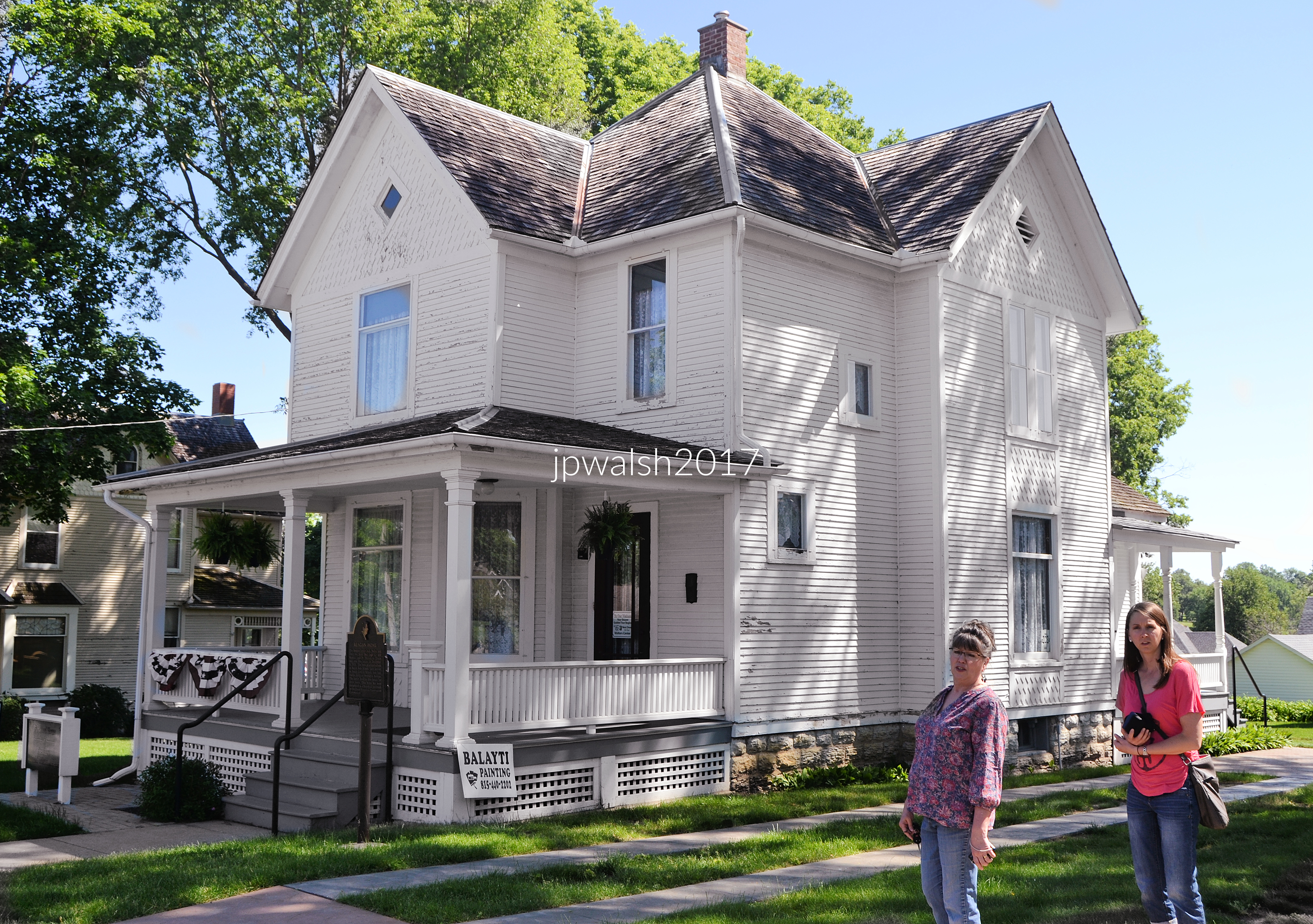
Feature Image: On Saturday, June 7, 1924, Ruth M. Anderson was married in this sleeveless wedding dress (left) to William Noling in Evanston, Illinois. The dress is now on display in the Charles Gates Dawes House in Evanston. Dawes was Vice President of the United States from 1925 to 1929 under President Calvin Coolidge. Author’s photograph (October 2015).
Wedding at the House of the Bride’s family
The Noling-Anderson wedding was held in the house of the bride and her parents, Isak and Jennie (née Johnson) Anderson, at 1035 Ridge Avenue in Evanston. Built in 1914, the house still stands as it did over 100 years ago.
Noling-Anderson Bridal Party Dresses, 1924. Charles Gates Dawes House, Evanston, Illinois. Author’s photograph, October 2015. 7.44 mb DSC_0893 (1)
The dress is made of silk satin in an egg shell color. It is accented by an oval medallion with bands also made of silk satin. The medallion is embroidered with faux pearl and other glass beads.
Thoroughly modern flapper style
While her wedding dress was very fashionable for the mid1920’s – sleeveless tops of all shapes and sizes were the rage in 1924 – it probably was not allowed in one of Evanston’s houses of worship. The fact that it was sleeveless and au courant would be deemed by many as risqué for showing too much bare skin inspired by a thoroughly modern flapper style. It was only in 1924, for instance, that the Methodist Episcopal General Conference first lifted its ban on going to the theater as well as dancing though dance music was the radio’s most popular programming.
The bridesmaid dress (right) was the height of women’s style in 1924 – a mainly straight, knee-length skirt gathered slightly or cut with front pleats. Short sleeve and sleeveless tops were the rage in 1924 reflected in Hollywood by the Mack Sennett girls who starred in movies where they pranced on the beach in a chorus line in not much more than bathing caps and short swim suits.
The fashionable bride and her court might have sported the latest style of facial make-up which is hinted at in the display– masklike with garish, even orange, lipstick and heavy red rouge on the cheeks. Popular fashion accessories from 1924 are also evident – pearls knotted at the neck and simple, though elegant, arm bracelets.
Father of the bride was an Evanston banker, local businessman, andSwedish immigrant
The bride’s father, Isak Anderson, was born in Sweden and came to the United States at 20 years old in 1890. In 1891 he married Jennie Johnson and they had Ruth and another child. Ruth’s father was a bank director and partner in a local tailoring business in downtown Evanston at 608 Davis that today is a noodle shop.
They served “Prohibition highballs”
With Prohibition starting in 1920, guests at the wedding may have been served the latest popular highball whose recipe called for fruit juice and raw eggs. Their morning might have started with a bowl of Wheaties at breakfast, since the cereal of champions made its first appearance in 1924.
Ruth Anderson married William Noling in this house wearing that dress at 1035 Ridge Avenue in Evanston, Illinois, on June 7, 1924. Author’s photograph, May 2024 92% 7.81 mb
SOURCES: Dawes House, Evanston Illinois; The Swedish Element in Illinois: Survey of the Past Seven Decades, Ernst Wilhelm Olson, p. 586; American Chronicle, Lois Gordon & Alan Gordon, Yale University Press, New Haven & London,1999, pp. 230-238; Chicago: The Glamour Years (1919-1941), Thomas G. Aylesworth & Virginia Aylesworth, Gallery Books, NY, 1986, p.14.
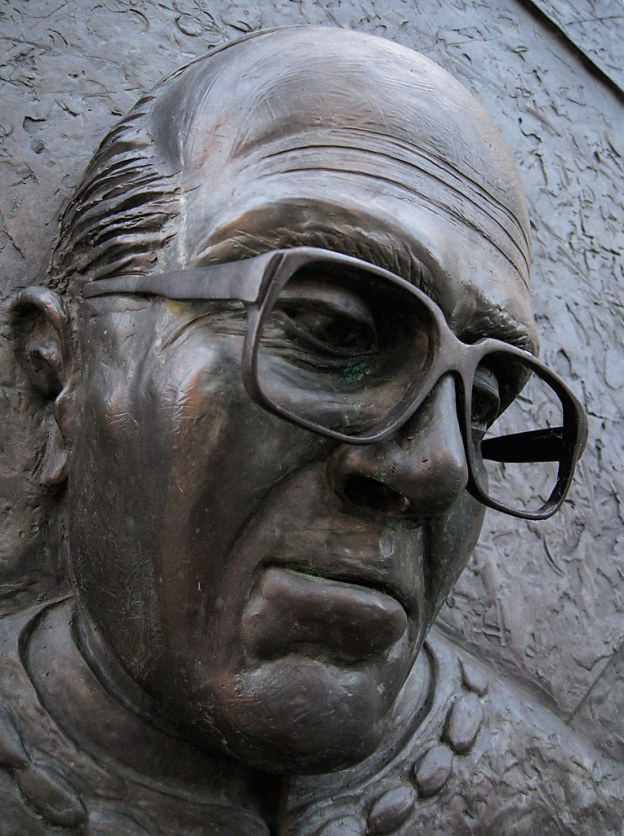
Derek Worlock (February 4, 1920 – February 6, 1996) was an English priest of the Roman Catholic Church who served as Archbishop of Liverpool. A leading figure in post‑war British Catholicism, he became known for his pastoral warmth, public presence, and commitment to unity among Christians.
A Ministry Shaped by Collaboration
Worlock devoted his episcopal life to fostering cooperation across Christian traditions. His partnership with Anglican Bishop of Liverpool David Sheppard became one of the most celebrated ecumenical friendships in modern Britain. Together they co‑authored Better Together and With Hope in our Hearts (both 1995), works that embodied their shared vision for a reconciled, outward‑facing Church. His episcopal motto, Caritas Christi eluceat—“For the Shining Light of Christ”—captured the spirit of his ministry.
Honours and Public Recognition
In 1994, Worlock received the Freedom of the City of Liverpool, a civic acknowledgment of his decades of service to the city. Two years later, in 1996, he was appointed a Companion of Honour, one of the United Kingdom’s most distinguished awards.
A Memorial on Hope Street
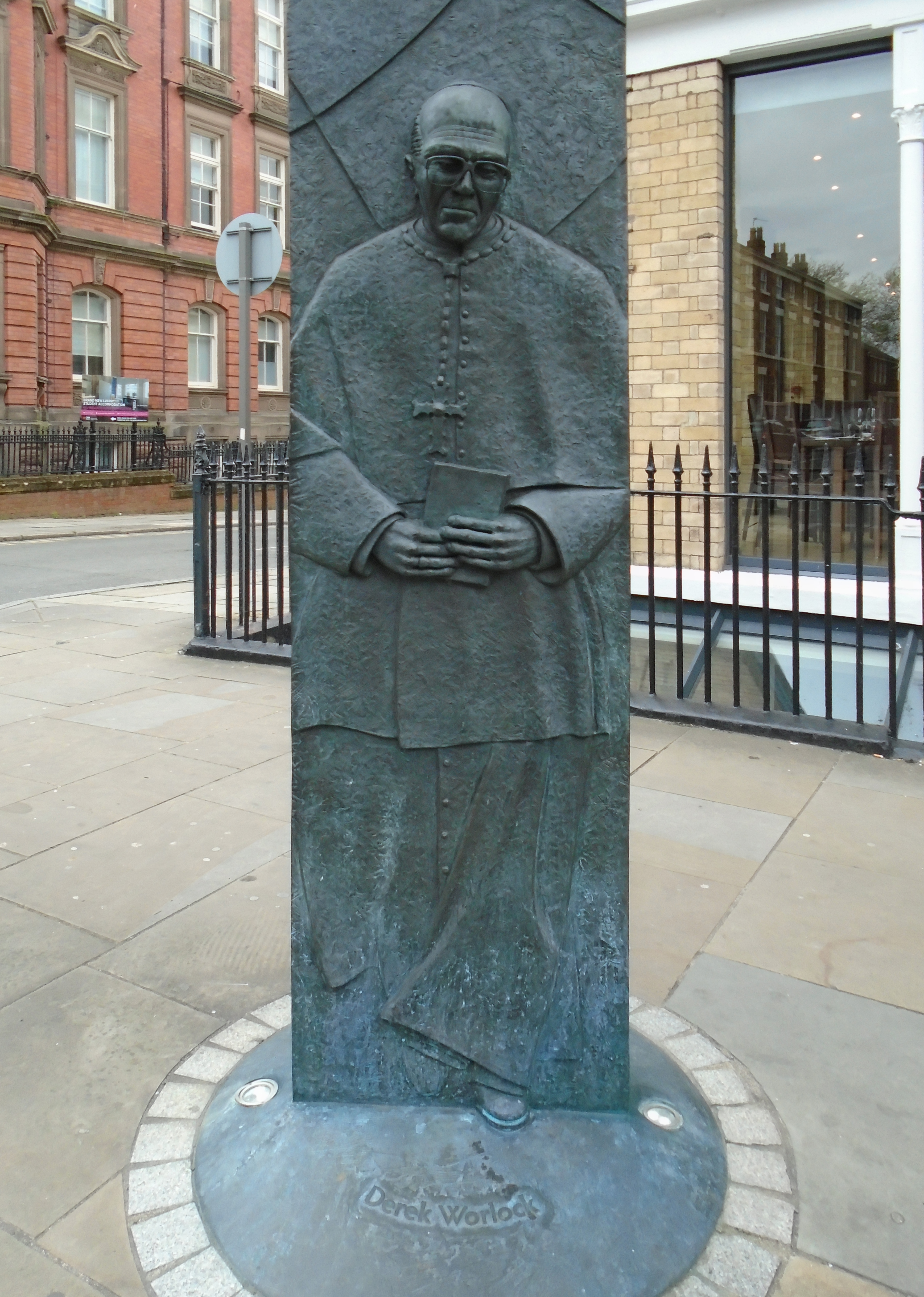
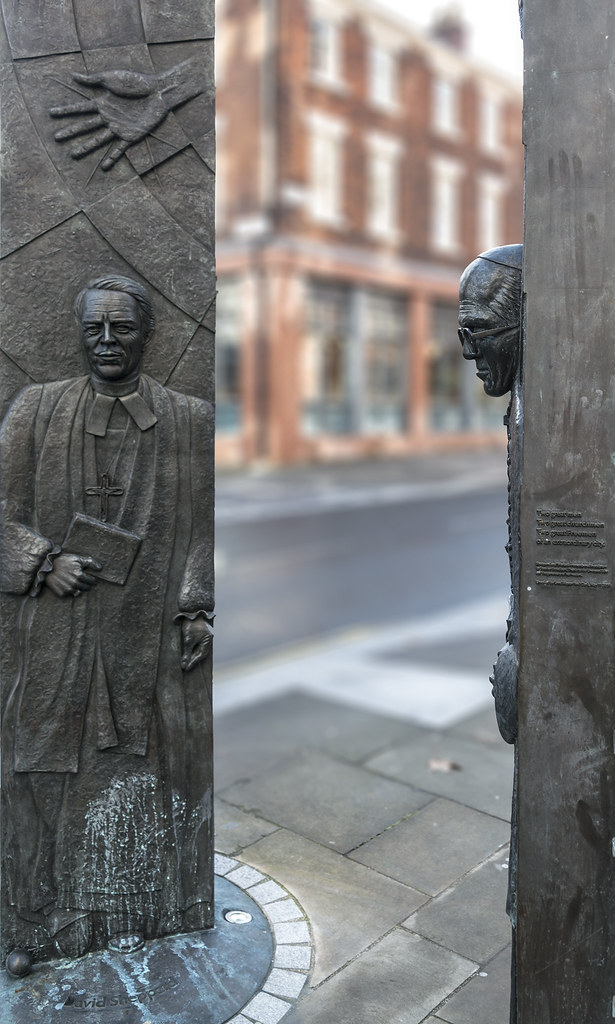
After his death in 1996, plans began for a public memorial. Commissioned in 2005 and funded through widespread public donations, the sculpture was created by British artist Stephen Broadbent (b. 1961). Placed at the midpoint of Liverpool’s Hope Street, the memorial stands symbolically between the city’s Anglican and Roman Catholic cathedrals—an architectural embodiment of the unity Worlock championed throughout his life.See it here: https://www.flickr.com/photos/newfolder/2535308455
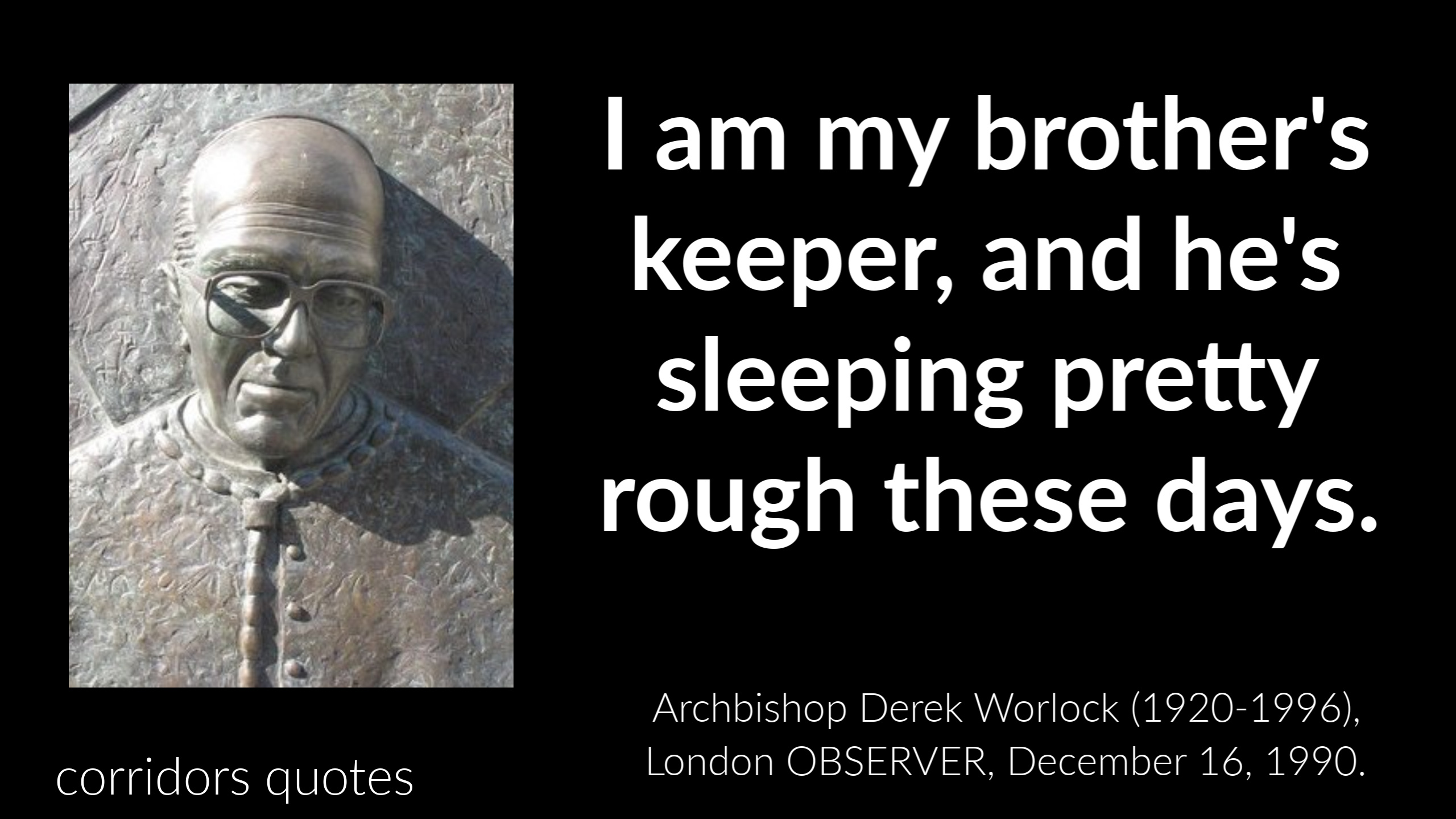
David Sheppard and Derek Worlock memorial, Hope Street, Liverpool.The placement is deliberate: halfway between the two cathedrals, exactly where their work met with space between them for everyone. “DSCF0029” by geraldmurphyx is licensed under CC BY-ND 2.0.
A Shared Mission of Reconciliation
The statue commemorates the extraordinary partnership between Archbishop Derek Worlock and Bishop David Sheppard, two churchmen who refused to let centuries of division define Liverpool’s Christian life. At a time when Catholic–Anglican relations still could be frosty and suspicious, they pointed to a a different path of public friendship, joint action, and a united moral voice for their city.
Their collaboration was not symbolic but deeply practical. They issued joint pastoral letters, appeared together at civic events, and spoke with one voice during moments of crisis. In a city marked by economic hardship, sectarian memory, and social fragmentation, they insisted that Christian leadership must be shared leadership. Their partnership became a model for ecumenical cooperation across Britain.
Healing Historic Divisions
Worlock and Sheppard understood that Liverpool’s religious landscape had long been shaped by rivalry—Catholic and Anglican identities often hardened by class, migration, and political history. Their work aimed to soften those boundaries. They promoted joint prayer services, encouraged cooperation between parishes, and supported community initiatives that crossed denominational lines.
Their message was simple but radical: unity was not an optional ideal but a pastoral necessity. They believed that reconciliation between churches could help foster reconciliation within the city itself.
A Memorial to Unity
The statue’s purpose was to create a permanent reminder of this shared ministry. It honors not only two individual leaders but the ecumenical vision they embodied. Positioned on Liverpool’s Hope Street—linking the Anglican Cathedral at one end and the Catholic Cathedral at the other—the memorial stands as a physical metaphor for the bridge they built.
Above: Archbishop Derek Worlock London‑born Derek Worlock was ordained a Catholic priest in 1944 and began his ministry as curate at Our Lady of Victories, Kensington, then London’s wartime pro‑cathedral. For nearly two decades he served at the heart of English Catholic leadership as private secretary to three Archbishops of Westminster, a role that shaped his administrative skill and national profile. He later spent a year as Rector and Rural Dean of the Church of SS Mary and Michael—one of London’s historically largest parishes—before being appointed Bishop of Portsmouth, serving the English Channel region for eleven years. In 1976 he became Metropolitan Archbishop of Liverpool, the post that defined his public legacy. “File:Sheppard-Worlock Statue 2017-2.jpg” by Rodhullandemu is licensed under CC BY-SA 4.0.
Detail from the Sheppard-Worlock statue Liverpool. Anglican Bishop David Sheppard was Worlock’s closest ecumenical partner and the other half of Liverpool’s most influential Christian alliance. Before Derek Worlock’s appointment as Roman Catholic Archbishop of Liverpool in 1976, the Anglican archbishop of Liverpool, David Sheppard, was consulted over a meal together with Pope Paul VI’s Papal Nuncio in Britain, Archbishop Bruno Heim. Before he became one of Liverpool’s most respected church leaders, David Sheppard was a national sporting hero—a stylish right‑handed batsman whose cricketing career made him a household name across Britain. His cricketing fame gave him a public platform long before he entered the clergy, and he later used that visibility to speak on issues of poverty, racial justice, and urban renewal. Public Domain (Man vyi – Self-photographed. Own work, all rights released).
Coat of Arms, Most Rev. Derek Worlock, Metropolitan Archbishop of Liverpool. It contains Worlock’s motto: Caritas Christi eluceat (“For the Shining Light of Christ”). “Uk rc liverpool worlock” by EborArmorist is licensed under CC BY 3.0.
Archbishop Derek Worlock served as bishop and archbishop from 1965 to 1996—years that spanned the close of the Second Vatican Council and the unfolding of its new teaching on ecumenism. From the beginning of his episcopal ministry, he treated the Council’s call to Christian unity not as an abstract ideal but as a pastoral responsibility.
The Portsmouth Years: Learning to Live Together in Love
As Bishop of Portsmouth, Worlock was already experimenting with practical ways for Catholics and Anglicans to share life, sacraments, and community with greater charity. His most famous initiative, later nicknamed the “Portsmouth solution,” emerged in the early 1970s when the daughter of a local Anglican bishop wished to marry a Catholic.Worlock crafted a pastoral compromise that honored both traditions:
The marriage rite and promises were celebrated first in the Catholic church, fulfilling canonical requirements.
Later that same day, the couple’s marriage was celebrated again in the bride’s Anglican parish, with her father—the Anglican bishop—presiding.
This arrangement was bold for its time. It respected Catholic sacramental discipline while acknowledging the Anglican family’s pastoral and emotional needs. More importantly, it modeled the kind of mutual recognition, goodwill, and shared joy that Worlock believed should characterize Christian life.
A Foreshadowing of His Liverpool Partnership
The Portsmouth solution was not an isolated gesture but an early sign of the ecumenical instincts that would later define his partnership with David Sheppard in Liverpool. It showed Worlock’s willingness to take risks, to trust the good faith of other Christians, and to build unity through concrete acts rather than theoretical statements.
Bishop Worlock’s mitre, placed at his tomb, recalls a pivotal moment in his early episcopal ministry. In 1973, while serving as Bishop of Portsmouth, Worlock was preparing to attend the upcoming Roman Synod of Bishops. Asked to suggest a theme for the Synod’s work, he proposed “Evangelization”—a choice Pope Paul VI accepted.
Worlock’s proposal did more than set the agenda for a major global gathering. It highlighted two convictions that shaped his entire episcopate:
that evangelization is rooted in the Church’s ancient mission shared by all the baptized, and
that the spirit of Vatican II’s outreach to others—its ecumenical openness, its desire for dialogue, its pastoral warmth—must animate that mission.
In many ways, the theme anticipated the hallmark of Worlock’s later ministry as Archbishop of Liverpool: a commitment to opening outward, building bridges, and embodying the Gospel through collaboration with other Christians, especially his Anglican counterpart David Sheppard.
Archbishop Worlock’s mitre, resting at his tomb, evokes a churchman whose influence extended far beyond Liverpool. Over more than three decades as bishop and archbishop, he became a driving force within the episcopal conference, shaping how the Catholic Church in Britain engaged with the modern world.
He helped lead national initiatives on the media, the laity, and justice and peace, urging the Church to speak with clarity, courage, and compassion. His advocacy for the poor was especially memorable. When drawing attention to Britain’s growing homelessness crisis, he captured the moral urgency in a single, searing line: “I am my brother’s keeper, and he’s sleeping pretty rough these days.” London OBSERVER, December 16, 1990. (on the homeless).
This sentence distills the core of his ministry: the conviction that Christian leadership must be measured by its solidarity with the most vulnerable.
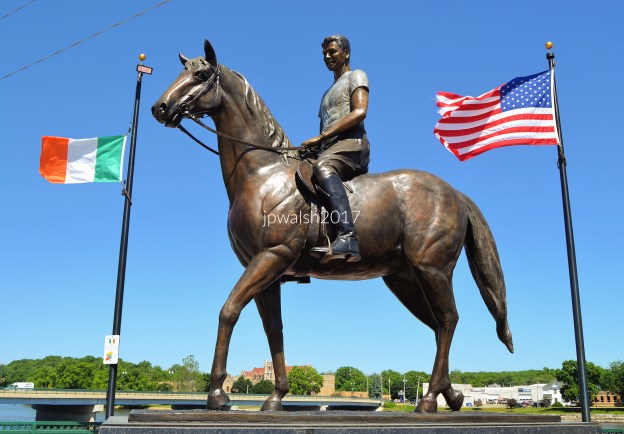
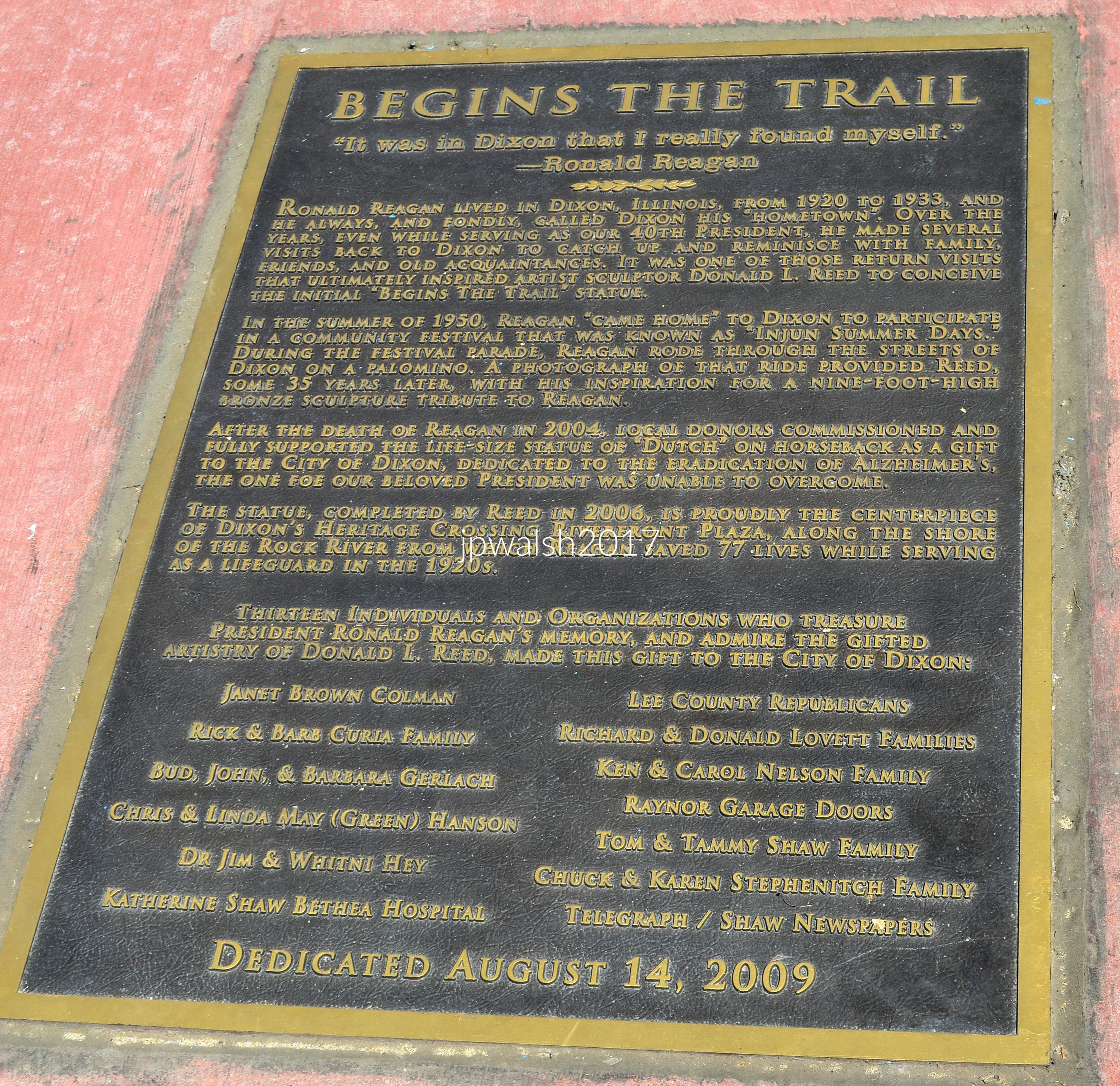
Feature Image: June 2017. 4.37mb DSC_0785. The statue of Ronald Reagan by American sculptor Donald L. Reed in DIxon, Illinois, was dedicated on August 14, 2009. It is based on a photograph of Reagan when he visited Dixon in 1950 and rode a horse through its streets in a parade.The statue itself is nine feet high on its pedestal and called Begins the Trail. It is the first of a series that includes a life-sized statue for the Reagan Foundation at the Ronald Reagan Presidential Library in Simi Valley, California, called Along the Trail. These artworks capture Reagan’s rugged amiable nature and his natural ability throughout life when riding. see – https://www.cowboysindians.com/2016/02/ronald-reagan-rides-again/ – retrieved April 13, 2025.
All text and photographs (except where noted) by John P. Walsh.
June 2017. 4.76mb DSC_0797.
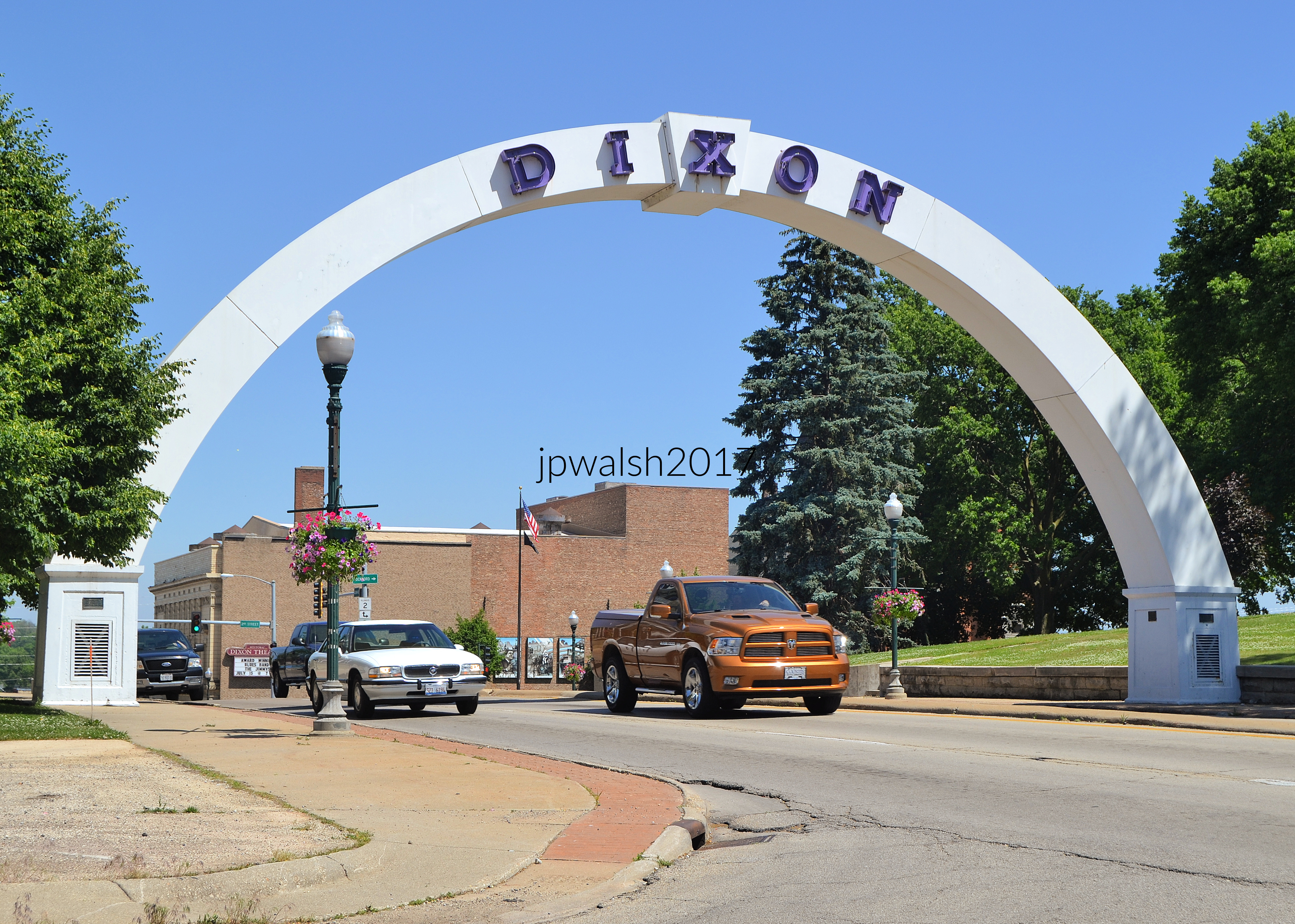
Considered the heart of Dixon, the memorial arch has been a landmark since the 1920s. The original arch, built in 1919, was made of beaver board and wood. It was built to celebrate the return of Dixon’s soldiers after World War One. In 1949, a new arch was constructed of wood. It was replaced in 1966 when Galena Avenue was widened. In 1985 the arch was replaced with this fiberglass one with the letters from the 1966 arch. In 2024 it went through a major restoration. See – https://www.wifr.com/2024/06/04/dixons-iconic-memorial-arch-facing-repairs/ – retrieved February 28, 2025.
June 2017. 5.41mb DSC_0822.
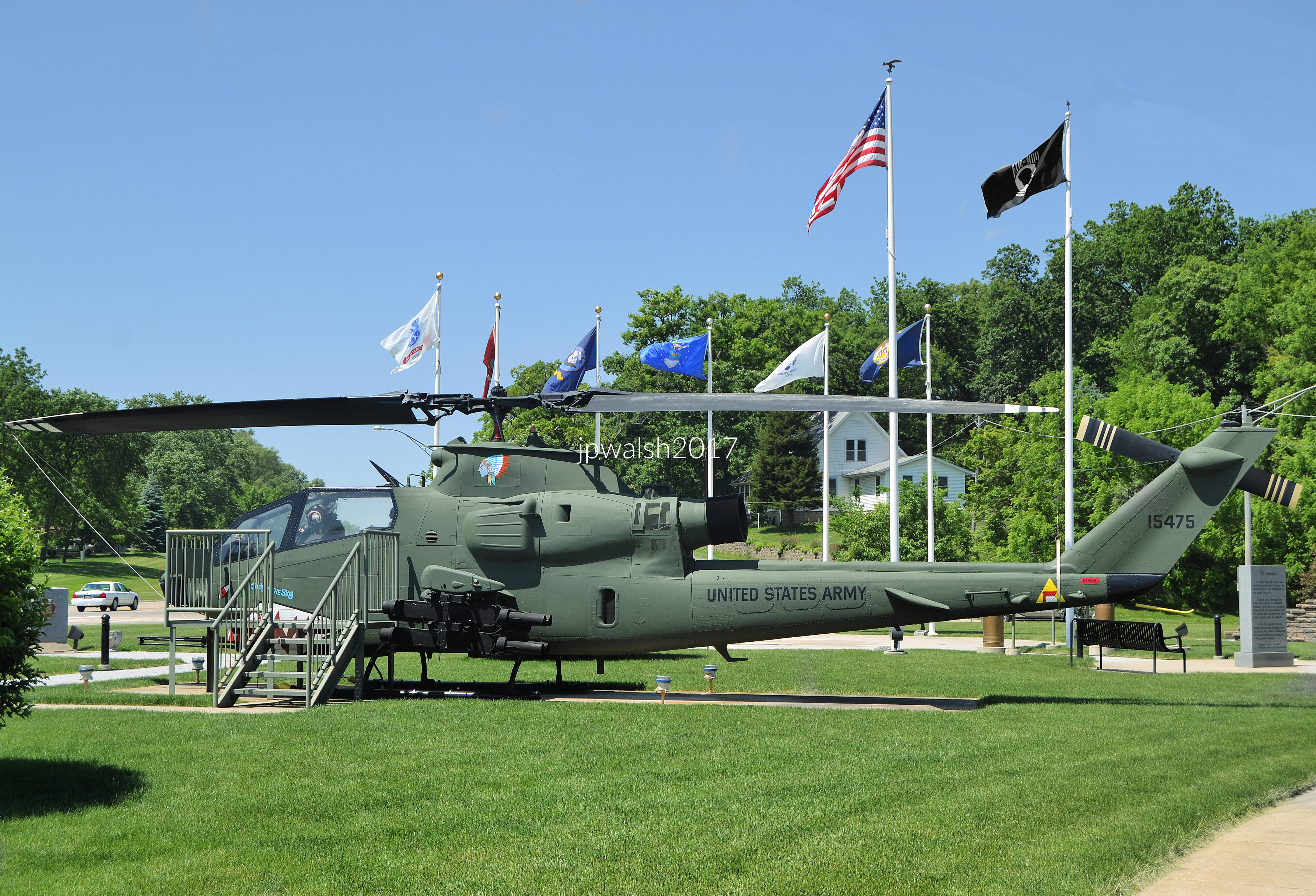
This helicopter (above and below) wears five Purple Hearts carved from enemy ground fire in Vietnam — battered, scorched, and shot to pieces, yet every time it clawed its way back through the smoke, it delivered its crew home alive. In Dixon’s (Illinois) Veterans Memorial Park founded in 2001 the 1967 AH-1F Cobra Attack Helicopter Gunship (serial #67-15475) was issued to the 7th Squadron of the First Calvary Divisions Aviation Group for its entire tour of duty. This helicopter arrived in Vietnam in March 1967. Following 1142 combat hours flown, the helicopter was damaged on July 27, 1969, because of a weapons malfunction. At 1792 hours flown it was shot down on February 6, 1970, by heavy enemy ground fire while providing armed escort to medivac helicopters with both crewmen wounded. On April 15, 1970, at 1954 hours flown, it was damaged while providing direct fire support to infantry. On July 13, 1970, it was shot down by small arms fire while providing escort at 2092 hours. At 2471 hours, on January 19, 1971, it was severely damaged by gunfire while providing direct escort protection to ground troops. On July 6, 1971, it was damaged by heavy ground fire on an armed escort mission at 2745 hours flown. see – Cobra Attack Helicopter – Veterans Memorial Park & Museum – retrieved April 13, 2025.
June 2017. 6.18mb DSC_0821 (2)June 2017. 3.12mb DSC_0751. Author’s photograph.
On June 5, Ronald Reagan’s death day, Honor Guard gather at the Reagan Boyhood Home in Dixon, Illinois.
June 2017. 4.13mb DSC_0845.
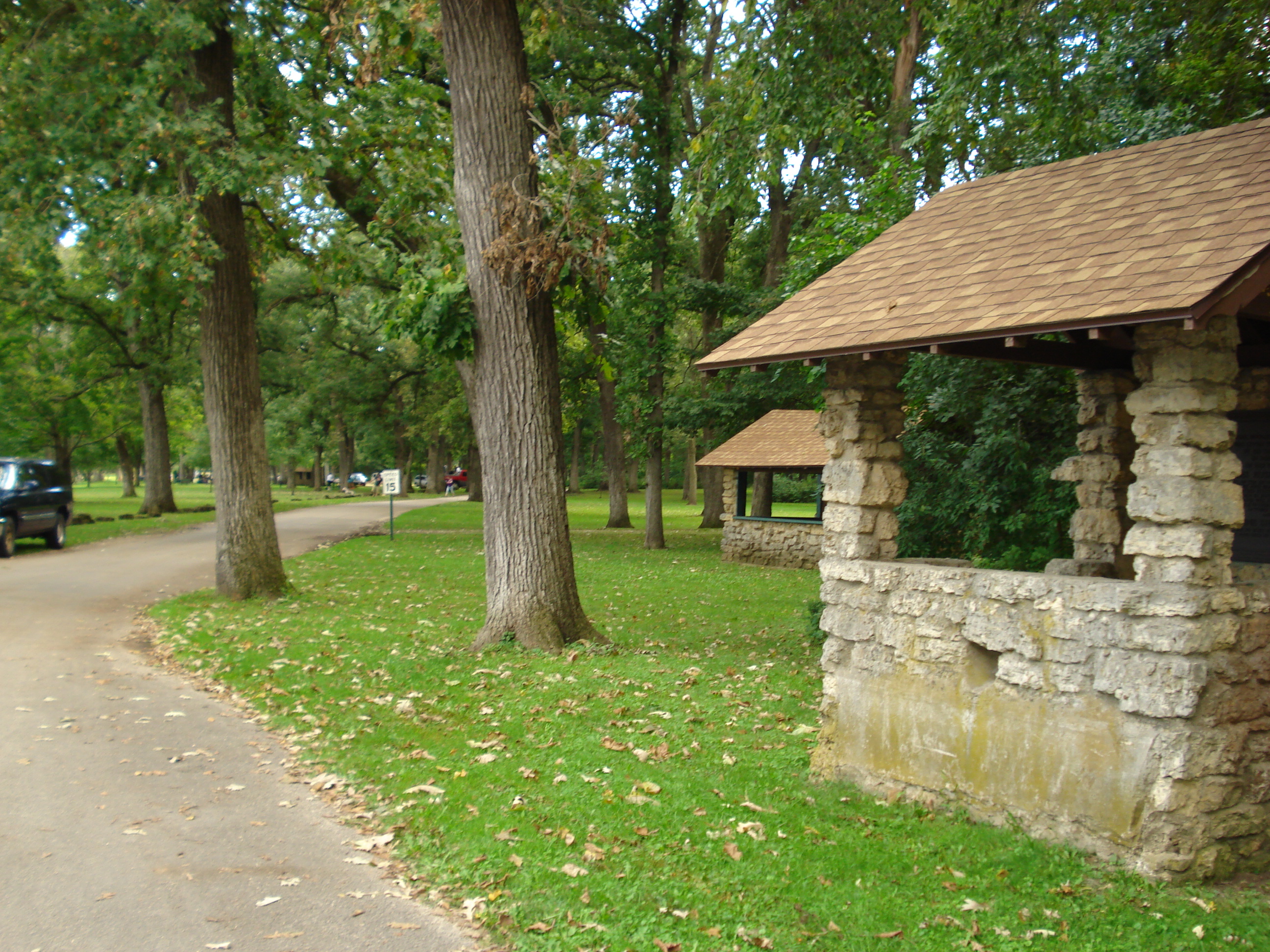
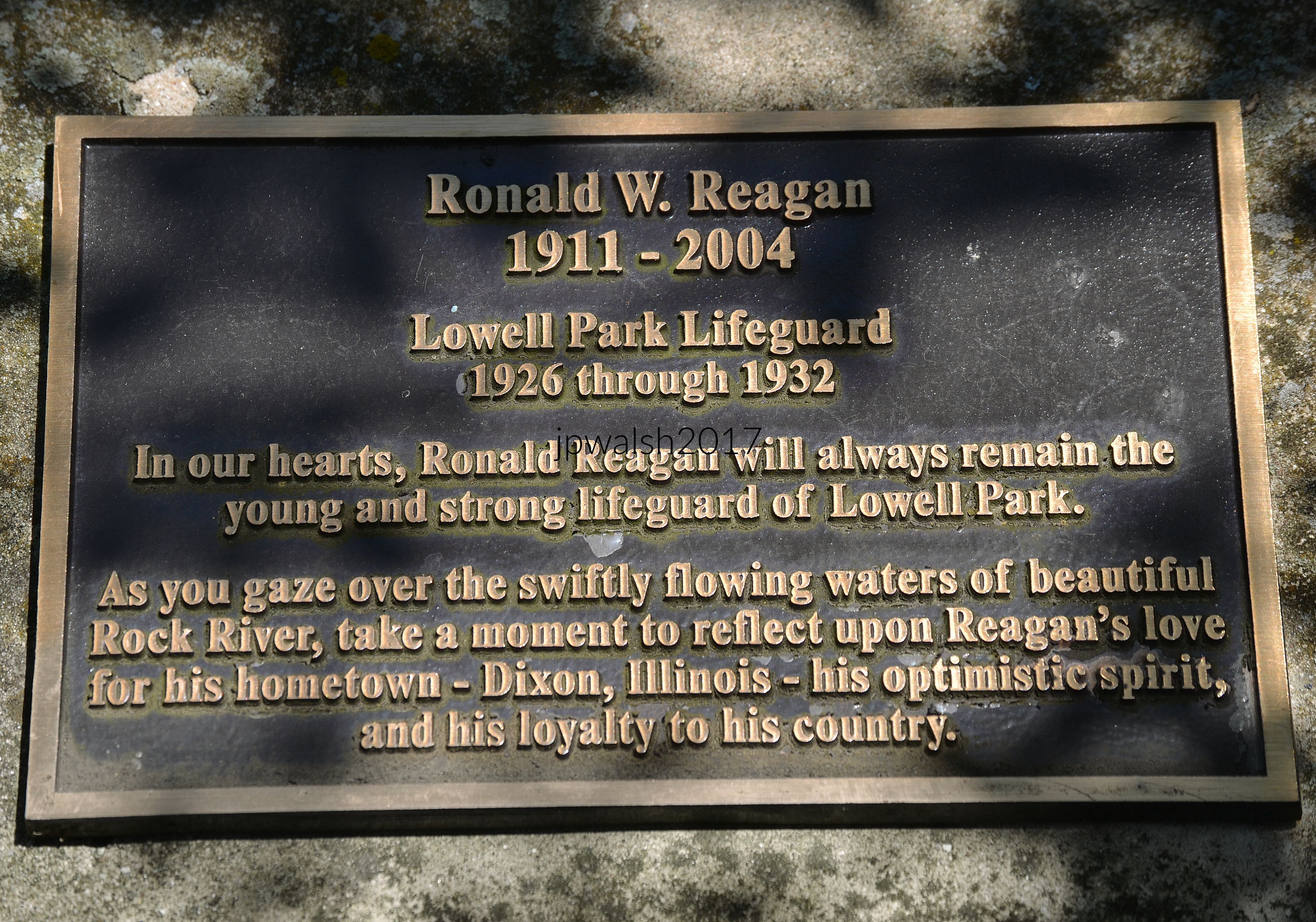
Reagan was a lifeguard at Lowell Park from 1926 to 1932. The original 200-acre public park opened in 1907 and began Dixon’s park system with the objective to preserve scenic beauty and establish civic beautification. From the start, Lowell Park attracted large numbers of people to its location along the Rock River. In this area, the valley of the Rock River contains bluffs and unique rock outcroppings that create a natural beauty. More than 100 years later, Lowell Park has maintained its distinctive scenic and natural recreational resources for free public use.
June 2017. 5.73mb DSC_0918.
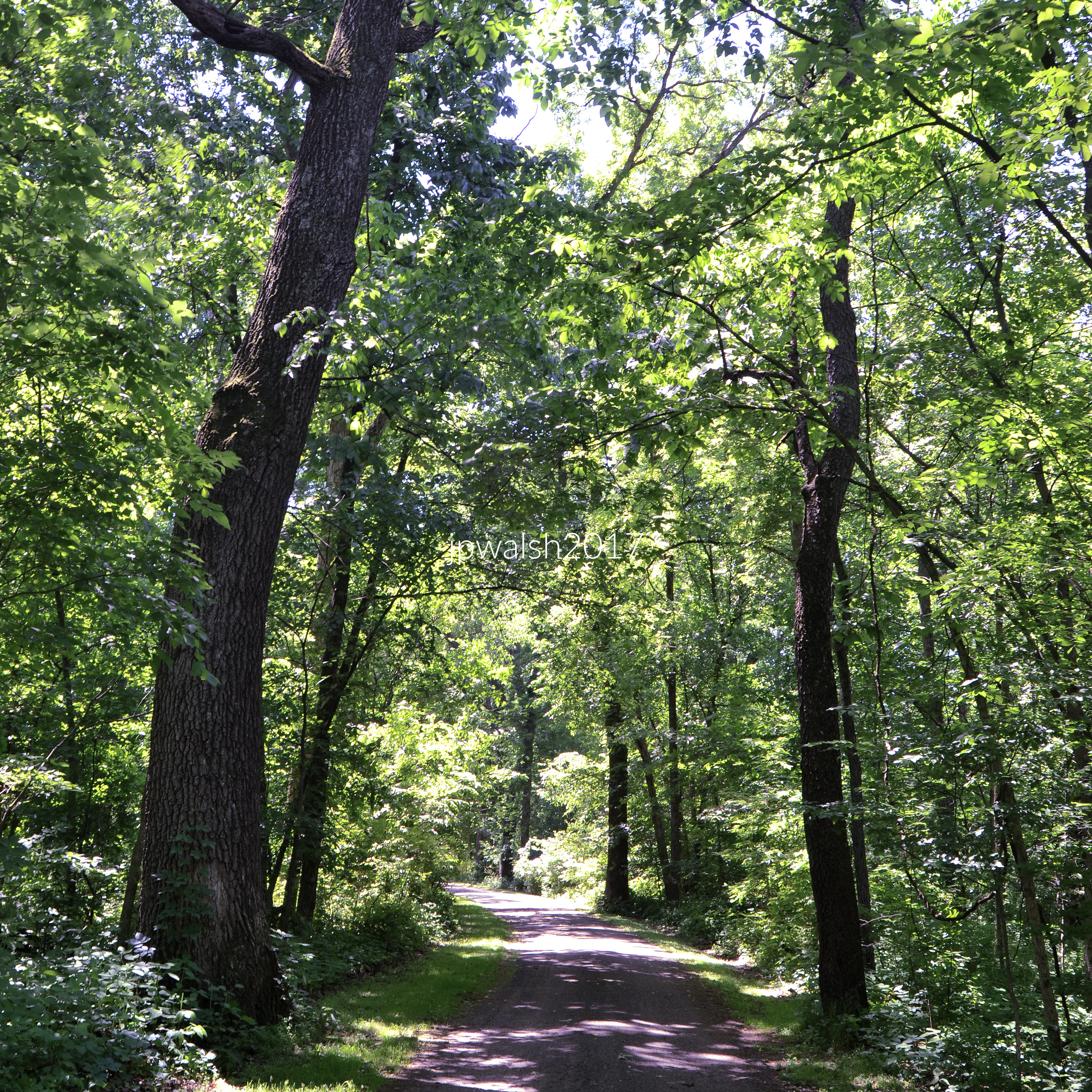
Lowell Park predated the development of Illinois state parks in areas of outstanding natural attractions by many years. Lowell Park is the only public place in the Dixon area that preserves remnants of the Boles Trail established in 1826from Peoria, Illinois, to Galena, Illinois. The trail was replaced in popularity by the famous Kellogg Trail established in 1825 east of the Boles Trail route. See – https://historyillinois.org/boles-trail-the/ – retrieved March 3, 2025.
Lowell Park, Dixon’s first recreational park, was gifted in 1906 by Carlotta Lowell who was the niece of James Russell Lowell (1819-1891), a famous Boston (Cambridge) poet. The family came west on the invitation of Alexander Charters, a wealthy New York businessman, who purchased a large, wooded estate overlooking the river north of Dixon in 1837 and named it Hazelwood. His home later became the estate of Mr. & Mrs. Charles R. Walgreen, founder of the drug store chain that bears that name. Charles Lowell. a guest at Hazelwood, purchased the adjacent tract of land to live. Lowell married Josephine Shaw, also originally of Boston, and then of Staten Island in New York. When the Civil War broke out, Charles enlisted and was promoted to the rank of colonel and was killed in 1864 at the Battle of Cedar Creek in northern Virginia. Carlotta never knew her father as she was born after his death and the family never lived on their land in Dixon. In 1874, they moved to New York City and stayed there the rest of their lives. After her mother died, Carlotta offered the property in 1906 to the City of Dixon for a park in memory of her parents.
June 2017. 5.11mb DSC_0780.
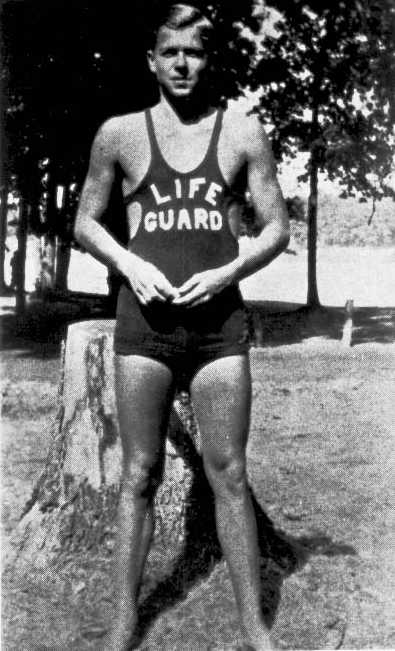
40th U.S. president Ronald Reagan visiting the Rock River in Lowell Park where he was an effective and beloved lifeguard for seven consecutive summers. In July 1921 a longer dock had been installed at the beach, extending 75 feet into the river with a springboard platform. The new bathhouse was built in 1922 that accommodated hundreds of bathers. Electricity was installed at the park in 1922 with lighting that allowed the beach to remain open until after dark. Over those summers, Reagan saved 77 swimmers from drowning. Obviously proud of his achievement, President Reagan often showed his Oval Office visitors a picture of the Rock River while telling them that his lifeguarding there was “one of the best jobs I ever had.”
The original 200 acres of Lowell Park opened to the public in 1907. The park was designed by the Olmsted Brothers, a nationally prominent architecture firm headed by the sons of Frederick Law Olmsted. Lowell Park was designed in the American Romantic style which is characterized by its emphasis on natural scenery, native plant materials, native building materials, curvilinear roads, and minimum formality. In 1959 the beach was finally closed after ten years of declining usage due to the opening of Memorial Pool in Vaile Park in the city of Dixon. The Lowell Park bathhouse was used for storage as its concession stand continued to operate until the late 1980s.
June 2017. Lowell Park was designed in the American Romantic style by the Olmsted Brothers. 7.24mb DSC_0916 (1)
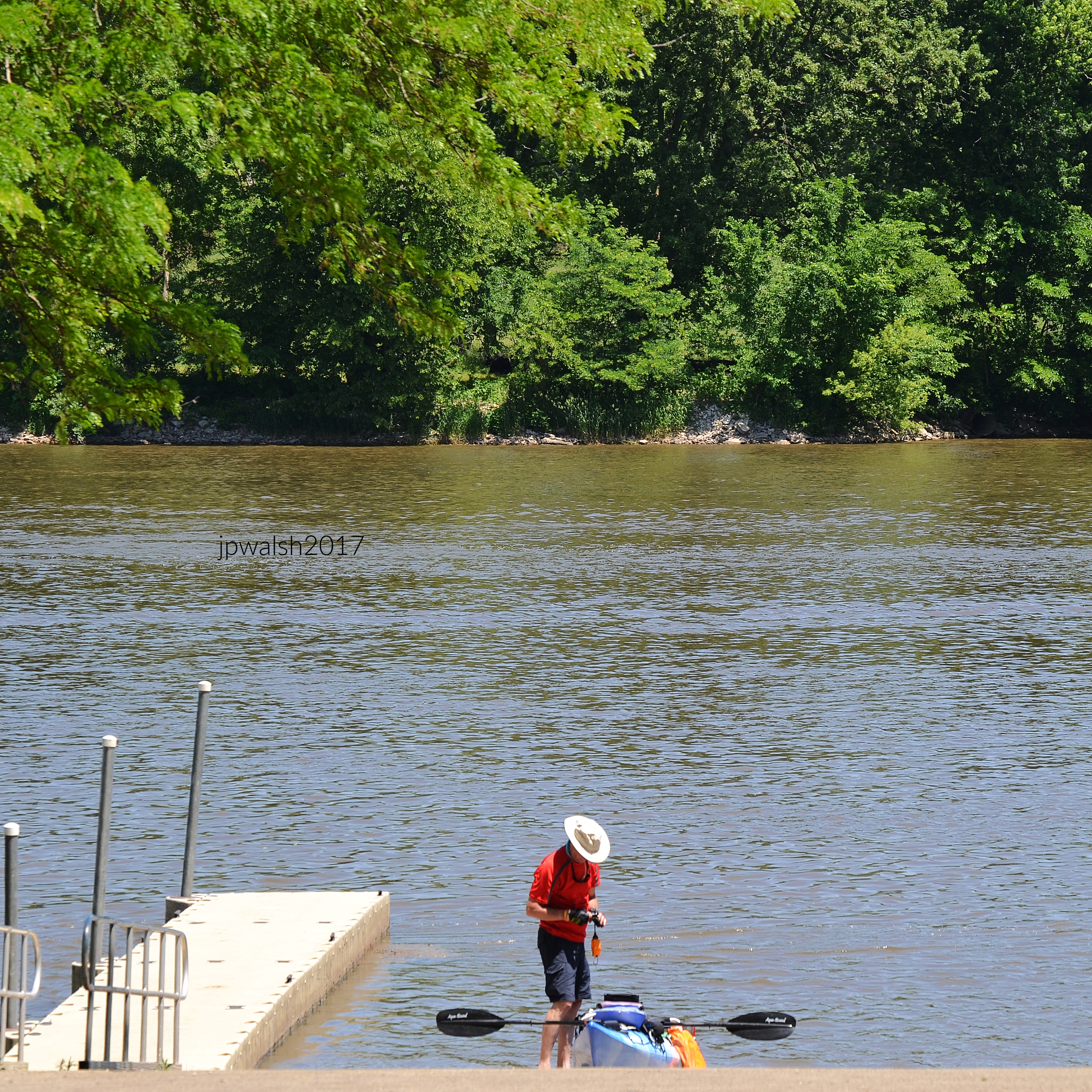
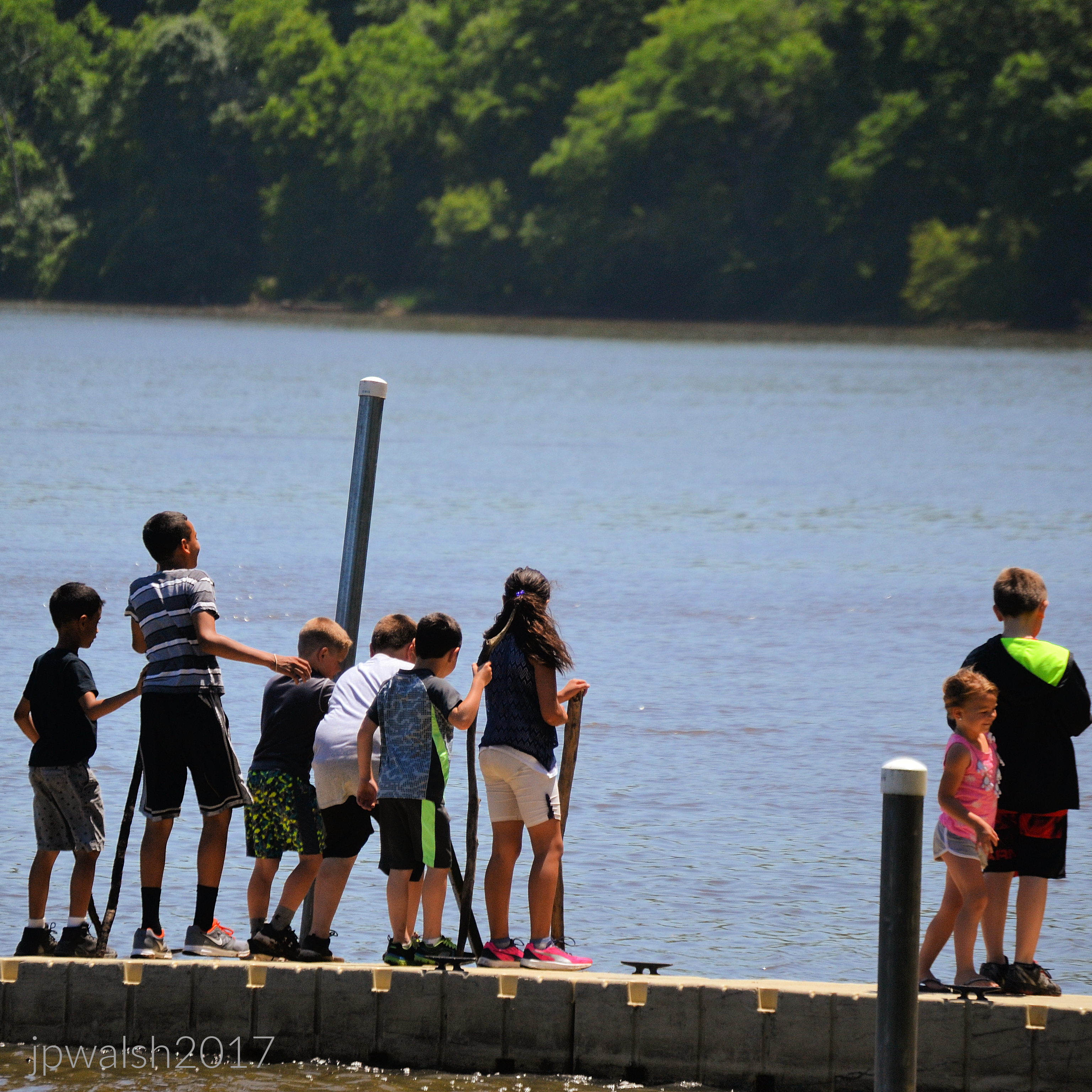
Rock River at Lowell Park is still the hub for recreational activities as it has been for over a century.
June 2017. 5.25mb DSC_0901.
President Reagan on his lifeguard years in Dixon: “One of the Best Jobs I Ever Had.”
Ronald Reagan as a lifeguard at Lowell Park in 1927. Public Domain.
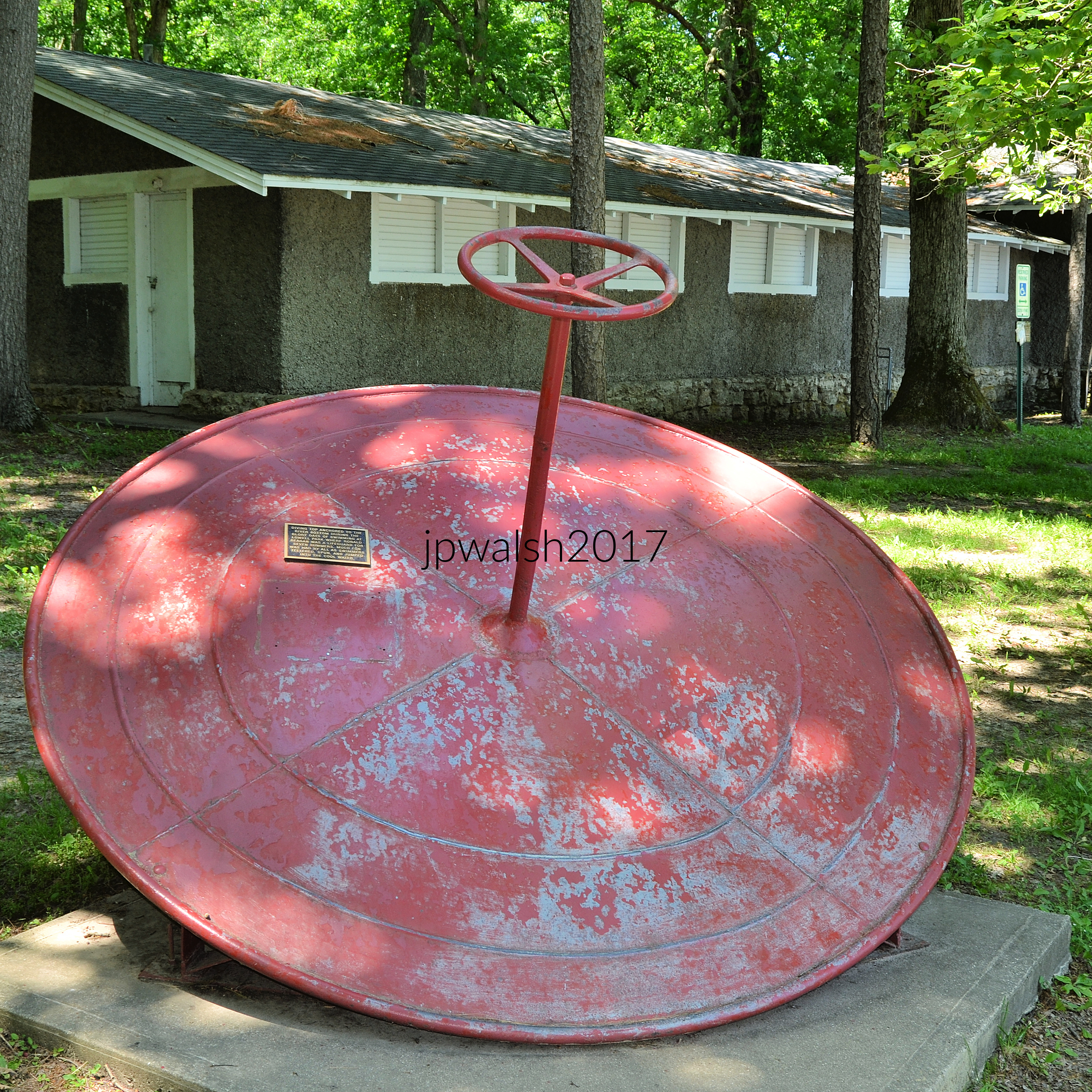
June 2017. Lowell Park, Dixon, IL. DSC_0882June 2017. Diving top with changing rooms and concession behind. Lowell Park, Dixon, IL. 5.38mb DSC_0896
Bus service from Dixon city to the park started in 1921. This diving top was anchored to the river bottom during its swimming hole glory days when Reagan was lifeguard. Swimmers teetered, spun and jumped into the water during hot Illinois summers which Reagan knew and loved. The one-story bathhouse behind it was designed and built in 1922. When Reagan was a lifeguard the building served as the concession stand and the check area for clothing baskets. Under a hipped roof, the men’s wing was to the south and women’s wing out of sight to the west. The architect of the bathhouse is unknown. Native stone was used from the ground to the height of the concession building’s serving counters and for the foundations of the two wings. Above that the walls were stucco on the exterior. All stonework was coursed and roughly squared. It was ventilated by raising the hinged board covers of the screened window openings. The steel-supported roof was covered originally with black-blue slate shingles that were replaced in 1934 with asphalt shingles. The overhang is broad with exposed rafters.
June 2017. Lowell Park, Dixon, Illinois. 3.53mb DSC_0877
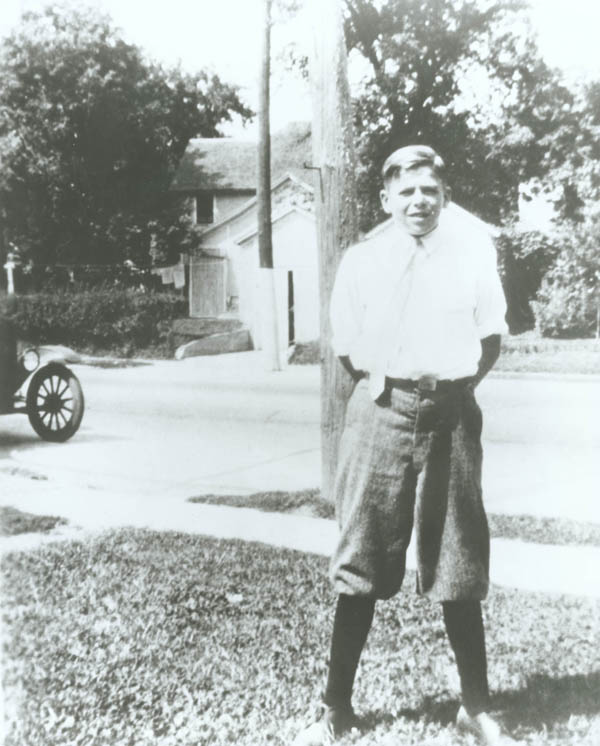
Ronald Reagan in Dixon, Illinois, in the early 1920’s. Public Domain.
June 2017. 5.93mb DSC_0774.
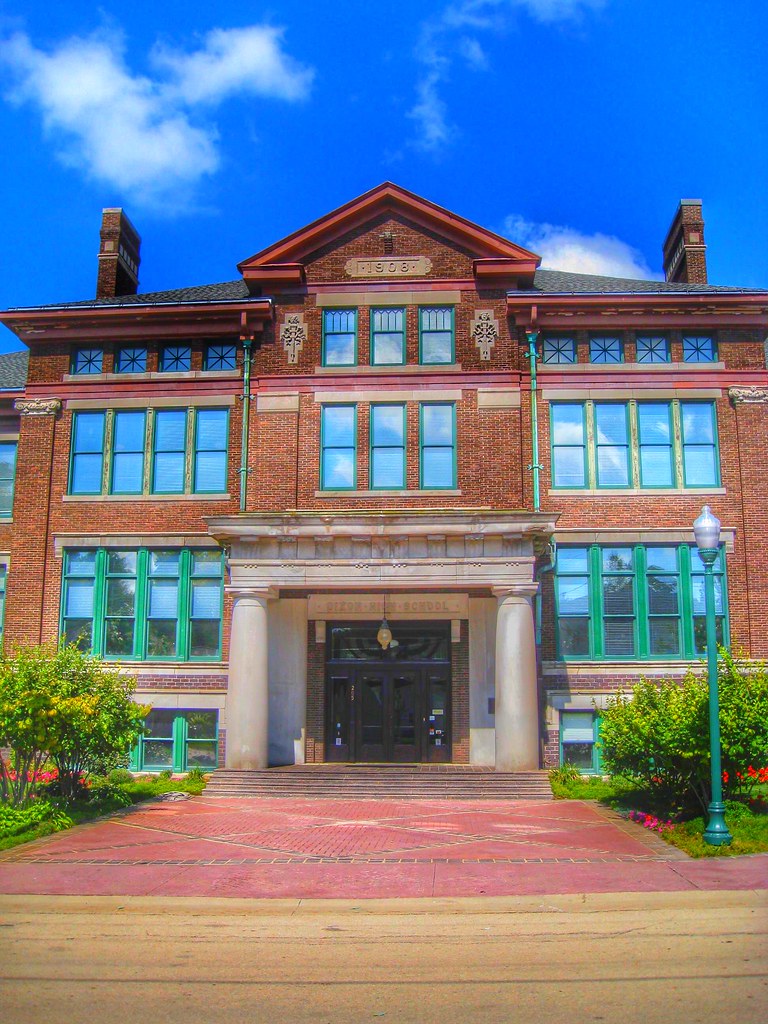
The Reagans settled in this rented house at 816 S. Hennepin Avenue in Dixon, Illinois, on December 6, 1920. The family of father Jack, mother Nelle, and 12-year-old Neil and 9-year-old Ronald lived here for three years. From 1921 to 1924, Neil and Ron attended South Side/Central School which still stands four blocks north of the house and is now the Dixon Historic Center. Reagan often walked along Hennepin Avenue going downtown to the Dixon Public Library at 221 South Hennepin Avenue and the First Christian Church at 123 South Hennepin Avenue where both Neil and Ron were baptized on June 1, 1922. Nelle taught Sunday school and sang in the church’s choir. Ronald and his mother were members of the Disciples of Christ church until 1937. Between 1924 and 1930, the Reagans lived in a rented house at 338 W. Everett Street in Dixon. Reagan lived in that house in Dixon when he was home from college after he began attending Eureka College in September 1928.
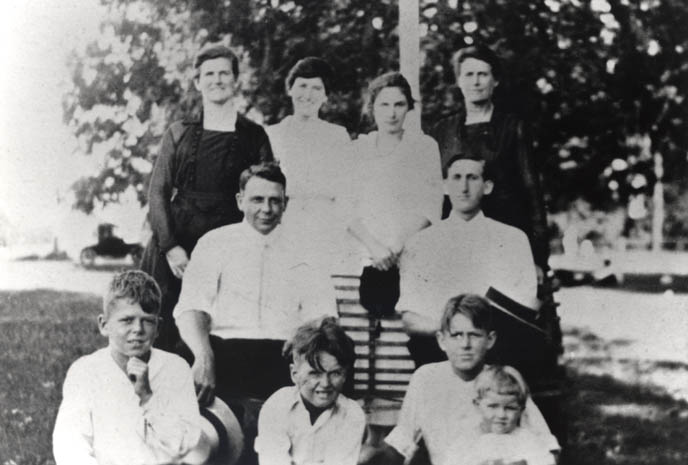
Reagan 1920s with family. Ronald Reagan sitting (hand on chin in front row) posing with other family members, Neil Reagan at far right (front row), Jack Reagan (middle row at left), Nelle Reagan (last row, second from left), Illinois. Public Domain.
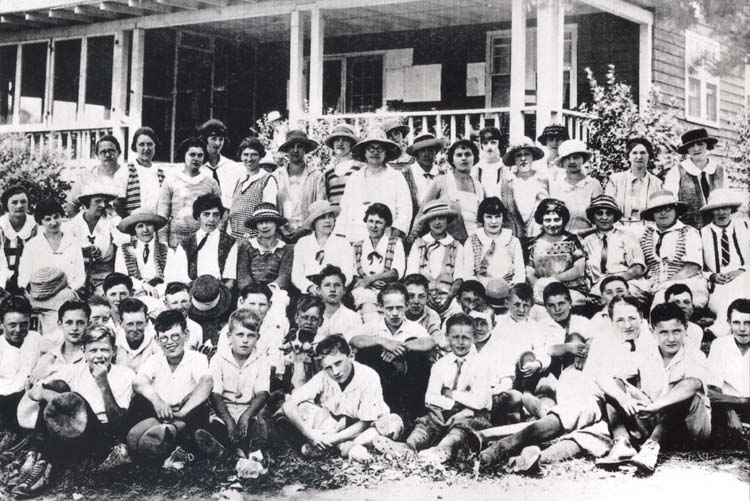
Ronald Reagan sitting (hand on chin in front row) with other golf caddies for the Lincoln Highway Ladies Golf Tournament in 1922 in DeKalb, Illinois. Public Domain.
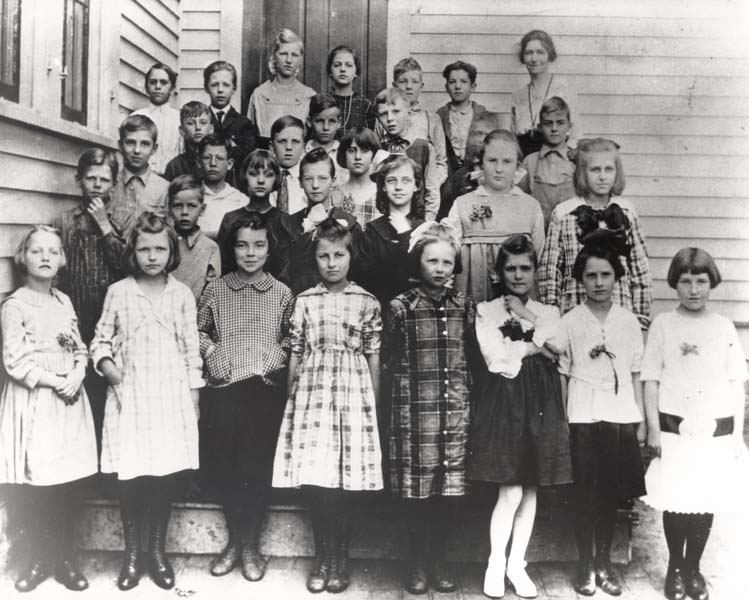
Reagan (second row, left) in 4th grade in Tampico, Illinois. Reagan was born in Tampico, Illinois, on February 6, 1911 in a second-floor apartment at 111 Main Street and, until 1914, at 104 W. Glassburn Street. Afterwards the family moved in sequence to Chicago, Galesburg, and Monmouth until they returned to Tampico in 1919-1920 and ultimately to Dixon in early December 1920. Reagan’s father was an alcoholic and they moved around a lot. As a young man Reagan became a lifesaver. Public Domain.
June 2017. Inside the Reagan Boyhood Home, Dixon, Illinois. 4.90mb DSC_0778 (1)
June 2017. Veterans Memorial Park, Dixon, Illinois. 6.41 mb DSC_0827.
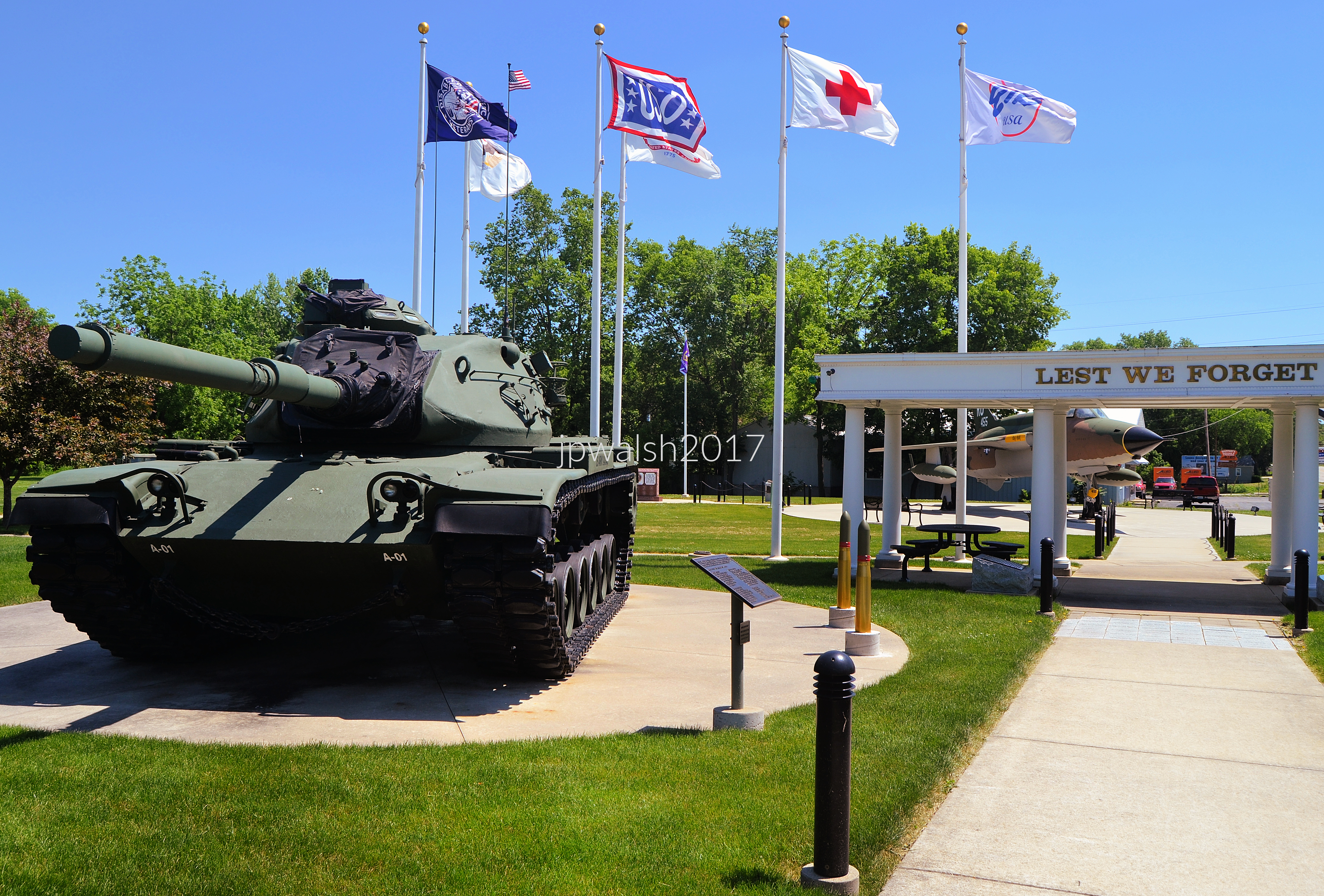
The M60 tank is designed as one of the main assault vehicles of an Armor/Mechanized Infantry/ Infantry Division. It weighs about 105,000 pounds unloaded and has a 64,000 pound payload. The tank can travel at top speeds of 30 m.p.h. and can travel nearly 300 miles.
June 2017. Veterans Memorial Park, Dixon, Illinois. 7.05mb DSC_0831.
Republic F-105D Thunderchief (serial #60-455) was a new aircraft that served the U.S. Air Force from 1958 to 1984. This specific aircraft fought in Vietnam between 1968 and 1970. It was stationed at Takhli Airforce Base in Thailand with the 355 Tactical Fighter Wing that was established in April 1962 at George AFB in California and transferred to Thailand in 1965. This F-105D Thunderbird was one of 833 airplanes manufactured by Republic in Farmingdale, New York, with over half the fleet lost in combat or due to mechanical failures. With 610 built, this particular warbird was the definitive production model with all-weather capability because of advanced avionics, including AN/APN-131 navigational (Doppler) radar. This aircraft was retired with almost 6000 flying hours and two men who had flown it receiving the Medal of Honor. The plane’s maximum range is 2390 miles at a maximum ceiling of 48,500 feet and reached speeds of supersonic Mach 2 (1,534 m.p.h.) at over 36,000 feet. In addition to a Vulcan Gatling Gun the plane’s payload includes 750-pound conventional bombs (16 of them) or one nuclear bomb.
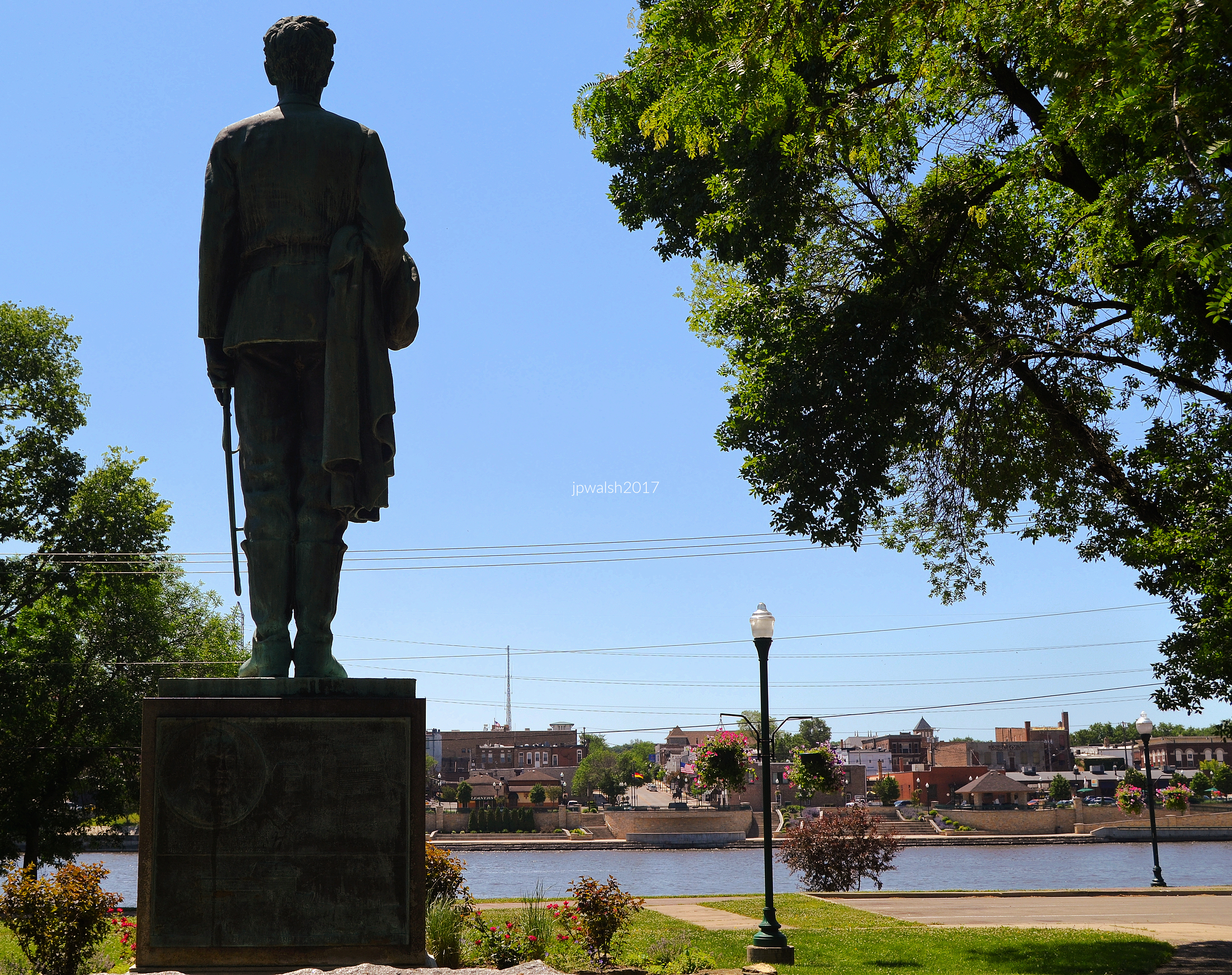
Capt. A. Lincoln, 16th president of the U.S., looking onto the Rock River in Dixon, Illinois, This 1930 statue by Leonard Crunelle (1872-1944) Reagan would have seen and known while living in Dixon. Young Lincoln enlisted in the Illinois Volunteers on April 21, 1832 and, following more enlistments, finally mustered out of military service on July 10, 1832. Across the Rock River is the modern Reagan statue.
June 2017. 4.37mb DSC_0785.
Ronald Reagan (1911-2004) lived in Dixon, Illinois from 1920 to 1933. Reagan always referred to Dixon as his “hometown.” Reagan made several visits to Dixon after he lived here, even when he was President of the United States. The statue is on the banks of the Rock River which is the same waterway where Reagan saved 77 lives as a lifeguard upstream at Lowell Park.
June 2017. 3.38mb DSC_0783.
After Reagan’s death in 2004 local donors commissioned this larger-than-life-sized statue of Dutch Reagan on a palomino horse and gifted it to the City of Dixon. It was dedicated to the eradication of Alzheimer’s that was a foe that President Reagan had to battle in last years.
June 2017. 5.28mb DSC_0786 (1)
Reagan in DIxon in the early 1920’s. Public Domain.
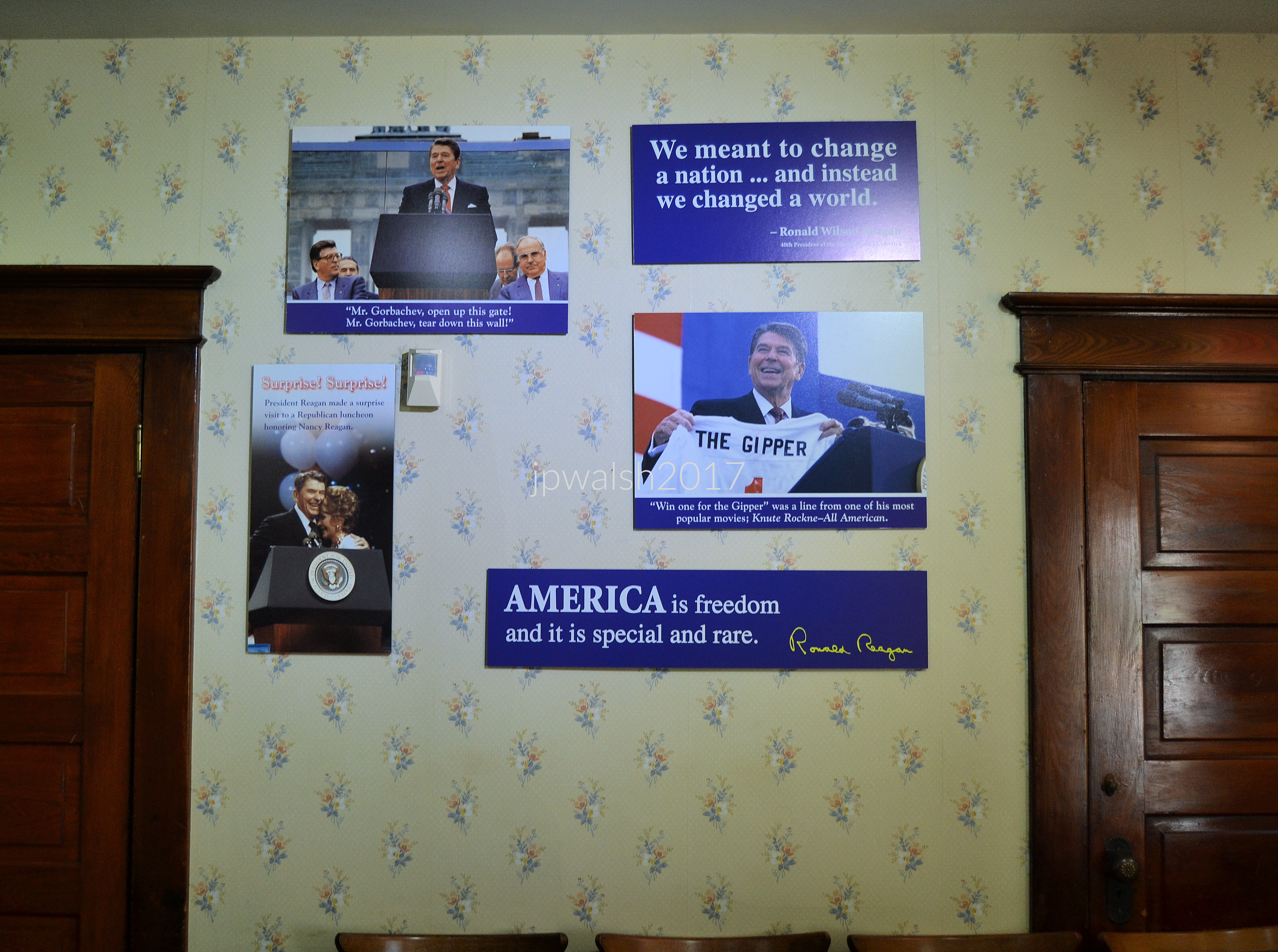
In 1982, President Reagan told the Eureka College audience, “Everything that has been good in my life began here.”
September 2016. Eureka College’s Burrus Dickinson Hall built in 1858. 3.87 mb
On campus at Eureka College in Eureka, Illinois, about 90 miles south of Dixon, where Reagan lived. The college, affiliated with the Disciples of Christ of which Ronald Reagan was a member, was founded in 1855. At the time of its founding Eureka was one of a handful of U.S. colleges that was co-ed. In 1856 Abraham Lincoln spoke on campus. After he graduated Reagan returned for campus visits at least a dozen times and served on its board of trustees. Reagan attended Eureka College from 1928 to June 10, 1932, when he graduated as the elected student body president with a degree in economics/sociology. Eureka College is the smallest college or university in American history to graduate a future U.S. president with a bachelor’s degree. The school is in Woodford County in Illinois.
On May 9, 1982, President Reagan announced the START treaty proposal in the Reagan Gym at Eureka’s commencement exercises. It resulted in a bilateral treaty signed in 1991 between the U.S. and U.S.S.R. on the reduction and the limitation of strategic offensive arms including nuclear warheads and intercontinental ballistic missiles and heavy bombers.
Ronald Reagan is the only U.S. president who was born, grew up and received his education in the state of Illinois.
September 2016. Part of the Berlin Wall. Eureka College. 2.40mb DSC_0493 (3)
Of Dixon the Gipper once said: “It was the place I really found myself.”
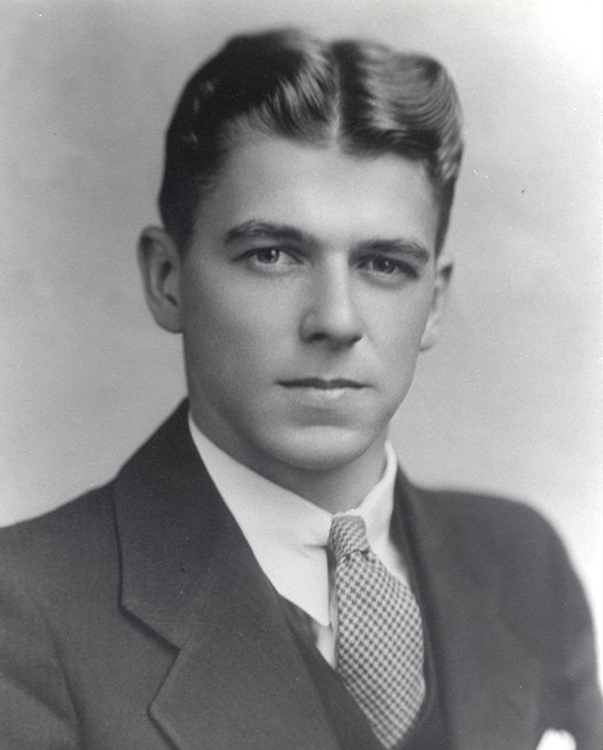
Portrait of Ronald Reagan in 1934 the year after he left Dixon, Illinois. His career led to Hollywood, California as a film actor and Screen Actors Guild president; to Sacramento, California as 33rd Governor of California (1967-1975); and to Washington, D.C., as 40th President of the United States of America (1981-1989). But it was to Dixon, Illinois, that Reagan always returned with its fond memories. Reagan graduated from Eureka College, a liberal arts school affiliated with the Disciples of Christ, in 1932 where he was active in sports and drama and elected student body president. Reagan’s first job was as a sports radio broadcaster in Davenport, Iowa, for Big Ten football games. Afterwards he was a sports announcer for Chicago Cubs’ baseball games on WHO-AM in Des Moines. Reagan arrived in Hollywood in 1937 and was cast in his first feature film Love is on the Air for Warner Bros. where he gets to play a newscaster. Fair use.
In Love is on the Air (1937) Ronald Reagan made his screen debut as a crusading radio reporter who takes on civic corruption.
This explanatory article may be periodically updated.
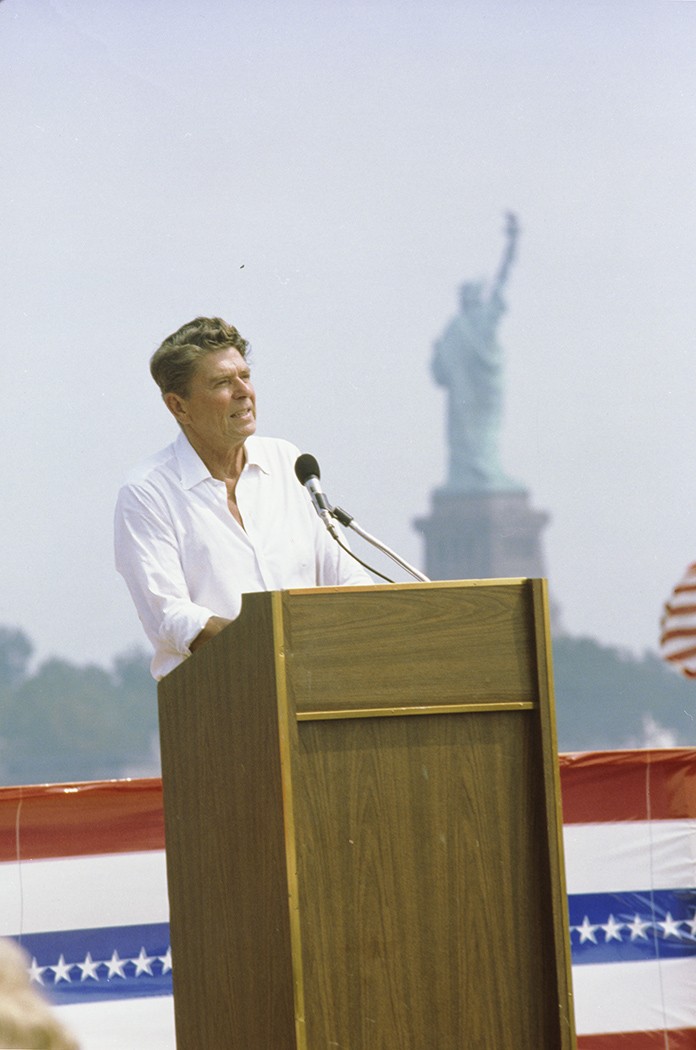
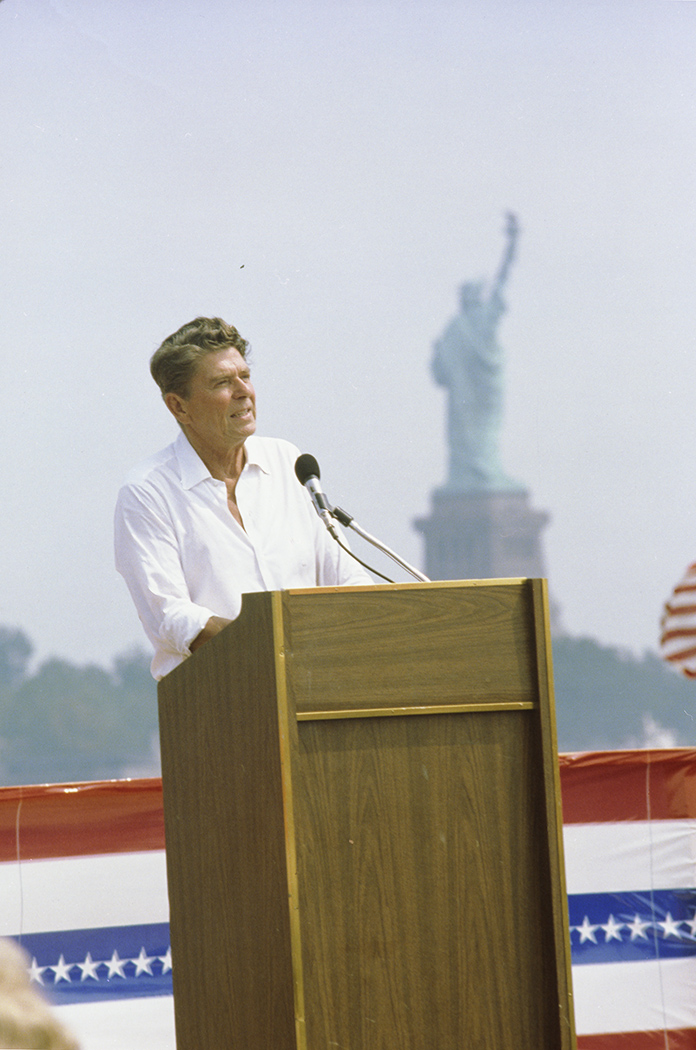
Reagan giving a speech in Liberty State Park in Jersey City, NJ on September 1, 1980. On a personal note, I met Ronald Reagan at the Palmer House in Chicago in June 1980 during a press conference. He was gracious and had movie star looks: tall and handsome. Reagan was elected the 40th U.S. president in a landslide over Jimmy Carter in November 1980 and re-elected in 1984. I later met Jimmy Carter in Chicago at a book signing in the 1990’s.
June 2017. 5.49 mb DSC_0776 (1)
Author and wife at Reagan Boyhood Home, Dixon, Illinois.
June 2017. 3.20mb DSC_0734 (2).
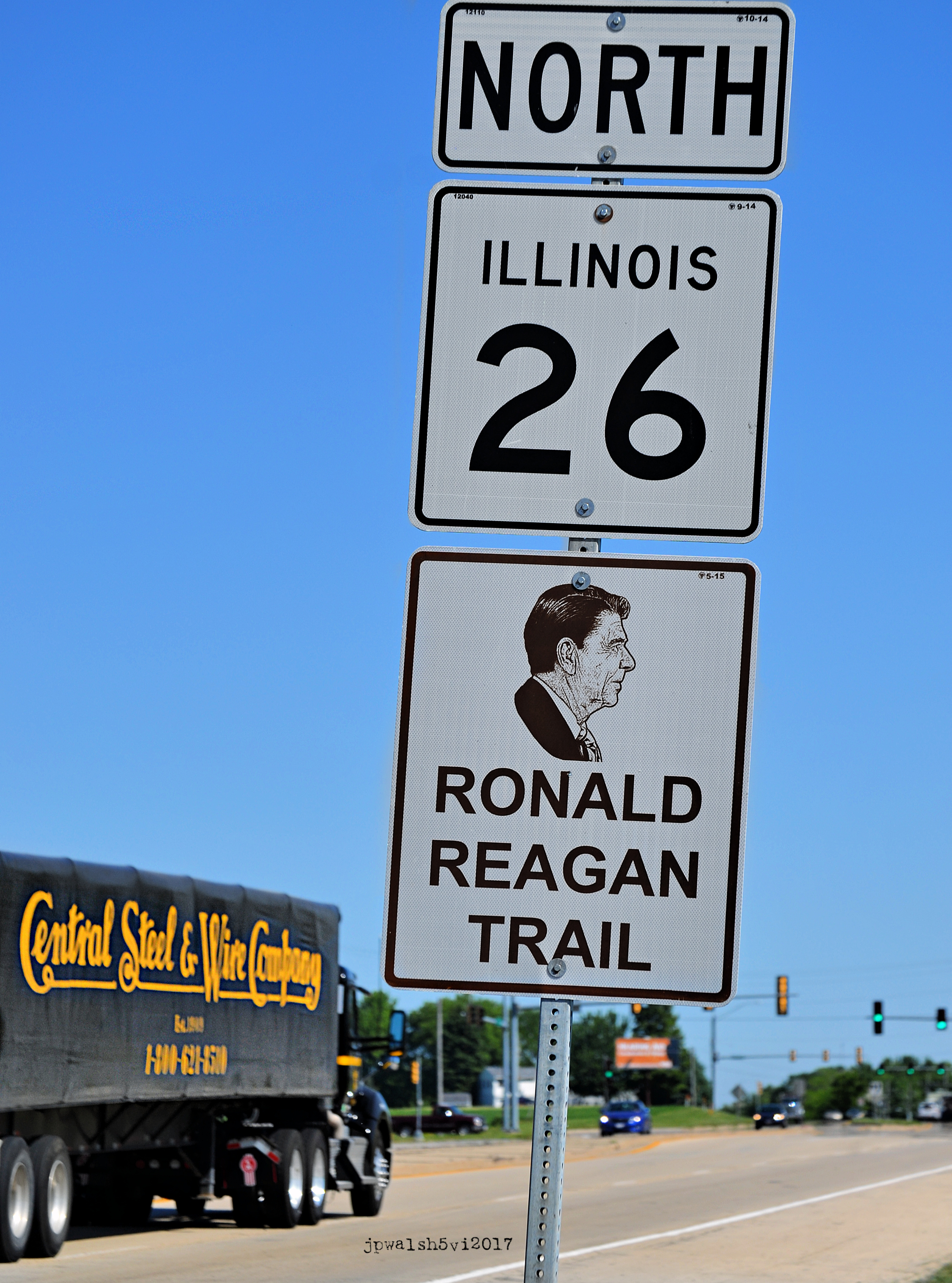
The Ronald Reagan Trail (IL-26) is a route in Illinois that follows sites of interest associated with the 40th president of the United States who was born in Tampico, Illinois and grew up in Dixon, Illinois. Route 26 originally ran north-to-south for about 25 miles from Freeport, Illinois to Polo, Illinois. In 1937, IL-26 was extended about 15 miles north to the Illinois-Wisconsin state line and about 15 miles south to Dixon, Illinois. In 1969, IL-26 was extended almost 100 miles south from Dixon to East Peoria, Illinois.
June 2017. Rock River at Lowell Park, Dixon, Illinois. 4.93 mb DSC_0865 (1). Author’s photograph.
January 3, 1960 — Announcement: One day after launching his campaign for the Democratic nomination, Kennedy immediately confronted a revived national anxiety: whether a Roman Catholic could serve as president without divided loyalties. As the first Catholic with a viable path to the White House, he faced sharp questioning over whether allegiance to the Pope might compromise his constitutional duties.
Religious Controversy: Kennedy moved quickly to defuse the issue. Kennedy, who happened to be Catholic, argued that religion should neither qualify nor disqualify a candidate. His position was deliberately universal. Though he made no excuses for his Catholic faith, he insisted that the presidency belongs to individuals, not categories. The controversy did not end there. In September 1960, before the Greater Houston Ministerial Association, he faced it down again, declaring that he was not the Catholic candidate for president, but the Democratic Party’s candidate who happened to be Catholic. The speech became the campaign’s clearest statement that personal identity must not become a political litmus test. He pledged to carry out the responsibilities of the presidency independent of any outside religious authority, rejecting both criticism and instruction. He argued for an uncompromising separation of church and state, stating that he would oppose a national church even if “99 percent” of Americans shared his faith.
Electoral Strategy: Beyond addressing religion, Kennedy used the NBC broadcast to outline his broader campaign logic. He rejected identity‑based ticket balancing, insisting that a major party’s presidential ticket should be shaped by geography and political experience rather than religious background.
Vice‑Presidential Speculation: He also dismissed rumors that he might accept the vice‑presidential slot, stating bluntly that he had no interest in “waiting for the president to die.” The unusually candid remark signaled his determination to run on his own terms and set the tone for the rest of his campaign.
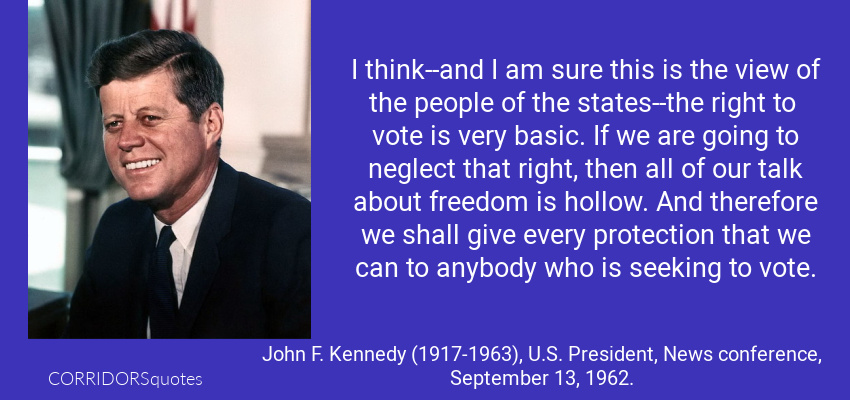
September 13, 1962 — News conference:
I think – and I am sure this is the view of the people and the states- the right to vote is very basic. If we are going to neglect that right, then all of our talk about freedom is hollow. And therefore we shall give every protection that we can to anybody who is seeking the vote.
October 26, 1963 — Remarks at Amherst College:
The men who create power make an indispensible contribution to the nation’s greatness. But the men who question power make a contribution just as indispensible for they determine whether we use power or power uses us.
September 13, 1960 — Kennedy-Johnson Joint Campaign Appearance, Grand Prairie, Texas:
Above: One of the rare joint appearances of Senators John F. Kennedy and Lyndon B. Johnson—the Democratic presidential ticket—in the 1960 campaign, which ultimately defeated the Republican ticket of Nixon–Lodge. During the second day of their Texas tour, the two men spoke to nearly 6,000 people in the parking lot of the Chance Vought Aircraft factory. It was at this stop that Kennedy was famously presented with a western cowboy hat, joking that he “didn’t have the guts to wear it” immediately. They also rode in a motorcade through the intersection of Main and Center streets in downtown Grand Prairie. Neither man was a natural campaigner: Kennedy’s hands often shook beneath a table or podium as he spoke, his voice growing hoarse, while Johnson, uneasy in crowds, frequently pushed himself into sick exhaustion on the trail.
Campaign Dynamics: Although both candidates wanted more joint appearances, their aides agreed such events mostly hurt the ticket’s image—especially Kennedy’s. Johnson was only nine years older, and both were the first U.S. presidents born in the 20th century, yet aides felt that when they stood together Kennedy looked almost like LBJ’s son. Still, the press and Johnson complained for weeks that the two men should campaign together more often, given the offices they sought.
Press Pressure: When reporters began hinting at a rift between the candidates as the reason for their limited joint schedule, the campaign arranged another appearance in November 1960, five days before Election Day. For that final joint even at the Biltmore in Los Angeles, Johnson flew out specifically to join Kennedy. The appearance received strong national print and television coverage, and on that Thursday before Americans went to the polls, both campaigns regarded it as a major success.
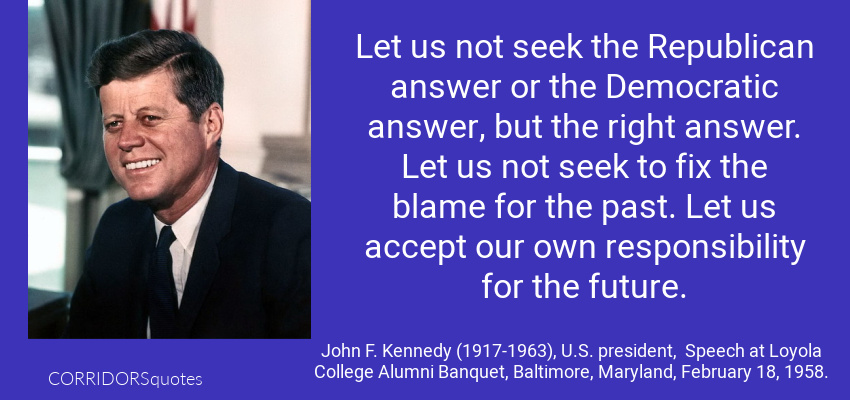
February 18, 1958 — Speech at Loyola College Alumni Banquet, Baltimore, Maryland:
Let us not seek the Republican answer or the Democratic answer, but the right answer. Let us not seek to fix the blame for the past. Let us accept our own responsibility for the future.
The Cuban Missile Crisis lasted from October 16 to October 28, 1962.Critical Milestones:
October 16: Kennedy was first shown U‑2 photographs revealing Soviet nuclear missile installations in Cuba.
October 22: Kennedy announced a naval “quarantine” of Cuba in a televised address to the nation.
October 24: Soviet ships approached the blockade line but stopped or turned back to avoid confrontation.
October 27 — “Black Saturday”: A U‑2 was shot down over Cuba, and a Soviet submarine was forced to surface by U.S. Navy signaling, marking the peak of the crisis.
October 28: Premier Nikita Khrushchev announced that the Soviet Union would dismantle and remove the missiles, ending the 13‑day standoff.
FROM 13 DAYS (2000). JFK: BOB, IS THERE ANY WAY TO AVOID STOPPING THE SUBMARINE FIRST? MCNAMARA: I’M AFRAID NOT MR. PRESIDENT. https://www.youtube.com/watch?v=gol-iCLcroY – retrieved April 20, 2026
In response to the rapid buildup of Soviet nuclear missiles in Cuba, President John F. Kennedy announced that the United States would impose a naval blockade—officially termed a “quarantine”—around the island. It went into effect on the morning of October 24, 1962, when American warships and aircraft tightened a ring around Cuba with orders to intercept any vessel suspected of carrying offensive military equipment.
Tension spiked almost immediately. Roughly 25 Soviet ships, some believed to be transporting nuclear missile components, continued steaming toward the quarantine line. U.S. commanders had standing instructions: any vessel refusing inspection could be stopped, diverted, and, if necessary, sunk. At 10:00 a.m., as the quarantine became active, Kennedy convened ExComm to assess the situation when new intelligence came in that made the situation immediately more precarious. Reports were that the approaching Soviet ships were joined by a Soviet sub armed with nuclear weapons, raising the risk of an existential, catastrophic confrontation. At the same time, aerial reconnaissance showed Soviet crews working feverishly in western Cuba to complete missile sites armed with nuclear warheads pointed at the U.S.—further evidence that the threat to U.S. national security, already considered imminent by the Kennedy Administration, was growing by the minute.
On the diplomatic front, the crisis was unresolved as it was debated by delegates at the U.N. whether Kennedy’s blockade was even legal under international law. Soviet leaders accused the United States of issuing an ultimatum and warned that force would be met with force. Meanwhile protests were organized on each side across the globe as political maneuvering accelerated.
By the end of October 24, 1962, the first signs of restraint appeared: several Soviet ships slowed or halted before reaching the quarantine line, suggesting Moscow might be reconsidering its next move. Even so, the world understood, some for the first time, that it stood on the precipice of nuclear war. The day ended with both superpowers locked in the most dangerous equilibrium of the crisis so far – both armed, alert, and waiting for the next move – with no one knowing whether diplomacy or confrontation would ultimately prevail.
October 31, 1962 — Three Days After the Cuban Missile Crisis, JFK Meets the Archbishop of Canterbury at the White House:
Above: Rev. Dr. Michael Ramsey (1904–1988), Archbishop of Canterbury, meets with President John F. Kennedy on Halloween, 1962—just three days after the Cuban Missile Crisis ended. The world was still exhaling in relief: armed confrontation between the superpowers had been narrowly avoided, and October 27 had been the crisis’s most perilous day. A U‑2 reconnaissance plane was shot down by Soviet‑supplied SAM missiles, killing the USAF pilot. Kennedy’s ExComm urged immediate military retaliation, but he resisted. That same night, Robert Kennedy met secretly with Soviet Ambassador Anatoly Dobrynin in Washington, where they reached a tentative understanding pending Moscow’s approval. By the next morning, October 28, Radio Moscow announced acceptance of Kennedy’s proposal, ending the 13‑day standoff.
Michael Ramsey had been appointed Archbishop of Canterbury on May 31, 1961, and installed the following month, serving until 1974. In 1962 he was also president of the World Council of Churches (1961–1968). During his archbishopric, the first woman Anglican priest—Chicago‑born high‑altitude balloonist Jeannette Piccard—was ordained in the United States in 1974.
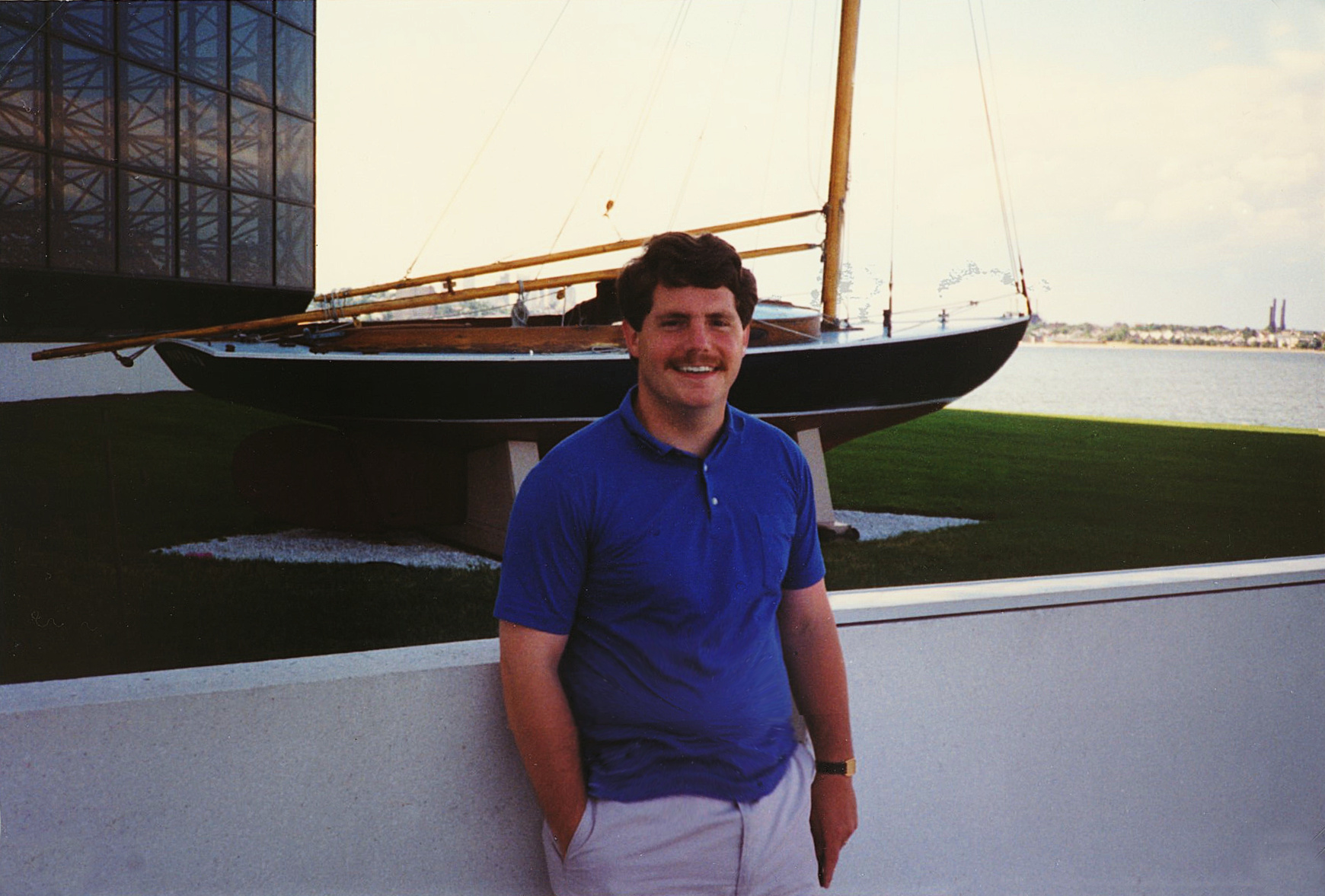
Massachusetts: John F. Kennedy Library, Columbia Point, Boston (June 1989):
July 1989 — The author at the John F. Kennedy Library, Columbia Point, Boston.
Standing near JFK’s iconic sailboat, 1989 marked the Library’s tenth anniversary, a moment when the institution shifted from a young presidential repository into a fully established center of civic education, political legacy, and architectural study. Its most enduring milestone of 1989 was the formal creation of the Profile in Courage Award by members of the Kennedy family. Just five weeks before this photograph, Columbia Point hosted a major family gathering on May 25, 1989, attended by Jacqueline Kennedy Onassis, Senator Ted Kennedy, Caroline Kennedy, and John F. Kennedy Jr., underscoring the Library’s growing national prominence a decade after its opening
John F. Kennedy Family House (1957), 3307 N Street, Georgetown, Washington, D.C. (October 2003):
Author’s photograph.
June 1957 — A Georgetown Purchase In June 1957, Massachusetts Senator John F. Kennedy bought this three‑story Federal‑style house as a gift for his wife, Jacqueline Kennedy after the birth of their daughter, Caroline. Their son, John Jr., was also born while the family lived here.
Campaign Life at 3307 N Street During JFK’s 1958 Senate re‑election and the 1960 presidential campaign, Jackie hosted teas in the home’s double living room. The front entrance became nationally recognizable when President‑elect Kennedy stepped outside to announce major appointments — including naming his younger brother and campaign manager, Robert F. Kennedy as U.S. Attorney General.
President-Elect John F. Kennedy and Chester Bowles emerge from a breakfast conference at Kennedy’s Georgetown home in Washington, on Nov. 29, 1960. Bowles was appointed Under Secretary of State and later was Kennedy and Johnson’s ambassador to India.
January 20, 1961 — Departure for History On the morning of January 20, 1961, Kennedy famously left from this doorstep to travel to the U.S. Capitol for his swearing‑in as the 35th President of the United States. The house was sold later that year when the family moved into the White House.
Early 19th‑Century Origins Beyond its presidential associations, the home was originally built in 1811–12 for William Marbury (1762–1835), the financier and plaintiff in the landmark 1803 Supreme Court case Marbury v. Madison — the decision that established the foundational principle of judicial review.
The Garden Refuge The Kennedys used the brick‑walled garden at 3307 N Street as a quiet refuge, especially during the 1960 campaign. With JFK traveling constantly, he rarely found time for his painting hobby, though he did spend occasional Sunday afternoons in the garden with Jackie and Caroline, away from the public spotlight.
Aesthetic Balance Inside the home, Jackie’s classical European taste was balanced with historical maritime art and paintings of naval vessels — a nod to Kennedy’s U.S. Navy service and lifelong passion for the sea.
Massachusetts: The John Fitzgerald Kennedy National Historic Site (Birthplace, 1917), Brookline, Massachusetts (July 1989) (August 2005):
July 1989 — The John Fitzgerald Kennedy National Historic Site at 83 Beals Street preserves the birthplace and early childhood home of the 35th president. The house, built in 1909 by local architect‑builder Robert M. Goode, is a two‑and‑a‑half‑story Colonial Revival structure with a green‑shingled exterior, an asymmetric cross‑gabled roof, prominent dormers, and a front porch topped by an upper balustrade deck. It stands in Brookline’s Coolidge Corner neighborhood, a dense early‑20th‑century streetcar suburb of tree‑lined residential blocks bordering Boston.
Three Kennedy children were born in the second‑floor master bedroom: John F. Kennedy on May 29, 1917; Rosemary Kennedy on September 13, 1918; and Kathleen Kennedy on February 20, 1920. Their older brother, Joseph P. Kennedy Jr., was born in Hull, and the later five siblings — including Bobby and Ted — were born around the corner in the larger family home on Abbottsford Road.
August 2005 — The John Fitzgerald Kennedy National Historic Site in Brookline, Massachusetts. Author’s photograph.
JFK’s birthplace and childhood home—stands on Beals Street in the Boston suburbs. Joseph Patrick Kennedy purchased the house in August 1914, just ahead of his October marriage to Rose Elizabeth Fitzgerald. A driven, opportunistic young bank president and businessman, he began building his fortune during World War I through shipbuilding contracts in the Quincy yards. In Brookline, Joe Kennedy was an affectionate father who fostered a spirited sense of competition among the Kennedy children, shaping the family ethos that would define their later public lives.
August 2005 — The John Fitzgerald Kennedy National Historic Site in Brookline, Massachusetts. Author’s photograph.
John F. Kennedy was born in this upstairs master bedroom of this Beals Street home in the mid-afternoon (3 p.m.) on Tuesday, May 29, 1917, an unseasonably cold (44 degrees), overcast, and rainy day. The family lived on Beals Street until 1920, then moved a short walk away to a larger house on Abbottsford Road, where they remained until 1927 before relocating to New York. Rose Fitzgerald—daughter of Boston’s first American‑born Irish mayor—had seven of her nine children in Brookline and was reluctant to leave. John F. Kennedy was her second child and son.
In Brookline, Joe Kennedy, son of a local pol and saloonkeeper, instilled a competitive spirit in his children, while Rose, who had studied in Europe, taught them an appreciation for the arts and history. A devout Catholic, Rose took her children on weekday walks to market and then to church, reinforcing their faith as part of daily life, not just Sundays.
After Joseph P. Kennedy sold the Beals Street house to family friend Edward Moore, the property passed through several owners over the next four decades. Following JFK’s assassination in 1963, thousands of mourners visited the home, turning it into an impromptu pilgrimage site. In 1966, the current owners agreed to sell the house back to the Kennedy family so it could be preserved as a permanent memorial.
Rose Fitzgerald Kennedy then led a full restoration of the interior, working from her own memories and period décor to recreate the exact appearance of the home as it looked on the day John F. Kennedy was born in 1917. When the project was complete, the Kennedy family donated the property to the National Park Service in 1969, establishing what is now the John Fitzgerald Kennedy National Historic Site. Rose Kennedy said she gave the house to the American people so that “future generations will be able to visit it and see how people lived in 1917 and thus get a better appreciation of the history of this wonderful country.” see – https://www.nps.gov/jofi/index.htm – retrieved May 29, 2025.
February 26, 1962 — Voice of America speech:
(56 seconds). “We are not afraid to entrust the American people with unpleasant facts, foreign ideas, alien philosophies, and competitive values. For a nation that is afraid to let its people judge the truth and falsehood in an open market is a nation that is afraid of its people.” -John F. Kennedy, Voice of America speech, February 26, 1962.
In a 1962 address to the Voice of America, President John F. Kennedy defined the organization’s mission as a duty to champion truth, transparency, and the free flow of information, even when revealing internal “blemishes and warts.” He emphasized that a free nation must not fear truth and that the “burden of truth” serves the cause of freedom.
SPEAKING OF FREEDOM OF INFORMATION IN A FREE COUNTRY TO THE ENTIRE WORLD: “The Voice of America speaks. Today America has been at war for 79 days. Daily at this time we shall speak to you about America and the war, and the news may be good or bad. We shall tell you the truth”… …We seek a free flow of information across national boundaries and oceans, across iron curtains and stone walls. We are not afraid to entrust the American people with unpleasant facts, foreign ideas, alien philosophies, and competitive values. For a nation that is afraid to let its people judge the truth and falsehood in an open market is a nation that is afraid of its people. The Voice of America thus carries a heavy responsibility. Its burden of truth is not easy to bear. …And as you tell it, it spreads. And as it spreads, not only is the security of the United States assisted, but the cause of freedom.” See – https://www.presidency.ucsb.edu/documents/remarks-the-20th-anniversary-the-voice-america – retrieved May 29, 2025.
November 22, 1963 — Fort Worth Remarks Before the Texas Hotel:
On a rainy morning in front of the Texas Hotel in Fort Worth, President John F. Kennedy delivered brief remarks at a citizen’s rally. He outlined three pillars of national security: military strength, economic prosperity, and superiority in space exploration, noting that Fort Worth would again “play its proper part.”
KENNEDY: “What we are trying to do in this country and what we are trying to do around the world, I believe, is quite simple: and that is to build a military structure which will defend the vital interests of the United States. And in that great cause, Fort Worth, as it did in World War II, as it did in developing the best bomber system in the world, the B‑58, and as it will now do in developing the best fighter system in the world, the TFX, Fort Worth will play its proper part. And that is why we have placed so much emphasis in the last 3 years in building a defense system second to none, until now the United States is stronger than it has ever been in its history. And secondly, we believe that the new environment, space, the new sea, is also an area where the United States should be second to none.”
November 22, 1963 — The Johnsons Telephone Their Condolences to Rose Kennedy in the Immediate Aftermath of the Assassination:
November 22, 1963 — Rose and Joe Kennedy at Hyannis Port
On a clear “bluebird” morning at the Hyannis Port compound, Rose Kennedy followed her usual routine, attending morning Mass before returning home for lunch with Joe, who remained severely impaired from his 1961 stroke. After a short drive together, Rose received a call from her son, Attorney General Robert Kennedy: the President—her son Jack—had been shot in Dallas. A second call soon followed, confirming he was dead.
Rose withdrew to grieve in solitude, walking the beach and sitting quietly in her room, later reflecting that she asked God how decades of preparing her children for service could be undone in seconds. At approximately 4:15 p.m., she took a call from the new president, Lyndon Johnson, speaking from Air Force One shortly after being sworn in and as he returned to Washington with President Kennedy’s body. Composed, Rose addressed him as “Mr. President.”
June 11, 1963 — Oval Office Report to the American People on Civil Rights:
This nation was founded on the principle that all men are created equal, and that the rights of every man are diminished when the rights of one man are threatened.
May 27, 1963 — Supreme Court Signals an End to Evasion of Brown v. Board
On May 27, 1963, the Supreme Court declared that it would no longer tolerate evasions of its 1954 Brown v. Board of Education ruling. The statement came in another desegregation case involving public parks. When the Court issued Brown in 1954, it could not have foreseen the years of delay and resistance that followed.
June 5–10, 1963 — Federal Orders and Kennedy’s Warning to Wallace
On June 5, a federal court enjoined Alabama Governor George Wallace from obstructing the admission of two qualified Black students to the University of Alabama. President John F. Kennedy reinforced the order on June 10, writing to Wallace and urging him not to interfere.
June 11, 1963 — Wallace “Stands in the Schoolhouse Door”
On June 11, Wallace carried out his pledge to “stand in the schoolhouse door,” physically blocking the students from enrolling. When he refused to yield to federal marshals, Kennedy nationalized the Alabama National Guard. Guard troops arrived, Wallace stepped aside, and the students entered and registered for classes.
June 11, 1963 — Kennedy’s Civil Rights Address from the Oval Office
That evening, Kennedy delivered his “Report to the American People on Civil Rights” from the Oval Office. In a 13‑minute address, he set out the moral and legal issues surrounding civil rights and previewed legislation that would become the Civil Rights Act of 1964. After two cautious years, the speech marked a decisive shift: Kennedy gave a full‑throated endorsement of civil rights and federal action to secure them.
June 12–13, 1963 — The Murder of Medgar Evers and Local Repression
In the early hours of June 12, civil rights leader Medgar Evers, who had listened to Kennedy’s remarks, was assassinated outside his home in Jackson, Mississippi. On June 13, Jackson police arrested 82 Black marchers protesting Evers’s murder. Within a week, a white suspect was arrested and charged.
June 19, 1963 — Kennedy Sends His Civil Rights Bill to Congress
On June 19, Kennedy asked Congress to introduce his civil rights bill, seeking desegregation of public facilities, federal action to end job discrimination, and authority for the Attorney General to initiate desegregation suits.
Summer 1963 — Civil Rights Leaders Reject a Pause in Demonstrations
As Congressional debate and filibuster began, Kennedy asked civil rights leaders to suspend protests and marches. They refused. Instead, they announced a March for Jobs and Freedom in Washington, D.C., to take place in August 1963.
See- Kennedy and the Press, edit. Harold W. Chase and Allen H. Lerman, introduction by Pierre Salinger, Thomas Y. Crowell Company, New York, 1965, p. 452.
June 26, 1963 — Berlin speech at Rudolph Wilde Platz November 21, 1963 —Texas motorcade & remarks at the dedication of the Aerospace Medical Health Center, San Antonio August 1, 1963—color recording of remarks for “Seas Around Us” September 12, 1962—Moon speech, Rice University, Houston, Texas
(27 seconds).
April 27, 1961 — Address before the American Newspaper Publishers Association, Waldorf-Astoria Hotel, New York City:
On April 27, 1961, President John F. Kennedy delivered his 2400-word+ major speech known as “President and the Press” before the American Newspaper Publishers Association at the Waldorf-Astoria Hotel in New York City. In the speech delivered just days after the failed Bay of Pigs Invasion the new president made a plea for responsible journalism in the face of Cold War threats. The remarks remain relevant today on the topics of press freedom, misinformation, and national security.
I am not asking your newspapers to support the Administration, but I am asking your help in the tremendous task of informing and alerting the American people. For I have complete confidence in the response and dedication of our citizens whenever they are fully informed. see – https://www.jfklibrary.org/archives/other-resources/john-f-kennedy-speeches/american-newspaper-publishers-association-19610427#:~:text=This%20Administration%20intends%20to%20be,out%20when%20we%20miss%20them. – retrieved March 25, 2025.It was early in the 17th century that Francis Bacon [1561-1626] remarked on three recent inventions already transforming the world: the compass, gunpowder and the printing press. Now the links between the nations, first forged by THE COMPASS have made us all citizens of the world, the hopes and threats of one becoming the hopes and threats of us all. In that one world’s efforts to live together, the evolution of GUNPOWDER to its ultimate limit has warned mankind of the terrible consequences of failure. And, so, it is to the PRINTING PRESS–to the recorder of man’s deeds, the keeper of his conscience, the courier of his news–that we look for strength and assistance, confident that with your help man will be what he was born to be: free and independent. I not only could not stifle controversy among your readers–I welcome it. This Administration intends to be candid about its errors; for as a wise man once said: “An error does not become a mistake until you refuse to correct it.” We intend to accept full responsibility for our errors; and we expect you to point them out when we miss them.
John F. Kennedy 1960 Campaign Ad For Social Security:
When Franklin D. Roosevelt signed the Social Security Act on August 14, 1935, he called the new federal retirement program a “cornerstone.” It became one of the central pillars of the New Deal and a defining feature of modern American social policy.
A Personal Reflection from 1998
In 1998, at a Chicago book signing for The Virtues of Aging, I met former President Jimmy Carter and asked whether he believed Social Security was destined to disappear. Carter replied that he did not think so, a view reflecting the long‑standing bipartisan commitment to the program’s survival.
Social Security Under Strain in 2026
By 2026, Social Security faces unprecedented pressure. The aging population has surged: 75 million seniors now receive benefits—three times the number in 1975. Meanwhile, a smaller workforce contributes payroll taxes to support a rapidly growing pool of beneficiaries. Trust‑fund reserves are being depleted, and insolvency is projected for the mid‑2030s.
Kennedy’s 1960 Visit to Hyde Park
During the 1960 presidential campaign, Democratic nominee John F. Kennedy visited Hyde Park, New York, the national shrine home of Franklin D. Roosevelt. The occasion marked the 25th anniversary of the Social Security Act. Kennedy addressed 2,000 senior citizens gathered to honor Roosevelt and hear the young senator outline his vision for strengthening the program.
Kennedy’s Proposals for America’s Aging Population
In his remarks, Kennedy advanced a series of proposals aimed at improving the lives of older Americans and modernizing Social Security. Among them:
Federal medical care — a precursor to Medicare, which would be enacted in 1965.
Cost‑of‑living adjustments — automatic increases to keep pace with inflation, implemented in 1975.
Incentives for continued work — allowing older Americans to earn more without losing benefits.
Vocational guidance — support for retirees seeking new roles or training.
Adequate housing — expanding federal efforts to provide safe, affordable homes for seniors.
Medical research — increased study of diseases associated with aging.
Higher survivor benefits — expanded support for spouses caring for under‑age children.
A Continuity of Purpose
Kennedy’s 1960 message echoed Roosevelt’s original vision: Social Security was not merely a retirement program but a national commitment to dignity, security, and opportunity in old age. His proposals anticipated many reforms that would shape the program in the decades to come.
March 29, 1962—News Conference 29:
The Tax Cut Bill Advances in Congress
The press conference occurred the same week the House Ways and Means Committee approved President Kennedy’s tax cut bill. At the same time, Kennedy emphasized the need to close tax loopholes that permitted and encouraged American industries to invest overseas.
Revenue Neutrality as a Central Congressional Concern
Congress was focused on balancing the revenue lost from tax cuts with revenue gained through tax reforms, aiming to produce a revenue‑neutral bill. The effort was conceived as a targeted economic stimulus—not the broad‑brush solution tax cuts later became in national economic debates, nor the inverse approach of sweeping tax hikes.
Balancing Cuts and Reforms in the 1962 Legislation
The 1962 tax bill was modified and passed with this balancing principle in mind. Kennedy proposed significant reductions in tax rates for individuals and corporations, acknowledging that such cuts would initially reduce federal revenue. Broadly pro‑growth, the plan was not a modern‑style tax giveaway; policymakers believed the country could not afford such an approach. Instead, the goal was to offset revenue losses through reforms that generated compensating gains.
Sources of Revenue Gains
Revenue increases for the government came from several reforms, including:
Eliminating the dividend credit and exclusion
Introducing withholding taxes on dividends and interest
Restricting business expense deductions, particularly for entertainment and meals
Adjusting tax treatment for cooperatives and financial institutions
Revising taxation of gains from the sale of depreciable property
Short‑Term Losses and Long‑Term Contrast
Although the final Revenue Act of 1962 resulted in a short‑term net revenue loss, it still reflected Kennedy’s intent to pair tax cuts with offsetting reforms. Later economic approaches—particularly those associated with Reagan‑era tax policy—introduced large tax cuts skewed toward higher‑income earners without corresponding revenue‑generating reforms, relying exclusively on growth‑driven revenue effects to offset massive revenue losses. Combined with increased federal spending, this produced persistent deficit financing that Kennedy could not have imagined.
Kennedy’s Fiscal Aim in 1962
In 1962, Kennedy sought both a tax cut and a balanced budget, a pairing that underscores how different his fiscal strategy was from later eras of tax policy.
March 7, 1962—News Conference 26:
On February 22, 1962, Soviet Premier Khrushchev proposed that at the upcoming U.N.-sponsored Geneva Disarmament Conference on March 14 that the heads of government meet.
Kennedy rejected the offer, though he was afterwards pressured by European allies to reconsider and probed by the U.S. press if he would possibly attend and so backtrack on his statements. He maintained his firm position against attending the opening of the Geneva Disarmament Conference on March 14, 1962. Instead of traveling to Switzerland himself, Kennedy appointed Arthur H. Dean as the Chairman of the U.S. Delegation and sent Secretary of State Dean Rusk to handle the initial high-level negotiations.
Kennedy later outlined the manner of his going to any sort of summit conference in the near future— 1. to ratify an agreement 2. if there was a serious international crisis or the U.S. was on the brink of war 3. To aid the national interest.
The outcome to that spring’s lengthy Geneva talks was announced by Kennedy about 5 weeks after its opening: that negotiators had reached a broad outline for the objectives and principles, basic provisions and timings of a general treaty on nuclear disarmament.
Six months later the Cuban Missile Crisis took place.
April 30, 1963 — April 30, 1963 — Kennedy’s Remarks to Choate Alumni:
On May 4, 1963, President Kennedy broadcast taped remarks to the alumni of his alma mater, The Choate School, commemorating the unveiling of his official portrait on the campus in Wallingford, Connecticut.
The phrase most associated with John F. Kennedy’s 1961 Inaugural Address—“Ask not what your country can do for you; ask what you can do for your country”—endured as a defining call to civic action. Delivered by the nation’s first Catholic president, it urged Americans to see national progress as a shared personal duty rather than a service provided by government.
Echoes in Years of Lightning, Day of Drums (1965)
Its resonance appears again in the 1965 documentary Years of Lightning, Day of Drums, one of the earliest films to chronicle Kennedy’s presidency and assassination. Near the conclusion, narrator Gregory Peck reflects, “All this took place in the early 1960s, and someday the early 1960s will be a long time ago.” Hearing that line as a child, I felt its existential reminder: even the most vivid present moments eventually recede into memory and become history.
Possible Origins at Choate
Some historians have suggested that Kennedy’s inaugural exhortation may trace back to his years at Choate, the Connecticut boarding school he entered in 1931 as a ninth‑grade student. In his chapel addresses, headmaster George St. John frequently reminded students: “The youth who loves his alma mater will always ask not ‘what can she do for me?’ but ‘what can I do for her?’” Kennedy would have heard this refrain repeatedly during his formative years.
A Frail Student with a Mischievous Streak
Kennedy arrived at Choate following his older brother, Joe Jr., a standout athlete two years ahead of him. By contrast, Kennedy was frail, thin, and saddled with the nickname “rat face” among classmates. His early years were marked less by distinction than by mischief. He gathered around him a circle of friends he called “The Muckers Club,” a tongue‑in‑cheek embrace of St. John’s term for troublemakers. Their antics were largely harmless—witty pranks and playful irreverence—and the group included Kennedy’s roommate and lifelong friend, Lem Billings.
A Shift in Trajectory
Despite his unremarkable start, Kennedy’s trajectory at Choate changed. By the time he graduated in 1935, he was not valedictorian, but his peers voted him “Most Likely to Succeed,” a judgment that reflected what followed.
JFK, May 4, 1963: First, it is to make sure that our private schools are increasingly representative of the diversity of American life. These schools will not survive if they become the exclusive possession of a single class or creed or color. They will enlarge their influence only as they incorporate within themselves the variety which accounts for so much of the drive and the creativity of the American tradition. The second is to make sure that our private schools prepare young men and women for service to the community and to the Nation. The inheritance of wealth creates responsibilities; so does privilege in education.
May 19, 1962 — Birthday Party for President Kennedy at Madison Square Garden:
On May 19, 1962—ten days before President Kennedy turned 45—more than 15,000 people packed Madison Square Garden for his birthday celebration, a star‑studded night of politicians, entertainers, and Hollywood royalty. The evening became legendary when Marilyn Monroe stepped onto the main stage in a sheer, flesh‑colored gown studded with 2,500 rhinestones and delivered her breathy rendition of “Happy Birthday, Mr. President” as a giant cake was brought out.
Kennedy followed her to the microphone and quipped, “I can now retire from politics after having had Happy Birthday sung to me in such a sweet, wholesome way,” a wink at Monroe’s sultry delivery and famously skintight dress.
Monroe had flown to New York with jazz pianist Hank Jones, leaving the troubled production of Something’s Got to Give to make the cross‑country appearance. The decision cost her: 20th Century‑Fox fired her in June 1962 for violating her contract. Kennedy attended the event alone; Jackie Kennedy skipped the celebration entirely, spending the day at the Loudoun Benefit Horse Show in Virginia with Caroline and John Jr.
The Madison Square Garden performance would become one of Monroe’s final public appearances before her death that August.
February 26, 1962 — President John F. Kennedy presented astronaut John Glenn with the NASA Distinguished Service Medal at the White House:
Astronaut John Glenn, born July 18, 1921, was part of NASA’s first astronaut group and became the first American to orbit Earth three times on February 20, 1962. Six days later, on February 26, 1962, President John F. Kennedy presented him with the NASA Distinguished Service Medal at the White House—a ceremony meant both to honor Glenn and to bolster national confidence during the Space Race.
The color footage (no sound) shows Kennedy awarding the medal with Glenn’s wife, Annie, and their children, John David (16) and Carolyn “Lyn” Glenn (14), standing beside him.
Glenn visited the Kennedy White House at least four times. He returned on May 3, 1962, as JFK welcomed Glenn and Soviet cosmonaut Gherman Titov to the Oval Office to discuss their historic flights and encourage international space cooperation. About six weeks before Dallas, on October 10, 1963, Kennedy presented Glenn, joined by the rest of the Mercury Seven astronauts, with the National Aeronautic Association’s 1962 Robert J. Collier Trophy for pioneering American manned spaceflight.
Glenn retired from NASA in 1964 and became A US Senator from Ohio for a quarter of a century (1974-1999). As a sitting senator, 77-year-old Glenn returned to space in 1999 on shuttle Discovery. John Glenn died on December 8, 2016, at the age of 95
June 23-July 2, 1963 — President Kennedy’s 1963 European Tour:
In June and July 1963, President John F. Kennedy embarked on a historic ten-day European tour, beginning with a four-day visit to West Germany and West Berlin. During a stop in Hanau on June 25, Kennedy stepped out of his motorcade to personally shake hands with the German police motorcycle escort that had guided him through streets lined with dense cheering crowds. The following day, June 26, he traveled to Berlin to deliver his celebrated “Ich bin ein Berliner” address on the steps of Rathbone Schöneberg that was attended by a crowd of 500,000. The trip continued as a triumphal circuit through Western Europe. In Ireland, Kennedy visited his ancestral homestead in Wexford and addressed the Irish Parliament. Moving on to the United Kingdom, he attended Sunday Mass at a small parish church in East Sussex (“Our Lady, Help of Christians”) before meeting with Prime Minister Harold Macmillan. Finally, Kennedy concluded his journey in Italy on July 2 with a private audience with Pope Paul VI—securing a vital diplomatic meeting while carefully avoiding the new Pope’s formal installation ceremony just days prior.
Bessie Coleman, the first licensed Black female aviator, was born on January 26, 1892, in Texas. Her father, who was American Indian, left the family for Oklahoma when she was seven. Bessie stayed in Texas with her mother while her older siblings moved away. In the deeply segregated America of the late 19th and early 20th centuries, racism shaped nearly every aspect of life. Even so, Bessie’s mother encouraged her to excel in school, where Bessie became an avid reader.
Education and Early Work
At 18, Bessie attended what is now Langston University for one semester but lacked the funds to continue. She returned home to work alongside her mother, who labored as a maid and sharecropper.
At 23, ambitious and restless, Bessie moved to Chicago to live with her brothers. She worked menial jobs — manicurist, restaurant server — but found the city’s atmosphere freer than the Jim Crow South.
A New Possibility: France
During World War I, her brothers served in France and returned with stories of a society where women and Black people were treated with more dignity than in the United States. They told her that in France, women even flew airplanes — a revelation that electrified her.
In America, flying was largely a pastime for wealthy white men. Still, Bessie applied to U.S. flight schools and was rejected everywhere.
Support from Robert Abbott
Enter Robert Abbott, the influential Black Chicago newspaper owner of the Chicago Defender. Impressed by her determination, he urged her to go to France to earn her license. The French accepted her application, and Bessie crossed the Atlantic to begin training.
Training in a Dangerous Era
Flying in the 1910s was perilous. Open cockpits had no seat belts, aircraft were fragile, and accidents were common. Despite the risks, Bessie excelled. She became the first Black and American Indian woman to earn a pilot’s license.
She returned to the United States determined to build a career — but she lacked money and access.
Barnstorming Dreams and Barriers
To earn enough to buy her own plane and inspire other women and people of color, Bessie sought work as a stunt pilot. But once again, American flight schools refused to train a Black woman, even one already licensed.
Her dream would require the same persistence that had carried her from Texas to Chicago to France — and back again.
Bessie Coleman’s photo on her first pilot’s license, issued June 15, 1921. Public Domain.
Returning to France for Advanced Training
Bessie returned to France to get the specialized aviation training she still couldn’t access in the United States. Her determination — and the barriers she faced — had not gone unnoticed back home. By the time she returned to America for the second time, now a licensed pilot and trained stunt performer, the press greeted her with mostly positive attention.
1922: A Breakthrough Year
It was 1922, and Bessie was ready to take off. Her longtime supporter Robert Abbott arranged her first major air show in New York City, which immediately set reporters buzzing. Back in Chicago, her adopted home, Bessie began performing in more and more air shows, each one building her reputation.
A Rising Star of the Air Shows
To be a stunt pilot required absolute fearlessness, and Bessie’s daring routines — her figure eights, her loop‑the‑loops — made her a sensation across the country. She wanted to maintain and eventually own her own plane, but she didn’t yet have the money. So she borrowed whatever aircraft she could, determined to keep flying and to keep proving what a Black woman pilot could do.
“Queen Bess” Takes the Roaring Twenties by Storm
While some women performed wing‑walking stunts, none piloted the plane and performed aerial maneuvers the way Bessie did. Her skill, charisma, and courage made her a cultural phenomenon. Americans began calling her “Queen Bess” and “Brave Bess,” names that captured her place in the imagination of the roaring 1920s.
Bessie Coleman and airplane, 1922. Public Domain.
Aviation as Activism
As she was determined to do so, Bessie Coleman was making a difference in the nation. Of all these remarkable things in the air Bessie was known for, none was more significant than what she also achieved on the ground. Bessie Coleman told show promoters and managers that she would not perform at any show whose audience or performers were segregated by race or anything else. “Brave Bess” insisted that for all shows she performed in, there had to be just one gate for all people to walk through. At the time this was a profoundly radical request, particularly south of the Mason-Dixon line.
Speaking, Teaching, and Inspiring
Beyond stunt flying, Bessie lectured at schools and churches, urging young people — especially Black children — to pursue aviation. She saw flight not only as a career but as a path to dignity, opportunity, and pride.
Setbacks and Recovery
Still hoping to buy her own airplane, Bessie finally purchased one in 1923. But during a test flight, she crashed, breaking her leg and several ribs. She spent a year recovering in Chicago, grounded but not defeated.
A Return to the Skies
By 1926, Bessie was ready to fly again. She had no funds for a new aircraft, but a wealthy businessman donated a used plane. It was far from ideal — rickety, temperamental — and she hired a mechanic, William Wills, to get it into working shape.
Wills flew the plane from Texas to Florida for her next show, but along the way he had to make several emergency landings as the engine repeatedly failed. After repairs in Florida, he and Bessie took the plane up for a test flight on April 30, 1926, the day before the show.
The Fatal Flight
They tested the plane as Bessie hunted for locations for her stunts. During the practice run, Bessie leaned out of the open cockpit — without a seatbelt, standard for stunt pilots — to scout locations for her aerial maneuvers. Something went wrong mechanically. The plane lurched, and Bessie fell to her death. Moments later, the aircraft crashed, killing Wills as well. Bessie was 34. Wills was 24.
A Nation Mourns
By the time of her third memorial service in Chicago, more than 20,000 people had paid their respects. At the Chicago service alone, 15,000 mourners gathered as journalist Ida B. Wells read an essay honoring Bessie’s courage and legacy. Bessie Coleman was laid to rest at Lincoln Cemetery in Blue Island, among many of Chicago’s Black notables.
A Legacy That Took Flight
In 1929, Black engineer and aviator William J. Powell founded the Bessie Coleman Aero Club in Los Angeles, training Black men and women to fly. By the 1930s, groups of Black female stunt pilots — including the Blackbirds — carried her inspiration into the sky.
In 1940, Bessie’s early champion, millionaire newspaper publisher Robert Abbott, was also buried in Lincoln Cemetery, not far from the woman whose dreams he helped launch.
Bessie Coleman, first Black and American Indian licensed aviator, two days before her 31st birthday, January 24, 1923. Public Domain.
SOURCES:
Bessie Coleman Bold Pilot Who Gave Women Wings, Martha London, 2021, Capstone Press, North Mankato, MN.
Feature image: Three reindeer, one mission: stack the holiday cheer sky‑high. Bringing some serious retro California sunshine to the winter chill, this stacked reindeer yard display perfectly channels the festive, energetic groove of The Beach Boys’ 1963 classic “Little Saint Nick.” Just like Santa’s legendary bobsled, these three are hauling holiday spirit through the neighborhood at a frightening speed. December 2024. Author’s photograph. All rights reserved.
At Christmas 1963, “Little Saint Nick” was more than a successful Beach Boys Christmas novelty record. Its B-side, “The Lord’s Prayer,” revealed Brian Wilson’s emerging artistic ambition, sophisticated vocal arranging, and willingness to push beyond the group’s surf-pop image, making the single an important milestone just before the Beatles and the British Invasion transformed popular music.
The Road to the Top
The Beach Boys finally reached the top of the Billboard Hot 100 in May 1964 with “I Get Around.” The breakthrough felt overdue. Throughout 1963, the California surf pop group had dominated American radio: five Top 10 singles, including three that cracked the Top 5, and three Top 10 albums. They completed their first national tour that April, and “Surfin’ U.S.A.” finished the year as Billboard’s No. 1 song. By December, with their first holiday single “Little Saint Nick” climbing the charts, the Beach Boys looked like America’s most celebrated pop band. Only Newark’s The Four Seasons rivaled their chart power.
Shifting Tides
Then, just two months later, everything changed. The British Invasion hit. The Beatles arrived in early 1964 and turned the rock ’n’ roll world upside down. Overnight, the Beach Boys found themselves challenged—creatively and commercially—by the Fab Four, who were suddenly setting the pace the rest of the pop world had to match.
The 1963 single “Little Saint Nick” endures because it transformed the band’s surf‑and‑speed aesthetic into holiday magic and was an early step toward the ambitious studio craft of The Beach Boys’ Christmas Album the following year.
Little Saint Nick LYRICS:
(Ooooooooh, merry Christmas Saint Nick) (Christmas comes this time each year) (Oooooooo-ooooooooh)
Well, way up north where the air gets cold There’s a tale about Christmas that you’ve all been told And a real famous cat all dressed up in red And he spends the whole year workin’ out on his sled
It’s the little Saint Nick (Oooooh, little Saint Nick) It’s the little Saint Nick (Oooooh, little Saint Nick)
Just a little bobsled, we call it old Saint Nick But she’ll walk a toboggan with a four speed stick She’s candy-apple red with a ski for a wheel And when Santa hits the gas, man, just watch her peel
It’s the little Saint Nick (Oooooh, little Saint Nick) It’s the little Saint Nick (Oooooh, little Saint Nick)
Run, run, reindeer Run, run, reindeer (Oh-oh-oh-oh) Run, run, reindeer Run, run, reindeer He don’t miss no one
And haulin’ through the snow at a frightenin’ speed With a half a dozen deer with Rudy to lead He’s gotta wear his goggles ’cause the snow really flies And he’s cruisin’ every pad with a little surprise
It’s the little Saint Nick (Oooooh, little Saint Nick) It’s the little Saint Nick (Oooooh, little Saint Nick)
(Aaa-aaa-aaah) (Ooooooooh, merry Christmas Saint Nick) (Christmas comes this time each year) (Aaa-aaa-aaah) (Ooooooooh, merry Christmas Saint Nick) (Christmas comes this time each year) (Aaa-aaa-aaah) (Ooooooooh, merry Christmas Saint Nick) (Christmas comes this time each year) (Aaa-aaa-aaah) (Ooooooooh, merry Christmas Saint Nick) (Christmas comes this time each year)
A Holiday Blueprint and Spiritual Depth
“Little Saint Nick” was released on December 9, 1963, climbing to No. 3 on Billboard’s Christmas Singles chart. Brian Wilson had composed the music that August, building it on the same brisk, compact structure he used for “Little Deuce Coupe.” Mike Love supplied most of the lyrics, shifting his focus from hot rods to a holiday bobsled.
The single’s B side carried a more reflective but remarkable achievement: “The Lord’s Prayer,” Albert Hay Malotte’s 1935 setting, adapted and arranged by Brian Wilson. Sung a cappella in four interlocking harmonies, it revealed a creative and spiritual depth unusual for a band of early twenty somethings. By Christmas 1963, the Beach Boys were firmly established as America’s No. 1 pop group.
“Little Saint Nick” successfully adapted the Beach Boys’ hot-rod and surf formula into a Christmas song, helping cement their status as America’s leading pop group in late 1963.
Brian Wilson dreamed up “The Lord’s Prayer” as a bold holiday B‑side—an intricate, five‑part a cappella arrangement blending barbershop, jazz‑pop, and church hymnals. Released December 9, 1963, it showcased his rising studio ambition long before fans were ready for it.The Beach Boys poured long hours into reshaping their signature harmonies for Christianity’s most venerated prayer. In doing so, they hoped to elevate the sacred text while proving that their so‑called surfer sound carried far more depth than lightweight pop. Their intricate vocal blend became both a devotional experiment and an early declaration of artistic ambition.
“The Lord’s Prayer” was an unusually ambitious B-side, featuring intricate a cappella harmonies and spiritual subject matter that demonstrated Brian Wilson’s growing sophistication as an arranger and producer.
Another clear indicator of the band’s rapid evolution can be found in Shut Down Volume 2, released in March 1964 at the absolute peak of the initial Beatlemania hurricane, where it climbed to No. 13 on the Billboard 200. Written and recorded just before the British Invasion transformed the American airwaves, the album’s opening track and lead single, “Fun, Fun, Fun,” was released a mere six days before the Beatles’ historic debut on The Ed Sullivan Show. Written by Brian Wilson and Mike Love, the track was recorded on New Year’s Day 1964 as a sunny California anthem wrapped around a story of teenage rebellion. The lyrics follow a girl who deceives her father, taking his Ford Thunderbird under the guise of going to the library, only to cruise the town to enjoy the thrill of speed and peer admiration that comes with driving a cool car. Rather than offering a rigid moral lesson, the song unapologetically celebrates the carefree, defiant spirit of youth. The driving hook—”she’ll have fun, fun, fun till her daddy takes the T-bird away”—promises that her freedom will last right up until she is caught, though the narrative ends with the narrator rescuing her from being grounded so the joyride can continue. While the Beatles already held the top slots on the charts in early 1964, the Beach Boys were still chasing their first chart-topper; “Fun, Fun, Fun” peaked at No. 5 that March, paving the way for their first No. 1 hit with “I Get Around” later that July.
The Ed Sullivan Shockwave
In mid January 1964, they left for their first international tour, performing in Australia and New Zealand. When they returned on February 2, their next single—“Fun, Fun, Fun”—was released the following day. It reached No. 5 on March 21.
But in the brief window between its release and its chart peak, the rock ’n’ roll landscape shifted beneath their feet. On February 9, 1964, the British Invasion began in earnest. The Beatles—John, Paul, George, and Ringo—made their first appearance on The Ed Sullivan Show, performing before an audience of roughly 74 million Americans, nearly half the country. The Beach Boys, still the top U.S. pop band, had not yet been invited onto that stage. The Beatles’ explosive debut instantly reshaped the pop hierarchy, and the Beach Boys suddenly found themselves facing a new and formidable rival.
The single stands at a historical crossroads, representing the Beach Boys at the peak of their pre-Beatles success just before the British Invasion challenged them and inspired the artistic competition that would lead to their greatest innovations.
The Packaging Gap
Overnight, the Beach Boys suddenly looked almost bush league next to the British newcomers—not musically, since both groups drew from the same exuberant teenage world, but in publicity, packaging, and sheer media savvy. It was a preview of what would happen again in the 1980s, when British acts outpaced Americans in the emerging music video era.
A Five-Year Revolution
In the long wake of that shock, as the Beatles returned to The Ed Sullivan Show twice more in February 1964 and again that May, Brian Wilson’s quiet but fierce competition with them began. Rock ’n’ roll would never be the same. Over the next five years, the music exploded into something more original, experimental, and sonically adventurous—a transformation that fueled breakthroughs for the Beach Boys, the Beatles, and countless others.
And sitting right on the cusp of that revolution was “Little Saint Nick.” With its hook and beat, the 1963 single endures today as a bright artifact from the moment just before rock ’n’ roll reinvented itself.
SOURCES:
Badman, Keith. The Beach Boys: The Definitive Diary of America’s Greatest Band on Stage and in the Studio. 1st ed. San Francisco: Backbeat Books, 2004, pp. 45-54. Love, Mike. Good Vibrations: My Life as a Beach Boy. New York: Penguin Publishing Group, 2016, pp. 84-88. Morgan, Johnny. The Beach Boys: America’s Band. Illustrated ed. New York: Union Square & Co., 2015, pp. 61-65. Whitburn, Joel. Joel Whitburn’s Top Pop Singles, 1955-1999. Menomonee Falls, WI: Record Research, Inc., 2000, pp.38-39.