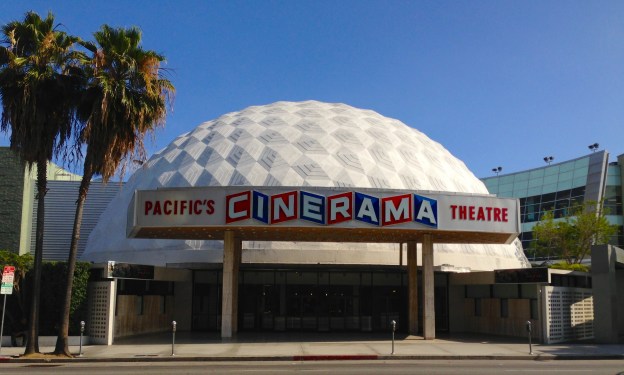

FEATURE image: Basking under a brilliant California sky, the Cinerama Dome is a proud, enduring monument to Hollywood’s golden age of widescreen showmanship. Its off-white geodesic dome, a striking honeycomb of interlocking triangular panels, rises like a futuristic cathedral of cinema along Sunset Boulevard in Los Angeles, California. Across the entrance, the historic marquee proudly bears the name “PACIFIC’S CINERAMA THEATRE,” its multi-colored, stylized 3D block lettering evoking the vibrant energy of a 1963 premiere when the theater first opened. Flanked by a pair of sentinel-like palm trees in the West Coast breeze, the shaded entryway sits frozen in time—its glass doors, concrete pillars, and classic street-side parking meters standing as silent witnesses to decades of film history, nestled gracefully against the encroaching glass of modern Hollywood. PHOTO: “Cinerama Dome front” by UpdateNerd is marked with CC0 1.0.
LOS ANGELES — Sony Pictures Entertainment has secured a long-term lease to restore and reopen Hollywood’s iconic Cinerama Dome by early 2028. Extensive renovations on the single-screen, 956-seat geodesic landmark are scheduled to begin next month in August 2026. Shuttered since the 2020 pandemic, the venue will be operated by the Sony-owned Alamo Drafthouse chain and will preserve its historic, 86-foot deeply curved screen and classic exterior.
Both properties—the historic Cinerama Dome and the adjacent 14-screen ArcLight multiplex—were owned and operated by the Forman family through their company, Decurion Corporation. When Decurion went out of business and permanently shuttered all ArcLight and Pacific Theatres locations, both venues were boarded up together.
As part of the same development project, Sony will also reopen the adjacent 14-screen former ArcLight Cinemas complex as an Alamo Drafthouse flagship. The renovated multiplex will feature premium large-format screens equipped with laser projection, immersive audio, and 70mm capabilities. While this new adjacent multiplex will offer Alamo’s signature dine-in service with food and drinks delivered directly to patrons’ seats, the main Cinerama Dome will explicitly remain a non-dine-in theater.
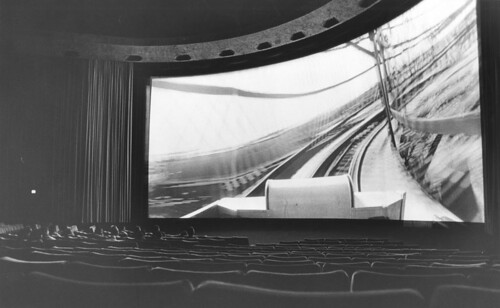
This black-and-white photograph captures the historic interior of an early Cinerama theater showcasing the legendary “Atom Smasher” roller-coaster sequence from the groundbreaking travelogue documentary, This Is Cinerama (1952). Taken from the front car at Rockaways’ Playland in Queens, the first-person projection vividly wraps around the auditorium’s hallmark curved screen, which is viewed by an audience seated in rows. Although This Is Cinerama was later shown at the Cinerama Dome during special retrospectives, this particular photograph cannot be the Dome in 1963 or after since faint vertical seams are visible on the screen, proving it was captured between 1952 and 1954 during the original three-strip Cinerama era at an earlier venue like New York’s Broadway Theatre or Hollywood’s Warner Theatre. “Cinerama Dome (interior)” by Machine Project is licensed under CC BY-NC-SA 2.0.
A Widescreen Revolution
The mid-century dawn of spectacular widescreen cinema originally relied on three-strip Cinerama—a pioneering 1952 technology that required three separate 35mm projectors running simultaneously. The three-strip system was incredibly expensive and complicated, demanding specialized theater installations and restrictive, labor-intensive filmmaking techniques. By 1959, premium theaters across the country began screening single-camera Ultra Panavision 70 films (initially developed in 1957 as MGM Camera 65), including epics like Ben-Hur (1959) and Mutiny on the Bounty (1962).
In 1963, the Cinerama Dome in Los Angeles opened as the world’s very first theater built from the ground up specifically for the cost-efficient, single-lens 70mm Cinerama format. By replacing three projectors with one, the Dome proved that immersive widescreen blockbusters could be seamlessly distributed both nationwide and globally, while simultaneously eliminating massive production headaches and overhead costs for Hollywood studios.
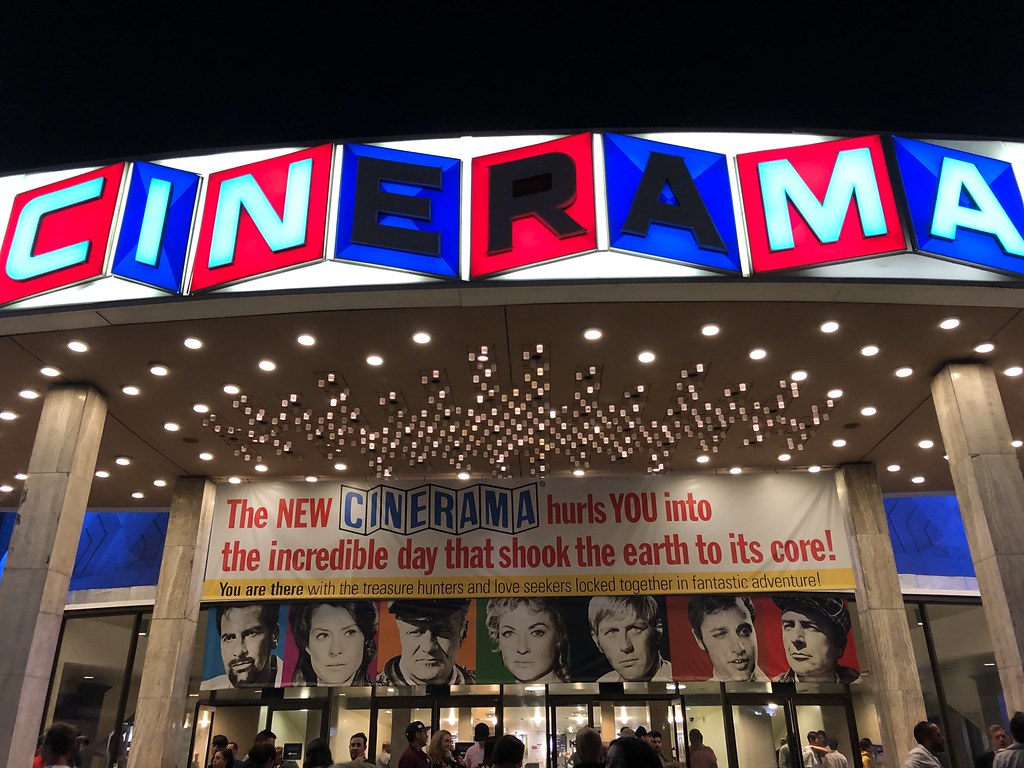
Taken in 2019, this close-up photograph captures the vibrant, illuminated marquee and main entryway of the Cinerama Dome on Sunset Boulevard, brightly lit at night with its massive, multi-colored 3D block lettering spelling out “CINERAMA.” Below the glowing under-canopy lights, a large custom retro banner advertises the 1968 feature film Krakatoa, East of Java, dramatically reading: “The NEW CINERAMA hurls YOU into the incredible day that shook the earth to its core! You are there with the treasure hunters and love seekers locked together in fantastic adventure!” The vintage appearance was a meticulous set transformation orchestrated by director Quentin Tarantino to replicate the theater’s 1969 appearance for his film Once Upon a Time… in Hollywood, with the crowd of people at the glass doors gathered for the movie’s highly anticipated 70mm theatrical run. PHOTO: “IMG_6315” by Kent MacElwee is licensed under CC BY-NC-ND 2.0.
The 1963 Debut: A Suitcase of Stolen Treasure
The historic venue officially opened its doors on November 7, 1963, with the star-studded world premiere of Stanley Kramer’s epic comedy, It’s a Mad, Mad, Mad, Mad World. Shot in 70mm Ultra Panavision, the groundbreaking film served as the perfect debut for the theater’s unique, immersive curved screen, playing at the Dome for a highly successful 67-week run until spring 1965.
For generations of filmgoers, the movie remains an inspiring string of sight gags delivered by way of a relentless chase. Kramer scaled up the raw, chaotic energy of early cinematic slapstick into a massive, modern blockbuster. The film’s frantic mood is perfectly set by Ernest Gold’s score and an iconic opening title sequence by legendary graphic designer Saul Bass.
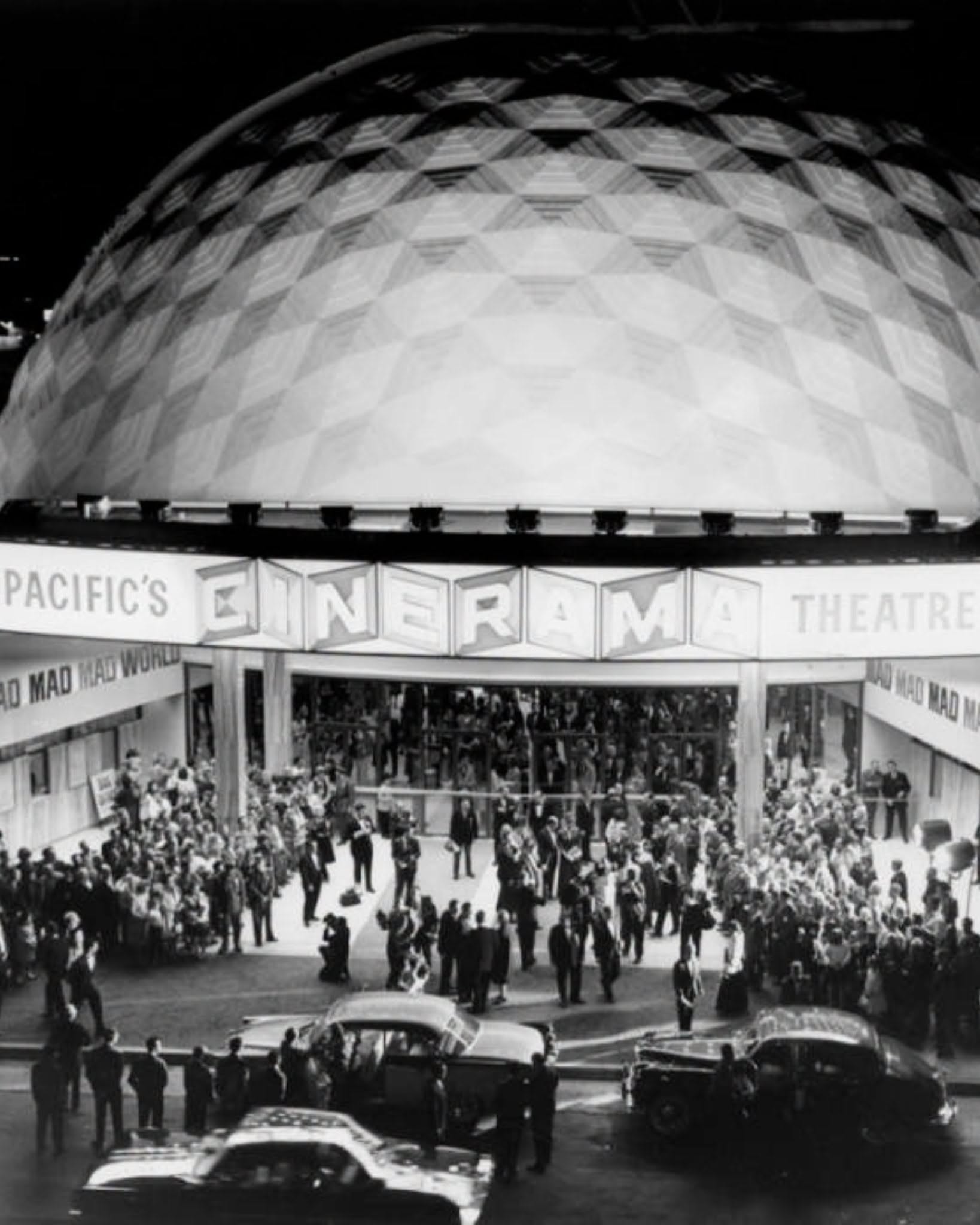
At 6360 Sunset Boulevard, the Pacific Theatres’ Cinerama Dome was designed specifically for widescreen Cinerama presentation. Conceived by Saul Pick and adapted by Welton Becket and Associates, it opened on November 2,1963, with the press premiere of It’s a Mad, Mad, Mad, Mad World. Built in only sixteen weeks, the Dome’s roof is formed from 316 pre-cast concrete panels—mostly hexagonal—each weighing about 3,200 pounds. Its screen spans 32 by 86 feet. The first and only theater of its kind, it became a long‑running site for Hollywood premieres and was named a Los Angeles Historic‑Cultural Monument in 1998. Costing $500,000, it was Hollywood’s first new theater in over three decades. The photograph shows the Dome’s exterior and the crowds gathered for the film’s premiere. PHOTO: The photo is part of the Herald-Examiner or general promotional distribution archives from November 1963. Because it was published and widely distributed to the press in the U.S. without a formal copyright notice (which was strictly legally required prior to 1989), it entered the public domain automatically under U.S. copyright law. Premiere at Pacific’s Cinerama Theatre – Los Angeles Public Library Photo Collection – Tessa: Photos and Digital Collections – retrieved July 23, 2026.
Director Quentin Tarantino deeply admires Stanley Kramer’s 1963 comedy It’s a Mad, Mad, Mad, Mad World, recalling how he first fell in love with it as a child at the Garmar Theater in Montebello, California. He particularly appreciates the film’s native 2.76 widescreen aspect ratio, noting how the immense size of the 70mm frame allowed Kramer to effortlessly keep all nine lead characters in the shot simultaneously during the roadside argument scene without compromising the composition. By contrast, I saw this movie as a kid during a pan-and-scan 35mm re-release and, at three hours long, wanted to like it more than I actually did. While I thoroughly enjoyed the broader ensemble of comedy legends, featuring The Three Stooges was probably the best part for me at the time. It felt deeply inspired by the Marx Brothers’ 1930s films—a jocular, cacophonic symphony of several movements—though it lost literally part of its brilliance, albeit in 1960s Eastman Kodak/Technicolor, when stripped of the widescreen presentation it was designed for and viewed in standard format. Even if the film is viewed by some as a mess, it is a commendable, big-budget pursuit of something vibrant and alive from over 60 years ago, making it the real suitcase full of stolen American treasure that cinephiles are looking for.
A Lasting Comic Legacy
Stanley Kramer originally paced the film at an incredible 192 minutes—a joke in itself—though United Artists ultimately cut it by 30 minutes for its general release. Captured in vibrant 1960s Eastman Kodak and Technicolor, the film represents a commendable, big-budget pursuit of something vibrant and alive.
While later generations often experienced the film via standard 35mm pan-and-scan re-releases—where it inevitably loses some of its widescreen brilliance—the sheer density of the cast endures so that It’s a Mad, Mad, Mad, Mad World stands alone in that measure of pure star power.
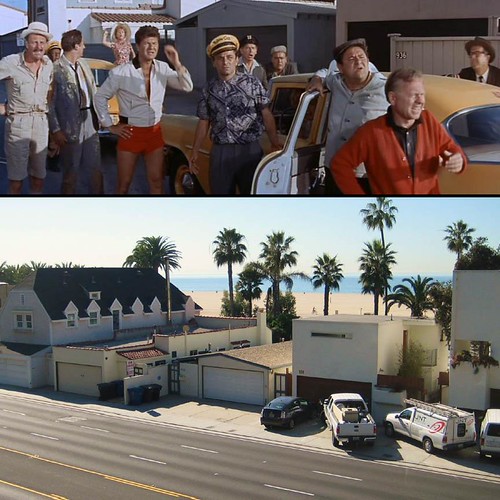
This bifurcated image showcases a side-by-side historical and modern location comparison from Stanley Kramer’s 1963 classic comedy. The film still (above) illustrates the expansive 2.76:1 Ultra Panavision 70 widescreen frame famously discussed by Quentin Tarantino, which effortlessly allows nine distinct actors to remain clearly in frame simultaneously without crowding the shot. “It’s a Mad Mad Mad Mad World” by On Location in Los Angeles is licensed under CC BY-NC-ND 2.0.
This visual location comparison clip from the Criterion Collection traces the original 1963 California filming sites of It’s a Mad, Mad, Mad, Mad World, cleanly contrasting them side-by-side with how those physical roads and landscapes look closer to today. Set against the background theme music from Ernest Gold’s frantic, Oscar-winning score, the footage follows the path of the film’s legendary, chaotic chase sequence from the desert highways to the coastal cliffside locations. By visually mapping out these real-world sets, the clip illustrates how director Stanley Kramer utilized the expansive Southern California topography to build the grand scale of his slapstick blockbuster that premiered in 1963 at a soon-to-be reopened Cinerama Dome in the heart of Hollywood.
Cinerama Dome endures into tomorrow
As it prepares to step back into the spotlight for its early 2028 reopening under the stewardship of Sony Pictures and Alamo Drafthouse, the Cinerama Dome endures as the ultimate monument to the mid-century widescreen revolution. From the moment it opened its doors in 1963, for the star-studded world premiere of It’s a Mad, Mad, Mad, Mad World, this single-lens 70mm architectural pioneer proved that epic cinema could be distributed globally without the punishing logistical headaches of earlier multi-projector formats. Over the decades, its unique geodesic silhouette and wrapping 86-foot screen have served as a sacred temple for Hollywood’s most prestigious premieres, leaving an indelible imprint on generations of filmgoers and visionary filmmakers like Quentin Tarantino, who have fought to preserve its celluloid legacy. By resurrecting this shuttered Hollywood landmark alongside a state-of-the-art 14-screen multiplex flagship, Sony is not merely restoring a theater; they are securing the future of the communal, large-format cinematic experience for decades to come.
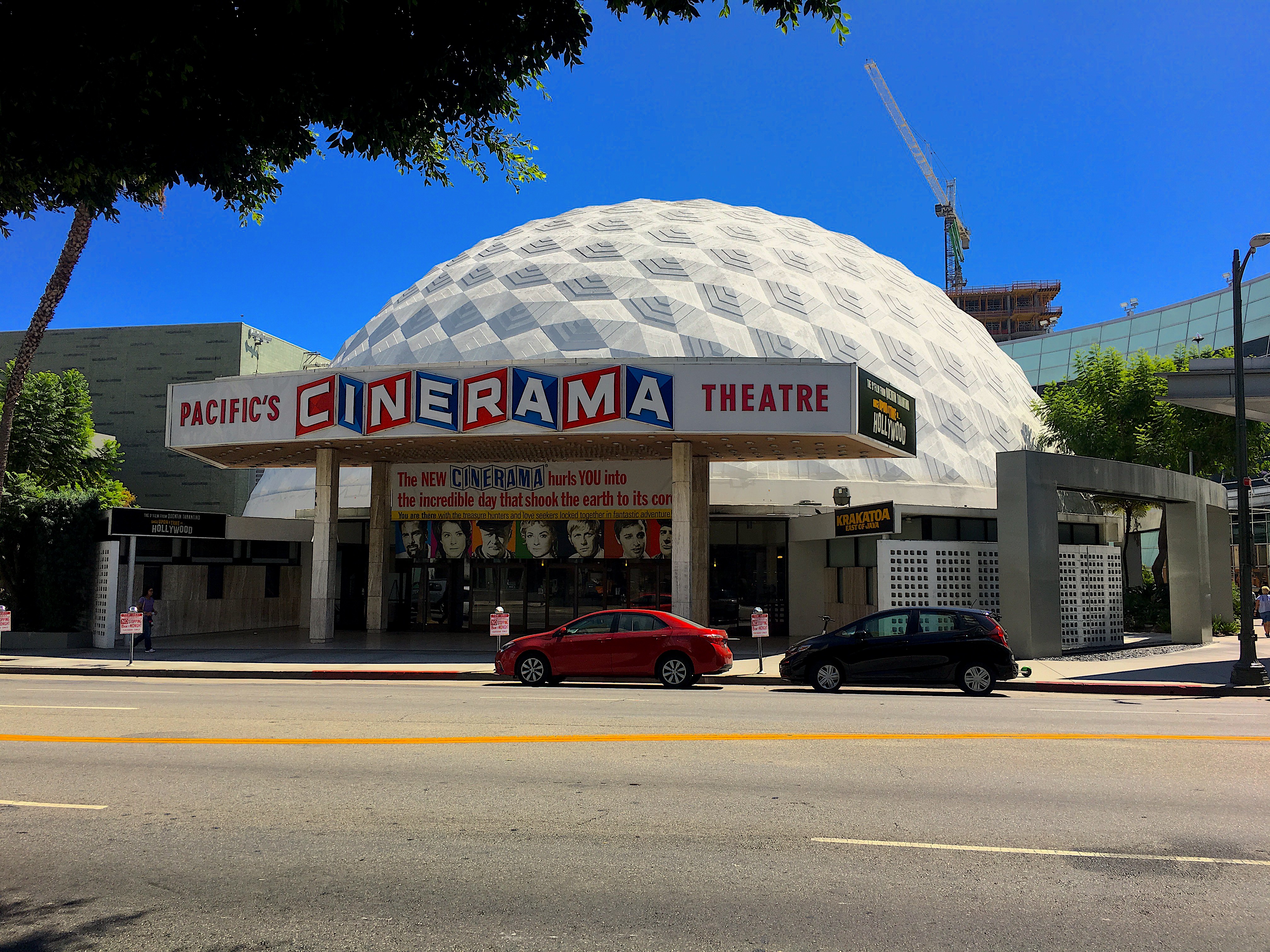
“Cinerama Dome” by Codera23 is licensed under CC BY-SA 4.0.
NOTES:
You can read the initial breaking coverage detailing the 2028 timeline over at The Hollywood Reporter. For further analysis on the business implications of Sony’s acquisition strategies, check out the follow-up piece from The New York Times. See – Barnes, Brooks. “Sony Revives Cinerama Dome in Los Angeles as Box Office Sales Rebound.” The New York Times, 22 July 2026, nytimes.com/2026/07/22/business/media/cinerama-dome-sony-pictures-hollywood.html and Galuppo, Mia. “Cinerama Dome to Reopen in Early 2028 as Sony Deal Revives Iconic L.A. Theater.” The Hollywood Reporter, 22 July 2026, https://www.hollywoodreporter.com/business/business-news/sony-alamo-drafthouse-cinerama-dome-2028-1236653956/ – retrieved July 23, 2026.
This explanatory article may be periodically updated.