FEATURE image: St. Ignatius of Loyola (1491-1556), after 1600, Jan Dammeszoon de Hoey (c.1545-1615), Stiftsmuseum Xanten (Germany). The artist was a Netherlandish painter who worked at the court of French king Henry IV (reign, 1589-1610) and is associated with the School of Fontainebleau. He is best known for his history paintings. Public Domain.
Conversion: From Soldier to Penitent
Ignatius, a noble Basque knight and soldier, was wounded by a cannonball at Pamplona in 1521. During recovery he asked for “novels,” but received instead lives of the saints. The usual claim that he was disappointed is overstated; he took to the stories quickly. Their blend of peace, glory, and heroic Christian action struck him with existential force. He recognized in them the pattern his own soul wanted to imitate.
Like St. Francis of Assisi—another aristocratic soldier reshaped by war, captivity, and penitence—Ignatius responded immediately. He surrendered his knightly identity, hung up his sword, and began a life of pilgrimage.
Character Redirected Toward Grace
Ignatius had always been elegant, disciplined, risk‑tolerant, and forceful. He despised greed, valued prudence, and possessed a mature bearing even as a youth. The wonder of his conversion is how these innate qualities were redirected: taken out of the orbit of violence and ambition and placed into the service of religious purpose. He moved from the “power of darkness” into what he understood was the kingdom of divine light.
Pilgrimage and Early Formation
Ignatius traveled from shrine to shrine, eventually reaching the Holy Land in September 1523. He departed on September 23 and returned to Europe to study—first in Barcelona, then in Paris. There he gathered six companions:
Alfonso Salmeron
Diego Laynez
Francis Xavier
Nicholas Bobadilla
Simão Rodrigues
Peter Faber
His Spiritual Exercises (1548), written early in the Jesuit story, distilled his ascetic, contemplative temperament into a program of disciplined prayer.
The Road to Romeand “the finger of God”
In 1537 the seven men traveled to Rome seeking papal approval for their new order. On the way, Ignatius reported a vision of Christ carrying the cross and saying, Ego vobis Romae propitius ero—“I will be good to you in Rome.” Jesuits have long treated this as a promise of mission accompanied by grace.
Pope Paul III, reviewing Ignatius’s writings during summer retreat at Tivoli, declared: “The finger of God is here.” He judged the proposed Society of Jesus to be “an invaluable auxiliary and splendid ornament to the Church in these eventful times.”
The order was formally approved in 1540.
Global Mission
Ignatius sent his companions across Europe and around the world to establish schools, colleges, seminaries, and missions. Their impact—intellectual, cultural, and educational—was immediate and largely positive, shaping Catholic engagement with the early modern world.
St. Ignatius of Loyola died in Rome on July 31, 1556, at the Jesuit headquarters attached to the Church of the Gesu. His body was interred within the church itself, where the Jesuit motherhouse stands. The site remains the central symbolic locus of the Society of Jesus and a major point of Ignatian pilgrimage.
The feast day of St. Ignatius of Loyola is observed across the Roman Catholic Church on July 31. St. Ignatius is Patron of Spiritual Retreats because of the Spiritual Exercises and his structured approach to discernment. Patron of Soldiers rooted in his own military background and the moral transformation that followed. Patron of the Jesuits whose founder and first Superior General he is and Patron of Educators by the wide global network of today’s Jesuit schools, colleges, and universities.
This explanatory article may be periodically updated.
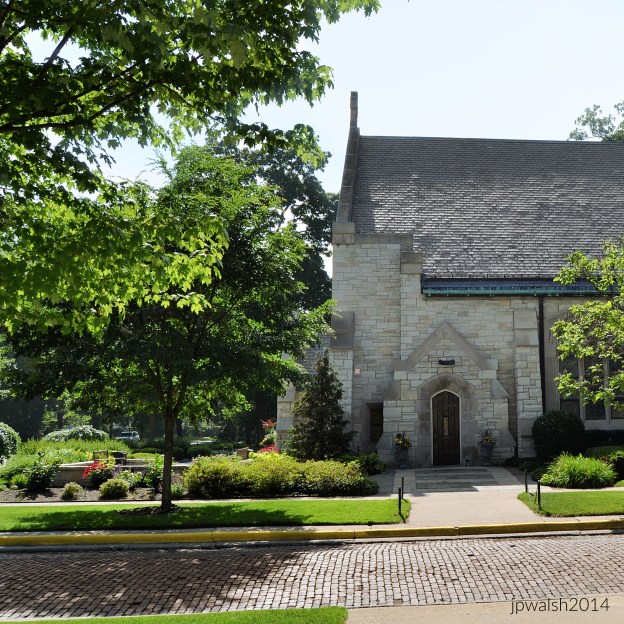
FEATURE image: Erected in 1939, St. Francis Xavier Church stands at 524 Ninth Street in Wilmette, Illinois, within a mature residential neighborhood just a few blocks west of Lake Michigan. Rather than dominate its surroundings, the church was deliberately designed to harmonize with the architectural character of Chicago’s North Shore, reflecting the desire of the local Roman Catholic community to create a dignified house of worship that blended naturally into its well-established suburban setting.June 2014. Author’s photograph 3.56mb
Though outwardly modest and deliberately integrated into its residential setting, St. Francis Xavier Church reveals the sophistication of twentieth-century Catholic design, using architecture, sculpture, and stained glass to transform doctrinal teaching into a fully immersive visual experience.
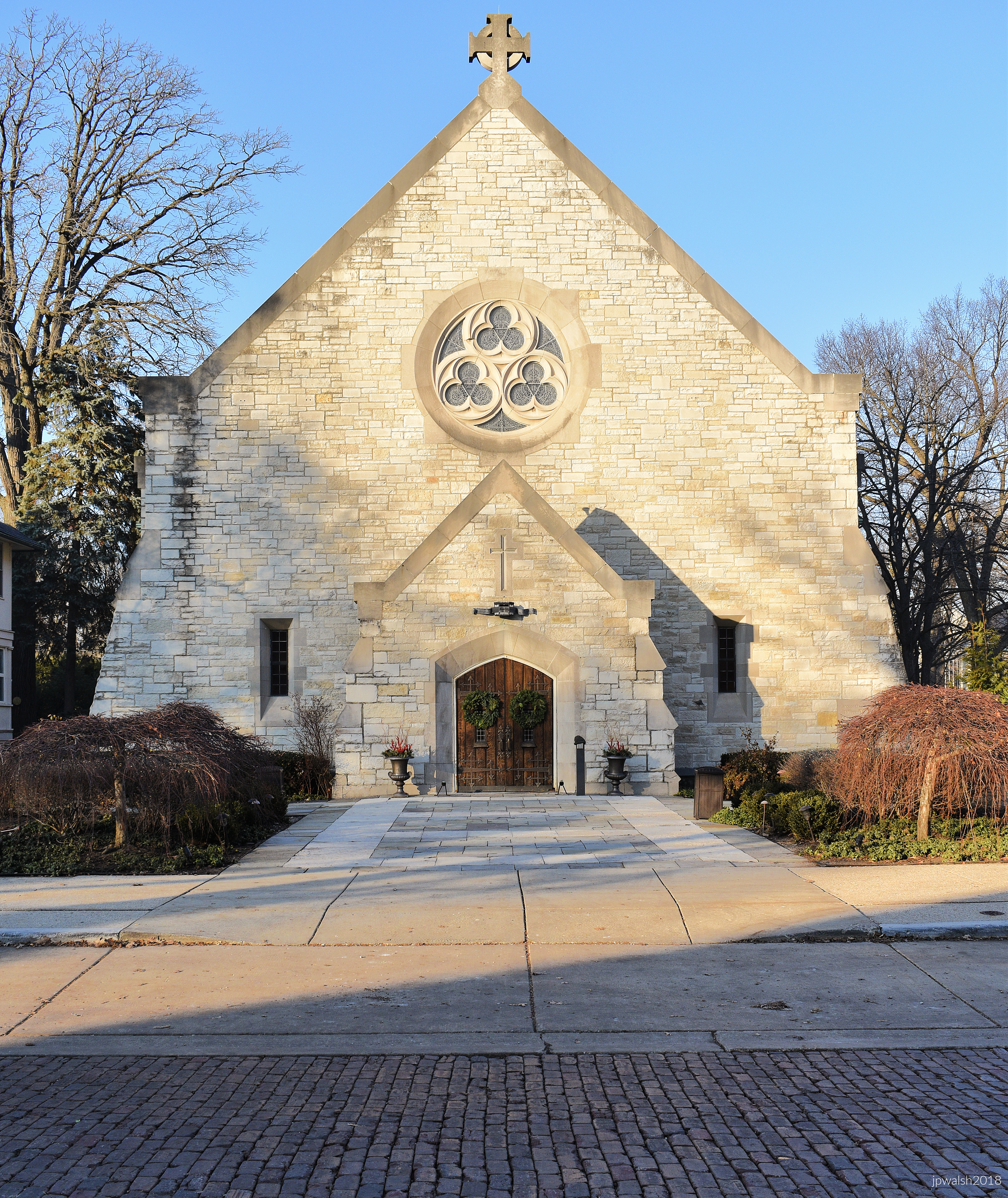
St. Francis Xavier church, Wilmette, Illinois. December 2018. Author’s photograph. 11.6mb
The English Gothic‑style church—typically associated with establishment mainline Protestants—was designed to be both sophisticated and simple. When the parish community formed in 1904, it built a smaller multi‑purpose church‑and‑school on this same corner of 9th Street and Linden Avenue. That first structure supported the parish through its early decades, serving as both classroom and worship space as the community grew into the congregation that would later commission the present building. Built by McCarthy, Smith & Eppig, St. Francis Xavier Church adopts the character of a sturdy country church, marked by low walls, massive external buttresses, and a sloped, elongated roof.
The church was intentionally designed to blend into the surrounding North Shore neighborhood rather than stand as a monumental urban landmark.Massive buttresses, low walls, and an elongated roof create the character of a sturdy English country church.
St. Francis Xavier church, Wilmette, Illinois. June 2014. Author’s photograph. 4.64mb
Erected in 1939, St. Francis Xavier Church sits within an established, well‑maintained residential neighborhood in Wilmette, Illinois, just blocks inland from Lake Michigan. The area’s Roman Catholics intentionally sought a design that would blend unobtrusively into the North Shore streetscape, ensuring the church harmonized with its surroundings rather than dominating them or otherwise stand out. Placing the 1904 parish under the patronage of St. Francis Xavier, the premier Jesuit missionary and intellectual, reflected the cultural and educational aspirations of the region’s affluent English‑speaking Catholic families, whose spiritual identity was shaped by the strong Jesuit presence on Chicago’s North Shore.
WHO IS ST. FRANCIS XAVIER (1506-1552), FIRST JESUIT MISSIONARY TO THE FAR EAST AND CO-PATRON OF FOREIGN MISSIONS?
Parish patron and namesake St. Francis Xavier is depicted in marble at the entrance to the sanctuary in Wilmette, Illinois. namesake. Holding a crucifix, the Basque Jesuit priest is dressed in a black cassock draped by an alb and stole. June 2014. Author’s photograph. 4.05 mb
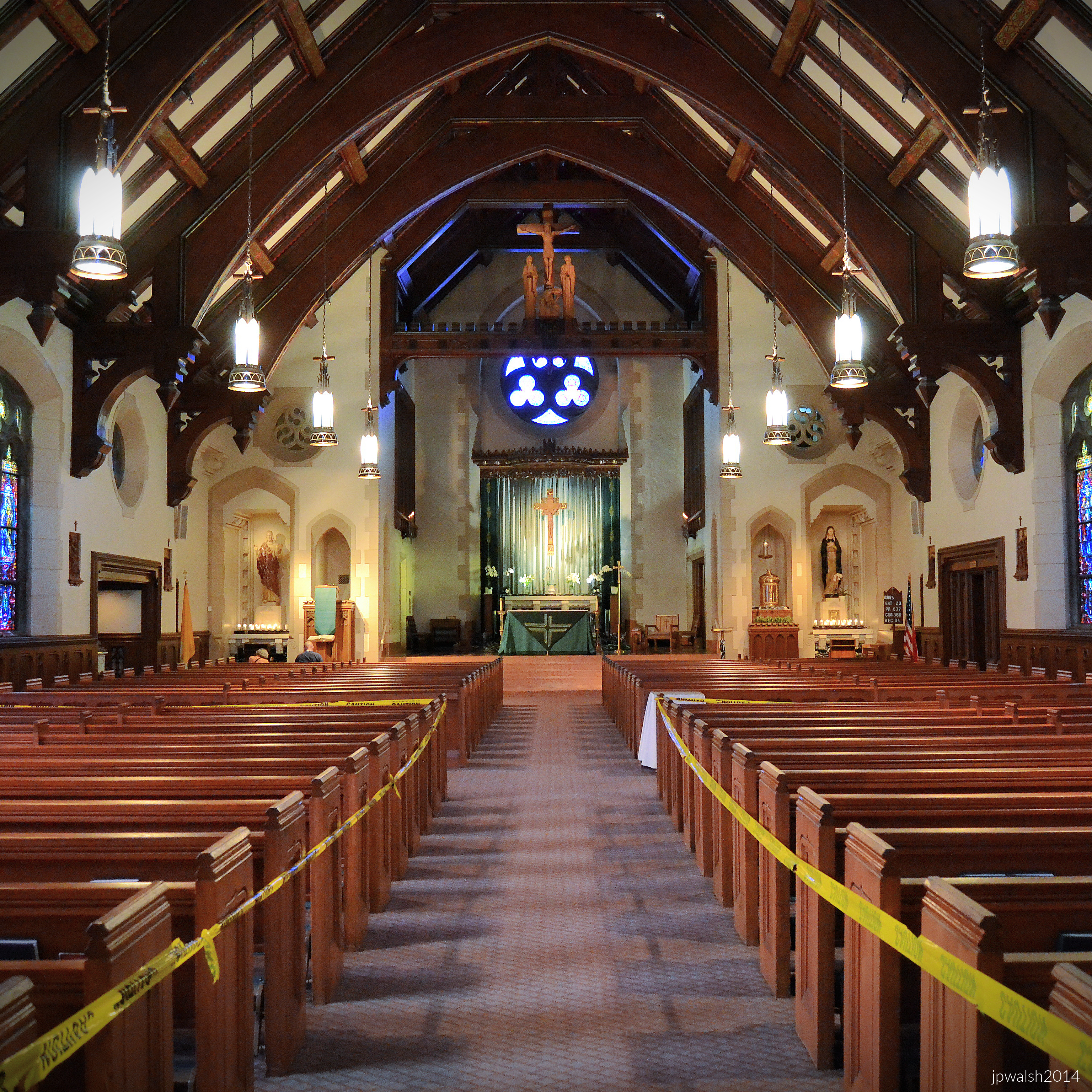
The unobstructed interior provides clear sightlines to the sanctuary and reflects evolving twentieth-century liturgical priorities.The inverted-barque ceiling symbolically references St. Francis Xavier’s missionary voyages to Asia.
Nave looking to main altar. June 2014. Author’s photograph. 5.99 mb
Unobstructed Sanctuary
There are no columns interrupting the view toward the marble altar and crucifix. After Vatican II, the tabernacle was moved to a niche on the right; originally it stood on the main altar beneath the crucifix. The extra‑wide altar rail—with cross‑shaped legs meant to evoke being at table with Christ for communicants—was also removed.
Modern Streamlining
Although St. Francis Xavier Church is traditional in overall form, its detailing is modern, chic, and streamlined, giving the sanctuary a flexible, adaptable character suited to later liturgical changes.
Symbolic Ceiling
The ceiling is shaped like an inverted barque, a visual metaphor for St. Francis Xavier’s missionary voyages across the seas to the Far East.
Its architecture combines English Gothic Revival forms with a notably streamlined and modernized interior treatment.
View of sanctuary. July 2014. Author’s photograph. 5.85mb
Architects & Origins
Among the leading ecclesiastical designers of the 1930s, McCarthy, Smith & Eppig worked closely with Chicago’s Cardinal George Mundelein. Joseph W. McCarthy (1884–1965), once a young architect under Daniel Burnham, shaped much of Chicago’s Catholic built environment from the 1910s through the 1930s.
Wilmette Commissions
In 1939, McCarthy completed two major Wilmette churches—St. Francis Xavier and the more monumental St. Joseph—standing barely a mile apart. The design of St. Francis Xavier was executed primarily by the firm’s younger partners, David Smith and Arthur Eppig.
Design & Cost
The church’s restrained architecture, enriched by fine detailing, cost $200,000 to build in the late Depression years—roughly $4 million in 2022.
Beyond Chicago
While most of McCarthy’s work rose in the Chicago region, his portfolio also includes significant projects such as the cathedral in Springfield (1928) and the parish church built in 1918 for what later became the Diocese of Joliet.
Organ loft. December 2017. Author’s photograph. 7.90 mb 77%
There are 8 major stained-glass windows in St. Francis Xavier Church: four in the west wall and four in the east wall.
Panels of three different windows.October 2015. Author’s photographs
Smaller stained-glass oculi and panels are scattered throughout the interior. These stained-glass windows were designed by parishioner Henry Schmidt. They are quite beautiful, scintillating in their pseudo-English Tudor style, and illumined by the usually soft eastern and tree-obscured western exposures. While their subject matter feels somewhat chaotic—a hodgepodge in its traditional and idiosyncratic admixture of hagiography, scripture, and popular piety—one aspect of their enduring appeal is that the glass can be seen close up and at eye level. This intimate perspective is vividly captured in the side panels: the left detail illustrates the Agony in the Garden, showing Christ kneeling on the Mount of Olives as an angel descends with the chalice of His Passion; the center panel depicts the Finding in the Temple, with the twelve-year-old Jesus teaching the elders while Mary and Joseph look on; and the right panel depicts the Annunciation, capturing the Archangel Gabriel appearing to the Virgin Mary under the illumination of the Holy Spirit.
ST. PETER WINDOW & THE QUEENSHIP OF MARY WINDOW.
The visual program of the St. Peter stained-glass window —particularly its central panel showing St. Peter holding the keys next to the Latin words for Saint Peter, flanked by scenes of Mary’s active intercession by way of her heavenly coronation and Assumption into Heaven—beautifully illustrate this very link between established apostolic authority on earth and the heavenly governance of Christ and His Mother.
The window’s left panel of the Crowning of Mary as Queen of Heaven refers to the moment the Trinity receives her, body and soul, following the Assumption. In Catholic tradition—as in the Fifth Glorious Mystery of the Rosary—the Coronation marks her crown of heavenly glory. Though rooted in Scripture—especially the ‘woman clothed with the sun’ of Revelation 12:1—the literal act of the Trinity placing a crown on Mary is held as pious tradition rather than defined dogma like the Assumption. Consequently, parish practices such as a May Crowning remain devotional customs rather than formal liturgical acts.
St. Peter window. June 2014. Author’s photograph. 4.98 mb
CENTER PANEL: Saint Peter, leader of the apostles, holds the keys of the kingdom of heaven (Matthew 16:19). Peter holds a book, a representation of St. Peter’s New Testament letters (1 and 2 Peter) and sermons (Acts). Below is St. Peter’s Basilica in Vatican City in Rome with its famous dome.
LEFT PANEL: Crowning of Mary as Queen of Heaven by Triune God (Father, Son and Holy Spirit). From the Council of Ephesus in 431, depicting the Blessed Virgin Mary wearing a regal crown was used in Christendom.
RIGHT PANEL: While biblical texts point directly to the defined dogma (431) of Mary as Theotokos (Mother of God), the literal event of her Assumption is not explicitly recorded in the New Testament. Instead, this latter dogma (1950) dictates that at the end of her earthly life, she was taken—or ‘assumed’—body and soul into heavenly glory. Scriptural imagery of going ‘up’ to heaven is utilized here to express a profound spiritual reality, drawing a deliberate theological parallel to Jesus’ own Ascension (Acts 1:6–17; Luke 24:50–53). This phenomenon of a bodily assumption is mirrored in the Old Testament accounts of Moses and Elijah, both of whom later appeared alongside Christ at His Transfiguration (Matt 17:1–9; Mark 9:2–10; Luke 9:28–36; 2 Peter 1:16–21). Anchoring these soaring heavenly narratives visually, identical angel figures rest directly below the window panels.
Assumption (right panel), St. Peter Window. October 2015. Author’s photograph. 4.81mb DSC_0504 (1)
The Queenship of Mary, while in one continuous arc with the crowning of Mary, is an established doctrine of the Church. In 1954, Pope Pius XII formalized this long-standing tradition by issuing the papal encyclical Ad Caeli Reginam (To the Queen of Heaven), establishing the universal Feast of the Queenship of Mary. The systematically-minded Pope Paul VI later moved the memorial to August 22—exactly seven days after the Solemnity of the Assumption—to underscore their inseparable theological connection. The Queenship refers to Mary’s eternal, structural office and state of reigning over the entire Created Order. Catholic theology teaches that her reign is not passive; rather, Mary actively exercises her exalted role as Intercessor, Advocate, and Mediatrix of graces on behalf of the entirety of creation, both the living and the dead, until the end of time. The maternal character of her office stems from the ancient Davidic kingdom, where the queen was not the king’s wife, but the king’s mother. In ancient Israel, this Queen Mother held a powerful office of advocacy, listening to the needs of the citizens and bringing them directly to the King. Mary reigns in this exact Old Testament typological capacity. As Pope Pius XII noted, Mary’s authority is characterized entirely by maternal solicitude and humility. Her power to rule flows directly from her absolute submission to God’s will, meaning her crown is the ultimate reflection of perfect, Christian discipleship and sacrificial agape.
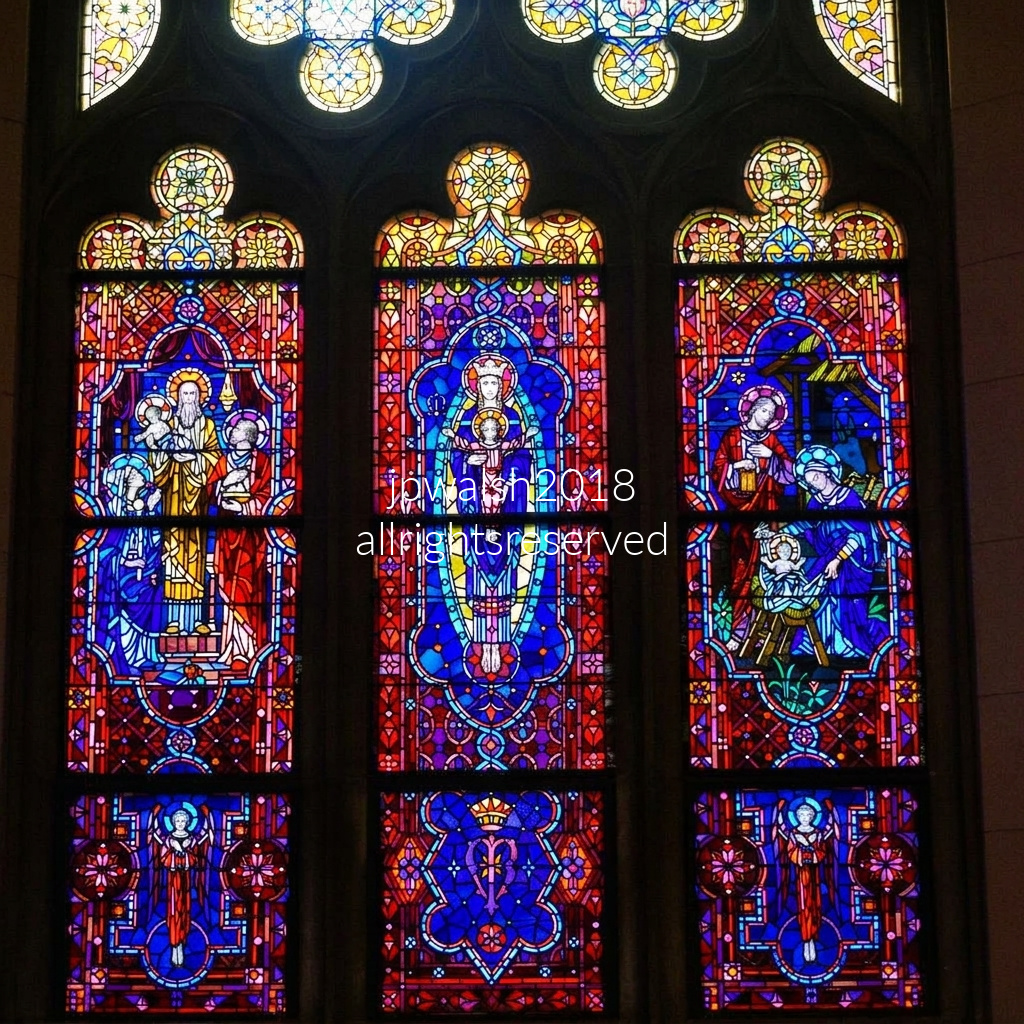
Queenship of Mary window. December 2018. Author’s photograph.
CENTER PANEL: The Queen of Heaven who reigns from the right hand of her son, is depicted in her role as mother of Jesus Christ. Below, a crown hovers over what may be a heart-shaped letter “M” for Mary’s first initial and/or her sacred heart.
LEFT PANEL: The presentation panel depicts Jesus being offered by Mary and Joseph in the Temple, where they meet Simeon, a ‘just and devout’ man of Jerusalem (Luke 2:25–35). Celebrated as the Fourth Joyful Mystery of the Rosary, the Presentation occurs forty days after Jesus’s birth. In accordance with Luke’s narrative, Mary and Joseph journeyed to the Temple in Jerusalem to fulfill the requirements of Mosaic Law: completing Mary’s ritual purification after childbirth and offering the prescription for the redemption of the firstborn son (Leviticus 12; Exodus 13:12–15)
RIGHT PANEL: Nativity of Jesus in Bethlehem (Luke 2: 1-7 and Matthew 1: 18-25) is the Third Joyful Mystery of the Rosary. Below each side panel are identical Angel figures.
ST. BONIFACE WINDOW.
St. Boniface Window. June 2014. 3.93 mb
CENTER PANEL: St. Boniface (675–754) is widely regarded as the “St. Patrick of Germany.” A missionary bishop who labored during Europe’s Early Middle Ages, Boniface was primarily responsible for organizing the Church in western Germany. While the ancient sees of Cologne and Mainz already existed, he fundamentally restructured and elevated them to serve as the pillars of his reform movement. Acting under the direct mandate of the Roman pope, Boniface anointed Pepin the Short (714–768)—son of Charles Martel (c. 688–741) and father of Charlemagne (747–814)—as King of the Franks. Pepin’s subsequent 751 coronation established a powerful precedent for future European royal coronations, marking a definitive milestone in the formation of the modern European state
LEFT PANEL: Jesus meets his mother is the fourth station of the cross. The Holy Face, below, is a devotion proclaimed by Pope Leo XIII in 1885.
RIGHT PANEL: Jesus mocked and crowned with thorns (Luke 22:63-65 and John 19:2-3) is the sixth station of the cross.
ST. PATRICK WINDOW.
St. Patrick Window. July 2014. 7.58mb
CENTER PANEL: St. Patrick (418–493) is one of the patron saints of Ireland, alongside St. Brigid (c. 451–525) and St. Columba (540–615). In Wilmette, Illinois, St. Joseph Church was founded in the 1840s to serve German immigrants, while St. Francis Xavier Church was established in 1904 as an English‑speaking territorial parish for the expanding North Shore community.
The depiction of Patrick as the archetypal, bearded Irish bishop—in green vestments, with miter and pastoral staff—rose to prominence in the late 1700s. His iconography includes a book, symbolizing both Holy Scripture and his own Latin works, the Confessio and the Epistola to Coroticus. Patrick also holds the traditional three‑leafed shamrock, the emblem he used to explain the Holy Trinity to the Irish people. Beneath him rests the harp, Ireland’s historic national emblem and one of the world’s oldest musical instruments.
LEFT PANEL:Jesus Christ’s Resurrection from the dead stands as the cornerstone of the Christian faith (1 Cor. 15:17). His empty tomb testifies to Christ’s deity (John 5:26; Rom. 1:4). Through the Resurrection, Christ redeemed humanity from sin (Rom. 4:24–25; Heb. 7:25), granted believers the promise of future resurrection (John 14:19; 1 Cor. 15:20–23), and infused them with spiritual power (Rom. 6:3–4; Eph. 1:19–21).
The window shows the resurrected Jesus holding the banner of victory over death, while a Roman guard collapses before the radiant light of the Risen Christ, accompanied by a ministering angel. Christ’s three‑part cruciform halo traditionally bears the Greek letters ὁ ὤν, meaning “He Who Is” (or “I Am Who Am”), a definitive sign of His divinity.
Although all four Gospels recount the aftermath of the Resurrection, none describe the moment or essence of the event itself — a mystery at the heart of Christian belief.
RIGHT PANEL: The Crucifixion of Jesus shows Him on the cross, flanked by Mary and John the Apostle at its base. Above Christ’s head appear the letters INRI, the Latin initials for Jesus Nazarenus, Rex Judaeorum, the official charge written by Pontius Pilate, meaning “Jesus the Nazarene, King of the Jews.” This title is recorded in John 19:19. Resting symmetrically below each side panel are identical anchoring angel figures, grounding the composition and framing the scene’s solemn balance.
Altar design includes tall candlesticks and a detailed, compact baldacchino. June 2014. 4.61 mb
The rood-beam crucifixion group by Fritz Muhlhauser revives a medieval English church tradition within a modern American Catholic setting.
Crucifixion scene in basswood. December 2018. Author’s photograph. 8.47mb
A striking depiction of the Crucifixion carved in basswood stands atop the sanctuary’s rood beam, positioned at the ceiling line directly above the main altar. Hand‑carved by German sculptor Fritz Muhlhauser, the work revives a medieval English Gothic tradition: the rood beam marking the threshold between nave and chancel, symbolizing the bridge between earth and heaven through Christ’s sacrifice.
Muhlhauser executed the composition in basswood (Lindenwood), a fine‑grained European carving wood prized for holding intricate facial expressions and sharp drapery folds without splitting. The sculptural grouping presents Christ on the cross, His head crowned with thorns beneath the INRI inscription, flanked by Mary on the left and John the Apostle on the right. At the base of the cross, Mary Magdalene, bowed in profound grief, embodies the faithful women who witnessed the Passion (John 19:25; Luke 23:27, 49).
Stylistically, the figures are elongated and vertically dramatic, allowing their features to read clearly from the pews far below while harmonizing with the soaring vertical lines of the church’s late Gothic Revival architecture.
STS. ANN AND MARY WINDOW.
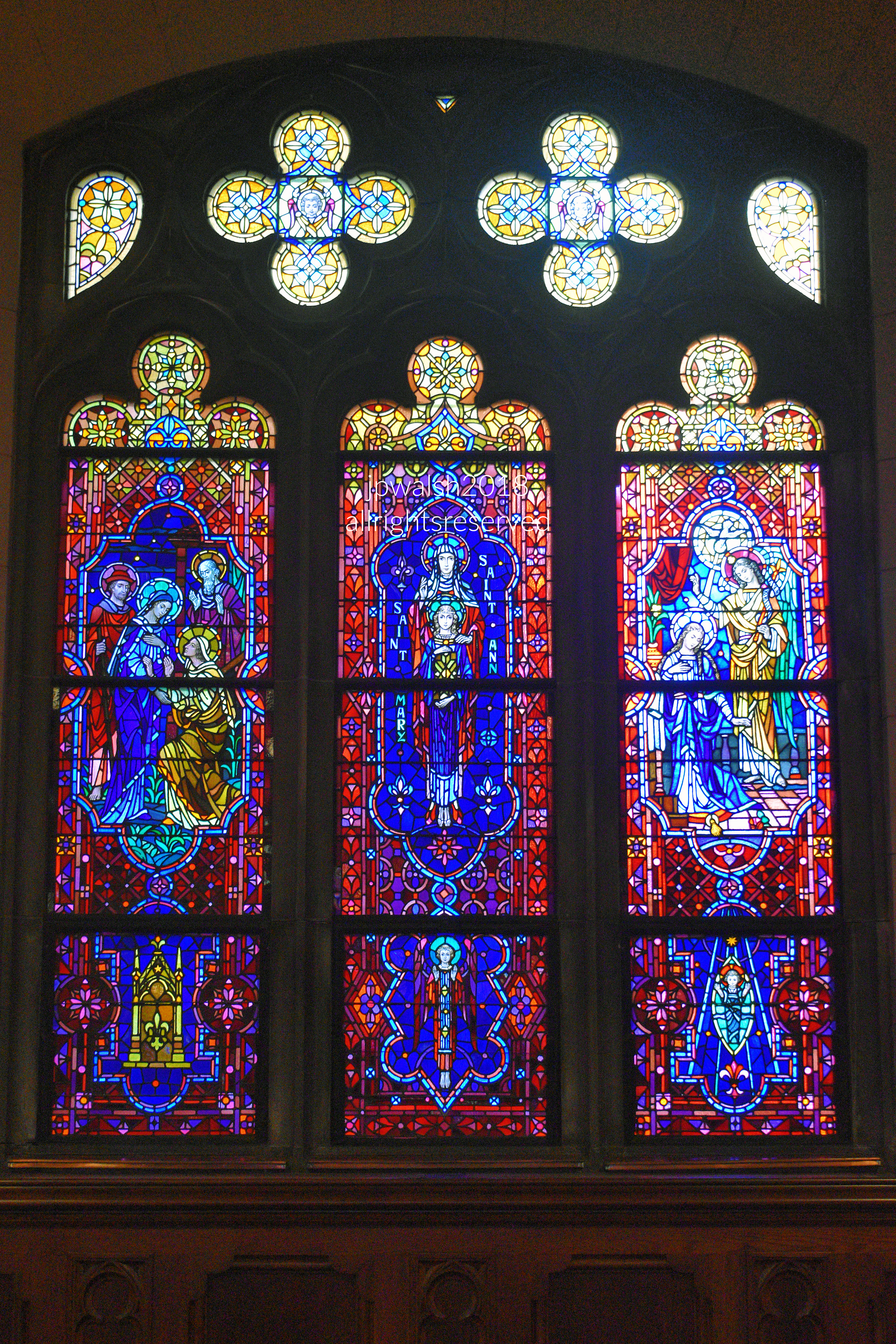
Sts. Ann and Mary Window. December 2018. 16.24mb. Author’s photograph.
Overview & Architecture
The late Gothic Revival stained-glass window illustrates the sacred maternal lineage that prepared the world for Christ. These nave windows are positioned so that they are sitting almost entirely at eye level. This intimate placement allows parishioners to stand directly beside the glass so that it functions much like an illuminated manuscript page, inviting them to appreciate its rich colors, expressive faces, and intricate details. Compositionally, the window’s narrative layout reads from right to left in terms of scriptural chronology (the Annunciation on the right moving to the Visitation on the left), flanking and bowing inward toward the central, towering figures of Saint Ann and Mary.
Center Panel: St. Ann and the Child Mary
This panel features the child Mary alongside her mother, Saint Ann, celebrating the vital generational link of Mary’s own birth. Because nothing is explicitly recorded in the New Testament about Mary’s parents or her nativity, early apocryphal Christian texts—such as the Protoevangelium of James—provide the vital historical framework. see – CHURCH FATHERS: Protoevangelium of James – retrieved September 8, 2026. These texts detail the miraculous nature of Mary’s birth to her long-barren parents, cementing an enduring legendary tradition of her immaculate beginnings. This familial focus is reinforced by the distinct vertical typography stitched directly into the blue glass background borders, with clean, capital letters clearly marking “SAINT ANN” and “SAINT MARY”—a design that rewards close-up reading from the aisle. Anchoring the base of this central structure is a miniature depiction of an angel.
Left Panel: The Visitation
The left detail depicts the Visitation of the Blessed Virgin Mary to her cousin Elizabeth (Luke 1:39–45). Following the Annunciation, Mary journeyed into the hill country to remain at the home of Elizabeth and her husband Zechariah for three months. Both women were experiencing miraculous pregnancies—Mary carrying Jesus by virgin birth, and Elizabeth conceiving John the Baptist in her advanced age. The window captures the precise moment John the Baptist leaped with joy in Elizabeth’s womb upon hearing Mary’s greeting (Luke 1:41). The Visitation is celebrated as the Second Joyful Mystery of the Rosary.
Anchoring the base of this left panel scene is a miniature architectural tabernacle or ark; Luke heavily structured his Visitation narrative around Old Testament accounts in 2 Samuel and 1 Kings regarding the physical journey of the Ark of the Covenant. Accordingly, paragraph 2676 of the Catechism of the Catholic Church formally identifies Mary as the Ark of the New Covenant: “Mary, in whom the Lord himself has just made his dwelling, is the daughter of Zion in person, the Ark of the Covenant, the place where the glory of the Lord dwells. She is ‘the dwelling of God . . . with men.’”
Right Panel: The Annunciation
The right panel illustrates the Annunciation, wherein the Archangel Gabriel proclaims that Mary will bear the Son of God, Jesus Christ, greeting her with the words: “Hail Mary, full of grace, the Lord is with you!” It is through Mary’s faithful acceptance of the divine will—“Behold, I am the handmaid of the Lord; let it be to me according to your word” (Luke 1:26–38)—that the Incarnation takes place. A traditional vase of white lilies sits positioned between Gabriel and Mary, serving as a classic art-historical symbol of her perpetual virginity and spiritual purity. The Annunciation constitutes the First Joyful Mystery of the Rosary. Anchored at the base of this right-panel scene is the fruit of Mary’s womb, the infant Jesus, wrapped in swaddling clothes (Luke 2:7, 2:12). He appears as he did when Mary laid him in a manger in Bethlehem, because there was no room for them at the inn.
ST. JOSEPH WINDOW.
St. Joseph Window. December 2018.12.34 mb
CENTER PANEL: St. Joseph was the foster father of Jesus and served as His guardian protector. Joseph’s symbology includes his holding a carpenter’s square (Matt. 13:55) along with a white lily to symbolize his faithfulness and chastity toward Mary (Matt. 1:25), as well as his absolute holiness and obedience to God (Matt. 1:24; 2:14, 21, 22). This devotional aspect is made explicit by the vertical text framing his figure, reading “SAINT JOSEPH” on the left and “PRAY FOR US” on the right in stark, clean capital letters. An angel figure is positioned directly below St. Joseph.
LEFT PANEL: The left detail depicts the Holy Family in Nazareth, illustrating the hidden years where Jesus was obedient to Mary and Joseph and “progressed steadily in wisdom, age, and grace before God and men” (Luke 2:52). Jesus is shown being instructed by St. Joseph in the carpenter’s trade, holding a prophetic wooden cross upon His knees. The flowering grass below is highly decorative and signifies the flowering staff of St. Joseph, which symbolized that he was specially chosen by God to be Mary’s husband. This imagery was heavily drawn from the Old Testament type where Aaron’s staff, placed before the Ark of the Testimony, miraculously sprouted with almond blossoms as a divine sign of his election (Num. 17:8; Vulgate 17:23).
RIGHT PANEL: The right panel captures Mary and St. Joseph finding the twelve-year-old Jesus in the Temple sitting among the doctors of the Law (Luke 2:41–52), which constitutes the Fifth Joyful Mystery of the Rosary. This scriptural event marks the only time in the Gospels where Jesus makes a public appearance between His infancy narrative and His later baptism in the Jordan by John the Baptist at the start of His public ministry (Matt. 3:3–17; Mark 1:9–11; Luke 3:21–23; John 1:29–33). Compositionally, the twelve-year-old Jesus is visually elevated above the scroll-holding doctors, sitting upon a small stone cathedra or teaching chair, which subtly emphasizes His divine authority over the earthly teachers of the Law.
Compositional Harmony Across the Base
The window’s lowest register displays a deliberate symbolic balance between the two side panels. Directly beneath the Nazareth home scene on the left, an ornate vase holds three stylized lilies representing the domestic purity of the Holy Family. This perfectly counterbalances the stone tablets of the Ten Commandments on the right, which are inscribed with Roman numerals (I through X) beneath the Eye of Providence—a symbol of the Holy Trinity hovering within an equilateral triangle. Together, the window visually tracks Jesus’s growth from the quiet, private household raised by his parents (the left) into the public, formal structures of divine law where He takes up His true spiritual mission as the Son of God (the right).
ST. PAUL THE APOSTLE WINDOW.
St. Paul Window. June 2022. Author’s photograph. 4.28 mb
CENTER PANEL: This panel features St. Paul, the great Apostle to the Gentiles. He is depicted in a traditional pose of apostolic authority, with his right hand raised in blessing and his left hand holding a large volume representing the Holy Scriptures and his foundational New Testament epistles. The figure is framed by vertical typography in clean capital letters reading “SAINT” on the left and “PAUL” on the right. While Christian iconography and the traditional symbology of martyrs frequently depict Paul holding a sword—both as the historical instrument of his execution by beheading (c. 64–68 CE) and as a metaphor for the ‘sword of the Spirit, which is the word of God’ (Ephesians 6:17)—this specific window replaces that martial emblem with the written word, highlighting his role as the preeminent teacher, theologian, and writer of the early Church. An angel figure is positioned directly below St. Paul.
LEFT PANEL: The left panel portrays Pentecost (Acts 2:1–13), which immediately followed the timeline of the Ascension. The scene depicts the Apostles gathered in prayer alongside Mary, the Mother of Jesus, as they receive the promised outpouring of the Holy Spirit. The divine presence is symbolized by a radiant dove descending from Heaven, casting tongues of fire upon the faithful below. Affixed to the bottom register of this panel is a prominent inscription block that reads: “TEACH YE ALL NATIONS – MATTHEW 28.”
RIGHT PANEL: The right panel illustrates the Ascension of Jesus into Heaven, an event heavily witnessed and detailed throughout the New Testament (Luke 24:50–53; Acts 1:6–12; John 3:13; Romans 8:34; Ephesians 1:19–20). The composition captures the exact moment the Resurrected Christ physically departed from Earth, rising into the heavens before the gaze of His Eleven remaining apostles (Judas Iscariot betrayed Jesus and tragically hung himself). Visually reinforcing this mystery, a cloud of glory reaches down from the upper tracery to receive Christ as His divine humanity enters into the eternal intimacy of the Father, sealing His identity as the perfect God-Man. Symmetrically anchoring the overall window design, a stylized descending dove—the symbol of the Holy Spirit—rests within the lower register directly below this scene.
St. Paul Window: Ascension. October 2015. Author’s photograph DSC_0505 (1).
Thematic and Compositional Harmony
The window’s design displays a brilliant theological and visual unity across its panels. Liturgically and historically, the inscription at the bottom left—“Teach ye all nations” (Matthew 28:19)—functions as the structural catalyst for the entire visual program. The Pentecost panel directly above it provides the Apostles with the supernatural grace and tongues of fire required to execute this Great Commission, while the central panel of St. Paul showcases the ultimate historical fulfillment of that missionary command to the wider world.
Artistically, this narrative is bound together by the striking use of deep cobalt blue glass backgrounds behind all three central figure groupings. This deliberate choice creates a dense, uniform baseline that forces the fiery reds and golden ambers of Christ’s robes and the descending Holy Spirit to pop with staggering visual contrast when sunlight hits the glass.
ST. PAUL THE APOSTLE WINDOW in situ on the east wall. June 2014. Author’s photograh
THE GOOD SHEPHERD WINDOW.
The Good Shepherd Window. December 2018. 12.6mb
CENTER PANEL: This panel features Jesus Christ declaring Himself the ‘Good Shepherd’ (John 10). This title fulfills the Old Testament prophecies of Ezekiel, who foretold a singular Messiah-Shepherd sent to oversee the people of God (Ezek. 34:23–24; 37:24–25). Christ is depicted holding a pastoral staff with a lamb slung securely over His shoulders, symbolizing His protective care for the faithful. This messianic claim is rendered instantly legible by the stark vertical English typography stitched directly into the blue background glass, reading “I AM THE” on the left and “GOOD SHEPHERD” on the right. Positioned within the lower register directly below His feet is a triumphant Agnus Dei (Lamb of God) panel, portraying a haloed lamb holding the banner of victory over death. This iconography honors John the Baptist’s proclamation (John 1:29) and functions as an Old Testament typological echo of the ram provided by God to replace Isaac on Mount Moriah (Gen. 22:13), foretelling the ultimate sacrifice of the Son of God at Calvary.
LEFT PANEL: The left panel portrays the Scourging at the Pillar, which constitutes the Second Sorrowful Mystery of the Rosary and part of the severe bodily brutalities Jesus endured during His Passion (John 19:1–3). Bound to a marble column, Christ is flanked by two Roman torturers. Resting directly beneath His feet are the instruments of His flagellation: the leather-thonged whip (flagrum) and crossed wooden rods. Symmetrically anchoring the base of this narrative register, a standing angel figure rests directly below.
RIGHT PANEL: The right panel depicts Jesus in the Garden of Gethsemane during His Agony, positioned at the foot of the Mount of Olives the night before His Crucifixion (Luke 22:39–46). Knowing the immediacy of Judas’s impending betrayal, Jesus kneels in intense prayer, pleading: ‘Father, if you are willing, take this cup from me. Yet not my will, but yours be done’ (Luke 22:42). The window captures the exact fulfillment of the subsequent verse, where a ministering angel descends from heaven to strengthen Him (Luke 22:43). This angel holds out a golden Eucharistic chalice directly toward Christ’s face, visually transforming the abstract concept of the spiritual ‘cup of suffering’ into a tangible, liturgical reality. Mirroring the layout of the left side, an identical standing angel figure occupies the register directly below.
Compositional and Structural Balance
Architecturally, the entire triptych is bound together by identical, pointed trefoil-lobed arch borders (or ogival mandorlas) rendered in deep cobalt blue glass. This recurring geometric framing establishes a strict visual symmetry across the three windows, naturally drawing the viewer’s eye away from the chaotic flanking scenes of the Passion and focusing it onto the serene, central icon of the Good Shepherd.
This formal balance extends to the lower register of the window. The identical, standing angel figures flanking the base on the left and right face inward toward the central register. This deliberate layout creates a sacred, heavenly court at eye level, physically framing and guarding the triumphant Agnus Dei panel at the center of the visual program.
Organ loft. St. Francis Xavier Church, Wilmette, IL. December 2018. Author’s photograph. 446 kb 25%
WINDOW DETAIL An angel figure graces one of the stained-glass windows in St. Francis Xavier Church. There are several different angel figures throughout the church’s stained glass panels.
SOURCES:
Catechism of the Catholic Church. 2nd ed. New York: Doubleday, 1997.
Coulson, John, ed. The Saints: A Concise Biographical Dictionary. New York: Guild Press, 1957.
Lane, George, S.J., and Algimantas Kezys. Chicago Churches and Synagogues: An Architectural Pilgrimage. Chicago: Loyola University Press, 1981.
McNamara, Denis Robert, and James Morris. Heavenly City: The Architectural Tradition of Catholic Chicago. Chicago: Liturgy Training Publications, 2005.
The New American Bible. New York: Catholic Book Publishing Corp., 1993.
Pise, Chas. Constantine. Saint Ignatius and His First Companions. New York: P.J. Kenedy & Sons, 1892.
St. Francis Xavier Statue
Travel Triangle. “How to Reach Japan – Get Air/Flights, Trains, Road/Bus Details.” Updated 2025. traveltriangle.com.
St. Peter Window
Archdiocese of Saint Paul and Minneapolis. “What Are the Symbols of St. Peter, the Apostle?” Accessed November 4, 2026. archspm.org.
Christianity.com Editorial Staff. “What Are the ‘Keys of the Kingdom’?” Christianity.com, August 31, 2022. christianity.com.
United States Conference of Catholic Bishops. Crowning an Image of the Blessed Virgin Mary. Washington, DC: USCCB. PDF.
St. Patrick Window
Ireland Calling. “The Harp – National Emblem of Ireland.” Accessed November 4, 2026. ireland-calling.com.
Kelly, David. “St Patrick’s Writings: Confessio and Epistola.” St. Patrick’s Confessio, Royal Irish Academy, 2011. confessio.ie.
Basswood Crucifix
Moody Bible Institute. “The Resurrection of Jesus Christ.” Accessed November 4, 2026. moodybible.org.
Morgan, G. Campbell, Matthew Henry, and A.W. Pink. “Who Was Present at the Cross?” Christianity.com, updated February 8, 2024. christianity.com.
New World Encyclopedia. “INRI.” Accessed November 4, 2026. newworldencyclopedia.org.
Queen of Heaven Window
Newman Connection. “Solemnities & Holy Days: Presentation of Jesus in the Temple.” Catholic Blesseds, Saints, Solemnities & Holy Days, accessed November 4, 2026. newmanministry.com.
Reconstructed Windows (Sts. Anne, Mary, Joseph, Paul, Shepherd)
Aleteia. “Why Is St. Paul Depicted Carrying a Sword?” Aleteia, October 3, 2018. aleteia.org.
Christianity.com. “Why Is Jesus Called the Good Shepherd?” Christianity.com, accessed November 4, 2026. christianity.com.
Grasping God. “The Scourging of Jesus.” Accessed November 4, 2026. graspinggod.com.
Ray, Steve. “Mary, the Ark of the New Covenant.” Catholic Answers Magazine, May 20, 2019. catholic.com.
Virtual St. Joseph Altar. “The Symbols of St. Joseph.” Accessed November 4, 2026. virtualstjosephaltar.com.
Author & wife. St. Francis Xavier, Wilmette, Illinois.
Alfred Delp, S.J., stands as one of the most compelling Christian witnesses of the Second World War: a Jesuit priest, intellectual, and Nazi resister whose prison meditations transformed personal suffering, political tyranny, and the certainty of death into enduring reflections on faith, freedom, conscience, and hope.
Alfred Delp, S.J. sailing. Fair use.
Arrested by the Gestapo on July 28, 1944—just eight days after the failed July 20 plot to assassinate Adolf Hitler—Delp was formally moved to Berlin’s notorious Tegel Prison in August 1944, following initial brutal interrogations and torture at the Gestapo’s Lehrter Straße Cell Prison (known as Moabit). Fr. Delp spent months imprisoned in Tegel, much of the time shackled. During imprisonment he wrote profound Advent and Christmas meditations, which were smuggled out of prison on scraps of paper.
Commentary written and texts compiled by John P. Walsh.
During World War II in Germany, Alfred Delp, S.J. (September 15, 1907 – executed, Berlin, February 2, 1945) was a member of the Kreisauer Kreis (The Kreisau Circle) composed of German men and women from a variety of backgrounds who opposed Adolf Hitler’s Nazi regime.
Fr. Delp was arrested by the Nazis in 1944 and, after six months in prison in shackles, the German Catholic priest and Jesuit was sentenced to death for high treason and executed by hanging on Candlemas 1945.
Following the Allied victory in 1945, Fr. Delp’s prison writings were assembled into a posthumous book called Facing Death (German: Im Angesicht des Todes). A highlight of the 37-year-old Delp’s writings are his seasonal sermons and meditations for Advent and Christmas which were written as he languished in a cell “three steps wide” surrounded by Nazi guards.
Fr. Delp’s writings, scrawled on numerous slips of paper and smuggled out before his death, have been compared to Dietrich Bonhoeffer’s Letters and Papers from Prison also written in Tegel prison in Berlin, Germany, during World War II.
Father Delp was developing his thoughts and writing about the annual Advent drama at least as early as 1933 so his prison writings became a concluding chapter of a lasting adult interest as he faced his death.
Jesuit priest Alfred Delp was a member of the German Nazi Resistance and the Kreisau Circle, a group that opposed Hitler’s regime and envisioned a democratic Germany after the fall of the Third Reich.
German-born Alfred Delp S.J. (September 15, 1907 – Berlin, 2 February 1945).
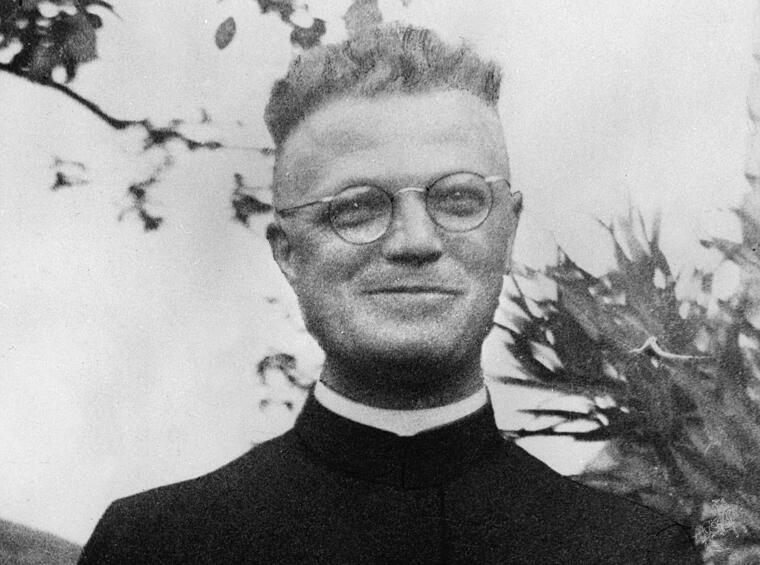
Fr. Delp wrote his meditations and sermons on Advent and Christmas when he was a political prisoner of the Nazis in Germany in World War II.This photo was taken most likely in 1942 or 1943—prior to his arrest by the Gestapo in July 1944. It captures a rare, candid moment of Delp smiling outdoors, wearing his round wire-rimmed glasses and civilian clothing. At the time, Father Delp was a Nazi resister living a dangerous double life. He was serving as a parish priest at St. Georg’s Church in Munich while secretly utilizing a covert underground network to help Jewish refugees escape Nazi persecution into neutral Switzerland. By 1942, he had joined the Kreisau Circle at the invitation of Count Helmuth von Moltke. This clandestine group of Christian intellectuals, theologians, and socialists met secretly to design a humane, democratic, and Christian-principled social order for Germany to rebuild upon after the inevitable downfall of Adolf Hitler’s regime. Though the Kreisau Circle explicitly favored peaceful planning over violence, the Gestapo rounded up its members following the failed July 20, 1944 bomb plot to assassinate Hitler. Delp was arrested on July 28, 1944, severely tortured, subjected to a mock show trial, and ultimately executed by hanging on February 2, 1945. PHOTO: “Alfred Delp Mannheim” by Graf Foto is licensed under CC BY-SA 3.0.
From Alfred Delp, S.J., “Figures of Advent,” Advent of the Heart, Ignatius Press, San Francisco, 2006 (adapted):
“I see this year’s Advent (December 1944 in Berlin’s Tegel Prison) with an intensity and discomposure like never before….Along with these thoughts comes the memory of an angel that a good person gave me for Advent in 1942. It held a banner: ‘Rejoice, for the Lord is near.’ A war bomb destroyed the angel as well as that good person although I often sense that she continues to do angel-services for me. It is the knowledge of the quiet angels of annunciation, who speak their message of blessing into the distress of our world situation and scatter their blessing’s seeds which begin to grow in the middle of the night which informs and encourages us of the truth of a situation. These angels of Advent are not loud angels of public jubilation and fulfillment but, silent and unnoticed, they come into private and shabby rooms and appear before our hearts as they did long ago. Silently they bring the questions of God and proclaim to us the miracles of God, with whom nothing is impossible. Advent is a time of refuge because it has received a message – and so to believe in God’s auspicious seeds that the angels offer an open heart are the first things we must do with our lives. The next is to go through the days as announcing messengers ourselves. We wait in faith for the abundance of the coming harvest – not because we trust the earth or the stars or our own good sense and courage – but only because we have perceived God’s messages and know about His herald angels – and even have ourselves encountered one.”
SECOND SUNDAY IN ADVENT.
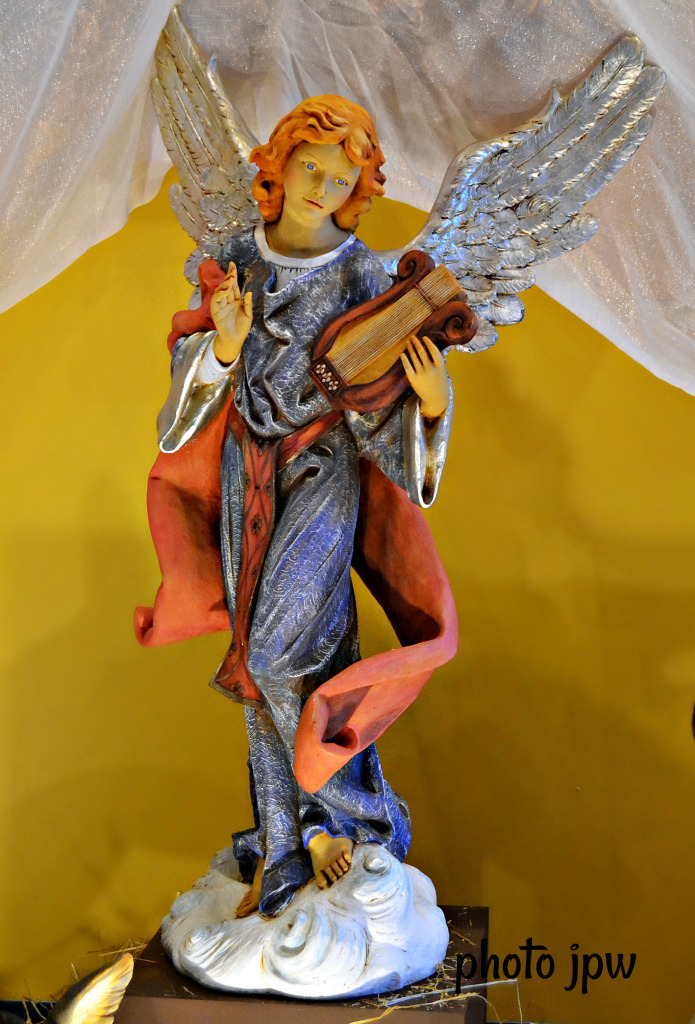
Standing Nativity Angel holding a lyre. Author’s photograph.
Thomas Merton in his introduction to Alfred Delp’s Prison Writings – a modern compilation of a young German Jesuit’s writings in prison in Berlin before he was executed for high treason as a Nazi resister in World War II – states that Fr. Delp was condemned because he and others “hoped to build a new Germany on Christian principles.” (p. xxv.)
Merton, a mid20th century Trappist monk, priest, and spiritual writer, links Fr. Delp’s political activity in the Kreisau Circle—an underground group of about twenty-five German dissidents of diverse backgrounds opposed to the Nazi regime—to broader Church doctrine and the western tradition of liberalism in evidence since the Ancient Greeks that “always hoped to attain a more equitable world order by peaceful collaboration among nations.” (ibid.)
For Fr. Delp, according to Merton, the stark choice before human beings remained the crucial one of global order or global destruction. Father Delp observed that even religious people in his time had fallen into the militaristic government’s syllogistic trap of “conquest first and a new and better world later.”
Fr. Delp’s concern when making this sort of choice is that “if the person who says it tolerates or helps further conditions which are fatal to mankind…or weakens his or her own spiritual, moral, and religious sense” – then even “the most pious prayer can become a blasphemy.” (ibid.) Fr. Delp proposed that any human indifference to honesty and justice originating in passionate conviction vitiates human nature which is left to then express itself in a vicious circle of fear and arrogance.
From Fr. Delp’s perspective, his active participation in Kreisauer Kreis for which he was executed by the Nazis in February 1945 pointed to the eschatological character of the Advent drama by the young Jesuit priest’s hope in his time for the political and social ruin of Germany which had sunk into bitter darkness and that it would find its way ahead by the light of each person’s burning candle “for honesty and justice.”
Hanging symmetrically from the classical pilasters are lush green pine Advent wreaths accented with vibrant, formal red ribbon bows. Against a peach-toned back wall is a dedicated devotional stand filled with dozens of glowing red glass prayer candles lit by parishioners. Author’s photograph.
Alfred Delp, S.J. Fair use.
From Alfred Delp S.J., Prison Writings, Orbis Books, Maryknoll, New York, 2004:
“So this Sunday we must again fold our hands and kneel humbly before God in order that his salvation may be active in us and that we may be ready to call upon him and be moved by his presence. The arrogance so typical of modern men and women is deflated here. At the same time, the icy loneliness and helplessness into which we are frozen melts under the divine warmth that fills and blesses us …If we are terrified by a dawning realization of our true condition, that terror is completely calmed by the certain knowledge that God is on the way and actually approaching. Our fate, no matter how much it may be entwined with the inescapable logic of circumstance, is still nothing more than the way to God, the way God has chosen for the ultimate consummation of his purpose, for his permanent ends. Light your candles – such candles as you possess – for they are the appropriate symbol for all that must happen in Advent if we are to live.”
THIRD SUNDAY IN ADVENT.
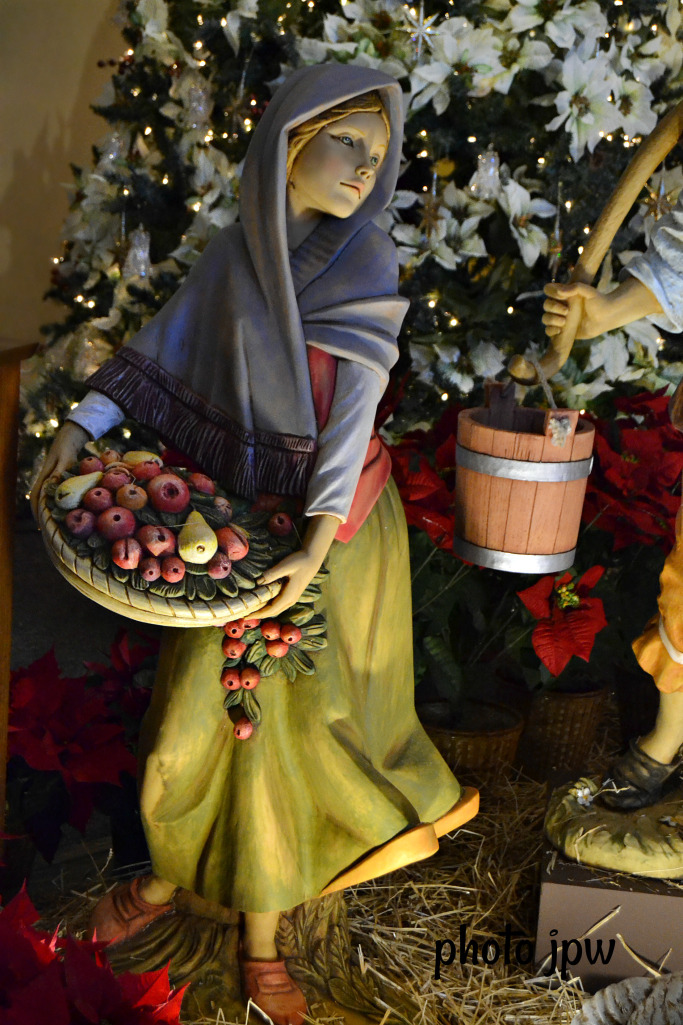
Part of a grand nativity scene, a young woman, Martha, dressed in traditional rustic garments, holds a woven basket overflowing with apples and pears, while a garland of red berries drapes down her skirt. Author’s photograph.
On Friday, July 28, 1944, two Gestapo men were waiting outside St. George’s church in Munich, a simple Baroque pile in an almost pastoral setting near the Englischer Garten.
Eight days before there had been an assassination attempt on Hitler’s life which failed. For active German dissidents to the Nazi regime in custody or, for the time being, still walking free, things were going to get worse.
Helmuth James Graf von Moltke (1907 – 1945), one of the leaders of the Kreisau Circle, a type of anti-Nazi salon, had been in prison since January 1944. Now, following the failed bombing at the Wolf’s Lair, Peter Yorck von Wartenburg (1904 –1944) who was the other leader of the Kreisau Circle, was immediately arrested and sent to Berlin where he was tried and executed on August 8, 1944.
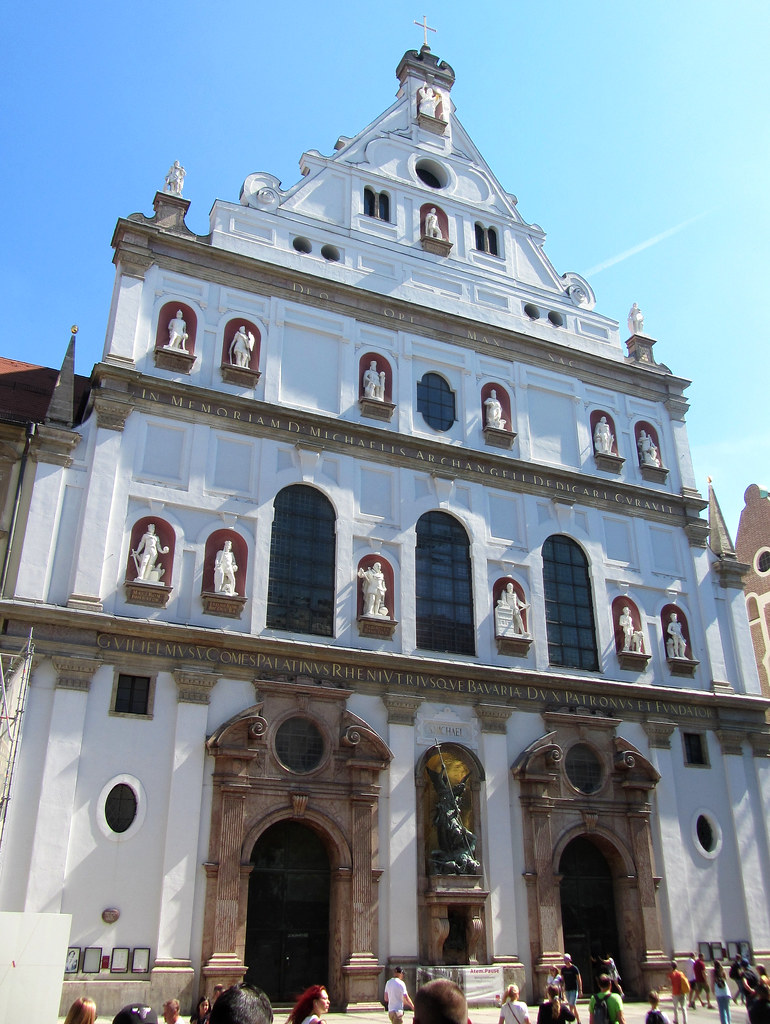
St. Michael’s Church (Michaelskirche), Munich. July 1984. Author’s photograph.
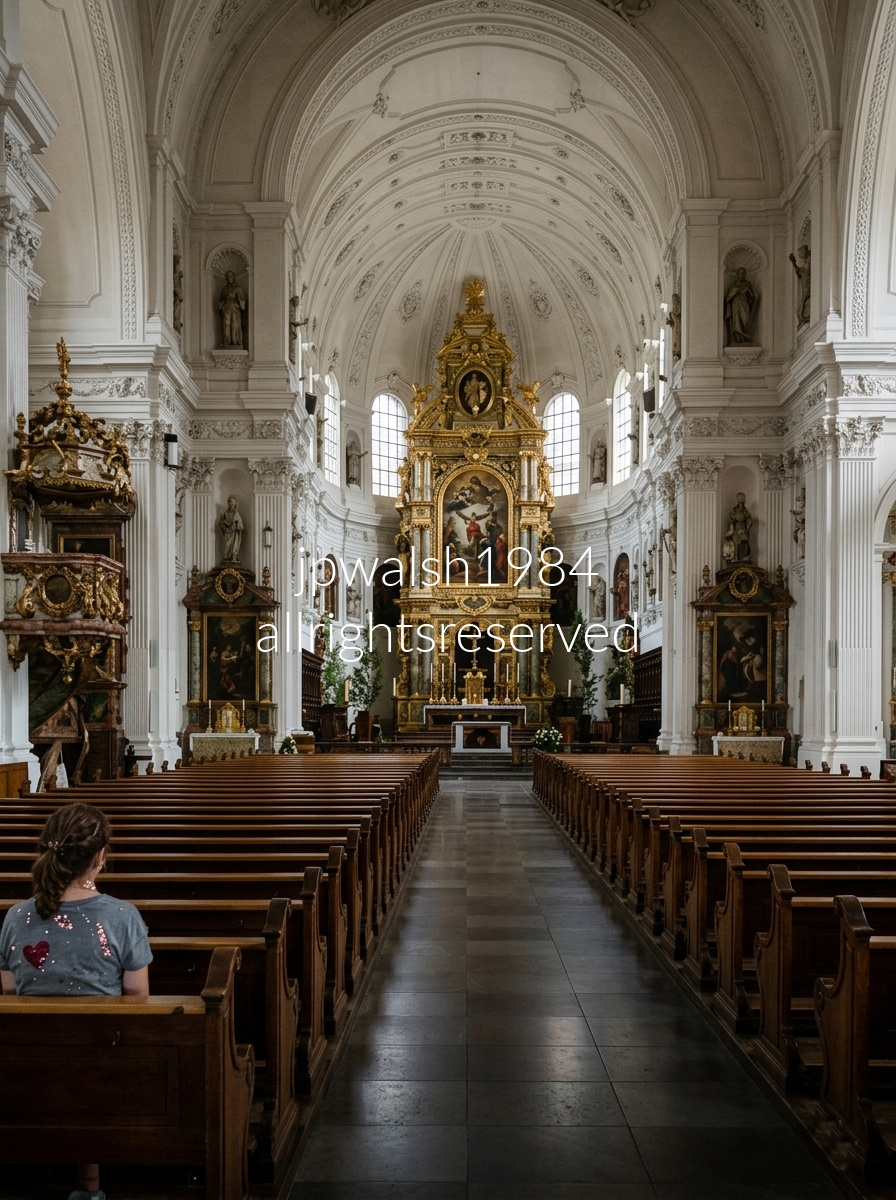
Beyond its architectural prominence as the largest Renaissance church north of the Alps, St. Michael’s maintains a deeply profound, historic connection to the German anti-Nazi resistance through Father Alfred Delp, S.J. The young Jesuit priest began his formal priestly ministry within these walls when he was ordained on June 24, 1937, by Munich’s celebrated Cardinal Michael von Faulhaber who delivered his famous anti-Nazi Advent sermons in 1933 which largely defined his ongoing critical tone towards the regime. Father Delp frequently ascended the pulpit of St. Michael’s to deliver powerful sermons that, alongside the courageous ministry of his fellow Jesuit Father Rupert Mayer, openly condemned the total incompatibility of National Socialist ideology with Christian values. This vocal opposition eventually led Delp to join the Kreisau Circle, a clandestine network of dissidents drafting plans for a humanitarian, Christian social order to rebuild Germany following the anticipated collapse of the Third Reich. Implicated in the wider resistance movements, Delp was arrested by the Gestapo in July 1944 and subsequently executed by hanging at Berlin-Plötzensee prison on February 2, 1945. In recognition of his enduring martyrdom, the Archdiocese of Munich and Freising has formally initiated the diocesan phase for Father Delp’s beatification process, ensuring that St. Michael’s continues to honor him as one of its most courageous historic voices.
St. Georg München-Bogenhausen, Munich:
St. Georg München-Bogenhausen. The exterior with its historic cemetery of St. Georg Church in Bogenhausen, Munich. A diocesan parish, a church has existed on this site since the Middle Ages. The current building was reconstructed between 1766 and 1768 and designed by Late Baroque architect Johann Michael Fischer, with interior art created by master sculptors Johann Baptist Straub and Ignaz Günther. As St. Georg was a filial church to the larger Heilig Blut (Holy Blood) parish nearby, Father Delp was the church rector—though to the ordinary churchgoers who attended his anti-Nazi sermons every Sunday, he effectively acted as their pastor.
Jesuit Father Delp’s primary assignment in Munich was serving on the editorial staff of the Jesuit journal Stimmen der Zeit (“Voices of the Times”). When the Nazi Gestapo suppressed and seized the journal’s offices in April 1941, Delp was left without a formal station. The local Archdiocese of Munich stepped in and appointed him as the rector/administrator of this small parish to keep him active. While his regional Jesuit Provincial superior (Augustin Rösch) kept close contact with him and introduced him to the anti-Nazi Kreisau Circle, the day-to-day parish staff at St. Georg was otherwise standard diocesan clergy.
The ornate, highly detailed Late Baroque (Rococo) interior of St. Georg Church in Bogenhausen, Munich, Germany. The architecture and abundant decoration emphasize dramatic composition, theatrical lighting effects, and rich faux-marble finishes characteristic of 18th-century Bavarian church design. PHOTO: “St. Georg München-Bogenhausen, Hochaltar” by Rufus46, used under CC BY-SA 3.0 / Cropped from original.
The danger surrounding Father Delp’s ministry was evident in the constant scrutiny of the Gestapo. Rather than denouncing the Nazi regime through direct political attacks, his sermons systematically dismantled its core ideology. From the pulpit, he rejected the State-as-God concept, affirming instead that only God possessed supreme authority. He also spoke forcefully about the intrinsic dignity, spiritual freedom, and equal worth of every human being, principles that stood in absolute opposition to Nazi racial doctrines and persecution.
The Gestapo fully understood what Delp was doing. Undercover agents and informants regularly filled the pews of St. Georg, reporting his sermons back to the authorities. Delp, in turn, knew they were there and occasionally mocked their presence from the pulpit itself. His dynamic and compelling preaching style drew large crowds, making his influence impossible to ignore. Ultimately, it was this fearless refusal to remain silent that kept him under permanent surveillance and led to his eventual arrest by the Gestapo.Portrait of Father Alfred Delp with glasses smiling [Photograph]. (n.d.). Historical Archives of the German Resistance / Public Domain.
One of the two Gestapo men waiting outside St. George’s to arrest Fr. Alfred Delp, S.J. happened to be an old schoolmate of his.
Like other Catholic bishops and priests who were known de facto dissenters working against the Nazi regime, especially its social and racial ideologies and practices, Fr. Delp had long been under close surveillance by the Gestapo.
As a member of the Kreisau Circle – that group of professionals of diverse religious, social, and political backgrounds with one thing in common (being dyed-in-the-wool anti-Nazis), Fr. Delp was their social scientist with a Ph.D. He illumined their minds to cutting-edge labor issues, including what could be the German worker’s role in a post-war liberated Germany.
Helmuth James Graf von Moltke (March 11, 1907 – January 23, 1945).
Count Moltke had close sympathies with the democratic forces of the day and expressed open criticism as he watched the rise of Hitler. In 1933 he refused to accept Nazi appointments. After the outbreak of World War II, as an expert adviser on international law and the laws of war he served as war administration councilor in the Office for Foreign Affairs/Counterintelligence in the Armed Forces High Command in Berlin. He was particularly active in advocating for humane treatment of prisoners of war and observance of international law. In 1940 Moltke with Peter Graf Yorck von Wartenburg became the leading figures in a group that emerged as the Kreisau Circle with its discussions held in Berlin and Kreisau. Moltke, formulating memoranda on the establishment of a new political order in Germany, systematically extended his contacts to Protestant and Catholic church leaders and to leaders of the social democratic political opposition. Moltke was arrested on January 19, 1944 after he had warned members of the Solf Circle that they were under Gestapo surveillance. His involvement in the plans for a coup against Hitler was not exposed until after the failure of the assassination attempt of July 20, 1944. Helmuth James Graf von Moltke was sentenced to death by the People’s Court on January 11, 1945 and executed on January 23, 1945 in Berlin-Plötzensee. http://www.gdw-berlin.de/home/ Fair use.
Under arrest, Fr. Delp disappeared into Nazi prisons in Munich and Berlin for almost three weeks. None of his friends could find him.
At Lehrterstrasse, a Gestapo prison in Berlin that specifically dealt with German resisters, the doctor-priest was regularly beaten. Fr. Delp was charged by the National Socialists with a half dozen crimes—being in Kriesau Circle; holding resistance meetings; knowing von Moltke and other anti-Nazis; knowing Claus von Stauffenberg who placed the bomb on July 20, 1944 to assassinate Hitler; knowing in advance of the assassination plot; and, displaying a general attitude of anti-Nazism.
The charge of knowing about the assassination plot before it happened greatly concerned Fr. Delp. He categorically denied it and, consequently worked vigorously through his lawyer to disprove it.
Having moved to Tegel Prison in Berlin on August 8, 1944, Fr. Delp’s whereabouts were finally discovered on August 15, 1944, by Marianne Hapig (1894-1973), a social worker and indefatigable friend to German resistance.
At Tegel, Fr. Delp found another significant friend—Harald Poelchau (1907-1972) the prison’s Lutheran chaplain since 1933. With the agency of chaplain Poelchau, the Catholic priest, Fr. Delp, had wafers and wine to say Mass. Also, messages could be smuggled in and out by way of the laundry.
It was through such a clandestine route that Fr. Delp made his final vows as a Jesuit on December 8, 1944. In front of a visiting witness, Fr. Delp pronounced the vow formula. Afterwards, he apologized for his emotion as he sank into a prison chair and wept.
Marianne Hapig (March 5, 1894 – March 23, 1973).Marianne Hapig discovered Father Delp’s presence at Tegel prison in Berlin after his disappearance following his arrest in Munich three weeks earlier. A career social worker and anti-Nazi Marianne Hapig and her lifelong jurist friend Marianne Pünder managed to smuggle Alfred Delp’s prison writings out of Tegel prison where soon after the war they were published. Fair use.
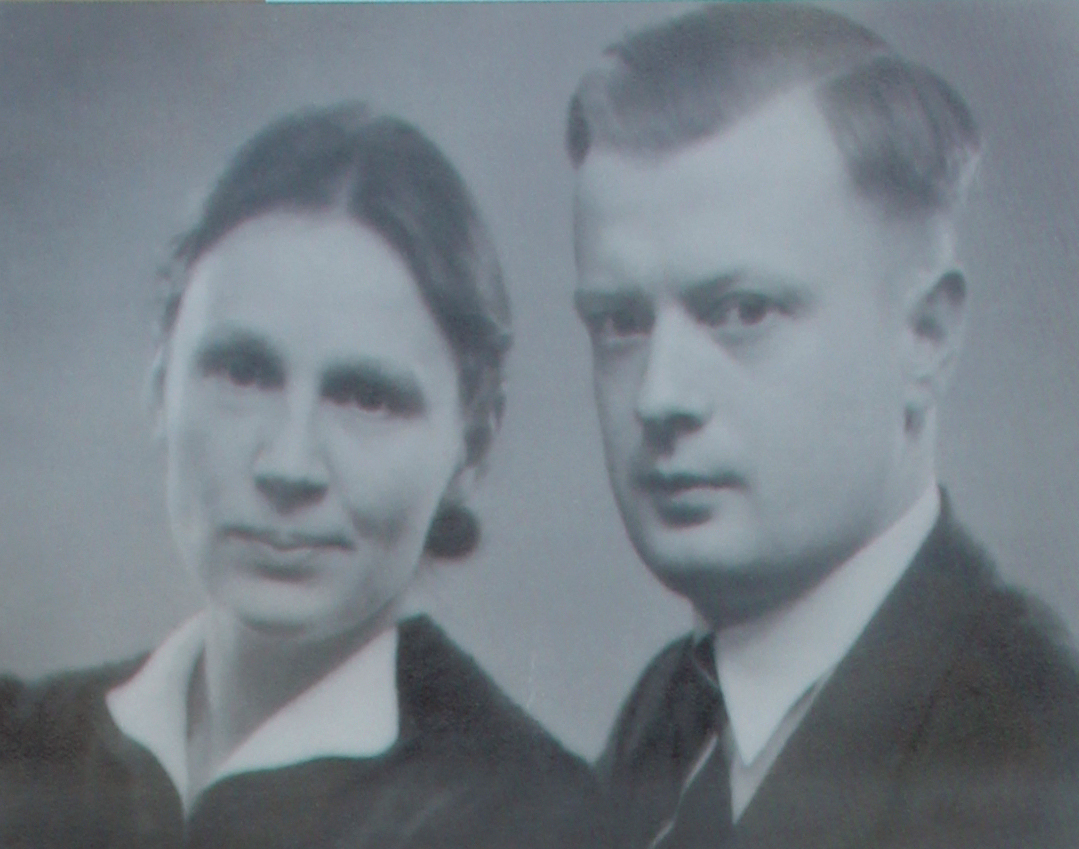
Dorothee und Harald Poelchau. Dorothee Poelchau (born Dorothee Ziegele; June 6, 1902 – November 4, 1977) was a German librarian and a prominent anti-Nazi resistance fighter who worked alongside her husband, Harald Poelchau. PHOTO: “Dorothee und Harald Poelchau (cropped)” by OTFW, Berlin is licensed under CC BY-SA 3.0.
Harald Poelchau (October 5, 1903 – April 29, 1972). Rev. Poelchau gained his doctorate in 1931 under Paul Tillich, the leading representative of Religious Socialism. At the end of 1932, Poelchau applied for a prison chaplain’s post in Berlin and became the first cleric to be employed by the National Socialist regime in a penal institution. As an official in the Justice Department he rapidly became an important source of support for the victims of National Socialist violence, and gave spiritual comfort to hundreds of people sentenced to death as they faced execution. From 1941 onwards he was a member of the circle around Helmuth James Graf von Moltke and attended the first major Kreisau Conference. After the failed coup attempt of July 20, 1944 Poelchau was able to pass on last messages and farewell letters to the relatives of many of those sentenced to death. Harald Poelchau managed to avoid being investigated by the Gestapo and survived the war. Fair use.
Many of Fr. Delp’s Advent writings come during these months in prison. They were smuggled out by Marianne Hapig and, her lifelong friend, Marianne Pünder. For more than a decade, Fr. Delp had written extensively on the Christian season of expectant waiting for the coming of Christmas.
Die gefesselten Hände (English: “Bound Hands”) by Tilman Riemenschneider (c.1460-1531).
During these months in prison, his hands almost always in chains, Fr. Delp had identified with a specific artwork as he wrote his Advent thoughts onto endless slips of paper. It was a sixteenth century German wood sculpture of St. Sebastian known as Die gefesselten Hände (English:“Bound Hands”) by Tilman Riemenschneider (c.1460-1531).
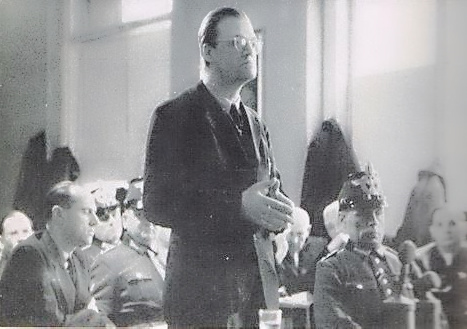
Alfred Delp, S.J. at his trial. Fair use.
In a moving ceremony while in prison and facing possible execution, Father Delp made his final Jesuit vows. Delp refused Nazi offers that could have secured his freedom if he abandoned his Jesuit vocation.
At his two-day trial in January 1945, rabid Nazi judge Roland Freisler was interested in one charge against Delp: the priest’s association with von Moltke. The leader of Kreisauer Kreis would be soon on death row and executed on January 23, 1945. Since 1942, Friesler’s reign of terror already included 5,000 death sentences as president of the People’s Court. It did not help that Fr. Delp was a Catholic priest and Jesuit.
So with Hitler, Friesler was maniacally anticlerical. Although many Nazis grew up as Catholics, in adulthood such notorious men as Hitler, Josef Goebbels, Martin Bormann, Heinrich Himmler, and others, held Christianity in utter and complete contempt. (Ian Kershaw; Hitler: a Biography; pp. 381–82). Once in power, Hitler believed that Christianity signified “the systematic cultivation of the human failure” and that its religious organization and central beliefs had to be marginalized and eventually purged from a heroic German worldview (Alan Bullock; Hitler: a Study in Tyranny; p. 218).
When Hitler invaded Poland in September 1939, the Superior-General of the Jesuits was just then a Pole, Wlodimir Ledóchowski, S.J. (1866 –1942). Ledóchowski who was in charge of neutral Vatican Radio made international broadcasts about Nazi wartime atrocities in many languages.
Wlodimir Ledóchowski, S.J. (1866 –1942). Ledóchowski, S.J. (1866 –1942) had been the Polish Superior-General of the Jesuits since 1915 when Hitler invaded Poland on September 1, 1939, setting off World War II. A renowned institutional builder, Ledóchowski established several notable institutes and colleges in Rome. In January 1940, Vatican Radio controlled by the Jesuits and with Pope Pius XII’s authorization broadcast the details of the Polish wartime situation. When the German ambassador protested the German language broadcasts, the Pope honored the request. But Vatican Radio broadcasts in other languages of the Poland situation continued and in even more explicit detail. The British press at the time hailed Vatican Radio as “tortured Poland’s powerful advocate.” see – Peter Hebblethwaite; Paul VI The First Modern Pope, Paulist Press, 1993, p. 140.Portrait of Father Wlodimir Ledóchowski, S.J. [Photograph]. (n.d.). Historical Archives of the Society of Jesus / Public Domain.
That Fr. Delp remained a Jesuit—even after he was offered a plea deal by the Nazis to walk free of all charges if he renounced his religious faith—undoubtedly deserved the death penalty in Freisler’s court.
After the death sentence was pronounced on January 11, 1945, the typical procedure of immediate execution was delayed. During this time, the bombing by British and Americans intensified. Fr. Delp desperately hoped that the Allies would arrive in time to set political prisoners, including himself, free. But, finally, on February 2, 1945, at Berlin-Plötzensee Alfred Delp was taken from his holding pen by the Nazi executioner and executed by hanging. The next day, February 3, 1945, Roland Freisler presiding in his People’s Court, was killed by collateral damage in an Allied bombing attack.
Alfred Delp, S.J.
From Alfred Delp, S.J., “Meditation for the Third Sunday of Advent Written in Tegel Prison, Berlin, December 1944” (adapted), Advent of the Heart, Ignatius Press, San Francisco, 2006:
“Mankind is challenged again to stand and deliver. Only man does not merely exchange one set of chains for another – God’s calls are always creative. They increase the very reality within us that is called upon – precisely because of their realness and authenticity…Freedom is the breath of life. We sit in musty bomb cellars and cramped prisons and groan under the bursting and destructive blows of fate. We should finally stop giving everything a false glamour and unrealistic value and begin to bear it for what it is – unredeemed life. As soon as we do this, the jangling of chains and the trembling of nerves and the faintness of heart transform themselves into a small prayer – “Drop down, dew…” We should much more definitively unite our concrete destiny with those kind of connections and call upon God’s redeeming freedom. Then the narrowness widens, our lungs breathe in fresh air again, and the horizon has promises again. Existence still weeps and mourns, but already a soft, joyous melody of longing and knowledge is ringing through the mourners’ broken voices. With this knowledge and attitude humanity releases itself from the lonely relationship to things and circumstances. A person finds wholesomeness and healing – not the goal-oriented, cool distance of calculation, mechanization, and organization. It is rather that higher level of freedom, the perspective given to someone looking from the heights to what lies below. The voice of such a person is not so quickly silenced!”
“The conditions for true joy have nothing to do with conditions of our exterior life but consist of humanity’s interior frame of mind and competence, which make it possible now and again for the person to sense, even in adverse circumstances, what life is really about…And the first answer is found in the figure of John the Baptist who personifies Advent. Humanity must be brought to an absolute clarity about himself and honestly before himself and others. He must come down from all the pedestals of arrogance onto which he always climbs…From the high-horses of vanity and self-deception that, for a time, let themselves be trotted out so proudly. Those horses though finally throw off their “master” in the wilderness…Two criteria identify whether we are following an authentic impulse or not…Both are found once again in John the Baptist. The first is service – human honesty requires a person to see himself as a servant and perceive his reality as mission and an assignment…The second criterion keeps us on track- annunciation, which calls us to praise of God. An extended personal effort is required to keep giving oneself the impulse to rise above, move away from self. But at the same time this is how a human being attains the necessary openness in which he or she must continue if sincerely wanting to strive toward the great realities God has prepared for him or her.”
FOURTH SUNDAY IN ADVENT.
Advent Nativity awaiting the birth of Jesus. Author’s photograph.
Thomas Merton makes clear about Father Delp that his writings on Advent are usually a simple presentation of the traditional Christian faith with no special originality to his images. (p. xxxv, Prison Writings). It is Fr. Delp’s application of those facts based in his personal experience – as an active dissident and prisoner of a Germany in ruins during World War II – that restores the sometimes hackneyed outcome to Advent to its original hope.
In Fr. Delp’s world, if humanity is fully alert to the desperation and bitterness of the times, Advent’s basic image of God-made-man becomes immensely opportune and favorable for humanity’s future although not holding any foregone conclusions or sudden outcomes.
“The Spirit of the Lord is upon me, because he has anointed me to bring glad tidings to the poor. He has sent me to proclaim liberty to captives and recovery of sight to the blind, to let the oppressed go free, and to proclaim a year acceptable to the Lord.” Luke 4:18-19.
Thomas Merton views Father Delp’s Advent meditations in Pauline terms, although Fr. Delp found St. Paul sometimes had a ‘tendency to over-emphasize.’ (p. 55, ibid.). Humanity hopes in God’s close alliance so to win back or have restored a future that is not any longer in ruins and in which humanity and even created life itself is absurdly helpless to fix.
His show trial before the notorious Nazi “People’s Court” took place over two days, spanning January 8–9, 1945. He was officially sentenced to death on January 11, 1945, and subsequently executed on February 2, 1945.
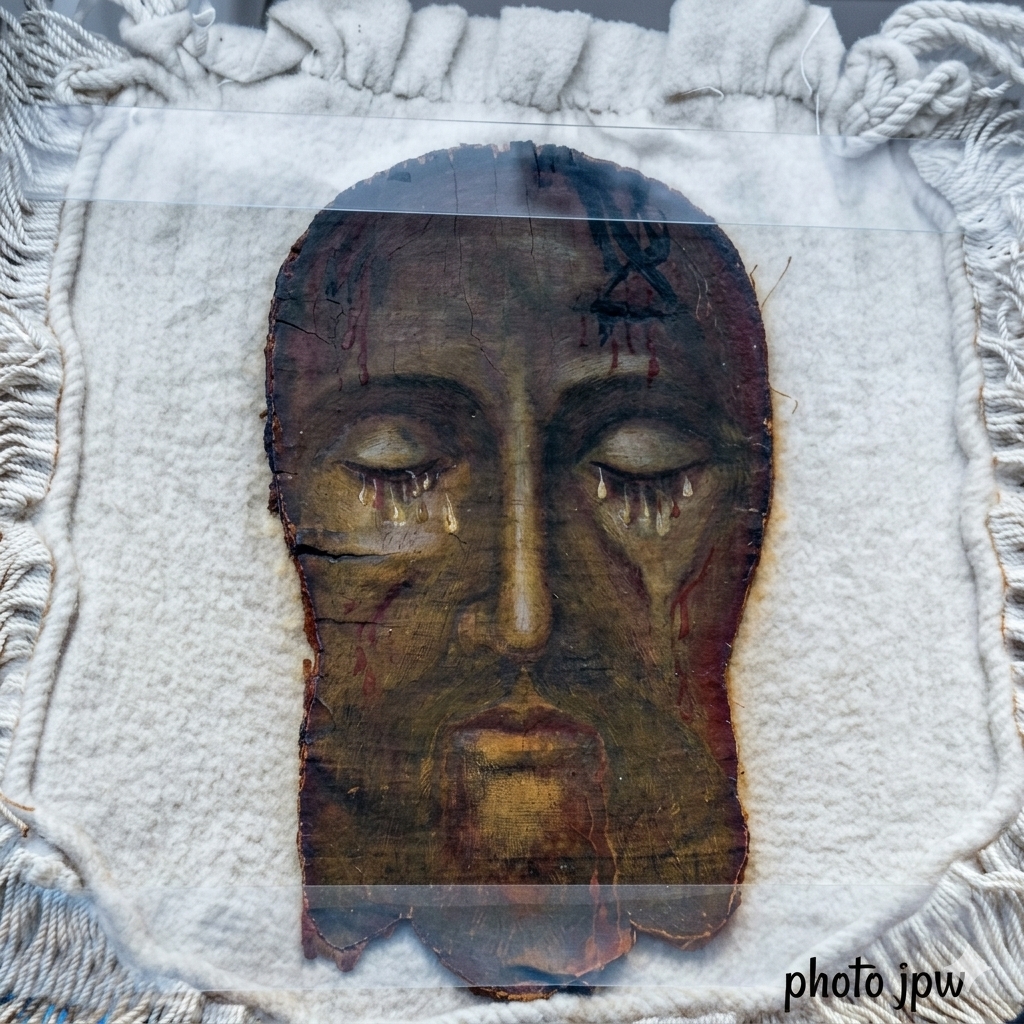
Holy Face painted by Saint Thérèse of Lisieux. National Shrine of St. Thérèse in Darien, Illinois. Author’s photograph.
Saint Thérèse of Lisieux (French, 1873-1897) traced and painted this image of the Holy Face of Jesus and tacked it to wool for hanging as a gift to her sister Céline who was at home at Les Buissonnets taking care of their widower father who was suffering from illness. The National Shrine of St. Thérèse in Darien, Illinois. It may be expected that a similar sort of facial expression was found on Father Delp. On February 2, 1945 Father Delp was imprisoned, tried and executed by the Nazis for “hop[ing] to build a new Germany on Christian principles.”
Alfred Delp S.J. Fair use.
From Alfred Delp S.J., Prison Writings, Orbis Books, Maryknoll, New York, 2004:
“God in the Christmas encounter is still the challenging God. The greatest misconceptions all center round the typical Christmas picture of God. Humanity becomes so wrapped up in appearance that the breathtaking reality of the birth of God as a human child scarcely enters our mind and the soul doesn’t grasp its significance….Of course the externals, the sweet sentimental pictures, carols, cribs and so on, are a comfort….but there is a great deal more to the nativity than that. The truth of it is too tremendous to be appreciated unless one concentrates on it fully. Since the birth of God, humanity has been confirmed in the hope that when we turn to God’s throne for favor that God is on our side. This does not mean that God has dethroned Himself any more than it means that human life has become a primrose path in the wake of that stupendous event. We need to look critically at the tendency to sentimentalize the divine attributes by personifying them in an innocent child or over-beautifying the adult Jesus. The glamorizing of the nativity story – the making the whole tone of Christ’s life equal to a Baroque sermon full of ominous warnings and grave moralizing – has contributed quite a lot to the West’s being paralyzed in the face of those conditions that hinder us and keep us trapped. God became man but nevertheless is God, master of all creation. Human beings must approach the God-made-man with reverence and adoration – disenthralling themselves in order to find themselves. It is the only way.”
His prison writings remain among the most powerful spiritual documents produced during the Third Reich, uniting Christian faith, human dignity, and resistance to totalitarianism
Alfred Delp, S.J. fair use.
BIBLIOGRAPHY:
Bullock, Alan, Hitler: a Study in Tyranny, Completely Revised Edition, Harper & Row, New York, 1964.
Delp, S.J., Alfred, Advent of the Heart, Ignatius Press, San Francisco, 2006.
Delp, S.J., Alfred, Prison Writings, Orbis Books, Maryknoll, New York, 2004.
Hebblethwaite, Peter, Paul VI The First Modern Pope, Paulist Press, New York, 1993.
Kershaw, Ian, Hitler: a Biography, W. W. Norton & Company, New York, 2010.
Kidder, Annemarie S., Ultimate Price Testimonies of Christians who Resisted the Third Reich, Orbis Books, Maryknoll, New York, 2012.
Royal, Robert, The Catholic Martyrs of the Twentieth Century A Comprehensive World History, Crossroad, New York, 2000.
This explanatory article may be periodically updated.