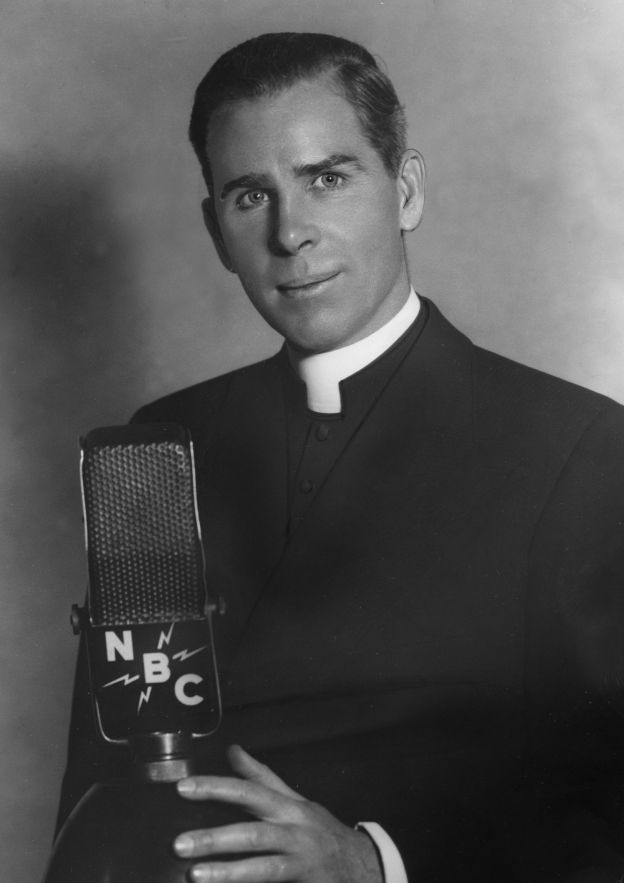

FEATURE image: Feature Image: Newly-Blessed Fulton J. Sheen posing for an official promotional portrait for the wildly popular NBC radio program, The Catholic Hour, which he hosted on Sunday nights. He launched the show with NBC in 1930, where his voice reached millions of households across the America each week, establishing him as America’s first true “media priest.” During his 20-year run on the radio Fulton Sheen pioneered a distinct blend of deep theology, patriotism, and sharp cultural commentary. For example, in the midst of the Great Depression (1929-1941) Sheen frequently attacked the moral failures of unbridled greed and monopoly capitalism, while simultaneously warning the poor not to fall for the “siren song” of class warfare. He consistently hosted sociology and labor experts on the program to advocate for worker rights, fair wages, and interracial justice, declaring that all people “have equal rights as children in the house of the Lord.” Public Domain. Fulton Sheen’s Beatification Illuminates His Message – WSJ – retrieved September 24, 2026.
How Fulton J. Sheen’s Irish-American family heritage, Catholic education, intellectual gifts, academic accomplishments, and disciplined spiritual life combined to form the future priest, bishop, evangelist, and eventual Blessed of the Catholic Church.
On September 24, 2026, the Catholic Church officially beatified Bishop Fulton J. Sheen during a historic ceremony in St. Louis, declaring him a Blessed of the Church. This milestone recognizes a lifetime of profound faith, intellectual brilliance, and pioneering media evangelization that began from immigrant Irish and Midwestern roots.
Family Roots and Early Life
Blessed Bishop Fulton J. Sheen (1895–1979), known for his perfect Catholic school penmanship, rarely made mistakes during his live, unscripted broadcasts. Born into an everyday working-class background in El Paso, Illinois, near Peoria, he was the eldest of four sons of Newton and Delia Sheen, both of Irish descent. Delia (1864–1943) grew up on a farm near Kickapoo in Peoria County, and Newton (1863–1944) was born in El Paso. Bishop Sheen’s maternal grandparents were born in Ireland; his paternal grandfather was from Dublin, Ireland, and his grandmother from Indiana.
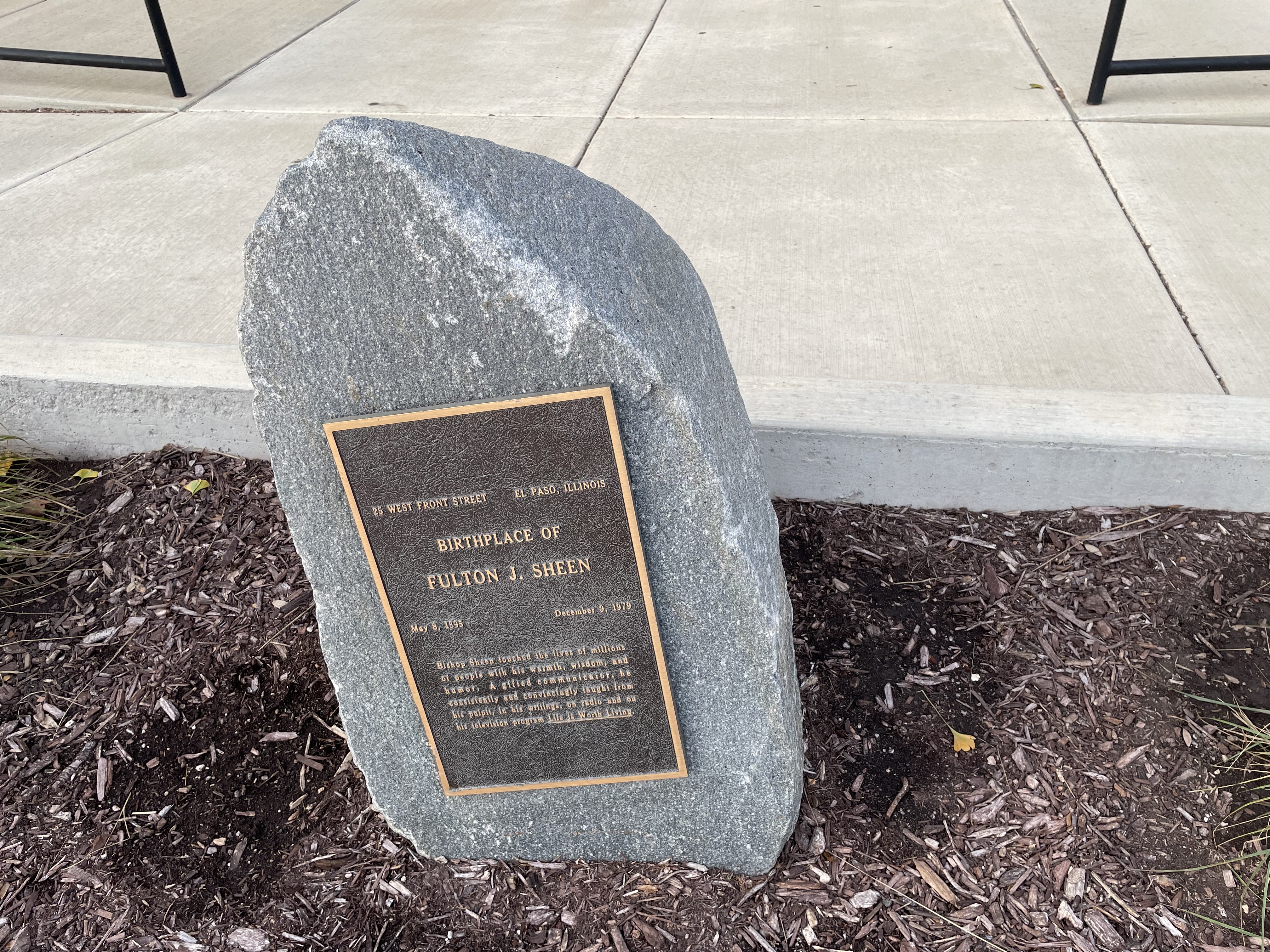
The stone stands at 25 West Front Street in downtown El Paso, Illinois. It marks the exact location where Fulton J. Sheen was born on May 8, 1895. PHOTO: “Fulton J. Sheen Birthplace Marker, El Paso, Illinois, November 2024” by HeatherMarieKosur is licensed under CC BY-SA 4.0.
Relatives remembered Delia—“Aunt Dee”—as laid back, cordial, sociable, and an excellent cook. Newton, short and slim, was generally quiet with a mechanical bent of mind. Newt first married Ida, a woman from Ohio, in 1886; she died in 1892, leaving him with a daughter (Eva Sheen married Luke Walsh in 1907). Afterward he married Delia, and the couple settled in El Paso, where Newton and his brother opened a hardware store. In 1900, while operating two farms on each side of Peoria, the family moved to 111 Seventh Street in Peoria, where Newt, Delia, their four sons, and Delia’s parents lived together. Fulton inherited his mother’s dark hair and deep-set eyes. The family moved from the farm directly into the city of Peoria for the express purpose that Fulton and his brothers could enroll in school.
Sheen’s holiness, intellectual achievement, disciplined spiritual life, and groundbreaking use of mass media were all deeply rooted in the formative influences of his family, education, and early experiences in Peoria.
Formative Education in Peoria
His parents prioritized their children’s education, enrolling Fulton in St. Mary’s Cathedral grade school and later the elite $60,000 Spalding Institute boys’ academy founded in 1899 by Peoria’s first bishop. There, Sheen not only served as an altar boy and discovered his priestly vocation but, in his class of 43 aspiring boys, graduated as the valedictorian of the class of 1913. His time there was highly influential, formed by the rigorous discipline of the Marianist brothers (not to be confused with the Marist Brothers), a French order founded in Bordeaux in 1817 by Blessed William Joseph Chaminade who staffed the school (Brother Gerald, S.M. was its first principal) from its founding until 1933 when the Benedictines took over (those were the days when they had the numbers to do that!).

Fulton J. Sheen’s high school graduation portrait from 1913. He was 18 years old having just concluded his time at the Spalding Institute in Peoria, Illinois. It was for this exact graduation milestone that he earned top academic honors and delivered the commencement address as the class valedictorian. A classmate recalled that at 18, Sheen possessed a terrifyingly good memory and a “golden tongue” that kept the entire auditorium pinned to their seats. Core themes of Sheen’s address included moral integrity over intellect, devotion to the truth, and a call to action as the vocation of the educated Christian man. Public Domain.
Higher Education, Debating, and Ordination
Fulton Sheen entered St. Viator College in Bourbonnais, Illinois, where he earned a combined B.A./M.A. in philosophy in 1917. Sheen was a star debater at the school, leading St. Viator to a legendary triumph over the University of Notre Dame, showing the golden dome fellows that the real fighting Irish lay everywhere (though that is a slightly later moniker under Knute Rockne and Notre Dame President Father Matthew Walsh). After college, Sheen entered the seminary in Minnesota and was ordained a priest in September 1919 at St. Mary’s Cathedral, where he had gone to grade school and served as an acolyte.
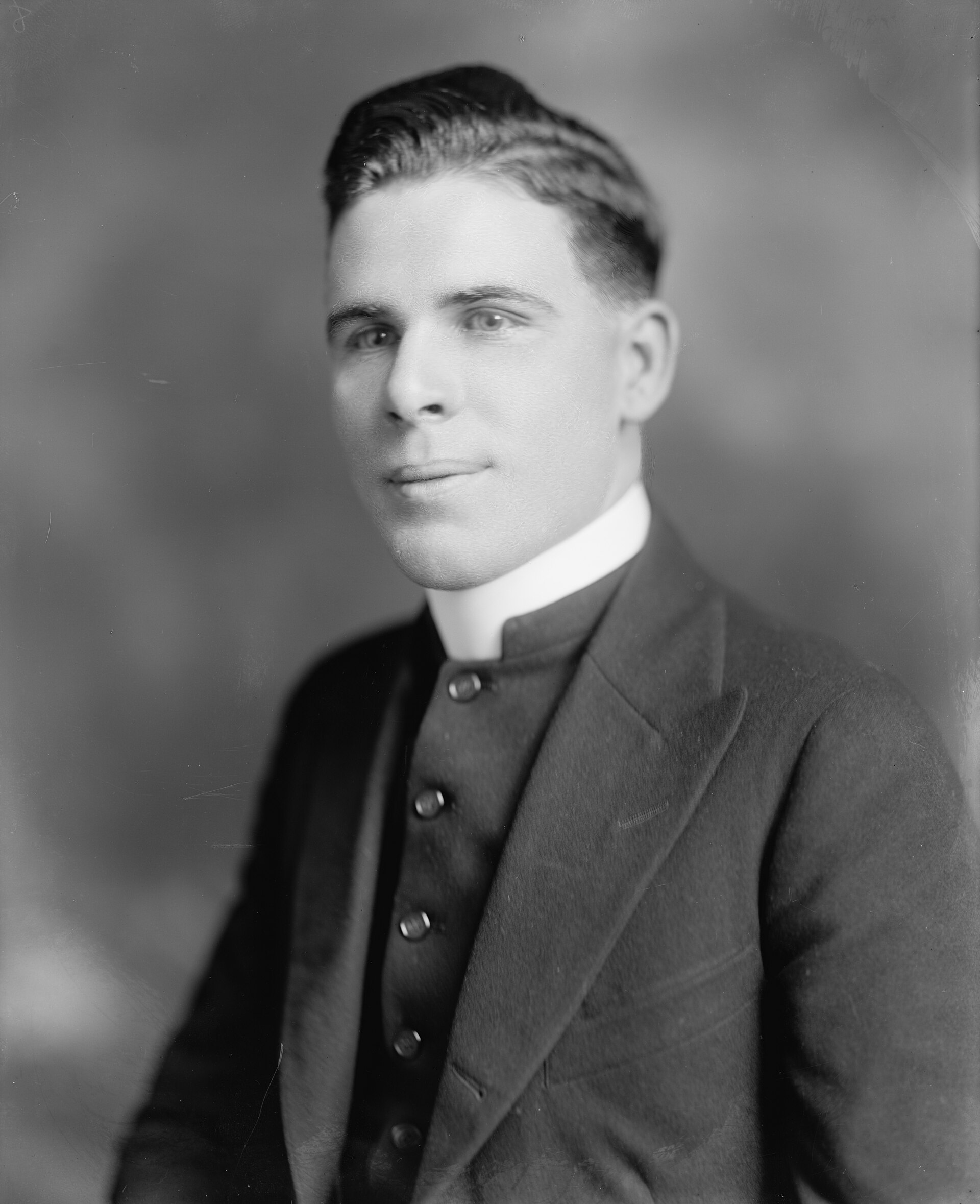
Fulton Sheen’s official ordination portrait taken in September 1919. He was 24 years old and had just been ordained a Roman Catholic priest on September 20, 1919, at St. Mary’s Cathedral in Peoria, Illinois. As a priest he made two resolutions that he kept for the rest of his life: He resolved to offer the Holy Eucharist every Saturday in honor of the Blessed Virgin Mary to petition her lifelong protection over his priesthood. He noted that according to the Epistle to the Hebrews, a priest must offer sacrifices not just for his congregation, but for his own soul. He also resolved to spend one continuous, uninterrupted hour every single day in prayer and adoration directly in front of our Lord in the Blessed Sacrament (the Tabernacle). While the Saturday Masses anchored his weeks, the Daily Holy Hour became the defining spiritual signature of his life. Even when he became a massive television celebrity with an exhausting travel schedule, Blessed Bishop Sheen never broke the vow. PHOTO: Public Domain. https://www.loc.gov/pictures/item/2016860626/
Academic Brilliance and the “Peoria Product”
Sheen’s aspiration and capability led him to become a canon lawyer where he completed his studies at The Catholic University of America in 1920. The arguably not yet over-educated Sheen now earned a Ph.D. in philosophy from the Catholic University of Louvain in Belgium (where he became the first American to win their prestigious Cardinal Mercier Prize) as well as an S.T.D. (Sacrae Theologiae Doctor) at the Angelicum in Rome.
This man from an everyday Midwestern family’s first assignment was a parish priest at St. Patrick’s Catholic Church in Peoria, Illinois, in 1926. This was partly so that the church could show off their new product to the folks at home and to see how he plays in Peoria—a time of perfect joy for Sheen—though some narratives imply it as a mere test of his humility. The only thing humbled is the diocese itself, who closed St. Patrick’s in Sheen’s lifetime in 1976 for dwindling attendance for shattered perceptions of the Church, liturgical confusion, and an unintended loosening of strict church laws after Vatican II. see – Review: Why did so many Catholics leave after Vatican II? – America Magazine – retrieved September 25, 2026.
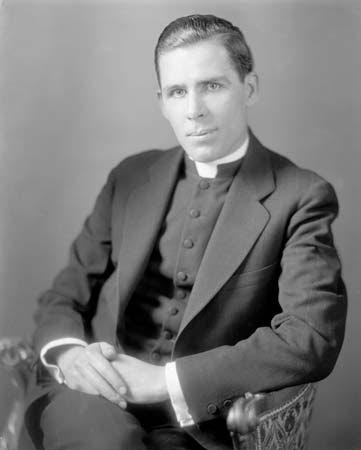
Young Rev. Sheen in a portrait taken around 1930 by Harris & Ewing Washington D.C. portrait studio. Rev. Sheen was approximately 35 years old. At the time Sheen was a young professor teaching philosophy at The Catholic University of America (CUA). This was the exact year Sheen launched into the national spotlight by becoming the first regular host of The Catholic Hour—a Sunday night NBC radio program that quickly grew to reach an estimated 4 million weekly listeners. Public Domain.
The Catholic University of America and National Fame
The Catholic University of America now called him to Washington to join their School of Theology, become a professor, launch his radio career, and begin his path to international fame and holiness. The first course Sheen regularly taught was “God and Religion in Contemporary Thought.” He taught at CUA until 1950, where his course offerings expanded as he transitioned into the School of Philosophy.
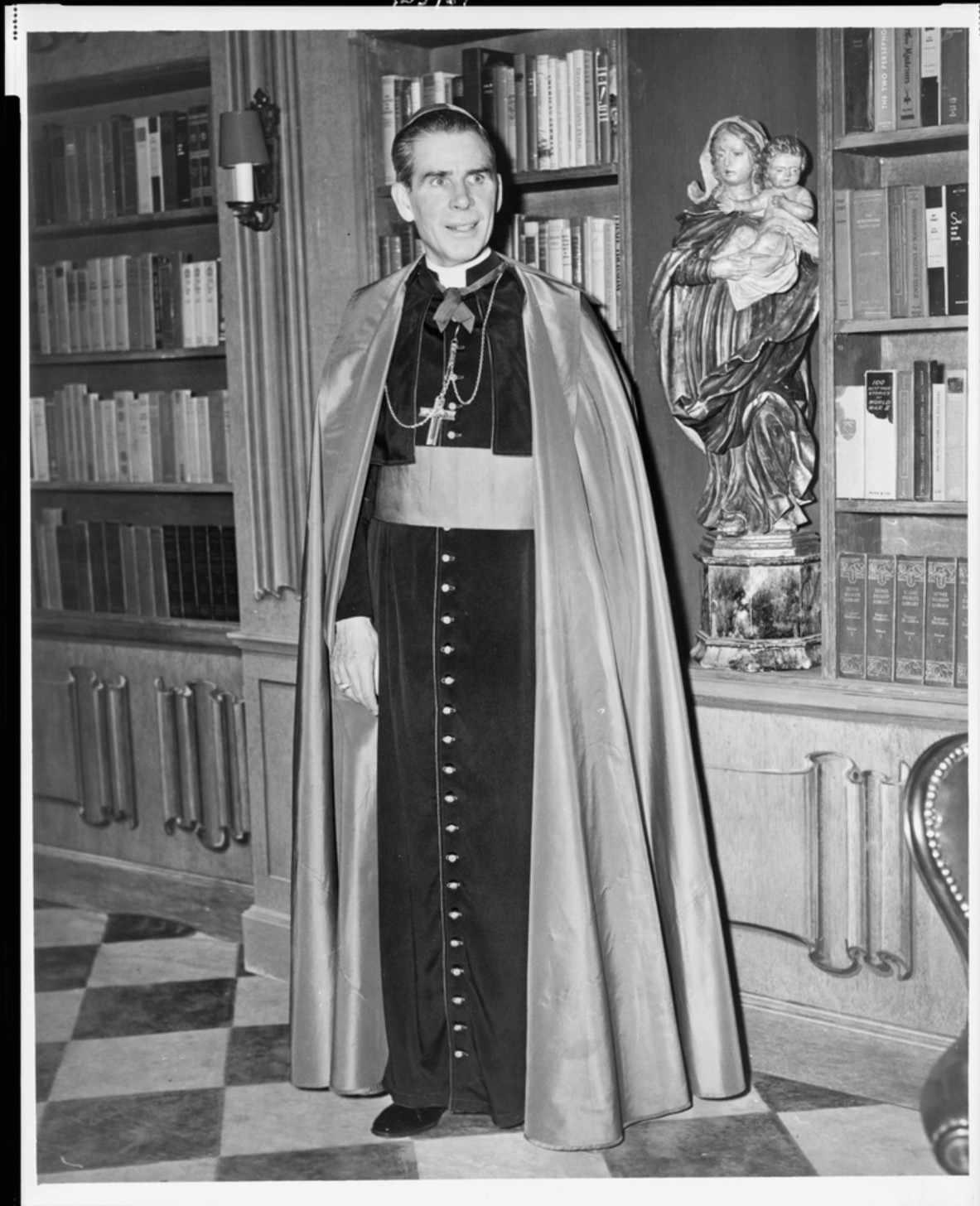
Consecrated as an auxiliary bishop of New York the previous year (1951), this photograph was taken in 1952 on the custom-designed library set of his groundbreaking, Emmy-winning television series, Life Is Worth Living. Dressed in his formal clerical attire—including his cassock, zucchetto, pectoral cross, and flowing structural ferraiolo cape—the image captures him at the absolute height of his national cultural influence. Airing on Tuesday nights on the DuMont Television Network, his unscripted, chalkboard-driven program surprisingly went head-to-head with “Mr. Television” Milton Berle, drawing up to 30 million weekly viewers of all faiths and backgrounds. PHOTO: “Bishop Fulton J. Sheen, full-length” by libraryofcongress is marked with CC0 1.0.
Blessed Bishop Fulton J. Sheen (1895–1979), known for his perfect Catholic school penmanship, rarely made mistakes during his live, unscripted broadcasts.
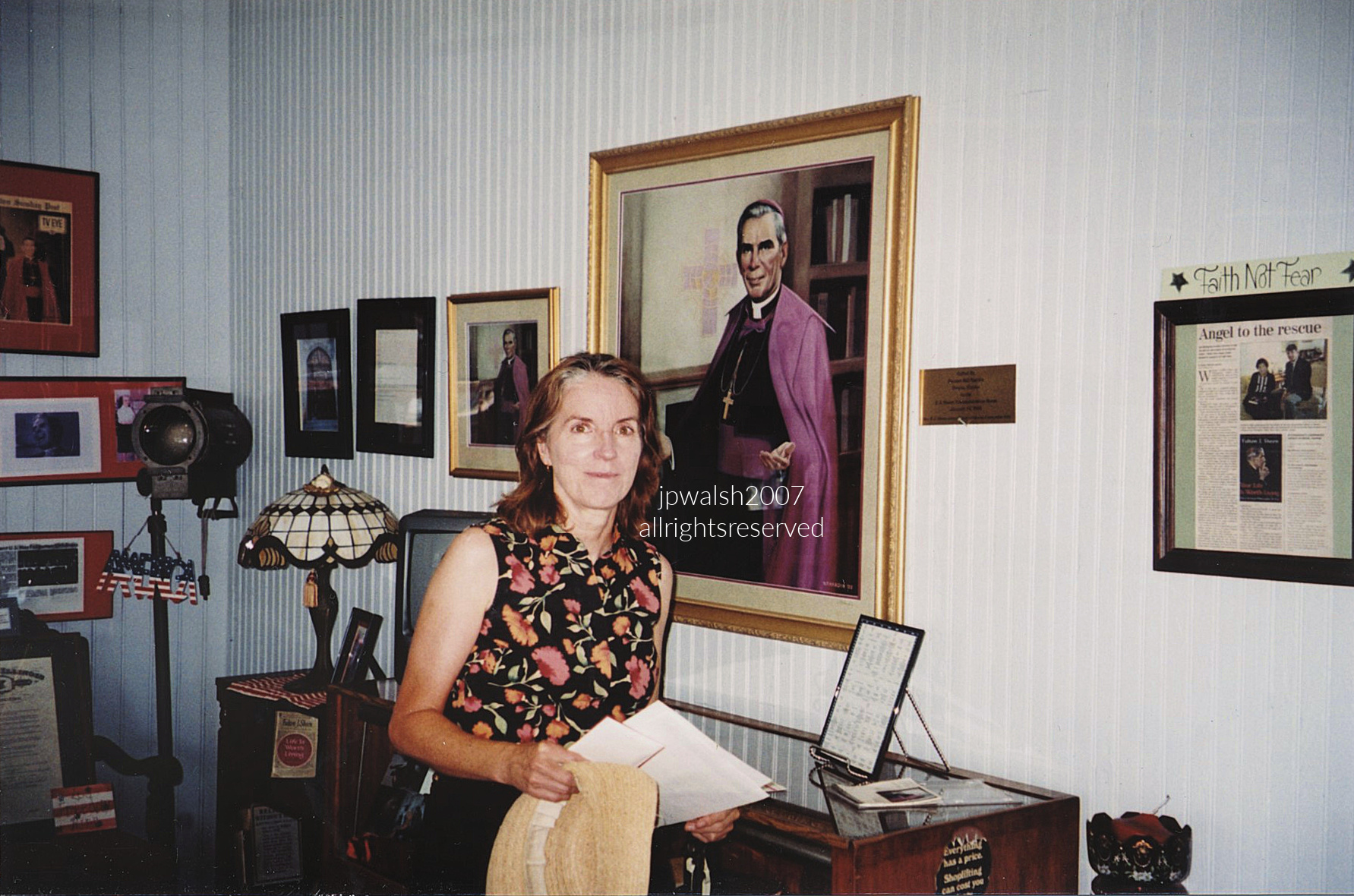
On a personal visit in August 2007 (my wife Deb is pictured) to the Archbishop Fulton John Sheen Spiritual Center and Communication Room, located inside the Historic Railroad Depot in his birthplace of El Paso, Illinois. The vintage studio spotlight on the left, old radios, and typewriter props in the room are deliberate design choices meant to recreate the atmosphere of Bishop Sheen’s pioneering mid-20th-century radio and Emmy-Award-winning television programs like The Catholic Hour and Life Is Worth Living. In October 2000, the museum founder first set up a modest Bishop Sheen exhibit in the “Reading Corner” of the newly restored historic depot. By July 2001 this dedicated, separate large, full-size room officially opened within the depot— the exact space in this photo. At his beatification Mass on September 24, 2026, the papal delegate and presider, Cardinal Luis Antonio Tagle, called Archbishop Fulton J. Sheen a “son of Illinois, son of the United States of America,” and “indeed, son of the world.” Author’s photograph.