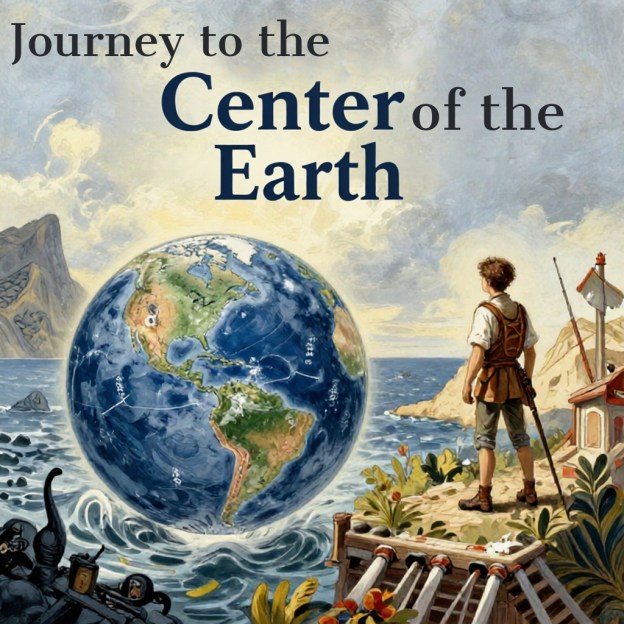
FEATURE image: Jules Verne’s Journey to the Center of the Earth follows Professor Lidenbrock, Axel, and Hans on a descent into a mysterious underground world filled with prehistoric landscapes and creatures. Image design by John P. Walsh, utilizing generative AI elements.
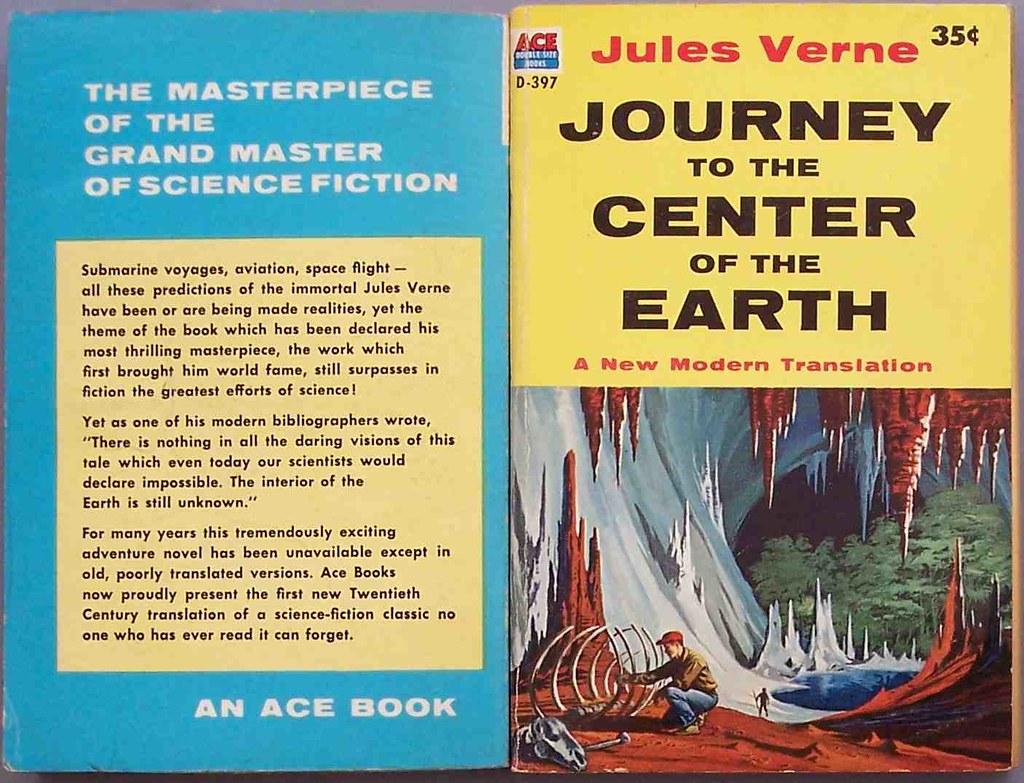
The novel’s first English edition was published in London in 1871. Journey to the Center of the Earth has appeared in various other English translations and has never gone out of print. PHOTO: “journey to the center of the earth” by cdrummbks is licensed under CC BY 2.0.
Jules Verne’s Journey to the Center of the Earth endures because its blend of scientific curiosity, adventure, wonder, and spectacle has proven endlessly adaptable, allowing a 19th-century science-fiction novel to captivate audiences across generations and media, from books and films to television, theme parks, and immersive attractions.
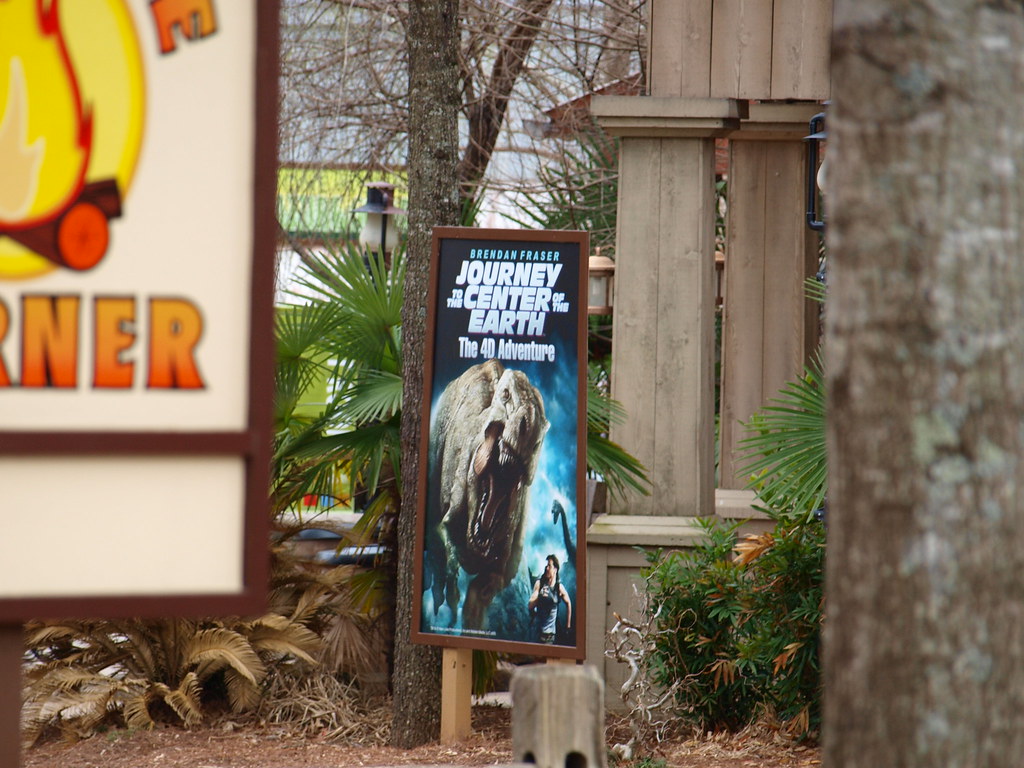
Promotion of a 2008 film adaptation of Journey to the Center of the Earth in 4D. PHOTO: “Journey to the Center of the Earth 4D Movie Sign” by rmanoske is licensed under CC BY-NC-ND 2.0.
The Novel That Opened a World Beneath Our Feet
Published in 1864, Journey to the Center of the Earth was one of the works that helped lay the foundations of modern science fiction. In it, French novelist Jules Verne (1828-1905) sent the fiery German geologist Professor Otto Lidenbrock, his anxious nephew Axel, and their steadfast Icelandic guide Hans Bjelke into the unexplored depths of the Earth. Their descent leads through vast caverns, prehistoric landscapes, and encounters with creatures long believed extinct.
The combination of scientific curiosity, exploration, danger, and imagination proved irresistible. More than 160 years later, the novel has never gone out of print in English and remains one of the most widely adapted works in science-fiction history.
Published in 1864, Journey to the Center of the Earth helped establish the foundations of modern science fiction.
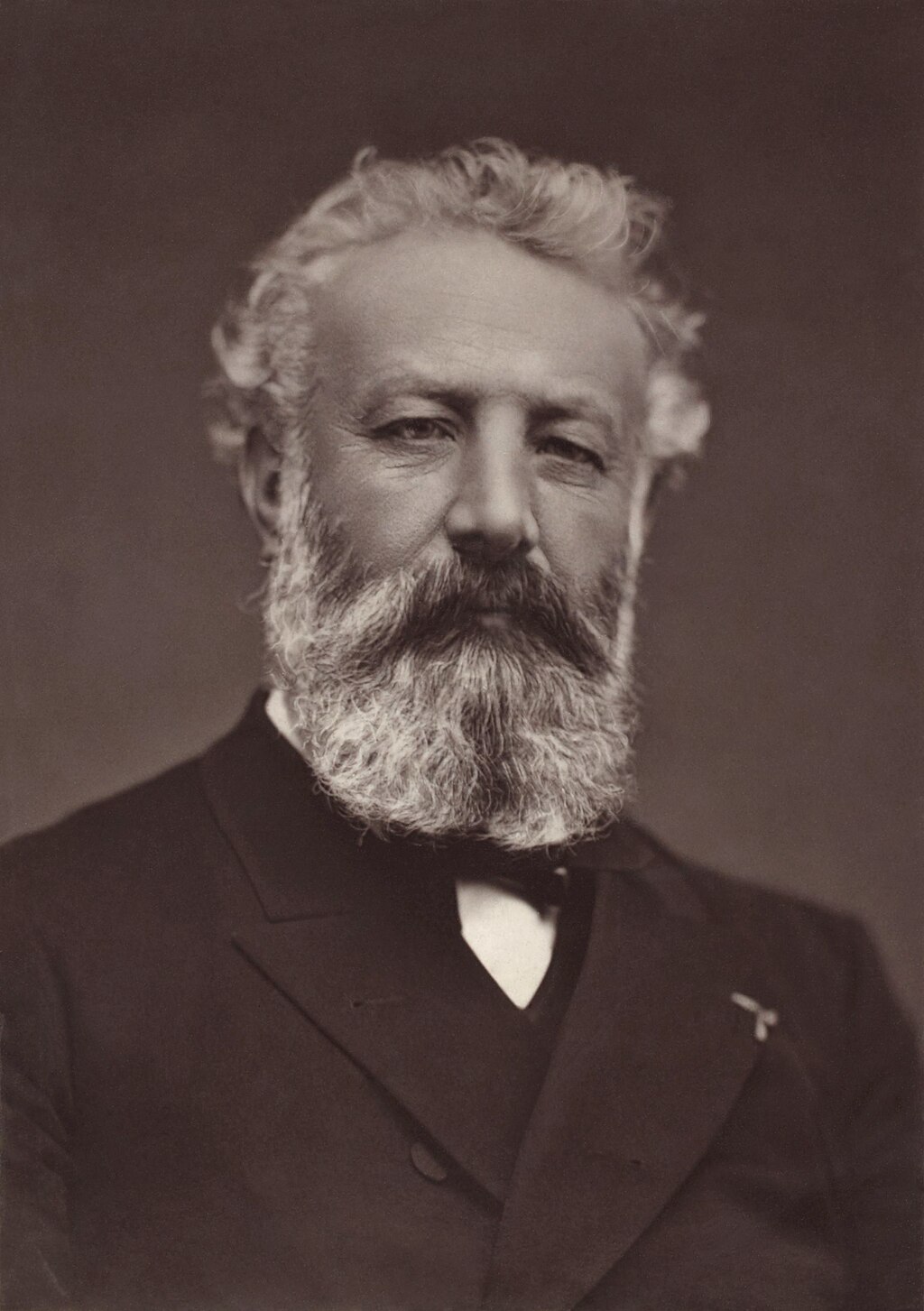
Photograph of Jules Verne in Nantes by Étienne Carjat (1828-1906). In Société de Géographie. Public Domain.
From Novel to Screen
Verne’s subterranean adventure quickly escaped the pages of the book and entered popular culture. The story has inspired films, radio dramas, television programs, cartoons, and theme-park attractions, each generation reshaping the tale for its own audience while preserving its central appeal: the thrill of venturing into the unknown.
The most celebrated adaptation arrived in 1959, when 20th Century-Fox released its lavish Cinemascope production starring James Mason. The film became a classic in its own right and introduced countless viewers to Verne’s underground world.
The novel follows Professor Lidenbrock, Axel, and Hans on a descent into a mysterious underground world filled with prehistoric landscapes and creatures. Verne’s combination of science, exploration, danger, and imagination has given the story lasting appeal.
Bernard Herrmann’s Sound of Terror
A major reason for the 1959 film’s enduring reputation is its extraordinary score by Bernard Herrmann, already famous for his collaborations with Alfred Hitchcock on Vertigo and Psycho. Herrmann envisioned the subterranean world as a place devoid of human warmth, seeking what he called an atmosphere of “no emotion, only terror.”
To achieve this effect, he eliminated strings from many underground sequences and constructed an immense, echoing soundscape using five organs. He even revived the serpent, a rarely used sixteenth-century bass wind instrument whose guttural voice lent a primal menace to scenes involving giant reptiles and prehistoric creatures. The result remains one of the most inventive fantasy film scores of Hollywood’s Golden Age.
The 1959 film starring James Mason became a classic in its own right, aided by Bernard Herrmann’s innovative score.
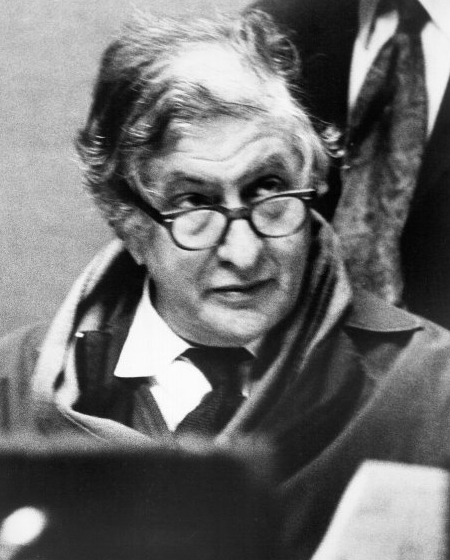
From the late 1950s to the mid-1960s, Bernard Herrmann scored a series of mythically-themed fantasy films, including 20th Century-Fox’s Journey to the Center of the Earth in 1959. Photo credit: Unknown photographer, via the Arlington Heights Herald (c. 1970). Public Domain.
Saturday-Morning Adventure
The story returned for a younger audience in 1967 as an animated television series produced by Filmation Associates and 20th Century Fox Television. Rather than adapting Verne’s novel directly, the cartoon borrowed heavily from the successful 1959 film and transformed it into a colorful, episodic adventure series.
Its twenty-minute episodes emphasized fantasy, monsters, and cliffhanger action. In one representative installment, “Creatures of the Swamp,” Professor Lindenbrook and his companions battle hostile moss creatures and rescue captured allies in a hidden underground marsh. Though the series moved far from Verne’s harder science-fiction roots, it demonstrated the remarkable flexibility of the original concept.
The 1967 animated series introduced Verne’s subterranean adventure to younger audiences, demonstrating the story’s flexibility across formats.
“Creatures of the Swamp,” the fourth episode of the 1967 animated Journey to the Center of the Earth series, aired on ABC on September 30, 1967. In this fast-paced 20-minute adventure, Professor Lindenbrook designs a custom swamp buggy to help Lars cross a vast underground marsh, but the expedition quickly goes awry when hostile moss creatures ambush and capture him. When the scheming Count Saknussemm’s interference results in Alec’s capture as well, Lindenbrook and Cindy join forces with the friendly subterranean “swamp people” to stage a rescue. Like much of the Filmation series, the episode favored colorful fantasy and monster-driven action over Jules Verne’s original science-fiction approach. Veteran voice actor Ted Knight performed the dual roles of heroic Professor Lindenbrook and the villainous Count Saknussemm.
The 3D and 4D Age
Verne’s adventure found yet another life in 2008. That year, three separate film versions of Journey to the Center of the Earth appeared, a testament to the story’s ongoing commercial appeal. The most successful was director Eric Brevig’s effects-driven 3D adventure starring Brendan Fraser, Josh Hutcherson, and Anita Briem.
Rather than directly retelling the novel, the film presented Verne’s book as a roadmap to a hidden world beneath the Earth’s surface. Audiences followed volcanologist Trevor Anderson, his nephew Sean, and guide Hannah into a spectacular subterranean realm populated by dinosaurs, volcanic hazards, and breathtaking landscapes. Enhanced by early 4DX technology that added motion, water sprays, wind, and other sensory effects, the film became a worldwide hit, earning more than $244 million against a $60 million budget and introducing Verne’s classic to a new generation of moviegoers.
A Journey Without End
Most journeys remain private experiences, recorded in diaries and forgotten with time. Others transcend their origins and become part of our shared cultural imagination. Journey to the Center of the Earth belongs to that rare second category. From Verne’s 1864 novel to the 1959 film, the 1967 animated series, and the immersive 3D and 4D adventures of the twenty-first century, each adaptation has reaffirmed the same enduring truth: humanity is endlessly fascinated by mysteries that lie beyond the horizon or beneath our feet. More than a century and a half after its publication, Verne’s remarkable descent into the unknown continues to inspire wonder, proving that some adventures never reach their destination because each generation eagerly begins the journey anew.

Neon lights, a warm marquee glow, and a line out the door: opening night at the Roxy as moviegoers queue for the 4D adventure Journey to the Center of the Earth. Directed by Eric Brevig, the film reimagines Jules Verne’s classic novel as a springboard for family-friendly spectacle, immersive 3D visuals, and sensory theater effects. Released in 2008, it grossed $244.2 million worldwide on a $60 million budget. While critics found the plot familiar and some of Brendan Fraser’s humor overly broad, they praised the film’s visual inventiveness and energetic use of 3D. Audiences embraced it, making the movie a family favorite and paving the way for the sequel Journey 2: The Mysterious Island (2012). PHOTO: “Warner Bros. Movie World – Journey to the Center of the Earth 4-D Adventure” by Mohd Fazlin Mohd Effendy Ooi is licensed under CC BY 2.0.