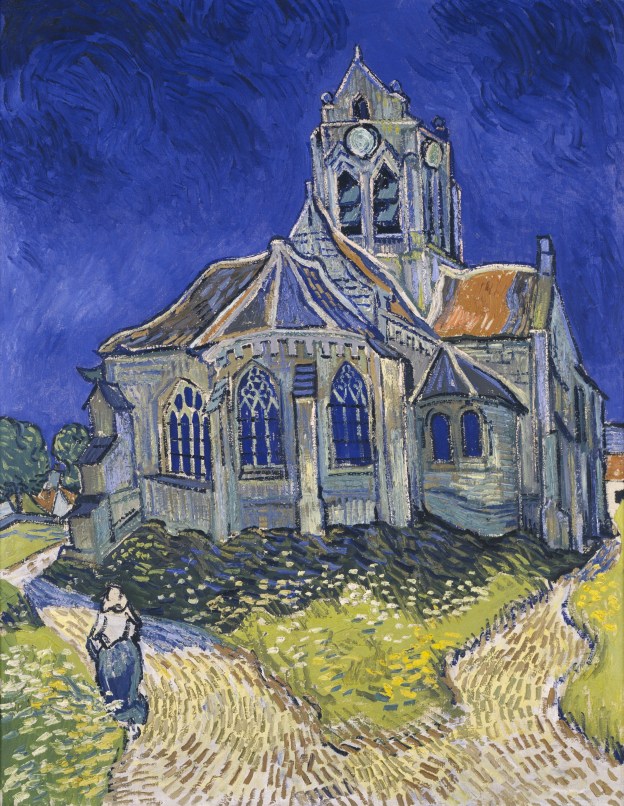
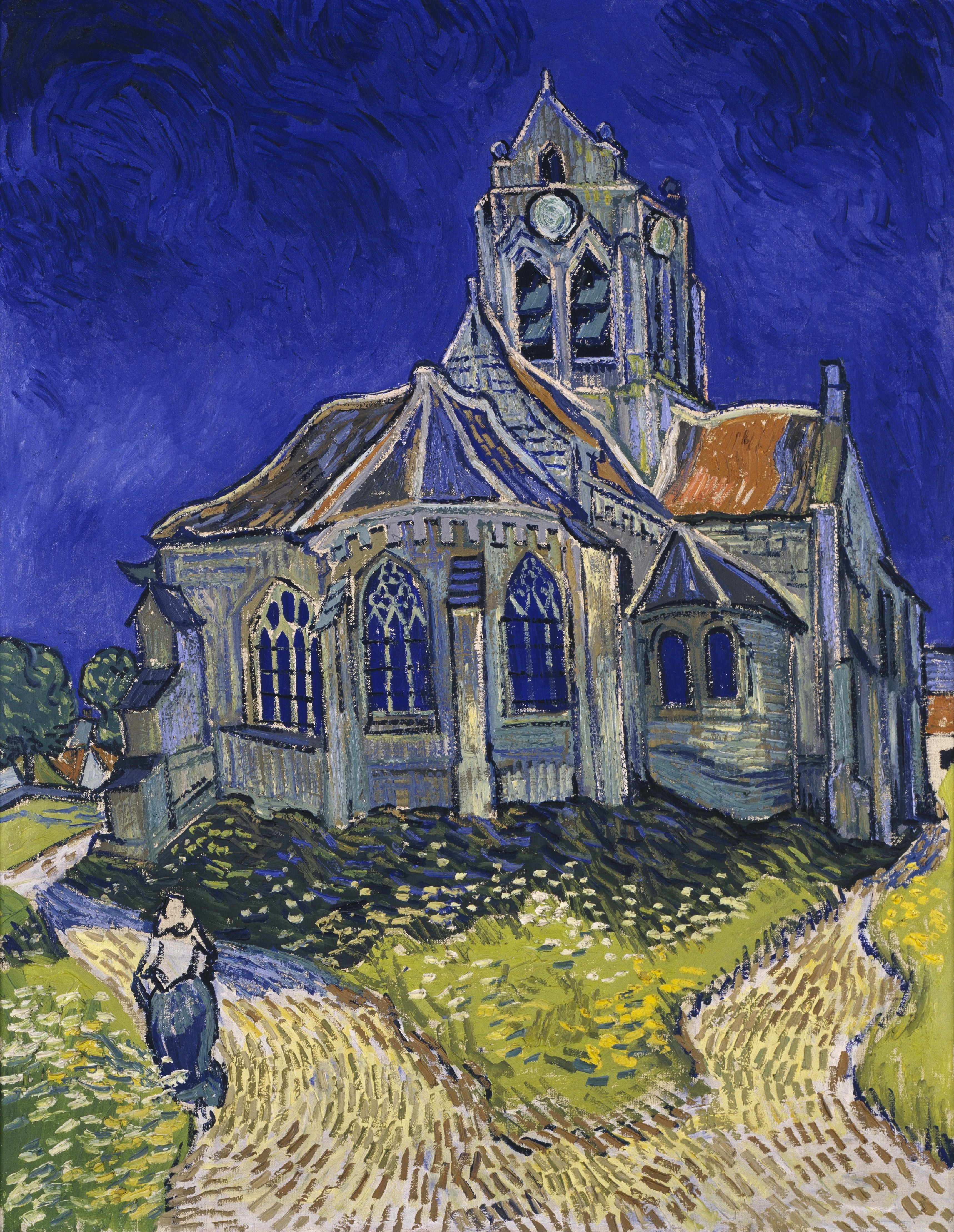
FEATURE Image: Vincent Van Gogh (1853-1890), L’église d’Auvers-sur-Oise, vue du chevet (“The Church at Auvers”), June 1890, oil on canvas, 94 cm x 74 cm (37 in x 29.1 in), Musée d’Orsay, Paris. Vincent Van Gogh (1853-1890), staying in Auvers starting on May 20, 1890, liked the small farm town about 20 miles west of Paris with its artistic pedigree (Corot, Daubigny, Cézanne) and spoke of settling into permanent quarters in the village after renting an attic room in a local café. About his experience at Auvers Van Gogh wrote: “[C]es toiles vous diront ce que je ne sais dire en paroles, ce que je vois de sain et de fortifiant dans la campagne” (“[T]hese canvases will tell you what I can’t say in words, what I consider healthy and fortifying about the countryside.”) During his more than two months stay in Auvers, the artist made more than 100 drawings and paintings of local landscapes, gardens, and village scenes such as its Catholic church. On the evening of July 27, 1890, Van Gogh had acquired a pistol and shot himself in the chest near the Auvers chateau. After languishing in pain for two days, he died on the morning of July 29, 1890. Vincent Van Gogh was 37 years old. Public Domain.
Auvers-sur-Oise was the decisive final chapter of Vincent van Gogh’s life and career, where in just over two months he created an extraordinary body of work that secured his enduring place in artistic modernism, even as his life moved toward its tragic conclusion. In May 2005 I made a pilgrimage to the town where I visited the places associated with the artist’s final days, including Ravoux Inn, Dr. Gachet’s house, the church at Auvers, the wheat fields, and his grave.
Vincent van Gogh, Garden in Auvers, July 1890, oil on canvas, 64×80 cm, private collection. Though Van Gogh died in July 1890 his modernist artistic influence forged deep ties with the European avant-garde art movement throughout the 1890’s and beyond. Public Domain.
By John P. Walsh
Auvers-sur-Oise: Van Gogh’s Final Home
In a peripatetic life, the last place where Vincent Van Gogh (1853-1890) lived was Auvers-sur-Oise, a small commune, a short distance northwest of Paris. Since Auvers was on a rail line in the orbit of Paris, Van Gogh moved to the small town with its farming community so he could live independently yet remain close to his art dealer younger brother Theo Van Gogh (1857-1891) who lived with his wife and family in the hustle and bustle of Paris. After leaving Saint-Paul Asylum, Saint-Rémy, where Van Gogh had admitted himself as a patient since May 1889, he traveled to the French capital in May 1890 where he visited Theo and Jo. He was then onwards to Auvers where, by arrangement of Theo, the artist was under the supervision of Dr. Paul Gachet (1828-1909), a mental health physician who was also an avid modern art collector and had his house, family and practice in the town.
After leaving the asylum at Saint-Rémy in May 1890, Van Gogh settled in Auvers-sur-Oise under the supervision of Dr. Paul Gachet while remaining close to his brother Theo in Paris.
Author at the graves of Vincent Van Gogh (1853-1890) and his brother, Paris art dealer Theo Van Gogh (1857-1891). They have been side by side in the Auvers cemetery in France since 1914. Photo: Author’s collection. May 2005.
During his stay from May to July 1890, Van Gogh produced more than 100 drawings and paintings, making it one of the most prolific periods of his career.
Life at the Ravoux Inn
Vincent arrived to Auvers on May 20, 1890 and stayed in the Saint-Aubin hotel until he moved into a rented attic room in a café of Arthur Gustave Ravoux and his wife, Adeline Louise Touillet, who charged him three and a half francs per night for room and board. Located in Place de la Mairie, a 5-minute walk from the train station, the artist’s daily schedule involved rising at dawn and going outside to draw and paint.
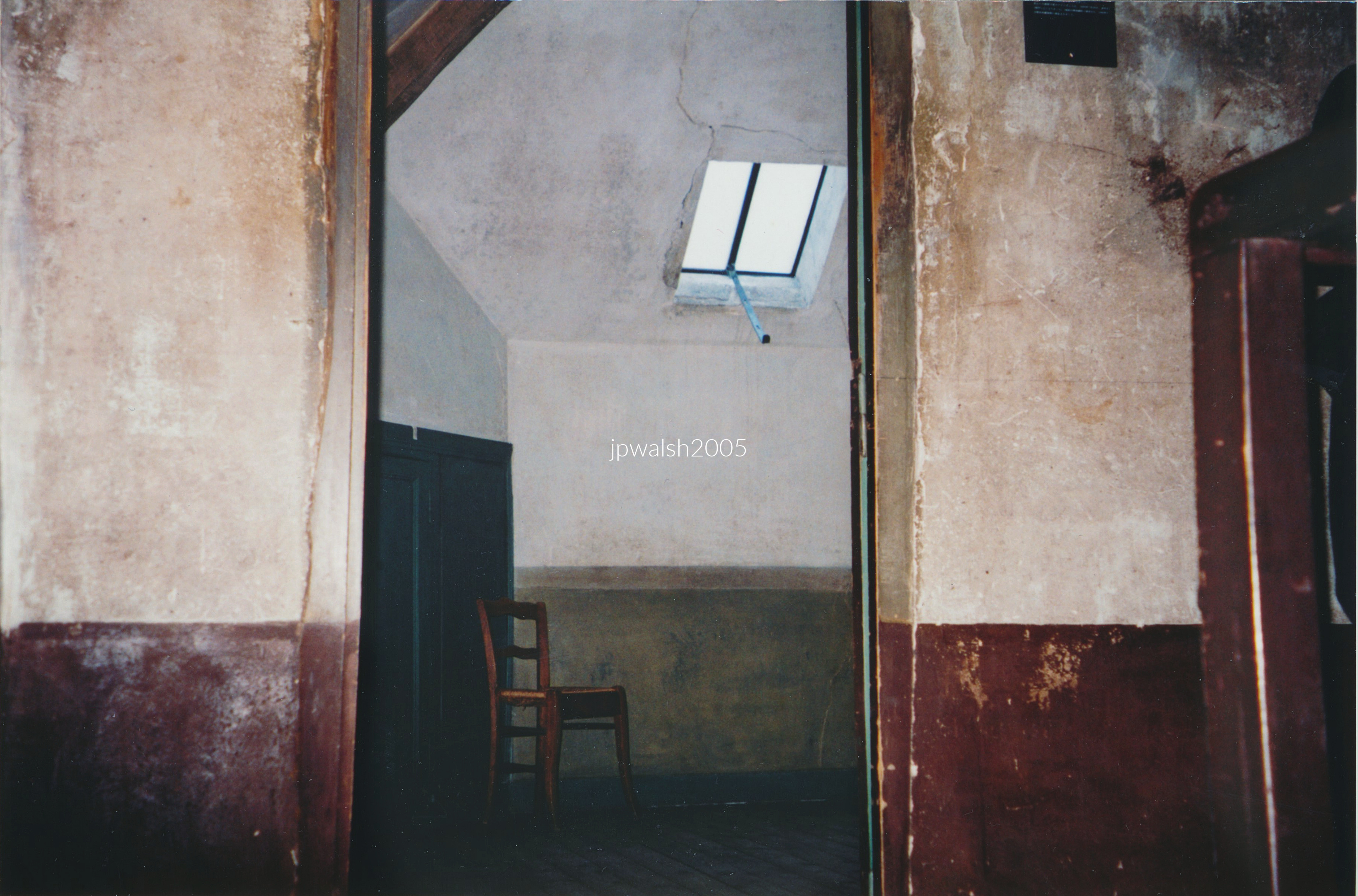
Entrance to Vincent Van Gogh’s rented room in Ravoux’s inn in Auvers. It was here that the artist lived for two months in the town. This is the same room is where Van Gogh returned after he shot himself on July 27, 1890, and died two days later here surrounded by family and friends. Author’s photograph, May 2005.
After roaming the town where he made friends of villagers, visited Dr. Gachet’s, and journeyed into nearby farm fields, Van Gogh returned to Ravoux’s café for lunch that was served at noon. In the afternoon he might sometimes work in the “painters’ room” at the inn or visit with other painters staying at the inn, such as compatriot Anton Matthias Hirschig (1867-1939) and Spanish painter Martinez de Valdivielse. These acquaintances proved more significant for history insofar as they provided eyewitness testimony of Van Gogh’s death and funeral. Following dinner at Ravoux’s, Van Gogh climbed the inn’s simple staircase to his single room in the center of the attic landing and retired at about nine in the evening.
Vincent Van Gogh, View of Vessenots near Auvers, May 1890, oil on canvas, 55×65 cm, Thyssen-Bornemisza, Madrid, Spain. Public Domain.
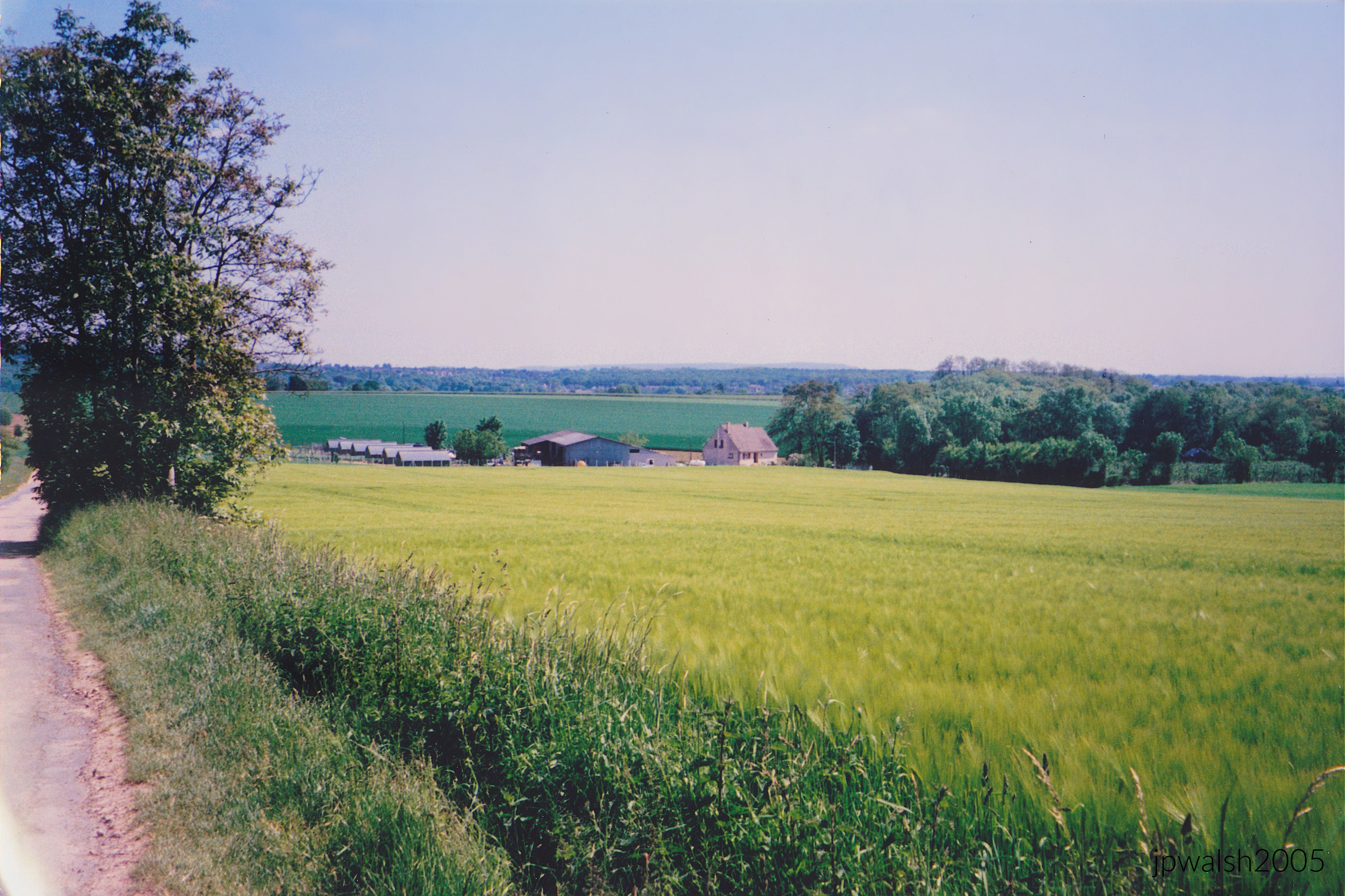
Fields of Auvers. Author’s photograph, May 2005.
Vincent Van Gogh, Daubigny’s Garden, midJune 1890, oil on canvas, 51 cm x 51.2 cm, Van Gogh Museum, Amsterdam. Other versions of Daubigny’s Garden are in the Hiroshima Museum of Art in Japan. see – https://www.hiroshima-museum.jp/en/collection/eu/vangogh.html – retrieved March 11, 2024) and the Van Gogh Museum in Amsterdam (see – https://www.vangoghmuseum.nl/en/collection/s0104V1962 – retrieved March 11, 2024. The square-format flat decorative painting, painted on a simple tea towel that was mounted to canvas, became Van Gogh’s first painted attempt of the garden. It acts as a modernist talisman reminiscent of Paul Sérusier’s 1888 cigar box painting and looks ahead to the decorative landscapes of the Nabis in the 1890’s and of Gustave Klimt (1862-1918) 15 years later. Public Domain.
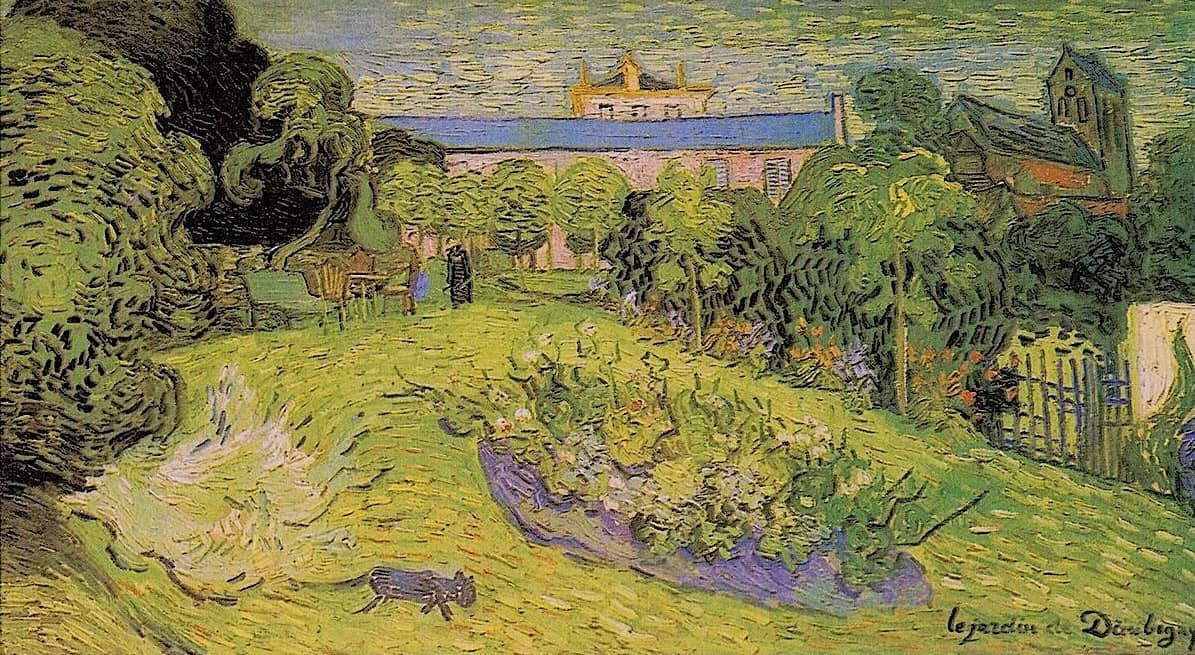
Vincent Van Gogh, Daubigny’s Garden, 1890, oil on canvas, 56 cm × 101 cm (22 in × 39.8 in), Kunstmuseum Basel, Basel, Switzerland. Van Gogh made three versions of the Auvers garden of Barbizon artist Charles-François Daubigny (1817-1878) between May and July 1890. Daubigny, who moved to Auvers in 1860. was a landscape artist who painted en plein aire. A short walk from the Ravoux inn, Daugigny’s widow still lived in the house in Auvers in 1890. For this painting Van Gogh stepped outdoors into Daubigny’s garden to look back towards the house (the Church of Auvers is distinctly drawn in the painting’s upper right corner). Van Gogh admired Daubigny since the 1870’s as he other Barbizon painters such as Jean-François Millet (1814-1875) and Camille Corot (1796-1875). see – https://www.vincentvangogh.org/garden-of-daubigny.jsp – retrieved March 11, 2024. Public Domain.
Van Gogh’s Auvers paintings reveal artistic innovations that anticipated later modernist movements and influenced future generations of artists.
Little has changed in appearance in Auvers from the time of Van Gogh’s stay in May-July 1890. Author’s photograph, May 2005.
Irises bloom along the side of a road in Auvers that leads to Dr. Gachet’s house. Author’s photograph, May 2005.
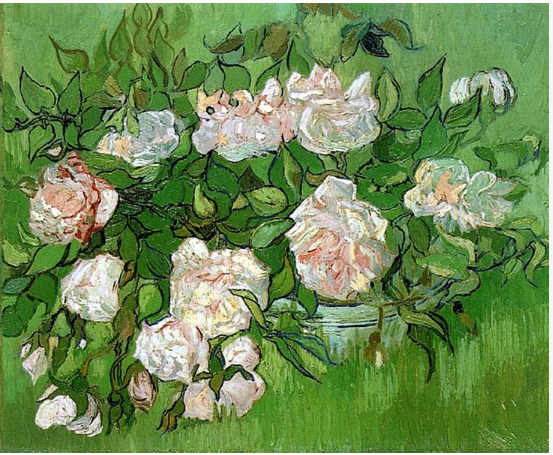
Vincent Van Gogh, Still Life Pink Roses, June 1890, oil on canvas, 32 x 40.5 cm, Ny Carlsberg Glyptotek, Copenhagen, Denmark. Public Domain.
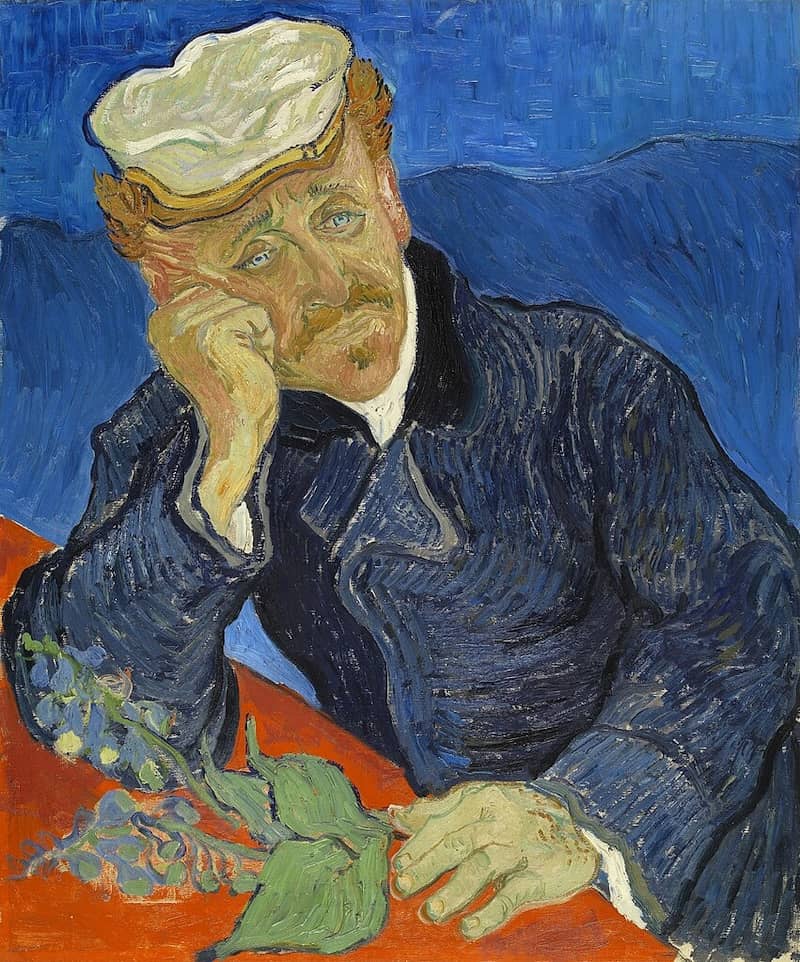
Van Gogh, Dr. Gachet (second version), June 1890, Musée d’Orsay, Paris. As a token of friendship, Van Gogh painted two authenticated versions of Dr. Gachet’s portrait in June 1890 at Auvers. Van Gogh came to Auvers because of the role Dr. Gachet played as the artist’s therapist. The well-regarded physician was an avid modern art collector and painter who hadparticipated in art circles since the 1850’s with Gustave Courbet (1819-1877). Dr. Gachet was instrumental in having Paul Cézanne come to Auvers to paint in 1873. In anticipation of Vincent’s arrival from Saint-Rémy, it was Camille Pissarro (1830-1903) living in Pontoise who recommended Dr. Gachet to Theo Van Gogh. Vincent Van Gogh thought fondly of Dr. Gachet as a brother. When Dr. Gachet visited Theo in Paris in early July 1890, he told him he believed that Vincent was “completely recovered” and “that there need be no fears of a further attack” (quoted in Complete Paintings, p. 718). Van Gogh saw Dr. Gachet as another brand of eccentric and painted him in these portraits as a deep thinker who reflected a sensitive nature tending to melancholy. Public Domain.
Van Gogh, Portrait of Adeline Ravoux, June 1890, oil on canvas, 52x 52 cm, Cleveland Museum of Art. In their therapeutic conversations, Dr. Gachet in June 1890 encouraged Van Gogh to make portraits of local sitters in Auvers. Van Gogh had done portraits of Arlesiens in the “Studio of the South” in 1888 and many self-portraits. Adeline Ravoux was the 15-year-old daughter of Van Gogh’s Auvers innkeepers. About one month after this portrait was made, the girl with her parents witnessed Vincent’s return to the café after he shot himself. Later, in a memoir she wrote: “Vincent walked bent, holding his stomach, again exaggerating his habit of holding one shoulder higher than the other. Mother asked him: “M. Vincent, we were anxious, we are happy to see you to return; have you had a problem?” He replied in a suffering voice: “No, but I have…” He did not finish, crossed the hall, took the staircase and climbed to his bedroom.” see – http://www.vggallery.com/misc/archives/a_ravoux.htm – retrieved March 11, 2024. Public Domain.
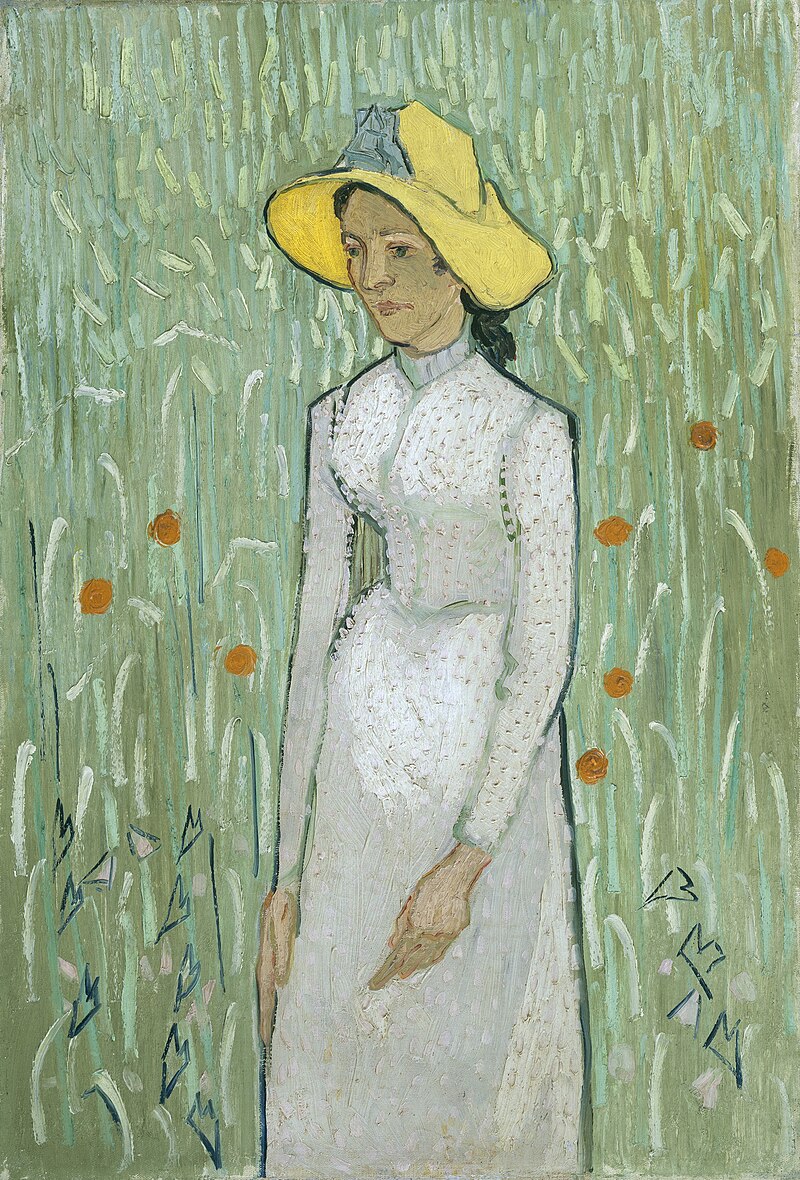
Van Gogh, Young Girl Standing Against Wheat, late June 1890, 66.7 x 45.8 cm (26 1/4 x 18 1/16 in.), National Gallery of Art, Washington, D.C. The painting’s lack of horizon creates a flat wall behind the sitter who appears in close proximity to the picture plane as she fills the pictorial space. Van Gogh shadowed her face under her hat and gave her a “distant, unfocused” gaze. All of these elements contribute to the portrait’s emotional distance. see – Painting the Difference: Sex and Spectator in Modern Art by Charles Harrison, University of Chicago Press, 2006. Public Domain.
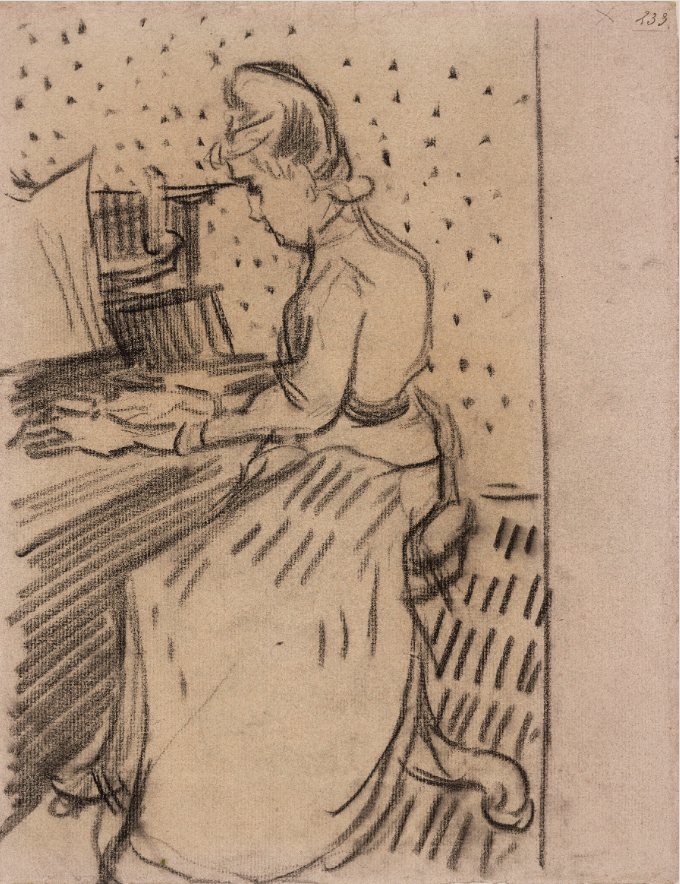
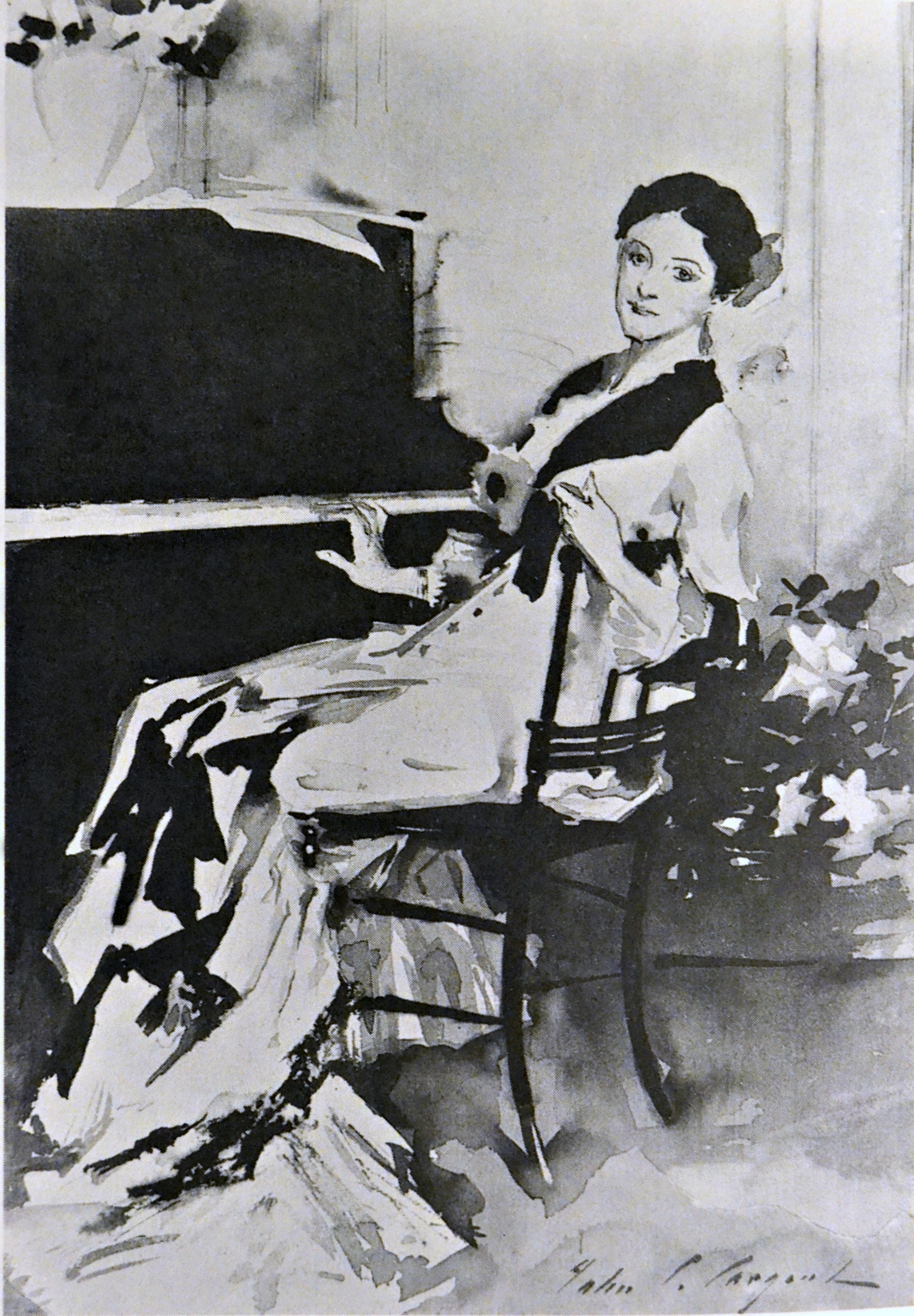
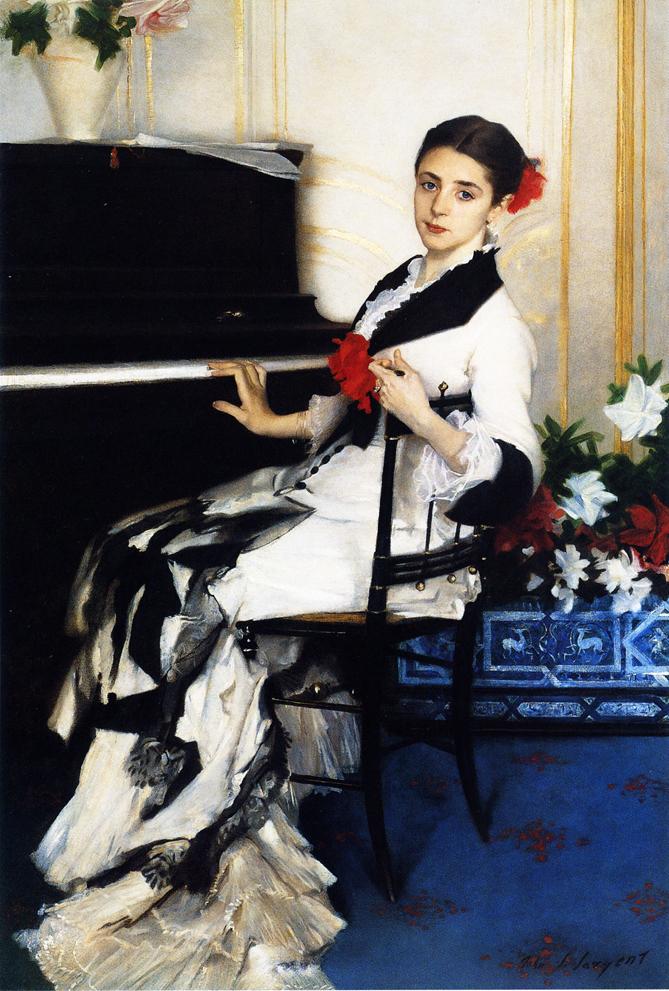
Van Gogh, Marguerite Gachet at the Piano, June 1890, chalk on paper, 30.5 cm x 23.8 cm, Van Gogh Museum, Amsterdam. Marguerite Gachet was the daughter of Dr. Gachet. In this sketch which resulted in a similarly composed painting, the sitter had recently turned 21 years old. For the painting that is today in the Kunstmuseum Basel, Van Gogh made two sketches in late June 1890. https://www.vangoghmuseum.nl/en/collection/d0427V1962r – retrieved March 11, 2024. Public Domain.
Van Gogh, L’église d’Auvers-sur-Oise, vue du chevet (“The Church at Auvers”), June 1890, oil on canvas, 94 cm x 74 cm (37 in x 29.1 in), Musée d’Orsay. Public Domain.
As in Van Gogh’s 1890 painting above, the church at Auvers (“Notre-Dame-de-l’Assomption”), situated in a bright midday sun, sits in deep shadow. Author’s photograph, May 2005.
An Extraordinary Final Burst of Creativity
Van Gogh proved quite productive in Auvers, painting several notable canvasses in and around the town and countryside, particularly landscapes and other outdoor subjects en plein aire. In these two months, the painter produced 74 paintings and 33 drawings, including the portraits of Dr. Gachet and Adeline Ravoux, The Church of Auvers, and Field of Wheat with Crows. In a letter of around July 10, 1890, Van Gogh wrote to Theo and Jo that he painted three large canvases at Auvers since visiting them in Paris on July 6, 1890. During that visit the artist also met with Henri Toulouse-Lautrec (1864-1901) and art critic Gabriel-Albert Aurier (1865-1892). In addition to Daubigny’s Garden, these large canvasses likely included Wheatfield with Crows and Wheatfields Thunderclouds (both Van Gogh Museum Amsterdam). Van Gogh described them as “immense stretches of wheatfields under turbulent skies…searching to express sadness [and] extreme loneliness” (“immenses étendues de blés sous des ciels troublés… chercher à exprimer de la tristesse, de la solitude extreme”). See – https://vangoghletters.org/vg/letters/let898/print.html – retrieved March 11, 2024.
Vincent Van Gogh, Sorrowing Old Man (“At Eternity’s Gate”), 1890, 80 cm × 64 cm (31.5 in × 21.2 in), oil on canvas, Kröller-Müller Museum, Otterlo, The Netherlands. The painting was completed at St. Rémy shortly before Van Gogh moved to Auvers-sur-Oise.
Van Gogh, Wheatfield with Crows. July 1890, oil on canvas, 50.2 cm × 103 cm (19.8 in × 41 in), Van Gogh Museum, Amsterdam. Many have claimed this to be Van Gogh’s last painting.
At the wheatfield in Auvers where Van Gogh painted “Wheatfield with Crows,” one of his last paintings, in July 1890. Author’s photograph, May 2005.
Van Gogh, Wheatfield Thunderclouds, July 1890, oil on canvas, 50.4 cm × 101.3 cm (19.8 in × 39.9 in), Vincent Van Gogh Museum, Amsterdam.
Auvers fields. Author’s photograph, May 2005.
The Tragic Events of July 1890
On July 27, 1890, Vincent, as he did each day, went into the fields to paint. Though the artist appeared to be in good spirits, the artist shot himself later that day near the chateau after going for a walk towards evening. Though able to walk the 10 minutes back mortally wounded to Ravoux’s inn, he told them nothing upon entering the café. The Ravoux’s, sensing something was wrong, called for Mazery, the village doctor and Dr. Gachet. Though these doctors bandage the wound, Van Gogh’s condition is inoperable. In the hot attic room, Van Gogh suffered into the next day, when Theo was sent for. He arrived immediately on July 28 from Paris to be by his brother’s side. Van Gogh died the next morning of July 29, 1890.
Funeral in the Wheat Fields
This suicide sent ripples of shock through the village, as some townspeople had witnessed these events. During my visit to Auvers in May 2005, after exiting Van Gogh’s room where he died, I told the innkeeper that the story was sad (“c’est triste”). She countered, “C’est emouvante” (“It’s moving”). Vincent was buried the next day, July 30, 1890, in Auvers’ new graveyard. His funeral was attended by Theo, Dr. Gachet, the Ravoux’s, assorted villagers, and friends from Paris. These last included artists Emile Bernard (1868-1941), Charles Laval (1862-1894), and Lucien Pissarro (1863- 1944), Camille Pissarro’s son. Petit boulevard art dealer and art materials supplier Julien (Père) Tanguy (1825-1894) was also in attendance. Van Gogh’s casket was strewn with yellow dahlias and sunflowers and Dr. Gachet gave remarks as did Theo Van Gogh. Later, in a letter to his wife, Theo wrote about the proceedings: “[Vincent] was buried in a sunny spot among the cornfields, and the cemetery does not have that unpleasant character of Parisian cemeteries.” (see- Kort geluk, 1999, p. 281). The mortal remains of Van Gogh were transported to the cemetery by a rented hearse from the next town because Auvers’ Catholic priest would not allow the community’s hearse to be used. A proposed church service was also cancelled. The homiletics were left to Dr. Gachet who said: “Vincent was an honest man and a great artist, and there were only two things for him – humanity and art. Art mattered to Vincent Van Gogh more than anything else and he will live on through it” (quoted in Complete Paintings, p. 719).
Graves of Vincent and Theo Van Gogh, Auvers-sur-Oise, France. Author’s photograph, May 2005.
Eyewitness Accounts of Van Gogh’s Last Days
Three days after the funeral, Emile Bernard wrote to Aurier about “our dear friend Vincent.” Aurier had written in January 1890 about the intense fixity of Van Gogh’s art. The art critic conjectured that it may be the catalyst for change in French art. In his essay entitled Les Isolés: Vincent van Gogh published in Mercure de France, Aurier prophesied for an artist-savior figure: “A man must come, a Messiah, a sower of Truth, to rejuvenate our geriatric art, indeed perhaps the whole of our geriatric, feeble minded, industrial society” (quoted in Complete Paintings, p. 698). Van Gogh, aware of these statements, did not think he was Aurier’s man. On August 2, 1890 Emile Bernard wrote to Aurier: “On Sunday evening [Vincent] went out into the countryside near Auvers, placed his easel against a haystack and went behind the chateau and fired a revolver shot at himself. Under the violence of the impact (the bullet entered his body below the heart) he fell, but he got up again, and fell three times more, before he got back to the inn where he was staying (Ravoux, place de la Mairie) without telling anyone about his injury. He finally died on Monday evening, still smoking his pipe which he refused to let go of, explaining that his suicide had been absolutely deliberate and that he had done it in complete lucidity…. On the walls of the room where his body was laid out all his last canvases were hung making a sort of halo for him and the brilliance of the genius that radiated from them made this death even more painful for us artists who were there. The coffin was covered with a simple white cloth and surrounded with masses of flowers, the sunflowers that he loved so much, yellow dahlias, yellow flowers everywhere. It was, you will remember, his favorite color, the symbol of the light that he dreamed of as being in people’s hearts as well as in works of art….The sun was terribly hot outside. We climbed the hill outside Auvers talking about him, about the daring impulse he had given to art, of the great projects he was always thinking about, and of the good he had done to all of us. We reached the cemetery, a small new cemetery strewn with new tombstones. It is on the little hill above the fields that were ripe for harvest under the wide blue sky that he would still have loved…perhaps.Then he was lowered into the grave…Then we returned. Theodore Van Ghog [sic] was broken with grief; everyone who attended was very moved, some going off into the open country while others went back to the station…” see – https://www.webexhibits.org/vangogh/letter/21/etc-Bernard-Aurier.htm – retrieved March 11, 2024.
Van Gogh, Two Women Crossing the Fields, July 1890, oil on paper on canvas, Marion Koogler McNay Art Museum, San Antonio, Texas.
By contrast, Anton Hirschig, the Dutch artist who roomed next door to Van Gogh at Ravoux’s, wrote a letter much later, in 1911, to Albert Plasschaert (1874-1941) in which he recounted a more terrible scene following Van Gogh’s shooting himself. Hirschig wrote: “He lay in his attic room under a tin roof. It was terribly hot. It was August. He stayed there alone for some days. Perhaps only a few. Perhaps many. It seemed to me like a lot. At night he cried out, cried out loud. His bed stood just beside the partition of the other attic room where I slept: Isn’t there anyone willing to open me up! I don’t think there was anyone with him in the middle of the night and it was so hot. I don’t think I ever saw any other doctor like his friend the retired army doctor: It’s your own fault, what did you have to go kill yourself for? He didn’t have any instruments this doctor. He lay there until he died.”
The Beginning of a Legacy
Theo Van Gogh died in Holland on January 25, 1891, nearly 6 months to the day after Vincent’s death. Theo was buried in Holland but exhumed and reinterred next to his older brother Vincent’s grave in Auvers cemetery in 1914. While Vincent Van Gogh, the man, was never larger than life, as an artist he produced an explosion of life on paper and canvas. Van Gogh came to art late (30 years old in 1883) and produced incessantly for the next 7 years. His oeuvre was beautifully powerful, and none of it more remarkably for the future of modernism than that done in Auvers-sur-Oise in May to July 1890.
SOURCES –
Harrison, Charles. Painting the Difference: Sex and Spectator in Modern Art. Chicago: University of Chicago Press, 2006.
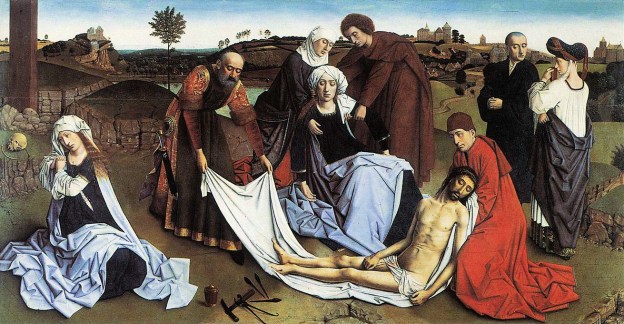
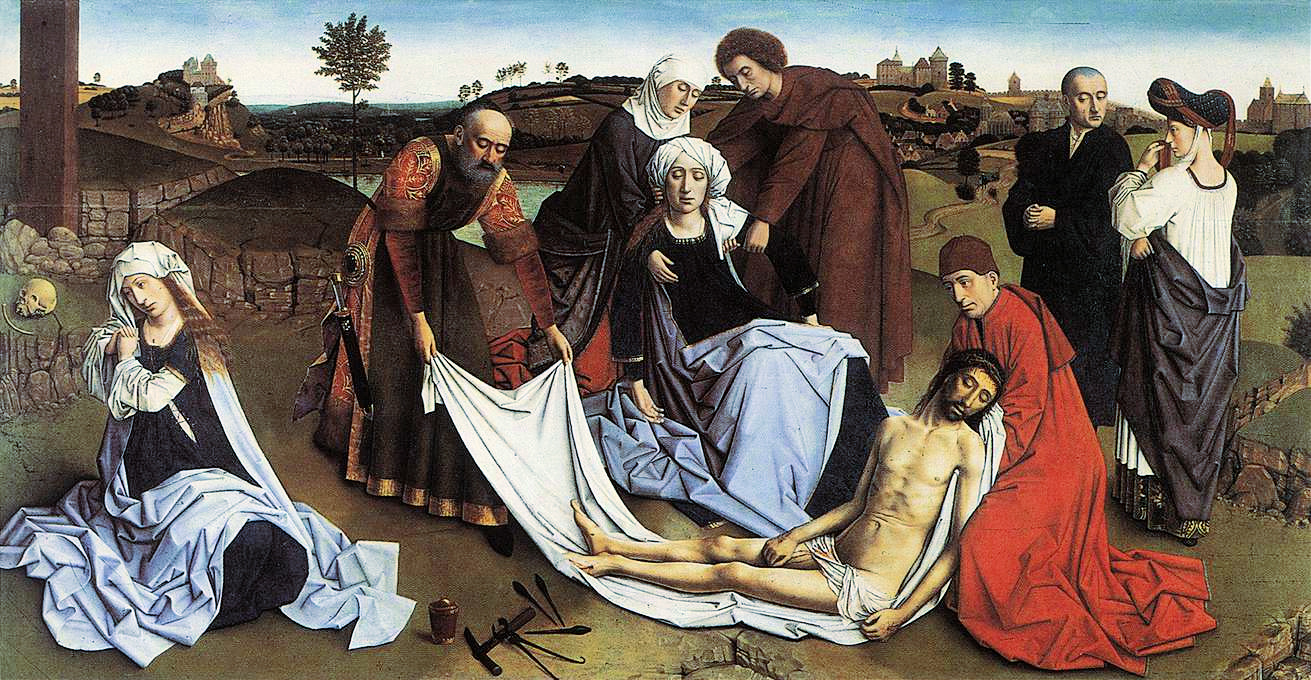
FEATURE Image: Petrus Christus (c. 1395-1472), Pietà, c. 1455–60. 39 ¾ x 75 ½ inches, Royal Museums of Fine Arts of Belgium, Brussels.
Fueled by the immense wealth of maritime trade hubs like Bruges and Antwerp, 15th-century Flemish art catalyzed the Northern European Renaissance by perfecting oil painting techniques, introducing brilliant surface luminosity, and blending meticulous naturalism with profound emotional realism.
Jan Van Eyck (or John of Bruges) (c. 1385-1441), detail, Marriage of Giovanni Arnolfini and Giovanna Cenami, 1434; National Gallery, London.
Introduction: The Wealth and Innovation of the Flemish School in the 15th century
Flemish art, as the name suggests, originates in Flanders which includes the Low Countries (Netherlands and Belgium) as well as northeastern France. The centers of Flemish art in the 15th century are Brussels, Bruges, and, later, Antwerp as well as other cities such as Liège and Tournai. Though the area had been settled as early as the 6th century, great growth and prosperity came to the region starting in the 14th century. As an international trade center centered in Bruges and, following the silting up of Bruges’ port, in Antwerp starting around 1525, Flanders experienced an influx of tremendous wealth joined to its attendant political connections and power. Such factors led to a high demand for Flemish art locally and far beyond its borders to royal courts, churches and other public and private patrons having marked influence on the European Renaissance. These rich cultural conditions in and around Flanders provided incentive for leading Flemish art masters to perfect their art technique and create magnificent pictures, particularly altarpieces, and display the latest naturalist styles, delineated forms, and bright colors within a European context. Flemish art developed systematically including its use of oil painting. This newly discovered and controversial medium greatly affected Flemish paintings’ surface luminosity by way of its range of cool colors and its ability to be applied in smooth facile layers. Most of these noteworthy Flemish painters in the 15th century found positions at court or as officials in prosperous urban centers. They became leading citizens whose workshops trained artists and made artwork for public and private consumption which worked to assure Flemish art’s primacy for the Northern European Renaissance into the 16th century.
International Gothic and the Burgundian Court
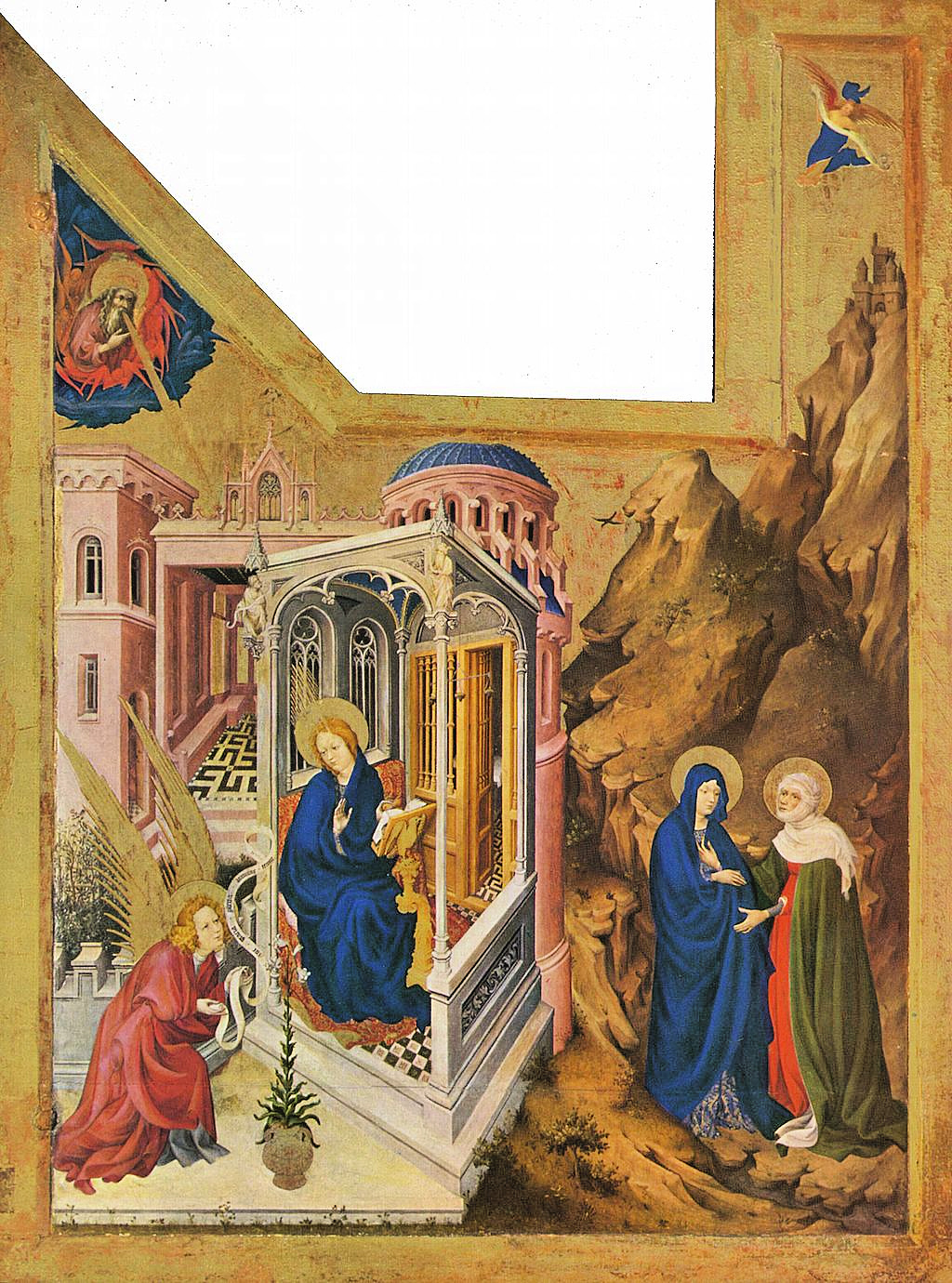
1 – Melchior Broederlam (c. 1350-1409), Champmol Altarpiece (The Annunciation and Meeting of Mary and Elizabeth), oil on wood, 1399, 65 ½ x 48 ¼ inches and 66 3/8 x 511/4 inches. Musée des Beaux-Arts de Dijon, France. 1 – Melchior Broederlam (c. 1350-1409), Champmol Altarpiece (The presentation in the Temple and Flight Into Egypt), oil on wood, 1399, 65 ½ x 48 ¼ inches and 66 3/8 x 511/4 inches. Musée des Beaux-Arts de Dijon, France.
This large diptych done for Philip the Bold, Duke of Burgundy (1342-1402) around 1399 is certainly painted over 600 years ago by Melchior Broederlam (c.1350-1409?). Broederlam was a painter in Ypres, Belgium, who entered the service as painter to Philip the Bold in 1385 and was in Paris by the early 1390’s. In the Champmol altarpiece – considered the earliest example of International Gothic in painting – Broederlam presents four stories in the life of the Virgin, some of which are contained in Luke themselves as scriptural diptychs including the Annunciation and the Birth stories of John the Baptist and Jesus. The first panel of the altarpiece presents the Annunciation (Luke 1:26–38) and the Visitation (Luke 1:39-56) while the second panel depicts the Presentation in the Temple (Luke 2:22-40) and The Flight into Egypt (Matthew 2:13-23). In the Champmol Altarpiece there is an attempt at realism by its placid gesturing figures in a landscape of crags and paths and also flowers at the foot of the picture’s imposing structures. At the same time there is a sense of unreality in the sense of it being a theatrical or stage setting in its flat, unitive display.
Sacred Narrative: The Presentation in the Temple
The Presentation of the Temple is the climax of the birth narratives. Up to now Luke and Matthew recounted the annunciations of Jesus and John, the Visitation of Mary to Elizabeth, the births of John and Jesus as well as the star, the stable, the Magi, the shepherds, the angels, surrounding Jesus’s birth in Bethlehem. The Presentation in the Temple was the highly anticipated strictly required formal religious ceremony for the “redemption of the firstborn” male and the first communal recognition and capstone of all these dramatic birth events described so far in Luke. Further, the setting is the Temple in Jerusalem, the very center of Jewish worship and life. This exciting and important place is where the infant Jesus and his mother are each presented for their purification in accordance with Mosaic Law. Jesus had been circumcised eight days after his birth and is now publicly presented to Yahweh in Jerusalem and formally stamped as a member of God’s chosen people. It is through the Jews that the salvation of the world is to be achieved, and Luke’s Gospel announces such hopes as fulfilled in Jesus. Though Mary’s purification at the Temple is ceremonial, it publicly reveals its agreement with what was told to her by the angel Gabriel at the Annunciation: that she is the symbol of the Jerusalem Temple (Luke 1:35).
Prophetic Witness: Simeon and Anna in the Temple
Also featured in this episode is Simeon, a righteous and devout man living in Jerusalem who, according to Luke 2:25-35, was promised by the Holy Spirit that he would not die until he had seen the Lord’s Messiah. Guided by the Spirit into the Temple, he recognized the infant Jesus during his presentation, took him up in his arms, and praised God, proclaiming Jesus as the savior for both Gentiles and Israel, a dramatic public witness to these public events whose testimony about the child “amazed” Mary and Joseph (Luke 2:33). Also present is Anna, an old prophetess, an honorable role found in both Jewish and Christian tradition who typically was a widow in service to the community. Both Anna with Judith, a devout widow in the Old Testament, are over 100 years old. Anna “never left the temple, but worshiped night and day with fasting and prayer” (Luke 2: 37). In the Rabbinic literature seven prophetesses are recognized – namely, Sarah; Miriam (Ex. 15); Deborah (Jgs. 4); Samuel’s mother, Hannah (1 Sm. 2); David’s wife, Abigail (1 Sm. 25); Huldah (2 Kgs 2); and Esther. Isaiah’s wife is also mentioned as a prophetess (Is. 8). With Anna, all these women were recognized for at least their holy lives, sometimes speaking in God’s name, as well as often their advanced years. At the Presentation Anna “gave thanks to God and spoke about the child to all who were awaiting the redemption of Jerusalem” (Lk 2:35).
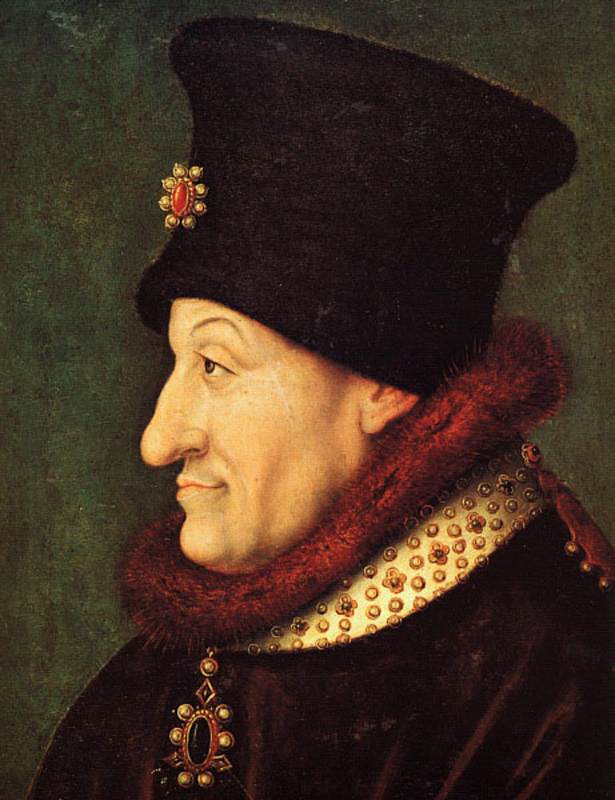
Philip II the Bold, anonymous, 16th century, 40 cm (15.7 in); width: 30 cm (11.8 in), Palace of Versailles, oil on wood.
Jan Van Eyck and the Burgundian Court
From 1422 to 1424 Jan Van Eyck (or John of Bruges) worked for John III the Pitiless (1374–1425) of the House of Wittelsbach, who was bishop of Liège (1389–1418) as well as duke of Bavaria-Straubing and count of Holland and Hainaut (1418–1425). The artist was appointed court painter to Philip III the Good (1396-1467) who was born in Dijon and died in Bruges and who founded the Burgundian state that was France’s rival in the 15th century. Philip III was the most important of the Valois dukes of Burgundy.
Philip III wearing the chain of office. Copy of painting by Rogier Van der Weyden, c, 1450.
The Mastery of Light: The Madonna of Chancellor Rolin
2 – Jan Van Eyck (c. 1385-1441), Madonna of Chancellor Rolin (or The Virgin of Autun), Oil on wood, c. 1435, 26 x 24 ¾ inches (66x 62 cm), Musée du Louvre, Paris.
Van Eyck lived in Lille between 1425 and 1429 but relocated to bustling Bruges in 1430 where he bought a house and lived until his death in 1441. On behalf of the Duke’s business concerns (including a secret marriage), Jan Van Eyck made trips to Spain and Portugal in 1427-28, and several others into the mid1430’s. There are many authenticated paintings by Jan Van Eyck, although Madonna of Chancellor Rolin is considered highly likely. The concept of composing the work to be divided into a shadowed interior and bright exterior landscape – and unified in the picture – is original. The contrasts of light, subject and form and their relation is appealing to the eye. The figures of the Virgin and the Child are delineated gently and beautifully for the donor, who is depicted behind a prayer desk, to adore. Like Italian master Leonardo da Vinci (1452-1519), Van Eyck had many cultural interests and talents in the service of Philip III such as studies in anatomy, cartography, geometry and perspective that created the illusion of three-dimensional space. These artists’ common preoccupations and concerns in the arts united the Northern and Italian Renaissance more closely. If Van Eyck did not actually invent oil painting, his work perfected its techniques. Van Eyck’s abilities make him the major artist of the Early Netherlandish School whose position is challenged only by the Master of Flémalle (Robert Campin). It was painted for the chancellor of Philip III, Nicolas Rolin (c. 1376/80-1462) to decorate a personal chapel (Saint-Sébastien chapel) that he decided to build in 1426-1428 (completed in 1430) in the church of Notre-Dame-du-Châtel in Autun, a church destroyed in 1793.
The Monumental Legacy of the Ghent Altarpiece
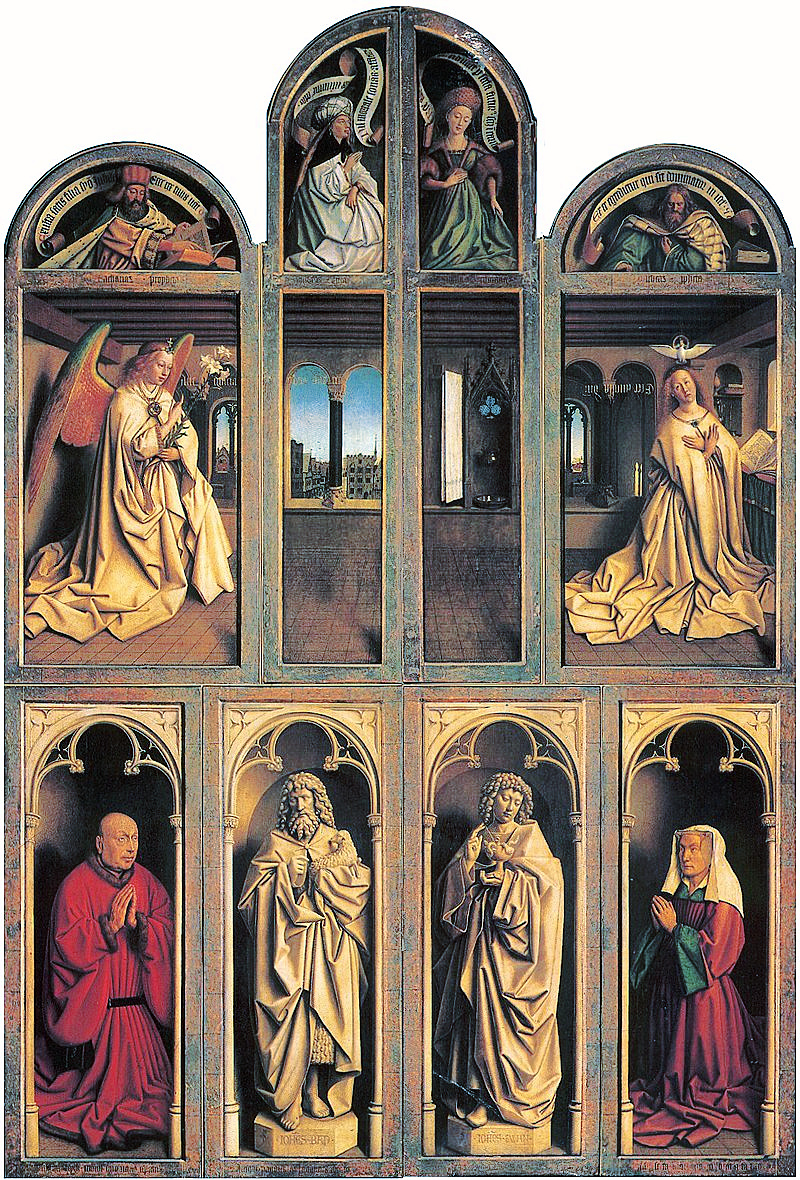
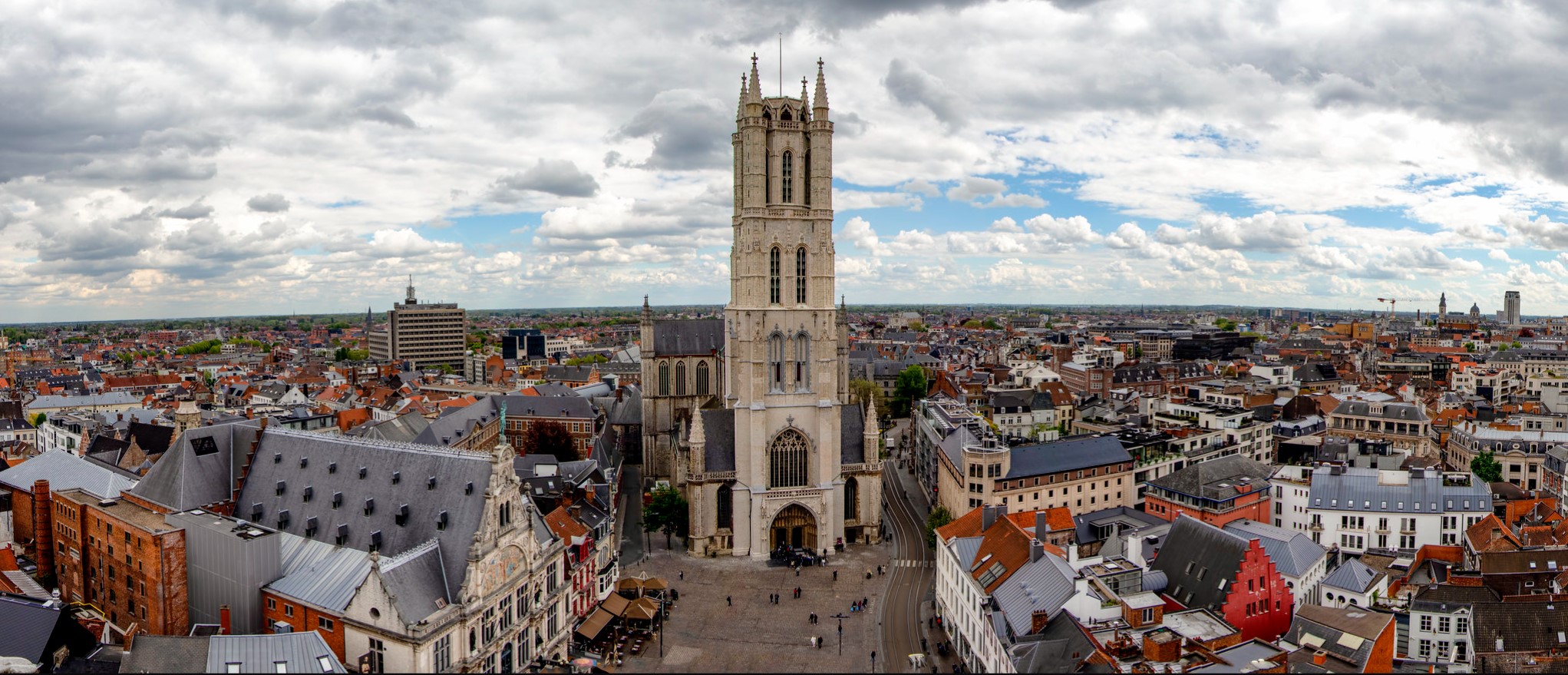
3 – 4 Hubert Van Eyck (c. 1370-1426) and Jan Van Eyck (c. 1385-1441), Closed (above) and open panel of The Ghent Altarpiece, also called the Adoration of the Mystic Lamb, c. 1425, 53 ¾ x 93 ¼ inches, Saint Bavo’s Cathedral, Ghent.St. Bavo’s Cathedral, Ghent, houses the Van Eyck brothers’ Ghent altarpiece. “Saint Bavo’s Cathedral, Ghent” by Arran Bee is licensed under CC BY 2.0.
Jan Van Eyck’s masterpiece is Adoration of the Mystic Lamb (1432), known as the Ghent Altarpiece, which he painted with his brother Hubert Van Eyck (c. 1370–1426). The Van Eycks’ artwork is known for its technical brilliance, intellectual complexity, and rich symbolism of which this very large (almost eight feet wide) and complex 15th-century polyptych is a prime testament. It was begun in the mid-1420s and completed by 1432. It marks a transition from the Middle Ages to the Renaissance in Northern European art. Its 22 panels opens and closes. When open, inside there are two rows of paintings. The middle section is Christ the King flanked by the Virgin and Saint John the Baptist. Other panels depict musicians, singing angels, and Adam and Eve. The center lower row depicts the Adoration of the Lamb with knights, hermits. judges and pilgrims who stream to behold the Lamb. In its 600-year history, there have been re-paintings, restorations and modern replacements (the original Judges panel was stolen in 1934). Little is known about Hubert Van Eyck to the point where he has been speculated in his obscurity to be a mythical figure, though this is quite unfounded. The painting was done for a nobleman’s family chapel in what become St. Bavo’s church in Ghent. The Eycks’ detail, fullness of form and luminous colors presents the mystery of the Mass whose subject is the miracle of the unity of heaven and earth in eternity. In contrast, the closed panel is beautifully calm and restrained in colors and composition. But it is just as masterful and, as it sits closed, offers a different mood for devotion.
Precursors to the Mona Lisa: Portrait of the Artist’s Wife
5 – Jan Van Eyck (c. 1385-1441), Portrait of Margaret van Eyck, 12 7/8 x 11 ½ inches (41.2cm x 34.6 cm), 1439, oil on wood, Groeningemuseum, Bruges, Belgium.
The portrait is of the artist’s wife executed in Bruges. The Van Eycks married in 1439. Like his other portraits the sitter is turned three-quarters to the left. Painted 60 years before Leonardo Da Vinci’s Mona Lisa (1503), there are affinities between them – a placid enigmatic female sitter, leftward turn, hands crossed at the lap, a possible landscape background that in the Van Eyck has been repainted.
Leonardo da Vinci, Mona Lisa (1503), Musée du Louvre, Paris.
The Next Generation: Petrus Christus and Flemish Genre Art
6 – Petrus Christus (c. 1395-1472), The Legend of Saints Eligius and Godeberta, 38 5/8 x 33 ½ inches, 1449, The Metropolitan Museum of Art, New York.
Following the death of Jan Van Eyck, Petrus Christus became the most important modern painter in Bruges who had settled there in 1444. The artwork was commissioned by the jewelers’ corporation in Bruges and depicts seventh century Saints Godeberta being given a ring by Saint Eligius to marry the Lord God as she decided to enter religious life. Though a religious painting, it is essentially a 15th century Flemish genre painting. And while not as graceful as Van Eyck’s artwork, the painting holds interest for its bold forms of figures and objects and the authority of a well-observed still life.
Landscape and Lamentation: The Deposition
7 – Petrus Christus (c. 1395-1472), Pietà, c. 1455–60. 39 ¾ x 75 ½ inches, Royal Museums of Fine Arts of Belgium, Brussels.
One of Petrus Christus’s most important works, the scene of the Deposition is poetically rendered in a mother’s lamentation over the dead Christ, her son, within the setting of a late afternoon landscape which is also perfectly rendered. The figures in the foreground are large and emphasize their placement in the space. The face of the Virgin constitutes the painting’s center. Holding the dead Christ in a sheet is NIcodemus and Joseph of Arimathea who asked Pilate for the body of Jesus so to bury him. The three figures who stand apart from the narrative’s central figures are depicted with equal stylistic power and whose strained grief they share.
Gustave Courbet, 1849-50, A Burial at Ornans, 315 cm × 660 cm (124 in × 260 in), Musée d’Orsay, Paris. The 19th century French realist artist made a trip to Amsterdam before he painted The Burial at Ornans and was likely influenced by Netherlandish painting he had seen on that trip.
Unwavering Physicality: The Master of Flémalle
8 – Master of Flémalle/Robert Campin (1375-1444), workshop, The Bad Thief (fragment), c. 1420, 56 ¾ x 20 3/8, Städel Museum, Frankfurt am Main, Germany.
The painterly style of the Master of Flémalle is earlier than Jan Van Eyck yet also progressing a naturalism that is realistic and of ordinary folk. The Master of Flémalle has been identified by consensus as Robert Campin whose pupils were Rogier van der Weyden (1399-1464) and Jacques Daret (c. 1404- c. 1470). Campin is known to have lived and worked in Tournai, Belgium. This imposing, cruelly exact image depicts the corpse of one of the two criminals crucified with Jesus. Executed in the workshop of Robert Campin in Tournai around 1420 – around the same time as the Van Eycks’ Ghent Altarpiece – the fragment is all that remains though copies of the rest exist that show the Deposition and John the Baptist. The painting presents the bad thief in a corporeal monumentality next to an embossed gold background which is a legacy of medieval art. The painting’s unwavering physicality, however, is 15th century modern. The well-constructed faces of the two observers are modeled by shadows as foreshortening suggests movement. The lower left of the picture at the thief’s broken legs reveals, as Delevoy states, “the perspective of a landscape that is concisely constructed, geometric, and intellectual.”
Synthesizing Narrative and Observation: Campin’s Nativity
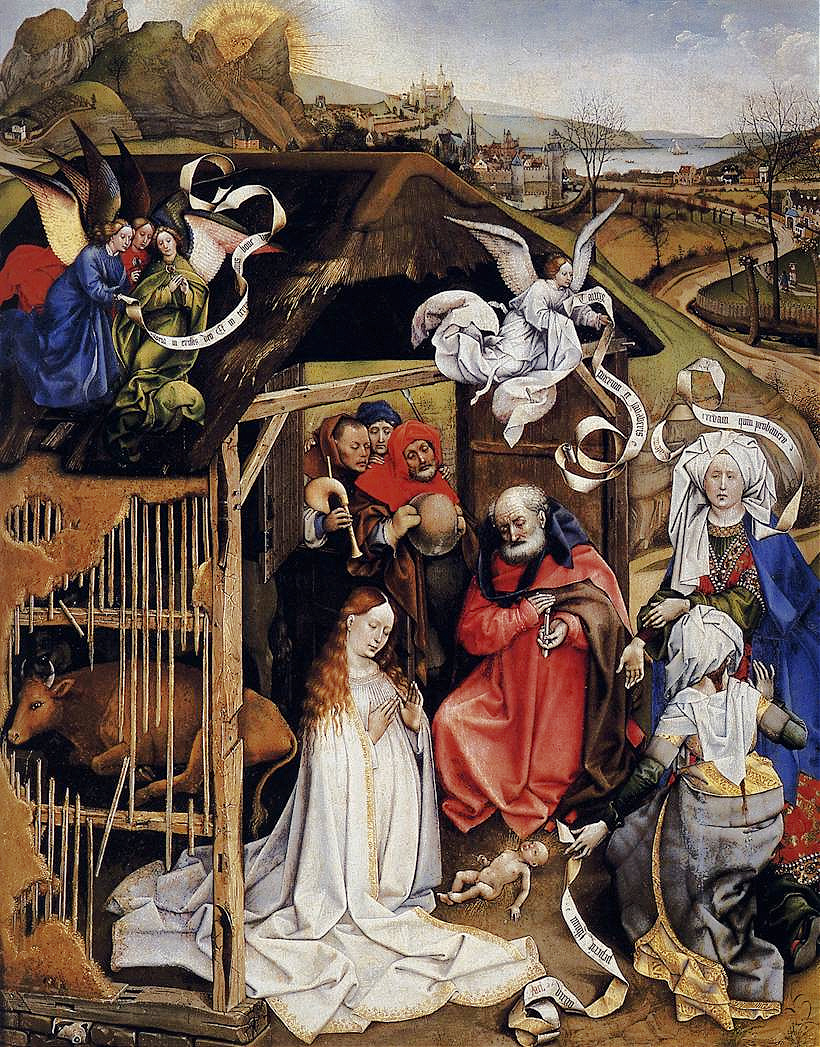
9 – Master of Flémalle/Robert Campin (1375-1444), The Nativity, c. 1420, oil on wood 87 x 70 cm, 32 5/8 x 27 ½, Musée des Beaux-Arts de Dijon, France.
The Nativity is the most famous work of the Master of Flémalle (Robert Campin). The single panel combines dreamed up images, and meticulous objective observation and rational knowledge to depict three episodes – (1) the legend of the midwives, (2) adoration of the shepherds, (3) the Nativity. The wooden stable, with its ox and ass, has a broken wall and holes in the roof. The Virgin dressed in white is kneeling with her hands held up in adoration as the Christ Child lies naked on the ground. Joseph is depicted as an old man and holds a lit candle that he shelters. The legend of the midwives is an apocryphal Gospel tale regarding Joseph’s anxiety during the birth and summoning these midwives with complicated headdresses. The stable door is swung open and three shepherds enter behind Mary and Joseph. Four angel figures hover above the scene holding strips of parchment with messages. There is an extensive, condensed, and detailed winter landscape in the background with a wide, curving road and castle perched on a hill.
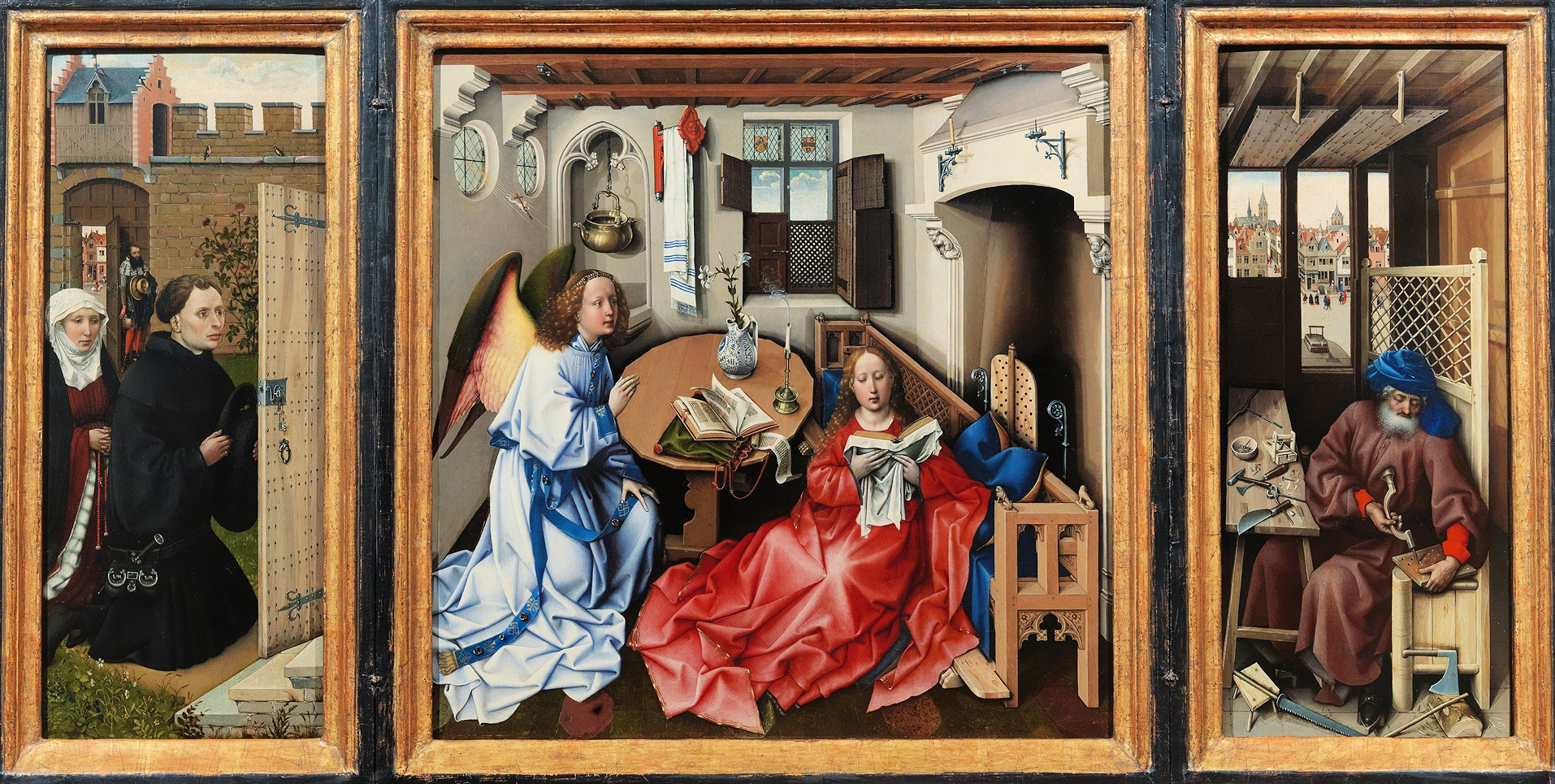
Spatial Complexity and Symbolism: The Merode Annunciation
10– Master of Flémalle/Robert Campin (1375-1444), Annunciation Triptych (Merode Altarpiece), c. 1427-32, The Cloisters (Metropolitan Museum of Art), New York.
St. Luke 1: 26-29. “In the sixth month, the angel Gabriel was sent from God to a town of Galilee called Nazareth, to a virgin betrothed to a man named Joseph, of the house of David, and the virgin’s name was Mary. And coming to her, he said, “Hail, favored one! The Lord is with you.” Placid depiction of the Annunciation at the moment when the angel Gabriel alights in the Virgin’s chamber. The setting is a middle-class home and Mary is, for the moment, still completely unaware of the mystery that will now be told to her. A miniature figure with a cross comes through the oculus above the angel. The objects in the room– a lily, an immaculate towel, an extinguished taper– may be symbolic but certainly work to hold realistic tactile value. The robes in the foreground, one red, the other light blue, provide focus for the painting’s harmony and color. The Master of Flémalle experiments with Renaissance applications of perspective, depth, proportion (foreshortening) with material objects such as open shutters, an open door (left panel), and an unforgiving diagonal of the room’s bench. These material objects in varying perspectival space as well as varying light sources give the painting complexity. The right panel depicts old Joseph in his carpenter workshop. The left panel shows the painting’s donors on their knees witnessing this remarkable scene through the open door. There is speculation that the Master of Flémalle had painted the center panel and, as buyers showed interest, these donors commissioned the wings that were painted by workshop artists such as, likely, young Rogier van der Weyden (ca. 1400–1464) and Jacques Daret (ca. 1404–1468).
The Master of Emotion: Rogier Van der Weyden
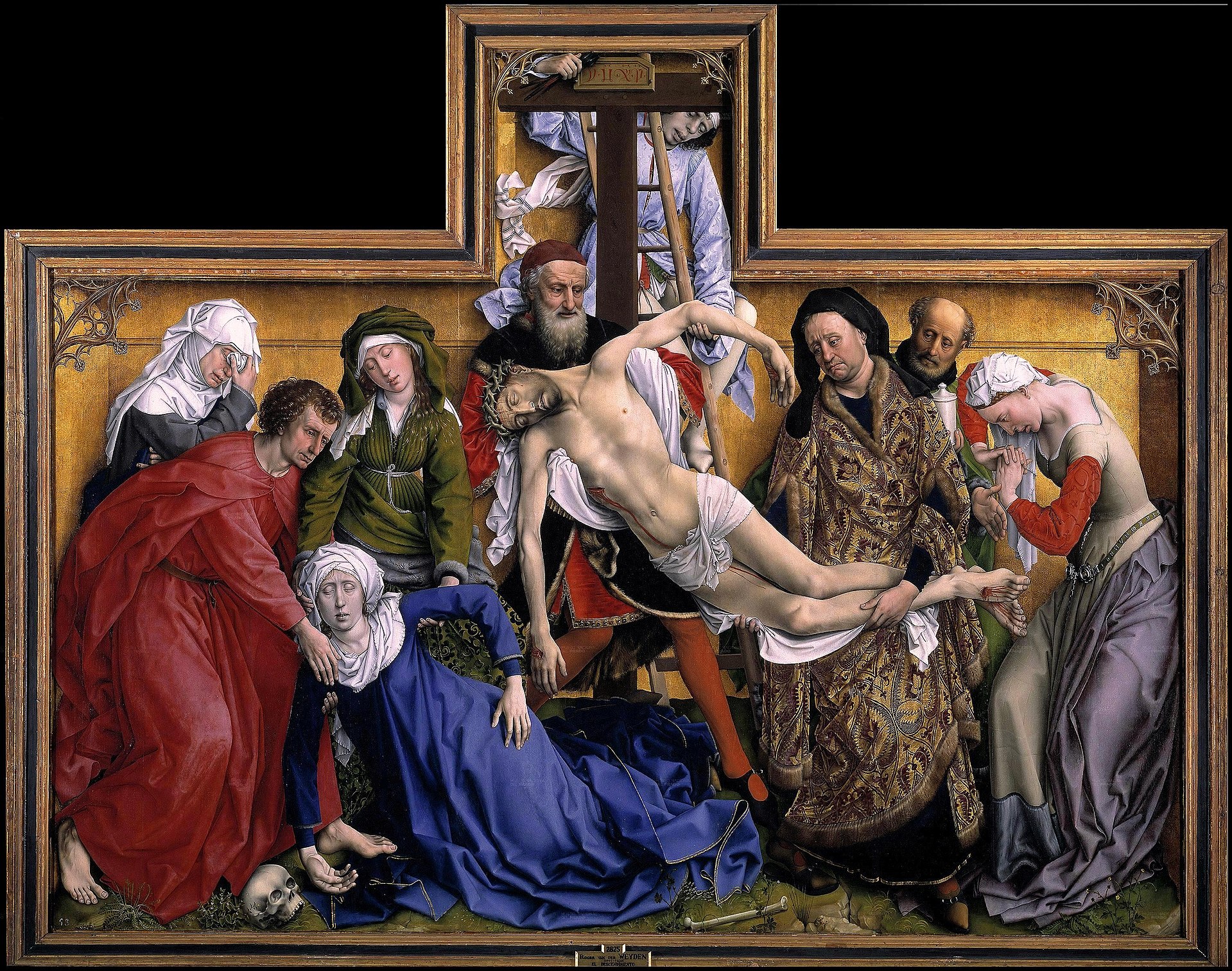
11-Rogier Van der Weyden (1399-1464), The Deposition or The Descent from the Cross, c. 1435, oil on oak panel, 86 ¾ x 110 inches, 220 × 262 cm. El Museo Nacional del Prado, Madrid.
Rogier Van der Weyden was a major artist in Flanders in the mid15th century. He was a pupil of Robert Campin, the Master of Flémalle, from which he imbued his realistic, ordinary naturalism with, what Murray said, was “more emotion, warmth and sensitiveness.” Insofar as the power of his artistic technique, Van der Weyden is a peer of Jan Van Eyck. Van der Weyden’s colors are cooler than Van Eyck’s and he subordinates his technical abilities to display the feelings of his paintings’ subject matter, typically religious. In terms of composition the striking difference between Van Eyck and Van der Weyden is that Van Eyck crafts a setting for his panorama of iconic vignettes while Van der Weyden paints flat-on action, often intensely emotional – all of which contributes to the artwork as a whole. Both Van Eyck’s Adoration of the Lamb and Van der Weyden’s The Deposition or Descent from the Cross are the most influential Flemish paintings of the mid15th century. Van der Weyden’s overall oeuvre makes him, arguably, 15th century Flemish art’s most influential figure.
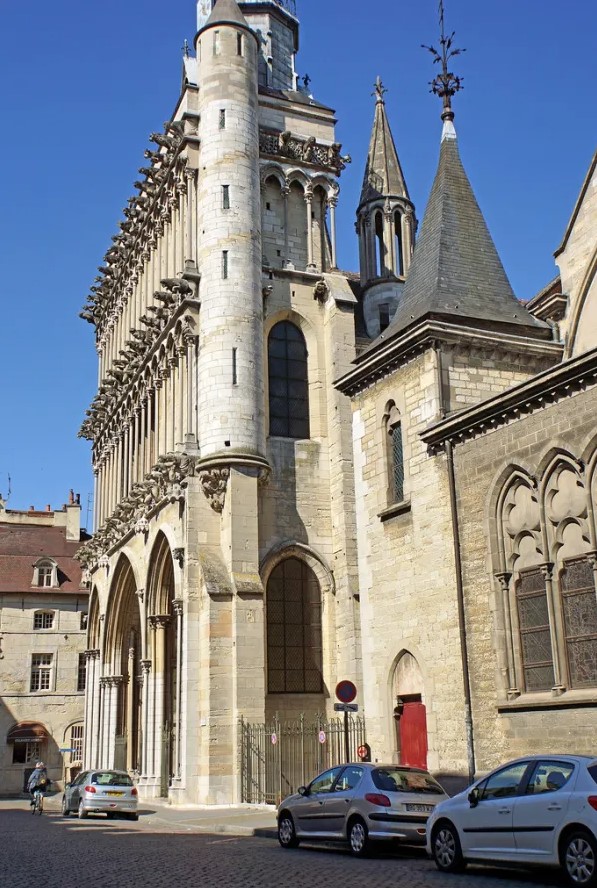
Van der Weyden’s The Deposition or Descent from the Cross are the most influential Flemish paintings of the mid15th century. The altarpiece was commissioned by the Grand Order of Crossbowman for the Church of Notre-Dame-Outside-the Walls of Dijon (13th century). PHOTO CREDIT: “France-003095 – Notre-Dame of Dijon” by archer10 (Dennis) is licensed under CC BY-SA 2.0.
Monumental Devotion: The Triptych of the Seven Sacraments
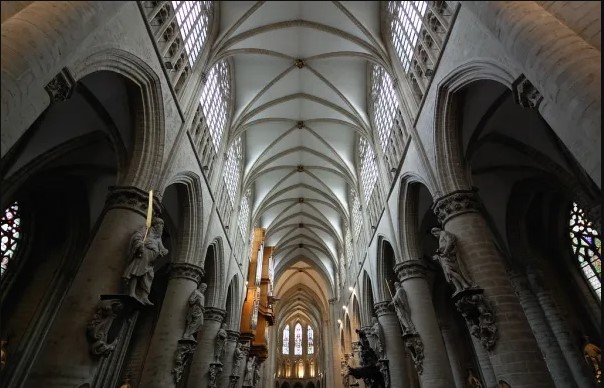
12- Rogier Van der Weyden (1399-1464), Triptych of the Seven Sacraments Altarpiece, c. 1445–1450, 78 ¾ x 87 ¾ inches. Royal Museum of Fine Arts, Antwerp.Van de Weyden’s painting, The Seven Sacraments, set in St. Gudule Church in Brussels, makes evident that the purpose for this grand and modern building is to manifest the presence of Jesus Christ in the sacraments. “St. Michael and St. Gudula Cathedral, Brussels” by tabula_electronica is licensed under CC BY-NC 2.0.
Van der Weyden married a woman from Brussels and relocated to that growing and prosperous city in the marshes of Flanders in 1426. By the mid1430’s Van der Weyden was the City Painter and did work for the Burgundian Court. In 1450 the artist traveled to Rome and Florence where the early Italian Renaissance was in full swing and whose art greatly influenced the Flemish master’s art through the 1450s and into the 1460’s. The Triptych of the Seven Sacraments Altarpiece was a return to the artist’s native city as it was painted for the Bishop of Tournai whose coat of arms appear on the upper portions of each panel. Set in the impressive Cathedral of St. Michael and St. Gudula in Brussels, the painting presents profound religious content in a finely drafted and colorful work – the left panel depicting the sacraments of initiation (baptism, confession and confirmation), the center of the Eucharist under a giant cross, and the right panel depicting the sacraments of ordination, marriage, and last rites.
Courtly Elegance: The Late Portraits of Van der Weyden
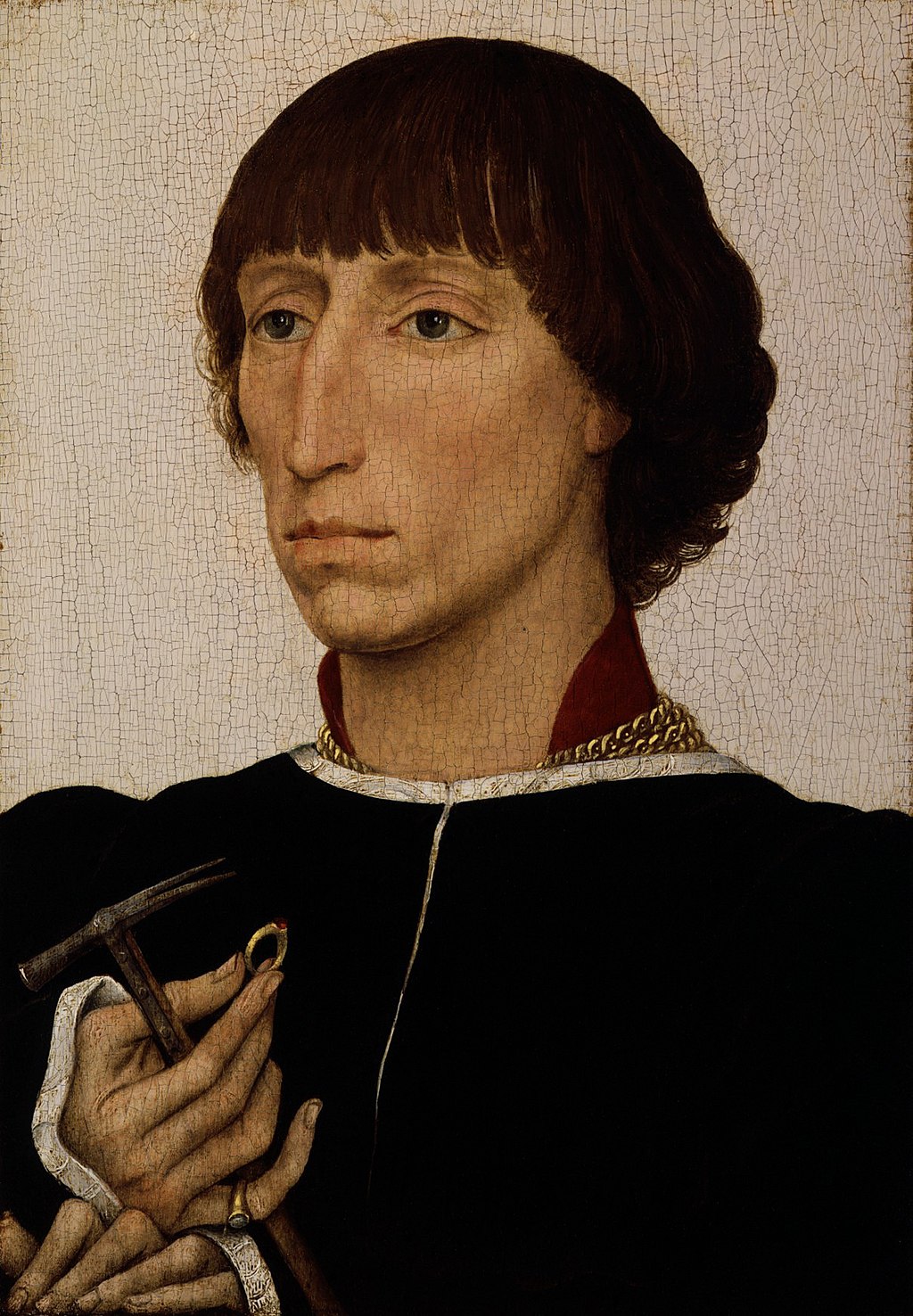
13- Rogier Van der Weyden (1399-1464), Portrait of Francesco d’Este (c. 1429-1476), ca. 1460, Oil on wood, 11 9/16 x 7 7/8 inches, The Metropolitan Museum of Art, New York.
Rogier van der Weyden painted several superb and sensitive portraits including Charles the Bold (Berlin), Le Grand Bâtard of Burgundy (Brussels), a Lady (National Gallery of Art, D.C.). Francesco d’Este was an Italian who received an education at the Burgundian Court. The d’Este family in Ferrara, Italy, was all-powerful when Rogier Van der Weyden visited there in 1450, though this portrait is done later. The sitter holds a hammer and ring whose significance is not explained with certainty.
Emotional Serenity and Architectural Precision: Dieric Bouts
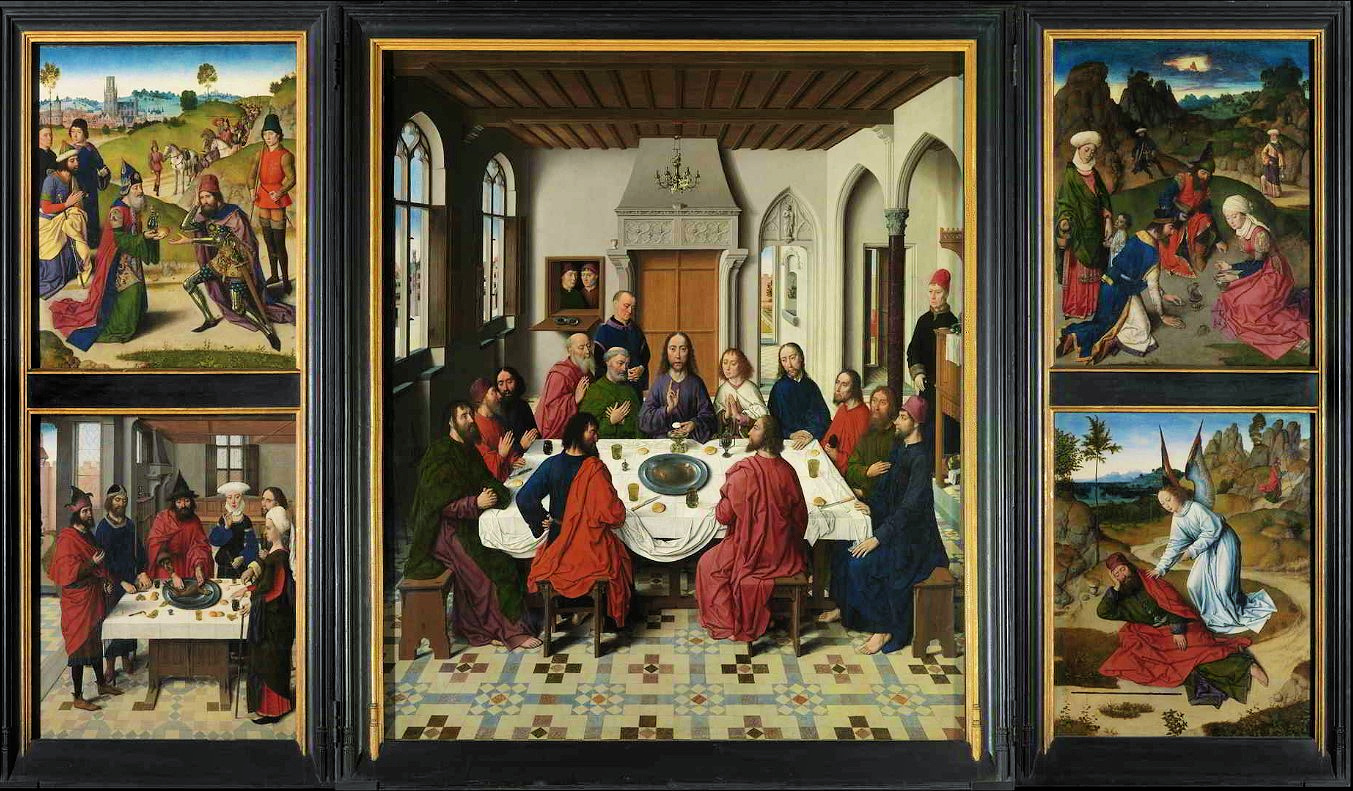
14 – Dieric Bouts (c. 1415-1475), The Altarpiece of the Last Supper or Five Mystic Meals, 1464-67, 70 ¾ x 114 inches, Church of St. Peter, Louvain, Belgium.
Dieric Bouts was born in Haarlem, the Netherlands, around 1415, where little is known of his early life. Before 1448 Bouts was working in Louvain where he married a wealthy Catharina Van der Brugghen and would work there until his death in 1475. Bouts’ finest paintings are characterized by their subtle depiction of colors and light on semi-inert and dignified and emotionally calm figures in detailed and delicately beautiful landscapes. Rogier van der Weyden influenced Bouts’ earlier work (Bouts may have trained with him in Brussels) in its greater emotionalism. In the year of Van der Weyden’s death the Brotherhood of the Blessed Sacrament of Louvain commissioned an altarpiece to place in St. Peter’s Church in Louvain. The artist worked with theologians to establish an iconography for the Eucharist which he then translated to contemporary Louvain with an exceptional plasticity whose result is that it is one of 15th century Europe’s greatest artworks. Jan Van Eyck’s influence is manifest in Bouts’ elegant intellectuality (in turn, Bouts was influential on 15th century German painting). Its perspectival calculus is matched to shapes and forms that convey emotion within the work’s compositional rigor. The head of Christ whose raised hand blesses the bread occupies the center of the artwork as the apostles gather in groupings around a table which itself develops within the room’s structure. The four side panels are scenes from the Old Testament transmitted likely by those same Catholic theologians who advised Bouts as to Biblical precedents to Christ’s Last Supper – here, the Feast of the Passover, Elijah in the Desert, the Gathering of Manna, and Abraham and Melchizedek. In 1472, Bouts was appointed city painter in Louvain, an honorary title at a time when the city was undergoing massive urban development. After Bouts’ wife died in 1473, the artist remarried in 1474 but died himself in 1475. Bouts was buried beside his first wife in the Franciscan church in Louvain. His sons, Dieric and Albrecht, were artists who continued the family tradition into the 16th century.
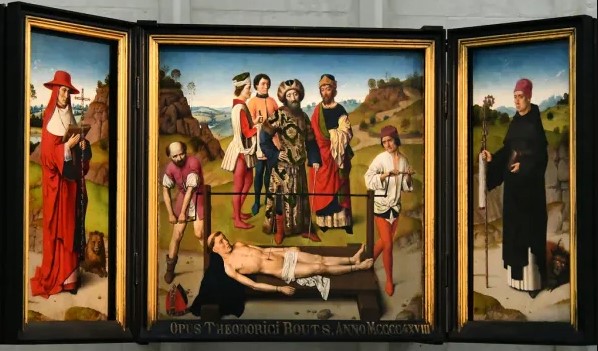
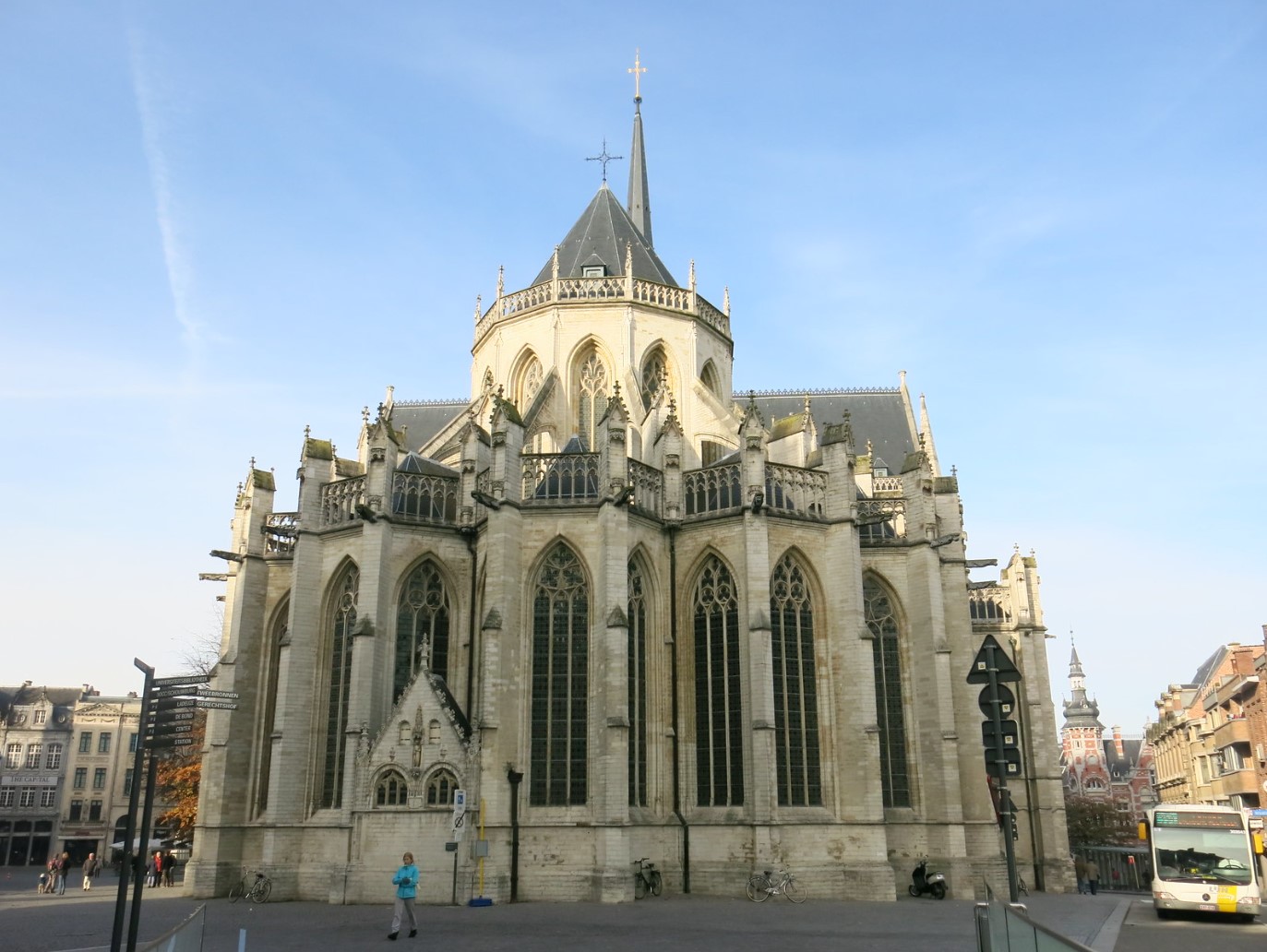
Bouts’ The Altarpiece of the Last Supper of Five Mystic Meals was to be placed in a chapel across from Bouts’ The Martyrdom of St. Erasmus in St. Peter’s, Louvain. Both artworks are hanging in the same place where it was intended for almost 600 years. “BELGIUM – LEUVEN – St Peter’s Church (7)” by eso2 is licensed under CC BY-NC-ND 2.0.St. Peter’s, Louvain. Choir and ridge 15th century. “St. Peter’s Church, Leuven” by dungodung is licensed under CC BY-SA 2.0.
Innovation in Movement: The Martyrdom of Saint Hippolytus
15 – Dieric Bouts (c. 1415-1475), The Martyrdom St. Hippolytus Triptych, 1470 – 1475 oil on wood, 35 ¾ x 35 ¾“ Groeningemuseum, Bruges, Belgium.
Unusual for Bouts this painting depicts the torture of martyrdom. There are many figures named Hippolytus in the early church. According to Prudentius’ 5th century account, one was the martyr Hippolytus who was dragged to his death by wild horses. The account led to this Hippolytus being considered the patron saint of horses. The square format panel preferred by Bouts depicts the martyrdom from above with foreshortened horsemen shown from the front. It is the first Flemish painting to depict movement not simply by using gesture. As Delevoy assesses, “The success of the picture lies in its timeless definition, its iconographic originality, its pictorial poetry, its popular feeling, its anecdotal interest.”
Civic Drama and Legal Moralism: The Justice of Emperor Otto III
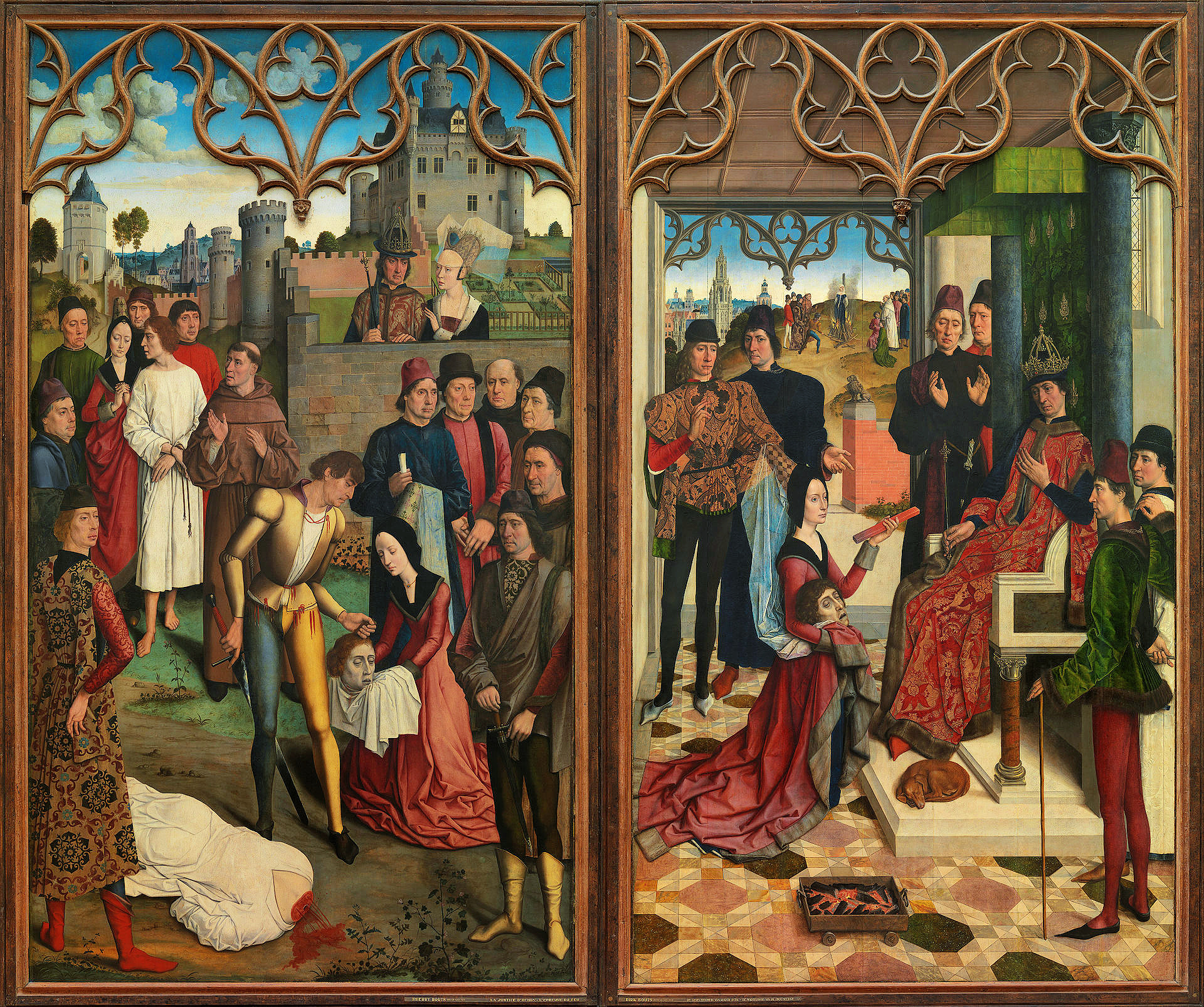
16 – Dieric Bouts (c. 1415-1475), Justice of Emperor Otto III Beheading of the Innocent Count and Ordeal by Fire, 1470 – 1475. oil on wood, 127 ½ x 72 ¼ inches, Royal Museums of Fine Arts, Brussels.
This is one of two paintings that is certain to be by Bouts (the other is Five Mystic Meals). It was commissioned in 1468 by a Louvain magistrate for the new city hall and intended to be an ambitious project on the Last Judgment. But it remained uncompleted at Bouts’s death. Panels representing heaven and hell survive and these two thematically related panels illustrating an episode from the legend of the Holy Roman emperor Otto III (980-1002). A 13th century chronicle tells how the Empress falsely accused an innocent man of a crime and persuades Otto and his court to behead him (left panel). The second panel shows the beheaded man’s wife, convinced of her husband’s innocence, approaching Otto’s throne with his head and a hot iron. Calling on God as judge, the Empress’s guilt is revealed and the royal is burned at the stake depicted in the distance. There is no lack of drama in the skillfully drawn episodes with elongated bodies, fanciful clothes, and unique facial expressions. The central focus of the panels is neither Otto nor his court but the put-upon widow of the innocent man murdered by the state through duplicity.
Edgy Mysticism and Monumental Contrast: Hugo Van Der Goes
17 – Hugo Van Der Goes (c.1440-1482), Portinari Altarpiece: The Adoration of the Shepherds, 1476-78, 96 ½ x228 Inches, Le Gallerie degli Uffizi, Florence, Italy.
Hugo Van Der Goes (c.1440-1482) was the most important Netherlandish painter working in Ghent after Jan Van Eyck. A Ghent native, Van der Goes was in a guild there in 1467 and rose to its leadership between 1473 and 1475. Soon afterwards, the artist completed the Portinari Altarpiece for an Italian who was then residing in the Netherlands. The painting was sent immediately to Florence. Though not having the opportunity to have any great influence in the Netherlands, the Flemish 15th century art practice of cool colors and exquisite oil technique impressed the Renaissance Italians, notably Domenico Ghirlandaio (1448-1494). Also, its immense size – eight feet tall and 19 feet wide – and its virtuosity made an impact. By synthesizing Van der Weyden’s drama and sensuous expression and Bouts’ three-dimensional space, Van der Goes gives increased everyday tangible reality to his sacred subjects. Sharing Broederlam’s inquiries for visual appearances, Van Der Goes’ artwork creates new forms, types, and the impetus behind them based in popular sentiments and an edgy mysticism. So, in a 15th century sort of way, this is not your father’s Nativity (i.e, Master of Flémalle’s in 1420). It is ponderable, dense, significantly tactile and spatially voluminous. The Virgin, in prayer and in maternal caress, is in the exact center of the immense triptych. Also in the circle are St. Joseph, the shepherds, angels in the air and the Christ Child. The painting is a masterpiece of contrasts – between religious, secular, and rustic architectures; heavenly and earthly figures; peace and agitation; filled space and void; warm tones and cool colors.
Hugo Van Der Goes (c.1440-1482), Portinari Altarpiece (detail).Hugo Van Der Goes (c. 1440-1482), Detail, Portinari Altarpiece, 1476-78, Uffizi Gallery, Florence, Italy.
Creative Solitude: The Later Years at Roode Cloister
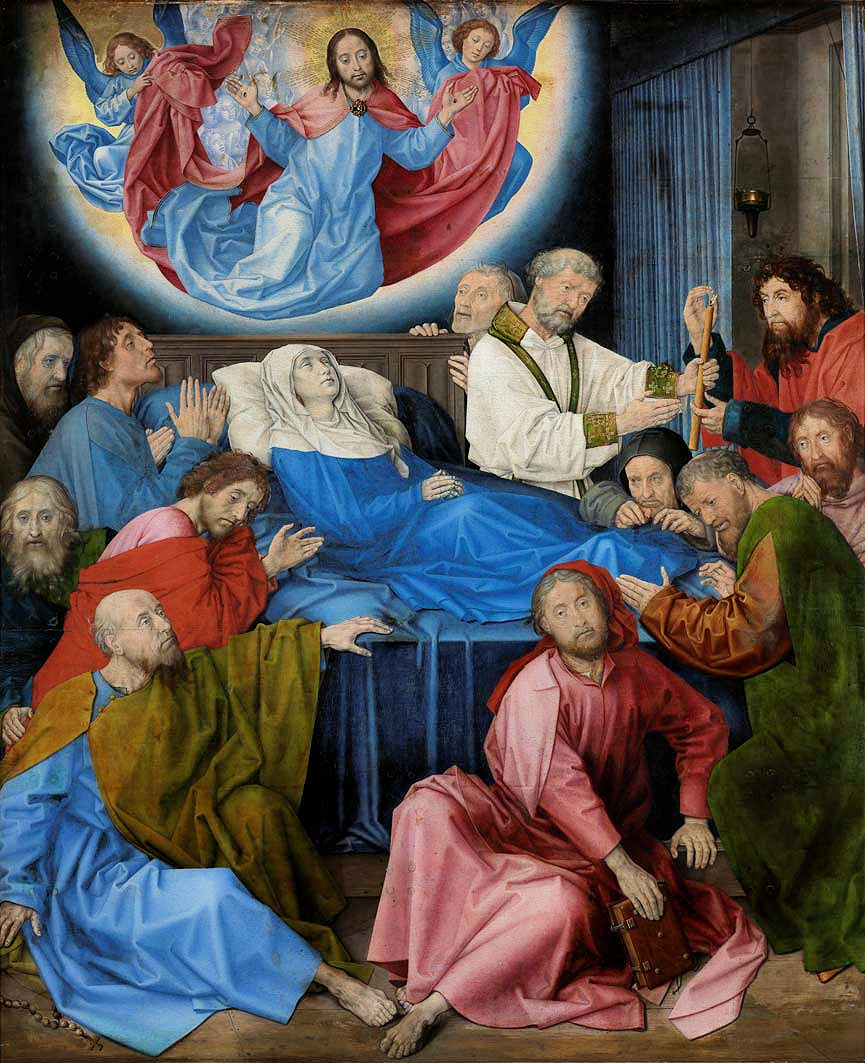
18 – Hugo Van Der Goes (c.1440-1482), The Death of the Virgin, c 1472–1480. 58 ½ x 47 ¾ inches, 147.8cm x 122.5cm. Groeningemuseum, Bruges, Belgium.
Around 1475 Hugo Van Der Goes became a lay brother in an Augustinian Priory, the Roode Cloister. Founded in 1367, the cloister is on the southeastern edge of modern Brussels. The artist continued to paint and receive visitors there, traveled to Louvain and Cologne, and died in 1482.
Global Exchange: Justus van Gent in Urbino
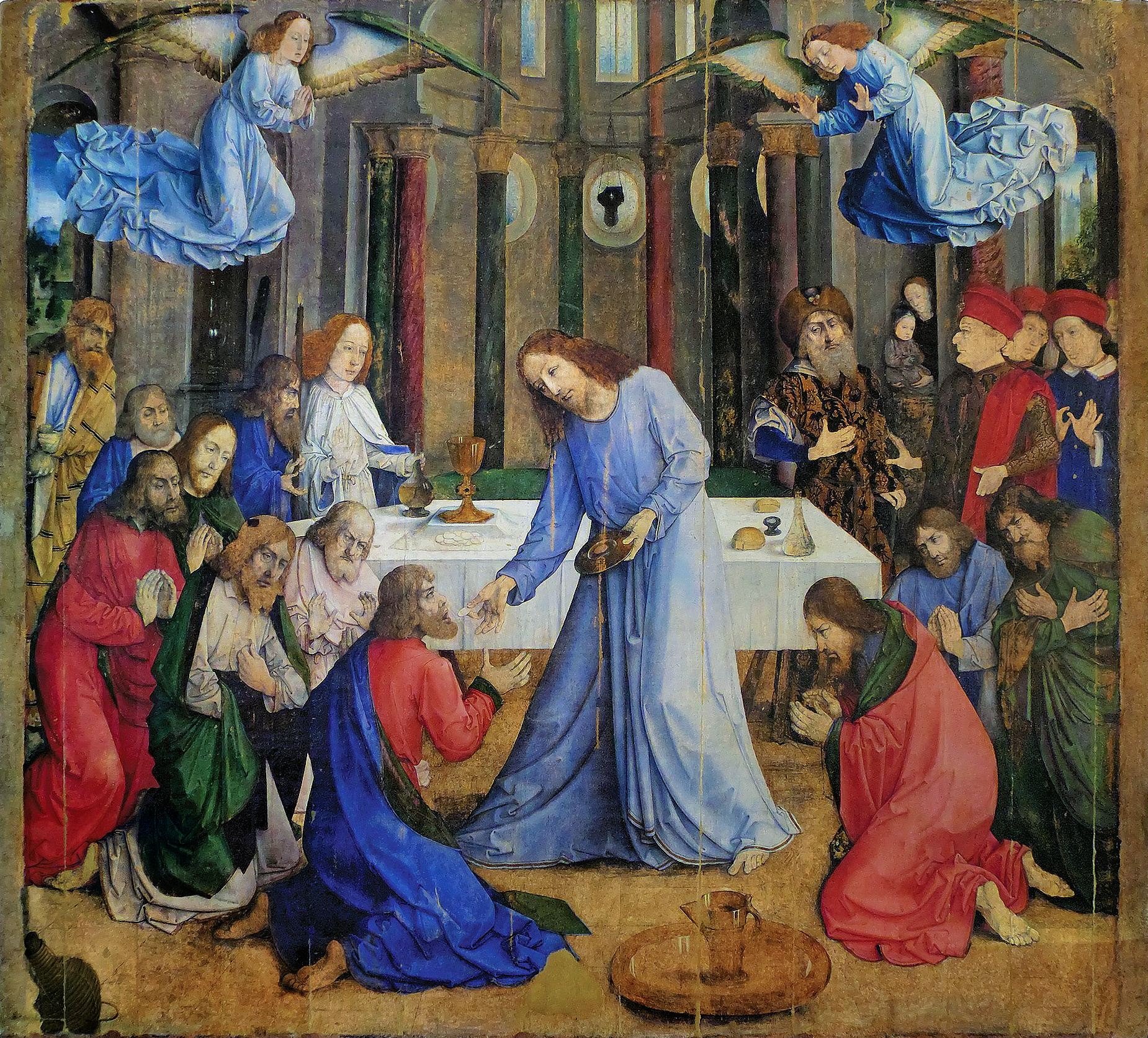
19 – Justus (Joos) van Gent (c.1435-1475), Communion of the Apostles or Institution of the Eucharist, 1473-75, 113 x125 inches, Ducal Palace, Urbino, Italy.
Justus van Ghent was a master in Antwerp in 1460 and in Ghent four years later where he met Hugo van der Goes. By the time of his death Justus van Ghent was in Rome, a city that was increasingly attracting international artists, including from northern Europe. Van Ghent was in Urbino where he painted Institution of the Eucharist in Urbino. The commission was originally given to Italian artist Piero della Francesca (1415-1492) and its predella (the altarpiece’s painting at its lower edge) was completed by Uccello (1397-1475).
Serene Piety and Commercial Success: Hans Memling
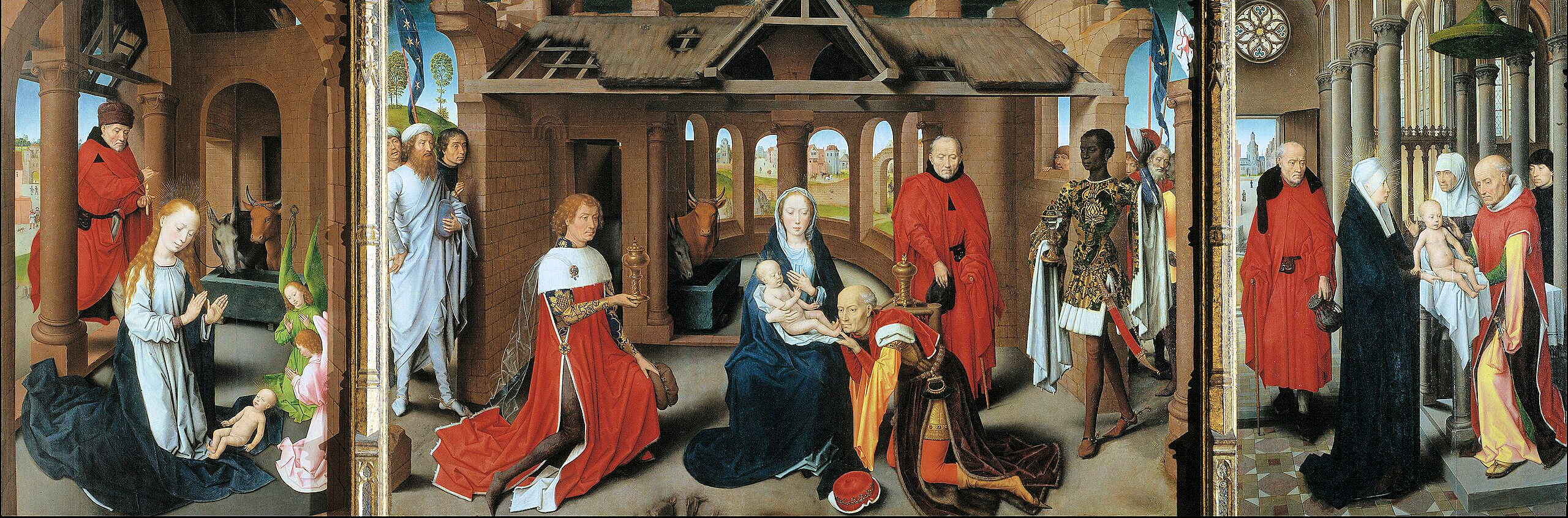
20 – Hans Memling (c. 1433-1494), The Adoration of the Magi (c. 1470), 37 ¼ x 57 inches, c. 1480, oil on panel, El Museo Nacional del Prado, Madrid.
Hans Memling was a German, born near Frankfurt-am-Main. Memling was likely a student of Rogier van der Weyden and completely Netherlandish in his artistic style. Memling lived in Bruges and became a citizen in 1465. By 1480 the successful artist was one Bruges denizen who was paying the city’s largest amount of taxes. Though not innovative, Memling’s artwork depicts calm and peaceful figures full of piety. Memling also painted portraits successfully. Examples of his artwork are in collections all over the world.
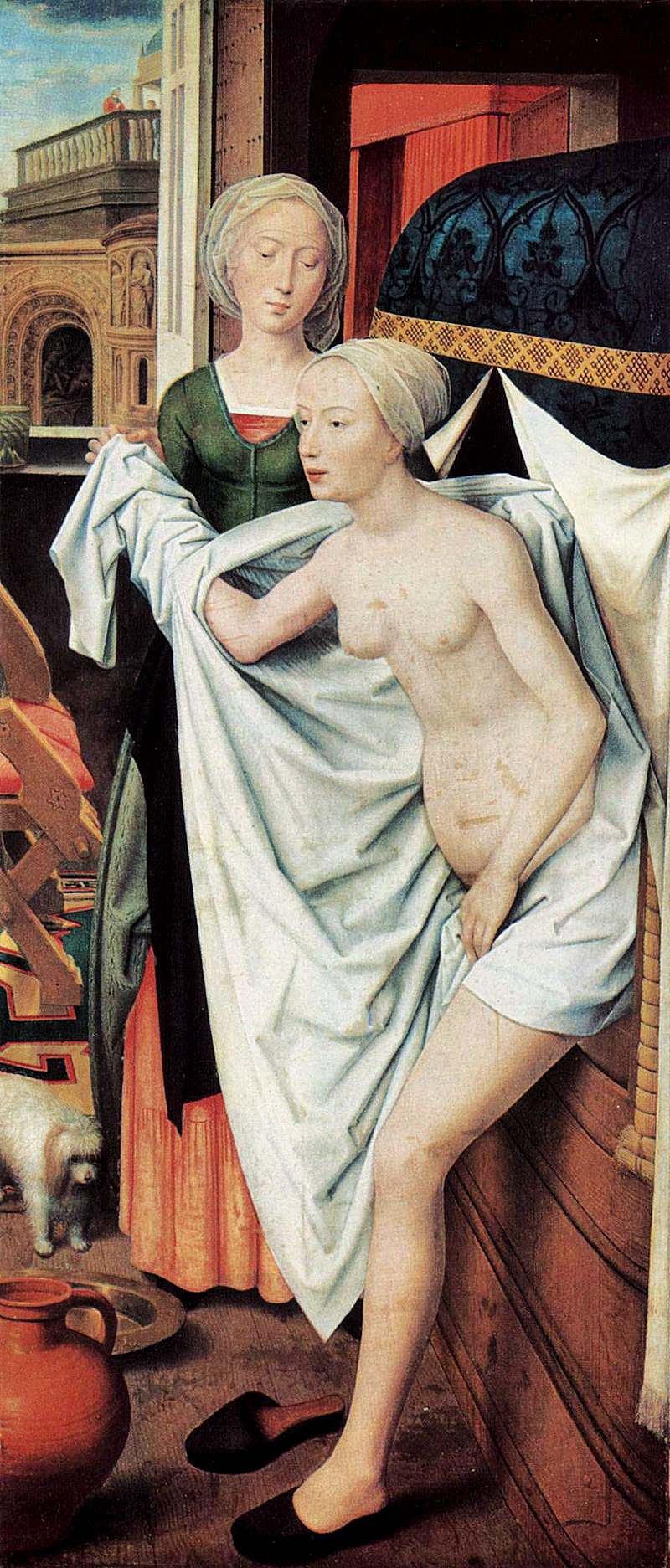
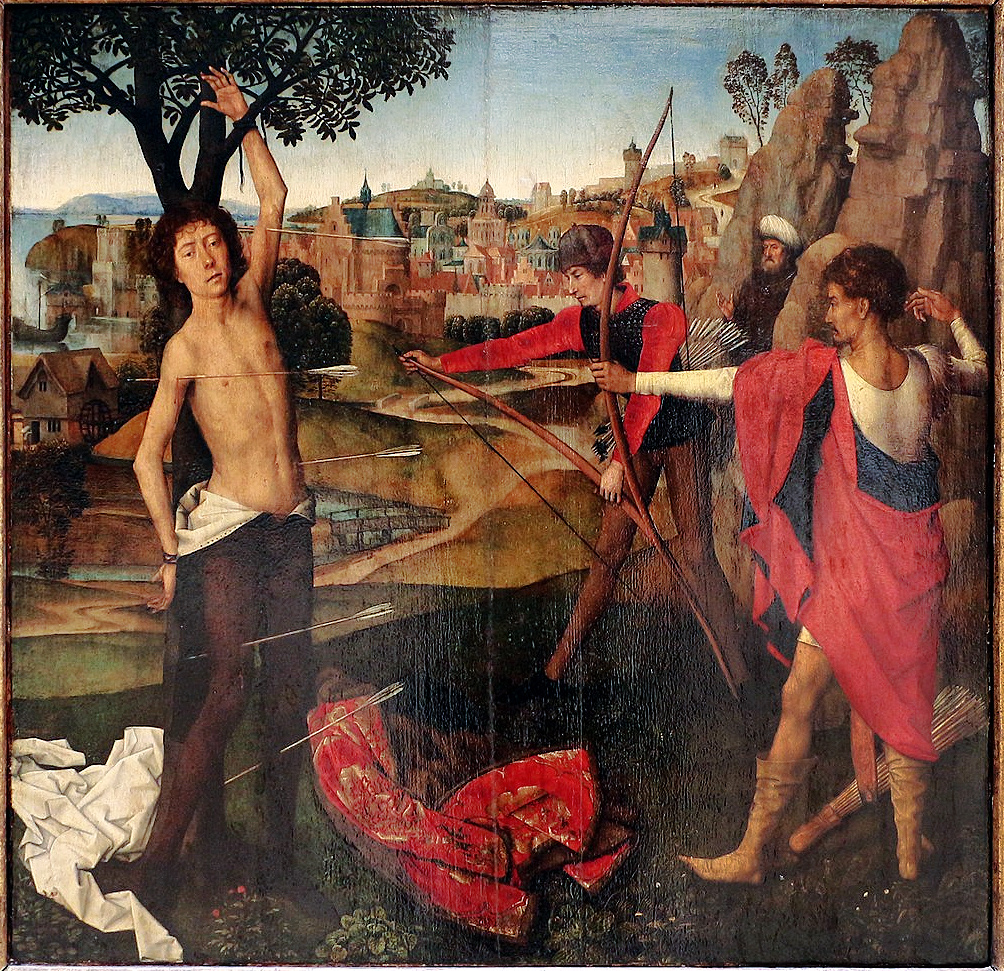
21 – Hans Memling (c. 1433-1494), Bathsheba at her Bath, c. 1480-1485, 37 ¾ x 33 inches, Staatsgalerie Stuttgart, Germany.22 – Hans Memling (c. 1433-1494), The Martyrdom of Saint Sebastian, c. 1475, 26 ¼ x 25 ½ (67.4 x 67.7 cm), oil on wood, Royal Museums of Fine Arts of Belgium, Brussels.
The Culmination of the Bruges School: Gerard David
23 – Gerard David (c.1460-1523), The Justice of Cambyses: the arrest of the Dishonest Judge, 1498, Groeningemuseum, Bruges, Belgium.
Gerard David was a Dutch painter born in Oudewater. David was in Bruges by 1484. He was the last major painter from Bruges and painted pious pictures in a gentle Netherlandish style right before the rise of a new Italianate style in Antwerp. David traveled to Antwerp in 1515 and joined the Guild but returned to Bruges and died there in 1523. Though many pictures are attributed to David, the pair of Justice paintings are certainly his.
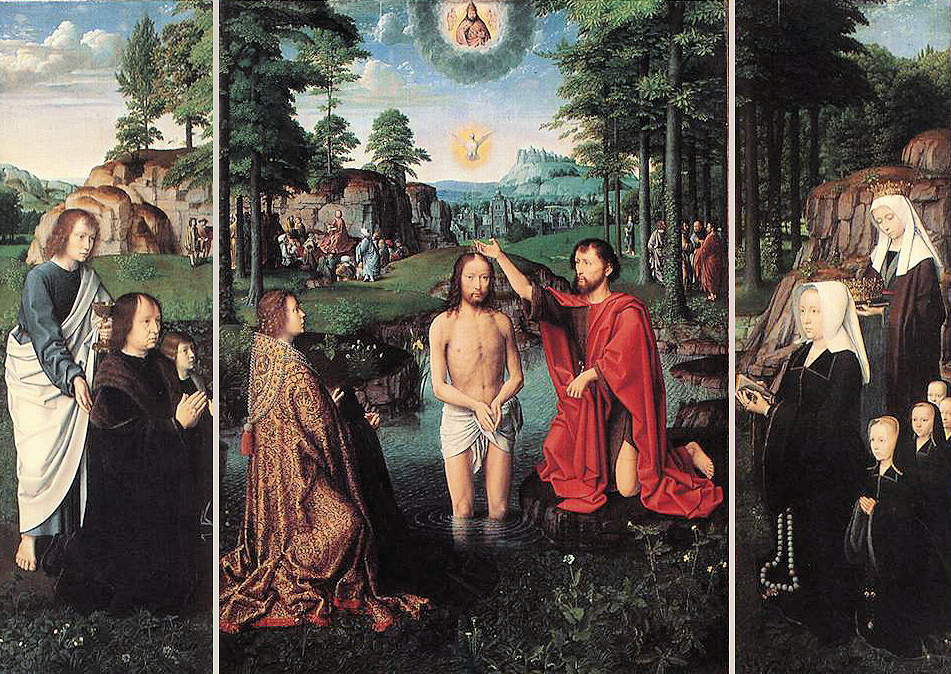
24 – Gerard David (c.1460-1523), Altarpiece of the Baptism of Christ, 1502-1508, 52 ¾ x 73 ½ inches, Groeningemuseum, Bruges, Belgium.
Conclusion: A Lasting Legacy of Northern Realism
Through this sweeping northern tier, the 15th-century Flemish School completely redefined the boundaries of Western art. Fueled by the immense mercantile wealth of trade hubs like Bruges and Antwerp, these masters looked beyond the rigid traditions of southern courtly capitals to capture the world as it was truly seen—perfecting the luminous magic of oil painting, pioneering deep three-dimensional space, and infusing sacred narratives with raw, human emotion.
From the early, groundbreaking naturalism of Robert Campin and the Van Eyck brothers to the emotional intensity of Rogier van der Weyden and Hugo van der Goes, Flemish innovation did not remain confined to the Low Countries. Its profound influence rippled across Europe, fundamentally altering artistic practices in Germany and captivating the master painters of Renaissance Italy. By marrying a meticulous observation of daily life with a powerful, independent spirit, the early Netherlandish masters created an enduring, cohesive artistic ecosystem whose brilliant light continues to fascinate and inspire the world today.
SOURCES:
A Dictionary of Art and Artists, Peter and Linda Murray, Penguin Books; Revised,1998.
Early Flemish Painting, Robert L. Delevoy, New York: McGraw-Hill Book Company, Inc., 1963.
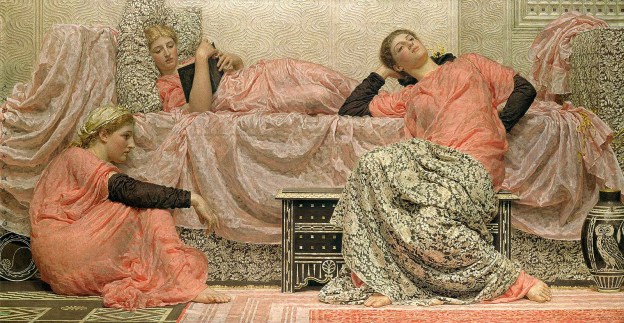
FEATURE image: Albert Joseph Moore (1841-1893), READING ALOUD, 1884, oil on canvas, 42.24 x 81 in., Glasgow Art Gallery & Museum.
The artist: Albert Joseph Moore (1841-1893).
Albert Joseph Moore was one of the leading figures of the British Aesthetic Movement, creating meticulously crafted paintings that placed beauty, harmony, color, form, and decoration above narrative or moral instruction. His idealized female figures inhabit timeless settings that blend classical inspiration with Victorian artistic experimentation, making him a unique voice in nineteenth-century British art.
Albert Moore: Life and Artistic Legacy
Albert Joseph Moore was born in 1841 into a family of artists in North Yorkshire in England. Moore through his own advanced aesthetic experiments in the milieu of theoretical and practical advancements of mid-to-late 19th century modern art in England and France – such as a systematic analysis of nature, mathematical plotting, and principles for quintessential combinations of color, line and form – created art that was, in formal terms, in its conception and execution, on the cutting edge of abstraction that would continue to develop and blossom into early 20th century Cubism. Moore’s art gained the respect of other progressive artists (Moore was called “a painter’s painter”), patrons and collectors, if not always the critics and contemporaries who viewed Moore’s work as merely decorative. Moore was actively collected in his lifetime and exhibited regularly in major venues such as the Royal Academy. Unmarried and of a lifelong independent disposition, Moore died in 1893 at 52 years old, having just completed his last monumentally ambitious artwork (“The Loves of the Winds and the Seasons,” Blackburn Museum and Art Gallery, posted below) a handful of days before. Several of Moore’s pictures are now in public collection throughout the UK, including the Tate and the British Museum in London.
Moore became a major representative of the Aesthetic Movement, often summarized by the ideal of “art for art’s sake.”
Azaleas (1867-1868)
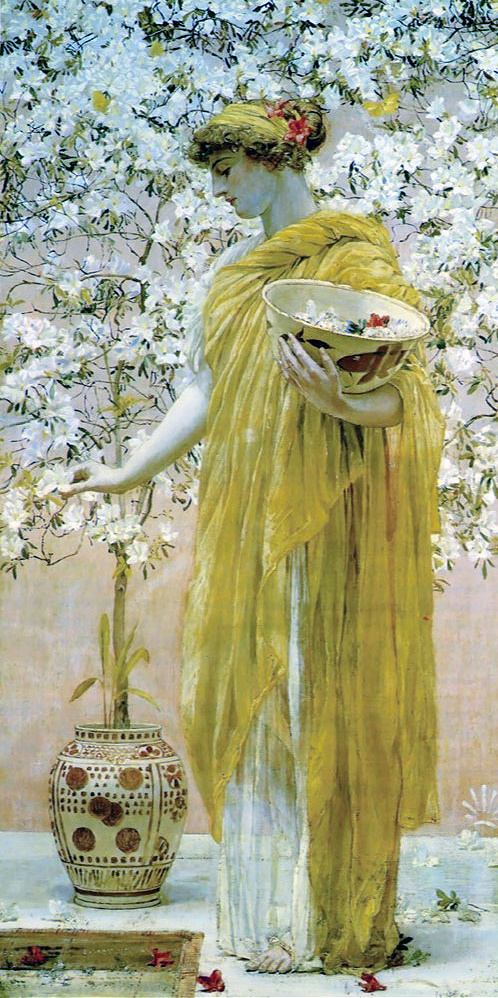
Albert Joseph Moore (1841-1893), AZALEAS, 1867, Hugh Lane Municipal Gallery of Modern Art, Dublin, Ireland.
Azaleas was a popular artwork by Albert Moore for its harmonies of color and the “Greek refinement” that the artist infused into his work. This bigger-than-life-size canvas called Azaleas was painted in 1867, exhibited in 1868 and demonstrates the artist’s ability to represent the human figure on a grand scale.
The featured works depict idealized women in dreamlike environments that feel both classical and modern. His paintings emphasize decorative harmony, color relationships, pattern, and graceful composition rather than storytelling.
Geometry and Preparation
The 26-year-old artist had some architectural design experience in theory and practice and used this in his preparatory process. This artwork incorporated ideal geometry along with typical academic methods.
Moore’s process followed, first, making studies of the nude figure and draped figure. Moore next made a larger-than-life-sized full-scale nude figure cartoon which, at this stage, was informed by geometric abstraction of the figure in a setting guided by, or through, the milieu of the object in the artist’s hands.
The geometric quality guided the composition rather than was externally imposed by the artist. Moore’s “system of line arrangement” sought the directions of the prominent lines of the composition so to plot parallels of them throughout the drawing resulting in a statuesque yet corporeally vivacious figure.
Nature, specifically the landscape, ultimately served as the inspiration for the manifestation of line parallels and optical balance rather than the mathematically ideal. Moore’s geometric construct and its interplay determined every element of the composition – from the position and placement of the figure to the location of accessories, such as wall hangings, distribution of drapery folds, and architectural elements. The canvas’s shape and size also were ultimately determined by this idiosyncratic geometric arrangement.
Traces of Moore’s preparatory practice are in evidence in Azaleas’ full size nude cartoon with its vestiges of diagonal and horizontal lines through the midsection of the figure and near to her feet. Using these lines in the nude drawing it is apparent that Moore experimented with the placement of the figure’s head, the extended hand, and a raised heel which was ultimately hidden under opaque drapery. Moore used a live model for his figure.
Technique and Execution
The final nude cartoon was transferred to the canvas and this outline was built up with oil colors. A drapery cartoon was then transferred on top of the transferred, built-up nude figure cartoon. Using this method Moore rendered greater transparency of the fabric since the underlying nude cartoon showed through faintly. This painstaking preparation was masked by Moore’s fresh and free style of painting. For instance, the drape folds of the left shoulder are painted in long, fluent, and elegant strokes while the azaleas are rendered in energetic strokes. Moore’s objective was for the final painting to look like an impromptu and expressive sketch when, in fact, it was carefully planned and executed.
About painting Moore taught his students to think long about it but execute with quickness and determination. This technique aided in transforming oil painting into the manner of Graeco-Roman fresco in that Moore’s working method allowed for painting only what could be finished in a day.
Japonisme and Color Harmony
Moore’s careful planning, rapid execution, and brush technique also suggested the influence of Japonisme. Asian influences in Azaleas included the carp bowl held in the women’s arm (an actual studio prop) and the geometric pattern in the azalea pot whose symmetry Moore saw as part of both Greek and Japanese art. To integrate and transition the predominantly yellow figure in the predominantly white background Moore used a device taken from Japanese art of painting flitting butterflies around the azalea bush. Moore also painted russet blossoms in the woman’s hair and bowl and on the floor that further unites the monumental composition.
Moore’s observation of Japanese prints also likely influenced the English artist’s color scheme in Azaleas. This is identifiable in its limited schematic of hues. The color placement, however, was also subject to the geometric practices in the whole composition.
Critical Reception
When Azaleas was exhibited at the Royal Academy in 1868 it was consigned to an out of the way place on the wall of its North Room. It was observed that Moore’s canvas looked more like a tapestry than an oil painting. In this way, Moore anticipated James McNeill Whistler’s comment about color in that it should appear “embroidered” on the canvas, in the same way a thread is embroidered on fabric. Whistler attributed this color quality to Japanese art in that those artists looked for repetition in color application and not contrast.
Architecture critics in 1868 noticed and especially admired Moore’s Azaleas. Its systematic repetitions and geometric construction were labeled the only “decorative” painting in the 1868 English exhibition. Art critics were less generous. Straining with opera glasses just to see the work they recognized its beauty and Moore’s talent but called its design and execution eccentric. Others turned up their critical nose to the new decorative work as “curious” and little more than a luxurious indulgence of art for art’s sake. Art critics were unhappy with the paintings’ colors as they found they lacked the requisite black that marked contemporary French art and, instead, opted for a quiet and delicate dreamscape.
English writer William Michael Rossetti (1829-1919) declared Azaleas one of the most important English pictures of 1868 and decried those looking to judge it by way of actual historical pictures from Greek antiquity. With Algernon Swinburne (1837-1909), Rossetti compared Moore’s artwork to another painting in the 1868 exhibition: “The Wife of Pygmalion, A Translation from the Greek” by the older George Frederic Watts (1817-1904). In that work Watts sought to create a painterly equivalent of classical sculpture. William Gladstone (1809-1898) wanted to purchase Watts’ picture after seeing it at the Academy in 1868. In a letter to Gladstone in May 1868 Watts informed Gladstone that it had been “claimed” but invited Gladstone to visit him in his studio to see the cast of the fragmentary Greek original from which the painting was derived.
Swinburne saw the poetry and musicality of Moore’s artwork .While most art critics snubbed the painting (and by extension the painter) for its art for art’s sake qualities, Swinburne praised them. Of Azaleas, Swinburne wrote: “The melody of color, the symphony of form is complete: one more beautiful thing is achieved, one more delight is born into the world; and its meaning is beauty; and its reason for being is to be.”
Sea-gulls (1871)
Albert Joseph Moore (1841-1893), SEA-GULLS, 1870/71, oil on canvas, 27 x 61 inches (68.5 x 154.8 cm), Williamson Art Gallery & Museum, Birkenhead, UK.
The Whistler Controversy
Sea-gulls was accepted for the 1871 Royal Academy exhibition. It was the third painting for Albert Moore to exhibit at the Royal Academy. Moore was absorbed in painting Sea-gulls, a major work, for British shipping magnate Frederic Leyland (1831-1892) and this work occupied him up to the Royal Academy Exhibition that spring.
Its creation by the 36-year-old Moore was not without headaches owing to controversy. Moore’s friend and admirer, American ex-patriate artist, James Abbott McNeill Whistler (1834-1903), had learned of Moore’s preliminary work on the painting through Leyland, a major art collector and the artists’ mutual friend.
Whistler expressed concern that Moore’s work perhaps overlapped adversely with some of Whistler’s own preliminary sketches for a painting. Whistler saw a pair of sketches Moore had sent to Leyland as potential commissions. Whistler felt that Moore’s sketch may have been influenced by seeing one of Whistler’s sketches. Whistler feared that if Moore’s painting was exhibited first, it would reflect badly on Whistler as an imitator when in fact the artwork Whistler was working on ante-dated Moore’s conceptions. This was a mortifying prospect for Whistler who prided himself on originality.
Whistler’s anxiety may have also stemmed from the fact that with Sea-gulls, Moore would fulfill his second commission for Leyland, while Whistler who introduced them had yet to complete a picture for Leyland that had been commissioned in 1867.
To ease Whistler’s fears, the American artist proposed that Moore accompany another mutual friend, architect William Nesfield (1835-1888), to Whistler’s studio in Chelsea to inspect his older original sketch that Moore had seen.
Nesfield, acting as mediator, concluded in September 1870 that the recent work of the two artists shared themes, but each maintained their own artistic originality. The crisis was averted and led to Moore exhibiting Sea-gulls.
Completion and Artistic Development
During this crisis and shortly thereafter, Moore did not finish to his satisfaction his painting when it was time for its exhibition in April 1871. A major effort required to complete Sea-gulls had deeply undermined Moore’s health. After the exhibition the painting was returned to the artist, but he could not yet immediately set to work on it to completion. Months later it was finished and sold to Leyland.
Nature, Movement, and Surface Effects
In Sea-gulls Moore introduced obvious analogies between the liquid patterns of the sea and the rippling and splashing motion of the figure’s hair and drapery. Moore’s intention was to discern patterns inherent in nature. The drawings also suggest that he exaggerated the effect of air currents by employing the revolving fans that were simultaneously in use for Sea-gulls and another painting titled Shells.
Much of Moore’s work to complete the painting after the exhibition revolved around redressing the picture surface. Moore had been experimenting for some time with the surface quality of his paintings. In the early 1870s, Moore’s technique had developed to combine transparent and opaque fabrics that created unusual layering effects. Following the 1871 exhibition, Moore seemed to apply this technique in Sea-gulls that involved unusually thick paint layers.
Grosvenor Gallery and Lasting Friendship with Whistler
Much later, during the winter of 1880, Sir Coutts Lindsay (1824-1913) – the British artist and watercolorist founded Grosvenor Gallery on Bond Street as an alternative exhibition space to the Royal Academy which became a venue for avant-garde artists, particularly those associated with art for art’s sake – mounted a show on the subject of artists’ working sketches. Moore contributed the preparatory studies for Sea-gulls to the show that included his sketches of hands, heads, drapery, plants and flowers, as well as the painting’s cartoon.
Although biographers of Whistler and Moore have attached no importance to their friendship, particularly after the September 1870 controversy over Sea-gulls which they claim ended it, the artists in fact remained on intimate terms unbroken until Moore’s death in 1893. In the later 1870s they again were thrust together in a contentious situation but this time on the same side of sorts. When Whistler became involved in libel proceedings against Ruskin in later 1878 Albert Moore was the only artist who the American ex-patriate artist could rely on to both publicly attend the proceedings and actually give evidence on Whistler’s behalf.
Albert Joseph Moore was highly admired by James McNeill Whistler, who regarded him as his favorite contemporary British artist.
Reading Aloud (1884)
Albert Joseph Moore (1841-1893), READING ALOUD, 1884, oil on canvas, 42.24 x 81 in., Glasgow Art Gallery & Museum.
Conception and Working Method
Reading Aloud was one of three large-format paintings Albert Moore completed in the 1880s. Completed in 1884, Moore had been working on Reading Aloud for years – at least since 1881. Moore had drawn a chalk sketch of the geometrically designed composition over which the artist would lay a piece of translucent glass. By painting directly on the glass, he could experiment with colors without redrawing the picture. He then could transfer the trial color experiment on glass (as well as a final drawing) onto tracing paper by which the final artwork was then made by pinning the tracing paper to the canvas. The artist then painted the composition directly to the canvas, section by section, working as he painted to unify color scheme and, as figural poses and other details are different in the final artwork than surviving preparatory materials, drawing. It was meticulous organizing and harmonizing creative work that helps to explain why Moore labored for years on the almost 7×4 foot oil on canvas.
Works such as Reading Aloud demonstrate his pursuit of beauty through carefully controlled arrangements of figures, fabrics, colors, and space.
Composition and Symbolism
While these three reclining figures are static their contrasting drapery folds whether they are swirls, zigzags or sweeping diagonals – with the sofa’s swags to unite them – enliven the picture. As classicism revivalists are noted for their mere realism and moralistic anecdote, Moore’s evocation of classicism, though containing allegorical qualities, belies a modernity by way of its abstract combination of line and form in the depiction of languid female figures in a neutral setting. The black-and-white owl vase that Moore included in the lower right corner of the painting had been absent from previous studies (originally it was a seated cat) and provides a narrative sign. It connotes the quality of wisdom as well as perhaps the goddess Athena with which the owl is associated so to apply it to the various states of the readers though the overall picture with its fascination with repose is more subtly mysterious than anecdotal. Yet the classicism/modernity enigma continues as the honey bee which Moore paints on the face of the owl vase was the symbol used by the picture’s purchaser, pig iron industrialist William Connal (1819-1898), for himself.
After his wife of 25 years Emelia Jessie (Campbell) Connal died in 1877, 56-year-old industrialist William Connal faced life alone at Solsgirth, his Scottish country manor. Connal turned his attention to the arts and, in addition to Moore, became an avid collector of contemporary art by such painters as Edward Burne Jones (1833-1898), Edward Poynter (1836-1919), Frederick Sandys (1829-1904), Roddam Spencer Stanhope (1829-1908), Fernand Knopff (1858-1921) and Adolphe Monticelli (1824-1886) along with the Old Masters. Connal owned Symphony in Silver and Grey by American artist James McNeill Whistler (1834-1903) who greatly admired Moore. In 1883, Connal invited Moore to stay at Solsgirth House in Perthshire for a month allowing the artist to recuperate after a serious illness. It was during this stay that Connal commissioned Moore to paint his portrait that shows him wearing a honeybee brooch, the emblem that Connal used on his personal items (Connal’s portrait today is in York Art Gallery).
Geometry, Abstraction, and Critical Response
Moore’s pictorial methodology which he continued to develop over his artistic career is in evidence in Reading Aloud. Moore works out and unifies various and moving parts depicting a scene’s animating personality based in psychology with its physical forms that are mathematically contrived by way of lines and curves and, ultimately, color and texture, and whose impact on the viewer of the completed artwork is allowed to be emotional rather than cerebral. In Reading Aloud Moore constructed the image based on two pairs of diagonals that intersect into a pattern. Though the geometric system is visually subdued, it is evident in the figure on the right whose arms coincide with a set of diagonals. It is obvious also in the picture’s overall use of contrasting bold colors – the fabrics’ pinks and creams are integrated to, though angularly distinct from, the charcoal greys of the covered limbs and book cover. The edges of the book cover also coincide with some of the complex design of diagonal lines whose subliminal quality is an intrinsic expression of the psychic nature of the artwork. This angularity based on diagonals was a deliberate strategy for Moore when he painted the final artwork. There is also the horizontal lines component in the painting manifested in the outstretched arms of the crouching figure at left and the table and vase. Moore’s design strategies were innovative in 1884 startling contemporary viewers approaching to what Cubism would accomplish 25 years later. Critics when viewing Reading Aloud, being neither particularly understanding nor sympathetic to Moore’s methods or intentions, praised the picture’s overall gracefulness but impugned his drawing skills and identified the painting as mostly static decoration. Yet the static figures form part of a complex array of abstract and naturalistic patterns that fill every inch of canvas. Reading Aloud is a testament to the artist’s ability to translate such natural phenomena into a stylized form. Most prominent among them is a fabric effect found in other of Moore’s paintings of the period, in which white lace is layered over cloth of a darker color. Reading aloud was exhibited at the Royal Academy where, starting in 1883, Moore chose to exhibit annually.
The Loves of the Winds and the Summer (1893)
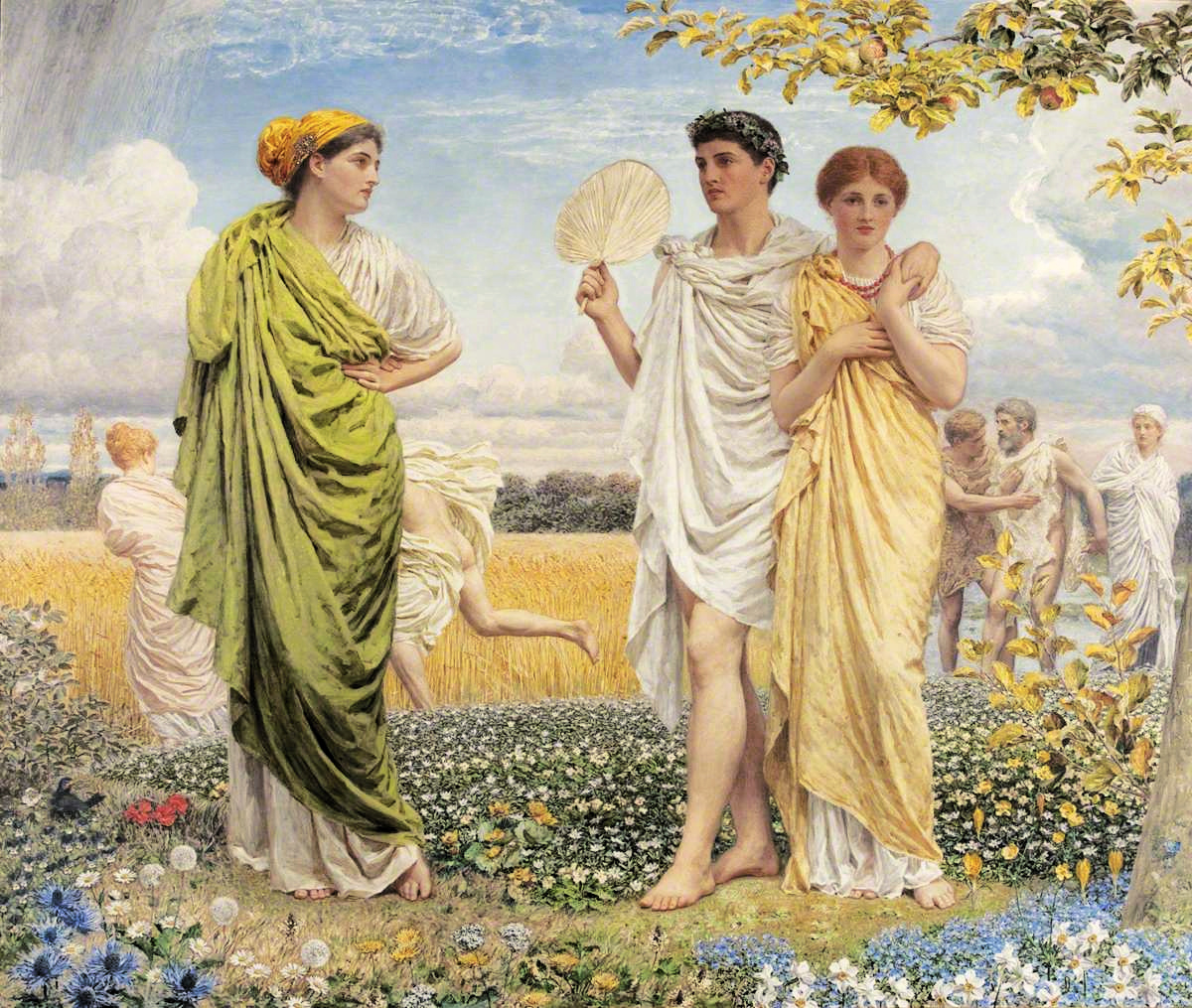
Albert Joseph Moore (1841-1893), The Loves of the Winds and the Seasons, 1893, oil on canvas, Blackburn Museum and Art Gallery, Blackburn, UK.
Moore’s Final Masterpiece
The Loves of the Winds and the Summer was English artist Albert Moore’s final and largest artwork of his career. It is 6 feet tall and 7 feet wide and is the jewel in the crown of the Blackburn Museum and Art Gallery near Manchester, England. It is the result of Moore’s study of the psychology of his subject matter, that of love. Love begins to manifest formally for Moore by the expression of soft bodily postures, changing and harmonious curves, and piercing gazes expressed in deep coral colors. The male figure of the Wind is flanked by the spurned female figure of Summer to the left and the embraced female figure of Autumn to the right. Moore was so enveloped in his amorous themes that while working on this picture he was writing poetry about what the human face was like when in love – and it is found in his picture. The Love of the Winds and the Seasons is Moore’s fullest expression of animating personality united to depicted physical forms that are first lines, curves and color, with the result being an emotional impact on the viewer who encounters the artwork.
Moore drew inspiration from ancient Greek sculpture and classical forms but was not attempting archaeological reconstruction.
Art in the Face of Terminal Illness
This exquisite artistic sensitivity by Moore is made more remarkable since the artist was dying in 1893. In the company of his young and attractive live models in his new capacious art studio, Moore worked day after day on this work. Moore had cancer (a tumor on his thigh) and had submitted to three operations to keep ahead of it. When his doctors told him they could operate no more, and that the cancer continued to spread throughout his body, Moore was resigned to his situation. He is reported to have said: “Well, there’s an end of it.” In the limited time left to him Moore intended to finish his painting of love, The Loves of the Winds and the Seasons. The artist did not want to lose any time. His legs had swollen to twice their size and had to be drained. In acute pain he worked around the clock for the next six months. His friends thought the intense work as well as the cancer was killing Moore but as the painting progressed to completion, they observed that the artist’s personal tranquility and happiness became apparent.
Geometry, Design, and Creative Process
The project was monumental – numerous preparatory studies, drapery studies, full scale and life-sized cartoons (i.e., 4’ 9” tall by 1’4” wide for Autumn) , nude studies – all technically meticulous and versatile- and that underwent the artist’s elaborate and idiosyncratic geometric platting system that he began in the late 1870s. Moore was the consummate auteur that slightly older American ex-patriate painter James Abbott McNeill Whistler (1834-1904) most admired in England. Moore conceived his paintings from start to finish – and The Loves of the Winds and the Seasons was at once its pinnacle and completion. Moore, as Whistler aspired to be, was sole master of his work. In 1893 Moore now expanded this mathematical process to amalgamate his diagonals with horizontals so that his creative process could not suffer the critique that Ruskin hurled at Whistler of “ask(ing) 200 guineas for flinging a pot of paint in the public’s face.” The painting was a commission for the Australian mine-owner George McCulloch (1848-1907). Moore’s calculations included various adjustments of the models’ natural poses to submit to the mathematical formulas on the canvas. This formal submission of subjects to linear construction extended to each detail in the entire composition, such as the flowers for which also study drawings were made. Within these design rigidities, the preparatory drawings of the live models and subjects were transferred to the artwork with little idealization though slight but important adjustments were made, such as to Summer’s hairstyle. Knowing his own time was short, Moore made his cartoons in color so that his transfer to the canvas was as efficient as possible as he painted the final artwork. Critics have observed that despite the intense planning and preparation, the final artwork is executed unevenly – parts are meticulous and vigorous, mostly in the foreground, while others in the background are loose and crude. To what degree this is the artist’s intention or the result of his declining health, is a matter for speculation. During the artistic process the terminally ill artist isolated himself mostly. His handful of visitors remarked that the artist was cheerful, cracked jokes, told funny stories, and smoked his pipe. These select parties knew, however, that their social calls were in the context of final good-byes. In those last days and months of Moore’s life, the artist’s mind, by evidence of the art from his past that he referenced in 1893, stretched back to an earlier career which shared long-held important aspects with The Loves of the Winds and the Summer.
Poetry and Meaning
For his last artwork. Albert Moore glossed the picture’s narrative in verses he wrote to accompany it:
Lo! fickle Zephyr chaseth wayward Spring, It is a merry race; Flowers laugh to birds that sing, Yet frequent tears shall cloud her comely face. The South Wind shall with blushing Autumn mate, Contented with her lot; Summer sigheth – such her fate She and her burning kisses are forgot. Two lovers rough for shudd’ring Winter strive, Beneath a shroud of snow; Heaven haply shall contrive Their violence she may not further know.
Legacy and Death
Through its figural and intellectual prism of ancient classical mythology, Moore worked in his career to update the complex equation of the natural world’s varying and transitory seasons to human life’s copious physical, emotional, and spiritual expressions and contradictions. With their immersion in Moore’s modern art, the painter achieved a graciously-contrived visual dramatic interplay of nature and humanity, ancient and present-day, whose quest is eternal in time and space.
Albert Joseph Moore passed away in the middle of the night on September 25, 1893. He died 9 days after finishing his last painting, The Loves of the Winds and the Summer. Moore was 52 years old.
Albert Joseph Moore’s art transformed Victorian classicism into a sophisticated decorative vision that influenced later developments in modern art and design.
FEATURE image: The Satyr at the Farmer’s (“Der Satyr beim Bauern”), Jacob Jordaens (Flemish, 1593-1678), c.1620.
Housing much of Munich’s most famous artwork, the Alte Pinakotek’s collection includes renowned international works from the 14th through the 18th centuries. A survey of these masterworks illustrates how European painters evolved from traditional craftsmen into divinely inspired creators. Through detailed analyses of artists like Albrecht Dürer, Valentin de Boulogne, and Claude Lorrain, the post demonstrates how these masters utilized religious self-fashioning, classical mythology, and the dramatic use of light (chiaroscuro) to inject profound emotional and psychological depth into Western art
Self-Portrait (“Selbstbildnis”), Albrecht Dürer (German, 1471-1528), c. 1520.
The Artist as Divine Creator: Albrecht Dürer’s Self-Portrait (c. 1520) deliberately uses the iconic, frontal pose of Christ Pantocrator to elevate the status of artists from manual laborers to divinely inspired creators. Humanizing the Divine: In contrast, Rembrandt did not portray himself as Christ but used his own aging, flawed face as a template for Jesus to ground him in human suffering and vulnerability.
Several prominent artists have, at various moments, fashioned their own likenesses in the image of Christ, a strategy that served both devotional and professional aims. This practice participates in the long tradition of imitatio Christi—the aspiration to model one’s life, conduct, and even physical bearing on the figure of Jesus. Within the visual arts, however, the gesture carried additional layers of meaning. By aligning themselves with the divine prototype, artists could elevate their social standing from that of manual laborers to inspired creators whose work partook in sacred authority. At the same time, such self-fashioning could signal profound personal piety, suggesting that the artist’s inner life mirrored the spiritual intensity of the Savior.
The most celebrated example is Albrecht Dürer, whose 1500s self‑portrait adopts the frontal, iconic pose associated with late‑medieval images of Christ Pantocrator. Dürer’s deliberate visual parallel not only asserts his artistic genius but also reflects his conviction that creative imagination was a God‑given faculty. His self‑portrait thus becomes a theological statement: the artist as a vessel of divine creativity.
Other painters engaged the motif in subtler ways. Rembrandt, for instance, did not present himself explicitly as Christ, yet he repeatedly used his own features as a template for the face of Jesus. This choice was less about claiming sacred authority and more about grounding the figure of Christ in lived human experience. By drawing on his own physiognomy—familiar, aging, marked by suffering—Rembrandt infused his depictions of Jesus with psychological depth and emotional immediacy. The result is a Christ who feels palpably human, capable of empathy and vulnerability.
Taken together, these strategies reveal how self‑representation as Christ could function across a spectrum: from bold assertions of artistic status to intimate explorations of spiritual identity. They also underscore the evolving conception of the artist in early modern Europe—not merely a craftsman, but a creator whose work could approach the divine.
Four Apostles (“Vier Apostel”), Albrecht Dürer (German, 1471-1528), c. 1526.Detail. Dürer, Vier apostel. Mark and Paul.The Land of Cockaigne, Pieter Brueghel the Elder (Flemish, 1525/1530-1569), 1567.Head of an Old Woman, Pieter Brueghel the Elder (Flemish, 1525/1530-1569), 1563.Robbery and Melon Eaters (“Trauben- und Melonenesser”), Bartolomé Esteban Murillo (Spain, 1617-1682), c.1645.History Cycle: Battle of Alexander (Battle of Issus) (“Historienzyklus: Alexanderschlacht [Schlacht bei Issus]”), Albrecht Altdorfer (German, c.1480-1538), 1529.Adoration of the Magi, Columba Altarpiece, central panel (“Columba-Altar: Anbetung der Könige”). Rogier van der Weyden (Nederlandish, c. 1399-1464), 1455.Danae, Jan Gossaert (Brabant, 1478-1532), c. 1527.
Blending Influences: Gossaert integrated French, German, and Netherlandish styles, becoming a key “Romanist” after traveling to Italy. The Erotic Renaissance: In Danaë (c. 1527), he broke away from the medieval practice of treating the Greek myth strictly as a safe, pagan metaphor for the biblical Annunciation, choosing instead to reintroduce its original erotic context.
Jan Gossaert was probably from Maubeuge in France though the artist’s whereabouts are first documented in Antwerp, Belgium, in 1503. His early style is an amalgam of then-popular contemporary French, German, and Netherlandish influences – Hugo Van Der Goes (c.1440-1482), Albrecht Dürer, and Gerard David (c.1460-1523). After a trip to Italy in 1508, Gossaert displayed new flamboyance in his style and detail, particularly using architectual settings as the Alte Pinakothek’s later Danae shows. The northern European Hainault artist never successfully incorporated Italian Renaissance ideas into his artwork and many of his figures’ poses are actually derivative. Yet this level of stylistic incorporation led Gossaert to become an important Romanist. Gossaert was the first northern European artist to introduce nude classical figures into Flanders’ art world.
The Oracle of Delphi prophesied that King Acrisius of Argos would die at the hand of his grandson. To prevent this, the king imprisoned his daughter, Danaë, in an essentially golden cage. However, the King of the gods, Zeus, desired Danaë and came to her by way of a stream of golden rain into her cage where she conceived Perseus. It was Perseus who later, after his own adventures, killed his grandfather by accident during some athletic games.
By the Middle Ages this ancient Greek literary material was used as a pagan reference for the New Testament Annunciation. Gossaert was one of the first artists in the Renaissance period to reintroduce the original subject’s erotic content on its own terms.
Madonna with Child, St. Mary Magdalene and Donor (“Maria mit Kind, hl. Maria Magdalena und Stifter”), Lucas van Leyden (Dutch, 1494-1533), 1522.“Pearl of Brabant”: Adoration of the Kings (“”Perle von Brabant”: Anbetung der Könige”), Dieric Bouts (Nederlandish, 1400?-1475), c.1465.Matthias Grünewald (c. 1470-1528), Meeting of Sts. Erasmus and Maurice, Martyrs, c 1520-24, 226 x 176 cm, basswood.
Emotional Weight & Late Gothic Outlook: Unlike his contemporary Dürer, Grünewald did not create prints and prints-making; instead, he used Italian Renaissance techniques solely to heighten the emotional and religious impact of his paintings.
Matthias Grünewald was a German painter of the Renaissance. Born Mathias Neithar(d)t-Gothar(d)t around 1470-75, Grünewald shared virtually the exact birth and death dates of fellow German artist, Albrecht Dürer, though the two artists were exact opposites.
Little is known about the life of Grünewald. He first enters the historical record in 1501 in Seligenstadt. It is believed the artist was also early on in Aschaffenburg and as far off as Würzburg. From 1508 to 1514 Grünewald was court painter to Albrecht of Brandenburg (1490–1545), the archbishop of Magdeburg, administrator of Halberstadt, and the archbishop and elector of Mainz (later Cardinal) who commissioned the Alte Pinakothek panel for the Neue Stift in Halle. By the mid1520s Grünewald was in Frankfurt and, apparently increasingly sympathetic to Lutheran doctrine, north to Halle where he died.
Grünewald’s first datable work is from 1503 though Grünewald is best known for his Isenheim Altarpiece in Colmar, France, produced in the mid1510s. Unlike his contemporary, Dürer, MatthiasGrünewald apparently attempted no woodcuts, engravings or even many drawings. Like Dürer, he was familiar with Italian Renaissance ideas, though Grünewald did not pursue its techniques for its own ends. Rather, Grünewald was interested in using these new Italian techniques to heighten his own art’s emotional impact as well as make a religious statement. In this sense Grünewald possessed an essentially Late Gothic outlook and style. Yet, besides the passionate, well-drawn, and colorful Isenheim Altarpiece, few paintings of Grünewald survive.
St. Erasmus (or Elmo) was a late Third Century bishop who was martyred under Diocletian around 303 CE. St. Maurice was martyred around 287 CE. Maurice wears the armor signaling his being an officer in a Roman legion which was composed almost entirely of Christians. Along with other officers and rank-and-file soldiers Maurice was slaughtered for refusing to worship the State’s pagan gods.
Valentin de Boulogne (1591-1632), Crowning of thorns of Christ, around 1616/17, oil on canvas, 173 x 241 cm Bayerische Staatsgemäldesammlungen München-Alte Pinakothek, Munich.
Street-Life Idiom: Le Valentin’s The Crowning of Thorns of Christ handles sacred biblical events by populating the scene with expressive characters who resemble everyday people from contemporary street life. Chiaroscuro & Recycle: His later works show a transition toward classical beauty and deep psychological tension, notably painting Crowning with Thorns over a discarded portrait of his patron, Cardinal Barberini.
One of the great artworks of Le Valentin’s early phase in Rome, biblical subjects painted before 1620 such as The Crowning of Thorns of Christ were interpreted in the street-life idiom, with expressive protagonists and bystanders resembling the cast of characters in his genre paintings. Although the painting was earlier believed to be by Caravaggio, it may have been a pendant to Le Valentin’s much-later Abraham Sacrificing Isaac (c. 1629) in The Montreal Museum of Fine Arts.
This is Le Valentin’s most ambitious of 3 such “crowning with thorns” pictures. The artist in horizontal-format depicts Jesus before his going to Calvary. Christ is mocked and tormented; a crown of thorns is pressed onto his head (Matthew 27: 27-31; Mark 15:16-21; Luke 23:11; John 19: 1-3). With its dramatic lighting and shadows, the naturalistic depiction of Christ’s body and soldiers in contemporary costume is Caravaggesque.
Le Valentin’s scene adheres to the Bible episode: a whole cohort of soldiers surrounded Jesus, stripped off his clothes and threw a scarlet military cloak on him. Henchmen have weaved a crown out of thorns and are placing it on Jesus’s head. Another puts a reed as a faux scepter into Jesus’s right hand. To mock him they kneel before him and say: “Hail, King of the Jews!” The soldiers spit on Jesus and then take the reed away and strike him repeatedly with it. When they were done with these violent actions, the soldiers stripped Jesus of the military cloak, dressed him in his own clothes and led him out to be crucified.
Le Valentin’s Passion theme is a later vertical-format picture of a subject he had painted masterly before. In these last years the subject matter had gained in classical beauty as well as psychological involvement compared to Le Valentin’s earlier artwork. The painting covers over a discarded portrait of Cardinal Barberini which suggests Valentin’s close relationship with the ecclesial prince, very likely being in his employ. What caused the artist to revisit the subject of a brutalized Christ is unclear though it may have been based on the artist’s own struggles or that of his employer whose portrait he painted over.
Valentin de Boulogne (1591-1632), Herminia among the Shepherds, c. 1630, oil on canvas, 134.6 x 185.6 cm (53 1/8 x 61 5/8”) Bayerische Staatsgemäldesammlungen – Alte Pinakothek München. https://www.sammlung.pinakothek.de/de/artwork/RQ4XPr8410
Erminia, the king’s daughter, escapes her persecutors and asks a peaceful shepherd family for shelter. The scene is based on a contemporary (1576) epic poem The Liberated Jerusalem by Torquato Tasso (1544-1595). The picture was a private commission whose patron was likely a Roman art collector and cognoscente. Valentin’s painting combines Caravaggesque chiaroscuro with exquisite coloring. In this realistic depiction of a human encounter between characters who represent contrasting social experiences, the subject matter is rendered psychologically sensitively.
Imaginary Worlds: Lorrain set a template for landscape painting into the 19th century by crafting muted, imaginary, stage-like scenes that blended fragments of classical antiquity with contemporary figures. The Bavarian Commission: Both Seaport at Sunrise and Idyllic Landscape in the Setting Sun were part of a trio of landscapes specifically commissioned by the Bavarian Privy Councillor Franz von Mayer.
The French artist Claude Lorrain arrived in Rome in 1615 and, except for interludes in Naples (1619-1624) and in France (1625-1627), the artist lived and worked in Rome during his life. Lorrain trained under Agostino Tassi (1578-1644), an Italian landscape painter. Lorrain’s compositions were painted in muted tones whose work displayed an ethereal mood. Using fragments from antiquity and a pleasant atmosphere, Lorrain’s mode of landscape painting set a template for such artworks into the 19th century. In Seaport at Sunrise, Lorrain’s depiction of the sunrise itself was bold and original, a haze dissolving within a scene of cities, sea and mountains and which contains contemporary figures yet harkens backwards in time or to the timeless.
In Seaport at Sunrise, the sun begins to bathe a seaport in early light, similar to the way the sun rises over the Gulf of Naples today. A working port, a boat is being loaded while travelers sit waiting on the shore. The place is imaginary – not purely contemporary, historical, mythological, or literary. Lorrain’s landscape transposes figures of everyday life contributing to the development of genre painting as its imaginary effects bend into the weight of medieval and ancient history.
There are fortified castles along the shore and a building to the right which appears very much like the triumphal Arch of Titus (80 A.D.) in Rome. Claude Lorrain’s painting is based on a composition he made from 1634 in the Hermitage in Saint Petersburg, Russia. Seaport at Sunrise is one of three landscape paintings commissioned by Bavarian Privy Councillor Franz von Mayer. The others in that trio are in the Alte Pinakothek (Idyllic Landscape in the Setting Sun – see below) and in the Dulwich Picture Gallery in London.
Before 1640, Claude Lorrain was considered the premier landscape painter in Rome. Most of his paintings are imaginary imitating a stage set for rich landscape narratives.
This painting is the first of the series of three landscape pictures commissioned by Bavarian Privy Councillor Franz von Mayer and that included Seaport at Sunrise (above). In the picture, a herd of cows crosses a ford in the Mediterranean as the sun sets behind mountains. The painting is based on one of Lorrain’s compositions from 1636.
Italian realist painter Caravaggio (1571-1610) remained very influential in contemporary art following his death. His use of targeted light and shadow as well as a muted, mainly brown palette, was key in the depiction of his figural scene. Painters in the 17th century followed this Caravaggesque practice throughout the rest of the century experimenting with using light and increasingly brighter colors as dramatic and aesthetic tools for their painting.
SOURCE: Baroque, Hermann Bauer, Andreas Prater, Ingo F. Walther, Köln: Taschen, 2006.
FEATURE image: Edvard Munch, The Scream, 1895, pastel on cardboard, private collection.
Edvard Munch transformed modern art by moving beyond naturalism and Impressionism to create a deeply personal Symbolist and Expressionist visual language that explored anxiety, love, death, loneliness, desire, and the psychological realities of human existence.
By John P. Walsh
Edvard Munch, Self-portrait, oil on canvas, 1886.
Edvard Munch: Symbolism, Expressionism, and Artistic Vision
Edvard Munch (1863-1944) was a Symbolist and Expressionist artist from Norway.
In the 1890s, anti-naturalism mainly took the form of Symbolism – that is, the fascination with many types of literature and the inclination to draw upon these sources for inspiration in dreams and visions. This movement informed the art of Edvard Munch throughout that decade and into the twentieth century. Inspiration from literature, however, was not illustration. By the 1890s the younger generation of modern artists saw that by giving the artist an example of constructing an irrational logic, the artist’s dream, or more specific to Munch, psychology, had been freed not only from the restrictions of nature in terms of form, line, color and subject but also its potentially literary or ideological sources. It manifests as a style of drawing that the imagination has liberated from the concern of natural details in order that it might freely serve only as the representation of conceived things.
For Edvard Munch, this resulted in the creation of several fantastic scenarios which are designed and constructed as the artist deems them necessary to be. The distinction between Impressionism and Symbolism is the difference emanating from the tradition of naturalism and the expression of ideas by means of its symbol that is searching beyond naturalism.
The Scream became the defining image of modern psychological anxiety and one of the most recognizable paintings in Western art.
Edvard Munch, The Scream, crayon, 1893.
Edvard Munch is a precursor and practitioner of Expressionism. Although the major portion of Munch’s artwork lies outside this classification, his expressionist paintings are some of his best-known works.
The Scream and Modern Anxiety
The Scream is Munch’s most famous work, and is widely interpreted as representing the universal anxiety of modern man. It is one of modern art’s most iconic paintings along with Whistler’s mother (Arrangement in Grey and Black, Number One, D’Orsay), Da Vinci’s Mona Lisa (Louvre), and Grant Wood’s American Gothic (Chicago).
Expressionism was a movement that was a combination of Symbolism, ideals of the human spirit, often confined in solitude, and poetical lyricism laced with emotion.1
Early Life and Artistic Training and “the Seeds of Madness”
In an artistic career that spanned from the early 1880s until his death in 1944 at 80 years old, Edvard Munch experimented within painting, graphic art, drawing, sculpture, photography and film.
Growing up in Kristiania (today’s Oslo) Munch decided at 17 years old that he was going to be a painter. Munch’s family encouraged his artistic pursuits so that in 1880 Munch enrolled at the Royal School of Art and Design in Kristiania where he expanded his drawing repertoire to include live models and en pleine aire (out of doors).
Often ill as a child, Munch believed that in his experiences growing up, “…I inherited the seeds of madness. The angels of fear, sorrow, and death stood by my side since the day I was born.”
In his career, Munch painted mania in several pictures, including Melancholy (1901). It depicted his younger sister Laura who suffered from schizophrenia, and was hospitalized regularly for what was diagnosed as “hysteria” and “melancholia.”2
Edvard Munch, Melancholy, Laura, 1901. Edvard Munch, Self-portrait, 1882, Munch Museum, Oslo. Edvard Munch, Interior Pilestredet, oil on canvas, 1881, Munch Museum, Oslo. Edvard Munch, Still Life with Jar, Apple, Walnut and Coconut, 1881, Munch Museum, Oslo. Edvard Munch, From Saxegårdsgate, c. 1882, oil on canvas, Lillehammer Art Museum. Edvard Munch, Laura, both 1882, oil on paper (top) and oil on cardboard (below), Munch Museum, Oslo. Edvard Munch, Andreas Studying Anatomy, 1883, Oil on Cardboard, Munch Museum, Oslo.
Early Subjects and Bohemian Influences
Between 1884 and 1889 young Munch made a range of drawing and paintings that was extensive and meaningful. His portfolio included landscapes, domestic environments, portraits, self-portrait, still life, and fictional motifs. Munch’s drawings included industrial sites along the Akerselva River, and promenading denizens and local farmers at work.
In Munch’s early work there is a hint of his wrestling with eros and the nature of woman that became a lifelong obsession.
In Kristiania Munch began to live a bohemian life under the influence of anti-establishment writer Hans Jaeger (1854-1910). Jaeger urged Munch to paint his own emotional and psychological state called “soul painting.”
The Sick Child (1886) and the Birth of “Soul Painting”
Munch’s first “soul painting” was The Sick Child (1886). The artist produced five versions over decades. Munch’s freedom of treatment and color – also found in the painting Tête-à-Tête in 1885 – is largely owed to Impressionism. In 1886, Munch participated in the Artists’ Autumn Exhibition in Kristiania and exhibited The Sick Child. It met with very negative reaction. The motif of the sick was popular but Munch’s hasty Impressionistic treatment was seen as insensitive. It was the first breakthrough for Munch’s art.
Childhood illness, family tragedy, mental illness within his family, and personal loss profoundly shaped his artistic vision. Influenced by writers, philosophers, and Symbolist artists, Munch developed what he called “soul painting.”
Edvard Munch, Tête-à-tête, oil on canvas, 1885, Munch Museum, Oslo.
Early works such as The Sick Child marked a decisive break from conventional academic painting.
Edvard Munch, The Sick Child (original version), 1885-86, National Gallery, Oslo. Other versions are in the Konstmuseet Gothenberg (1896), Tate London (1907), Thiel Gallery (1907) and Munch Museum (1925).
Munch later painted Hans Jaeger’s portrait in Oslo in 1889 after Jaeger lost his job and had to flee Norway one step ahead of the law. This was after Jaeger published a novel about local Bohemian life that the authorities considered inflammatory. Young Munch began to explore in his art personal situations, emotions, and states of mind. He wrote in his “soul” diary: ” I attempt In my art to explain life and its meaning to myself.”3
Edvard Munch, Hans Jæger, 1889, National Gallery, Oslo. Edvard Munch, Night on the Beach, 1889, Bergen Art Museum. Known also as Inger on the Beach, it was painted in the summer of 1889 at Åsgårdstrand. The sitter is Munch’s youngest sister Inger. The artwork created a storm of confusion and controversy. Its simplified forms, thick outlines, contrasting colors and shades, and subtle emotional content signaled the direction of Munch’s developing style. Edvard Munch, Self Portrait, c. 1888, Munch Museum, Oslo.
Paris (1885), French Modernism, and First Love
With friends, Munch rented a studio in Kristiania. His mentor, established artist Christian Krohg (1852-1925), encouraged Munch to conform to his own artistic vision.
In 1885, 22-year-old Munch traveled to Paris for the first time to explore the world’s art capital. During his three-week stay in Paris Munch visited the Louvre and the Salon and was particularly impressed by French Modernist painter, Édouard Manet (1832-1883). Munch began to incorporate those ideas and techniques of French Modernism into his artistic vision. In the same year Munch produced his full-length Portrait of the Painter Jensen -Hjell to the derision of critics in Kristiania. The penchant for Manet’s artwork continued for Munch into the new century with a full-length portrait called The Frenchman (Monsieur Archimard) in 1901.
In summer of 1885 Munch had his first love affair which affected him deeply. It occurred in the coastal resort town of Åsgårdstrand when Munch met Milly Thaulow (1860-1937), a fashion model and singer.
Milly had been married since 1881 when she met Munch and they had a passionate affair. The short, secret relationship filled Munch with mixed feelings of love and shame. Its inevitable ending produced melancholy that affected Munch’s artmaking.
Milly Thaulow remained active in the arts, translating Maurice Maeterlinck’s French play, Pelléas et Mélisande, into Norwegian in 1906. She went on to divorce her husband in 1891 and remarry that same year. Her second marriage ended in divorce. In the end, Munch justified his experience with Milly as part of radical bohemian artist culture which Hans Jaeger preached where love is free and self-expression is paramount.
Edvard Munch, Portrait of the Painter Jensen -Hjell, 1885, National Gallery, Oslo.
Paris (1889-91), Loss, and the Origins of The Frieze of Life
In 1889 Munch rented exhibition space in Kristiania to display 110 of his artworks. His entrepreneurship resulted in receiving state grant funds that led to a second, yet back and forth, stay to Paris whose time amounted overall to about two years.
In Paris, Munch took drawing lessons, explored art galleries, and networked with expatriate artists, especially at the venerable 17th-century Café de la Régence near the Palais-Royal.
In his study, Munch became inspired by the rhythmical and decorative art of Paul Gauguin (1847-1903), several of the Nabis, Japonisme, and the Symbolist drawing of Odilon Redon (1840-1916).
Though Munch rejected Realism in art, he embraced Impressionism, particularly the technique of Claude Monet (1840-1926) and Camille Pissarro (1830-1903) and Thomas Couture (1815-1879). Munch was particularly impressed by Vincent Van Gogh (1853-1890) and Henri de Toulouse-Lautrec (1864-1901) and their unnatural use of color to express sensory perception and emotion. In this milieu Munch painted Rue Lafayette (1891).
The 26-year-old Munch had just arrived into Paris when his father died, an event which devastated the artist. Running low on money, Munch left the city and, with Danish poet Goldstein, rented a small apartment in the suburb of St. Cloud.
Munch’s experiences of relative poverty and the death of a loved one offered new insights and impetus for his art in terms of seeking to understand and express the memory of his human existence.
He painted Night In St. Cloud (1890) and Evening on the Karl Johan (1889) in this time period. Munch also conceived the idea of The Frieze of Life, a series of paintings exploring human existence from a range of pathos, terror, desire, dread, nightmare, and anxiety, to other fascinations, so to include The Dance of Life, The Scream, The Vampire, Madonna, and Death and the Maiden.
In 1891 Munch had exhibitions in Kristiania, Berlin, and Munich. He returned to Paris several times in the next decade for short term visits as in 1899 which included a trip to Italy.4
His experiences in Paris exposed Munch to Impressionism, Post-Impressionism, Gauguin, Van Gogh, Redon, and modern artistic experimentation. Munch pioneered a highly personal form of art that sought to express inner states rather than external appearances.
Edvard Munch, Night In St. Cloud, 1890, oil on canvas, National Gallery, Oslo. Edvard Munch, Evening on the Karl Johan, 1889, oil, Bergen Art Museum.
Munch emerged from the Symbolist movement of the 1890s, which rejected strict naturalism in favor of dreams, psychology, emotion, and imagination.
Edvard Munch, Kiss by the Window, 1891, Munch Museum, Oslo. Edvard Munch, Evening Melancholy, 1891, oil, crayon, pencil on canvas, Munch Museum, Oslo. Edvard Munch, Rue Lafayette, 1891, oil on canvas, National Museum, Oslo. Edvard Munch, Rue de Rivoli, 1891, oil on canvas, Fogg Art Museum, Harvard University, Cambridge, Massachusetts. Edvard Munch, Inger in a White Blouse, 1891, Munch Museum, Oslo. Edvard Munch, Pleine-aire, 1891, oil on canvas, 60 x 120 cm, Munch Museum, Oslo.
Berlin Breakthrough (1892-1895) and Symbolist Fame
In 1892, Munch’s pictures were again exhibited at the Autumn Exhibition in Oslo (it was his final time)–and led to the 29-year-old artist being invited to exhibit at the Verein der Berliner Künstler (Association of Berlin Artists) in Germany in November 1892 for a one-man exhibition.
Munch’s exhibition of Melancholy (1891) in Oslo was called Norway’s “first Symbolist painting.” His exhibition of 55 pictures in Berlin proved another breakthrough for Munch’s reputation in Europe: it made him infamous. The critical reaction to his artwork was divided. Critics described Munch’s art as “repugnant, ugly and mean.” As it shocked the Berlin public, German artists Max Liebermann (1847-1935) and Ludwig von Hofmann (1861-1945) setting up a dissident “Group of XI” that led to the establishment of the Berlin Secession later on May 2, 1898.
The government of Kaiser Wilhelm II (1859-1941) set the mood for the public reaction in that art which “presumes to overstep the limits and rules” which Wilhelm had set, “is no longer art.” In the eyes of German society, Munch’s artwork “misused the word ‘freedom’ and (with) a total loss of restraint and excess of self-esteem.”
Later, by around 1910, that same Emperor in his constant pursuit of cultural influence, mostly supported the Berlin Secession. Yet the Secession’s public and financial success which Wilhelm II eventually helped to build, came at the price of a benevolent autocrat’s constant interference, particularly in the modern art group’s jury process.
The Frieze of Life and the Berlin Circle
Munch stayed in Berlin until 1895. In the Berlin exhibitions of 1893 and 1895 Munch presented a sequence of pictures he called Man’s Life, From the Modern Life of the Soul and, simply, Love. These all contained artwork that contributed to The Frieze which Munch intended to be a symbolic expression of reality and not a mere symbol of or for reality.
Munch’s bohemian circle in Berlin included editors of the magazine Pan, the German arts publication analogous to France’s La Revue Blanche. It also included Swedish avant-garde writer, August Strindberg (1849-1912) who would soon provide Munch with influential introductions to the Berlin and Paris art worlds. In 1890 Strindberg broke with naturalism and was in his own artistic and personal crisis as he sought new art forms within an emerging Symbolism. Munch met German art critic Julius Meier-Graefe (1867-1935) and socialized with Polish decadent naturalist and Symbolist novelist, dramatist, and poet Stanisław Przybyszewski (1868-1927) along with Przybyszewski’s paramour and later short-term wife, Dagny Juel (1867-1901). Munch painted both of these friends’ portraits.
Munch’s Berlin friends understood what Munch was doing with symbolism though the German critics did not. Przybyszewski wrote: “The old kind of art and psychology was an art and psychology of the conscious personality, whereas the new art is the art of the individual. Men dream and their dreams open up vistas of a new world to them.”
In addition to exhibiting in Berlin in both 1893 and 1894, Munch exhibited in Copenhagen, Dresden and Munich in 1893 and in Stockholm in 1894.
Symbolist Masterpieces of the 1890s
Working on the Frieze of Life, Munch created painting with turbulent, ambiguous and morose themes with titles such as Despair (1892), The Girl and Death (1893), Stormy Night (1893), The Voice (1893), Anxiety (1894), The Three Stages of Woman (1894), Ashes (1894), Death Struggle (1895), and Jealousy (1895). Aspects of Symbolism extended to romantic aspects of nature in paintings such as Coastal Mysticism (1892), Evening (Melancholy) (1893), Moonlight (1893), Starlit Night (1893), Sunrise at Åsgårdstrand (1893) and The Evening Star (1894). He painted many portraits in this period, in addition to those in his Berlin Bohemian circle, including Sister Inger (1892). Other iconic, overtly anecdotal Munch paintings were created such as Self Portrait in Hell (1895), Self Portrait under a female mask (1892), and Self portrait with Burning Cigarette (1895).
Other paintings, including casino scenes, showed Munch’s simplification of form and detail. The artist favored shallow pictorial space and a minimal backdrop for his foreground figures. Poses, forms, colors, lines and subjects were carefully constructed images that expressed psychological and emotional states, and often appear monumental as if they were playing a role on the stage of life.5
Edvard Munch, Melancholy, 1893, oil, Munch Museum. Edvard Munch, Melancholy (The Yellow Boat), 1891, oil, National Gallery, Oslo. Edvard Munch, Kiss by the window, 1892, oil, National Gallery, Oslo. Edvard Munch, The Kiss, 1892, oil, Private Collection. Edvard Munch, The Girl by the Window, 1893, oil, Art Institute of Chicago. Edvard Munch, Separation, 1893-94, Gouache, watercolor and crayon on paper, Munch Museum. Edvard Munch, Parting, 1894, oil on canvas, 67 x 128 cm, Munch Museum. Edvard Munch, Three Stages of Women (Sphinx), c. 1894, Bergan. Munch painted woman as dreaming, hungry for life, and as a nun. Edvard Munch, Puberty, 1894–1895, oil on canvas, 151.5 x 110 cm, National Gallery, Oslo. Edvard Munch, Anxiety, 1894, Munch Museum. Art critics see the painting as closely related to The Scream (1893). The faces show despair and the colors impress a depressed state showing emotions of heartbreak and sorrow. Edvard Munch, Despair, 1893, oil on canvas, Munch Museum.Edvard Munch, Inger in Black and Violet, 1892, oil on canvas, National Museum, Oslo. Edvard Munch, The Storm, oil on canvas, 1893, Museum of Modern Art, New York. Edvard Munch, Summer Night’s Dream The Voice, 1893, Museum of Fine Arts, Boston, Massachusetts. Edvard Munch, Coastal Mysticism, 1892.Edvard Munch, Sketch of the Model Posing, 1893, pastel on cardboard, The Solomon R. Guggenheim Museum, New York. Edvard Munch, The Hands, 1893, oil on canvas, 91 x 77 cm, Munch Museum, Oslo. Edvard Munch, At the Roulette Table in Monte Carlo, 1892, oil, Munch Museum. Edvard Munch, Self-Portrait Under the Mask of the Woman, 1893, oil, Munch Museum, Oslo. Edvard Munch, Self Portrait with Burning Cigarette, 1895, oil, Munch Museum, Oslo. Edvard Munch, Self-portrait in Hell, c. 1895, oil on canvas, 82 x 60 cm, Munch Museum, Oslo. Edvard Munch, Stanislaw Przybyszewski,1895, pastel, 62x55cm, Munch Museum.Edvard Munch, The Scream, 1893, oil, tempera, pastel on cardboard, National Museum, Oslo.
Paris (1895-1897). Munch Adopts “Idea” Painting: The Scream, Printmaking, and International Recognition
Until 1870, young artists from Norway went to Dűsseldorf to study and pursue an art career though sometimes to Berlin, Paris, Munich and Karlesruhe. By 1880, Paris was the center of the art world and Munch returned to Paris in 1895, 1896, and 1897 for extended visits (he also visited Nice in 1897).
Thadée Nathanson’s La Revue Blanche published Munch’s lithograph The Scream in December 1895. The Scream exists in four versions: two pastels (1893 and 1895) and two paintings (1893 and 1910). There are several lithographs of The Scream from 1895 and later.
With The Scream, Munch met his stated goal in his diary of his art expressing “the study of the soul, that is to say the study of my own self.” Philippe Jullian argues that it had been the combination of influences of Strindberg, Redon, and Gauguin that explained Munch’s conversion from Naturalism and Impressionism to “Idea” painting expressed in Symbolism. Munch was the first to express the individual’s anguish in modern society and facing death. He was an inventor of the ectoplasm line (“ectoplasm” is a spiritualism term first used in 1894). Munch’s figures, including The Scream, emerges from pastel, oil, or ink like an apparition, yet to be identified with the “souls” of ordinary persons.
Anxiety, jealousy, loneliness; Munch illustrates people who pictorially express Symbolism’s darkest visions and themes.
Edvard Munch, The Scream, 1895. Ink.
In Paris Munch exhibitions were organized at the Salon des Indépendents and Siegfried Bing’s Salon de L‘Art Nouveau. Young avant-garde art dealer Ambroise Vollard (1866-1939) included Munch in his first Album des Peintres Graveurs. Munch was commissioned by the Cent Bibliophiles to illustrate Baudelaire’s Flowers of Evil. Like young Nabis Édouard Vuillard (1868-1940) and Pierre Bonnard (1867-1947), Munch designed programs for Symbolist theatre (Ibsen’s Peer Gynt at the Théâtre de l’Oeuvre). He did portraits of Symbolist poet Stéphane Mallarmé (1842-1898) and August Strindberg. Munch created some of his most iconic motifs, including The Scream (pastel version), Vampire (a woman seductive and destructive), Puberty (an anxious girl seated naked on a bed), and Madonna (a synthesis of the mystical and erotic).
MUNCH MASTERS MODERN EXPERIMENTAL PRINTMAKING
In Berlin in 1894 Munch had produced his first dry point etchings. In Paris in 1896, following the explosion of color printing in the 1890’s, Munch produced his first color lithographs and woodcuts (Vampire was his first woodcut). Influenced by Gauguin and Max Klinger (1857-1920), printmaking allowed Munch to be highly experimental in the creation of an image. Particular to Munch as an artist, the subject of the artwork determined which of the various styles to be deployed. At his death Munch retained over 15,000 prints in his Oslo studios. During his lifetime, inspired importantly by his work in mid-1890’s Paris, Munch became a master of all graphic techniques, such as color, volume, and line. Munch’s production of an immense portfolio of graphic art sought to create images which are subordinated to the experiences of the self’s impulses and drives.
Munch’s attempts to market his new artwork in Paris as he did in Berlin to acceptance and fame resulted in relative failure in the world’s art capital. His parting milestone in Paris in this period was in the 1897 Salon des Artistes Indépendants where Munch displayed in the main hall his ever-augmenting Frieze of Life. The cycle was characterized by continuous reworkings as new paintings; versions that replaced paintings which had sold; and, new compositions added to the series.
In terms of public acclaim, the effort appeared for naught. French resistance to Munch’s “repugnant, ugly and mean” art endured. French critics decried Munch’s art as “violent and brutal” and, when they weren’t chastising him, they ignored him—and this attitude lasted deep into the 20th century. However, another exhibition in Munch’s native Oslo of 85 paintings was well received.6
Edvard Munch, The Scream, 1895, pastel on cardboard, private collection. Edvard Munch, The Kiss, 1895, Dry-point and aquatint, 34.8 x 28 cm, Munch Museum, Oslo. Edvard Munch, The Kiss, woodcut, n.d., 44.7 x 44.7. cm, Munch Museum, Oslo.
His turbulent relationships, especially with women, heavily informed recurring themes of love, desire, attraction, fear, and loss.
Edvard Munch, Jealousy, 1896, Lithograph, 46.5 x 56.5 cm, Munch Museum, Oslo.
Edvard Munch, Death and the Maiden, 1894, Dry-point, 30.2 x 22 cm, Munch Museum, Oslo.
Edvard Munch, Melancholy (Evening),1896, woodcut, 37.6 x 45.5. cm, Munch Museum, Oslo. Edvard Munch, Attraction, 1896, Lithograph, 47.2 x 35.5 cm, Munch Museum, Oslo.
Edvard Munch, The Sick Child, 1896, Lithograph, 42.1 x 56.5 cm, The Munch Museum, Oslo.
Edvard Munch, Evening, Melancholy I, woodcut, 1896.
Edvard Munch, Stéphane Mallarmé, 1896, lithograph.
Edvard Munch, August Strindberg, 1896, lithograph.
Edvard Munch, Self-portrait, 1895, Lithograph, 45.5×31.7 cm, Museum of Modern Art, New York. Munch was 31 years when he produced this self-portrait. It is a memento mori – a reminder of death. The bones at the bottom of the image are paired with the artist’s name and the date of the lithograph’s creation at the top. The floating head in a sea of darkness was a familiar motif in art in the 1890’s expressing in part the cosmic and ontological realities of humanity. Edvard Munch, Lady From the Sea (detail), 1896, oil on canvas. 100 cm × 320 cm, The Munch Museum, Oslo. Edvard Munch, The Voice Summer Night, 1896, 90 cm × 119 cm, Munch Museum, Oslo Edvard Munch, Paris Boulevard, 1896, oil on canvas, 96.5 x 130 cm, Munch Museum, Oslo.
Love, Women, and the Femme Fatale
In 1898 Munch met Tulla (Mathilde Larsen) and they became lovers. Munch continued a productive period of art-making as he continually refused to marry Tulla. Munch portrayed many artworks displaying his view of life and death and the destructive force of love where both man and woman suffer– Madonna (1893), Salome, The Maiden and the Heart (1896), Under the Yoke (1896), Cruelty, The Woman and the Urn (1896), and, later, his Alpha and Omega lithograph series (1909). Munch remained fascinated by women as expressed in The Kiss (1892), The Three Stages of Women (1894), and The Dance of Life (1900).
One explanation of the ambivalent relationship of Munch the artist and Woman as artistic subject may be understood through the Symbolist art aesthetic. Symbolism connoted the idea of a desirable union of the human being with a philosophic ideal. In its view, Woman, though called real is a false appearance, and thereby not ideal. Further, Woman acts mainly as a temptress, the then-popular notion of a femme fatale, as she reveals man’s animal nature which obscures and prevents the desirable union to the ideal. Woman must be avoided and, if engaged by man, done so with peril.
Munch was an idealist before he became a Symbolist, and, as Christian Krohg ominously wrote about him in 1892: “dares to subordinate Nature, his model, to the mood.“
Edvard Munch, Lonely People, 1899.
Expressionism and Personal Crisis
In 1899 Munch exhibited at the Venice Biennale and in Dresden. The Berlin Secession held its first exhibition in 1899 on its own premises but did not invite Edvard Munch. Though the Berlin group invited no foreigners that year, Munch’s art continued to be viewed by status quo cognoscenti as “undesirable.” Yet, at the same time, Munch’s art was beginning to influence young Expressionist artists in Germany. In artworks such as The Voice and Summer’s Night, Munch appealed to these younger avant-garde artists for his illustrating the upsurge and resonance of raw emotion.
Edvard Munch, The Inheritance, 1897-99, oil on canvas, 141 x 121 cm, The Munch Museum, Oslo. Edvard Munch, Two people, 1899, oil on canvas, 175 x 143 cm, Munch Museum, Oslo
Edvard Munch, Amor and Psyche, 1907, oil on canvas, 118 x 99 cm, Munch Museum, Oslo. Edvard Munch, Marat’s death, 1907, oil on canvas, 151 x148 cm, Munch Museum. Edvard Munch, The Murderess, 1906, Munch museum.
Edvard Munch, Death of Marat I, 1907, 150 x 199 cm, Munch Museum, Oslo. Edvard Munch, Kiss by the Window, 1897, oil on canvas, 99 x 80.5 cm, The Munch Museum, Oslo. Edvard Munch, Death and the Maiden, 1893, oil on canvas, 128 x 86 cm, The Munch Museum, Oslo.Edvard Munch, Man and Woman, 1898, oil on canvas, Bergen. Edvard Munch, Stanislaw Przybyszewski (The Vampire), Oil and/or tempera on unprimed cardboard, 1893.Edvard Munch, Weeping Nude, 1913–1914, 110 cm × 135 cm, Munch Museum, Oslo.
Love, Tulla Larsen, and Personal Turmoil
Little is known about Munch’s personal relationships with individual women that would greatly enlighten the artist’s overall character and how these relationships’ impacted his artwork in his adult years. Fantastic stories are told. How, in his room at Åsgårdstrand with an unknown woman (likely Tulla), did a gunshot go off in Fall 1902 from a revolver that injured Munch’s hand? Munch successfully chased Tulla out of his life, though after she married another man, the artist felt betrayed by Love and brooded over it. Even as Munch had numerous short-lived affairs with beautiful women who wanted to marry him, he fled them all and verbally expressed no known regrets. Throughout his life, Edvard Munch never married.
The Frieze of Life and Growing Recognition
Munch started the year 1900 in Gudbrandsdalen and moved on to Berlin. In 1901 he painted in Nordstrand and in 1902 returned to Berlin. Along with artwork of Édouard Manet, Wassily Kandinsky (1866-1944), and Claude Monet, Munch exhibited at the Berlin Secession in 1902. He had continually worked at the Frieze of Life, the group of images representing human existence, a subject that fascinated the artist. He exhibited 22 paintings from the completed Frieze at that year’s Berlin Secession. Though the Berlin critics began to appreciate Munch’s art, the public continued to view him as warped and weird. In 1902 he met ophthalmologist Dr. Max Linde (1862-1940), an art collector and author of a Munch study while Hamburg judge and art collector Gustav Schiefler (1857-1935) started a catalogue of Munch’s voluminous graphic art that year.
Edvard Munch, Self Portrait Against a Green Background and Caricature Portrait of Tulla Larsen, 1905. Edvard Munch, Ashes, 1893, Edvard Munch, The Dance of Life, 1899-1900.
The concept of The Frieze of Life became his lifelong artistic project examining love, desire, anxiety, jealousy, suffering, and death.
Edvard Munch, Madonna, 1894, Munch Museum, Oslo.Edvard Munch, Gustav Schiefler, 1906/06, Ketterer Kunst, Munich. A judge and avid print collector, Gustav Schiefler compiled a catalog on the prints of Edvard Munch as well as Emile Nolde (18967-1956), Max Liebermann, and Ernst Ludwig Kirchner (1880-1938).
Eva Mudocci and Artistic Inspiration
In 1903 Munch visited Dr. Max Linde in Lübeck and painted a frieze for his house though Dr. Linde ended up rejecting Munch’s work. Munch exhibited in Berlin at Paul Cassirer modern art gallery.
That same year, Munch met British violinist Eva Mudocci (1872-1953) in Paris where Munch had an exhibition. Fully aware of his commitment only to art, Eva Mudocci reportedly became Munch’s mistress, and Munch soon immortalized her in The Woman with the Brooch.
Edvard Munch, The Brooch, 1903, lithograph, 60×46 cm.
International Success and New Commissions
In this period, Munch received several commissions for portraits and prints. In 1904 the German rights to his graphic art and paintings was sold to two prominent galleries. Munch exhibited in Vienna and Paris and became a member of the Berlin Secession. In 1905 Munch exhibited 75 paintings in Prague at the Manés Gallery and in 1906 was invited to exhibit with the Fauves in Paris. In Berlin, Munch painted stage sets for Henrik Ibsen plays (Ghosts and Hedda Gabler) at the Max Reinhardt Theatre. A frieze that was commissioned for the Reinhardt Theatre was sold by its director before the frieze was unveiled to the public.
Warnemünde (1907), Eva Mudocci, and Unanswered Questions
In 1907 Munch summered in Warnemünde as he turned his attention to human figures and situations. He exhibited with Henri Matisse and Paul Cézanne at Cassirer Gallery, the purchaser of the German rights to Munch’s graphic art. In November 1907 Eva Mudocci went on a concert tour in Norway for three weeks where She and Munch spent time together in Åsgårdstrand and Oslo. In early 1908 Eva Mudocci was pregnant and gave birth to twins in Denmark at the end of the year. Friends insisted that Munch must have been the father but Mudocci never said who the father was.
Edvard Munch, Salome, 1903, lithograph.
Nervous Breakdown and Treatment
Almost simultaneous with Mudocci’s pregnancy, 45-year-old Edvard Munch had a nervous breakdown. In December 1908 he checked himself into a clinic in Copenhagen for several month’s treatment for alcoholism and exhaustion. Munch later wrote: “My condition was verging on madness—it was touch and go.”
Recovery and a Turning Point in Art
In 1909, Mudocci and Munch parted ways though they stayed in touch for the next 18 years, until 1927. At the clinic, Munch painted portraits of his doctor (Dr. Daniel Jacobsen, 1909) and a nurse as well as close friends and a self-portrait using short, thick, and forceful brushstrokes—it was a watershed moment in Munch’s life and art.7
Edvard Munch, Fertility, 1898, woodcut, 42 x 51.7 cm, The Munch Museum, Oslo. Edvard Munch, Women on the Beach, 1898, woodcut, 45.5 x 50.8 cm, The Munch Museum, Oslo. Edvard Munch, Red and White, 1899–1900, 93 cm × 129 cm, Munch Museum, Oslo.
Edvard Munch, Portrait of Friedrich Nietzsche, 1906, Thiel Gallery, Stockholm. Edvard Munch, Red Virginia Creeper, 1900, oil on canvas, 120 x 120 cm. Edvard Munch, Young People on the Beach, 1902, oil on canvas, 90 x 174 cm. Edvard Munch, On the beach, 1905, oil on canvas, 81x 121 cm. Edvard Munch, Bathing Boys, c. 1904, oil on canvas, 194 x 294 cm.
Edvard Munch, Shore with Red House, 1904, oil on canvas, 69 × 109 cm, Munch Museum. Edvard Munch, Train Smoke,1900, 84 cm × 109 cm, Munch Museum, Oslo.
Munch’s emotional intensity and expressive use of color and form helped lay the foundations for German Expressionism.
Edvard Munch, At The Sign of the Sweet Girl, 1907, oil on canvas, 85 x 130 cm. Edvard Munch, Nude by the bed, c. 1907, oil on canvas, 120×121 cm
Edvard Munch, Nude by the bed, c.1907, oil on canvas 120×121 cm Edvard Munch, Four Girls Åsgårdstrand, 1905, oil on canvas, 87x111cm
Edvard Munch, Avenue in the snow, 1906, oil on canvas, 80 x100 cm, Edvard Munch, Self-Portrait with Brushes, 1904, 197×91 cm, Munch Museum, Oslo. Edvard Munch, Self-Portrait with a Bottle of Wine, 1906, 110 cm × 120, The Munch Museum, Oslo. Edvard Munch, Jealousy, 1907, oil on canvas, 75 x 98 cm, The Munch Museum, Oslo. Edvard Munch, Deathbed, 1900, oil on canvas, 100 x 110 cm. Edvard Munch, Village Street, 1905, oil on canvas, 100×100 cm. Edvard Munch, Prayer, 1902, woodcut, 45.8 x32.5 cm. Edvard Munch, Dr. Daniel Jacobson, 1909, oil on canvas, 204 x 112 cm. Edvard Munch, Nurse, 1909, dry point, 20.5×15.2 cm.Edvard Munch, Reclining woman, pencil and watercolor, 17.3 x 25 cm. (6.8 x 9.8 in.).see – https://www.artnet.com/artists/edvard-munch/reclining-woman-fTQcrFe4Y0qTp8QEmczZyQ2
Return to Norway (1909) and Public Recognition
Following his recuperation at the clinic, Munch was sober for the first time in years. In 1907 and 1908 he created Bathing Men, a scene of cleansing by immersion reminiscent of Paul Cézanne (1839-1906). Suddenly the totality of Munch’s art of the 1890’s and early 1900’s, where he explored his dark and tormented feelings, thoughts, and experiences, became passé for the artist. With the same vigorous brushwork and unnatural, expressionistic colors, Munch turned to painting everyday subjects.
Renting a house in Kragerø, a fishing village in Norway, Munch permanently settled in his homeland. In 1912 he exhibited in Cologne at the Sonderbund exhibition where he was ranked with Van Gogh, Gauguin and Cézanne. That year Munch had his first American exhibition In New York City. In 1913, the 50-year-old artist traveled extensively, had tributes paid to him, and rented larger quarters at Jeløya.
Murals, Museums, and National Honors
Munch turned to landscapes and large-scale art projects as he continued the murals for Oslo University which were, after lengthy controversy, finally accepted in 1914. Already a Knight of the Royal Order of St. Olaf since 1909, the Oslo National Gallery began buying some of Munch’s most important works – The Day After, Ashes, Puberty, Two Girls at the Verandah, and The Frenchman. The State museum received gifts from collectors as well. Olaf Schou (1861-1925) gave them Madonna, The Sick Child, Mother and Daughter, Girls on the Bridge and, later, The Scream, Death in the Sick Chamber, The Dance of Life, Girl at her Toilet, Betsy, Moonlight in Nice, and others.
Meanwhile, Munch decided to turn for inspiration to some of the outward obsessions of a new 20th century: its advancing technologies, mass media, high-speed transportation and urban life. 8
Edvard Munch, The Scream, 1910, oil, Munch Museum, Oslo. Edvard Munch, Self Portrait Bergen, 1916, oil on canvas, 90 x 60 cm. Edvard Munch, Bathing Men, 1907–1908, oil on canvas, 206 x 227.5 cm, Atheneum, Helsinki.Edvard Munch, The Seducer, 1913 Munch Museum, Oslo, Norway. Edvard Munch, The Day After, 1894/5, oil on canvas, National Gallery, Oslo. Edvard Munch, Moonlight in Nice, 1895, oil, National Gallery, Oslo. Edvard Munch, Death in the Sickroom, 1893, pastel on canvas, Munch Museum. Edvard Munch, Girls on the Bridge,1899-1901, National Gallery, Oslo. Edvard Munch, Mother and Daughter, 1897, Thyssen-Bornemisza National Museum, Madrid. Edvard Munch, Crouching Nude, 1919, oil on canvas, Munch Museum.Edvard Munch, Artist and his Model, 1919-1921, Thyssen-Bornemisza National Museum, Madrid.
Ekely, Isolation, and the Munch Museum Legacy
From 1914 until his death in January 1944, Munch sold nearly nothing but pictures bought by museums and new, commissioned work. Until then Munch had to sell pictures to live though he was reluctant and made replicas for himself. He did not sell works closely aligned to his emotional life. In 1916, Munch, now a famous artist, had finished the murals in the assembly Hall of Oslo University and purchased Ekely at Skøyen just outside the city. The artist constructed fences, let hedges and weeds grow tall, and closed off his residence to onlookers. Not strictly a misanthrope, Munch chose to live in glorious isolation. He hardly stayed in contact with family or relatives and permitted few friends to visit.
At Ekely Munch constructed interior and exterior studio spaces where, situated among works, Munch stored The Frieze of Life. At his death in January 1944 at Ekely, Munch bestowed all works in his possession to the city of Oslo– more than 1000 paintings, 15,000 prints, and about 500 watercolors and drawings. There was also some sculpture. These artworks comprise most of today’s Munch Museum – see https://www.munchmuseet.no/
Late Work and Final Years
In 1922 Munch painted 12 murals for a chocolate factory in Oslo. In the 1920’s and 1930’s he exhibited his art frequently— in Zurich, Basel, Berne, Berlin, Mannheim, Dresden. In 1936 and 1937, he exhibited in London, Amsterdam and Stockholm. There were major shows and retrospectives.
Edvard Munch, Modellen kler av seg (Model undressing), 1919-1924. Akvarell, fargestift (Watercolor, crayon). Munchmusee, Oslo.
LAST PAINTINGS RETURN TO EARLIER DARKER SUBJECTS AND THEMES
Besides monumental work for public projects, Munch late paintings included almost genre-type scenes such as horses and workers in the field, fishermen, an elm forest, fruit trees and a garden. While the main mural for Festival Hall at Oslo University is mostly decorative, The Sun (1909-11) recalls aspects of Symbolism that Munch depicted in his darker pictures of the 1890s. Some late pictures stirred with the memory of past, darker experiences such as The Death of the Bohemian (1926) and The Bohemian’s Wedding (1926). In 1915 he painted a new version of the Death Struggle from 1895.
After contracting Spanish Flu in 1919, Munch painted his self-portrait as a convalescent from sickness and death. Twenty years later the artist painted a self portrait as an insomniac in The Night Wanderer (1939). Munch produced paintings and graphic work in great number. There are self-portraits; portraits; beach motifs; motifs from life of workers, fishermen, and farmers; garden scenes; nudes; landscapes; the theme of Faust, etc.
When Norway was invaded by Nazi Germany in April 1940 during World War II, Munch’s exhibitions outside Norway ceased by 1942. In 1937 the Nazis had labeled 37 of Munch’s paintings as “degenerate art” and they were removed and sold. After the invasion of Norway, Munch refused to have anything to do with the German occupiers. Munch stayed in Norway where he died at Ekely on January 23. 1944, at 80 years old.9
Edvard Munch, Uninvited Guests, 1932-1935, oil on canvas, 75 x 101 cm, Munch Museum, Oslo.
Following a nervous breakdown in 1908-09, his art evolved toward brighter subjects, landscapes, workers, nature, and monumental mural projects.
The Sun, 1909-11.
FOOTNOTES
1. Odilon Redon, To Myself, translated by Mira Jacob and Jeanne L. Wasserman, New York: George Braziller, Inc., 1986, p. 23.
Quoted in Martha Kapos, The Post-Impressionists: A Retrospective, London: Beaux Arts Editions, 1993, pp. 175-180.
Jean Selz, Edvard Munch, New York: Crown Publishers, Inc., 1974, p. 6 and 24
2. Sue Prideaux, Edvard Munch: Behind the Scream, New Haven, CT: Yale University Press, 2005, p. 2.
Arne Eggum, Edvard Munch: Paintings, Sketches, and Studies, , New York: C.N. Potter, 1984, pp. 196, 203, 228, 236.
Edward Lucie-Smith, Symbolist Art, Thames & Hudson, 1972, p. 189.
8. J.P. Hodin, Edvard Munch, Thames & Hudson, 1972, pp. 127-128.
Sue Prideaux, Edvard Munch: Behind the Scream, New Haven, CT: Yale University Press, 2005, p. 373. 9. J.P. Hodin, Edvard Munch, Thames & Hudson, 1972, p. 167.
Michael Gibson, Symbolism, Cologne: Taschen, 1999, p.149.
Munch, Langarred, Johan H., Revold, Residar, New York: Universe Books, 1964, p. i-ii; 1.
BIBLIOGRAPHY
Bischoff, Ulrich, Edvard Munch 1863-1944, Cologne: Taschen, 2000. Delevoy, Robert L., Symbolists and Symbolism, New York: Rizzoli, 1982. Dube, Wolf-Dieter, Expressionism, New York: Oxford University Press, 1972. Eggum, Arne, Edvard Munch: Paintings, Sketches, and Studies, New York: C.N. Potter, 1984. Gibson, Michael, Symbolism, Cologne: Taschen, 1999. Goldwater, Robert, Symbolism, New York: Westview Press, 1998. Hodin, J.P., Edvard Munch, Thames & Hudson, 1972. Jullian, Philippe, Dreams of Decadence: Symbolist Painters of the 1890s, New York: Praeger Publishers, 1971. Kapos, Martha, The Post-Impressionists: A Retrospective, London: Beaux Arts Editions, 1993. Langarred, Johan H., Revold, Residar, Munch, New York: Universe Books, 1964. Lucie-Smith, Edward, Symbolist Art, Thames & Hudson, 1972. Mathews, Nancy Mowll, Paul Gauguin: An Erotic Life, Yale University Press, New Haven, 2001, p. 207. Paret, Peter, The Berlin Secession, Cambridge, MA: Harvard University Press, 1980. Prideaux, Sue, Edvard Munch: Behind the Scream, New Haven, CT: Yale University Press, 2005. Rapetti, Rodolphe, Symbolism, Paris: Flammarion, 2005. Redon, Odilon, To Myself, translated by Mira Jacob and Jeanne L. Wasserman, New York: George Braziller, Inc., 1986. Selz, Jean, Edvard Munch, New York: Crown Publishers, Inc., 1974.
LIST OF WORKS BY EDVARD MUNCH
Edvard Munch, Self-portrait, oil on canvas, 1886.
Edvard Munch, The Scream, crayon, 1893.
Edvard Munch, Melancholy, Laura.
Edvard Munch, Self-portrait, 1882, Munch Museum, Oslo.
Edvard Munch, Interior Pilestredet, oil on canvas, 1881, Munch Museum, Oslo.
Edvard Munch, Still Life with Jar, Apple, Walnut and Coconut, 1881, Munch Museum, Oslo.
Edvard Munch, From Saxegårdsgate, c. 1882, oil on canvas, Lillehammer Art Museum.
Edvard Munch, Laura, 1882, oil on paper (top) and oil on cardboard, Munch Museum, Oslo.
Edvard Munch, Andreas Studying Anatomy, 1883, Oil on Cardboard, Munch Museum, Oslo.
Edvard Munch, Tête-à-tête, oil on canvas, 1885, Munch Museum, Oslo.
Edvard Munch, The Sick Child (original version), 1885-86, National Gallery, Oslo.
Edvard Munch, Hans Jæger, 1889, National Gallery, Oslo.
Edvard Munch, Night on the Beach, 1889, Bergen Art Museum.
Edvard Munch, Self Portrait, c. 1888, Munch Museum, Oslo.
Edvard Munch, Portrait of the Painter Jensen -Hjell, 1885, National Gallery, Oslo.
Edvard Munch, Night In St. Cloud, 1890, oil on canvas, National Gallery, Oslo.
Edvard Munch, Evening on the Karl Johan, 1889, oil, Bergen Art Museum.
Edvard Munch, Kiss by the Window, 1891, Munch Museum, Oslo.
Edvard Munch, Evening Melancholy, 1891, oil, crayon, pencil on canvas, Munch Museum, Oslo.
Edvard Munch, Rue Lafayette, 1891, oil on canvas, National Museum, Oslo.
Edvard Munch, Rue de Rivoli, 1891, oil on canvas, Fogg Art Museum, Harvard University, Cambridge, Massachusetts.
Edvard Munch, Melancholy, 1893, oil, Munch Museum.
Edvard Munch, Melancholy (The Yellow Boat), 1891, oil, National Gallery, Oslo.
Edvard Munch, Kiss by the window, 1892, oil, National Gallery, Oslo.
Edvard Munch, The Kiss, 1892, oil, Private Collection.
Edvard Munch, The Girl by the Window, 1893, oil, Art Institute of Chicago.
Edvard Munch, Separation, 1893-94, Gouache, watercolor and crayon on paper, Munch Museum, Oslo.
Edvard Munch, Parting, 1894, oil on canvas, 67 x 128 cm, Munch Museum, Oslo.
Edvard Munch, Three Stages of Women (Sphinx), c. 1894, Bergan.
Edvard Munch, Puberty, 1894–1895, oil on canvas, 151.5 x 110 cm, National Gallery, Oslo.
Edvard Munch, Anxiety, 1894, Munch Museum, Oslo.
Edvard Munch, Despair, 1893, oil on canvas, Munch Museum, Oslo.
Edvard Munch, Inger in Black and Violet, 1892, oil on canvas, National Museum, Oslo.
Edvard Munch, The storm, oil on canvas, 1893, Museum of Modern Art, New York.
Edvard Munch, Summer Night’s Dream The Voice, 1893, Museum of Fine Arts, Boston, Massachusetts.
Edvard Munch, Coastal Mysticism, 1892.
Edvard Munch, Sketch of the Model Posing, 1893, pastel on cardboard, The Solomon R. Guggenheim Museum, New York.
Edvard Munch, The Hands, 1893, oil on canvas, 91 x 77 cm, Munch Museum, Oslo.
Edvard Munch, At the Roulette Table in Monte Carlo, 1892, oil, Munch Museum, Oslo.
Edvard Munch, Self-Portrait Under the Mask of the Woman, 1893, oil, Munch Museum, Oslo.
Edvard Munch, Self Portrait with Burning Cigarette, 1895, oil, Munch Museum, Oslo.
Edvard Munch, Self-portrait in Hell, c. 1895, oil on canvas, 82 x 60 cm, Munch Museum, Oslo.
Edvard Munch, Stanislaw Przybyszewski,1895, pastel, 62x55cm, Munch Museum, Oslo.
Edvard Munch, The Scream, 1893, oil, tempera, pastel on cardboard, National Museum, Oslo.
Edvard Munch, The Scream, 1895. Ink.
Edvard Munch, The Kiss, 1895, Dry-point and aquatint, 34.8 x 28 cm, Munch Museum, Oslo.
Edvard Munch, The Kiss, woodcut, n.d., 44.7 x 44.7. cm, Munch Museum, Oslo.
Edvard Munch, Jealousy, 1896, Lithograph, 46.5 x 56.5 cm, Munch Museum, Oslo.
Edvard Munch, Death and the Maiden, 1894, Dry-point, 30.2 x 22 cm, Munch Museum, Oslo.
Edvard Munch, Melancholy (Evening),1896, woodcut, 37.6 x 45.5. cm, Munch Museum, Oslo.
Edvard Munch, Attraction, 1896, Lithograph, 47.2 x 35.5 cm, Munch Museum, Oslo.
Edvard Munch, The Sick Child, 1896, Lithograph, 42.1 x 56.5 cm, The Munch Museum, Oslo.
Edvard Munch, Evening, Melancholy I, woodcut, 1896.
Edvard Munch, Stéphane Mallarmé, 1896, lithograph.
Edvard Munch, Auguste Strindberg, 1896, lithograph.
Edvard Munch, Self-portrait, 1895, Lithograph, 45.5×31.7 cm, Museum of Modern Art, New York.
Edvard Munch, Lady From the Sea (detail), 1896, oil on canvas. 100 cm × 320 cm, The Munch Museum, Oslo.
Edvard Munch, The Voice Summer Night, 1896, 90 cm × 119 cm, Munch Museum, Oslo
Edvard Munch, Paris Boulevard, 1896, oil on canvas, 96.5 x 130 cm, Munch Museum, Oslo.
Edvard Munch, The Inheritance, 1897-99, oil on canvas, 141 x 121 cm, The Munch Museum, Oslo.
Edvard Munch, Two people, 1899, oil on canvas, 175 x 143 cm, Munch Museum, Oslo.
Edvard Munch, Amor and Psyche, 1907, oil on canvas, 118 x 99 cm
Edvard Munch, Marat’s death, 1907, oil on canvas, 151 x148 cm, Munch Museum.
Edvard Munch, The Murderess, 1906, Munch museum.
Edvard Munch, Death of Marat I, 1907, 150 x 199 cm, Munch Museum, Oslo.
Edvard Munch, Kiss by the Window, 1897, oil on canvas, 99 x 80.5 cm, The Munch Museum, Oslo.
Edvard Munch, Death and the Maiden, 1893, oil on canvas, 128 x 86 cm, The Munch Museum, Oslo.
Edvard Munch, Man and Woman, 1898, oil on canvas, Bergen.
Edvard Munch, Stanislaw Przybyszewski (The Vampire), Oil and/or tempera on unprimed cardboard, 1893.
Edvard Munch, Weeping Nude, 1913–1914, 110 cm × 135 cm, Munch Museum, Oslo.
Edvard Munch, Self Portrait Against a Green Background and Caricature Portrait of Tulla Larsen, 1905.
Edvard Munch, Ashes, 1893,
Edvard Munch, The Dance of Life, 1899-1900.
Edvard Munch, Madonna, 1894, Munch Museum, Oslo.
Edvard Munch, The Brooch, 1903, lithograph, 60×46 cm.
Edvard Munch, Salome, 1903, lithograph.
Edvard Munch, Fertility, 1898, woodcut, 42 x 51.7 cm, The Munch Museum, Oslo.
Edvard Munch, Women on the Beach, 1898, woodcut, 45.5 x 50.8 cm, The Munch Museum, Oslo.
Edvard Munch, Red and White, 1899–1900, 93 cm × 129 cm, Munch Museum, Oslo.
Edvard Munch, Portrait of Friedrich Nietzsche, 1906, Thiel Gallery, Stockholm.
Edvard Munch, Red Virginia Creeper, 1900, oil on canvas, 120 x 120 cm.
Edvard Munch, Young People on the Beach, 1902, oil on canvas, 90 x 174 cm.
Edvard Munch, On the beach, 1905, oil on canvas, 81x 121 cm.
Edvard Munch, Bathing Boys, c. 1904, oil on canvas, 194 x 294 cm.
Edvard Munch, Shore with Red House, 1904, oil on canvas, 69 × 109 cm, Munch Museum. Edvard Munch, Train Smoke,1900, 84 cm × 109 cm, Munch Museum, Oslo.
Edvard Munch, At The Sign of the Sweet Girl, 1907, oil on canvas, 85 x 130 cm.
Edvard Munch, Nude by the bed, c. 1907, oil on canvas, 120×121 cm.
Edvard Munch, Nude by the bed, c. 1907, oil on canvas, 120×121 cm.
Edvard Munch, Four Girls Åsgårdstrand, 1905, oil on canvas, 87x111cm.
Edvard Munch, Avenue in the snow, 1906, oil on canvas, 80 x100 cm.
Edvard Munch, Self-Portrait with Brushes, 1904, 197×91 cm, Munch Museum, Oslo.
Edvard Munch, Self-Portrait with a Bottle of Wine, 1906, 110 cm × 120, The Munch Museum, Oslo.
Edvard Munch, Deathbed, 1900, oil on canvas, 100 x 110 cm.
Edvard Munch, Village Street, 1905, oil on canvas, 100×100 cm.
Edvard Munch, Prayer, 1902, woodcut, 45.8 x32.5 cm.
Edvard Munch, Dr. Daniel Jacobson, 1909, oil on canvas, 204 x 112 cm.
Edvard Munch, Nurse, 1909, dry point, 20.5×15.2 cm.
Edvard Munch, The Scream, 1910, oil, Munch Museum, Oslo.
Edvard Munch, Self Portrait Bergen, 1916, oil on canvas, 90 x 60 cm.
Edvard Munch, Bathing Men, 1907–1908, oil on canvas, 206 x 227.5 cm, Atheneum, Helsinki.
Edvard Munch, The Day After, 1894/5, oil on canvas, National Gallery, Oslo.
Edvard Munch, Moonlight in Nice, 1895, oil, National Gallery, Oslo.
Edvard Munch, Death in the Sickroom, 1893, pastel on canvas, Munch Museum, Oslo.
Edvard Munch, Girls on the Bridge,1899-1901, National Gallery, Oslo.
Edvard Munch, Mother and Daughter, 1897, Thyssen-Bornemisza National Museum, Madrid.
Edvard Munch, Crouching Nude, 1919, oil on canvas, Munch Museum.
Edvard Munch, Artist and his Model, 1919-1921, Thyssen-Bornemisza National Museum, Madrid.
FEATURE Image: Jawlensky, Hügel (Hills), 1912, oil on hardboard, Museum am Ostwall, Dortmund.
Alexei von Jawlensky’s artistic development mirrors the larger struggle over Germany’s cultural identity in the decades before World War I. Through his encounters with French Post-Impressionism, Expressionism, the Munich avant-garde, the NKVM, and The Blue Rider, Jawlensky helped forge a distinctly modern spiritual art that challenged both academic tradition and rising nationalist conservatism in Imperial Germany.
Alexei von Jawlensky (1864-1941), Russian-émigré German Expressionist painter.
Alexei von Jawlensky, Self Portrait, 1912.
The Creation of the German Empire
In 1871, the newly-founded German Empire fused together most of the German speaking states in Central Europe under Prussian leadership. Over the next 60 years under several different forms of government—that of Emperor Wilhelm I (1871-1888), his grandson Wilhelm II (1888-1918) and, following World I, the Weimer Republic (1918-1933) —Germany worked to create and define a political and cultural identity all its own.
In World War I (1914-1918), the recent German Empire fought to consolidate its gains but the effort failed—and Central European powers were divided up into smaller states after the war. The German Empire had risen and fallen in less than 50 years.1
Bismarck and the Making of a German Nation-State
Before unification in 1871, German-speaking denizens of Central Europe came from many independent and differing political units. The Kingdom of Prussia, which in 1816 annexed the Kingdom of Brandenburg, was the foremost German power alongside Austria. Long-held liberal dreams based on the French Revolution of 1789, the Napoleonic empire (defeated at Waterloo in 1815) and later mid-19th century pan-European revolutions looked to unify these diverse states into a national union based on self-determination. But these idealistic political aspirations did not reflect all the conditions and facts in these lands.
Napoleon’s invasions into Central Europe in 1806 and 1807 resulted in German state governments that were conservative and anti-constitutional monarchies. When unification came for Germany in 1871, it was not by popular uprisings or democracy. It was the diplomatic handiwork of the six-foot-three-inch Prussian prime minister, Otto von Bismarck (1815-1898).
Prussian prime minister Otto von Bismarck (1815-1898).
War, Nationalism, and German Unification
In 1849, Otto von Bismarck was elected to the Landtag, or Prussian parliament. Following a decade of government service, König Wilhelm of Prussia appointed Bismarck in 1862 as Minister President of Prussia and Foreign Minister. This gave Bismarck virtual absolute power.
In 1866, Bismarck started a short, decisive war with Austria. It proved Prussia was the dominant force in German territory. The Austrian war led to the Prussians with their allies annexing territories and forming the North German Confederation comprised of 22 German states. Nationalism throughout German-speaking Europe rose significantly after this military victory over Austria which had in the contest lost its dominant power position in Europe.
By 1870, German unification was both cause and effect of German nationalism. Unification was opposed by European nations, particularly France, as well as German expansion. The smaller German kingdoms reacted to the diplomatic opposition by uniting with Prussia. It was France that, since the 17th century, was viewed as the actual destabilizing force in Europe, and not a new Germany.
The Franco-Prussian War of 1870 which started when France was maneuvered by Bismarck to declare war on the North German Confederation, was a disastrous defeat for France. The Prussian victory allowed them to annex Alsace-Lorraine from the French and became another impetus for independent German states to join a united Germany. The German empire was founded and declared on New Year’s Day, 1871. Bismarck crowned Wilhelm as Kaiser Wilhelm I, and Bismarck became Grand Chancellor.
The German Empire and the Road to World War I
With Austria as an exception, Bismarck ruled the German states as the Second Reich. He brutally censored and repressed any contradictory forces to German nationalism—including the Catholic Church and the Communists and worked to mold scattered German speaking residents into one political and cultural nationality. This nationalistic vision of centralized power—and entangling alliances to support or offset it—led to the mechanized death mill of World War I. In that conflict, Germany, Austria-Hungary, Bulgaria and the Ottoman Empire—the so-called Central Powers—fought the Allied Powers of Great Britain, France, Russia, Italy, Romania, Japan and, later, the United States.
World War I and the Collapse of Imperial Germany
In this “Great War” the total number of military and civilian casualties on both sides was around 40 million—about 20 million deaths and 21 million wounded. Of the 20 million deaths, it included about 10 million in the military and 10 million civilians. The Allies lost almost 6 million soldiers and the Central Powers lost about 4 million.2
World War I was a dividing point in modern history which also had effects on modern art in Germany. Many young, avant-garde artists were killed in action as soldiers in the war. Wassily Kandinsky (1866-1944) and Alexei von Jawlensky (1864-1941), both Russian-émigrés, had to flee Germany, only to emerge from the general carnage years later. After the war, German architect Walter Gropius (1883-1969) believed that his work could be picked up precisely where it was left off before the war. But Gropius quickly realized that was not going to happen going forward, as if the worldwide calamity could exclude art-making in its whirlwind.
Art and the Search for a German Identity
Prior to World War I, however, the German Empire experienced dynamic activity and prosperity. During Wilhelm II’s 30-year reign (1888-1918), rapid industrialization, population growth, and the growing gap between an increasingly wealthy and politically influential elite and disenchanted working class rippled throughout the empire. Berlin became Germany’s national capital and Europe’s young new city.
Kaiser Wilhelm II, c. 1901, by German painter Christian Heyden (1854-1939).
Antique map of the German Empire in 1900 showing population density.
German Modernism Versus Cultural Conservatism
Within this modern-state commotion, the role of art in Germany became a battle for the nation’s soul: from the pole of freedom to produce outstanding artworks in the modernist spirit to a regressive cultural heritage with proto-fascist overtones. Cultural conservatives argued for turning inward to German sources for the future direction of German art. These conservative critics dismissed French Impressionism as nonacademic, genre painting of modern life. Above all, it was foreign.
Conversely, the Berlin Secession (1898-1934) and Neue Galerie Thannhauser in Munich challenged academic and state-sponsored artwork and introduced international styles. These venues were where Germans went to see post-Impressionists such as Vincent Van Gogh and later Cubists such as Pablo Picasso and Georges Braque.
By the dawn of the 20th century, what it meant to be German, and among a culturally diverse citizenry, was a 30-year experimental construct forged by Bismarck using raw power so to achieve a unified empire on the world stage. The fall of that empire and the peace that followed it, helped set the stage for the rise of Fascism leading to World War II.
Expressionism and the Question of German Art
Modern artists of the key artistic movements of the Wilhelmine period, particularly Expressionist art groups such as Die Brücke (“The Bridge”) in Dresden from 1905 to 1913 and Der Blaue Reiter (“The Blue Rider”) in Munich from 1911 to 1914 — avant-garde forms of modernist abstraction and romanticism — wanted to offset conventional social values based on German industrial materialism by using a contradictory form of self-expression based on the sensual and spiritual.
The issue of what exactly was, or would be, “German” art in the modern age were the stakes for these artists. These artists sought to unify body and soul by expressing internal qualities through exterior appearances and saw this integrated expression as their contribution to that societal and artistic endeavor.3 Progressive artists never dismissed the idea of a German art. They sought its expression in avant-garde artistic elements and forms thereby rejecting its basis on historical and cultural anecdote or nostalgia.
Published in St. Petersburg, Russia, in 1900 the map of the Russian Empire is labeled in French with topography relief shown by hachures and Paris as the meridian reference. Transcontinental rail lines in Russia and extend to Paris. Jawlensky, born in western Russia in 1864 was stationed in the 1880’s as a soldier in Moscow and St. Petersburg. As a professional artist in Germany in the 1890’s and afterwards, Jawlensky returned to visit Russia including in the year this map was made. see- https://www.mapsofthepast.com/russia-empire-kartograficheskoe-circa-1900.html
Alexei von Jawlensky’s Early Life and Artistic Awakening
Alexei von Jawlensky, born in Torzhok in western Russia in 1864, started his career in the military. At 25 years old, in 1889, Jawlensky, stationed in Moscow, requested a transfer to St. Petersburg to study painting at the Academy of Arts. In St. Petersburg, Jawlensky learned about the French Impressionists, particularly the artwork of Édouard Manet (1832-1883) and Alfred Sisley (1839-1899). In 1892, while taking painting lessons with Russian naturalist painter Ilya Repin (1844-1930), Jawlensky met realist painter Marianne von Werefkin (1860-1938) who became his mistress and dedicated patron. In 1893 Von Werefkin invited Jawlensky to her father’s estate in Kovno governorate (modern Lithuania) where Jawlensky met Hélène Nesnakomoff (1881-1965), Von Werekin’s personal maid. In time she became Jawlensky’s mistress, mother of his child and, ultimately, in 1922, his wife.
Jawlensky at 23 years old in his military uniform in Russia in 1887.
Marianne von Werefkin.
After seven years studying art in St. Petersburg, Jawlensky’s request to leave the military was granted. He left in early 1896 with a 20-year half pension and the rank of staff captain. That summer Jawlensky traveled through Germany, Holland and Belgium with Marianne von Werefkin and a female friend. Returning to St. Petersburg by way of Paris and London, Jawlensky viewed and admired artwork of J. W. M. Turner (1775-1851) and living artists, James Whistler (1834-1903) and Puvis de Chavannes (1824-1898).
Russian-born Alexei Jawlensky settled in Munich in 1896 and became a central figure in German Expressionism.
Munich and the Russian Avant-Garde Circle
In St. Petersburg, Jawlensky entrusted his possessions with family in Russia. With two young painter friends, Igor Grabar (1871-1960) and Dmitrij Kardovskij (1866-1943), he set off to settle in Munich at the end of 1896. Marianne von Werefkin and Hélène Nesnakomoff joined Jawlensky soon after. From his arrival into Munich, Jawlensky lived, with the exception of World War I, in Germany until his death in 1941. In 1897 Jawlensky, Von Werefkin and Hélène Nesnakomoff took an apartment at Giselastrasse 23, a residential street near the Englischen Garten, where they lived until 1914.
Marianne von Werefkin and Alexej von Jawlensky in their studio at Gut Blagodat, 1893.
Anton Ažbe, Kandinsky, and Artistic Formation
In Munich Jawlensky attended Anton Ažbe’s art school where he met other young German artists, and in 1897, fellow Russian artist, Wassily Kandinsky. Anton Ažbe (1862-1905), a Slovene realist painter, was a master of human anatomy. He enforced figure drawing studies in his classes which Kandinsky loathed but Jawlensky had been studying since 1890. Kandinsky did appreciate Ažbe’s expressed view that an artist should never conform to a theory or set of rules. Ažbe, who died at 43 years old of cancer in 1905, said: “You must know your own anatomy but in front of the easel you must forget it.”4
Anton Ažbe, Self portrait, 1886.
Wassily Kandinsky (1866-1944). Jawlensky met Kandinsky in 1897 in Munich at Anton Ažbe’s art school.
Early Experiments and First Artistic Successes
After five months in Munich, Jawlensky traveled to Venice in April 1897. He went with Werefkin, Grabar and Kardovskij, and Anton Ažbe. The next summer, in 1898, Jawlensky returned to Russia with Marianne von Werefkin and Hélène Nesnakomoff to visit family. That autumn the Russian group returned to Munich, where artists continued to draw heads and nudes at Azbé’s school. In 1898 Jawlensky met German Symbolist painter Franz von Stuck (1863-1928) and where, in 1900, Kandinsky matriculated in his art class.5 Jawlensky’s conversation with von Stuck was not on the expression of German character in Symbolist art but the technical issue of working in tempura. In 1898 Jawlensky also received a visit from Russian portraitist Valentin Serov (1865-1911).
Franz von Stuck, Lucifer, 1890, oil on canvas, Bulgaria. At the 1893 World’s Columbian Exposition in Chicago, critics observed that Franz von Stuck (1863–1928) was “one of the most versatile and ingenious of contemporary German artists.” Jawlensky met the renowned Symbolist painter, architect, designer, and co-founder of the Munich Secession in 1898.
Valentin Serov (1865-1911). Self portrait, c. 1888.
In 1899, with Grabar and Kardovskij, Jawlensky executed the ambitious project to open their own painting school in Munich which was short-lived. Kardovskij returned to Russia in 1900 to eventually become a professor at the St. Petersburg Academy of Arts in 1907. Grabar returned to Russia in 1903 to became director of Moscow’s Tretyakov Gallery. Jawlensky, remaining in Munich, was painting still lifes and looking for color harmonies.
Painter Dmitri Nikolayevich Kardovsky, Marianne von Werefkin, Igor Grabar, and Jawlensky in 1900.
Alexei von Jawlensky, Stillleben mit Samowar (Still life with a samovar), 1901.
Jawlensky visited Russia in 1901 with Marianne von Werefkin and Hélène Nesnakomoff. They visited the Ansbaki estate in the Vitebsk governorate (modern Belarus). When Jawlensky fell ill possibly with typhus, he recovered at the Black Sea with Marianne von Werefkin. There he met Kardovskij and his wife, Olga Lyudvigovna Della-Vos-Kardovskaya (1875-1952), a painter who studied at Anton Ažbe’s in Munich in 1898 and 1899.
Olga Lyudvigovna Della-Vos-Kardovskaya, Self portrait, 1917.
The following year, in January 1902, a son, Andreas, was born to Jawlensky and Hélène Nesnakomoff. Jawlensky was continuing to paint still lifes and figural pictures, some of which were influenced by Swedish artist, Anders Zorn (1860-1920). Jawlensky’s pictures featured as models Hélène and her sister, Maria, after she arrived to Munich in November 1902 to aid the new parents. In a visit in 1902, Prussian-born artist Lovis Corinth (1858-1925) advised Jawlensky to send a painting to the Berlin Secession. Jawlensky did so and it was exhibited.
Anders Zorn (1860-1920), Self portrait, 1896.
Lovis Corinth (1858-1925), Self-portrait with Skeleton, 1896, Lenbachaus, Munich. Corinth is a leading figure painter marked by draftsmanship and brushwork. Like Jawlensky, Corinth pursued his artistic training throughout Europe, including in Munich and Paris, and settled permanently in Berlin in 1902. https://www.kimbellart.org/collection/ap-201701.
Jawlensky, Stillleben mit orangen (Still Life with Oranges), 1902, oil on canvas.
Jawlensky, Cottage in the Woods, 1903.
Jawlensky absorbed influences from Van Gogh, Gauguin, Cézanne, Matisse, and Symbolism. His artistic goal evolved toward expressing spiritual and psychological realities through color and form.
Discovering France and Modern Art
Between 1903 and 1907, with Munich as his base, Jawlensky spent much time in France, including in Paris, Brittany and Normandy. In 1903, as Marianne von Werefkin and Georgian artist Alexander Salzmann (1874-1934) traveled in Normandy, Jawlensky was in Paris where he was fascinated with the color and texture of Vincent Van Gogh (1853-1890). That same year, in Munich, Jawlensky attended lectures on aesthetics by Theodor Lipps and met the young, eccentric Austrian printmaker Alfred Kubin (1877-1959). Lipps’ theory of aesthetics involved the overlap of psychology and philosophy creating a framework for the concept of Einfühlung (“empathy”) which, defined as “projecting oneself onto the object of perception,” became a key component of Expressionism.5
Van Gogh, Gauguin, Matisse, and the Road to Expressionism
In 1904, an over-worked Kubin married Hedwig Gründler, an older widow. In early 1906 Jawlensky painted her portrait in his Munich apartment before the Kubins left Munich to live in Austria. In the 23 x 30 inch, oil-on-cardboard portrait, Jawlensky’s colors and modeling of the face showed the influences of French Impressionism and emergent Fauvism.
Jawlensky, writing after his visit to France in 1903. (Dube, p.114).
Jawlensky, Porträt Hedwig Kubin (Portrait of Hedwig Kubin), 1906, oil on cardboard.
Jawlensky stayed in Reichertshausen in the summer of 1904. A woody hamlet 15 miles east of Heidelburg, Jawlensky painted a series of landscapes. In 1905 he followed up with a series of landscapes at Füssen. Jawlensky made friends with Wladimir Bechtejeff (1878-1971), a young Russian painter who relocated to Munich in 1904 in admiration of Jawlensky. Like the older artist, Bechtejeff stayed in Munich until 1914. When Jawlensky visited the 38-year-old German composer Felix vom Rath (1866-1905), son of a wealthy industrialist, Jawlensky saw for the first time at his home a painting by Paul Gauguin (Riders on the Beach of Tahiti, 1902, Essen). At Vom Rath’s home, Jawlensky also met pianist Anna Langenhan-Hirzel (1874-1951).7
Gauguin, Riders on the Beach, 1902, Essen. Jawlensky saw this, his first Gauguin, in a private collection in Germany in 1904.
Jawlensky, Selbstbildnis mit Zylinder (Self-portrait with a top hat), 1904, private collection.
Jawlensky, Hélène im spanischen Kostüm (Hélène in Spanish costume), 1904, Wiesbaden.
Jawlensky, Stilleben mit Weinflasche, 1904.
Jawlensky, Marianne von Werfekin, 1905, Switzerland.
Jawlensky, Portrait de Madame Sid, 1905.
Jawlensky, The Hunchback, 1905.
The Breakthrough Years, 1905-1907
The middle years of the first decade of the 20th century—1905, 1906 and 1907—were key to Jawlensky’s artistic development. It is likely that Jawlensky traveled to France in 1905. He exhibited six paintings in the Paris Salone d’Automne in 1905, the exhibition which gave birth to the Fauves.
In January 1906 Jawlensky returned to St. Petersburg to exhibit nine paintings. As evidenced in his correspondence, he traveled to France in 1906. He visited Paris and Carantec in Brittany which was a region where Gauguin had worked. That same year Jawlensky exhibited ten paintings at the Paris Salone d’Automne in the newly-formed Russian Pavilion organized by ballet impresario Sergei Diaghilev (1872-1929). At the salon, either in 1905 or 1906, Jawlensky met Henri Matisse (1869-1954) whose Fauvist artwork Jawlensky unreservedly admired. During Jawlensky’s visit to France in 1906 he also met Russian painter Elisabeth Ivanowna Epstein (1879-1956) and studied the artwork of Gauguin, Paul Cézanne (who died in October 1906), and Maurice de Vlaminck (1872-1958). Over the next couple of years, Jawlensky wrestled with Cézanne’s influence on his art.8
Jawlensky, writing after his visit to France in 1905 or 1906.
Jawlensky, Stillleben mit Blumen und Früchten, c. 1905.
Jawlensky, Bretonische Bäuerin, 1905.
In 1905 and 1906 Jawlensky painted landscapes and character studies, mainly heads. Following the 1906 exhibition in Paris Jawlensky traveled to the Mediterranean resort town of Sausset-les-Pins outside of Marseilles to continue to paint landscapes. Jawlensky returned to Munich by way of Geneva where he visited Swiss Symbolist artist, Ferdinand Hodler (1853-1918).
Ferdinand Hodler, Self Portrait, 1900.
Jawlensky, Self portrait, 1905.
Jawlensky spent the fall of 1906, as evidenced in correspondence, in Wasserburg am Inn outside of Munich. He painted landscapes and portraits.
Jawlensky with Andreas, 1905.
The next year, in 1907, he returned to Wasserburg for a shorter stay with his 5-year-old son, Andreas. In fall 1907 he went to Paris with Hélène Nesnakomoff and Andreas to view the Cézanne retrospective at the Salon d’Automne. He also visited at Matisse’s studio. Near Marseilles to paint landscapes alone afterwards, Jawlensky believed that he achieved his primary goal to use color that was autonomous from the object and based on the artist’s inner feeling. This was a major breakthrough for his painting. Jawlensky’s Mittelmeerkűste (Mediterranean Coast) (below) became the result of these searches and his talisman for landscapes going forward.9
Jawlensky, Mittelmeerkűste (Mediterranean Coast), 1907, oil on hardboard, Munich.
Jawlensky, Wasserburg am Inn, 1907, oil on board.
Jawlensky, Wasserburg am Inn (Melancholy in the Evening), 1907, oil on cardboard.
Color, Spirituality, and Artistic Synthesis
The landscape Wasserburg am Inn (Melancholy in the Evening) provides insight into Jawlensky’s artistic development at this time. Painted at Wasserburg Am Inn outside Munich in 1907, Jawlensky experimented with applying the techniques of French post-Impressionism, especially Van Gogh, Gauguin and Henri Matisse. The painting and others in this period express Jawlensky’s goal of making unnatural color harmonies and giving visual form to the artist’s inner nature or spirituality. In the manner of Van Gogh, Jawlensky used chisel-like brush strokes and, like Gauguin, thick outlining to achieve a rhythmic, flat, two-dimensional landscape.
Following these travels to Wasserburg am Inn, Paris and Marseilles in 1907, Jawlensky was back in Munich at Christmas and met Dutch Symbolist artist Jan Verkade (1868-1946) in January 1908. Verkade was a Dutch post-Impressionist and Symbolist painter who was a member of the French Nabis under Gauguin in Brittany. Verkade taught Jawlensky and Marianne Weferkin about Gauguin’s ideas on Synthetism. A convert to Catholicism in the mid1890s, Verkade became a Benedictine monk and priest and lived at a monastery in nearby Beuron. In 1907 and 1908 Verkade stayed in Munich and at times painted in Jawlensky’s studio. Jawlensky also learned from Verkade about the writings of French theosophist Edouard Schuré (1841-1929) who influenced the Nabis’ art. In 1908 Jawlensky met Paul Sérusier (1864-1927) who painted The Talisman, an icon to Gauguin’s ideas of Synthetism. 10
Jan Verkade, Self-portrait, 1891.
Paul Sérusier, The Talisman, 1888, Musée D’Orsay.
Murnau and the Birth of German Expressionism
In Munich in 1908 Jawlensky met other significant figures for his art, including the acquaintance of German painter Karl Caspar (1879-1956) and 22-year-old Alexander Sacharoff (1886-1963). Sacharoff was one of Europe’s most innovative solo dancers. Jawlensky formed a lifelong friendship with Sacharoff and painted his portrait several times between 1909 and 1913. Jawlensky’s 1909 portrait of Sacharoff was painted spontaneously one evening when Sacharoff arrived to Jawlensky’s studio before a performance. In his full theater costume, Jawlensky’s portrait of Sacharoff is notable in that it was one of the first examples of the painter’s motif of wide, piercing eyes.11
Jawlensky, Alexander Sacharoff, 1909.
Jawlensky, Girl with Peonies, 1909. Von der Hevdt Museum.
Vincent Van Gogh, La Maison du père Pilon, 49 × 70 cm, May 1890.
In 1908, with the help of Theo van Gogh’s widow, Jawlensky acquired a Van Gogh painting, La maison du Père Pilon. Jawlensky spent the next three summers—in 1908, 1909 and 1910—in southern Bavaria at Murnau am Staffelsee with Hélène Nesnakomoff, Andreas, Marianne von Werefkin, Kandinsky and Gabriele Münter (1877-1962).
In 1909 Jawlensky met Austrian philosopher Rudolf Steiner (1861-1925), Baltic German painter Ida Kerkovius (1879-1970), and German Expressionist painters Erma Barrera-Bossi (1875-1952) and August Macke (1887-1914). These were all notable figures to the formation of avant-garde expressionism. Jawlensky also met the Ukrainian brothers and avant-garde artists David Burliuk (1882-1967) and Wladimir Burliuk (1886-1917).
Munich became a major center for avant-garde experimentation. The summers at Murnau were decisive for the development of German Expressionism.
Jawlensky’s summer visits to Murnau led to significant development in his painting, This was especially true for his large format portraits. In 1909, his Murnau landscape is a highly stylized reduction of the subject of mountains, trees, and pathway into flat, geometrical forms and harsh, contrasting and unnatural colors influenced by French Cloisonnism and French Cubism. The painting, Murnau landscape, is another example of Gauguin-inspired Synthetism with its high degree of stylization and artificial bright colors. Some of the experimental nature of the painting is indicated by the color samples in the lower righthand corner of the painting.
Jawlensky, Murnauer Landschaft, (Murnau landscape), 1909, oil on cardboard.
The Murnau Years, 1908-1910
It was Wassily Kandinsky and Gabriele Münter who discovered Murnau in the spring of 1908 on a bicycle tour. They told Jawlensky about it who visited that summer with Marianne von Werfekin and wrote to Kandinsky to join them. In 1909 Münter and Kandinsky bought a house in Murnau which they called “The Russia House.” The importance of the Bavarian landscape as an inspiration to these artists’ work cannot be underestimated. The Murnau years of 1908 to 1910 was the start and bonding of artists that evolved in 1911 to the formation of The Blue Rider. In 1908 it was Jawlensky’s sharing of his new ideas gained from his visits to France that made him the progressive leader of the group in this period. Accompanied by Marianne von Werfekin, Jawlensky returned to this market town several times where he stayed at Gasthof Griesbräu.12
Jawlensky, Vue de Murnau, c. 1908–1910.
Jawlensky, Skizze aus Murnau (Murnau Sketch), 1908-09, oil on cardboard, Lenbachhaus.
Jawlensky, Weisse Wolke (White Cloud), summer 1909, oil on textured cardboard mounted, Norton Simon Museum, Pasadena, California.
Jawlensky, Sommerabend in Murnau (Summer Evening in Murnau), 1908-09, oil on cardboard, Lenbachhaus.
The painting Summer Evening in Murnau is marked by intense colors, dark contours, simple drawing, and a reduction of form reflecting Jawlensky’s understanding of Gauguin’s “Synthetism.” Sérusier had observed that “art is above all a means of expression.” Within the embryonic Blue Rider group of artists before 1911, Gauguin’s “Synthetism” meshed to Wassily Kandinsky’s idea of “inner necessity.” Intense colors and imaginary reduction of forms that marks German Expressionism had its nascent development in Jawlensky’s paintings at Murnau.13
Alexei Yavlensky, Marianna Werefkina, Andreas Yavlensky and Gabriel Münter in Murnau. 1909.
As Jawlensky played a leadership role in introducing French modernist ideas to fellow artists, the NKVM exhibitions introduced German audiences to international modernism, including Cubism and Fauvism.
Founding the New Munich Artists Association (NKVM)
In March 1909 Jawlensky co-founded Neue Künstlervereinigung München (“New Munich Artists”), an exhibition organization to counteract the inability of official academic art to accommodate avant-garde practice in a new century and counteract the Munich Secession, one of the oldest breakaway modern art groups founded in 1892. Before the first NKVM exhibition in Munich in December 1909, Jawlensky, Kandinsky and other artists resigned from the Munich Secession.14
Challenging Academic Art in Germany
In 1909 Jawlensky. Kandinsky, Gabriele Münter, and art historian Oskar Wittenstein and Heinrich Schnabel elected Kandinsky as NKVM president and Jawlensky as vice-president. German magic realist painter Alexander Kanoldt (1881–1939) was appointed secretary and German painter Adolph Erbslöh (1881–1947) was made chairperson of the association’s exhibition committee. German painter and printmaker Paul Baum (1859-1932) joined as did Russian painter Wladimir Bechtejeff (1878-1971), and German painters Erma Barrera-Bossi (1875-1952) and Carl Hofer (1878-1955). Alexander Sacharoff, Austrian Symbolist printmaker Alfred Kubin, and East European artist Moissey Kogan (1879-1943) soon joined this German avant-garde secession.
The First NKVM Exhibition
The NKVM hosted, in Munich, three annual exhibitions—in 1909, 1910, and 1911. These Munich shows then traveled around Germany. On December 1, 1909 the first New Munich Artists (NKVM) show opened at the Neue Galerie Thannhauser. It included ten painters, one sculptor, one printmaker and other invited artists. Though half of the exhibitors were Russians, these visual artists showed no similarity in style.15 The first show traveled to Brünn, Elberfeld, Barmen, Hamburg, Düsseldorf, Wiesbaden, Schwerin, and Frankfurt am Main. It was greeted almost universally with jeers by the public. The critics called it a “carnival hoax” and saw their art as evocative of bad French Impressionism.16
Designed by Kandinsky, the poster advertising for the first exhibition by the Neue Künstlervereinigung München, December 1909. Lenbachhaus, Munich.
Artistic Synthesis and Inner Expression
The pamphlet for the foundation of the artist association stated, “Our starting point is the idea that the artist not only receives new impressions from the world outside from nature, but that he also gathers experiences in an inner world. And indeed, it seems to us that at the moment more artists are again spiritually united in their search for artistic forms. They are looking for forms that will express the mutual interdependence of all these experiences and which are free from everything irrelevant. The aim is that only those elements which are actually necessary should be expressed with emphasis. In other words, they are striving for an artistic synthesis This seems to us a solution that is once again uniting in spirit an increasing number of artists.”17
Jawlensky, Schwebende Wolke (Floating Cloud), 1909-10, oil on cardboard, 32.9 x 40.8 cm, Norton Simon Museum, Pasadena, California.
Floating Cloud and the Mature Expressionist Landscape
In 1909 and 1910, working in Murnau am Staffelsee, Alexei Jawlensky took outings into the foothills of the Bavarian Alps to paint. It was a manageable walk for the 45-year-old artist into surrounding mountains and woods. Floating Cloud is one painting that is part of a group of artworks from this period that evokes mountains, clouds and trees. The painting is undated so there is no irrefutable proof it was painted in 1910 — Jawlensky’s final summer stay in Murnau — but its varied and discordant colors and tendency to synthetic composition points to having been created in 1910 or summer 1909.
Its foreground green, dark trees, pink clouds, and orange sky are formal elements found in landscapes from the period. The painting had been later discarded by the artist though under exactly what circumstances is unclear. When World War I began in August 1914, Russian-émigré Jawlensky had to leave works behind in Munich to be retrieved in 1921 and 1922. Floating Cloud was brought to the United States in 1924 by its owner, Galka Scheyer (1889-1945). Jawlensky began his series of monumental heads by 1910 that defined his artwork in the years ahead.
In Floating Cloud, shapes are precisely delineated; the chain of the pine trees’ triangular forms are echoed in the repetition of the mountain chain’s pointed shapes in the background. The clearly defined planes of foreground, middle distance, and background are parallel to the picture plane but compressed into a narrowed, stage-like area. Jawlensky also began many figural drawings of the female nude in 1910 though he did not use them for paintings much. Its formal properties as well as subject is similar to paintings of Henri Matisse in this time period.18
Jawlensky, Sitzender Weiblicher Akt (Seated female nude), c. 1910 oil on cardboard.
Jawlensky, Girl with the Green Face, 1910, oil on hardboard, The Art Institute of Chicago.
Meanwhile Kandinsky’s Blue Mountain in 1908-1909 continued to demonstrate his direction towards abstraction. In the picture, a blue mountain has a yellow and a red tree on each side of it. A procession of human figures and horses crosses in the foreground. Their faces, clothing, and saddles are composed of bold colors, with little linear detail. The flat, contoured colored shapes indicate French Fauvist influences.
Kandinsky, Der Blaue Berg (Blue Mountain), 1908-1909, Guggenheim, New York.
Kandinsky, 1908, oil on card, Murnau, Landschaft mit Turm (Murnau Landscape with Tower Centre), Pompidou, Paris.
Floating Cloud was exhibited by Jawlensky, along with ten other of his paintings, in the important second exhibition of the New Artists’ Association which opened in September 1910 at the Neue Galerie Thannhauser. In that second show, Jawlensky also exhibited Child with Doll (Kind mit Puppe). In that painting, the sitter was a local school girl in Murnau. In 1912 Jawlensky returned to the subject of a girl with doll and gave one such picture to Franz Marc.19
Jawlensky, Kind mit Puppe (Child with Doll), c. 1910, oil on paper mounted on cardboard, Norton Simon.
The Neue Galerie Thannhauser and International Modernism
Heinrich Thannhauser (1859-1934) opened his gallery in Munich in 1904. In 1908 it hosted an important exhibition of over ninety works by Vincent van Gogh. The Neue Galerie Thannhauser became the leading proponent of international modern art in Germany in the 1910’s exhibiting French Impressionist and post-Impressionist art as well as German and other international modern artists. Designed by Paul Wenz in the glass-domed Arcopalais developed by Georg Meister and Oswald Bieber at Theatinerstraße 7 in the heart of Munich’s shopping district, several rooms of the Neue Galerie Thannhauser were set up as fashionable domestic environments. With Wassily Kandinsky and Franz Marc in December 1911, Thannhauser organized the first exhibition of Der Blaue Reiter.
Lovis Corinth, Portrait of the Art Dealer Heinrich Thannhauser, 1918, Kimbell.
The Landmark Second NKVM Exhibition
The second NKVM exhibition is important in that it was the world’s first modern art exhibition that assembled an estimable scope of international artists represented by Germans, French, Russians, and others.
The second exhibition expanded to include French Cubists, including Pablo Picasso and Georges Braque, Postimpressionists, and Fauvists, such as Henri Le Fauconnier, Andre Dérain, Maurice Vlaminck, and Kees van Dongen.20 The historic showing at the Neue Galerie Thannhauser afterwards traveled to Karlsruhe, Mannheim, Hagen, Paul Cassirer Berlin, Leipzig, Galerie Arnold Dresden, Munich Weimar, and the Neue Secession Berlin. The exhibition was the precursor of future great international shows such as the Cologne Sonderbund in 1912 and New York Armory Show in 1913. The Armory Show, in which Neue Galerie Thannhauser participated, introduced European Modernism to the United States.
The Munich gallery occupied over 2,600 square feet of the glass-domed Arcopalais and was divided between two floors. Nine exhibition rooms were on the ground floor with a skylit gallery on the floor above. Similar to the first NKVM exhibition, the Munich public derided the offerings of the second. The German press called for its closure as the artists were “anarchists.” A small group of sympathizers gathered to support the avant-garde exhibitions including other modern artists and some German curators, one of whom was afterwards dismissed from his official curatorial posts because he espoused contemporary nonacademic views.21
Picasso, Head of a Woman, spring 1909, gouache, watercolor, and black and ochre chalks, manipulated with stump and wet brush, on cream laid paper. The Art Institute of Chicago.
Gabriele Münter, Landschaft mit weisser mauer (Landscape with a White Wall), 1910, oil on hardboard, Hagen.
The second exhibition catalog had five articles and was illustrated by Picasso’s Head of a Woman. In addition to Jawlensky’s 11 art works, Gabriele Münter exhibited 7 art works, including Landscape with White Wall from 1910. Kandinsky had carefully defined his different categories for a painting—an impression; an improvisation; and a composition.22 Kandinsky exhibited examples of all three at the second NKVM show in September 1910, including Composition no.2 of early 1910 and Improvisation no.12-The Rider painted in summer 1910.
Kandinsky, Improvisation no. 12 The Rider, summer of 1910.
Collectors, Still Lifes, and Artistic Maturity
Karl Ernst Osthaus (1874–1921), an important German patron of European avant-garde art, founded the Folkwang Museum at Hagen, Germany, in 1902. Following the second New Artists’ Association exhibition, Osthaus organized an even larger exhibition of Expressionist painting with works by Jawlensky and Kandinsky.
Ida Gerhadi, Portrait of Karl Ernst Osthaus, 1903.
By 1910, with 20 years of art practice, Jawlensky had built up and continued to expand his circle of collectors. His friendship with Cuno Amiet (1868-1961), a pioneer of modern art in Switzerland, likely started in 1909. In Still Life with Vase in 1909 Jawlensky painted in simplified forms, vivid colors, and decorative lines, following the example of Henri Matisse.23 From 1906 to 1911, Jawlensky’s still lifes were influenced by Matisse who Jawlensky met in Paris. In 1909 and 1910 Jawlensky painted still lifes that are among his finest works. Starting in 1911, Jawlensky focused increasingly on the human face. Regarding his still lifes, Jawlensky observed that he was not searching for a material object, but by way of form and color, “want[ing] to express an inner vibration.”24
Jawlensky, Stilleben mit Vase und Krug(Still Life with Vase and Jug), 1909, oil on Hardboard, Museum Ludwig, Cologne.
Jawlensky, Stilleben mit Früchten, (Still Life with Fruit), c. 1910, oil on cardboard.
Jawlensky and Marianne von Werefkin
In late 1909 and into early 1910 Marianne von Werefkin visited family in Lithuania. Since the early 1890’s, Alexej von Jawlensky and Marianne von Werefkin were a pioneering artist couple of the avant-garde. With the founding of the Neue Künstlervereinigung München in 1909, from which The Blue Rider emerged in 1911, individually and as a couple they advanced modernism as a conceptual and creative force making a significant contribution to early 20th century modern art. Each had found the other’s soulmate in which their interpersonal relationship was intense and complex. Lily Klee (1876-1946), wife of painter Paul Klee, wrote in her memoirs that Jawlensky and von Werfekin were “no marriage” but rather “an erotically platonic friendship love.” Though their domestic partnership ended, they remained loyal partners and art colleagues. A wealthy, Russian aristocrat, Von Werfekin was, as a painter and knowledgeable supporter of their theories and ideas, an influential force in the NVKM and Blaue Reiter that benefitted these progressive artists’ work.25
Marianne von Werefkin, Selbstbildnis I (Self portrait I), , c. 1910, tempera on paper on hardboard, Städtische Galerie am Lenbachhaus Munich.
Franz Marc, Kandinsky, and the Emergence of The Blue Rider
In 1910, Jawlensky met German painter and printmaker Franz Marc (1880-1916) and, in 1911, after seeing the second exhibition of the Neue Künstlervereinigung, Marc joined NKVM. Pierre Girieud and Henri Le Fauconnier also joined. That same year Kandinsky, Marc, and others in the NKVM resigned and founded Der Blaue Reiter.
The approach of Le Fauconnier’s painting influenced by Gauguin and Emile Bernard greatly influenced Jawlensky’s work in this period. Kandinsky’s mediation led to Jawlensky exhibiting 6 paintings in Vladimir Izdebsky’s salon in Odessa and Kiev from December 1909 to February 1910 and again in Odessa at the same venue in December 1910. Jawlensky also exhibited at the Sonderbund Westdeutscher Künstler in Düsseldorf. In 1911 Jawlensky visited Franz Marc in Sindelsdorf, south of Munich and spent that summer with his family and Marianne von Werefkin in far northern Germany. At Prerow on the Baltic Sea he painted landscapes and large figural works in bright strong colors. The artist considered his time at Prerow as “a turning point in my art.”
Jawlensky, Blonde, c. 1911, oil on carboard. The time Jawlensky spent in the summer of 1911 on the Baltic coast was a turning point in his art.
Jawlensky, Blühendes Mädchen (Blossoming Girl),c.1911. Norton Simon. The precise date and the sitter are unknown, and the work was titled much later and not by Jawlensky.
Jawlensky, Turandot I, 1912, Privatsammlung.
In Fall 1911 Jawlensky traveled to Paris with von Werefkin where he saw Matisse, visited with Pierre Paul Girieud (1875-1940) and met Kees van Dongen (1877-1968). Later that year Girieud stayed with Jawlensky in Munich where Heinrich Campendonk (1889-1957) visited him in the studio in November. In December 1911 Kandinsky, Marc, Münter, Kubin and Macke resigned from the Neue Künstlervereinigung and Kandinsky and Marc founded Der Blaue Reiter.
The Split Between NKVM and The Blue Rider
The fault line between NKVM and The Blue Rider was over the degree of artistic importance of representation (Kanoldt and Erbslöh) versus nonrepresentation (Kandinsky, Marc, Kubin, Münter) in avant-garde German expressionism. The resignations came after Kandinsky and Marc had forcefully advocated for a jury show and, then, having overcome some other members’ intractable resistance, one of Kandinsky’s large format pictures was rejected by the jury for the 1911 NKVM show.26
Adolf Erbslöh, Mädchen mit rotem Rock (Girl with Red skirt), 1910, Von der Heydt Museum.
Alexander Kanoldt, Nikolaiplatz, 1910-13.
Jawlensky, Yellow Houses, 1909.
Kandinsky’s Spiritual Theory of Abstract Art
Kandinsky in 1910 produced the first painting, a watercolor, that was completely nonrepresentational—Untitled in the collection of the Pompidou in Paris. In late 1911 Kandinsky, seeing his painting as a triumph of art over the external object, published his art theories in a major treatise entitled Über das Geistige in der Kunst (“On the Spiritual in Art”). Kandinsky, who was informed on European modern art currents, synthesized and personalized ideas that were broadly available at the turn of the 20th century—one, that there is an order of pre-eminent human experiences; second, that all artworks possess spiritual or expressive qualities to be researched, expanded to the sensory faculties and refined to and superseded by physical and psychological effects; and, third, that the essential nature of art makes it autonomous of naturalistic external appearances.
Modern, specifically abstract, art, through the artist’s practice of relaying his emotive and spiritual qualities can, within the broad engagement of culture as well as art that possesses an autonomous spiritual-expressionist nature, can become a barometer for social progress and gauge the spirit of the age.
Since art is the embodiment of spirit or expression, Kandinsky postulated no specific formal or stylistic language—form is meaningless apart from the expression, the making visible, of the artist’s inner reality. This is true for the “great” avenues of realism or abstraction. The immediate use of Cubist and Futurist forms dematerialized further into a spiritual significance of colors and nonrepresentational forms in Abstract Expressionism.27
The Final NKVM Exhibition
The third and final NKVM show was held in December 1911 at Neue Galerie Thannhauser. It featured 58 paintings and 8 illustrations by eight of the original and early member artists, namely, Jawlensky, Adolf Erbslöh, Alexander Kanoldt, Erma Barrera-Bossi, Wladimir von Bechtejeff, Moissey Kogan, Pierre Girieud and Marianne von Werefkin. It was hardly mentioned in the German press.
The show closed on January 12, 1912 and likely did not travel though scheduled to do so. In the same month of December 1911 and in the same gallery Der Blaue Reiter hosted its first exhibition. Though Jawlensky and Marianne von Werefkin sympathized with Kandinsky and der Blaue Reiter, they did not follow into the group until 1912.
Kandinsky pursued pure abstraction while Jawlensky maintained a synthesis between external reality and inner expression.
Jawlensky’s Alternative to Abstraction
Neither did Jawlensky follow Kandinsky into nonrepresentational abstract art. He continued with representational motifs. Jawlensky was more concerned with synthesis—a term and practice with a broad, diverse, and even contradictory definition. For Jawlensky, synthesis occurred between impressions of the outer world and experiences of the artist’s inner world. In terms of his art, it involved the “outer” object and “inner” expressive, unnatural colors. It involved the “outer” pictorial composition and “inner” colors and forms, with these categorical elements being fluid in terms of their opposition.
Kandinsky, Untitled, 1910, watercolor, Indian Ink and pencil on paper. Centre Georges Pompidou, Paris. Reputedly the first nonrepresentational (abstract) painting.
Franz Marc, Pferd in Landschaft (Horse in a Landscape), 1910, oil on canvas, Folkwang Museum, Essen.
Jawlensky, Hügel (Hills), 1912, oil on hardboard, Museum am Ostwall, Dortmund.
Jawlensky, Landschaft mit gelbem Schornstein (Blue mountains landscape with yellow chimney), 1912, Museum Wiesbaden.
Jawlensky, Jünglingskopf (Head of a Young Man, called Hercules), 1912, oil on hardboard, Dortmund.
Kandinsky, Der Blaue Rider (The Blue Rider), 1903, private collection.
NOTES
1. German Unification – Confronting Identities in German Art: Myth, Reactions, Reflections, Smart Museum, Chicago, 2002, pamphlet.
4. Ažbe Quote- Boehmer, Konrad, Schonberg and Kandinsky: An Historic Encounter (Contemporary Music Studies), Routledge, 1998, p. 209.
5. matriculated at von Stuck’s- Watson, Peter, The German Genius: Europe’s Third Renaissance, the Second Scientific Revolution, and the Twentieth Century, HarperCollins, 2010, p. 515.
6. Trip to Paris and Brittany– Clemens Weiler, Jawlensky: Heads, Faces, Meditations, Pall Mall Press, 1971.; Theodor Lipps– Encyclopedia Britannica.
11. Sacharoff portrait—Hoberg, Blue Rider in Lenbachhaus.
12. Murnau art colony—Watson, German Genius, pp. 516-518; progressive artist- Hoberg, Blue Rider in Lenbachhaus; Barnett, Vivian Endicott, The Blue Four Collection at the Norton Simon Museum, 2002, p. 84.
13. Hoberg, Blue Rider in Lenbachhaus.
14. Selz, Peter, German Expressionist Painting, University of California Press, Berkeley, Los Angeles, London, 1974. p.185.
15. ibid., p 186 and 191.
16. First NKVM exhibition travel cities–Hoberg, not paginated; carnival hoax—Selz, German Expressionist Painting, p. 191.
17. Elgar, Expressionism, p. 168; Selz, German Expressionist Painting, p 191; Watson, German Genius, p. 516.
18. Selz, p. 195; Barnett, p. 86.
19. Barnett, p. 90.
20. Hoberg (not paginated); Selz, p.193.
21. Selz, p. 196.
22. “An impression is a direct impression of nature, expressed in purely pictorial form. An improvisation is a largely unconscious, spontaneous expression of inner character, non-material nature. A composition is an expression of a slowly formed inner feeling, tested and worked over repeatedly and almost pedantically. Reason, conscious, purpose, play an overwhelming part. But of calculation nothing appears: only feeling…” Kandinsky, Concerning the Spiritual in Art, quoted in Selz, p.196.
23. Elgar, Expressionism, p. 169.
24. Hoberg, not paginated.
25. Elgar, Expressionism, p.177.
26. Selz, p. 197.
27. Harrison, Charles & Paul Wood, Art in Theory 1900-1990: An Anthology of Changing Ideas, Blackwell Publishers, Oxford U.K. and Cambridge, MA, 2000, p 86); Chipp, Herschel B., Theories of Modern Art: A Source Book by Artists and Critics, University of California Press, Berkeley, Los Angeles, London, 1971, pp. 126-127; Kern, Stephen, The Culture of Time and Space, 1880-1918, Harvard University Press, Cambridge, MA, 1983, p. 203).
Bibliography
Barnett, Vivian Endicott, The Blue Four Collection at the Norton Simon Museum, 2002.
Boyle, Nicholas, German Literature: A Very Short Introduction, Oxford University Press, Oxford New York, 2008.
Chipp, Herschel B., Theories of Modern Art: A Source Book by Artists and Critics, University of California Press, Berkeley, Los Angeles, London, 1971.
Dube, Wolf-Dieter, Expressionism, Oxford University Press, New York and Toronto, 1972.
Elger, Dietmar, Expressionism: A Revolution in German Art, Taschen, Cologne, Germany, 1998.
Harrison, Charles & Paul Wood, Art in Theory 1900-1990: An Anthology of Changing Ideas, Blackwell Publishers, Oxford U.K. and Cambridge, MA, 2000.
Hoberg, Annegret, The Blue Rider in the Lenbachhaus, Munich, Prestel, Munich, 1989.
Kern, Stephen, The Culture of Time and Space, 1880-1918, Harvard University Press, Cambridge, MA, 1983.
Koldehoff, Stefan and Chris Stolwijk, editors, The Thannhauser Gallery: Marketing Van Gogh, Mercatorfonds, Brussels, 2018.
Selz, Peter, German Expressionist Painting, University of California Press, Berkeley, Los Angeles, London, 1974.
Taylor, A.J.P., Bismarck: The Man and the Statesman, Vintage Books, New York, 1967 (originally 1955).
Watson, Peter, The German Genius : Europe’s Third Renaissance, the Second Scientific Revolution, and the Twentieth Century, HarperCollins, 2010.
Featured Image: Self-Portrait, Hans Holbein the Younger, 1542/3, black and colored chalks, 23 x 18 cm, Florence, Galleria degli Uffizi. This is the only confirmed self portrait by Holbein.
Hans Holbein the Younger’s first visit to England (1526-1528) was the decisive turning point in his career, as the humanist network centered on Erasmus and Thomas More introduced the young German artist to England’s political and intellectual elite, enabling him to establish himself as a master portraitist and laying the foundation for his later success at the court of Henry VIII.
Self-portrait Hans Holbein The Younger, Oil on paper, mounted on oak, 16.5 x 14 cm, inscribed on the left and right of the head: H H; on the left above the shoulder: AN [N] O. 1554 / ETATIS SVE/45, Kunstmuseum Basel, donated by Prof. J.J. Bachofen-Burckhardt Foundation in 2015. While Lüdin was probably working from a graphic reproduction, the unknown painter of this picture, if not Holbein’s own drawing, surely had one of the copies made shortly after his death in the narrow workshop environment. This is one more Hans Holbein self-portrait based on the secure Florentine drawing.
Self-Portrait Hans Holbein, copy by Johannes Lüdin, c. 1647-1667, Oil on canvas, 61.5 x 47.5 cm, Kunstmuseum Basel. In fall 1526 twenty-nine-year-old Hans Holbein crossed the channel from Antwerp to England where the German immigrant’s first concerns were to find work, useful friends, and a place to stay. While Lüdin’s painting was given as a gift to a major art collector in Basel and probably based on a graphic model whose type proliferated after 1600, it is the drawing in the Uffizi (see Featured Image) that remains the only secure self-portrait image according to current Holbein scholarship.
Introduction by John P. Walsh
Holbein’s First English Sojourn, 1526-1528
Hans Holbein the Younger was born in Augsburg, Germany, in 1497. After 1515, he lived and trained in Basel, Switzerland. Over two visits, one starting in 1526 and another in 1532, Holbein spent a total of thirteen years in Henry VIII’s England until the artist’s death in 1543. The focus for this post is Holbein’s first visit to England which lasted two years – specifically, from around September 1526 to mid-August 1528. His second, more permanent, visit to England started in 1532 (Holbein likely arrived in the spring) and lasting to his death, almost certainly from plague, in late 1543. It was during that second, longer visit in England that Holbein became the most important court artist in the time of Henry VIII. His first visit is characterized by the activity of a young immigrant German artist – Holbein was about 29 years in 1526 – getting established in a foreign land and developing a mastery of his craft.
Erasmus, Thomas More, and the Road to England
Holbein arrived in England in late 1526 with a letter of introduction from Dutch humanist Desiderius Erasmus (1466-1536) addressed to Sir Thomas More (1478-1535).
Erasmus’s English Connections and Career Struggles
This was not the first time Erasmus wrote to More asking him to temporarily lodge a friend.1 More would be appointed Lord Chancellor in 1529, but in 1526 Sir Thomas was the Speaker of the House of Commons and Chancellor of the Duchy of Lancaster. By 1526, Erasmus and More had been friends for more than a quarter century. They met during Erasmus’s first high-spirited stay in England in summer 1499. In that year, Erasmus was 33 years old and More twelve years his junior. Other major protagonists in this story – namely, Hans Holbein the Younger and the future King Henry VIII – were just children in 1499.2 While Erasmus began writing seriously on theological topics during his first English stay he also reveled in the gentle and happy personality of More. Part of More’s reception to Holbein in 1526 by way of Erasmus’s request may go back to the two old friends’ first meeting in England in 1499. After Erasmus had been encouraged by More to bring his money into England which More assured the relatively poor scholar would be safe, most of it was confiscated by English customs at Erasmus’ departure. This unpleasant shock not only left Erasmus with keen anger towards England for months afterwards—he never, however, blamed More (and one other English friend) for the misinformation—but left him lacking for money in Paris and elsewhere for several years thereafter.3 Similar to Holbein’s effort in 1526, Erasmus returned to England in 1505 to improve his fortunes by staying with his new friends, including Thomas More, and working to establish a network of influential English contacts. Erasmus emigrated in large part to access various English scholars as well as to counteract friends in the Netherlands who were mostly ignoring his work. It was by way of a new English contact that Erasmus in June 1506 ventured to Italy where he stayed for three years.4 Back in England on his third visit in 1509, Erasmus wrote his Praise of Folly, probably his most enduringly famous work, while living in the house of Thomas More. But writing and lecturing (at Cambridge) brought Erasmus little profit.5 It was only when the Archbishop of Canterbury, another English friend, gave him a stipend in 1512 that Erasmus was relieved of practical destitution. But the favored scholar would remain chronically in need of money and wrote more books to help fill the need. A scholar’s life in cold Britain, however, following three years in Italy’s southern climes, proved tiresome for Erasmus. He found his many months of writing and teaching at Cambridge to be like “a snail’s life, staying at home and plodding.”6 Erasmus was lonely; the plague was frequently about; and, for whatever his labors, he was making literally no money. Further, a state of war between England and France commenced in June 1513 which alarmed and depressed Erasmus, prompting him to publish his first anti-war writings and resolved to leave the island as soon as he could. He sailed for Antwerp in the summer of 1514.7
Humanist Networks and Holbein’s Introduction to More
In 1526 when Erasmus wrote to More asking him to welcome German artist Han Holbein the Younger, both old friends had achieved literary fame in Europe. Thomas More’s Utopia appeared in Latin in 1516, edited by Erasmus and published in Louvain. During the first years of the Reformation, Erasmus remained More’s link to the Continent as they continued their amiable correspondence following Erasmus’ settling in Basel, Switzerland, in 1521. That city would be Erasmus’s dwelling place for the next eight years. Erasmus relied on More’s friendship in the 1520’s as the disputes of the Reformation intensified.8
Holbein’s Artistic Rise in Basel
In 1523 when Hans Holbein the Younger painted two portraits of Erasmus, the young German artist and the older Dutch humanist had been acquainted for some years. Before Holbein joined the workshop of Hans Herbst (c. 1470-1552) in 1516 or had been taken into the Basel painters’ guild in 1519, the teenage Holbein provided a pen and ink drawing for the Basel edition of Erasmus’s Praise of Folly in 1515 which apparently pleased the humanist. From 1519 to 1526 before his first visit to England, Holbein, now in his 20’s, was a whirlwind of artistic activity in Basel. His expressive drawings and paintings were a leading feature, but he demonstrated talent and skill in the many topical arts of his time, including printmaking, metal engraving, frescoes, and altarpieces.9
Erasmus as Holbein’s Most Important Early Patron
By 1523 Holbein desired to focus his talent on portrait painting.10 Basel’s most famous resident of Basel was certainly Erasmus. Before his relocation to the Swiss city, the writer and theologian had been famously embroiled in controversies swirling around German reformer Martin Luther (1482-1546). Erasmus came to Basel from Louvain to escape these difficulties and live in relative tranquility.11 In 1523 in Basel Holbein painted three portraits of Erasmus of Rotterdam. One exists today in Basel (in the Öffentliche Kunstsammlung), in Paris (Louvre) and in London (on loan from the Longford Castle collection to the National Gallery). The Reformation was, for the foreseeable future, taking its toll in terms of the visual and plastic arts. Erasmus described to More the state of the arts on the Continent, citing Basel in particular: “Here the arts freeze.”12
The Erasmus Portrait and Holbein’s English Opportunity
Historian David Starkey has called Holbein’s three-quarter profile portrait of Erasmus which was sent to the Archbishop of Canterbury William Warham (c.1450-1532) as a gift in 1524 as “the most important portrait in England”13 Starkey claims the painting is the beginning of portraiture itself when so-called “realism” was introduced into art.
Thomas More’s Household and Holbein’s Early English Masterpieces
By way of Erasmus’s portrait to Warham, Thomas More learned of Holbein’s artwork up to two years prior to the young artist’s arrival in England. It is probable that like Erasmus before him, Holbein lodged in More’s house during his first English visit. Such accommodation provided practical hospitality to a friend’s friend on many levels including the fact that immigrant artists in England were disallowed from dwelling within the city gates of London (More’s house was in nearby Chelsea). Further, More, as a rising political figure in England, became Holbein’s first patron and in that way could secure Holbein’s modern art portraiture for himself. Indeed, the major work of Holbein’s first stay in England between 1526 and 1528 is the portrait of the household of Thomas More as well as the famous portrait of Sir Thomas painted around the same time. In this first two-year period in England Holbein also set to work on a variety of artistic projects, but the portraits highlighted the stay.
Returning to Basel and Preparing for a Greater English Career
Like his famed classicist sponsor Erasmus before him, Holbein came to England to improve his fortunes as an artist. Holbein had visited France in 1524 with the hope for a royal commission but was ignored.14 While English guild artists required Holbein’s exclusion from London proper, the time restriction on his stay was owed to the city of Basel. At the cost of losing his citizenship, Holbein was allowed no more than two-year’s absence from the Swiss city.
Conclusion: The Foundations of Holbein’s Success in England
On August 29, 1528, Holbein returned to Basel.15 This marked the end of Holbein’s first visit to England, but not before he had developed many new influential contacts and established his mastery of craft within the orbit of one of Europe’s most dynamic royal courts. Little more than three years later, in spring 1532, with his old friend Thomas More in the last throes of service as Lord Chancellor (More would almost immediately resign that year as dangerous political storms grew), Holbein returned to England. The Continent’s political and religious revolution was creeping across the channel for England’s own idiosyncratic reasons such that the English world Holbein visited in the 1520’s was rapidly declining. A revolutionary zeal was emerging, especially under Thomas Cromwell between 1535 and 1539, which would inspire new challenges for artistic accomplishment which Hans Holbein the Younger met and engaged throughout his second rewarding visit in England from 1532 to 1543.16
Hans Holbein the Younger: Portrait of Erasmus, 1523, oil on wood, 42 x 32 cm, Louvre, Paris.
One of Holbein’s study drawings of Erasmus’s hands for the profile portraits, silverpoint and chalks, 1523. Louvre.
Hans Holbein the Younger: Portrait of Erasmus, 1523, oil on wood, 73.6 x 51.4 cm, London, National Gallery. Erasmus gifted this portrait to the Archbishop of Canterbury in 1524. The humanist is shown in three-quarter profile wearing a fur collar overcoat seated behind a table with his hands on an inscribed book. Behind the classicist and theologian are painted symbolic elements of the sitter’s profession and achievements: a Renaissance pilaster, green curtain and shelf of books with glass bottle. David Starkey of the National Gallery called this portrait “arguably the most important portrait in England” where “portraiture actually begins.”
Hans Holbein the Younger: Portrait of Erasmus, 1523, paper mounted on wood, 36.8 x 30.5 cm, Öffentliche Kunstsammlung, Basel. Closely related to the Louvre portrait, it is lightly smaller but offers the same strict profile of the sitter. The profile derives from an ancient classical pose signifying political or intellectual power. In this painting Erasmus’s writing can be discerned: it is the opening of a commentary on the gospel of St. Mark dedicated to the king of France. (Wolf, p. 39)
Hans Holbein the Younger in England, 1526 to 1528.
Hans Holbein the Younger: Thomas More (1477-1535), 1527, oil on oak panel, 29.5 in x 23.7 in. (74.9 cm x 60.3 cm), Frick Collection, New York. More became Lord Chancellor in 1529 where thereafter the great humanist scholar, author, and statesman, who resigned in 1532, defied the Act of Supremacy of 1534 that made Henry VIII head of the Church in England and was beheaded on July 6, 1535 for high treason. The “S-S” chain of office More wears in Holbein’s painting is an emblem of service to the King. (Frick, p. 48) More’s execution, coming in quick succession to John Fisher’s two weeks earlier, grieved Erasmus in Basel. Later, Erasmus in a letter lamented More’s involvement in “that dangerous business” which should have been left to “the theologians,” and ignored More’s plea on behalf of his conscience. (Huizinga, p. 183).
Hans Holbein the Younger: Thomas More, 1526/1527, black and colored chalks, 9.8 x 29.9 cm sheet of paper, outlines pricked for transfer. The inscription is a later addition (18th century). Royal Collection Windsor.
Hans Holbein the Younger: Thomas More, black and colored chalks, and brown wash on paper, 37.6 x 25.5 cm. Royal Collection Windsor. More’s career included study at Oxford and becoming a lawyer. He became a MP in 1504, King’s Councillor in 1518, was knighted in 1521, and became Speaker of the House of Commons in 1523. More became Lord Chancellor of England in 1529, but practical politics proved outside More’s forte. He resigned the office in 1532 and was beheaded for high treason in 1535. Thomas More was Holbein’s first patron in England, the German artist to enjoy a happier fate as the preeminent painter in the court of Henry VIII starting in the 1530’s. (Ganz, pp. 231-232)
Frick Collection, New York City. Holbein the Younger’s Thomas More (1527) and Thomas Cromwell (1533) with El Greco’s Saint Jerome (1610) above the fireplace.
Hans Holbein the Younger: Portrait of a Lady with a Squirrel and a Starling (Anne Lovell), 1528, oil on oak, 56 x 38.8 cm, National Gallery, London. Recent scholarship has produced interesting speculations as to the identity of this unknown woman who, in any case, was in Thomas More’s circle (Foister, p. 30; Ganz, p. 232).
Hans Holbein the Younger: Alice Middleton, Lady More, 1527, Corsham Court (private collection) near Bath, England, oil and tempera on oak, 14 1/2 x 10 5/8 in. This is a color study for the large family picture. The color chalk study is missing. Alice was Thomas More’s second wife.
Hans Holbein the Younger: Portrait of Thomas More with his family, 1527, pen and black ink on paper, Öffentliche Kunstsammlung, Basel. This is the preparatory drawing for a group portrait of the family of Sir Thomas More that was the major work of Holbein’s first period in England. The finished painting, whether on canvas or wood or a mural, is missing and was probably destroyed. It is the first nondevotional or ceremonial group portrait made north of the Alps (Ganz, p. 276). This is the household into which Holbein had taken up residence during his first visit to England. Thomas More lived outside London in a country house with his second wife Alice, his father John, his son John and bride to be Anne, three married daughters, eleven grandchildren and a live-in relative (Margaret Giggs). From left is Elizabeth Dauncy, More’s second daughter; Margaret Giggs; More’s father; Thomas More’s future daughter-in-law, Anne Cresacre; Sir Thomas More; More’s son; court entertainer Henry Patenson; More’s youngest daughter, Cecily Heron; eldest daughter, Margaret Roper; and More’s second wife, Alice. The Latin inscriptions in brown ink of the sitters’ names and ages were added by astronomer-in-residence Nikolaus Kratzer (whose portrait was painted by Holbein).
Holbein’s preparatory drawing of Elizabeth Dauncey, middle daughter of Thomas More. In 1525 she married Sir William Dauncey who served Henry VIII and was a member of parliament. This drawing’s later inscription (not by Nikolaus Kratzer) is inaccurate in its identification. (see – https://www.royalcollection.org.uk/collection/400046/sir-henry-guildford-1489-1532)
Margaret Giggs Clement was Thomas More’s foster daughter. In 1526 she married John Clement, a court physician. Margaret eventually had eleven children and died in exile in the Netherlands in 1570. While the extant More family group drawing by Holbein shows Margaret leaning towards John More, this drawing may actually have served as the now-lost or destroyed painting’s final study. The exact meaning of the inscription “Mother Iak” is unknown. Royal Collection, Windsor.
Hans Holbein the Younger: Anne Cresacre (c.1511-1577), for the More family portrait. Royal Collection, Windsor.
Hans Holbein the Younger: Cecily Heron (b, 1506 or 1507), youngest daughter of Sir Thomas More. She was married to Giles Heron, a Member of Parliament who was hanged for treason in 1540. Royal Collection, Windsor.
Hans Holbein the Younger: Sir John More (c.1451 – 1530), black and colored chalks, 35.1 x 27.3 cm. Thomas More’s father was a respected judge and described by a biographer as “very virtuous” and “merry.” Royal Collection, Windsor.
Hans Holbein the Younger: John More, black and colored chalks, 38.1 x 28.1 cm. Thomas More’s son. Royal Collection, Windsor.
Hans Holbein the Younger: Sir Henry Guildford (1478-1532), Controller of the Royal Household, inscribed and dated, 1527, oil and tempera on wood, 32 1/8 x 26 in. (82.6 x 66.4 cm), Royal Collection, Windsor. Wearing the collar of the garter for his military service – which was the occasion for the portrait – Guildford, a physical giant of a man, holds the wand of office as Comptroller of the King’s Household. Sir Henry stands against a deep blue background, decorated with the twisting vine found in several Holbein portraits. Above the sitter’s head is a curtain rail, from which hangs a rich green curtain. This detail has lost context in the separation of the portrait from its companion, that of Guildford’s wife Mary.
Sir Henry Guildford, Black and colored chalks, and pen and ink on paper, 38.3 x 29.4 cm. The drawing is a study for the painted portrait. Sir Henry was one of Henry VIII’s closest friends and an early patron of Holbein.
Mary Wotton, Lady Guildford, 1527, black and colored chalk on paper, 55.2 x 38.5 cm, Kunstmuseum Basel, Kupferstichkabinett. A study from life for the painted portrait. In the portrait Holbein muted the sitter’s overall playful expression and smile. Mary outlived Sir Henry to marry again.
Hans Holbein the Younger: Mary Wotton, Lady Guildford, inscribed and dated, 1527, tempera and oil on oak, 34 1/4 x 27 13/16 in.( 87 × 70.6 cm), St. Louis Art Museum. Mary was Sir Henry Guildford’s second wife. They married in 1525. She holds a devotional book.
Hans Holbein the Younger: William Warham (1456-1532), Archbishop of Canterbury (first version), 1527, Oil and tempera on wood, 30 in x 25.75 in., Lambeth Palace, London.
Hans Holbein the Younger: William Warham, Archbishop of Canterbury, 1527. Colored chalk on paper, 40.1 x 31 cm, The Royal Collection, Windsor. This is the preparatory drawing for the Louvre portrait. The sitter had been in his position since 1504 and remained there until his death in 1532. The similarities between the Holbein portrait of Erasmus (1523) and that of Warham (1527) are striking for their compositional elements and the conveyance of each sitter’s function by way of iconographical symbols so that these forms are a portrait template.
Hans Holbein the Younger: William Warham, Archbishop of Canterbury (second version), 1527, Tempera on wood, 32.3 in x 26.4 in. (82 cm x 67 cm), Musée du Louvre, Paris. Both versions include the episcopal crucifix of gold and jewels with Warham’s coat-of-arms and his motto, prayer books and the Archbishop’s jeweled miter. Warham had this “original replica” painted to reciprocate for a portrait of Erasmus he received. The color is richer in the replica. The brown curtain is replaced with a green one. A later copy of this painting resides in the National Portrait Gallery in London.
Hans Holbein the Younger, Portrait of Nikolaus Kratzer (1487-1550), 1528, Tempera on oak, 83 x 67 cm, Musée du Louvre, Paris. The sitter was born in Munich and studied in Cologne and Wittenberg. Appointed professor to Corpus Christi College in Oxford, Kratzer relocated to England. A humanist, he became friends with Thomas More and his family and, starting in 1519, served as astronomer to Henry VIII’s court. The painting, created during Holbein’s first stay in England, continues to exemplify Holbein’s lively style of illustrating a sitter’s career. Kratzer was a maker of mathematical and geometrical instruments and is shown in practical involvement with these tools. Compared with the Guildford portraits of the year before, Holbein expresses a new subtlety of lighting and refined range of tones.
Hans Holbein the Younger: Double Portrait of Sir Thomas Godsalve and His Son John, 1528, Resin tempera on oak, 35 x 36 cm, Gemäldegalerie, Dresden. Thomas Godsalve (1481-1542) was a notary from Norfolk. Holbein cleverly shows him writing his name and age on a sheet of paper. By 1528, the Godsalves were among London’s most wealthy and politically influential men. (Wolf, p. 51) His son John (1510-1556) later had a double portrait of himself and his wife painted by Holbein.
Hans Holbein the Younger: Sir Henry Wyatt of Allington Castle, c. 1528?, oil on oak, 15.4 × 12.2 in. (39 × 31 cm), Musée du Louvre, Paris. Sir Henry Wyatt served in the court of Henry VII and Henry VIII and a member of the latter’s Privy Council. Sir Henry was part of the circle of Thomas More. N.B. This portrait, once thought to have been painted during Holbein’s first visit to England from 1526 to 1528, is today believed to have been painted towards the end of Sir Henry’s life.
Hans Holbein the Younger: Sir Bryan Tuke, c. 1527/1528 or c. 1532/1534, oil on wood, 49 x 39 cm, National Gallery of Art, Washington, D.C. The sitter is about 57 years old. The date of the painting is unknown and its conjecture is based on its style although that leads to at least two possibilities. The physical mass of the body and the sitter’s expression suggest Holbein’s last year in England (mid 1528) although the painting’s other features (notably its horizontal lines of text) suggest the painting was made after Holbein’s return to London in 1532. There are further later additions after that. The subject, Bryan Tuke (1470-1545), was, starting in 1509, Clerk of the Signet and then Cardinal Wolsey’s secretary. By 1528 Sir Bryan was Treasurer of the Royal Household and secretary to the king for French affairs, a post he held until his death in 1545. There exist several versions of this portrait.
Hans Holbein the Younger: St. Thomas, 1527, Pen and black ink, brush and gray wash, heightened with white gouache, 8 1/16 x 4 1/8 in. (20.4 x 10.5 cm). Metropolitan Museum of Art, New York. Holbein produced a diversity of art in England, including design and decorative works (at Greenwich), book illuminations, and sacred art. St. Thomas is part of a series of apostles of which nine are known. The ultimate application of these drawings is not known and even may have reached their final form in these studies. (Foister, p. 128)
Hans Holbein the Younger: Noli Me Tangere, 1526-1528?, Oil on oak panel, 76.7 x 95.8 cm, Royal Collection Windsor. Holbein paints the gospel narrative of Mary Magdalen meeting Jesus Christ at his resurrection, with angels illuminating the tomb and night breaking for dawn. Between the major figures, a rushing Peter and John in the background are discussing matters. Royal Collection, Windsor.
Hans Holbein the Younger: Sir Nicholas Carew, 1527, black and colored chalk sheet: 54.8 x 38.5 cm, Kunstmuseum Basel, Kupferstichkabinett, Amerbach-Cabinet. Sir Nicholas was Henry VIII’s Master of the Horse until he was implicated in one of the various popular uprisings against the same king’s religious policies in the mid-1530’s, and summarily executed in 1539. (Foister, p.121)Hans Holbein the Younger: Portrait of an Unknown Englishman, 1527, black and colored chalk and leadpoint on prepared paper; outlines traced blind, 38.9 x 27.7 cm, Kunstmuseum Basel, Kupferstichkabinett.
Hans Holbein the Younger: Portrait of an Unknown Englishwoman, 1527, black and colored chalk and leadpoint on prepared paper; outlines traced blind, 38.9 x 27.7 cm, Kunstmuseum Basel, Kupferstichkabinett. These two drawings were prepared for transfer to panels for painting portraits, neither of which survive.
FOOTNOTES (Introduction).
Erasmus and the Age of Reformation, Johan Huizinga, Harper & Brothers, New York, reprint 1957, p. 223.
Huizinga, p. 29.
Huizinga, pp. 35-36.
Huizinga, p. 58.
Huizinga, pp. 79-81.
Huizinga, p. 83.
Huizinga, p. 85.
Huizinga, p. 87.
Hans Holbein The Younger: The German Raphael, Norbert Wolf, Taschen, Cologne, Germany, 2006, p. 28.
Holbein in England, Susan Foister, Tate Publishing, London, 2006, p. 13.
An Advanced History of Great Britain: From the Earliest Times To the Death of Edward VII, T.F. Tout, M.A., Longmans, Green, and Co, New York, London, Bombay and Calcutta, 1913, p.342.
SOURCES: An Advanced History of Great Britain: From the Earliest Times To the Death of Edward VII, T.F. Tout, M.A., Longmans, Green, and Co, New York, London, Bombay and Calcutta, 1913. Erasmus and the Age of Reformation, Johan Huizinga, Harper & Brothers, New York, reprint 1957. Five centuries of British painting: from Holbein to Hodgkin, Andrew Wilton, London: Thames & Hudson, 2001. Holbein in England, Susan Foister, Tate Publishing, London, 2006. Hans Holbein The Younger: The German Raphael, Norbert Wolf, Taschen, Cologne, Germany, 2006. The Frick Collection /A Tour, Edgar Munhall, et.al, The Frick Collection, New York, 1999. The Paintings of Hans Holbein: First Complete Edition, Paul Ganz, Phaidon, London, 1950.
Hans Holbein the Younger: ‘A man very excellent in taking of physionamies’ (sic) – Dr Susan Foister – https://www.youtube.com/watch?v=3UnbWlZnYv4 – retrieved February 26, 2018.
FEATURE image: Detail, Queen Elizabeth I. Ditchley portrait. Marcus Gheeraerts the Younger, 1592.
Marcus Gheeraerts the Younger was one of the most important portrait painters of Elizabethan and early Stuart England, whose innovative artistic style, influential court connections, and penetrating portrayals of political, military, and aristocratic figures helped shape English portraiture during a pivotal era in British history.
Marcus Gheeraerts the Younger, Captain Thomas Lee in Irish Dress, oil on canvas, 1594 (purchased 1980), Tate Britain.
Captain Thomas Lee (c.1551-1601) had his portrait painted by 33-year-old Marcus Gheeraerts the Younger (Bruges, 1561-1636) in London in 1594. Captain Lee was 43 years old and had worked as a military adventurer for English colonization in Ireland since the early 1570’s.
The young artist was the son of Gheeraerts the Elder (c. 1520–c. 1590), a painter and printmaker associated with the Tudor court in the late 1560’s and 1570’s. Fleeing religious persecution in Flanders, Gheeraerts the Elder arrived into England with his 7-year-old son Marcus in 1568. In 1577, Gheeraerts the Elder had likely returned to Flanders.
By 1594, when the portrait of Captain Lee was made, Gheeraerts the Younger was a rising young contemporary artist working in Elizabeth I’s Tudor court. Sir Roy Strong, the English art historian who served as director of the National Portrait Gallery and the Victoria and Albert Museum in London is unequivocal about Gheeraerts the Younger’s artistic importance to English art history. Strong wrote that Gheeraerts is “the most important artist of quality to work in England in large-scale between (Hans) Eworth (c. 1520 – 1574) and (Anthony) van Dyck (1599-1641).”1
In addition to a discussion of the early painting of Captain Lee, a complete collection of Marcus Gheeraerts the Younger’s 33 art works– including signed and dated works, documented and dated works, inscribed and dated works, and inscribed and undated works– is included in this post following this introduction.
Social contract: Marriages of court artists in late-16th-century Tudor England
At 22 years old in 1583, Marcus Gheeraerts the Younger’s world in and around London was ideally enclosed by marriage to the sister of talented Tudor court painter John De Critz (c.1555-c.1641). De Critz, like his new brother-in-law Gheeraerts the Younger, was a child expatriate from Flanders to England in 1568.2
In 1571 Gheeraerts the Elder had married his son’s future wife’s sister, making father and son Gheeraerts also eventually brothers-in law.3
Over two decades later, in 1602, Gheeraerts the Younger’s sister married the court artist Isaac Oliver (c.1565-1617).4
This was typical social behavior at the Tudor court where many active artists were connected by ties of marriage, family, and artistic training as well as shared European origin.
In Gheeraerts the Younger’s circle, for instance, John De Critz was apprenticed to the wealthy portrait painter Lucas de Heere (1534-1584) who may also have helped train Gheeraerts the Younger. De Heere – like Gheeraerts the Younger and De Critz – was a religious refugee to England from Flanders.
Isaac Oliver, Gheeraerts the Younger’s other brother-in-law, studied under leading Tudor portrait miniaturist and goldsmith Nicholas Hilliard (c.1547-1619). 5 Roy Strong as Director of the National Portrait Gallery in London links Hilliard to Gheeraerts by way of the supreme artistic quality found in both of these contrasting artists’ masterpieces.6
One remarkable technical innovation that the young artist applied in his portraits was the use of stretched canvas in place of wood panel that allowed for larger and lighter surface areas on which to paint and more easily transport pictures of the grand gentlemen and ladies of the time.
By way of marriage to an Irish Catholic woman, Captain Thomas Lee became a man of considerable property in Ireland. Captain Lee had separated from his wife by the time of his portrait. The next year -– in 1595 –- Lee married an Englishwoman. Over the decades, Captain Lee’s military reputation became one of an enfant terrible in Ireland which did not mellow over time. Powerful friends looked to explain Thomas’s frequent reckless political and military behavior. It was justified as the occupational hazard of a longtime English soldier in Ireland.
Planning and posing of Captain Lee’s portrait
Lee posed for Gheeraerts when the captain was straight off the battlefield from Ulster chieftain Aodh Mag Uidhir (Hugh Maguire, d. 1600) and in London for delicate negotiations.
To presumably express Thomas’s faithful service to the Crown, the portrait includes a Latin inscription in the tree that refers to Mucius Scaevola (c. 500 BC), an ancient perhaps mythical Roman fighter who remained loyal to Rome even after he was captured by mortal enemies.
Captain Thomas Lee was related to Sir Henry Lee as paternal half cousins. Sir Henry was Queen Elizabeth I’s Champion for almost 25 years until his retirement in 1590. In that capacity, Henry was the creator of the stunning imagery for her publicly-popular Accession Day festivals that he annually planned. Along with Gheerearts the Younger’s Elizabethan allegorical portrait Lady in Fancy Dress (The Persian Lady) (#30 below) and the Ditchley portrait of Queen Elizabeth I (#31 below) — both painted in the early 1590s — Henry, who remained active and influential in political affairs, may have helped devise the symbolism in Captain Lee’s portrait. The portrait also came from Ditchley, Sir Henry Lee’s timber-framed family house set in the wooded farmsland of north Oxfordshire.
While the painting’s landscape where Captain Lee stands is likely a representation of Ireland’s wild landscape, Henry Lee’s symbolism may provide other subtle and humorous features.
Troublesome Thomas, for example, stands under an oak, which may refer to Sir Henry’s political protection but also that these trees are prone to dangerous lightning strikes.
The final seven years of Captain Thomas Lee’s life iterated a legendary standard: at times negotiating with or killing Irish enemies he also served time in prison in Ireland on a charge of treason. Ultimately, Sir Henry could not save his familial junior– in 1601 Thomas faced execution in England for treason against Elizabeth I.
English colonial rule tightens in 17th century Ireland
English power became increasingly absolute in 17th century Ireland.
In the 1590’s, the Protestant Ascendancy in Ireland believed turning their backs on the mostly Catholic natives was the most effective governing strategy. While an oath of allegiance to the Crown remained law to divest Irish rebels of their property to English rule, it was not vigorously applied until the arrival in 1604 into Ireland of Lord Deputy Arthur Chichester (1563-1625).
The 1590’s continued to implement England’s new plantation system in Ireland which amounted to confiscating Irish property for English and Scottish settlers. While this provided quick and lucrative rewards for the conquerors, the political situation was not free of ambiguity. English laws were attacked by Irish chiefs seeking protection under older common law.
Protestant settlers had their own uneasy relationship with the English Crown who, in turn, fought a tug of war with an English Parliament.
About half of settlers in Ulster were Presbyterians who were dissenters from the English church which itself was at war with Anglo- and Gaelic Irish Catholics. Moreover, London viewed new Protestant landowners in Ireland –- such as Captain Thomas Lee –- with no less suspicion as despoiled Catholics. The Crown believed that the new Protestant vanguard in Ireland had power to usurp the island’s treasure more readily than pillaged Catholics who could, ironically perhaps, be better disposed to the idea of royal governance.7
While Thomas Lee’s special status is expressed in the painting’s lace embroidery on his rolled-up shirt and inlaid pistol and Northern Italian-made helmet, the Captain is dressed as a common foot-soldier who traveled through Ireland lightly armed. Captain Lee is also, both seriously and humorously, barelegged.
Sir Henry Lee must have been one of Marcus Gheeraerts the Younger’s earliest patrons, as the Ditchley collection had several portraits which can be ascribed to the artist.8
FOOTNOTES:
Strong, Roy, The English Icon: Elizabethan & Jacobean Portraiture, The Paul Mellon Foundation for British Art London Routledge and Kegan Paul Limited New Haven Yale University Press, 1969, p.22.
Ibid. p.259.
Hearn, Karen, Marcus Gheeraerts II: Elizabethan Artist, In Focus (Tate Publishing), 2003, p. 11ff.
The Captain Thomas Lee portrait was first recorded at Ditchley by Vertue in 1725 who noted there a portrait of ‘Lee in Highlanders Habit leggs naked a target & head piece on his left hand his right a spear or pike. Ætatis suae.43.ano.Dni 1594’.
Marcus Gheeraerts the Younger‘s surviving signed, dated, documented, and inscribed works demonstrate both his artistic achievement and his importance as a visual chronicler of Tudor and Jacobean society.
1. SIGNED AND DATED WORKS (8 works):
1 – Marcus Gheeraerts The Younger, Louis Frederick, Duke of Württemberg, 1608, oil on canvas, 225.1 x 113.1 cm, St James Palace. Probably painted for James I though first recorded in Charles II’s collection. (Strong 255, The English Icon).
Gheeraerts II painted portraits of several foreign dignitaries on their visits to the English court. Louis Frederick, Duke of Württemberg visited James I in London for three months in the latter part of 1608 and likely the artist produced this work at that time.
2 – Marcus Gheeraerts the Younger, William Camden, 1609, oil of panel,, 76.2.x 58.5 cm, Bodleian Library, Oxford. Given to the Schools by Camden Professor (1622-1647) Degory Whear. (Strong 256).
3 – Marcus Gheeraerts the Younger, Lucy Davis, Countess of Huntingdon, 1623, oil on panel, 76.8 x 62.3 cm, Private Collection. (Strong 257).
4 – Marcus Gheeraerts the Younger, William Pope, 1st Earl of Downe, 1624, oil on panel, 62.3.x 47.1 cm, Trinity College, University of Oxford. It was presented to Trinity College in 1813 by Henry Kett. (Strong 258).
5 – Marcus Gheeraerts the Younger, Elizabeth Cherry, Lady Russell, 1625, oil on canvas, 194.5 x 105.6 cm, The Duke of Bedford. This painting has been at Woburn Abbey since 1625. (Strong 259).
6 – Marcus Gheeraerts the Younger, Sir William Russell, 1625, oil on canvas, 195.6 x 111.8 cm, The Duke of Bedford. Always at Woburn Abbey. (Strong 260).
7 – Marcus Gheeraerts the Younger, Richard Tomlins, 1628, oil on panel, 111.8 x 83.9 cm. The Bodleian Library, Oxford. It was in the Library in 1759. (Strong 261).
8 – Marcus Gheeraerts the Younger, Anne Hale, Mrs. Hoskins, 1629, oil on panel, 111.8 x 82.7 cm. Jack Hoskins Master, Esq. The painting remains in the family. (Strong 262).
2. DOCUMENTED AND DATED WORKS (3 works):
9 – Marcus Gheeraerts the Younger, Barbara Gamage, Countess of Leicester, and her children, 1596, oil on canvas, 203.2 x 260.3 cm, The Viscount De L’Isle. Always at Penshurst Place near Tonbridge, Kent, 32 miles southeast of London; first recorded 1623. (Strong 263).
10 – Marcus Gheeraerts the Younger, William, 2nd Lord Petre, 1599, oil on panel. 111.8 x 90.2.cm. The Lord Petre; custody of the Essex County Record Office. (Strong 264).
11 – Marcus Gheeraerts the Younger, Katherine Somerset, Lady Petre, 1599, oil on panel, 111.8 x 90.2 cm. The Lord Petre. Always at Ingatestone Hall, the 16th century manor of the Barons Petre in Essex, England. Queen Elizabeth I spent several nights there in 1561. (Strong 265).
3. INSCRIBED AND DATED WORKS (18 works):
12 – Marcus Gheeraerts the Younger, Unknown Lady (Mary Rogers, Lady Harington), 1593, oil on panel, 114.3 x 94 cm, Tate (purchased 1974). The identity for the sitter is speculative, although her age (23 years old) is inscribed. It is one of the earliest known portraits by Gheeraerts. (Strong 266).
Detail, Unknown Lady (Mary Rogers, Lady Harington), 1593. The sitter is identified in part by the clothes she wears: the distinctive black and white pattern on her dress heralds the Harington coat of arms. The sitter is 23 years old and her portrait may have been painted in connection with a visit to Kelston (The Harington homestead) in 1592 by Queen Elizabeth. The Latin inscription in the painting reads, “I may neither make nor break” a dramatic phrase whose meaning is no longer clear.
13 – Marcus Gheeraerts the Younger, Captain Thomas Lee in Irish Dress, oil on canvas, 1594 (purchased 1980), Tate Britain. (Strong 267). With detail.
14 – Marcus Gheeraerts the Younger, Sir Francis Drake, oil on canvas, 1594. Versions at National Maritime Museum, Greenwich and Lt.- Col. Sir geirge Tapps-Gervis-Meyrick.
15 – Marcus Gheeraerts the Younger, Unknown Man (Called the Earl of Southampton), 1599, location unknown. (Strong 269).
16 – Marcus Gheeraerts the Younger, Unknown Lady, 1600, oil on panel, The Lord Talbot de Malhide. (Strong 270).
17 – Marcus Gheeraerts the Younger, Sir Henry Lee, oil on canvas, 1600, private collection on loan since 2008 to Tate Britain.
Sir Henry Lee (1533–1611), a Tudor Court favorite under Elizabeth I, was appointed as Queen’s Champion and Master of the Armoury. In that capacity, Sir Henry organised the annual public Accession Day festivals in honor of the queen. He commissioned the famous Ditchley portrait of Elizabeth I by Gheeraerts for his house at Ditchley in Oxfordshire. In 1597 he was made a Knight of the Garter and in Gheeraerts’s portrait wears that order’s gold chain and bejeweled medal of St George slaying the dragon. (Strong 271).
One of Gheeraerts II’s finest portraits, Sir Henry Lee is a former man of action, whose old head is remarkably shrewd.
18 – Marcus Gheeraerts the Younger, Sir Henry Lee in Garter Robes, 1602, oil on canvas, 216.2 x 137.2 cm. Always at Ditchley until 1933. Today at The Armourers & Brasiers’ Company of the City of London. Founded in 1322, the livery company was awarded its first Royal Charter in 1453 from King Henry VI. In 1708 the Armourers joined with the Brasiers and received its current charter from Queen Anne. (Strong 272).
19 – Marcus Gheeraerts the Younger, Christophe de Harlay, Comte de Beaumont, 1605, oil on canvas, The Marquess of Salibury.
The Comte de Beaumont was the French ambassador to England at a time when the Kings of England and France were looking in their own ways for a diplomatic solution to the religious controversies in Europe. The painting was made for Robert Cecil, 1st Earl of Salisbury, a politician who had won James I’s trust. (Strong 273).
20 – Marcus Gheeraerts the Younger, Alexander Seton 1st Earl of Dunfermline, 1606.
Alexander Seton, 1st Earl of Dunfermline (1555–1622), a Scot, was regarded as one of the finest legal minds of his time. Seton served as Lord President of the Court of Session (top judge) from 1593 to 1604, Lord Chancellor of Scotland (top presiding officer of state) from 1604 to 1622 and Lord High Commissioner to the Scottish Parliament. (Strong 274).
21 – Marcus Gheeraerts the Younger, Anne of Denmark, 1614, oil on panel, 109.4 x 87.3 cm, Windsor Castle.
At 15 years old, Anne married the future James I of England in 1589. The Queen consort bore James three children who survived infancy, including the future Charles I (reigned 1625-1649). Once fascinated with his bride, observers regularly noted incidents of marital discord between the dour and ambitious James and his independent and self-indulgent wife. Before she died in 1619 the royal couple led mainly separate lives. (Strong 275).
22 – Marcus Gheeraerts the Younger, Ulrik, Duke of Schleswig-Holstein, 1614, oil on canvas, 211.2 x 114.3 cm, The Duke of Bedford.
Prince Ulrik of Denmark, (1578–1624) was the second son of King Frederick II of Denmark and his consort, Sophie of Mecklenburg-Güstrow. As second-born Ulrick bore the merely titular rank of Duke of Holstein and Schleswig although he later became Administrator of Schwerin. After his sister Anne became Queen of England, Ulrik was godfather to Princess Mary. (Strong 276).
23 – Marcus Gheeraerts the Younger, Sir John Kennedy, oil on canvas, 1614, The Duke of Bedford.
Upon James I’s accession, Elizabeth Brydges — Maid of Honour of Queen Elizabeth I — married Sir John Kennedy, one of the king’s Scotch attendants. This occurred at Sudeley Manor in Gloucestershire. Chandos appears to have opposed the match, and it was rumored in early 1604 that Sir John Kennedy had a wife living in Scotland. James I wrote to Chandos (February 19, 1603, or 1604) entreating him to overlook Sir John’s errors because of his own love for his attendant. Elizabeth Brydges apparently left her husband and desired to have the matter legally examined. As late as 1609 the legality of the marriage had yet to be decided. Lord Chandos declined to aid his cousin, and Sir John Kennedy’s wife died deserted and in poverty in 1617. (Strong 277).
24 – Marcus Gheeraerts the Younger, Catherine Killigrew, Lady Jermyn, 1614, oil on panel, 73.7 x 57.2 cm, Yale Center for British Art. (Strong 278).
Catherine Killigrew was 35 years old when she sat for this portrait. The wife of an MP as well as the mother of three children, Catherine was the daughter of Sir William Killigrew (d. 1622) who was a courtier to Queen Elizabeth I and to King James I. Her father, Sir William, served as Groom of the Privy Chamber. (Strong 278).
25 – Marcus Gheeraerts the Younger, probably Mary (née Throckmorton), Lady Scudamore, oil on panel, 1615, 45 in. x 32 1/2 in. (1143 mm x 826 mm), National Portrait Gallery, London, purchased 1859.
The sitter, once wrongly identified as the Countess of Pembroke, is likely Lady Scudamore though about whom little is known. The portrait is likely for the occasion of her son’s marriage (John, later Viscount Scudamore) to Elizabeth Porter of Dauntsey, Wiltshire. The wreath of flower and inscribed motto ‘No Spring Till now,’ suggest the hope that this marriage must have represented within the family. (Strong 279).
26 – Marcus Gheeraerts the Younger, Sir Henry Savile, 1621, 216.2 x 127 cm, Bodleian Library, Oxford. Gift from the sitter’s widow, 1622.
Sir Henry Savile (1549-1622) was an enterprising Bible scholar. When his qualifications did not meet the standards for the role of Provost of Eton, he had Queen Elizabeth I waive the college’s rules for him. As Warden of Merton — a post secured with the help of influential friends — he was unpopular with faculty and students though the college itself flourished. Sir Henry’s brother was a powerful lawyer who helped guide his brother’s career which included knighthood in 1604. (Strong 280).
27 – Marcus Gheeraerts the Younger, Sir Henry Savile, 1621, oil on canvas, 1621, 203.7 x 122 cm, Eton College. A second smaller copy of the Bible scholar and college administrator. (Strong 281).
28 – Marcus Gheeraerts the Younger, William Herbert, Earl of Pembroke, 1628, oil on panel, 68.5 x 48.2 cm, Philip Yorke.
Under King James I, William Herbert, 3rd Earl of Pembroke (1580 –1630), founded Pembroke College, Oxford, in 1624. In 1623 the First Folio of Shakespeare’s plays was dedicated to him and to Philip Herbert, Earl of Montgomery (the later 4th Earl of Pembroke), his brother. A bookish man, the 3rd Earl of Pembroke was engaged to be married three times. The first engagement was to Elizabeth Carey in 1595. Elizabeth was the granddaughter of the Lord Chamberlain who ran Shakespeare’s company. William simply refused to marry her. In 1597 William was engaged a second time. This time it was to Bridget de Vere. As William found her dowry arrangements to be unsatisfactory, negotiations dragged out to a tiresome point where the match became unacceptable. In 1600 William impregnated a mistress at court whom he refused to marry. The child was born and died soon after. Following this episode, William and the mistress (Mary Fitton) were barred from court. In 1604 William married Mary Talbot. Their children both died in infancy. At the same time, William was having an extra-marital affair with his cousin, Lady Mary Wroth, which produced two illegitimate children. A lively patron of the arts, William Herbert, 3rd Earl of Pembroke died suddenly in 1630 at 50 years old. He is buried in Salisbury Cathedral in the family vault at the foot of the altar. (Strong 282).
29 – Marcus Gheeraerts the Younger, Charles Hoskins, 1629, oil on panel, 66.1 x 52.7 cm, Jack Hoskins Master. Esq. (Strong 283).
30 – Marcus Gheeraerts the Younger, Lady in Fancy Dress (The Persian Lady), 1590s, oil on panel, 216.5 x 135.3 cm, Hampton Court.
First recorded in the collection of Queen Anne but believed to be part of the Royal Collection before that time, in the cartouche the sonnet reads: “The restless swallow fits my restless minde, Instill revivinge still renewinge wronges; her Just complaintes of cruelty unkinde, are all the Musique, that my life prolonges. With pensive thoughtes my weeping Stagg I crowne whose Melancholy teares my cares Expresse; hes Teares in sylence, and my sighes unknowne are all the physicke that my harmes redresse. My only hope was in this goodly tree, which I did plant in love bringe up in care: but all in vaine, for now to late I see the shales be mine, the kernels others are. My Musique may be plaintes, my physique teares If this be all the fruite my love tree beares.” Lady in Fancy Dress is a good example of Elizabethan allegorical portraiture. Importantly, the painting may be related to the Ditchley portrait of Elizabeth I (Strong 285) as well as the portrait of Captain Thomas Lee (Strong 267 ). These three portraits may be connected in some way to the entertainment given by Sir Henry Lee, the Queen’s Master of the Armouries and Champion of the Tilt, when the Queen visited Ditchley in 1592. (Strong 284).
31 – Marcus Gheeraerts the Younger, Queen Elizabeth I (“The Ditchley Portrait”), oil on canvas, 1592, 95 in. x 60 in. (2413 mm x 1524 mm). National Portrait Gallery, London. Bequeathed by Harold Lee-Dillon, 17th Viscount Dillon, 1932. Queen Elizabeth was nearly 60 years old when this portrait was made. It is traditionally understood to have been painted on the Queen’s visit to Ditchley, the timber-framed family house in north Oxfordshire of Sir Henry Lee (1533-1611). Like John II Walshe (d.1546/7) of Little Sodbury, Gloucestershire, who was the King’s Champion to Elizabeth’s father Henry VIII, Henry Lee served at that standard for Queen Elizabeth from 1570 until his retirement about two years before this painting was made. Ditchley once provided lodging and access to the royal hunting ground of Wychwood Forest. (Strong 285).
Queen Elizabeth I is standing on a map of England. Detail from The Ditchley Portrait of Elizabeth I by Marcus Gheeraerts the Younger in 1592.
Detail of a bejeweled fan in Queen Elizabeth I’s right hand from The Ditchley Portrait of 1592 by Marcus Gheeraerts the Younger. In the decade before The Ditchley Portrait Gheeraerts the Elder, Marcus II’s father, had painted a full- length oil on panel portrait of Elizabeth I. In the ensuing handful of years, practical technical innovation in art is in evidence in the Elizabethan court — the the son’s oil portrait of the same royal personage was able to be produced on canvas on a much larger scale.
Detail of the beautiful garment and accessories.
Detail, Queen Elizabeth I. Ditchley portrait. Three fragmentary Latin inscriptions in the painting have been interpreted as: “She gives and does not expect”; “She can, but does not take revenge”; and, “In giving back, she increases.” An inscribed sonnet, whose author is not known, takes the sun as its subject. At some later date the canvas was cut more than 7 centimeters fragmenting the final words of the each line.
The King’s Champion and the Outlaw: How Sir John Walshe’s Little Sodbury Manor Shielded the English Bible
Sir John II Walshe (d. 1546/7) was a prominent English landowner, courtier, and high-ranking local official based at Little Sodbury Manor in Gloucestershire. He is most famous historically for his close connection to King Henry VIII and his early patronage of the famous Bible translator and Catholic priest, William Tyndale. Sir John was a major favorite of the young King Henry VIII and was chosen to serve as the King’s Champion at Henry’s coronation in 1509. Because of his standing, Henry VIII and Queen Anne Boleyn stayed with Walshe at Little Sodbury Manor for two nights during the King’s Second Royal Progress on August 21, 1535. Walshe was a dominant political figure in the county, serving multiple terms as the High Sheriff of Gloucestershire (in 1526, 1530, 1535, and 1540).
Around 1521–22, Sir John Walshe hired a young William Tyndale to serve as the private tutor for his children and as the manor’s chaplain. Walshe frequently hosted local abbots, deacons, and wealthy clergymen at his dining table. Tyndale famously used these dinners to debate the local Catholic elite using scripture, which frequently troubled Walshe and his wife, Lady Anne. Since the Constitutions of Oxford in 1408, the Catholic Church had strictly banned translation of the Bible into the vernacular, fearing it would undermine theology and their authority, breeding social chaos. By translating directly from the original Greek and Hebrew (rather than the Church’s official Latin Vulgate), Tyndale was committing a capital crime. Historical tradition holds that Tyndale began his monumental work translating the Bible from Greek into English right in his bedroom at Walshe’s manor before church hostility forced him to flee to London in 1523.
Words matter, and Tyndale’s choices stirred controversy—as they actively dismantled institutional power structures. Catholic officials—most notably Sir Thomas More—charged that Tyndale used language that fueled already rampant anti-clericalism in England. For example, Tyndale translated Church as “Congregation,” shifting power from the Vatican hierarchy to local people. He also translated Do Penance to “Repentance,” cutting out the need for the Catholic sacramental system of confession. It was during his time living under Walshe’s roof that Tyndale had his historic argument with a local priest and declared: “If God spare my life, ere many years I will cause a boy that driveth the plow shall know more of the scripture than thou dost.” Sir John died around 1546 or 1547, passing the manor down to his son and heir, Maurice Walshe.
Tyndale’s fate was far more complex. In 1528, he published The Obedience of a Christian Man, arguing that a king should answer directly to God rather than the Pope. King Henry VIII famously loved the book because it gave him a legal rationale to break away from Rome. However, in 1530, Tyndale published The Practice of Prelates, where he fiercely opposed Henry VIII’s attempt to annul his marriage to Catherine of Aragon. This instantly turned Tyndale into an enemy of the English Crown; Henry VIII declared him a traitor, banned his books, and actively hunted him down. Tyndale spent years in exile, smuggling thousands of English New Testaments into the hands of ordinary folk in England. In 1535, he was betrayed in Antwerp and spent over a year in a Brussels dungeon at Vilvoorde Castle for his religious activities.
Meanwhile, John Walshe’s role was that of a benevolent, high-status buffer. Rather than throwing Tyndale to the wolves, Walshe acted as a protective patron. He and Tyndale mutually agreed that Tyndale must leave Little Sodbury. Walshe gave Tyndale his blessing, provided him with travel funds, and wrote him letters of introduction to influential contacts in London. Even after Tyndale fled England, became an outlaw, and infuriated the King, Walshe’s loyalty did not vanish. Records indicate that both Sir John and Lady Anne Walshe were personally deeply moved by Tyndale’s theology—though made uncomfortable around powerfully connected Catholic guests—so that when Tyndale was in a dungeon near Brussels, they sent funds to support him and made behind-the-scenes diplomatic efforts to secure his release.
Ultimately, Tyndale was executed by Catholic forces in Brussels a little over a year after Thomas More and John Fisher were beheaded in London by Henry VIII. Tyndale’s execution was particularly brutal. First, since he was found guilty of heresy, he was excommunicated. Because he was an ordained priest, he was dressed in his formal vestments and mocked as the executors of 16th-century justice ripped them away, subsequently scraping the holy oil off his hands and fingers to connote that he could no longer say Mass. Tyndale was then tied to a stake and strangled to death by the hangman, who then burned his body. While Sir John Walshe’s status as King’s Champion had bought Tyndale a safe, early window of time to conceptualize his English translation, and gave him the launchpad to take his prohibited, dangerous work to the global stage, Tyndale’s famous last words were a prayer aimed directly at the monarchy: “Lord, open the King of England’s eyes.” Ironically—as is typical when it comes to Henry VIII and power mongers generally—within just three years of his execution, Henry VIII officially authorized the Great Bible to be printed in English and placed in every parish, using Tyndale’s exact work as its foundational core.
Although no painting preserves Walshe’s face, his legacy is preserved through the architecture of Little Sodbury Manor. The grand 15th-century manor house, its Great Hall where the dinner debates took place, and the room traditionally identified as Tyndale’s library still stand intact in Gloucestershire today.
32 – Marcus Gheeraerts the Younger, Sir Henry Lee, 1590s, oil on canvas, 117 x 86.4 cm, The Ditchley Foundation. Always at Ditchley.
The painting and inscribed verses memoralize an incident where Bevis – Lee’s dog – saved his master’s life. “More faithfull then favoured…” (Strong 286).
33 – Marcus Gheeraerts the Younger, Michael Dormer, mid 1590s, oil on canvas, 122 x 91.5 cm, J.C. H. Dunlop, Esq. There are Latin inscriptions which surround and are written across the globe and shield. (Strong 287).
The social and cultural world of Sir Henry Lee once again influences the young artist’s portrait of Michael Dormer, who was an Oxfordshire neighbor to Sir Henry. In Dormer’s three-quarter-length portrait, the right hand is posed similarly to Thomas Lee’s portrait. As Captain lee’s portrait is the centerpiece of this post’s explorations,it may be said with Michael Dormer’s this post has traveled full circle around Marcus Gheeraerts II’s verifiable portraiture in Elizabethan and Jacobean England.
Conclusion
Here then concludes the complete collection of Marcus Gheeraerts the Younger’s signed and dated works (Strong 255-262); inscribed and dated works (Strong 266-283); and, inscribed and undated works (Strong 284-287). Not included here are works dated and attributed to the artist (Strong 288-294) and attributed and undated (Strong 295-313). The last group includes several well-known portraits including William Cecil, Lord Burghley, c. 1595, in the National Portrait Gallery (Strong 295) and Robert Devereux, 2nd Earl of Essex, c. 1596, in collection of the Duke of Bedford. (Strong 300).
CAPTION NOTES:
Strong 255 – Hearn, Karen, Marcus Gheeraerts II, Elizabethan Artist (In Focus series), Tate Publishing, 2002, p. 29.
FEATURE image: Margaret Stuyvesant Rutherfurd White (Mrs. Henry White), 1883, oil on canvas, 225.1 × 143.8 cm (88 5/8 × 56 5/8 in.), National Gallery of Art, Washington, D.C. from Corcoran Collection, 2014.
The formative years and professional evolution of American expatriate painter John Singer Sargent during the 1870s and 1880s, tracing how his work progressed from intimate studies of family and friends into high-society commissions that defined Gilded Age portraiture. The post captures the crucial creative window where Sargent’s expanding elite social network catalyzed his rise to prominence, culminating in some of his most legendary and controversial masterpieces.
By John P. Walsh
The art works by John Singer Sargent (1856-1925) in this post are ones in oil, watercolor, and pastel. They begin to present Sargent’s professional output during his formative years in France, England and his trips to the United States.
While Sargent’s early portrait subjects range from famous people such as writer Robert Louis Stevenson (1850-1894) and actress Ellen Terry (1847-1928) in her role as Lady Macbeth, Sargent’s first portraits were mostly of family and friends. These included artists, writers, musicians, and some of the artist’s romantic interests.
Sargent’s artistic practice developed within a swiftly expanding social circle of prominent American expatriates and Europeans which included portrait commissions from business, military, legal and medical practitioners.His portrait work extended to their wives and children. It was during this creative period that Sargent painted his well-known group portrait The Daughters of Edward D. Boit (1882) and the portrait of an exotic and controversial Madame X (Mme. Virginie Amélie Avegno Gautreau).
Each of the following art works are identified and described with a brief caption. These include the art work’s title (usually a sitter’s name), date created, and dimensions, markings and location, when known. Further, it often discusses how the sitter knew Sargent and the historical context of the art work including some of its particular provenance and exhibition history.
The survey covers Sargent’s diverse early outputs in oil, watercolor, and pastel during his foundational years traveling between France, England, and the United States.
Violet Sargent, c. 1875, oil on panel, 27.7 x 23.5 cm (10 ½ x 9 ¼ in.), private collection. Originally inscribed across the top “Violet” but removed in a later cleaning. The sitter was the artist’s youngest sister (1870-1955).
Resting, c. 1875, oil on canvas, 8½ x 10 9/16 in. (21.6 x 26.8 cm), inscribed upper right: John S. Sargent, Sterling and Francine Clark Art Institute, Williamstown, Massachusetts. Informal pose and setting, bold treatment of light, this is one of the artist’s early outdoor works. The identity of the sitter is unknown.
Mrs. Emily Sargent Pleasants, c. 1876, oil on canvas, 55.8 x 40.6 cm (22 x 16 inches), private collection. The artist’s aunt (his father’s sister). Dr. Pleasants (Emily’s husband) visited the artist’s family in France in 1875, but it is not known if she came along. The next year the 20-year-old American artist, born in Florence, Italy, visited the United States for the first time and went to the Pleasants home in Radnor, Pennsylvania. The high-backed rocking chair in the painting points to this portrait being done there.
The O’Meara Love Triangle: Sargent painted a portrait of his classmate Frank O’Meara specifically so O’Meara could give it to a girl during a summer romance; the girl eventually returned home and married someone else.
Frank O’Meara, c. 1876, oil on canvas, 44.5 x 39.5 cm (17½ x 15½ inches), inscribed upper left: John S. Sargent. Inscribed upper right:1875. Typewritten label on reverse signed by Austin Strong, 14/5/1931, The Century Association, New York. O’Meara was an “impecunious and dreamy” Irish art student with Sargent in Carolus-Duran’s atelier. Sargent painted it for O’Meara to give to an American girl during a summer romance. Then Isobel Osbourne (1858-1953) returned home and married somebody else.
The Posthumous Commission: For the portrait of Mrs. Charles Deering, Sargent agreed to a tragic request by a grieving widower to paint a posthumous image of his wife after she died in childbirth.
Mrs. Charles Deering, c.1877, oil on canvas, 55.8 x 43.2 cm (22 x 17 in.), Rhode Island School of Design. The family of Annie Rogers Case (1848-1876) met the Sargents in Florence in the 1860s. Her father (“the Admiral”) owned a Sargent Salon picture and dined with them on Christmas Day 1874. In 1876 JSS visited with the Deerings at Newport, Rhode Island, but did not paint Annie’s portrait. Mrs. Deering died the next year in childbirth. In the Sargent-Deering letters preserved at Chicago the artist agreed to the widower’s request to paint a posthumous work of his wife.
Violet Sargent, 1877, oil on canvas, 34.9 x 25.4 cm (13 3/4 x 10 in), inscribed upper right: Violet 17th May 1877/7 years old. Location unknown. Sargent’s younger sister, the later Mrs. Frances Ormond. It had been owned by French Academic painter Auguste-Alexandre Hirsch (1833 -1911).
Harriet Louise Warren, 1877, oil on panel, 26.7 x 21 cm (10 1/2 x 8 1/4 in), inscribed lower right: JSS/Jan 18 1877. Private collection. Harriet Louise Warren (1854-1919) and Sargent were early friends. Later, in 1890, the artist painted her daughter, Beatrice.
Inseparable Siblings: His sister Emily, a naturally cheerful watercolorist born just a year after him, traveled roamed Europe and America constantly by his side.
Emily Sargent, c.1877, oil on canvas, 31.1 x 22.9 cm (12 ¼ x 9 in.), private collection. Six siblings comprised the FitzWilliam and Mary Newbold Singer Sargent family. John was the second oldest and only boy. Of his five sisters only two lived to adulthood. This is JSS’s sister Emily (1857-1936) born one year after him. About 20 years old in this painting, the two were inseparable at home and roamed Europe and America together. Emily was a watercolorist and naturally cheerful.
Eugène Juillerat, c. 1877-78, oil on canvas, 40.6 x 31.1 (16 x 12 ¼ in.), inscribed upper right: à mon ami Juillerat/J.S. Sargent. Inscribed on label on back by sitter on April 19, 1927. Private collection. Juillerat and Sargent were the same age and both studied under Carolus-Duran in Paris. Juillerat was an award-winning lithographer and sculptor receiving medals at the Salons of 1895 and 1899 and at the Exposition Universelle in 1900.
Head of an Italian Girl, 1878, oil on canvas, 45.7 x 38.1 (18 x 15 in.), Inscribed upper center: To my cousin Kitty Austin/ John S. Sargent; upper left: 1878. The Sargents had roots in New England yet resettled in Philadelphia where JSS’s father was a surgeon and married JSS’s mother. With the death of their firstborn, the Sargents left for Europe and stayed. JSS was born in Italy in 1856. He first visited the U.S.A. at 20 years old. This painting’s whereabouts and sitter’s identity are unknown.
Mary Turner Austin, oil on canvas, 45.7 x 38.1 (18 x 15 in.), Inscribed upper left: to my friend, Mary, John S. Sargent. The Christopher Whittle Collection. The Austins, like the Sargents, were American expats in Europe. Dr. Sargent mentions the Austins in correspondence and writes that the girls are “quite attractive.” Mary was an art student. Chicago artist J.C. Beckwith at dinner with the Sargents hoped to see “the pretty Miss Austin.” French artist Auguste Hirsch owned this portrait.
Head of an Italian Woman, c. 1878-1881, oil on canvas, 45.7 x 38.1 (18 x 15 in.), Inscribed upper right: J. S. Sargent. The Arkell Museum, Canajoharie, New York. Gift of Bartlett Arkell. Hair piled at the nape of the neck is a typical mid1870s woman’s hairstyle, though the dress is less fashionable. The model may be a Sargent cousin – a later Mrs. Wurts – who owned this picture in 1926.
Portrait Sketch c. 1910, graphite on thin, slightly textured off-white laid paper (tissue) 10 x 9.1 cm (3 15/16 x 3 9/16 in.). Gift of Mrs. Francis Henry Taylor, The Worcester Art Museum, Worcester, Massachusetts. Dated c.1910, this drawing had been only recently identified as the same model as “Head of an Italian Woman” painted by Sargent sometime between 1878 and 1881 and today in the Arkell Museum.
Carmela Bertagna, c.1879, oil on canvas, 59.7 x 49.5 (23.5 x 19.5 in.), inscribed upper L: à mon ami Poirson; upper R: John S. Sargent; lower L: Carmela Bertagna/rue du/16 Maine. Bequest F.W. Schumacher. The picture’s history is muddled by the sitter’s questioned identity (a professional model, possibly Carmela B.), its stylistic clues (no later than 1880), diverse inscriptions (to later friends) and exactly from whom it was acquired before it was given to the Columbus Museum of Fine Arts.
Unhappy Clients: Sargent’s studio and speed sometimes caused friction. Boston lawyer Henry St. John Smith visited the studio and openly disliked it, requiring mutual friends to intervene. Meanwhile, Mme. François Buloz openly complained that her portrait was painted in such a haste that it made her look ten years older than she actually was.
Mme. François Buloz, 1879, oil on canvas, 54 x 46.2 cm (21.25 x 18.25 in.), Inscribed lower L: à mon amie Me Buloz/John S. Sargent/Ronjoux 1879, Los Angeles County Museum of Art. Mme. Buloz was from a family of writers and musicians. In summer 1879, Sargent was in the Savoy to paint her daughter Marie’s full length portrait for her marriage. Madame complained that this portrait, painted in haste, made her look ten years older than she was.
Marie-Louise Pailleron, 1879, 38.7 x 45.1 cm (15.25 x 17.75 in.), Inscribed, upper R: à ma petite amie Marie-Louise/John S. Sargent 1880, private collection. Daughter of Marie (Buloz) and Edward Pailleron, Sargent’s first important patrons. Two years after this portrait, Marie-Louise (1870-1950) was the subject of an important double portrait with her brother Edouard.
Marie-Louise Pailleron, 1879, watercolor on paper? Dimensions? Untraced. Sargent did other wash drawings of Marie-Louise that are better documented. The head on the left has a halo or other decorative design. This image is taken from a photograph the sitter made available in 1948 when the sketch was in her house at Ronjoux.
The Interrupted Romance of Fanny Watts: Described by his father as his “first serious work,” this Salon painting was an attempt to reminisce about their romance, which had been explicitly “nixed” by Sargent’s mother.
Fanny Watts, 1877, oil on canvas, 105.7 x 83.5 cm (41.5/8 x 32.7/8 in.), inscribed upper R: John S. Sargent. Philadelphia Museum of Art. Following money reverses in the U.S., Fanny’s New York family traveled to Nice and Florence in the 1860s and met the Sargents. The young Sargent and Fanny began a romance in 1876 that was nixed by Mrs. Sargent. The portrait is the artist’s attempt to reminisce about their time together. Dr. Sargent thought this portrait was his son’s “first serious work” and had it shown at the Salon. Fanny and the artist stayed lifelong friends.
Carolus-Duran, 1879, oil on canvas, 116.8 x 95.9 cm (46 x 37 3/4 in.), inscribed upper R: à mon cher maître M. Carolus Duran, sur élève affectioné/John S. Sargent 1879. Clark Art Institute, Massachusetts. Teacher and portrait painter Carolus-Duran (1838-1917) had a profound influence on JSS’s artistic practice in the mid to late 1870s. The sitter wears a red ribbon of the Légion d’honneur in his buttonhole. It was Sargent’s second portrait exhibited at the Salon and this painting received critical praise in Europe and America.
The First Major Patron: Famed poet and playwright Edouard Pailleron was Sargent’s very first major patron, though how the unknown 23-year-old met him remains a mystery.
Edouard Pailleron, 1879, oil on canvas, 127 x 94 cm (50 x 37 in.), Inscribed lower L: John S. Sargent. Musée d’Orsay. Edouard Pailleron (1834-99) was JSS’s first major patron. How the 45-year-old famed poet and playwright met the unknown 23-year-old painter is a mystery. One impetus may be the favored portrait of Carolus-Duran at the Salon of 1879. This casually posed portrait of studied bohemianism was painted in Paris in summer 1879 and soon paired with one of Mme. Pailleron.
Fashion Controversies: Critics at the 1880 Salon heavily mocked his first full-length portrait (Madame Edouard Pailleron), remarking that her black satin dress looked completely bizarre and out of place in an outdoor garden setting.
Madame Edouard Pailleron, 1879, oil on canvas, 208.3 x 100.3 cm (82 x 39.5 in.), Inscribed lower R: John S. Sargent/Ronjoux 1879. National Gallery of Art, Washington D.C. Sargent’s first full length portrait depicts Mme. Pailleron (1840-1913). It was painted at her parents’ house at Chambéry in the Savoy. She posed at the entrance to the allée des Tilleuls with house and garden behind. At the Salon of 1880 critics remarked that the black satin dress was out of place in an outdoor setting.
Madame Edouard Pailleron, 1879, study. The painting was Sargent’s first full length portrait.
The Watershed Salon of 1879: This exhibition was the ultimate turning point for Sargent’s career, directly yielding six distinct portrait commissions in Paris right as he was described by some as “practically starving”.
Robert de Cévrieux, 1879, oil on canvas, 84.5 x 48 cm (33.25 x 18.875 in.), inscribed lower L: John S. Sargent, 1879. Museum of Fine Arts, Boston. The Salon of 1879 was a watershed for JSS’s artistic career. Out of it came six portrait commissions in Paris including presumably this 6-year-old and his terrier. Carolus-Duran, by now JSS’s former teacher, painted children holding pets which were exhibited in mid1870s Salons. The child wears a velvet suit with no pant legs and matching jacket.
Jeanne Kieffer, 1879, oil on canvas, 43.2 x 35.6 cm (17 x 14 in.), inscribed upper right: John S. Sargent 1879. Private collection. By his early 20s some saw Sargent as an artist of “great talent and a real future.” He was also described as “practically starving.” This portrait of a 7-year-old sitter is quirky for the direct frontal pose and that the pink dress was an afterthought. The artist had originally painted her in a black velvet dress.
The Going Rate: For standard portraits of connected professionals (like well-connected soldier Le Vicomte de Saint-Périer and Boston lawyer Henry St. John Smith), Sargent commanded 1,500 francs, which was equivalent to a typical French worker’s entire annual wage.
Le Vicomte de Saint-Périer, 1879, oil on canvas, 61 x 50.5 cm (24 x 19.875 in.), inscribed upper L: John S. Sargent. Musée d’Orsay. Sargent was paid 1,500 francs – a typical French worker’s annual wages – for this portrait of a well-connected professional soldier. The expressive realism of the head recalls his recent portraits of Edouard Pailleron and Carolus-Duran.
Henry St. John Smith, 1880, oil on canvas, 62.2 x 49.5 cm (24.5 x 19.5 in.), inscribed upper R: John S. Sargent 1880. Portland Museum of Art, Maine. Boston lawyer Henry St. John Smith (1852-1896) graduated from Harvard in 1872 and went to Europe virtually annually. In 1880 he was an eligible bachelor. Smith saw Sargent’s studio in Paris and didn’t like it. Friends Augustus Jay and Boston artist Francis Brooks Chadwick intervened and the result is this head-and-shoulders portrait that earned Sargent a commission of 1,500 francs.
Peter Augustus Jay, 1880, oil on canvas, 45.8 x 37.5 cm (18 x 14.75 in.), inscribed upper L: John S. Sargent 1880. Private collection. The future U.S. Ambassador to Argentina is painted when he was a 3-year-old with golden shoulder-length hair and dressed in a bibbed white blouse. It was when Henry St. John Smith was with the boy’s father Augustus “Gussie” Jay at Sargent’s Paris studio when St. John Smith was having his portrait painted that the commission for the child’s portrait probably originated.
Eleanor Jay Chapman, c.1881, oil on canvas, 43.8 x 53.3 cm (17.25 x 21 in.), inscribed upper L: John S. Sargent. Private collection. In 1881, Eleanor Jay Chapman was the 16-year-old daughter of a stockbroker. Through her mother, she was a descendant of John Jay, first Chief Justice of the U.S. Eleanor and her younger sister Beatrix had their portraits painted by Sargent in Paris (Beatrix’s was later destroyed). There is no evidence for how the Chapmans met Sargent, but it happened before her father’s financial collapse in 1882.
Edward Burckhardt, 1880, oil on canvas, 55.2.x 46.4 cm (21.75 x 18.25 in.), inscribed lower L: To my friend Valerie/John S. Sargent Paris June 1880. Private collection. Sargent was an intimate friend of Swiss businessman Edward Burckhardt (1815-1903) and his American wife and their family. The portrait, painted in Paris in May 1880, has inspired little positive critical commentary.
Destroyed by Fire: Companion portraits of Boston’s James Lawrence and his new wife Caroline Estelle Mudge were completely lost to history when they were destroyed in a house fire in Hingham, Massachusetts, in 1939.
Mrs. James Lawrence, oil on canvas, 61 x 45.7 cm (24 x 18 in.), inscribed upper R: John S. Sargent 1881. Sargent painted companion portraits of Boston’s James Lawrence (1853-1914) and his new wife Caroline Estelle Mudge (1850-1920). Neither portrait has survived. Both were destroyed by fire in Hingham, Massachusetts, in 1939. In 1888 it was noted that the sitter wore a black dress in front of a red background.
The Torturous 83 Sittings: For The Pailleron Children double portrait, the 10-year-old Marie-Louise was so uncooperative and exasperated by Sargent making her wear her hair “up” that his teacher, Carolus-Duran, had to step in to calm her down across 83 separate sittings.
The Pailleron Children, 1881, oil on canvas, 152.4 x 175.3 cm (60 x 69 in.), upper right: John S. Sargent. Des Moines Art Center. Édouard (b.1865) and Marie-Louise (b.1870) are children of Sargent’s first patron. Seated on a bench, the boy is dressed in a suit with an Eton collar and silk bow tie and the girl, hair up, is wearing a satin dress with lace trim. Carolus-Duran had to calm Marie-Louise to cooperate for a double portrait that required 83 sittings done in Sargent’s studio. It was exhibited at the Salon of 1881.
Marie-Louise Pailleron, c.1881, watercolor, 27 x 20 cm (10.625 x 7.875 in.). Private collection. Aside from a couple of dabs of blue, the portrait is executed nearly in one color, that is, en grisaille. Marie-Louise wears her hair “down” unlike in the formal portrait with her older brother done at the same time where the 10-year-old was exasperated by the artist’s insistence that she wear her hair “up.”
Marie-Louise Pailleron, c.1881, pen, ink and wash on paper, 23.2 x 18.1 cm (9.125 x 7.125 in.), Metropolitan Museum of Art, New York. A second monochrome facial study of 10-year-old Marie-Louise by JSS. The work has a playful aspect in that the paper’s back side (or verso) has a child’s drawing of a house.
His portrait practice grew within a expanding network of prominent American expatriates and Europeans. This network brought in commissions from professionals in business, the military, law, and medicine, as well as their wives and children.
Dr. Pozzi (or Dr. Pozzi at Home), 1881. Oil on canvas, 204.5 x 111.4 cm (80 ½ x 43 7/8 in.). Inscribed upper right: John S. Sargent 1881. UCLA at the Armand Hammer Museum of Art and Cultural Center, Los Angeles.
Below: Detail of left hand, Dr. Pozzi, 1881.
Madame Ramón Subercaseaux, c. 1881, sepia wash, 22.2 x 32.4 cm (12 ¾ x 8 ¾ in.), inscribed, lower right: John S. Sargent. Private collection. This is not a study for the painting below but a derivation from it. The artist made it for the painting’s reproduction in the Salon catalog.
Madame Ramón Subercaseaux, c. 1880-81, oil on canvas, 165.1 x 109.9 cm (65 x 43 ¼ in.). Inscribed, lower right: John S. Sargent. Private collection.
Mrs. John Joseph Townsend, 1881, oil on canvas, 124.5 x 83.8 cm (49 x 33 in.). Inscribed, upper right: John S. Sargent Paris 1881. Location unknown. Catherine Rebecca Bronson (1833-1926) was from a family of U.S. politicians and married a New York businessman. The Bronsons were part of the American expatriate community in Florence and Venice with the Sargents. This is Sargent’s first portrait of the old family friend. She sits on a low couch, right elbow on pillows and holds a swan’s-down fan.
Mrs. John Joseph Townsend, c. 1882, oil on canvas, 69.9 x 56.5 cm (27½ x 22¼ in.). Inscribed, upper left: to my dear friend Mrs Townsend/John S. Sargent. Location unknown.
John Joseph Townsend, 1882, oil on canvas, 128.9 x 86.4 cm (50 ¾ x 34 in.). Incribed, upper right: John S. Sargent/Paris 1882. Private collection. Mr. Townsend (1825-1889) was a New York lawyer who served in the State Assembly. A Columbia University trustee and Union Club president, he married Catherine Bronson, a Sargent family friend, in 1854.
The Tragedy of Beatrice Townsend: Painted as a vibrant teenager holding a dog, Beatrice tragically died just two years later from peritonitis.
Beatrice Townsend, c. 1882, oil on canvas, 81.9 x 58.4 cm (32 ¼ x 23 in.). Inscribed, upper center: to my friend/Mrs. Townsend/John S. Sargent. National Gallery of Art, Washington, D.C. (Mellon Collection). (Eleanor) Beatrice Townsend (1870-1884), born in New York, was the sixth of seven children of Mr. and Mrs. Townsend. The teenager died tragically of peritonitis, an abdominal disease in 1884.
Mr. and Mrs. John Field, 1882, oil on canvas, 111.8 x 82.5 cm (44 x 32½ in.). Inscribed, upper right: John S. Sargent, Paris 1882. Pennsylvania Academy of Fine Arts, Philadelphia. Gilbert Stuart painted the father of Mrs. Field (Eliza Willing Spring Peters, 1820-1897) and she was painted by Thomas Sully in 1841– and now by Sargent. European travel led Mr. Field (1815-1887), a trader, into art collecting. In a June 1882 letter, British writer Vernon Lee noted that it was the Fields (or possibly the Townsends) who were nonstop talkers.
Isabel Vallé, 1882, oil on canvas, 132.1 x 81.3 cm (52 x 32 in.). Inscribed, upper left: John Singer Sargent; upper right: Paris 1882. Private collection. Likely exhibited at the third exhibition of the Cercle des arts libéraux in 1882 on rue Vivienne in Paris, Isabel Vallé (1864-1947) became Mrs. Austin but later divorced. The three-quarter-length portrait of the 18-year-old possesses a “soft, liquid beauty.”
Mrs. Jules Félix Vallé, 1882, 50.8 x 40.6 cm (20 x 16 in.), Inscribed, upper right: John S. Sargent/1882. Lost. Mrs. Vallé was Isabel Vallé’s mother.
Mrs. Daniel Sargent Curtis, 1882, oil on canvas, 71.1 x 53.3 cm (28 x 21 in.). Inscribed, upper left: Venice 1882; upper right: John S. Sargent/to his kind friend Mrs Curtis. Spencer Museum of Art, Lawrence, Kansas. Ariana Randolph Wormeley (1833-1922) came from a family of writers and linguists. At 20 years old she married Dr. Sargent’s cousin and moved from Boston to a palazzo in Venice where she established a fashionable salon. Sargent called her the “Dogaressa” and was a frequent guest in later years.
Mademoiselle Boussenet-Duclos, 1882, oil on canvas, 55.6 x 46 cm (21 7/8 x 18 7/8 in.). Inscribed, upper left: John S. Sargent; upper right: 1882. Verso: Mr. John Sargent/ 8….. Private collection. The whereabouts of this portrait of a young woman dressed in a black outdoor coat with fur edging was unknown until it reappeared in public in 1988.
Madame Allouard-Jouan, c. 1882, oil on canvas, 74.9 x 55.9 cm (29½ x 22 in.). Inscribed, upper left: à Mme Allouard Jouan/témoignage d’amitié; upper right: John S. Sargent. Musée du Petit Palais, Paris. In 1882 the portrait was exhibited at French art dealer Georges Petit’s gallery. The portrait was described as being painted “with verve, by the hand of a master.”
Madame Paul Escudier, 1882, oil on canvas, 128.3 x 90.2 cm (50½ x 35½ in.). Inscribed, lower right: John S. Sargent 1882. Private collection. Louise Lefevre (1861-1950) married Paul Escudier (1858-1931), a sometime French entertainment lawyer. This informal portrait with a beautiful subject and setting in delightful light, the sitter’s identity is not certain. Sometimes compared to Belgian artist Alfred Stevens, the work’s reflection in the mirror seems to evoke Jan Van Eyck.
Madame Paul Escudier, c. 1882, oil on canvas, 73.2 x 59.5 cm (18 ¾ x 23 ½ in.). Inscribed, upper left: à Madame Escudier/John S. Sargent. Clark Art Institute, Massachusetts. The sitter is dressed in a black coat and diamond pin, ready for a possible soirée. She is wearing a fashionable white-ribboned black hat for a finish.
Louise Burckhardt (or, Lady With a Rose), 1882, oil on canvas, 213.4 x 113.7 cm (84 x 44¾ in.). The Metropolitan Museum of Art, New York.
Below: detail, Louise Burckhardt (or, Lady With a Rose), 1882.
This specific era of Sargent’s career produced his famous group portrait, The Daughters of Edward D. Boit (1882), and his controversial portrait of Madame X.
Daughters of Edward D. Boit, 1882, oil on canvas, 221.9 x 221.6 cm (87 3/8 x 87 5/8 in.). Museum of Fine Arts, Boston, 1882. The group portrait depicts the four daughters of Sargent’s friend and fellow American painter, Edward Boit and his wife, Mary Louisa. In Europe the Boits lived in Rome and Paris where this painting, directly influenced by Velázquez, was painted in the family flat on Avenue de Friedland. Exhibited at Georges Petit and the Salon. The Japanese vases remain in the family today.
Judith Gautier, c. 1883-1885. Detroit Institute of Arts, oil on panel. 39 x 24 1/2 in., (99.1 x 62.2 cm)
Judith Gautier or Gust of Wind, c, 1883-1885, private collection, oil on canvas, 24 1/8 x 15 in. (61.3 x 38.1 cm).
While his earliest portraits focused tightly on his personal inner circle—including family, fellow artists, writers, musicians, and romantic interests—he quickly expanded to paint prominent cultural figures like author Robert Louis Stevenson and actress Ellen Terry.
Margaret Stuyvesant Rutherfurd White (Mrs. Henry White), 1883, oil on canvas, 225.1 × 143.8 cm (88 5/8 × 56 5/8 in.), National Gallery of Art, Washington, D.C. from Corcoran Collection, 2014.
REFERENCE: John Singer Sargent, Complete Paintings, Volume 1: The Early Portraits by Richard Ormond and Elaine Kilmurray, Yale University Press/Paul Mellon Centre, 1998.
FEATURE image: Reginald Pole, 1743-44, 76 x 86.5 cm, Trustees of the Carew Pole Family Trusts, Antony House, Cornwall. See no. 2 below for the painting’s story.
The earliest phase of Sir Joshua Reynolds’s portrait practice, showcasing how his foundational career was built on personal networks, regional connections, and early patrons. By cataloging his earliest documented works, the post highlights how the budding artist transitioned from a precocious child painter into a structurally guided apprentice under local influences and early professional portrait assignments.
Notes by John P. Walsh
Before dominating the London art scene as the first president of the Royal Academy in 1768, Sir Joshua Reynolds laid the groundwork for his legendary career within the tight-knit networks of his native Devon and Cornwall. The 1730s and 1740s represent a vital formative window for the young artist, mapping his transformation from an eleven-year-old prodigy—reputedly painting the local vicar with makeshift materials provided by the Earl of Mount Edgcumbe—into a trained professional artist. His career-launching relationship with Devon attorney Charles Cutcliffe directly secured his pivotal London apprenticeship under master portraitist Thomas Hudson. Through localized family connections like the Kendalls, regional politicians, and naval midshipmen, a young Reynolds sharpened his technical precision and began experimenting with classical postures and profiles. These early regional commissions, authenticated by his father’s intimate 1743 correspondence, capture the raw genesis of a master adapting Old Master compositions, such as those of Anthony van Dyck, to secure his future prominence.
The Alleged First Painting (Reverend Mr. Thomas Smart): Painted in 1735 when Reynolds was only 11 years old, this portrait used art supplies provided by the 1st Earl of Mount Edgcumbe. It was completed the same year the sitter, the Vicar of Maker, died.
1- REVEREND MR. THOMAS SMART, portrait after Reynolds (1735, private collection), 1822, mezzotint with scratching, 22.6 x 16.3 cm, British Museum, London.
Reverend Mr. Thomas Smart was Vicar of Maker when, in 1735, 11-year-old Joshua Reynolds painted his portrait. It was the same year the sitter died. This print is a much later derivation of the oil on canvas in a private collection. With art materials provided by George, 1st Earl of Mount Edgcumbe (1720-1795), it is traditionally believed to be Reynolds’s first painting.
Network-Driven Sitters (Reginald Pole): Reynolds’s early 1740s commissions relied closely on localized family connections; for instance, the 26-year-old Reginald Pole (depicted in a blue velvet coat) was married to a woman whose brother was also painted by Reynolds.
2 – Reginald Pole, 1743-44, 76 x 86.5 cm, Trustees of the Carew Pole Family Trusts, Antony House, Cornwall.
Reginald Pole (1717-1769), son of a Devon clergyman and his wife, married a woman whose brother was painted by Reynolds. The 26-year-old sitter wears a blue velvet coat.
The Career-Launching Patron (Charles Cutcliffe): Reynolds’s oval portrait of north Devon attorney Charles Cutcliffe captures a vital professional relationship. Cutcliffe actively helped Reynolds secure his pivotal art apprenticeship under the prominent English portrait painter Thomas Hudson.
3 – Charles Cutcliffe, c. 1743, City Art Gallery, Plymouth, 28 x 22 cm (oval).
The sitter was an attorney in north Devon at Bideford who helped Reynolds secure an apprenticeship to English portrait painter Thomas Hudson (1701-1779). This picture is identified as a young Reynolds’s work based on an August 1743 letter from his father to Cutcliffe.
4- Richard Eliot (1733-1746), 1743-44, 48.2 x 43 cm, Private Collection.
The attentive young subject is a midshipman in the British navy.
5 – Richard Edgcumbe, 1st Baron of Mount Edgcumbe (1680-1758), 1740, 127 x 101 cm. Destroyed.
Richard Edgcumbe, son of Sir Richard Edgcumbe, became at 22 years old MP from Plympton where he served for 32 years. He was a reliable ally to long-serving British prime minister Sir Robert Walpole (1676-1745). Edgcumbe married in 1715 but six years later was a widower. Reynolds’ painting was destroyed by bombing in World War II.
Authenticity Grounded in Correspondence: The historical identification of these early works as a young Reynolds’s hand relies directly on historical provenance documentation, such as an August 1743 letter written by Reynolds’s father.
Mrs. Elizabeth Field, 1744, 76 x 63 cm, Private Collection.
Reynolds’ blood uncle’s wife’s sister. Though called “Mrs.,” the sitter never married.
7 – Mrs. Mary Kendall, 1744, 76.3 x 63.5 cm, Private Collection.
An early example of the artist’s use of the profile. Mary Fletcher married Walter Kendall of Cornwall in 1740.
8- known as Miss Mary Kendall, 1744, location unknown.
The identity of the sitter in a blue dress is uncertain. She may be an in-law of Walter Kendall.
9- Master Nicholas Kendall, 1744, 75 x 62.2 cm, Private Collection.
Part of a collection of 6 or 7 Kendall family portraits painted in 1744 when Reynolds was 21 years old.
10 – Walter Kendall (born 1689), 1744, 72.5 x 59.7 cm, Fraunces Tavern Museum, NY.
Walter Kendall was Plymouth Dock’s town clerk.
11-Mrs. Kerley, 1744.
Elizabeth Murray married John Kerley, a town official of Plymouth. Their son became a captain in the Royal Navy.
12-Edward Eliot, 1st Lord (1727-1804), 1744-45, 76 x 63 cm, Trustees of the St Germans Estate, Port Eliot, Cornwall.
Edward Eliot was MP for Cornwall and a life-long friend of Reynolds. Described as lively, very clever and most agreeable, 50 years later he was a pall-bearer at Reynolds’ funeral.
13- Mrs. Foote, 1744-45, 76 x 63.3 cm, private collection.
Wife to Rev. Josiah Foote, Rector of Antony and Kingsteignton in South Devon, the sitter is also the mother of Captain John Foote.
14-Richard Parsons, 2nd Earl of Rosse (c.1718-1764), 1744-46, 127 x 102 cm, private collection.
Rosse was an Irish peer whose portrait was painted in London likely. He married Olivia Edwards in 1754. The composition is derived from a portrait of James Stuart, Duke of Richmond and Lennox, c. 1634–35 by Anthony van Dyck (Flemish, 1599–1641). The van Dyck hangs today in The Metropolitan Museum of Art in New York.
15- Clotworth Skeffington, later 1st Earl of Massereene (1714-1757), 1744-46, 121.3 x 96.5 cm, Private Collection.
Clotworth Skeffington’s portrait was painted in London perhaps. It was Reynolds’ most ambitious painting to date.
16-Sir William Morice, 3rd Bt (c.1707-1750) 1745, 123 x 99 cm, St. Michael’s Mount, Cornwall.
Sir William had his portrait painted other artists. In Italy in 1729 and 1730 he collected Canalettos. In 1731 he married Lady Lucy Wharton. They divorced in 1738. In 1741 he married Anna Bury. In 1745 Reynolds painted Sir William wearing a brownish silk tunic and grey cloak with a red velvet hat lined in fur.
17 – “Amelia Watts,” 1745, 155 x 102 cm, Private Collection.
Family tradition identifies this as a young girl who married in 1769 and died in childbirth soon after.
Ultimately, these early portrait commissions are far more than regional artworks; they represent the structural progression that formed Sir Joshua Reynolds. By blending local patronage with the classical compositions that would soon define his signature “Grand Style,” these foundational years permanently reshaped the trajectory of 18th-century British art.