Feature image: 18 août 1674: feu d’artifice sur le Canal, 1676, by French Academy designer and engraver Jean Le Pautre (1618-1682). Flamboyant ephemeral architectures were erected at Versailles for a 17th century summer evening on the Canal that forms the base of elaborate pyrotechnics. Public Domain.
When the French Sun King, Louis XIV (reign, 1638-1715) made his decision to build a palace complex at Versailles, surrounded by the greatest gardens and waterworks the world had ever seen, fireworks (feux d’artifices), were an essential part of the grand entertainments which the king put on for the French court and the thousands of visitors who assembled to celebrate for various special occasions.
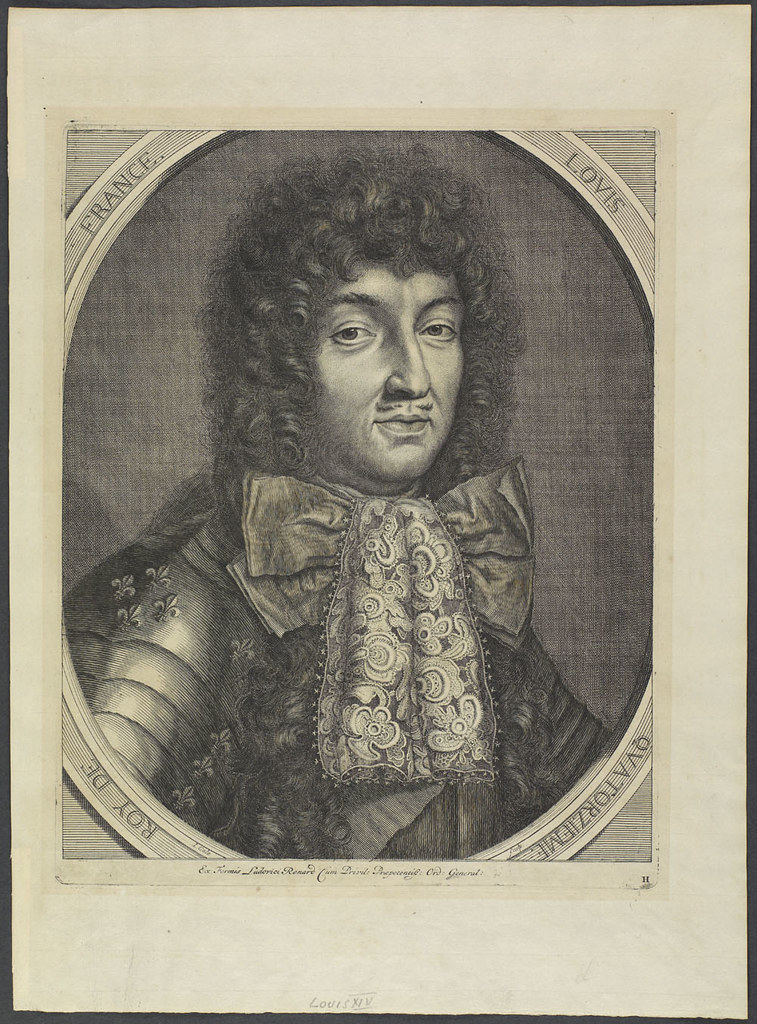
Louis XIV’s reign fused monarchy with light, a 17th‑century symbol of order, power, and divine radiance. The young king chose Versailles not because the marshy valley naturally suited his vision of a court devoted to spectacle, but because it carried the intimate imprint of his father, Louis XIII — the hunting lodge, the modest garden, the remembered landscape of childhood. What followed was not a palace adapted to its terrain, but a terrain forced to yield to an unprecedented royal design. The site’s limitations were absorbed, reshaped, and ultimately overwhelmed by the scale of the Sun King’s project, turning an unremarkable valley into the stage for absolute monarchy. PHOTO credit: “King Louis XIV, 1638-1715 / Roi Louis XIV, 1638-1715” by BiblioArchives / LibraryArchives is marked with CC BY 2.0.
For the next century, Versailles became the premier stage for royal light shows — vast productions of fireworks, illuminations, and night‑time spectacle. Though fireworks were first invented in China, it was Rome that embraced them in the 14th century and launched Europe’s courtly tradition of celebratory rockets. France quickly followed, importing Italian artists, architects, and pyrotechnic masters whose displays soon surpassed anything on the continent.
A key reason Louis XIV moved his court out of cramped Paris and the Louvre was to gain the space required for these grand outdoor entertainments. At Versailles, the king could stage the full range of divertissements du Roi — not only fireworks and illuminations, but elaborate festivals of music, dance, and theater that turned the gardens into a glowing extension of royal power.
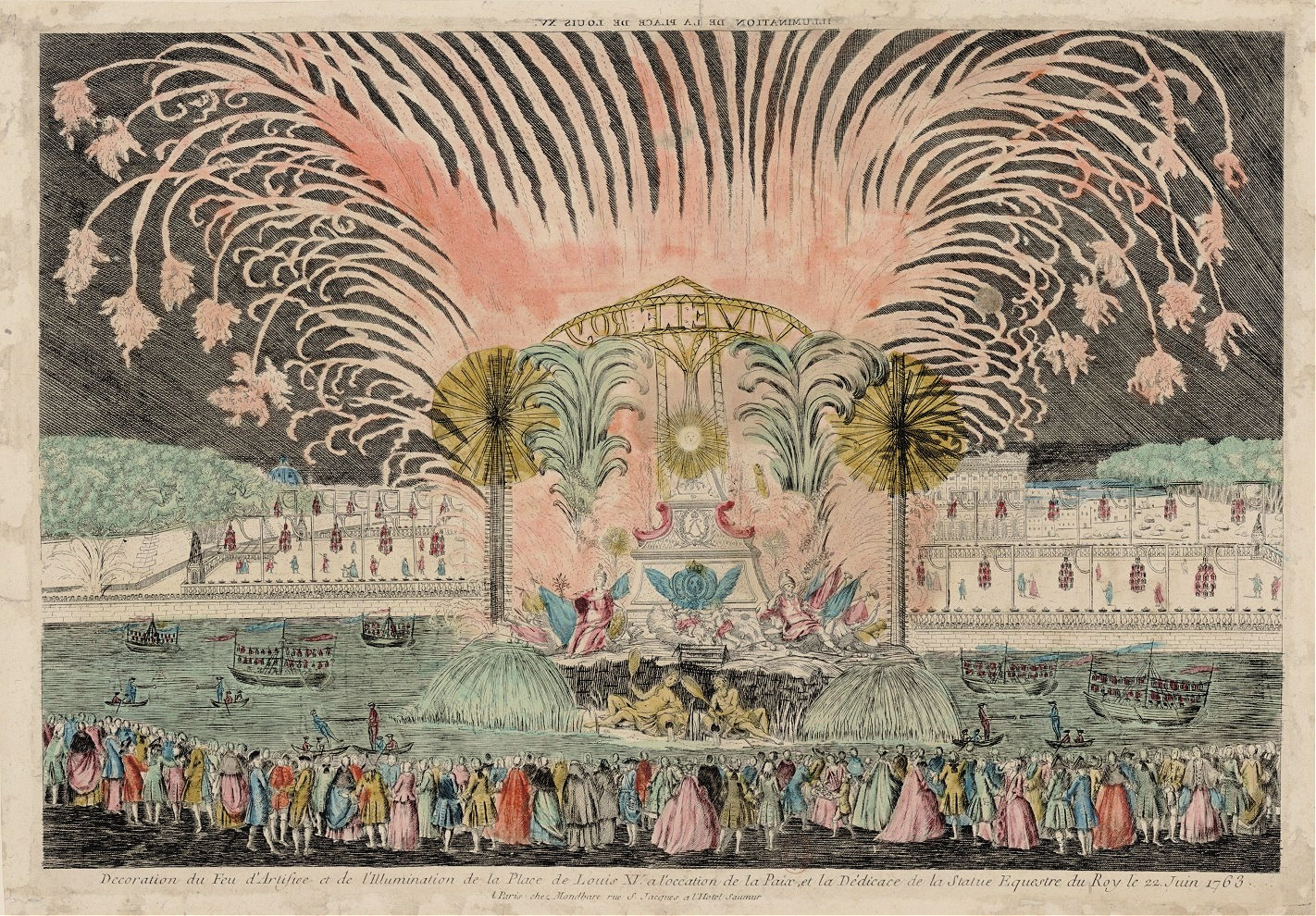
Décoration du feu d’artifice et de l’illumination de la place de Louis XV, à l’occasion de la paix, et la dédicace de la statue équestre du Roi, le 22 juin 1763. Chez Louis-Joseph Mondhare (1734-1799), rue S. Jacques à l’hotel Saumur. Bibliothèque nationale de France, département Estampes et photographie. Public Domain.See – https://www.europeana.eu/en/item/9200518/ark__12148_btv1b8409645h?q=paix%20paris%201763 – retrieved July 14, 2024.
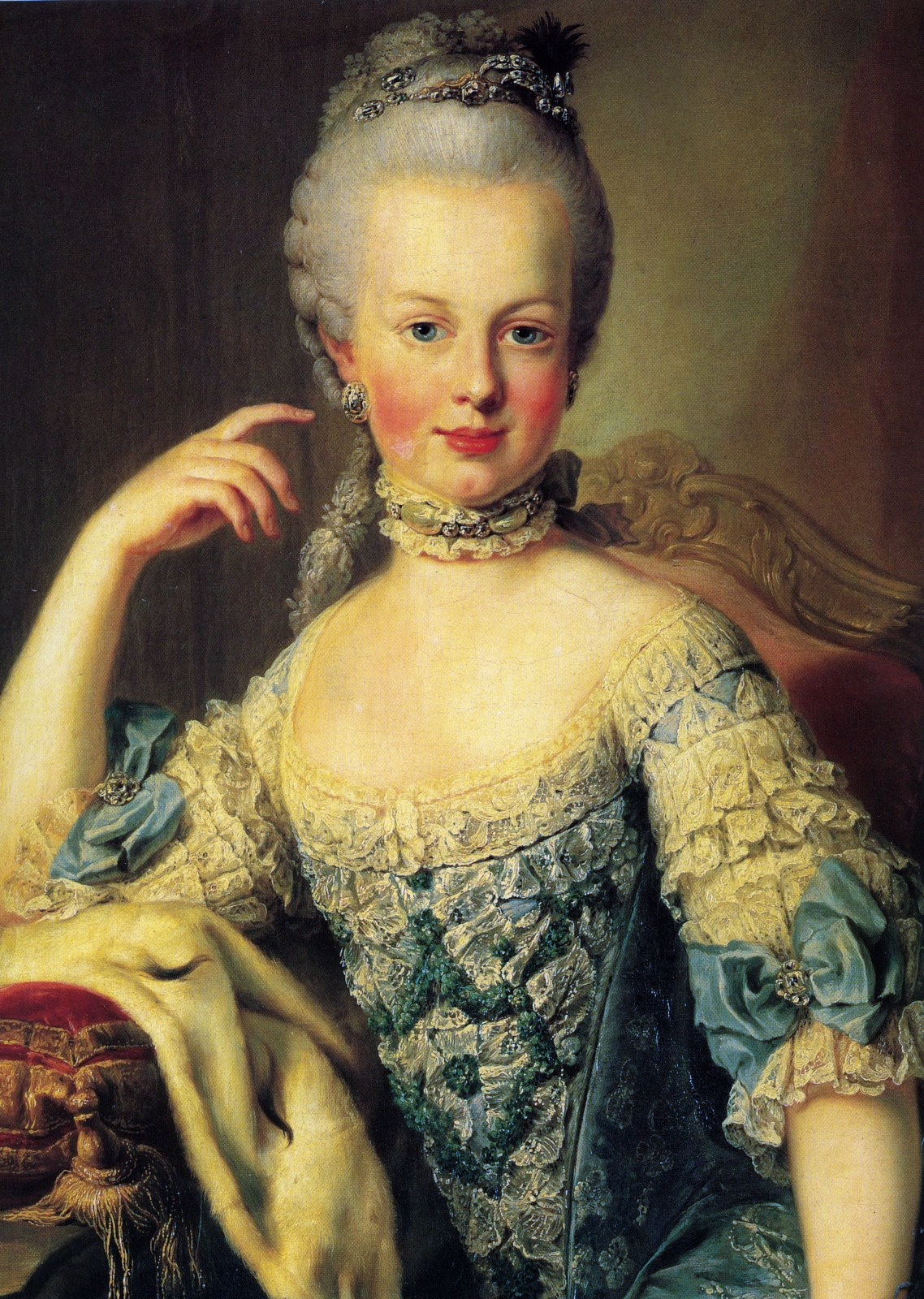
One of Versailles’ most spectacular celebrations came in 1770, when fourteen‑year‑old Marie Antoinette arrived from Austria to marry the heir to the French throne. Louis XV marked the occasion with days of festivities and a guest list numbering in the thousands. The scale was unprecedented: the French Academy of Sciences collaborated with the king’s bureau de Menus‑plaisirs to engineer a display capable of launching 20,000 rockets at once, followed by the coordinated illumination of 15,000 lanterns across the gardens. It was court spectacle elevated to scientific precision — a fusion of dynastic celebration, technological ambition, and the theatrical grandeur that defined Versailles.
Portrait of Archduchess Marie Antoinette, by Swedish-Austrian Martin van Meylens the Younger (1698-1770), c. 1768, Schönbrunn Palace, Vienna. Public Domain.
Les Grandes Eaux Nocturnes de Feu — Versailles’ midsummer night spectacular — turn the gardens into a blazing stage of water, light, music, and fire. A 2½‑hour promenade of illuminated fountains and baroque soundscapes builds toward the “de Feu” climax: monumental flame effects and a full pyrotechnic performance by Groupe F, France’s world‑renowned masters of fireworks.
Even today, crowds stream to Versailles just west of Paris, gathering to watch cutting‑edge pyrotechnics ignite the night above the palace. The modern displays play off the same elements that once dazzled the Sun King: the vast pools, canals, and fountains that mirror every burst of color and amplify the spectacle across the gardens’ sweeping geometry. In these moments, the waterworks and the fireworks merge into a single theatrical composition — a living continuation of the courtly entertainments that defined Versailles at its height.
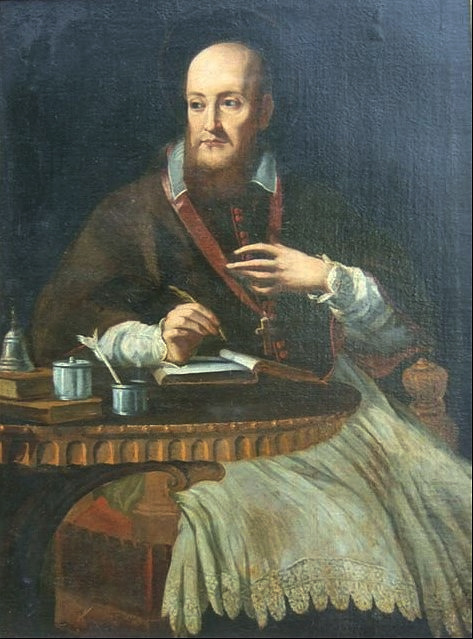
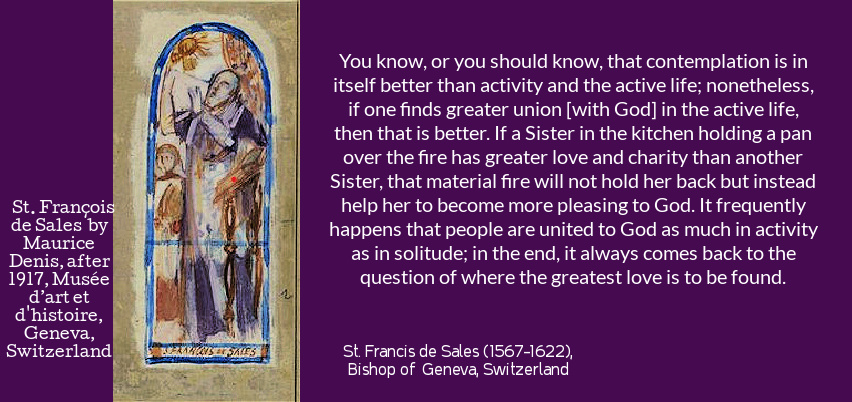
FEATURE Image: St. Francis de Sales, 18th c, Besançon, 96 x 131 cm. Public Domain.
St. Francis de Sales stands as one of Christianity’s most practical and accessible spiritual teachers because he showed that holiness is attainable in ordinary daily life through love, gentleness, humility, perseverance, and faithful acceptance of God’s will. His enduring importance lies not only in his role as Bishop of Geneva and founder of the Visitation Order, but in his ability to translate Catholic doctrine into practical spiritual guidance for everyday people.
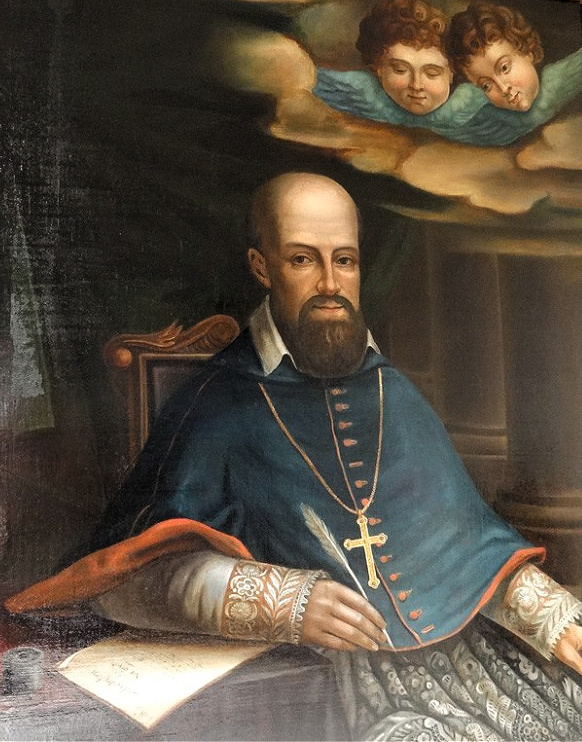
Saint Francis de Sales sitting in front of a copy of his work, “Introduction to the Devout Life,” oil on canvas, c.1790s, 77 cm x 99.5 cm, unknown artist. Hovering above the 17th century French Catholic bishop, saint, and Doctor of the Church are two cherubs who regard him with kindness. Public Domain. Francis de Sales became one of the most respected theologians in Christianity. A great preacher and writer, Francis de Sales ascended the seat of Bishop of Geneva, Switzerland, and, with widowed Baroness Jeanne de Chantal (1571-1641), founded the religious order of the Visitation. As a diplomat and man of prayer, Francis de Sales exerted a significant influence within the Catholic Church and among the temporal powers of the day. https://www.antiques-delaval.com/en/paintings/7068-hst-large-portrait-saint-francois-dirty-life-devote-cherubs-xviiieme.html -retrieved January 24, 2023. Public Domain.
CANONIZED ON APRIL 8, 1665, IN ROME BY POPE ALEXANDER VII, ST. FRANCIS DE SALES IS THE PATRON OF WRITERS, JOURNALISTS, THE CATHOLIC PRESS, CONFESSORS, THE DEAF AND EDUCATORS. ST. FRANCIS WAS DECLARED A DOCTOR OF THE CHURCH IN 1877 BY PIUS IX.
INTRODUCTION.
By all accounts, St. Francis de Sales (1567-1622), whose feast day is January 24, was a gracious and holy man. His writings were, similar to the Jesuits of whom Francis was a student, admirer and close friend, directed to society’s well-to-do and concerned with how, as society’s current elites, they can practice, most basically, Christian “noblesse oblige” within their privileged social station. St. Francis de Sales’ writing defended and explained Catholic doctrine to a Europe which, in an age of Renaissance and Reformation, was very much in revolt against it. To preserve and endorse (1) a social order and (2) perfect belief in doctrine, St. Francis de Sales communicated in everything that both were attainable simultaneously, and did so famously in his book, Introduction to the Devout Life (1608).
Like the sons of St. Ignatius of Loyola, St. Francis de Sales was active in the direction of souls. For Introduction to the Devout Life, Jesuit father Jean Fourier, S.J. strongly encouraged a noble lady around 1607 to prevail upon her local bishop (de Sales) to have his personal writings of spiritual direction to her and others printed to reach a wider audience at court and elsewhere among the ruling class. St. Francis de Sales was also eager to have his personal instructions in print for the advancement and perfection of individual souls. Introduction to the Devout Life became an instant international bestseller and, over 400 years later, remains a spiritual classic. As John K. Ryan, S.J. observed, “Its greatness lies in many things: in its originality, its completeness, its sincerity, its balance, its penetration and its style…(and) as such it is beyond adverse criticism in any important way.”1
His spiritual classic, Introduction to the Devout Life (1608), taught that holiness is not reserved for priests or religious but can be pursued by people living ordinary lives in the world. His writings emphasized gentleness over harshness, love over fear, and steady spiritual growth rather than dramatic religious experiences.
Francis Bonaventure was born into nobility in August 1567 in Sales castle in Savoy, France, where there were tremendous social pressures to marry and settle into a life of wealth and prestige. Sent to Paris by his family, they wanted him to attend the prestigious College of Navarre in the fine hôtel de Navarre with its renowned library in rue Saint André des Arts, but Francis chose to attend the new Jesuit College of Clermont, which at that time was known for its religious and moral vision as much as its academic achievement.2 At the Jesuit school St. Francis de Sales came into contact with the post-Tridentine humanism taught by faculty such as Father Possevin, S.J. and Francis took to it like a duck to water so that he could express its intellectual tenets afterwards quite well.3 St. Francis de Sales worked out his spiritual life in prayer in Saint-Étienne-des-Grès in the Latin Quarter. The church (now demolished) on Rue Saint-Jacques was the center for Christianity among students. Another saintly Frenchman who later frequented Saint-Étienne-des-Grès was St. Vincent de Paul (1581-1660). Francis de Sales as a college-age layman was finding he had serious religious scruples and temptations to lust.4 it was in Saint-Étienne-des-Grès that St. Francis de Sales ultimately took a personal vow of chastity before a statue of the Virgin Mary which allowed him to pursue his spiritual desires.
After studying for five more years at the University of Padua, St. Francis de Sales emerged in 1591 with the equivalent of a J.D.- Ph.D. and was ordained a priest in 1593. In those years the young nobleman was surrounded by the Renaissance writings of philosophers and poets such as Marsiglio Ficino (1433-1499), Giovanni della Casa (1503-1556) and contemporary French theologian Pierre Charron (1541-1603).5 Now in his mid-20’s Francis was given by his bishop the nearly impossible task to reconvert John Calvin’s citizens of Geneva to Catholicism. Needless to say, Francis’s efforts failed. In fact, the Wars of Religion (1562-1598) were in full swing and made for impassioned attitudes on all sides and complicated factors in politics. An individual, Protestant or Catholic, had to practice their faith in a fragmented society.6
In 1602 St. Francis de Sales was sent to Paris to negotiate the condition of Catholics in reconverted territories in France. As a diplomat St. Francis de Sales was smooth – peaceful, positive, charitable and temperate in his words and persona. At meetings taking place at the court of French King Henry IV ( (1553-1610), St. Francis de Sales met some of the great figures of the religious and mystical revival occurring in France including Henri, Duc de Joyeuse (1563–1608), a General commander in the Wars of Religion and member of the Catholic League who became a Capuchin Franciscan after the death of his wife, Catherine de La Valette; Pierre de Bérulle (1575-1629), one of the most important mystics of 17th century France and, later, a Catholic cardinal; and Madame Acarie (1566-1618), mother of seven children, and foundress and lay sister of the Discalced Carmelites in France. She was perhaps the most widely respected religious person in Paris and certainly the go-to contact for the wealthy whenever they desired to help the poor because she made sure their alms got to the poor and not the professional charitable class. St. Francis de Sales, a respected theologian, also influenced the temporal powers – the dukes of Savoy, Charles Emmanuel I (1562-1630) and Victor Amadeus I (1587-1637), the regent of Savoy Christine de France and kings Henry IV and Louis XIII of France.
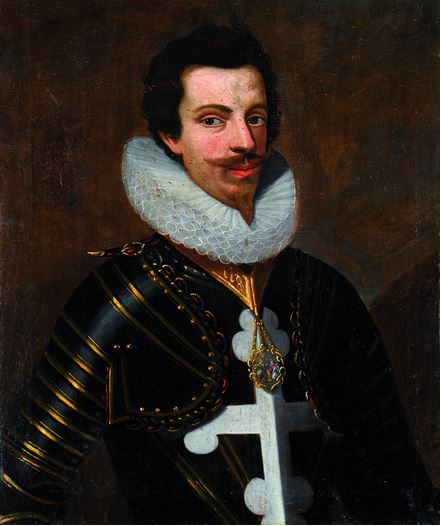
Charles Emmanuel I. Duke of Savoy (1562-1630) by Jan Kraeck. Public Domain.
Victor Amadeus I (1587-1637), artist unknown. Public Domain.
St. Francis de Sales (1567-1622) became one of the most respected Catholic theologians, writers, preachers, and spiritual directors of the Counter-Reformation era.
In July 1602 following the death of Bishop Grenier, St. Francis de Sales became Bishop of Geneva. Francis de Sales traveled ceaselessly around the diocese and beyond, preaching and hearing confessions, and the people quickly realized they had a holy bishop. It was by way of one of his penitents, St. Jeanne-Françoise de Chantal (1572-1641), that St. Francis de Sales worked his vision of the foundation of a new order, the Visitation, whose charism was to serve the sick and the poor with “the charity and gentleness of Jesus Christ.”7
St. Francis de Sales with Sisters of the Visitation, Francisco Bayeu y Subias (1734-1795), c. 1760, oil on canvas, 56 x 34 cm, Prado, Madrid, Spain. The 18th century painting, once in the Royal Collection, is today housed in a regional art museum in Salamanca. Public Domain.It was by way of one of his penitents, St. Jeanne-Françoise de Chantal (1572-1641), that St. Francis de Sales worked his vision of the foundation of a new order, the Visitation, whose charism was to serve the sick and the poor with “the charity and gentleness of Jesus Christ.” https://www.museodelprado.es/coleccion/obra-de-arte/san-francisco-de-sales/540cb0b9-ca15-4c43-b011-d2d71f7c5820?searchMeta=san%20francis – retrieved January 24, 2023. Francisco Bayeu y Subías (1734-1795) is one of the leading of Spanish late Baroque painters using quick and fluid touches and vivid and exquisite colors though later assuming neoclassicism with formal, sometimes cold, pictures based rigorous observation of nature. Bayeu, born in Zaragoza, trained there in the workshop of Danish painter Juan Andrés Merklein (1716-1797) and in the drawing classes of José Luzán Martínez (1710-1785). In 1758 at 24 years old he obtained a two-year scholarship to the Academy of San Fernando in Madrid, but left two months later because of disputes with the professor Antonio González Velázquez (1723–1793). Bayeu returned to Zaragoza and painted several commissions for churches and convents. In 1762 he was helping German painter Anton Raphael Mengs (1728-1779) in the decoration of the Palacio Nuevo. Thanks to Mengs’ influence, Bayeu started his decorative collaborative undertakings that earned him the appointment of court painter in 1767. He worked mainly as a fresco painter. In addition to his courtly commissions, he did church commissions such as of the vaults of the Holy Chapel of the Basilica of Nuestra Señora del Pilar completed in 1776. He painted 11 scenes for the the cloister of the Cathedral of Toledo between 1776 and 1787. He was then entrusted with the decoration of the royal chapel in the Palace of Aranjuez. After Mengs’s departure in 1777 for Rome, Francesco Bayeu assumed all Mengs’ duties as first painter, though not obtaining the appointment. Like other Spanish artists he worked developing cartoons for Real Fábrica de Tapices de Santa Bárbara (Royal tapestry Factory). Bayeu supervised the work of a talented newcomer, Francisco Goya (1746- 1828) who was Bayeu’s brother-in-law since 1773. In 1785 Charles III entrusted Bayeu and Mariano Salvador Maella Pérez (1739 –1819) with the restoration of the paintings in the royal collections. When he fell ill in 1786, Goya replaced Bayeu at the Academy of San Fernando, which Bayeu had been director of painting. Despite declining health from overwork, the commissions kept coming in. The Prince and Princess of Asturias hired Bayeu for the decoration of the dining room vault in the Palace of El Pardo. Bayeu returned to Zaragoza in 1788 until he was called again in 1791 to Aranjuez where he painted for the oratory of the Royal Palace and the vault of the King’s bedroom. This would be his last work when he died, in Madrid, in 1795. see – https://www.museodelprado.es/coleccion/artista/bayeu-y-subias-francisco/b218fee4-053b-4656-8577-9aa001ad1989 – retrieved January 24, 2025.
It was in this first decade of the 17th century amidst this flurry of evangelizing and other activity that the 40-something bishop wrote the Introduction to the Devout Life (1608). The book, written in short chapters with titles on topical challenges, problems, and opportunities in the Christian life in the world, provides its responses based on practical counsels. The Introduction to the Devout Life much as his later work, On Love of God, are very reliant on the Bible for its teaching and sprang directly from the bishops’ care of souls that he was doing actively and sacramentally from his diocese in southeastern France. Francis’s generous range of literary sources reflected his education in Renaissance humanism and included classical authors, Montaigne, contemporary poets as well as medieval saints and spiritual writers such as Sts. Anselm, Bonaventure and Bernard. Francis was also familiar with the writings and religious vision of the 16th century Spanish mystics and saints such as Teresa of Avila and Ignatius of Loyola.8
The exceedingly practical St. Vincent de Paul observed about St. Francis de Sales’ On the Love of God: “A truly admirable book, which has as many admirers of the sweetness of its author as it has readers. I have carefully arranged that it shall be read throughout our Society [the Vincentians], as the universal remedy for all feeble ones, the good of slothful ones, the stimulus of love, and the ladder of those who are tending to perfection. Oh! that all would study it as it deserves! There should be no one to escape its heat.”9
A recurring theme in his counsel is that Christians should focus on today’s duties, trust in divine providence, and avoid anxiety about the future. He taught that charity and love are the measure of all Christian action, giving value even to the smallest tasks when performed for God.
St. Francis de Sales by J. J. Owens. c. 1905, based on the Turin portrait. Public Domain.
St. Francis de Sales, now in his early 50s, visited Paris in 1618 where he preached sometimes twice each day. His great work was to show how ordinary daily life, particularly a busy and successful life, could be a path of holiness. No issue was too large or small for the saint to address – from parties, clothes, flirtations, daily life among marrieds – but all directed to the purpose of imitation of Christ and the love of God. St. Francis takes for granted one’s daily life in French society and proposes no maxim which involves any violent upheavals from it. Part of the saint’s genius is to see that there can be no dispute between the social order and the Christian life. At the same time, St. Francis is no easy teacher or grader – he asks that the Christian virtues be upheld and practiced. That insistence on Christian virtue informing one’s daily life is also the genius of his doctrine. While highly educated and imbued with the grace of mind of the Renaissance, St. Francis carried naturally within himself and conveyed the wisdom of the French soil of Savoy, its terroir. As Francis took one’s daily life in French society for granted, he took Catholic doctrine as if for granted. He then explained it with a highly cultivated mind and gracious spirit that expressed itself with a sweetness and gentleness of style that expounded it as “the universal remedy…the stimulus of love…the ladder …to perfection” as St. Vincent de Paul recognized to those with faith or not, or in trouble in day-to-day life.
St. Francis de Sales perhaps speaks to the 21st century most clearly by way of his theology that is presented without sentimentality or melodrama and is clearly explained and lived to be particularly possible and desirable. Francis said: “He who lives for God, frequently thinks of Him during all the occupations of life.”12
January 24 is the memorial feast day of St. Francis de Sales on the General Roman Calendar of 1969. St. Francis de Sales is the patron of writers, journalists, the Catholic press, confessors, the deaf and educators. He was proclaimed a saint and doctor of the Catholic Church. The following quotes are taken from his many published works of spiritual edification, counsel, exhortation, and solace.
Canonized in 1665 and declared a Doctor of the Church in 1877, St. Frances De Sales remains the patron saint of writers, journalists, educators, confessors, and the Catholic press.
NOTES:
Introduction to the Devout Life, St. Francis de Sales, trans. and edited by John K. Ryan, Image books (Doubleday) Garden City New York, 1955, p.11.
Francis de Sales and Jane de Chantal: Letters of Spiritual Direction, trans. by Péronne Marie Thibert, V.H.M. and selected and introduced by Wendy M. Wright and Joseph F. Power, O.S.F.S. Paulist Press New York, 1988 p.19.
CF. Elisabeth Stopp, “St. Francis de Sales at Clermont College,” in Salesian Studies, 6 (Winter 1969). pp. 42-43.
Wright & Power, p. 20.
Wright & Power, p. 22.
The Saints: A Concise Biographical Dictionary, edited by John Coulson, Guild Press, New York, 1957, p. 305.
Maxims and counsels of St. Francis de Sales for every day in the year, Ella McMahon, M.H. Gill & Son, Dublin, 1884, p. 12.
QUOTATIONS.
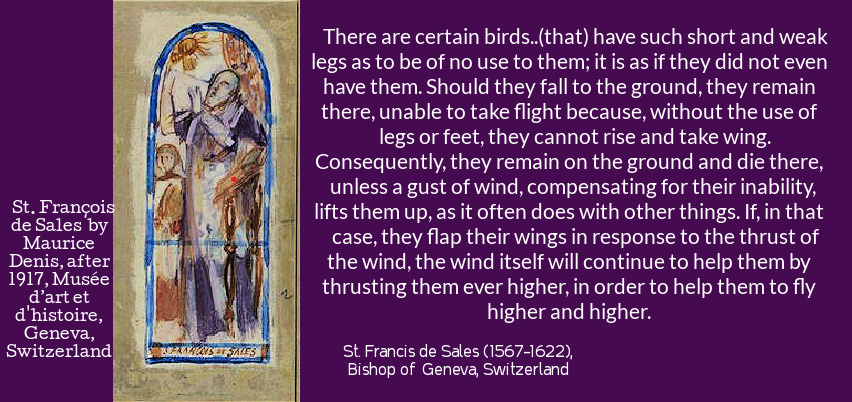
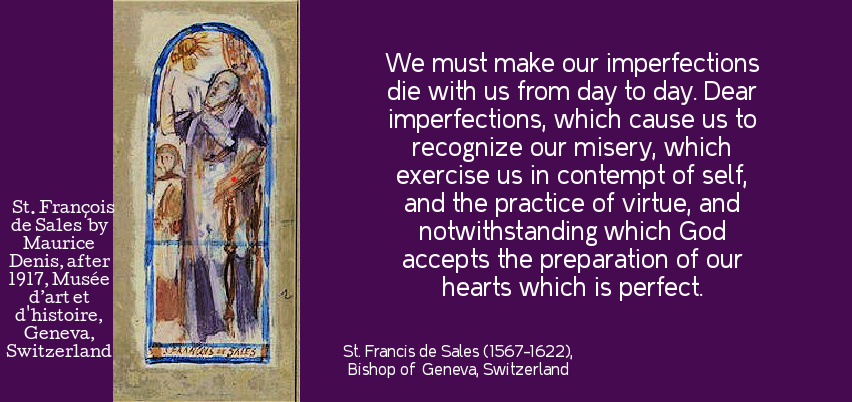
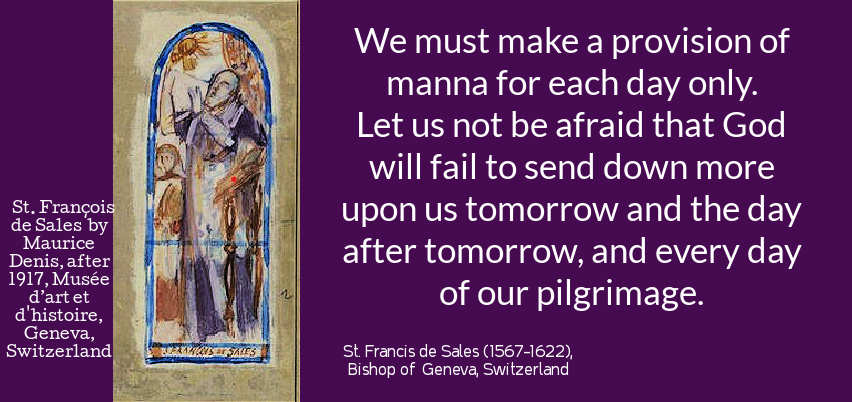
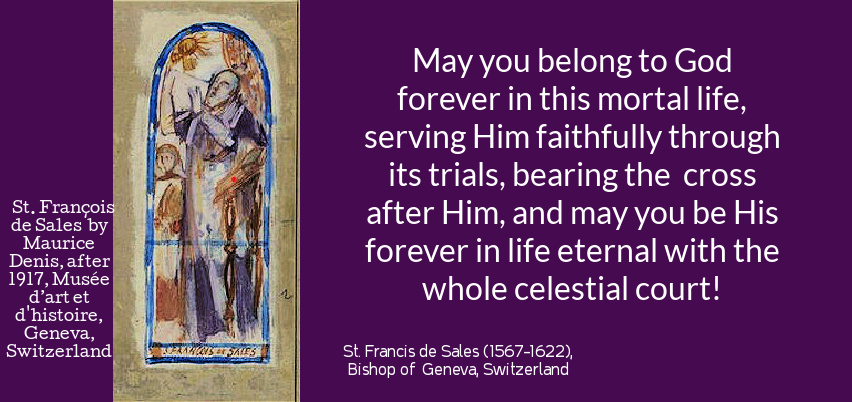
There are certain birds..(that) have such short and weak legs as to be of no use to them; it is as if they did not even have them. Should they fall to the ground, they remain there, unable to take flight because, without the use of legs or feet, they cannot rise and take wing. Consequently, they remain on the ground and die there, unless a gust of wind, compensating for their inability, lifts them up, as it often does with other things. If, in that case, they flap their wings in response to the thrust of the wind, the wind itself will continue to help them by thrusting them ever higher, in order to help them to fly higher and higher.Keep yourself faithfully in the presence of God. Avoid hurry and anxiety, for there are no greater obstacles to our progress in perfection.Cast your heart gently, not violently, into the wounds of our Savior and have an unlimited confidence in his mercy and goodness.To make good progress we must devote ourselves to getting over that portion of the path which lies close before us, and not amuse ourselves with the desire to attain the last step before we have accomplished the first.We must make our imperfections die with us from day to day. Dear imperfections, which cause us to recognize our misery, which exercise us in contempt of self, and the practice of virtue, and notwithstanding which God accepts the preparation of our hearts which is perfect.I recommend simplicity to you; look before you, and not at the dangers which you behold in the distance. Keep your will firmly bent upon serving God with your whole heart. While you are thus occupied in forecasting the future you expose yourself to some false step.Have no care for tomorrow. Think only of doing well today. And when tomorrow shall have become today, then we shall think about it.We must make a provision of manna for each day only. Let us not be afraid that God will fail to send down more upon us tomorrow and the day after tomorrow, and every day of our pilgrimage.Since the Heart of our Lord has no more loving law than meekness, humility, and charity, we must firmly maintain these dear virtues in us.True sanctity lies in love of God, and not in foolish imaginings, raptures, &c. Let us devote ourselves to the practice of true meekness and submission, to renouncement of self, to docility of heart, to love of abjection, to consideration for the wishes of others : this is true sanctity and the most amiable ecstasy of the children of God.May you belong to God forever in this mortal life, serving Him faithfully through its trials, bearing the cross after Him, and may you be His forever in life eternal with the whole celestial court!
Saint Francis gives the rule to Saint Jeanne de Chantal (Study for the Chapel of the Visitation at Nantes), 19th century, Elie Delaunay (1828-1891), Louvre. Public Domain.
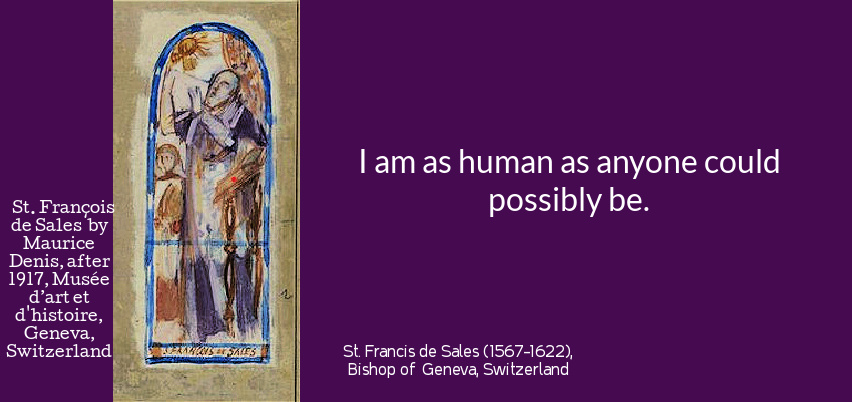
The reason persons are in the world is to receive and carry the gentle Jesus: on our tongue by proclaiming him and in our arms by doing good works.I am as human as anyone could possibly be.See the divine lover at the gate. He does not simply knock once. He continues to knock. He calls the soul: come, arise my beloved, hurry!…In short, this divine Savior forgets nothing to show that his mercies are above all his works, are greater than his judgment.Solitude has its assaults, the world its busyness – in either place we must be courageous since in either place divine help is available to those who trust God and humbly and gently ask for his fatherly assistance.Since this congregation does not have as many austerities or indissoluble bonds as formal orders, the fervor of charity and force of a deep personal resolution must supply for all that…so that might be realized the saying of the Apostle which affirms that charity is the perfect bond.
Saint François de Sales blesses Saint Jeanne de Chantal, Chapelle de la Visitation at Nantes n° 61 XIXe siècle. Elie Delaunay (1828-1891), Musée d’Arts de Nantes. Public Domain.
It is the height of holy disinterestedness to be content with naked, dry, and insensible acts carried out by the superior will alone….In the end, the savior wants us to be His so perfectly that nothing else remains for us, and to abandon ourselves to His providence without reservation.Since the heart is the source of all our actions, as the heart is, so are they.For myself, I cannot approve the methods of those who try to reform a person by beginning with external things, such as bearings, dress or hair. On the contrary, it seems to me that we should begin inside.I beg you, my dear Sister, govern your community with a great expansiveness of heart…The more solicitous, open, and supportive you are with them, the more you will win their hearts.I had the courage to my give [my own dying mother] the last blessing, to close her eyes and mouth and to give her the last kiss of peace at the moment she passed away; after which my heart swelled and I wept….
Saint Francis de Sales healing a lame man, Chapelle de la Visitation at Nantes n° 61 XIXe siècle. Elie Delaunay (1828-1891), Musée d’Arts de Nantes. Public Domain.
Then let us belong wholly to Him, and live but for Him, desiring only to please Him, and for his creatures in Him, through Him, and for Him. Make your little efforts sweetly, peacefully, and amiably to please this Sovereign Goodness, and do not be astonished at difficulties.We must be constant in aspiring to the perfection of holy love, in order that love may be perfect. For the love which seeks anything less than perfection cannot fail to be imperfect.Never permit your soul to be sad and live in bitterness of spirit or scrupulous fear, since He who loved it and died to give it life is so good, so sweet, so amiable.God, who calls us to Him, sees how we are approaching, and will never permit anything to happen but what is for our greater good. God knows what we are, and will hold out his paternal hand to us in a difficult step, in order that nothing may stop us.God has preserved you so far. Only keep yourself faithful to the law of his providence and He will assist you at all times. And where you cannot walk, He will carry you.
Saint Francis de Sales healing a lame man, Chapelle de la Visitation at Nantes n° 61 XIXe siècle. Elie Delaunay (1828-1891), Musée d’Arts de Nantes. Public Domain.
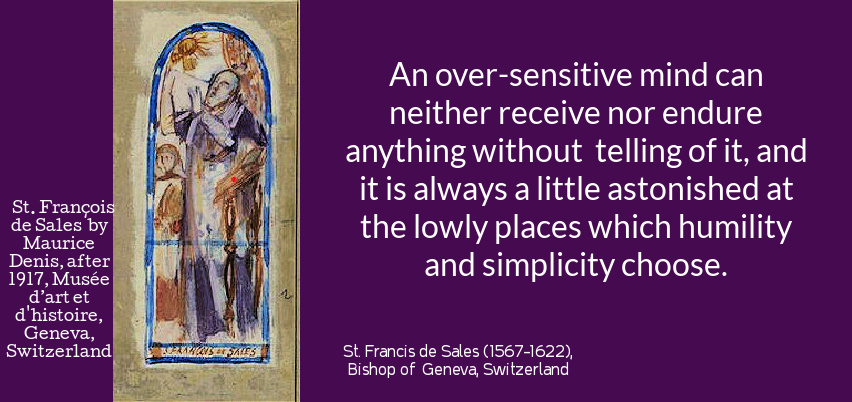
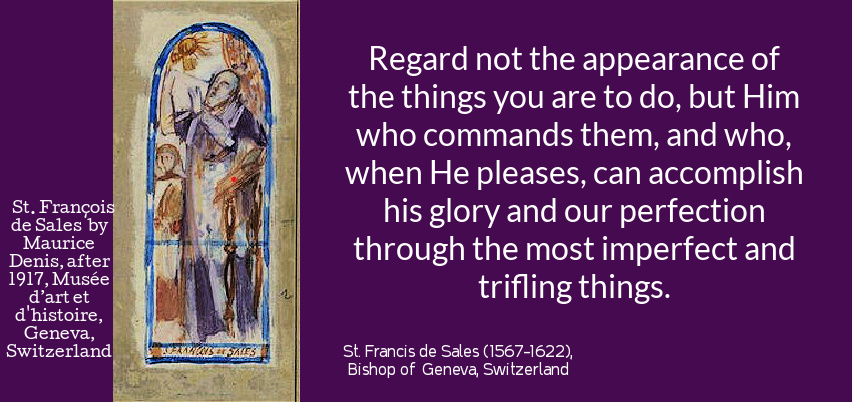
An over-sensitive mind can neither receive nor endure anything without telling of it, and it is always a little astonished at the lowly places which humility and simplicity choose.I see you with your vigorous heart which loves and wills powerfully. I like it, for what are those half -dead hearts good for? We must make a particular exercise once every week of willing to love the will of God more tenderly, more affectionately than anything in the world, and that, too, not only in bearable but in the most unbearable events.Plant in your heart Jesus Christ Crucified, and all the crosses of this world will seem to you like roses.Lord Jesus, without reserve, without an if, or a but, without exception or limitation, may you holy will be done in all things and at all times.Regard not the appearance of the things you are to do, but Him who commands them, and who, when He pleases, can accomplish his glory and our perfection through the most imperfect and trifling things.
Painting of St. Francis de Sales in Don Bosco’s rooms at the Oratory of St. Francis de Sales in Turin. Public Domain.
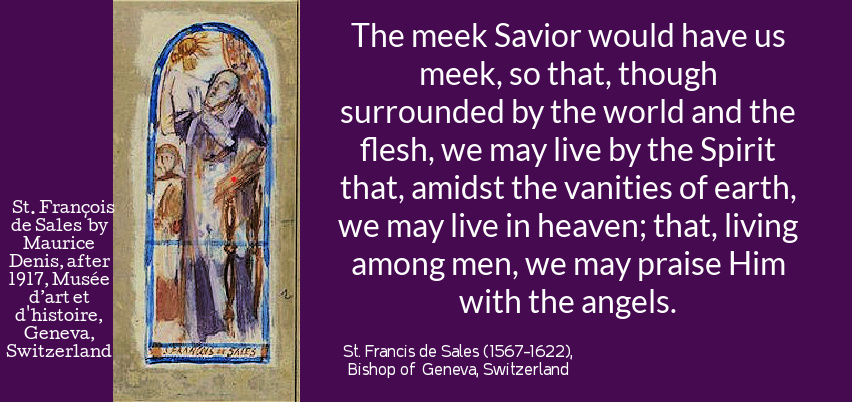
Behold this great Artisan of mercy. He converts our miseries into graces and our iniquities into salutary remedies for our souls. Tell me, I pray, what will He not do with the afflictions, the labors, the persecutions which assail us?Never think you have attained the purity of heart which you owe to God until your will is freely and joyfully resigned to his holy will in all things, even in the most repugnant.Daily strengthen yourself more and more in the resolution, which you formed with so much affection, of serving God according to his good pleasure. Regard Him who commands them and, when He pleases, can accomplish his glory and our perfection through the most imperfect and trifling things.A true servant of God has no care for tomorrow, but performs faithfully what is required today, and tomorrow will do what is required without a word.The meek Savior would have us meek, so that, though surrounded by the world and the flesh, we may live by the Spirit that, amidst the vanities of earth, we may live in heaven; that, living among men, we may praise Him with the angels.
St. Francis de Sales, 18th c, Besançon, 96 x 131 cm. Public Domain.
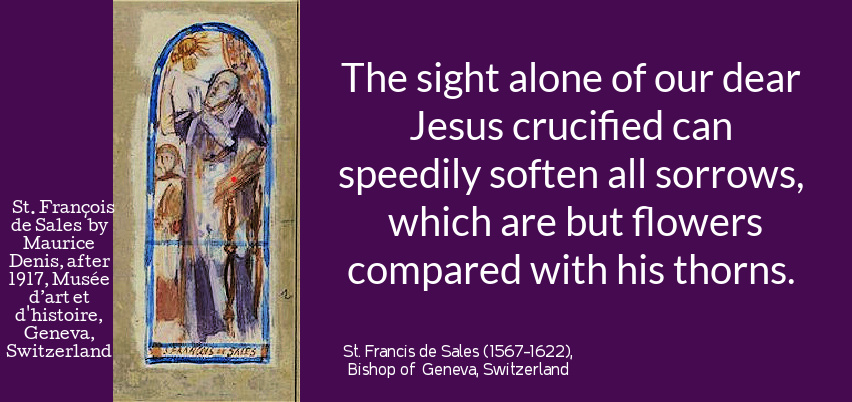
Here is the great lesson – we must discover God’s will, and, recognizing it, endeavor to do it joyfully, or at least courageously.The sight alone of our dear Jesus crucified can speedily soften all sorrows, which are but flowers compared with his thorns.Our great rendezvous is an eternal heaven and compared with the price of eternity, what are the things which end with time?Continue to unite yourself more and more with our Lord. Plunge your heart into the charity of His, and say always with your whole soul: May I die and may Jesus live !” Our death will be a happy one if we have died daily.Lord Jesus, what true happiness for a soul consecrated to God to be strongly exercised in tribulation before leaving this life!
Saint Francis Sales, antique pendant, Lyon, France. Public Domain.
Nothing can give us deeper peace in this world than to frequently contemplate our Lord in all the afflictions He endured from his birth to his death. Contempt, calumnies, poverty, abjection, weariness, suffering, nakedness, wrongs, and grief of every kind.Let us faithfully cultivate that resignation and pure love of God which is never wholly practiced but amid sufferings. For to love God, when He feeds us with sweetness is nothing more than children do. But to love God when He feeds us with gall is to offer Him the cup of our loving fidelity.It is not in my power to propose to Him anything for you, save that He may, according to his holy will, fashion your heart for his dwelling, and reign there eternally. And whether He fashion it with the brush, hammer, or chisel, must be according to his good pleasure.I desire that your cross and mine should be wholly the cross of Jesus. This or that burden, or making any choice, God knows what He is doing and why He does it. It is certainly for our good.God wishes that, like Job, I should serve Him in the midst of dryness, suffering, and temptation. Like St Paul, that I serve Him according to His desire. You will see that one day He will do all and even more than you can desire.
St. Francis de Sales. medallion. Public Domain.
At the very thought of God, one immediately feels a certain delightful emotion of the heart, which testifies that God is God of the human heart.I said everything in just two words, when I told you to refuse nothing and to desire nothing; I have nothing more to say to you.Do you see the baby Jesus in the crib? He accepts all the discomforts of that season, the bitter cold and everything that the Father lets happen to him. He does not refuse the small consolations that his Mother gives him; we are not told that he ever reached out for his Mother’s breast, but left everything to her care and concern. So too, we ourselves should neither desire nor refuse anything, but accept all that God sends us, the bitter cold and the discomforts of the season.It is love that grants perfection to our works. I will tell you much more. Take a person who suffers martyrdom for God with an ounce of love; that person merits much, since he could give nothing greater than his own life. Yet another person who has only suffered a scratch with two ounces of love will have much more merit, because it is charity and love that give value to our works.You know, or you should know, that contemplation is in itself better than activity and the active life; nonetheless, if one finds greater union [with God] in the active life, then that is better. If a Sister in the kitchen holding a pan over the fire has greater love and charity than another Sister, that material fire will not hold her back but instead help her to become more pleasing to God. It frequently happens that people are united to God as much in activity as in solitude; in the end, it always comes back to the question of where the greatest love is to be found.In Holy Church, everything pertains to love, lives in love, is done for love and comes from love.Whatever may happen, Lord, you who hold everything in your hands and whose ways are all justice and truth, … I will love you, Lord, … I will love you here, O my God; I will hope always in your mercy and ever repeat your praise… O Lord Jesus, you will always be my hope and my salvation in the land of the living.I wonder whether another difficulty can also be raised concerning your reform: perhaps those who imposed it on you have treated the wound too harshly… I appreciate their method, although it is not what I am in the habit of using, especially with regard to noble and cultivated spirits like yours. I believe it is better simply to indicate the disease and put the scalpel in their hands, so that they themselves can make the necessary incision. Yet do not for this reason neglect the reform that you need.
Saint Jeanne de Chantal. antique pendant, Lyon, France. Public Domain.
The world is becoming so delicate that, in a little while, no one will dare any longer to touch it except with velvet gloves, or tend its wounds except with perfumed bandages; yet what does it matter, if only men and women are healed and finally saved? Charity, our queen, does everything for her children.My intention is but to represent, with simplicity and straightforwardly, without artifice and certainly without false colors, the history of the birth, progress, decline, operations, properties, advantages and sublime qualities of divine love.The power of grace does not constrain the heart, but attracts it. Grace possesses a holy violence, not to violate our liberty but to guide it to love. Grace acts strongly, yet in such a pleasing way that our will is not overwhelmed by so powerful a force; while pressing us, it does not oppress our liberty. Consequently, we are able, before all its might, to consent to or resist its promptings at our pleasure.God’s inspirations, Theotimos, anticipate us and make themselves felt before we are even aware of them, but once we become aware of them, it is up to us either to consent and follow their lead, or to refuse and reject them. They make themselves felt by us without us; yet without us they do not bring about our consent.All these fine people, commonly considered devout, most surely are not.In the end, charity and devotion can be said to differ from one another as fire from a flame. Charity is a spiritual fire that, when fanned into flame, is called devotion. Devotion thus adds nothing to the fire of charity but the flame that makes charity prompt, active and diligent, not only in the observance of God’s commandments but also in the exercise of his divine counsels and inspirations.Almost all those who have treated of devotion have sought to instruct persons living apart from the world, or at least they have taught a kind of devotion that leads to such isolation. I intend to offer my teachings to those who live in cities, in families, at court and who, by virtue of their state in life, are obliged to live in the midst of others.
FEATURE image: The Satyr at the Farmer’s (“Der Satyr beim Bauern”), Jacob Jordaens (Flemish, 1593-1678), c.1620.
Housing much of Munich’s most famous artwork, the Alte Pinakotek’s collection includes renowned international works from the 14th through the 18th centuries. A survey of these masterworks illustrates how European painters evolved from traditional craftsmen into divinely inspired creators. Through detailed analyses of artists like Albrecht Dürer, Valentin de Boulogne, and Claude Lorrain, the post demonstrates how these masters utilized religious self-fashioning, classical mythology, and the dramatic use of light (chiaroscuro) to inject profound emotional and psychological depth into Western art
Self-Portrait (“Selbstbildnis”), Albrecht Dürer (German, 1471-1528), c. 1520.
The Artist as Divine Creator: Albrecht Dürer’s Self-Portrait (c. 1520) deliberately uses the iconic, frontal pose of Christ Pantocrator to elevate the status of artists from manual laborers to divinely inspired creators. Humanizing the Divine: In contrast, Rembrandt did not portray himself as Christ but used his own aging, flawed face as a template for Jesus to ground him in human suffering and vulnerability.
Several prominent artists have, at various moments, fashioned their own likenesses in the image of Christ, a strategy that served both devotional and professional aims. This practice participates in the long tradition of imitatio Christi—the aspiration to model one’s life, conduct, and even physical bearing on the figure of Jesus. Within the visual arts, however, the gesture carried additional layers of meaning. By aligning themselves with the divine prototype, artists could elevate their social standing from that of manual laborers to inspired creators whose work partook in sacred authority. At the same time, such self-fashioning could signal profound personal piety, suggesting that the artist’s inner life mirrored the spiritual intensity of the Savior.
The most celebrated example is Albrecht Dürer, whose 1500s self‑portrait adopts the frontal, iconic pose associated with late‑medieval images of Christ Pantocrator. Dürer’s deliberate visual parallel not only asserts his artistic genius but also reflects his conviction that creative imagination was a God‑given faculty. His self‑portrait thus becomes a theological statement: the artist as a vessel of divine creativity.
Other painters engaged the motif in subtler ways. Rembrandt, for instance, did not present himself explicitly as Christ, yet he repeatedly used his own features as a template for the face of Jesus. This choice was less about claiming sacred authority and more about grounding the figure of Christ in lived human experience. By drawing on his own physiognomy—familiar, aging, marked by suffering—Rembrandt infused his depictions of Jesus with psychological depth and emotional immediacy. The result is a Christ who feels palpably human, capable of empathy and vulnerability.
Taken together, these strategies reveal how self‑representation as Christ could function across a spectrum: from bold assertions of artistic status to intimate explorations of spiritual identity. They also underscore the evolving conception of the artist in early modern Europe—not merely a craftsman, but a creator whose work could approach the divine.
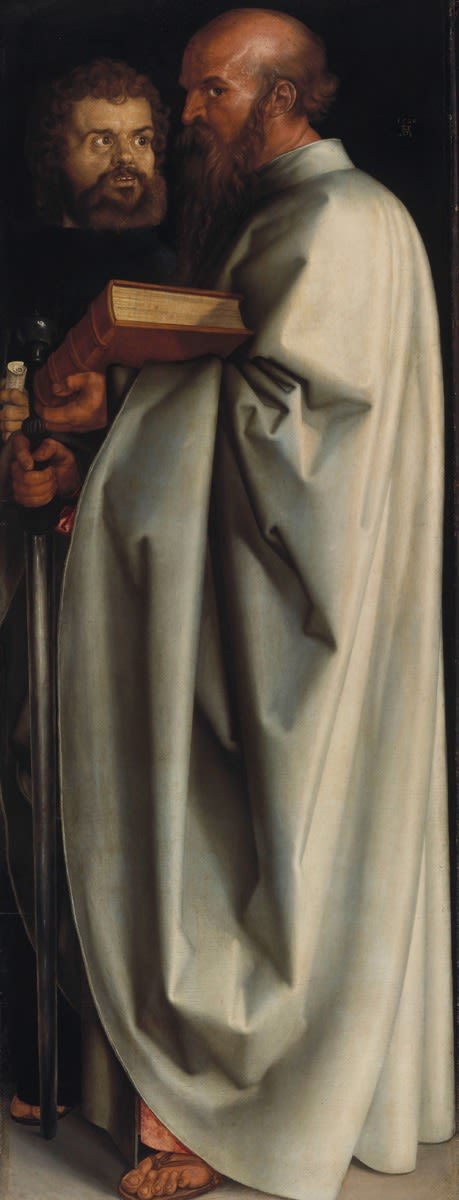
Four Apostles (“Vier Apostel”), Albrecht Dürer (German, 1471-1528), c. 1526.Detail. Dürer, Vier apostel. Mark and Paul.The Land of Cockaigne, Pieter Brueghel the Elder (Flemish, 1525/1530-1569), 1567.Head of an Old Woman, Pieter Brueghel the Elder (Flemish, 1525/1530-1569), 1563.Robbery and Melon Eaters (“Trauben- und Melonenesser”), Bartolomé Esteban Murillo (Spain, 1617-1682), c.1645.History Cycle: Battle of Alexander (Battle of Issus) (“Historienzyklus: Alexanderschlacht [Schlacht bei Issus]”), Albrecht Altdorfer (German, c.1480-1538), 1529.Adoration of the Magi, Columba Altarpiece, central panel (“Columba-Altar: Anbetung der Könige”). Rogier van der Weyden (Nederlandish, c. 1399-1464), 1455.Danae, Jan Gossaert (Brabant, 1478-1532), c. 1527.
Blending Influences: Gossaert integrated French, German, and Netherlandish styles, becoming a key “Romanist” after traveling to Italy. The Erotic Renaissance: In Danaë (c. 1527), he broke away from the medieval practice of treating the Greek myth strictly as a safe, pagan metaphor for the biblical Annunciation, choosing instead to reintroduce its original erotic context.
Jan Gossaert was probably from Maubeuge in France though the artist’s whereabouts are first documented in Antwerp, Belgium, in 1503. His early style is an amalgam of then-popular contemporary French, German, and Netherlandish influences – Hugo Van Der Goes (c.1440-1482), Albrecht Dürer, and Gerard David (c.1460-1523). After a trip to Italy in 1508, Gossaert displayed new flamboyance in his style and detail, particularly using architectual settings as the Alte Pinakothek’s later Danae shows. The northern European Hainault artist never successfully incorporated Italian Renaissance ideas into his artwork and many of his figures’ poses are actually derivative. Yet this level of stylistic incorporation led Gossaert to become an important Romanist. Gossaert was the first northern European artist to introduce nude classical figures into Flanders’ art world.
The Oracle of Delphi prophesied that King Acrisius of Argos would die at the hand of his grandson. To prevent this, the king imprisoned his daughter, Danaë, in an essentially golden cage. However, the King of the gods, Zeus, desired Danaë and came to her by way of a stream of golden rain into her cage where she conceived Perseus. It was Perseus who later, after his own adventures, killed his grandfather by accident during some athletic games.
By the Middle Ages this ancient Greek literary material was used as a pagan reference for the New Testament Annunciation. Gossaert was one of the first artists in the Renaissance period to reintroduce the original subject’s erotic content on its own terms.
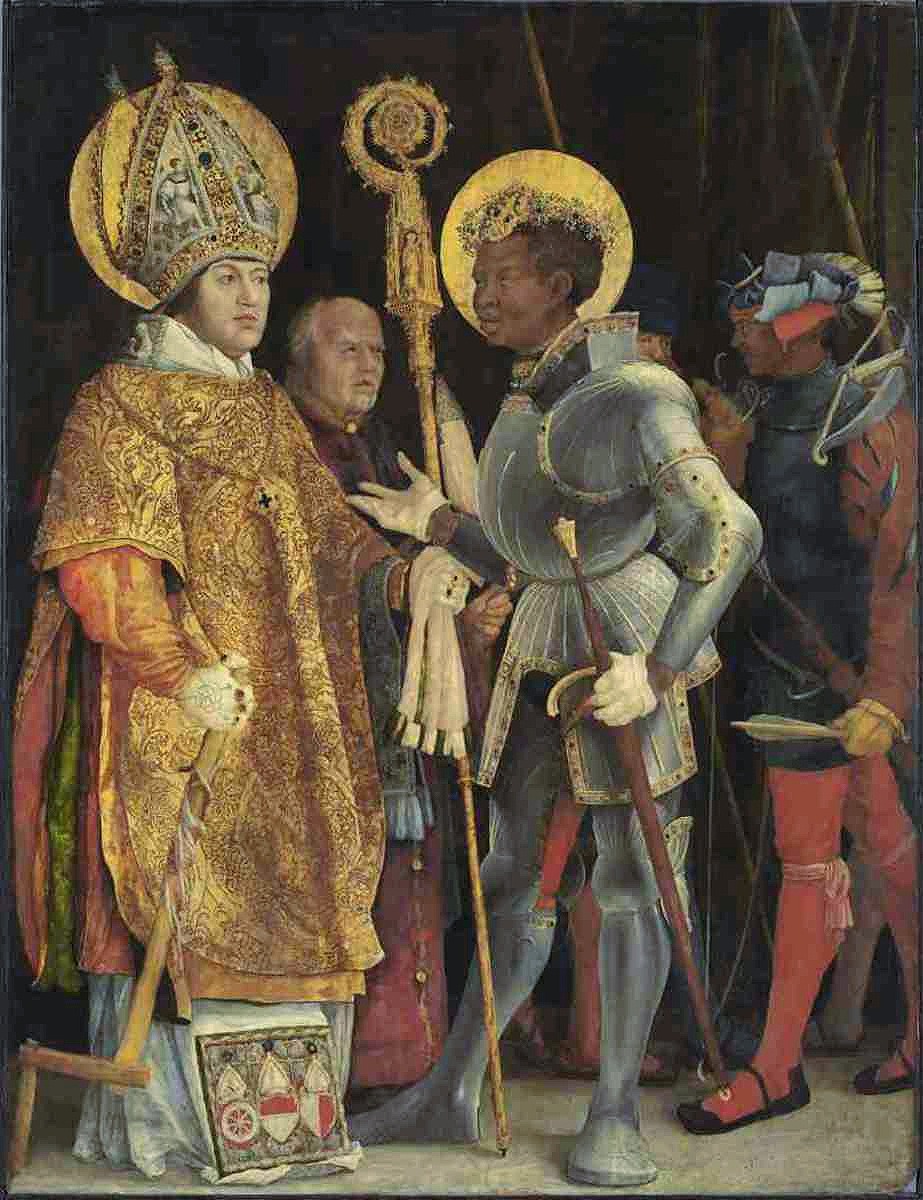
Madonna with Child, St. Mary Magdalene and Donor (“Maria mit Kind, hl. Maria Magdalena und Stifter”), Lucas van Leyden (Dutch, 1494-1533), 1522.“Pearl of Brabant”: Adoration of the Kings (“”Perle von Brabant”: Anbetung der Könige”), Dieric Bouts (Nederlandish, 1400?-1475), c.1465.Matthias Grünewald (c. 1470-1528), Meeting of Sts. Erasmus and Maurice, Martyrs, c 1520-24, 226 x 176 cm, basswood.
Emotional Weight & Late Gothic Outlook: Unlike his contemporary Dürer, Grünewald did not create prints and prints-making; instead, he used Italian Renaissance techniques solely to heighten the emotional and religious impact of his paintings.
Matthias Grünewald was a German painter of the Renaissance. Born Mathias Neithar(d)t-Gothar(d)t around 1470-75, Grünewald shared virtually the exact birth and death dates of fellow German artist, Albrecht Dürer, though the two artists were exact opposites.
Little is known about the life of Grünewald. He first enters the historical record in 1501 in Seligenstadt. It is believed the artist was also early on in Aschaffenburg and as far off as Würzburg. From 1508 to 1514 Grünewald was court painter to Albrecht of Brandenburg (1490–1545), the archbishop of Magdeburg, administrator of Halberstadt, and the archbishop and elector of Mainz (later Cardinal) who commissioned the Alte Pinakothek panel for the Neue Stift in Halle. By the mid1520s Grünewald was in Frankfurt and, apparently increasingly sympathetic to Lutheran doctrine, north to Halle where he died.
Grünewald’s first datable work is from 1503 though Grünewald is best known for his Isenheim Altarpiece in Colmar, France, produced in the mid1510s. Unlike his contemporary, Dürer, MatthiasGrünewald apparently attempted no woodcuts, engravings or even many drawings. Like Dürer, he was familiar with Italian Renaissance ideas, though Grünewald did not pursue its techniques for its own ends. Rather, Grünewald was interested in using these new Italian techniques to heighten his own art’s emotional impact as well as make a religious statement. In this sense Grünewald possessed an essentially Late Gothic outlook and style. Yet, besides the passionate, well-drawn, and colorful Isenheim Altarpiece, few paintings of Grünewald survive.
St. Erasmus (or Elmo) was a late Third Century bishop who was martyred under Diocletian around 303 CE. St. Maurice was martyred around 287 CE. Maurice wears the armor signaling his being an officer in a Roman legion which was composed almost entirely of Christians. Along with other officers and rank-and-file soldiers Maurice was slaughtered for refusing to worship the State’s pagan gods.
Valentin de Boulogne (1591-1632), Crowning of thorns of Christ, around 1616/17, oil on canvas, 173 x 241 cm Bayerische Staatsgemäldesammlungen München-Alte Pinakothek, Munich.
Street-Life Idiom: Le Valentin’s The Crowning of Thorns of Christ handles sacred biblical events by populating the scene with expressive characters who resemble everyday people from contemporary street life. Chiaroscuro & Recycle: His later works show a transition toward classical beauty and deep psychological tension, notably painting Crowning with Thorns over a discarded portrait of his patron, Cardinal Barberini.
One of the great artworks of Le Valentin’s early phase in Rome, biblical subjects painted before 1620 such as The Crowning of Thorns of Christ were interpreted in the street-life idiom, with expressive protagonists and bystanders resembling the cast of characters in his genre paintings. Although the painting was earlier believed to be by Caravaggio, it may have been a pendant to Le Valentin’s much-later Abraham Sacrificing Isaac (c. 1629) in The Montreal Museum of Fine Arts.
This is Le Valentin’s most ambitious of 3 such “crowning with thorns” pictures. The artist in horizontal-format depicts Jesus before his going to Calvary. Christ is mocked and tormented; a crown of thorns is pressed onto his head (Matthew 27: 27-31; Mark 15:16-21; Luke 23:11; John 19: 1-3). With its dramatic lighting and shadows, the naturalistic depiction of Christ’s body and soldiers in contemporary costume is Caravaggesque.
Le Valentin’s scene adheres to the Bible episode: a whole cohort of soldiers surrounded Jesus, stripped off his clothes and threw a scarlet military cloak on him. Henchmen have weaved a crown out of thorns and are placing it on Jesus’s head. Another puts a reed as a faux scepter into Jesus’s right hand. To mock him they kneel before him and say: “Hail, King of the Jews!” The soldiers spit on Jesus and then take the reed away and strike him repeatedly with it. When they were done with these violent actions, the soldiers stripped Jesus of the military cloak, dressed him in his own clothes and led him out to be crucified.
Le Valentin’s Passion theme is a later vertical-format picture of a subject he had painted masterly before. In these last years the subject matter had gained in classical beauty as well as psychological involvement compared to Le Valentin’s earlier artwork. The painting covers over a discarded portrait of Cardinal Barberini which suggests Valentin’s close relationship with the ecclesial prince, very likely being in his employ. What caused the artist to revisit the subject of a brutalized Christ is unclear though it may have been based on the artist’s own struggles or that of his employer whose portrait he painted over.
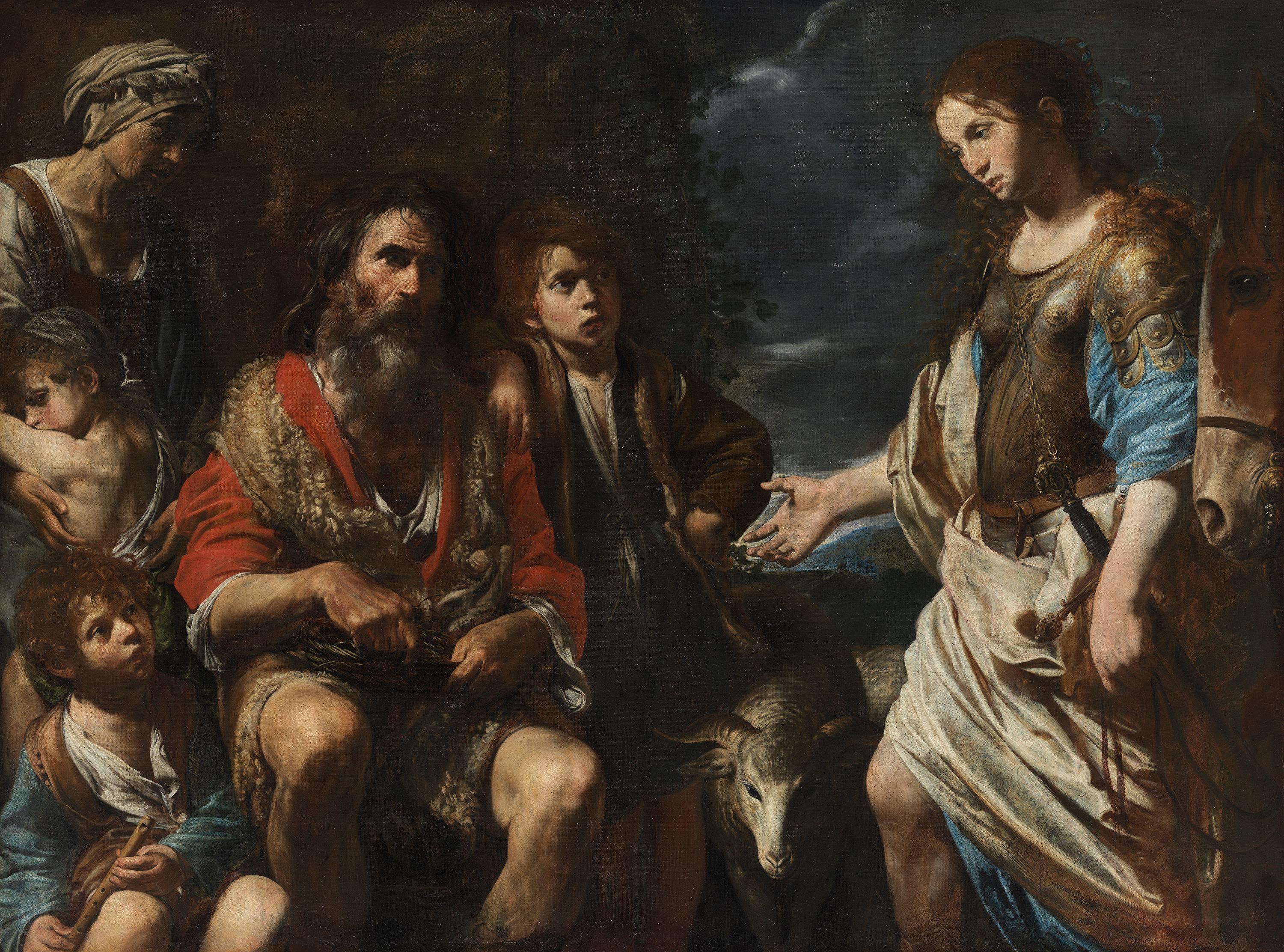
Valentin de Boulogne (1591-1632), Herminia among the Shepherds, c. 1630, oil on canvas, 134.6 x 185.6 cm (53 1/8 x 61 5/8”) Bayerische Staatsgemäldesammlungen – Alte Pinakothek München. https://www.sammlung.pinakothek.de/de/artwork/RQ4XPr8410
Erminia, the king’s daughter, escapes her persecutors and asks a peaceful shepherd family for shelter. The scene is based on a contemporary (1576) epic poem The Liberated Jerusalem by Torquato Tasso (1544-1595). The picture was a private commission whose patron was likely a Roman art collector and cognoscente. Valentin’s painting combines Caravaggesque chiaroscuro with exquisite coloring. In this realistic depiction of a human encounter between characters who represent contrasting social experiences, the subject matter is rendered psychologically sensitively.
Imaginary Worlds: Lorrain set a template for landscape painting into the 19th century by crafting muted, imaginary, stage-like scenes that blended fragments of classical antiquity with contemporary figures. The Bavarian Commission: Both Seaport at Sunrise and Idyllic Landscape in the Setting Sun were part of a trio of landscapes specifically commissioned by the Bavarian Privy Councillor Franz von Mayer.
The French artist Claude Lorrain arrived in Rome in 1615 and, except for interludes in Naples (1619-1624) and in France (1625-1627), the artist lived and worked in Rome during his life. Lorrain trained under Agostino Tassi (1578-1644), an Italian landscape painter. Lorrain’s compositions were painted in muted tones whose work displayed an ethereal mood. Using fragments from antiquity and a pleasant atmosphere, Lorrain’s mode of landscape painting set a template for such artworks into the 19th century. In Seaport at Sunrise, Lorrain’s depiction of the sunrise itself was bold and original, a haze dissolving within a scene of cities, sea and mountains and which contains contemporary figures yet harkens backwards in time or to the timeless.
In Seaport at Sunrise, the sun begins to bathe a seaport in early light, similar to the way the sun rises over the Gulf of Naples today. A working port, a boat is being loaded while travelers sit waiting on the shore. The place is imaginary – not purely contemporary, historical, mythological, or literary. Lorrain’s landscape transposes figures of everyday life contributing to the development of genre painting as its imaginary effects bend into the weight of medieval and ancient history.
There are fortified castles along the shore and a building to the right which appears very much like the triumphal Arch of Titus (80 A.D.) in Rome. Claude Lorrain’s painting is based on a composition he made from 1634 in the Hermitage in Saint Petersburg, Russia. Seaport at Sunrise is one of three landscape paintings commissioned by Bavarian Privy Councillor Franz von Mayer. The others in that trio are in the Alte Pinakothek (Idyllic Landscape in the Setting Sun – see below) and in the Dulwich Picture Gallery in London.
Before 1640, Claude Lorrain was considered the premier landscape painter in Rome. Most of his paintings are imaginary imitating a stage set for rich landscape narratives.
This painting is the first of the series of three landscape pictures commissioned by Bavarian Privy Councillor Franz von Mayer and that included Seaport at Sunrise (above). In the picture, a herd of cows crosses a ford in the Mediterranean as the sun sets behind mountains. The painting is based on one of Lorrain’s compositions from 1636.
Italian realist painter Caravaggio (1571-1610) remained very influential in contemporary art following his death. His use of targeted light and shadow as well as a muted, mainly brown palette, was key in the depiction of his figural scene. Painters in the 17th century followed this Caravaggesque practice throughout the rest of the century experimenting with using light and increasingly brighter colors as dramatic and aesthetic tools for their painting.
SOURCE: Baroque, Hermann Bauer, Andreas Prater, Ingo F. Walther, Köln: Taschen, 2006.
FEATURE image: Detail, Queen Elizabeth I. Ditchley portrait. Marcus Gheeraerts the Younger, 1592.
Marcus Gheeraerts the Younger was one of the most important portrait painters of Elizabethan and early Stuart England, whose innovative artistic style, influential court connections, and penetrating portrayals of political, military, and aristocratic figures helped shape English portraiture during a pivotal era in British history.
Marcus Gheeraerts the Younger, Captain Thomas Lee in Irish Dress, oil on canvas, 1594 (purchased 1980), Tate Britain.
Captain Thomas Lee (c.1551-1601) had his portrait painted by 33-year-old Marcus Gheeraerts the Younger (Bruges, 1561-1636) in London in 1594. Captain Lee was 43 years old and had worked as a military adventurer for English colonization in Ireland since the early 1570’s.
The young artist was the son of Gheeraerts the Elder (c. 1520–c. 1590), a painter and printmaker associated with the Tudor court in the late 1560’s and 1570’s. Fleeing religious persecution in Flanders, Gheeraerts the Elder arrived into England with his 7-year-old son Marcus in 1568. In 1577, Gheeraerts the Elder had likely returned to Flanders.
By 1594, when the portrait of Captain Lee was made, Gheeraerts the Younger was a rising young contemporary artist working in Elizabeth I’s Tudor court. Sir Roy Strong, the English art historian who served as director of the National Portrait Gallery and the Victoria and Albert Museum in London is unequivocal about Gheeraerts the Younger’s artistic importance to English art history. Strong wrote that Gheeraerts is “the most important artist of quality to work in England in large-scale between (Hans) Eworth (c. 1520 – 1574) and (Anthony) van Dyck (1599-1641).”1
In addition to a discussion of the early painting of Captain Lee, a complete collection of Marcus Gheeraerts the Younger’s 33 art works– including signed and dated works, documented and dated works, inscribed and dated works, and inscribed and undated works– is included in this post following this introduction.
Social contract: Marriages of court artists in late-16th-century Tudor England
At 22 years old in 1583, Marcus Gheeraerts the Younger’s world in and around London was ideally enclosed by marriage to the sister of talented Tudor court painter John De Critz (c.1555-c.1641). De Critz, like his new brother-in-law Gheeraerts the Younger, was a child expatriate from Flanders to England in 1568.2
In 1571 Gheeraerts the Elder had married his son’s future wife’s sister, making father and son Gheeraerts also eventually brothers-in law.3
Over two decades later, in 1602, Gheeraerts the Younger’s sister married the court artist Isaac Oliver (c.1565-1617).4
This was typical social behavior at the Tudor court where many active artists were connected by ties of marriage, family, and artistic training as well as shared European origin.
In Gheeraerts the Younger’s circle, for instance, John De Critz was apprenticed to the wealthy portrait painter Lucas de Heere (1534-1584) who may also have helped train Gheeraerts the Younger. De Heere – like Gheeraerts the Younger and De Critz – was a religious refugee to England from Flanders.
Isaac Oliver, Gheeraerts the Younger’s other brother-in-law, studied under leading Tudor portrait miniaturist and goldsmith Nicholas Hilliard (c.1547-1619). 5 Roy Strong as Director of the National Portrait Gallery in London links Hilliard to Gheeraerts by way of the supreme artistic quality found in both of these contrasting artists’ masterpieces.6
One remarkable technical innovation that the young artist applied in his portraits was the use of stretched canvas in place of wood panel that allowed for larger and lighter surface areas on which to paint and more easily transport pictures of the grand gentlemen and ladies of the time.
By way of marriage to an Irish Catholic woman, Captain Thomas Lee became a man of considerable property in Ireland. Captain Lee had separated from his wife by the time of his portrait. The next year -– in 1595 –- Lee married an Englishwoman. Over the decades, Captain Lee’s military reputation became one of an enfant terrible in Ireland which did not mellow over time. Powerful friends looked to explain Thomas’s frequent reckless political and military behavior. It was justified as the occupational hazard of a longtime English soldier in Ireland.
Planning and posing of Captain Lee’s portrait
Lee posed for Gheeraerts when the captain was straight off the battlefield from Ulster chieftain Aodh Mag Uidhir (Hugh Maguire, d. 1600) and in London for delicate negotiations.
To presumably express Thomas’s faithful service to the Crown, the portrait includes a Latin inscription in the tree that refers to Mucius Scaevola (c. 500 BC), an ancient perhaps mythical Roman fighter who remained loyal to Rome even after he was captured by mortal enemies.
Captain Thomas Lee was related to Sir Henry Lee as paternal half cousins. Sir Henry was Queen Elizabeth I’s Champion for almost 25 years until his retirement in 1590. In that capacity, Henry was the creator of the stunning imagery for her publicly-popular Accession Day festivals that he annually planned. Along with Gheerearts the Younger’s Elizabethan allegorical portrait Lady in Fancy Dress (The Persian Lady) (#30 below) and the Ditchley portrait of Queen Elizabeth I (#31 below) — both painted in the early 1590s — Henry, who remained active and influential in political affairs, may have helped devise the symbolism in Captain Lee’s portrait. The portrait also came from Ditchley, Sir Henry Lee’s timber-framed family house set in the wooded farmsland of north Oxfordshire.
While the painting’s landscape where Captain Lee stands is likely a representation of Ireland’s wild landscape, Henry Lee’s symbolism may provide other subtle and humorous features.
Troublesome Thomas, for example, stands under an oak, which may refer to Sir Henry’s political protection but also that these trees are prone to dangerous lightning strikes.
The final seven years of Captain Thomas Lee’s life iterated a legendary standard: at times negotiating with or killing Irish enemies he also served time in prison in Ireland on a charge of treason. Ultimately, Sir Henry could not save his familial junior– in 1601 Thomas faced execution in England for treason against Elizabeth I.
English colonial rule tightens in 17th century Ireland
English power became increasingly absolute in 17th century Ireland.
In the 1590’s, the Protestant Ascendancy in Ireland believed turning their backs on the mostly Catholic natives was the most effective governing strategy. While an oath of allegiance to the Crown remained law to divest Irish rebels of their property to English rule, it was not vigorously applied until the arrival in 1604 into Ireland of Lord Deputy Arthur Chichester (1563-1625).
The 1590’s continued to implement England’s new plantation system in Ireland which amounted to confiscating Irish property for English and Scottish settlers. While this provided quick and lucrative rewards for the conquerors, the political situation was not free of ambiguity. English laws were attacked by Irish chiefs seeking protection under older common law.
Protestant settlers had their own uneasy relationship with the English Crown who, in turn, fought a tug of war with an English Parliament.
About half of settlers in Ulster were Presbyterians who were dissenters from the English church which itself was at war with Anglo- and Gaelic Irish Catholics. Moreover, London viewed new Protestant landowners in Ireland –- such as Captain Thomas Lee –- with no less suspicion as despoiled Catholics. The Crown believed that the new Protestant vanguard in Ireland had power to usurp the island’s treasure more readily than pillaged Catholics who could, ironically perhaps, be better disposed to the idea of royal governance.7
While Thomas Lee’s special status is expressed in the painting’s lace embroidery on his rolled-up shirt and inlaid pistol and Northern Italian-made helmet, the Captain is dressed as a common foot-soldier who traveled through Ireland lightly armed. Captain Lee is also, both seriously and humorously, barelegged.
Sir Henry Lee must have been one of Marcus Gheeraerts the Younger’s earliest patrons, as the Ditchley collection had several portraits which can be ascribed to the artist.8
FOOTNOTES:
Strong, Roy, The English Icon: Elizabethan & Jacobean Portraiture, The Paul Mellon Foundation for British Art London Routledge and Kegan Paul Limited New Haven Yale University Press, 1969, p.22.
Ibid. p.259.
Hearn, Karen, Marcus Gheeraerts II: Elizabethan Artist, In Focus (Tate Publishing), 2003, p. 11ff.
The Captain Thomas Lee portrait was first recorded at Ditchley by Vertue in 1725 who noted there a portrait of ‘Lee in Highlanders Habit leggs naked a target & head piece on his left hand his right a spear or pike. Ætatis suae.43.ano.Dni 1594’.
Marcus Gheeraerts the Younger‘s surviving signed, dated, documented, and inscribed works demonstrate both his artistic achievement and his importance as a visual chronicler of Tudor and Jacobean society.
1. SIGNED AND DATED WORKS (8 works):
1 – Marcus Gheeraerts The Younger, Louis Frederick, Duke of Württemberg, 1608, oil on canvas, 225.1 x 113.1 cm, St James Palace. Probably painted for James I though first recorded in Charles II’s collection. (Strong 255, The English Icon).
Gheeraerts II painted portraits of several foreign dignitaries on their visits to the English court. Louis Frederick, Duke of Württemberg visited James I in London for three months in the latter part of 1608 and likely the artist produced this work at that time.
2 – Marcus Gheeraerts the Younger, William Camden, 1609, oil of panel,, 76.2.x 58.5 cm, Bodleian Library, Oxford. Given to the Schools by Camden Professor (1622-1647) Degory Whear. (Strong 256).
3 – Marcus Gheeraerts the Younger, Lucy Davis, Countess of Huntingdon, 1623, oil on panel, 76.8 x 62.3 cm, Private Collection. (Strong 257).
4 – Marcus Gheeraerts the Younger, William Pope, 1st Earl of Downe, 1624, oil on panel, 62.3.x 47.1 cm, Trinity College, University of Oxford. It was presented to Trinity College in 1813 by Henry Kett. (Strong 258).
5 – Marcus Gheeraerts the Younger, Elizabeth Cherry, Lady Russell, 1625, oil on canvas, 194.5 x 105.6 cm, The Duke of Bedford. This painting has been at Woburn Abbey since 1625. (Strong 259).
6 – Marcus Gheeraerts the Younger, Sir William Russell, 1625, oil on canvas, 195.6 x 111.8 cm, The Duke of Bedford. Always at Woburn Abbey. (Strong 260).
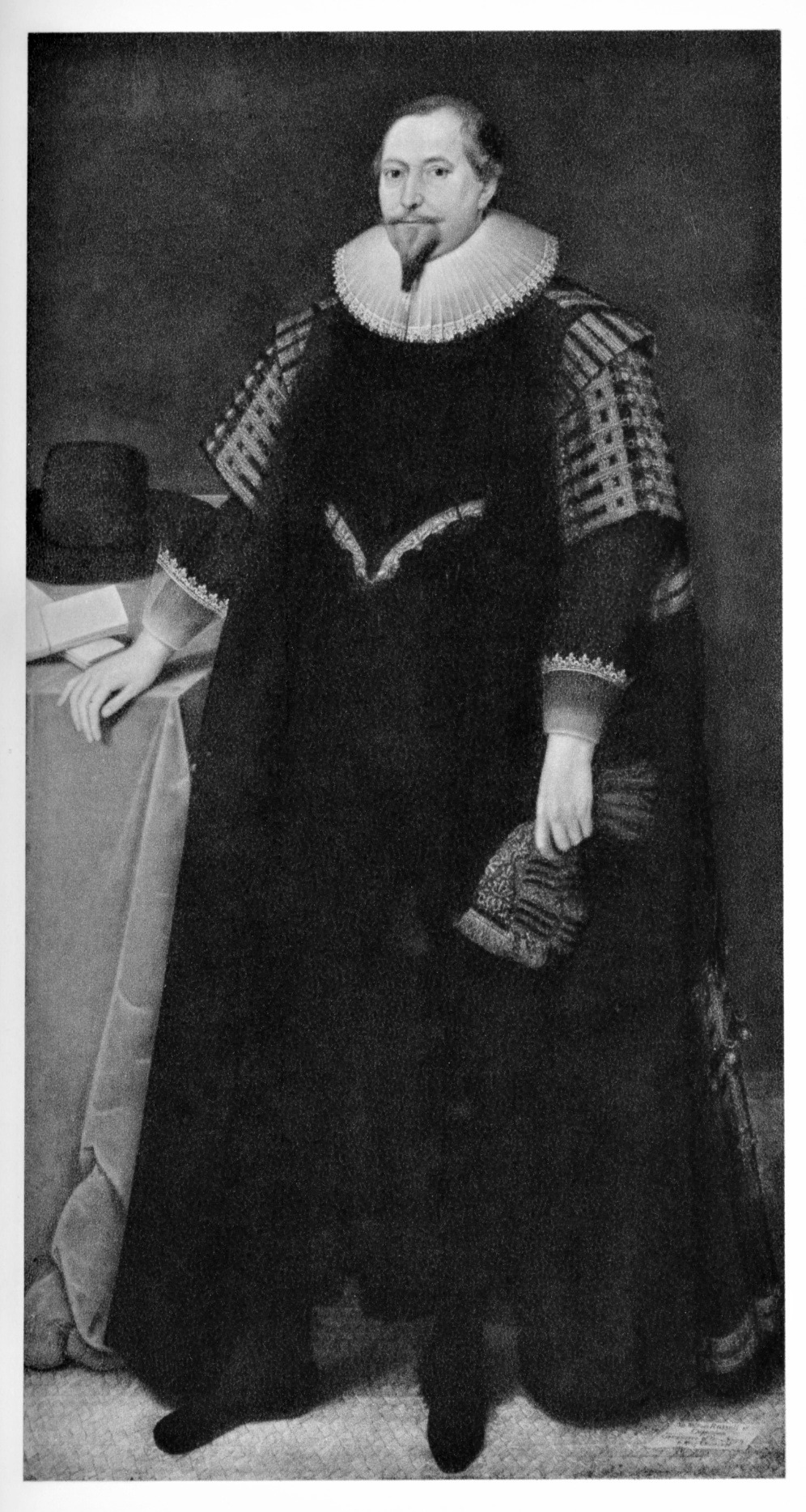
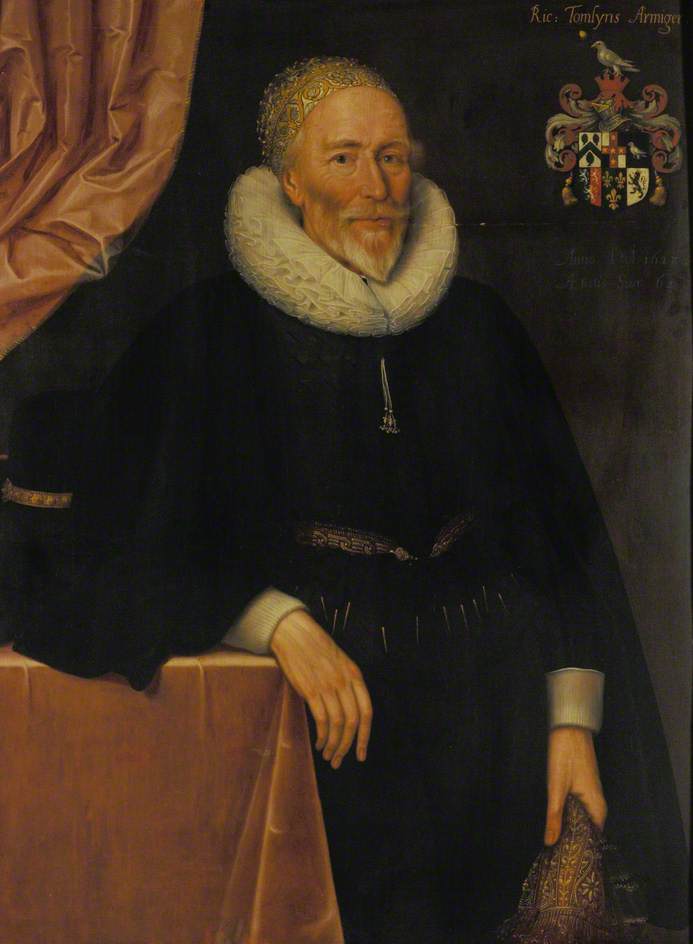
7 – Marcus Gheeraerts the Younger, Richard Tomlins, 1628, oil on panel, 111.8 x 83.9 cm. The Bodleian Library, Oxford. It was in the Library in 1759. (Strong 261).
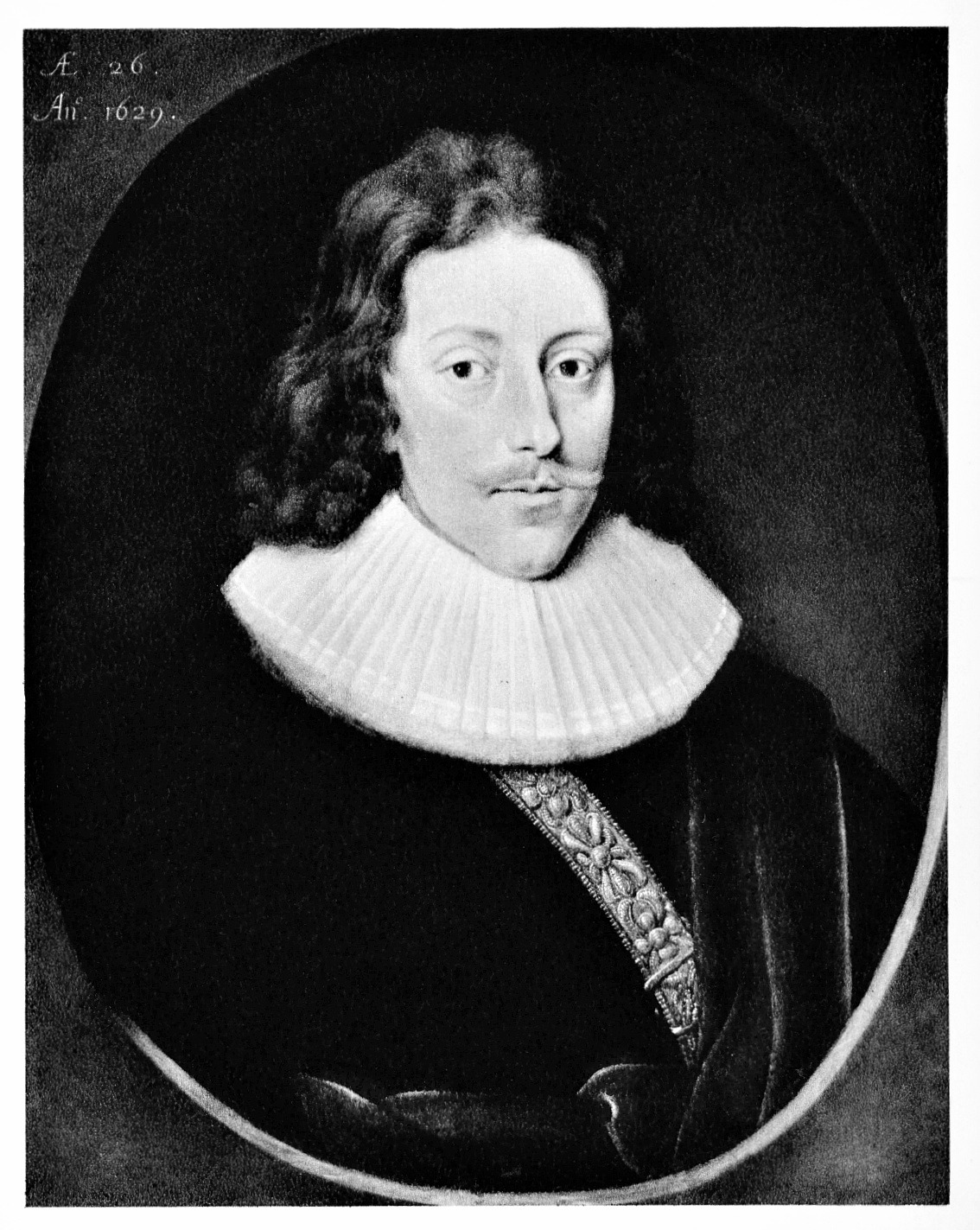
8 – Marcus Gheeraerts the Younger, Anne Hale, Mrs. Hoskins, 1629, oil on panel, 111.8 x 82.7 cm. Jack Hoskins Master, Esq. The painting remains in the family. (Strong 262).
2. DOCUMENTED AND DATED WORKS (3 works):
9 – Marcus Gheeraerts the Younger, Barbara Gamage, Countess of Leicester, and her children, 1596, oil on canvas, 203.2 x 260.3 cm, The Viscount De L’Isle. Always at Penshurst Place near Tonbridge, Kent, 32 miles southeast of London; first recorded 1623. (Strong 263).
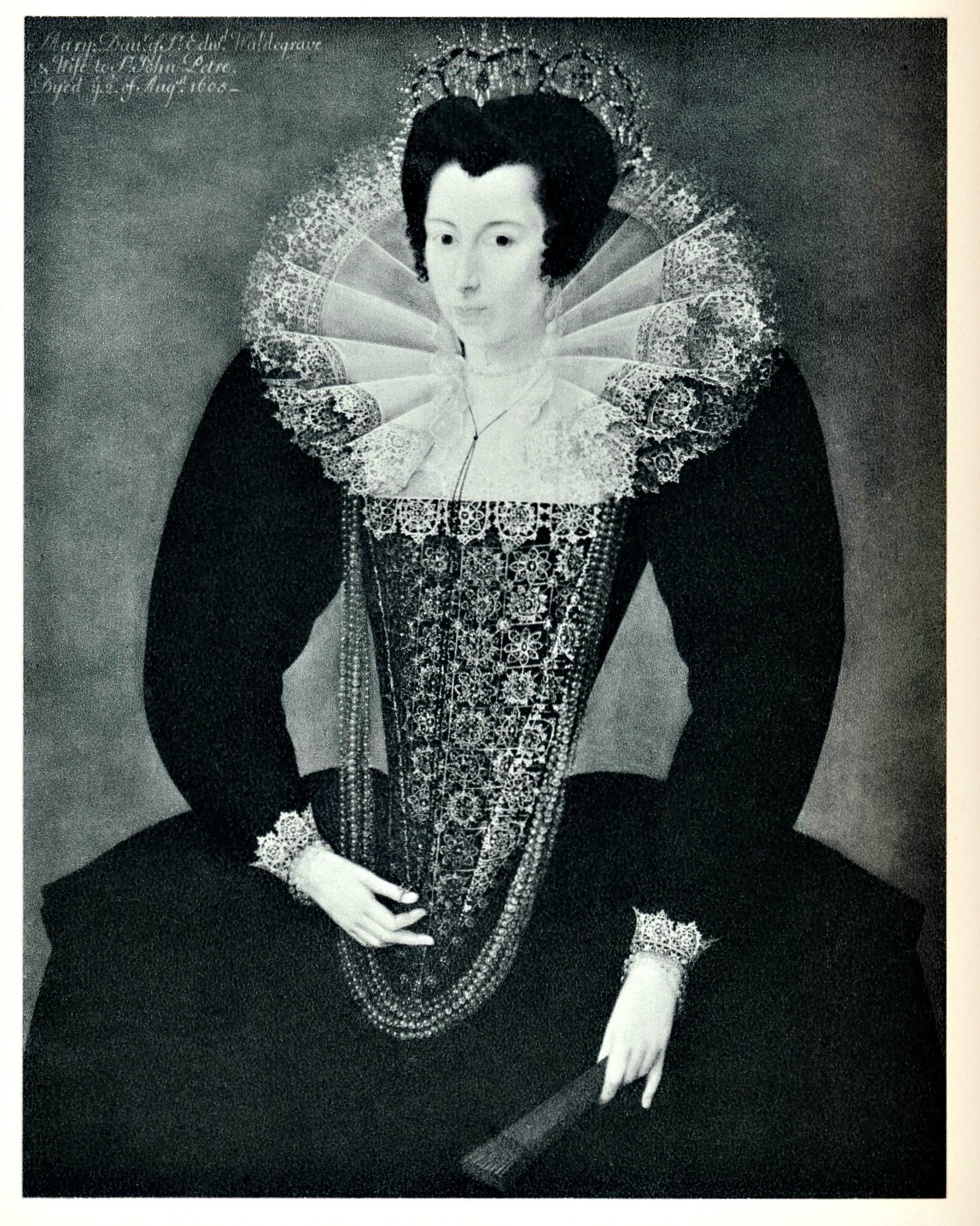
10 – Marcus Gheeraerts the Younger, William, 2nd Lord Petre, 1599, oil on panel. 111.8 x 90.2.cm. The Lord Petre; custody of the Essex County Record Office. (Strong 264).
11 – Marcus Gheeraerts the Younger, Katherine Somerset, Lady Petre, 1599, oil on panel, 111.8 x 90.2 cm. The Lord Petre. Always at Ingatestone Hall, the 16th century manor of the Barons Petre in Essex, England. Queen Elizabeth I spent several nights there in 1561. (Strong 265).
3. INSCRIBED AND DATED WORKS (18 works):
12 – Marcus Gheeraerts the Younger, Unknown Lady (Mary Rogers, Lady Harington), 1593, oil on panel, 114.3 x 94 cm, Tate (purchased 1974). The identity for the sitter is speculative, although her age (23 years old) is inscribed. It is one of the earliest known portraits by Gheeraerts. (Strong 266).
Detail, Unknown Lady (Mary Rogers, Lady Harington), 1593. The sitter is identified in part by the clothes she wears: the distinctive black and white pattern on her dress heralds the Harington coat of arms. The sitter is 23 years old and her portrait may have been painted in connection with a visit to Kelston (The Harington homestead) in 1592 by Queen Elizabeth. The Latin inscription in the painting reads, “I may neither make nor break” a dramatic phrase whose meaning is no longer clear.
13 – Marcus Gheeraerts the Younger, Captain Thomas Lee in Irish Dress, oil on canvas, 1594 (purchased 1980), Tate Britain. (Strong 267). With detail.
14 – Marcus Gheeraerts the Younger, Sir Francis Drake, oil on canvas, 1594. Versions at National Maritime Museum, Greenwich and Lt.- Col. Sir geirge Tapps-Gervis-Meyrick.
15 – Marcus Gheeraerts the Younger, Unknown Man (Called the Earl of Southampton), 1599, location unknown. (Strong 269).
16 – Marcus Gheeraerts the Younger, Unknown Lady, 1600, oil on panel, The Lord Talbot de Malhide. (Strong 270).
17 – Marcus Gheeraerts the Younger, Sir Henry Lee, oil on canvas, 1600, private collection on loan since 2008 to Tate Britain.
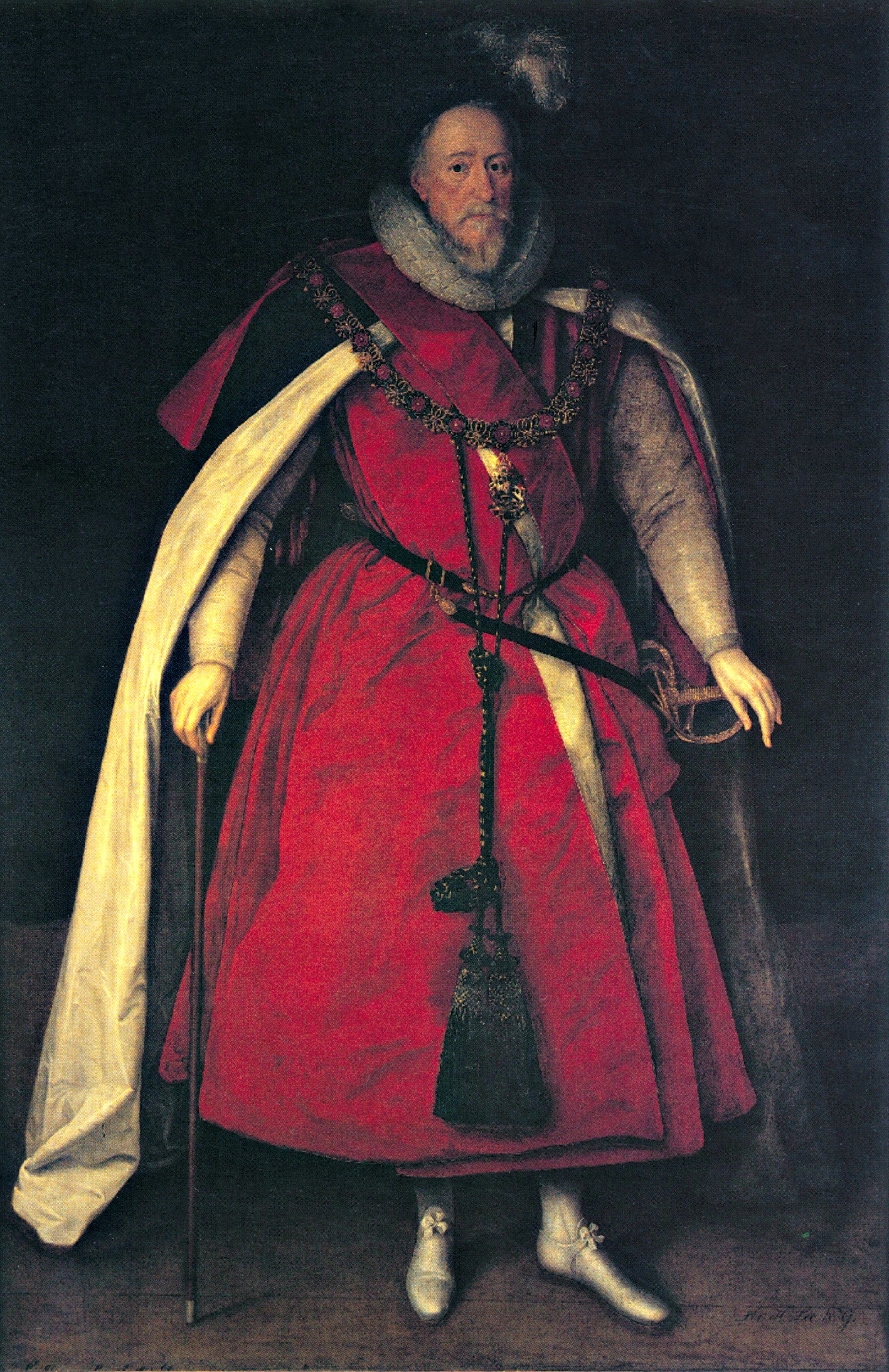
Sir Henry Lee (1533–1611), a Tudor Court favorite under Elizabeth I, was appointed as Queen’s Champion and Master of the Armoury. In that capacity, Sir Henry organised the annual public Accession Day festivals in honor of the queen. He commissioned the famous Ditchley portrait of Elizabeth I by Gheeraerts for his house at Ditchley in Oxfordshire. In 1597 he was made a Knight of the Garter and in Gheeraerts’s portrait wears that order’s gold chain and bejeweled medal of St George slaying the dragon. (Strong 271).
One of Gheeraerts II’s finest portraits, Sir Henry Lee is a former man of action, whose old head is remarkably shrewd.
18 – Marcus Gheeraerts the Younger, Sir Henry Lee in Garter Robes, 1602, oil on canvas, 216.2 x 137.2 cm. Always at Ditchley until 1933. Today at The Armourers & Brasiers’ Company of the City of London. Founded in 1322, the livery company was awarded its first Royal Charter in 1453 from King Henry VI. In 1708 the Armourers joined with the Brasiers and received its current charter from Queen Anne. (Strong 272).
19 – Marcus Gheeraerts the Younger, Christophe de Harlay, Comte de Beaumont, 1605, oil on canvas, The Marquess of Salibury.
The Comte de Beaumont was the French ambassador to England at a time when the Kings of England and France were looking in their own ways for a diplomatic solution to the religious controversies in Europe. The painting was made for Robert Cecil, 1st Earl of Salisbury, a politician who had won James I’s trust. (Strong 273).
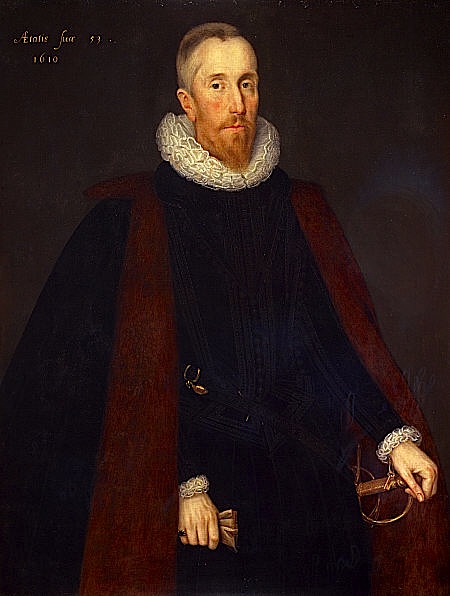
20 – Marcus Gheeraerts the Younger, Alexander Seton 1st Earl of Dunfermline, 1606.
Alexander Seton, 1st Earl of Dunfermline (1555–1622), a Scot, was regarded as one of the finest legal minds of his time. Seton served as Lord President of the Court of Session (top judge) from 1593 to 1604, Lord Chancellor of Scotland (top presiding officer of state) from 1604 to 1622 and Lord High Commissioner to the Scottish Parliament. (Strong 274).
21 – Marcus Gheeraerts the Younger, Anne of Denmark, 1614, oil on panel, 109.4 x 87.3 cm, Windsor Castle.
At 15 years old, Anne married the future James I of England in 1589. The Queen consort bore James three children who survived infancy, including the future Charles I (reigned 1625-1649). Once fascinated with his bride, observers regularly noted incidents of marital discord between the dour and ambitious James and his independent and self-indulgent wife. Before she died in 1619 the royal couple led mainly separate lives. (Strong 275).
22 – Marcus Gheeraerts the Younger, Ulrik, Duke of Schleswig-Holstein, 1614, oil on canvas, 211.2 x 114.3 cm, The Duke of Bedford.
Prince Ulrik of Denmark, (1578–1624) was the second son of King Frederick II of Denmark and his consort, Sophie of Mecklenburg-Güstrow. As second-born Ulrick bore the merely titular rank of Duke of Holstein and Schleswig although he later became Administrator of Schwerin. After his sister Anne became Queen of England, Ulrik was godfather to Princess Mary. (Strong 276).
23 – Marcus Gheeraerts the Younger, Sir John Kennedy, oil on canvas, 1614, The Duke of Bedford.
Upon James I’s accession, Elizabeth Brydges — Maid of Honour of Queen Elizabeth I — married Sir John Kennedy, one of the king’s Scotch attendants. This occurred at Sudeley Manor in Gloucestershire. Chandos appears to have opposed the match, and it was rumored in early 1604 that Sir John Kennedy had a wife living in Scotland. James I wrote to Chandos (February 19, 1603, or 1604) entreating him to overlook Sir John’s errors because of his own love for his attendant. Elizabeth Brydges apparently left her husband and desired to have the matter legally examined. As late as 1609 the legality of the marriage had yet to be decided. Lord Chandos declined to aid his cousin, and Sir John Kennedy’s wife died deserted and in poverty in 1617. (Strong 277).
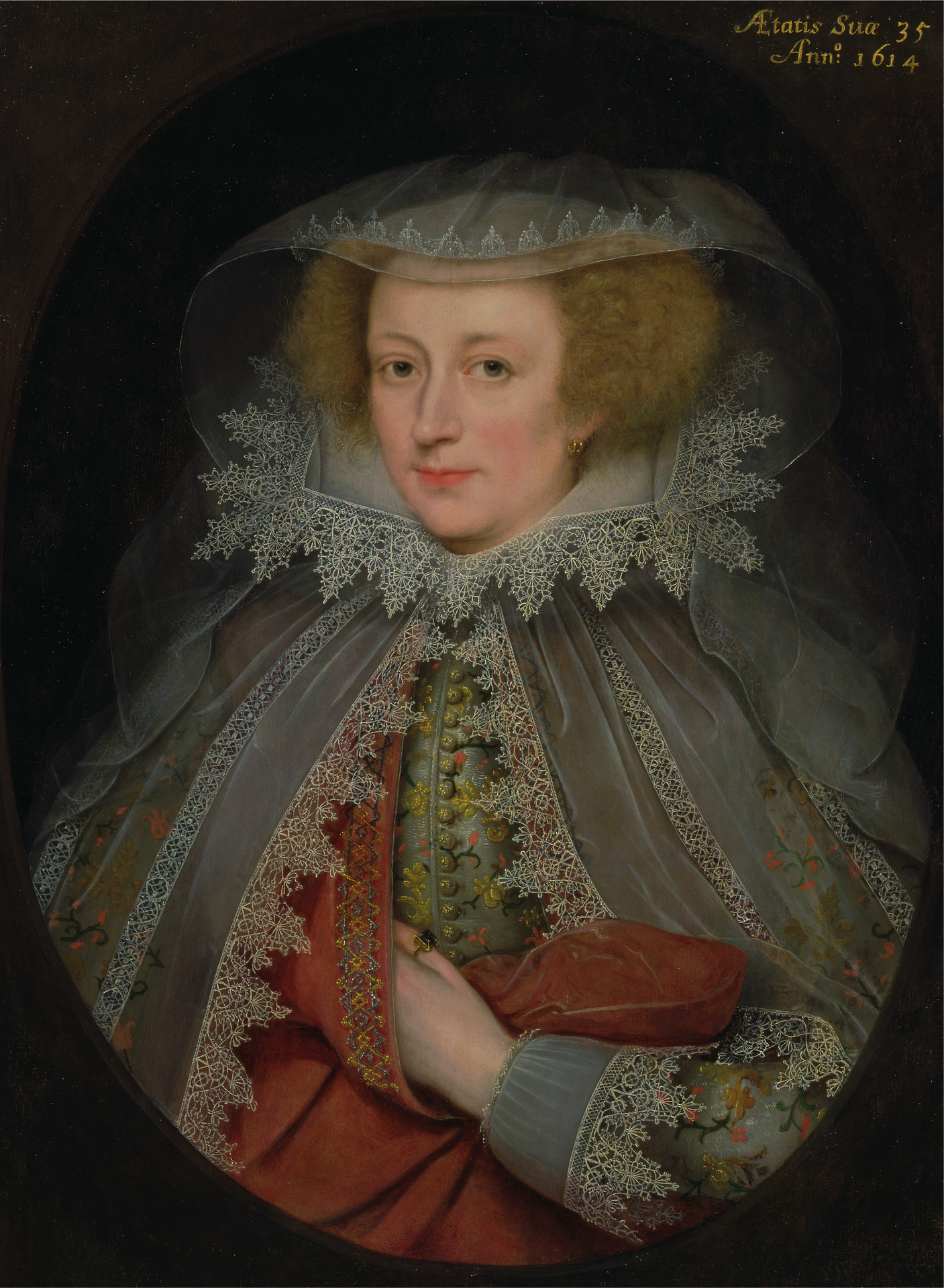
24 – Marcus Gheeraerts the Younger, Catherine Killigrew, Lady Jermyn, 1614, oil on panel, 73.7 x 57.2 cm, Yale Center for British Art. (Strong 278).
Catherine Killigrew was 35 years old when she sat for this portrait. The wife of an MP as well as the mother of three children, Catherine was the daughter of Sir William Killigrew (d. 1622) who was a courtier to Queen Elizabeth I and to King James I. Her father, Sir William, served as Groom of the Privy Chamber. (Strong 278).
25 – Marcus Gheeraerts the Younger, probably Mary (née Throckmorton), Lady Scudamore, oil on panel, 1615, 45 in. x 32 1/2 in. (1143 mm x 826 mm), National Portrait Gallery, London, purchased 1859.
The sitter, once wrongly identified as the Countess of Pembroke, is likely Lady Scudamore though about whom little is known. The portrait is likely for the occasion of her son’s marriage (John, later Viscount Scudamore) to Elizabeth Porter of Dauntsey, Wiltshire. The wreath of flower and inscribed motto ‘No Spring Till now,’ suggest the hope that this marriage must have represented within the family. (Strong 279).
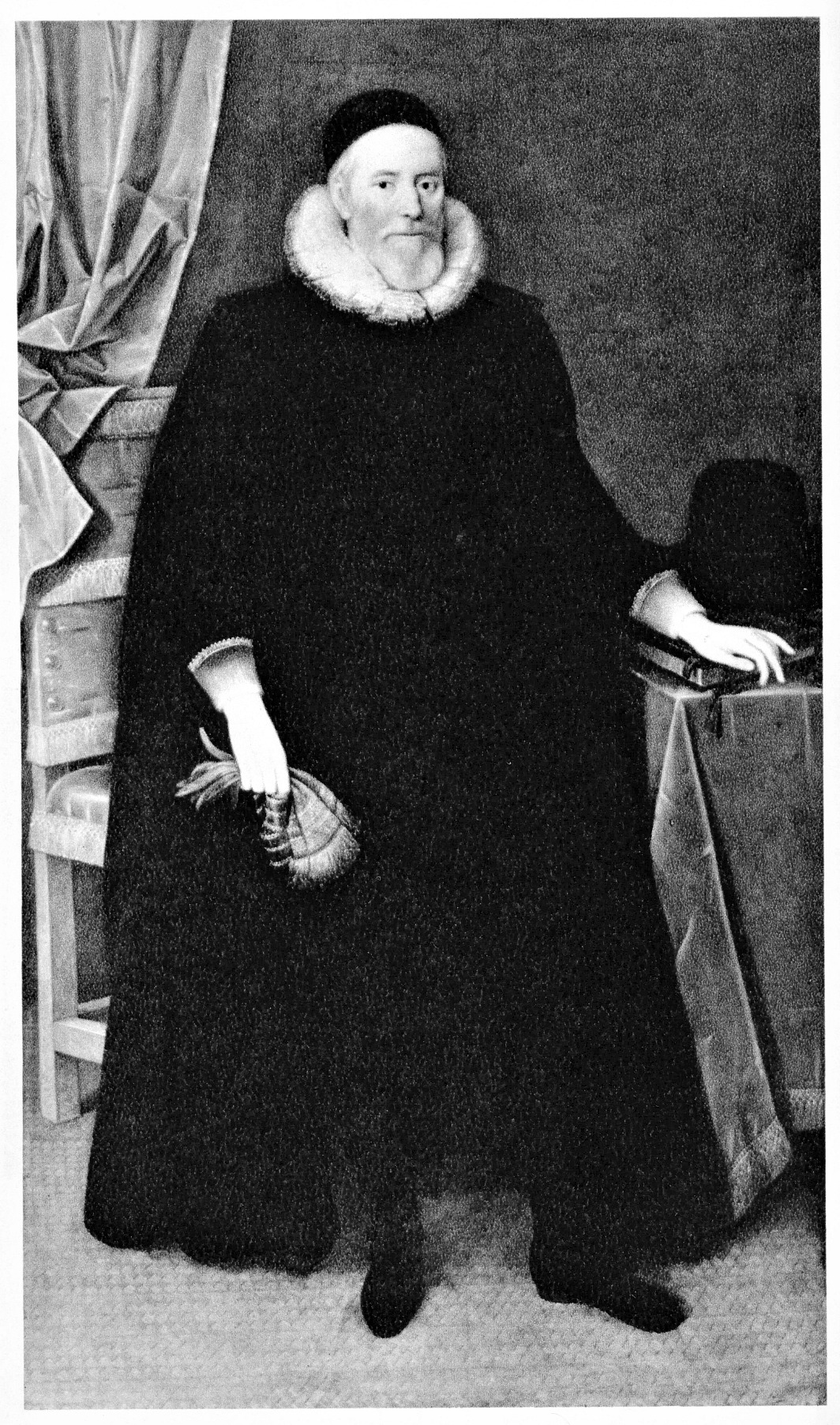
26 – Marcus Gheeraerts the Younger, Sir Henry Savile, 1621, 216.2 x 127 cm, Bodleian Library, Oxford. Gift from the sitter’s widow, 1622.
Sir Henry Savile (1549-1622) was an enterprising Bible scholar. When his qualifications did not meet the standards for the role of Provost of Eton, he had Queen Elizabeth I waive the college’s rules for him. As Warden of Merton — a post secured with the help of influential friends — he was unpopular with faculty and students though the college itself flourished. Sir Henry’s brother was a powerful lawyer who helped guide his brother’s career which included knighthood in 1604. (Strong 280).
27 – Marcus Gheeraerts the Younger, Sir Henry Savile, 1621, oil on canvas, 1621, 203.7 x 122 cm, Eton College. A second smaller copy of the Bible scholar and college administrator. (Strong 281).
28 – Marcus Gheeraerts the Younger, William Herbert, Earl of Pembroke, 1628, oil on panel, 68.5 x 48.2 cm, Philip Yorke.
Under King James I, William Herbert, 3rd Earl of Pembroke (1580 –1630), founded Pembroke College, Oxford, in 1624. In 1623 the First Folio of Shakespeare’s plays was dedicated to him and to Philip Herbert, Earl of Montgomery (the later 4th Earl of Pembroke), his brother. A bookish man, the 3rd Earl of Pembroke was engaged to be married three times. The first engagement was to Elizabeth Carey in 1595. Elizabeth was the granddaughter of the Lord Chamberlain who ran Shakespeare’s company. William simply refused to marry her. In 1597 William was engaged a second time. This time it was to Bridget de Vere. As William found her dowry arrangements to be unsatisfactory, negotiations dragged out to a tiresome point where the match became unacceptable. In 1600 William impregnated a mistress at court whom he refused to marry. The child was born and died soon after. Following this episode, William and the mistress (Mary Fitton) were barred from court. In 1604 William married Mary Talbot. Their children both died in infancy. At the same time, William was having an extra-marital affair with his cousin, Lady Mary Wroth, which produced two illegitimate children. A lively patron of the arts, William Herbert, 3rd Earl of Pembroke died suddenly in 1630 at 50 years old. He is buried in Salisbury Cathedral in the family vault at the foot of the altar. (Strong 282).
29 – Marcus Gheeraerts the Younger, Charles Hoskins, 1629, oil on panel, 66.1 x 52.7 cm, Jack Hoskins Master. Esq. (Strong 283).
30 – Marcus Gheeraerts the Younger, Lady in Fancy Dress (The Persian Lady), 1590s, oil on panel, 216.5 x 135.3 cm, Hampton Court.
First recorded in the collection of Queen Anne but believed to be part of the Royal Collection before that time, in the cartouche the sonnet reads: “The restless swallow fits my restless minde, Instill revivinge still renewinge wronges; her Just complaintes of cruelty unkinde, are all the Musique, that my life prolonges. With pensive thoughtes my weeping Stagg I crowne whose Melancholy teares my cares Expresse; hes Teares in sylence, and my sighes unknowne are all the physicke that my harmes redresse. My only hope was in this goodly tree, which I did plant in love bringe up in care: but all in vaine, for now to late I see the shales be mine, the kernels others are. My Musique may be plaintes, my physique teares If this be all the fruite my love tree beares.” Lady in Fancy Dress is a good example of Elizabethan allegorical portraiture. Importantly, the painting may be related to the Ditchley portrait of Elizabeth I (Strong 285) as well as the portrait of Captain Thomas Lee (Strong 267 ). These three portraits may be connected in some way to the entertainment given by Sir Henry Lee, the Queen’s Master of the Armouries and Champion of the Tilt, when the Queen visited Ditchley in 1592. (Strong 284).
31 – Marcus Gheeraerts the Younger, Queen Elizabeth I (“The Ditchley Portrait”), oil on canvas, 1592, 95 in. x 60 in. (2413 mm x 1524 mm). National Portrait Gallery, London. Bequeathed by Harold Lee-Dillon, 17th Viscount Dillon, 1932. Queen Elizabeth was nearly 60 years old when this portrait was made. It is traditionally understood to have been painted on the Queen’s visit to Ditchley, the timber-framed family house in north Oxfordshire of Sir Henry Lee (1533-1611). Like John II Walshe (d.1546/7) of Little Sodbury, Gloucestershire, who was the King’s Champion to Elizabeth’s father Henry VIII, Henry Lee served at that standard for Queen Elizabeth from 1570 until his retirement about two years before this painting was made. Ditchley once provided lodging and access to the royal hunting ground of Wychwood Forest. (Strong 285).
Queen Elizabeth I is standing on a map of England. Detail from The Ditchley Portrait of Elizabeth I by Marcus Gheeraerts the Younger in 1592.
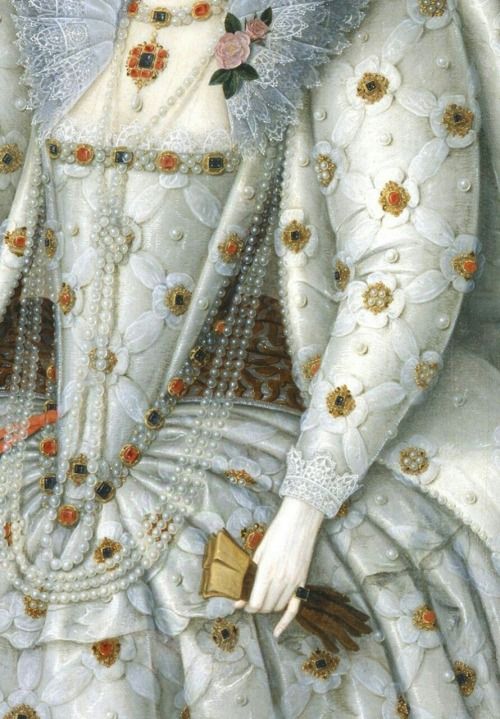
Detail of a bejeweled fan in Queen Elizabeth I’s right hand from The Ditchley Portrait of 1592 by Marcus Gheeraerts the Younger. In the decade before The Ditchley Portrait Gheeraerts the Elder, Marcus II’s father, had painted a full- length oil on panel portrait of Elizabeth I. In the ensuing handful of years, practical technical innovation in art is in evidence in the Elizabethan court — the the son’s oil portrait of the same royal personage was able to be produced on canvas on a much larger scale.
Detail of the beautiful garment and accessories.
Detail, Queen Elizabeth I. Ditchley portrait. Three fragmentary Latin inscriptions in the painting have been interpreted as: “She gives and does not expect”; “She can, but does not take revenge”; and, “In giving back, she increases.” An inscribed sonnet, whose author is not known, takes the sun as its subject. At some later date the canvas was cut more than 7 centimeters fragmenting the final words of the each line.
The King’s Champion and the Outlaw: How Sir John Walshe’s Little Sodbury Manor Shielded the English Bible
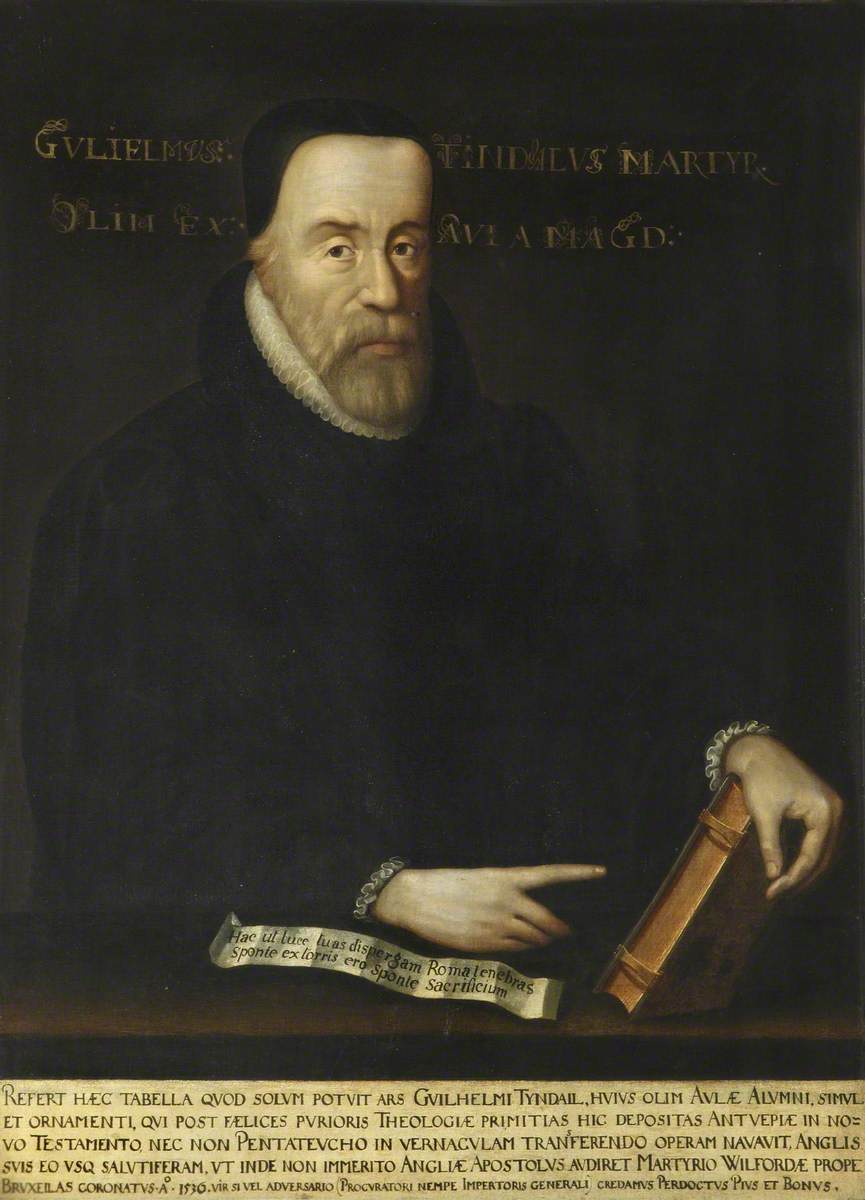
Sir John II Walshe (d. 1546/7) was a prominent English landowner, courtier, and high-ranking local official based at Little Sodbury Manor in Gloucestershire. He is most famous historically for his close connection to King Henry VIII and his early patronage of the famous Bible translator and Catholic priest, William Tyndale. Sir John was a major favorite of the young King Henry VIII and was chosen to serve as the King’s Champion at Henry’s coronation in 1509. Because of his standing, Henry VIII and Queen Anne Boleyn stayed with Walshe at Little Sodbury Manor for two nights during the King’s Second Royal Progress on August 21, 1535. Walshe was a dominant political figure in the county, serving multiple terms as the High Sheriff of Gloucestershire (in 1526, 1530, 1535, and 1540).
Around 1521–22, Sir John Walshe hired a young William Tyndale to serve as the private tutor for his children and as the manor’s chaplain. Walshe frequently hosted local abbots, deacons, and wealthy clergymen at his dining table. Tyndale famously used these dinners to debate the local Catholic elite using scripture, which frequently troubled Walshe and his wife, Lady Anne. Since the Constitutions of Oxford in 1408, the Catholic Church had strictly banned translation of the Bible into the vernacular, fearing it would undermine theology and their authority, breeding social chaos. By translating directly from the original Greek and Hebrew (rather than the Church’s official Latin Vulgate), Tyndale was committing a capital crime. Historical tradition holds that Tyndale began his monumental work translating the Bible from Greek into English right in his bedroom at Walshe’s manor before church hostility forced him to flee to London in 1523.
Words matter, and Tyndale’s choices stirred controversy—as they actively dismantled institutional power structures. Catholic officials—most notably Sir Thomas More—charged that Tyndale used language that fueled already rampant anti-clericalism in England. For example, Tyndale translated Church as “Congregation,” shifting power from the Vatican hierarchy to local people. He also translated Do Penance to “Repentance,” cutting out the need for the Catholic sacramental system of confession. It was during his time living under Walshe’s roof that Tyndale had his historic argument with a local priest and declared: “If God spare my life, ere many years I will cause a boy that driveth the plow shall know more of the scripture than thou dost.” Sir John died around 1546 or 1547, passing the manor down to his son and heir, Maurice Walshe.
Tyndale’s fate was far more complex. In 1528, he published The Obedience of a Christian Man, arguing that a king should answer directly to God rather than the Pope. King Henry VIII famously loved the book because it gave him a legal rationale to break away from Rome. However, in 1530, Tyndale published The Practice of Prelates, where he fiercely opposed Henry VIII’s attempt to annul his marriage to Catherine of Aragon. This instantly turned Tyndale into an enemy of the English Crown; Henry VIII declared him a traitor, banned his books, and actively hunted him down. Tyndale spent years in exile, smuggling thousands of English New Testaments into the hands of ordinary folk in England. In 1535, he was betrayed in Antwerp and spent over a year in a Brussels dungeon at Vilvoorde Castle for his religious activities.
Meanwhile, John Walshe’s role was that of a benevolent, high-status buffer. Rather than throwing Tyndale to the wolves, Walshe acted as a protective patron. He and Tyndale mutually agreed that Tyndale must leave Little Sodbury. Walshe gave Tyndale his blessing, provided him with travel funds, and wrote him letters of introduction to influential contacts in London. Even after Tyndale fled England, became an outlaw, and infuriated the King, Walshe’s loyalty did not vanish. Records indicate that both Sir John and Lady Anne Walshe were personally deeply moved by Tyndale’s theology—though made uncomfortable around powerfully connected Catholic guests—so that when Tyndale was in a dungeon near Brussels, they sent funds to support him and made behind-the-scenes diplomatic efforts to secure his release.
Ultimately, Tyndale was executed by Catholic forces in Brussels a little over a year after Thomas More and John Fisher were beheaded in London by Henry VIII. Tyndale’s execution was particularly brutal. First, since he was found guilty of heresy, he was excommunicated. Because he was an ordained priest, he was dressed in his formal vestments and mocked as the executors of 16th-century justice ripped them away, subsequently scraping the holy oil off his hands and fingers to connote that he could no longer say Mass. Tyndale was then tied to a stake and strangled to death by the hangman, who then burned his body. While Sir John Walshe’s status as King’s Champion had bought Tyndale a safe, early window of time to conceptualize his English translation, and gave him the launchpad to take his prohibited, dangerous work to the global stage, Tyndale’s famous last words were a prayer aimed directly at the monarchy: “Lord, open the King of England’s eyes.” Ironically—as is typical when it comes to Henry VIII and power mongers generally—within just three years of his execution, Henry VIII officially authorized the Great Bible to be printed in English and placed in every parish, using Tyndale’s exact work as its foundational core.
Although no painting preserves Walshe’s face, his legacy is preserved through the architecture of Little Sodbury Manor. The grand 15th-century manor house, its Great Hall where the dinner debates took place, and the room traditionally identified as Tyndale’s library still stand intact in Gloucestershire today.
32 – Marcus Gheeraerts the Younger, Sir Henry Lee, 1590s, oil on canvas, 117 x 86.4 cm, The Ditchley Foundation. Always at Ditchley.
The painting and inscribed verses memoralize an incident where Bevis – Lee’s dog – saved his master’s life. “More faithfull then favoured…” (Strong 286).
33 – Marcus Gheeraerts the Younger, Michael Dormer, mid 1590s, oil on canvas, 122 x 91.5 cm, J.C. H. Dunlop, Esq. There are Latin inscriptions which surround and are written across the globe and shield. (Strong 287).
The social and cultural world of Sir Henry Lee once again influences the young artist’s portrait of Michael Dormer, who was an Oxfordshire neighbor to Sir Henry. In Dormer’s three-quarter-length portrait, the right hand is posed similarly to Thomas Lee’s portrait. As Captain lee’s portrait is the centerpiece of this post’s explorations,it may be said with Michael Dormer’s this post has traveled full circle around Marcus Gheeraerts II’s verifiable portraiture in Elizabethan and Jacobean England.
Conclusion
Here then concludes the complete collection of Marcus Gheeraerts the Younger’s signed and dated works (Strong 255-262); inscribed and dated works (Strong 266-283); and, inscribed and undated works (Strong 284-287). Not included here are works dated and attributed to the artist (Strong 288-294) and attributed and undated (Strong 295-313). The last group includes several well-known portraits including William Cecil, Lord Burghley, c. 1595, in the National Portrait Gallery (Strong 295) and Robert Devereux, 2nd Earl of Essex, c. 1596, in collection of the Duke of Bedford. (Strong 300).
CAPTION NOTES:
Strong 255 – Hearn, Karen, Marcus Gheeraerts II, Elizabethan Artist (In Focus series), Tate Publishing, 2002, p. 29.