

FEATURE IMAGE: The monument inside Vézelay Abbey features a striking statue of Saint Bernard of Clairvaux sculpted from fine French limestone by Honoré Jean Aristide Husson (1803–1864). Depicted in traditional monastic robes, the influential Cistercian monk and reformer triumphantly raises a large Latin cross in his right hand while holding an abbot’s crozier in his left, a powerful posture that directly signifies his historical role as a passionate orator and preacher rallying the faithful. The landmark monument was completed and installed in 1846, commissioned to commemorate exactly 700 years since Bernard famously preached the launch of the Second Crusade on Easter Sunday, March 31, 1146. This installation coincided with a critical period for Vézelay Abbey, which was in a severe state of decay until the French government launched a massive restoration project headed by the famous architect Eugène Viollet-le-Duc. Husson’s sculpture was an integral part of that grand, 19th-century revival designed to honor the abbey’s illustrious medieval legacy. Directly below the main statue, a finely carved stone relief panel depicts the historic outdoor assembly where the crusade was declared. The figures shown enthroned in the relief represent the French monarchy, specifically King Louis VII and his queen consort, Eleanor of Aquitaine. Because the crowd gathered to hear Bernard was far too vast to fit inside the abbey walls, the event was forced to move to an open field just outside the abbey. His sermon proved so profoundly moving that the inspired crowd immediately began shouting “Crosses! Crosses!” and eagerly tearing up their own clothing to fashion cloth crosses to stitch onto their shoulders. September 1993. Author’s photograph.
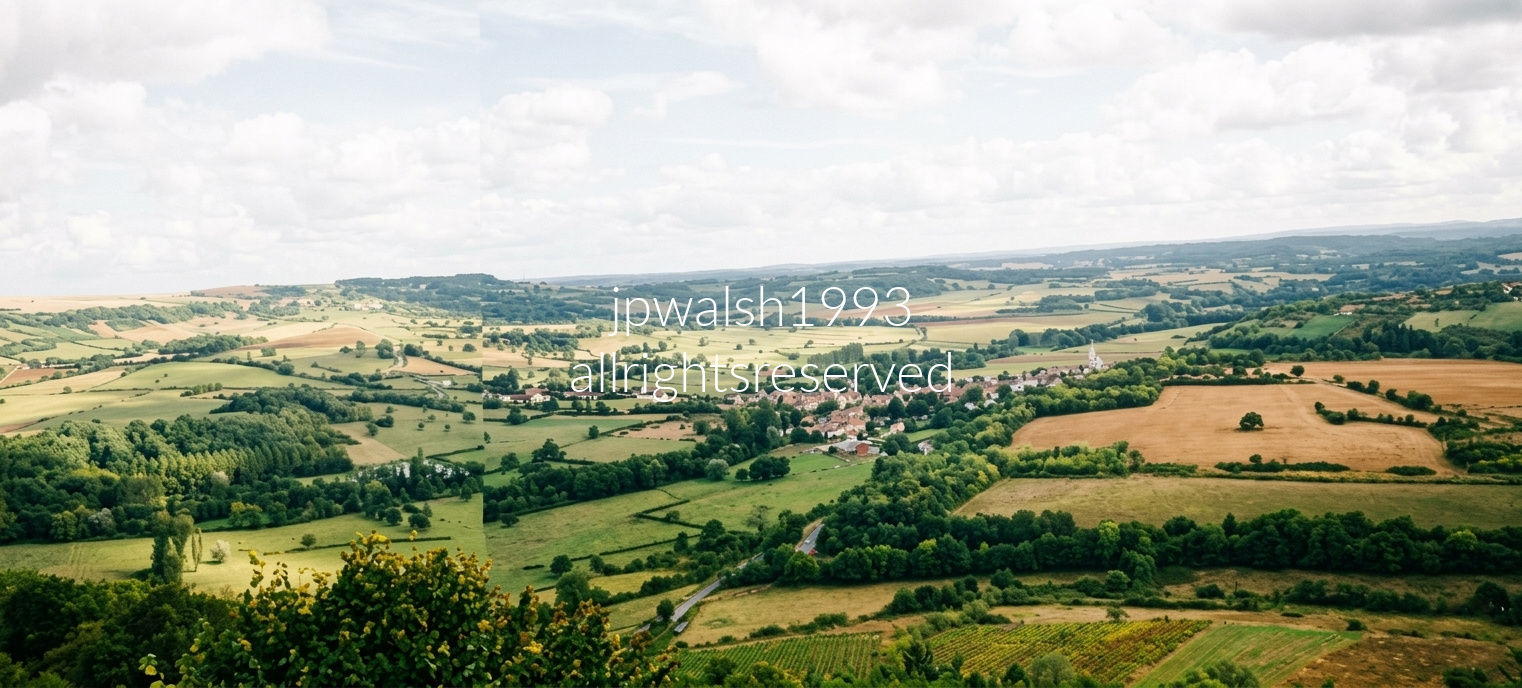
A wide panorama of the Burgundy countryside reveals a landscape shifting seamlessly between plateaus, low ridges, and broad depressions, the very geology that produces the south‑ and east‑facing slopes essential to the region’s viticulture. Flat, fertile basins cut between the rolling hills, arranged in the traditional patchwork of small fields bordered by dense hedgerows and tree lines. A compact village sits naturally in the folds of a low valley, echoing the historic pattern of settlements clustering along gentle contours near water and travel routes. Higher ridges carry thick stands of deciduous and coniferous forest, breaking the farmland into measured intervals and acting as natural windbreaks. It was in this terrain that St. Bernard preached the Second Crusade in 1146, rallying the vast crowd gathered on the open meadow outside Vézelay.
Bernard’s Voice & the Call to Arms
A contemporary witness wrote that Bernard’s voice “rang out across the meadow like a celestial organ,” and when he finished, the crowd surged forward to enlist en masse. History recalls that the Second Crusade they joined would collapse into a disastrous sequence of defeats for Christendom in the East.
Early Life & Vocation
Born into a wealthy Burgundian family, Bernard was intelligent, intense, and strikingly handsome in appearance. His decision to become a monk was unusual enough; choosing Cîteaux, a new and absolutely impoverished monastery founded in 1098, horrified his relatives. Bernard’s choice presaged, a century early, the radical poverty later embraced by St. Francis: a literal return to the gospel and to St. Benedict’s rule, even as Cîteaux struggled to attract recruits.
The Cistercian Surge
In 1113, Bernard’s charisma famously drew thirty of Burgundy’s finest young men into Cîteaux, transforming the monastery overnight. Historian Christopher Holdsworth later wrote that “Bernard’s first and greatest miracle was himself.” Under Abbot Stephen Harding, Cîteaux’s English co‑founder, Bernard and the new monks began founding daughter houses. Their example ignited a movement so strong that the 12th century became the “Cistercian century.”
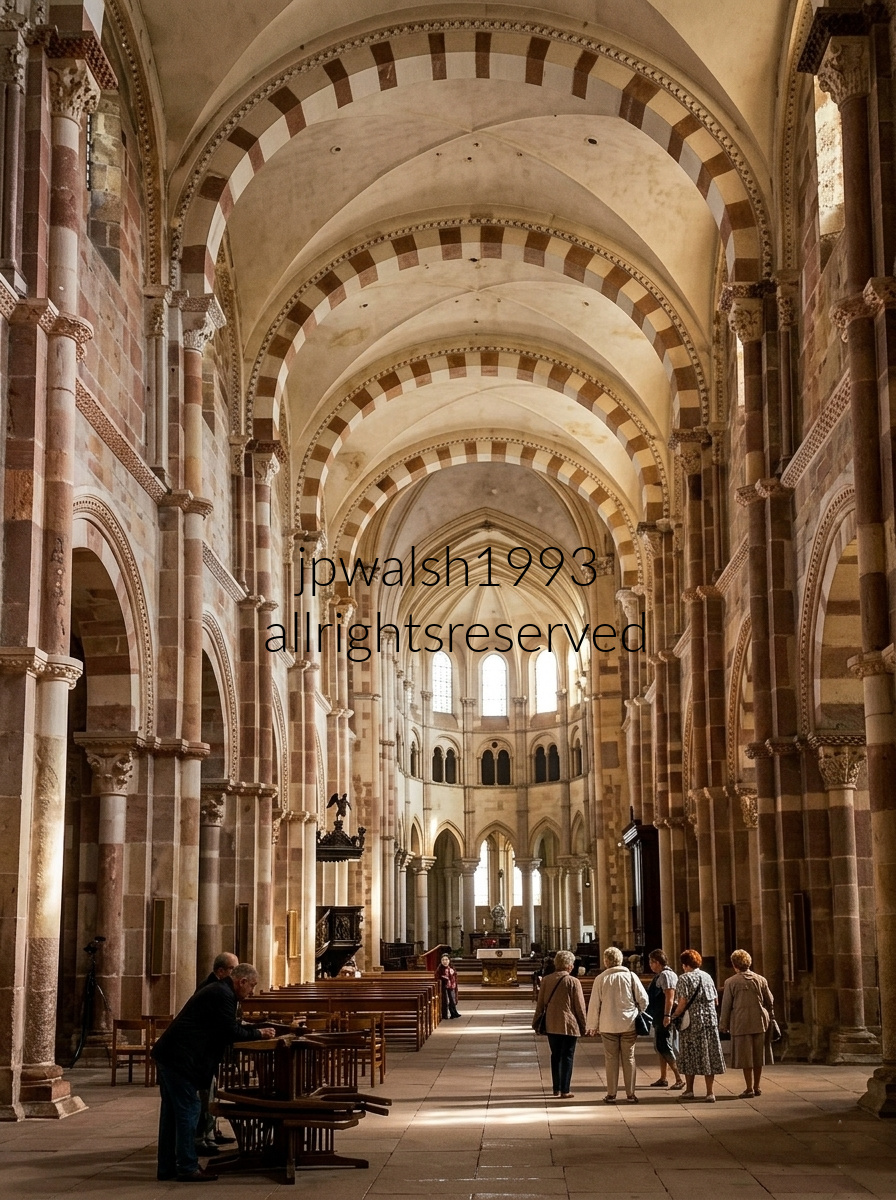
The interior nave of Vézelay Abbey (Basilica of Sainte‑Marie‑Madeleine) in Burgundy presents a Romanesque masterpiece moving confidently toward early Gothic. The most commanding feature is the series of semicircular arches (arcs doubleaux) that span the nave, each built from alternating light and dark stone voussoirs that create a striking banded pattern and echo a revived Roman design vocabulary.
Clairvaux & Opinionated Leadership
With twelve companions, Bernard founded Clairvaux, the “Valley of Light.” Life there was harsh, marked by privation and illness, but Bernard’s sharing in all the foundation’s suffering sharpened his authority. As abbot, he became a sought‑after voice on the political and ecclesiastical crises of his day. His wit was cutting, his opinions unfiltered, and his influence immense.
Reform & Conflict
Bernard championed the Hildebrand reforms of Pope Gregory VII, targeting simony, enforcing clerical celibacy, and resisting secular control of church appointments. He pushed for a purified clergy and a Church independent of royal interference. The 12th century’s chronic schisms—among popes, kings, princes, and bishops—made reform urgent. Bernard helped secure unity at the Second Lateran Council (1139), where the anti‑pope’s adherents were finally condemned.
Bernard clashed with the wealthy monks of Cluny, though he remained friendly with their abbot, and dismissed Peter Abelard as a marketplace intellectual.

The west façade of Vézelay Abbey evolved over several centuries, merging Romanesque engineering, Gothic heightening, and 19th‑century restoration into a single composite front. While the abbey’s celebrated internal narthex tympanum dates to the 1140s, the exterior tympanum above the main entrance is a 19th‑century reconstruction. The original Romanesque Last Judgment—one of Vézelay’s masterpieces—was mutilated and destroyed by revolutionaries in 1793. The current tympanum was carved by Michel‑Pascal under the direction of Eugène Viollet‑le‑Duc, whose restoration campaign reshaped the façade’s sculptural program and stabilized its structural envelope. The south tower began around 1150 in the Romanesque style, then rose higher through 13th‑ and 14th‑century Gothic phases. A matching north tower was planned but never built, leaving the façade asymmetrical. The main stone portals and doorways were constructed between 1140 and 1150 as part of a major western porch expansion designed to handle the heavy influx of medieval pilgrims traveling to Vézelay.
The Second Crusade & Reputation
In 1142, the pope ordered Bernard to preach the Second Crusade, a duty he accepted but which later rebounded against him when the campaign failed catastrophically. The stain on his reputation lingered into his final years.
Death, Canonization & Legacy
Bernard died on August 20, 1153, now his feast day. He was canonized in 1174 and named a Doctor of the Church in 1830.
After his death, Vézelay remained a stage for major political drama. In 1166, the exiled Archbishop Thomas Becket used Vézelay to threaten King Henry II with excommunication. In 1190, Richard the Lionheart and King Philippe Auguste met there and spent three months at the abbey before departing on the Third Crusade.
This explanatory article may be periodically updated.

