
Monthly Archives: August 2026

Dolly Parton, Beloved American Icon Whose Legacy Spanned Music, Film, and Literacy, Dies at 80.

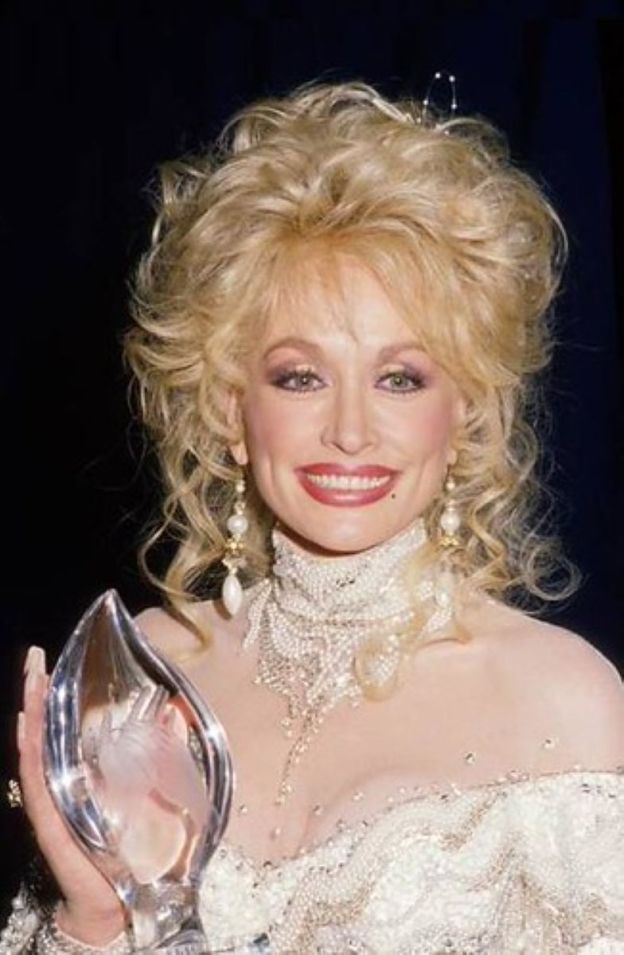
FEATURE image: Country music superstar Dolly Parton beams at the 14th annual People’s Choice Awards at 20th Century Fox Studios in Los Angeles on March 13, 1988, proudly holding the crystal flame trophy she won for Favorite Female All‑Around Entertainer. Dressed in her signature “more is more” glamour, Parton wears a custom off‑the‑shoulder white gown lavishly adorned with hand‑sewn beads, pearls, and Swarovski crystals. She completes the look with a dramatic pearl‑and‑crystal statement choker, pearl drop earrings, and her iconic feather‑teased platinum hair — a moment of pure Dolly radiance. PHOTO: “Dolly Parton 1988” by Alejo Castillo is licensed under CC BY-SA 2.0.

Country music legend Dolly Parton, who rose from Appalachian poverty to become one of the most beloved cultural figures of the past century, died on August 25, 2026, at age 80 after a brief and courageous battle with cancer. Her passing marks the end of a seven‑decade career that added soulfulness and humanity to American music, film, philanthropy, and popular culture.

Parton sold more than 100 million records worldwide, powered by era‑defining hits like Jolene, 9 to 5, and I Will Always Love You. She built a global fan base on the strength of her songwriting brilliance, crystalline voice, and unmistakable persona—equal parts wit, warmth, and steel. Beyond music, she became a formidable business force, launching Dollywood, starring in hit films, and transforming childhood literacy through her Imagination Library, which has gifted hundreds of millions of books to children around the world.

Released as a country single on March 11, 1974, Dolly Parton’s original acoustic recording of I Will Always Love You reached no. 1 on the Billboard Hot Country Songs chart on June 8, 1974. She had written both “I Will Always Love You” and Jolene on the same afternoon in 1973—a burst of creativity that produced two of her most enduring songs.

Her catalog remains one of the most influential in American songwriting. Released in 1974, “I Will Always Love You” topped the country charts and quickly became one of her signature achievements. Parton wrote it as a farewell to her mentor and longtime duet partner Porter Wagoner, crafting a song of honesty and dignity rather than heartbreak. Its emotional clarity made it a classic. Elvis Presley hoped to record it, but his manager, Colonel Tom Parker, demanded half the publishing rights—an ultimatum Parton refused, protecting a song she often described as one of her “children.” That decision proved prescient: the track generated millions in royalties and later became a global phenomenon when Whitney Houston’s 1992 cover spent 14 weeks at no. 1 on the Billboard Hot 100.

In 1980 Dolly Parton was 34 and Dabney Coleman 48 when 9 to 5 hit theaters. In the film, Coleman’s character—Franklin Hart Jr., the office’s chauvinistic boss—has just been confronted by Parton’s Doralee Rhodes after she discovers he’s been spreading rumors that they’re sleeping together. Furious that the entire office now treats her like a “dime store floozy,” Doralee calls him out. Hart tries to smooth it over, steps in close, and grabs her by the waist, telling her, “Now let’s don’t get excited,” as he minimizes his behavior. Doralee shoves him off, calls him “scummy,” and warns she has a gun in her purse. As Hart nervously backpedals—“All right, now wait, let’s just sit down and—” —Doralee cuts him off and delivers her iconic threat.

Parton’s film career produced its own cultural landmarks. In 9 to 5 (1980), she delivered one of the decade’s most memorable confrontations as Doralee Rhodes, standing up to her predatory boss Franklin Hart Jr. The film became the first female‑driven movie to cross the $100 million mark, cementing Parton as a Hollywood force and expanding her reach far beyond country music.

Written and produced by the Bee Gees, “Islands in the Stream” became one of the defining pop crossovers of the 1980s, topping the charts for two weeks in October 1983 and turning a chance collaboration into a global phenomenon. Before recording it, Kenny Rogers and Dolly Parton barely knew each other.

Her collaborative instincts also shaped pop history. In 1983, she joined Kenny Rogers for “Islands in the Stream,” a Bee Gees‑penned duet originally intended for Diana Ross or Marvin Gaye. Rogers was already a crossover titan, but Parton’s presence electrified the track. Her bright, buoyant delivery transformed a solemn love ballad into a breezy, optimistic anthem. The chemistry between the two singers felt effortless, helping the song become one of the decade’s defining pop‑country crossovers.

Dolly Parton’s death leaves a void that stretches far beyond Nashville. She was a songwriter of staggering range, a performer of rare charisma, a philanthropist who changed lives at scale, and a cultural figure whose influence touched generations. Her legacy will endure in the songs that shaped American life, in the millions of children who learned to read because she cared, and in the joy she carried into every room, every stage, every story. She will be missed—deeply, widely, and for a very long time.
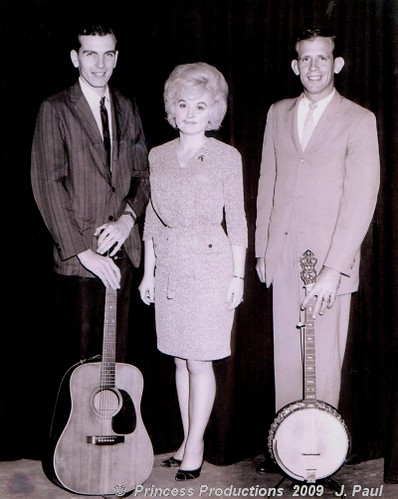
Larry Mathis, Dolly Parton, and Bud Brewster perform together as The Pick’n Grin Bluegrass Band in an early‑1960s promotional studio shoot for Cas Walker’s Farm and Home Hour in Knoxville, Tennessee. The image captures Parton at the very dawn of her musical career, years before she became a beloved American icon. Walker, a grocery magnate and media personality, gave the teenage Parton one of her first paid radio and television jobs, pairing her with seasoned local musicians like Mathis and Brewster. Those formative broadcasts helped her build stage confidence, refine her Appalachian bluegrass‑inflected vocal style, and gain the early exposure that set her on the path toward Nashville stardom. PHOTO: “Larry Mathis – Dolly Parton – Bud Brewster” by PRINCESS THEATER – Raising the Curtain is licensed under CC BY 2.0.

The Killers at 80 and Universal’s Postwar Reinvention: When Burt Lancaster and Ava Gardner Lit Up a Changing Hollywood.

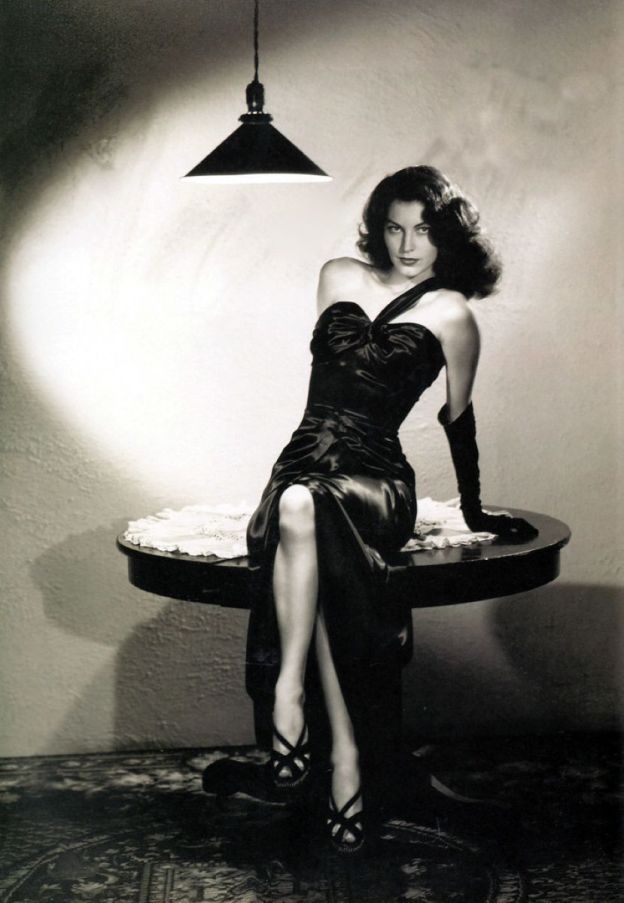
FEATURE: Twenty-three-year-old Ava Gardner was a noir icon in the making when, in 1946, she sat beneath a hard cone of light, her satin gown, long gloves, and crisp shadows distilled into pure mid-century glamour. Cross‑legged on the polished table, she projects cool, controlled noir magnetism—elegance with an undercurrent of danger.  Captured by veteran Universal studio portrait photographer Ed Esterbrook, this iconic image served as the primary promotional portrait for Robert Siodmak’s 1946 masterpiece, The Killers. Distributed globally across newspapers, movie magazines, lobby cards, and posters, it introduced Gardner to the public as Hollywood’s definitive femme fatale and launched her into overnight stardom. On the Universal film sets, cinematographer Elwood Bredell shaped the movie’s high-contrast lighting, carving sharp, expressionistic shadows while giving Gardner’s skin a luminous, dangerous sheen. Bringing this lethal on-screen look to life was the actress in a famous, custom-made asymmetrical black satin gown crafted by Universal’s legendary chief costume designer, Vera West. Together, all these elements froze a moment in time that remains one of the most recognizable and enduring symbols of cinematic post-war noir glamour. PHOTO: “Ava Gardner in The Killers, 1946” by thefoxling is licensed under CC BY-NC-SA 2.0.

A Film Noir Breakthrough

Eighty years ago today—August 28, 1946—Robert Siodmak’s The Killers exploded onto American movie screens, instantly becoming a film noir sensation. It launched Burt Lancaster into overnight stardom after producer Mark Hellinger couldn’t land his first choice, Wayne Morris, and it introduced Ava Gardner as Hollywood’s definitive femme fatale. Adapted from Ernest Hemingway’s 1927 existential and grim short story, the film follows a washed-up ex-boxer who waits calmly in a dark room for hitmen to kill him, utterly undone by Gardner’s double-crossing allure. Though Anthony Veiller received official screen credit, the script carried major, uncredited writing contributions from future directing icons Richard Brooks and John Huston, while Miklós Rózsa’s tense, four-note brass score sharpened its fatalistic mood.

The complete, dramatic original motion picture score for the 1946 film noir classic The Killers, composed by the legendary Miklós Rózsa. The soundtrack includes the famous, tense instrumental tracks that heightened the movie’s fatalistic mood, alongside the nightclub torch song performed with vocals by Ava Gardner herself.


Hollywood at Peak Attendance

Moviegoing in 1946 was at its absolute historic height, drawing a staggering 90 million weekly admissions. However, ticket prices had nearly doubled since before the war. This spike made post-war audiences far more selective, pushing major studios away from cheap “B-movies” and toward full-length, high-production features—frequently shot in vibrant Technicolor and paired as double features to ensure patrons got their money’s worth.

Universal Pictures tried to reinvent itself by merging with independents, including Hellinger’s banner, which produced The Killers for under $1 million and earned more than $3 million. Emboldened to meet the new demand, the studio chased prestige cinema, dropped its old B‑pictures and many longtime stars, and merged with International Pictures to form Universal‑International—but audiences mostly shrugged, and by decade’s end the company was losing money.

The Return to What Audiences Wanted

Veteran executive Edward Muhl, who had been with Universal since 1927, stepped up as general manager to steady the studio before officially becoming Head of Production in 1953. He steered the company back toward what mainstream American audiences reliably embraced: lucrative, low-budget comedy franchises like Ma and Pa Kettle (10 films, 1947–1957) and Francis the Talking Mule (7 films, 1950–1956), alongside a steady, highly profitable output of escapist Technicolor action-adventure films.

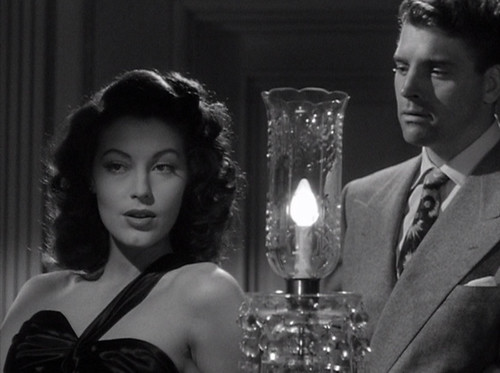
Film still from the production of The Killers (1946) captures the charged chemistry between Ava Gardner as Kitty Collins and Burt Lancaster, making his debut as Ole “The Swede” Andreson. Their first meeting is a textbook noir seduction: the doomed protagonist instantly, helplessly drawn into the orbit of the femme fatale who will seal his fate. At the center of the frame, cinematographer Elwood Bredell turns a crystal oil lamp into a diegetic light source—a glowing boundary between the two characters that casts soft illumination across Gardner’s face while dropping the rest of the room into deep, moody shadow. She’s wearing Vera West’s asymmetrical black satin gown—the same one from the famous publicity portrait—and on screen the heavy satin drinks the light, turning her into the ultimate femme fatale. PHOTO: “Ava Gardner y Burt Lancaster” by afevrier is licensed under CC BY-NC-SA 2.0.

This video short captures the electric first meeting between Ava Gardner and Burt Lancaster in the 1946 film noir classic The Killers, highlighting her sultry debut scene as Kitty Collins. The clip showcases Ava Gardner’s mesmerizing screen presence that audiences will remember as she delivers her smooth, fatalistic dialogue directly to the spellbound Swede. KITTY COLLINS: “How wonderful of you, I could never bear to see a man I really cared for being hurt.”

“She can’t sing, she can’t act, she can’t talk. She’s terrific!” – Louis B. Mayer on Ava Gardner.

Before The Killers, Ava Gardner was hopelessly stuck in Hollywood limbo. MGM head Louis B. Mayer had signed the 19-year-old North Carolina newcomer in 1941 purely based on her breathtaking physical photos. For five long years, she drifted through more than twenty films as an uncredited extra, barely noticed by the industry.

The Killers changed everything. Producer Mark Hellinger fought to cast the 23-year-old as Kitty Collins, freeing her from MGM’s rigid, squeaky-clean star-making machinery and handing her a role with genuine dramatic weight. Dressed in Vera West’s iconic, asymmetrical black satin gown, Gardner used her natural magnetism, smoldering gaze, and quiet confidence to completely command the visual frame. On the silver screen, she crafted a cold, calculating siren who seamlessly weaponized vulnerability to orchestrate a massive double-cross.

When the film became a box-office triumph in August 1946, audiences and critics were instantly transfixed. Gardner and Lancaster became overnight A-list sensations. Suddenly, she wasn’t just a glamorous face in the gossip columns—she was a legitimate actress widely praised for her dramatic depth and dangerous screen presence.

MGM moved fast to exploit her newly minted star power. Gone were the uncredited bit parts; instead, Gardner was vaulted into high-profile late-1940s productions like The Hucksters (1947) opposite Clark Gable, One Touch of Venus (1948), and The Bribe (1949). By the turn of the decade, MGM’s publicity office was completely overwhelmed, processing more than 3,000 fan photo requests per week for Hollywood’s ultimate new siren.

The original theatrical movie poster for The Killers (1946) pulses with classic film noir energy, dominated by bold red typography and the striking tagline: “TENSE! TAUT! TERRIFIC!” Public Domain.
The poster had a valid copyright notice, as seen on the bottom left corner. However, the copyright for the artwork was not renewed, as was required by American copyright law to extend/maintain protection for works published 1963 or earlier. In order to maintain copyright protection, the poster would have had to be renewed 28 years after publication, in either 1973 or 1974. Because it was not renewed, copyright lapsed at that time. Note that the poster art is a distinct work from the film it represents and had to be renewed separately.

SOURCE: The Universal Story, Clive Hirschhorn, Crown Publishers, Inc. New York, 1983, pp. 156-64.

This explanatory article may be periodically updated.

St. Augustine of Hippo (354–430): Intellectual Crisis, Spiritual Conversion, and the Formation of Christian Philosophy.

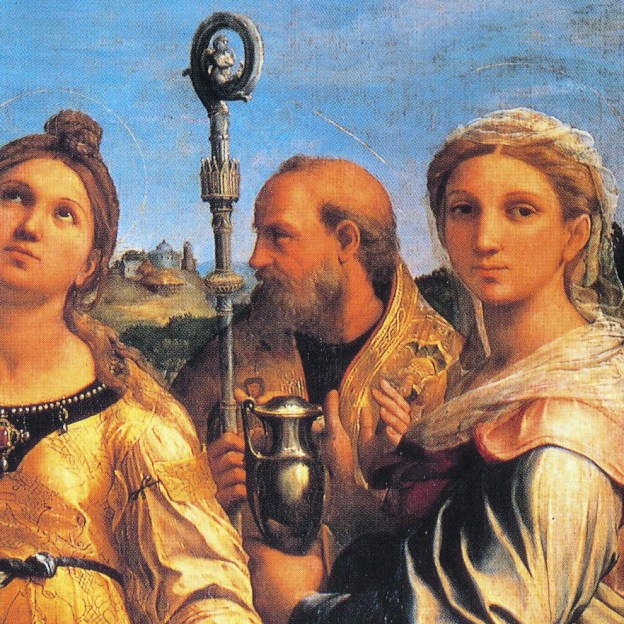
Feature image: Detail featuring St. Augustine of Hippo in Raphael’s St. Cecilia Altarpiece — a more than seven‑by‑five‑foot oil on canvas painted in 1513–14 for a chapel in S. Giovanni in Monte, Bologna. The ensemble gathers St. Cecilia, St. Paul, St. John the Evangelist, St. Mary Magdalene, and Augustine himself, each rendered with Raphael’s mature serenity and monumental poise. Today the altarpiece is housed in the National Gallery of Bologna (Pinacoteca Nazionale di Bologna), where Augustine’s figure remains one of its most arresting presences.

Ambrose, Monica, and the Origin of “When in Rome…”

The familiar maxim “When in Rome, do as the Romans do” is attributed to St. Ambrose, bishop of Milan. He offered this advice to St. Monica and her son St. Augustine while they were living in Milan. Monica discovered that Saturday was observed in Rome as a day of fasting—a practice not followed in Milan. Ambrose’s counsel was simple adaptability: “When I am here [in Milan] I do not fast on Saturday, when I am in Rome I do fast on Saturday.”

After Augustine and his successor Boethius, Europe entered an era of transition later termed the Dark Ages. While learning was heavily restricted, the intellectual landscape was preserved in monasteries, highlighted by the brilliant Irish philosopher John Scotus Eriugena (c. 815–877), who kept rigorous philosophical development alive during the Carolingian Renaissance.

Augustine’s Place in Christian Thought

Scholars consistently claim that after St. Paul, no Christian thinker has left a greater legacy than Augustine. He died on August 28, 430, a bishop watching his city of Hippo fall to invading Vandals as the Roman world collapsed around him. By the 7th century, the cities of the West were fractured, and learning survived mainly in monasteries, where the central intellectual task remained defining God’s existence, His nature, and His relationship to humanity.

Augustine’s Search: Manicheism, Skepticism, Neoplatonism

Before his conversion, Augustine explored three major worldviews:

  • Manicheism: A dualistic system dividing reality into good spirit and evil matter, rejecting the Bible and denying Christ’s true humanity.
  • Skepticism: A profound distrust of objective truth.
  • Neoplatonism: A lofty spiritual philosophy that lacked a personal Creator and treated the material world as an obstacle to the soul.

None satisfied Augustine’s intellect or moral hunger.

The Central Question: How Do God and Man Meet?

Christianity posed unique philosophical challenges: If creation is an act of God’s will, where and how does the Creator meet His creature? This relationship dominated Augustine’s thought. His battles with two major movements sharpened his theology:

  • Donatism: Which denied the objective validity of sacraments administered by flawed priests.
  • Pelagianism: Which denied original sin and man’s absolute need for grace.

From these conflicts emerged Augustine’s definitive Doctrines of Creation and Grace.

Augustine on Grace, Freedom, and the Human Condition

Augustine taught that fallen man cannot know God by his own power; the very desire to know God is a sign of operating grace. He insisted that one knows God fundamentally by faith—arguing that dynamic belief must precede total understanding (“I believe in order to understand”).

Against Pelagius, he insisted grace was necessary even before the Fall to draw humanity toward God. After the Fall, grace heals human nature and frees the will to pursue the true Good. From these foundations, he developed core Western ideas on self-knowledge, universals, the Trinity, sin, and political philosophy in The City of God. A distinctive feature of his episcopacy was establishing a monastic, communal life with his clergy to ensure spiritual and material stability.

Early Life: North Africa, Family, Education

Augustine was born in Thagaste (modern-day Algeria), likely of Berber descent, to Monica, a devout Christian, and Patricius, a pagan who converted on his deathbed in 371. Monica’s persistent prayer is considered the decisive force behind her husband’s and son’s conversions. Augustine loved Virgil, famously disliked Greek, and trained in rhetoric at Carthage. He lived with an unnamed female companion for years and shared a deep, lifelong bond with their natural son, Adeodatus.

Manichean Years and Intellectual Crisis

As a young man, Augustine embraced Manichean dualism, which treated matter as evil and uncreated—contradicting the Christian belief in a good material creation and the Incarnation. Traveling to Rome and Milan (384), he abandoned Manicheism amid an intellectual crisis.

Ambrose, Milan, and Conversion

In Milan, he encountered St. Ambrose, whose sophisticated preaching demonstrated the harmony of faith and reason, offering Augustine an escape from skepticism. Augustine was baptized at age 32 at the Easter Vigil on April 24, 387, alongside his son Adeodatus and his friend Alypius.

Augustine withdrew to Cassiciacum to write, but tragedy struck when Adeodatus died in 390. Returning to Africa, Augustine was ordained a priest by Bishop Valerius of Hippo, became auxiliary bishop in 395, and soon succeeded him—spending 35 years preaching, governing, and writing works that shaped Western civilization.

Death and the Vandal Invasion

Augustine died in 430 as the Vandals sacked Hippo, spending his final days praying the penitential psalms amidst the physical collapse of his world.

Augustine’s Legacy and Pope Leo XIV

On May 8, 2025, Chicago-born Cardinal Robert Francis Prevost—a dedicated White Sox fan and an Augustinian friar—was elected Pope Leo XIV, becoming the 267th pope and the first-ever pontiff from the United States. His spiritual lineage traces directly back to the monastic rules of St. Augustine of Hippo, whose life and thought continue to shape Christian pastoral life and theology.

see- https://dacb.org/stories/tunisia/adeodatus/ – retrieved August 28, 2025. The Saints: A Concise Biographical Dictionary, edited by John Coulson, Guild Press, New York, 1957. Medieval Thought, Gordon Leff, Humanities Press, Highland, New Jersey, 1958.

This explanatory article may be periodically updated.

Saint Bernard of Clairvaux at Vézelay: Preaching the Second Crusade, 1146.

FEATURE IMAGE: The monument inside Vézelay Abbey features a striking statue of Saint Bernard of Clairvaux sculpted from fine French limestone by Honoré Jean Aristide Husson (1803–1864). Depicted in traditional monastic robes, the influential Cistercian monk and reformer triumphantly raises a large Latin cross in his right hand while holding an abbot’s crozier in his left, a powerful posture that directly signifies his historical role as a passionate orator and preacher rallying the faithful. The landmark monument was completed and installed in 1846, commissioned to commemorate exactly 700 years since Bernard famously preached the launch of the Second Crusade on Easter Sunday, March 31, 1146. This installation coincided with a critical period for Vézelay Abbey, which was in a severe state of decay until the French government launched a massive restoration project headed by the famous architect Eugène Viollet-le-Duc. Husson’s sculpture was an integral part of that grand, 19th-century revival designed to honor the abbey’s illustrious medieval legacy. Directly below the main statue, a finely carved stone relief panel depicts the historic outdoor assembly where the crusade was declared. The figures shown enthroned in the relief represent the French monarchy, specifically King Louis VII and his queen consort, Eleanor of Aquitaine. Because the crowd gathered to hear Bernard was far too vast to fit inside the abbey walls, the event was forced to move to an open field just outside the abbey. His sermon proved so profoundly moving that the inspired crowd immediately began shouting “Crosses! Crosses!” and eagerly tearing up their own clothing to fashion cloth crosses to stitch onto their shoulders. September 1993. Author’s photograph.

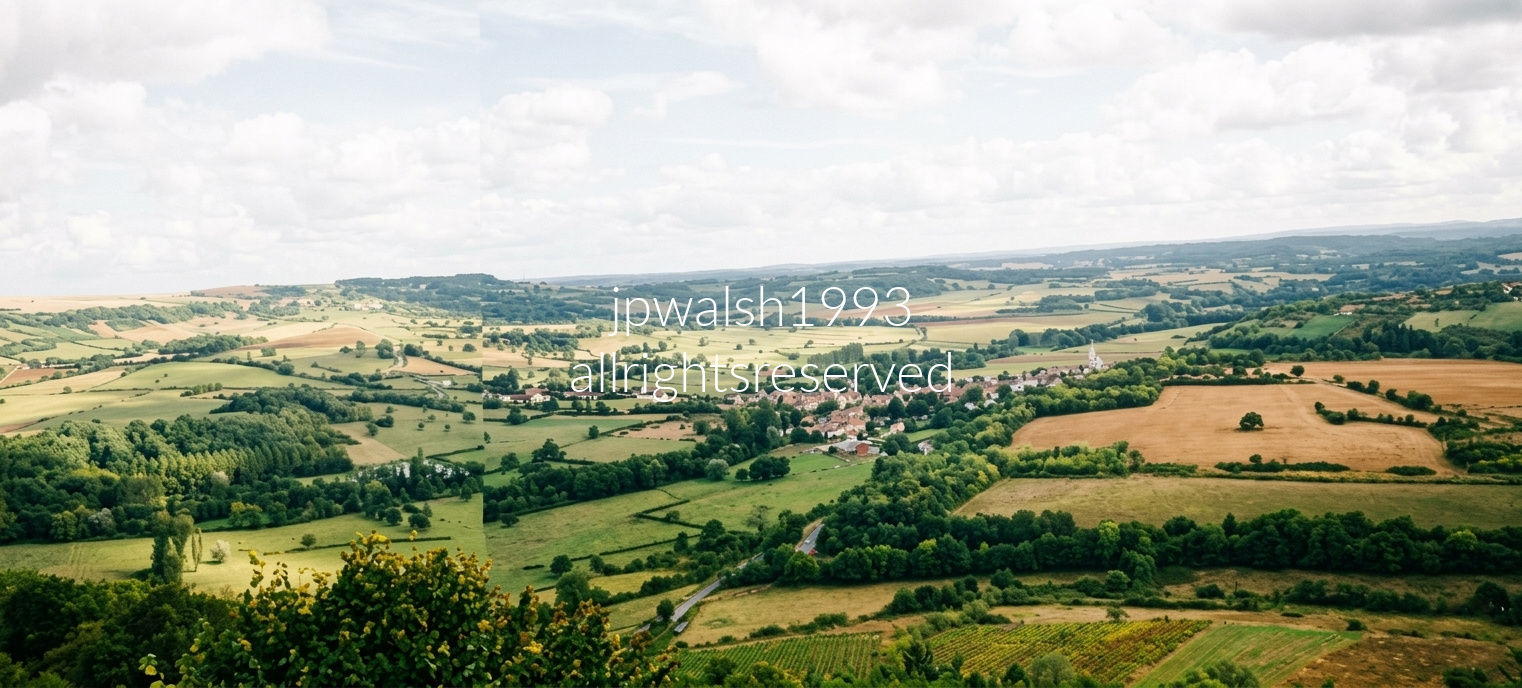
Burgundy landscape. September 1993. Author’s photograph.

A wide panorama of the Burgundy countryside reveals a landscape shifting seamlessly between plateaus, low ridges, and broad depressions, the very geology that produces the south‑ and east‑facing slopes essential to the region’s viticulture. Flat, fertile basins cut between the rolling hills, arranged in the traditional patchwork of small fields bordered by dense hedgerows and tree lines. A compact village sits naturally in the folds of a low valley, echoing the historic pattern of settlements clustering along gentle contours near water and travel routes. Higher ridges carry thick stands of deciduous and coniferous forest, breaking the farmland into measured intervals and acting as natural windbreaks. It was in this terrain that St. Bernard preached the Second Crusade in 1146, rallying the vast crowd gathered on the open meadow outside Vézelay.

Bernard’s Voice & the Call to Arms

A contemporary witness wrote that Bernard’s voice “rang out across the meadow like a celestial organ,” and when he finished, the crowd surged forward to enlist en masse. History recalls that the Second Crusade they joined would collapse into a disastrous sequence of defeats for Christendom in the East.

Early Life & Vocation

Born into a wealthy Burgundian family, Bernard was intelligent, intense, and strikingly handsome in appearance. His decision to become a monk was unusual enough; choosing Cîteaux, a new and absolutely impoverished monastery founded in 1098, horrified his relatives. Bernard’s choice presaged, a century early, the radical poverty later embraced by St. Francis: a literal return to the gospel and to St. Benedict’s rule, even as Cîteaux struggled to attract recruits.

The Cistercian Surge

In 1113, Bernard’s charisma famously drew thirty of Burgundy’s finest young men into Cîteaux, transforming the monastery overnight. Historian Christopher Holdsworth later wrote that “Bernard’s first and greatest miracle was himself.” Under Abbot Stephen Harding, Cîteaux’s English co‑founder, Bernard and the new monks began founding daughter houses. Their example ignited a movement so strong that the 12th century became the “Cistercian century.”

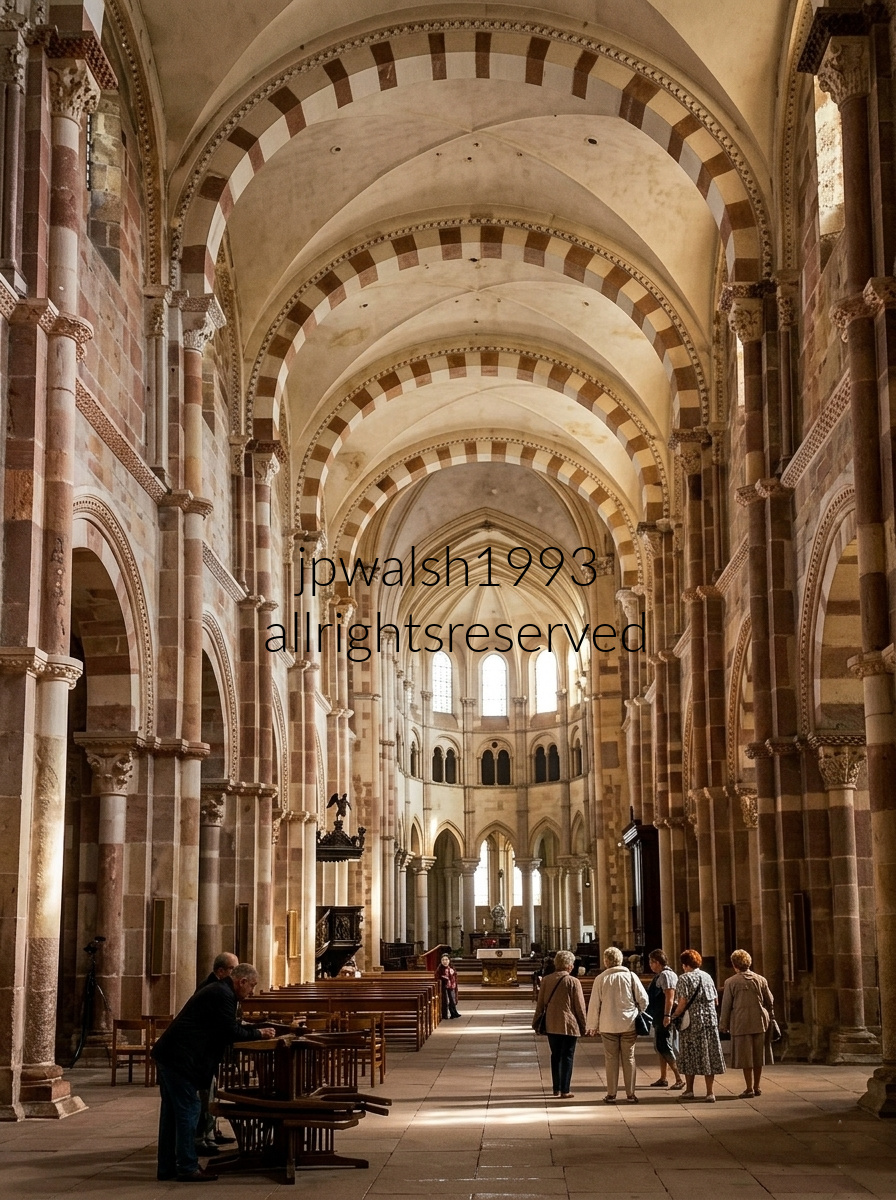
Interior nave of Vézelay Abbey. September 1993. Author’s photograph.

The interior nave of Vézelay Abbey (Basilica of Sainte‑Marie‑Madeleine) in Burgundy presents a Romanesque masterpiece moving confidently toward early Gothic. The most commanding feature is the series of semicircular arches (arcs doubleaux) that span the nave, each built from alternating light and dark stone voussoirs that create a striking banded pattern and echo a revived Roman design vocabulary.

Clairvaux & Opinionated Leadership

With twelve companions, Bernard founded Clairvaux, the “Valley of Light.” Life there was harsh, marked by privation and illness, but Bernard’s sharing in all the foundation’s suffering sharpened his authority. As abbot, he became a sought‑after voice on the political and ecclesiastical crises of his day. His wit was cutting, his opinions unfiltered, and his influence immense.

Reform & Conflict

Bernard championed the Hildebrand reforms of Pope Gregory VII, targeting simony, enforcing clerical celibacy, and resisting secular control of church appointments. He pushed for a purified clergy and a Church independent of royal interference. The 12th century’s chronic schisms—among popes, kings, princes, and bishops—made reform urgent. Bernard helped secure unity at the Second Lateran Council (1139), where the anti‑pope’s adherents were finally condemned.

Bernard clashed with the wealthy monks of Cluny, though he remained friendly with their abbot, and dismissed Peter Abelard as a marketplace intellectual.

West façade of Vézelay Abbey. September 1993. Author’s photograph.

The west façade of Vézelay Abbey evolved over several centuries, merging Romanesque engineering, Gothic heightening, and 19th‑century restoration into a single composite front. While the abbey’s celebrated internal narthex tympanum dates to the 1140s, the exterior tympanum above the main entrance is a 19th‑century reconstruction. The original Romanesque Last Judgment—one of Vézelay’s masterpieces—was mutilated and destroyed by revolutionaries in 1793. The current tympanum was carved by Michel‑Pascal under the direction of Eugène Viollet‑le‑Duc, whose restoration campaign reshaped the façade’s sculptural program and stabilized its structural envelope. The south tower began around 1150 in the Romanesque style, then rose higher through 13th‑ and 14th‑century Gothic phases. A matching north tower was planned but never built, leaving the façade asymmetrical. The main stone portals and doorways were constructed between 1140 and 1150 as part of a major western porch expansion designed to handle the heavy influx of medieval pilgrims traveling to Vézelay.

The Second Crusade & Reputation

In 1142, the pope ordered Bernard to preach the Second Crusade, a duty he accepted but which later rebounded against him when the campaign failed catastrophically. The stain on his reputation lingered into his final years.

Death, Canonization & Legacy

Bernard died on August 20, 1153, now his feast day. He was canonized in 1174 and named a Doctor of the Church in 1830.

After his death, Vézelay remained a stage for major political drama. In 1166, the exiled Archbishop Thomas Becket used Vézelay to threaten King Henry II with excommunication. In 1190, Richard the Lionheart and King Philippe Auguste met there and spent three months at the abbey before departing on the Third Crusade.

This explanatory article may be periodically updated.

Frank Beard, Rhythmic Anchor of ZZ Top Since 1969, Dead at 77; The Eliminator Trilogy Still Defines MTV Royalty.

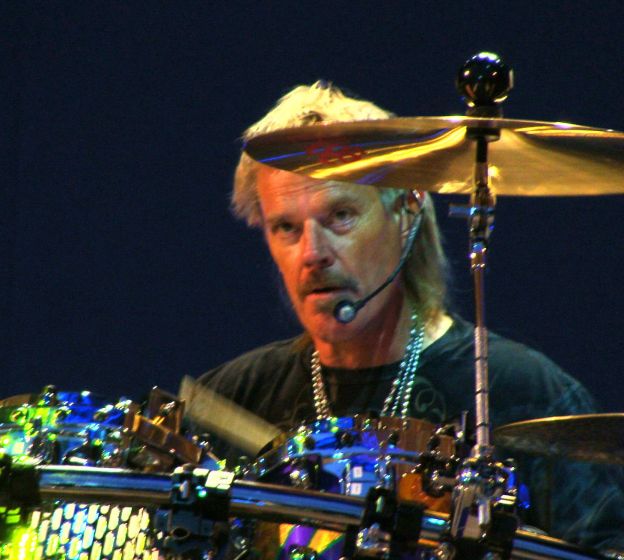
Feature Image: Frank Beard ZZ Top BBK Live 2008. PHOTO: “Frank Beard ZZ Top BBK Live 2008” by Alberto Cabello from Vitoria Gasteiz is licensed under CC BY 2.0.

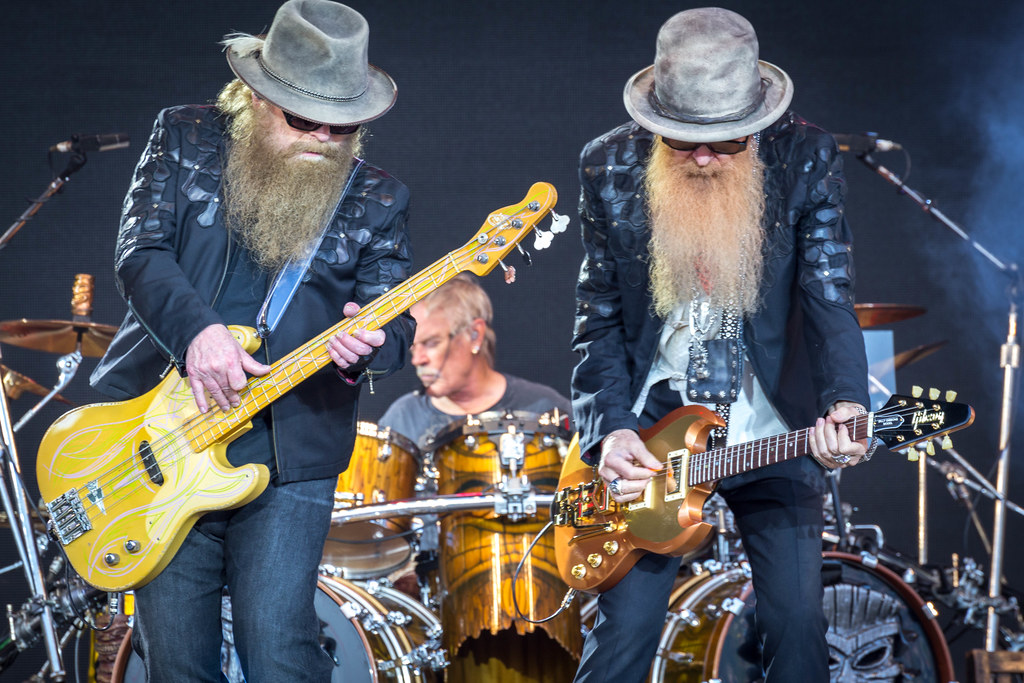
ZZ Top bandmates Dusty Hill (left) and Billy Gibbons (right) lock into a signature groove downstage while drummer Frank Beard keeps time in the background during a live performance. PHOTO: “ZZ Top” by beanmunster is licensed under CC BY 2.0.

Condolences & Context

First, sending sincere condolences on the passing of Frank Beard. Moments like this make the band’s cultural peaks hit even harder. He truly was the rock-solid backbone of that Little Ol’ Band from Texas.

Frank Beard’s Passing

Frank Beard—ZZ Top’s precision timekeeper and long‑running rhythmic anchor—has passed on, leaving Billy Gibbons as the last surviving member of the classic three‑man lineup formed in Houston in 1969. Beard died on Monday, August 17, 2026, at 77, according to a statement from the band’s publicist and Gibbons. He passed peacefully in hospice care at his ranch in Richmond, Texas, surrounded by family.

A young visitor admires a beautifully restored 1930s Ford Model A street rod on display at an indoor car show, showcasing its pristine candy-apple red paint job and custom leather-bound rear travel trunk. PHOTO: “ZZ Top” by Matthew Kenwrick is licensed under CC BY-NC-ND 2.0.

The Eliminator Trilogy

These three videos form what MTV fans celebrate as The Eliminator Trilogy: “Gimme All Your Lovin’,” “Sharp Dressed Man,” and “Legs.” Directed by Tim Newman, they didn’t just promote singles—they built a highly stylized mythology that transformed a gritty 1970s blues-rock outfit into full-blown 1980s MTV royalty.

Each video consistently deploys the same four “magic tools of transformation”:

  • The Eliminator Coupe: Billy Gibbons’ custom, candy-apple red 1933 Ford—the band’s ultimate chariot of freedom.
  • The Silver “Z” Keychain: The literal “key to the kingdom,” handed off to grant the protagonist immediate confidence and power.
  • The Band as Blues Prophets: Billy, Dusty, and Frank popping up randomly in the background like omniscient, instrument-playing guardians.
  • The Eliminator Girls: Jeana Tomasino, Kymberly Herrin, and Danièle Arnaud acting as glamorous fairy godmothers who rescue ordinary people from oppressive lives.

“Gimme All Your Lovin’” (May 1983)

Running a tight 4:37, “Gimme All Your Lovin’” dropped the hammer on Eliminator the moment the album hit shelves on March 23, 1983. Hill, Beard, and Gibbons fused synthesizers and electronic drums into their signature Texas boogie, rebuilding classic blues-rock for the neon age without losing an ounce of their trademark grit.

The single hit radio airwaves in April 1983 and became the band’s very first Top 40 track by July. The music video officially premiered on MTV on May 21, 1983. In it, actor Peter Tramm plays a bored gas station grease monkey whose luck instantly turns when the Eliminator Girls roll up and whisk him away on a midnight escape. Filmed at a dusty filling station in the Palmdale–Littlerock flats of California, the setting perfectly captures an iconic, “middle-of-nowhere” desert vibe.

The track cemented ZZ Top—and that cherry-red ’33 Ford—as MTV fixtures. Eliminator peaked at No. 9, sold 10 million copies, and parked itself on the Billboard 200 charts until 1987.

“Sharp Dressed Man” (November 1983)

The trilogy’s second single was a major hit, sitting on the Billboard Hot 100 for nearly four months and peaking at No. 22. It propelled the band to unprecedented rock superstardom, keeping the Eliminator album on the charts for a staggering three and a half years. Decades later, the track surged again in March 2020, hitting No. 14 on Hot Rock Songs and No. 8 on Mainstream Rock Songs due to a wave of streaming interest.

For ZZ Top, being “sharp-dressed” was entirely subjective. While the track cites a fashionable silk suit, bass player Dusty Hill beautifully summarized the song’s timeless ethos to Spin magazine in 1985:

“Sharp-dressed depends on who you are. If you’re on a motorcycle, really sharp leather is great. If you’re a punk rocker, you can get sharp that way… If you feel sharp, you be sharp.”

“Legs” (May 1984)

Released in May 1984, “Legs” tells a highly stylized empowerment story. Wendy Frazier plays a shy, timid young woman working at a small-town diner who finds her independence after a dramatic makeover from the Eliminator Girls.

Shot in Santa Clarita, California, the video deliberately contrasts her transformation with exaggerated, often cruel behavior from the townspeople who belittle her. This stark contrast sharpens the theme of self-agency beneath the song’s surface-level flash.

Billy, Dusty, and Frank appear throughout alongside their spinning sheepskin fur guitars. Amid the town’s rough-edged supporting cast, actor David Wakefield plays a kind short-order cook, serving as an emotional anchor for the main character’s journey. The production went on to win MTV’s Best Group Video that year.

Legacy of the Trilogy

Before these videos hit the airwaves, ZZ Top was a critically respected but visually modest blues-rock band. Tim Newman’s cinematic storytelling—combined with the hot rod, fur-lined guitars, and heavy visual swagger—turned the trilogy into definitive pop art. It perfectly mirrored the escapist, theatrical culture of the 1980s and permanently embedded Frank Beard’s driving, electronic-infused backbeat directly into the decade’s visual fabric.

Frank Beard (1949-2026), ZZ Top drummer. PHOTO: “ZZ Top Motorcycle – Frank Beard” by jambox998 is licensed under CC BY-NC-ND 2.0.