Category Archives: Popular Culture

Host of the Highway: The Rise and Fade of Howard Johnson’s, America’s Orange‑Roofed Icon (1925-2022).

FEATURE Image: Howard Johnson’s Motor Lodge and Restaurant Myrtle Beach, SC. Howard Johnson’s reshaped the American roadside, turning a patchwork of unpredictable stops into a network of bright, dependable landmarks. Its orange roofs, neon signs, and motor lodges became part of the visual grammar of mid‑century travel, signaling consistency in an era when the open road beckoned for families. More than a brand, it became a kind of national shorthand — a promise that wherever you were headed, a familiar meal and a safe place to rest weren’t far away. PHOTO: “Howard Johnson’s Motor Lodge and Restaurant Myrtle Beach,SC” by romleys is licensed under CC BY-NC-SA 2.0.

By the 1950s, Howard Johnson’s had become the bright, orange roofed companion of the American highway. Aggressive franchising in the ’30s and ’40s grew into more than 400 restaurants, and by the late ’60s and early ’70s, HoJo’s was the nation’s largest restaurant chain, topping 1,000 locations.

Its story began when Howard Johnson (1897–1972) inherited his father’s debt burdened shop. At twenty eight, he liquidated it and opened a small drugstore and soda fountain in Quincy, Massachusetts. From those 28 flavors came a brand that shaped mid century travel.

Founded in 1925, Howard Johnson’s didn’t just sell ice cream — it set the benchmark. Its rich 16%‑butterfat formula began with three simple flavors, then exploded into the famous 28 that defined mid‑century indulgence. From that creamy foundation, the company built a nationwide franchise empire, planting its bold orange roofs along America’s highways. For families on the road, a HoJo’s stop became a promise: dependable comfort food, a familiar welcome, and a scoop of the ice cream that made the brand a household name. PHOTO: Symbols – Daytime, Man and Boy with Dog – Howard Johnson’s, Art Deco, Free Standing, Neon Sign, Telephone Booth on Boylston Street Sidewalk off Copley Square” by MIT-Libraries is licensed under CC BY-NC 2.0.

Howard Deering Johnson (1897-1972) in 1955. Howard Johnson was an American entrepreneur who transformed his Massachusetts soda fountain into a massive restaurant and motel empire characterized by its iconic orange roofs. By pioneering the “28 flavors” of ice cream in the late 1920s and early 1930s featuring flavors such as Orange Pineapple and Burgundy Cherry, Howard Johnson established one of the nation’s first franchising models and became a central figure in 20th-century American roadside culture. PHOTO: “Howard Deering Johnson” by OptimistMover is licensed under CC BY-SA 4.0.

In the 1974 satirical Western Blazing Saddles, the town of Rock Ridge is populated by citizens who almost all share the last name “Johnson,” including a character specifically named Howard Johnson played by John Hillerman. The film parodies the famous restaurant chain by featuring a “Howard Johnson’s Ice Cream Parlor” that comically advertises only one flavor and poking fun at the real chain’s legendary “28 flavors.” (8) Johnson is Right – YouTube (https://www.youtube.com/watch?v=V8oaQhTYx2Q) – retrieved May 2, 2026.

From crispy, golden-fried clams to creamy peppermint stick ice cream, HJ’s “family-friendly” dining experience set standards in brand consistency across mid-20th century America. PHOTO: “1965 Howard Johnsons Advertisement Life Magazine January 8 1965” by SenseiAlan is licensed under CC BY 2.0.

The dining room of Howard Johnson’s Motor Lodge and Restaurant in Middletown, New Jersey, glows with that classic Howard Johnson’s warmth — tufted booths, patterned curtains, and soft recessed lighting wrapping the space in mid‑century comfort. The wood dividers, carpeted floors, and pops of greenery give it the feel of a roadside refuge where families settled in for fried clams, creamed fricassee, ice cream, and a moment of personal refueling between miles. It’s a room that still carries the hum of long‑ago travelers and the promise of a familiar meal. Photo: “Howard Johnson’s Motor Lodge and Restaurant Middletown,NJ” by romleys is licensed under CC BY-NC-SA 2.0.

1965 Howard Johnson’s Restaurant Commercial Baked Haddock Au Gratin #hojos #howardjohnsons #retro – retrieved May 2, 2026.

By the mid 1950s, the company expanded into motor lodges, pairing familiar meals with modern roadside rooms. Known for its orange roofs, family friendly dining, and early innovations in frozen entrées, Howard Johnson’s became a symbol of consistency — even as travelers swapped stories of sometimes uneven service.

The Vibe: An incandescent orange roof, bright turquoise shutters, and the electric glow of the neon Pied Piper — a roadside beacon promising weary travelers a safe, familiar harbor. PHOTO: “Howard Johnson’s St. Petersburg, Florida” by 1950sUnlimited is licensed under CC BY-NC 2.0.

Howard Johnson’s Motor Lodge, 1971 – Portage, Indiana. With its wood‑paneled walls, blue bedspreads, and floral curtains Howard Johnson’s rooms created a cozy, mid‑century vibe. Two chairs, a small table, and a vintage TV completed the retro roadside‑stop motel scene. PHOTO: “Howard Johnson’s Motor Lodge, 1971 – Portage, Indiana” by Shook Photos is licensed under CC BY 2.0.

But the landscape changed. Through the 1970s and 1980s, the chain declined, its restaurants and frozen foods slowly disappearing. When the last location closed in March 2022, Howard Johnson’s quietly ended a century as the old “Host of the Highway.”

Howard Johnson’s Restaurant, Lynchburg, shared the fate of hundreds of other HoJo’s across the nation since the 1980’s. The last restaurant closed in March 2022. PHOTO: “Howard Johnson’s Restaurant, Lynchburg” by Retronaut is licensed under CC BY-NC-ND 2.0.

Jazz-Age WEDDING DRESS with high skirts and sleeveless blouses, was flapper style à la mode and believed risqué. On June 7, 1924, Noling-Anderson nuptials took place in the bride’s family home at 1035 Ridge Avenue in Evanston, Illinois. The house still stands today.

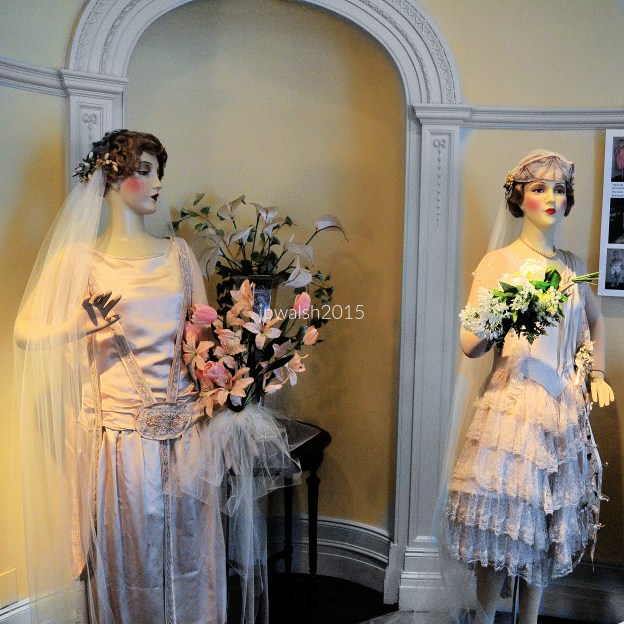
Feature Image: On Saturday, June 7, 1924, Ruth M. Anderson was married in this sleeveless wedding dress (left) to William Noling in Evanston, Illinois. The dress is now on display in the Charles Gates Dawes House in Evanston. Dawes was Vice President of the United States from 1925 to 1929 under President Calvin Coolidge. Author’s photograph (October 2015).

Wedding at the House of the Bride’s family

The Noling-Anderson wedding was held in the house of the bride and her parents, Isak and Jennie (née Johnson) Anderson, at 1035 Ridge Avenue in Evanston. Built in 1914, the house still stands as it did over 100 years ago.

The dress is made of silk satin in an egg shell color. It is accented by an oval medallion with bands also made of silk satin. The medallion is embroidered with faux pearl and other glass beads.

Noling-Anderson Bridal Party Dresses, 1924. Charles Gates Dawes House, Evanston, Illinois. Author’s photograph, October 2015. 7.44 mb DSC_0893 (1)

Thoroughly modern flapper style

While her wedding dress was very fashionable for the mid1920’s – sleeveless tops of all shapes and sizes were the rage in 1924 – it probably was not allowed in one of Evanston’s houses of worship. The fact that it was sleeveless and au courant would be deemed by many as risqué for showing too much bare skin inspired by a thoroughly modern flapper style. It was only in 1924, for instance, that the Methodist Episcopal General Conference first lifted its ban on going to the theater as well as dancing though dance music was the radio’s most popular programming.

The bridesmaid dress (right) was the height of women’s style in 1924 – a mainly straight, knee-length skirt gathered slightly or cut with front pleats. Short sleeve and sleeveless tops were the rage in 1924 reflected in Hollywood by the Mack Sennett girls who starred in movies where they pranced on the beach in a chorus line in not much more than bathing caps and short swim suits.

The fashionable bride and her court might have sported the latest style of facial make-up which is hinted at in the display– masklike with garish, even orange, lipstick and heavy red rouge on the cheeks. Popular fashion accessories from 1924 are also evident – pearls knotted at the neck and simple, though elegant, arm bracelets.

Father of the bride was an Evanston banker, local businessman, and Swedish immigrant

The bride’s father, Isak Anderson, was born in Sweden and came to the United States at 20 years old in 1890. In 1891 he married Jennie Johnson and they had Ruth and another child. Ruth’s father was a bank director and partner in a local tailoring business in downtown Evanston at 608 Davis that today is a noodle shop.  

They served “Prohibition highballs”

With Prohibition starting in 1920, guests at the wedding may have been served the latest popular highball whose recipe called for fruit juice and raw eggs. Their morning might have started with a bowl of Wheaties at breakfast, since the cereal of champions made its first appearance in 1924.

Ruth Anderson married William Noling in this house wearing that dress at 1035 Ridge Avenue in Evanston, Illinois, on June 7, 1924. Author’s photograph, May 2024 92% 7.81 mb

SOURCES: Dawes House, Evanston Illinois; The Swedish Element in Illinois: Survey of the Past Seven Decades, Ernst Wilhelm Olson, p. 586; American Chronicle, Lois Gordon & Alan Gordon, Yale University Press, New Haven & London,1999, pp. 230-238; Chicago: The Glamour Years (1919-1941), Thomas G. Aylesworth & Virginia Aylesworth, Gallery Books, NY, 1986, p.14.


Opened and in continuous operation since 1942, Leon’s in Milwaukee, Wisconsin, is still owned by the original family. The Drive-In served as inspiration for Arnold’s in the 1970’s popular TV sitcom “Happy Days.”

FEATURE image: Late afternoon at Leon’s Frozen Custard in Milwaukee, Wisconsin. June 2017. (4.53mb, DSC_0728). Author’s photograph.

Leon’s original sign. By victorgrigas – Own work, CC BY-SA 3.0.

Leon’s is a family-owned drive-in in Milwaukee, Wisconsin, that opened 83 years ago – in 1942. The building was remodeled in the early 50’s and is what is seen today. Leon’s was inspiration for the original Arnold’s Drive-In in the 1970’s ABC television sitcom, Happy Days, that was also set during the 1950’s in Milwaukee, Wisconsin.

The World Famous Leon’s.The World Famous Leon’s” by nixter is licensed under CC BY-NC 2.0.
Fonzi played by Henry Winkler was a new character for the ABC TV series. He had just 6 lines in the first episode of “Happy Days” whose debut broadcast was January 15, 1974. In the series, Fonzie’s full name was Arthur Fonzarelli and called that by Richie’s mom. The original family name of series’ creator Garry Marshall (1923-2016) was Masciarelli and changed before Garry was born by his father, a man of Italian descent. TV Guide #1189” by trainman74 is licensed under CC BY-NC 2.0.
Ordering at Leon’s.World Famous Leon’s Frozen Custard” by Thomas Hawk is licensed under CC BY-NC 2.0.

Leon’s is still owned and operated by the original family. The main focus of the business is, and always has been, to serve the freshest and finest frozen custard available anywhere. The business is open all year round and they have full soda fountain service, a sandwich menu, daily special flavors and take-out service.

Leon’s at night. “Leon’s” by joseph a is licensed under CC BY-NC-SA 2.0.
Late afternoon at Leon’s, Milwaukee, Wisconsin. June 2017. Leon’s was inspiration for Arnold’s on Happy Days. Author’s photograph.
Arnold’s was the name of the local Milwaukee drive-in hang out for most of the characters in Happy Days. Fair Use.

In 1973 Ron Howard was 19 years old when he signed to a seven-year contract to do Happy Days. Howard was balancing working on several projects at the same time: making a film (American Graffiti), going to college at USC, and planning for a directing career. Given a starring role as Richie Cunningham, Howard was paid $3,500 per episode (about $25,000 in 2025). Along with M*A*S*H, All in the Family, The Mary Tyler Moore Show, and The Bob Newhart Show, Happy Days was one of the most popular TV shows of the 1970’s. It aired for 11 seasons from January 15, 1974, to July 19, 1984 on the ABC network. There was a total of 255 half-hour episodes. Ron Howard starred as Richie Cunningham in the Love American Style episode in February 1972 on which the new TV series was based, but still had to audition for the part for the TV series. Cast again as Richie, at the first read-through for the first episode Howard reconnected with Anson Williams (“Potsie”) and Marion Ross (Richie’s mother) who were also in the Love American Style pilot. He also met Tom Bosley (“Richie’s dad”), Donny Most (“Ralph Malph”) and 28-year-old Yale School of Drama grad Henry Winkler (“Fonzie”) at that first read through.

SOURCES:

Ron Howard & Clint Howard , The Boys A Memoir of Hollywood and Family, William Morrow, 2021, pp. 275-277.

https://leonsfrozencustardmke.com/ – retrieved March 2, 2025.

https://happydays.fandom.com/wiki/Arnold%27s_Drive-In – retrieved March 20, 2025.