
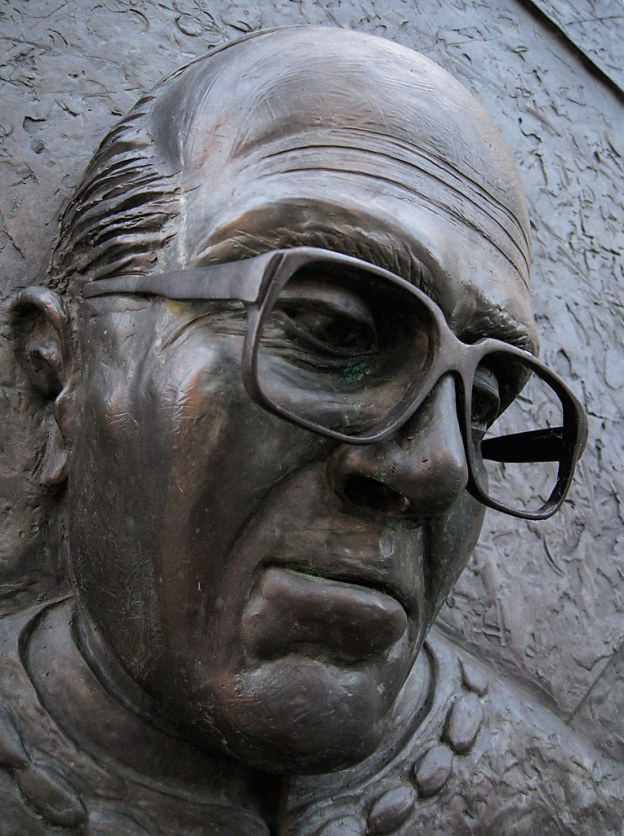
FEATURE image: Archbishop Derek Worlock, sculpture Liverpool. “Archbishop Derek Worlock, sculpture Liverpool” by mira66 is licensed under CC BY-NC-SA 2.0.
Derek Worlock: Archbishop of Liverpool
Derek Worlock (February 4, 1920 – February 6, 1996) was an English priest of the Roman Catholic Church who served as Archbishop of Liverpool. A leading figure in post‑war British Catholicism, he became known for his pastoral warmth, public presence, and commitment to unity among Christians.
A Ministry Shaped by Collaboration
Worlock devoted his episcopal life to fostering cooperation across Christian traditions. His partnership with Anglican Bishop of Liverpool David Sheppard became one of the most celebrated ecumenical friendships in modern Britain. Together they co‑authored Better Together and With Hope in our Hearts (both 1995), works that embodied their shared vision for a reconciled, outward‑facing Church. His episcopal motto, Caritas Christi eluceat—“For the Shining Light of Christ”—captured the spirit of his ministry.
Honours and Public Recognition
In 1994, Worlock received the Freedom of the City of Liverpool, a civic acknowledgment of his decades of service to the city. Two years later, in 1996, he was appointed a Companion of Honour, one of the United Kingdom’s most distinguished awards.
A Memorial on Hope Street
After his death in 1996, plans began for a public memorial. Commissioned in 2005 and funded through widespread public donations, the sculpture was created by British artist Stephen Broadbent (b. 1961). Placed at the midpoint of Liverpool’s Hope Street, the memorial stands symbolically between the city’s Anglican and Roman Catholic cathedrals—an architectural embodiment of the unity Worlock championed throughout his life.See it here: https://www.flickr.com/photos/newfolder/2535308455

David Sheppard and Derek Worlock memorial, Hope Street, Liverpool. The placement is deliberate: halfway between the two cathedrals, exactly where their work met with space between them for everyone. “DSCF0029” by geraldmurphyx is licensed under CC BY-ND 2.0.
A Shared Mission of Reconciliation
The statue commemorates the extraordinary partnership between Archbishop Derek Worlock and Bishop David Sheppard, two churchmen who refused to let centuries of division define Liverpool’s Christian life. At a time when Catholic–Anglican relations still could be frosty and suspicious, they pointed to a a different path of public friendship, joint action, and a united moral voice for their city.
Their collaboration was not symbolic but deeply practical. They issued joint pastoral letters, appeared together at civic events, and spoke with one voice during moments of crisis. In a city marked by economic hardship, sectarian memory, and social fragmentation, they insisted that Christian leadership must be shared leadership. Their partnership became a model for ecumenical cooperation across Britain.
Healing Historic Divisions
Worlock and Sheppard understood that Liverpool’s religious landscape had long been shaped by rivalry—Catholic and Anglican identities often hardened by class, migration, and political history. Their work aimed to soften those boundaries. They promoted joint prayer services, encouraged cooperation between parishes, and supported community initiatives that crossed denominational lines.
Their message was simple but radical: unity was not an optional ideal but a pastoral necessity. They believed that reconciliation between churches could help foster reconciliation within the city itself.
A Memorial to Unity
The statue’s purpose was to create a permanent reminder of this shared ministry. It honors not only two individual leaders but the ecumenical vision they embodied. Positioned on Liverpool’s Hope Street—linking the Anglican Cathedral at one end and the Catholic Cathedral at the other—the memorial stands as a physical metaphor for the bridge they built.
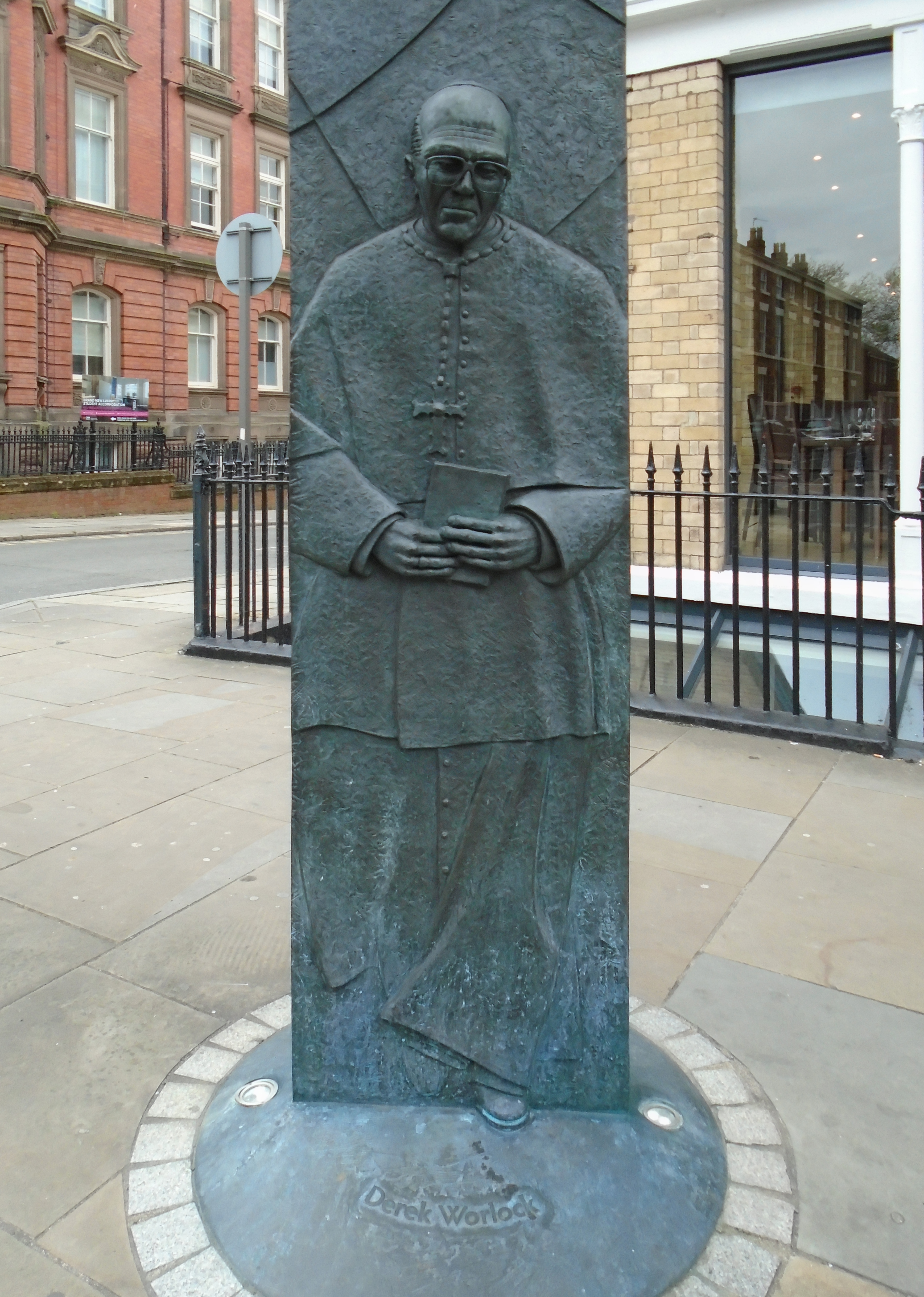
Above: Archbishop Derek Worlock London‑born Derek Worlock was ordained a Catholic priest in 1944 and began his ministry as curate at Our Lady of Victories, Kensington, then London’s wartime pro‑cathedral. For nearly two decades he served at the heart of English Catholic leadership as private secretary to three Archbishops of Westminster, a role that shaped his administrative skill and national profile. He later spent a year as Rector and Rural Dean of the Church of SS Mary and Michael—one of London’s historically largest parishes—before being appointed Bishop of Portsmouth, serving the English Channel region for eleven years. In 1976 he became Metropolitan Archbishop of Liverpool, the post that defined his public legacy. “File:Sheppard-Worlock Statue 2017-2.jpg” by Rodhullandemu is licensed under CC BY-SA 4.0.

Detail from the Sheppard-Worlock statue Liverpool. Anglican Bishop David Sheppard was Worlock’s closest ecumenical partner and the other half of Liverpool’s most influential Christian alliance. Before Derek Worlock’s appointment as Roman Catholic Archbishop of Liverpool in 1976, the Anglican archbishop of Liverpool, David Sheppard, was consulted over a meal together with Pope Paul VI’s Papal Nuncio in Britain, Archbishop Bruno Heim. Before he became one of Liverpool’s most respected church leaders, David Sheppard was a national sporting hero—a stylish right‑handed batsman whose cricketing career made him a household name across Britain. His cricketing fame gave him a public platform long before he entered the clergy, and he later used that visibility to speak on issues of poverty, racial justice, and urban renewal. Public Domain (Man vyi – Self-photographed. Own work, all rights released).

Coat of Arms, Most Rev. Derek Worlock, Metropolitan Archbishop of Liverpool. It contains Worlock’s motto: Caritas Christi eluceat (“For the Shining Light of Christ”). “Uk rc liverpool worlock” by EborArmorist is licensed under CC BY 3.0.
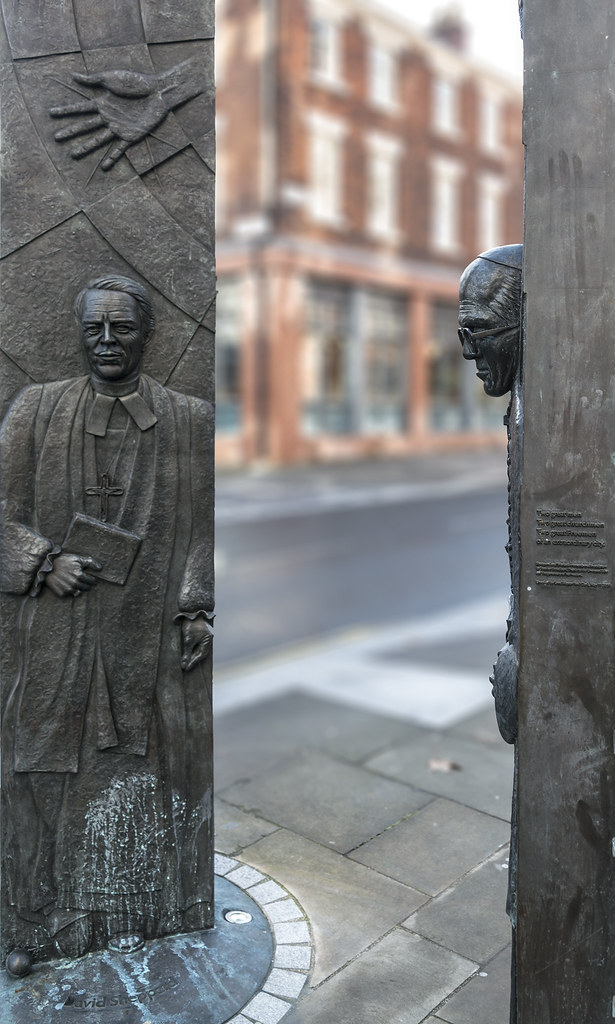
“5783 Sheppard Worlock Statue” by steeljam is licensed under CC BY-NC-ND 2.0.
Worlock’s Early Ecumenical Leadership
Archbishop Derek Worlock served as bishop and archbishop from 1965 to 1996—years that spanned the close of the Second Vatican Council and the unfolding of its new teaching on ecumenism. From the beginning of his episcopal ministry, he treated the Council’s call to Christian unity not as an abstract ideal but as a pastoral responsibility.
The Portsmouth Years: Learning to Live Together in Love
As Bishop of Portsmouth, Worlock was already experimenting with practical ways for Catholics and Anglicans to share life, sacraments, and community with greater charity. His most famous initiative, later nicknamed the “Portsmouth solution,” emerged in the early 1970s when the daughter of a local Anglican bishop wished to marry a Catholic.Worlock crafted a pastoral compromise that honored both traditions:
- The marriage rite and promises were celebrated first in the Catholic church, fulfilling canonical requirements.
- Later that same day, the couple’s marriage was celebrated again in the bride’s Anglican parish, with her father—the Anglican bishop—presiding.
This arrangement was bold for its time. It respected Catholic sacramental discipline while acknowledging the Anglican family’s pastoral and emotional needs. More importantly, it modeled the kind of mutual recognition, goodwill, and shared joy that Worlock believed should characterize Christian life.
A Foreshadowing of His Liverpool Partnership
The Portsmouth solution was not an isolated gesture but an early sign of the ecumenical instincts that would later define his partnership with David Sheppard in Liverpool. It showed Worlock’s willingness to take risks, to trust the good faith of other Christians, and to build unity through concrete acts rather than theoretical statements.

https://www.independent.co.uk/news/people/obituary-the-most-rev-derek-worlock-1318052.html – retrieved May 27, 2025. “Derek Worlocks Mitre” by James O’Hanlon is licensed under CC BY-NC-ND 2.0.
Bishop Worlock’s mitre, placed at his tomb, recalls a pivotal moment in his early episcopal ministry. In 1973, while serving as Bishop of Portsmouth, Worlock was preparing to attend the upcoming Roman Synod of Bishops. Asked to suggest a theme for the Synod’s work, he proposed “Evangelization”—a choice Pope Paul VI accepted.
Worlock’s proposal did more than set the agenda for a major global gathering. It highlighted two convictions that shaped his entire episcopate:
- that evangelization is rooted in the Church’s ancient mission shared by all the baptized, and
- that the spirit of Vatican II’s outreach to others—its ecumenical openness, its desire for dialogue, its pastoral warmth—must animate that mission.
In many ways, the theme anticipated the hallmark of Worlock’s later ministry as Archbishop of Liverpool: a commitment to opening outward, building bridges, and embodying the Gospel through collaboration with other Christians, especially his Anglican counterpart David Sheppard.
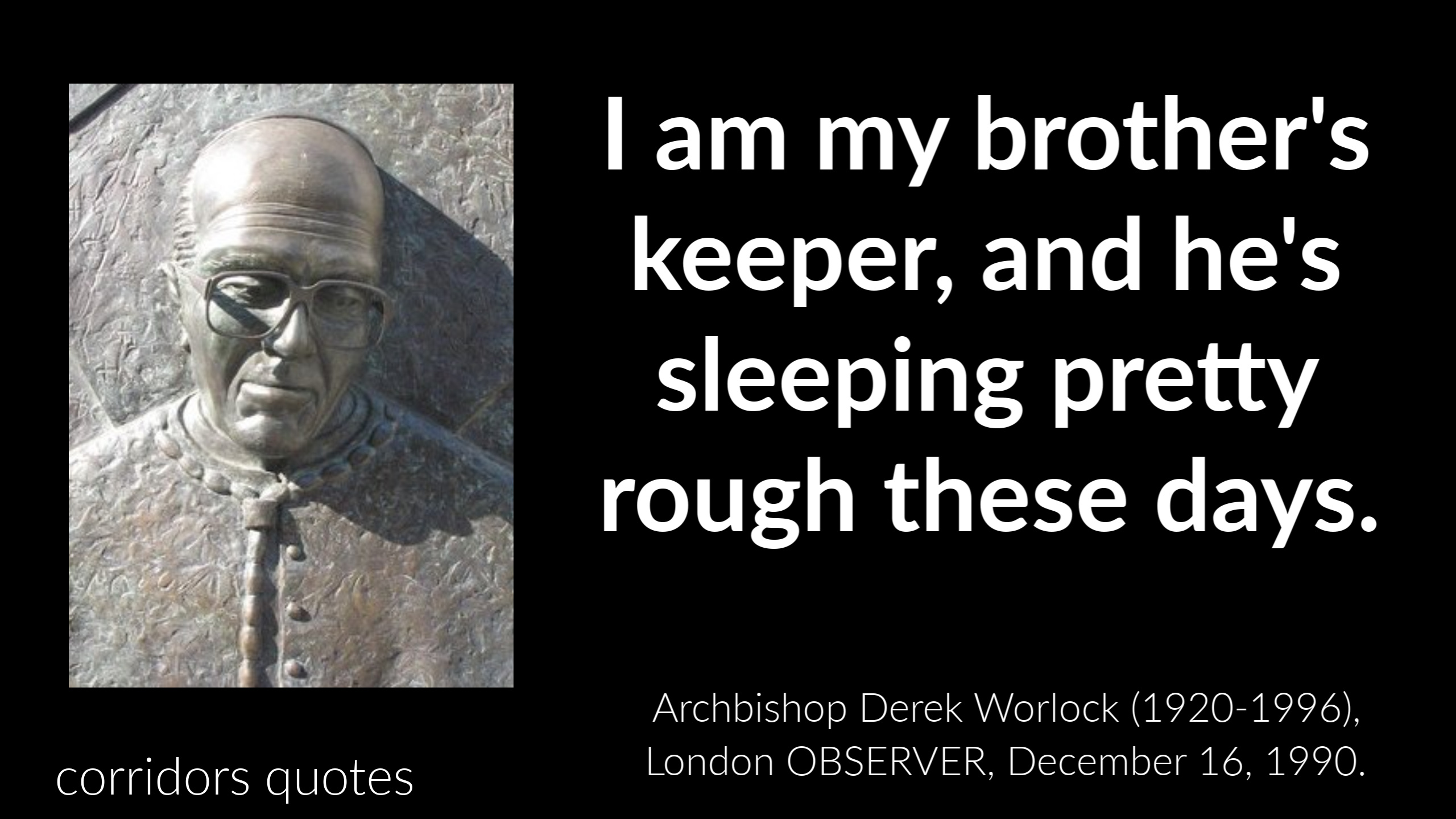
Archbishop Worlock’s mitre, resting at his tomb, evokes a churchman whose influence extended far beyond Liverpool. Over more than three decades as bishop and archbishop, he became a driving force within the episcopal conference, shaping how the Catholic Church in Britain engaged with the modern world.
He helped lead national initiatives on the media, the laity, and justice and peace, urging the Church to speak with clarity, courage, and compassion. His advocacy for the poor was especially memorable. When drawing attention to Britain’s growing homelessness crisis, he captured the moral urgency in a single, searing line: “I am my brother’s keeper, and he’s sleeping pretty rough these days.” London OBSERVER, December 16, 1990. (on the homeless).
This sentence distills the core of his ministry: the conviction that Christian leadership must be measured by its solidarity with the most vulnerable.

