John P. Walsh is an art historian, writer and photographer. He has an M.A. in Modern Art History, Theory and Criticism from The School of the Art Institute of Chicago and taught Modern Art History at Northwestern University.
Follow his work @ http://johnpwalshblog.com/
Pinterest @ http://www.pinterest.com/lang52tr/
Facebook @ https://www.facebook.com/john.p.walshiii.
On November 5, 1963, President John F. Kennedy reminded his fellow Americans of the detailed guarantees of individual liberty found in the Bill of Rights that “perhaps we take for granted but which we are guaranteed in the United States Constitution…” “President John F. Kennedy” by U.S. Embassy New Delhi is licensed under CC BY-ND 2.0.
In a letter dated September 24, 1963, Lawrence Speiser (1923-1991), Director of the Washington D.C. Office of the American Civil Liberties Union (ACLU) expressed his encouragement and support to the idea of the President of The United States addressing the nation in that auspicious time and place to commemorate that year’s U.S. Bill of Rights week. The Bill of Rights are the first ten amendments to the U.S. Constitution that were created on September 25, 1789 and ratified by the states on December 15, 1791. As the president listed in his remarks, they guarantee individual rights and liberties to every citizen including “freedom of speech, freedom of religion, freedom of the press, the right of assembly and petition, the right of trial by jury, the right to be secure in one’s own home, the protection of due process of law and private property and public trials, and many other things…” President Kennedy agreed to make a two-minute movie trailer for national showing on television and in theaters during “Bill of Rights Week” to be held that year from December 15 to 21.
In his letter, the ACLU Director in Washington, D.C. acknowledged the important relevance of the Bill of Rights in his day as it was when originally written and adopted. Just months since President Kennedy’s June 11, 1963 Civil Rights speech to the nation (https://www.jfklibrary.org/learn/about-jfk/historic-speeches/televised-address-to-the-nation-on-civil-rights – retrieved October 26, 2024) which advocated a fundamental support of the civil rights movement for Black Americans, and less than one month since the March on Washington and Martin Luther King Jr.’s “I Have A Dream” speech delivered from the steps of the Lincoln Memorial in the National Mall, ACLU Director Speiser pointed out to Kennedy’s Press Secretary in his letter the significance of the Bill of Rights to these actions: “Certainly the entire civil rights movement today for fair and equal treatment for Negroes has demonstrated the importance of basic freedoms of speech, press, religion and assembly as well as due process of law in attaining that ideal. The August 28th “March on Washington” was a massive demonstration in the time-honored tradition of a peaceable assembly to petition the government for a redress of grievance.”
On November 5, 1963, President John F. Kennedy recorded a short speech for Bill of Rights Day, which is celebrated on December 15. The speech was filmed at the request of the Council of Motion Picture Organizations and was distributed to theaters across the country.
President Kennedy’s remarks from the Oval Office were filmed on November 5, 1963. They were to be broadcast nationwide in December 1963. A little over two weeks after Kennedy made these remarks, the 46-year-old president was assassinated in Dallas, Texas. In President Kennedy’s remarks on Bill of Rights Day he related the history of how the document came to be created and formed: “After the Constitution was written it was felt that while this was an extraordinary document it did not provide the kind of guarantees for our individual liberties that a free country required. Therefore, under the leadership of James Madison, the first 10 amendments were adopted to the Constitution. We call them the Bill of Rights.“
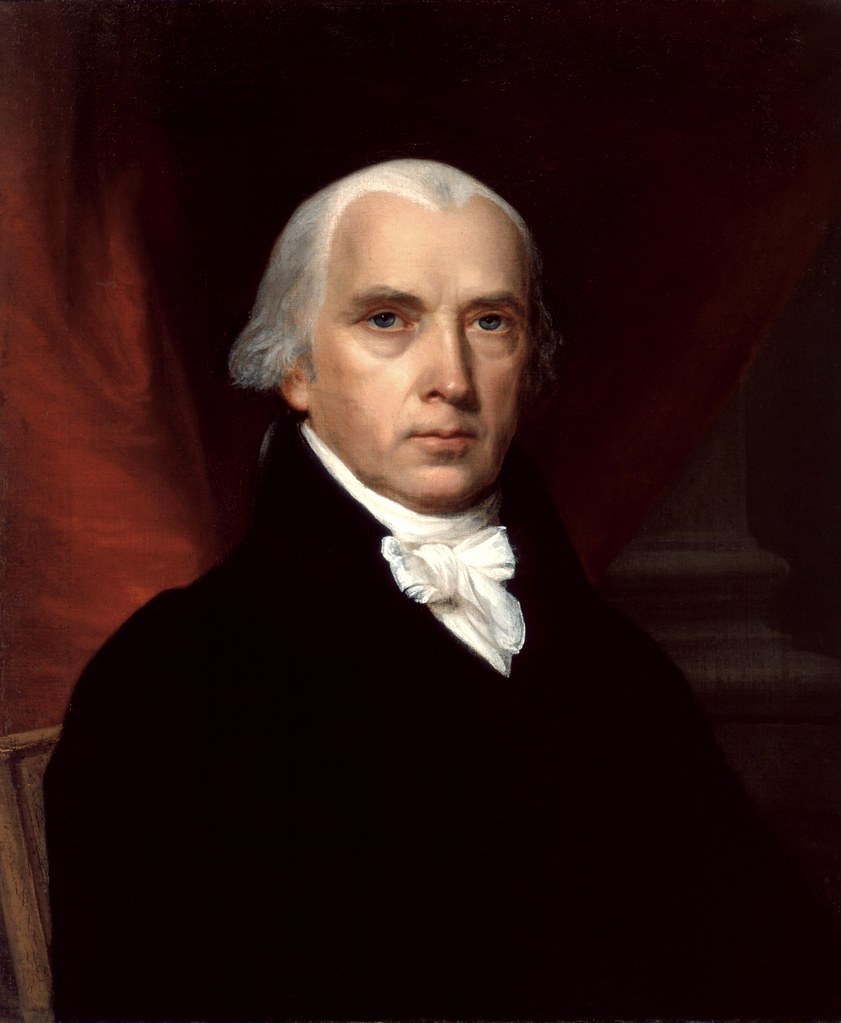
James Madison (1751-1836), who became the 4th president of the U.S. for two terms starting in 1808, introduced the Bill of Rights on June 8, 1789. His amendments contained numerous restrictions on the federal government and would protect, among other things, freedom of religion, freedom of speech, and the right to peaceful assembly. While most of his proposed amendments were drawn from the ratifying conventions, Madison was largely responsible for proposals to guarantee freedom of the press, protect property from government seizure, and ensure jury trials. President John F. Kennedy, 35th president of the United States, cited Madison in his remarks to the nation on November 5, 1963. “4 James Madison” by US Department of State is marked with Public Domain Mark 1.0.
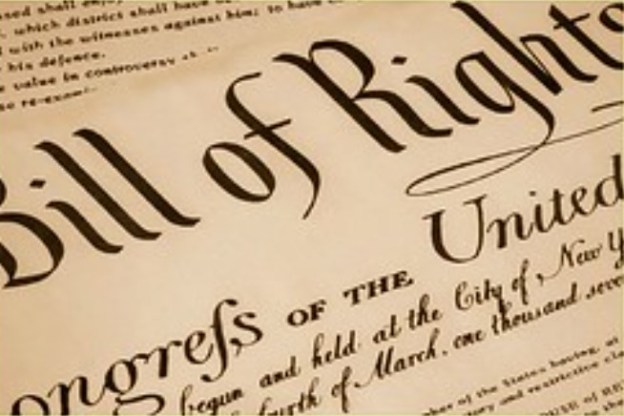
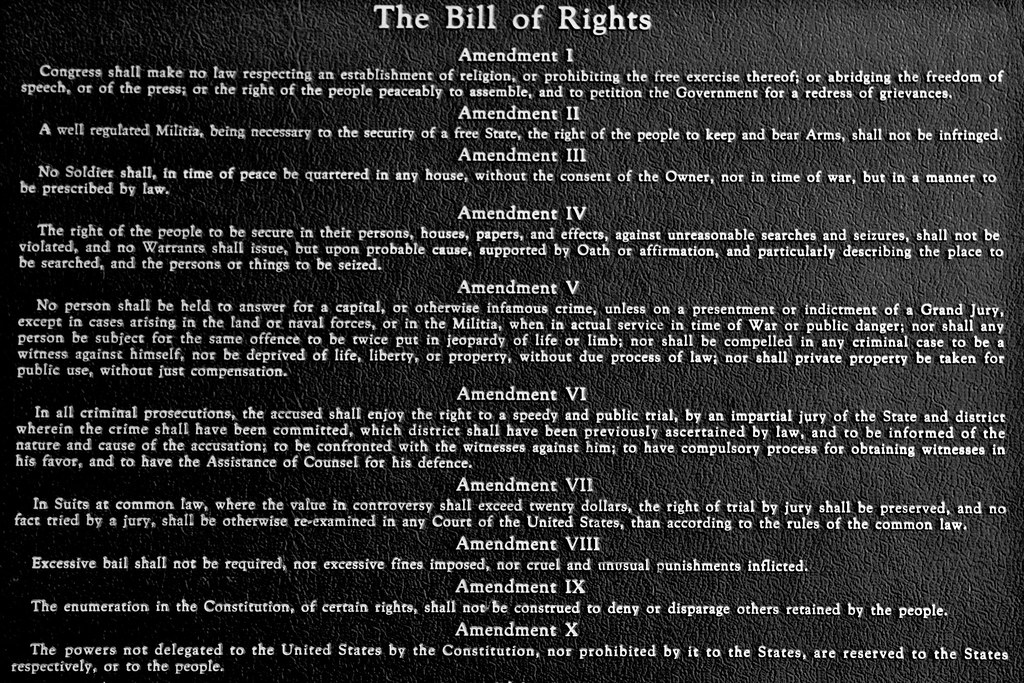
The U.S. Bill of Rights comprises the first ten amendments to the U.S. Constitution adopted in 1791. The Bill of Rights specifically adds to the Constitution specific and detailed guarantees of personal freedoms and rights, clear limitations on the government’s power in judicial and other proceedings, and explicit declarations that all powers not specifically granted to the federal government by the Constitution are reserved to the states or the people. “The Bill of Rights” by eugevon is licensed under CC BY-SA 2.0.
President Kennedy pointed to the document’s profound meaning and relevance in the life of the nation – “We, The People.” Despite, or because of, the many struggles in the nation’s history, the Bill of Rights had proved vital and inseparable to the people in America – and mankind – in their guarantee of the sort of life its citizens seek to live and lead. “My fellow American citizens,” Kennedy said, “…They are the most extraordinary and detailed guarantees of individual liberty that any people on earth now possess. Because of the Bill of Rights, we are guaranteed freedom of speech, freedom of religion, freedom of the press, the right of assembly and petition, the right of trial by jury, the right to be secure in one’s own home, the protection of due process of law and private property and public trials, and many other things that perhaps we take for granted but which we are guaranteed in the United States Constitution…”
FEATURE Image: Caravaggio (Michelangelo Merisi), Judith Beheading Holofernes, c. 1598, oil on canvas, 56 ¾ x 76 ¾” 145 x 195cm Galleria Nazionale d’Arte Antica, Rome. https://barberinicorsini.org/opera/giuditta-e-oloferne/ – retrieved October 12, 2024.
Ottavio Leoni (1578-1630), Portrait of Caravaggio, c. 1621/25, red and white chalk on blue paper, 23.4 x 16.3 cm, Biblioteca Marucelliana, Florence.
INTRODUCTION.
The chalk portrait above is probably the most faithful likeness of Caravaggio. Born Michelangelo Merisi in 1571, Caravaggio became an influential figure in Italian and European art in and well after his lifetime. He revolutionized painting by his theatrical use of light, dramatic narrative, and the naturalistic physical depiction of everyday people. His depiction of figures in historical narrative using dramatic interplay of light and shadow called chiaroscuro along with its naturalistic composition was further modernized in its scenes’ inclusion of the emotional and psychological human state. These artistic qualities were admired and emulated by many young European artists going forward into the balance of the seventeenth century.
Caravaggio came to Rome around 1592 from Lombardy, where he was influenced by the works of Giovanni Girolamo Savoldo (c.1480-1548), Lorenzo Lotto (c. 1480-1557), Romanino (c.1484-1566) and Moretto (c. 1498-1554?). For a while he worked in the workshop of the leading late mannerist Giuseppe Cesari (1568-1640), but soon broke away from the established course in Roman-Florentine artistic mannerism. His completely new approach of intense realism and chiaroscuro — that is, dramatic use of light and darkness to situate a scene – made him the “master of darkness” and completely revolutionized art in Rome around 1600. Along with Annibale Carracci (1560-1609), Adam Elsheimer (1578-1610) and Peter Paul Rubens (1577-1640), Michelangelo Merisi, called Caravaggio, was one of the progenitors of 17th century painting.
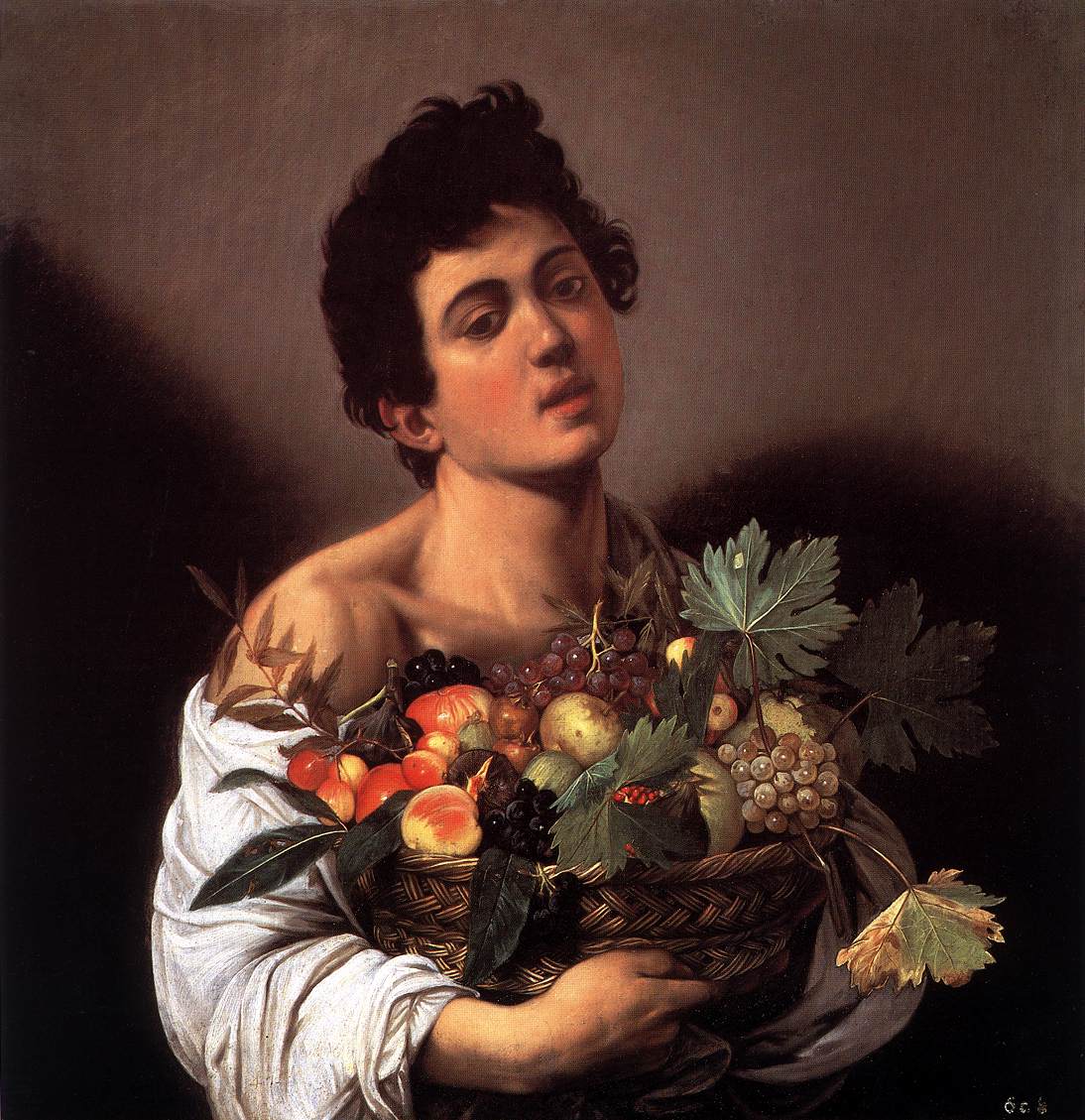
Caravaggio’s Il Fruttaiuolo (“Boy with a Basket of Fruit”) presents a remarkable contrast of the detailed, colorful, and sensuous depiction of fruits of the season and the refined and delicate innocence of an adolescent boy holding its basket. The placid scene of typical everyday life is enhanced by an expressive and careful execution. The model was Caravaggio’s friend, Sicilian painter Mario Minniti, at about 16 years old. According to Giovanni Pietro Bellori (1613-1696) who included Caravaggio in his Lives of the Artists, the artist learned “to paint flowers and fruit so well imitated that everybody came to learn from him how to create the beauty that is so popular today.”
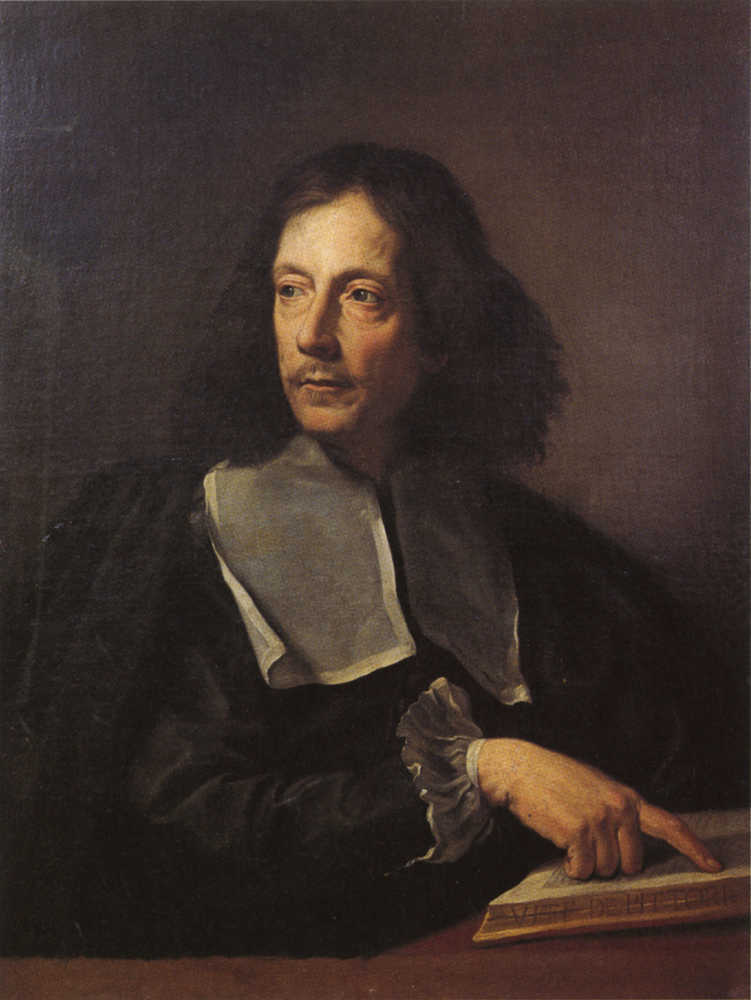
Carlo Maratta (1625-1713), Portrait of Gian Pietro Bellori who was Caravaggio’s most important biographer. Other early biographies of Caravaggio’s life were written by his doctor, Giulio Mancini (1559-1630) and by Giovanni Baglione (1566-1643), a rival artist.
Caravaggio’s Il Bacchino Malato (“The Young Sick Bacchus”), also known as Bacchino malato (“The Sick Bacchus”) or Autoritratto in veste di Bacco (“The Self-Portrait as Bacchus”), is an early self-portrait by Michelangelo Merisi da Caravaggio, dated between 1593 and 1594. The artwork dates from Caravaggio’s first years in Rome when he moved to the Eternal City from his native Milan in 1592. The painting was in the collection of Giuseppe Cesari (1568-1640), Caravaggio’s early employer. In 1607 it was confiscated from Cesari by the Pope in exchange for the Italian mannerist’s freedom following an illegal firearms charge. The pope gifted it to his nephew, Cardinal Scipione Borghese (1577-1633), together with the Boy Peeling Fruit and Boy with a Basket of Fruit (“Il Fruttaiuolo“).
The painting is a realist portrait of a young man displaying the typical attributes of Bacchus, the god of drunkenness. The sitter is turned to the viewer in a three-quarter pose, holding in his hands a bunch green grapes held next to his ailing greenish complexion. The sitter has been identified as the artist since it is documented that he was in the Ospedale della Consolazione in Rome around this time for undefined reasons. This interpretation provides the origin for the artwork’s title.
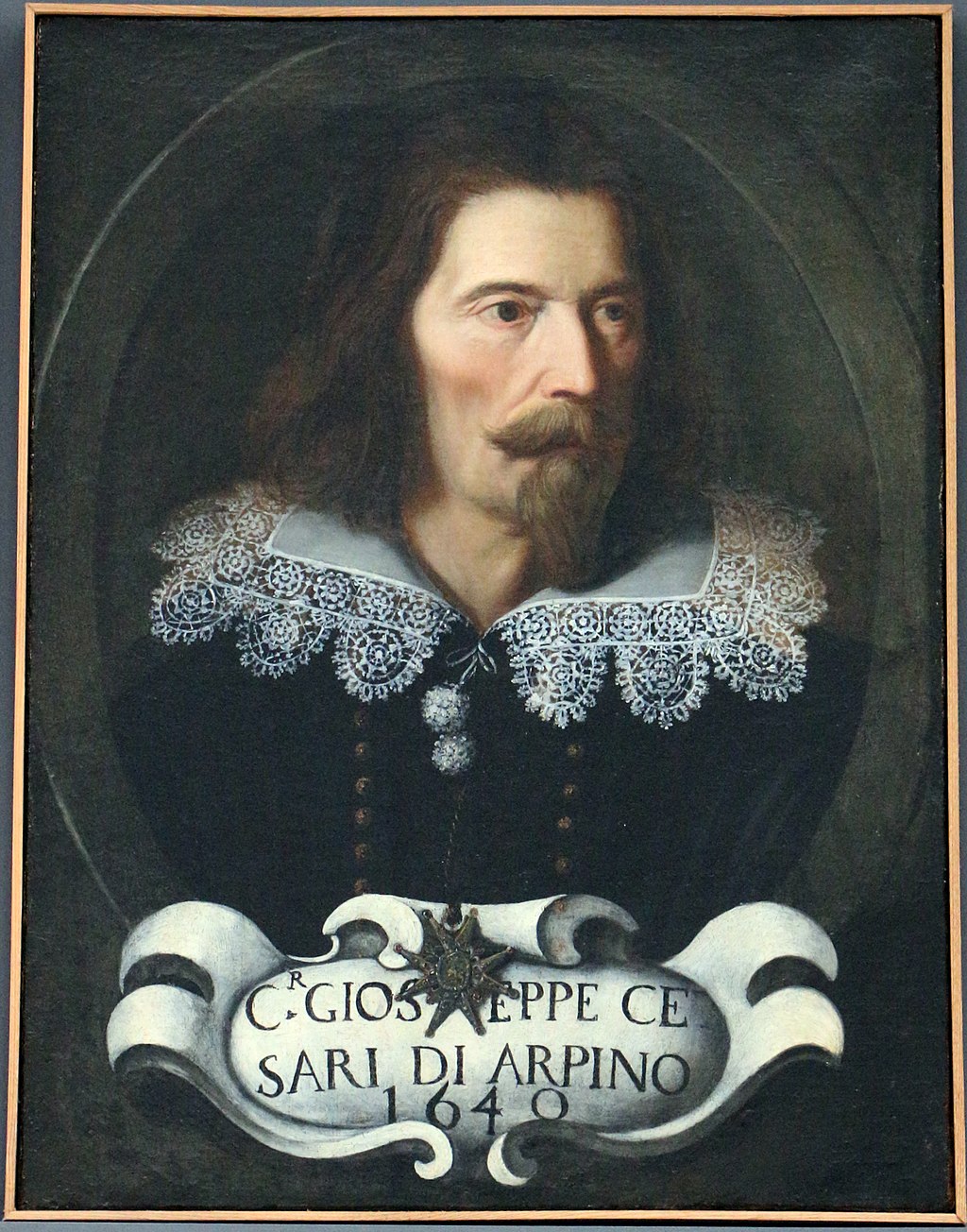
Giuseppe Cesari, Self-portrait, 1640, Accademia di San Luca. Cesari was Caravaggio’s first employer and in possession of The Young Sick Bacchus that was confiscated by the pope.
Ottavio Leoni, Portrait of Cardinal Scipione Borghese. The sitter was not only the pope’s nephew and a Cardinal in the Catholic Church but the recipient of early Caravaggio paintings by gift. Such a gift was not at random: the cardinal’s growing art collection, including Caravaggio and Bernini, formed the basis of the Villa Borghese in Rome.
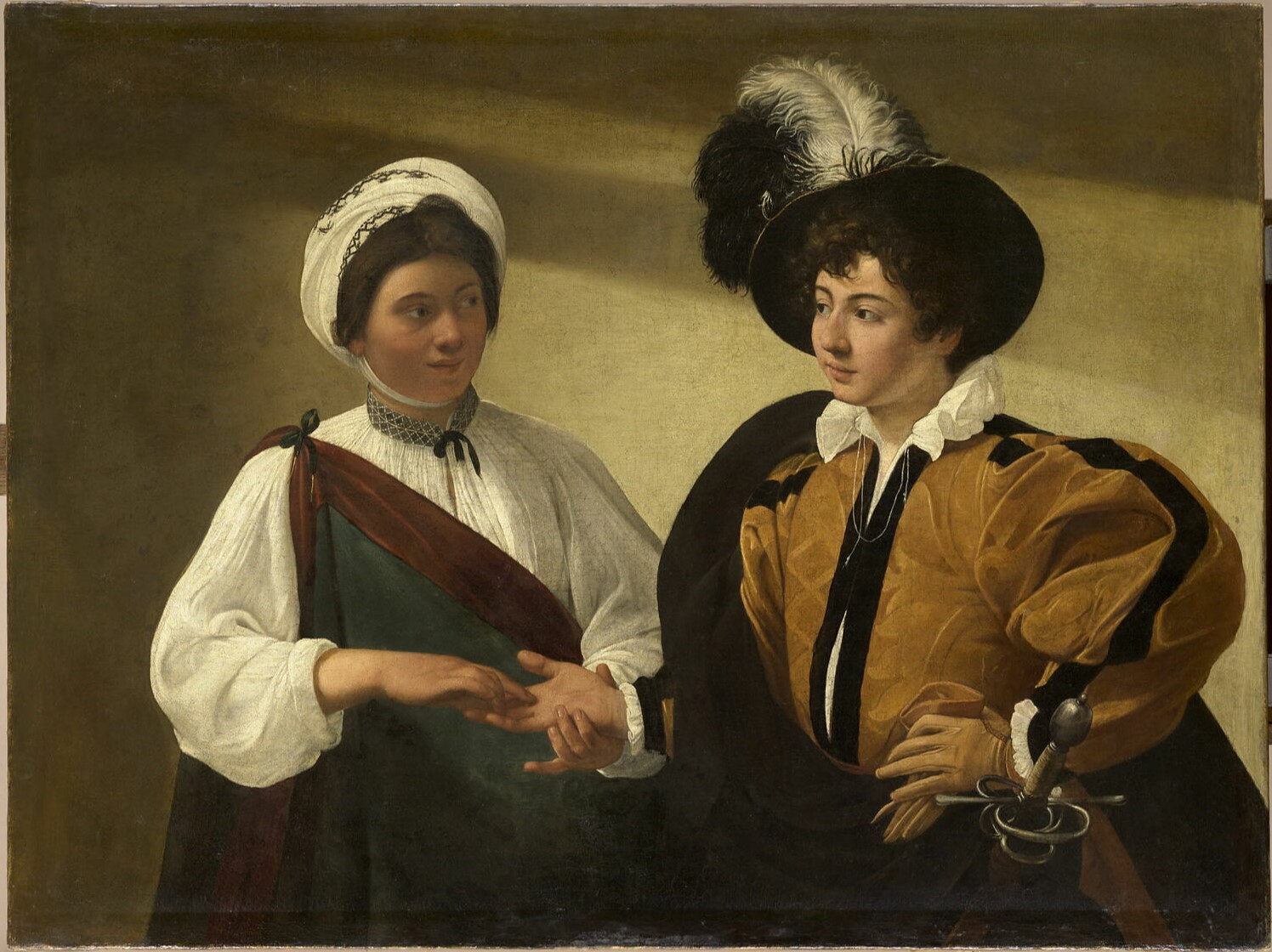
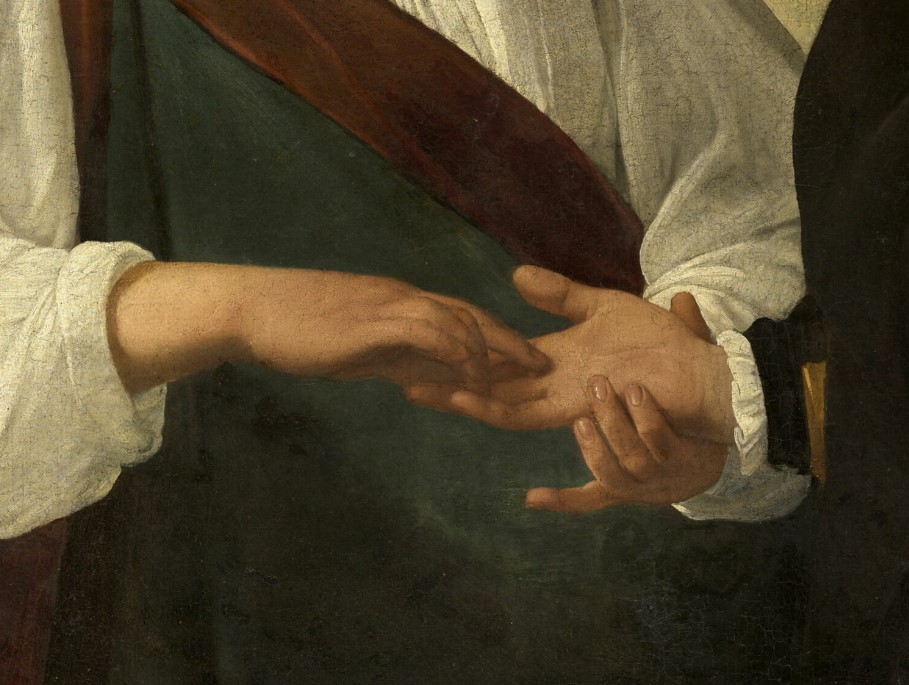
According to Giulio Mancini, Caravaggio painted The Fortune-Teller for a proverbial song while staying with Archbishop Fantino Petrignani (1577-1601). By 1620 when Mancini was writing, the painting was owned by Roman art collector and Catholic prelate Alessandro Vittrici (d. 1650). Later (1657) it was in the collection of Catholic Cardinal Camillo Francesco Maria Pamphili (1622-1666) who sent it with Bernini (1598-1680) to Paris as a gift to Louis XIV.
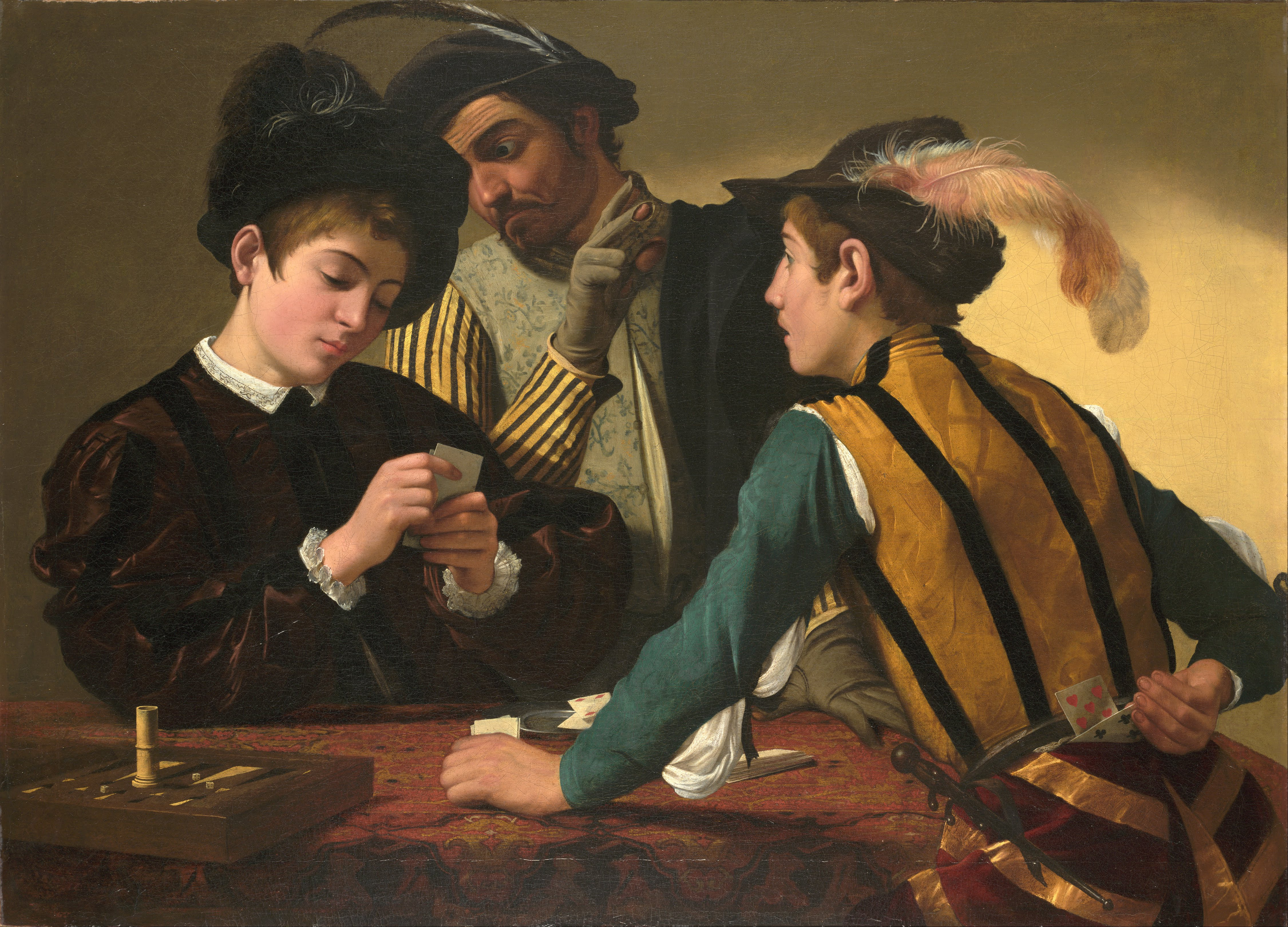
Caravaggio (Michelangelo Merisi), cardsharps,1594/95, oil on canvas, 37 1/16 x 51 9/16 in. (94.2 x 130.9 cm), Fort Worth, Kimbell Art Museum, Fort Worth, Texas. https://kimbellart.org/collection/ap-198706 – retrieved October 18, 2024.
Playing the game of primero the player at left is oblivious to a bearded cardsharp who uses his gloved fingers to signal to the other player the content of the cards. The other cheater is reaching for a hidden card from his pants behind his back. Caravaggio’s composition is novel with a naturalistic treatment of the figures whose distinct expressions and gestures convey a realistic and hard drama of being cheated and cheating. This painting was owned and stamped by Cardinal del Monte and in his inventory of 1627 following his death. It had been lost for almost a century when it was discovered in a European private collection and purchased by the Kimbell in 1987.
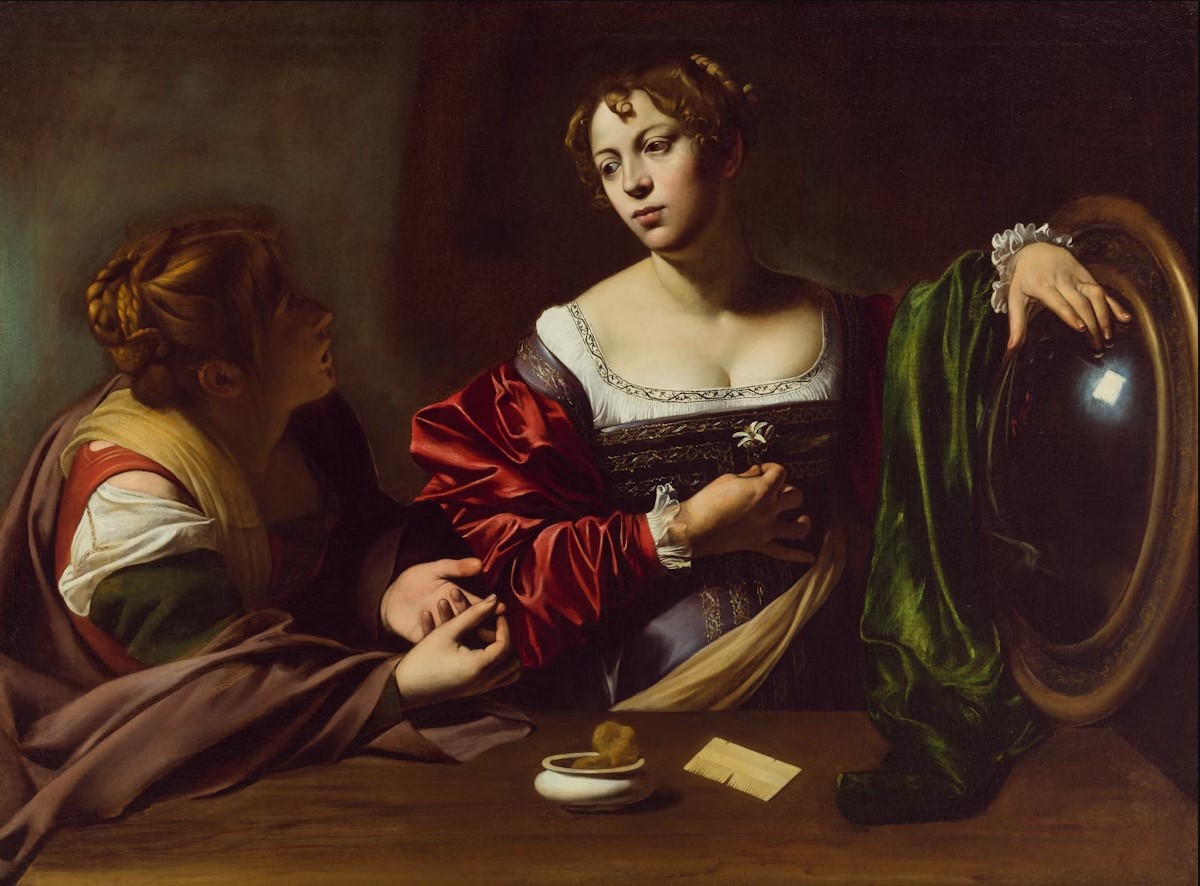
Caravaggio (Michelangelo Merisi), Martha and Mary Magdalene, c. 1598 Detroit Institute of Arts.
“Caravaggio helped to popularize half-length religious paintings like this, made for private collectors rather than for public church settings. His greatest innovation was in depicting biblical characters as if they belonged to contemporary Roman society, basing them on studio models and dressing them in 17th-century attire, as he does here.” https://www.artic.edu/articles/1071/caravaggio-s-dramatic-life-and-paintings – retrieved October 15, 2024.
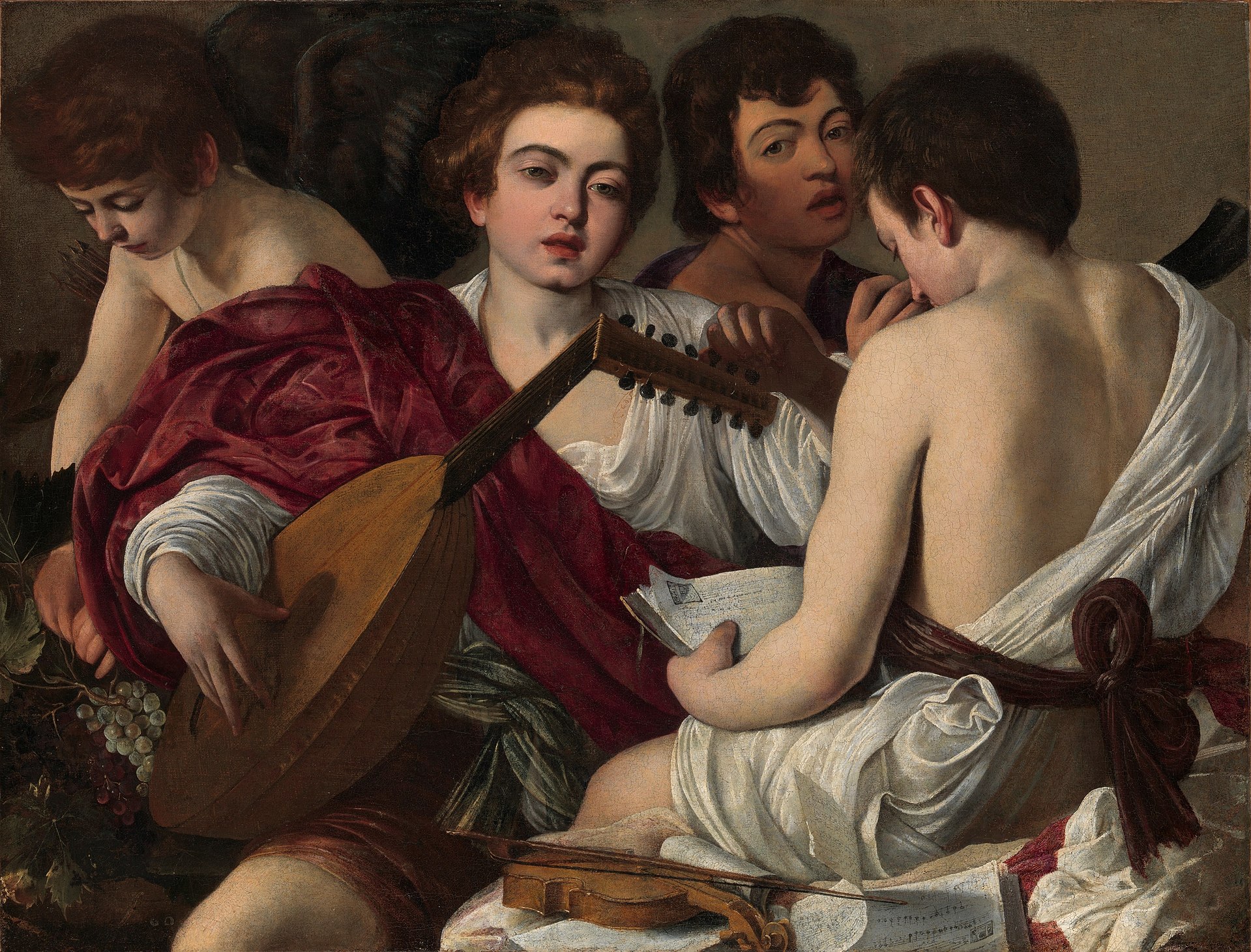
Caravaggio (Michelangelo Merisi), The Musicians, 1595/96, oil on canvas, 36 ¼ x 46 5/8” (92.1 x 118.4 cm), The Metropolitan Museum of Art, New York. https://www.metmuseum.org/art/collection/search/435844 – retrieved October 10, 2024.
The Musicians, painted by Caravaggio and now in The Metropolitan Museum of Art, was commissioned by Cardinal Francesco Maria del Monte (1549–1627), one of Rome’s most influential patrons of the arts. Conceived as an allegory of music—signaled by the presence of Cupid in the background—it is equally a portrait of contemporary musical practice, featuring individualized sitters. Among them is Caravaggio himself, second from the right, offering one of his rare youthful self-portraits.
During the Counter‑Reformation, the Catholic Church actively promoted a revival of music, and Cardinal del Monte was at the center of this cultural movement. At his residence, the Palazzo Madama, he hosted composers, rehearsals, and experiments in progressive musical forms, especially the emerging solo vocal style that departed from older polyphonic traditions. The Musicians was designed specifically for the Cardinal’s music room, its subject and atmosphere echoing the live performances that took place there.
In keeping with Caravaggio’s modernizing approach, the figures are not idealized classical types but real young men posed in quasi‑antique white robes. The self‑portrait—directly engaging the viewer—shows the artist holding a cornetto, a popular wind instrument of the period. Caravaggio also employs a spatial device familiar in later eighteenth‑century art: the prominently placed violin and open music manuscript in the immediate foreground. These objects project into the viewer’s space, drawing the spectator into the scene as an implied participant.
Ottavio Leoni, Francesco Maria del Monte, 1616.
Born in Venice of a Tuscan aristocratic family, Cardinal del Monte was an important connoisseur of the arts. Four centuries later his fame rests on his early patronage of Caravaggio and an art collection which provides detailed provenance for many important works of the period. Del Monte was the single most influential force in Caravaggio’s life. Between 1595 and 1601, the Catholic cardinal became not only the painter’s primary patron but his intellectual mentor, legal shield, and diplomatic strategist—an alliance that lifted the volatile outsider into the ranks of Rome’s most sought‑after, and most controversial, artistic prodigies. Their bond was complicated by each’s share of eccentricities, intense legal vulnerabilities, and the uneasy overlap between church politics and the city’s street‑level underworld.
As mentioned, the relationship began when Del Monte purchased The Cardsharps from a local dealer and immediately recognized the raw, disruptive talent behind it. He brought Caravaggio into his official residence, the Palazzo Madama, granting him a stipend, room and board, and a dedicated studio. Within those walls, Caravaggio entered a rarefied world. Del Monte—an intimate friend and protector of Galileo —surrounded himself with mathematicians, natural philosophers, and experimenters in optics. Immersed in this court of scientific inquiry, Caravaggio refined the radical, directional lighting that would become his signature, transforming observation into revelation.
Del Monte also understood that private cabinet pictures could only carry an artist so far. Leveraging his position as a Vatican insider, he secured Caravaggio’s first major public commission: the Contarelli Chapel cycle in San Luigi dei Francesi. It was a turning point—Caravaggio’s explosive debut on the public stage and the moment his reputation as a revolutionary painter crystallized.
But the Cardinal’s protection had limits. Caravaggio’s temperament grew increasingly erratic, his nights spent among gamblers, swordsmen, and fugitives. By 1606, after the fatal brawl with Ranuccio Tomassoni, even Del Monte could no longer shield him. Caravaggio fled Rome under threat of execution, bringing to an abrupt end one of the most fertile and consequential artistic partnerships of the Baroque age.
Caravaggio (Michelangelo Merisi), The Lute Player, 1595/96, oil on canvas, 37 x 46 7/8” The Hermitage Leningrad.
The Lute Player was owned by Cardinal del Monte. It was sold to Vincenzo Giustiniani (1564-1637), an aristocrat Italian banker, art collector and intellectual, and appeared in his inventory in 1638. Caravaggio’s model for the painting is the same as for The Musicians.
Nicolas Régnier/Niccolò Renieri (1591-1667), Portrait of Vincenzo Giustiniani, c. 1630.
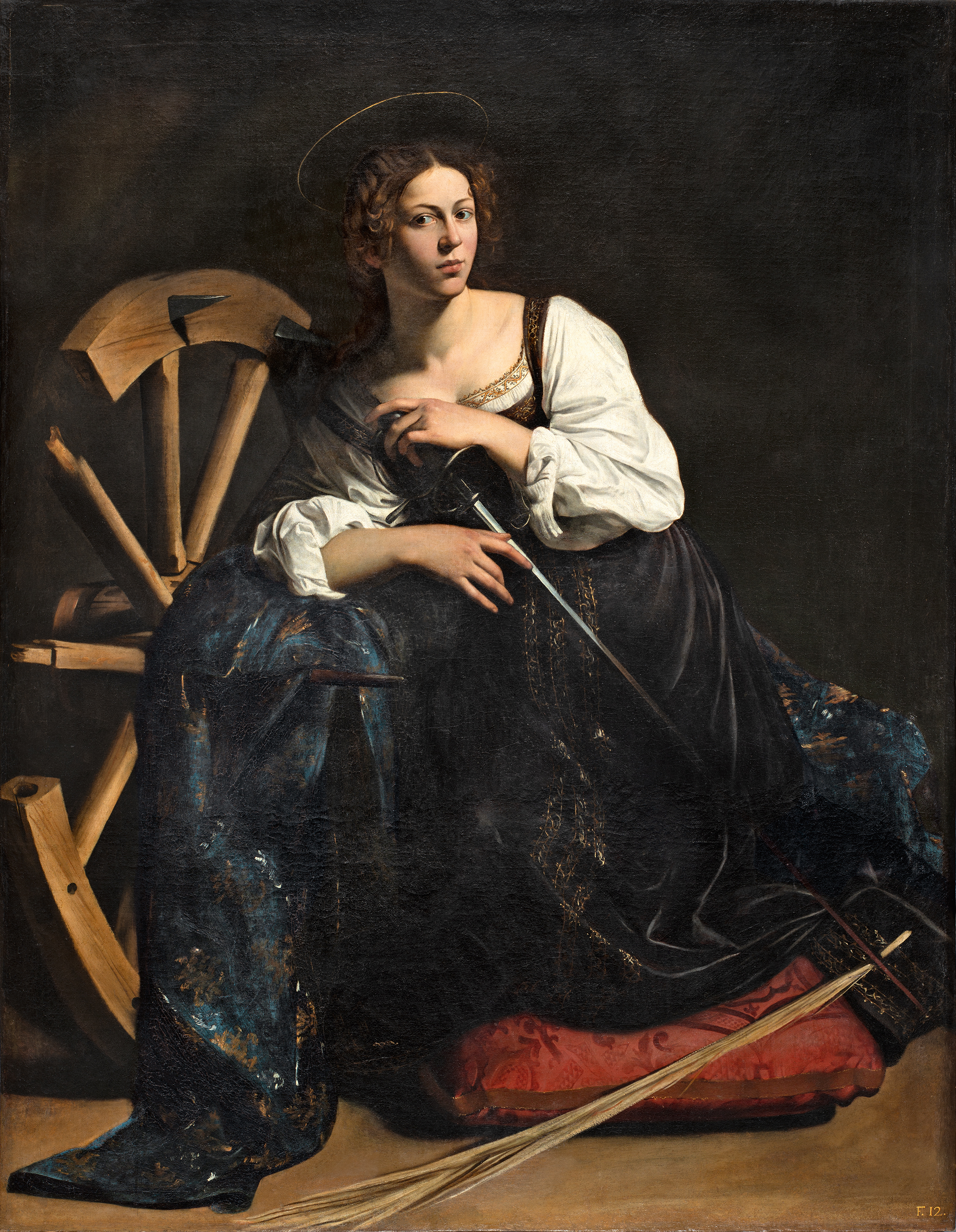
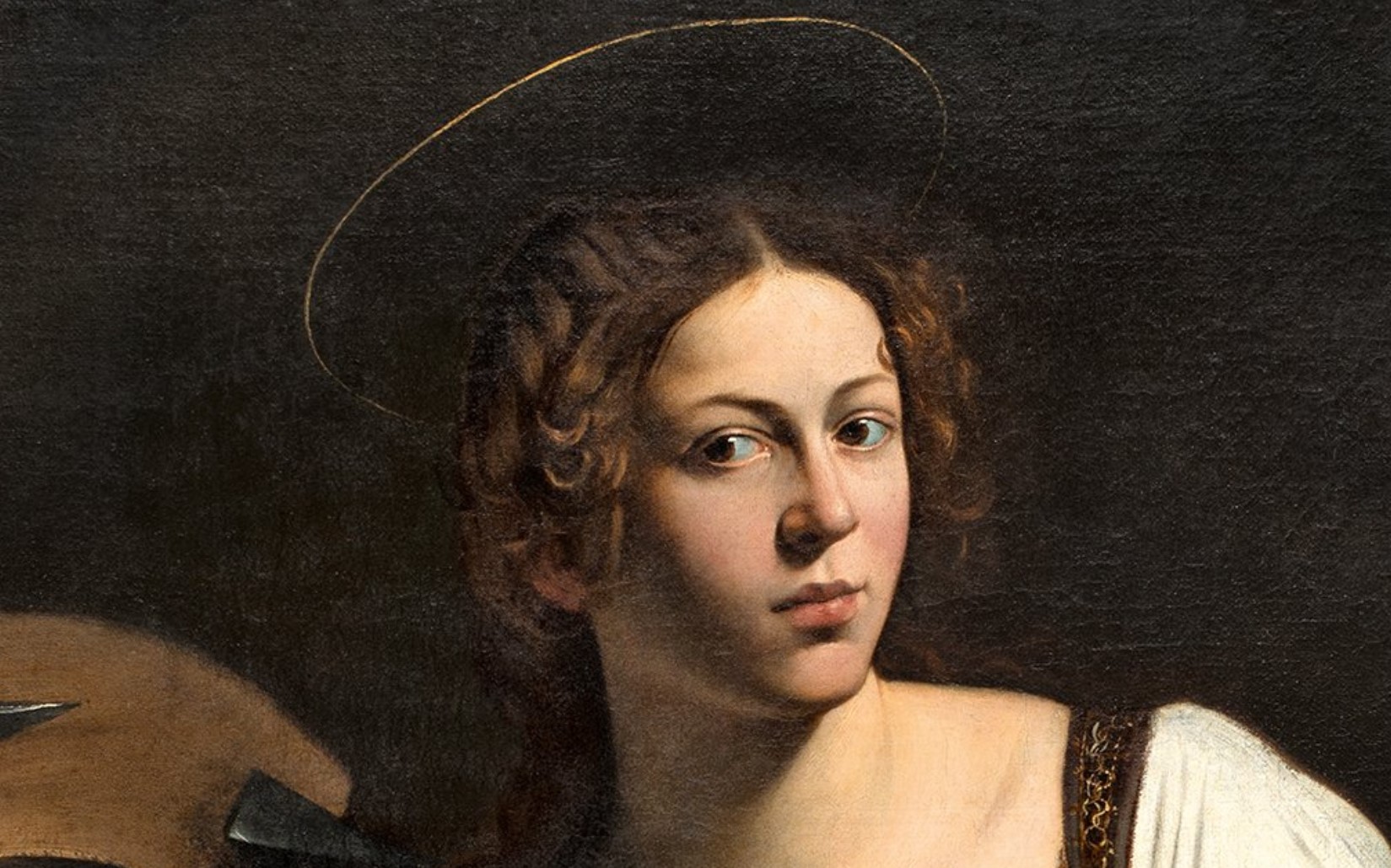
Commissioned by Cardinal Francesco Maria del Monte, Caravaggio’s St. Catherine of Alexandria presents the saint in the unmistakable likeness of Fillide Melandroni, a well‑known Roman courtesan who played a decisive role in the painter’s artistic and personal life. Young artists routinely turned to women like Fillide for models—respectable women were simply unavailable for such work—and Caravaggio, more than most, transformed these marginalized figures into icons of startling dignity and psychological depth.
Richly robed and kneeling on a cushion, Catherine occupies the canvas with commanding stillness. She rests one hand on the spiked breaking wheel and gently cradles the sword—emblems of her martyrdom—while the dramatic fall of light isolates her against the darkness in Caravaggio’s signature chiaroscuro. The effect is intimate yet monumental: a saint rendered not as an ethereal ideal but as a living woman whose presence feels immediate, almost breathing qualities which would have an immense impact on European art in the 17th century.
Caravaggio heightens this immediacy with a device that would also echo through seventeenth‑century European painting: the saint’s body and attributes press toward the viewer’s space, collapsing the distance between sacred history and the spectator. It is precisely this fusion of realism, theatrical light, and emotional proximity that made works like St. Catherine so influential across the Baroque world.
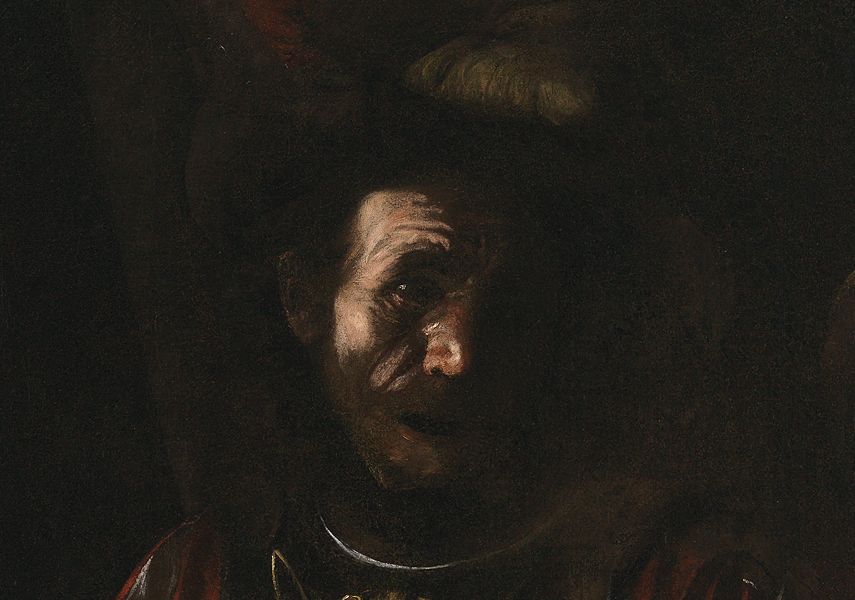
Detail of above: the face of St. Catherine of Alexandria (Fillide Melandroni).
Caravaggio’s Saint Francis of Assisi in Ecstasy stands as his earliest known religious composition, and already the hallmarks of his mature style—intimacy, theatrical light, and emotional immediacy—are unmistakable. The subject, Saint Francis of Assisi (1182–1226), the Umbrian mystic famed for his radical poverty and fierce asceticism, often withdrew into solitude for forty‑day fasts, seeking to imitate Christ as literally as Scripture allowed. Medieval tradition holds that, like Christ in the wilderness, Francis was ministered by angels during these periods of spiritual extremity.
Caravaggio seizes on one such moment. In September 1224, on Mount La Verna in central Italy, Francis received the stigmata, the wounds of the crucified Christ—an experience granted to only a handful of saints. Caravaggio renders the episode with striking restraint: the saint collapses into the arms of an angel, his body slack with awe, while shepherds linger in the obscured background, half‑witnesses to a mystery they cannot fully comprehend. A faint trace of the wound appears beneath the rough folds of Francis’s tunic, a subtle but potent sign of the miracle.
The entire scene is carved out of darkness by Caravaggio’s directional light, a technique shaped by the scientific culture surrounding his patrons. Here, the light does not merely illuminate; it consecrates. It isolates Francis and the angel in a suspended moment of revelation, while the world around them recedes into shadow.
Caravaggio painted the work in Rome for Ottavio Costa (1554–1639), a Genoese banker and discerning collector who became one of his most loyal supporters. Centuries later, in 1943, Saint Francis of Assisi in Ecstasy became the first Caravaggio to enter a public collection in the United States, marking a milestone in the American reception of the Baroque master.
Caravaggio (Michelangelo Merisi), Rest on the Flight to Egypt, c, 1595/98, oil on canvas, 51 ¼ x 63” Galleria Doria- Pamphili, Rome.
La fête champêtre is a musical picnic whose tradition originated in Italy. Caravaggio’s composition is lyrical and complicated. As it is in the setting of the Holy Family’s flight to Egypt in Matthew’s Gospel, the characters are dressed humbly accompanied by the presence of an angel.
Caravaggio (Michelangelo Merisi), Boy Bitten By A Lizard, 1596/97, oil on cavas, 27 ½ 2 22 3/8”, The National Gallery, London.
Detail of above.
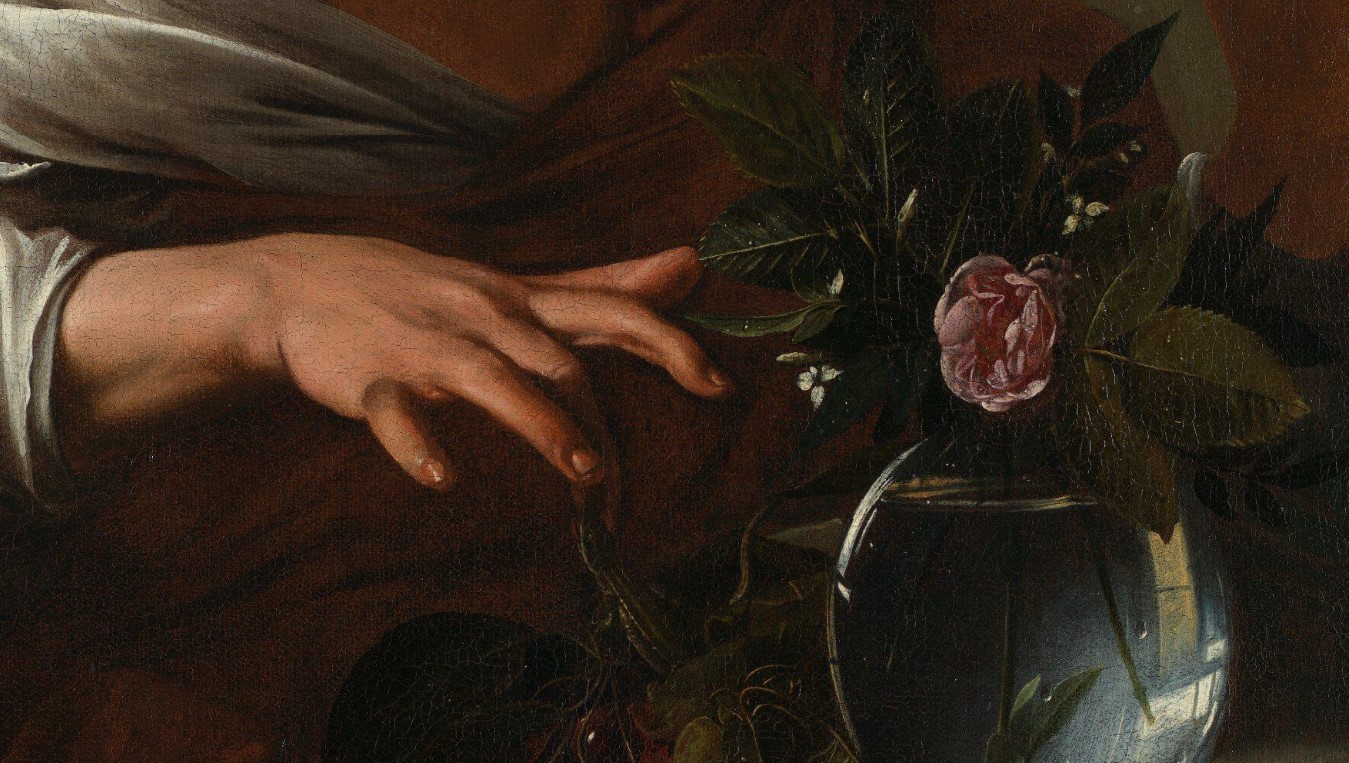
Mancini relates that Caravaggio painted the subject when staying with an old Catholic prelate named Pandolfo Pucci. By the end of his residence Caravaggio nicknamed his temporary benefactor Monsignor Insalata, or “Mister Salad,” for the pittance of solid food he served his artist boarder. The mock heroic painting may be allegorical with the lizard conveying its traditional meaning of lust or death joined to cherries symbolic of love and roses that of sexually transmitted disease — and warning of all three. see – https://www.britannica.com/biography/Caravaggio/First-apprenticeships-in-Rome-Pucci-Cesari-and-Petrigiani – retrieved October 15, 2024.
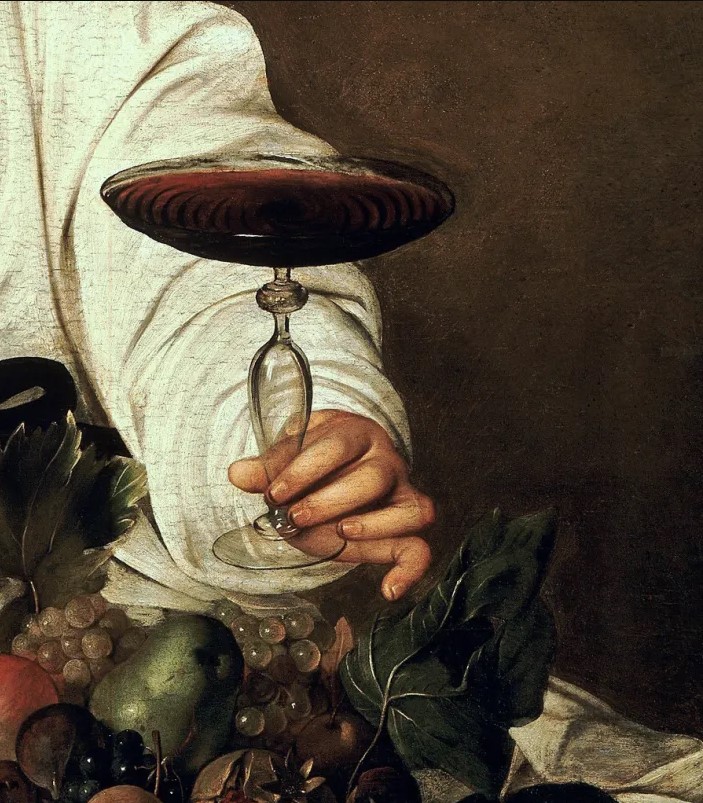
Caravaggio (Michelangelo Merisi), Bacchus, c. 1597, oil on canvas, 37 3/8 x 33 ½”, Uffizi, Florence.
Detail of above.
Cardinal del Monte commissioned it from Caravaggio for a Medici. Detail of above.
Commissioned by his principal patron, Cardinal Francesco Maria del Monte, Caravaggio’s Bacchus was presented as a diplomatic gift to Grand Duke Ferdinando I de’ Medici to mark his son’s wedding—a gesture that secured the painting’s place in the Medici collections for centuries. Today it stands as a cornerstone of early Baroque art, celebrated for its audacious rejection of idealized Renaissance classicism in favor of a startlingly earthbound realism.
Instead of a radiant, godlike deity, Caravaggio gives us a working‑class Roman youth—almost certainly his friend and frequent model Mario Minniti—costumed as the god of wine. Any pretense of antiquity is deliberately dismantled. Bacchus reclines not on a marble couch but on a striped mattress folded to imitate a Roman triclinium. His white “toga” is nothing more than a contemporary bedsheet, loosely draped over his body. The effect is both intimate and unsettling: a classical god rendered as a boy you might meet in the streets of Rome, invited into myth by costume alone.
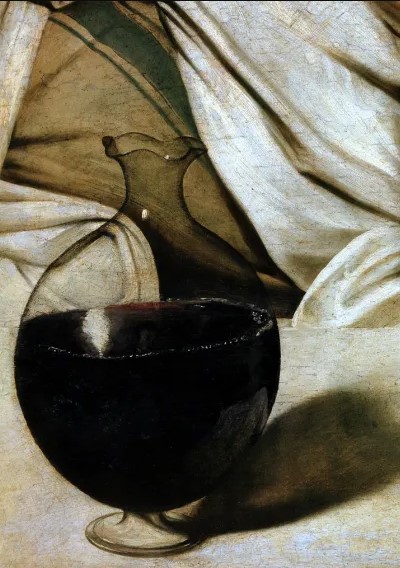
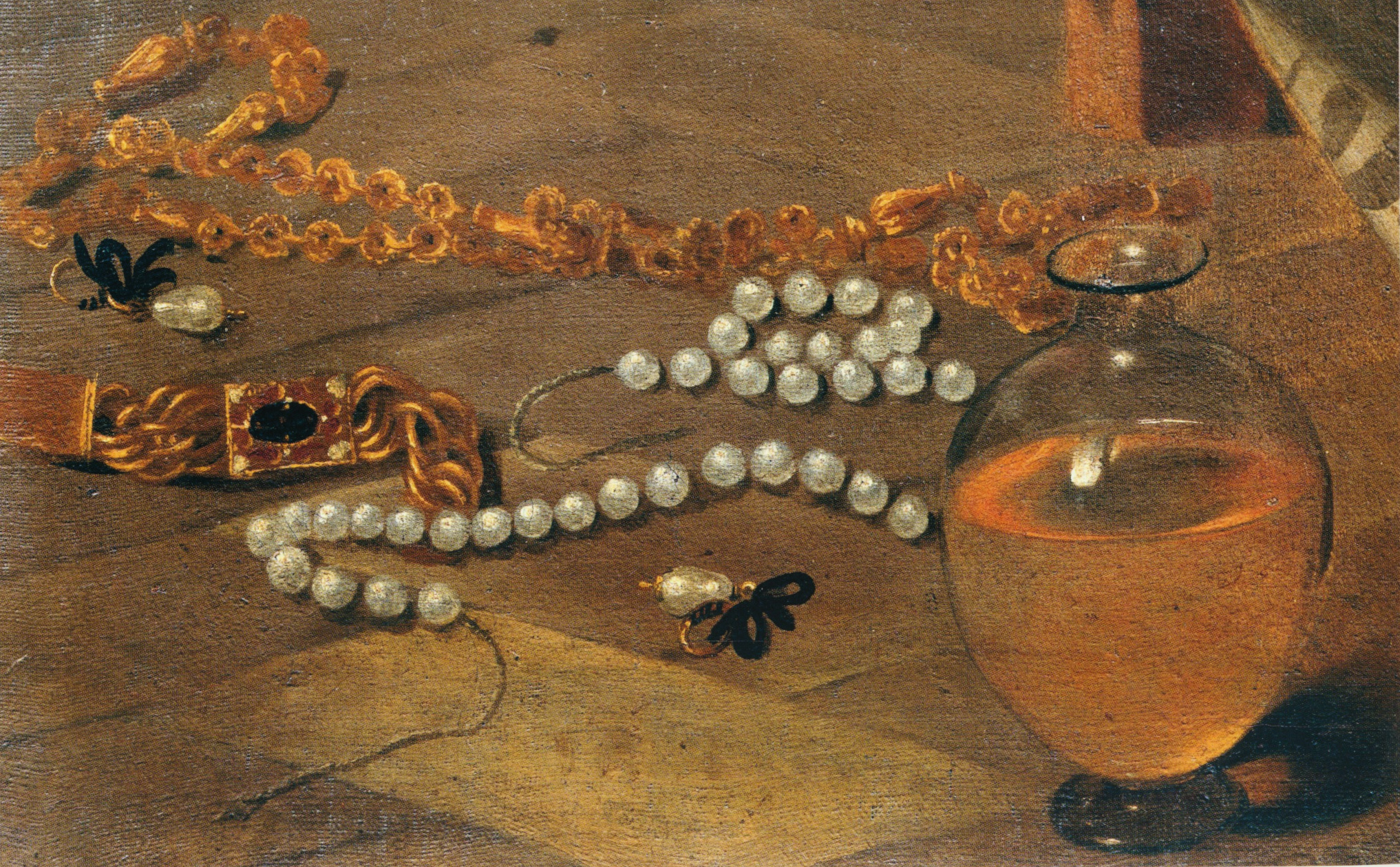
The lower half of the canvas deepens the painting’s moral tension. Caravaggio arranges a sumptuous still life—apples, grapes, figs, a carafe of wine—but it is also a vanitas. The apples are bruised and worm‑eaten, the grapes overripe, the leaves already curling toward decay. This quiet rot serves as a memento mori, a reminder that youth, beauty, and sensual pleasure are as fleeting as the fruit that embodies them. Caravaggio’s realism becomes a form of philosophy.
Despite its current fame, Bacchus nearly vanished from history. After the fall of the Medici dynasty, the painting was relegated to a dark storage room in the Uffizi reserves—unframed, uncatalogued, and obscured beneath yellowed varnish. It remained forgotten until 1913, when art historians rediscovered and authenticated it as an irreplaceable treasure of the Baroque.
Caravaggio (Michelangelo Merisi), Jupiter, Neptune, and Pluto, 1597, oil on stucco, about 9/9”” x 5’11” Villa Ludovisi, Rome. https://villaludovisi.org/ – retrieved October 12, 2024.
The building and grounds of Villa Ludovisi in Rome, and their rich artwork, includes masterpiece frescoes by Guercino (1591-1666) and other leading lights of the 17th century Bolognese school. Caravaggio’s Jupiter, Neptune and Pluto is his only known oil painting on plaster. Cardinal de Monte purchased the villa and took up residence there in 1596. The cardinal sold it to the Ludovisi in 1621. Bellori relates that the subject matter for the fresco of these gods was to express the cardinal’s interest in medicinal chemistry (today’s pharmaceuticals).
Caravaggio (Michelangelo Merisi), Judith Beheading Holofernes, c. 1598, oil on canvas, 56 ¾ x 76 ¾” 145 x 195cm Galleria Nazionale d’Arte Antica, Rome. https://barberinicorsini.org/opera/giuditta-e-oloferne/ – retrieved October 12, 2024.
Commissioned by Ottavio Costa, one of Caravaggio’s most loyal Roman patrons, the painting passed through several prominent Roman families before entering the Galleria Nazionale d’Arte Antica in 1970. Its subject is the famous episode from the Book of Judith, a Biblical tale of courage, seduction, and divine deliverance that had long captured the Christian imagination.
Judith—beautiful, eloquent, and revered in her community—is a widow living in the besieged city of Bethulia, threatened with destruction by the Assyrian general Holofernes. Because he is captivated by her beauty, Judith is granted unusual freedom within the enemy camp. She joins Holofernes at a banquet in his tent, where he drinks himself into oblivion. As the text puts it, “Holofernes, charmed by her, drank a great quantity of wine, more than he had ever drunk on any day since he was born” (Judith 12:20).
Once the attendants withdraw, Judith seizes her moment. The biblical account describes the scene with stark intensity: she stands beside the general’s bed and prays silently for strength, saying: “O Lord, God of all might, in this hour look graciously on the work of my hands for the exaltation of Jerusalem. Now is the time for aiding your heritage and for carrying out my design to shatter the enemies who have risen against us” (Judith 13:4–5). Taking Holofernes’ own sword from the bedpost, she grasps his hair, invokes the God of Israel, and strikes twice, severing his head. She then rolls his body aside and hands the severed head to her maid, who conceals it in a food bag before the two women slip back into the night (Judith 13:4–10).
Caravaggio chooses the exact instant when violence erupts—his first painting to depict action with such visceral, kinetic force. The scene unfolds like a frieze suspended in time: Judith leaning forward with grim resolve, her maid assisting with practiced efficiency, and Holofernes recoiling in shock as the blade bites into his neck. The theatrical light isolates the figures against darkness, heightening the sense of immediacy and moral gravity.
This painting marks a turning point in Caravaggio’s career. With Judith Beheading Holofernes, he demonstrates not only his mastery of chiaroscuro but also his ability to transform a biblical narrative into a moment of raw human drama—one that reverberated across the Baroque world.
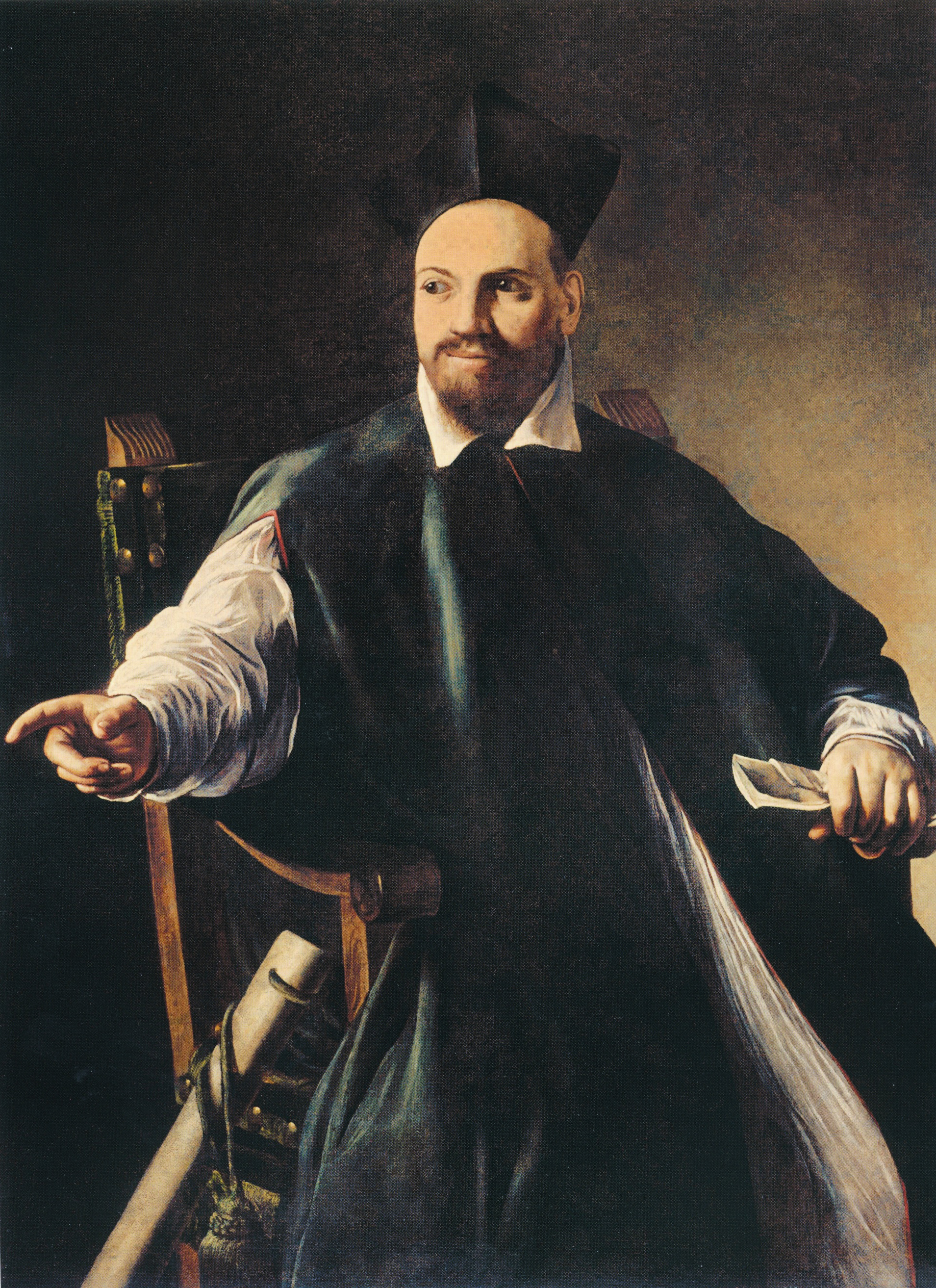
Caravaggio (Michelangelo Merisi), Portrait of Monsignor Maffeo Barberini, c. 1603, Private Collection, Firenze. Maffeo Vincenzo Barberini (1568-1644) became the future Pope Urban VIII whose reign began in 1623.
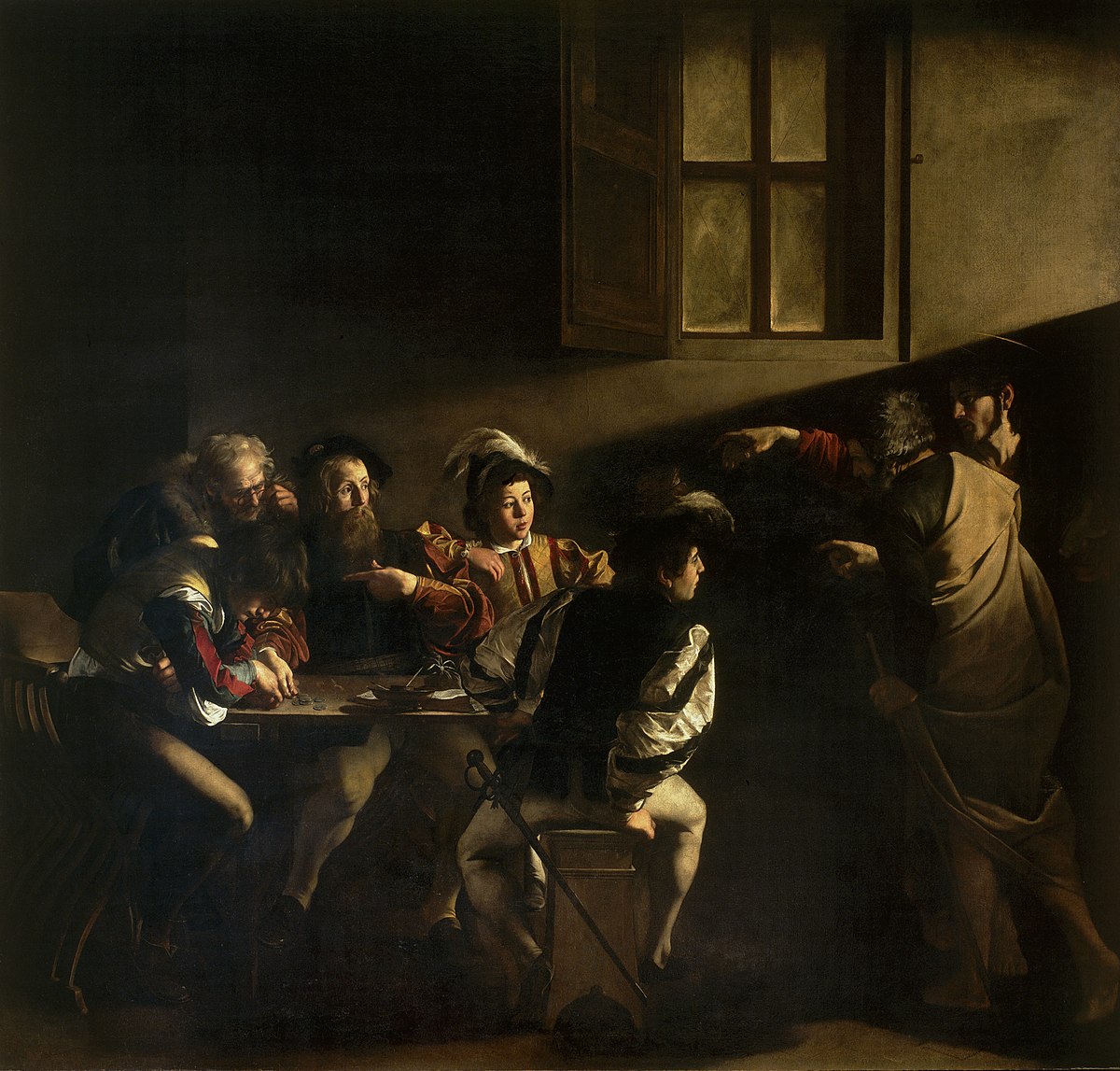
Caravaggio (Michelangelo Merisi), The Calling of Saint Matthew, 1599-1600, oil on canvas, 10’7 1/2 “ x 11’ 2” Contarelli Chapel, Church of Luigi dei Francesi, Rome.
Caravaggio’s The Calling of Saint Matthew (1599–1600), a monumental oil on canvas measuring 10’7½” × 11’2” (322 × 340 cm), occupies the left wall of the Contarelli Chapel in San Luigi dei Francesi, Rome. Commissioned as his first major public work, it quickly became a defining masterpiece of the Baroque—an image that rewired the expectations of religious art for an entire generation.
Caravaggio stages the biblical moment described in Matthew 9:9—Christ summoning the tax collector Levi (Matthew) to discipleship—not in a distant, idealized past but in a dark, contemporary Roman tavern, thick with shadow. The sacred enters the profane unexpectedly.
The composition unfolds in two distinct worlds. Around the counting table sit Matthew and his companions, absorbed in their unseemly gains, dressed in sumptuous late‑16th‑century velvet doublets, feathered hats, and sidearms—figures of worldly wealth and casual corruption. Into this scene step Christ and Saint Peter, barefoot and clothed in rough robes. Their presence feels out of sorts, yet the room shifts around them.
A single, razor‑sharp beam of light—Caravaggio’s signature tenebrism —enters from the upper right, cutting diagonally across the darkness. It travels in parallel to Christ’s extended hand, making the light itself a metaphor for divine grace and spiritual awakening penetrating a den of exploitation and greed. As the light strikes the faces at the table—some oblivious, others looking up startled— it settles fully on Matthew, who points to himself in shock.
In Counter‑Reformation Rome, the message was unmistakable. Caravaggio’s painting declared that the divine could break into the most ordinary, compromised corners of daily life—that salvation could arrive unannounced, even in a backroom thick with schemes of greed. It was a psychological jolt to the city’s viewers, a reminder that grace was not confined to altars or idealized visions but could happen anywhere to anyone, at any moment.
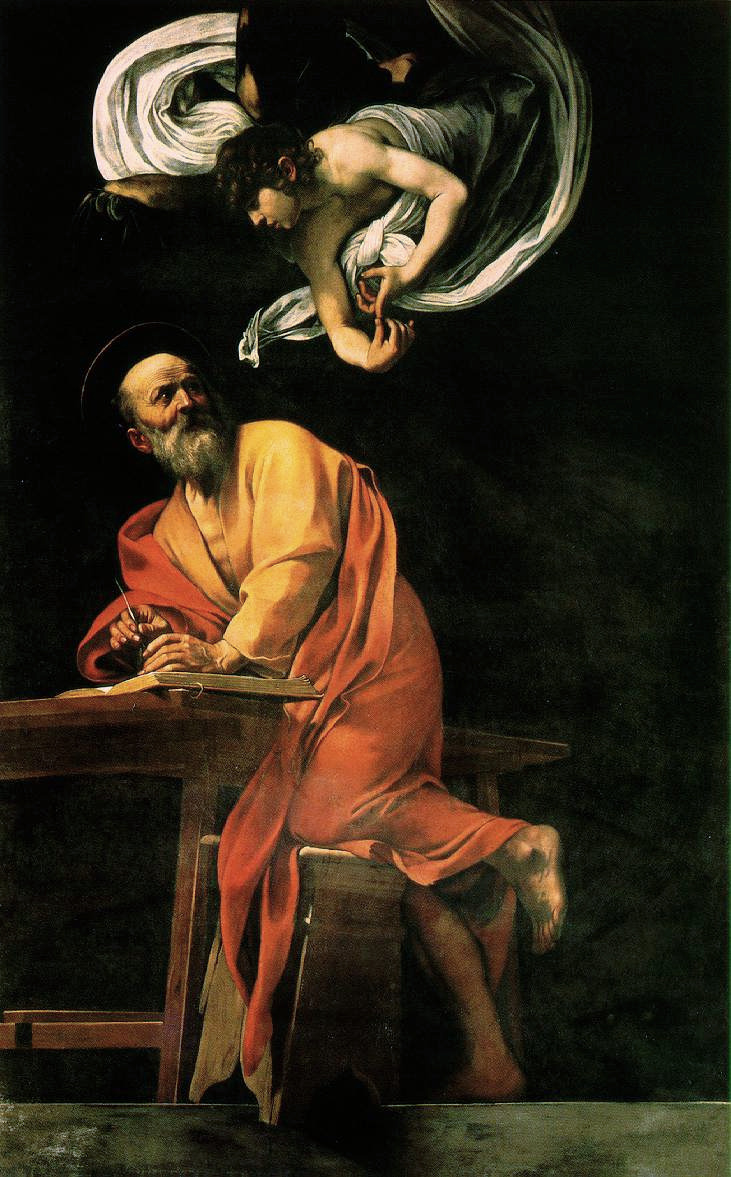
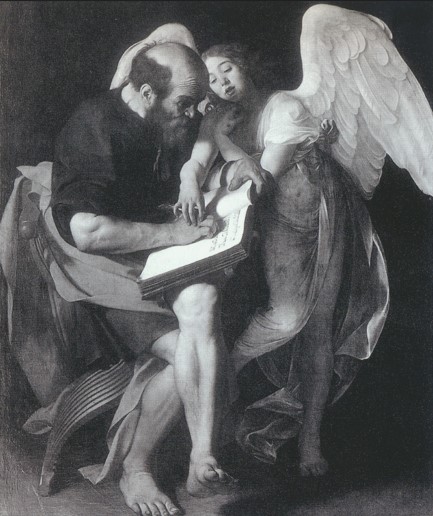
Caravaggio (Michelangelo Merisi), The Inspiration of Saint Matthew, 1602, oil on canvas, 9’8 1/2 “ x 6’ 2 ½” Contarelli Chapel, Church of Luigi dei Francesi, Rome.
This first version of The Inspiration of St. Matthew by Caravaggio was rejected because the evangelist was considered too crude and the angel too familiar. The painting was destroyed during the Fall of Berlin in 1945 and known by photographs.
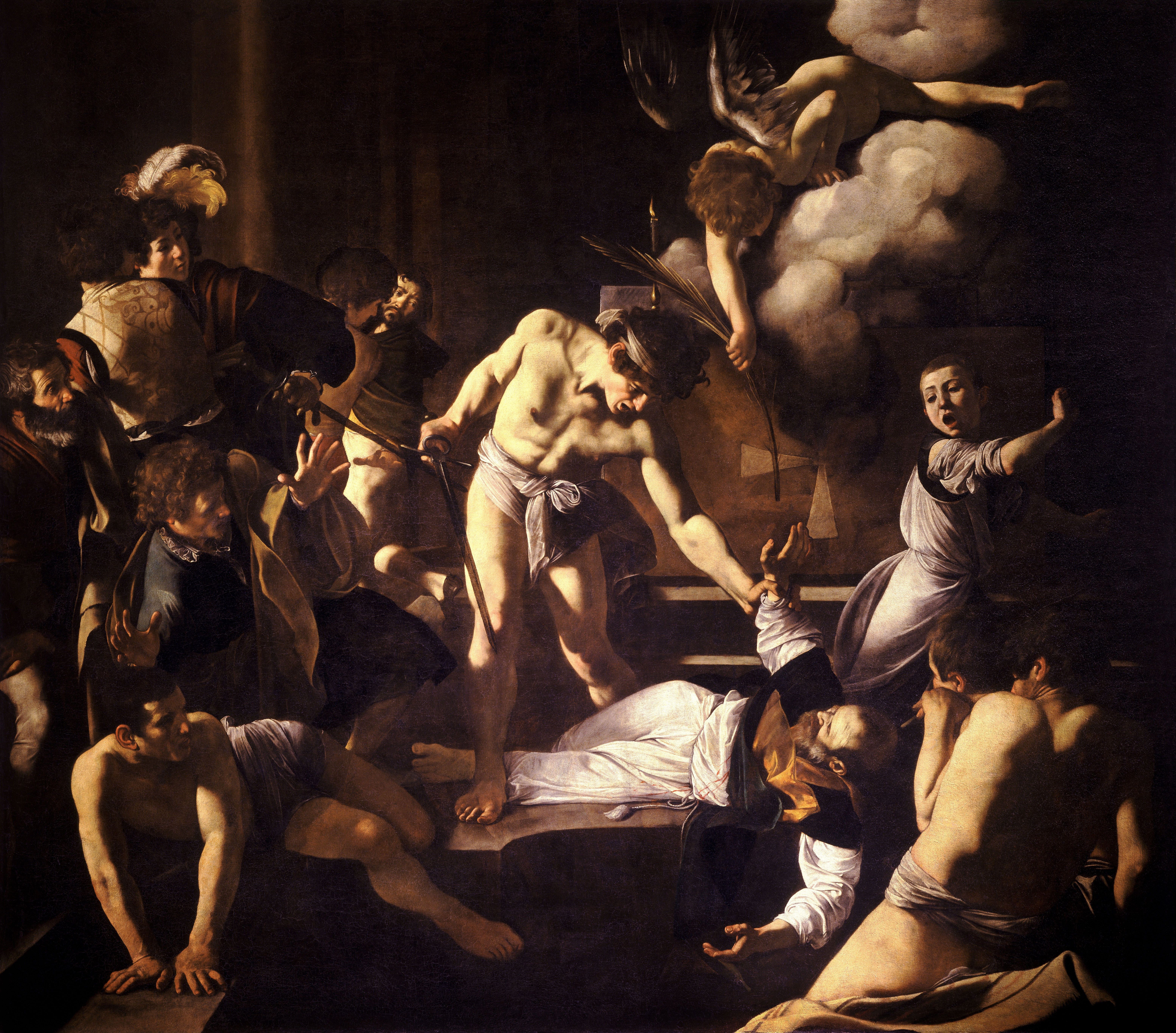
Caravaggio (Michelangelo Merisi), The Martyrdom of Saint Matthew, 1599-1600, oil on canvas, 10’7 1/2 “ x 11’ 3” Contarelli Chapel, Church of Luigi dei Francesi, Rome.
Permanently installed on the right wall of the Contarelli Chapel in San Luigi dei Francesi, Caravaggio’s The Martyrdom of Saint Matthew erupts across the canvas in a chaotic, centrifugal burst of bodies and motion. The composition radiates outward from a single, horrifying fulcrum—the moment of the apostle’s death—captured with explosive, almost cinematic intensity. With this work, Caravaggio established himself as the unrivaled master of psychological violence in early Baroque art.
The narrative follows the traditional account in the Golden Legend. Saint Matthew, having publicly condemned King Hirticus of Ethiopia for lusting after his own niece, the consecrated virgin Iphigenia, is murdered in retaliation. Caravaggio distills the entire hagiography into one blinding instant: the assassin, a half‑nude royal soldier, lunges forward to strike the fatal blow as Matthew collapses, bleeding, onto the altar steps.
Caravaggio pushes tenebrism to its outer limit. The saint lies sprawled on the ground, his arms flung open in a gesture that hovers between defense and surrender. The executioner grips Matthew’s wrist, towering above him with a drawn sword, his face twisted in a scream of fury. Around them, witnesses recoil in terror, their bodies spiraling outward as if blasted by the force of the violence.
Yet amid the earthly chaos, the supernatural breaks through. A cloud gathers above the altar, and an angel descends—not to rescue Matthew, but to complete the drama of martyrdom. Leaning down from heaven, the angel extends the palm of victory, placing it into the saint’s wounded hand at the very moment the assassin’s sword arcs downward.
The intersection of these three elements—the angel’s arm, the soldier’s blade, and Matthew’s reaching hand—forms a powerful diagonal axis, a visual declaration that divine salvation overrides mortal execution. In this collision of heaven and earth, Caravaggio transforms a brutal killing into a moment of transcendent destiny.
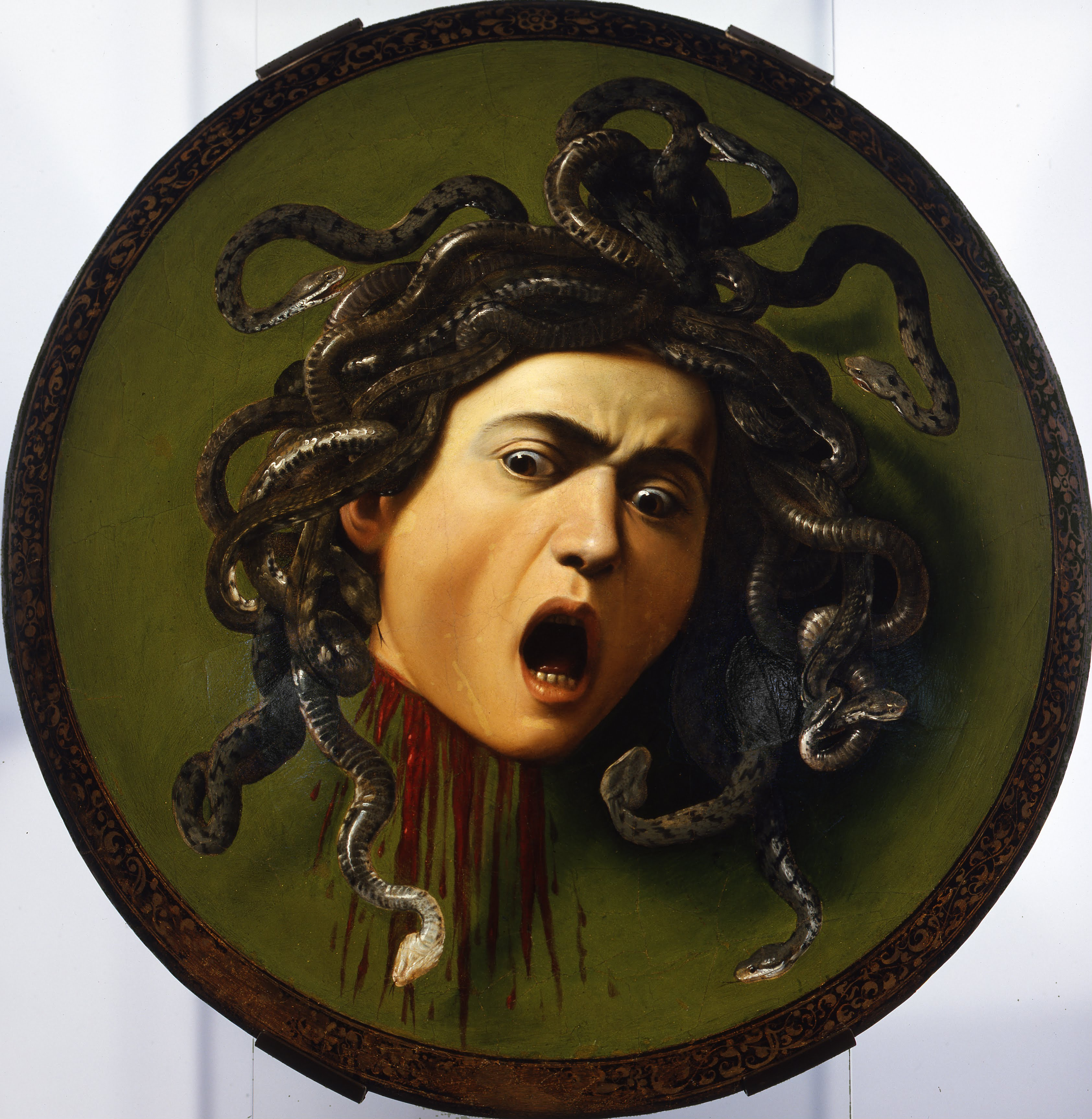
Caravaggio (Michelangelo Merisi), Medusa (detail), 1600/01, oil on canvas mounted on a convex poplar-wood shield, Uffizi, Florence.
Caravaggio’s Medusa is painted on an actual parade shield.
Caravaggio’s Medusa (1600/01), now in the Uffizi Gallery, is one of the most astonishing feats of early Baroque engineering and psychological terror. Painted in oil on canvas and mounted onto a convex poplar shield, the work fuses myth, optics, and raw anatomy into a single, unnervingly lifelike apparition. Commissioned by Cardinal Francesco Maria del Monte and presented as a diplomatic gift to Grand Duke Ferdinando I de’ Medici, it was proudly displayed in the Medici Armory as both a marvel of craftsmanship and a symbol of dynastic power.
Because the surface curves outward, Caravaggio had to deploy advanced foreshortening and perspectival distortion to counteract the shield’s bulge. He subtly elongates Medusa’s cheeks and distorts her jawline so that, when viewed head‑on, the surface appears flat—or even concave—a technical sleight of hand that would have impressed both artists and scientists in Del Monte’s Roman circle.
Caravaggio captures the exact, electric instant between life and death. Perseus has already struck, yet Medusa’s nervous system still fires. Her face becomes a study in catastrophic realization: eyes bulging with shock and fury, brow knotted in disbelief, mouth wrenched open in a silent, blood‑freezing scream. True to his radical naturalism, Caravaggio did not invent stylized serpents; he studied real vipers, painting them mid‑coil, mid‑strike, writhing in panic as their host dies beneath them. From the severed neck, bright arterial blood spurts outward in jagged, hyper‑realistic streams.
To deepen the mythic resonance, Caravaggio anchors the work in the classical story as told by Ovid. According to the Metamorphoses, Perseus could only approach Medusa safely by looking at her reflection in the polished bronze shield given to him by Athena. By painting Medusa’s head directly onto a shield, Caravaggio transforms the viewer into Perseus himself—the one who sees the monster only through a mediated surface. The painting becomes a weapon, a mirror, and a mythic reenactment all at once.
For modern viewers, the shield reads as pure horror: a severed head frozen in the moment of its final scream. But for the Medici, it carried a very different charge. Medusa—whose gaze could immobilize armies—became a potent emblem of political dominion, a symbol of a ruler whose power could paralyze enemies before they even approached.
Caravaggio (Michelangelo Merisi), Basket of fruit (canestra di frutta), c. 1600/01, oil on canvas, 18 1/8 x 25 3/8, Biblioteca Ambrosiana, Milan. https://www.ambrosiana.it/opere/canestra-di-frutta/ – retrieved October 13, 2024.
Caravaggio’s Basket of Fruit is the only autonomous still life by the artist known to survive, though his figure paintings are filled with exquisitely rendered fruit that function as symbolic subtexts. Across his oeuvre, these arrangements vary widely in species, ripeness, and composition, yet they share a distinctive naturalism—blemishes, curling leaves, and the quiet drama of decay rendered with almost scientific precision.
The painting belonged to Cardinal Federico Borromeo (1564–1631), cousin of Saint Charles Borromeo and, like him, Archbishop of Milan. A towering figure of the Counter‑Reformation, Federico championed religious art as a tool of pastoral instruction, yet he was also an unusually passionate collector of still life, a genre often dismissed as minor. Whether he commissioned Caravaggio’s painting or received it as a gift remains uncertain, but he valued it enough to bequeath it in his will to the Ambrosiana in Milan, the scholarly gallery and library he co‑founded in 1618.
The basket itself is instantly recognizable to anyone familiar with Caravaggio’s work. A nearly identical arrangement appears in the Supper at Emmaus in London’s National Gallery, painted around the same time. In both works, the fruit leans precariously over the edge, as if about to tumble into the viewer’s space—a hallmark of Caravaggio’s desire to collapse the boundary between the painting and the viewer.
Cardinal Borromeo lived in Rome from 1586 to 1601, precisely the years when Caravaggio’s reputation was rising with meteoric speed. During this period, he became deeply familiar with the painter’s radical naturalism. For a prelate devoted to both doctrinal clarity and the beauty of the created world, Caravaggio’s still life—so attentive to the fragile, transient nature of living things—would have held profound appeal.
Giulio Cesare Procaccini ((1574–1625), Cardinal-Archbishop Federico Borromeo, 1610, Museo diocesano di Milano.
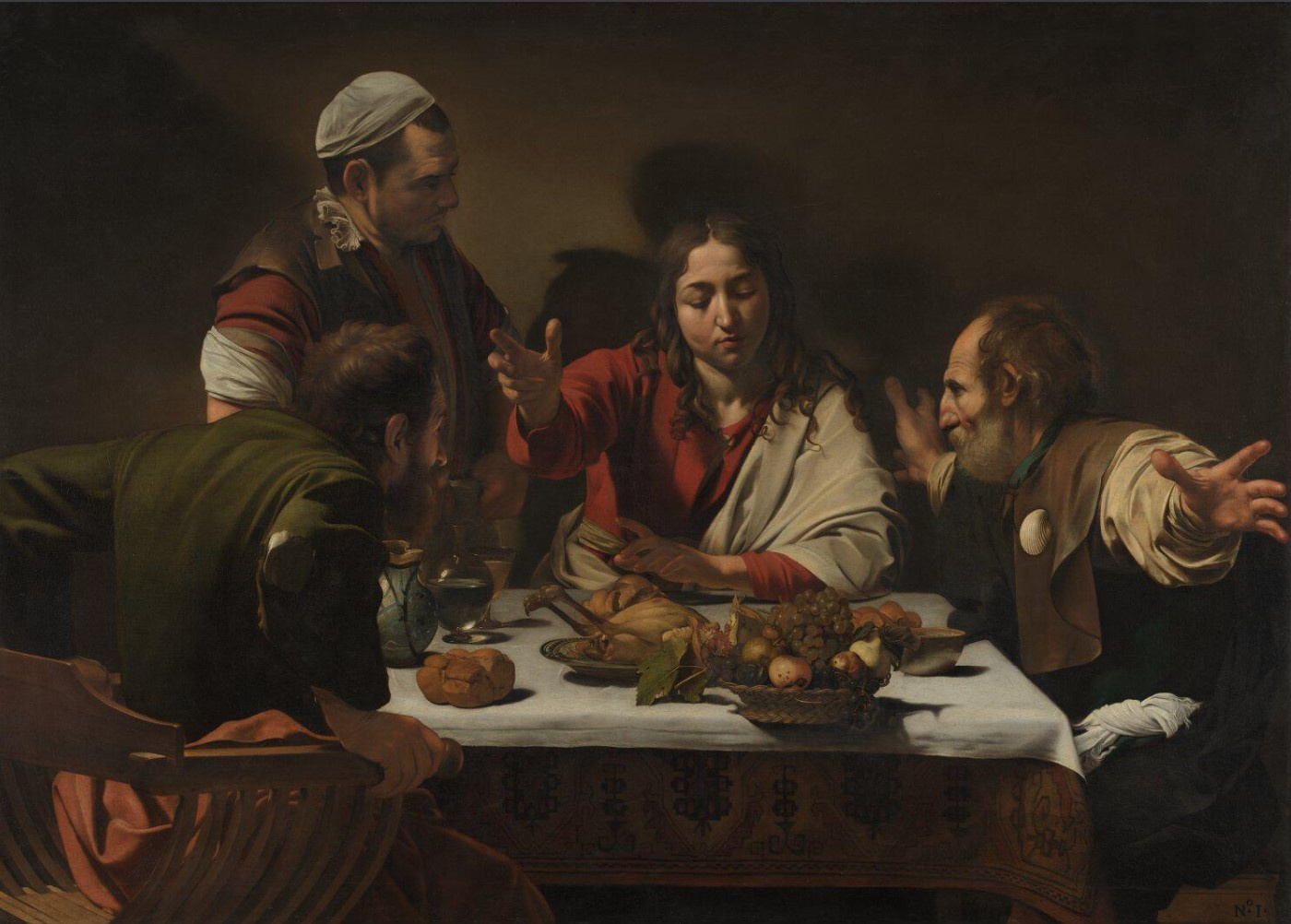
Caravaggio (Michelangelo Merisi), Supper at Emmaus, c. 1600/01, oil on canvas, 54 ¾ x 76 ¾” The National Gallery, London.
Caravaggio’s Roman career accelerated rapidly after the triumph of the Contarelli Chapel commissions. Almost immediately he was engaged for another prestigious project in Santa Maria del Popolo, decorating the Cerasi Chapel. Although these were technically private commissions, their placement in major Roman churches ensured that Caravaggio’s work circulated before a broad public. By 1600 he had become one of the most sought‑after painters in the city, attracting both established patrons and ambitious newcomers such as the wealthy Mattei brothers, prominent Roman bankers. For one of them, in the family palazzo, Caravaggio produced The Supper at Emmaus (1601), a work executed at the apex of his early fame and artistic maturity.
What distinguishes this painting is not only Caravaggio’s reliance on live models and his anatomically precise naturalism, but his increasingly sophisticated deployment of light as a bearer of meaning rather than mere aesthetic embellishment. Instead of depicting the journey to Emmaus, Caravaggio selects the climactic instant at the supper table when the risen Christ blesses and breaks the bread and the disciples suddenly recognize him—just before he vanishes from their sight. Light becomes the visual analogue of recognition itself: a revelatory force that cuts through the scene with theological and psychological clarity.
Caravaggio dramatizes this moment with unprecedented immediacy. One disciple thrusts himself forward, his elbow projecting into the viewer’s space; the other flings his arms wide in astonished realization. Meanwhile the innkeeper, who has not grasped the miracle unfolding before him, remains enveloped in the darker register of Caravaggio’s chiaroscuro, his face still in shadow. The contrast is not incidental: it marks the divide between those who have entered the “light” of recognition and those who remain outside it.
The composition’s theatricality intensifies this effect. Caravaggio’s half‑length, tightly cropped figures press against the picture plane, collapsing the distance between sacred narrative and beholder. Everyday objects—fruit basket, tablecloth, the disciples’ garments—jut outward with near sculptural immediacy, creating a sensuous, almost tactile realism that anchors the miracle in the viewer’s own world. The result is a painting that is simultaneously grounded in contemporary Roman life and elevated by a supratemporal luminosity that signals divine presence.
Yet the work was not universally admired. Critics objected that Caravaggio’s Christ looked too youthful and unbearded—“a man posing as Christ who certainly was not Christ,” as Bellori complained in 1672. Caravaggio got the criticism though Michaelangelo Buonarroti did the same thing in the pope’s Sistine Chapel. Others scoffed that the fruit on the table could not have been in season during the post‑Easter episode. Such criticisms, however, reveal the very innovation of Caravaggio’s method: his commitment to inventing a world that is believable precisely because it is rooted in the observable, even when that realism unsettles traditional expectations. Unlike earlier artists who idealized sacred history, Caravaggio insisted on painting from life, even in a religious history painting intended for private devotion.
The Supper at Emmaus thus exemplifies Caravaggio’s distinctive achievement: a fusion of radical naturalism and spiritual intensity that collapses historical distance, bringing the sacred into the viewer’s present while simultaneously lifting the everyday into a realm of revelation.
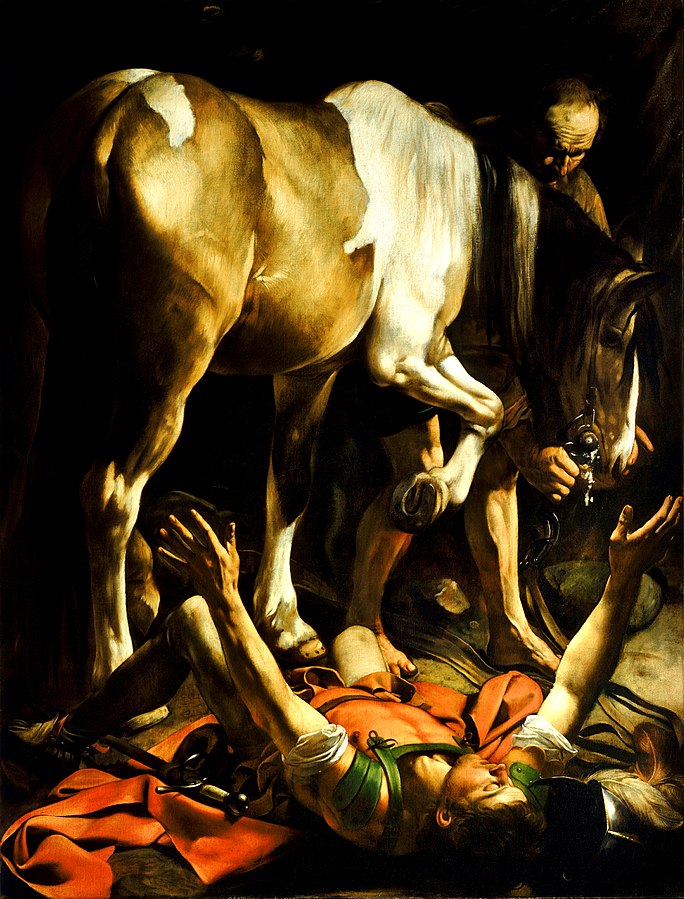
Caravaggio (Michelangelo Merisi), The Conversion of Saint Paul, 100/01, oil on canvas, 90 ½ x 70” Cerasi Chapel, Santa Maria de Popolo, Rome.
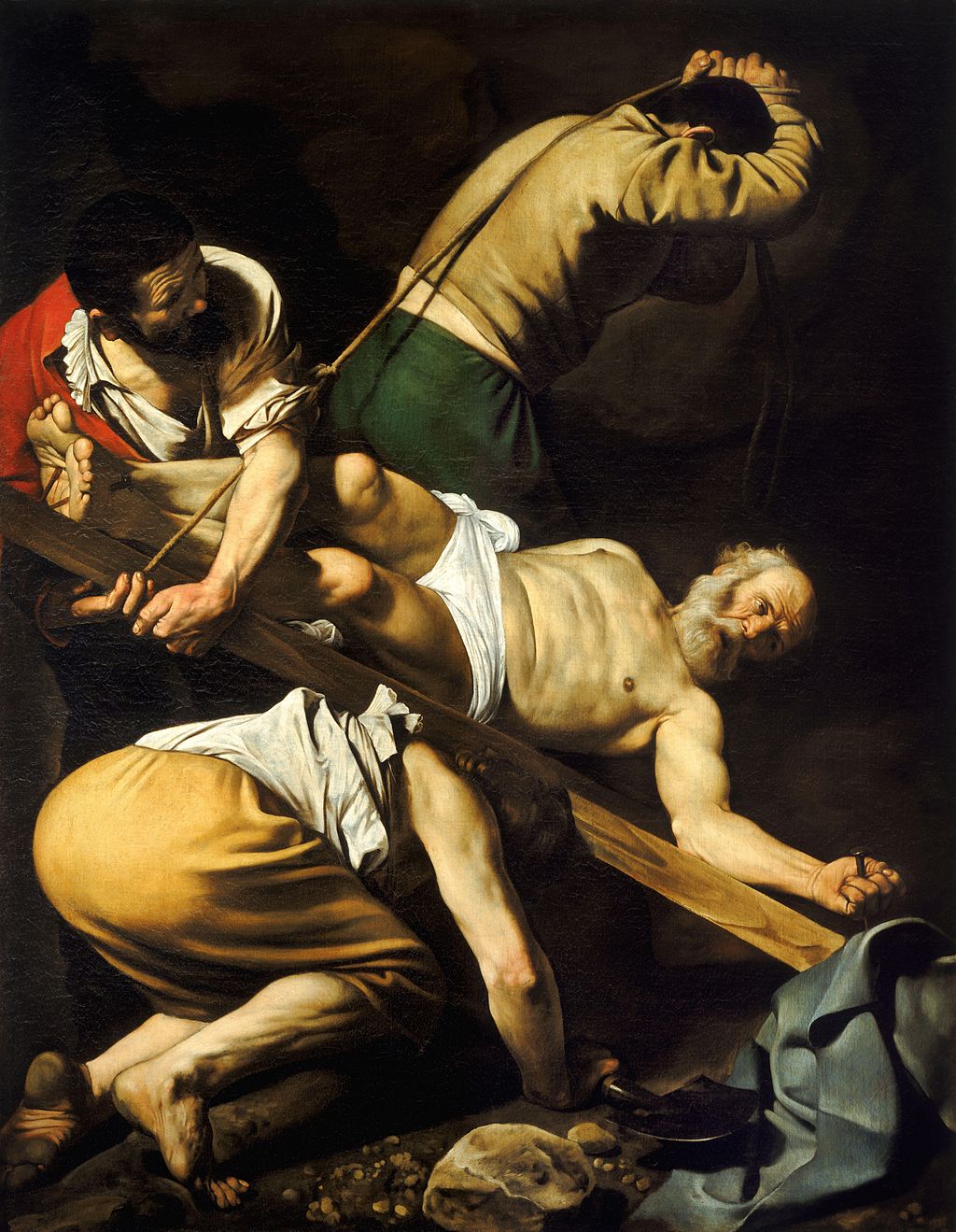
Caravaggio (Michelangelo Merisi), The Crucifixion of St. Peter, 1600/01, oil on canvas, 90 ½ x70” Cerasi Chapel, Santa Maria de Popolo, Rome.
The chapel was purchased by Tiberio Cerasi (1544-1601) in 1600 who worked as Treasurer-General for Pope Clement VIII. Cerasi had the chapel redone by Carlo Maderno (1556-1629). In 1601 Cerasi hired Caravaggio to paint The Conversion of St. Paul and The Crucifixion of St. Paul. Notably, his paintings’ first versions were rejected. The final paintings were installed in 1605 and the chapel consecrated in 1506. The Assumption of Mary over the altar was painted at the same time by Annibale Caracci. See – https://en.wikipedia.org/wiki/Cerasi_Chapel– retrieved October 14, 2024.
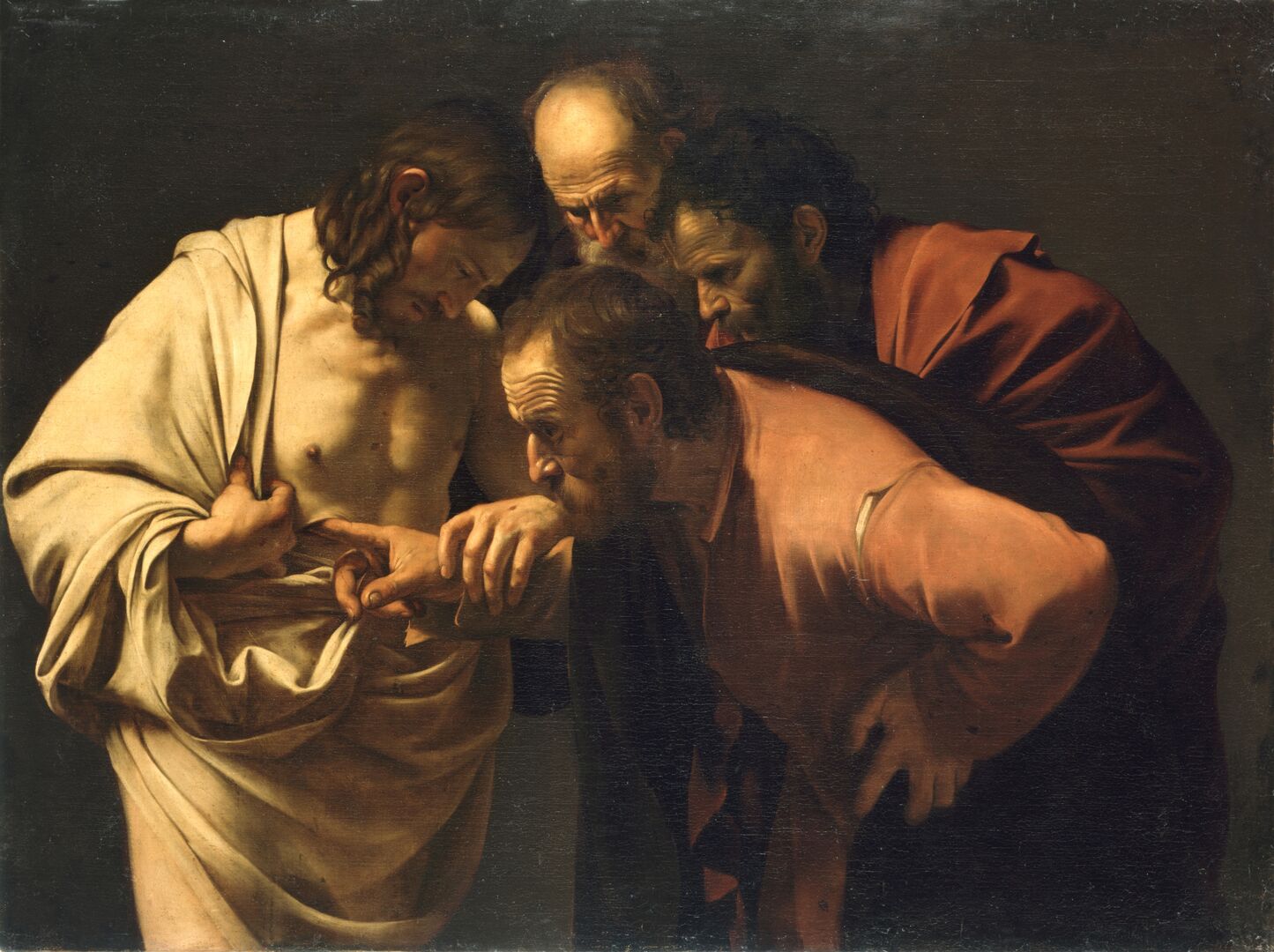
Caravaggio (Michelangelo Merisi), The Incredulity of Saint Thomas, 1601/02, oil on canvas, 42 1/8 x 57 ½” 118 × 156.5 cm Neues Palais, Potsdam.
Caravaggio’s The Incredulity of Saint Thomas presents the New Testament encounter (John 20:27–31) with uncompromising naturalism and the stark drama of chiaroscuro. The painting’s later history is as turbulent as its subject. Originally owned by the powerful Giustiniani family, it was sold under financial duress and purchased in 1815 from a Paris dealer by King Frederick William III of Prussia (1770–1840). The king intended to assemble a public art museum for Berlin, yet this work—astonishingly—was initially judged “lower quality,” perhaps because Caravaggio offers no visible markers of Christ’s divinity. Instead, he renders the risen Christ with the same corporeal immediacy as the apostles, a choice that unsettled early nineteenth‑century connoisseurs.
Of the five Caravaggios acquired by the Prussian monarch, only three ultimately entered the museum collection, including Cupid as Victorious at the Gemäldegalerie. The Incredulity of Saint Thomas was instead hung in the Berlin Palace, and later, in 1856, installed in the picture gallery at Sanssouci, where its psychological intensity found a more appreciative audience.
Caravaggio’s interpretation of the biblical scene is uncompromisingly direct. Christ guides Thomas’s hand into the wound in his side, the gesture rendered with surgical clarity. The apostles crowd around, their faces lit by a single, directional beam that isolates the moment of recognition. There is no halo, no ethereal glow—only flesh, shadow, and the shock of belief forced into being. Caravaggio transforms a theological lesson into a moment of tactile revelation, collapsing the distance between viewer and miracle. https://brandenburg.museum-digital.de/object/11898 – retrieved October 11, 2024.
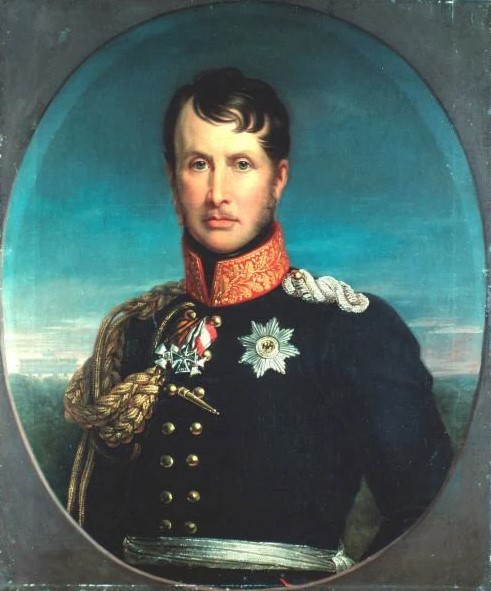
Frederick William III ruled Prussia during the Napoleonic Wars and, while shy and quiet by nature, reluctantly participated in the coalition against Napoleon in the German campaign of 1813. After Napoleon’s defeat in 1815, he took part in the Congress of Vienna and helped established the new postwar order in Europe. For the remainder of his reign, Frederick William III set about reforming Prussian institutions and centralizing royal control.
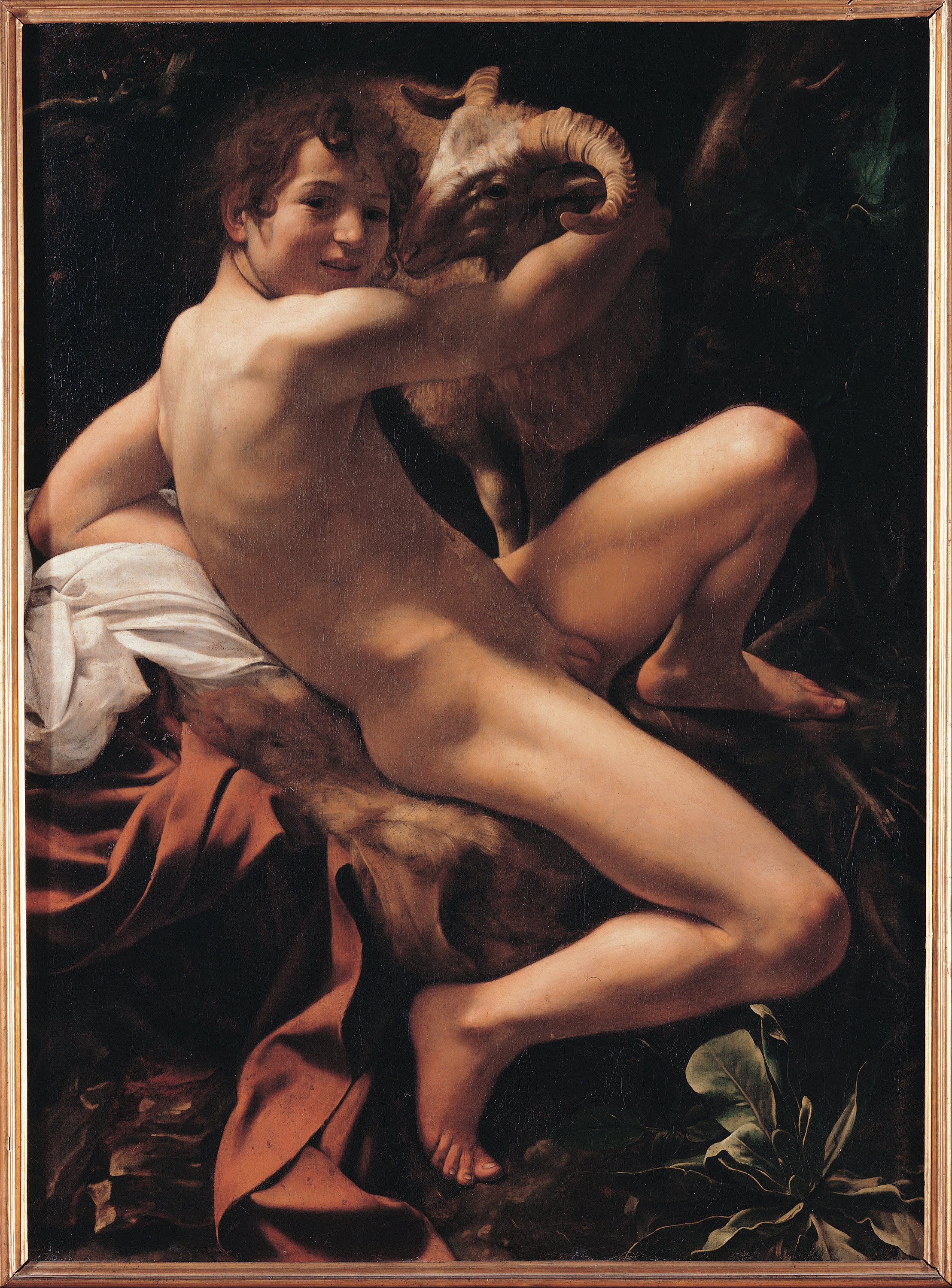
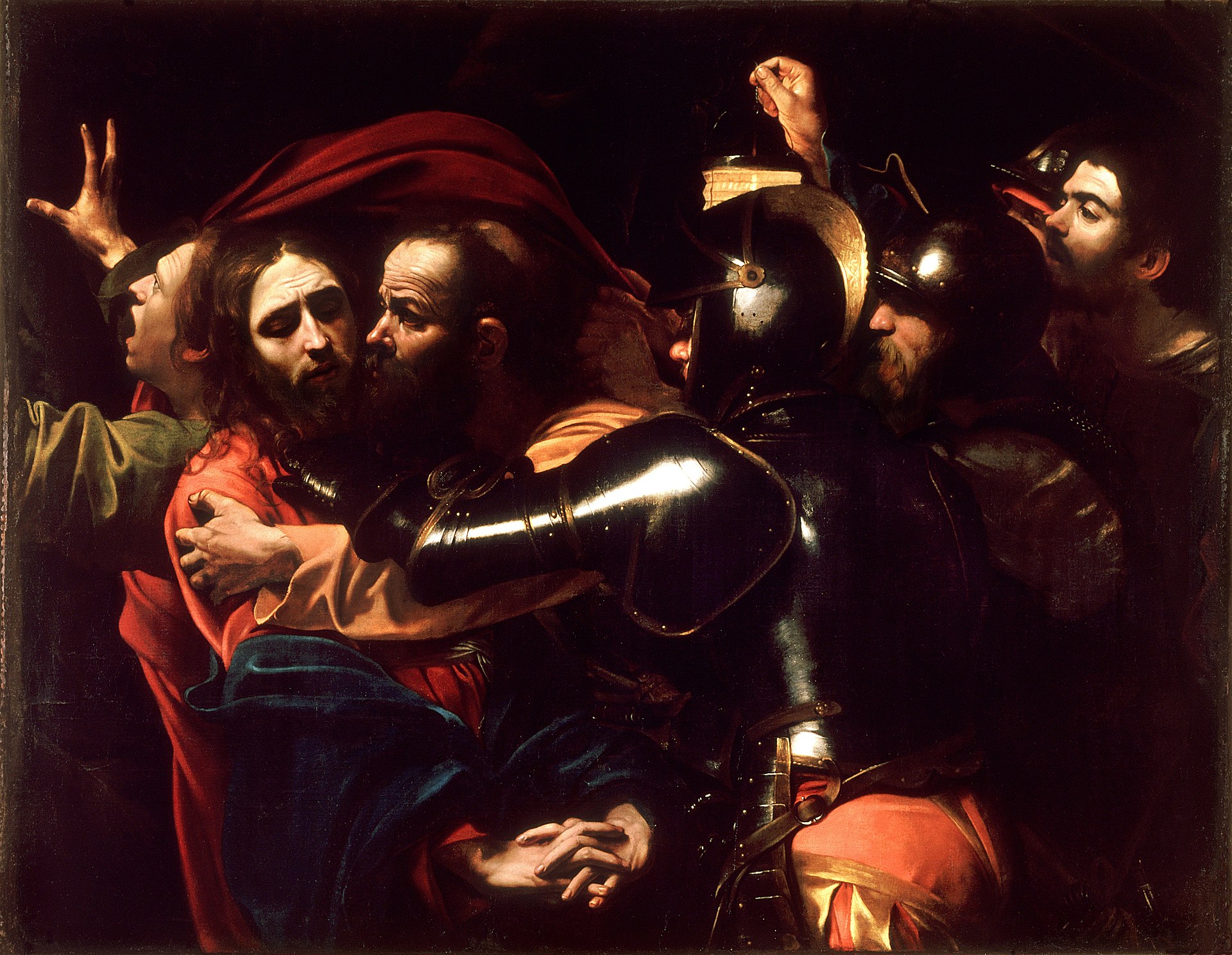
Youth With A Ram was painted for Ciriaco Mattei (d.1614), one of the foremost art collectors of his time, and given to Cardinal del Monte by his son before his death. Mattei also commissioned Caravaggio’s Supper at Emmaus and The Taking of Christ.
Caravaggio (Michelangelo Merisi), The Taking of Christ, 1602, oil on canvas, 133.5 cm × 169.5 cm (52.6 in × 66.7 in) National Gallery of Ireland. On loan from the Society of Jesus, Leeson Street., Dublin.
The painting includes a self portrait of Caravaggio. Caravaggio (Michelangelo Merisi), The Sacrifice of Isaac, 1603, oil on canvas, 41 x 53 1/8” Uffizi, Florence.https://www.uffizi.it/en/artworks/sacrifice-of-isaac – retrieved October 12, 2024.
The painting illustrates the Old Testament story in which God subjected Abraham to an extraordinary test of obedience by ordering him to sacrifice his only son Isaac (Genesis 22: 1-19). Caravaggio faithfully depicts the crucial moment of this dramatic story, when old Abraham, at the very moment he is about to immolate a screaming Isaac, is blocked by an angel sent by the Lord.
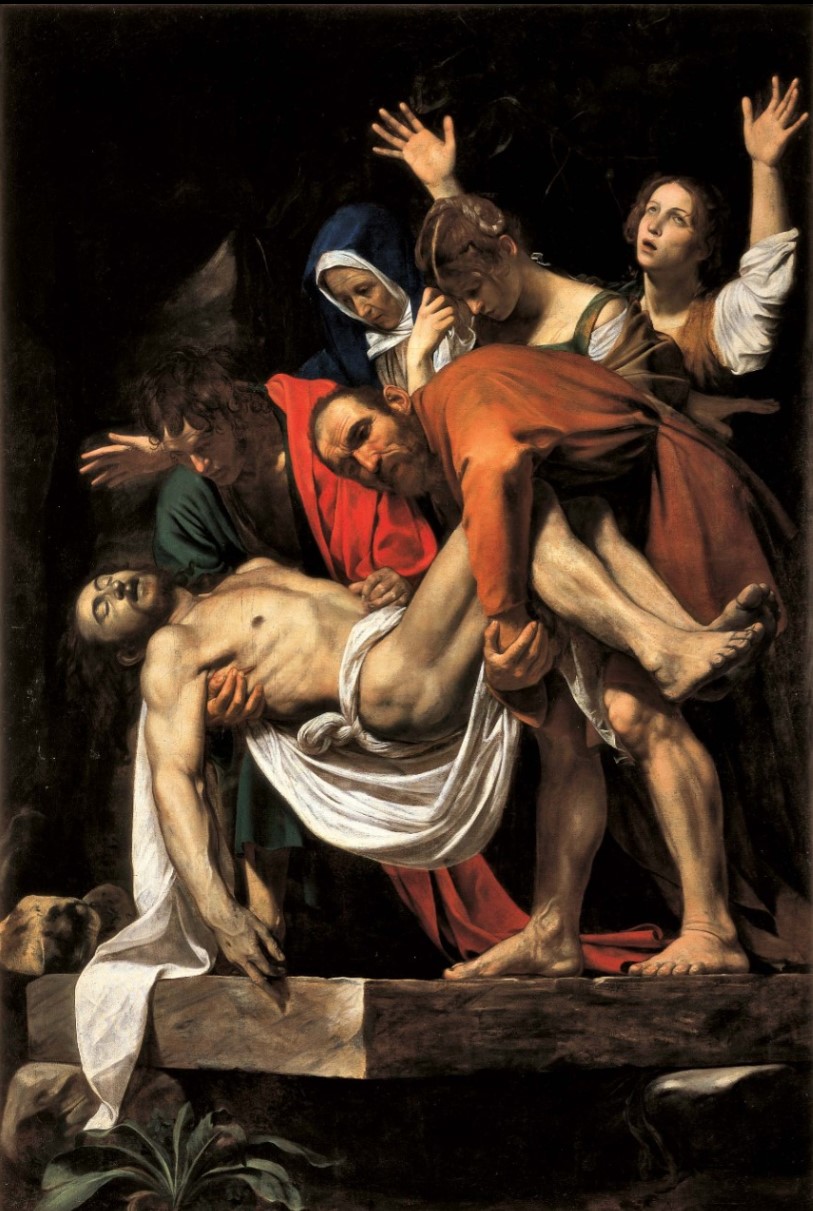
The Deposition, considered one of Caravaggio’s greatest masterpieces, was commissioned by Girolamo Vittrice for his family chapel in Santa Maria in Vallicella (Chiesa Nuova) in Rome. In 1797 it was included in the group of works transferred to Paris in execution of the Treaty of Tolentino. After its return in 1817 it became part of Pius VII’s Pinacoteca.
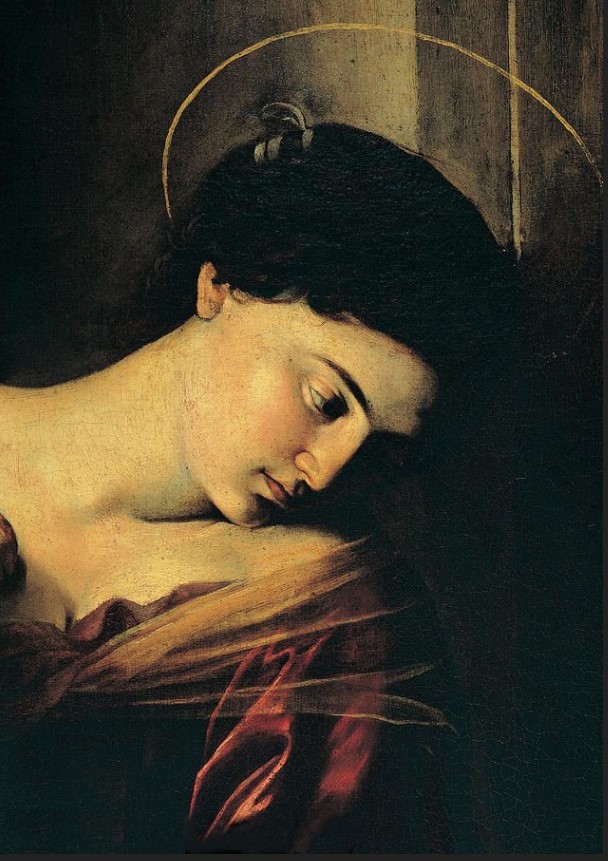
Michelangelo Merisi, called the Caravaggio, DETAIL The Madonna of Loreto (The Madonna of the Pilgrims), circa1603-1604, Oil on canvas, 8’ 8 ½ x 4’ 11”, Cavalletti Chapel, Church of Sant’ Agostino, Rome.Michelangelo Merisi, called the Caravaggio, The Madonna of Loreto (The Madonna of the Pilgrims), circa1603-1604, Oil on canvas, 8’ 8 ½ x 4’ 11”, Cavalletti Chapel, Church of Sant’ Agostino, Rome.
The painting has been in the Cavalletti chapel in Rome since it was installed at the end of 1604.
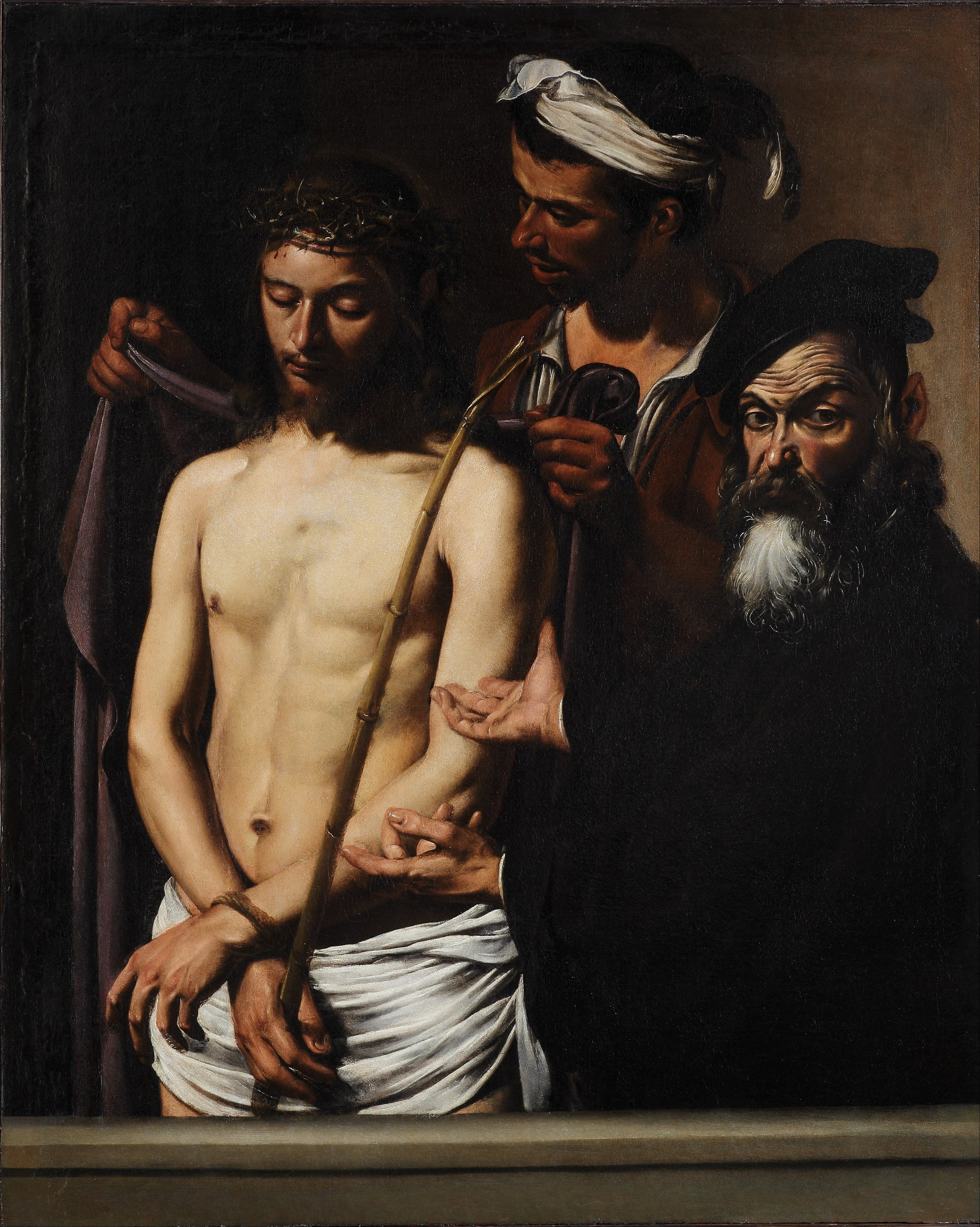
Michelangelo Merisi, called the Caravaggio, Ecce Homo, c. 1604-05, oil on canvas, 50 ½ x 40 ½” Civic Collection, Palazzo Rosso, Genoa.
The painting was made for a competition with Domenico Passignano (1559-1638) and Lodovico Cardi (“Il Cigoli”) (1559-1613) soon after Il Cigoli first arrived in Rome. Il Cigoli won the compettion and the whereabouts of Caravaggio’s painting until it arrived to Genoa is uncertain. It may be that Caravaggio himself took it to Genoa when he visited there in 1605.
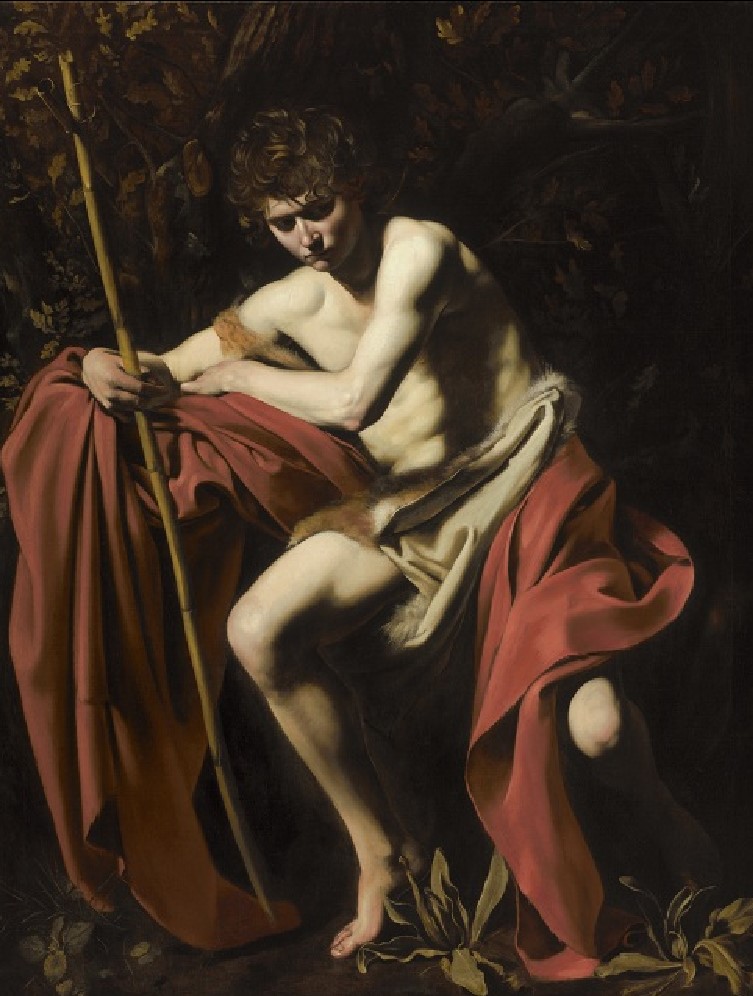
Michelangelo Merisi, called the Caravaggio, Saint John the Baptist, c. 1605, oil on canvas, 68 1/4 x 52” Nelson-Atkins Museum of Art, Kansas City, Missouri.
The painting was made for Ottavio Costa who then had a copy made for his chapel in Liguria while the original was lost. It resurfaced in the mid 19th century in England and was acquired by the Nelson-Atkins Museum of Art in the 1950s. Caravaggio reveals the qualities of the saint by his expression and pose. He is sober and downcast with a tense energy as his pose manifests the monumentality of the prophets on the Sistine Chapel ceiling. With his staff he quietly and contemplatively conveys zeal, passion and vitality. There is a sense of his singleness of purpose, joined even to a little madness, as a man driven by making straight the paths of the Lord.
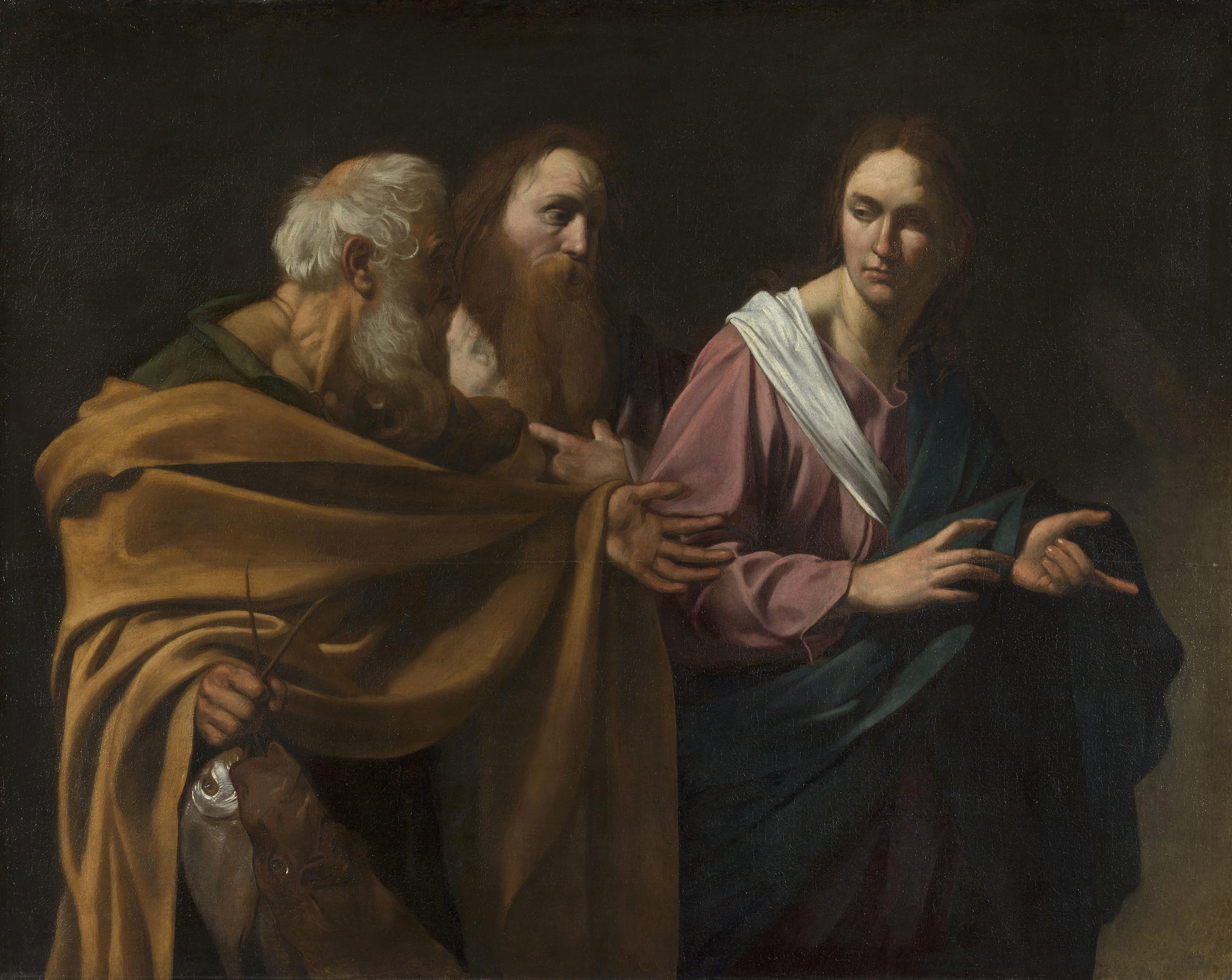
The painting was bought by King Charles I of England (1600-1649) in 1637. After the monarch’s defeat in the English Civil War (1642-1645), he was imprisoned and executed for high treason in 1649. During the Commonwealth (1649-1660), the painting was sold in 1651 and recovered at the Restoration. Caravaggio’s painting depicts the call of the very first disciples in the very first New Testament Gospel by Mark: “As he passed by the Sea of Galilee, he saw Simon and his brother Andrew casting their nets into the sea; they were fishermen. Jesus said to them, “Come after me, and I will make you fishers of men.” Then they abandoned their nets and followed him” (Mk 1:16-18). Caravaggio depicts Jesus without a beard as he turns back to invite them to follow him as he moves ahead. Fishermen, Simon Peter holds skewered fish on a stick while Andrew points to himself identifying the object of Jesus’s invitation.
As recently as 1987 this painting came to be attributed to Caravaggio and as the original of this painting’s subject matter. In varying copies of the work the furrow in Christ’s brow is painted faithfully though in this original it is not a painted feature but a canvas fold. There are other design features that, after recent cleaning and conservation, point to a later work of Caravaggio. Many small incisions are present in the artwork’s lower layers of paint that is an uncanny method used by the artist to lay out important points on the canvas for his design. Although the attribution can be argued to the contrary – such as the unusual use of the color blue which Caravaggio saw, according to Bellori, as the “poison of colors” – he did use the color and mostly softened as it is here. Blue, for instance, occurs in the Baptism of Christ (National Gallery of Ireland, c. 1603) and the Annunciation (Nancy, c. 1604). At the Supper at Emmaus (Brera, 1605-6) Christ also wears a robe of softened blue. In its telling broad brushwork, restrained colors, and minimal detail the painting was understood to be a Road to Emmaus painting as discussed by Giulio Mancini and Giovanni Baglione. But these early biographers’ references are likely to the Supper at Emmaus (National Gallery London, 1601). Dated stylistically by its economical, shadowed, and expressive manner, The Calling of Saints Peter and Andrew appears to be from the period of 1603-1606. This would be before Caravaggio killed Ranuccio Tomassoni (c. 1580-1606) in a brawl and fled Rome in May 1606. During the first years of the 17th century, the sensuous surface detail of Caravaggio’s art had become spare, dark and expressive. Further, The Calling of Saints Peter and Andrew places half-length figures interacting against a stark background, similar to such paintings as Doubting Thomas (Sanssouci, Potsdam) and the Betrayal of Christ (National Gallery of Ireland, Dublin), both of 1603. Before this painting reached England, there was a broadly interpreted copy of it that is today in a private collection by Bernardo Strozzi (1582-1644). Strozzi lived and worked in Rome, Genoa and Venice where he may have seen this painting by Caravaggio. When Charles I’s buying agent was later in Italy, he visited the same places as Strozzi had been, except Genoa.
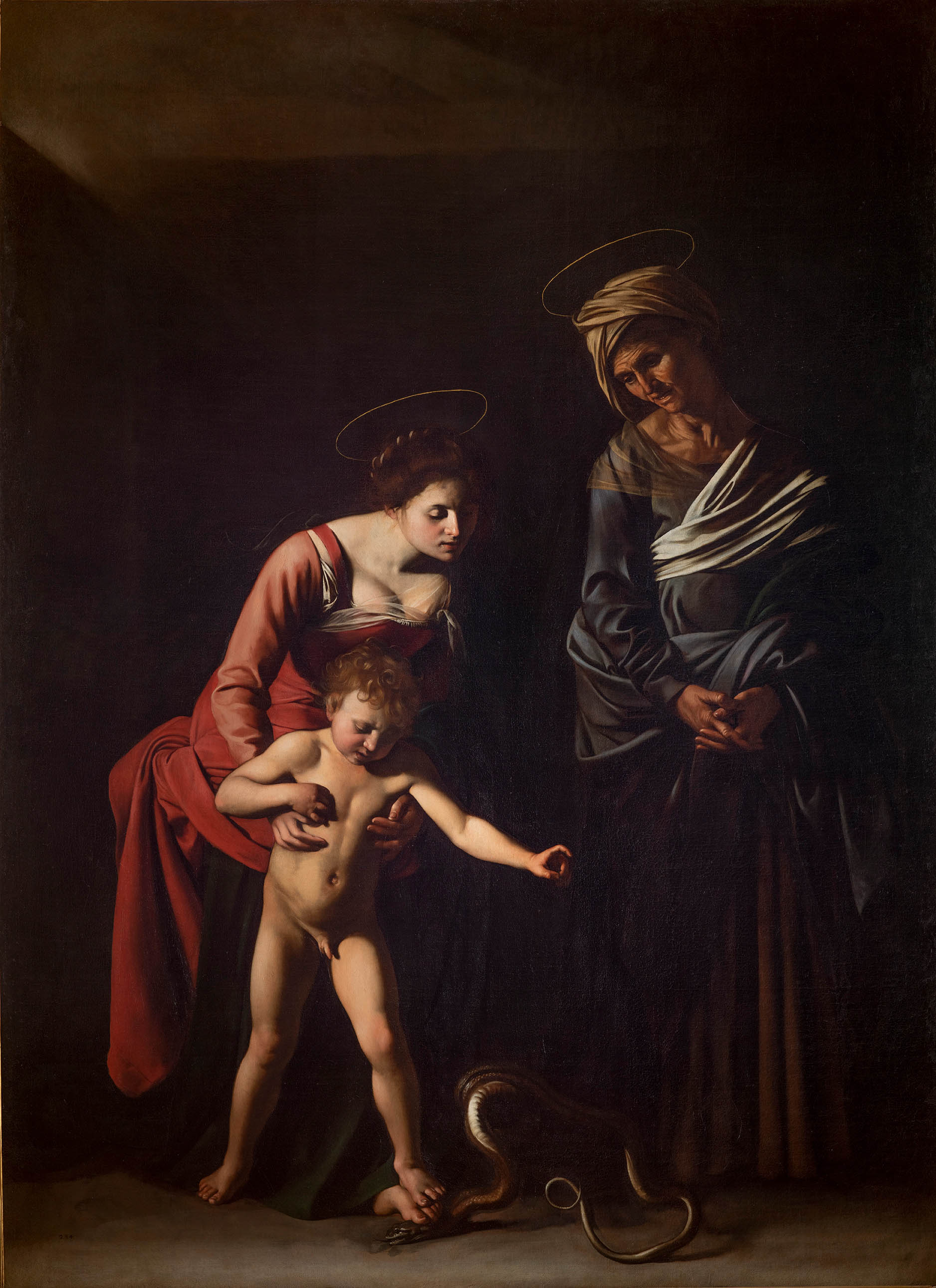
The painting was commissioned in 1605 by members of the powerful archconfraternity of the Palafrenieri who, following the renovation of St. Peter’s Basilica, asked the painter for a new work intended to replace an old painting that decorated the altar of their chapel dedicated to St. Anne. Painted within a few months, in April 1606 the work was exhibited and shortly afterwards moved to the nearby church of Sant’Anna dei Palafrenieri where, seen by Scipione Borghese, it was bought by him. For whatever reason the painting was controversial – perhaps the cleavage of the Madonna or the rendering of the nudity of the child – but Scipione Borghese proudly hung it in his own picture gallery. The painting depicts Mary as she crushes a snake – a symbol of sin – at her feet with the help of Jesus and witnessed by Anna, mother of the Virgin.
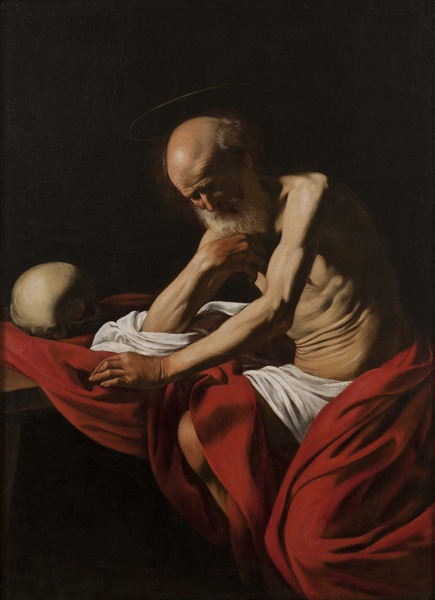
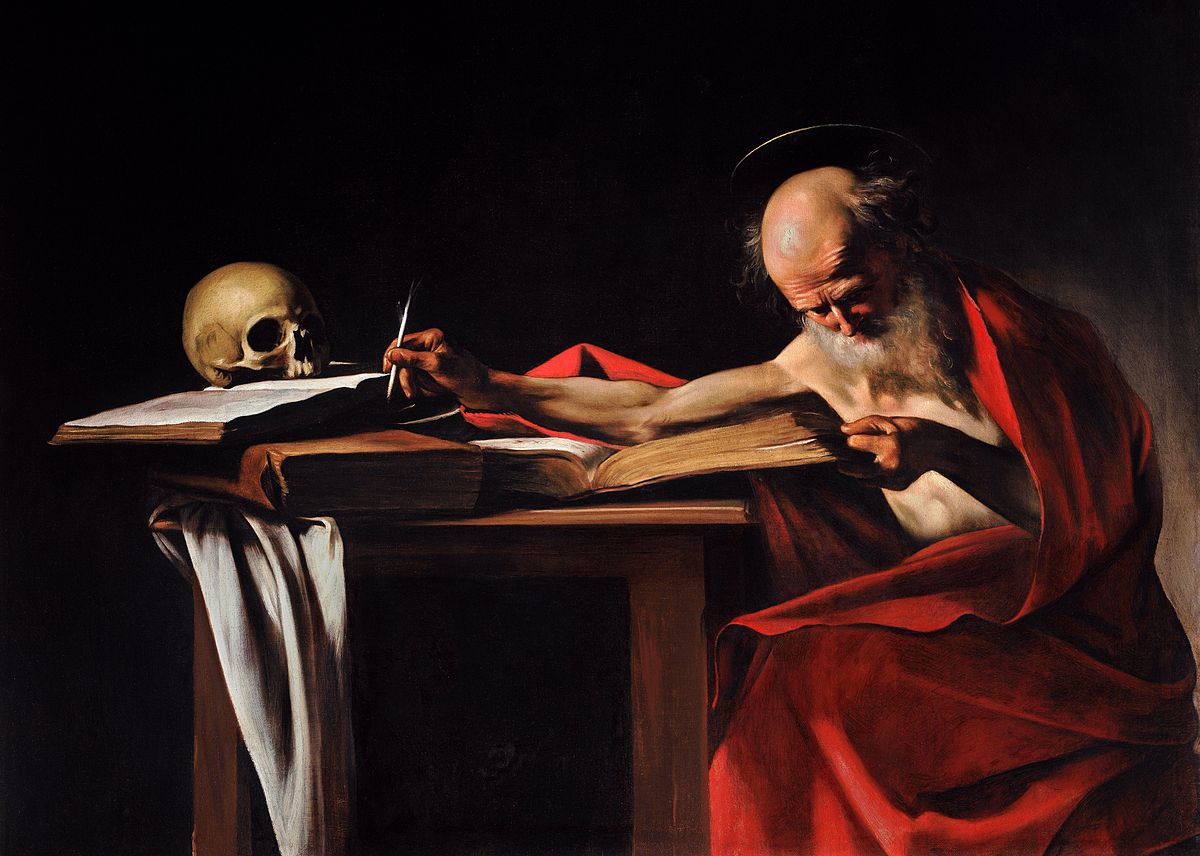
Michelangelo Merisi, called the Caravaggio, Saint Jerome writing, 1605/06, oil on canvas, 116 cm x 153 cm, Borghese Gallery, Rome.
According to Bellori, the painting was made by Caravaggio for Cardinal Scipione Borghese. The cardinal was not only an avid and refined art collector but one of young Caravaggio’s earliest and greatest admirers recognizing the Lombard’s talent despite personality flaws or lack of connections in Rome. The painting depicts Saint Jerome (c. 340s-420), Doctor of the Church, best known for his translation of the Bible from Greek into Latin as well as his commentaries on the Bible. Caravaggio depicts the priest and confessor writing and studying the Holy Scriptures as a scholar, now in old age, who has dedicated his life as a humanist engaged in the complex translation and exegesis of the Church’s sacred text. The composition is divided into large fields of color in warm tones (the saint’s complexion and reddish mantle) and cold tones (the skull and shroud-like white cloth) with Jerome’s arm outstretched with writing instrument in hand across the picture to symbolically portray the unity of the scholar-saint’s dialogue with these opposites of nature including life and death, past and present. As there are many unfinished details in the painting, the artist’s style points to his rapid execution of the work. https://www.collezionegalleriaborghese.it/opere/san-girolamo – retrieved October 13, 2024.
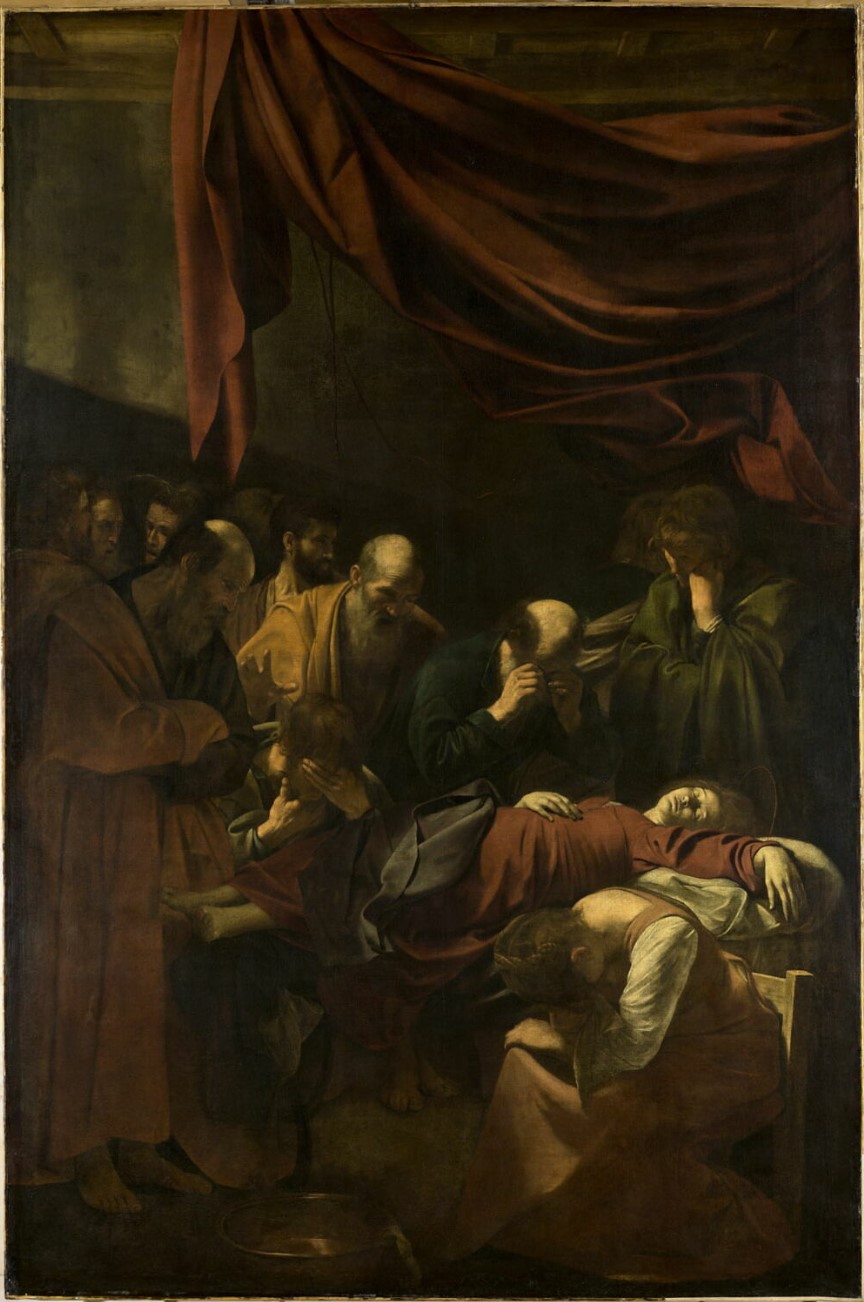
DETAIL Caravaggio (Michelangelo Merisi), The Death of The Virgin, c. 1605-1606, oil on canvas, 12’1 ½” x8’, Louvre, Paris.
Caravaggio (Michelangelo Merisi), The Death of The Virgin, c. 1605-1606, oil on canvas, 12’1 ½” x8’, Louvre, Paris.
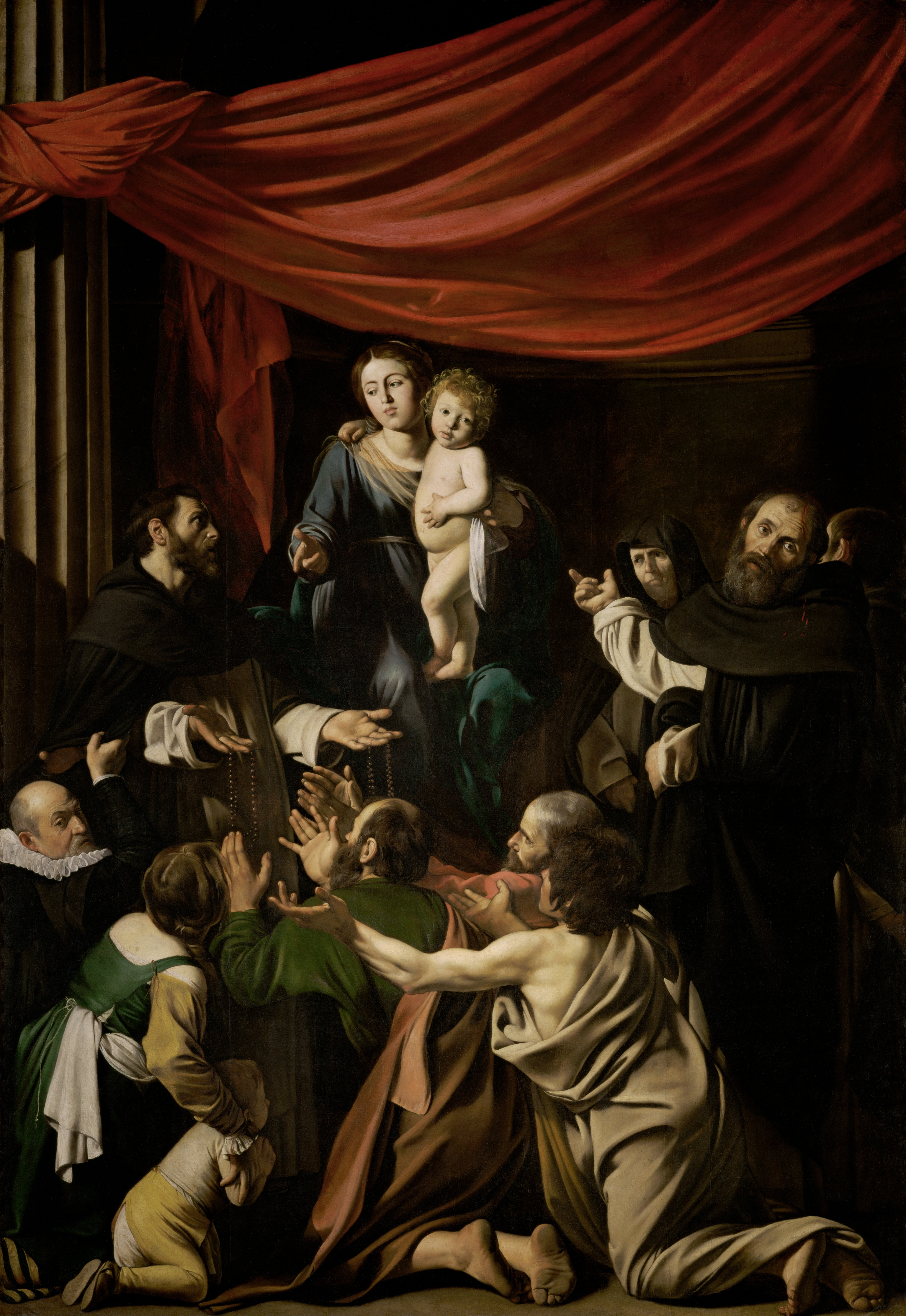
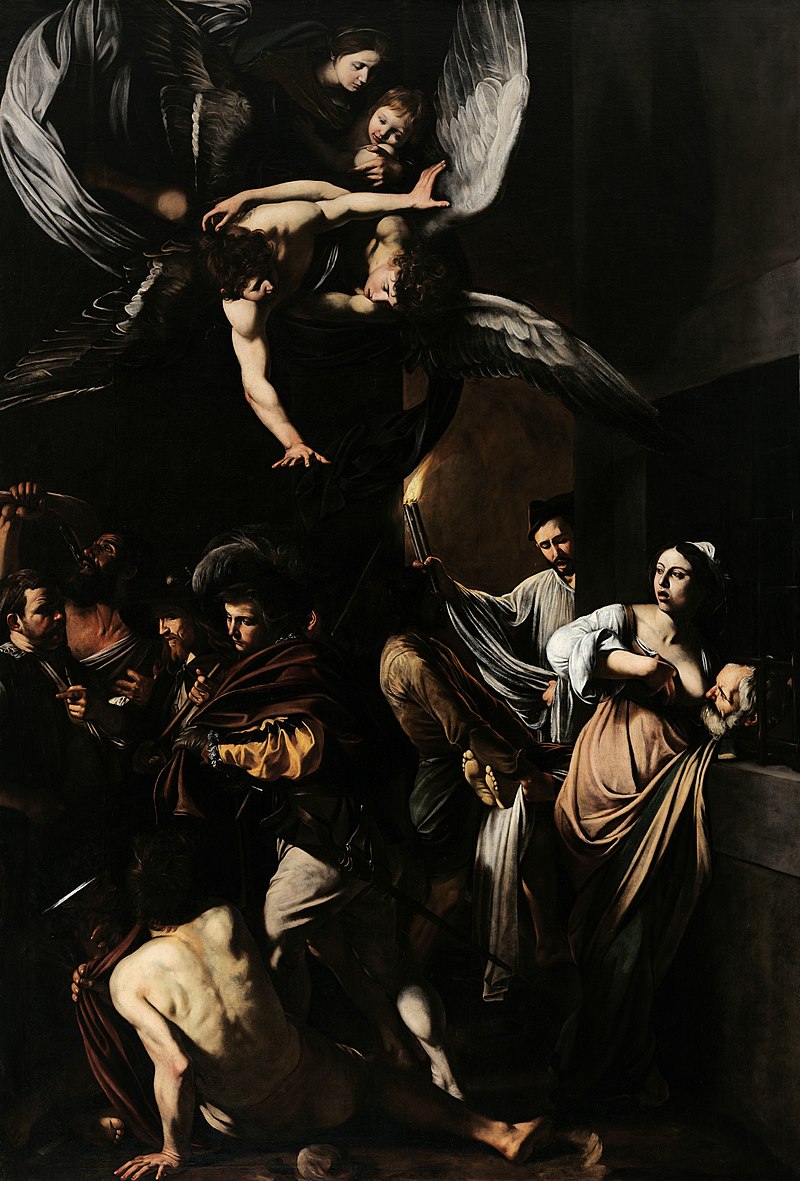
Caravaggio (Michelangelo Merisi), The Madonna of the Rosary, c. 1605-1607, oil on canvas, 11’11 ½” x8’ 4”, Kunsthistorisches Museum, Vienna.Caravaggio (Michelangelo Merisi), The Seven Acts of Mercy, 1606, Oil in canvas, 12’ 9 ½” x 8’ 6 ½” Pio Monte della Misericordia, Naples.
The Seven Acts of Mercy altarpiece was painted between September 23, 1606 and January 9, 1607 for which Caravaggio was paid 400 ducats. The commission required that the artist include the figure of the Madonna of the Misericordia and all the acts of mercy in one vertical canvas and whose overall achievement was a first in Italian art.
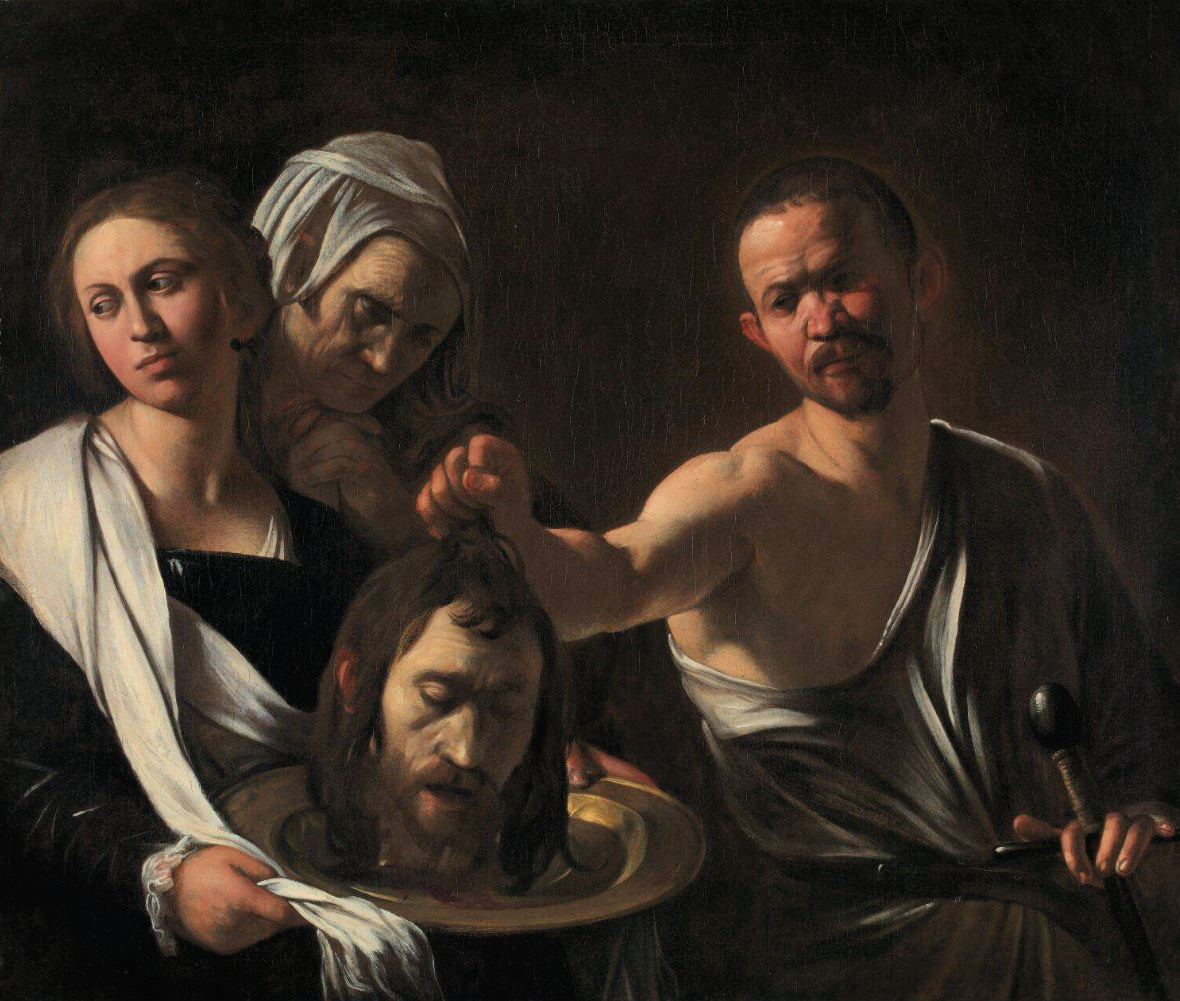
Caravaggio (Michelangelo Merisi), Salome, 1609/10, oil on canvas, 35 5/8 x 65 ¾” The National Gallery London.
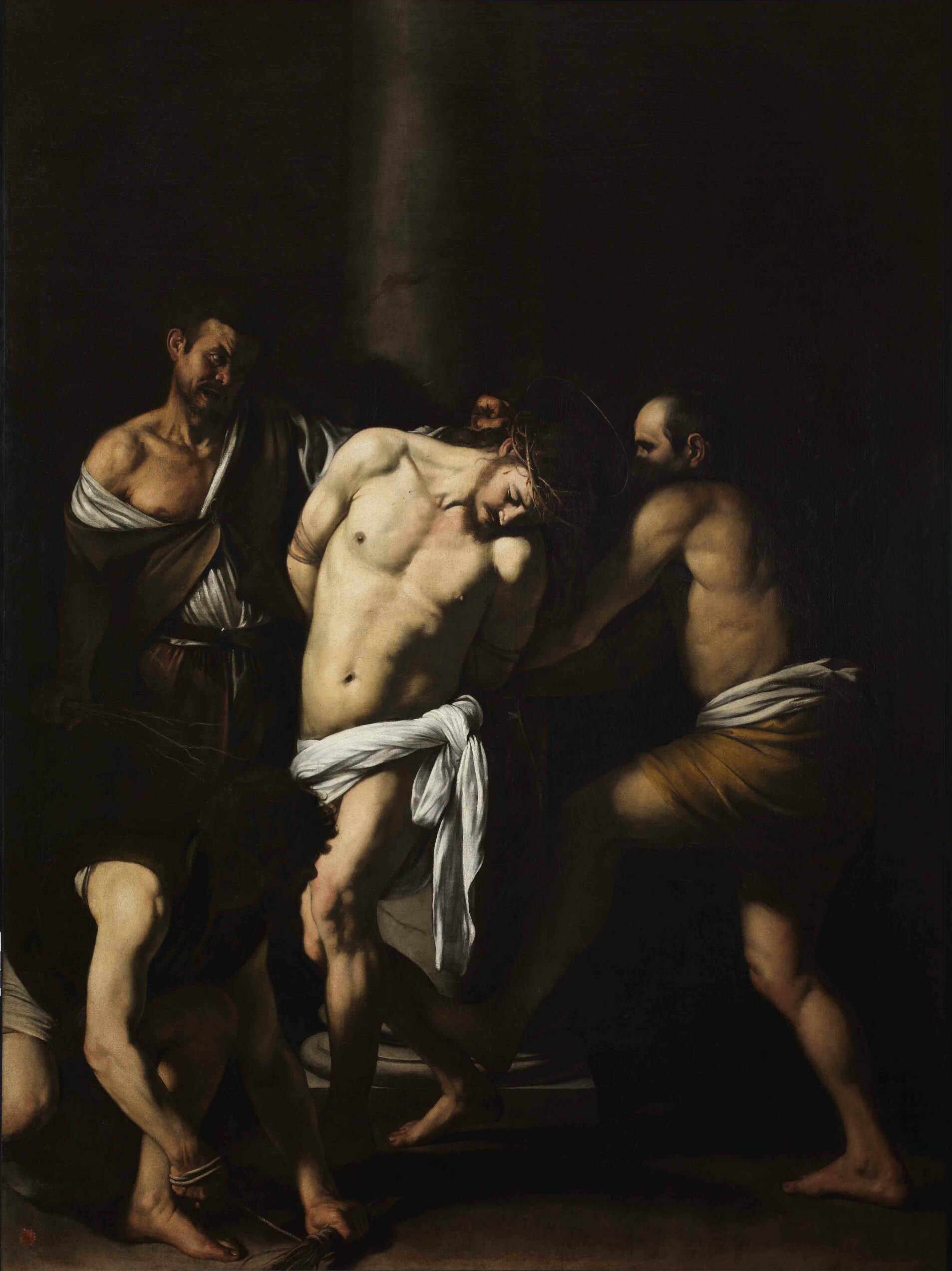
Caravaggio (Michelangelo Merisi), The Flagellation, 1607, oil on canvas, 9’ 4 ½” x 6’2” Capodimonte Museum, Naples.
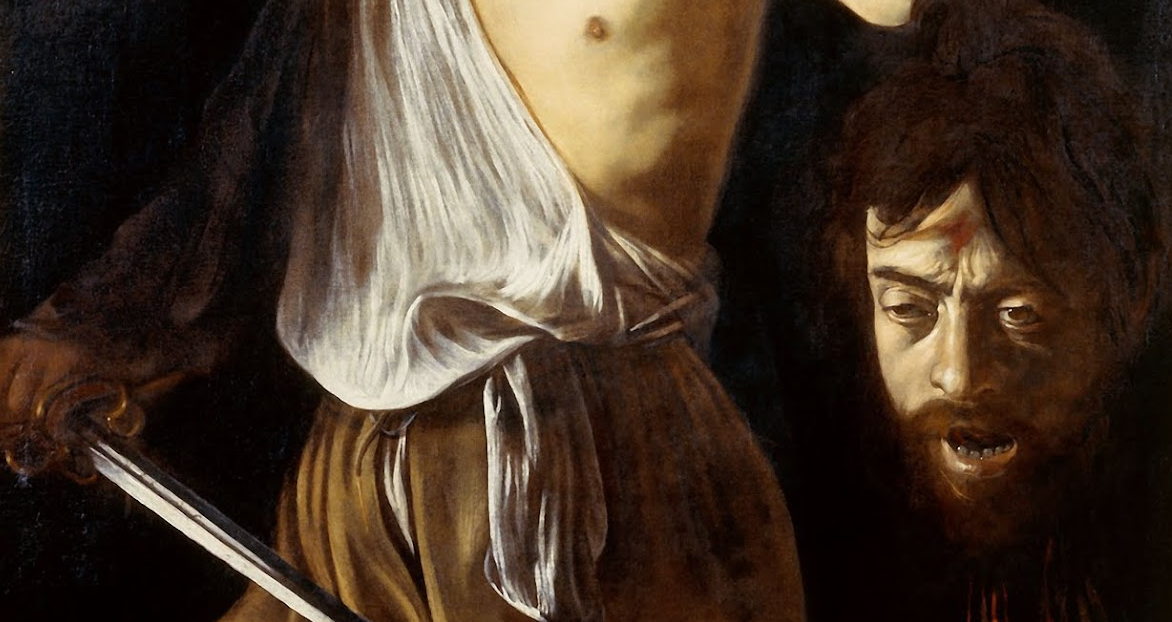
The dramatic play of light and shadow throws into relief the melancholic expression on David’s face and the hauntingly lifelike head of Goliath, creating a palpable sense of guilt and redemption that resonates deeply with the viewer.
The head of Goliath is Caravaggio’s self portrait.
In addition to developing a considerable name as an artist, Caravaggio was a reputably volatile, bad-tempered and violent man. On May 29, 1606 Caravaggio killed Ranuccio Tomassoni in a fight, the cause of which is disputed, though it may have been over a Roman prostitute, Fillide Melandroni who had posed for Caravaggio several times. The capital crime forced Caravaggio to flee to Naples. A report written by the local coroner declared that the male victim died by Caravaggio’s attempt to castrate him, the code on the Roman street meriting it for a man who insulting another man’s woman. Caravaggio became a fugitive from the law though he continued to paint (Supper at Emmaus) and fled to Naples by the end of 1606. In Naples he painted Flagellation and Seven Works of Mercy, among others. He fled further to Malta and then to Sicily where Caravaggio moved from town to town across the island fearing some unnamed retribution. It was presumed that 38-year-old Caravaggio died from syphilis or perhaps malaria or the Malta Fever though there is current speculation the artist may have been murdered in revenge for his crimes by perhaps members of the Tomassoni family or the Royal Knights. see – https://www.italianartsociety.org/2018/05/on-29-may-1606-the-great-italian-baroque-painter-caravaggio-killed-ranuccio-tommasoni-in-rome/ ; https://thecinemaholic.com/ranuccio-tomassoni-caravaggio/– retrieved October 15, 2024.
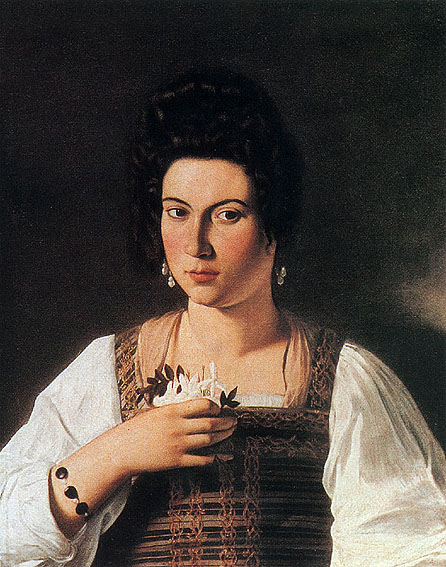
Caravaggio (Michelangelo Merisi), Portrait of a Courtesan (Fillide Melandroni), c, 1599. Destroyed Berlin 1945. Caravaggio (Michelangelo Merisi), Supper at Emmaus,1606, oil on canvas, 141 x 175 cm, Pinacoteca di Brera, Milan.
Caravaggio’s later Supper at Emmaus in Milan’s Brera Gallery intensifies the drama and imposes greater stylistic discipline compared to the earlier London version painted five years prior. The gestures are more restrained and the palette more muted, allowing the dramatic accents to emerge with heightened clarity despite the overall reduction of detail. Objects are rendered with deliberate precision—the urn angled toward the viewer, the plates catching narrow rims of reflected light—each contributing to the painting’s controlled visual rhetoric.
The composition organizes itself in a semicircular sweep of gestures around the table, rising diagonally from Christ’s head to the sharply profiled disciple and then to the standing figures beyond. The entire scene is suffused with a concentrated, directional illumination that culminates on the face of the risen Christ, reinforcing the painting’s theological and dramatic center.
SOURCE: Brera Milan: Great Museums of the World (Great Museums of the World, volume 14), Newsweek, Inc. & Arnoldo Monadori Editore, 1970, pp. 68-69.
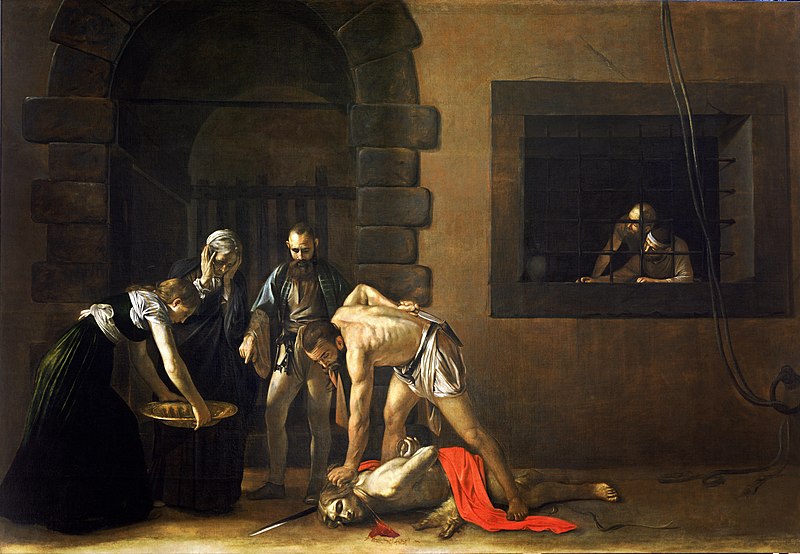
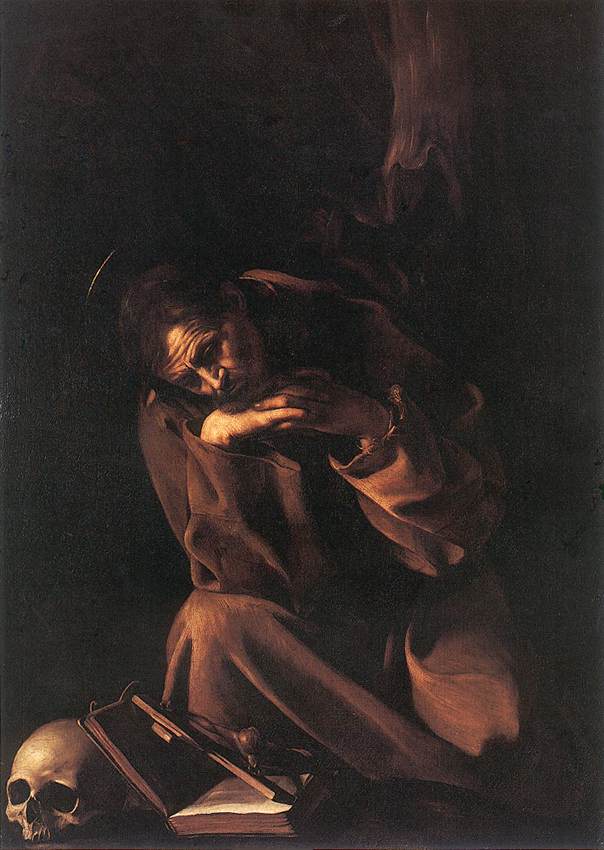
Caravaggio (Michelangelo Merisi), The Beheading of St John, 1608, St John’s Co-Cathedral, Valetta, Malta.Caravaggio (Michelangelo Merisi), St. Francis of Assisi in Meditation, 1606/07, oil on canvas, Pinacoteca Civica Museo ala Ponzone Cremona.Caravaggio (Michelangelo Merisi), Portrait of Alof de Wignacourt with his Page, 1606/07, oil on canvas, 195 x 134 cm, Louvre.
The subject was the Grand Master of the Knights of Malta. In exchange for this grand portrait, according to Bellori and Baglione, Caravaggio became a Knight of Malta on an accelerated timetable though soon after the artist fled the island in disgrace.
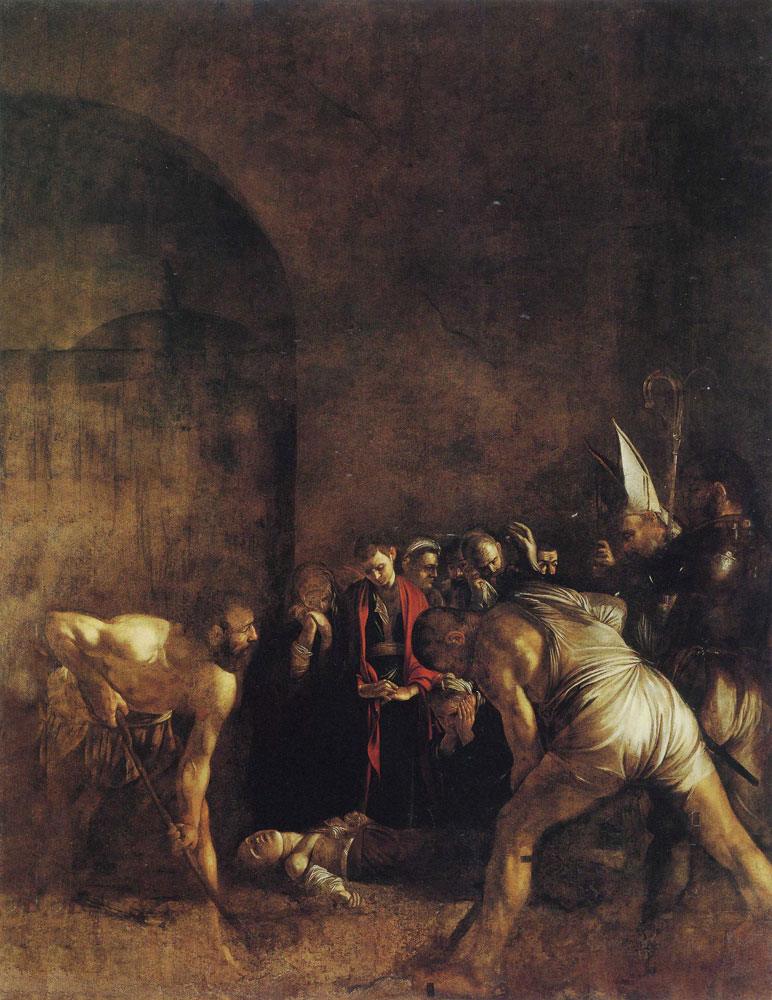
Caravaggio (Michelangelo Merisi), The Burial of Saint Lucy, 1608/9, oil on canvas, 13′ 4 1/2″ x 9′ 10″ 408 x 300 cm, Church of Santa Lucia,Syracuse in deposit at the Galleria Regionale, Palazzo Bellomo, Syracuse, Sicily.
The famous Caravaggio painting depicting the burial of Santa Lucia once hung in the Church of Santa Lucia al Sepolcro, but today is in Siracusa’s Palazzo Bellomo museum. The original church, built as early as the 6th century, was on the site of Saint Lucy’s martyrdom in the early 4th century. Beneath the sanctuary is a vast labyrinth of dark catacombs dating from the 3rd century which have never been completely explored and are closed to the public. Once containing the tomb of the decapitated saint, her remains were relocated to Venice during the Crusades and where they can be found today. This painting was made by Caravaggio between October 1608 in Malta and early 1609 in Sicily in a commission arranged by his old friend painter Mario Minniti. Caravaggio was on the run in Sicily starting in late 1608 when he arrived into Siracusa, and then onto Messina followed by Palermo. In Sicily, the exile Caravaggio painted Resurrection of Lazarus, The Adoration of the Shepherds (Adorazione dei pastori) and Ecce Homo. In late 1609 he returned to Naples and continued painting, including another St. John the Baptist and, his final artwork, The Martyrdom of St. Ursula. In Naples the artist was attacked in the street by four armed men shortly after his arrival where Caravaggio was seriously injured. see – https://www.frommers.com/destinations/syracuse-and-ortygia-island/attractions/santa-lucia-al-sepolcro; https://www.great-sicily.com/post/the-byzantine-era-in-sicily – retrieved October 15, 2024.
Caravaggio (Michelangelo Merisi), Adorazione dei pastori (The Adoration of the The Shepherds), 1609, oil on canvas, 10′ 3 1/2 ” x 6′ 11″, Messina, Sicily, Museo regionale interdisciplinare.
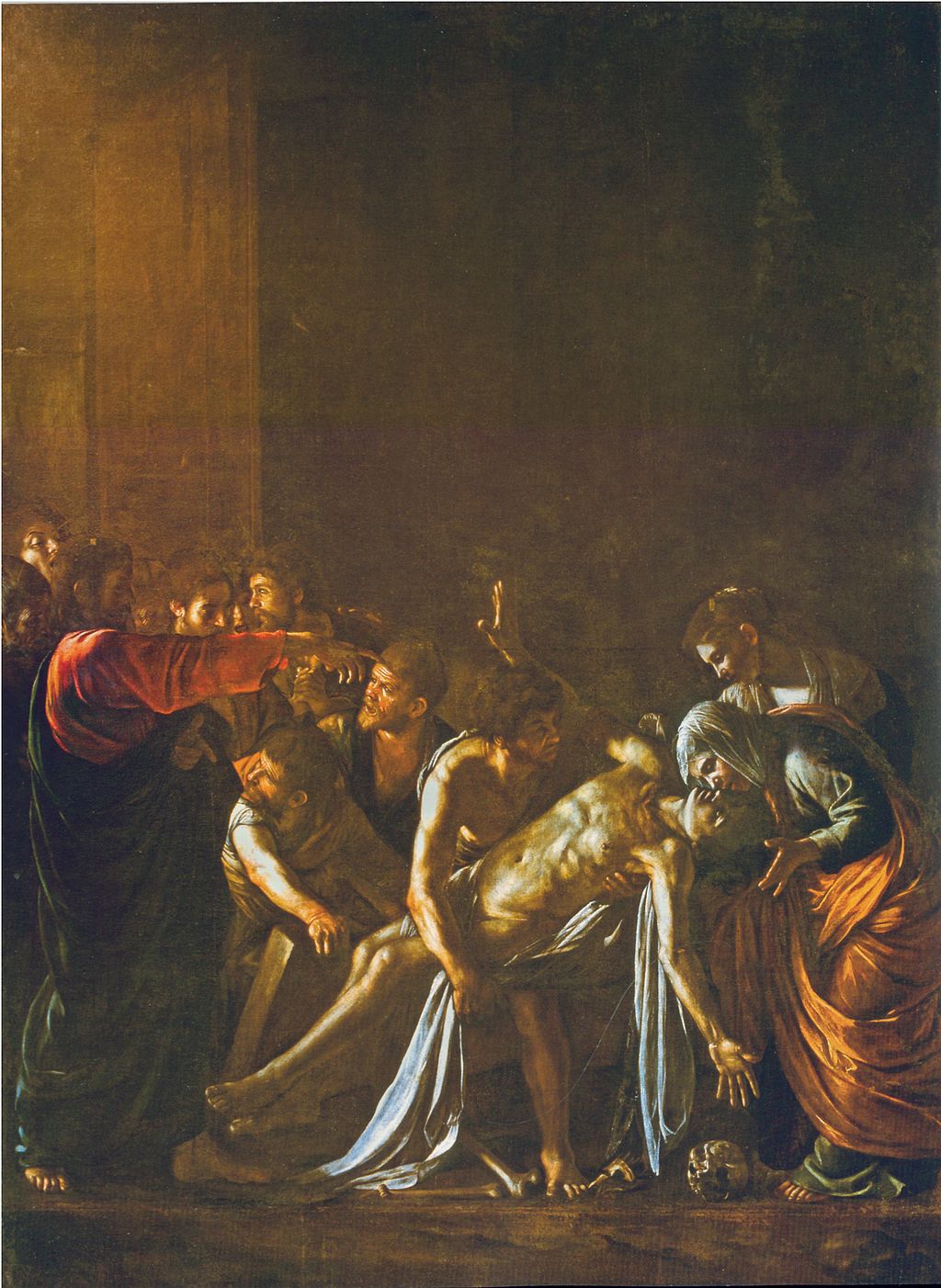
Caravaggio (Michelangelo Merisi), La Resurrezione di Lazzaro (The Resurrection of Lazarus), 1609, oil on canvas, 10′ 3 1/2 ” x 6′ 11″, Messina, Sicily, Museo regionale interdisciplinare.
In Malta Caravaggio became a Knight of Malta but got into another violent group brawl where a knight was badly injured. With a warrant put out for his arrest Caravaggio managed to flee to Sicily in October 1608. By December 1608 Caravaggio was found guilty in abstentia and removed from the Maltese order. The commission for this painting came from Giovanni Battista de’ Lazzari, a merchant of Genoese origin who had obtained permission to be buried in the choir chapel of the church of Saints Peter and Paul de’ Pisani (demolished in 1880) in Messina where Camillo de’ Lellis’ religious order, founded in 1591 and dedicated to the care of the sick, had a house. De’Lazzari’s signed contract on December 6, 1608, declared that his new altarpiece would have the Madonna and St. John with saints as its subject. But that was changed to the resurrection of Lazarus (Gospel of John, chapter 11). It is very likely the change was made by De’Lazzari in agreement with the Camillians. According to Susinno, the artwork’s 13 figures were staff members of the hospital where Caravaggio did the painting. see – https://federica90.wixsite.com/emozionearte/post/caravaggio-in-sicilia-la-resurrezione-di-lazzaro – retrieved October 15, 2024.
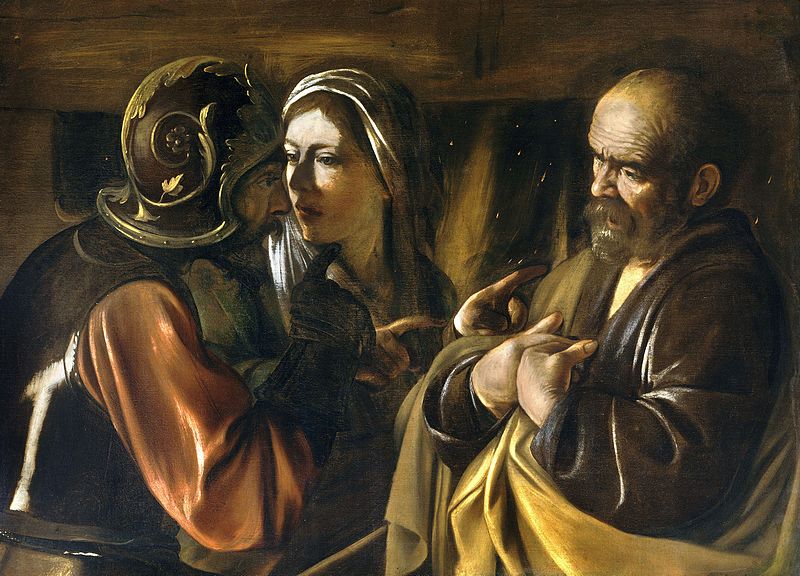
Caravaggio (Michelangelo Merisi), The Denial of St. Peter,1609/10, oil on canvas, 94 x 125.4 cm, The Metropolitan Museum of Art, New York.
The Denial of Saint Peter is generally thought to be one of the last pair of artworks by Caravaggio, the other being The Martyrdom of Saint Ursula. It was probably finished at Naples in the summer of 1610.
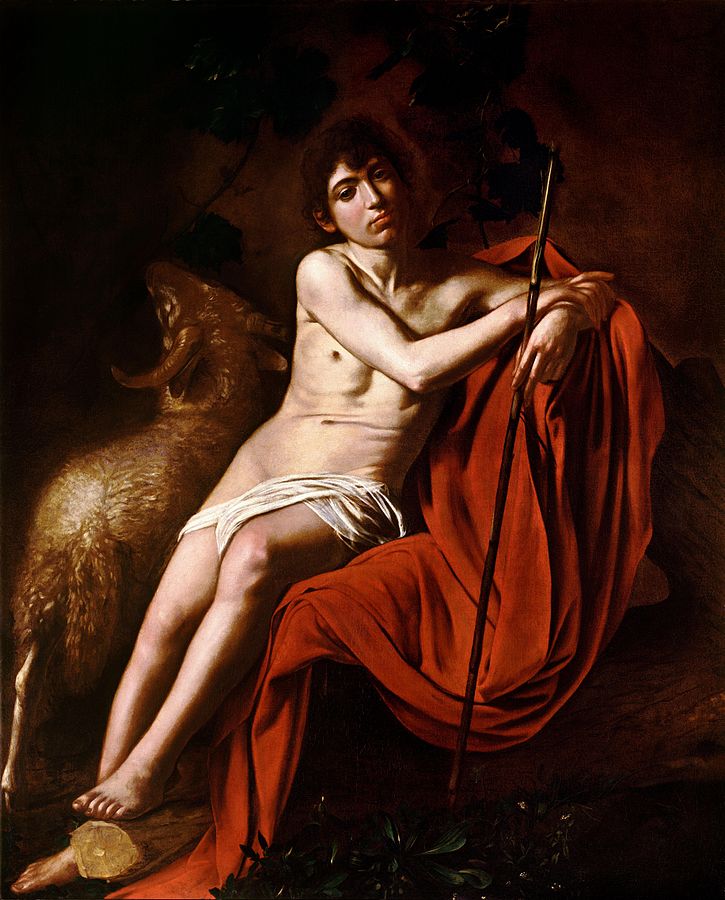
Caravaggio (Michelangelo Merisi), St. John the Baptist, 1610, oil on canvas, 159 x 124.5 cm, Galleria Borghese, Rome.
Caravaggio carried this painting and others sailing from Naples to Rome hoping for a pardon from the pope. Instead, when the desperate artist landed he was arrested and the boat was sent back to Naples with the paintings. Caravaggio died on July 18, 1610 in Porto Ercole. The papal nuncio secured this painting for Cardinal Scipione Borghese. see – https://www.dailyartmagazine.com/caravaggios-martyrdom-of-saintt-ursula/ – retrieved October 15, 2024.
LAST PAINTING.
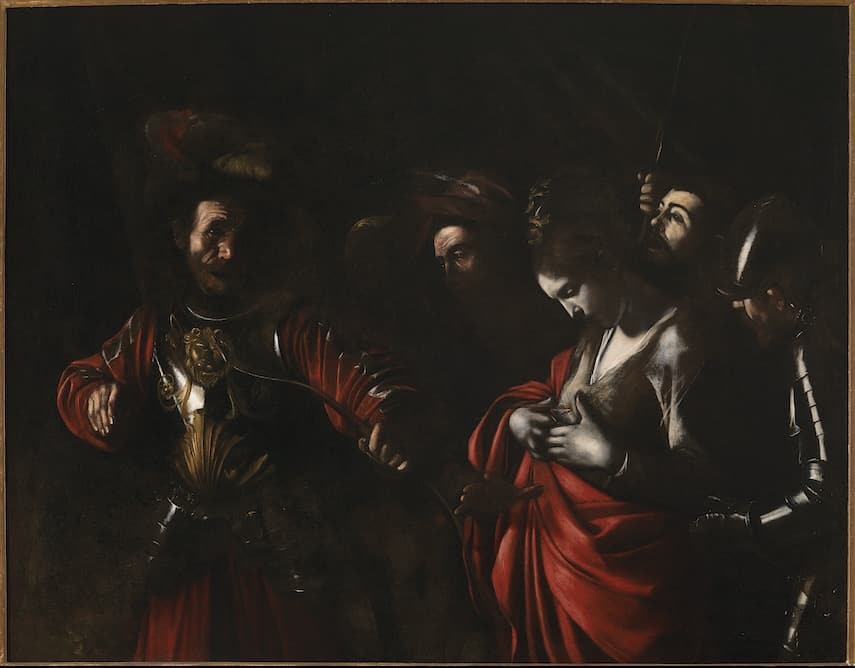
Caravaggio (Michelangelo Merisi), The Martyrdom of Saint Ursula, 1610, oil on canvas, 142 x180 cm, Naples, Galleria di Palazzo Zevallos Stigliano.
Caravaggio’s The Martyrdom of Saint Ursula was painted in the last month of his life. It contains his characteristic and revolutionary chiaroscuro, naturalism, and depiction of psychological and physical emotion. The Martyrdom of Saint Ursula was commissioned by Genoese art patron Marcantonio Doria. The painting was finished in May and arrived in Genoa in mid-June 1610. Ursula was a venerated but almost completely legendary figure. In typical fashion Caravaggio dispels traditional religious iconography associated with Ursula — a crown, halo, palm branch, the 11,000 virgin martyr companions — for the painful moment in her story when the Barbarian king shoots the arrow into Ursula’s chest that kills her.
Caravaggio’s The Martyrdom of Saint Ursula marked a watershed in European art. His revolutionary style inspired subsequent generations of painters, such as Artemisia Gentileschi (1593—1651), Giovanni Baglione (1566-1643), and Orazio Gentileschi (1563–1639), that became known as the Caravaggisti. He also influenced international Baroque artists including Spaniard Diego Velázquez (1599-1660) and Dutchman Rembrandt van Rijn (1606-1669). see – https://www.widewalls.ch/magazine/the-martyrdom-of-saint-ursula-caravaggio – retrieved October 15, 2024.
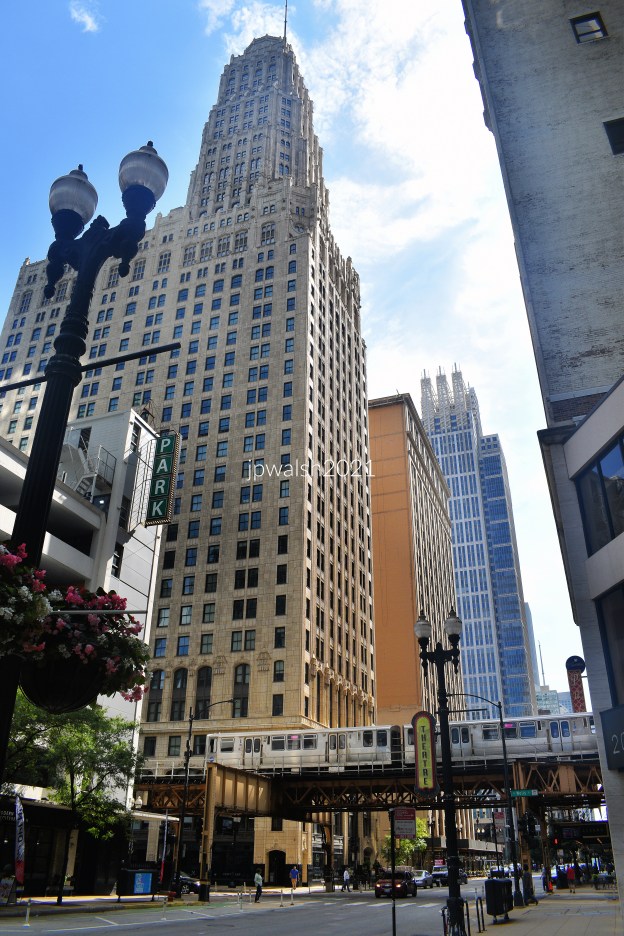
FEATURE Image: Steuben Club Building/Randolph Tower. 188 W. Randolph Street, Chicago. View from the west, August 2021. Author’s photograph. 12.72mb_9354 (1)
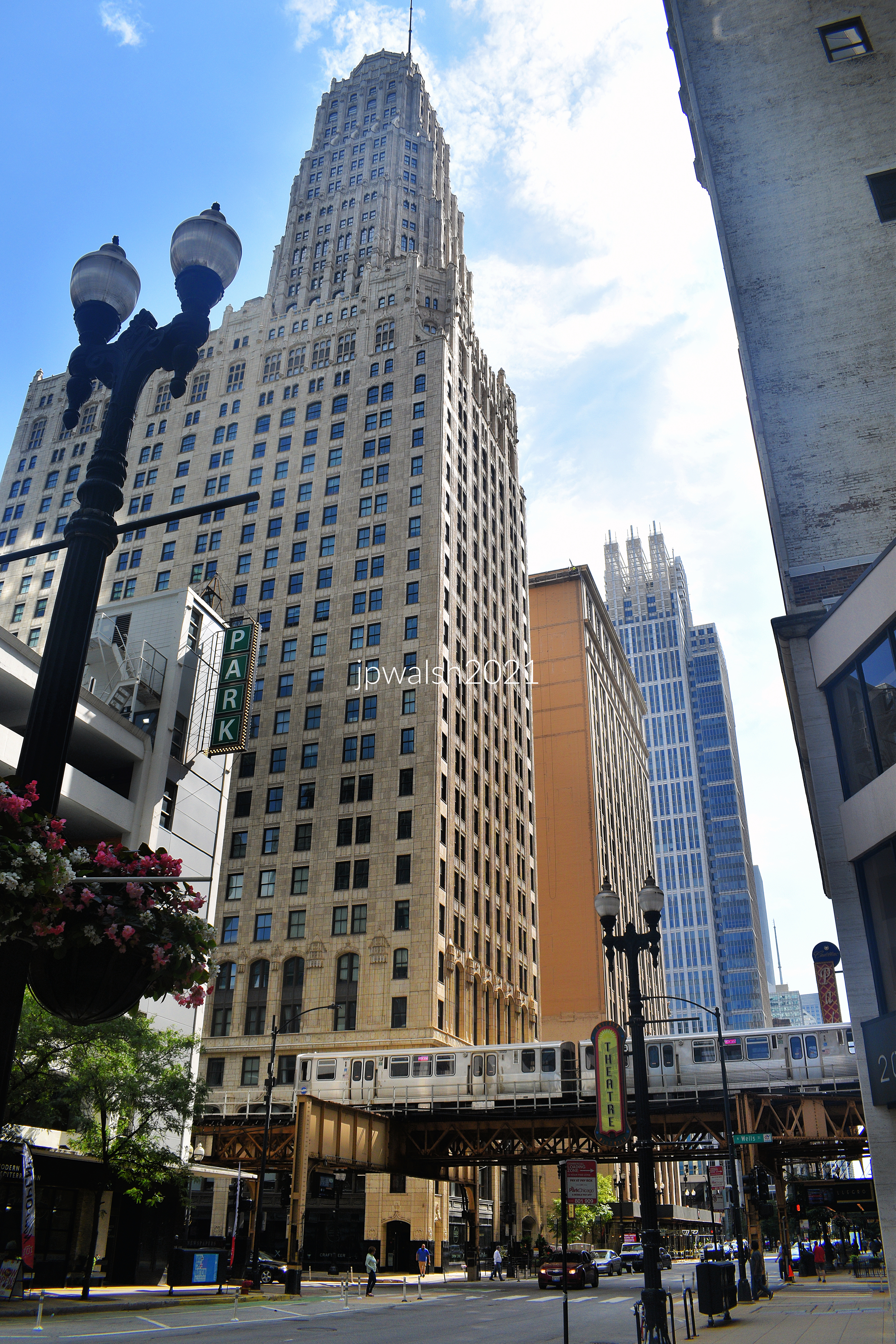
The 1929 limestone tower whose shape may be the last surviving skyscraper reflective of the 1923 zoning law with setbacks and a telescoping tower presages Vitzthum & Burns’ mighty 1 N. LaSalle Street Building in 1930. Randolph Tower was restored in 1993 by Stenbro, Ltd. and in 2013 opened as the residences of Randolph Tower City. In addition to its 15-story tower, the building is 27 stories tall and 465 feet high built on rock caissons. German-born Karl Martin Vitzthum (1880-1967) and John Joseph Burns (1886-1956) built some of Chicago’s best-known skyscrapers of the 1920s and 1930s. The firm also built, in 1953, St. Peter’s Church in the Loop at 110 W. Madison Street two doors down from the corner skyscraper of 1 N. LaSalle Street Building. Karl M. Vitzhum was architect on the Midland Hotel (then the Midland Club Building ). Built in 1927, it is 22 stories of roaring 1920’s Beaux-Arts architecture.
Karl Martin Vitzthum (1880-1967). One of the architects of the Steuben Club Building/Randolph Tower with partner John J. Burns. The skyscrapers they built starting in 1925 until the Great Depression became taller and more vertical as time progressed and are some of the most visible soaring stone structures of the period in downtown Chicago. Karl Martin Vitzthum (Architect), Steuben Club Building, Chicago, Illinois, Perspective Randolph Street, 188 West (Building address), 1924-1928, Watercolor and tempera on paper 86 × 35.6 cm (33 7/8 × 14 in.) The Art Institute of Chicago. see – https://www.artic.edu/artworks/158560/steuben-club-building-chicago-illinois-perspective – retrieved September 21, 2024.
With each building the move from classicism to Modernism is clear as well as pure verticality. During the 1980s and 1990’s, I worked in one of Vitzthum & Burns’ mid1920s office buildings in Chicago – The Old Republic Building at 307 North Michigan Avenue built in 1925. My airy office on the 7th floor looked right onto Michigan Avenue where I could admire the Carbide and Carbon Building across the street built in 1929.
Steuben Club Building/Randolph Tower. August 2021. Author’s photograph. 82% 7.88 mb _9354
Vitzthum arrived in Chicago from Germany in 1914 and worked with architectural firms such as Graham Anderson Probst and White, Burnham & Co., and White, Jarvis & Hunt. He often worked with Fredrick J. Teich (1874- n.a) prior to establishing his own firm with John J. Burns in 1919. Vitzthum was a young architect on Burnham’s staff when he worked on some engineering details for the old Comiskey Park (1910-1990). The partnership of Vitzthum and Burns started in 1919 and ended with Burns’ death in 1956. Though known for eclectic styled bank buildings throughout the Midwest, the pair had built the one-screen 1,000 seat The Hollywood Theatre at Fullerton Avenue and Greenview Avenue in 1926. The theatre closed in 1957 after being renamed the Holly Theatre and was demolished soon afterwards. It is a parking lot today for a local Walgreens across the street from Facets movie theatre.
SOURCES:
Frank A. Randall, History of Development of Building Construction in Chicago, Second Edition, Revised and Expanded by John D. Randall, University of Illinois Press, Urbana and Chicago, 1999, pp. 331 and 319.
Saliga, Pauline A., editor, The Sky’s The Limit A Century of Chicago Skyscrapers, Rizzoli New York, 1990, p. 133.
Alice Sinkevitch, AIA Guide to Chicago, 2nd Edition, Harcourt, Inc., Orlando, 2004, p. 84.
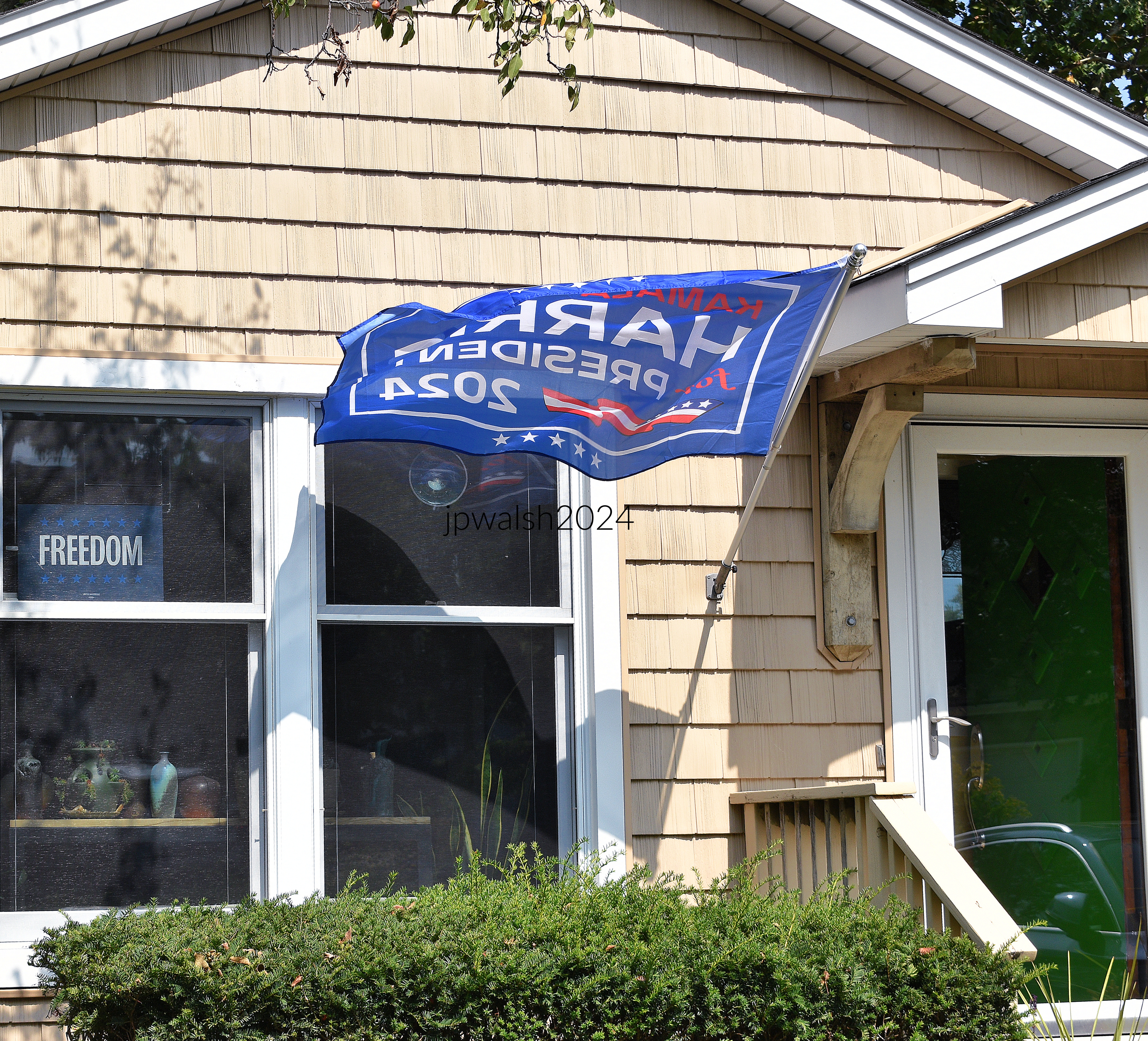
Vice President and Democratic presidential nominee Kamala Harris supporter in 2024. Author’s photograph. Sept 2024 8.96mb
California as National Vanguard
San Francisco Democrat and longtime U.S. House Representative Nancy Pelosi recently told Bill Maher on Real Time With Bill Maher (HBO) that California “is always in the lead” and that it is up to the rest of the country whether they choose to “follow that lead.” What the former Speaker said on August 31, 2024 is, in my view, both insightful and essentially correct.
Vice President Kamala Harris, the 2024 Democratic nominee for president, is herself a California native and former state Attorney General and U.S. Senator. Their shared California sensibility—rooted in diversity, demographic change, and a forward‑leaning cultural posture—is not only the state’s history but increasingly the nation’s trajectory.
The California Pattern: A Country Becoming California
It is often said today that “every state is a border state.” One could just as easily say that every state is now a state of California. The demographic, cultural, and political patterns that defined California for more than a century are now unfolding nationwide, whether chosen or not.
This dynamic is not merely demographic. It is historical, psychological, and structural.
L.A. as Prototype: A City Without a Past
In The Big Goodbye: Chinatown and the Last Years of Hollywood (2020), author Sam Wasson cites educator Richard G. Lillard (1909–1990), who chronicled Los Angeles’s explosive development from the 1880s onward. Lillard observed that L.A. was essentially an open‑border town that grew too fast for its own infrastructure.
Wasson also quotes journalist Morrow Mayo (1896–1983), who wrote that Los Angeles had always been a commodity, a place marketed to outsiders as somewhere to come to. When Vice President Harris said “Don’t come, don’t come” in Guatemala in June 2021, the remark can be read through this California lens—a familiar, almost resigned plea from a state that has spent 150 years absorbing wave after wave of newcomers.
Because of this constant churn, Los Angeles—unlike older American cities, and even less so than San Francisco—rarely speaks of its past. It lives in a perpetual present, always turning the page. Where other cities experienced a boom and then settled into normalcy, L.A. is a boomtown permanently in boom mode, with all the visionary energy and strange side effects that come with it.
Migration as California’s Defining Engine
California drew migrants from across the United States in the late 19th and 20th centuries; today it draws them from around the world. Between 2021 and 2024, nearly two million new migrants arrived—roughly 500,000 people every year. With or without adequate infrastructure, this is a massive human boom unmatched by any other state.
Since the 1880s, California has imported people and exported ideas. Increasingly, it is exporting its people as well—along with its political culture, its social norms, and its worldview.
The Spread of the California Model
This is the phenomenon Pelosi alludes to: a California model spreading beyond the state’s borders. The question is not whether the model exists, but whether other states choose to adopt, resist, or adapt it.
The “Californication” of the United States is already underway. The only remaining variables are the degree of acquiescence and the pace at which it unfolds.
The Limits of Reversal
If Donald Trump believes he can halt this momentum by deporting California’s undocumented population—and the undocumented population dispersed across all 50 states, which collectively equals California’s entire population—he faces a monumental challenge. The California state of mind is already planted, already influential, and already attractive to many.
The demographic and cultural forces shaping the country now are the same ones that shaped California long before. The state is not merely a place; it is a template, and the nation is increasingly living inside it.
Republican nominee and former president Donald Trump supporter in 2024. Author’s photograph. Sept 2024 7.92 mb
L.A. as a Lens for the National Experience
It is instructive to look closely at Los Angeles, because its pattern of constant booms mirrors what is now happening across the country. The city’s cycles—rapid growth, sudden reinvention, and equally rapid forgetting—offer a preview of the national experiential trajectory emerging under what might be called California’s literal and cultural leadership.
Boom, Erasure, and the California Condition
As Sam Wasson notes, L.A.’s booms bring an influx of the new that inevitably produces what he calls “destructive erasures” of what came before. This is not an occasional disruption but a perpetual condition—the defining rhythm of a place that never stops remaking itself.
Increasingly, the nation is entering this same mode. The California pattern—constant arrival, constant reinvention, constant shedding of the past—is becoming a national operating system.
A Political Culture Shaped by Perpetual Reinvention
This is the California way that Nancy Pelosi alluded to in her conversation with Bill Maher: a model that other states may choose to follow, consciously or not. The election becomes, in part, a referendum on whether the country embraces this California‑style dynamism, with all its gains and losses.
Even the political “flip‑flops” for which Vice President Harris has been criticized since becoming the Democratic nominee can be read through this lens. They echo a long California tradition of boom and erasure, where rapid change is not an anomaly but a structural feature of the culture she comes from.
California’s Pattern as National Future
Seen this way, Harris’s shifts are not merely tactical or personal—they reflect the deeper California historical pattern of constant adaptation. In a political moment shaped by demographic churn, cultural flux, and rapid realignment, that pattern may be less a liability than a preview of the country’s emerging identity.
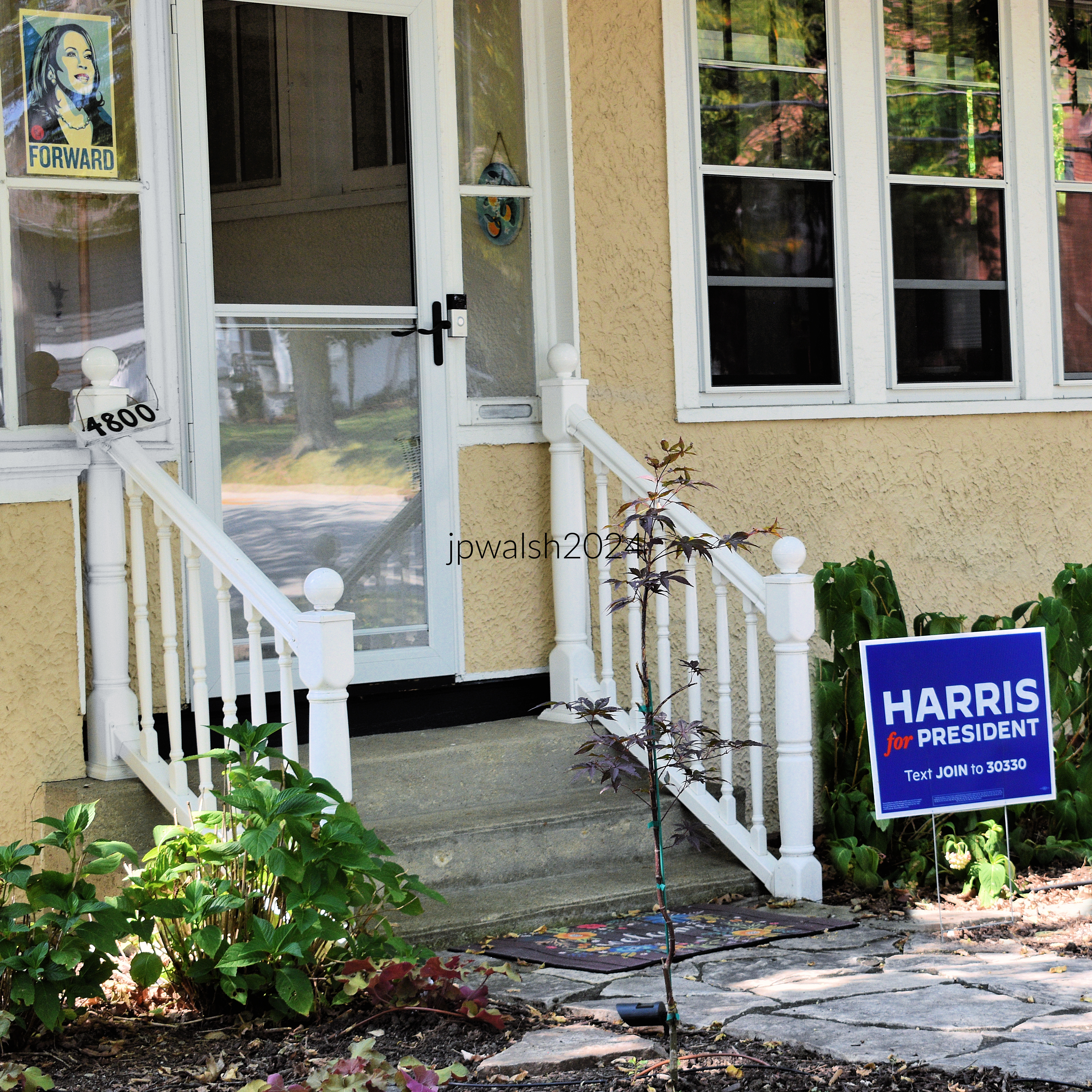
Vice President and Democratic presidential nominee Kamala Harris supporter in 2024. Author’s photograph. Sept 2024 7.23 mb
Leaving California, Only to Carry It Elsewhere
The irony of the moment is that many Californians who leave the state—seeking relief from its pressures, costs, or pace—may be doing so in vain. In moving to other states, they often bring with them the very cultural, political, and economic sensibilities they hoped to escape. In that sense, they become agents of Californication, extending the state’s influence rather than diminishing it.
A California State of Mind on the Move
This California state of mind—restless, forward‑tilting, boom‑driven—now appears in places far from the Pacific coast. The rapid arrival of newcomers in cities like Springfield, Ohio, or the dramatic demographic and real‑estate shifts in Aurora, Colorado, reflect a broader national pattern: communities experiencing sudden change, rapid growth, and the accompanying sense of disruption that Sam Wasson describes as “destructive erasures.”
These are not uniquely California events. They are California‑style events, unfolding elsewhere.
The Californication of Everywhere U.S.A.
If this pattern has not reached a particular town yet, the logic of national migration and cultural diffusion suggests that it eventually will. The California model—constant influx, constant reinvention, constant shedding of what came before—has become a portable operating system, carried by both longtime Californians and new arrivals who first encountered American life in California.
This is the Californication of Everywhere U.S.A.: a spreading cultural template rather than a geographic one.
A Culture Without a Rearview Mirror
For Angelenos—and for many Californians—the absence of a stable past is not a flaw but a condition of life. The state lives in a perpetual present, defined by booms and erasures so frequent that they rarely register as events. What disappears is forgotten; what arrives becomes temporarily the new normal.
As this sensibility spreads, more of the country begins to resemble California: forward‑leaning, memory‑light, and always in motion.
FEATURE Image: Raphael, Portraits of Agnolo Doni and Maddalena Doni, c. 1506, oil on panel, 24 ¾ x 17 ¾” Pitti Gallery, Florence.
Raphael, Self-portrait at 23 years old, 1504–1506. Tempera on panel, 47.5 cm × 33 cm (18.7 in × 13 in), Palazzo Pitti, Florence, Italy.
INTRODUCTION.
Born in Urbino in 1483, an environment rich in the arts and humanist learning, Raphael had a remarkable capacity for personal growth and branded new incarnations of his artistic style regularly. He moved to Florence toward the end of 1504. Giorgio Vasari in his chapter on Raphael describes an episode where the artist of Urbino, already in his thirties with a reputation as a master, went back to study the nude (male) form with Michelangelo as his guide. Vasari’s admiration in telling this story goes beyond Raphael’s humility in assuming the role of student again (he studied constantly anyway) but that his learning always improved his artistic output. In the study of nudes, however, artistic growth came perhaps not as the artist expected or intended. Whether Raphael entered the workshop of Perugino at that time or, as seems more likely, many years later when he was already an acknowledged artist, he quickly mastered Perugino’s delicate, ornamental style, with its open landscapes and gentle figures. It was said that contemporaries had trouble distinguishing Perugino’s work from Raphael’s, but Raphael’s compositions were more sophisticated even when he was a young artist. While Raphael mastered Michelangelo’s (and Leonardo’s) art forms convincingly, he also realized he was no match for the creator of the Sistine Chapel and other chiseled works insofar as the nude male forms.1 Yet Raphael consolidated his strengths by testing his limits. A major strength, Vasari believed, was Raphael’s ability to draw and compose a wide range of subjects, such as landscape, architecture, draperies, and the human figure. Up to that time that had been what the artist was doing and would now unflinchingly continue to do on a grander scale, for example, in the Stanzae. In 1508 the pope called Raphael to Rome. Influenced by the idealized, classical art of the city’s ancient past, Raphael’s work took on a new grandeur. He also responded to the more energetic and physical style of Michelangelo, whose works he had already begun to study in Florence. Vasari believed Raphael had the gift to congeal the “poetic moment” by depicting in his painting the most significant gesture and force of action. With the possible exception of Leonardo, he is probably the unparalleled master of excellent design.2 The precocious Raphael Sanzio also benefited from early opportunities given to him by his father to cultivate his talent. The artist’s own determination to succeed in his métier paid off when he was summoned to work at the Vatican by the Pope in 1509, arguably the greatest art patron in an age of art patrons. 3 The early sixteenth century was an age where patrons were as luminous as their artists and the coming together of Raphael and Julius II, and later Leo X, made for a celebrity team. While Vasari meticulously tells the reader of the artist’s “judicious” character – and that Raphael was extremely “amatory” and implying it aided in his death – the chronicler describes, often from memory, his preferences in Raphael’s art work. His collective response, for example, to all four frescos in the Camera d’Eliodoro is that he is most impressed by Raphael’s interesting decorative details, beautiful movements and gestures, the sheer number of figures portrayed, and his ability to express complex ideas and stories on a two-dimensional surface.4 With Leonardo da Vinci (1452-1519) and Michelangelo (1475-1564) Raphael is one of the great masters of the High Renaissance. Raphael and his large team of assistants left behind a large body of influential work, especially in the Vatican where the artist spent the last 12 years of his life, although Raphael died at 37 years old. For most of the history of Western art, the easy grace and harmonious balance of Raphael’s style has represented an ideal of perfection. His work became widely influential through the dissemination of prints. Raphael was also the city’s leading portraitist, creating penetrating psychological images that engaged viewer and sitter with a new intensity.
ARTWORKS.
Raphael, S. Niccolo Da Tolentino Altarpiece, 1501, oil on panel, 44 x45 ¼ in., Capodimonte Museum, Naples, Italy.
The Baronci Altarpiece is Raphael’s first recorded commission. It was made for the patron’s chapel in the church of Sant’Agostino in Città di Castello, a commune between Arezzo and Urbino, north of Perugia. In 1789 the artwork was badly damaged in an earthquake and surviving fragments were acquired by the Vatican until they mysteriously dispersed in the mid-19th century and found their way into different collections. Raphael’s commission of 1501 was to paint a large altarpiece dedicated to the Augustinian saint Nicholas of Tolentino (c. 1246– September 10, 1305). Nicholas was canonized by Augustinian Pope Eugene IV in 1446. While today’s saints require 1-2 miracles, St. Nicolas Tolentino was credited at his canonization with 300 miracles – including 3 resurrections. (see – Encyclopedia of the Middle Ages, Volume 2, André Vauchez, Richard Barrie Dobson, Michael Lapidge. Chicago: Fitzroy, Dearborn, 2000).
Raphael, angel, fragment Baronci altarpiece. Pinacoteca Tosio Martinengo, Brescia. Raphael, The Crucifixion, 1502-03, oil on polar, 283.3 × 167.3 cm, National Gallery, London.
The painting was done in 1503 for Domenico Gavari for his S. Domenico chapel in Città di Castello. Angels are poised on toes on a cloud as their cups catch Christ’s dripping blood. Mary Magdelene and St. Jerome (holding a rock) are on their knees while the Virgin Mary and St. John stand. The sun and moon in the sky was characteristic of Crucifixion paintings in Umbria (p. 13, Jones & Penny). It was bequeathed to the National Gallery in 1924. Gavari was a close friend of Andrea Baronci, for whom Raphael painted the Saint Nicholas of Tolentino Altarpiece for the church of S. Agostino, also in Città di Castello. Saint Jerome, of course, was not present at the Crucifixion but is included in this scene because the chapel was dedicated to him. The overall design is based on several versions of the crucified Christ in a landscape painted by Perugino in the late 1480s and 1490s, and is especially similar to his altarpiece of the Crucifixion for the convent of S. Francesco al Monte in Perugia, commissioned in 1502 and completed 1506. https://www.nationalgallery.org.uk/paintings/raphael-the-mond-crucifixion – retrieved September 5, 2024.
Raphael, Coronation of the Virgin (Oddi Altarpiece), 1503-1504, Oil on canvas, 8’9” x 5’4”, Pinacoteca, Vatican, Rome.Raphael, Coronation of the Virgin (Oddi Altarpiece), 1503-1504, Oil on canvas, 8’9” x 5’4”, Pinacoteca, Vatican, Rome. DETAIL.
Raphael painted altarpieces for the Augustinians and Dominicans and the Oddi altarpiece (above) was done for the Franciscans. It was commissioned by the Oddi family chapel in S. Francesco al Prato. The Oddi were in exile from Perugia since 1495 because of battles between families and returned in 1503. The altarpiece was part of honoring their family members. The painting is divided into an upper part depicting the coronation of the Virgin and, in the lower part, the Apostles at the time of the Assumption. In the center, the apostle Thomas holds the Virgin’s girdle that the Virgin lowered to him as a token of these supernatural events. This display of theology was precious to the Franciscans at the time who were promoting the Virgin Mary. They were likely very involved in directing the artist in its composition. (Roger & Jones, pp. 15-16).
Raphael, Spozalizio (The Engagement of the Virgin Mary), 1504, oil on panel, 67 x 46 ½” Brera Gallery, Milan.
The painting’s composition reflects the influence of Perugino, specifically the fresco done by him in the Sistine Chapel in 1484. In terms of its architectural setting, Raphael was influenced by Piero della Francesca (c.1416-1492) and Bramante (1444-1514). The painting’s architectural structure shares centrality in the painting with the foreground figures done in a perspectival arrangement. Within the figures are members of the party positioned in depth. Joseph places a ring on Mary’s finger whose positioning bisects the artwork. A tawny gold tone pervades the painting. It was commissioned by the Alberini family for a chapel in S. Francesco of the Friars Minor at Città di Castello in Perugia. (Brera Milan, p 34)
Raphael, The Madonna and Child Enthroned with Five Saints (Colonna Altarpiece), c. 1504-1505, oil on panel, 68 x 68” The Metropolitan Museum of Art, New York City.
Raphael painted this altarpiece for the Franciscan convent of Sant’Antonio in Perugia. It hung in a part of the church reserved for the nuns. The pair of voluminous saints straddling each side of the throne reflect the progressive style of Leonardo da Vinci and Fra Bartolomeo (1472-1517) that Raphael was studying in Florence. The lunette above the main panel depicts God the Father holding a globe and raising his right hand in blessing situated between two angels and two seraphim. https://www.metmuseum.org/art/collection/search/437372 – retrieved September 5, 2024.
Raphael, The Small Cowper Madonna, c. 1505 59.5 x 44 cm (23 7/16 x 17 5/16 in.), National Gallery of Art, Washington D.C.
The Cowper Madonna includes an agreeable background landscape. In a vertical painting, a haloed woman and nude child sit before an expansive grass field extending behind them to a group of trees and buildings on a hill in the distance among hazy blue hills beneath a blue sky.https://www.nga.gov/collection/art-object-page.1196.html – retrieved September 8, 2024.
Raphael, Saint Michael and The Dragon, c. 1505, oil on panel, 12 ¼” x 10 ¼” The Louvre Paris https://collections.louvre.fr/en/ark:/53355/cl010060773 – retrieved September 4, 2024Raphael, Saint Michael and The Dragon, c. 1505, oil on panel, 12 1/4 x 10 ¼” The Louvre, Paris https://collections.louvre.fr/en/ark:/53355/cl010060772 – retrieved September 4, 2024.Raphael, Saint George and the Dragon, c. 1506, National Gallery of Art, Washington, D.C.
These early works by the artist depict the popular subjects of St. Michael the Archangel vanquishing Satan and Saint George slaying the Dragon, each showing the martial subject of good combatting evil. These were early private commissions for the court of Urbino. Saint George was a Christian Roman soldier who, pious legend informs, subdued a dragon and, with the daughter of a pagan king, brought it to the city, where St. George killed it with his sword. These heroic actions witnessed by the king and his subjects led to their conversion to Christianity. The historic figure of Saint George was martyred around the year 290. https://www.nga.gov/collection/art-object-page.28.html – retrieved September 4, 2024.
Raphael, The Three Graces, 1505-1506, oil on panel, 6 ¾ x 6 ¾” Condé Museum, Chantilly.
The panel was recorded in the Borghese collection in 1650. It accompanied the Dream of Scipio, an oil on panel, today in the National Gallery of London. The figures were derived from ancient classical sculpture and depict, likely, Chastity, Beauty and Love. Chastity’s lower torso is veiled and an arm covers her breasts from view. Amor’s breasts, by contrast, are revealed. Chastity also wears no adornment as do Beauty and Amor. While the figures are modeled similarly, the space between them is disparate and Beauty blocks Chastity’s leg. (Jones & Penny, p. 8; Beck, pp. 62-63).
Raphael, Portrait of Agnolo Doni, c. 1506, oil on panel, 24 ¾ x 17 ¾” Pitti Gallery, Florence.Raphael, Portrait of Maddalena Doni, c. 1506, oil on panel, 24 ¾ x 17 ¾” Pitti Gallery, Florence.
Agnolo Doni is the only Florentine portrait in these first years mentioned by Vasari though paired with its companion portrait of Maddalena Doni. Doni was an art collector who married the daughter of Giovanni Strozzi in 1503. Agnolo was 10 years older than his wife who was in her teens. The portraits are painted on identically sized panel and are intended to hang next to one another. Raphael took great care in depicting the corporeal reality of his subjects, particularly appreciated in their faces and hands (though Agnolo Doni’s portrait is more detailed than his wife’s.) In both Doni portraits the sitters show-off their jewelry – such as rings and, in Maddalena’s portrait, a large pearl hanging around her neck. (Roger & Penny, p. 29-30)
Raphael, The Madonna of the Granduca, c. 1506, Oil on panel, 33 x 21 1/2 “ Pitti gallery, Florence.Raphael, Lady with a Unicorn, 1506, oil on panel, 65 cm × 51 cm (26 in × 20 in), Galleria Borghese, Rome, Italy.
The work was of uncertain attribution until recent times. In the 1760 inventory of the Gallery, the subject of the painting was identified as Saint Catherine of Alexandria and attributed to Perugino. A restoration of the painting in 1934 revealed a unicorn, the medieval symbol for chastity, and led to the pianting’s attribution to Raphael. In 1959 an x-ray revealed a small dog under the unicorn which symbolized conjugal fidelity.https://en.wikipedia.org/wiki/Young_Woman_with_Unicorn – retrieved September 7, 2024.
Raphael, The Holy Family With Saints Elizabeth and John (The Canigiani Holy Family), c. 1506-07, oil on panel, 51 ½ x 42 1/8” Alte Pinakothek, Munich.
Visible on the hem of the Madonna’s scarf is inscribed, “Rapahel Urbanas.” The fresco and easel painter was active mainly in Umbria, in Florence after 1504, and in Rome in 1509 until his death. It was painted for Domenico Canigiani where Vasari saw it later. It entered the Medici collection and when a Medici daughter married an Elector Palatine it accompanied her over the Alps to Germany. (Pinakothek Munich Great Museums of the World, Roberto Salvini, et. al., Newsweek NY 1969 pp. 126).
Raphael, Madonna del Cardellino, 1506-07, oil on panel, 42 1/8 x 30 ¼” Uffizi Gallery Florence.
The three figures are closely integrated as well as displaying a greater sense of volume. The painting is dated 1507, again on the hem of the Virgin’s garment. In the painting St. John the Baptist presents a goldfinch (cardellino) to the Christ child – a symbol of the Passion. (Roger & Penny, p. 33)
The Deposition, 1507, oil on panel, 72 ½ x 69 ¼” Borghese Gallery, Rome.The Deposition, 1507, oil on panel, 72 ½ x 69 ¼” Borghese Gallery, Rome. DETAIL.
Upon seeing Leonardo’s Battle of Anghiari and Michelangelo’s Battle of Cascia in Florence Raphael’s style applied its innovative principles immediately changing the trajectory of his artwork up to that point. Leonardo da Vinci and Michelangelo were in a pitched artistic battle for the future of modern art in the first decade of the 16th century in central Italy. Their artwork was for a fabled competition to decorate the Great Council Hall in Florence. Raphael studied closely these complex drawings of heroic violence. Though Raphael was familiar with violent combat in Perugia and elsewhere, it was its containment in these artworks in Florence that such dynamic convolutions appeared as in his own work such as The Deposition though he may have had in mind also Perugino’s work in 1495 of the Lamentation over the Dead Christ. In the finished painting the action takes place from right to left – a group of women attending to a swooning Virgin to the Magdalene grasping Christ’s hand to look into his face. (Roger & Penny, pp. 37-44).
Raphael, La Belle Jardinière, 1507-08, oil on panel, 48 x 31 ½” The Louvre, Paris.
In this painting John the Baptist kneels before the Christ child. The painting has an arched top. It was Leonardo da Vinci who formulated the pyramidal structure for the Holy Family and half-length portrait and it seems Raphael looked to explore his idea for his narrative of the Virgin Mary with cousins Jesus Christ and John the Baptist. (Roger & Penny, p. 33)
Raphael, The Madonna of the Baldacchino, 1508, oil on canvas, 9’ x7’4” Pitti Gallery Florence.
The painting was started by Raphael and finished after his death (Roger & Penny, p. 44). It was Raphael’s first major commission in Florence for the Dei family chapel in the Santo Spirito basilica (1487) and remained unfinished when the 25-year-old artist was summoned to Rome by Pope Julius II, nicknamed the Fearsome, who reigned on Peter’s chair from 1503 to 1513. Pope Julius, born Giuliano della Rovere in 1443, took his name specifically from Julius Caesar (d. 44 BCE). In 1508, this “Battle Pope” as he was also known, commissioned the Raphael Rooms and Michelangelo’s paintings in the Sistine Chapel at the Vatican. Raphael’s enthroned Madonna and Child is with, from left, Sts. Peter, Bernard of Clairvaux, James the Greater and St. Augustine of Hippo. The group is joined by two putti at the foot of the throne’s high pedestal steps. It is a large format painting whose size was increased when it was restored and “completed” at the end of the 17th century to meet the tastes of a Medici prince. Raphael is cited for being an imitator more than originator and this is exampled in the Christ Child playing with his toes whose pudgy type derives from the workshop of Florentine sculptor Luca Della Robbia (c. 1400-1482). The painting can be read right to left as St. Augustine, looking at the viewer, gestures, with St. James gazing in a similar direction, towards the throne and its occupants and then crosses to St. Bernard whose backward glance ends in conversation with St. Peter holding a book and large key. Once in Rome, Raphael continued these simple straight forward readings of his artworks’ often complex network of figures beginning in his famous frescoes in the Stanza della Segnatura (1508-1511) yet by then with greater refinement and heroism. In 1799 The Madonna of the Baldacchino was confiscated by French forces and taken to Paris only to be returned to Florence in 1813. (Beck, pp. 78-79).
Raphael, St. Catherine of Alexandria, oil on panel, c. 1507, 71 x 56 cm, National Gallery of Art, London.
Raphael’s saint, a 4TH century mystic and martyr, is not an object for devotion but dramatizes an example of devotion. The turned figure derives from Leonardo da Vinci and expresses an emotional animation that is one of the strongest depictions in Raphael’s oeuvre. (Roger & Penny, p. 44). The portrait is joined to a landscape as the saint leans on a spiked wheel which is her symbol as it was the manner of her death. Raphael looks to capture the mystical or visionary aspect of the saint as she places her hand over her heart and gazes upwards to a golden break in the sky. The figure is very dynamic moving beyond Perugino’s influence of angelic air and distant landscapes and towards Michelangelo and Leonardo da Vinci whose monumentality and detailed arrangements Raphael studied in Florence. It is unknown who commissioned the artwork and for exactly what purpose it served. https://www.nationalgallery.org.uk/paintings/raphael-saint-catherine-of-alexandria – retrieved September 6, 2024.
Raphael, The Niccolini-Cowper Madonna, 1508, oil on panel, 80.7 x 57.5 cm (31 3/4 x 22 5/8 in., National Gallery of Art, Washington, D.C. https://www.nga.gov/collection/art-object-page.27.html – retrieved September 8, 2024.Raphael, c. 1509, fresco, 47 ½ x 41 ½” Ceiling, Stanza della Segnatura, Vatican, Rome.Raphael, The Fall, c. 1509, fresco, 47 ½ x 41 ½” Ceiling, Stanza della Segnatura, Vatican, Rome.DETAIL.
At the time of the papal commission Raphael had little experience painting large frescos but would revolutionize the tradition. The basic scheme of the decoration presents four tondi of abstract ideas of Theology, Poetry, Philosophy and Law. The Fall – or Adam and Eve on the Brink of Disobedience along with the Judgment of Solomon on the ceiling relates to themes of Theology and Law as the ceiling’s admixture of pagan scenes including Urania and Apollo and Marsyas relate to Poetry and Philosophy. (Roger & Penny – pp 50-52).
Raphael, The Disputation over the Sacrament (Disputa), 1509-10, fresco, 25’3” at base, Stanza della Segnatura, Vatican, Rome.Raphael, The Disputation over the Sacrament (Disputa), 1509-10, fresco, 25’3” at base, Stanza della Segnatura, Vatican, Rome. DETAIL.
Raphael’s artwork has the effect of cinema in presenting nearly life-sized figures in space that, hoisted onto the wall like a massive theatre screen, fills the room’s field of vision. Further, as a modern-day film dispels incredulity to its medium and any message it conveys, absorbing the viewer, Raphael’s fresco makes intensely real the Catholic faith. Angels in the vault accompany God the Father as a white-robed God the Son sits enthroned before a golden disc displaying his sacrificial wounds of the Cross. On each side sit the Virgin Mary and St. John the Baptist while on the raised tier sits figures from the Bible. The Holy Spirit descends in the form of a dove on the monstrance holding the Eucharist. Many preparatory drawings survive for this fresco. (Roger & Penny, pp.57-58)
Raphael, The School of Athens, 1510-11, Fresco, 25’3” at base, Stanza della Segnatura, Vatican, Rome.Raphael, The School of Athens, 1510-11, Fresco, 25’3” at base, Stanza della Segnatura, Vatican, Rome. DETAIL.
Raphael creatively adapted figures or figural groupings from one fresco to another. Raphael also utilized Michaelangelo’s newly publicly accessible Sistine Chapel ceiling’s prophets and sibyls. Beyond Michaelangelo, Raphael was interested in foreshortening and also arranging numerous figures in a mathmatically constructed perspectival space. Compared to the architecture in his Spozalizio from 1504, Raphael’s architecture in The School of Athens is more massive and yet whose angular lines are softened by curvacious colossal statues in niches. One statue is Minerva above Jurisprudence while Apollo is on the left (and closest to the Parnassus fresco). The central figures below the arches, open sky behind them, are Plato with his Timaeus and Aristotle with his Ethics. Other recognizable figures include Socrates to the left of Plato and Pythagoras to the right of the door. Euclid bends down to use one of his compasses surrounded by students and disciples. (Roger & Penny p 74-78).
Raphael, Parnassus, c. 1511, fresco, 22’1 ½” at base. Stanza della Segnatura, Vatican, Rome.
Raphael painted a poet’s paradise where Apollo has the central place. The window which interupts the base of the artwork looked out onto a hill in Rome called Mons Vaticanus that was known since classical times as sacred to Apollo. This fact with the fresco’s other siting challenges (window glare) Raphael was well aware of. Apollo plays the fiddle surrounded by poets and gorgeous muses with a background of laurel trees. Mortals are below on either side of the window. (Roger & Penny, pp. 68-69)
Raphael was working on the frescos in the Vatican Palace when he painted this oil on panel portrait of a “Young Cardinal.” The sitter is not known though it likely is Cardinal Francesco Alidosi (1455-1511). Cdl. Alidosi was an influential diplomat and military leader and a favorite of Julius II (1503-1513). The sitter’s expression and pose of a resting arm on the edge of the painting’s base and the slight turn of the body seems to owe much to Leonardo da Vinci. The body is monumental compared to a placid and yet almost inscrutable slightly smaller head whose depiction, while directly observed, is somewhat idealized. When Della Rovere was elected as Pope Julius II in 1503, Alidosi became his secretary and primary collaborator. He was appointed papal chamberlain and then treasurer. Though labeled “unholy” by Venetian cardinal Pietro Bembo (1470-1547), Cld. Alidosi helped guide the vocation of Bl. Elena Duglioli dall’ Olio (1472-1520), an Italian aristocrat, who wanted to be a Poor Clare nun but was forced to marry by her family and for whose endowed chapel in Bologna Raphael painted an altar-piece. In 1504 Alidosi became a bishop whose sees ranged up and down all Italy – of Mileto in 1504 and of Pavia in 1505. He occupied the seat of Pavia until he was murdered in broad daylight in 1511. There were accusations traded back and forth that Cdl. Alidosi was a traitor in a time when the French occupied parts of Italy among its warring Italian families and an independently powerful pope who acted to protect his favorite as long as possible. About Alidosi, one historian noted, ”A favorite has no friends” and there were many unconcerned witnesses to the brutal crime whose attack included blows that split open his head. (Beck, pp. 92-93; Herbert M. Vaughan, B.A., The Medici Popes (Leo X and Clement VII), Methuen & Co., London, 1910, p. 64-65; “Alidosi, Francesco, detto il Cardinal di Pavia”. Dizionario Biografico degli Italiani – Volume 2 (in Italian). Treccani. 1960.)
Raphael, The Alba Madonna, c. 1511, oil on canvas (transferred from panel), diameter 37 ¼” National Gallery of Art, Washington, D.C.
For all his grandiose commissions for the pope and others, Raphael continued to paint Madonnas as he had in the past in Umbria and Florence and with all the creativity and variation in his powers. The Alba Madonna is clearly a Virgin of humility as she sits on the ground. The woman wears a rose-pink dress under a topaz-blue robe and a finger holds a page in a book she rests on her lap as her hair is twisted away from her face. The woman takes up most of the composition as she welcomes John the Baptist who, according to Christian theology, by his works in the desert and at the River Jordan is the figure who prepares and presents the Christ Child to the people with flowers from the fold of his loin cloth. The trio gazes at the cross held by the Christ Child, the Lamb of God, who takes away the sins of the world by his sacrifice as a proper offering to God, his Father. The rounded features of the Madonna figure are in harmony with the circular panel on which the scene is painted. Behind the figures is a wide plain of grass that edges to a body of water painted light turquoise with mountains in the distance painted a deeper shade of blue beneath a blue sky. (Roger & Penny, p. 88.) https://www.nga.gov/collection/art-object-page.26.html – retrieved September 4, 2024.
Raphael, Galatea, c. 1512, fresco, 9’8 1/8” x 7’4”, Villa farnesina, Rome.
Raphael took a poem by Florentine poet Poliziano (1454-1494) for inspiration for this fresco. The poet gives a detailed description of the Palace of Venus. Galatea is described as riding on the sea in a chariot pulled by a pair of dolphins whose reins she holds. Around her is her entourage playing amorously in the sea. In 2007, the bodies of Poliziano and philosopher Giovanni Pico della Mirandola (1463-1464) were exhumed from Florence’s Church of San Marco to determine the causes of their deaths. Forensic tests showed that both men of letters likely were poisoned but how and by whom are only speculation. (see – http://news.bbc.co.uk/2/hi/europe/6920443.stm – retrieved September 7, 2024). (Roger & Penny, p. 93).
Raphael, The Expulsion of Heliodoris From the Temple, 1512-13, Fresco, 24’7” at base. Stanza D’Eliodoro, Vatican, Rome.
The Stanza D’Eliodoro served as a Vatican audience chamber for the Pope. Each fresco depicts a story of divine intervention and the Pope felt impelled to record them like a civic authority would record an important battle scene in the town hall. The Pope had control over the message and even had himself inserted into these works and one of the best portraits of the pope by Raphael.5 Vasari believed that in the Expulsion of Heliodorus the message was clear: it was the Pope chasing avarice out of the church. Still others, more realistic perhaps, believed the theme to be the defense of the Church’s right to worldly possessions.6While Julius II kept the treasury full and spent lavishly on public works, he also formally condemned his predecessor’s self-enrichment as well as the Church practice of buying and selling its offices. Others impute Pope Julius II making a parallel between Heliodorus’ expulsion and the Pope’s battle to expel rebellious cardinals who supported the French king against Rome.7 The first fresco painted in the Stanza D’Eliodoro and the one the room is named for is also, in my opinion, the finest: The Expulsion of Heliodorus. Heinrich Wölfflin in his book Classic Art provides the most satisfying brief account of this fresco, although there are other observers who offer insight and detail. The painting is based on an account found in 2 Maccabees, a book that treats of the events in Jewish history from the time of the high priest Onias III and King Seleucus IV to the defeat of Nicanor’s army (around 170 B.C). The biblical account of Heliodorus’ attempt to profane the Temple is a rich one and, in terms of the painting’s iconography, can be synopsized as such:
“There was great distress throughout the city. Priests prostrated themselves in their priestly robes before the altar, and loudly begged him in heaven…to keep the deposits safe for those who had made them…(T)he changed color of the (high priest’s) face manifested the anguish of his soul. The terror and bodily trembling that had come over the man clearly showed…People rushed out…in crowds to make public supplication because the Place was in danger of being profaned…Women, girded…filled the streets…While they were imploring the almighty Lord to keep the deposits safe and secure… Heliodorus went on with his plan. But just as he was approaching the treasury with his bodyguards, the Lord of spirits… (struck). There appeared to them a richly caparisoned horse, mounted by a dreadful rider. Charging furiously the horse attacked Heliodorus with his front hoofs…Then two other young men, remarkably strong…beautiful…splendidly attired, appeared…they flogged (Heliodorus) unceasingly…Suddenly, he fell to the ground enveloped in a great darkness…The man who a moment ago had entered that treasury with a great retinue and his whole bodyguard was carried away helpless…” (2 Maccabees, Chapter 3:14-28)
Raphael followed the biblical text closely. He depicts the three major parties in the religious story: the divine rider, two youths and Heliodorus; the figure of the anguished priest; and the “girded” women. As he does in The Deliverance of Saint Peter, the Pope identifies with one of the major priestly characters in the art work if one detects, as some scholars do, the features of Julius II in the High Priest Onias III.8 The Stanza D’Eliodoro and its first fresco The Explusion of Heliodorus is a milestone for its scale, its composition, its form, its treatment of subject, its color, its narrative power, and its graceful draughtmanship.
Raphael, The Mass of Bolsena, c. 1512 Fresco 21’8” Stanza d’Eliodoro, Vatican, Rome.
The fresco depicts a 13th century miracle connected to the Eucharist when a traveling priest, doubting the Real Presence of Jesus in the consecrated host, is given proof of its reality when the altar cloth he uses for Mass becomes stained with blood from the Host. The cloth relic was revered by Julius II and housed in Orvieto Cathedral where it is today. From its inception, the five handsome youths in the bottom right section of the fresco have been admired for their sturdy monumentality perhaps influenced by Michelangelo as well as its colors and costumes showing Venetian influence. (Beck, pp. 100-101).
Raphael, The Mass of Bolsena, c. 1512 Fresco 21’8” Stanza d’Eliodoro, Vatican, Rome. DETAIL. Raphael, The Mass of Bolsena, c. 1512 Fresco 21’8” Stanza d’Eliodoro, Vatican, RomeDETAIL.
Giuliano della Rovere (1443-1513) was described by Machiavelli in his works as an ideal prince. Becoming pope in 1503, he took the name Julius II in honor of Julius Caesar and was nicknamed the Warrior Pope. In 1506 Julius II organized the famous Swiss Guard for his personal protection and established the Vatican Museums. He was also the pope who instigated the rebuilding of St. Peter’s Basilica that exists today. The pope increased the power of the Papal States and, in 1508, he commissioned the Raphael Rooms and Michelangelo’s paintings in the Sistine Chapel. It was Julius II who also established the first bishoprics in the New World. Although the Tomb of Pope Julius II with its famous sculpture of Moses by Michelangelo is in San Pietro in Vincoli in Rome, the ensemble, extensively abbreviated than originally planned, was not finished until 1545, long after Julius II’s death in 1520. In fact, Julius II is buried in St. Peter’s Basilica.
Raphael, The Liberation of Saint Peter From Prison, 1512-13, Fresco, 22’8” at base. Stanza d’Eliodoro, Vatican, Rome.
San Pietro in Vincoli in Rome (“St. Peter in Chains”) was Julius II’s titular church when he was a cardinal before becoming pope. It was also his uncle’s church before him, pope Sixtus IV (1471-1484). When pope, Julius II made pilgrimage to the church in 1512 after the French evacuated from Italy. The liberation in the title of Raphael’s concurrent fresco probably refers to that of the Papal States with St. Peter taking on the physical characteristics of Julius II. The fresco was being painted during the year when the pope was dying which took place in February 1513. Raphael’s use of light in this fresco is probably the boldest in art taking place at night in the whole of Renaissance art. (Beck, pp. 102-3).
Raphael, The Liberation of Saint Peter From Prison, 1512-13, Fresco, 22’8” at base. Stanza d’Eliodoro, Vatican, Rome.Raphael, The Sistine Madonna, 1512-13, oil on canvas, 8’8” x 6’5”Gemäldegalerie Alte Meister Staatliche Kunstsammlungen, Dresden.
Raphael’s painting was made for the high altar of a newly rebuilt church of Pope St. Sixtus (d. 257) in Piacenza, Italy. St. Sixtus kneels on a cloud before the Virgin and Christ Child with a hand over his heart. The saint is interceding for the worshippers of Piacenza to whom he gestures outward with his other hand. Opposite is St. Barbara, patron of soldiers, with the symbol of a tower behind her. (Roger & Penny p. 128)
The painting also includes Sts. Paul, John the Evangelist, Augustine and Mary Magdalene. It was an altarpiece for a chapel in S. Giovanni in Monte in Bologna founded by Elena Duglioli dall’ Olio (1472-1520). The Italian aristocrat wanted to become a Poor Clare nun but was forced to marry by her family. She persuaded her husband, however, not to consummate the marrage attributed to her devotion to St. John (patron of virginity) and St. Cecilia and of which Raphael was commissioned to execute the altarpiece. Elena’s benefactor in this enterprise of her religious vocation was the influential Cardinal Alidosi. Raphael depicts St. Cecilia with an organetto slipping from her hands as she looks skyward to the preferred sound of heavenly music. Elena died on September 23, 1520 and her remains are incorrupt in her church of San Giovanni in Monte. In 1828 she was beatified by Pope Leo XII (1760-1829). Her feast day is September 23. (Roger & Penny, pp. 144-146).
On St. Augustine of Hippo (354-430):
The phrase “When in Rome, do as the Romans do” is credited to St. Ambrose, bishop of Milan, from the 4th century. Their bishop said it to Saint Monica and her son, St. Augustine, on their visit to Rome after they discovered that Saturday was a seasonal “Ember” day of abstinence and prayer which was not the practice in Milan. Saint Ambrose’s answer was to be adaptable, thus: “When in Rome,…” After St. Augustine (354-430) and his successor Boethius (c. 470-c. 525) Europe entered the Dark Ages. There was no really important thinker until the 11th century. Even in 2025 It is said that after St. Paul, there is no greater legacy of Christian thought than that of St. Augustine of Hippo. Augustine died a new man on August 28, 430, a bishop by then himself, as he witnessed his city of Hippo succumb to hordes of invading Vandals as Rome fell. It was all over by the 7th century as the cities were a wasteland and any learning moved to monasteries. One leading aspect of learning was theology and philosophy – grappling with the problems of God’s existence and who He is in relation to man. Before Christianity, Augustine tried Manicheism that explained the world in purely rational and material terms. Finding it unsatisfactory he turned to Skepticism – an old idea in popular practice in the 21st century – which distrusted or denied objective truth for subjective conviction. Finally, Neoplatonism, which had a spiritual bent but, unlike Christianity, had no Supreme Creator and saw the material world as a block to spirituality’s end. Christianity had its philosophical problems also for Augustine and others: while creation was a matter of God’s will for his creature of actual being, where and how did God and man meet? Philosophically, this relationship of Creator and creature remained the central issue for Augustine before and after his becoming a Christian at 32 years old. His battles with the Berber schism of Donatists (who denied the objective value of the sacraments) and Pelagianism (Pelagius being an Irishman who denied original sin and man’s need for grace) led to Augustine’s Doctrine of Creation and Doctrine of Grace for which he is well-known. While fallen man is limited and cannot know God, the desire to know God is itself a sign of grace on a natural level. Augustine asserts one can know God only by faith and, though he offers no formal proof for the existence of God, Augustine reasoned that before one desires or seeks to know anything one must have some idea or believes in its existence. In his battle with Pelagius Augustine determined man needed grace from the beginning – even in the Garden of Eden before the fall. Grace is what led Adam and Eve to God. After the Fall (The LORD God then called to the man and asked him: Where are you? [Adam] answered, “I heard you in the garden; but I was afraid, because I was naked, so I hid.” Genesis 3: 9-10), grace is what heals man. Without grace man’s fallen nature cannot allow his free will to overcome his limitations. Grace is a way to freedom for man to give effect to his desires for good. From here Augustinianism moved beyond these things to self-knowledge and Universals; the Nature of God and the Trinity; Sin; and political philosophy (“City of God”), among other topics. One important characteristic of Augustine as bishop was his living a common “monastic” life with his clergy. Augustine believed strongly in the formation of religious communities for spiritual witness and support and material well-being among Christians.
Augustine was born in Algeria in North Africa. He was likely a Berber and grew up in a family where his mother, Monica, was a Christian and his father, Patricius, was a pagan. His father died in 371 after becoming a Christian and Monica did not remarry. St. Monica prayed for her pagan son to become a Christian and is the human being considered most responsible for that result. Augustine who loved the Latin-language Roman poet Virgil (he was less fond of Greek) followed a normal course of study for students at the time and was trained in rhetoric at Carthage. He lived with a woman for a time and had a son by her named Adeodatus with whom he had a lifelong fatherly relationship. Augustine in these early years was a Manichaean, a former major world religion that disappeared in Europe by the 6th century. To explain evil the Manicheans taught a dualistic cosmology where the spiritual world was good and the material world, uncreated by their concept of God, was bad. These beliefs made life in the world a prison to be escaped from by asceticism and intellectuality. It was directly contrary to Christianity which believed God, who created the material world, became flesh and blood man in Jesus Christ. The Manicheans rejected the Bible and taught that Christ could only be a spiritual being and not human. By the time Augustine traveled to Rome and then to Milan to teach rhetoric in 384, he gave up Manicheanism and entered a difficult period of searching. In Milan he met its great bishop St. Ambrose whose sermons showed him the unity of faith and reason in Christian teaching and an escape from skepticism as well as categorically rigid spiritualism and materialism. Augustine was baptized by St. Ambrose at 32 years old at the Easter Vigil, on April 24, 387 in Milan where he was joined by his son Adeodatus and his lifelong friend (and later bishop) Alypius of Thagaste who were also baptized. Though Augustine’s conversion was delayed when it occurred it was complete and complex insofar as integrating his many background experiences with Christianity. Augustine left teaching and went to Cassiciacum near Milan to become a writer. Adeodatus died prematurely in 390, and when Augustine returned to Africa, he was persuaded by Bishop Valerius of Hippo to become a priest. In 395 Augustine became auxiliary bishop to Valerius and soon succeeded him as bishop of Hippo. Augustine spent the next 35 years as a diocesan bishop and prolific and influential writer. He died in 430 in trying times: the Vandals had begun the destruction of the Roman Empire and invaded Africa in 429 including the sacking of Hippo. Taking it forward almost 1600 years, when Chicago-born Robert Prevost was elected as Pope Leo XIV in 2025, in addition to being a White Sox fan, he is an Augustinian friar, priest, bishop, and cardinal who takes inspiration from St. Augustine of Hippo, Leo XIV is the first Augustinianpope since Pope Eugene IV elected in 1431. see- https://dacb.org/stories/tunisia/adeodatus/ – retrieved August 28, 2025. The Saints: A Concise Biographical Dictionary, edited by John Coulson, Guild Press, New York, 1957. Medieval Thought, Gordon Leff, Humanities Press, Highland, New Jersey, 1958.
Santi, Raffaello, dit Raphaël Rencontre entre Léon Ier et Attila 1512/1513 LOUVRE https://collections.louvre.fr/en/ark:/53355/cl020101100 – retrieved September 4, 2024.Raphael, the Fire in the Borgo, 1514-15, fresco, 22’1″ at base, Stanza dell’ Incendio, Vatican, Rome.
The name of the room comes from this fresco which Raphael began work on in the summer of 1514. It depicts a newly imagined historical event from the mid-9th century when a fire broke out in Rome. The pope (Leo IV) is seen giving a blessing from the balcony of Old St. Peter’s which, the story goes, tamped down the flames. In the meantime Raphael depicted the event’s panic and drama among its foreground figures in its throes. Once more Raphael is re-inventing his art from only a couple of years earlier. As Raphael continued the practice of borrow ing certain figures and themes from previous frescos, the overall classical style of the Segnatura and Eliodoro frescos are remarkably more spatially complex and intriguing in The Fire in the Borgo. Raphael absorbed what Rome offered – from Michelangelo’s latest art to architecture, both contemporary and ancient, in the city. The Ionic columns of Old St. Peter’s are accurately rendered as are the building fragment of Corinthian columns. (Beck, p. 110).
Raphael, the Fire in the Borgo, 1514-15, fresco, 22’1″ at base, Stanza dell’ Incendio, Vatican, Rome. DETAIL.Raphael, Madonna della Sedia (The Madonna of the Chair), 1514-15, Oil on Panel, diameter 28” Pitti Gallery, Florence.Raphael, Portrait of a Nude woman (“Fornarina”), oil on panel, c. 1518, 85 x 80cm, galleria Nazionale ( Palazzo Barberini), Rome.Raphael, The Miraculous Draught of Fishes (Luke 5: 1-11), 1514-15, Tempera on paper, 11’10” x 13’2” Victoria and Albert Museum, London
The Raphael Cartoons are designs for tapestries and were commissioned from Raphael by Pope Leo X (1513-21) shortly after his election in 1513. The tapestries were intended to hang in the Sistine Chapel in Rome, built by Pope Sixtus IV (1471-84). The decoration of the chapel under Sixtus addressed the lives of Moses and Christ. The tapestries continued this theme, illustrating scenes from the lives of St. Peter and St. Paul.
Raphael, La Donna Velata, c. 1514, oil on canvas, 33 ½ x 25 ¼” Pitti Gallery, Florence. Portrait of Baldassare Castiglione, c. 1515, oil on canvas, 32 ¼” x 26” the Louvre Paris https://collections.louvre.fr/en/ark:/53355/cl010066418 – retrieved September 4, 2024.Raphael’s artwork inspired making copies by many later artists. This is “Etude d’après le portrait de Balthazar Castiglione par Raphaël” by Eugène Delacroix, c. 1818/1820 in the Louvre. https://collections.louvre.fr/en/ark:/53355/cl020142954 – retrieved September 4, 2024.
In La Donna Velata and Portrait of Baldassare Castiglione, Raphael, the master portraitist, present near ideal depictions. Both portraits are of almost identical dimensions. The model Raphael used for La Donna Velata he used in other artworks of this period, including The Sistine Madonna. These mid 1510s’ portraits have progressively become gentler in their modeling than a tight, detailed study of corporeal features done before. Raphael begins a display of a mastery of forms and colors that had great influence on future artists such as Rubens and Rembrandt. However, Raphael’s painting does not forgo his mastery of draughtmanship exampled in the female sitter’s sleeve or the overall nobility of the male sitter. (Beck, pp. 108-09; 116-17).
Raphael. Portrait of Bindo Altoviti c. 1515:Oil on panel 59,7 x 43,8 (24 in × 17 in), National Gallery of Art of Washington, D.C. https://www.nga.gov/collection/art-object-page.12131.html – retrieved September 5, 2024.Raphael, The Way to Calvary (Lo Spasimo), 1516-17, oil on canvas, 10 ½ x 7’ 6 1/2” The Prado Madrid.
Raphael, Portrait of Leo X and Two cardinals, 1517-18, oil on panel, 60 5/8 x 46 7/8” Uffizi Gallery Florence
This was an important group portrait commission for Raphael: the current Pope Leo X Medici (1513-1521) seated by his cousins, Cardinals Giulio de’ Medici on the left and Luigi de’ Rossi on the right. Giulio de’ Medici was soon to become the future pope Clement VII (1523-1534). Though highly individualized, Raphael captures a family resemblance between these three Medici – then the most powerful family in Italy – who are all about the same age. In 1517 Cardinal Giulio was an important art patron and already commissioned Raphael to do The Transfiguration, his last painting. Raphael demonstrates a wide range of artistic experience and skills so that he pulls from his tool-box whatever is required for a successful outcome of any commission. In Urbino Raphael had been exposed to Flemish art and deploys its detailed technique in the bell and manuscript which 42-year-old Leo X uses a magnifier to see. The setting of the monumental portrait, in a room in the Vatican, is subtly captured by way of Flemish art ingenuity. The doorknob in front of newly-made cardinal Luigi de’ Rossi shows the reflection of an open window while the cape and biretta of the pope are highly detailed by the artist in its natural light. The Portrait of Leo X and Two Cardinals is considered the greatest group portrait of the 16th century. (Beck, pp. 120-121)
This painting was commissioned by Giovanni Branconio, the Apostolic Protonotary, at the behest of his father, Marino Branconio, for the family chapel at the church of San Silvestre de Aquila. Marino´s choice of subject matter was undoubtedly guided by the fact that his wife was named Elizabeth and his son, John. In 1655, this work was acquired by Felipe IV (1605-1665), who deposited it at El Escorial. It entered the Prado Museum in 1837.
Raphael, The Holy Family of Francis I. 1518 Oil on canvas 81 ½ x 55 1/8” The Louvre Paris.Raphael, The Transfiguration, 1518-20, oil on panel, 13’3 ¾ x 9’1 ½” Pinacoteca, Vatican, Rome.
FOOTNOTES:
1. Giorgio Vasari, Lives of the Artists, translated by George Bull (Penguin Books, Harmondsworth, Middlesex, England, 1965) pages 316-18.
2. Ibid., page 318 and Edizioni Musei Vaticani, Michelangelo and Raphael in the Vatican, (Tipografia Vaticana, Città del Vaticano, 1995) page 169.
3. Vasari, Lives, pages 285 and 291.
4. Ibid., pages 299-302.
5. Roger Jones and Nicholas Penny, Raphael, Yale University Press, New Haven and London, 1983, page 113 and 17. Carlo Ludivico, Vatican Museums Rome, page 119
6. Roger Jones and Nicholas Penny, Raphael, Yale University Press, New Haven and London, 1983, page 117 and Vasari, Lives, page 301.
7. Frederick Hartt, History of Italian Renaissance Art: Painting, Sculpture, Architecture, Harry N. Abrams, Inc. New York, Third Edition, 1987, page 513.
8. New American Bible, (Catholic Book Publishing Company, New York) page 546 and 550; Beck, Raphael, page 98.
BIBLIOGRAPHY:
Brera Milan Great Museums of the World, Carlo Ludovico Ragghianti, Newsweek NY 1970 pp. 34
Pinakothek Munich Great Museums of the World, Roberto Salvini, et. al., Newsweek NY 1969 pp. 126
Lives of the Artists, Giorgio Vasari, translated by George Bull, Penguin Books, Harmondsworth, Middlesex, England, 1965, pages 316-18
Michelangelo and Raphael in the Vatican, Edizioni Musei Vaticani, Tipografia Vaticana, Città del Vaticano, 1995 p. 169
Raffaello. Franzese, Paolo (2008). Milano: Mondadori Arte.
Raphael, James H. Beck, harry N. Abrams, Inc., Publishers, New York, 1994.
Raphael, Roger Jones and Nicholas Penny, Yale University Press, New Haven and London, 1983.
Encyclopedia of the Middle Ages, Volume 2, André Vauchez, Richard Barrie Dobson, Michael Lapidge, Chicago: Fitzroy, Dearborn, 2000.
History of Italian Renaissance Art: Painting, Sculpture, Architecture, Frederick Hartt, Harry N. Abrams, Inc. New York, Third Edition, 1987.
Raphael, Beck, James H., Harry N. Abrams, Inc. Publishers, New York, 1994.
The Medici Popes (Leo X and Clement VII), Herbert M. Vaughan, B.A., Methuen & Co., London, 1908.
“Alidosi, Francesco, detto il Cardinal di Pavia”. Dizionario Biografico degli Italiani – Volume 2. Treccani. 1960.
This explanatory article may be periodically updated.
Feature Image: Red Rose Speedway is the second studio album by English-American rock band Wings, although credited to “Paul McCartney and Wings.” It was released through Apple Records on May 4, 1973, preceded by its lead single, the ballad My Love on March 23, 1973. It was Wings’ first no. 1 hit. PHOTO: “red rose speedway, PAUL MCCARTNEY,” by badgreeb RECORDS – art -photos is licensed under CC BY-SA 2.0.
Paul built “My Love” from the ground up: chords first, then melody, then words—a “pure love song,” as he later called it, written for his Wings bandmate and wife, Linda. PHOTO: “Linda McCartney Retrospective” by cezzie901 is licensed under CC BY 2.0.
Recording and Release
MY LOVE LYRICS: And when I go away I know my heart can stay with my love It’s understood It’s in the hands of my love And my love does it good Whoa, whoa, whoa, whoa Whoa, whoa, whoa, whoa My love does it good And when the cupboard’s bare I’ll still find something there with my love It’s understood It’s everywhere with my love My love does it good Whoa, whoa, whoa, whoa Whoa, whoa, whoa, whoa My love does it good Whoa, whoa, I love Whoa, whoa, my love Only my love holds the other key to me Whoa, whoa, I love Whoa, whoa, my love Only my love does it good to me Whoa, whoa, whoa, whoa Whoa, whoa, whoa, whoa My love does it good Don’t ever ask me why I never say goodbye to my love It’s understood It’s everywhere with my love And my love does it good Whoa, whoa, whoa, whoa Whoa, whoa, whoa, whoa My love does it good Whoa, whoa, I love Whoa, whoa, my love Only my love does it good to me Whoa, whoa, whoa, whoa Whoa, whoa, whoa, whoa
“My Love” was recorded by Paul and Linda McCartney in January 1973 and released on March 23 of that year. The single reached no. 1 on June 2, 1973, becoming one of Wings’ early chart‑topping successes. After four straight weeks at no. 1 on the Billboard Hot 100 beginning June 2, 1973, “My Love” finally slipped to no. 2 on June 30. Taking its place was the previous week’s no. 5 single—George Harrison’s “Give Me Love (Give Me Peace on Earth)”—which climbed into the top spot for a one‑week reign.
Henry McCullough’s Improvised Solo
The song’s signature guitar solo was improvised in the studio by Wings’ new lead guitarist Henry McCullough (1943–2016). Paul, playing electric piano on the track, had envisioned a different solo but chose to trust McCullough’s instinct. Reflecting in 2010, he recalled (quoted in NME): “It was like, ‘Do I believe in this guy?’ And he played the solo on ‘My Love’, which came right out of the blue. And I just thought, Fucking great. And so there were plenty of moments like that where somebody’s skill or feeling would overtake my wishes.”
A Song Built on Chords
Paul later noted that the way he had written “My Love”—chord‑based rather than melody‑and‑counterpoint driven—shaped the space McCullough stepped into. The guitarist’s spontaneous solo fit the harmonic structure so naturally that Paul regarded it as a moment when another musician’s creativity elevated the song beyond his original plan.
Wings bandmates in 1973. Guitarist Henry McCullough appears at left in the bottom photo. Before joining Wings, McCullough toured as a session guitarist with Jimi Hendrix and Pink Floyd, and in 1969 performed with Joe Cocker at Woodstock—making him the only Irish musician to take the stage at the legendary festival. PHOTO: “red rose speedway, PAUL MCCARTNEY,……” by badgreeb RECORDS – art -photos is licensed under CC BY-SA 2.0.
Grammar, Blues Influence, and Everyday Speech
The lyrics of “My Love” include deliberately ungrammatical phrasing—most famously, “My love does it good.” Paul McCartney knew exactly what he was doing. The line reflects a habit carried over from his Beatles‑era Hamburg days, when he absorbed the syntax of American blues, a tradition rich in mixed or non‑standard grammar. Paul liked the phrase because it sounded like real speech, the way people actually talk rather than the way grammar books prescribe.
Subverting the Rules
McCartney also enjoyed bending grammatical rules simply for the pleasure of it, something the Beatles had done to memorable effect in earlier songs. “My love does it good” functions as a value judgment about the beloved without specifying what “it” is—leaving the meaning open for listeners to fill in themselves.
“My Love,” with its deliberately ungrammatical charm, grew straight out of Paul McCartney’s Beatles‑era instincts and his 1969 marriage to Linda. A love song made by real life, it blends his old habit of bending language with the new domestic world he built with her and their four children. PHOTO: 여유로운 휴일… 따뜻한 감성의 사진을 만나다 #Seoul #Daelim #Gallery #Linda #McCartney #Photo #Exhibition” by IchStyle is licensed under CC BY 2.0.
Paul and Linda (née Eastman) McCartney first crossed paths on May 15, 1967 at London’s Bag O’Nails Club, just steps from Buckingham Palace. He was a Beatle; she was a rising photographer known for her striking prints. They married on March 12, 1969 and stayed together for 29 years. “My Love” arrived just after their fourth wedding anniversary—a love song rooted in the partnership that defined Paul’s post‑Beatles life. PHOTO: “Bag O’Nails, Victoria, London – geograph.org.uk – 1981720” by Graham Hogg is licensed under CC BY-SA 2.0.
By the late 1970s, “My Love” had become one of the most frequently covered songs by any former Beatle—second only to George Harrison’s “My Sweet Lord”. During its original chart run, the single slipped from no. 1 to no. 2 on June 30, 1973, just as Harrison’s “Give Me Love (Give Me Peace on Earth)” rose to the top for a one‑week stay, a moment that underscored the commercial strength of both ex‑Beatles in the early 1970s.
McCullough’s Defining Moment
For Northern Irish guitarist Henry McCullough (1943–2016), the improvised solo on “My Love” remained the defining achievement of his career. He often described it as his proudest musical moment—a spontaneous, intuitive performance that became central to the song’s identity.
McCartney’s Later Reflections
Paul McCartney remembered the session with equal admiration. Looking back in 2016, he noted that “the solo [Henry] played on ‘My Love’ was a classic that he made up on the spot in front of a live orchestra,” a testament to McCullough’s instinct and to Paul’s willingness to let another musician reshape the emotional arc of his song.
SOURCES:
The Lyrics 1956 to the Present, Paul McCartney, Liveright Publishing Corporation, 2023, pp. 349-352.
Levine, Nick (15 June 2016), “Paul McCartney pays tribute to ‘super-talented’ Wings guitarist Henry McCullough”. nme.com. – retrieved September 2, 2024.
Feature Image: Richard Nixon flashes his double‑V salute as he boards the helicopter moments after his resignation on August 9, 1974. “RICHARD NIXON FAREWELL” by manhhai is licensed under CC BY 2.0.
I was on one of my backpacking canoe trips into Quetico Provincial Park in Canada during the week of Nixon’s resignation on August 9, 1974. Up to that point the political theatre in the nation had been stoked to climax. That summer I was one of the first to get and read a copy of Bernstein & Woodward’s All the President’s Men published in June 1974.
Carl Bernstein and Bob Woodward’s All the President’s Men traced the Watergate story from the June 17, 1972 break‑in through the cascading resignations of April 1973 — including Chief of Staff H. R. Haldeman and Domestic Affairs Advisor John Ehrlichman — and culminating in Alexander Butterfield’s July 1973 revelation of the White House taping system. The book reconstructs the political machinery behind the scandal, detailing how two relatively junior reporters uncovered a widening pattern of abuses inside the executive branch. It also pulls back the curtain on the reporting process itself, recounting the behind‑the‑scenes battles over major stories and Woodward’s clandestine meetings with his source, Deep Throat, who helped steer them through a landscape shaped by secrecy, institutional resistance, and the power of the presidency.
The film, All the President’s Men, released in April 1976, was directly based on the 1974 non-fiction book of the same name and starred Robert Redford as Bob Woodward and Dustin Hoffman as Carl Bernstein. “All the President’s Men, 1976” by thefoxling is licensed under CC BY-NC-SA 2.0.
In July 1972, Woodward and Bernstein searched the Library of Congress for evidence linking Watergate burglars to White House intelligence operations, yet found nothing after days of searching. Due to this lack of hard evidence, the story was kept off the front page, highlighting the initial lack of support for the investigation. The 1976 film All the President’s Men dramatizes this moment through a high-angle shot, visually emphasizing the pair’s isolation in exposing a massive, government-backed conspiracy.
Since it started in May 1974, I had been watching the congressional hearings as well as reading the newspapers mostly that summer on the fight over the White House tapes. On July 24, 1974 the U.S. Supreme Court in an unanimous decision said Nixon had to surrender the tapes and on July 27, 1974 the House Judiciary Committee voted for articles of impeachment of Nixon. This was coming to a head just days before I was getting ready to set out for a week in the wilderness by way of Madison, Wisconsin and Ely, Minnesota.
As we paddled, portaged, and set up and broke camp over a beautiful week in the wilderness, we were all aware that something extraordinary was unfolding in Washington. But with no radios or newspapers in the backcountry, we were cut off from the final act of Nixon’s presidency. Only when we returned to Ely, Minnesota for the trip home did we learn that Richard Nixon had resigned — the first, and so far only, U.S. president to do so. I’m standing at the center of the group, wearing the open‑collared green shirt. Author’s collection.
In an evening televised address on August 8, 1974, President Richard M. Nixon announced his resignation to be effective at noon on August 9, 1974. That day Nixon gave a farewell press conference in the East Room in mid morning before scores of White House staff and cabinet members joined by his wife, Pat, and two daughters, Julie and Tricia, with their husbands. Nixon was finally bowing to pressure from the public and Congress to leave the White House.
Portage, Quetico, August 1974: Between lakes and light, the work becomes its own kind of rhythm. Author’s photograph.
I didn’t see Nixon’s resignation speech when it happened. We were still on the canoe trip, deep in the woods, and the world felt very far away. But the next morning, back at the outfitter’s, a small television was on, and I caught his early‑morning press conference. Even then, I thought Nixon’s tone was maudlin and overwrought — a view I still hold, though with time it’s easier to see how skillfully he staged that final bit of melodrama.
In the days and weeks that followed, after years of political combat at the highest levels of government, the country felt both relieved and strangely unmoored, as if the ground had shifted and no one quite knew what came next. That sense of drifting didn’t last long. When President Ford pardoned Nixon on September 8, 1974, the national mood snapped back into focus. By then school had started again for me, and I was back on the football field, trying to keep track of plays and classes while the country tried to make sense of its own upheaval. Politics, like the season, regrouped quickly. The struggle resumed — loud, messy, determined — as if the nation needed that friction to feel like itself again so to make all right in the world by way of that struggle for it.
President Ford announcing his decision to pardon Nixon, September 8, 1974, in the Oval Office. Public Domain.
The author at the Richard Nixon Presidential Library in Yorba Linda, California, June 1994—nearly twenty years after Nixon’s resignation and just six weeks after his death on April 22, 1994, at age 81. Author’s collection.
June 1994. President Richard Nixon’s grave at the Nixon Library in Yorba Linda, California, set beside his childhood home. He is buried here alongside his wife, Pat. Author’s photograph.
Reporting work of Woodward and Bernstein has often been described as “maybe the single greatest reporting effort of all time” (Roy J. Harris Jr., Pulitzer’s Gold, 2007, p. 233). In 1976, the story they broke reached a mass audience through the hit film adaptation of All the President’s Men, with Robert Redford portraying Woodward and Dustin Hoffman as Bernstein. That same year, the two journalists published The Final Days, a sequel I read when it first appeared, which chronicled the collapse of Richard Nixon’s presidency — picking up where their earlier book ended and tracing the unraveling of the administration through its final, chaotic months.
FEATURE image: Blue Cross Blue Shield Tower building, Day and Night. November 2017. It was designed by Goettsch Partners (GP) an architecture firm based in Chicago, with additional offices in Denver and Shanghai.
The Blue Cross Blue Shield Tower sits on the northeast corner of East Randolph Street and Columbus Drive in Chicago, Illinois. It is on the north side of Millennium Park. The tower is the headquarters of Health Care Services Corporation, a company founded in 1936 and based in Chicago, Illinois. HCSC is the licensee of the Blue Cross and Blue Shield Association that provides health insurance to more than 115 million people in the U.S. as of 2022.
The Blue Cross Blue Shield Tower was built in two stages. The first stage was the original 32-story building completed by Lohan Associates (today Goettsch Partners) in 1997. It was built with the potential for a vertical expansion so that the client could grow in the same location. An expansion occurred in 2007 with a 24-story addition completed in 2010. It became the first building project in downtown Chicago that built upon an existing tower.The views are from inside Millennium Park. November 2017 7.38 mb 3417 (1)The Blue Cross Blue Shield Tower (second from right) in its setting on the north side of Millennium Park which was established in 1998. From left: One Prudential Plaza (1955), Two Prudential Plaza (1990), Aon Center (1973/1994). The Blue Cross Blue Shield Tower is next to the Aon Center with original plans to connect the two buildings via an underground pedway but did not come to fruition. November 2017 5.76mb 3397 (1)The Blue Cross Blue Shield Tower was designed by Jim Goettsch, chairman of Goettsch Partners. November 2017 99% 7.41mb3480