John P. Walsh is an art historian, writer and photographer. He has an M.A. in Modern Art History, Theory and Criticism from The School of the Art Institute of Chicago and taught Modern Art History at Northwestern University.
Follow his work @ http://johnpwalshblog.com/
Pinterest @ http://www.pinterest.com/lang52tr/
Facebook @ https://www.facebook.com/john.p.walshiii.
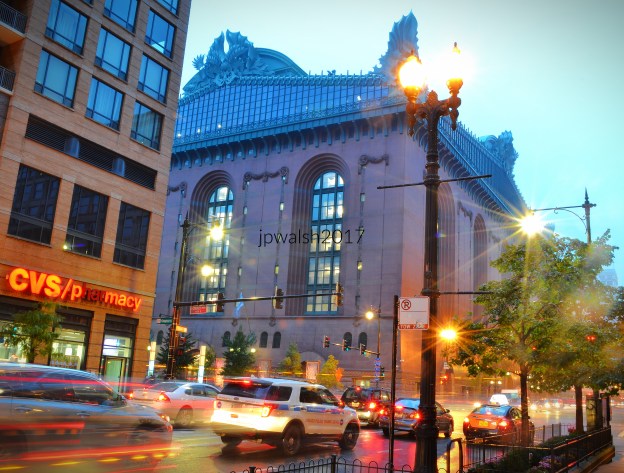
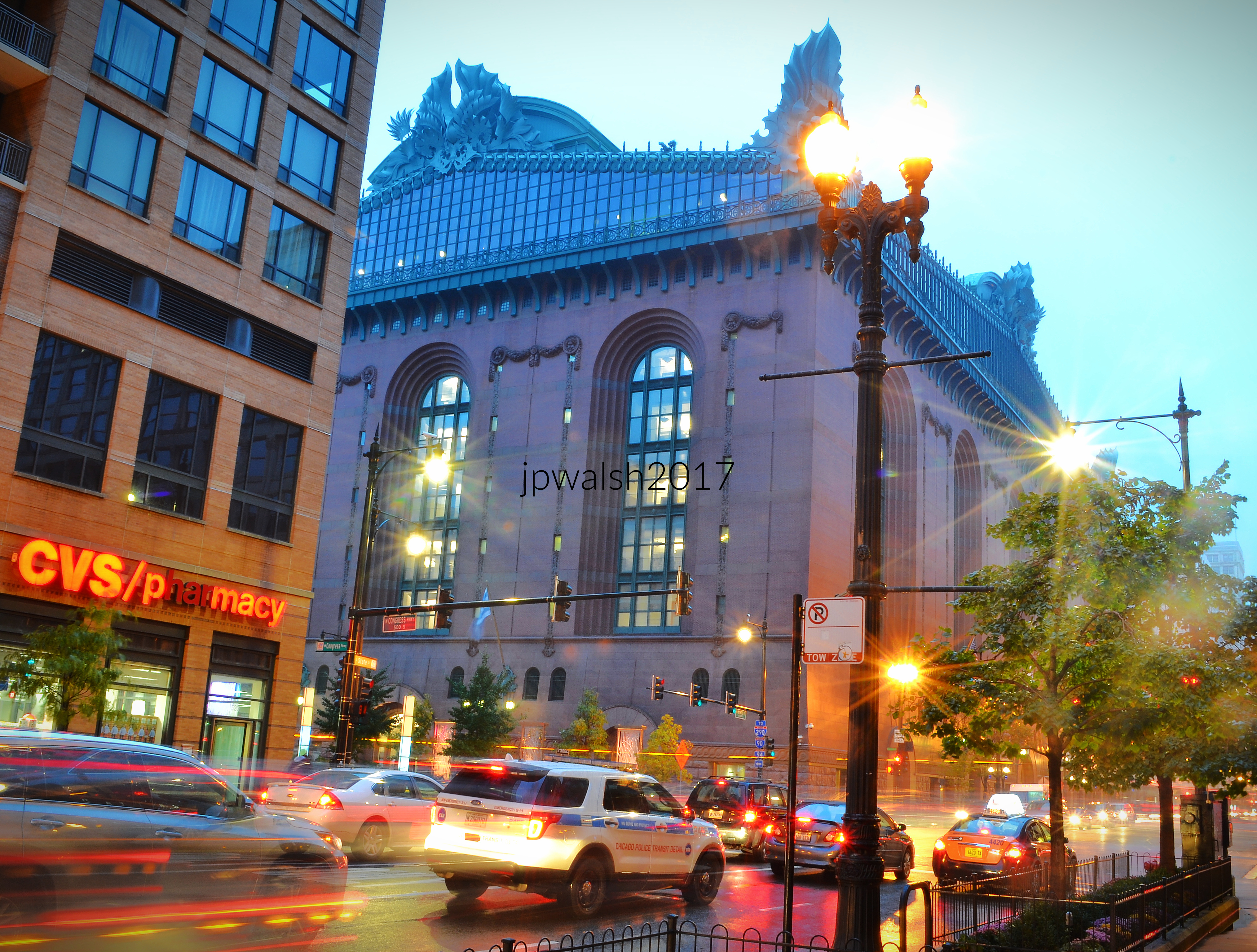
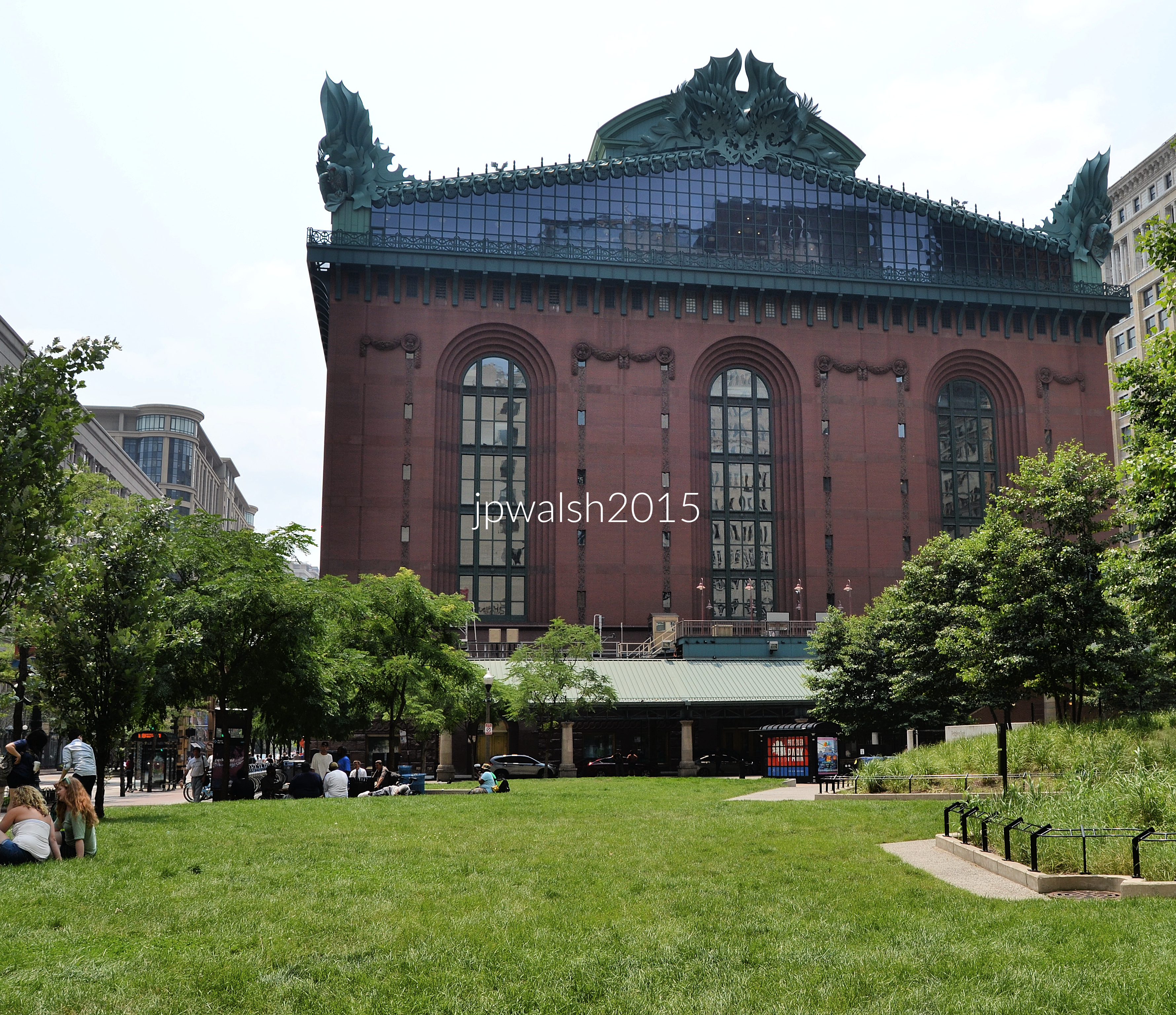
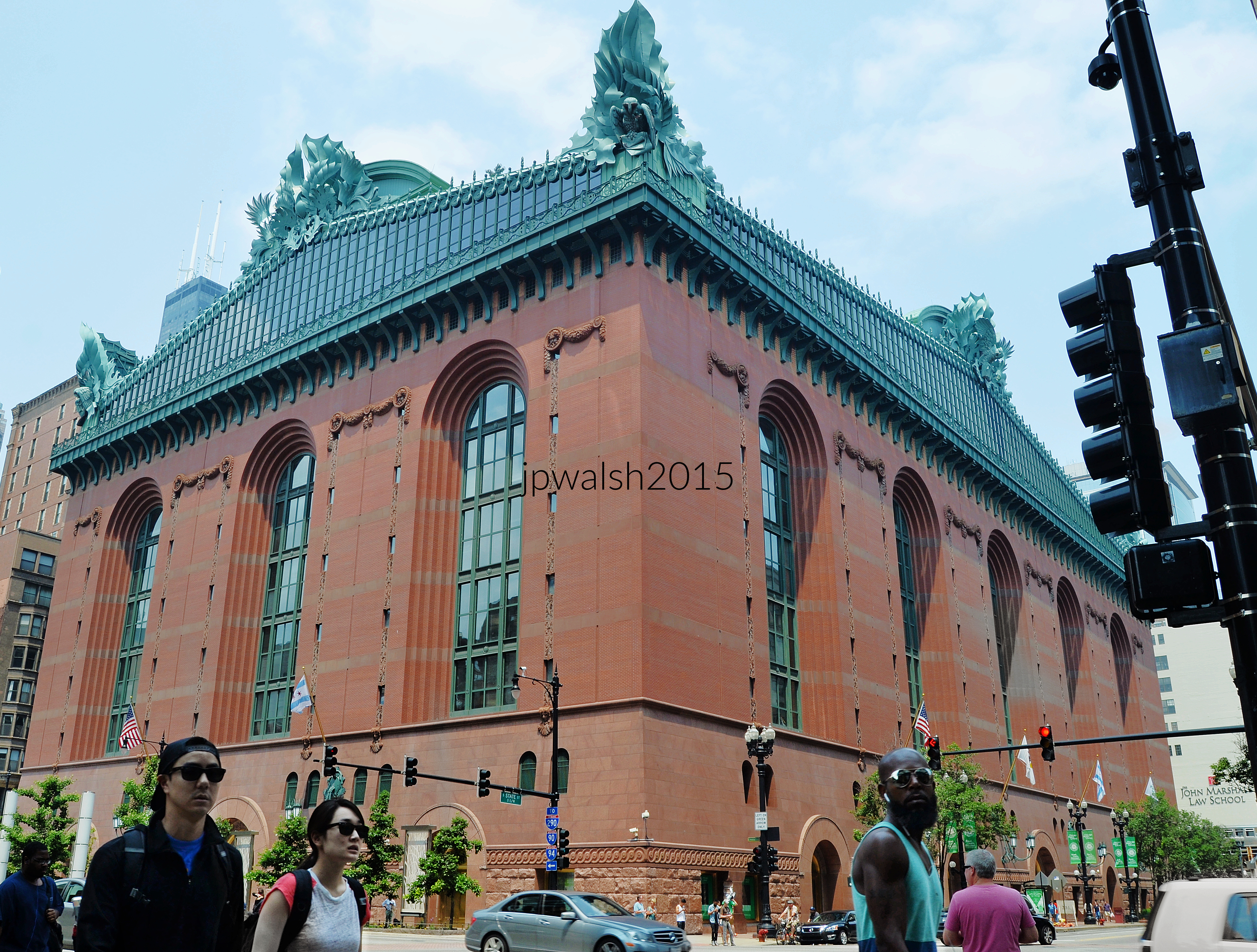
FEATURE image: November 2017.The Harold Washington Library sits on the northwest corner of State Street and Ida B. Wells (Congress) Drive. It is recognized as one of the largest public library buildings in the world. 5.02 mb. Author’s photograph.
November 2017. The decorative pediment of stylized aluminum sculptures was designed by Kent Bloomer in 1993. The large sculptures represent growth and wisdom with enormous owls at each of the pediment’s four corners (“acroteria”). Harold Washington Library Center | Chicago Architecture Center – retrieved February 16, 2026. Author’s photograph.
In 1987, Hammond, Beeby and Babka won the competition to design the main branch of Chicago’s library. The Harold Washington Library was completed in 1991 and is one of the Chicago-based architectural firm’s most famous structures. The building recalls neo-classical institutional buildings yet whose style is creatively applied in its details.
PHOTO CREDIT: “Harold Washington (9519692588)” by City of Boston Archives from West Roxbury, United States is licensed under CC BY 2.0.
The Harold Washington Library is named for Chicago’s first Black mayor. Harold Washington (1922-1987) was elected to two terms as mayor starting in 1983. The well-read and erudite mayor died suddenly of a heart attack the day before Thanksgiving in November1987 just a few months into his second term. I was running along the lakefront in Lincoln Park on an overcast day when I heard the news on my Walkman. My fiancée and I were one of the thousands of Chicagoans (and one of the few whites) who passed by his open casket in the lobby of City Hall between November 27 and 29, 1987. I had also seen and heard Harold Washington speak a couple of times during his public appearances as mayor.
FROM THE PROGRAM: “The jury becomes the ultimate client…There are three areas of evaluation: the design of the building; how it meets technical specifications and how it fulfills the library program…•
Five competing architecture teams race to create the vision for the new Harold Washington (Chicago Public Main) Library that opened at 400 S. State Street on October 7, 1991. The Burnham-dreamed park south across Congress/Ida B. Wells from the library never materialized (Pritzker Park is to the north). The NOVA episode follows these creators as they develop and present their ideas to be judged by the city and public for the downtown building that range from postmodern to Beaux-Arts design concepts. FROM THE PROGRAM: “The jury becomes the ultimate client…There are three areas of evaluation: the design of the building; how it meets technical specifications and how it fulfills the library program…•
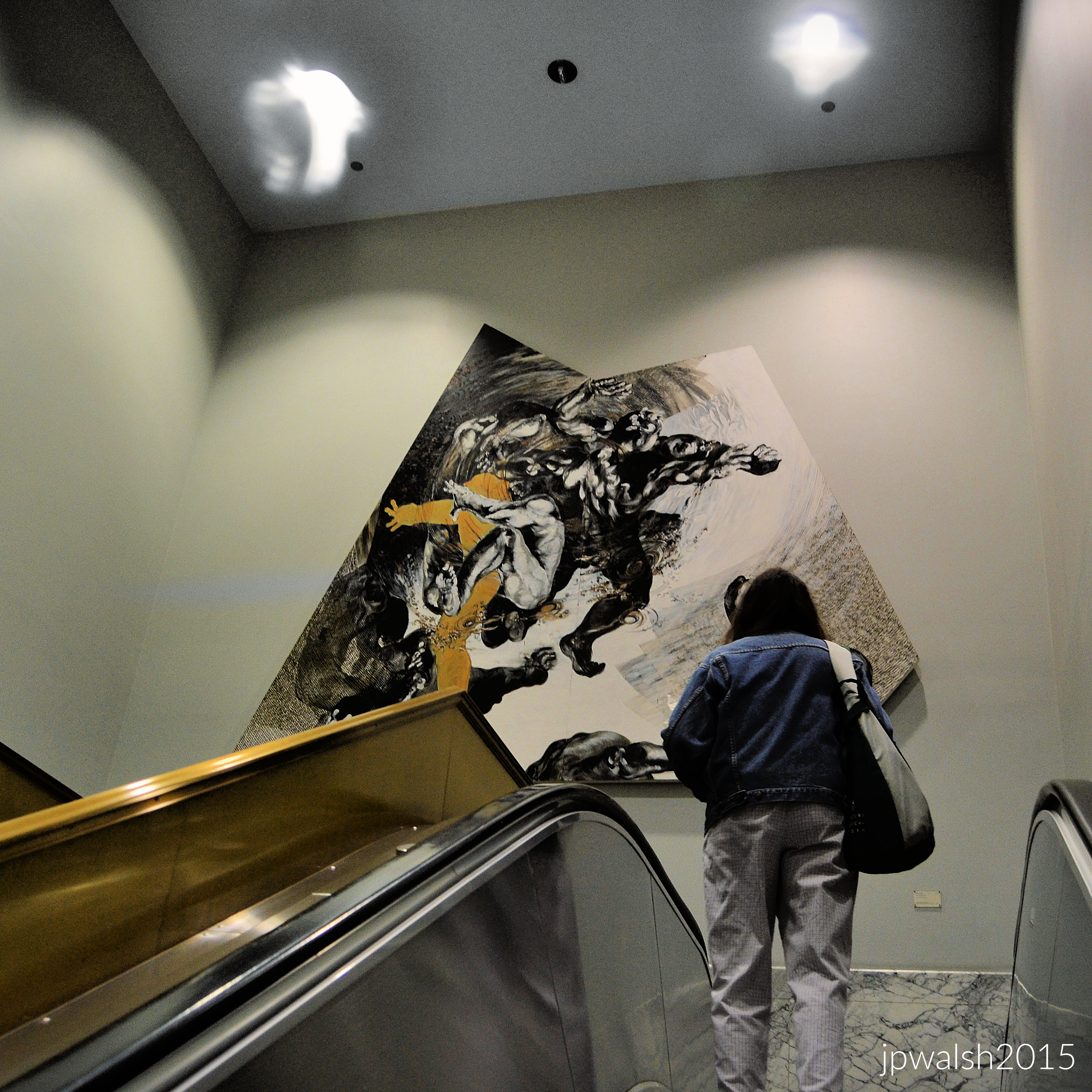
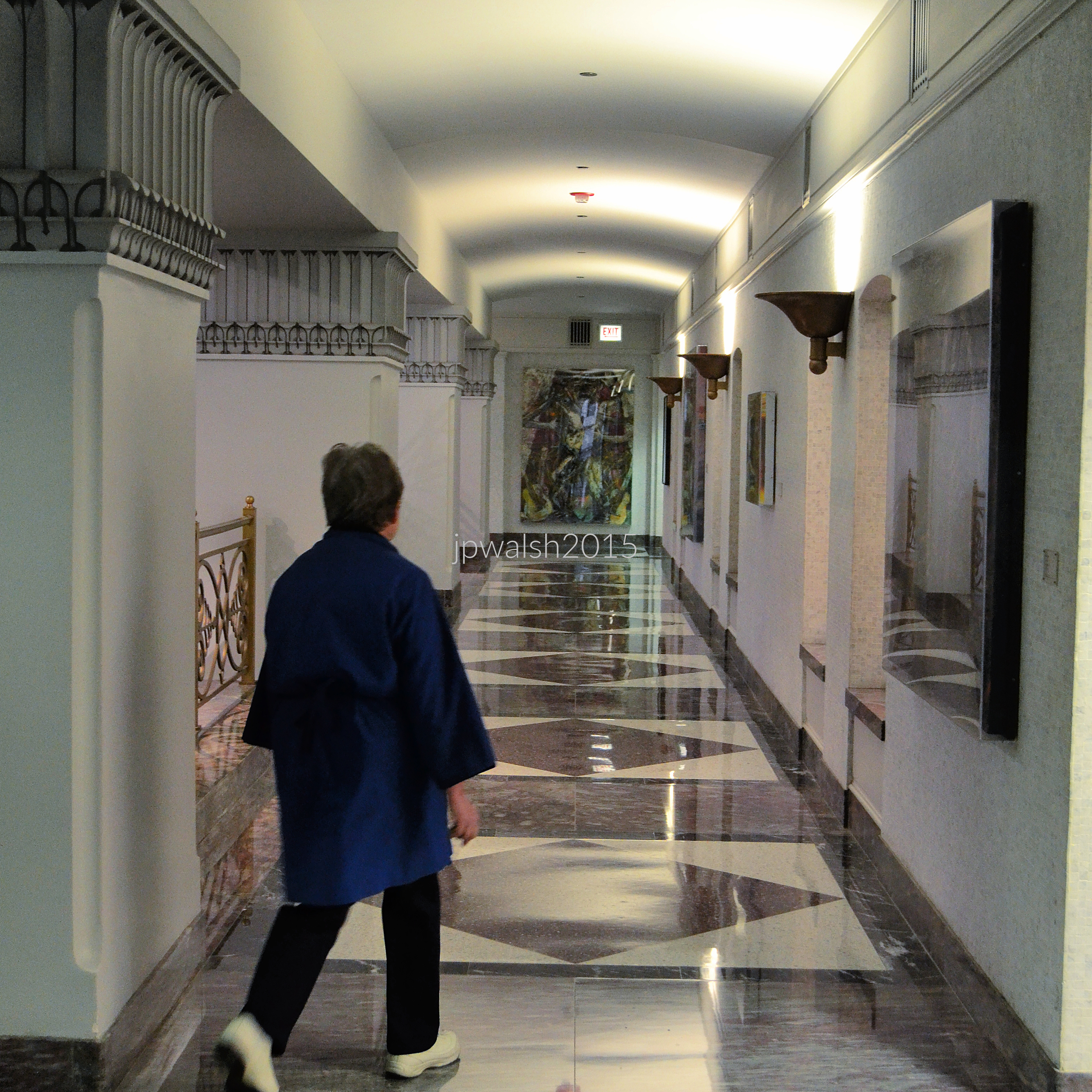
July 2015. State Street entrance. Chicago. 4.84mbAuthor’s photograph. May 2015. The Harold Washington Library serves as the main research branch of the Chicago Public Library. Main floor entrance. see – Harold Washington Library | Loop Chicago – retrieved February 16, 2026. 5.85mb DSC_0474 (1). Author’s photograph. May 2015. The Harold Washington Library houses millions of items across nine floors. At 750,000 square feet, it is the largest public library building in the world. Harold Washington Library | Loop Chicago – retrieved February 16, 2026. 4.0 mb DSC_0476 (1) Author’s photograph.May 2015. Inside Harold Washington Library. 4.88mb DSC_0488 (1) Author’s photograph.May 2015. On the 8th floor the Visual and Performing Arts Department maintains a comprehensive music archive. One major collection, for example, is the Martin and Morris Collection which contains roughly 1,500 scores from the renowned gospel music publisher. 3.61mb DSC_0486. Author’s photographJuly 2015. Northern view from Priztker Park. 5.01mb DSC_0056 (1) Author’s photograph. July 2015. Southeastern view from Ida P. Wells Drive (formerly, Congress Parkway). 5.52 mb DSC_0004 (2) Author’s photograph. December 2015. Harold Washington Library after dark. 3.7mb DSC_0980 (3) Author’s photograph.
This explanatory article may be periodically updated.
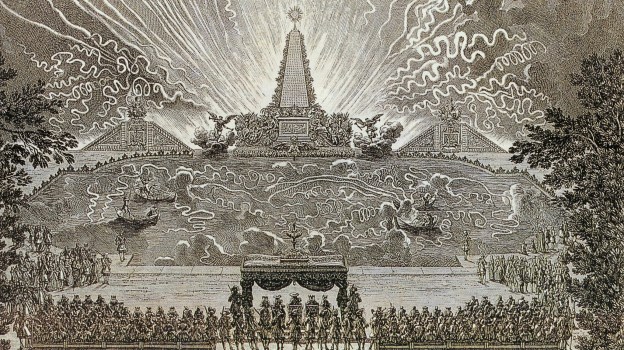
Feature image: 18 août 1674: feu d’artifice sur le Canal, 1676, by French Academy designer and engraver Jean Le Pautre (1618-1682). Flamboyant ephemeral architectures were erected at Versailles for a 17th century summer evening on the Canal that forms the base of elaborate pyrotechnics. Public Domain.
When the French Sun King, Louis XIV (reign, 1638-1715) made his decision to build a palace complex at Versailles, surrounded by the greatest gardens and waterworks the world had ever seen, fireworks (feux d’artifices), were an essential part of the grand entertainments which the king put on for the French court and the thousands of visitors who assembled to celebrate for various special occasions.
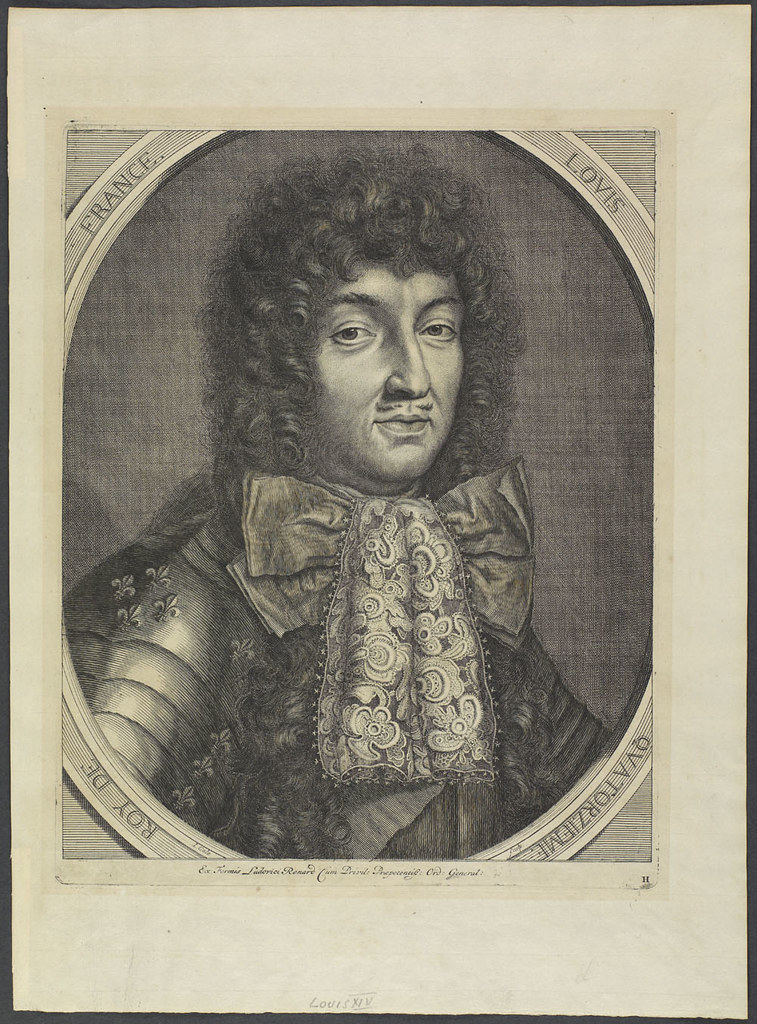
Louis XIV’s reign fused monarchy with light, a 17th‑century symbol of order, power, and divine radiance. The young king chose Versailles not because the marshy valley naturally suited his vision of a court devoted to spectacle, but because it carried the intimate imprint of his father, Louis XIII — the hunting lodge, the modest garden, the remembered landscape of childhood. What followed was not a palace adapted to its terrain, but a terrain forced to yield to an unprecedented royal design. The site’s limitations were absorbed, reshaped, and ultimately overwhelmed by the scale of the Sun King’s project, turning an unremarkable valley into the stage for absolute monarchy. PHOTO credit: “King Louis XIV, 1638-1715 / Roi Louis XIV, 1638-1715” by BiblioArchives / LibraryArchives is marked with CC BY 2.0.
For the next century, Versailles became the premier stage for royal light shows — vast productions of fireworks, illuminations, and night‑time spectacle. Though fireworks were first invented in China, it was Rome that embraced them in the 14th century and launched Europe’s courtly tradition of celebratory rockets. France quickly followed, importing Italian artists, architects, and pyrotechnic masters whose displays soon surpassed anything on the continent.
A key reason Louis XIV moved his court out of cramped Paris and the Louvre was to gain the space required for these grand outdoor entertainments. At Versailles, the king could stage the full range of divertissements du Roi — not only fireworks and illuminations, but elaborate festivals of music, dance, and theater that turned the gardens into a glowing extension of royal power.
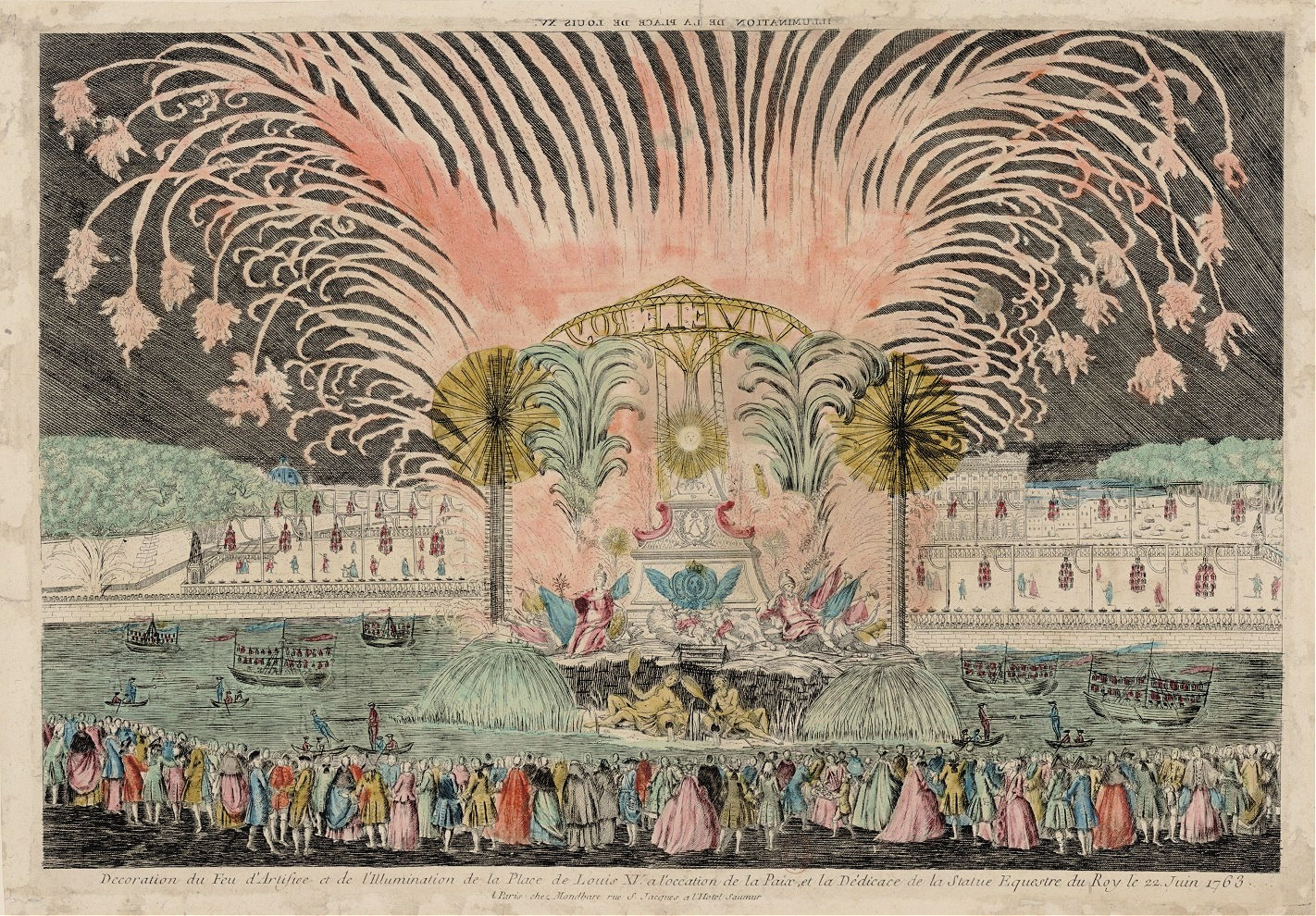
Décoration du feu d’artifice et de l’illumination de la place de Louis XV, à l’occasion de la paix, et la dédicace de la statue équestre du Roi, le 22 juin 1763. Chez Louis-Joseph Mondhare (1734-1799), rue S. Jacques à l’hotel Saumur. Bibliothèque nationale de France, département Estampes et photographie. Public Domain.See – https://www.europeana.eu/en/item/9200518/ark__12148_btv1b8409645h?q=paix%20paris%201763 – retrieved July 14, 2024.
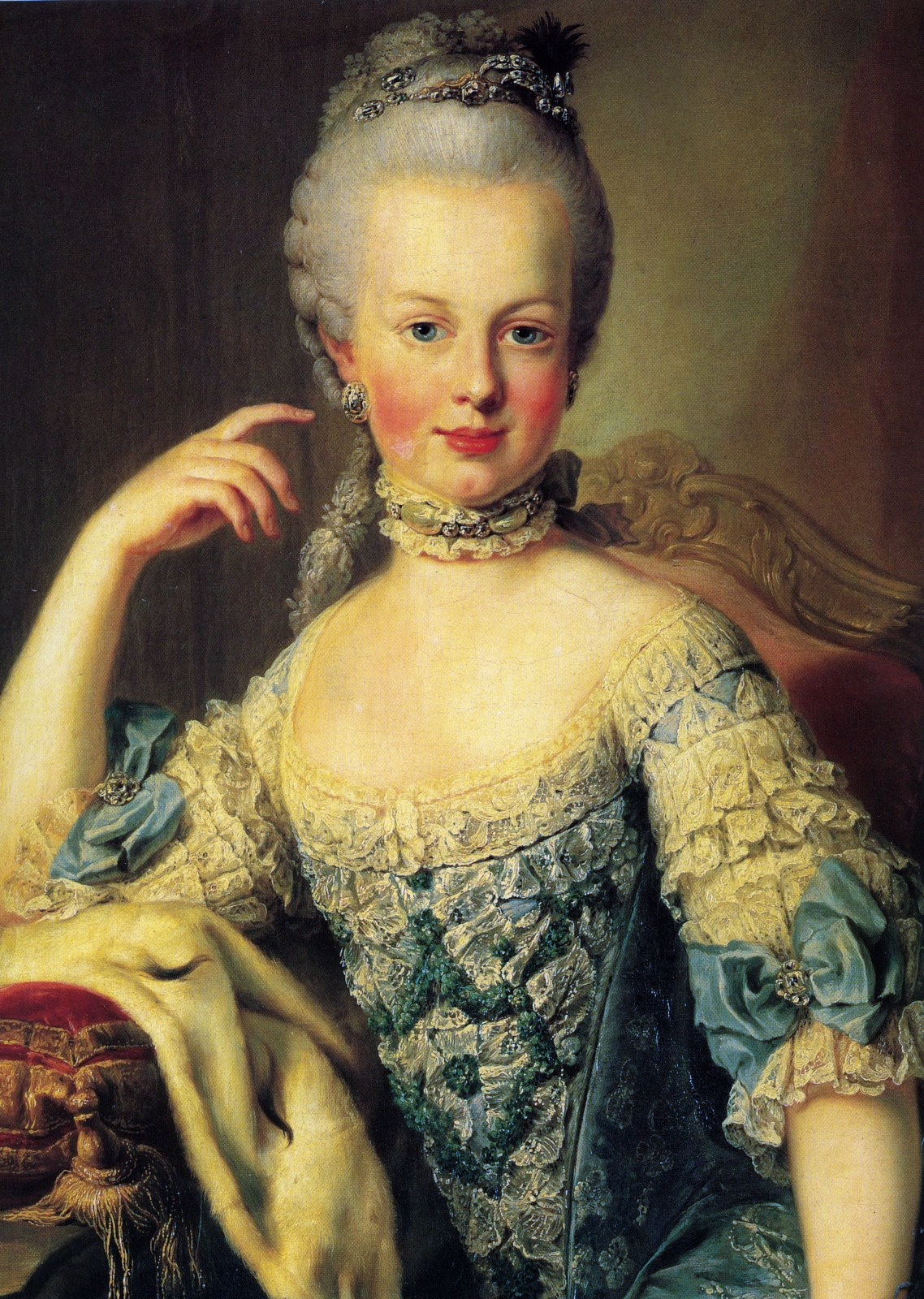
One of Versailles’ most spectacular celebrations came in 1770, when fourteen‑year‑old Marie Antoinette arrived from Austria to marry the heir to the French throne. Louis XV marked the occasion with days of festivities and a guest list numbering in the thousands. The scale was unprecedented: the French Academy of Sciences collaborated with the king’s bureau de Menus‑plaisirs to engineer a display capable of launching 20,000 rockets at once, followed by the coordinated illumination of 15,000 lanterns across the gardens. It was court spectacle elevated to scientific precision — a fusion of dynastic celebration, technological ambition, and the theatrical grandeur that defined Versailles.
Portrait of Archduchess Marie Antoinette, by Swedish-Austrian Martin van Meylens the Younger (1698-1770), c. 1768, Schönbrunn Palace, Vienna. Public Domain.
Les Grandes Eaux Nocturnes de Feu — Versailles’ midsummer night spectacular — turn the gardens into a blazing stage of water, light, music, and fire. A 2½‑hour promenade of illuminated fountains and baroque soundscapes builds toward the “de Feu” climax: monumental flame effects and a full pyrotechnic performance by Groupe F, France’s world‑renowned masters of fireworks.
Even today, crowds stream to Versailles just west of Paris, gathering to watch cutting‑edge pyrotechnics ignite the night above the palace. The modern displays play off the same elements that once dazzled the Sun King: the vast pools, canals, and fountains that mirror every burst of color and amplify the spectacle across the gardens’ sweeping geometry. In these moments, the waterworks and the fireworks merge into a single theatrical composition — a living continuation of the courtly entertainments that defined Versailles at its height.
FEATURE image: Independence Day Parade 2024 was honored to have Kate, this year’s Illinois Miss Amazing Miss Queen, as the Grand Marshal. Miss Amazing, a national organization, provides opportunities for girls and women with disabilities across the nation to make for engagement at every level of society and that dismantles stereotypes and opens up pathways for personal growth and self-esteem.
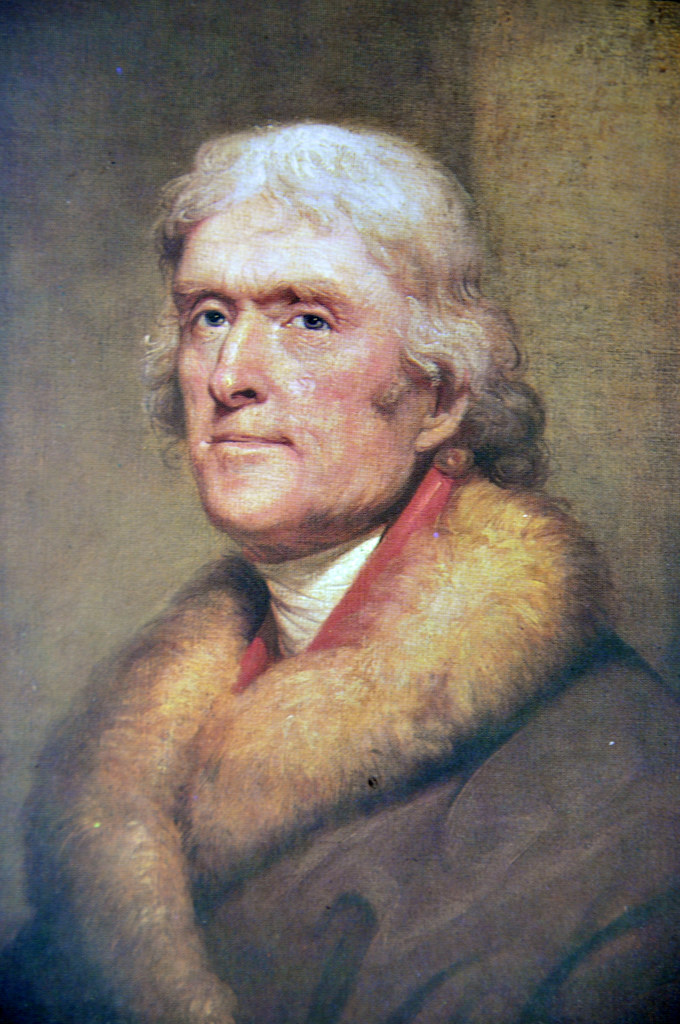
Since late May 2024 Illinois has been the epicenter of an historic emergence of two broods of trillions of cicadas whose buzzing presence is expected to continue into July. The Northern Illinois Brood (Brood XIII) came out of the soil on schedule during its 17-year cycle. In 2024 there is an adjacent emergence in the central United States occuring at the same time. It is the emergence of the Great Southern Brood (Brood XIX). It is this dual emergence of the two groups of cicadas that is historic since it has not happened since Thomas Jefferson was the third president of the U.S. in 1803.
Illinois is the epicenter of 2024’s historic cicada invasion.
According to a 2024 publication by the Ohio Biological Survey of “The 2024 Emergence of Periodical Cicada Broods XIII and XIX” by renowned cicada expert Dr. Gene Kritsky, Professor Emeritus of Biology and former Dean of the School of Behavioral and Natural Sciences at Mount St. Joseph University, the Brood XIII emergence extends from the center of the state of Illinois around Springfield and spreads as far north as southern Wisconsin. Brood XIX also extends from around Springfield, Illinois, to points south past Cairo, Illinois. “This is not just a cicada year,” Dr. Kritsky observed, “it’s an historic convergence of Broods XIII and XIX, making it a once-in-a-lifetime experience for enthusiasts and researchers alike” (See- https://www.msj.edu/news/2024/01/dr-gene-kritsky-releases-book-cicada-emergence.html – retrieved June 15, 2024). As trillions of cicadas mate and lay their eggs this year, the buzzing activity will gradually fade and 2024’s broods of adult cicadas die. Their offspring of 2024 will emerge, in the case of Brood XIII, during its next 17 year cycle in 2041.
While the cicada’s life is mostly spent under the soil, they use their legs to emerge from the soil where they molt and mate. Cicadas emerge after the soil temperature is higher than 64 degrees Fahrenheit. Their emergence from the ground turns over large amounts of soil, and after they die their decaying bodies contribute a massive amount of nutrients to the soil. June 15, 2024 79% 7.89 mb 8563
Ghost Trees.
GHOST TREES.Homeowners in Chicago have wrapped their small trees with mesh netting in preperation of the arrival of trillions of molting mating cicadas. The wrapped mesh is to prevent cicadas from damaging young trees. Once cicadas molt and mate, female cicadas lay their fertilized eggs in the bark of trees. April 2024 7.46 mbGHOST TREES.Periodical cicada years are quite beneficial to the ecology of the region. Their egg-laying in trees is a natural pruning that results in increased numbers of flowers and fruits in the succeeding years. May 31, 2024 99% 6.92 mb 7779GHOST TREES. June 15, 2024 95% 7.66 mb 8565 (2)GHOST TREES.June 3, 2024 89% 7.80 mb 7917GHOST TREES. May 28, 2024 90% 7.69 mb 7588
During May and June 2024, the 17-year Northern Illinois Brood XIII emerged in and around Chicago, across northern Illinois and in portions of northwest Indiana, southern Wisconsin and eastern Iowa.
Cicadas converge on a backyard playset. Cicadas do not sting or bite, and do not carry diseases. May 28 2024 95% 7.69 mb 7557Cicadas emerging from their shell. Cicadas are more closely related to aphids (i.e., black flys) than grasshoppers. May 28 2024 95% 7.67 mb 7667Trillions of male cicadas sing through sound-producing structures called tymbals on either side of the abdomen under the wings. Their singing is a mating call to the female.
June 7, 2024 4.20mb 8117May 31, 2024 5.47mb 7700May 31, 2024 5.03mb 7719May 31, 2024 5.80mb 7801June 3, 2024 99% 6.40mb 7911Cicadas do not eat solid food, but do drink fluids to avoid dehydration. May 28, 2024 2.73mb 7563June 8, 2024 6.87mb 8154June 7, 2024 4.84mb 8111June 10, 2024 7.02mb 8473
Reacting to a story in the Wall Street Journal dated June 9, 2024 entitled, “Americans Really, Really Hate Inflation—and That’s a Big Problem for the Fed” (see – https://www.wsj.com/economy/central-banking/americans-inflation-target-fed-c1fc7857?mod=latest_headlines – retrieved June 9, 2024) the author cites various financial experts where some of them prefer the traditional 2% target inflation rate for the Federal Reserve and others for a higher and perhaps more realistic 4% target rate (or thereabouts) so to give better headroom for the Fed to cut rates or not to stimulate and otherwise moderate the economy. In tandem with this article is another article that appeared in the Tampa Bay Times updated August 28, 2005 entitled, “Remember how Reagan beat inflation” (see – https://www.tampabay.com/archive/2004/06/09/remember-how-reagan-beat-inflation/ – retrieved June 9, 2024) that served as a history of inflation and unemployment rates between the 1960’s and the early 2000s.
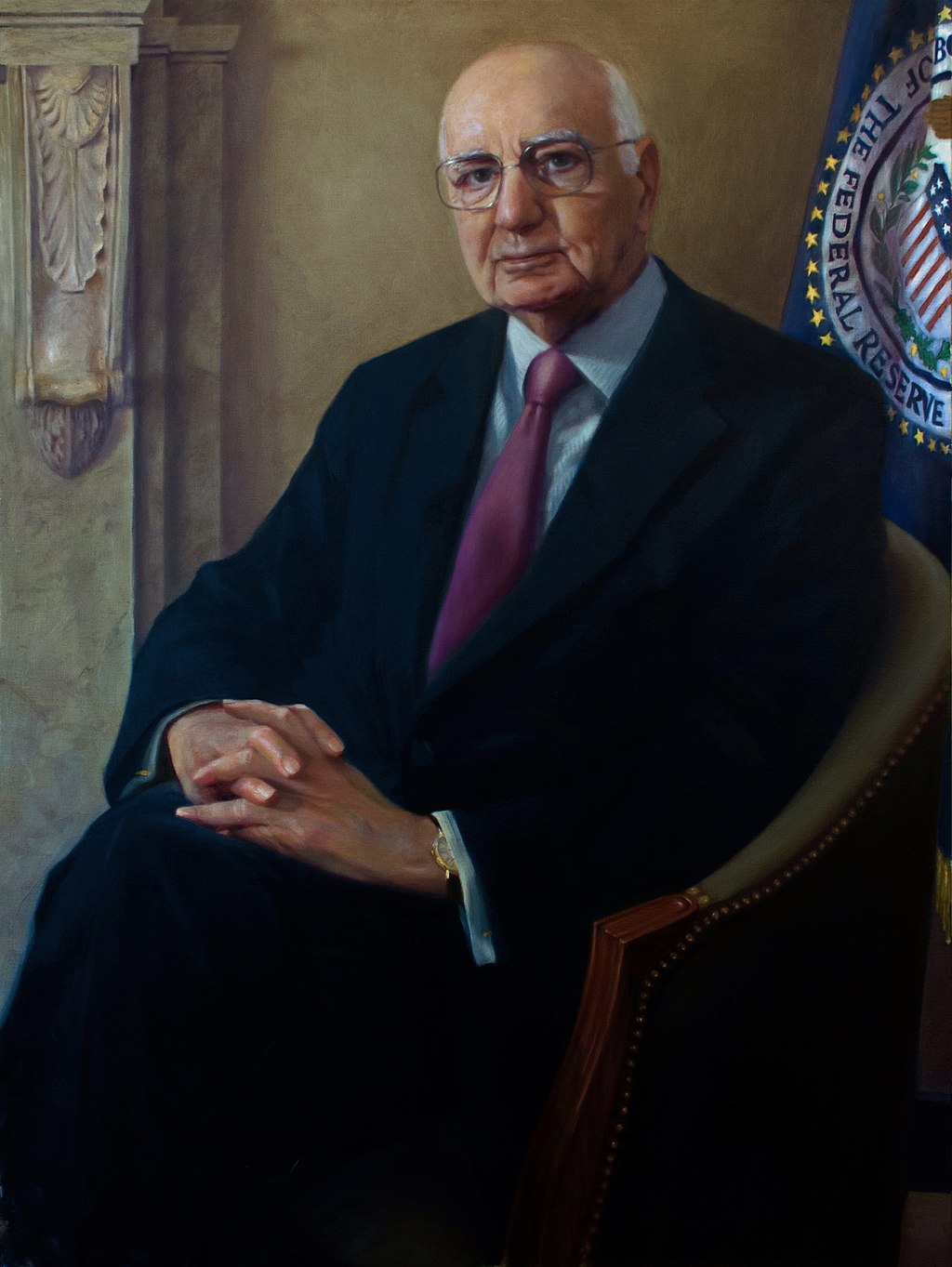
Portrait of Paul A. Volcker (1927-2019) by Luis Alvarez Roure. 2015. Oil on linen. 40 x 30 inches. Collection of the Board of Governors of the Federal Reserve System.Volcker served as Fed chairman from 1979 to 1987. PHOTO CC BY-SA 3.0.
There are many ways to skin a cat – and as some financial experts agree that a 2% target inflation rate is the better choice for the Fed to maintain – the board can work with this traditional target inflation rate to react to the economy. That the going inflation rate should be higher and, if for no other reason that it matches today’s inflation level (4% as of April 2023 cited by WSJ article), has its proponents as more practical if not always politically viable. The last time inflation was as high as it is in 2024 was under one-term Democrat president Jimmy Carter in 1980. After inflation in 1976 was 4.9%, it roared to 13.3% under Carter. Further, the Carter Administration did not stop inflation’s continued rising at an unpredictable pace. When Reagan was elected in 1980 nearly 60% of voters said inflation was, as the TBT article stated, “a determining issue for them.” Mortgage rates, too, were at an historic high level in 1980. It was Fed Chairman Paul Volcker’s tight money policy that revived the 1980s and this despite Reagan’s tax cuts and massive deficit spending which left a troublesome legacy of historically large deficits and economic consolidation. To fix the economy as Volcker and Reagan worked it in the early 1980s had workers bear the brunt – Carter’s 7% unemployment rate spiked to 11% under Reagan. This meant millions of workers were suddenly without the means to buy goods and services and – guess what?- inflation dropped to under 4%. Though it ticked up to 6% by 1990 it has not been higher until President Joe Biden. The WSJ article’s citing “wage growth” that consumers should be appreciating yet apparently choose to ignore seems to be that most spectral of all economic indicators. As house prices (and mortgage interest rates) have doubled in the last 20 years how have wages kept up? Since Reagan, “free” money and attendant excessive borrowing at the individual and government level clearly juiced the economy, but at a price where the American people now have record debt levels and there have been certain misdirected “too big too fail” investments including inadequate affordable housing inventory and overbuilding office space and other commercial developments and the sometimes implosion of capital requiring huge bailouts, much of it from more borrowed money with the taxpayer on the hook.
Federal Reserve Board Chairman Jerome H. Powell took office on February 5, 2018, for a four-year term. He was reappointed to the office and sworn in for a second four-year term on May 23, 2022. Public Domain.
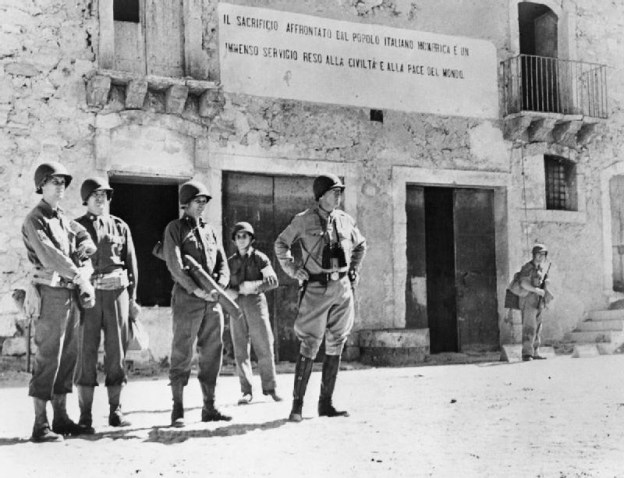
FEATURE IMAGE: Lieutenant General George Patton watches operations from a town in Sicily on the front line accompanied by his staff. Unknown photographer. Fair Use. For Operation Husky, the invasion of Sicily in July 1943, Patton commanded the Seventh U.S. Army, in landings on the southern bay of Sicily at Gela, Scoglitti and Licata. Patton’s I Armored Corps was officially redesignated the Seventh Army just before his force of 90,000 landed. Initially ordered to protect the British forces’ left flank, Patton was granted permission by British General Sir Harold Alexander (1891-1969) to take Palermo.
(2.42 minutes) June 6, 2024 – D-Day 80th (June 6, 1944) – After the remarkable North Africa and Sicily campaigns, three-star Lieutenant General Patton (George C. Scott) was sidelined by the architect of D-Day, Supreme Allied Commander and five-star General Dwight Eisenhower (“Ike”) (1890-1969) because of this “slapping” incident of an American soldier by Patton that took place in the time the American army reached Nicosia, Sicily, in the interior of the Italian island. Both by air or street to street, the fighting against the occupying Germans was a dogfight. This highly controversial “slapping” incident, witnessed by many, in Gen. George C. Patton’s command of the 7th Army occurred in an American evacuation hospital in Nicosia, Sicily, on August 3, 1943. Afterwards, Ike privately chastised Patton and insisted he apologize to the soldier, which Patton did.
George C. Scott (1927-1999) won the Academy Award for Best Actor for playing General George S. Patton in Patton (1970). Scott was the first actor to decline the award, having told the Academy of Motion Picture Arts and Sciences that he would if he won because of his belief that film performances should not be compared. The “slap heard around the world” was dramatized in Patton, the 1970 American epic biographical war film about U.S. General George S. Patton during World War II. The scene takes place in an evacuation hospital in the historic hilltown of Nicosia, Sicily, in the central part of the Italian island. Patton won seven Academy Awards, including Best Picture, Best Director and Best Original Screenplay.
The account of Patton’s humiliating slap of a young U.S. soldier leaked to the press and three-star Patton had to go on an extensive apology tour. Americans sacrificing at home were deeply disturbed by Patton’s action done at least partly out of misguided compassion. The result was that Patton was relieved of his command for six months citing his intense and unprofessional lack of personal discipline and self-control.
Patton was feared by the Germans more than any Allied commander. Yet American protocols sent him to England to train troops for combat in anticipation of D-Day. Patton was given combat command again only following the D-Day invasion. He crossed the Channel with the Third Army in July 1944. Nine months later, in April 1945, he was made a four-star general.
After the war, on December 9, 1945, Patton, the armored forces commander who criticized American leadership for not rolling right on through into Eastern Europe to fight the Russians – his suggestions were refused – was involved in a freak road accident near Heidelberg, Germany. The accident left Patton paralyzed. He died 12 days later in a Heidelberg hospital, on December 21, 1945. Patton was 60 years old.
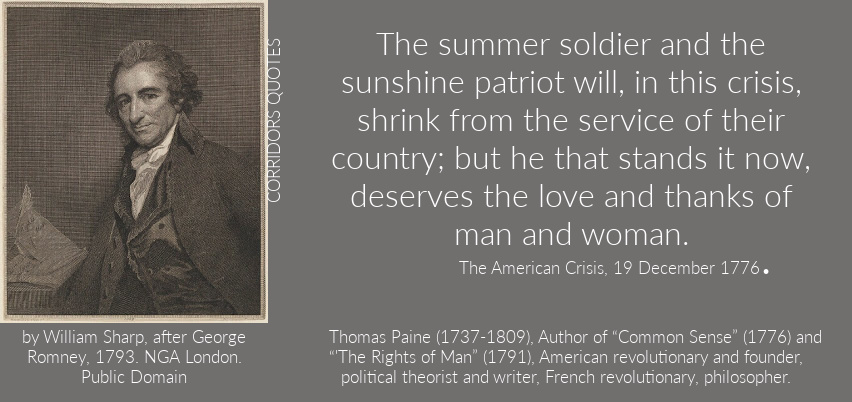
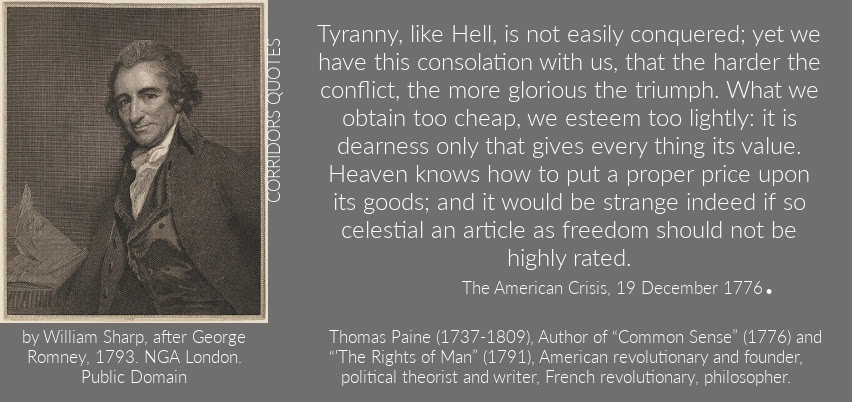
These are the times that try men’s souls. The American Crisis, 19 December 1776.The summer soldier and the sunshine patriot will, in this crisis, shrink from the service of their country; but he that stands it now, deserves the love and thanks of man and woman. The American Crisis, 19 December 1776.Tyranny, like Hell, is not easily conquered; yet we have this consolation with us, that the harder the conflict, the more glorious the triumph. What we obtain too cheap, we esteem too lightly: it is dearness only that gives every thing its value. Heaven knows how to put a proper price upon its goods; and it would be strange indeed if so celestial an article as freedom should not be highly rated. The American Crisis, 19 December 1776.
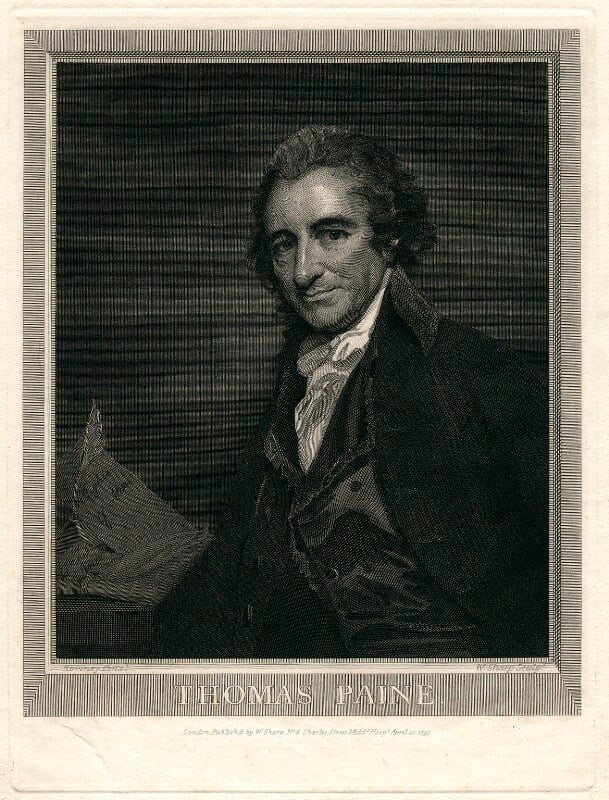
With the capture of Manhattan, British Army Commander in Chief William Howe sent Cornwallis to pursue Washington into New Jersey just sixty miles north of Philadelphia. Washington’s army was down almost 90% in December 1776 (3500 soldiers) from just August 1776. Washington just escaped Cornwallis’ grasp. As the British set up a line of forts to house and feed their soldiers during winter, Washington was the outsider. The British believed the end of the revolution of what they called “despised” and “undisciplined rabble” which Virginia planter George Washington led (by way of the efforts of troublemaker Massachusetts lawyer John Adams), was in hand. The British entered into winter by taking prisoner Charles Lee, one of Washington’s senior generals in the Continental army, and locked him up as well as their own fleet in Newport, Rhode Island which they took without resistance. The British kept Lee’s horse perpetually drunk out of spite for the Americans. Before Washington’s important crossing of the Delaware River on Christmas night 1776 and surprised the mercenary Hessians, Washington’s first comeback victory, it was the lowest ebb of the war. Since July 1776, Howe had taken almost 5000 men as P.O.W.’s, including 4 generals, and hundreds of artillery pieces and many tens of thousands of Washington’s ammunition in the wake of winning battles. It was then that 39-year-old Thomas Paine, serving in Washington’s army, wrote this propaganda tract (his Common Sense appeared earlier in January) that began with the famous line. “These are the times that try men’s souls: The summer soldier and the sunshine patriot will, in this crisis, shrink from the service of their country; but he that stands it now, deserves the love and thanks of man and woman. Tyranny, like Hell, is not easily conquered; yet we have this consolation with us, that the harder the conflict, the more glorious the triumph. What we obtain too cheap, we esteem too lightly: it is dearness only that gives every thing its value. Heaven knows how to put a proper price upon its goods; and it would be strange indeed if so celestial an article as freedom should not be highly rated.” Washington wrote about the same events more soberly: “Our affairs are in a very bad way . . . the game is pretty near up—owing in a great measure to the insidious arts of the enemy.”
SOURCES: CHAPTER THREE. “The Peace Commissioners? THE HOWE BROTHERS,” The Men Who Lost America: British Leadership, the American Revolution, and the Fate of the Empire (The Lewis Walpole Series in Eighteenth-Century Culture and History), Andrew Jackson O’Shaughnessy, Yale University Press, 2013, p. 96.
Your failure is, I am persuaded, as certain as fate. America is above your reach….her independence neither rests upon your consent, nor can it be prevented by your arms. In short, you spend your substance in vain, and impoverish yourself without hope. To the People of England , The American Crisis: PHILADELPHIA, Nov. 21, 1778. see- https://www.ushistory.org/paine/crisis/c-07.htm – retrieved June 5, 2024.
The first national observance of Memorial Day occurred on May 30, 1868 following the U.S. Civil War. Commander in Chief John A. Logan of the Grand Army of the Republic issued General Order Number 11 designating May 30 as a day of memorial “for the purpose of strewing with flowers or otherwise decorating the graves of comrades who died in defense of their country during the late rebellion, and whose bodies now lie in almost every city, village, and hamlet churchyard in the land.” (see – https://www.loc.gov/item/today-in-history/may-30/ – retrieved May 27, 2024). It is a day for visiting cemeteries and memorials to mourn the military personnel who died in the line of duty.
Films, music and literature about the people, places and events in history where military personnel as individuals and as a unit are asked to pay the ultimate price and make the greatest sacrifice for freedom are among some of the greatest stories ever told.
THE CROSSING. The American Revolutionary War (1775-1783)
Directed by Robert Harmon and adapted by Howard Fast from his novel of the same name, The Crossing stars Jeff Daniels as George Washington.
In December 1776 — barely six months after the Declaration of Independence — Washington’s Continental Army was collapsing. Starved of men, artillery, and supplies, the revolution hung by a thread. So Washington made the most dangerous decision of the war: he would gamble everything on a surprise strike at Trenton, where more than a thousand feared Hessian mercenaries held the town.
To reach them, his exhausted army would have to force a night crossing of the ice‑choked Delaware River and march toward what looked like a hopeless fight. Instead, the attack became the stunning, against‑all‑odds victory Washington had scarcely dared imagine.
Washington’s surprise attack on the Hessian garrison at Trenton on December 26, 1776, produced a stunningly one‑sided American victory. The Continental Army suffered almost no combat losses — none killed in action, two men who froze to death during the night march, and only five wounded, including a young James Monroe, later of Monroe Doctrine fame, who took a musket ball in the shoulder.
The Hessians, by contrast, were effectively destroyed as a fighting force: 22 killed (among them their commander, Colonel Johann Rall), 92 wounded, and about 920 captured.
Directed by Ronald F. Maxwell whose screenplay is based on The Killer Angels, a novel by Michael Shaara, Gettysburg starred an ensemble cast including Martin Sheen, Tom Berenger, Jeff Daniels, Stephen Lang and Sam Elliott.
One of the Union army’s most respected senior commanders during the American Civil War was 42-year-old General John F. Reynolds (John Rothman) who was killed on the first day of the Battle of Gettysburg at the very start of it. Reynolds was in command of the “left wing” of the Army of the Potomac commanded by Gen. George C. Meade and which included the cavalry division of 37-year-old Brig. Gen. John Buford (Sam Elliott).
Buford had occupied the town of Gettysburg, Pennsylvania, with his “headquarters” atop the cupola of the Lutheran seminary. With light defensive lines he resisted superior numbers of Confederate infantry brigades along the Chambersburg Pike who were blind to the Union Army’s smaller numbers because Major General J. E. B. Stuart had gone missing.
When Reynolds’ I Infantry Corps arrived, he rode out ahead, met with Buford, and then accompanied some of his soldiers into the fighting. As Reynolds was supervising the placement of the 2nd Wisconsin, he shouted: “Forward men! Forward for God’s sake! and drive those fellows out of those woods.” At that moment Reynolds was shot by a sniper and fell off his horse to the ground with a mortal wound to the back of the head.
The death of Reynolds impacted his troops and fellow commanders deeply. At that particular moment, they realized that any one leader (and the Union army had been through several at the top), even if he had the necessary zeal, vision, and sense of purpose, would not be enough to win the fight to save the Union. It must be a coordinated effort. Reynolds, by supporting Buford’s decision to set up defensive resistance as well as engaging his infantry, even in death effectively chose Gettysburg as that hallowed battleground for the next three days.
Since Confederate numbers were superior on that first day, Union troops eventually retreated through town and rallied on Cemetery Ridge where General Meade and Maj. Gen. Winfield S. Hancock, with many others, entrenched on the high ground. They faced Confederate Gen. Robert E. Lee (Martin Sheen), and Lieutenant Generals Longstreet, Ewell, and A.P. Hill, among others. In the 1993 film, Confederate Major General Henry Heth is played by Warren Burton who was born and grew up in Chicago and attended The School of the Art Institute of Chicago. Heth was from a coal mining area near Richmond, Virginia.
At the Battle of Gettysburg the two armies suffered between 46,000 and 51,000 casualties. Union casualties amounted to 3,155 killed, 14,531 wounded, and 5,369 captured or missing. Reynolds’ body was immediately transported to his home-town of Lancaster, PA, where he was buried on July 4, 1863. Buford died 5 months later possibly of typhus in Washington, D.C. and was buried at West Point Cemetery in New York. Like Lincoln, Buford was born in Kentucky and grew up in Illinois (Rock Island). His father was a leading politician, but as a Democrat supported Stephen A. Douglas and opposed Abraham Lincoln.
THE (FIGHTING) SULLIVANS. World War II (1941-1945)
Directed by Lloyd Bacon based on a story by Edward Doherty, Mary C. McCall Jr., and Jules Schermer, The (Fighting) Sullivans starred Anne Baxter, Thomas Mitchell, Selena Royle, Edward Ryan, John Campbell, James Cardwell, John Alvin, George Offerman, Ward Bond and Trudy Marshall.
Released as The Sullivans in 1944, this 20th-Century-Fox drama film tells the true story of five brothers – George, Frank, Matt, Joe and Al Sullivan – who grew up in Waterloo, Iowa, and who were all killed in World War II when their ship, Juneau, was sunk in combat at Guadalcanal in November 1942.
The film is a tearjerker not so much because it is sentimental but that it is honest. The final scene where the naval officer who recruited the five brothers (Ward Bond) comes to the boys’ house to tell the tragic news to their parents (Thomas Mitchell and Selena Royle) and the youngest brother’s widow (Anne Baxter) and mother of his child is one of cinema’s best conveyances of the price paid in a world war that claimed 420,000 American lives.
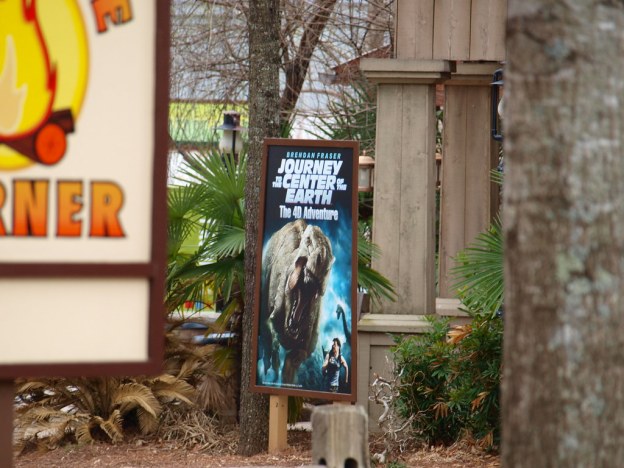
In this 3D science‑fantasy action‑adventure, Brendan Fraser stars as volcanologist Trevor Anderson, who sets out on a dangerous quest to uncover what happened to his missing brother. He’s joined by his 13‑year‑old nephew, Sean (Josh Hutcherson), and an Icelandic mountain guide, Hannah (Anita Briem). Their search plunges them into a vast, hidden world beneath the Earth’s crust—a luminous, prehistoric landscape filled with strange ecosystems, volcanic hazards, and living prehistoric creatures, including dinosaurs.Directed by Eric Brevig, the film takes a loose approach to Jules Verne’s 1864 novel, treating the book as an in‑story roadmap rather than a strict adaptation. The emphasis is on family‑friendly spectacle and immersive 3D effects, including early use of the 4DX format, which added motion, wind, water sprays, and other sensory elements in select theaters.Released on July 11, 2008, the movie earned $244.2 million worldwide on a $60 million budget. Critics admired its visual energy and inventive 3D sequences but found the plot predictable and Fraser’s trademark quips a bit on the cheesy side. Even so, the film became a reliable family favorite and spawned a sequel, Journey 2: The Mysterious Island (2012)—though Fraser did not return.
Journey to the Center of the Earth began as a science‑fiction novel published in 1864, 160 years ago, by Jules Verne (1828–1905). Verne’s story follows the fiery German geologist Professor Otto Lidenbrock, his anxious nephew Axel, and their unflappable Icelandic guide Hans Bjelke as they descend into the planet’s interior. Their expedition leads them through vast caverns, prehistoric landscapes, and encounters with living creatures long thought extinct.
Across three centuries, Verne’s subterranean adventure has proven irresistible. The novel has inspired multiple film, television, and radio adaptations, along with theme‑park attractions and reinterpretations that keep its blend of science, imagination, and danger alive for new generations.
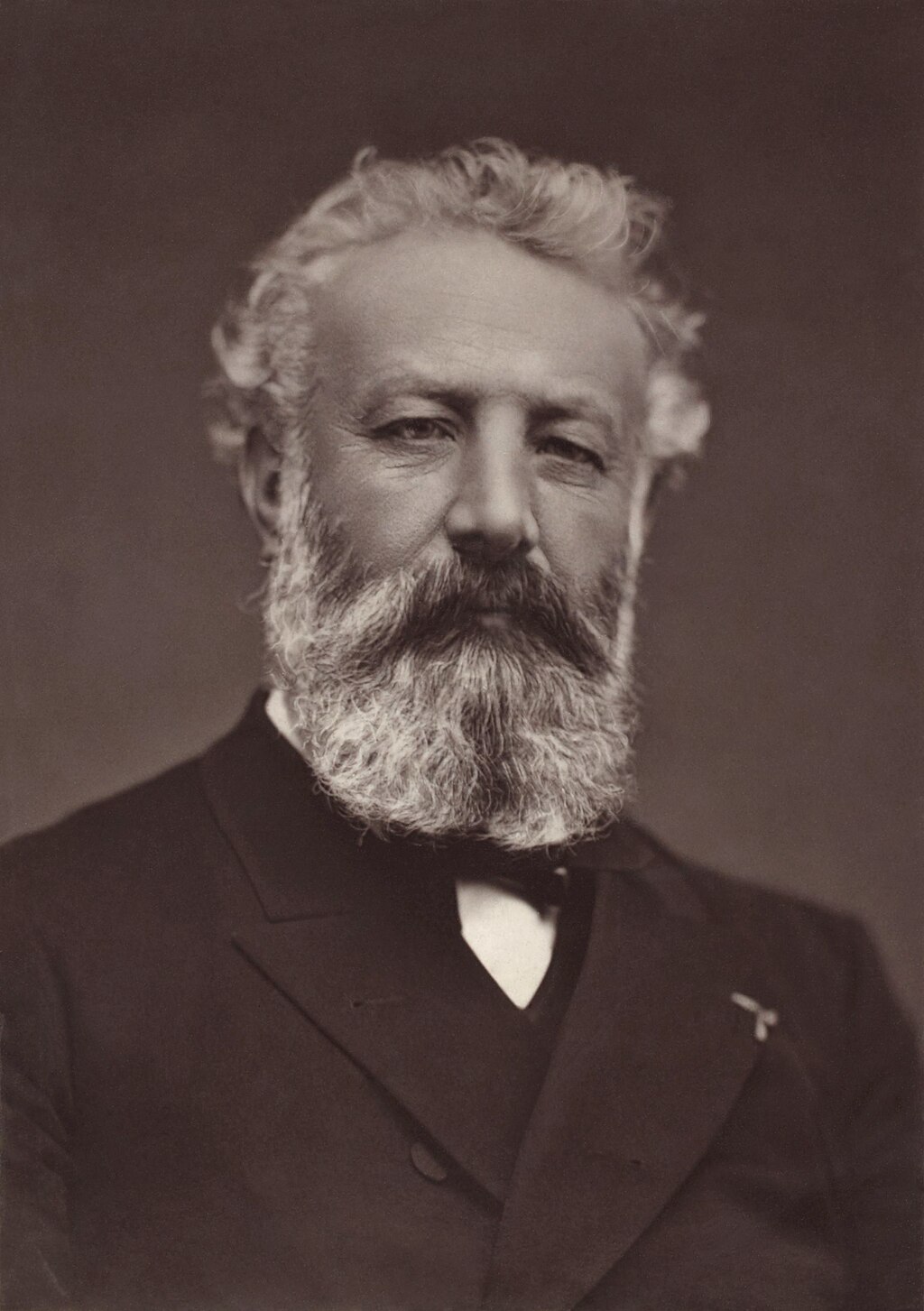
Photograph of Jules Verne in Nantes by Étienne Carjat (1828-1906). In Société de Géographie. Public Domain.
The story has been revisited many times, most famously in the 1959 20th Century‑Fox film starring James Mason, featuring a bold, atmospheric score by Bernard Herrmann. For a new generation, the tale resurfaced as a 1967 Saturday‑morning cartoon series, voiced by Ted Knight, Pat Harrington, and Jane Webb—a nostalgic favorite for many who grew up with weekend television. The enduring appeal of Verne’s adventure was underscored again in 2008, when no fewer than three separate film adaptations of Journey to the Center of the Earth were released. In the wake of the heavy marketing campaign for the high-profile theatrical version starring Brendan Fraser, other studios produced their own versions of the classic subterranean odyssey., including a TV movie and a direct to DVD low budget feature, each capitalizing and offering its own spin on the Jules Verne tale.
“Creatures of the Swamp,” the fourth episode of the 1967 animated Journey to the Center of the Earth series, originally aired on September 30, 1967, on ABC. In this 20‑minute adventure, Professor Lindenbrook builds a custom swamp buggy for Lars to navigate an underground marsh, but the mission quickly unravels when hostile moss creatures ambush and capture him. Count Saknussemm’s interference leads to Alec’s capture as well, forcing Lindenbrook and Cindy to enlist the help of the friendly local “swamp people” to mount a rescue. Ted Knight voiced both Professor Lindenbrook and the villainous Count Saknussemm.
The 1967 animated series wasn’t a direct adaptation of Jules Verne’s 1864 novel. Instead, it reworked the hit 1959 20th Century‑Fox film into a Saturday‑morning format. Co‑produced by Filmation Associates and 20th Century Fox Television, the show leaned into the movie’s commercially successful changes and added episodic, monster‑of‑the‑week fantasy adventures. As a result, the popular cartoon show followed Verne’s book only loosely, moving far from the novel’s harder science‑fiction tone.
From the late 1950s to the mid-1960s, Bernard Herrmann scored a series of mythically-themed fantasy films, including 20th Century-Fox’s Journey to the Center of the Earth in 1959. Unknown photographer – Arlington Heights Herald, Arlington Heights, Illinois. Permission details: This work is in the public domain in the United States because it was published in the United States between 1929 and 1977, inclusive, without a copyright notice. For further explanation, see Commons:Hirtle chart as well as a detailed definition of “publication” for public art. Note that it may still be copyrighted in jurisdictions that do not apply the rule of the shorter term for US works (depending on the date of the author’s death), such as Canada (50 p.m.a.), Mainland China (50 p.m.a., not Hong Kong or Macao), Germany (70 p.m.a.), Mexico (100 p.m.a.), Switzerland (70 p.m.a.), and other countries with individual treaties.
Bernard Herrmann’s score for the 1959 film Journey to the Center of the Earth is often cited as one of the most inventive, audacious, and influential fantasy film scores of Hollywood’s Golden Age. Known for his iconic collaborations with Alfred Hitchcock (Psycho, Vertigo), Herrmann approached this project with a radical idea: he wanted to create, in his words, an “atmosphere with absolutely no human contact—the film had no emotion, only terror.”
To achieve that effect, Herrmann stripped the subterranean sequences of all stringed instruments, removing warmth and lyricism entirely. In their place, he built a massive, echoing wall of sound using five separate organs, evoking the scale and weight of vast underground chambers. For the lowest registers of the brass and woodwinds, he revived the serpent, a 16th‑century leather‑covered bass wind instrument whose raw, guttural tone added a primal edge. Its harsh, instinctive honks heighten the terror in scenes where the explorers are hunted by giant dimetrodons and lizards.
Of the three Journey to the Center of the Earth films released in 2008, the standout is easily Eric Brevig’s 4D adventure (below). Starring Brendan Fraser as the professor, Josh Hutcherson as his nephew, and Anita Briem as their guide, Hannah, it follows the spirit of Verne’s 1860s novel with surprising fidelity while delivering a lively, effects‑driven thrill ride.
Most journeys belong to the private realm—scribbled into diaries never meant to be read, then tucked away or forgotten. But some journeys break past the personal and become universal, the kind of adventures where the “I” disappears and larger‑than‑life protagonists take over. Jules Verne’s Journey to the Center of the Earth is one of those classics, a story that leaves the individual behind and invites everyone into its grand, imaginative descent.
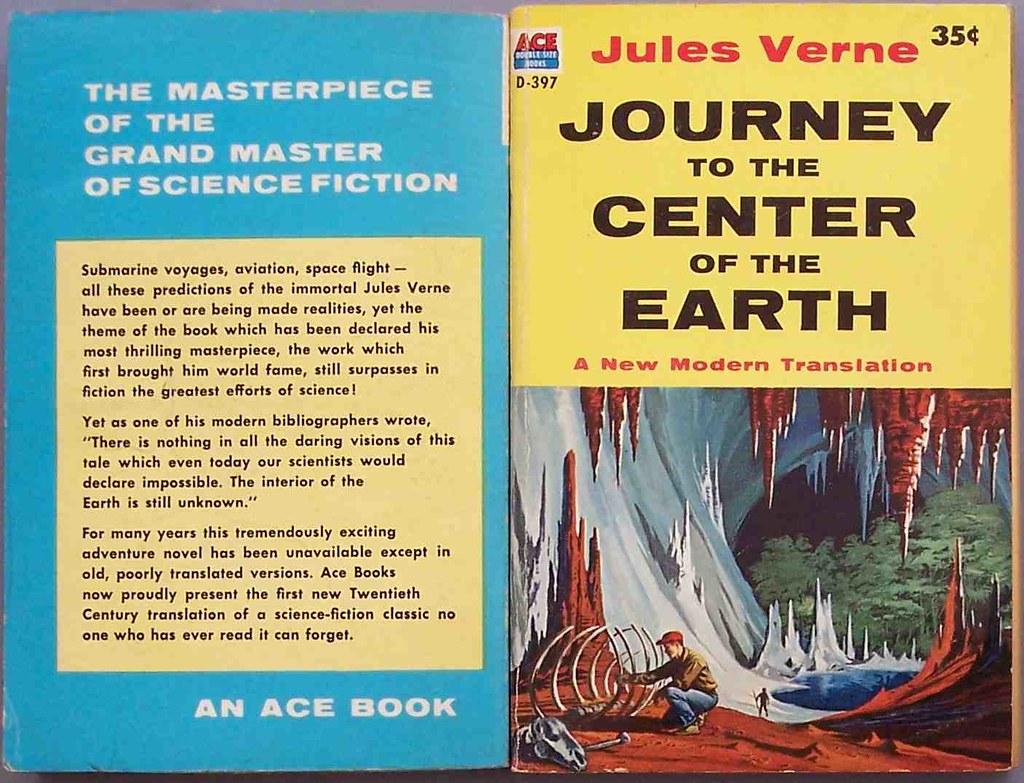
The novel’s first English edition was published in London in 1871. Journey to the Center of the Earth has appeared in various other English translations and has never gone out of print. “journey to the center of the earth” by cdrummbks is licensed under CC BY 2.0.