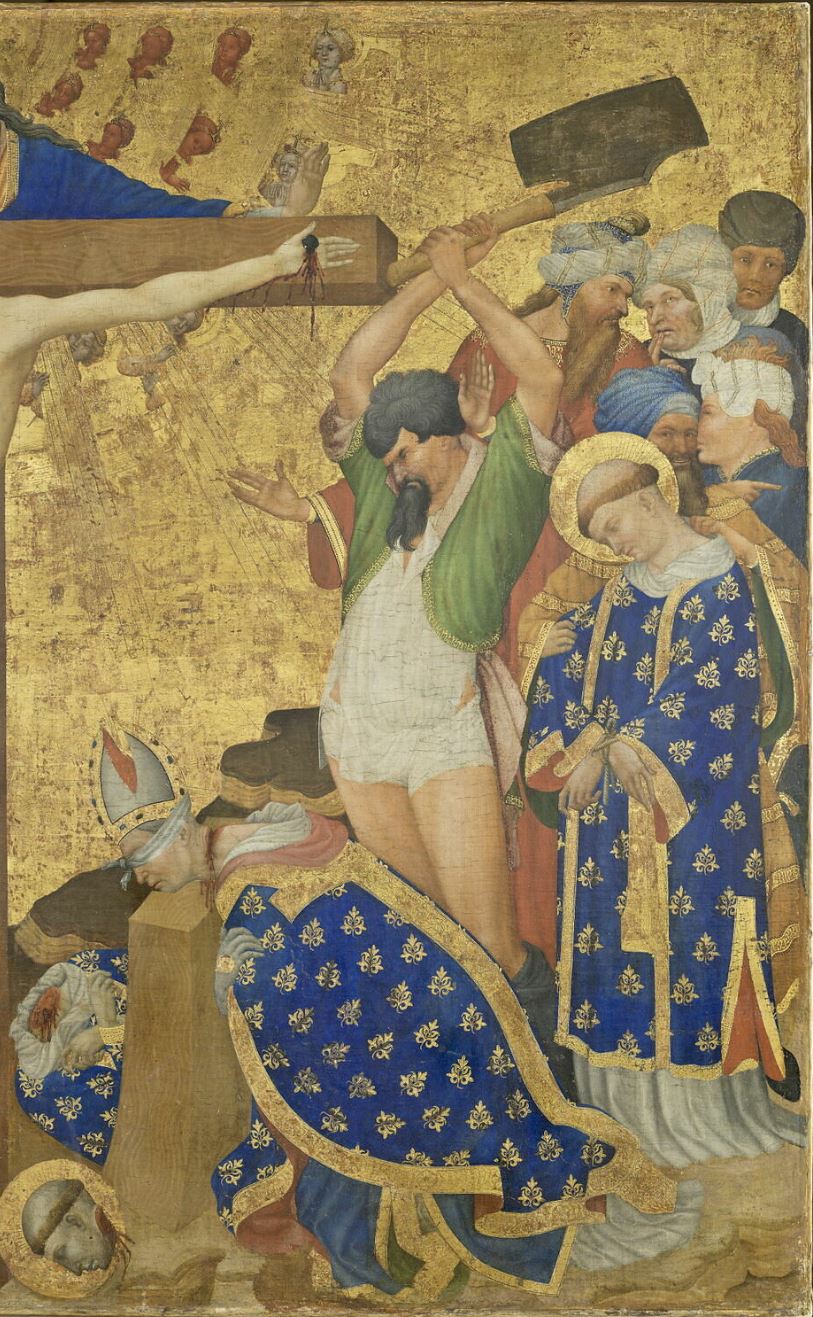
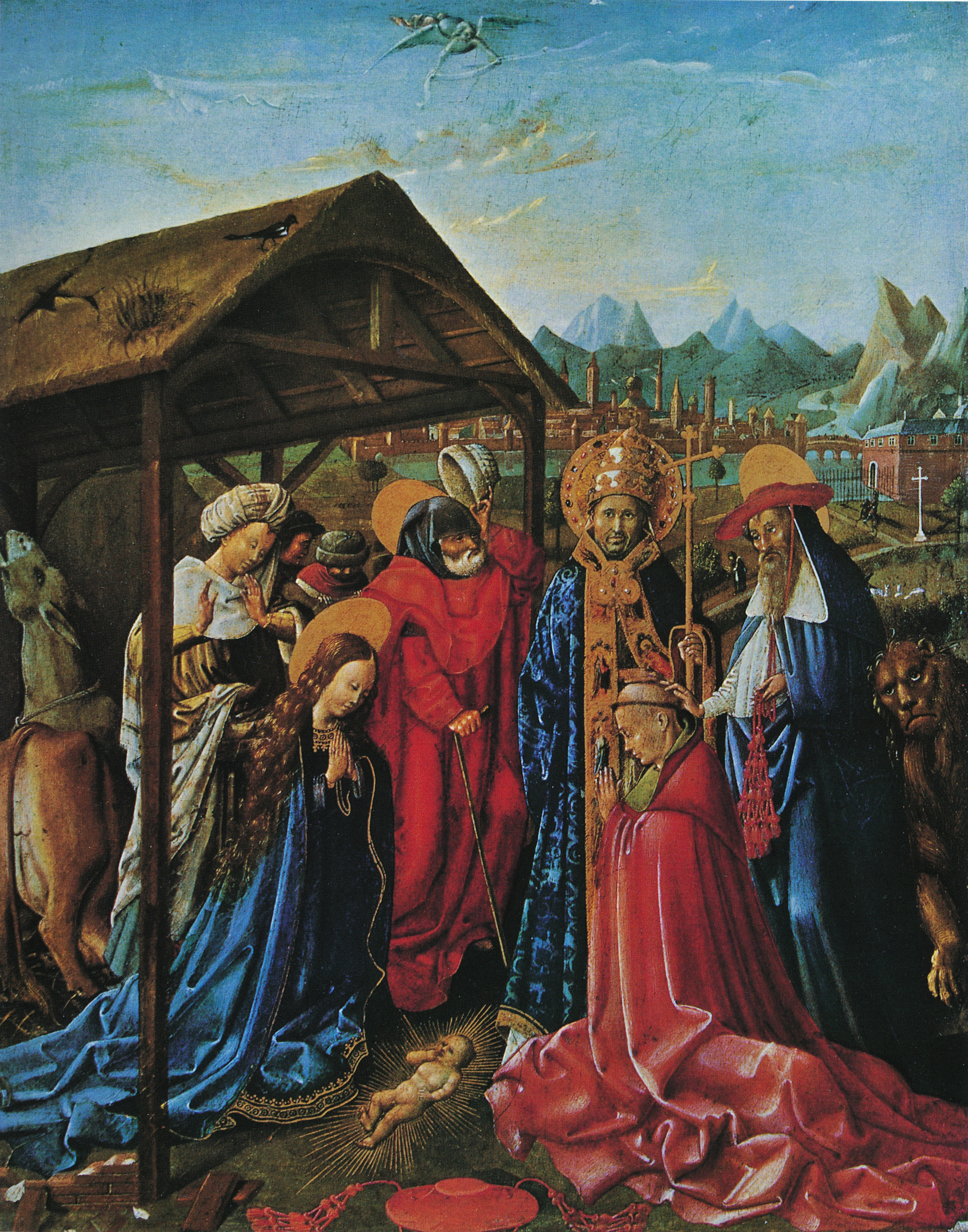
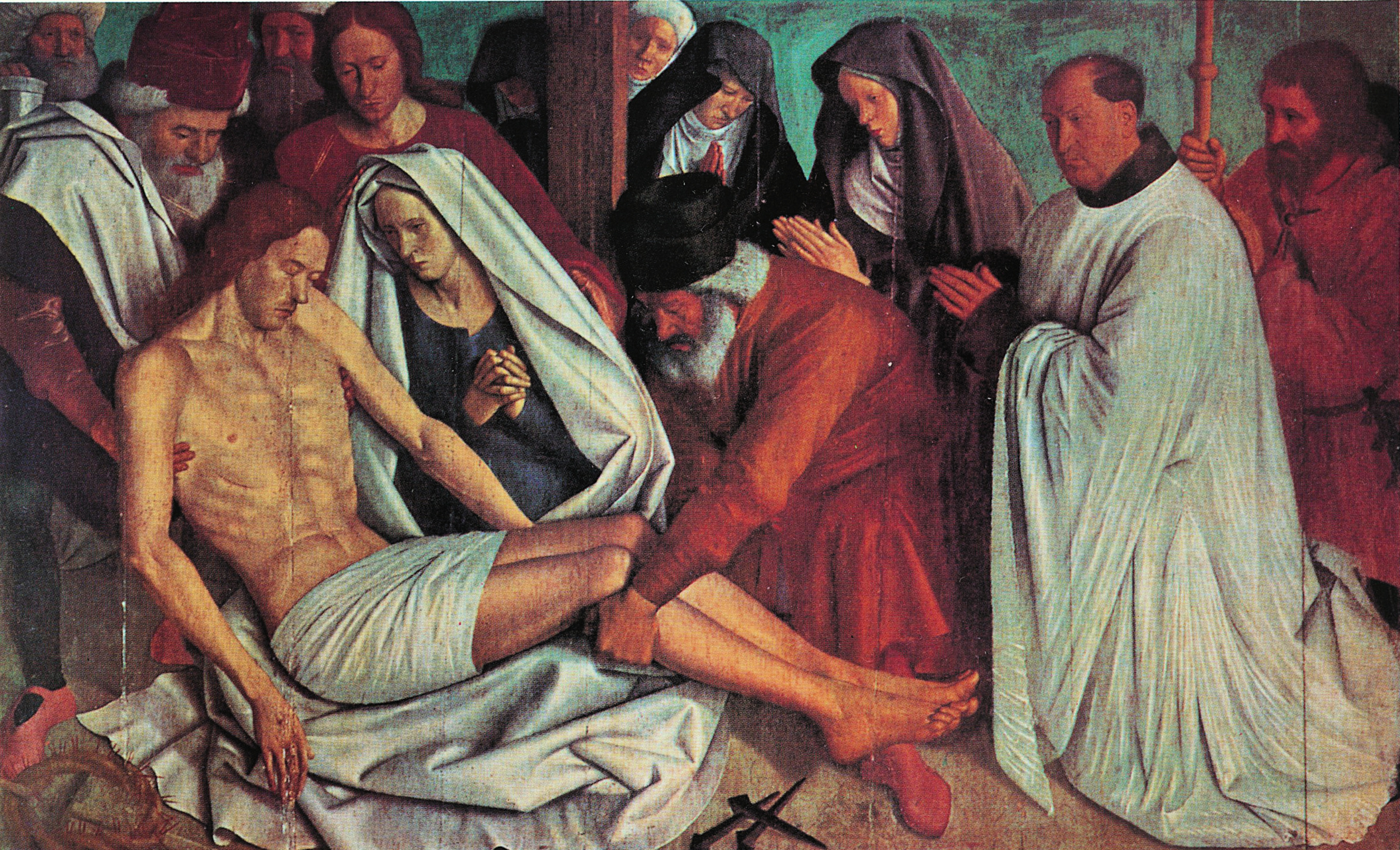
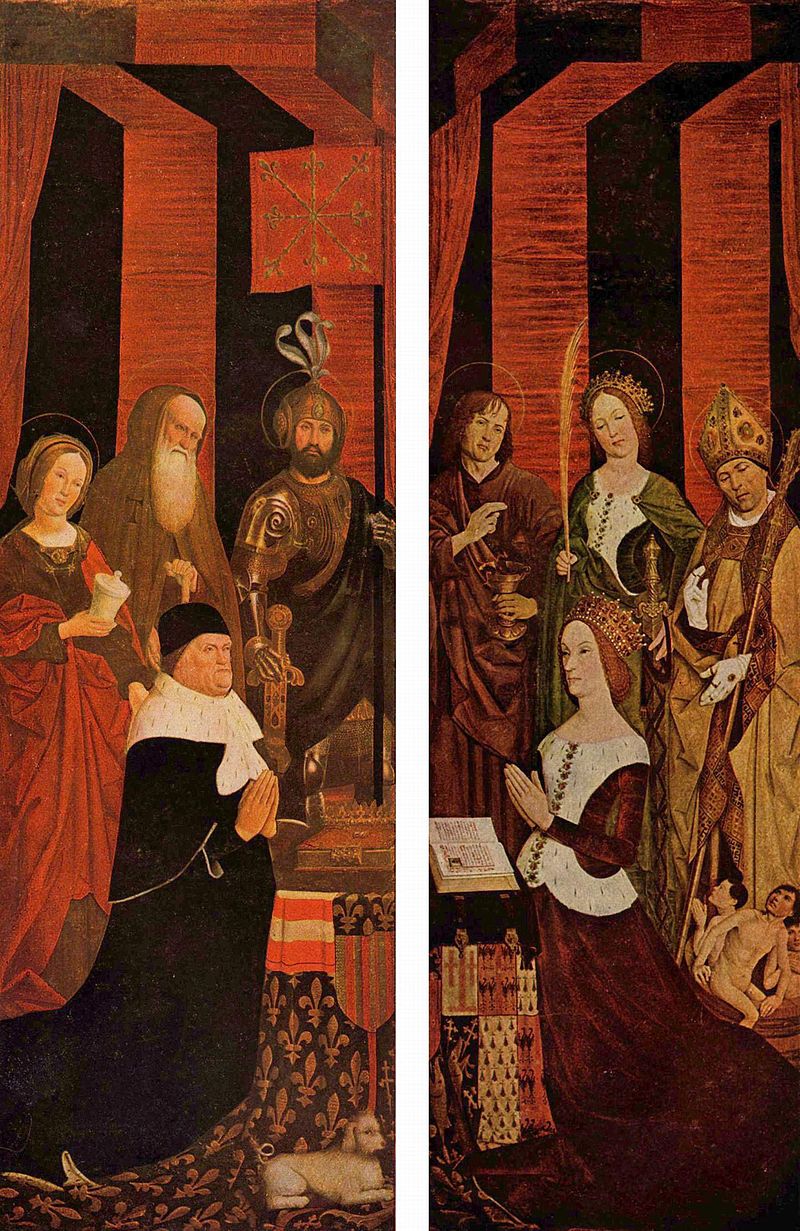
Anonymous master. Portrait of John le Bon (1319-1364) c. 1360. Musée de Louvre, Paris (“Louvre”).Henri Bellechose (1415-1440), École de Bourgogne, Retable de saint Denis, 1416, https://collections.louvre.fr/ark:/53355/cl010063178
Retable de Saint Denis, (above), was completed in 1416 for the church of the Charterhouse of Champmol that is adjacent to Dijon. The artwork’s attribution has long been debated between Bellechose and Jean Malouel (1370-1415). Written evidence points to Bellechose possibly only completing the painting started by Malouel who was Bellechose’s predecessor at the head of the ducal workshop. However, recent connoisseurship does not see two different styles that would indicate two painters and the artwork in the Louvre is not the same size as the artwork mentioned in the early 15th century document that supports the dual attribution.
St. Denis is the most famous cephalophore (beheaded saint holding his head) in Christian history. Denis and two companions were martyred on Montmartre in what became a future Paris in the mid-3rd century. Much later, in the ninth century, an anonymous chronicler told the tale of the martyr Denis and mentioned his carrying his head from his execution spot on Montmartre to Saint-Denis. There the abbey of St-Denis rose to become the burial place of French kings. Soon after, this preposterous but delicious tale of Denis’ post-mortem pilgrimage received further embellishment by an abbot chronicler so that the legend took hold in St. Denis’ hagiography and iconography. St. Denis is the patron of Paris in France and against headaches and any strife or frenzy.
Anonymous, École de Île-de-France? Bourgogne? Studio Henri Bellechose? Dead Christ Placed in the Tomb, 1400-1425. Louvre. https://collections.louvre.fr/ark:/53355/cl010065413Anonymous master, The Annunciation, France, possibly Netherlands, late 14th century (1380s), tempera and oil with gold on wood, 15 7/8 x 12 3/8 x 1 7/8 in. Cleveland Museum of Art.
The angel Gabriel’s wings resemble peacock feathers. The panel painting was once joined to another panel to form a diptych. Its opulent ornate style and small size allowing for easy mobility points to its use as a devotional artwork for an aristocratic patron around 1400.
Anonymous, The Crowning of the Virgin, c. 1400-1410, Paris, oak on wood. 20.5 cm. Staatliche Museum, Berlin.
In Christian Biblical tradition, the Virgin Mary was the only human person to be received into heaven after her death as a physical body prior to the Last Judgment. By the Middle Ages, the event’s narrative was elaborated so that the Virgin in Heaven came to be understood as a royal court where angels acted as court pages. In Heaven’s throne room, Mary is crowned as Queen by her son, Jesus Christ.
In the French tondo, Christ wears a red cloak symbolizing his Resurrection and a violet robe symbolizing his Passion. He sits on a stone throne and sets the crown on his mother Mary’s head as she kneels on a splendid cushion.
Strewn on the green-tiled floor of the celestial throne room are a variety of cut flowers which point to Mary’s purity and love for humanity. One angel carries her dress’s train and is himself dressed in a liturgical-type costume.
The tiny panel is remarkable for its delicate execution, lovely colors, and precise articulation of details such as the angels’ multi-colored wings. Its overall imagery was 14th century Italian in origin and arrived into Paris in the 15th century. Like the Annunciation panel in the Cleveland Museum of Art (above), this panel was likely produced as a private devotional image for a patron of high rank who dwelt among the milieu of the Parisian court.
Les Frères de Limbourg, Meeting of the Three Wise Men c. 1416 from Les Très riches heures du duc de Berry folio 51 verso. Chantilly, Musée Condé.Entourage des Frères de Limbourg. Adoration de L’Enfant, c. 1415, Glasgow Art Gallery and Museum.Maître des heures de Rohan (active 1410-1435), The Last Judgment c. 1420, Paris, Bibliothèque nationale.Maître des heures de Rohan, Annunciation Angel and donor, c. 1420/30, Musée de Laon. Maître des heures de Rohan, Portrait de Louis II d’Anjou, c 1420. Paris, Bibliothèque nationale.
Not much more is known of the Maître des heures de Rohan than if he were anonymous. The artist had ties to Troyes, a Burgundian market town, and settled in Paris between 1415 and 1420. He was a commercial illuminator and is found in the service of the Dukes of Anjou around 1420. In addition to the Grandes Heures de Rohan, c.1430-1435, he produced other exceptional books, including the Hours of René d’Anjou (Bibliothèque nationale de France), the Hours of Isabelle Stuart (Fitzwilliam Museum, Cambridge, UK) and the Hours for the Use of Angers (former Martin Le Roy collection).
Artwork by Maître des heures de Rohan reflects a highly personal vision. The artist was completely unconcerned with his contemporaries’ preoccupation to introduce Renaissance realism into painting. The artist ignored perspective and chiaroscuro through concrete depictions and continued to develop his artistic meditations on faith and death using highly original invention of forms. In this way, the Maître des heures de Rohan is an enduring artist from early 15th century France as some of his more fashionably progressive contemporaries are not as he stayed true to his vision to create some of the most expressive pages of medieval Christian mysticism.
Maître of the Aix Annunciation, Annunciation, before 1445, Église de la Madeleine d’Aix-en-Provence.
The precise identification of the artist called the Maître of the Aix Annunciation is unknown. The artist is believed to be male and French, and could be Jean Chapus who lived in Aix and was working for King Réne of Anjou in the 1430s and 1440s. The Annunciation which was placed in the church in 1445 and has been there since, was part of a triptych. The other wings have been split off and are in Brussels, Amsterdam, and a private Dutch collection (one wing was also split). The style shows influence from Italy (Naples) and Flemish art.
DETAIL. Maître of the Aix Annunciation, before 1445, Église de la Madeleine d’Aix-en-Provence.Maître du Coeur l’amour épris, Rencontre de Coeur et d’Humble requête, c. 1479, Vienna, National Library.Anonymous. Annunciation, c. 1447-1450, Stained glass, Bourges cathedral, Chapel of Jacques Coeur.Jean Fouquet (1420-1480), Diptych de Melun, c. 1450, right panel: The Virgin and Child Jesus. Antwerp, Museum of Fine Arts.Jean Fouquet (1420-1480), Diptych de Melun, c. 1450, left panel: Chevalier Stephan presented by Saint Stephan. Staatliche Museum Berlin.
Jean Fouquet was a major French painter of the 15th century. He was in Rome in the mid-1440s and is presumed to have painted portraits. Under what circumstances the twenty-something Fouquet traveled to Rome is unknown. In any event Fouquet returned to Tours in 1448 and was working in the court of Charles VII. Louis XI appointed him official painter to the king in 1475. A handful of miniatures are documented artworks by Fouquet though other pictures, such as the Melun diptych and others, are attributed to him.
Jean Fouquet (1420-1480), Medallion, self-portrait, 1452/1455. Louvre.Jean Fouquet (1420-1480), Charles VII, 1440/1460. Louvre.Jean Fouquet (1420-1480), The Visitation, c. 1450. The Musée Condé, Chantilly.Jean Fouquet (1420-1480), Announcement of the Death of Saul to David, c. 1470. Les Antiquités Judaïques, Ms. fr. 247, folio 135 verso. Paris Bibliothèque Nationale.Jean Fouquet (1420-1480), Pietà, c. 1470-1480. Parish church, Nouans (Indre-et-Loire).Jean Fouquet (1420-1480), Pietà (detail), c. 1470-1480. Parish church, Nouans (Indre-et-Loire).Retable du Parlement de Paris, c.1455. Louvre. see – https://collections.louvre.fr/en/ark:/53355/cl010061369 – retrieved September 15, 2025.
It depicts the scene on Calvary on Good Friday with Jesus Christ crucified in the center with saints at its base including, left to right, Saint Louis, John the Baptist, the Virgin Mary, Saint John, a beheaded Saint Denis, and Charlemagne. In the background is the tour de Nesle (c. 1200-1665), Seine, the Louvre, Hôtel du Petit-Bourbon, and Palais de la Cité. Formerly identified as an artwork by Philippe de Mazerolles, it is currently identified by the Louvre as “anonymous“ in the School of France influenced by the Master of Dreux Budé who is likely André d’Ypres, active between 1425-1450. Philippe de Mazerolles was also a French painter and illuminator who was active in Paris and in Bruges. Trained in Paris, Philippe de Mazerolles’ style was directly inspired by the Maître de Bedford, an anonymous illuminator active in Paris slightly earlier between 1415 and 1435. The Master of Dreux Budé was a Parisian illuminator whose works show his knowledge of the repertoire of models of the Master of Flémalle (1375-1444). see – https://initiale.irht.cnrs.fr/en/intervenant/3443 – retrieved September 15, 2025.
DETAILS retable du Parlement de Paris (above), c.1455. Louvre:
Also known as Charonton, the French painter worked in Avignon in southern France. His large Coronation of the Virgin is a documented artwork that was completed in 1454. It is one of the most important surviving 15th century French paintings.
Enguerrand Quarton (1410-1466), The Coronation of the Virgin (detail), 1452-53, Altar of the Charterhouse (hospice) of Villeneuve-lès-Avignon.DETAIL. Enguerrand Quarton (1410-1466), The Coronation of the Virgin, 1452-53, Altar of the Charterhouse (hospice) of Villeneuve-lès-Avignon.Enguerrand Quarton (1410-1466), attributed, Pietà de Villeneuve-lès-Avignon. École de Provence, c. 1455. Louvre. https://collections.louvre.fr/ark:/53355/cl010063345
DETAILS Pietà de Villeneuve-lès-Avignon (above), c.1455. Louvre:
Nicolas Froment (1461-1483), Triptych (center panel): Mary in the Burning Bush, 1476. Cathedral St. Sauveur, Aix-en-Provence.
DETAIL Triptych (center panel): Mary in the Burning Bush (above), 1476. Cathedral St. Sauveur, Aix-en-Provence:
Nicolas Froment (1461-1483), Mary in the Burning Bush (detail), 1476. Aix-en-Provence, Cathedral St. Sauveur.Triptych (center panel).Nicolas Froment (1461-1483) The Burning Bush, 1476. Aix-en-Provence, Cathedral St. Sauveur.Triptych (right and left panels).
Nicolas Froment worked in the south of France and was painter to Réne d’Anjou. The triptych is a documented artwork by the artist.
Josse Lieferinxe, called Maître de Saint-Sébastien, Part of an altarpiece shutter. The marriage of the Virgin. Musées royaux des Beaux-Arts de Belgique.Maître de Moulins, active 1475 to 1505, Triptych de Moulins, center panel: The Virgin and the Child in Glory, c. 1498. Cathedral de Moulins.
DETAILS Triptych de Moulins, center panel: The Virgin and the Child in Glory (above), c. 1498, Cathedral de Moulins:
The Master of Moulins is one of the great French painters of the 15th century. He was influenced by Hugo van der Goes (died 1482) and takes his name from the triptych painting of the Madonna and Child with angels and Donors (above) in Moulins Cathedral dated from 1498/99. Other works attributed to the Master of Moulins are in Autun, Paris, Chicago, Brussels, London, Munich, and Glasgow.
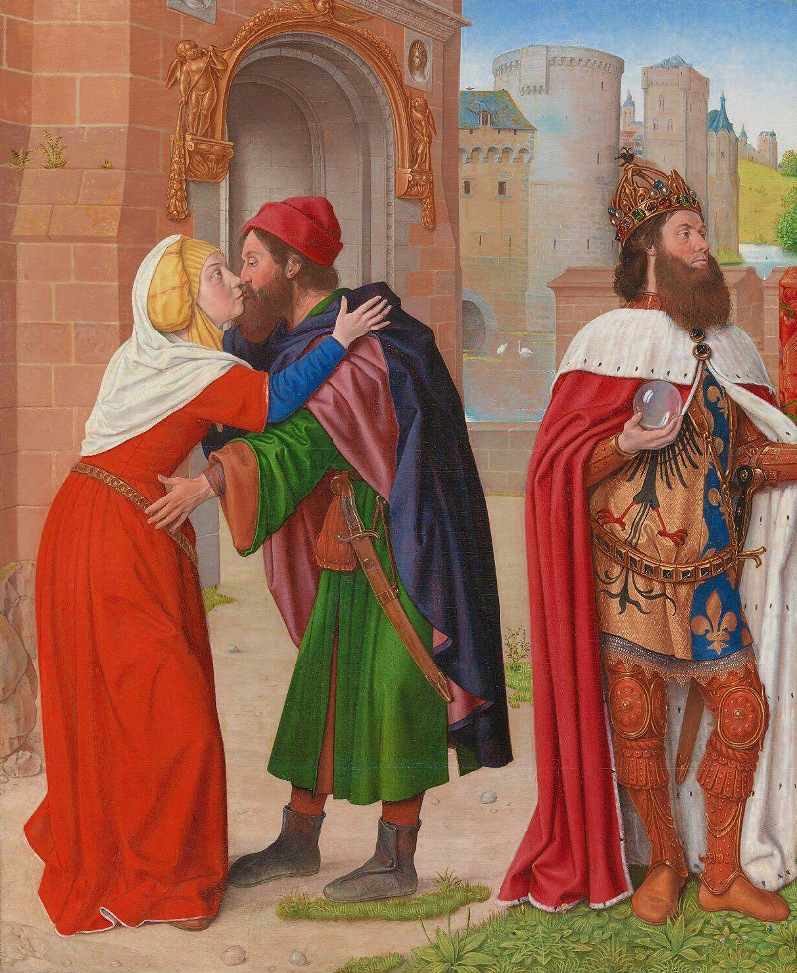
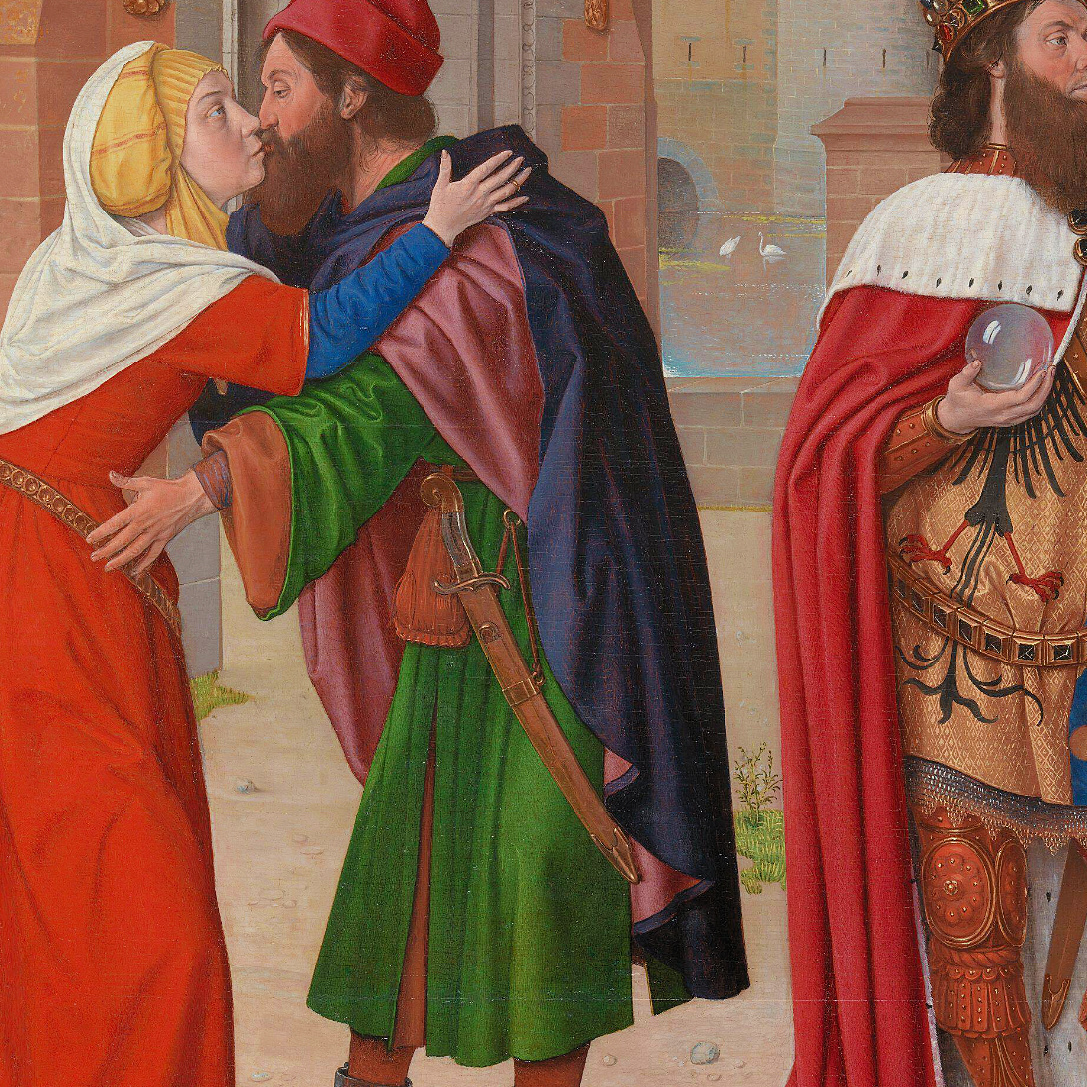
Maître de Moulins, active 1475 to 1505, Meeting of Saints Joachim and Anne at the Golden Gate with Charlemagne, oil on oak, about 1491-1494. 72.6 x 60.2 cm, National Gallery, London.Maître de Moulins, active 1475 to 1505, The Virgin with Child surrounded by angels, c. 1490, Musées royaux des Beaux-Arts de Belgique.Maître de Moulins, active 1475 to 1505, François de Chateaubriand presented by St. Maurice or St. Victor with Donor, c. 1485, Kelvingrove Art Gallery and Museum Glasgow.Jean Bourdichon (1457-1521), King David and Bathsheba, Leaf from the Hours of Louis XII, 1498–1499, Tempera and gold, Leaf: 24.3 × 17 cm (9 9/16 × 6 11/16 in.), The J. Paul Getty Museum, Los Angeles, Ms. 79, 2003.105.
Jean Bourdichon served as official court painter to four successive French kings: Louis XI, Charles VIII, Louis XII, and François I. Bourdichon was almost certainly a pupil of Jean Fouquet, the previous court painter.
Simon Marmion (active 1449-1489), The miracle of the True Cross in Jerusalem in the presence of Saint Helena Empress, 2nd half of 15th century (1450/1500). Louvre. https://collections.louvre.fr/ark:/53355/cl010061655
Simon Marmion (died 1489) who worked in Amiens and Valenciennes and temporarily in Tournai was a painter and illuminator where his miniatures were admired for their rich decoration and landscape details. In the mid1440s the artist moved from Amiens to Valenciennes where he became a leading painter. His most important painting is the Saint Bertin Altarpiece in Berlin and London.
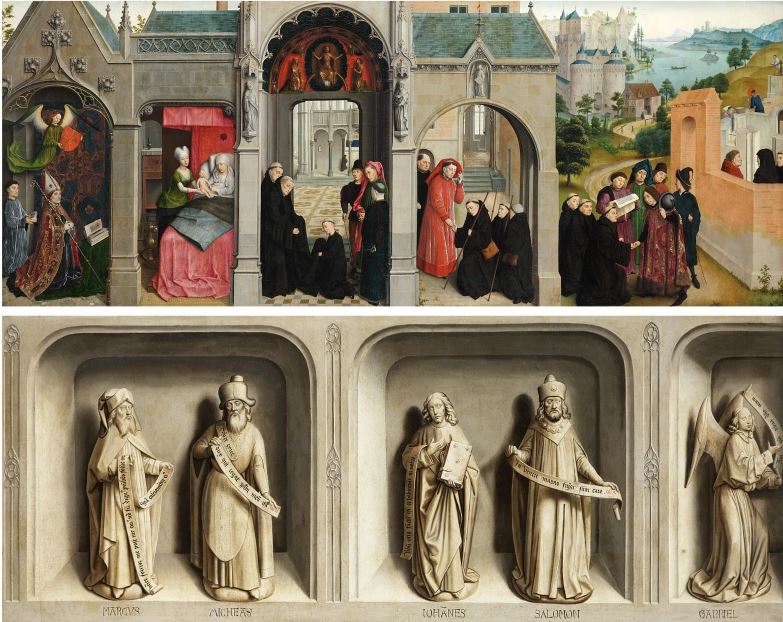
St. Bertin Altarpiece, 1459:
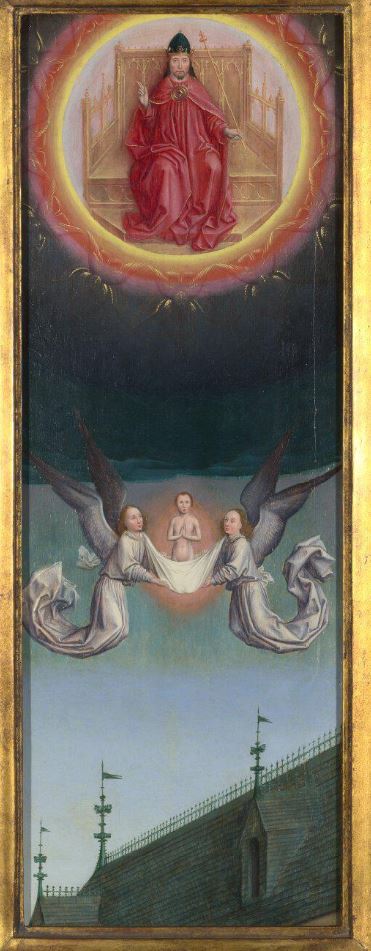
Simon Marmion, The Soul of Saint Bertin carried up to God. Fragment of Shutters from the St. Bertin Altarpiece, 1459. National Gallery London.
The Soul of Saint Bertin carried up to God was the upper section of a wing for an altarpiece for the high altar of the abbey church of St Bertin at Saint-Omer in northern France. It was commissioned by the influential Guillaume Fillastre, Abbot of St Bertin (1450-73), Bishop of Verdun (1437-49), Bishop of Toul (1449-60), Bishop of Tournai (1460–73), Chancellor of the Order of the Golden Fleece and a close confidant of the powerful Duke of Burgundy, Philip the Good. The artwork, whose main parts are in the Gemäldegalerie, Berlin, was consecrated in 1459. The altarpiece was intact in the abbey until 1791 when, as with many church goods, it fell victim to the French Revolution. https://www.nationalgallery.org.uk/paintings/simon-marmion-the-soul-of-saint-bertin-carried-up-to-god
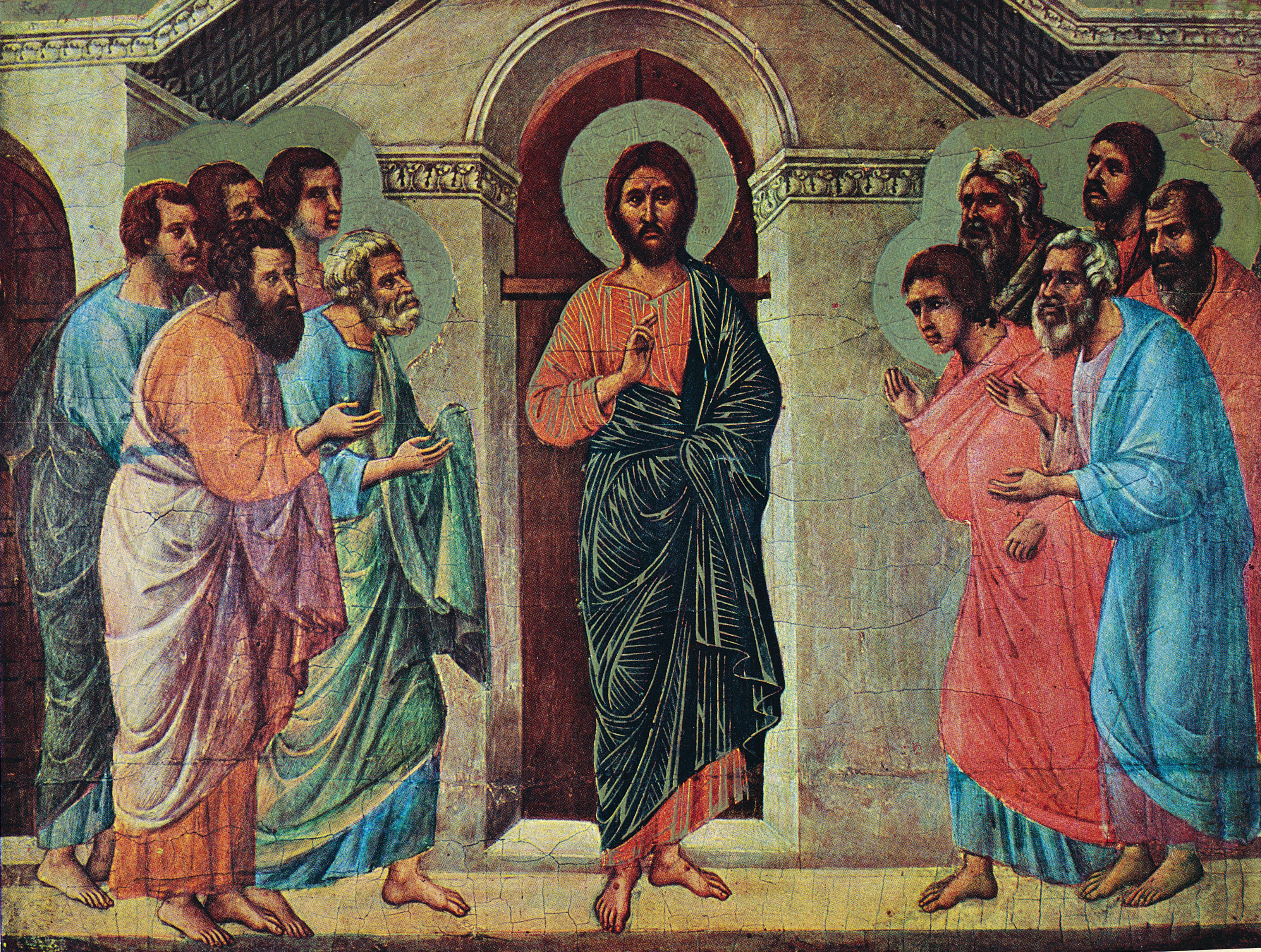
Duccio Di Buoninsegna (c.1255-c.1319), The Apparition of Jesus at the Closed Doors. The Museo dell’Opera del Duomo, Siena, Italy.
The artistic tradition of the Sienese master, Duccio di Buoninsegna (c. 1255-c. 1319) was based on older Greek painting. Duccio, however, was no less “modern” than Giotto (1266-1377). Giotto, who was trained by Cimabue (1240-1302), directed his creative artistry towards concrete reality whose perception derived from the artist’s thoughts and feelings of it. Duccio would achieve a similar but unique synthesis through and from a different direction.
Duccio modernized the older Greek style creating the painting styles of the Sienese school as well as all of early Renaissance painting. Duccio’s artwork is distinguished by his discriminating advance of the Byzantine Post-Hellenism tradition in Tuscany—and following his own encounter with Cimabue who gave the Sienese artist his first important commission in Florence in 1285 —in a masterly delicate way. This delicacy and discrimination are seen in Duccio’s elegant, often light and airy, compositions and rich colors.
Over the next almost 25 years Duccio learned and deployed the elements of various pictorial traditions that, by his constant intelligent blending, enriched them. Duccio’s style used the iconographic schemata of the ancient Oriental-Byzantine tradition including its glorious color and poetic composition along with the ultra-contemporary French and Gothic linear style. Duccio’s oeuvre epitomizes the artist’s temperament and taste as well as a lifetime of artistic education and culture.
Beyond its representation of an event in a scene, Duccio’s painting, not unlike Giotto’s histories, is raised to another level by some of its formal elements –- a figure, episode, or gesture -– into the artist’s magical world. This quality of Duccio’s art provides a textually clear and comprehensibly observed episode—such as of the Gospels— within a setting that is carefully observed and delineated—and with its totality imbued in finer artistic and aesthetic sensibilities.
The imminent drama manifested in Duccio’s iconography transcends its representational anecdote, even as figures or episodes of the Bible are easily recognizable. His artwork’s plasticity, with figures and surroundings in serene harmony, emanates a power whose message supersedes, or at least is contiguous to, the painting’s ostensible, usually religious, subject matter.
In the display of such a unique artistic quality, Duccio’s artwork functions in a dream-like and imaginatively timeless dimension—a unique poetical language—while it conveys an historical condition in any of his intentionally-varying episodes. Duccio’s carefully delineated religious scenes, softly and carefully conveyed, would characterize emerging Sienese painting and make religious painting exceedingly popular in Europe over the next 450 years. see – Giotto and His Contemporaries, Enzo Carli, trans. Susan Bellamy, New York: Crown Publishers, Inc., 1958.
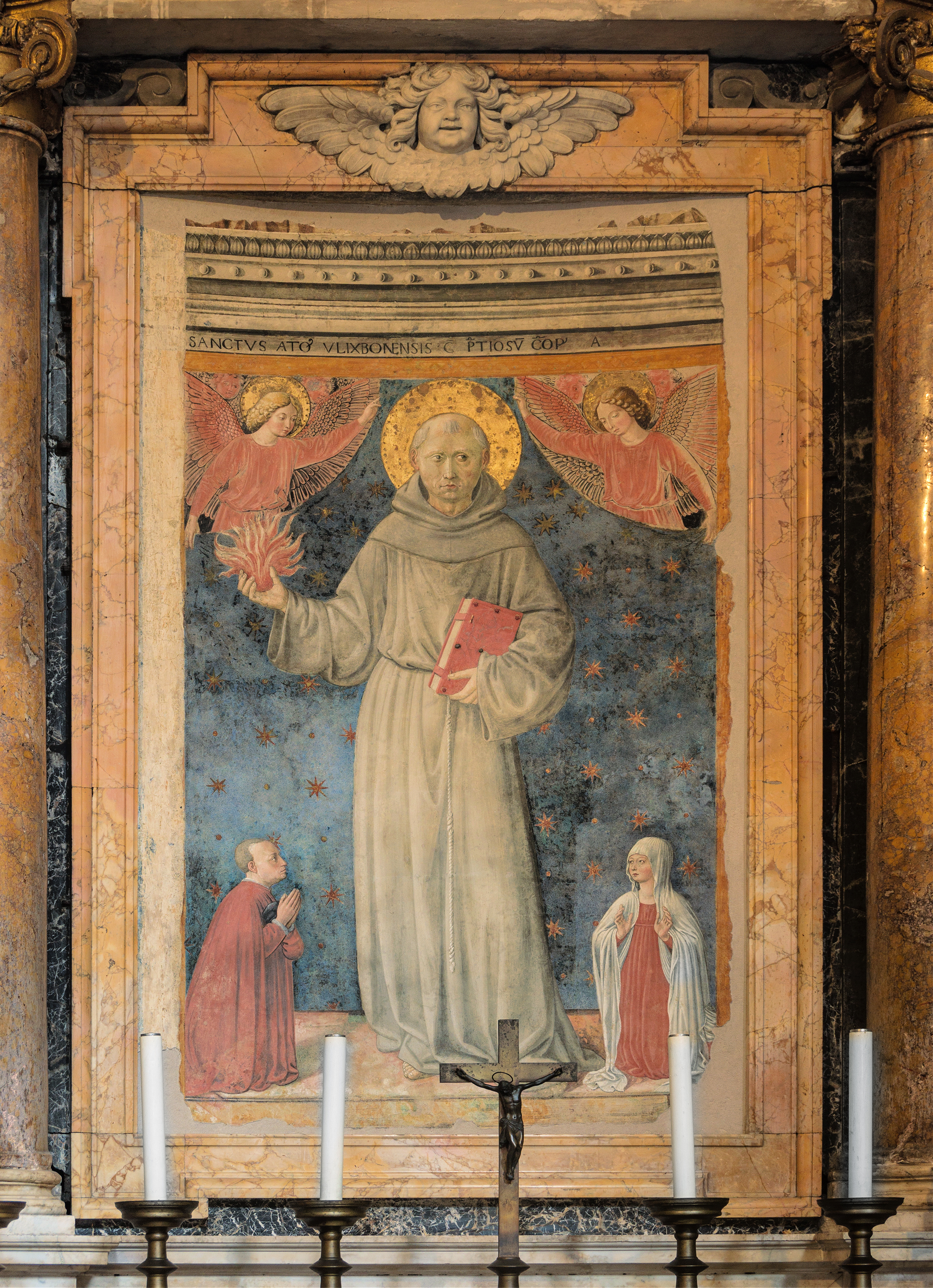
Benozzo Gozzoli (c. 1421-October 4, 1497).
Benozzo Gozzoli (c. 1421-October 4, 1497), Saint Anthony of Padua, 1450, Santa Maria in Aracoeli, Rome, Italy. In art, the saint’s iconography often depicts him with one or more of the following: a book, a heart, a flame, a lily, or the child Jesus.
Anthony of Padua (1195-1231) had a cult in Italy that grew around him quickly and continues to today. He was born with the name Ferdinand in the last decade of the 12th century in Lisbon, Portugal. His father was a high financial official in the king’s court and a knight under Alfonso II of Aragon. Young Ferdinand was educated at the cathedral school in Lisbon and, at 15 years old, became an Augustinian Canon regular in Lisbon. After two years he transferred to a house in Coimbra in part to get away from his well-to-do relatives who were constantly seeking after their promising progeny who had decided to become a Catholic religious and priest. At Coimbra Ferdinand studied at the monastery’s renown biblical studies school for eight years. Steeped in the scriptures he became a theological and scripture scholar of unparalleled high caliber. One day the young Augustinian canon was serving as guest master for the house in Coimbra when 5 Franciscans sent out from Assisi in Italy by St. Francis (1181-1226)– the order had been founded in 1209 – stopped on their way to the missions in in Morocco. Not soon after Anthony learned that all 5 of these zealous Franciscans were butchered in Morocco as martyrs as soon as they arrived there. Their bodies brought back to Coimbra for their funeral deeply moved Anthony who wanted to emulate these Franciscans’ active witness and he decided to become a Franciscan himself in order to take their place. His family, who had been wary of his becoming a scholarly Augustinian following a venerable old rule in nearby Coimbra, grew even more upset as their son who threw away a knight’s career at court now joined a fly by night ragtag group in far flung Italy founded by another rich kid named Francesco who also renounced wealth to focus on evangelical poverty following his brand-new skeletal rule based on a few bible verses. Ferdinand was determined in his inspirations and took the difficult path of leaving the Augustinian canons for the Franciscans and then insisting on leaving Portugal for the missions in Morocco. But Ferdinand’s ambitions were stymied – he fell ill and was ordered home. But the ship he was traveling on was caught in a storm that drove Anthony off course to Sicily. From there he took the long journey to Assisi where he met St. Francis and was present at the famous Chapter of Mats in 1221 that drew, perhaps symbolically, 5,000 brethren of the new order. Though highly educated among a group of mendicants whose founder was suspicious of book learning, Anthony disappeared into menial duties in a small hospice in Forli. But the Franciscans, many of them former sons of the wealthy themselves, recognized Anthony’s brilliant abilities and he was ordered to preach to the whole of Italy. Anthony of Padua became this great preacher and, later, famous worker of miracles. In a time of heresy and controversy throughout Christendom Anthony, who was gentle, poised, charming, intelligent, thoughtful, and deeply well-versed in theology and scripture, served as a personable and effective counterweight. From that point forward until his death, Anthony was active and always on the road from Italy’s south to the north of France. Townspeople and rural folk were positively responsive to his efforts and wherever Anthony went next, churches, plazas and surrounding countryside would be packed with people to hear his sermons. Speaking events would be advertised by word of mouth so that towns often declared a holiday in anticipation of his arrival so that everyone could go out to listen to Anthony. Anthony’s preeminent issue was on the corruption of the secular clergy which scandalized the church, the faithful in the pews, and the wider world to the detriment of the faith. During a time of the rise of cities and the bourgeoisie, as the hierarchical church progressively attached themselves to the bankers and such, Anthony inveighed against the society’s greed, its lust for elite luxuriant living, with its necessary exploitation of labor to maintain themselves at such an unfair level. Anthony called such social behavior “tyrannical.” At a synod in Bourges, France, in the presence of the bishop, Anthony called him out – “as for you with the mitre on your head” and proceeded to denounce his abuses in the diocese before a petrified and perhaps also thrilled audience. Anthony happened to be in Padua when he preached his last sermons – and thus his nomenclature. Miracles and stories have a Franciscan flavor -such as preaching to the fishes or a giant walnut tree unexpectedly providing sustenance and shade to a tired evangelizing preacher. After 10 years of constant travel and preaching, like the Franciscan founder who died blind and naked on the ground outside the Portiuncula in 1226 at 44 years old, Anthony’s body had worn out at an early age. He was 36 years old. In the spring of 1231, his health deteriorated, he took a period of rest and prayer in a small hermitage in Camposampiero close to Padua. His health did not recover and he asked to return to St. Mary’s in Padua. As he was transported to the city in an ox cart he got as far Arcella, just opposite the city, where he died in a convent of Poor Clares. Though his cult hails him as a miracle worker — at his canonization 56 were recorded -– only one occurred in Anthony’s lifetime. Anthony‘s reputation, who was called the “hammer of the heretics” by his contemporaries, rests mainly on his persuasive preaching filled with the fire of the Holy Spirit. Pope Gregory IX (1227-1241) canonized Anthony less than a year after his death – faster than St. Francis himself – as this once rich kid with excellent theological and biblical training became the patron saint of losing things and the illiterate. On January 16, 1946, Pope Pius XII (1939-1958) declared Anthony a doctor of the church. In art, the saint’s iconography often depicts him with one or more of the following: a book, a heart, a flame, a lily, or the child Jesus. see – https://www.findagrave.com/memorial/5118/anthony_of_padua – retrieved June 13, 2025. The Saints: A Concise Biographical Dictionary, edited by John Coulson, Guild Press, New York, 1957, pp.73-76.
Dosso Dossi (c. 1489-1542)– whose actual name was Giovanni de Lutero–was an Italian Renaissance painter who belonged to the School of Ferrara. Among scores of artists who painted mainly in the Venetian style influenced by Giorgione (c. 1477-1510), Dosso Dossi dominated the school that maintained its tradition of painterly artificiality.
Melissa is Dosso Dossi’s masterpiece: a benign personage in the Italian epic poem Orlando Furioso (1516) of Ludovico Ariosto (1574-1533). The enchantress frees humans from the black arts of the wicked sorceress Alcina. The painting depicts Melissa at the moment she burns the seals and spells of Alcina and liberates two men from the tree trunks.
The realistic dog is certainly a human being under Alcina’s spell who will be liberated by Melissa and take up again the suit of armor he watches earnestly. The trees are stylized, artificially-lighted elements – that is, Giorgionesque – that provide a magical setting for the poem’s characters.
The figure of Melissa is draped in a fringed red-and-gold-brocaded robe and enriched by Titianesque glazes. She is particularly alluring in a sparkling gold and green setting moored by meticulously and softly portrayed meadows, background figures, and distant city towers.
SOURCE: History of Italian Renaissance Art: Painting, Sculpture, Architecture, Third Edition, Frederick Hartt, New York: Harry N. Abrams, Inc. 1987. A Dictionary of Art and Artists, Peter and Linda Murray, Penguin Books; Revised,1998. Italian Paintings of the Sixteenth Century, Allan Braham, The National Gallery, London (William Collins), 1985.
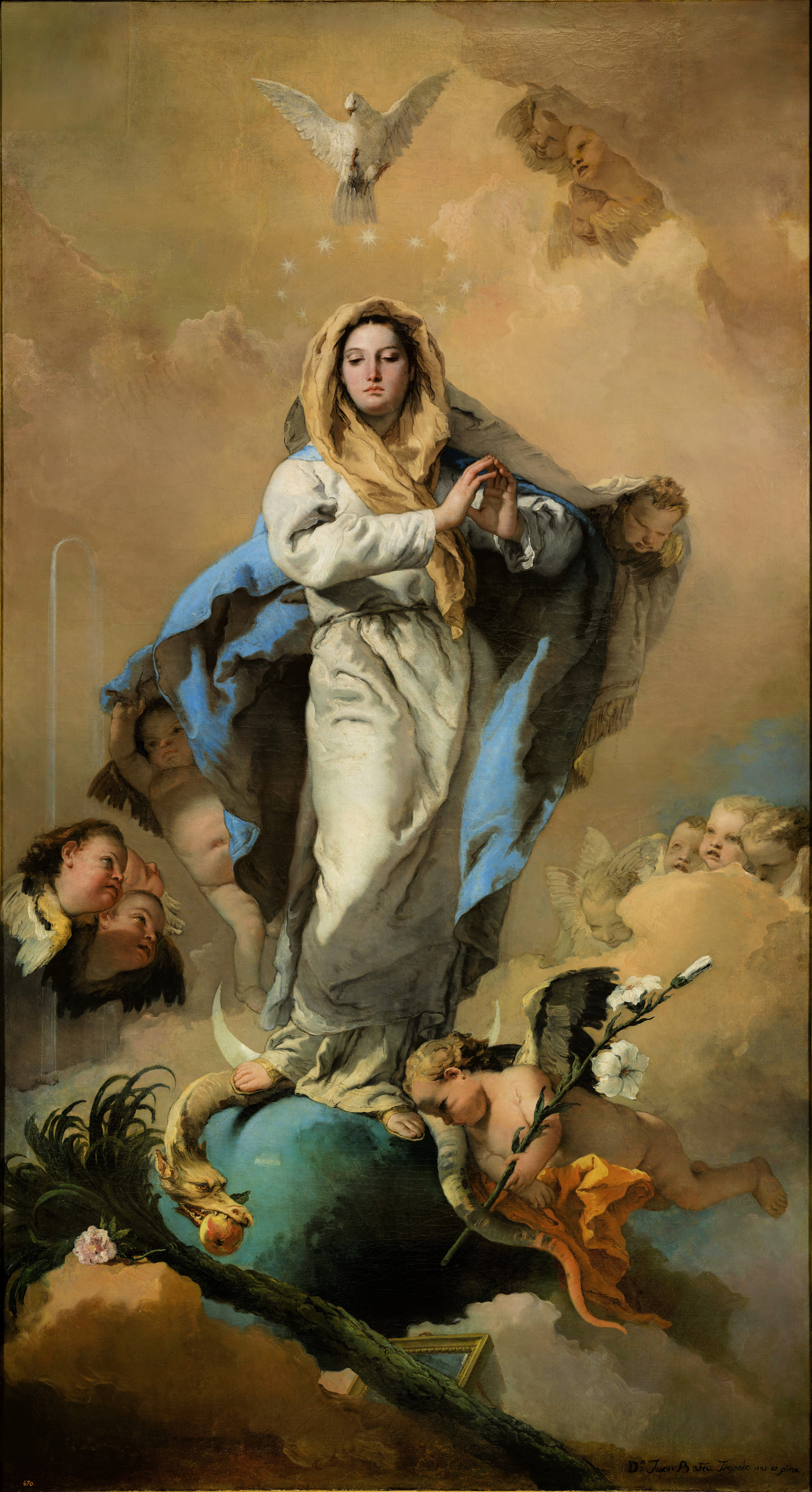
Giovanni Battista Tiepolo (1696-1770).
Giovanni Battista Tiepolo (1696-1770), The Immaculate Conception, 1767-1769, oil on canvas, 152x 279 cm, Prado, Madrid. 88% 7.88 mb
Tiepolo depicts Mary with proud, almost sculptural, beauty of a human being free from original sin from the moment of her conception. Mary stands as a fully mature woman who is triumphant over the tempter, the serpent, that slithers and writhes itself across the globe. Mary is surrounded by cherubim with her halo pictured as a circle of stars, usually 12 in number, though some here are implicitly hidden from view. In chapter 12 of the Book of Revelation in the New Testament, “a woman clothed with the sun, with the moon under her feet, and on her head a crown of twelve stars” (Rev. 12: 1) stands against the Dragon who is about “to devour her child when she gave birth” (Rev. 12: 4). That Biblical woman has been identified with Mary, particularly as The Immaculate Conception. The dove that hovers above her in the painting represents the Holy Spirit who emanates from the Father and the Son and rests on Mary fundamentally at her Annunciation (Luke 1) which leads to the birth of Jesus and at Pentecost (Acts 2) which is the birth of the Christian Church. Augmented by roses and lilies, Mary is clothed in her traditional symbolic colors representing her virginal purity (white) as she became pregnant by the Holy Spirit, her role as the sinless human Mother of God (red), her character of fidelity, truth and spiritual serenity (blue), and the glory of her birth as The Immaculate Conception and crowning as Queen of Heaven following her Assumption (gold). Though its dogma was not settled definitively until 1854 by Pope Pius IX (reign, 1846-1878), The Feast of the Immaculate Conception (December 8th) was on the Church calendar as early as 1708 and a popular subject for Catholic Church art throughout the 18th century. Tiepolo was invited to Madrid in 1762 by Charles III (1716-1788). The artist was accompanied to Spain by his sons, Domenico and Lorenzo, and immediately began the frescoes in the Royal Palace that he finished in 1766. His next commission was for altar paintings, seven in number, for the new Franciscan Convent of San Pascual in Aranjuez, a Royal seat, including The Immaculate Conception. As soon as the series of paintings were finished in 1769, they were considered passé as Tiepolo’s late Baroque Rococo style had given way to the rise of neo-classicism as the next new thing that took hold of Carlos III, Europe and beyond to the United States into the first quarter of the 19th century. Tiepolo, who died in 1770, wasn’t around to see his church paintings fragmented and stored away and replaced by neo-classical artwork of the same subjects by another artist. However, The Immaculate Conception survived intact as King Carlos III ‘s confessor, the powerful Franciscan bishop Joaquín de Eleta (1707-1788) who, holding sway over artistic commissions, favored depictions of The Immaculate Conception as one of his important subjects that shaped late 18th century Spain’s visual culture. Tiepolo’s emotional and elegant version, which he signed, was conserved as a masterful contrast to neo-classicism’s colder rationality. The painting has been in the Prado since 1828 – Mary not content with being relegated to a storage closet – while a preparatory drawing that exists for the artwork made its way into the picture collection of the Lords Kinnaird in London. See- A Basic Guide to The Prado, J. Rogelio Buendia, translated by Patricia S. Parrent, Silex, 1973, pp. 240-241.
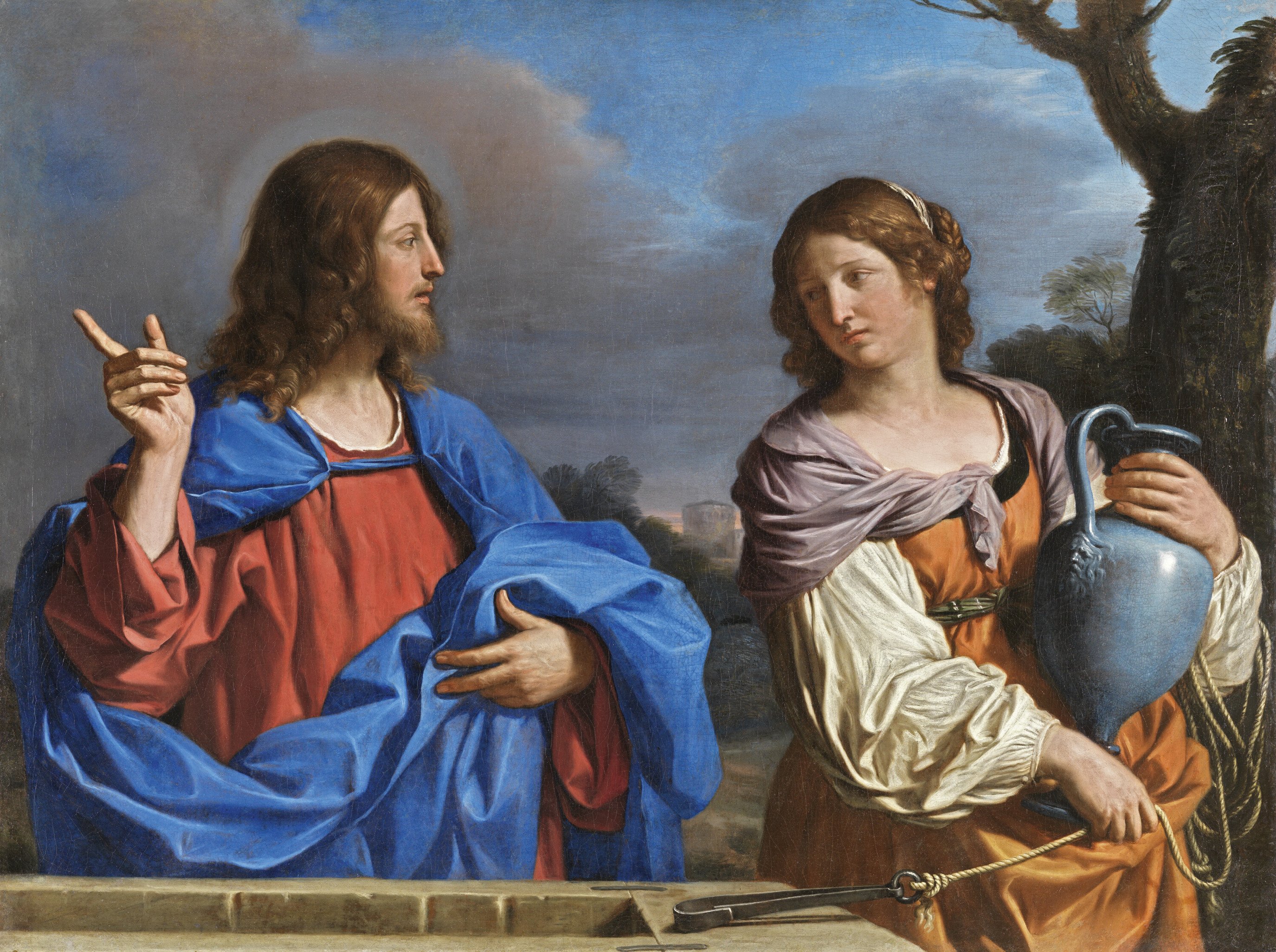
Guercino (1591-1666).
Guercino (1591-1666), Christ and the Woman of Samaria, c. 1640–1641, Museo Nacional Thyssen-Bornemisza, Madrid.
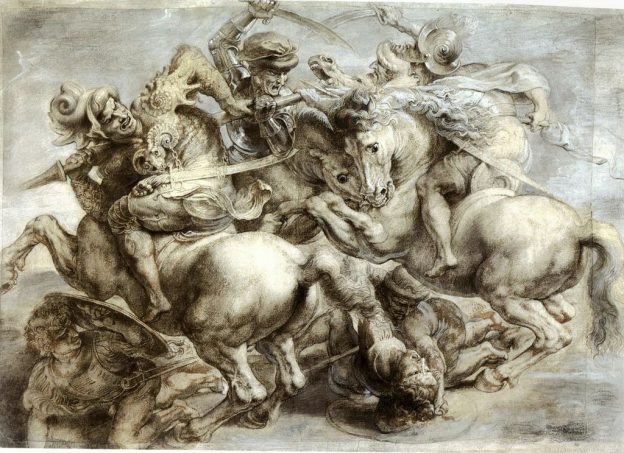
FEATURE image: Peter Paul Rubens, Copy of Leonardo’s Battle of the Standard (from the Battle of Anghiari), 1603, Louvre.
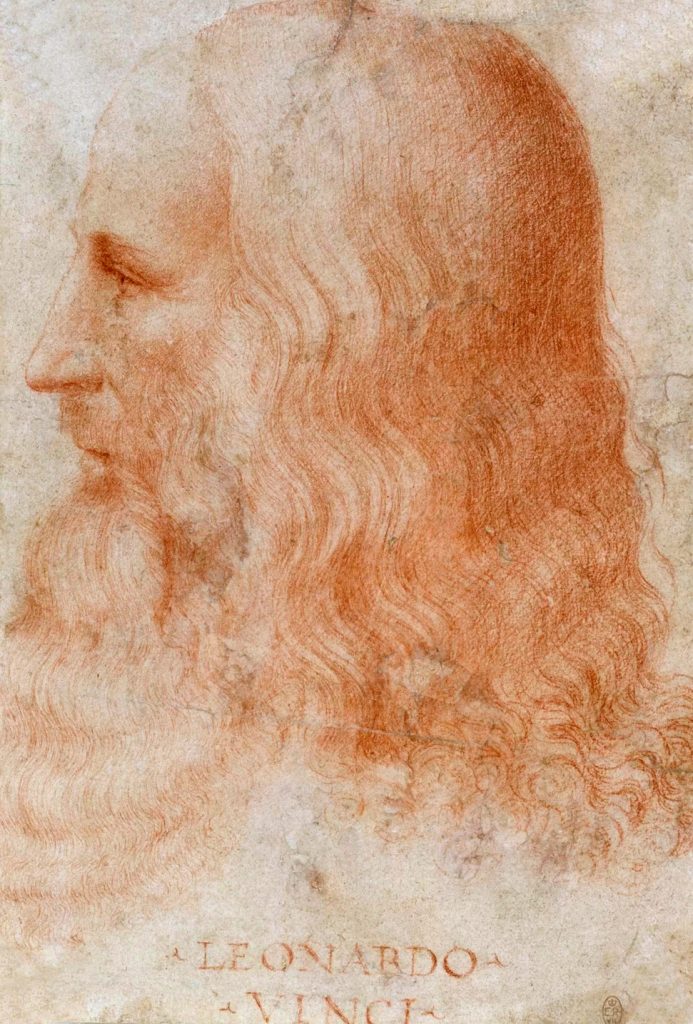
Profile Portrait of Leonardo da Vinci, attributed to Francesco Melzi, circa 1515–1517, Royal Trust Collection.
On May 2, 2019,
the world remembered the day 500 years ago when Leonardo da Vinci (1452-1519),
Italian Renaissance artist and polymath, died. The 67-year-old applied the
spheres of the human brain to its many branches of knowledge and voraciously
fused his interests and studies into one lifetime that inspired universal
learning in Europe.
Leonardo da Vinci made original contributions as an inventor, draftsman, painter, sculptor, architect, scientist, musician, mathematician, engineer, writer, anatomist, geologist, astronomer, botanist, paleontologist and cartographer.1Leonardo was involved in military science, hydraulics, aerodynamics, and optics. Used by princes and admired by kings, charming and handsome Leonardo da Vinci could show in his notebooks that he was often misanthropic.2 A significant part of his important visionary achievements is that Leonardo da Vinci painted two of the most reproduced artistic masterpieces of all time: the Mona Lisa (1503, Louvre, Paris) and The Last Supper (1490s, Convent of Santa Maria delle Grazie, Milan). Leonardo, after a lifetime of adventure, curiosity, and solid achievement died in Amboise, France, following a short illness.
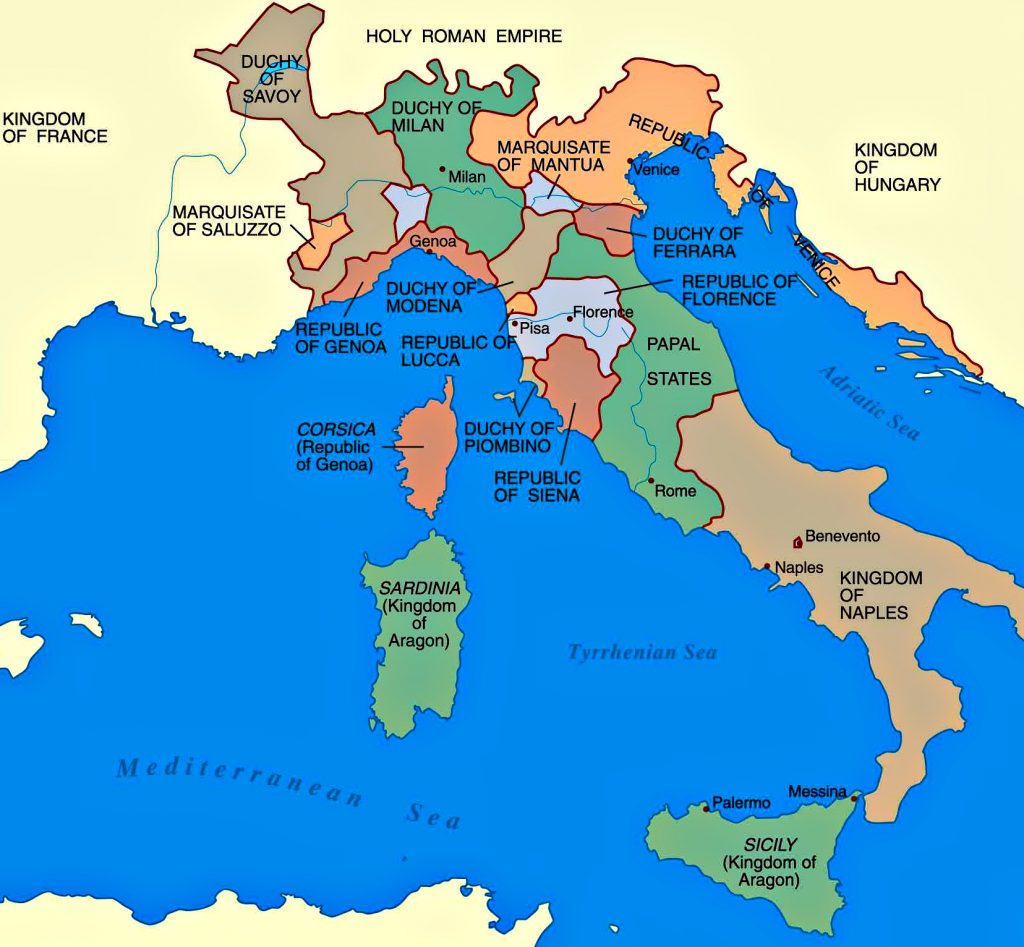
Italy, c. 1500.
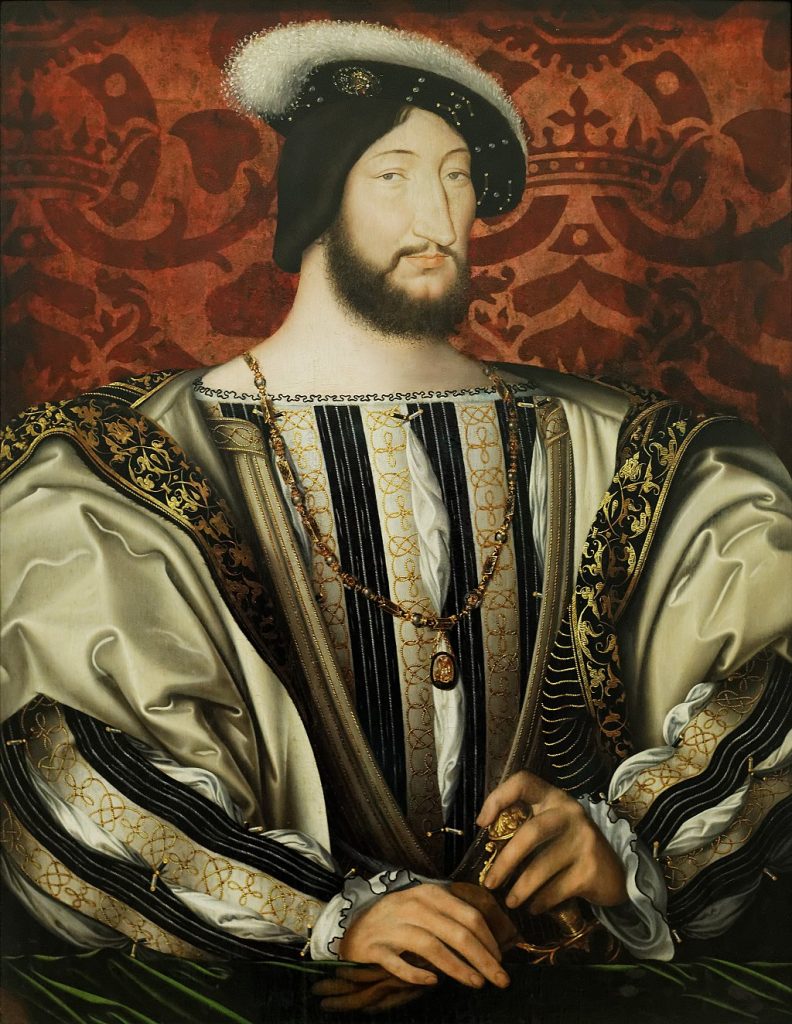
In 1516 Leonardo left Italy for the first time to live in France under the protection of its most cultured young French king, François I (1494-1547). As a dedicated artist, Leonardo experienced a lifetime of disappointment from most of his would-be patrons starting with his father through to Lorenzo de’ Medici, the Magnificent (1449-1492), hapless Milanese duke Ludovico Sforza (1452-1508), Milanese governor Charles II d’Amboise (1473-1511), and Lorenzo’s son and a papal brother, Giuliano di Lorenzo de’ Medici (1479-1516), among others. As Leonardo was ahead of his times it can be said that only at the end of the artist’s life—in 1516, under the wing of François I—that the bulk of his times, that is, the temporarily powerful men in them, had failed him and mankind’s enduring greatness. François I was Leonardo’s first unconditional patron3—while the rest, relatively speaking, are history’s minor players.
François I, Jean Clouet, c. 1530. Louvre, Paris. Lorenzo the Magnificent, Agnolo Bronzino (1503-1572), Uffizi, Florence, Italy. Ludovico Sforza (detail), Master of the Pala Sforzesca, c.1495, Pinacoteca di Brera, Milan, Italy. Charles II d’Amboise, Andrea Solario, 1507. Giuliano de’ Medici, Raphael.
At Leonardo’s
death his reputation as an artist and man rested, as Giorgio Vasari (1511-1574)
relates, on his physical strength, generosity, and artistic innovations which
brought art and society out of its reliance on the past and its well-intentioned
model books into a future of science and art which characterized the best of
the Renaissance period. Because of Leonardo’s lifetime of study and work, mostly
in isolation from a majority of his fellow artists’ and other practitioners’
careers, he bore the fruit of innovation, including new and creative forms and
motifs for art. These emanated out of the imagination of the individual artist who
closely observed the workings of nature. Leonardo’s artistic innovations
included the subtle skill of sfumato
(shadowing) and, as a draughtsman, progressive chalk and cross-hatching
techniques. These inspired other great artists, like Michelangelo Buonarroti
(1475-1564), and only begins to account for the knowledge Leonardo gained from
the physical sciences, particularly anatomy.
Leonardo spent his final three years in Italy in the Vatican (1513-1516), effectively a refuge from petty Italian tyrants. He departed for France in 1516 under the protection of its warrior and cultured 21-year-old new king, François I, whom 64-year-old Leonardo first met in late 15154. Like his cousin and father-in-law predecessor King Louis XII of France (1462-1515) and his cultured mother Louise de Savoie (1476-1531), François I worked hard to recruit the Italian High Renaissance’s most inventive artist for the Gallic Kingdom. When Leonardo finally crossed the Alps he carried with him his recent paintings of the Mona Lisa, Saint John the Baptist, and the Virgin and Child with Saint Anne—all works in the Louvre in Paris today.5 In the second edition of Vasari’s Lives of the Artists6 he described Leonardo in his last months of life in France. In 1519, after a happy period in France at the Château de Cloux, Leonardo was a sick and bedridden man. At the very end, Vasari writes, Leonardo “could not stand [and had to be] supported by his friends and servants.”7. The King paid Leonardo “affectionate visits” in these last days. Vasari intimates that the dying artist consciously felt himself honored to be ministered to by François I Vasari and that Leonardo realized the distinct privilege to “[breathe] his last in [the king’s] arms.”8 This death bed scene, particularly Vasari’s tender detail, has been subsequently imagined in the artwork of artists, including Ingres’ famous painting dated 1818 in the collection of the Petit Palais in Paris.
Louis XII of France, Workshop of Jean Perréal, c. 1514. Cousin and father-in-law of François I Louis admired and collected Leonardo and passed down this admiration to France. Bemberg fondation Toulouse – Portrait de Louise de Savoie, mère de François Ier – École De Jean Clouet (1475;1485-1540) 22×17 Inv.1013
The mother of François I, Louise de Savoie (above), worked hard to convince Leonardo to leave Italy for France.
Leonardo carried with him over the Alps to France three of his recent paintings (above) – Mona Lisa (1503), Saint John the Baptist (1513), and the Virgin and Child with Saint Anne (1503). All are in the Louvre today.
Châteaux de Cloux (Clos Lucé), Amboise, France.Leonardo’s room, Châteaux de Cloux.Death of Leonardo, Cesare Mussini (1804-1888).Death of Leonardo, pencil, 11 x 8½ in. (28 x 21.8 cm.), Jean-Auguste-Dominique Ingres (1780-1867).Death Of Leonardo da Vinci, 1818, oil on canvas, Jean-Auguste-Dominique Ingres, Petit Palais, Paris.
Ink consecrated to the artistry of Leonardo da Vinci is vast. The Bible-like exhibition catalog for Leonardo da Vinci, Master Draftsman from the 2003 show at The Metropolitan Museum of Art in New York City is a 786-page testament. That tome presents and discusses about 100 drawings by the master. This article focuses on one image – Leonardo’s Battle of Anghiari, particularly its central section called the Battle of The Standard.
In October 1503 Leonardo’s commission by the Florentine Republic was to commemorate the military victory of the Florentines over the Milanese in 1440. It would be one of the major artworks in the newly-built Sala de Gran Consiglio (Grand Council Hall) by IL Cronaca (“The Chronicler”) to the rear of the Palazzo della Signoria, also known as the Palazzo Vecchio.9 The commission was given to Leonardo by Republican standard-bearer Piero Soderini (1450-1522) with one of Leonardo’s contracts signed by Niccolò Machiavelli (1469-1527)—and so entered into the annals of what became a fabled art competition (“concorrenza”).
Ink consecrated to Leonardo da Vinci’s art is vast.
View of Florence (detail, Arno River, Palazzo Vecchio, Duomo), c. 1561, Giorgio Vasari.Piero Soderini (1450-1522) by Ridolfo del Ghirlandaio.
Statesman Piero Soderini of the Florentine Republic awarded Leonardo the mural commission for the Battle of Anghiari in October 1503.
Today’s Salone dei Cinquecento by Giorgio Vasari, 1563-1572.
In the process of re-decorating this room with its coffered ceiling and walls with paintings of battle scenes dedicated to the exaltation of Cosimo I de’ Medici, Leonardo da Vinci’s innovative fresco of the Battle of Anghiari was lost or destroyed.
Battle of Marciano by Giorgio Vasari, 1571, Palazzo Vecchio, Florence, Italy.Peter Paul Rubens’ copy of 1603 of the lost Battle for the Standard.
Peter Paul Rubens’ copy of 1603 of the lost Battle for the Standard, the central section of the Battle of Anghiari fresco by Leonardo, 1503-06, in Palazzo della Signoria (also, Palazzo Vecchio) in Florence. While Rubens’ copy is the best known, there are copies of Leonardo’s work by other 16th century artists.
After Leonardo Da Vinci, Fight For the Standard (from the Battle of Anghiari), oil on canvas, 28.625 x 33.125 in. (72.8 x 84 cm).After Leonardo Da Vinci, Fight For the Standard (from the Battle of Anghiari) oil on canvas, 16th century, Museo Horne, Florence.
In 1503 Leonardo da Vinci was at the height of his artistic powers. The
Battle
of Anghiari was a commission for a large scale, complex and dramatic fresco mural
on one wall of the Sala de Gran Consiglio in Florence during
the short-lived restored Republic (c.1492-1512). Leonardo looked to paint the fresco
in dazzling oils and glazes but his complicated experimental techniques to
adhere the pigment to the wall largely failed.10 With the fresco’s ultimate destruction in the early 1560’s
under Vasari who redecorated the Great Council Hall with six of his own massive
battle scenes, he and his Medici rulers were faced with another of Leonardo’s
deteriorating frescos similar to the disastrous flaking of The Last Supper in Milan. The Battle of
Anghiari was not in an obscure
monastery refectory but the central hall of changing political power in
Florence.11
Leonardo’s Last Supper, Santa Maria delle Grazie, Milan.
Leonardo’s Last Supper fresco in Milan started flaking almost as soon as it was painted in the 1490’s. Leonardo’s experimental painting techniques for that project had largely failed.
Fragmentary remains by Leonardo of his Florentine project are his preparatory
drawings whose subjects include horses, riders, and combatants on the
battlefield in various stages of creative development. Some of these drawings
were made by Leonardo immediately upon receiving his commission in late 1503.12
Several copies and copies of copies made by other artists also survive. While
the preparatory drawings do not complete the full composition— though
contemporary written sources lend credence to books of sketches that are lost13—Leonardo
possibly did not even complete a cartoon before he started painting on the
wall.14 While copies by others
intrigue, they are problematic to envision Leonardo’s final fresco of the Battle
of Anghiari—yet each of these sources provide insights.
The Battle of Anghiari is arguably Leonardo’s most important
public commission.15 It manifested itself in the context of
impactful local history, civic pride, city government, and the artist’s own
vision and skills in its employ. Florence was Leonardo’s native city and he
wanted to make a strong impression. Sixty years after Leonardo left his
brilliant fresco on the west wall.16 Vasari,
whose redecoration of the Palazzo Vecchio included a fresco cycle of his own almost
certainly covered over all or part of Leonardo’s unfinished fresco. A desire
for new artwork to showcase the Medici restoration under Cosimo I de’ Medici
(1519-1574) naturally extended to the Grand Council Hall. The late-fifteenth-century
Republic had commissioned Leonard’s battle fresco—and that form of government
had ended in Florence in 1512.
Portrait of Cosimo I de’ Medici, 1535, Alessandro Allori (1536-1607), oil on poplar, 86 x 65 cm (34 x 25 5/8 in.), Florence.
Cosimo I de’ Medici (1519 -1574) ruled Florence from 1537 until his death.
Cosimo I de’ Medici (detail), c. 1564, by Giorgio Vasari, Palazzo Vecchio, Florence.
As Vasari
relates in his Lives of the Artists, Leonardo depicted a scene from the
life of Niccolò Piccinino (1386-1444), an Italian mercenary officer or “condottiere”
in the service of the politically brilliant and physically repulsive duke of
Milan, Filippo Maria Visconti (1392-1447). Fighting for Milan, Piccinino—aided
by two score of cavalry squadron, many foot soldiers17and
treacherous Florentine exiles—was defeated by a force led by the Republic of
Florence under Francesco I Sforza
(1401-1466). The victory at the Battle of Anghiari on June 29, 1440 handed the
Florentines domination of central Italy. At the turn of the sixteenth century
the new republic of Florence continued to face warring tyrants as neighbors
including Cesare Borgia (1475-1507). At the start of a new century and Republic
the timing was ripe to depict in its government hall valorous Florentine
warriors defeating political enemies. In 1503, Florentine officials gave
Leonardo an in-depth orientation of the 1440 battle using historical texts but
the artist brushed these aside as he conceived the scene to be depicted, a
virtually cinematic induction of the battle’s climax —the mortal contest by the
Florentines to capture the standard from the Milanese. Leonardo’s first sketches
for it are of a condensed melée full of the swirling movement and
stirring sensations of battle.18 The actual standards taken during
the battle had been kept in the Grand Council Hall as a trophy.19
Niccolò Piccinino. Defeated at the Battle of Anghiari, the Italian mercenary becomes the central protagonist of Leonardo’s fresco.
Front (Recto) of a medal of Duke of Milan, Filippo Maria Visconti, by Pisanello (1395-1455).
Local battles such as the Battle of Anghiari were usually
part of larger campaigns— in this instance, The Lombardy Wars of 1423-1454— and
fought by hired warriors. Mercenaries usually provided terms to competing foes
that protected the mercenary’s best interest. Following the Battle of Anghiari,
Piccinino, who had been captured, was soon after released. In the next battle
at Martinengo, he defeated and captured Sforza. Because of these endless war
games, Niccolò Machiavelli (1469-1527)
advised in The Prince that
a ruler should not be tempted to use these swords for hire – and cited Francesco
Sforza by example.20
Mercenary Francesco Sforza, Pinacoteca di Brera, Milan.Niccolò Machiavelli by Santi di Tito (1536-1603).
Machiavelli, author of The Prince, signed an order to commission Leonardo to create the fresco commemorating the Battle of Anghiari for Florence’s newly-built Sala de Gran Consiglio (Grand Council Hall).
Leonardo’s sketches of probably Cesare Borgia.
Cosimo I de’ Medici who ruled Florence starting in 1547 was interested in that which supports power— including art. Vasari’s new paintings of Cosimo I de’ Medici’s wartime exploits was partly a political act. By ridding the hall of Leonardo’s Battle of Anghiari — a Republican military victory from long ago — Vasari worked his political masters’ desires. The ultimate reasons and fate of Leonardo’s artwork is not known but if Vasari destroyed the mural he would not be the first Italian artist to destroy a competitor’s artwork as shall be seen.
In late 1503 Leonardo, installed in a temporary workshop at Santa Maria Novella, about a fifteen-minute walk to the Palazzo, was given a deadline for the mural’s completion of February 1505. Like the fabled competition between Leonardo and Michelangelo that was intentionally arranged by Florence’s political operatives, the deadline for completion was also a demand for Leonardo’s art outside the artist’s concerns. The first late winter deadline passed as did those in spring and summer. Setbacks included Leonardo’s meticulously slow work, other projects he took up that kept him away from the fresco, and even bad weather.21
Santa Maria Novella, Florence.
Leonardo’s designated workshop for the mural commission was the Dominican church built in 1420, Santa Maria Novella.
In early 1504
the wall painting of the Battle of Anghiari and its 51-year-old artist
was joined by Michelangelo Buonarroti who would paint his Battle of Cascina
in the same room and possibly on the same wall. Michelangelo, recently turned
28 years old, would depict the Florentine military victory over Pisa in 1364.
Neither this imposed rivalry or proximity encouraged their friendship.22
Michelangelo was intense, pious, and unwashed contrasting to Leonardo’s genial,
independent, and stylish manner.23 However, their professional
relationship temporarily influenced each other’s artmaking.
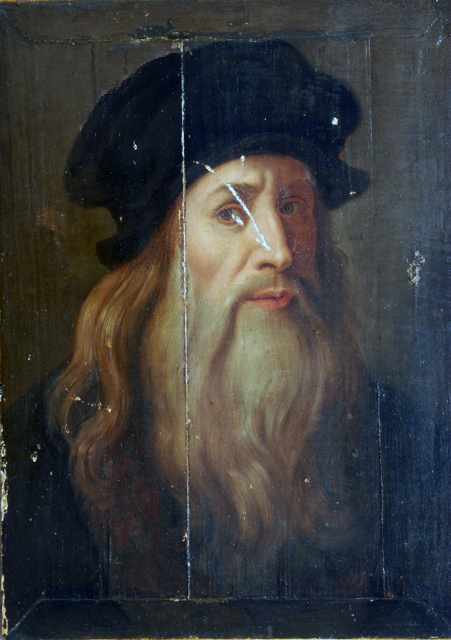
Michelangelo, Self-Portrait.Leonardo da Vinci, (Lucan) Self-Portrait.
In 1504 and
1505, Michelangelo learned to use Leonardo’s innovative stylus cross-hatching
technique along with the chalk technique that Leonardo was continuing to exploit
in the Battle of Anghiari. Inspired by Michelangelo, Leonardo did
masterful drawings of nude figures though he did not use them. In
Michelangelo’s preparatory drawings for the Battle of Cascina—that and
copies by others are what survive of the project– the younger artist used
Leonardo’s cross hatching technique for the pull of the skin. He experimented
with Leonardo’s chalk technique to display types and degrees of muscular
tension on figures.24 Yet, according
to Vasari, the two clashed at almost every turn. Michelangelo’s use of
Leonardo’s advanced techniques was restricted to the short period of their
common commission and Leonardo openly disparaged Michelangelo’s cartoon of male
nude bathers as coldly analytical.25
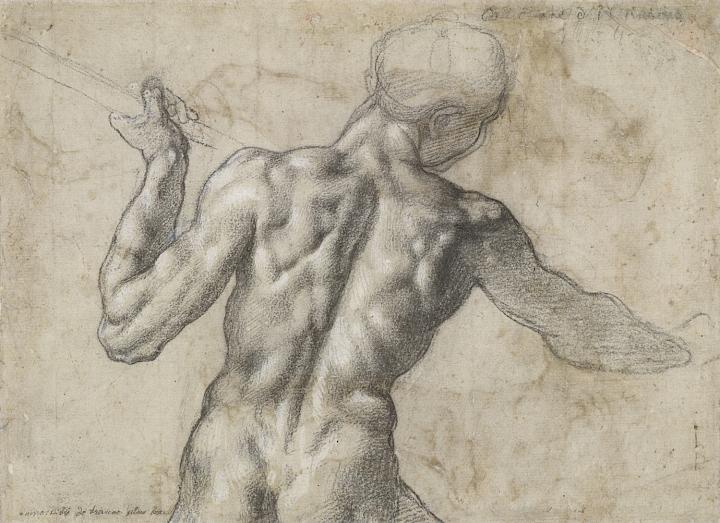
Two Michelangelo chalk studies. ABOVE: Male Nude Seen From the Back With a Flag Staff, c. 1504, The Albertina Museum, Vienna. BELOW: Life Study for a bathing soldier in the lost cartoon for theBattle of Cascina, black chalk, 404 x 258 cm, Teylers Museum, Haarlem, The Netherlands.
Leonardo da Vinci, Anatomical Studies of the Nude, connected with the Battle of Anghiari, c. 1504, Royal Library, Windsor. Though influenced by Michelangelo’s nude drawings in this time, Leonardo’s design and imagery for his battle scene looked to invention and unexpected drama rather than the nude.
In spring 1505
Michelangelo’s cartoon was finished but his painting barely started—and the
younger artist left Florence for Rome. Michelangelo accepted the commission to
build the tomb of Pope Julius II (1443-1513) although it would not be completed
until 1545 and on a much-reduced scale. He returned to Florence the following
spring but was soon back in Rome to paint, between 1508 and 1512, the Sistine
Chapel ceiling. In 1506 Leonardo’s gradual departure for Milan, complete by
1508, began. Leonardo stayed in Milan until 1513 when he was invited by the
pope to the Vatican. Leonardo and Michelangelo had in Florence shared a common
commission from the Republic. Their two battle scenes presented, each in their
own way, a tangle of intertwined figures. Otherwise, each artist created compositions of varying subject matter and
style which proved seminal for art-making schools of the future. Leonardo’s
swirling horsemen in the Battle of
Anghiari inspired the Baroque
style and Michelangelo’s bathers in the Battle of Cascina
displayed a perfect template for Classicism. These two great artists also
shared, despite their age difference or varying temperaments, the fact that
neither of them completed their commissioned work.
Michelangelo, The Tomb of Pope Julius II, completed 1545, San Pietro in Vincoli, Rome.Michelangelo, Sistine Chapel ceiling, 1508-1512, Rome (The Vatican).Michelangelo, David, 1501-1504, Galleria dell’ Accademia, Florence, Italy.
Michelangelo’s David had just been placed Florence’s central square when the painting competition (“concorrenza“) between himself and Leonardo da Vinci began. Leonardo had served on his native city’s committee which decided where to place Michelangelo’s 17-foot tall marble sculpture. Today a copy stands outside the Palazzo Vecchio.
At the time of the public commission in Florence, Leonardo had just finished his Mona Lisa (1503, Louvre, Paris) and Michelangelo had just installed, in the city square, his David (1501-1504, Accademia Gallery Museum, Florence). Leonardo had been part of the city committee to recommend where Michelangelo’s David should be placed.26 Over the next decade, until 1512, Leonardo’s and Michelangelo’s unfinished wall paintings—that they both had abandoned (a worthy reason for a later Medici to paint it over)—adorned the same room possibly side by side. Michelangelo’s work was mutilated first with the fall of the Republic. Young artists had flocked to study and copy these unfinished artworks, including a young Raphael.27 In 1512 one of these artists, a 24-year-old named Bartolommeo Bandinelli (1488-1560)—he had been obsessive in studying Michelangelo’s cartoon to the point of sneaking in to the Council Hall at night—in one moment grabbed the cartoon and cut it into pieces. The motivation for Bandinelli’s destruction is unclear. The center section of Leonardo’s Battle of Anghiari – namely, Battle of the Standard– remained intact on the wall and for decades saw copies and written descriptions made of it. After 1508, neither Michelangelo nor Leonardo were anywhere near Florence as both moved on to larger opportunities.28
Michelangelo, Battle of Cascina, 1504-6, destroyed copy by Aristotile da Sangallo, grisaille on panel, 30 x 52 in. The Courtauld Institute of Art, London.
Leonardo openly disparaged Michelangelo’s cartoon of male nude bathers as coldly analytical. Younger artists preferred the noble and expressive form of Michelangelo’s nudes to Leonardo’s messier constructions.
Focusing on
Leonardo’s Battle of Anghiari, and, particularly, the Battle of the
Standard, its central panel, one is impressed by Leonardo’s revolutionary
approach to drawing. Leonardo shattered
tradition, specifically in drawing. First, Leonardo was not tidy in his
drawing. Medieval tradition was fundamentally concerned with conserving the
controlled line. A draftsman’s artistic ability was judged by patrons and cultural
tastemakers by the accurate lines he created directly out of an existing
model-book. Leonardo’s early silverpoint
drawing of a Bust of a Warrior in the
British Museum demonstrates his ability to masterfully fulfill this Renaissance
expectation.29 As Leonardo the artist developed, by the end of the
fifteenth century he was attacking this long-held linear tradition in his
notebooks as a failed technique.30 The fiery scribbling of
Leonardo’s drawing style expresses his process of creative exploration but
equally his rebellion towards the old technique. In its place, Leonardo shows
himself in his drawings to be actively pushing outside the linear restraint of quattrocento drawing and formulating a
new artistic standard derived from orientation to the model. As an avant-garde
artist in this mode Leonardo practiced it alone for 25 years.31 The
profligacy of his drawings – often multiple images on the same page of paper
expressing his changing primo pensiero
(“first thoughts”) – indicates the brilliancy of Leonardo’s creativity. His
drawing technique points to the artist seeking to free the immaginativa to emphasize dramatic invention that included
individual details (such as heads) and unto an entire scene. Leonardo’s artistic practice worked to
overturn, or revolutionize, the tradition-bound formulas imposed on art. He replaced
it with a new and radical conception of nature ever-changing as the drawing
framework.
Leonardo da Vinci, Bust of a Warrior in profile, 28.7 x 21.1 cm, silverpoint, c.1478, The British Museum.Model-book page, 1390’s, pen and ink with wash and watercolors on parchment, workshop of Giovannino de’ Grassi (1350-1398).Giorgio Vasari, Self-portrait, 1560’s.
Vasari goes into admirable detail on Leonardo’s Battle of Anghiari in his Lives of the Artists in editions of 1550 and 1568. That Vasari destroyed or painted over this same work by Leonardo around the same time during a re-decoration of Florence’s Grand Council Hall is difficult to reconcile with his writings.
Invested
Quattrocento cultural taste-makers and practitioners found danger in
Leonardo’s new artistic direction. Art producers and patrons could not
understand why a single artist for his own personal exploration would forsake
generations of practiced skill and systematics. The challenge for Leonardo after
he discarded the model-book was difficult and clear– to invent figures and
forms to replace it. This monumental task helps explain some of the artist’s
motivation for working in many areas such as anatomy, mechanics, botany, and
geophysics. Wide study was certainly owing to Leonardo’s “unquenchable curiosity”32
but its practical application worked to fulfill his ambition to locate source
material to replace the model-book’s groupings, movements, and forms that he
had audaciously sacked. The culmination of his approach is manifest in the Battle of Anghiari. To discover some of Leonardo’s unfolding
revolutionary creative process makes this artwork exciting to consider as Vasari
describes it in detail in his Lives:
“The great achievements of this inspired artist so increased his prestige that everyone who loved art, or rather every single person in Florence, was anxious for him to leave the city some memorial; and it was being proposed everywhere that Leonardo should be commissioned to do some great and notable work which would enable the state to be honored and adorned by his discerning talent, grace, and judgement. As it happened the great hall of the council was being constructed under the architectural direction of Giuliano Sangallo, Simone Pollaiuolo (known as Cronaca), Michelangelo Buonarroti and Baccio d’ Agnolo, as I shall relate at greater length in the right place. It was finished in a hurry, after the head of the government and the chief citizens had conferred together, it was publicly announced that a splendid painting would be commissioned from Leonardo. And then he was asked by Piero Soderini, the Gonfalonier of Justice, to do a decorative painting for the council hall. As a start, therefore, Leonardo began work in the Hall of the Pope, in Santa Maria Novella, on a cartoon illustrating an incident in the life of Niccolò Piccinino, a commander of Duke Filippo of Milan. He showed a group of horsemen fighting for a standard, in a drawing which was regarded as very fine and successful because of the wonderful ideas he expressed in his interpretation of the battle. In the drawing, rage, fury, and vindictiveness are displayed both by the men and by the horses, two of which with their forelegs interlocked are battling with their teeth no less fiercely than their riders are struggling for the standard, the staff of which has been grasped by a soldier who, as he turns and spurs his horse to flight, is trying by the strength of his shoulders to wrest it by force from the hands of four others. Two of them are struggling for it with one hand and attempting with the other to cut the staff with their raised swords; and an old soldier in a red cap roars out as he grips the staff with one hand and with the other raises a scimitar and aims a furious blow to cut off both the hands of those who are gnashing their teeth and ferociously defending their standard. Besides this, on the ground between the legs of the horses there are two figures, foreshortened, shown fighting together; the one on the ground has over him a soldier who has raised his arm as high as possible to plunge his dagger with greater force into the throat of his enemy, who struggles frantically with his arms and legs to escape death.
It is impossible to convey the fine draughtsmanship with which Leonardo depicted the soldiers’ costumes, with their distinctive variations, or the helmet-crests and the other ornaments, not to speak of the incredible mastery that he displayed in the forms and lineaments of the horses which with their bold spirit and muscles and shapely beauty, Leonardo portrayed better than any other artist. It is said that to draw the cartoon Leonardo constructed an ingenious scaffolding that he could raise or lower by drawing it together or extending it. He also conceived the wish to paint the picture in oils, but to do this he mixed such a thick composition for laying on the wall that, as he continued his painting in the hall, it started to run and spoil what had been done, So shortly afterwards he abandoned the work.”33
It seems nearly
inconceivable that Vasari could write so appreciably of Leonardo’s fresco and
then destroy it. Yet its removal, whether wholly destroyed, or lost by being
painted over or misplaced, is a fact. Leonardo who no longer relied on the
model-book as his authority the artist answered with his own creative immaginativa and all of the facets of nature.
In this revolutionary creative process, Leonardo further anticipated the modern
era’s introduction of the psychological component into a drawing. The
psychological element that Leonardo introduced extended to the figures Leonardo
depicted in drawings but it benefited the individual artist’s ability to think
and dream creatively. To this end Leonardo consciously devised mental exercises
to produce psychological effects in himself.34
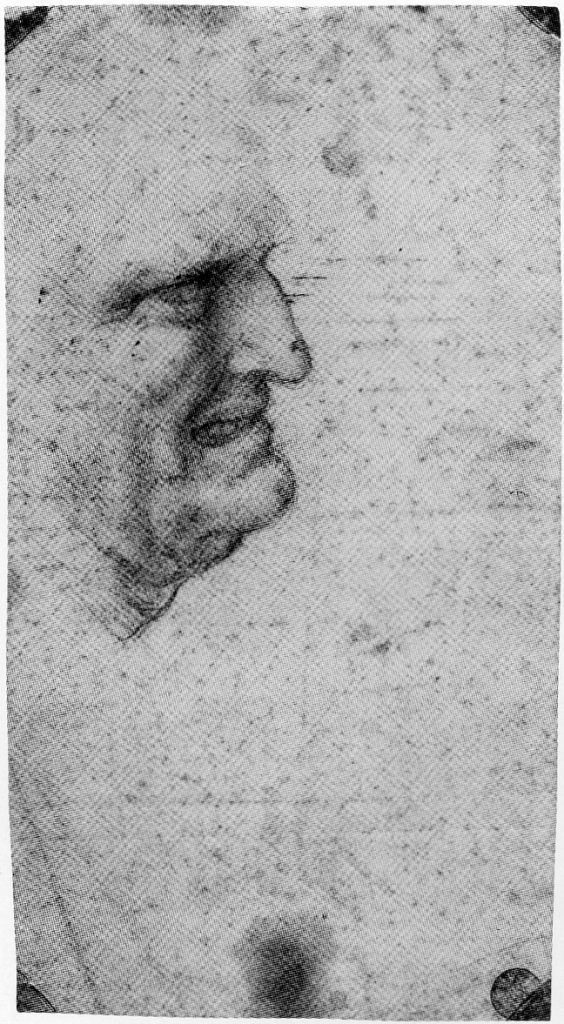
Leonardo da Vinci, Head of a Warrior in Profile, black chalk, 220 x 116 mm, Gallerie dell’Accademia, Venice.
Leonardo anticipated the modern era’s introduction of the psychological component into a drawing.
Leonardo da Vinci, Study of a Warrior’s Head for the Battle of Anghiari (Recto), Red chalk on prepared paper, 22.6 × 18.6 cm. Museum of Fine Arts, Budapest.
It is half life size from a live model. Over the years some scholars have doubted its authenticity as a Leonardo drawing.
Verso of Study of a Warrior’s Head for the Battle of Anghiari (above drawing).
Leonardo da Vinci, Study of Two Warriors’ Heads for Battle of Anghiari (c. 1504–5). Black chalk or charcoal, traces of red chalk on paper, Museum of Fine Arts, Budapest.
This is one of the most famous drawing studies by Leonardo da Vinci for the Battle of Anghiari fresco mural project.
Within wide
study in the physical sciences, Leonardo attempted everything̱– and did not
always finish. It was the immensity of his study and his loathing of the
finished quality of the model-book that allowed Leonardo to abandon projects and
pick up new and creative directions and methods. Leonardo’s world view as an
artist for his art was universal—indeed, he personified the popular definition
of “Renaissance Man.” In his artistic boldness and innovation, Leonardo’s
methods and objectives found him its sole practitioner for years—even decades.
Yet Leonardo was a man of his times. The era of the mid-to-late fifteenth
century was one of social awakening to the globe and its conquest by nations
and kingdoms. The historical period saw great changes in cultural perceptions
based on European cities achieving charters of economic and political freedom as
well as new scientific and other discoveries. These included the heliocentric
model of the solar system by astronomer and mathematician Nicolaus Copernicus
(1473-1543) and the international voyages of discovery by Christopher Columbus
(1451-1506). It was an age of revolutionary ideas and technology and Leonardo
da Vinci had no doubt it included art.
In Leonardo’s drawings there is the
untidy immaginativa quality in its hasty,
scribbled animations. Studies for the Battle
of Anghiari present a cacophony of images—drapery studies; grotesque heads;
armory; horses. For each area, Leonardo’s drawing between 1503 and 1506 had
reached mature stylistic development.35 Not since Leonardo’s The Adoration of the Magi in 1482 had he
created a composition achieving the cohesion of gestures and
inter-relationships among figures.
Nikolaus Copernicus (The Torun portrait), Anonymous, c. 1580.Leonardo da Vinci, Adoration of the Magi, 1482, oil on wood, 246 cm × 243 cm (97 in. × 96 in.), Uffizi, Florence.
There are
speculatively three panels or sections completed for the Battle of Anghiari. The
most recognizable is the large central panel or section known as the Battle for the Standard. It is known by its copies by other
artists. Leonardo’s central panel depicts four men, one partially hidden,
riding war horses. They are engaged in the heat of combat, frozen in a frame of
animated movement, for the capture of a standard during the battle. Other
sections of the Battle of Anghiari—derived
from Leonardo’s small preparatory sketches—depict a wild, galloping horse and a
pair of belligerents on horseback. These are briefly discussed below. The most
well-known copy of the central section of Leonardo’s fresco (the only section
he apparently painted) is by the great artist Peter Paul Rubens (1577-1640). In
the collection of the Louvre, Rubens’ copy dates from 1603 and is, in fact, a copy
of a copy. Rubens copies Lorenzo Zacchia’s (1524-c.1587) copy dating from 1553
which he possibly took directly from the fresco or a lost cartoon. There are
three extant copies by other artists of Ruben’s copy of a copy of the possibly
original artwork.36 These copies at various removes provide insight
into the impact for art through the centuries. The rest of Leonardo’s composition
is conjectured based on drawings.37 The left panel or section Leonardo
could have intended to be horsemen charging into battle while the right panel
or section could be the taking of the bridge over the Tiber on horseback which
was a key action for victory. The preparatory drawing sheets have images on top
and below and may be related as part of a narrative sequence that Leonardo
worked to clarify and simplify as a design until he started painting the
composition.38 Throughout the project
Leonardo had detail and atmospherics in mind though in its piece meal condition
today, a full aspect of his creative process is irretrievably lost.39
Peter Paul Rubens, Copy of Leonardo’s Battle of the Standard (from the Battle of Anghiari), 1603, Louvre.
Horses are one
of Leonardo’s favorite subjects. The Battle for the Standard portrays three
soldiers on three horses with swords brandished in the smoke and flame of
hand-to-hand combat. A fourth soldier on horseback is partially hidden. Two more
soldiers have fallen beneath the hooves of their reeling horses and attempt to
cover themselves with their shields. The weight of the horses is depicted in
their meaty haunches. The horses’ heads are ancient and noble. They crush,
bite, and plow into the heat of battle. The screaming head of Niccolò Piccinino
–the protagonist of the Battle for the Standard — and from whose hands
the standard is wrested away by Florentine soldiers (the profile on his
immediate right) wore a large red cap as described by Vasari.40
The overall
configuration of the scene is Leonardo’s Renaissance construction of the type
of dense figures discovered on ancient Greek and Roman sarcophagi. The
stylistic effect of Rubens’ copy of Leonardo’s Battle of the Standard
is, by virtue of its similarity, carried forward into the seventeenth century
as witnessed by Rubens’ The Hippopotamus Hunt (1616) and The Lion Hunt (1621) both in the Alte
Pinakoteck in Munich. The question can be posed: to what degree is Rubens’
stylistic effect, by virtue of his 1603 copy of a 1553 copy of Leonardo’s 1503
image, inferred into Leonardo’s Battle of the Standard? Yet Leonardo’s
battle, seen by thousands over decades before its demise, can be said to have
directly influenced battle scene depictions whose style continued into the
Romantic Period in mid19th century France.41
Fall of Phaeton, Greek marble Roman sarcophagus, 62 x 220 cm, c. 150 AD, Uffizi Gallery, Florence.Peter Paul Rubens, The Hippopotamus Hunt, 1616, Alte Pinakothek, Munich.Peter Paul Rubens, The Lion Hunt, 1621, Alte Pinakothek, Munich.Tintoretto, Saint George and the Dragon, oil on canvas, 157.5 x 110.3 cm, The National Gallery, London.Eugène Delacroix, The Combat of the Giaour and Hassan, 1826, The Art Institute of Chicago.Bronzino, Allegory of Venus and Cupid, c. 1560, The National Gallery, London.
The screaming head in the background on the left side of the painting is speculatively based on the head of Leonardo’s protagonist in the Battle of the Standard.
Along with
these artistic innovations and achievements by Leonardo in a long, lonely
process of exploration the hallmark achievement of the Battle of Anghiari
is its reckless artistic inspiration.
While historical construction of Leonardo’s drawing method requires speculation,
existing studies for the work, including those specific to the Battle of
Anghiari, provide insights. For instance, Leonardo deployed the pen as well
as chalk in preparatory drawings for the Battle of Anghiari. This
practice continued the spontaneous and dynamic plasticity of his drawing
technique from the 1490s42 and
contained psychophysical and temporal effects.43 Up to Leonardo, the
general practice for using a pen or stylus was by way of short parallel lines.
In the Battle of Anghiari Leonardo is the first Italian artist to
systematically use curvilinear hatching.44 A complementary contrast
to Leonardo’s inventiveness is that he valued and paid attention to his work
experiences. After the early 1480s he retained his sense of form and design and
continued to work through particular problems that interested him within a
general trend of development.45
Leonardo da Vinci, Study of Rearing Horse, light fine red chalk and hatching with traces pen and brown ink, 153 x 142 mm, Royal Library, Windsor.
The horse drawn from life shows a tense rider pivoting.
Leonardo’s
drawings, including his preparatory studies, convey a sensational appearance of
continuous movement. Formed into a triangle the figures of combatants in the
central section of the Battle of Anghiari and elsewhere move in a
swirling motion similar to the apocalyptic liquid cascades Leonardo would later
draw. Facial expressions, gnarled and strained on both man and beast, add their
distinctive vitality to the animated whole. The Battle of the Standard
works similarly to Leonardo’s mechanical drawings in their careful
construction. The “machine” operates as an expression of the physicality and
emotional and psychological intensity of men fighting to the death. Leonardo,
as discussed, based this key scene for the city-state commission on an episode
described in historical written texts.46
Leonardo in his
first draft of a drawing worked to establish this general sense of movement. In
first drafts he attempts the pictorial pitch that he will develop. In the
second stage (“per ripruova”) Leonardo begins to create major motifs.47
The two most important primi pensieri for the Battle of Anghiari
are pen and ink drawings from the Gallerie dell’ Accademia in Venice, Italy.
Scholarship’s quest to reconstruct Leonardo’s creation of the Battle of
Anghiari has been identified as “quixotic,”48 yet these drawings while no larger than the size of a
clenched fist give out significant clues.
Leonardo da Vinci, Battle Study, two skirmishes between horsemen and foot soldiers, c.1503, pen and brown ink, brush and brown wash, 147 x 154 mm (6 x 6 in.) Gallerie dell’ Accademia, Venice, Italy.Leonardo da Vinci, Battle Study, Skirmish between Horsemen, Foot soldiers and Foot soldiers Wielding Long Weapons, pen and brown ink over black chalk and stylus, c.1503, 147 x 154 mm (6 x 6 in.), Gallerie dell’ Accademia, Venice, Italy.
In one of the
preparatory drawings the horseman on the left is looking back over the horse’s
haunches, a dramatic image among the handful of fighters in close combat that
Leonardo will condense into a dominant motif in the Battle of the Standard.
The artist’s steady progression belies his reputation as a slow worker though
this inventive stage of drawing appealed to him most. For each stage,
Leonardo’s drawing is a fully animated artistic expression of his subject
matter. While the creative process of Leonardo’s drawing brings the image, as
Heinrich Wöfflin observed, to the “verge of the unclear,”49 it also
begins to reveal some of the inner workings of Leonardo’s brilliance. In exchange
for the free and kinetic character of drawing studies taken to the brink, the
later and final work becomes increasingly plastic and compact.50
Leonardo da Vinci, Fight for the Standard at the Bridge and Two Foot Soldiers, pen and brown ink, 99 x 141 mm, Gallerie dell’Accademia, Venice.
It is speculated that this preparatory drawing was for the right panel (or section) of the fresco. It depicted the taking of the bridge over the Tiber River that was a key historical action to military victory for the Florentines over the Milanese at the Battle of Anghiari on June 29, 1440.
Leonardo da Vinci, Study of charging horses and Soldiers, red chalk on paper, 167 x 240 mm, Royal Library, Windsor.
Anticipating Degas’s racehorses 350 years in the future, this drawing of horsemen charging to battle may represent the left panel (or section) of the Battle of Anghiari that Leonardo envisioned as a three-part narrative sequence.
Copy of a horseman from the Battle of Anghiari, pen and brown ink, brush and gray wash, white gouache on paper, 267 x 237 mm, The British Museum.
In the drawings
for the Battle of Anghiari he communicates in lively action and
engrossing drama the close physical contact of the horses and their riders
encircling and falling upon one another in the passion and violence of war.51
The fresco in the Florentine council chambers would remind leaders of war’s
brutality and, though a glorification of civic heroism and pride, the
wall-sized image served to show the fury of slaughter that military battles
cost. The Battle of the Standard was an image that conveyed the phrase
that typified the meaning of war for Leonardo: pazzia bestialissima (“beastly
madness.”)52Recalling
Bertoldo’s battle scene that originally decorated the Florentine palazzo of
Lorenzo de’ Medici (“the Magnificent’) and based on an ancient Roman
sarcophagus, proffered to the viewer no identifiable sides. War is not a
glorious narrative, but combatants falling into one another. In addition to its
classical and Renaissance allusions, its plastic form appealed to Leonardo’s
beliefs and attitudes about the intrinsic nature of combat that he then looked
to dramatize in the Battle of Anghiari.
Leonardo da Vinci, Study of horses for the Battle of Anghiari. Leonardo depicts horses displaying emotion.
Leonardo da Vinci, Study of group of riders in the Battle of Anghiari, c. 1503, charcoal and black chalk reworked with brush and brown wash, Royal Library, Windsor.
The left-handed hatching is for a drawing taken from a clay or wax model.
Bertoldo di Giovanni (ca. 1440–1491), Battle, c. 1480–85, Bronze, 17 3/4 × 39 1/8 in. (45 × 99.5 cm), Museo Nazionale del Bargello, Florence.
The artistic drawings that survive which reveal Leonardo’s artistic process are an invaluable piece of a final enterprise that ultimately failed to materialize on several levels despite Leonardo believing the high-level commission was vital to his reputation as an artist.53 In the end, Leonardo was viewed by the oligarchs as not only procrastinating but having not fulfilled his contract and they sued Leonardo for breach. Yet more enduring than a legal concern was the art project involving Leonardo da Vinci and Michelangelo Buonarroti. The work accomplished by these two giants of art reverberates through the centuries to today. Theirs is a legacy of the individual artist still being sought out—though by chairmen and presidents rather than popes and princes. A legacy that says artists are no longer craftsmen or tradesmen but artistic personalities in their own right with a unique and appealing style who are thus engaged for their singular brilliance.54 In the face of what was an incomplete, sometimes failed, and ultimately abandoned project—its competitive nature notwithstanding—all the variations of Leonardo’s creative activity funnels into a tremendous example for the mission of the artist –that is, to serve first neither patron nor purse nor artistic reputation —but the glory of making one’s art.
Leonardo, Self-Portrait, c. 1512, Royal Library of Turin, Italy.
BIBLIOGRAPHY:
Acidini Luchinat, Christina, Butters, Suzanne B., Chiarini,
Marco, Cox-Rearick, Janet, Darr, Alan P., Feinberg, Larry J., Giusti,
Annamaria, Goldthwaite, Richard A. , Meoni, Lucia, Piacenti, Kirsten
Aschengreen, Pizzorusso, Claudio, Testaverde, Anna Maria, The Medici,
Michelangelo, And The Art of Late Renaissance Florence, Yale University
Press in association with The Detroit Institute of Arts, New Haven and London,
2002.
Ames-Lewis, Francis, Drawing in Early Renaissance Italy,
Revised Edition, Yale University Press, New Haven & London, Second Edition,
2000 (originally published 1981).
Ames-Lewis, Francis, The Intellectual Life of the Early Renaissance
Artist, Yale University Press, New Haven & London, 2000.
Bambach, Carmen C., editor, Leonardo da Vinci, Master
Draftsman, The Metropolitan Museum of Art, New York, and Yale University
Press, New Haven and London, 2003.
Berenson, Bernard, The Italian Painters of the
Renaissance, Phaidon Press, London, 1959.
Braham, Allan, Italian Paintings of the Sixteenth Century,
The National Gallery, London in association with William Collins Sons & Co.
Ltd, London, 1985.
Braudel, Fernand, Out of Italy: 1450-1650, trans. Siân
Reynolds, Flammarion, Paris, 1991.
Clark, Kenneth, Selected Drawings from Windsor
Castle: Leonardo da Vinci, Phaidon
Press, London, 1954.
Durant, Will, The Renaissance: A History of Civilization
in Italy from 1304-1576 A.D., Simon and Schuster, New York, 1953.
Gombrich, E. H., Norm and Form: Studies in the Art of the
Renaissance, Phaidon Press, London, 1966.
Hartt, Frederick, History of Italian Renaissance
Art: Painting, Sculpture, Architecture,
Harry N. Abrams, Inc., New York, Third Edition, 1987.
Hohenstaat, Peter, Leonardo da Vinci, Könemann,
Köln,
1998.
Isaacson, Walter, Leonardo da Vinci, Simon &
Schuster, New York, 2017.
Machiavelli, Niccolò, trans. William J. Connell, The Prince,
Bedford/St. Martin’s, Boston and New York, Second Edition, 2016 (originally
published 2005).
Meiss, Millard, The Great Age of Fresco Discoveries, Recoveries
and Survivals, George Braziller, Inc. in association with The Metropolitan
Museum of Art, New York, 1970.
Popham, A.E., The Drawings of Leonardo da Vinci,
Jonathon Cape, London, 1977 (first published 1946
Saviotti, Franco, Florence, Edizione – SAFRA,
Firenze, 1981.
Steinberg, Leo, Leonardo’s Incessant Last Supper,
Zone Books, New York, 2001.
Turner, Jane, editor, Encyclopedia of Italian Renaissance
& Mannerist Art, Volume 1 and II, Grove Dictionaries, Inc., New
York, 2000.
Vasari, Giorgio, trans. George Bull, Lives of the Artists,
Penguin Books, Harmondsworth, Middlesex, England, 1965.
Wöfflin, Heinrich, Classic Art: An Introduction to the Italian Renaissance, Phaidon Press Limited, London, 1994 (first published 1952).
FEATURE image: Nadar, Rosine Stolz (1815-1903), Paris, c.1857. Nadar transformed photographic portraiture into a serious artistic and cultural record of modern France by capturing the personalities, intellect, and creative spirit of the leading artists, writers, musicians, actors, and thinkers of nineteenth-century Paris. His portraits are presented not merely as likenesses, but as historical documents that preserve the human face of an extraordinary cultural age. Rosine Stoltz was a French mezzo-soprano.
By John P. Walsh.
Early Years: A Family in Transition
Gaspard-Félix Tournachon, later known as Nadar, was born in Paris on April 6, 1820, to Thérèse Maillet and Victor Tournachon at 195 rue Saint-Honoré (they married in 1826). A younger brother, Adrien, was born in 1825. His childhood was marked by instability. As political censorship and economic pressures undermined his father’s printing business, the family moved to 45 rue Saint-André-des-Arts on the Left Bank before relocating to Lyon in 1833. Financial hardship deepened for the family after the July Revolution of 1830, shaping the environment in which Nadar and his younger brother, Adrien, came of age.
While his family settled in Lyon, Nadar continued his education at Versailles, where he revealed an early gift for creative writing and an unusual talent for cultivating friendships. His studies were cut short by his father’s death in 1837. Returning to Lyon, he briefly pursued medical studies in hopes of supporting his mother and brother, though his true interests already lay elsewhere: journalism, literature, and public life held a far stronger attraction.
Paris and the Making of “Nadar”
In 1838 Nadar returned to Paris, where he immersed himself in the city’s vibrant literary culture. During the 1840s he began writing reviews and short stories, contributing to a variety of publications while developing his skills as a caricaturist. It was within these bohemian circles that the nickname “Nadar” emerged and ultimately replaced his given name.
The friendships he forged became central to his identity and future career. Frequenting Paris cafés and bohemian literary gatherings, he met many of the writers, poets, and critics who would later sit before his camera, including Gérard de Nerval (1808-1855), Charles Baudelaire (1821-1867) and Théodore de Banville (1823-1891). Nadar’s devotion to artistic and intellectual pursuits came at a cost, including a stint in a debtor’s prison in the early 1850s. Yet even after achieving wealth and fame, he retained the unconventional outlook and political and aesthetic radicalism of his youth.
A Man Shaped by a Changing Paris
Nadar’s rise coincided with one of the most transformative periods in French history. The Revolution of 1848 replaced the constitutional monarchy with the Second Republic, while Baron Haussmann’s sweeping reconstruction of Paris reshaped the city physically and socially. The atmosphere of upheaval mirrored Nadar’s own restless energy, persuasive character, and appetite for innovation.
Working in the rapidly expanding world of newspapers and journals, Nadar moved comfortably among the left-wing intellectuals and cultural figures who animated Parisian life. He met Honoré de Balzac through his editorial work and joined the Société des gens de lettres in 1844, gaining access to valuable professional and social networks, writing mainly short pieces for periodicals.
Although he never abandoned his literary ambitions, Nadar increasingly supplemented his income through caricature. His drawings appeared in many of the period’s leading publications, and his reputation as both an artist and keen observer of celebrity culture grew rapidly. He made sketches and drawings for a short-lived Journal du dimanche, the influential Le Charivari, an antisocialist LeJournal, a new weekly La Revue comique, and also Journal pour rire (which became Journal amusant), Tintamarre, Illustrated London News, and Count Charles de Villedeuil’s L’Éclair. By 1850 he had established the first studio bearing the Nadar name, laying the groundwork for an entirely new career.
From Caricature to Photography
Success as a draughtsman enabled Nadar to settle with his mother and Adrien who returned to Paris in 1845 at 13 rue Saint-Lazare in 1854, a location that would become his first important photographic studio. At a time when professional photography remained a relatively new occupation, Nadar entered a field still struggling to define itself. Was photography an art form or merely a technical service? Was a photographer’s workplace a studio or a commercial shop?
Nadar helped answer those questions through the quality and originality of his work. While hundreds of photographers would eventually enter the profession by 1870, Nadar had arrived at the moment when photography was emerging as a significant cultural force. Nadar retired from the profession fulltime in 1873.
Creating the Modern Portrait
Nadar married Ernestine-Constance Lefèvre (1836-1909) in 1854, and she became both an important supporter of his enterprise and one of his earliest photographic models. Drawing on years of experience creating caricatures of prominent figures, Nadar turned his attention to photographic portraiture.
His sitters reflected the breadth of Parisian cultural life: painters, sculptors, writers, actors, historians, philosophers, journalists, politicians, musicians, and members of the bourgeois public. He also photographed himself repeatedly, producing one of the most extensive self-portrait records of the nineteenth century.
Nadar’s approach was distinctive. A sitter would be welcomed into the outdoor courtyard on rue Saint-Lazare which served as Nadar’s studio. His first work used natural light whenever possible, favored plain dark backgrounds, minimized distracting props, and relied on carefully controlled lighting to emphasize character rather than status. Sitters often wore costumes supplied by the photographer which worked to generalize their social position and contemporaneity. As important as any technical device was Nadar’s ability to establish rapport with his sitters, often friends and celebrities. His relaxed manner encouraged spontaneity, allowing subjects to reveal something of their personality before the camera. The result was a body of portraiture that, while spare, was notable for its psychological depth and human immediacy.
The Nadar Brand
As Nadar’s reputation expanded, so did his ambitions. His brother Adrien learned how to take photographs from Gustave Le Gray (1820-1884). Le Gray, who was the same age as Nadar, was already one the most important photographers of his time. Adrien first set up photographic services with his older brother taking portraits. Yet Adrien and Le Gray remained contacts for Nadar only through the 1850s: Le Gray fled France in 1860 because of creditors and the brothers split professionally in a lawsuit brought by Nadar and decided in 1859. After a professional break with his brother Adrien, he acquired the former studio of the celebrated photographer Gustave Le Gray at 35 boulevard des Capucines. Enlarged with an impressive iron-and-glass penthouse structure, the new establishment opened in September 1861 and quickly became one of Paris’s most fashionable artistic destinations.
Marked by its famous outdoor “Nadar” sign, one of its unforgettable modern notes made by 21-year-old Antoine Lumière (1840-1911), the studio embodied modern urban culture and attracted an affluent clientele. As both photographer and celebrity, Nadar cultivating an image that balanced commercial success with artistic independence and bohemian credibility. Nadar charged high prices based on his appeal as an anti-establishment photographer who sometimes took erotic photographs as he cultivated Paris’s society of artists and political radicals.
Innovation Beyond the Portrait
The boulevard des Capucines studio also marked a new phase in Nadar’s creative development. His portraits became increasingly polished than his and Adrien’s work on rue Saint-Lazare in the 1850’s, and notable figures such as Sarah Bernhardt (1844-1923) and George Sand (1804-1876) sat for him multiple times.
Yet portraiture alone could not satisfy his curiosity. In 1864 he pioneered the use of artificial light to photograph the Paris catacombs and later the city’s vast sewer system, opening previously inaccessible spaces to photography. His fascination with flight led to another landmark achievement when he took aerial photographs from a balloon over Paris in 1865, creating some of the first aerial photographs in history. During the Seige of 1870, Nadar took to the air again with his camera for patriotic reasons.
Whether underground, high above the city, or face-to-face with the leading cultural figures of his age, Nadar consistently pushed photography into new territory. His career helped define what modern photography could be: a medium of art, innovation, and historical memory.
SOURCES:
Begley, Adam. The Great Nadar: The Man Behind the Camera. New York: Tim Duggan Books, 2017.
Bernard, Anne-Marie, ed. The World of Proust as Seen by Paul Nadar. Cambridge, MA: The MIT Press, 2002.
Hambourg, Maria Morris, Françoise Heilbrun, Philippe Néagu, et al. Nadar. New York: Harry N. Abrams, 1995.
Rubin, James H. Nadar: Gaspard-Félix Tournachon. London: Phaidon Press, 2001.
Nadar was uniquely positioned within Paris’s literary and artistic circles, allowing him intimate access to major cultural figures.
Nadar, Self Portrait, 1854. Throughout his career, Nadar took images of himself. This was used as a simple record of the artist but also a form of publicity for his business.
Nadar, Self Portrait, 1855.
Nadar, Atelier at 35, boulevard des Capucines, c. 1861. Nadar moved out of his mother’s house where he had his first studio into this grandiose showplace on the new boulevard which attracted celebrities, onlookers, and those eager to have their portrait taken in the nineteenth century. The script sign “Nadar” across the building’s facade at its upper floor offered a dramatic advertisement for the enterprising photographer.
The Nadars, c. 1864. Paul Nadar (1856-1939), Gaspard-Félix Nadar (1820-1910), Ernestine-Constance Nadar née Lefèvre (1836-1909). A family portrait portrayed both a close family unit of mother, father, and son, as well as the dynastic quality of Nadar’s photographic business to be inherited by none other than young Paul by the 1890’s.
His portrait style emphasized character and psychological presence through lighting, simplicity, and rapport with the sitter.
Nadar (and Adrien Tournachon), Gérard de Nerval (1808-1855), 1855. The poet played a major role in introducing French readers to the works of German Romantic authors, including Friedrich Gottlieb Klopstock (1724-1803), Gottfried August Bürger (1747-1804), Johann Wolfgang von Goethe (1749-1832) and Friedrich von Schiller (1759-1805). His own poetry was a major influence on Marcel Proust (1871-1922), André Breton (1896-1966), and the avant-garde movement of Surrealism in 1920’s that sought to release the creative potential of the unconscious mind. Nadar claimed that Nerval sat for him just once and only days before the bohemian poet committed suicide.
Charles Baudelaire, 1855-1862, by Nadar:
1855. In an early portrait by Nadar, his friend Baudelaire reclines in an armchair with an intense and dreamy gaze. The poet and critic was involved in producing poems to be published in 1859 as Les Fleurs du mal. Baudelaire’s critique of photography was its negative impact on judgement and feeling of the beautiful.
1855. The lumpy coat is likely a costume provided by Nadar that helps contrast the sitter’s slim frame and fine facial features. The formal gesture of the right hand inside the coat, a pose known in Ancient Greece to indicate good manners, had appeared in eighteenth century art to establish calm and deliberation in its subject so posed. Baudelaire’s left hand in the pocket is informal and could intentionally serve to undermine or mock the classical gesture. Nadar’s portrait series of Baudelaire is important to view as a group since these are the few images of the French Symbolist poet that exist from the mid nineteenth century and in a manner of pose inspired by the artistic interchange of the diverse and inventive Nadar and his subject who was also his friend, the experimental modernist writer Baudelaire.
c. 1856.
c. 1862. Rather than dreamy, Baudelaire’s expression — mouth turned down, eyes gleaming — is defiant and the pose is stern but whimsical.
c. 1862.
Nadar’s portraits documented not just individual people, but an entire cultural world.
Nadar, Théodore de Banville (1823-1891). Banville was a French poet , writer and critic who was a leader of the Parnassians and whose work was later influential on French Symbolism. His first book of verse, Les Cariatides (“The Caryatids”) in 1842, owed much to the style and manner of Victor Hugo (1802-1885). The chief quality of his poetry is its technical virtuosity — he experimented with forms such as the ballad and rondeau that had been neglected for 300 years — though contemporaries also admired his poems’ erudition, wit and whimsy. His best-known collection, Les Odes funambulesques (“Fantastic Odes”) published in 1857, is dedicated to Hugo who praised it. Such is the first stanza of Mascarades: Le Carnaval s’amuse!/ Viens le chanter, ma Muse,/En suivant au hasard/ Le bon Ronsard!
Nadar, Théodore de Banville, 1854.
Nadar, Henri Murger (1822-1861), Paris, c. 1855.
Nadar, Charles Philipon, Paris, 1854. The founder of Le Charivari in 1831, among other popular journals, Charles Philipon (1800-1862) was Nadar’s mentor and an important collaborator in Nadar’s bid to establish himself as a caricaturist. Philipon and Nadar, though from different generations, both shared an energetic and inventive personal character as well as a keen interest, skill, and talent for contemporary caricature (though censorship killed political cartoons after 1851). Charles Philipon, however, being the better businessman, provided Nadar in this period with editor in chief jobs at new magazines that Philipon founded and, until the day he died in 1862, stayed solicitous of Nadar’s future in illustration. Except that, after Charles Philipon died, Nadar lost all interest in the practice.
Adrien Tournachon (1825-1903), c. 1855. Nadar’s younger brother was a quirky and talented artist and photographer in his own right. By the mid-to-late 1850’s Adrien collaborated closely with his older brother in the photographic studio’s services. Their work in this period is often enmeshed so that an exact delineation between them can be difficult to ascertain. Is this photograph a self portrait or a collaborative (self-)portrait? The photograph presents Adrien at about age thirty, wearing casual attire and posing with a bohemian air marked by a broad-brimmed dark straw hat and holding a hand-rolled and lit cigarette in his mouth. Adrien Tournachon opened a photographic studio at 11, boulevard des Capucines in 1853. The two brothers worked together closely in photography which each also worked in other professions, Nadar as a caricaturist and Adrien as a painter (whom Nadar helped to establish). Adrien’s photography career included being active in newly-formed photographic societies, securing a patent for a photo-mechanical process, and later specializing in horse and animal photography as well as other photography-related businesses.
Nadar’s work helped establish photography as an artistic medium rather than merely a technical process.
Pierrot series, 1855, by Nadar:
Jean-Charles Deburau (1829-1873) as Pierrot series, c. 1855. This is another series of Nadar’s photographs–Deburau’s portrayal of the stock character Pierrot– that should be viewed as a group to appreciate the sitter portrayed in a single portrait, although this post includes only a small portion. A collaborative project by Nadar and Adrien. Nadar issued the invitation for Deburau to pose in the studio. Deburau is dressed as Pierrot, the famous commedia dell’arte character. These are rare full-length portraits in Nadar’s oeuvre and include Pierrot in a variety of dramatic poses, some more natural than others, in strongly sculptural light and shadow. There is Pierrot surprised, Pierrot listening, Pierrot in pain, Pierrot laughing and, most famously, Pierrot photographer which explicitly suggests the performative dialogue between sitter and photographer.
Pierrot surprised.
Pierrot running.
Pierrot laughing.
Pierrot listening.
Pierrot as photographer.
BELOW: Nadar, Legrand, c. 1858. An understudy to Baptise Deburau as Pierrot and a friendly rival to Charles Deburau, Legrand was short and stocky and in his performances was known for his deftness in pantomime to convey character, especially sentiment and tears.
Nadar’s Pantheon are the people who made Paris.
Nadar, Théophile Gautier (1811-1872), Paris, c. 1855. Gautier was a French poet, dramatist, novelist, journalist, and art and literary critic.
Nadar, Jules Michelet (1798-1874), c. 1858. Historian of France. Nadar positions his camera lens below the subject so that Michelet can look out from above and has arranged the light reflectors to sculpt Michelet’s features in high relief.
Nadar, Prince Adam Jerzy Czartoryski (1770-1861), c. 1858. A Polish patriot, Nadar’s portrait of the prince was exhibited in 1859 at the Société Française de Photographie. In 1848 Nadar had volunteered to fight for the liberation of Poland when Lamartine called for an expeditionary force of 300 Polish and 200 French (including Nadar) to incite revolution against a Russian regime there since 1830. Nadar was captured, spent time in prison in Germany, and returned by foot to Paris.
Auguste Préault (1808-1879), Paris, c. 1854. A student of David d’Angers (1788-1856), Préault was a sculptor who first exhibited at the Paris salon in 1833. Works by Préault are in the Louvre, d’Orsay, and other museum collections mainly in France.
Created in 1842, the medallion titled Le Silence in the Louvre is one of the most famous works of Auguste Préault, who was the romantic sculptor par excellence. Reduced to its simplest expression, the deeply-engraved artwork — a funereal figure with a finger on the lips evoking the chasm between Life and Death — both fascinates and terrifies. This is the sculptural work on the tomb of Jacob Roblès in Père Lachaise where Préault abandoned recent traditional funerary imagery begun by his mentor David D’Angers of artwork that evokes the person who died, and fashioning in its place an enigmatic and mysterious evocation of death itself. Préault, who died in 1879, is also buried in Père Lachaise.
Nadar, Pierre-Clément-Eugène Pelletan (1813-1884), c. 1857. Protestant minister, mystic, socialist pamphleteer, an associate of George Sand and Lamartine. This is lionizing portrait – gleaming eyes, furrowed brow – that epitomized for the photographer the nobility of the Romantic hero.
The portraits collectively form a visual history of nineteenth-century French cultural life.
Nadar, Benoît Molin (1810-1894), Paris, 1858. A student of Baron Gros (1771-1835), Molin was a portrait, genre, Religion and History painter. Molin regularly exhibited at the Salon starting in 1843 and became the Director of Chambéry Musée des beaux-arts in 1850.
Molin, Le Baiser rendu (Judas et Satan), 1840s, Chambéry; Musée des Beaux-Arts.
Nadar, Gioachino Rossini (1792-1868). Italian composer who wrote 39 operas, including his French grand opera, Guillaume Tell (William Tell) in 1832 based on Friedrich Schiller’s 1804 play that is based on the previous William tell legend.
Gioachino Rossini: William Tell Overture (1829). London Philharmonic, Alfred Scholz.
Alexandre Dumas père (1802-1870), Paris, c. 1855. The French writer’s works have been translated into many languages, and he is one of the most widely read French authors. Many of his historical novels of high adventure were originally published as serials including The Count of Monte Cristo, The Three Musketeers, and Twenty Years After, among others. His novels have been adapted since the early twentieth century into hundreds of films.
François-Louis Lesueur (1820-1876), Paris, c. 1855. Lesueur was a French actor.
Nadar recorded the faces behind France’s golden cultural age.
Nadar (and Adrien Tournachon), Edmond Goncourt (1822-1896) and Jules Goncourt (1830-1870), Paris, c. 1855. The brothers were taste-makers of their time. The Prix Goncourt, the best known and most prestigious of French literary awards, is named for them.
Joan of Arc on Horseback, 1874, Place des Pyramides, Paris by Frémiet. The pedestal was designed by the architect Paul Abadie (1812-1884). The model for Joan was Aimée Girod (1856–1937).
Nadar, Louis-Charles-Auguste-Couder (1789-1873), c. 1856. French painter and student of Jean-Baptiste Regnault (1754-1829) and Jacques-Louis David (1748-1825).
Couder, Le Serment du Jeu de Paume, 20 juin 1789, 1848, Musée de la Révolution française, Vizelle.
Nadar approached female sitters as individuals with distinct personalities and psychological presence, while also exploring the artistic possibilities of the nude as a serious photographic subject.
Nadar’s nude studies demonstrate “inventiveness and grace” in presenting vulnerability and beauty.
Nadar, Mariette (Standing Nude), c. 1855. Only by viewing Nadar’s nude portraits in a group can the viewer begin to get a sense of the photographer’s inventiveness and grace in posing the model that achieves the maximum effect of the sitter’s degrees of vulnerability and beauty.
Nadar, Mimi, c. 1857.
Nadar, Draped Standing Nude, c. 1858.
Whether the sitter was a famous writer, actress, society woman, or nude model, Nadar’s real subject was the individual’s presence and character rather than social status alone.
Maria L’Antillaise, Paris, c. 1858.
Mademoiselle de Sanzillon, Paris, c. 1858. Nadar took photographs of this society woman of the time. In a time when married women were still the legal property of their husband, Nadar’s portraits reveal a liberality of practice to find and display the individual personality of each female sitter. This is achieved by how the photographer posed them and captured their expression and outward fashion. The extent of Nadar’s abilities in the area of photographing women is best appreciated by seeing a select grouping of small-sized portraits that illustrate the range of this quality that he produced though a fraction of his oeuvre.
Mère Marie Jamet, c. 1860. From an inscription on the back of the photograph, it is speculated, though by no means certain, that this is the founder and mother superior of the Petites Soeurs des Pauvres (Little Sisters of the Poor).
Mademoiselle de Basté, c. 1855.
Through portraits and nude studies alike, Nadar sought to reveal the humanity, personality, and emotional presence of his female subjects, elevating photographic representations of women beyond social convention and toward artistic expression.
Nadar (and Adrien Tournachon?), Musette (also Mariette), c. 1855.
Young woman in profile, c. 1859.
Marie Laurent (1826-1904), Paris, c. 1856.
Maria L’Antillaise, Paris, c. 1858.
Young Model, Paris, c. 1858.
Juliette Adam (1835-1936), Paris, c. 1858.
Carlotta Grisi ( 1819-1899), Paris, 1865.
Portraits of the Artists, Poets, and Rebels Who Defined Paris
Nadar (Adrien Tournachon), Jules Janin (1804-1874), Paris, c. 1855. Known as the “prince of critics,” Janin enjoyed a 40-year-career as a theater critic, novelist, and literary historian from the 1830’s to the 1870’s.
Kopp (d. 1872), Paris, c. 1857. Kopp was a comic actor at the Théâtre des Variétés, a theatre and “salle de spectacles” on the boulevard Montmartre in Paris. Several opéra bouffe by Jacques Offenbach premiered there in the 1860’s.
Le Théâtre des Variétés, sur le boulevard Montmartre, à Paris (IIe).
Nadar (and Adrien Tournachon), Émile Blavier, 1854. A young sculptor who gained recognition at the Salon of 1852.
Blavier, Buste de fillette au chignon.
Hector Berlioz (1803-1869), Paris, c. 1857. Hector Berlioz’s Symphonie fantastique: Épisode de la vie d’un artiste … en cinq parties (Fantastic Symphony: Episode in the Life of an Artist… in Five Parts) was composed in 1830. and is one of the most important orchestral works of the period. Franz Liszt made a piano transcription of it in 1833. Leonard Bernstein described the symphony as the first musical expedition into psychedelia because of its hallucinatory and dream-like nature. The symphony is in five movements.
The Orchestre philharmonique de Radio France conducted by Myung-Whun Chung performs Berlioz’s “Symphonie fantastique”. Live recording on September 13th 2013 at the Salle Pleyel (Paris)
Paul Chenavard (1807-1895), Paris, c. 1857.
Nadar, Pierre-Alfred Ravel (1811-1881). Master comic on the Paris stage at the Théâtre du Palais-Royal for a quarter of century. Each brilliant conversationalists, both sitter and photographer were both at the height of their powers. The glorious theater interiors that still stand in Paris today give the best indication of the celebrity quality that surrounded many of Nadar’s sitters.
Foyer, Théâtre du Palais-Royal, 38 Rue de Montpensier, (1e).
Théâtre de la Montansier/Théâtre du Palais-Royal, 1er, Paris.
Rosine Stolz (1815-1903), Paris, c.1857.
Pierre Cicéri (1782-1868), Paris, c.1857.
Jean-Baptiste-Camille Corot (1796-1875), Paris, c. 1857.
The Photographer Who Captured Modernist French Genius – Eugène Delacroix, Honoré Daumier, Jean-François Millet, Charles-François Daubigny, Gustave Courbet, Gustave Doré, Édouard Manet:
Eugène Delacroix (1798-1863), Paris, 1858. Many volumes could be and are dedicated to the work of this great French Romantic artist and painter. The Musée Delacroix in Paris reports that the artist lived in ten different dwellings and changed studios six times prior to 1857, the year he moved to 6 Rue de Fürstenberg. The apartment he occupied there became the Musée Delacroix in 1932. Delacroix decorated the Salon du Roi (1833–1838) and the library (1840–1846) of the Assemblé Nationale, followed by the library of the Sénat (1840–1851). He was then commissioned for the ceiling of the Galerie d’Apollon for the Musée du Louvre (1850–1851). Between 1851 and 1854, he also created the décor of the Salon de la Paix in the Paris Hôtel de Ville, although his work was unfortunately lost in the fire of 1871. Apart from that particular ensemble, all of Delacroix’s secular decoration still remains in its original location for our viewing pleasure today. The Musée Delacroix has the model of the Orpheus for one of the hemicycles of the Assemblée Nationale ceiling, as well as the model for the hemicycle of the Sénat library depicting Alexander Placing Homer’s Poems in a Golden Chest.
Delacroix, Two Bearded Heads, after Veronese (detail from “The Marriage at Cana”), 1820, oil on canvas. Photo by author.
Delacroix, Lion Hunt (detail), 1861, The Art Institute of Chicago. Photo by author.
Honoré Daumier (1808-1879), Paris, c. 1857. Four masterful portraits taken in the same sitting. Nadar and Daumier both started their cartoon careers under Charles Philipon. Daumier started by drawing and was prompted, again by Philipon, to model unbaked clay figurines of lawmakers in the July Monarchy. For the rest of his long career Daumier was a master in drawing, painting, sculpture and lithography where the contemporary human element was key admired by Delacroix and Baudelaire. Daumier was friends with the sculptor Préault, painters Corot, Daubigny, Rousseau, and Dupré, and writers Théodore de Banville and Théophile Gautier. Although his first large solo exhibition (at Impressionist art dealer Durand Ruel’s gallery) was when the caricaturist was 70 years old, he had already been compared to novelist Balzac and philosopher Saint-Simon in that his art chronicled an era in French history. It is by viewing the several poses by Nadar of sitter during the same session that one begins to understand the appearance and personality of the subject for the first time.
Honoré Daumier (1808-1879), Paris, c. 1857.
Honoré Daumier (1808-1879), Paris, c. 1857. This portrait of Daumier was exhibited in 1859 at the Société Française de Photographie.
Daumier, Caricature de Photographie-A Collection of Ten Lithographs, lithograph, 36 x 24 cm. (14.2 x 9.4 in.), c. 1840–1867
Nadar, Jean-François Millet (1814-1875), c. 1857. Nadar admired Millet of whom he wrote in 1857 was “one of the most serious talents of the French school.” Some wanted to make Millet’s canvases into sociopolitical manifestos such as in Courbet’s works, but Millet was not intentionally political. Rather Millet’s works looked to depict a toiling peasantry with monumentality and the noble simplicity.
Millet, The Angelus, c 1857, Oil on canvas, 55.5 x 66 cm, Musée d’Orsay.
Nadar, Charles-François Daubigny (1817-1878), c. 1857. Born near Paris into a family of artists, Daubigny was first taught by his father, the artist Edme François Daubigny. His uncle Pierre Daubigny, a miniaturist, was also influential in his life. Daubigny carried on the tradition by his son Karl Daubigny (1846-1886), an accomplished landscape painter.
Daubigny, The Village of Groton, 1857, Oil on Panel, 29.8 x 53.7 cm (11 3/4 x 21 1/8 in.), Fine Arts Museums of San Francisco.
Gustave Courbet (1819-1877), Paris, c. 1866.
Courbet, Woman With A Parrot, 1866, oil on canvas, 51 x 77 in. (129.5 x 195.6 cm), The Metropolitan Museum of Art. New York. When this painting was shown in the Salon of 1866, critics censured Courbet’s “lack of taste” as well as his model’s “ungainly” pose and “disheveled hair.” Yet the provocative picture found favor with a younger generation of artists who shared Courbet’s disregard for academic standards.
Gustave Doré (1832-1883), Paris, c. 1857.
Nadar, Gustave Doré, Paris, 1867.
Gustave Doré, Vision of the Valley of Dry Bones, 1866. Printmaker and engraver, Doré’s illustrations for the Bible in 1866 were a huge success. This print depicts a vision in Ezekiel 37 when God transported Ezekiel to a valley full of dry bones. God directed Ezekiel to speak to the bones saying that God would make breath enter the bones and they would come to life. This would be just as God did at creation for Adam and Eve as told in Genesis’s first chapters. In Doré’s print, Ezekiel spoke, and God’s breath enters the bones so that they begin to come together, develop flesh and skin, and stand up and form a vast army.
Nadar, Édouard Manet (1832-1883), Paris, c. 1864.
Manet, Music in the Tuileries. 1862. London.
Jacques Offenbach (1819-1880), Paris, 1875.
The famous can-can from Orphée aux Enfers (“Orpheus in the Underworld”) composed in 1858.
François Guizot (1787-1874), Paris, c. 1857. Guizot was a government official in certain of the conservative governments that ruled in early-to-mid-nineteenth century France. Where Guizot was contentious and controversial as a public official, his breath of learning on French History and European Civilization led to the publication of historical tomes that he wrote on these subjects that are comprehensive and well written and remain exciting classics of the period.
Moses Saphire (1795-1857), Paris, c. 1857. A cartoonist and satirist known as Maurice Gottlieb.
Adolphe Crémieux (1796-1880), Paris, c. 1858.
Isadore Severin, Baron Taylor (1789-1879), Paris, c. 1858.
Nadar, Philippe de Chennevières-Pointel (1820-1899), c.1855. Museum administrator and scholar. A good friend of Baudelaire who praised Chennevières’ modesty in the face of his humanitarian ideals and work ethic.
Emma Livry (1842-1863), Paris, c. 1859.
Nadar by Nadar (self-portraits):
Nadar, Self Portrait, c. 1858.
Nadar, Self-Portrait, c. 1859.
Nadar, Self-Portrait, c. 1860.
Nadar, Self Portrait in artificial light, c.1859-1860.
Constance Quéniaux (1832-1908), Paris, 1861. Documentary evidence (a letter between Alexandre Dumas fils and Georges Sand) points to the sitter in Nadar’s photograph, a former dancer at the Paris opera and a mistress of the Ottoman diplomat and art collector Khalil Bey as the subject in Gustave Courbet’s erotic painting, The Origin of the World (1866), in the Musée d’Orsay in Paris.
“The Divine Sarah,” Sarah Bernhardt by Nadar:
Sarah Bernhardt in her late teens, c. 1859.
In 1893 Sarah Bernhardt (1844-1923) took over the direction of the Théâtre de la Renaissance in Paris. Built in 1873, the theater stands next to the Porte Saint-Martin monument constructed in 1674. During the next six years (until 1899) many productions premiered in Bernhardt’s theater: Gismonda, a Greek melodrama in four acts, by Victorien Sardou (1831-1908) in 1894; La Princesse Lointaine, a play based on the story of a 12th-century troubadour, by Edmond Rostand (1868-1918) in 1895; two plays by Maurice Donnay (1859-1945), Amants in 1896 and L’Affranchie in 1898; La Figurante by François, Vicomte de Curel (1854-1928) in 1896; and two other productions in 1898, La Ville morte by Gabriele D’Annunzio (1863-1938) and Lysiane, a five-act play, by Romain Coolus (1868-1952). In 1896, Sarah Bernhardt in the Théâtre de la Renaissance, played the title role in Alfred de Musset’s Lorenzaccio, performing the part at the age of 52 and declared by the critics to be “from beginning to end, and at every moment, incomparably sublime.”
Sarah Bernhardt (1844-1923), Paris, c. 1864.
Théâtre de la Renaissance, Paris (10e).
Stage, Théâtre de la Renaissance, 20 boulevard Saint-Martin (10th), Paris. Sarah Bernhardt directed this theater from 1893 to 1899. It was built in 1873.
Sarah Bernhardt photographed by Nadar in the title role of Théodora in 1884.
Sarah Bernhardt photographed by Nadar.
In 1899 Sarah Bernhardt signed a long lease for the Théâtre des Nations/Théâtre Lyrique at 2 Place du Châtelet in the Fourth arrondissement and renamed it Théâtre Sarah-Bernhardt. It was designed by Gabriel Davioud (1824-1881) and built in 1862 by Baron Haussmann (1809-1891). It was virtually destroyed by fire in May 1871 at the end of Paris Commune and rebuilt according to the original plans in 1874. The renowned actress produced there until her death in 1923. Théâtre Sarah-Bernhardt today is Théâtre de la Ville.
Part of a program for a production of La Vierge d’Avila in 1906-1907 at the Théâtre Sarah-Bernhardt.
Impressive Haussmannian architecture of the Théâtre de la Ville has stood opposite the Théâtre du Châtelet, on the square of the same name in Paris, since 1862.
Sarah Bernhardt photographed by Nadar in a production of La Tosca in 1887.
Jules Champfleury (1821-1889), Paris, c. 1865. French writer and modern art critic. Champfleury was a prominent supporter of the Realistmovement in painting and fiction and a champion of Gustave Courbet.
Jean Journet (1799-1861), Paris, c. 1858. Fourierist “apostle.” Champfleury included Journet in his Excentriques and Nadar looked to achieve a passionate and inspired image in this photographic portrait portrait to offset Courbet’s anti-idealized artwork of Journet included above (Lithograph in black on wove paper, 1850, The Art Institute of Chicago).
Charles Garnier (1825-1898), Paris, 1877. Architect of the opulent Opéra Garnier constructed between 1861 and 1875. The Palais Garnier is probably the most famous opera house in the world and one of the symbols of Paris.
FEATURE image: Henri de Toulouse-Lautrec (1864-1901), La Revue Blanche, 1895, Paris. Lithograph in four colors.
By John P. Walsh
The nineteenth century in France brought about a radical transformation of the role of the artist. In place of artwork for aristocratic patrons, artists in all media were increasingly left to their own devices and began creating works of art in their studios and looking to sell them in the open marketplace. Innovative forms, new subjects, and new styles emerged from these changing economic structures brought about by the dawning of the industrial and technological age as well as the growing importance of cities.
In Paris and elsewhere, enterprising artists sought to attract new clients increasingly composed of the urban bourgeoisie. By the mid-to-late nineteenth century the involvement of the public in artistic matters became an irrevocable fact which had been secured by the improved means of mass production. New processes in lithographic and photographic printmaking, for example, made art widely available to a popular audience. The entry of this sort of democracy into artistic production coincided with current aesthetic influences such as a Japonisme movement prevalent in France in the years before 1890. In addition, there was a new understanding of modern beauty that began around 1830 that rejected traditional forms of beauty manifested in classical and later art forms.
By the early 1890’s when Henri Toulouse Lautrec (French, 1864-1901) created his mass-produced posters in Paris a new artistic practice had appeared whose idea of beauty was contemporary, sophisticated and subtly realistic. By 1890, Lautrec’s art could react in several ways to the modern art tradition. Toulouse-Lautrec repudiated the bourgeois modernity of the Impressionists from the 1870’s and 1880’s displayed in the drawing-room paintings of Claude Monet (French, 1840-1926) and Pierre-Auguste Renoir (French, 1841-1919) and, owing to cultural spaces that had shifted by the 1880’s to artistic cabarets and literary cafés, Lautrec could also claim to be a direct heir to an earlier 1830’s romantic bohemian and 1840’s flâneur.
There are several interpretations for this cultural shift and its effects on artists and artistic practice in the 1890’s including Toulouse-Lautrec’s mass-produced commercial posters. Building on a rejection of bourgeois art forms, Mary Gluck at Brown University argues that artists such as Toulouse-Lautrec—who with others was a creature of the cabarets and cafés—desired commercial mass media to be the means by which the public sphere would eclipse individual lives which modern society had fragmented. At the center of their art production, Gluck believes, is a distinct vision of modernity identified with a city’s public space as opposed to the private anonymity of bourgeois culture (see Popular Bohemia: Modernism and Urban Culture in Nineteenth-Century Paris, 2005). To strive to transform the public sphere by way of the legacy of the café-concert about and for which Toulouse-Lautrec created a significant amount of his mass-produced commercial art could only be an ambitious cultural task. These cabarets and café-concerts, mostly centered on and around Montmartre in Paris, were crowded, loud and often rowdy. Its performances and clientele were often unpolished and popular. Small but well-known art movements such as Les Arts incohérents and their Montmartre cabaret Les Hydropathes begin to describe the level of social parody and frivolity to be expected within these establishments. While Lionel Richard at the University of Picardy attributes these activities to social rebels (see Cabaret, Cabarets: Origines et décadence, 1991), Jerrold Seigel at New York University views it as a calculated new relationship between the popular classes and the bourgeoisie where the aspiring artist, such as Toulouse-Lautrec, could create art for potential customers (see Bohemian Paris: Culture, Politics, and the Boundaries of Bourgeois Life, 1830-1930, 1986). For T. J. Clark, the cabaret’s diverse audience as a venue for some form of cultural democracy by way of a mixing of classes is illusory (see “The Bar at the Folies-Bergères,” The Wolf and the Lamb: Popular Culture in France, From the Old Régime to the Twentieth Century, 1977). Charles Rearick of the University of Massachusetts, Amherst, casts an eye on those frivolous aspects of the Montmartre cabarets, dance halls, and literary cafés. His conclusion is that these activities allowed a Parisian to escape modern society’s social constraints of respectability typically found everywhere else (see Pleasures of the Belle Epoque: Entertainment & Festivity in Turn-Of-The-Century France, 1985). Phillip Dennis Cate at The Jane Voorhees Zimmerli Art Museum at Rutgers University viewed the role of cabarets in the artistic context of these bohemian antics being the genesis of what became twentieth-century avant-garde aesthetics (see The Spirit of Montmartre: Cabarets, Humor, and the Avant-Garde, 1875-1905, 1996). It is the affirmation of the values of spontaneous experience and direct communication as an integral aspect of the modern experience and, for the fin-de-siècle bohemian, parodic performances which helped criticize the official art establishment that carried forward into artistic attitudes in the new century.
The fruit of reflection for this late-nineteenth-century artistic period in Paris is numerous and diverse. It leads to the observation—whether of Henri de Toulouse-Lautrec or the variety of subjects in his mass-produced commercial art—that the stereotype of the artist, poet, or performer as bohemian, owing to their psychological nuance and stylistic antisepsis as aesthetic modernity—and possibly its inverse—becomes a source for their estrangement and alienation from modernity—that is, to emerge as an alienated human figure detached from their society and time. With Toulouse-Lautrec’s sixth poster (Divan Japonais, 1893) it is clear that his mass-produced commercial poster art in Paris was making an important impact on modern art in the 1890’s. It was a new art form for its deploying the rapidly developing technique of color printing. It utilized new approaches to composition and subject matter which were created for a mixture of new and popular commercial establishments. Finally, and perhaps most significantly, they became the first regularly displayed art commodity for public mass consumption. Each of these art principles and practices found in Toulouse-Lautrec’s posters of the 1890’s continue to impact contemporary art-making today.
1. Henri de Toulouse-Lautrec – Moulin Rouge-La Goulue, 1891.
1. Moulin Rouge-La Goulue is a lithograph done in 4 colors: yellow, blue, red, and black. The Moulin Rouge opened in 1889 and, in summer 1891, the poster was commissioned by its owners. It depicts La Goulue (“The Glutton”) who is 21-year-old Louis Weber (1870-1929) and Valentin-le-Désossé (“the Boneless”) (1843-1907). This is Toulouse-Lautrec’s first, largest, and many estimate, most complex and artistically important poster. Printed by Charles Levy, it is made up of two sheets although Toulouse-Lautrec thought the printer had made mistakes and didn’t use him again. When this poster was plastered around Paris, the artist knew that his own silhouetted profile could be found in the background of silhouetted figures. The art of the streets pioneered by Jules Chéret (1836-1932) and immediately recognized for its implications by writers such as the Goncourt brothers and J.K. Huysmans (1848-1907) Lautrec exploited in the 1890’s aided by technological advances in color printing that continued to improve throughout the decade.
2. Henri de Toulouse-Lautrec – Le Pendu, 1892
2. The poster Le Pendu is a lithograph done in 2 colors: black and dark green. It was commissioned by a magazine editor to publicize a new theater play. Based on a true story of a wrongful capital death, the poster depicts the son’s suicide. Created in charcoal in late 1891, it was printed in 1895 in a limited edition for collectors only.
3. Henri de Toulouse-Lautrec – Ambassadeurs Aristide Bruant, 1892.
3. The poster Ambassadeurs Aristide Bruant is a lithograph in 5 colors yellow, blue, red, black, and olive green. Aristide Bruant (1851-1923) was a singer and this was a promotional poster for a café concert that opened in June 1892. The poster appeared all over Paris and on stage during the performance. The café owner thought the poster was a “disgusting mess” and refused to hang it until Bruant threatened to cancel his show. The subject wears a heavy dark velvet jacket, red shirt scarf, and wide brimmed hat with a riding crop. His head rises out of a dark mass which is lifted wholesale from a Japanese print by Katsukawa Shunshō (1726-1792).
4. Henri de Toulouse-Lautrec – Eldorado Aristide Bruant. 1892.
4. The poster Eldorado Aristide Bruant is a lithograph in 5 colors (olive green, yellow, red, blue, and black). It includes the letters “TL” and signed monogram which will appear on other posters. The poster was created for the singer’s event on Boulevard de Strasbourg (north of Boulevard Montmartre at Sebastopol). With the same but reversed design, the customer and artist cut poster costs while increasing brand identity. In modern art the figure of the imposing heroic individual performer was new and Bruant became an overnight celebrity that year in Paris. Toulouse-Lautrec made no money on this project because the café owners were shocked by its content and refused to pay him.
5. Henri de Toulouse-Lautrec – Reine de Joie, 1892
5. The poster Reine de Joie is a lithograph in 4 colors (olive green, yellow, red, and black). It includes the emblematic letters “TL” and is signed. The poster was an advertisement for a suggestive new serialized novel by Victor Joze (1861-1933) and depicted the moment in the novel when the heroine kisses a fat banker, the latter being modeled by Georges Lasserre, a Lautrec friend. The poster, also used as the novel’s cover, caused a scandal across Paris and prompted a poster tear-down campaign. Speculation ran rampant as to who might be the real-life personalities on which characters in the novel were based.
6. Henri de Toulouse-Lautrec – Divan Japonais, 1892-93.
6. The poster Divan Japonais (1892-93) is a lithograph in 4 colors (olive green, yellow, red, and black). The cabaret on rue des Martyrs came under new ownership in 1892 and was totally refurbished in a trendy Japanese style. The poster depicts 24-year-old Jane Avril (1868-1943) with critic Edouard Dujarden (1861-1949) in the cabaret. On stage are shown the long black gloves of new singer Yvette Guilbert (1865-1944). In a stylistic move, the artist cuts off Guilbert’s head and shoulders in the poster much to the consternation of the young singer just getting started in her career. (She later commissioned a poster by another artist to depict her complete figure). When this poster went up all over Paris it created a sensation and was another triumph for Lautrec. In 1894 the Divan Japonais closed to be replaced by another establishment. As with his other posters, there were several preliminary sketches the artist made for Divan Japonais. The posters used the new and improving popular mechanical technique of color printing and applied it to commercial establishments and popular entertainers, subject matter usually reserved for cruder forms of advertisement.
Divan Japonais is one of Toulouse-Lautrec’s early posters. In his poster career the artist usually used anywhere from 2 to 5 colors. It is signed by Toulouse Lautrec. This Montmartre cabaret was taken over in 1892 by a new owner and totally refurbished in the avant-garde Japanese style which was the inspiration for the cabaret’s name. By February 1893 when this sixth poster was made by Lautrec and put up all around Paris, his 5 previous posters had already made him famous.
7. Henri de Toulouse-Lautrec – Jane Avril, 1893.
7. The poster Jane Avril is a lithograph in 5 colors (olive green, yellow, orange, red, and black). The same subject who appeared in Divan Japonais, Jane Avril commissioned this poster for her performance at the Jardin de Paris, a new café-concert. The letters for the name of the establishment were added later by someone other than Lautrec. The artist first produced 20 collector prints and after, with its newly-added letters, the poster went into mass production. Known as La Mélinite—a type of explosive—Jane Avril looked to this poster to reinvigorate her career as a performer in Paris. The poster helped her to take Paris by storm as she went on to perform at the Casino de Paris, the Moulin Rouge and the Folies-Bergères. In terms of composition, the poster is noteworthy for its strong diagonals inspired by Japanese prints and the detail of a large musical instrument—including the meticulously drawn hairs of a musician’s fingers—which rounds out the design and is seen as homage to Degas who used a similar motif in his artwork.
8. Henri de Toulouse-Lautrec – Aristide Bruant Dans Son Cabaret, 1893.
8. The poster Aristide Bruant Dans Son Cabaret is a lithograph in 4 colors (olive green, brown, red, and black). Lautrec’s third image of the singer became a Parisian icon. From the poster’s inception the singer used this image to promote his appearances—and for the next twenty years until 1912.
9. Henri de Toulouse-Lautrec – Au Pied De L’Echafaud, 1893.
9. The poster Au Pied De L’Echafaud is a lithograph in 4 colors (grey, red-brown, red, and black). The poster was an advertisement for the memoirs of a prison chaplain published in 1893.
10. Henri de Toulouse-Lautrec – Caudieux, 1893.
10. The poster Caudieux is a lithograph in 4 colors (olive green, yellow, red and black). Lautrec depicts Caudieux, who was a popular cabaret comedian, to be striding across the stage. Lautrec used the partial figure in the prompt box in other artwork.
11. Henri de Toulouse-Lautrec – Bruant Au Miriton, 1893.Bruant Au Miriton, 1893.
11. The poster Bruant Au Miriton is a lithograph in 2 colors (olive green or black and red). Represented with his back to the viewer, the popular performer is identified simply by his costume and the way he stands. This artistic device had already been used by Degas based on a theory by an art critic that a person’s economic and social class could be revealed simply by the way he or she comports themselves. The poster was recycled by Bruant as a songbook cover.
12. Henri de Toulouse-Lautrec – Babylone D’Allemagne, 1894
12. The poster Babylone D’Allemagne is a lithograph in 5 colors (olive green, yellow, red, dark blue and black). This was Lautrec’s second poster for another Victor Joze novel following his Reine de Joie. Lautrec wrote to his mother at this time to relate how busy he was with his art projects. Because of Joze’s anti-German message in the book, the author wanted the poster suppressed but it went up all over Paris nonetheless.
13. Henri de Toulouse-Lautrec – L’Artisan Moderne, 1894.
13. The poster L’Artisan Moderne is a lithograph in 4 colors (dark blue, yellow, green, and brown). The lettering is not done by Lautrec. Because of the impact of the cabaret and book posters, Lautrec began to be commissioned to make posters for the trades. This poster was provided to an interior design firm.
14. Henri de Toulouse-Lautrec – P. Sescau, Photographe, 1894
14. The poster P. Sescau, Photographe is a lithograph in 4 colors (dark red, yellow, green, and dark blue). The lettering is not done by Lautrec. This poster was provided to Paul Sescau, a professional photographer and personal friend of the artist.
15. Henri de Toulouse-Lautrec – Confetti, 1894.
15. The poster Confetti is a lithograph in 3 colors (dark olive green, red and yellow). This is Lautrec’s poster for the English paper manufacturer Bella & de Malherbe. The model is Jeanne Granier (1852-1939). These paper manufacturers hosted poster exhibitions in 1894 and 1896 to which Lautrec was invited.
16. Henri de Toulouse-Lautrec – May Belfort, 1895.
16. The poster May Belfort is a lithograph in 4 colors (olive black, red and yellow). Following his trades posters Lautrec returned to the subject of the single musical performer. May Egan (whose stage name was May Belfort) was an Irish singer who appeared at the Cabaret des Décadents where Jane Avril performed.
17. Henri de Toulouse-Lautrec – La Revue Blanche, 1895.
17. The poster La Revue Blanche is a lithograph in 4 colors (blue, red, black, and green). The subject is Misia Natanson (1872-1950) who was married to Thadée Natanson whose brother was editor of La Revue Blanche from 1891 to 1903. Misia was muse to a generation of avant-garde artists, composers, and writers as the publication itself was the remarkable meeting point for the Paris literary and artistic worlds in the 1890’s. Lautrec shows Misia wearing an ostrich feather hat, spotted dress, fur jacket and muff and ice skating which was a popular activity in Paris. Two preparatory drawings for this poster are known.
18. Henri de Toulouse-Lautrec – May Milton, 1895.
18. The poster May Milton is a lithograph in 5 colors (blue, red, black, yellow and olive green). This poster was never posted in Paris but produced as an advertisement in a magazine to promote the U.S. tour of May Milton, an English dancer at the Moulin Rouge in Paris. Picasso owned a copy of this poster and used some of its compositional elements in his own artwork. Art dealers would commission limited editions of black-and-white lithographs of performers such as May Milton because they sold quickly.
19. Henri de Toulouse-Lautrec – Napoleon, 1895.
19. The poster Napoleon is a lithograph in 5 colors (blue, reddish brown, black, yellow and olive green). Toulouse-Lautrec produced this poster for a book cover competition that he lost. Failing to sell this artwork, the artist produced a limited edition of 100 copies at the artist’s expense. The artist’s fee for his poster artwork varied a good deal, although during his career Lautrec clearly made more money from the output of his graphic work than his paintings.
20. Henri de Toulouse-Lautrec – Salon Des Cents, 1895.
20. The poster Salon Des Cents is a lithograph in 6 colors (blue, dark blue, black, yellow, ochre, and red). This poster is Lautrec’s homage to a married woman he met and became infatuated with during a summer cruise in 1895. The young woman sits in a deck chair under an awning facing out to sea. He produced the poster at his rentrée to Paris that fall and used it for international poster exhibitions sponsored by the journal La Plume at the Salon des Cent during winter 1895-96 and later in 1896 at the Libre Esthétique exhibition in Brussels.
21. Henri de Toulouse-Lautrec – The Chap Book, 1895.
21. The poster The Chap Book is a lithograph in 5 colors (olive green, blue, yellow, pink and red). The lettering is not done by Lautrec. The artist used the setting of an Irish-American bar near Place Madeleine in Paris to promote The Chap Book, an American magazine. Along with its identifiable characters, Lautrec includes the image of a bartender preparing a cocktail which was a libation newly introduced to Paris.
22. Henri de Toulouse-Lautrec – La Chatelaine, Ou ‘Le Tocsin’, 1895
22. The poster La Chatelaine, Ou ‘Le Tocsin’ is a lithograph in 2 colors (blue and blue-green). This poster was commissioned by former Republican politician and Editor-in-chief Arthur Huc (1854-1932) to advertise a novel by Jules de Gastyne (1847-1920) which appeared in his newspaper in popular serial form in 1895. Letters were added by others after copies of the poster were printed for collectors of Lautrec’s increasingly popular artwork.
23. Henri de Toulouse-Lautrec – Troupe De Mlle Églantine, 1896.
23. The poster Troupe De Mlle Églantine is a lithograph in 4 colors (green-blue, red, yellow and dark brown). The lettering is not designed by Lautrec. This was commissioned by Jane Avril for her work in London at the Palace Theatre and elsewhere. The formation dance was comprised of four identified dancers including Mlle Églantine and Jane Avril and derived from the famous French can-can.
24. Henri de Toulouse-Lautrec – La Vache Enragee, 1896.
24. The poster La Vache Enragée is a lithograph in 5 colors (dark blue, green-blue, red, yellow and black). The lettering is not designed by Lautrec. This was an advertisement for a new monthly magazine founded by Adolphe Willette (1857-1926). Its editor, Adolphe Roedel, organized an annual parade through Montmartre called the Vachalcade to lampoon the artist’s state of life in a major urban center.
25. Henri de Toulouse-Lautrec – Elles, 1896.
25. The poster Elles is a lithograph in 4 colors (yellow, dark green, orange and blue). Later lettering is not designed by Lautrec. Degas would visit a Paris brothel to sketch its denizens, but Lautrec moved in for weeks at a time to do his artwork. Elles is a series of lithographs of the lives of prostitutes. Although considered some of the finest of lithographs of the nineteenth century, its portfolio of prints could not find collectors and they had to be sold singly. An exhibition of the complete lithographic series was held at La Plume starting in April 1896 where Lautrec adapted Elles’ title-page lithograph as the poster to advertise the show.
26. Henri de Toulouse-Lautrec – L’Aube, 1896.
26. The poster L’Aube is a lithograph in 2 colors (dark blue and blue-green). The lettering is not designed by Lautrec. This was another advertisement for a new journal, the leftist L’Aube, first published in 1896. After its printing, the printer and artist had a rafter of remainders of this poster which they tried to sell for next to nothing.
27. Henri de Toulouse-Lautrec – Cycle Michael, 1896.
27. The poster Cycle Michael is a lithograph in 1 color (olive green). Bicycling had developed into a cult sport in France by the 1890’s. Lautrec’s interest in the new sport led to this poster commission of British cyclist Jimmy Michael with his trainer (left background) and a sports writer with a hand in his coat pocket. The bicycle company rejected Lautrec’s design in part because the depiction of its mechanics was inaccurate which left the artist to print a limited edition for collectors at his own expense.
28. Henri de Toulouse-Lautrec – La Chaine Simpson, 1896
28. The poster La Chaîne Simpson is a lithograph in 3 colors (red, yellow and blue). The lettering is not designed by Lautrec. This is Lautrec’s second poster for the new sport of bicycling which had become immensely popular in France in the 1890’s. It depicts popular rider Constant Huret (left) and, in the background wearing hats, two British and French bicycle and chain manufacturers. Lautrec was fascinated with the cycling sport and its imagery appears in other of his artwork.
29. Henri de Toulouse-Lautrec – The Ault & Wiborg Co, 1896.
29. The poster The Ault & Wiborg Co is a zincograph in 4 colors (brown, red, yellow and black). The lettering is not designed by Lautrec. The smallest of Lautrec’s posters, it was commissioned by an American ink manufacturer whose sitters are not precisely identified. Before it became a poster advertisement, Lautrec had an edition of it printed which he titled Au Concert.
30. Henri de Toulouse-Lautrec – Henri de Toulouse-Lautrec – Jane Avril, 1899.
30. The poster Jane Avril is a zincograph in 4 colors (black, red, yellow and blue). After six years of intense poster production, Lautrec temporarily left its practice in 1897 and 1898. When he returned to it in 1899 he found that technology had advanced to make the printing technique for his artwork more efficient. This poster was commissioned by Jane Avril but never publicly displayed. Lautrec looked to capture her dancing style and graceful and wistful figure which the artist admired. The serpentine-themed dress Jane Avril wears was a popular motif in the Art Nouveau.
31. Henri de Toulouse-Lautrec – La Gitane, 1899-1900.
31. The poster La Gitane is a lithograph in 5 colors (black, grey, red, brown and blue). The lettering is designed by Lautrec. Lautrec’s last poster was produced for a Carmen-like play that opened in January 1900 at the Théâtre Antoine in the tenth arrondissment. The play was unpopular, the poster never published, and Lautrec’s modern art poster career had come to an end.
Select Bibliography: Ash, Russell, Toulouse-Lautrec:The Complete Posters, Pavilion Books Limited, London, 1991. Beauroy, Jacques, Bertrand, Marc, Gargan, Edward T., editors, The Wolf and the Lamb: Popular Culture in France, From the Old Régime to the Twentieth Century, Anma Libri, Saratoga, CA, 1977. Cate, Phillip Dennis, The Color Revolution: Color Lithography in France, 1890-1900, Peregrine Smith, Inc., Santa Barbara and Salt Lake City, 1978. Cate, Phillip Dennis and Shaw, Mary, editors, The Spirit of Montmartre: Cabarets, Humor, and the Avant-Garde, 1875-1905, Jane Voorhees Zimmerli Art Museum, Rutgers, New Brunswick, New Jersey, 1996. Denvir, Bernard, Toulouse-Lautrec, Thames and Hudson, London, 1991. Gluck, Mary, Popular Bohemia: Modernism and Urban Culture in Nineteenth-Century Paris, Harvard University Press, Cambridge, MA, 2005. Foxwell, Chelsea, Leonard, Anne, et.al. Awash in Color: French and Japanese Prints, Smart Museum of Art, University of Chicago, 2012. Oberthur, Mariel, Cafés and Cabarets of Montmartre, Peregrine Smith Books, Salt Lake City, 1984. Rearick, Charles, Pleasures of the Belle Époque: Entertainment & Festivity in Turn-Of-The-Century France, Yale University Press, New Haven and London, 1985. Seigel, Jerrold, Bohemian Paris: Culture, Politics, and the Boundaries of Bourgeois Life, 1830-1930, Penguin Books, New York, 1986. Thory-Frèches, Claire, Roquebert, Anne, Thomson, Richard, Toulouse-Lautrec, South Bank Center, 1991. Weisberg, Gabriel P., Montmartre and the Making of Mass Culture, Rutgers University Press, News Brunswick, New Jersey and London. 2001.
FEATURED image: Francisco de Goya (1746-1828), The Kite (detail), 1777/78. Oil on canvas, 269 x 285 cm.
These are a selection of the first two suites of decorative tapestry cartoons (or designs) completed for El Escorial in 1775 and El Palacio Real del Pardo between 1776 and 1778 by Spanish artist Francisco de Goya (1746-1828) .
Both of these palaces were the residences of the future Carlos IV (reigned, 1788-1808) and his wife, Queen consort of Spain, María Luisa de Parma—they are the Prince and Princess of Asturias for whom the artist did these works.
1. DINING ROOM OF THE PRINCES OF ASTURIAS IN SAN LORENZO DE EL ESCORIAL, 1775.
1. Decoy Hunting 1775. Oil on canvas, 112 x 179 cm.
The cartoon called Decoy Hunting is part of the first commission that Goya received for the Royal Tapestry Factory of Santa Bárbara in 1774-1775.
It was part of a series of fourteen tapestries—of which Goya rendered nine of them. They depicted hunting subjects, a keen passion for the Spanish nobility, to hang as decoration in the dining room at El Escorial of the Prince and Princess of Asturias.
Newly arrived to Madrid in January 1775 , Goya completed and submitted his cartoons for this commission between May and October 1775.
The cartoon called Decoy Hunting is part of the first commission that Goya received for the Royal Tapestry Factory of Santa Bárbara in 1774-1775.
It was part of a series of fourteen tapestries—of which Goya rendered nine of them. They depicted hunting subjects, a keen passion for the Spanish nobility, to hang as decoration in the dining room at El Escorial of the Prince and Princess of Asturias.
Newly arrived to Madrid in January 1775 , Goya completed and submitted his cartoons for this commission between May and October 1775.
2. Dogs on a leash 1775. Oil on canvas, 112 x 174 cm.
This is Goya’s tapestry cartoon of two hunting dogs chained together—one of which sits up and holds a fixed gaze on the viewer—with hunters’ tools on the ground. It is part of a series of decorative tapestries depicting hunting subjects for the new Bourbon rooms installed in 1773 by the architect Juan de Villanueva (1739-1811) at El Escorial.
Goya, newly arrived to Madrid from Zaragoza in 1775, was brought into the project because one of its originators, Ramón Bayeu y Subías (1746-1793), after having completed five of the intended fourteen cartoons by March 1775, was appointed to assist painter Anton Raphael Mengs (1728–1779) at El Palacio Real de Madrid in the execution of several frescoes there.
Goya rendered the remaining nine cartoons, six of which are included in this blog post.
3. Hunting Party 1775. Oil on canvas, 290 x 226 cm.
Hunting Party is one of the nine cartoons Goya provided for the royal dining room at El Escorial. This cartoon scene displays different types of hunting.
While Goya worked closely with the designs of Ramón and elder brother Francisco Bayeu y Subías (1734-1795), the originators of this project, the young artist placed his own stamp upon the commissioned work.
For instance, in the background, Goya’s sprinting greyhound provides an original and engaging study of how to represent rapid animal movement in a painting.
4. Hunter with his Hounds 1775. Oil on canvas, 268 x 67.5 cm.
The two cartoons below called Hunter with his hounds and Hunter Loading his Rifle are paired for a tapestry in El Escorial to hang by a window or door.
The cartoon is notable in part for Goya’s successful rendering of a hunter depicted from the back with a rifle on his shoulder and two leashed dogs — a “modern figure in a landscape.” Goya’s late 18th-century artistic accomplishment became a leading challenge for later 19th century French Impressionists such as Claude Monet (1840-1926) and Pierre-Auguste Renoir (1841-1919) to attempt the same sort of figural art work.
5. Hunter loading his Rifle 1775. Oil on canvas, 292 x 50 cm.
Goya’s cartoon is called Hunter loading his rifle. It is paired with Hunter with his hounds. the cartoon depicts a face-forward hunter with a sitting dog who stares at the viewer. In the background are others in the hunting party.
The design is for a dining room tapestry at El Escorial for the future Carlos IV (1748-1819) and his wife, María Luisa de Parma (1751-1819).
6. The Angler 1775. Oil on canvas, 289 x 110 cm.
Two activities are represented in this cartoon scene—fishing and hunting. A transition between them is marked by the sports’ different tools that overlap in the middle of the canvas.
The Angler completed the commission begun in 1774 by Francisco and Ramón Bayeu to prepare a set of fourteen tapestry cartoons for the decoration of the dining room of the future Carlos IV and María Luisa de Parma at El Escorial, of which Goya produced nine of them.
The theme of hunting was specifically selected to merge with the monarchs’ use of El Escorial in the autumn as a hunting grounds.
Two activities are represented in this cartoon scene—fishing and hunting—with a transition between them marked in the sports’ different tools overlapping in the middle of the canvas.
The Angler completed the commission begun in 1774 by Francisco and Ramón Bayeu to prepare a set of fourteen tapestry cartoons for the decoration of the dining room of the future Carlos IV and María Luisa de Parma at El Escorial, of which Goya produced nine of them. The theme of hunting was specifically selected to merge with the monarchs’ use of El Escorial in the autumn as a hunting grounds.
2. DINING ROOM OF THE PRINCES OF ASTURIAS IN THE PALACE OF EL PARDO, 1776-1778.
7. The Picnic 1776. Oil on canvas, 271 x 295 cm.
The Picnic is part of Goya’s 10-tapestry decorative cartoon series depicting leisure in the countryside for a dining room tapestry at El Pardo for the Prince and Princess of Asturias.
Notable for its foreground still life, this scene depicts young revelers sitting on the banks of the Manzanares River at Madrid’s periphery.
The Picnic is joined in Goya’s second cartoon series by Dance on the Banks of the Manzanares, A Fight at the Venta Nueva, An Avenue in Andalusia (or The Maja and the cloaked Men), The Drinker,The Parasol, The Kite, The Card Players,Children blowing up a Bladder, and Boys picking Fruit.
8. A Fight at the Cock Inn 1777. Oil on canvas, 41.9 x 67.3 cm.
An early draft called El Mesón del Gallo by Goya for his preparatory sketch for the cartoon of A Fight at the New Inn.
Goya’s artistic models for the cartoon range from typical seventeenth century Flemish and Dutch genre scenes to elements of Italian classicism.
The 32-year-old Goya displays a creative edginess in a tapestry that is to hang in the royal house. The artist presents a brutal and ironically humorous scene showing country folk from diverse regions of Spain and of varying social roles using several weapon types to violently contest a card game involving money.
9. Dance on the Banks of the Manzanares 1776 – 1777. Oil on canvas, 272 x 295 cm.
The resulting tapestry was to be hung on a wall of the dining room at the Palacio de El Pardo in Madrid for the princes of Asturias. Progressing from his hunting cartoon suite done on behalf of the brothers Bayeu the year or so before, this 10-part series of country life scenes was completely Goya’s own invention.
Goya’s cartoon called Dance on the Banks of the Manzanares depicts a scene of majos and majas (country folk) dancing the seguidillas, a dance that was popular in Madrid and throughout Spain’s Castile region.
The view of the river banks and the figure of the man clapping his hands are composition elements preserved in Goya’s drawing notebook suggesting they were taken from life.
10. Children blowing up a Bladder 1777 – 1778. Oil on canvas, 116 x 124 cm.
The tapestry resulting from this cartoon hung in the dining room of the future Carlos IV and Queen consort María Luisa de Parma in El Palacio de El Pardo in Madrid.
With his cartoon Goya started his childhood scenes in this series of ten tapestries of “country” subjects for the royal house.
In a playful yet dramatic scene, a boy of about 7 years old inflates an animal bladder as his companion awaits the outcome raising one hand to her heart.
Two women seated in the background are perhaps the children’s mothers. One of the women displays a melancholic disposition as she holds a hand to the head while the other looks straight at the viewer.
11. An Avenue in Andalusia or The Maja and the cloaked Men 1777. Oil on canvas, 275 x 190 cm.
This tapestry cartoon presents an ostensible love scene of a well-dressed young woman with her companion. in the tapestry factory invoice Goya identified both figures as gitanos, or gypsy people.
The scene is populated with other stealthily dressed figures, perhaps with their own sinister intent, suggesting an undercurrent of jealous spying on the gitano pair.
For a Madrid royal palace’s dining room (El Pardo), Goya considered this scene a fanciful contemporary walk in far-off Andalucia in southern Spain.
12. The Parasol 1777. Oil on canvas, 104 x 152 cm.
A bottom-to-top perspective view joined to its format indicates that this tapestry cartoon for the El Pardo dining room was intended to decorate an over-arch.
A cortejo holds a green-color parasol to shade an elegant young woman from the Iberian sunshine.
Goya’s cartoon could have possibly been modeled on the work of Jean Ranc (1674–1735), a French portrait painter or on a lunette entitled Vertumnus and Pomano by Italian painter Pontormo (1494-1557).
If it is the Pontormo that inspired Goya then, in this instance, the artist creatively transformed what was an ancient mythological subject into a scene of modern Spanish life.
13. The Kite 1777 – 1778. Oil on canvas, 269 x 285 cm.
In this mid-to-late eighteenth century contemporary scene, possibly drawn from life, Goya describes it as young people who “have gone out to the field to fly a kite.”
A majo is smoking, body splayed upon the ground, sending smoke into the air. In the cartoon’s center three majos fly the popular kite with a sun face on it. One figure holds the spindle, another guides its string, and a third in heroic stance, launches and maintains the kite aloft.
In the background, couples chat and watch the kite’s flight, while a dog sits and looks towards the viewer.
The building in the cartoon’s upper right part has been interpreted as an astronomical observatory, a scientific project popularly spoken of in the days of Carlos III (1716-1788).
14. The Drinker 1777. Oil on canvas, 107 x 151 cm.
A cartoon for a tapestry in the dining room in the Palace of El Pardo in Madrid, one of a series of ten made by Goya between 1776 and 1778.
The scene has been interpreted as has been seen as Goya’s allegory of gluttony. A young man drinks from a boot and a boy eats a raw turnip snatched out of a collection of meager vegetables with a round loaf of bread that constitutes the cartoon’s still life.
These images would be based on characters from a 1554 Spanish novella entitled The Life of Lazarillo de Tormes and of His Fortunes and Adversities. The novella tells the story of a boy named Lazarillo who learns the world’s wiles from a blind beggar with whom he is apprenticed.
The format and bottom-to-top perspective view indicates the modern tapestry cartoon was for an over-window decoration.
15. Boys picking Fruit 1778. Oil on canvas, 119 x 122 cm.
Boys picking Fruit is another of Goya’s childhood scenes. It is one of four scenes of a set with Children blowing up a Bladder, The Parasol, and The Drinker which hung as overhead decorations in the dining room at El Pardo.
The joyful and playful cartoon depicts four boys gathered at a tree to shake down its fruit. It is part of a series of ten tapestry cartoons of “country” subjects—all conserved in the Prado Museum in Madrid—that Goya composed and produced.
16. The Card Players 1777 – 1778. Oil on canvas, 270 x 167 cm.
To give this scene an appearance of realism, Goya carefully crafted each individual face and unique expression for each figure. These creative details enriches the depiction of country folk cheating and being cheated at cards.
Goya’s accurate study of the contrast of light and shadow enhances his varied colors which works to heighten the scene’s realism.
A group of majos situate themselves in a field as three of them play card. They gather under a man’s cloak placed on a tree branch which shadows them from the sun at siesta.
With gold coins tossed into a hat on the ground by one of the players, the two other majos study their hands, each with an expression of concern.
Darkly humorous, the cartoon revealed to its viewer the accomplices standing behind two players and who are sending signals to a third player about the unsuspecting victims’ cards.
The Card Players concludes Goya’s 10-part cartoon series of scenes of country life for the tapestries in the dining room of El Pardo for the princes of Asturias.
CONCLUSION.
Between 1775 and 1792, Goya painted more than 60 cartoons for the Royal Tapestry Factory located in Madrid since 1720. (It moved to its present site by the main train station in the nineteenth century). Like Les Gobelins, an older counterpart in Paris, the Royal Tapestry Factory supplied the Spanish royal court with tapestries which were among the most prestigious objects owned by them.
By the late eighteenth century, large tapestries were hung in palaces mainly for decoration. Goya’s contemporary scenes from that period illuminated newly-built Bourbon rooms at El Escorial and the dining room at El Pardo.
In 1775, that the Prince and Princess of Asturias were hanging tapestry scenes about the hunt—an activity that would become the future Carlos IV’s passion —or about peasant life had been the fashionable choice for the ruling class for around two hundred years already.
For Goya’s designs to display the artist’s playfully sensuous inventions joined with a dark and ironically humorous wit—along with the candid appreciation of the modern scene based on first-hand observation (especially the costumes) as well as using stock social characters doing things that can intelligently impress and amuse a royal audience and their guests—makes these disposable cartoons the more remarkable.
Further, the fact that they were retrieved largely intact from the basement of a Madrid royal palace almost a century after Goya’s death and are now housed in the Prado makes their firsthand study in the 21st century altogether amazing.
FEATURE Image: Paul Gauguin, Tahitian Idol-The Goddess Hina, 1894/95 – woodcut in black ink, over ochre and red, with touches of white and green inks, on tan wove paper, 5.78 x 4.72 inches (147 x 120 mm). The Art Institute of Chicago, Edward McCormick Blair collection.
Produced in Paris inspired by Tahiti: Tahitians Fishing – Tahitian Landscape – Tahitian Idol the Goddess Hina.
By John P. Walsh
To take a look at a selection of three prints produced in Paris by Paul Gauguin (1848-1903) that were inspired by his long trip to Tahiti from 1891 to 1893—and followed by his return there in 1895 until his death in 1903— elucidates both his artistic ideas and methods and techniques he used to produce them in this time period unique to his career.
Ever the consummate craftsman—even Gauguin’s modern art critics largely conceded his graphic arts expertise—his traced monotypes (also called watercolor transfer drawings or printed drawings) employed a simple but creatively unique process to offset his watercolor or gouache designs onto paper.
The first step in Gauguin’s process was to place slightly damp paper over his hand-drawn design and with the pressure he exerted from the back of an ordinary spoon the moisture in the paper and the water-based medium worked to transfer the reverse image of the design onto the paper. Gauguin could then reprint his design so that each would be variable images, imparting a pale, soft value to the work — outcomes that the artist sought for these Tahitian pieces.
By 1898, having returned to Tahiti, Gauguin created a new print medium which was essentially a reversal of early Renaissance silverpoint. His new technique required Gauguin to apply a coat of ink to one sheet of paper, place a second sheet over it, and draw on the top sheet with pencil or crayon. The pressure of the drawing instrument transferred the ink from the first sheet of paper onto the back or verso side of the top sheet. Gauguin greatly admired his technical discovery and considered it an expression of “childlike simplicity.”
Fig.1 . Tahitians Fishing, 1893/5 – watercolor and black ink, over pen and brown ink, on vellum laid down on brown wove paper, 9.84 x 12.48 inches (250 x 317 mm). The Art Institute of Chicago, Edward McCormick Blair collection.
1-Tahitians Fishing
In the first print to be seen, Tahitians Fishing is a small work (fig. 1). Its figures are flat, with little modeling or detail. The impact created is one of a dream. Gauguin presents a primitive world that is half-naked and childlike. In its Synthetist elements, it is reminiscent of a major painting he completed the year before, Fatata te Miti (By the Sea) (fig.2). It shares its flat colors, abstract shapes, and unbroken curves uniting to make an integrated decorative pattern.
Fig. 2. Gauguin, Fatata te Miti (By the Sea), 1892, oil on canvas, 67.9 x 91.5 cm (26 3/4 x 36 in.), The National Gallery of Art, Washington, D.C.
Yet Tahitians Fishing is a sketch. It is divided into distinct zones like Day of the Gods (Mahana No Atua) (fig.3) created by Gauguin in the same years in Paris. The print shows a grassy foreground and sea/vegetation/sandy shore that creates two horizontal zones. These are bisected by a dominant vertical (a tree) that divides the piece into informal quadrants. The tree, a powerful element, is a void―a space of black ink―while its branches and roots are delineated with the same facile modeling as the rest of the composition. The pair of main roots and twelve or so ancillary roots sit ambiguously atop the grassy foreground with its childlike delineation of blades and sinks into sandy soil. The tree surrounds a naked squatting female, her bare breasts exposed. Is she hiding herself from a second woman working with a net in the area of sand and sea? This second worker is aided by three others who are perhaps completely nude figures that stand waist deep in water. Two are male but the third figure’s sex is uncertain as s/he is turned so the viewer sees only a naked back. There is very little personality to the figures. They are, instead, composition elements like cartoons.
Fig.3. Gauguin, Day of the Gods (Mahana No Atua), 1894,
oil on canvas, 26 7/8 x 36 in. (68.3 x 91.5 cm), The Art Institute of Chicago.
Gauguin’s visual image and text searches and reflects European Symbolism and Tahiti to create a new hybrid
In the time Gauguin was making Tahitians Fishing, he was working on the text and suite of ten wood block prints for his book Noa Noa. Tahitians Fishing also involves text and the visual image. Gauguin places a verse by living French Symbolist poet Paul Verlaine (1844-1896) into a visual work about Tahiti. This artistic admixture could be part of Gauguin’s reaction to one of Symbolist art’s major indictments by naturalist modern art critics ― that it is preoccupied with ideas and should be subsumed exclusively into the domain of literature.41
Gauguin’s literary career began in the midst of this critical argument that predated his first departure to Tahiti and maintained itself at his return. From an artist who confronted disparate parts to create something new, Tahitians Fishing is a hybrid piece of Symbolist literary and visual elements using Gauguin’s obsession with Tahiti as its unifying theme. It indicates that the artist was reflecting on his Tahitian art, if not searching for more. Many Paris critics believed his art confused East and West. Gauguin gives validity to that belief by putting a poem at the top of the sheet in its own artistic “zone” and not straying into the visual image itself or making letters into art. While his pillaging from the Western world could set Gauguin’s critics alight, sympathizers saw his juxtapositions as a productive and creative artistic strategy.42 Verlaine’s nature poem ― “Qu’as-tu fait, ô toi que voilà/Pleurant sans cesse./Dis, qu’as tu fait, toi que voilà/De ta jeunesse?”43 ―provides another facet to Gauguin’s imposition of the Edenic dimension of good and evil onto the image.
Tahitians Fishing tested Gauguin’s powers to illustrate text which he was working on for Noa Noa, a phrase that means “perfume.” The Man with the Ax (fig.4), a print from this Paris period (1892/94) is a complex of thinned gouache and pen and black ink over pen and brown ink on dark tan wove paper and laid down on cream Japanese paper. At approximately 12 x 9 inches it is – by virtue of its tripartite landscape, stooping figure and monumental and vertical figure enclosed in Cloisonnist dark contour – a retrospective of work done in Tahiti between 1891 and 1893.
Fig. 4. Gauguin, Man with an Ax, 1891/93, thinned gouache with pen and black ink, over pen and brown ink on cream wove paper (discolored to tan), laid down on cream Japanese paper, 317 x 228 mm, The Art Institute of Chicago.
Tahitians Fishing is new as it reflects Tahiti and adds a contemporary French Symbolist text. It contains similarities in composition, theme, and figures to the forward-looking painting Day of the Gods. Both share the image of a “Savage Eve” figure which obsessed Gauguin throughout 1893 to 189544 and both have a dominant central vertical―a tree in Tahitians Fishing and an idol in Day of the Gods. Each has distinct horizontal zones and ground-and-water block-like forms. Even the amoeba-shaped waters in Day of the Gods are reflected in the steeply pitched water-as-sky in Tahitians Fishing. Maurice Denis identified Gauguin by his bright, unnatural colors45, but this exercise piece is more than that. It explores compositional forms and themes of his Tahitian and Synthetist works and includes avant-gardist French Symbolist verse. Gauguin’s work in these pieces is not always simply, as Julien Leclerq wrote in December 1894, “(the) transposing into another medium motifs from his Tahitian works.”46 Gauguin may have used this particular Verlaine poem if he was anywhere outside Paris, but it seems less likely. He continued to experiment with mixing text and visual image, a courageous act in the face of conservative critics who, with artists Edgar Degas and Paul Cézanne, castigated Gauguin for the repetitive elaboration and recombination of pictorial ideas. On the recto side of this work no signature of any sort is detectable.
2-Tahitian Landscape
As Belgian critic Emile Verhaeren saw him, Paul Gauguin (French, 1848-1903) produces “child art.”47 The artist’s anagram “P.Go.” looms large in the lower left hand corner making it plain that the 46-year-old Gauguin made this print. Gauguin’s use of color and form are significant as they build up the image of five women in a landscape―two foreground figures more fully defined than the three figures merging into the background. It is ambiguous whether it is a channel of water or grass that separates the two foreground women who appear to perform a rite of worship and a trio in conversation or, as Richard Brettell interprets, dancing.48 As the Seine flows through Paris where Gauguin created this print, there exists in Tahitian Landscape (fig. 5) a commentariat on the Right Bank and artisans spilling blood in their offerings on the Left Bank. Modeling of the three women has affinities with Ta Matete of 1892 (fig.6) as Gauguin uses the same flat, static figures that have been traced to Egyptian painting with the ethnological implication that the Polynesians’ origins are in mankind’s oldest civilizations.49
Fig. 5. Paul Gauguin, Tahitian Landscape, 1894 – watercolor monotype, with brush and watercolor, on cream wove paper, 8.66 x 9.72 inches (220 x 247 mm). The Art Institute of Chicago, Edward McCormick Blair collection.Fig. 6. Gauguin, Ta Matete (The Market), 1892, 28.7 x 36.2″ (73 x 92 cm), Öffentliche Kunstsammlung, Basel.
Continual rhythm or “musicality” of bodily contours with intervening empty space gives Tahitian Landscape a Synthetist sensibility to the figures while its overall Symbolist ambiguity is a result of pale color and de-emphasized form. The figure of the woman on her knees to the right is engaged in a ritual bathing as Brettell believes or may be bowing before a vague natural stone construct (Brettel, however, denies any hint of religion).A pool of red flows at, or under, her chest that may represent bathing water as Brettell offers or perhaps a hint of light or shadow or, more intensely, the figure’s blood. Red appears again in one of the three dancing figures. In this landscape Gauguin allows for several possible interpretations.
Gauguin presents a scene of bewilderment, ambiguity, and mystery
Under close examination the artist seems to encourage bewilderment by producing a scene of ambiguity and mystery. If Gauguin acted as an ethnologist―as art critic and historian Roger Marx compared him in November 1893 – it would be impossible for the artist to depict an authentic blood sacrifice in Tahiti since, in the 1890s, it was prohibited by French law. The artist then dreams a scene in a Tahitian setting of a woman and her associates offering a savage blood sacrifice to a stone god. This piece asks questions about Gauguin’s attitude for Tahiti and sheds light on some of his deepest desires in Paris. The formulation of the sky, waters, and ground create a Synthetist landscape but it is the Symbolist figures and the mystery surrounding their presence that is the central power of the work. This use of mysterious figures in a landscape is found in Gauguin’s previous work in Martinique (“the land of the Creole gods”50 he wrote in a letter) and in Brittany (figs. 7 and 8).
fig. 7. Gauguin, By the Sea, oil on canvas, signed and dated at lower left, P. Gauguin 87, 18 1/8 x 24 in. (46 x 61 cm), private collection, Paris. Fig. 8. Gauguin, Be Mysterious, 1890, low relief, polychrome lime tree wood 73 x 95 x 5 cm., Musée d’Orsay, Paris.
In Tahitian Landscape, on the other side of the green, blue, and peach-color chasm heavily outlined on the right and halted by a built-up “shore,” the three dancing women who are barely modeled or detailed appear to be observed by an idol figure. It lies in blue shadow in dense foliage and is nearly invisible. As in Tahitians Fishing (see part 2 of “Savagery in Civilization…” ) it is by way of foliage, boulders, and rounded forms of the landscape that there emerges a similarity with the jigsaw puzzle-like lagoon in that same year’s Day of the Gods. However, the forms in Tahitian Landscape are flatter and less organic-looking. As popular graphic art methods could not produce the deliberately pale character of the surface Brettell proposes that this image was made as a transfer or counterproof on wetted paper from a now lost watercolor matrix.51
3- Tahitian Idol-The Goddess Hina
For some pieces of graphic art Paul Gauguin (French, 1848-1903) uses the moniker “P.Go.” to sign them.52 In Tahitian Idol-The Goddess Hina (fig.9, at top of the blog post), the moniker is present in the lower left corner slightly on its side. While Day of the Gods, painted in Paris in 1894 at the same time as the woodcut, received a simple signature of “Gauguin” (the painting was not exhibited in the artist’s lifetime), Gauguin sometimes used these new graphic art works as “image translations” to explain his Tahitian art to the Parisian public. This may explain the pretension of the anagram here.53
fig.10. Gauguin, Parau na te Varua ino (Words of the Devil), 1892, oil on canvas, 91.7 × 68.5 cm (36 1/8 × 25 15/16 in.), National Gallery of Art, Washington, D.C.
Artist’s obsession with representations of the primitive and “savage”
Gauguin’s obsession with the primitive, the savage, is evident in this work. The small woodcut is an image of a Tahitian goddess where the composition’s diverse elements congeal to a single mask to be held in the palm of one’s hand. Goddess Hina, immobile and august, is fitted into the composition as a first among equals. A tree fills the left border like a totem with a V-formed sprout. At the woodcut’s top border – and peering out of a branch at the tree trunk’s crux – is a profile of an evil spirit represented by a head. The grassy hair of the goddess fills about half the background and falls to nestle by her left arm. Gauguin uses several stock elements in different attitudes or positions. For example, he used the evil head in the 1892 painting Parau na te Varua ino (Words of the Devil) (fig.10) and this woodcut’s symbolism likewise remains complex. In the woodcut, to Goddess Hina’s right and immediately below the malevolent spirit who materializes in strange and frightening humanoid forms, appear abstracted forms of a coiled snake and other ceremonial visages. Goddess Hina is primitive and statuesque whereas the evil head possesses a sinister aspect with circles that serve as open eyes.
When Gauguin wrote from Tahiti in March 1899 to Belgian Symbolist poet and critic André Fontainas with reflections on the South Seas, he expressed strong feelings of awe, personal vigil, and dream-like vision. Such qualities must have been experienced on his first Tahiti trip for they permeate a work like Tahitian Idol – The Goddess Hina:
“Here near my hut, in utter silence, I dream of violent harmonies in the natural fragrances that exhilarate me. A pleasure heightened by an indefinable sacred awe which I divine towards the immemorial. In bygone days, an odor of joy that I breathe in the present. Animal figures in statuesque rigidity: something inexpressibly old, august, religious in the rhythm of their gesture, in their rare immobility. In dreaming eyes, the cloudy surface of an unfathomable enigma. And here is nightfall – everything is at rest. My eyes close in order to see without understanding the dream in the infinite space that recedes before me, and I have a sense of the doleful march of my hopes.”54
Paul Gauguin’s hut in Tahiti – Jules Agostini (1859-1930), December 31, 1904. Bibliothèque nationale de France.
In a work of approximately 5 x 4 inches―and its small size in no way diminishes its artistic force―Gauguin achieves in Tahitian Idol-The Goddess Hina a craftsman’s unity of good and evil in nature. Before his first visit to Tahiti Gauguin already had familiarity with this theme of nature’s duality for he uses it in his 1889 painting Self-Portrait (fig. 11) where halo and snake vie within and for creation.
fig.11. Gauguin, Self-Portrait, 1889, oil on wood, 79.2 x 51.3 cm (31 3/16 x 20 3/16 in.), National Gallery of Art, Washington, D.C.PAUL GAUGUIN, Tahitian Woman, 1894?, irregularly shaped; charcoal and pastel, selectively stumped, and worked with brush and water on wove “pasted” paper, glued to secondary support of yellow wove paper mounted on gray millboard. The Brooklyn Museum. A pastel where Gauguin subverted the medium.PAUL GAUGUIN The Young Christian Girl, 15 3/8 x 18 inches, oil on canvas, Clark Institute Art Institute, Massachusetts. Gauguin painted this work in Northern France fusing imagery from his recent experiences in Tahiti. She is shown in a dress similar to those brought by Christian missionaries to the South Sea Islands.
NOTES:
Marlais, p.99.
Salvesen, p. 51.
“What have you done – you who are Forever crying? Speak! What have you done – you who are so young?” – my translation.
quoted in Barbara Stern Shapiro, “Shapes and Harmonies of Another World,” in Gauguin Tahiti, George T.M. Shackelford and Claire Frèches-Thory, MFA Publications, 2004, p.131.
Thomson, Gauguin, p. 130.
Brettell, p. 359.
Thomson, Gauguin, p. 152.
Brettell, p. 80; “denies any hint of religion” and “bathing water”- Brettell, p. 359. Brettell’s denial here of Tahitian religion does not preclude his proposing that the bowing figure may be an adaptation of the naked and penitent Magdalen at the foot of the cross, which is part of Catholic tradition.
Ibid., p. 359.
Brettell., p. 330.
Ibid., p. 330.
Delevoy, Robert L., Symbolists and Symbolism, Rizzoli International Publications, Inc., New York, 1982, page 54.
FEATURE image: Gauguin, Self-Portrait with Palette, winter 1893-94 or 1894-95, 92 x 73 cm (35 7/8 x 28 1/2 in.), private collection.
Paul Gauguin, Self-Portrait, 1893-1894. Oil on canvas, 18 x 15 in. (46 x 38 cm), Musée D’Orsay, Paris. The artist portrays himself in his new studio in Paris painted in bright colors with exotic decor including a blue and yellow sarong at the lower right. Behind him is his Manau Tupapau (The Spirit of the Dead Keeps Watch, Buffalo, Albright-Knox Art Gallery) painted in the South Pacific in 1892.
By John P. Walsh
In May 1894 during a working visit to Brittany filled with nostalgia, a 45-year-old Paul Gauguin broke his leg above the ankle in a scuffle with sailors in broad daylight. In France just nine months after being away in French Polynesia for over two years, Gauguin was spotted playing the role of bohemian artist in Concarneau, an old fishing port which had become a busy international art colony. Gauguin made an attractive target in his outlandish attire and shoulder-length hair huddled with a coterie of young art disciples, a pet monkey, and a Ceylonese child mistress whose dark skin offended late-nineteenth-century social norms as much as her age.1
Map of Brittany in northwestern France showing the principal sites where Gauguin and other avant-garde artists lived and worked in the late 1880s and 1890s.
Exhibiting his penchant for questioning prevailing assumptions and bringing to Brittany the easy sexual standards he experienced in Tahiti, a dissolute Gauguin now paid for his personal freedom with serious bodily harm. The violent incident added to the changed relations Gauguin found for himself in France since his return to his homeland in late August 1893. After his 27-month artistic exile in the middle of the South Pacific starting in April 1891, the midcareer artist strove to re-establish ties among dealers, critics, collectors and artists in Paris. He had a misguided anticipation for sales of his new Tahitian paintings based on his past artistic triumphs and the handful of new Tahiti work he sent ahead of his arrival into France for exhibition in Paris to carry his objectives forward.2 In Brittany Gauguin’s injury required him to be hospitalized and put on morphine and alcohol as pain killers for a two-month recuperation. By late August 1894 Gauguin’s leg had healed where he traveled to nearby Quimper for his assailants’ trial. The artist had sued the ruffians for 3,000 francs, but local justice meted out a small fine.3
Gauguin did not rest on his laurels or his recent injury. Rather, since his return to France, Gauguin engaged himself almost nonstop in self-promotion on behalf of his new Tahitian art portfolio. During his recuperation Gauguin found he was unable to paint in his first full summer back in France in 1894. This was a hard irony since in his Tahitian work between 1892 and 1893 Gauguin was primarily a painter. In summer 1894 he turned to work exclusively on wood cuts and monotypes (the latter art form also called transfer drawings, watercolor transfer drawings, printed drawings, and traced monotypes). Working alone and with other artists from the Pont-Aven group, Gauguin experimented with new images, new arrangements and new applications without committing anything to oil. These print techniques ―different from etching which Gauguin found too dainty― afforded him the painterly effects, unusual textures and distorted forms that he sought and which his opponents in the modern art world vocally despised. For the sake of this post’s length and logic, a fuller presentation of four of these “savage” prints which Gauguin finished in Paris between 1893 and 1895 (among scores of others) can be discovered in a separate blog post. Excluding the collective power of his ten large and earliest woodcuts made for Noa Noa, no works of graphic art by Gauguin in this Paris period are more mysterious than the ones this article will consider – namely, Tahitians Fishing (involving Savage Eves), Tahitian Landscape (blood sacrifices), Tahitian Idol – The Goddess Hina (vying spirits in the natural world) and Oviri based on Gauguin’s ceramic sculpture.
TAHITIANS FISHING, 1893/5 – watercolor and black ink, over pen and brown ink, on vellum laid down on brown wove paper, 9.84 x 12.48 inches (250 x 317 mm). The Art Institute of Chicago, Edward McCormick Blair collection.TAHITIAN LANDSCAPE, 1894 – watercolor monotype, with brush and watercolor, on cream wove paper, 8.66 x 9.72 inches (220 x 247 mm). The Art Institute of Chicago, Edward McCormick Blair collection.TAHITIAN IDOL – THE GODDESS HINA, 1894-95 – woodcut in black ink, over ochre and red, with touches of white and green inks, on tan wove paper, 5.78 x 4.72 inches (147 x 120 mm). The Art Institute of Chicago, Edward McCormick Blair collection.OVIRI (SAVAGE), 1894 – woodcut printed in black on cream Japan laid paper, 8.03 x 4.56 inches (204 x 116 mm). The Art Institute of Chicago, Clarence Buckingham Collection.
In November 1894 when Gauguin was able to return from Brittany to Paris he opened the door to his studio to find that its two rooms had been ransacked save for own art work. It had been the undertaking of Gauguin’s Ceylonese mistress, called Annah la Javanaise, who had exacted her sense of savage justice on the man from France for her services.4
Gauguin’s Studio at 6 rue Vercingétorix in Paris. Gauguin is seated at left in the broad brimmed hat. Behind him is artist Paul Sérusier with Annah la Javanaise. Standing in the black hat is painter Georges Lacombe. The two musicians are Fritz Schnedklud (center) and Larrivel (right). Photograph: Musée Gauguin, Papeari.
Following his passage from Tahiti into France on August 30, 18935, Paul Gauguin, virtually penniless, stayed in Paris with art historian Émile Schuffenecker with whom he had been estranged and by more than the High Seas.6 From fall 1892 into early spring 1893 Gauguin had been sending to Paris his new work from Tahiti ―nine canvases in total – including his first portrait of a Tahitienne, namely, Vahine no te Tiare of 1892 which today hangs in Copenhagen. Displayed in the Boulevard Montmartre gallery of Boussod, Valadon & Cie (the former Goupil & Cie),7 critical reaction to the portrait which was so important to Gauguin turned out to be mixed.8 The portrait might have served as a bellwether to Gauguin and those who paid attention to his work. Its tepid, divided response would mark the reception he received for his much larger Tahitian oeuvre in Paris between 1893 and 1895.
Gauguin, Vahine No te Tiare (Woman with Flower), 1891. Oil on canvas, 70 x 46 cm, Ny Carlsberg Glyptotek, Copenhagen.
While Edgar Degas spoke well of and invested in Gauguin’s work, the two were not personally close.9 It was in conversation with younger artists and one older artist, Odilon Redon, that in January or February 1890 Gauguin was inspired to pursue the idea of a “Studio of the Tropics.” Although Redon by late summer of 1890 told Gauguin he was against his leaving France – whether to Madagascar, as first entertained, or as it happened, to Tahiti in April 1891, Gauguin was clearly not persuaded. Redon was convinced that Gauguin’s artistic development in Europe would be significant and appealed to Gauguin to reconsider.10 Gauguin wrote to Redon from Le Pouldu in September of 1890:
“…The reasons you give me for staying in Europe are more flattering than they are likely to convince me. My mind is made up…I judge that my art, which you like, is only a seedling thus far, and out there I hope to cultivate it…Here, Gauguin is finished, and nothing more will be seen of him…”11
In Tahiti Gauguin made his home in Papeete and soon after in Mataiea before he returned to Paris two years and three months later in August 1893. He stayed in the French capital for twenty-two months until a second departure for Tahiti in June 1895 when this time, indeed, nothing more would be seen of him (“My design, Gauguin wrote, “(is) to bury myself in the South Sea Islands.”)12 It could not be known until December 1894 that Gauguin had decided to return to Tahiti – although in 1894 his letters expressed longing for it.13 His time in Paris possessed a “liminal” quality in that he occupied a position at or on both sides of a boundary or threshold of Tahiti. From 1893 to 1895 in Paris Gauguin had two distinct worlds to draw on and consider for his art – one, an echo of Redon’s advice in 1890 to develop artistically in Europe and two, his memory of Tahiti from 1891 to 1893. The South Seas had imparted to Gauguin new images for him to paint that he could not find in France – and he worked to promote these discoveries and ruminate on them in current work. Unlike Brittany of which the artist was fond, Tahiti surrounded Gauguin with a strangeness that allowed his imagination to take greater hold of the mystery, savagery, and otherness that he increasingly sought to express in his artistic work. Both worlds can be found in Gauguin’s art of this Paris period – Tahiti in the new images based on primitiveness and savagery and France in the forms of Symbolism and Synthetism that Gauguin learned and helped lead after 1888. Each of these worlds – one definitely savage and the other civilized or also savage based on one’s art critical perspective in early 1890s Paris – informed the other in formal terms and the impressions inspired by the artist’s dreams, exaggerations and inventions.
Paul Gauguin had come back to France actually intending to stay14 but as time passed his connection to the faraway islands became too strong to forsake. At Café Escoffier in Paris on December 7, 1894, Gauguin announced his return to Tahiti and left France forever the following year. In those 660 days in France Gauguin worked to force rapid public acceptance of his work and ended up being all but shunned by the French public. Gauguin brought to Tahiti in 1891 the experience of all the art he had made in the late 1880s with Vincent Van Gogh in Arles and with Émile Bernard and Paul Sérusier in Brittany as well as his deep admiration for Redon’s noirs. Primitive culture in Polynesia, while truncated and absorbed into French rule, appealed to him and in the Paris interlude Gauguin obsessed about the island in his literature and art.15
Gauguin. Manao Tupapau (Spirit of the Dead Watching), 1892. Oil on canvas. 28 1/2 x 36 3/8 in. (72.5 x 92.5 cm), Albright-Knox Art Gallery, Buffalo, NY.
Gauguin took the initiative to woo the French art-buying public and even the State to embrace the sixty-six paintings that comprised his Tahitian portfolio. His failure to take Paris by storm in this period― book-ended by a two-week commercial exhibition at Durand-Ruel’s in November 1893 and a Drouot auction on February 18, 1895 ―is blamed for his leaving for Tahiti the second and final time. These disappointments had a financial bearing – he sold only eleven of forty-one paintings from Tahiti at Durand-Ruel’s and just nine out of forty seven works at the Hôtel Drouot – but their apathetic reception affected more than a mercantile Gauguin. It is a historical irony that one of Gauguin’s unsold Tahitian paintings from this period – his 1892 double portrait “Nafea Faa Ipoipo” (When Will You Marry?)” – was sold in February 2015 by a Swiss family foundation to a group of state museums in Qatar for a record nearly $300 million. In 1893 the artist priced it at no higher than 3,000 francs or about $15,000 in 2015 dollars.
Gauguin, Nafea faa ipoipo (When Will You Marry Me?), oil on canvas, 101 by 77 cm (40 in × 30 in.).
In art work Gauguin was preparing for the public and for his private rumination he continued his “searching deep within himself”16 begun in Tahiti with its exotic theme being paramount. Throughout the period of 1893 to 1895, in Paris and in Brittany, Gauguin escaped into a Tahitian world of his own imaginings by way of his highly experimental graphic work.17 Gauguin brought to Paris with him his notes and sketch books from Tahiti and meditated on them during the course of his Paris sojourn. He thought of these mementos as “my letters, my secrets”18 and one wonders about his intention to commercially exhibit these trial works. In summer 1894 Gauguin gave away some of his watercolors19 and while this action may serve as a memento or payment to a friend, it points to a tentativeness with which Gauguin viewed these first works. “The world I am discovering,” Gauguin wrote in a letter months later, “is a Paradise the outlines of which I shall have merely sketched out and between the sketch and the realization of the vision there is a long way to go.”20
Aside from around fifteen paintings he did in France from 1893 to 1895, Gauguin’s work is mainly (with some overlap in art forms) in the graphic arts and literature, including Noa Noa, Ancien Culte Mahorie, and Cahier Pour Aline. Starting in Paris during this period and until his death in May 1903, Gauguin worked to transform himself from an artist to an artist and writer. The general idea for this effort was not original to Gauguin; it may even be a reaction to his critics who derided him as a “writer’s painter” – that is, one who obscured his instinctive painterly talent with literary or ideal concerns. Criticism of Gauguin’s art for this specific reason was deep and extensive in 1890s France by many leading intellectuals who favored the prevailing Impressionist and Neo-Impressionist art forms which promoted a naturalist and modernist art and that Gauguin had abandoned in the late 1880s. Gauguin angered and annoyed artists and critics and they derided his current work forcefully. According to Félix Fénéon Gauguin’s art was unnatural, irrational and illogical and constituted a step backwards for modern art which had staked a secular, democratic, and progressive course. For Camille Pissarro and Impressionist artists such as Paul Signac – Gauguin’s Synthetist and Symbolist styles and forms were retrograde and should be actively resisted. “Let us study Delacroix, Corot, Puvis, Manet and leave those (other) humbugs to their own devices,”21 wrote Signac in 1895 about Monsieur Gauguin.
Gauguin, three wooden sculptures exhibited at Durand Ruel’s in November 1893. Photography Georges Chaudet. Gauguin’s commercial exhibition at Durand-Ruel’s included 41 Tahitian paintings, 3 Brittany paintings, 1 ceramic and wood sculptures called “tiis.”
Although brief and contentious, Paris turned out to be a productive time for Gauguin’s art.22 In December 1893 following decent sales after his exhibition at Durand-Ruel’s, Gauguin wrote from Paris to his wife Mette in Copenhagen and pointedly did not discuss his earnings which likely netted him about 10,000 francs – or $50,000 in 2015 dollars.23 Gauguin talked around the money issue to reflect on his attitude for any future art world gambit which would likely be undertaken immediately. “My show,” Gauguin wrote to his faraway spouse, “has not in fact given the results that might have been expected but we must look facts in the face…The most important thing is that my exhibition had a very great artistic success, has even provoked passion and jealousy. The press has treated me …rationally, with words of praise. For the moment I am considered by many people to be the greatest modern painter.”24
Many viewers, however, were perplexed by the artist’s refusal to translate into French the Tahitian titles found in scores of his paintings. Others were amused by the bohemian role he had assumed for himself in astrakhan hat and gilet. Gauguin was obsessed with exhibiting his major Tahitian paintings, continuing to produce that kind of work in Paris and trying to explain this portfolio to the public through his studio invitations, writings, and “image translations.” He wanted to see his Tahitian work conquer the Paris art world.25 While many Parisians did not accept or understand Gauguin’s Tahiti art they were fascinated by it. The World’s Columbian Exposition in Chicago opened in May 1893 and closed just ten days before Gauguin’s Tahiti show opened at Durand-Ruel’s. The Chicago Fair, inspired by the 1889 Paris Universal Exposition, showcased ethnological “villages” that attracted nearly thirty million people. Despite a set course for Impressionism as the parameter for modern art, Gauguin’s cutting-edge Tahiti art could not be ignored completely by Parisians who felt an intense curiosity about exotic locales, especially French Polynesia.26 In Paris Gauguin showed himself to be tireless to capitalize on this current passion. In his letters he ceaselessly complains, justifies his every action, demands extraordinary things of others and lays grand plans for himself because he believed his artistic career was on the verge of greatness but frustratingly incomplete. He poured his energy into his several artistic exhibitions in Paris and elsewhere, produced critical articles and letters for journals, and began to pull together his Tahiti adventures to write Noa Noa with his occasional friend Charles Morice. Morice added a preface, a chapter entitled “Songeries,” as well as the poems. Portions of Noa Noa (“pleasing fragrance”) appeared for the first time in La Revue Blanche, between October 15 and November 1, 1897, more than two years after Gauguin returned to Tahiti. Yet Gauguin used the writing project in late 1893 to excuse himself from traveling to Copenhagen to see his wife Mette.27
Eugène Carrière, Portrait of Charles Morice, 1893 Oil on canvas, 46.5 x 38.5 cm, Clemens Sels Museum, Neuss, Germany.
Gauguin, Portrait of Mette, 1877, The Courtauld Gallery, London.
In Paris Gauguin produced a slew of graphic work and some painting and sculpture. His message from the French capital to his far off wife was interchangeable with what it had been from Tahiti: “I am up to my neck in work!” and that he needed money.28 Regardless of his committed efforts at self-promotion and artistic expansion in Paris – including all aspects of publicity, catalog production, and stock preparation for his Tahiti exhibitions as well as mending fences with old friends and rejoining social networks such as Stéphane Mallarmé’s “les jeudis”29 – criticism and sales receipts did not fulfill the artist’s hopes for his new art. Following Durand-Ruel’s, Gauguin in January 1894 rented a two-room studio on Rue Vercingétorix and fills it with his unsold art that amounted to dozens of paintings and sculptures as well as his current work, some flea-market exotica, and an ethnographic collection. He famously decorated the walls in chrome yellow and olive green―reminiscent of Pierre Loti’s residence in western France with its valuable Far Eastern art collection30― and invited friends to share in his les mardis where they played music, told travel stories, and the host read from his work-in-progress, Noa Noa. 31
Courtyard apartment, 6 rue Vercingétorix, in the Montparnasse section of Paris, around the time of Gauguin’s residence. The location is difficult to imagine in modern Paris today.
One question asked about Gauguin’s Tahitian and Tahitian-inspired oeuvre was which of it is strictly Tahitian and which is western influenced – or, what is direct observation and what is artifice? Exceptional global coordinates did not prevent Gauguin’s first Tahitian experience from 1891 to 1893 to have a European and specifically French flavor. At Durand-Ruel’s exhibition one critic traced the origins of Gauguin’s Ia Orana Maria of 1891, now in the Metropolitan Museum of Art in New York, to a late-1870s work by Jules Bastien-Lepage. In the French press he scoffed at Gauguin’s canvas as “nothing but a Bastien-Lepage done Tahitian style.”32 This sort of critical charge underscores the ground-breaking nature of Gauguin’s art as it introduced primitivism into the European cosmopolitan avant-garde at the turn of the century. Tahiti was an official French colony since 1880 and like most Frenchmen Gauguin had little to no knowledge of its indigenous beliefs and customs. Further, he found no indigenous cultural artifacts during his first stay although he did late in his stay discover published sources for indigenous objects and practices that influenced his art by way of a Belgian scholar.33 In addition to Gauguin’s main artistic threat at “terrorizing reality” and creating ugly art as Fénéon and others strongly postulated, the challenge to Gauguin’s lack of direct observation of Tahitian subject matter or overall Tahitian expertise helped to dismiss his new art as “inauthentic.” Gauguin’s personal life was also fodder for criticism by his artistic enemies. For instance, that it was discovered that Gauguin procured his exotic mistress, Annah la Javanaise, only after his return to Paris stealing her from a French singer after meeting her possibly through art dealer Ambroise Vollard lent an almost boorish air to his art-world bearing. That after1895 Annah la Javanaise became Alphonse Mucha’s mistress in the same building in which she ransacked Gauguin’s studio in August or September 1894, was a further curiosity.34
Perhaps to be expected from leading Impressionists such as Claude Monet, Pierre-Auguste Renoir, Camille Pissarro and Paul Signac, each balked before Gauguin’s forty-one Tahitian canvases during his one-man show at Durand-Ruel’s in November 1893. Two days before the show closed Pissarro wrote to his cher Lucien: “I saw Gauguin; he told me his theories about art and assured me that the young would find salvation by replenishing themselves at remote and savage sources. I told him that this art did not belong to him, that he was a civilized man and hence it was his function to show us harmonious things. We parted, each unconvinced. Gauguin is certainly not without talent, but how difficult it is for him to find his own way! He is always poaching on someone’s ground; now he is stealing from the savages of Oceania.”35 Yet during that two-week show Gauguin received a complimentary review from Octave Mirbeau, his old champion, and a reported verbal endorsement from major Symbolist poet Stéphane Mallarmé. While some new paintings done by Gauguin in Paris are clear aesthetic hybrids of Europe and Polynesia―such as Portrait de Upaupa Schneklud and Aita Parari te Tamari Vahine Judith, both from 1894―Vaïraumati tei oa (Her Name is Vairaumati), a painting he started in Tahiti in 1892 based on his new-found knowledge of indigenous gods, received its mystery and savagery out of French Symbolism and this trend of inculcating his Tahitian iconography with contemporary if controversial European influences would significantly deepen in Paris.
Gauguin, Upaupa Schneklud, 1894, oil on canvas, 92.5 x 73.5 cm (36 x 28 5/8 in.), The Baltimore Museum of Art.Gauguin, Aita Tamari Vahine Judith Te Parari, 1893-1894, oil on canvas, 116 x 81 cm (45 1/4 x 31 1/2 in.), private collection.
The argument over whether Gauguin’s Tahitian oeuvre was either authentic, exploitative colonialism or the condition for an artistic sham continued during his Paris stay. After it was revealed that Gauguin was returning to Tahiti in spring 1895, the regular art critic for Mercure de France ridiculed his decision based on the artist’s published contention that his rendering of the unnatural and the ideal were his muses. “Why must he leave his Breton digs,” Camille Mauclair wrote, “and exile himself in Tahiti to execute his painting which could, as Gauguin himself said, be done without leaving his room?” Even the artist traveling to Tahiti could be viewed, under certain critical conditions, as inauthentic to Gauguin’s own Tahitian-inspired modern art.36
Gauguin. Vaïraumati tei oa (Her Name is Vairaumati). 1892. Oil on canvas. The Pushkin Museum of Fine Art, Moscow, Russia.
Lagging sales in Paris and in Copenhagen of Gauguin’s Tahitian art portfolio remained a sore point for the artist. Whatever the date or venue― Durand-Ruel’s from November 10-25, 1893; an auction of Père Tanguy’s art collection with six works by Gauguin on June 2, 1894; a sales-exhibition in his atelier of Gauguin’s woodcuts, monotypes, wood sculptures and Tahitian paintings from December 2-9, 1894; or a February 18, 1895 Drouot auction of 47 works of art – sales performance for the “greatest modern painter” consistently underwhelmed. Such headwinds pushed Gauguin to “face facts” in a changed manner. In December 1893 he had bragged to Mette about bidders at Durand-Ruel’s going as high as 1,500 francs on his asking price of 2,000 to 3,000 francs for a Tahitian canvas and he conceiving a potential fallback price of 1,000 francs for each of his paintings. A year later, hungry for cash and wanting to unload his 4-year-old stock, Gauguin offered the same dealer thirty-five Tahitian canvases for 600 francs each.37
What might have occurred for Gauguin if he had stayed in Paris instead of going back to Tahiti, while impossibly speculative, is hinted at by his choice of Swede August Strindberg to write his catalog introduction for the February 1895 Drouot auction. While Strindberg could be simply viewed as another national hybrid – that of the Nordic lands and France – by the mid 1890s there could be no more propitious moment for Gauguin to interact with this avant-garde literary figure. About Gauguin’s age, Strindberg had also broke with naturalism around 1890 and subsequently was in personal and artistic crisis as he sought new arts forms in an emerging Symbolism. For his proposed catalog introduction Strindberg recognized Gauguin to be a savage and what defined a savage, according to the playwright, novelist and poet, is that he created art work that is neither beautiful nor harmonious but original and unique.
August Strindberg, Self Portrait in Berlin, 1892, National Library of Sweden.
In mid1890s Paris the city was in the midst of a technological revolution. It was in color lithography and that mechanical art form proliferated among artists like wildfire which a competitive Gauguin could not have failed to notice. His reaction to the popular modern modality was to remain undeterred in his pursuit of the low-tech woodcut. The savage, Strindberg wrote, is independent and uncompromising. In the rush to technology, Gauguin’s defiance – or what Mette called his “most monstrously brutal egoism” –contributed to the woodcut’s revival at this time. More important, in the graphic arts no contemporary French artist could approach Gauguin’s power and vitality.38 In the Paris period from 1893 to 1895 – and extending to 1900 – Gauguin had no dealer representation. Gauguin broke and then drifted away from the security of Impressionism that Degas, Monet, Renoir and Cassatt enjoyed.39 Strindberg, an artistic visionary, could bring little to Gauguin by way of collectors or patrons. Like Gauguin, he brought the integrity of his artistic experience which around that time was regrettably bordering on insanity. Three months before leaving France, Gauguin, resigned or relishing his social and artistic isolation, wrote to writer-artist Maurice Denis in March 1895. Gauguin wrote to congratulate the younger artist on an article he published on Armand Séguin, Gauguin’s print-making comrade in Brittany in summer 1894―and includes this short line on a modern artist’s role that might serve as Gauguin’s epitaph in France:
“What prompts me to write you is the pleasure it gives me to see painters looking after their own business….Go on all of you fighting with the brush as well as the pen, and in my retreat (in the South Seas) I shall cherish this fervent hope.”40
Gauguin, Self-Portrait with Palette, winter 1893-94 or 1894-95, 92 x 73 cm (35 7/8 x 28 1/2 in.), private collection. His new friend Armand Séguin (1869–1903) described the older Gauguin at this time with “his astrakhan hat and his huge dark blue overcoat buttoned with a precious buckle, in which he looked to the Parisians like a sumptuous, gigantic Magyar, or like Rembrandt in 1635.” (Séguin 1903a, 160).
The Paris interlude for Gauguin was about reworking and reinterpreting his first Tahitian experience. Whether Breton coifs or Tahitian pareos, Gauguin uses them to express his themes of distant memory, savagery, mystery, darkness, androgyny, sensual melancholy, exoticism, and the hieratic. His art united disparate objects and themes but under a veil of mystery and ambiguity. As a craftsman he uses symbolical objects to express a deeper idea than the surface meaning of the artifacts that a viewer can identify. Along with his unsold canvases Gauguin filled his Paris studio with Tahitian fabrics, wooden sculptures, weapons, trophies, and photographs and then advertised for collectors to come and steep themselves in the new language of modern art.41 Through hard work and artistic vision in France involving Synthetism, Symbolism, and from 1893 to 1895, Tahitianism, Gauguin remained an avant-garde leader. Gauguin’s art divided critical opinion but ever the passionate individualist who possessed an optimistic expectation for himself he saw much of his ambition realized in Paris in those short months. His wife Mette was responsive to his interests and he received his share of critical praise and sales for his exhibitions. In his art Gauguin combined fact and fantasy, reality and imagination and used a variety of artistic media and innovative techniques.42 In Paris by way of his re-workings of his Tahitian experience Gauguin deepened his vision of the islands and served his appetite to be, as Gustave Flaubert might arrange, “violent and revolutionary” in his work. Between 1893 and 1895 Impressionist Paris is artistically lost in the background to Paul Gauguin: there is no more than one canvas of its snow-covered roofs out of a courtyard window that was painted by him. The importance of Tahiti in Gauguin’s psyche in this Paris interlude cannot be overstated – and it becomes increasingly evident after his return there which soon resulted in his second (and final) Polynesian sojourn.
Mathews, Nancy Mowll, Paul Gauguin: An Erotic Life, Yale University Press, New Haven, 2001, p. 205.
Ibid. p.193.
Malingue, Maurice, Paul Gauguin: Letters to his Wife and Friends, The World Publishing Company, Cleveland and New York, 1949 (Letter 150, Gauguin to William Molard), p. 193.
“First Tahitian period Gauguin primarily painter…” Brettell, Richard, et.al., The Art of Paul Gauguin, National Gallery of Art, Washington, D.C. and The Art Institute of Chicago, 1988, p. 297; “exclusively on watercolor transfers and woodcuts” – Ibid., p. 293; “print techniques” – Boyle-Tuner, Caroline, in collaboration with Samuel Josefowitz, foreward by Douglas Druick, The Prints of the Pont-Aven School: Gauguin and His Circle in Brittany, Abbeville Press, New York, 1986, p.106; “atelier…plundered…”, Bretell, p. 294.
For Gauguin’s return date, August 30, 1893 according to Gloria Groom in Brettell, p. 291 and August 23, 1893 according to Nancy Mowll Mathews in Mathews, p. 193.
Mathews, p. 194.
Mathews, p. 300; Thomson, Belinda, Gauguin, Thames and Hudson, New York, 1897 (reprinted 1997), p 138.
Thomson, p 138.
Mathews, p.195.
Rewald, John, Post-Impressionism: From Van Gogh to Gauguin, The Museum of Modern Art, New York, Third Edition, 1978, p. 414.
Malingue, (Letter 157, Gauguin to Maurice Denis), p. 200.
Mathews, p. 207.
Salvesen, Britt, Gauguin, Harry N. Abrams, Inc., Publishers, New York, 2001, p. 57.
Thomson, Gauguin, p.156.
Ibid., p.140.
Brettell, p. 300.
Exhibition Pamphlet, “Intimate Encounters Paul Gauguin and the South Pacific,” The Edward McCormick Blair Collection, September 6, 2003 to January 11, 2004, the Art Institute of Chicago.
Mathews, p. 203.
Malingue, (Letter 154, Gauguin to August Strindberg), February 5, 1895, p.197.
see Georges Lecomte (1867-1958), “Salon XX, conférence de M. Georges Lecomte,” L’Art moderne, 28 February 1892, p. 67 and Francois Thiébault-Sisson (1856-1944), “Les Petits Salons” in Le Temps, December 2, 1893. “What artist would be more gifted if exclusively literary friendships did not cloud his judgment and paralyze the instinctive sense of painting that he has?” -quoted in Mathews, p. 203. For Félix Fénéon, Camille Pissarro and Paul Signac quote, see Marlais, Michael, Conservative Echoes in Fin-de-Siècle Parisian Art Criticism, The Pennsylvania State University Press, University Park, PA, 1992, pp. 98-101.
see Brettell, p. 297; Delevoy, Robert L., Symbolists and Symbolism, Rizzoli International Publications, Inc., New York, 1982, p. 159; Stevenson, Lesley, Gauguin, Gallery Books/W.H. Smith Publishers, Inc., New York, 1990, p. 56; Crepaldi, Gabriele, trans. Sylvia Tombesi-Walton, Gauguin, Dorling Kindersley, London, 1998, p. 92.
Mathews, p. 197.
Malingue, (Letter 145, Gauguin to Mette), pp. 187-88.
“image translations” –Brettell, p. 330; Druick, Douglas W. and Zegers, Peter Kort, Van Gogh and Gauguin: The Studio of the South, Thames & Hudson, New York 2001, p. 342.
Malingue, letter 142, Gauguin to his wife, September 1893, p.186.
Mathews, p. 195-196.
Ibid., p. 197.
Brettell, p. 301.
Thomson, Gauguin, p.146.
“European sources” – Ibid., p. 143; “little knowledge of indigenous beliefs and customs” and “by way of a Belgian” – Ibid., p.156; “found no indigenous cultural artefacts” – Ibid., p. 161.
Salvesen, pps. 50-51.
Pissarro, Camille, Letters to his Son Lucien, edited by John Rewald, Peregrine Smith, Inc., Santa Barbara and Salt Lake City, 1981, p. 280.
Mirbeau – Mathews, p.197; Mallarmé reportedly said: “It is extraordinary that one should be able to put so much mystery into so much splendor.” – Dorra, Henri, Symbolist Art Theories: A Critical Anthology, University of California press, 1994, p.209; Mauclair – Mathews, p.210.
“bragged about bidders..” Malingue (Letter 145, Gauguin to Mette), p. 187-88; “thirty-five canvases for 600 francs each…” -Brettell, p. 294.
Strindberg –Mathews, p. 207; color lithography and woodcuts revival – Shapiro, p. 133; “brutal egoism”-quoted in Claire Frèches-Thory, “The Exhibition at Durand-Ruel,” in Gauguin Tahiti, George T.M. Shackelford and Claire Frèches-Thory, MFA Publications, 2004, p. 84.
Ibid., p. 200.
Malingue, (Letter 157, Gauguin to Maurice Denis), pp. 200-201.