Tag Archives: #DoctorOfTheChurch

No Drama, No Mysticism, No Shortcuts: St. Francis de Sales (1567-1622) on the Daily Work of Becoming a Saint.

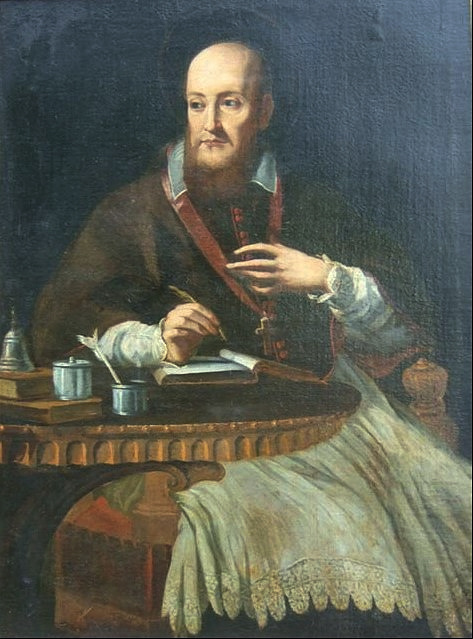
FEATURE Image: St. Francis de Sales, 18th c, Besançon, 96 x 131 cm. Public Domain.

St. Francis de Sales stands as one of Christianity’s most practical and accessible spiritual teachers because he showed that holiness is attainable in ordinary daily life through love, gentleness, humility, perseverance, and faithful acceptance of God’s will. His enduring importance lies not only in his role as Bishop of Geneva and founder of the Visitation Order, but in his ability to translate Catholic doctrine into practical spiritual guidance for everyday people.
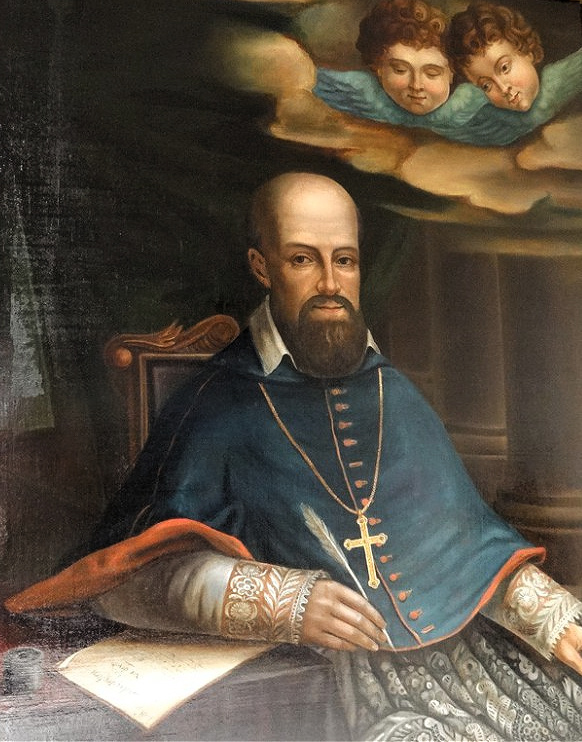
Saint Francis de Sales sitting in front of a copy of his work, “Introduction to the Devout Life,” oil on canvas, c.1790s, 77 cm x 99.5 cm, unknown artist. Hovering above the 17th century French Catholic bishop, saint, and Doctor of the Church are two cherubs who regard him with kindness. Public Domain. Francis de Sales became one of the most respected theologians in Christianity. A great preacher and writer, Francis de Sales ascended the seat of Bishop of Geneva, Switzerland, and, with widowed Baroness Jeanne de Chantal (1571-1641), founded the religious order of the Visitation. As a diplomat and man of prayer, Francis de Sales exerted a significant influence within the Catholic Church and among the temporal powers of the day.  https://www.antiques-delaval.com/en/paintings/7068-hst-large-portrait-saint-francois-dirty-life-devote-cherubs-xviiieme.html -retrieved January 24, 2023. Public Domain.

CANONIZED ON APRIL 8, 1665, IN ROME BY POPE ALEXANDER VII, ST. FRANCIS DE SALES IS THE PATRON OF WRITERS, JOURNALISTS, THE CATHOLIC PRESS, CONFESSORS, THE DEAF AND EDUCATORS. ST. FRANCIS WAS DECLARED A DOCTOR OF THE CHURCH IN 1877 BY PIUS IX.

INTRODUCTION.

By all accounts, St. Francis de Sales (1567-1622), whose feast day is January 24, was a gracious and holy man. His writings were, similar to the Jesuits of whom Francis was a student, admirer and close friend, directed to society’s well-to-do and concerned with how, as society’s current elites, they can practice, most basically, Christian “noblesse oblige” within their privileged social station. St. Francis de Sales’ writing defended and explained Catholic doctrine to a Europe which, in an age of Renaissance and Reformation, was very much in revolt against it. To preserve and endorse (1) a social order and (2) perfect belief in doctrine, St. Francis de Sales communicated in everything that both were attainable simultaneously, and did so famously in his book, Introduction to the Devout Life (1608).

Like the sons of St. Ignatius of Loyola, St. Francis de Sales was active in the direction of souls. For Introduction to the Devout Life, Jesuit father Jean Fourier, S.J. strongly encouraged a noble lady around 1607 to prevail upon her local bishop (de Sales) to have his personal writings of spiritual direction to her and others printed to reach a wider audience at court and elsewhere among the ruling class. St. Francis de Sales was also eager to have his personal instructions in print for the advancement and perfection of individual souls. Introduction to the Devout Life became an instant international bestseller and, over 400 years later, remains a spiritual classic. As John K. Ryan, S.J. observed, “Its greatness lies in many things: in its originality, its completeness, its sincerity, its balance, its penetration and its style…(and) as such it is beyond adverse criticism in any important way.”1

His spiritual classic, Introduction to the Devout Life (1608), taught that holiness is not reserved for priests or religious but can be pursued by people living ordinary lives in the world. His writings emphasized gentleness over harshness, love over fear, and steady spiritual growth rather than dramatic religious experiences.

Francis Bonaventure was born into nobility in August 1567 in Sales castle in Savoy, France, where there were tremendous social pressures to marry and settle into a life of wealth and prestige. Sent to Paris by his family, they wanted him to attend the prestigious College of Navarre in the fine hôtel de Navarre with its renowned library in rue Saint André des Arts, but Francis chose to attend the new Jesuit College of Clermont, which at that time was known for its religious and moral vision as much as its academic achievement.2 At the Jesuit school St. Francis de Sales came into contact with the post-Tridentine humanism taught by faculty such as Father Possevin, S.J. and Francis took to it like a duck to water so that he could express its intellectual tenets afterwards quite well.3 St. Francis de Sales worked out his spiritual life in prayer in Saint-Étienne-des-Grès in the Latin Quarter. The church (now demolished) on Rue Saint-Jacques was the center for Christianity among students. Another saintly Frenchman who later frequented Saint-Étienne-des-Grès was St. Vincent de Paul (1581-1660). Francis de Sales as a college-age layman was finding he had serious religious scruples and temptations to lust.4 it was in Saint-Étienne-des-Grès that St. Francis de Sales ultimately took a personal vow of chastity before a statue of the Virgin Mary which allowed him to pursue his spiritual desires.

After studying for five more years at the University of Padua, St. Francis de Sales emerged in 1591 with the equivalent of a J.D.- Ph.D. and was ordained a priest in 1593. In those years the young nobleman was surrounded by the Renaissance writings of philosophers and poets such as Marsiglio Ficino (1433-1499), Giovanni della Casa (1503-1556) and contemporary French theologian Pierre Charron (1541-1603).5 Now in his mid-20’s Francis was given by his bishop the nearly impossible task to reconvert John Calvin’s citizens of Geneva to Catholicism. Needless to say, Francis’s efforts failed. In fact, the Wars of Religion (1562-1598) were in full swing and made for impassioned attitudes on all sides and complicated factors in politics. An individual, Protestant or Catholic, had to practice their faith in a fragmented society.6

In 1602 St. Francis de Sales was sent to Paris to negotiate the condition of Catholics in reconverted territories in France. As a diplomat St. Francis de Sales was smooth – peaceful, positive, charitable and temperate in his words and persona. At meetings taking place at the court of French King Henry IV ( (1553-1610), St. Francis de Sales met some of the great figures of the religious and mystical revival occurring in France including Henri, Duc de Joyeuse (1563–1608), a General commander in the Wars of Religion and member of the Catholic League who became a Capuchin Franciscan after the death of his wife, Catherine de La Valette; Pierre de Bérulle (1575-1629), one of the most important mystics of 17th century France and, later, a Catholic cardinal; and Madame Acarie (1566-1618), mother of seven children, and foundress and lay sister of the Discalced Carmelites in France. She was perhaps the most widely respected religious person in Paris and certainly the go-to contact for the wealthy whenever they desired to help the poor because she made sure their alms got to the poor and not the professional charitable class. St. Francis de Sales, a respected theologian, also influenced the temporal powers – the dukes of Savoy, Charles Emmanuel I (1562-1630) and Victor Amadeus I (1587-1637), the regent of Savoy Christine de France and kings Henry IV and Louis XIII of France.

Charles Emmanuel I. Duke of Savoy (1562-1630) by Jan Kraeck. Public Domain.
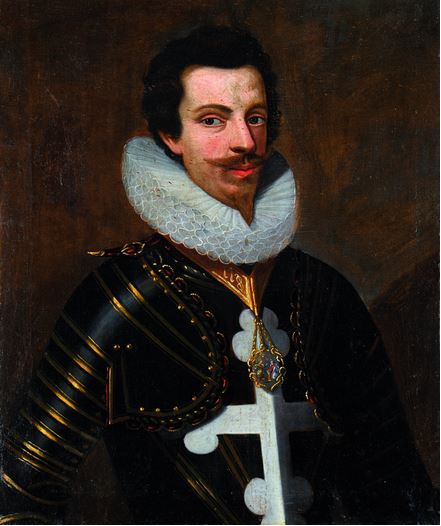
Victor Amadeus I (1587-1637), artist unknown. Public Domain.

St. Francis de Sales (1567-1622) became one of the most respected Catholic theologians, writers, preachers, and spiritual directors of the Counter-Reformation era.

In July 1602 following the death of Bishop Grenier, St. Francis de Sales became Bishop of Geneva. Francis de Sales traveled ceaselessly around the diocese and beyond, preaching and hearing confessions, and the people quickly realized they had a holy bishop. It was by way of one of his penitents, St. Jeanne-Françoise de Chantal (1572-1641), that St. Francis de Sales worked his vision of the foundation of a new order, the Visitation, whose charism was to serve the sick and the poor with “the charity and gentleness of Jesus Christ.”7

St. Francis de Sales with Sisters of the Visitation, Francisco Bayeu y Subias (1734-1795), c. 1760, oil on canvas, 56 x 34 cm, Prado, Madrid, Spain. The 18th century painting, once in the Royal Collection, is today housed in a regional art museum in Salamanca. Public Domain. It was by way of one of his penitents, St. Jeanne-Françoise de Chantal (1572-1641), that St. Francis de Sales worked his vision of the foundation of a new order, the Visitation, whose charism was to serve the sick and the poor with “the charity and gentleness of Jesus Christ.” https://www.museodelprado.es/coleccion/obra-de-arte/san-francisco-de-sales/540cb0b9-ca15-4c43-b011-d2d71f7c5820?searchMeta=san%20francis – retrieved January 24, 2023. Francisco Bayeu y Subías (1734-1795) is one of the leading of Spanish late Baroque painters using quick and fluid touches and vivid and exquisite colors though later assuming neoclassicism with formal, sometimes cold, pictures based rigorous observation of nature. Bayeu, born in Zaragoza, trained there in the workshop of Danish painter Juan Andrés Merklein (1716-1797) and in the drawing classes of José Luzán Martínez (1710-1785). In 1758 at 24 years old  he obtained a two-year scholarship to the Academy of San Fernando in Madrid, but left two months later because of disputes with the professor Antonio González Velázquez (1723–1793). Bayeu returned to Zaragoza and painted several commissions for churches and convents. In 1762 he was helping German painter Anton Raphael Mengs (1728-1779) in the decoration of the Palacio Nuevo. Thanks to Mengs’ influence, Bayeu started his decorative collaborative undertakings that earned him the appointment of court painter in 1767. He worked mainly as a fresco painter. In addition to his courtly commissions, he did church commissions such as of the vaults of the Holy Chapel of the Basilica of Nuestra Señora del Pilar completed in 1776. He painted 11 scenes for the the cloister of the Cathedral of Toledo between 1776 and 1787. He was then entrusted with the decoration of the royal chapel in the Palace of Aranjuez. After Mengs’s departure in 1777 for Rome, Francesco Bayeu assumed all Mengs’ duties as first painter, though not obtaining the appointment. Like other Spanish artists he worked developing cartoons for Real Fábrica de Tapices de Santa Bárbara  (Royal tapestry Factory). Bayeu supervised the work of a talented newcomer, Francisco Goya (1746- 1828) who was Bayeu’s brother-in-law since 1773. In 1785 Charles III entrusted Bayeu and Mariano Salvador Maella Pérez (1739 –1819) with the restoration of the paintings in the royal collections. When he fell ill in 1786, Goya replaced Bayeu at the Academy of San Fernando, which Bayeu had been director of painting. Despite declining health from overwork, the commissions kept coming in. The Prince and Princess of Asturias hired Bayeu for the decoration of the dining room vault in the Palace of El Pardo. Bayeu returned to Zaragoza in 1788 until he was called again in 1791 to Aranjuez where he painted for the oratory of the Royal Palace and the vault of the King’s bedroom. This would be his last work when he died, in Madrid, in 1795. see – https://www.museodelprado.es/coleccion/artista/bayeu-y-subias-francisco/b218fee4-053b-4656-8577-9aa001ad1989 – retrieved January 24, 2025.

It was in this first decade of the 17th century amidst this flurry of evangelizing and other activity that the 40-something bishop wrote the Introduction to the Devout Life (1608). The book, written in short chapters with titles on topical challenges, problems, and opportunities in the Christian life in the world, provides its responses based on practical counsels. The Introduction to the Devout Life much as his later work, On Love of God, are very reliant on the Bible for its teaching and sprang directly from the bishops’ care of souls that he was doing actively and sacramentally from his diocese in southeastern France. Francis’s generous range of literary sources reflected his education in Renaissance humanism and included classical authors, Montaigne, contemporary poets as well as medieval saints and spiritual writers such as Sts. Anselm, Bonaventure and Bernard. Francis was also familiar with the writings and religious vision of the 16th century Spanish mystics and saints such as Teresa of Avila and Ignatius of Loyola.8

The exceedingly practical St. Vincent de Paul observed about St. Francis de Sales’ On the Love of God: “A truly admirable book, which has as many admirers of the sweetness of its author as it has readers. I have carefully arranged that it shall be read throughout our Society [the Vincentians], as the universal remedy for all feeble ones, the good of slothful ones, the stimulus of love, and the ladder of those who are tending to perfection. Oh! that all would study it as it deserves! There should be no one to escape its heat.”9

A recurring theme in his counsel is that Christians should focus on today’s duties, trust in divine providence, and avoid anxiety about the future. He taught that charity and love are the measure of all Christian action, giving value even to the smallest tasks when performed for God.

St. Francis de Sales by J. J. Owens. c. 1905, based on the Turin portrait. Public Domain.

St. Francis de Sales, now in his early 50s, visited Paris in 1618 where he preached sometimes twice each day. His great work was to show how ordinary daily life, particularly a busy and successful life, could be a path of holiness. No issue was too large or small for the saint to address – from parties, clothes, flirtations, daily life among marrieds – but all directed to the purpose of imitation of Christ and the love of God. St. Francis takes for granted one’s daily life in French society and proposes no maxim which involves any violent upheavals from it. Part of the saint’s genius is to see that there can be no dispute between the social order and the Christian life. At the same time, St. Francis is no easy teacher or grader – he asks that the Christian virtues be upheld and practiced. That insistence on Christian virtue informing one’s daily life is also the genius of his doctrine. While highly educated and imbued with the grace of mind of the Renaissance, St. Francis carried naturally within himself and conveyed the wisdom of the French soil of Savoy, its terroir. As Francis took one’s daily life in French society for granted, he took Catholic doctrine as if for granted. He then explained it with a highly cultivated mind and gracious spirit that expressed itself with a sweetness and gentleness of style that expounded it as “the universal remedy…the stimulus of love…the ladder …to perfection” as St. Vincent de Paul recognized to those with faith or not, or in trouble in day-to-day life.

St. Francis de Sales perhaps speaks to the 21st century most clearly by way of his theology that is presented without sentimentality or melodrama and is clearly explained and lived to be particularly possible and desirable. Francis said: “He who lives for God, frequently thinks of Him during all the occupations of life.”12

January 24 is the memorial feast day of St. Francis de Sales on the General Roman Calendar of 1969. St. Francis de Sales is the patron of writers, journalists, the Catholic press, confessors, the deaf and educators. He was proclaimed a saint and doctor of the Catholic Church. The following quotes are taken from his many published works of spiritual edification, counsel, exhortation, and solace.

Canonized in 1665 and declared a Doctor of the Church in 1877, St. Frances De Sales remains the patron saint of writers, journalists, educators, confessors, and the Catholic press.

NOTES:

  1. Introduction to the Devout Life, St. Francis de Sales, trans. and edited by John K. Ryan, Image books (Doubleday) Garden City New York, 1955, p.11.
  2. Francis de Sales and Jane de Chantal: Letters of Spiritual Direction, trans. by Péronne Marie Thibert, V.H.M. and selected and introduced by Wendy M. Wright and Joseph F. Power, O.S.F.S. Paulist Press New York, 1988 p.19.
  3. CF. Elisabeth Stopp, “St. Francis de Sales at Clermont College,” in Salesian Studies, 6 (Winter 1969). pp. 42-43.
  4. Wright & Power, p. 20.
  5. Wright & Power, p. 22.
  6. The Saints: A Concise Biographical Dictionary, edited by John Coulson, Guild Press, New York, 1957, p. 305.
  7. Ibid.
  8. Wright & Power, p. 28.
  9. https://www.ccel.org/ccel/desales/love.all.html – retrieved January 23, 2023.
  10. The Saints: A Concise Biographical Dictionary, edited by John Coulson, Guild Press, New York, 1957, p. 305.
  11. On the Love of God – https://www.ccel.org/ccel/desales/love.all.html – retrieved January 23, 2023.
  12. Maxims and counsels of St. Francis de Sales for every day in the year, Ella McMahon, M.H. Gill & Son, Dublin, 1884, p. 12.

QUOTATIONS.
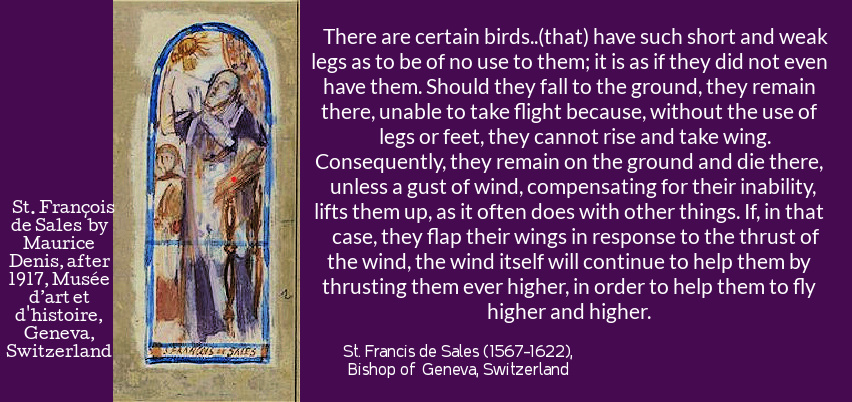
There are certain birds..(that) have such short and weak legs as to be of no use to them; it is as if they did not even have them. Should they fall to the ground, they remain there, unable to take flight because, without the use of legs or feet, they cannot rise and take wing. Consequently, they remain on the ground and die there, unless a gust of wind, compensating for their inability, lifts them up, as it often does with other things. If, in that case, they flap their wings in response to the thrust of the wind, the wind itself will continue to help them by thrusting them ever higher, in order to help them to fly higher and higher.
Keep yourself faithfully in the presence of God. Avoid hurry and anxiety, for there are no greater obstacles to our progress in perfection.
Cast your heart gently, not violently, into the wounds of our Savior and have an unlimited confidence in his mercy and goodness.
To make good progress we must devote ourselves to getting over that portion of the path which lies close before us, and not amuse ourselves with the desire to attain the last step before we have accomplished the first.
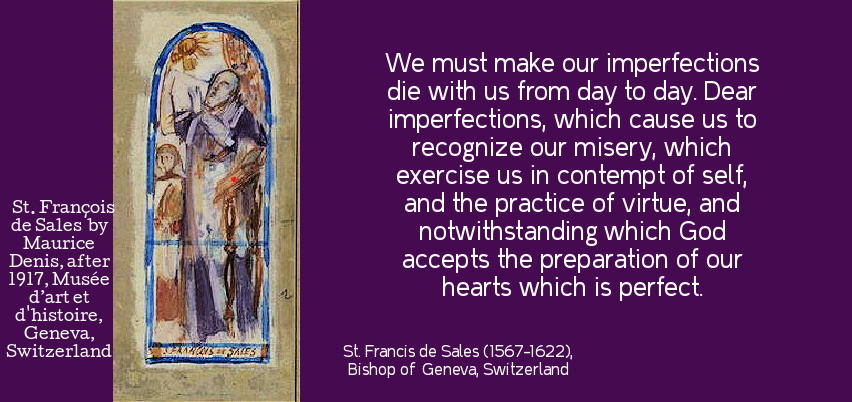
We must make our imperfections die with us from day to day. Dear imperfections, which cause us to recognize our misery, which exercise us in contempt of self, and the practice of virtue, and notwithstanding which God accepts the preparation of our hearts which is perfect.
I recommend simplicity to you; look before you, and not at the dangers which you behold in the distance. Keep your will firmly bent upon serving God with your whole heart. While you are thus occupied in forecasting the future you expose yourself to some false step.
Have no care for tomorrow. Think only of doing well today. And when tomorrow shall have become today, then we shall think about it.
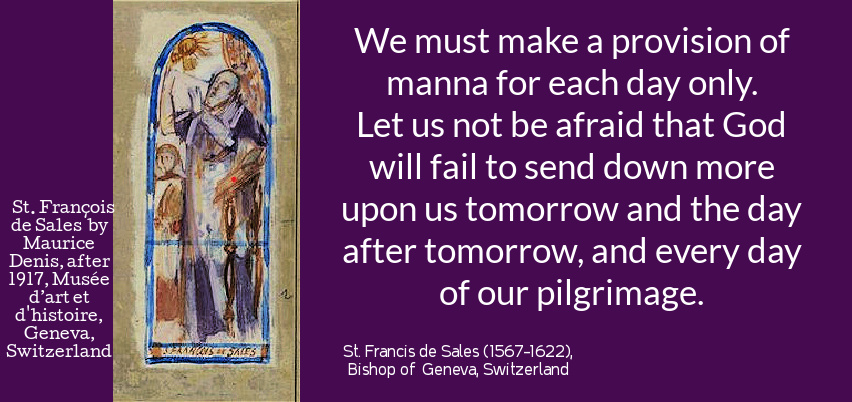
We must make a provision of manna for each day only. Let us not be afraid that God will fail to send down more upon us tomorrow and the day after tomorrow, and every day of our pilgrimage.
Since the Heart of our Lord has no more loving law than meekness, humility, and charity, we must firmly maintain these dear virtues in us.
True sanctity lies in love of God, and not in foolish imaginings, raptures, &c. Let us devote ourselves to the practice of true meekness and submission, to renouncement of self, to docility of heart, to love of abjection, to consideration for the wishes of others : this is true sanctity and the most amiable ecstasy of the children of God.
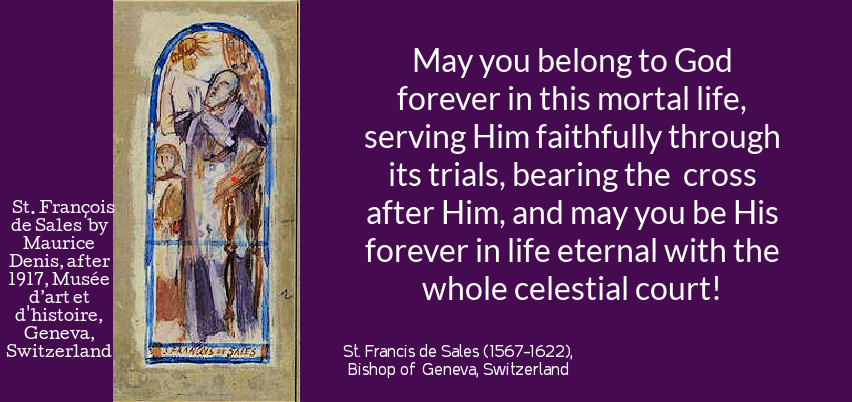
May you belong to God forever in this mortal life, serving Him faithfully through its trials, bearing the cross after Him, and may you be His forever in life eternal with the whole celestial court!

https://www.vatican.va/content/francesco/en/apost_letters/documents/20221228-totum-amoris-est.html – APOSTOLIC LETTER TOTUM AMORIS EST (it’s all about love)
OF THE HOLY FATHER FRANCIS ON THE FOURTH CENTENARY OF THE DEATH
OF SAINT FRANCIS DE SALES
, dated December 28, 2022 – retrieved January 28, 2023.

The great good of our souls is to live for God, and the greatest good to live for God alone. He who lives but for God is never sad, save at having offended God.
He who lives for God, frequently thinks of Him during all the occupations of life.

Saint Francis gives the rule to Saint Jeanne de Chantal (Study for the Chapel of the Visitation at Nantes), 19th century, Elie Delaunay (1828-1891), Louvre. Public Domain.

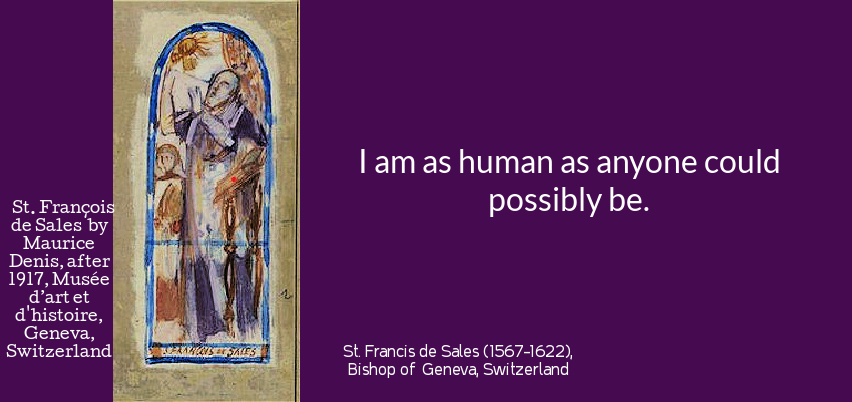
The reason persons are in the world is to receive and carry the gentle Jesus: on our tongue by proclaiming him and in our arms by doing good works.
I am as human as anyone could possibly be.
See the divine lover at the gate. He does not simply knock once. He continues to knock. He calls the soul: come, arise my beloved, hurry!…In short, this divine Savior forgets nothing to show that his mercies are above all his works, are greater than his judgment.
Solitude has its assaults, the world its busyness – in either place we must be courageous since in either place divine help is available to those who trust God and humbly and gently ask for his fatherly assistance.
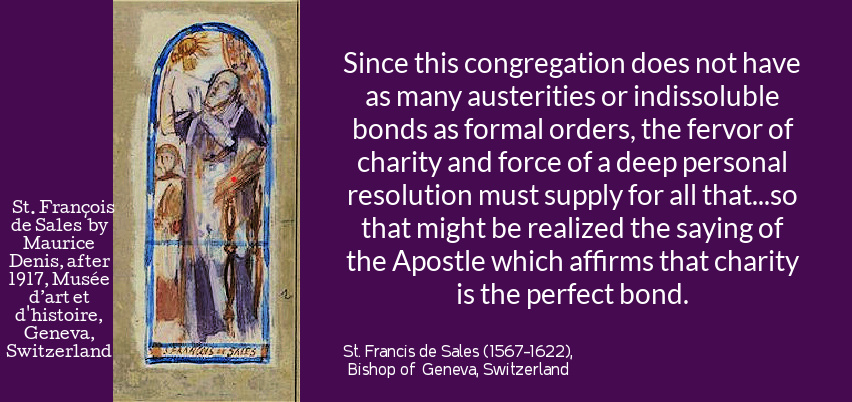
Since this congregation does not have as many austerities or indissoluble bonds as formal orders, the fervor of charity and force of a deep personal resolution must supply for all that…so that might be realized the saying of the Apostle which affirms that charity is the perfect bond.

Saint François de Sales blesses Saint Jeanne de Chantal, Chapelle de la Visitation at Nantes n° 61 XIXe siècle. Elie Delaunay (1828-1891), Musée d’Arts de Nantes. Public Domain.

It is the height of holy disinterestedness to be content with naked, dry, and insensible acts carried out by the superior will alone….In the end, the savior wants us to be His so perfectly that nothing else remains for us, and to abandon ourselves to His providence without reservation.
Since the heart is the source of all our actions, as the heart is, so are they.
For myself, I cannot approve the methods of those who try to reform a person by beginning with external things, such as bearings, dress or hair. On the contrary, it seems to me that we should begin inside.
I beg you, my dear Sister, govern your community with a great expansiveness of heart…The more solicitous, open, and supportive you are with them, the more you will win their hearts.
I had the courage to my give [my own dying mother] the last blessing, to close her eyes and mouth and to give her the last kiss of peace at the moment she passed away; after which my heart swelled and I wept….

Saint Francis de Sales healing a lame man, Chapelle de la Visitation at Nantes n° 61
XIXe siècle. Elie Delaunay (1828-1891), Musée d’Arts de Nantes.
Public Domain.

Then let us belong wholly to Him, and live but for Him, desiring only to please Him, and for his creatures in Him, through Him, and for Him. Make your little efforts sweetly, peacefully, and amiably to please this Sovereign Goodness, and do not be astonished at difficulties.
We must be constant in aspiring to the perfection of holy love, in order that love may be perfect. For the love which seeks anything less than perfection cannot fail to be imperfect.
Never permit your soul to be sad and live in bitterness of spirit or scrupulous fear, since He who loved it and died to give it life is so good, so sweet, so amiable.
God, who calls us to Him, sees how we are approaching, and will never permit anything to happen but what is for our greater good. God knows what we are, and will hold out his paternal hand to us in a difficult step, in order that nothing may stop us.
God has preserved you so far. Only keep yourself faithful to the law of his providence and He will assist you at all times. And where you cannot walk, He will carry you.

Saint Francis de Sales healing a lame man, Chapelle de la Visitation at Nantes n° 61
XIXe siècle. Elie Delaunay (1828-1891), Musée d’Arts de Nantes.
Public Domain.

An over-sensitive mind can neither receive nor endure anything without telling of it, and it is always a little astonished at the lowly places which humility and simplicity choose.
I see you with your vigorous heart which loves and wills powerfully. I like it, for what are those half -dead hearts good for? We must make a particular exercise once every week of willing to love the will of God more tenderly, more affectionately than anything in the world, and that, too, not only in bearable but in the most unbearable events.
Plant in your heart Jesus Christ Crucified, and all the crosses of this world will seem to you like roses.
Lord Jesus, without reserve, without an if, or a but, without exception or limitation, may you holy will be done in all things and at all times.
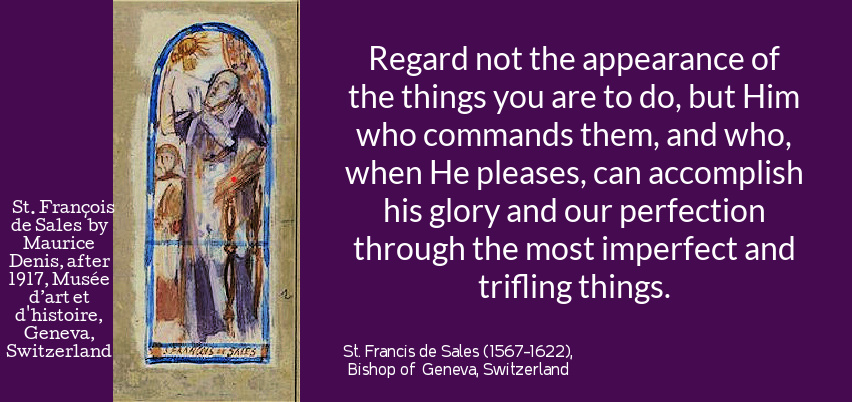
Regard not the appearance of the things you are to do, but Him who commands them, and who, when He pleases, can accomplish his glory and our perfection through the most imperfect and trifling things.
 

Painting of St. Francis de Sales in Don Bosco’s rooms at the Oratory of St. Francis de Sales in Turin. Public Domain.

Behold this great Artisan of mercy. He converts our miseries into graces and our iniquities into salutary remedies for our souls. Tell me, I pray, what will He not do with the afflictions, the labors, the persecutions which assail us?
Never think you have attained the purity of heart which you owe to God until your will is freely and joyfully resigned to his holy will in all things, even in the most repugnant.
Daily strengthen yourself more and more in the resolution, which you formed with so much affection, of serving God according to his good pleasure. Regard Him who commands them and, when He pleases, can accomplish his glory and our perfection through the most imperfect and trifling things.
A true servant of God has no care for tomorrow, but performs faithfully what is required today, and tomorrow will do what is required without a word.
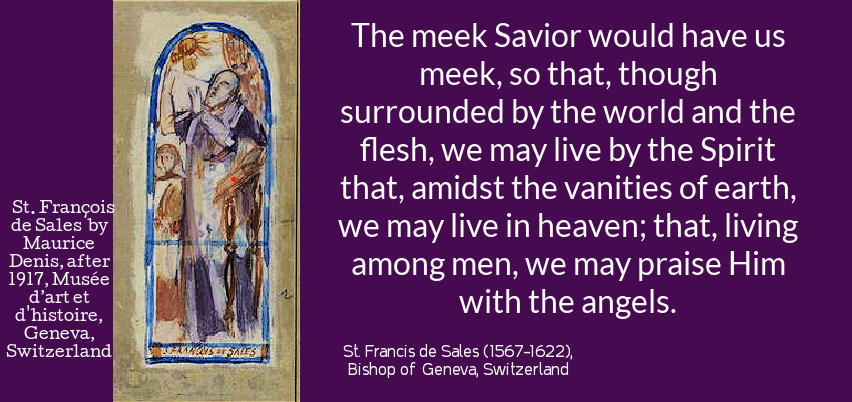
The meek Savior would have us meek, so that, though surrounded by the world and the flesh, we may live by the Spirit that, amidst the vanities of earth, we may live in heaven; that, living among men, we may praise Him with the angels.

St. Francis de Sales, 18th c, Besançon, 96 x 131 cm. Public Domain.

Here is the great lesson – we must discover God’s will, and, recognizing it, endeavor to do it joyfully, or at least courageously.
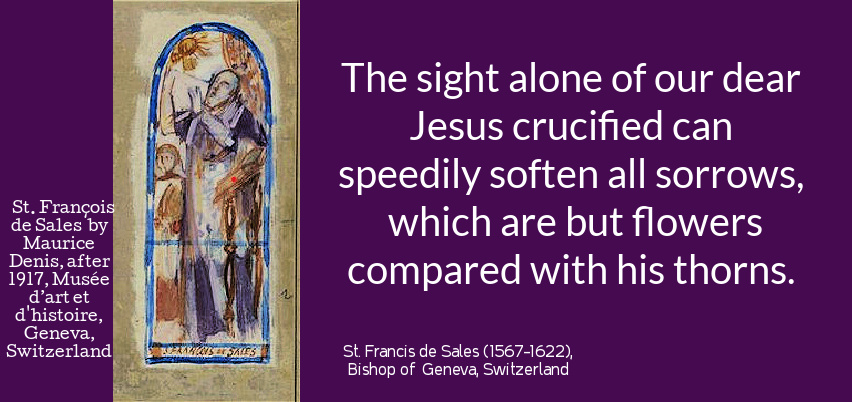
The sight alone of our dear Jesus crucified can speedily soften all sorrows, which are but flowers compared with his thorns.
Our great rendezvous is an eternal heaven and compared with the price of eternity, what are the things which end with time?
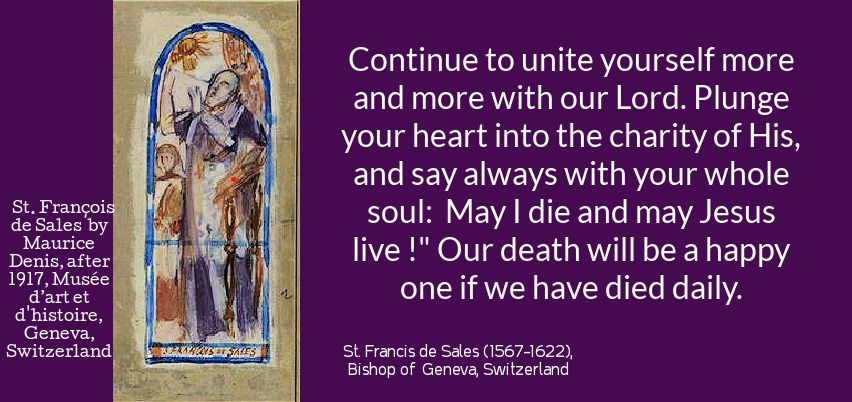
Continue to unite yourself more and more with our Lord. Plunge your heart into the charity of His, and say always with your whole soul: May I die and may Jesus live !” Our death will be a happy one if we have died daily.
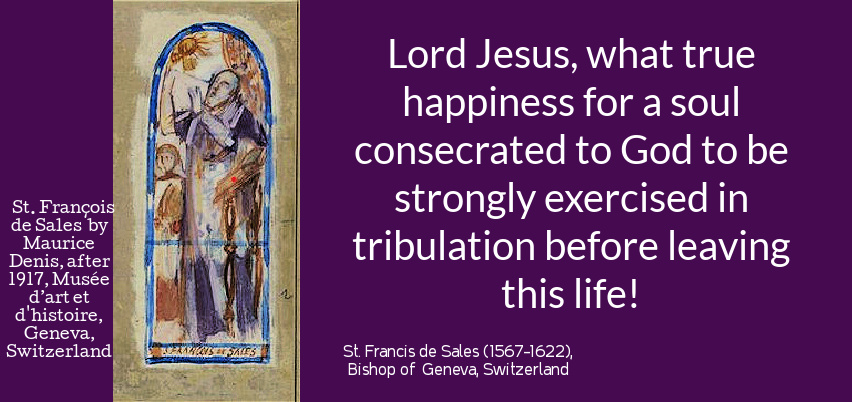
Lord Jesus, what true happiness for a soul consecrated to God to be strongly exercised in tribulation before leaving this life!

Saint Francis Sales, antique pendant, Lyon, France. Public Domain.

Nothing can give us deeper peace in this world than to frequently contemplate our Lord in all the afflictions He endured from his birth to his death. Contempt, calumnies, poverty, abjection, weariness, suffering, nakedness, wrongs, and grief of every kind.
Let us faithfully cultivate that resignation and pure love of God which is never wholly practiced but amid sufferings. For to love God, when He feeds us with sweetness is nothing more than children do. But to love God when He feeds us with gall is to offer Him the cup of our loving fidelity.
It is not in my power to propose to Him anything for you, save that He may, according to his holy will, fashion your heart for his dwelling, and reign there eternally. And whether He fashion it with the brush, hammer, or chisel, must be according to his good pleasure.
I desire that your cross and mine should be wholly the cross of Jesus. This or that burden, or making any choice, God knows what He is doing and why He does it. It is certainly for our good.
God wishes that, like Job, I should serve Him in the midst of dryness, suffering, and temptation. Like St Paul, that I serve Him according to His desire. You will see that one day He will do all and even more than you can desire.

St. Francis de Sales. medallion. Public Domain.

At the very thought of God, one immediately feels a certain delightful emotion of the heart, which testifies that God is God of the human heart.
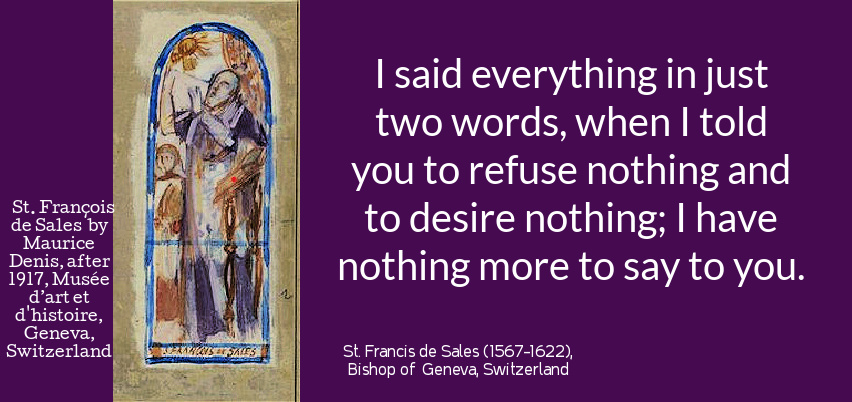
I said everything in just two words, when I told you to refuse nothing and to desire nothing; I have nothing more to say to you.
Do you see the baby Jesus in the crib? He accepts all the discomforts of that season, the bitter cold and everything that the Father lets happen to him. He does not refuse the small consolations that his Mother gives him; we are not told that he ever reached out for his Mother’s breast, but left everything to her care and concern. So too, we ourselves should neither desire nor refuse anything, but accept all that God sends us, the bitter cold and the discomforts of the season.
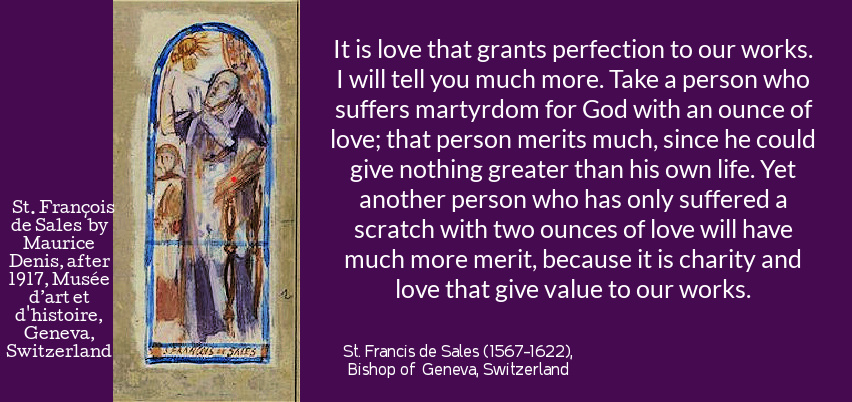
It is love that grants perfection to our works. I will tell you much more. Take a person who suffers martyrdom for God with an ounce of love; that person merits much, since he could give nothing greater than his own life. Yet another person who has only suffered a scratch with two ounces of love will have much more merit, because it is charity and love that give value to our works.
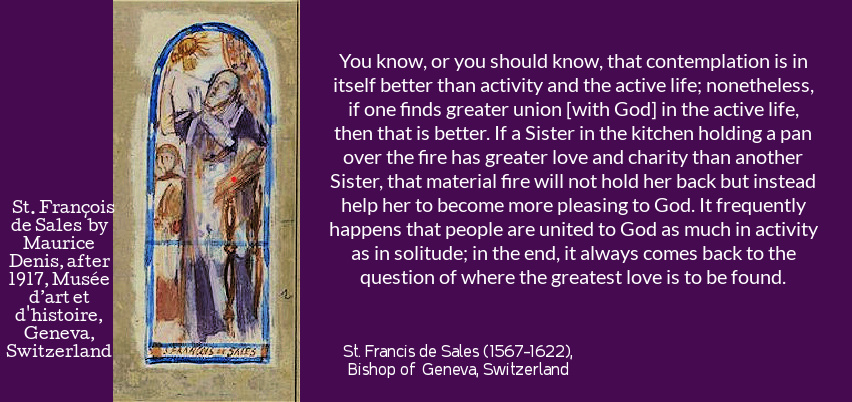
You know, or you should know, that contemplation is in itself better than activity and the active life; nonetheless, if one finds greater union [with God] in the active life, then that is better. If a Sister in the kitchen holding a pan over the fire has greater love and charity than another Sister, that material fire will not hold her back but instead help her to become more pleasing to God. It frequently happens that people are united to God as much in activity as in solitude; in the end, it always comes back to the question of where the greatest love is to be found.
In Holy Church, everything pertains to love, lives in love, is done for love and comes from love.
Whatever may happen, Lord, you who hold everything in your hands and whose ways are all justice and truth, … I will love you, Lord, … I will love you here, O my God; I will hope always in your mercy and ever repeat your praise… O Lord Jesus, you will always be my hope and my salvation in the land of the living.
I wonder whether another difficulty can also be raised concerning your reform: perhaps those who imposed it on you have treated the wound too harshly… I appreciate their method, although it is not what I am in the habit of using, especially with regard to noble and cultivated spirits like yours. I believe it is better simply to indicate the disease and put the scalpel in their hands, so that they themselves can make the necessary incision. Yet do not for this reason neglect the reform that you need.

Saint Jeanne de Chantal. antique pendant, Lyon, France. Public Domain.

The world is becoming so delicate that, in a little while, no one will dare any longer to touch it except with velvet gloves, or tend its wounds except with perfumed bandages; yet what does it matter, if only men and women are healed and finally saved? Charity, our queen, does everything for her children.
My intention is but to represent, with simplicity and straightforwardly, without artifice and certainly without false colors, the history of the birth, progress, decline, operations, properties, advantages and sublime qualities of divine love.
The power of grace does not constrain the heart, but attracts it. Grace possesses a holy violence, not to violate our liberty but to guide it to love. Grace acts strongly, yet in such a pleasing way that our will is not overwhelmed by so powerful a force; while pressing us, it does not oppress our liberty. Consequently, we are able, before all its might, to consent to or resist its promptings at our pleasure.
God’s inspirations, Theotimos, anticipate us and make themselves felt before we are even aware of them, but once we become aware of them, it is up to us either to consent and follow their lead, or to refuse and reject them. They make themselves felt by us without us; yet without us they do not bring about our consent.
All these fine people, commonly considered devout, most surely are not.
In the end, charity and devotion can be said to differ from one another as fire from a flame. Charity is a spiritual fire that, when fanned into flame, is called devotion. Devotion thus adds nothing to the fire of charity but the flame that makes charity prompt, active and diligent, not only in the observance of God’s commandments but also in the exercise of his divine counsels and inspirations.
Almost all those who have treated of devotion have sought to instruct persons living apart from the world, or at least they have taught a kind of devotion that leads to such isolation. I intend to offer my teachings to those who live in cities, in families, at court and who, by virtue of their state in life, are obliged to live in the midst of others.

From Oxford to Rome: How St. John Henry Newman (1801-1890) Followed Conscience in Search of Religious Truth.

N.B. – Vatican City, July 31, 2025 (UPI) — Pope Leo XIV will bestow St. John Henry Newman, the influential 19th-century Anglican convert, with the honor of “Doctor of the Church” [today].” Cardinal Newman was beatified by Pope Benedict XVI in 2010 and canonized by Pope Francis in 2019. With Pope Leo XIV’s action Card. St. Newman is now one of 38 “Doctors of the Church” whose ranks include four women. St. John Henry Newman became the first saint canonized from Britain since 1976.

FEATURE image: Photographic portrait, John Henry Cardinal Newman, 1880.

Canonized in 2019 and later declared a Doctor of the Church, Newman is a thinker whose relevance extends well beyond the 19th century.

 John Henry Newman, Oratory of St. Philip Neri, Birmingham, England.  London; New York; Bombay; Calcutta: Longmans, Green. Newman’s method of composing a sermon was to do so by heart and then write it down afterwards. English theologian James Mozley (1813-1878) who was active in the Oxford Movement, observed about these sermons: “A sermon of Mr. Newman’s enters into our feelings, ideas, and modes of viewing things. Persons look into Mr. Newman’s sermons and see their own thoughts in them.”

John Henry Newman was one of the most influential Christian thinkers of the modern era, whose journey from Anglican leader to Catholic cardinal, combined with his profound writings on truth, conscience, faith, reason, and holiness, continues to offer a model for navigating religious, intellectual, and cultural divisions.

Introduction by John P. Walsh

John Henry Newman (1801-1890) was a theologian and poet who was first an Anglican priest and later a Roman Catholic priest and cardinal. In the 1830’s and until his conversion to Catholicism in 1845, Newman was a leading figure in the Oxford Movement. They were a group of Anglicans who looked to create a bridge between the Church of England and the Catholic Church by adopting many Catholic beliefs and liturgical rituals from before the English Reformation. Newman eventually came to believe for himself that these religious efforts proved insufficient and he left the Anglican Communion for the Catholic Church in 1845. Already an articulate and influential religious leader in Britain, Newman’s decision brought with it the burden of having upset his friends as well as being challenged by them and others for his changed religious opinions on polemical grounds. Newman, a longtime writer and speaker, responded after a while with his now-celebrated Apologia Pro Vita Sua (1865–1866), which served as a defense of his religious opinions after he quit his position as Anglican vicar at Oxford. Newman, a 19th-century master of English prose and poetry, had already published The Idea of a University (1852) and went on to publish Grammar of Assent (1870) as well as several poems, some of which were set to music or served as hymns. In 1879, at the age of 78 years old, Pope Leo XIII named Newman a cardinal for his work on behalf of the Catholic Church in England as well as his having co-founded the Catholic University of Ireland in 1854, which today as University College Dublin is Ireland’s largest institution of higher learning. On October 13, 2019, John Henry Newman was canonized a Catholic saint at the Vatican by Pope Francis. St. John Henry Newman became the first saint canonized from Britain since 1976. In remarks by Prince Charles who led the British delegation to the Vatican for Newman’s canonization, the Prince of Wales said: “In the age in which he [Newman] attains sainthood, his example is needed more than ever – for the manner in which, at his best, he could advocate without accusation, could disagree without disrespect and, perhaps most of all, could see differences as places of encounter rather than exclusion.” London-born Cardinal Newman died in England in 1890 at 89 years old. He founded the Oratory at Birmingham in 1848 and through his writings spoke to many about the issues of faith, education, and conscience.

John Henry Newman began as an Anglican priest and leading figure in the Oxford Movement before converting to Catholicism in 1845. Newman became a major Catholic intellectual, publishing influential works on education, belief, doctrine, and the development of Christian thought.

A given opinion, as held by several individuals, even when of the most congenial views, is as distinct as are their faces. Oxford University sermons, 1843.

It is as absurd to argue men, as to torture them, into believing. Oxford University sermon, December 11, 1831.

His conversion cost him friendships and provoked controversy, prompting him to write Apologia Pro Vita Sua, one of the great religious autobiographies and defenses of conscience.

From the age of fifteen, dogma has been the fundamental principle of my religion: I know of no other religion; I cannot enter into the idea of any other sort of religion; religion, as a mere sentiment, is to me a dream and a mockery. Apologia Pro Vita Sua, 1864.

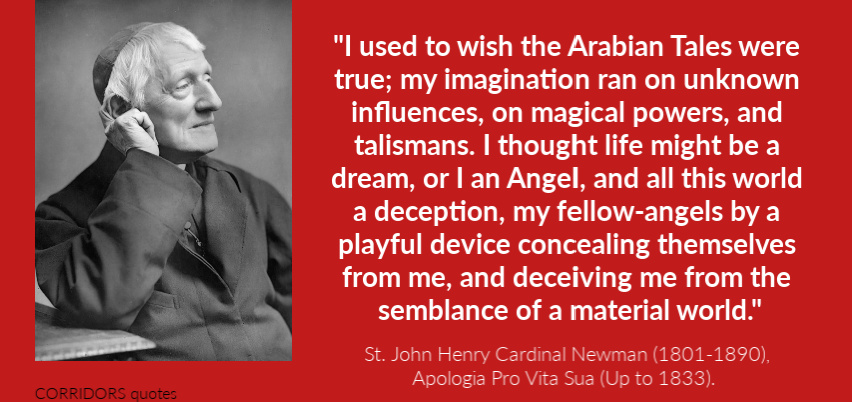
I used to wish the Arabian Tales were true; my imagination ran on unknown influences, on magical powers, and talismans. I thought life might be a dream, or I an Angel, and all this world a deception, my fellow-angels by a playful device concealing themselves from me, and deceiving me from the semblance of a material world. Apologia Pro Vita Sua (Up to 1833).

I was brought up from a child to take great delight in reading the Bible; but I had formed no religious convictions till I was fifteen. Of course I had perfect knowledge of my Catechism. Apologia Pro Vita Sua (Up to 1833).

I read Joseph Milner’s Church History, and was nothing short of enamoured of the long extracts from St. Augustine and the other Fathers which I found there. I read them as being the religion of the primitive Christians. Apologia Pro Vita Sua (Part III).

I read Newton on the Prophecies, and in consequence became most firmly convinced that the Pope was the Antichrist predicted by Daniel, St. Paul and St. John. My imagination was stained by the effects of this doctrine up to the year 1843. Apologia Pro Vita Sua (Part III).

There are virtues indeed, which the world is not fitted to judge about or to uphold, such as faith, hope and charity; but it can judge about Truthfulness; it can judge about the natural virtues, and truthfulness is one of them. Natural virtues may also become supernatural; Truthfulness is such… Apologia Pro Vita Sua (Part II).

Newman sought truth above party loyalty, holiness above comfort, and intellectual honesty above ideological conformity.

John Newman, 1841, Thomas Robinson Green?, collotype, 7 5/8 in. x 10 in. (195 mm x 255 mm). National Portrait Gallery, St Martin’s Place, London. https://www.npg.org.uk/collections/search/portrait/mw39717/John-Newman?LinkID=mp03281&wPage=1&role=sit&rNo=21

Catholics on the other hand shade and soften the awful antagonism between good and evil, which is one of their dogmas, by holding that there are different degrees of justification, that there is a great difference in point of gravity between sin and sin, that there is a possibility and the danger of falling away, and that there is no certain knowledge given to anyone that he is simply in a state of grace, and much less that he is to persevere to the end. Apologia Pro Vita Sua (Part III).

Let us seek the grace of a cheerful heart, an even temper, sweetness, gentleness, and brightness of mind, as well as walking in His light, and by His grace. Let us pray to Him to give us the ever-abundant, ever-springing love, which overpowers and sweeps away the vexations of life by its own richness and strength, and which above all unites us to Him, Who is the fountain and center of all mercy, loving kindness and joy. 17, Religious Joy (Sermon for Christmas Day), 1868.

Ex Umbris et Imaginibus in Veritatem! (From shadows and symbols into the truth!) Epitaph at Edgbaston.

He believed faith and reason worked together and rejected both blind skepticism and rigid rationalism. His writings emphasize the importance of truthfulness, conscience, reverence, humility, and intellectual integrity. His famous hymn Lead, Kindly Light emerged from a difficult period of illness, uncertainty, and spiritual reflection.

Lead, kindly Light, amid the encircling gloom; Lead thou me on! The night is dark, and I am far from home; Lead thou me on! Keep thou my feet: I do not ask to see the distant scene; one step enough for me. The Pillar of the Cloud, 1833.

Lead, Kindly Light is a hymn with words written in 1833 by Saint John Henry Newman as a poem titled “The Pillar of the Cloud.” The impetus for the poem was that young Newman, traveling in Italy, became ill and found himself stranded in Palermo, Sicily, without any passage out for almost a month.

To occupy his time, the 32-year-old Newman visited the many churches in Palermo but only when they were dark, abandoned and silent. Newman, then still an Anglican, didn’t attend any services.

Newman finally got a ship to England that sailed direct for Marseilles yet, between Corsica and Sardinia, the ship lay idle for a week from lack of wind. It was just at that point in his far-flung journey that the words, Lead Kindly Light, articulated themselves in Newman’s mind as he ached to go home.

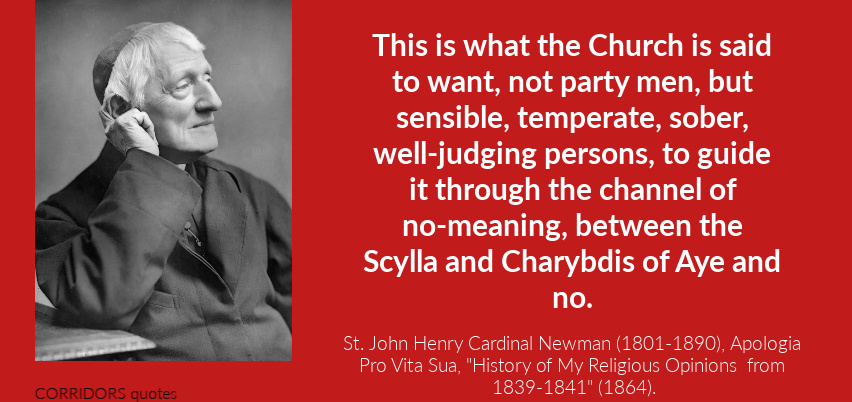
This is what the Church is said to want, not party men, but sensible, temperate, sober, well-judging persons, to guide it through the channel of no-meaning, between the Scylla and Charybdis of Aye and no. St. John Henry Cardinal Newman (1801-1890), Apologia Pro Vita Sua, “History of My Religious Opinions from 1839-1841” (1864).

John Henry Cardinal Newman, 1881, Sir John Everett Millais, 1st Baronet, President Royal Academy of Arts (1829-1896). National Portrait Gallery, London: https://www.npg.org.uk/collections/search/portrait/mw07727/John-Newman

Nature was a parable: Scripture was an allegory: pagan literature, philosophy, and mythology, properly understood, were but a preparation for the Gospel. St. John Henry Cardinal Newman (1801-1890), Apologia Pro Vita Sua, “History of My Religious Opinions from 1839-1841” (1864).

The Greek poets and sages were in a certain sense prophets; for “thoughts beyond their thought to those high bards were given.” St. John Henry Cardinal Newman (1801-1890), Apologia Pro Vita Sua, “History of My Religious Opinions from 1839-1841” (1864).

Holy Church in her sacraments and her hierarchical appointments, will remain even to the end of the world. Her mysteries are but expressions in human language of truths to which the human mind is unequal. St. John Henry Cardinal Newman (1801-1890), Apologia Pro Vita Sua, “History of My Religious Opinions from 1839-1841” (1864).

We may not speak of [Jesus] as we speak of any individual man, acting from and governed by a human intelligence within Him, but He was God, acting not only as God, but now through the flesh also, when He would. St. John Henry Cardinal Newman (1801-1890), Parochial and Plain Sermons, volume 6.

[Prophetic tradition] permeates the Church like an atmosphere, irregular in shape from its very profusion and exuberance. St. John Henry Cardinal Newman (1801-1890), Lectures on the Prophetical Office of the Church (1837).

Newman viewed disagreement as an opportunity for encounter rather than exclusion, a theme highlighted by then-Prince Charles at his canonization.

John Newman by George Richmond, chalk, 1844, 16 1/4 in. x 13 1/4 in. (413 mm x 337 mm), National Portrait Gallery, St Martin’s Place, London. https://www.npg.org.uk/collections/search/portrait/mw04655/John-Newman

John Henry Newman, after 1844. https://archive.org/details/newmanfran00barruoft/page/48/mode/2up?view=theater

The more claim an idea has to be considered living, the more various will be its aspects; and the more social and political is its nature, the more complicated and subtle will be its issues. St. John Henry Cardinal Newman (1801-1890), An Essay on the Development of Christian Doctrine.

And such mainly is the way in which all men, gifted or not gifted, commonly reason – not by rule, but by an inward faculty. St. John Henry Cardinal Newman (1801-1890), Fifteen Sermons preached before the University of Oxford.

If we insist upon being as sure as is conceivable, in every step of our course, we must be content to creep along the ground, and can never soar. St. John Henry Cardinal Newman (1801-1890), Fifteen Sermons preached before the University of Oxford.

If we are intended for great ends, we are called to great hazards; and, whereas we are given absolute certainty in nothing, we must in all things choose between doubt and inactivity. St. John Henry Cardinal Newman (1801-1890), Fifteen Sermons preached before the University of Oxford.

I am what I am, or I am nothing. I cannot think, reflect, or judge about my being, without starting from the very point which I am concluding…I cannot avoid being sufficient for myself, for I cannot make myself anything else, and to change me is to destroy me. St. John Henry Cardinal Newman (1801-1890), The Grammar of Assent (1870).

John Newman, 1864, McLean & Haes, albumen carte-de-visite, 3 5/8 in. x 2 1/4 in. (93 mm x 57 mm). National Portrait Gallery, St Martin’s Place, London. https://www.npg.org.uk/collections/search/portrait/mw125777/John-Newman?LinkID=mp03281&role=sit&rNo=10

A man who said “I cannot trust a cable, I must have an iron bar,” would, in certain given cases, be irrational and unreasonable: so too is a man who says I must have a rigid demonstration, not moral demonstration, of religious truth. St. John Henry Cardinal Newman (1801-1890), Letters & Diaries, volume 21.

We differ in our sense and use of the word “certain.” I use it of minds, you of propositions. I fully grant the uncertainty of all conclusions in your sense of the word, but I maintain that minds may in my sense be certain of conclusions which are uncertain in yours. St. John Henry Cardinal Newman (1801-1890), Letter to William Froude, April 29, 1879.

There is a great attempt to bring a new theory of Papal Infallibility, which would make it a mortal sin not to hold the Temporal Power necessary to the papacy. No one answers them and multitudes are being carried away. The pope gives ear to them and the consequence is there is a very extreme prejudice in the highest quarters at Rome against such as me. St. John Henry Cardinal Newman (1801-1890), Letter to James Hope Scott, April 11, 1867.

Really and truly I am NOT a theologian. A theologian is one who has mastered theology…and a hundred things besides. And this I am not and never shall be. St. John Henry Cardinal Newman (1801-1890), Letter to Maria Giberne, February 10, 1869.

To write theology is like dancing on the tight-rope some hundred feet above ground: it is hard to keep from falling, and the fall is great. St. John Henry Cardinal Newman (1801-1890), Letter to Emily Bowles, April 16, 1866.

Cardinal Henry Edward Manning is not a theologian, the pope is not a theologian, and therefore theology has gone out of fashion. I don’t profess to be a theologian, but at all events I should have been able to show a side of the Catholic religion more theological, more exact, than theirs. St. John Henry Cardinal Newman (1801-1890), Letter to Lord Blatchford, February 5, 1875.

There was true private judgment in the primitive and medieval schools. There are no schools now, no private judgment (in the religious sense of the phrase), no freedom of opinion. That is, no exercise of the intellect. This is a way of things which in God’s own time, will work its own cure of necessity. St. John Henry Cardinal Newman (1801-1890), Letter to Emily Bowles, May 19, 1863.

John Newman, c. 1845, Richard Woodman, after Sir William Charles Ross, stipple engraving, 11 1/2 in. x 9 1/2 in. (291 mm x 241 mm) plate size, National Portrait Gallery, St Martin’s Place, London. https://www.npg.org.uk/collections/search/portrait/mw198540/John-Newman?LinkID=mp03281&wPage=1&role=sit&rNo=24

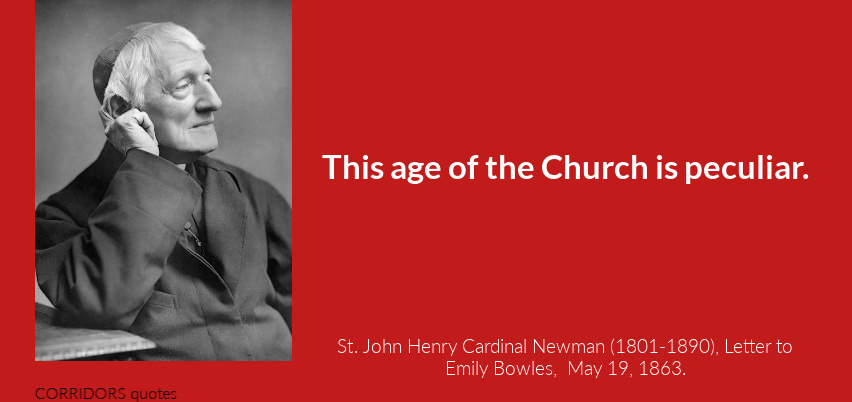
This age of the Church is peculiar. St. John Henry Cardinal Newman (1801-1890), Letter to Emily Bowles, May 19, 1863.

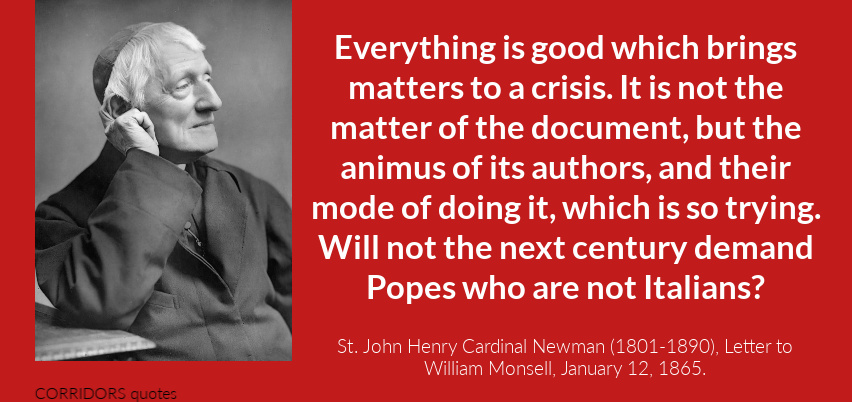
Everything is good which brings matters to a crisis. It is not the matter of the document, but the animus of its authors, and their mode of doing it, which is so trying. Will not the next century demand Popes who are not Italians? St. John Henry Cardinal Newman (1801-1890), Letter to William Monsell, January 12, 1865.

The Fathers made me a Catholic, and I am not going to kick down the ladder by which I ascended into the Church. It is a ladder quite as serviceable for that purpose now, as it was twenty years ago. St. John Henry Cardinal Newman (1801-1890), Letter to Rev. E. B. Pusey, D.D.

He maintained an independent mind, sometimes criticizing excesses and abuses within church governance while remaining deeply loyal to Catholic doctrine.

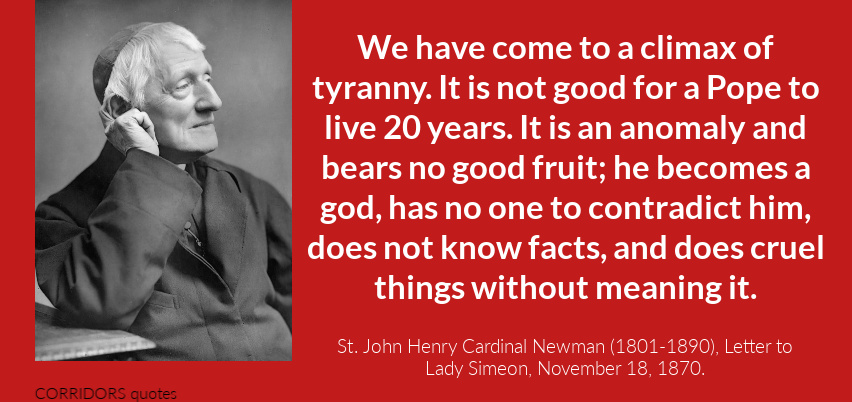
We have come to a climax of tyranny. It is not good for a Pope to live 20 years. It is an anomaly and bears no good fruit; he becomes a god, has no one to contradict him, does not know facts, and does cruel things without meaning it. St. John Henry Cardinal Newman (1801-1890), Letter to Lady Simeon, November 18, 1870.

There is no evil without its alleviation. St. John Henry Cardinal Newman (1801-1890), Letter to Bishop David Moriarty, November 14, 1866.

To be at once infallible in religion and a despot in temporals is perhaps too great for mortal man. St. John Henry Cardinal Newman (1801-1890), Letter to Mrs. William Frounde, January 2, 1871.

Truth is the guiding principle of theology and theological inquiries; devotion and edification, of worship; and of government, expedience. St. John Henry Cardinal Newman (1801-1890), The Via Media of the Anglican Church Illustrated in Lectures, Letters and Tracts written between 1830 and 1841.

The instrument of theology is reasoning; of worship, our emotional nature; of rule, command and coercion. Further, as man is, reasoning tends to rationalism; devotion to superstition and enthusiasm; and power to ambition and tyranny. St. John Henry Cardinal Newman (1801-1890), The Via Media of the Anglican Church Illustrated in Lectures, Letters and Tracts written between 1830 and 1841.

Now all of us are sinners, all of us have need to come to God as the Publican did; every one, if he does but search his heart, and watch his conduct, and try to do his duty, will find himself to be full of sins which provoke God’s wrath. I do not mean to say that all men are equally sinners; some are wilful sinners, and of them there is no hope, till they repent; others sin, but they try to avoid sinning, pray to God to make them better, and come to church to be made better; but all men are quite sinners enough to make it their duty to behave as the Publican. Every one ought to come into Church as the Publican did, to say in his heart, “Lord, I am not worthy to enter this sacred place; my only plea for coming is the merits of Jesus Christ my Saviour.” St. John Henry Cardinal Newman (1801-1890), Sermon, Reverence in Worship, October 30, 1836 (PPS-8).

To believe and not to revere, to worship familiarly and at one’s ease, is an anomaly and a prodigy unknown even to false religions, to say nothing of the true one…Worship, forms of worship — such as bowing the knee, taking off the shoes, keeping silence, a prescribed dress and the like — are considered as necessary for a due approach to God. Parochial and Plain Sermons, Vol. VIII — “Reverence in Worship,” October 30, 1836.

[Christ] is not past, He is present now. And though He is not seen, He is here. The same God who walked the water, who did miracles, etc., is in the Tabernacle. We come before Him, we speak to Him just as He was spoken to 1800 years ago, etc. This [is] how He counteracts time and the world… It is this that makes devotion in lives. It is the life of our religion. We are brought into the unseen world. St. John Henry Cardinal Newman (1801-1890), SN 127: May 25, 1856.

To consider the world in its length and breadth, its various history, the many races of man, their starts, their fortunes, their mutual alienation, their conflicts; and then their ways, habits, governments, forms of worship; their enterprises, their aimless courses, their random achievements and acquirements, the impotent conclusion of long-standing facts, the tokens so faint and broken of a superintending design, the blind evolution of what turn out to be great powers or truths, the progress of things, as if from unreasoning elements, not towards final causes, the greatness and littleness of man, his far-reaching aims, his short duration, the curtain hung over his futurity, the disappointments of life, the defeat of good, the success of evil, physical pain, mental anguish, the prevalence and intensity of sin, the pervading idolatries, the corruptions, the dreary hopeless irreligion, that condition of the whole race, so fearfully yet exactly described in the Apostle’s words, “having no hope and without God in the world,”—all this is a vision to dizzy and appal; and inflicts upon the mind the sense of a profound mystery, which is absolutely beyond human solution. St. John Henry Cardinal Newman (1801-1890), Apologia Pro Vita Sua, Chapter 5: Position of My Mind Since 1845.

What shall be said to this heart-piercing, reason-bewildering fact? I can only answer, that either there is no Creator, or this living society of men is in a true sense discarded from His presence. Did I see a boy of good make and mind, with the tokens on him of a refined nature, cast upon the world without provision, unable to say whence he came, his birth-place or his family connections, I should conclude that there was some mystery connected with his history, and that he was one, of whom, from one cause or other, his parents were ashamed. Thus only should I be able to account for the contrast between the promise and the condition of his being. And so I argue about the world;—if there be a God, since there is a God, the human race is implicated in some terrible aboriginal calamity. It is out of joint with the purposes of its Creator. This is a fact, a fact as true as the fact of its existence; and thus the doctrine of what is theologically called original sin becomes to me almost as certain as that the world exists, and as the existence of God. St. John Henry Cardinal Newman (1801-1890), Apologia Pro Vita Sua, Chapter 5: Position of My Mind Since 1845.

On October 13, 2019 in Rome then-Prince Charles attended the canonization of St. John Henry Newman (1801-1890) by Pope Francis. On July 31, 2025 Cardinal Newman—English Catholic theologian, academic, philosopher, historian, writer, and poet—was declared Doctor of the Church by Pope Leo XIV. On September 4, 2025, King Charles III became the first British monarch to visit the Oratory of St. Philip Neri in Birmingham which served as headquarters for the 19th century Catholic cardinal’s life and activities. On his visit, Charles III viewed the cardinal’s library as well as his personal items and the room where Newman died which has remained unchanged. John Henry Newman was born in London and grew up in the Church of England. He became an Anglican priest in 1825 and a leader of the Oxford Movement which sought affinities with Roman Catholicism. In 1845, in his mid-40’s, Newman became a Catholic and studied in Rome where he became a Catholic priest. Newman was always a prolific writer of letters, sermons and articles, and this continued throughout his life. The Cardinal often fell between the cracks – Anglicans mistrusting his Catholic “betrayal” and Catholics mistrusting his having been an Anglican. A cloud lifted in 1879 when Newman was named a cardinal of the Roman Church by Pope Leo XIII (1878-1903). After Rome, Newman returned to England in 1847 and founded the first English Oratory in 1848 here in Birmingham. Newman was soon joined by other English converts, including Father Wilfrid Faber (1814-1863) who Newman sent to London to establish its Oratory in 1849. After Newman was made a Cardinal in 1879, he lived at the Birmingham Oratory and died there in 1890. In 2008 Newman’s grave was opened so to move his remains into the Birmingham Oratory. But his wooden coffin was found to have disintegrated and no bones were found.

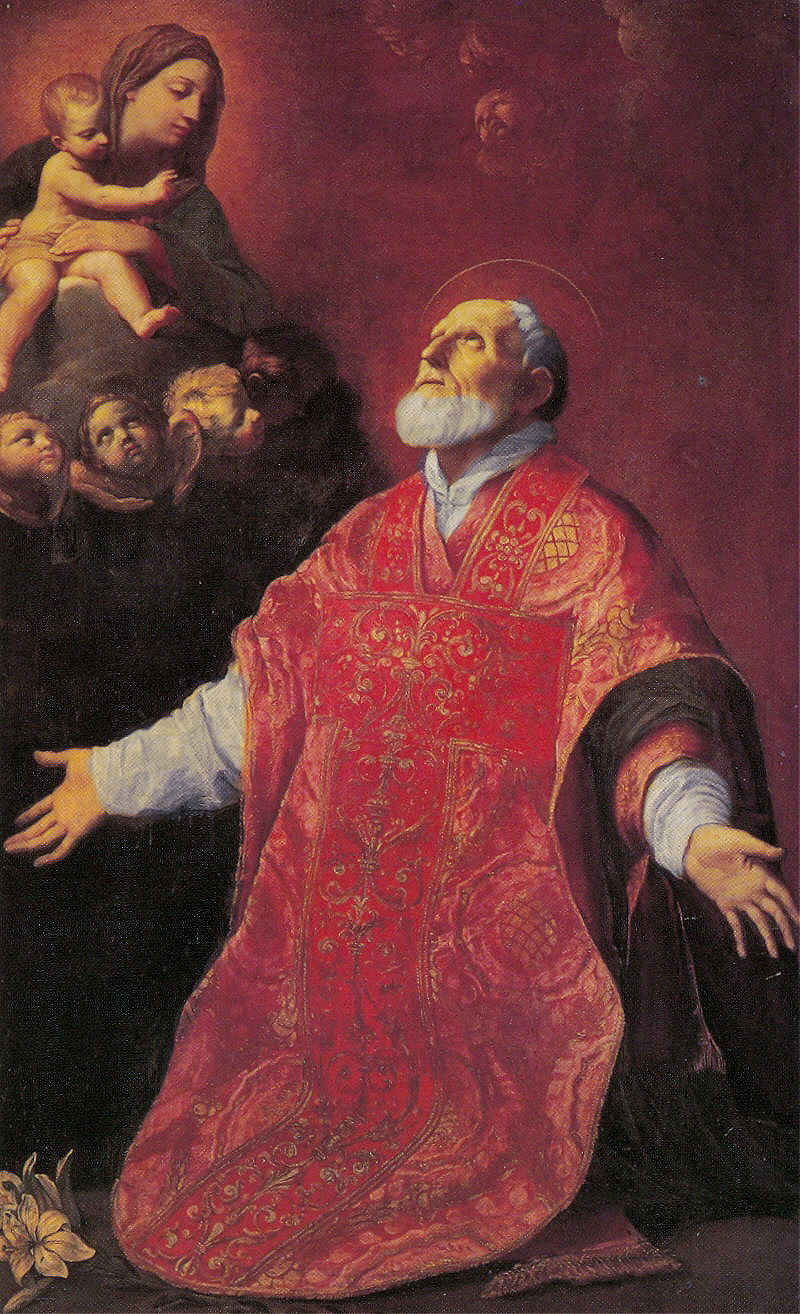
St. Philip Neri, Birmingham Oratory.

St. Philip Neri (1515-1595) who founded the Oratory in Rome in 1550 came from Florence where his family were Tuscan nobles who practicied the learned professions. Like some saints do, Philip tore up these family pedigrees in preference for the poor and itinerant. Once in Rome Philip never made study his central occupation and was reticent to talk about it, but he surprised professional scholars not only by his natural wit and humor but his learned depth and the clearness of his theological thinking and knowledge.

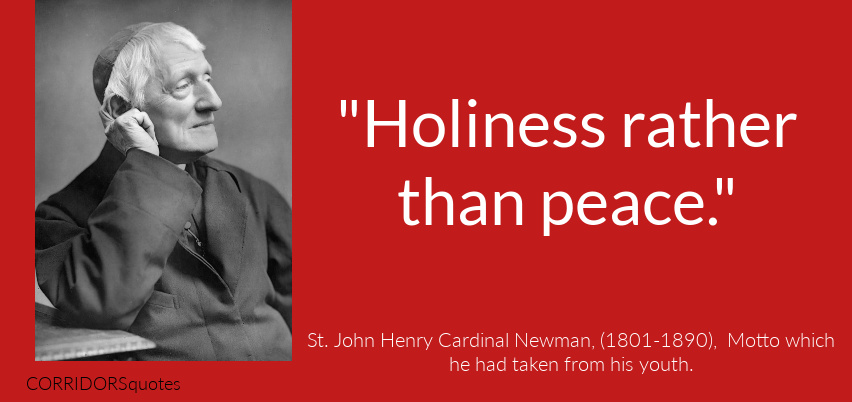
“Holiness rather than peace.” St. John Henry Cardinal Newman, (1801-1890), Motto which he had taken from his youth.

His lifelong motto was “Holiness rather than peace,” reflecting his belief that truth and sanctity mattered more than comfort or popularity.

This explanatory article may be periodically updated.