
Tag Archives: #MichelangeloBuonarroti

“The Pupil of Nobody, the Heir of Everybody”: Michelangelo at 550.

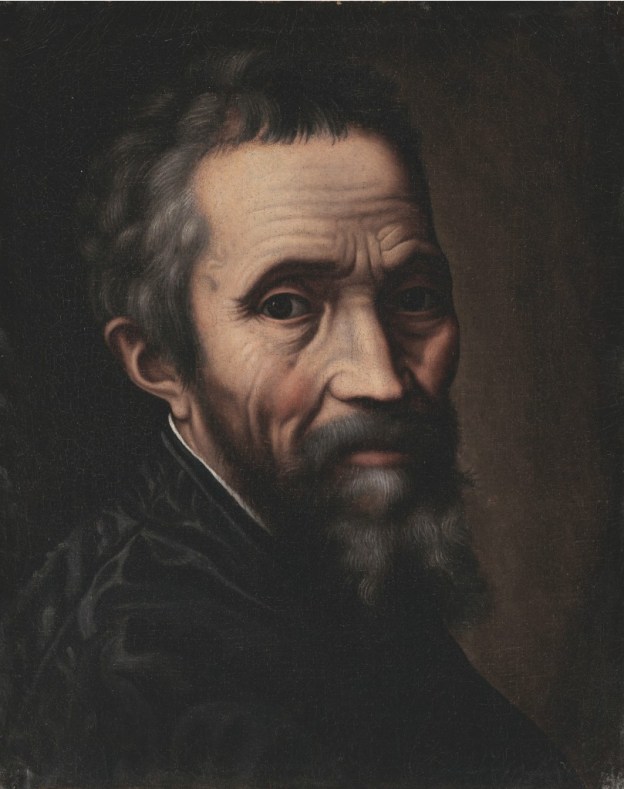
FEATURE Image: Portrait of Michelangelo, Marcello Venusti (1510-1579), after 1550. Casa Buonarroti, Florence, Italy. see – https://artsandculture.google.com/asset/ritratto-di-michelangelo/AgFcI66SXt6qGg?hl=it – retrieved March 6, 2025.

Michelangelo Buonarroti was not simply the greatest artist of the Italian Renaissance, but the artist who synthesized and transcended the achievements of his predecessors, transforming Renaissance ideals into works of unprecedented power, realism, and spiritual intensity. Michelangelo absorbed the innovations of artists such as Giotto, Masaccio, Donatello, Paolo Uccello, Verrocchio, and Leonardo da Vinci before elevating the human figure, especially the nude, to its highest artistic expression.

Attributed to Michelangelo Buonarotti, 1513, terracotta, Casa Buonarroti, Florence, Italy. The work is a study of a male torso, conceived to be without the head and upper and lower limbs. The work has been identified as a preparatory model for one of the figures of the Prisoners, intended to decorate the tomb of Julius II in Rome. see – https://artsandculture.google.com/asset/torso-virile/zQGx46asE5jBIg?hl=it&ms=%7B%22x%22%3A0.5%2C%22y%22%3A0.5%2C%22z%22%3A9.086882915528859%2C%22size%22%3A%7B%22width%22%3A3.3866676762513332%2C%22height%22%3A1.2375000000000005%7D%7D – retrieved March 6, 2025.

Michelangelo Buonarotti, Madonna della Scala, 1490. Casa Buonarroti, Florence, Italy. Though it is small-sized the relief subject of the Madonna and child presents a monumental scope. The female figure fills the entire space. The meaning of the ladder (“scala”) in the title is ambiguous and may have reference to the children playing and holding a drape behind the Madonna. The date of the relief has been much discussed. However, a placement around 1490, before the Battle of the Centaurs, seems to be confirmed. see – https://artsandculture.google.com/asset/madonna-della-scala/xQF2nwLhAXd26w?hl=it – retrieved March 6, 2025.
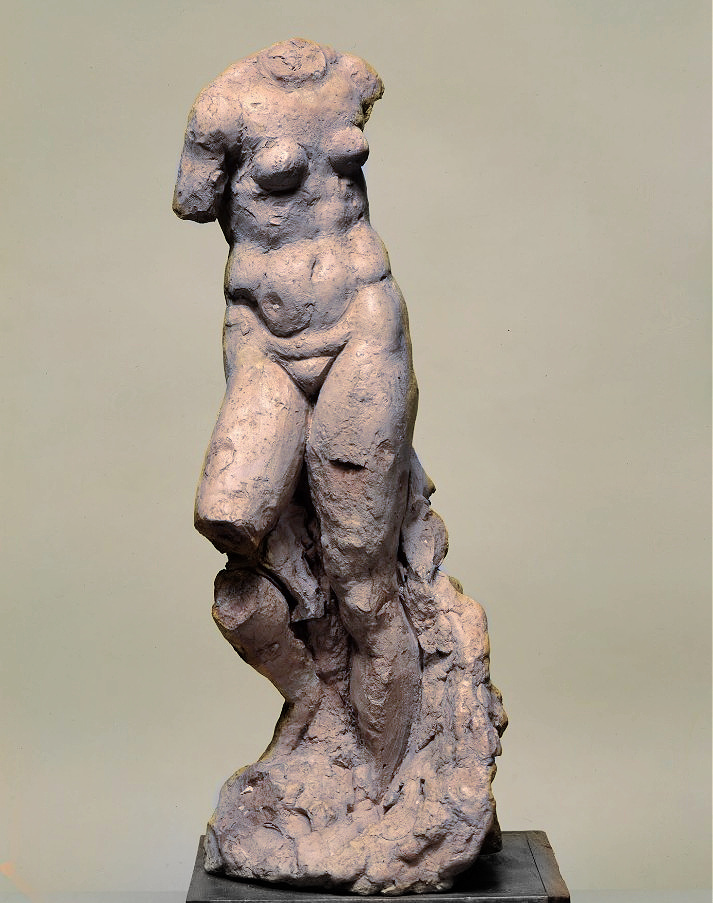
Michelangelo Buonarotti, Nude female, 1533, Casa Buonarroti, Florence, Italy. This figure of a female nude is linked to the New Sacristy in Florence to accompany the marble effigy of Giuliano de’ Medici. It has been linked to the figure of the Earth that, together with the Sky, was to be part of Giuliano’s marble effigy. The project of building a proper Medici family mausoleum was conceived in 1520, when Michelangelo began work on the New Sacristy upon the request of Cardinal Giulio de Medici, the future Pope Clement VII, who expressed a desire to erect the mausoleum for some members of his family including Lorenzo the Magnificent and his brother Giuliano assassinated in Florence’s Duomo in 1478. After completing the architectural works in 1524, Michelangelo worked until 1533 on the sculptures and the sarcophagi that were to be featured on the chapel walls. The only ones actually completed were the statues of Lorenzo, the Duke of Urbino; Giuliano, the Duke of Nemours; the four statues of the allegories of Day and Night, and Dawn and Dusk; and the group representing the Madonna and Child. see – https://artsandculture.google.com/asset/nudo-femminile/xgHfNWIKU6r13g?hl=it – retrieved March 6, 2025 and http://www.museumsinflorence.com/musei/Medici_chapels.html#:~:text=The%20project%20of%20building%20a,the%20Magnificent%20and%20his%20brother – retrieved March 6, 2025.  
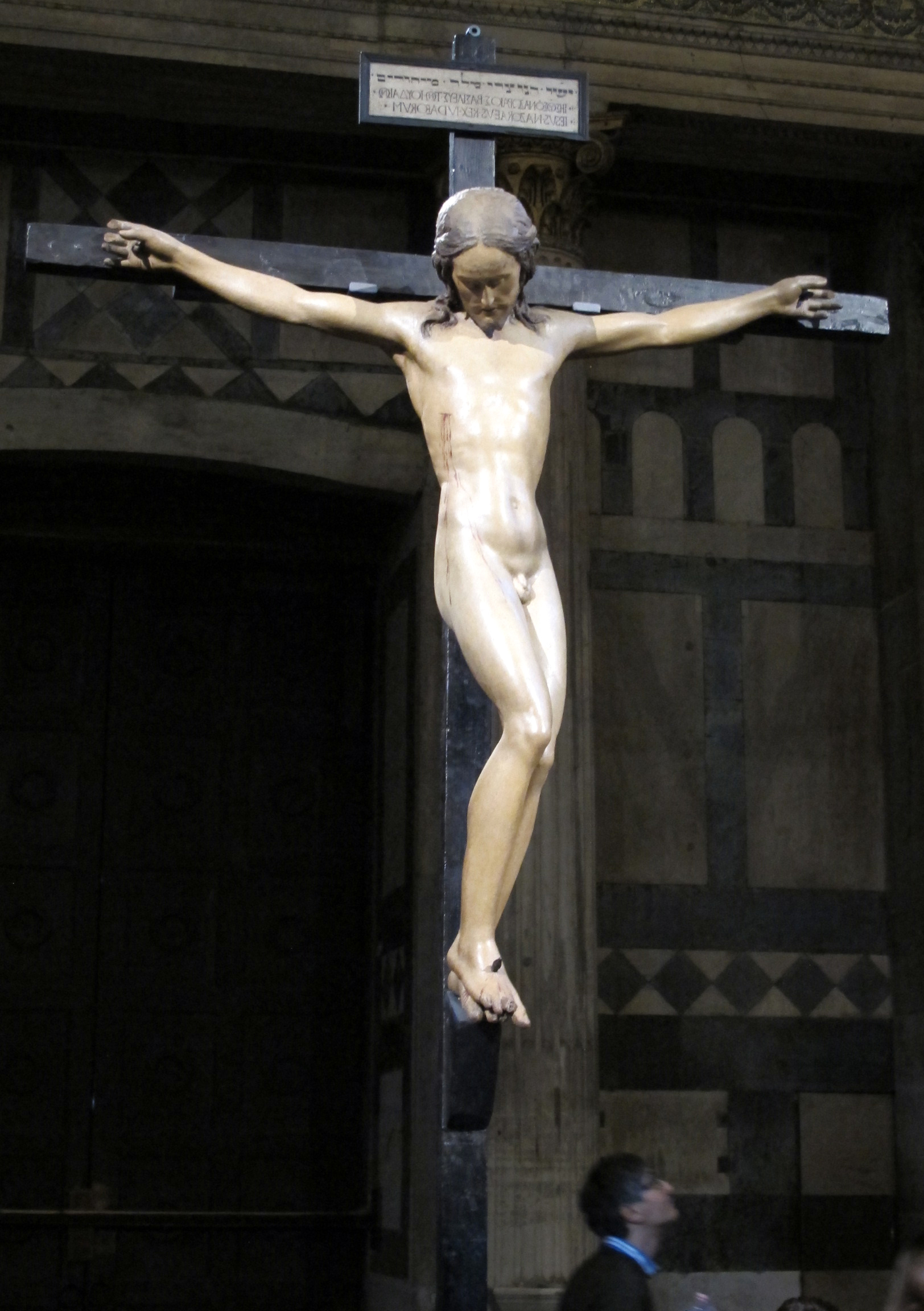
Michelangelo, crucifix, 1493, wood, Santo Spirito, Florence. It was placed by the artist in 1493 above the lunette of the high altar and has been there since.

The Italian Renaissance artist was born in Florentine territory in Caprese in the provinces of Tuscany where his father was a government bureaucrat. The family soon relocated to Florence where Michaelangelo grew up. Becoming friends with Francesco Granacci (1469-1543) who saw Michaelangelo’s drawing talent, at 13 years old Michelangelo announced he wanted to be an artist. Despite his parents objection, they eventually yielded to their son’s aspirations, and he was apprenticed to Domenico Ghirlandaio (1448-1494) for the next three years.

Raised in Florence, Michelangelo trained under Domenico Ghirlandaio and was later influenced by the artistic environment fostered by Lorenzo de’ Medici.
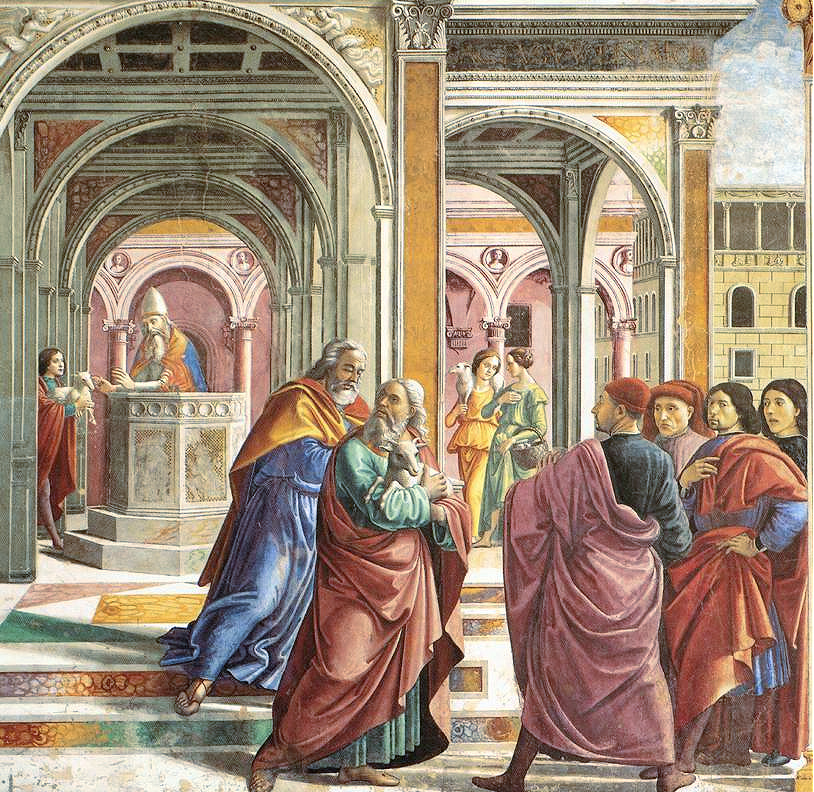
Domenico Ghirlandaio (1448-1494), Expulsion of Joachim From the Temple, fresco (detail), 1486-1490. Santa Maria Novella, Cappella Tornabuoni, Florence. In the background, the mitered high priest receives sacrificial lambs at the altar where a fire burns. Joachim, according to sacred tradition, father of the Virgin Mary and grandfather of Jesus Christ, is sent away at this time since he is childless. He is married to Anne. To the right Ghirlandaio depicts an assembled group of contemporary Florentines including, second from right, Ghirlandaio himself. In 2nd century apocryphal writings, childless Joachim left for the desert where he prayed and fasted for 40 days. Angels appeared to Joachim and his wife Anne, and promised them a child. Joachim then returned to Jerusalem and embraced Anne at the city gate, a scene popularly depicted in medieval and Renaissance art. After this, Anne became pregnant and became the mother of the Virgin Mary and Jesus’s grandmother. This apocryphal relating of Joachim and Anne to Biblical figures Elizabeth and Zechariah and the birth of their son, John the Baptist (Luke 1) and Abraham and Sarah and the birth of their son, Isaac (Genesis 21) was a popular subject depicted in Christian art until the Council of Trent (1545–1563) when the church restricted public displays of these simple stories and events from apocryphal sources in a severe reaction to the Protestant reformation.

Michelangelo’s training was erratic, likely having left Ghirlandaio before his contract was complete, and working under the city’s ruler, Lorenzo de Medici for his contracted master, Bertoldo (1420-1491). Later in life Michelangelo did not advertise his training credentials as he believed art – such as freeing subjects from stone – emerged by the sheer artistic power of the individual. In this period, as a teenager, Michelangelo learned the art of fresco painting and drawing, copying previous masters such as Giotto (1267-1337) and Masaccio (1401-1428). Michelangelo absorbed the artwork of the naturalists, such as Paolo Uccello (1397-1475), whose artwork looked to present subjects with a viewpoint like a scientist interested in objective fact rather than looking to convey some established figural attitude. Where young Michelangelo was materially as great as Giotto and Masaccio, he also possessed a new means undreamt by those previous masters, as he drunk of the art of Donatello (1386-1466), Pollaiuolo (1429-1498), Verrocchio (c.1435-1488) and Leonardo da Vinci (1452-1519). Further, Michelangelo understood better than these others, that the epitome of these Renaissance artistic studies was to be expressed by one subject above all: the human nude.

Michelangelo believed artistic greatness derived from the artist’s own creative power and became especially devoted to expressing the human form, particularly the nude, as the pinnacle of artistic achievement.
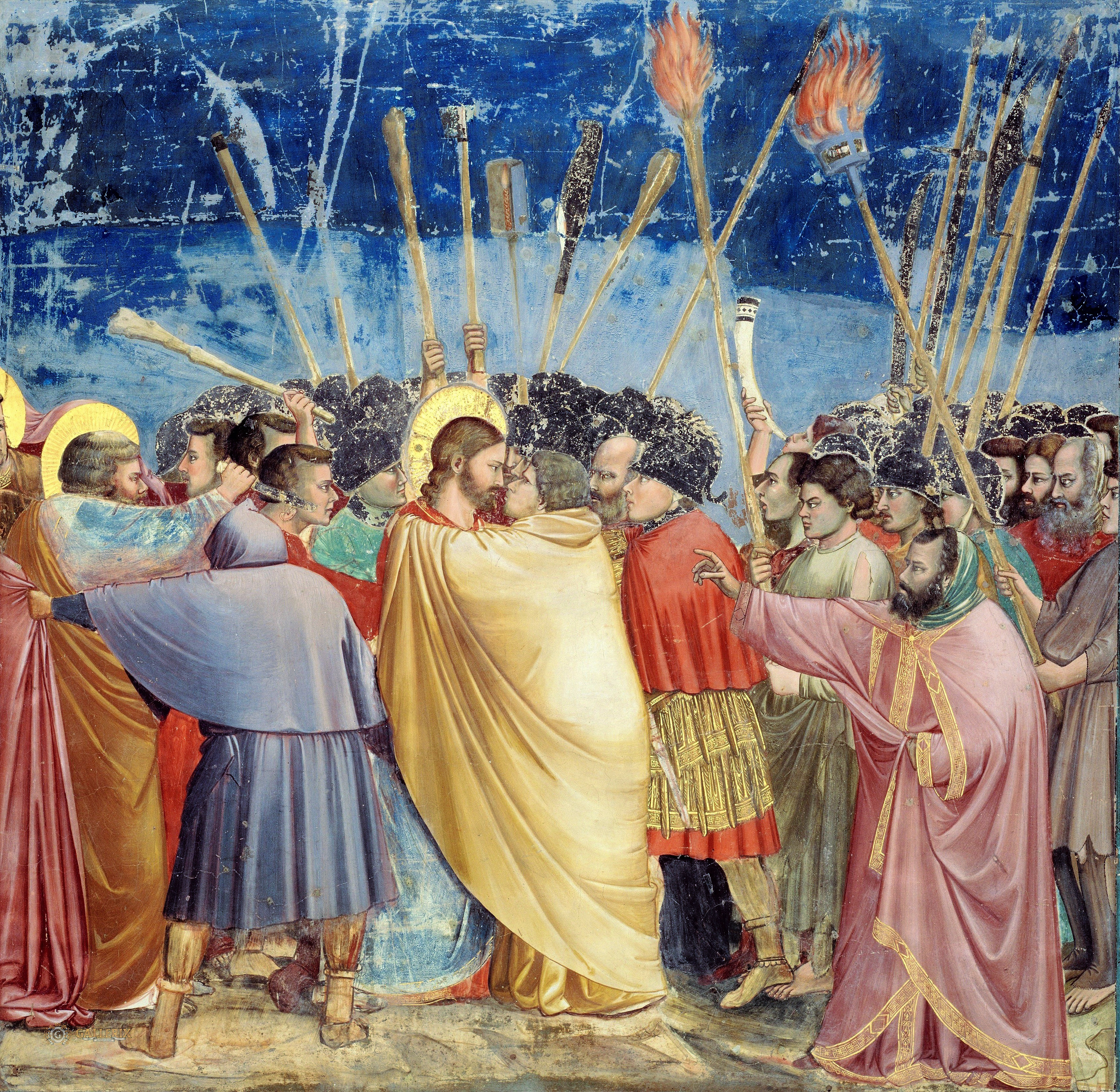
Giotto, The Arrest of Christ (Kiss of Judas ), 1304, Padua, Scrovegni Chapel.

The Arena, or Scrovegni Chapel, was commissioned by Enrico Scrovegni in 1303. A nobleman of Padua, Enrico dedicated the chapel as an act of atonement for the sins of his father, Reginaldo, a moneylender whom Dante placed among the damned in the Inferno. The exterior of the chapel is austere, but its interior is filled with Giotto’s frescoes, completed by the time of the chapel’s dedication in late March 1305, with remaining work finished by March 1306. By this point, Giotto—then in his late thirties—was already a mature master, and in this cycle he transformed the course of Italian painting.

What had appeared as youthful brittleness and restlessness in his frescoes at Assisi in the late 1290s—works that had secured his fame and led to the Padua commission—has here developed into a fully realized visual language of narrative concision, solemnity, and decisive, almost fatalistic, plastic form. Although the subjects of the Life of the Virgin, the Life and Passion of Christ, and the Last Judgment draw upon a venerable medieval tradition, Giotto renders them with a striking immediacy. Human emotion, individualized gesture, and the presence of everyday life infuse the sacred narratives with a naturalism that conveys profound dignity and emotional gravity rather than rhetorical flourish.

Bernard Berenson described Michelangelo as “the pupil of nobody, the heir of everybody, who felt profoundly and powerfully what to his precursors had been vague instinct, who saw and expressed the meaning of it all.” 

The dramatic center of the Betrayal fresco is the confrontation between Christ and Judas. Once Christ accepts His fate in the agony of the garden, the world wastes no time in presenting Him with the cross He has embraced. One of His own apostles—an unsettling reminder of the failures of religious leaders across the ages—betrays Him with a kiss. Christ’s body nearly disappears beneath Judas’s enveloping cloak, yet His classical profile remains visible, fixed in a calm, penetrating gaze upon His betrayer. Judas’s pursed lips embody the chilling intimacy of treachery. As John 13 recounts, the devil—whether through possession or the alignment of Judas’s will with Satan’s designs—provides the impetus for the betrayal.

Giotto had previously depicted Judas as youthful and handsome, but here the apostle’s features bear the accumulated marks of moral decay. At the left, Peter lashes out at Malchus, the high priest’s servant, severing his ear; at the right, the high priest himself gestures toward the betrayal, yet his posture suggests a momentary hesitation before the full enormity of the act. Through these figures, Giotto constructs a scene of moral and emotional complexity, capturing the decisive moment when divine purpose and fallen humanity collide.
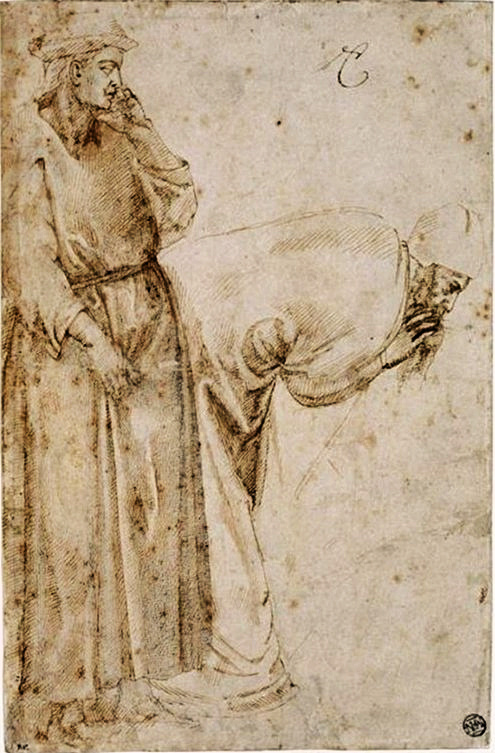
Michelangelo after Giotto, Drawing from “Ascension of the Evangelist,” 1490-1492. Louvre. see – https://collections.louvre.fr/en/ark:/53355/cl020001224 – retrieved March 6, 2025.
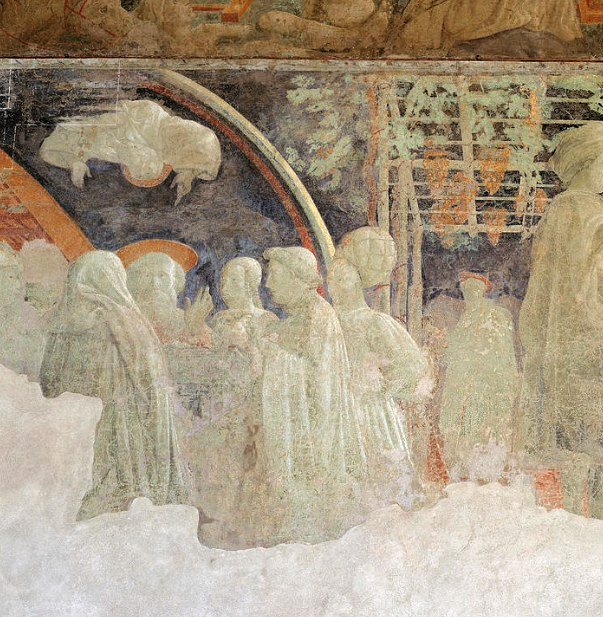
Paolo Uccello, Sacrifice of Noah And Noah’s Drunkenness (detail), 1447-48. Uccello was not interested primarily in conveying in art the possible “artistic” intention of this story’s scene. Instead, as Bernard Berenson described it, the artist produced “nothing but the scientific intention to find out how a man swooping down head-foremost would have looked if at a given instant of his fall he had been suddenly congealed and suspended in space.” These studies of reproducing objects as they really are, in anatomy and perspective, had a great bearing for the art of Leonardo da Vinci and Michelangelo. quoted in Berenson, p.54.
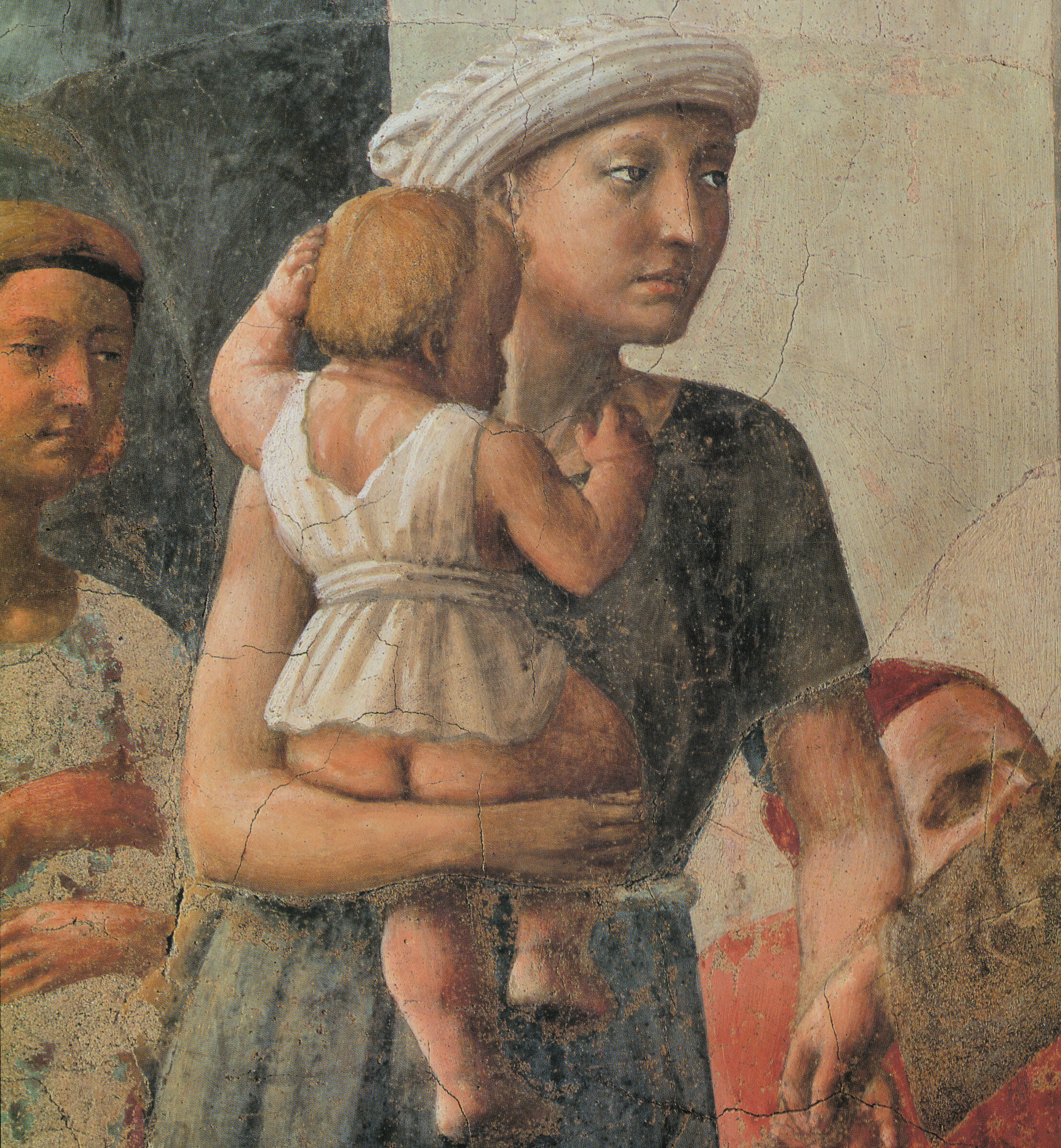
Masaccio, Distribution of Alms and Death of Ananias (detail), 1425-1427, Brancacci Chapel, Florence. An episode from Acts of the Apostles (4:43-37 and 5: 1-11) depicting Ananias’s wife and child whose husband withheld their tithe from the early church leaders with the outcome being that Ananias dropped dead in divine retribution. When it was painted, viewers in the 1420’s and afterwards, read it as an artistic display of a New Testament endorsement of the equitable redistribution of wealth and the divine punishment of death forthwith for those who falsely withheld their fair share. 67% 7.95mb

When the Medici fell and Florence became a theocracy under Savonarola (1452-1498), 19-year-old Michelangelo decided to leave Florence. He lamented the fall of Lorenzo the Magnificent, his artistic patron, and the young artist lived hand to mouth going to Bologna, then to Venice, and back to Bologna, and finally to Rome in June 1496. The popes’ tremendous influence in capitalist Italy started in the 13th century and augmented into the 17th century, leading to what art critic Bernard Berenson (1865-1959) called an encroachment of “soulless Vaticanism” towards modern art. But clearly Rome had no use for a firebrand friar who refused to support the pope’s troops against the invading French army. As Columbus set out to discover America, It was the unpleasant chapter of the Italian War of the 1490s that helped fill the times with ongoing brutality, duplicity, complicity, intrigue, opportunism and expedience. A looming danger of looting and violence of the invading French army were emphasized by the impassioned sermons of Girolamo Savonarola that frightened the people and led to their heightened resentment against the ruling Medici. Florence was traditionally pro-French, but Piero di Lorenzo de’ Medici (“Piero the Unfortunate”) (1472-1504), son of Lorenzo the Magnificent, had deployed against them to defend Naples. Under pressure from citizens and outside French forces promising church reforms and civic transparency, the Medici was forced to flee and the city was proclaimed a Republic. The Florentines, with Savonarola in the lead, facilitated the invasion of French king Charles VIII (1470-1498) and against the pope which they considered corrupt. Pope Alexander VI (1431-1503), a Borgia and one of the most corrupt popes in history, ascended to the papal throne in 1492 and was immediately condemned in fiery sermons by Savonarola. Yet all was not well between “liberator” Charles VIII and his Florentine supporters. Immediately the French king demanded a huge sum of money, a ransom payment of sorts, from the Florentines in appreciation, as well as to pay for, the pro-French liberation. The Florentine government refused and the king threatened to loot the city. Faced with a backlash and real threat of popular revolt, the French bully relented and continued onto Rome. Charles postured, but was constantly fearful of antagonizing the European powers and announced his decision that he would not depose the corrupt old pope after all. By having kidnapped the pope’s mistress Giulia Farnese, wife of the pope’s military ally Orsino Orsini, who commanded 4,000 Neapolitan soldiers freshly landed to defend papal interests on the peninsula, Charles VIII was able to extract full entry into Rome in exchange for her release. Once in Rome the French troops looted the city. The pope, in a panic, arranged a quick safe passage for Charles VIII out of the Papal States towards Naples during which the king’s army massacred many hundreds of local inhabitants.
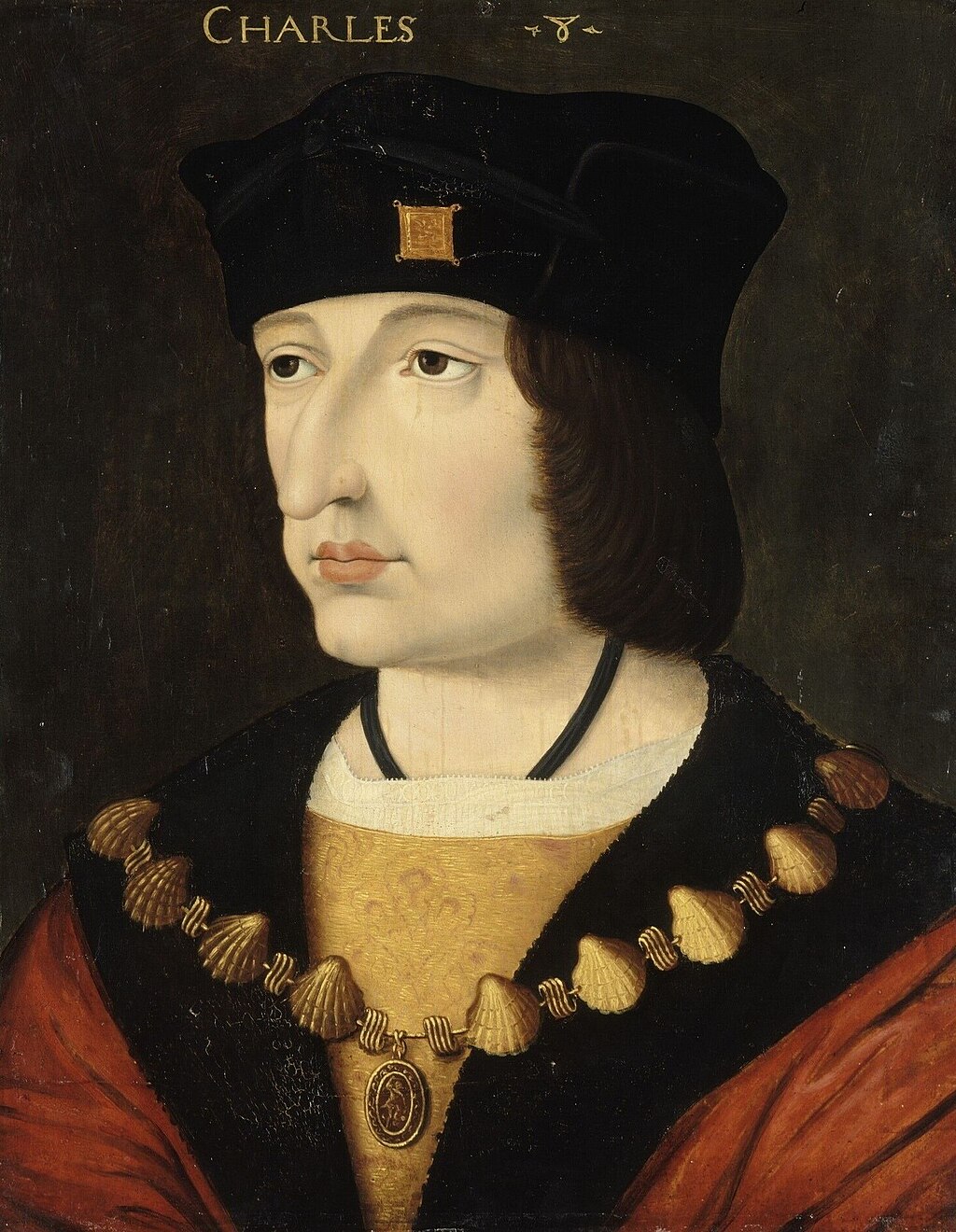
Charles VIII, roi de France, anonymous, c. 1550. Entering Florence in a power vacuum the invading French king demanded a huge sum of money from the citizens who refused to pay and leading to a stand-off. Public Domain.
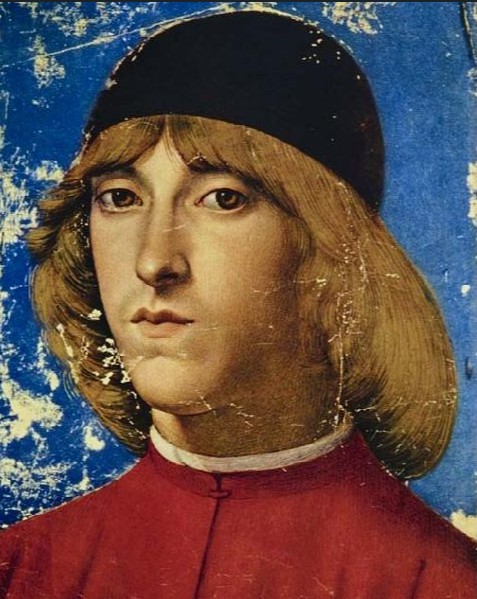
Domenico Ghirlandaio’s 15th century portrait of Piero the Unfortunate. Eldest son of Lorenzo the Magnificent, Piero di Lorenzo de’ Medici succeeded him as ruler of Florence in 1492. When Piero determined in 1494 to stay neutral during French king Charles VIII’s invasion of Italy, effectively defending Naples the object of the king’s campaign, he was challenged. Suffering from an abandonment of the Florentine elite under the spell of Savonarola, Piero totally capitulated to Charles VIIi’s demands. Having succeeded in alienatating everyone in Florence, Piero fled to Venice, aided by a French diplomat, in November 1494. Attempting to make a comeback several times to Florence he was constantly rebuked, Piero drowned in the Garigliano River while attempting to flee the aftermath of the Battle of Garigliano in 1503, Public Domain.

Pope Alexander VI Borgia, c.1495, attributed to Spanish painter Pedro Berruguete (c. 1450-1504), Vatican Museums. Alexander Vi was a wily politician from a prominent family who practiced nepotism and sired several children by way of his many mistresses.

Savonarola played an important role in this French infiltration in Italy — and Rome did not forget. Then, in February 1497, during Mardi Gras of that year, Savonarola, whose message was a combination of religious purist and civic republican preached his most dramatic act of cultural desecration by seeking that artworks, books, clothing items and cosmetics were thrown into a bonfire of the vanities as a sign of monied and other social decadence. The flames became his final undoing: Savonarola was excommunicated for heresy and sedition by Pope Alexander VI on May 12, 1497 after the preacher called “the contemporary Church leadership…a pockmarked whore sitting on Solomon’s throne.” The pope also threatened Florence with severe interdictions if they continued to be a sanctuary for Savonarola and his ilk. Savonarola was imprisoned on April 7, 1498 after failing a literal public trial by fire (it rained). Finally, he was dragged from his prison cell and with two other contemptible friars was condemned as a heretic and schismatic and hanged and burned at the stake on May 23, 1498, with the Vatican and the Medici observing it all from a safe distance. Yet the cult of Savonarola, his person as well as his political and religious ideas, did not go quietly up in smoke. Though seen today as a sort of vile figure, his supporters around 1500 and afterwards saw him as a martyr and encouraged his veneration as a saint to which many complied. In Florence Savonarola’s disputed legacy went on until the Medici more or less permanently re-installed themselves in 1530. Yet Protestant reformers in Germany and Switzerland were intrigued and influenced by Savonarola’s ideas and, in 1558, even Pope Paul IV, who was 22 years old when Savonarola was executed, declared him not a heretic and always in communion with the Catholic Church. Saint Philip Neri (1515-1595), a Florentine established in Rome, and regularly characterized as a most relatable prelate of and for the masses, also defended Savonarola’s memory.

Michelangelo’s early career was within the turbulent political and religious upheavals of Florence, including the rise and fall of Girolamo Savonarola.
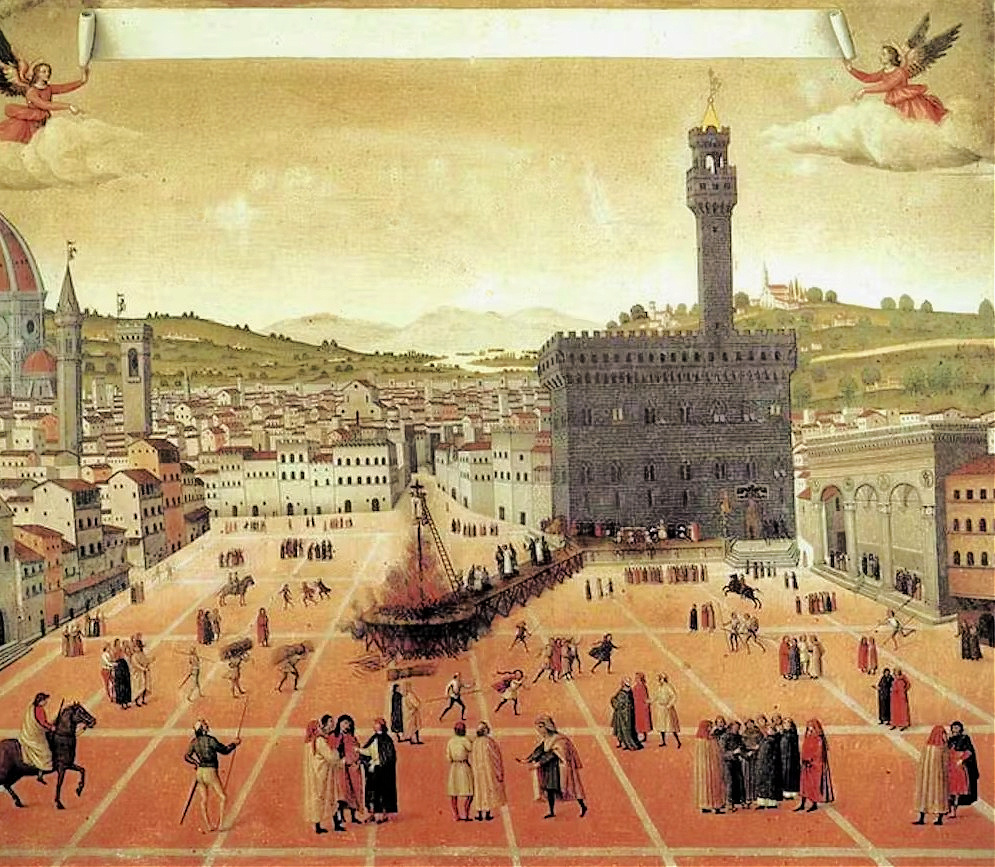
Francesco Rosselli (1445-1513), The Execution of Savonarola and Two Companions at Piazza della Signoria, 16th century, oil on canvas, Galeria Corsini.

Bernard Berenson as a young man, Berenson described Michelangelo as “the pupil of nobody, the heir of everybody, who felt profoundly and powerfully what to his precursors had been vague instinct, who saw and expressed the meaning of it all.” quoted in Berenson p. 72. Public Domain.
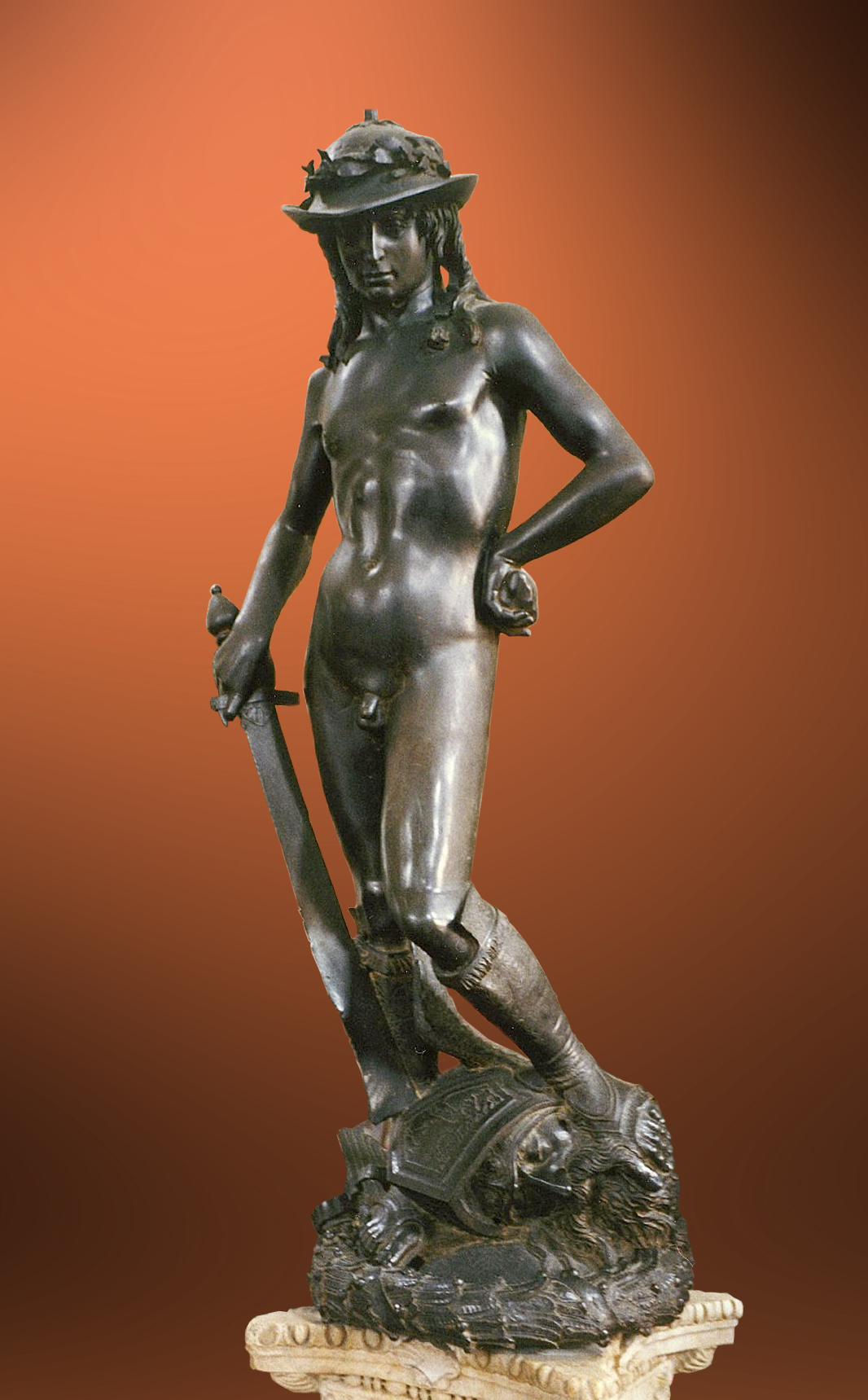
PHOTO: “Donatello – David – Florença” by original file by Patrick A. Rodgers is licensed under CC BY-SA 2.0.
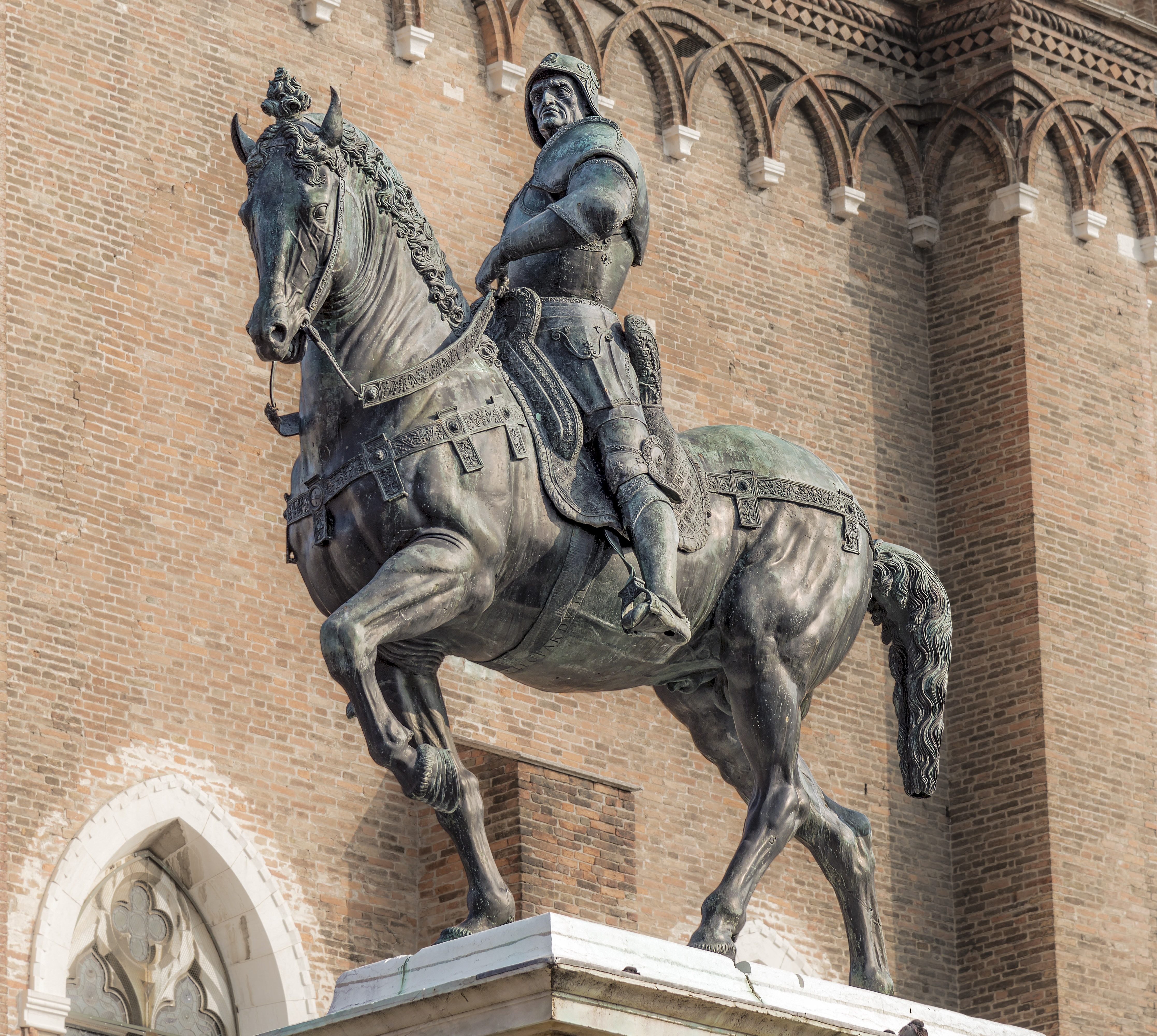
Verrocchio, Equestrian Statue of Bartolomeo Colleoni, 1480s, Venice. Bartolomeo Colleoni (1400-1475) was an Italian condottiero, who became captain-general of the Republic of Venice. Colleoni gained a reputation as the foremost tactician and disciplinarian of the 15th century. PHOTO: “Bartolomeo Colleoni by Andrea del Verrocchio” by Didier Descouens is licensed under CC BY-SA 4.0.
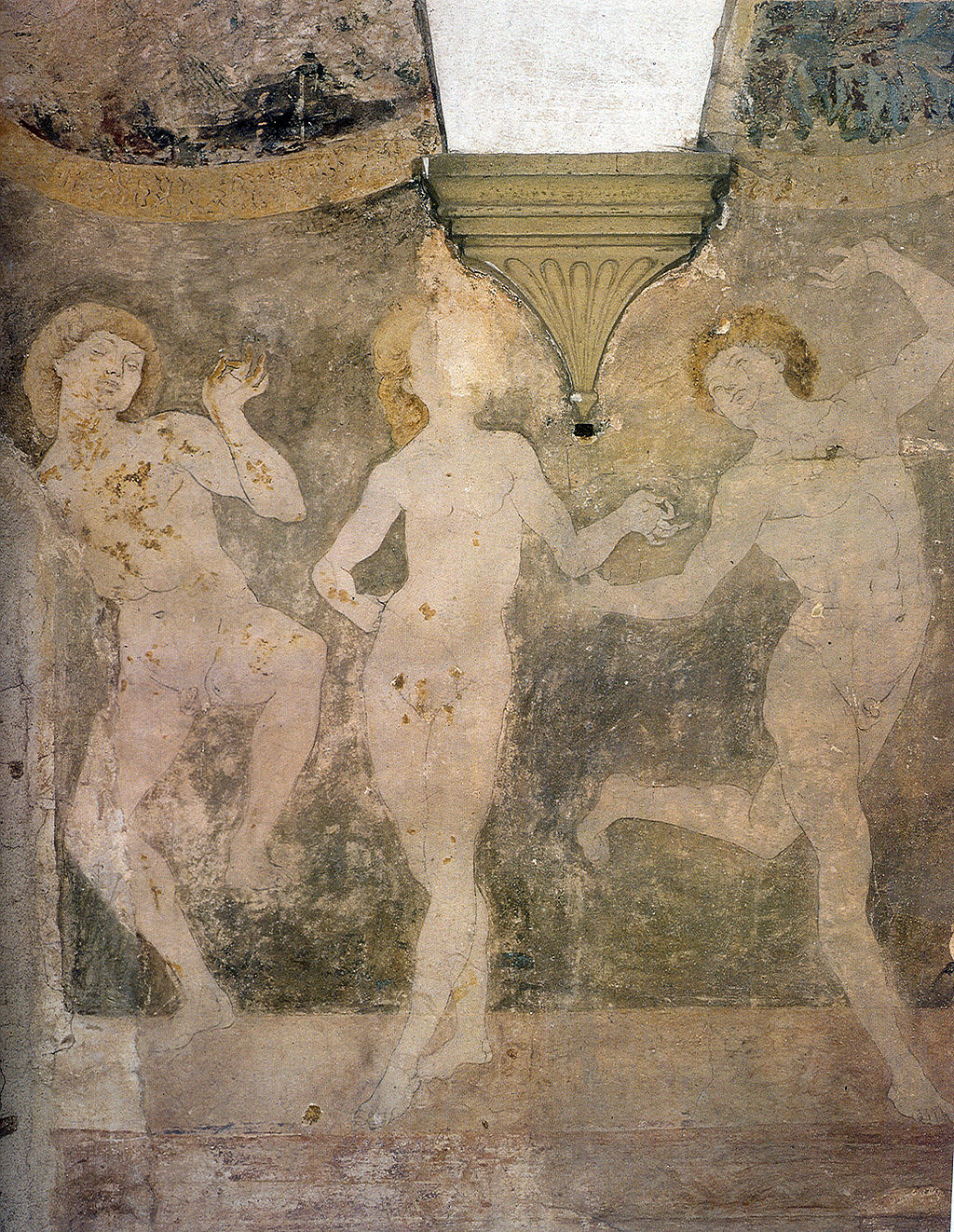
Antonio del Pollaiuolo, Nude Dancers, 1470s, Fresco Arcetri, Villa La Gallina. A fresco frieze of dancing nude figures, in a villa near Florence, shows the artist’s same interest in extreme body poses. Public Domain.

Meanwhile, in Rome, Michelangelo sculpted his first major marble works. The first, Bacchus, was commissioned by Cardinal Raffaele Riario (1461-1521) in partnership with Jacopo Galli, a Roman collector, that was displayed in Galli’s garden until it was sold in 1572 to the Medici and is today in the Bargello. The second is the sublime Pietà (St. Peter’s Basilica, Vatican City) that was commissioned by a French cardinal in Rome and placed in the Santa Maria della Febbre. Vasari described the Pietà as “a revelation of all the potentialities and force of the art of sculpture.” Though the Pietà made Michelangelo famous in Rome, he returned to Florence following its installation to work on the David, a commission made by the Florentine republic after the expulsion of the Medici.

Michaelangelo’s early masterpieces, including Bacchus, the Pietà, and David, established his reputation as one of Europe’s greatest sculptors.
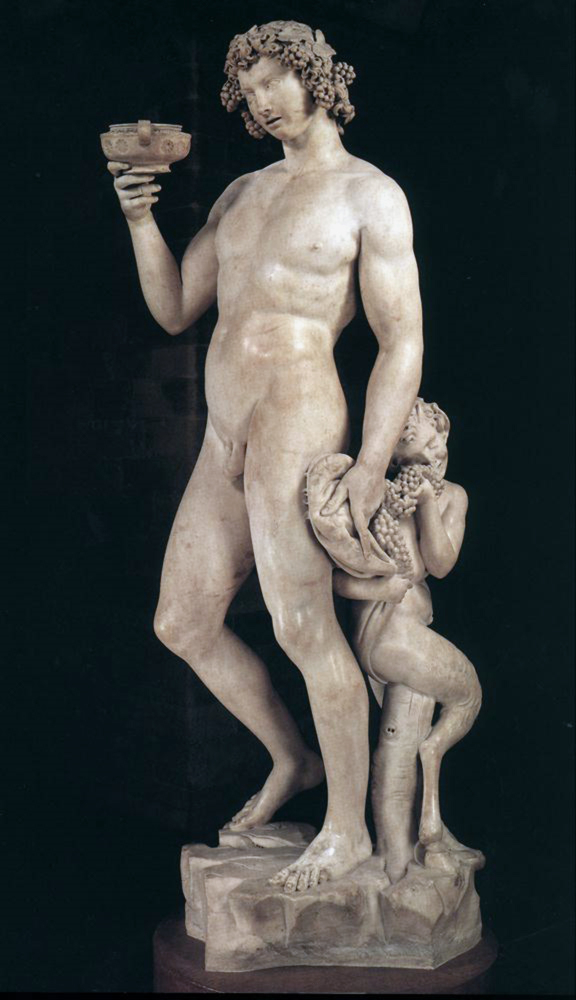
Michelangelo, Bacchus, marble. 1497, Bargello, Florence.
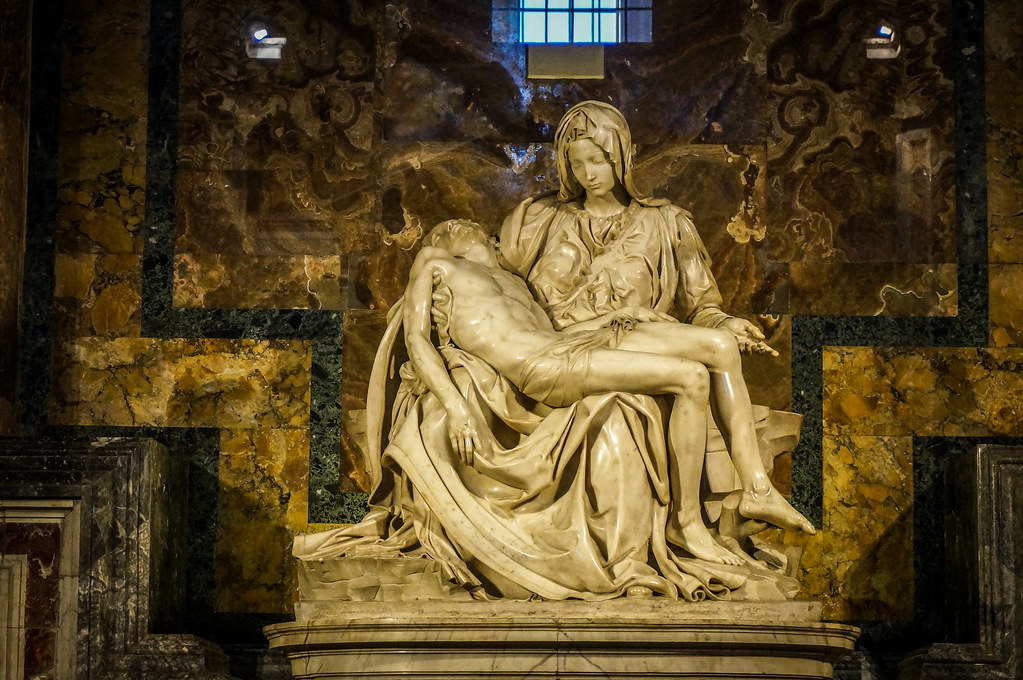
Michelangelo, Pietà, marble, 1498-1499, St. Peter’s Basilica, Rome. A 24-year-old Michelangelo was all the rage in Rome as an artist in the late 1490’s and wrote his name prominently across the sash of the Blessed Mother. The artist did this after it was completed and heard a group admiring the artwork and attributing it to a different artist. Michelangelo was having none of it and one night whet into the chapel and chiseled his name for none to miss seeing. PHOTO: “Pieta (Michelangelo)” by elixirk is licensed under CC BY-NC-SA 2.0.
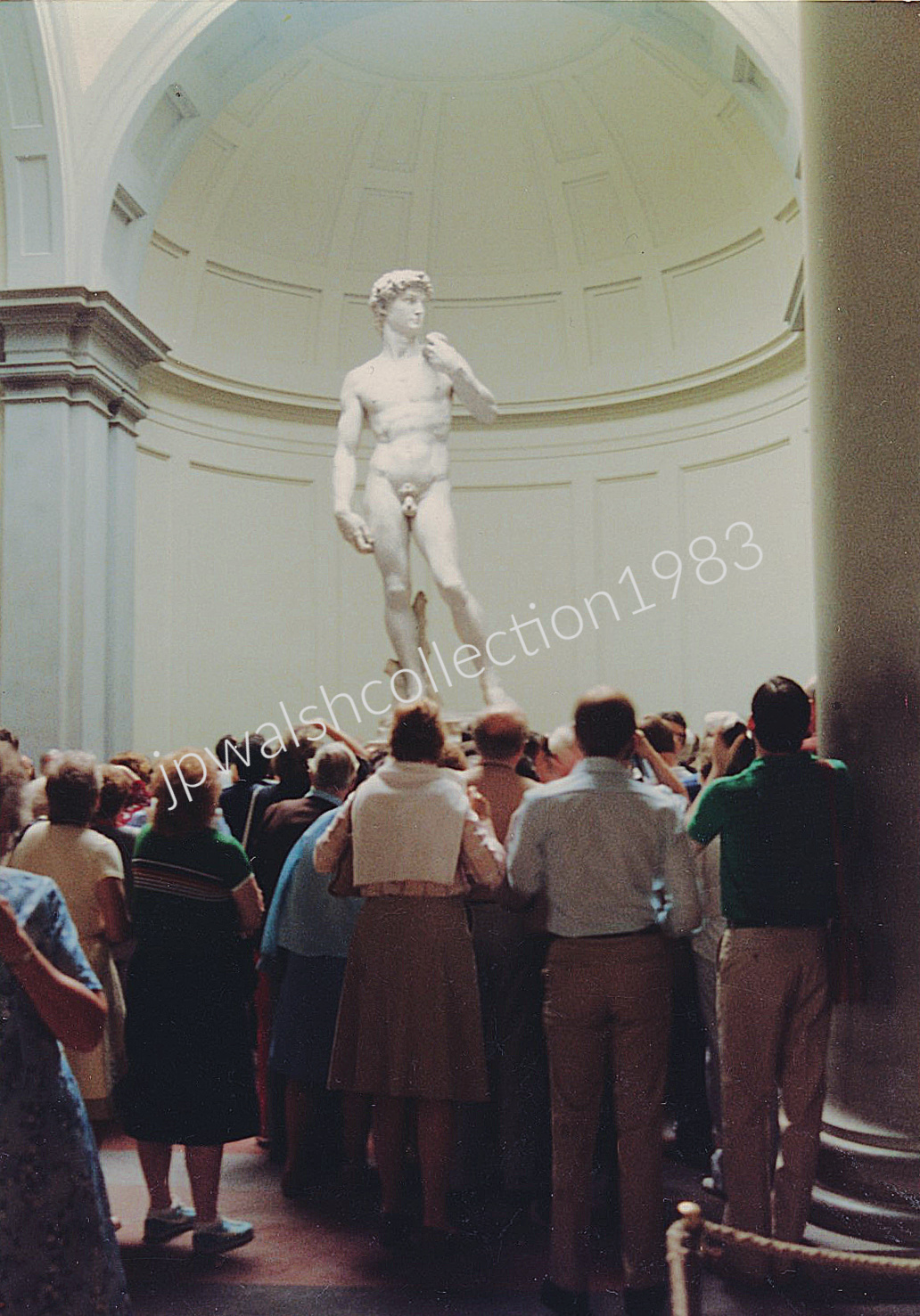
Galleria dell’Accademia, Florence, Italy, Michelangelo’s David, created in c. 1501-1504, has been in the Galleria dell’Accademia since 1873, The biblical figure of David came to symbolize the defense of civil liberties embodied in the 1494 constitution of the Republic of Florence, an independent city-state threatened on all sides by more powerful rival states and by the political aspirations of the Medici family. May 1983. Author’s collection.

Michelangelo’s achievement rested on combining Renaissance naturalism, anatomical understanding, classical ideals, and spiritual drama into a unified artistic vision.

Michelangelo, The Last Judgment, 1536-41, Sistine Chapel, Vatican.

The Cosmic Blast of the High Renaissance: Michelangelo’s Last Judgment and the Fracture of Europe

Introduction: A Masterpiece Born of Crisis
Michelangelo’s The Last Judgment, painted on the altar wall of the Sistine Chapel between 1536 and 1541, stands as the terminal monument to Renaissance humanism in a unified Europe. It captures the terrifying moment when mortals face the raw justice of the Lord—either attaining eternal bliss or being found profoundly wanting. This monumental fresco was forged in a crucible of profound instability. The traditional religious and political order of Europe was fracturing, a reality mirrored in the turbulent biography of the artist himself and the volatile politics of Rome and Florence.

Decades earlier, in 1498, the execution of the radical friar Girolamo Savonarola had temporarily suppressed the spirit of the Florentine Republic. Yet, when Rome was brutally sacked by imperial troops in 1527, Florence, that normally chafed under Roman authority, seized the papacy’s weakness as an opportunity for renewal, re-establishing its republic. By 1530, however, papal and Medici forces crushed Florentine liberty once again. Michelangelo, a fierce republican and an effective “Never Medici” artist, found himself in an impossible position. He ultimately returned to Rome to work for the papacy, viewing it as the lesser of two political evils.

The commission for the altar wall was initiated by Pope Clement VII, though Michelangelo fought desperately to avoid it, longing instead to finish his decades-long project, the Tomb of Pope Julius II. When Clement died, his successor, Pope Paul III—already an old man at the start of a transformative papacy—commanded the artist to abandon the tomb and begin the fresco. To make room for Michelangelo’s vision, existing masterpieces on the wall were completely destroyed, fundamentally altering the chapel’s visual landscape.

The Architecture of Individuality
While earlier medieval and early Renaissance masters like Giotto and Fra Angelico had depicted the Last Judgment with a clear, comforting heavenly hierarchy and orderly rows of the Elect, over a century later Michelangelo elevated the concept to reflect a High Renaissance understanding of radical individuality. It took the master three years of intense conceptualization to finalize the design. Crucially, he developed the principal figures before establishing their exact placement, prioritizing the integrity of the individual soul over the constraints of the composition. Secondary elements like shrouds and skeletal figures were introduced only after the primary figures were locked in place.

At the center of this swirling cosmos stands Christ. He is a dynamic, thunderous figure—striding forward and rising from his seat in a manner that mirrors the physical bursting forth from the tomb at His Resurrection. This is the Risen Christ, whose victory over death makes both resurrection and final judgment conceivable. Yet, even in his power, he displays the wounds in his hands, feet, and side, reminding humanity of the immense cost of eternal life.

Beside him, the Virgin Mary breaks from her traditional role as the active universal Intercessor. She tucks her arms close to her body, turning slightly away as her son takes full, absolute command of the human ledger. While she no longer pleads, some art historians interpret her close proximity to Christ as a sign that cosmic Justice is inherently bound to Mercy.

Pagan Imagery and Copernican Echoes
One of the most controversial elements of the fresco was Michelangelo’s depiction of a beardless Christ. To many contemporary critics, this smacked of paganism, as the figure heavily evoked the solar deity Apollo. However, this aesthetic choice may have been a brilliant, prescient nod to contemporary scientific breakthroughs. By 1533, the revolutionary Copernican theory—postulating that the earth revolved around the sun, shattering the old man-centered, geocentric universe—was already circulating within the Vatican intellectual circles, including the pope. Michelangelo painted a brilliant, singular shade of yellow behind Christ’s head, used nowhere else in the fresco, effectively transforming Christ into the Heliocentric Sun of the universe. While the institutional Church would later condemn heliocentrism, the popes and the artist of this era seemed quite fascinated by it.

In the final composition, traditional figures like Saint Michael were eliminated in favor of anonymous angels who blow the trumpets of doom and hold the open books of judgment. Directly above the altar where the Pope and cardinals celebrated Mass, Michelangelo painted the black, fiery caverns of Hell. Here, angels and demons wage an organic, chaotic war over resurrected souls, dragging bodies down or pulling them upward. Some have interpreted the space immediately above the altar as Purgatory—a theological battleground of the era, as Protestants fiercely condemned Purgatory due to the Church’s monetization of the doctrine through its sale of indulgences.

This literal depiction of Hell led to legendary friction. When Biagio da Cesena, the papal Master of Ceremonies, complained bitterly that the fresco’s widespread nudity was better suited for a tavern than a sacred chapel, Michelangelo retaliated by painting Biagio’s face in Hell as Minos, complete with donkey ears and a serpent wrapping around him. When Biagio begged Pope Paul III to intervene, the Pope wittily replied that while his papal authority extended to Heaven and Earth, even Purgatory, he had no power to release anyone from Hell.

The Existential Big Bang
Ultimately, Michelangelo’s Last Judgment unfolds like an explosive cosmic Big Bang. Humanity is stripped of all earthly status, titles, and emblems of rank. Kings, bishops, and beggars alike meet the Lord entirely naked, judged solely on a ledger of tension between their selfish earthly cruelties and their altruistic compassion. The entire scene is thrown into terrifying uncertainty, caught in an eternal flux by a force outside themselves.

The destinations of these souls are communicated not by spatial boxes, but through raw human emotion: shock, surprise, ecstatic joy, and absolute horror. Rather than using frames or orderly registers, Michelangelo overlapped and cut off his densely packed figures, creating an organic, swirling motion that leaves the true expansiveness of Heaven and Hell completely unknown.

While the theme of eternal judgment had grown increasingly pessimistic and macabre since the devastation of the Black Death in the 14th century, Michelangelo channeled this pessimism into an exploration of Augustinian theology and existential drama. The absolute pinnacle of this psychological despair is captured in a single, monumental figure: a lone damned man being dragged downward by demons. He does not scream or fight; instead, he covers one eye in a gesture of paralyzing realization. His existential isolation remains far more terrifying than a host of medieval depictions of physical torture in Hell, serving as a permanent witness to the heavy responsibility of human free will.

Four years after the fresco’s unveiling, the Western Church would convene the Council of Trent, embarking on a fifty-year Counter-Reformation effort to preserve institutional Catholicism in the face of Protestant revolution. Europe would remain politically and religiously fractured through centuries of subsequent English, French, and global revolutions – as early as the late 15th century the Church would need to lob onto the explorations to find new converts. Yet on the altar wall of the Sistine Chapel, Michelangelo’s swirling cosmos remains forever frozen at the terrifying brink of eternity.

Michelangelo’s The Last Judgment serves as the ultimate, transitional monument of the Renaissance, capturing the psychological terror and theological uncertainty of a fracturing Europe by replacing traditional, orderly religious hierarchies with an explosive, chaotic focus on radical human individuality and personal moral responsibility.

This explanatory article may be periodically updated.

SOURCES:

Berenson, Bernard. The Italian Painters of the Renaissance. New York: Phaidon, 1959.

Brepols Publishers. “Raffaele Riario, Jacopo Galli, and Michelangelo’s Bacchus, 1471–1572.” Accessed March 6, 2025. https://www.brepols.net/products/IS-9781915487117-1.

Carli, Enzo. Giotto and His Contemporaries. Translated by Susan Bellamy. New York: Crown Publishers, 1958.

Casazza, Ornella. Masaccio and the Brancacci Chapel. Florence: Scala, 1990.

Hall, Marcia B. “Introduction.” In Michelangelo’s Last Judgment, edited by Marcia B. Hall, 1–50. Cambridge: Cambridge University Press, 2005.

Murray, Peter, and Linda Murray. A Dictionary of Art and Artists. Rev. ed. London: Penguin Books, 1998.

Quermann, Andreas. Ghirlandaio. Cologne: Könemann, 1998.

Vasari, Giorgio. Lives of the Artists. Translated by George Bull. Harmondsworth, Middlesex: Penguin Books, 1965.

Virtual Uffizi. “Francesco Granacci.” Virtual Uffizi Gallery. Accessed March 6, 2025. https://www.virtualuffizi.com/francesco-granacci.html.


In Florence, THE BATTLE OF ANGHIARI (1503-06) by Leonardo da Vinci (1452-1519) and his fabled competition with Michelangelo for the laurel of Greatest High Renaissance Artist.

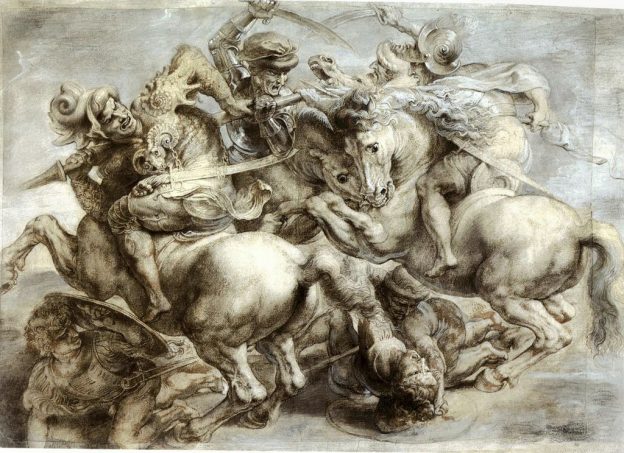
FEATURE image: Peter Paul Rubens, Copy of Leonardo’s Battle of the Standard (from the Battle of Anghiari), 1603, Louvre.

Despite its physical destruction, Leonardo da Vinci’s lost mural, The Battle of Anghiari, revolutionized artistic drawing techniques and established the modern concept of the artist as an independent, brilliant genius.

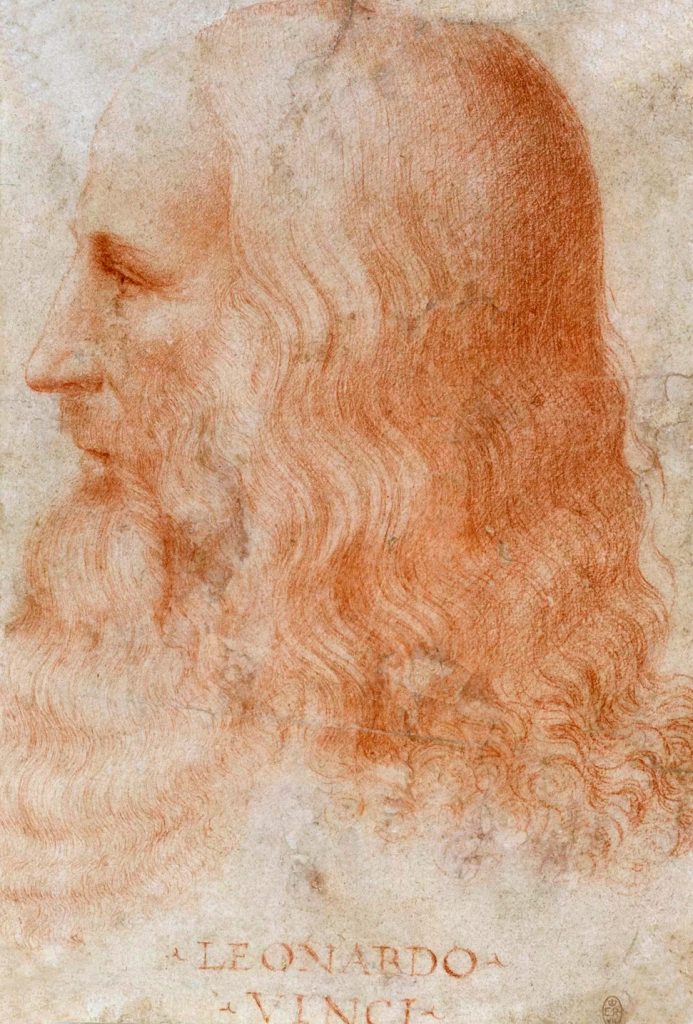
Profile Portrait of Leonardo da Vinci, attributed to Francesco Melzi, circa 1515–1517, Royal Trust Collection.

On May 2, 2019, the world remembered the day 500 years ago when Leonardo da Vinci (1452-1519), Italian Renaissance artist and polymath, died. The 67-year-old applied the spheres of the human brain to its many branches of knowledge and voraciously fused his interests and studies into one lifetime that inspired universal learning in Europe.

Leonardo da Vinci made original contributions as an inventor, draftsman, painter, sculptor, architect, scientist, musician, mathematician, engineer, writer, anatomist, geologist, astronomer, botanist, paleontologist and cartographer.1 Leonardo was involved in military science, hydraulics, aerodynamics, and optics. Used by princes and admired by kings, charming and handsome Leonardo da Vinci could show in his notebooks that he was often misanthropic.2 A significant part of his important visionary achievements is that Leonardo da Vinci painted two of the most reproduced artistic masterpieces of all time: the Mona Lisa (1503, Louvre, Paris) and The Last Supper (1490s, Convent of Santa Maria delle Grazie, Milan). Leonardo, after a lifetime of adventure, curiosity, and solid achievement died in Amboise, France, following a short illness.

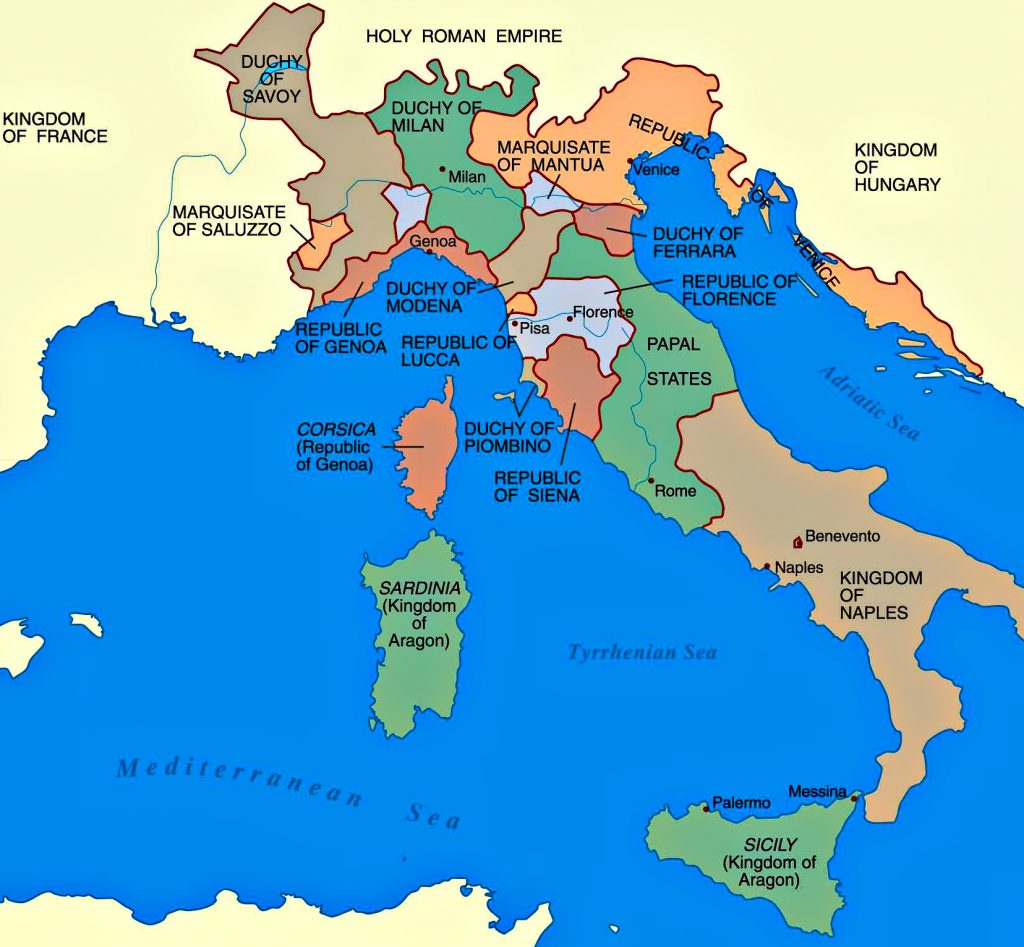
Italy, c. 1500.

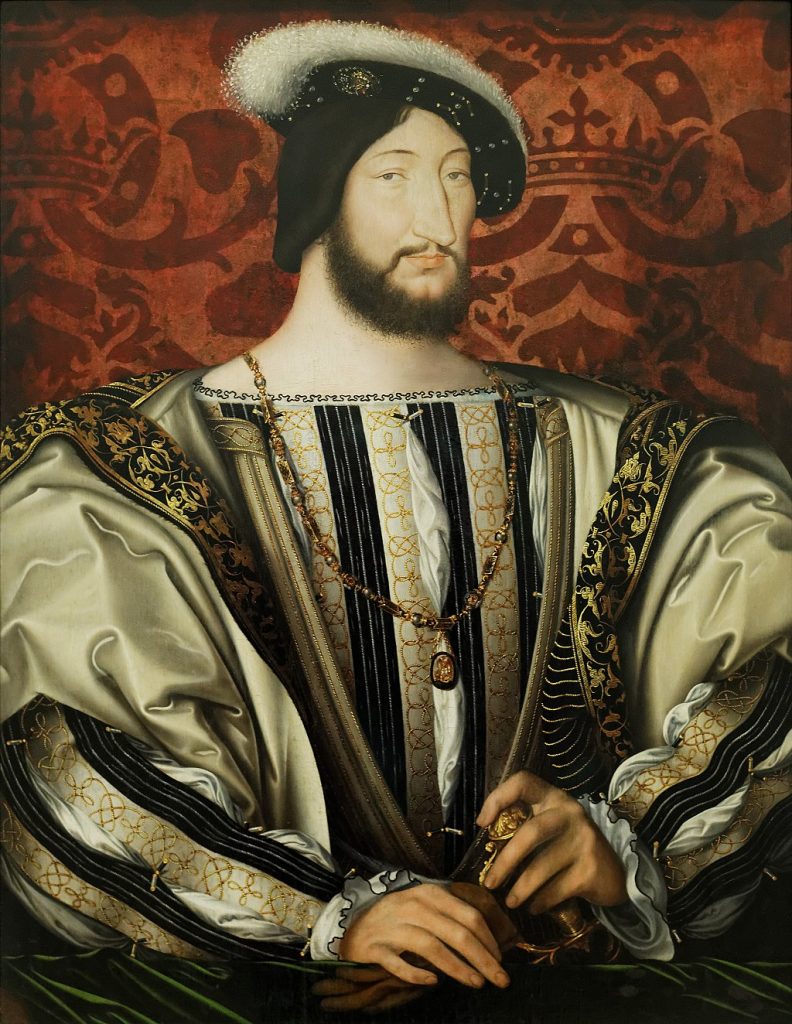
In 1516 Leonardo left Italy for the first time to live in France under the protection of its most cultured young French king, François I (1494-1547). As a dedicated artist, Leonardo experienced a lifetime of disappointment from most of his would-be patrons starting with his father through to Lorenzo de’ Medici, the Magnificent (1449-1492), hapless Milanese duke Ludovico Sforza (1452-1508), Milanese governor Charles II d’Amboise (1473-1511), and Lorenzo’s son and a papal brother, Giuliano di Lorenzo de’ Medici (1479-1516), among others. As Leonardo was ahead of his times it can be said that only at the end of the artist’s life—in 1516, under the wing of François I—that the bulk of his times, that is, the temporarily powerful men in them, had failed him and mankind’s enduring greatness. François I was Leonardo’s first unconditional patron3—while the rest, relatively speaking, are history’s minor players.

François I, Jean Clouet, c. 1530. Louvre, Paris.

Lorenzo the Magnificent, Agnolo Bronzino (1503-1572), Uffizi, Florence, Italy.

Ludovico Sforza (detail), Master of the Pala Sforzesca, c.1495, Pinacoteca di Brera, Milan, Italy.

Charles II d’Amboise, Andrea Solario, 1507.

Giuliano de’ Medici, Raphael.

At Leonardo’s death his reputation as an artist and man rested, as Giorgio Vasari (1511-1574) relates, on his physical strength, generosity, and artistic innovations which brought art and society out of its reliance on the past and its well-intentioned model books into a future of science and art which characterized the best of the Renaissance period. Because of Leonardo’s lifetime of study and work, mostly in isolation from a majority of his fellow artists’ and other practitioners’ careers, he bore the fruit of innovation, including new and creative forms and motifs for art. These emanated out of the imagination of the individual artist who closely observed the workings of nature. Leonardo’s artistic innovations included the subtle skill of sfumato (shadowing) and, as a draughtsman, progressive chalk and cross-hatching techniques. These inspired other great artists, like Michelangelo Buonarroti (1475-1564), and only begins to account for the knowledge Leonardo gained from the physical sciences, particularly anatomy.

Leonardo spent his final three years in Italy in the Vatican (1513-1516), effectively a refuge from petty Italian tyrants. He departed for France in 1516 under the protection of its warrior and cultured 21-year-old new king, François I, whom 64-year-old Leonardo first met in late 15154. Like his cousin and father-in-law predecessor King Louis XII of France (1462-1515) and his cultured mother Louise de Savoie (1476-1531), François I worked hard to recruit the Italian High Renaissance’s most inventive artist for the Gallic Kingdom. When Leonardo finally crossed the Alps he carried with him his recent paintings of the Mona Lisa, Saint John the Baptist, and the Virgin and Child with Saint Anne—all works in the Louvre in Paris today.5 In the second edition of Vasari’s Lives of the Artists6 he described Leonardo in his last months of life in France. In 1519, after a happy period in France at the Château de Cloux, Leonardo was a sick and bedridden man. At the very end, Vasari writes, Leonardo “could not stand [and had to be] supported by his friends and servants.”7. The King paid Leonardo “affectionate visits” in these last days. Vasari intimates that the dying artist consciously felt himself honored to be ministered to by François I Vasari and that Leonardo realized the distinct privilege to “[breathe] his last in [the king’s] arms.”8 This death bed scene, particularly Vasari’s tender detail, has been subsequently imagined in the artwork of artists, including Ingres’ famous painting dated 1818 in the collection of the Petit Palais in Paris.

Louis XII of France, Workshop of Jean Perréal, c. 1514. Cousin and father-in-law of François I Louis admired and collected Leonardo and passed down this admiration to France.

Bemberg fondation Toulouse – Portrait de Louise de Savoie, mère de François Ier – École De Jean Clouet (1475;1485-1540) 22×17 Inv.1013

Louise de Savoie worked hard to convince Leonardo to leave Italy for France: Leonardo took with him over the Alps to France three of his recent paintings – the Mona Lisa (1503), the Virgin and Child with Saint Anne (1503), and Saint John the Baptist (1513).

Mona Lisa (1503), Louvre.

Virgin and Child with Saint Anne (1503), Louvre.

Saint John the Baptist (1513). Louvre.

Châteaux de Cloux (Clos Lucé), Amboise, France.

Death of Leonardo, Cesare Mussini (1804-1888).

Leonardo’s room, Châteaux de Cloux.

Death Of Leonardo da Vinci, 1818, oil on canvas, Jean-Auguste-Dominique Ingres, Petit Palais, Paris.

Death of Leonardo, pencil, 11 x 8½ in. (28 x 21.8 cm.), Jean-Auguste-Dominique Ingres (1780-1867).

Ink consecrated to the artistry of Leonardo da Vinci is vast. The Bible-like exhibition catalog for Leonardo da Vinci, Master Draftsman from the 2003 show at The Metropolitan Museum of Art in New York City is a 786-page testament. That tome presents and discusses about 100 drawings by the master. This article focuses on one image – Leonardo’s Battle of Anghiari, particularly its central section called the Battle of The Standard.

The Republican Commission: In 1503, the Florentine Republic hired Leonardo to paint a massive mural celebrating the 1440 military victory over Milan in the Grand Council Hall of the Palazzo Vecchio.

In October 1503 Leonardo’s commission by the Florentine Republic was to commemorate the military victory of the Florentines over the Milanese in 1440. It would be one of the major artworks in the newly-built Sala de Gran Consiglio (Grand Council Hall) by IL Cronaca (“The Chronicler”) to the rear of the Palazzo della Signoria, also known as the Palazzo Vecchio.9 The commission was given to Leonardo by Republican standard-bearer Piero Soderini (1450-1522) with one of Leonardo’s contracts signed by Niccolò Machiavelli (1469-1527)—and so entered into the annals of what became a fabled art competition (“concorrenza”).

Ink consecrated to the art of Leonardo da Vinci is vast.

View of Florence (detail, Arno River, Palazzo Vecchio, Duomo), c. 1561, Giorgio Vasari.

Statesman Piero Soderini of the Florentine Republic awarded Leonardo the mural commission for the Battle of Anghiari in October 1503.

Piero Soderini (1450-1522) by Ridolfo del Ghirlandaio.

In the process of re-decorating Salone dei Cinquecento with its coffered ceiling and walls with paintings of battle scenes dedicated to the exaltation of Cosimo I de’ Medici, the Battle of Anghiari, Leonardo da Vinci’s innovative fresco was lost or destroyed.

Today’s Salone dei Cinquecento by Giorgio Vasari, 1563-1572.

Battle of Marciano by Giorgio Vasari, 1571, Palazzo Vecchio, Florence, Italy.

Peter Paul Rubens’ copy of 1603 of the lost Battle for the Standard, the central section of the Battle of Anghiari fresco by Leonardo, 1503-06, in Palazzo della Signoria (also, Palazzo Vecchio) in Florence. While Rubens’ copy is the best known, there are copies of Leonardo’s work by other 16th century artists.

Peter Paul Rubens’ copy of 1603 of the lost Battle for the Standard.

After Leonardo Da Vinci, Fight For the Standard (from the Battle of Anghiari), oil on canvas, 28.625 x 33.125 in. (72.8 x 84 cm).

After Leonardo Da Vinci, Fight For the Standard (from the Battle of Anghiari), oil on canvas, 28.625 x 33.125 in. (72.8 x 84 cm).

After Leonardo Da Vinci, Fight For the Standard (from the Battle of Anghiari) oil on canvas, 16th century, Museo Horne, Florence.

Material & Technical Failure: Neither master finished their mural. Leonardo’s experimental oil-and-glaze wall technique failed to adhere, causing the painting to run and degrade before Giorgio Vasari eventually painted over it during a 1560s Medici remodel.

In 1503 Leonardo da Vinci was at the height of his artistic powers. The Battle of Anghiari was a commission for a large scale, complex and dramatic fresco mural on one wall of the Sala de Gran Consiglio in Florence during the short-lived restored Republic (c.1492-1512). Leonardo looked to paint the fresco in dazzling oils and glazes but his complicated experimental techniques to adhere the pigment to the wall largely failed.10 With the fresco’s ultimate destruction in the early 1560’s under Vasari who redecorated the Great Council Hall with six of his own massive battle scenes, he and his Medici rulers were faced with another of Leonardo’s deteriorating frescos similar to the disastrous flaking of The Last Supper in Milan. The Battle of Anghiari was not in an obscure monastery refectory but the central hall of changing political power in Florence.11

Leonardo’s Last Supper, Santa Maria delle Grazie, Milan.

Leonardo’s Last Supper fresco in Milan started flaking almost as soon as it was painted in the 1490’s. Leonardo’s experimental painting techniques for that project had largely failed.

Fragmentary remains by Leonardo of his Florentine project are his preparatory drawings whose subjects include horses, riders, and combatants on the battlefield in various stages of creative development. Some of these drawings were made by Leonardo immediately upon receiving his commission in late 1503.12 Several copies and copies of copies made by other artists also survive. While the preparatory drawings do not complete the full composition— though contemporary written sources lend credence to books of sketches that are lost13—Leonardo possibly did not even complete a cartoon before he started painting on the wall.14 While copies by others intrigue, they are problematic to envision Leonardo’s final fresco of the Battle of Anghiari—yet each of these sources provide insights.

The Battle of Anghiari is arguably Leonardo’s most important public commission.15 It manifested itself in the context of impactful local history, civic pride, city government, and the artist’s own vision and skills in its employ. Florence was Leonardo’s native city and he wanted to make a strong impression. Sixty years after Leonardo left his brilliant fresco on the west wall.16 Vasari, whose redecoration of the Palazzo Vecchio included a fresco cycle of his own almost certainly covered over all or part of Leonardo’s unfinished fresco. A desire for new artwork to showcase the Medici restoration under Cosimo I de’ Medici (1519-1574) naturally extended to the Grand Council Hall. The late-fifteenth-century Republic had commissioned Leonard’s battle fresco—and that form of government had ended in Florence in 1512.

Portrait of Cosimo I de’ Medici, 1535, Alessandro Allori (1536-1607), oil on poplar, 86 x 65 cm (34 x 25 5/8 in.), Florence.

Cosimo I de’ Medici (1519 -1574) ruled Florence from 1537 until his death.

Cosimo I de’ Medici (detail), c. 1564, by Giorgio Vasari, Palazzo Vecchio, Florence.

As Vasari relates in his Lives of the Artists, Leonardo depicted a scene from the life of Niccolò Piccinino (1386-1444), an Italian mercenary officer or “condottiere” in the service of the politically brilliant and physically repulsive duke of Milan, Filippo Maria Visconti (1392-1447). Fighting for Milan, Piccinino—aided by two score of cavalry squadron, many foot soldiers17and treacherous Florentine exiles—was defeated by a force led by the Republic of Florence under Francesco I Sforza (1401-1466). The victory at the Battle of Anghiari on June 29, 1440 handed the Florentines domination of central Italy. At the turn of the sixteenth century the new republic of Florence continued to face warring tyrants as neighbors including Cesare Borgia (1475-1507). At the start of a new century and Republic the timing was ripe to depict in its government hall valorous Florentine warriors defeating political enemies. In 1503, Florentine officials gave Leonardo an in-depth orientation of the 1440 battle using historical texts but the artist brushed these aside as he conceived the scene to be depicted, a virtually cinematic induction of the battle’s climax —the mortal contest by the Florentines to capture the standard from the Milanese. Leonardo’s first sketches for it are of a condensed melée full of the swirling movement and stirring sensations of battle.18 The actual standards taken during the battle had been kept in the Grand Council Hall as a trophy.19

Niccolò Piccinino. Defeated at the Battle of Anghiari, the Italian mercenary becomes the central protagonist of Leonardo’s fresco.

Front (Recto) of a medal of Duke of Milan, Filippo Maria Visconti, by Pisanello (1395-1455).

Local battles such as the Battle of Anghiari were usually part of larger campaigns— in this instance, The Lombardy Wars of 1423-1454— and fought by hired warriors. Mercenaries usually provided terms to competing foes that protected the mercenary’s best interest. Following the Battle of Anghiari, Piccinino, who had been captured, was soon after released. In the next battle at Martinengo, he defeated and captured Sforza. Because of these endless war games, Niccolò Machiavelli (1469-1527) advised in The Prince that a ruler should not be tempted to use these swords for hire – and cited Francesco Sforza by example.20

Mercenary Francesco Sforza, Pinacoteca di Brera, Milan.

Niccolò Machiavelli by Santi di Tito (1536-1603).

Machiavelli, author of The Prince, signed an order to commission Leonardo to create the fresco commemorating the Battle of Anghiari for Florence’s newly-built Sala de Gran Consiglio (Grand Council Hall).

Leonardo’s sketches of probably Cesare Borgia.

Cosimo I de’ Medici who ruled Florence starting in 1547 was interested in that which supports power— including art. Vasari’s new paintings of Cosimo I de’ Medici’s wartime exploits was partly a political act. By ridding the hall of Leonardo’s Battle of Anghiari — a Republican military victory from long ago — Vasari worked his political masters’ desires. The ultimate reasons and fate of Leonardo’s artwork is not known but if Vasari destroyed the mural he would not be the first Italian artist to destroy a competitor’s artwork as shall be seen.

In late 1503 Leonardo, installed in a temporary workshop at Santa Maria Novella, about a fifteen-minute walk to the Palazzo, was given a deadline for the mural’s completion of February 1505. Like the fabled competition between Leonardo and Michelangelo that was intentionally arranged by Florence’s political operatives, the deadline for completion was also a demand for Leonardo’s art outside the artist’s concerns. The first late winter deadline passed as did those in spring and summer. Setbacks included Leonardo’s meticulously slow work, other projects he took up that kept him away from the fresco, and even bad weather.21

Santa Maria Novella, Florence.

Leonardo’s workshop during the mural commission was the Dominican church, Santa Maria Novella, built in 1420.

In early 1504 the wall painting of the Battle of Anghiari and its 51-year-old artist was joined by Michelangelo Buonarroti who would paint his Battle of Cascina in the same room and possibly on the same wall. Michelangelo, recently turned 28 years old, would depict the Florentine military victory over Pisa in 1364. Neither this imposed rivalry or proximity encouraged their friendship.22 Michelangelo was intense, pious, and unwashed contrasting to Leonardo’s genial, independent, and stylish manner.23 However, their professional relationship temporarily influenced each other’s artmaking.

Michelangelo, Self-Portrait.

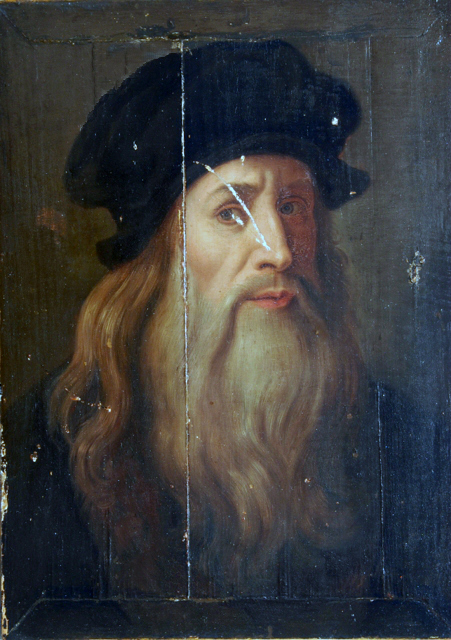
Leonardo da Vinci, (Lucan) Self-Portrait.

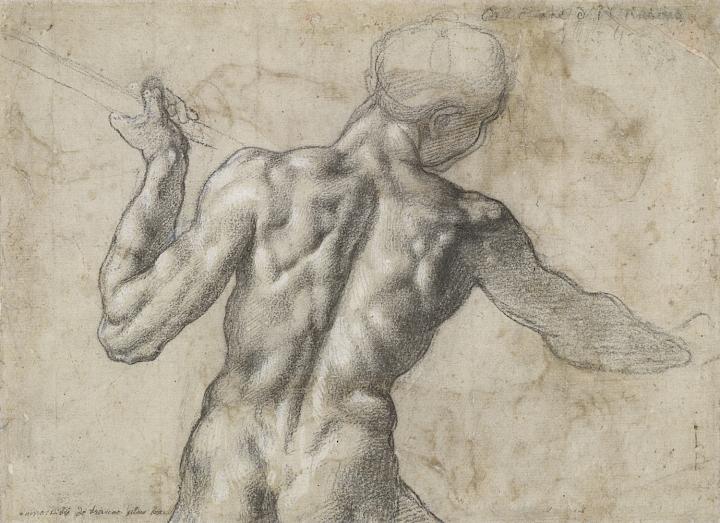
In 1504 and 1505, Michelangelo learned to use Leonardo’s innovative stylus cross-hatching technique along with the chalk technique that Leonardo was continuing to exploit in the Battle of Anghiari. Inspired by Michelangelo, Leonardo did masterful drawings of nude figures though he did not use them. In Michelangelo’s preparatory drawings for the Battle of Cascina—that and copies by others are what survive of the project– the younger artist used Leonardo’s cross hatching technique for the pull of the skin. He experimented with Leonardo’s chalk technique to display types and degrees of muscular tension on figures.24 Yet, according to Vasari, the two clashed at almost every turn. Michelangelo’s use of Leonardo’s advanced techniques was restricted to the short period of their common commission and Leonardo openly disparaged Michelangelo’s cartoon of male nude bathers as coldly analytical.25

Two Michelangelo chalk studies. ABOVE: Male Nude Seen From the Back With a Flag Staff, c. 1504, The Albertina Museum, Vienna. BELOW: Life Study for a bathing soldier in the lost cartoon for the Battle of Cascina, black chalk, 404 x 258 cm, Teylers Museum, Haarlem, The Netherlands.

Leonardo da Vinci, Anatomical Studies of the Nude, connected with the Battle of Anghiari, c. 1504, Royal Library, Windsor. Though influenced by Michelangelo’s nude drawings in this time, Leonardo’s design and imagery for his battle scene looked to invention and unexpected drama rather than the nude.

In spring 1505 Michelangelo’s cartoon was finished but his painting barely started—and the younger artist left Florence for Rome. Michelangelo accepted the commission to build the tomb of Pope Julius II (1443-1513) although it would not be completed until 1545 and on a much-reduced scale. He returned to Florence the following spring but was soon back in Rome to paint, between 1508 and 1512, the Sistine Chapel ceiling. In 1506 Leonardo’s gradual departure for Milan, complete by 1508, began. Leonardo stayed in Milan until 1513 when he was invited by the pope to the Vatican. Leonardo and Michelangelo had in Florence shared a common commission from the Republic. Their two battle scenes presented, each in their own way, a tangle of intertwined figures. Otherwise, each artist created compositions of varying subject matter and style which proved seminal for art-making schools of the future. Leonardo’s swirling horsemen in the Battle of Anghiari inspired the Baroque style and Michelangelo’s bathers in the Battle of Cascina displayed a perfect template for Classicism. These two great artists also shared, despite their age difference or varying temperaments, the fact that neither of them completed their commissioned work.

Michelangelo, The Tomb of Pope Julius II, completed 1545, San Pietro in Vincoli, Rome.

Michelangelo, Sistine Chapel ceiling, 1508-1512, Rome (The Vatican).

Michelangelo, David, 1501-1504, Galleria dell’ Accademia, Florence, Italy.

Michelangelo’s David had just been placed Florence’s central square when the painting competition (“concorrenza“) between himself and Leonardo da Vinci began. Leonardo had served on his native city’s committee which decided where to place Michelangelo’s 17-foot tall marble sculpture. Today a copy stands outside the Palazzo Vecchio.

At the time of the public commission in Florence, Leonardo had just finished his Mona Lisa (1503, Louvre, Paris) and Michelangelo had just installed, in the city square, his David (1501-1504, Accademia Gallery Museum, Florence). Leonardo had been part of the city committee to recommend where Michelangelo’s David should be placed.26 Over the next decade, until 1512, Leonardo’s and Michelangelo’s unfinished wall paintings—that they both had abandoned (a worthy reason for a later Medici to paint it over)—adorned the same room possibly side by side. Michelangelo’s work was mutilated first with the fall of the Republic. Young artists had flocked to study and copy these unfinished artworks, including a young Raphael.27 In 1512 one of these artists, a 24-year-old named Bartolommeo Bandinelli (1488-1560)—he had been obsessive in studying Michelangelo’s cartoon to the point of sneaking in to the Council Hall at night—in one moment grabbed the cartoon and cut it into pieces. The motivation for Bandinelli’s destruction is unclear. The center section of Leonardo’s Battle of Anghiari – namely, Battle of the Standard– remained intact on the wall and for decades saw copies and written descriptions made of it. After 1508, neither Michelangelo nor Leonardo were anywhere near Florence as both moved on to larger opportunities.28

The Fabled Showdown: Florentine leaders intentionally staged an intense competition (concorrenza) by placing 28-year-old Michelangelo on the same wall to paint The Battle of Cascina, sparking a rivalry that deeply influenced both artists’ techniques.

Michelangelo, Battle of Cascina, 1504-6, destroyed copy by Aristotile da Sangallo, grisaille on panel, 30 x 52 in. The Courtauld Institute of Art, London.

Leonardo openly disparaged Michelangelo’s cartoon of male nude bathers as coldly analytical. Younger artists preferred the noble and expressive form of Michelangelo’s nudes to Leonardo’s messier constructions.

Focusing on Leonardo’s Battle of Anghiari, and, particularly, the Battle of the Standard, its central panel, one is impressed by Leonardo’s revolutionary approach to drawing.  Leonardo shattered tradition, specifically in drawing. First, Leonardo was not tidy in his drawing. Medieval tradition was fundamentally concerned with conserving the controlled line. A draftsman’s artistic ability was judged by patrons and cultural tastemakers by the accurate lines he created directly out of an existing model-book.  Leonardo’s early silverpoint drawing of a Bust of a Warrior in the British Museum demonstrates his ability to masterfully fulfill this Renaissance expectation.29 As Leonardo the artist developed, by the end of the fifteenth century he was attacking this long-held linear tradition in his notebooks as a failed technique.30 The fiery scribbling of Leonardo’s drawing style expresses his process of creative exploration but equally his rebellion towards the old technique. In its place, Leonardo shows himself in his drawings to be actively pushing outside the linear restraint of quattrocento drawing and formulating a new artistic standard derived from orientation to the model. As an avant-garde artist in this mode Leonardo practiced it alone for 25 years.31 The profligacy of his drawings – often multiple images on the same page of paper expressing his changing primo pensiero (“first thoughts”) – indicates the brilliancy of Leonardo’s creativity. His drawing technique points to the artist seeking to free the immaginativa to emphasize dramatic invention that included individual details (such as heads) and unto an entire scene.  Leonardo’s artistic practice worked to overturn, or revolutionize, the tradition-bound formulas imposed on art. He replaced it with a new and radical conception of nature ever-changing as the drawing framework.

Leonardo da Vinci, Bust of a Warrior in profile, 28.7 x 21.1 cm, silverpoint, c.1478, The British Museum.

Model-book page, 1390’s, pen and ink with wash and watercolors on parchment, workshop of Giovannino de’ Grassi (1350-1398).

Giorgio Vasari, Self-portrait, 1560’s.

Vasari goes into admirable detail on Leonardo’s Battle of Anghiari in his Lives of the Artists in editions of 1550 and 1568. That Vasari destroyed or painted over this same work by Leonardo around the same time during a re-decoration of Florence’s Grand Council Hall is difficult to reconcile with his writings.

Invested Quattrocento cultural taste-makers and practitioners found danger in Leonardo’s new artistic direction. Art producers and patrons could not understand why a single artist for his own personal exploration would forsake generations of practiced skill and systematics. The challenge for Leonardo after he discarded the model-book was difficult and clear– to invent figures and forms to replace it. This monumental task helps explain some of the artist’s motivation for working in many areas such as anatomy, mechanics, botany, and geophysics. Wide study was certainly owing to Leonardo’s “unquenchable curiosity”32 but its practical application worked to fulfill his ambition to locate source material to replace the model-book’s groupings, movements, and forms that he had audaciously sacked. The culmination of his approach is manifest in the Battle of Anghiari. To discover some of Leonardo’s unfolding revolutionary creative process makes this artwork exciting to consider as Vasari describes it in detail in his Lives:

“The great achievements of this inspired artist so increased his prestige that everyone who loved art, or rather every single person in Florence, was anxious for him to leave the city some memorial; and it was being proposed everywhere that Leonardo should be commissioned to do some great and notable work which would enable the state to be honored and adorned by his discerning talent, grace, and judgement.  As it happened the great hall of the council was being constructed under the architectural direction of Giuliano Sangallo, Simone Pollaiuolo (known as Cronaca), Michelangelo Buonarroti and Baccio d’ Agnolo, as I shall relate at greater length in the right place.  It was finished in a hurry, after the head of the government and the chief citizens had conferred together, it was publicly announced that a splendid painting would be commissioned from Leonardo.  And then he was asked by Piero Soderini, the Gonfalonier of Justice, to do a decorative painting for the council hall.  As a start, therefore, Leonardo began work in the Hall of the Pope, in Santa Maria Novella, on a cartoon illustrating an incident in the life of Niccolò Piccinino, a commander of Duke Filippo of Milan.  He showed a group of horsemen fighting for a standard, in a drawing which was regarded as very fine and successful because of the wonderful ideas he expressed in his interpretation of the battle.  In the drawing, rage, fury, and vindictiveness are displayed both by the men and by the horses, two of which with their forelegs interlocked are battling with their teeth no less fiercely than their riders are struggling for the standard, the staff of which has been grasped by a soldier who, as he turns and spurs his horse to flight, is trying by the strength of his shoulders to wrest it by force from the hands of four others.  Two of them are struggling for it with one hand and attempting with the other to cut the staff with their raised swords; and an old soldier in a red cap roars out as he grips the staff with one hand and with the other raises a scimitar and aims a furious blow to cut off both the hands of those who are gnashing their teeth and ferociously defending their standard.  Besides this, on the ground between the legs of the horses there are two figures, foreshortened, shown fighting together; the one on the ground has over him a soldier who has raised his arm as high as possible to plunge his dagger with greater force into the throat of his enemy, who struggles frantically with his arms and legs to escape death.

It is impossible to convey the fine draughtsmanship with which Leonardo depicted the soldiers’ costumes, with their distinctive variations, or the helmet-crests and the other ornaments, not to speak of the incredible mastery that he displayed in the forms and lineaments of the horses which with their bold spirit and muscles and shapely beauty, Leonardo portrayed better than any other artist.  It is said that to draw the cartoon Leonardo constructed an ingenious scaffolding that he could raise or lower by drawing it together or extending it.  He also conceived the wish to paint the picture in oils, but to do this he mixed such a thick composition for laying on the wall that, as he continued his painting in the hall, it started to run and spoil what had been done, So shortly afterwards he abandoned the work.”33

It seems nearly inconceivable that Vasari could write so appreciably of Leonardo’s fresco and then destroy it. Yet its removal, whether wholly destroyed, or lost by being painted over or misplaced, is a fact. Leonardo who no longer relied on the model-book as his authority the artist answered with his own creative immaginativa and all of the facets of nature. In this revolutionary creative process, Leonardo further anticipated the modern era’s introduction of the psychological component into a drawing. The psychological element that Leonardo introduced extended to the figures Leonardo depicted in drawings but it benefited the individual artist’s ability to think and dream creatively. To this end Leonardo consciously devised mental exercises to produce psychological effects in himself.34

A Drawing Revolution: Leonardo shattered centuries of rigid, tidy medieval drawing traditions. He abandoned static model-books for wild, kinetic, and curvilinear sketches that introduced psychological intensity and raw motion to paper.

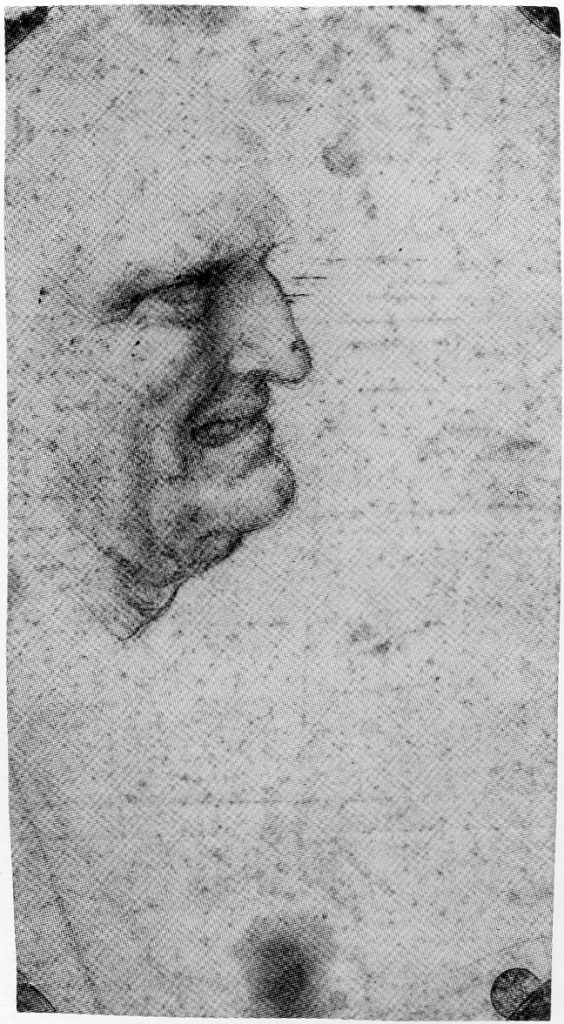
Leonardo da Vinci, Head of a Warrior in Profile, black chalk, 220 x 116 mm, Gallerie dell’Accademia, Venice.

Leonardo anticipated the modern era’s introduction of the psychological component into a drawing.

Leonardo da Vinci, Study of a Warrior’s Head for the Battle of Anghiari (Recto), Red chalk on prepared paper, 22.6 × 18.6 cm. Museum of Fine Arts, Budapest. It is a less than life size drawing from a live model. Over the years some scholars have doubted its authenticity as a Leonardo drawing.

Verso of Study of a Warrior’s Head for the Battle of Anghiari (above drawing).

Leonardo da Vinci, Study of Two Warriors’ Heads for Battle of Anghiari (c. 1504–5). Black chalk or charcoal, traces of red chalk on paper, Museum of Fine Arts, Budapest. This is one of the most famous drawing studies by Leonardo da Vinci for the Battle of Anghiari fresco mural project.

Within wide study in the physical sciences, Leonardo attempted everything̱– and did not always finish. It was the immensity of his study and his loathing of the finished quality of the model-book that allowed Leonardo to abandon projects and pick up new and creative directions and methods. Leonardo’s world view as an artist for his art was universal—indeed, he personified the popular definition of “Renaissance Man.” In his artistic boldness and innovation, Leonardo’s methods and objectives found him its sole practitioner for years—even decades. Yet Leonardo was a man of his times. The era of the mid-to-late fifteenth century was one of social awakening to the globe and its conquest by nations and kingdoms. The historical period saw great changes in cultural perceptions based on European cities achieving charters of economic and political freedom as well as new scientific and other discoveries. These included the heliocentric model of the solar system by astronomer and mathematician Nicolaus Copernicus (1473-1543) and the international voyages of discovery by Christopher Columbus (1451-1506). It was an age of revolutionary ideas and technology and Leonardo da Vinci had no doubt it included art.

In Leonardo’s drawings there is the untidy immaginativa quality in its hasty, scribbled animations. Studies for the Battle of Anghiari present a cacophony of images—drapery studies; grotesque heads; armory; horses. For each area, Leonardo’s drawing between 1503 and 1506 had reached mature stylistic development.35 Not since Leonardo’s The Adoration of the Magi in 1482 had he created a composition achieving the cohesion of gestures and inter-relationships among figures.

Nikolaus Copernicus (The Torun portrait), Anonymous, c. 1580.

Leonardo da Vinci, Adoration of the Magi, 1482, oil on wood, 246 cm × 243 cm (97 in. × 96 in.), Uffizi, Florence.

There are speculatively three panels or sections completed for the Battle of Anghiari. The most recognizable is the large central panel or section known as the Battle for the Standard. It is known by its copies by other artists. Leonardo’s central panel depicts four men, one partially hidden, riding war horses. They are engaged in the heat of combat, frozen in a frame of animated movement, for the capture of a standard during the battle. Other sections of the Battle of Anghiari—derived from Leonardo’s small preparatory sketches—depict a wild, galloping horse and a pair of belligerents on horseback. These are briefly discussed below. The most well-known copy of the central section of Leonardo’s fresco (the only section he apparently painted) is by the great artist Peter Paul Rubens (1577-1640). In the collection of the Louvre, Rubens’ copy dates from 1603 and is, in fact, a copy of a copy. Rubens copies Lorenzo Zacchia’s (1524-c.1587) copy dating from 1553 which he possibly took directly from the fresco or a lost cartoon. There are three extant copies by other artists of Ruben’s copy of a copy of the possibly original artwork.36 These copies at various removes provide insight into the impact for art through the centuries. The rest of Leonardo’s composition is conjectured based on drawings.37 The left panel or section Leonardo could have intended to be horsemen charging into battle while the right panel or section could be the taking of the bridge over the Tiber on horseback which was a key action for victory. The preparatory drawing sheets have images on top and below and may be related as part of a narrative sequence that Leonardo worked to clarify and simplify as a design until he started painting the composition.38 Throughout the project Leonardo had detail and atmospherics in mind though in its piece meal condition today, a full aspect of his creative process is irretrievably lost.39

Peter Paul Rubens, Copy of Leonardo’s Battle of the Standard (from the Battle of Anghiari), 1603, Louvre.

Horses are one of Leonardo’s favorite subjects. The Battle for the Standard portrays three soldiers on three horses with swords brandished in the smoke and flame of hand-to-hand combat. A fourth soldier on horseback is partially hidden. Two more soldiers have fallen beneath the hooves of their reeling horses and attempt to cover themselves with their shields. The weight of the horses is depicted in their meaty haunches. The horses’ heads are ancient and noble. They crush, bite, and plow into the heat of battle. The screaming head of Niccolò Piccinino –the protagonist of the Battle for the Standard — and from whose hands the standard is wrested away by Florentine soldiers (the profile on his immediate right) wore a large red cap as described by Vasari.40

The overall configuration of the scene is Leonardo’s Renaissance construction of the type of dense figures discovered on ancient Greek and Roman sarcophagi. The stylistic effect of Rubens’ copy of Leonardo’s Battle of the Standard is, by virtue of its similarity, carried forward into the seventeenth century as witnessed by Rubens’ The Hippopotamus Hunt (1616) and The Lion Hunt (1621) both in the Alte Pinakoteck in Munich. The question can be posed: to what degree is Rubens’ stylistic effect, by virtue of his 1603 copy of a 1553 copy of Leonardo’s 1503 image, inferred into Leonardo’s Battle of the Standard? Yet Leonardo’s battle, seen by thousands over decades before its demise, can be said to have directly influenced battle scene depictions whose style continued into the Romantic Period in mid19th century France.41

Fall of Phaeton, Greek marble Roman sarcophagus, 62 x 220 cm, c. 150 AD, Uffizi Gallery, Florence.

Peter Paul Rubens, The Hippopotamus Hunt, 1616, Alte Pinakothek, Munich.

Peter Paul Rubens, The Lion Hunt, 1621, Alte Pinakothek, Munich.

Tintoretto, Saint George and the Dragon, 1555–1558, oil on canvas, 157.5 x 110.3 cm, The National Gallery, London.

Eugène Delacroix, The Combat of the Giaour and Hassan, 1826, The Art Institute of Chicago.

Bronzino, Allegory of Venus and Cupid, c. 1560, The National Gallery, London.

The screaming head in the background on the left side of the painting is speculatively based on the head of Leonardo’s protagonist in the Battle of the Standard.

Along with these artistic innovations and achievements by Leonardo in a long, lonely process of exploration the hallmark achievement of the Battle of Anghiari is its reckless artistic inspiration.  While historical construction of Leonardo’s drawing method requires speculation, existing studies for the work, including those specific to the Battle of Anghiari, provide insights. For instance, Leonardo deployed the pen as well as chalk in preparatory drawings for the Battle of Anghiari. This practice continued the spontaneous and dynamic plasticity of his drawing technique from the 1490s42 and contained psychophysical and temporal effects.43 Up to Leonardo, the general practice for using a pen or stylus was by way of short parallel lines. In the Battle of Anghiari Leonardo is the first Italian artist to systematically use curvilinear hatching.44 A complementary contrast to Leonardo’s inventiveness is that he valued and paid attention to his work experiences. After the early 1480s he retained his sense of form and design and continued to work through particular problems that interested him within a general trend of development.45

Leonardo da Vinci, Study of Rearing Horse, light fine red chalk and hatching with traces pen and brown ink, 153 x 142 mm, Royal Library, Windsor. The horse drawn from life shows a tense rider pivoting.

Leonardo’s drawings, including his preparatory studies, convey a sensational appearance of continuous movement. Formed into a triangle the figures of combatants in the central section of the Battle of Anghiari and elsewhere move in a swirling motion similar to the apocalyptic liquid cascades Leonardo would later draw. Facial expressions, gnarled and strained on both man and beast, add their distinctive vitality to the animated whole. The Battle of the Standard works similarly to Leonardo’s mechanical drawings in their careful construction. The “machine” operates as an expression of the physicality and emotional and psychological intensity of men fighting to the death. Leonardo, as discussed, based this key scene for the city-state commission on an episode described in historical written texts.46

Leonardo in his first draft of a drawing worked to establish this general sense of movement. In first drafts he attempts the pictorial pitch that he will develop. In the second stage (“per ripruova”) Leonardo begins to create major motifs.47 The two most important primi pensieri for the Battle of Anghiari are pen and ink drawings from the Gallerie dell’ Accademia in Venice, Italy. Scholarship’s quest to reconstruct Leonardo’s creation of the Battle of Anghiari has been identified as “quixotic,”48 yet these drawings while no larger than the size of a clenched fist give out significant clues.

Leonardo da Vinci, Battle Study, two skirmishes between horsemen and foot soldiers, c.1503, pen and brown ink, brush and brown wash, 147 x 154 mm (6 x 6 in.) Gallerie dell’ Accademia, Venice, Italy.

Leonardo da Vinci, Battle Study, Skirmish between Horsemen, Foot soldiers and Foot soldiers Wielding Long Weapons, pen and brown ink over black chalk and stylus, c.1503, 147 x 154 mm (6 x 6 in.), Gallerie dell’ Accademia, Venice, Italy.

In one of the preparatory drawings the horseman on the left is looking back over the horse’s haunches, a dramatic image among the handful of fighters in close combat that Leonardo will condense into a dominant motif in the Battle of the Standard. The artist’s steady progression belies his reputation as a slow worker though this inventive stage of drawing appealed to him most. For each stage, Leonardo’s drawing is a fully animated artistic expression of his subject matter. While the creative process of Leonardo’s drawing brings the image, as Heinrich Wöfflin observed, to the “verge of the unclear,”49 it also begins to reveal some of the inner workings of Leonardo’s brilliance. In exchange for the free and kinetic character of drawing studies taken to the brink, the later and final work becomes increasingly plastic and compact.50

Leonardo da Vinci, Fight for the Standard at the Bridge and Two Foot Soldiers, pen and brown ink, 99 x 141 mm, Gallerie dell’Accademia, Venice. It is speculated that this preparatory drawing was for the right panel (or section) of the fresco. It depicted the taking of the bridge over the Tiber River that was a key historical action to military victory for the Florentines over the Milanese at the Battle of Anghiari on June 29, 1440.

Leonardo da Vinci, Study of charging horses and Soldiers, red chalk on paper, 167 x 240 mm, Royal Library, Windsor. Anticipating Degas’s racehorses 350 years in the future, this drawing of horsemen charging to battle may represent the left panel (or section) of the Battle of Anghiari that Leonardo envisioned as a three-part narrative sequence.

Copy of a horseman from the Battle of Anghiari, pen and brown ink, brush and gray wash, white gouache on paper, 267 x 237 mm, The British Museum.

In the drawings for the Battle of Anghiari he communicates in lively action and engrossing drama the close physical contact of the horses and their riders encircling and falling upon one another in the passion and violence of war.51 The fresco in the Florentine council chambers would remind leaders of war’s brutality and, though a glorification of civic heroism and pride, the wall-sized image served to show the fury of slaughter that military battles cost. The Battle of the Standard was an image that conveyed the phrase that typified the meaning of war for Leonardo: pazzia bestialissima (“beastly madness.”)52 Recalling Bertoldo’s battle scene that originally decorated the Florentine palazzo of Lorenzo de’ Medici (“the Magnificent’) and based on an ancient Roman sarcophagus, proffered to the viewer no identifiable sides. War is not a glorious narrative, but combatants falling into one another. In addition to its classical and Renaissance allusions, its plastic form appealed to Leonardo’s beliefs and attitudes about the intrinsic nature of combat that he then looked to dramatize in the Battle of Anghiari.  

The Madness of War: The mural’s preserved central section, The Battle for the Standard (known through copies by Peter Paul Rubens), depicted combat not as glorious propaganda, but as a claustrophobic, violent clash of roaring men and biting horses—a concept Leonardo dubbed pazzia bestialissima (“beastly madness”).

Leonardo da Vinci, Study of horses for the Battle of Anghiari. Leonardo depicts horses displaying emotion.

Leonardo da Vinci, Study of group of riders in the Battle of Anghiari, c. 1503, charcoal and black chalk reworked with brush and brown wash, Royal Library, Windsor. The left-handed hatching is for a drawing taken from a clay or wax model.

A Paradigm Shift for Artists: These projects and the historic confrontation between Leonardo and Michelangelo permanently transformed the status of artists from simple craftsmen into celebrated, irreplaceable creative personalities.

Bertoldo di Giovanni (ca. 1440–1491), Battle, c. 1480–85, Bronze, 17 3/4 × 39 1/8 in. (45 × 99.5 cm), Museo Nazionale del Bargello, Florence.

The artistic drawings that survive which reveal Leonardo’s artistic process are an invaluable piece of a final enterprise that ultimately failed to materialize on several levels despite Leonardo believing the high-level commission was vital to his reputation as an artist.53 In the end, Leonardo was viewed by the oligarchs as not only procrastinating but having not fulfilled his contract and they sued Leonardo for breach. Yet more enduring than a legal concern was the art project involving Leonardo da Vinci and Michelangelo Buonarroti. The work accomplished by these two giants of art reverberates through the centuries to today. Theirs is a legacy of the individual artist still being sought out—though by chairmen and presidents rather than popes and princes. A legacy that says artists are no longer craftsmen or tradesmen but artistic personalities in their own right with a unique and appealing style who are thus engaged for their singular brilliance.54 In the face of what was an incomplete, sometimes failed, and ultimately abandoned project—its competitive nature notwithstanding—all the variations of Leonardo’s creative activity funnels into a tremendous example for the mission of the artist –that is, to serve first neither patron nor purse nor artistic reputation —but the glory of making one’s art.

Leonardo, Self-Portrait, c. 1512, Royal Library of Turin, Italy.

BIBLIOGRAPHY:

Acidini Luchinat, Christina, Butters, Suzanne B., Chiarini, Marco, Cox-Rearick, Janet, Darr, Alan P., Feinberg, Larry J., Giusti, Annamaria, Goldthwaite, Richard A. , Meoni, Lucia, Piacenti, Kirsten Aschengreen, Pizzorusso, Claudio, Testaverde, Anna Maria, The Medici, Michelangelo, And The Art of Late Renaissance Florence, Yale University Press in association with The Detroit Institute of Arts, New Haven and London, 2002.

Ames-Lewis, Francis, Drawing in Early Renaissance Italy, Revised Edition, Yale University Press, New Haven & London, Second Edition, 2000 (originally published 1981).

Ames-Lewis, Francis, The Intellectual Life of the Early Renaissance Artist, Yale University Press, New Haven & London, 2000.

Bambach, Carmen C., editor, Leonardo da Vinci, Master Draftsman, The Metropolitan Museum of Art, New York, and Yale University Press, New Haven and London, 2003.

Berenson, Bernard, The Italian Painters of the Renaissance, Phaidon Press, London, 1959.

Braham, Allan, Italian Paintings of the Sixteenth Century, The National Gallery, London in association with William Collins Sons & Co. Ltd, London, 1985.

Braudel, Fernand, Out of Italy: 1450-1650, trans. Siân Reynolds, Flammarion, Paris, 1991.

Clark, Kenneth, Leonardo da Vinci, Penguin Books, London, 1993 (first printed 1939).

Clark, Kenneth, Selected Drawings from Windsor Castle:  Leonardo da Vinci, Phaidon Press, London, 1954.

Durant, Will, The Renaissance: A History of Civilization in Italy from 1304-1576 A.D., Simon and Schuster, New York, 1953.

Gombrich, E. H., Norm and Form: Studies in the Art of the Renaissance, Phaidon Press, London, 1966.

Hartt, Frederick, History of Italian Renaissance Art:  Painting, Sculpture, Architecture, Harry N. Abrams, Inc., New York, Third Edition, 1987.

Hohenstaat, Peter, Leonardo da Vinci, Könemann, Köln, 1998.

Isaacson, Walter, Leonardo da Vinci, Simon & Schuster, New York, 2017.

Machiavelli, Niccolò, trans. William J. Connell, The Prince, Bedford/St. Martin’s, Boston and New York, Second Edition, 2016 (originally published 2005).

Meiss, Millard, The Great Age of Fresco Discoveries, Recoveries and Survivals, George Braziller, Inc. in association with The Metropolitan Museum of Art, New York, 1970.

Popham, A.E., The Drawings of Leonardo da Vinci, Jonathon Cape, London, 1977 (first published 1946

Saviotti, Franco, Florence, Edizione – SAFRA, Firenze, 1981.

Steinberg, Leo, Leonardo’s Incessant Last Supper, Zone Books, New York, 2001.

Turner, Jane, editor, Encyclopedia of Italian Renaissance & Mannerist Art, Volume 1 and II, Grove Dictionaries, Inc., New York, 2000.

Vasari, Giorgio, trans. George Bull, Lives of the Artists, Penguin Books, Harmondsworth, Middlesex, England, 1965.

Wöfflin, Heinrich, Classic Art: An Introduction to the Italian Renaissance, Phaidon Press Limited, London, 1994 (first published 1952).

©John P. Walsh. All rights reserved. No part of this material may be reproduced or transmitted in any form or by any means, electronic or mechanical, which includes but is not limited to facsimile transmission, photocopying, recording, rekeying, or using any information storage or retrieval system.

FOOTNOTES: Available at link below.

https://www.academia.edu/41301480/On_the_500th_Anniversary_of_Leonardo_da_Vincis_death_a_look_at_a_masterpiece_the_Battle_of_Anghiari_and_its_Fabled_Competition_with_Michelangelo_for_the_Laurel_of_Greatest_High_Renaissance_Artist_in_Sixteenth-Century_Italy