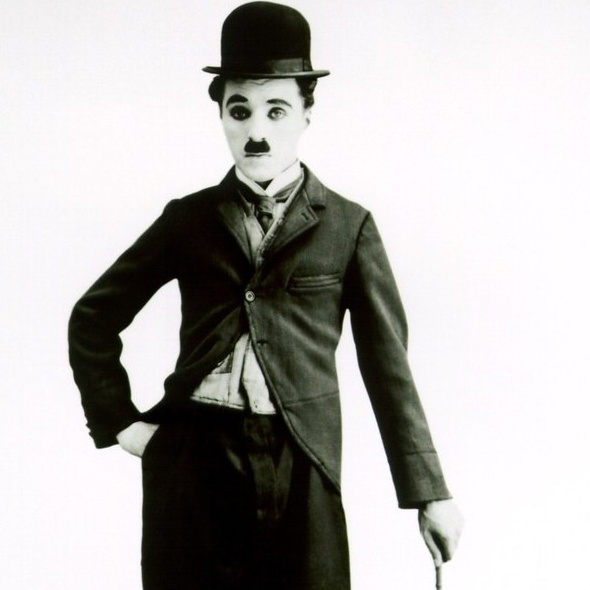
FEATURE image: Full-length, black-and-white portrait of the English comic actor and filmmaker Charlie Chaplin in his famous “The Tramp” character, 1915. See details below. Public Domain.
Charlie Chaplin’s rise between 1913 and 1918 illustrates how exceptional talent, business acumen, and a determination to gain creative control transformed him from a touring stage performer into the world’s most famous film comedian and one of the first independent movie auteurs.

Charlie Chaplin (1889–1977) taken circa 1915 to 1916 during Chaplin’s massive surge in popularity while he was under contract with the Essanay Film Manufacturing Company (1915) or right as he transitioned to the Mutual Film Corporation. This is a famous publicity headshot meant to show the public the “real” man behind the slapstick makeup. At the time, audiences worldwide only knew him as the scruffy Little Tramp.
Studio portraits like this shocked fans by revealing that Chaplin was a remarkably handsome, sharp-dressing young man in his mid-20s without his fake mustache, baggy clothes, and heavy eyeliner instead dressed in a formal, well-tailored dark three-piece suit, a high stiff-collared white shirt, and a distinct polka-dot bowtie. Chaplin didn’t sign his historic million-dollar deal with First National Pictures until late 1917, building his own Hollywood studio to produce films for them in 1918. Public Domain.
From Keystone to First National: Charlie Chaplin’s Rise to Global Stardom, 1913-1918.
Discovered in America
Twenty-four-year-old Charlie Chaplin arrived in the United States in 1913 as a member of Fred Karno’s famous English music hall and pantomime troupe. During the tour, his remarkable comic talents attracted the attention of film producer Mack Sennett, founder of Keystone Studios.
Chaplin was discovered in the United States in 1913 while touring with an English vaudeville and pantomime troupe and was hired by Mack Sennett’s Keystone Studios.
Chaplin signed a contract with Keystone Comedies for $150 a week, roughly three times what he had earned in vaudeville and music halls. More importantly, the position introduced him to the rapidly expanding motion picture industry and its enormous commercial potential.
In his first year at Keystone, Chaplin appeared in an astonishing 35 films. The short one- and two-reel format proved ideal for developing his most famous screen creation, “the Tramp,” a lovable, resilient underdog recognizable by his bowler hat, cane, oversized shoes, and distinctive walk. Audiences embraced the character immediately, and Chaplin became one of the first true movie stars of the silent era.
At Keystone, he created and refined the “Tramp” character and became an overnight film sensation through a remarkable output of short comedies.
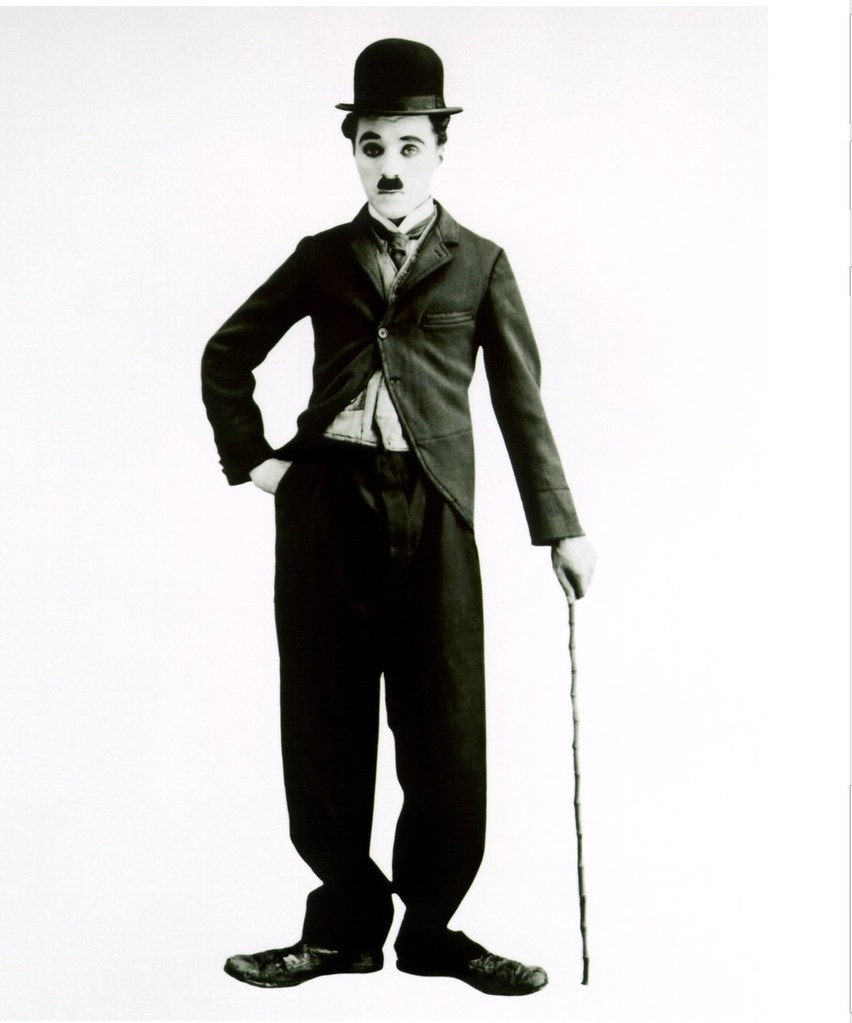
Full-length, black-and-white portrait of the English comic actor and filmmaker Charlie Chaplin in his famous “The Tramp” character costume of tight-fitting jacket, oversized baggy trousers, a collared shirt with vest, large worn-out shoes, and signature bowler hat. One hand is on his hip while the other holds his thin cane, which rests on the floor. The Tramp stands with his feet turned outward and has his trademark small toothbrush mustache and heavily lined eyes, looking directly forward with a slightly melancholy expression.
The portrait was taken in 1915 by American photographer Julius Strauss-Albert Peyton Studio. The promotional photograph was made during Charlie Chaplin’s meteoric rise to global fame, specifically around the time he signed with the Essanay Film Manufacturing Company. Chaplin had spontaneously created “The Tramp” (or “Little Tramp”) costume just a year prior in early 1914 while working at Keystone Studios. This exact image became one of the definitive, universally recognized marketing portraits of the era. It was reproduced globally on movie posters, sheet music, and merchandise to promote his foundational silent films, cementing the Tramp as a permanent fixture of film history. PHOTO: “Charlie Chaplin” by tonynetone is licensed under CC BY 2.0.
Edna Purviance: Chaplin’s Leading Lady. Charlie Chaplin and Edna Purviance (1895-1958) share the screen in this classic clip from A Dog’s Life (1918), featuring Granville Redmond (1871-1935) as the dance hall proprietor. Beginning in 1915, Purviance became a key figure in early cinema as Chaplin’s principal leading lady. She brought charm and depth to many of his greatest silent films, appearing in more than 30 films with him through 1923.
Purviance’s natural screen presence and understated acting style complemented Chaplin’s comic genius. Among their collaborations was A Dog’s Life (1918), in which she played the female lead opposite the Tramp. The film also featured landscape painter Granville Redmond (1871-1935), a close friend of Chaplin, in the role of a dance hall proprietor.
The Essanay Years: Creative Freedom and Financial Success
Although Mack Sennett wanted to retain his breakout star, the Chicago-based Essanay Film Manufacturing Company successfully lured Chaplin away in late 1914. The new contract paid him $1,250 a week and, just as importantly, gave him the opportunity to exercise greater creative control over his films.
Chaplin made 14 films for Essanay between 1915 and early 1916. During this period, he refined the Tramp character, blending comedy with sentiment and human emotion in ways that distinguished his work from the rough-and-tumble slapstick then common in silent film comedy.
His move to Chicago’s Essanay Film Manufacturing Company brought a dramatic salary increase and greater artistic control over his films.
The financial rewards were substantial for both artist and studio. While Chaplin earned unprecedented sums, Essanay profited even more from the immense popularity of his films, helping transform both Chaplin and the company into major forces within the motion picture industry.
Mutual Film Corporation and Comic Mastery
In early 1916, Chaplin signed a groundbreaking contract with Mutual Film Corporation that elevated him into the highest ranks of entertainment. The agreement paid him approximately $670,000 annually, or $10,000 a week, an extraordinary amount at the time and the equivalent of hundreds of thousands of dollars per week today.
By this point Chaplin was not merely a popular comedian. He had become an international cultural phenomenon whose fame extended across Europe and North America.
The Mutual period is often regarded as one of the most artistically successful phases of Chaplin’s career. During 1916 alone he produced twelve films, including:
At Mutual Film Corporation, Chaplin became the highest-paid entertainer in the film industry and produced a series of silent comedy classics that established his international reputation.
- The Floorwalker
- The Fireman
- The Vagabond
- One A.M.
- The Count
- The Pawnshop
- Behind the Screen
- The Rink
Chaplin followed these with four additional films in 1917. Collectively, the Mutual comedies demonstrated a remarkable combination of physical comedy, character development, storytelling, and technical craftsmanship that raised screen comedy to a new artistic level.
By the beginning of 1918, the still youthful Chaplin had become one of the world’s most celebrated filmmakers. His fame opened doors to prominent artists, writers, performers, and cultural figures across the globe.
Becoming an Independent Producer
Recognizing Chaplin’s unmatched drawing power, Mutual offered him a lucrative renewal contract worth $20,000 per week, with the studio covering production costs. Yet Chaplin wanted more than a salary. He wanted artistic independence and a direct share of the profits generated by his films.
Instead, he signed with First National Exhibitors’ Circuit. The new agreement matched Mutual’s financial terms, included a signing bonus of $15,000, and granted Chaplin substantial control over his productions.
Rather than remain a highly paid employee, Chaplin pursued profit-sharing and creative independence, signing with First National. By 1918, with A Dog’s Life, Chaplin was producer, writer, director, and star of his films, demonstrating full artistic authority over his work.
Although Chaplin assumed responsibility for production expenses, he benefited from profit-sharing arrangements – 50% share in its box office – and retained unprecedented authority over every aspect of filmmaking. As producer, writer, director, editor, and star, he was increasingly shaping his career on his own terms.
The arrangement effectively made Chaplin an independent producer, controlling both the artistic direction and financial destiny for his next 8 films. It was a major step toward the complete creative autonomy he would later achieve as a co-founder of United Artists in 1919.
A Dog’s Life and a New Phase of Chaplin’s Career
Chaplin’s first release for First National was A Dog’s Life, which premiered in April 1918.
Running approximately 33 minutes, the three-reel film featured the Tramp and demonstrated Chaplin’s growing sophistication as a filmmaker. Combining humor, pathos, social observation, and romance, the picture is often viewed as a bridge between his shorter comedies and the feature-length masterpieces that would follow.
Chaplin served as producer, writer, director, and star, reflecting the extraordinary level of creative control he had achieved by the age of twenty-eight.
Chaplin on Film: The 1992 Biography Chaplin’s life later inspired the 1992 biographical film Chaplin, directed by Richard Attenborough and starring Robert Downey Jr. in the title role. The comedy-drama film from TriStar Pictures (US). also featured Dan Aykroyd as Mack Sennett, Marisa Tomei as Mabel Normand, Penelope Ann Miller as Edna Purviance, Kevin Kline as Douglas Fairbanks, and Maria Pitillo as Mary Pickford.
One of the film’s most notable aspects was the casting of Geraldine Chaplin, Charlie Chaplin’s daughter, as her grandmother Hannah Chaplin. Although Chaplin received mixed reviews, it earned three Academy Award nominations, including one for John Barry’s acclaimed original score. Barry’s haunting main theme captures both the triumph and melancholy of one of cinema’s most influential pioneers.
Conclusion
Between 1913 and 1918, Charlie Chaplin rose from a touring English music hall performer to the most famous comedian in the world. Through Keystone, Essanay, Mutual, and First National, he steadily gained higher salaries, greater artistic freedom, and increasing control over his work. By the release of A Dog’s Life in 1918, Chaplin had become far more than a movie star. He was a filmmaker, entrepreneur, and creative visionary whose influence would shape the history of cinema for generations.
The time period highlights not only Chaplin’s comic genius but also his evolution into a pioneering filmmaker-businessman whose career pointed toward the creation of artist-controlled enterprises such as United Artists with Mary Pickford, Douglas Fairbanks, and D.W. Griffith in 1919.
Bibliography:
Balio, Tino. “Stars in Business: The Founding of United Artists.” In The American Film Industry, edited by Tino Balio, 135–152. Madison: University of Wisconsin Press, 1976.
Robinson, David. Chaplin: His Life and Art. New York: McGraw-Hill Book Company, 1985.