FEATURE image: Wearing his unmistakable black fedora and dark sunglasses, an iconic style armor he rarely performed without from the 1970s onward, this performance photograph captures the Argentine jazz icon Leandro “Gato” Barbieri entirely in his element during a live concert as it beautifully emphasizes the intense stage presence that defined his late-career persona. PHOTO: “Gato Barbieri” by ognid is licensed under CC BY-NC-ND 2.0.
Leandro “Gato” Barbieri was a singular musical innovator who transcended jazz, Latin music, film scoring, and popular music, forging a distinctive sound that carried him from avant-garde experimentation and the Grammy-winning score for Last Tango in Paris to international recognition and a Latin Grammy Lifetime Achievement Award.
Released in September 2002 on Peak Records, the Latin jazz ballad “Beautiful Walk” is from “Gato” Barbieri’s 50th album, Shadow of the Cat.
Shadow of the Cat was Grammy-nominated for Best Latin Jazz. Gato Barbieri looked to two major sources for the album’s inspiration. The first was the 30th anniversary of his Last Tango in Paris (1972) for which Barbieri won a Grammy Award for the film score. The second was his huge-toned, raucous yet smooth jazz-pop sound Barbieri created in five albums he made at A&M Records in the mid-to-late-1970’s.
Following a six decade career as a music original, Gato Barbieri died on April 2, 2016 at 83 years old.
Latin Grammy Lifetime Achievement in 2015. “What do you play?”
By 2006 Gato Barbieri was content that in a long musical career he had pursued playing different musical styles—jazz, Latin, film orchestration, etc.—and did not limit himself to a single genre.
In November 2015 Gato Barbieri received the Latin Grammy Lifetime Achievement Award for music that has been described as “mystical yet fiery, passionately romantic yet supremely cool.” Around the same time, Barbieri gave his final concert at the Blue Note club in Greenwich Village. That was the club where the “Cat” first performed in 1985 and—still sporting his trademark black fedora hat—started performing again there in 2013 on a monthly basis until his last concert on November 23, 2015.
“The jazz people they don’t consider me a jazz musician. If I am Latin, they don’t consider me Latin. So I am here in the middle,” Gato said. “It’s a good thing. You know why? Because they say, ‘What do you play?’ I say, ‘I play my music — Gato Barbieri.’”
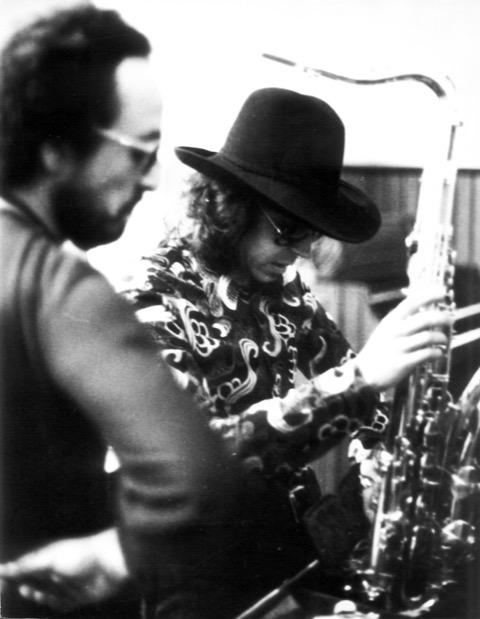
Gato Barbieri with Italian music critic, journalist, and record producer Giacomo Pellicciotti in a photograph by Giuseppe Pino during a recording session break on April 14, 1982. By April 1982, Barbieri was in a fascinating transitional phase of his career. Having spent the late 1970s conquering the global pop-jazz charts with polished A&M crossover hits like Caliente! and Ruby, Ruby, the early 1980s saw him collaborating closely with prominent European jazz figures. Giacomo Pellicciotti was a monumental force in the European jazz world, having co-founded the legendary avant-garde label Black Saint in 1975 and later producing for its companion label, Soul Note. PHOTO: “File:Pellicciotti con Gato Barbieri.jpg” by Giuseppe Pino is licensed under CC BY-SA 4.0
Mid1960’s Jammin’ fusion.
Gato Barbieri and Italian-born wife Michelle married in 1960 and moved to Rome in 1962, where Gato began collaborating with American jazz trumpeter Don Cherry (1936-1995). The year is 1966. Tenor saxophonist Gato Barbieri is joined by trumpeter Don Cherry, jazz vibraphonist Karl Berger (German, b. 1935) and bassist Bo Stief (Danish, b. 1946). In 1966 Barbieri and Cherry recorded two albums for Blue Note—Complete Communion and Symphony For Improvisors. Also in that early era Gato recorded with jazz saxophonist and composer Steve Lacy (1934-2004) and South African pianist Abdullah Ibrahim (b. 1934).
Recordings for Flying Dutchman and Impulse!
In the early 1970’s Barbieri recorded a handful of albums on the Flying Dutchman label and later signed with Impulse! where he recorded his classic “Chapter Series” which included Latin America and Hasta Siempre (both 1973), Viva Emiliano Zapata (1974) and Alive in New York (1975).
Gato Barbieri, “Encuentros” from Chapter One: Latin America, the 1973 album on the Impulse! label.
Barbieri’s free jazz meant he was playing with American jazz double bass player Charlie Haden (1937-2014) and American jazz pianist Carla Bley (b. 1936), among many others. The Cat could also be found jamming with jazz bassist Stanley Clarke (b. 1951), Brazilian jazz drummer and percussionist Airto Moreira (b. 1941), Cuban composer Chico O’Farrill (1921-2001) and American jazz musician Lonnie Liston Smith (b.1940).
Gato Barbieri’s work on Last Tango in Paris (1972) became a global phenomenon. It transformed him overnight from a respected, niche avant-garde jazz musician into an international celebrity. The score earned him a Grammy Award for Best Instrumental Composition in 1973 and opened the door for his highly successful 1970s career as a mainstream crossover artist.
Gato Barbieri’s free-jazz playing and improvised style that mined Latin jazz in multi-artist projects in the late 1960s and early 1970s attracted Italian film director Bernardo Bertolucci (1941-2018) for his next film project. In 1972 Bertolucci recruited Gato Barbieri to compose the score for Bertolucci’s brutal sex-fantasy film Last Tango in Paris (1973) starring Marlon Brando and Maria Schneider.
Bertolucci hired Barbieri to incorporate the Italian director’s ideas for an original blend of jazz, strings, and tangos to embody his highly controversial X-rated film’s chaos of spirit and ferocious sexuality that gave nod to American and European avant-gardists with a splash of Hollywood popularity. The musical score for Last Tango in Paris was a professional triumph for the 41-year-old Gato Barbieri.

This iconic movie still captures Marlon Brando and Maria Schneider amid a crowded dance floor in Bernardo Bertolucci’s controversial 1972 drama Last Tango in Paris. The scene unfolds as Jeanne and Paul enter a formal tango competition, a pivotal moment where the film’s themes of desire, alienation, and emotional collapse converge with mounting intensity. Complementing the imagery is Gato Barbieri’s unforgettable score, which fuses the melancholy elegance of traditional Argentine tango with the raw energy and improvisational fire of modern jazz. The result is a soundtrack that mirrors the film’s atmosphere of longing, volatility, and emotional reckoning, helping to make both the music and the movie enduring cultural touchstones. PHOTO: “Last Tango in Paris” by drmvm1 is licensed under CC BY-ND 2.0.
The film, censored and disliked across a range of groups as well as whole nations, received two Academy Award nominations – for Best Actor for Marlon Brando’s performance and Best Director for Bertolucci. At the April 1974 ceremony, Oscar in both categories, went to others – respectively, Jack Lemmon for Save the Tiger and George Roy Hill for The Sting. The film was neither nominated for Best Foreign Language Film, nor was its musical score recognized in any way.
After Last Tango in Paris opened in New York City on February 1, 1973, Gato Barbieri’s musical score was an instant international sensation. In March 1974, at the 16th Annual Grammy Awards in Los Angeles, Gato Barbieri won the Grammy Award for Best Instrumental Composition (“Album of Best Original Score Written For A Motion Picture Or A Television Special”) for his work on Last Tango in Paris.
Fireflies is the lead track from Gato’s bestselling Caliente! album for A&M in 1976. It was produced by Herb Alpert.
The Argentine-born saxophonist’s enduring legacy was built on artistic independence, constant reinvention, and an unwavering commitment to creating music on his own terms.
Gato Barbieri performed benefit concerts, one for the Friends of Chile benefit concert in Madison Square Garden on May 6, 1974. Gato Barbieri’s five albums on A&M Records in the mid-to-late 1970s featured a more soothing jazz-pop sound.
Caliente! (1976) on A&M Records was released at the beginning of the peak of the jazz-fusion and disco eras. Produced by Herb Alpert, Gato Barbieri plays with sizzling heat relying on tango-infused Argentine fluency as well as the influence of Sonny Rollins (b.1930), John Coltrane (1926-1967) and Pharoah Sanders (b. 1940).
Caliente! is beautifully arranged and executed which makes for enjoyable listening. The concept of strings combined with rhythmic danceable funk anted up Barbieri’s raucous sound and made Caliente! a successful primogeniture to Herb Alpert’s instrumental Rise in 1979 which became a huge international hit.
Bridge to Legend Status
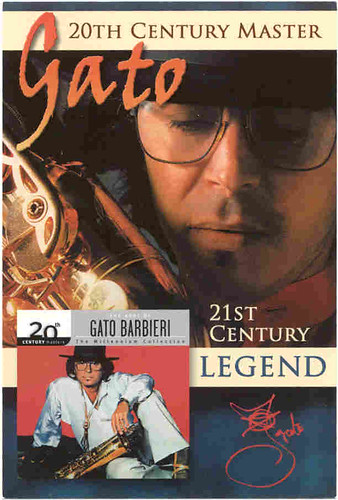
This is the official cover for The Best of Gato Barbieri: 20th Century Masters – The Millennium Collection, released by Universal Music Group/Hip-O Records in January 2004. The cover photograph shows Barbieri leaning back in a signature white suit, cradling his gold tenor saxophone. The compilation, along with its accompanying “Master / Legend” branding, represented the ultimate third-act canonization phase of his career. Rather than surveying his entire catalog, this particular 20th Century Masters volume focused almost exclusively on the beloved mid-to-late 1970s recordings that defined his commercial peak, including “Europa (Earth’s Cry, Heaven’s Smile),” “Behind the Rain,” and “Ruby.”
By the early 2000s, Barbieri was emerging from a difficult decade marked by profound personal hardship, including the loss of his first wife, Michelle, and his own triple-bypass surgery. This retrospective package formed part of a broader industry effort to cement his place in the jazz canon, recasting him not simply as a successful contemporary artist of the 1970s and 1980s but as an enduring cultural figure whose music and influence would carry comfortably into the 21st century. The album stands as both a greatest-hits collection and a symbolic milestone in the transformation of Gato Barbieri from living performer to acknowledged jazz master. PHOTO: “RICH FREE-6” by jeanmimi 2000 is licensed under CC BY-SA 2.0.
“Tango is tragedy.”
“Always in the tango is tragedy,” said Barbieri in 1997. “She leaves him, she kills him. It’s like an opera—but it’s called tango.”
In the 1980s the “Cat” kicked it up a notch for Para Los Amigos (1984), an album which spotlighted the rock-influenced South American sound.
Mystica is from Gato Barbieri’s Qué Pasa. After working nonstop for nearly 30 years the 1997 album was the Argentine jazz tenor saxophonist’s first of the 1990’s. Gato would produce over 50 albums in his career.
“Music is mystery.”
By the early 1990’s Gato had taken time off from creating in order to evaluate his musical style and identity going forward. Suddenly, in 1995, Michelle Barbieri, his wife of 36 years, as well as manager and confidant, died. In deep bereavment, Gato took up his saxophone and began to record again. This effort soon produced the 1997 album, Qué Pasa, Gato Barbieri’s first album of the decade.
In 1996 Gato Barbieri married his wife Laura and they soon had Christian, their son. After Gato’s death on April 2, 2016 at 83 years old, Laura Barbieri told The Associated Press: “Music was a mystery to Gato, and each time he played was a new experience for him, and he wanted it to be that way for his audience.”
SOURCES:
AllMusic. “The Shadow of the Cat – Gato Barbieri | Album.” Accessed October 30, 2016. http://www.allmusic.com/album/the-shadow-of-the-cat-mw0000225929
Billboard. “Gato Barbieri Dead at 83.” Accessed October 30, 2016. http://www.billboard.com/articles/columns/latin/7318824/gato-barbieri-dead.
Concord Music Group. “Gato Barbieri.” Accessed October 30, 2016. http://www.concordmusicgroup.com/artists/gato-barbieri/.
Encyclopedia.com. “Gato Barbieri: Biography, Musical Style, and Identity.” Accessed October 30, 2016. https://www.encyclopedia.com/education/news-wires-white-papers-and-books/barbieri-gato.
Highlight Hollywood. “Latin Jazz Saxophonist Gato Barbieri Dies at Age 83.” Accessed October 30, 2016. http://highlighthollywood.com/2016/04/latin-jazz-saxophonist-gato-barbieri-dies-at-age-83-highlight-hollywood-news/.
The New York Times. “Gato Barbieri, Latin Jazz Trailblazer, Dies at 83.” Accessed October 30, 2016. http://www.nytimes.com/2016/04/03/arts/music/gato-barbieri-latin-jazz-trailblazer-dies-at-83.html.
Tff.gr. “To Teleutaio Tangko Tou Leandro ‘Gato’ Mparmpieri.” Accessed October 30, 2016. http://www.tff.gr/nea/arthro/to_teleutaio_tangko_tou_leantro_gkato_mparmpieri_vds-130329325/.