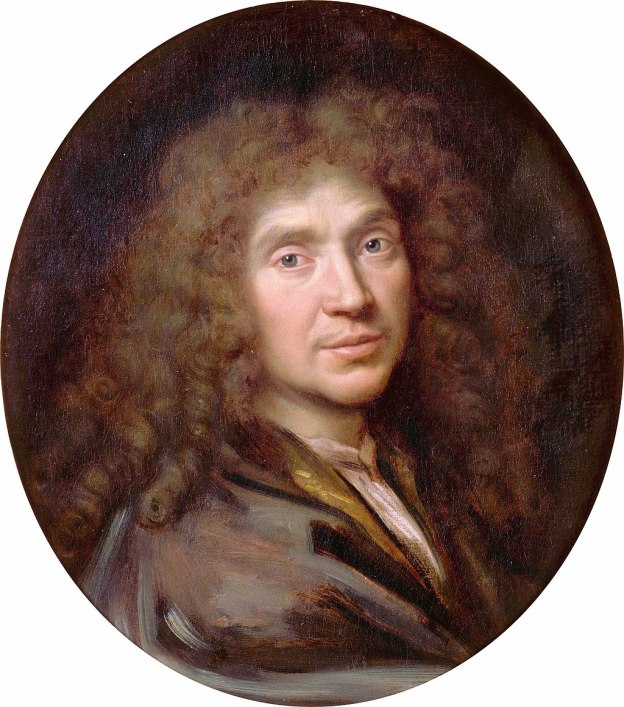

FEATURE image: Portrait of Molière, c. 1658, Pierre Mignard (1612-1695), Château de Chantilly. Pierre Mignard is one of the major classic French portrait artists. When the artist crossed paths with Molière in Avignon in 1658, after having worked in Orange and Saint-Rémy, a great friendship started between the two men, until the death of Molière in 1673. The portrait of Molière in Chantilly probably dates from this Avignon meeting, as the writer appears to be under forty years old.
More than three centuries after his death, Molière remains the defining figure of French theater, his plays continuing to shape the repertory of the Comédie-Française and affirm his enduring place in French cultural life. Far more than France’s greatest comic playwright, the 17th-century actor-manager became a permanent presence in the nation’s theatrical tradition and cultural memory.
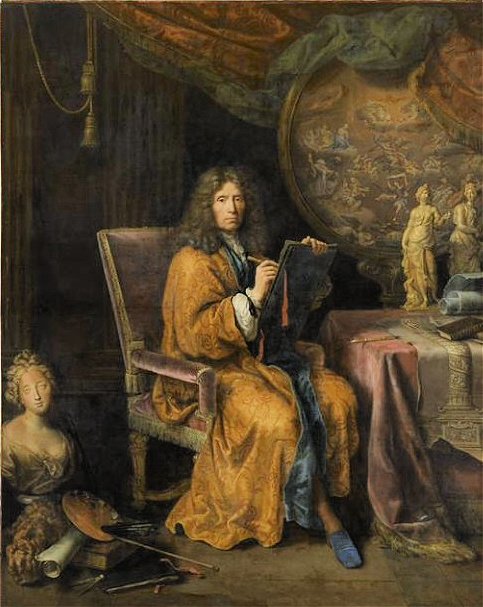
Pierre Mignard, self portrait, 1650.
Molière was born into a well-to-do family on January 15, 1622 at Rue St. Honoré in Paris and grew up near the Bastille at Rue Saint-Antoine. The greatest genius of the French theater was baptized at St. Eustache as Jean-Baptiste Poquelin. He adopted the stage name of Molière in the mid1640s after he founded his first theater troupe.

Nicolas Mignard (1606-1668). Molière (1622-1673) dans le rôle de César de la “Mort de Pompée”, tragédie de Corneille. Paris, musée Carnavalet.

Nicolas Mignard (1606-1668), self portrait, La Fondation Calvert Museum, Avignon. Mignard was a painter and older brother of Pierre Mignard.

St. Eustache in Paris was where Jean-Baptiste Poquelin, dit Molière, was baptized. PHOTO credit: “Around St. Eustache Paris 1e (40)” by Julie70 Joyoflife is marked with CC BY-NC-SA 2.0.
Known as the “Shakespeare of France,” Molière was a profound theater actor, writer and poet. His plays’ wit and characters are timeless, including Tartuffe (1664), Don Juan (1665), and The Misanthrope (1666).
In 2007 French film, “Molière,” Romain Duris is Molière and Laura Morante is Elmire
The fictional film is told in flashback to 1645. It is a conflation of different periods in Molière’s life into one earlier period. In 1645, 23-year-old bachelor Molière was bailed out of debtor’s prison. Molière was married and much older when his great, controversial play, Tartuffe, appeared in the mid1660s.
In the film, Molière poses as “Monsieur Tartuffe” (a priest) who serves as tutor for Orgon’s children. In history, older Molière played the part of the householder and trusting husband, Orgon, in his play, Tartuffe. In the film, a young Molière as Tartuffe, as in the play, falls in love with Elmire, Orgon’s neglected wife of the household.
In this scene Molière delivers a letter to Elmire from her secret admirer which, unknown to her, was written by the debonaire M. Tartuffe (Duris as young Molière).
Today any type of true romance can be heart-warming, but in the 17th century romance was viewed through the lens of means and ends, either of which could be scandalous.
Molière’s great plays Don/m Juan and Tartuffe were halted in their tracks by French religious and royal authorities who were concerned that their characters and plots could provoke popular scandal. In the mid1660s, the Archbishop of Paris condemned Molière’s work -– and the libertine Molière himself — and then turned to the highest state authority, the king, with whom the top bishop was privileged to be closely aligned, to carry out his sentence. For Molière, the Ancien Régime was alive and well: the American and French Revolutions a distant century in the future.
“But I ought to warn you, strictly between the pair of us, that in Don Juan my master you see the greatest scoundrel that ever walked on Earth. He is a madman, a dog, a devil, a Turk. He is a heretic who believes in neither Heaven, nor saint, nor God, nor the bogeyman. He lives the life of an absolute brute beast. He is an Epicurean hog, a regular Sardanapalus who is deaf to every Christian remonstrance, and looks on all that we others believe as nothing but old wives’ tales. You say he has married your mistress. He would have done far more than that to gratify his desires. He would have married you, and her dog and cat as well. It costs him nothing to marry. That is the best baited trap he has.” – Sganarelle, servant of Don Juan, played by Molière. From Don Juan (1665).
“Oh, you scoundrel! At last I see you as you really are. But, unhappily, the knowledge comes too late; and it can only serve to drive me to desperation. But, be sure, your villainy will not remain unpunished. The Heaven you mock will avenge me for your faithlessness.“ – Donna Elvira, wife of Don Juan, played by Madmoiselle du Parc. From Don Juan (1665).
“Constancy is only fit for idiots.” – Don Juan, played by La Grange. From Don Juan (1665).
“You see him as a saint. … I see right through him. He’s a fraud.” – Dorine, played by Madeleine Béjart, Act 1, Scene 1. From Tartuffe (1664).
“It’s true – those whose private conduct is the worst,/Will mow each other down to be the first/To weave some tale of lust, and hearts broken/Out of a simple kiss that’s just a token/Between friends.” – Dorine, played by Madeleine Béjart, Act 1, Scene 1. From Tartuffe (1664).
“See, I revere/Everyone whose worship is sincere./Nothing is more noble or beautiful/Than fervor that is holy, not just dutiful.“ – Cléante, played by La Thorillière, Act I, Scene 4. From Tartuffe (1664).
“What good would it do to dissent? A father’s power is great.” – Mariane, played by Mlle de Brie, Act 2, Scene 3. From Tartuffe (1664).
“Don’t be deceived by hollow shows; / I’m far … from being what men suppose.“ – Tartuffe, played by Du Croisy, Act 3, Scene 6. From Tartuffe (1664).
“There’ll be no sins for which we must atone,/Because evil only exists when it’s known.” – Tartuffe, played by Du Croisy, Act 4, Scene 5. From Tartuffe (1664).
“Ah! Ah! You are a traitor and a liar!/Some holy man you are, to wreck my life, / Marry my daughter? Lust after my wife?” – Orgon, played by Molière, Act 4, Scene 7. From Tartuffe (1664).
“Damn all holy men! They’re filled with deceit!/I now renounce them all, down to the man.” – Orgon, played by Molière, Act 5, Scene 1. From Tartuffe (1664).
“All that we most revere, he uses/To cloak his plots and camouflage his ruses.” – Dorine, played by Madeleine Béjart, Act 5, Scene 7. From Tartuffe (1664).
While “mixing it up” in politics has shown itself to be the Church’s normal path, it was Molière’s irreligious observations of such that proved a major theme in his wittiest dramas and brought him into trouble with the authorities. While a young King Louis XIV (1638-1715) approved orders that banned some of Molière’s farces, the royal personage was reluctant to do so. It had been the priests who were stung by Molière’s popular ridicule with its social risk of being overthrown by its witty truths. Yet the church’s well-connected desires to cancel Molière proved only partly successful in the mid-17th century and, afterwards, hardly at all.

King Louis XiV of France (1638-1715). The young king was reluctant to censor Molière (but did). PHOTO credit: “King Louis XIV, 1638-1715 / Roi Louis XIV, 1638-1715” by BiblioArchives / LibraryArchives is marked with CC BY 2.0.
Molière and His Times: Writers of 17th Century French Literature
The 17th century contained and continued the wealth of French literature in its many genres including these literati, among others, in poetry, novels, fairty tales, essays. philosophy, theology, and drama.
POETRY
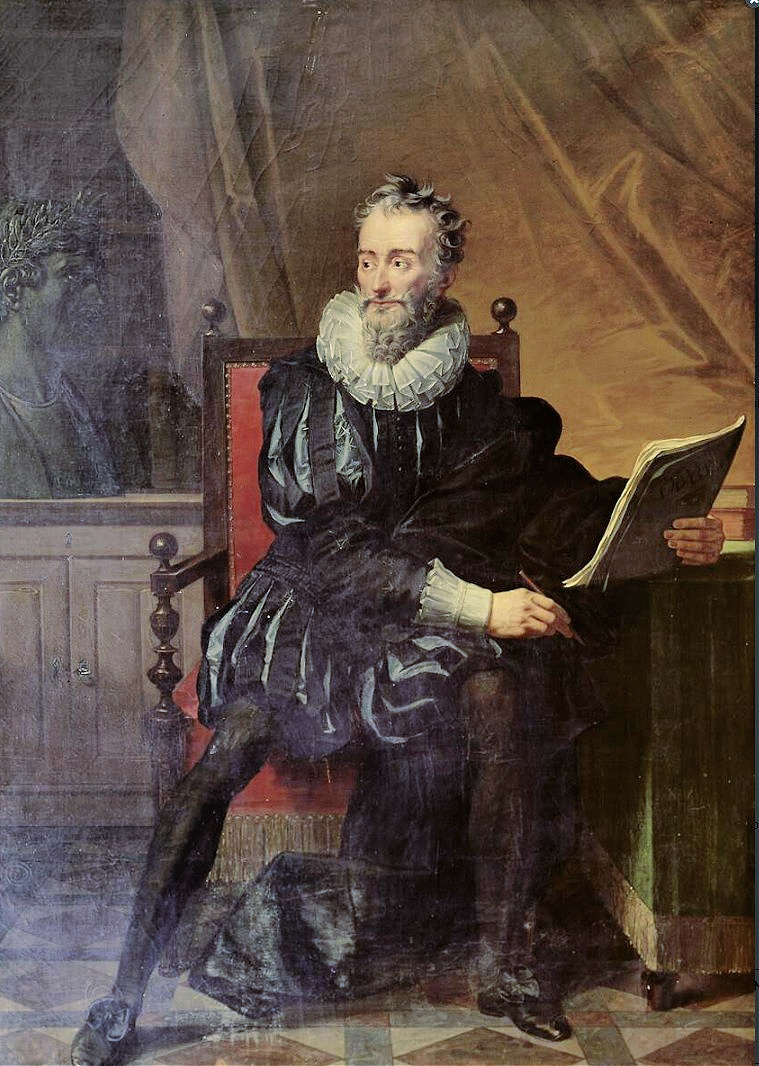
François de Malherbe (1555-1628) by Robert Lefevre. The sitter in this portrait is the prominent French poet, critic, and translator François de Malherbe (1555–1628). This oil on canvas painting, completed posthumously in 1822 by the French Neoclassical artist Robert Lefèvre. Malherbe is historically recognized as the official court poet for King Henri IV and King Louis XIII. He is widely considered the first of the major Classiques of France. Instead of embracing the ornamental and free-flowing nature of Renaissance poetry, Malherbe introduced strict rules regarding rhythm, vocabulary, and structural purity, laying the critical foundation for 17th-century French classical literature. Public Domain.
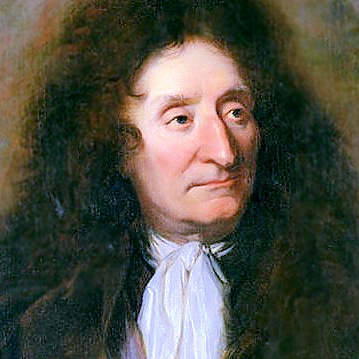
Jean de La Fontaine (1621-1695) by Hyacinthe Rigaud. Carnavalet Museum, Paris. World-renowned French poet and fabulist, this famous portrait, originally painted by the celebrated French court artist Nicolas de Largillierre, captures La Fontaine in his later years. La Fontaine is universally famous for his Fables (Fables choisies, mises en vers), a massive collection of stories published in several volumes between 1668 and 1694. Public Domain.
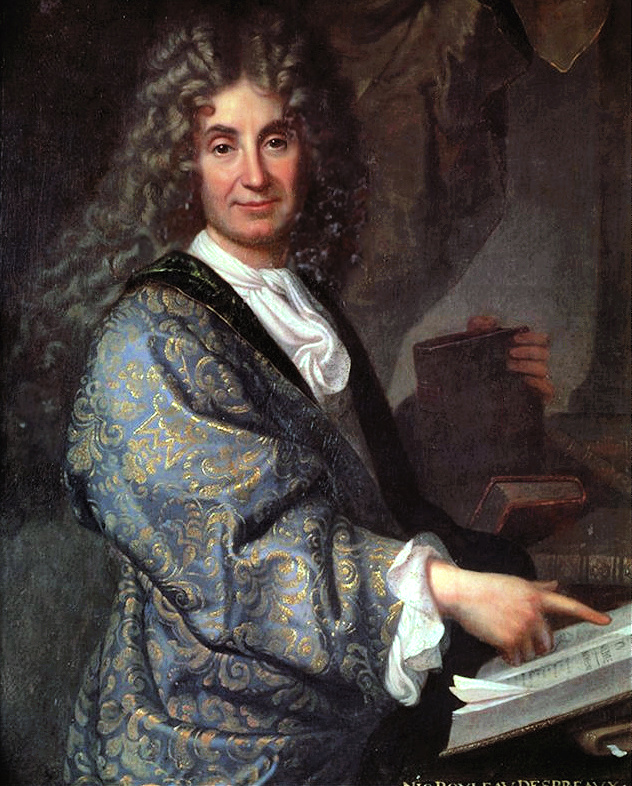
Nicolas Boileau-Despréaux (1636-1711) dit Boileau, 1678, by Jean-Baptiste Santerre. French poet, satirist, and literary critic Nicolas Boileau-Despréaux (1636–1711), commonly known simply as Boileau. This famous 1699 canvas by the French Baroque painter Jean-Baptiste Santerre depicts Boileau at the height of his intellectual influence. Boileau was a monumental figure in 17th-century French classical literature, earning the moniker the “Lawgiver of Parnassus” for his fierce determination to reform French poetry. He vehemently rejected the ornamental, convoluted styles of the late Renaissance and early Baroque eras. Instead, he championed the virtues of bon sens (good sense), structural balance, clarity, and rational alignment with classical antiquity. His highly influential work, L’Art poétique (The Art of Poetry, 1674), laid down strict aesthetic rules regarding rhythm, genre parameters, and vocabulary that dictated French literature for generations to come. Public Domain.
NOVELS AND FAIRY TALES
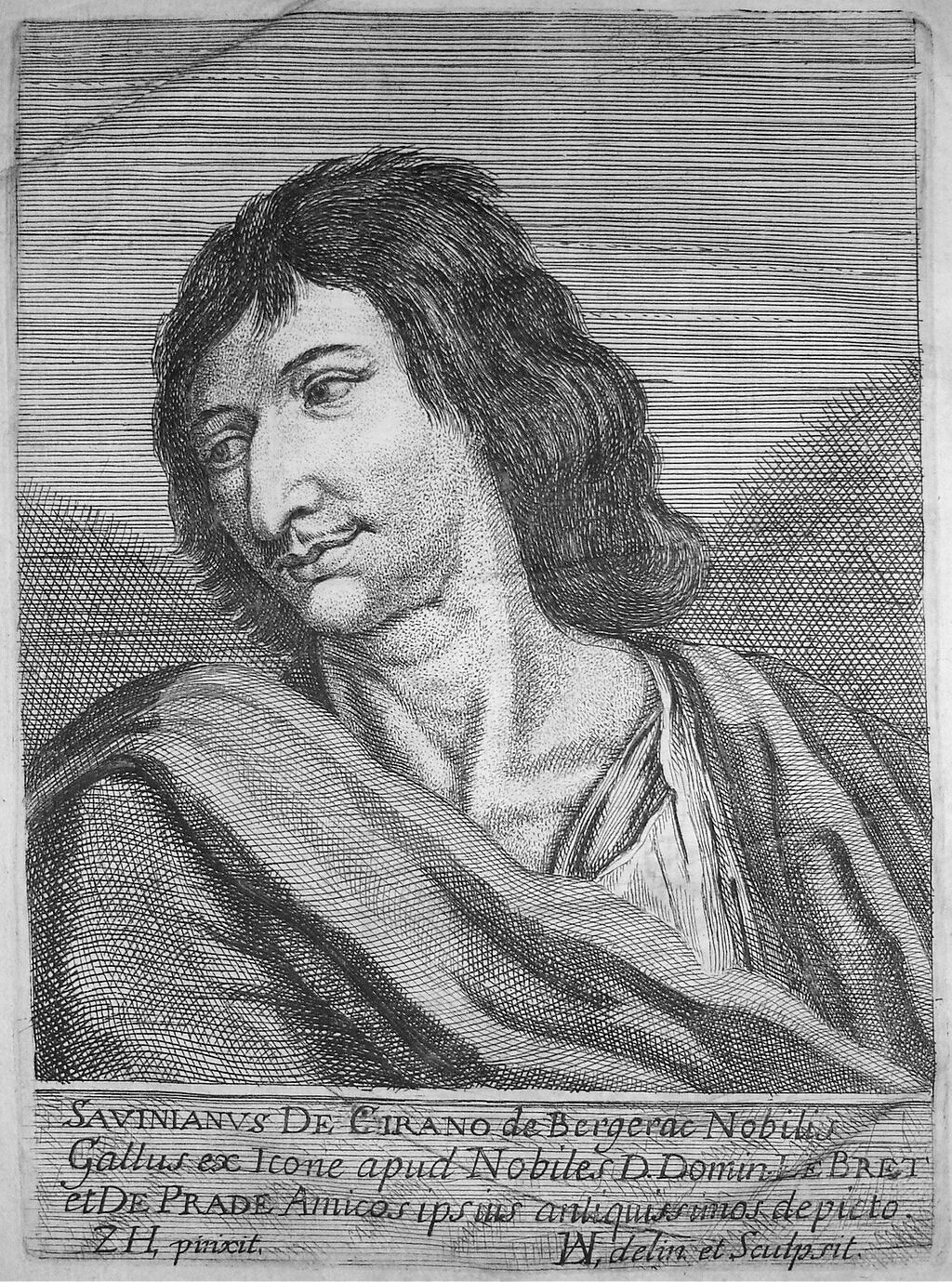
Savinien de Cyrano de Bergerac (1619-1655), c. 1654, by Zacharie Heince. Novelist, playwright, and duelist Cyrano de Bergerac (born Savinien de Cyrano de Bergerac). This particular print, engraved by Zacharie Heince and François Chauveau, stands as one of the very few surviving contemporary, authentic portraits of the real man. While modern audiences know Cyrano primarily as the big-nosed, romantic protagonist of Edmond Rostand’s world-famous 1897 play Cyrano de Bergerac, the historical sitter was a brilliant, radical, and highly controversial intellectual of the French Baroque era who was a pioneer of Science Fiction (Comical History of the States and Empires of the Moon, published posthumously in 1657); libertine philosopher and bold duelist. Public Domain.
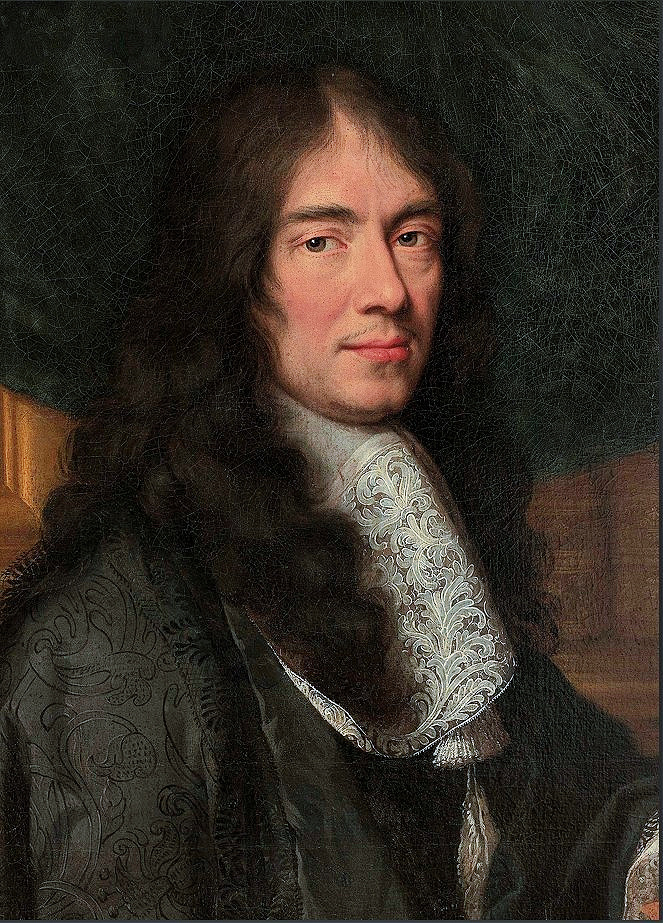
Charles Perrault (1628-1703), c. 1670, oil on canvas, 135.50 x 97.50 cm, by Charles Le Brun. French author and intellectual Charles Perrault (1628–1703) painted by the premier court artist of King Louis XIV, Charles Le Brun, this oil on canvas captures Perrault in his absolute prime as a major cultural force in 17th-century France. While Perrault was a high-ranking bureaucrat, he is universally immortalized today as the foundational figure of the modern fairy tale genre. In 1697, he published Histoires ou contes du temps passé (Stories or Tales from Past Times), famously subtitled Tales of Mother Goose (Les Contes de ma Mère l’Oye). His versions established the definitive structures for world-famous classics like Cinderella, Sleeping Beauty, Little Red Riding Hood, Puss in Boots, and Bluebeard. Perrault was at the dead center of the most explosive intellectual debate of his era, known as the Quarrel of the Ancients and the Moderns: Perrault boldly led the “Moderns” faction, arguing that French culture, science, and literature under Louis XIV had actually surpassed the achievements of ancient Greece and Rome. This pitted him directly against your previous portrait’s subject, Nicolas Boileau, who fiercely defended the “Ancients.” The Robe: He is draped in a heavy, dark brocade robe featuring subtle, woven floral patterns, projecting a somber but deeply wealthy and intellectual presence. Public Domain.
ESSAYS
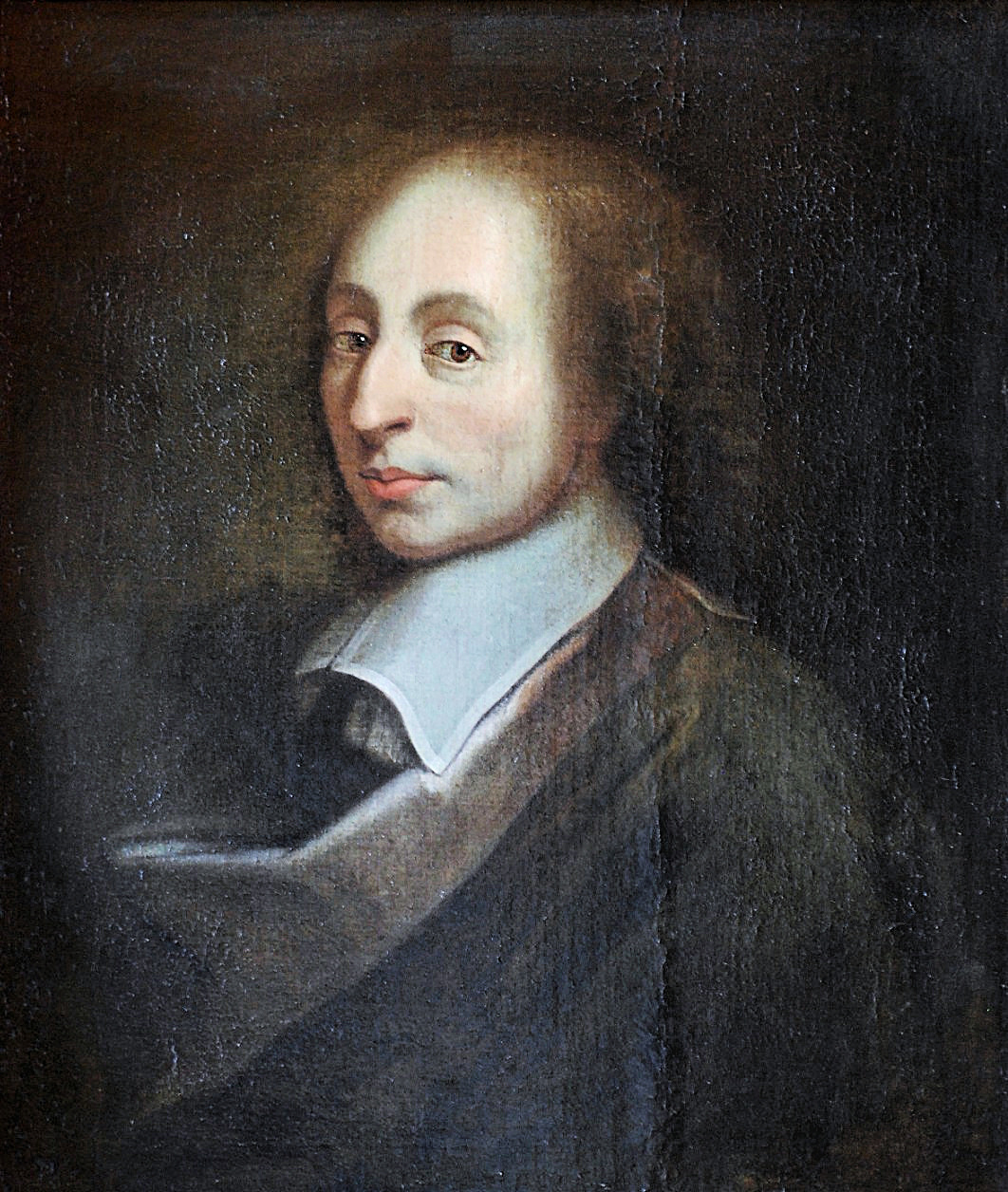
Blaise Pascal (1623-1662), posthumous portrait, 1691. French polymath Blaise Pascal (1623–1662) is depicted by French Baroque portraitist François Quesnel (or after him) and captures Pascal’s intense, contemplative gaze during a life cut short at just 39 years old. Pascal was an absolute prodigy whose contributions profoundly reshaped mathematics, physics, and philosophy. In 1654, Pascal experienced an intense, mystical religious awakening (called his “Night of Fire”). He subsequently aligned himself with Jansenism, an austere, highly controversial Catholic reform movement centered at the Port-Royal Abbey. This deep spiritual pivot birthed two of the most influential works in French literature: Les Provinciales (The Provincial Letters): a brilliant, witty, and fiercely satirical defense of Jansenism that publicly eviscerated the moral casuistry of the Jesuits whose sharp prose style influenced writers like Voltaire and Nicolas Boileau and Pensées (Thoughts): A profound, posthumously published collection of personal notes on faith, human suffering, and reason. Pensées contains the world-famous “Pascal’s Wager”—a pragmatic, probabilistic argument stating that a rational person should live as though God exists, because the potential gain (eternal life) is infinite, while the potential loss (a finite earthly life) is minimal. PHOTO; “<div class=’fn’> <div style=’font-weight:bold;display:inline-block;’>Blaise Pascal (1623-1672)</div></div>” by unknown; a copy of the painting of François II Quesnel, which was made for Gérard Edelinck en 1691[réf. nécessaire]. is licensed under CC BY 3.0.

François de La Rochefoucauld (1613-1680) is universally famous in world literature for his groundbreaking 1665 book, Maximes (Réflexions ou sentences et maximes morales). With writing deeply cynical and realistic, he perfected the art of the aphorism and argued that almost all human actions, virtues, and displays of kindness are secretly driven by self-love (amour-propre), vanity, and hidden ego. This precise oil-on-canvas painting is titled François VI, duc de La Rochefoucauld, mémorialiste (1613–1680). It was officially commissioned from Théodore Chassériau in 1836 as part of King Louis-Philippe’s historical reconstruction project for the Palace of Versailles. Public Domain.

Jean de La Bruyère (1645-1696), posthumous portrait, 1775, attributed to Nicolas de Largillière. French philosopher, essayist, and moralist Jean de La Bruyère (1645–1696) is depicted at the height of his intellectual influence, immortalized in Western literature for his magnum opus, Les Caractères (The Characters, or the Manners of the Age), originally published in 1688. Rather than drafting a dense philosophical treatise, La Bruyère wrote a series of brief, razor-sharp psychological “portraits” and epigrams detailing the vanity, hypocrisy, and corruption of the court of King Louis XIV. After being rejected three times by the prestigious Académie Française, La Bruyère was elected in 1693—the exact year emblazoned at the bottom of the artwork. The painting belongs to a historic set of scores of uniform portraits of famous scholars commissioned under the direction of the Abbé de Dangeau starting in 1685 to honor the members of the Académie Française. Having survived seizure during the French Revolution, the painting was eventually gifted to King Louis-Philippe in 1839. Today, it resides in the historical collection of the Palace of Versailles. Public Domain.
PHILOSOPHY
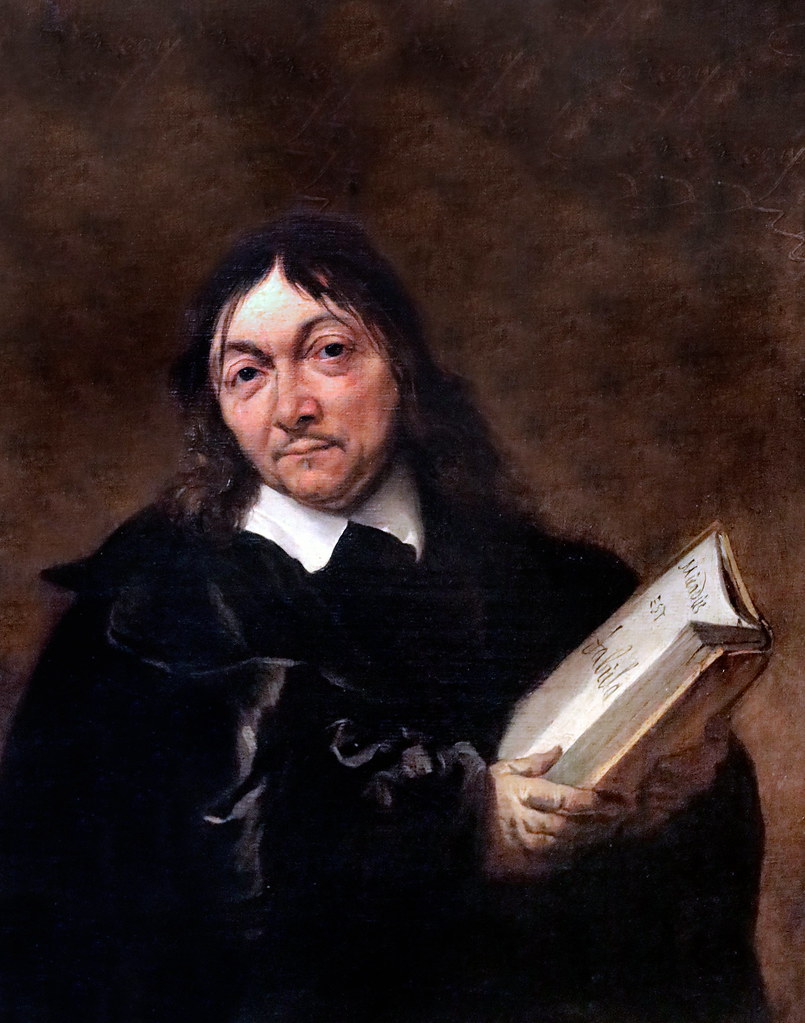
Rene Descartes (1596-1650), c. 1648, by Jan Baptist Weenix (1621-16590, Utrecht Centraal Museum. Famous 1648 portrait from life of French philosopher, mathematician, and scientist René Descartes (1596–1650), recognized as the “Father of Modern Philosophy.” The painting created by the Jan Baptist Weenix (1621–1659) during Descartes’ extended residency in the Netherlands resides in the Centraal Museum in Utrecht. Descartes revolutionized Western thought by discarding medieval scholasticism and starting philosophy completely anew from a foundation of absolute skepticism. In seminal works like his Discourse on the Method (1637) and Meditations on First Philosophy (1641), he set out to doubt everything that could possibly be false—including his senses and the physical world. He arrived at one undeniable truth: the very act of doubting proved his own existence, immortalized in the phrase “Cogito, ergo sum” (“I think, therefore I am”). Beyond philosophy, Descartes fundamentally reshaped science by inventing analytic geometry (Cartesian geometry), which bridged algebra and geometry. While first half of Descartes’ work shares affinities with deconstruction, Descartes did not dismantle ideas just to leave them in ruins. In his Meditations, he explained that he was pulling down an old, unstable house solely so he could dig deep into the bedrock and find an indestructible foundation—which he found in the Cogito (“I think, therefore I am”). From that single, absolute truth, he meticulously rebuilt the entire structure of knowledge, science, and God. Deconstruction, philosophers usually point toward the Ancient Greek Skeptics (who argued we can never know absolute truth) or later thinkers like Friedrich Nietzsche (who systematically broke down morality and truth without trying to build a new system to replace them). Modern Deconstruction pioneered by the 20th-century French philosopher Jacques Derrida, argues that language, texts, and human ideas are fundamentally unstable, full of contradictions, and lack any ultimate “bedrock” or center. A deconstructionist tears down the house to show that the foundation itself is an illusion. Public Domain.
THEOLOGY
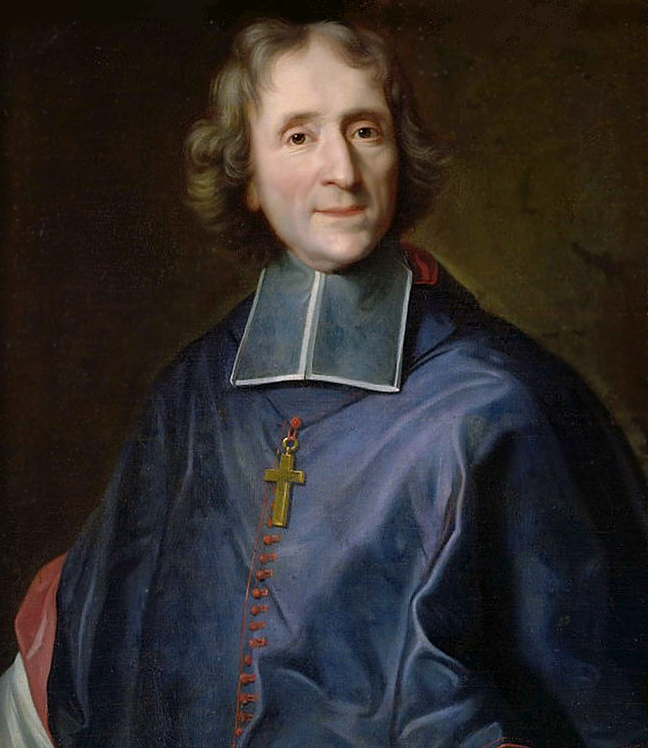
François Fénelon (1651-1715) by Joseph Vivien. François Fénelon (1651–1715), born François de Salignac de la Mothe-Fénelon, was a French Roman Catholic theologian, poet, and writer. His career at court skyrocketed in 1689 when Louis XIV appointed him as the tutor to his 7-year-old grandson, the Duke of Burgundy, who was second-in-line to the French throne. Fénelon was highly successful in reforming the young prince’s behavior, which earned him immense royal favor. In 1693, Fénelon was elected to Seat 34 of the Académie française. Following this, in 1694, the king rewarded him by naming him the Abbot of Saint-Valery, a lucrative post worth 14,000 livres a year ($250,000 in US dollars today).
In February 1695, Louis XIV nominated Fénelon to the archiepiscopal See of Cambrai, and he was consecrated as Archbishop in August by his close friend and mentor, Bishop Jacques-Bénigne Bossuet. However, a major theological rift soon destroyed their close alliance. Fénelon became entangled in the Quietism controversy—a mystical movement emphasizing passive contemplation that the Church feared led to moral passivity. Defending his friend Madame Guyon, Fénelon disagreed with Bossuet’s harsh anti-mystical interpretations. Fénelon outlined his defense in 1697 with the publication of Explication des Maximes des Saints (Maxims of the Saints). Deeply angered by this defiance, Louis XIV banished Fénelon from the royal court in August 1697, ordering him to remain confined strictly within his distant diocese of Cambrai. This triggered two years of fierce pamphlet warfare as Bossuet and Fénelon traded public blows.
The year 1699 brought the definitive end to Fénelon’s political status. On March 12, 1699, the Inquisition formally condemned Maximes des Saints, with Pope Innocent XII listing 23 specific propositions within the text as unorthodox. Fénelon immediately submitted to papal authority and set his personal opinions aside, effectively ending the Quietist dispute.
However, that exact same year, 1699, The Adventures of Telemachus was published without Fénelon’s permission – a dirty trick perpetrated by a rogue secretary in Fénelon’s household who, working in tandem with an opportunistic printer, was motivated by money in light of intense public curiosity. Archbishop Fénelon had written the manuscript years prior as an educational story for his royal pupil to teach the virtues of a wise, peaceful ruler. Yet, the text contained sharp, thinly-veiled critiques of Louis XIV’s aggressive warmongering and crushing taxation policies. It stood in sharp contrast to Bossuet, who had written Politique tirée de l’Écriture sainte to affirm the divine foundations of absolute monarchy. Fénelon explicitly wrote that “Good kings are rare and the generality of monarchs bad.” Infuriated by the book’s sudden public release, Louis XIV permanently stripped Fénelon of his royal tutorship title and ensured his permanent exile in Cambrai until his death in 1715.
It was during this twilight era of high ecclesiastical authority and restricted exile that the French Baroque artist Joseph Vivien (1657–1734) executed the famous portrait of the prelate. Capturing Fénelon’s gentle, humanitarian gaze in his robes as the Archbishop of Cambrai, the painting now resides in the historical collections of the Palace of Versailles. Public Domain.

Jacques-Bénigne Bossuet (1627-1704) by Hyacinthe Rigaud. French bishop, theologian, and famed court orator Jacques-Bénigne Bossuet (1627–1704) in an1698 oil-on-canvas portrait painted by French Baroque master Hyacinthe Rigaud. Bossuet was over seventy years old when he sat for this painting. The masterpiece resides in the permanent collection of the Uffizi Gallery (Galleria degli Uffizi) in Florence, Italy. Bossuet was the primary theoretical architect of the Divine Right of Kings. In his seminal work, Politique tirée de l’Écriture sainte (Politics Drawn from the Very Words of Holy Scripture), he argued that monarchs received their governing authority directly from God and were accountable to no earthly power—a philosophy that perfectly justified the absolute rule of King Louis XIV. Like his ultimate rival, Fénelon, Bossuet served at the absolute center of Versailles as the chosen tutor to King Louis XIV’s eldest son and heir, the Dauphin. Public Domain.
DRAMA
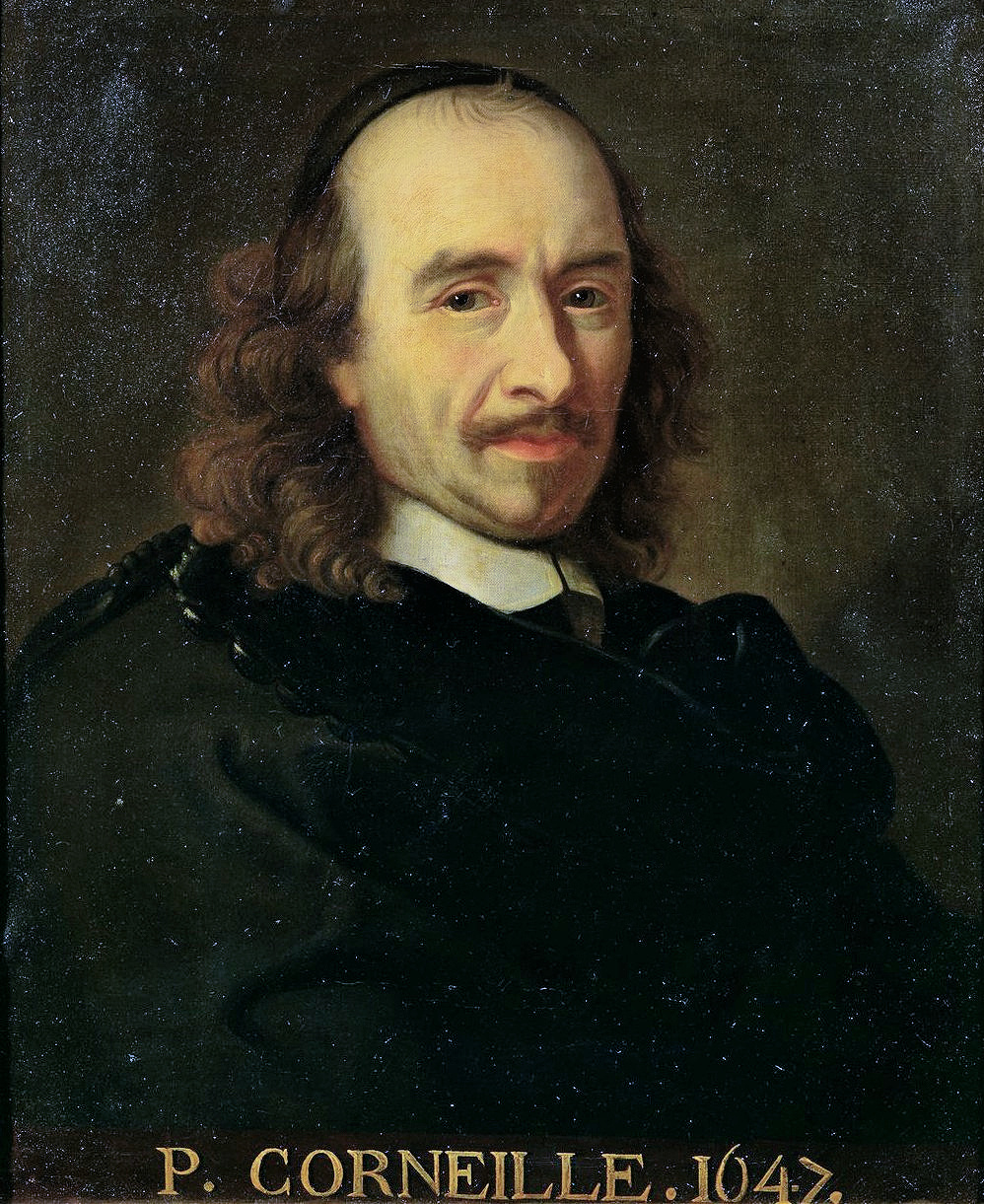
Pierre Corneille (1606-1684), 1647, by Charles Le Brun. Along with Molière and Racine, French dramatist and poet Pierre Corneille stands as one of the foundational pillars of 17th-century French classical theater. Corneille revolutionized the French stage by introducing complex psychological conflicts, epic political dilemmas, and big theme dramas of honor versus passion. His most celebrated and controversial work is the tragicomedy Le Cid (1637), a play that sparked a major intellectual debate—the famous Querelle du Cid—orchestrated by Cardinal Richelieu and the Académie Française, which criticized Corneille for deviating from strict classical unities. In 1647—the year visible at the bottom of the painting—Corneille reached the height of his public recognition and was elected to Seat 14 of the prestigious Académie Française. This famous oil-on-canvas portrait is painted by Charles Le Brun (1619–1690), who would later become the premier court painter to King Louis XIV and the artistic director of the Palace of Versailles. The original painting is housed in the historic collection of the Palais de l’Institut de France in Paris, with notable historical copies preserved at the Palace of Versailles. Public Domain.

French playwright and poet Jean Racine (1639–1699) revolutionized French tragedy by shifting the focus from epic external conflicts to raw, internal psychological torment. His characters are trapped by intense, uncontrollable passions—usually unrequited love—that lead inevitably to their doom. Racine authored some of the greatest tragedies in the French language, including Andromaque (1667), Britannicus (1669), and his absolute crowning achievement, Phèdre (1677). Following his theatrical retirement in 1677, King Louis XIV appointed Racine and his close friend Nicolas Boileau as official royal historiographers. This prestigious role granted him direct access to the king’s inner circle at the Palace of Versailles. The oil-on-canvas portrait is painted by the prominent French Baroque master Jean-Baptiste Santerre (1658–1717) and belongs to the historic collections of the Musée de l’Histoire de France at the Palace of Versailles. Public Domain.
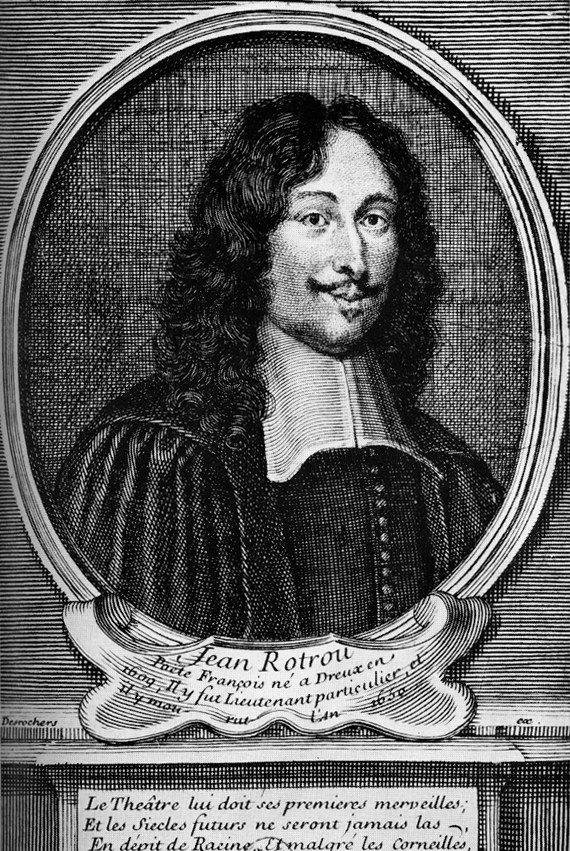
French poet and tragic dramatist Jean de Rotrou (1609–1650). A contemporary and close friend of Pierre Corneille, Rotrou was an incredibly prolific playwright who helped bridge the gap between the late Renaissance theatre and the dawn of French classicism. Recognizing his immense talent, Cardinal Richelieu selected Rotrou as a core member of Les Cinq Auteurs (The Five Authors). This elite group of writers was chosen to execute Richelieu’s personal ideas and structural concepts for the stage. He is celebrated for tragedies and tragicomedies that blended Spanish romance with classical structure, most notably Le Véritable Saint Genest (1645), a fascinating play-within-a-play about a Roman actor who converts to Christianity mid-performance, and Venceslas (1647). Rotrou’s life ended heroically at just 40 years old. When a catastrophic plague broke out in his hometown of Dreux, where he served as a local magistrate (lieutenant particulier), he refused to flee. He stayed behind to maintain civic order and comfort the dying until he caught the disease himself and succumbed to it. This copperplate engraving was executed by the celebrated French printmaker Étienne Jehandier Desrochers (1668–1741). Public Domain.

French poet, dramatist, and novelist Paul Scarron (1610–1660) was the principal master of the 17th-century French burlesque literary genre and, interestingly, the first husband of Françoise d’Aubigné, who later became famous as Madame de Maintenon and secretly married King Louis XIV. Scarron is best remembered for his masterpiece, Le Roman Comique (1651–1657), a brilliant comic novel that chronicled the misadventures of a troupe of strolling players traveling through the French provinces. His home became one of Paris’s most vibrant literary salons, frequented by intellectuals, courtiers, and writers. This portrait was created by an anonymous artist of the 17th-century French School and housed in the permanent collection of the Musée de Tessé in Le Mans, France. Public Domain.
Molière’s Comedy: Wit And Types
Molière wrote drama based on actual facts of society and human nature. Using ludicrous incidents, he headed straight to a moral purpose. His plays were very instructive and had all the makings of high comedy. Molière attracted his audience as a premier dramatist of wit.
His characters are not individuals but types which are intense. This comic form is mainly indigenous to France and contrasted to Italy’s dramatic form of tragedy.
The City of Paris Plays a Role
Paris is a theatrical city. Similar to today’s Beaubourg in fine weather, there were outdoor performances at the Pont Neuf and Place Dauphine. The Hotel de Bourgogne on Rue Etienne Marcel was used in the 16th century by the Confraternité de la Passion for passion plays. In the mid1620s when America was wilderness there were street parades of comedians in Paris to lure spectators into the theatre. Stock farce characters included Aurlupin (a mean-spirited school teacher), Gros Guillaume (dressed in a flour sack), and Captain Fracasse (breaking plates and things). At the permanent flea market of St. Germain de Prés, spectacles were put on stage. Goods were sold, some of it junk, because, as Daumier observed, “people are always fooled.”
Molière’s mother died when he was 10 years old and he was raised by a nurse maid. In his later plays there are often such maids and servant girls.
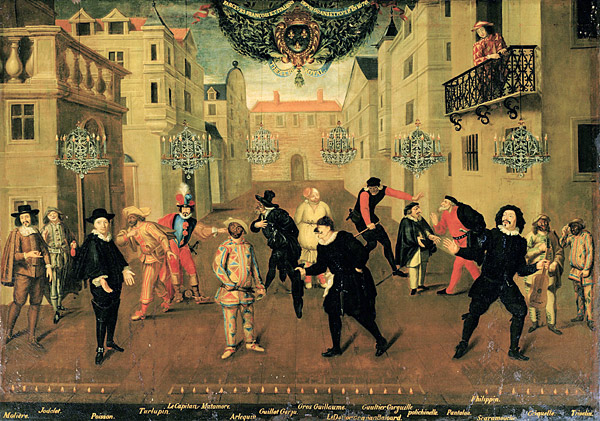
In Paris, three rival theatre groups coexisted: that of the Marais; that of the Hôtel de Bourgogne; and, that of the Palais-Royal, directed by Molière. After Molière’s death, the actors of the Marais joined Molière’s troupe of actors by royal order. This new troupe settles at the Hotel Guénégaud, rue Mazarine. Public domain.

La Thorillière (1626-1680). François de La Thorillière was Molière’s companion and kept the register of the company during the 1663-1664 and 1664-1665 seasons. He moved to the Hôtel de Bourgogne after Molière’s death. In 1680 La Thorillière, head of the troupe of the Hôtel de Bourgogne and the last rival in Paris of Molière’s former troupe, died. The King ordered these two troupes of French actors established in Paris to play together going forward. Public Domain.

La Grange (1635-1692). On August 25, 1680, the actors of La Thorillière’s Hotel de Bourgogne and Molière’s former troupe now led by La Grange’s Hotel Guénégaud gave their first joint performance. On October 21, 1680, an official royal letter signed at Versailles, established the unique troupe, composed of 27 actors and actresses chosen by the King for their excellence, to have a monopoly of performances in French so to “make performances of comedies more perfect.” The repertoire includes Corneille, Molière, Racine, Jean Rotrou, Paul Scarron, and others. Public Domain.
Molière Schools in Paris and Orléans; penniless for 15 years
Molière was a commuter student at the Collège de Clermont behind the Sorbonne. Founded in the 1560s by the Jesuits who had a tremendous hold on educating the young in this period, it was renamed Lycée Louis-le-Grand in the 1680s. Nobility and the well-to-do bourgeois schooled together though segregated by a so-called “golden barrier” of identity (an illiberal, reactionary practice). Molière received a strict, excellent education and was a Latinist. He went to Orléans to study law but didn’t pursue it. His father sent him to Narbonne to become a royal tapestry maker (the family business) but Molière was idealistic and chose to be in theater. Following his bliss, twenty-something Molière, around the time of the 2007 film included above, was virtually penniless for the next 15 years.
In the shadow of the queen of the sciences (theology), cultural authorities of church and state officially ordered the boycott of theater as immoral. But the people in Paris mostly ignored these bans and theater life thrived.

Lycée Louis-le-Grand, Paris. PHOTO: “File:Lycée Louis-le-Grand, Paris 5e 3.jpg” by Celette is marked with CC BY-SA 4.0.
Molière’s first theater production flops and he is bailed out of debtor’s prison by a street contractor
By the 17th century the Renaissance social fad of tennis had faded away and Molière rented empty courts for the theater. He joined Madeliene Béjart, four years older and from a family of actors, and established his first theater in June 1643 called Illustre Théâtre (“Illustrious Theater”). The first performances in the tennis court featuring the 22-year-old Molière and the others opened on January 1, 1644.
To build the theater, Molière fell into debt in 1644. The first performances were a complete flop and Molière was thrown into debtor’s prison for 3 days in July 1645. A paving contractor paid the bail to release the young actor/writer, a remarkable historical fact.

Madeleine Béjart (1618-72) playing Madelon in “Précieuses Ridicules” by Molière, oil paint on stone, French School, 17th century (after 1659,). Bibliotheque Nationale, Paris. Public Domain.
In Paris in the 1640s there were two official theatre troupes and Molière’s Illustre Théâtre was not one of them. The troupe did have a royal protector, the king’s brother. But no financial bailout was provided by Gaston d’Orléans (1608-1660) and Molière’s first theater had to be auctioned off with proceeds going to creditors.
Noble sponsors

Gaston d’Orléans (1608-1660) by Anthony Van Dyck, 1634. Musée Condé. Molière’s noble sponsor would not be held financially responsible for the bad luck of the young actor’s first theatre troupe in Paris.
In 1646 Molière and Mme. Béjart joined a troupe led by Charles Dufresne (1611-1684) and left for the provinces, specifically to Nantes and points south. Success as an actor was fleeting, and Molière was very close to returning to his father’s business as a tapestry maker. Molière, like his fellow actors, could not afford costumes and wore street clothes on stage. His was just one theatre troupe among the 1,000 or so in France. Others in the defunct Illustre Théâtre joined Molière in 1648. Dufresne handed over the direction of the troupe to Molière in 1650 who rechristened the troupe Comédiens de SAR le prince de Conti. The prince de Conti (1629-1666), fifth in line to be king, was Molière’s new patron and friend. At the domaine de la Grange des Prés at Pézenas in Languedoc, the actor-playwright discussed plays and theater with the prince.

Armand de Bourbon, prince de Conti (1629-1666). The prince in Languedoc was a patron and friend of Molière in the 1650s. Le musée du Vieux Nîmes.

Anne-Marie Martinozzi (1637-1672) was the wife of the prince de Conti. She was also the niece of Cardinal Mazarin, successor to Richelieu. Though there were interludes of life together at Pézenas with the prince, much of their marriage was lived apart. It is the princess who shows herself in love, writing her husband numerous letters. Château de Versailles.
In the 1650s, Molière’s troupe became moderately successful performing all over southern Mediterranean France. Though Molière kept a notebook to record his ideas and character types these personal items have been lost.

Portrait of Molière, c. 1658 , Pierre Mignard (1612-1695), Château de Chantilly.
The prince de Conti, Languedoc governor, was the king’s cousin, and, upon marrying Anne-Marie Martinozzi (1637-1672) in 1654, an in-law of sorts to Cardinal Mazarin (Anne-Marie was Mazarin’s niece). The prince de Conti, however, lived with his mistress at Pézenas among Molière’s free-spirited actors. In 1655 the prince, being engaged in military campaigns in Spain and experiencing failing health, had a religious awakening. He discarded the mistress, returned to his wife and banished the theatre. Molière had, overnight, been cancelled.
Allowance of theater in society based on moral grounds would continue to evolve as audiences continued to enjoy its entertainment value. Finding a need and filling it, Molière sold drama as morality and used witty plot and dialogue that slayed his subject close to the bone.
Molière’s Muse

Armande Béjart (1645-1700). Armande Béjart was in Molière’s troupe in 1653 under the name of Mademoiselle Menou and played child roles. Married to Molière in 1662, she was the inspiration for all his heroines: the Princess of Élide, Charlotte, Célimène, Lucinde, Elmire, Alcmène, Élise, Angélique, Lucile, Hyacinthe, Henriette. Armande and Molière’s daughter, Madeleine-Esprit, survived but their two sons did not. When Molière died in 1673, Armande encouraged the troupe, led by La Grange. In 1677 Armande remarried a man not in the theater named Guérin d’Etriché and they had a son. She became Mademoiselle Guérin on stage in the troupe brought together by Louis XIV in 1680 and retired in 1694.
After being cancelled by the prince de Conti who became an implacable enemy of the theater until his death in 1666, the reputation of Molière’s traveling troupe was being critically appreciated at the highest levels. In 1658, the king’s brother, 18-year-old Philippe d’Orléans, le Monsieur (1640-1701), arranged an audition for Molière and his troupe in Paris. The result was that King Louis XIV approved the Troupe de Monsieur to share the royal theater, the Petit-Bourbon. Molière immediately premiered there on November 2, 1658. The troupe soon had to build up its cast and repertoire to meet the Paris audience’s expectations and Molière looked to provide them with original comedies. This was notably aided by the addition, in 1659, of 24-year-old La Grange, who would play young romantic lead roles.
Molière enjoyed royal patronage and became a central figure in the cultural life of the French court of Louis XIV.
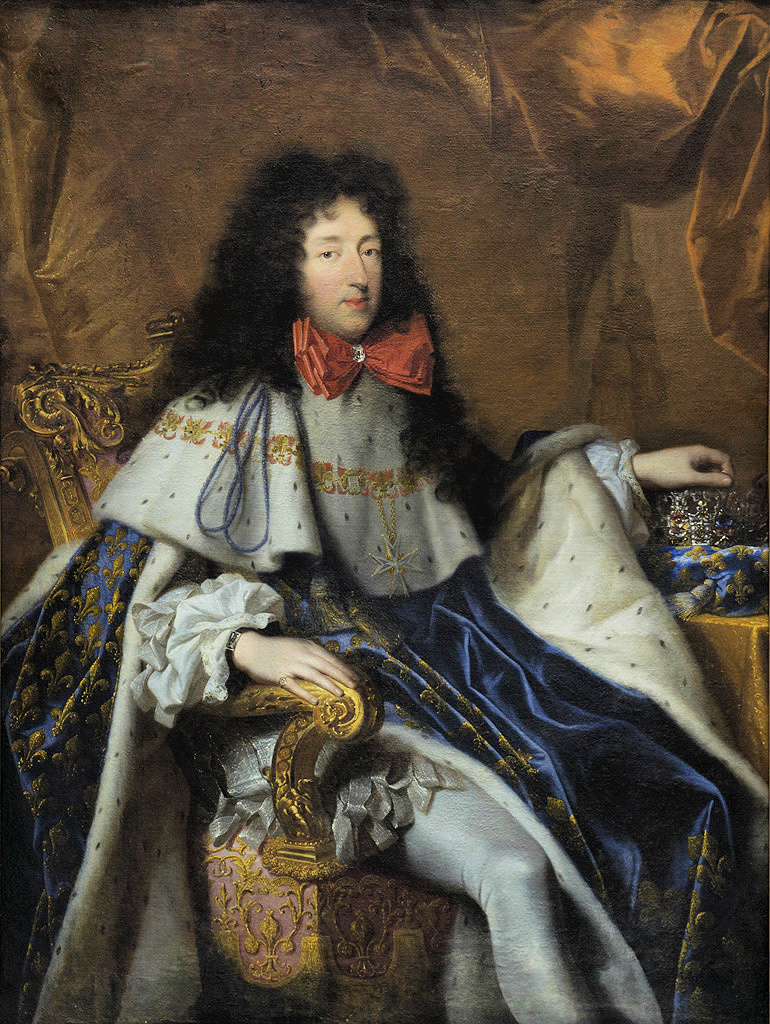
Philippe d’Orléans (1640-1701). Musée des Beaux-Arts de Bordeaux. Le Monsieur, the king’s younger brother, wears an ostentatiously beautiful bow-tie. Pierre Mignard, Musée des Beaux-Arts de Bordeaux. Public Domain.
Also in 1659, having acquired the king’s favor, Molière set about to write the first of his great works: Précieuses Ridicules. In 1662 he married Madeleine Béjart’s younger sister (possibly daughter), Armande. The king was godfather to their child as Molière now performed at the Palais Royal for the king and the royal family. In the next years, Molière wrote plays about marriage, jealousy, and adultery, including The Imaginary Cuckold in 1660; Don Garcie de Navarre and The School for Husbands in 1661; and, a great success, The School for Wives in 1662. Opening in December 1662, by the end of May 1663, audiences filled the theatre to watch The School for Wives, a play whose scheming plot is more straightforward than its characters, in over 60 performances. It was afterward attacked by critics who expressed outrage for its sexual references and irreligiosity, but also, possibly, envy for its newness and blatant success. A flurry of artful broadsides between Molière and the King’s Actors at The Hôtel de Bourgogne followed in pamphlets and on their respective stages.
“People of quality know everything without ever having learned anything.” (Les gens de qualité savent tout sans avoir jamais rien appris.) – Mascarille, played by Molière, Act 1, Scene 8. From Précieuses Ridicules (1659).
“A man’s not simple to take a simple wife. Your wife, no doubt, is a wise, virtuous woman. But brightness, as a rule, is a bad omen. And I know men who’ve undergone much pain because they married girls with too much brain. I want no intellectual, if you please.” – Arnolphe, Act 1, Scene 1. From School For Wives (1662).
“It must be confessed that love is a skillful instructor. It teaches us to be what we never were before. By its lessons a complete change in our manners is often the work of a moment. It overcomes obstacles in our very nature, and its sudden effects seem like miracles. It makes misers liberal in an instant, cowards become heroes, and, dear gentlemen, it turns the most inexperienced mind into a nimble wit, as it gives understanding to the most simple.” – Horace, Act 3, Scene 4. From School For Wives (1662).
Jean-Baptiste Lully (1632-1687): Italian-born French composer to “The Sun King” King Louis XIV, and collaborator with Molière on comédies-ballets which culminated in 1670 with Le bourgeois gentilhomme.

Artist’s imaginary depiction of Lully’s Armide, Salle du Palais-Royal, 1761, by Gabriel de Saint-Aubin (1724-1780), Boston Museum of Fine Arts.
In 1664 famous French composer J.B.- Lully (1632-1687) began a series of 13 comedy-ballets with Molière including La Princesse d’Élide (1664); Le Mariage forcé (1664), L’Amour médecin, (1665), George Dandin ou le mari confondu (1668), Monsieur de Pourceaugnac (1669), Le Bourgeois gentilhomme (1670), and Psyché (1671). Their collaboration, which was sometimes stormy, ended in 1671. Lully was born as G.B. Lulli in Florence, Italy. He was brought from Florence to Paris in 1646 by the Duc de Guise and placed in the service of La Grande Mademoiselle, Mlle. De Montpensier (1627-1693), the duke’s niece, at her court in the Tuileries. She despised Cdl. Mazarin and was involved in the Fronde (1648-1653) which was defeated by Louis XIV. Following Mlle de Montpensier’s exile to her château at Saint-Fargeau in Burgundy, Lully, who had been learning the best of French and Italian music, was released from her service and in 1653 was made Louis XIV’s court composer (“compositeur de la music instrumentale”) where he was in charge of the king’s personal violin orchestra. An innovative composer, Lully employed his skills and talents to ballet, theater, and opera while ascending the ranks at court. In 1661 Lully became “surintendant de la music et compositeur de la musique de la chambre” which gave Lully, not yet 30 years old, greater responsibilities for the king’s music.

Full-length portrait engraving of Jean-Baptiste Lully by Henri Bonnart (1642-1711).
In 1662 Lully became a naturalized Frenchman, married Madeleine Lambert, and was appointed “maître de la musique de la famille royale.” In these early years, as he wrote operas and theatre music for Molière, the ostentatious Lully was envied by other musicians as his success at court continued unabated. In 1681, Lully was made sécretaire de Roi, an ennobling position, signed Monsieur de Lully, escuyer, conseiller, Secrétaire du Roy, Maison, Couronne de France & de ses Finances, & Sur-Intendant de la Musique de sa Majesté. In the 1680’s, the last decade of his life, Lully turned to writing religious music. In January 1687, while beating time during a performance with his cane on the floor, Lully injured his foot which became infected and he died soon after. Lully is the epitome of the French royal composer having written almost everything to the taste and service of the king. Lully’s three sons – Louis, J.B. and Jean-Louis -also became court composers in the king’s service. Louis XIV died in 1715.
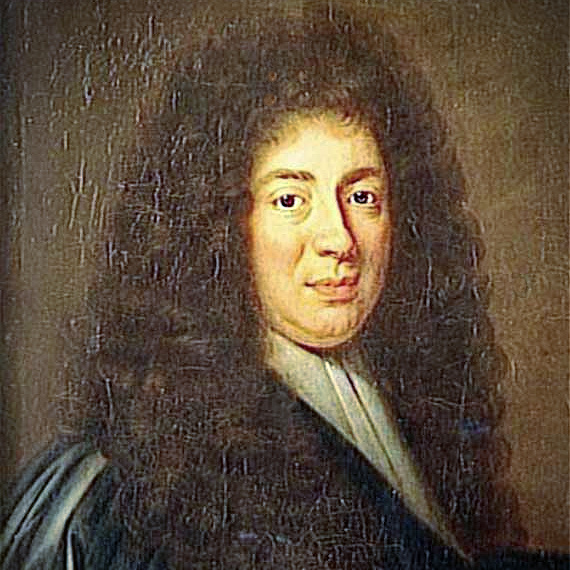
Philippe Quinault (1635-1688) in 1670. When Lully turned to opera he teamed up with Philippe Quinault as librettist. Of the 13 tragédies lyriques Lully wrote between 1673 and 1686—a quintessentially French type of opera—he wrote 11 of them with Quinault.
1660’s: High point for Molière’s plays
The middle 1660s was a high point for Molière’s plays: Tartuffe; Festin de Pierre (Don Juan) and Le Misanthrope were all written in two or three years (1664-1666). These great comedies of genius, however, were not well received in their day as audiences continued to follow diktats of church and state who condemned the theater and this mocking satire of the authorities (themselves). In May 1664, Molière staged the first three acts of his developing Tartuffe at Versailles. Called The Hypocrite, the play was immediately banned by Louis XIV. When it opened again in 1667 as The Imposter, it was again immediately banned. Any future performance adventured excommunication with the threat extended to its audience. It was not until February 1669 that Louis XIV finally allowed the performance of Tartuffe in its complete five-act form where it instantly became the hottest ticket in Paris.
Molière: Last years
A now prosperous man wanting to continue to practice his theory of the stage as layman’s pulpit and yet retain his hard-earned social position, Molière in his final years turned to light and innocuous spectacles to teach and entertain French society. In 1665 Don Juan ran for 15 performances though it, too, was censored and its financial proceeds had to go to the Church.
“I expect you to be sincere and as an honourable man never to utter a single word that you don’t really mean.” – Alceste, played by Molière, Act 1, Scene 1. From The Misanthrope (1666).
“There’s a season for love and another for prudishness, and we may consciously choose the latter when the hey-day of our youth has passed—it may serve to conceal some of life’s disappointments.” – Célimène, played by Armande Béjart-Molière, Act 3, Scene 4. From The Misanthrope (1666).
“I’ll confront her in no uncertain terms with her villainy, confound her utterly, and then bring to you a heart entirely freed from her perfidious charms.” – Alceste, played by Molière, Act , Scene . From The Misanthrope (1666).
“The failings of human nature in this life give us opportunities for exercising our philosophy, which is the best use we can put our virtues to. If all men were righteous, all hearts true and frank and loyal, what purpose would most of our virtues serve?” – Philinte, played by La Grange, Act 5, Scene 1. From The Misanthrope (1666).
“You shall observe me push my weakness to its furthest limit and show how wrong it is to call any of us wise and demonstrate that there’s some touch of human frailty in every one of us.” – Alceste, played by Molière, Act 5, Scene 4. From The Misanthrope (1666).
A baptized Catholic, Molière died in 1673 at 51 years old. He was denied a religious burial because he was a theater actor. The Catholic Church impugned Molière’s work. Educated by the Jesuits, Molière never renounced his Catholicism, and was probably not an atheist. He was secretly buried in a Catholic cemetery in a section of unbaptized infants. In 1792, during the French Revolution, Molière’s remains were transferred to the museum of French Monuments. In 1817, Molière was placed in Père Lachaise Cemetery where he resides today.
Denied Catholic burial at his death in 1673, Molière is at rest in Père Lachaise Cemetery in Paris since 1817
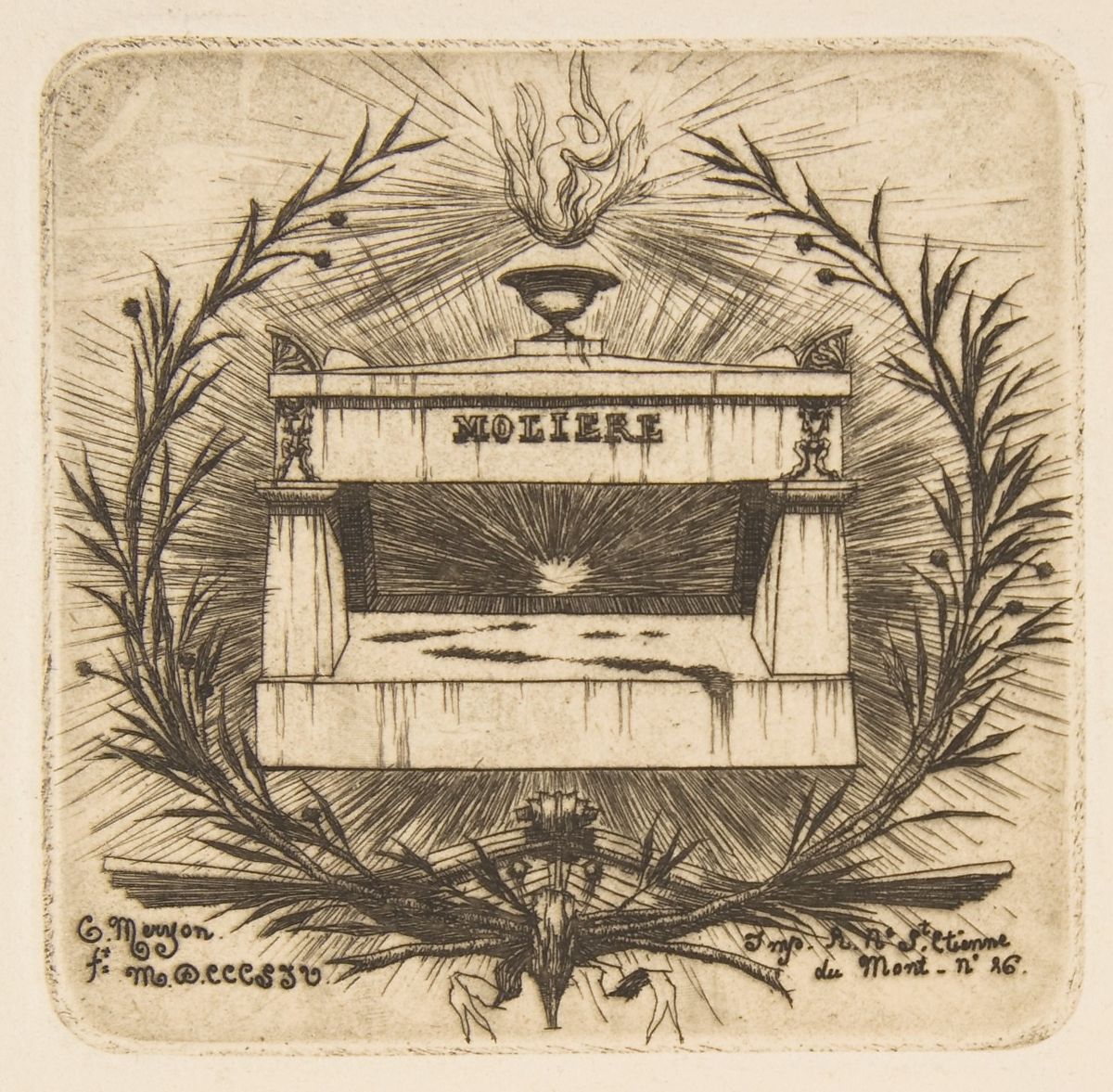
Molière’s Tomb, Père-Lachaise Cemetery, Paris, 1854, Etching in warm black on ivory laid paper, The Art Institute of Chicago.
Molière’s legacy
Though he disguises himself as a virtuous man, Tartuffe is a hypocrite. As the French and the world celebrate Molière’s 400th birth anniversary they can reflect on the relevance of Molière’s drama for today. Molière would have sufficient material today to write and perform another of his witty comedy and drama for the 21st century. Any ridicule of contemporary types of recognized hypocrites would likely face the menace of cancellation similar to what Molière faced in the 1660s. Yet as antagonized power and interest look to lower the curtain on such work, its actors on stage with its original music, brilliant costume and witty plot and dialogue would meet with the roaring laughter and hand clapping of audiences indicating their approval that the show must go on.

Comedy scenes according to Molière (Lustspielszenen nach Molière), wallpaper, c. 1825-1830, Deutsches Tapetenmuseum, Kassel, Germany. Photo credit: “lustspiel Moliere 1825” by janwillemsen is marked with CC BY-NC-SA 2.0.
Jean-Baptiste Poquelin, known as Molière (1622–1673), became one of France’s greatest playwrights by transforming comedy into a penetrating critique of human folly, religious hypocrisy, and social pretension. Despite censorship and opposition from powerful institutions, his wit, memorable characters, and insight into human nature secured his enduring legacy in French theater and at the Comédie-Française.
FURTHER READING:
Comédie-Française. “Armande Béjart.” Comédie-Française, 2026, http://www.comedie-francaise.fr/fr/artiste/armande-bejart. Accessed 29 Oct. 2026.
—. “Histoire de la Comédie-Française.” Comédie-Française, 2026, http://www.comedie-francaise.fr/fr/histoire-de-la-maison#. Accessed 29 Oct. 2026.
—. “La Troupe à travers les siècles: de 1680 à nos jours.” Comédie-Française, 2026, http://www.comedie-francaise.fr/fr/la-troupe-a-travers-les-siecles. Accessed 29 Oct. 2026.
Molière. Les Précieuses Ridicules. Edited by Gwénola Fièvre, Ernest Fièvre, and Paul Fièvre, Théâtre Classique, Aug. 2015, theatre-classique.fr/pages/pdf/MOLIERE_PRECIEUSESRIDICULES.pdf.
—. The Misanthrope. Translated by Henri van Laun, Dover Publications, 1992.
—. The Misanthrope. PDF file.
—. Tartuffe and Other Plays. Translated by Donald M. Frame, Signet Classics, 2015.
Osborne, Kristen. “Tartuffe Quotes and Analysis.” Edited by S. R. Cedars, GradeSaver, 8 Jan. 2013, http://www.gradesaver.com/tartuffe/study-guide/quotes. Accessed 29 Oct. 2026.
Saintsbury, George. A Short History of French Literature. Clarendon Press, 1901.
SparkNotes Editors. “The Misanthrope Quotes.” SparkNotes, 2026, http://www.sparknotes.com/drama/misanthrope/quotes/. Accessed 29 Oct. 2026.
The Editors of Encyclopaedia Britannica. “Molière: French Dramatist.” Encyclopædia Britannica, 2026, http://www.britannica.com/biography/Moliere-French-dramatist#ref362537. Accessed 29 Oct. 2026.