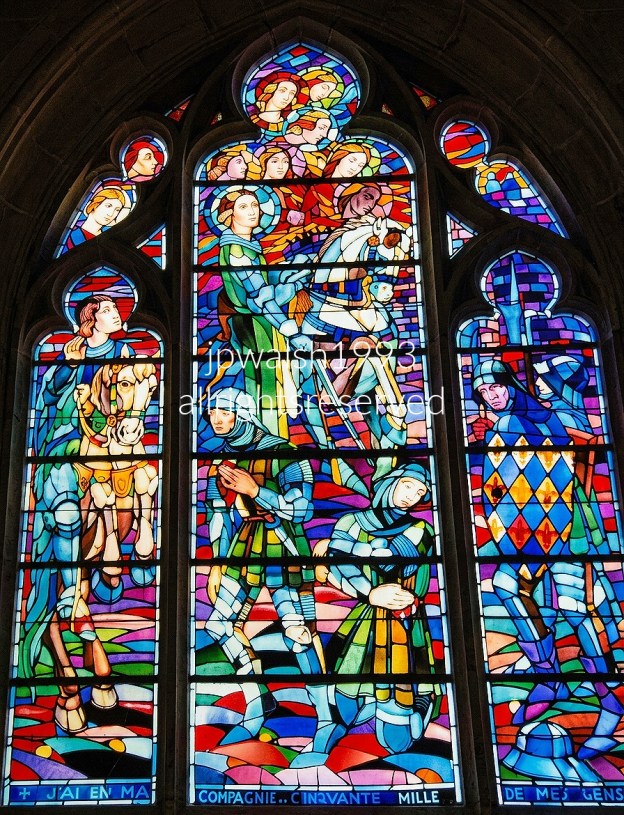
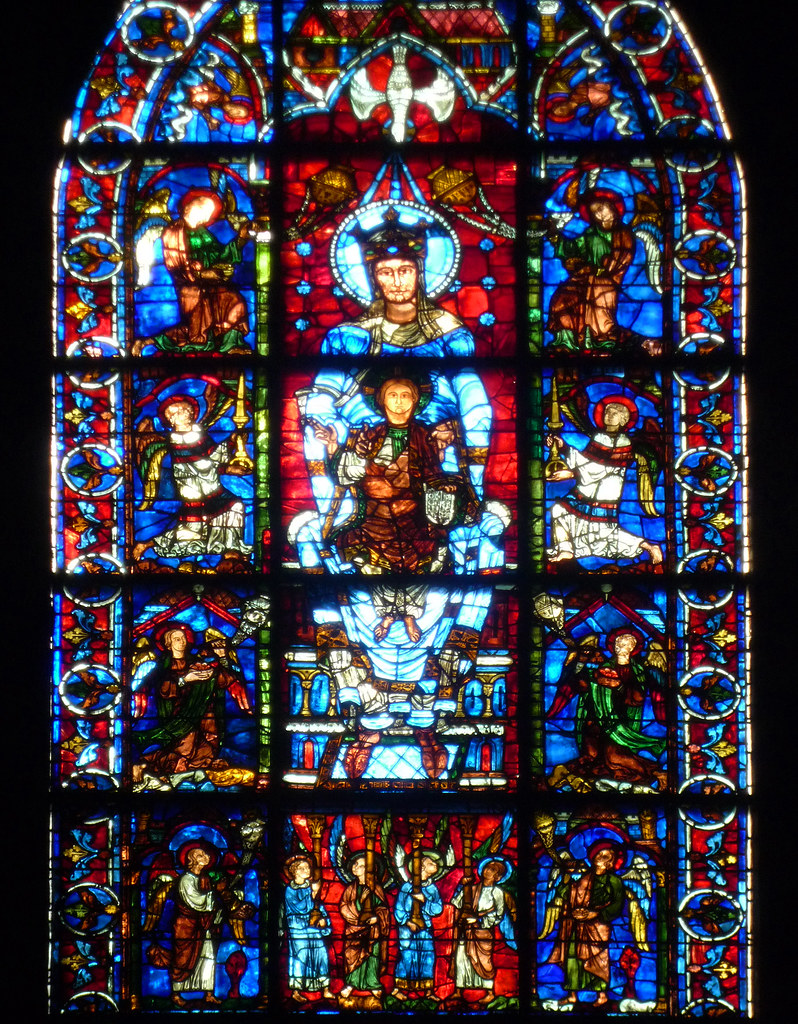
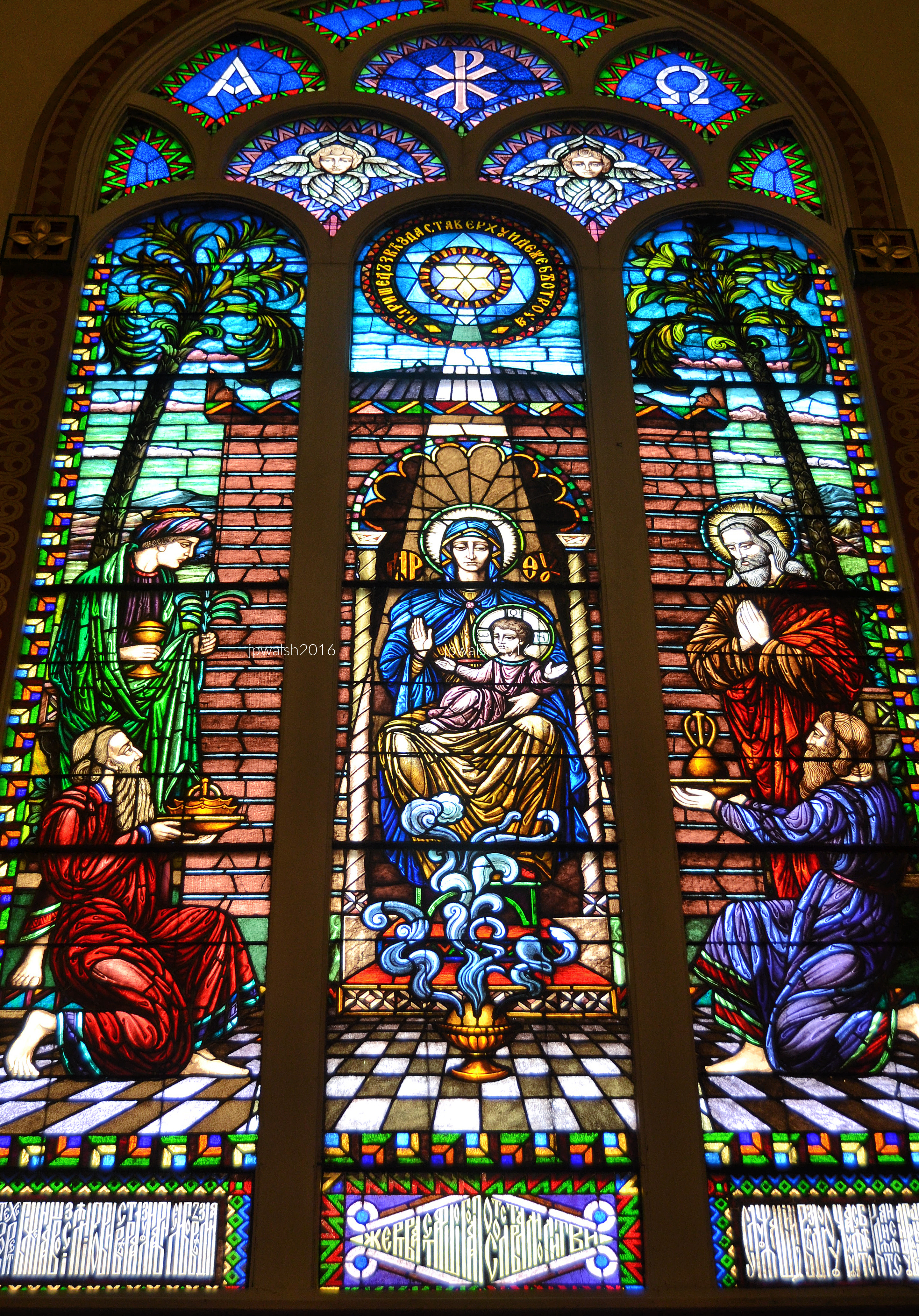
FEATURE Image: St. Joan of Arc’s capture of Saint-Pierre-le-Moûtier from Anglo-Burgundian forces on November 4, 1429, during the Hundred Years War in L’église Saint-Pierre at Saint-Pierre-le-Moûtier, France. Seotember 1993. Author’s photograph.
The stained-glass window at Saint-Pierre-le-Moûtier commemorates a pivotal moment in Joan of Arc’s military career, illustrating how her unwavering faith, personal courage, and conviction in divine assistance transformed a near-defeat into a decisive French victory during the Hundred Years’ War.
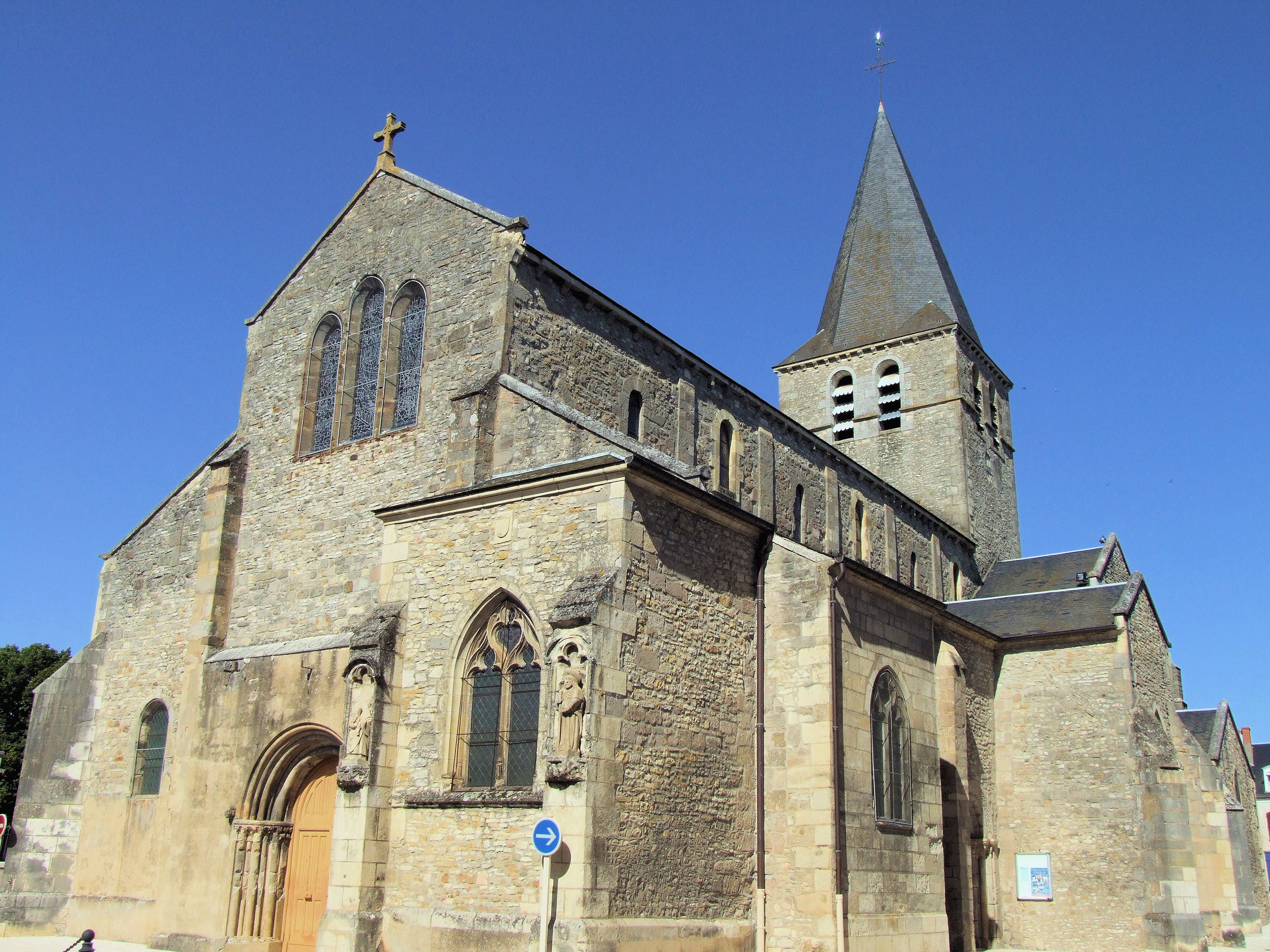
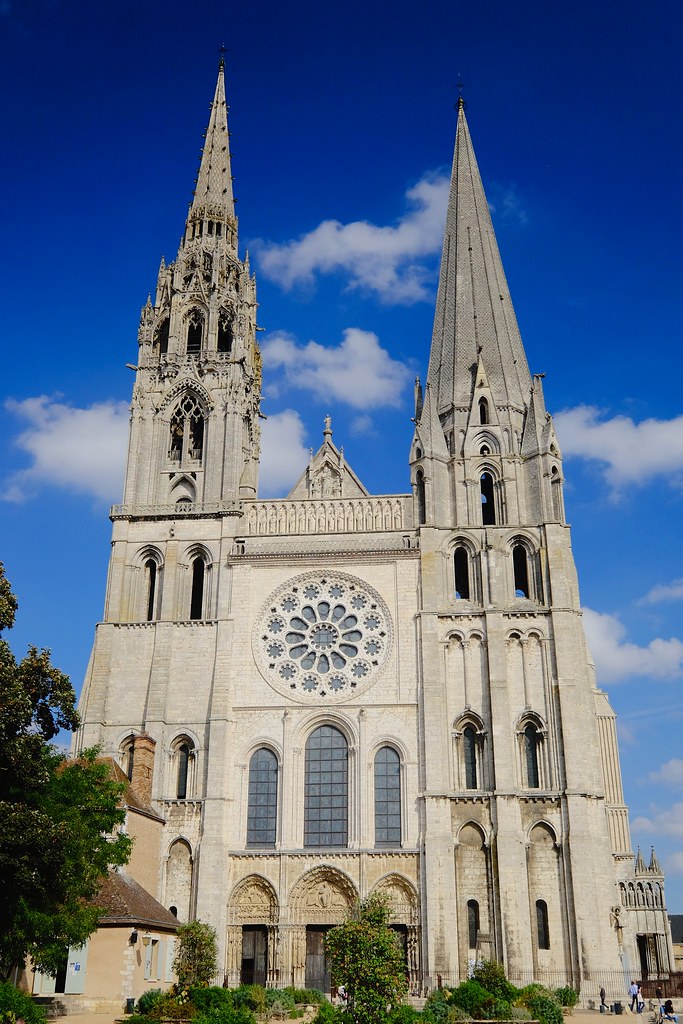
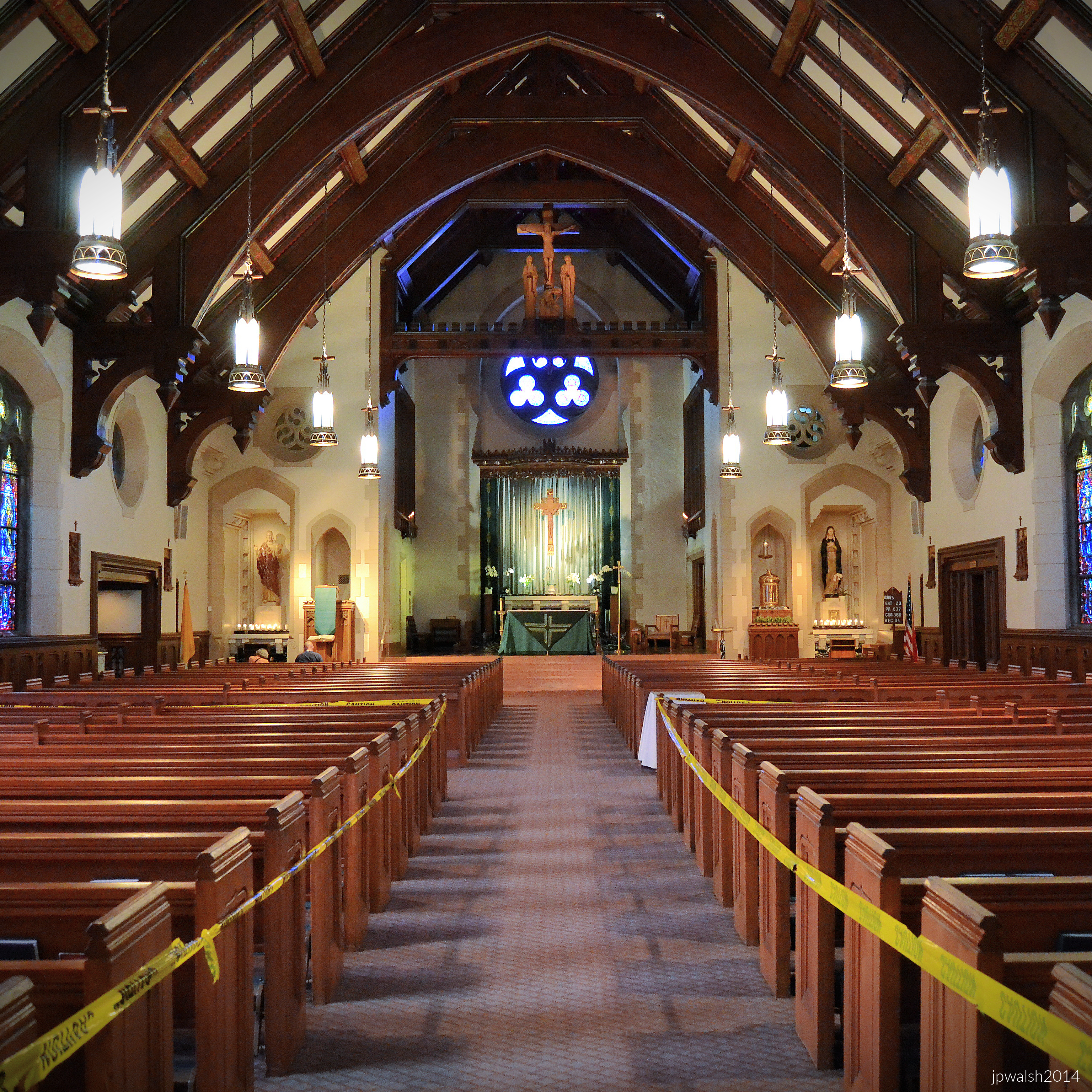
The Saint Peter Church of Saint-Pierre-le-Moûtier (Nièvre) is a 12th-century Roman Catholic building, a former Benedictine priory, classified as a historical monument since 1886. Photo by MOSSOT / Wikimedia Commons / CC BY 3.0
The Window and Its Setting
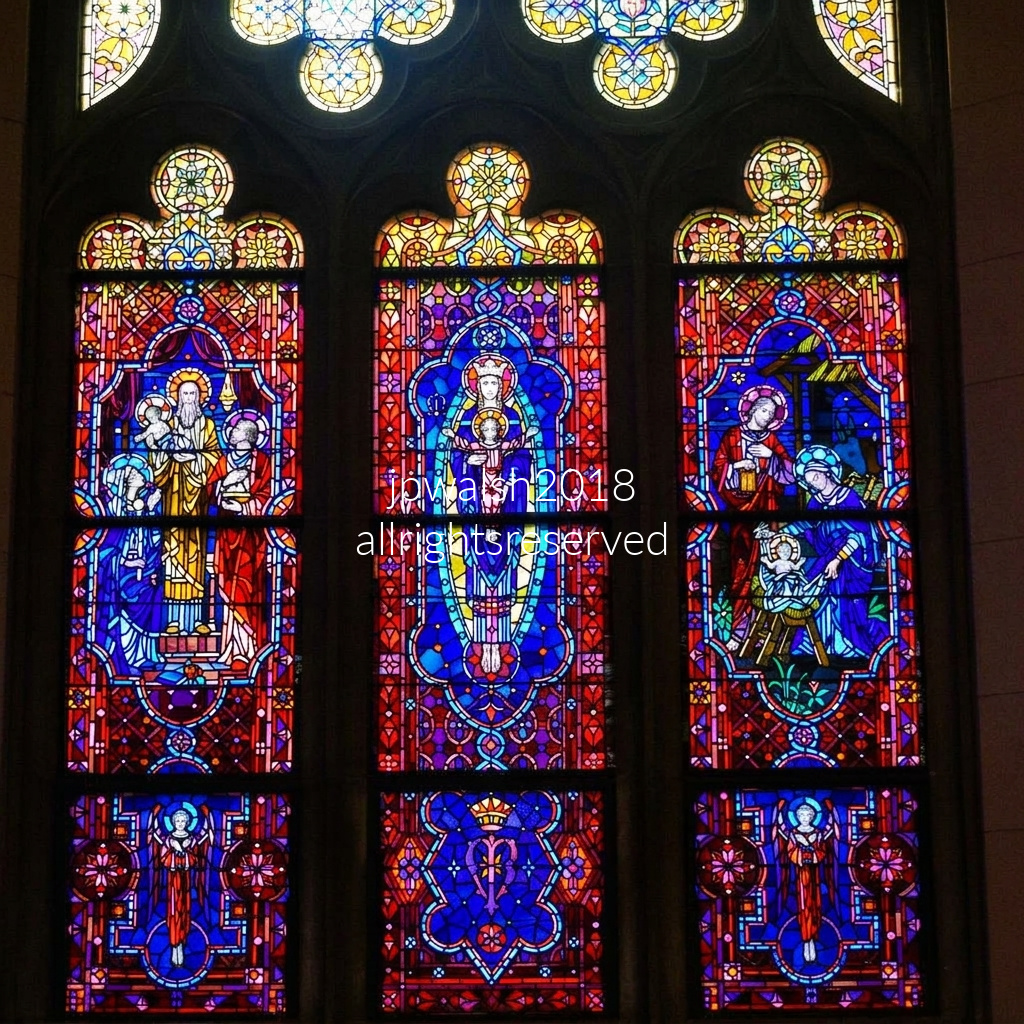
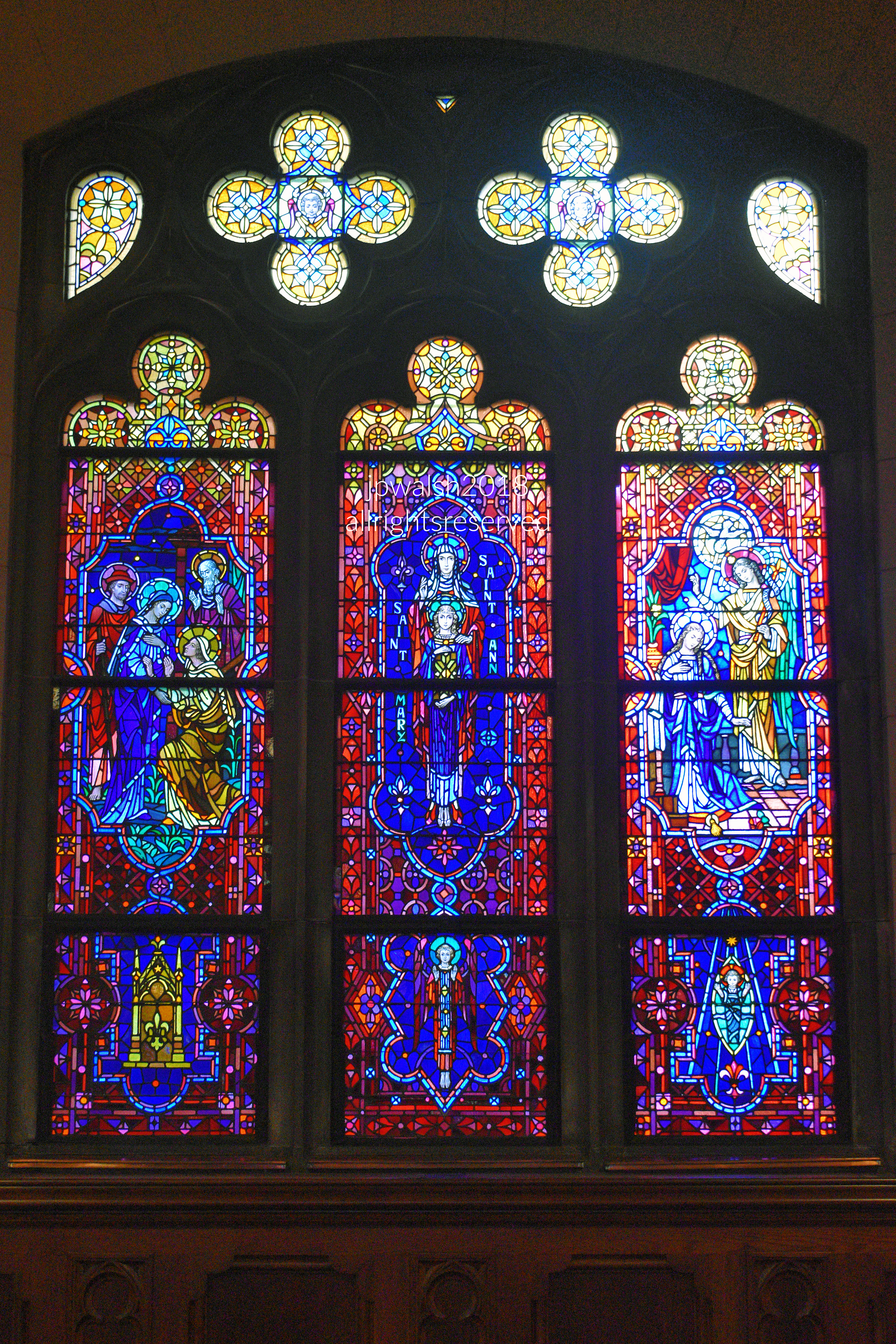
This stained‑glass window captures one of the most electrifying moments in the epic of Joan of Arc. It is part of a modern cycle in the town church of Saint‑Pierre de Saint‑Pierre‑le‑Moûtier, crafted in the mid‑20th century by the Mauméjean brothers. The artwork commemorates an event that unfolded in this very town — and inside this very church — during the Hundred Years’ War.
On November 4, 1429, Joan led a French royal force to seize Saint‑Pierre‑le‑Moûtier, a fortified stronghold held by Anglo‑Burgundian troops. The attack stalled under fierce resistance. French soldiers broke formation and began to fall back. Amid the chaos, Joan’s officer Jean d’Aulon — wounded during the fighting — suddenly realized she had been left almost alone near the moat with only a handful of men.
Author’s photograph. All rights reserved.
Joan’s Defiance and Her “Fifty Thousand”
D’Aulon mounted a horse, rode to her, and urged her to retreat before she was killed or captured. Joan removed her helmet and shouted that she was not alone. The window preserves her words across its lower banners: “+ J’AI EN MA / COMPAGNIE . . CINQVANTE MILLE / DE MES GENS.” She claimed she had fifty thousand of her people with her — the heavenly host of angels she believed fought at her side. D’Aulon saw only four or five soldiers, but Joan’s unshakable resolve reignited the army.
The Turning of the Battle
Joan ordered her men to gather wood and brush to build a makeshift bridge across the moat. The retreating French troops saw The Maid standing her ground, turned back, and launched a sudden, overwhelming assault that broke the defenses and captured the town. The upper portion of the window shows Joan on her white horse in the heat of battle, while the faces gathered in the arc above represent the “fifty thousand” she invoked — angels, Saint Michael, and the voices she believed guided her.
Aftermath and Joan’s Devotion
Following the victory, Joan prevented her troops from sacking the town. She then spent several days praying inside this church before marching on to her next campaign, leaving behind both a military triumph and a moment of mystic conviction that the Mauméjean window preserves with vivid force.
The nave of Saint-Pierre Church at Saint-Pierre-le-Moûtier, where Joan of Arc spent several days in prayer following her remarkable victory against overwhelming odds at the Battle of Saint-Pierre-le-Moûtier in November 1429. Photo by MOSSOT / Wikimedia Commons / CC BY-SA 3.0
More than a scene of battlefield heroism, the Saint-Pierre-le-Moûtier window presents Joan of Arc’s conviction that military success flowed from divine providence, portraying the inseparable relationship between faith, vision, and leadership that defined her extraordinary career.
This explanatory article may be periodically updated.
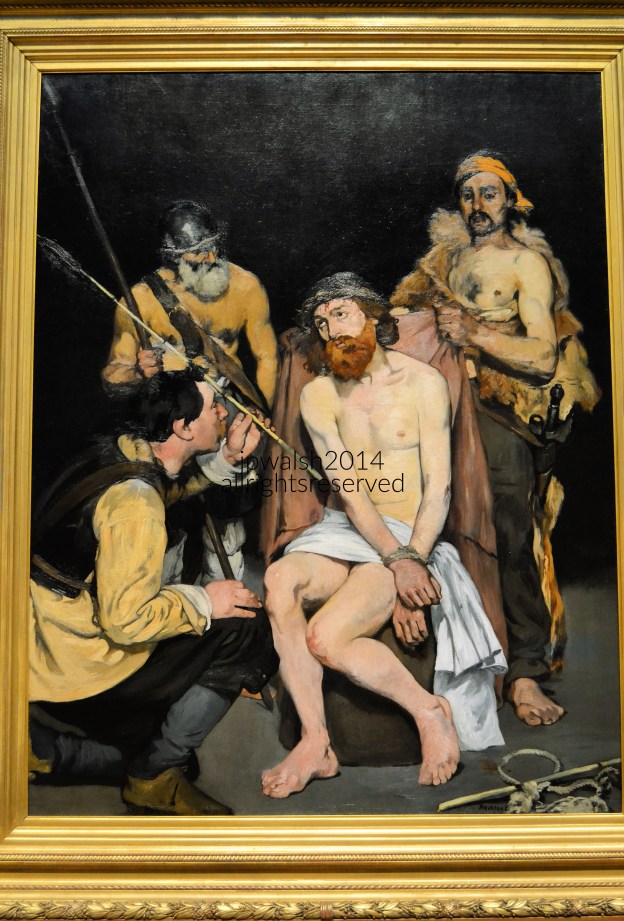
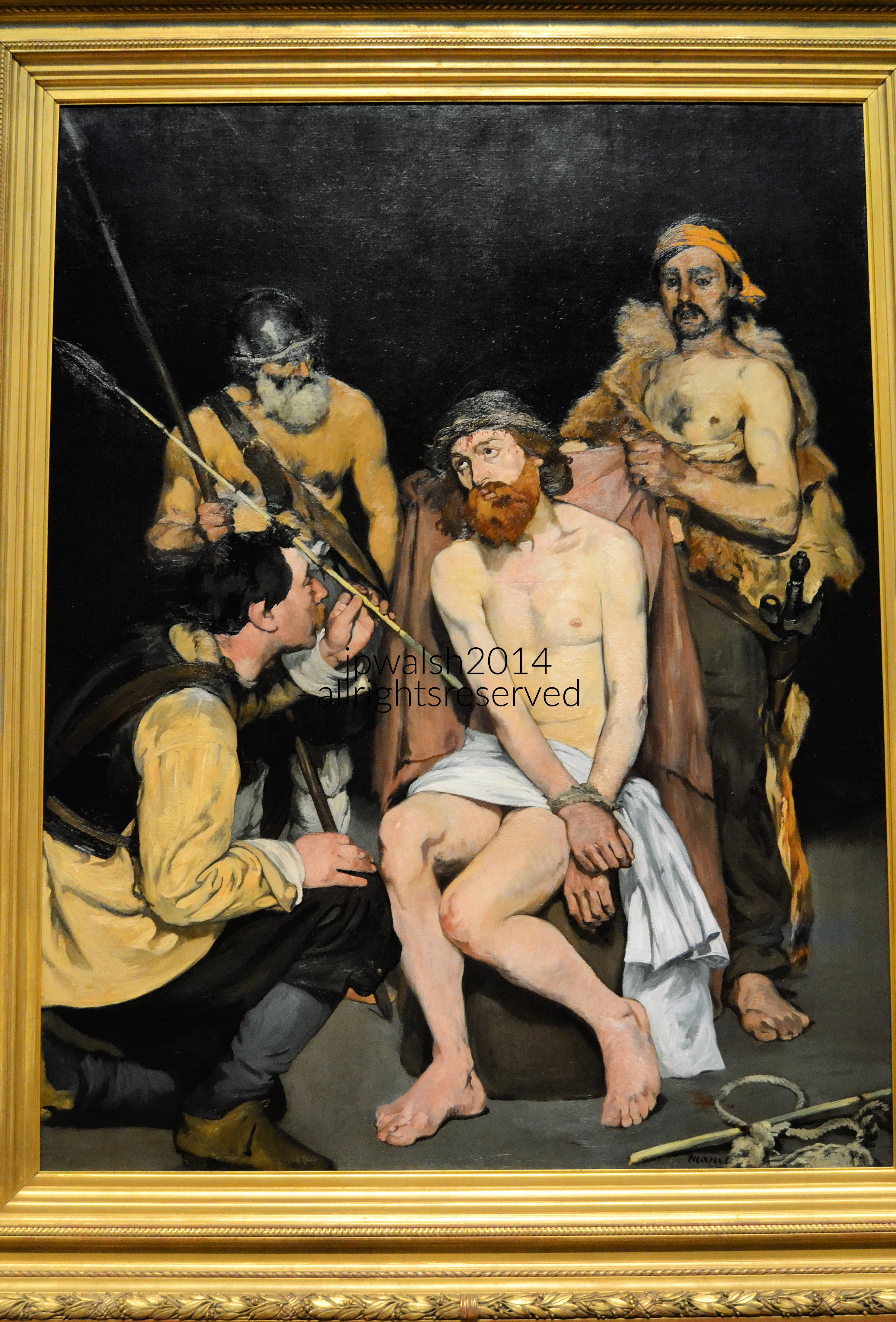
Feature image: Édouard Manet, Jesus Mocked by the Soldiers, 1865, oil on canvas, 190.8 × 148.3 cm (74 7/8 × 58 3/8 in.), transforms a traditional Passion scene into a striking meditation on artistic identity and public judgment. Rather than emphasizing spiritual transcendence, Manet presents Christ with an unsettling immediacy, drawing parallels between the mocked figure and the modern artist subjected to criticism, misunderstanding, and ridicule. Created during a period when Manet’s own work was regularly attacked by critics and rejected by academic convention, the painting blurs the boundary between religious narrative and contemporary experience, turning Christ’s humiliation into a powerful reflection on the costs of innovation and the burden of standing apart from public opinion. The Art Institute of Chicago. See – Jesus Mocked by the Soldiers | The Art Institute of Chicago – retrieved April 18, 2026. May 2014. Author’s photograph, 4.93mb DSC_0577 (1)
Christ as the Modern Artist
Even if Édouard Manet did not literally model Christ’s face on his own in Jesus Mocked by the Soldiers, the painting functions as an unmistakable act of self‑identification. Christ becomes a proxy for the embattled modern artist, a figure exposed, judged, and misunderstood by a hostile public. Manet selects the moment of Christ’s humiliation not to reenact a devotional scene but to stage a parallel between sacred suffering and his own experience before the Salon.
By mid‑century, French painting had turned decisively secular, yet Manet submitted two religious works to the Salons of 1864 and 1865, The Dead Christ with Angels and Jesus Mocked by the Soldiers. Both were accepted, and both were savaged. Critics called them vulgar, ignoble, even “contrary to art.” The public, accustomed to sentimentalized, idealized images of Jesus, recoiled from Manet’s starkly human Christ. Manet admitted to Baudelaire that the hostility unsettled him, even as Degas noted that the uproar made him famous. As Edmond Bazire observed, the Empire preferred idealized piety and bristled at seeing the Passion rendered with unvarnished realism, even when the scene followed Scripture closely.
Painting the Passion in a Secular Age
What, then, is a secular modern artist doing painting the Passion at all? Manet’s answer is to reframe Christ’s suffering as an analogue for the artist’s own embattled position, a truth‑teller punished by a complacent society. While many French moderns had drifted from Catholicism, Manet maintained ties to the faith, and he inherited a Renaissance tradition in which artists increasingly identified with Christ, blurring the line between human and divine as a form of imitatio Christi. By the 1860s this identification was a legitimate, if easily misunderstood, mode of artistic self‑expression. Manet was not conventionally pious, but he was close to several religious thinkers, and his engagement with sacred subjects was sincere enough that these works were conspicuously omitted from the 1884 retrospective after his death.
A Contemporary Christ
What makes Manet’s identification radical is the way he collapses the boundary between sacred history and modern experience. His Christ is rendered with the same realist immediacy, the same studio illumination, the same unidealized physicality that define his contemporary subjects. The result is a figure who is neither fully divine nor fully secular but unsettlingly both, a Christ startlingly contemporary. The frontal, confrontational composition intensifies this effect: Christ appears not as a distant theological symbol but as a vulnerable body exposed to judgment. The ambiguity, devotional image, critique of devotional imagery, or modern psychological drama, was precisely what scandalized a hierarchical society that depended on stable categories.
Édouard Manet’s Jesus Mocked by the Soldiers shocked 1865 Paris Salon critics with its radical portrayal of Christ. According to the Art Institute of Chicago, the painting’s profound ambiguity, heavy emphasis on Christ’s raw humanity, and Manet’s refusal to idealize the sacred figure ignited immediate controversy. Appearing deeply exhausted and vulnerable, Christ conspicuously lacks a traditional halo, forcing viewers to question whether they are looking at a divine being or merely an ordinary man.
Conservatives attacked the work as crude, irreverent, and a total violation of academic standards. Critics were particularly outraged that Manet treated a holy subject with the same blunt realism, flat lighting, and visible brushwork he used for modern, secular street scenes. Public and critical reception was so fiercely negative that the prominent critic Paul de Saint-Victor famously dismissed the masterpiece as “the horrible Ecce Homo by Monsieur Manet.”
The Passion as Artistic Self‑Portrait
The deeper provocation lies in Manet’s intervention into the history of painting. For a secular avant‑garde artist to take up a Passion subject in the 1860s was anomalous; to transform it into a conceptual self‑portrait was unprecedented. Manet’s Christ is not a theological claim but an artistic one: the modern painter, like the historical Jesus, confronts entrenched power, exposes uncomfortable truths, and endures public derision for doing so. The painting becomes a self‑portrait not of Manet’s face but of his artistic condition.
A Mockery of the Mockery
In this light, Jesus Mocked by the Soldiers is not a mockery of the sacred scene but a mockery of the mockery, a doubling of humiliation that implicates both Christ’s tormentors and Manet’s critics. The viewer’s unease arises from this conflation of registers: divine and human, biblical and modern, sacred narrative and artistic identity. Manet’s Christ stands under a bright studio light, stripped of idealization, exposed to judgment, just as Manet stood before the tribunal of the Salon.
The Suffering Artist
The scandal, then, lies not only in the subject but in the claim: that the modern artist, misunderstood and persecuted, belongs to a lineage of suffering truth‑tellers. If not a literal self‑portrait, the painting is unmistakably a portrait of artistic identity, asserting that the modern painter occupies a role once reserved for the sacred.
SOURCES:
Books: Brettell, Richard R. French Salon Artists, 1800–1900. New York: Harry N. Abrams, Inc.; Chicago: The Art Institute of Chicago, 1987. [See pp. 58–62.] Cachin, Françoise, and Charles S. Moffett. Manet, 1832–1883. New York: The Metropolitan Museum of Art and Harry N. Abrams, Inc., Publishers, 1983. [See pp. 226–229.]
Archival Documents & Reviews: Paris Salon of 1865. Historical Exhibition Records and Archives. Paris, 1865. Saint-Victor, Paul de. “Le Salon de 1865.” La Presse, May 28, 1865. Cited in the Bibliography Archives of the Art Institute of Chicago.
Websites: ArtWay. “Historical Essays on Manet.” Accessed September 2026. https://artway.eu. Wikipedia contributors. “Jesus Insulted by the Soldiers.” Wikipedia, The Free Encyclopedia. Accessed September 2026. https://wikipedia.org.
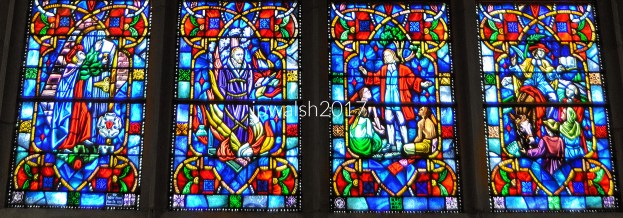
FEATURE Image: Reformation and the 18th century missions of Methodist founder John Wesley, detail of Willet stained- glass window, Trinity United Methodist Church, 1024 Lake Avenue, Wilmette, Illinois. March 2017. Author’s photograph.
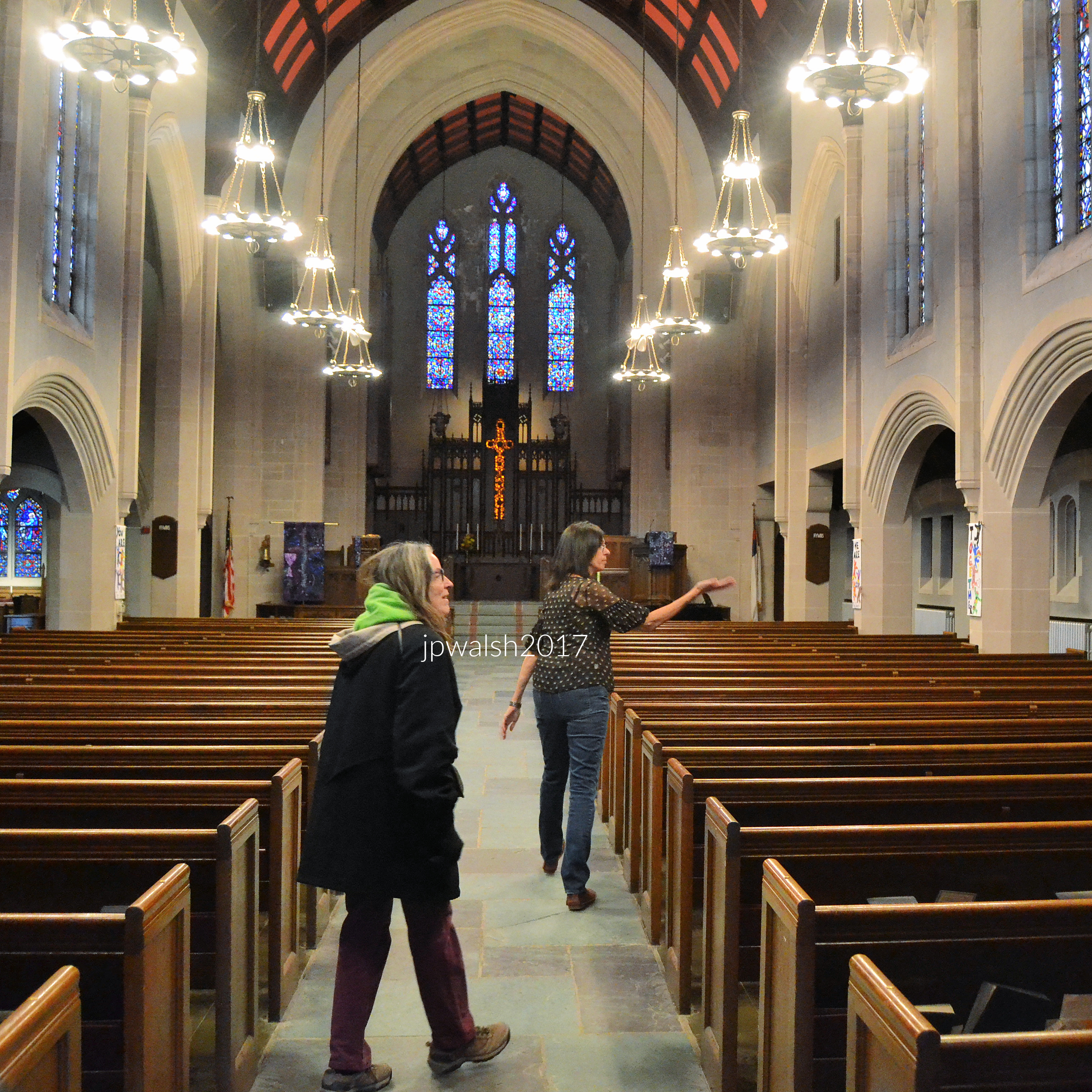
Trinity United Methodist Church in Wilmette is a remarkable example of early twentieth-century ecclesiastical architecture whose artistic significance is enriched by its exceptional Willett Studios stained glass and an unexpected place in popular culture through its association with the film Home Alone.
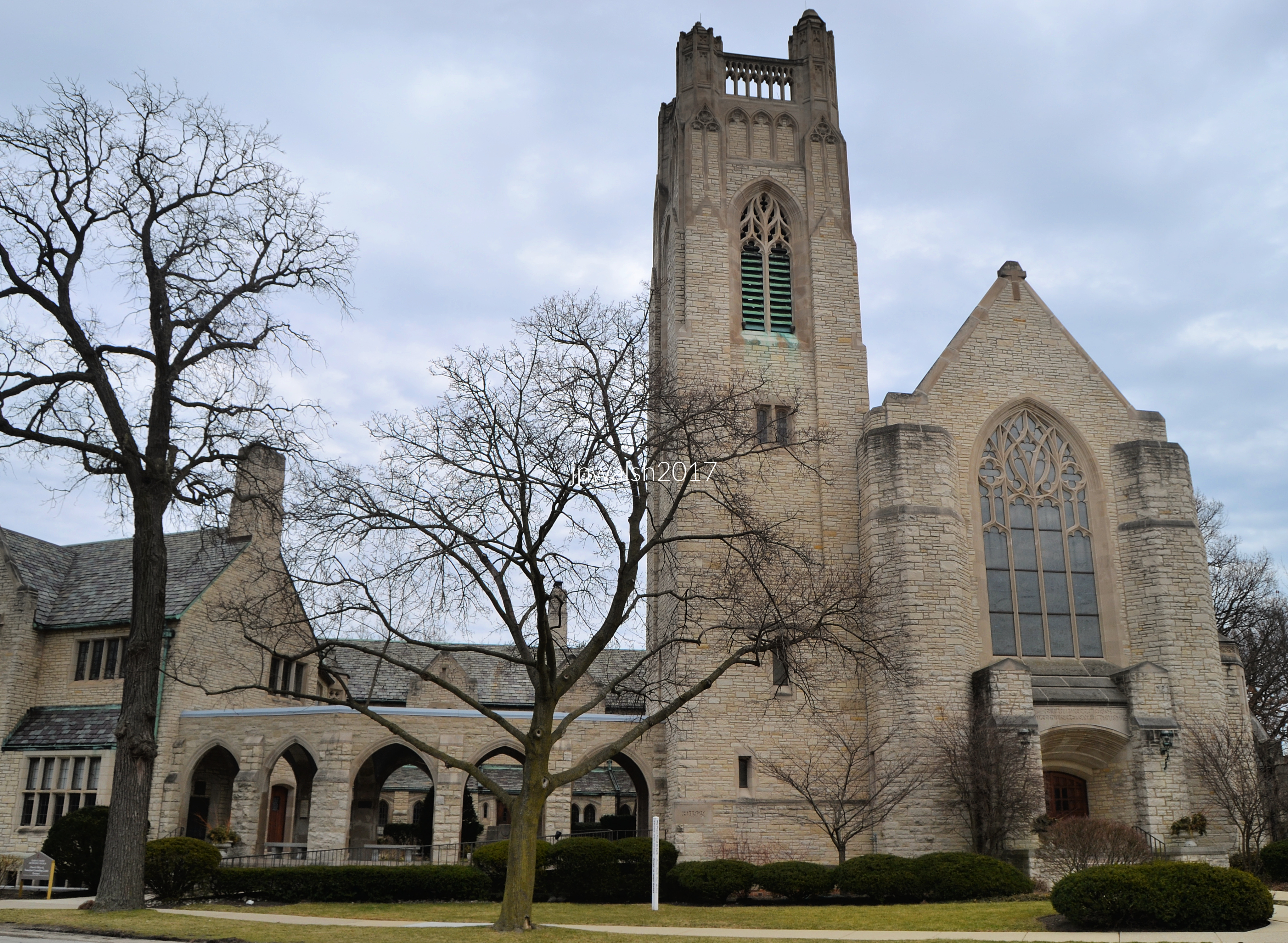
The church buildings complex displays the key ecclesiastical architectural features of late American Gothic Revival style. Trinity UMC, Wilmette. March 2017. Author’s photograph. 4.38mb DSC_0634 (1).
Architecture of Trinity United Methodist Church, Wilmette.
The Ashlar limestone church has stood on a prominent triangular corner of Lake and Wilmette Avenues for nearly 100 years. In the late American Gothic Revival style that flourished in the first third of the 20th century, the church displays in my photo its key ecclesiastical architectural features of (1) pointed‑arch windows with stone tracery, (2) tall bell tower with louvered openings, (3) buttress‑like vertical stonework emphasizing height, (4) a steep slate roof and (5) stained‑glass windows set in deep stone. Designed by Granger & Bollenbacher, the church building completed in 1929 is designed to feel ancient, monumental, and rooted in medieval Christian tradition — exactly what Methodist congregations of the era wanted. Trinity UMC stands out on the North Shore because it is scaled to frame its narrative, more medieval stained glass and not for grandeur comparative to its neighbors such as Christ Church (Episcopal) in Winnetka designed by Bertram Goodhue, or for crisp academic lines such as First Presbyterian in Wilmette designed by Coolidge & Hodgdon, among others. Of Gothic Revival churches built between 1900–1935. Trinity fits squarely into that movement, but with its own personality, specifically its didactic windows. The building was erected when the congregation outgrew its earlier 1908 Romanesque brick church. The church’s current Gothic Revival building, designed by Chicago architects Granger and Bollenbacher, reflects inspiration from European cathedrals. Construction began in the late 1920s, but the 1929 Stock Market Crash halted many of the planned interior details. The stained- glass windows, including the prominent façade window, were designed and installed by Henry Lee Willet in 1954.
Founding History and Its “Home Alone” Legacy.
Trinity United Methodist Church in Wilmette is one of the North Shore’s oldest congregations, with a history that stretches back to the 19th century. Founded on March 24, 1874, the church originally bore the name First Methodist Episcopal Church of Wilmette. Over the decades, it evolved through several identities — Wilmette Parish Methodist Church (1930–1968), Trinity Church of the North Shore (1968–1989), and finally Trinity United Methodist Church of Wilmette, the name it carries today. The church’s historic bell — once used to call worshippers, toll for local deaths, and warn the village of fires — now sits on display near the parking lot.
While its spiritual and community roles define its core identity, Trinity United Methodist Church is also widely recognized for its unexpected place in American pop culture. The church’s exterior appears in two memorable scenes in the 1990 Christmas classic “Home Alone.” In the film, directed by John Hughes, young Kevin McCallister (Macaulay Culkin) first spots the church while fleeing the burglars and hides in the Nativity scene on the lawn. Later, Kevin approaches the church at night, drawn by the sound of the choir singing “O Holy Night.” These moments set the stage for one of the film’s most emotional sequences — Kevin’s conversation with Old Man Marley — though that interior scene was filmed at Grace Episcopal Church in Oak Park. Securing permission to film at Trinity was not straightforward. When Twentieth Century Fox approached the Village of Wilmette in early 1990, the Village Board narrowly approved the request in a 4–3 vote after discussion and date changes. Filming took place in late winter of that year, and the church’s brief but iconic appearance has since become a point of local pride. Today, Trinity embraces this connection, often noting that to many visitors, it is simply “the Home Alone church.”
Beyond its religious and architectural significance, the church gained broader recognition through its connection to the beloved film Home Alone.
More than a movie landmark, Trinity United Methodist Church in Wilmette remains a vibrant congregation committed to worship, music, community service, and hospitality — a place where history, faith, and a touch of Hollywood intersect on the corner of Lake and Wilmette Avenues.
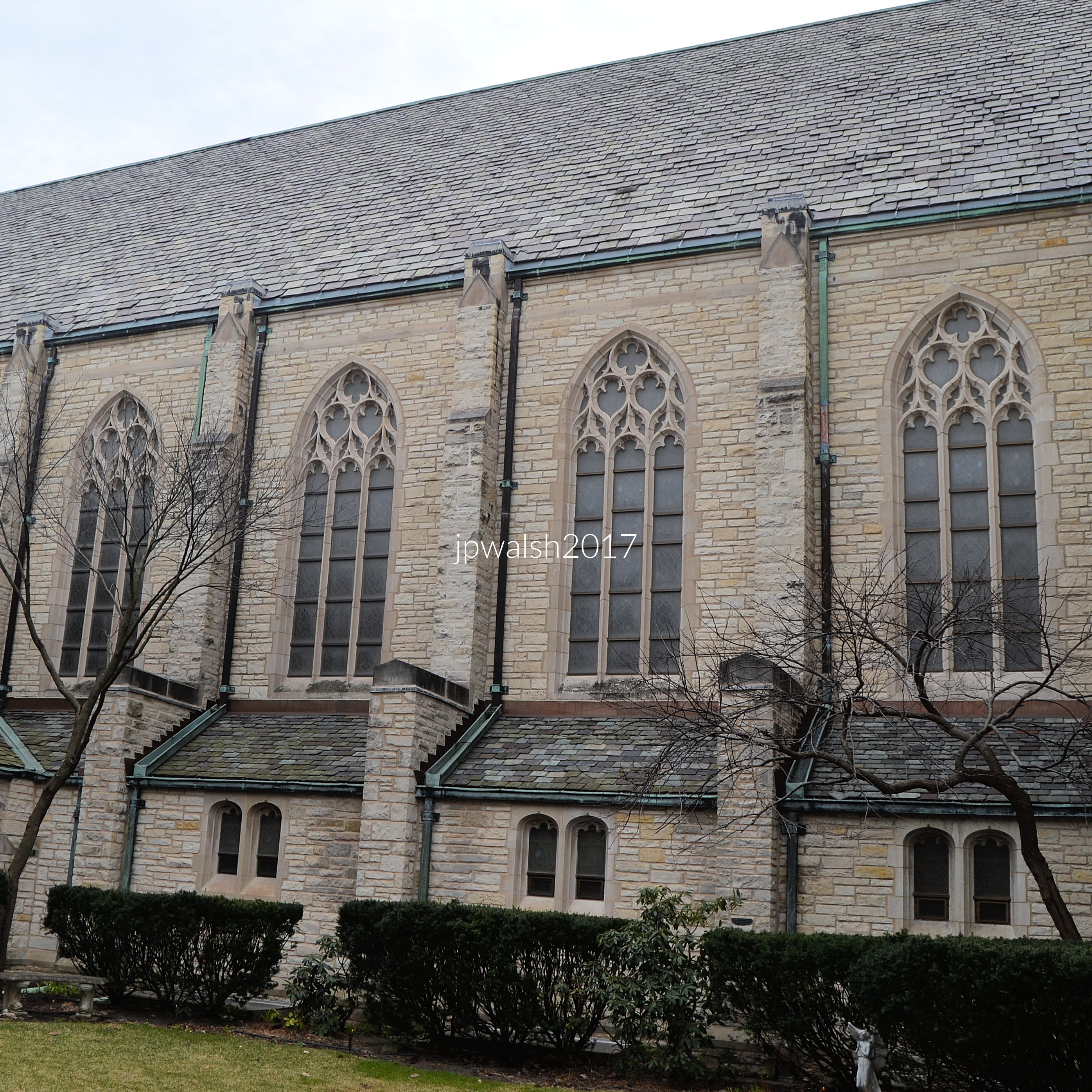
Designed by Granger & Bollenbacher, a procession of stained‑glass windows that line the nave are set in deep stone. Trinity UMC, Wilmette. March 2017. Author’s photograph. 3.40mb DSC_0635 (1)
How the architecture relates to the stained‑glass program.
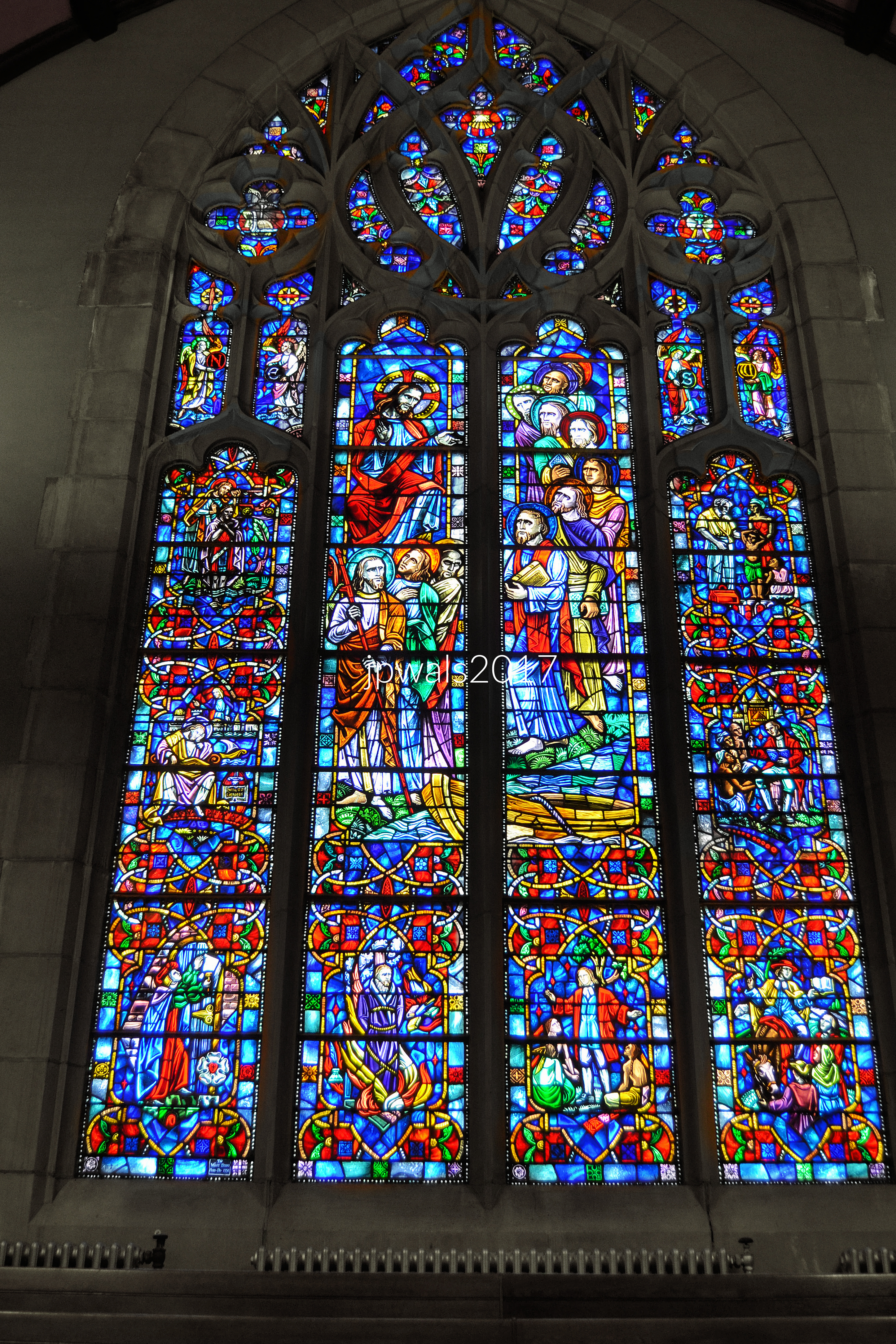
The stained glass was created by Henry Lee Willett of Willett Stained Glass Studios in Philadelphia, one of the leading American studios of the mid‑20th century. The major façade window, dated February 14, 1954, shows Willett’s signature use of rich blues, jewel‑tone reds, elongated Gothic figures, and clear narrative panels. Its scale and design were chosen for narrative clarity, while the church’s deep window wells intensify color saturation and create a natural shadow‑frame that draws the eye toward the visual telling of Scripture — a hallmark of Methodist stained‑glass design. While Trinity’s windows feel sacred and are tall enough to make a visual statement, they are also narrow enough to keep scenes readable and, like most narrative stained-glass windows, arranged in story cycles. The church’s façade and nave proportions create a natural processional reading of the windows, allowing each panel — and the entire cycle together — to unfold as a coherent theological arc. Methodist churches of the 1920s often used architecture to shape a catechetical journey, with the Gothic style providing both a sense of transcendence and a visual link to the continuity of the church across the millennia. The building and the glass tell the same story: God speaks, calls, teaches, transforms.
Interior Analysis: Gothic Revival Structure.
The sanctuary speaks in the familiar Gothic vocabulary. Trinity UMC, Wilmette. March 2017. Author’s photograph. 4.48 mb DSC_0654 (1)
A procession of rounded arches line the nave arcade, a testament to the congregation’s former Romanesque church building, with Gothic pointed-arch stained -glass windows above them guiding the eye upwards and forward. Above these, a ribbed or groin‑vaulted ceiling lifts the gaze further upward into a sense of height and devotion that feels almost instinctive. Reinforcing this vertical pull, the tall, narrow stained‑glass windows have proportions echoing centuries of Gothic design stretching light into color. Stone columns with simple capitals mark each step of the nave, guiding you along the long central aisle toward the chancel. The sanctuary is familiar Gothic interpreted through the American 1920s–30s lens—lighter, more vertical, devotional rather than medieval.
Trinity UMC, Wilmette. March 2017. Author’s photograph. 3.89mb DSC_0657 (1)
The space warms into Methodist Gothic. Dark wood pews, wooden chancel furnishings, a prominent pulpit or lectern, and a central cross create an interior that feels both sacred and approachable. The materials and layout quietly affirm the Methodist emphasis on Scripture, preaching, and congregational participation.
Overhead, hanging lantern chandeliers complete the atmosphere. Their medieval‑inspired metalwork casts a warm glow that softens the stone and wood. Evenly spaced along the nave, they reinforce the processional rhythm, drawing the eye—and the worshipper—toward the chancel and the unfolding narrative held in glass and architecture. Gothic in form, Methodist in function, Willett in storytelling, and 1920s–30s American in craftsmanship, including acoustics shaped for congregational singing, the interior of Trinity UMC is a space designed to make worship feel like a journey: from the world outside, through the nave, toward the light of the chancel and the story told in glass.
How Methodist theology shaped 20th‑century stained glass.
Methodist stained glass in the early–mid 1900s has a distinctive character shaped by Methodist convictions about Scripture, preaching, and discipleship. Because windows were expected to teach, almost every Methodist window cycle from this era functions as a visual sermon. Their imagery is intentionally accessible, with a strong Biblical orientation and a clear narrative movement through salvation history.
Methodists understand themselves as heirs of the Old Testament, followers of Jesus, children of the Reformation, and participants in the church’s ongoing renewal. As a result, their stained‑glass programs blend Old Testament, New Testament, and Reformation themes. Typical cycles include scenes of the prophets, episodes from the Life of Christ, and depictions of key Reformers such as Martin Luther (1483-1546), William Tyndale (c. 1494-1536), and Methodist founder John Wesley (1703-1791).
Trinity UMC, Wilmette. March 2017.Author’s photograph. 5.29mb DSC_0655 (1)
Its stained glass windows were created by the renowned Willett Studios of Philadelphia, among the most respected American ecclesiastical glass firms.
Façade window – Jesus Calling the First Disciples:
Façade window of Jesus Calling the First Disciples.Trinity UMC, Wilmette. March 2017. Author’s photograph. 7.65mb DSC_0649 (2)
A foundational moment in the Gospels — and a favorite subject in mid‑20th‑century Methodist stained glass — is Jesus calling the first disciples. In this scene, Jesus summons fishermen from their boats with the words, “Follow me, and I will make you fishers of men.”
The boat anchors the story in the Sea of Galilee, while the iconography makes the identification unmistakable. Jesus is shown with a cruciform halo and red and blue garments, signaling his dual nature. His authoritative, summoning gesture directs attention to the haloed figures of Peter, Andrew, James, and John, who look up toward him in response to the call.
Detail of Façade window depicting Reformers.
At the bottom of the façade window are four scenes from the life of the Reformers. At LEFT is MARTIN LUTHER nailing his 95 theses to the door of the Castle Church (All Saints’ Church) in Wittenberg, Germany, on October 31, 1517, that sparked the Reformation. At the bottom right of the panel is a white rose with a red heart and black cross. That is Luther’s personal emblem, designed in 1530 and used on his letters and publications. He is wearing scholarly robes in the colors of deep red, green, and brown that Willett often used for Reformers.
At LEFT CENTER is the burning at the stake of WILLIAM TYNDALE in 1536 whose crime was translating the Bible into English for the ordinary people. Tyndale believed Scripture should be accessible to ordinary people and died for that conviction. The Reformation’s gift is to take the Bible out of the hands of the elite and place it into the hands of the people.
At CENTER RIGHT is JJOHN WESLEY, founder of Methodism, preaching in the open air to Native Americans — specifically the Muscogee (Creek) people —during his mission to the Georgia colony between 1735 to 1737 which, after his return to England, accelerated the Methodist Movement which Wesley founded at Oxford in 1729. Wesley began preaching in the open air, embracing traveling ministry and forming societies as he did in America. By 1739, he built the first Methodist meeting house in Bristol, England.
At RIGHT John Wesley preaching to early American settlers. Wesley served as Anglican pastor of Christ Church in Savannah, Georgia, where he introduced strict spiritual disciplines. His time was marked by conflict, including a failed romantic relationship, and backlash from residents against his strictness, causing him to return to England heartbroken and disillusioned after only two years.
Methodist stained glass seeks to be beautiful where clarity is key. The style tends to bold outlines, well delineated figures and readable gestures with minimal abstraction.
Trinity UMC, Wilmette. March 2017. Author’s photograph. 5.20mb DSC_0645 (1)
Traditional enough to feel sacred – Modern enough to feel fresh – narrative enough to teach – artistic enough to inspire: Why Willett Studios was chosen.
Christ the Teacher — sometimes also read as Christ the Good Shepherd window. Trinity UMC, Wilmette. March 2017. Author’s photograph. 3.95mb DSC_0664 (2)
This Willet window is a Life of Christ triptych, arranged in the traditional Methodist/Willett narrative pattern.
At the left, the window shows the ministry of compassion: a haloed Christ blessing or forgiving a kneeling woman, possibly inspired by the woman who washed his feet with her tears and dried them with her hair. Willett often preferred such non‑specific healing scenes, using them to emphasize Christ’s compassion rather than tie the image to a single Gospel episode.
At the center, Christ stands elevated and alone in Willett’s characteristic depiction of Christ the Teacher — sometimes also read as Christ the Good Shepherd when paired with lamb symbolism above. He bears the cruciform halo (reserved only for Jesus) and wears red and blue robes to signify his dual nature as God and Man. His arms extend slightly in a gesture of blessing and invitation.
At the right, the scene shifts to Christ’s agony in the garden before his betrayal and arrest, capturing the moment of solitary struggle that precedes the Passion.
“Do all the good you can.”
Taken together, these panels proclaim a unified message: Christ at the center of the Christian life, the one who heals, restores, and calls disciples to follow. The sequence echoes the Methodist conviction embodied in the familiar motto: “Do all the good you can.”
Trinity UMC, Wilmette. March 2017. Author’s photograph. 4.12.mb DSC_0637 (1)
FEATURE Image: Caravaggio (Michelangelo Merisi), Judith Beheading Holofernes, c. 1598, oil on canvas, 56 ¾ x 76 ¾” 145 x 195cm Galleria Nazionale d’Arte Antica, Rome. https://barberinicorsini.org/opera/giuditta-e-oloferne/ – retrieved October 12, 2024.
Viewed chronologically, Caravaggio’s career reveals the emergence of a radically new artistic vision in which light, shadow, emotion, and everyday reality transformed both religious and secular painting, altering the course of European art around 1600.
Ottavio Leoni (1578-1630), Portrait of Caravaggio, c. 1621/25, red and white chalk on blue paper, 23.4 x 16.3 cm, Biblioteca Marucelliana, Florence.
INTRODUCTION.
The chalk portrait above is probably the most faithful likeness of Caravaggio. Born Michelangelo Merisi in 1571, Caravaggio became an influential figure in Italian and European art in and well after his lifetime. He revolutionized painting by his theatrical use of light, dramatic narrative, and the naturalistic physical depiction of everyday people. His depiction of figures in historical narrative using dramatic interplay of light and shadow called chiaroscuro along with its naturalistic composition was further modernized in its scenes’ inclusion of the emotional and psychological human state. These artistic qualities were admired and emulated by many young European artists going forward into the balance of the seventeenth century.
Caravaggio came to Rome around 1592 from Lombardy, where he was influenced by the works of Giovanni Girolamo Savoldo (c.1480-1548), Lorenzo Lotto (c. 1480-1557), Romanino (c.1484-1566) and Moretto (c. 1498-1554?). For a while he worked in the workshop of the leading late mannerist Giuseppe Cesari (1568-1640), but soon broke away from the established course in Roman-Florentine artistic mannerism. His completely new approach of intense realism and chiaroscuro — that is, dramatic use of light and darkness to situate a scene – made him the “master of darkness” and completely revolutionized art in Rome around 1600. Along with Annibale Carracci (1560-1609), Adam Elsheimer (1578-1610) and Peter Paul Rubens (1577-1640), Michelangelo Merisi, called Caravaggio, was one of the progenitors of 17th century painting.
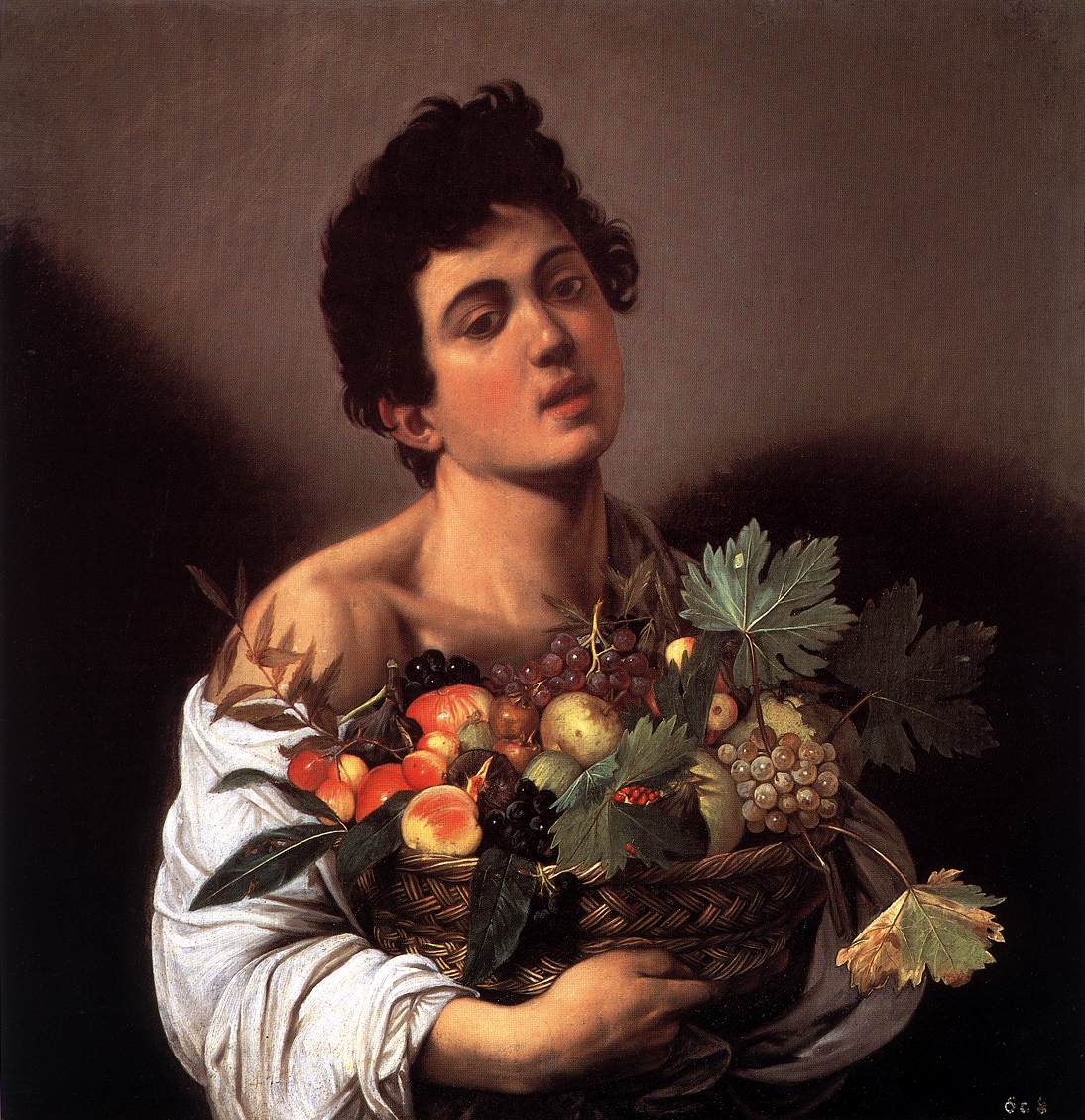
Caravaggio’s Il Fruttaiuolo (“Boy with a Basket of Fruit”) presents a remarkable contrast of the detailed, colorful, and sensuous depiction of fruits of the season and the refined and delicate innocence of an adolescent boy holding its basket. The placid scene of typical everyday life is enhanced by an expressive and careful execution. The model was Caravaggio’s friend, Sicilian painter Mario Minniti, at about 16 years old. According to Giovanni Pietro Bellori (1613-1696) who included Caravaggio in his Lives of the Artists, the artist learned “to paint flowers and fruit so well imitated that everybody came to learn from him how to create the beauty that is so popular today.”
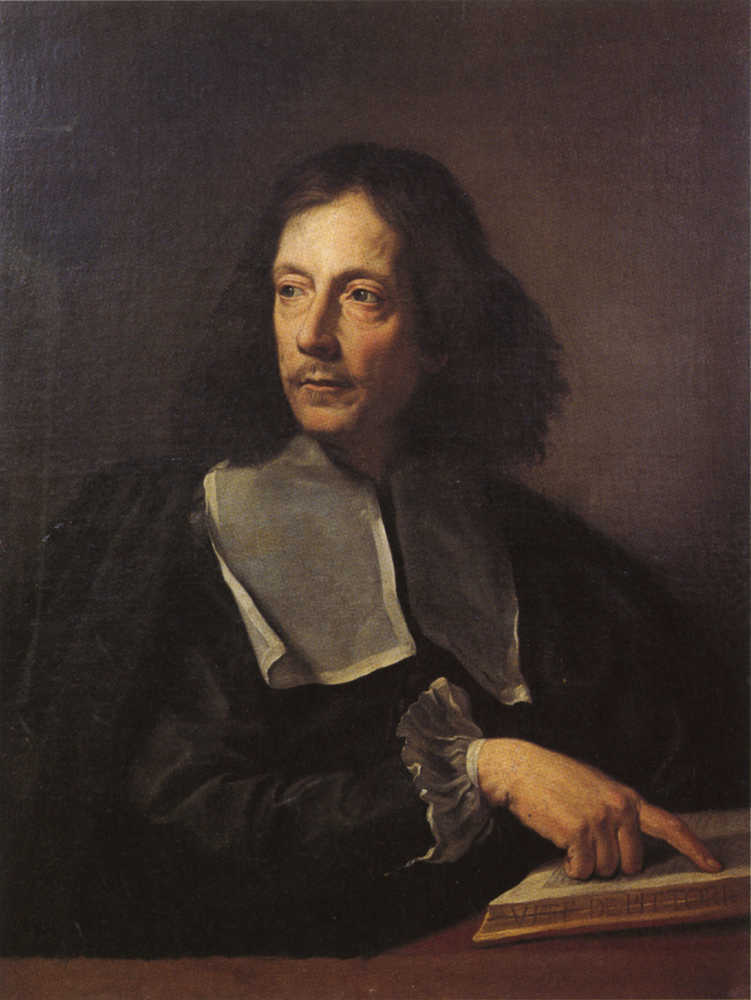
Carlo Maratta (1625-1713), Portrait of Gian Pietro Bellori who was Caravaggio’s most important biographer. Other early biographies of Caravaggio’s life were written by his doctor, Giulio Mancini (1559-1630) and by Giovanni Baglione (1566-1643), a rival artist.
Caravaggio’s Il Bacchino Malato (“The Young Sick Bacchus”), also known as Bacchino malato (“The Sick Bacchus”) or Autoritratto in veste di Bacco (“The Self-Portrait as Bacchus”), is an early self-portrait by Michelangelo Merisi da Caravaggio, dated between 1593 and 1594. The artwork dates from Caravaggio’s first years in Rome when he moved to the Eternal City from his native Milan in 1592. The painting was in the collection of Giuseppe Cesari (1568-1640), Caravaggio’s early employer. In 1607 it was confiscated from Cesari by the Pope in exchange for the Italian mannerist’s freedom following an illegal firearms charge. The pope gifted it to his nephew, Cardinal Scipione Borghese (1577-1633), together with the Boy Peeling Fruit and Boy with a Basket of Fruit (“Il Fruttaiuolo“).
The painting is a realist portrait of a young man displaying the typical attributes of Bacchus, the god of drunkenness. The sitter is turned to the viewer in a three-quarter pose, holding in his hands a bunch green grapes held next to his ailing greenish complexion. The sitter has been identified as the artist since it is documented that he was in the Ospedale della Consolazione in Rome around this time for undefined reasons. This interpretation provides the origin for the artwork’s title.
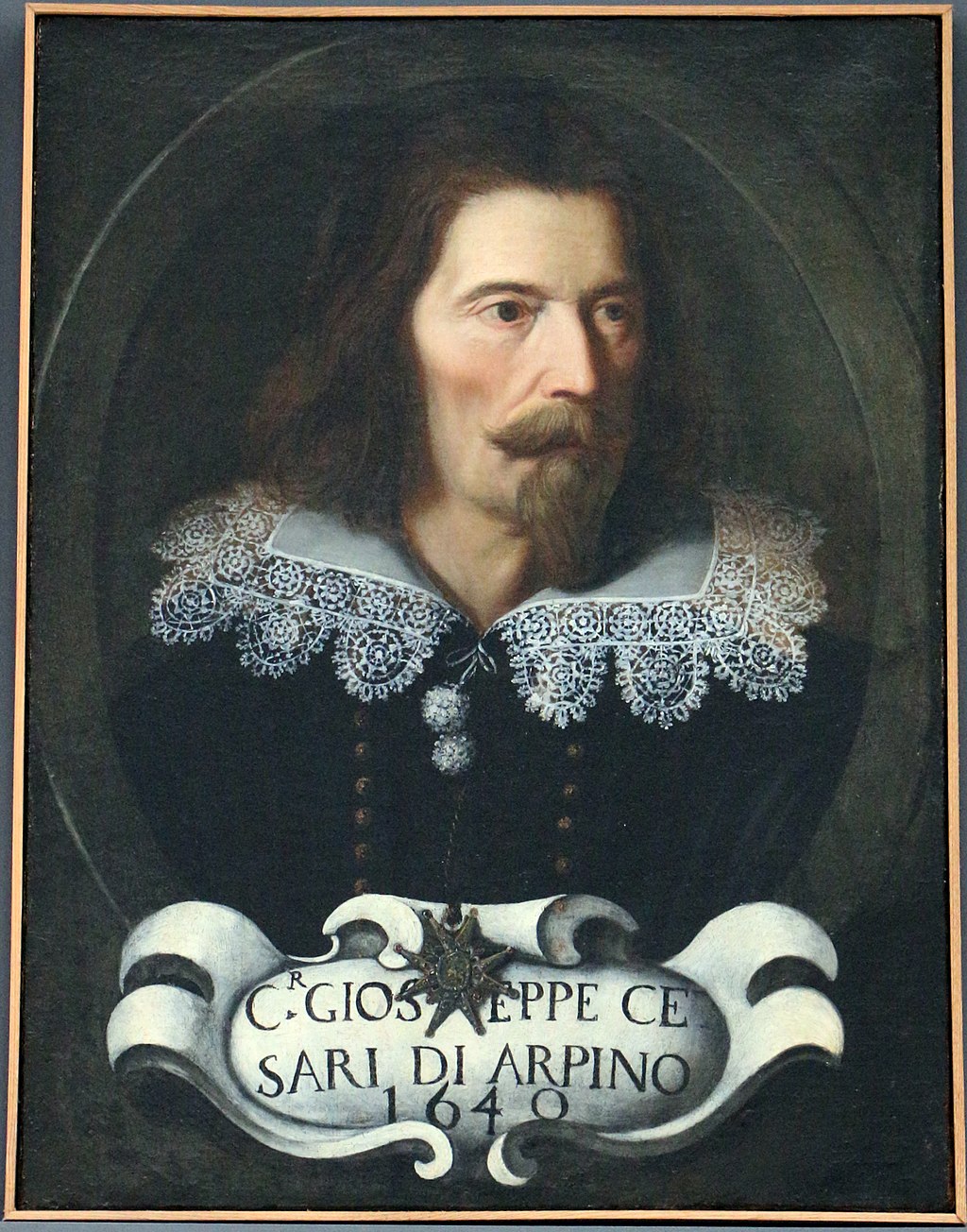
Giuseppe Cesari, Self-portrait, 1640, Accademia di San Luca. Cesari was Caravaggio’s first employer and in possession of The Young Sick Bacchus that was confiscated by the pope.
Ottavio Leoni, Portrait of Cardinal Scipione Borghese. The sitter was not only the pope’s nephew and a Cardinal in the Catholic Church but the recipient of early Caravaggio paintings by gift. Such a gift was not at random: the cardinal’s growing art collection, including Caravaggio and Bernini, formed the basis of the Villa Borghese in Rome.
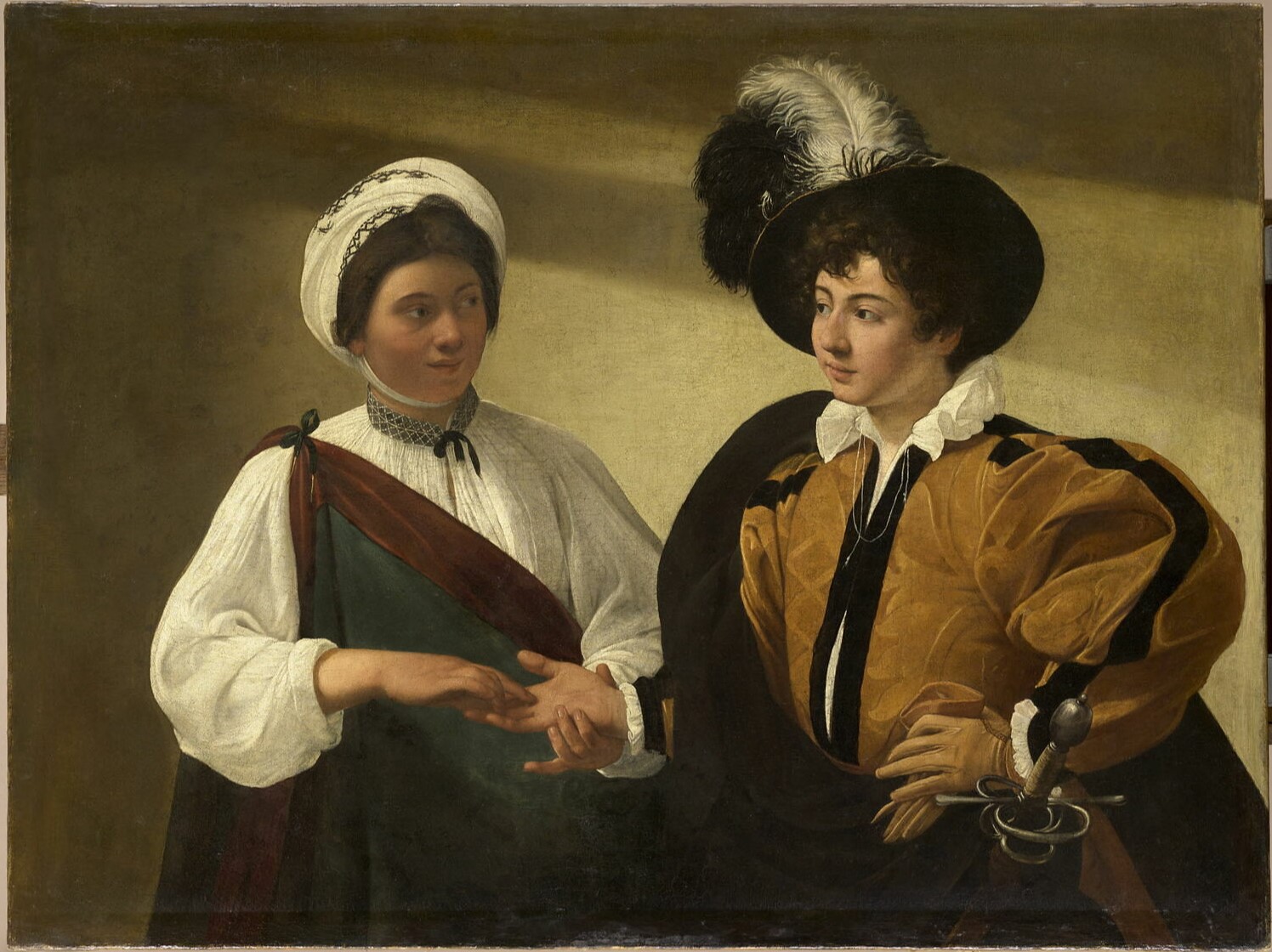
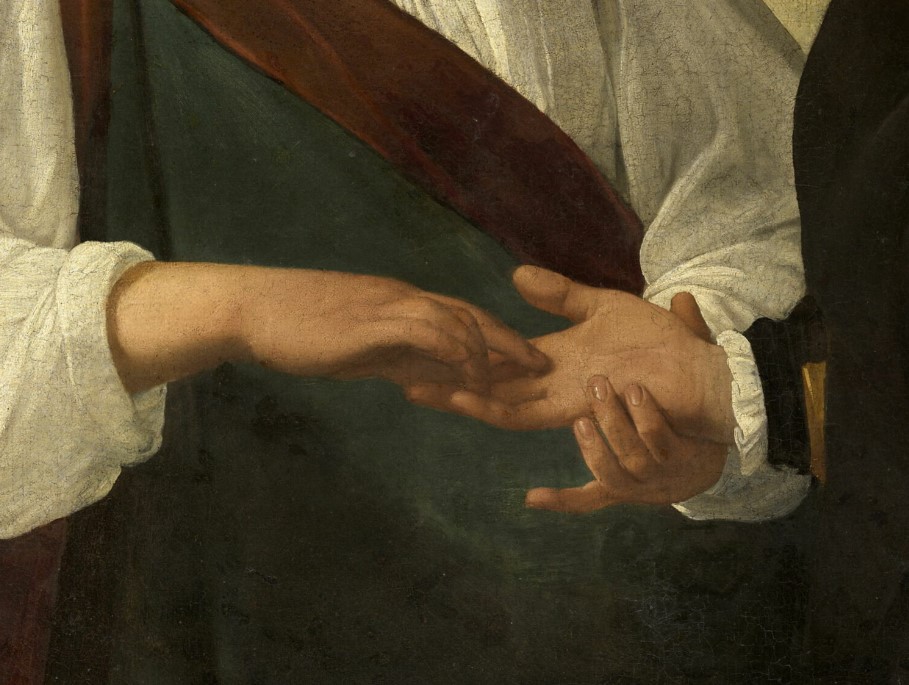
According to Giulio Mancini, Caravaggio painted The Fortune-Teller for a proverbial song while staying with Archbishop Fantino Petrignani (1577-1601). By 1620 when Mancini was writing, the painting was owned by Roman art collector and Catholic prelate Alessandro Vittrici (d. 1650). Later (1657) it was in the collection of Catholic Cardinal Camillo Francesco Maria Pamphili (1622-1666) who sent it with Bernini (1598-1680) to Paris as a gift to Louis XIV.
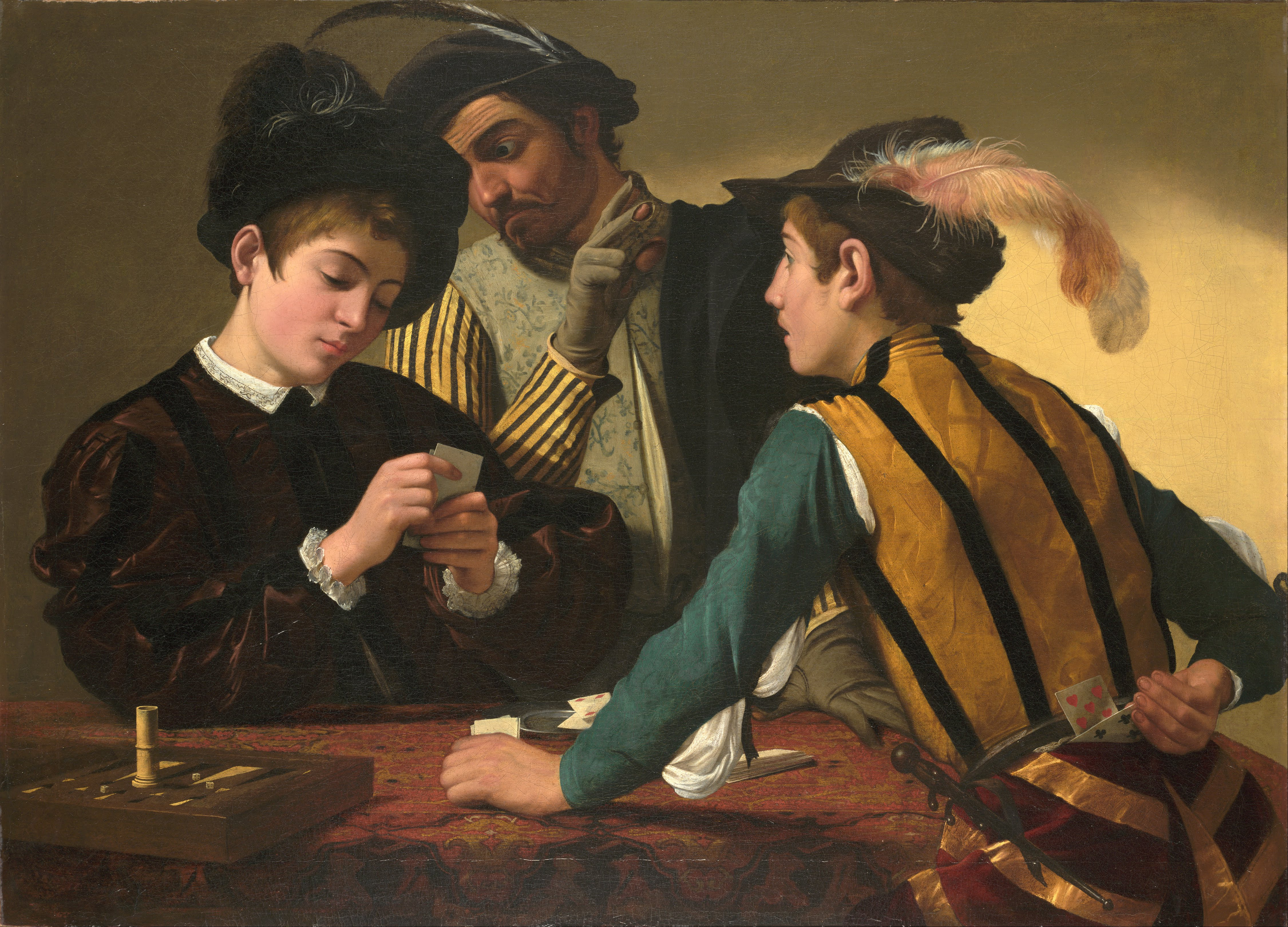
Caravaggio (Michelangelo Merisi), cardsharps,1594/95, oil on canvas, 37 1/16 x 51 9/16 in. (94.2 x 130.9 cm), Fort Worth, Kimbell Art Museum, Fort Worth, Texas. https://kimbellart.org/collection/ap-198706 – retrieved October 18, 2024.
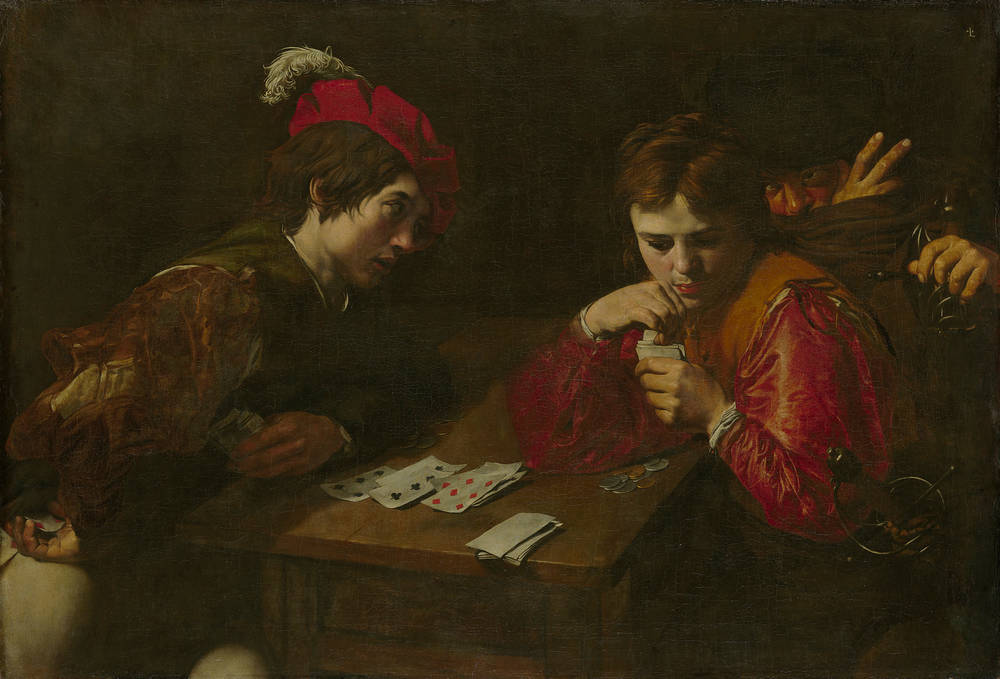
Playing the game of primero the player at left is oblivious to a bearded cardsharp who uses his gloved fingers to signal to the other player the content of the cards. The other cheater is reaching for a hidden card from his pants behind his back. Caravaggio’s composition is novel with a naturalistic treatment of the figures whose distinct expressions and gestures convey a realistic and hard drama of being cheated and cheating. This painting was owned and stamped by Cardinal del Monte and in his inventory of 1627 following his death. It had been lost for almost a century when it was discovered in a European private collection and purchased by the Kimbell in 1987.
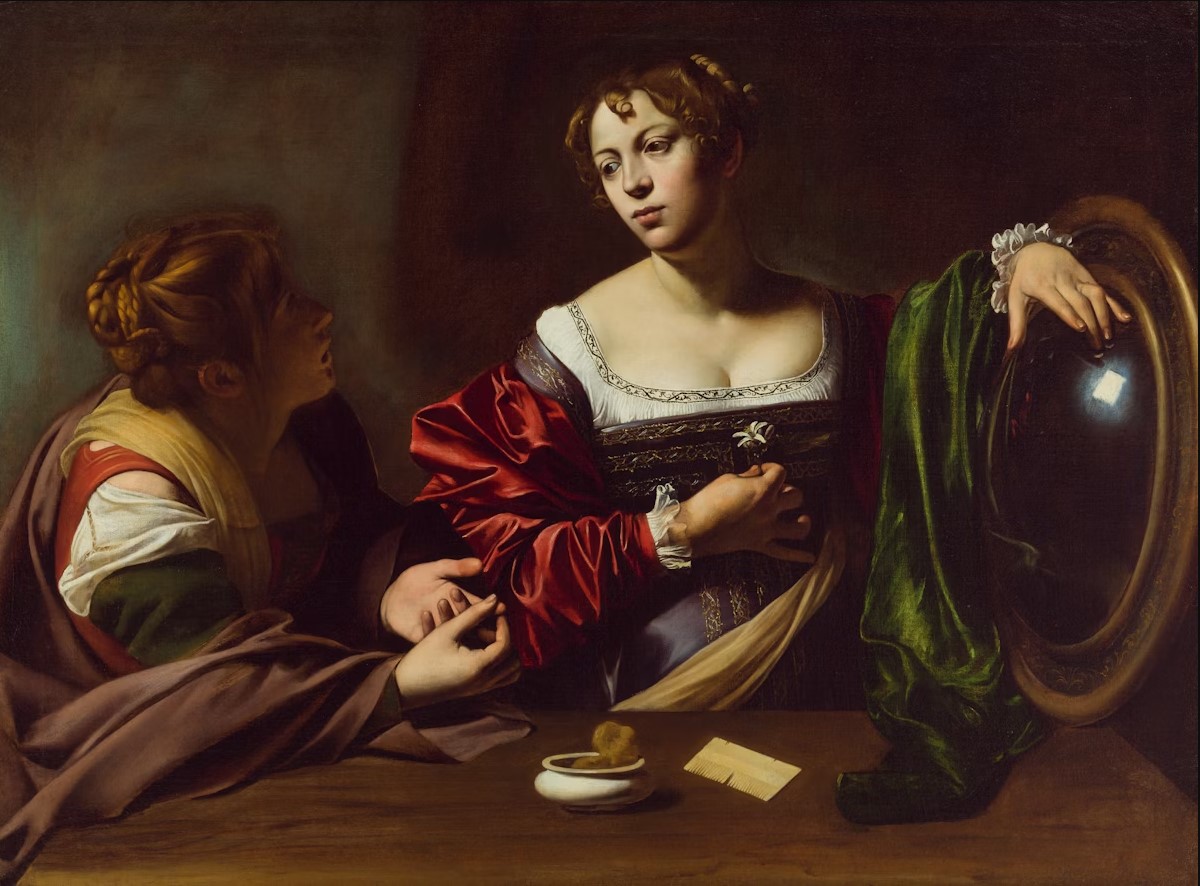
Caravaggio (Michelangelo Merisi), Martha and Mary Magdalene, c. 1598 Detroit Institute of Arts.
“Caravaggio helped to popularize half-length religious paintings like this, made for private collectors rather than for public church settings. His greatest innovation was in depicting biblical characters as if they belonged to contemporary Roman society, basing them on studio models and dressing them in 17th-century attire, as he does here.” https://www.artic.edu/articles/1071/caravaggio-s-dramatic-life-and-paintings – retrieved October 15, 2024.
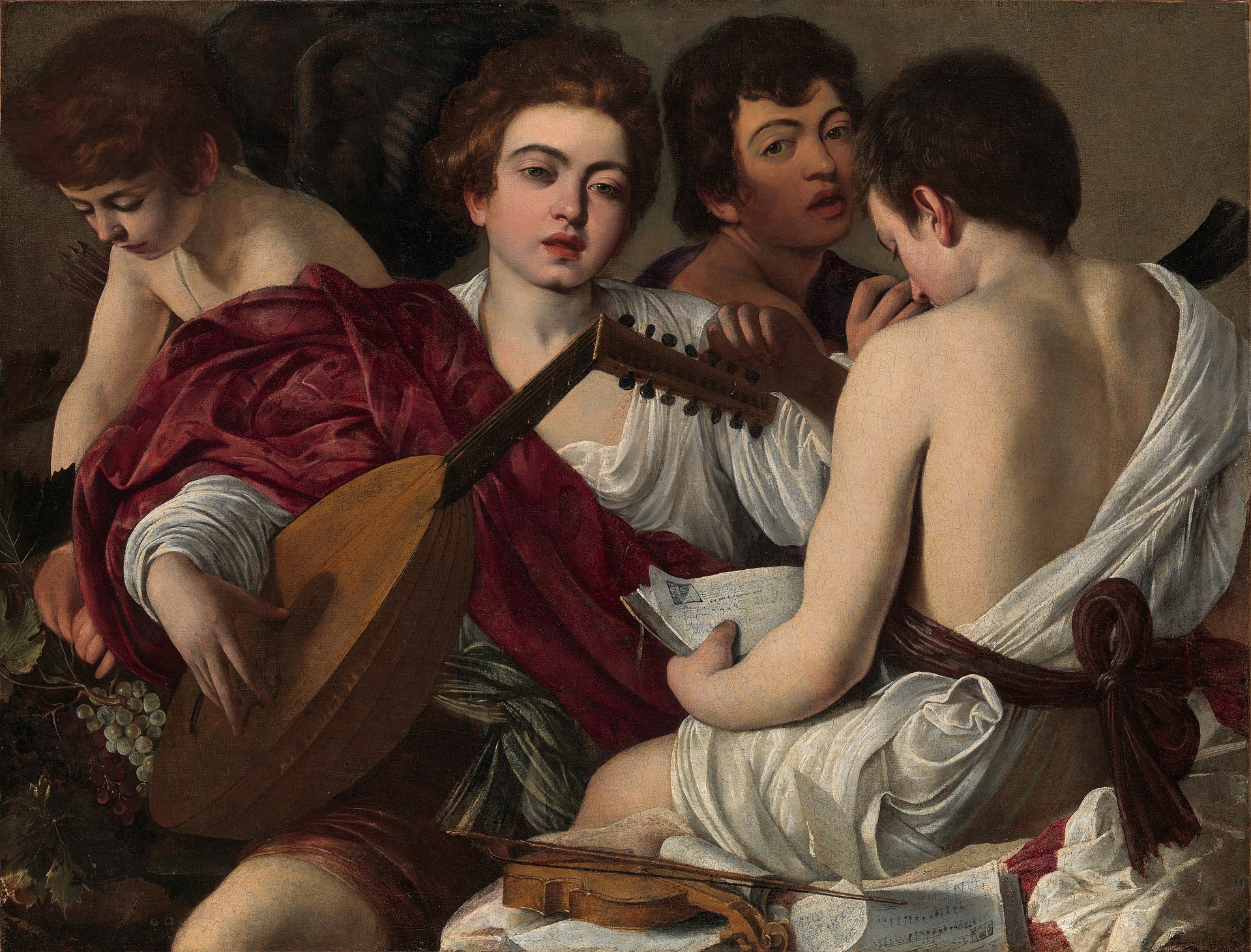
Caravaggio (Michelangelo Merisi), The Musicians, 1595/96, oil on canvas, 36 ¼ x 46 5/8” (92.1 x 118.4 cm), The Metropolitan Museum of Art, New York. https://www.metmuseum.org/art/collection/search/435844 – retrieved October 10, 2024.
The Musicians, painted by Caravaggio and now in The Metropolitan Museum of Art, was commissioned by Cardinal Francesco Maria del Monte (1549–1627), one of Rome’s most influential patrons of the arts. Conceived as an allegory of music—signaled by the presence of Cupid in the background—it is equally a portrait of contemporary musical practice, featuring individualized sitters. Among them is Caravaggio himself, second from the right, offering one of his rare youthful self-portraits.
During the Counter‑Reformation, the Catholic Church actively promoted a revival of music, and Cardinal del Monte was at the center of this cultural movement. At his residence, the Palazzo Madama, he hosted composers, rehearsals, and experiments in progressive musical forms, especially the emerging solo vocal style that departed from older polyphonic traditions. The Musicians was designed specifically for the Cardinal’s music room, its subject and atmosphere echoing the live performances that took place there.
In keeping with Caravaggio’s modernizing approach, the figures are not idealized classical types but real young men posed in quasi‑antique white robes. The self‑portrait—directly engaging the viewer—shows the artist holding a cornetto, a popular wind instrument of the period. Caravaggio also employs a spatial device familiar in later eighteenth‑century art: the prominently placed violin and open music manuscript in the immediate foreground. These objects project into the viewer’s space, drawing the spectator into the scene as an implied participant.
Ottavio Leoni, Francesco Maria del Monte, 1616.
Born in Venice of a Tuscan aristocratic family, Cardinal del Monte was an important connoisseur of the arts. Four centuries later his fame rests on his early patronage of Caravaggio and an art collection which provides detailed provenance for many important works of the period. Del Monte was the single most influential force in Caravaggio’s life. Between 1595 and 1601, the Catholic cardinal became not only the painter’s primary patron but his intellectual mentor, legal shield, and diplomatic strategist—an alliance that lifted the volatile outsider into the ranks of Rome’s most sought‑after, and most controversial, artistic prodigies. Their bond was complicated by each’s share of eccentricities, intense legal vulnerabilities, and the uneasy overlap between church politics and the city’s street‑level underworld.
As mentioned, the relationship began when Del Monte purchased The Cardsharps from a local dealer and immediately recognized the raw, disruptive talent behind it. He brought Caravaggio into his official residence, the Palazzo Madama, granting him a stipend, room and board, and a dedicated studio. Within those walls, Caravaggio entered a rarefied world. Del Monte—an intimate friend and protector of Galileo —surrounded himself with mathematicians, natural philosophers, and experimenters in optics. Immersed in this court of scientific inquiry, Caravaggio refined the radical, directional lighting that would become his signature, transforming observation into revelation.
Del Monte also understood that private cabinet pictures could only carry an artist so far. Leveraging his position as a Vatican insider, he secured Caravaggio’s first major public commission: the Contarelli Chapel cycle in San Luigi dei Francesi. It was a turning point—Caravaggio’s explosive debut on the public stage and the moment his reputation as a revolutionary painter crystallized.
But the Cardinal’s protection had limits. Caravaggio’s temperament grew increasingly erratic, his nights spent among gamblers, swordsmen, and fugitives. By 1606, after the fatal brawl with Ranuccio Tomassoni, even Del Monte could no longer shield him. Caravaggio fled Rome under threat of execution, bringing to an abrupt end one of the most fertile and consequential artistic partnerships of the Baroque age.
Caravaggio (Michelangelo Merisi), The Lute Player, 1595/96, oil on canvas, 37 x 46 7/8” The Hermitage Leningrad.
The Lute Player was owned by Cardinal del Monte. It was sold to Vincenzo Giustiniani (1564-1637), an aristocrat Italian banker, art collector and intellectual, and appeared in his inventory in 1638. Caravaggio’s model for the painting is the same as for The Musicians.
Nicolas Régnier/Niccolò Renieri (1591-1667), Portrait of Vincenzo Giustiniani, c. 1630.
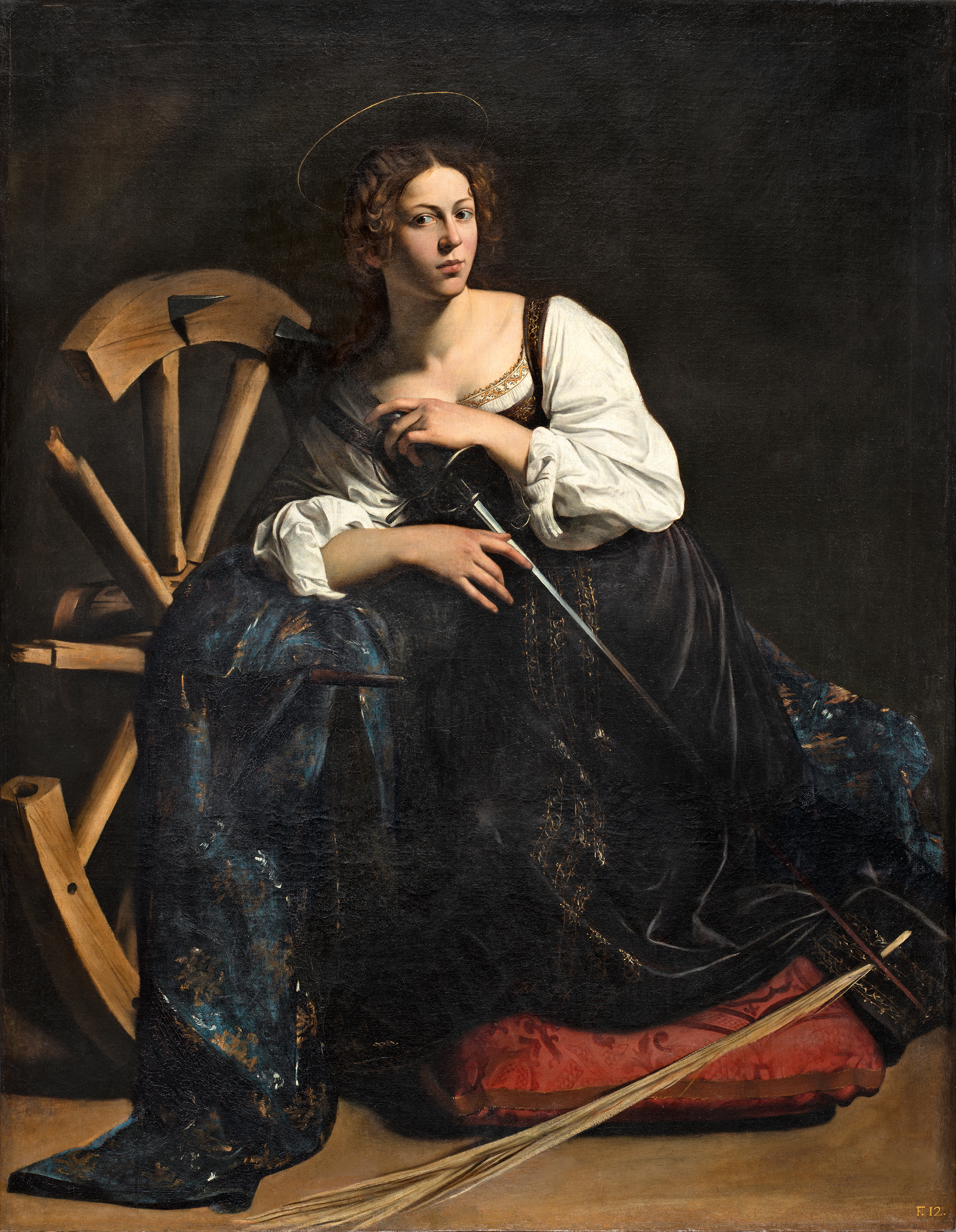
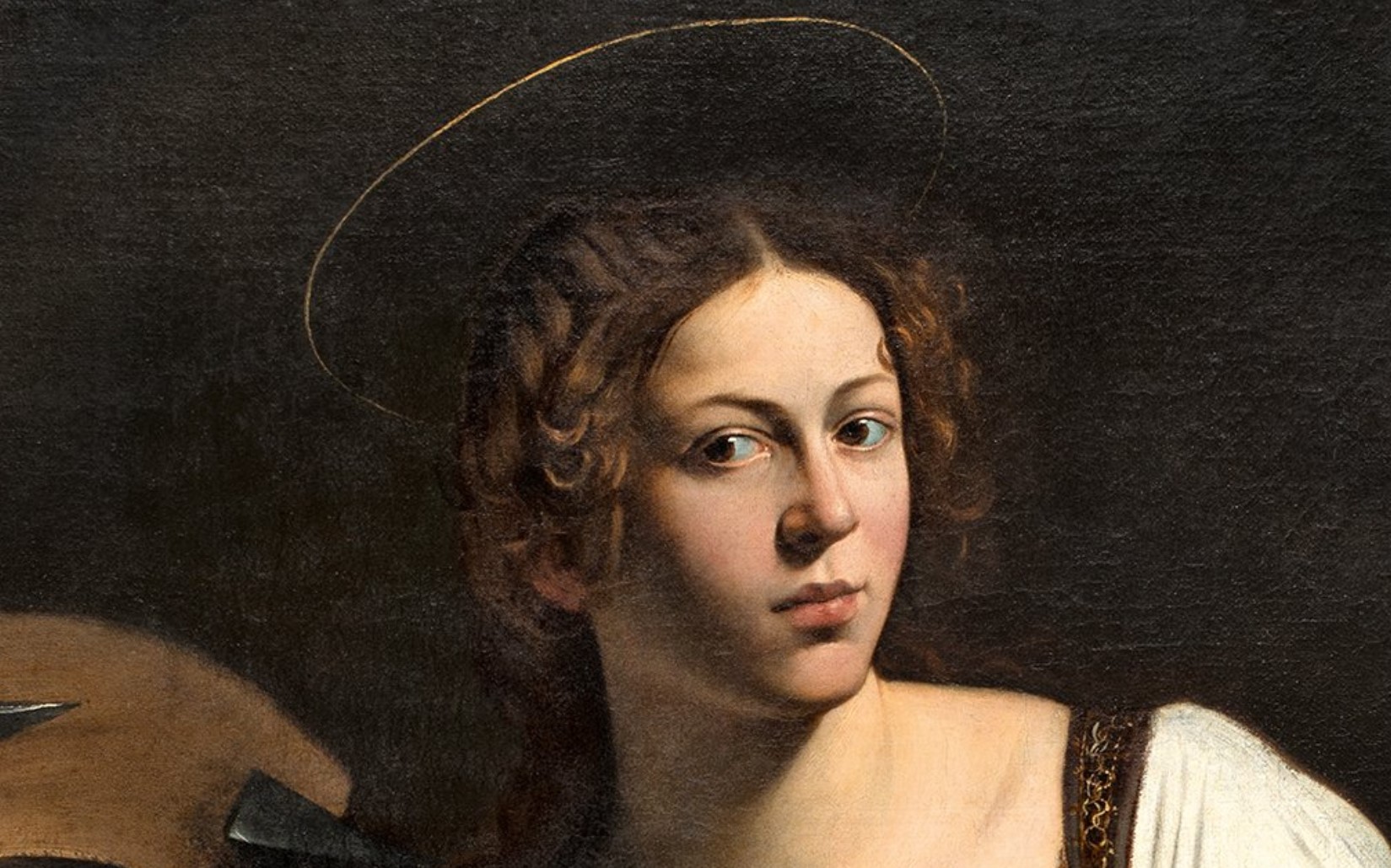
Commissioned by Cardinal Francesco Maria del Monte, Caravaggio’s St. Catherine of Alexandria presents the saint in the unmistakable likeness of Fillide Melandroni, a well‑known Roman courtesan who played a decisive role in the painter’s artistic and personal life. Young artists routinely turned to women like Fillide for models—respectable women were simply unavailable for such work—and Caravaggio, more than most, transformed these marginalized figures into icons of startling dignity and psychological depth.
Richly robed and kneeling on a cushion, Catherine occupies the canvas with commanding stillness. She rests one hand on the spiked breaking wheel and gently cradles the sword—emblems of her martyrdom—while the dramatic fall of light isolates her against the darkness in Caravaggio’s signature chiaroscuro. The effect is intimate yet monumental: a saint rendered not as an ethereal ideal but as a living woman whose presence feels immediate, almost breathing qualities which would have an immense impact on European art in the 17th century.
Caravaggio heightens this immediacy with a device that would also echo through seventeenth‑century European painting: the saint’s body and attributes press toward the viewer’s space, collapsing the distance between sacred history and the spectator. It is precisely this fusion of realism, theatrical light, and emotional proximity that made works like St. Catherine so influential across the Baroque world.
Detail of above: the face of St. Catherine of Alexandria (Fillide Melandroni).
Caravaggio’s Saint Francis of Assisi in Ecstasy stands as his earliest known religious composition, and already the hallmarks of his mature style—intimacy, theatrical light, and emotional immediacy—are unmistakable. The subject, Saint Francis of Assisi (1182–1226), the Umbrian mystic famed for his radical poverty and fierce asceticism, often withdrew into solitude for forty‑day fasts, seeking to imitate Christ as literally as Scripture allowed. Medieval tradition holds that, like Christ in the wilderness, Francis was ministered by angels during these periods of spiritual extremity.
Caravaggio seizes on one such moment. In September 1224, on Mount La Verna in central Italy, Francis received the stigmata, the wounds of the crucified Christ—an experience granted to only a handful of saints. Caravaggio renders the episode with striking restraint: the saint collapses into the arms of an angel, his body slack with awe, while shepherds linger in the obscured background, half‑witnesses to a mystery they cannot fully comprehend. A faint trace of the wound appears beneath the rough folds of Francis’s tunic, a subtle but potent sign of the miracle.
The entire scene is carved out of darkness by Caravaggio’s directional light, a technique shaped by the scientific culture surrounding his patrons. Here, the light does not merely illuminate; it consecrates. It isolates Francis and the angel in a suspended moment of revelation, while the world around them recedes into shadow.
Caravaggio painted the work in Rome for Ottavio Costa (1554–1639), a Genoese banker and discerning collector who became one of his most loyal supporters. Centuries later, in 1943, Saint Francis of Assisi in Ecstasy became the first Caravaggio to enter a public collection in the United States, marking a milestone in the American reception of the Baroque master.
Caravaggio (Michelangelo Merisi), Rest on the Flight to Egypt, c, 1595/98, oil on canvas, 51 ¼ x 63” Galleria Doria- Pamphili, Rome.
La fête champêtre is a musical picnic whose tradition originated in Italy. Caravaggio’s composition is lyrical and complicated. As it is in the setting of the Holy Family’s flight to Egypt in Matthew’s Gospel, the characters are dressed humbly accompanied by the presence of an angel.
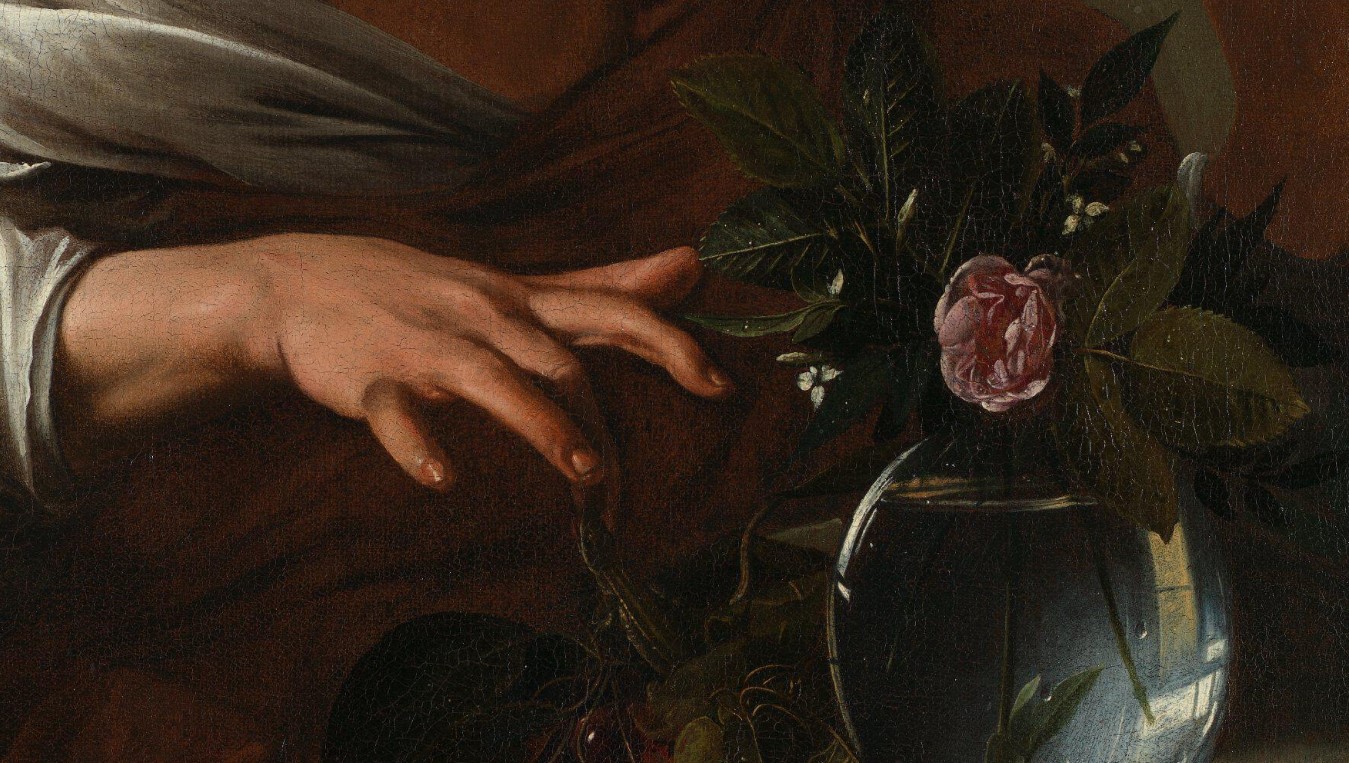
Caravaggio (Michelangelo Merisi), Boy Bitten By A Lizard, 1596/97, oil on cavas, 27 ½ 2 22 3/8”, The National Gallery, London.
Detail of above.
Mancini relates that Caravaggio painted the subject when staying with an old Catholic prelate named Pandolfo Pucci. By the end of his residence Caravaggio nicknamed his temporary benefactor Monsignor Insalata, or “Mister Salad,” for the pittance of solid food he served his artist boarder. The mock heroic painting may be allegorical with the lizard conveying its traditional meaning of lust or death joined to cherries symbolic of love and roses that of sexually transmitted disease — and warning of all three. see – https://www.britannica.com/biography/Caravaggio/First-apprenticeships-in-Rome-Pucci-Cesari-and-Petrigiani – retrieved October 15, 2024.
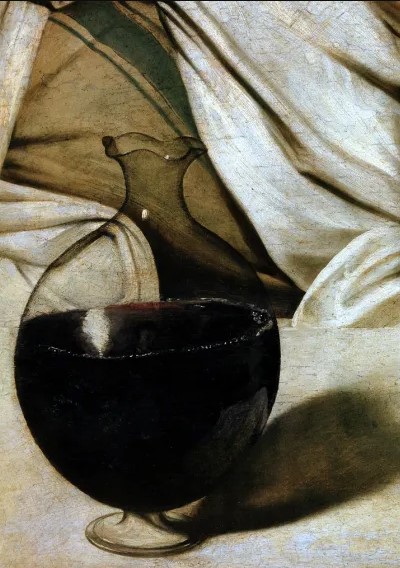
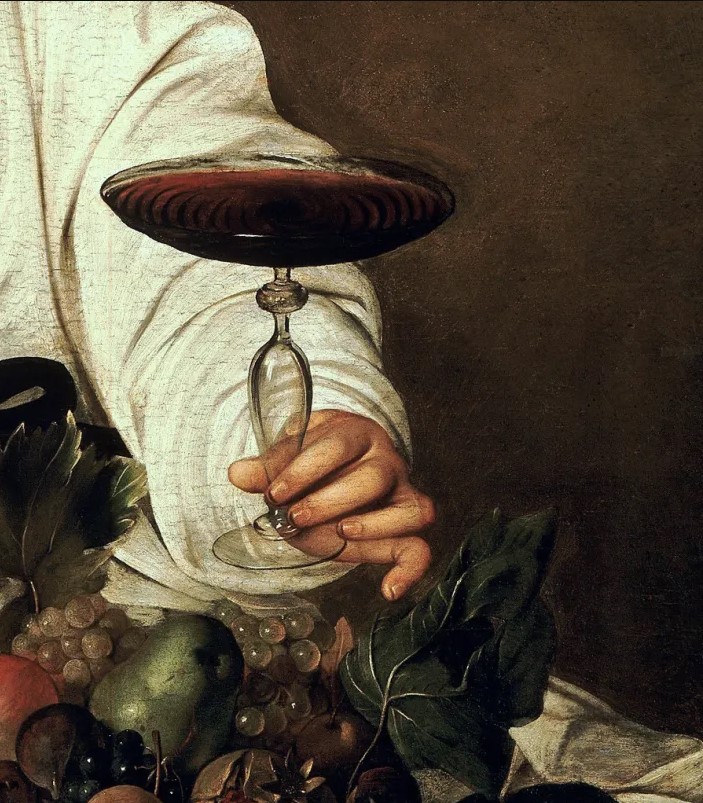
Caravaggio (Michelangelo Merisi), Bacchus, c. 1597, oil on canvas, 37 3/8 x 33 ½”, Uffizi, Florence.
Detail of above.
Cardinal del Monte commissioned it from Caravaggio for a Medici. Detail of above.
Commissioned by his principal patron, Cardinal Francesco Maria del Monte, Caravaggio’s Bacchus was presented as a diplomatic gift to Grand Duke Ferdinando I de’ Medici to mark his son’s wedding—a gesture that secured the painting’s place in the Medici collections for centuries. Today it stands as a cornerstone of early Baroque art, celebrated for its audacious rejection of idealized Renaissance classicism in favor of a startlingly earthbound realism.
Instead of a radiant, godlike deity, Caravaggio gives us a working‑class Roman youth—almost certainly his friend and frequent model Mario Minniti—costumed as the god of wine. Any pretense of antiquity is deliberately dismantled. Bacchus reclines not on a marble couch but on a striped mattress folded to imitate a Roman triclinium. His white “toga” is nothing more than a contemporary bedsheet, loosely draped over his body. The effect is both intimate and unsettling: a classical god rendered as a boy you might meet in the streets of Rome, invited into myth by costume alone.
The lower half of the canvas deepens the painting’s moral tension. Caravaggio arranges a sumptuous still life—apples, grapes, figs, a carafe of wine—but it is also a vanitas. The apples are bruised and worm‑eaten, the grapes overripe, the leaves already curling toward decay. This quiet rot serves as a memento mori, a reminder that youth, beauty, and sensual pleasure are as fleeting as the fruit that embodies them. Caravaggio’s realism becomes a form of philosophy.
Despite its current fame, Bacchus nearly vanished from history. After the fall of the Medici dynasty, the painting was relegated to a dark storage room in the Uffizi reserves—unframed, uncatalogued, and obscured beneath yellowed varnish. It remained forgotten until 1913, when art historians rediscovered and authenticated it as an irreplaceable treasure of the Baroque.
Caravaggio (Michelangelo Merisi), Jupiter, Neptune, and Pluto, 1597, oil on stucco, about 9/9”” x 5’11” Villa Ludovisi, Rome. https://villaludovisi.org/ – retrieved October 12, 2024.
The building and grounds of Villa Ludovisi in Rome, and their rich artwork, includes masterpiece frescoes by Guercino (1591-1666) and other leading lights of the 17th century Bolognese school. Caravaggio’s Jupiter, Neptune and Pluto is his only known oil painting on plaster. Cardinal de Monte purchased the villa and took up residence there in 1596. The cardinal sold it to the Ludovisi in 1621. Bellori relates that the subject matter for the fresco of these gods was to express the cardinal’s interest in medicinal chemistry (today’s pharmaceuticals).
Caravaggio (Michelangelo Merisi), Judith Beheading Holofernes, c. 1598, oil on canvas, 56 ¾ x 76 ¾” 145 x 195cm Galleria Nazionale d’Arte Antica, Rome. https://barberinicorsini.org/opera/giuditta-e-oloferne/ – retrieved October 12, 2024.
Commissioned by Ottavio Costa, one of Caravaggio’s most loyal Roman patrons, the painting passed through several prominent Roman families before entering the Galleria Nazionale d’Arte Antica in 1970. Its subject is the famous episode from the Book of Judith, a Biblical tale of courage, seduction, and divine deliverance that had long captured the Christian imagination.
Judith—beautiful, eloquent, and revered in her community—is a widow living in the besieged city of Bethulia, threatened with destruction by the Assyrian general Holofernes. Because he is captivated by her beauty, Judith is granted unusual freedom within the enemy camp. She joins Holofernes at a banquet in his tent, where he drinks himself into oblivion. As the text puts it, “Holofernes, charmed by her, drank a great quantity of wine, more than he had ever drunk on any day since he was born” (Judith 12:20).
Once the attendants withdraw, Judith seizes her moment. The biblical account describes the scene with stark intensity: she stands beside the general’s bed and prays silently for strength, saying: “O Lord, God of all might, in this hour look graciously on the work of my hands for the exaltation of Jerusalem. Now is the time for aiding your heritage and for carrying out my design to shatter the enemies who have risen against us” (Judith 13:4–5). Taking Holofernes’ own sword from the bedpost, she grasps his hair, invokes the God of Israel, and strikes twice, severing his head. She then rolls his body aside and hands the severed head to her maid, who conceals it in a food bag before the two women slip back into the night (Judith 13:4–10).
Caravaggio chooses the exact instant when violence erupts—his first painting to depict action with such visceral, kinetic force. The scene unfolds like a frieze suspended in time: Judith leaning forward with grim resolve, her maid assisting with practiced efficiency, and Holofernes recoiling in shock as the blade bites into his neck. The theatrical light isolates the figures against darkness, heightening the sense of immediacy and moral gravity.
This painting marks a turning point in Caravaggio’s career. With Judith Beheading Holofernes, he demonstrates not only his mastery of chiaroscuro but also his ability to transform a biblical narrative into a moment of raw human drama—one that reverberated across the Baroque world.
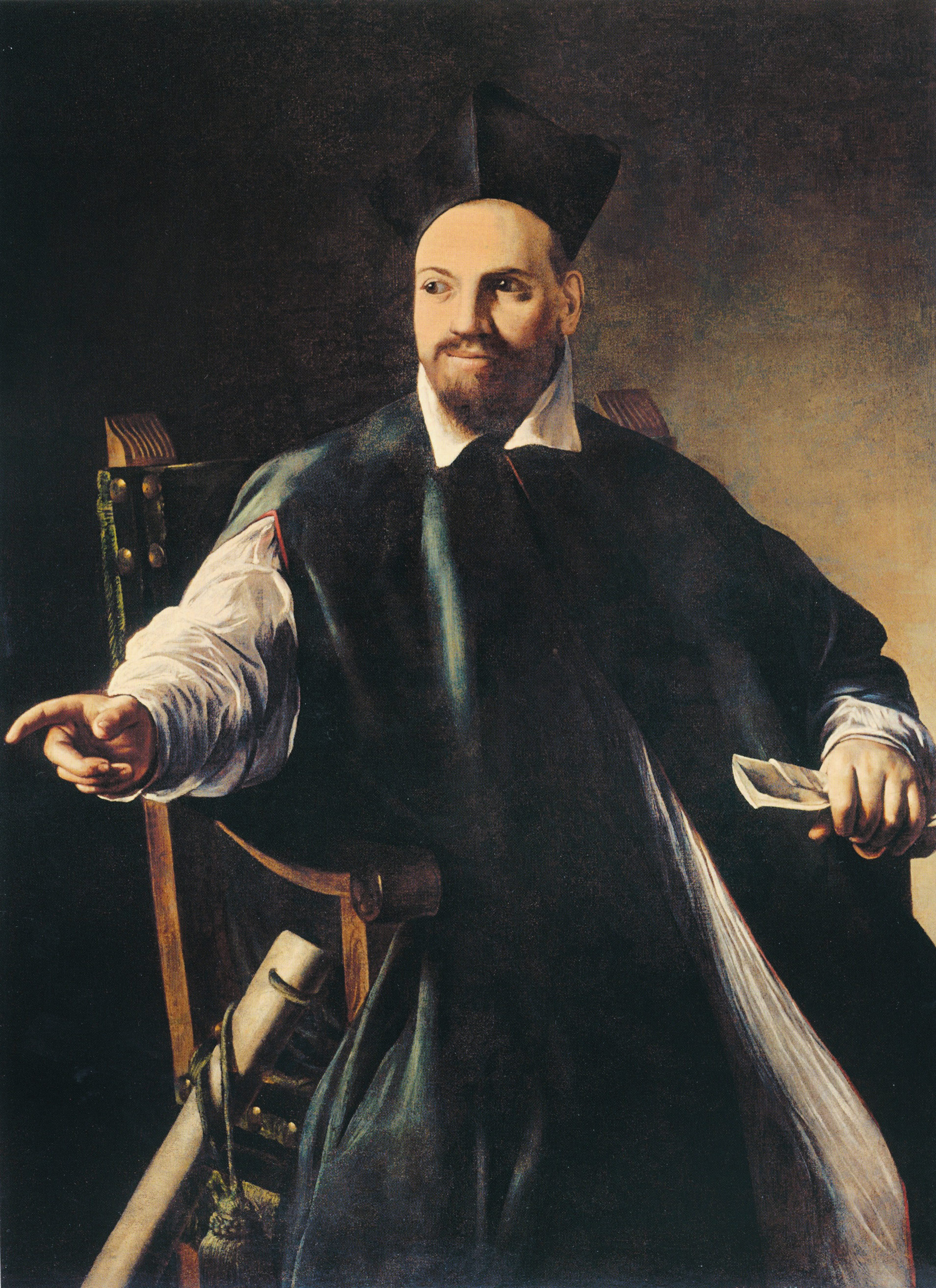
Caravaggio (Michelangelo Merisi), Portrait of Monsignor Maffeo Barberini, c. 1603, Private Collection, Firenze. Maffeo Vincenzo Barberini (1568-1644) became the future Pope Urban VIII whose reign began in 1623.
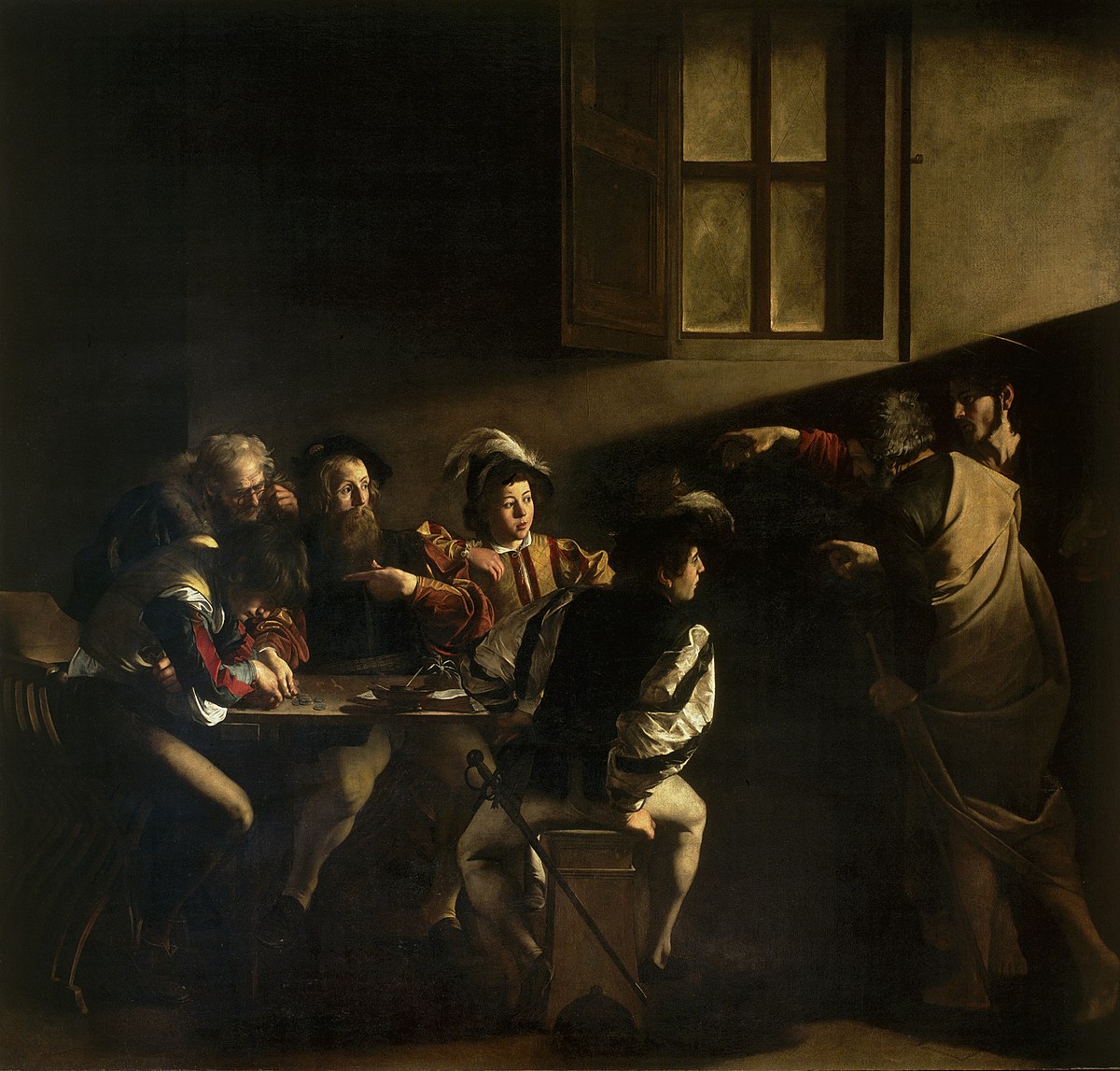
The words of Christ, who is there, have been spoken. But now time is suspended. How will Matthew reply? Christ is calling him. Do I go or not? Do I follow him or not? These paintings are completely dramatic. Caravaggio uses natural light but turns it into an astonishing symbol of divine illumination.
Caravaggio (Michelangelo Merisi), The Calling of Saint Matthew, 1599-1600, oil on canvas, 10’7 1/2 “ x 11’ 2” Contarelli Chapel, Church of Luigi dei Francesi, Rome.
Caravaggio’s The Calling of Saint Matthew (1599–1600), a monumental oil on canvas measuring 10’7½” × 11’2” (322 × 340 cm), occupies the left wall of the Contarelli Chapel in San Luigi dei Francesi, Rome. Commissioned as his first major public work when the artist was 28 years old, it quickly became a defining masterpiece of the Baroque—an image that rewired the expectations of religious art for an entire generation.
Caravaggio stages the biblical moment described in Matthew 9:9—Christ summoning the tax collector Levi (Matthew) to discipleship—not in a distant, idealized past but in a dark, contemporary Roman tavern, thick with shadow. The sacred enters the profane unexpectedly.
The composition unfolds in two distinct worlds. Around the counting table sit Matthew and his companions, absorbed in their unseemly gains, dressed in sumptuous late‑16th‑century velvet doublets, feathered hats, and sidearms—figures of worldly wealth and casual corruption. Into this scene step Christ and Saint Peter, barefoot and clothed in rough robes. Their presence feels out of sorts, yet the room shifts around them.
A single, razor‑sharp beam of light—Caravaggio’s signature tenebrism —enters from the upper right, cutting diagonally across the darkness. It travels in parallel to Christ’s extended hand, making the light itself a metaphor for divine grace and spiritual awakening penetrating a den of exploitation and greed. As the light strikes the faces at the table—some oblivious, others looking up startled— it settles fully on Matthew, who points to himself in shock.
In Counter‑Reformation Rome, the message was unmistakable. Caravaggio’s painting declared that the divine could break into the most ordinary, compromised corners of daily life—that salvation could arrive unannounced, even in a backroom thick with schemes of greed. It was a psychological jolt to the city’s viewers, a reminder that grace was not confined to altars or idealized visions but could happen anywhere to anyone, at any moment.
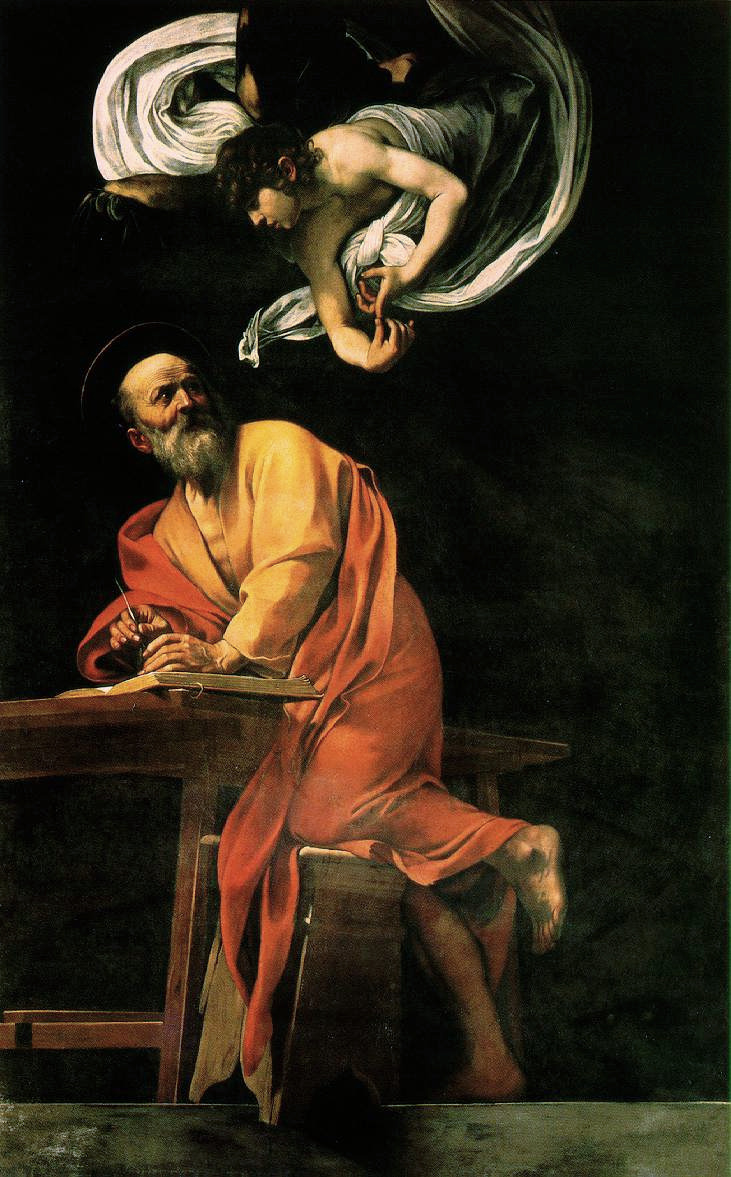
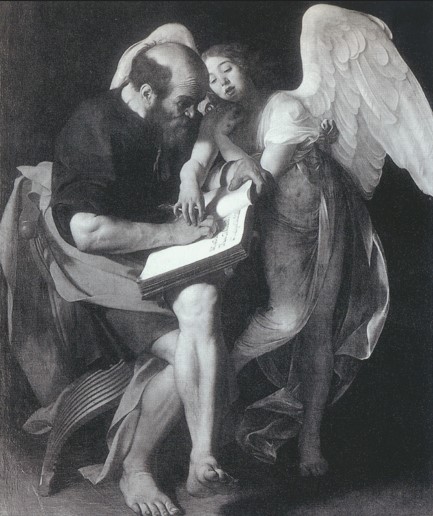
Caravaggio (Michelangelo Merisi), The Inspiration of Saint Matthew, 1602, oil on canvas, 9’8 1/2 “ x 6’ 2 ½” Contarelli Chapel, Church of Luigi dei Francesi, Rome.
This first version of The Inspiration of St. Matthew by Caravaggio was rejected because the evangelist was considered too crude and the angel too familiar. The painting was destroyed during the Fall of Berlin in 1945 and known by photographs.
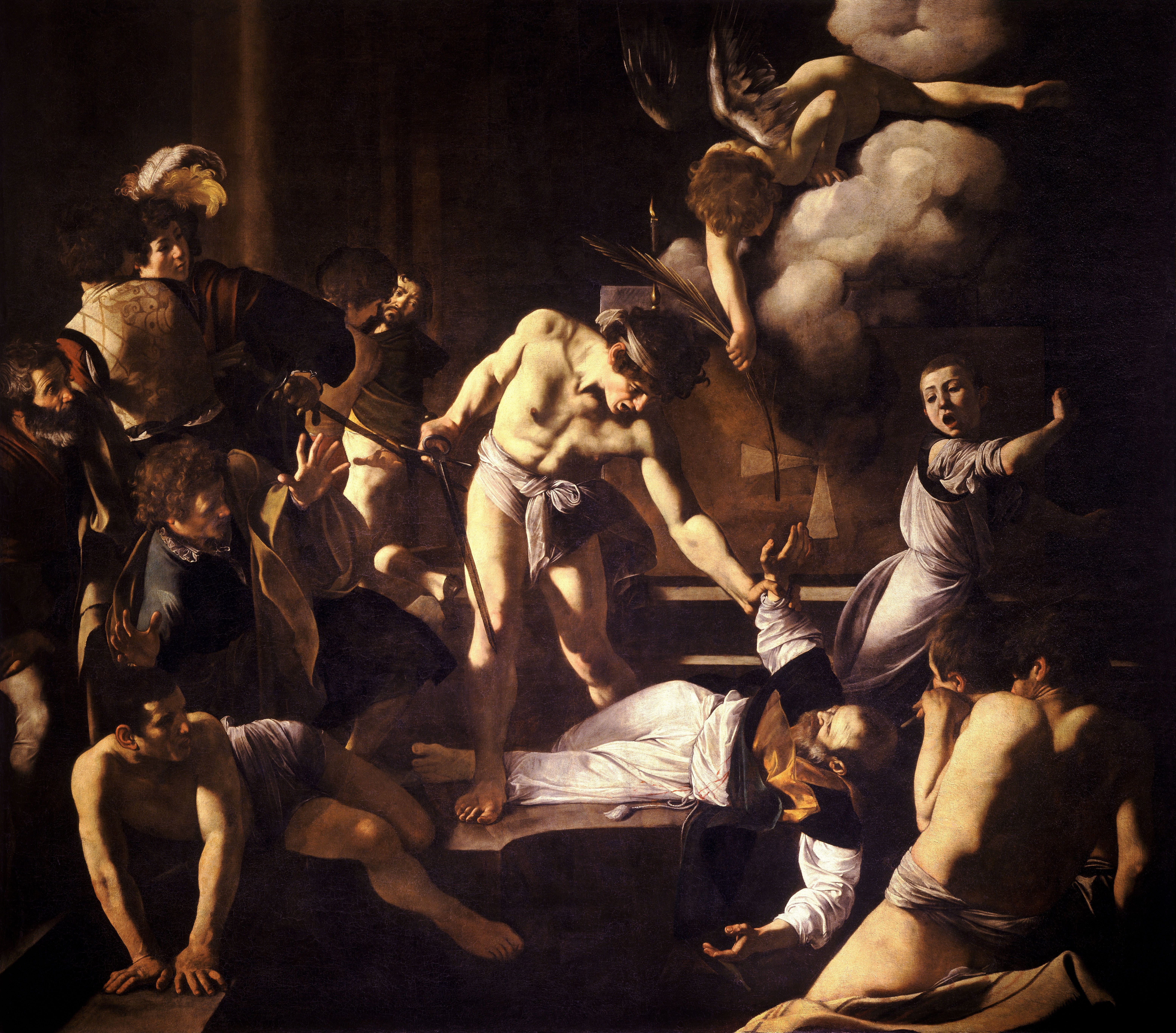
Caravaggio (Michelangelo Merisi), The Martyrdom of Saint Matthew, 1599-1600, oil on canvas, 10’7 1/2 “ x 11’ 3” Contarelli Chapel, Church of Luigi dei Francesi, Rome.
Permanently installed on the right wall of the Contarelli Chapel in San Luigi dei Francesi, Caravaggio’s The Martyrdom of Saint Matthew erupts across the canvas in a chaotic, centrifugal burst of bodies and motion. The composition radiates outward from a single, horrifying fulcrum—the moment of the apostle’s death—captured with explosive, almost cinematic intensity. With this work, Caravaggio established himself as the unrivaled master of psychological violence in early Baroque art.
The narrative follows the traditional account in the Golden Legend. Saint Matthew, having publicly condemned King Hirticus of Ethiopia for lusting after his own niece, the consecrated virgin Iphigenia, is murdered in retaliation. Caravaggio distills the entire hagiography into one blinding instant: the assassin, a half‑nude royal soldier, lunges forward to strike the fatal blow as Matthew collapses, bleeding, onto the altar steps.
Caravaggio pushes tenebrism to its outer limit. The saint lies sprawled on the ground, his arms flung open in a gesture that hovers between defense and surrender. The executioner grips Matthew’s wrist, towering above him with a drawn sword, his face twisted in a scream of fury. Around them, witnesses recoil in terror, their bodies spiraling outward as if blasted by the force of the violence.
Yet amid the earthly chaos, the supernatural breaks through. A cloud gathers above the altar, and an angel descends—not to rescue Matthew, but to complete the drama of martyrdom. Leaning down from heaven, the angel extends the palm of victory, placing it into the saint’s wounded hand at the very moment the assassin’s sword arcs downward.
The intersection of these three elements—the angel’s arm, the soldier’s blade, and Matthew’s reaching hand—forms a powerful diagonal axis, a visual declaration that divine salvation overrides mortal execution. In this collision of heaven and earth, Caravaggio transforms a brutal killing into a moment of transcendent destiny.
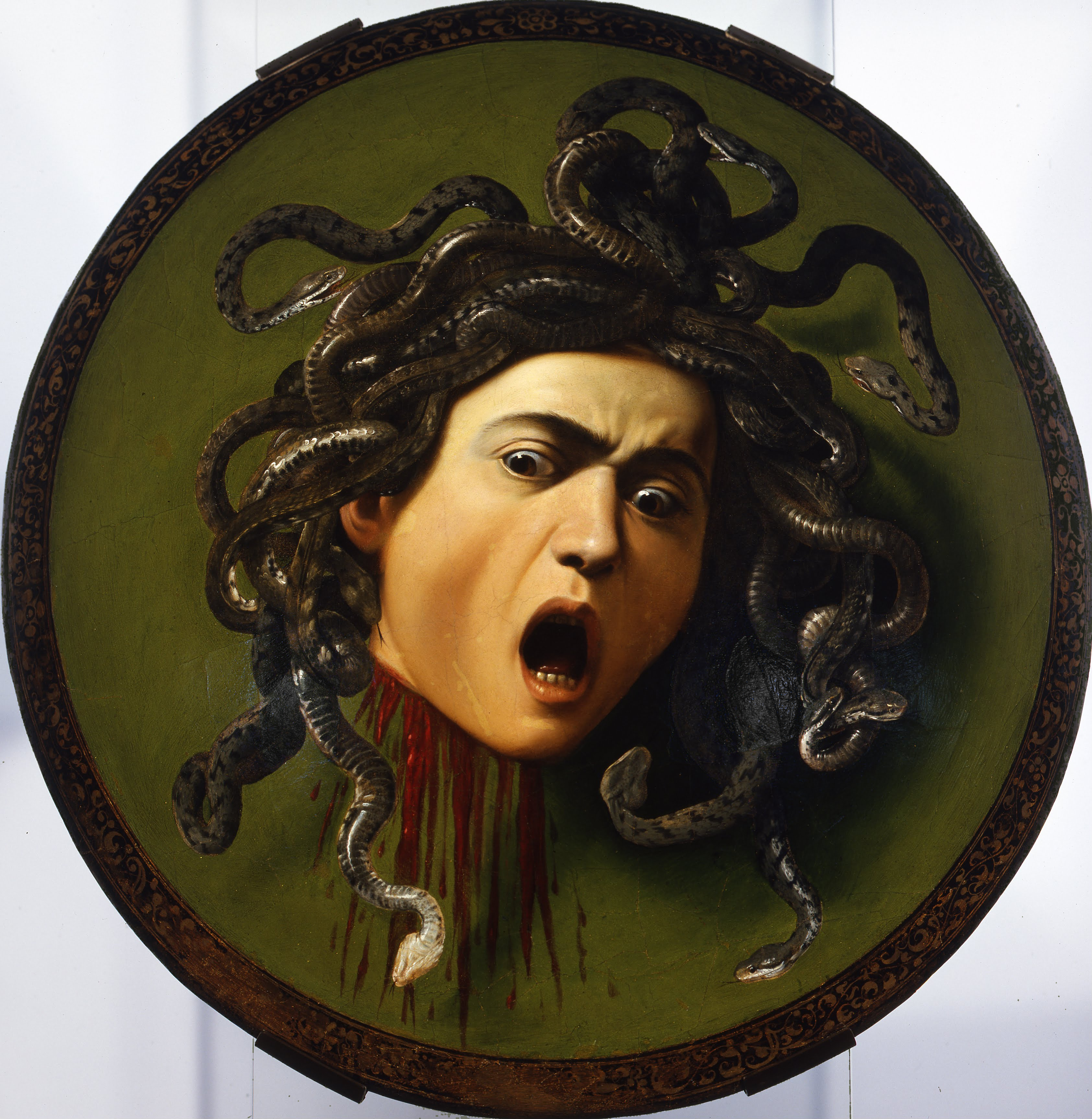
Caravaggio (Michelangelo Merisi), Medusa (detail), 1600/01, oil on canvas mounted on a convex poplar-wood shield, Uffizi, Florence.
Caravaggio’s Medusa is painted on an actual parade shield.
Caravaggio’s Medusa (1600/01), now in the Uffizi Gallery, is one of the most astonishing feats of early Baroque engineering and psychological terror. Painted in oil on canvas and mounted onto a convex poplar shield, the work fuses myth, optics, and raw anatomy into a single, unnervingly lifelike apparition. Commissioned by Cardinal Francesco Maria del Monte and presented as a diplomatic gift to Grand Duke Ferdinando I de’ Medici, it was proudly displayed in the Medici Armory as both a marvel of craftsmanship and a symbol of dynastic power.
Because the surface curves outward, Caravaggio had to deploy advanced foreshortening and perspectival distortion to counteract the shield’s bulge. He subtly elongates Medusa’s cheeks and distorts her jawline so that, when viewed head‑on, the surface appears flat—or even concave—a technical sleight of hand that would have impressed both artists and scientists in Del Monte’s Roman circle.
Caravaggio captures the exact, electric instant between life and death. Perseus has already struck, yet Medusa’s nervous system still fires. Her face becomes a study in catastrophic realization: eyes bulging with shock and fury, brow knotted in disbelief, mouth wrenched open in a silent, blood‑freezing scream. True to his radical naturalism, Caravaggio did not invent stylized serpents; he studied real vipers, painting them mid‑coil, mid‑strike, writhing in panic as their host dies beneath them. From the severed neck, bright arterial blood spurts outward in jagged, hyper‑realistic streams.
To deepen the mythic resonance, Caravaggio anchors the work in the classical story as told by Ovid. According to the Metamorphoses, Perseus could only approach Medusa safely by looking at her reflection in the polished bronze shield given to him by Athena. By painting Medusa’s head directly onto a shield, Caravaggio transforms the viewer into Perseus himself—the one who sees the monster only through a mediated surface. The painting becomes a weapon, a mirror, and a mythic reenactment all at once.
For modern viewers, the shield reads as pure horror: a severed head frozen in the moment of its final scream. But for the Medici, it carried a very different charge. Medusa—whose gaze could immobilize armies—became a potent emblem of political dominion, a symbol of a ruler whose power could paralyze enemies before they even approached.
Caravaggio (Michelangelo Merisi), Basket of fruit (canestra di frutta), c. 1600/01, oil on canvas, 18 1/8 x 25 3/8, Biblioteca Ambrosiana, Milan. https://www.ambrosiana.it/opere/canestra-di-frutta/ – retrieved October 13, 2024.
Caravaggio’s Basket of Fruit is the only autonomous still life by the artist known to survive, though his figure paintings are filled with exquisitely rendered fruit that function as symbolic subtexts. Across his oeuvre, these arrangements vary widely in species, ripeness, and composition, yet they share a distinctive naturalism—blemishes, curling leaves, and the quiet drama of decay rendered with almost scientific precision.
The painting belonged to Cardinal Federico Borromeo (1564–1631), cousin of Saint Charles Borromeo and, like him, Archbishop of Milan. A towering figure of the Counter‑Reformation, Federico championed religious art as a tool of pastoral instruction, yet he was also an unusually passionate collector of still life, a genre often dismissed as minor. Whether he commissioned Caravaggio’s painting or received it as a gift remains uncertain, but he valued it enough to bequeath it in his will to the Ambrosiana in Milan, the scholarly gallery and library he co‑founded in 1618.
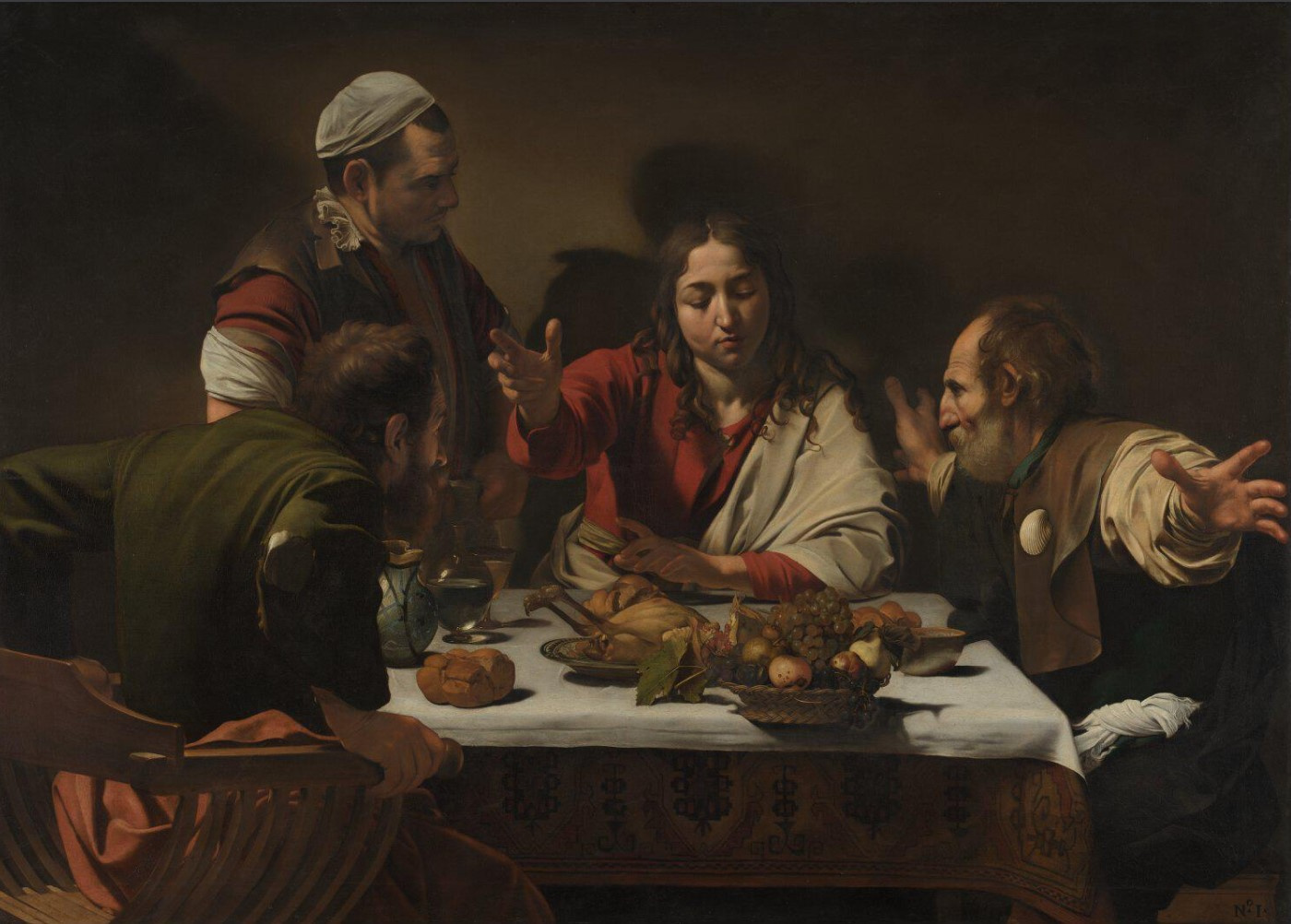
The basket itself is instantly recognizable to anyone familiar with Caravaggio’s work. A nearly identical arrangement appears in the Supper at Emmaus in London’s National Gallery, painted around the same time. In both works, the fruit leans precariously over the edge, as if about to tumble into the viewer’s space—a hallmark of Caravaggio’s desire to collapse the boundary between the painting and the viewer.
Cardinal Borromeo lived in Rome from 1586 to 1601, precisely the years when Caravaggio’s reputation was rising with meteoric speed. During this period, he became deeply familiar with the painter’s radical naturalism. For a prelate devoted to both doctrinal clarity and the beauty of the created world, Caravaggio’s still life—so attentive to the fragile, transient nature of living things—would have held profound appeal.
Giulio Cesare Procaccini ((1574–1625), Cardinal-Archbishop Federico Borromeo, 1610, Museo diocesano di Milano.
Caravaggio (Michelangelo Merisi), Supper at Emmaus, c. 1600/01, oil on canvas, 54 ¾ x 76 ¾” The National Gallery, London.
Caravaggio’s Roman career accelerated rapidly after the triumph of the Contarelli Chapel commissions. Almost immediately he was engaged for another prestigious project in Santa Maria del Popolo, decorating the Cerasi Chapel. Although these were technically private commissions, their placement in major Roman churches ensured that Caravaggio’s work circulated before a broad public. By 1600 he had become one of the most sought‑after painters in the city, attracting both established patrons and ambitious newcomers such as the wealthy Mattei brothers, prominent Roman bankers. For one of them, in the family palazzo, Caravaggio produced The Supper at Emmaus (1601), a work executed at the apex of his early fame and artistic maturity.
What distinguishes this painting is not only Caravaggio’s reliance on live models and his anatomically precise naturalism, but his increasingly sophisticated deployment of light as a bearer of meaning rather than mere aesthetic embellishment. Instead of depicting the journey to Emmaus, Caravaggio selects the climactic instant at the supper table when the risen Christ blesses and breaks the bread and the disciples suddenly recognize him—just before he vanishes from their sight. Light becomes the visual analogue of recognition itself: a revelatory force that cuts through the scene with theological and psychological clarity.
Caravaggio dramatizes this moment with unprecedented immediacy. One disciple thrusts himself forward, his elbow projecting into the viewer’s space; the other flings his arms wide in astonished realization. Meanwhile the innkeeper, who has not grasped the miracle unfolding before him, remains enveloped in the darker register of Caravaggio’s chiaroscuro, his face still in shadow. The contrast is not incidental: it marks the divide between those who have entered the “light” of recognition and those who remain outside it.
The composition’s theatricality intensifies this effect. Caravaggio’s half‑length, tightly cropped figures press against the picture plane, collapsing the distance between sacred narrative and beholder. Everyday objects—fruit basket, tablecloth, the disciples’ garments—jut outward with near sculptural immediacy, creating a sensuous, almost tactile realism that anchors the miracle in the viewer’s own world. The result is a painting that is simultaneously grounded in contemporary Roman life and elevated by a supratemporal luminosity that signals divine presence.
Yet the work was not universally admired. Critics objected that Caravaggio’s Christ looked too youthful and unbearded—“a man posing as Christ who certainly was not Christ,” as Bellori complained in 1672. Caravaggio got the criticism though Michaelangelo Buonarroti did the same thing in the pope’s Sistine Chapel. Others scoffed that the fruit on the table could not have been in season during the post‑Easter episode. Such criticisms, however, reveal the very innovation of Caravaggio’s method: his commitment to inventing a world that is believable precisely because it is rooted in the observable, even when that realism unsettles traditional expectations. Unlike earlier artists who idealized sacred history, Caravaggio insisted on painting from life, even in a religious history painting intended for private devotion.
The Supper at Emmaus thus exemplifies Caravaggio’s distinctive achievement: a fusion of radical naturalism and spiritual intensity that collapses historical distance, bringing the sacred into the viewer’s present while simultaneously lifting the everyday into a realm of revelation.
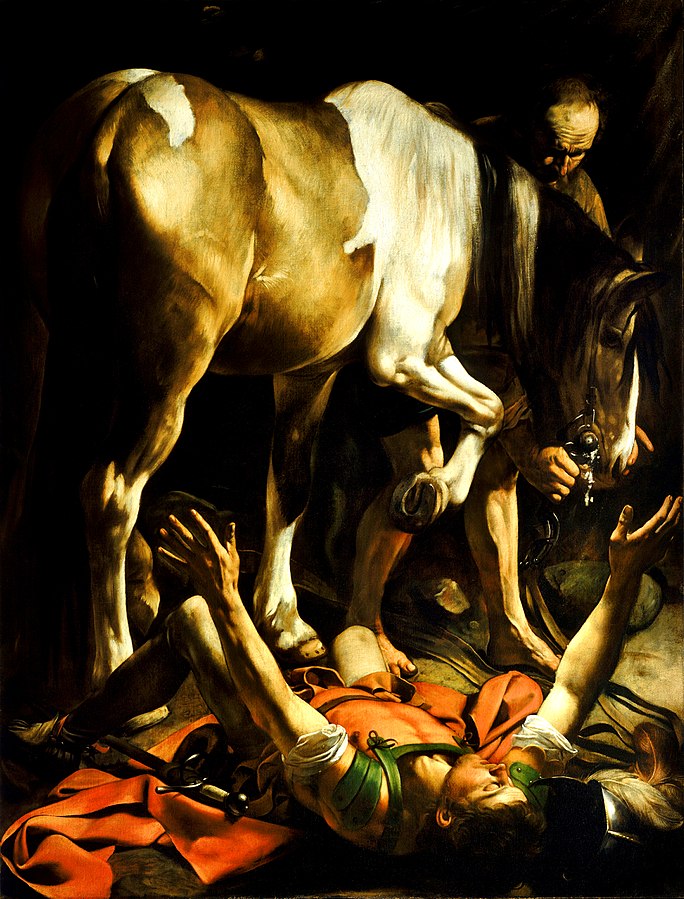
Caravaggio (Michelangelo Merisi), The Conversion of Saint Paul, 100/01, oil on canvas, 90 ½ x 70” Cerasi Chapel, Santa Maria de Popolo, Rome.
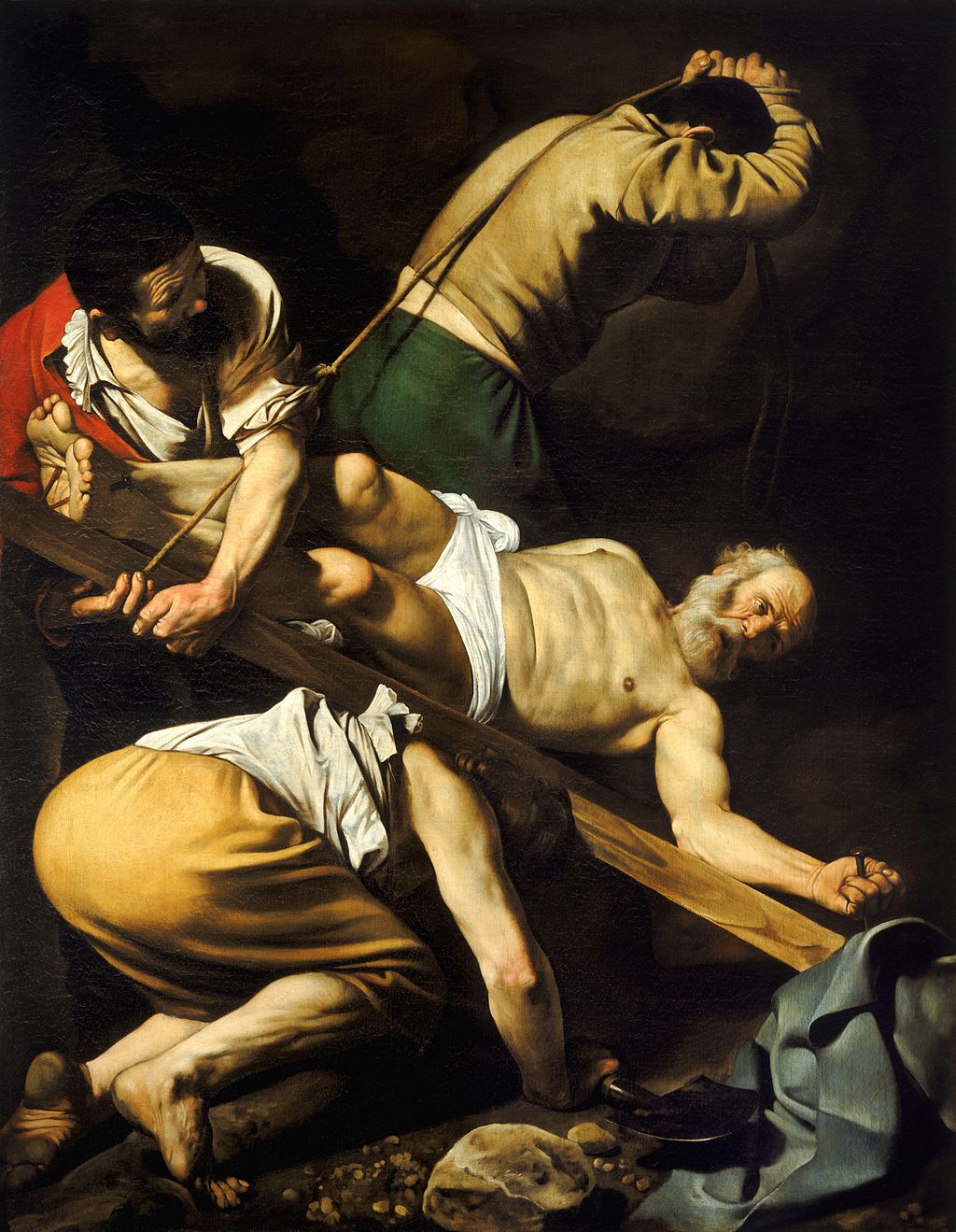
Caravaggio (Michelangelo Merisi), The Crucifixion of St. Peter, 1600/01, oil on canvas, 90 ½ x70” Cerasi Chapel, Santa Maria de Popolo, Rome.
The chapel was purchased by Tiberio Cerasi (1544-1601) in 1600 who worked as Treasurer-General for Pope Clement VIII. Cerasi had the chapel redone by Carlo Maderno (1556-1629). In 1601 Cerasi hired Caravaggio to paint The Conversion of St. Paul and The Crucifixion of St. Paul. Notably, his paintings’ first versions were rejected. The final paintings were installed in 1605 and the chapel consecrated in 1506. The Assumption of Mary over the altar was painted at the same time by Annibale Caracci. See – https://en.wikipedia.org/wiki/Cerasi_Chapel– retrieved October 14, 2024.
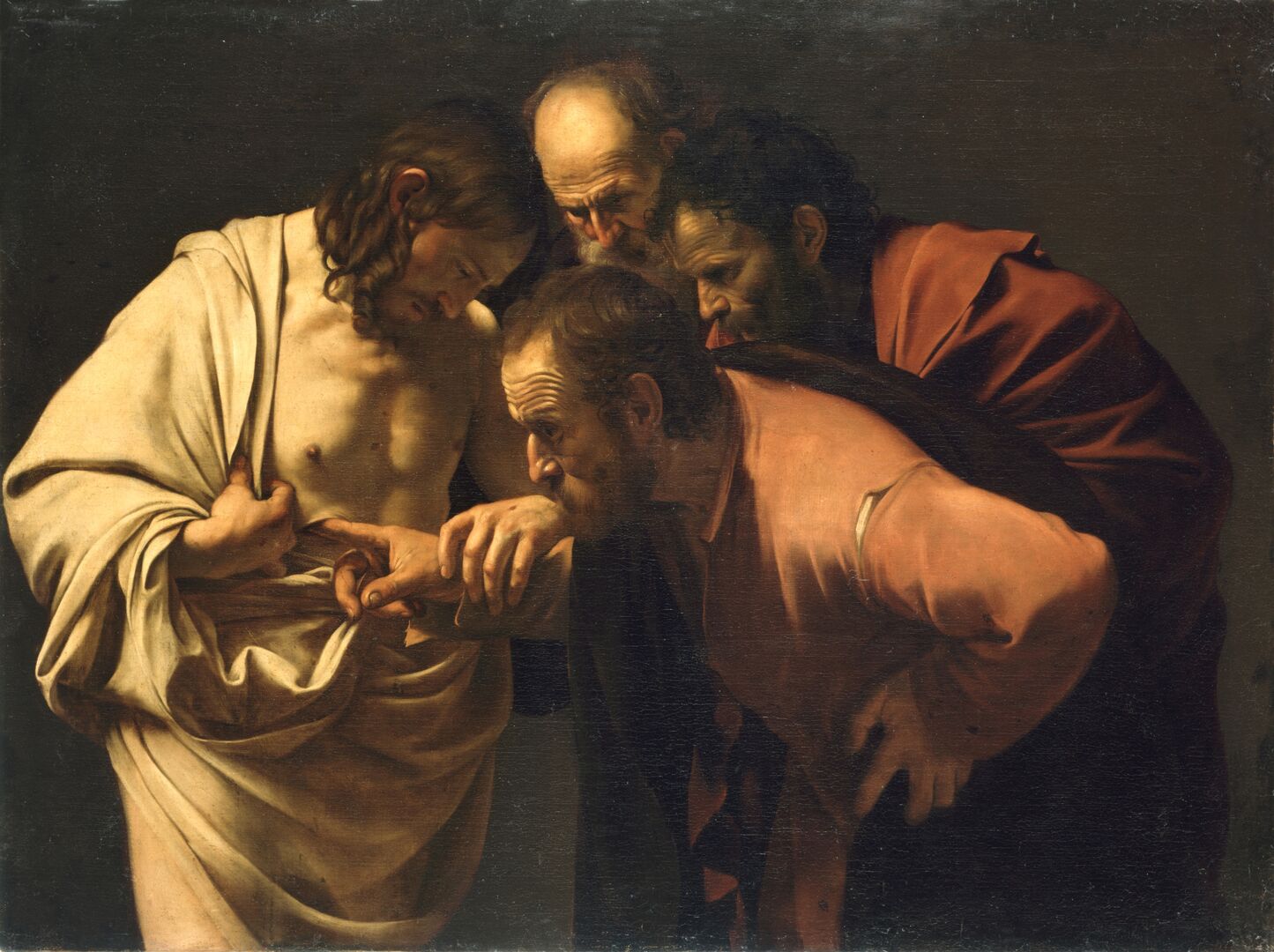
Caravaggio (Michelangelo Merisi), The Incredulity of Saint Thomas, 1601/02, oil on canvas, 42 1/8 x 57 ½” 118 × 156.5 cm Neues Palais, Potsdam.
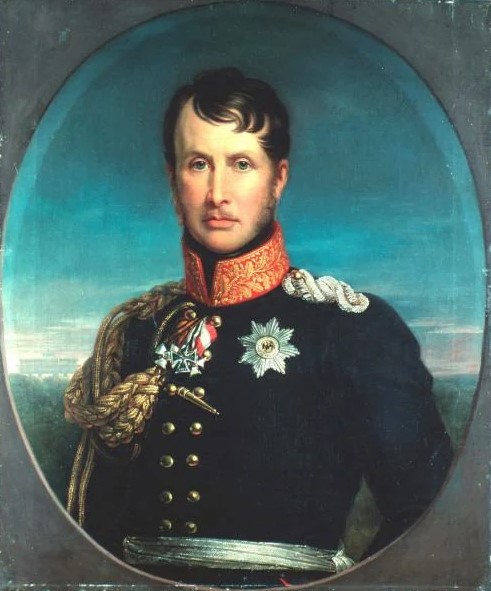
Caravaggio’s The Incredulity of Saint Thomas presents the New Testament encounter (John 20:27–31) with uncompromising naturalism and the stark drama of chiaroscuro. The painting’s later history is as turbulent as its subject. Originally owned by the powerful Giustiniani family, it was sold under financial duress and purchased in 1815 from a Paris dealer by King Frederick William III of Prussia (1770–1840). The king intended to assemble a public art museum for Berlin, yet this work—astonishingly—was initially judged “lower quality,” perhaps because Caravaggio offers no visible markers of Christ’s divinity. Instead, he renders the risen Christ with the same corporeal immediacy as the apostles, a choice that unsettled early nineteenth‑century connoisseurs.
Of the five Caravaggios acquired by the Prussian monarch, only three ultimately entered the museum collection, including Cupid as Victorious at the Gemäldegalerie. The Incredulity of Saint Thomas was instead hung in the Berlin Palace, and later, in 1856, installed in the picture gallery at Sanssouci, where its psychological intensity found a more appreciative audience.
Caravaggio’s interpretation of the biblical scene is uncompromisingly direct. Christ guides Thomas’s hand into the wound in his side, the gesture rendered with surgical clarity. The apostles crowd around, their faces lit by a single, directional beam that isolates the moment of recognition. There is no halo, no ethereal glow—only flesh, shadow, and the shock of belief forced into being. Caravaggio transforms a theological lesson into a moment of tactile revelation, collapsing the distance between viewer and miracle. https://brandenburg.museum-digital.de/object/11898 – retrieved October 11, 2024.
Frederick William III ruled Prussia during the Napoleonic Wars and, while shy and quiet by nature, reluctantly participated in the coalition against Napoleon in the German campaign of 1813. After Napoleon’s defeat in 1815, he took part in the Congress of Vienna and helped established the new postwar order in Europe. For the remainder of his reign, Frederick William III set about reforming Prussian institutions and centralizing royal control.
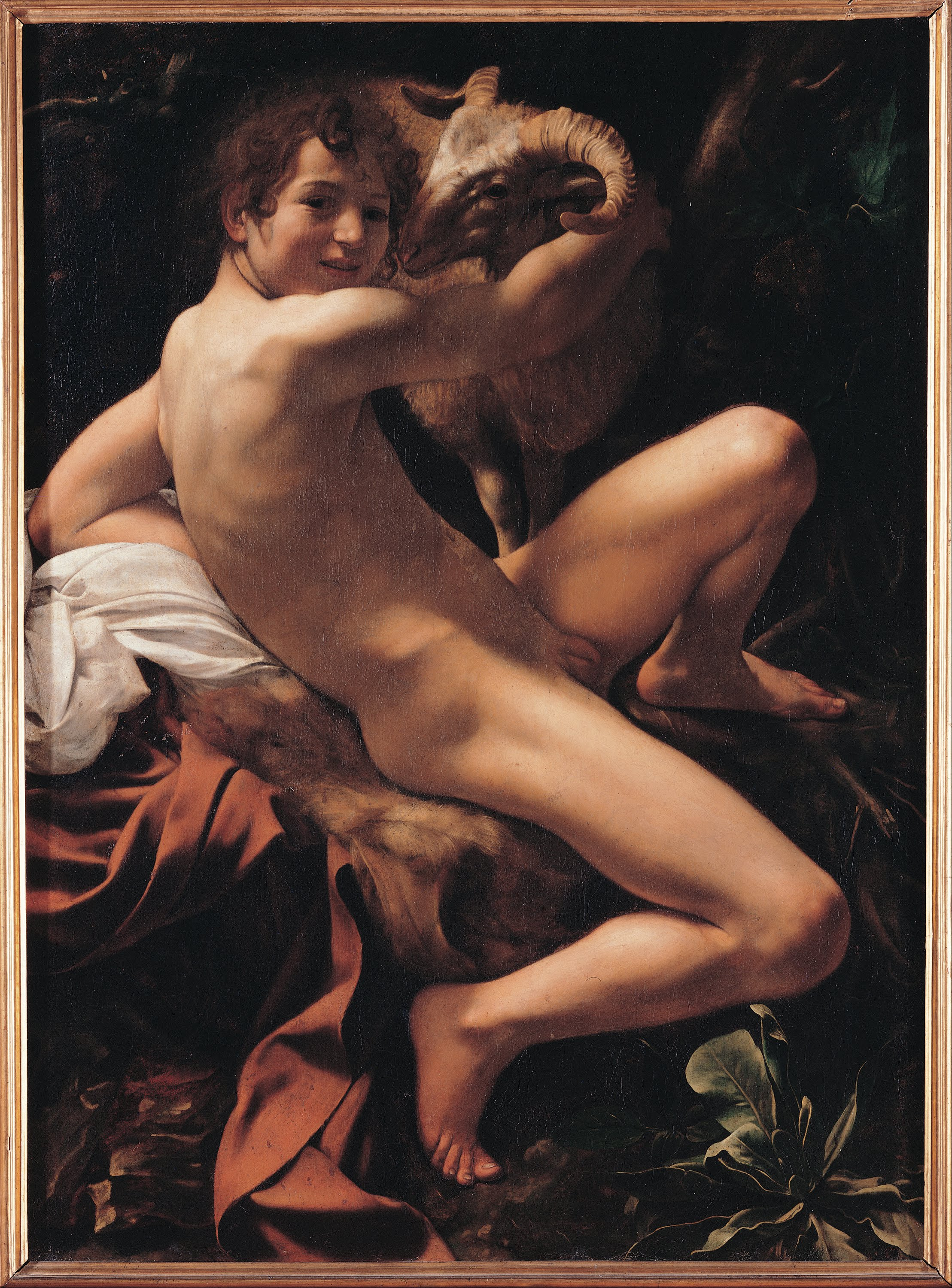
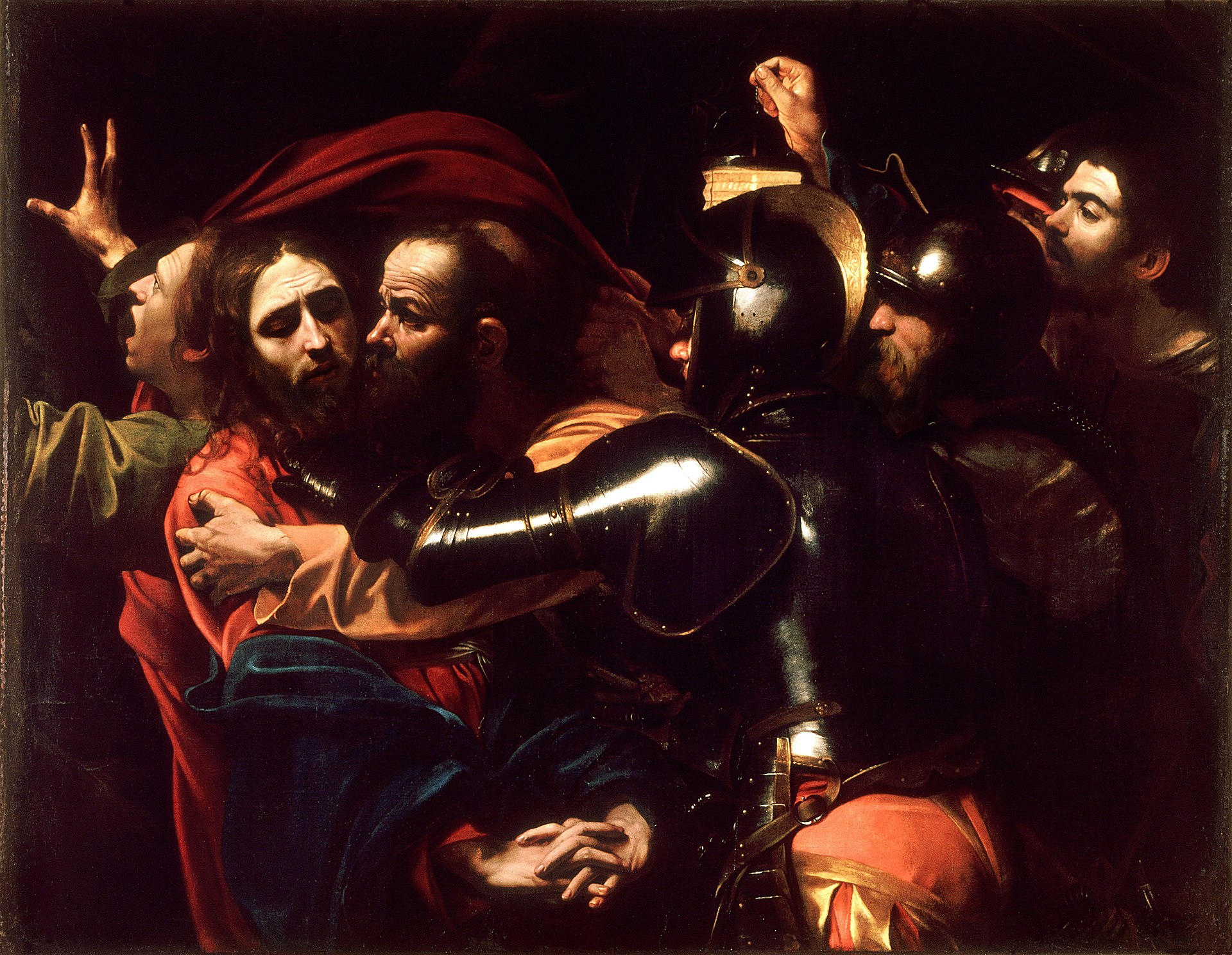
Youth With A Ram was painted for Ciriaco Mattei (d.1614), one of the foremost art collectors of his time, and given to Cardinal del Monte by his son before his death. Mattei also commissioned Caravaggio’s Supper at Emmaus and The Taking of Christ.
Caravaggio (Michelangelo Merisi), The Taking of Christ, 1602, oil on canvas, 133.5 cm × 169.5 cm (52.6 in × 66.7 in) National Gallery of Ireland. On loan from the Society of Jesus, Leeson Street., Dublin.
The painting includes a self portrait of Caravaggio. Caravaggio (Michelangelo Merisi), The Sacrifice of Isaac, 1603, oil on canvas, 41 x 53 1/8” Uffizi, Florence.https://www.uffizi.it/en/artworks/sacrifice-of-isaac – retrieved October 12, 2024.
The painting illustrates the Old Testament story in which God subjected Abraham to an extraordinary test of obedience by ordering him to sacrifice his only son Isaac (Genesis 22: 1-19). Caravaggio faithfully depicts the crucial moment of this dramatic story, when old Abraham, at the very moment he is about to immolate a screaming Isaac, is blocked by an angel sent by the Lord.
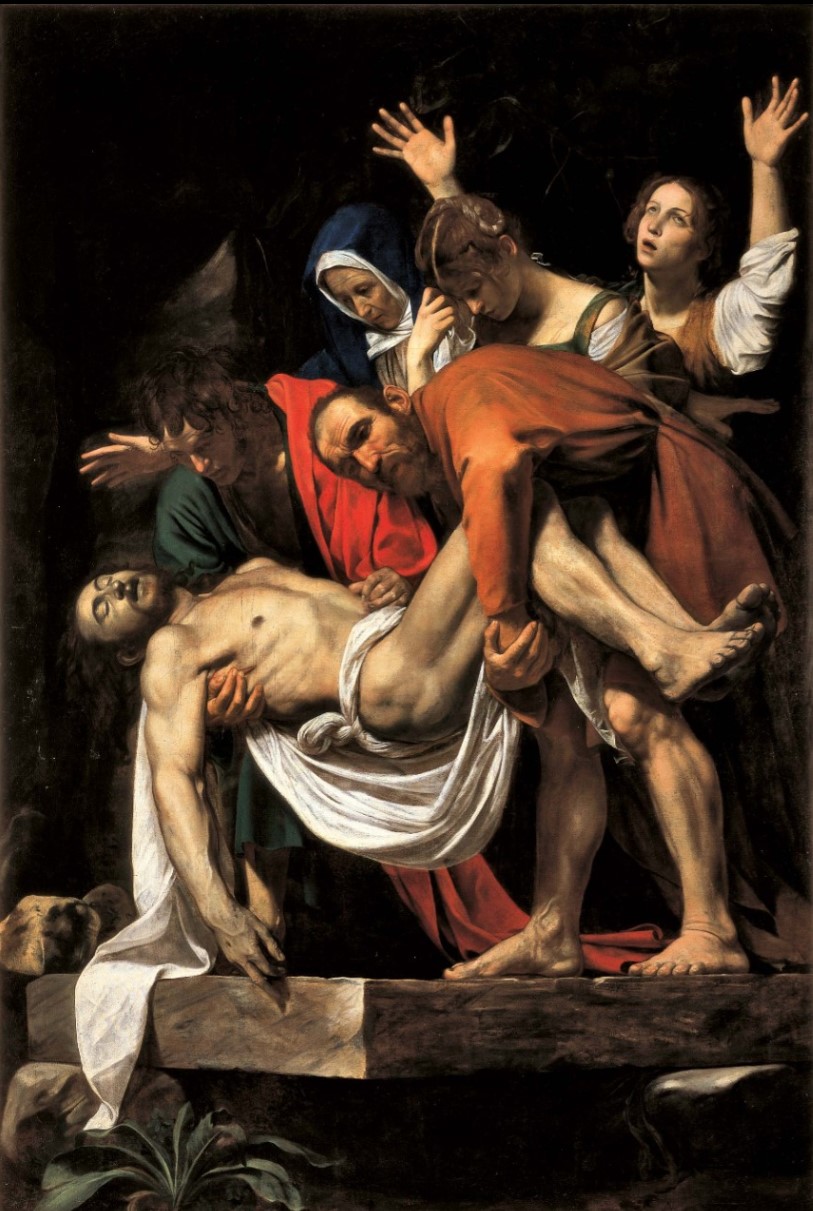
The Deposition, considered one of Caravaggio’s greatest masterpieces, was commissioned by Girolamo Vittrice for his family chapel in Santa Maria in Vallicella (Chiesa Nuova) in Rome. In 1797 it was included in the group of works transferred to Paris in execution of the Treaty of Tolentino. After its return in 1817 it became part of Pius VII’s Pinacoteca.
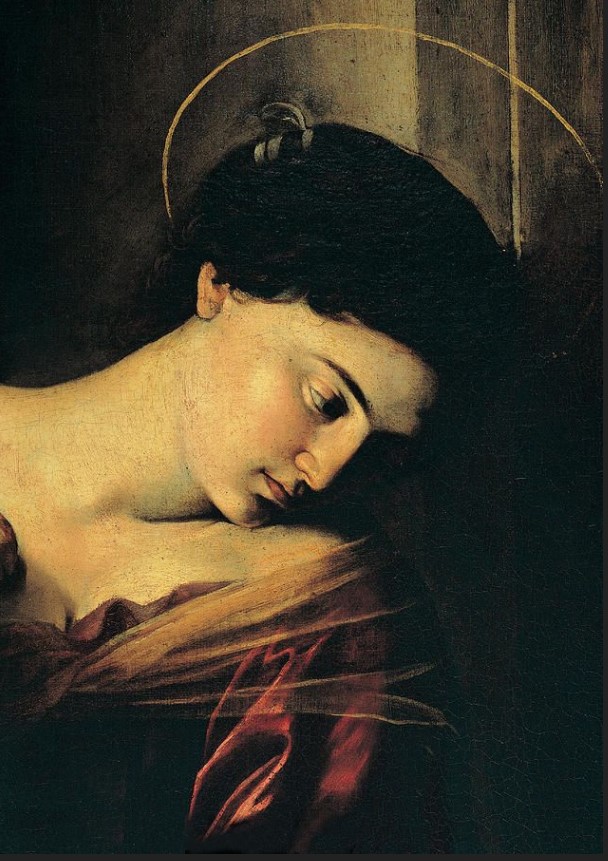
Michelangelo Merisi, called the Caravaggio, DETAIL The Madonna of Loreto (The Madonna of the Pilgrims), circa1603-1604, Oil on canvas, 8’ 8 ½ x 4’ 11”, Cavalletti Chapel, Church of Sant’ Agostino, Rome.Michelangelo Merisi, called the Caravaggio, The Madonna of Loreto (The Madonna of the Pilgrims), circa1603-1604, Oil on canvas, 8’ 8 ½ x 4’ 11”, Cavalletti Chapel, Church of Sant’ Agostino, Rome.
The painting has been in the Cavalletti chapel in Rome since it was installed at the end of 1604.
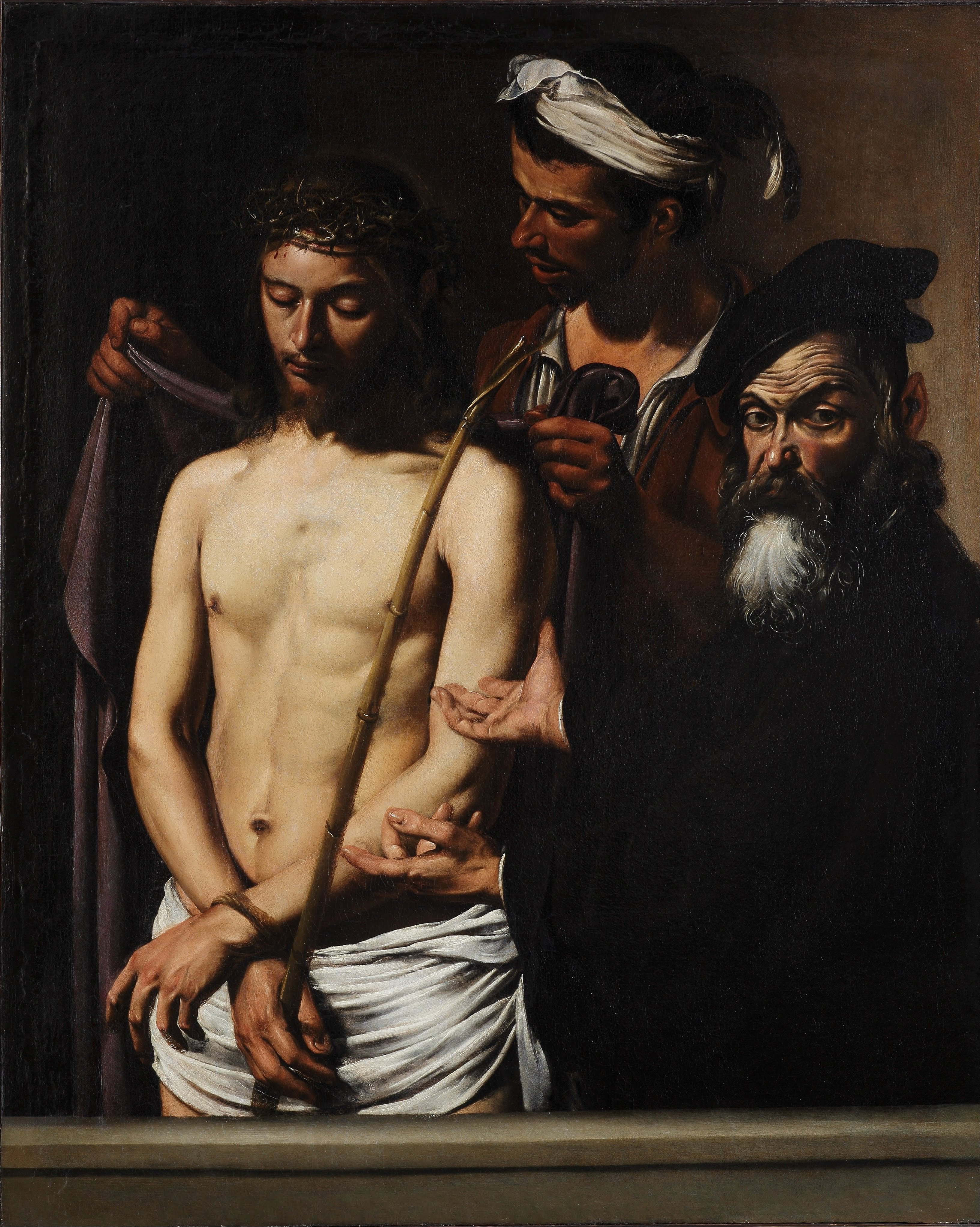
Michelangelo Merisi, called the Caravaggio, Ecce Homo, c. 1604-05, oil on canvas, 50 ½ x 40 ½” Civic Collection, Palazzo Rosso, Genoa.
The painting was made for a competition with Domenico Passignano (1559-1638) and Lodovico Cardi (“Il Cigoli”) (1559-1613) soon after Il Cigoli first arrived in Rome. Il Cigoli won the compettion and the whereabouts of Caravaggio’s painting until it arrived to Genoa is uncertain. It may be that Caravaggio himself took it to Genoa when he visited there in 1605.
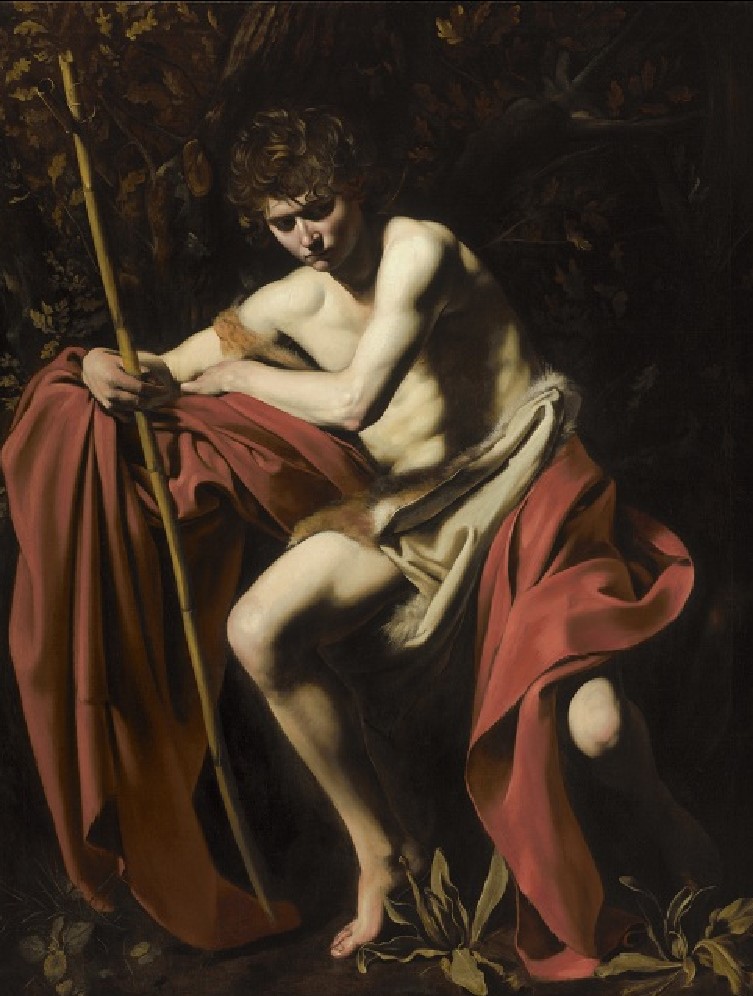
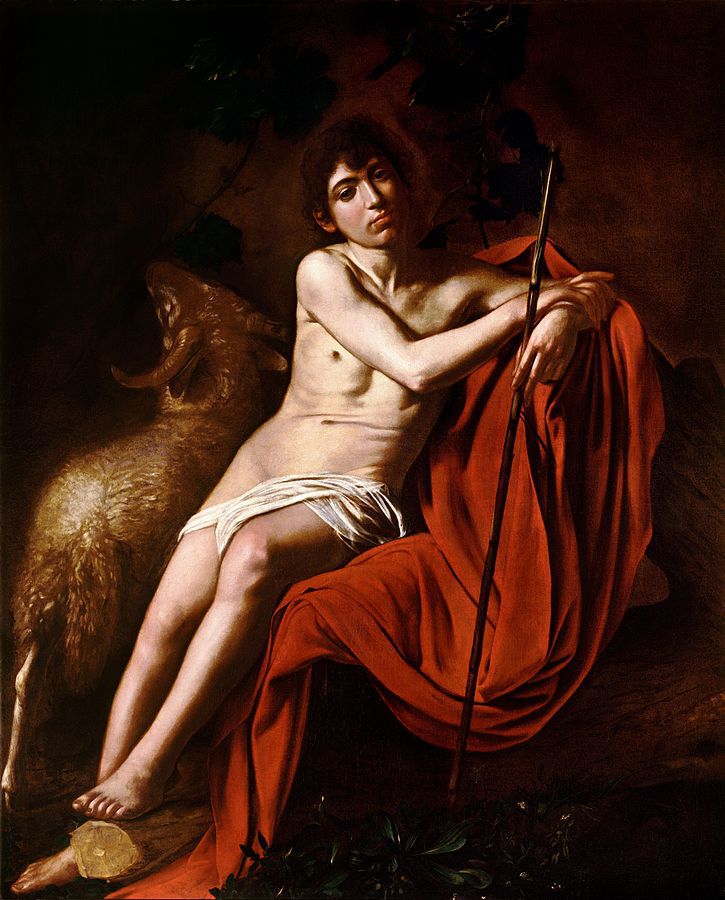
Michelangelo Merisi, called the Caravaggio, Saint John the Baptist, c. 1605, oil on canvas, 68 1/4 x 52” Nelson-Atkins Museum of Art, Kansas City, Missouri.
The painting was made for Ottavio Costa who then had a copy made for his chapel in Liguria while the original was lost. It resurfaced in the mid 19th century in England and was acquired by the Nelson-Atkins Museum of Art in the 1950s. Caravaggio reveals the qualities of the saint by his expression and pose. He is sober and downcast with a tense energy as his pose manifests the monumentality of the prophets on the Sistine Chapel ceiling. With his staff he quietly and contemplatively conveys zeal, passion and vitality. There is a sense of his singleness of purpose, joined even to a little madness, as a man driven by making straight the paths of the Lord.
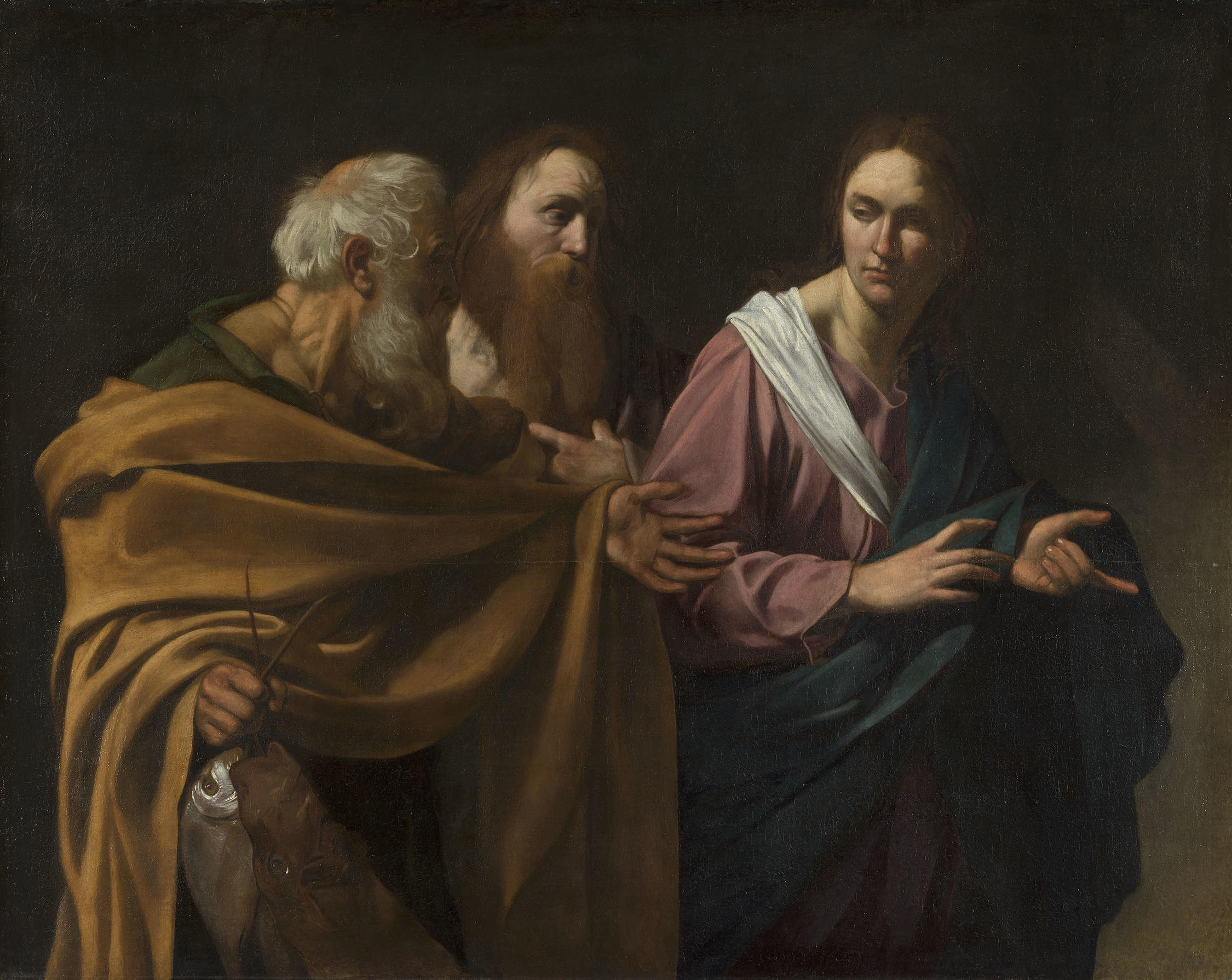
The painting was bought by King Charles I of England (1600-1649) in 1637. After the monarch’s defeat in the English Civil War (1642-1645), he was imprisoned and executed for high treason in 1649. During the Commonwealth (1649-1660), the painting was sold in 1651 and recovered at the Restoration. Caravaggio’s painting depicts the call of the very first disciples in the very first New Testament Gospel by Mark: “As he passed by the Sea of Galilee, he saw Simon and his brother Andrew casting their nets into the sea; they were fishermen. Jesus said to them, “Come after me, and I will make you fishers of men.” Then they abandoned their nets and followed him” (Mk 1:16-18). Caravaggio depicts Jesus without a beard as he turns back to invite them to follow him as he moves ahead. Fishermen, Simon Peter holds skewered fish on a stick while Andrew points to himself identifying the object of Jesus’s invitation.
As recently as 1987 this painting came to be attributed to Caravaggio and as the original of this painting’s subject matter. In varying copies of the work the furrow in Christ’s brow is painted faithfully though in this original it is not a painted feature but a canvas fold. There are other design features that, after recent cleaning and conservation, point to a later work of Caravaggio. Many small incisions are present in the artwork’s lower layers of paint that is an uncanny method used by the artist to lay out important points on the canvas for his design. Although the attribution can be argued to the contrary – such as the unusual use of the color blue which Caravaggio saw, according to Bellori, as the “poison of colors” – he did use the color and mostly softened as it is here. Blue, for instance, occurs in the Baptism of Christ (National Gallery of Ireland, c. 1603) and the Annunciation (Nancy, c. 1604). At the Supper at Emmaus (Brera, 1605-6) Christ also wears a robe of softened blue. In its telling broad brushwork, restrained colors, and minimal detail the painting was understood to be a Road to Emmaus painting as discussed by Giulio Mancini and Giovanni Baglione. But these early biographers’ references are likely to the Supper at Emmaus (National Gallery London, 1601). Dated stylistically by its economical, shadowed, and expressive manner, The Calling of Saints Peter and Andrew appears to be from the period of 1603-1606. This would be before Caravaggio killed Ranuccio Tomassoni (c. 1580-1606) in a brawl and fled Rome in May 1606. During the first years of the 17th century, the sensuous surface detail of Caravaggio’s art had become spare, dark and expressive. Further, The Calling of Saints Peter and Andrew places half-length figures interacting against a stark background, similar to such paintings as Doubting Thomas (Sanssouci, Potsdam) and the Betrayal of Christ (National Gallery of Ireland, Dublin), both of 1603. Before this painting reached England, there was a broadly interpreted copy of it that is today in a private collection by Bernardo Strozzi (1582-1644). Strozzi lived and worked in Rome, Genoa and Venice where he may have seen this painting by Caravaggio. When Charles I’s buying agent was later in Italy, he visited the same places as Strozzi had been, except Genoa.
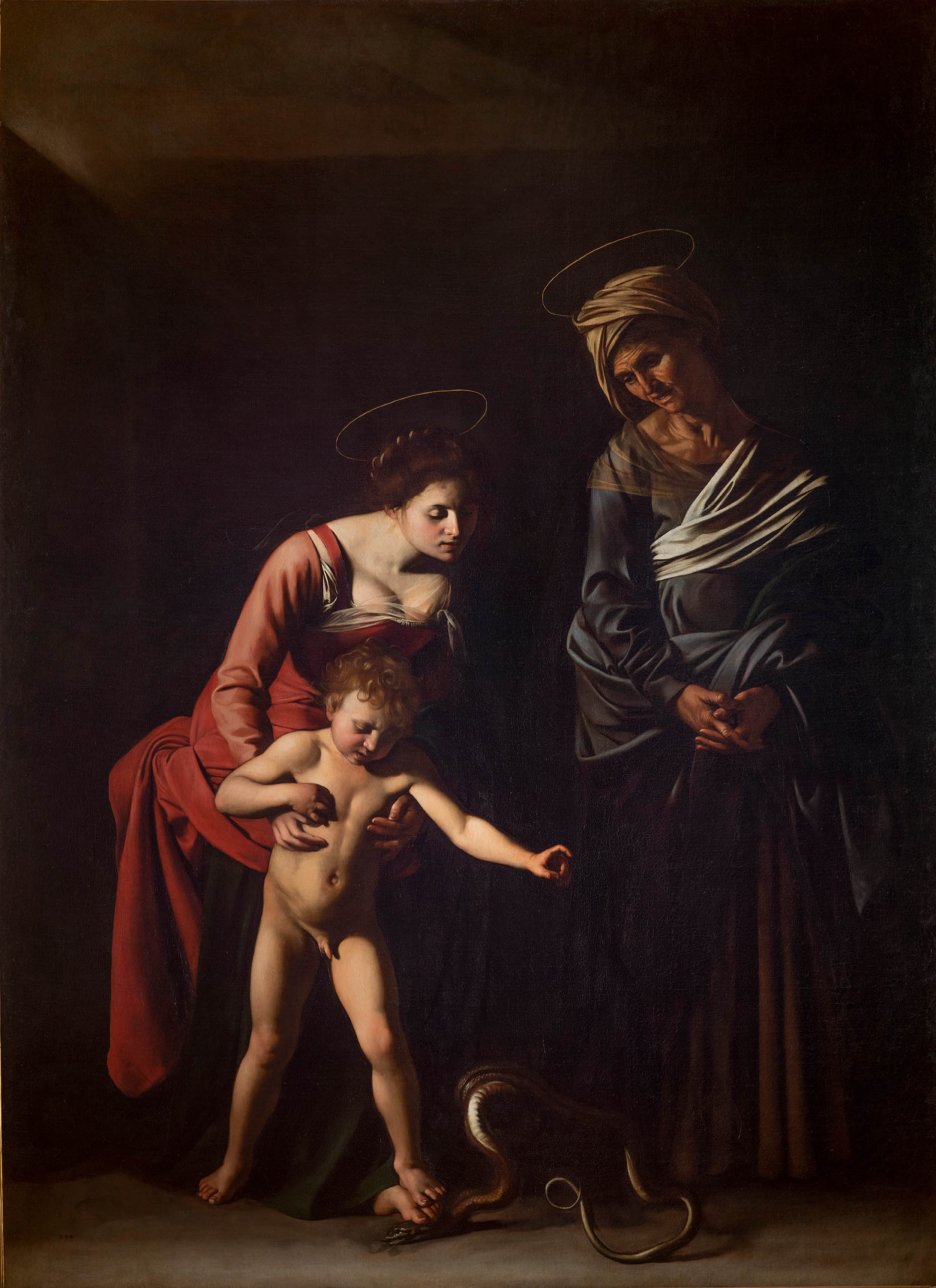
The painting was commissioned in 1605 by members of the powerful archconfraternity of the Palafrenieri who, following the renovation of St. Peter’s Basilica, asked the painter for a new work intended to replace an old painting that decorated the altar of their chapel dedicated to St. Anne. Painted within a few months, in April 1606 the work was exhibited and shortly afterwards moved to the nearby church of Sant’Anna dei Palafrenieri where, seen by Scipione Borghese, it was bought by him. For whatever reason the painting was controversial – perhaps the cleavage of the Madonna or the rendering of the nudity of the child – but Scipione Borghese proudly hung it in his own picture gallery. The painting depicts Mary as she crushes a snake – a symbol of sin – at her feet with the help of Jesus and witnessed by Anna, mother of the Virgin.
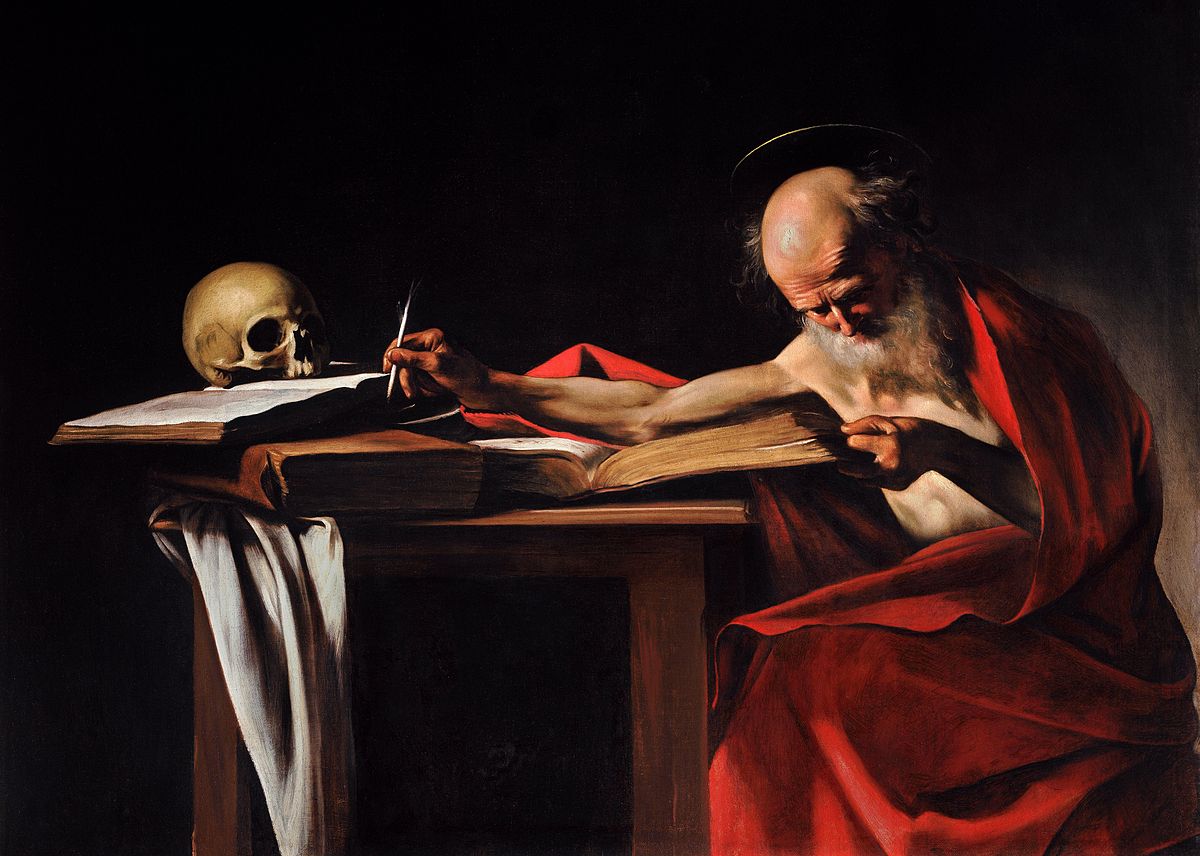
Michelangelo Merisi, called the Caravaggio, Saint Jerome writing, 1605/06, oil on canvas, 116 cm x 153 cm, Borghese Gallery, Rome.
According to Bellori, the painting was made by Caravaggio for Cardinal Scipione Borghese. The cardinal was not only an avid and refined art collector but one of young Caravaggio’s earliest and greatest admirers recognizing the Lombard’s talent despite personality flaws or lack of connections in Rome. The painting depicts Saint Jerome (c. 340s-420), Doctor of the Church, best known for his translation of the Bible from Greek into Latin as well as his commentaries on the Bible. Caravaggio depicts the priest and confessor writing and studying the Holy Scriptures as a scholar, now in old age, who has dedicated his life as a humanist engaged in the complex translation and exegesis of the Church’s sacred text. The composition is divided into large fields of color in warm tones (the saint’s complexion and reddish mantle) and cold tones (the skull and shroud-like white cloth) with Jerome’s arm outstretched with writing instrument in hand across the picture to symbolically portray the unity of the scholar-saint’s dialogue with these opposites of nature including life and death, past and present. As there are many unfinished details in the painting, the artist’s style points to his rapid execution of the work. https://www.collezionegalleriaborghese.it/opere/san-girolamo – retrieved October 13, 2024.
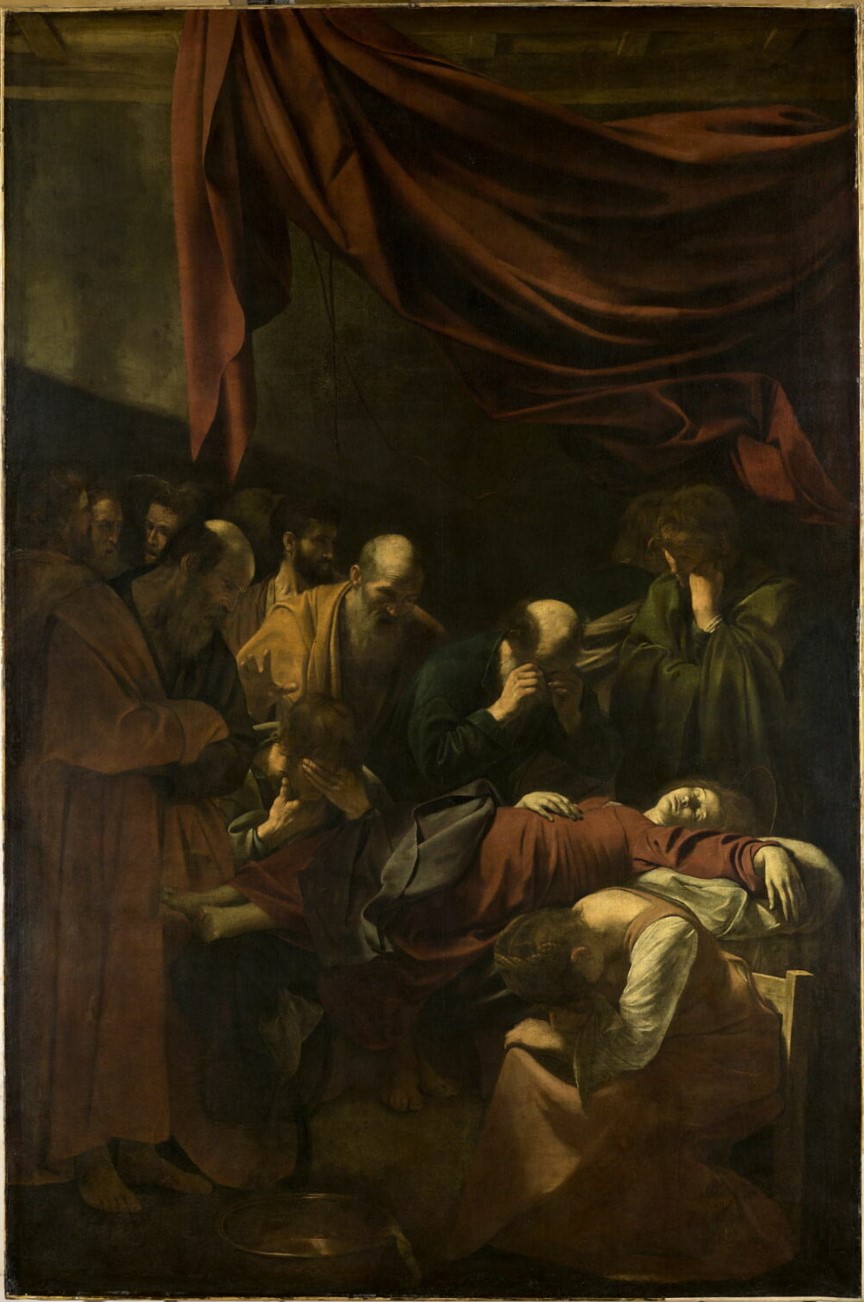
DETAIL Caravaggio (Michelangelo Merisi), The Death of The Virgin, c. 1605-1606, oil on canvas, 12’1 ½” x8’, Louvre, Paris.
Caravaggio (Michelangelo Merisi), The Death of The Virgin, c. 1605-1606, oil on canvas, 12’1 ½” x8’, Louvre, Paris.
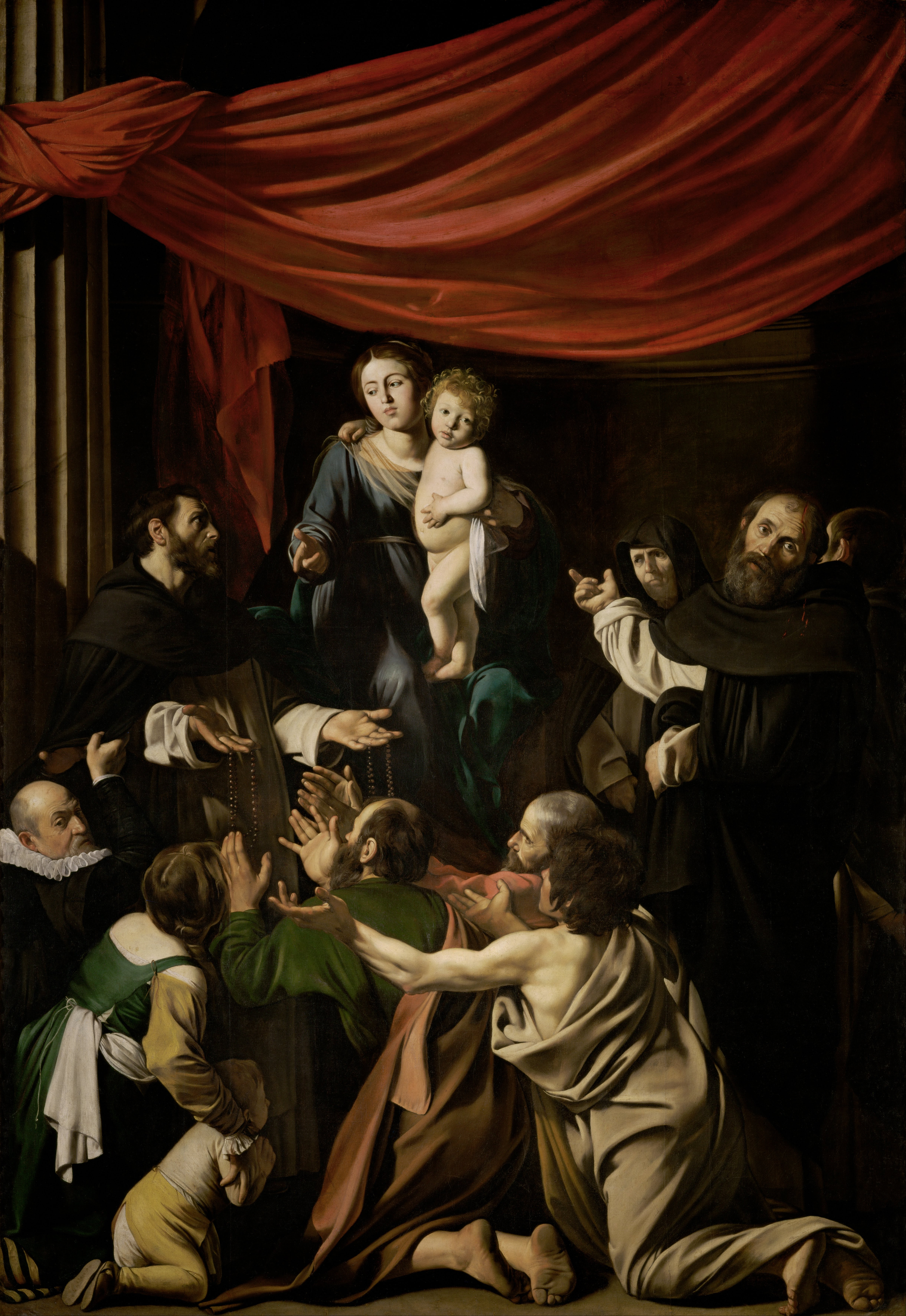
Caravaggio (Michelangelo Merisi), The Madonna of the Rosary, c. 1605-1607, oil on canvas, 11’11 ½” x8’ 4”, Kunsthistorisches Museum, Vienna.
The Madonna of the Rosary (1605-1607) is a monumental work of the Italian Baroque and one of the few large-scale, traditional altarpieces Caravaggio ever completed. Although its original patron remains unknown, the commission may have come from the powerful Colonna family, who sheltered the artist after he fled to Naples in 1606. Whoever commissioned it ultimately rejected the painting. It was taken to Naples and sold to Flemish art dealers, who transported it to Antwerp. There, a committee of artists, including Peter Paul Rubens and Jan Brueghel the Elder, purchased it for St. Paul’s Dominican Church.
The painting unfolds as both visual drama and Catholic Counter-Reformation theology, collapsing heaven and earth into a single charged moment. High above, the Madonna sits enthroned with the Christ Child as she presents the rosary to Saint Dominic, clad in the black-and-white habit of his order. The rosary serves as heaven’s answer to Dominic’s prayers in the struggle against the thirteenth-century Albigensian heresy. At right stands Saint Peter Martyr, the first canonized martyr of the Dominican Order, elevated to sainthood by Pope Innocent IV only eleven months after his death and even before the canonization of the order’s founder, Saint Dominic. To this day, Peter Martyr, the fiery preacher who fought heresy throughout Northern Italy and was murdered by an axe blow to the head in 1252, remains the fastest canonization in Catholic Church history. Gazing directly at the viewer, he points toward the Christ Child, identifying Jesus as the ultimate source of divine grace.
Below, Caravaggio brings sacred history to the world’s barefoot and struggling poor. Kneeling in the dirt, their grimy feet and outstretched hands reach for the rosaries being distributed through Saint Dominic. In the left foreground, a wealthy donor in a black coat and crisp white ruff kneels while looking directly outward, drawing viewers into the drama.
In 1781, the painting was confiscated from St. Paul’s Dominican Church when Emperor Joseph II pressured the Dominicans to surrender, or “donate,” the masterpiece to his imperial collection. Today, it remains one of Caravaggio’s essential late works and a centerpiece of the Kunsthistorisches Museum in Vienna, where its powerful blend of realism, devotion, and theatrical display continues to command attention.
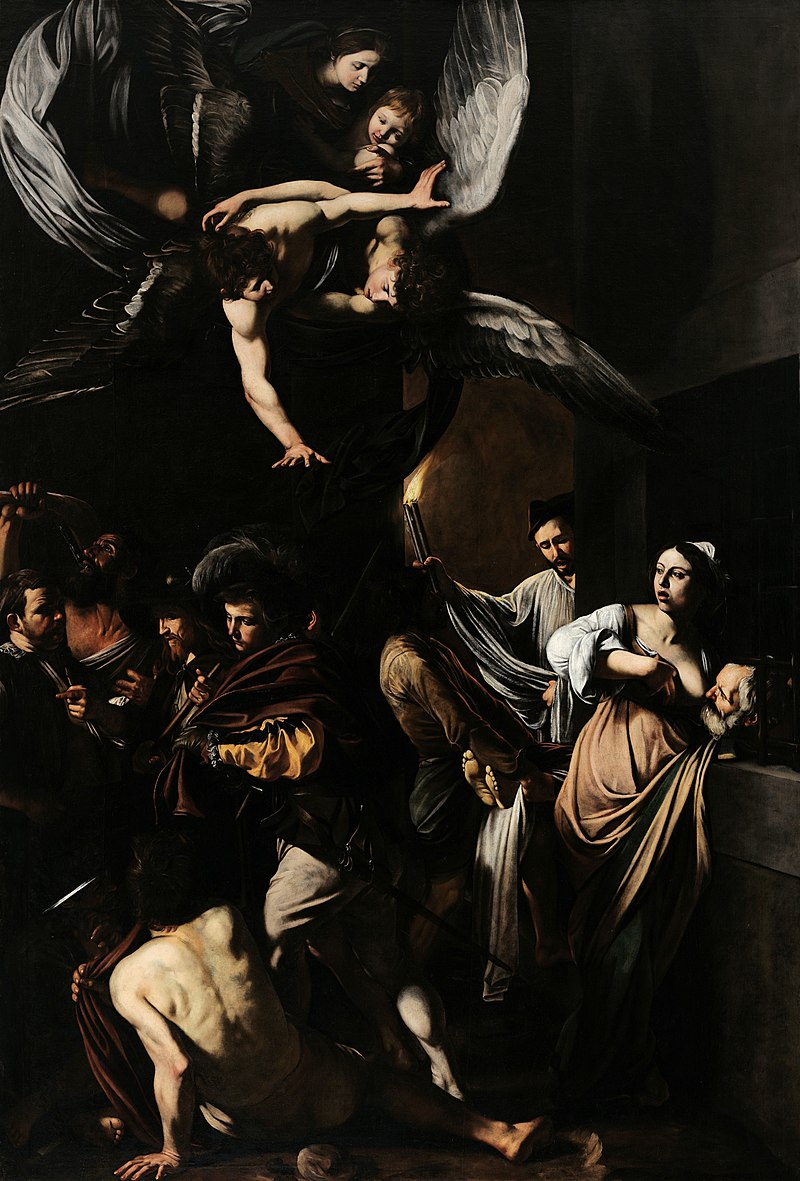
Caravaggio (Michelangelo Merisi), The Seven Acts of Mercy, 1606, Oil in canvas, 12’ 9 ½” x 8’ 6 ½” Pio Monte della Misericordia, Naples.
The Seven Acts of Mercy altarpiece was painted between September 23, 1606 and January 9, 1607 for which Caravaggio was paid 400 ducats. The commission required that the artist include the figure of the Madonna of the Misericordia and all the acts of mercy in one vertical canvas and whose overall achievement was a first in Italian art.
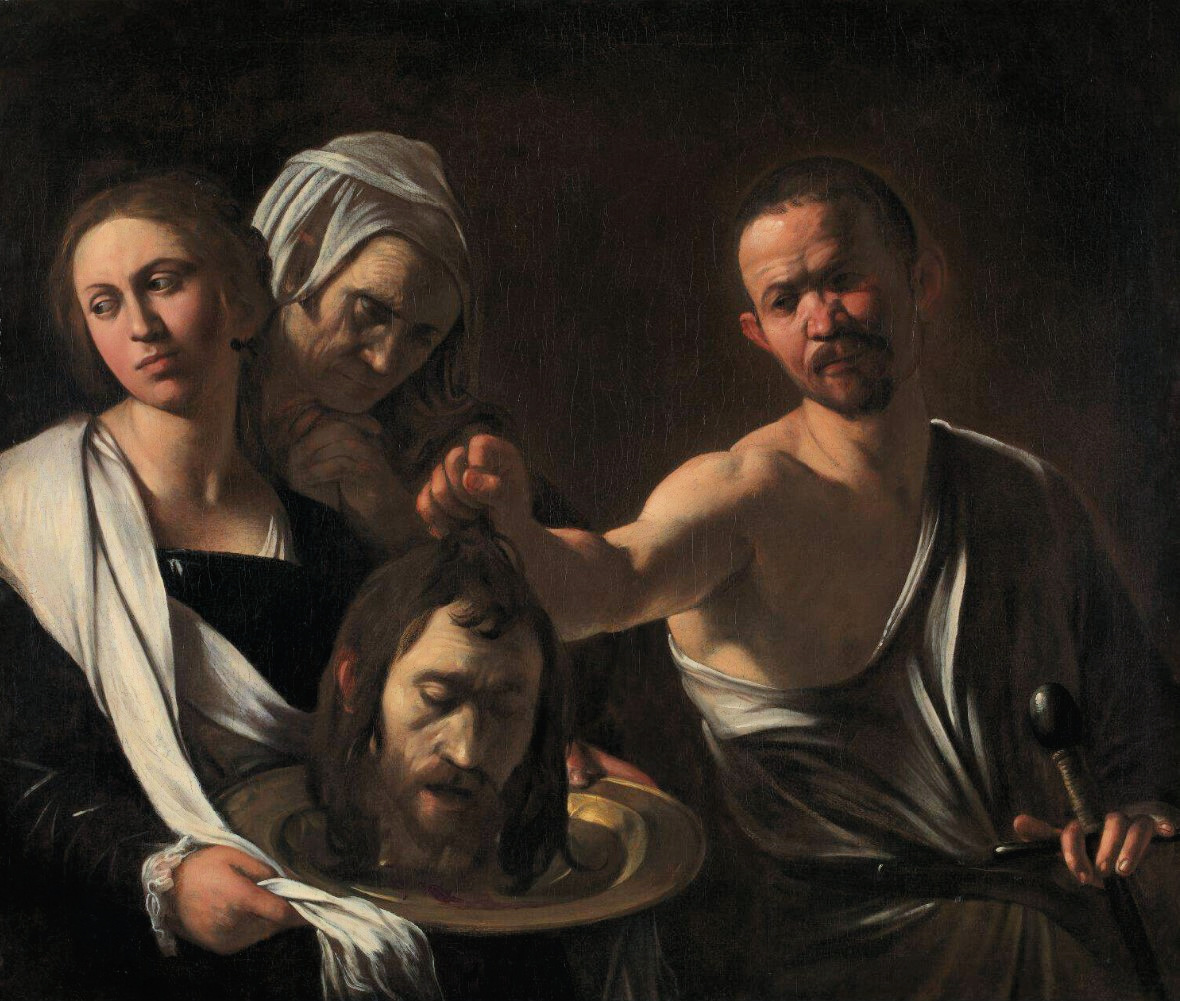
Caravaggio (Michelangelo Merisi), Salome, 1609/10, oil on canvas, 35 5/8 x 65 ¾” The National Gallery London.
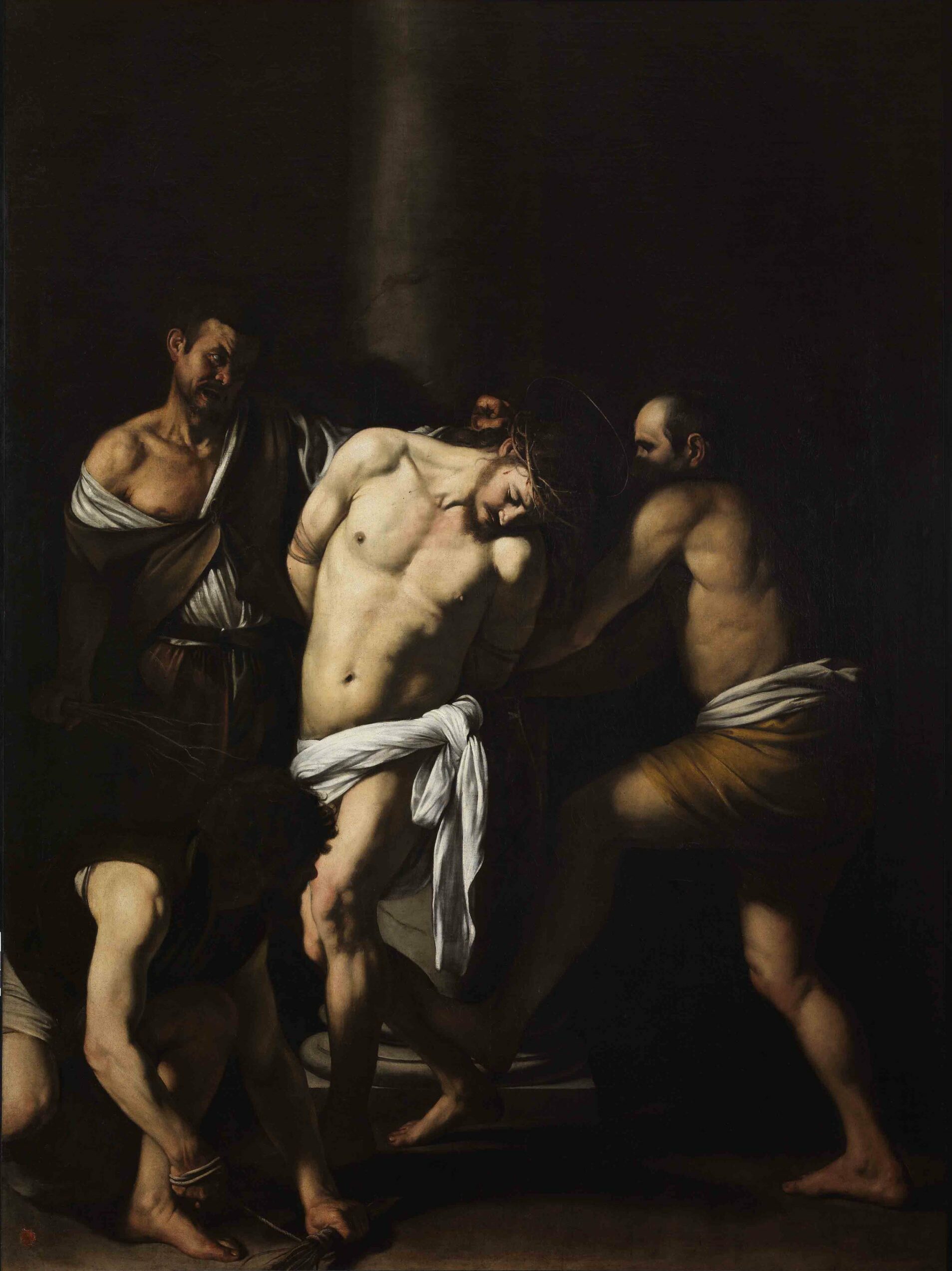
Caravaggio (Michelangelo Merisi), The Flagellation, 1607, oil on canvas, 9’ 4 ½” x 6’2” Capodimonte Museum, Naples.
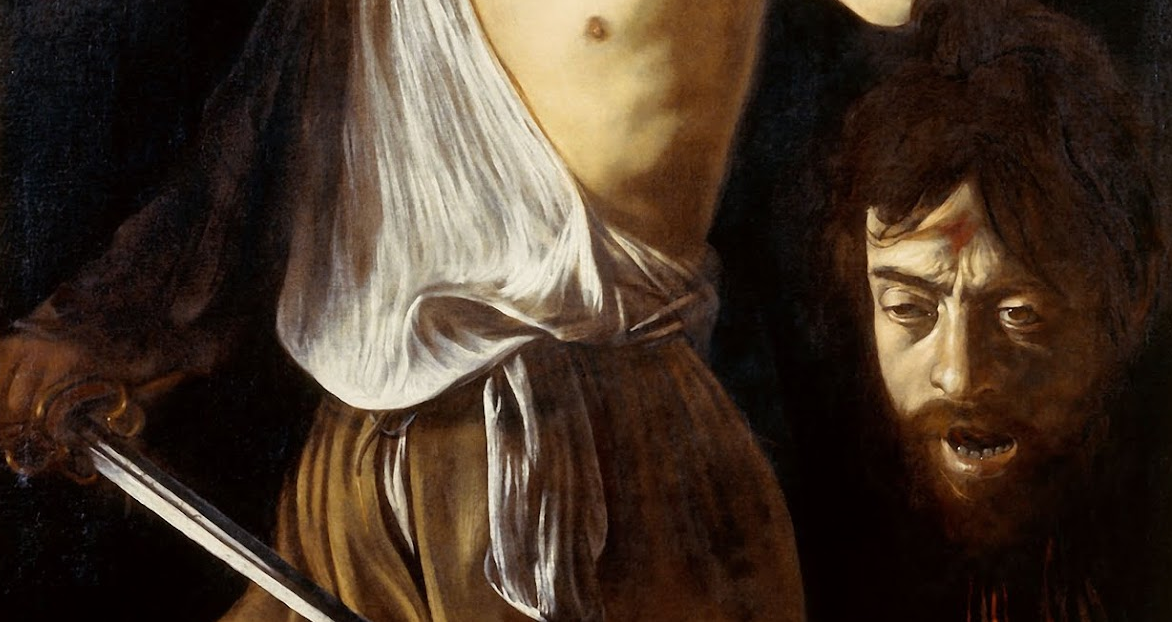
The dramatic play of light and shadow throws into relief the melancholic expression on David’s face and the hauntingly lifelike head of Goliath, creating a palpable sense of guilt and redemption that resonates deeply with the viewer.
The head of Goliath is Caravaggio’s self portrait.
In addition to developing a considerable name as an artist, Caravaggio was a reputably volatile, bad-tempered and violent man. On May 29, 1606 Caravaggio killed Ranuccio Tomassoni in a fight, the cause of which is disputed, though it may have been over a Roman prostitute, Fillide Melandroni who had posed for Caravaggio several times. The capital crime forced Caravaggio to flee to Naples. A report written by the local coroner declared that the male victim died by Caravaggio’s attempt to castrate him, the code on the Roman street meriting it for a man who insulting another man’s woman. Caravaggio became a fugitive from the law though he continued to paint (Supper at Emmaus) and fled to Naples by the end of 1606. In Naples he painted Flagellation and Seven Works of Mercy, among others. He fled further to Malta and then to Sicily where Caravaggio moved from town to town across the island fearing some unnamed retribution. It was presumed that 38-year-old Caravaggio died from syphilis or perhaps malaria or the Malta Fever though there is current speculation the artist may have been murdered in revenge for his crimes by perhaps members of the Tomassoni family or the Royal Knights. see – https://www.italianartsociety.org/2018/05/on-29-may-1606-the-great-italian-baroque-painter-caravaggio-killed-ranuccio-tommasoni-in-rome/ ; https://thecinemaholic.com/ranuccio-tomassoni-caravaggio/– retrieved October 15, 2024.
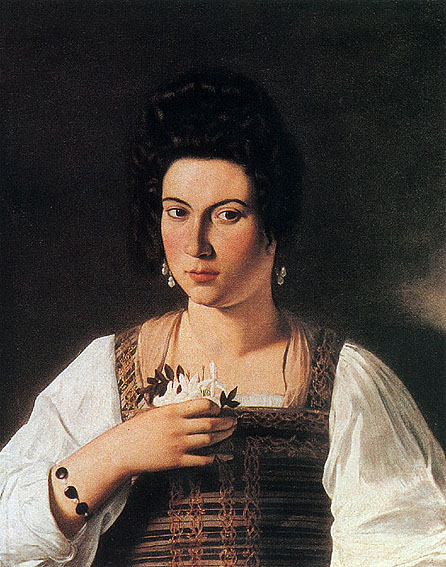
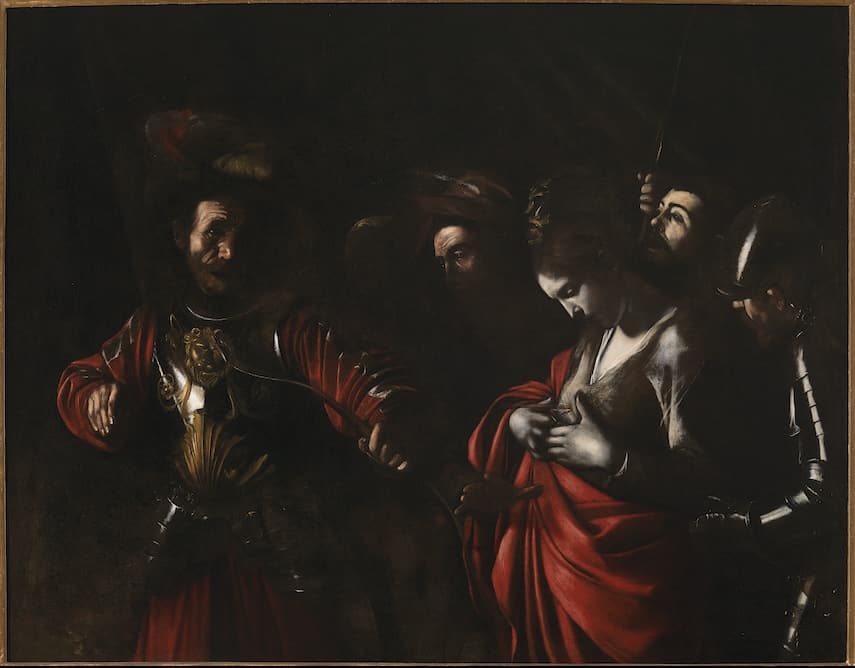
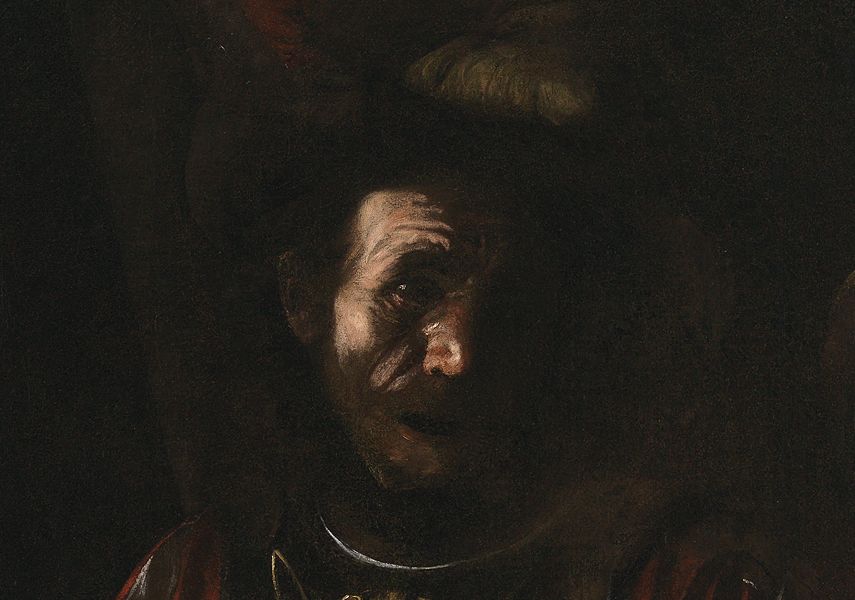
Caravaggio (Michelangelo Merisi), Portrait of a Courtesan (Fillide Melandroni), c, 1599. Destroyed Berlin 1945. Caravaggio (Michelangelo Merisi), Supper at Emmaus,1606, oil on canvas, 141 x 175 cm, Pinacoteca di Brera, Milan.
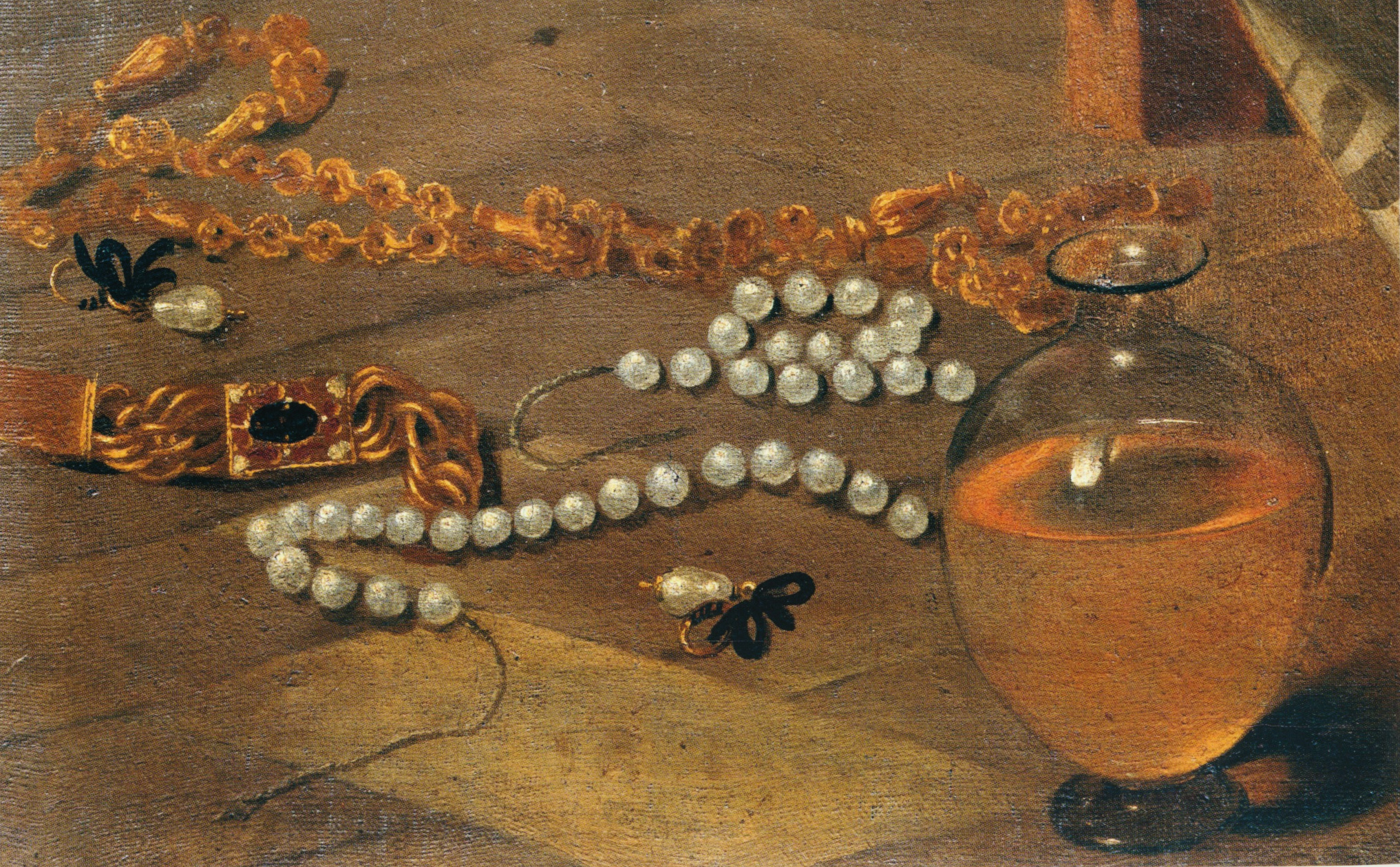
Caravaggio’s later Supper at Emmaus in Milan’s Brera Gallery intensifies the drama and imposes greater stylistic discipline compared to the earlier London version painted five years prior. The gestures are more restrained and the palette more muted, allowing the dramatic accents to emerge with heightened clarity despite the overall reduction of detail. Objects are rendered with deliberate precision—the urn angled toward the viewer, the plates catching narrow rims of reflected light—each contributing to the painting’s controlled visual rhetoric.
The composition organizes itself in a semicircular sweep of gestures around the table, rising diagonally from Christ’s head to the sharply profiled disciple and then to the standing figures beyond. The entire scene is suffused with a concentrated, directional illumination that culminates on the face of the risen Christ, reinforcing the painting’s theological and dramatic center.
SOURCE: Brera Milan: Great Museums of the World (Great Museums of the World, volume 14), Newsweek, Inc. & Arnoldo Monadori Editore, 1970, pp. 68-69.
Caravaggio (Michelangelo Merisi), The Beheading of St John, 1608, St John’s Co-Cathedral, Valetta, Malta.Caravaggio (Michelangelo Merisi), St. Francis of Assisi in Meditation, 1606/07, oil on canvas, Pinacoteca Civica Museo ala Ponzone Cremona.Caravaggio (Michelangelo Merisi), Portrait of Alof de Wignacourt with his Page, 1606/07, oil on canvas, 195 x 134 cm, Louvre.
The subject was the Grand Master of the Knights of Malta. In exchange for this grand portrait, according to Bellori and Baglione, Caravaggio became a Knight of Malta on an accelerated timetable though soon after the artist fled the island in disgrace.
Caravaggio (Michelangelo Merisi), The Burial of Saint Lucy, 1608/9, oil on canvas, 13′ 4 1/2″ x 9′ 10″ 408 x 300 cm, Church of Santa Lucia,Syracuse in deposit at the Galleria Regionale, Palazzo Bellomo, Syracuse, Sicily.
The famous Caravaggio painting depicting the burial of Santa Lucia once hung in the Church of Santa Lucia al Sepolcro, but today is in Siracusa’s Palazzo Bellomo museum. The original church, built as early as the 6th century, was on the site of Saint Lucy’s martyrdom in the early 4th century. Beneath the sanctuary is a vast labyrinth of dark catacombs dating from the 3rd century which have never been completely explored and are closed to the public. Once containing the tomb of the decapitated saint, her remains were relocated to Venice during the Crusades and where they can be found today. This painting was made by Caravaggio between October 1608 in Malta and early 1609 in Sicily in a commission arranged by his old friend painter Mario Minniti. Caravaggio was on the run in Sicily starting in late 1608 when he arrived into Siracusa, and then onto Messina followed by Palermo. In Sicily, the exile Caravaggio painted Resurrection of Lazarus, The Adoration of the Shepherds (Adorazione dei pastori) and Ecce Homo. In late 1609 he returned to Naples and continued painting, including another St. John the Baptist and, his final artwork, The Martyrdom of St. Ursula. In Naples the artist was attacked in the street by four armed men shortly after his arrival where Caravaggio was seriously injured. see – https://www.frommers.com/destinations/syracuse-and-ortygia-island/attractions/santa-lucia-al-sepolcro; https://www.great-sicily.com/post/the-byzantine-era-in-sicily – retrieved October 15, 2024.
Caravaggio (Michelangelo Merisi), Adorazione dei pastori (The Adoration of the The Shepherds), 1609, oil on canvas, 10′ 3 1/2 ” x 6′ 11″, Messina, Sicily, Museo regionale interdisciplinare.
Caravaggio (Michelangelo Merisi), La Resurrezione di Lazzaro (The Resurrection of Lazarus), 1609, oil on canvas, 10′ 3 1/2 ” x 6′ 11″, Messina, Sicily, Museo regionale interdisciplinare.
In Malta Caravaggio became a Knight of Malta but got into another violent group brawl where a knight was badly injured. With a warrant put out for his arrest Caravaggio managed to flee to Sicily in October 1608. By December 1608 Caravaggio was found guilty in abstentia and removed from the Maltese order. The commission for this painting came from Giovanni Battista de’ Lazzari, a merchant of Genoese origin who had obtained permission to be buried in the choir chapel of the church of Saints Peter and Paul de’ Pisani (demolished in 1880) in Messina where Camillo de’ Lellis’ religious order, founded in 1591 and dedicated to the care of the sick, had a house. De’Lazzari’s signed contract on December 6, 1608, declared that his new altarpiece would have the Madonna and St. John with saints as its subject. But that was changed to the resurrection of Lazarus (Gospel of John, chapter 11). It is very likely the change was made by De’Lazzari in agreement with the Camillians. According to Susinno, the artwork’s 13 figures were staff members of the hospital where Caravaggio did the painting. see – https://federica90.wixsite.com/emozionearte/post/caravaggio-in-sicilia-la-resurrezione-di-lazzaro – retrieved October 15, 2024.
Caravaggio (Michelangelo Merisi), The Denial of St. Peter,1609/10, oil on canvas, 94 x 125.4 cm, The Metropolitan Museum of Art, New York.
The Denial of Saint Peter is generally thought to be one of the last pair of artworks by Caravaggio, the other being The Martyrdom of Saint Ursula. It was probably finished at Naples in the summer of 1610.
Caravaggio (Michelangelo Merisi), St. John the Baptist, 1610, oil on canvas, 159 x 124.5 cm, Galleria Borghese, Rome.
Caravaggio carried this painting and others sailing from Naples to Rome hoping for a pardon from the pope. Instead, when the desperate artist landed he was arrested and the boat was sent back to Naples with the paintings. Caravaggio died on July 18, 1610 in Porto Ercole. The papal nuncio secured this painting for Cardinal Scipione Borghese. see – https://www.dailyartmagazine.com/caravaggios-martyrdom-of-saintt-ursula/ – retrieved October 15, 2024.
LAST PAINTING.
Caravaggio (Michelangelo Merisi), The Martyrdom of Saint Ursula, 1610, oil on canvas, 142 x180 cm, Naples, Galleria di Palazzo Zevallos Stigliano.
Caravaggio’s The Martyrdom of Saint Ursula was painted in the last month of his life. It contains his characteristic and revolutionary chiaroscuro, naturalism, and depiction of psychological and physical emotion. The Martyrdom of Saint Ursula was commissioned by Genoese art patron Marcantonio Doria. The painting was finished in May and arrived in Genoa in mid-June 1610. Ursula was a venerated but almost completely legendary figure. In typical fashion Caravaggio dispels traditional religious iconography associated with Ursula — a crown, halo, palm branch, the 11,000 virgin martyr companions — for the painful moment in her story when the Barbarian king shoots the arrow into Ursula’s chest that kills her.
Caravaggio’s The Martyrdom of Saint Ursula marked a watershed in European art. His revolutionary style inspired subsequent generations of painters, such as Artemisia Gentileschi (1593—1651), Giovanni Baglione (1566-1643), and Orazio Gentileschi (1563–1639), that became known as the Caravaggisti. He also influenced international Baroque artists including Spaniard Diego Velázquez (1599-1660) and Dutchman Rembrandt van Rijn (1606-1669). see – https://www.widewalls.ch/magazine/the-martyrdom-of-saint-ursula-caravaggio – retrieved October 15, 2024.
FEATURE image: The North Porch was constructed at the start of the 13th century. The North Porch, like the North Rose Window (below) crafted in the same time, depicts the glories of the Virgin Mary along with Old Testament figures. PHOTO: “Chartres, North Porch, Central Portal, LeftJamb” by profzucker is licensed under CC BY-NC-SA 2.0.
The Royal Portal of Chartres Cathedral represents one of the defining achievements of early Gothic art, where architecture, sculpture, and theology were fused into a monumental visual statement of Christian belief. Created in the mid-twelfth century and remarkably preserved, its sculpted kings, queens, prophets, and Christ figures reveal the moment when medieval Europe began transforming stone into a sophisticated language of faith, learning, and artistic innovation.
The Royal Portal (Portail Royal) on the west façade of Chartres Cathedral, carved between 1145 and 1155, is one of the finest surviving ensembles of Early Gothic sculpture. Its three richly coordinated doorways present a sweeping vision of Christ’s role in salvation history. Above the left portal, a semicircular tympanum depicts Christ’s Ascension; the central portal illustrates the Apocalypse and the Second Coming of Christ; while the right portal focuses on Christ’s nativity and entrance into human history while crowning the composition is the Sedes Sapientiae (Throne of Wisdom), where the Virgin Mary sits enthroned with the Christ Child in her lap, flanked by two incensing angels. The portals are further enriched by sculpted lintels and archivolts populated with biblical figures and symbolic imagery. Lining the doorways below are the celebrated jamb statues attached to the columns, their elongated, otherworldly forms depicting the kings and queens of the Old Testament. Together, these sculptures create a monumental stone theology that welcomed medieval pilgrims while proclaiming the spiritual and royal lineage of Christ. PHOTO: “Chartres” by Photo:Nina Aldin Thune User:Nina-no is licensed under CC BY 2.5.
The Royal Portal of Chartres is more than a cathedral entrance; it is one of the earliest and most influential masterpieces of Gothic art, transforming carved stone into a timeless expression of faith, knowledge, and medieval imagination.
Jamb statues from the Royal Portal (west façade) of Chartres Cathedral. These columns stand on the right-hand side of the Central Portal. These statues were carved between 1145 and 1155. They represent a critical turning point in Western art history, standing as the definitive bridge between the rigid, blocky Romanesque style and the lifelike naturalism of the Early Gothic period. While individual identities are debated, the overarching program represents the Kings and Queens of the Old Testament. PHOTO: “Cenral tympanum Chartres” by Cancre is licensed under CC BY-SA 2.5.
First Visit and Returning to Chartres Across the Years
I first visited Chartres Cathedral in 1985, returning in 1989, 2002, and 2005. That first visit included a Malcolm Miller tour—my introduction to a guide who, since 1958, had devoted his life to interpreting one building. As I backpacked through Europe, his example showed me how a single enduring monumental work can anchor a lifetime of study.
The Great Glass of Chartres
Chartres is celebrated above all for its 12th‑ and early‑13th‑century stained glass, a nearly intact ensemble unmatched anywhere in Europe. The windows shimmer with deep blues, ruby reds, and jewel‑like greens—colors that have survived more than 800 years. Their narratives unfold left to right, beginning at the base and rising upward, guiding viewers through biblical cycles, guild stories, and royal symbolism.
Layers of Cathedrals on a Roman Site
The cathedral stands on what was once a Roman site, and several earlier churches rose and fell here. Structures were destroyed during the Merovingian era, again in Viking raids, and once more in the fires of the 12th century. Each catastrophe cleared the ground for a new architectural vision, culminating in the High Gothic monument seen today.
Detail of jamb statue located on the on the Central Doorway of the North Portal (Portail Nord) of Chartres Cathedral. The prominently featured statue is identified as Saint Anne, the mother of the Virgin Mary. While the Royal West Portal y dates to the mid-12th century (1145–1155), the North Portal was constructed later, between 1204 and 1220. This timing difference explains why Saint Anne’s face features a much more advanced, deeply expressive, and three-dimensional High Gothic naturalism compared to the highly stylized, strictly column-like figures of the west façade. PHOTO: “France, Detail ‘Cathédrale Notre-Dame de Chartres’” by Vincent_AF is licensed under CC BY-SA 2.0.
The Cult of the Virgin Mary
A powerful cult of the Virgin Mary developed at Chartres, strengthened by the arrival of the cathedral’s most famous relic in the 9th century: the Sancta Camisa, believed to be the Virgin’s veil. When devotion to Mary surged across Europe in the 12th century, Chartres—already dedicated to Mary’s Assumption—was perfectly positioned to become a major pilgrimage center, drawing travelers from across Christendom.
Arrival in Chartres
On my first visit to Chartres Cathedral in 1985, I left Paris after breakfast, walked to Gare Montparnasse, and boarded a direct train to Chartres. That day’s tour with Malcolm Miller centered on the great windows of the north side: the North Rose Window (c. 1231), the Blue Virgin Window (c. 1194), and portions of the Noah Window (c. 1210). The Noah Window includes a portrait of St. Lubin, the 6th‑century bishop of Chartres and patron of wine merchants—one of the guilds that financed the glass.
The Blue Virgin Window (Notre-Dame de la Belle-Verrière) is located completely away from the transept roses, tucked into the south aisle of the choir ambulatory (Bay 30). it was one of the incredibly rare pieces of glass that miraculously survived the great cathedral fire of 1194. The central figures of the Virgin Mary and Child date to approximately 1180. When the cathedral was rebuilt in the early 13th century, the master glasiers saved this sacred 12th-century panel and carefully framed it with new 13th-century outer border panels (circa 1215–1220), blending Romanesque and High Gothic glass art seamlessly. PHOTO: “Chartres, Notre-Dame de la Belle-Verrière (detail of Virgin)” by profzucker is licensed under CC BY-NC-SA 2.0.
The portal celebrates Christ’s majesty while emphasizing the relationship between the Old and New Testaments. Its sculptural program unites architecture and theology, turning the cathedral entrance into a visual lesson in Christian belief.
Sculpture of the West Front
Miller also took us outside to study the 12th‑century statuary of the Royal Portal on the west front—figures I photographed again in 1989. These sculptures belong to the cathedral’s Romanesque‑Gothic transitional phase and survived multiple disasters that reshaped the building.
Early Fires and Romanesque Foundations
A major fire in 1120 destroyed the earlier church, prompting construction of a large Romanesque structure contemporary with Vézelay Abbey. Another fire in 1134 damaged the building and led to the construction of the north tower, completed in 1150. The south tower followed roughly a decade later. The Royal Portal itself was built between 1145 and 1155, forming the nucleus of the west front that still stands today.
The 1194 Fire and Gothic Rebuilding
The defining catastrophe came in July 1194, when a devastating fire destroyed nearly the entire church and much of the city. Remarkably, the mid‑12th‑century west front, its royal doors, and the two contrasting towers survived. Everything else—the soaring nave, the sculptural program, and nearly all the stained glass—was rebuilt between 1195 and 1220, creating the unified High Gothic masterpiece seen today.
The survival of the Royal Portal through fires, wars, and centuries of change makes it an extraordinary witness to medieval civilization.
The North Rose window in Chartres Cathedral displays the Virgin Mary and Child in the center surrounded by small circles of doves, angels and thrones. In the outer circles are depicted the 12 kings of Judah (who were Jesus and Mary’s ancestors) and the 12 minor prophets. “Chartres – cathédrale – rosace nord” by Eusebius@Commons is licensed under CC BY 2.0.
Royal Patronage of the North Rose:
In the rebuilding of Chartres, The North Rose Window (created c. 1230-1235) was donated by Blanche de Castile, mother and regent, who ensured the design honored both her lineage and her teenage son, King Louis IX, whose royal patronage helped define the Gothic cathedral’s luminous 13th‑century glass program both here and soon in Paris.
Political Strategy Behind the Glass
The window is not only a devotional masterpiece; it is a calculated piece of 13th‑century political messaging crafted at a moment when Blanche of Castile faced rebellions from French barons who resented both her gender and her foreign birth to rule France. By shaping the iconography, Blanche used the cathedral’s most prominent glass to assert her divinely sanctioned authority.
Heraldry as a Statement of Power
Blanche inserted unmistakable symbols of legitimacy:
the arms of France — golden fleurs‑de‑lis on blue
the arms of Castile — golden castles on red
Placed together, they proclaimed the union of dynasties and the rightful lineage of her son, Louis IX, whose minority she was defending.
The Lancet as a Warning to the Barons
Directly beneath the great rose, Blanche added a lancet window pairing righteous biblical kings standing triumphantly over fallen, corrupt rulers. It was a visual admonition to rebellious nobles: oppose the rightful sovereign, and you align yourself with the defeated enemies of God.
Saint Anne and Blanche of Castile
At the center of the vertical lancets stands Saint Anne, holding the infant Virgin Mary. This was a deliberate, intimate parallel. Blanche positioned herself as a holy mother‑protector, raising the sacred child — Louis IX — to rule France. The imagery reinforced her maternal authority and the sanctity of her regency.
Revolutionary Upheaval and Restoration
During the French Revolution, Chartres Cathedral was desecrated and repurposed as a Temple of Reason, part of the radical de‑Christianization campaign. It was not returned to the Church or reconsecrated until 1855, beginning the long modern era of preservation and study that continues today.
The survival of the Royal Portal through fires, wars, and centuries of change makes it an extraordinary witness to medieval civilization. Chartres became a model for later Gothic cathedrals throughout France and Europe.
The West Front is from the 12th, 13th and 16th centuries. The photograph’s column statues below are on the right side of the West Portal’s central door. Though likely originally intended in the 12th century to be enclosed in a narthex, that structure was not built and these sculptures remained outdoors. “Chartres 2014 – 2” by evocateur is licensed under CC BY-SA 2.0.
The Rise of Cathedral Learning
By the 11th century, Europe experienced a renewed intellectual energy, especially in Northern Europe, where monastic and later cathedral schools became centers of study. One of the pivotal figures in this revival was Gerbert of Aurillac (c. 946–1003), later Pope Sylvester II, who had studied in Spain and led the cathedral school at Reims in the 970s. His most influential pupil, St. Fulbert of Chartres, carried this legacy forward.
Fulbert and the Great School of Chartres
As bishop, St. Fulbert founded the Chartres Cathedral School, which became the most illustrious center of learning in the 12th century. It marked a turning point in Western intellectual life. Scholars there debated emerging philosophical questions about God, humanity, reason, and creation—the very issues that defined the 12th‑century renaissance of thought.
Completion and Consecration of the Gothic Cathedral
Although the present Gothic cathedral was roofed and essentially finished around 1220, it was formally reconsecrated in October 1260. By then, Chartres had already become a magnet for major religious figures. Three popes visited during the 12th century, and in later centuries saints such as Thomas Becket, Bernard of Clairvaux, Francis de Sales, Vincent de Paul, Louis de Montfort, and Benedict Joseph Labre prayed there.
Pilgrimage Through the Centuries
Pilgrimages to Chartres began before the 12th century and remained important through the 16th and 17th centuries, though they declined sharply after the French Revolution. By the late 19th century, pilgrims were returning, but the revival of the traditional Paris‑to‑Chartres route is credited to the French poet Charles Péguy.
Charles Péguy and the Modern Pilgrimage
On June 14, 1912, Péguy set out on the nearly 150‑kilometer walk from Paris to Chartres, completing it in three days. The pilgrimage fulfilled a vow he had made the previous year at the bedside of his ill son. “Chartres is my cathedral,” he later wrote. His life ended two years later: on September 5, 1914, serving as a lieutenant in the 19th Company, 276th Infantry Regiment, he was killed near Villeroy, Seine‑et‑Marne. Péguy was 41.
The Royal Portal is the oldest surviving section of Chartres Cathedral and predates much of the present Gothic structure. Elongated jamb figures of kings and queens bridge Romanesque traditions and the emerging naturalism of Gothic sculpture.
The Royal (West) Portal, 12th century, Cathédrale de Chartres (1145-1220), France. December 1989. Author’s photograph 1.24 mb
Identifying the Figures
While art historians have attempted to identify the portal statuary at Chartres, the conclusions remain speculative. The figures appear to represent Old Testament characters—and in this photograph, the pair may be King Solomon, at right holding a scroll, and the Queen of Sheba beside him. Their identities matter less than the expressive force the sculptor carved into their faces nearly a millennium ago.
Faces Filled With Life
What is striking is the inexpressible joy radiating from these stone faces. The 12th‑century sculptor concentrated the entire vitality of the figures in their expressions—an artistic ambition that still feels modern. Even after 900 years of weather, war, and revolution, the faces retain a startling immediacy.
Statuary at the Height of 12th‑Century Art
Although Chartres is world‑famous for its flying buttresses and stained glass, many art historians argue that the statuary is the cathedral’s most compelling achievement. These portal figures represent 12th‑century sculpture at its zenith, where spiritual intensity, architectural innovation, and human emotion converge in stone.
Cathédrale Notre-Dame de Chartres. May 2005. Author’s photograph,
Taken from Jardin de Sakuraï, this view looks west-southwest along 35 Rue du Faubourg Guillaume toward the historic center of Chartres, France, where the world-famous Cathédrale Notre-Dame de Chartres dominates the skyline. This High Gothic masterpiece is instantly recognizable for its asymmetrical spires, soaring flying buttresses, and expansive green copper roof. From this eastern vantage point, the cathedral’s two towering western spires rise at the far left. Following the roofline to the right, the large projecting cross-shaped section in the middle is the north transept façade. Beyond it, the lower rounded end of the church, encircled by an impressive ring of flying buttresses, forms the apse, the cathedral’s eastern termination. Together, these elements reveal the monumental scale and architectural complexity that have made Chartres one of the most celebrated cathedrals in Europe.
FEATURE IMAGE: Valentin de Boulogne (1591-1632), A Musical Party, 1623/26, oil on canvas, 44 × 57 3/4 in. (111.76 × 146.69 cm), Los Angeles County Museum of Art. https://collections.lacma.org/node/186803
Valentin de Boulogne was one of the most accomplished French painters of the 17th century, transforming Caravaggio’s revolutionary realism into a sophisticated visual language of psychological depth, religious drama, and human emotion. Working in Rome at the height of the Baroque era, he helped make French art an international force while bridging the worlds of Italian Caravaggism and the emerging French classical tradition.
Ruins of the Coliseum in Rome, Circle of Willem van Nieuwlandt, II, c. 1600, Pen and brown ink, with brush and brown and gray wash, on pieced cream laid paper, 35.3 × 61.3 cm (13 15/16 × 24 3/16 in.) The Art Institute of Chicago. https://www.artic.edu/artworks/95904/ruins-of-the-coliseum-in-rome
INTRODUCTION
Le Valentin de Boulogne (c.1591/1594-1632), sometimes called Jean Valentin, Jean de Boulogne Valentin, or simply Le Valentin, was a French painter. Born in Coulommiers-en-Brie about 35 miles east of Paris, Le Valentin may have been at least half Italian. His artwork was certainly influenced by Italian painting more than any other though he was familiar with Northern or Flemish painting. Le Valentin may have been in Rome as early as 1612. German painter and art-historian Joachim von Sandrart (1606-1688) remarked in 1675 that Valentin reached Rome before Simon Vouet (1590-1649) who had arrived around 1614. Whether in 1612 or definitely by 1620 (Le Valentin appears in the census), Le Valentin spent the rest of his life In Rome. In the Eternal City Le Valentin was greatly influenced by Simon Vouet (French, 1590-1649) and Bartolomeo Manfredi (Italian, 1581-1622), a leading Caravaggiste or follower of Carravaggio (Italian, 1571-1610).
Le Valentin’s oeuvre is today around 55-60 paintings, most of them identified by modern scholarship (i.e., Jacques Bousquet; Roberto Longhi). Le Valentin’s major commissions date from the last seven years of his life. Opportunities to acquire his artwork was rare, though avid collectors such as Cardinal Mazarin (1602-1661) and Louis XIV collected them.
Major patrons included the powerful Barberini family, Cardinal Mazarin, and eventually Louis XIV.
Joachim von Sandrart, Self Portrait, 1641.Bartolomeo Manfredi, The Martyrdom of St. Bartholomew (detail).Simon Vouet, Self-portrait, c. 1626–1627 Musée des Beaux-arts de Lyon.
Valentin was closely associated with the community of French artists working in Rome, including Simon Vouet and Nicolas Poussin.
Cardinal Mazarin by Pierre Mignard, Musée Condé, Chantilly, France.Louis XIV, Charles Le Brun, Château de Versailles.Piazza del Popolo, Rome. “Piazza del Popolo.. Rome” by Nick Kenrick.. is licensed under CC BY 2.0
Dominating the left side of the photograph of Piazza de Popolo is the dome and Neoclassical portico of Santa Maria in Montesanto. This church sits alongside its counterpart, Santa Maria dei Miracoli (partially obscured), framing the entrance to the Tridente streets. Pope Alexander VII commissioned these twin churches to build a grand theatrical backdrop to greet arrivals. In the lower-right foreground, the stone balustrade and sculptures belong to the Fontana della Dea Roma designed by Giuseppe Valadier. The statue group overlooks the expansive, oval open square. For centuries and at the time of Le Valentin’s arrival to Rome, this square was the primary northern entrance to the city. Anyone traveling to Rome via the ancient Via Flaminia entered through the Porta del Popolo (the northern gate) right into this piazza, making it the traveler’s very first impression of the Eternal City. Later, in the early 19th century, architect Giuseppe Valadier redesigned the piazza into its famous harmonious oval shape, seamlessly connecting the urban space to the natural landscape of the Pincio Hill. The piazza serves as the origin point for three major arterial streets—Via del Corso, Via del Babuino, and Via di Ripetta—which fan out into the heart of Rome’s historic center.
Valentin de Boulogne spent most of his artistic career in Rome, where he became one of the leading followers of Caravaggio.
In Rome Le Valentin forged close ties with other French artists and lived with many of them in and around the Piazza del Popolo to the Piazza di Spagna. Most French painters born in the 1590s made a stay in Rome – and influenced art in France in the 17th century. Reasons young painters fled to Italy in the early 17th century included depletion of opportunity in Paris due to the professionalization of artistic practice in and outside the capital although establishment French art was no longer flourishing. Conversely, Roman art – and not only the schools of Michelangelo and Raphael but new horizons afforded by Annibale Carracci (1560-1609) and Caravaggio (1571-1610) -was at an apex. The Eternal City was drawing international artists from Paris and elsewhere and, between 1610 and 1630, the Roman style became internationalized. The dialogue among artists in Rome in this period was exciting – and its outcomes often unpredictable. The culture of Rome (and the papacy) could actually be liberating for foreign, usually destitute, often libertine talented young artists who had great ambitions for a prominent commission as they were exposed to Rome’s virtue and vice almost equally. Many of these young artists, even ones whose artworks survive, exist today virtually anonymously. Le Valentin de Boulogne is one of the better-known artists of the period, although his precise name is uncertain and his artwork requires connoisseurship based on modern scholarship.
Annibile Carracci, Self-portrait, 1604, Hermitage Museum, St. Petersburg, Russia.Caravaggio, David with the Head of Goliath, included a self portrait of the artist, 1610, oil on canvas, Borghese Gallery, Rome.
In 1626 Valentin, in Rome several years, was invited by Vouet to organize with Nicolas Poussin (1594-1665) the festival of the Accademia di San Luca ‘s patron saint. Around the same age, Vouet led the academy whose artists’ association was founded in 1593 by Federico Zuccari (1539-1609). This appointment signaled that Valentin was an active and respected rising French artist in Rome in these years. Though Caravaggio died in 1610 his influence was still felt very strongly in Rome in the 1620s.
Two of Caravaggio’s masterpieces—The Martyrdom of Saint Peter and The Conversion of Saint Paul—hung in the neighboring church of Santa Maria del Popolo which Le Valentin certainly had opportunity to study. In Italy, Valentin took swift, direct, and enduring inspiration from Caravaggio’s chiaroscuro and realistic depiction of characters drawn from Roman street life, including extensive use of half figures. As one of the young Caravaggisti, Valentin applies these elements to his artwork, whether genre or, later, Biblical subjects.
None of the works from Le Valentin’s earliest Roman years is documented, but it is believed he produced his Card Sharps (Dresden, Staatliche Kunstsammlungen), The Fortune Teller (Toledo Museum of Art), and Soldiers Playing Cards and Dice (The Cheats) (NGA) – and probably in this order – between 1615 and 1620.
In Le Valentin’s compositions which often contain several actors in a scene, the French artist’s realism and Caravaggio-inspired technique is often imbued with energetic rhythm in which diagonals and geometric concurrences play a role. This schematic suggests animation in the subject matter while retaining the human figures’ inner reserve and mystery. This creates a psychological quality in his artwork that is unique whichever drama is unfolding in the picture. Louis XIV who was an admirer of le Valentin acquired and hung several of his paintings in his bedroom at Versailles. Cardinal Mazarin, another art collector with a keen eye, acquired works by Valentin, some of which today are in the Louvre.
Andrea Sacci, Cardinal Francesco Barberini, Wallraf-Richartz-Museum, Cologne, Germany, oil on canvas, c. 1631-1633 (detail).
By way of Le Valentin’s important young patron, Cardinal Francesco Barberini (1597-1679) – made a cardinal in 1624 by his uncle, Pope Urban VIII (1568-1644) – Valentin became a competitor to his artist friend Nicholas Poussin. Le Valentin’s first documented work commissioned in May 1629 and completed in the spring of 1630 called Martyrdom of SS. Processus and Martinian is a compendium to a slightly earlier work by Poussin–both in the Vatican (Poussin’s was a different stylistic statement called Martyrdom of S. Erasmus). Valentin had further won the patronage of Cavaliere del Pozzo (1588-1657), the secretary of Cardinal Francesco Barberini and one of Rome’s leading art patrons. Paid the handsome sum of 350 crowns for Martyrdom of SS. Processus and Martinian , after 1630 Valentin’s artwork continued to command high prices and prestige.
His paintings combined dramatic chiaroscuro, realism, and intense psychological observation.
Valentin de Boulogne, Martyrdom of Saints Processus and Martinian, 1629–30, Oil on canvas, 118 7/8 × 75 9/16 in. (302 × 192 cm), Vatican Museums, Vatican City/Jan van den Hoecke (Flemish, 1611-1651), Portrait of Cassiano dal Pozzo. Pozzo’s portrait was painted by Le Valentin though it is lost.
Though SS. Processus and Martinian is Le Valentin’s most important public work, he also produced many pictures for private commissions. There are several pictures by, or today attributed to, Le Valentin in many of the world’s leading art museums. Le Valentin produced artwork especially for the ruling Barberini family and their circle.
How Le Valentin died in 1632 is not certain though it was sudden and of natural causes. The professional artist who is admired in today’s major art institutions reportedly left no money to pay for a funeral. Identified as a “Pictor famosus” on his death certificate, Le Valentin was buried at Santa Maria de Popolo on August 20, 1632 paid for by Cassiano dal Pozzo (1588-1657).
His subjects ranged from tavern scenes and musicians to biblical narratives, martyrs, saints, and allegories. Remarkable among Caravaggisti, Valentin infused his figures with unusual emotional complexity and interior life.
One of the most moving and beautiful stories in the Bible is the judgment of King Solomon in the case involving two disputing harlots over who was the mother of a living child (I Kings).
Both had had a child, though one died and the other lived. To have an offspring was considered a blessing. One harlot claimed that her living child had been taken from her bosom at night by the other harlot. She replaced the child with her dead child after “she had smothered him by lying on him” (I Kings 3:19).
Since this was a case of one harlot’s word against another’s Solomon had no simple and fair resolution at hand. King Solomon said: “Cut the child in two and give half to one woman and half to the other” (I Kings 3:25). Le Valentin shows the viewer what is at stake – a real flesh and blood child. The import of Solomon’s judgment could not be missed. Le Valentin’s women are modeled on those mothers and others the artist observed along Via Margutta.
Detail. Judgment of Solomon. Le Valentin.
When one harlot said, “Divide it! it shall be neither mine nor yours!” and the other harlot said, “Please, my lord, give her the living child. Please do not kill it!”, the king’s judgement changed.
Solomon spoke again and said, “Give her the child alive, and let no one kill him, for she is his mother” (1 Kings 3: 16-28). Solomon knew a woman privileged to be a mother would seek to see the child live most of all.
It is this final pronouncement that Solomon appears to give in Le Valentin’s painting, as the complete biblical episode can be readily seen in the gestures and expressions of its characters.
Acquired by Louis XIV at Cardinal Mazarin’s death in 1661, The Judgment of Solomon has long been presented as a counterpart to The Judgment of Daniel. These canvases, which may actually be pendants, share the same format and show examples of just judgment in the Bible. The Judgment of Solomon is dated later than The Judgment of Daniel. There is a variant of it by Le Valentin in Rome at the Barberini Gallery in the same format and oil medium. The Louvre painting was restored in 1966.
The subject is taken from chapter 13 of the Book of Daniel, the book’s addendum. In Babylon, a pair of wicked elders covet Suzanne, “a very beautiful and God-fearing woman” who was the wife of the “very rich” and “most respected” Joachim. After these wicked elders surprised Suzanne in her bath, she refuses their advances and they denounce her for adultery with the intent to put her to death.
Daniel condemns these wicked elders for “growing evil with age” including their past sins of “passing unjust sentences, condemning the innocent, and freeing the guilty.” Daniel interrogates them and, by their own words, shows the assembly they are lying. The painting depicts that moment of judgment.
His work reflects the international artistic culture of Rome in the early Baroque period.
Detail. Judgment of Daniel. Le Valentin.
Le Valentin depicts Daniel in the painting instead of Suzanne in her bath which was a more popular subject. Suzanne is at right, her hands across her chest, “As she wept, she looked up to heaven, for she trusted in the Lord wholeheartedly” (Daniel 13:35). A guard seizes one of the wicked elders as the other shows surprise and incredulity. Young Daniel, at left, is seated on a throne under a red canopy and stretches out his hand in judgment over the scene for their sin. For each judgment by Le Valentin the artist was inspired in some of its details by Raphael’s artwork in Rome. Louis XIV acquired the painting in 1662.
Valentin de Boulogne, Martyrdom of Saints Processus and Martinian, 1629–30, Oil on canvas, 118 7/8 × 75 9/16 in. (302 × 192 cm), Vatican Museums, Vatican City.
Within iconography that is cyclonic, two Roman soldiers are placed on the rack to be tortured after they refused their commander’s orders to sacrifice to an idol. The soldiers had been converted to Christianity by Saints Peter and Paul when they guarded them in prison. The altar to Jupiter is on the upper left while, at right, the commander clutches his eye with his left hand after God blinded him in retribution for the idolatry. The foreground figures build on 16th century Franco Italian Mannerist style. One has his back to the viewer; another grinds the wheel of the rack; and, a third bends down with his arm outstretched. All are advanced expressions of realistic figural development and rendered in spatial perspective correctly.
Le Valentin’s powerful painting is an artwork with a psychological dimension. To the left, a hooded figure, Lucina, is a Christian woman who encourages the martyrs to be steadfast as an angel out of heaven extends a palm of martyrdom. To the right, realistically portrayed, is a Roman soldier indifferent to another brutal slaying by the authoritarian government in the face of nascent, meddling, heroic, and expanding Christians in their pagan global empire.
With his attention to detail, Le Valentin’s picture accomplishes an exciting imagined drama based on Renaissance-inspired natural world observation and by way of colorful contemporary 17th century formulations that give a viewer visionary immersion into a complex and significant Bible scene.
Some of Le Valentin’s great ambition as an artist is demonstrated by this large format canvas whose composition includes eight realistically delineated figures including 5 musicians and 3 singing youths. The five instruments are depicted accurately as well as the demeanors of the musicians and singers. Instruments have been identified by others as a polyphonic spinet, an alto, a chitarrone, a bass viol and a cornetto.
Detail. Concert in an Interior. Le Valentin.
The painting had been dated at around 1626, though more recent connoisseurship dates it to around 1628 or 1630. It was restored in 1940. It was owned by that avid art collector, Cardinal Mazarin.
Valentin de Boulogne (1591-1632), The Concert in bas-relief, 1624/26, oil on canvas, 1.73 m x 2.14m, Louvre.Detail. The Concert in bas relief. Le Valentin. Detail. The Concert in bas relief. Le Valentin.
Le Valentin painted seven figures gathered around a classical bas-relief. There are a pair of drinkers, one in the foreground, the other in the background; two singers; and three musicians – a violinist, guitarist and lutenist.
The painting, filled with mystery and gravity, is Caravaggesque and not merely telling a story or depicting a genre scene of performance. The painting has been dated to as early as 1622 by some connoisseurs. It was owned by Cardinal Mazarin and restored in 1959. It entered the collection of the Louvre in 1742.
Valentin never ceased producing genre paintings as attested by Concert with Eight Figures and Fortune Teller (both Musée du Louvre, c. 1628), and what is thought to be his very last painting, the Gathering with a Fortune Teller (Vienna, Liechtenstein Collection) in 1632.
Valentin de Boulogne (1591-1632), Musicians and Soldiers, c. 1626, oil in canvas, 155 x 200 cm, Musée des Beaux-Arts, Strasbourg.
This is a tavern scene with impromptu music-making among transitory musicians. They are playing for a pair of drinking soldiers. Le Valentin’s painting is Caravaggesque with its interplay of shadows and light, dark palette, and depiction of realistic figures, and a psychological vivacity that is imbued by Le Valentin. It is by his passion and energy for Caravaggio that Le Valentin helped revolutionize art in 17th century Europe.
Valentin de Boulogne (1591-1632), Jesus and Caesar’s Coin, around 1624, oil on canvas, 1.11 m x 1.54m, Louvre.
In Matthew’s Gospel the Pharisees were plotting to entrap Jesus by his own words. They sent some of their followers along with local government types (“Herodians”) to flatter Jesus as a truthful and humble man. They asked him to reply to a question: “Is it lawful to pay the census tax to Caesar or not?” (Mt 22:17).
Jesus, knowing their motivation, responded hardly very nicely, by calling them “hypocrites.” He asked them to show the coin that paid Caesar’s tax.
Le Valentin’s painting depicts the moment when the Pharisee’s henchmen show Jesus the coin with Caesar’s image and inscription on it. Jesus tells them: ”Repay to Caesar what belongs to Caesar and to God what belongs to God” (Mt 22: 21).
Owned by Louis XIV it was put in his dressing room at Versailles in 1680. The Louvre acquired it during the French Revolution in 1793.
Valentin de Boulogne (1591-1632), Soldiers Playing Cards and Dice (The Cheats), c. 1618/1620, oil on canvas, 121 x 152 cm (47 5/8 x 59 13/16 in.), The National Gallery of Art, Washington DC. https://www.nga.gov/collection/art-object-page.107315.html
This painting is inspired by Caravaggio’s The Cheats in the Kimbell Art Museum in Fort Worth, Texas. Le Valentin’s painting, only discovered in 1989, shows a group of soldiers idling in Rome and identifiable by their piecemeal armor and other livery. The crowding of the figures into the picture space adds to the scene’s tension.
In this early painting in Rome, Le Valentin presents a scene of its contemporary street life. These figures are seriously gaming at a table where two players (center and right) roll dice and two others (left and center) play cards. A fifth figure in the background signals to his accomplice what is in the hand of the card player in a feathered hat. It is an early artwork that Le Valentin gives a psychological dimension.
As had been Caravaggio’s practice, the artwork is painted alla prima, that is, directly onto the prepared canvas without under-drawing or any preliminary work which works to give it greater spontaneity. The painting is indebted to Caravaggio not only for its subject, but for its vivid sense of actuality with which Le Valentin invested his protagonists as well as for the chiaroscuro, and a thinly and rapidly-applied brushed execution.
This painting is one of the first genre pictures Le Valentin painted in Rome. It is a pair of figures to which Le Valentin would soon numerically expand in his pictures. The composition is simple and sturdy.
Valentin de Boulogne (1591-1632), Herminia among the Shepherds, c. 1630, oil on canvas, 134.6 x 185.6 cm (53 1/8 x 61 5/8”) Bayerische Staatsgemäldesammlungen – Alte Pinakothek München. https://www.sammlung.pinakothek.de/de/artwork/RQ4XPr8410
Erminia, the king’s daughter, escapes her persecutors and asks a peaceful shepherd family for shelter. The scene is based on a contemporary (1576) epic poem The Liberated Jerusalem by Torquato Tasso (1544-1595). The picture was a private commission whose patron was likely a Roman art collector and cognoscente. Valentin’s painting combines Caravaggesque chiaroscuro with exquisite coloring. In this realistic depiction of a human encounter between characters who represent contrasting social experiences, the subject matter is rendered psychologically sensitively.
Valentin de Boulogne (1591-1632), Crowning of thorns of Christ, around 1616/17, oil on canvas, 173 x 241 cm Bayerische Staatsgemäldesammlungen München-Alte Pinakothek, Munich https://www.sammlung.pinakothek.de/de/artwork/bwx0jkJGm8
One of the great artworks of Le Valentin’s early phase in Rome, biblical subjects painted before 1620 such as The Crowning of Thorns of Christ were interpreted in the street-life idiom, with expressive protagonists and bystanders resembling the cast of characters in his genre paintings. Although the painting was earlier believed to be by Caravaggio, it may have been a pendant to Le Valentin’s much-later Abraham Sacrificing Isaac (c. 1629) in The Montreal Museum of Fine Arts.
This is Le Valentin’s most ambitious of 3 such “crowning with thorns” pictures. The artist in horizontal-format depicts Jesus before his going to Calvary. Christ is mocked and tormented; a crown of thorns is pressed onto his head (Matthew 27: 27-31; Mark 15:16-21; Luke 23:11; John 19: 1-3). With its dramatic lighting and shadows, the naturalistic depiction of Christ’s body and soldiers in contemporary costume is Caravaggesque.
Le Valentin’s scene adheres to the Bible episode: a whole cohort of soldiers surrounded Jesus, stripped off his clothes and threw a scarlet military cloak on him. Henchmen have weaved a crown out of thorns and are placing it on Jesus’s head. Another puts a reed as a faux scepter into Jesus’s right hand. To mock him they kneel before him and say: “Hail, King of the Jews!” The soldiers spit on Jesus and then take the reed away and strike him repeatedly with it. When they were done with these violent actions, the soldiers stripped Jesus of the military cloak, dressed him in his own clothes and led him out to be crucified.
Le Valentin’s Passion theme is a later vertical-format picture of a subject he had painted masterly before. In these last years the subject matter had gained in classical beauty as well as psychological involvement compared to Le Valentin’s earlier artwork. The painting covers over a discarded portrait of Cardinal Barberini which suggests Valentin’s close relationship with the ecclesial prince, very likely being in his employ. What caused the artist to revisit the subject of a brutalized Christ is unclear though it may have been based on the artist’s own struggles or that of his employer whose portrait he painted over.
Valentin de Boulogne (French, 1591–1632), Noli me tangere c. 1620. Oil on canvas. Perugia, Galleria Nazionale dell’Umbria.Valentin de Boulogne (French, 1591–1632), Christ and the Samaritan Woman c. 1620. Oil on canvas. Perugia, Galleria Nazionale dell’Umbria.Valentin de Boulogne (1591-1632), Martyrdom of St. Lawrence, 1622/24, oil on canvas, 195 x 261 cm, Prado, Madrid. Spain.
St. Laurence (225-258)—Laurentius is Latin for ”laurelled”—became a popular early Roman martyr. Laurence has been continually highly honored by the church since the 4th century and is a patron of Rome.
In the mid 3rd century, Laurence was archdeacon to the new pope, Sixtus II (257-258). Sixtus II was martyred along with his seven deacons, including Laurence, during the persecution of Christians by Emperor Valerian (199-264). When Laurence met the pope, the pope was under arrest and Laurence expressed the desire to join him in his sufferings. Sixtus promised Laurence that martyrdom would soon be his but in the meantime asked his archdeacon to distribute the church property among the poor. Word of this planned dispersal reached the ears of the Emperor and Laurence was arrested.
Following the pope’s martyrdom by decapitation, Laurence, in prison, was ordered three days’ reprieve to collect and hand over the church treasures to the emperor. Instead, Laurence gathered and distributed these goods to Rome’s poor folk and presented the people to the emperor. These paupers appeared in Le Valentin’s painting to the left.
Infuriated, the emperor ordered the Catholic deacon to sacrifice to Rome’s gods which Laurence refused to do (in prison Laurence converted his guard) and was summarily condemned. After undergoing a series of tortures, the 32-year-old Laurence was martyred by the method of being roasted alive over a fire on a spit. The saint is famously quoted as telling his executioners: “One side is roasted, so you can turn me over and roast the other side.”
In the Prado Le Valentin gives orderly arrangement to a complex scene of 15 figures and a horse. It shows the saint during his martyrdom isolated in the center of the composition. As with Caravaggio’s figures, the soldiers are in modern costume, use of chiaroscuro is evident, and further drama is added by the use of diagonals whose construction suggest movement that add to the tension of the naturally rendered figures. However, Le Valentin uses these derived elements unconventionally.
St. Laurence is the patron saint of people whose occupation involves working with fire such as traditionally cooks, bakers, brewers, textile cleaners, and tanners and also those whose occupation values fire prevention such as traditionally librarians, archivists, miners, and poor people. St. Laurence of Rome is also, truly, the patron saint of comedians.
Valentin de Boulogne (1591-1632), St Luke, Evangelist, 1624/26, oil on canvas, 120 x 146 cm, Palace of Versailles, Versailles.Detail. St. Luke Evangelist. Le Valentin.
Dating from the years 1624-1626, le Valentin painted all four Evangelists (Matthew, Mark, Luke and John) for the same religious order in Rome whose name is unknown. They entered the collections of the Sun King in 1670.
Valentin de Boulogne (1591-1632), The Last Supper, c. 1625, oil on canvas, Galleria Nazionale d’Arte Antica, Palazzo Barberini, Rome.
For his The Last Supper, Le Valentin was, at least through engravings, aware of Leonardo da Vinci’s Last Supper (c. 1495–1498) in Milan and Raphael’s Last Supper (1518-1519) in Palazzi Pontifici, Vatican. Le Valentin explores the 12 apostles’ reactions. Commissioned by Asdrubale Mattei (d. 1638), one of Rome’s nobili, to decorate a gallery in his family’s palace, the picture depicts a central event presented in the gospels. The moment that is depicted in these Last Supper paintings is when Christ announces that one of his disciples will betray him. Judas, in the foreground left, was treasurer for Jesus’s disciples and betrayed Jesus for a bribe payment of 30 pieces of silver. The picture, with its simple and monumental composition, so impressed Jacques-Louis David (1748-1825) in 1779 that he copied it and sent it from Rome to Paris.
An Old Testament Judge, Samson was born in a miraculous fashion and with an angel telling his mother and father, “No razor shall touch his head” (Judges 13:5). Samson is often depicted with his locks unshorn. As a youth Samson displayed an incredible physical strength attributed to “the spirit of the Lord rushing upon him” (Judges 14:6).
Le Valentin’s picture presents Samson’s legendary strength by showing the solid demeanor of his physical body as well as objects which hold symbolic value of his strength. These include that he killed a lion with his bare hands and liberated the Israelites by slaughtering a thousand Philistines with a donkey’s jawbone (Judges 15: 15-16). The strength of his arm is displayed as his fingers curl under his jaw as his wandering gaze looks off with intense interiority. One contemporary allusion in the painting is Samson’s breastplate which is joined at the shoulder by a clasp in the form of a bee which was the emblem of the Barberini family who commissioned the painting. It is speculated that the facial features of Samson in a picture before his fateful meeting with Delilah (Judges 16), may be a self-portrait of Le Valentin.
Valentin de Boulogne (1591–1632), Judith with the Head of Holofernes. c. 1626-27. Oil on canvas. Musée des Augustins, Toulouse.
The story of Judith in the Old Testament relates of a woman of great beauty and reverence to the God of Israel who is highly respected by her people and its leaders. The nation, desperate for survival, turns to Judith who is given the opportunity to kill their enemy’s military leader which she believes she can and must do and that all believed impossible as Israel’s military defeat by their enemies was a foregone conclusion.
The story has a femme fatale aspect as Holofernes was captivated by Judith’s physical appearance, but the Biblical episode of the execution, while a climax of her mission, pales in comparison with the relating of Judith’s overall dedication to her people and her God, a femme forte, which carries on into her long life of blessedness to her natural death. Le Valentin chooses that sacred element of the Bible book when he shows an iconic Judith, triumphant woman of Israel, holding in her hands the decapitated head of one of Israel’s once-formidable mortal enemies. Judith is shown as a heroic woman with her hand raised as she admonishes: “But the Almighty Lord hath disappointed them by the hand of a woman.”
For Le Valentin’s artwork, Judith is an icon of God’s justice to his obedient people. Purchased for French King Louis XIV from German banker Everhard Jabach, the picture was installed in the king’s bedroom at Versailles to be especially admired.
The picture belongs to Le Valentin’s period of maturity for it displays the artist’s full interpretation of the realism of Caravaggio and Manfredi though, as expressed here, with a new appreciation for colors. The pretext of a Judith who, according to the Bible, had adorned herself in her best finery so not to dissuade Holofernes’s gaze (Judith, 13, 14), allows le Valentin to illuminate the dress’s rich fabrics with monochrome refractions, while the jewels and hair are bathed in ethereal light.
The Four Ages of Man is a painting commissioned by Cardinal Barberini. It is an allegorical work whose human figures are painted by Le Valentin in natural poses. Groups of figures around a table were common in the work of Caravaggio and his northern followers. The allegory of the ages of man was a common subject for paintings during the sixteenth and seventeenth century, though its quantity of ages varied.
The allegory presents humanity in four categories of age – childhood (holding an empty bird trap); youth (playing a lute); adulthood (with a book and victor’s laurel); old age (with coins of wealth and delicate glassware).
The theme had its origin in classical literature: Ovid’s Metamorphoses and Dante’s Inferno acknowledged the stages of human life according to physical growth and decline. Contemporary poems were written on the subject that Le Valentin may have known.
In the 17th century, the painting was owned by Michel Particelli, seigneur d’Emery (1596–1650) in Paris. In the 18th century it was in the Orléans collection at the Palais Royal. During the French Revolution and the dispersal of the collection in 1791, the painting was brought to England where it is today.
Le Valentin painted many half- or three-quarter-length figures of saints, prophets and narrative scenes including this painting. The scene of Christ expelling the moneychangers from the Temple of Jerusalem is told in all four gospels of the New Testament. Le Valentin adapted the method of half-length, full size street figures depicted in dark, precisely lighted spaces and emerging in relief from the shadows from the Caravaggistes.
Gospel readers would recognize that the cleansing of the temple was prophesied in the Old Testament as a sign of the ushering in of the Messianic Age (Zechariah 14:21). In the synoptic gospels (Matthew, Mark and Luke) the episode appears at the close of Jesus’s public ministry and in John’s gospel at the start (2:13-17). The chronology of the episode in Jesus‘ ministry is generally not considered its most important element.
Le Valentin shows the “whip of cords” held by Christ, a detail mentioned only in John (Jn 2:15). There are overturned tables, a bench, and scattered coins. Le Valentin depicts the gestures, movements and emotions of the characters involved, focused on a wrathful Christ and fear of the unrighteous.
While in Synoptics the point of the episode appears to be the dishonesty of the Temple money changers, in John’s gospel Jesus’s wrath is directed to the Temple institution itself. In John’s Gospel Jesus declares the Temple is to be “My Father’s house.” Though not a term unique to John, he uses it more than any other Gospel writer (27 times).
Derived from Caravaggio are the types of ordinary people, distinct contrasts of light and shade and the natural plasticity of the figures involved in the composition.
The painting entered the Hermitage collection in 1772.
Valentin de Boulogne (French, 1591–1632), Expulsion of the Money Changers from the Temple. Oil on canvas, 195 x 260 cm (76 ¾ x 103 1/8 in.). Palazzo Corsini, Rome.
The painting’s structural asymmetry lends energy to the scene. With Christ’s raised arm, he is a menace to the money changers. Le Valentin, taking inspiration from Caravaggio, unabashedly renders a scene in grand format of violence in the gospels. The painting was rediscovered in Rome in the mid19th century.
Valentin de Boulogne (1591-1632), Allegory of Rome, 1628, oil on canvas, 330 x 245 cm, Villa Lante – Institutum Romanum Finlandiae Foundation. https://irfrome.org/en/villa-lante-4/architecture/salone-en/ Villa Lante in Rome is an example of the work of the 16th century Raphael school in the reign of the Medici popes. The Renaissance villa, which was a residence for Roman aristocracy, was purchased in 1950 by the Finnish state. The Institutum Romanum Finlandiae Foundation started operating there in April 1954.
The oil painting called Allegoria d’Italia by Le Valentin was originally called Historia d’Italia. Its massive volumes imbued with inner life are rendered using a brown palette and highlights that retained the Caravaggiste tradition. Le Valentin’s redoubling his commitment to Caravaggio in the late 1620s was on display in this painting as other leading painters, such as Vouet, Poussin, Giovanni Lanfranco (1582-1647) and Pietro da Cortona (1597-1669), were deploying brighter “modern” colors.
In March 1628 Cardinal Barberini gave Le Valentin the commission for the Extraordinary Jubilee of 1628 and paid 113 crowns for it. This major painting which renewed Caravaggio-inspired technique in the late 1620s attracted greater attention to Le Valentin’s artwork not only by Caravaggeschi but the broader Roman art circles.
A young Roman girl wears an emperor’s cuirass, holds a spear and shield, as the personification of Italy. At her feet are the fruit and nuts of the land’s bounty. Below her image are two male figures, naked and bearded, who represent the Tiber and the Arno, Italy’s great rivers. The figure of the Tiber is joined by Romulus and Remus and the suckling wolf who founded Rome and the later Papal States. The Arno that runs through Florence is joined by its symbol of the lion. In the top left corner, a tree stump with a bee swarm symbolizes the Barberini.
The gospel story that Le Valentin depicts using the typical Caravaggiste method (half-length, full size street figures in shadow and light) is from John 8. The story had been painted by the Flemish and the Venetians. The plump young woman in a torn garment exposing her shoulders and full-formed breasts is taken into custody by soldiers in armor to Jesus. According to the law the woman should be publicly stoned for adultery. The Pharisees lay verbal and other traps repeatedly in the gospels for Jesus to say or do something that is expungable. Jesus’s response moves past their premise. Whereas Jesus will soon be arrested, tried, and condemned by the authorities for his “transgressions,” the focus of le Valentin’s artwork is Jesus showing mercy to the sinful woman. From a theological viewpoint, Jesus’s innovative teaching is again based on the appeal to an extant biblical tradition of God’s anger towards, and forgiveness of, harlotry or unfaithfulness when such sin is repented (Hosea 5:4). Jesus tells her: “Go and sin no more” (John 8:11). While the woman’s disheveled look suggests the nature of her sin, she represents humankind and points to Christ, the God-Man and prophesied suffering servant (Isaiah 53). Christ takes the harlot’s place as the arrested agitator and manhandled by soldiers along the Via Dolorosa. In that episode, Christ goes to the cross to shed his blood in the new covenant whose outcome for “adulterous” humankind is eternal forgiveness of sins and rising to new life.
The image of a young soldier singing in armor breastplate a love madrigal is unique in Valentin’s oeuvre. The painting was part of the collection of Cardinal Mazarin, minister to Louis XIV.
Valentin de Boulogne (1591-1632), Return of the Prodigal Son, c. 1615–16, oil on canvas, 59 1/16 × 70 1/16 in. (150 × 178 cm), Museo della Venerabile Arciconfraternita della Misericordia, Florence.
One of Jesus’s most famous parables, The Prodigal Son tells the story of a young man who demanded his “full share of [his father’s] estate that should come to [him],” and departed to waste it “on a life of dissipation” (Luke 15). When the lost son falls on hard times, he seeks his father’s house though “only as a hired servant.” The forgiving father who has been on the look-out for his lost son (dressed in rags) since the day of his departure welcomes him back as a son “who was dead and has come back to life.” Which of the other figures may be the older brother who is unhappy about his dissolute brother’s return is not clear. Le Valentin treats the parable as a human story of repentance, forgiveness, and unconditional love.
The attribution to Le Valentin and its dating for this artwork is the result of modern scholarship. Art historians can thereby draw conclusions and make conjectures about the development of Le Valentin’s early artwork in Rome -he uses a larger format, growing complexity of compositional qualities and its subject matter, and the retention of low-life characters and stylistic indebtedness to Caravaggio as he moves beyond him.
A dark tavern filled with low-life characters provides the setting for a scene of fortune and deceit. As a gypsy fortuneteller reads the palm of a young soldier he is looking pensively as she speaks his fate, there are carousers and thieves in the scene. The picture is emblematic of Le Valentin – the techniques of a somber palette and dramatic lighting and tabletop groupings but also a mysterious mood and psychological depth to the complex interplay among its characters.
Valentin de Boulogne (French (active Rome), 1591-1632), Portrait of Roman Prelate, 128 x 94 cm, private collection.
The prelate is dressed in the robes of a papal chamberlain. Modern scholarship has proposed various individuals as the sitter from cardinals to lawyers.
Moses led the Israelites out the slavery of Egypt into the freedom of the Promised Land during the Exodus. The event is told and retold in the Old Testament and Moses as Liberator and Law Giver is its most significant figure. Le Valentin shows him holding a miraculous rod that he used to open the Red Sea (Exodus 14), struck the rock to produce water (Numbers 20) and, after its transformation into an iron snake, healed the ill (Numbers 21). Moses points to the stone tablets of the Ten Commandments of God (Exodus 20; Deuteronomy 5). This late work by Valentin is characteristic in its dark and pensive tone that is reminiscent of Caravaggio.
The picture is one of Valentin’s last paintings before his death in 1632. Prince Hans Adam Il von und zu Liechtenstein (b. 1945) acquired the work in 2004. Throughout his painting career, Le Valentin never ceased producing genre paintings.
Though he died young in 1632, Valentin’s paintings became prized by major collectors and entered leading European collections.
Sources:
Bousquet, Jacques. Mannerism: The Painting and Style of the Late Renaissance. Translated by Simon Watson Taylor. New York: Braziller, 1964.
Brown, Raymond E., Joseph A. Fitzmyer, and Roland E. Murphy, eds. The Jerome Biblical Commentary. Englewood Cliffs, NJ: Prentice Hall, 1968.
Chatâlet, Albert, and Jacques Thuillier. French Painting From Fouquet to Poussin. Translated by Stuart Gilbert. Geneva: Skira, 1963.
Conisbee, Philip. Art for the Nation. Exhibition catalogue. Washington, D.C.: National Gallery of Art, 2000.
Conisbee, Philip, and Frances Gage. French Paintings of the Fifteenth through the Eighteenth Century. The Collection of the National Gallery of Art Systematic Catalogue. Washington, D.C.: National Gallery of Art, 2009.
Coulson, John, ed. The Saints: A Concise Biographical Dictionary. New York: Guild Press, 1957.
Fried, Michael. After Caravaggio. New Haven: Yale University Press, 2016.
“Gifts of European Art from The Ahmanson Foundation.” Vol. 2, French Painting and Sculpture. Edited by Leah Lehmbeck. Los Angeles: Los Angeles County Museum of Art, 2019.
“Hoogewerff, G. J.” Dictionary of Art Historians. Accessed October 27, 2026. arthistorians.info.
Lemoine, Annick, Keith Christiansen, Patrizia Cavazzini, Jean-Pierre Cuzin, and Gianni Papi. Valentin de Boulogne: Beyond Caravaggio. New York: Metropolitan Museum of Art, 2016.
Schmid, Vanessa I., with Julia Armstrong-Totten. The Orléans Collection. New Orleans: New Orleans Museum of Art; Lewes: In association with D. Giles, 2018.
Tasso, Torquato. The Liberation of Jerusalem. Translated by Max Wickert. Oxford: Oxford World’s Classics, 2009.
The New American Bible. New York: Catholic Book Publishing Corp, 1993.
French art in the 15th century stood at the crossroads of the medieval and early Renaissance worlds, blending Gothic spirituality, courtly elegance, and devotional symbolism with growing influences from Italian and Flemish artistic innovations. Through illuminated manuscripts, altarpieces, stained glass, and panel paintings, French artists created some of Europe’s most expressive and sophisticated religious imagery while forging a distinct national artistic identity.
Anonymous master. Portrait of John le Bon (1319-1364) c. 1360. Musée de Louvre, Paris (“Louvre”).
French artistic production in the 15th century remained deeply rooted in Christian devotion, mysticism, and royal patronage.
Retable de Saint Denis, (above), was completed in 1416 for the church of the Charterhouse of Champmol that is adjacent to Dijon. The artwork’s attribution has long been debated between Bellechose and Jean Malouel (1370-1415). Written evidence points to Bellechose possibly only completing the painting started by Malouel who was Bellechose’s predecessor at the head of the ducal workshop. However, recent connoisseurship does not see two different styles that would indicate two painters and the artwork in the Louvre is not the same size as the artwork mentioned in the early 15th century document that supports the dual attribution.
St. Denis is the most famous cephalophore (beheaded saint holding his head) in Christian history. Denis and two companions were martyred on Montmartre in what became a future Paris in the mid-3rd century. Much later, in the ninth century, an anonymous chronicler told the tale of the martyr Denis and mentioned his carrying his head from his execution spot on Montmartre to Saint-Denis. There the abbey of St-Denis rose to become the burial place of French kings. Soon after, this preposterous but delicious tale of Denis’ post-mortem pilgrimage received further embellishment by an abbot chronicler so that the legend took hold in St. Denis’ hagiography and iconography. St. Denis is the patron of Paris in France and against headaches and any strife or frenzy.
Anonymous, École de Île-de-France? Bourgogne? Studio Henri Bellechose? Dead Christ Placed in the Tomb, 1400-1425. Louvre. https://collections.louvre.fr/ark:/53355/cl010065413Anonymous master, The Annunciation, France, possibly Netherlands, late 14th century (1380s), tempera and oil with gold on wood, 15 7/8 x 12 3/8 x 1 7/8 in. Cleveland Museum of Art.
The angel Gabriel’s wings resemble peacock feathers. The panel painting was once joined to another panel to form a diptych. Its opulent ornate style and small size allowing for easy mobility points to its use as a devotional artwork for an aristocratic patron around 1400.
Anonymous, The Crowning of the Virgin, c. 1400-1410, Paris, oak on wood. 20.5 cm. Staatliche Museum, Berlin.
In Christian Biblical tradition, the Virgin Mary was the only human person to be received into heaven after her death as a physical body prior to the Last Judgment. By the Middle Ages, the event’s narrative was elaborated so that the Virgin in Heaven came to be understood as a royal court where angels acted as court pages. In Heaven’s throne room, Mary is crowned as Queen by her son, Jesus Christ.
In the French tondo, Christ wears a red cloak symbolizing his Resurrection and a violet robe symbolizing his Passion. He sits on a stone throne and sets the crown on his mother Mary’s head as she kneels on a splendid cushion.
Strewn on the green-tiled floor of the celestial throne room are a variety of cut flowers which point to Mary’s purity and love for humanity. One angel carries her dress’s train and is himself dressed in a liturgical-type costume.
The tiny panel is remarkable for its delicate execution, lovely colors, and precise articulation of details such as the angels’ multi-colored wings. Its overall imagery was 14th century Italian in origin and arrived into Paris in the 15th century. Like the Annunciation panel in the Cleveland Museum of Art (above), this panel was likely produced as a private devotional image for a patron of high rank who dwelt among the milieu of the Parisian court.
Les Frères de Limbourg, Meeting of the Three Wise Men c. 1416 from Les Très riches heures du duc de Berry folio 51 verso. Chantilly, Musée Condé.Entourage des Frères de Limbourg. Adoration de L’Enfant, c. 1415, Glasgow Art Gallery and Museum.Maître des heures de Rohan (active 1410-1435), The Last Judgment c. 1420, Paris, Bibliothèque nationale.Maître des heures de Rohan, Annunciation Angel and donor, c. 1420/30, Musée de Laon.
The courts of Burgundy, Anjou, and the French monarchy served as major centers of artistic innovation and patronage.
Maître des heures de Rohan, Portrait de Louis II d’Anjou, c 1420. Paris, Bibliothèque nationale.
Not much more is known of the Maître des heures de Rohan than if he were anonymous. The artist had ties to Troyes, a Burgundian market town, and settled in Paris between 1415 and 1420. He was a commercial illuminator and is found in the service of the Dukes of Anjou around 1420. In addition to the Grandes Heures de Rohan, c.1430-1435, he produced other exceptional books, including the Hours of René d’Anjou (Bibliothèque nationale de France), the Hours of Isabelle Stuart (Fitzwilliam Museum, Cambridge, UK) and the Hours for the Use of Angers (former Martin Le Roy collection).
Artwork by Maître des heures de Rohan reflects a highly personal vision. The artist was completely unconcerned with his contemporaries’ preoccupation to introduce Renaissance realism into painting. The artist ignored perspective and chiaroscuro through concrete depictions and continued to develop his artistic meditations on faith and death using highly original invention of forms. In this way, the Maître des heures de Rohan is an enduring artist from early 15th century France as some of his more fashionably progressive contemporaries are not as he stayed true to his vision to create some of the most expressive pages of medieval Christian mysticism.
French art absorbed influences from both Italian Renaissance painting and Flemish realism while preserving distinctive Gothic traditions.
Maître of the Aix Annunciation, Annunciation, before 1445, Église de la Madeleine d’Aix-en-Provence.
The precise identification of the artist called the Maître of the Aix Annunciation is unknown. The artist is believed to be male and French, and could be Jean Chapus who lived in Aix and was working for King Réne of Anjou in the 1430s and 1440s. The Annunciation which was placed in the church in 1445 and has been there since, was part of a triptych. The other wings have been split off and are in Brussels, Amsterdam, and a private Dutch collection (one wing was also split). The style shows influence from Italy (Naples) and Flemish art.
DETAIL. Maître of the Aix Annunciation, before 1445, Église de la Madeleine d’Aix-en-Provence.
Illuminated manuscripts remained a major art form, exemplified by the work of the Master of Rohan and the Limbourg Brothers.
Maître du Coeur l’amour épris, Rencontre de Coeur et d’Humble requête, c. 1479, Vienna, National Library.Anonymous. Annunciation, c. 1447-1450, Stained glass, Bourges cathedral, Chapel of Jacques Coeur.
The period’s art is notable for its rich symbolism, luminous color, meticulous detail, and emotional spirituality.
Jean Fouquet (1420-1480), Diptych de Melun, c. 1450, right panel: The Virgin and Child Jesus. Antwerp, Museum of Fine Arts.Jean Fouquet (1420-1480), Diptych de Melun, c. 1450, left panel: Chevalier Stephan presented by Saint Stephan. Staatliche Museum Berlin.
Jean Fouquet was a major French painter of the 15th century. He was in Rome in the mid-1440s and is presumed to have painted portraits. Under what circumstances the twenty-something Fouquet traveled to Rome is unknown. In any event Fouquet returned to Tours in 1448 and was working in the court of Charles VII. Louis XI appointed him official painter to the king in 1475. A handful of miniatures are documented artworks by Fouquet though other pictures, such as the Melun diptych and others, are attributed to him.
Jean Fouquet (1420-1480), Medallion, self-portrait, 1452/1455. Louvre.Jean Fouquet (1420-1480), Charles VII, 1440/1460. Louvre.Jean Fouquet (1420-1480), The Visitation, c. 1450. The Musée Condé, Chantilly.Jean Fouquet (1420-1480), Announcement of the Death of Saul to David, c. 1470. Les Antiquités Judaïques, Ms. fr. 247, folio 135 verso. Paris Bibliothèque Nationale.Jean Fouquet (1420-1480), Pietà, c. 1470-1480. Parish church, Nouans (Indre-et-Loire).Jean Fouquet (1420-1480), Pietà (detail), c. 1470-1480. Parish church, Nouans (Indre-et-Loire).Retable du Parlement de Paris, c.1455. Louvre. see – https://collections.louvre.fr/en/ark:/53355/cl010061369 – retrieved September 15, 2025.
It depicts the scene on Calvary on Good Friday with Jesus Christ crucified in the center with saints at its base including, left to right, Saint Louis, John the Baptist, the Virgin Mary, Saint John, a beheaded Saint Denis, and Charlemagne. In the background is the tour de Nesle (c. 1200-1665), Seine, the Louvre, Hôtel du Petit-Bourbon, and Palais de la Cité. Formerly identified as an artwork by Philippe de Mazerolles, it is currently identified by the Louvre as “anonymous“ in the School of France influenced by the Master of Dreux Budé who is likely André d’Ypres, active between 1425-1450. Philippe de Mazerolles was also a French painter and illuminator who was active in Paris and in Bruges. Trained in Paris, Philippe de Mazerolles’ style was directly inspired by the Maître de Bedford, an anonymous illuminator active in Paris slightly earlier between 1415 and 1435. The Master of Dreux Budé was a Parisian illuminator whose works show his knowledge of the repertoire of models of the Master of Flémalle (1375-1444). see – https://initiale.irht.cnrs.fr/en/intervenant/3443 – retrieved September 15, 2025.
DETAILS retable du Parlement de Paris (above), c.1455. Louvre:
Also known as Charonton, the French painter worked in Avignon in southern France. His large Coronation of the Virgin is a documented artwork that was completed in 1454. It is one of the most important surviving 15th century French paintings.
Enguerrand Quarton (1410-1466), The Coronation of the Virgin (detail), 1452-53, Altar of the Charterhouse (hospice) of Villeneuve-lès-Avignon.DETAIL. Enguerrand Quarton (1410-1466), The Coronation of the Virgin, 1452-53, Altar of the Charterhouse (hospice) of Villeneuve-lès-Avignon.Enguerrand Quarton (1410-1466), attributed, Pietà de Villeneuve-lès-Avignon. École de Provence, c. 1455. Louvre. https://collections.louvre.fr/ark:/53355/cl010063345
DETAILS Pietà de Villeneuve-lès-Avignon (above), c.1455. Louvre:
Nicolas Froment (1461-1483), Triptych (center panel): Mary in the Burning Bush, 1476. Cathedral St. Sauveur, Aix-en-Provence.
DETAIL Triptych (center panel): Mary in the Burning Bush (above), 1476. Cathedral St. Sauveur, Aix-en-Provence:
Nicolas Froment (1461-1483), Mary in the Burning Bush (detail), 1476. Aix-en-Provence, Cathedral St. Sauveur.Triptych (center panel).Nicolas Froment (1461-1483) The Burning Bush, 1476. Aix-en-Provence, Cathedral St. Sauveur.Triptych (right and left panels).
Nicolas Froment worked in the south of France and was painter to Réne d’Anjou. The triptych is a documented artwork by the artist.
Josse Lieferinxe, called Maître de Saint-Sébastien, Part of an altarpiece shutter. The marriage of the Virgin. Musées royaux des Beaux-Arts de Belgique.Maître de Moulins, active 1475 to 1505, Triptych de Moulins, center panel: The Virgin and the Child in Glory, c. 1498. Cathedral de Moulins.
DETAILS Triptych de Moulins, center panel: The Virgin and the Child in Glory (above), c. 1498, Cathedral de Moulins:
The Master of Moulins is one of the great French painters of the 15th century. He was influenced by Hugo van der Goes (died 1482) and takes his name from the triptych painting of the Madonna and Child with angels and Donors (above) in Moulins Cathedral dated from 1498/99. Other works attributed to the Master of Moulins are in Autun, Paris, Chicago, Brussels, London, Munich, and Glasgow.
Maître de Moulins, active 1475 to 1505, Meeting of Saints Joachim and Anne at the Golden Gate with Charlemagne, oil on oak, about 1491-1494. 72.6 x 60.2 cm, National Gallery, London.
By century’s end, French artists had begun moving toward Renaissance naturalism while maintaining a uniquely French visual language.
Maître de Moulins, active 1475 to 1505, The Virgin with Child surrounded by angels, c. 1490, Musées royaux des Beaux-Arts de Belgique.Maître de Moulins, active 1475 to 1505, François de Chateaubriand presented by St. Maurice or St. Victor with Donor, c. 1485, Kelvingrove Art Gallery and Museum Glasgow.Jean Bourdichon (1457-1521), King David and Bathsheba, Leaf from the Hours of Louis XII, 1498–1499, Tempera and gold, Leaf: 24.3 × 17 cm (9 9/16 × 6 11/16 in.), The J. Paul Getty Museum, Los Angeles, Ms. 79, 2003.105.
Jean Bourdichon served as official court painter to four successive French kings: Louis XI, Charles VIII, Louis XII, and François I. Bourdichon was almost certainly a pupil of Jean Fouquet, the previous court painter.
Simon Marmion (active 1449-1489), The miracle of the True Cross in Jerusalem in the presence of Saint Helena Empress, 2nd half of 15th century (1450/1500). Louvre. https://collections.louvre.fr/ark:/53355/cl010061655
Simon Marmion (died 1489) who worked in Amiens and Valenciennes and temporarily in Tournai was a painter and illuminator where his miniatures were admired for their rich decoration and landscape details. In the mid1440s the artist moved from Amiens to Valenciennes where he became a leading painter. His most important painting is the Saint Bertin Altarpiece in Berlin and London.
St. Bertin Altarpiece, 1459:
Simon Marmion, The Soul of Saint Bertin carried up to God. Fragment of Shutters from the St. Bertin Altarpiece, 1459. National Gallery London.
The Soul of Saint Bertin carried up to God was the upper section of a wing for an altarpiece for the high altar of the abbey church of St Bertin at Saint-Omer in northern France. It was commissioned by the influential Guillaume Fillastre, Abbot of St Bertin (1450-73), Bishop of Verdun (1437-49), Bishop of Toul (1449-60), Bishop of Tournai (1460–73), Chancellor of the Order of the Golden Fleece and a close confidant of the powerful Duke of Burgundy, Philip the Good. The artwork, whose main parts are in the Gemäldegalerie, Berlin, was consecrated in 1459. The altarpiece was intact in the abbey until 1791 when, as with many church goods, it fell victim to the French Revolution. https://www.nationalgallery.org.uk/paintings/simon-marmion-the-soul-of-saint-bertin-carried-up-to-god
FEATURE image: St. Nicholas Ukrainian Catholic Cathedral (1915), 2238 W. Rice Street, Chicago, Illinois. July 2015. Author’s photograph. 7.16 mb
Inspired by Kyiv’s ancient St. Sophia Cathedral, St. Nicholas Ukrainian Catholic Cathedral in Chicago demonstrates how immigrant communities used architecture, art, and worship to preserve identity while establishing a permanent presence in the American urban landscape.
Chicago. St. Nicholas Ukrainian Catholic Cathedral. July 2015. Author’s photograph. 7.16 mb
At the western main entrance are the stars and stripes of the U.S. flag and the blue and yellow Ukraine flag. An avenue of trees lines the south side of the cathedral building. With its huge size and detailed architecture, St. Nicholas stands prominently on its 20 city lots. Worthmann & Steinbach was a Chicago-based architectural firm active in the first three decades of the 20th century. It was a partnership of German-born Henry W. Worthmann (1857-1946) and John G. Steinbach. The firm, with offices in Chicago and Oak Park, Illinois, designed many of the great Polish cathedrals in Chicago and for Eastern Catholic and Lutheran clients. Clement L. Pointek collaborated with Worthmann & Steinbach until he formed his own architectural firm with principal Joseph A. Slupkowski (1884-1951). The church interior was renovated in the wake of Vatican II liturgical reforms in the mid 1970s by Ukrainian-American architect Zenon Mazurkevich (1939-2018).
Its design was modeled after the historic St. Sophia Cathedral in Kyiv, linking Chicago’s Ukrainian community to the architectural heritage of Ukraine.
The huge yellow brick church building in Chicago’s tree-lined Ukrainian Village neighborhood is 155 feet long and 85 feet wide. Among its details, the building is renowned for its frescos and mosaics. St. Nicholas Ukrainian Catholic Cathedral’s impressive design and footprint on the skyline of one of Chicago’s neighborhoods was built as a worthy emulation of the 11th century (former) St. Sophia Cathedral in Kyiv, Ukraine. The church on Chicago’s near West side was built by the firm of Worthmann and Steinbach which built many churches in Chicago in the 1910’s and 1920’s. In the mid1970s the church interior was completely renovated and restored by a Ukrainian artist. Ukrainian Catholics follow the Byzantine-Slavonic Eastern Rite and acknowledge the pope in Rome as their spiritual leader.
Who is St. Nicholas the Wonder Worker?
St. Nicholas, Demre, Turkey. St. Nicholas of Myra (270-340) is one of the church’s most popular and revered saints. St. Nicholas, who is the historical inspiration for Santa Claus, is the patron saint of children and those in dire need. St. Nicholas is an important religious figure for Latin and Eastern Rite Roman Catholics and Orthodox Christians. He was the bishop of the ancient Lycian town of Myra in the eastern Mediterranean which is today’s Demre in Turkey. He is patron saint of prisoners, the falsely accused and convicted, and travelers. Nicholas is also patron saint of Greece, Sicily, Apulia in Italy, and the Lorraine in France. The St. Nicholas Church that exists today in Demre (Myra) was built around 520 A.D over an older church where St. Nicholas was bishop and was the saint’s burial place. Remarkably, St. Nicholas’s corpse remained incorrupt and exuded a fragrant odor of myrrh. For centuries St. Nicholas’s relics were in the cathedral in Myra. In 1087 his relics were removed from Myra to Bari, Italy, where they are today. The sweet myrrh smell that exudes from the saint’s body is said to still take place today. Many miracles have been attributed to St. Nicholas during his lifetime and after his death so that he came to be called “The Miracle/Wonder Worker” of Myra.
History of the Cathedral parish
St. Nicholas Ukrainian Catholic parish was founded in 1905 by a group of 51 Ukrainian working immigrants. These Ukrainians arrived on Chicago’s northside in the late 1890’s from western and Carpathian Ukraine. Irish, Germans and Poles were already well established in Chicago by this time and built churches. The Ukrainians not only arrived later, but also were committed to their eastern-rite, Greek Catholic origins. They actively looked to fend off incorporation into the Latin rite under a mostly Irish Catholic hierarchy in the Chicago diocese. To this effect, the parish board adopted a resolution stating: “[T]hat all property of said church which may hereafter be acquired be held in the name of its incorporated name but under no conditions shall said church or its priests or pastors be ever under the jurisdiction of bishop or bishops except those of the same faith and rite.”
Founded by Ukrainian immigrants in 1905, the parish became a focal point for preserving Ukrainian religious and cultural traditions in Chicago.
By 1911 it became clear that a new, larger church was needed for the growing Ukrainian community. Twenty lots were purchased on Rice Street between Oakley and Leavitt for $12,000 and building began. In 1913, Bishop Soter Ortynsky blessed the cornerstone of the new church. This Ukrainian Catholic church parish community relocated out of its original site and ventured about one mile directly west to build their new church under Fr. Nicholas Strutynsky. Fr. Nicholas had recently arrived from Ukraine and remained at St. Nicholas parish until 1921.
In 1941, St. Nicholas parish was host to the Eucharistic Congress for Eastern Rites. Twenty years later, in 1961, St. Nicholas Parish became St. Nicholas Ukrainian Catholic Cathedral when it became the seat of the Eparchy for much of the United States. Msgr. Jaroslaw Gabro, a native son of the parish, became the first bishop of the newly created Ukrainian Catholic eparchy.
Completed in 1915, the magnificent, Byzantine-Slavonic structure with thirteen onion domes representing Christ and His 12 apostles was erected. The first liturgy was celebrated on Christmas Day, January 7, 1915 (Julian calendar). A Ukrainian heritage school (Ridna Shkola) was also founded. By the early 1960s the school had over 1000 students. In 2022, St. Nicholas Elementary School has about 150 students.
The cathedral was completed in 1915 and designed by Worthmann & Steinbach, with Clement L. Pointek associated with the project.
When Bishop Gabro announced that churches in the eparchy would need to follow the Gregorian religious calendar that is used in the Latin west, some parishioners left St. Nicholas. In 1974 these parishioners, adhering to the ancient Julian religious calendar. erected Sts. Volodymyr and Olha Church three minutes away on foot across Chicago Avenue.
In 1980 Bishop Gabro who passed away was succeeded by Bishop Innocent Lotocky and a healing began between the estranged Ukrainian churches that continues today. In 1988, an ecumenical commemoration of the millennium of Christianity in Ukraine brought together Ukrainian churches in Chicagoland. Following the collapse of the Soviet Union in 1990, a new wave of immigrants from Ukraine began arriving in Chicago and joined St. Nicholas Cathedral. In 1993 Bishop Innocent Lotocky retired and was succeeded by Bishop Michael Wiwchar. In 2003 Bishop Michael Wiwchar was succeeded by Bishop Richard Stephen Seminack.
Chicago. St. Nicholas Ukrainian Catholic Cathedral. October 2016. Author’s photograph. 3.87 mb
The height of the cathedral building is appreciated looking up from its north side near its main entrance. Metal onion domes turned green by a century of oxidization cap the building’s 16 towers.
A major interior renovation between 1974 and 1977 introduced extensive frescoes and mosaics inspired by medieval Ukrainian Byzantine art.
Chicago. St. Nicholas Ukrainian Catholic Cathedral. October 2016. Author’s photograph.7.54 mb
The architecture, supported by columns, is curvaceous and spectacularly colorful.
The gold and blue fresco above the altar includes a pair of depictions of the former 11th century St. Sofia Cathedral in Kyiv on whose design and appearance St. Nicholas Ukrainian Cathedral is inspired. Kyiv is the capital city of the Ukraine and its cathedral is one of the finest examples of East Russo-Byzantine architecture. Kyiv/Kiev, Ukraine became the first capital of proto-Russia in the mid9th century as Slavic lands were organized by Norsemen who, simultaneously, as the fierce Vikings were plundering through much of Europe as they transported their culture.
Before the 9th century was over, the first Christian missionaries had arrived from Constantinople to the south into Russia and Ukraine and many Slavs became Christian. From the 10th to 13th centuries Kyiv, like Moscow to its north centuries later, became the intellectual and religious center of the country, where there were established innumerable monasteries, churches, and convents.
The entirety of murals and ornamentation are permanently affixed on interior surfaces by being painted directly on them. The only icon that was not renovated at this time was the one at the rear of the sanctuary depicting Christ with his apostles and Mother Mary. It was kept from 1928.
Chicago. St. Nicholas Ukrainian Catholic Cathedral. October 2016. Author’s photograph. 11.84 mb
Hanging from the center highest dome of the church is a 9-tiered golden chandelier with 480 brilliant lights. The chandelier was made in Greece and is one the largest such chandeliers in North America. The ceiling is in gold leaf and wall decorations depict Christ and the Virgin with Old and New Testament figures such as saints, prophets, and patriarchs, all in bright colors.
Chicago. St. Nicholas Ukrainian Catholic Cathedral. October 2016. Author’s photograph. 5.96 mb
A propensity of brown and gold in a color scheme that works. The formidable dome is an integral aspect of the interior decoration.
Chicago. St. Nicholas Ukrainian Catholic Cathedral. October 2016. Author’s photograph. 7.22 mb
Suspended beneath the great central dome of St. Nicholas Ukrainian Catholic Cathedral in Chicago, a nine‑tier chandelier of 480 lights—crafted in Greece—casts a radiant glow across the interior. Directly beneath it unfolds the scene of Pentecost (Acts 2:1–13): the twelve apostles and Mary, robed in vivid primary colors, sit together as the Holy Spirit descends upon them, symbolized by a dove emerging from heaven. The moment marks the fiftieth day after Easter and the tenth after the Ascension.
The cathedral’s iconographic program draws directly from the mosaics of the eleventh‑century Cathedral of St. Sophia in Kyiv, one of the masterpieces of Ukrainian Byzantine art. When St. Nicholas was renovated between 1974 and 1977, the interior work was led by Boris Makarenko (1925–2008), a specialist in Ukrainian Byzantine style, who adapted the ancient Kyivan models with meticulous attention to color, gesture, and theological symbolism.
Boris Makarenko was born in the Poltava region of Ukraine between Karkiv and Kyiv. With the outbreak of World War II, Ukraine was thrown into turmoil and Boris was drafted into the Soviet Army. He deserted with a group of friends and joined the Ukrainian Resistance. Boris fought his way across Europe and was eventually recruited into the British Army. Unable to return to his homeland, Boris immigrated in 1950 to the United States. He worked under the famed Ukrainian sculptor Mykola Mukhyn and eventually in a German-based firm where he learned and mastered the techniques of interior ecclesiastical art, restoration, and design. By the late 1950s, Makarenko founded his own studio in Philadelphia, Pennsylvania.
Using classical methods, mosaics are created by utilizing pieces of smalti and gold whether the mosaics are on the exterior and or in the interior of the church building.
Typically, Italian smalti is poured thicker and cut into thinner pieces. Since they are cut from the inside of exposed molten glass they are more vibrant, consistent and reflective in colors. Italian smalti can provide a coarse or smooth surface depending on how they are laid into a working surface. To begin to understand the complexity and richness of the frescos and mosaic interior of St. Nicholas, the general rule is for each square foot of mosaic surface, about 600 pieces side to side are required. The amount of pieces for the cathedral are into the many tens of thousands.
Chicago. St. Nicholas Ukrainian Catholic Cathedral. October 2016. Author’s photograph. 6.02 mb
The altar was built to face ad orientem, properly, “to the east.” This was the tradition and practice of the Catholic Church for nearly 2,000 years. The gold and decorations are outstanding.
In an Eastern Christian (Byzantine Rite) iconostasis, the placement of the primary figures follows a precise theological arrangement. Inside St. Nicholas Ukrainian Catholic Cathedral, the 4 Large Front Icons (Main Tier) are left to right: Saint Nicholas (Far Left) The Theotokos (Mother of God) (Inner Left), Jesus Christ (Christ Pantocrator) (Inner Right) and Saint John the Baptist (Far Right)
The 2 Small Front Icons (Deacon’s Doors) are the Archangel Michael (Left Deacon’s Door) and Archangel Gabriel (Right Deacon’s Door).
Chicago. St. Nicholas Ukrainian Catholic Cathedral. October 2016. Author’s photograph. 5.34 mb
Icons are visual symbols of eternal truth in the Christian Faith: the designs are based on archetypal images preserved and regenerated from the very beginnings of Christianity. Iconographers write icons in traditional media using egg yolk tempera and oil-based pigments. The predominance of the gold color that marks these interior paintings and decorations is gold leaf. Called “gilding,” the use of gold leaf pertains to iconography. plaster carvings, wood carvings, and metal.
Stained Glass, 1915, Munich Studio of Chicago:
Chicago. St. Nicholas Ukrainian Catholic Cathedral. October 2016. Author’s photograph. 6.87 mb
• Left Panel: Saint Apostle Paul (labeled in Cyrillic as СВ АПЛЪ ПАВЕЛЪ).
• Right Panel: Saint Apostle Peter (labeled as СВ АПЛЪ ПЕТРЪ).
Stained Glass by Munich Studio of Chicago
The colorful stained-glass is original to the 1915 church. They depict saints of the Catholic Church and were created by the Munich Studio of Chicago. The walls include tall, faceted windows displaying a hybrid of traditional and dalle-de-verre type glass techniques. Akin to mosaic, the latter stained-glass technique lends itself to abstract and highly stylized designs. The Munich Studio of Chicago was a major stained-glass studio in Chicago composed of skilled craftsmen and artists. In addition to the hagiography the windows depict, they also represent the artistic investment of the founding parishioners of St. Nicholas. While the term stained glass covers “colored, enameled, or painted glass”, Chicago’s pioneer “glass stainers” were primarily glass painters who used dark brown vitreous oxide and silver stain to paint designs on pieces of colored and/or opaque white glass. After the kiln firing the pieces were assembled like fragments of a puzzle and connected to each other with strips of malleable lead – called cames – which were fitted and soldered around each piece to create the full window.
The founder of The Munich Studio, Max Guler, was of middle-European extraction, as were the congregations of many of the churches who commissioned his firm for their windows. Guler came to Chicago about 1896 from the city of Munich, Germany where he had studied China painting. In 1898 his name appears in the Chicago city directory as an artist. Four years later the firm of Guler, Kugel and Holzchuh, presumably a small glass shop, is listed; and in 1903 the Chicago city directory first lists The Munich Studio, stained glass, 222 W. Madison, 5th f1r., with Guler as president. Catalog listings from 1910 to 1925 note thirty-two major church installations in Chicago and scores more elsewhere.
In 1913 the company moved from Madison Street to larger quarters at 300 West South Water Street (now Wacker Drive), and in 1923 to 111 West Austin Street (now Hubbard Street), at that time employing over 30 craftsmen, seven doing only glass painting. The Munich Studio imported most of its glass from France and Germany with domestically-made glass from firms in Indiana and West Virginia. As with European stained glass, they were painted with iron oxide and yellow stain and fired in ovens. The Munich Studio continued to prosper until 1930 when the Great Depression brought all building to a near standstill. Since it depended primarily upon the construction of new churches for its business, the economic downturn caused the company’s closing in 1932.
Chicago. St. Nicholas Ukrainian Catholic Cathedral. October 2016. Author’s photograph. 7.15 mb
• Left Panel: Saint Princess Euphrosyne (labeled in Cyrillic as СВ • КН • ЕУФРОСИНIЯ). She is typically associated with Saint Euphrosyne of Polotsk, a 12th-century princess who rejected marriage to enter a monastery, became a noted patron of literacy and copyist of books, and founded multiple convents.
• Right Panel: Saint Princess Paraskeva (labeled in Cyrillic as СВ • КН • ПАРАСКЕВА). She represents Saint Paraskeva (often associated with Paraskeva of Polotsk or the beloved eastern European traditions of St. Paraskeva/Petka), a princess known for her ascetic life, devotion, and works of charity.
Chicago. St. Nicholas Ukrainian Catholic Cathedral. October 2016. Author’s photograph. 5.92 kb 30%
Mosaics of the Stations of the Cross were created by Boris Makarenko.
• Left Panel: Saint Great Martyr Barbara (labeled in Cyrillic as СВ • ВЛМЧ • ВАРВАРА).
• Right Panel: Saint Demetrius Great Martyr (labeled in Cyrillic as СВ • ДИМИТРIЙ ВМЧ), commonly known as Saint Demetrius of Thessaloniki.
Chicago. St. Nicholas Ukrainian Catholic Cathedral. October 2016. Author’s photograph.
• Left Panel: Saint Methodius (labeled in Cyrillic as СВ • МЕѲОДIЙ).
• Right Panel: Saint Cyril (labeled in Cyrillic as СВ • КИРИЛЛЪ). Saint Cyril holds an open scroll displaying the early Slavic alphabet (А, Б, В, Г…), directly referencing his historic invention of the Glagolitic script (the precursor to the Cyrillic alphabet) used to translate the Bible and liturgical texts for the Slavic peoples.
Artist Boris Makarenko played a central role in creating the cathedral’s rich iconographic program.
Chicago. St. Nicholas Ukrainian Catholic Cathedral. October 2016. Author’s photograph. 5.65 mb
The parents of the Virgin Mary:
• Left Panel: Saint Anne (labeled in Cyrillic as СВ • АННА).
• Right Panel: Saint Joachim (labeled in Cyrillic as СВ • ІОАКИМЪ).
Chicago. St. Nicholas Ukrainian Catholic Cathedral. October 2016. Author’s photograph. 8.62 mb
Transfiguration.
Chicago. St. Nicholas Ukrainian Catholic Cathedral. October 2016. Author’s photograph. 7.22 mb
Nativity.
Chicago. St. Nicholas Ukrainian Catholic Cathedral. October 2016. Author’s photograph. 5.35 mb
The cathedral became the seat of the Ukrainian Catholic Eparchy in 1961, elevating its ecclesiastical significance nationwide.
Chicago. St. Nicholas Ukrainian Catholic Cathedral. October 2016. Author’s photograph. 3.78 mb
The thirteen domes symbolize Christ and the Twelve Apostles, reflecting Byzantine theological symbolism.
Chicago. St. Nicholas Ukrainian Catholic Cathedral. October 2016. Author’s photograph. 3.67 mb
St. Nicholas Ukrainian Catholic Cathedral’s regal appearance and design is inspired by the Cathedral of St. Sophia in Kyiv. This includes its 13 domes, symbolic of Christ and his 12 apostles. The Chicago cathedral is also similar to the Kyiv model in that it has 5 major domes.
Chicago. Author & wife on steps of St. Nicholas Ukrainian Catholic Cathedral. July 2015. Author’s photograph. 6.41 mb
Above these main entrance steps, the façade of the cathedral displays a treasured mosaic depicting “Our Lady of Pochaev.” Above that image is the icon of St. Nicholas the Wonder (or Miracle) Worker, the cathedral’s namesake.
Story of “Our Lady of Pochaev”
Ukraine had been Christianized for about 200 years when, in 1198, when St. Francis of Assisi was about 17 years old, a monk climbed Pochaiv mountain in western Ukraine in order to pray. A pillar of fire appeared to the monk and some nearby shepherds. When the flames subsided, the Blessed Virgin Mary appeared. The apparition left her footprint out of which a spring of water flowed. This supernatural event led to many others so that the region became dedicated to Mary.
In 1559, Metropolitan Neophit sent to Anna Hoyska an icon of our Lady of Pochaev. The icon shows our Lady wearing a crown and holding the infant Jesus. She holds the end of her veil in the other hand. It is an icon where the cheek of the baby Jesus touches Mary’s face as the infant gives a blessing with his hand. At approximately 11×9 inches in size, the original icon is small. Made from red-pitched cypress, the artist and circumstances of its creation are unknown.
The icon immediately worked a miracle as Anna Hoyska’s blind brother regained his sight. Following her death, the icon was donated to a Basilian Monastery and eventually placed in the Church of the Dormition of the Blessed Mother. Monastery chronicles record numerous miracles during the icon’s stay at their Church.
In 1773, the icon was crowned by Pope Clement XIV. In 1831 Russian Czar Nicholas I expelled the Basilians and gave the monastery to Orthodox monks. In 2001, the icon was moved from Pochaev to The Cathedra of the Trinity of The Danilov Monastery in Moscow.
Chicago. St. Nicholas Ukrainian Catholic Cathedral. October 2016. Author’s photograph. 3.96 mb
This is the apolytikion for the feast of St. Nicholas of Myra, December 6, an important saint in the Christian Church, East to West, since the 4th century. In the Eastern Orthodox Church, the term “apolytikion” refers to a hymn sung as an important part of the liturgy typically in honor of a saint’s feast day. It often summarizes in a few lines the significance of the saint’s spirituality celebrated that day. The “apolytikion” can also be sung in conjunction with the Divine Office, such as Matins or Vespers. FROM THE GREEK: “A rule of faith and an image of meekness, a teacher of self-control, the truth of things has revealed you to your flock; therefore, I shall gain the heights through humility, the wealth through poverty. Father Hierarch Nicholas, pray to Christ our God that our souls may be saved.”
Heavenly City: The Architectural Tradition of Catholic Chicago, Denis Robert McNamara, James Morris, Liturgy Training Publications, Chicago, Illinois, 2005, pp. 114-115
Chicago Churches and Synagogues: An Architectural Pilgrimage, George Lane, S.J., and Algimantas Kezys, Loyola University Press, Chicago, 1981, p. 136-137.
Houses of Worship: An Identification Guide to the History and Styles of American Religious Architecture, Jeffrey Howe, Thunder Bay Press, San Diego, California, 2003.
AIA Guide to Chicago, 2nd Edition, Alice Sinkevitch, Harcourt, Inc., Orlando, 2004, p. 260.
Discovering Stained Glass in Detroit, Nola Huse Tutage with Lucy Hamilton, Wayne State University Press, Detroit, 1987.
The Saints: A Concise Biographical Dictionary, edited by John Coulson, Guild Press, New York, 1957, pp. 565-567.
FEATURE image: Erected in 1939, St. Francis Xavier Church stands at 524 Ninth Street in Wilmette, Illinois, within a mature residential neighborhood just a few blocks west of Lake Michigan. Rather than dominate its surroundings, the church was deliberately designed to harmonize with the architectural character of Chicago’s North Shore, reflecting the desire of the local Roman Catholic community to create a dignified house of worship that blended naturally into its well-established suburban setting.June 2014. Author’s photograph 3.56mb
Though outwardly modest and deliberately integrated into its residential setting, St. Francis Xavier Church reveals the sophistication of twentieth-century Catholic design, using architecture, sculpture, and stained glass to transform doctrinal teaching into a fully immersive visual experience.
St. Francis Xavier church, Wilmette, Illinois. December 2018. Author’s photograph. 11.6mb
The English Gothic‑style church—typically associated with establishment mainline Protestants—was designed to be both sophisticated and simple. When the parish community formed in 1904, it built a smaller multi‑purpose church‑and‑school on this same corner of 9th Street and Linden Avenue. That first structure supported the parish through its early decades, serving as both classroom and worship space as the community grew into the congregation that would later commission the present building. Built by McCarthy, Smith & Eppig, St. Francis Xavier Church adopts the character of a sturdy country church, marked by low walls, massive external buttresses, and a sloped, elongated roof.
The church was intentionally designed to blend into the surrounding North Shore neighborhood rather than stand as a monumental urban landmark.Massive buttresses, low walls, and an elongated roof create the character of a sturdy English country church.
St. Francis Xavier church, Wilmette, Illinois. June 2014. Author’s photograph. 4.64mb
Erected in 1939, St. Francis Xavier Church sits within an established, well‑maintained residential neighborhood in Wilmette, Illinois, just blocks inland from Lake Michigan. The area’s Roman Catholics intentionally sought a design that would blend unobtrusively into the North Shore streetscape, ensuring the church harmonized with its surroundings rather than dominating them or otherwise stand out. Placing the 1904 parish under the patronage of St. Francis Xavier, the premier Jesuit missionary and intellectual, reflected the cultural and educational aspirations of the region’s affluent English‑speaking Catholic families, whose spiritual identity was shaped by the strong Jesuit presence on Chicago’s North Shore.
WHO IS ST. FRANCIS XAVIER (1506-1552), FIRST JESUIT MISSIONARY TO THE FAR EAST AND CO-PATRON OF FOREIGN MISSIONS?
Parish patron and namesake St. Francis Xavier is depicted in marble at the entrance to the sanctuary in Wilmette, Illinois. namesake. Holding a crucifix, the Basque Jesuit priest is dressed in a black cassock draped by an alb and stole. June 2014. Author’s photograph. 4.05 mb
The unobstructed interior provides clear sightlines to the sanctuary and reflects evolving twentieth-century liturgical priorities.The inverted-barque ceiling symbolically references St. Francis Xavier’s missionary voyages to Asia.
Nave looking to main altar. June 2014. Author’s photograph. 5.99 mb
Unobstructed Sanctuary
There are no columns interrupting the view toward the marble altar and crucifix. After Vatican II, the tabernacle was moved to a niche on the right; originally it stood on the main altar beneath the crucifix. The extra‑wide altar rail—with cross‑shaped legs meant to evoke being at table with Christ for communicants—was also removed.
Modern Streamlining
Although St. Francis Xavier Church is traditional in overall form, its detailing is modern, chic, and streamlined, giving the sanctuary a flexible, adaptable character suited to later liturgical changes.
Symbolic Ceiling
The ceiling is shaped like an inverted barque, a visual metaphor for St. Francis Xavier’s missionary voyages across the seas to the Far East.
Its architecture combines English Gothic Revival forms with a notably streamlined and modernized interior treatment.
View of sanctuary. July 2014. Author’s photograph. 5.85mb
Architects & Origins
Among the leading ecclesiastical designers of the 1930s, McCarthy, Smith & Eppig worked closely with Chicago’s Cardinal George Mundelein. Joseph W. McCarthy (1884–1965), once a young architect under Daniel Burnham, shaped much of Chicago’s Catholic built environment from the 1910s through the 1930s.
Wilmette Commissions
In 1939, McCarthy completed two major Wilmette churches—St. Francis Xavier and the more monumental St. Joseph—standing barely a mile apart. The design of St. Francis Xavier was executed primarily by the firm’s younger partners, David Smith and Arthur Eppig.
Design & Cost
The church’s restrained architecture, enriched by fine detailing, cost $200,000 to build in the late Depression years—roughly $4 million in 2022.
Beyond Chicago
While most of McCarthy’s work rose in the Chicago region, his portfolio also includes significant projects such as the cathedral in Springfield (1928) and the parish church built in 1918 for what later became the Diocese of Joliet.
Organ loft. December 2017. Author’s photograph. 7.90 mb 77%
There are 8 major stained-glass windows in St. Francis Xavier Church: four in the west wall and four in the east wall.
Panels of three different windows.October 2015. Author’s photographs
Smaller stained-glass oculi and panels are scattered throughout the interior. These stained-glass windows were designed by parishioner Henry Schmidt. They are quite beautiful, scintillating in their pseudo-English Tudor style, and illumined by the usually soft eastern and tree-obscured western exposures. While their subject matter feels somewhat chaotic—a hodgepodge in its traditional and idiosyncratic admixture of hagiography, scripture, and popular piety—one aspect of their enduring appeal is that the glass can be seen close up and at eye level. This intimate perspective is vividly captured in the side panels: the left detail illustrates the Agony in the Garden, showing Christ kneeling on the Mount of Olives as an angel descends with the chalice of His Passion; the center panel depicts the Finding in the Temple, with the twelve-year-old Jesus teaching the elders while Mary and Joseph look on; and the right panel depicts the Annunciation, capturing the Archangel Gabriel appearing to the Virgin Mary under the illumination of the Holy Spirit.
ST. PETER WINDOW & THE QUEENSHIP OF MARY WINDOW.
The visual program of the St. Peter stained-glass window —particularly its central panel showing St. Peter holding the keys next to the Latin words for Saint Peter, flanked by scenes of Mary’s active intercession by way of her heavenly coronation and Assumption into Heaven—beautifully illustrate this very link between established apostolic authority on earth and the heavenly governance of Christ and His Mother.
The window’s left panel of the Crowning of Mary as Queen of Heaven refers to the moment the Trinity receives her, body and soul, following the Assumption. In Catholic tradition—as in the Fifth Glorious Mystery of the Rosary—the Coronation marks her crown of heavenly glory. Though rooted in Scripture—especially the ‘woman clothed with the sun’ of Revelation 12:1—the literal act of the Trinity placing a crown on Mary is held as pious tradition rather than defined dogma like the Assumption. Consequently, parish practices such as a May Crowning remain devotional customs rather than formal liturgical acts.
St. Peter window. June 2014. Author’s photograph. 4.98 mb
CENTER PANEL: Saint Peter, leader of the apostles, holds the keys of the kingdom of heaven (Matthew 16:19). Peter holds a book, a representation of St. Peter’s New Testament letters (1 and 2 Peter) and sermons (Acts). Below is St. Peter’s Basilica in Vatican City in Rome with its famous dome.
LEFT PANEL: Crowning of Mary as Queen of Heaven by Triune God (Father, Son and Holy Spirit). From the Council of Ephesus in 431, depicting the Blessed Virgin Mary wearing a regal crown was used in Christendom.
RIGHT PANEL: While biblical texts point directly to the defined dogma (431) of Mary as Theotokos (Mother of God), the literal event of her Assumption is not explicitly recorded in the New Testament. Instead, this latter dogma (1950) dictates that at the end of her earthly life, she was taken—or ‘assumed’—body and soul into heavenly glory. Scriptural imagery of going ‘up’ to heaven is utilized here to express a profound spiritual reality, drawing a deliberate theological parallel to Jesus’ own Ascension (Acts 1:6–17; Luke 24:50–53). This phenomenon of a bodily assumption is mirrored in the Old Testament accounts of Moses and Elijah, both of whom later appeared alongside Christ at His Transfiguration (Matt 17:1–9; Mark 9:2–10; Luke 9:28–36; 2 Peter 1:16–21). Anchoring these soaring heavenly narratives visually, identical angel figures rest directly below the window panels.
Assumption (right panel), St. Peter Window. October 2015. Author’s photograph. 4.81mb DSC_0504 (1)
The Queenship of Mary, while in one continuous arc with the crowning of Mary, is an established doctrine of the Church. In 1954, Pope Pius XII formalized this long-standing tradition by issuing the papal encyclical Ad Caeli Reginam (To the Queen of Heaven), establishing the universal Feast of the Queenship of Mary. The systematically-minded Pope Paul VI later moved the memorial to August 22—exactly seven days after the Solemnity of the Assumption—to underscore their inseparable theological connection. The Queenship refers to Mary’s eternal, structural office and state of reigning over the entire Created Order. Catholic theology teaches that her reign is not passive; rather, Mary actively exercises her exalted role as Intercessor, Advocate, and Mediatrix of graces on behalf of the entirety of creation, both the living and the dead, until the end of time. The maternal character of her office stems from the ancient Davidic kingdom, where the queen was not the king’s wife, but the king’s mother. In ancient Israel, this Queen Mother held a powerful office of advocacy, listening to the needs of the citizens and bringing them directly to the King. Mary reigns in this exact Old Testament typological capacity. As Pope Pius XII noted, Mary’s authority is characterized entirely by maternal solicitude and humility. Her power to rule flows directly from her absolute submission to God’s will, meaning her crown is the ultimate reflection of perfect, Christian discipleship and sacrificial agape.
Queenship of Mary window. December 2018. Author’s photograph.
CENTER PANEL: The Queen of Heaven who reigns from the right hand of her son, is depicted in her role as mother of Jesus Christ. Below, a crown hovers over what may be a heart-shaped letter “M” for Mary’s first initial and/or her sacred heart.
LEFT PANEL: The presentation panel depicts Jesus being offered by Mary and Joseph in the Temple, where they meet Simeon, a ‘just and devout’ man of Jerusalem (Luke 2:25–35). Celebrated as the Fourth Joyful Mystery of the Rosary, the Presentation occurs forty days after Jesus’s birth. In accordance with Luke’s narrative, Mary and Joseph journeyed to the Temple in Jerusalem to fulfill the requirements of Mosaic Law: completing Mary’s ritual purification after childbirth and offering the prescription for the redemption of the firstborn son (Leviticus 12; Exodus 13:12–15)
RIGHT PANEL: Nativity of Jesus in Bethlehem (Luke 2: 1-7 and Matthew 1: 18-25) is the Third Joyful Mystery of the Rosary. Below each side panel are identical Angel figures.
ST. BONIFACE WINDOW.
St. Boniface Window. June 2014. 3.93 mb
CENTER PANEL: St. Boniface (675–754) is widely regarded as the “St. Patrick of Germany.” A missionary bishop who labored during Europe’s Early Middle Ages, Boniface was primarily responsible for organizing the Church in western Germany. While the ancient sees of Cologne and Mainz already existed, he fundamentally restructured and elevated them to serve as the pillars of his reform movement. Acting under the direct mandate of the Roman pope, Boniface anointed Pepin the Short (714–768)—son of Charles Martel (c. 688–741) and father of Charlemagne (747–814)—as King of the Franks. Pepin’s subsequent 751 coronation established a powerful precedent for future European royal coronations, marking a definitive milestone in the formation of the modern European state
LEFT PANEL: Jesus meets his mother is the fourth station of the cross. The Holy Face, below, is a devotion proclaimed by Pope Leo XIII in 1885.
RIGHT PANEL: Jesus mocked and crowned with thorns (Luke 22:63-65 and John 19:2-3) is the sixth station of the cross.
ST. PATRICK WINDOW.
St. Patrick Window. July 2014. 7.58mb
CENTER PANEL: St. Patrick (418–493) is one of the patron saints of Ireland, alongside St. Brigid (c. 451–525) and St. Columba (540–615). In Wilmette, Illinois, St. Joseph Church was founded in the 1840s to serve German immigrants, while St. Francis Xavier Church was established in 1904 as an English‑speaking territorial parish for the expanding North Shore community.
The depiction of Patrick as the archetypal, bearded Irish bishop—in green vestments, with miter and pastoral staff—rose to prominence in the late 1700s. His iconography includes a book, symbolizing both Holy Scripture and his own Latin works, the Confessio and the Epistola to Coroticus. Patrick also holds the traditional three‑leafed shamrock, the emblem he used to explain the Holy Trinity to the Irish people. Beneath him rests the harp, Ireland’s historic national emblem and one of the world’s oldest musical instruments.
LEFT PANEL:Jesus Christ’s Resurrection from the dead stands as the cornerstone of the Christian faith (1 Cor. 15:17). His empty tomb testifies to Christ’s deity (John 5:26; Rom. 1:4). Through the Resurrection, Christ redeemed humanity from sin (Rom. 4:24–25; Heb. 7:25), granted believers the promise of future resurrection (John 14:19; 1 Cor. 15:20–23), and infused them with spiritual power (Rom. 6:3–4; Eph. 1:19–21).
The window shows the resurrected Jesus holding the banner of victory over death, while a Roman guard collapses before the radiant light of the Risen Christ, accompanied by a ministering angel. Christ’s three‑part cruciform halo traditionally bears the Greek letters ὁ ὤν, meaning “He Who Is” (or “I Am Who Am”), a definitive sign of His divinity.
Although all four Gospels recount the aftermath of the Resurrection, none describe the moment or essence of the event itself — a mystery at the heart of Christian belief.
RIGHT PANEL: The Crucifixion of Jesus shows Him on the cross, flanked by Mary and John the Apostle at its base. Above Christ’s head appear the letters INRI, the Latin initials for Jesus Nazarenus, Rex Judaeorum, the official charge written by Pontius Pilate, meaning “Jesus the Nazarene, King of the Jews.” This title is recorded in John 19:19. Resting symmetrically below each side panel are identical anchoring angel figures, grounding the composition and framing the scene’s solemn balance.
Altar design includes tall candlesticks and a detailed, compact baldacchino. June 2014. 4.61 mb
The rood-beam crucifixion group by Fritz Muhlhauser revives a medieval English church tradition within a modern American Catholic setting.
Crucifixion scene in basswood. December 2018. Author’s photograph. 8.47mb
A striking depiction of the Crucifixion carved in basswood stands atop the sanctuary’s rood beam, positioned at the ceiling line directly above the main altar. Hand‑carved by German sculptor Fritz Muhlhauser, the work revives a medieval English Gothic tradition: the rood beam marking the threshold between nave and chancel, symbolizing the bridge between earth and heaven through Christ’s sacrifice.
Muhlhauser executed the composition in basswood (Lindenwood), a fine‑grained European carving wood prized for holding intricate facial expressions and sharp drapery folds without splitting. The sculptural grouping presents Christ on the cross, His head crowned with thorns beneath the INRI inscription, flanked by Mary on the left and John the Apostle on the right. At the base of the cross, Mary Magdalene, bowed in profound grief, embodies the faithful women who witnessed the Passion (John 19:25; Luke 23:27, 49).
Stylistically, the figures are elongated and vertically dramatic, allowing their features to read clearly from the pews far below while harmonizing with the soaring vertical lines of the church’s late Gothic Revival architecture.
STS. ANN AND MARY WINDOW.
Sts. Ann and Mary Window. December 2018. 16.24mb. Author’s photograph.
Overview & Architecture
The late Gothic Revival stained-glass window illustrates the sacred maternal lineage that prepared the world for Christ. These nave windows are positioned so that they are sitting almost entirely at eye level. This intimate placement allows parishioners to stand directly beside the glass so that it functions much like an illuminated manuscript page, inviting them to appreciate its rich colors, expressive faces, and intricate details. Compositionally, the window’s narrative layout reads from right to left in terms of scriptural chronology (the Annunciation on the right moving to the Visitation on the left), flanking and bowing inward toward the central, towering figures of Saint Ann and Mary.
Center Panel: St. Ann and the Child Mary
This panel features the child Mary alongside her mother, Saint Ann, celebrating the vital generational link of Mary’s own birth. Because nothing is explicitly recorded in the New Testament about Mary’s parents or her nativity, early apocryphal Christian texts—such as the Protoevangelium of James—provide the vital historical framework. see – CHURCH FATHERS: Protoevangelium of James – retrieved September 8, 2026. These texts detail the miraculous nature of Mary’s birth to her long-barren parents, cementing an enduring legendary tradition of her immaculate beginnings. This familial focus is reinforced by the distinct vertical typography stitched directly into the blue glass background borders, with clean, capital letters clearly marking “SAINT ANN” and “SAINT MARY”—a design that rewards close-up reading from the aisle. Anchoring the base of this central structure is a miniature depiction of an angel.
Left Panel: The Visitation
The left detail depicts the Visitation of the Blessed Virgin Mary to her cousin Elizabeth (Luke 1:39–45). Following the Annunciation, Mary journeyed into the hill country to remain at the home of Elizabeth and her husband Zechariah for three months. Both women were experiencing miraculous pregnancies—Mary carrying Jesus by virgin birth, and Elizabeth conceiving John the Baptist in her advanced age. The window captures the precise moment John the Baptist leaped with joy in Elizabeth’s womb upon hearing Mary’s greeting (Luke 1:41). The Visitation is celebrated as the Second Joyful Mystery of the Rosary.
Anchoring the base of this left panel scene is a miniature architectural tabernacle or ark; Luke heavily structured his Visitation narrative around Old Testament accounts in 2 Samuel and 1 Kings regarding the physical journey of the Ark of the Covenant. Accordingly, paragraph 2676 of the Catechism of the Catholic Church formally identifies Mary as the Ark of the New Covenant: “Mary, in whom the Lord himself has just made his dwelling, is the daughter of Zion in person, the Ark of the Covenant, the place where the glory of the Lord dwells. She is ‘the dwelling of God . . . with men.’”
Right Panel: The Annunciation
The right panel illustrates the Annunciation, wherein the Archangel Gabriel proclaims that Mary will bear the Son of God, Jesus Christ, greeting her with the words: “Hail Mary, full of grace, the Lord is with you!” It is through Mary’s faithful acceptance of the divine will—“Behold, I am the handmaid of the Lord; let it be to me according to your word” (Luke 1:26–38)—that the Incarnation takes place. A traditional vase of white lilies sits positioned between Gabriel and Mary, serving as a classic art-historical symbol of her perpetual virginity and spiritual purity. The Annunciation constitutes the First Joyful Mystery of the Rosary. Anchored at the base of this right-panel scene is the fruit of Mary’s womb, the infant Jesus, wrapped in swaddling clothes (Luke 2:7, 2:12). He appears as he did when Mary laid him in a manger in Bethlehem, because there was no room for them at the inn.
ST. JOSEPH WINDOW.
St. Joseph Window. December 2018.12.34 mb
CENTER PANEL: St. Joseph was the foster father of Jesus and served as His guardian protector. Joseph’s symbology includes his holding a carpenter’s square (Matt. 13:55) along with a white lily to symbolize his faithfulness and chastity toward Mary (Matt. 1:25), as well as his absolute holiness and obedience to God (Matt. 1:24; 2:14, 21, 22). This devotional aspect is made explicit by the vertical text framing his figure, reading “SAINT JOSEPH” on the left and “PRAY FOR US” on the right in stark, clean capital letters. An angel figure is positioned directly below St. Joseph.
LEFT PANEL: The left detail depicts the Holy Family in Nazareth, illustrating the hidden years where Jesus was obedient to Mary and Joseph and “progressed steadily in wisdom, age, and grace before God and men” (Luke 2:52). Jesus is shown being instructed by St. Joseph in the carpenter’s trade, holding a prophetic wooden cross upon His knees. The flowering grass below is highly decorative and signifies the flowering staff of St. Joseph, which symbolized that he was specially chosen by God to be Mary’s husband. This imagery was heavily drawn from the Old Testament type where Aaron’s staff, placed before the Ark of the Testimony, miraculously sprouted with almond blossoms as a divine sign of his election (Num. 17:8; Vulgate 17:23).
RIGHT PANEL: The right panel captures Mary and St. Joseph finding the twelve-year-old Jesus in the Temple sitting among the doctors of the Law (Luke 2:41–52), which constitutes the Fifth Joyful Mystery of the Rosary. This scriptural event marks the only time in the Gospels where Jesus makes a public appearance between His infancy narrative and His later baptism in the Jordan by John the Baptist at the start of His public ministry (Matt. 3:3–17; Mark 1:9–11; Luke 3:21–23; John 1:29–33). Compositionally, the twelve-year-old Jesus is visually elevated above the scroll-holding doctors, sitting upon a small stone cathedra or teaching chair, which subtly emphasizes His divine authority over the earthly teachers of the Law.
Compositional Harmony Across the Base
The window’s lowest register displays a deliberate symbolic balance between the two side panels. Directly beneath the Nazareth home scene on the left, an ornate vase holds three stylized lilies representing the domestic purity of the Holy Family. This perfectly counterbalances the stone tablets of the Ten Commandments on the right, which are inscribed with Roman numerals (I through X) beneath the Eye of Providence—a symbol of the Holy Trinity hovering within an equilateral triangle. Together, the window visually tracks Jesus’s growth from the quiet, private household raised by his parents (the left) into the public, formal structures of divine law where He takes up His true spiritual mission as the Son of God (the right).
ST. PAUL THE APOSTLE WINDOW.
St. Paul Window. June 2022. Author’s photograph. 4.28 mb
CENTER PANEL: This panel features St. Paul, the great Apostle to the Gentiles. He is depicted in a traditional pose of apostolic authority, with his right hand raised in blessing and his left hand holding a large volume representing the Holy Scriptures and his foundational New Testament epistles. The figure is framed by vertical typography in clean capital letters reading “SAINT” on the left and “PAUL” on the right. While Christian iconography and the traditional symbology of martyrs frequently depict Paul holding a sword—both as the historical instrument of his execution by beheading (c. 64–68 CE) and as a metaphor for the ‘sword of the Spirit, which is the word of God’ (Ephesians 6:17)—this specific window replaces that martial emblem with the written word, highlighting his role as the preeminent teacher, theologian, and writer of the early Church. An angel figure is positioned directly below St. Paul.
LEFT PANEL: The left panel portrays Pentecost (Acts 2:1–13), which immediately followed the timeline of the Ascension. The scene depicts the Apostles gathered in prayer alongside Mary, the Mother of Jesus, as they receive the promised outpouring of the Holy Spirit. The divine presence is symbolized by a radiant dove descending from Heaven, casting tongues of fire upon the faithful below. Affixed to the bottom register of this panel is a prominent inscription block that reads: “TEACH YE ALL NATIONS – MATTHEW 28.”
RIGHT PANEL: The right panel illustrates the Ascension of Jesus into Heaven, an event heavily witnessed and detailed throughout the New Testament (Luke 24:50–53; Acts 1:6–12; John 3:13; Romans 8:34; Ephesians 1:19–20). The composition captures the exact moment the Resurrected Christ physically departed from Earth, rising into the heavens before the gaze of His Eleven remaining apostles (Judas Iscariot betrayed Jesus and tragically hung himself). Visually reinforcing this mystery, a cloud of glory reaches down from the upper tracery to receive Christ as His divine humanity enters into the eternal intimacy of the Father, sealing His identity as the perfect God-Man. Symmetrically anchoring the overall window design, a stylized descending dove—the symbol of the Holy Spirit—rests within the lower register directly below this scene.
St. Paul Window: Ascension. October 2015. Author’s photograph DSC_0505 (1).
Thematic and Compositional Harmony
The window’s design displays a brilliant theological and visual unity across its panels. Liturgically and historically, the inscription at the bottom left—“Teach ye all nations” (Matthew 28:19)—functions as the structural catalyst for the entire visual program. The Pentecost panel directly above it provides the Apostles with the supernatural grace and tongues of fire required to execute this Great Commission, while the central panel of St. Paul showcases the ultimate historical fulfillment of that missionary command to the wider world.
Artistically, this narrative is bound together by the striking use of deep cobalt blue glass backgrounds behind all three central figure groupings. This deliberate choice creates a dense, uniform baseline that forces the fiery reds and golden ambers of Christ’s robes and the descending Holy Spirit to pop with staggering visual contrast when sunlight hits the glass.
ST. PAUL THE APOSTLE WINDOW in situ on the east wall. June 2014. Author’s photograh
THE GOOD SHEPHERD WINDOW.
The Good Shepherd Window. December 2018. 12.6mb
CENTER PANEL: This panel features Jesus Christ declaring Himself the ‘Good Shepherd’ (John 10). This title fulfills the Old Testament prophecies of Ezekiel, who foretold a singular Messiah-Shepherd sent to oversee the people of God (Ezek. 34:23–24; 37:24–25). Christ is depicted holding a pastoral staff with a lamb slung securely over His shoulders, symbolizing His protective care for the faithful. This messianic claim is rendered instantly legible by the stark vertical English typography stitched directly into the blue background glass, reading “I AM THE” on the left and “GOOD SHEPHERD” on the right. Positioned within the lower register directly below His feet is a triumphant Agnus Dei (Lamb of God) panel, portraying a haloed lamb holding the banner of victory over death. This iconography honors John the Baptist’s proclamation (John 1:29) and functions as an Old Testament typological echo of the ram provided by God to replace Isaac on Mount Moriah (Gen. 22:13), foretelling the ultimate sacrifice of the Son of God at Calvary.
LEFT PANEL: The left panel portrays the Scourging at the Pillar, which constitutes the Second Sorrowful Mystery of the Rosary and part of the severe bodily brutalities Jesus endured during His Passion (John 19:1–3). Bound to a marble column, Christ is flanked by two Roman torturers. Resting directly beneath His feet are the instruments of His flagellation: the leather-thonged whip (flagrum) and crossed wooden rods. Symmetrically anchoring the base of this narrative register, a standing angel figure rests directly below.
RIGHT PANEL: The right panel depicts Jesus in the Garden of Gethsemane during His Agony, positioned at the foot of the Mount of Olives the night before His Crucifixion (Luke 22:39–46). Knowing the immediacy of Judas’s impending betrayal, Jesus kneels in intense prayer, pleading: ‘Father, if you are willing, take this cup from me. Yet not my will, but yours be done’ (Luke 22:42). The window captures the exact fulfillment of the subsequent verse, where a ministering angel descends from heaven to strengthen Him (Luke 22:43). This angel holds out a golden Eucharistic chalice directly toward Christ’s face, visually transforming the abstract concept of the spiritual ‘cup of suffering’ into a tangible, liturgical reality. Mirroring the layout of the left side, an identical standing angel figure occupies the register directly below.
Compositional and Structural Balance
Architecturally, the entire triptych is bound together by identical, pointed trefoil-lobed arch borders (or ogival mandorlas) rendered in deep cobalt blue glass. This recurring geometric framing establishes a strict visual symmetry across the three windows, naturally drawing the viewer’s eye away from the chaotic flanking scenes of the Passion and focusing it onto the serene, central icon of the Good Shepherd.
This formal balance extends to the lower register of the window. The identical, standing angel figures flanking the base on the left and right face inward toward the central register. This deliberate layout creates a sacred, heavenly court at eye level, physically framing and guarding the triumphant Agnus Dei panel at the center of the visual program.
Organ loft. St. Francis Xavier Church, Wilmette, IL. December 2018. Author’s photograph. 446 kb 25%
WINDOW DETAIL An angel figure graces one of the stained-glass windows in St. Francis Xavier Church. There are several different angel figures throughout the church’s stained glass panels.
SOURCES:
Catechism of the Catholic Church. 2nd ed. New York: Doubleday, 1997.
Coulson, John, ed. The Saints: A Concise Biographical Dictionary. New York: Guild Press, 1957.
Lane, George, S.J., and Algimantas Kezys. Chicago Churches and Synagogues: An Architectural Pilgrimage. Chicago: Loyola University Press, 1981.
McNamara, Denis Robert, and James Morris. Heavenly City: The Architectural Tradition of Catholic Chicago. Chicago: Liturgy Training Publications, 2005.
The New American Bible. New York: Catholic Book Publishing Corp., 1993.
Pise, Chas. Constantine. Saint Ignatius and His First Companions. New York: P.J. Kenedy & Sons, 1892.
St. Francis Xavier Statue
Travel Triangle. “How to Reach Japan – Get Air/Flights, Trains, Road/Bus Details.” Updated 2025. traveltriangle.com.
St. Peter Window
Archdiocese of Saint Paul and Minneapolis. “What Are the Symbols of St. Peter, the Apostle?” Accessed November 4, 2026. archspm.org.
Christianity.com Editorial Staff. “What Are the ‘Keys of the Kingdom’?” Christianity.com, August 31, 2022. christianity.com.
United States Conference of Catholic Bishops. Crowning an Image of the Blessed Virgin Mary. Washington, DC: USCCB. PDF.
St. Patrick Window
Ireland Calling. “The Harp – National Emblem of Ireland.” Accessed November 4, 2026. ireland-calling.com.
Kelly, David. “St Patrick’s Writings: Confessio and Epistola.” St. Patrick’s Confessio, Royal Irish Academy, 2011. confessio.ie.
Basswood Crucifix
Moody Bible Institute. “The Resurrection of Jesus Christ.” Accessed November 4, 2026. moodybible.org.
Morgan, G. Campbell, Matthew Henry, and A.W. Pink. “Who Was Present at the Cross?” Christianity.com, updated February 8, 2024. christianity.com.
New World Encyclopedia. “INRI.” Accessed November 4, 2026. newworldencyclopedia.org.
Queen of Heaven Window
Newman Connection. “Solemnities & Holy Days: Presentation of Jesus in the Temple.” Catholic Blesseds, Saints, Solemnities & Holy Days, accessed November 4, 2026. newmanministry.com.
Reconstructed Windows (Sts. Anne, Mary, Joseph, Paul, Shepherd)
Aleteia. “Why Is St. Paul Depicted Carrying a Sword?” Aleteia, October 3, 2018. aleteia.org.
Christianity.com. “Why Is Jesus Called the Good Shepherd?” Christianity.com, accessed November 4, 2026. christianity.com.
Grasping God. “The Scourging of Jesus.” Accessed November 4, 2026. graspinggod.com.
Ray, Steve. “Mary, the Ark of the New Covenant.” Catholic Answers Magazine, May 20, 2019. catholic.com.
Virtual St. Joseph Altar. “The Symbols of St. Joseph.” Accessed November 4, 2026. virtualstjosephaltar.com.
Author & wife. St. Francis Xavier, Wilmette, Illinois.
FEATURE IMAGE: CENTRAL Bronze Door: Sorrowful Mysteries panel (detail), The Shrine of Our Lady of Pompeii, Chicago. December 2013. 1.55 mb. Author’s photograph.
Biagio Governali’s 2004 bronze doors at the Shrine of Our Lady of Pompeii in Chicago stand at a crossroads of Renaissance craftsmanship, international collaboration, and Catholic devotion. Heavily inspired by Lorenzo Ghiberti’s historic fifteenth-century Gates of Paradise in Florence, this monumental three-portal work in Chicago—modeled by a Sicilian sculptor and cast by specialized foundries in Verona, Italy—visually narrates all twenty mysteries of the Rosary. By conveying scriptural narrative with sophisticated relief sculpture, the doors transform a physical church entrance into a visual and spiritual gateway of sacred art to teach, meditate upon, and experience the mysteries of the Rosary in a modern pilgrimage of prayer.
In Chicago’s Little Italy, The Shrine of Our Lady of Pompeii’s bronze doors depicting the Joyful, Sorrowful, Glorious, and Luminous Mysteries of the Rosarywas dedicated on October 11, 2004, by Cardinal Archbishop Francis Cardinal George, O.M.I.
A Modern Gateway of Faith and Art
Biagio Governali’s 2004 bronze doors at the Shrine of Our Lady of Pompeii in Chicago stand at a brilliant crossroads of Renaissance craftsmanship, international art history, and Catholic devotion. Heavily inspired by Lorenzo Ghiberti’s historic Gates of Paradise in Florence, this monumental three-portal work, modeled by a Sicilian sculptor and cast by specialized foundries in Verona, Italy, visually narrates all twenty mysteries of the Rosary. By seamlessly marrying scriptural narrative with sophisticated relief sculpture, the doors transform a physical church entrance into a profound visual and spiritual gateway. Ultimately, they serve as a modern pilgrimage and living instrument of prayer, inviting both worshippers and secular passersby to learn, meditate upon, and personally experience the Gospel.
An Italian Parish in Chicago
Our Lady of Pompeii was originally established in Chicago in 1911 as an Italian national parish. The present church building at 1224 West Lexington Street in Chicago’s West Side University Village/Little Italy neighborhood was constructed in 1923 and dedicated to Mary, Queen of the Rosary in 1924. The parish began under the Scalabrinian Missionaries, a religious institute founded in Italy in 1887 to aid and serve Italian immigrants in America.
From Parish to Shrine
In 1994, Joseph Cardinal Bernardin proclaimed Our Lady of Pompeii a Shrine dedicated to honoring Mary, the Mother of God and Queen of the Holy Rosary. Ten years later, almost to the day, Francis Cardinal George, O.M.I., dedicated the Shrine’s bronze doors. On that same October day in 2004, Bishop Carlo Liberati, Pontifical Delegate to the Shrine of the Blessed Virgin of the Holy Rosary in Pompeii, Italy, established “a most fervent and fraternal link of communion” between the shrine in Pompeii and the Shrine of Our Lady of Pompeii in Chicago, formally strengthening the spiritual bond between the two communities.
Inspired by Florence’s Gates of Paradise
The Chicago doors draw direct inspiration from the Porta del Paradiso (Gates of Paradise), the celebrated bronze doors created by Florentine goldsmith and sculptor Lorenzo Ghiberti (1378-1455) between 1425 and 1452 for the Baptistry of Florence, located opposite the city’s cathedral. Governali, a native of Corleone, Sicily, adapted this renowned artistic tradition for a contemporary American shrine dedicated to the Rosary.
From Sicily to Verona to Chicago
Biagio Governali modeled each panel in wax before sending the designs to Verona, Italy, where they were cast in bronze and meticulously polished by skilled craftsmen. The Veronese artisans traveled to Chicago on two separate occasions to mount and position the massive doors before their dedication and blessing by Cardinal George in 2004. The result is a remarkable international collaboration that links Florence, Sicily, Verona, Pompeii, and Chicago through a single work of sacred art, while carrying a centuries-old tradition of bronze sculpture into the twenty-first century.
West Door: JOYFUL Mysteries
WEST Bronze Door. Joyful Mysteries of the Rosary. The Shrine of Our Lady of Pompeii, Chicago. December 2013. 6.72 mb Author’s photograph.
The West Bronze Door, dedicated in 2004, depicts the five Joyful Mysteries of the Rosary at the Shrine of Our Lady of Pompeii (1923), 1224 West Lexington Street in Chicago. Clockwise from top left, the Annunciation (Luke 1:26-38), the Visitation (Luke 1:39-56), the Nativity of Jesus (Luke 2:1-20; Matthew 1:18-2:23), the Presentation of Jesus in the Temple (Luke 2:22-40) and Christ among the Doctors (Finding in the Temple) (Luke 2:41-52). The shrine is the oldest continuous Italian-American Catholic Church in Chicago and is today a place to pray for peace that embraces pilgrims of all faiths.
1. The Annunciation (top, left)
“In the sixth month the angel Gabriel was sent from God to a city of Galilee named Nazareth, to a virgin betrothed to a man whose name was Joseph, of the house of David; and the virgin’s name was Mary.” (Luke 1:26-27).
2. The Visitation (top, right)
“In those days Mary arose and went with haste into the hill country, to a city of Judah, and she entered the house of Zechariah and greeted Elizabeth. And when Elizabeth heard the greeting of Mary, the babe leaped in her womb; and Elizabeth was filled with the Holy Spirit and she exclaimed with a loud cry, ‘Blessed are you among women, and blessed is the fruit of your womb!”‘ (Luke 1:39-42).
3. The Nativity of Jesus (center)
“In those days a decree went out from Caesar Augustus that all the world should be enrolled. This was the first enrolment, when Quirinius was governor of Syria. And all went to be enrolled, each to his own city. And Joseph also went up from Galilee, from the city of Nazareth, to Judea, to the city of David, which is called Bethlehem, because he was of the house and lineage of David, to be enrolled with Mary, his betrothed, who was with child. And while they were there, the time came for her to be delivered. And she gave birth to her first-born son and wrapped him in swaddling clothes, and laid him in a manger, because there was no place for them in the inn.” (Luke 2:1-7).
Upper portion of WEST Bronze Door depicting Joyful Mysteries of the Rosary. The Annunciation (Luke 1:26-38); Visitation (Luke 1: 39-56), and Nativity (Luke 2:1-20; Matthew 1:18-2:23). The Shrine of Our Lady of Pompeii, Chicago. December 2013. 4.42 mb Author’s photograph.
4. The Presentation in the Temple (bottom, left)
“And at the end of eight days, when he was circumcised, he was called Jesus, the name given by the angel before he was conceived in the womb. And when the time came for their purification according to the law of Moses, they brought him up to Jerusalem to present him to the Lord (as it is written in the law of the Lord, ‘Every male that opens the womb shall be called holy to the Lord’) and to offer a sacrifice according to what is said in the law of the Lord, ‘a pair of turtledoves, or two young pigeons.”‘ (Luke 2:21-24).
5. The Finding of Jesus in the Temple (bottom, right)
“Now his parents went to Jerusalem every year at the feast of the Passover. And when he was twelve years old, they went up according to custom; and when the feast was ended, as they were returning, the boy Jesus stayed behind in Jerusalem. His parents did not know it … After three days they found him in the temple, sitting among the teachers, listening to them and asking them questions; and all who heard him were amazed at his understanding and his answers.” (Luke 2:41-47).
The exterior doors of the Shrine of Our Lady of Pompeii in Chicago visually narrate the twenty mysteries of the Rosary. These are the Joyful, Sorrowful, Glorious and Luminous mysteries. The faithful can use each door panel as a meditation to pray each decade of the Rosary.
In Europe, most of the complete works of art that have survived undamaged and unrestored from the Middle Ages and Renaissance to today are bronze doors, most of which are in Italy.
Even when the Shrine doors are closed, the sanctuary calls to all passersby to look, ponder, and personally experience the Gospel that these doors present in its fine artwork of the mysteries of the Rosary.
The bronze doors were inspired by Florence’s famous “Gates of Paradise,” linking Chicago’s shrine to a long Italian artistic tradition.
Central Door:SORROWFUL and GLORIOUS Mysteries
The exterior doors of the Shrine of Our Lady of Pompeii in Chicago visually narrate the twenty mysteries of the Rosary – the Joyful, Sorrowful, Glorious and Luminous mysteries. The faithful can use each door panel as a meditation to pray each decade of the Rosary. In Europe, complete works of art that have survived undamaged and unrestored from the Middle Ages and Renaissance to today are bronze doors, with most in Italy. The Shrine doors are closed but the sanctuary calls to passersby to look and ponder on the Gospel that these doors present on the mysteries of the Rosary.December 2013. Author’s photograph.
Sorrowful Mysteries.
1. The Agony in the Garden (top, left)
“Then Jesus went with them to a place called Gethsemane, and he said to his disciples, ‘Sit here, while I go yonder and pray.’ And taking with him Peter and the two sons of Zebedee, he began to be sorrowful and troubled. Then he said to them, ‘My soul is very sorrowful, even to death; remain here, and watch with me.’ And going a little farther he fell on his face and prayed, ‘My Father, if it be possible, let this cup pass from me; nevertheless, not as I will, but as you will.’” (Matthew 26:36-39).
2. The Scourging at the Pillar (top, right)
“Pilate released Barabbas to them, but after he had Jesus scourged, he handed him over to be crucified.” (Matthew 27:26).
3. The Crowning With Thorns (center, left)
“Then the soldiers of the governor took Jesus into the praetorium, and they gathered the whole battalion before him. And they stripped him and put a scarlet robe upon him, and plaiting a crown of thorns they put it on his head, and put a reed in his right hand. And kneeling before him they mocked him, saying, ‘Hail, King of the Jews!’” (Matthew 27:27-29).
4. The Carrying of the Cross (center, right)
“And they compelled a passer-by, Simon of Cyrene, who was coming in from the country, the father of Alexander and Rufus, to carry his cross. And they brought him to the place called Golgotha (which means the place of a skull).” (Mark 15:21-22).
5. The Crucifixion and Death of Jesus with Mary and John (center)
“And when they came to the place which is called The Skull, there they crucified him, and the criminals, one on the right and one on the left. And Jesus said, ‘Father, forgive them; for they know not what they do’ …It was now about the sixth hour, and there was darkness over the whole land until the ninth hour, while the sun’s light failed; and the curtain of the temple was torn in two. Then Jesus, crying with a loud voice, said, ‘Father, into thy hands I commit my spirit!’ And having said this he breathed his last” (Luke 23:33-46).
Upper portion of Central Bronze Door of Sorrowful Mysteries (left panel) and Glorious Mysteries (right panel) of the Rosary.December 2013. Author’s photograph.
The central bronze door of the Shrine of Our Lady of Pompeii in Chicago’s Little Italy is one of three doors sculpted by Italian artist Biagio Governali and dedicated in October 2004. Inspired by Lorenzo Ghiberti’s celebrated Gates of Paradise in Florence, the monumental portals visually narrate the theological mysteries of the Catholic Rosary through a richly detailed program of relief sculpture. Dominating the central door’s composition are dramatic depictions of the Crucifixion of Jesus Christ and the triumphant Resurrection and Ascension, surrounded by smaller narrative panels illustrating the Sorrowful and Glorious Mysteries. Above, a transom adorned with carved Christian crosses and geometric ornamentation separates the bronze doors from the surrounding masonry. The project was the result of an international collaboration: Governali, a native of Sicily, first modeled the figures in wax before the panels were cast and finished in bronze at specialized foundries in Verona, Italy. Veronese craftsmen then traveled to Chicago to assemble and install the completed work, creating one of the shrine’s most striking artistic and devotional landmarks.
Glorious Mysteries.
1. The Resurrection of Jesus (center)
“But at daybreak on the first day of the week they took the spices they had prepared and went to the tomb. 2They found the stone rolled away from the tomb; 3but when they entered, they did not find the body of the Lord Jesus. 4While they were puzzling over this, behold, two men in dazzling garments appeared to them. 5They were terrified and bowed their faces to the ground. They said to them, “Why do you seek the living one among the dead? 6He is not here, but he has been raised. Remember what he said to you while he was still in Galilee, 7that the Son of Man must be handed over to sinners and be crucified, and rise on the third day.” 8And they remembered his words. 9 Then they returned from the tomb and announced all these things to the eleven and to all the others. 10The women were Mary Magdalene, Joanna, and Mary the mother of James; the others who accompanied them also told this to the apostles, 11but their story seemed like nonsense and they did not believe them. But Peter got up and ran to the tomb, bent down, and saw the burial cloths alone; then he went home amazed at what had happened.” (Luke 24: 1-12).
2. The Ascension of Our Lord into Heaven (top, left)
“So then the Lord Jesus, after he had spoken to them, was taken up into heaven, and sat down at the right hand of God.” (Mark 16:19).
3. TheHoly Spirit comes upon Mary and the Apostles (top, right)
“When the day of Pentecost had come, they were all together in one place. And suddenly a sound came from heaven like the rush of a mighty wind, and it filled all the house where they were sitting. And there appeared to them tongues as of fire, distributed and resting on each one of them. And they were all filled with the Holy Spirit and began to speak in other tongues, as the Spirit gave them utterance.” (Acts of the Apostles 2:1-4).
4. TheAssumption of Mary into Heaven (bottom, left)
“Henceforth all generations will call me blessed; for he who is mighty has done great things for me.” (Luke 1:48-49).
5. TheCoronation of Mary as Queen of Heaven (bottom, right)
“And a great portent appeared in heaven, a woman clothed with the sun, with the moon under her feet, and on her head a crown of twelve stars.” (Revelation12:1).
CENTRAL Bronze Door -Sorrowful Mysteries panel (detail), The Shrine of Our Lady of Pompeii, Chicago. December 2013. 1.55 mb Author’s photograph.
At the bottom of the Sorrowful Mysteries bronze door, the angels hold a tablet emblazoned with Latin text that contains statements on the rosary by two post-Vatican II modern popes. A translation of the text reveals the importance of the rosary to Pope Paul VI (1897-1978) and John Paul II (1920-2005), both canonized saints. Pope Paul VI: “Without contemplation, the Rosary is a body without a soul.” Pope John Paul II: “To meditate on the mysteries of the Rosary is to look into the face of Christ.”
Even when closed, the doors “call to all passersby to look, ponder, and personally experience the Gospel.”
“Looking into the Face of Christ”: A New Chapter in a Centuries-Old Devotion
Near the end of his nearly 27-year pontificate, Pope Saint John Paul II (1920-2005) enriched the traditional rosary by establishing the five Luminous Mysteries in 2002. Reflecting on the devotion as a whole, the pope wrote, “To meditate on the mysteries of the Rosary is to look into the face of Christ.”
According to The Catholic Encyclopedia, the structure of the rosary, comprising the Joyful, Sorrowful, and Glorious Mysteries, had remained unchanged for roughly five centuries. With the publication of his Apostolic Letter Rosarium Virginis Mariae on October 16, 2002, John Paul II introduced the Luminous Mysteries, expanding the rosary’s meditation on the life of Christ while preserving its traditional character.
Why Pray the Rosary?
In Rosarium Virginis Mariae, the pope identified four principal reasons for praying the rosary:
To contemplate Christ in union with Mary;
To reflect upon the mysteries of Mary’s life and mission;
To assimilate more deeply the mystery expressed by St. Paul: “It is no longer I who live, but Christ lives in me” (Galatians 2:20);
To pray for and foster peace in one’s personal life, family, community, and the wider world.
Sacred Art as an Aid to Prayer
John Paul II also emphasized the value of sacred imagery in fostering contemplation. Drawing upon the Church’s spiritual tradition and the meditative approach of St. Ignatius of Loyola’s Spiritual Exercises, the pope argued that visual representations can engage the imagination and deepen reflection on the mysteries of the Christian faith. In this context, the bronze portals of Chicago’s Shrine of Our Lady of Pompeii serve not merely as architectural adornment but as instruments of prayer, inviting visitors to stand at the threshold between the temporal and the eternal.
Filling the Gap in Christ’s Life
While all twenty mysteries of the rosary may be described as mysteries of light, John Paul II observed that the newly instituted Luminous Mysteries bridge an important gap between Christ’s hidden life that are reflected upon in the Joyful Mysteries, and the events of Holy Week and Easter that are contemplated in the Sorrowful and Glorious Mysteries.
Revelations of the Kingdom
The Luminous Mysteries focus on five pivotal moments from Christ’s public ministry: the Baptism in the Jordan, the Wedding Feast at Cana, the Proclamation of the Kingdom of God, the Transfiguration, and the Institution of the Eucharist. Each, as John Paul II explained, is “a revelation of the Kingdom now present in the very person of Jesus,” illuminating the mission and identity of Christ through the events of his public life.
Pope John Paul II with then-Cardinal Joseph Ratzinger. With the publication of his Apostolic Letter Rosarium Virginis Mariae on October 16, 2002, John Paul II introduced the Luminous Mysteries. PHOTO: “42-15248354” by Catholicus Fluminensis is licensed under CC BY 2.0.
East Door:LUMINOUS Mysteries
EAST Bronze Door (complete exterior), Luminous Mysteries of the Rosary. The Shrine of Our Lady of Pompeii, Chicago. December 2013. 6.89 mb Author’s photograph.
Luminous Mysteries
1. The Baptism in the Jordan (top, left)
“And when Jesus was baptized, he went up immediately from the water, and behold, the heavens were opened and he saw the Spirit of God descending like a dove, and alighting on him; and lo, a voice from heaven, saying, ‘This is my beloved Son, with whom I am well-pleased.”‘ (Matthew 3:16-17).
2. The Wedding Feast of Cana (top, right)
“On the third day there was a marriage at Cana in Galilee, and the mother of Jesus was there; Jesus also was invited to the marriage, with his disciples. When the wine failed, the mother of Jesus said to him, ‘They have no wine.’ And Jesus said to her, ‘O woman, what have you to do with me? My hour has not yet come.’ His mother said to the servants, ‘Do whatever he tells you.”‘ (John 2:1-5).
5. The Institution of the Eucharist (center)
“Now as they were eating, Jesus took bread, and blessed, and broke it, and gave it to the disciples and said, ‘Take, eat; this is my body.”‘ (Matthew 26:26).
EAST Bronze Door (detail, top), The Shrine of Our Lady of Pompeii, Chicago. Upper panels of East Bronze Door depict the Luminous Mysteries of the Rosary at the Shrine of Our Lady of Pompeii in Chicago’s Little Italy. The sculptor is Biagio Governali who was born in Palermo, Sicily, and is an award-winning artist active in Italy and internationally, participating in many art exhibitions. December 2013. 3.60 mb Author’s photograph.
3. The Proclamation of the Kingdom of God (bottom, left)
“The time is fulfilled, and the kingdom of God is at hand; repent, and believe in the gospel.” (Mark 1:15).
4. The Transfiguration (bottom, right)
“And after six days Jesus took with him Peter and James and John his brother, and led them up a high mountain apart. And he was transfigured before them, and his face shone like the sun, and his garments became white as light.” (Matthew 17:1-2).
EAST Bronze Door (detail, bottom), The Shrine of Our Lady of Pompeii, Chicago. December 2013. 3.48 mb Author’s phtograph
Governali’s bronze doors demonstrate how religious art serves as both a masterpiece of craftsmanship and a living instrument of prayer, inviting worshippers and passersby alike to contemplate the Gospel through the mysteries of the Rosary.