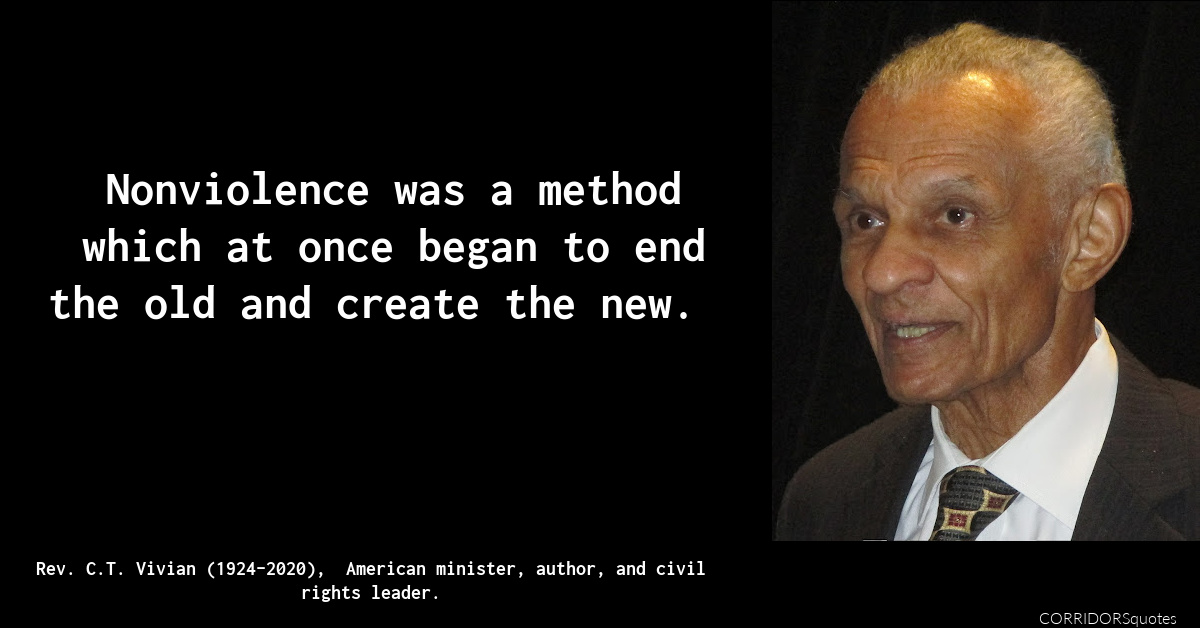
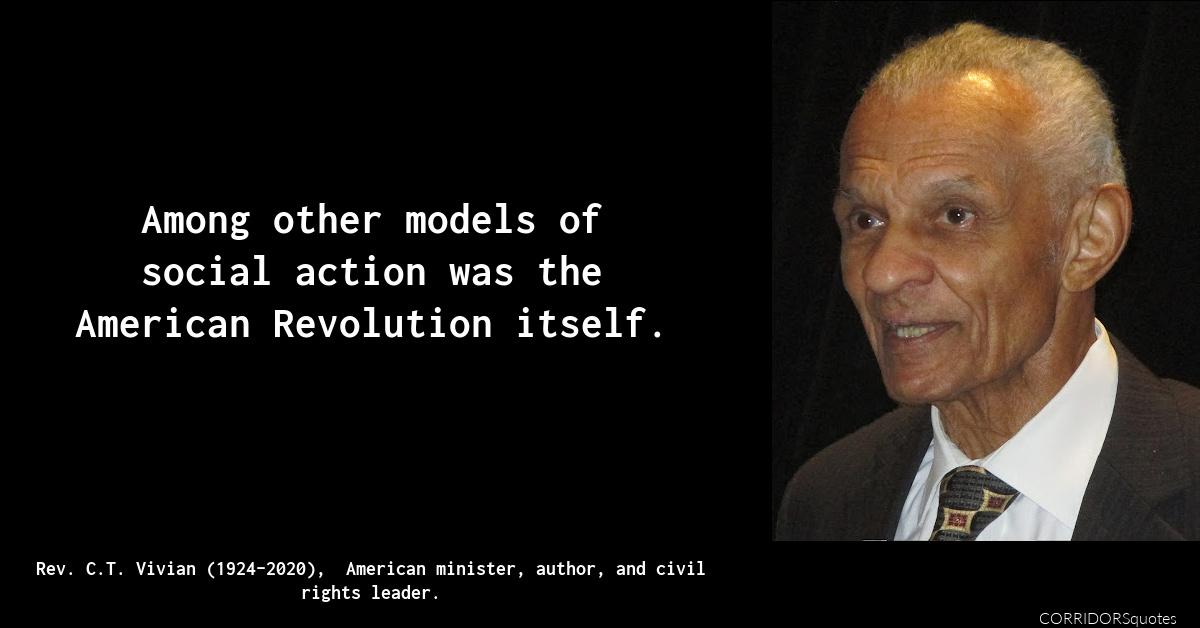
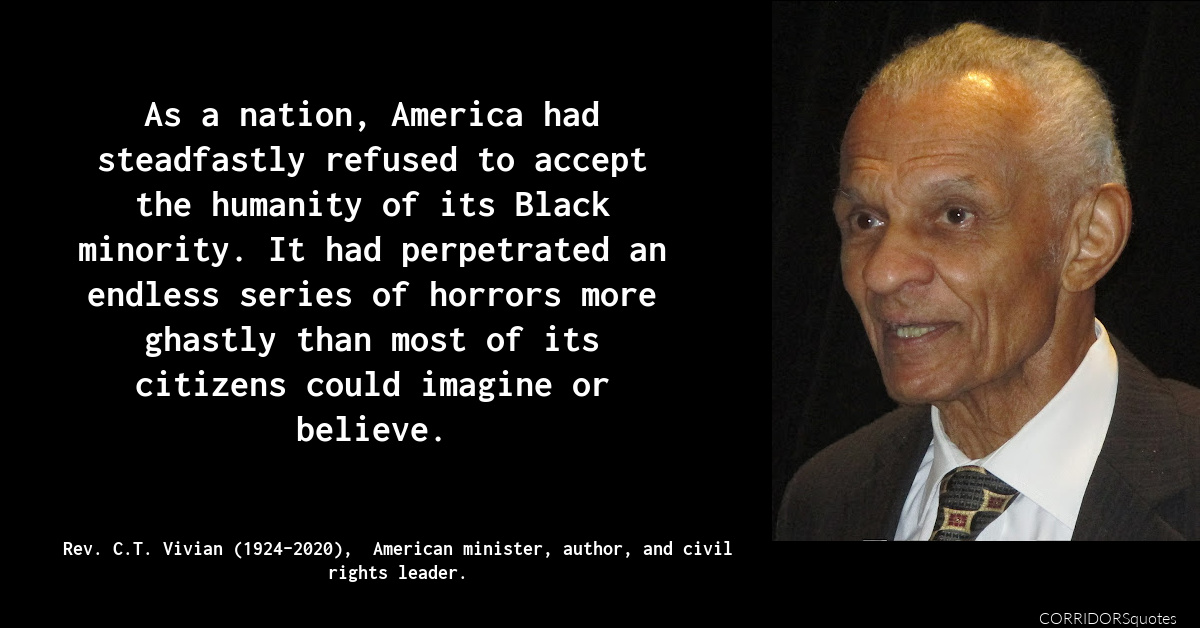
FEATURE image: Rev. C.T. Vivian. PHOTO: CC BY-SA 4.0
President Barack Obama delivers the 2013 Presidential Medal of Freedom to Cordy Tindell “C.T.” Vivian, during a ceremony in the East Room of the White House, Nov. 20, 2013. (Official White House Photo by Lawrence Jackson)/ Public Domain.
America’s racial crisis was not fundamentally a Black problem but a moral, institutional, and historical failure of the nation itself. True freedom and justice require transforming the attitudes and structures that sustain racial inequality, and nonviolent action is the most powerful means of achieving that transformation.
Early Life and Foundations
Rev. C.T. Vivian died on July 17, 2020 at 95 years old. Rev. Vivian was born in Boonville, Missouri, and migrated as a child with his mother to Macomb, Illinois. Rev. Vivian grew up to attend Western Illinois University (WIU) in Macomb, Illinois, where he worked as the sports editor for the student newspaper. In 1987, decades after attending the university, Rev. Vivian received an honorary doctorate from WIU.
Entering the Civil Rights Arena
Rev. Vivian’s career as an activist began in Peoria, Illinois, where, in 1947, he participated in sit-in demonstrations to successfully integrate Barton’s Cafeteria. Soon after, he served with Rev. Dr. Martin Luther KIng, Jr. and joined Dr. King’s executive staff. In that capacity, Rev. VIvian served as the national director of affiliates for the Southern Christian Leadership Conference (SCLC).
Evaluating Black Power and the Christian Faith
In the mid1960’s Rev. Vivian organized and directed efforts to re-evaluate activist networks and goals and the ideology and practice of Black Power, as well as the role of Christian faith among its participants.
The Urban Training Center and “The Plunge”
In 1965, Rev. C.T. Vivian became Director of Fellowships and Internships of the Urban Training Center (UTC) for Christian Mission in Chicago. Founded with a grant from the Ford Foundation in 1963 to train African American Christian pastors and organizers—Rev. Jesse Jackson was among the first 19 men trained under Rev. Vivian’s program at the UTC in its first year—the organization considered new dimensions to protest movements in Chicago concerned with Black power, Black identity and Black unity.
By means of lectures, readings, discussions and nonviolent training exercises such as “the Plunge” where participants had to survive on their own for seven days without access to housing, food, or other resources, the organization existed to help its participants to seek ways to take power from structures which affect their lives particularly on the West and South Sides of Chicago.
Authoring the Post-King Era
In 1970, following the assassination of Dr. King in 1968, Rev. Vivian became the first of Dr. King’s staff to write a book based on his experiences in the civil rights movement. Rev. Vivian’s book was entitled Black Power and the American Myth.
Theological Leadership and Community Banking
Rev. Vivian eventually became director of the Urban Theological Institute at Atlanta’s Interdenominational Theological Center, a consortium of African-American seminaries. He was also board chair of Capitol City Bank, a minority-owned bank founded in 1995 that focused on loans for underserved areas. With eight branches in metro Atlanta, Capitol City Bank closed in 2015.
A Legacy of Youth Leadership and National Honors
Through the C.T. Vivian Leadership Institute founded in 2008, Rev. Vivian continued to do the kind of work he did in Chicago in the 1960’s which was facilitating mainly youth who were seeking discerned strategies for their material and spiritual goals. On behalf of at-risk youth and college graduates, Rev. Vivian fostered innovative leadership for their career development in the 21st century. In 2012, Rev. Vivian returned to serve as interim President of the Southern Christian Leadership Conference and, in 2013, President Obama awarded Rev. Vivian the Presidential Medal of Freedom.
Nonviolence was both strategy and transformation. Rev. C.T. Vivian presents nonviolence as a source of power that confronts fear with courage and hate with love while simultaneously creating a new social order.
To all who accepted it, nonviolence offered new power. It pitted calm courage against frantic fear. It set the action of love against the reaction of hate.Nonviolence was a method which at once began to end the old and create the new.America was born as a revolutionary nation.The United States began with a struggle for civil rights. The specific issue – taxation without representation – was merely a focus for the larger question of whether or not a dominant majority would continue to exploit a subject minority. The American colonists decided that this oppression was not tolerable.Among other models of social action was the American Revolution itself.The question always before the Black man was: What must I do to be free?
Martin Luther King Jr. elevated civil rights into a moral issue. According to Rev. Vivian, Dr. King moved the struggle beyond economics and politics and placed it within a moral and spiritual framework.
It was Martin Luther King who removed the Black struggle from the economic realm and placed it in the moral and spiritual context.When Martin Luther King emerged, he raised the issues from the pragmatic to the sublime.As a nation, America had steadfastly refused to accept the humanity of its Black minority. It had perpetrated an endless series of horrors more ghastly than most of its citizens could imagine or believe
Racism was created to justify injustice. C.T. Vivian believed that racism developed as a rationalization for slavery and exploitation, allowing Americans to reconcile oppression with their conscience.
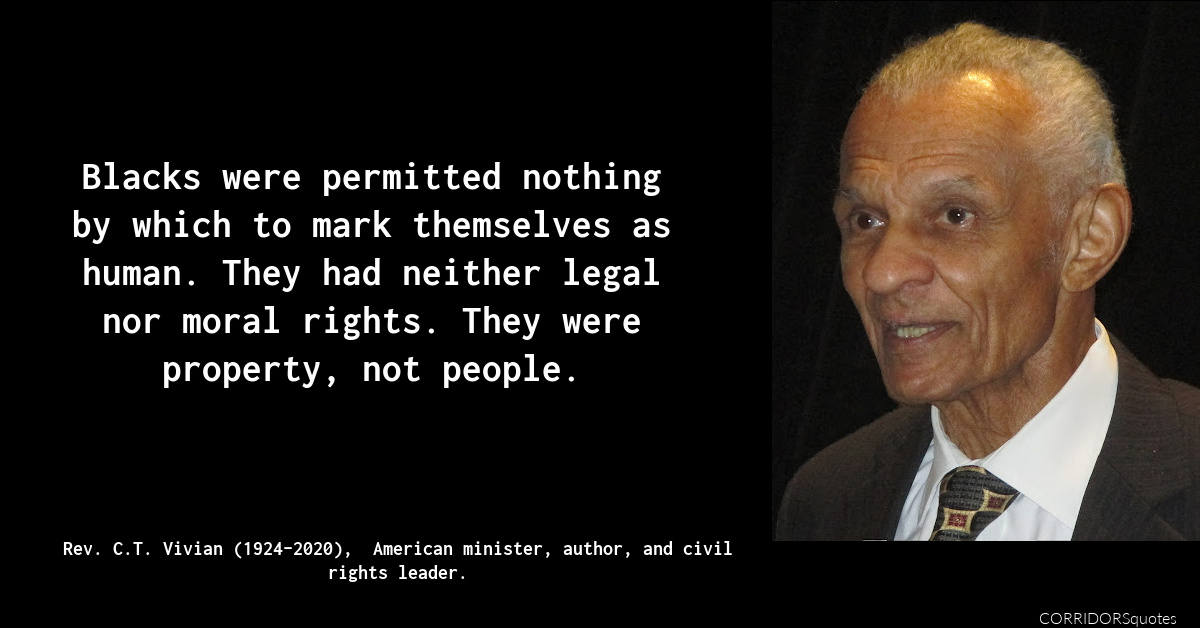
Racism began as rationalization. It began as a justification of the white man’s injustice to the Black. The greed that brought Black men into slavery was not alone enough to make the institution bearable to the white conscience.The Blacks who were brought to this country as slaves were systematically stripped of all cultural ties…Nor were they allowed to develop new institutions to replace the old. They were not permitted to read or write.White Americans had to become racists or John Browns…There were many more whites of John Brown’s persuasion than is commonly known. The annals of Southern history document the executions of scores of whites accused of fomenting Black revolt. Today bigotry most often shows itself as blind indifference and willful ignorance rather than as racist activism.During the time of slavery abolitionists were accused of violence for merely ADVOCATING an end to slavery, while the steady falling of the overseer’s lash went unquestioned as a necessary fact of life.Blacks were permitted nothing by which to mark themselves as human. They had neither legal nor moral rights. They were property, not people.Although the Constitution had been amended to declare him a citizen, the Black was neither considered to be, nor treated as, a man.
The larger problem was white society and its institutions. Drawing on Gunnar Myrdal, Rev. Vivian contends that America did not have a “Negro problem” but a “white problem,” requiring change in majority attitudes and institutions.
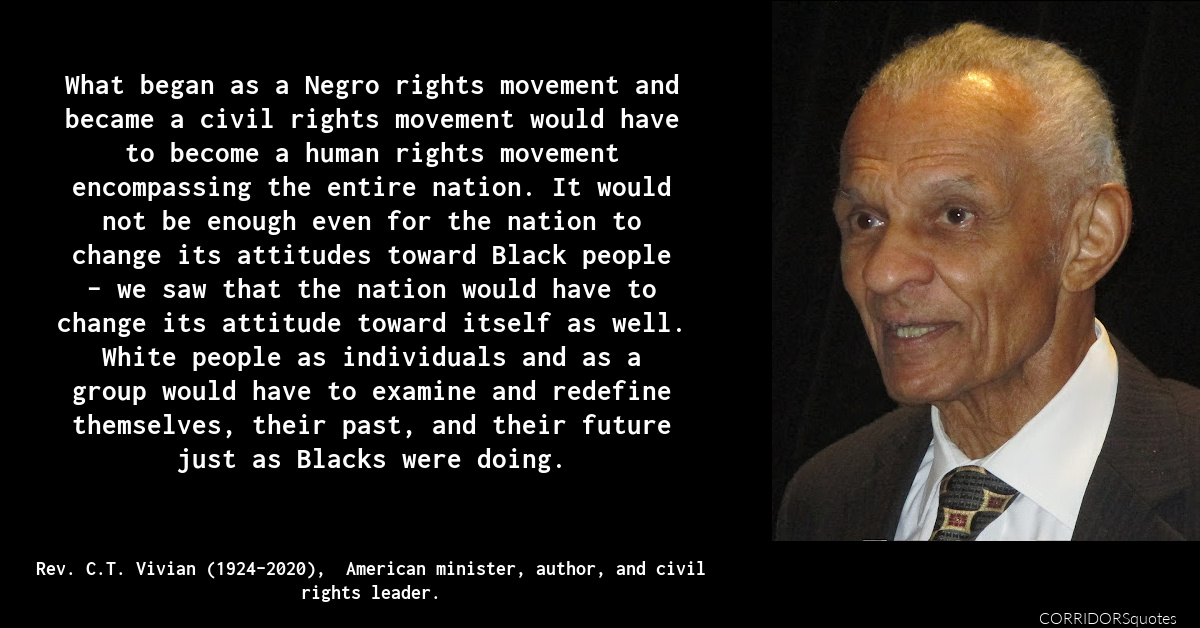
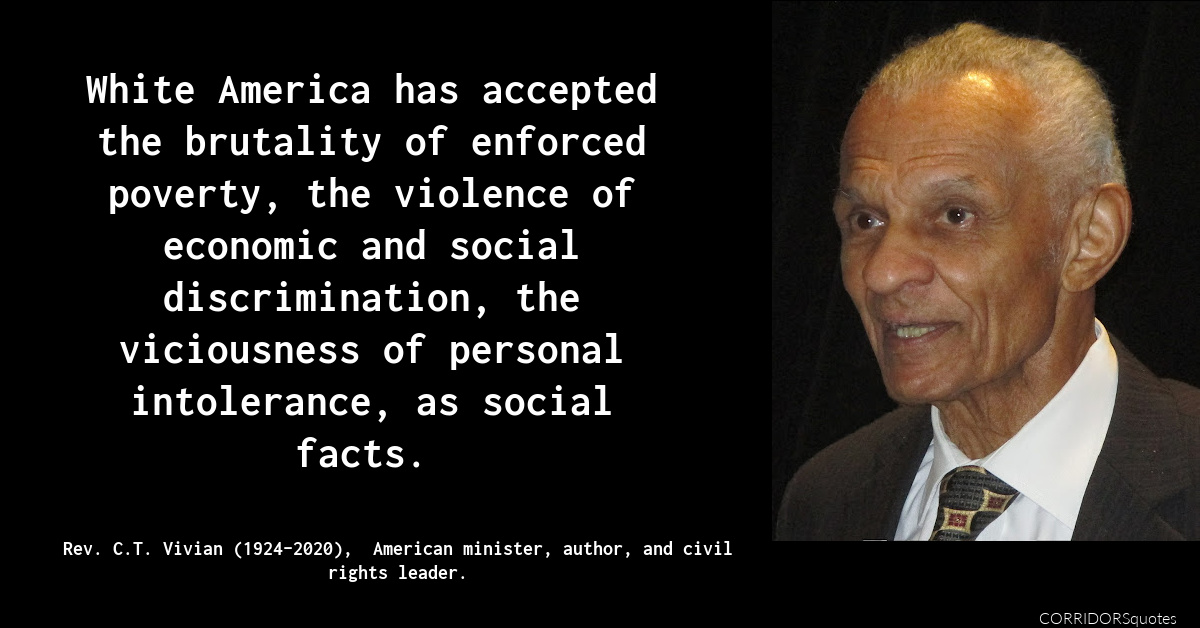
We were continually warned about “backlash”—which is what white people do when Black people fail to “stay in their place.”What began as a Negro rights movement and became a civil rights movement would have to become a human rights movement encompassing the entire nation. It would not be enough even for the nation to change its attitudes toward Black people – we saw that the nation would have to change its attitude toward itself as well. White people as individuals and as a group would have to examine and redefine themselves, their past, and their future just as Blacks were doing.As Gunnar Myrdal pointed out in his classic study AN AMERICAN DILEMMA, this country does not have a Negro problem, it has a white problem. Changing the white majority, their attitudes and their institutions, is basic to any solution to “racial strife.”White America has accepted the brutality of enforced poverty, the violence of economic and social discrimination, the viciousness of personal intolerance, as social facts.Even the Black church, which has been the closest thing in most communities to be a truly independent Black institution, has largely failed to deal with the facts of Black America. The church has taught that Blacks were human. But that they would only enjoy its privileges after death.John Calhoun voiced the typical slaveholder’s view when he said freedom for whites was impossible without the enslavement of Blacks.
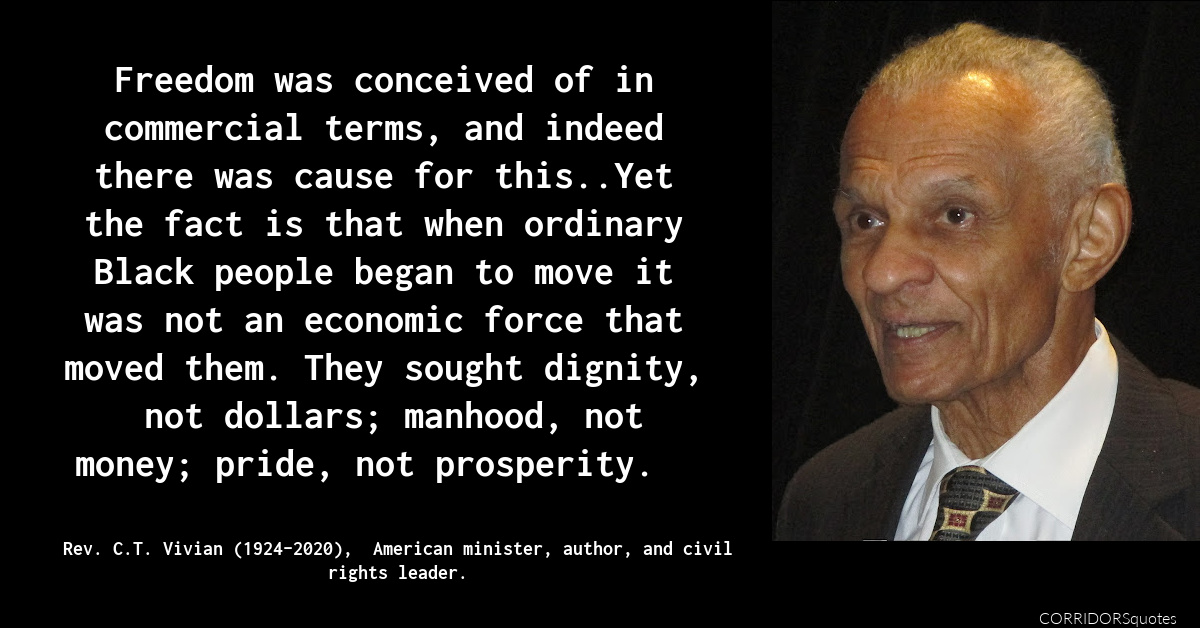
The Black freedom struggle was about dignity, not merely economics. Vivian argues that Black Americans sought “dignity, not dollars; manhood, not money; pride, not prosperity.” The movement was fundamentally a human and moral struggle.
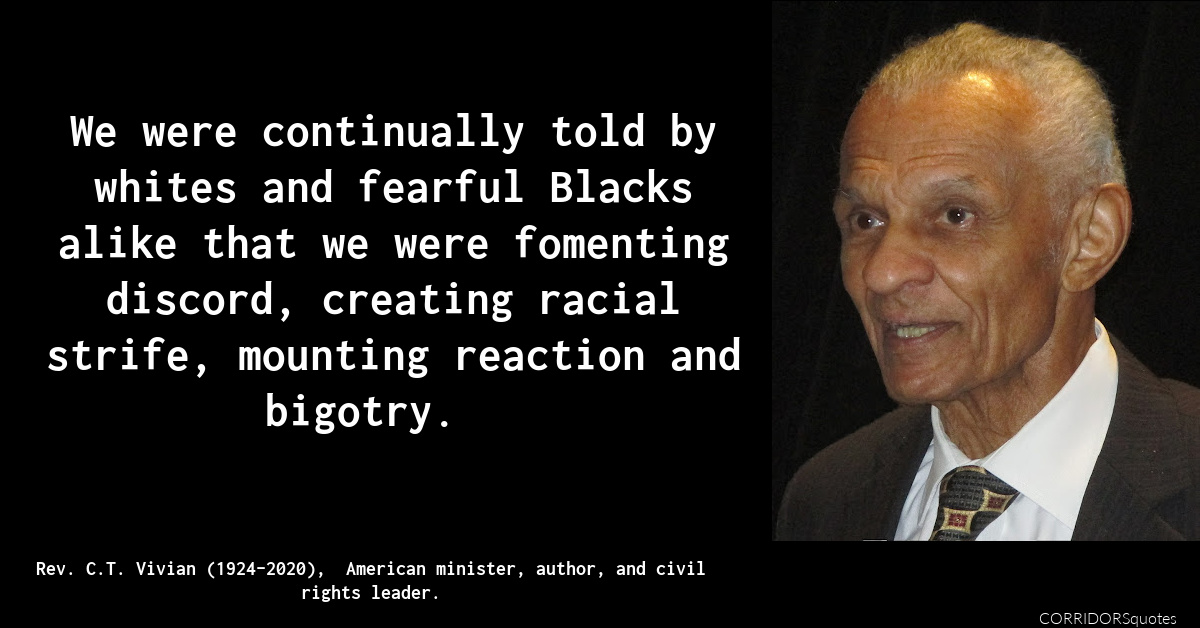
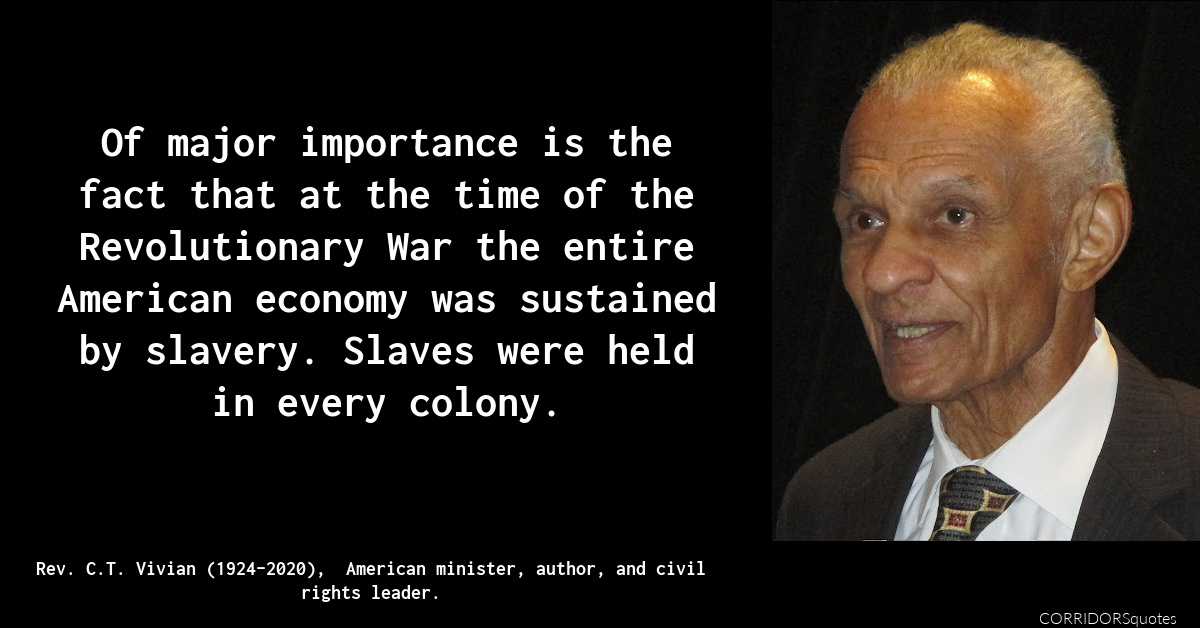
Freedom was conceived of in commercial terms, and indeed there was cause for this..Yet the fact is that when ordinary Black people began to move it was not an economic force that moved them. They sought dignity, not dollars; manhood, not money; pride, not prosperity.We were continually told by whites and fearful Blacks alike that we were fomenting discord, creating racial strife, mounting reaction and bigotry.Blacks had to come to see themselves as masters of their own fate, masters of their secular destiny as well as their spiritual destiny.When white people find filth in the streets of their neighborhood they quite properly call city hall and complain, and it is removed. But when the same whites (and warped Blacks) find filth in the ghetto streets, they call for a clean-up campaign by ghetto residents.These facts — (of economic discrimination, infant mortality rate, malnutrition) and all the others which describe the Black condition — we knew well. Our problem was to make the rest of the nation understand them.In 1964, the Small Business Administration reviewed its past ten years and reported that it had made seven loans to Blacks during that time –seven in ten years. This record is typical of most banks, savings and loans companies, and other financial institutions, which provide the capital that allows people to enter the commercial world.We saw that the failure to admit Blacks to the society had created a permanent ambivalence within the nation, an ambivalence which warped everything that the nation did. Even the simple facts of history had been so twisted that it was impossible for most Americans to understand what happened to their land or why they had arrived at the crisis they were facing.The first permanent non-Indian settlers in what is now the United States were not whites seeking religious freedom but Blacks seeking physical freedom. These people came here as slaves with an ill-fated Spanish colonial venture. They rebelled and sought refuge with the Indians. The Spanish left and the Blacks remained. This took place more than a hundred years before the landing of the Mayflower.Of major importance is the fact that at the time of the Revolutionary War the entire American economy was sustained by slavery. Slaves were held in every colony.For Blacks were not the only ones oppressed by slavery. Whites were also brutalized by their inability to escape from slavery. In the South this was especially clear. A police state was created and the entire population lived in terror of a slave uprising.
Justice is indivisible. Injustice anywhere threatens everyone: “When there is no justice for ALL, then there is no justice at all.”
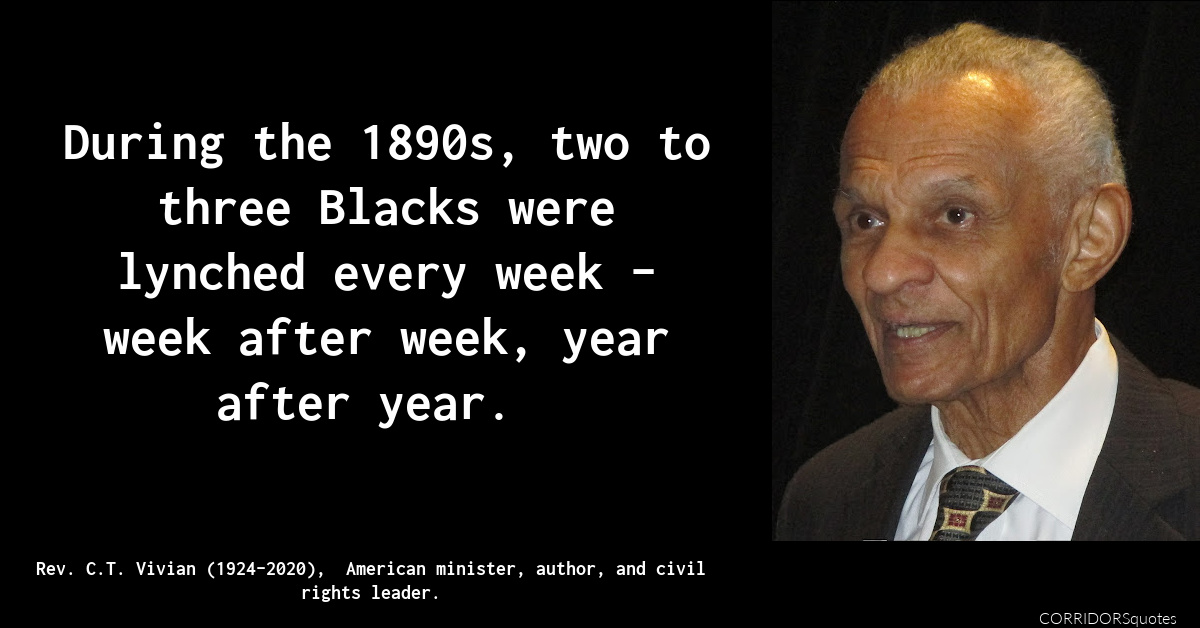
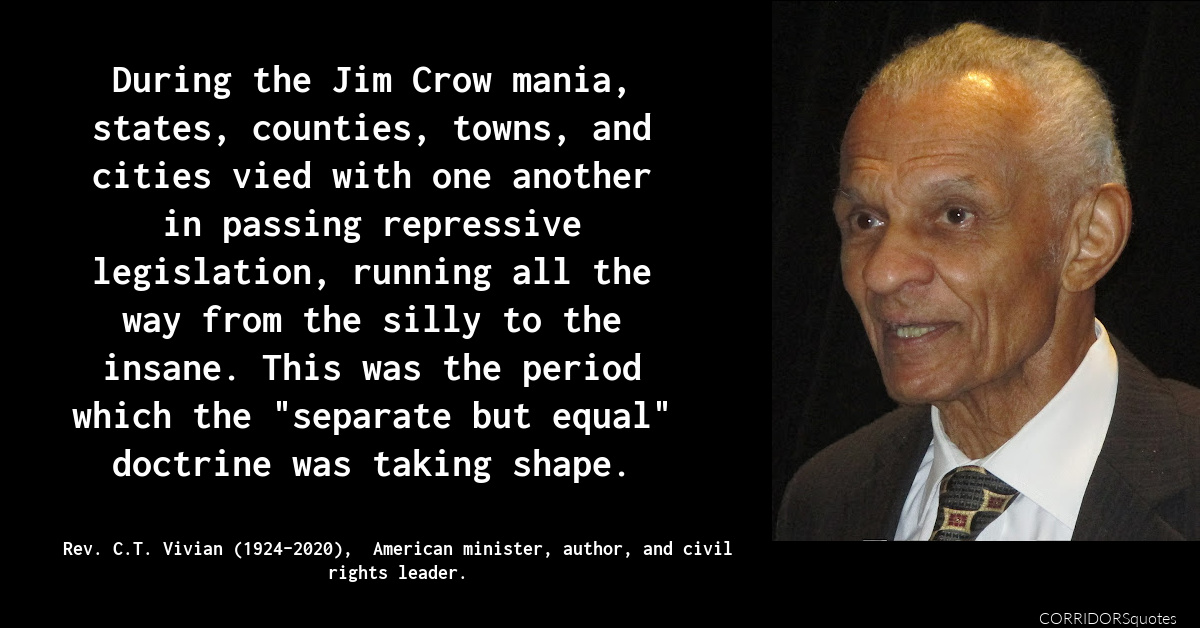
During the 1890s, two to three Blacks were lynched every week – week after week, year after year.In the Dred Scott decision of 1857…the Supreme Court explained that the phrase “the people of the United States” in the Constitution was never meant to include Blacks.Congress…created the Freedmen’s Bureau, an agency designed to make the ex-slaves participants in the national economy. Much good work was done by the Bureau.Millions of Americans suffered from misplaced hatreds. The classic example is the poor white Southerner who has been pitted against Blacks by the powerful men who exploit them both.Most of the antislavery agitation in the United States came from poor whites in the South. These people saw that slavery kept THEM in bondage by allowing planters to control all the best land and manipulate the markets to their own advantage.One reactionary Supreme Court decision interpreted the Fourteenth Amendment as having granted the privilege of national citizenship, but not necessarily state citizenship. This gave Blacks rights such as access to seaports, but left questions of education, suffrage, and employment up to the states.During the Jim Crow mania, states, counties, towns, and cities vied with one another in passing repressive legislation, running all the way from the silly to the insane. This was the period which the “separate but equal” doctrine was taking shape.When there is no justice for ALL, then there is no justice at all. Some may be favored, but none are safe.
Legal victories alone were insufficient. Court decisions and legislation mattered, but Rev. Vivian argues they often failed to produce meaningful changes in everyday Black life.
Ironically, it is America’s firm commitment to equalitarian ideals which makes the race question so intense.In the Fifteenth Amendment, the government officially forbade the denial of voting rights because of “race, color, or previous condition of servitude.” And having done this, the government washed its hands of the whole matter.The Civil Rights Act of 1965 was intended partly to enforce the Fifteenth Amendment, because no more than a tiny fraction of the Black population had ever actually been allowed to vote.Almost every public pronouncement concerning the condition of Blacks insisted that their situation was rapidly improving. But since Blacks were invisible to the white world, these questionable statements went unverified.Some of our leaders recommended movement through education…Others to industrial occupations…still other leaders counseled violence. Throughout the history of America we fought many times. Before emancipation there were over 250 slave conspiracies and revolts.
C.T. Vivian embodied action-oriented leadership. Highlights include his work with Martin Luther King Jr., the SCLC, and civil rights organizing, leadership development, and youth empowerment.
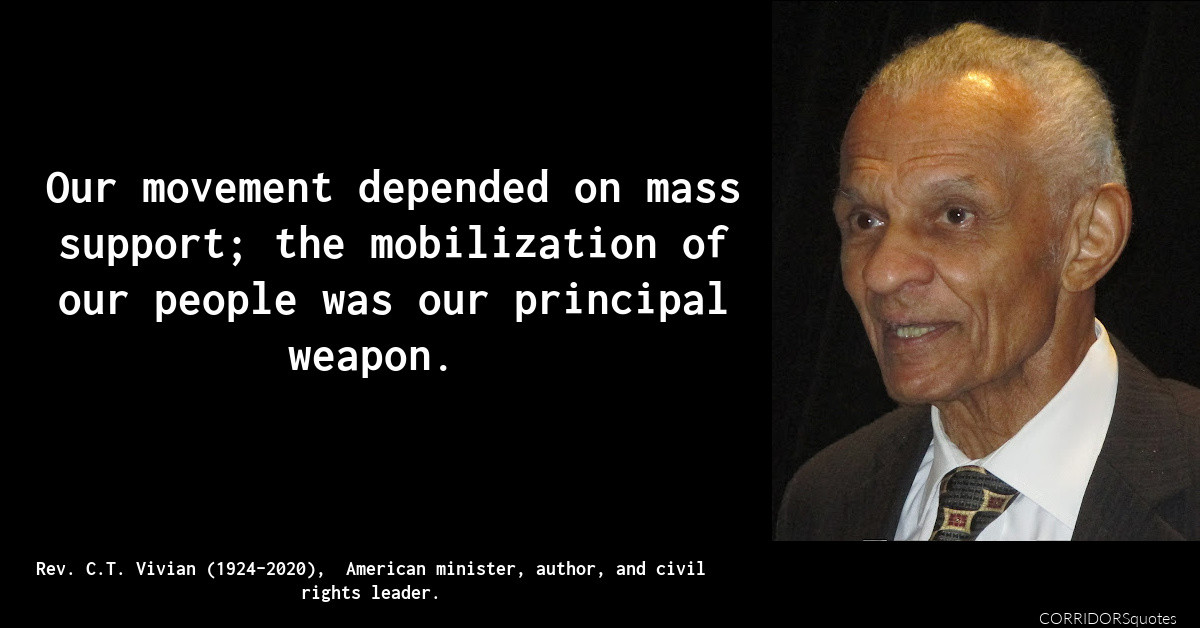
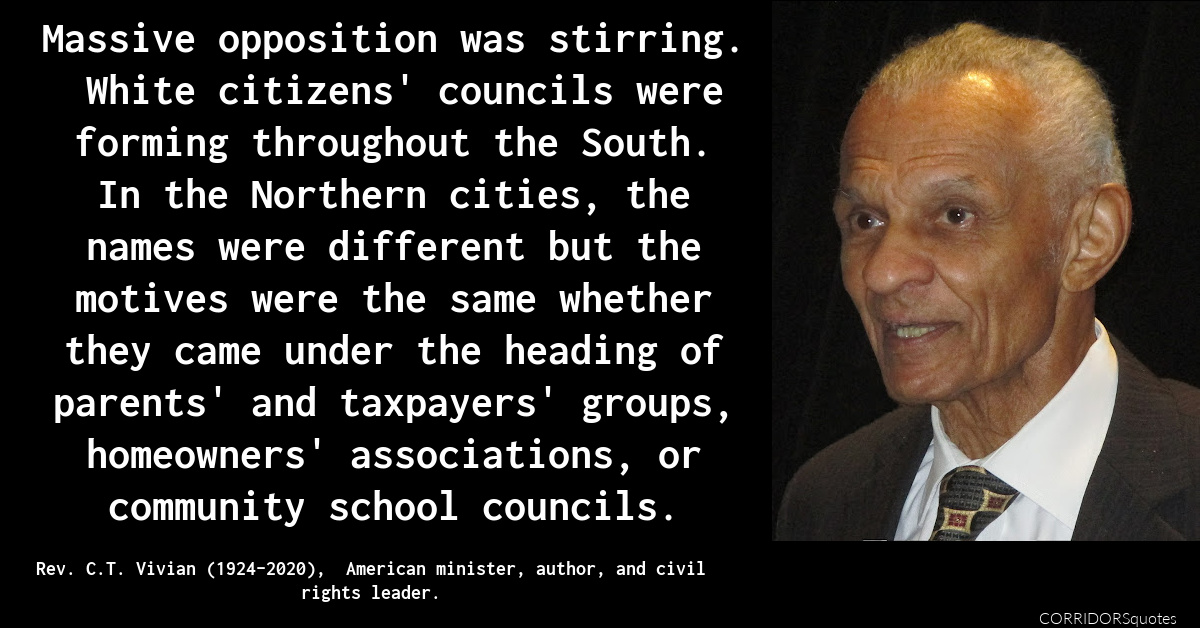
The Birmingham campaign of 1963 was the first large-scale test of the new method (of nonviolence). It was titled “Project C” – C for CONFRONTATION.When it became clear that we would not be crushed, official Birmingham accepted our demands—(1) desegregation of all public facilities, (2) hiring and upgrading of workers without discrimination, (3) the release of all jailed demonstrators, (4) the establishment of a permanent biracial committee to keep communications open between Blacks and whites.Our movement depended on mass support; the mobilization of our people was our principal weapon.White liberals also touted the success gained through legal action. But important as court battles have been, they failed to make any basic change in the lives of most Blacks.Ten years after the school desegregation cases of 1954, only 2.14% of the nearly 3 million Black children in Southern schools have been affected and were receiving anything like a desegregated education.As this protest reached massive proportions it became clear that those Americans who were not coming to realize the justice of the Black demands were closing their minds more permanently and more desperately to justice.Massive opposition was stirring. White citizens’ councils were forming throughout the South. In the Northern cities, the names were different but the motives were the same whether they came under the heading of parents’ and taxpayers’ groups, homeowners’ associations, or community school councils.Our accomplishments often bewildered us as much as our defeats.It was not until the riots began that we understood the extent of our failure. The message from the streets was that hundreds of years of Black appeals for justice would now give way to action.
Civil rights must evolve into human rights. The movement’s ultimate goal was not simply Black advancement but a transformation of the entire nation into a more just society.
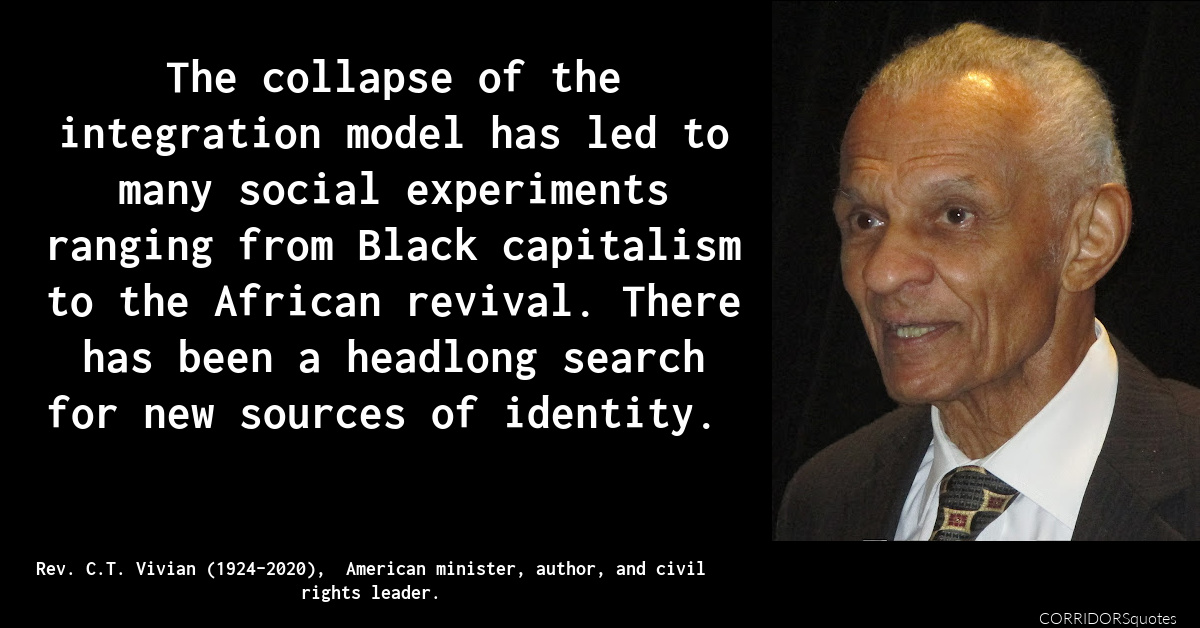
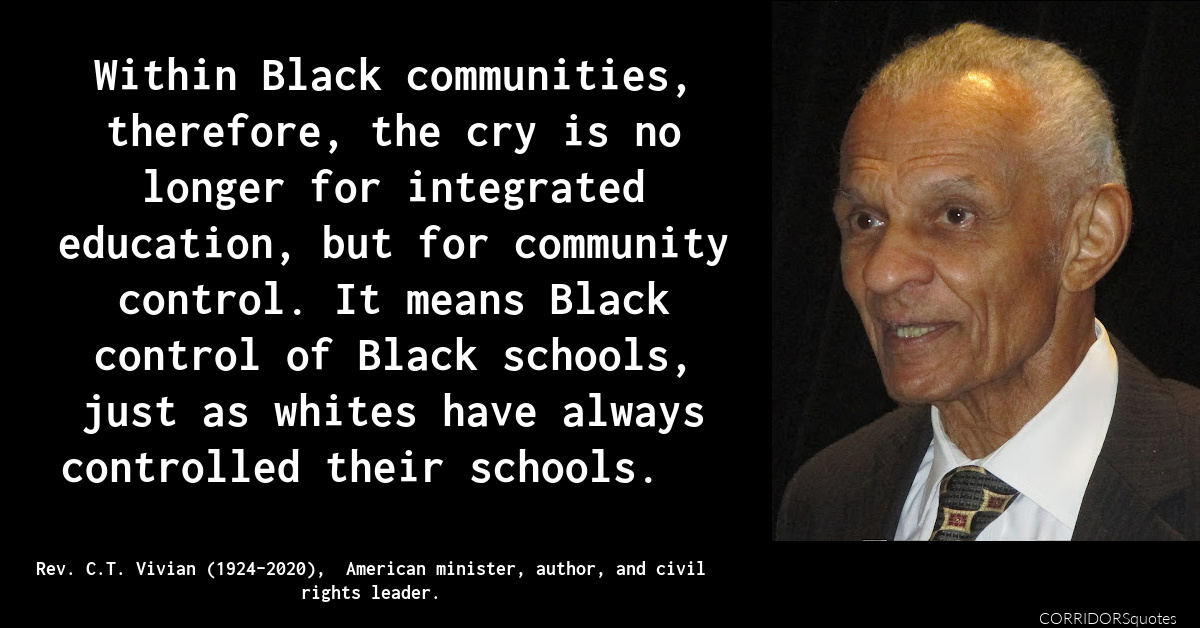
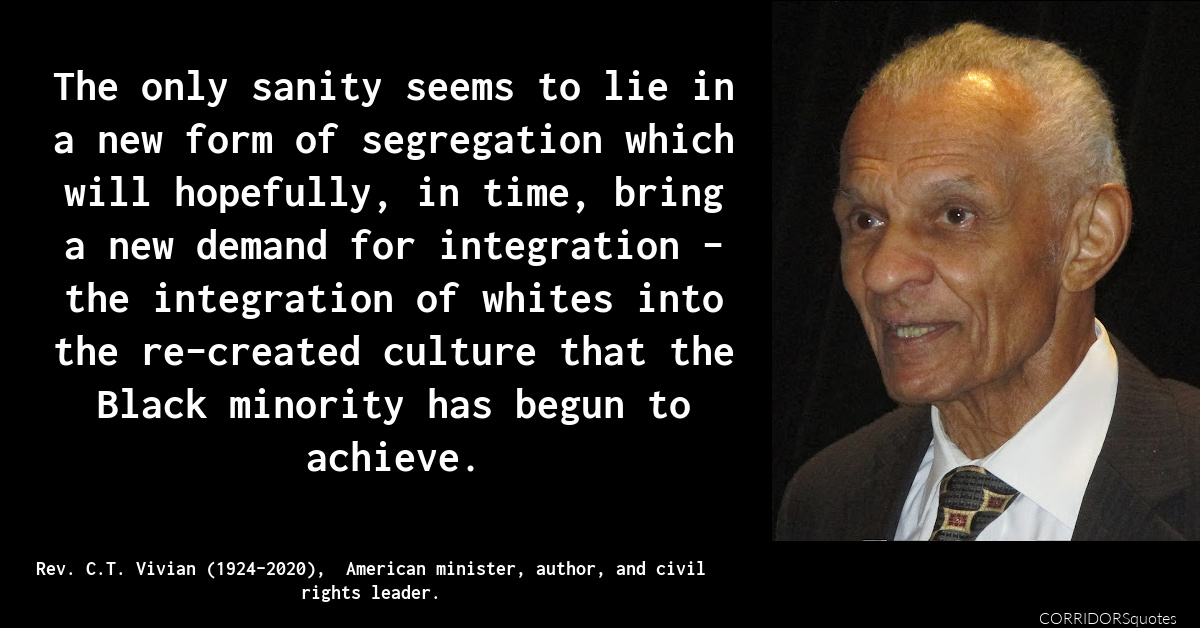
Genuine integration can never become a reality until both parties can live together as equals; and that will not happen until each sees the other as human, until each holds the same values upon which the entire culture can grow.Integration is dead. The concept and the experience, insofar as they were tried, have both failed because of the powerful racism of this society. Blacks, in response, have realized that they must develop their own distinctive culture.Black organizations that have organized around welfare have almost universally called for the abolishment of that system.Who then really WANTS the welfare system? Who profits by it? Who perpetuates it? It is, of course, the people who RUN the system.It is those who ADMINISTER welfare who get the most money, not the recipients; it is the administrators who are most truly ON welfare. This point should always be remembered when they try to speak for the Black community.The collapse of the integration model has led to many social experiments ranging from Black capitalism to the African revival. There has been a headlong search for new sources of identity.Within Black communities, therefore, the cry is no longer for integrated education, but for community control. It means Black control of Black schools, just as whites have always controlled their schools.In a few cases there have even been beginning attempts at coalition between bigots and Blacks in opposition to the white liberals who refuse to give up the rubric of integration.Some segments of the Black movement are concerning themselves specifically with the creation and re-creation of Black culture. Others have found inspiration in such international movements as socialism.The only sanity seems to lie in a new form of segregation which will hopefully, in time, bring a new demand for integration – the integration of whites into the re-created culture that the Black minority has begun to achieve.
Most brief, educationally distinct citations come from C.T. Vivian’s Black Power and the American Myth.
FEATURE image: This historic photograph captures the August 28, 1963 meeting between President John F. Kennedy and civil rights leaders in the White House Oval Office immediately following the March on Washington for Jobs and Freedom. The photograph (left to right) includes Willard Wirtz (U.S. Secretary of Labor), Floyd McKissick (National Chairman of the Congress of Racial Equality, CORE), Mathew Ahmann (Executive Director of the National Catholic Conference for Interracial Justice), Whitney Young (Executive Director of the National Urban League), Dr. Martin Luther King Jr. (President of the Southern Christian Leadership Conference, SCLC), John Lewis (Chairman of the Student Nonviolent Coordinating Committee, SNCC), Rabbi Joachim Prinz (President of the American Jewish Congress), A. Philip Randolph (Director of the March on Washington and veteran labor leader), President John F. Kennedy, Vice President Lyndon B. Johnson, Walter Reuther (President of the United Automobile Workers, UAW), Roy Wilkins (Executive Secretary of the National Association for the Advancement of Colored People, NAACP). Public Domain.
The real historical significance of August 28, 1963, did not end with Martin Luther King Jr.’s “I Have a Dream” speech or the March on Washington itself, but continued inside the White House during a 72-minute strategy session between President John F. Kennedy and civil rights leaders. The meeting was not merely ceremonial. It served as a critical discussion about political strategy, legislative priorities, jobs, education, urban poverty, and the future of the civil rights movement, helping shape the path toward the Civil Rights Act of 1964.
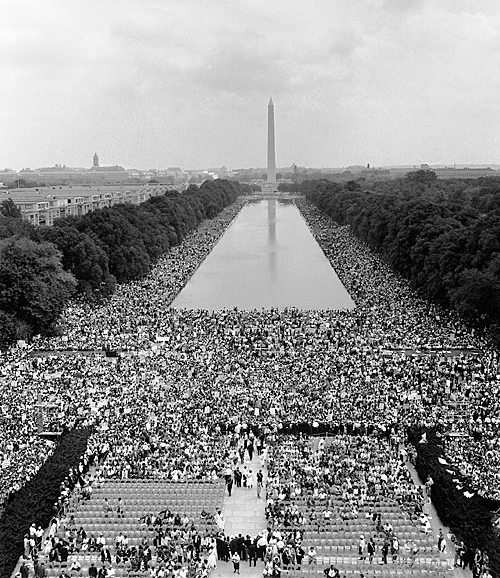
Fig. 1. Hundreds of thousands descended on Washington, D.C.’s Lincoln Memorial, August 28, 1963. (U.S. Government Photo.) Public Domain. Sensing a national breakthrough for civil rights, Rev. Dr. Martin Luther King, Jr. joined civil rights leaders to plan a March on Washington for Wednesday, August 28, 1963. The great march filled the VIP section at the Lincoln Memorial and the National Mall to past the Washington Monument, a distance of almost one mile. The March on Washington is remembered for King’s “I Have a Dream” speech and the massive crowd’s hopeful jubilation. The meeting with President John F. Kennedy afterwards was more than a polite courtesy call to the White House–it helped coordinate political strategy for the movement that would have concrete ramifications for the Civil Rights Act of 1964 following Kennedy’s death.
Kennedy’s Reaction to the March
President John F. Kennedy watched the March on Washington, including Martin Luther King Jr.’s “I Have a Dream” address, on television from the White House. Though both men were relatively young, King at 34 and Kennedy at 46, they shared a maturity and sensitivity that often contrasted with their public images. King, in particular, was uncomfortable with the intense attention focused on him after his speech at the Lincoln Memorial.
When civil rights leaders arrived at the White House Cabinet Room later that day, Kennedy greeted King with a smile and the words, “I have a dream,” repeating the line that had so impressed him only hours earlier. King brushed aside the compliment and instead asked what the president thought of Walter Reuther’s speech, which had criticized America’s commitment to freedom abroad while failing to fully secure it at home. Kennedy answered dryly, “Oh, I’ve heard Walter plenty of times.”
Fig. 2.Civil Rights March on Washington, D.C. (Leaders of the march posing in front of the statue of Abraham Lincoln, Lincoln Memorial.) (Photograph by Rowland Scherman, U.S. Information Agency, National Archives and Records Administration.) Public Domain. Civil Rights leaders in this group photograph at the Lincoln Memorial followed up the March on Washington with a visit to the White House to meet President Kennedy. Seated left to right:National Urban League executive director Whitney Young (1921-1971); chairman of the Demonstration Committee Cleveland Robinson (1914-1995); labor union leader A. Philip Randolph (1889-1979); Dr. Rev. Martin Luther King, Jr. (1929-1968); National Association for the Advancement of Colored People (NAACP) leader Roy Wilkins (1901-1981). Standing left to right: director of the National Catholic Conference for Interracial Justice Matthew Ahmann (1931-2001); Rabbi Joachim Prinz (1902-1998);Student Nonviolent Coordinating Committee (SNCC) leader John Lewis (1940-2020); Rev. Eugene Carson Blake (1906-1985); Floyd McKissick (1922-1991); labor union leader Walter Reuther (1907-1970).
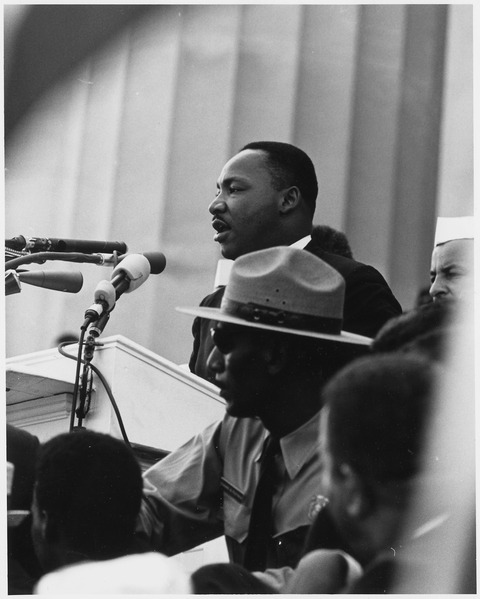
Fig. 3.Martin Luther King, Jr., speaking from the Lincoln Memorial during the March on Washington. (Photograph by Rowland Scherman, U.S. Information Agency, National Archives and Records Administration.) Public Domain. Rev. Dr. Martin Luther King, Jr., speaking at the March on Washington from the Lincoln Memorial on August 28, 1963. Following the successful march for jobs and freedom, civil rights leaders went to the White House to visit with President Kennedy and pushed measures to strengthen the Civil Rights bill.
Civil Rights Priorities
Although King and Kennedy spoke only briefly, the meeting quickly turned to policy. Kennedy and Roy Wilkins talked at length about strengthening the pending civil rights bill in light of the march’s peaceful success. Meanwhile, King moved down the line to stand near John Lewis, the 23-year-old chairman of the Student Nonviolent Coordinating Committee (SNCC).
Civil rights leaders pressed for stronger protections in the civil rights bill, including a ban on racial discrimination in employment. They also warned Kennedy about accelerating automation, which threatened to reduce job opportunities, and described worsening conditions in urban Black communities. Leaders highlighted soaring school dropout rates among Black teenagers and a growing sense of alienation among young African Americans.
A. Philip Randolph told the president that the entire current generation of young Blacks “had no faith” in whites. They also dismissed Black leadership, government and God. To them, he said, American society offered little beyond despair.
The Debate Over Federal Action
The activists also urged Kennedy to restore a provision removed from the 1957 Civil Rights Act that would give the Attorney General broader authority to investigate and pursue civil rights violations.
Kennedy replied that he and Attorney General Robert Kennedy had already examined unemployment and school dropout problems in cities such as Chicago and New York. He argued that community leadership also had a responsibility to encourage educational achievement.
“It seems to me,” Kennedy said, “with all the influence that all you gentlemen have in the Negro community that we could emphasize educating children, making them study, making them stay in school and all the rest.”
Despite the bill’s narrow prospects in Congress, Roy Wilkins countered that the Speaker of the House had assured him an even stronger civil rights bill could pass the House and help pressure the Senate to act. Wilkins urged President Kennedy to go over the heads of congressional opponents and lead a national crusade to win voter approval for the civil rights measures.
Kennedy rejected that strategy. He argued that civil rights had to remain a bipartisan cause and warned that a partisan campaign could undermine Democratic support in the South while allowing Republicans to claim credit for supporting civil rights. He also complained that both parties were engaging in “treacherous” political maneuvering that complicated passage of the legislation. Any add-ons now to the civil rights bill joined existing legislation that was already on the brink of defeat in the Democrat-controlled Senate and too close to call in a Democrat-controlled House.
In the tension between moral urgency and political pragmatism, civil rights leaders pressed Kennedy to act more boldly, while Kennedy focused on the difficult realities of congressional politics and bipartisan support.
White House, August 28, 1963, meeting with President Kennedy after the march.
Reuther Challenges the President
The sharpest exchange came from Walter Reuther.
“You can’t escape this problem,” the labor leader warned. “There are two ways of resolving it, either by reason or riots.”
Reuther argued that racial conflict would not be confined to historic battlefields like Gettysburg but would erupt in neighborhoods, workplaces, and communities across the country. He also criticized Kennedy’s governing style, calling it a “seminar” approach in which meetings produced too little action. Reuther contrasted Kennedy with Vice President Lyndon B. Johnson, whose governing style as Majority Leader he praised where he relentlessly pushed difficult legislation through Congress. by “jawbone[ing]” an issue until he got “difficult things done.”
Throughout much of the debate, King remained silent. When he finally spoke, he suggested that if Kennedy led a civil rights crusade, perhaps former Republican President Dwight D. Eisenhower could join it, transforming the effort into the bipartisan movement Kennedy desired.
Kennedy immediately dismissed the idea.
“No, it won’t,” he replied.
King answered with a playful jab: “Doesn’t President Eisenhower happen to be in the other denomination?”
Rev. Eugene Blake and the Eisenhower Idea
King’s remark referred to Rev. Eugene Blake, Eisenhower’s pastor, who was present in the Cabinet Room. Blake had been the only white speaker at the March on Washington. He had previously been arrested during a civil rights demonstration in Baltimore and had spent time in jail for the cause.
Earlier that day Blake had declared from the march platform, “We come late, late we come, in the reconciling and repentant spirit.” The Protestant clergyman supported both civil rights and economic justice for African Americans while avoiding the more revolutionary language favored by some activists.
Blake told Kennedy that Eisenhower might indeed be willing to help. The president seized on the suggestion and encouraged Blake to visit the former president in Gettysburg to explore what role he might play in advancing the civil rights bill.
“And include a Catholic and maybe a businessman or two,” Kennedy advised.
Then, pointing toward Reuther, he added with a grin, “And leave Walter in the background.”
The room chuckled. Shortly afterward, before leaving the meeting, Kennedy assured the group he would remain in contact in the months ahead as the civil rights bill moved forward.
SOURCES:
Branch, Taylor. Parting the Waters: America in the King Years 1954–63. New York: Simon & Schuster, 1988.
Garrow, David J. Bearing the Cross: Martin Luther King, Jr., and the Southern Christian Leadership Conference. New York: William Morrow and Company, 1986.
Fig. 4.Civil Rights March on Washington, D.C. (Aerial view of Washington Monument showing marchers.) (U.S. Information Agency photograph, National Archives and Records Administration.) Public Domain. On August 28, 1963, about 250,000 peaceful protesters descended on Washington, D.C. for the March on Washington for Jobs and Freedom. The march was one of the largest political rallies for human rights in United States history.
Harry Belafonte and Hollywood at the March on Washington
A Life of Achievement and Activism
Harry Belafonte (1927-2023) was born in New York City and died there at the age of 96. Over a remarkable career that spanned more than seventy years, he earned a Tony Award, an Emmy Award, and three Grammy Awards as both a pioneering singer and accomplished film actor. Beyond his entertainment career, Belafonte devoted himself to the struggle for civil rights and became one of the movement’s most visible and influential supporters.
Bringing Hollywood to History
Belafonte used his celebrity and influence to help unite the entertainment industry behind the civil rights cause. As plans were finalized for the March on Washington for Jobs and Freedom on August 28, 1963, he organized support from many of Hollywood’s biggest stars. To ensure a strong show of solidarity, Belafonte chartered a plane from Los Angeles to bring a group of prominent actors, entertainers, and artists to Washington, D.C.
Their presence highlighted the growing national support for the movement and demonstrated that the fight for equality extended well beyond political and civil rights circles into the highest levels of American popular culture.
The March on Washington
An estimated 200,000 to 250,000 people gathered in the nation’s capital for what became one of the most significant events in American history. The crowd filled the area around the Lincoln Memorial and stretched across the National Mall toward the Washington Monument, covering nearly a mile. Despite the enormous size of the gathering, the atmosphere was one of hope, optimism, and celebration.
It was from the steps of the Lincoln Memorial that Dr. Martin Luther King Jr. delivered his immortal “I Have a Dream” speech, a defining moment of the civil rights movement and one of the most celebrated speeches in American history.
Hollywood Stars in Attendance
Among the many entertainers who joined Belafonte at the march were Marlon Brando, Rita Moreno, James Garner, Tony Franciosa, Sammy Davis Jr., Joanne Woodward, Paul Newman, Susan Strasberg, Burt Lancaster, Robert Ryan, Gregory Peck, Anthony Quinn, James Baldwin, Lena Horne, Ruby Dee, Sidney Poitier, Charlton Heston, and numerous others.
Many of these performers actively supported civil rights causes, while others used their public stature to bring national attention to the movement’s goals. Their participation underscored the broad coalition that had gathered in Washington to advocate for racial equality, voting rights, employment opportunities, and social justice.
Meeting with President Kennedy
Following the march, Dr. King and several prominent civil rights leaders traveled to the White House to meet with President John F. Kennedy. During their discussions, they reviewed the significance of the day’s events, examined the challenges still facing African Americans, and discussed the future direction of the civil rights movement.
The meeting also touched on the legislative efforts that would eventually culminate in the Civil Rights Act of 1964. Although President Kennedy would not live to see its passage, the momentum generated by the March on Washington helped build public support for the landmark legislation that became law under President Lyndon B. Johnson.
A Lasting Legacy
Harry Belafonte’s role in the March on Washington reflected his belief that artists had a responsibility to use their influence in the service of justice. By bringing some of Hollywood’s most recognizable faces to the nation’s capital, he helped amplify the message of the civil rights movement and demonstrated the power of cultural figures to support social change. His contributions as both an entertainer and activist remain an enduring part of American history.
REMARKS BY HARRY BELAFONTE: “We are here to bear witness to what we know. We know that this country, America, to which we are committed, and which we love, aspires to become that country in which all men are free. We also know that freedom is not license. Everyone in a democracy ought to be free to vote. But no one has the license to oppress or demoralize another. We also know or we would not be here, that the American negro has endured for many generations in this country which he helped to build the most intolerable injustices. To be a negro in this country means several unpleasant things. In the Deep South it often means he is prevented from exercising his right to vote by all manner of intimidation up to and including death. This fact of intimidation is a great weight in the life of any negro and though it varies in degree it never varies in intent which is simply to limit, to demoralize and to keep in subservient status more than 20 million negro people. We are here, therefore, to protest this evil and make known our resolve to do everything we can possibly do to bring it to an end. As artists and as human beings we rejoice in the knowledge that human experience has no color and that excellence in any endeavor is the fruit of individual labor and love. We believe artists have a valuable function in any society since it is the artists who reveal society to itself. But any society that ceases to respect the human aspirations of all its citizens courts political chaos and artistic sterility. We need the energies of these people to whom we have for so long denied full humanity. We need their vigor, their joy, the authority which their pain has brought them and cutting ourselves off from them then we are punishing and diminishing ourselves. As long as we do so our society is in great danger. Our growth as artists is severely menaced and no American can boast of freedom since he cannot be considered an example of it. We are here then in an attempt to strike the chains of the ex-master no less than the ex-slave and to invest with reality that deep and universal longing which has sometimes been called the American Dream.”
Fig. 5. Leaders of the march leading marchers down the street. (U.S. Information Agency photograph, National Archives and Records Administration.) Public Domain.