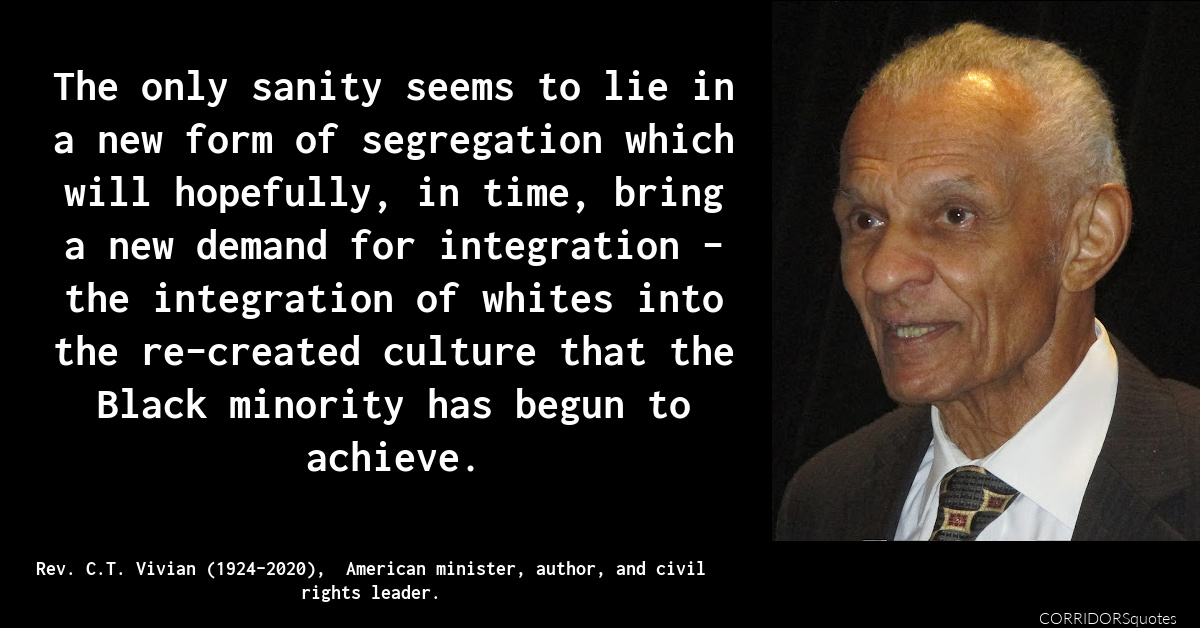
FEATURE image: Rev. C.T. Vivian. PHOTO: CC BY-SA 4.0
President Barack Obama delivers the 2013 Presidential Medal of Freedom to Cordy Tindell “C.T.” Vivian, during a ceremony in the East Room of the White House, Nov. 20, 2013. (Official White House Photo by Lawrence Jackson)/ Public Domain.
America’s racial crisis was not fundamentally a Black problem but a moral, institutional, and historical failure of the nation itself. True freedom and justice require transforming the attitudes and structures that sustain racial inequality, and nonviolent action is the most powerful means of achieving that transformation.
Early Life and Foundations
Rev. C.T. Vivian died on July 17, 2020 at 95 years old. Rev. Vivian was born in Boonville, Missouri, and migrated as a child with his mother to Macomb, Illinois. Rev. Vivian grew up to attend Western Illinois University (WIU) in Macomb, Illinois, where he worked as the sports editor for the student newspaper. In 1987, decades after attending the university, Rev. Vivian received an honorary doctorate from WIU.
Entering the Civil Rights Arena
Rev. Vivian’s career as an activist began in Peoria, Illinois, where, in 1947, he participated in sit-in demonstrations to successfully integrate Barton’s Cafeteria. Soon after, he served with Rev. Dr. Martin Luther KIng, Jr. and joined Dr. King’s executive staff. In that capacity, Rev. VIvian served as the national director of affiliates for the Southern Christian Leadership Conference (SCLC).
Evaluating Black Power and the Christian Faith
In the mid1960’s Rev. Vivian organized and directed efforts to re-evaluate activist networks and goals and the ideology and practice of Black Power, as well as the role of Christian faith among its participants.
The Urban Training Center and “The Plunge”
In 1965, Rev. C.T. Vivian became Director of Fellowships and Internships of the Urban Training Center (UTC) for Christian Mission in Chicago. Founded with a grant from the Ford Foundation in 1963 to train African American Christian pastors and organizers—Rev. Jesse Jackson was among the first 19 men trained under Rev. Vivian’s program at the UTC in its first year—the organization considered new dimensions to protest movements in Chicago concerned with Black power, Black identity and Black unity.
By means of lectures, readings, discussions and nonviolent training exercises such as “the Plunge” where participants had to survive on their own for seven days without access to housing, food, or other resources, the organization existed to help its participants to seek ways to take power from structures which affect their lives particularly on the West and South Sides of Chicago.
Authoring the Post-King Era
In 1970, following the assassination of Dr. King in 1968, Rev. Vivian became the first of Dr. King’s staff to write a book based on his experiences in the civil rights movement. Rev. Vivian’s book was entitled Black Power and the American Myth.
Theological Leadership and Community Banking
Rev. Vivian eventually became director of the Urban Theological Institute at Atlanta’s Interdenominational Theological Center, a consortium of African-American seminaries. He was also board chair of Capitol City Bank, a minority-owned bank founded in 1995 that focused on loans for underserved areas. With eight branches in metro Atlanta, Capitol City Bank closed in 2015.
A Legacy of Youth Leadership and National Honors
Through the C.T. Vivian Leadership Institute founded in 2008, Rev. Vivian continued to do the kind of work he did in Chicago in the 1960’s which was facilitating mainly youth who were seeking discerned strategies for their material and spiritual goals. On behalf of at-risk youth and college graduates, Rev. Vivian fostered innovative leadership for their career development in the 21st century. In 2012, Rev. Vivian returned to serve as interim President of the Southern Christian Leadership Conference and, in 2013, President Obama awarded Rev. Vivian the Presidential Medal of Freedom.
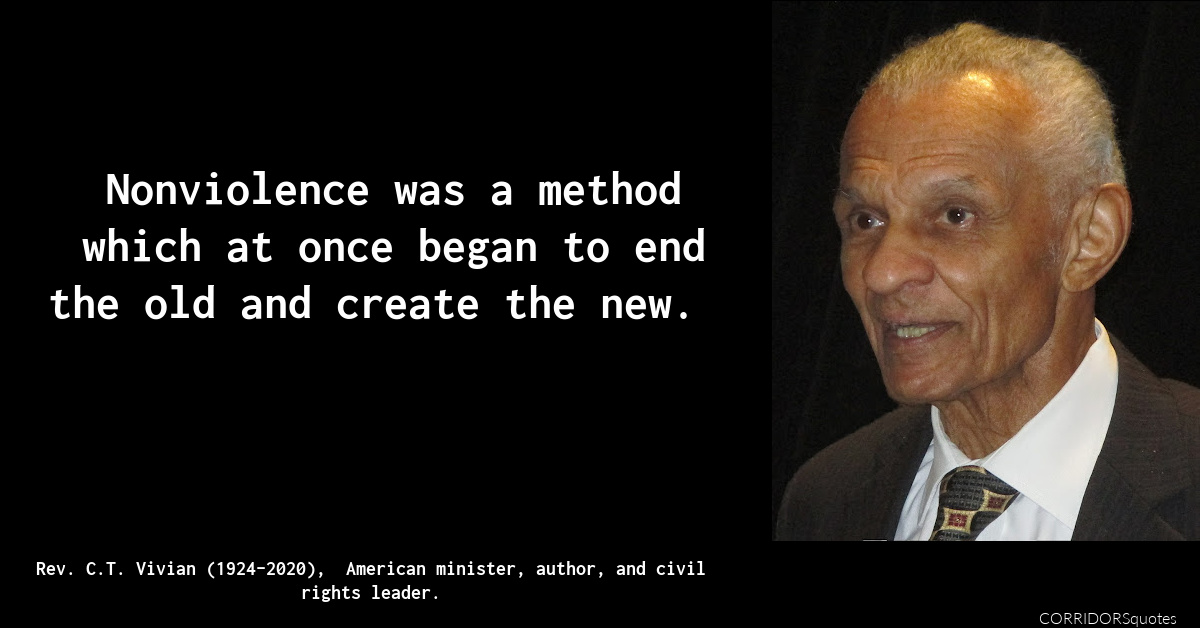
Nonviolence was both strategy and transformation. Rev. C.T. Vivian presents nonviolence as a source of power that confronts fear with courage and hate with love while simultaneously creating a new social order.
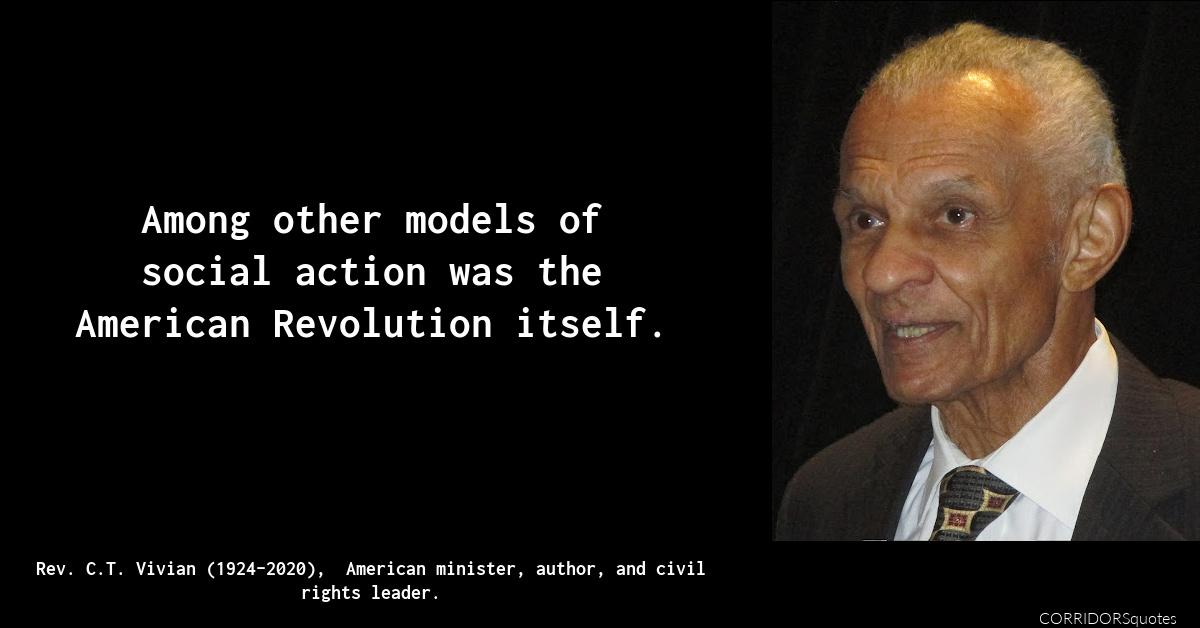
To all who accepted it, nonviolence offered new power. It pitted calm courage against frantic fear. It set the action of love against the reaction of hate.Nonviolence was a method which at once began to end the old and create the new.America was born as a revolutionary nation.The United States began with a struggle for civil rights. The specific issue – taxation without representation – was merely a focus for the larger question of whether or not a dominant majority would continue to exploit a subject minority. The American colonists decided that this oppression was not tolerable.Among other models of social action was the American Revolution itself.The question always before the Black man was: What must I do to be free?
Martin Luther King Jr. elevated civil rights into a moral issue. According to Rev. Vivian, Dr. King moved the struggle beyond economics and politics and placed it within a moral and spiritual framework.
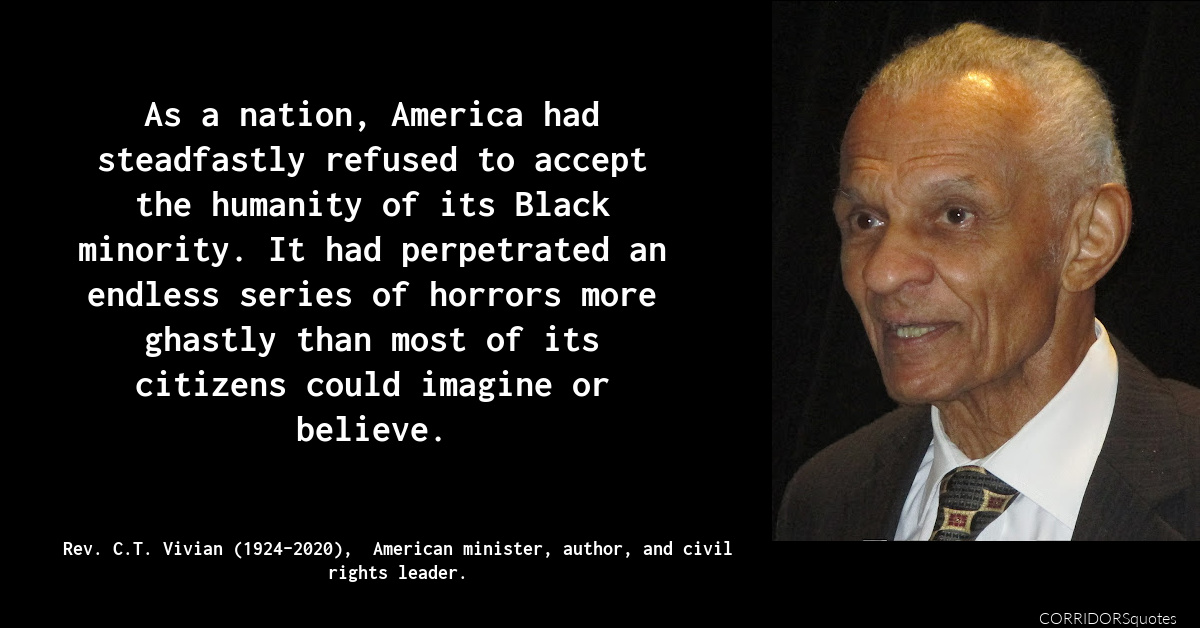
It was Martin Luther King who removed the Black struggle from the economic realm and placed it in the moral and spiritual context.When Martin Luther King emerged, he raised the issues from the pragmatic to the sublime.As a nation, America had steadfastly refused to accept the humanity of its Black minority. It had perpetrated an endless series of horrors more ghastly than most of its citizens could imagine or believe
Racism was created to justify injustice. C.T. Vivian believed that racism developed as a rationalization for slavery and exploitation, allowing Americans to reconcile oppression with their conscience.
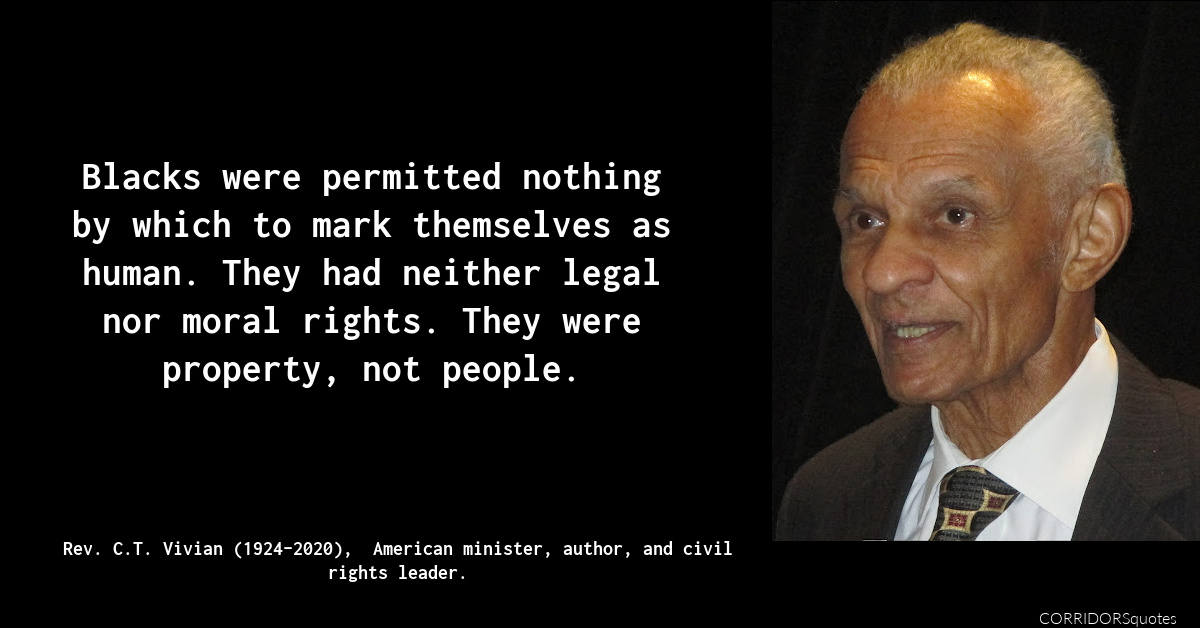
Racism began as rationalization. It began as a justification of the white man’s injustice to the Black. The greed that brought Black men into slavery was not alone enough to make the institution bearable to the white conscience.The Blacks who were brought to this country as slaves were systematically stripped of all cultural ties…Nor were they allowed to develop new institutions to replace the old. They were not permitted to read or write.White Americans had to become racists or John Browns…There were many more whites of John Brown’s persuasion than is commonly known. The annals of Southern history document the executions of scores of whites accused of fomenting Black revolt. Today bigotry most often shows itself as blind indifference and willful ignorance rather than as racist activism.During the time of slavery abolitionists were accused of violence for merely ADVOCATING an end to slavery, while the steady falling of the overseer’s lash went unquestioned as a necessary fact of life.Blacks were permitted nothing by which to mark themselves as human. They had neither legal nor moral rights. They were property, not people.Although the Constitution had been amended to declare him a citizen, the Black was neither considered to be, nor treated as, a man.
The larger problem was white society and its institutions. Drawing on Gunnar Myrdal, Rev. Vivian contends that America did not have a “Negro problem” but a “white problem,” requiring change in majority attitudes and institutions.
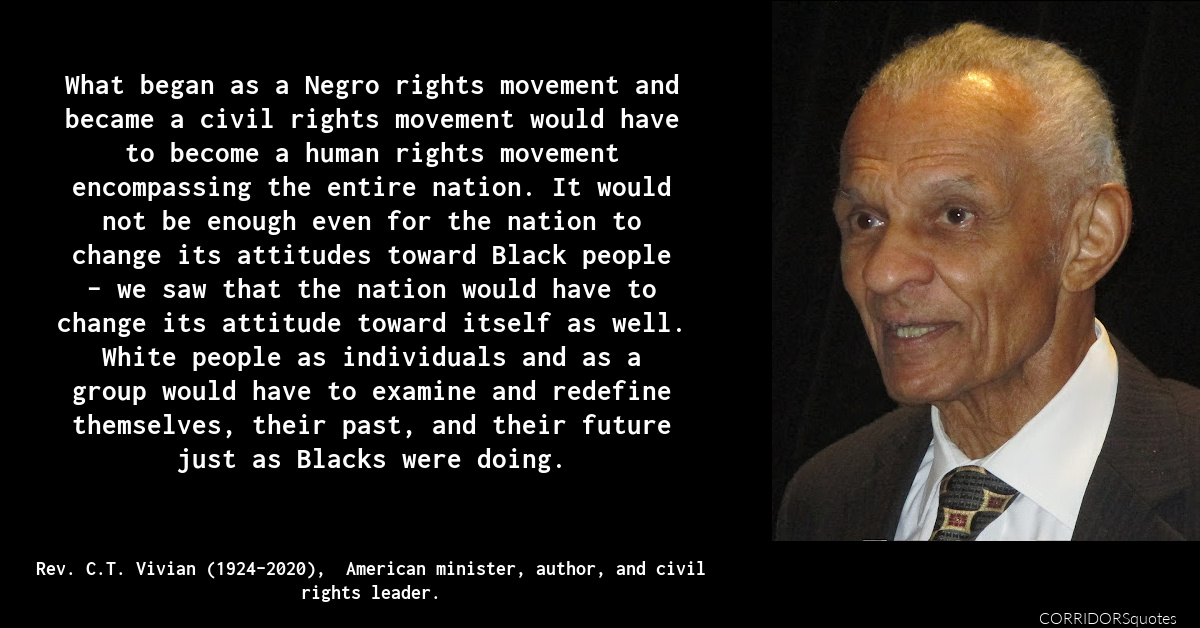
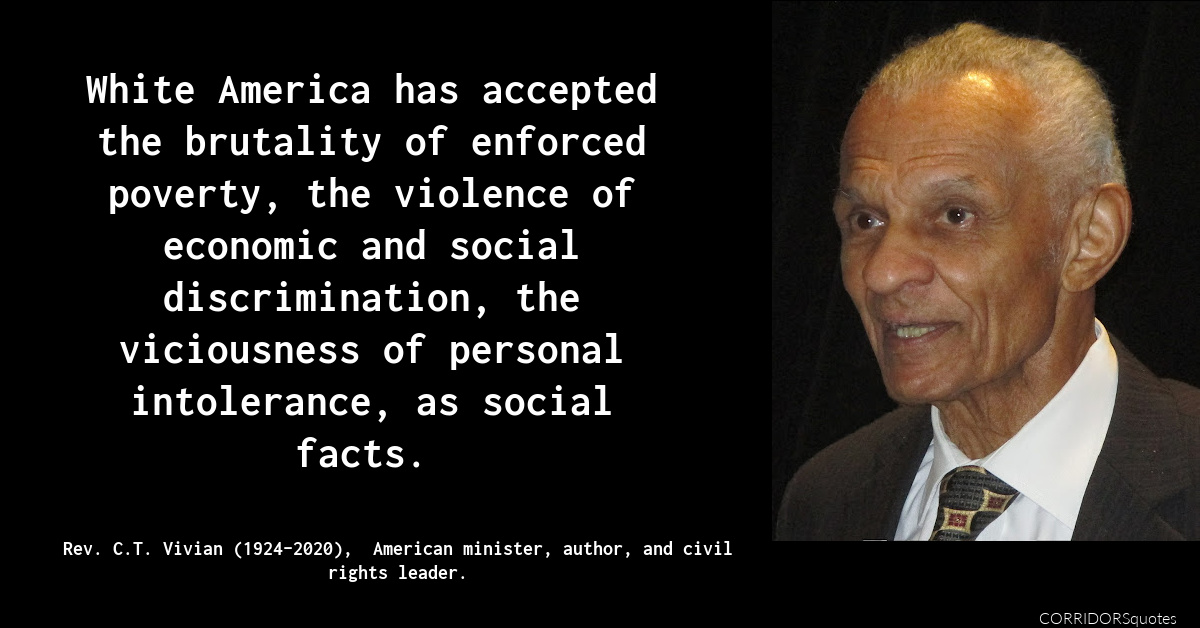
We were continually warned about “backlash”—which is what white people do when Black people fail to “stay in their place.”What began as a Negro rights movement and became a civil rights movement would have to become a human rights movement encompassing the entire nation. It would not be enough even for the nation to change its attitudes toward Black people – we saw that the nation would have to change its attitude toward itself as well. White people as individuals and as a group would have to examine and redefine themselves, their past, and their future just as Blacks were doing.As Gunnar Myrdal pointed out in his classic study AN AMERICAN DILEMMA, this country does not have a Negro problem, it has a white problem. Changing the white majority, their attitudes and their institutions, is basic to any solution to “racial strife.”White America has accepted the brutality of enforced poverty, the violence of economic and social discrimination, the viciousness of personal intolerance, as social facts.Even the Black church, which has been the closest thing in most communities to be a truly independent Black institution, has largely failed to deal with the facts of Black America. The church has taught that Blacks were human. But that they would only enjoy its privileges after death.John Calhoun voiced the typical slaveholder’s view when he said freedom for whites was impossible without the enslavement of Blacks.
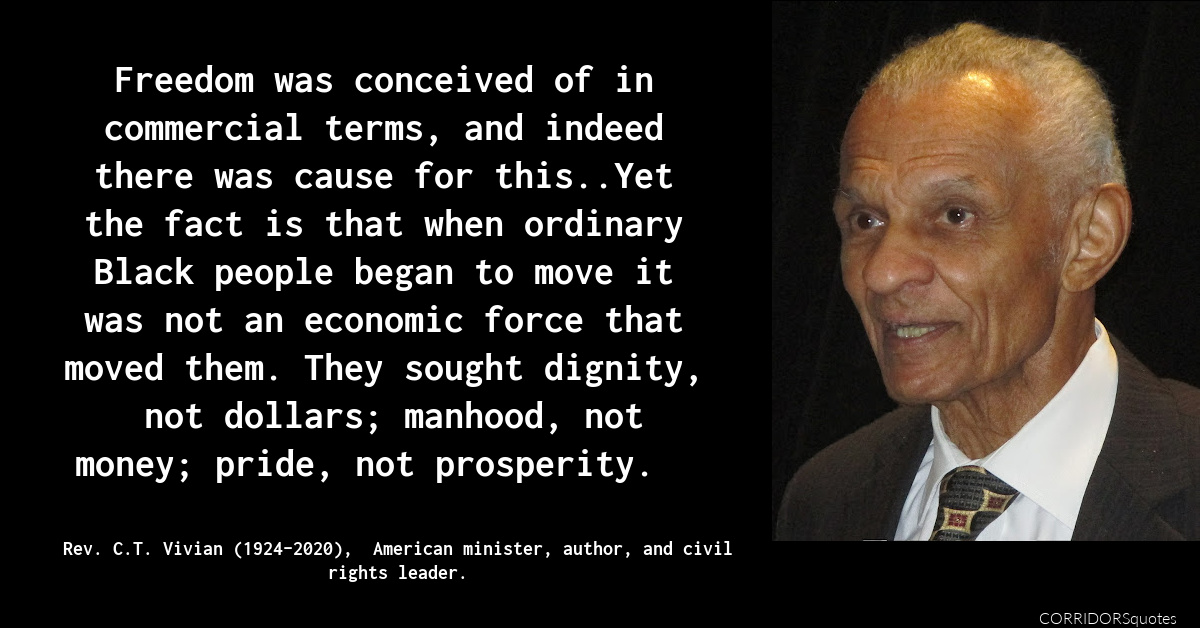
The Black freedom struggle was about dignity, not merely economics. Vivian argues that Black Americans sought “dignity, not dollars; manhood, not money; pride, not prosperity.” The movement was fundamentally a human and moral struggle.
Freedom was conceived of in commercial terms, and indeed there was cause for this..Yet the fact is that when ordinary Black people began to move it was not an economic force that moved them. They sought dignity, not dollars; manhood, not money; pride, not prosperity.We were continually told by whites and fearful Blacks alike that we were fomenting discord, creating racial strife, mounting reaction and bigotry.Blacks had to come to see themselves as masters of their own fate, masters of their secular destiny as well as their spiritual destiny.When white people find filth in the streets of their neighborhood they quite properly call city hall and complain, and it is removed. But when the same whites (and warped Blacks) find filth in the ghetto streets, they call for a clean-up campaign by ghetto residents.These facts — (of economic discrimination, infant mortality rate, malnutrition) and all the others which describe the Black condition — we knew well. Our problem was to make the rest of the nation understand them.In 1964, the Small Business Administration reviewed its past ten years and reported that it had made seven loans to Blacks during that time –seven in ten years. This record is typical of most banks, savings and loans companies, and other financial institutions, which provide the capital that allows people to enter the commercial world.We saw that the failure to admit Blacks to the society had created a permanent ambivalence within the nation, an ambivalence which warped everything that the nation did. Even the simple facts of history had been so twisted that it was impossible for most Americans to understand what happened to their land or why they had arrived at the crisis they were facing.The first permanent non-Indian settlers in what is now the United States were not whites seeking religious freedom but Blacks seeking physical freedom. These people came here as slaves with an ill-fated Spanish colonial venture. They rebelled and sought refuge with the Indians. The Spanish left and the Blacks remained. This took place more than a hundred years before the landing of the Mayflower.Of major importance is the fact that at the time of the Revolutionary War the entire American economy was sustained by slavery. Slaves were held in every colony.For Blacks were not the only ones oppressed by slavery. Whites were also brutalized by their inability to escape from slavery. In the South this was especially clear. A police state was created and the entire population lived in terror of a slave uprising.
Justice is indivisible. Injustice anywhere threatens everyone: “When there is no justice for ALL, then there is no justice at all.”
During the 1890s, two to three Blacks were lynched every week – week after week, year after year.In the Dred Scott decision of 1857…the Supreme Court explained that the phrase “the people of the United States” in the Constitution was never meant to include Blacks.Congress…created the Freedmen’s Bureau, an agency designed to make the ex-slaves participants in the national economy. Much good work was done by the Bureau.Millions of Americans suffered from misplaced hatreds. The classic example is the poor white Southerner who has been pitted against Blacks by the powerful men who exploit them both.Most of the antislavery agitation in the United States came from poor whites in the South. These people saw that slavery kept THEM in bondage by allowing planters to control all the best land and manipulate the markets to their own advantage.One reactionary Supreme Court decision interpreted the Fourteenth Amendment as having granted the privilege of national citizenship, but not necessarily state citizenship. This gave Blacks rights such as access to seaports, but left questions of education, suffrage, and employment up to the states.During the Jim Crow mania, states, counties, towns, and cities vied with one another in passing repressive legislation, running all the way from the silly to the insane. This was the period which the “separate but equal” doctrine was taking shape.When there is no justice for ALL, then there is no justice at all. Some may be favored, but none are safe.
Legal victories alone were insufficient. Court decisions and legislation mattered, but Rev. Vivian argues they often failed to produce meaningful changes in everyday Black life.
Ironically, it is America’s firm commitment to equalitarian ideals which makes the race question so intense.In the Fifteenth Amendment, the government officially forbade the denial of voting rights because of “race, color, or previous condition of servitude.” And having done this, the government washed its hands of the whole matter.The Civil Rights Act of 1965 was intended partly to enforce the Fifteenth Amendment, because no more than a tiny fraction of the Black population had ever actually been allowed to vote.Almost every public pronouncement concerning the condition of Blacks insisted that their situation was rapidly improving. But since Blacks were invisible to the white world, these questionable statements went unverified.Some of our leaders recommended movement through education…Others to industrial occupations…still other leaders counseled violence. Throughout the history of America we fought many times. Before emancipation there were over 250 slave conspiracies and revolts.
C.T. Vivian embodied action-oriented leadership. Highlights include his work with Martin Luther King Jr., the SCLC, and civil rights organizing, leadership development, and youth empowerment.
The Birmingham campaign of 1963 was the first large-scale test of the new method (of nonviolence). It was titled “Project C” – C for CONFRONTATION.When it became clear that we would not be crushed, official Birmingham accepted our demands—(1) desegregation of all public facilities, (2) hiring and upgrading of workers without discrimination, (3) the release of all jailed demonstrators, (4) the establishment of a permanent biracial committee to keep communications open between Blacks and whites.Our movement depended on mass support; the mobilization of our people was our principal weapon.White liberals also touted the success gained through legal action. But important as court battles have been, they failed to make any basic change in the lives of most Blacks.Ten years after the school desegregation cases of 1954, only 2.14% of the nearly 3 million Black children in Southern schools have been affected and were receiving anything like a desegregated education.As this protest reached massive proportions it became clear that those Americans who were not coming to realize the justice of the Black demands were closing their minds more permanently and more desperately to justice.Massive opposition was stirring. White citizens’ councils were forming throughout the South. In the Northern cities, the names were different but the motives were the same whether they came under the heading of parents’ and taxpayers’ groups, homeowners’ associations, or community school councils.Our accomplishments often bewildered us as much as our defeats.It was not until the riots began that we understood the extent of our failure. The message from the streets was that hundreds of years of Black appeals for justice would now give way to action.
Civil rights must evolve into human rights. The movement’s ultimate goal was not simply Black advancement but a transformation of the entire nation into a more just society.
Genuine integration can never become a reality until both parties can live together as equals; and that will not happen until each sees the other as human, until each holds the same values upon which the entire culture can grow.Integration is dead. The concept and the experience, insofar as they were tried, have both failed because of the powerful racism of this society. Blacks, in response, have realized that they must develop their own distinctive culture.Black organizations that have organized around welfare have almost universally called for the abolishment of that system.Who then really WANTS the welfare system? Who profits by it? Who perpetuates it? It is, of course, the people who RUN the system.It is those who ADMINISTER welfare who get the most money, not the recipients; it is the administrators who are most truly ON welfare. This point should always be remembered when they try to speak for the Black community.The collapse of the integration model has led to many social experiments ranging from Black capitalism to the African revival. There has been a headlong search for new sources of identity.Within Black communities, therefore, the cry is no longer for integrated education, but for community control. It means Black control of Black schools, just as whites have always controlled their schools.In a few cases there have even been beginning attempts at coalition between bigots and Blacks in opposition to the white liberals who refuse to give up the rubric of integration.Some segments of the Black movement are concerning themselves specifically with the creation and re-creation of Black culture. Others have found inspiration in such international movements as socialism.The only sanity seems to lie in a new form of segregation which will hopefully, in time, bring a new demand for integration – the integration of whites into the re-created culture that the Black minority has begun to achieve.
Most brief, educationally distinct citations come from C.T. Vivian’s Black Power and the American Myth.
FEATURE image: Ethel Barrymore on the cover of The Theatre in August 1901 following the close of the successful Captain Jinks of the Horse Marines which ran on Broadway for 168 performances from February to July 1901 and made 22-year-old Ethel Barrymore a star. Public Domain.
Ethel Barrymore’s breakout performance as Madame Trentoni in the 1901 Broadway romantic comedy Captain Jinks of the Horse Marines at the Garrick Theatre transformed her into a major theatrical celebrity, launching a legendary 60-year career across the American stage and cinema.
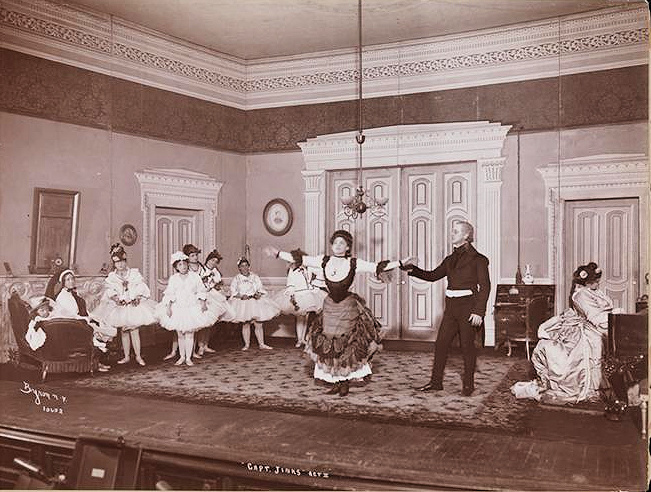
22-year-old Ethel Barrymore on stage at the Garrick Theatre on West 35th Street in New York City in Clyde Fitch’s Captain Jinks of the Horse Marines in 1901. Dramatist Clyde Fitch (1865-1909) wrote over 60 plays in his career that ranged from comedies and farces to melodramas. Fitch was the most popular writer for the Broadway stage in his time and specialized in writing important dramatic parts for women. Fitch’s new play was a romantic comedy set in the States years after the Civil War. Ethel Barrymore played Madame Trentoni, the female lead and the play’s love interest. The 1901 Broadway production made Barrymore a star. The public domain photograph is in the archive of the Museum of the City of New York.
By John P. Walsh
Stage and screen actress Ethel Barrymore (1879-1959) was the sister to older brother Lionel (1878-1954) and younger brother John (1882-1942) Barrymore. Though Ethel Barrymore was absolutely devoted to the stage from her youth, she began to appear in major silent films starting in 1914. Much later, in the 1940’s, the veteran stage actress was nominated twice for an Academy Award for Best Supporting Actress. She won the golden statuette in 1944 for her role as Ma Mott in the film None but the Lonely Heart starring Cary Grant who used a Cockney accent for his part.
By the time Barrymore appeared in her first feature motion picture, The Nightingale, in 1914, she was a celebrated stage actress on both sides of the Atlantic. Coming from the famous American acting family of Drews and Barrymores, the just 16-year-old Ethel Barrymore made her Broadway stage debut in 1895 alongside her uncle, John Drew, Jr. (1853-1927).
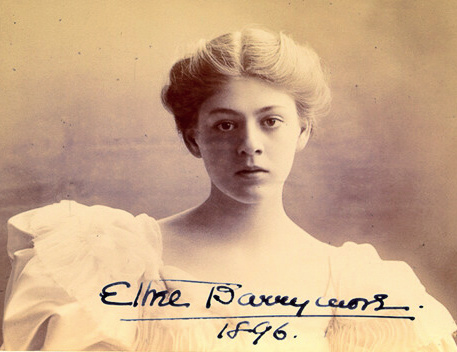
Ethel Barrymore at 17 years old in 1896. In 1895, a 16-year-old Barrymore made her Broadway stage debut alongside her uncle, Jack Drew, Jr., a famous and well-liked actor.
John Drew, Jr. in 1896. A versatile actor, Drew was so highly esteemed by his fellow actors that they elected him the lifetime president of New York City’s Players’ Club. The private social club for actors founded in the 1840’s at 16 Gramercy Park remains active today.
Before she was 20 years old, Ethel appeared several times on the London stage. Her first role was that of Miss Kittridge in William Gillette’s new play, Secret Service (1895). After that show closed, she was offered and played other roles on the London circuit. By the turn of the 20th century, a vibrant and talented Ethel Barrymore gained the especial attentions of several male admirers that included dukes, actors, writers and politicians.
As a young, vibrant actress touring the London circuit, she caught the attention of many high-society suitors, famously refusing a marriage proposal from a young Winston Churchill, who became a lifelong friend.
Winston Churchill in 1900. A public domain photograph in the Imperial War Museum.
One such admirer of Ethel Barrymore was eligible bachelor, enthusiastic theater hound, and nascent politician Winston Churchill (1874-1965). Though Ethel had many propositions and proposals in this period—she was even briefly engaged to a man until Ethel broke it off—any marriage proposal made to her by Churchill was refused. Churchill and Barrymore, however, became lifelong friends.
Poster for William Hooker Gillette’s 1895 play, Secret Service, on the London stage which featured young American actress Ethel Barrymore in its cast. The poster promotion depicts the play as a royal entertainment which attracts princes and princesses, dukes and duchesses. William Gillette (1853-1937) wrote melodramas and spy plays that were very popular with audiences. In 1899, Gillette first created the role of Sherlock Holmes for the stage, a role which he himself played for over 30 years.
Ethel Barrymore at 19 years old in 1898.
Young Ethel Barrymore. From a famous American acting family, she was was devoted to the stage at an early age.
At 20 years old Ethel Barrymore gained the attention of many male admirers, including dukes, actors, writers and politicians. Though briefly engaged around the turn of the century, Ethel broke it off. Ethel finally married in 1909. She met her husband, Russell Griswold Colt (1882–1960), at Sherry’s restaurant at 44th Street and Fifth Avenue in New York City while having lunch with her uncle, John Drew, Jr. The marriage produced three children, though it ended in divorce in 1923.
When Ethel returned to the United States, she began to appear in various stage productions. It was in 1901 when the 22-year-old actress was cast in the role of Mrs. Trentoni in Clyde Fitch’s Captain Jinks of the Horse Marines on Broadway that Ethel Barrymore became a star.
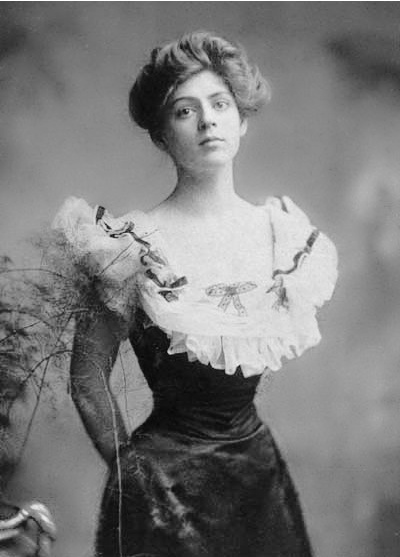
Ethel Barrymore dressed in one of the Edwardian costumes as Madame Trentoni in the 1901 Broadway play, Captain Jinks of the Horse Marines.
The plot of Clyde Fitch’s Captain Jinks of the Horse Marines—in which her character Madame Trentoni falls in love with a man who initially bets he can win her affection—ran for 168 performances from February to July 1901 and cemented Ethel Barrymore’s celebrity status.
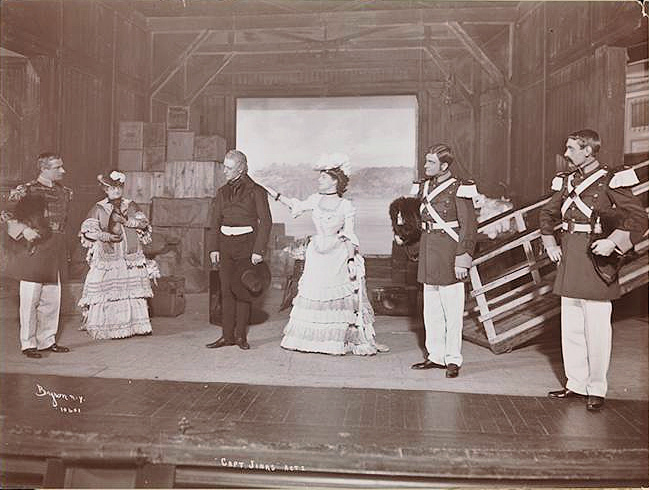
Act 1.
Clyde Fitch’s Captain Jinks of the Horse Marines introduces Robert Carrolton Jinks and his friends who form a club to boost the presidential campaign for General U.S. Grant in 1868. Calling themselves “Captain Jinks of the Horse Marines,” they think to try out their marching abilities by greeting the arrival of a steamer carrying Madame Trentoni, a famous opera singer. Though sight unseen, Jinks bets money that he can make Madame Trentoni fall in love with him. The boat is late and everyone leaves the dock except for a gaggle of reporters who wait to greet the opera singer. When Jinks returns, after he lays eyes on Madame Trentoni (played by Ethel Barrymore) he falls in love with her. After Captain Jinks sees she is having trouble at customs, he pulls out money which the customs official mistakes for a bribe and Jinks is promptly arrested.
When Jinks is released on bail he calls on Madame Trentoni who has stopped to visit her foster father. She is as much in love with him as he is with her and their courtship progresses rapidly. When Jinks tries to call off the bet he made with his friends, they refuse until he finally agrees to pay off the bet with an I.O.U.
Jinks’ friends are also smitten with Madame Trentoni but she is totally uninterested in them. This gets them angry and they decide to ruin it for Jinks. They tell Madame Trentoni’s foster father that jinks intends to marry Madame Trentoni solely for her money — and as proof pull out the signed I.O.U. that says “I.O.U. $1,000 for the bet regarding Madame Trentoni.” The foster father flies into a rage, tells Madame Trentoni about the I.O.U, and she decides to never see Jinks again.
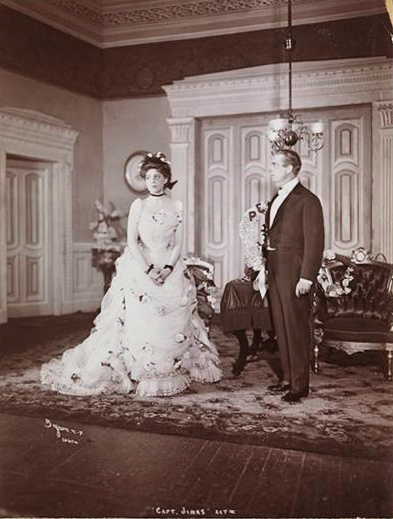
ACT 2.
Jinks has no idea why Madame Trentoni is so angry at him. When he finally discovers what his friends have falsely told her, he tries to gain admittance to her apartment to tell her the truth. When she learns the real facts of the matter, Madame Trentoni throws her arms around her Captain Jinks.
In that intimate position, a detective suddenly bursts into the room to arrest Jinks. In all the tumult surrounding the loss of his love interest, Jinks forgot to appear in court for his bribery case. It appeared Jinks had skipped bail. Madame Trentoni tells the detective that she and her sweetheart have had a misunderstanding and only now are having the chance to make up. Her plea and the promise that Captain Jinks will appear in court tomorrow for his case is approved by the detective, who departs. Captain Jinks and Madame Trentoni embrace, and the curtain goes down on the couple living happily ever after.
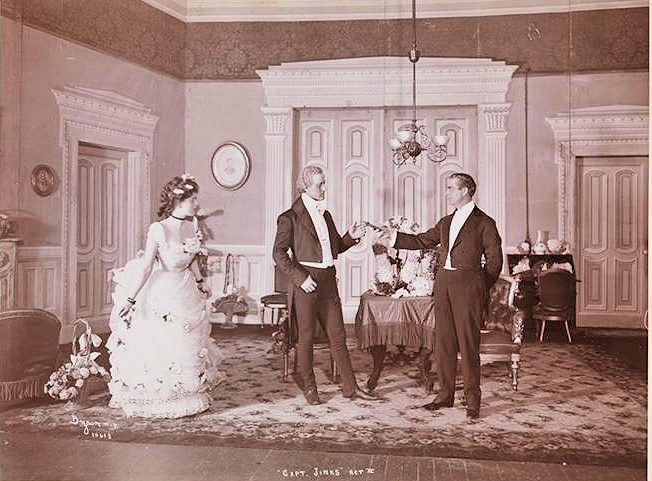
Act 3.
The public domain photographs above are in the archive of the Museum of the City of New York.
Cultural Phenomenon: The play soon triggered an insatiable public demand for Ethel Barrymore’s style, photos, and postcards.
Color promotional poster for Captain Jinks and the Horse Marines starring Elizabeth Kennedy. After the Broadway show starring Ethel Barrymore closed in July 1901, a new production and cast appeared in 1902. The theatrical poster highlights New York’s Garrick Theatre run. (Library of Congress collection)
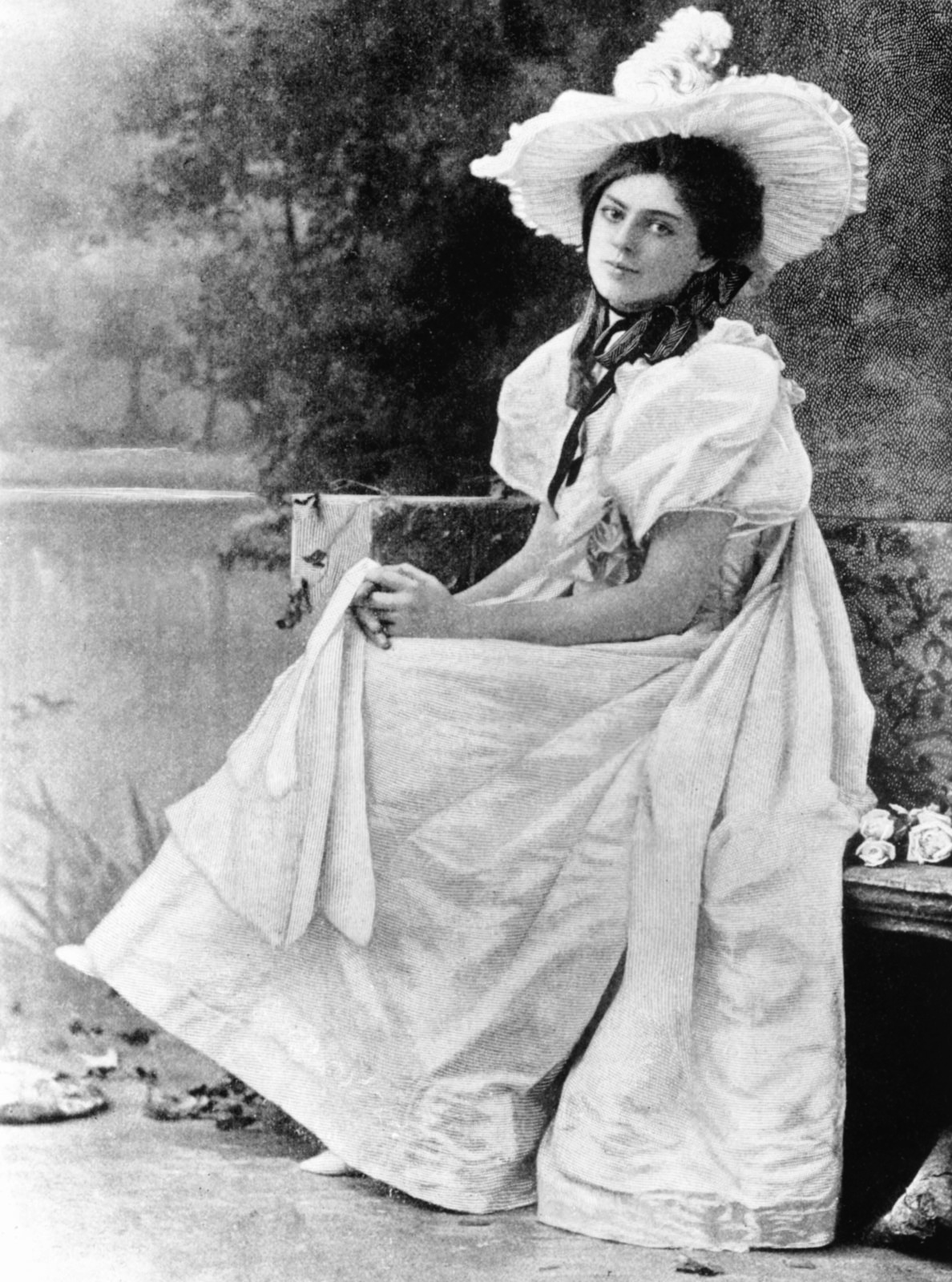
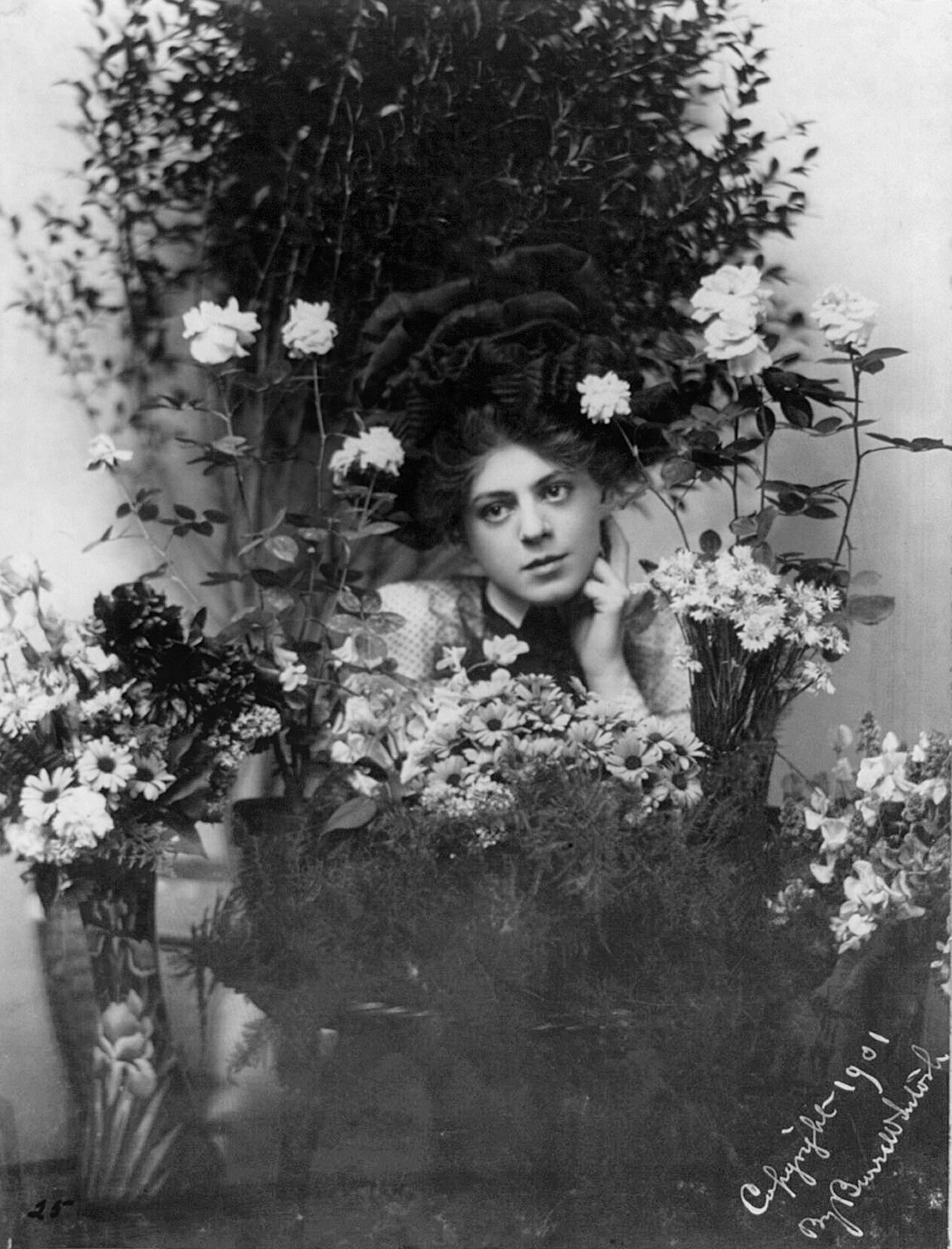
Ethel Barrymore as Madame Trentoni in 1901.
Ethel Barrymore on the cover of The Theatre in August 1901 following the close of her successful Captain Jinks of the Horse Marines run which made 22-year-old Ethel Barrymore a star.
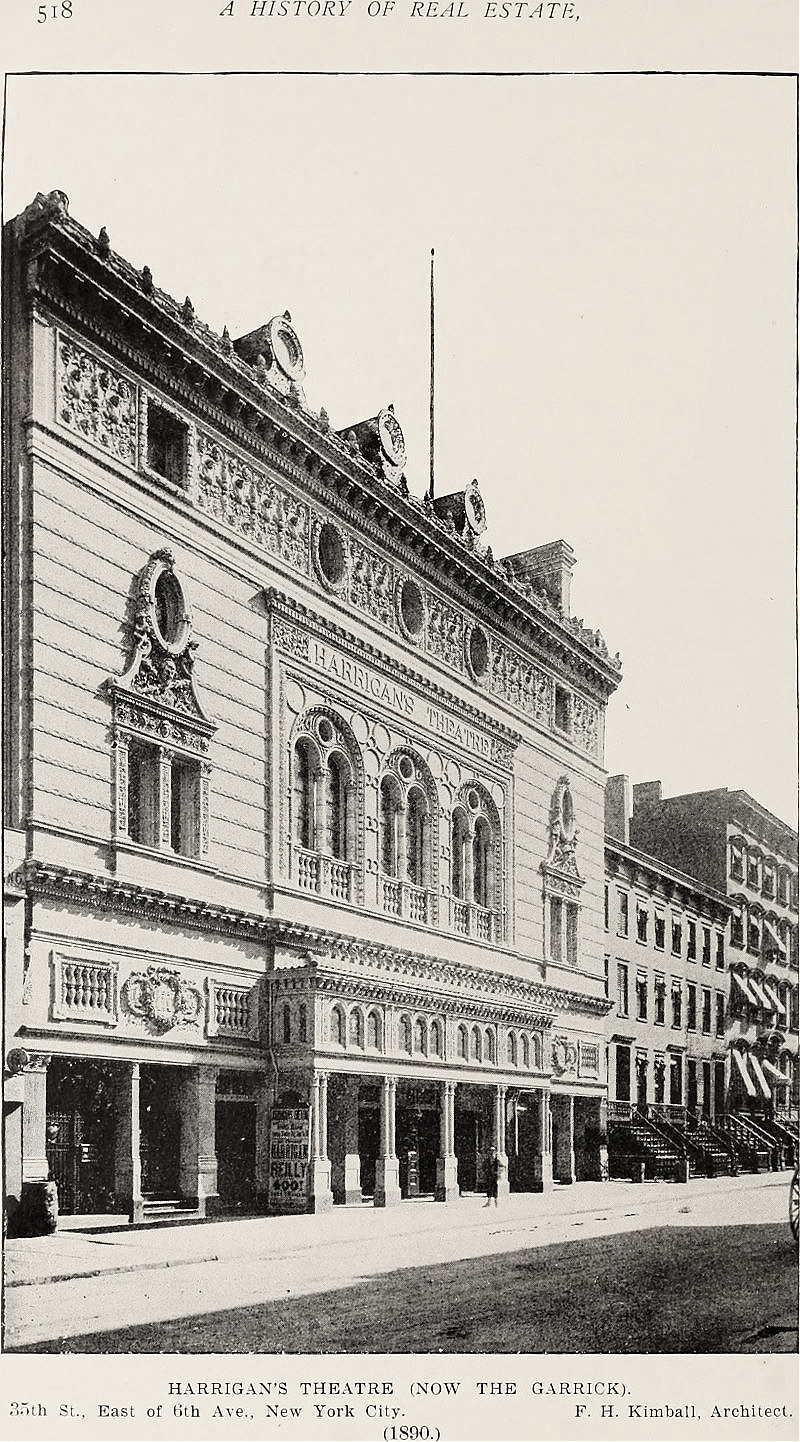
Captain Jinks of the Horse Marines was produced in 1901 at the Garrick Theatre. The 910-seat theatre was built in 1890 by Francis Hatch Kimball (1845-1919) and located at 67 W. 35th Street in New York City.
The Garrick opened as Harrigan’s Theatre and became the Garrick in 1895. It was sold to the Schubert brothers in 1916 and leased to Otto Kahn who renamed it the Théâtre du Vieux-Colombier in 1917.
Management reverted to the Schuberts in 1925 when the theatre featured popular burlesque until the onset of the Great Depression. The building was demolished in 1932.
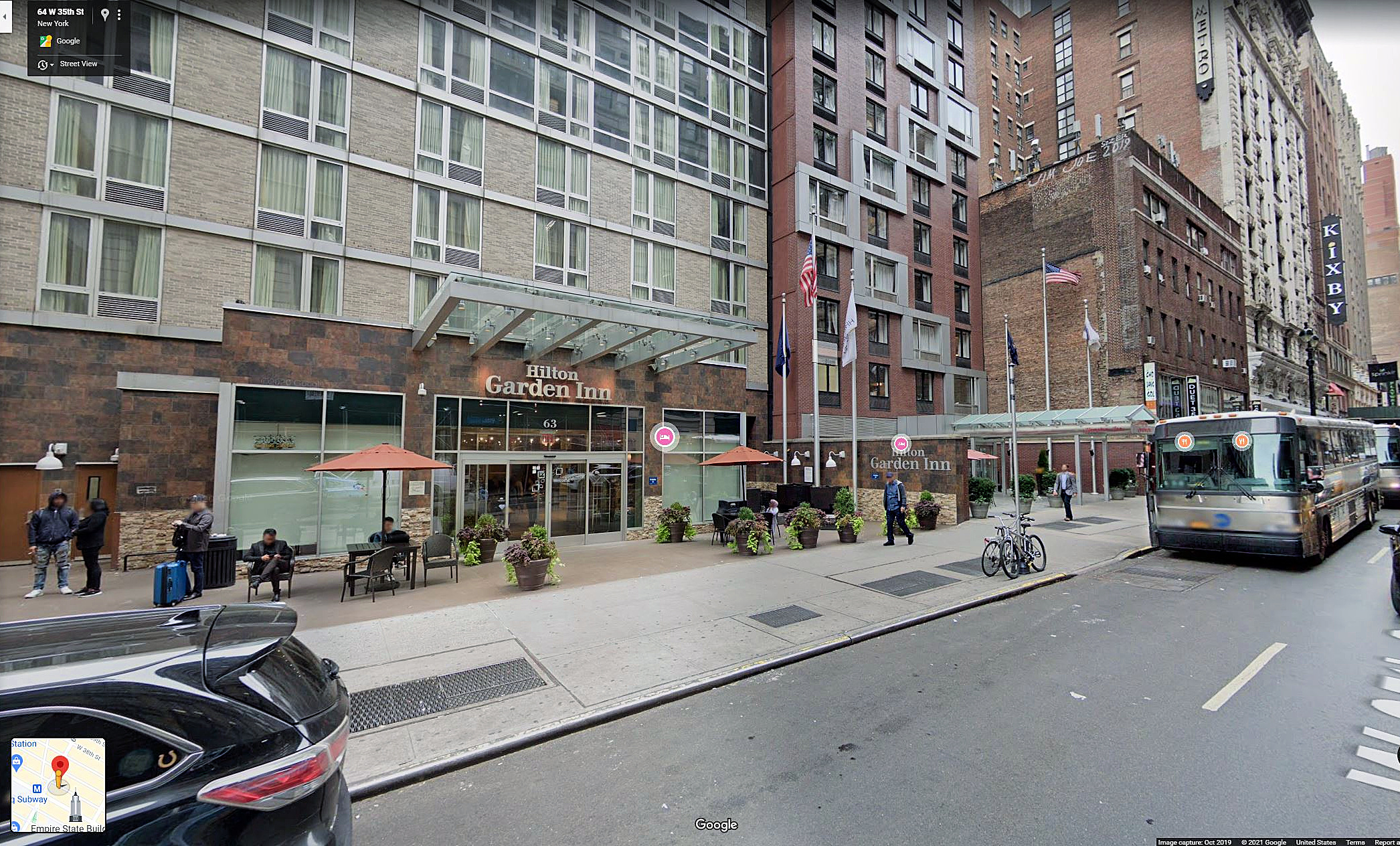
Screenshot, October 2019, site of GARRICK THEATRE (1890-1932), 67 W. 35th Street, New York City. The Garrick Theatre was where Ethel Barrymore starred as Madame Trentoni in Clyde Fitch’s Captain Jinks of the Horse Marines. A smash hit, the Broadway production made Ethel Barrymore one of the 20th century’s major theatrical and film stars. In 2006 the site had a multi-level parking garage which was later replaced by a hotel devlopment. The brownstone building in the middle distance appears to have survived from the late 19th-century period.
Following her 1901 success, Ethel Barrymore became a cultural style icon. She went on to headline numerous top-rated Broadway plays throughout the early 1900s.
Both photographs above, Ethel Barrymore in 1901. As a new theatrical celebrity Barrymore’s image, style, and fashion were in demand by the public.
Ethel Barrymore in 1901.
Barrymore with a fur muf and feather hat in a hairstyle à la mode. The demand by the public for images of theatrical celebrities was insatiable.
In the 20th century’s first decade, Ethel Barrymore became a theatrical celebrity. Her image was in demand in photographs and picture post cards of the time. Throughout the first third of the twentieth century, Barrymore continually appeared in popular stage productions. Following the success of Captain Jinks of the Horse Marines, Barrymore appeared in the next years in many top-rated popular Broadway productions.
A few highlights included in 1903 Barrymore appearing for 60 performances in the title role in Cousin Kate at the brand-new Hudson Theatre at 139–141 West 44th Street. In 1905 Barrymore played Norma Helmer in Henrik Ibsen’s A Doll House for 23 performances at The Lyceum Theatre at 149 West 45th Street. Also in 1905 Barrymore appeared in Alice Sit-by-the-Fire at the Empire Theatre. In 1908 Barrymore played the title role in Lady Frederick for 96 performances, again at the Hudson Theatre. There were a dozen more productions Barrymore was involved in before 1910.
Another side of Ethel Barrymore, at the piano in 1903. Before she took to a career on the stage, Ethel Barrymore aspired to be a concert pianist as a youth.
Ethel Barrymore, 1904, by photographer Arnold Genthe. The actress was starring in several plays that year including in the title role of Kate Curtis in My Cousin Kate at the Empire Theatre. Barrymore would reprise the role briefly in 1907.
Ethel Barrymore in a photograph by William Morrison of Chicago in 1907. In the 1900’s Ethel Barrymore was a theatrical celebrity whose image displayed the latest fashion, make-up, and hairstyles that helped express the style of the times.
Ethel Barrymore in 1908. She was starring in the title role of Lady Frederick at the Hudson Theatre that year. The Broadway play ran for 96 performances.
Ethel Barrymore made her silent film debut in 1914 with The Nightingale and balanced stage work with cinema, later winning an Oscar in 1944.
With her film debut in 1914 in The Nightingale, a film written especially for her by playwright Augustus Thomas (1857-1934), Ethel Barrymore began in the new silent flickering medium of cinema in the footsteps of her brothers Lionel and John, who made their film debuts a couple of years earlier.
While Ethel made at least 14 films between 1914 and 1919 (some films are lost) she continued with her stage work and appeared in a dozen more Broadway productions throughout the 1910’s. When she decided to interrupt her film work in 1920 –and did not return to the movies until 1932 in the M-G-M film Rasputin and the Empress starring with her brothers (Ethel played Czarina Alexandra) – she appeared in a dozen more plays in the 1920’s, all in prominent Broadway theatres.
In 1922 she starred as Juliet in Shakespeare’s Romeo and Juliet for 23 performances at the Longacre Theatre at 220 West 48th Street as well as her celebrated role as Constance Middleton in Somerset Maugham’s new comedy play, The Constant Wife, in 1927. It ran for 296 performances at Maxime Elliot’s Theatre at 109 West 39th Street (it was demolished in 1960). The play had previewed in Cleveland, Ohio, at the Ohio Theatre in early November 1926 with Ethel Barrymore in the title role. It opened on Broadway at the end of November 1926 and ran until August 1927. After the Broadway show closed, Ethel Barrymore toured the production. Maugham dedicated his play to Ethel Barrymore and later said her performance was by far the best of any he had seen given for any of his plays.
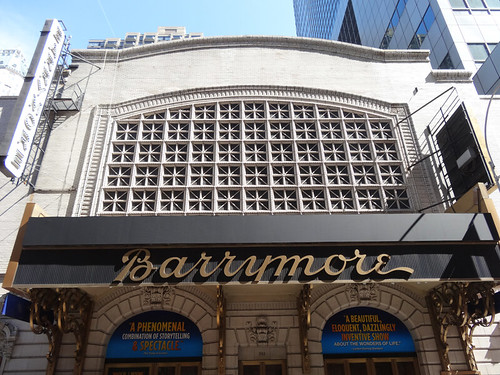
Barrymore’s extensive stage work in this period also included, in 1928, appearing in the role of Sister Gracia in The Kingdom of God. The play was selected by Ethel Barrymore herself as the premier production in the Schubert Theatre chain’s newly-built 1,058-seat venue at 243 W. 47th Street in New York City. The new Broadway venue was named the Ethel Barrymore Theatre. Since its opening on December 20, 1928, the Ethel Barrymore Theatre has, without exception, presented legitimate Broadway productions continuously from that time to the present day.
Ethel Barrymore died on June 18, 1959, two months shy of her 80th birthday, at her home in Hollywood. She is buried in the Main Mausoleum in Calvary Cemetery in East Los Angeles, California. (see – https://www.findagrave.com/memorial/59/Ethel-Barrymore – retrieved June 18, 2024). The middle sister of Lionel and John Barrymore, Ethel is great aunt of Drew Barrymore. A screen legend and New York and London stage celebrity for more than 60 years Ethel Barrymore is a First Lady of the American Theatre.
Ultimate Honor: Ethel Barrymore had a permanent 1,058-seat Broadway theatre named after her in 1928.
The Ethel Barrymore Theatre on West 47th street in New York City opened on December 20, 1928. It has been in continuous operation as a legitimate theatre since its first production, The Kingdom of God, a play Barrymore selected and starred in. Photo Credit: “Barrymore Theatre” by ensign_beedrill is licensed under CC BY-NC-ND 2.0.
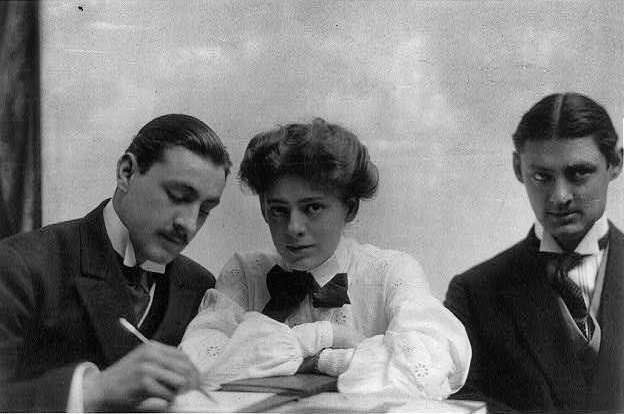
Three famous actors, Philadelphia-born, in 1904. They were the third generation of the Royal Family of the American stage. From left: John (1882–1942), Ethel (1879–1959), and Lionel (1878–1954) BARRYMORE, performed on stage, screen, and radio. Their grandparents, the Drews, managed the Arch St. Theatre in Philadelphia.
FEATURE image: Portrait of Chief Joseph in native dress with ornaments, 1900, by Lee Moorhouse (1850–1926). Public Domain.
Chief Joseph became the moral voice of the Nez Percé struggle against dispossession, forced removal, and broken treaties, using dignity, reason, and appeals to justice even as his people lost their homeland. His life story and quotations reveal not simply a military defeat in the Nez Percé War, but a powerful indictment of how the United States acquired Native lands and treated Native peoples.
INTRODUCTION. by John P. Walsh
Chief Joseph, 1877. Chief Joseph inherited his father’s determination never to sell the Wallowa homeland.
Chief Joseph and the Wallowa Valley
Joseph (1840-1904) was the leader of one of the Nez Percé tribes. The band amounted to about 200 people who lived in the Wallowa Valley in northeastern Oregon. White settlers wanted their grazing lands. After the death of Wellamotkin in 1871, a Nez Percé chief and Joseph’s father, the 31-year-old tall and handsome Joseph began to have conflict with the whites.
The Nez Percé Before White Contact
At the time of Joseph’s birth in 1840 there were around 6,000 Nez Percé, most of them living in small fishing villages next to fecund streams and rivers. Each village had its own “chief” and young Joseph visited these villages with his father where he learned about the people and the lore of his nation.
Once each winter was over, the Nez Percé, like other Native American tribes ranged beyond their own territory. These could be friendly visits like buffalo hunts or more contentious meetings. These cultural interchanges influenced Nez Percé as they influenced others. For hundreds of years the Nez Percé were mostly influenced by the Pacific Coast culture through the Chinook tribes more than the Plains tribes.
Horses and the Transformation of Nez Percé Culture
In the 1730s the Nez Percé learned about horses from Native Americans like the Apache who had contact with Spanish settlements in the south. With horses the Nez Percé traveled farther and more often into the Plains so that by the 1800s the Nez Percé were more a Plains tribe though they maintained their roots in the Pacific Northwest.
First Encounters With Europeans
It was at the start of the 19th century that those venturing Nez Percé came into contact with whites and bought guns. The home tribe didn’t have to wait long to encounter the whites – in 1805 Lewis and Clark reached the Columbia River. Promised more guns, none appeared for a couple of years and these by way of a Canadian trader.
The Nez Percé got their name from this French-Canadian trader who saw the nose piercings that the tribe used to affix ornaments to themselves. In 1812 the American traders that Lewis and Clark promised finally arrived but quickly left and the Canadians took over.
Missionaries, Christianity, and Growing Divisions
By the late 1820s the Nez Percé roamed farther east and encountered more white fur traders among whom they lived, traded, fought, and frequently intermarried. It was in this period that the first Christian missions, both protestant and Catholic, began their influence among the Nez Percé. In the 1830s the Nez Percé journeyed to St. Louis to recruit missionaries which was successful. Joseph’s father, Wellamotkin, became a Presbyterian and Joseph was baptized at birth. By 1850, with the influx of white settlers into Oregon, the Native Americans expelled the missionaries though this divided the tribe. Joseph retreated to the Wallowa Valley away from contact – and conflict – with the new arrivals.
Treaties, Gold, and Broken Promises
In 1855 the Nez Percé signed a treaty that created a large reservation for themselves. Joseph was considered a Christian and friendly to the whites. In 1860 when gold was discovered on the Nez Percé reservation the rampant trespassing of whites was unacceptable to Joseph. White crime against Nez Percé went up and whites built settlements on Indian land. Federal agents arrived and offered a smaller new reservation to the Nez Percé. The proposal was initially opposed by Indian leaders but Federal agents bought off the local chiefs one-by-one and, in 1863, a treaty was signed.
The new reservation was one quarter the size of what it was and did not include the Wallowa Valley. Joseph and most of the rest of the chiefs refused to sign. It was at this time that Joseph renounced his protestant Christianity as the white man’s religion. The Nez Percé on the new reservation saw the arrival of more and more whites. Though the Wallowa Valley where Joseph lived remained outside the white settlements’ orbit that changed over a short time.
Chief Joseph Takes Leadership
In 1871, after Joseph buried his father and became chief, white settlers began moving into the Wallowa Valley. Joseph protested to the U.S. Government and, in 1873, President U.S. Grant ordered the whites to withdraw and formally recognized the Wallowa reservation.
But the White House in Washington D.C. was far away and the whites refused to leave. They threatened Joseph with extermination if the Nez Percé didn’t leave – and invited increasing numbers of white settlers who poured into the valley. The Oregon governor took the side of the white settlers and President Grant was forced to rescind his decision that favored Chief Joseph.
Mounting Tensions and Federal Intervention
Chief Joseph – known as Heinmot Tooyalakekt (“thunder travels to lofty mountains”) – counseled delay. He moved his tribe farther from the encroaching white settlers and appealed to the U.S. Government again whose review of land claims and treaties advised siding with the Indians.
The U.S. Government did nothing until they appointed a panel in November 1876 with the power to make a final decision about the competing claims. Looking to dominate and persuade Chief Joseph, they were not able to do so by argument.
Chief Joseph, before 1877. Photographed by William H. Jackson.Joseph consistently preferred negotiation and diplomacy over war, even as violence escalated.
But events on the ground were intensifying between whites and Nez Percé so much so that violence between them was expected. The commissioners made their decision. Whether Nez Percé signed the 1863 or not all Nez Percé must go to the new small reservation or be taken there by force. The whites would get the Wallowa Valley. The deadline was April 1,1877.
The Deadline and the Outbreak of War
As the deadline approached the Nez Percé appealed to the commission to let them continue to live in the Wallowa Valley but the decision was final. A new deadline of June 12, 1877 was set. Joseph was called a coward by his tribe for abiding by the order to go to the reservation.
That night a Nez Percé youth avenged the murder of his father by whites by killing 4 whites and wounding 1 more. Nez Percé killed 15 more whites in the next couple of days – and struck terror in the hearts of white settlers.
Chief Joseph counseled diplomacy but most of the Nez Percé didn’t listen to him and left for hiding places. Joseph was watched closely by his own tribe that he would not abandon them or betray them to the soldiers. Chief Joseph and his buffalo-hunting younger brother Ollokot finally decided to join the Nez Percé to fight the whites.
Early Nez Percé Victories
Soldiers were deployed to force the Nez Percé onto the reservation. With Nez Percé informants they planned to attack the hostile Nez Percé in their encampment. The Indian response was to buy time to escape. A white flag of truce went on ahead of the small Nez Percé party to meet the soldiers. There was an exchange of gunfire and the battle was on. The soldiers lost 34 dead, a third of the command, while the Nez Percé lost none and two wounded. The victors retrieved scores of guns and ammo that the fleeing soldiers left behind.
Reinforcements were called in – on both sides. Rumors ran wild. There was a massacre of reservation Nez Percé mistaken for hostiles. As the soldiers advanced the hostiles cut in behind them and the white settlers the soldiers were supposed to be protecting lay exposed to the hostiles. These Nez Percé advanced and massacred parties of soldiers, civilian volunteers, and terrified settlers.
Nez Percé picked up about 40 warriors but also whole communities of women and children to protect. Joseph was being given credit for this successful war campaign though it was other war leaders who led the strategy and tactics.
The Fighting Retreat
By July 11, 1877, there was 400 soldiers and 180 others who were pursuing the Nez Percé. They attacked and the Nez Percé responded. The battle went on for two days though the Nez Percé were outnumbered 6 to 1. The army lost 13 killed and 27 wounded and the Nez Percé lost 4 killed and 6 wounded – and escaped again. The Nez Percé decided it was time to evacuate the area.
On July 16, 1877 Chief Joseph agreed to the exodus to Montana. The army decided to pursue them. Army reinforcements were called out of Montana to intercept the Nez Percé. Chief Joseph decided to talk with them. Promising to be peaceful and pay for any supplies on his way to the Crows, he reassured the volunteers. In Montana. the Nez Percé rested though they were being pursued by new reinforcements. On August 8, 1877, the Nez Percé were attacked. The Nez Percé were surprised but reorganized and counter attacked and escaped with much of the army’s hardware and ammo. The army lost 33 soldiers dead and 38 wounded. Fourteen of 17 officers were among the casualties. But at least 60 Nez Percé were killed in the battle of Big Hole.
The Flight Toward Canada
The Nez Percé decided to escape to Canada. Lean Elk replaced Looking Glass as supreme war chief. On and on the Indians hurried. On September 13, 1877 the Nez Percé were overtaken by U.S. cavalry. But, at Canyon Creek, the Nez Percé escaped with three wounded while 3 cavalrymen were killed and 11 were wounded.
Nez Percé, c. 1910. The Nez Percé conducted one of the most remarkable fighting retreats in American history before being cornered near the Canadian border.
Just 30 miles from the Canada border and confident that they had outrun their pursuers, the Nez Percé took a much-needed rest. This pause became their last stand.
The Final Siege and Surrender
The army arrived with 600 men that included infantry, cavalry, and Cheyenne warriors. This force intercepted the Nez Percé on September 30, 1877. They attacked and, from Nez Percé gunfire, the army had 2 officers and 22 soldiers killed and 4 officers and 38 soldiers wounded. Another contingent of army successfully worked to cut the Nez Percé camp into pieces. A siege ensued. The army commander lured Joseph to a diplomatic talk and then took him prisoner/hostage. The Nez Percé retaliated by taking an army officer prisoner/hostage. A swap was quickly agreed to.
The arrival of army reinforcements on October 4, 1877 spelled the end for the Nez Percé hold outs. Negotiations began and the Nez Percé were split – some argued to keep fighting. Joseph agreed to surrender. When the parlay ended one of chiefs who argued to keep fighting was shot in the head by a stray bullet as he stood up from discussion with the white man.
Bibliography: The Patriot Chiefs, Alvin M. Josephy, Jr., Viking Press, NY, 1961, pp. 312-340. Saga of Chief Joseph, Helen Addison Howard, 1978.
Following the Battle of Bear Paw, non-treaty (of 1863) groups of the Nez Percé surrendered to the United States Army on October 5, 1877, ending the Nez Percé War. Even after surrender, Joseph remained committed to peaceful advocacy for Native rights. His famous surrender speech expresses grief for his people rather than personal defeat, making him an enduring symbol of Native resistance and moral leadership.
When I am gone, think of your country. You are the chief of these people. They look to you to guide them. Always remember that your father never sold the country. You must stop your ears whenever you are asked to sign a treaty selling your home. They have their eyes on this land. My son, never forget my dying words, this country holds your father’s body. Never sell the bones of your father and mother. Wellamotkin to Chief Joseph (c.1840-1904), Nez Percé, 1871.
Somebody has got our horses. Reaction to violation of surrender treaty terms by U.S. Government. “When the terms of surrender were violated by the government, [Chief] Joseph did not dig up the tomahawk and go on the warpath again…. He…. spoke with a straight tongue , and was a gentleman of his word. Nor did he blame [Maj. Gen. O. O.] Howard or [Col. Nelson A.] Miles for what his people suffered. He remarked only the above. (Quoted in Saga of Chief Joseph, H. A. Howard, University of Nebraska Press, 1978, p. 348.)
We love the land. It is our home. Chief Joseph (c.1840-1904), Nez Percé, November 1876.
Suppose a white man goes to my neighbor and says to him, ‘Joseph has some good horses. I want to buy them, but he refuses to sell.’ My neighbor answers, ‘Pay me the money, and I will sell you Joseph’s horses.’ The white man returns to me and says, ‘Joseph, I have bought your horses and you must let me have them.’ If we sold our lands to the government, this is the way they were bought. Chief Joseph (c.1840-1904), Nez Percé, November 1876.
Gravesite of Chief Joseph, Nez Percé Cemetery, Nespelem, Washington — 1993 Chief Joseph’s grave lies in the tribal cemetery at Nespelem, where he spent the final decades of his life after years of forced displacement. In October 1877, with his band exhausted and cornered in northern Montana—just 40 miles from Canada—Joseph surrendered under the belief that his people would be allowed to return to their Idaho homeland. Instead, they were shuttled among forts and reservations across the southern Plains before being relocated to the Colville Reservation in east‑central Washington. Joseph died there in 1904, far from the Wallowa Valley he had fought to preserve. Author’s photograph.
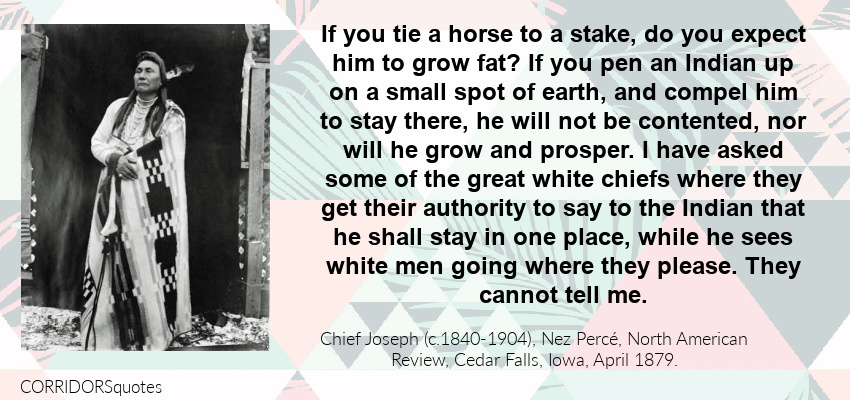
If you tie a horse to a stake, do you expect him to grow fat? If you pen an Indian up on a small spot of earth, and compel him to stay there, he will not be contented, nor will he grow and prosper. I have asked some of the great white chiefs where they get their authority to say to the Indian that he shall stay in one place, while he sees white men going where they please. They cannot tell me. Chief Joseph (c.1840-1904), Nez Percé, North American Review, Cedar Falls, Iowa, April 1879.
I am tired of fighting. Our chiefs are killed…The old men are all dead. It is the young men who say yes or no. He who led the young men are dead. Chief Joseph (c.1840-1904), Nez Percé, 1877.
It is cold and we have no blankets. The little children are freezing to death. My people, some of them, have run away to the hills, and have no blankets, no food, no one knows where they are – perhaps freezing to death. Chief Joseph (c.1840-1904), Nez Percé, 1877.
I want to have time to look for my children and see how many I can find. Maybe I shall find them among the dead. Hear me, my chiefs. I am tired; my heart is sick and sad. From where the sun now stands, I will fight no more forever. Chief Joseph (c.1840-1904), Nez Percé, 1877.
Chief Joseph, c. 1903.
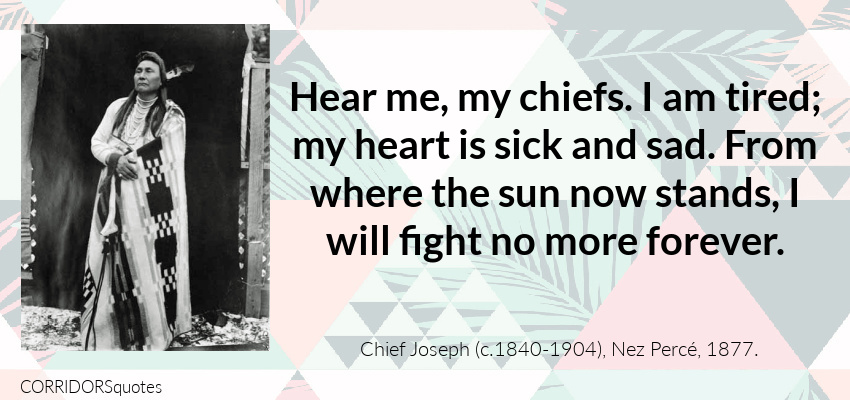
Hear me, my chiefs. I am tired; my heart is sick and sad. From where the sun now stands, I will fight no more forever. Chief Joseph (c.1840-1904), Nez Percé, 1877.
Gravesite of Chief Joseph and war followers, Nez Percé Cemetery, Nespelem, Washington — 1993. Colville Indian Reservation, Okanogan Co., Washington. Chief Joseph’s gravesite is in the distance marked by the tall memorial pillar. Author’s photograph.
FEATURE image: Hawker-Siddeley Blue Steel was started privately in 1954. A contract was placed in 1956 for a stand-off missile to carry a thermonuclear device with a 1 megaton yield by the British Ministry of Supply. Blue Steel was powered by two Armstrong Siddeley Motors that were ignited on launch and enabled the missile to fly at supersonic speed. The missile was constructed of stainless steel with surfaces manufactured of titanium steel. Blue Steel first entered service in 1962 and remained as Britain’s nuclear deterrent until 1970. see- https://www.rafmuseum.org.uk/research/collections/hawker-siddeley-blue-steel/ PHOTO: “Hawker Siddeley Blue Steel” by hugh llewelyn is licensed under CC BY-SA 2.0.
While the North Korea nuclear confrontation of 2017 differed significantly from the Cuban Missile Crisis of 1962, the successful lesson from John F. Kennedy’s leadership was the necessity of restraint, patience, diplomacy, and moral responsibility in avoiding catastrophic war. President Trump should emulate Kennedy’s ability to combine military strength with a commitment to peaceful resolution rather than provoke or initiate conflict.
By John P. Walsh, August 9, 2017
In addition to Twitter, the media tells us that U.S. President Donald J. Trump loves to watch a lot of TV. Has he seen the film: Virtual JFK (2008)?
“Does it matter,” the film’s narrator states, “who is president on issues of war and peace? Can a president make a decisive difference in matters of war and peace? Can a president decisively lead his country into war or keep his country out of war? Or are the forces that drive nations into conflict far more impersonal (and) out of the control of any human being, even a president?”
Nuclear crises remain among the greatest dangers facing humanity because several nations possess nuclear weapons, including North Korea.
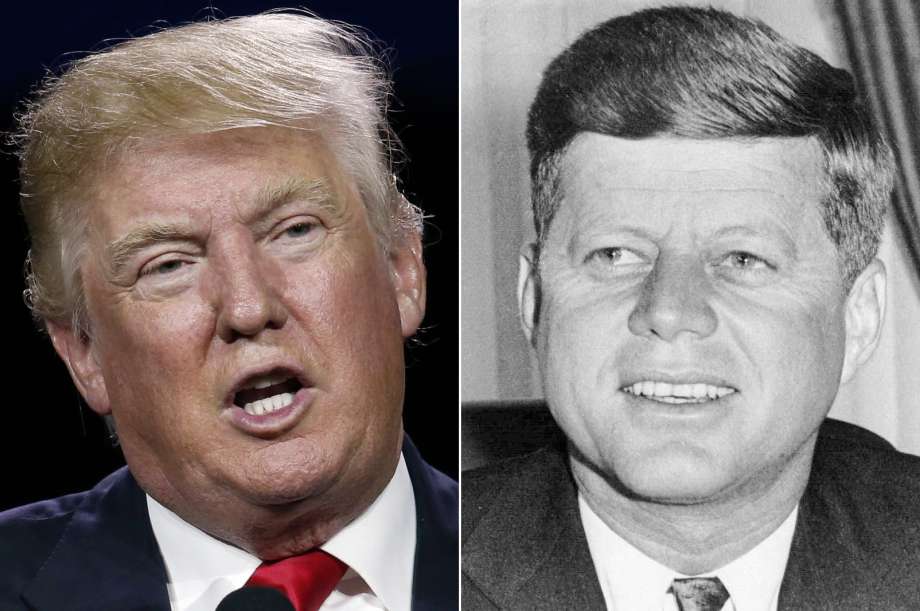
Donald J. Trump and John F. Kennedy. Similar to JFK in the Cuban Missile Crisis in 1962, Trump in 2017 must use the military and moral strength of the U.S. to seek and find a conclusion so that North Korea changes course on their nuclear weapons peacefully. Fair use.
Nine nations stockpile around 16,300 nuclear weapons. The U.S. possesses less than half of them.
In 2014 nine nations around the world—including North Korea—have around 16,300 nuclear weapons. Estimates are that North Korea’s arsenal today may be about 20 warheads or higher. In descending order of warhead amounts, the other nuclear states are Russia (8,000 warheads), the U.S.A. (7,300), France (300), China (250), the UK (225), India and Pakistan (about 100 each) and Israel (80).
According to the National Security Archive, the last tactical nuclear weapons left Cuba in December 1962. For a rogue state such as North Korea to possess nuclear weapons is dangerous and unpredictable to the region and world.
Kennedy prepared for war but consistently avoided taking actions that would trigger either conventional or nuclear conflict.
Like JFK in the Cuban Missile Crisis in 1962, the U.S. must use its military and moral strength to seek and find a conclusion so that North Korea changes course on their nuclear weapons peacefully. Exactly what that change should look like is an important debate not explored here, but the U.S. must not or never start or provoke a nuclear war to achieve it.
Kennedy prepared for nuclear war during the Cuban Missile Crisis, but always carefully stayed away from pulling the trigger. There can be no close analogy between Cuba, 90 miles off American shores, in 1962 and North Korea, over 6,000 miles away, in 2017.
The Cold War by the early 1960’s had become a well-worn competitive geopolitical game that hadn’t completely played itself out. The Russians built a wall in Berlin in 1961; Kennedy quarantined Cuba in 1962. In the Cuban Missile Crisis, the missiles were clearly Russian nukes. In 2017 what sources can Trump hold accountable for the North Korean weapons deployment in addition to the rogue regime? China? Russia? Iran? If Pyongyang is as remote and obscure today as the Kremlin was in Kennedy’s time, today’s political and military equations appear to be more tangled and complicated.
Kennedy’s example demonstrates that strength can be expressed through successful conflict avoidance, not merely through military action.
JFK: “It will be worse before it gets better.”
Any calculations for war must include those who may or will get killed – and how many. Is American “hyper” power any good if its allies are casualties on a massive scale? No nuclear exchange must result with a hermit kingdom dictator who is not a friend of the U.S. or its allies in the region – especially if war may incalculably spread.
If the U.S. has allies in the true meaning of the word then an attack on them by North Korea (or China or Russia) is equal to an attack on the homeland – otherwise what’s the point of the U.S. having allies at all? The U.S. must protect its allies in the region to the highest degree so to defend and preserve its esteemed alliances. In this ongoing dangerous politico-military standoff there are ramifications with severe strong risk for the U.S. as a global superpower and markedly in East Asia. North Korea must somehow stand down for there to be success from the perspective of the U.S and its allies.
Effective leadership in a nuclear crisis depends on cool-headed judgment, patience, and a careful balance of “carrot and stick” diplomacy.
Similar to the Cuban Missile Crisis that endured for 13 straight days—the Korean crisis has gone on arguably for over 60 years — patience and cool-headed leadership joined to a calibration of carrot and stick (preferring the carrot) should serve as worthwhile qualities so to craft a necessarily peaceful and successful outcome.
“Because of the ingenuity of science and man’s own inability to control his relations one with another,” said JFK in 1961 in Virtual JFK, “we happen to live in the most dangerous time in the history of the human race.” The film states that experienced military advisers believed that whenever Americans committed military force – they won the conflict.
Kennedy avoided war –and was almost impeached for it.
But as frequent and strong pressure by many advisers is put on Kennedy to commit the U.S. to a war, the president time and again chose to avoid both conventional and nuclear war.
It may not be well remembered today but after the failure of the Bay of Pigs in 1961, there was talk of John Kennedy’s impeachment for incompetence. Many in his own Democratic party wouldn’t support him because they had convinced themselves he wasn’t a serious political leader.
JFK: “The United States as the world knows will never start a war.”
North Korea’s nuclear ambitions presented a challenge requiring both deterrence and diplomacy rather than reckless escalation. The United States has an obligation to protect its allies while preventing a wider regional or global catastrophe.
In 2017 the defeat of 33-year-old Kim Jong-un’s nuclear threat short of war will not be simply a victory for the status quo but a step forward in terms of American leadership in that part of the world.
An actual war –even if nonnuclear and limited which is improbable -– cannot be in any civilized people’s self-interest. Certainly if Kim started a nuclear war, which is very remote but possible, war would come. As Trump stated plainly, on August 8, 2017, the U.S. response would be with “fire and fury.”
In October 1962 Kennedy’s speech to the nation on the Cuban Missile Crisis included his own “fiery” rhetoric:
“Third: It shall be the policy of this nation to regard any nuclear missile launched from Cuba against any nation in the Western Hemisphere as an attack on the United States, requiring a full retaliatory response upon the Soviet Union.”
JFK concluded with the overall purpose of his actions: “Our goal is not the victory of might, but the vindication of right – not peace at the expense of freedom, but both peace and freedom, here in this hemisphere, and we hope, around the world. God willing, that goal will be achieved.”
Trump should aspire to Kennedy’s commitment to peace and responsible statesmanship in the nuclear age.
President Trump issues a stern warning to North Korea after the latest missile news, saying the nation “best not make any more threats to the United States.”
In 2017 we may look for a resolution to the North Korea crisis where history repeats itself.
All through the Cold War Kennedy looked into the face of strategic MAD (Mutually Assured Destruction) without blinking and then chose to evoke the better angels of our nature. At the United Nations in his first year as president (September 25, 1961) Kennedy exhorted the world’s representatives: “Together we shall save our planet – or together we shall perish in its flames. Save it we can. Save it we must. Then shall we earn the eternal thanks of mankind and, as peacemakers, the eternal blessing of God.”
President Trump would do well to aspire to the same.