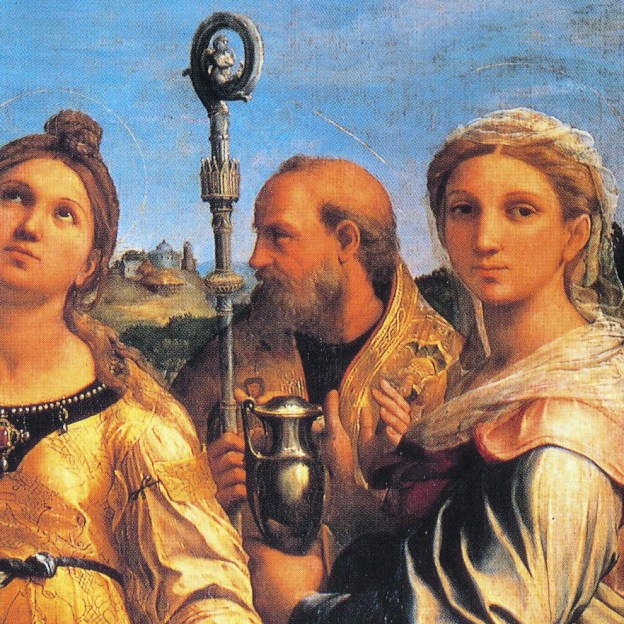

Feature image: Detail featuring St. Augustine of Hippo in Raphael’s St. Cecilia Altarpiece — a more than seven‑by‑five‑foot oil on canvas painted in 1513–14 for a chapel in S. Giovanni in Monte, Bologna. The ensemble gathers St. Cecilia, St. Paul, St. John the Evangelist, St. Mary Magdalene, and Augustine himself, each rendered with Raphael’s mature serenity and monumental poise. Today the altarpiece is housed in the National Gallery of Bologna (Pinacoteca Nazionale di Bologna), where Augustine’s figure remains one of its most arresting presences.
Ambrose, Monica, and the Origin of “When in Rome…”
The familiar maxim “When in Rome, do as the Romans do” is attributed to St. Ambrose, bishop of Milan. He offered this advice to St. Monica and her son St. Augustine while they were living in Milan. Monica discovered that Saturday was observed in Rome as a day of fasting—a practice not followed in Milan. Ambrose’s counsel was simple adaptability: “When I am here [in Milan] I do not fast on Saturday, when I am in Rome I do fast on Saturday.”
After Augustine and his successor Boethius, Europe entered an era of transition later termed the Dark Ages. While learning was heavily restricted, the intellectual landscape was preserved in monasteries, highlighted by the brilliant Irish philosopher John Scotus Eriugena (c. 815–877), who kept rigorous philosophical development alive during the Carolingian Renaissance.
Augustine’s Place in Christian Thought
Scholars consistently claim that after St. Paul, no Christian thinker has left a greater legacy than Augustine. He died on August 28, 430, a bishop watching his city of Hippo fall to invading Vandals as the Roman world collapsed around him. By the 7th century, the cities of the West were fractured, and learning survived mainly in monasteries, where the central intellectual task remained defining God’s existence, His nature, and His relationship to humanity.
Augustine’s Search: Manicheism, Skepticism, Neoplatonism
Before his conversion, Augustine explored three major worldviews:
- Manicheism: A dualistic system dividing reality into good spirit and evil matter, rejecting the Bible and denying Christ’s true humanity.
- Skepticism: A profound distrust of objective truth.
- Neoplatonism: A lofty spiritual philosophy that lacked a personal Creator and treated the material world as an obstacle to the soul.
None satisfied Augustine’s intellect or moral hunger.
The Central Question: How Do God and Man Meet?
Christianity posed unique philosophical challenges: If creation is an act of God’s will, where and how does the Creator meet His creature? This relationship dominated Augustine’s thought. His battles with two major movements sharpened his theology:
- Donatism: Which denied the objective validity of sacraments administered by flawed priests.
- Pelagianism: Which denied original sin and man’s absolute need for grace.
From these conflicts emerged Augustine’s definitive Doctrines of Creation and Grace.
Augustine on Grace, Freedom, and the Human Condition
Augustine taught that fallen man cannot know God by his own power; the very desire to know God is a sign of operating grace. He insisted that one knows God fundamentally by faith—arguing that dynamic belief must precede total understanding (“I believe in order to understand”).
Against Pelagius, he insisted grace was necessary even before the Fall to draw humanity toward God. After the Fall, grace heals human nature and frees the will to pursue the true Good. From these foundations, he developed core Western ideas on self-knowledge, universals, the Trinity, sin, and political philosophy in The City of God. A distinctive feature of his episcopacy was establishing a monastic, communal life with his clergy to ensure spiritual and material stability.
Early Life: North Africa, Family, Education
Augustine was born in Thagaste (modern-day Algeria), likely of Berber descent, to Monica, a devout Christian, and Patricius, a pagan who converted on his deathbed in 371. Monica’s persistent prayer is considered the decisive force behind her husband’s and son’s conversions. Augustine loved Virgil, famously disliked Greek, and trained in rhetoric at Carthage. He lived with an unnamed female companion for years and shared a deep, lifelong bond with their natural son, Adeodatus.
Manichean Years and Intellectual Crisis
As a young man, Augustine embraced Manichean dualism, which treated matter as evil and uncreated—contradicting the Christian belief in a good material creation and the Incarnation. Traveling to Rome and Milan (384), he abandoned Manicheism amid an intellectual crisis.
Ambrose, Milan, and Conversion
In Milan, he encountered St. Ambrose, whose sophisticated preaching demonstrated the harmony of faith and reason, offering Augustine an escape from skepticism. Augustine was baptized at age 32 at the Easter Vigil on April 24, 387, alongside his son Adeodatus and his friend Alypius.
Augustine withdrew to Cassiciacum to write, but tragedy struck when Adeodatus died in 390. Returning to Africa, Augustine was ordained a priest by Bishop Valerius of Hippo, became auxiliary bishop in 395, and soon succeeded him—spending 35 years preaching, governing, and writing works that shaped Western civilization.
Death and the Vandal Invasion
Augustine died in 430 as the Vandals sacked Hippo, spending his final days praying the penitential psalms amidst the physical collapse of his world.
Augustine’s Legacy and Pope Leo XIV
On May 8, 2025, Chicago-born Cardinal Robert Francis Prevost—a dedicated White Sox fan and an Augustinian friar—was elected Pope Leo XIV, becoming the 267th pope and the first-ever pontiff from the United States. His spiritual lineage traces directly back to the monastic rules of St. Augustine of Hippo, whose life and thought continue to shape Christian pastoral life and theology.
see- https://dacb.org/stories/tunisia/adeodatus/ – retrieved August 28, 2025. The Saints: A Concise Biographical Dictionary, edited by John Coulson, Guild Press, New York, 1957. Medieval Thought, Gordon Leff, Humanities Press, Highland, New Jersey, 1958.
This explanatory article may be periodically updated.