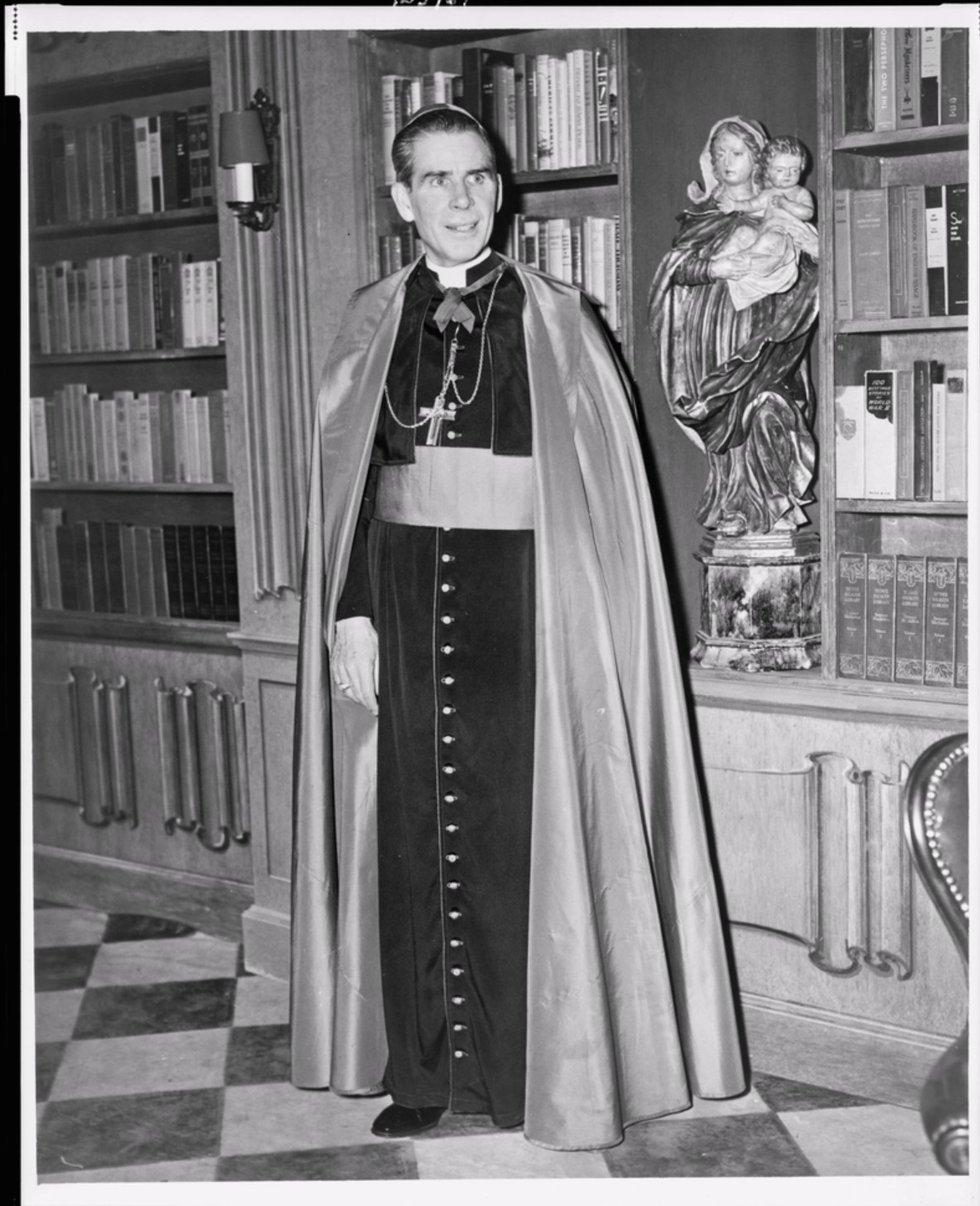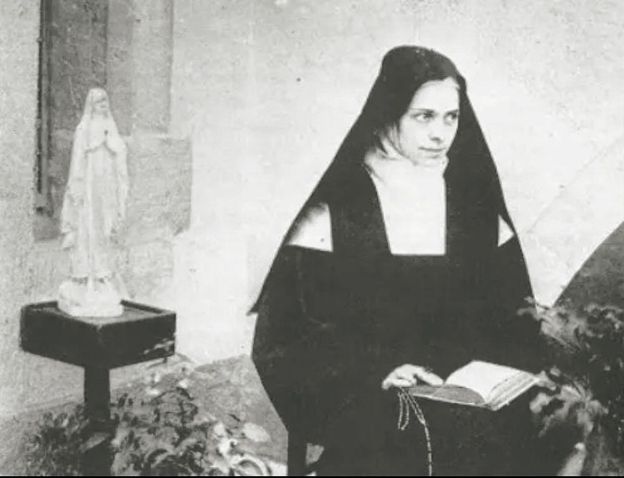
FEATURE Image: Saint Elizabeth of the Trinity (born Élisabeth Catez), a French Discalced Carmelite nun, in a photograph taken in October 1906, just a few weeks before her death at the age of 26. The statue on the table is in the style of Our Lady of Lourdes, shown standing in prayer. Public Domain.
St. Elizabeth of the Trinity’s brief but influential life demonstrates how suffering, personal loss, contemplative prayer, and unwavering devotion to the Holy Trinity transformed an ordinary young French woman into one of the Church’s great modern mystics, whose writings continue to guide souls toward deeper union with God.
By John P. Walsh.
Early Life and Family Tragedy
St. Elizabeth of the Trinity (1880-1906) actually has two different feast days depending on the liturgical calendar used. Born Élisabeth Catez in 1880 at a military camp near Bourges, France, she was the first child of Captain Joseph Catez and Marie Rolland, and was baptized in the camp’s small chapel. Much like her slightly older contemporary, St. Thérèse of Lisieux, Elizabeth suffered the devastating loss of a parent at a young age; her father died suddenly when she was only seven years old. Because Captain Catez was a devout Catholic, his passing collided directly with the fierce anti-Catholic, secularist political movement gripping France at the time. Actively working to scrub all religious influence from public life, state authorities heavily restricted the Catholic military honors and public funeral processions typically granted to officers. Elizabeth witnessed this political alienation firsthand as her grieving family was abruptly thrust out of their secure military housing into immediate financial strain.

The three western entrance portals of St Michel in Dijon. The western façade of Saint-Michel in Dijon is a masterpiece of the French Renaissance, carved in stone over a Gothic structure. It was through these exact heavy wooden doors, beneath the carving of Saint Michael fighting the dragon, that seven-year-old Elizabeth walked in 1887 to make her first confession and later communion and resolved to conquer her own explosive temper. The three portals depict a complete theological narrative centered on Creation and the Fall of Man (north portal), the Incarnation (south portal), and the Last Judgment and St Michael (central portal), with an emphasis on angelic warfare.
Elizabeth was highly conscious of her fiery nature, famously writing in her childhood diaries about the “war” she had to wage against her own violent temper.
Walking under the central portal of Saint-Michel—where the Archangel Michael is carved aggressively crushing the dragon—provided her with a powerful, real-world visual metaphor for her own internal struggles. She did not view her spiritual life as a passive, soft devotion; instead, her early journals reflect a gritty, warlike determination. She explicitly resolved after her first confession to “conquer” her anger and treat her soul as a battlefield where grace had to systematically defeat her volatile impulses, mimicking the very triumph of Saint Michael she passed beneath each day for Mass.
She would later shift her language from this “warlike combat” of her childhood to the profound, quiet interior silence found in her famous mature prayer, “Holy Trinity, Whom I Adore.” PHOTO: “Dijon – Église Saint-Michel – Portails occidentaux” by Benjamin Smith, licensed under CC BY-SA 4.0 (Wikimedia Commons).
A Childhood of Upheaval and Conversion
This sudden family upheaval triggered in seven-year-old Elizabeth a fearful, explosive anger. The family subsequently relocated to a modest apartment in Dijon. It was there, after making her first confession in late 1887 and First Communion at Saint-Michel on April 19, 1891, to which she always looked back as the true moment of her spiritual “conversion” where she resolved to conquer her fiery, explosive temper. On June 8, 1891, Elizabeth received her Confirmation at the Church of Notre-Dame. Though she remained inherently passionate and intense like her mother, she began exercising rigorous, grace-filled self-control over her volatile temper. Playing the piano became both an artistic expression of her musical talents—winning first prize at the local conservatory—and served as a healthy emotional outlet for her deep passions.
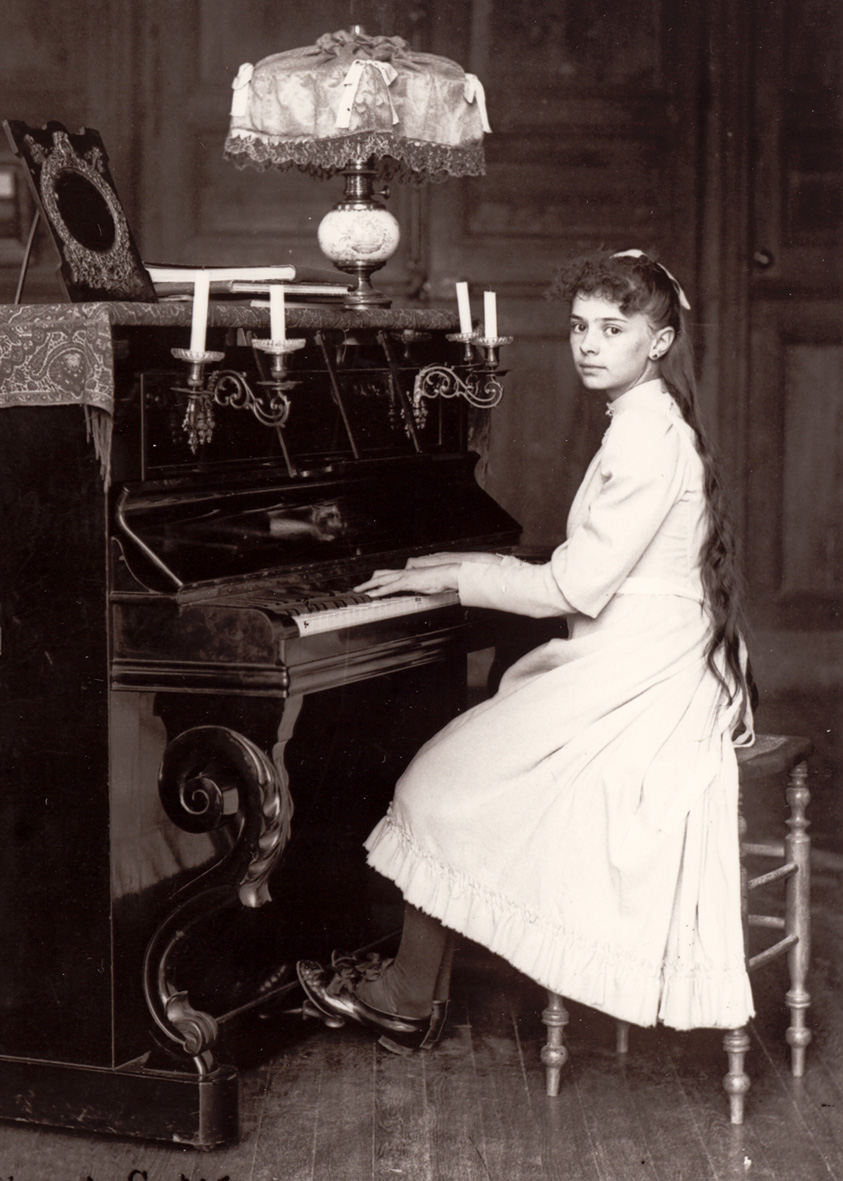
Saint Elisabeth of the Trinity as a young child playing the piano. Public Domain.

The western façade of the High Gothic Notre-Dame of Dijon where St. Elizabeth of the Trinity made her Confirmation on June 8, 1892. Begun in the early 13th century, the parish church was within a rising quarter of local merchants and craftsmen and is famed for its rows of sculpted gargoyles. Author’s photograph. March 1992.
A Soul Drawn to the Trinity
At an early age, she received a profound, infused understanding of the Trinity. This insight did not come primarily through academic study, spiritual conferences, or formal theological instruction, but through a deeply personal dialogue with God Himself, which sparked an ardent, lifelong devotion to the Holy Trinity. As a young laywoman, Elizabeth visited the sick, sang in her parish choir, and taught religion to impoverished children working in local factories to help support their families. It was a period of social transition in which child labor reforms, though motivated by compassion, sometimes left struggling families facing even greater economic hardship.
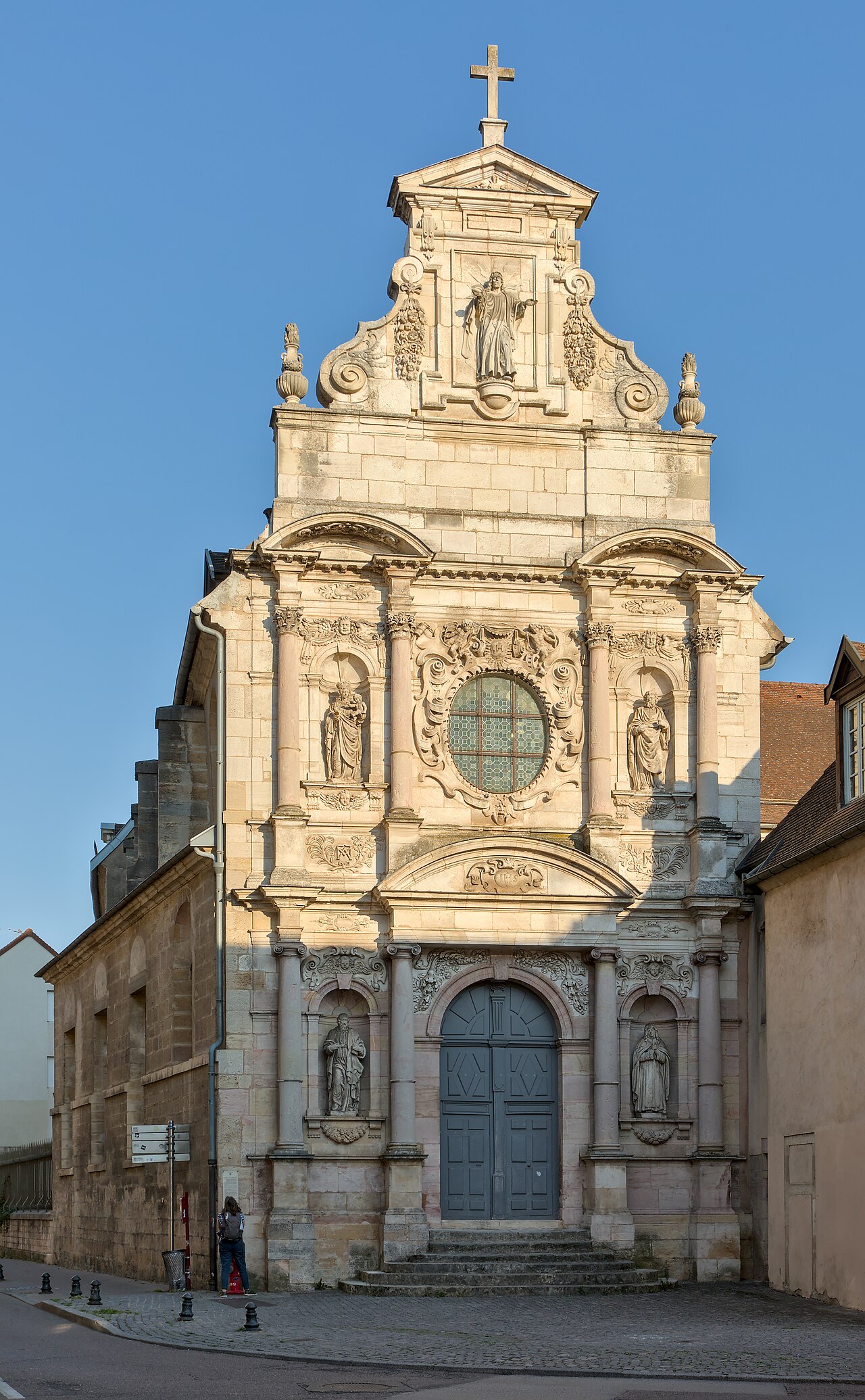
Originally, the third Carmelite convent in France was founded in Dijon in 1605 on Rue Victor Dumay. The nuns were expelled during the French Revolution, and today only the highly ornate, richly sculpted Baroque stone façade of the Chapelle des Carmélites de Dijon survives as a protected historic monument. When the Carmelite presence was reestablished in Dijon during the nineteenth century, a new monastery was constructed at what became 4 Boulevard Carnot, then known as Boulevard de la Préfecture. Situated at the intersection of Boulevard Carnot and the Place du 30-Octobre, this convent stood in the very heart of the city, only a short two-minute walk from Elizabeth’s childhood apartment and her home parish of Saint-Michel.
It was this new monastery that St. Elizabeth entered on August 2, 1901. Although the nineteenth-century buildings in which she lived have since been demolished, the site remains in downtown Dijon. The Carmelite community eventually relocated to its present, more secluded monastery in nearby Flavignerot in 1979.
Following her death from Addison’s disease at the age of twenty-six, Elizabeth was buried on November 12, 1906, in the Carmelite section of Dijon’s Cimetière des Péjoces. In accordance with both Church and civic custom, she was laid to rest alongside her deceased religious sisters in the communal cemetery rather than within a church. During the formal investigation of her cause for beatification in 1931, her remains were exhumed and transferred to a private crypt within the chapel of her own monastery at 4 Boulevard Carnot.
When the Carmelites departed the city center for Flavignerot in 1979 and sold the Boulevard Carnot property, Elizabeth’s relics were moved once more. This final translation brought her back to the parish that had shaped so much of her spiritual life: Saint-Michel Church in Dijon, where her sacred remains rest permanently today.
PHOTO: “Dijon – Chapelle des Carmélites” by Benjamin Smith, licensed under CC BY-SA 4.0 (Wikimedia Commons).
The Call to Carmel
Drawn to an intense life of prayer, Elizabeth felt a strong call to the strict cloister of the Discalced Carmelite Order. Her mother adamantly opposed the vocation, urging Elizabeth to accept one of her many marriage proposals so she could secure a wealthy, comfortable lifestyle. Elizabeth declined them all, determined to praise God in the monastery located just a short distance from her home in Dijon. The close proximity to the monastery on Boulevard Carnot (formerly known as Boulevard de la Préfecture) in the heart of Dijon. is why Elisabeth wrote that she could constantly hear the Carmelite monastery bells ringing throughout her childhood days. She finally entered the Dijon Carmel on August 2, 1901, famously writing of her ordinary duties: “I find Him everywhere, while doing the wash as well as while praying.”
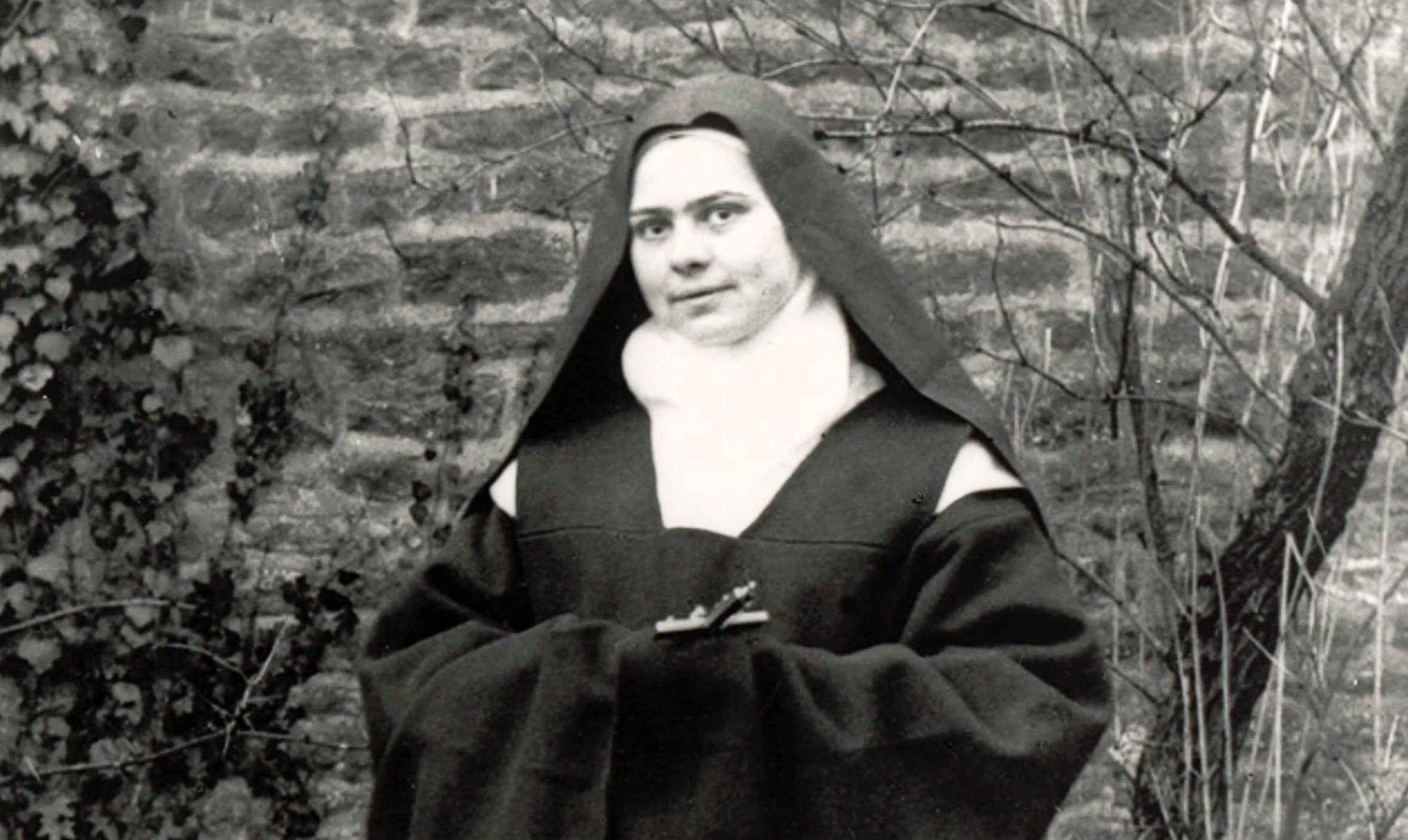
Saint Elizabeth of the Trinity wearing her Carmelite habit was taken circa 1902–1904 at the Carmel of Dijon in France. It is frequently dated to December 1902, captured shortly before she made her final religious profession. Public Domain.
Mystic of the Interior Life
Her life behind the convent walls was a mixture of profound mystical highs and painful, dark interior trials. Throughout these valleys, she wrote extensively about her need for an even richer immersion into God’s infinite love. Toward the end of her short life, she took on the spiritual mantle of “Laudem Gloriae” (Praise of Glory), anticipating her eternal role in Heaven. Through her diary, poetry, and vast correspondence with family and friends, she outlined her heavenly mission: “I think that in Heaven my mission will be to draw souls by helping them to go out of themselves in order to cling to God by a wholly simple and loving movement, and to keep them in this great silence which will allow God to communicate Himself to them and to transform them into Himself”—a beautiful description of the mystical process of theosis, or divinization.
Final Suffering and Holy Death: To Light, to Love, to Life!
Elizabeth died in the monastery at the age of twenty-six from Addison’s disease, which was incurable at the time. Her death was agonizingly painful, marked by violent nausea, high fevers, and sleepless days and nights. Yet, she gratefully accepted her three years of escalating physical suffering as a sacrificial gift from God. Anchored in a profound intimacy with the indwelling Trinity, her legendary final words were: “I am going to Light, to Love, to Life!”
Why Two Feast Days?
Though she passed away on November 8, 1906, the Universal Church assigns November 9 as her official feast day. Because November 9 is also the major universal feast of the Dedication of the Lateran Basilica (the Pope’s cathedral in Rome), the Carmelite Order celebrates her memorial on November 8. This clever calendar shift effectively “cleared the path,” ensuring their beloved mystic would receive an unhindered, solemn celebration within her own religious family.
Path to Canonization
The formal path to her saintly recognition began in Dijon in 1931, where church authorities meticulously collected and examined her life, death, and writings. Pope John XXIII officially introduced her cause in October 1961, declaring her a Servant of God. Following an extensive review of her heroic virtues, she was declared Venerable in 1982. After the validation of a medical miracle, Pope John Paul II beatified her in Paris in November 1984 during his historic apostolic visit to France. In March 2016, following the approval of a second miracle, Pope Francis cleared her way for formal sainthood, canonizing her later that year, on October 16, 2016.
Legacy and Patronage
Today, St. Elizabeth of the Trinity—whose most famous contemplative prayer is titled “Holy Trinity, Whom I Adore”—is widely venerated as the patron saint of sick people, those battling chronic illness, and individuals mourning the loss of a parent.
The famous prayer “Holy Trinity, Whom I Adore” (Ô mon Dieu, Trinité que j’adore) was written by St. Elizabeth of the Trinity (Élisabeth Catez) on November 21, 1904, inside her cell at the Discalced Carmelite Monastery in Dijon, France.
Elizabeth wrote this down on a loose sheet of paper during her convent’s annual retreat. It was never intended for publication; it was a completely raw, private act of interior praise. Her prioress only discovered the written prayer among Elizabeth’s personal papers after her death in 1906.
The prayer serves as the ultimate summary of her deep, mystical theology of theosis—the total emptying of oneself (“let me entirely forget myself”) so that the indwelling Trinity can fully possess, consume, and transform the soul into a living reflection of Christ.
St. Elizabeth of the Trinity left behind influential letters, poetry, retreats, and prayers, especially “Holy Trinity, Whom I Adore.”
O my God, Trinity whom I adore, let me entirely forget myself that I may abide in you, still and peaceful as if my soul were already in eternity; let nothing disturb my peace nor separate me from you, O my unchanging God, but that each moment may take me further into the depths of your mystery! Pacify my soul! Make it your heaven, your beloved home, and the place of your repose; let me never leave you there alone, but may I be ever attentive, ever alert in my faith, ever adoring and all given up to your creative action.
O my beloved Christ, crucified for love, would that I might be for you a spouse of your heart! I would anoint you with glory, I would love you — even unto death! Yet I sense my frailty and ask you to adorn me with yourself; identify my soul with all the movements of your soul, submerge me, overwhelm me, substitute yourself in me that my life may become but a reflection of your life. Come into me as Adorer, Redeemer, and Saviour.
O Eternal Word, Word of my God, would that I might spend my life listening to you, would that I might be fully receptive to learn all from you; in all darkness, all loneliness, all weakness, may I ever keep my eyes fixed on you and abide under your great light; O my Beloved Star, fascinate me so that I may never be able to leave your radiance.
O Consuming Fire, Spirit of Love, descend into my soul and make all in me as an incarnation of the Word, that I may be to him a super-added humanity wherein he renews his mystery; and you, O Father, bestow yourself and bend down to your little creature, seeing in her only your beloved Son in whom you are well pleased.
O my ‘Three’, my All, my Beatitude, infinite Solitude, Immensity in whom I lose myself, I give myself to you as a prey to be consumed; enclose yourself in me that I may be absorbed in you so as to contemplate in your light the abyss of your Splendour!
See – Le Carmel de Dijon – Carmel de Flavignerot – accessed November 8, 2026.

Her reconstituted convent cell at the Carmel of Dijon (now preserved at Flavignerot), where her personal items—including this statue on the wall shelf—are kept. The statue on the table of Our Lady of Lourdes is either the exact same statue in the October 1906 feature photograph or an identical one. PHOTO: “Convent Cell of Elisabeth of the Trinity” by Willuconquer is licensed under CC BY-SA 3.0
This explanatory article may be periodically updated.