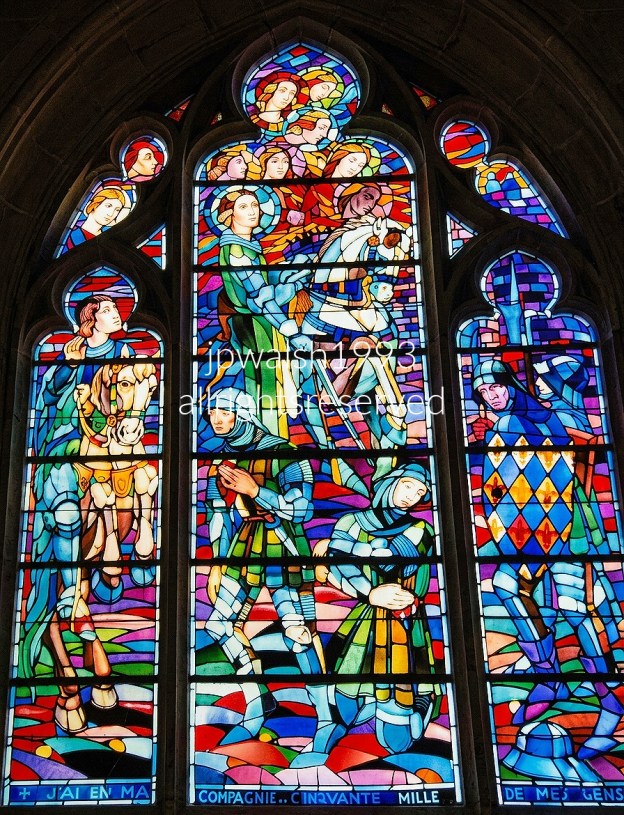
FEATURE Image: St. Joan of Arc’s capture of Saint-Pierre-le-Moûtier from Anglo-Burgundian forces on November 4, 1429, during the Hundred Years War in L’église Saint-Pierre at Saint-Pierre-le-Moûtier, France. Seotember 1993. Author’s photograph.
The stained-glass window at Saint-Pierre-le-Moûtier commemorates a pivotal moment in Joan of Arc’s military career, illustrating how her unwavering faith, personal courage, and conviction in divine assistance transformed a near-defeat into a decisive French victory during the Hundred Years’ War.
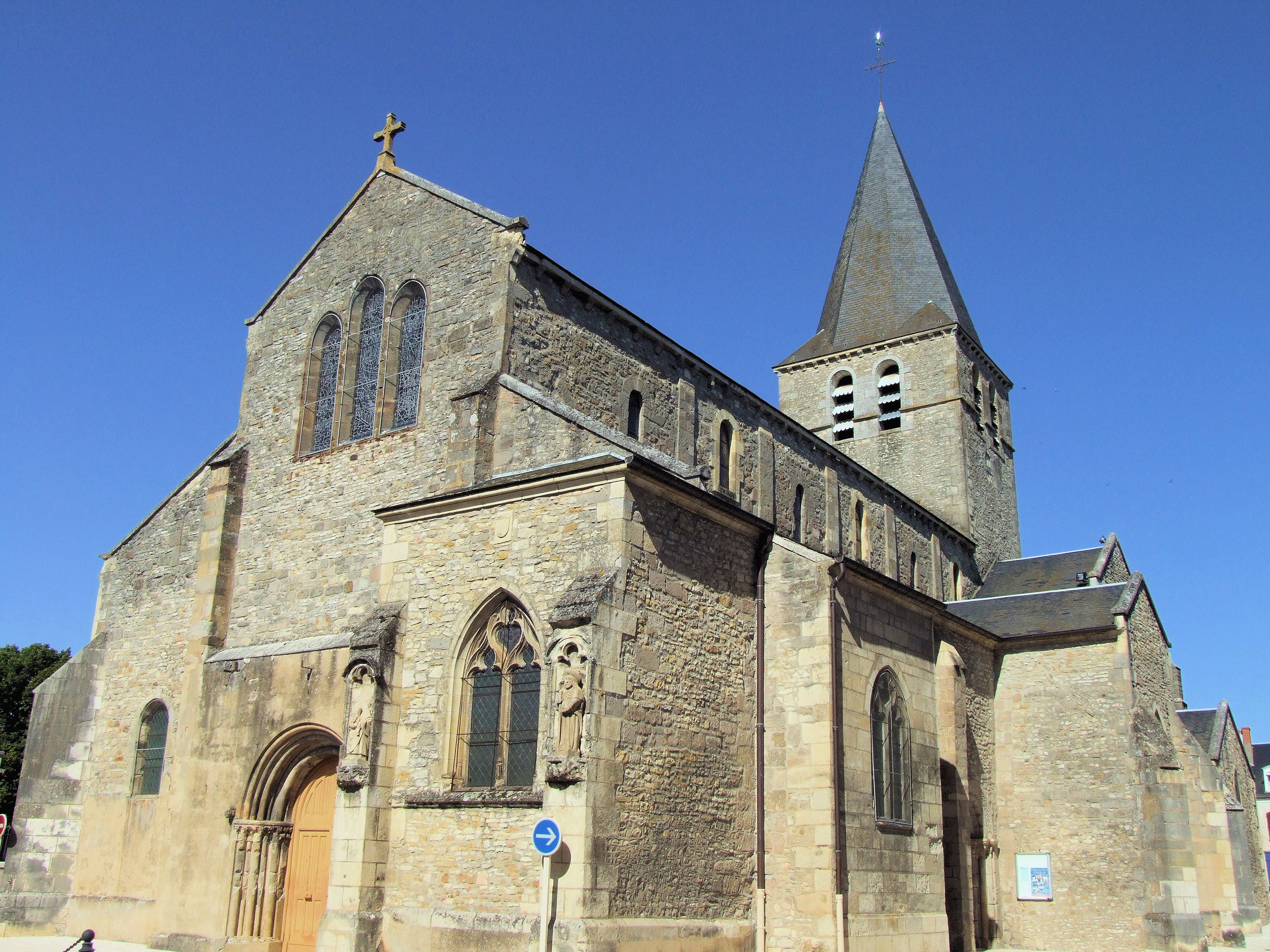
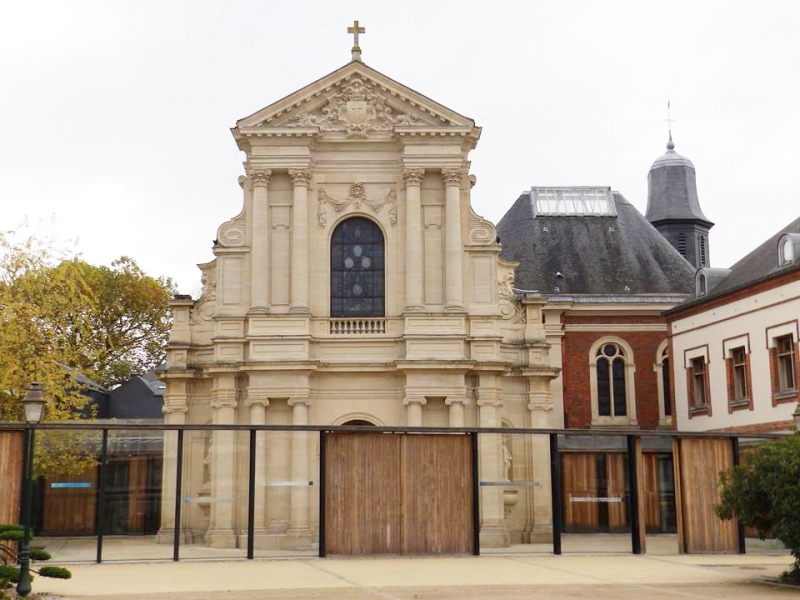
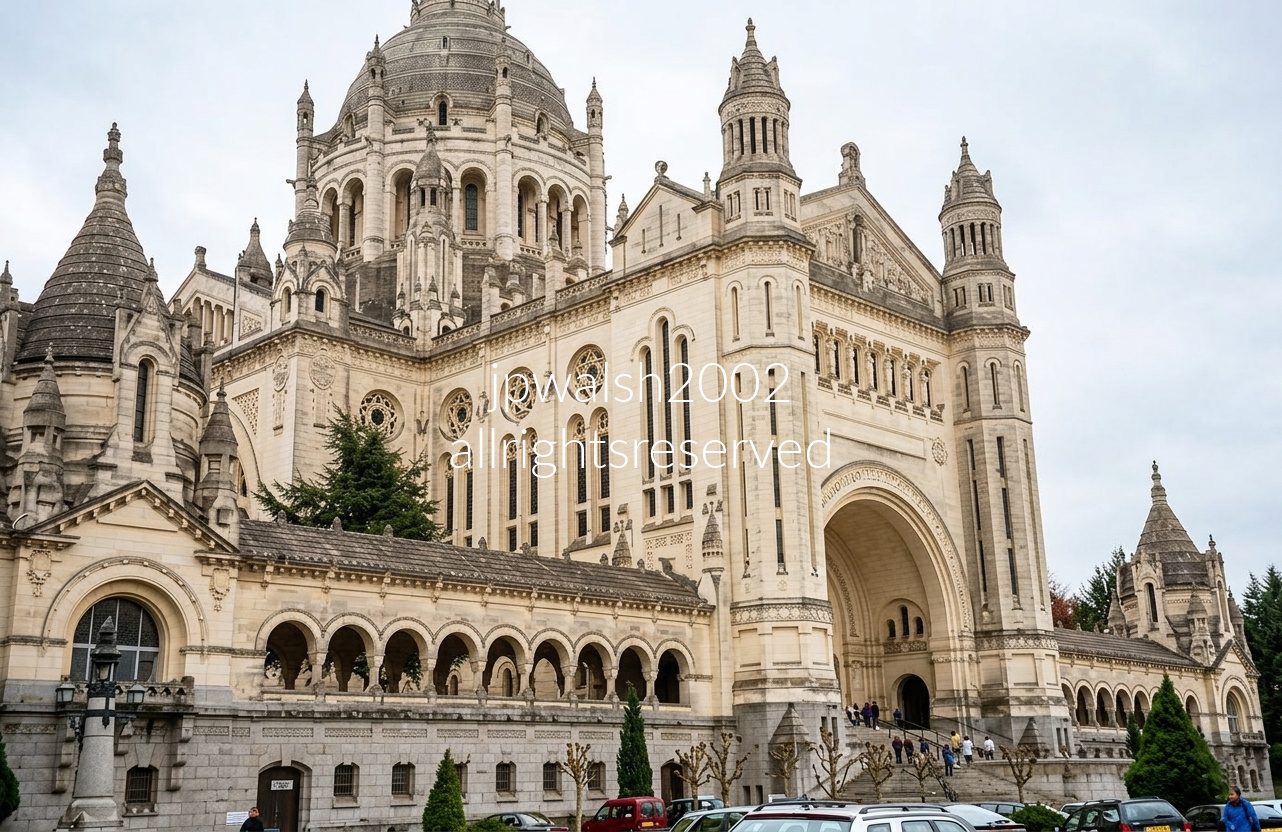
The Saint Peter Church of Saint-Pierre-le-Moûtier (Nièvre) is a 12th-century Roman Catholic building, a former Benedictine priory, classified as a historical monument since 1886. Photo by MOSSOT / Wikimedia Commons / CC BY 3.0
The Window and Its Setting
This stained‑glass window captures one of the most electrifying moments in the epic of Joan of Arc. It is part of a modern cycle in the town church of Saint‑Pierre de Saint‑Pierre‑le‑Moûtier, crafted in the mid‑20th century by the Mauméjean brothers. The artwork commemorates an event that unfolded in this very town — and inside this very church — during the Hundred Years’ War.
On November 4, 1429, Joan led a French royal force to seize Saint‑Pierre‑le‑Moûtier, a fortified stronghold held by Anglo‑Burgundian troops. The attack stalled under fierce resistance. French soldiers broke formation and began to fall back. Amid the chaos, Joan’s officer Jean d’Aulon — wounded during the fighting — suddenly realized she had been left almost alone near the moat with only a handful of men.
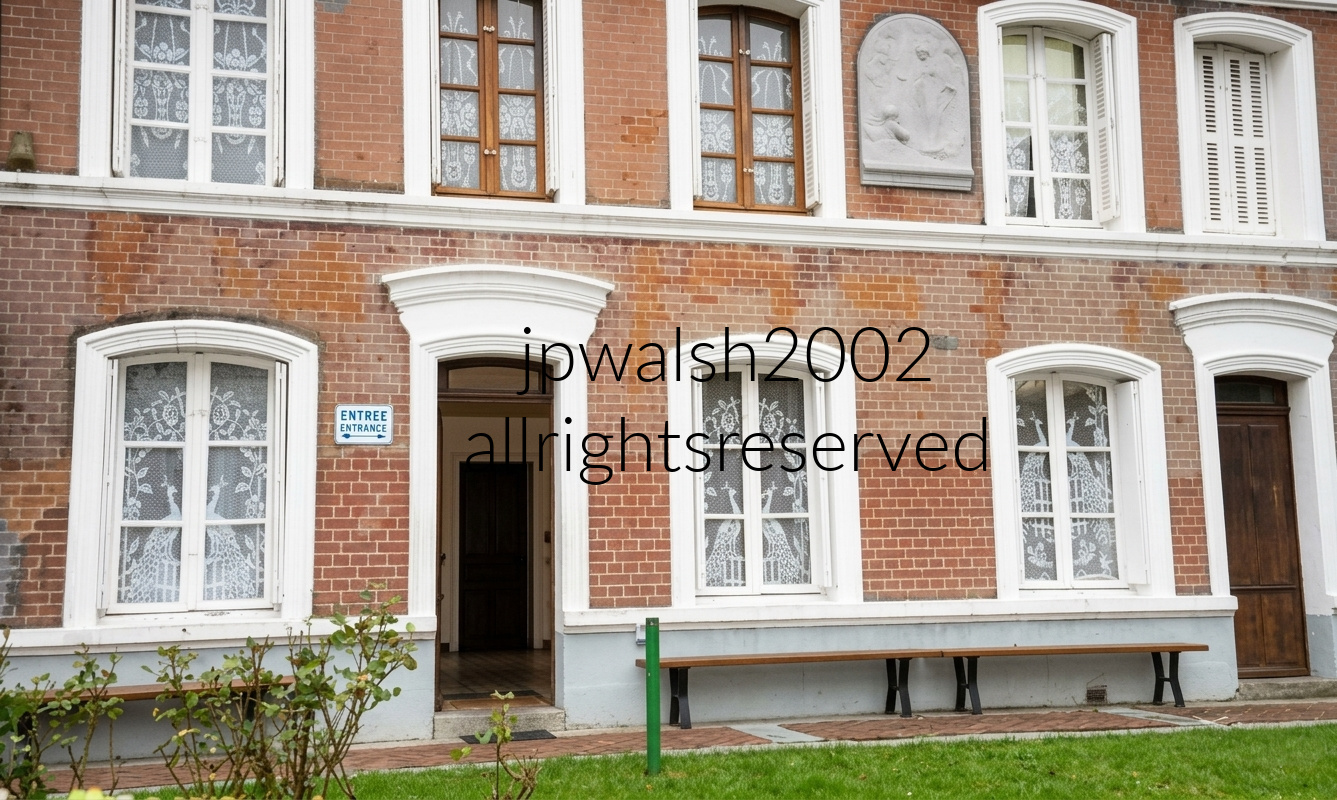
Author’s photograph. All rights reserved.
Joan’s Defiance and Her “Fifty Thousand”
D’Aulon mounted a horse, rode to her, and urged her to retreat before she was killed or captured. Joan removed her helmet and shouted that she was not alone. The window preserves her words across its lower banners: “+ J’AI EN MA / COMPAGNIE . . CINQVANTE MILLE / DE MES GENS.” She claimed she had fifty thousand of her people with her — the heavenly host of angels she believed fought at her side. D’Aulon saw only four or five soldiers, but Joan’s unshakable resolve reignited the army.
The Turning of the Battle
Joan ordered her men to gather wood and brush to build a makeshift bridge across the moat. The retreating French troops saw The Maid standing her ground, turned back, and launched a sudden, overwhelming assault that broke the defenses and captured the town. The upper portion of the window shows Joan on her white horse in the heat of battle, while the faces gathered in the arc above represent the “fifty thousand” she invoked — angels, Saint Michael, and the voices she believed guided her.
Aftermath and Joan’s Devotion
Following the victory, Joan prevented her troops from sacking the town. She then spent several days praying inside this church before marching on to her next campaign, leaving behind both a military triumph and a moment of mystic conviction that the Mauméjean window preserves with vivid force.
The nave of Saint-Pierre Church at Saint-Pierre-le-Moûtier, where Joan of Arc spent several days in prayer following her remarkable victory against overwhelming odds at the Battle of Saint-Pierre-le-Moûtier in November 1429. Photo by MOSSOT / Wikimedia Commons / CC BY-SA 3.0
More than a scene of battlefield heroism, the Saint-Pierre-le-Moûtier window presents Joan of Arc’s conviction that military success flowed from divine providence, portraying the inseparable relationship between faith, vision, and leadership that defined her extraordinary career.
This explanatory article may be periodically updated.
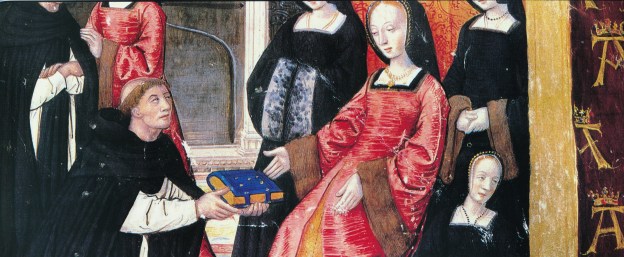
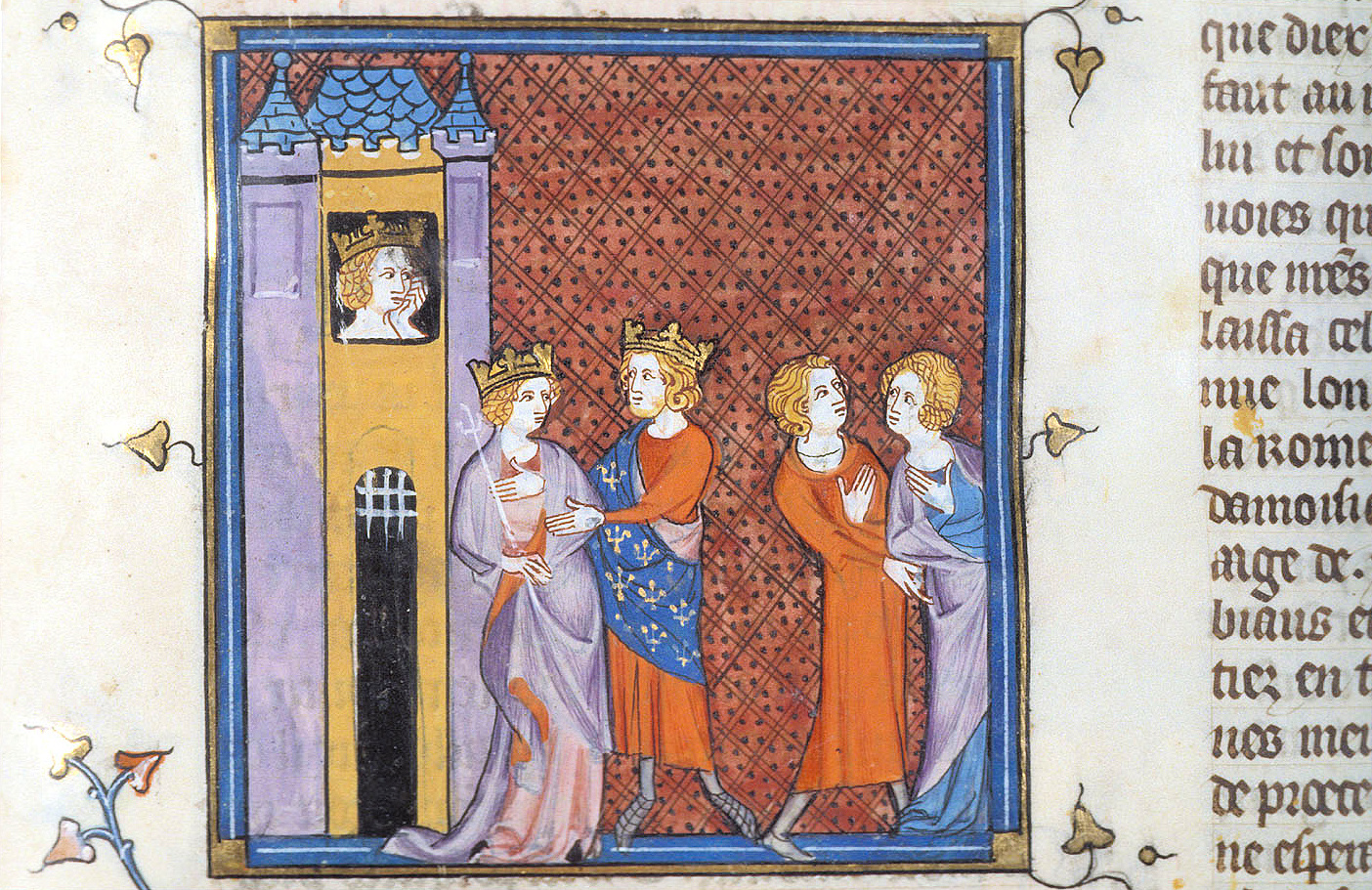
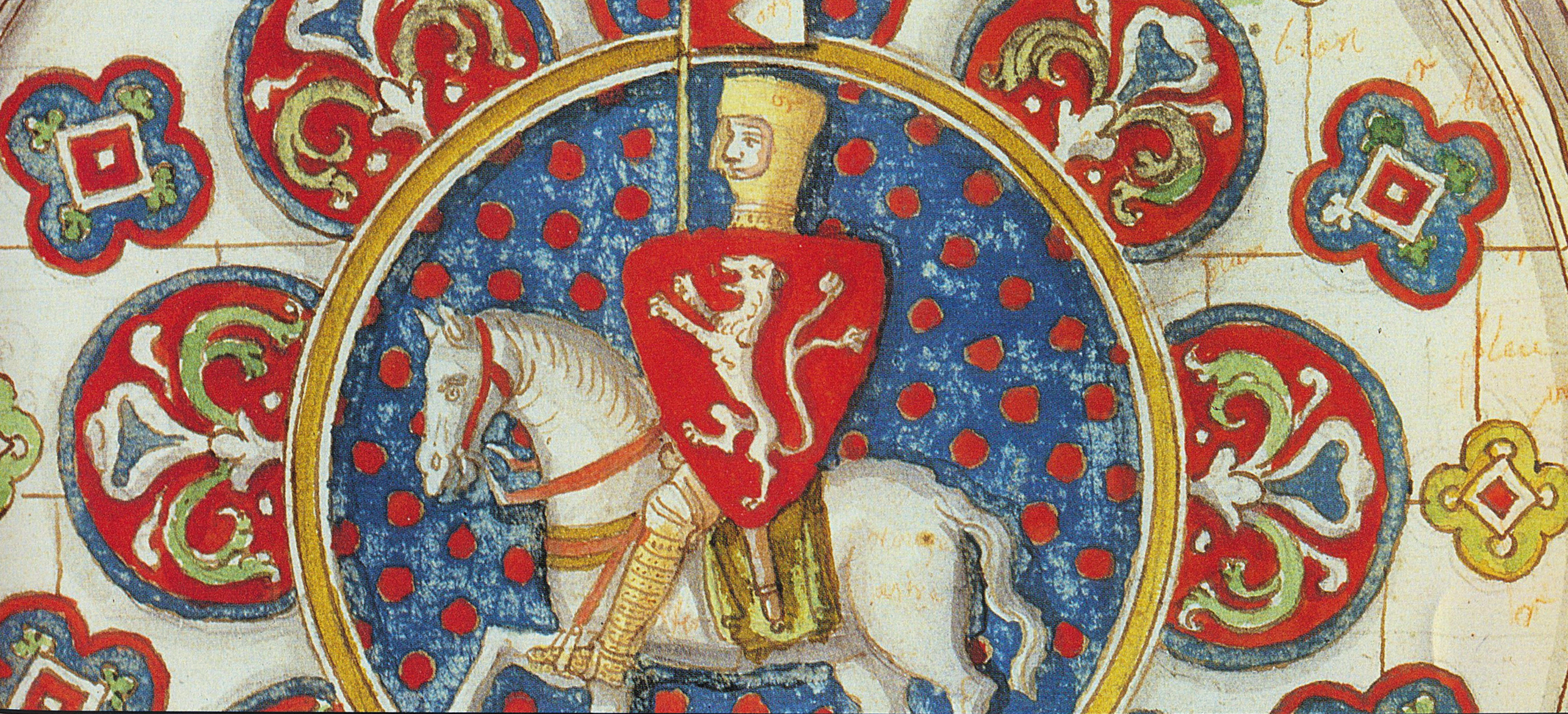
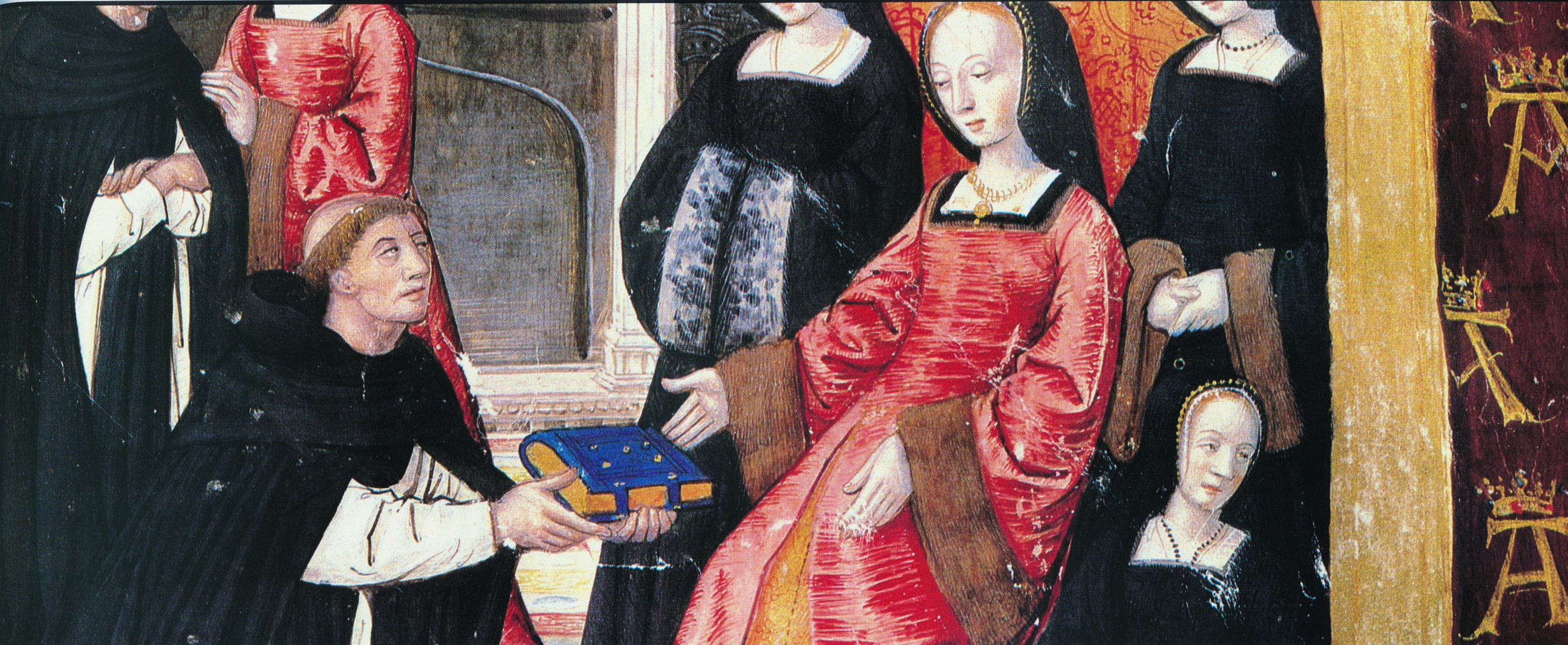
FEATURED image: Manuscript 16th century (detail): Queen consort Anne of Brittany (1477-1514) receiving a Book of Hours from her Dominican confessor, Antoine Dufour (d.1509). Montfort L’Amaury returned to the crown of France after Anne of Brittany married Charles VIII “the Affable” (1470-1498) in 1491.
Thirty miles from Paris, Montfort-l’Amaury condenses a thousand years of French history into one small town, where medieval fortifications, Renaissance religious art, royal patronage, and modern cultural figures reveal the continuous evolution of France from the age of crusaders to the twenty-first century.
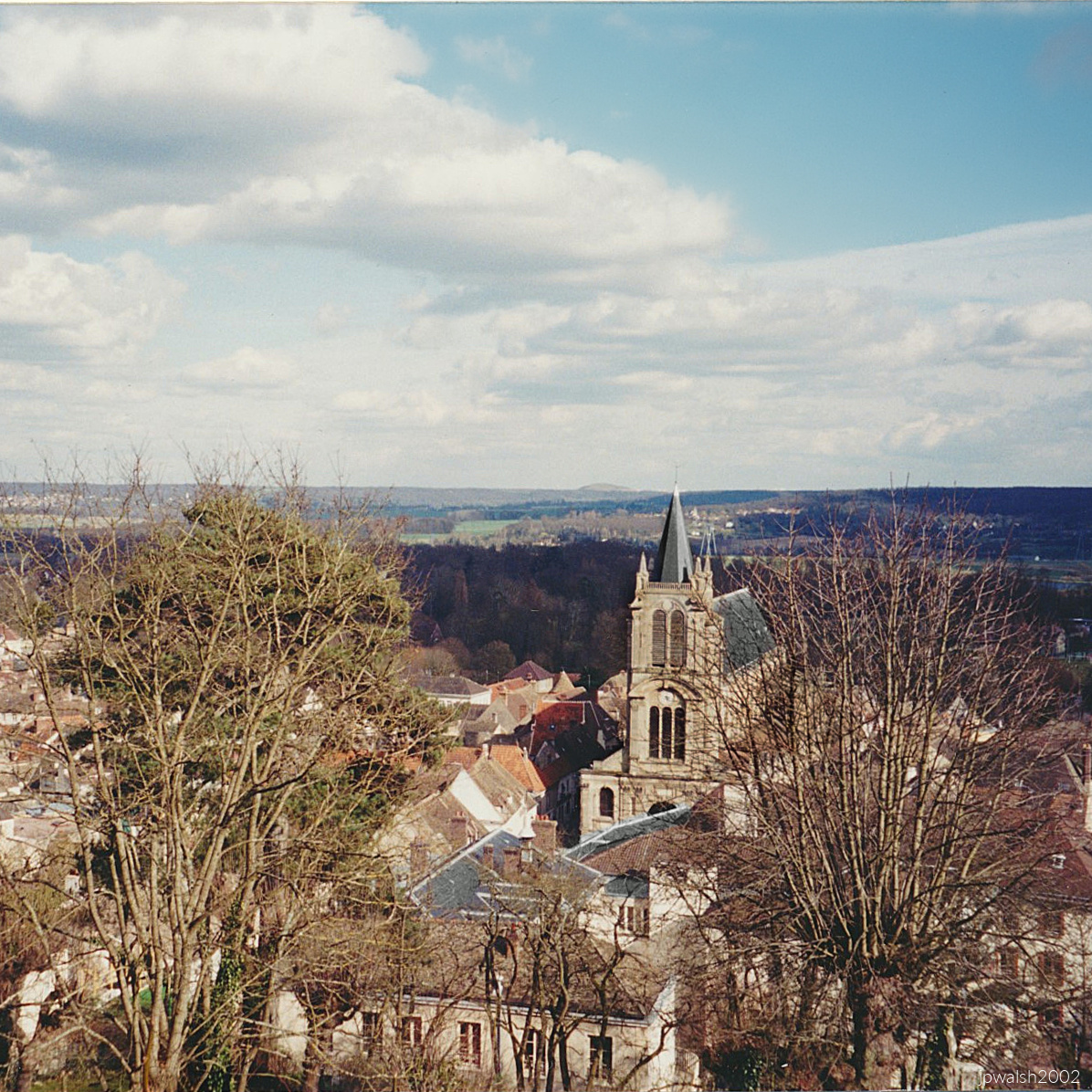
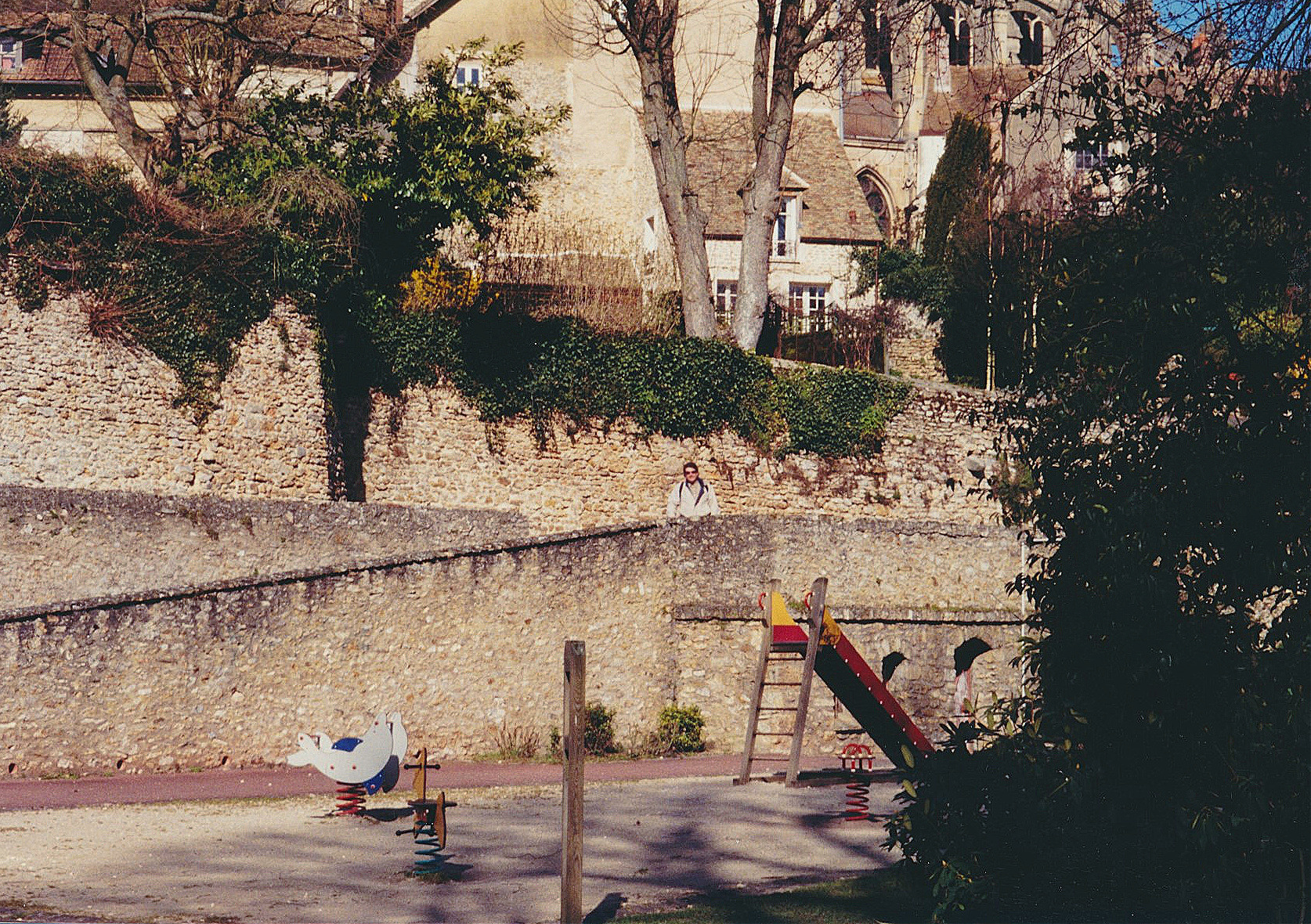
Started in the 11th century, L’Église St. Pierre anchors part of the centre ville of Montfort L’Amaury, a town in France about 30 miles west of Paris. The photograph is taken from the ruins of the chateau on the town’s heights. The late 10th century Frankish king Robert II built a castle in the hills of Montfort. From the start of the 11th century, Montfort-l’Amaury was the stronghold of the Montfort family. March 2002. Author’s photograph.
At the north edge of the Rambouillet forest the city of Montfort L’Amaury spreads along the restored ruins of its ancient fortified castle. Founded under the Capetian kings, the city owes its fame to Simon de Montfort (1208-1265), Anne de Bretagne (1477-1514), the Valois royal dynasty, and Henry IV (1553-1610). Its monuments begin in the 11th century, stretch towards exceptional Renaissance stained-glass windows and half-timbered houses as its civilization has attracted writers, artists, and musicians to live there. This would include the house of Maurice Ravel (1875-1937) called Le Belvédère where he lived from 1921 until his death and where we were invited to sit at, and play, the piano where Ravel composed Boléro. It was in March 2002 during a visit to Paris and the Île-de France that we ventured through Yvelines by train to Montfort-L’Amaury for a day trip which included a memorable déjeuner in a restaurant that has since disappeared.
L’Église Saint-Pierre
Interior, L’Église Saint-Pierre (Church of St. Peter), late 15th century, Montfort L’Amaury, France. March 2002. Author’s photograph.
The interior of Saint Pierre church is bright and intimate. Like other French monuments, today’s Saint-Pierre was completed over many centuries. Its origin is in the 11th century. A notable reconstruction of the edifice began in the late 15th century by initiative of Queen Consort, Anne of Bretagne. There is a vast ambulatory around both sides of the nave. Since 1840, the church has been an historic monument because of its unique ensemble of 37 stained glass windows. The oldest date from the 1540s and 1570s. The others were installed in the late16th century. That ecclesial project was started by Catherine de Medicis (1519-1589) in 1562. The windows were installed during the time of the Council of Trent (1545-1563) and some of the glass commemorates that event. As none of the glasswork is signed, it is not known whether its painters are from Montfort L’Amaury or elsewhere.
South exterior of L’Église Saint-Pierre along Rue de Dion in Montfort L’Amaury. March 2002. Author’s photograph.
The exterior wall shows flying buttresses designed in the French Renaissance style as well as gargoyles that were sculpted in the late 15th century. The building is constructed of calcified stone that came from towns to the north, precisely, Maule, and a more distant Vernon on the Seine. The interior ambulatory that surrounds the nave on both sides and ends at the chevet expresses the building’s gothic aspect. Street lamps and a narrow street with tight parking has room for a small tree next to the church.
St. Peter Window. L’Église Saint-Pierre, Montfort L’Amaury, France. Public Domain.
Throughout France starting in the 1540s there was a growing taste and demand for stained glass windows in their local churches. The experimentation in glasswork and painting by the middle of the 16th century allowed for the iconography in these stained glass windows to express numerous details and refined techniques.
Detail. St. Peter Window. Public Domain.
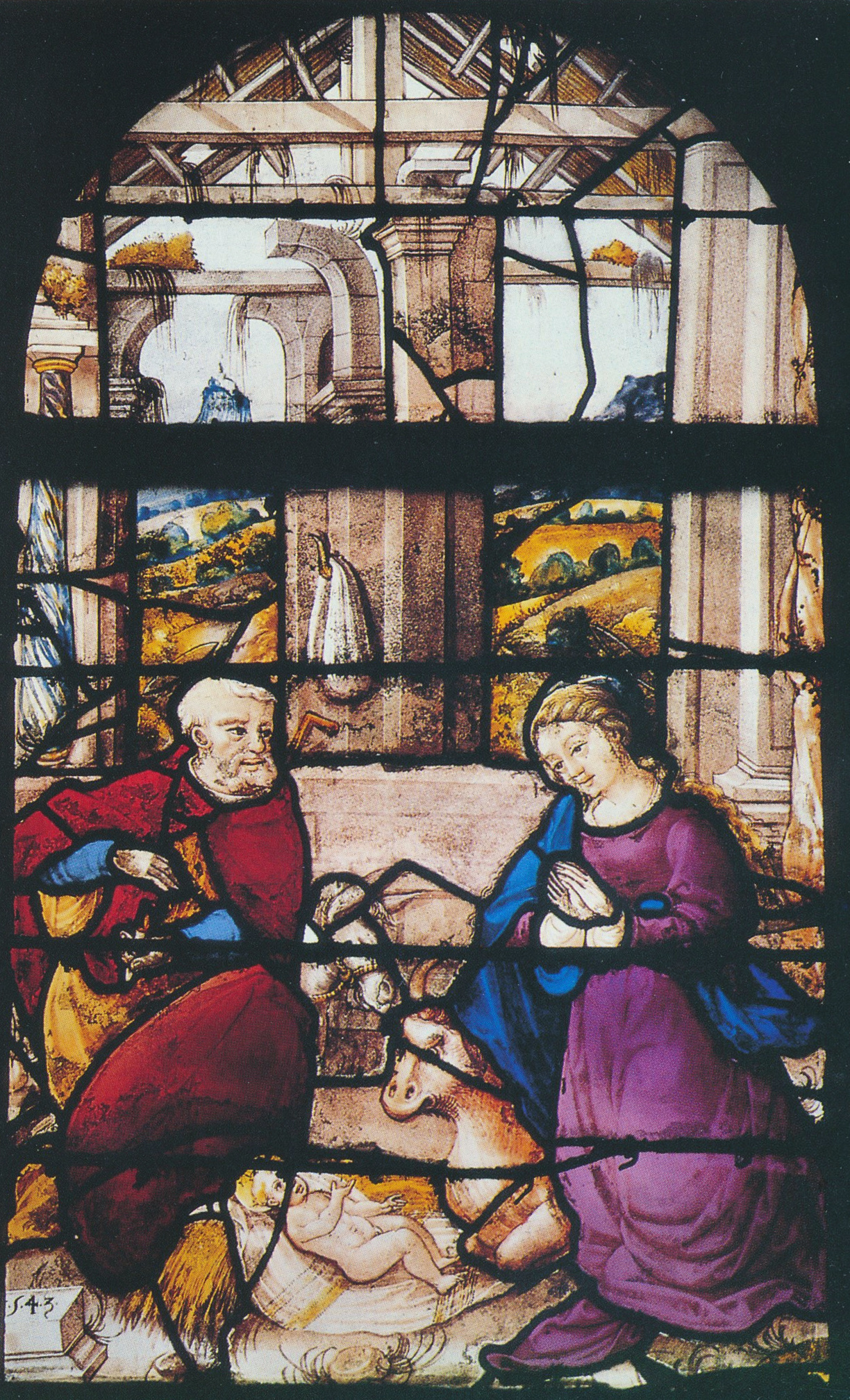
Detail. Nativity Window. Public Domain.
Historic 16th-century half-timbered house located in Montfort-l’Amaury
Montfort L’Amaury has half-timbered houses dating to the 16th century. March 2002. Author’s photograph.
This is no. 16, Place de la Libération, just steps from the front entrance of Église St. Pierre. The building features a classic colombage (half-timbered) facade with vertical wood beams, diagonal braces, and traditional window shutters. Houses like this were common during the 15th and 16th centuries in the region.
Victor Hugo
At the beginning of October 1825 young Victor Hugo (1802-1885) lived in Montfort L’Amaury for a few days. He wrote a letter to his father in Paris and described it as “a charming little town ten leagues from Paris, where there are ruins, woods, and one of my friends…”
Victor Hugo stayed in Montfort-l’Amaury primarily to visit his close friend, the poet Adolphe de Saint-Valry. At the beginning of October 1825, a young, 23-year-old Victor Hugo and his wife, Adèle, spent several days at Saint-Valry’s family home located on Rue de la Treille. Saint-Valry was a fellow literary intellectual and one of the co-founders of the conservative romantic journal La Muse française.
The trip profoundly influenced French literature in two major ways: first, upon returning to Paris, Hugo wrote a letter to his father describing Montfort-l’Amaury as described above; and second, during Hugo’s wanderings through the village, the future author of The Hunchback of Notre Dame (1831) became captivated by the crumbling medieval fortifications and the 12th-century castle keep (The Tower of Anne de Bretagne). This inspired him to write his famous poem, “Aux ruines de Montfort-L’Amaury” (published in his 1828 collection Odes et Ballades). It marks the very first time Hugo integrated the romantic grandeur of medieval ruins into his poetry—a thematic hallmark he would develop extensively throughout the rest of his legendary career.
View of the church from the east. March 2002, Author’s photograph.
The church of Saint Pierre is of late gothic origin. It was rebuilt and decorated in the 15th, 16th, and early 17th centuries. Following the French Revolution and its aftermath, the church building received an extensive restoration in the mid19th century, including a new steeple. Except for one stained glass window that was restored in situ, all the 16th century stained-glass windows were taken out, restored, and reinstalled by a master painter in Metz between 1851 and 1857.
Chevet. L’Église Saint-Pierre. Public Domain.
Taken from Rue Pétau de Maulette, the historic photograph captures the apse and side facade of the Church of Saint-Pierre de Montfort-l’Amaury. Built largely under the patronage of Queen Anne of Brittany in the late 15th and early 16th centuries, the lower structure features the dramatic flying buttresses, pointed arches, and intricate stone tracery characteristic of late Flamboyant Gothic architecture. The upper galleries and the grand rounded apse roof visible in the foreground display the classical proportions, decorative balustrades, and orderly lines of the French Renaissance style of the later 16th century. The building is a remarkable architectural hybrid, illustrating the transition between two major eras in French history. It also houses one of France’s most important and complete collections of Renaissance stained-glass, dating from 1530 to 1580. These 37 monumental windows are celebrated for their vivid colors, exceptional draftsmanship, and richly detailed biblical and historical narratives.
Place de la Libération with Rue de la Libération just beyond. March 2002. Author’s photograph.
On Saint Pierre’s front stoop is busy Place de la Libération. Like many town squares throughout France, this area was renamed to commemorate the town’s liberation from Nazi occupation during World War II. Montfort-l’Amaury was officially liberated on August 18, 1944, when American military forces entered the village center. Following a brief firefight with a heavily armed detachment of retreating German soldiers, the town was successfully freed, bringing an end to the local German Kommandantur. Prior to this 20th-century renaming, the historic area was known as the Place Normande—the dark site where the municipal guillotine was briefly erected during the height of the French Revolution. At the end of the street is the rounded 16th century La Porte Bardoul, one of gateways to the chateau. It was named in the 16th century for the captain who built the ramparts of Montfort L’Amaury in the 11th century (Hugues Bardoul).
Charles Aznavour (1924-2018), dubbed France’s Frank Sinatra, didn’t live in Montfort L’Amaury but for 60 years, the singer lived a five–minute car ride away in neighboring Galluis. In those many years, Aznavour frequently came to Montfort L’Amaury, sometimes to go shopping or visit friends or eat at one of its restaurants. In 2018 Aznavour was buried in the cemetery in Montfort L’Amaury and it has become a pilgrimage site for his many fans. PHOTO: “Charles Aznavour – Disque D’Or” by Piano Piano! is licensed under CC BY 2.0.
The cemetery at Montfort-l’Amaury. Fair Use.
The cemetery at Montfort-l’Amaury dates to the sixteenth century and is a fascinating site for its history, architecture, and the notable individuals buried there. For centuries, the dead were interred in the ground as they are today, but as burial space became scarce, especially during recurring epidemics, older graves were exhumed and the bones transferred to ossuaries to make room for the newly deceased. Built to resemble the arcades of a cloister, these elegant galleries are in fact a vast communal repository of human remains. The contrast between their graceful architecture and their somber purpose gives the cemetery a distinctive atmosphere, combining historical necessity with the melancholy charm of a Romantic-era bone yard.
The initial fortified stronghold on this strategic hill was erected by Amaury I of Montfort around the turn of the 11th century under the orders of King Robert II of France.
Ruins of the castle of Montfort-l’Amaury. The Tour d’Anne de Bretagne (the castle keep) stands as the focal point of the medieval Château. In the foreground is Le Belvédère, the house of Maurice Ravel. PHOTO: Montfort-l’Amaury Donjon by ℍenry Salomé(Jaser !) 08:12, 21 November 2006 (UTC) – Cliché personnel, own work is licensed under CC BY-SA 3.0
The role of Montfort l’Amaury as a town began to develop in the High Middle Ages when Capetian king, Robert II (976-1031), built a castle there in the forest of Yvelines which was then a royal prerogative. William of Hainaut built the castle whose walls were finished around 1050. Hugues Bardoule was captain of the castle and thus a later 16th century gateway is named after him. It is in the 11th century that L’Église Saint-Pierre and L’Église Saint Laurent begin to be built. Robert II was married three times, and excommunicated by the Catholic Church – one of the early examples of French royals who married as they wished.
In the twelfth century, Bertrade de Montfort (1070-1117), after giving birth to a boy who would become King of Jerusalem, left her husband, the Duke of Anjou, Fulk IV (1043-1109) in 1092. She married the king of France, Philip I “the Amorous” whose spouse, Bertha of Holland, was also still living.
Philip was so in love with Bertrade that he refused to leave her even when threatened and finally excommunicated by Pope Urban II (1035-1099) in 1095. Because of his excommunication Philip was prevented from taking part in the First Crusade (1096-1099).
Montfort-l’Amaury reflects major themes in French history, including crusading movements, dynastic politics, the Wars of Religion, and the growth of royal power.
The ramparts and castle. The specific, octagonal brick-and-stone residential keep tower in the photo were erected by Queen Anne of Brittany in the late 1490s. She added the elegant Renaissance-style tower to make the defensive castle a comfortable royal manor. When the castle was dismantled and blown apart in the 1600s, the front and back walls of the tower collapsed entirely, leaving only the structural core intact giving appearance of two towers. March 2002. Author’s photograph.
The ramparts and castle were destroyed by the English during the Hundred Years’ War in the 15th century. After the battle of Agincourt in 1419, the English occupied the French domain and it was during this time that the castle at Montfort was destroyed. The two rebuilt towers were named for Anne of Brittany after she assisted in the castle’s restoration. From this height, the fort overlooked the old Roman road from Beauvais to Chartres.
Also from this place, troops assembled at Montfort L’Amaury in the 12th century as Amaury III raised lords and knights to fight alongside Louis VI (1081-1137) against the Emperor of Germany. Simon IV fought alongside Philippe II Auguste (1165-1223) against the English as well as to the Crusades in the Middle East and the Albigensian Crusade in southern France. The Montforts distinguished themselves especially in this crusade against the Cathars.
At the beginning of the Third Crusade (1189-1192), not wanted by King Philippe Auguste (1165-1223), the future Louis VIII “the Lion” (1187-1226) was looking for companions. Simon IV, Lord of Montfort (1175-1218), embarked on the crusade where victory was equalled by its terror.
Stained glass (detail) Chartres cathedral: Simon de Montfort V (1208-1265). Simon was born in the chateau in 1208. Whereas his brother Amaury V (1191-1241) inherited his father’s French properties, including in the south of France owing to his father’s Cathar crusade, Simon V is known to history as having a major role in the constitutional development of England where he successfully led the barons’ opposition to the absolute rule of King Henry III (1207-1272) of England. During his rule of England Simon de Montfort V called two famous parliaments, one of which recognized the voices of ordinary town citizens in the affairs of government making him one of the progenitors of modern parliamentary democracy. Public Domain.
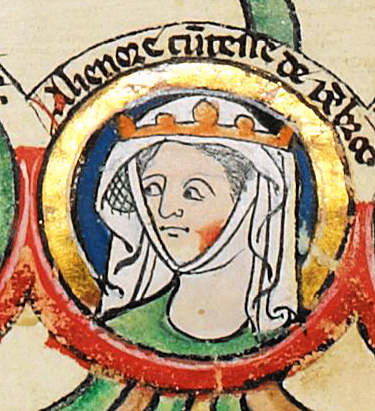
In January 1238, Montfort married Eleanor of England, daughter of King John and Isabella of Angoulême and sister of English King Henry III. While this marriage took place with the king’s approval, the act itself was performed secretly and without consulting the great barons. Eleanor had previously been married and swore a vow of perpetual widowhood after her husband died. This vow was broken when she married Montfort and, for that reason, the Archbishop of Canterbury condemned it. The English nobles protested the marriage of the king’s sister to a foreigner who was only of modest rank. Most notably, Richard, 1st Earl of Cornwell, the king’s and Eleanor’s brother, rose up in revolt over the marriage. King Henry III eventually bought off his brother and peace was restored. The marriage brought property to Montfort and when a child was born of the union in late 1238, he was baptized Henry, in honor of his uncle, the king. In February 1239, Montfort was finally invested as Earl of Leicester where he acted as the king’s advisor and became godfather to Henry’s eldest son, Edward, who became King Edward I (“Longshanks”).
Eleanor of England who married Simon de Montfort V in 1238 in an early-fourteenth-century Genealogical Roll of the Kings of England. Public Domain.
The author at the ramparts. March 2002. Author’s collection.
These fortifications were originally built over 1000 years ago in the early 11th century by Amaury I. The walls run from east to west creating a superficial size of Montfort at about 4 to 5 hectares (one hectare equals about two and a half acres). Portions of the wall were dismantled during the 100 Years War but rebuilt during the Wars of Religion (1562-1598) as well as Montfort’s reception of a royal charter by Charles IX in the mid16th century. The rebuilt wall had to expand to meet the development of Montfort under Anne de Bretagne a half a century before, though substantial portions of the original 11th century wall were incorporated into the construction.
Manuscript 16th century (detail): Queen consort Anne of Brittany (1477-1514) receiving a Book of Hours from her Dominican confessor, Antoine Dufour (d.1509). Montfort L’Amaury returned to the crown of France after Anne of Brittany married Charles VIII “the Affable” (1470-1498) in 1491.
From Montfort L’Amaury, the lords continued to assist the French kings in the crusades. After John I, only a daughter allowed the continuity of the Montfort family. Beatrice d’Albidon married Robert, Count of Dreux. The Comté de Montfort was related to the Duchy of Brittany following the marriage of Yolande de Dreux-Montfort (1263-1330) with Arthur II of Brittany (1261-1312) in 1294. With their marriage in February 1492, Anne of Brittany became the first Queen of France crowned in St. Denis basilica. The marriage contract of Anne to Charles VIII “the Affable” stipulated a union of France and Brittany though the ruthless Charles forbade her to reign with her title, “Duchess of Brittany.” The contract also stated that if the queen were to die first and was childless, the king would inherit all her property. In this pre-nuptial agreement, it further stipulated that if Charles VIII died first Anne must marry his successor. This would be his cousin and brother-in-law, the handsome and seductive Louis II of Orléans, later, Louis XII (1462-1515). Though Charles and Anne often lived apart, she was pregnant for most of her married life with a child on average every fourteen months that produced two sons who died and two daughters who lived. After the accidental death of warring Charles in April 1498 (he hit his head on a door lintel), there was no male heir and 22-year-old Anne duly married Louis. Before she married French kings, Anne was engaged 8 times and briefly was married in 1490 to the Holy Roman Emperor, Maximilian, which the French did not like. Anne was still a married woman when she and Charles the Affable exchanged vows in December 1491. To prevent scandal the marriage had to be regularized by the pope who annulled Anne’s marriage to Maximilian in February 1492 and granted the royal couple a dispensation for each marrying their relative. Before new king Louis XII could marry Anne he had his 22-year marriage to Joan of France – a marriage of longer duration than Anne was then alive – annulled. In 1476 Louis believed he had had Joan forced on him by Louis XI (“The Universal Spider”) and never really cared for her. In what has been described as one of the seamiest lawsuits of the Middle Ages, Joan went on childless from her disappeared marriage to die in a nunnery. In 1499 it was the king’s second marriage and Anne’s third. Anne was quite aware that she was no longer a child but a 33-year-old woman, divorced and widowed with two children. She proceeded to actively insist at court on her rights and prerogatives. Though King Louis XII ruled Brittany, he officially recognized Anne’s title Charles had forbade and Louis promulgated decisions in her name. Their contract stipulated that Anne’s second child with Louis XII would rule Brittany. But with Anne’s death at 36 years old in 1514 this was not honored. Anne was coronated again in St. Denis basilica in 1504. She lived mostly at Blois and was an important patron of the Italian and French fine arts. Louis XII died the next year without a legitimate heir and his cousin and son-in-law Francis I mounted the throne. The couple were buried in St. Denis basilica. During the French Revolution in the wake of the frenzy of having decapitated the king in January 1793, revolutionaries made their way to St. Denis basilica and desecrated the graves of Anne of Brittany and Louis XII and threw their remains into a mass grave. This 15-16th century union of Brittany and France brought increased benefits to Montfort L’ Amaury compared to a union with Brittany alone. The new period saw the town’s castle ruins restored and there was new construction everywhere. The cemetery was relocated outside city walls. Churches were rebuilt and enhanced with that day’s art. While reaping these material improvements from its royal benefactors, Montfort maintained a semi-autonomy from the crown of France that would not be changed until 1550 when Brittany and the French Crown finally united under a single sovereign, Henry II (1519-1559).
Jean Perréal (1455-1529), Portrait Louis XII, c. 1514, Windsor collections de S.M. la Reine d’Angleterre. Jean Perréal’s most important attribution is this portrait of Louis XII who was King of France from 1498 to 1515. Louis XII was married three times – the first annulled; the second leaving the king a widower, and, in his last three months of life, to Mary Tudor (1496-1533), the favorite sister of King Henry VIII of England. Despite these wives, the king had no living sons. The Salic Law prohibited his line to continue on the French throne through his daughters. When Louis died in 1515, his throne eventually passed to his cousin, Francis I.
Under the Valois the Yvelines region of which Montfort is a central part received royal favor. Catherine de Medici (1519-1589) was named the Lady of Montfort in 1561. When the Wars of Religion broke out (1562-1598), the king, Charles IX (1550-1574), offered to the city home-rule in exchange for the reconstruction of its medieval ramparts at his expense. At the end of these wars, the passage of the future king, Henry IV (1553-1610) on the road that led him to Paris to take power, allowed Montfort L’Amaury to prove its loyalty to the new king. Montfort provided Henry Navarre with weapons and later obtained special rights in exchange. During the reigns of the first two Bourbon kings of France, Henry IV and Louis XIII (1601-1643), there are frequent royal visits to Montfort L’Amaury.
A canonized Catholic saint: Joan of Valois (1464 – 1505), sister of Charles VIII, and betrothed of Louis XII.
Portrait of Joan of Valois as abbess by Jean Perréal (1455-1530).
The second daughter of Louis XI (1423-1483) and Charlotte of Savoy (1411-1483), Joan of Valois was a fleeting Queen of France as the wife of King Louis XII following the death of her brother, King Charles VIII. Her marriage was soon annulled so that Louis could, as pre-arranged by contract, marry Charles VIII’s widow, Anne of Brittany.
Joan’s demeanor was characterized by an accepting and placid countenance. When she retired from court politics to become Duchess of Berry, the former Queen of France remarked: “If so it is to be, praised be the Lord.”
In Bourges, Joan of Valois founded a monastic order of sisters and served them as their abbess. In terms of her personality, Joan could be autocratic as an administrator of her nuns, which may have been a vestige of her former high-born role. Joan was canonized in May 1950, almost 450 years after her death.
Anne of Brittany, Catherine de’ Medici, and other royal figures helped shape the town’s development during the Renaissance.
Workshop of François Clouet. Catherine de’ Medici wears the black cap and veil of widow, after 1559. Upon seeing Catherine in the flesh, an Italian diplomat noted that “her mouth is too large and her eyes too prominent and colorless for beauty. But she is very distinguished-looking, has beautiful skin, a shapely figure, and exquisitely made hands.”
Marie de’ Medici, 1616, Frans Pourbus the Younger (Flemish, 1569-1622), oil on canvas, The Art Institute of Chicago. Marie de Medici (1575-1642) married Henry IV of France in 1600. After the king was assassinated in Paris in 1610, Marie de Medici served as the regent for their young son, Louis XIII. Marie de Medici brought Frans Pourbus to the French court to make regal portraits of the royal family.
Le Belvédère at Montfort L’Amaury: the House of Maurice Ravel from 1921 to his death in 1937. The coexistence of castle ruins, Gothic architecture, Renaissance art, historic houses, and literary and musical associations makes the town an unusually rich historical destination.
The author in front of Le Belvédère, the house of Maurice Ravel, and ready to go inside for a visit. March 2002. Author’s collection.
InsideLe Belvédère. The salon. March 2002. Author’s photograph.
Pianist Jacques Février with Maurice Ravel in 1925 in Le Belvédère, the house of the composer in Montfort-l’Amaury. Public Domain.
Ravel’s house sits on an ascent from the centre ville where Ravel could look out his garden-side window to back towards town and south and east to the green countryside between Montfort and Paris. March 2002. Author’s photograph.
Classic theater paperback anthology titled Jean Anouilh: Five Plays published as part of the celebrated Mermaid Dramabook series by Hill and Wang in 1958. He lived in Montfort-l’Amaury for roughly a decade, from 1951 to the early 1960s. PHOTO: “George Maas” by Crossett Library Bennington College is licensed under CC BY-NC-SA 2.0.
A master stylist, Jean Anouilh lived in Montfort-L’Amaury as he rejected the conventional realism that dominated much of contemporary theater, instead treating the stage as an elaborate and self-conscious game, an approach reflected in the categories and cycles into which he organized his plays. His dramas became powerful psychological mirrors of the moral and political trauma left by the German occupation of France. Drawing on classical mythology, Anouilh explored themes of moral purity, compromised integrity, and the devastating cost of saying “no” to corrupt authority. He possessed a rare gift for transforming ancient Greek myths into modern drama, replacing epic poetry with sharp, colloquial, and psychologically charged dialogue that resonated deeply with twentieth-century audiences.
Anouilh’s 1944 play, Antigone, was an adaptation play of Sophocles’ play of the same name. The 34-year-old Anouilh’s work was seen as an attack on the Vichy government of Marshal Pétain (1856-1951) in World War II.
This anthology is particularly important to theater history because it gathers the landmark works that introduced Anouilh’s genius to English-speaking audiences, foremost among them Antigone, his crowning achievement. For many French spectators, the defiant Antigone embodied the spirit of the French Resistance, while the pragmatic and authoritarian Creon evoked the collaborationist Vichy regime. By recasting an ancient conflict as a modern moral dilemma, Anouilh created one of the most enduring and controversial dramas of the twentieth century, a work that continues to challenge audiences with its unsettling questions about conscience, obedience, and resistance.
Anouiih also wrote Becket. The original French play is titled Becket ou l‘Honneur de Dieu. It was staged in Paris at the Théâtre Montparnasse-Gaston Baty in October 1959 and directed by Anouilh. The play dramatizes historical martyr and Catholic saint Thomas Becket (1120-1170), the Archbishop of Canterbury In England.
Anouilh’s Becket became an international sensation. Successive productions in English translation were mounted in London (starring Christopher Plummer and Eric Porter) and in New York City (starring Laurence Olivier and Anthony Quinn). In 1964 Becket became a major motion picture starring Richard Burton and Peter O’Toole which won the Academy Award for Best Screenplay.
SOURCES:
Comité d’organisation des fêtes. 1972. Montfort-L’Amaury. Montfort-l’Amaury: Le Syndicat d’Initiative des Fêtes et des Arts de Montfort-L’Amaury et ses Environs.
Coulson, John, dir. 1957. The Saints: A Concise Biographical Dictionary. New York: Guild Press.
De Finance, Laurence, et Marie-Huguette Hadrot. 1994. Montfort-L’Amaury : Les verrières de l’église paroissiale Saint-Pierre (Yvelines). Paris: Centre de Documentation du Patrimoine.
FEATURED image: Napoleon near Borodino, Vasily Vereshchagin (1842–1904), 1897, oil on canvas, State Historical Museum, Moscow.The image of a sullen dictator seated on his field chair with boots raised onto a battle drum, as his General Staff views in their spyglasses the men of the Grande Armée in harm’s way at the Battle of Borodino, can be seen as indicative of Napoleon’s exercise of arbitrary power as the first of modern history’s tyrants.
Napoleon Bonaparte (1769-1821) transformed France and Europe through military genius, political ambition, and administrative reform, yet the same drive that built an empire ultimately led to its collapse. His final years, exile on the remote island of Saint Helena, and the creation of his death mask contributed to a legend that outlived both the man and the empire he forged.
The Emperor Napoleon in His Study at the Tuileries, 1812, Jacques-Louis David (1748-1825), National Gallery of Art, Washington, D.C.
Major facts of the life of Napoleon Bonaparte (1769-1821) are well known. Known as Napoleon I, the French Emperor who died two centuries ago was a shrewd, ambitious and skilled military leader who conquered much of Europe in the early 19th century.
Born on the island of Corsica that had recently handed authority from Italy to France, Napoleon rose rapidly in the French military during the unsettled period of the French Revolution after 1789 and until 30-year-old Napoleon seized power in a coup d’état in 1799.
Napoleon rose from a young Corsican artillery officer to become Emperor of the French in 1804.
In 1804 Napoleon crowned himself emperor in Notre Dame Cathedral in Paris in the presence of the pope. In the next decade Napoleon successfully waged war against various coalitions of European nations and expanded his empire. Following his disastrous French invasion of Russia in 1812 explored in some detail in this post, Napoleon abdicated his throne in 1814 and was exiled to the island of Elba not far from his native Corsica in the Mediterranean Sea near Italy.
In 1815, he escaped Elba and returned to France where he briefly returned to power in his Hundred Days campaign. He received a crushing defeat at the Battle of Waterloo in today’s Belgium and was exiled until his death on May 5, 1821 to the remote island of Saint Helena in the South Atlantic Ocean. Napoleon Bonaparte was just 51 years old at the time of his death stemming from mysterious circumstances, though likely something such as stomach cancer.1
Napoleon on St. Helena, Franz Josef Sandmann (1805-1856), c. 1820. Musée national des châteaux de Malmaison et de Bois-Préau.
In 2021, the bicentenary of the death of Napoleon I is commemorated. While 200 years is a long time ago, in terms of History it is a relatively short span amount of time. In other words, Napoleon, who might have come to the United States (New Orleans) after his exile, is not very far away from modern times.
Napoleon Bonaparte, born in Corsica which had just switched allegiance from Italy to France, was born in 1769. In 1821 when he died on May 5 he was 51 years old. The former French emperor died far away from Europe on the island of Saint Helena in the middle of the South Atlantic Ocean. Napoleon had been exiled there following his defeat at Waterloo in Belgium in 1815 and escape from Elba in the Mediterranean, the British Government’s first location for his confinement.
Between the continents of Africa and South America, St. Helena is much more remote. The island built its first airport only in 2011.
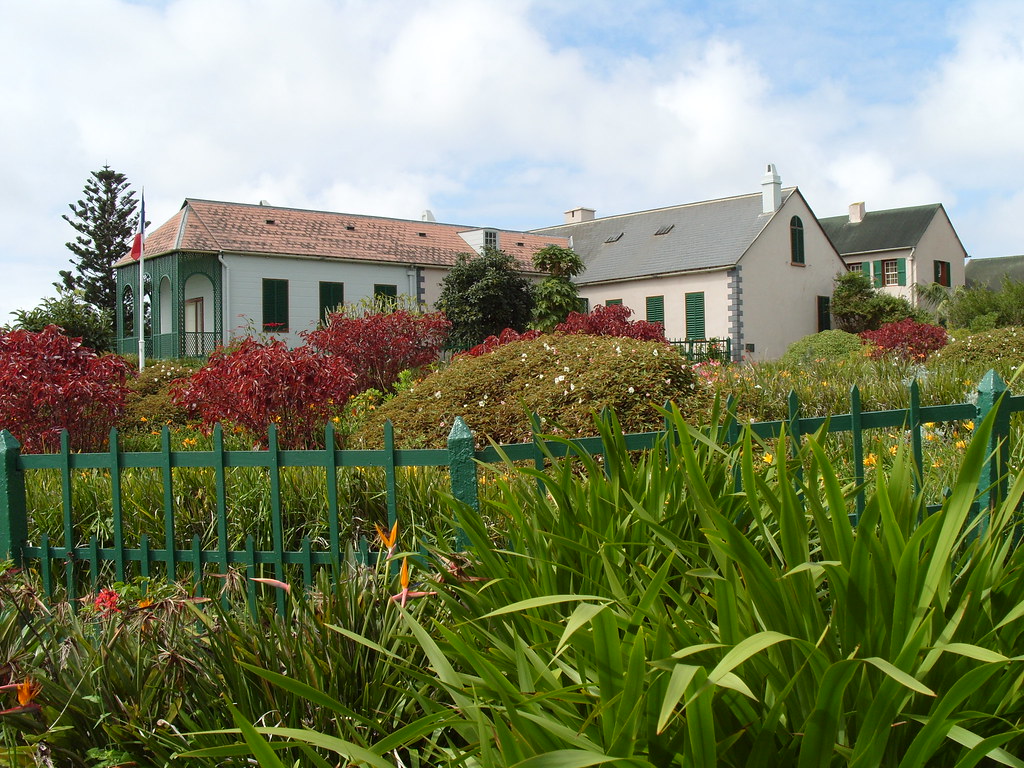
Napoleon lived on St. Helena for about 6 years and died there, somewhat unexpectedly, at Longwood House. Napoleon’s permanent residence was completed for him in December 1815.
Napoleon was buried on St. Helena. In 1840, stirring old wounds of controversy, the remains of the warring General and French despot were transferred to Paris. Napoleon’s tomb in Les Invalides had been a military hospital whose construction was by Louis XIV (1638-1715).
His death mask became one of the most famous relics associated with any historical figure.
Napoleon’s plaster death mask, known as the Malmaison mask, May 1821. The death mask was made on Saint Helena about two days after the former French Emperor’s death there on May 5, 1821 at Longwood House. see – http://www.lautresaintehelene.com/autre-sainte-helene-articles-malmaison2.html – retrieved May 5, 2021.
On St. Helena, Longwood House was Napoeleon’s permanent residence completed for him by his British captors in December 1815. In 1858, French emperor Napoleon III, nephew of Napoleon I, purchased Longwood House and various other lands associated with Napoleon I on St. Helena for the French government. Though Napoleon’s remains were returned to France in 1840, Napoleon III’s purchase on St. Helena remains the property of France. It is administered by a French representative under the authority of the French Ministry of Foreign Affairs. (see – https://fondationnapoleon.org/en/activities-and-services/preserving-heritage/operation-st-helena/ – retrieved May 5, 2021). PHOTO: “Longwood House (c) St Helena Tourism” by sthelenatourism is licensed under CC BY-ND 2.0.
His military victories reshaped Europe and spread many principles of the French Revolution across the continent. The Napoleonic Code became one of his most enduring legacies, influencing legal systems worldwide.
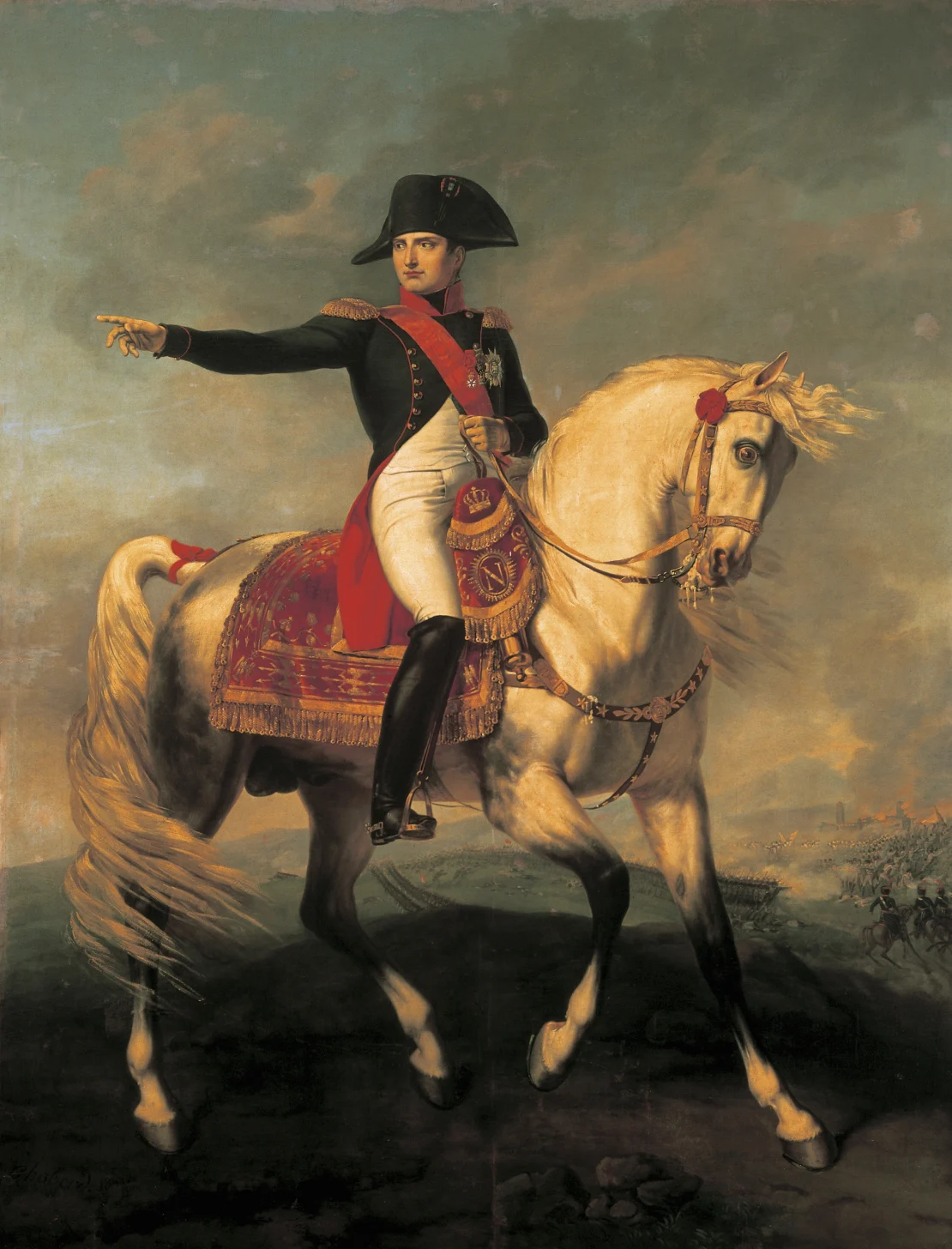
Napoléon at Battle of Wagram, July 5-6, 1809, Joseph Chabord (Chambèry 1786-Paris 1848), 293 cm (115.3 in) x 224 cm (88.1 in), Museo Napoleónico, Rome, Italy. On July 5-6, 1809, the Battle of Wagram took place north of Vienna and was the greatest battle in world history up to that time. It was Napoleon’s last and greatest victory. The battle opposed the Austrian army led by Archduke Charles, Duke of Teschen (1771-1847) against the Franco-Italo-German army under Napoleon I, Emperor of the French, King of Italy, Protector of the Confederation of the Rhine. The painting depicts the plain of Wagram, the scene of the battle with the dominant figure of Napoleon, perfectly settled upon a wild-eyed horse. The emperor wears the uniform of Colonel of the Chasseurs on Horseback with the insignia of the Legion of Honor and the Iron Crown. The grandeur of the rider-horse group, which contrasts with the small figures of the soldiers in the background, accentuates the heroic character of Napoleon, a charismatic strategist who dominates events. The commemoration painting probably was linked to an official commission. The painting was in the collection of Hortense de Beauharnais (1783-1837), the daughter of Napoleon’s first wife, Joséphine de Beauharnais. in Arenenberg, where the former Queen of Holland lived from 1817 until her death. It remained there until 1905, when the last owner of the castle, the former Empress Eugenie, wife of Napoleon III, donated it to Count Giuseppe Primoli. Public Domain. See – https://www.museonapoleonico.it/it/percorsi/percorsi_per_sale/sale_i_e_ii_il_primo_impero/napoleone_sul_campo_di_battaglia_di_wagra
THE YEAR 1812: A BAD ECONOMY, CONTINENTAL BLOCKADES, AND A DISASTROUS INVASION OF RUSSIA BY NAPOLEON
During the War of 1812 which had ramifications for the U.S., world domination by Napoleon was being attempted within a sagging, uncooperative economy in Europe.
France had 300,000 French troops and a rafter of French generals occupying Spain to keep the blockaded British from invading. Napoleon, in a near constant state of war since 1793, had created an Empire whose subjected parts didn’t cooperate. In 1812, Napoleon had to choose between losing his blockade in Spain or in Russia.
Since the Treaty of Tilsit in 1807 which followed the Battle of Friedland where Napoleon defeated the Russian army, Russia continued to transact business with England. This was a violation of the agreement and the pretext for Napoleon’s invasion of Russia in 1812.
While over 1,500 miles away from Paris, Napoleon wanted to shut down Russia’s economy and take full control. For Russia, Napoleon’s invasion required the defense of their homeland.
NAPOLEON’S NEW WAR NEEDED 700,000 FRESH CONSCRIPTS
Napoleon needed fresh conscripts but a third of Napoleon’s French draftees didn’t report for duty. Many of Napoleon’s generals advised the dictator to stay in Paris and enjoy life’s spoils. Napoleon refused. He explained that he would not rest until he fulfilled the dream to form a United States of Europe.2
Napoleon assembled 700,000 men with the monumental task to pay for it. For years the Emperor had been stockpiling supplies along the route to Russia and even arranged for their delivery on the battlefield.
Napoleon left St. Cloud for Moscow in June 1812. His high stakes gamble would affect not just Napoleon’s fortunes but the Empire’s inhabitants.
The disastrous Russian campaign of 1812 marked a turning point in his fortunes.
Ernest Meissonier (1815-1891), Campaign of France, 1814, 1864. Oil on wood, 51.5 x 76.5 cm, Paris, Musée d’Orsay.
This was the artist’s first painting produced in a cycle of Napoleon’s conquests. Though the episode Meissonier depicts was painted for the fiftieth anniversary of Napoleon’s invasion of France from Elba in 1814, it captures the overall desolation that surrounded the former French Emperor by the time of his invasion of Russia in 1812.
The series made by the 49-year-old artist, an admirer of seventeenth-century Flemish and Dutch small-format painting, not only captures the desolate landscape the Grande Armée endured, it also shows a solitary, unusually unkempt, and tenuous figure of Napoleon who is leading the General Staff and troops in an over-extended military campaign that spelled defeat.
For the painting, the artist’s imagination was informed by historical documentation and interviews of surviving eyewitnesses, including the detail of the emperor’s grey coat. Its realist style was a prevailing aspect of mid-19th century artistic taste during the Second Empire headed by Napoleon III from 1852 to 1870.
FAILURE OF THE SUPPLY CHAIN AND “THE ENEMY OF LIBERTY”
The army marched 1,200 miles to Lithuania to engage the Russian army. But the Russians had retreated. Napoleon’s men had to march another 550 miles to Moscow. The generous supply lines got snarled. French troops turned sick and exhausted.
In the Battle of Smolensk, the French invaders—viewed by some to be fighting for a united liberal Europe over small state autocrats—set that town on fire. Napoleon’s criminal reputation preceded him – he murdered without mercy and often by treachery. Royalists criticized him but also articulate liberals like Alexis de Tocqueville (1805-1859) and François-René de Chateaubriand (1768-1848). The emperor was the enemy of liberty. Chateaubriand wrote: “Les Français vont indistinctement au pouvoir, ils n’aiment pas la liberté, l’égalité est leur idole. Or l’égalité et le despotisme ont des liaisons secrètes” (“The French go to power indiscriminately, they don’t like liberty, equality is their idol. But equality and despotism have secret links”).
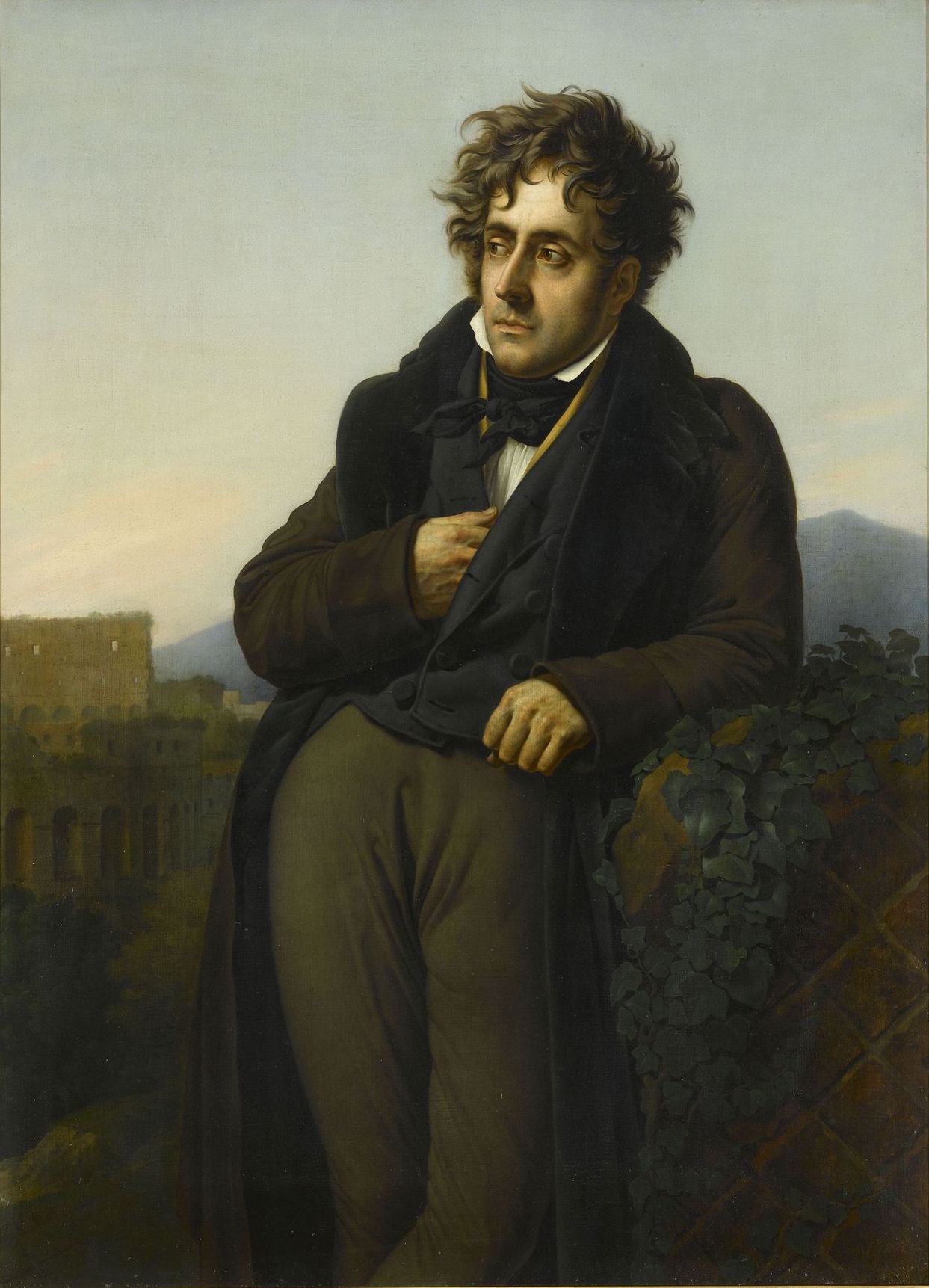
Portrait of Chateaubriand by Anne-Louis Girodet de Roussy-Trioson, 1809, the Musée d’Histoire de la Ville et du Pays Malouin in Saint-Malo, France. Of Napoleon Chateaubriand wrote: “Les Français vont indistinctement au pouvoir, ils n’aiment pas la liberté, l’égalité est leur idole. Or l’égalité et le despotisme ont des liaisons secrètes” (“The French go to power indiscriminately, they don’t like liberty, equality is their idol. But equality and despotism have secret links”).
The Sly Old Fox of the North
With casualties for the Battle of Smolensk around 15,000 for both sides, the Czar appointed Mikhail Kutuzov (1745-1813) as commander of Russian forces. Napoleon called Kutuzov, “The sly old fox of the north“ (cited in Roger Parkinson, The Fox of the North, 1976). At 67 years old, Kutuzov was lazy and lecherous, but knew how to fight—and, regarding Napoleon’s invasion of Russia, how to retreat strategically. It made Napoleon’s thirst for further battle on his own terms impossible.
Portrait of Mikhail Kutuzov, 1829, George Dawe (1781–1829). Oil on canvas, State Hermitage Museum, Winter Palace War Gallery, St. Petersburg, Russia.
70 MILES WEST OF MOSCOW, THE BATTLE OF BORODINO PITS 242,000 TOTAL COMBATANTS WITH OVER 1,000 BIG GUNS ON SEPTEMBER 7, 1812
In his address to troops before the Battle of Borodino General Kutuzov told his men: “Napoleon is a torrent we are yet unable to stem. Moscow will be the sponge that sucks him dry.”3 Napoleon knew what he was up against. Without supplies, Napoleon ordered his men to keep marching: “Motion alone keeps this army together.”4
The march from Smolensk to Moscow took 3 weeks. Many soldiers of the Grande Armée died on the march. Kutuzov set up a defensive position in Borodino, about 70 miles west of Moscow. On Sept. 7, 1812, French forces engaged the Russians. Both sides were evenly matched – Napoleon had 587 guns and 130,000 troops and the Russians had 640 guns and 112,000 troops.
Hanging over the battlefield was the feeling that the destiny of Europe lay in the balance. The battle’s outcome was a draw. The French were masters of the field as the Russians retreated. It was another day for war’s slaughter— combined French and Russian losses was 80,000 soldiers.
Battle of Moscow (or Borodino), the Capture of the Great Redoubt. Engraving by unknown artist, 1820’s. State Borodino Military Historical Museum, Russia.
Battle of Moscow (or Battle of Borodino) in 1812. Attack of the Lithuanian Life Guards Regiment, oil on canvas, 1912, Nikolay Semyonovich Samokish (1860-1944). State Borodino Military Historical Museum, Russia.
General Uvarov at Borodino, Auguste-Joseph Desarnod (1788-1840), State Hermitage Museum, St. Petersburg, Russia.
In the War of 1812 Fedor Petrovich Uvarov (1769 -1824) commanded the 1st Cavalry Corps and then the Cavalry of the 1st and 2nd Russian Armies. With the Cossacks of Matvei Platov (1753-1818), Uvarov distinguished himself in the Battle of Borodino when he turned the left flank of the French army and made a raid to its rear. The Russian attack of the main French forces delayed Napoleon’s battle plans for two crucial hours.
WHEN LEJEUNE’S BATTLE-PICTURES WERE SHOWN IN LONDON, EAGER CROWDS CAME TO SEE THEM FOR THEIR REALISTIC, DETAILED DEPICTIONS OF SIGNIFICANT CONTEMPORARY EVENTS.
Battle of Borodino, 7th September 1812, 1822, Louis-François Lejeune (1775-1848).
In the French invasion of Russia in 1812, Lejeune was made général de brigade and chief of staff to Davout (1770-1823). During the retreat, Lejeune was frostbitten on the face and left his post where he was subsequently arrested on Napoleon’s orders.
During his military service, Lejeune produced a series of important battle-pictures based on his experiences. They were generally executed from sketches and studies made on the battlefield. Known for their lofty perspective which, according to Chase Maenius in The Art of War[s], “offer[ed] a panoramic view of the totality of the battle’s events,” the Battle of Borodino… of 1822 is considered his masterwork.
In his Memoirs of Baron Lejeune, aide-de-camp to marshals Berthier, Davout, and Oudinot (translation, 1897), Lejeune related one of the many wretched scenes that the Napoleonic Wars produced. He wrote: “As we were pushing on the next day, we came upon two poor creatures at a turn in the road whose condition tore our hearts. They were a handsome well-built man of about forty and a woman of about thirty, also with a fine figure, both stark naked. They approached us and said to us in very good French, ‘Our home has been sacked by Cossacks, who stripped us of everything and left us as you see us. For pity’s sake help us.’ We could do nothing for them but give them a little food, and we felt very wretched as we turned away. The next day at a bivouac some distance off a fresh irresistible demand was made upon our pity, and our stock of provisions was so much reduced that I don’t know what we should have done but that some German peasants brought us a few sheep, with which we replenished our larder.” p. 158, https://archive.org/details/memoirsbaronlej01maurgoog/page/n170/mode/2up —retrieved May 5, 2021.)
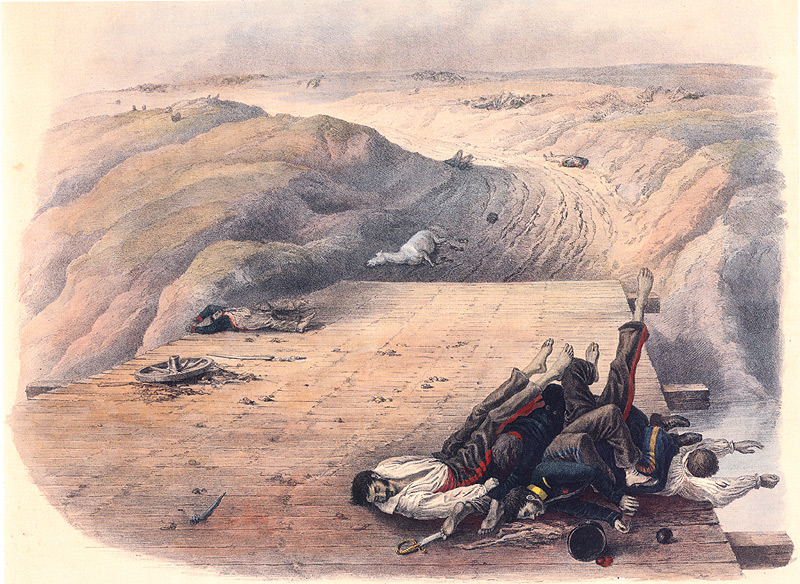
The bodies of dead soldiers of Napoleon’s Grand Armée left on the bridge over the River Kolocha after the Battle of Borodino, 1812. Christian Wilhelm von Faber du Faur (1780-1857), published 1830’s.
Gen. Kutuzov at the conference of Fili deciding to surrender Moscow to Napoleon, Aleksey Kivshenko (1851–1895), 1880, oil on canvas, Tretyakov Gallery, Moscow.
Following the Battle of Borodino on September 7, 1812, the Russian army retreated towards Moscow and camped near Fili. A military council led by General Kutuzov assembled in a hut in Fili where, despite objections from younger generals, Kutuzov insisted on his plan to abandon Moscow.
The action not only saved the remains of the Russian army but worked to stymie and ultimately defeat Napoleon’s invasion drive. The personalities in the painting include Prince Michael Andreas Barclay de Tolly (1761-1818), who was replaced by Kutuzov on order of the Czar and sits in the corner below the Virgin Mary and Child Jesus icon. Fyodor Uvarov sits near Barclay holding a paper. Nikolay Raevsky (1771-1829) sits by the window with his fingers locked together. Aleksey Petrovich Yermolov (1777-1861) stands on the far right. The much younger Yermolov resented old general Kutuzov’s plan and demanded to fight the enemy.
Napoleon and about 100,000 French troops reached Moscow on September 8, 1812, Napoleon found only Russia’s poor and displaced. Moscow was Russia’s largest city, its capital, and its Holy City—and French troops of the Enlightenment set it ablaze. The fires burned for 4 days as Napoleon’s army looted it.
Napoleon wrote a letter of apology and condolence to the Czar, Alexander I Pavlovich, the Blessed (1777-1825). One result was that Tthe Russians resolved never to surrender to their would-be conqueror. Only some of the wealthy in Russia looked to negotiate with Napoleon mainly out of fear of losing their assets, that is, the serfs. Napoleon surmised, “I beat the Russians every time—but that does not get me anywhere.”5 Old general Kutuzov’s inaction attained his objective to defend Russia whereas 43-year-old Napoleon failed to rally his men for his Empire these many hundreds of miles from home.
In Ridley Scott’s Napoleon, after trudging with his conscripts through most of Europe, the French Emperor (Joaquin Phoenix) reaches Moscow in Russia. Itching for a fight, the Holy City is, instead, deserted. Disappointed and mocked, Moscow is looted and set ablaze by Napoleon’s men before they retreat.
Posthumous Portrait of Czar Alexander I of Russia, 1826, George Dawe, State Hermitage Museum, St. Petersburg, Russia.
Napoleon’s interest became retreat. There was an intended coup d’état in Paris that Napoleon had to raise more fresh recruits to crush. Other parts of the Empire also raised their head following Napoleon’s inglorious retreat. But it grew worse to become one of world history’s worst defeats.
Weather in Russia turned to snow and ice. The Russians retreated into Mother Russia before they were defeated. The French retreated to the west in defeat. Reports of cannibalism among Napoleon’s army is recorded. Turning back to Paris, the French army lost another half of their men. All of Napoleon’s supply lines had been sacked. Adding further injury, the French were chased out of Russia by Kutuzov’s 80,000 troops.
Famous tell-all graph by French civil engineer Charles Joseph Minard (1781-1870) showing the size of Napoleon’s Grande Armée as it marched towards Moscow (top gray line, left to right) in summer of 1812 and its retreat (bottom black line, from right to left) in the late fall of 1812. Frozen temperatures during the humiliating retreat are plotted on the bottom graph.
On the retreat, surviving warriors fought among themselves over any existing supplies. Napoleon’s retreat included the humiliation of being chased out of Russia by Kutuzov’s redeployed 80,000 troops. The old man’s hot pursuit did not allow Napoleon, the once young Enlightenment military figure, to rest.
Under military surgeon Baron Dominique Jean Larrey (1766-1842), the Grand Army’s medical and sanitary measures were the finest in the world but the retreat route offered no food and no medical care. As a remedy for possible future ills, including his capture, Napoleon convinced his doctor to give him a vial of poison which the dictator could ingest if conditions deteriorated to become inescapably dire.
Portrait of Dominique-Jean Larrey, oil on canvas, 1804, Marie-Guillemine Benoist (1768-1826), Musée des Augustins, Toulouse, France.
Baron Dominique Jean Larrey was a French surgeon and military doctor who distinguished himself during the near endless wars of the French Revolution and under Napoleon. Baron Larrey served as the Grand Army’s medical and sanitation leader and was an important innovator in triage who is considered the first modern military doctor and surgeon.
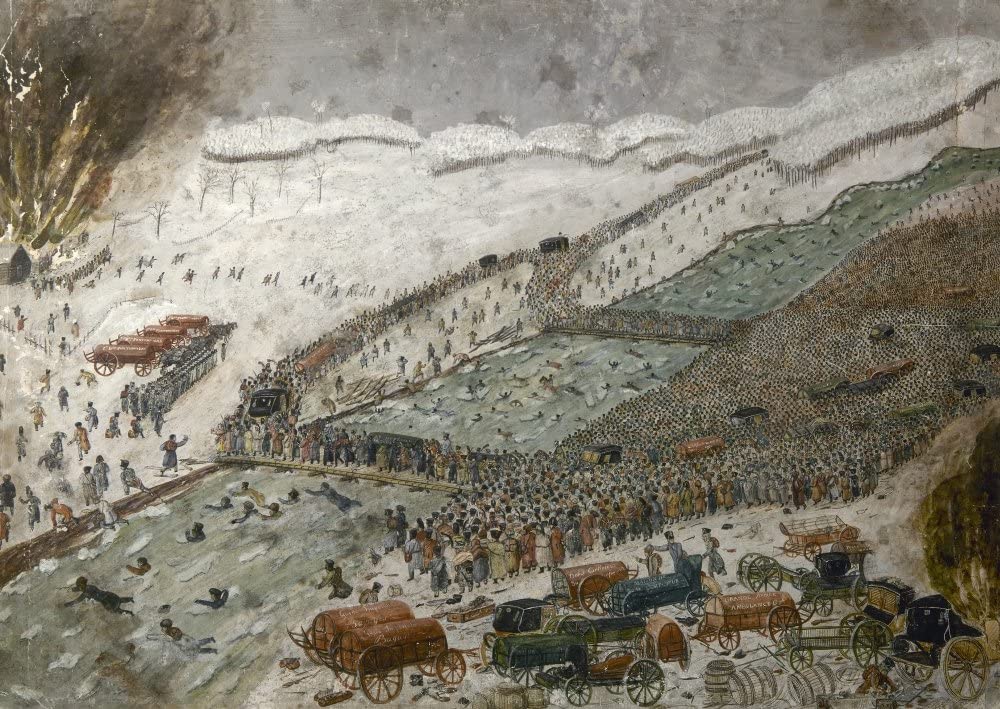
Napoleon: Retreat, 1812. /Ncrossing The Beresina River In Russia During The Retreat Of The Grand Army Under Napoleon Bonaparte, December 1812; Baggage Carts And Ambulances Have Been Abandoned In The Foreground. Watercolor, c. 1812, attributed to General François Louis Fournier-Sarlovèze (1773-1827). During the Russian Campaign, Fournier commanded a brigade of light cavalry composed of French, German, and Central European horsemen, and led a noted cavalry charge at the Battle of Smolensk.
Generals Kutuzov and Wittgenstein attacked at a bridge crossing in what today is Belarus. Hundreds of Frenchmen drowned. To slow the attack, Napoleon ordered the bridges destroyed. In the process the general stranded hundreds of his troops to enemy gunfire.
Napoleon now told his aide-de-camp, Armand-Augustin-Louis de Caulaincourt, what the Russian campaign taught him: “I can hold my grip on Europe only from the Tuileries.” In Warsaw, Napoleon met Abbé de Pradt, his ambassador, and told him: “From the sublime to the ridiculous is but a step.”6
As Tchaikovsky’s 1812 Overture with its famous climax using cannon fire, ringing chimes and brass fanfare, commemorates a Russian defensive victory, French losses were staggering. Of Napoleon’s 700,000 men led into Russia, only 30,000 survived. Only 1,000 soldiers returned to active duty.7
NAPOLEON IN RUSSIA, HIS FORCES LOSE THE PENINSULAR WAR IN SPAIN; THE FOLLOWING YEAR, IN 1813, NAPOLEON LOSES THE BATTLE OF LIEPZIG, THE LARGEST LAND BATTLE UNTIL WORLD WAR I.
Simultaneous with the debacle of Napoleon’s Russian invasion, French forces lost the long fight (since 1808) in Spain and Portugal to keep the British off the Continent.
Significant losses in the east and west of the Empire were followed in 1813 by the Battle of Leipzig, Napoleon’s penultimate defeat by an international coalition that included Austria, Prussia, Russia and Sweden.
DEFEATED, FORCED TO ABDICATE AND EXILED TO ELBA IN 1814, HE BRIEFLY RETURNED TO POWER DURING THE AUDACIOUS HUNDRED DAYS IN 1815. NAPAOLEON MET HIS WATERLOO ON JUNE 18, 1815.
After Napoleon withdrew into France, in March 1814 these allied forces captured Paris. By early April 1814 Napoleon was forced to abdicate as Emperor. Napoleon had to go for his pursuit of glory had become a menace to his country and the world.
With the Treaty of Fontainebleau, Napoleon was exiled to Elba, and, following his brief escape into France in 1814, he was defeated for the final time at the Battle of Waterloo and exiled to St. Helena which held him until his death at 51 years old on May 5, 1821.
Waterloo Battlefield taken from Lion’s Mound, July 1984. Author’s photograph. All Rights Reserved.
Center of Wellington’s Line
This vantage point looks straight down the Allied‑Coalition center under the Duke of Wellington, facing south toward Napoleon’s army. The road cutting through the field is the Chaussée de Charleroi (today’s Route N5), the main axis of Napoleon’s plan to drive north, seize Brussels, and split the Allied and Prussian forces.
La Haye Sainte: The Breakwater
The white, walled farm complex beside the road is La Haye Sainte, held on June 18 by the King’s German Legion (expatriated Hanoverians). This fortified farmhouse became the immovable center of Wellington’s line, blocking the French advance up the main road for most of the day.
D’Erlon’s Assault and the Heavy Cavalry Counter‑Charge
The east field (left) was the killing ground for Count d’Erlon’s I Corps early that afternoon. Across this slope, British heavy cavalry—including the Scots Greys—launched their legendary, chaotic counter‑charge, smashing d’Erlon’s infantry columns before overextending and being cut down in turn.
Ney’s Mass Cavalry Attacks
The rising west field (right) hosted Marshal Ney’s massive cavalry charges. Wellington’s infantry met them in a checkerboard of roughly 20 defensive squares, each holding 500–1,000 men. The French horsemen funneled through narrow gaps, unable to break the squares and instead becoming trapped, jumbled, and exposed to disciplined musket fire. It was like as Agincourt all over again.
Portrait of the Duke of Wellington, by Sir Thomas Lawrence, c. 1815–1816, Apsley House, Apsley House, London. Public Domain.
The creation of the Lion’s Mound between 1820 and 1826 permanently reshaped the original 1815 battlefield. King William I of the Netherlands ordered the monument to mark the exact spot where his son, the Prince of Orange, was wounded. To build the 141‑foot conical hill, engineers with 2,000 workers moved an enormous volume of earth—roughly 300,000 to 400,000 cubic meters—an amount equal to over 40,000 standard dump truck loads packed back-to-back—by scraping and excavating the battlefield itself rather than importing soil. In doing so, they erased key contours, slopes, and defensive features that had defined Wellington’s position during the Battle of Waterloo. The alteration was so drastic that when Wellington returned in 1827, he reportedly reacted with fury, declaring, “They have altered my field of battle!”
Exiled to the remote South Atlantic island of Saint Helena, he spent his remaining years dictating memoirs and reflecting on his career. Napoleon died on May 5, 1821, at age 51. Two centuries after his death, historians continue to debate whether he was a liberator, dictator, military genius, or all three.
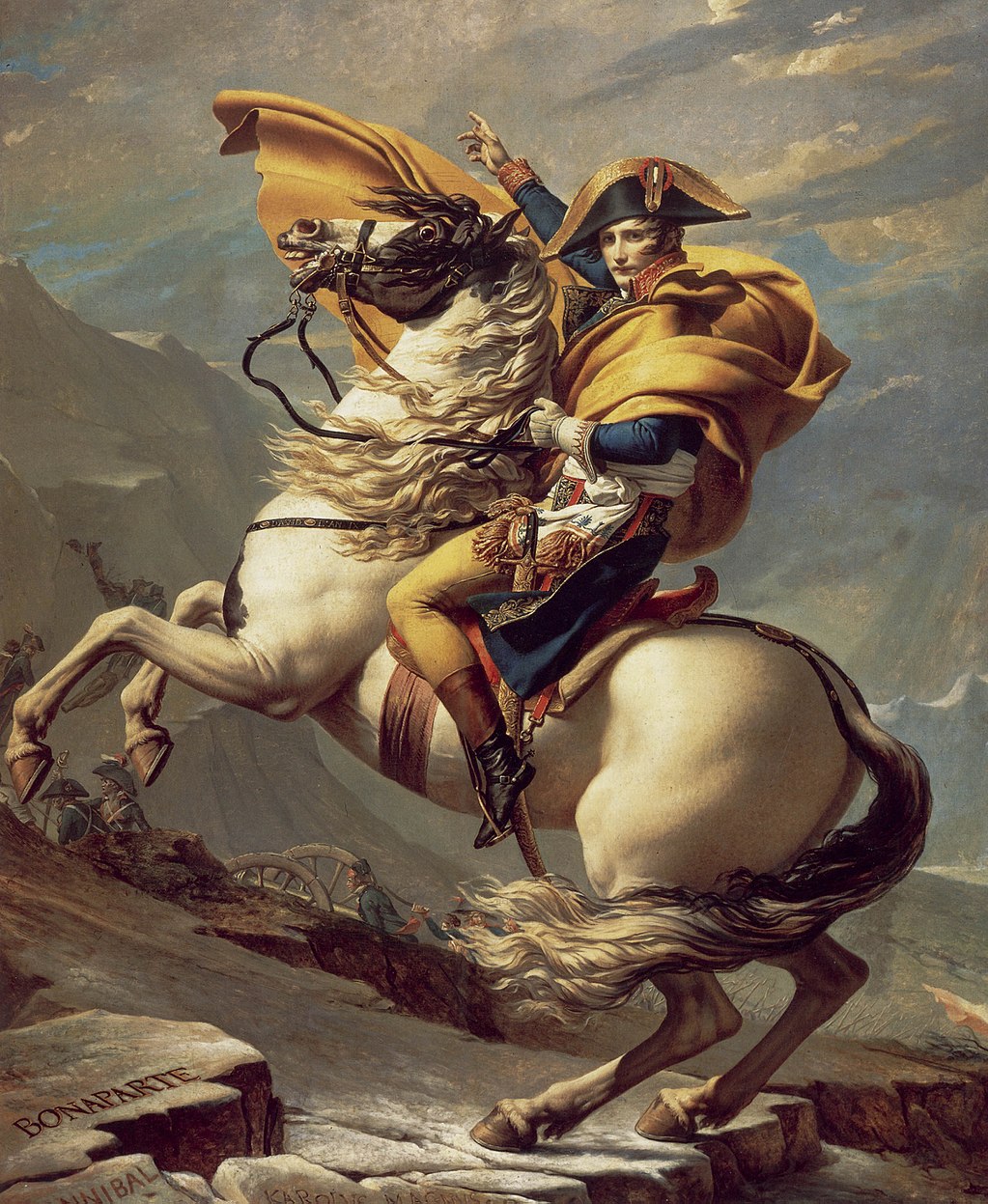
Napoleon Crossing the Alps, Jacques-Louis David, 1801, oil on canvas, 102 1⁄3 × 87 in., Château du Malmaison.
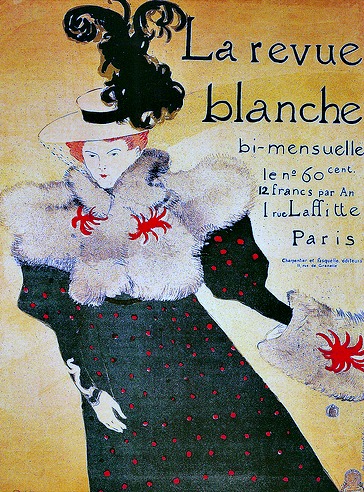
FEATURE image: Henri de Toulouse-Lautrec (1864-1901), La Revue Blanche, 1895, Paris. Lithograph in four colors.
From Montmartre to Mass Culture: Henri Toulouse-Lautrec’s 31 color posters transformed commercial advertising into modern art, using innovative color lithography, bold design, and iconic images of Parisian nightlife to democratize art and shape the visual language of the twentieth century.
By John P. Walsh
The Artist in an Age of Mass Production
The nineteenth century in France brought about a radical transformation of the role of the artist. In place of artwork for aristocratic patrons, artists in all media were increasingly left to their own devices and began creating works of art in their studios and looking to sell them in the open marketplace. Innovative forms, new subjects, and new styles emerged from these changing economic structures brought about by the dawning of the industrial and technological age as well as the growing importance of cities.
In Paris and elsewhere, enterprising artists sought to attract new clients increasingly composed of the urban bourgeoisie. By the mid-to-late nineteenth century the involvement of the public in artistic matters became an irrevocable fact which had been secured by the improved means of mass production. New processes in lithographic and photographic printmaking, for example, made art widely available to a popular audience. The entry of this sort of democracy into artistic production coincided with current aesthetic influences such as a Japonisme movement prevalent in France in the years before 1890. In addition, there was a new understanding of modern beauty that began around 1830 that rejected traditional forms of beauty manifested in classical and later art forms.
Henri Toulouse-Lautrec and the Emergence of Modern Poster Art
By the early 1890’s when Henri Toulouse Lautrec (French, 1864-1901) created his mass-produced posters in Paris a new artistic practice had appeared whose idea of beauty was contemporary, sophisticated and subtly realistic. By 1890, Lautrec’s art could react in several ways to the modern art tradition. Toulouse-Lautrec repudiated the bourgeois modernity of the Impressionists from the 1870’s and 1880’s displayed in the drawing-room paintings of Claude Monet (French, 1840-1926) and Pierre-Auguste Renoir (French, 1841-1919) and, owing to cultural spaces that had shifted by the 1880’s to artistic cabarets and literary cafés, Lautrec could also claim to be a direct heir to an earlier 1830’s romantic bohemian and 1840’s flâneur.
Montmartre, Bohemia, and the Public Sphere
There are several interpretations for this cultural shift and its effects on artists and artistic practice in the 1890’s including Toulouse-Lautrec’s mass-produced commercial posters. Building on a rejection of bourgeois art forms, Mary Gluck at Brown University argues that artists such as Toulouse-Lautrec—who with others was a creature of the cabarets and cafés—desired commercial mass media to be the means by which the public sphere would eclipse individual lives which modern society had fragmented. At the center of their art production, Gluck believes, is a distinct vision of modernity identified with a city’s public space as opposed to the private anonymity of bourgeois culture (see Popular Bohemia: Modernism and Urban Culture in Nineteenth-Century Paris, 2005).
To strive to transform the public sphere by way of the legacy of the café-concert about and for which Toulouse-Lautrec created a significant amount of his mass-produced commercial art could only be an ambitious cultural task. These cabarets and café-concerts, mostly centered on and around Montmartre in Paris, were crowded, loud and often rowdy. Its performances and clientele were often unpolished and popular. Small but well-known art movements such as Les Arts incohérents and their Montmartre cabaret Les Hydropathes begin to describe the level of social parody and frivolity to be expected within these establishments.
While Lionel Richard at the University of Picardy attributes these activities to social rebels (see Cabaret, Cabarets: Origines et décadence, 1991), Jerrold Seigel at New York University views it as a calculated new relationship between the popular classes and the bourgeoisie where the aspiring artist, such as Toulouse-Lautrec, could create art for potential customers (see Bohemian Paris: Culture, Politics, and the Boundaries of Bourgeois Life, 1830-1930, 1986). For T. J. Clark, the cabaret’s diverse audience as a venue for some form of cultural democracy by way of a mixing of classes is illusory (see “The Bar at the Folies-Bergères,” The Wolf and the Lamb: Popular Culture in France, From the Old Régime to the Twentieth Century, 1977).
Charles Rearick of the University of Massachusetts, Amherst, casts an eye on those frivolous aspects of the Montmartre cabarets, dance halls, and literary cafés. His conclusion is that these activities allowed a Parisian to escape modern society’s social constraints of respectability typically found everywhere else (see Pleasures of the Belle Epoque: Entertainment & Festivity in Turn-Of-The-Century France, 1985). Phillip Dennis Cate at The Jane Voorhees Zimmerli Art Museum at Rutgers University viewed the role of cabarets in the artistic context of these bohemian antics being the genesis of what became twentieth-century avant-garde aesthetics (see The Spirit of Montmartre: Cabarets, Humor, and the Avant-Garde, 1875-1905, 1996). It is the affirmation of the values of spontaneous experience and direct communication as an integral aspect of the modern experience and, for the fin-de-siècle bohemian, parodic performances which helped criticize the official art establishment that carried forward into artistic attitudes in the new century.
The Legacy of Toulouse-Lautrec’s Posters
The fruit of reflection for this late-nineteenth-century artistic period in Paris is numerous and diverse. It leads to the observation—whether of Henri de Toulouse-Lautrec or the variety of subjects in his mass-produced commercial art—that the stereotype of the artist, poet, or performer as bohemian, owing to their psychological nuance and stylistic antisepsis as aesthetic modernity—and possibly its inverse—becomes a source for their estrangement and alienation from modernity—that is, to emerge as an alienated human figure detached from their society and time. With Toulouse-Lautrec’s sixth poster (Divan Japonais, 1893) it is clear that his mass-produced commercial poster art in Paris was making an important impact on modern art in the 1890’s. It was a new art form for its deploying the rapidly developing technique of color printing. It utilized new approaches to composition and subject matter which were created for a mixture of new and popular commercial establishments. Finally, and perhaps most significantly, they became the first regularly displayed art commodity for public mass consumption. Each of these art principles and practices found in Toulouse-Lautrec’s posters of the 1890’s continue to impact contemporary art-making today.
Toulouse-Lautrec’s 31 posters (1891-1900) represent one of the earliest successful unions of fine art and mass-produced advertising.
1. Henri de Toulouse-Lautrec – Moulin Rouge-La Goulue, 1891.
1. Moulin Rouge-La Goulue is a lithograph done in 4 colors: yellow, blue, red, and black. The Moulin Rouge opened in 1889 and, in summer 1891, the poster was commissioned by its owners. It depicts La Goulue (“The Glutton”) who is 21-year-old Louis Weber (1870-1929) and Valentin-le-Désossé (“the Boneless”) (1843-1907). This is Toulouse-Lautrec’s first, largest, and many estimate, most complex and artistically important poster. Printed by Charles Levy, it is made up of two sheets although Toulouse-Lautrec thought the printer had made mistakes and didn’t use him again. When this poster was plastered around Paris, the artist knew that his own silhouetted profile could be found in the background of silhouetted figures. The art of the streets pioneered by Jules Chéret (1836-1932) and immediately recognized for its implications by writers such as the Goncourt brothers and J.K. Huysmans (1848-1907) Lautrec exploited in the 1890’s aided by technological advances in color printing that continued to improve throughout the decade.
2. Henri de Toulouse-Lautrec – Le Pendu, 1892
2. The poster Le Pendu is a lithograph done in 2 colors: black and dark green. It was commissioned by a magazine editor to publicize a new theater play. Based on a true story of a wrongful capital death, the poster depicts the son’s suicide. Created in charcoal in late 1891, it was printed in 1895 in a limited edition for collectors only.
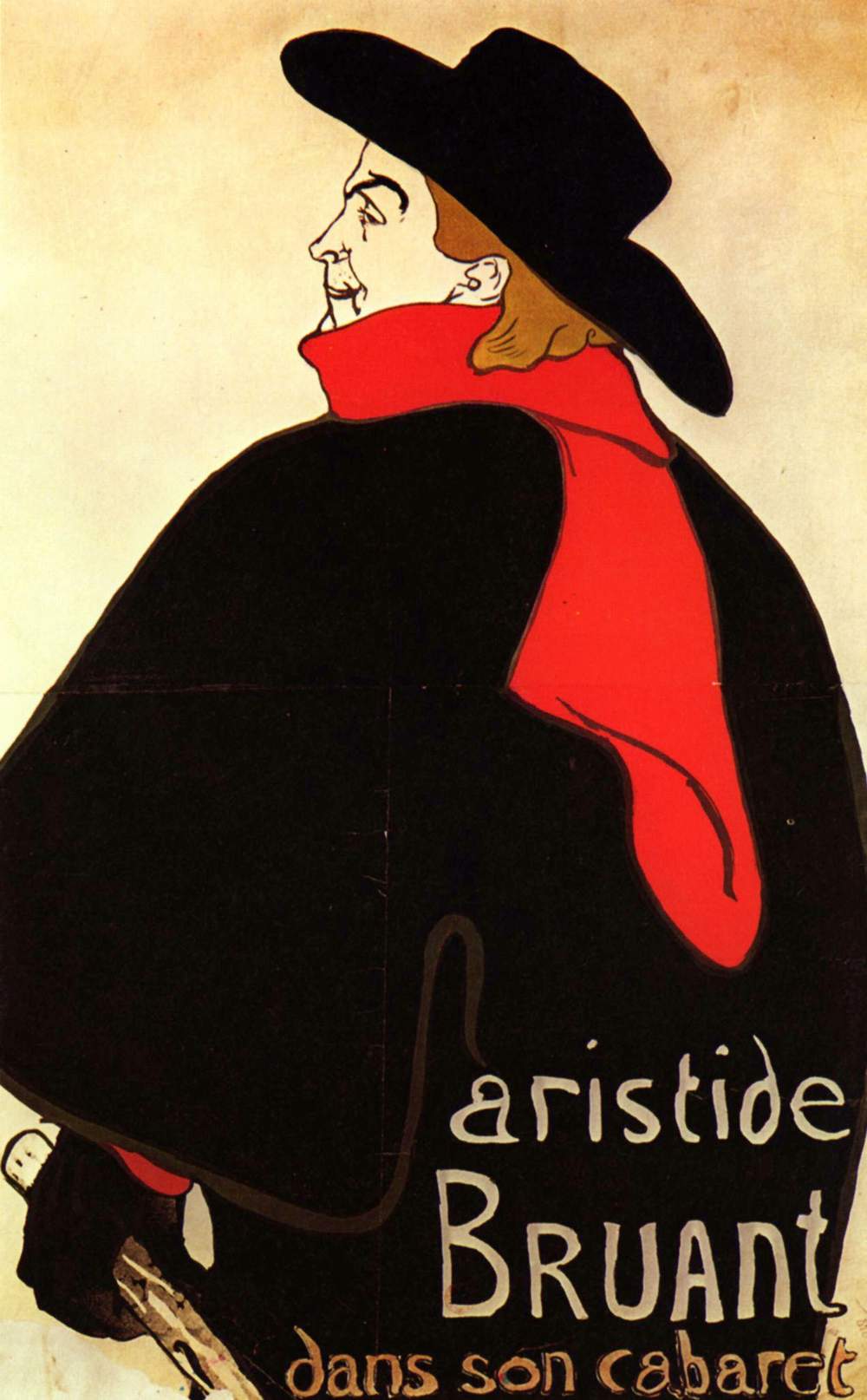
3. Henri de Toulouse-Lautrec – Ambassadeurs Aristide Bruant, 1892.
3. The poster Ambassadeurs Aristide Bruant is a lithograph in 5 colors yellow, blue, red, black, and olive green. Aristide Bruant (1851-1923) was a singer and this was a promotional poster for a café concert that opened in June 1892. The poster appeared all over Paris and on stage during the performance. The café owner thought the poster was a “disgusting mess” and refused to hang it until Bruant threatened to cancel his show. The subject wears a heavy dark velvet jacket, red shirt scarf, and wide brimmed hat with a riding crop. His head rises out of a dark mass which is lifted wholesale from a Japanese print by Katsukawa Shunshō (1726-1792).
Lautrec’s posters chronicled the vibrant world of Montmartre’s cabarets, cafés-concerts, dance halls, entertainers, and literary culture.
4. Henri de Toulouse-Lautrec – Eldorado Aristide Bruant. 1892.
4. The poster Eldorado Aristide Bruant is a lithograph in 5 colors (olive green, yellow, red, blue, and black). It includes the letters “TL” and signed monogram which will appear on other posters. The poster was created for the singer’s event on Boulevard de Strasbourg (north of Boulevard Montmartre at Sebastopol). With the same but reversed design, the customer and artist cut poster costs while increasing brand identity. In modern art the figure of the imposing heroic individual performer was new and Bruant became an overnight celebrity that year in Paris. Toulouse-Lautrec made no money on this project because the café owners were shocked by its content and refused to pay him.
Lautrec helped create a new form of visual culture where art left the museum and entered everyday life through posters pasted on city streets. These works became among the first art objects produced for broad public consumption and were tied directly to the cafés, cabarets, and entertainment venues of Montmartre.
5. Henri de Toulouse-Lautrec – Reine de Joie, 1892
5. The poster Reine de Joie is a lithograph in 4 colors (olive green, yellow, red, and black). It includes the emblematic letters “TL” and is signed. The poster was an advertisement for a suggestive new serialized novel by Victor Joze (1861-1933) and depicted the moment in the novel when the heroine kisses a fat banker, the latter being modeled by Georges Lasserre, a Lautrec friend. The poster, also used as the novel’s cover, caused a scandal across Paris and prompted a poster tear-down campaign. Speculation ran rampant as to who might be the real-life personalities on which characters in the novel were based.
The posters are documents of mass entertainment, celebrity culture, advertising, consumer culture, and urban nightlife in Belle Époque Paris.
6. Henri de Toulouse-Lautrec – Divan Japonais, 1892-93.
6. The poster Divan Japonais (1892-93) is a lithograph in 4 colors (olive green, yellow, red, and black). The cabaret on rue des Martyrs came under new ownership in 1892 and was totally refurbished in a trendy Japanese style. The poster depicts 24-year-old Jane Avril (1868-1943) with critic Edouard Dujarden (1861-1949) in the cabaret. On stage are shown the long black gloves of new singer Yvette Guilbert (1865-1944). In a stylistic move, the artist cuts off Guilbert’s head and shoulders in the poster much to the consternation of the young singer just getting started in her career. (She later commissioned a poster by another artist to depict her complete figure). When this poster went up all over Paris it created a sensation and was another triumph for Lautrec. In 1894 the Divan Japonais closed to be replaced by another establishment. As with his other posters, there were several preliminary sketches the artist made for Divan Japonais. The posters used the new and improving popular mechanical technique of color printing and applied it to commercial establishments and popular entertainers, subject matter usually reserved for cruder forms of advertisement.
Divan Japonais is one of Toulouse-Lautrec’s early posters. In his poster career the artist usually used anywhere from 2 to 5 colors. It is signed by Toulouse Lautrec. This Montmartre cabaret was taken over in 1892 by a new owner and totally refurbished in the avant-garde Japanese style which was the inspiration for the cabaret’s name. By February 1893 when this sixth poster was made by Lautrec and put up all around Paris, his 5 previous posters had already made him famous.
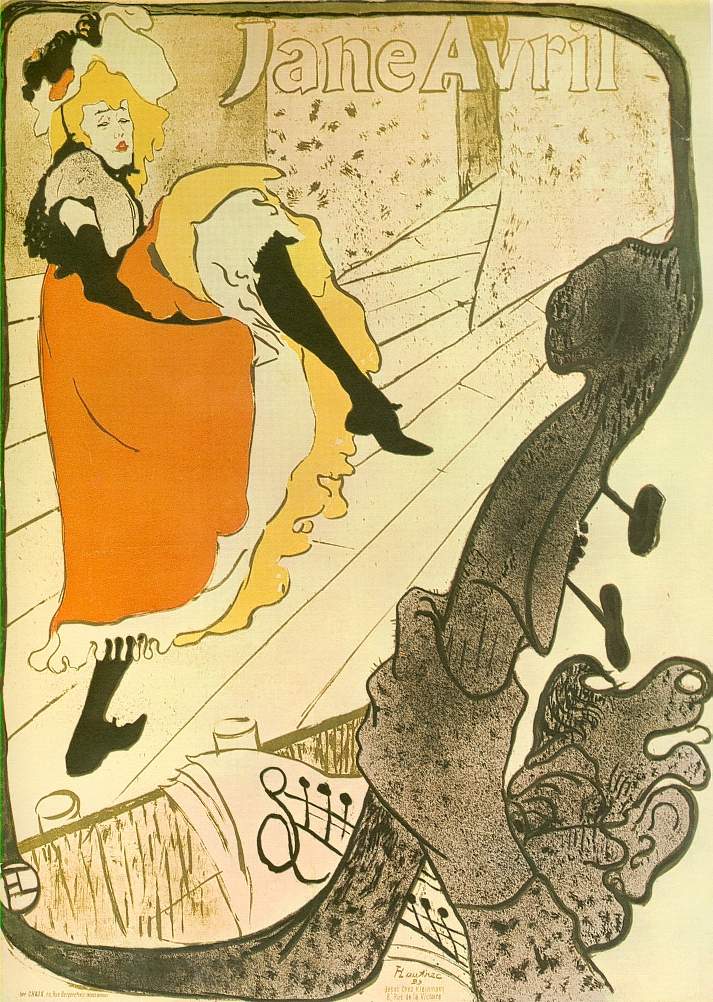
7. Henri de Toulouse-Lautrec – Jane Avril, 1893.
7. The poster Jane Avril is a lithograph in 5 colors (olive green, yellow, orange, red, and black). The same subject who appeared in Divan Japonais, Jane Avril commissioned this poster for her performance at the Jardin de Paris, a new café-concert. The letters for the name of the establishment were added later by someone other than Lautrec. The artist first produced 20 collector prints and after, with its newly-added letters, the poster went into mass production. Known as La Mélinite—a type of explosive—Jane Avril looked to this poster to reinvigorate her career as a performer in Paris. The poster helped her to take Paris by storm as she went on to perform at the Casino de Paris, the Moulin Rouge and the Folies-Bergères. In terms of composition, the poster is noteworthy for its strong diagonals inspired by Japanese prints and the detail of a large musical instrument—including the meticulously drawn hairs of a musician’s fingers—which rounds out the design and is seen as homage to Degas who used a similar motif in his artwork.
Iconic figures such as Jane Avril, Aristide Bruant, Yvette Guilbert, and La Goulue became cultural celebrities through his poster designs.
8. Henri de Toulouse-Lautrec – Aristide Bruant Dans Son Cabaret, 1893.
8. The poster Aristide Bruant Dans Son Cabaret is a lithograph in 4 colors (olive green, brown, red, and black). Lautrec’s third image of the singer became a Parisian icon. From the poster’s inception the singer used this image to promote his appearances—and for the next twenty years until 1912.
9. Henri de Toulouse-Lautrec – Au Pied De L’Echafaud, 1893.
9. The poster Au Pied De L’Echafaud is a lithograph in 4 colors (grey, red-brown, red, and black). The poster was an advertisement for the memoirs of a prison chaplain published in 1893.
10. Henri de Toulouse-Lautrec – Caudieux, 1893.
10. The poster Caudieux is a lithograph in 4 colors (olive green, yellow, red and black). Lautrec depicts Caudieux, who was a popular cabaret comedian, to be striding across the stage. Lautrec used the partial figure in the prompt box in other artwork.
11. Henri de Toulouse-Lautrec – Bruant Au Miriton, 1893.Bruant Au Miriton, 1893.
11. The poster Bruant Au Miriton is a lithograph in 2 colors (olive green or black and red). Represented with his back to the viewer, the popular performer is identified simply by his costume and the way he stands. This artistic device had already been used by Degas based on a theory by an art critic that a person’s economic and social class could be revealed simply by the way he or she comports themselves. The poster was recycled by Bruant as a songbook cover.
12. Henri de Toulouse-Lautrec – Babylone D’Allemagne, 1894
12. The poster Babylone D’Allemagne is a lithograph in 5 colors (olive green, yellow, red, dark blue and black). This was Lautrec’s second poster for another Victor Joze novel following his Reine de Joie. Lautrec wrote to his mother at this time to relate how busy he was with his art projects. Because of Joze’s anti-German message in the book, the author wanted the poster suppressed but it went up all over Paris nonetheless.
13. Henri de Toulouse-Lautrec – L’Artisan Moderne, 1894.
13. The poster L’Artisan Moderne is a lithograph in 4 colors (dark blue, yellow, green, and brown). The lettering is not done by Lautrec. Because of the impact of the cabaret and book posters, Lautrec began to be commissioned to make posters for the trades. This poster was provided to an interior design firm.
14. Henri de Toulouse-Lautrec – P. Sescau, Photographe, 1894
14. The poster P. Sescau, Photographe is a lithograph in 4 colors (dark red, yellow, green, and dark blue). The lettering is not done by Lautrec. This poster was provided to Paul Sescau, a professional photographer and personal friend of the artist.
15. Henri de Toulouse-Lautrec – Confetti, 1894.
15. The poster Confetti is a lithograph in 3 colors (dark olive green, red and yellow). This is Lautrec’s poster for the English paper manufacturer Bella & de Malherbe. The model is Jeanne Granier (1852-1939). These paper manufacturers hosted poster exhibitions in 1894 and 1896 to which Lautrec was invited.
16. Henri de Toulouse-Lautrec – May Belfort, 1895.
16. The poster May Belfort is a lithograph in 4 colors (olive black, red and yellow). Following his trades posters Lautrec returned to the subject of the single musical performer. May Egan (whose stage name was May Belfort) was an Irish singer who appeared at the Cabaret des Décadents where Jane Avril performed.
Advances in color lithography allowed his work to reach a broad urban audience, bringing art directly into the streets of Paris.
17. Henri de Toulouse-Lautrec – La Revue Blanche, 1895.
17. The poster La Revue Blanche is a lithograph in 4 colors (blue, red, black, and green). The subject is Misia Natanson (1872-1950) who was married to Thadée Natanson whose brother was editor of La Revue Blanche from 1891 to 1903. Misia was muse to a generation of avant-garde artists, composers, and writers as the publication itself was the remarkable meeting point for the Paris literary and artistic worlds in the 1890’s. Lautrec shows Misia wearing an ostrich feather hat, spotted dress, fur jacket and muff and ice skating which was a popular activity in Paris. Two preparatory drawings for this poster are known.
18. Henri de Toulouse-Lautrec – May Milton, 1895.
18. The poster May Milton is a lithograph in 5 colors (blue, red, black, yellow and olive green). This poster was never posted in Paris but produced as an advertisement in a magazine to promote the U.S. tour of May Milton, an English dancer at the Moulin Rouge in Paris. Picasso owned a copy of this poster and used some of its compositional elements in his own artwork. Art dealers would commission limited editions of black-and-white lithographs of performers such as May Milton because they sold quickly.
19. Henri de Toulouse-Lautrec – Napoleon, 1895.
19. The poster Napoleon is a lithograph in 5 colors (blue, reddish brown, black, yellow and olive green). Toulouse-Lautrec produced this poster for a book cover competition that he lost. Failing to sell this artwork, the artist produced a limited edition of 100 copies at the artist’s expense. The artist’s fee for his poster artwork varied a good deal, although during his career Lautrec clearly made more money from the output of his graphic work than his paintings.
Influenced by Japanese prints (Japonisme), Lautrec employed flattened forms, strong diagonals, silhouettes, and unconventional cropping.
20. Henri de Toulouse-Lautrec – Salon Des Cents, 1895.
20. The poster Salon Des Cents is a lithograph in 6 colors (blue, dark blue, black, yellow, ochre, and red). This poster is Lautrec’s homage to a married woman he met and became infatuated with during a summer cruise in 1895. The young woman sits in a deck chair under an awning facing out to sea. He produced the poster at his rentrée to Paris that fall and used it for international poster exhibitions sponsored by the journal La Plume at the Salon des Cent during winter 1895-96 and later in 1896 at the Libre Esthétique exhibition in Brussels.
21. Henri de Toulouse-Lautrec – The Chap Book, 1895.
21. The poster The Chap Book is a lithograph in 5 colors (olive green, blue, yellow, pink and red). The lettering is not done by Lautrec. The artist used the setting of an Irish-American bar near Place Madeleine in Paris to promote The Chap Book, an American magazine. Along with its identifiable characters, Lautrec includes the image of a bartender preparing a cocktail which was a libation newly introduced to Paris.
22. Henri de Toulouse-Lautrec – La Chatelaine, Ou ‘Le Tocsin’, 1895
22. The poster La Chatelaine, Ou ‘Le Tocsin’ is a lithograph in 2 colors (blue and blue-green). This poster was commissioned by former Republican politician and Editor-in-chief Arthur Huc (1854-1932) to advertise a novel by Jules de Gastyne (1847-1920) which appeared in his newspaper in popular serial form in 1895. Letters were added by others after copies of the poster were printed for collectors of Lautrec’s increasingly popular artwork.
His work captured the spirit of Belle Époque Paris, documenting its entertainment culture while influencing generations of graphic artists.
23. Henri de Toulouse-Lautrec – Troupe De Mlle Églantine, 1896.
23. The poster Troupe De Mlle Églantine is a lithograph in 4 colors (green-blue, red, yellow and dark brown). The lettering is not designed by Lautrec. This was commissioned by Jane Avril for her work in London at the Palace Theatre and elsewhere. The formation dance was comprised of four identified dancers including Mlle Églantine and Jane Avril and derived from the famous French can-can.
24. Henri de Toulouse-Lautrec – La Vache Enragee, 1896.
24. The poster La Vache Enragée is a lithograph in 5 colors (dark blue, green-blue, red, yellow and black). The lettering is not designed by Lautrec. This was an advertisement for a new monthly magazine founded by Adolphe Willette (1857-1926). Its editor, Adolphe Roedel, organized an annual parade through Montmartre called the Vachalcade to lampoon the artist’s state of life in a major urban center.
25. Henri de Toulouse-Lautrec – Elles, 1896.
25. The poster Elles is a lithograph in 4 colors (yellow, dark green, orange and blue). Later lettering is not designed by Lautrec. Degas would visit a Paris brothel to sketch its denizens, but Lautrec moved in for weeks at a time to do his artwork. Elles is a series of lithographs of the lives of prostitutes. Although considered some of the finest of lithographs of the nineteenth century, its portfolio of prints could not find collectors and they had to be sold singly. An exhibition of the complete lithographic series was held at La Plume starting in April 1896 where Lautrec adapted Elles’ title-page lithograph as the poster to advertise the show.
26. Henri de Toulouse-Lautrec – L’Aube, 1896.
26. The poster L’Aube is a lithograph in 2 colors (dark blue and blue-green). The lettering is not designed by Lautrec. This was another advertisement for a new journal, the leftist L’Aube, first published in 1896. After its printing, the printer and artist had a rafter of remainders of this poster which they tried to sell for next to nothing.
27. Henri de Toulouse-Lautrec – Cycle Michael, 1896.
27. The poster Cycle Michael is a lithograph in 1 color (olive green). Bicycling had developed into a cult sport in France by the 1890’s. Lautrec’s interest in the new sport led to this poster commission of British cyclist Jimmy Michael with his trainer (left background) and a sports writer with a hand in his coat pocket. The bicycle company rejected Lautrec’s design in part because the depiction of its mechanics was inaccurate which left the artist to print a limited edition for collectors at his own expense.
28. Henri de Toulouse-Lautrec – La Chaine Simpson, 1896
28. The poster La Chaîne Simpson is a lithograph in 3 colors (red, yellow and blue). The lettering is not designed by Lautrec. This is Lautrec’s second poster for the new sport of bicycling which had become immensely popular in France in the 1890’s. It depicts popular rider Constant Huret (left) and, in the background wearing hats, two British and French bicycle and chain manufacturers. Lautrec was fascinated with the cycling sport and its imagery appears in other of his artwork.
29. Henri de Toulouse-Lautrec – The Ault & Wiborg Co, 1896.
29. The poster The Ault & Wiborg Co is a zincograph in 4 colors (brown, red, yellow and black). The lettering is not designed by Lautrec. The smallest of Lautrec’s posters, it was commissioned by an American ink manufacturer whose sitters are not precisely identified. Before it became a poster advertisement, Lautrec had an edition of it printed which he titled Au Concert.
Posters such as Moulin Rouge: La Goulue, Divan Japonais, and Jane Avril helped establish the visual foundations of Art Nouveau graphic design.
30. Henri de Toulouse-Lautrec – Henri de Toulouse-Lautrec – Jane Avril, 1899.
30. The poster Jane Avril is a zincograph in 4 colors (black, red, yellow and blue). After six years of intense poster production, Lautrec temporarily left its practice in 1897 and 1898. When he returned to it in 1899 he found that technology had advanced to make the printing technique for his artwork more efficient. This poster was commissioned by Jane Avril but never publicly displayed. Lautrec looked to capture her dancing style and graceful and wistful figure which the artist admired. The serpentine-themed dress Jane Avril wears was a popular motif in the Art Nouveau.
31. Henri de Toulouse-Lautrec – La Gitane, 1899-1900.
31. The poster La Gitane is a lithograph in 5 colors (black, grey, red, brown and blue). The lettering is designed by Lautrec. Lautrec’s last poster was produced for a Carmen-like play that opened in January 1900 at the Théâtre Antoine in the tenth arrondissment. The play was unpopular, the poster never published, and Lautrec’s modern art poster career had come to an end.
Lautrec elevated commercial poster art from simple advertising into a respected artistic medium.
Select Bibliography: Ash, Russell, Toulouse-Lautrec:The Complete Posters, Pavilion Books Limited, London, 1991. Beauroy, Jacques, Bertrand, Marc, Gargan, Edward T., editors, The Wolf and the Lamb: Popular Culture in France, From the Old Régime to the Twentieth Century, Anma Libri, Saratoga, CA, 1977. Cate, Phillip Dennis, The Color Revolution: Color Lithography in France, 1890-1900, Peregrine Smith, Inc., Santa Barbara and Salt Lake City, 1978. Cate, Phillip Dennis and Shaw, Mary, editors, The Spirit of Montmartre: Cabarets, Humor, and the Avant-Garde, 1875-1905, Jane Voorhees Zimmerli Art Museum, Rutgers, New Brunswick, New Jersey, 1996. Denvir, Bernard, Toulouse-Lautrec, Thames and Hudson, London, 1991. Gluck, Mary, Popular Bohemia: Modernism and Urban Culture in Nineteenth-Century Paris, Harvard University Press, Cambridge, MA, 2005. Foxwell, Chelsea, Leonard, Anne, et.al. Awash in Color: French and Japanese Prints, Smart Museum of Art, University of Chicago, 2012. Oberthur, Mariel, Cafés and Cabarets of Montmartre, Peregrine Smith Books, Salt Lake City, 1984. Rearick, Charles, Pleasures of the Belle Époque: Entertainment & Festivity in Turn-Of-The-Century France, Yale University Press, New Haven and London, 1985. Seigel, Jerrold, Bohemian Paris: Culture, Politics, and the Boundaries of Bourgeois Life, 1830-1930, Penguin Books, New York, 1986. Thory-Frèches, Claire, Roquebert, Anne, Thomson, Richard, Toulouse-Lautrec, South Bank Center, 1991. Weisberg, Gabriel P., Montmartre and the Making of Mass Culture, Rutgers University Press, News Brunswick, New Jersey and London. 2001.
FEATURE image: Thérèse Martin (St. Thérèse of Lisieux) at 15 years old in a photograph taken in October 1887.
Saint Thérèse of Lisieux demonstrated that sanctity is achieved not through dramatic achievements but through humility, trust, suffering accepted with love, and fidelity to ordinary daily life, a spiritual vision that transformed an unknown Carmelite nun into one of the most influential figures in modern Christianity.
Thérèse Martin at 8 years old in 1881.
Thérèse Martin at 8 years old in 1881 with her sister Céline. The Martin family had moved from Alençon to Lisieux to be with the Guerin relatives. Zélie Martin had died four years before.
By John P. Walsh
October 1 is the feast day of Saint Thérèse of Lisieux (French, 1873-1897), one of only four women “doctors” in the Roman Catholic Church, and popularly known as The Little Flower of Jesus. Her religious name is Thérèse of the Child Jesus and the Holy Face and, with St. Francis of Assisi, she is one of today’s most popular saints. For a young Norman woman who died at 24 years old in an obscure convent in northern France that is a surprisingly solid list of titles and accolades.
Yet, when she died on September 30, 1897, the Carmelite nuns in her community at the Carmel in Lisieux didn’t think they had any accomplishments to cite for her obituary. Her sister Céline (1869-1959), a nun in the same convent as Thérèse, observed: “In general, even in the last years, she continued to lead a hidden life, the sublimity of which was known more to God than to the Sisters around her.”1
Born Marie-Françoise-Thérèse Martin in 1873, she was the youngest of five sisters and lively and precocious. She lost her mother Zélie Martin (née Guérin, 1831-1877) to breast cancer as a four-year-old. The next decade – according to Thérèse’s journal (The Story of a Soul, begun in 1895) – was the most “distressing” years of her life.2
Thérèse’s mother was the breadwinner in the Martin house and after she died little Thérèse naturally turned to her father Louis (1823-1894) for nurturing along with her four older sisters — especially the second eldest, Pauline.
For the rest of the 1870s and into the 1880s, Thérèse was the high-spirited baby sister in the family home called Les Buissonnets in the Normandy town of Lisieux.
Les Buissonnets, at 22 Chemin des Buissonnets in Lisieux, Normandy, is the historic brick home where St. Thérèse of Lisieux spent her childhood. The Martin family moved here in November 1877 after the death of her mother, Zélie Martin, in Alençon. Thérèse lived in this house from age four until she left at fifteen to enter the Carmel of Lisieux in 1888, beginning the religious life that would define her legacy.
Thérèse was born in Alençon in 1873 and raised in Lisieux after the death of her mother.
Les Buissonnets, St. Thérèse of Lisieux’s childhood home in Lisieux, France. October 2002. Author’s photograph.
St. Azélie-Marie “Zélie” Martin née Guérin (1831 -1877) and St. Louis Martin (1823 –1894), the mother and father of Saint Thérèse of Lisieux. The married couple were canonized together in the Catholic Church by Pope Francis on October 18, 2015.
As three of Thérèse’s sisters left the family homestead to enter convents -– two of them to a Carmelite convent (“Carmel”) in Lisieux and another later to a Visitation convent in Caen– the two youngest sisters, Céline and Thérèse, remained at home with their father.
Although Louis adored Thérèse and called her his “little flower,” Thérèse was headstrong and obstinate and she seemed to do chores with the attitude like she was doing the household a big favor. The young child also began to have panic attacks. Though intelligent and educated, at ten years old Thérèse believed she saw a statue of the Blessed Virgin given to her by her mother in her bedroom smile at her. While unusual, from that point forward, the girl’s nerves calmed. These early tantrums left a mark on her reputation. They, along with some of her later writings in journals, letters, and poems, left the future saint prey for others in her lifetime and after her death to be called “immature” and “sentimental,” even “neurotic.”3
Doubtless some of Thérèse’s thoughts sound naïve, though she writes profoundly: “At times when I am reading certain spiritual treatises in which perfection is shown through a thousand obstacles…my poor little mind quickly tires; I close the learned book that is breaking my head and drying up my heart and I take up Holy Scripture. Then all seems luminous to me; a single word uncovers for my soul infinite horizons, perfection seems simple to me, I see it is sufficient to recognize one’s nothingness and to abandon oneself as a child into God’s arms.”4
Marie.
Marie (1860-1940), the eldest Martin sister. After she entered the Carmel in Lisieux, she was called Sister Marie of the Sacred Heart.
Pauline.
Pauline (1861- 1951). Thérèse’s “favorite” sister. When Pauline entered the Carmel in Lisieux her name was Mother Agnes of Jesus.
Léonie.
Léonie (1863-1941). She entered the Visitation Sisters in Caen and took the name Sister Françoise-Thérèse.
Céline.
Céline (1869-1959) was four years older than Thérèse and closest in age. She entered the Carmel in Lisieux after Thérèse and took the name Sister Geneviève of the Holy Face.
On April 9, 1888, a 15-year-old Thérèse entered the Carmel de Lisieux on Rue du Carmel, less than a one-half mile walk from Les Buissonnets. Younger than a typical postulant, exceptions had to be made. She received the habit after some delay mostly because of her father’s declining health in January 1890. Although her profession was also postponed, Thérèse’s spiritual life was deepening through her reading of another Carmelite, St. John of the Cross (1542-1591).
St. Thérèse of Lisieux as a young nun read deeply of Saint John of the Cross who said many beautiful things about having a close relationship with Jesus.
In due time, despite difficulty in prayer and doubts about becoming a nun, Thérèse received the black veil in September 1890. In early 1891 the 18-year-old Thérèse was made sacristan’s aide, a duty she carried into 1892 as her father lay slowly dying. During this time her reading and prayer transitioned to the Gospels and she began to write poems for which she had talent. Founded in 1838 as a “progressive” convent so that by the 1890’s the nuns were allowed to practice photography within its walls, the Carmel was also a working-class foundation comprised of daughters of shop-keepers and craftspeople brought up to expect a day’s work for a day’s wage. Thérèse, like another young French mystic saint, St. Bernadette Soubirous, sought to be useful.
When Thérèse’s favorite sister Pauline was elected prioress in early 1893, Thérèse was appointed novice master (though a novice herself) and embarked on her artistic avocation of picture painting. Scheduled to graduate from the novitiate in September 1893 it was postponed in part due to convent politics. The duty of doorkeeper’s aide was added to Thérèse’s tasks.
In the spring of 1894 Thérèse began to experience chest pains and a hoarse throat that grew worse by that summer. After her father died in July 1894, Céline entered the Carmel six weeks later. It was at that time that Thérèse began to seriously formulate her “little way” of seeking holiness of life based on scripture passages. Before 1894 had ended, her sister Pauline (Mother Agnes Of Jesus) ordered her to begin to record her life story in a journal (The Story of a Soul). The novice composed her journal in segments in her free time over the next two and a half years.
Early in 1895 Thérèse voiced the first prediction of her death as her prayer life was working out an idea for what she would dedicate her life to. It would be a life with God whom she called Merciful Love. On June 9, 1895, the Feast of the Holy Trinity, during Mass, Thérèse decided to offer herself to Merciful Love who is the Lord. Thérèse confided these spiritual developments to Céline so that by summer 1895 Thérèse recommended the same devotion to more nuns in the community.
Sister Geneviève recounted later in her memoirs: “Coming out of Mass, eyes all on fire, breathing holy enthusiasm, Thérèse dragged me without saying a word to follow our Mother who was then Mother Agnes of Jesus. She told him in front of me how she had just offered herself as a Holocaust Victim to Merciful Love, asking her permission to deliver us together. Our Mother, in a great hurry at the moment, allowed everything without really understanding what it was about. Once alone, Thérèse confided in me the grace she had received and began to compose an act of offering.” (”Au sortir de la messe, l’œil tout enflammé, respirant un saint enthousiasme, Thérèse m’entraîna sans mot dire à la suite de notre Mère qui était alors Mère Agnès de Jésus. Elle lui raconta devant moi comment elle venait de s’offrir en Victime d’Holocauste à l’Amour Miséricordieux, lui demandant la permission de nous livrer ensemble. Notre Mère, très pressée en ce moment, permit tout sans trop comprendre de quoi il s’agissait. Une fois seule, Thérèse me confia la grâce qu’elle avait reçue et se mit à composer un acte d’offrande.”)
June 11, 1895.
Céline (Sister Geneviève) and Thérèse, June 11, 1895.
Throughout 1895 Thérèse continued to write–composing poems and giving them as gifts on special occasions, writing plays and painting pictures. Her spirit was characterized by humility.
Thérèse wrote: “How shall she prove her lovesince love is proved by works? Well, the little child will strew flowers, she will perfume the royal throne with their sweet scents, and she will sing in her silvery tones the canticle of Love.”5 (the emphases are Thérèse’s).
July 1876, Thérèse.
Taken in the first part of July 1876, Thérèse is 3 1/2 years old. As a child she was stubborn and headstrong. For this photography sitting, Thérèse was fidgety and ill at ease. Looking as if she might cry, the photographer had to take her photograph several times so to achieve this image of Thérèse with a pouting look. Thérèse’s mother, Zélie Martin, accompanied her youngest child during the photography session and had to reassure her throughout.
February 1886.
Thérèse was 13 years old in this photograph taken in February 1886. Just months later, at Christmas 1886, Thérèse made her first Holy Communion and at once her nervous childhood sensitivity stopped. That December 1886 she wrote about these occurrences, stating: “I felt love enter my soul, and the need to forget myself and please others, and since then I have been happy.”
October 1887.
Pretty and well-dressed Thérèse at 15 years old in a photograph taken in October 1887. At the time this photograph was taken Thérèse was seeking the permission of Bishop at Bayeux, Flavien-Abel-Antoinin Hugonin (1823-1898), to enter the convent of Carmel. She entered on April 9, 1888.
Thérèse 1887.
Thérèse entered the Carmelite convent in Lisieux at age fifteen after obtaining special permission because of her youth.
Above: Recent photograph of the Carmelite convent (Carmel) where Thérèse Martin entered at Lisieux in April 1888 and photograph of Carmel taken in September 1894 by Céline. Thérèse stands on the steps, third from the right.
Bishop Flavien-Abel-Antoine Hugonin (July 3, 1823 – May 2, 1898).
Bishop Hugonin of Bayeux and Lisieux had confirmed Thérèse on June 14, 1884. Nearly four years later, he authorized, with some reluctance on account of her young age, Thérèse’s entrance in Carmel at 15 years old. Soon after, Bishop Hugonin presided over her clothing on January 10, 1889 as he showed continued solicitude for the young Carmelite novice he had specially approved. Less than two months before his own death in May 1898, Bishop Hugonin, on March 7, 1898, gave his verbal imprimatur to Thérèse’s Story of a Soul.
Thérèse January 1889.
Above: Thérèse as a novice in Carmel in January 1889. She was 16 years old and in the convent nine months. The photographs were taken by Fr. Gombault, the bursar of the minor seminary.
Late 1894.
Thérèse (right) was one of five Martin sisters who became religious nuns. The photograph was taken by Céline in late 1894 or early 1895.
Original oil oval portrait painting of Thérèse by Céline based on her photograph of Thérèse around Christmas 1894. Céline later claimed that this image captured the real Thérèse. National Shrine & Museum of St. Thérèse, Darien. Author’s photograph.
Detail of a photograph of Thérèse taken by Céline in late 1894 or early 1895. The photographic image was the basis for an oval portrait painting done by Céline in the same time period.
Thérèse dressed as Joan of Arc in winter 1895.
A series of photographs taken by Céline from January 21 to March 25, 1895, in the convent courtyard. Thérèse is dressed as Joan of Arc. Thérèse played the part of La Pucelle in a play Thérèse had written called Joan of Arc Accomplishing Her Mission.
A longtime revered figure in France, Joan of Arc was not yet a canonized saint in late winter 1895 (Joan became a saint in 1920 and is today patron of France).
In March 1895 Thérèse was 22 years old. In a little over a year Thérèse’s symptoms of tuberculosis indicated a serious turn for the worse in her health. Over the next two years, her health continued to decline so that by summer 1897 Thérèse was on her death bed.
Close up of a photograph taken by Céline of Thérèse dressed as Joan of Arc in 1895.
Thérèse developed her famous spiritual philosophy known as the “Little Way,” rooted in humility, simplicity, and complete trust in God and love of Him.
Thérèse knew her great desire to be a missionary to Vietnam was now impractical. In June 1895 Thérèse decided to have an earthly mission within convent walls of “merciful love” and the “little way.” Like young Joan of Arc, Thérèse’s spiritual mission began on earth and would continue in heaven. So that a little over 6 months before her early death at 24 years old, Thérèse implored the favor by the command of Our Lord and of the Angels of “spending her heaven doing good on earth.”
Community of 22 Carmelite nuns in a photograph taken by Céline on Easter Monday, April 15th, 1895. First row left to right: Geneviève of the Holy Face (Céline). Second row left to right: Mother Agnès of Jesus (Pauline) and Thérèse of the Child Jesus.
Easter Monday, April 15, 1895.
Photograph taken by Céline for the feast of the Good Shepherd, April 27 or 28, 1895. Thérèse is at right between two of her white-veiled novices.
Above photograph (including close-up) was taken by Céline in July 1896. Thérèse had been ill for several months.
After July 3, 1896, photograph taken by Céline.
Thérèse 1896.
Thérèse holds a lily in a photograph taken by Céline in the convent garden in July 1896.
Carmel, July 1896.
Photograph of the community taken by Céline. July 1896.
November 1896.
Photograph taken by Céline in early-mid November 1896 of her sisters and cousin showing the work of the sacristan. Thérèse stands at right. In September 1896 Thérèse wrote a letter to her sister Marie whose text called Manuscript B became part of The Story of a Soul.
Thérèse recorded her spiritual experiences in The Story of a Soul, one of the most influential religious autobiographies of the modern age.
Photocopied pages of Thérèse’s original notebook entries in Thérèse’s own handwriting. National Shrine & Museum of St. Thérèse, Darien. Author’s photograph.
Published transcriptions of The Story of a Soul (“HISTOIRE D’UNE AME”) have varied over the years by way of editorial additions, omissions or consolidations that have taken liberties with Thérèse’s original notebook entries whose form can be like a shower of roses of her memory. One version of the spiritual classic that was updated to 1911 had followed her second exhumation in 1910 in the presence of the bishop of Bayeux which led to the start of her canonization process in 1914 (Thérèse of Lisieux was canonized in Rome on May 17, 1925). The text provides in French the following transcription of these photocopied pages in Thérèse’s own handwriting. They appear in chapter 4 (“CHAPITRE IV”) of the 1911 publication where Thérèse discusses her life in the mid-1880s as a child and teenager which includes her first Communion, Confirmation, and her personal experiences of light and darkness. Thérèse relates her deliverance from her interior pains which left her with an indescribably deep sweet peace that followed her into the convent of Carmel in Lisieux in 1888 and stayed with her in that place amid the greatest trials until her death there in 1897. These pages are part of the display at the National Shrine and Museum of St. Therese in Darien, Illinois.
French:
A cette époque, il m’eût été bien doux de faire oraison; mais Marie, me trouvant assez pieuse, ne me permettait que mes seules prières vocales. Un jour, à l’Abbaye, une de mes maîtresses me demanda quelles étaient mes occupations les jours de congé, quand je restais aux Buissonnets. Je répondis timidement: «Madame, je vais bien souvent me cacher dans un petit espace vide de ma chambre, qu’il m’est facile de fermer avec les rideaux de mon lit, et là, je pense…—Mais à quoi pensez-vous? me dit en riant la bonne religieuse.—Je pense au bon Dieu, à la rapidité de la vie, à l’éternité; enfin, je pense!» Cette réflexion ne fut pas perdue, et plus tard ma maîtresse aimait à me rappeler le temps où je pensais, me demandant si je pensais encore… Je comprends aujourd’hui que je faisais alors une véritable oraison, dans laquelle le divin Maître instruisait doucement mon cœur. Les trois mois de préparation à ma première communion passèrent vite; bientôt je dus entrer en retraite et pendant ce temps devenir grande pensionnaire. Ah! quelle retraite bénie! Je ne crois pas que l’on puisse goûter une semblable joie ailleurs que dans les communautés religieuses: le nombre des enfants étant petit, il est d’autant plus facile de s’occuper de chacune. Oui, je l’écris avec une reconnaissance filiale: nos maîtresses de l’Abbaye nous prodiguaient alors des soins vraiment maternels. Je ne sais pour quel motif, mais je m’apercevais bien qu’elles veillaient plus encore sur moi que sur mes compagnes. Chaque soir, la première maîtresse venait avec sa petite lanterne ouvrir doucement les rideaux de mon lit, et déposait sur mon front un tendre baiser. Elle me témoignait tant d’affection, que, touchée de sa bonté, je lui dis un soir: «O Madame, je vous aime bien, aussi je vais vous confier un grand secret.» Tirant alors mystérieusement le précieux petit livre du Carmel, caché sous mon oreiller, je le lui montrai avec des yeux brillants de joie. Elle l’ouvrit bien délicatement, le feuilleta avec attention et me fit remarquer combien j’étais privilégiée. Plusieurs fois, en effet, pendant ma retraite, je fis l’expérience que bien peu d’enfants, comme moi privées de leur mère, sont aussi choyées que je l’étais à cet âge. J’écoutais avec beaucoup d’attention les instructions données par M. l’abbé Domin, et j’en faisais soigneusement le résumé. Pour mes pensées, je ne voulus en écrire aucune, disant que je me les rappellerais bien; ce qui fut vrai. Avec quel bonheur je me rendais à tous les offices comme les religieuses! Je me faisais remarquer au milieu de mes petites compagnes par un grand crucifix donné par ma chère Léonie; je le passais dans ma ceinture à la façon des missionnaires, et l’on crut que je voulais imiter ainsi ma sœur carmélite. C’était bien vers elle, en effet, que s’envolaient souvent mes pensées et mon cœur! Je la savais en retraite aussi; non pas, il est vrai, pour que Jésus se donnât à elle, mais pour se donner elle-même tout entière à Jésus, et cela le jour même de ma première communion. Cette solitude passée dans l’attente me fut donc doublement chère. Enfin le beau jour entre tous les jours de la vie se leva pour moi! Quels ineffables souvenirs laissèrent dans mon âme les moindres détails de ces heures du ciel! Le joyeux réveil de l’aurore, les baisers respectueux et tendres des maîtresses et des grandes compagnes, la chambre de toilette remplie de flocons neigeux, dont chaque enfant se voyait revêtue à son tour; surtout l’entrée à la chapelle et le chant du cantique matinal: O saint autel qu’environnent les anges!*
At that time, it would have been very sweet for me to make prayers; but Mary, finding me quite pious, allowed me only my vocal prayers. One day, at the Abbey, one of my mistresses asked me what my occupations were on my days off, when I stayed at Les Buissonnets. I replied timidly: “Madam, I often go to hide in a small empty space in my room, which it is easy for me to close with the curtains of my bed, and there, I think…—But what are you thinking? said the good nun, laughing.—I think of God, of the rapidity of life, of eternity; well, I think!” This reflection was not lost, and later my mistress liked to remind me of the time when I thought, asking me if I still thought… I understand today that I was then making a true prayer, in which the divine Master gently instructed my heart. The three months of preparation for my First Communion passed quickly; Soon I had to retire and during this time become a boarder. Ah! What a blessed retreat! I do not believe that one can taste such joy anywhere else than in religious communities: the number of children being small, it is all the easier to take care of each one. Yes, I write it with filial gratitude: our mistresses of the Abbey then provided us with truly maternal care. I do not know for what reason, but I could see that they watched over me even more than my companions. Every evening, the first mistress came with her little lantern gently to open the curtains of my bed, and placed on my forehead a tender kiss. I listened very carefully to the instructions given by Father Domin, and I carefully summarized them. For my thoughts, I would not write any, saying that I would remember them well; which was true. With what happiness I went to all the services like the nuns! I was noticed in the midst of my little companions by a large crucifix given by my dear Léonie; I put it in my belt like missionaries, and it was thought that I wanted to imitate my Carmelite sister in this way. It was to her, indeed, that my thoughts and my heart often flew away! I knew she was retired too; not, it is true, so that Jesus might give himself to her, but to give herself entirely to Jesus, and that on the very day of my First Communion. This solitude spent waiting was therefore doubly dear to me. At last the beautiful day between all the days of life dawned for me! What ineffable memories left in my soul the smallest details of those hours of heaven! The joyful awakening of dawn, the respectful and tender kisses of mistresses and great companions, the washroom filled with snowflakes, with which each child saw himself clothed in turn; especially the entrance to the chapel and the singing of the morning hymn: O holy altar that surrounds the angels!
June 7, 1897.
The second pose of three posed photographs taken by Céline in the sacristy courtyard on June 7th, 1897. It was taken 4 days after Thérèse had been asked to complete the last section of A Story of a Soul. Thérèse, who holds the image of the “Holy Face” of Jesus, was in the midst of her 18-month “dark night” of faith. She knew she would die soon and Céline made these photographs intentionally as a “final remembrance” of her 24-year-old sister. After many months of sickness and suffering, Thérèse died on Thursday, September 30, 1897.
Thérèse desired missionary service and ultimately viewed prayer and sacrifice as her missionary vocation.
Circumstances were growing more difficult for Thérèse in terms of her health and spirituality. In 1896 a new prioress of Carmel confirmed Thérèse’s role in the novitiate where she could continue to teach her “little way” and work in the sacristy and the laundry room. In addition to finding it difficult to pray, in April 1896 she began to spit blood, a sure sign of the seriousness of her illness. These last eighteen months of her life proved a dark period for the normally vivacious five-foot three-inch Norman young woman. Her physical pain was often unrelenting and the dreams she had of becoming a foreign missionary to Vietnam had to be abandoned. Yet, the priest in charge of foreign missions, Father Adolphe Roulland (1870–1934) whom Thérèse had met in July 1896 as he was going to China, asked her to be a “spiritual sister” to the mission priests. This charge meant not only to pray for the priests but in her correspondence with them to “console and warn, encourage and praise, answer questions, offer corroboration, and instruct them in the meaning of her little way.”6
In 1896 Father Adolphe Roulland (1870-1934) of the Society of Foreign Missions asked the Carmel of Lisieux for a “spiritual sister.”
In a letter from Thérèse to Fr. Roulland she wrote: “Reverend Father… I feel very unworthy to be associated in a special way with one of the missionaries of our adorable Jesus, but since obedience entrusts me with this sweet task, I am assured my heavenly Spouse will make up for my feeble merits (upon which I in no way rely), and that He will listen to the desires of my soul by rendering fruitful your apostolate. I shall be truly happy to work with you for the salvation of souls. It is for this purpose I became a Carmelite nun; being unable to be an active missionary, I wanted to be one through love and penance just like Saint Teresa, my seraphic Mother….I beg you, Reverend Father, ask for me from Jesus, on the day He deigns for the first time to descend from heaven at your voice, ask Him to set me on fire with His Love so that I may enkindle it in hearts. For a long time I wanted to know an Apostle who would pronounce my name at the holy altar on the day of his first Mass….I wanted to prepare for him the sacred linens and the white host destined to veil the King of heaven…The God of Goodness has willed to realize my dream and to show me once again how pleased He is to grant the desires of souls who love Him alone.”7
Thérèse endured illness, spiritual darkness, and tuberculosis during her final years while continuing to write, pray, and encourage others.
The year 1897 was defined on the one hand by Thérèse’s physical decline because of tuberculosis and, on the other hand, her personal joy expressed in her conversations and poems. It was on the feast day of St. Joseph, March 19, 1897, during a personal novena to St. Francis Xavier (1506-1552), that Thérèse asked St. Joseph to obtain from God the favor of “spending her heaven doing good on earth.” She asked St. Francis Xavier for the same intercession.8
Bartolomé Esteban Murillo (1617-1682), St. Joseph and the Child Jesus, Glasgow.
By April 1897 Thérèse was gravely ill and in May 1897 was relieved of all work duties and community prayer. Thérèse continued to write in her journal but abadoned it, too weak to write. In August 1897 Thérèse’s suffering was so great she confessed to the temptation of suicide. After August 19, 1897 Thérèse was too physically weak to even ingest the consecrated communion wafer. On September 30, 1897, Thérèse died in the convent infirmary. She was 24 years old.
In her last hours Thérèse said: “Oh! It is pure suffering because there are no consolations. No, not one! O my God…Good Blessed Virgin, come to my aid! My God…have pity on me! I can’t take it anymore! I can’t take it anymore!…I am reduced…No, I would never have believed one could suffer so much…never! never!…I no longer believe in death for me…I believe in suffering…O I love Him. My God I love you…”9 These last words of the dying nun were reported by more than one witness.
At the centenary of her death in 1997, St. Pope John Paul II (1920-2005) made Thérèse a “Doctor of the Church,” one of only thirty-three such credentialed. By elevating Thérèse’s example of simple love, the Polish pope, himself called out from behind an Iron Curtain and lived to see it fall, clarified what may constitute a Church Doctor’s character and purpose.
Thérèse died in 1897 at only twenty-four years old after prolonged suffering.
August 30, 1897.
Sick Thérèse one month before her death, August 30, 1897. she promised, “After my death, I will let fall a shower of roses,” which is a sign of her own crucifixion and martyrdom in union with the crucifixion and resurrection of her mystically beloved Jesus Christ. The rose is an expression of the divine love linked to this faith-filled action of oblation that is shared with others in the Holy Spirit who ask for it.
St. Thérèse of Lisieux was beatified on April 29, 1923 and canonized on May 17, 1925. She is co-patron saint of all church missions with St. Francis Xavier and co-patron saint of France with St. Jeanne d’Arc (1412-1431). Thérèse is patron saint of AIDS sufferers, pilots, florists, bodily ills (particularly tuberculosis), and the loss of parents.
Saint Thérèse of Lisieux’s obituary (above) was written by the nuns of her community and printed in Le Normand. In an English translation it reads:“It is with a spirited feeling of sadness that we learned Thursday evening of the death at the Monastery of Our Lady of Mount Carmel of a young person who gave the most beautiful years of youth to a life of prayer and sacrifice. Miss Marie-Francoise-Thérèse Martin, renounced the world at fifteen years of age and consecrated herself to God as Sister Thérèse of the Child Jesus. She departed after ten years of angelic life in the shadow of the cloister, and we have sweet confidence that death which put an end to long and cruel sufferings has come to take this youth in her bloom and already placed on her head the immortal crown, the goal of all our earthly aspirations. The funeral will be celebrated Monday morning at 9 o’clock in the Carmel chapel. Le Normand offers to the family of Sister Thérèse of the Child Jesus and to the Prioress and all the Carmelite sisters the tribute of its respectful condolences.”
Thérèse in death, October 1, 1897.
Thérèse died in the evening of September 30, 1897. The next morning, October 1, 1897, before her body left the infirmary where she died, Céline (Sister Geneviève), deeply impressed by Thérèse’s peaceful countenance in death, took one final photograph of her sister.
Sister Thérèse of the Child Jesus was buried in the Carmelite section at the municipal cemetery at Lisieux on the morning of October 4, 1897 after a funeral Mass at the Carmel. An obscure figure at the time of her death, the funeral procession which followed her body to the cemetery was small that day. It was to this municipal cemetery grave that pilgrims first came. Miracles began to be reported to have taken place at her tomb through her intercession. One notable miracle was that of Reine Fauquet, a four-year-old girl from Lisieux, who was blind. On May 25, 1908, the child was brought by her mother to the tomb of Sister Thérèse of the Child Jesus where the child’s sight was suddenly restored. A medical doctor who was not in favor of making Sister Thérèse of the Child Jesus a saint, signed the medical documents attesting to the cure.10
Because of these events, a tribunal was convened by the bishop of Bayeux in August 1910 to interview witnesses at Lisieux. To investigate the corporeal remains of Sister Thérèse of the Child Jesus for its condition, the body was exhumed on September 6, 1910. The exhumation took place in the presence of the bishop of Bayeux, Thomas-Paul-Henri Lemonnier (1853-1927) and scores of others. The doctors who treated Thérèse before her death confirmed that the body decayed in the usual manner, finding only bones and bits of clothes.
The site of Therese’s first grave from 1897 to 1910 continues to be marked by the same cross. The site of her second grave in the same Carmelite section of the municipal cemetery is also marked. The second grave held her bodily remains in a cemented vault from 1910 until 1923. When Sister Thérèse of the Child Jesus was declared a “servant of God,” the first step on the road to sainthood, there was a second exhumation. It was to the second grave site that large and growing numbers of pilgrims came to implore the Little Flower’s intercessions. The cross that marked the second grave was completely covered by prayers and tributes to Sister Thérèse of the Child Jesus by pilgrims.
Sister Thérèse of the Child Jesus rapidly became the focus of international devotion, with reported miracles associated with her intercession.
Second exhumation of Thérèse of the Child Jesus, August 1917.
On the occasion of her beatification, Sister Thérèse of the Child Jesus’s remains were transferred for a third time on March 26, 1923 to the Carmelite Chapel at Lisieux. Saint Thérèse was canonized on May 17, 1925 by Pope Pius XI (1922-1939) and declared Doctor of the Church by Pope John Paul II (1978-2005) in 1997. Her feast day is October 1.
Reine Fauquet was 4 years old when she visited Thérèse’s grave in Lisieux and her eyesight was cured.
It is recorded that on May 26, 1908, Reine Fauquet who lived in Lisieux was cured of an eye disease following her visit to Thérèse’s grave in Lisieux. The 4-year-old child explained to her sister that she had an apparition of Thérèse: “I saw little Thérèse, right next to my bed, she took my hand, she laughed at me, she was beautiful, she had a veil, and it was all lit around her head” (“J’ai vu la petite Thérèse, là, tout près de mon lit, elle m’a pris la main, elle me riait, elle était belle, elle avait un voile, et c’était tout allumé autour de sa tête“). When Reine Fauquet met Thérèse’s sisters at the Carmel they asked her how Thérèse had been dressed in the vision. The child replied: “The same as you!′′ (“Pareille à vous!“).
Thérèse hand-made costumes for Christmas crèche. National Shrine & Museum of St. Thérèse, Darien. Spring 2018. Author’s photograph.
Using this light-blue dress with lace trim, on the evening of December 25, 1895, Thérèse created a ceremony for her community of sisters that celebrated the birthday of the Christ Child.
During the celebration each sister selected a folded note from a basket and handed it to an “angel” (one of the other sisters). The “angel” opened the note and sang its prayerful verse.
Each sister was then asked to offer to Jesus her best self in the coming year. Thérèse’s ceremony included a crib and wax figure of the infant Jesus for which Thérèse and her novice designed these hand-made costumes.
Sister Thérèse of the Child Jesus was canonized in 1925 and declared a Doctor of the Church in 1997.
Papal decree, August 14, 1921.
The papal decree of August 14, 1921 declaring Thérèse of the Child Jesus a “Venerable” of the Church. It was promulgated by Benedict XV.
Saint Thérèse of Lisieux (1873-1897) was beatified in 1923 and canonized in 1925 by Pope Pius XI (1857-1939). The bishop of Bayeux, Thomas-Paul-Henri Lemonnier (1853-1927) decided to build a large basilica dedicated to her in Lisieux, France. The cornerstone was laid after his death in 1929 by then-bishop of Bayeux-Lisieux, Emmanuel Célestin Suhard (1874-1949), soon to be named cardinal archbishop of Reims, both appointments by Pope Pius XI. The basilica project had the full support of that indomitable Roman pontiff who had placed his pontificate which began in 1922 under the sign of Saint Thérèse of Lisieux. Funded completely by private donations received worldwide, construction started in 1929 and continued unto its dedication in 1954.https://youtu.be/4uCfaHOy4KE?si=LsFactM78MBy8euY – retrieved January 27, 2026.
Basilica of Sainte-Thérèse in Lisieux, France. October 2002. Author’s photograph.
Architecture and Style
The Basilica of Sainte‑Thérèse in Lisieux is built in a Neo‑Byzantine–Romano style closely inspired by the Sacré‑Cœur in Paris. Its exterior is defined by massive towers, intricate arcade arches, and a monumental central dome that dominates the surrounding hillside.
Pilgrimage Significance
Drawing roughly 2 million visitors and pilgrims each year, it is the second most important pilgrimage destination in France after Lourdes. Though St. Thérèse of Lisieux is not buried here—her primary tomb is at the nearby Carmel of Lisieux where she lived—one of her arm bones, a major relic, is permanently enshrined in a reliquary in the basilica’s south transept.
Family Legacy
The basilica also houses the tombs of Saints Louis and Zélie Martin, Thérèse’s parents, who are buried in the crypt, making the site a central locus of devotion for pilgrims honoring the Martin family.
Completed and released in 2001, Thérèse de Lisieux, une course de géant (translated as “Thérèse of Lisieux, a giant’s race”) is a 35-minute documentary directed by Fabrice Maze and produced by Seven Doc. For decades, this film has served as the official introduction for visitors, screening on a continuous loop in the auditorium at the Centre d’Accueil Pastoral International Saint Jean-Paul II—the international visitor center located directly across from the Basilica. The title is inspired by a phrase describing St. Thérèse’s rapid spiritual journey, and the documentary beautifully traces her childhood, her life inside the Carmel convent, and her vast global legacy. Filmed entirely on-site in Lisieux and inside the Basilica throughout 2001, this video serves as a brief trailer for the feature.
Stained glass.
ENDNOTES:
St. Thérèse of Lisieux: her last conversations, translated by John Clarke O.C.D., ICS Publications, Institute of Carmelite Studies, Washington, D.C., 1977, pp. 18-19. Her complete obituary printed in Le Normand reads: “It is with a spirited feeling of sadness that we learned Thursday evening of the death at the Monastery of Our Lady of Mount Carmel of a young person who gave the most beautiful years of youth to a life of prayer and sacrifice. Miss Marie-Francoise-Thérèse Martin, renounced the world at fifteen years of age and consecrated herself to God as Sister Thérèse of the Child Jesus. She departed after ten years of angelic life in the shadow of the cloister, and we have sweet confidence that death which put an end to long and cruel sufferings has come to take this youth in her bloom and already placed on her head the immortal crown, the goal of all our earthly aspirations. The funeral will be celebrated Monday morning at 9 o’clock in the Carmel chapel. Le Normand offers to the family of Sister Thérèse of the Child Jesus and to the Prioress and all the Carmelite sisters the tribute of its respectful condolences.”
see Story of a Soul: the Autobiography of St. Thérèse of Lisieux, translated by John Clarke O.C.D., ICS Publications, Institute of Carmelite Studies, Washington, D.C., 1996, pp. 51-67.
The Hidden Face: A Study of St. Thérèse of Lisieux, Ida Friederike Görres, London, 2003, p. 83.
Letter from Thérèse to Father Roulland, LT 226, dated May 9, 1897, Letters of St. Thérèse of Lisieux, Volume II, translated by John Clarke O.C.D., ICS Publications, Institute of Carmelite Studies, Washington, D.C., 1974, p. 1094.
Story of a Soul, p. 196. For this paragraph’s chronology see Letters of St. Thérèse of Lisieux, Volume II, 1297-1329.
Görres, p.189.
Letter from Thérèse to Father Roulland, LT 189, dated June 23, 1896, Letters of St. Thérèse of Lisieux, Volume II, translated by John Clarke O.C.D., ICS Publications, Institute of Carmelite Studies, Washington, D.C., 1974, pp. 956-957.
see footnote 11 in Letters of St. Thérèse of Lisieux, Volume II, p. 1074.
Last conversations, pp. 204-205; 230; 243.
Thérèse and Lisieux, Pierre Descouvement and Helmut-Nils Loose, Toronto: Novalis, 1996, p. 316.
BIBLIOGRAPHY:
Story of a Soul: the Autobiography of St. Thérèse of Lisieux, translated by John Clarke O.C.D., ICS Publications, Institute of Carmelite Studies, Washington, D.C., 1996;
Light of the Night: The Last Eighteen Months in the Life of Thérèse of Lisieux, Jean-François Six, University of Notre Dame Press, South Bend, Indiana, 1996;
St. Thérèse of Lisieux: her last conversations, translated by John Clarke O.C.D., ICS Publications, Institute of Carmelite Studies, Washington, D.C., 1977;
Letters of St. Thérèse of Lisieux,Volumes I and II, translated by John Clarke O.C.D., ICS Publications, Institute of Carmelite Studies, Washington, D.C., 1974;
The Hidden Face: A Study of St. Thérèse of Lisieux, Ida Friederike Görres, London, 2003;
Marc-Antoine Charpentier’s sacred music stands among the most eloquent artistic expressions of the French Baroque, uniting theological depth, emotional power, and musical innovation to transform Catholic devotion into a profoundly moving spiritual and cultural experience. Through works such as Messe et Motets pour la Vierge, Charpentier helped shape the religious and artistic identity of Louis XIV’s France while creating music that continues to resonate centuries later.
Le Concert des Nations in 2005. Fair Use.
Le Concert des Nations is a period instrument orchestra founded in 1989 by Catalan maestro and viola da gamba virtuoso Jordi Savall (b. 1941) whose repertoire spans the Baroque era, the Age of Enlightenment, and the Romantic period. Performing orchestral, choral, and symphonic works with historical authenticity, the ensemble takes its name from Le Concert des Nations, a 1726 chamber music masterpiece by celebrated French Baroque composer and musical theorist François Couperin (1668-1733). Savall chose the name because Couperin’s work represented a symbolic bridge where national musical styles—French, Spanish, Italian, and German—coexisted and harmonized. This perfectly mirrored Savall’s organizational vision: an international orchestra primarily bringing together specialists from Latin nations to revitalize historical European repertoires under a singular, unified artistic spirit.
A presumed portrait of French Baroque composer, organist, and harpsichordist François Couperin (1668-1733), often referred to as Couperin le Grand (“Couperin the Great”), is preserved today in the collection of the Palace of Versailles. The unsigned oil painting, dated c. 1730, depicts Couperin dressed in an elegant chamber robe with a lace cravat and holding a scroll of sheet music. The prominent inclusion of a quill and silver inkwell on the table beside him underscores his stature not only as a performer but also as a composer and influential musical theorist.
Couperin was arguably the most important figure in French instrumental music between the eras of Jean-Baptiste Lully and Jean-Philippe Rameau. His reputation rests in large part on his four published books of harpsichord (clavecin) pieces, comprising more than 230 works, as well as his landmark 1716 treatise, L’art de toucher le clavecin (The Art of Harpsichord Playing). This revolutionary manual on keyboard technique and interpretation exerted a lasting influence on generations of musicians, including Johann Sebastian Bach and Johannes Brahms. Equally significant was Couperin’s role as a mediator between national traditions, becoming the foremost advocate for a synthesis of French elegance and Italian expressiveness.
Charpentier and Couperin: A Shared Musical World
While no surviving documentary evidence confirms that Couperin and Marc-Antoine Charpentier (1643-1704) ever met, the two composers worked within the same Parisian musical environment and shared important artistic affinities. Charpentier belonged to an older generation and served as a crucial pioneer whose innovations helped shape the musical landscape inherited by Couperin.
The Italian Influence in France
At a time when the French musical establishment dominated by Lully often regarded Italian music with suspicion, Charpentier took the bold step of traveling to Rome to study with Giacomo Carissimi. There he absorbed the expressive possibilities of Italian sacred music, cantatas, and sonatas, later introducing many of these elements into French religious composition. His music expanded the emotional range and harmonic vocabulary of French sacred works while demonstrating that Italian and French styles could coexist productively.
Laying the Groundwork for the High Baroque
Charpentier’s achievements helped prepare the way for the next generation of French composers. As Couperin developed his own sonatas, motets, and keyboard works, he embraced many of the possibilities opened by Charpentier’s example. What Charpentier had pioneered, Couperin refined and systematized, ultimately perfecting a celebrated union of Italian dramatic vitality and French courtly grace.
This stylistic reconciliation would become one of the defining artistic achievements of the French High Baroque. In that sense, although Charpentier and Couperin belonged to different generations, they may be viewed as collaborators across time: one laying the foundation, the other bringing the project to its fullest realization.
Print (c. 1680’s) of M. Charpentier in the lower left corner with two ladies displaying a sheet of musical notations. Public Domain.
Messe et Motets pour la Vierge by Marc-Antoine Charpentier (1702): Canticum in honorem Beate Virginis Mariae inter hominess et angelos (H.400) In Nativitatem Domini Canticum: nuit (H.416) Stabat Mater pour des religieuses (H.15) Litanies de la Vierge a 6 voix et 2 dessus de violes (H.83) Missa Assumpta Est Maria (H.11a)
What is Charpentier’s Messe et Motets Pour La Vierge about?
Marc-Antoine Charpentier (French, 1643-1704) was a prolific composer who had a diverse list of clients in Paris and the composer continually adapted his work. His religious music is complex for its musical relationships and its theological structures.
Starting in the sixteenth century one of the Catholic Church’s responses to Protestant reformers during the so-called “Catholic Counter Reformation” was the renewal of its devotion to the Virgin Mary.
Charpentier’s composition of Messe et Motets Pour La Vierge is not trivial. It supports varied and comprehensive expressions of Marian devotion. This includes a didactic dialogue in her honor (Canticum in honorem Virginis Mariae Beatae homines…); a sorrowful Virgin at the foot of the Cross (Stabat mater dolorosa); a litany of the Virgin; and a great Mass in her honor for God’s glory (Assumpta est Maria…).
Added to the theological variety of musical forms are its different musical styles for soloists, chorus and orchestra.
Charpentier’s final product is sublime and leads directly to the Mass worship on the Feast of Mary’s assumption into heaven which is August 15.
His Messe et Motets pour la Vierge reflects the Catholic Church’s renewed devotion to the Virgin Mary during the Counter-Reformation in a composition that incorporates multiple forms of Marian devotion, including hymns, litanies, motets, and a Mass honoring the Virgin.
Louis XIV with his mother and brother, 1643, Philippe de Champaigne (1602-1674), Kunsthalle Hamburg. The crown of France being offered to the young Louis (future King Louis XIV) by the Virgin Mary while his mother (Anne of Austria) and brother (Philippe, Duke of Anjou) attend. Public Domain.
Charpentier’s Messe and the Palace of Versailles
Intriguing facts coincide in this live early music performance of the Messe et Motets Pour La Vierge (Mass and Motets for the Virgin) by Charpentier and the Palace of Versailles in whose Royal Chapel it was recorded in 2007. The ninety-one-minute music video in this post is directed by Olivier Simonnet and broadcast by MEZZO.
In the Jules Hardouin-Mansart-designed chapel of 1699 (completed in 1710) is performed some of the greatest music ever composed by early music ensemble Hespèrion XXI and period instrument orchestra Le Concert des Nations led by Jordi Savall.
Fourteen miles west of Paris, there are many ways to visit Versailles’ château and grounds as it is very big and expansive. The château has over two thousand windows (exact count: 2,153).
Performances at the Royal Chapel of Versailles connect Charpentier’s music to the cultural and artistic ambitions of the Sun King’s France. His compositions reveal how music, architecture, liturgy, and royal patronage intersected in Baroque Europe
The vaulted ceiling in the Royal Chapel at Versailles (1699-1710). Hardouin-Mansart (1646-1708) designed it without transverse ribs so to create a unified surface, It is dedicated to the Holy Trinity: iGod the Father in his Glory by Antoine Coypel (1661-1722) is in the center. In the apse is The Resurrection by Charles de La Fosse (1636 – 1716). Above the Royal tribune is The Descent of the Holy Ghost by Jean-Baptiste Jouvenet (1644– 1717).
Chateau de Versailles – Galerie des Glaces. “File:Chateau Versailles Galerie des Glaces.jpg” by Myrabella is licensed under CC BY-SA 3.0[/caption]
From the United Center to the Court of the Sun King
In 2012, when former Chicago Bulls superstar Michael Jordan listed his estate for sale, it hit the market at a staggering $29 million. For that price, the legendary athlete’s residence boasted an impressive 32,683 square feet situated on seven acres of prime land near Chicago.
Yet, how does the King of B-ball stack up against Louis XIV’s Palace of Versailles? The royal French château spans an unimaginable 720,000 square feet anchored across two thousand acres of land. A visitor who finishes wandering the 30 rooms of Jordan’s mansion could transition to wandering Versailles’ twenty-three hundred rooms.
A Treasury of Baroque Art
As one might expect, there is an overwhelming amount of historic art to absorb inside the château. By official inventories, the palace walls and vaults play host to 6,123 paintings, 1,500 drawings, 15,000 engravings, 2,000 individual sculptures, and more than 5,000 pieces of masterfully crafted period furniture.
While the structural expansion of the palace took place in waves beginning in the 1670s, it is particularly fascinating to hear Marc-Antoine Charpentier’s Messe et Motets Pour La Vierge performed inside its Royal Chapel. Composed in 1702, this brilliant piece of contemporary liturgical music was uniquely hosted in an architectural space that, at the time, was also brand new. The sacred structure was eventually completed in 1710 under the direction of the First Architect to the King.
The Masterpieces of Hardouin-Mansart
The genius French Baroque architect Jules Hardouin-Mansart was the mastermind who designed both the breathtaking Galerie des Glaces (the Hall of Mirrors) and the soaring Royal Chapel at the Palace of Versailles.
While they share a designer, their production timelines and artistic decorators varied across the decades:
The Hall of Mirrors: Construction began in 1678 and concluded in 1684. Its magnificent vaulting ceiling was painted entirely by the King’s first painter, Charles Le Brun.
The Royal Chapel: Construction began much later in 1699. Because Le Brun had passed away years prior, the chapel’s majestic, vaulted ceilings were instead adorned with sweeping biblical frescoes painted by Baroque masters Antoine Coypel, Charles de La Fosse, and Jean Jouvenet.
Charpentier’s music blends soloists, chorus, and orchestra into an integrated religious and artistic expression while his legacy endures through modern historically informed performances that bring early music to contemporary audiences including Messe et Motets pour la Vierge which demonstrates the sophistication of French sacred music at the dawn of the eighteenth century.
Jordi Savall, pardessus de viole Guido Balestracci, bass viol Bruno Cocset, bass violin Imke David, haute-contre de viole Xavier Diaz-Latorre, theorbo Luca Guglielmi, organ and harpsichord Marc Hantai and Charles Zebley, transverse flutes Xavier Puertas, violone Joanna Valencia, tenor viol
FEATURE image: Gustave Caillebotte, Paris street; a rainy day (Rue de Paris, Temps de pluie), 1877, The Art Institute of Chicago. Caillebotte submitted his painting to the Third Impressionist Art Exhibition held in Paris in 1877.
Gustave Caillebotte was not merely an important Impressionist painter but a crucial organizer, strategist, and financial supporter whose participation in the Second Impressionist Exhibition of 1876 and leadership in the Third Impressionist Exhibition of 1877 helped transform Impressionism from a loose collection of artists into a more coherent and successful movement.
The first Impressionist exhibition was held in Paris in 1874. Gustave Caillebotte (1848-1894) did not exhibit with the Impressionists in that watershed show. In 1875 the 27-year-old Caillebotte divided a more than two-million-franc inheritance with his older half-brother Alfred (1834-1896) who was a Catholic priest and younger brother Martial (1853-1910).
Henri Rouart (1833-1912) who was of the same high-class circle as his neighbor Gustave Caillebotte was one of the two signatures on a formal invitation to Caillebotte inviting him to exhibit in the Second Impressionist Exhibition in 1876. The other signatory was Pierre-Auguste Renoir (1841-1919).
Caillebotte accepted and sent eight paintings including his famous The Floor Scrapers (Les raboteurs de parquet) that today hangs in the Museé D’Orsay.
Gustave Caillebotte, Les raboteurs de parquet (The Floor Scrapers), 1875, oil on canvas, 102 x 146.5 cm (40.2 × 57.7 in.). It was originally bestowed by Caillebotte at his death in 1894 to the Musée du Luxembourg and, in 1929, transferred to the Musée du Louvre. In 1947, it was moved to the Galerie nationale du Jeu de Paume, and in 1986, brought to the Musée d’Orsay in Paris.
Rejected by the Salon
The Impressionists were not purists to their collective cause and to varying degrees many of them, if reluctantly, also exhibited in the French Government’s huge annual exhibition known as the Salon. Despite its attempts at modernizing its policies and art stock, the Salon remained a conservative venue. While The Floor Scrapers of 1875 had been rejected by the Salon that year, it was exhibited in the Second Impressionist exhibition in 1876.
Artwork called “vulgar” and “leftist”
In addition to its subject matter and artificially enhanced perspective, The Floor Scrapers was called “vulgar” and “leftist” by critics. This was because the painting commutes the nude—a traditional academic subject—into the Impressionist specialty of a modern life subject.
The floor scrapers in the painting are not removing old wax as might be first suspected. Their efforts show them working in a new building where they are preparing the wood by inducing its buckling with water and scraping it smooth.
Gustave Caillebotte, Raboteurs de parquets (The Floor Scrapers), 1876, oil on canvas, 80 x 100 cm (31.5 × 39.375 in.).
The 6 other paintings sent by Caillebotte to the 1876 2nd Impressionist exhibition:
Gustave Caillebotte, Jeune homme jouant du piano (Young man Playing the Piano), 1876, oil on canvas, 80 x 166 cm (31.5 x 45.625 in.). Private collection.Gustave Caillebotte, Déjeuner (Lunch), 1876, oil on canvas, 80 x 166 cm (31.5 x 45.625 in.). Private collection.Gustave Caillebotte, Jeune Homme à sa fenêtre (Young Man at His Window), 1876, oil on canvas, 116.2 x 81 cm (45 3/4 x 31 7/8 in.). J. Paul Getty Museum, Los Angeles.Gustave Caillebotte, Woman under a tree (Femme sous un arbre), 1872-73, oil on canvas, 46 x 38 cm. Private collection.Gustave Caillebotte, Jardin à Yerres (Garden at Yerres), 1876, 59 x 82 cm. Private collection.Gustave Caillebotte, Jardin à Yerres (Garden at Yerres), 1876, 65 x 92 cm
Gustave Caillebotte’s Dinner Invitation Leads to the Exquisite THIRD IMPRESSIONIST EXHIBITION of 1877.
In early 1877 Caillebotte and Camille Pissarro organized a pivotal gathering of leading modern painters to discuss the future of French art and a third exhibition. Caillebotte selected the venue, coordinated the exhibition, and helped create the most balanced and coherent of the eight Impressionist exhibitions.
Gustave Caillebotte, Rue Halévy, sixth floor view (Rue Halévy, vue d’un sixième étage), 1878. Private collection.
Richard R. Brettell, chair in Art and Aesthetics at the University of Texas at Dallas, states plainly that in January or February 1877 a soirée of seven male artists constituted what was “arguably the most important dinner party of painters held in the nineteenth century.”
The reason for this social occasion was all business—specifically, to ponder and discuss the future of French modern art. It was hosted in the well-appointed Paris apartment of fellow artist Gustave Caillebotte (1848-1894) on Rue Miromesnil in the Faubourg Saint- Honoré in Paris.
Richard R. Brettell. For much of the 1980’s, Brettell was Searle Curator of European Painting at The Art Institute of Chicago. Fair Use.
The clubby dinner idea and its invitation to artists ranging in age from 28-year-old Caillebotte to 49-year-old Pissarro was the initiative of those two arists as evidenced in a surviving letter from Caillebotte to Pissarro. In the letter, haute bourgeois Caillebotte invites sometime anarchist and socialist Camille Pissarro (1830-1903) to this smart-set gathering and shares with Pissarro an advance guest list.
Monday night dinner of Impressionists
Five of the greatest avant-garde painters of their generation joined Caillebotte and Pissarro on the next Monday night. They were: Edgar Degas (1834-1917), Claude Monet (1840-1926), Pierre-Auguste Renoir (1841-1919), Alfred Sisley (1839-1899), and Édouard Manet (1832-1883), “the dean” of modern artists. If Gustave Courbet (1819-1877) was not in self-imposed exile in Switzerland for being unwilling to pay a heavy indemnity to the French Government and Paul Cézanne (1839-1906) was not creating misunderstood masterpieces even by avant-garde standards, the tally in Caillebotte’s suite of rooms would still fit Richard Brettell’s description.
Caillebotte’s aim was direct. He wanted to facilitate frank and fruitful discussion among these artists to set an agenda and strategy for the future of French modern painting. Their plans included a third exhibition of their so-called “new painting.” A likely agenda item was marketing for these modern artists’ first exhibition that was advertised as “Impressionist.” Such is the an ambiguous moniker of descriptive iconography and critical valuation that endured.
Modern art show on the new Paris Boulevards
Caillebotte selected the venue for the April 1877 show. It was a five-room luxury apartment in the heart of Baron Haussmann’s newly-constructed Paris. The capital’s boulevards became a symbol of French wealth, modernity, and prestige.
Caillebotte’s organizational methods worked. The Third Impressionist Exhibition is judged to be “the most balanced and coherent” of the eight exhibitions held between 1874 and 1886. Gustave Caillebotte contrived, solicited and arranged for what he wanted to see as a “democratic” exhibition of 230 works representing 18 artists. In its 30-day run, the exhibition attracted 500 attendees per day.
The Third Impressionist Exhibition featured 230 works by 18 artists and drew significantly larger audiences than previous shows.Caillebotte exhibited major works including Paris Street: A Rainy Day, one of the masterpieces of Impressionism.
Gustave Caillebotte, Paris street; a rainy day (Rue de Paris, Temps de pluie), 1877, The Art Institute of Chicago.
Caillebotte sent six of his paintings to the show including his iconic Paris Street: A Rainy Day. It hangs today in The Art Institute of Chicago though in 2012 and until January 20, 2013 it was loaned out to the Musée d’Orsay in Paris.
Brettell thinks it is fair to say that Caillebotte had just one notable set back during this third exhibition affair—the young art show producer and artist was unable to convince Édouard Manet to “desert the Salon and join forces with the Impressionists” to exhibit with them.
The 5 other paintings sent by Caillebotte to the 1877 3rd Impressionist exhibition:
Gustave Caillebotte, Le Pont De L’Europe, 1876, oil on canvas, 125 x 181 cm, Petit Palais/Musée d’art moderne, Geneva, Switzerland.Gustave Caillebotte, Portraits à la campagne, 1876. oil on canvas, 95 × 111 cm (37.4 × 43.7 in.), Musée Baron Gérard, Bayeux.Gustave Caillebotte, Portrait de Madame Caillebotte (The Artist’s Mother), 1877, Private Collection.Gustave Caillebotte, Portraits dans un intérieur (Portraits in an Interior), 1877, oil on canvas, 46 x 56 cm (18 1/8 x 22 in.). Private Collection, New York.Gustave Caillebotte, Peintres en bâtiments (House Painters), 1877, 89 x 116 cm, Private Collection, Paris.
Caillebotte’s role extended beyond painting to leadership, diplomacy, planning, and promotion of the Impressionist cause. The success of the 1877 exhibition was largely due to his vision and organizational abilities.
Sources: The New Painting: Impressionism 1874-1886, 1986, Charles S. Moffet.
Gustave Caillebotte: Urban Impressionist, 1995, Anne Distel, editor.