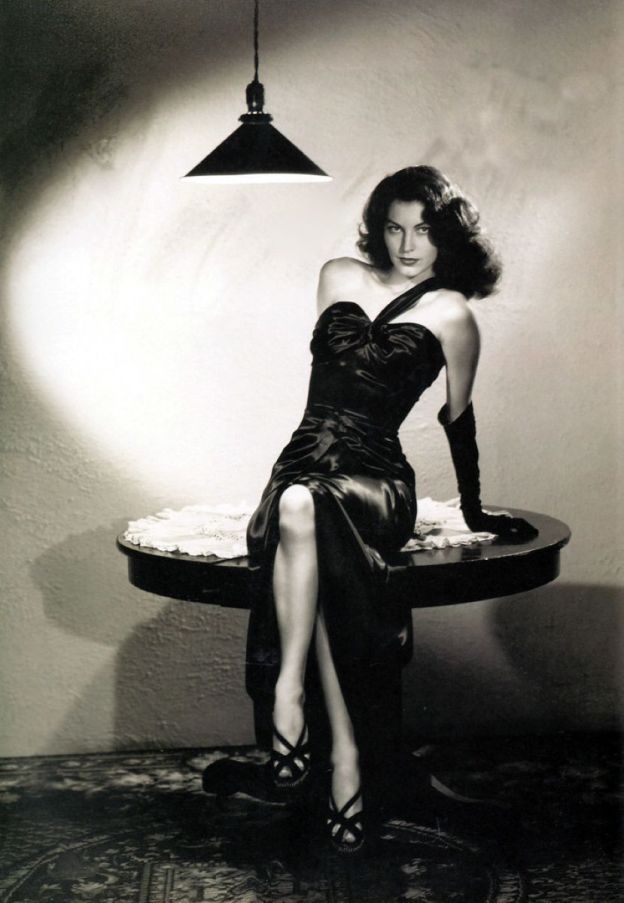
FEATURE: Twenty-three-year-old Ava Gardner was a noir icon in the making when, in 1946, she sat beneath a hard cone of light, her satin gown, long gloves, and crisp shadows distilled into pure mid-century glamour. Distributed globally across newspapers, movie magazines, lobby cards, and posters, cross‑legged on the polished table, she projects cool, controlled noir magnetism—elegance with an undercurrent of danger. Captured by veteran Universal studio portrait photographer Ed Esterbrook, this iconic image served as the primary promotional portrait for Robert Siodmak’s 1946 masterpiece, The Killers. On the Universal film sets, cinematographer Elwood Bredell shaped the movie’s high-contrast lighting, carving sharp, expressionistic shadows while giving Gardner’s skin a luminous, dangerous sheen. Bringing this lethal on-screen look to life was Gardner in a famous, custom-made asymmetrical black satin gown crafted by Vera West, Universal’s legendary chief costume designer. Altogether, these elements froze a moment in time that remains one of the most recognizable and enduring symbols of cinematic post-war noir glamour. PHOTO: “Ava Gardner in The Killers, 1946” by thefoxling is licensed under CC BY-NC-SA 2.0.
Robert Siodmak’s 1946 film The Killers stands as a pivotal milestone in cinema history, serving as the catalyst for Universal Pictures’ postwar commercial stabilization while simultaneously redefining film noir by launching Burt Lancaster into stardom and establishing Ava Gardner as the definitive archetype of the Hollywood femme fatale.
A Film Noir Breakthrough
Eighty years ago today—August 28, 1946—Robert Siodmak’s The Killers exploded onto American movie screens, instantly becoming a film noir sensation. It launched Burt Lancaster into overnight stardom after producer Mark Hellinger couldn’t land his first choice, Wayne Morris, and it introduced Ava Gardner as Hollywood’s definitive femme fatale. Adapted from Ernest Hemingway’s 1927 existential and grim short story, the film follows a washed-up ex-boxer who waits calmly in a dark room for hitmen to kill him, utterly undone by Gardner’s double-crossing allure. Though Anthony Veiller received official screen credit, the script carried major, uncredited writing contributions from future directing icons Richard Brooks and John Huston, while Miklós Rózsa’s tense, four-note brass score sharpened its fatalistic mood.
From the complete, dramatic original motion picture score for the 1946 film noir classic The Killers, composed by the legendary Miklós Rózsa. The soundtrack includes the famous, tense instrumental tracks that heightened the movie’s fatalistic mood, alongside the nightclub torch song performed with vocals by Ava Gardner herself.
Hollywood at Peak Attendance
Moviegoing in 1946 was at its absolute historic height, drawing a staggering 90 million weekly admissions. However, ticket prices had nearly doubled since before the war. This spike made post-war audiences far more selective, pushing major studios away from cheap “B-movies” and toward full-length, high-production features—frequently shot in vibrant Technicolor and paired as double features to ensure patrons got their money’s worth.
Universal Pictures tried to reinvent itself by merging with independents, including Hellinger’s banner, which produced The Killers for under $1 million and earned more than $3 million. Emboldened to meet the new demand, the studio chased prestige cinema, dropped its old B‑pictures and many longtime stars, and merged with International Pictures to form Universal‑International—but audiences mostly shrugged, and by decade’s end the company was losing money.
The Return to What Audiences Wanted
Veteran executive Edward Muhl, who had been with Universal since 1927, stepped up as general manager to steady the studio before officially becoming Head of Production in 1953. He steered the company back toward what mainstream American audiences reliably embraced: lucrative, low-budget comedy franchises like Ma and Pa Kettle (10 films, 1947–1957) and Francis the Talking Mule (7 films, 1950–1956), alongside a steady, highly profitable output of escapist Technicolor action-adventure films.
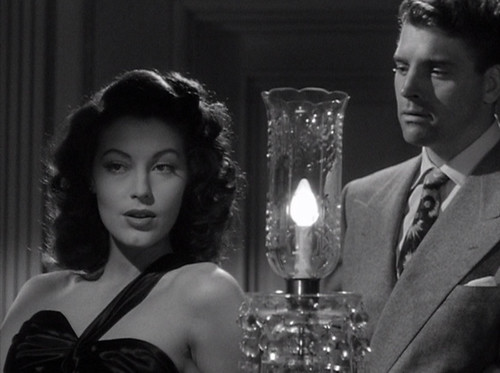
Film still from the production of The Killers (1946) captures the charged chemistry between Ava Gardner as Kitty Collins and Burt Lancaster, making his debut as Ole “The Swede” Andreson. Their first meeting is a textbook noir seduction: the doomed protagonist instantly, helplessly drawn into the orbit of the femme fatale who will seal his fate. At the center of the frame, cinematographer Elwood Bredell turns a crystal oil lamp into a diegetic light source—a glowing boundary between the two characters that casts soft illumination across Gardner’s face while dropping the rest of the room into deep, moody shadow. She’s wearing Vera West’s asymmetrical black satin gown—the same one from the famous publicity portrait—and on screen the heavy satin drinks the light, turning her into the ultimate femme fatale. PHOTO: “Ava Gardner y Burt Lancaster” by afevrier is licensed under CC BY-NC-SA 2.0.
This video short captures the electric first meeting between Ava Gardner and Burt Lancaster in the 1946 film noir classic The Killers, highlighting her sultry debut scene as Kitty Collins. The clip showcases Ava Gardner’s mesmerizing screen presence that audiences will remember as she delivers her smooth, fatalistic dialogue directly to the spellbound Swede. KITTY COLLINS: “How wonderful of you, I could never bear to see a man I really cared for being hurt.”
“She can’t sing, she can’t act, she can’t talk. She’s terrific!” – Louis B. Mayer on Ava Gardner.
Before The Killers, Ava Gardner was hopelessly stuck in Hollywood limbo. MGM head Louis B. Mayer had signed the 19-year-old North Carolina newcomer in 1941 purely based on her breathtaking physical photos. For five long years, she drifted through more than twenty films as an uncredited extra, barely noticed by the industry.
The Killers changed everything. Producer Mark Hellinger fought to cast the 23-year-old as Kitty Collins, freeing her from MGM’s rigid, squeaky-clean star-making machinery and handing her a role with genuine dramatic weight. Dressed in Vera West’s iconic, asymmetrical black satin gown, Gardner used her natural magnetism, smoldering gaze, and quiet confidence to completely command the visual frame. On the silver screen, she crafted a cold, calculating siren who seamlessly weaponized vulnerability to orchestrate a massive double-cross.
When the film became a box-office triumph in August 1946, audiences and critics were instantly transfixed. Gardner and Lancaster became overnight A-list sensations. Suddenly, she wasn’t just a glamorous face in the gossip columns—she was a legitimate actress widely praised for her dramatic depth and dangerous screen presence.
MGM moved fast to exploit her newly minted star power. Gone were the uncredited bit parts; instead, Gardner was vaulted into high-profile late-1940s productions like The Hucksters (1947) opposite Clark Gable, One Touch of Venus (1948), and The Bribe (1949). By the turn of the decade, MGM’s publicity office was completely overwhelmed, processing more than 3,000 fan photo requests per week for Hollywood’s ultimate new siren.

The original theatrical movie poster for The Killers (1946) pulses with classic film noir energy, dominated by bold red typography and the striking tagline: “TENSE! TAUT! TERRIFIC!” Public Domain.
The poster had a valid copyright notice, as seen on the bottom left corner. However, the copyright for the artwork was not renewed, as was required by American copyright law to extend/maintain protection for works published 1963 or earlier. In order to maintain copyright protection, the poster would have had to be renewed 28 years after publication, in either 1973 or 1974. Because it was not renewed, copyright lapsed at that time. Note that the poster art is a distinct work from the film it represents and had to be renewed separately.
SOURCE: The Universal Story, Clive Hirschhorn, Crown Publishers, Inc. New York, 1983, pp. 156-64.
This explanatory article may be periodically updated.