FEATURE image: Rev. C.T. Vivian. PHOTO: CC BY-SA 4.0
President Barack Obama delivers the 2013 Presidential Medal of Freedom to Cordy Tindell “C.T.” Vivian, during a ceremony in the East Room of the White House, Nov. 20, 2013. (Official White House Photo by Lawrence Jackson)/ Public Domain.
America’s racial crisis was not fundamentally a Black problem but a moral, institutional, and historical failure of the nation itself. True freedom and justice require transforming the attitudes and structures that sustain racial inequality, and nonviolent action is the most powerful means of achieving that transformation.
Early Life and Foundations
Rev. C.T. Vivian died on July 17, 2020 at 95 years old. Rev. Vivian was born in Boonville, Missouri, and migrated as a child with his mother to Macomb, Illinois. Rev. Vivian grew up to attend Western Illinois University (WIU) in Macomb, Illinois, where he worked as the sports editor for the student newspaper. In 1987, decades after attending the university, Rev. Vivian received an honorary doctorate from WIU.
Entering the Civil Rights Arena
Rev. Vivian’s career as an activist began in Peoria, Illinois, where, in 1947, he participated in sit-in demonstrations to successfully integrate Barton’s Cafeteria. Soon after, he served with Rev. Dr. Martin Luther KIng, Jr. and joined Dr. King’s executive staff. In that capacity, Rev. VIvian served as the national director of affiliates for the Southern Christian Leadership Conference (SCLC).
Evaluating Black Power and the Christian Faith
In the mid1960’s Rev. Vivian organized and directed efforts to re-evaluate activist networks and goals and the ideology and practice of Black Power, as well as the role of Christian faith among its participants.
The Urban Training Center and “The Plunge”
In 1965, Rev. C.T. Vivian became Director of Fellowships and Internships of the Urban Training Center (UTC) for Christian Mission in Chicago. Founded with a grant from the Ford Foundation in 1963 to train African American Christian pastors and organizers—Rev. Jesse Jackson was among the first 19 men trained under Rev. Vivian’s program at the UTC in its first year—the organization considered new dimensions to protest movements in Chicago concerned with Black power, Black identity and Black unity.
By means of lectures, readings, discussions and nonviolent training exercises such as “the Plunge” where participants had to survive on their own for seven days without access to housing, food, or other resources, the organization existed to help its participants to seek ways to take power from structures which affect their lives particularly on the West and South Sides of Chicago.
Authoring the Post-King Era
In 1970, following the assassination of Dr. King in 1968, Rev. Vivian became the first of Dr. King’s staff to write a book based on his experiences in the civil rights movement. Rev. Vivian’s book was entitled Black Power and the American Myth.
Theological Leadership and Community Banking
Rev. Vivian eventually became director of the Urban Theological Institute at Atlanta’s Interdenominational Theological Center, a consortium of African-American seminaries. He was also board chair of Capitol City Bank, a minority-owned bank founded in 1995 that focused on loans for underserved areas. With eight branches in metro Atlanta, Capitol City Bank closed in 2015.
A Legacy of Youth Leadership and National Honors
Through the C.T. Vivian Leadership Institute founded in 2008, Rev. Vivian continued to do the kind of work he did in Chicago in the 1960’s which was facilitating mainly youth who were seeking discerned strategies for their material and spiritual goals. On behalf of at-risk youth and college graduates, Rev. Vivian fostered innovative leadership for their career development in the 21st century. In 2012, Rev. Vivian returned to serve as interim President of the Southern Christian Leadership Conference and, in 2013, President Obama awarded Rev. Vivian the Presidential Medal of Freedom.
Nonviolence was both strategy and transformation. Rev. C.T. Vivian presents nonviolence as a source of power that confronts fear with courage and hate with love while simultaneously creating a new social order.
To all who accepted it, nonviolence offered new power. It pitted calm courage against frantic fear. It set the action of love against the reaction of hate.Nonviolence was a method which at once began to end the old and create the new.America was born as a revolutionary nation.The United States began with a struggle for civil rights. The specific issue – taxation without representation – was merely a focus for the larger question of whether or not a dominant majority would continue to exploit a subject minority. The American colonists decided that this oppression was not tolerable.Among other models of social action was the American Revolution itself.The question always before the Black man was: What must I do to be free?
Martin Luther King Jr. elevated civil rights into a moral issue. According to Rev. Vivian, Dr. King moved the struggle beyond economics and politics and placed it within a moral and spiritual framework.
It was Martin Luther King who removed the Black struggle from the economic realm and placed it in the moral and spiritual context.When Martin Luther King emerged, he raised the issues from the pragmatic to the sublime.As a nation, America had steadfastly refused to accept the humanity of its Black minority. It had perpetrated an endless series of horrors more ghastly than most of its citizens could imagine or believe
Racism was created to justify injustice. C.T. Vivian believed that racism developed as a rationalization for slavery and exploitation, allowing Americans to reconcile oppression with their conscience.
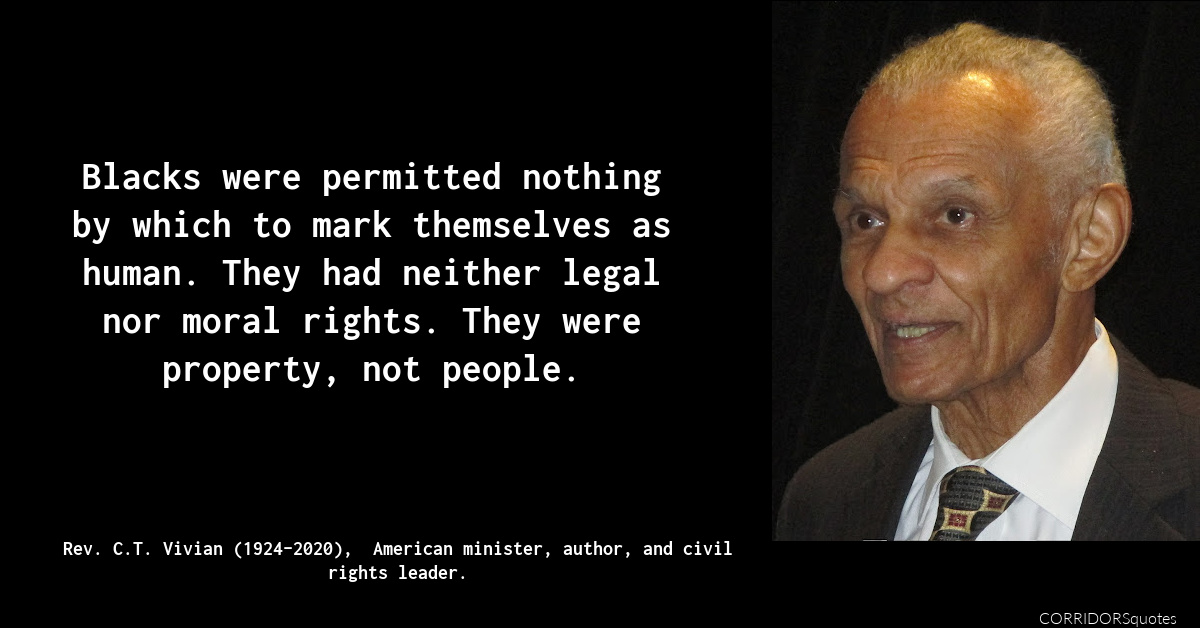
Racism began as rationalization. It began as a justification of the white man’s injustice to the Black. The greed that brought Black men into slavery was not alone enough to make the institution bearable to the white conscience.The Blacks who were brought to this country as slaves were systematically stripped of all cultural ties…Nor were they allowed to develop new institutions to replace the old. They were not permitted to read or write.White Americans had to become racists or John Browns…There were many more whites of John Brown’s persuasion than is commonly known. The annals of Southern history document the executions of scores of whites accused of fomenting Black revolt. Today bigotry most often shows itself as blind indifference and willful ignorance rather than as racist activism.During the time of slavery abolitionists were accused of violence for merely ADVOCATING an end to slavery, while the steady falling of the overseer’s lash went unquestioned as a necessary fact of life.Blacks were permitted nothing by which to mark themselves as human. They had neither legal nor moral rights. They were property, not people.Although the Constitution had been amended to declare him a citizen, the Black was neither considered to be, nor treated as, a man.
The larger problem was white society and its institutions. Drawing on Gunnar Myrdal, Rev. Vivian contends that America did not have a “Negro problem” but a “white problem,” requiring change in majority attitudes and institutions.
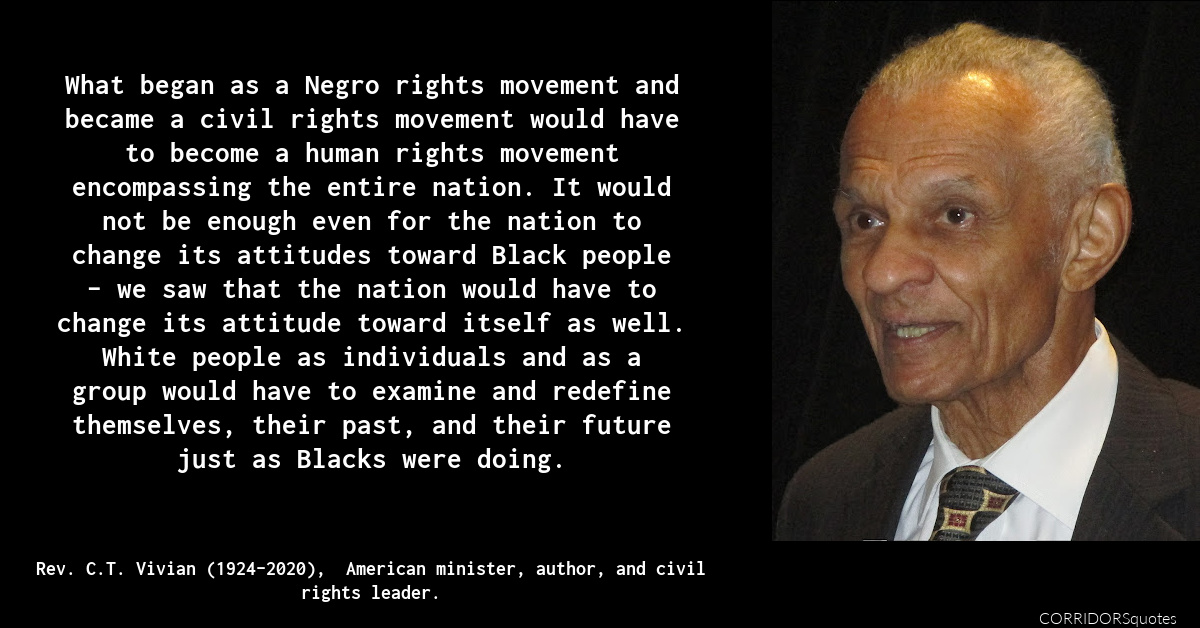
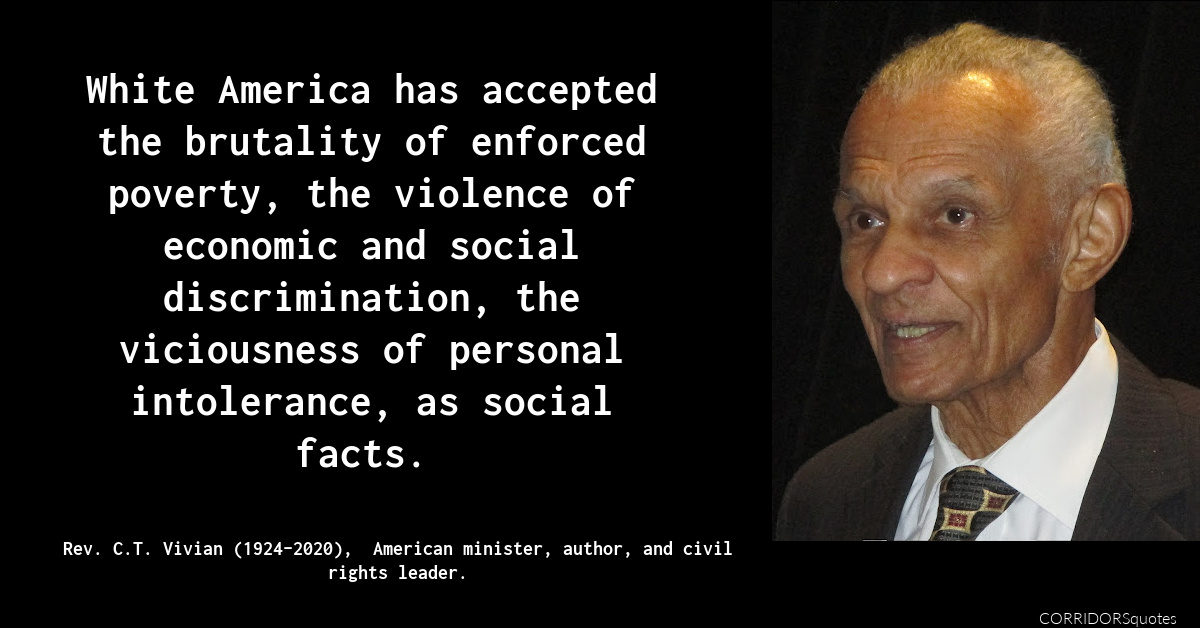
We were continually warned about “backlash”—which is what white people do when Black people fail to “stay in their place.”What began as a Negro rights movement and became a civil rights movement would have to become a human rights movement encompassing the entire nation. It would not be enough even for the nation to change its attitudes toward Black people – we saw that the nation would have to change its attitude toward itself as well. White people as individuals and as a group would have to examine and redefine themselves, their past, and their future just as Blacks were doing.As Gunnar Myrdal pointed out in his classic study AN AMERICAN DILEMMA, this country does not have a Negro problem, it has a white problem. Changing the white majority, their attitudes and their institutions, is basic to any solution to “racial strife.”White America has accepted the brutality of enforced poverty, the violence of economic and social discrimination, the viciousness of personal intolerance, as social facts.Even the Black church, which has been the closest thing in most communities to be a truly independent Black institution, has largely failed to deal with the facts of Black America. The church has taught that Blacks were human. But that they would only enjoy its privileges after death.John Calhoun voiced the typical slaveholder’s view when he said freedom for whites was impossible without the enslavement of Blacks.
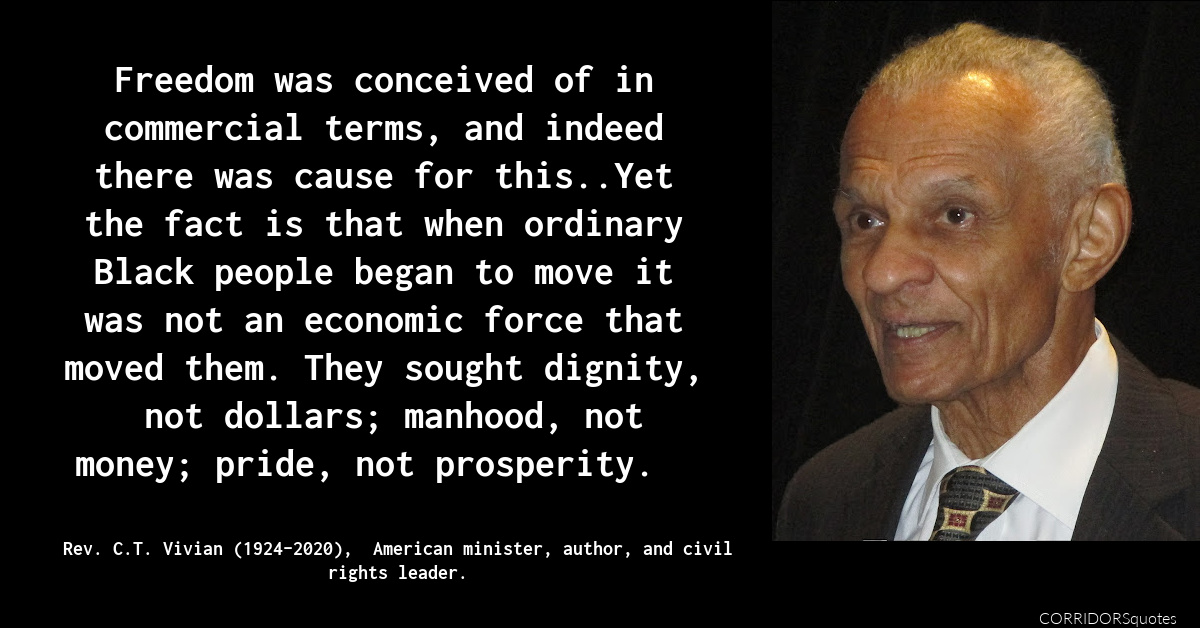
The Black freedom struggle was about dignity, not merely economics. Vivian argues that Black Americans sought “dignity, not dollars; manhood, not money; pride, not prosperity.” The movement was fundamentally a human and moral struggle.
Freedom was conceived of in commercial terms, and indeed there was cause for this..Yet the fact is that when ordinary Black people began to move it was not an economic force that moved them. They sought dignity, not dollars; manhood, not money; pride, not prosperity.We were continually told by whites and fearful Blacks alike that we were fomenting discord, creating racial strife, mounting reaction and bigotry.Blacks had to come to see themselves as masters of their own fate, masters of their secular destiny as well as their spiritual destiny.When white people find filth in the streets of their neighborhood they quite properly call city hall and complain, and it is removed. But when the same whites (and warped Blacks) find filth in the ghetto streets, they call for a clean-up campaign by ghetto residents.These facts — (of economic discrimination, infant mortality rate, malnutrition) and all the others which describe the Black condition — we knew well. Our problem was to make the rest of the nation understand them.In 1964, the Small Business Administration reviewed its past ten years and reported that it had made seven loans to Blacks during that time –seven in ten years. This record is typical of most banks, savings and loans companies, and other financial institutions, which provide the capital that allows people to enter the commercial world.We saw that the failure to admit Blacks to the society had created a permanent ambivalence within the nation, an ambivalence which warped everything that the nation did. Even the simple facts of history had been so twisted that it was impossible for most Americans to understand what happened to their land or why they had arrived at the crisis they were facing.The first permanent non-Indian settlers in what is now the United States were not whites seeking religious freedom but Blacks seeking physical freedom. These people came here as slaves with an ill-fated Spanish colonial venture. They rebelled and sought refuge with the Indians. The Spanish left and the Blacks remained. This took place more than a hundred years before the landing of the Mayflower.Of major importance is the fact that at the time of the Revolutionary War the entire American economy was sustained by slavery. Slaves were held in every colony.For Blacks were not the only ones oppressed by slavery. Whites were also brutalized by their inability to escape from slavery. In the South this was especially clear. A police state was created and the entire population lived in terror of a slave uprising.
Justice is indivisible. Injustice anywhere threatens everyone: “When there is no justice for ALL, then there is no justice at all.”
During the 1890s, two to three Blacks were lynched every week – week after week, year after year.In the Dred Scott decision of 1857…the Supreme Court explained that the phrase “the people of the United States” in the Constitution was never meant to include Blacks.Congress…created the Freedmen’s Bureau, an agency designed to make the ex-slaves participants in the national economy. Much good work was done by the Bureau.Millions of Americans suffered from misplaced hatreds. The classic example is the poor white Southerner who has been pitted against Blacks by the powerful men who exploit them both.Most of the antislavery agitation in the United States came from poor whites in the South. These people saw that slavery kept THEM in bondage by allowing planters to control all the best land and manipulate the markets to their own advantage.One reactionary Supreme Court decision interpreted the Fourteenth Amendment as having granted the privilege of national citizenship, but not necessarily state citizenship. This gave Blacks rights such as access to seaports, but left questions of education, suffrage, and employment up to the states.During the Jim Crow mania, states, counties, towns, and cities vied with one another in passing repressive legislation, running all the way from the silly to the insane. This was the period which the “separate but equal” doctrine was taking shape.When there is no justice for ALL, then there is no justice at all. Some may be favored, but none are safe.
Legal victories alone were insufficient. Court decisions and legislation mattered, but Rev. Vivian argues they often failed to produce meaningful changes in everyday Black life.
Ironically, it is America’s firm commitment to equalitarian ideals which makes the race question so intense.In the Fifteenth Amendment, the government officially forbade the denial of voting rights because of “race, color, or previous condition of servitude.” And having done this, the government washed its hands of the whole matter.The Civil Rights Act of 1965 was intended partly to enforce the Fifteenth Amendment, because no more than a tiny fraction of the Black population had ever actually been allowed to vote.Almost every public pronouncement concerning the condition of Blacks insisted that their situation was rapidly improving. But since Blacks were invisible to the white world, these questionable statements went unverified.Some of our leaders recommended movement through education…Others to industrial occupations…still other leaders counseled violence. Throughout the history of America we fought many times. Before emancipation there were over 250 slave conspiracies and revolts.
C.T. Vivian embodied action-oriented leadership. Highlights include his work with Martin Luther King Jr., the SCLC, and civil rights organizing, leadership development, and youth empowerment.
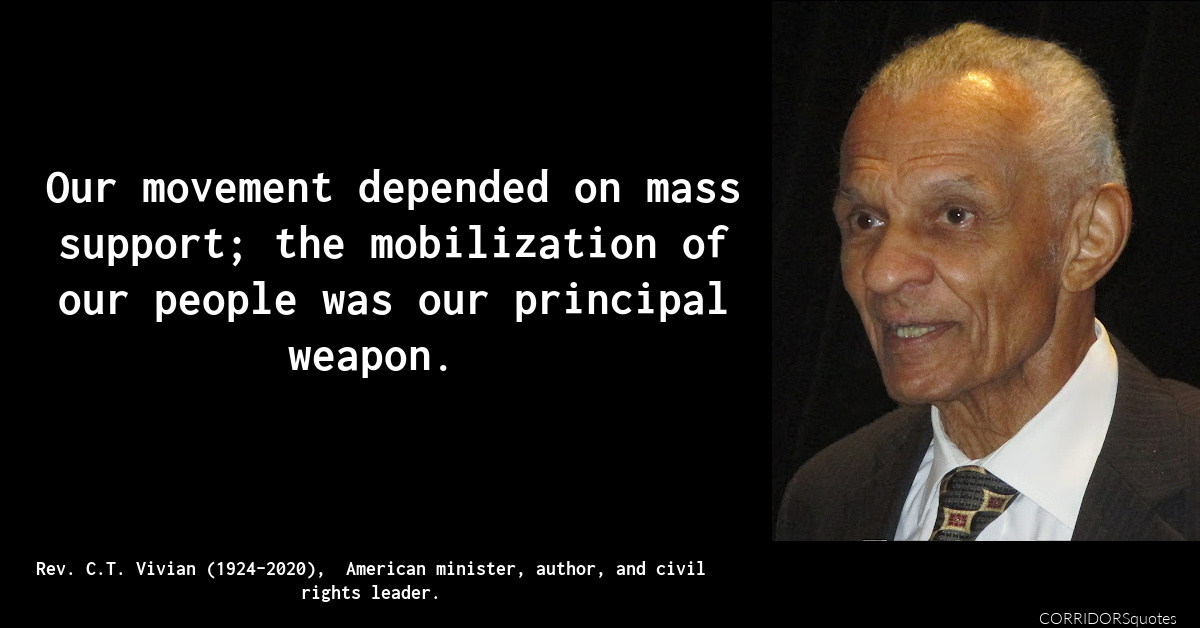
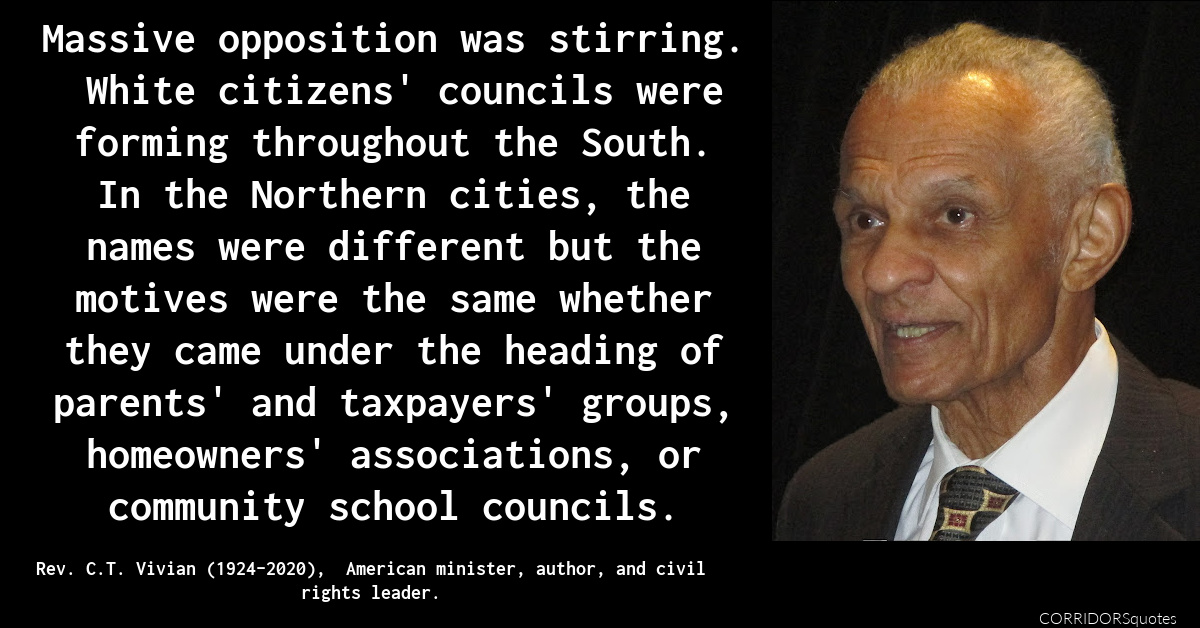
The Birmingham campaign of 1963 was the first large-scale test of the new method (of nonviolence). It was titled “Project C” – C for CONFRONTATION.When it became clear that we would not be crushed, official Birmingham accepted our demands—(1) desegregation of all public facilities, (2) hiring and upgrading of workers without discrimination, (3) the release of all jailed demonstrators, (4) the establishment of a permanent biracial committee to keep communications open between Blacks and whites.Our movement depended on mass support; the mobilization of our people was our principal weapon.White liberals also touted the success gained through legal action. But important as court battles have been, they failed to make any basic change in the lives of most Blacks.Ten years after the school desegregation cases of 1954, only 2.14% of the nearly 3 million Black children in Southern schools have been affected and were receiving anything like a desegregated education.As this protest reached massive proportions it became clear that those Americans who were not coming to realize the justice of the Black demands were closing their minds more permanently and more desperately to justice.Massive opposition was stirring. White citizens’ councils were forming throughout the South. In the Northern cities, the names were different but the motives were the same whether they came under the heading of parents’ and taxpayers’ groups, homeowners’ associations, or community school councils.Our accomplishments often bewildered us as much as our defeats.It was not until the riots began that we understood the extent of our failure. The message from the streets was that hundreds of years of Black appeals for justice would now give way to action.
Civil rights must evolve into human rights. The movement’s ultimate goal was not simply Black advancement but a transformation of the entire nation into a more just society.
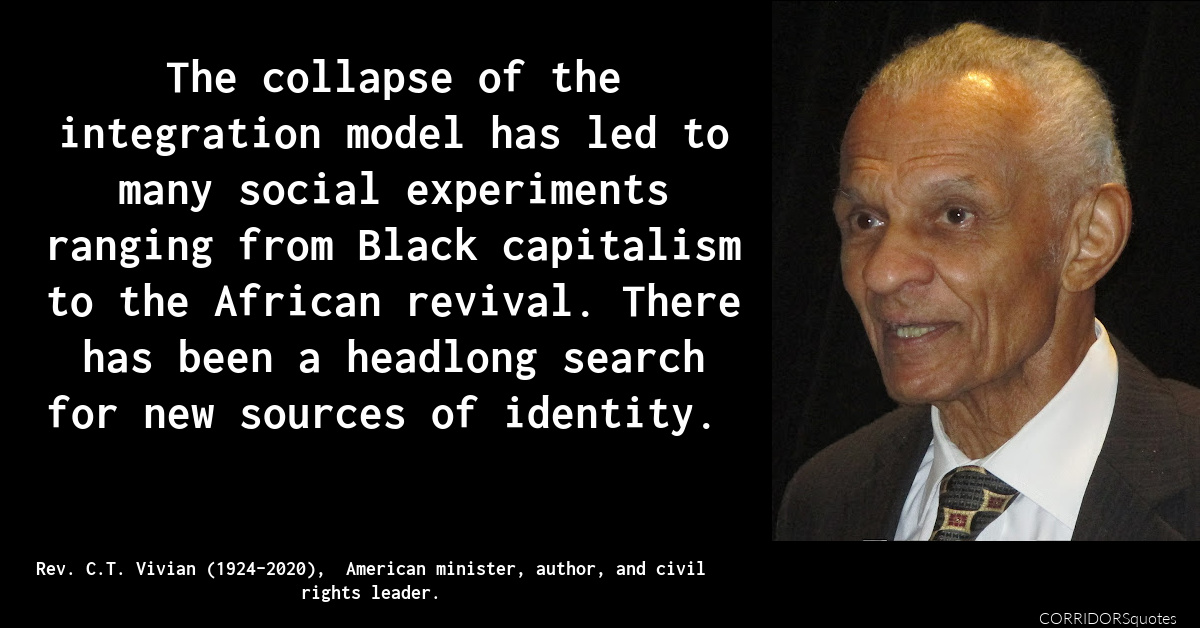
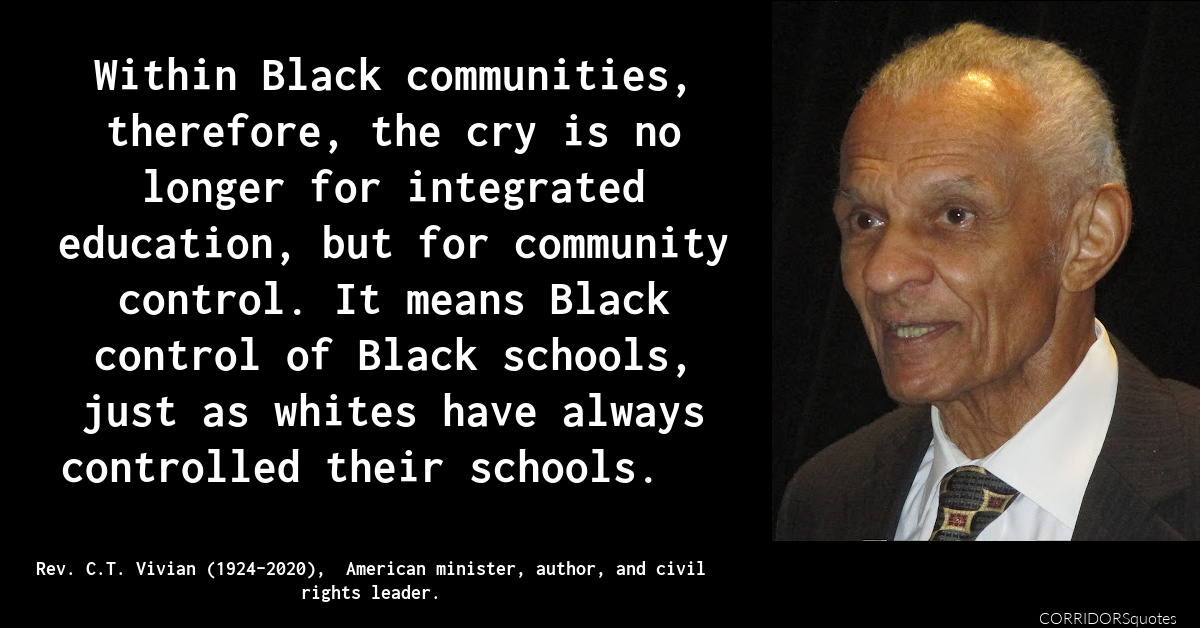
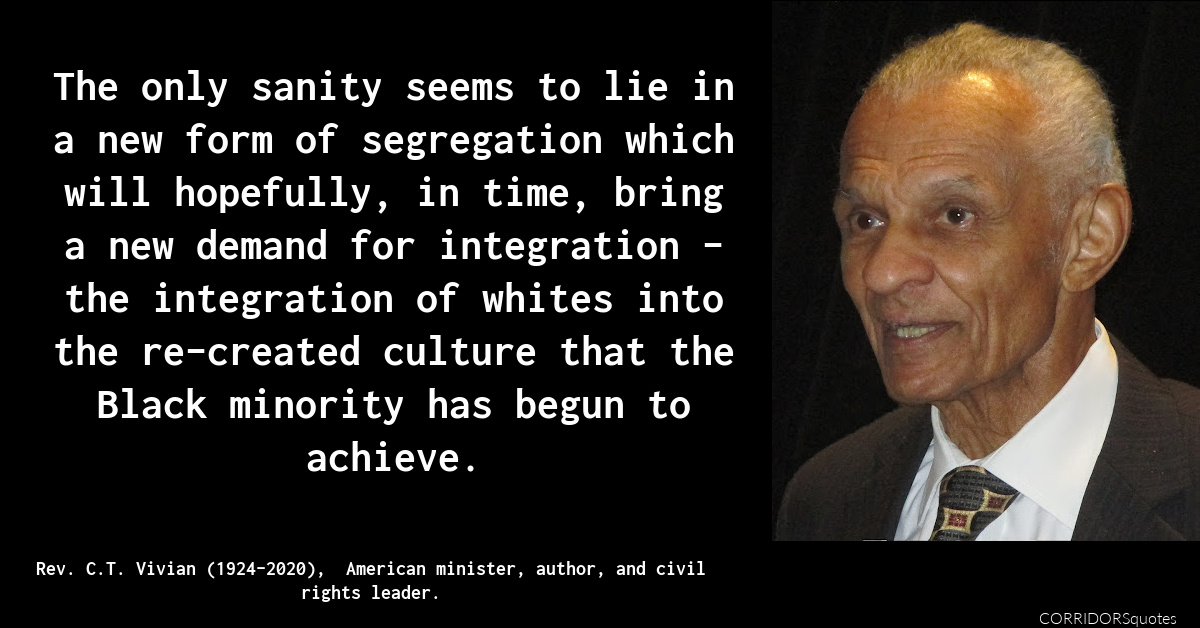
Genuine integration can never become a reality until both parties can live together as equals; and that will not happen until each sees the other as human, until each holds the same values upon which the entire culture can grow.Integration is dead. The concept and the experience, insofar as they were tried, have both failed because of the powerful racism of this society. Blacks, in response, have realized that they must develop their own distinctive culture.Black organizations that have organized around welfare have almost universally called for the abolishment of that system.Who then really WANTS the welfare system? Who profits by it? Who perpetuates it? It is, of course, the people who RUN the system.It is those who ADMINISTER welfare who get the most money, not the recipients; it is the administrators who are most truly ON welfare. This point should always be remembered when they try to speak for the Black community.The collapse of the integration model has led to many social experiments ranging from Black capitalism to the African revival. There has been a headlong search for new sources of identity.Within Black communities, therefore, the cry is no longer for integrated education, but for community control. It means Black control of Black schools, just as whites have always controlled their schools.In a few cases there have even been beginning attempts at coalition between bigots and Blacks in opposition to the white liberals who refuse to give up the rubric of integration.Some segments of the Black movement are concerning themselves specifically with the creation and re-creation of Black culture. Others have found inspiration in such international movements as socialism.The only sanity seems to lie in a new form of segregation which will hopefully, in time, bring a new demand for integration – the integration of whites into the re-created culture that the Black minority has begun to achieve.
Most brief, educationally distinct citations come from C.T. Vivian’s Black Power and the American Myth.
The story of Hans Scholl, Sophie Scholl, and the White Rose demonstrates that moral courage can survive even at great cost under a totalitarian regime. In Nazi Germany, a group of university students chose conscience over conformity, using words and ideas rather than weapons to challenge dictatorship, expose injustice, and defend human dignity. Their campaign of non-violent resistance became one of the most enduring symbols of intellectual and spiritual opposition to Hitler’s regime.
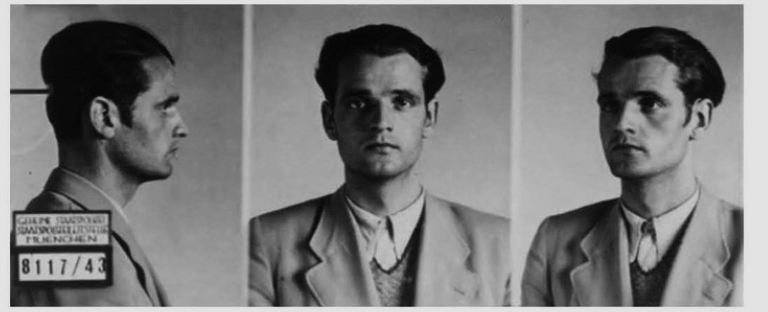
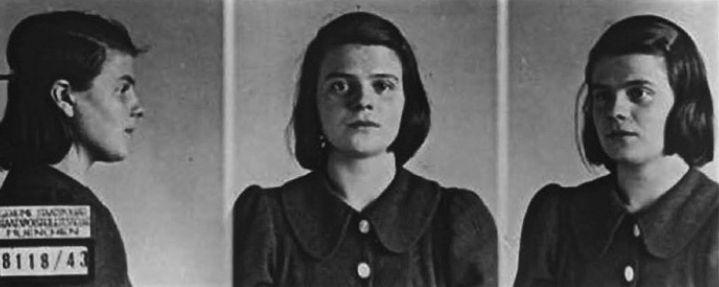
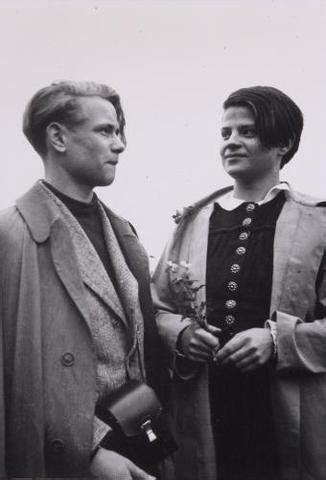
Gestapo photos of Hans Scholl and Sophie Scholl taken after their capture on February 18, 1943. The White Rose movement of which the Scholls were members distributed leaflets condemning Nazi tyranny, war crimes, and the suppression of freedom. They drew inspiration from Christian ethics, philosophy, literature, and humanist ideals. Believing individual conscience carried greater authority than obedience to an immoral state. Hans and Sophie Scholl were arrested while distributing leaflets at the University of Munich in February 1943. PHOTOS: Public domain.
By John P. Walsh
On February 18, 1943, following the illegal distribution of anti-Nazi leaflets by the White Rose at Ludwig-Maximilians-Universität München—the leaflets instructing students and all others to actively resist the 10-year-old Nazi regime—three young German university students were arrested. In the next four days these students will be tried in a Nazi kangaroo court, convicted of treason, and condemned to death. Their crime?—public vocal resistance to the totalitarian state that suppresses freedom of speech, freedom of religion, and freedom of conscience in addition to reprehensible war crimes, including the Holocaust, during World War II.
On February 22, 1943, in Stadelheim Prison in Munich, Germany, these three White Rose resisters are the first of their group to die for freedom and whose legacy in the 21st century is to be listed as some of the most important Germans of all time—namely, 21-year-old Sophie Scholl, her brother, 24-year-old Hans Scholl, and 23-year-old Christoph Probst, a married father with three children.
Christoph Probst: It wasn’t in vain.
Sophie Scholl: The sun is still shining.
The execution scene from Marc Rothemund’s 2005 German film, Sophie Scholl – The Final Days (“Sophie Scholl – Die letzten Tage”). On February 22, 1943 the three condemned White Rose students—Sophie Scholl (Julia Jentsch), Christoph Probst (Florian Stetter) and Hans Scholl (Fabian Hinrichs)—are allowed a final moment together before being beheaded in Munich’s Stadelheim Prison.
By the start of 1943, the Nazis were badly losing the Battle of Stalingrad in Russia that had been raging since August 1942. Its outcome was a major turning point in the war. The German armed forces experienced nearly one million casualties in six months. The American, British, and the Russian armed forces were closing in on Hitler’s Third Reich from many sides.
Since June 1942 five anti-Nazi leaflets had been written and distributed in and around the university in Munich. The distribution channels as well as the network of this new clandestine anti-Nazi group—who eventually called themselves the German Resistance Movement, a.k.a. the White Rose—had steadily expanded during the creation of these leaflets.
Conditions were growing tense in Germany. There was a developing global consensus—that included some even in Germany— that Hitler’s war was ultimately unwinnable for the Fascist tyrant. As these totalitarian thugs had lashed out to consolidate power so, as ultimate military victory was slipping away, the regime stooped to any means to crush its internal enemies.
The White Rose defended human dignity by insisting that every person possesses a moral conscience and basic freedoms that no state can legitimately suppress, and by courageously resisting Nazi tyranny, racism, mass murder and unjust war despite the certainty of severe punishment.
Sophie Scholl, May 9, 1921-February 22, 1943.
Sophie Scholl had almost not graduated from high school in May 1940 because she was sick and tired of the curriculum’s relentless political (Nazi) indoctrination. Scholl was fond of children and took a job teaching kindergarten. But her motivation was not simply that she had found an early vocation but hoped to steer clear of Germany’s six-month National Labor Service (Reichsarbeitsdienst).
The Nazis found her anyway— and Sophie taught at a National Labor Service-approved nursery as part of the war effort. Scholl might not have bothered with the National Labor Service at all except that the Nazis had set it up as a prerequisite for attending university.
In her personal reading Sophie Scholl had already developed an interest in philosophy and theology and wanted to pursue these subjects academically. The Labor Service experience did contribute, however, to Sophie’s outlook—she reacted completely against its militaristic aspects to the point where she started to practice forms of nonviolent resistance.
1940 Letter from Sophie Scholl to a Friend – White Rose Memorial Room – Interior of Main Building of Ludwig-Maximilians-Universitat – Munich – Germany.
In May 1942, 21-year-old Sophie started at the University in Munich. Her older brother Hans, studying medicine and philosophy at the school, introduced his younger sister to all his friends. Though Hans had evolving and increasingly strong anti-Nazi views, as did his friends, camaraderie revolved around the arts, music, philosophy and theology. The Scholls were also physically active—especially hiking and swimming.
Sophie pursued her intellectual interests at the university making connections with artists, writers, and philosophers. Her father, a hometown mayor, had been put in prison for an indirect critical remark he made about Hitler—and Sophie’s quest to understand how she, as an individual, should act under a dictatorship was intensely personal.
The White Rose formed and began writing and publishing anti-Nazi leaflets in June and July 1942—but Hans Scholl kept his dangerous undertaking secret from Sophie. But, in November 1942, when Sophie learned about the White Rose, she immediately joined.
Hans Scholl (Fabian Hinrichs), left, and Sophie Scholl (Julia Jentsch) in the 2005 German historical film, Sophie Scholl – The Final Days.
On February 18, 1943, in the wake of the battle of Stalingrad, and major Allied victories in Africa which had the Americans and British closing in on Hitler’s Europe, the sixth and final leaflet produced by the White Rose was distributed by Hans and Sophie Scholl and others of the White Rose at Munich University. The leaflet had been written by Kurt Huber, a university faculty and White Rose member, and stated that the “day of reckoning” had finally come for “[Hitler,] the most contemptible tyrant that the German people has ever endured.”
The Atrium, Munich University, where the Scholls dropped the sixth leaflets on February 18, 1943, which led to their arrest by the Gestapo.
Atrium, Munich University.
Bringing the leaflets in suitcases, the Scholls stacked them in corridors of the main building—and the hurried activity, including tossing the last leaflets into the atrium, was noticed by a maintenance man who reported it. Before their arrest by the Gestapo, Sophie had successfully gotten rid of any incriminating evidence. But the Gestapo did find fragments of a seventh leaflet by Christoph Probst on Hans Scholl’s person and, upon searching the Scholls’ apartment, confirmed the White Rose writings. The Gestapo was going to let Sophie free, but when she discovered her older brother had been arrested, she confessed to her full role.
Hans and Sophie Scholl lived in the rear of this apartment building at 13 Franz-Joseph Strasse in Munich from June 1942 until their arrest on February 18, 1943 and execution on February 22, 1943.
The White Rose wrote that Germans should act according to moral truth rather than obey propaganda or fear. Sophie Scholl herself defended her actions during interrogation as flowing from an individual “theology of conscience.”
Sophie Scholl and Christoph Probst.
During the interrogation following her arrest, transcripts show that Sophie defended herself mainly by claiming her right to act based on an individual “theology of conscience.”
On February 22, 1943, the Scholls and Christoph Probst were tried in the Volksgerichtshof (The People’s Court) before rabid Nazi judge Roland Freisler. Sophie interrupted the judge several times during his tirades. The court record shows her saying to the judge: “Somebody—after all—had to make a start. What we wrote and said is believed by many others. They just don’t dare to express themselves as we did.” The trio were found guilty of treason and condemned to death. They were guillotined the same day at Munich’s Stadelheim Prison.
They were willing to sacrifice their lives for moral truth and freedom. Sophie Scholl told the Nazi court that someone had to make a start, even if others were afraid to speak. Hans Scholl’s reported final words, “Let Freedom live!” encapsulate the group’s commitment to human liberty and dignity.
Sophie Scholl, Hans Scholl and Christoph Probst, a married father of three children, were tried in the Volksgerichtshof (The People’s Court) before the rabid Nazi judge Roland Freisler.Transcripts show Sophie told the judge, Somebody—after all—had to make a start. What we wrote and said is believed by many others. They just don’t dare to express themselves as we did.
White Rose stamp – Sophie and Hans Scholl.
Hans Scholl was, with Alexander Schmorell (1917-executed by the Nazis in prison, July 13, 1943), a founding member of the White Rose in 1942. After serving as a medic on the Eastern Front in 1939, Hans Scholl became determined to do something to change the German people’s minds about the Nazi regime and its war effort.
By June 1942 the White Rose (Weiße Rose) had been founded on principles of nonviolent intellectual resistance to the Nazis—a highly dangerous proposition in a totalitarian regime.
Rather than violence, they used leaflets, ideas, and public witness to challenge injustice. The post explicitly describes the White Rose as being founded on principles of “nonviolent intellectual resistance.”
Detail of Typewriter Used to Produce White Rose Anti-Nazi Leaflets – White Rose Memorial Room – Interior of Main Building of Ludwig-Maximilians-Universitat – Munich – Germany.
Between June and mid-July 1942, Hans Scholl and Alexander Schmorell wrote four leaflets against the Nazis appealing to the truth of the people’s consciences based on facts. “Isn’t it true that every honest German is ashamed of the government these days?’ the writers asked in their first leaflet. “Who among us has any conception of the dimensions of the shame that will befall us and our children when one day the veil has fallen from our eyes and the most horrible crimes reach the light of day?”
Alexander Schmorell was, with Hans Scholl, a co-founder of the White Rose. Schmorell co-wrote their leaflets. A Russian-German student at Munich University, Schmorell was sentenced to death at 25 years old on April 19, 1943 at the second trial of the White Rose at the Volksgerichtshof. With Munich University faculty member Kurt Huber, also a White Rose member and leaflet writer, Schmorell was beheaded at Munich’s Stadelheim Prison on July 13, 1943. In 2012, Schmorell was declared a saint and martyr in the Russian Orthodox Church.
“Stay strong. Make no concessions!”
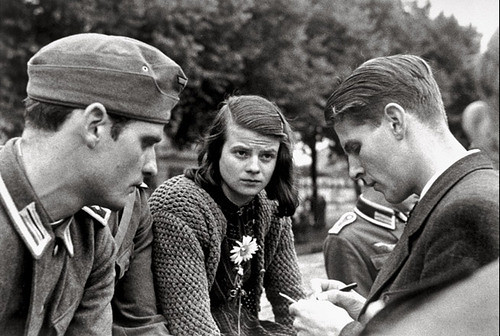
The Scholl siblings included Hans, Sophie, Inge, Elisabeth, and their younger brother Werner, who is depicted alongside Sophie in the photograph. Taken by Hans on February 22, 1941, this specific snapshot captures a moment exactly two years to the day before Hans and Sophie were executed by the Nazi regime for distributing anti-war leaflets at the University of Munich. While Hans and Sophie are immortalized for leading the White Rose resistance movement, Werner also notably defied the regime early on, becoming the first in the family to openly break with the Nazis when he resigned from the Hitler Youth in 1939.
Werner would ultimately meet his own tragic fate on the Eastern Front, disappearing just over a year after his siblings’ deaths. In February 1943, while on temporary military leave in Ulm, he rushed to Munich and managed to slip past guards into the courtroom to witness his siblings’ sham trial. As Hans and Sophie were being led away to the guillotine, Werner managed to reach out and hold their hands one last time. Hans left him with a final, searing command: “Stay strong. Make no concessions!”
In the agonizing hours following their executions, a distraught Werner helped their close friend, Traute Lafrenz, clear out incriminating resistance evidence from his siblings’ rooms just ahead of the Gestapo. Soon after, the Nazi regime arrested the remaining members of the Scholl family under collective punishment laws—but Werner was spared detention only because he had already been ordered back to active duty. In June 1944, during heavy fighting against Soviet forces near Mogilev (in modern-day Belarus), 21-year-old Werner went missing in action. His body was never recovered, and he was officially presumed dead. PHOTO: Public Domain.
In the second leaflet the White Rose spoke of the crimes of the Holocaust: “Since the conquest of Poland, 300,000 Jews have been murdered in this country in the most bestial way…The German people sleep in a stupid sleep and encourage the Fascist criminals…”
The third leaflet appealed to the German people’s “spirit” to eliminate the Nazi system in their midst.
Their leaflets openly condemned the regime’s mass murder of Jews and called attention to crimes that many Germans preferred not to confront. By doing so, they defended the dignity of those being persecuted and killed.
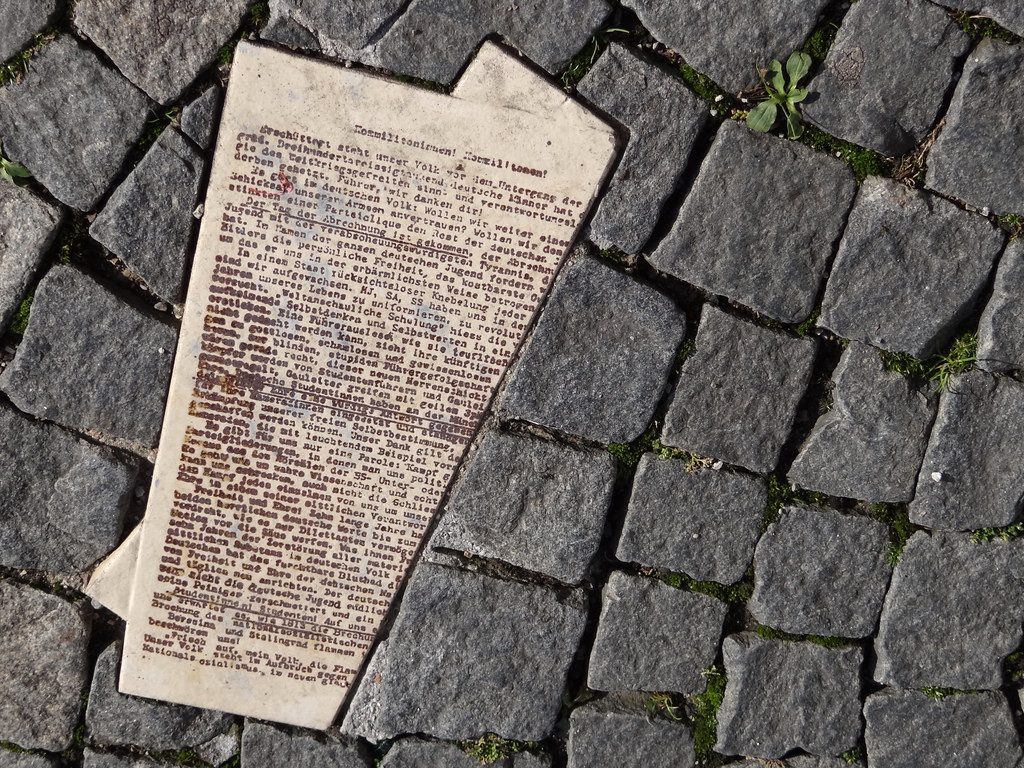
Leaflets, Memorial to Scholls at Munich University.
For the next four months, until November 1942, Scholl, Schmorell, and other young members of the White Rose were drafted to again serve as medics on the Eastern Front. War’s ongoing horrors that they witnessed only strengthened their resolve to resist.
At their return to Germany in autumn 1942 Sophie Scholl, Hans’ younger sister (born May 9, 1921), learned about the White Rose and Hans’ involvement in it, and eagerly joined the group.
Sophie Scholl bust, Munich University.
With the Battle of Stalingrad raging since August 1942, the White Rose (now called the German Resistance Movement) produced a fifth leaflet in January 1943. It was an appeal addressed to all Germans and the White Rose made almost 10,000 copies to distribute. The leaflet presented a straightforward analysis of the situation so to jog people’s intellect to take moral action. To state, as the leaflet did, that “Hitler cannot win the war; he can only prolong it.” was pure heresy to the all-encompassing propaganda arm of the dictatorship.
In the Battle of Stalingrad which the Nazis lost—it was the major turning point in the war—Hitler made an intense appeal to the German people’s patriotism. By one count, the German armed forces experienced nearly one million casualties in about six months.
The German populace—as well as people around the world– understood that Hitler’s defeat was inevitable. But, unlike the Americans and British who, in November 1942, successfully began and concluded Operation Torch in French Morocco pushing the Germans east and out of North Africa and next out of Southern Europe, few Germans were willing to even yet criticize the Nazi regime let alone take action as did the handful of young students and faculty of the White Rose.
The White Rose defended fundamental human freedoms and opposed a regime that suppressed freedom of speech, freedom of religion, and freedom of conscience. Their fifth leaflet called for a future Germany that would protect “freedom of speech, freedom of religion, and the individual citizen from the arbitrary action of any dictator states.”
White Rose Leaflets, memorial.
The White Rose’s fifth leaflet called all Germans to “Support the resistance movement!” The leaflet labeled Nazi policies as racist and subhuman, imperialist and militarist—and to be resisted. But further, a future Germany and Europe must, stated the White Rose in this penultimate leaflet, protect “freedom of speech, freedom of religion, and the individual citizen from the arbitrary action of any dictator states.”
It was in January 1943 that the White Rose was beginning to expand its operation to make connection with older anti-Nazi groups already formed and operating in Germany, such as the Kreisau Circle led by Helmuth James von Moltke (1907-executed by the Nazis in prison, January 23, 1945).
Helmuth James Graf von Moltke (1907–1945) was one of the leaders of an early diverse group of anti-Nazi intellectuals known as the Kreisau Circle. In prison since January 1944, Von Moltke is photographed at his trial in July 1944. The Nazis executed Moltke in prison in January 1945. By early 1943, members of the mostly student-led White Rose were starting to expand their network of contacts to include other anti-Nazi groups such as the Kriesau Circle.
With the defeat at Stalingrad officially announced by the Nazis in early February 1943, the totalitarian regime blamed the German people. This included pointing a finger at university students as unpatriotic who did not serve in the army. Such slanderous and cowardly accusations from Nazi leaders who pompously impugned German intellectual youth in the wake of a massive Hitler-led military defeat making for one million casualties and devastating the nation’s morale, sparked a riot by students at the university in Munich. A growing chaos under the totalitarian regime had a heartbeat—and as in all totalitarian regimes, scapegoats must be found and made examples of. The leaflets of the White Rose had been disseminating anti-Nazi literature since June 1942. Its perpetrators had yet to be found out—and stood square at the tip of the Fascist dictatorship’s spear.
The White Rose, its members actively looking to capitalize on the energy of the students’ righteous indignation, decided to send out their sixth and last leaflet—which they did on February 18, 1943. The sixth leaflet, written by Munich faculty Kurt Huber (1893-executed by the Nazis in prison, July 13, 1943), and revised by Hans Scholl and Alexander Schmorell, said that with “the dead of Stalingrad [to] adjure us!,” the “day of reckoning” had finally come for “[Hitler,] the most contemptible tyrant that the German people has ever endured.” The group also stenciled slogans on university walls and buildings throughout Munich, the Nazi Party’s home base, stating “Down with Hitler!” and “Freedom!”
Munich University, Main Corridor.
The distribution of the leaflets packed in suitcases—this time including the public participation of Sophie Scholl—took place on Thursday, February 18, 1943. It is what led to the arrest, trial, conviction, and execution by beheading of Hans and Sophie Scholl and Christoph Probst by the Nazis within the span of the next four days.
Sophie Scholl’s last words were: It is such a splendid sunny day, and I have to go. But how many have to die on the battlefield in these days? How many young, promising lives? What does my death matter if by our acts thousands are warned and alerted? Among the student body there will certainly be a revolt!
Hans Scholl’s last words were Es lebe die Freiheit! (Let Freedom live!)
Christoph Probst, Hans and Sophie Scholl graves, Perlach Cemetery in Munich.