

FEATURE image: Pope St. John 23 (1881-1963). “Pope John XXIII” by jimforest is licensed under CC BY-NC-ND 2.0.
Pope St. John XXIII was far more than the popular “Good Pope John.” Through his humility, warmth, humor, diplomatic skill, commitment to peace, and launching of the Second Vatican Council, he helped shape the Catholic Church’s relationship with the modern world while leaving a lasting moral vision centered on human dignity, unity, and reconciliation.
“Giovanni, why don’t you sleep? Is it the Pope or the Holy Spirit who governs the church? It’s the Holy Spirit, no? Well, then, go to sleep, Giovanni!” Wit and Wisdom of Good Pope John, collected by Henri Fesquet.
One day John XXIII visited the Hospital of the Holy Spirit in Rome. Deeply stirred by the pope’s visit, the mother superior whose nuns administered the hospital, went up to introduce herself. “Most Holy Father,” she announced, “I am the Superior of the Holy Spirit!” “Well, I must say you’re lucky,” the pope said. “I’m only the Vicar of Jesus Christ!” Wit and Wisdom of Good Pope John, collected by Henri Fesquet.
•As Vatican representative in Turkey during World War II, Roncalli participated in humanitarian efforts that helped Jewish refugees fleeing Nazi-occupied Europe.
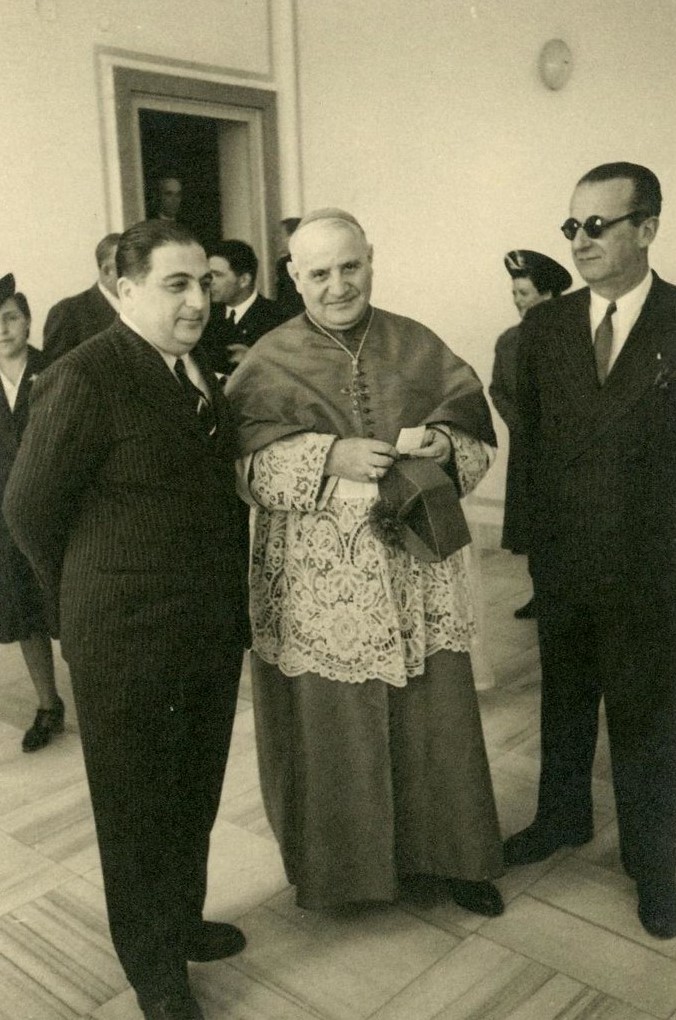
1943 – Istanbul, Raffaele Guariglia (1889-1970), ambassador to Turkey, and Msgr. Angelo Roncalli, apostolic delegate in Istanbul. Msgr. Angelo Giuseppe Roncalli (the future Pope John XXIII) stands alongside Italian diplomat Raffaele Guariglia (at right, in sunglasses) and another unnamed official from the Italian Embassy in Turkey with his hands resting behind his back. Appointed by Pope Pius XI Roncalli served as the Catholic Church’s Archbishop and Apostolic Delegate to Turkey and Greece from January 1935 until December 1944. Raffaele Guariglia (1889–1970) was a prominent Italian diplomat who served as the Italian Ambassador to Turkey during World War II. The photograph was taken during an official diplomatic meeting in Istanbul, Turkey, in 1943, Roncalli’s base the entirety of the time. During World War II, Istanbul was a critical nexus of quiet diplomacy and intelligence exchange. While stationed there as the Vatican’s Apostolic Delegate, Msgr. Roncalli worked closely with international ambassadors, including Guariglia, to coordinate extensive humanitarian efforts, transit visas, and rescue operations that ultimately saved thousands of Jewish refugees fleeing occupied Europe. PHOTO:”1943 – Istanbul, Raffaele Guariglia, Ambasciatore in Turchia, e Mons. Angelo Roncalli delegato apostolico ad Istanbul” by realizzato da Stefano Baldi is licensed under CC BY-NC-ND 2.0.
John XXIII’s personal spirituality was marked by humility, kindness, simplicity, and optimism, reflected in the collection of quotations featured throughout the article.

Voglio essere buono, ad ogni costo, sempre, con tutti. (“I want to be good, at all costs, always, with everyone.”) Casa Natale di Papa Giovanni, Sotto Il Monte Giovanni XXIII (Bergamo).
In postwar France, he successfully navigated the politically sensitive dispute over bishops associated with the Vichy regime, demonstrating the diplomatic style that later defined his papacy.
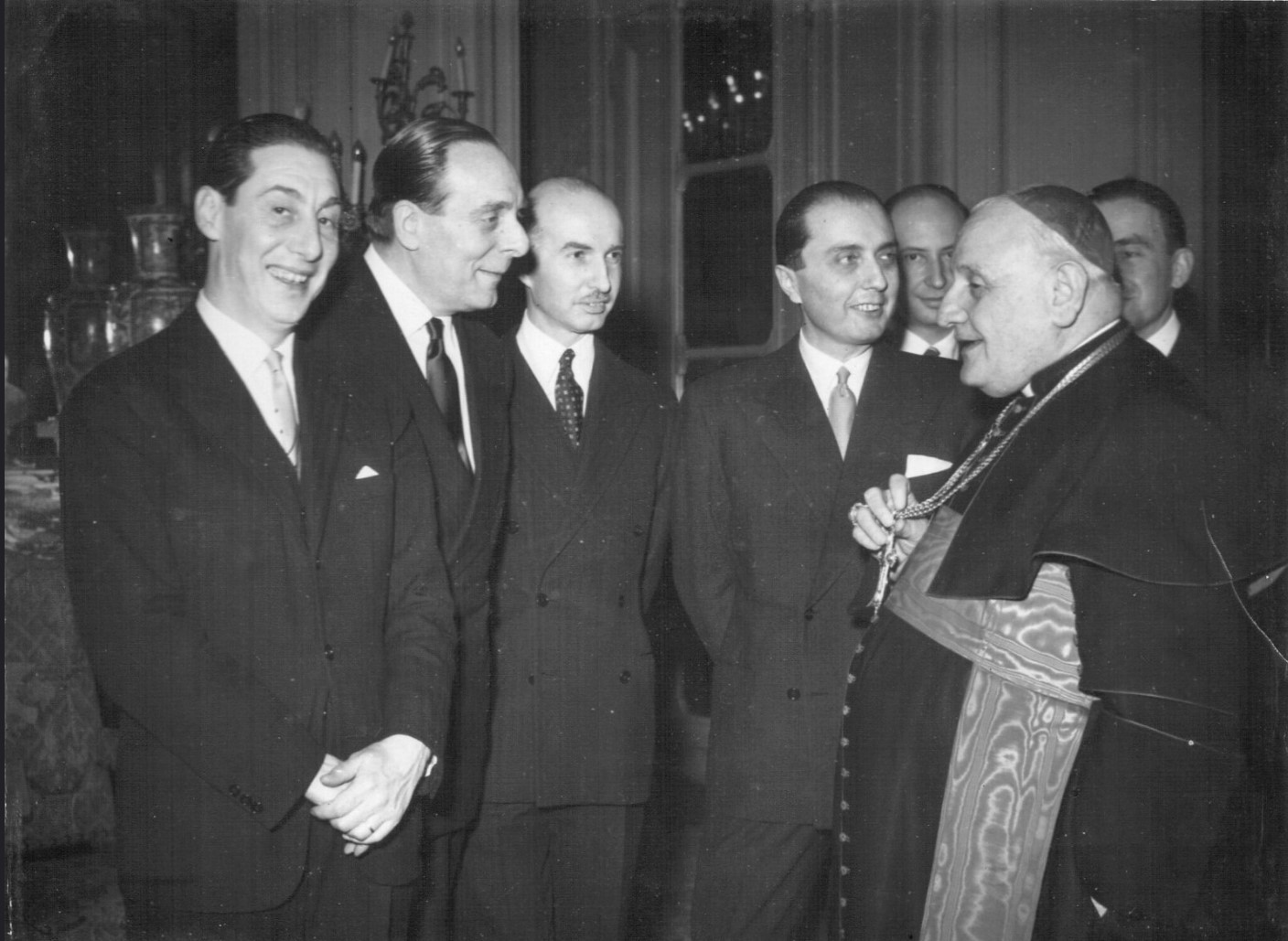
1953, Paris, Angelo Roncalli, Apostolic Nuncio in Paris, with some officials of the Embassy. Roberto Gaja (1912-1992), Embassy Counsellor, is the third from the left. Taken in 1953 in Paris, France, Apostolic Nuncio Monsignor Angelo Giuseppe Roncalli (the future Pope John XXIII) gathered with members of the Italian Embassy staff. Roncalli served as the Holy See’s Apostolic Nuncio to France from late 1944 until early 1953. This photo records one of his final diplomatic engagements in Paris before he was elevated to Cardinal and appointed Patriarch of Venice later that year. Third from the left is Roberto Gaja, who was serving as an Embassy Counselor (Consigliere d’Ambasciata) and eventually became Italy’s Ambassador to the United States. Having successfully spent his tenure navigating intense post-war church-state tensions—including de Gaulle’s provisional government demands to purge Vichy-era bishops—Roncalli had become deeply beloved by the Parisian political and diplomatic corps. The event served as both a diplomatic working meeting and part of a series of farewell courtesies before his departure back to Italy. PHOTO: “1953, Parigi, Angelo Roncalli, Nunzio Apostolico a Parigi, con alcuni funzionari dell’Ambasciata. Roberto Gaja, Consigliere d’Ambasciata, è il terzo da sinistra” by realizzato da Stefano Baldi is licensed under CC BY-NC-ND 2.0.
What was the Vichy Bishops Purge in France at the end of World War II?
The Vichy bishops purge was one of the most consequential church-state confrontations in postwar Europe and the principal reason Monsignor Angelo Giuseppe Roncalli was abruptly reassigned from Turkey to France. Following the liberation of France in 1944, General Charles de Gaulle’s provisional government launched the épuration légale (“legal purge”) to remove collaborators from public life. Among the institutions placed under intense scrutiny was the Catholic Church. During the war, most French bishops had supported Marshal Philippe Pétain’s Vichy regime, while some openly encouraged French youth to comply with compulsory labor programs in Germany. The hierarchy’s general silence during the deportation of French Jews further damaged its standing in the eyes of many French citizens.
Supported by prominent Catholic members of the Resistance, who regarded sections of the episcopate as morally compromised, De Gaulle pressed the Vatican to remove approximately thirty to thirty-three bishops accused of collaboration. Rome strongly resisted. Pope Pius XII and senior Vatican officials maintained that the Vichy regime had been the legally constituted government of France and that the bishops had merely dealt with the authorities then in power. From the Vatican’s perspective, De Gaulle’s demands represented an unacceptable intrusion by the state into the internal governance of the Church.
To break the impasse, the Vatican sent Roncalli to Paris in late December 1944, replacing a nuncio whose associations with Vichy had become politically untenable. Arriving on New Year’s Eve, Roncalli approached the crisis not through public confrontation but through patient diplomacy. Unlike some Vatican hardliners who dismissed French grievances, he engaged directly with government officials and accepted that odium plebis (“hatred of the people”) could constitute a legitimate reason for removing a bishop who had lost public confidence and moral authority.
Through a series of discreet negotiations, Roncalli succeeded in dramatically reducing the scope of the proposed purge. De Gaulle’s original list of more than thirty bishops was ultimately narrowed to three diocesan bishops, the Archbishop of Aix-en-Provence, the Bishop of Arras, and the Bishop of Mende, together with several auxiliary bishops and overseas prelates. Their departures were arranged through resignation rather than public dismissal.
By guiding the crisis to a negotiated resolution, Roncalli spared the Vatican a humiliating confrontation while allowing the French government to demonstrate accountability in the aftermath of occupation and collaboration. The episode established his reputation as an exceptionally skilled diplomat and helped lay the foundations for the conciliatory leadership style that would later characterize his pontificate as Pope John XXIII.

Una croce mi ci vuole: Signore Gesù aiutami a portarla umilmente e degnamente (“A cross is needed for me: Lord Jesus, help me to carry it humbly and worthily.”) Casa Natale di Papa Giovanni, Sotto Il Monte Giovanni XXIII (Bergamo).
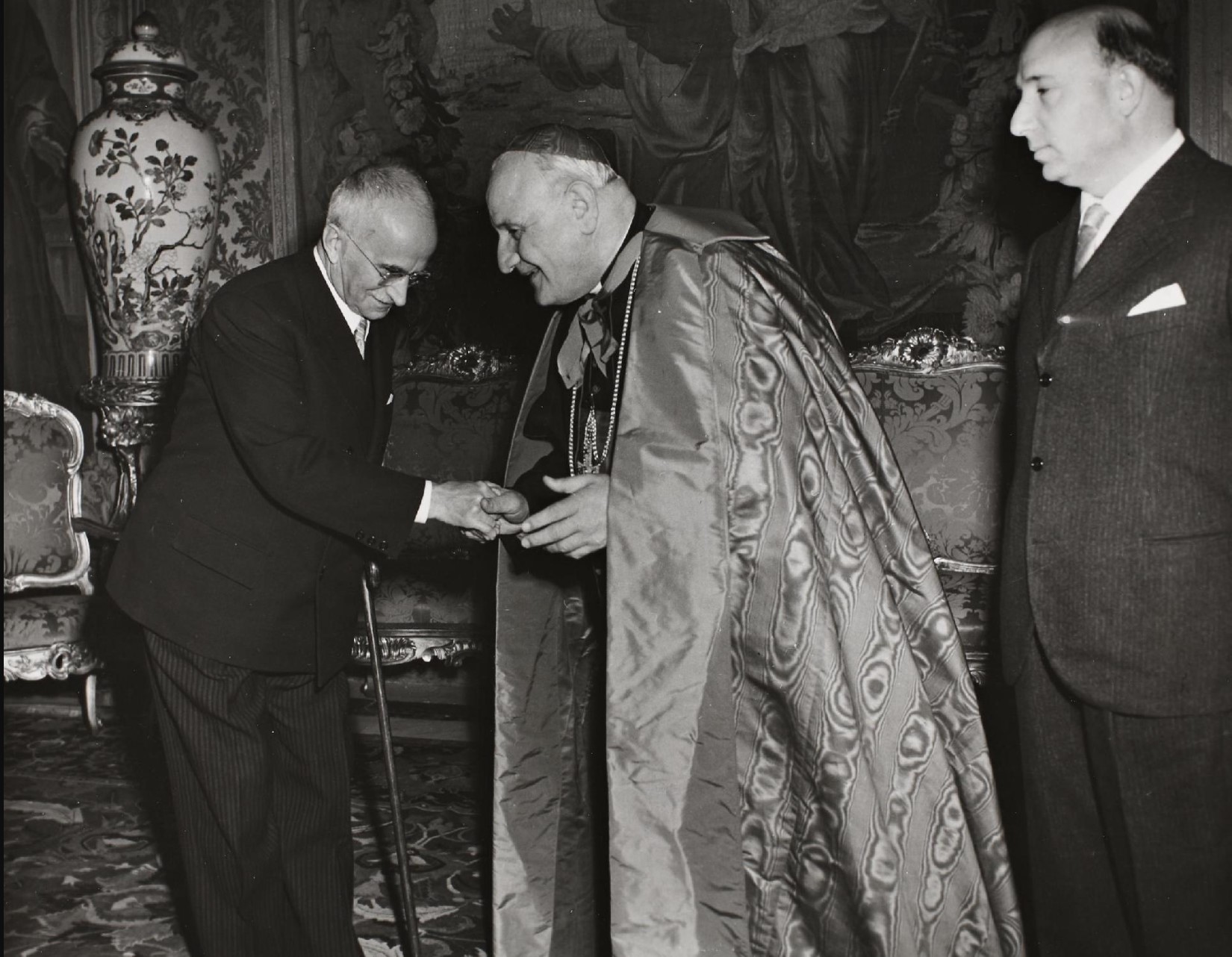
The President of the Italian Republic, Luigi Einaudi (1874-1961), receives His Eminence Cardinal Angelo Giuseppe Roncalli, Archbishop of Venice. Cardinal Roncalli, the newly appointed Patriarch of Venice meets the President of the Italian Republic, on March 16, 1953. Following his nearly decade-long service as Nuncio to France, Pope Pius XII elevated Roncalli to Cardinal in January 1953. This official photo from the Quirinale Palace Historical Archives captures Roncalli taking his mandatory constitutional oath of allegiance before President Einaudi prior to officially taking control of his new archdiocese in Venice. “Il Presidente della Repubblica Luigi Einaudi riceve Sua Eminenza il Cardinale Angelo Giuseppe Roncalli, Arcivescovo di Venezia” is licensed under CC BY-NC-SA 4.0.
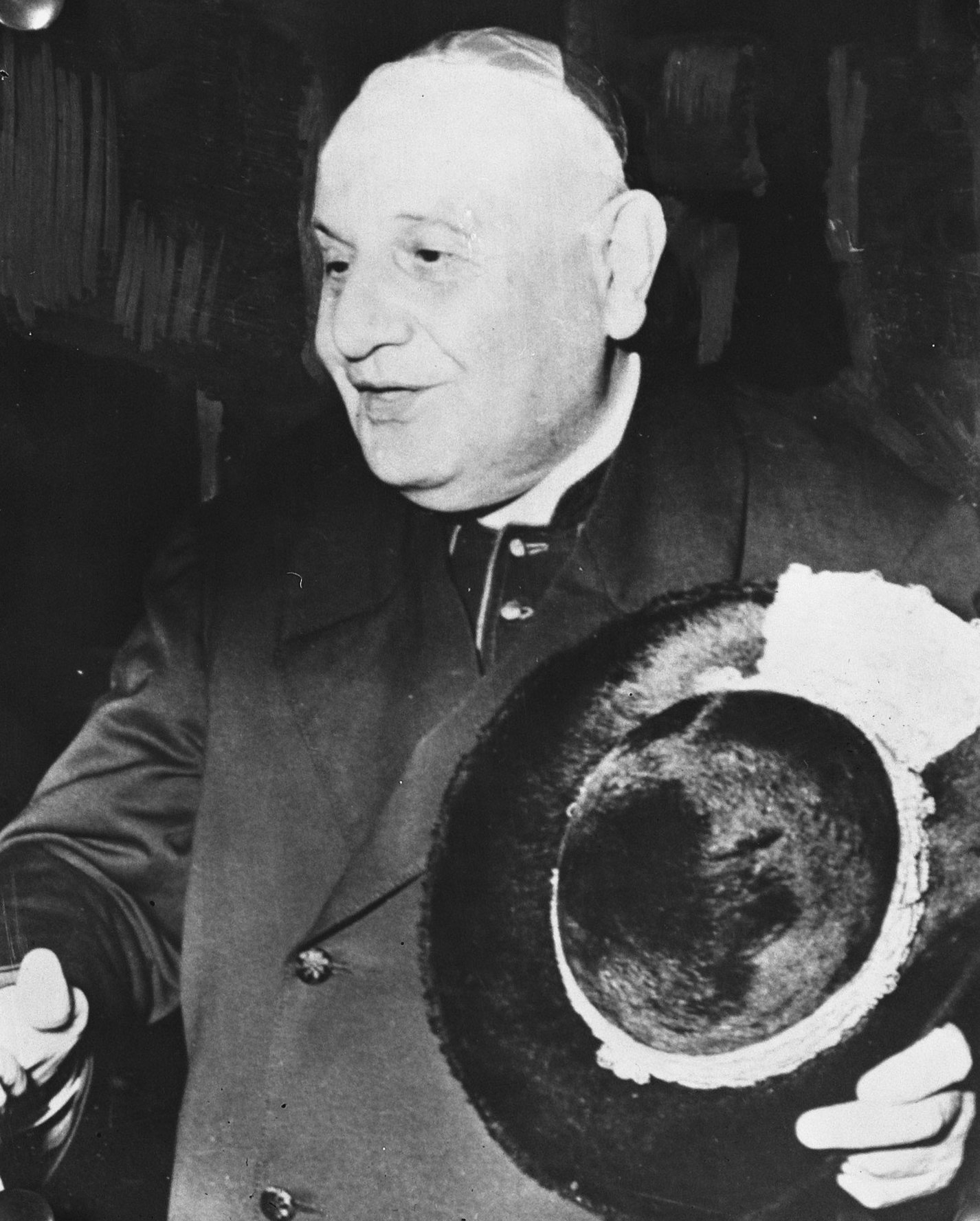
Giuseppe Roncalli, the future Pope John XXIII, was made a cardinal by Pope Pius XII on January 12, 1953. Immediately afterward, he was appointed Patriarch of Venice, a post he held until his election as pope in October 1958. Roncalli holds a cappello romano (literally “Roman hat”), also universally known in Catholic clerical circles as a saturno because its wide, circular brim resembles the rings of the planet Saturn. In strict ecclesiastical etiquette, a premium saturno like the one held here by Cardinal Angelo Roncalli (the future Pope John XXIII) is traditionally fashioned from fine brushed beaver fur (beaver pelt). The interior is typically lined with white silk. The saturno evolved into its shape by 1850, moving away from the “tricorne” cocked hats worn by 18th-century European clergy. Unlike ceremonial headwear like the miter or the square biretta, the saturno has no liturgical function though the color and trim of the hat indicated the rank of the wearer. Roncalli is holding a traditional black saturno outfitted with a red and gold braided silk cord and matching tassels indicating his rank as Cardinal. The saturno fell out of widespread, everyday usage following the modernization reforms of the Second Vatican Council in the mid-1960s, turning it into a rare, historic piece of traditional clerical attire. In 1950’s Venice, Cardinal Roncalli’s leadership stood out: prayerful, humble, effective, and unfailingly affable, he immersed himself in the daily life of the archdiocese with a level of personal engagement locals had not experienced in decades. PHOTO: “Kardinaal Angelo Giuseppe Roncalli, Bestanddeelnr 909-9364” by Anefo is marked with CC0 1.0.

Non cade lacrima dai nostri occhi e non c’è sospiro del nostro cuore senza una riposta di Dio. (“There is no tear that falls from our eyes and no sigh of our heart without a response from God.”) Casa Natale di Papa Giovanni, Sotto Il Monte Giovanni XXIII (Bergamo).

Mi sento più che mai unito ai tanti e tanti che soffrono negli ospedali e nelle case, o sono angustiati in varie forme. (“I feel more than ever united with the many who suffer in hospitals and homes, or are distressed in various forms.”) Casa Natale di Papa Giovanni, Sotto Il Monte Giovanni XXIII (Bergamo).
Elected pope in 1958 at age 77, he was widely expected to be a transitional figure but instead became one of the most consequential popes of the twentieth century.

Installation of Pope John 23 in 1958. The central loggia of Saint Peter’s Basilica overlooking Saint Peter’s Square in Vatican City, Rome, on November 4, 1958 (the Feast of Saint Charles Borromeo). Following a traditional five-hour mass and ceremony inside the basilica, Pope John XXIII (Angelo Giuseppe Roncalli), newly elected as the 261st successor to St. Peter and vested in grand white pontifical vestments, is about to be crowned with the triple-tiered papal tiara (the triregnum) placed on his head by the Senior Cardinal Deacon in full view of the public. This stunning public ritual would turn out to be one of the very last traditional papal coronations in history, as his successor, Pope Paul VI, retired the use of the papal tiara in continuous use for over 1,100 years. PHOTO: “The Coronation of Pope John XXIII (23)” by manhhai is licensed under CC BY 2.0.
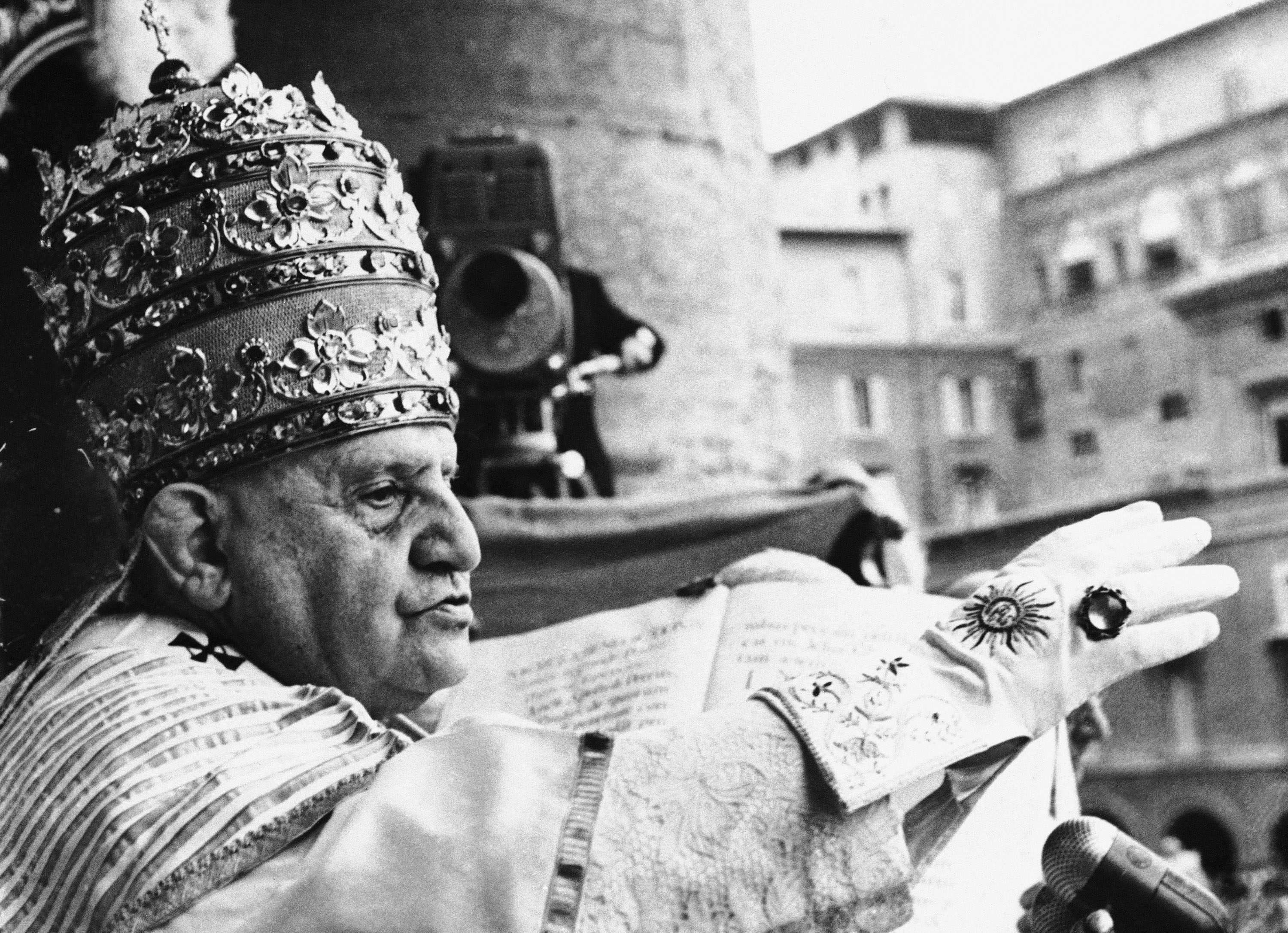
In this photograph from November 4, 1958, Pope John XXIII, newly crowned as Supreme Pontiff of the Roman Catholic Church, lifts his hand in blessing before the faithful gathered at the Vatican. The gentle dignity of the moment foreshadows the deep pastoral spirit that would define his pontificate. Decades later, John XXIII would be canonized alongside Pope John Paul II in a solemn Vatican ceremony. (AP Photo) This work is in the public domain in the United States because it was published in the United States between 1931 and 1963, and although there may or may not have been a copyright notice, the copyright was not renewed.

Una gran medicina per i nostri mali è la buona coscienza, soprattutto l’abbandano nella Provvidenza di Dio. (“A great medicine for our ills is a good conscience, especially its abandonment to the Providence of God.”) Casa Natale di Papa Giovanni, Sotto Il Monte Giovanni XXIII (Bergamo).

Per la pace in famiglia tutto bisogna sacrificare e tutto conviene prendere dalla buona parte. (“For peace in the family everything must be sacrificed and everything should be taken from its good part.”) Casa Natale di Papa Giovanni, Sotto Il Monte Giovanni XXIII (Bergamo).

Pope John XXIII convened the Second Vatican Council in 1962. The Council’s proceedings were held in four sessions from 1962 to 1965 as it aimed to define the Church for modern times, or aggiornamento. The First Session was opened by Pope John XXIII in October 1962 and closed in December 1962. John XXIII died on June 3, 1963, and his successor Paul VI (Giovanni Montini) was elected on June 21, 1963. The Second Session, opened by Paul VI in September 1963 closed in December 1963. The Third and Fourth Sessions were also held from September to December in 1964 and 1965, respectively. The Council adjourned on December 8, 1965, which is the feast of The Solemnity of the Immaculate Conception. PHOTO: “50th Anniversary of Vatican II” by Lawrence OP is licensed under CC BY-NC-ND 2.0.
Vatican II produced 16 major documents, including Constitutions (4), Decrees (9), and Declarations (3).
Constitutions:
Lumen Gentium: (Dogmatic Constitution on the Church) – Defined Church as the People of God and as sacrament. – promulgated November 21, 1964.
Dei Verbum: (Dogmatic Constitution on Divine Revelation) – Cited the Bible and Tradition as sources of divine revelation. – November 18, 1965.
Sacrosanctum Concilium: (Constitution on the Sacred Liturgy) – Called for liturgical changes including use of local languages. – December 4, 1963.
Gaudium et Spes: (Pastoral Constitution on the Church in the Modern World) – Addressed the Church’s engagement with contemporary human life. – December 7, 1963.
Decrees:
Ad Gentes (Mission Activity) – 1965.
Apostolicam Actuositatem (Apostolate of the Laity) – November 18, 1965.
Christus Dominus (Pastoral Office of Bishops) – October 28, 1965.
Inter Mirifica (Media of Social Communications) – December 4, 1963.
Orientalium Ecclesiarum (Eastern Catholic Churches) – November 21, 1964.
Optatam Totius (Priestly Training) – October 28, 1965.
Perfectae Caritatis (Renewal of Religious Life) – October 28, 1965.
Presbyterorum Ordinis (Ministry and Life of Priests) – December 7, 1965.
Unitatis Redintegratio (Ecumenism) – November 21, 1964.
Declarations:
Gravissimum Educationis (On Christian Education) – October 28, 1965.
Nostra Aetate (On the Relation of the Church to Non-Christian Religions): A landmark document that opened dialogue and understanding with other faiths, particularly Judaism and Islam, and addressed universal human spiritual heritage. – October 28, 1965.
Dignitatis Humanae (On Religious Freedom): Affirmed the human right to religious liberty. – December 7, 1965.

Cardinal Alfredo Ottaviani (Holy Office head), Cardinal Francis Spellman of Boston and Enrico Dante (Master of Ceremonies) gather around John XXIII at the opening ceremonies of the Second Vatican Council on October 11, 1962. Off to the left is Aspreno II Colonna, Prince of Paliano, near Rome. Called by John XXIII on January 25, 1959, the Council was held in four fall sessions between 1962 and 1965, continuing under Pope Paul VI after Pope John XXIII’s death in June 1963. PHOTO: Public Domain. The country of origin of this photograph is Italy. It is in the public domain there because its copyright term has expired.

Figlioli, cercate più quello che unisce che ciò che divide… (“Little children, seek more what unites than what divides…”) Casa Natale di Papa Giovanni, Sotto Il Monte Giovanni XXIII (Bergamo).

Tutti ricordo e per tutti pregherò. (“I remember everyone and I will pray for everyone.”) Casa Natale di Papa Giovanni, Sotto Il Monte Giovanni XXIII (Bergamo).

Published in January 1963, Pope John XXIII was named TIME’s Man of the Year for his decisive global influence, highlighted by his role in convening the Second Vatican Council and his quiet but effective mediation during the Cuban Missile Crisis. Elected in 1958 at age 77 and widely expected to be a short-term “transitional” pope, he surprised the world by reshaping the papacy through openness, pastoral warmth, and a new commitment to ecumenical dialogue. His selection marked the first time a pope received the magazine’s annual distinction, underscoring his impact on both believers and nonbelievers. PHOTO: Time Inc., started renewing the copyrights of Time magazine in 1962 with the 29 January 1934, issue. Therefore, issues that were published before 29 January 1934 are in the public domain. In addition, a few later issues were not renewed. The copyright on this 1963 issue of Time magazine was not renewed, and it is in the public domain.
John XXIII’s encyclical Pacem in Terris (April 1963) became one of the most influential Catholic statements on peace, human rights, and international cooperation during the Cold War.
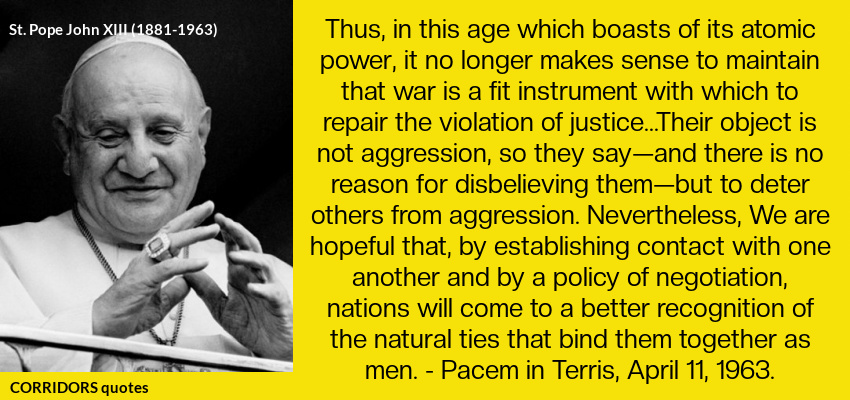
Thus, in this age which boasts of its atomic power, it no longer makes sense to maintain that war is a fit instrument with which to repair the violation of justice…Their object is not aggression, so they say—and there is no reason for disbelieving them—but to deter others from aggression. Nevertheless, We are hopeful that, by establishing contact with one another and by a policy of negotiation, nations will come to a better recognition of the natural ties that bind them together as men. – Pacem in Terris, April 11, 1963.
Issued on April 11, 1963, in the harrowing shadow of the Cuban Missile Crisis, Pacem in Terris (“Peace on Earth”) served as a vital moral intervention for a world teetering on the edge of nuclear conflict. In a groundbreaking departure from tradition, Pope St. John XXIII addressed this final encyclical not only to the Catholic faithful but to all “men of good will,” signaling a new era of universal engagement. By urging a retreat from the Cold War arms race, the Pope shifted the foundation of global security from the “balance of terror” to a framework of mutual trust, disarmament, and restraint. Within the Church, the document marked a pivotal evolution, embedding religious freedom and universal human rights into the core of Catholic social teaching and establishing the Church as a credible voice in the modern struggle for international justice. Though Pope John XXIII passed away on June 3, 1963—just 53 days after its publication and less than five years into his papacy—his final work remains a prophetic cornerstone. Today, it continues to provide the moral blueprint for the Church’s response to humanitarian crises and the enduring quest for a peaceful global order.
https://www.vatican.va/content/john-xxiii/en/encyclicals/documents/hf_j-xxiii_enc_11041963_pacem.html – retrieved May8, 2026.
His most significant initiative was convening the Second Vatican Council (Vatican II), which sought to bring the Church into deeper engagement with the modern world through aggiornamento (“updating”).
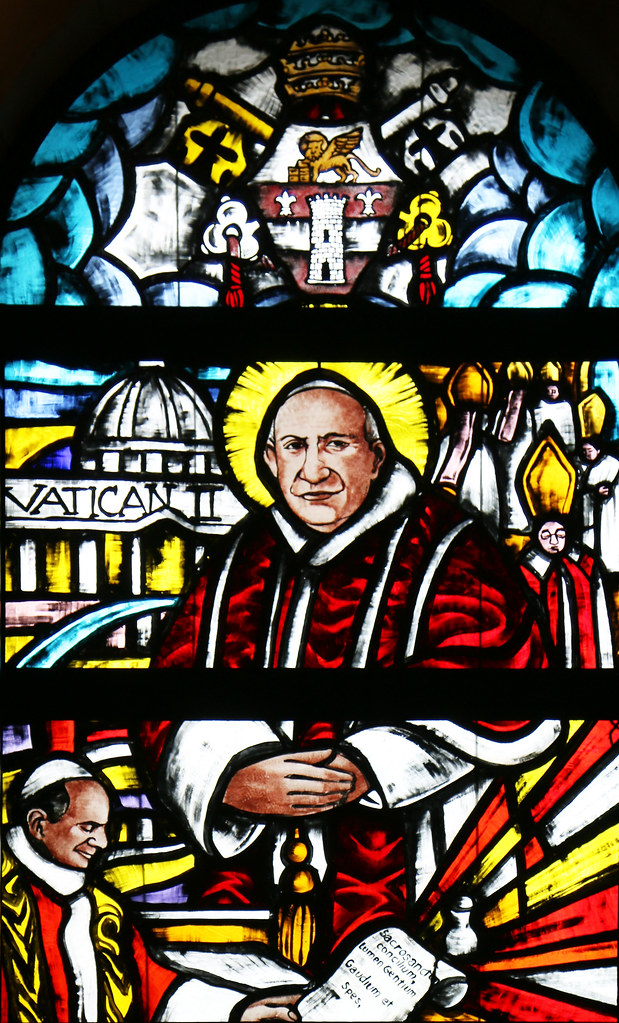
PHOTO: “Pope St John XXIII” by Lawrence OP is licensed under CC BY-NC-ND 2.0.
Pope John XXIII (1958–1963) issued eight encyclicals during his pontificate, focusing on themes of social justice, peace, unity, and pastoral care.
Here is the list of, with links, his 8 encyclicals (1959-1963):
Ad Petri Cathedram (To the Chair of Peter) – June 29, 1959. Purpose: Promotes truth, unity, and peace under the light of charity.
Ad Petri Cathedram (June 29, 1959)
Sacerdotii Nostri Primordia (At the Beginning of Our Priesthood) – August 1, 1959. Purpose: Honors St. John Vianney and urges priests toward spiritual perfection.
Sacerdotii Nostri Primordia (August 1, 1959)
Grata Recordatio (With Joyful Recollection) – September 26, 1959. Purpose: Encourages praying the Rosary for the success of the upcoming Council.
Grata Recordatio (September 26, 1959)
Princeps Pastorum (The Prince of Shepherds) – November 28, 1959. Purpose: Stresses the need for native clergy and lay leadership in mission territories.
Princeps Pastorum (November 28, 1959)
Mater et Magistra (Mother and Teacher) – May 15, 1961. Purpose: Explains the Church’s role in social progress including workers’ rights and global economic justice.
Mater et Magistra (May 15, 1961)
Aeterna Dei Sapientia (God’s Eternal Wisdom) – November 11, 1961. Purpose: Calls for Christian unity through the legacy of Pope St. Leo the Great against modern secularism.
https://www.vatican.va/content/john-xxiii/en/encyclicals/documents/hf_j-xxiii_enc_11111961_aeterna-dei.html
Paenitentiam Agere (To Practice Penance) – July 1, 1962. Purpose: Requests penance from the faithful to ensure the Council’s spiritual success.
https://www.vatican.va/content/john-xxiii/en/encyclicals/documents/hf_j-xxiii_enc_01071962_paenitentiam.html – all above retrieved May 9, 2026.
Pacem in Terris (Peace on Earth) – April 11, 1963. Purpose: Details a blueprint for world peace based on human rights and dignity, addressed to “all men of good will.”
https://www.vatican.va/content/john-xxiii/en/encyclicals/documents/hf_j-xxiii_enc_11041963_pacem.html – retrieved May 8, 2026.

PHOTO: “File:Coat of arms of Angelo Giuseppe Roncalli.svg” by SajoR is licensed under CC BY-SA 2.5.
John 23’s coat of arms with the motto “Obedience and Peace.” This is the official ecclesiastical coat of arms used by Angelo Giuseppe Roncalli during his tenure as Cardinal Patriarch of Venice (1953–1958), before his election as Pope John XXIII. Created in early 1953, the design follows Church heraldic tradition by combining Roncalli’s family arms with the historic symbols of the Venetian patriarchate.
Dominating the shield is the Lion of St. Mark, the traditional emblem retained by Venetian cardinals. The golden winged lion holds an open book bearing the inscription “Pax Tibi Marce Evangelista Meus” (“Peace be with you, Mark, my evangelist”), the ancient heraldic symbol of the Patriarchate of Venice and its patron saint. Beneath it appear Roncalli’s personal family emblems: a stone tower with an open gate representing Sotto il Monte, the Bergamo village where he was born and raised, flanked by two silver lilies symbolizing purity and devotion to the Virgin Mary.
Surrounding the shield is the red galero, the ceremonial hat reserved for cardinals, with its thirty tassels serving as the strict heraldic indication of cardinalatial rank. Above the shield stands the golden patriarchal cross with its distinctive double crossbars, signifying jurisdiction over an archdiocese and patriarchate rather than a standard bishopric.
At the base appears Roncalli’s lifelong episcopal motto, “Oboedientia et Pax” (“Obedience and Peace”), inspired by the writings of St. Caesar Baronius, the sixteenth-century church historian and Oratorian priest. Roncalli carried this motto with him throughout the remainder of his life, including his historic papacy as Pope John XXIII.
Roncalli’s lifelong habits of diplomacy, humility, and compassion prepared him to become Pope John XXIII, whose leadership transformed the Catholic Church and influenced the wider world.
This explanatory article may be periodically updated.

