

Feature image: Three reindeer, one mission: stack the holiday cheer sky‑high. Bringing some serious retro California sunshine to the winter chill, this stacked reindeer yard display perfectly channels the festive, energetic groove of The Beach Boys’ 1963 classic “Little Saint Nick.” Just like Santa’s legendary bobsled, these three are hauling holiday spirit through the neighborhood at a frightening speed. December 2024. Author’s photograph. All rights reserved.
At Christmas 1963, “Little Saint Nick” was more than a successful Beach Boys Christmas novelty record. Its B-side, “The Lord’s Prayer,” revealed Brian Wilson’s emerging artistic ambition, sophisticated vocal arranging, and willingness to push beyond the group’s surf-pop image, making the single an important milestone just before the Beatles and the British Invasion transformed popular music.
The Road to the Top
The Beach Boys finally reached the top of the Billboard Hot 100 in May 1964 with “I Get Around.” The breakthrough felt overdue. Throughout 1963, the California surf pop group had dominated American radio: five Top 10 singles, including three that cracked the Top 5, and three Top 10 albums. They completed their first national tour that April, and “Surfin’ U.S.A.” finished the year as Billboard’s No. 1 song. By December, with their first holiday single “Little Saint Nick” climbing the charts, the Beach Boys looked like America’s most celebrated pop band. Only Newark’s The Four Seasons rivaled their chart power.
Shifting Tides
Then, just two months later, everything changed. The British Invasion hit. The Beatles arrived in early 1964 and turned the rock ’n’ roll world upside down. Overnight, the Beach Boys found themselves challenged—creatively and commercially—by the Fab Four, who were suddenly setting the pace the rest of the pop world had to match.
The 1963 single “Little Saint Nick” endures because it transformed the band’s surf‑and‑speed aesthetic into holiday magic and was an early step toward the ambitious studio craft of The Beach Boys’ Christmas Album the following year.
Little Saint Nick LYRICS:
(Ooooooooh, merry Christmas Saint Nick)
(Christmas comes this time each year)
(Oooooooo-ooooooooh)
Well, way up north where the air gets cold
There’s a tale about Christmas that you’ve all been told
And a real famous cat all dressed up in red
And he spends the whole year workin’ out on his sled
It’s the little Saint Nick
(Oooooh, little Saint Nick)
It’s the little Saint Nick
(Oooooh, little Saint Nick)
Just a little bobsled, we call it old Saint Nick
But she’ll walk a toboggan with a four speed stick
She’s candy-apple red with a ski for a wheel
And when Santa hits the gas, man, just watch her peel
It’s the little Saint Nick
(Oooooh, little Saint Nick)
It’s the little Saint Nick
(Oooooh, little Saint Nick)
Run, run, reindeer
Run, run, reindeer
(Oh-oh-oh-oh)
Run, run, reindeer
Run, run, reindeer
He don’t miss no one
And haulin’ through the snow at a frightenin’ speed
With a half a dozen deer with Rudy to lead
He’s gotta wear his goggles ’cause the snow really flies
And he’s cruisin’ every pad with a little surprise
It’s the little Saint Nick
(Oooooh, little Saint Nick)
It’s the little Saint Nick
(Oooooh, little Saint Nick)
(Aaa-aaa-aaah)
(Ooooooooh, merry Christmas Saint Nick)
(Christmas comes this time each year)
(Aaa-aaa-aaah)
(Ooooooooh, merry Christmas Saint Nick)
(Christmas comes this time each year)
(Aaa-aaa-aaah)
(Ooooooooh, merry Christmas Saint Nick)
(Christmas comes this time each year)
(Aaa-aaa-aaah)
(Ooooooooh, merry Christmas Saint Nick)
(Christmas comes this time each year)
A Holiday Blueprint and Spiritual Depth
“Little Saint Nick” was released on December 9, 1963, climbing to No. 3 on Billboard’s Christmas Singles chart. Brian Wilson had composed the music that August, building it on the same brisk, compact structure he used for “Little Deuce Coupe.” Mike Love supplied most of the lyrics, shifting his focus from hot rods to a holiday bobsled.
The single’s B side carried a more reflective but remarkable achievement: “The Lord’s Prayer,” Albert Hay Malotte’s 1935 setting, adapted and arranged by Brian Wilson. Sung a cappella in four interlocking harmonies, it revealed a creative and spiritual depth unusual for a band of early twenty somethings. By Christmas 1963, the Beach Boys were firmly established as America’s No. 1 pop group.
“Little Saint Nick” successfully adapted the Beach Boys’ hot-rod and surf formula into a Christmas song, helping cement their status as America’s leading pop group in late 1963.
Brian Wilson dreamed up “The Lord’s Prayer” as a bold holiday B‑side—an intricate, five‑part a cappella arrangement blending barbershop, jazz‑pop, and church hymnals. Released December 9, 1963, it showcased his rising studio ambition long before fans were ready for it. The Beach Boys poured long hours into reshaping their signature harmonies for Christianity’s most venerated prayer. In doing so, they hoped to elevate the sacred text while proving that their so‑called surfer sound carried far more depth than lightweight pop. Their intricate vocal blend became both a devotional experiment and an early declaration of artistic ambition.
“The Lord’s Prayer” was an unusually ambitious B-side, featuring intricate a cappella harmonies and spiritual subject matter that demonstrated Brian Wilson’s growing sophistication as an arranger and producer.
Another clear indicator of the band’s rapid evolution can be found in Shut Down Volume 2, released in March 1964 at the absolute peak of the initial Beatlemania hurricane, where it climbed to No. 13 on the Billboard 200. Written and recorded just before the British Invasion transformed the American airwaves, the album’s opening track and lead single, “Fun, Fun, Fun,” was released a mere six days before the Beatles’ historic debut on The Ed Sullivan Show. Written by Brian Wilson and Mike Love, the track was recorded on New Year’s Day 1964 as a sunny California anthem wrapped around a story of teenage rebellion. The lyrics follow a girl who deceives her father, taking his Ford Thunderbird under the guise of going to the library, only to cruise the town to enjoy the thrill of speed and peer admiration that comes with driving a cool car. Rather than offering a rigid moral lesson, the song unapologetically celebrates the carefree, defiant spirit of youth. The driving hook—”she’ll have fun, fun, fun till her daddy takes the T-bird away”—promises that her freedom will last right up until she is caught, though the narrative ends with the narrator rescuing her from being grounded so the joyride can continue. While the Beatles already held the top slots on the charts in early 1964, the Beach Boys were still chasing their first chart-topper; “Fun, Fun, Fun” peaked at No. 5 that March, paving the way for their first No. 1 hit with “I Get Around” later that July.
The Ed Sullivan Shockwave
In mid January 1964, they left for their first international tour, performing in Australia and New Zealand. When they returned on February 2, their next single—“Fun, Fun, Fun”—was released the following day. It reached No. 5 on March 21.
But in the brief window between its release and its chart peak, the rock ’n’ roll landscape shifted beneath their feet. On February 9, 1964, the British Invasion began in earnest. The Beatles—John, Paul, George, and Ringo—made their first appearance on The Ed Sullivan Show, performing before an audience of roughly 74 million Americans, nearly half the country. The Beach Boys, still the top U.S. pop band, had not yet been invited onto that stage. The Beatles’ explosive debut instantly reshaped the pop hierarchy, and the Beach Boys suddenly found themselves facing a new and formidable rival.
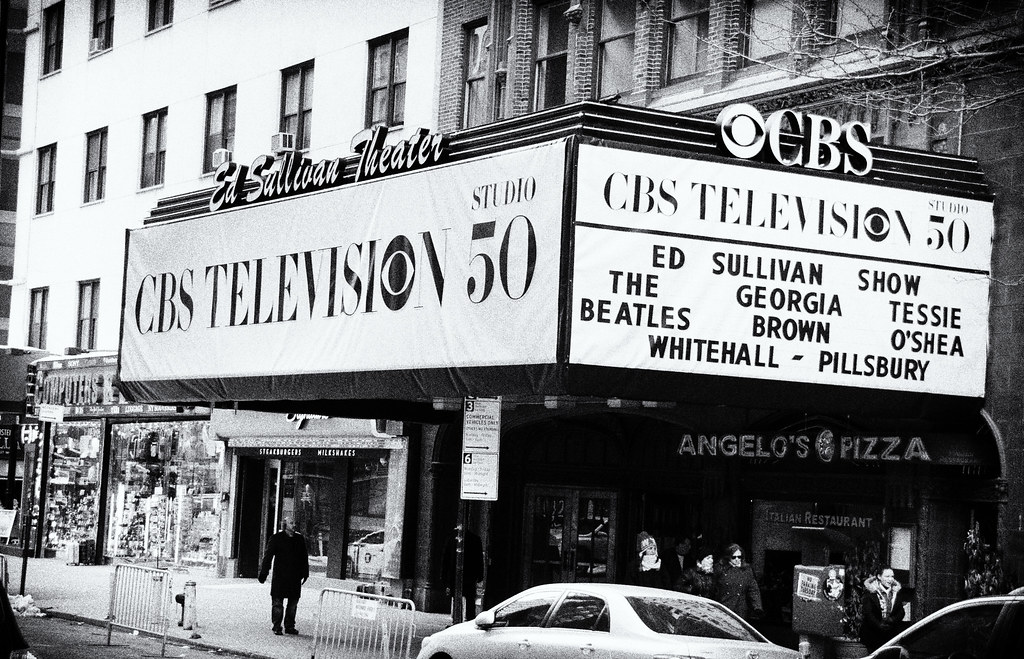
The Beatles appeared several times on the Ed Sullivan Show in 1964 and 1965 and transformed American rock ‘n roll forever. “The Beatles Ed Sullivan Theater Marquee” by mkfeeney is licensed under CC BY 2.0.
The single stands at a historical crossroads, representing the Beach Boys at the peak of their pre-Beatles success just before the British Invasion challenged them and inspired the artistic competition that would lead to their greatest innovations.
The Packaging Gap
Overnight, the Beach Boys suddenly looked almost bush league next to the British newcomers—not musically, since both groups drew from the same exuberant teenage world, but in publicity, packaging, and sheer media savvy. It was a preview of what would happen again in the 1980s, when British acts outpaced Americans in the emerging music video era.
A Five-Year Revolution
In the long wake of that shock, as the Beatles returned to The Ed Sullivan Show twice more in February 1964 and again that May, Brian Wilson’s quiet but fierce competition with them began. Rock ’n’ roll would never be the same. Over the next five years, the music exploded into something more original, experimental, and sonically adventurous—a transformation that fueled breakthroughs for the Beach Boys, the Beatles, and countless others.
And sitting right on the cusp of that revolution was “Little Saint Nick.” With its hook and beat, the 1963 single endures today as a bright artifact from the moment just before rock ’n’ roll reinvented itself.
SOURCES:
Badman, Keith. The Beach Boys: The Definitive Diary of America’s Greatest Band on Stage and in the Studio. 1st ed. San Francisco: Backbeat Books, 2004, pp. 45-54.
Love, Mike. Good Vibrations: My Life as a Beach Boy. New York: Penguin Publishing Group, 2016, pp. 84-88.
Morgan, Johnny. The Beach Boys: America’s Band. Illustrated ed. New York: Union Square & Co., 2015, pp. 61-65.
Whitburn, Joel. Joel Whitburn’s Top Pop Singles, 1955-1999. Menomonee Falls, WI: Record Research, Inc., 2000, pp.38-39.


