
FEATURE image: Navigating the turbulent backstories behind classic rock’s greatest seafaring anthems, from Blues Image’s “Ride Captain Ride” to The Beach Boys’ “Sail On, Sailor.” PHOTO: “Sailing to Cape Cod” by ShaneTaremi is licensed under CC BY-NC-ND 2.0.
Rock music frequently utilizes maritime imagery as a powerful metaphor for human endurance, personal discovery, and professional struggle; this is vividly demonstrated through the turbulent creation, charting histories, and resilient lyrical themes of Blues Image’s “Ride Captain Ride” and The Beach Boys’ “Sail On, Sailor.”
Blues Image: Ride Captain Ride (1970):
Released in April 1970, “Ride Captain Ride” by Blues Image reached no.4 on pop charts in the U.S. and Canada. The song was no. 32 on the year-end Billboard chart for 1970. At 3:43 minutes, there was a shorter radio version.
The Story of “Ride Captain Ride”
“Ride Captain Ride” was a No. 4 hit in the U.S. and Canada during the spring and summer of 1970. Written and performed by the Tampa, Florida-based rock band Blues Image, the song is a fantasy about a captain and crew seeking laughter and freedom on a mystery ship bound for an uncharted world.
Co-written by lead singer/guitarist Mike Pinera and keyboardist “Skip” Konte, the track sold over one million copies and earned a Gold certification in August 1970. While best known for this defining anthem, Blues Image was much more than a one-hit wonder.
Miami, Florida’s late 1960’s psych-rock music scene
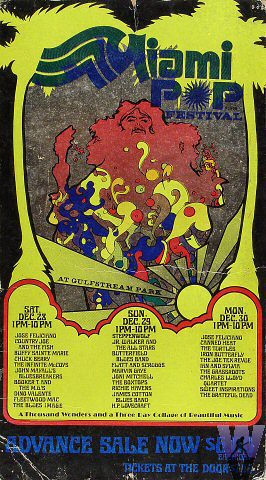
Concert poster for the Miami Pop Festival with the Grateful Dead, Gulfstream Park Race Track, Hallandale, Florida, December 28, 29, 30, 1968. PHOTO: “concert poster: Miami Pop Festival with the Grateful Dead, Gulfstream Park Race Track, Hallandale, Florida, December 28, 29, 30, 1968 [borrowed from http://www.wolfgangsvault.com]” by Zooomabooma is licensed under CC BY-NC-SA 2.0.
Grounding the Miami Psych-Rock Scene
Formed in Tampa in 1966, Blues Image relocated to Miami in 1968. They played a pivotal role in helping promoters establish “Thee Image,” a popular new music club housed in a former bowling alley in Sunny Isles Beach. It quickly became South Florida’s premier venue for emerging psychedelic rock, drawing massive crowds.
The innovative venue featured three stages, a meditation room, and a black-light room. It hosted local acts alongside legendary names like Cream, The Doors, the Grateful Dead, Led Zeppelin, and Frank Zappa.
Cultural Impact and Innovation
The club served as the brainchild, construction project, and gathering spot for the region’s hippie counterculture, bringing messages of peace, love, and brotherhood to beachfront Miami. Massive outdoor jam sessions and “love-ins” in nearby public parks once drew an impromptu crowd of 3,000 fans for a joint performance by the Grateful Dead and Blues Image. Beyond their local impact, Blues Image was one of the first rock groups to experiment with Latin-infused rock, a hybrid style that exploded across the wider rock music scene in the 1970s.

Ride Captain Ride is the 6th track on Blues Image’s second album, Open, released in April 1970. Written by bandmates Mike Pinera and “Skip” Konte, the song is about joining a cruise into an uncharted world. PHOTO: “Mystery ship” by Guru Sno Studios is licensed under CC BY-ND 2.0.
The End of an Era and The Move to Los Angeles
The beginning of the end for Miami’s late-1960s psych-rock scene arrived with The Doors’ infamous concert appearance in March 1969. Following the August 1968 Republican National Convention in Miami—which helped propel Richard Nixon to the U.S. presidency—local public opinion soured on the hippie subculture, leading to the permanent closure of Thee Image.
That same year, Blues Image packed up and moved to Los Angeles, seeking a fresh start as the Miami scene faded.
In 1969, Blues Image relocated to Los Angeles, where they signed with Atco Records and released their self-titled debut album. They were not alone; the shifting social climate forced many bands to exit Miami, with some heading to New York City. For a brief moment, the cultural energy of Thee Image was transplanted to the West Coast through a similar venue, but South Florida’s legendary psych-rock era had officially drawn to a close.
Brushes with Greatness
The band quickly integrated into the thriving California music scene. In the summer of 1969, Blues Image drummer Manny Bertematti was seen jamming with Jimi Hendrix at “Thee Experience,” a Sunset Strip club that evoked the spirit of their old Miami haunt. The band clearly left an impression on the guitar icon; shortly before his death, Hendrix praised Blues Image in Melody Maker magazine, calling them “one of the best up and coming bands around.”
In 1970, Florida rock band Blues Image scored a Gold-certified, No. 4 hit with “Ride Captain Ride,” a mystical fantasy about a ship bound for an uncharted world. Before conquering the radio, the band pioneered Latin-infused rock and anchored Miami’s legendary psychedelic scene at “Thee Image” club. After jamming with Jimi Hendrix in Los Angeles, they released this iconic anthem, featuring dynamic guitar solos by Kent Henry and Mike Pinera. The group disbanded in 1971, but the track remains a timeless classic rock radio staple.
Anatomy of a Hit
In April 1970, the band released their breakthrough single, “Ride Captain Ride.” Hidden as the sixth track on their second album, Open, the song featured dynamic guitar work, with Kent Henry handling the main solo and fills, and Mike Pinera delivering the final, soaring outro solo. The track became a massive success, landing at No. 32 on the 1970 year-end Billboard chart. Decades later, the anthem remains a rock staple and has been covered by numerous artists, most notably by Blood, Sweat & Tears in 1975 and frequently by Phish between 1987 and 2013.
Legacy and Aftermath
The band’s peak was short-lived. Following Pinera’s departure, Blues Image officially disbanded in 1971. Despite their breakup, the members remained highly influential fixtures in rock history. Keyboardist “Skip” Konte joined Three Dog Night, while Pinera and other alumni went on to play with an incredible roster of iconic bands, including Iron Butterfly, Steppenwolf, Crosby, Stills, Nash & Young, Manassas, Jackson Browne, Joe Walsh, and Alice Cooper.
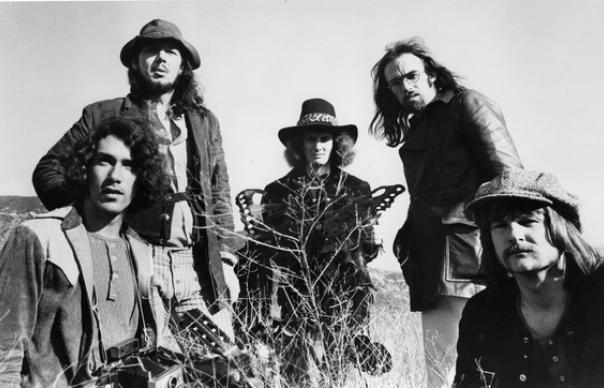
Taken in Los Angeles in 1970, Mike Pinera and Iron Butterfly. Left to right: Larry “Rhino” Reinhardt (guitar), Mike Pinera (guitar, vocals) who just left Blues Image to join Iron Butterfly, Doug Ingle (organ, lead vocals), Lee Dorman (bass) and Ron Bushy (drums). The promotional photo was taken for Iron Butterfly’s fourth studio album Metamorphosis, which was released in August 1970. PHOTO: “Mike Pinera and Iron Butterfly” by ClassicRockHistory is licensed under CC BY-SA 4.0.
RIDE CAPTAIN RIDE LYRICS:
Seventy three men sailed up from the San Francisco Bay
Rolled off of their ship, and here’s what they had to say
We’re callin’ everyone to ride along to another shore
We can laugh our lives away and be free once more
But no one heard them callin’, no one came at all
‘Cause they were too busy watchin’ those old raindrops fall
As a storm was blowin’ out on the peaceful sea
Seventy-three men sailin’ off to history
Ride Captain Ride upon your mystery ship
Be amazed at the friends you have here on your trip
Ride Captain Ride upon your mystery ship
On your way to a world that others might have missed
Seventy-three men sailed up from the San Francisco Bay
Got off the ship, and here’s what they had to say
We’re callin’ everyone to ride along to another shore
We can laugh our lives away and be free once more
Ride Captain Ride upon your mystery ship
Be amazed at the friends you have here on your trip
Ride Captain Ride upon your mystery ship
On your way to a world that others might have missed
Ride Captain Ride upon your mystery ship
Be amazed at the friends you have here on your trip
THE BEACH BOYS: Sail On, Sailor (1973):

Brian Wilson at the piano. PHOTO: “Brian Wilson of the Beach Boys in West Los Angeles 1990 photographed by Ithaka Darin Pappas” by IthakaDarinPappas is licensed under CC BY-SA 4.0.
“Sail on, Sailor” was released in February 1973 as the album Holland’s lead single. It peaked at no. 79 on the Billboard Hot 100. When it was re-released two years later, in 1975, it jumped to no.49.
The Beach Boys Move to Holland
Following the demise of Blues Image, the Beach Boys, Al Jardine, Dennis Wilson, Brian Wilson, Carl Wilson, and Mike Love, made an unusual decision in the summer of 1972. Seeking a fresh environment and renewed creative focus, they relocated with their families to the Netherlands to record a new album.
Once there, they discovered that no existing studio met their needs. Their solution was as ambitious as the move itself: import recording equipment and construct a temporary studio inside a converted Dutch barn. Throughout the summer they worked on Holland, the band’s 19th album.
When the finished record was presented to Warner Bros., executives were unconvinced. The label believed Holland lacked a commercially viable hit single. According to those involved, the group was told that without a clearly identifiable single, the album could not be released.
Searching for a Hit
Brian Wilson and the brand-new head of Warner Bros.’ music video department, Van Dyke Parks, set out to work on a song. Van Dyke Parks was a collaborator on Good Vibrations and they came up with Sail On, Sailor.
A sailing song with deeper connotations of a searching journey that could be personal or professional, the music was remembered to have been drafted by Wilson in 1970 and, with Van Dyck Parks, to fuller form in 1971. At that point the song was headed to Three Dog Night and with lyrics by Ray Kennedy and Tandyn Almer.
More Than a Sailing Song
On the surface, Sail On, Sailor is a nautical song. Beneath that imagery, however, lies a deeper meditation on perseverance, survival, and personal struggle.
The narrator’s voyage is both literal and symbolic:
“I sailed an ocean, unsettled ocean / Through restful waters and deep commotion…”
The sailor battles uncertainty, fear, and adversity:
“I wrest the waters, fight Neptune’s waters / Sail through the sorrows of life’s marauders…”
The song’s vibrant melody, intricate harmonies, and driving rhythm can make it easy to glide along with the music while overlooking the turbulence within its lyrics. Lines such as:
“Seldom stumble, never crumble / Try to tumble, life’s a rumble…”
reveal a protagonist constantly confronting hardship while refusing to surrender.
A Song Forged by Many Hands
The lyric underwent several revisions before completion. Beach Boys manager Jack Rieley returned to Los Angeles in 1972 and contributed additional lines, later expressing particular pride in the phrase:
“Lost like a sewer rat alone but I sail…”
Official songwriting credits ultimately went to Brian Wilson, Tandyn Almer, and Van Dyke Parks as composers, with Jack Rieley and Ray Kennedy credited for lyrics. Lead vocals were delivered by South African singer Blondie Chaplin, whose powerful performance became one of the song’s defining features.
In 1972, The Beach Boys relocated to the Netherlands to record their album Holland. When Warner Bros. demanded a commercial hit, Brian Wilson and Van Dyke Parks crafted “Sail On, Sailor.” Featuring a powerful lead vocal by Blondie Chaplin, the track uses nautical imagery as a deeper metaphor for perseverance and survival through adversity. Releasing as a single, it eventually climbed to No. 49 on the Billboard Hot 100 in 1975, cementing its legacy as a timeless classic rock radio staple about enduring life’s roughest storms.

Composer Brian Wilson of the Beach Boys at the piano. At one point in the recording process, Wilson was barred from the studio for tinkering too much with “Sail On, Sailor,” the group’s intended hit song, PHOTO: “Rock Dreams: Brian Wilson” by Jim the Chin is licensed under CC BY-NC-SA 2.0.
From Holland to the Charts
The path to release was not entirely smooth. By November 28, 1972, Brian Wilson had reportedly been barred from further work on the track at Village Recorder in Los Angeles because of endless artistic tinkering, with Carl Wilson assuming control of the final production process to assure the album’s commercial release.
Holland was released on January 8, 1973. The album earned strong critical reviews, reached No. 36 on the Billboard 200, and cracked the Top 20 in the United Kingdom. Sail On, Sailor followed as a single in February 1973, reaching No. 79 on the Billboard Hot 100.
Yet the song’s reputation continued to grow. When reissued as a single in 1975, it climbed higher, reaching No. 49 and securing its place as one of the most admired tracks from the Beach Boys’ 1970s catalog.
An Anthem of Endurance
Part of the song’s enduring appeal lies in how closely its themes mirrored the experiences of its creators. Throughout Sail On, Sailor, the lyrics return repeatedly to struggle, resilience, and hard-earned survival:
“Always needing, even bleeding / Never feeding all my feelings…”
Those words reflected not only the sailor’s journey but also the personal and professional challenges faced by many of the song’s collaborators during a turbulent period in their lives.

Without an apparent hit single on the new album “Holland,” Warner Bros. wasn’t going to release it. Already in a draft form by Wilson, “Sail on, Sailor” was finished to replace another song and released in February 1973 as the album’s first single. PHOTO: “beach boys- holland” by cdrummbks is licensed under CC BY 2.0.
SAIL ON, SAILOR LYRICS:
I sailed an ocean, unsettled ocean Through restful waters and deep commotion Often frightened, unenlightened Sail on, sail on sailor
I wrest the waters, fight Neptune’s waters Sail through the sorrows of life’s marauders Unrepenting, often empty Sail on, sail on sailor
Caught like a sewer rat alone but I sail Bought like a crust of bread, but oh do I wail
Seldom stumble, never crumble Try to tumble, life’s a rumble Feel the stinging I’ve been given Never ending, unrelenting Heartbreak searing, always fearing Never caring, persevering Sail on, sail on, sailor
I work the seaways, the gale-swept seaways Past shipwrecked daughters of wicked waters Uninspired, drenched and tired Wail on, wail on, sailor
Always needing, even bleeding Never feeding all my feelings Damn the thunder, must I blunder There’s no wonder all I’m under Stop the crying and the lying And the sighing and my dying
Sail on, sail on sailor Sail on, sail on sailor Sail on, sail on sailor Sail on, sail on sailor Sail on, sail on sailor Sail on, sail on sailor Sail on, sail on sailor
The Long Tradition of Rock and the Sea
Rock music has long been drawn to the imagery of sailors, ships, and open water. Sail On, Sailor stands within a larger tradition that uses the sea as a metaphor for freedom, uncertainty, longing, and self-discovery. Sail On, Sailor has been covered many times, including recently by Los Lobos on their 2022 Grammy-Award winning Native Sons album.
Notable examples include the Grateful Dead’s Lost Sailor (1980), Rod Stewart’s Sailing (1975), Christopher Cross’s Sailing (1980), and Crosby, Stills & Nash’s Southern Cross (1981). Earlier still, Van Morrison’s Into the Mystic (1970) explored similar maritime imagery.
The Beach Boys themselves had already contributed one of the genre’s most famous seafaring songs with Sloop John B in 1966. For that recording, Brian Wilson adapted a traditional Bahamian folk song whose lyrics centered on hoisting sails and life at sea.
More than fifty years after its release, Sail On, Sailor endures because its voyage feels universal. Beneath the nautical imagery lies a timeless story of adversity, perseverance, and the determination to keep moving forward when the waters turn rough.
Of the 25 or so notable covers since 1973 of the Beach Boys’ song, “Sail On, Sailor,” Jimmy Buffet’s came into port in 2003 on his compilation album, “Meet Me in Margaritaville: The Ultimate Collection.” The self-produced double album of 38 songs on MCA/Mailboat/UTV Records is, by one count, Buffet’s 37th of 50 albums in a music recording career that started in 1970. The 2003 album, certified 2x Platinum, included two brand new recordings of covers, “Sail on, Sailor,” being one of them (Harry Nilsson’s “Everybody’s Talkin'” being the other) and which Jimmy Buffet afterwards frequently performed as an encore on his live concert tours.
PHOTO: “Black Dog schooner” by mgstanton is licensed under CC BY-NC-ND 2.0.