
Monthly Archives: September 2026

The Making of Blessed Archbishop Fulton J. Sheen (1895-1979): Irish Roots, Academic Brilliance, and a Life of Faith.

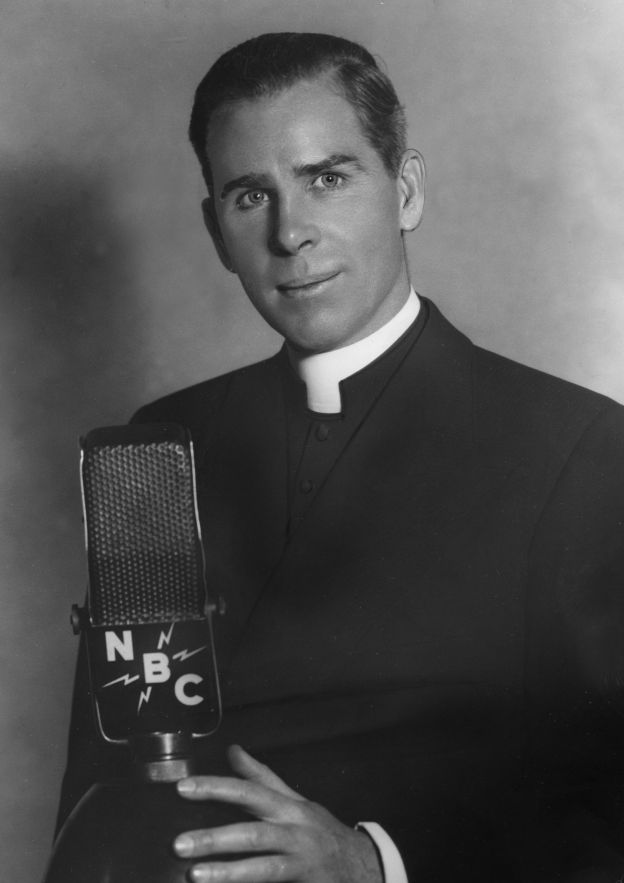
FEATURE image: Feature Image: Newly-Blessed Fulton J. Sheen posing for an official promotional portrait for the wildly popular NBC radio program, The Catholic Hour, which he hosted on Sunday nights. He launched the show with NBC in 1930, where his voice reached millions of households across the America each week, establishing him as America’s first true “media priest.” During his 20-year run on the radio Fulton Sheen pioneered a distinct blend of deep theology, patriotism, and sharp cultural commentary. For example, in the midst of the Great Depression (1929-1941) Sheen frequently attacked the moral failures of unbridled greed and monopoly capitalism, while simultaneously warning the poor not to fall for the “siren song” of class warfare. He consistently hosted sociology and labor experts on the program to advocate for worker rights, fair wages, and interracial justice, declaring that all people “have equal rights as children in the house of the Lord.” Public Domain. Fulton Sheen’s Beatification Illuminates His Message – WSJ – retrieved September 24, 2026.

How Fulton J. Sheen’s Irish-American family heritage, Catholic education, intellectual gifts, academic accomplishments, and disciplined spiritual life combined to form the future priest, bishop, evangelist, and eventual Blessed of the Catholic Church.

On September 24, 2026, the Catholic Church officially beatified Bishop Fulton J. Sheen during a historic ceremony in St. Louis, declaring him a Blessed of the Church. This milestone recognizes a lifetime of profound faith, intellectual brilliance, and pioneering media evangelization that began from immigrant Irish and Midwestern roots.

Family Roots and Early Life

Blessed Bishop Fulton J. Sheen (1895–1979), known for his perfect Catholic school penmanship, rarely made mistakes during his live, unscripted broadcasts. Born into an everyday working-class background in El Paso, Illinois, near Peoria, he was the eldest of four sons of Newton and Delia Sheen, both of Irish descent. Delia (1864–1943) grew up on a farm near Kickapoo in Peoria County, and Newton (1863–1944) was born in El Paso. Bishop Sheen’s maternal grandparents were born in Ireland; his paternal grandfather was from Dublin, Ireland, and his grandmother from Indiana.
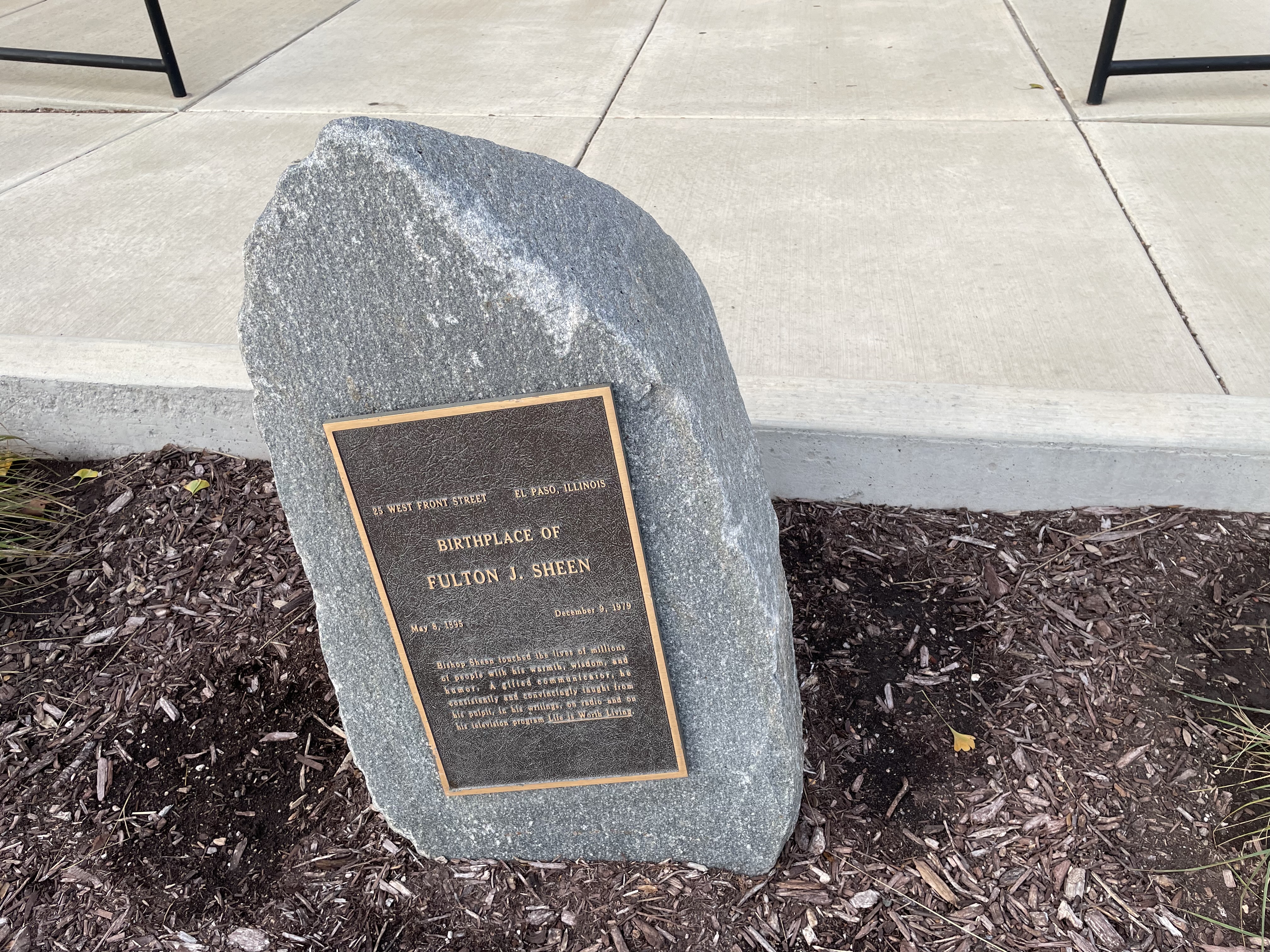
The stone stands at 25 West Front Street in downtown El Paso, Illinois. It marks the exact location where Fulton J. Sheen was born on May 8, 1895. PHOTO: “Fulton J. Sheen Birthplace Marker, El Paso, Illinois, November 2024” by HeatherMarieKosur is licensed under CC BY-SA 4.0.

Relatives remembered Delia—“Aunt Dee”—as laid back, cordial, sociable, and an excellent cook. Newton, short and slim, was generally quiet with a mechanical bent of mind. Newt first married Ida, a woman from Ohio, in 1886; she died in 1892, leaving him with a daughter (Eva Sheen married Luke Walsh in 1907). Afterward he married Delia, and the couple settled in El Paso, where Newton and his brother opened a hardware store. In 1900, while operating two farms on each side of Peoria, the family moved to 111 Seventh Street in Peoria, where Newt, Delia, their four sons, and Delia’s parents lived together. Fulton inherited his mother’s dark hair and deep-set eyes. The family moved from the farm directly into the city of Peoria for the express purpose that Fulton and his brothers could enroll in school.

Sheen’s holiness, intellectual achievement, disciplined spiritual life, and groundbreaking use of mass media were all deeply rooted in the formative influences of his family, education, and early experiences in Peoria.

Formative Education in Peoria

His parents prioritized their children’s education, enrolling Fulton in St. Mary’s Cathedral grade school and later the elite $60,000 Spalding Institute boys’ academy founded in 1899 by Peoria’s first bishop. There, Sheen not only served as an altar boy and discovered his priestly vocation but, in his class of 43 aspiring boys, graduated as the valedictorian of the class of 1913. His time there was highly influential, formed by the rigorous discipline of the Marianist brothers (not to be confused with the Marist Brothers), a French order founded in Bordeaux in 1817 by Blessed William Joseph Chaminade who staffed the school (Brother Gerald, S.M. was its first principal) from its founding until 1933 when the Benedictines took over (those were the days when they had the numbers to do that!).

Fulton J. Sheen’s high school graduation portrait from 1913. He was 18 years old having just concluded his time at the Spalding Institute in Peoria, Illinois. It was for this exact graduation milestone that he earned top academic honors and delivered the commencement address as the class valedictorian. A classmate recalled that at 18, Sheen possessed a terrifyingly good memory and a “golden tongue” that kept the entire auditorium pinned to their seats. Core themes of Sheen’s address included moral integrity over intellect, devotion to the truth, and a call to action as the vocation of the educated Christian man. Public Domain.

Higher Education, Debating, and Ordination

Fulton Sheen entered St. Viator College in Bourbonnais, Illinois, where he earned a combined B.A./M.A. in philosophy in 1917. Sheen was a star debater at the school, leading St. Viator to a legendary triumph over the University of Notre Dame, showing the golden dome fellows that the real fighting Irish lay everywhere (though that is a slightly later moniker under Knute Rockne and Notre Dame President Father Matthew Walsh). After college, Sheen entered the seminary in Minnesota and was ordained a priest in September 1919 at St. Mary’s Cathedral, where he had gone to grade school and served as an acolyte.
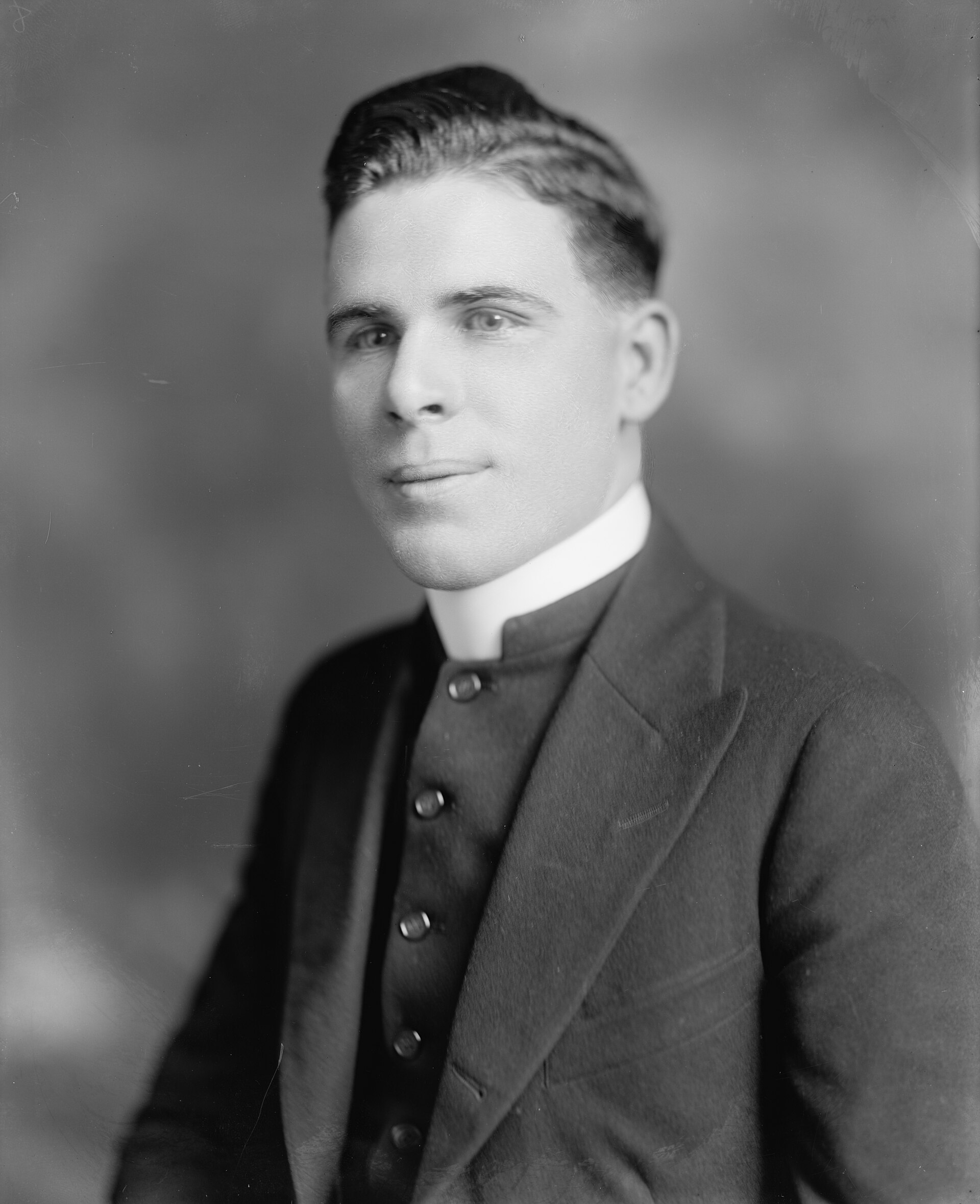
Fulton Sheen’s official ordination portrait taken in September 1919. He was 24 years old and had just been ordained a Roman Catholic priest on September 20, 1919, at St. Mary’s Cathedral in Peoria, Illinois. As a priest he made two resolutions that he kept for the rest of his life: He resolved to offer the Holy Eucharist every Saturday in honor of the Blessed Virgin Mary to petition her lifelong protection over his priesthood. He noted that according to the Epistle to the Hebrews, a priest must offer sacrifices not just for his congregation, but for his own soul. He also resolved to spend one continuous, uninterrupted hour every single day in prayer and adoration directly in front of our Lord in the Blessed Sacrament (the Tabernacle). While the Saturday Masses anchored his weeks, the Daily Holy Hour became the defining spiritual signature of his life. Even when he became a massive television celebrity with an exhausting travel schedule, Blessed Bishop Sheen never broke the vow.  PHOTO: Public Domain. https://www.loc.gov/pictures/item/2016860626/

Academic Brilliance and the “Peoria Product”

Sheen’s aspiration and capability led him to become a canon lawyer where he completed his studies at The Catholic University of America in 1920. The arguably not yet over-educated Sheen now earned a Ph.D. in philosophy from the Catholic University of Louvain in Belgium (where he became the first American to win their prestigious Cardinal Mercier Prize) as well as an S.T.D. (Sacrae Theologiae Doctor) at the Angelicum in Rome.

This man from an everyday Midwestern family’s first assignment was a parish priest at St. Patrick’s Catholic Church in Peoria, Illinois, in 1926. This was partly so that the church could show off their new product to the folks at home and to see how he plays in Peoria—a time of perfect joy for Sheen—though some narratives imply it as a mere test of his humility. The only thing humbled is the diocese itself, who closed St. Patrick’s in Sheen’s lifetime in 1976 for dwindling attendance for shattered perceptions of the Church, liturgical confusion, and an unintended loosening of strict church laws after Vatican II. see – Review: Why did so many Catholics leave after Vatican II? – America Magazine – retrieved September 25, 2026.
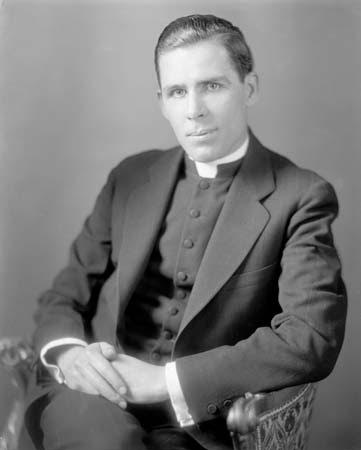
Young Rev. Sheen in a portrait taken around 1930 by Harris & Ewing Washington D.C. portrait studio. Rev. Sheen was approximately 35 years old. At the time Sheen was a young professor teaching philosophy at The Catholic University of America (CUA). This was the exact year Sheen launched into the national spotlight by becoming the first regular host of The Catholic Hour—a Sunday night NBC radio program that quickly grew to reach an estimated 4 million weekly listeners. Public Domain.

The Catholic University of America and National Fame

The Catholic University of America now called him to Washington to join their School of Theology, become a professor, launch his radio career, and begin his path to international fame and holiness. The first course Sheen regularly taught was “God and Religion in Contemporary Thought.” He taught at CUA until 1950, where his course offerings expanded as he transitioned into the School of Philosophy.
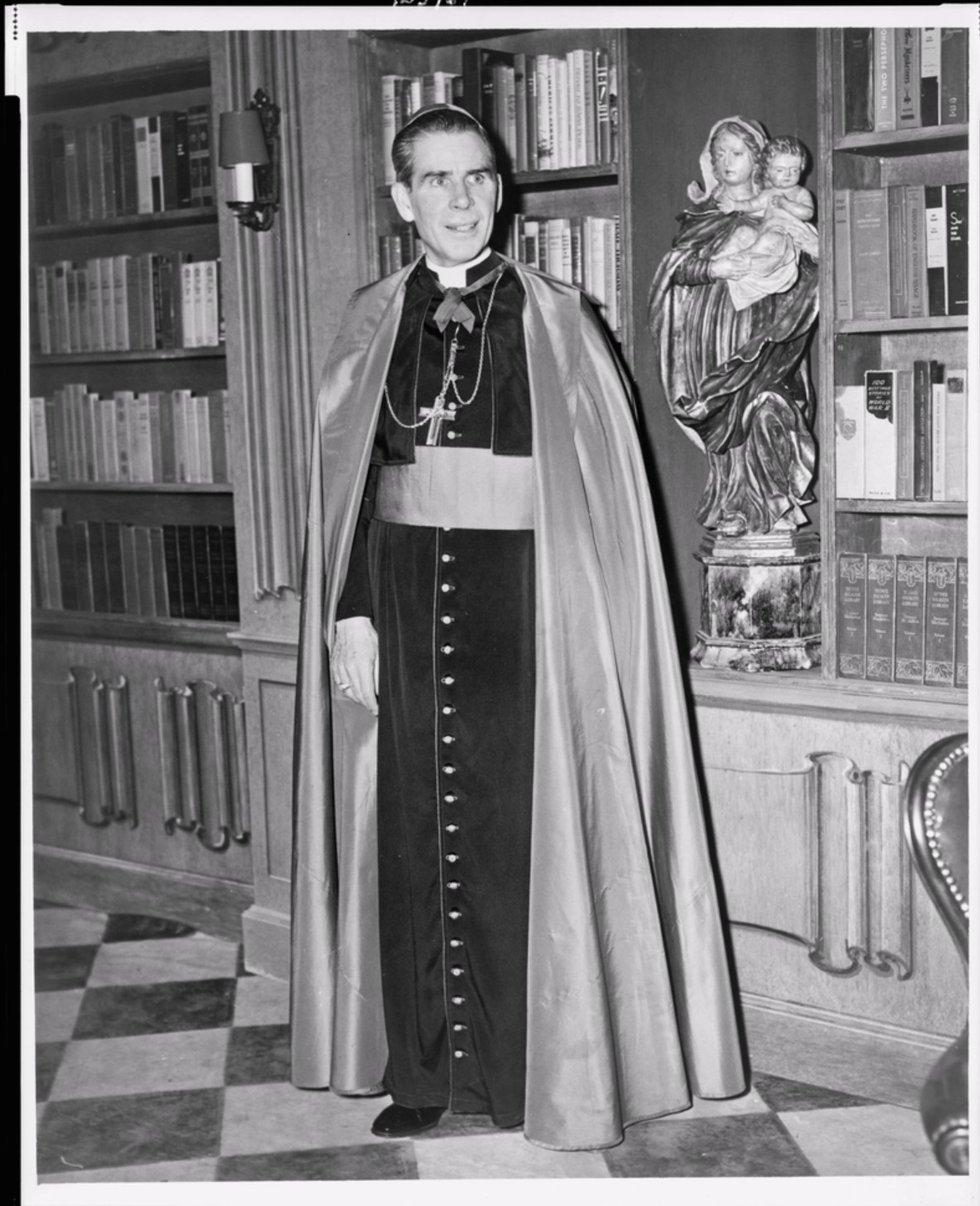
Consecrated as an auxiliary bishop of New York the previous year (1951), this photograph was taken in 1952 on the custom-designed library set of his groundbreaking, Emmy-winning television series, Life Is Worth Living. Dressed in his formal clerical attire—including his cassock, zucchetto, pectoral cross, and flowing structural ferraiolo cape—the image captures him at the absolute height of his national cultural influence. Airing on Tuesday nights on the DuMont Television Network, his unscripted, chalkboard-driven program surprisingly went head-to-head with “Mr. Television” Milton Berle, drawing up to 30 million weekly viewers of all faiths and backgrounds. PHOTO: “Bishop Fulton J. Sheen, full-length” by libraryofcongress is marked with CC0 1.0.

Blessed Bishop Fulton J. Sheen (1895–1979), known for his perfect Catholic school penmanship, rarely made mistakes during his live, unscripted broadcasts.
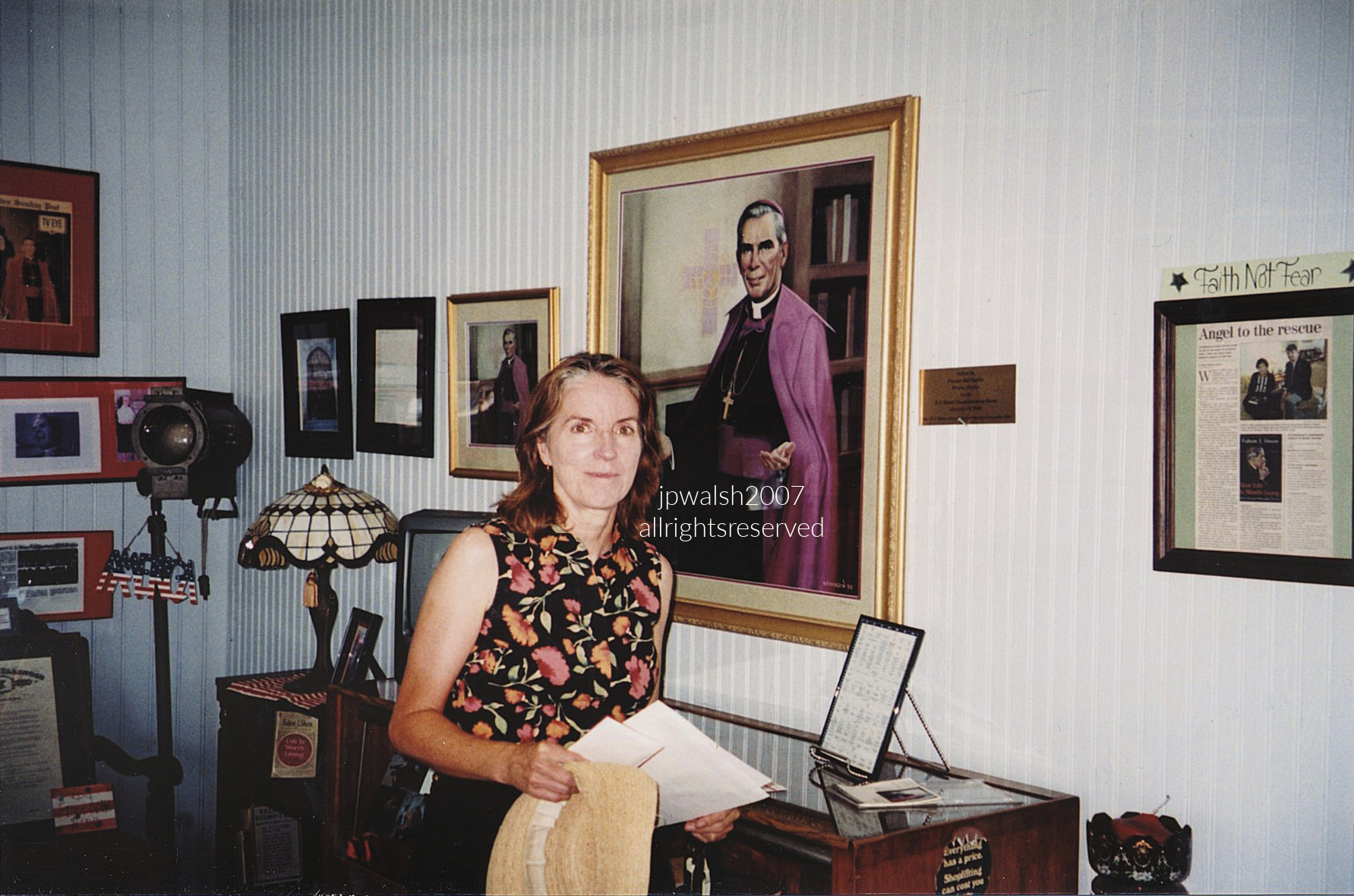
On a personal visit in August 2007 (my wife Deb is pictured) to the Archbishop Fulton John Sheen Spiritual Center and Communication Room, located inside the Historic Railroad Depot in his birthplace of El Paso, Illinois. The vintage studio spotlight on the left, old radios, and typewriter props in the room are deliberate design choices meant to recreate the atmosphere of Bishop Sheen’s pioneering mid-20th-century radio and Emmy-Award-winning television programs like The Catholic Hour and Life Is Worth Living. In October 2000, the museum founder first set up a modest Bishop Sheen exhibit in the “Reading Corner” of the newly restored historic depot. By July 2001 this dedicated, separate large, full-size room officially opened within the depot— the exact space in this photo. At his beatification Mass on September 24, 2026, the papal delegate and presider, Cardinal Luis Antonio Tagle, called Archbishop Fulton J. Sheen a “son of Illinois, son of the United States of America,” and “indeed, son of the world.” Author’s photograph.


The Biblical Roots of Yom Kippur: From the Golden Calf to the Day of Atonement.

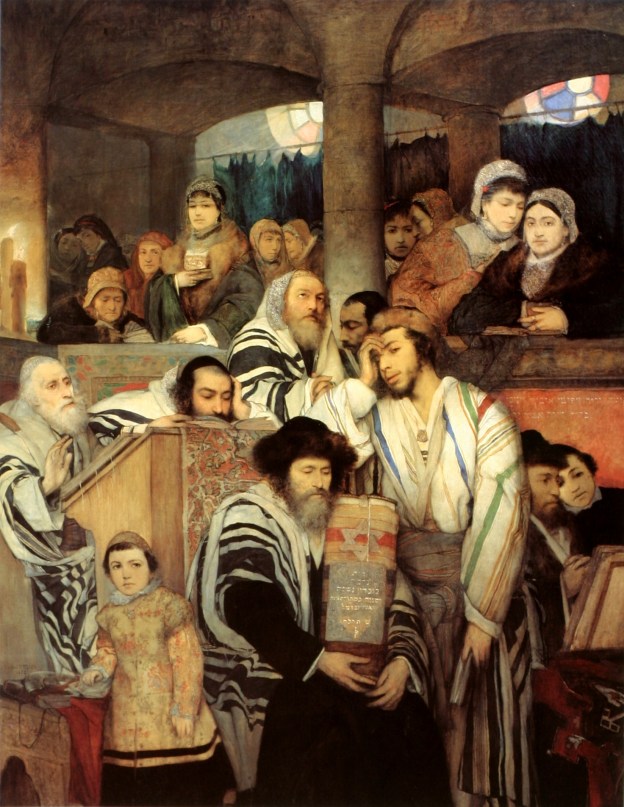
Feature Image: Maurycy Gottlieb, 1878, oil on canvas, 243 cm × 190 cm (96 in × 75 in), Tel Aviv Museum of Art, Tel Aviv, Israel. Jews Praying in the Synagogue on Yom Kippur (cataloged as Jews Praying on the Day of Atonement) serves as a literal flagship masterpiece of the museum’s 16th–19th Century European Art Galleries in the Main Building. Maurycy Gottlieb’s 1878 masterpiece, Jews Praying in the Synagogue on Yom Kippur, captures a pervasive melancholy blending spiritual solemnity with deep personal and historical anguish. Set during Judaism’s holiest day of judgment, the painting lacks religious ecstasy, opting instead for sadness and nostalgia. This somber tone reflects the systemic antisemitism and instability faced by Jews within the Russian Empire’s Pale of Settlement. For Jewish-Polish painter Gottlieb personally, the work serves as tragic farewell; haunted by depression and a broken engagement, he painted a prophetic memorial inscription to himself on the central Torah scroll shortly before his untimely death. Public Domain. see – 16th–19th c. European Art \ Tel Aviv Museum of Art – accessed September 21, 2026.

How Israel’s greatest act of covenant betrayal led to one of the Bible’s most enduring lessons on repentance, forgiveness, and renewal.

The Holiest Day in Judaism

As the Day of Atonement, Yom Kippur is the holiest day in Judaism, marked by prayer, fasting, repentance, and reflection. Every year, Yom Kippur falls on the exact same day of the Hebrew calendar, the 10th day of the seventh month of Tishrei. In 2026, Yom Kippur begins at sundown on Sunday, September 20, and concludes at nightfall on Monday, September 21. The origins of the holy day are rooted in the aftermath of the Golden Calf incident described in Exodus 32, while its formal observance and rituals were established in Leviticus 16.

An overhead view captures a contemporary Jewish congregation preparing for Yom Kippur services inside a historic sanctuary. The vibrant crowd consists of diverse community members of all ages, gathered together in the pews and aisles. Men and women are seen donning traditional kippot (headcoverings) and white tallitot (prayer shawls) while conversing, finding their seats, and entering a collective space for prayer. This bustling preparation signifies the deep community bond and shared responsibility of entering the Day of Atonement, uniting individuals in reflection before the solemnity of the holiday begins. PHOTO:”Preparing for Yom Kippur” by wordsnpix is licensed under CC BY-NC 2.0.

The Golden Calf and Israel’s Great Betrayal

According to Jewish tradition, the first Yom Kippur occurred in the wilderness after the Israelites had left Egypt. While Moses was atop Mount Sinai receiving the Ten Commandments, the Israelites built and worshiped a Golden Calf. This was not merely an act of disobedience. It represented a catastrophic collapse of trust between God and Israel at the very moment their covenant relationship was being established.

Building and worshiping the Golden Calf in Moses’s absence was a direct violation of God’s commandments and an attempt to create a deity that could be more easily controlled, understood, and managed. It was an example of, if not outright idol worship, then the dangerous blending of pagan beliefs and practices with the worship of the God of Israel, a phenomenon known as syncretism. The calf itself was inspired by the bull imagery and deities of the Egyptian pantheon, the very religious system from which the Israelites had recently been delivered.

Breaking the Covenant at Sinai

The magnitude of the offense is difficult to overstate. Just weeks earlier, at the foot of Mount Sinai, the entire nation had heard God audibly proclaim the Ten Commandments, including the first two: Have no other gods before Me and Do not make any graven images. Having witnessed the miracles of the Exodus, crossed the Red Sea, and heard the voice of God for themselves, the people almost immediately reversed course and recreated an image drawn from the religious world they had left behind.

By building and worshiping the calf, the nation shattered the covenant they had just sworn to uphold, breaking the contract almost as soon as it was made. Throughout Scripture, God frequently compares His covenant with Israel to a marriage. Within that framework, the Golden Calf was viewed as nothing less than the spiritual equivalent of committing adultery on a wedding night, a devastating betrayal immediately after the vows had been exchanged.

A Return to Egypt’s Ways

Exodus 32:6 notes how quickly the incident descended into pagan revelry:

“So the next day the people rose early and sacrificed burnt offerings and presented fellowship offerings. Afterward they sat down to eat and drink and got up to indulge in revelry.”

The episode revealed just how rapidly the people reverted to the mindset of Egypt. No sooner had they received God’s commandments than they abandoned them, embracing the revelry, excess, and spiritual chaos associated with pagan worship. By turning to the calf, the people rejected the moral order embodied in the Ten Commandments and drifted back toward the culture where they were slaves and from which God had rescued them.

Yom Kippur’s origins are rooted in the Golden Calf incident, Israel’s repentance, Moses’ intercession, and God’s restoration of the covenant.

Moses Intercedes for the Nation

When Moses descended from Mount Sinai and witnessed the scene, his anger led him to smash the original stone tablets, symbolizing the covenant that the people themselves had broken. Yet Moses did not abandon them. For months he acted as an intercessor, pleading with God to spare the nation from destruction and seeking reconciliation on their behalf.

Forgiveness and the Renewal of the Covenant

When Moses descended the mountain a second time carrying a new set of tablets (Exodus 34:29-35), it signified far more than a replacement of the originals. It represented God’s mercy toward a repentant people and the restoration of the covenant itself (Exodus 34:6-10).

Jewish tradition holds that this reconciliation occurred on the 10th of Tishrei, the very date later designated as Yom Kippur, the Day of Atonement. The holiday therefore commemorates not only repentance but also one of the Bible’s greatest examples of divine forgiveness and covenant renewal.

The Establishment of Yom Kippur

Following this restorative event, God formally established the observance of Yom Kippur in Leviticus 16. It was instituted as a day to cleanse the Tabernacle, and later the Temple, along with the people themselves, from the accumulated sins of the previous year. It was the one day annually when the High Priest could enter the Holy of Holies, the innermost chamber of the sanctuary where God’s presence dwelled.

A unique ritual was performed in which the High Priest symbolically placed the sins of the nation upon a goat, which was then driven into the wilderness. God also commanded the people to “afflict their souls” by fasting and to refrain from all work, a decree intended to endure throughout every generation.

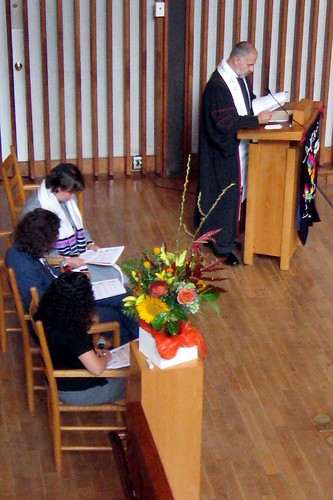
A congregation gathered for a Yom Kippur synagogue service, with a spiritual leader leading the community from a wooden podium. Facing the bimah, congregants wearing white prayer shawls follow along closely in their prayer books. The day is marked by prayer, self-examination and reflection in a synagogue service. This quiet, intimate setting underscores the profound individual and collective introspection core to the Day of Atonement. The service serves to distance worshippers from daily distractions, offering a sacred space to seek forgiveness, realign their morals, and renew their spiritual focus for the year ahead. PHOTO: “Yom Kippur service” by runneralan2004 is licensed under CC BY 2.0.

How Yom Kippur Is Observed Today

The observance of Yom Kippur today includes twenty-five consecutive hours of fasting, intensive prayer, and attendance at synagogue services. Many Jews also dress in white, symbolizing both burial shrouds and the purity of angels, serving as reminders of human mortality, humility, and the need for repentance.

Individuals are expected to seek out those they have wronged during the previous year and ask for forgiveness directly before the holiday begins, because sins committed against another person cannot be resolved without first seeking reconciliation. In the days leading up to Yom Kippur, it is also customary to give Tzedakah (charity) as an expression of repentance and compassion.

From Atonement to Celebration

Once night falls on September 21, 2026, the shofar is sounded and the fast comes to an end. Families and communities gather for a festive meal, and the atmosphere dramatically shifts from solemn introspection to celebration. After a day devoted to repentance, self-examination, and prayer, worshipers emerge with the conviction that God has granted forgiveness, renewed the covenant, and provided a clean slate with which to begin anew.

A large community of students and other members of the community gather around a festive buffet table for a joyous Break-the-Fast celebration following Yom Kippur. Inside a modern communal hall, a diverse group of Jewish youth and adults look on as a woman holds up a traditional Havdalah candle, signaling the official end of the holy day. In the foreground, an abundant spread of bagels, lox, and fresh vegetables awaits the hungry crowd. This celebratory gathering signifies the transition from solemn affliction to communal joy, relief, and renewed life as the community breaks their 25-hour fast together in shared warmth. PHOTO: “Students at Chabad at Texas A&M University Breaking the Yom Kippur Fast in 2019” by AriH972 is licensed under CC BY-SA 4.0.

A Portrait of Artistic Suffering: Manet’s Monumental “Jesus Mocked by the Soldiers” (1865) at The Art Institute of Chicago.

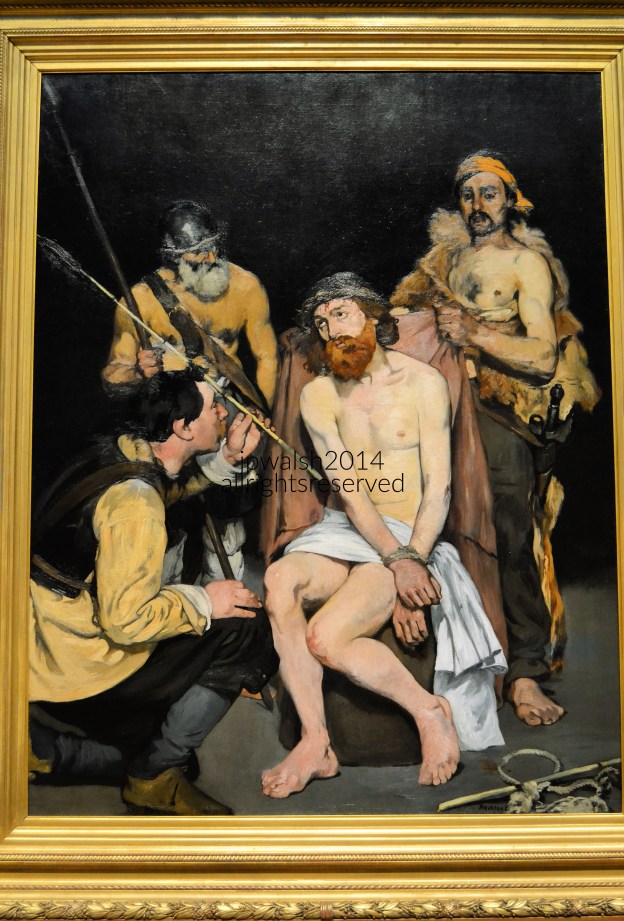
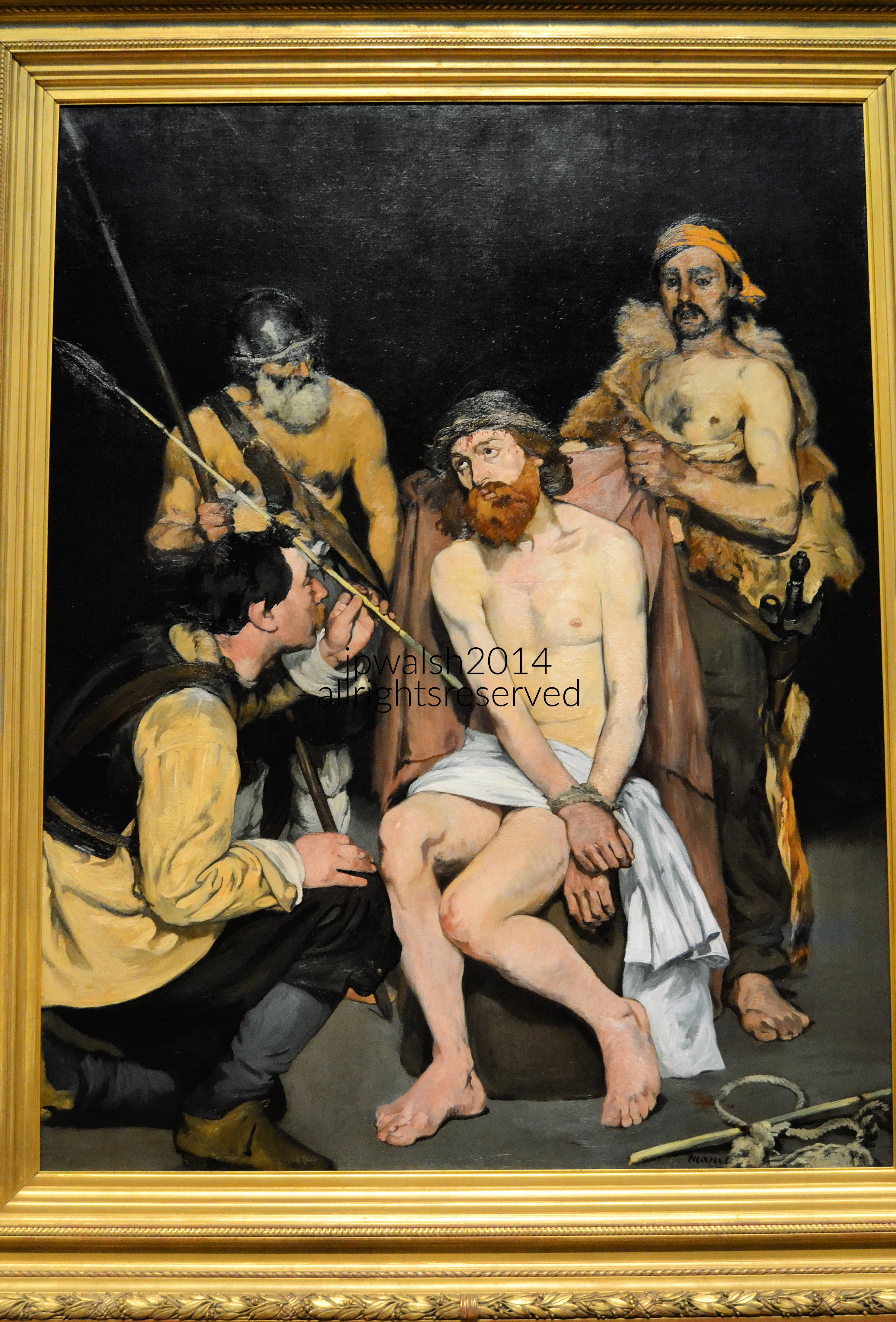
Feature image: Édouard Manet, Jesus Mocked by the Soldiers, 1865, oil on canvas, 190.8 × 148.3 cm (74 7/8 × 58 3/8 in.), transforms a traditional Passion scene into a striking meditation on artistic identity and public judgment. Rather than emphasizing spiritual transcendence, Manet presents Christ with an unsettling immediacy, drawing parallels between the mocked figure and the modern artist subjected to criticism, misunderstanding, and ridicule. Created during a period when Manet’s own work was regularly attacked by critics and rejected by academic convention, the painting blurs the boundary between religious narrative and contemporary experience, turning Christ’s humiliation into a powerful reflection on the costs of innovation and the burden of standing apart from public opinion. The Art Institute of Chicago. See – Jesus Mocked by the Soldiers | The Art Institute of Chicago – retrieved April 18, 2026. May 2014. Author’s photograph, 4.93mb DSC_0577 (1)

Christ as the Modern Artist

Even if Édouard Manet did not literally model Christ’s face on his own in Jesus Mocked by the Soldiers, the painting functions as an unmistakable act of self‑identification. Christ becomes a proxy for the embattled modern artist, a figure exposed, judged, and misunderstood by a hostile public. Manet selects the moment of Christ’s humiliation not to reenact a devotional scene but to stage a parallel between sacred suffering and his own experience before the Salon.

By mid‑century, French painting had turned decisively secular, yet Manet submitted two religious works to the Salons of 1864 and 1865, The Dead Christ with Angels and Jesus Mocked by the Soldiers. Both were accepted, and both were savaged. Critics called them vulgar, ignoble, even “contrary to art.” The public, accustomed to sentimentalized, idealized images of Jesus, recoiled from Manet’s starkly human Christ. Manet admitted to Baudelaire that the hostility unsettled him, even as Degas noted that the uproar made him famous. As Edmond Bazire observed, the Empire preferred idealized piety and bristled at seeing the Passion rendered with unvarnished realism, even when the scene followed Scripture closely.

Painting the Passion in a Secular Age

What, then, is a secular modern artist doing painting the Passion at all? Manet’s answer is to reframe Christ’s suffering as an analogue for the artist’s own embattled position, a truth‑teller punished by a complacent society. While many French moderns had drifted from Catholicism, Manet maintained ties to the faith, and he inherited a Renaissance tradition in which artists increasingly identified with Christ, blurring the line between human and divine as a form of imitatio Christi. By the 1860s this identification was a legitimate, if easily misunderstood, mode of artistic self‑expression. Manet was not conventionally pious, but he was close to several religious thinkers, and his engagement with sacred subjects was sincere enough that these works were conspicuously omitted from the 1884 retrospective after his death.

A Contemporary Christ

What makes Manet’s identification radical is the way he collapses the boundary between sacred history and modern experience. His Christ is rendered with the same realist immediacy, the same studio illumination, the same unidealized physicality that define his contemporary subjects. The result is a figure who is neither fully divine nor fully secular but unsettlingly both, a Christ startlingly contemporary. The frontal, confrontational composition intensifies this effect: Christ appears not as a distant theological symbol but as a vulnerable body exposed to judgment. The ambiguity, devotional image, critique of devotional imagery, or modern psychological drama, was precisely what scandalized a hierarchical society that depended on stable categories.

Édouard Manet’s Jesus Mocked by the Soldiers shocked 1865 Paris Salon critics with its radical portrayal of Christ. According to the Art Institute of Chicago, the painting’s profound ambiguity, heavy emphasis on Christ’s raw humanity, and Manet’s refusal to idealize the sacred figure ignited immediate controversy. Appearing deeply exhausted and vulnerable, Christ conspicuously lacks a traditional halo, forcing viewers to question whether they are looking at a divine being or merely an ordinary man.

Conservatives attacked the work as crude, irreverent, and a total violation of academic standards. Critics were particularly outraged that Manet treated a holy subject with the same blunt realism, flat lighting, and visible brushwork he used for modern, secular street scenes. Public and critical reception was so fiercely negative that the prominent critic Paul de Saint-Victor famously dismissed the masterpiece as “the horrible Ecce Homo by Monsieur Manet.”

The Passion as Artistic Self‑Portrait

The deeper provocation lies in Manet’s intervention into the history of painting. For a secular avant‑garde artist to take up a Passion subject in the 1860s was anomalous; to transform it into a conceptual self‑portrait was unprecedented. Manet’s Christ is not a theological claim but an artistic one: the modern painter, like the historical Jesus, confronts entrenched power, exposes uncomfortable truths, and endures public derision for doing so. The painting becomes a self‑portrait not of Manet’s face but of his artistic condition.

A Mockery of the Mockery

In this light, Jesus Mocked by the Soldiers is not a mockery of the sacred scene but a mockery of the mockery, a doubling of humiliation that implicates both Christ’s tormentors and Manet’s critics. The viewer’s unease arises from this conflation of registers: divine and human, biblical and modern, sacred narrative and artistic identity. Manet’s Christ stands under a bright studio light, stripped of idealization, exposed to judgment, just as Manet stood before the tribunal of the Salon.

The Suffering Artist

The scandal, then, lies not only in the subject but in the claim: that the modern artist, misunderstood and persecuted, belongs to a lineage of suffering truth‑tellers. If not a literal self‑portrait, the painting is unmistakably a portrait of artistic identity, asserting that the modern painter occupies a role once reserved for the sacred.

SOURCES:

Books: Brettell, Richard R. French Salon Artists, 1800–1900. New York: Harry N. Abrams, Inc.; Chicago: The Art Institute of Chicago, 1987. [See pp. 58–62.]
Cachin, Françoise, and Charles S. Moffett. Manet, 1832–1883. New York: The Metropolitan Museum of Art and Harry N. Abrams, Inc., Publishers, 1983. [See pp. 226–229.]

Archival Documents & Reviews: Paris Salon of 1865. Historical Exhibition Records and Archives. Paris, 1865.
Saint-Victor, Paul de. “Le Salon de 1865.” La Presse, May 28, 1865. Cited in the Bibliography Archives of the Art Institute of Chicago.

Websites: ArtWay. “Historical Essays on Manet.” Accessed September 2026. https://artway.eu.
Wikipedia contributors. “Jesus Insulted by the Soldiers.” Wikipedia, The Free Encyclopedia. Accessed September 2026. https://wikipedia.org.