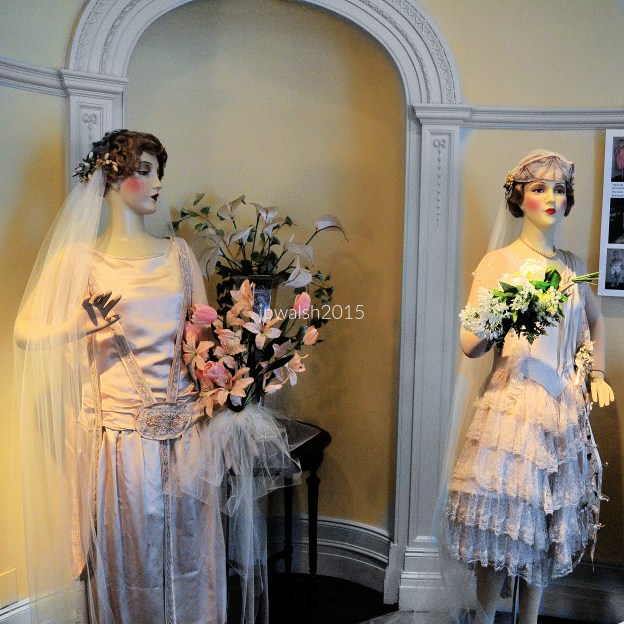
Feature Image: On Saturday, June 7, 1924, Ruth M. Anderson was married in this sleeveless wedding dress (left) to William Noling in Evanston, Illinois. The dress is now on display in the Charles Gates Dawes House in Evanston. Dawes was Vice President of the United States from 1925 to 1929 under President Calvin Coolidge. Author’s photograph (October 2015).
A surviving wedding dress and family home transform a local 1924 wedding into a study of popular culture, showing how the artistic styles and fashions of the Jazz Age reshaped American attitudes toward femininity, modernity, and social convention.
Wedding at the House of the Bride’s family
The Noling-Anderson wedding was held in the house of the bride and her parents, Isak and Jennie (née Johnson) Anderson, at 1035 Ridge Avenue in Evanston. Built in 1914, the house still stands as it did over 100 years ago.
Noling-Anderson Bridal Party Dresses, 1924 in the Charles Gates Dawes House, Evanston, Illinois. October 2015. Author’s photograph. 7.44 mb DSC_0893 (1)
The dress is made of silk satin in an egg shell color. It is accented by an oval medallion with bands also made of silk satin. The medallion is embroidered with faux pearl and other glass beads.
Thoroughly modern flapper style
While her wedding dress was very fashionable for the mid1920’s – sleeveless tops of all shapes and sizes were the rage in 1924 – it probably was not allowed in one of Evanston’s houses of worship. The fact that it was sleeveless and au courant would be deemed by many as risqué for showing too much bare skin inspired by a thoroughly modern flapper style. It was only in 1924, for instance, that the Methodist Episcopal General Conference first lifted its ban on going to the theater as well as dancing though dance music was the radio’s most popular programming.
The bridesmaid dress (right) was the height of women’s style in 1924 – a mainly straight, knee-length skirt gathered slightly or cut with front pleats. Short sleeve and sleeveless tops were the rage in 1924 reflected in Hollywood by the Mack Sennett girls who starred in movies where they pranced on the beach in a chorus line in not much more than bathing caps and short swim suits.
The fashionable bride and her court might have sported the latest style of facial make-up which is hinted at in the display– masklike with garish, even orange, lipstick and heavy red rouge on the cheeks. Popular fashion accessories from 1924 are also evident – pearls knotted at the neck and simple, though elegant, arm bracelets.
Father of the bride was an Evanston banker, local businessman, andSwedish immigrant
The bride’s father, Isak Anderson, was born in Sweden and came to the United States at 20 years old in 1890. In 1891 he married Jennie Johnson and they had Ruth and another child. Ruth’s father was a bank director and partner in a local tailoring business in downtown Evanston at 608 Davis that today is a noodle shop.
The Jazz Age transformed American social customs, fashion, and ideas of modern womanhood, with the bride’s flapper-inspired wedding attire reflecting broader cultural shifts that were fashionable, controversial, and distinctly of their time.
The dance migrated North during the Great Migration. It officially exploded into mainstream American culture on October 29, 1923, when it debuted on Broadway in the all-Black musical revue Runnin’ Wild. The show featured the hit song “The Charleston,” composed by jazz pioneer James P. Johnson, which provided the fast, syncopated 4/4 rhythm that defined the dance. The Charleston was most fashionable during the “Roaring Twenties” (1923–1929), reaching its absolute peak popularity between 1926 and 1927.
It was most popular in major urban centers—particularly New York City, Chicago, Paris and London, where young women called flappers wore short dresses, rolled down their stockings, and kicked up their heels to flout traditional social etiquette
The original Charleston craze effectively ended as a mainstream fad with the onset of the Great Depression in 1929. However, it didn’t completely disappear. The Charleston’s fast kicks, hand-to-knee swivels, and loose movements were absorbed into newer, more complex swing dances, most notably, for the Lindy Hop and the Jitterbug in the 1930s and 1940s.
They served “Prohibition highballs”
With Prohibition starting in 1920, guests at the wedding may have been served the latest popular highball whose recipe called for fruit juice and raw eggs. Their morning might have started with a bowl of Wheaties at breakfast, since the cereal of champions made its first appearance in 1924.
Wearing that dress Ruth Anderson married William Noling in this house at 1035 Ridge Avenue in Evanston, Illinois, on June 7, 1924. May 2024. Author’s photograph. 92% 7.81 mb
The bride’s attire reflected contemporary flapper fashion, including higher hemlines and sleeveless styles.
SOURCES: Charles G. Dawes House. Evanston, Illinois. Ernst Wilhelm Olson, The Swedish Element in Illinois: Survey of the Past Seven Decades (Chicago: Peter-Albin-Publishing, 1917), p. 586. Lois Gordon and Alan Gordon, American Chronicle (New Haven: Yale University Press, 1999), pp. 230–38. Thomas G. Aylesworth and Virginia Aylesworth, Chicago: The Glamour Years (1919-1941) (New York: Gallery Books, 1986), p. 14.
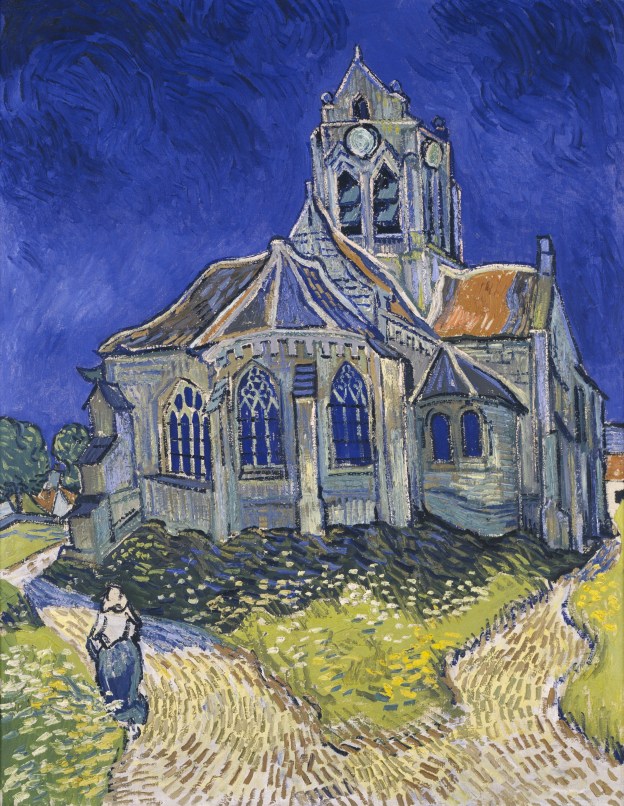
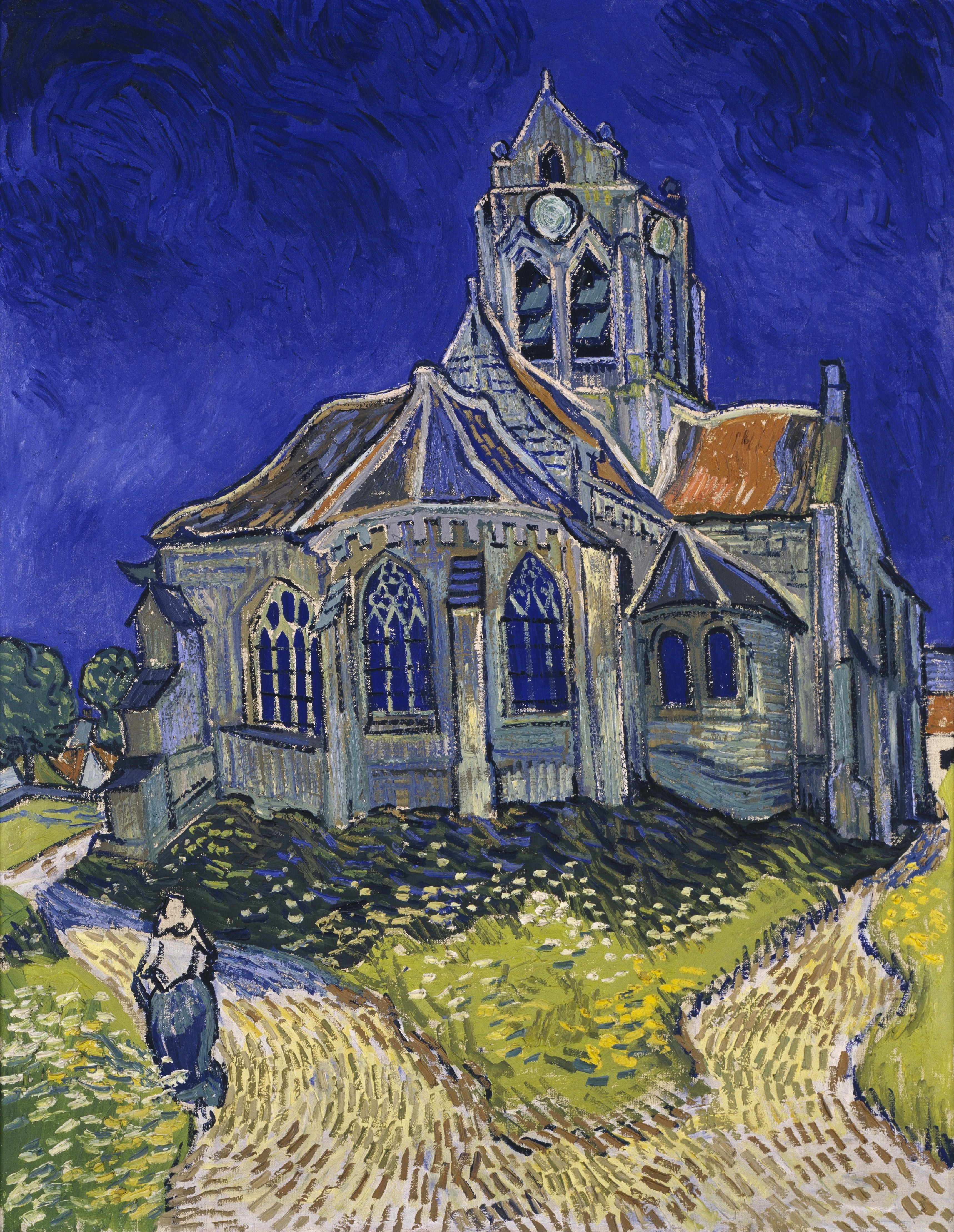
FEATURE Image: Vincent Van Gogh (1853-1890), L’église d’Auvers-sur-Oise, vue du chevet (“The Church at Auvers”), June 1890, oil on canvas, 94 cm x 74 cm (37 in x 29.1 in), Musée d’Orsay, Paris. Vincent Van Gogh (1853-1890), staying in Auvers starting on May 20, 1890, liked the small farm town about 20 miles west of Paris with its artistic pedigree (Corot, Daubigny, Cézanne) and spoke of settling into permanent quarters in the village after renting an attic room in a local café. About his experience at Auvers Van Gogh wrote: “[C]es toiles vous diront ce que je ne sais dire en paroles, ce que je vois de sain et de fortifiant dans la campagne” (“[T]hese canvases will tell you what I can’t say in words, what I consider healthy and fortifying about the countryside.”) During his more than two months stay in Auvers, the artist made more than 100 drawings and paintings of local landscapes, gardens, and village scenes such as its Catholic church. On the evening of July 27, 1890, Van Gogh had acquired a pistol and shot himself in the chest near the Auvers chateau. After languishing in pain for two days, he died on the morning of July 29, 1890. Vincent Van Gogh was 37 years old. Public Domain.
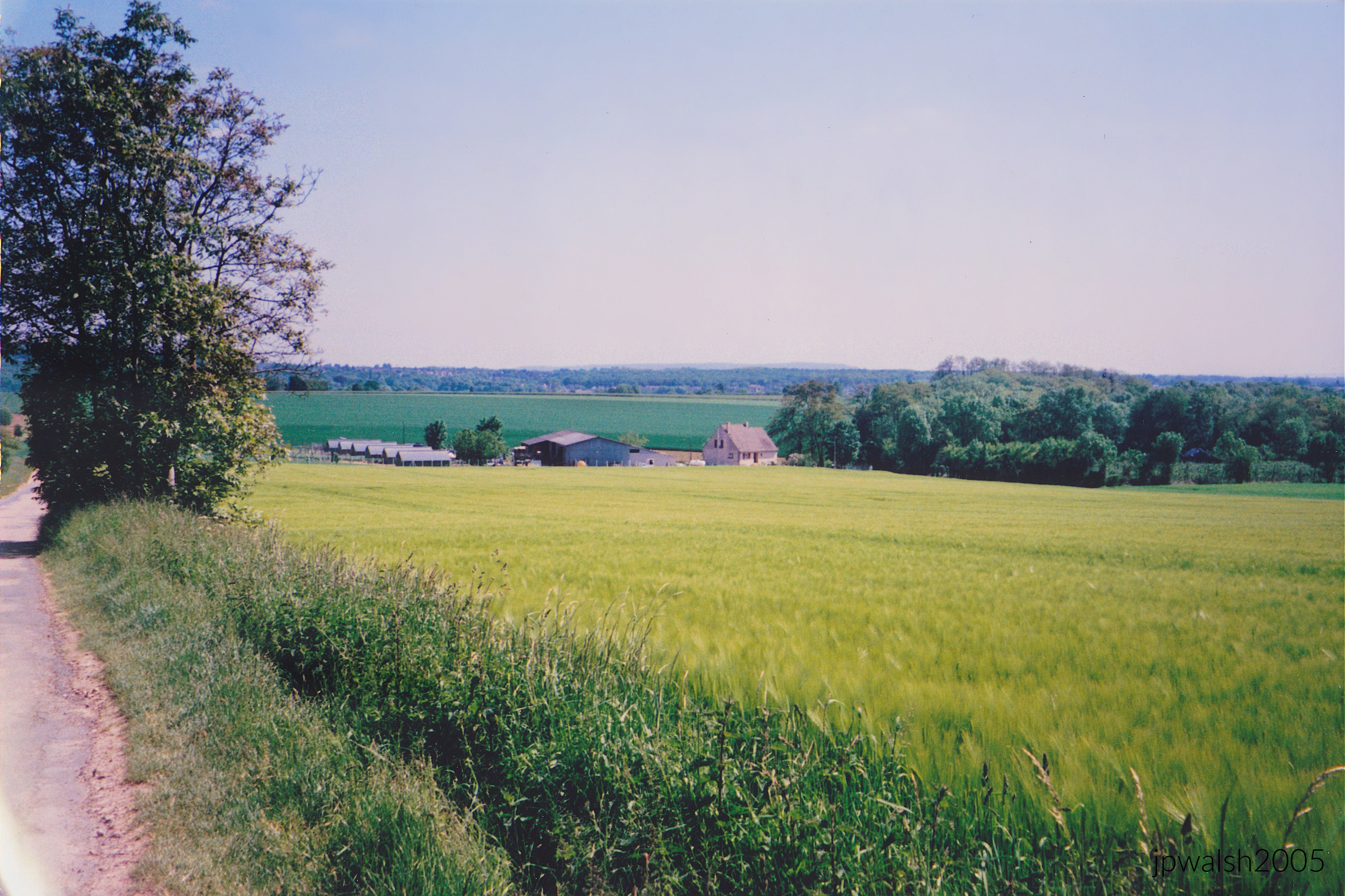
Auvers-sur-Oise was the decisive final chapter of Vincent van Gogh’s life and career, where in just over two months he created an extraordinary body of work that secured his enduring place in artistic modernism, even as his life moved toward its tragic conclusion. In May 2005 I made a pilgrimage to the town where I visited the places associated with the artist’s final days, including Ravoux Inn, Dr. Gachet’s house, the church at Auvers, the wheat fields, and his grave.
Vincent van Gogh, Garden in Auvers, July 1890, oil on canvas, 64×80 cm, private collection. Though Van Gogh died in July 1890 his modernist artistic influence forged deep ties with the European avant-garde art movement throughout the 1890’s and beyond. Public Domain.
By John P. Walsh
Auvers-sur-Oise: Van Gogh’s Final Home
In a peripatetic life, the last place where Vincent Van Gogh (1853-1890) lived was Auvers-sur-Oise, a small commune, a short distance northwest of Paris. Since Auvers was on a rail line in the orbit of Paris, Van Gogh moved to the small town with its farming community so he could live independently yet remain close to his art dealer younger brother Theo Van Gogh (1857-1891) who lived with his wife and family in the hustle and bustle of Paris. After leaving Saint-Paul Asylum, Saint-Rémy, where Van Gogh had admitted himself as a patient since May 1889, he traveled to the French capital in May 1890 where he visited Theo and Jo. He was then onwards to Auvers where, by arrangement of Theo, the artist was under the supervision of Dr. Paul Gachet (1828-1909), a mental health physician who was also an avid modern art collector and had his house, family and practice in the town.
After leaving the asylum at Saint-Rémy in May 1890, Van Gogh settled in Auvers-sur-Oise under the supervision of Dr. Paul Gachet while remaining close to his brother Theo in Paris.
Author at the graves of Vincent Van Gogh (1853-1890) and his brother, Paris art dealer Theo Van Gogh (1857-1891). They have been side by side in the Auvers cemetery in France since 1914. Photo: Author’s collection. May 2005.
During his stay from May to July 1890, Van Gogh produced more than 100 drawings and paintings, making it one of the most prolific periods of his career.
Life at the Ravoux Inn
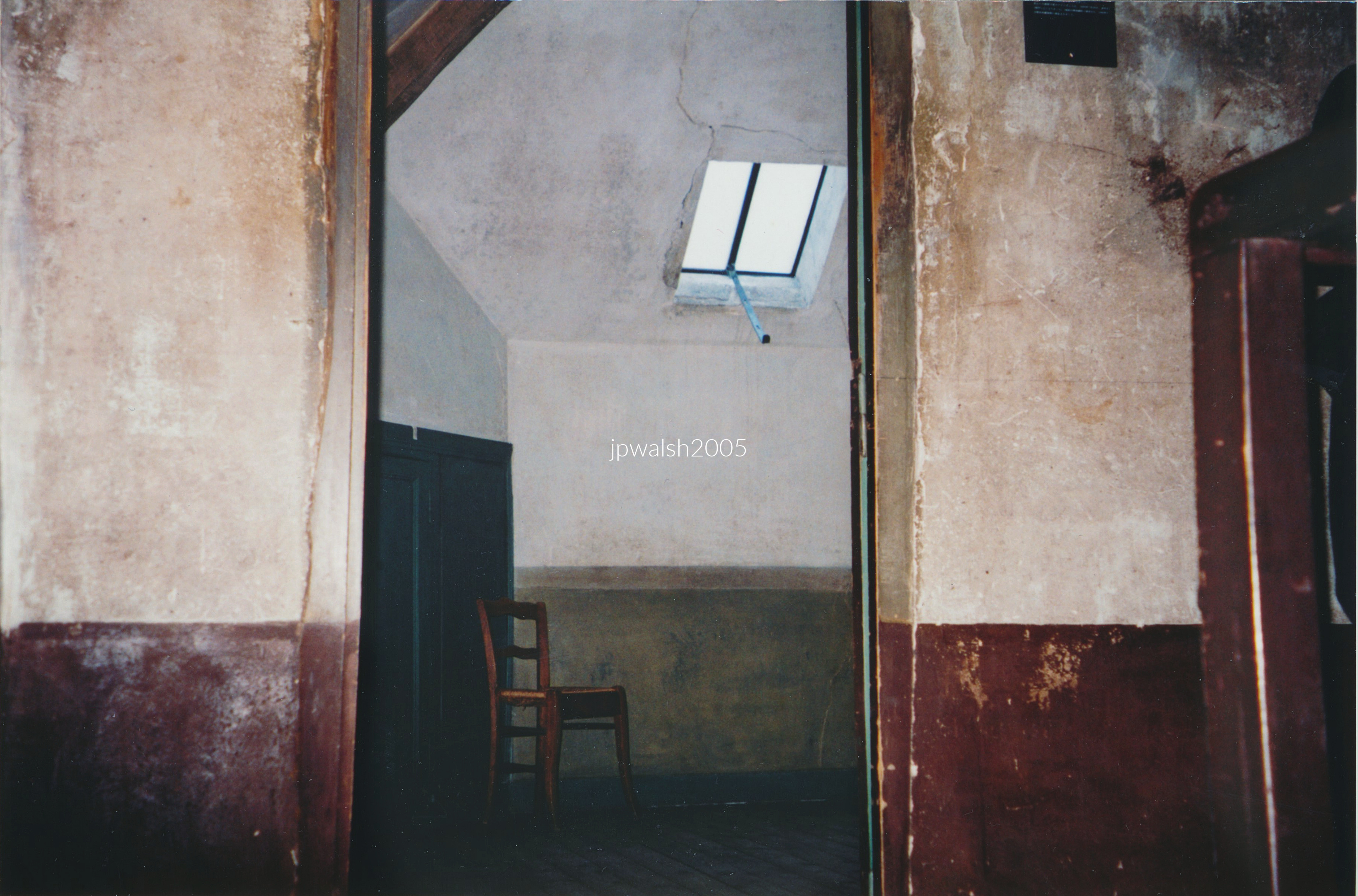
Vincent arrived to Auvers on May 20, 1890 and stayed in the Saint-Aubin hotel until he moved into a rented attic room in a café of Arthur Gustave Ravoux and his wife, Adeline Louise Touillet, who charged him three and a half francs per night for room and board. Located in Place de la Mairie, a 5-minute walk from the train station, the artist’s daily schedule involved rising at dawn and going outside to draw and paint.
Entrance to Vincent Van Gogh’s rented room in Ravoux’s inn in Auvers. It was here that the artist lived for two months in the town. This is the same room is where Van Gogh returned after he shot himself on July 27, 1890, and died two days later here surrounded by family and friends. Author’s photograph, May 2005.
After roaming the town where he made friends of villagers, visited Dr. Gachet’s, and journeyed into nearby farm fields, Van Gogh returned to Ravoux’s café for lunch that was served at noon. In the afternoon he might sometimes work in the “painters’ room” at the inn or visit with other painters staying at the inn, such as compatriot Anton Matthias Hirschig (1867-1939) and Spanish painter Martinez de Valdivielse. These acquaintances proved more significant for history insofar as they provided eyewitness testimony of Van Gogh’s death and funeral. Following dinner at Ravoux’s, Van Gogh climbed the inn’s simple staircase to his single room in the center of the attic landing and retired at about nine in the evening.
Vincent Van Gogh, View of Vessenots near Auvers, May 1890, oil on canvas, 55×65 cm, Thyssen-Bornemisza, Madrid, Spain. Public Domain.
Fields of Auvers. Author’s photograph, May 2005.
Vincent Van Gogh, Daubigny’s Garden, midJune 1890, oil on canvas, 51 cm x 51.2 cm, Van Gogh Museum, Amsterdam. Other versions of Daubigny’s Garden are in the Hiroshima Museum of Art in Japan. see – https://www.hiroshima-museum.jp/en/collection/eu/vangogh.html – retrieved March 11, 2024) and the Van Gogh Museum in Amsterdam (see – https://www.vangoghmuseum.nl/en/collection/s0104V1962 – retrieved March 11, 2024. The square-format flat decorative painting, painted on a simple tea towel that was mounted to canvas, became Van Gogh’s first painted attempt of the garden. It acts as a modernist talisman reminiscent of Paul Sérusier’s 1888 cigar box painting and looks ahead to the decorative landscapes of the Nabis in the 1890’s and of Gustave Klimt (1862-1918) 15 years later. Public Domain.
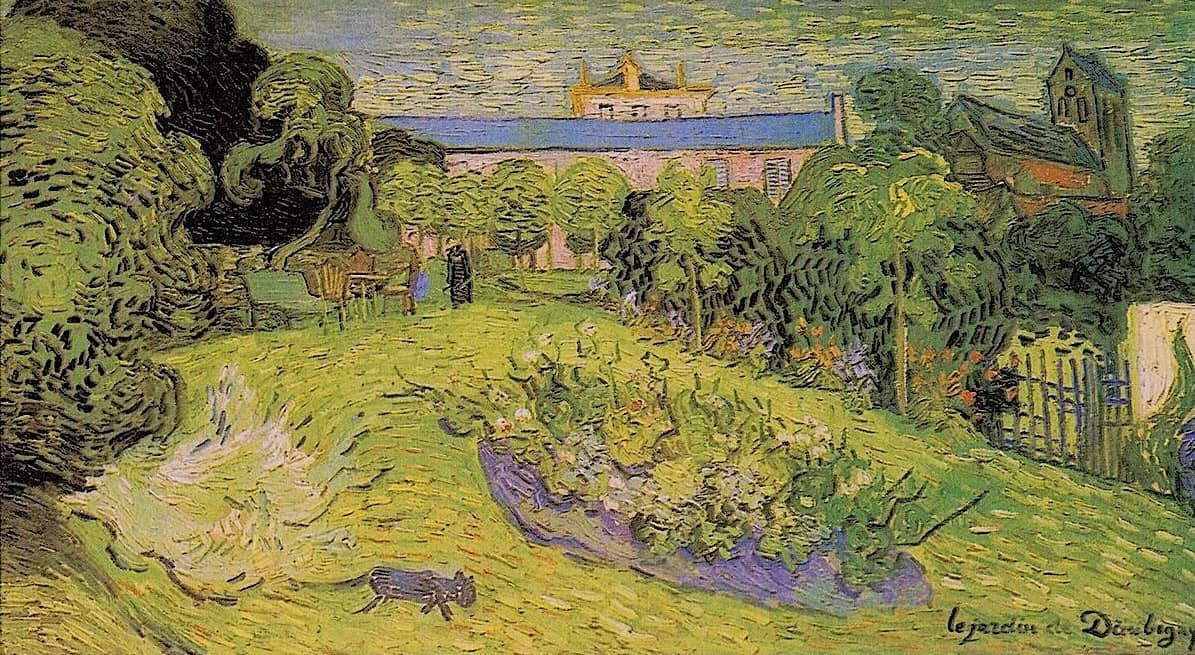
Vincent Van Gogh, Daubigny’s Garden, 1890, oil on canvas, 56 cm × 101 cm (22 in × 39.8 in), Kunstmuseum Basel, Basel, Switzerland. Van Gogh made three versions of the Auvers garden of Barbizon artist Charles-François Daubigny (1817-1878) between May and July 1890. Daubigny, who moved to Auvers in 1860. was a landscape artist who painted en plein aire. A short walk from the Ravoux inn, Daugigny’s widow still lived in the house in Auvers in 1890. For this painting Van Gogh stepped outdoors into Daubigny’s garden to look back towards the house (the Church of Auvers is distinctly drawn in the painting’s upper right corner). Van Gogh admired Daubigny since the 1870’s as he other Barbizon painters such as Jean-François Millet (1814-1875) and Camille Corot (1796-1875). see – https://www.vincentvangogh.org/garden-of-daubigny.jsp – retrieved March 11, 2024. Public Domain.
Van Gogh’s Auvers paintings reveal artistic innovations that anticipated later modernist movements and influenced future generations of artists.
Little has changed in appearance in Auvers from the time of Van Gogh’s stay in May-July 1890. Author’s photograph, May 2005.
Irises bloom along the side of a road in Auvers that leads to Dr. Gachet’s house. Author’s photograph, May 2005.
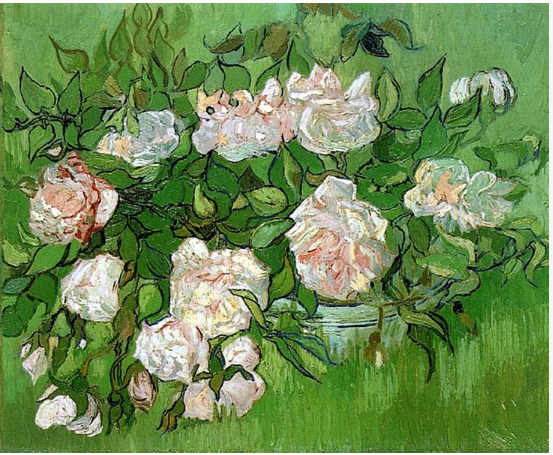
Vincent Van Gogh, Still Life Pink Roses, June 1890, oil on canvas, 32 x 40.5 cm, Ny Carlsberg Glyptotek, Copenhagen, Denmark. Public Domain.
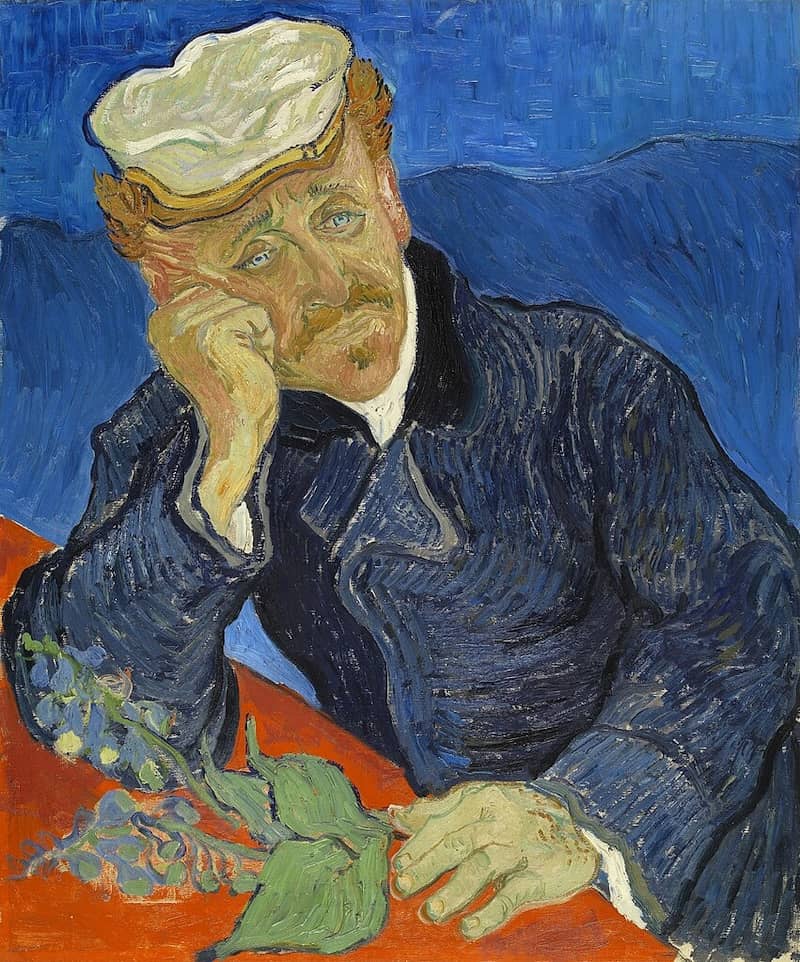
Van Gogh, Dr. Gachet (second version), June 1890, Musée d’Orsay, Paris. As a token of friendship, Van Gogh painted two authenticated versions of Dr. Gachet’s portrait in June 1890 at Auvers. Van Gogh came to Auvers because of the role Dr. Gachet played as the artist’s therapist. The well-regarded physician was an avid modern art collector and painter who hadparticipated in art circles since the 1850’s with Gustave Courbet (1819-1877). Dr. Gachet was instrumental in having Paul Cézanne come to Auvers to paint in 1873. In anticipation of Vincent’s arrival from Saint-Rémy, it was Camille Pissarro (1830-1903) living in Pontoise who recommended Dr. Gachet to Theo Van Gogh. Vincent Van Gogh thought fondly of Dr. Gachet as a brother. When Dr. Gachet visited Theo in Paris in early July 1890, he told him he believed that Vincent was “completely recovered” and “that there need be no fears of a further attack” (quoted in Complete Paintings, p. 718). Van Gogh saw Dr. Gachet as another brand of eccentric and painted him in these portraits as a deep thinker who reflected a sensitive nature tending to melancholy. Public Domain.
Van Gogh, Portrait of Adeline Ravoux, June 1890, oil on canvas, 52x 52 cm, Cleveland Museum of Art. In their therapeutic conversations, Dr. Gachet in June 1890 encouraged Van Gogh to make portraits of local sitters in Auvers. Van Gogh had done portraits of Arlesiens in the “Studio of the South” in 1888 and many self-portraits. Adeline Ravoux was the 15-year-old daughter of Van Gogh’s Auvers innkeepers. About one month after this portrait was made, the girl with her parents witnessed Vincent’s return to the café after he shot himself. Later, in a memoir she wrote: “Vincent walked bent, holding his stomach, again exaggerating his habit of holding one shoulder higher than the other. Mother asked him: “M. Vincent, we were anxious, we are happy to see you to return; have you had a problem?” He replied in a suffering voice: “No, but I have…” He did not finish, crossed the hall, took the staircase and climbed to his bedroom.” see – http://www.vggallery.com/misc/archives/a_ravoux.htm – retrieved March 11, 2024. Public Domain.
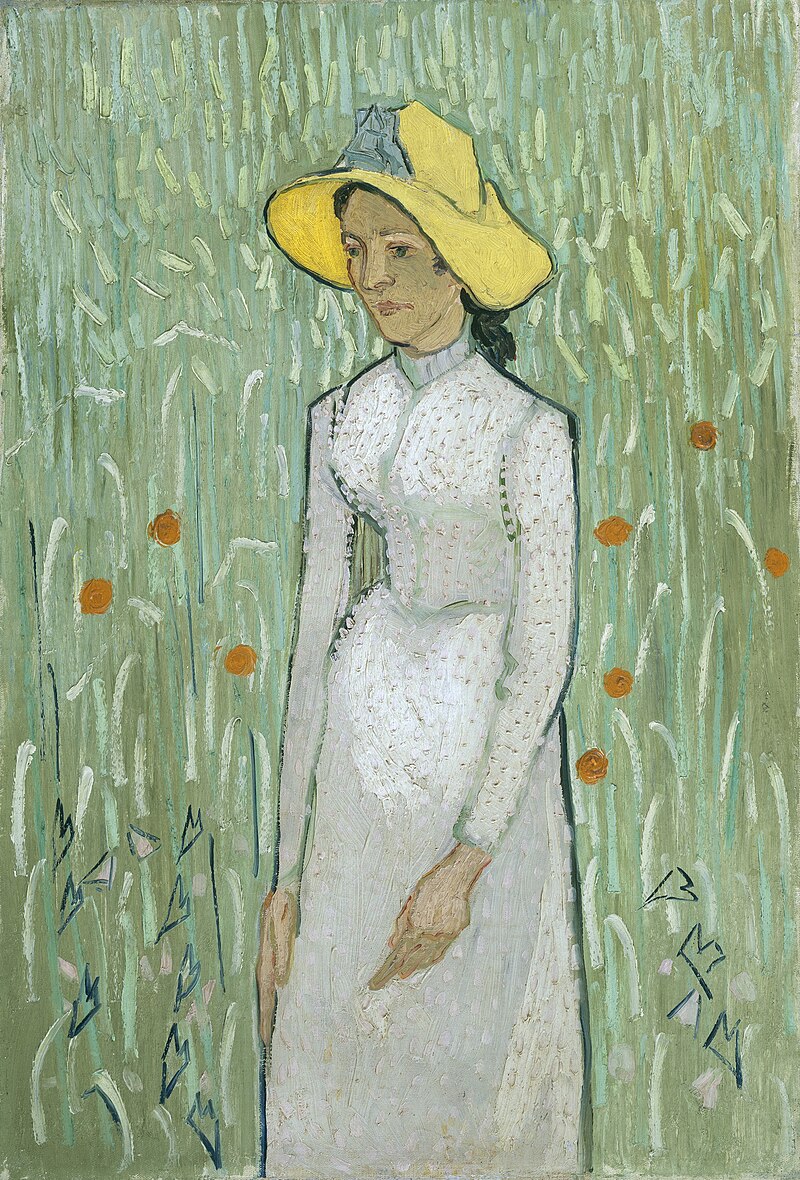
Van Gogh, Young Girl Standing Against Wheat, late June 1890, 66.7 x 45.8 cm (26 1/4 x 18 1/16 in.), National Gallery of Art, Washington, D.C. The painting’s lack of horizon creates a flat wall behind the sitter who appears in close proximity to the picture plane as she fills the pictorial space. Van Gogh shadowed her face under her hat and gave her a “distant, unfocused” gaze. All of these elements contribute to the portrait’s emotional distance. see – Painting the Difference: Sex and Spectator in Modern Art by Charles Harrison, University of Chicago Press, 2006. Public Domain.
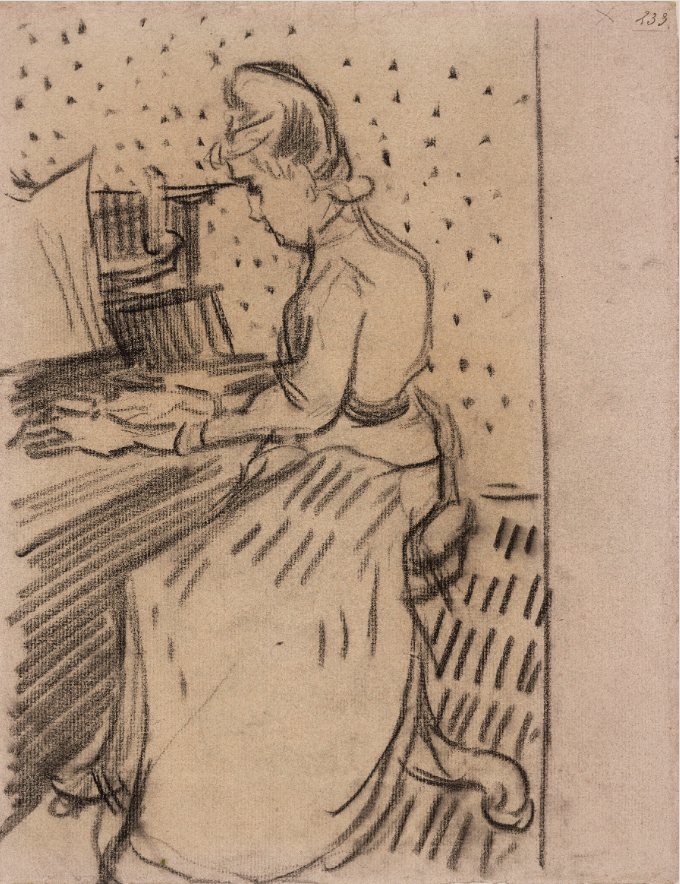
Van Gogh, Marguerite Gachet at the Piano, June 1890, chalk on paper, 30.5 cm x 23.8 cm, Van Gogh Museum, Amsterdam. Marguerite Gachet was the daughter of Dr. Gachet. In this sketch which resulted in a similarly composed painting, the sitter had recently turned 21 years old. For the painting that is today in the Kunstmuseum Basel, Van Gogh made two sketches in late June 1890. https://www.vangoghmuseum.nl/en/collection/d0427V1962r – retrieved March 11, 2024. Public Domain.
Van Gogh, L’église d’Auvers-sur-Oise, vue du chevet (“The Church at Auvers”), June 1890, oil on canvas, 94 cm x 74 cm (37 in x 29.1 in), Musée d’Orsay. Public Domain.
As in Van Gogh’s 1890 painting above, the church at Auvers (“Notre-Dame-de-l’Assomption”), situated in a bright midday sun, sits in deep shadow. Author’s photograph, May 2005.
An Extraordinary Final Burst of Creativity
Van Gogh proved quite productive in Auvers, painting several notable canvasses in and around the town and countryside, particularly landscapes and other outdoor subjects en plein aire. In these two months, the painter produced 74 paintings and 33 drawings, including the portraits of Dr. Gachet and Adeline Ravoux, The Church of Auvers, and Field of Wheat with Crows. In a letter of around July 10, 1890, Van Gogh wrote to Theo and Jo that he painted three large canvases at Auvers since visiting them in Paris on July 6, 1890. During that visit the artist also met with Henri Toulouse-Lautrec (1864-1901) and art critic Gabriel-Albert Aurier (1865-1892). In addition to Daubigny’s Garden, these large canvasses likely included Wheatfield with Crows and Wheatfields Thunderclouds (both Van Gogh Museum Amsterdam). Van Gogh described them as “immense stretches of wheatfields under turbulent skies…searching to express sadness [and] extreme loneliness” (“immenses étendues de blés sous des ciels troublés… chercher à exprimer de la tristesse, de la solitude extreme”). See – https://vangoghletters.org/vg/letters/let898/print.html – retrieved March 11, 2024.
Vincent Van Gogh, Sorrowing Old Man (“At Eternity’s Gate”), 1890, 80 cm × 64 cm (31.5 in × 21.2 in), oil on canvas, Kröller-Müller Museum, Otterlo, The Netherlands. The painting was completed at St. Rémy shortly before Van Gogh moved to Auvers-sur-Oise.
Van Gogh, Wheatfield with Crows. July 1890, oil on canvas, 50.2 cm × 103 cm (19.8 in × 41 in), Van Gogh Museum, Amsterdam. Many have claimed this to be Van Gogh’s last painting.
At the wheatfield in Auvers where Van Gogh painted “Wheatfield with Crows,” one of his last paintings, in July 1890. Author’s photograph, May 2005.
Van Gogh, Wheatfield Thunderclouds, July 1890, oil on canvas, 50.4 cm × 101.3 cm (19.8 in × 39.9 in), Vincent Van Gogh Museum, Amsterdam.
Auvers fields. Author’s photograph, May 2005.
The Tragic Events of July 1890
On July 27, 1890, Vincent, as he did each day, went into the fields to paint. Though the artist appeared to be in good spirits, the artist shot himself later that day near the chateau after going for a walk towards evening. Though able to walk the 10 minutes back mortally wounded to Ravoux’s inn, he told them nothing upon entering the café. The Ravoux’s, sensing something was wrong, called for Mazery, the village doctor and Dr. Gachet. Though these doctors bandage the wound, Van Gogh’s condition is inoperable. In the hot attic room, Van Gogh suffered into the next day, when Theo was sent for. He arrived immediately on July 28 from Paris to be by his brother’s side. Van Gogh died the next morning of July 29, 1890.
Funeral in the Wheat Fields
This suicide sent ripples of shock through the village, as some townspeople had witnessed these events. During my visit to Auvers in May 2005, after exiting Van Gogh’s room where he died, I told the innkeeper that the story was sad (“c’est triste”). She countered, “C’est emouvante” (“It’s moving”). Vincent was buried the next day, July 30, 1890, in Auvers’ new graveyard. His funeral was attended by Theo, Dr. Gachet, the Ravoux’s, assorted villagers, and friends from Paris. These last included artists Emile Bernard (1868-1941), Charles Laval (1862-1894), and Lucien Pissarro (1863- 1944), Camille Pissarro’s son. Petit boulevard art dealer and art materials supplier Julien (Père) Tanguy (1825-1894) was also in attendance. Van Gogh’s casket was strewn with yellow dahlias and sunflowers and Dr. Gachet gave remarks as did Theo Van Gogh. Later, in a letter to his wife, Theo wrote about the proceedings: “[Vincent] was buried in a sunny spot among the cornfields, and the cemetery does not have that unpleasant character of Parisian cemeteries.” (see- Kort geluk, 1999, p. 281). The mortal remains of Van Gogh were transported to the cemetery by a rented hearse from the next town because Auvers’ Catholic priest would not allow the community’s hearse to be used. A proposed church service was also cancelled. The homiletics were left to Dr. Gachet who said: “Vincent was an honest man and a great artist, and there were only two things for him – humanity and art. Art mattered to Vincent Van Gogh more than anything else and he will live on through it” (quoted in Complete Paintings, p. 719).
Graves of Vincent and Theo Van Gogh, Auvers-sur-Oise, France. Author’s photograph, May 2005.
Eyewitness Accounts of Van Gogh’s Last Days
Three days after the funeral, Emile Bernard wrote to Aurier about “our dear friend Vincent.” Aurier had written in January 1890 about the intense fixity of Van Gogh’s art. The art critic conjectured that it may be the catalyst for change in French art. In his essay entitled Les Isolés: Vincent van Gogh published in Mercure de France, Aurier prophesied for an artist-savior figure: “A man must come, a Messiah, a sower of Truth, to rejuvenate our geriatric art, indeed perhaps the whole of our geriatric, feeble minded, industrial society” (quoted in Complete Paintings, p. 698). Van Gogh, aware of these statements, did not think he was Aurier’s man. On August 2, 1890 Emile Bernard wrote to Aurier: “On Sunday evening [Vincent] went out into the countryside near Auvers, placed his easel against a haystack and went behind the chateau and fired a revolver shot at himself. Under the violence of the impact (the bullet entered his body below the heart) he fell, but he got up again, and fell three times more, before he got back to the inn where he was staying (Ravoux, place de la Mairie) without telling anyone about his injury. He finally died on Monday evening, still smoking his pipe which he refused to let go of, explaining that his suicide had been absolutely deliberate and that he had done it in complete lucidity…. On the walls of the room where his body was laid out all his last canvases were hung making a sort of halo for him and the brilliance of the genius that radiated from them made this death even more painful for us artists who were there. The coffin was covered with a simple white cloth and surrounded with masses of flowers, the sunflowers that he loved so much, yellow dahlias, yellow flowers everywhere. It was, you will remember, his favorite color, the symbol of the light that he dreamed of as being in people’s hearts as well as in works of art….The sun was terribly hot outside. We climbed the hill outside Auvers talking about him, about the daring impulse he had given to art, of the great projects he was always thinking about, and of the good he had done to all of us. We reached the cemetery, a small new cemetery strewn with new tombstones. It is on the little hill above the fields that were ripe for harvest under the wide blue sky that he would still have loved…perhaps.Then he was lowered into the grave…Then we returned. Theodore Van Ghog [sic] was broken with grief; everyone who attended was very moved, some going off into the open country while others went back to the station…” see – https://www.webexhibits.org/vangogh/letter/21/etc-Bernard-Aurier.htm – retrieved March 11, 2024.
Van Gogh, Two Women Crossing the Fields, July 1890, oil on paper on canvas, Marion Koogler McNay Art Museum, San Antonio, Texas.
By contrast, Anton Hirschig, the Dutch artist who roomed next door to Van Gogh at Ravoux’s, wrote a letter much later, in 1911, to Albert Plasschaert (1874-1941) in which he recounted a more terrible scene following Van Gogh’s shooting himself. Hirschig wrote: “He lay in his attic room under a tin roof. It was terribly hot. It was August. He stayed there alone for some days. Perhaps only a few. Perhaps many. It seemed to me like a lot. At night he cried out, cried out loud. His bed stood just beside the partition of the other attic room where I slept: Isn’t there anyone willing to open me up! I don’t think there was anyone with him in the middle of the night and it was so hot. I don’t think I ever saw any other doctor like his friend the retired army doctor: It’s your own fault, what did you have to go kill yourself for? He didn’t have any instruments this doctor. He lay there until he died.”
The Beginning of a Legacy
Theo Van Gogh died in Holland on January 25, 1891, nearly 6 months to the day after Vincent’s death. Theo was buried in Holland but exhumed and reinterred next to his older brother Vincent’s grave in Auvers cemetery in 1914. While Vincent Van Gogh, the man, was never larger than life, as an artist he produced an explosion of life on paper and canvas. Van Gogh came to art late (30 years old in 1883) and produced incessantly for the next 7 years. His oeuvre was beautifully powerful, and none of it more remarkably for the future of modernism than that done in Auvers-sur-Oise in May to July 1890.
SOURCES –
Harrison, Charles. Painting the Difference: Sex and Spectator in Modern Art. Chicago: University of Chicago Press, 2006.
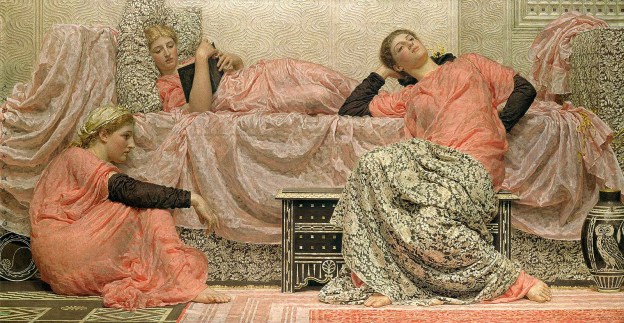
FEATURE image: Albert Joseph Moore (1841-1893), READING ALOUD, 1884, oil on canvas, 42.24 x 81 in., Glasgow Art Gallery & Museum.
The artist: Albert Joseph Moore (1841-1893).
Albert Joseph Moore was one of the leading figures of the British Aesthetic Movement, creating meticulously crafted paintings that placed beauty, harmony, color, form, and decoration above narrative or moral instruction. His idealized female figures inhabit timeless settings that blend classical inspiration with Victorian artistic experimentation, making him a unique voice in nineteenth-century British art.
Albert Moore: Life and Artistic Legacy
Albert Joseph Moore was born in 1841 into a family of artists in North Yorkshire in England. Moore through his own advanced aesthetic experiments in the milieu of theoretical and practical advancements of mid-to-late 19th century modern art in England and France – such as a systematic analysis of nature, mathematical plotting, and principles for quintessential combinations of color, line and form – created art that was, in formal terms, in its conception and execution, on the cutting edge of abstraction that would continue to develop and blossom into early 20th century Cubism. Moore’s art gained the respect of other progressive artists (Moore was called “a painter’s painter”), patrons and collectors, if not always the critics and contemporaries who viewed Moore’s work as merely decorative. Moore was actively collected in his lifetime and exhibited regularly in major venues such as the Royal Academy. Unmarried and of a lifelong independent disposition, Moore died in 1893 at 52 years old, having just completed his last monumentally ambitious artwork (“The Loves of the Winds and the Seasons,” Blackburn Museum and Art Gallery, posted below) a handful of days before. Several of Moore’s pictures are now in public collection throughout the UK, including the Tate and the British Museum in London.
Moore became a major representative of the Aesthetic Movement, often summarized by the ideal of “art for art’s sake.”
Azaleas (1867-1868)
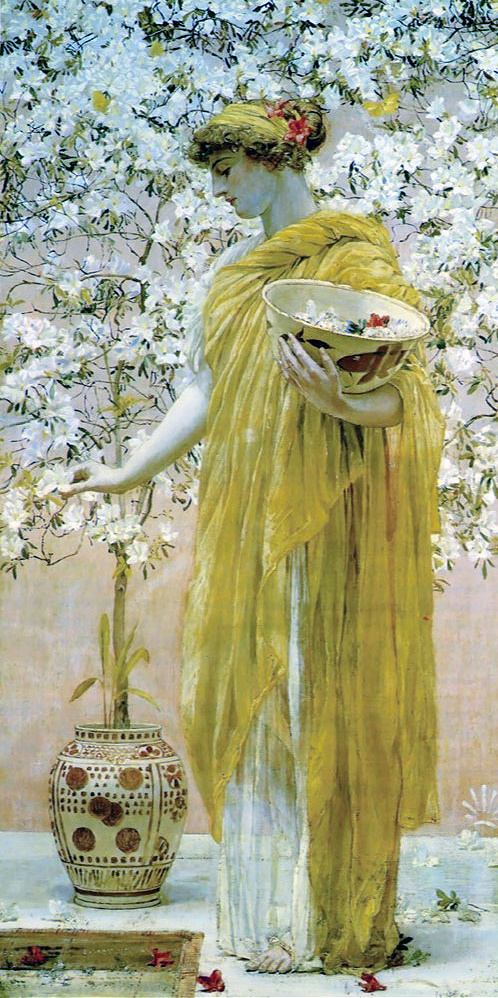
Albert Joseph Moore (1841-1893), AZALEAS, 1867, Hugh Lane Municipal Gallery of Modern Art, Dublin, Ireland.
Azaleas was a popular artwork by Albert Moore for its harmonies of color and the “Greek refinement” that the artist infused into his work. This bigger-than-life-size canvas called Azaleas was painted in 1867, exhibited in 1868 and demonstrates the artist’s ability to represent the human figure on a grand scale.
The featured works depict idealized women in dreamlike environments that feel both classical and modern. His paintings emphasize decorative harmony, color relationships, pattern, and graceful composition rather than storytelling.
Geometry and Preparation
The 26-year-old artist had some architectural design experience in theory and practice and used this in his preparatory process. This artwork incorporated ideal geometry along with typical academic methods.
Moore’s process followed, first, making studies of the nude figure and draped figure. Moore next made a larger-than-life-sized full-scale nude figure cartoon which, at this stage, was informed by geometric abstraction of the figure in a setting guided by, or through, the milieu of the object in the artist’s hands.
The geometric quality guided the composition rather than was externally imposed by the artist. Moore’s “system of line arrangement” sought the directions of the prominent lines of the composition so to plot parallels of them throughout the drawing resulting in a statuesque yet corporeally vivacious figure.
Nature, specifically the landscape, ultimately served as the inspiration for the manifestation of line parallels and optical balance rather than the mathematically ideal. Moore’s geometric construct and its interplay determined every element of the composition – from the position and placement of the figure to the location of accessories, such as wall hangings, distribution of drapery folds, and architectural elements. The canvas’s shape and size also were ultimately determined by this idiosyncratic geometric arrangement.
Traces of Moore’s preparatory practice are in evidence in Azaleas’ full size nude cartoon with its vestiges of diagonal and horizontal lines through the midsection of the figure and near to her feet. Using these lines in the nude drawing it is apparent that Moore experimented with the placement of the figure’s head, the extended hand, and a raised heel which was ultimately hidden under opaque drapery. Moore used a live model for his figure.
Technique and Execution
The final nude cartoon was transferred to the canvas and this outline was built up with oil colors. A drapery cartoon was then transferred on top of the transferred, built-up nude figure cartoon. Using this method Moore rendered greater transparency of the fabric since the underlying nude cartoon showed through faintly. This painstaking preparation was masked by Moore’s fresh and free style of painting. For instance, the drape folds of the left shoulder are painted in long, fluent, and elegant strokes while the azaleas are rendered in energetic strokes. Moore’s objective was for the final painting to look like an impromptu and expressive sketch when, in fact, it was carefully planned and executed.
About painting Moore taught his students to think long about it but execute with quickness and determination. This technique aided in transforming oil painting into the manner of Graeco-Roman fresco in that Moore’s working method allowed for painting only what could be finished in a day.
Japonisme and Color Harmony
Moore’s careful planning, rapid execution, and brush technique also suggested the influence of Japonisme. Asian influences in Azaleas included the carp bowl held in the women’s arm (an actual studio prop) and the geometric pattern in the azalea pot whose symmetry Moore saw as part of both Greek and Japanese art. To integrate and transition the predominantly yellow figure in the predominantly white background Moore used a device taken from Japanese art of painting flitting butterflies around the azalea bush. Moore also painted russet blossoms in the woman’s hair and bowl and on the floor that further unites the monumental composition.
Moore’s observation of Japanese prints also likely influenced the English artist’s color scheme in Azaleas. This is identifiable in its limited schematic of hues. The color placement, however, was also subject to the geometric practices in the whole composition.
Critical Reception
When Azaleas was exhibited at the Royal Academy in 1868 it was consigned to an out of the way place on the wall of its North Room. It was observed that Moore’s canvas looked more like a tapestry than an oil painting. In this way, Moore anticipated James McNeill Whistler’s comment about color in that it should appear “embroidered” on the canvas, in the same way a thread is embroidered on fabric. Whistler attributed this color quality to Japanese art in that those artists looked for repetition in color application and not contrast.
Architecture critics in 1868 noticed and especially admired Moore’s Azaleas. Its systematic repetitions and geometric construction were labeled the only “decorative” painting in the 1868 English exhibition. Art critics were less generous. Straining with opera glasses just to see the work they recognized its beauty and Moore’s talent but called its design and execution eccentric. Others turned up their critical nose to the new decorative work as “curious” and little more than a luxurious indulgence of art for art’s sake. Art critics were unhappy with the paintings’ colors as they found they lacked the requisite black that marked contemporary French art and, instead, opted for a quiet and delicate dreamscape.
English writer William Michael Rossetti (1829-1919) declared Azaleas one of the most important English pictures of 1868 and decried those looking to judge it by way of actual historical pictures from Greek antiquity. With Algernon Swinburne (1837-1909), Rossetti compared Moore’s artwork to another painting in the 1868 exhibition: “The Wife of Pygmalion, A Translation from the Greek” by the older George Frederic Watts (1817-1904). In that work Watts sought to create a painterly equivalent of classical sculpture. William Gladstone (1809-1898) wanted to purchase Watts’ picture after seeing it at the Academy in 1868. In a letter to Gladstone in May 1868 Watts informed Gladstone that it had been “claimed” but invited Gladstone to visit him in his studio to see the cast of the fragmentary Greek original from which the painting was derived.
Swinburne saw the poetry and musicality of Moore’s artwork .While most art critics snubbed the painting (and by extension the painter) for its art for art’s sake qualities, Swinburne praised them. Of Azaleas, Swinburne wrote: “The melody of color, the symphony of form is complete: one more beautiful thing is achieved, one more delight is born into the world; and its meaning is beauty; and its reason for being is to be.”
Sea-gulls (1871)
Albert Joseph Moore (1841-1893), SEA-GULLS, 1870/71, oil on canvas, 27 x 61 inches (68.5 x 154.8 cm), Williamson Art Gallery & Museum, Birkenhead, UK.
The Whistler Controversy
Sea-gulls was accepted for the 1871 Royal Academy exhibition. It was the third painting for Albert Moore to exhibit at the Royal Academy. Moore was absorbed in painting Sea-gulls, a major work, for British shipping magnate Frederic Leyland (1831-1892) and this work occupied him up to the Royal Academy Exhibition that spring.
Its creation by the 36-year-old Moore was not without headaches owing to controversy. Moore’s friend and admirer, American ex-patriate artist, James Abbott McNeill Whistler (1834-1903), had learned of Moore’s preliminary work on the painting through Leyland, a major art collector and the artists’ mutual friend.
Whistler expressed concern that Moore’s work perhaps overlapped adversely with some of Whistler’s own preliminary sketches for a painting. Whistler saw a pair of sketches Moore had sent to Leyland as potential commissions. Whistler felt that Moore’s sketch may have been influenced by seeing one of Whistler’s sketches. Whistler feared that if Moore’s painting was exhibited first, it would reflect badly on Whistler as an imitator when in fact the artwork Whistler was working on ante-dated Moore’s conceptions. This was a mortifying prospect for Whistler who prided himself on originality.
Whistler’s anxiety may have also stemmed from the fact that with Sea-gulls, Moore would fulfill his second commission for Leyland, while Whistler who introduced them had yet to complete a picture for Leyland that had been commissioned in 1867.
To ease Whistler’s fears, the American artist proposed that Moore accompany another mutual friend, architect William Nesfield (1835-1888), to Whistler’s studio in Chelsea to inspect his older original sketch that Moore had seen.
Nesfield, acting as mediator, concluded in September 1870 that the recent work of the two artists shared themes, but each maintained their own artistic originality. The crisis was averted and led to Moore exhibiting Sea-gulls.
Completion and Artistic Development
During this crisis and shortly thereafter, Moore did not finish to his satisfaction his painting when it was time for its exhibition in April 1871. A major effort required to complete Sea-gulls had deeply undermined Moore’s health. After the exhibition the painting was returned to the artist, but he could not yet immediately set to work on it to completion. Months later it was finished and sold to Leyland.
Nature, Movement, and Surface Effects
In Sea-gulls Moore introduced obvious analogies between the liquid patterns of the sea and the rippling and splashing motion of the figure’s hair and drapery. Moore’s intention was to discern patterns inherent in nature. The drawings also suggest that he exaggerated the effect of air currents by employing the revolving fans that were simultaneously in use for Sea-gulls and another painting titled Shells.
Much of Moore’s work to complete the painting after the exhibition revolved around redressing the picture surface. Moore had been experimenting for some time with the surface quality of his paintings. In the early 1870s, Moore’s technique had developed to combine transparent and opaque fabrics that created unusual layering effects. Following the 1871 exhibition, Moore seemed to apply this technique in Sea-gulls that involved unusually thick paint layers.
Grosvenor Gallery and Lasting Friendship with Whistler
Much later, during the winter of 1880, Sir Coutts Lindsay (1824-1913) – the British artist and watercolorist founded Grosvenor Gallery on Bond Street as an alternative exhibition space to the Royal Academy which became a venue for avant-garde artists, particularly those associated with art for art’s sake – mounted a show on the subject of artists’ working sketches. Moore contributed the preparatory studies for Sea-gulls to the show that included his sketches of hands, heads, drapery, plants and flowers, as well as the painting’s cartoon.
Although biographers of Whistler and Moore have attached no importance to their friendship, particularly after the September 1870 controversy over Sea-gulls which they claim ended it, the artists in fact remained on intimate terms unbroken until Moore’s death in 1893. In the later 1870s they again were thrust together in a contentious situation but this time on the same side of sorts. When Whistler became involved in libel proceedings against Ruskin in later 1878 Albert Moore was the only artist who the American ex-patriate artist could rely on to both publicly attend the proceedings and actually give evidence on Whistler’s behalf.
Albert Joseph Moore was highly admired by James McNeill Whistler, who regarded him as his favorite contemporary British artist.
Reading Aloud (1884)
Albert Joseph Moore (1841-1893), READING ALOUD, 1884, oil on canvas, 42.24 x 81 in., Glasgow Art Gallery & Museum.
Conception and Working Method
Reading Aloud was one of three large-format paintings Albert Moore completed in the 1880s. Completed in 1884, Moore had been working on Reading Aloud for years – at least since 1881. Moore had drawn a chalk sketch of the geometrically designed composition over which the artist would lay a piece of translucent glass. By painting directly on the glass, he could experiment with colors without redrawing the picture. He then could transfer the trial color experiment on glass (as well as a final drawing) onto tracing paper by which the final artwork was then made by pinning the tracing paper to the canvas. The artist then painted the composition directly to the canvas, section by section, working as he painted to unify color scheme and, as figural poses and other details are different in the final artwork than surviving preparatory materials, drawing. It was meticulous organizing and harmonizing creative work that helps to explain why Moore labored for years on the almost 7×4 foot oil on canvas.
Works such as Reading Aloud demonstrate his pursuit of beauty through carefully controlled arrangements of figures, fabrics, colors, and space.
Composition and Symbolism
While these three reclining figures are static their contrasting drapery folds whether they are swirls, zigzags or sweeping diagonals – with the sofa’s swags to unite them – enliven the picture. As classicism revivalists are noted for their mere realism and moralistic anecdote, Moore’s evocation of classicism, though containing allegorical qualities, belies a modernity by way of its abstract combination of line and form in the depiction of languid female figures in a neutral setting. The black-and-white owl vase that Moore included in the lower right corner of the painting had been absent from previous studies (originally it was a seated cat) and provides a narrative sign. It connotes the quality of wisdom as well as perhaps the goddess Athena with which the owl is associated so to apply it to the various states of the readers though the overall picture with its fascination with repose is more subtly mysterious than anecdotal. Yet the classicism/modernity enigma continues as the honey bee which Moore paints on the face of the owl vase was the symbol used by the picture’s purchaser, pig iron industrialist William Connal (1819-1898), for himself.
After his wife of 25 years Emelia Jessie (Campbell) Connal died in 1877, 56-year-old industrialist William Connal faced life alone at Solsgirth, his Scottish country manor. Connal turned his attention to the arts and, in addition to Moore, became an avid collector of contemporary art by such painters as Edward Burne Jones (1833-1898), Edward Poynter (1836-1919), Frederick Sandys (1829-1904), Roddam Spencer Stanhope (1829-1908), Fernand Knopff (1858-1921) and Adolphe Monticelli (1824-1886) along with the Old Masters. Connal owned Symphony in Silver and Grey by American artist James McNeill Whistler (1834-1903) who greatly admired Moore. In 1883, Connal invited Moore to stay at Solsgirth House in Perthshire for a month allowing the artist to recuperate after a serious illness. It was during this stay that Connal commissioned Moore to paint his portrait that shows him wearing a honeybee brooch, the emblem that Connal used on his personal items (Connal’s portrait today is in York Art Gallery).
Geometry, Abstraction, and Critical Response
Moore’s pictorial methodology which he continued to develop over his artistic career is in evidence in Reading Aloud. Moore works out and unifies various and moving parts depicting a scene’s animating personality based in psychology with its physical forms that are mathematically contrived by way of lines and curves and, ultimately, color and texture, and whose impact on the viewer of the completed artwork is allowed to be emotional rather than cerebral. In Reading Aloud Moore constructed the image based on two pairs of diagonals that intersect into a pattern. Though the geometric system is visually subdued, it is evident in the figure on the right whose arms coincide with a set of diagonals. It is obvious also in the picture’s overall use of contrasting bold colors – the fabrics’ pinks and creams are integrated to, though angularly distinct from, the charcoal greys of the covered limbs and book cover. The edges of the book cover also coincide with some of the complex design of diagonal lines whose subliminal quality is an intrinsic expression of the psychic nature of the artwork. This angularity based on diagonals was a deliberate strategy for Moore when he painted the final artwork. There is also the horizontal lines component in the painting manifested in the outstretched arms of the crouching figure at left and the table and vase. Moore’s design strategies were innovative in 1884 startling contemporary viewers approaching to what Cubism would accomplish 25 years later. Critics when viewing Reading Aloud, being neither particularly understanding nor sympathetic to Moore’s methods or intentions, praised the picture’s overall gracefulness but impugned his drawing skills and identified the painting as mostly static decoration. Yet the static figures form part of a complex array of abstract and naturalistic patterns that fill every inch of canvas. Reading Aloud is a testament to the artist’s ability to translate such natural phenomena into a stylized form. Most prominent among them is a fabric effect found in other of Moore’s paintings of the period, in which white lace is layered over cloth of a darker color. Reading aloud was exhibited at the Royal Academy where, starting in 1883, Moore chose to exhibit annually.
The Loves of the Winds and the Summer (1893)
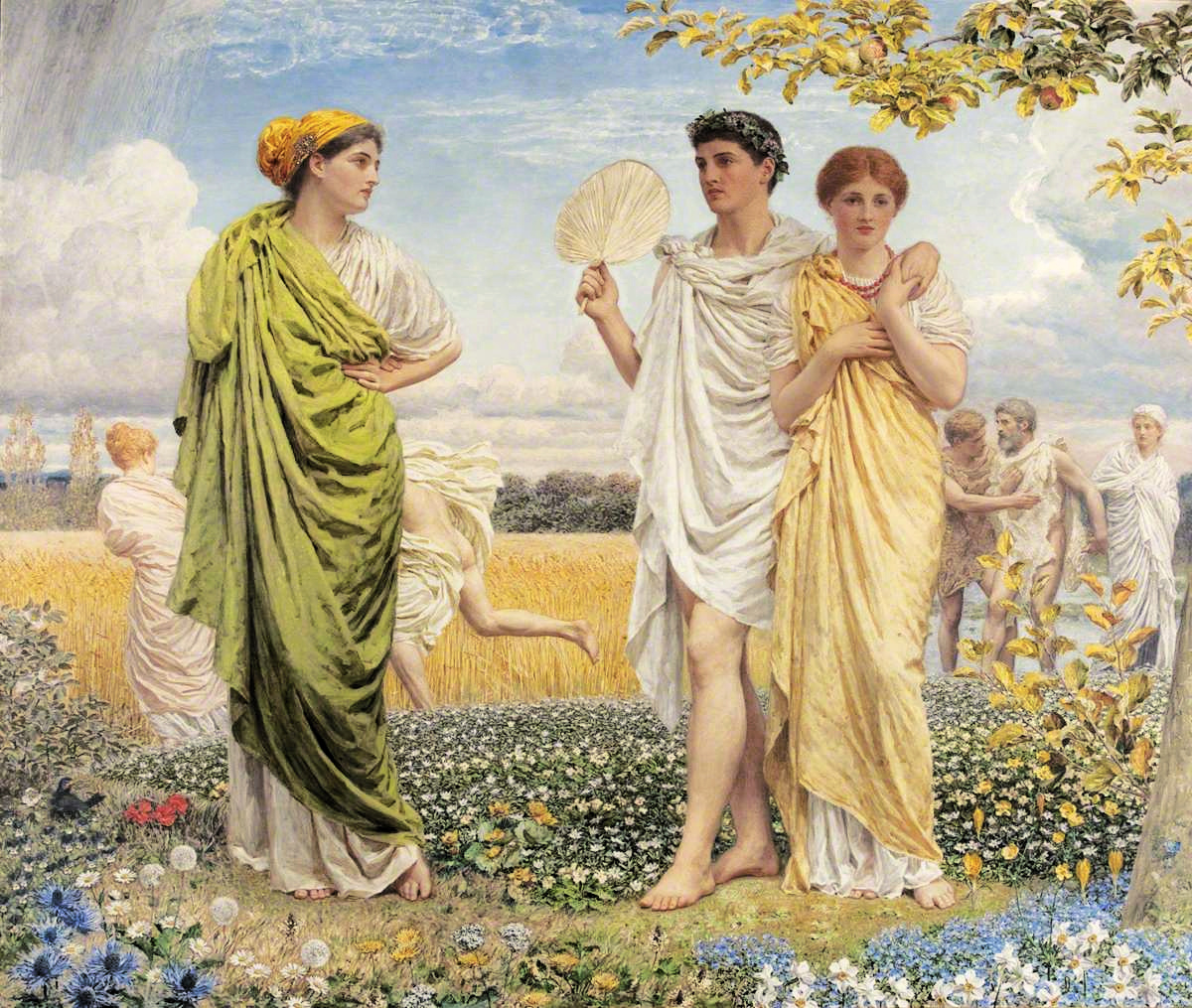
Albert Joseph Moore (1841-1893), The Loves of the Winds and the Seasons, 1893, oil on canvas, Blackburn Museum and Art Gallery, Blackburn, UK.
Moore’s Final Masterpiece
The Loves of the Winds and the Summer was English artist Albert Moore’s final and largest artwork of his career. It is 6 feet tall and 7 feet wide and is the jewel in the crown of the Blackburn Museum and Art Gallery near Manchester, England. It is the result of Moore’s study of the psychology of his subject matter, that of love. Love begins to manifest formally for Moore by the expression of soft bodily postures, changing and harmonious curves, and piercing gazes expressed in deep coral colors. The male figure of the Wind is flanked by the spurned female figure of Summer to the left and the embraced female figure of Autumn to the right. Moore was so enveloped in his amorous themes that while working on this picture he was writing poetry about what the human face was like when in love – and it is found in his picture. The Love of the Winds and the Seasons is Moore’s fullest expression of animating personality united to depicted physical forms that are first lines, curves and color, with the result being an emotional impact on the viewer who encounters the artwork.
Moore drew inspiration from ancient Greek sculpture and classical forms but was not attempting archaeological reconstruction.
Art in the Face of Terminal Illness
This exquisite artistic sensitivity by Moore is made more remarkable since the artist was dying in 1893. In the company of his young and attractive live models in his new capacious art studio, Moore worked day after day on this work. Moore had cancer (a tumor on his thigh) and had submitted to three operations to keep ahead of it. When his doctors told him they could operate no more, and that the cancer continued to spread throughout his body, Moore was resigned to his situation. He is reported to have said: “Well, there’s an end of it.” In the limited time left to him Moore intended to finish his painting of love, The Loves of the Winds and the Seasons. The artist did not want to lose any time. His legs had swollen to twice their size and had to be drained. In acute pain he worked around the clock for the next six months. His friends thought the intense work as well as the cancer was killing Moore but as the painting progressed to completion, they observed that the artist’s personal tranquility and happiness became apparent.
Geometry, Design, and Creative Process
The project was monumental – numerous preparatory studies, drapery studies, full scale and life-sized cartoons (i.e., 4’ 9” tall by 1’4” wide for Autumn) , nude studies – all technically meticulous and versatile- and that underwent the artist’s elaborate and idiosyncratic geometric platting system that he began in the late 1870s. Moore was the consummate auteur that slightly older American ex-patriate painter James Abbott McNeill Whistler (1834-1904) most admired in England. Moore conceived his paintings from start to finish – and The Loves of the Winds and the Seasons was at once its pinnacle and completion. Moore, as Whistler aspired to be, was sole master of his work. In 1893 Moore now expanded this mathematical process to amalgamate his diagonals with horizontals so that his creative process could not suffer the critique that Ruskin hurled at Whistler of “ask(ing) 200 guineas for flinging a pot of paint in the public’s face.” The painting was a commission for the Australian mine-owner George McCulloch (1848-1907). Moore’s calculations included various adjustments of the models’ natural poses to submit to the mathematical formulas on the canvas. This formal submission of subjects to linear construction extended to each detail in the entire composition, such as the flowers for which also study drawings were made. Within these design rigidities, the preparatory drawings of the live models and subjects were transferred to the artwork with little idealization though slight but important adjustments were made, such as to Summer’s hairstyle. Knowing his own time was short, Moore made his cartoons in color so that his transfer to the canvas was as efficient as possible as he painted the final artwork. Critics have observed that despite the intense planning and preparation, the final artwork is executed unevenly – parts are meticulous and vigorous, mostly in the foreground, while others in the background are loose and crude. To what degree this is the artist’s intention or the result of his declining health, is a matter for speculation. During the artistic process the terminally ill artist isolated himself mostly. His handful of visitors remarked that the artist was cheerful, cracked jokes, told funny stories, and smoked his pipe. These select parties knew, however, that their social calls were in the context of final good-byes. In those last days and months of Moore’s life, the artist’s mind, by evidence of the art from his past that he referenced in 1893, stretched back to an earlier career which shared long-held important aspects with The Loves of the Winds and the Summer.
Poetry and Meaning
For his last artwork. Albert Moore glossed the picture’s narrative in verses he wrote to accompany it:
Lo! fickle Zephyr chaseth wayward Spring, It is a merry race; Flowers laugh to birds that sing, Yet frequent tears shall cloud her comely face. The South Wind shall with blushing Autumn mate, Contented with her lot; Summer sigheth – such her fate She and her burning kisses are forgot. Two lovers rough for shudd’ring Winter strive, Beneath a shroud of snow; Heaven haply shall contrive Their violence she may not further know.
Legacy and Death
Through its figural and intellectual prism of ancient classical mythology, Moore worked in his career to update the complex equation of the natural world’s varying and transitory seasons to human life’s copious physical, emotional, and spiritual expressions and contradictions. With their immersion in Moore’s modern art, the painter achieved a graciously-contrived visual dramatic interplay of nature and humanity, ancient and present-day, whose quest is eternal in time and space.
Albert Joseph Moore passed away in the middle of the night on September 25, 1893. He died 9 days after finishing his last painting, The Loves of the Winds and the Summer. Moore was 52 years old.
Albert Joseph Moore’s art transformed Victorian classicism into a sophisticated decorative vision that influenced later developments in modern art and design.
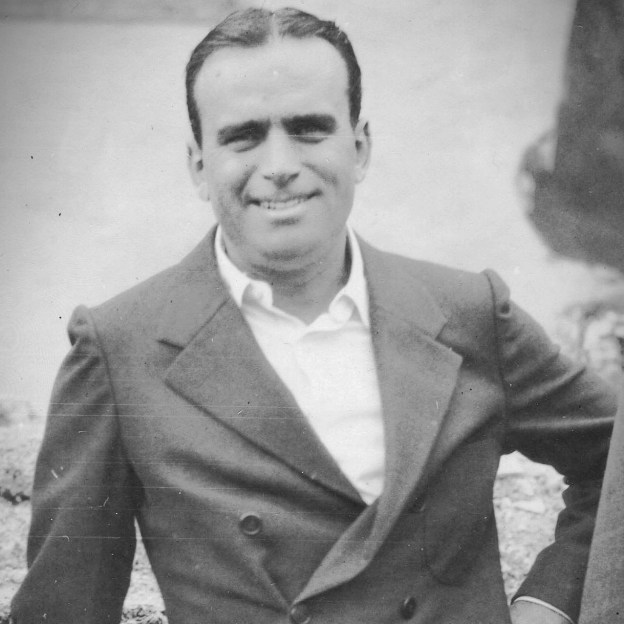
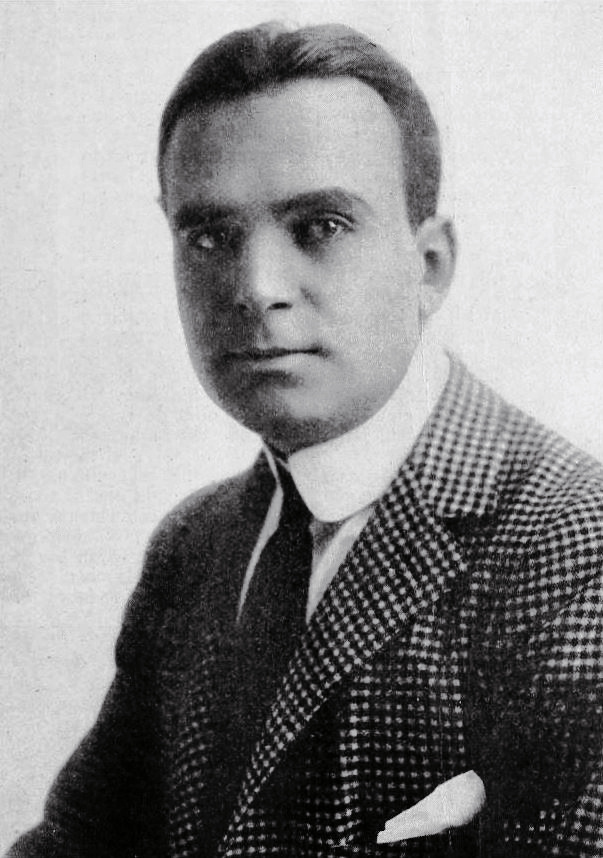
FEATURE image: Silent film superstar and icon Douglas Fairbanks Sr., c. 1917, flashing his trademark toothy smile in a cropped photograph taken in or around 1917. The photograph was taken on location on the massive backlots of Universal Studios at Universal City, California. That year Fairbanks was highly active making dynamic comedies and open-air adventures in Southern California (such as A Modern Musketeer). The original negative is preserved today as part of the official United States Marine Corps History Division Archives.
Douglas Fairbanks, Sr. helped create the modern movie star by transforming himself from a successful Broadway actor into Hollywood’s first great athletic screen hero, using charisma, physicality, and entrepreneurial ambition to become one of silent cinema’s most influential figures and a co-founder of United Artists.
Studio portrait of silent film megastar Douglas Fairbanks Sr., taken at the height of his rise as “The King of Hollywood.” The uncropped image preserves the raw edges of the original 8×10 glass plate negative, revealing the studio backdrop and the photographer’s reference numbers etched along the bottom edge. Photographed in Washington, D.C., in April 1918 by Harris & Ewing, one of the nation’s premier photographic firms, the image comes from a studio renowned for documenting U.S. presidents, visiting dignitaries, and leading cultural figures of the early twentieth century.
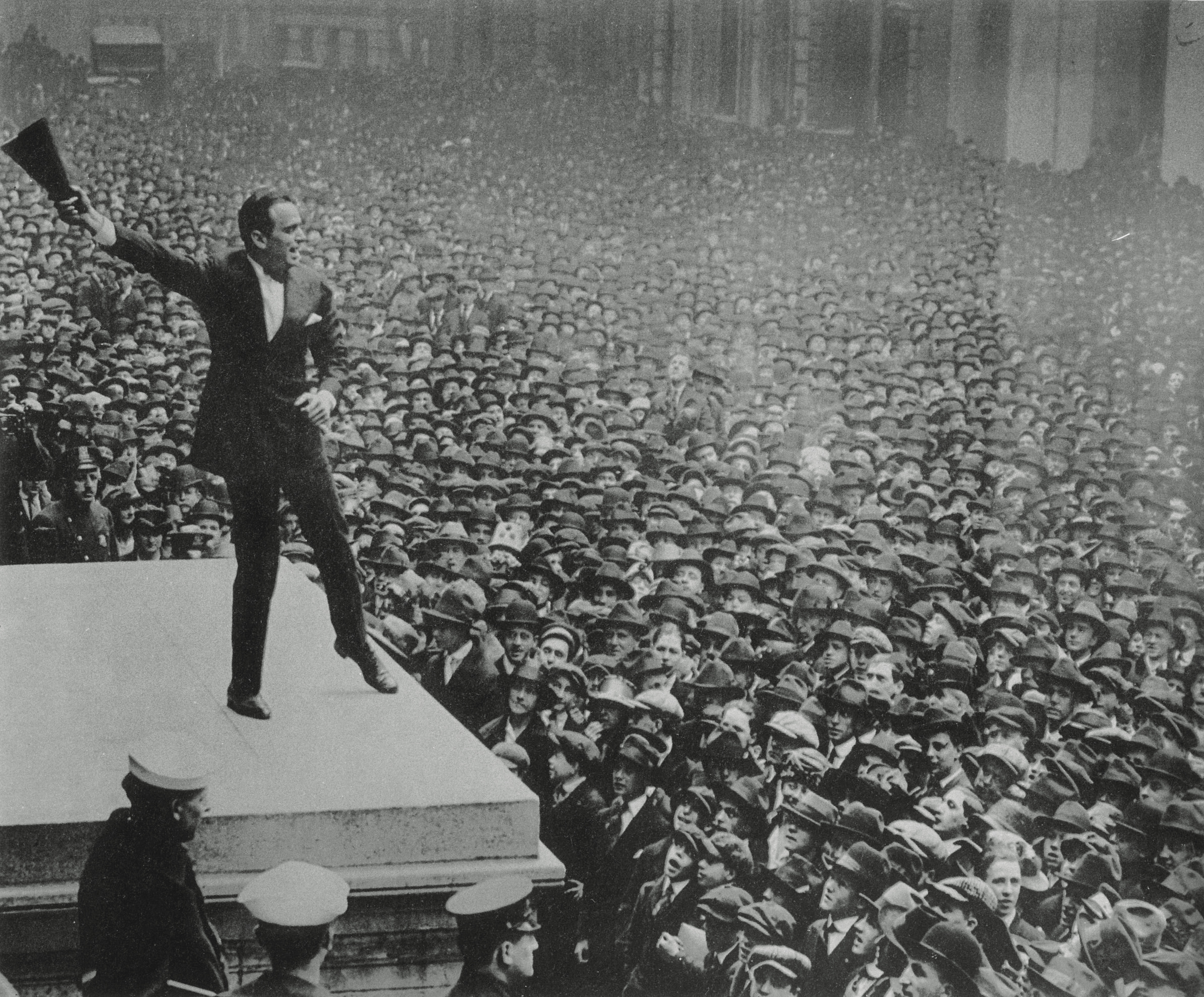
The sitting was part of a major publicity campaign connected to the World War I home-front effort. That spring, Fairbanks joined his close friends and future United Artists partners Charlie Chaplin and Mary Pickford on a widely publicized cross-country tour promoting Liberty Bonds and boosting public support for the war. Along the way, he became a headline attraction at patriotic rallies, including the famous Wall Street event where he hoisted Chaplin onto his shoulders before thousands of spectators.
The Washington studio session provided newspapers, magazines, and patriotic publications with fresh promotional photographs showcasing Fairbanks’s trademark energy and infectious smile, helping carry the Liberty Bond campaign to audiences across the country. Because the images were created as part of a government-associated wartime publicity effort, the original glass negative was ultimately preserved and is now held in the collections of the Library of Congress.No known restrictions on publication. Public Domain.
By John P. Walsh.
Early Life and Family Background
Born in Denver in 1883, Douglas Fairbanks’ mother had been married three times before she had him, the younger of two brothers with his father, an East Coast publisher and lawyer, who had relocated his family to the West. Douglas’s father abandoned the family when he was 5 years old, and the brothers were raised by their mother in Denver. Douglas also had two older half brothers by way of his mother’s previous marriages. With Douglas’s father’s departure, his mother gave her youngest sons her first husband’s surname—Fairbanks.
Stage Beginnings in Denver and New York
Douglas Fairbanks started acting as a youth in summer stock at the historic Elitch Theatre in Denver so that by 1899 Fairbanks was touring with the acting troupe of English Shakespearean actor Frederick Warde (1851-1935). For two seasons Fairbanks was an actor and assistant stage manager with the group.1 Fairbanks moved to New York where he debuted on Broadway in Her Lord and Master in February 1902. The year before, from February 1901 to July 1901, Ethel Barrymore (1879-1959) of the legendary Barrymore acting family became a Broadway star in a new romantic comedy play, Captain Jinks of the Horse Marines, at the Garrick Theatre in New York City. Barrymore’s production ran on Broadway for 168 performances in 1901 and made the 22-year-old actress a star. The turn of 20th century was a time when the theatre was king of the arts – and where, in the new century’s first decade, the nation’s celebrities were born to be made. Her Lord and Master by Martha Morton was first produced in New York, during the spring of 1902. The play, in which Douglas Fairbanks had his first role, met with success, and ran for 69 performances at the Manhattan Theatre (demolished) at 102 W. 33rd Street in New York City.2 The opening night cast for A Case of Frenzied Finance in April 1905 included Douglas Fairbanks playing Bennie Tucker at third-billing. The play, set in the Vanbillon Hotel, ran for less than a month at the Savoy Theatre at 112 W. 34th Street. That theatre opened in 1900 and closed in 1933 and was demolished in 1952.3
A dapper and svelte 22-year-old Douglas Fairbanks played third-bill Bennie Tucker in A Case of Frenzied Finance at the Savoy Theatre in April 1905. It closed after 8 performances. Public Domain.
Broadway Success and Marriage
Fairbanks appeared in A Gentleman from Mississippi from September 1908 to September 1909. On September 22, 1908 (datelined September 21, 1908) The New York Times wrote a blurb regarding a preview that stated: “A Gentleman from Mississippi received its initial performance to-night at the New national Theatre. The play deals with Congressional riots and social life in the National capital. Thomas A. Wise, Douglas Fairbanks, Sue Van Duser, Harriet Worthington and Lola May were in the cast. Mr Wise [1865-1928] and Harrison Rhodes [1871-1929] are the authors of the play.”
A Gentleman from Mississippi ran for 407 performances moving to the Bijou Theatre in NYC.4 In July 1907, 24-year-old Douglas Fairbanks married wealthy Anna Beth Sully (1886-1967) of Rhode Island. The couple had one son who followed his father into the acting business—Douglas Fairbanks, Jr. (1909-2000).
Douglas Fairbanks, c. 1910. Before 1915 Fairbanks established his character type on Broadway of the athletic all-American hero which followed him into films. By 1920 it was this full-blooded romanticism of Douglas Fairbanks that drew the biggest movie-going audiences in the country5https://www.loc.gov/resource/hec.16616/ Harris & Ewing, photographer. Public Domain.
Creating the All-American Hero
It was in November 1912, on opening night of Hawthorne of the USA, a play by J.B. Fagan, that Fairbanks established his character type for stage and screen: the athletic all-American hero.6 With Fairbanks in the starring role as Anthony Hamilton Hawthorne, the play set in Oberon, the small capital of Borrovina, a small independent state somewhere in the mess of Southeastern Europe, ran for 72 performances at the Astor Theatre at 1537 Broadway (45th St.) in New York.7 It was made into a silent film in 1919 starring Wallace Reid (1891-1923) as the American hero.
Athleticism and acrobatic stunts characterized Douglas Fairbanks’ roles on stage since 1912 were translated to his films. They are on full display in A Modern Musketeer, a 1917 silent adventure comedy film produced by and starring Douglas Fairbanks.
In 1915 the Fairbanks moved to Los Angeles – Douglas Fairbanks Sr. had received a lucrative offer from the nascent film industry. It was a three-year contract for $104,000 per year (over $3 million in today’s dollars) to join Triangle films. Exorbitant sums were dangled, often over-ambitiously by producers, to coax legitimate theatre actors to work on the West Coast in film – and under sometimes multi-year contracts. The strategy usually worked but came at a high cost later to a company’s survival and the star’s future. Again, Ethel Barrymore who became a Broadway star in 1901 and national celebrity at 22 years old began to appear in major silent films starting in 1914. Her brothers John and Lionel were already making films and though absolutely devoted to the stage from her youth, Ethel made at least 14 films before returning to the stage full time in 1920. The trend to capitalize on the talents of the stage in film was already underway when Triangle company was formed in 1915 to do just that on a spectacular scale.
Harry Aitken, c. 1910. Public Domain.
Harry Aitken, Triangle Film Corporation, and the Broadway-to-Hollywood Strategy
Harry Aitken (1877-1956) and his brother Roy Aitken (1882-1978) co-founded a film distribution business in Milwaukee in 1906. There had also been a relationship with a Chicago film distributor who established American Film Manufacturing Company production company in 1910. The Aitken brothers relocated to California in 1908 and in 1912, with others, formed the Mutual Film Corporation. One of Mutual’s many subsidiary production and auxiliary units was Keystone Studios, where 24-year-old Charlie Chaplin got his start in films in 1913 at $150 per week (Chaplin was making more than $20,000 a week 5 years later). In 1914 Harry Aitken went into partnership with D.W. Griffith (1875-1948) and, in 1914, founded Reliance-Majestic Studios at 4516 Sunset Boulevard which is today a strip mall.
Following the tremendous success of The Birth of Nation in 1915 with which Harry Aitken was involved so to reap some of its incredible profits, the Aitken brothers and various other companies, such as Reliance-Majestic Studio, departed from Mutual to form a conglomerate of Triangle Film Corporation. The company served as a distributor to other studios in California and Aitken’s plans included sweeping into the fold the best and the brightest of Broadway theatre – which included 32-year-old Douglas Fairbanks. A leading artistic objective for these Hollywood producers was to bring these stage actors’ greatest plays to the screen. Believed to be a worthwhile goal in 1915, before the end of the 1920’s such published plays and other literature while fine for the boudoir reader were problematic to simply translate to the silver screen. The movement towards self-censorship had developed in reaction to the fear the industry would be regulated or outright banned by states. In 1915 there were fewer worries about this as such theatrical artistic fare was expected to attract a better educated movie-goer as well as the Wall Street big-money-type investors who invested in Broadway plays. In one fell swoop Aitken contracted over 60 actors and actresses including Billy Burke (1884-1970), recently married to Florenz Ziegfeld; soon-to-be Western star Dustin Farnum (1874-1929); Shakespearean actor Sir Herbert Beerbohm Tree (1852-1917) who played Macbeth in D.W. Griffith’s lost 1916 film of the same name; and, “Casey At the Bat” DeWolf Hopper (1858-1935).
Douglas Fairbanks, 1916. Public Domain.
The Lamb and the Birth of a Screen Idol
The debut feature from Triangle starred Douglas Fairbanks in The Lamb, a film based on a 1913 stage play that was expanded to have Western cinematic elements. It premiered with two more features on September 23, 1915 at The Knickerbocker Hotel in Fairbanks’ old stomping ground of New York City. Triangle had in-house three master directors – D.W. Griffith, Mack Sennett, and Thomas Ince. D.W. Griffith had a hand in The Lamb, though its directing and screenplay credits went to 27-year-old W. Christy Cabanne (1888-1950). The Lamb was a hit with audiences, and critics praised Fairbanks’ performance marked by his celebrated physicality.8 The film had a nationwide release that November 1915. Although not yet a movie star, Fairbanks saw his weekly salary doubled. By His Picture in the Papers, a 1916 silent comedy film for Triangle that provided stunts for Fairbanks to wrap his athleticism around, Fairbanks became a popular screen idol. Fairbanks made 13 films for Triangle and when his contract expired, Harry Aitken was paying him $10,000 per week.9 Yet, excepting Douglas Fairbanks, Aitken had over bought his stable of stage stars in relation to their poor return so that in 1916 Triangle was known in the industry to be on the verge of collapse.
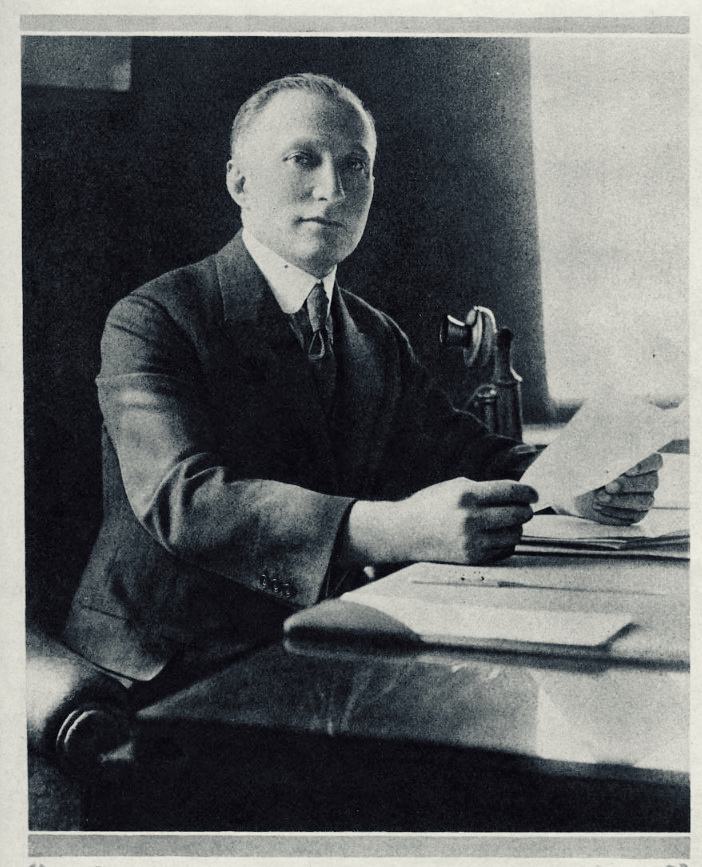
Paramount Pictures’ co-founder Adolph Zukor (1873-1976) was one of the innovators of the motion picture business. In 1916 Zukor convinced Douglas Fairbanks to become the independent producer of his own films. From the May 1922 issue of Motion Picture Classic. Public Domain.https://archive.org/details/MotionPictureClassicMay1922/mode/1up?view=theater
Independent Producer and the Douglas Fairbanks Picture Corporation
Douglas Fairbanks, Triangle’s star, was convinced by Paramount Pictures’ co-founder Adolph Zukor (1873-1976), believed to be “the business brains of the motion picture industry,”10 to become the independent producer of his own films. This became reality at the end of 1916 with the creation of the Douglas Fairbanks Picture Corporation. Zukor had already worked to do something similar for Mary Pickford’s films.
Douglas Fairbanks and Mary Pickford around 1919. Both movie stars already had established independent productions companies for their own films which still required their distribution – a key aspect of making money in movies – by others. These stars along with comedy star Charlie Chaplin and master director D.W. Griffith founded United Artists in 1919 largelyto establish control of the distribution arm of the movie making business for their independently produced films. In 1919, Douglas Fairbanks divorced his wife, Anita. The following year, Mary Pickford, “America’s Sweetheart,” divorced her husband, Owen Moore, and married Douglas Fairbanks, her paramour since 1916. The American public, which took tremendous interest in these personal affairs, were shocked but hardly surprised by the country’s changing values. Even Douglas Fairbanks’ films between 1915 and 1919 had demonstrated those changing values by way of his athletic, likeable characters drawn to display a comical, good-natured, brash overambitious hero with a popular philosophy of avoiding both boring convention and conventional boredom. While Fairbanks’ dramatis personae would change dramatically in the 1920s from comedies to swashbucklers his already fantastic, attractive and likeable character type was being merely reinforced.11 Glass negative, Harris & Ewing photographer.https://www.loc.gov/resource/hec.30098/ Public Domain.
Fairbanks Productions and the Road to United Artists
As Fairbanks had been lured away by a better offer, so the actor hired his team at Triangle for his own company. Director John Emerson (1874-1956) and screenwriter Anita Loos (1888-1981) – to be husband and wife in 1919 – had successfully collaborated on Fairbanks’ movie hits at Triangle and even D.W. Griffith valued the pair as among the best film editors in the business after working on Intolerance in 1916. Emerson had directed important films at Triangle in 1916 featuring Douglas Fairbanks including His Picture in the Papers, The Americano, and The Mystery of the Leaping Fish. These Emerson-directed films were followed in 1917 by In Again, Out Again, Wild and Woolly, Down to Earth, and Reaching for the Moon, all for Douglas Fairbanks Productions. In 1918 Fairbanks made 5 more romantic comedies and one melodrama called Arizona, a film now lost. Despite a film receiving perhaps a mixed review from critics or being subject to local censorship, Douglas Fairbanks’ films proved box office gold due to his star power. In 1918 and moving into 1919 Fairbanks had become a millionaire, screen idol and soon to be co-founder of his own movie studio, United Artists.
John Emerson and Anita Loos in 1918. These two creative individuals who married in 1919 worked closely as director, screenwriter, and film editorwith Douglas Fairbanks as well as D.W. Griffith at Triangle films and later at Douglas Fairbanks Picture Corporation. They helpedmake some of the most popular and critically-acclaimed films in the industry at that time. Public Domain.
Down to Earth is a 1917 American comedy romance film produced by and starring Douglas Fairbanks with Irish-born actress Elaine Percy. Directed by John Emerson with a screenplay co-written by Anita Loos, the film features Fairbanks as Bill Gaynor who sets out to prove the outdoors and self-reliant manual labor are better for health than any modern medical treatment. He does this by kidnapping a group of hypochondriacs from a clinic that includes a girl, Ethel Forsythe (Percy). Bill is interested in her, but she refuses his proposals. Finally, after proving his point on a “deserted island” that is next to a California freeway, Bill bids farewell to the revived group of patients and escapes with his awaiting love interest, Ethel, into the sunset by rowboat. The film is in the Public Domain.
The most popular silent film stars on the road selling Liberty bonds in 1918 were Charlie Chaplin, Mary Pickford, and before a massive crowd on Wall Street in New York City, Douglas Fairbanks. In 1918 Fairbanks and Chaplin decided to hire private detectives to spy on their respective studios, Paramount Pictures and First National. They were told that the studios were going to put a stop to their exorbitant salaries and not renew their contracts.12 The positive audience response from the Liberty drives and a fear of a corporate merger that would end star leveraging power, led directly to Fairbanks, Chaplin, Pickford, and master director D.W. Griffith, to found United Artists in January 1919. Public Domain.
Conclusion
As the curtain fell on the theater-dominated nineteenth century and rose on the age of motion pictures, Douglas Fairbanks emerged as a defining titan of the new medium. At a pivotal moment when the art and business of film were still being invented from scratch, Fairbanks helped construct the very blueprint of modern movie stardom. He achieved this through a potent combination of infectious optimism, explosive athletic vigor, and an instinctive, unparalleled screen charisma.
More than just a box-office darling, Fairbanks became the ultimate symbol of silent-era ambition and untamed possibility. He radically disrupted the industry by challenging rigid studio monopolies, pioneering artist-led production as a co-founder of United Artists. In doing so, Fairbanks established a revolutionary model of creative freedom, global celebrity, and entrepreneurial control that reshaped the landscape of Hollywood and the business of filmmaking for generations. Ultimately, his career mirrored Hollywood’s own meteoric rise, ensuring his towering influence would endure long after the silent era that made him famous had passed into history.
NOTES:
1. Goessel, Tracey. The First King of Hollywood; The Life of Douglas Fairbanks. Chicago Review Press, 2016.
8. Lombardi, Frederic (2013). Allan Dwan and the Rise and Decline of the Hollywood Studios. McFarland. pp. 53–54.
9. United Artists, Volume 1, 1919–1950: The Company Built by the Stars, Tino Balio, University of Wisconsin Press, 2009. p. 143.
10. Quoted in the May 1922 issue of Movie Picture Classic, p. 26.
11. A Short History of the Movies, Gerald Mast, Indianapolis: Bobbs-Merrill Company, Inc., 1976, pp. 124; 127 and The Liveliest Art: A Panoramic History of The Movies, Arthur Knight, New York: MacMillan Publishing, 1978, p 107.
12. Chaplin: His Life and Art, David Robinson, New York: McGraw-Hill Book Company, 1985, p. 267.
BIBLIOGRAPHY:
A Short History of The Movies, Gerald Mast, The Bobbs-Merrill Company, Inc. Indianapolis, 1977.
David Robinson, Chaplin: His Life and Art. New York: McGraw-Hill Book Company, 1985.
Hollywood: The Pioneers. Kevin Brownlow and John Kobal, New York: Alfred A. Knopf Inc. A Borzoi Book,1979.
History of the American Cinema, Volume 5, 1930-1939, Charles Harpole, General Editor, New York: Charles Scribner’s Sons, 1993.
The American Film Industry, ed. Tino Balio, University of Wisconsin Press, 1976.
The Hollywood Story, Joel W. Finler, New York: Crown Publishers, Inc., 1988.
The Liveliest Art: A Panoramic History of The Movies, Arthur Knight, New York: MacMillan Publishing, 1978
The United Artists Story, Ronald Bergan, Crown Publishers, Inc., New York, 1986.
United Artists, Volume 1, 1919–1950: The Company Built by the Stars, Tino Balio, University of Wisconsin Press, 2009
An iconic production still showing Douglas Fairbanks Sr. flashing his famous smile as his character, Ahmed, in the 1924 landmark silent film fantasy epic, The Thief of Bagdad. In the promotional shot distributed by United Artists in 1924 he famously paired a patterned, wrapped head scarf with prominent matching hoop earrings as the movie star starred in what is universally classified as an epic swashbuckler. Public Domain.
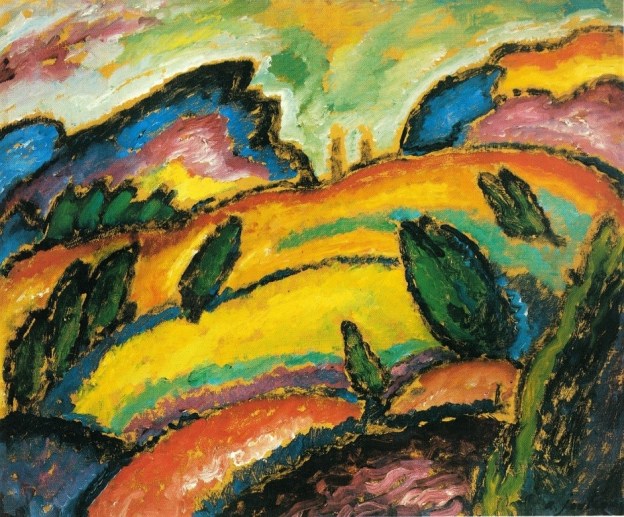
FEATURE Image: Jawlensky, Hügel (Hills), 1912, oil on hardboard, Museum am Ostwall, Dortmund.
Alexei von Jawlensky’s artistic development mirrors the larger struggle over Germany’s cultural identity in the decades before World War I. Through his encounters with French Post-Impressionism, Expressionism, the Munich avant-garde, the NKVM, and The Blue Rider, Jawlensky helped forge a distinctly modern spiritual art that challenged both academic tradition and rising nationalist conservatism in Imperial Germany.
Alexei von Jawlensky (1864-1941), Russian-émigré German Expressionist painter.
Alexei von Jawlensky, Self Portrait, 1912.
The Creation of the German Empire
In 1871, the newly-founded German Empire fused together most of the German speaking states in Central Europe under Prussian leadership. Over the next 60 years under several different forms of government—that of Emperor Wilhelm I (1871-1888), his grandson Wilhelm II (1888-1918) and, following World I, the Weimer Republic (1918-1933) —Germany worked to create and define a political and cultural identity all its own.
In World War I (1914-1918), the recent German Empire fought to consolidate its gains but the effort failed—and Central European powers were divided up into smaller states after the war. The German Empire had risen and fallen in less than 50 years.1
Bismarck and the Making of a German Nation-State
Before unification in 1871, German-speaking denizens of Central Europe came from many independent and differing political units. The Kingdom of Prussia, which in 1816 annexed the Kingdom of Brandenburg, was the foremost German power alongside Austria. Long-held liberal dreams based on the French Revolution of 1789, the Napoleonic empire (defeated at Waterloo in 1815) and later mid-19th century pan-European revolutions looked to unify these diverse states into a national union based on self-determination. But these idealistic political aspirations did not reflect all the conditions and facts in these lands.
Napoleon’s invasions into Central Europe in 1806 and 1807 resulted in German state governments that were conservative and anti-constitutional monarchies. When unification came for Germany in 1871, it was not by popular uprisings or democracy. It was the diplomatic handiwork of the six-foot-three-inch Prussian prime minister, Otto von Bismarck (1815-1898).
Prussian prime minister Otto von Bismarck (1815-1898).
War, Nationalism, and German Unification
In 1849, Otto von Bismarck was elected to the Landtag, or Prussian parliament. Following a decade of government service, König Wilhelm of Prussia appointed Bismarck in 1862 as Minister President of Prussia and Foreign Minister. This gave Bismarck virtual absolute power.
In 1866, Bismarck started a short, decisive war with Austria. It proved Prussia was the dominant force in German territory. The Austrian war led to the Prussians with their allies annexing territories and forming the North German Confederation comprised of 22 German states. Nationalism throughout German-speaking Europe rose significantly after this military victory over Austria which had in the contest lost its dominant power position in Europe.
By 1870, German unification was both cause and effect of German nationalism. Unification was opposed by European nations, particularly France, as well as German expansion. The smaller German kingdoms reacted to the diplomatic opposition by uniting with Prussia. It was France that, since the 17th century, was viewed as the actual destabilizing force in Europe, and not a new Germany.
The Franco-Prussian War of 1870 which started when France was maneuvered by Bismarck to declare war on the North German Confederation, was a disastrous defeat for France. The Prussian victory allowed them to annex Alsace-Lorraine from the French and became another impetus for independent German states to join a united Germany. The German empire was founded and declared on New Year’s Day, 1871. Bismarck crowned Wilhelm as Kaiser Wilhelm I, and Bismarck became Grand Chancellor.
The German Empire and the Road to World War I
With Austria as an exception, Bismarck ruled the German states as the Second Reich. He brutally censored and repressed any contradictory forces to German nationalism—including the Catholic Church and the Communists and worked to mold scattered German speaking residents into one political and cultural nationality. This nationalistic vision of centralized power—and entangling alliances to support or offset it—led to the mechanized death mill of World War I. In that conflict, Germany, Austria-Hungary, Bulgaria and the Ottoman Empire—the so-called Central Powers—fought the Allied Powers of Great Britain, France, Russia, Italy, Romania, Japan and, later, the United States.
World War I and the Collapse of Imperial Germany
In this “Great War” the total number of military and civilian casualties on both sides was around 40 million—about 20 million deaths and 21 million wounded. Of the 20 million deaths, it included about 10 million in the military and 10 million civilians. The Allies lost almost 6 million soldiers and the Central Powers lost about 4 million.2
World War I was a dividing point in modern history which also had effects on modern art in Germany. Many young, avant-garde artists were killed in action as soldiers in the war. Wassily Kandinsky (1866-1944) and Alexei von Jawlensky (1864-1941), both Russian-émigrés, had to flee Germany, only to emerge from the general carnage years later. After the war, German architect Walter Gropius (1883-1969) believed that his work could be picked up precisely where it was left off before the war. But Gropius quickly realized that was not going to happen going forward, as if the worldwide calamity could exclude art-making in its whirlwind.
Art and the Search for a German Identity
Prior to World War I, however, the German Empire experienced dynamic activity and prosperity. During Wilhelm II’s 30-year reign (1888-1918), rapid industrialization, population growth, and the growing gap between an increasingly wealthy and politically influential elite and disenchanted working class rippled throughout the empire. Berlin became Germany’s national capital and Europe’s young new city.
Kaiser Wilhelm II, c. 1901, by German painter Christian Heyden (1854-1939).
Antique map of the German Empire in 1900 showing population density.
German Modernism Versus Cultural Conservatism
Within this modern-state commotion, the role of art in Germany became a battle for the nation’s soul: from the pole of freedom to produce outstanding artworks in the modernist spirit to a regressive cultural heritage with proto-fascist overtones. Cultural conservatives argued for turning inward to German sources for the future direction of German art. These conservative critics dismissed French Impressionism as nonacademic, genre painting of modern life. Above all, it was foreign.
Conversely, the Berlin Secession (1898-1934) and Neue Galerie Thannhauser in Munich challenged academic and state-sponsored artwork and introduced international styles. These venues were where Germans went to see post-Impressionists such as Vincent Van Gogh and later Cubists such as Pablo Picasso and Georges Braque.
By the dawn of the 20th century, what it meant to be German, and among a culturally diverse citizenry, was a 30-year experimental construct forged by Bismarck using raw power so to achieve a unified empire on the world stage. The fall of that empire and the peace that followed it, helped set the stage for the rise of Fascism leading to World War II.
Expressionism and the Question of German Art
Modern artists of the key artistic movements of the Wilhelmine period, particularly Expressionist art groups such as Die Brücke (“The Bridge”) in Dresden from 1905 to 1913 and Der Blaue Reiter (“The Blue Rider”) in Munich from 1911 to 1914 — avant-garde forms of modernist abstraction and romanticism — wanted to offset conventional social values based on German industrial materialism by using a contradictory form of self-expression based on the sensual and spiritual.
The issue of what exactly was, or would be, “German” art in the modern age were the stakes for these artists. These artists sought to unify body and soul by expressing internal qualities through exterior appearances and saw this integrated expression as their contribution to that societal and artistic endeavor.3 Progressive artists never dismissed the idea of a German art. They sought its expression in avant-garde artistic elements and forms thereby rejecting its basis on historical and cultural anecdote or nostalgia.
Published in St. Petersburg, Russia, in 1900 the map of the Russian Empire is labeled in French with topography relief shown by hachures and Paris as the meridian reference. Transcontinental rail lines in Russia and extend to Paris. Jawlensky, born in western Russia in 1864 was stationed in the 1880’s as a soldier in Moscow and St. Petersburg. As a professional artist in Germany in the 1890’s and afterwards, Jawlensky returned to visit Russia including in the year this map was made. see- https://www.mapsofthepast.com/russia-empire-kartograficheskoe-circa-1900.html
Alexei von Jawlensky’s Early Life and Artistic Awakening
Alexei von Jawlensky, born in Torzhok in western Russia in 1864, started his career in the military. At 25 years old, in 1889, Jawlensky, stationed in Moscow, requested a transfer to St. Petersburg to study painting at the Academy of Arts. In St. Petersburg, Jawlensky learned about the French Impressionists, particularly the artwork of Édouard Manet (1832-1883) and Alfred Sisley (1839-1899). In 1892, while taking painting lessons with Russian naturalist painter Ilya Repin (1844-1930), Jawlensky met realist painter Marianne von Werefkin (1860-1938) who became his mistress and dedicated patron. In 1893 Von Werefkin invited Jawlensky to her father’s estate in Kovno governorate (modern Lithuania) where Jawlensky met Hélène Nesnakomoff (1881-1965), Von Werekin’s personal maid. In time she became Jawlensky’s mistress, mother of his child and, ultimately, in 1922, his wife.
Jawlensky at 23 years old in his military uniform in Russia in 1887.
Marianne von Werefkin.
After seven years studying art in St. Petersburg, Jawlensky’s request to leave the military was granted. He left in early 1896 with a 20-year half pension and the rank of staff captain. That summer Jawlensky traveled through Germany, Holland and Belgium with Marianne von Werefkin and a female friend. Returning to St. Petersburg by way of Paris and London, Jawlensky viewed and admired artwork of J. W. M. Turner (1775-1851) and living artists, James Whistler (1834-1903) and Puvis de Chavannes (1824-1898).
Russian-born Alexei Jawlensky settled in Munich in 1896 and became a central figure in German Expressionism.
Munich and the Russian Avant-Garde Circle
In St. Petersburg, Jawlensky entrusted his possessions with family in Russia. With two young painter friends, Igor Grabar (1871-1960) and Dmitrij Kardovskij (1866-1943), he set off to settle in Munich at the end of 1896. Marianne von Werefkin and Hélène Nesnakomoff joined Jawlensky soon after. From his arrival into Munich, Jawlensky lived, with the exception of World War I, in Germany until his death in 1941. In 1897 Jawlensky, Von Werefkin and Hélène Nesnakomoff took an apartment at Giselastrasse 23, a residential street near the Englischen Garten, where they lived until 1914.
Marianne von Werefkin and Alexej von Jawlensky in their studio at Gut Blagodat, 1893.
Anton Ažbe, Kandinsky, and Artistic Formation
In Munich Jawlensky attended Anton Ažbe’s art school where he met other young German artists, and in 1897, fellow Russian artist, Wassily Kandinsky. Anton Ažbe (1862-1905), a Slovene realist painter, was a master of human anatomy. He enforced figure drawing studies in his classes which Kandinsky loathed but Jawlensky had been studying since 1890. Kandinsky did appreciate Ažbe’s expressed view that an artist should never conform to a theory or set of rules. Ažbe, who died at 43 years old of cancer in 1905, said: “You must know your own anatomy but in front of the easel you must forget it.”4
Anton Ažbe, Self portrait, 1886.
Wassily Kandinsky (1866-1944). Jawlensky met Kandinsky in 1897 in Munich at Anton Ažbe’s art school.
Early Experiments and First Artistic Successes
After five months in Munich, Jawlensky traveled to Venice in April 1897. He went with Werefkin, Grabar and Kardovskij, and Anton Ažbe. The next summer, in 1898, Jawlensky returned to Russia with Marianne von Werefkin and Hélène Nesnakomoff to visit family. That autumn the Russian group returned to Munich, where artists continued to draw heads and nudes at Azbé’s school. In 1898 Jawlensky met German Symbolist painter Franz von Stuck (1863-1928) and where, in 1900, Kandinsky matriculated in his art class.5 Jawlensky’s conversation with von Stuck was not on the expression of German character in Symbolist art but the technical issue of working in tempura. In 1898 Jawlensky also received a visit from Russian portraitist Valentin Serov (1865-1911).
Franz von Stuck, Lucifer, 1890, oil on canvas, Bulgaria. At the 1893 World’s Columbian Exposition in Chicago, critics observed that Franz von Stuck (1863–1928) was “one of the most versatile and ingenious of contemporary German artists.” Jawlensky met the renowned Symbolist painter, architect, designer, and co-founder of the Munich Secession in 1898.
Valentin Serov (1865-1911). Self portrait, c. 1888.
In 1899, with Grabar and Kardovskij, Jawlensky executed the ambitious project to open their own painting school in Munich which was short-lived. Kardovskij returned to Russia in 1900 to eventually become a professor at the St. Petersburg Academy of Arts in 1907. Grabar returned to Russia in 1903 to became director of Moscow’s Tretyakov Gallery. Jawlensky, remaining in Munich, was painting still lifes and looking for color harmonies.
Painter Dmitri Nikolayevich Kardovsky, Marianne von Werefkin, Igor Grabar, and Jawlensky in 1900.
Alexei von Jawlensky, Stillleben mit Samowar (Still life with a samovar), 1901.
Jawlensky visited Russia in 1901 with Marianne von Werefkin and Hélène Nesnakomoff. They visited the Ansbaki estate in the Vitebsk governorate (modern Belarus). When Jawlensky fell ill possibly with typhus, he recovered at the Black Sea with Marianne von Werefkin. There he met Kardovskij and his wife, Olga Lyudvigovna Della-Vos-Kardovskaya (1875-1952), a painter who studied at Anton Ažbe’s in Munich in 1898 and 1899.
Olga Lyudvigovna Della-Vos-Kardovskaya, Self portrait, 1917.
The following year, in January 1902, a son, Andreas, was born to Jawlensky and Hélène Nesnakomoff. Jawlensky was continuing to paint still lifes and figural pictures, some of which were influenced by Swedish artist, Anders Zorn (1860-1920). Jawlensky’s pictures featured as models Hélène and her sister, Maria, after she arrived to Munich in November 1902 to aid the new parents. In a visit in 1902, Prussian-born artist Lovis Corinth (1858-1925) advised Jawlensky to send a painting to the Berlin Secession. Jawlensky did so and it was exhibited.
Anders Zorn (1860-1920), Self portrait, 1896.
Lovis Corinth (1858-1925), Self-portrait with Skeleton, 1896, Lenbachaus, Munich. Corinth is a leading figure painter marked by draftsmanship and brushwork. Like Jawlensky, Corinth pursued his artistic training throughout Europe, including in Munich and Paris, and settled permanently in Berlin in 1902. https://www.kimbellart.org/collection/ap-201701.
Jawlensky, Stillleben mit orangen (Still Life with Oranges), 1902, oil on canvas.
Jawlensky, Cottage in the Woods, 1903.
Jawlensky absorbed influences from Van Gogh, Gauguin, Cézanne, Matisse, and Symbolism. His artistic goal evolved toward expressing spiritual and psychological realities through color and form.
Discovering France and Modern Art
Between 1903 and 1907, with Munich as his base, Jawlensky spent much time in France, including in Paris, Brittany and Normandy. In 1903, as Marianne von Werefkin and Georgian artist Alexander Salzmann (1874-1934) traveled in Normandy, Jawlensky was in Paris where he was fascinated with the color and texture of Vincent Van Gogh (1853-1890). That same year, in Munich, Jawlensky attended lectures on aesthetics by Theodor Lipps and met the young, eccentric Austrian printmaker Alfred Kubin (1877-1959). Lipps’ theory of aesthetics involved the overlap of psychology and philosophy creating a framework for the concept of Einfühlung (“empathy”) which, defined as “projecting oneself onto the object of perception,” became a key component of Expressionism.5
Van Gogh, Gauguin, Matisse, and the Road to Expressionism
In 1904, an over-worked Kubin married Hedwig Gründler, an older widow. In early 1906 Jawlensky painted her portrait in his Munich apartment before the Kubins left Munich to live in Austria. In the 23 x 30 inch, oil-on-cardboard portrait, Jawlensky’s colors and modeling of the face showed the influences of French Impressionism and emergent Fauvism.
Jawlensky, writing after his visit to France in 1903. (Dube, p.114).
Jawlensky, Porträt Hedwig Kubin (Portrait of Hedwig Kubin), 1906, oil on cardboard.
Jawlensky stayed in Reichertshausen in the summer of 1904. A woody hamlet 15 miles east of Heidelburg, Jawlensky painted a series of landscapes. In 1905 he followed up with a series of landscapes at Füssen. Jawlensky made friends with Wladimir Bechtejeff (1878-1971), a young Russian painter who relocated to Munich in 1904 in admiration of Jawlensky. Like the older artist, Bechtejeff stayed in Munich until 1914. When Jawlensky visited the 38-year-old German composer Felix vom Rath (1866-1905), son of a wealthy industrialist, Jawlensky saw for the first time at his home a painting by Paul Gauguin (Riders on the Beach of Tahiti, 1902, Essen). At Vom Rath’s home, Jawlensky also met pianist Anna Langenhan-Hirzel (1874-1951).7
Gauguin, Riders on the Beach, 1902, Essen. Jawlensky saw this, his first Gauguin, in a private collection in Germany in 1904.
Jawlensky, Selbstbildnis mit Zylinder (Self-portrait with a top hat), 1904, private collection.
Jawlensky, Hélène im spanischen Kostüm (Hélène in Spanish costume), 1904, Wiesbaden.
Jawlensky, Stilleben mit Weinflasche, 1904.
Jawlensky, Marianne von Werfekin, 1905, Switzerland.
Jawlensky, Portrait de Madame Sid, 1905.
Jawlensky, The Hunchback, 1905.
The Breakthrough Years, 1905-1907
The middle years of the first decade of the 20th century—1905, 1906 and 1907—were key to Jawlensky’s artistic development. It is likely that Jawlensky traveled to France in 1905. He exhibited six paintings in the Paris Salone d’Automne in 1905, the exhibition which gave birth to the Fauves.
In January 1906 Jawlensky returned to St. Petersburg to exhibit nine paintings. As evidenced in his correspondence, he traveled to France in 1906. He visited Paris and Carantec in Brittany which was a region where Gauguin had worked. That same year Jawlensky exhibited ten paintings at the Paris Salone d’Automne in the newly-formed Russian Pavilion organized by ballet impresario Sergei Diaghilev (1872-1929). At the salon, either in 1905 or 1906, Jawlensky met Henri Matisse (1869-1954) whose Fauvist artwork Jawlensky unreservedly admired. During Jawlensky’s visit to France in 1906 he also met Russian painter Elisabeth Ivanowna Epstein (1879-1956) and studied the artwork of Gauguin, Paul Cézanne (who died in October 1906), and Maurice de Vlaminck (1872-1958). Over the next couple of years, Jawlensky wrestled with Cézanne’s influence on his art.8
Jawlensky, writing after his visit to France in 1905 or 1906.
Jawlensky, Stillleben mit Blumen und Früchten, c. 1905.
Jawlensky, Bretonische Bäuerin, 1905.
In 1905 and 1906 Jawlensky painted landscapes and character studies, mainly heads. Following the 1906 exhibition in Paris Jawlensky traveled to the Mediterranean resort town of Sausset-les-Pins outside of Marseilles to continue to paint landscapes. Jawlensky returned to Munich by way of Geneva where he visited Swiss Symbolist artist, Ferdinand Hodler (1853-1918).
Ferdinand Hodler, Self Portrait, 1900.
Jawlensky, Self portrait, 1905.
Jawlensky spent the fall of 1906, as evidenced in correspondence, in Wasserburg am Inn outside of Munich. He painted landscapes and portraits.
Jawlensky with Andreas, 1905.
The next year, in 1907, he returned to Wasserburg for a shorter stay with his 5-year-old son, Andreas. In fall 1907 he went to Paris with Hélène Nesnakomoff and Andreas to view the Cézanne retrospective at the Salon d’Automne. He also visited at Matisse’s studio. Near Marseilles to paint landscapes alone afterwards, Jawlensky believed that he achieved his primary goal to use color that was autonomous from the object and based on the artist’s inner feeling. This was a major breakthrough for his painting. Jawlensky’s Mittelmeerkűste (Mediterranean Coast) (below) became the result of these searches and his talisman for landscapes going forward.9
Jawlensky, Mittelmeerkűste (Mediterranean Coast), 1907, oil on hardboard, Munich.
Jawlensky, Wasserburg am Inn, 1907, oil on board.
Jawlensky, Wasserburg am Inn (Melancholy in the Evening), 1907, oil on cardboard.
Color, Spirituality, and Artistic Synthesis
The landscape Wasserburg am Inn (Melancholy in the Evening) provides insight into Jawlensky’s artistic development at this time. Painted at Wasserburg Am Inn outside Munich in 1907, Jawlensky experimented with applying the techniques of French post-Impressionism, especially Van Gogh, Gauguin and Henri Matisse. The painting and others in this period express Jawlensky’s goal of making unnatural color harmonies and giving visual form to the artist’s inner nature or spirituality. In the manner of Van Gogh, Jawlensky used chisel-like brush strokes and, like Gauguin, thick outlining to achieve a rhythmic, flat, two-dimensional landscape.
Following these travels to Wasserburg am Inn, Paris and Marseilles in 1907, Jawlensky was back in Munich at Christmas and met Dutch Symbolist artist Jan Verkade (1868-1946) in January 1908. Verkade was a Dutch post-Impressionist and Symbolist painter who was a member of the French Nabis under Gauguin in Brittany. Verkade taught Jawlensky and Marianne Weferkin about Gauguin’s ideas on Synthetism. A convert to Catholicism in the mid1890s, Verkade became a Benedictine monk and priest and lived at a monastery in nearby Beuron. In 1907 and 1908 Verkade stayed in Munich and at times painted in Jawlensky’s studio. Jawlensky also learned from Verkade about the writings of French theosophist Edouard Schuré (1841-1929) who influenced the Nabis’ art. In 1908 Jawlensky met Paul Sérusier (1864-1927) who painted The Talisman, an icon to Gauguin’s ideas of Synthetism. 10
Jan Verkade, Self-portrait, 1891.
Paul Sérusier, The Talisman, 1888, Musée D’Orsay.
Murnau and the Birth of German Expressionism
In Munich in 1908 Jawlensky met other significant figures for his art, including the acquaintance of German painter Karl Caspar (1879-1956) and 22-year-old Alexander Sacharoff (1886-1963). Sacharoff was one of Europe’s most innovative solo dancers. Jawlensky formed a lifelong friendship with Sacharoff and painted his portrait several times between 1909 and 1913. Jawlensky’s 1909 portrait of Sacharoff was painted spontaneously one evening when Sacharoff arrived to Jawlensky’s studio before a performance. In his full theater costume, Jawlensky’s portrait of Sacharoff is notable in that it was one of the first examples of the painter’s motif of wide, piercing eyes.11
Jawlensky, Alexander Sacharoff, 1909.
Jawlensky, Girl with Peonies, 1909. Von der Hevdt Museum.
Vincent Van Gogh, La Maison du père Pilon, 49 × 70 cm, May 1890.
In 1908, with the help of Theo van Gogh’s widow, Jawlensky acquired a Van Gogh painting, La maison du Père Pilon. Jawlensky spent the next three summers—in 1908, 1909 and 1910—in southern Bavaria at Murnau am Staffelsee with Hélène Nesnakomoff, Andreas, Marianne von Werefkin, Kandinsky and Gabriele Münter (1877-1962).
In 1909 Jawlensky met Austrian philosopher Rudolf Steiner (1861-1925), Baltic German painter Ida Kerkovius (1879-1970), and German Expressionist painters Erma Barrera-Bossi (1875-1952) and August Macke (1887-1914). These were all notable figures to the formation of avant-garde expressionism. Jawlensky also met the Ukrainian brothers and avant-garde artists David Burliuk (1882-1967) and Wladimir Burliuk (1886-1917).
Munich became a major center for avant-garde experimentation. The summers at Murnau were decisive for the development of German Expressionism.
Jawlensky’s summer visits to Murnau led to significant development in his painting, This was especially true for his large format portraits. In 1909, his Murnau landscape is a highly stylized reduction of the subject of mountains, trees, and pathway into flat, geometrical forms and harsh, contrasting and unnatural colors influenced by French Cloisonnism and French Cubism. The painting, Murnau landscape, is another example of Gauguin-inspired Synthetism with its high degree of stylization and artificial bright colors. Some of the experimental nature of the painting is indicated by the color samples in the lower righthand corner of the painting.
Jawlensky, Murnauer Landschaft, (Murnau landscape), 1909, oil on cardboard.
The Murnau Years, 1908-1910
It was Wassily Kandinsky and Gabriele Münter who discovered Murnau in the spring of 1908 on a bicycle tour. They told Jawlensky about it who visited that summer with Marianne von Werfekin and wrote to Kandinsky to join them. In 1909 Münter and Kandinsky bought a house in Murnau which they called “The Russia House.” The importance of the Bavarian landscape as an inspiration to these artists’ work cannot be underestimated. The Murnau years of 1908 to 1910 was the start and bonding of artists that evolved in 1911 to the formation of The Blue Rider. In 1908 it was Jawlensky’s sharing of his new ideas gained from his visits to France that made him the progressive leader of the group in this period. Accompanied by Marianne von Werfekin, Jawlensky returned to this market town several times where he stayed at Gasthof Griesbräu.12
Jawlensky, Vue de Murnau, c. 1908–1910.
Jawlensky, Skizze aus Murnau (Murnau Sketch), 1908-09, oil on cardboard, Lenbachhaus.
Jawlensky, Weisse Wolke (White Cloud), summer 1909, oil on textured cardboard mounted, Norton Simon Museum, Pasadena, California.
Jawlensky, Sommerabend in Murnau (Summer Evening in Murnau), 1908-09, oil on cardboard, Lenbachhaus.
The painting Summer Evening in Murnau is marked by intense colors, dark contours, simple drawing, and a reduction of form reflecting Jawlensky’s understanding of Gauguin’s “Synthetism.” Sérusier had observed that “art is above all a means of expression.” Within the embryonic Blue Rider group of artists before 1911, Gauguin’s “Synthetism” meshed to Wassily Kandinsky’s idea of “inner necessity.” Intense colors and imaginary reduction of forms that marks German Expressionism had its nascent development in Jawlensky’s paintings at Murnau.13
Alexei Yavlensky, Marianna Werefkina, Andreas Yavlensky and Gabriel Münter in Murnau. 1909.
As Jawlensky played a leadership role in introducing French modernist ideas to fellow artists, the NKVM exhibitions introduced German audiences to international modernism, including Cubism and Fauvism.
Founding the New Munich Artists Association (NKVM)
In March 1909 Jawlensky co-founded Neue Künstlervereinigung München (“New Munich Artists”), an exhibition organization to counteract the inability of official academic art to accommodate avant-garde practice in a new century and counteract the Munich Secession, one of the oldest breakaway modern art groups founded in 1892. Before the first NKVM exhibition in Munich in December 1909, Jawlensky, Kandinsky and other artists resigned from the Munich Secession.14
Challenging Academic Art in Germany
In 1909 Jawlensky. Kandinsky, Gabriele Münter, and art historian Oskar Wittenstein and Heinrich Schnabel elected Kandinsky as NKVM president and Jawlensky as vice-president. German magic realist painter Alexander Kanoldt (1881–1939) was appointed secretary and German painter Adolph Erbslöh (1881–1947) was made chairperson of the association’s exhibition committee. German painter and printmaker Paul Baum (1859-1932) joined as did Russian painter Wladimir Bechtejeff (1878-1971), and German painters Erma Barrera-Bossi (1875-1952) and Carl Hofer (1878-1955). Alexander Sacharoff, Austrian Symbolist printmaker Alfred Kubin, and East European artist Moissey Kogan (1879-1943) soon joined this German avant-garde secession.
The First NKVM Exhibition
The NKVM hosted, in Munich, three annual exhibitions—in 1909, 1910, and 1911. These Munich shows then traveled around Germany. On December 1, 1909 the first New Munich Artists (NKVM) show opened at the Neue Galerie Thannhauser. It included ten painters, one sculptor, one printmaker and other invited artists. Though half of the exhibitors were Russians, these visual artists showed no similarity in style.15 The first show traveled to Brünn, Elberfeld, Barmen, Hamburg, Düsseldorf, Wiesbaden, Schwerin, and Frankfurt am Main. It was greeted almost universally with jeers by the public. The critics called it a “carnival hoax” and saw their art as evocative of bad French Impressionism.16
Designed by Kandinsky, the poster advertising for the first exhibition by the Neue Künstlervereinigung München, December 1909. Lenbachhaus, Munich.
Artistic Synthesis and Inner Expression
The pamphlet for the foundation of the artist association stated, “Our starting point is the idea that the artist not only receives new impressions from the world outside from nature, but that he also gathers experiences in an inner world. And indeed, it seems to us that at the moment more artists are again spiritually united in their search for artistic forms. They are looking for forms that will express the mutual interdependence of all these experiences and which are free from everything irrelevant. The aim is that only those elements which are actually necessary should be expressed with emphasis. In other words, they are striving for an artistic synthesis This seems to us a solution that is once again uniting in spirit an increasing number of artists.”17
Jawlensky, Schwebende Wolke (Floating Cloud), 1909-10, oil on cardboard, 32.9 x 40.8 cm, Norton Simon Museum, Pasadena, California.
Floating Cloud and the Mature Expressionist Landscape
In 1909 and 1910, working in Murnau am Staffelsee, Alexei Jawlensky took outings into the foothills of the Bavarian Alps to paint. It was a manageable walk for the 45-year-old artist into surrounding mountains and woods. Floating Cloud is one painting that is part of a group of artworks from this period that evokes mountains, clouds and trees. The painting is undated so there is no irrefutable proof it was painted in 1910 — Jawlensky’s final summer stay in Murnau — but its varied and discordant colors and tendency to synthetic composition points to having been created in 1910 or summer 1909.
Its foreground green, dark trees, pink clouds, and orange sky are formal elements found in landscapes from the period. The painting had been later discarded by the artist though under exactly what circumstances is unclear. When World War I began in August 1914, Russian-émigré Jawlensky had to leave works behind in Munich to be retrieved in 1921 and 1922. Floating Cloud was brought to the United States in 1924 by its owner, Galka Scheyer (1889-1945). Jawlensky began his series of monumental heads by 1910 that defined his artwork in the years ahead.
In Floating Cloud, shapes are precisely delineated; the chain of the pine trees’ triangular forms are echoed in the repetition of the mountain chain’s pointed shapes in the background. The clearly defined planes of foreground, middle distance, and background are parallel to the picture plane but compressed into a narrowed, stage-like area. Jawlensky also began many figural drawings of the female nude in 1910 though he did not use them for paintings much. Its formal properties as well as subject is similar to paintings of Henri Matisse in this time period.18
Jawlensky, Sitzender Weiblicher Akt (Seated female nude), c. 1910 oil on cardboard.
Jawlensky, Girl with the Green Face, 1910, oil on hardboard, The Art Institute of Chicago.
Meanwhile Kandinsky’s Blue Mountain in 1908-1909 continued to demonstrate his direction towards abstraction. In the picture, a blue mountain has a yellow and a red tree on each side of it. A procession of human figures and horses crosses in the foreground. Their faces, clothing, and saddles are composed of bold colors, with little linear detail. The flat, contoured colored shapes indicate French Fauvist influences.
Kandinsky, Der Blaue Berg (Blue Mountain), 1908-1909, Guggenheim, New York.
Kandinsky, 1908, oil on card, Murnau, Landschaft mit Turm (Murnau Landscape with Tower Centre), Pompidou, Paris.
Floating Cloud was exhibited by Jawlensky, along with ten other of his paintings, in the important second exhibition of the New Artists’ Association which opened in September 1910 at the Neue Galerie Thannhauser. In that second show, Jawlensky also exhibited Child with Doll (Kind mit Puppe). In that painting, the sitter was a local school girl in Murnau. In 1912 Jawlensky returned to the subject of a girl with doll and gave one such picture to Franz Marc.19
Jawlensky, Kind mit Puppe (Child with Doll), c. 1910, oil on paper mounted on cardboard, Norton Simon.
The Neue Galerie Thannhauser and International Modernism
Heinrich Thannhauser (1859-1934) opened his gallery in Munich in 1904. In 1908 it hosted an important exhibition of over ninety works by Vincent van Gogh. The Neue Galerie Thannhauser became the leading proponent of international modern art in Germany in the 1910’s exhibiting French Impressionist and post-Impressionist art as well as German and other international modern artists. Designed by Paul Wenz in the glass-domed Arcopalais developed by Georg Meister and Oswald Bieber at Theatinerstraße 7 in the heart of Munich’s shopping district, several rooms of the Neue Galerie Thannhauser were set up as fashionable domestic environments. With Wassily Kandinsky and Franz Marc in December 1911, Thannhauser organized the first exhibition of Der Blaue Reiter.
Lovis Corinth, Portrait of the Art Dealer Heinrich Thannhauser, 1918, Kimbell.
The Landmark Second NKVM Exhibition
The second NKVM exhibition is important in that it was the world’s first modern art exhibition that assembled an estimable scope of international artists represented by Germans, French, Russians, and others.
The second exhibition expanded to include French Cubists, including Pablo Picasso and Georges Braque, Postimpressionists, and Fauvists, such as Henri Le Fauconnier, Andre Dérain, Maurice Vlaminck, and Kees van Dongen.20 The historic showing at the Neue Galerie Thannhauser afterwards traveled to Karlsruhe, Mannheim, Hagen, Paul Cassirer Berlin, Leipzig, Galerie Arnold Dresden, Munich Weimar, and the Neue Secession Berlin. The exhibition was the precursor of future great international shows such as the Cologne Sonderbund in 1912 and New York Armory Show in 1913. The Armory Show, in which Neue Galerie Thannhauser participated, introduced European Modernism to the United States.
The Munich gallery occupied over 2,600 square feet of the glass-domed Arcopalais and was divided between two floors. Nine exhibition rooms were on the ground floor with a skylit gallery on the floor above. Similar to the first NKVM exhibition, the Munich public derided the offerings of the second. The German press called for its closure as the artists were “anarchists.” A small group of sympathizers gathered to support the avant-garde exhibitions including other modern artists and some German curators, one of whom was afterwards dismissed from his official curatorial posts because he espoused contemporary nonacademic views.21
Picasso, Head of a Woman, spring 1909, gouache, watercolor, and black and ochre chalks, manipulated with stump and wet brush, on cream laid paper. The Art Institute of Chicago.
Gabriele Münter, Landschaft mit weisser mauer (Landscape with a White Wall), 1910, oil on hardboard, Hagen.
The second exhibition catalog had five articles and was illustrated by Picasso’s Head of a Woman. In addition to Jawlensky’s 11 art works, Gabriele Münter exhibited 7 art works, including Landscape with White Wall from 1910. Kandinsky had carefully defined his different categories for a painting—an impression; an improvisation; and a composition.22 Kandinsky exhibited examples of all three at the second NKVM show in September 1910, including Composition no.2 of early 1910 and Improvisation no.12-The Rider painted in summer 1910.
Kandinsky, Improvisation no. 12 The Rider, summer of 1910.
Collectors, Still Lifes, and Artistic Maturity
Karl Ernst Osthaus (1874–1921), an important German patron of European avant-garde art, founded the Folkwang Museum at Hagen, Germany, in 1902. Following the second New Artists’ Association exhibition, Osthaus organized an even larger exhibition of Expressionist painting with works by Jawlensky and Kandinsky.
Ida Gerhadi, Portrait of Karl Ernst Osthaus, 1903.
By 1910, with 20 years of art practice, Jawlensky had built up and continued to expand his circle of collectors. His friendship with Cuno Amiet (1868-1961), a pioneer of modern art in Switzerland, likely started in 1909. In Still Life with Vase in 1909 Jawlensky painted in simplified forms, vivid colors, and decorative lines, following the example of Henri Matisse.23 From 1906 to 1911, Jawlensky’s still lifes were influenced by Matisse who Jawlensky met in Paris. In 1909 and 1910 Jawlensky painted still lifes that are among his finest works. Starting in 1911, Jawlensky focused increasingly on the human face. Regarding his still lifes, Jawlensky observed that he was not searching for a material object, but by way of form and color, “want[ing] to express an inner vibration.”24
Jawlensky, Stilleben mit Vase und Krug(Still Life with Vase and Jug), 1909, oil on Hardboard, Museum Ludwig, Cologne.
Jawlensky, Stilleben mit Früchten, (Still Life with Fruit), c. 1910, oil on cardboard.
Jawlensky and Marianne von Werefkin
In late 1909 and into early 1910 Marianne von Werefkin visited family in Lithuania. Since the early 1890’s, Alexej von Jawlensky and Marianne von Werefkin were a pioneering artist couple of the avant-garde. With the founding of the Neue Künstlervereinigung München in 1909, from which The Blue Rider emerged in 1911, individually and as a couple they advanced modernism as a conceptual and creative force making a significant contribution to early 20th century modern art. Each had found the other’s soulmate in which their interpersonal relationship was intense and complex. Lily Klee (1876-1946), wife of painter Paul Klee, wrote in her memoirs that Jawlensky and von Werfekin were “no marriage” but rather “an erotically platonic friendship love.” Though their domestic partnership ended, they remained loyal partners and art colleagues. A wealthy, Russian aristocrat, Von Werfekin was, as a painter and knowledgeable supporter of their theories and ideas, an influential force in the NVKM and Blaue Reiter that benefitted these progressive artists’ work.25
Marianne von Werefkin, Selbstbildnis I (Self portrait I), , c. 1910, tempera on paper on hardboard, Städtische Galerie am Lenbachhaus Munich.
Franz Marc, Kandinsky, and the Emergence of The Blue Rider
In 1910, Jawlensky met German painter and printmaker Franz Marc (1880-1916) and, in 1911, after seeing the second exhibition of the Neue Künstlervereinigung, Marc joined NKVM. Pierre Girieud and Henri Le Fauconnier also joined. That same year Kandinsky, Marc, and others in the NKVM resigned and founded Der Blaue Reiter.
The approach of Le Fauconnier’s painting influenced by Gauguin and Emile Bernard greatly influenced Jawlensky’s work in this period. Kandinsky’s mediation led to Jawlensky exhibiting 6 paintings in Vladimir Izdebsky’s salon in Odessa and Kiev from December 1909 to February 1910 and again in Odessa at the same venue in December 1910. Jawlensky also exhibited at the Sonderbund Westdeutscher Künstler in Düsseldorf. In 1911 Jawlensky visited Franz Marc in Sindelsdorf, south of Munich and spent that summer with his family and Marianne von Werefkin in far northern Germany. At Prerow on the Baltic Sea he painted landscapes and large figural works in bright strong colors. The artist considered his time at Prerow as “a turning point in my art.”
Jawlensky, Blonde, c. 1911, oil on carboard. The time Jawlensky spent in the summer of 1911 on the Baltic coast was a turning point in his art.
Jawlensky, Blühendes Mädchen (Blossoming Girl),c.1911. Norton Simon. The precise date and the sitter are unknown, and the work was titled much later and not by Jawlensky.
Jawlensky, Turandot I, 1912, Privatsammlung.
In Fall 1911 Jawlensky traveled to Paris with von Werefkin where he saw Matisse, visited with Pierre Paul Girieud (1875-1940) and met Kees van Dongen (1877-1968). Later that year Girieud stayed with Jawlensky in Munich where Heinrich Campendonk (1889-1957) visited him in the studio in November. In December 1911 Kandinsky, Marc, Münter, Kubin and Macke resigned from the Neue Künstlervereinigung and Kandinsky and Marc founded Der Blaue Reiter.
The Split Between NKVM and The Blue Rider
The fault line between NKVM and The Blue Rider was over the degree of artistic importance of representation (Kanoldt and Erbslöh) versus nonrepresentation (Kandinsky, Marc, Kubin, Münter) in avant-garde German expressionism. The resignations came after Kandinsky and Marc had forcefully advocated for a jury show and, then, having overcome some other members’ intractable resistance, one of Kandinsky’s large format pictures was rejected by the jury for the 1911 NKVM show.26
Adolf Erbslöh, Mädchen mit rotem Rock (Girl with Red skirt), 1910, Von der Heydt Museum.
Alexander Kanoldt, Nikolaiplatz, 1910-13.
Jawlensky, Yellow Houses, 1909.
Kandinsky’s Spiritual Theory of Abstract Art
Kandinsky in 1910 produced the first painting, a watercolor, that was completely nonrepresentational—Untitled in the collection of the Pompidou in Paris. In late 1911 Kandinsky, seeing his painting as a triumph of art over the external object, published his art theories in a major treatise entitled Über das Geistige in der Kunst (“On the Spiritual in Art”). Kandinsky, who was informed on European modern art currents, synthesized and personalized ideas that were broadly available at the turn of the 20th century—one, that there is an order of pre-eminent human experiences; second, that all artworks possess spiritual or expressive qualities to be researched, expanded to the sensory faculties and refined to and superseded by physical and psychological effects; and, third, that the essential nature of art makes it autonomous of naturalistic external appearances.
Modern, specifically abstract, art, through the artist’s practice of relaying his emotive and spiritual qualities can, within the broad engagement of culture as well as art that possesses an autonomous spiritual-expressionist nature, can become a barometer for social progress and gauge the spirit of the age.
Since art is the embodiment of spirit or expression, Kandinsky postulated no specific formal or stylistic language—form is meaningless apart from the expression, the making visible, of the artist’s inner reality. This is true for the “great” avenues of realism or abstraction. The immediate use of Cubist and Futurist forms dematerialized further into a spiritual significance of colors and nonrepresentational forms in Abstract Expressionism.27
The Final NKVM Exhibition
The third and final NKVM show was held in December 1911 at Neue Galerie Thannhauser. It featured 58 paintings and 8 illustrations by eight of the original and early member artists, namely, Jawlensky, Adolf Erbslöh, Alexander Kanoldt, Erma Barrera-Bossi, Wladimir von Bechtejeff, Moissey Kogan, Pierre Girieud and Marianne von Werefkin. It was hardly mentioned in the German press.
The show closed on January 12, 1912 and likely did not travel though scheduled to do so. In the same month of December 1911 and in the same gallery Der Blaue Reiter hosted its first exhibition. Though Jawlensky and Marianne von Werefkin sympathized with Kandinsky and der Blaue Reiter, they did not follow into the group until 1912.
Kandinsky pursued pure abstraction while Jawlensky maintained a synthesis between external reality and inner expression.
Jawlensky’s Alternative to Abstraction
Neither did Jawlensky follow Kandinsky into nonrepresentational abstract art. He continued with representational motifs. Jawlensky was more concerned with synthesis—a term and practice with a broad, diverse, and even contradictory definition. For Jawlensky, synthesis occurred between impressions of the outer world and experiences of the artist’s inner world. In terms of his art, it involved the “outer” object and “inner” expressive, unnatural colors. It involved the “outer” pictorial composition and “inner” colors and forms, with these categorical elements being fluid in terms of their opposition.
Kandinsky, Untitled, 1910, watercolor, Indian Ink and pencil on paper. Centre Georges Pompidou, Paris. Reputedly the first nonrepresentational (abstract) painting.
Franz Marc, Pferd in Landschaft (Horse in a Landscape), 1910, oil on canvas, Folkwang Museum, Essen.
Jawlensky, Hügel (Hills), 1912, oil on hardboard, Museum am Ostwall, Dortmund.
Jawlensky, Landschaft mit gelbem Schornstein (Blue mountains landscape with yellow chimney), 1912, Museum Wiesbaden.
Jawlensky, Jünglingskopf (Head of a Young Man, called Hercules), 1912, oil on hardboard, Dortmund.
Kandinsky, Der Blaue Rider (The Blue Rider), 1903, private collection.
NOTES
1. German Unification – Confronting Identities in German Art: Myth, Reactions, Reflections, Smart Museum, Chicago, 2002, pamphlet.
4. Ažbe Quote- Boehmer, Konrad, Schonberg and Kandinsky: An Historic Encounter (Contemporary Music Studies), Routledge, 1998, p. 209.
5. matriculated at von Stuck’s- Watson, Peter, The German Genius: Europe’s Third Renaissance, the Second Scientific Revolution, and the Twentieth Century, HarperCollins, 2010, p. 515.
6. Trip to Paris and Brittany– Clemens Weiler, Jawlensky: Heads, Faces, Meditations, Pall Mall Press, 1971.; Theodor Lipps– Encyclopedia Britannica.
11. Sacharoff portrait—Hoberg, Blue Rider in Lenbachhaus.
12. Murnau art colony—Watson, German Genius, pp. 516-518; progressive artist- Hoberg, Blue Rider in Lenbachhaus; Barnett, Vivian Endicott, The Blue Four Collection at the Norton Simon Museum, 2002, p. 84.
13. Hoberg, Blue Rider in Lenbachhaus.
14. Selz, Peter, German Expressionist Painting, University of California Press, Berkeley, Los Angeles, London, 1974. p.185.
15. ibid., p 186 and 191.
16. First NKVM exhibition travel cities–Hoberg, not paginated; carnival hoax—Selz, German Expressionist Painting, p. 191.
17. Elgar, Expressionism, p. 168; Selz, German Expressionist Painting, p 191; Watson, German Genius, p. 516.
18. Selz, p. 195; Barnett, p. 86.
19. Barnett, p. 90.
20. Hoberg (not paginated); Selz, p.193.
21. Selz, p. 196.
22. “An impression is a direct impression of nature, expressed in purely pictorial form. An improvisation is a largely unconscious, spontaneous expression of inner character, non-material nature. A composition is an expression of a slowly formed inner feeling, tested and worked over repeatedly and almost pedantically. Reason, conscious, purpose, play an overwhelming part. But of calculation nothing appears: only feeling…” Kandinsky, Concerning the Spiritual in Art, quoted in Selz, p.196.
23. Elgar, Expressionism, p. 169.
24. Hoberg, not paginated.
25. Elgar, Expressionism, p.177.
26. Selz, p. 197.
27. Harrison, Charles & Paul Wood, Art in Theory 1900-1990: An Anthology of Changing Ideas, Blackwell Publishers, Oxford U.K. and Cambridge, MA, 2000, p 86); Chipp, Herschel B., Theories of Modern Art: A Source Book by Artists and Critics, University of California Press, Berkeley, Los Angeles, London, 1971, pp. 126-127; Kern, Stephen, The Culture of Time and Space, 1880-1918, Harvard University Press, Cambridge, MA, 1983, p. 203).
Bibliography
Barnett, Vivian Endicott, The Blue Four Collection at the Norton Simon Museum, 2002.
Boyle, Nicholas, German Literature: A Very Short Introduction, Oxford University Press, Oxford New York, 2008.
Chipp, Herschel B., Theories of Modern Art: A Source Book by Artists and Critics, University of California Press, Berkeley, Los Angeles, London, 1971.
Dube, Wolf-Dieter, Expressionism, Oxford University Press, New York and Toronto, 1972.
Elger, Dietmar, Expressionism: A Revolution in German Art, Taschen, Cologne, Germany, 1998.
Harrison, Charles & Paul Wood, Art in Theory 1900-1990: An Anthology of Changing Ideas, Blackwell Publishers, Oxford U.K. and Cambridge, MA, 2000.
Hoberg, Annegret, The Blue Rider in the Lenbachhaus, Munich, Prestel, Munich, 1989.
Kern, Stephen, The Culture of Time and Space, 1880-1918, Harvard University Press, Cambridge, MA, 1983.
Koldehoff, Stefan and Chris Stolwijk, editors, The Thannhauser Gallery: Marketing Van Gogh, Mercatorfonds, Brussels, 2018.
Selz, Peter, German Expressionist Painting, University of California Press, Berkeley, Los Angeles, London, 1974.
Taylor, A.J.P., Bismarck: The Man and the Statesman, Vintage Books, New York, 1967 (originally 1955).
Watson, Peter, The German Genius : Europe’s Third Renaissance, the Second Scientific Revolution, and the Twentieth Century, HarperCollins, 2010.
FEATURE image: The Millers in 1920. Lee, Erik, Theodore, Florence and John. Public Domain.
Lee Miller’s extraordinary artistic career did not emerge suddenly in Paris or the Surrealist movement, but was rooted in the unique environment of her Poughkeepsie upbringing, where family affluence, her father’s intense photographic interests, early exposure to cameras, artistic encouragement, and her rebellious independent personality shaped the creative force she would become.
The Millers, Theodore, Elizabeth Lee, Erik, John and Florence, in 1923. Public Domain.
By John P. Walsh
In the first decades of the twentieth century it became increasingly common practice for established American families to reflect and display their personal lives as well as social status in the timely gathering of photographic portraits. Progressively, the American family unit grew more compact in tandem with its greater personal affluence in an economy increasingly dominated by mechanization and the manufacture of consumer goods, all of which worked relentlessly to replace farming as the engine of American enterprise.
The Millers of Poughkeepsie, New York – a seventeenth century town eighty miles north of New York City which in the eighteenth century had progressed to an early state capital and, by 1910, a significant stop on the railroad line1 – shared that prototypical family form as they gathered for their family portraits between 1914 and 1932.
After 1900, camera availability and quality had markedly improved. Moving into the popular culture, photography allowed the display of a family image that is relaxed and natural as well as a time capsule of its members. In the instance of the Millers their formal and informal photographic portraits capture what appears to be a cohesive family unit expressive of their times. They are within a thoughtfully creative pose and posture likely managed by the head of the household, Theodore Miller (1872-1971), an energetic lifelong amateur photographer.
These portraits are ambitious for an aesthetic which manifests as a controlled vibrancy in the sitters as well as overall composition. The outcome for these portraits which all include Lee Miller as a child and teenager are photographs that combine the qualities of the fine arts with the more delicate workings of a machine.
The extensive photographs taken by her father, Theodore Miller, unintentionally document the formation of a future artist, providing rare visual evidence of the circumstances that nurtured one of the twentieth century’s most remarkable photographers.
Lee Miller at about eight months old, c. December 1907. Taken by her father Theodore Miller, the amateur photographer would photograph his daughter near incessantly from her childhood into adulthood. Part chronicle, part creative project, their photographer-model relationship could be unusual as he photographed his daughter nude at times over the same time period. Public Domain.
Lee Miller at 8 years in a photograph by her father, Theodore Miller, in 1915. Public Domain.
The Millers, headed by highly credentialed mechanical engineer and amateur photographer Theodore Miller and his wife Florence (1881-1954), saw the couple produce a handsome family: brothers John MacDonald (December 15, 1905-2008) and Erik Theodore (born May 22, 1910-?) and middle daughter, Elizabeth Lee, later Lee Miller, Lady Penrose (April 23, 1907-1977).
In childhood, Lee was curious, had her special interests and likes, especially the newly invented movies, and was encouraged by her parents to be free and active. Rambunctious in youth, Li-Li (Elizabeth Lee’s nickname) expressed herself as a sort of tomboy and later a definite teenage rebel. In school she was often undisciplined and, as the ringleader, provocative.2
When she was ten years old in 1917, her father gave Li-Li an inexpensive and popular Kodak Brownie to take photographs. Kodak used the box camera to sell more products and popularize photography. Almost more like a toy, the Brownie series was first introduced in 1900 and extensively marketed to children,3 although they were taken by soldiers into World War I.
Theodore Miller’s experimentation with photographic technologies exposed Lee to creative and technical aspects of image-making from an early age. She received a Kodak Brownie camera at age ten, introducing her directly to photography.
In the age of American invention, teenage Li-Li Miller, intelligent and creative, was fascinated by her father’s enduring experimentation with new camera gadgets including stereoscopy. That photographic application produced two-dimensional images which, when combined in the brain, gave the perception of three-dimensional depth.4
The family’s photographs serve as both personal records and carefully composed artistic images.
The Millers in 1914. Florence, Erik, Lee, John, Theodore. Public Domain.
Lee Miller and her mother in 1914. Public Domain.
In an almost desperate search for an academic program to constructively engage their daughter’s interest, the Millers placed Li-Li in and out of several schools around Poughkeepsie. Lee traipsed through Governor Clinton school to Oakwood Quaker to St. Mary’s Catholic to Eastman Business College to Putnam Hall known as the prep school for local Vassar College.
Even with extra-curricular dance and theater activities as well as sojourns into creative writing – along with extended trips to New York City and, accompanying her father on business trips, such as to Puerto Rico on a cruise – by 1920 Li-Li seemed only most uniquely prepared to embrace the intrepid nonchalance of the flapper whose age had arrived thanks to the appearance of This Side of Paradise by F. Scott Fitzgerald.
“The Flapper” as conceived by American illustrator Frank Xavier Leyendecker (1876-1924) for Life magazine in 1922. It seemed by the start of the 1920’s, the teenage rebel and provacateur Lee Miller was ready to embrace the Flapper’s nonchalant image. PHOTO: “‘The Flapper’ (1922)” by Swallowtail Garden Seeds is marked with CC PDM 1.0. This work is in the public domain.
Lee was intelligent, strong-willed, unconventional, and often rebellious in school and social settings. Her interests in movies, dance, theater, travel, and creative expression reflected a broader artistic temperament.
The Millers in 1920. Lee, Erik, Theodore, Florence and John. The teenager bobbed and later permed her golden hair to match a new decade’s fashionable style as she looked for the next exit out of Poughkeepsie. Public Domain.
At the end of a record-cold spring of 1925, Li-Li, called spoiled and well-to-do by many of her neighborhood classmates, took a ship for Paris, France, on May 29 of that year. The Millers’ intention was not to internationalize the shortcomings of their daughter’s educational career, but to assist in the rebellious 18-year-old’s discovery and development of a talent and skill to match her artistic temperament.5
No one could predict in 1925 that after spending this short period of time in Europe as a teenager, Li-Li Miller of Poughkeepsie, New York, will, as Lee Miller, finally return to Europe to spend most of the rest of her life, over 50 years. In those adult years, Miller became a celebrated artist’s and cinema’s muse as well as an important World War II photographer.
By the 1920s, Lee embraced the spirit of the modern flapper, seeking independence beyond her hometown. Her 1925 departure for Paris marked the transition from gifted, restless teenager to the future photographer, model, muse, Surrealist, and war correspondent she would become.
In the cold spring of 1925, Lee Miller is joined by her father as the 18-year-old Lee boards the ship that will take her to Paris to study. The family’s hopes include that in Paris Lee will find and develop some talented skill to express her artistic temperament. Public Domain.
FOOTNOTES:
1. Burke, Carolyn, Lee Miller: A Life, Alfred A. Knopf, New York, 2006, p.6. 2. Haworth-Booth, Mark, The Art of Lee Miller, Yale University Press, 2007, p. 14; provocative-Burke, p. 24. 3. Roberts, Hilary, Lee Miller: A Woman’s War, Thames & Hudson, 2015, p. 190. 4. see Lincoln, Tom, Exercises in Three Dimensions, 2011. http://www.lincolntom.com/pages/Exercises%20in%203D.html- retrieved April 17, 2019 5. Roberts, p.194; https://thestarryeye.typepad.com/weather/april/page/2/
FEATURE image: Detail, Queen Elizabeth I. Ditchley portrait. Marcus Gheeraerts the Younger, 1592.
Marcus Gheeraerts the Younger was one of the most important portrait painters of Elizabethan and early Stuart England, whose innovative artistic style, influential court connections, and penetrating portrayals of political, military, and aristocratic figures helped shape English portraiture during a pivotal era in British history.
Marcus Gheeraerts the Younger, Captain Thomas Lee in Irish Dress, oil on canvas, 1594 (purchased 1980), Tate Britain.
Captain Thomas Lee (c.1551-1601) had his portrait painted by 33-year-old Marcus Gheeraerts the Younger (Bruges, 1561-1636) in London in 1594. Captain Lee was 43 years old and had worked as a military adventurer for English colonization in Ireland since the early 1570’s.
The young artist was the son of Gheeraerts the Elder (c. 1520–c. 1590), a painter and printmaker associated with the Tudor court in the late 1560’s and 1570’s. Fleeing religious persecution in Flanders, Gheeraerts the Elder arrived into England with his 7-year-old son Marcus in 1568. In 1577, Gheeraerts the Elder had likely returned to Flanders.
By 1594, when the portrait of Captain Lee was made, Gheeraerts the Younger was a rising young contemporary artist working in Elizabeth I’s Tudor court. Sir Roy Strong, the English art historian who served as director of the National Portrait Gallery and the Victoria and Albert Museum in London is unequivocal about Gheeraerts the Younger’s artistic importance to English art history. Strong wrote that Gheeraerts is “the most important artist of quality to work in England in large-scale between (Hans) Eworth (c. 1520 – 1574) and (Anthony) van Dyck (1599-1641).”1
In addition to a discussion of the early painting of Captain Lee, a complete collection of Marcus Gheeraerts the Younger’s 33 art works– including signed and dated works, documented and dated works, inscribed and dated works, and inscribed and undated works– is included in this post following this introduction.
Social contract: Marriages of court artists in late-16th-century Tudor England
At 22 years old in 1583, Marcus Gheeraerts the Younger’s world in and around London was ideally enclosed by marriage to the sister of talented Tudor court painter John De Critz (c.1555-c.1641). De Critz, like his new brother-in-law Gheeraerts the Younger, was a child expatriate from Flanders to England in 1568.2
In 1571 Gheeraerts the Elder had married his son’s future wife’s sister, making father and son Gheeraerts also eventually brothers-in law.3
Over two decades later, in 1602, Gheeraerts the Younger’s sister married the court artist Isaac Oliver (c.1565-1617).4
This was typical social behavior at the Tudor court where many active artists were connected by ties of marriage, family, and artistic training as well as shared European origin.
In Gheeraerts the Younger’s circle, for instance, John De Critz was apprenticed to the wealthy portrait painter Lucas de Heere (1534-1584) who may also have helped train Gheeraerts the Younger. De Heere – like Gheeraerts the Younger and De Critz – was a religious refugee to England from Flanders.
Isaac Oliver, Gheeraerts the Younger’s other brother-in-law, studied under leading Tudor portrait miniaturist and goldsmith Nicholas Hilliard (c.1547-1619). 5 Roy Strong as Director of the National Portrait Gallery in London links Hilliard to Gheeraerts by way of the supreme artistic quality found in both of these contrasting artists’ masterpieces.6
One remarkable technical innovation that the young artist applied in his portraits was the use of stretched canvas in place of wood panel that allowed for larger and lighter surface areas on which to paint and more easily transport pictures of the grand gentlemen and ladies of the time.
By way of marriage to an Irish Catholic woman, Captain Thomas Lee became a man of considerable property in Ireland. Captain Lee had separated from his wife by the time of his portrait. The next year -– in 1595 –- Lee married an Englishwoman. Over the decades, Captain Lee’s military reputation became one of an enfant terrible in Ireland which did not mellow over time. Powerful friends looked to explain Thomas’s frequent reckless political and military behavior. It was justified as the occupational hazard of a longtime English soldier in Ireland.
Planning and posing of Captain Lee’s portrait
Lee posed for Gheeraerts when the captain was straight off the battlefield from Ulster chieftain Aodh Mag Uidhir (Hugh Maguire, d. 1600) and in London for delicate negotiations.
To presumably express Thomas’s faithful service to the Crown, the portrait includes a Latin inscription in the tree that refers to Mucius Scaevola (c. 500 BC), an ancient perhaps mythical Roman fighter who remained loyal to Rome even after he was captured by mortal enemies.
Captain Thomas Lee was related to Sir Henry Lee as paternal half cousins. Sir Henry was Queen Elizabeth I’s Champion for almost 25 years until his retirement in 1590. In that capacity, Henry was the creator of the stunning imagery for her publicly-popular Accession Day festivals that he annually planned. Along with Gheerearts the Younger’s Elizabethan allegorical portrait Lady in Fancy Dress (The Persian Lady) (#30 below) and the Ditchley portrait of Queen Elizabeth I (#31 below) — both painted in the early 1590s — Henry, who remained active and influential in political affairs, may have helped devise the symbolism in Captain Lee’s portrait. The portrait also came from Ditchley, Sir Henry Lee’s timber-framed family house set in the wooded farmsland of north Oxfordshire.
While the painting’s landscape where Captain Lee stands is likely a representation of Ireland’s wild landscape, Henry Lee’s symbolism may provide other subtle and humorous features.
Troublesome Thomas, for example, stands under an oak, which may refer to Sir Henry’s political protection but also that these trees are prone to dangerous lightning strikes.
The final seven years of Captain Thomas Lee’s life iterated a legendary standard: at times negotiating with or killing Irish enemies he also served time in prison in Ireland on a charge of treason. Ultimately, Sir Henry could not save his familial junior– in 1601 Thomas faced execution in England for treason against Elizabeth I.
English colonial rule tightens in 17th century Ireland
English power became increasingly absolute in 17th century Ireland.
In the 1590’s, the Protestant Ascendancy in Ireland believed turning their backs on the mostly Catholic natives was the most effective governing strategy. While an oath of allegiance to the Crown remained law to divest Irish rebels of their property to English rule, it was not vigorously applied until the arrival in 1604 into Ireland of Lord Deputy Arthur Chichester (1563-1625).
The 1590’s continued to implement England’s new plantation system in Ireland which amounted to confiscating Irish property for English and Scottish settlers. While this provided quick and lucrative rewards for the conquerors, the political situation was not free of ambiguity. English laws were attacked by Irish chiefs seeking protection under older common law.
Protestant settlers had their own uneasy relationship with the English Crown who, in turn, fought a tug of war with an English Parliament.
About half of settlers in Ulster were Presbyterians who were dissenters from the English church which itself was at war with Anglo- and Gaelic Irish Catholics. Moreover, London viewed new Protestant landowners in Ireland –- such as Captain Thomas Lee –- with no less suspicion as despoiled Catholics. The Crown believed that the new Protestant vanguard in Ireland had power to usurp the island’s treasure more readily than pillaged Catholics who could, ironically perhaps, be better disposed to the idea of royal governance.7
While Thomas Lee’s special status is expressed in the painting’s lace embroidery on his rolled-up shirt and inlaid pistol and Northern Italian-made helmet, the Captain is dressed as a common foot-soldier who traveled through Ireland lightly armed. Captain Lee is also, both seriously and humorously, barelegged.
Sir Henry Lee must have been one of Marcus Gheeraerts the Younger’s earliest patrons, as the Ditchley collection had several portraits which can be ascribed to the artist.8
FOOTNOTES:
Strong, Roy, The English Icon: Elizabethan & Jacobean Portraiture, The Paul Mellon Foundation for British Art London Routledge and Kegan Paul Limited New Haven Yale University Press, 1969, p.22.
Ibid. p.259.
Hearn, Karen, Marcus Gheeraerts II: Elizabethan Artist, In Focus (Tate Publishing), 2003, p. 11ff.
The Captain Thomas Lee portrait was first recorded at Ditchley by Vertue in 1725 who noted there a portrait of ‘Lee in Highlanders Habit leggs naked a target & head piece on his left hand his right a spear or pike. Ætatis suae.43.ano.Dni 1594’.
Marcus Gheeraerts the Younger‘s surviving signed, dated, documented, and inscribed works demonstrate both his artistic achievement and his importance as a visual chronicler of Tudor and Jacobean society.
1. SIGNED AND DATED WORKS (8 works):
1 – Marcus Gheeraerts The Younger, Louis Frederick, Duke of Württemberg, 1608, oil on canvas, 225.1 x 113.1 cm, St James Palace. Probably painted for James I though first recorded in Charles II’s collection. (Strong 255, The English Icon).
Gheeraerts II painted portraits of several foreign dignitaries on their visits to the English court. Louis Frederick, Duke of Württemberg visited James I in London for three months in the latter part of 1608 and likely the artist produced this work at that time.
2 – Marcus Gheeraerts the Younger, William Camden, 1609, oil of panel,, 76.2.x 58.5 cm, Bodleian Library, Oxford. Given to the Schools by Camden Professor (1622-1647) Degory Whear. (Strong 256).
3 – Marcus Gheeraerts the Younger, Lucy Davis, Countess of Huntingdon, 1623, oil on panel, 76.8 x 62.3 cm, Private Collection. (Strong 257).
4 – Marcus Gheeraerts the Younger, William Pope, 1st Earl of Downe, 1624, oil on panel, 62.3.x 47.1 cm, Trinity College, University of Oxford. It was presented to Trinity College in 1813 by Henry Kett. (Strong 258).
5 – Marcus Gheeraerts the Younger, Elizabeth Cherry, Lady Russell, 1625, oil on canvas, 194.5 x 105.6 cm, The Duke of Bedford. This painting has been at Woburn Abbey since 1625. (Strong 259).
6 – Marcus Gheeraerts the Younger, Sir William Russell, 1625, oil on canvas, 195.6 x 111.8 cm, The Duke of Bedford. Always at Woburn Abbey. (Strong 260).
7 – Marcus Gheeraerts the Younger, Richard Tomlins, 1628, oil on panel, 111.8 x 83.9 cm. The Bodleian Library, Oxford. It was in the Library in 1759. (Strong 261).
8 – Marcus Gheeraerts the Younger, Anne Hale, Mrs. Hoskins, 1629, oil on panel, 111.8 x 82.7 cm. Jack Hoskins Master, Esq. The painting remains in the family. (Strong 262).
2. DOCUMENTED AND DATED WORKS (3 works):
9 – Marcus Gheeraerts the Younger, Barbara Gamage, Countess of Leicester, and her children, 1596, oil on canvas, 203.2 x 260.3 cm, The Viscount De L’Isle. Always at Penshurst Place near Tonbridge, Kent, 32 miles southeast of London; first recorded 1623. (Strong 263).
10 – Marcus Gheeraerts the Younger, William, 2nd Lord Petre, 1599, oil on panel. 111.8 x 90.2.cm. The Lord Petre; custody of the Essex County Record Office. (Strong 264).
11 – Marcus Gheeraerts the Younger, Katherine Somerset, Lady Petre, 1599, oil on panel, 111.8 x 90.2 cm. The Lord Petre. Always at Ingatestone Hall, the 16th century manor of the Barons Petre in Essex, England. Queen Elizabeth I spent several nights there in 1561. (Strong 265).
3. INSCRIBED AND DATED WORKS (18 works):
12 – Marcus Gheeraerts the Younger, Unknown Lady (Mary Rogers, Lady Harington), 1593, oil on panel, 114.3 x 94 cm, Tate (purchased 1974). The identity for the sitter is speculative, although her age (23 years old) is inscribed. It is one of the earliest known portraits by Gheeraerts. (Strong 266).
Detail, Unknown Lady (Mary Rogers, Lady Harington), 1593. The sitter is identified in part by the clothes she wears: the distinctive black and white pattern on her dress heralds the Harington coat of arms. The sitter is 23 years old and her portrait may have been painted in connection with a visit to Kelston (The Harington homestead) in 1592 by Queen Elizabeth. The Latin inscription in the painting reads, “I may neither make nor break” a dramatic phrase whose meaning is no longer clear.
13 – Marcus Gheeraerts the Younger, Captain Thomas Lee in Irish Dress, oil on canvas, 1594 (purchased 1980), Tate Britain. (Strong 267). With detail.
14 – Marcus Gheeraerts the Younger, Sir Francis Drake, oil on canvas, 1594. Versions at National Maritime Museum, Greenwich and Lt.- Col. Sir geirge Tapps-Gervis-Meyrick.
15 – Marcus Gheeraerts the Younger, Unknown Man (Called the Earl of Southampton), 1599, location unknown. (Strong 269).
16 – Marcus Gheeraerts the Younger, Unknown Lady, 1600, oil on panel, The Lord Talbot de Malhide. (Strong 270).
17 – Marcus Gheeraerts the Younger, Sir Henry Lee, oil on canvas, 1600, private collection on loan since 2008 to Tate Britain.
Sir Henry Lee (1533–1611), a Tudor Court favorite under Elizabeth I, was appointed as Queen’s Champion and Master of the Armoury. In that capacity, Sir Henry organised the annual public Accession Day festivals in honor of the queen. He commissioned the famous Ditchley portrait of Elizabeth I by Gheeraerts for his house at Ditchley in Oxfordshire. In 1597 he was made a Knight of the Garter and in Gheeraerts’s portrait wears that order’s gold chain and bejeweled medal of St George slaying the dragon. (Strong 271).
One of Gheeraerts II’s finest portraits, Sir Henry Lee is a former man of action, whose old head is remarkably shrewd.
18 – Marcus Gheeraerts the Younger, Sir Henry Lee in Garter Robes, 1602, oil on canvas, 216.2 x 137.2 cm. Always at Ditchley until 1933. Today at The Armourers & Brasiers’ Company of the City of London. Founded in 1322, the livery company was awarded its first Royal Charter in 1453 from King Henry VI. In 1708 the Armourers joined with the Brasiers and received its current charter from Queen Anne. (Strong 272).
19 – Marcus Gheeraerts the Younger, Christophe de Harlay, Comte de Beaumont, 1605, oil on canvas, The Marquess of Salibury.
The Comte de Beaumont was the French ambassador to England at a time when the Kings of England and France were looking in their own ways for a diplomatic solution to the religious controversies in Europe. The painting was made for Robert Cecil, 1st Earl of Salisbury, a politician who had won James I’s trust. (Strong 273).
20 – Marcus Gheeraerts the Younger, Alexander Seton 1st Earl of Dunfermline, 1606.
Alexander Seton, 1st Earl of Dunfermline (1555–1622), a Scot, was regarded as one of the finest legal minds of his time. Seton served as Lord President of the Court of Session (top judge) from 1593 to 1604, Lord Chancellor of Scotland (top presiding officer of state) from 1604 to 1622 and Lord High Commissioner to the Scottish Parliament. (Strong 274).
21 – Marcus Gheeraerts the Younger, Anne of Denmark, 1614, oil on panel, 109.4 x 87.3 cm, Windsor Castle.
At 15 years old, Anne married the future James I of England in 1589. The Queen consort bore James three children who survived infancy, including the future Charles I (reigned 1625-1649). Once fascinated with his bride, observers regularly noted incidents of marital discord between the dour and ambitious James and his independent and self-indulgent wife. Before she died in 1619 the royal couple led mainly separate lives. (Strong 275).
22 – Marcus Gheeraerts the Younger, Ulrik, Duke of Schleswig-Holstein, 1614, oil on canvas, 211.2 x 114.3 cm, The Duke of Bedford.
Prince Ulrik of Denmark, (1578–1624) was the second son of King Frederick II of Denmark and his consort, Sophie of Mecklenburg-Güstrow. As second-born Ulrick bore the merely titular rank of Duke of Holstein and Schleswig although he later became Administrator of Schwerin. After his sister Anne became Queen of England, Ulrik was godfather to Princess Mary. (Strong 276).
23 – Marcus Gheeraerts the Younger, Sir John Kennedy, oil on canvas, 1614, The Duke of Bedford.
Upon James I’s accession, Elizabeth Brydges — Maid of Honour of Queen Elizabeth I — married Sir John Kennedy, one of the king’s Scotch attendants. This occurred at Sudeley Manor in Gloucestershire. Chandos appears to have opposed the match, and it was rumored in early 1604 that Sir John Kennedy had a wife living in Scotland. James I wrote to Chandos (February 19, 1603, or 1604) entreating him to overlook Sir John’s errors because of his own love for his attendant. Elizabeth Brydges apparently left her husband and desired to have the matter legally examined. As late as 1609 the legality of the marriage had yet to be decided. Lord Chandos declined to aid his cousin, and Sir John Kennedy’s wife died deserted and in poverty in 1617. (Strong 277).
24 – Marcus Gheeraerts the Younger, Catherine Killigrew, Lady Jermyn, 1614, oil on panel, 73.7 x 57.2 cm, Yale Center for British Art. (Strong 278).
Catherine Killigrew was 35 years old when she sat for this portrait. The wife of an MP as well as the mother of three children, Catherine was the daughter of Sir William Killigrew (d. 1622) who was a courtier to Queen Elizabeth I and to King James I. Her father, Sir William, served as Groom of the Privy Chamber. (Strong 278).
25 – Marcus Gheeraerts the Younger, probably Mary (née Throckmorton), Lady Scudamore, oil on panel, 1615, 45 in. x 32 1/2 in. (1143 mm x 826 mm), National Portrait Gallery, London, purchased 1859.
The sitter, once wrongly identified as the Countess of Pembroke, is likely Lady Scudamore though about whom little is known. The portrait is likely for the occasion of her son’s marriage (John, later Viscount Scudamore) to Elizabeth Porter of Dauntsey, Wiltshire. The wreath of flower and inscribed motto ‘No Spring Till now,’ suggest the hope that this marriage must have represented within the family. (Strong 279).
26 – Marcus Gheeraerts the Younger, Sir Henry Savile, 1621, 216.2 x 127 cm, Bodleian Library, Oxford. Gift from the sitter’s widow, 1622.
Sir Henry Savile (1549-1622) was an enterprising Bible scholar. When his qualifications did not meet the standards for the role of Provost of Eton, he had Queen Elizabeth I waive the college’s rules for him. As Warden of Merton — a post secured with the help of influential friends — he was unpopular with faculty and students though the college itself flourished. Sir Henry’s brother was a powerful lawyer who helped guide his brother’s career which included knighthood in 1604. (Strong 280).
27 – Marcus Gheeraerts the Younger, Sir Henry Savile, 1621, oil on canvas, 1621, 203.7 x 122 cm, Eton College. A second smaller copy of the Bible scholar and college administrator. (Strong 281).
28 – Marcus Gheeraerts the Younger, William Herbert, Earl of Pembroke, 1628, oil on panel, 68.5 x 48.2 cm, Philip Yorke.
Under King James I, William Herbert, 3rd Earl of Pembroke (1580 –1630), founded Pembroke College, Oxford, in 1624. In 1623 the First Folio of Shakespeare’s plays was dedicated to him and to Philip Herbert, Earl of Montgomery (the later 4th Earl of Pembroke), his brother. A bookish man, the 3rd Earl of Pembroke was engaged to be married three times. The first engagement was to Elizabeth Carey in 1595. Elizabeth was the granddaughter of the Lord Chamberlain who ran Shakespeare’s company. William simply refused to marry her. In 1597 William was engaged a second time. This time it was to Bridget de Vere. As William found her dowry arrangements to be unsatisfactory, negotiations dragged out to a tiresome point where the match became unacceptable. In 1600 William impregnated a mistress at court whom he refused to marry. The child was born and died soon after. Following this episode, William and the mistress (Mary Fitton) were barred from court. In 1604 William married Mary Talbot. Their children both died in infancy. At the same time, William was having an extra-marital affair with his cousin, Lady Mary Wroth, which produced two illegitimate children. A lively patron of the arts, William Herbert, 3rd Earl of Pembroke died suddenly in 1630 at 50 years old. He is buried in Salisbury Cathedral in the family vault at the foot of the altar. (Strong 282).
29 – Marcus Gheeraerts the Younger, Charles Hoskins, 1629, oil on panel, 66.1 x 52.7 cm, Jack Hoskins Master. Esq. (Strong 283).
30 – Marcus Gheeraerts the Younger, Lady in Fancy Dress (The Persian Lady), 1590s, oil on panel, 216.5 x 135.3 cm, Hampton Court.
First recorded in the collection of Queen Anne but believed to be part of the Royal Collection before that time, in the cartouche the sonnet reads: “The restless swallow fits my restless minde, Instill revivinge still renewinge wronges; her Just complaintes of cruelty unkinde, are all the Musique, that my life prolonges. With pensive thoughtes my weeping Stagg I crowne whose Melancholy teares my cares Expresse; hes Teares in sylence, and my sighes unknowne are all the physicke that my harmes redresse. My only hope was in this goodly tree, which I did plant in love bringe up in care: but all in vaine, for now to late I see the shales be mine, the kernels others are. My Musique may be plaintes, my physique teares If this be all the fruite my love tree beares.” Lady in Fancy Dress is a good example of Elizabethan allegorical portraiture. Importantly, the painting may be related to the Ditchley portrait of Elizabeth I (Strong 285) as well as the portrait of Captain Thomas Lee (Strong 267 ). These three portraits may be connected in some way to the entertainment given by Sir Henry Lee, the Queen’s Master of the Armouries and Champion of the Tilt, when the Queen visited Ditchley in 1592. (Strong 284).
31 – Marcus Gheeraerts the Younger, Queen Elizabeth I (“The Ditchley Portrait”), oil on canvas, 1592, 95 in. x 60 in. (2413 mm x 1524 mm). National Portrait Gallery, London. Bequeathed by Harold Lee-Dillon, 17th Viscount Dillon, 1932. Queen Elizabeth was nearly 60 years old when this portrait was made. It is traditionally understood to have been painted on the Queen’s visit to Ditchley, the timber-framed family house in north Oxfordshire of Sir Henry Lee (1533-1611). Like John II Walshe (d.1546/7) of Little Sodbury, Gloucestershire, who was the King’s Champion to Elizabeth’s father Henry VIII, Henry Lee served at that standard for Queen Elizabeth from 1570 until his retirement about two years before this painting was made. Ditchley once provided lodging and access to the royal hunting ground of Wychwood Forest. (Strong 285).
Queen Elizabeth I is standing on a map of England. Detail from The Ditchley Portrait of Elizabeth I by Marcus Gheeraerts the Younger in 1592.
Detail of a bejeweled fan in Queen Elizabeth I’s right hand from The Ditchley Portrait of 1592 by Marcus Gheeraerts the Younger. In the decade before The Ditchley Portrait Gheeraerts the Elder, Marcus II’s father, had painted a full- length oil on panel portrait of Elizabeth I. In the ensuing handful of years, practical technical innovation in art is in evidence in the Elizabethan court — the the son’s oil portrait of the same royal personage was able to be produced on canvas on a much larger scale.
Detail of the beautiful garment and accessories.
Detail, Queen Elizabeth I. Ditchley portrait. Three fragmentary Latin inscriptions in the painting have been interpreted as: “She gives and does not expect”; “She can, but does not take revenge”; and, “In giving back, she increases.” An inscribed sonnet, whose author is not known, takes the sun as its subject. At some later date the canvas was cut more than 7 centimeters fragmenting the final words of the each line.
The King’s Champion and the Outlaw: How Sir John Walshe’s Little Sodbury Manor Shielded the English Bible
Sir John II Walshe (d. 1546/7) was a prominent English landowner, courtier, and high-ranking local official based at Little Sodbury Manor in Gloucestershire. He is most famous historically for his close connection to King Henry VIII and his early patronage of the famous Bible translator and Catholic priest, William Tyndale. Sir John was a major favorite of the young King Henry VIII and was chosen to serve as the King’s Champion at Henry’s coronation in 1509. Because of his standing, Henry VIII and Queen Anne Boleyn stayed with Walshe at Little Sodbury Manor for two nights during the King’s Second Royal Progress on August 21, 1535. Walshe was a dominant political figure in the county, serving multiple terms as the High Sheriff of Gloucestershire (in 1526, 1530, 1535, and 1540).
Around 1521–22, Sir John Walshe hired a young William Tyndale to serve as the private tutor for his children and as the manor’s chaplain. Walshe frequently hosted local abbots, deacons, and wealthy clergymen at his dining table. Tyndale famously used these dinners to debate the local Catholic elite using scripture, which frequently troubled Walshe and his wife, Lady Anne. Since the Constitutions of Oxford in 1408, the Catholic Church had strictly banned translation of the Bible into the vernacular, fearing it would undermine theology and their authority, breeding social chaos. By translating directly from the original Greek and Hebrew (rather than the Church’s official Latin Vulgate), Tyndale was committing a capital crime. Historical tradition holds that Tyndale began his monumental work translating the Bible from Greek into English right in his bedroom at Walshe’s manor before church hostility forced him to flee to London in 1523.
Words matter, and Tyndale’s choices stirred controversy—as they actively dismantled institutional power structures. Catholic officials—most notably Sir Thomas More—charged that Tyndale used language that fueled already rampant anti-clericalism in England. For example, Tyndale translated Church as “Congregation,” shifting power from the Vatican hierarchy to local people. He also translated Do Penance to “Repentance,” cutting out the need for the Catholic sacramental system of confession. It was during his time living under Walshe’s roof that Tyndale had his historic argument with a local priest and declared: “If God spare my life, ere many years I will cause a boy that driveth the plow shall know more of the scripture than thou dost.” Sir John died around 1546 or 1547, passing the manor down to his son and heir, Maurice Walshe.
Tyndale’s fate was far more complex. In 1528, he published The Obedience of a Christian Man, arguing that a king should answer directly to God rather than the Pope. King Henry VIII famously loved the book because it gave him a legal rationale to break away from Rome. However, in 1530, Tyndale published The Practice of Prelates, where he fiercely opposed Henry VIII’s attempt to annul his marriage to Catherine of Aragon. This instantly turned Tyndale into an enemy of the English Crown; Henry VIII declared him a traitor, banned his books, and actively hunted him down. Tyndale spent years in exile, smuggling thousands of English New Testaments into the hands of ordinary folk in England. In 1535, he was betrayed in Antwerp and spent over a year in a Brussels dungeon at Vilvoorde Castle for his religious activities.
Meanwhile, John Walshe’s role was that of a benevolent, high-status buffer. Rather than throwing Tyndale to the wolves, Walshe acted as a protective patron. He and Tyndale mutually agreed that Tyndale must leave Little Sodbury. Walshe gave Tyndale his blessing, provided him with travel funds, and wrote him letters of introduction to influential contacts in London. Even after Tyndale fled England, became an outlaw, and infuriated the King, Walshe’s loyalty did not vanish. Records indicate that both Sir John and Lady Anne Walshe were personally deeply moved by Tyndale’s theology—though made uncomfortable around powerfully connected Catholic guests—so that when Tyndale was in a dungeon near Brussels, they sent funds to support him and made behind-the-scenes diplomatic efforts to secure his release.
Ultimately, Tyndale was executed by Catholic forces in Brussels a little over a year after Thomas More and John Fisher were beheaded in London by Henry VIII. Tyndale’s execution was particularly brutal. First, since he was found guilty of heresy, he was excommunicated. Because he was an ordained priest, he was dressed in his formal vestments and mocked as the executors of 16th-century justice ripped them away, subsequently scraping the holy oil off his hands and fingers to connote that he could no longer say Mass. Tyndale was then tied to a stake and strangled to death by the hangman, who then burned his body. While Sir John Walshe’s status as King’s Champion had bought Tyndale a safe, early window of time to conceptualize his English translation, and gave him the launchpad to take his prohibited, dangerous work to the global stage, Tyndale’s famous last words were a prayer aimed directly at the monarchy: “Lord, open the King of England’s eyes.” Ironically—as is typical when it comes to Henry VIII and power mongers generally—within just three years of his execution, Henry VIII officially authorized the Great Bible to be printed in English and placed in every parish, using Tyndale’s exact work as its foundational core.
Although no painting preserves Walshe’s face, his legacy is preserved through the architecture of Little Sodbury Manor. The grand 15th-century manor house, its Great Hall where the dinner debates took place, and the room traditionally identified as Tyndale’s library still stand intact in Gloucestershire today.
32 – Marcus Gheeraerts the Younger, Sir Henry Lee, 1590s, oil on canvas, 117 x 86.4 cm, The Ditchley Foundation. Always at Ditchley.
The painting and inscribed verses memoralize an incident where Bevis – Lee’s dog – saved his master’s life. “More faithfull then favoured…” (Strong 286).
33 – Marcus Gheeraerts the Younger, Michael Dormer, mid 1590s, oil on canvas, 122 x 91.5 cm, J.C. H. Dunlop, Esq. There are Latin inscriptions which surround and are written across the globe and shield. (Strong 287).
The social and cultural world of Sir Henry Lee once again influences the young artist’s portrait of Michael Dormer, who was an Oxfordshire neighbor to Sir Henry. In Dormer’s three-quarter-length portrait, the right hand is posed similarly to Thomas Lee’s portrait. As Captain lee’s portrait is the centerpiece of this post’s explorations,it may be said with Michael Dormer’s this post has traveled full circle around Marcus Gheeraerts II’s verifiable portraiture in Elizabethan and Jacobean England.
Conclusion
Here then concludes the complete collection of Marcus Gheeraerts the Younger’s signed and dated works (Strong 255-262); inscribed and dated works (Strong 266-283); and, inscribed and undated works (Strong 284-287). Not included here are works dated and attributed to the artist (Strong 288-294) and attributed and undated (Strong 295-313). The last group includes several well-known portraits including William Cecil, Lord Burghley, c. 1595, in the National Portrait Gallery (Strong 295) and Robert Devereux, 2nd Earl of Essex, c. 1596, in collection of the Duke of Bedford. (Strong 300).
CAPTION NOTES:
Strong 255 – Hearn, Karen, Marcus Gheeraerts II, Elizabethan Artist (In Focus series), Tate Publishing, 2002, p. 29.
Grace Kelly’s rise from a disciplined, ambitious Philadelphia upbringing to international stardom was not simply the story of extraordinary beauty, but of talent, professionalism, artistic ambition, and careful career choices that transformed her into one of Hollywood’s most admired actresses before she left the screen at the height of her fame to become Princess of Monaco.Her brief film career between 1951 and 1956 produced an enduring legacy that united screen acting, fashion, celebrity culture, and modern royalty.
Philadelphia-born Grace Kelly (1929-1982) had a short but dazzling film career in Hollywood. Called the “Greatest Screen Presence in Film,”1 passionate and dramatically talented Grace Kelly was Alfred Hitchcock’s favorite actress when she starred in three of his classic films of the 1950’s: Dial M For Murder (1954), Rear Window (1954) and To Catch a Thief (1955).
After Grace was discovered in 1951 by Gary Cooper who said that Grace was “different from all these actresses we’ve been seeing so much of”2—and cast in High Noon (1951) as Cooper’s movie wife—Grace Kelly’s incomparable charm and allure swiftly impressed Hollywood and the world.
From September 1951 to March 1956 Grace Kelly’s star blazed across the silver screen in eleven major motion pictures for five different Hollywood studios. Grace was at the height of her career when she exited Hollywood to get married to the prince of Monaco in Europe, in April 1956.
Grace Kelly and her stand-in Dorothy Towne on the set of High Noon (1952).
High Noon (1952), directed by Fred Zinnemann, is a classic American Western that unfolds in near real time. On his wedding day to Quaker bride Amy Fowler Kane (Grace Kelly), retiring Hadleyville marshal Will Kane (Gary Cooper) learns that Frank Miller, the outlaw he once sent to prison, has been pardoned and is arriving on the noon train seeking revenge. Though he has the chance to leave town with his new wife, whose pleas to flee grow increasingly desperate, Kane’s unwavering sense of duty compels him to stay. As the clock relentlessly counts down toward noon, he discovers that the townspeople who once depended on him are unwilling to stand beside him. Abandoned by friends, colleagues, and neighbors, Kane is left to confront Miller and his gang alone in one of cinema’s most powerful examinations of courage, conscience, and moral responsibility.
Gary Cooper, who co-starred with Grace Kelly in High Noon, took credit for discovering her. Cooper was impressed with her acting talent, good looks, work ethic, and professionalism.
Before she became known as Hollywood’s pristine, untouchable “Ice Queen” or the Princess of Monaco this photgraph was taken in October 1951 by photojournalist Carl Mydans for LIFE Magazine. It was taken on location in Burbank, California, on the outdoor backlot set of the classic Western High Noon (1952). Grace Kelly was 21 years old and filming her first major starring Hollywood role as the Quaker wife of Gary Cooper’s character. PHOTO: “Grace Kelly 1929 – 1982” by oneredsf1 is marked with CC BY-NC-SA 2.0.
Promotional photograph shows Ava Gardner (left) and Grace Kelly (right) standing together outdoors on location in Africa during the filming of the 1953 John Ford Technicolor adventure/romantic film Mogambo. With two Hollywood films under her belt (Fourteen Hours in 1951 and High Noon), Grace Kelly was nominated for her first Oscar for Best Supporting Actress in John Ford’s Mogambo (1953). Kelly plays Linda Nordley, who arrives at the camp in Africa with her husband. She soon has an affair with Marswell (Clark Gable), the camp’s big game hunter. When Marswell later tries to break off the affair to protect her marriage, it leads to a dramatic climax where a distraught Linda shoots him, an act that is ultimately covered up by Ava Gardner’s character to save Linda’s reputation.
Both actresses are captured in a candid, joyful moment, smiling away from the camera. Ava Gardner stands with her hands raised slightly, while Grace Kelly stands confidently with one hand on her hip, leaning against a rustic wooden fence structure. Despite their completely contrasting backgrounds and temperaments, Ava Gardner and Grace Kelly formed an incredibly close, lifelong friendship on the set of Mogambo (1953). Ava absolutely adored Grace and playfully nicknamed her “Gracie.” In her memoir, Ava: My Story, Gardner wrote warmly about her co-star: “She was a great lady and also great fun.” When Ava noticed Grace wearing a pair of old, worn-out shoes on set she joked, “Surely you can afford new shoes?” Grace explained they were sentimental favorites from high school. Ava also fondly remembered trying to get Grace to drink with her, noting, “She was never much of a drinker, though she tried hard…”
Grace deeply respected Ava’s raw beauty, honesty, and confidence. Grace remarked on how Ava commanded a room: “When Ava Gardner gets in a taxi, the driver knows at once she’s Ava Gardner… but not for me. I’m never Grace Kelly, I’m always someone who looks like Grace Kelly.” After Grace engaged in a brief, intense affair with their co-star Clark Gable and he broke it off, Grace sought Ava’s advice, who told her, “He likes to conquer, and when he’s done, he’s through.” When Grace married Prince Rainier III in 1956 to become the Princess of Monaco, Ava was personally invited to the wedding, though she ultimately declined to attend to avoid a media spectacle with her ex-husband Frank Sinatra, who was also on the guest list. However, Grace never forgot Ava’s birthday. No matter where Ava was in the world, a bottle of fine Dom Pérignon champagne and a handwritten card from Grace would arrive every single year. The two remained close confidantes and exchanged highly personal letters for decades, with Grace writing to Ava about the realities of settling into Monaco and her first pregnancy.PHOTO Credit: Ava Gardner and Grace Kelly on location in Africa for Mogambo (1953). Publicity still by Metro-Goldwyn-Mayer (MGM). Status: Public Domain.
Following High Noon for United Artists, Grace’s performance for M-G-M on John Ford’s Mogambo (1953) led to her first Academy Award nomination as Best Supporting Actress. This was a coup for Grace Kelly who had made two films and was only one of many actresses considered for the role. Neither was Grace the studio’s first choice for the part of Linda Nordley, but English actress Deborah Kerr. It was mostly thanks to fellow Irish-American John Ford that worked to get fellow half-Irish Kelly the role – and Grace got to see the continent of Africa, “all expenses paid.” Always looking ahead, Kelly did Mogambo for many reasons not least of which was its overseas international connection.
Location filming in Africa began in November 1952 and continued until the end of January 1953. It was a major production, and out of the nervous excitement that seemed to imbue the project for the actors and crew, there shortly developed a sense of camaraderie and confidence. Grace contributed to the exciting professional spirit and a major outcome was that the Technicolor film from M-G-M was successful both critically and at the box office. It also raised the career prospects of its principals—namely, director John Ford, and Clark Gable, Ava Gardner, and newcomer Grace Kelly.3
At dinner in the safari camp compound, Linda Nordley (Grace Kelly) and her husband Donald are newly arrived guests. While Donald is captivated by Victor Marswell’s animated account of the upcoming gorilla safari, Linda remains unusually quiet, studying him with unmistakable interest. Hovering at the edges of the conversation, Honey Bear Kelly punctuates the evening with her sharp wit and sardonic remarks, laying the groundwork for the film’s celebrated romantic triangle and its clash of personalities, classes, and desires.
The elegant lilac-lavender dress Kelly wears in this sequence became one of the most memorable fashion statements in the film. Designed by MGM’s legendary costume department, it perfectly reflects Linda’s privileged, aristocratic background. Paired with a simple strand of white pearls, matching earrings, and impeccably coiffed hair, the look projects sophistication, restraint, and social polish. Amid the rugged African setting, Linda appears every inch the refined outsider, a woman whose carefully ordered world is about to be tested by both the wilderness around her and the powerful emotions awakening within it.
Clark Gable repeated the role of big-game hunter Victor Marswell that he played in Red Dust, M-G-M’s 1932 film co-starring Jean Harlow and Mary Astor. In the 1953 film, Marswell’s competing love interests were now played by Ava Gardner as Eloise Kelly and Grace Kelly as Linda Nordley. Grace Kelly was dressed by Helen Rose (1904-1985) costumer designer at M-G-M, for Mogambo. She wore a memorable well-cut pink shirt and, during one evening dinner, a flower dress which inspired its imitation among movie-goers. In 1956 Grace would be dressed again by Helen Rose for The Swan, though it is by being dressed by older and prolific costume designer Edith Head (1897-1981) that Grace Kelly became a fashion film icon.
From left: hairstylist Annabella Levy, actor Elizabeth Taylor and costume designer Helen Rose in 1954. Helen Rose did most of her costume design work at M-G-M which was Grace Kelly’s home studio. Helen Rose dressed Grace in Mogambo (1953) and The Swan (1956). Public Domain. PD-US (licensing information : [1]) – no copyright notice (see source). https://en.wikipedia.org/wiki/Helen_Rose#/media/File:Levy-Taylor-Rose_in_Rhapsody.jpg
IN 1953 GRACE BEGINS HER FASHION COLLABORATION AND FRIENDSHIP WITH ACADEMY-AWARD-WINNING COSTUME DESIGNER EDITH HEAD.
The photograph was taken by Virgil Apger, one of the most accomplished portrait photographers of Hollywood’s Golden Age and head of MGM’s portrait gallery. Created as a studio publicity still, the image was designed to introduce Grace Kelly as Metro-Goldwyn-Mayer’s newest prestige star after the studio signed her to a seven-year contract following her breakthrough performance in Mogambo. Virgil Apger’s composition masterfully captures the “Ice Queen” archetype that came to define Grace Kelly’s celebrity persona.
Every detail of the portrait reinforces that carefully crafted image. The oversized black straw hat, pearl earrings, and single strand of pearls project elegance, wealth, and effortless refinement. Rather than following the overtly glamorous pin-up style popular in the period, MGM presented Kelly as something rarer: the embodiment of patrician chic, a woman whose beauty derived as much from grace, intelligence, and self-possession as from conventional Hollywood glamour.
The timing was perfect. In 1953, Kelly transformed virtually overnight from a promising stage and screen actress into one of Hollywood’s most sought-after stars. Her acclaimed performance in Mogambo earned her first Academy Award nomination and brought her to the attention of Alfred Hitchcock, who would soon cast her in Dial M for Murder and Rear Window, cementing her place among the era’s screen elite. PHOTO: “Grace Kelly” by twm1340 is marked with CC BY-SA 2.0.
Grace Kelly in wardrobe by Edith Head for The Bridges of Toko-Ri. Filming began in January 1954.
Grace Kelly’s Iconic Film Dresses Restored. By 1953 Grace Kelly was becoming as famous as Audrey Hepburn for her fashion sense so that legendary costume designer Edith Head found Kelly a joy to work with.https://youtube.com/shorts/ZkSOa7j1FlE?si=crKcmfrrVgoHr2Rl – retrieved March 17, 2026.
In July 1953 Grace began work on Dial M For Murder for Warner Brothers where she met Alfred Hitchcock who became a cinematic mentor. Soon after, The Bridges at Toko-Ri (1954) at Paramount Pictures began Grace’s ground-breaking multi-film collaboration with Academy-Award winning costume designer Edith Head. In the 1930’s, costume designer Edith Head leaned liberal in her costume designs. By the 1950’s, when she worked with Grace, Head’s fashion designs became more conservative. Edith Head and Grace Kelly became lifelong friends. Even after Grace left Hollywood and became Princess of Monaco, Edith Head, who had a very busy schedule as a prolific and successful costume designer in Hollywood – a record eight Academy Awards for Best Costume Design between 1949 and 1973 – visited Grace in Monaco on vacations right up to the time of Kelly’s untimely death at 52 years old on September 14, 1982 following a car accident.
In 1952 Grace Kelly played Amy Fowler Kane in Fred Zinnemann’s High Noon. In 1953 Kelly received an Oscar nomination for Best Supporting Actress for her performance as Linda Nordley, one side of a love triangle, in John Ford’s Mogambo with Hollywood stars Clark Gable and Ava Gardner. Grace had made her first of three films with Alfred Hitchcock as Margot Mary Wendice in Dial M For Murder (released in May 1954). So, when filming started in January 1954 for The Bridges at Toko-Ri, Grace Kelly, who just turned 24 years old, had already made remarkable films.
Taken in late 1953, this portrait captures Grace Kelly at the precise moment she stood on the threshold of international stardom. The photograph was made in New York City by the legendary celebrity photographer Milton H. Greene, whose gift for moving beyond the rigid glamour of the Hollywood studio system produced some of the era’s most natural and revealing portraits. Greene photographed many of the entertainment world’s biggest stars, including Marilyn Monroe and Judy Garland, emphasizing poise, personality, and vulnerability over conventional publicity poses.
The image was created for a major profile and fashion feature commissioned by Look magazine, which devoted an extensive spread to Kelly in early 1954 as Hollywood studios began promoting her as a leading new star. The timing was ideal. Within months, Kelly appeared in a remarkable succession of landmark films: Mogambo (1953), which earned her an Academy Award nomination; Alfred Hitchcock’s Dial M for Murder and Rear Window (both 1954); and The Country Girl (1954), for which she won the Academy Award for Best Actress. Seen in retrospect, Greene’s portrait preserves the image of a young actress just before one of the most extraordinary ascents in Hollywood history transformed her into an international icon. PHOTO image: “Grace Kelly 1929 – 1982” by oneredsf1 is marked with CC BY-NC-SA 2.0.
The year 1954 proved to be a banner year for Grace Kelly’s scintillating Hollywood career. In August/September 1954 Alfred Hitchcock’s Rear Window was released. The part of Lisa Carol Fremont solidified Kelly’s image as a fashion icon. Other films released in 1954 starring Grace Kelly were Green Fire with Stewart Granger, The Bridges at Toko-Ri with William Holden and The Country Girl with Bing Crosby – all December 1954 releases. In the dressed-down role of Georgie Elgin Grace Kelly’s performance brought her that year’s Academy Award for Best Actress in a Leading Role in March 1955. In May 1955 Grace Kelly met Prince Rainier III (1923-2005) of Monaco and the couple were engaged by the end of the year.
A behind-the-scenes photograph of Grace Kelly in 1954 shot by celebrity and lifestyle photojournalist Gene Lester. Captured in her studio dressing room during the filming of The Bridges of Toko-Ri, her outfit epitomizes 1950s All-American casual elegance, sometimes referred to as “patrician chic.” She wears a form-fitting, sleeveless black knit turtleneck paired with high-waisted, tailored tan slacks. While she wore high-fashion studio wardrobe designed by legends like Helen Rose and Edith Head for her movies, this minimalist, off-duty ensemble consisted of her own personal clothing rather than a formal studio design. In the film set in the Korean War, Grace played a small but pivotal role as Nancy Brubaker, wife of Lt. Harry Brubaker (William Holden). PHOTO credit: “Grace Kelly 1929 – 1982” by oneredsf1 is marked with CC BY-NC-SA 2.0
Kelly had been working constantly since 1951. She made the entertaining color action feature The Bridges at Toko-Ri for Paramount Pictures. The film is significant for the fact that it started the collaboration of Grace Kelly with costume designer Edith Head as well as was a serious film dealing with the Korean war.
Before meeting Prince Rainier III in May 1955 upon leading the American delegation that year to the Cannes Film Festival and making the Hitchcock thriller, To Catch a Thief, co-starring Cary Grant, Grace had her share of romantic involvements, including during the making of The Bridges at Toko-Ri.
In The Bridges at Toko-Ri Grace Kelly is Nancy Brubaker, the young wife of Navy pilot Lieutenant Harry Brubaker (Holden). A husband and father, Brubaker never wanted to be a flyer in the Navy and still wants out. Yet he accepts a very risky and dangerous mission during the Korean War and is killed in action. The commander asks—is it really a good mission if lives of good men are lost? The film is based on a novel by James Michener who recounted actual missions he covered as a correspondent on U.S. air craft carriers that were flying bombing missions on railroad bridges in North Korea in 1951 and 1952.
A promotional publicity still of Grace Kelly from the production of Paramount Pictures’ The Bridges at Toko-Ri (1954). She is pictured in character as Nancy Brubaker, wearing her signature elegant travel wardrobe, including a halo-style white hat and heavy winter overcoat. One of the finest major motion pictures made about the Korean war, The Bridges at Toko-Ri featured Grace Kelly playing the wife of a U.S. Navy pilot (William Holden) who is killed in action. The Bridges at Toko-Ri is based on a book by James Michener, it was filmed in Technicolor and had the full cooperation of the U.S. Navy.Image Source: Grace Kelly as Nancy Brubaker in a promotional portrait for The Bridges at Toko-Ri (1954). Publicity still by Paramount Pictures. Public Domain.
Though Kelly has a relatively small part in the war film, she is radiant in every scene. This is the first film where Grace Kelly appears in bed. Directed by prolific Marc Robson, The Bridges at Toko-Ri was one of the biggest hits of his career. Lyn Murray composed the musical score. Murray started in Hollywood in 1950 doing vocal arrangements for Walt Disney but soon was writing music for feature films throughout the 1950’s and 1960’s.
The film is a noisy and straightforward tale of one small American family in war-time. It combines humor notably provided by Mickey Rooney as CPO NAP Mike Forney that soon collides with war’s high-stakes mortal danger whose scenes look to presage Vietnam. The film’s cooperation with the U.S. Navy led to realistic and spectacular aerial and carrier action scenes that, in 1956, won the Academy Award for Best Special Effects.
Though the critical consensus surrounding Grace Kelly’s performance in The Bridges at Toko-Ri (1954) is that she is warmly sympathetic, deeply grounding, but intentionally underutilized, it showcased her versatility. Her performance as Nancy Brubaker proved she could seamlessly pivot from high-society thrillers to a grounded, emotionally raw wartime drama while effortlessly commanding the screen. This built momentum for her Oscar win as Best Actress in March 1955 for The Country Girl.
A promotional still from the 1954 Korean War drama The Bridges at Toko-Ri, the first of two films Grace Kelly and William Holden made together that year, followed by The Country Girl. Holden stars as Lt. Harry Brubaker, a World War II veteran and Naval Reservist recalled to combat service in Korea, while Kelly plays Nancy Brubaker, the devoted wife anxiously waiting for his return.
The pairing proved compelling both on and off the screen. During the production, Kelly and Holden began a passionate romance that continued through the filming of The Country Girl. In The Bridges at Toko-Ri, they portray a loving, deeply committed married couple facing the uncertainties of war, a striking contrast to the troubled and emotionally fractured relationship they would depict in their next film. At the height of their Paramount careers, their off-screen relationship added an extra layer of intensity to two of the most memorable collaborations in either star’s career. The electricity of that affair is evident in the love scenes where they played movie husband and wife.
That tension gives the photograph an added resonance today. What appears to be a conventional Hollywood publicity still also captures two major stars at the beginning of a brief but consequential romance, one that unfolded behind the carefully managed façade of 1950s studio-era glamour. Later biographers would describe the relationship as one of the most significant and emotionally charged of Kelly’s Hollywood years, although many of the more colorful stories surrounding the affair remain the subject of debate.Image Source: William Holden and Grace Kelly in a promotional portrait for The Bridges at Toko-Ri (1954). Publicity still by Paramount Pictures. Public Domain.
Holden as Airman Brubaker tenderly expresses his sense of loss when his fellow airmen Mike Forney and Nestor Gamidge (Earl Holliman) are whisked off to other navy assignments. Their entire job was to save the lives of airmen in battle—and had saved Brubaker’s – so that their sudden professional absence is personally and deeply felt.
This is a film of the mid 1950s with caring commanders who look and talk remarkably like Ike, then President of the United States and who had just ended the Korean action in July 1953. Chain smoking by nearly everyone in the cast appears to be de rigueur. Listening to navy radio Lieutenant Harry Brubaker is riveted hearing a broadcast from Chicago’s famous Chez Paree nightclub showcasing jazz trumpeter Henry Busse. The local flair and period cultural items add interest to the fine acting and timeless beauty of Grace Kelly along with the film’s fact-based war story and blockbuster action. Almost 70 years after its initial release, The Bridges at Toko-Ri continues to be a worthwhile entertainment.
Though the film was panned by many, Grace Kelly was the reason the box office thrived for Green Fire, a drama about emerald miners in South America co-starring Stewart Granger. It was produced in Cinemascope and Eastman Color.
Although Green Fire (1954) is not among Grace Kelly’s best-known films today, it was one of MGM’s most ambitious location productions of the period, filmed extensively in Colombia, South America. The Magdalena River setting gave the film an authenticity and exotic atmosphere uncommon in 1950s Hollywood adventure pictures. For Kelly, the role of Catherine Knowland continued the screen persona that was quickly becoming her trademark: intelligent, poised, and self-assured women whose elegance concealed considerable determination and strength.
Designed by M-G-M’s Helen Rose, Grace’s costume is a masterful blend of practicality and sophistication. The soft pink blouse and sturdy leather belt with matching sun hat acknowledge Catherine’s active life on a South American plantation, while the tailored silhouette preserves the refinement and understated glamour that had already become synonymous with Grace Kelly’s screen image. In Green Fire, Grace Kelly plays a coffee plantation owner in Colombia who clashes—and eventually falls in love with—an emerald miner named Rian Mitchell (played by Stewart Granger). PHOTO credit: “Grace Kelly 1929 – 1982” by oneredsf1 is marked with CC BY-NC-SA 2.0.
Taken in March 1954, this portrait captures Grace Kelly at the height of her meteoric rise to Hollywood’s front rank. Within that remarkable year, she starred in three landmark films: Alfred Hitchcock’s Dial M for Murder and Rear Window, and George Seaton’s The Country Girl, the dramatic performance that earned her the Academy Award for Best Actress. The photograph was made by Clarence Sinclair Bull, the legendary chief portrait photographer of MGM, whose images helped define the visual language of Hollywood’s Golden Age. Unlike the more intimate, candid style favored by photographers such as Milton Greene, Bull specialized in polished studio glamour. Every aspect of this portrait, from the lighting and pose to the immaculate styling, was carefully orchestrated to project elegance, refinement, and star power. The result is a quintessential MGM image: a young actress on the verge of becoming not merely a movie star, but one of the most admired and recognizable women in the world. PHOTO: “Grace Kelly” by manitou2121 is marked with CC BY 2.0
Dial M for Murder was filmed starting August 1953 and officially released in theaters on May 29, 1954. A stage play on film, the action in Dial M For Murder is limited to a few rooms. The story concerns a tennis player (Ray Milland) who arranges to kill his wife (Grace Kelly) to inherit her money. Shot in WarnerColor, the cast included Robert Cummings.
Taken in 1954, this photograph was made by legendary LIFE magazine staff photographer Loomis Dean at the absolute pinnacle of Grace Kelly’s meteoric Hollywood ascent. Renowned for his lifestyle and environmental portraiture, Dean often stepped beyond the rigid confines of studio sets, preferring to photograph celebrities in natural settings and available light. The image was created as part of a major LIFE magazine feature documenting Kelly’s emergence as the film industry’s newest “it-girl,” fashion trendsetter, and rising star.
Rather than placing her before a painted backdrop or carefully controlled studio arrangement, Dean photographed Kelly outdoors on the Paramount lot, seeking an atmosphere of effortless, ethereal glamour. He positioned her directly before the afternoon sun, employing a technique known as rim lighting. The backlighting catches the fine strands of her blonde hair, creating a luminous halo that seems to separate her from the surrounding world. The effect is both natural and carefully orchestrated, transforming a publicity photograph into an image that reinforces the qualities Hollywood was then cultivating around Kelly: elegance, poise, refinement, and an almost otherworldly beauty. PHOTO: “Grace Kelly 1929 – 1982” by oneredsf1 is marked with CC BY-NC-SA 2.0.
In the 1940s and early 1950s, Hollywood publicity was dominated by highly processed glamor portraits. Photographs of Kelly convey a completely different ideal: a natural, sophisticated, and serene presence that felt entirely authentic. It perfectly broadcasted her signature appeal—a woman of elite aristocratic poise who remained utterly relaxed and accessible.
On the set of Rear Window (1954).
The background reveals Alfred Hitchcock’s enormous Greenwich Village courtyard set, constructed on Paramount’s Stage 18 and then among the largest indoor sets ever built for a motion picture. Grace Kelly wears one of the most celebrated costumes in cinema history, designed by Edith Head for her role as Lisa Fremont. Drawing on Christian Dior’s influential postwar “New Look” silhouette, Head combined a deep-cut black velvet bodice with a sweeping, multi-layered white chiffon skirt accented by delicate black branch-and-leaf embroidery at the waist and hips. Kelly’s signature pearl necklace completes the look. The costume serves a dramatic purpose beyond fashion: it instantly defines Lisa as a sophisticated Manhattan socialite whose elegance seems worlds apart from Jeff’s rough-and-ready lifestyle. Yet as the story unfolds, she proves far more adventurous, courageous, and resourceful than her glamorous appearance initially suggests, making the gown an enduring symbol of one of Hitchcock’s most memorable heroines. PHOTO: James Stewart, Grace Kelly, and director Alfred Hitchcock on the massive courtyard soundstage set of Rear Window (1954). Publicity still by Paramount Pictures. Public Domain.
Principal photography for Rear Window began on November 27, 1953, and wrapped in early 1954. Its highly anticipated premiere was in New York City on August 4, 1954, and the film was released nationally the following month. Grace Kelly received equal billing with co-star Jimmy Stewart.
Grace refused other lucrative film offers to work again with Hitchcock, this time at Paramount Pictures, on Rear Window co-starring Jimmy Stewart. In this landmark mystery thriller film which came out in summer 1954, one of Hitchcock’s dramatic emphases for Grace Kelly’s film persona was to display her natural elegance and sex appeal—he was amused by her public image as an “Ice Queen”4—by having her costumed in an array of fabulous Edith-Head-designed lingerie, dresses, and pants. Growing up in Philadelphia Grace Kelly as an adolescent and teenager had modeled in local fashion shows but, by the middle 1950’s in her mid-twenties, she became an international fashion and style icon.
Franz Waxman’s theme at first is presented as a romanza cantabile on the piano. Because Lisa’s love for Jeff is mostly unrequited—he is stubborn and resistant to letting a high-society woman into his messy life—the lonely piano notes highlight a sense of longing and romantic frustration. However, as the film moves toward its climax and Lisa proves herself, the song mirrors her triumph.
Edith Head’s famous eau de nil suit and matching pill box hat for Grace Kelly in Rear Window (1954).
Edith-Head lingerie, dresses, and pants highlighted the differences in lifestyle between the character of Lisa played by Kelly and the photojournalist L.B. Jeffries played by Jimmy Stewart.Image Source: Grace Kelly as Lisa Carol Fremont in a promotional portrait for Rear Window (1954). Publicity still by Paramount Pictures. Public Domain.
In this scene from Alfred Hitchcock’s Rear Window (1954), Lisa Carol Fremont (Grace Kelly) arrives at the apartment of her boyfriend, L.B. “Jeff” Jeffries (James Stewart), after a long day in Manhattan. Up to this point, Jeff has dismissed Lisa as a polished Park Avenue socialite, far too refined for the rugged, unpredictable life of a globe-trotting photojournalist. Carrying a Mark Cross overnight case and dressed with effortless elegance, Lisa turns the encounter into a subtle rebuttal. Without saying a word, she demonstrates that sophistication and adaptability are not mutually exclusive.
The outfit, designed by legendary costume designer Edith Head, is among the most celebrated wardrobes in Hollywood history. Tailored from a striking pistachio green, or eau de nil, wool fabric, the ensemble features a structured jacket with a stand-up collar, rounded shoulders, and three-quarter sleeves, paired with a slim, belted column skirt. Yet the real brilliance of the design remains concealed beneath the jacket. When Lisa later removes it, she reveals a white silk halter-neck blouse with a dramatically bare back, transforming the look from impeccably professional to quietly seductive in an instant.
Completed by a pillbox hat, white gloves, a multi-strand pearl choker, matching pearl earrings, and an oversized gold charm bracelet, the ensemble perfectly captures Lisa’s world of wealth, style, and self-confidence. More importantly, it introduces one of Hitchcock’s central themes: appearances can be deceiving. Beneath the flawless couture is a woman far more daring, resourceful, and adventurous than Jeff ever imagined. The suit proved so iconic that Edith Head would later echo its distinctive silhouette and color palette in the celebrated green suit worn by Tippi Hedren in Hitchcock’s The Birds (1963).
Like Dial M for Murder before it, Alfred Hitchcock’s Rear Window (1954) transformed confinement into suspense. Where Dial M for Murder unfolded largely within a single apartment, Rear Window takes place almost entirely from the perspective of photojournalist L.B. “Jeff” Jeffries (James Stewart), who is immobilized in his Greenwich Village apartment by a broken leg.
What might have seemed a severe limitation became one of Hitchcock’s greatest strengths. Armed only with binoculars, a telephoto lens, and his restless curiosity, Jeff begins observing the lives of his neighbors and gradually becomes convinced that a murder has occurred. Set within the confines of a single apartment and an enclosed courtyard, Rear Window masterfully turns ordinary windows into stages, neighbors into characters, and voyeurism into high suspense. Both an artistic triumph and a major box-office success, the film remains one of Hitchcock’s most ingenious demonstrations that the most gripping drama can emerge from the most restricted settings.
Studio publicity still of Grace Kelly for the film Rear Window (1954). Public Domain.
The image above captures a pivotal moment in the creation of the Grace Kelly legend. Photographed by Bud Fraker, Paramount Pictures’ longtime Director of Still Photography, it presents Kelly in the celebrated black-and-white silk-and-tulle gown designed by Edith Head for Alfred Hitchcock’s Rear Window (1954). More than a costume, the dress became a visual statement of elegance, privilege, and effortless sophistication, helping define one of the most enduring star images in Hollywood history.
Although Kelly had already attracted widespread attention through Mogambo (1953) and Hitchcock’s Dial M for Murder (1954), Rear Window crystallized her screen persona. As Lisa Fremont, she embodied a rare blend of glamour, intelligence, confidence, and refinement. Edith Head’s design, with its dramatic contrast of black velvet and sweeping white tulle, perfectly conveyed the character’s status while simultaneously elevating Kelly into the ranks of Hollywood’s elite stars.
The timing could not have been more significant. Within months, Kelly would surprise critics and audiences alike by winning the Academy Award for Best Actress for The Country Girl (1954), proving that she was far more than a stylish leading lady. She followed with a remarkable run of sophisticated, high-profile productions, including To Catch a Thief (1955) and High Society (1956), films that further reinforced her association with luxury, grace, and cosmopolitan elegance.
This portrait series helped establish the public image that would captivate audiences around the world and eventually ease Kelly’s transition from Hollywood star to international royalty. By the time she met Prince Rainier III of Monaco in 1955, she was already viewed not simply as a working actress but a fairy-tale embodiment of poise, elegance, and distinction. The persona Hollywood had so carefully crafted made her transformation into Princess Grace appear less a Cinderella story than the logical culmination of an image that audiences, the press, and even a European prince had already accepted as real.
In the scene where Kelly is first introduced in the film, Stewart awakes to a full close up of Lisa coming toward him for what may be cinema’s greatest kiss. The dress Lisa describes as “fresh from the Paris plane” offered a simple neckline to frame Grace’s face for the close-up, a fitted black bodice and a full skirt to mid-calf, among other accessories. The $1,100 price tag in 1954 that Lisa talks about is about $13,000 today. Hitchcock wanted the audience to know immediately that Lisa was no ordinary woman that had arrived to Jeff’s apartment.
A silk organza floral-print day dress, designed by costume designer Edith Head for Alfred Hitchcock’s Rear Window (1954). In contrast to Grace’s introduction in the elegant black-and-white tulle gown (which established her as an untouchable, high-society creature) this dress represents a more approachable version of Lisa. She wears it during a daytime scene when she involves herself in Jeff’s neighborhood murder investigation, transitioning from a fashion ornament into a hands-on partner in solving the crime. The publicity photograph was taken by studio photographer Bud Fraker. PHOTO: “Grace Kelly in Rear Window” by thefoxling is marked with CC BY-NC-SA 2.0.
Alfred Hitchcock, actress Grace Kelly, and actor James Stewart at the Rivoli Theatre in New York City for a star-studded world premiere of Rear Window on August 4, 1954. Grace’s satin evening gown featuring a dramatic, contrasting white portrait-collar neckline, paired with her signature white opera gloves was custom-designed for her by Oleg Cassini with whom she was then seriously romantically involved. PHOTO: “Alfred Hitchcock, Grace Kelly, Jimmy Stewart (1)” by oneredsf1 is marked with CC BY-NC-SA 2.0.
Taken by theatrical and celebrity portrait photographer Erwin Blumenfeld of Grace in New York City in early winter 1955 for Cosmopolitan magazine. At this time, her Best Actress nomination for The Country Girl was a major topic of Hollywood buzz, but the voting and ceremony had not yet occurred. This exact photograph served as the front cover image for the April 1955 issue of Cosmopolitan magazine. PHOTO: “Grace Kelly 1929 – 1982” by oneredsf1 is marked with CC BY-NC-SA 2.0.
Never just a pretty face, Grace Kelly insisted in her studio contract that she be allowed regular breaks to be able to act in live theater.5 From childhood, Grace admired the art of the live stage and welcomed demanding theater and film roles that challenged and exhibited her acting range and abilities. This love of the theater was a big part of her motivation to seek the hardly glamorous but dramatically impressive role of Georgie Elgin in George Seaton’s The Country Girl (1954) for Paramount Pictures.
With co-stars Bing Crosby and William Holden, the film featured Grace playing Georgie, the long-suffering wife of an alcoholic actor struggling to resume his career (played by Crosby).
Grace Kelly studying the script during filming of George Seaton’s The Country Girl (1954). The drama film received 7 Academy Award nominations and won two Oscars – including Grace Kelly as Best Actress.
The Country Girl features actors playing against type and revealing new facets of their acting talents. William Holden plays Bernie Dodd, a stage director, who takes a chance on Frank Elgin (Bing Crosby), a great star who has lost jobs because of his dipsomania. Dodd blames Elgin’s wife Georgie (Grace Kelly) but realizes that Frank Elgin would have crumbled without her. When Frank pulls himself together for an opening night triumph, Dodd proposes to Georgie and she must decide to leave with the handsome, hardworking stage director or stay with her troubled husband.
Taken in early 1954 during principal photography on the Paramount lot, this behind-the-scenes photograph, originally shot in black-and-white and later colorized, captures Grace Kelly studying a setup through the lens line of a massive Mitchell BNC camera alongside the camera operator and crew. The image comes from the production of The Country Girl (1954), the role Kelly fought to secure after persuading MGM to loan her to Paramount so she could play Georgie Elgin, a weary, unglamorous wife far removed from her polished screen persona. More than a candid production still, the photograph documents a pivotal moment in Kelly’s career, reinforcing her transformation from celebrated fashion icon into a serious dramatic actress determined to be judged by her talent rather than her beauty. PHOTO: “Grace Kelly 1929 – 1982” by oneredsf1 is licensed under CC BY-NC-SA 2.0.
At its release, The Country Girl was a hit and nominated for seven Academy Awards. On Wednesday, March 25, 1955, at the telecast of the 27th annual Academy Awards held at RKO Pantages Theatre, the third time the ceremony was televised nationally, The Country Girl won two Oscars, including one for Grace Kelly for Best Actress.6 At 25 years old Grace Kelly of the ambitious and hugely competitive Kellys of Philadelphia had reached the pinnacle of the cinema arts holding her profession’s gold-plated statuette.
Grace Kelly backstage after the 27th annual Academy Awards on March 25, 1955.
During the evening Grace won the Oscar for Best Actress for her dressed-down and dramatic role in The Country Girl.
At the 27th Annual Academy Awards, presenter Bette Davis is joined by Marlon Brando and Grace Kelly, each holding their golden trophies for Best Actor and Best Actress.
Taken in April 1955 during a Jamaican vacation following her Academy Award win, this relaxed portrait of Grace Kelly was photographed by her favorite photographer, Howell Conant. After an exhausting year that included five feature films, Kelly sought refuge from Hollywood’s relentless demands, escaping to a private villa in Montego Bay for a lifestyle-oriented photo spread in Collier’s. By posing her against a crisp navy-and-white striped cushion, Conant stripped away the cool, sculpted “Dresden China” mystique that Alfred Hitchcock often emphasized on screen. Her vibrant coral-red dress and oversized pearl-button earrings retain an air of high-fashion elegance, yet her upturned gaze, slightly parted lips, and relaxed pose make her seem approachable and warmly human. The image captured a new American ideal: a woman who could be both glamorous fashion icon and carefree vacationer basking in the Caribbean sun. PHOTO: “Grace Kelly 1929 – 1982” by oneredsf1 is marked with CC BY-NC-SA 2.0.
Grace Kelly in a chiffon-draped gown by Edith Head in To Catch a Thief (1955).
In early 1954 Grace had flown to South America to make Green Fire (1954) for M-G-M with Stewart Granger. In May 1954 she was at the French Riviera to make her third film with Alfred Hitchcock: To Catch a Thief (1955) co-starring Cary Grant for Paramount Pictures.
Grace liked the Riviera. In April 1955 she traveled there again for the 8th annual Cannes Film Festival. It was during this early spring 1955 Mediterranean trip that Grace Kelly was first introduced to Prince Rainier III of Monaco.
Sitting in a director’s chair with her co-star Cary Grant’s name emblazoned on it, Academy-Award-winning Best Actress Grace Kelly is served a beverage by director Alfred Hitchcock on the set of To Catch A Thief.
Cary Grant’s reaction to the beach dress makes its stunning design even more iconic. “Grace Kelly” by twm1340 is marked with CC BY-SA 2.0.
Hitchcock had found his blonde muse in Grace Kelly and aided mightily to reveal her star qualities. Grace Kelly and Cary Grant in To Catch a Thief (1955). Kelly and Grant were lifelong friends. PHOTO credit: “Grace Kelly & Cary Grant, ‘To Catch a Thief’, 1955” by thefoxling is marked with CC BY-NC-SA 2.0.
Grace wears a pink dress for a walk in the south of France. Grace Kelly on the set of To Catch A Thief. “grace kelly” by ___carmendy is marked with CC BY 2.0.About Grace Kelly, friend and co-star Cary Grant recalled that the Academy-Award winning actress commanded so much respect during the filming of “To Catch a Thief” that there was almost total silence when she arrived on the set.Fair use.
Grace Kelly dressed for the ball in the penultimate scene of her penultimate film, To Catch A Thief.
Grace Kelly by Howell Conant, 1955. Conant was Grace Kelly’s friend and favorite photographer.
26-year-old Grace Kelly and 31-year-old Prince Rainier III on their first meeting at the palace in Monaco, May 6, 1955. They would be engaged to be married by the end of the year. Photo: Edward Quinn. Fair Use.
Grace Kelly stood five foot seven inches tall and weighed 118 pounds. Her dress size was two.7 She was born on November 12, 1929 into the Kelly family of Philadelphia. Grace Patricia Kelly was the third of four children and one of that Irish-German family’s three girls. Elder sister Peggy and younger sister Lizanne were athletic and shared their mother Margaret’s model looks. Margaret was the family disciplinarian who the Kelly children liked to call “the Prussian General.”8
Grace Kelly models a fashionable dress for her mother in the mid1950’s. Grace’s reflection is in the mirror.
As a child Grace was dreamy and shy while her siblings were outgoing and athletic. Yet Grace inherited a keen awareness of her body using her arms and legs to be dramatically expressive in an actress’s rather than athlete’s way.9 At 18 years old Grace’s beautiful rectangle-shaped face with soft pear-shape dimensions displayed thick blond hair, almond-shaped blue eyes, a small high-bridge nose and ruby lips evident in later glamour photographs.
Each member of the Philadelphia Kelly family was an exuberant competitor in areas of American life such as athletics, business, politics, or high society.
in addition to her remarkable beauty, one of Grace’s major strengths was her ability to focus on the goal she decided to pursue whether professionally or personally until that goal was achieved.
When Grace won the Academy Award for Best Actress in 1955 it was a brick in the Kelly family wall of ambition for success.
Before she was a teenager Grace performed in plays so that during her teenage years a desire to be a professional actress grew. Since Grace was situated within a protective and affluent family as well as educated in Philadelphia Catholic and other private schools she sought theater work in New York City instead of Hollywood. Even when she had achieved the pinnacle of film success Grace still considered New York Theater a worthwhile aspiration and Hollywood as a pitiless machine of cinematic production.10
The Kellys in Philadelphia. Grace and Peggy flank Jack and Lizanne on his shoulders, c. 1946. Grace Kelly moved to Southern California to be in motion pictures. She appeared in her first film called Fourteen Hours for 20th Century-Fox in 1951 when she was 22 years old.“Grace Kelly 1929 – 1982” by oneredsf1 is marked with CC BY-NC-SA 2.0.Grace Kelly, 1955. Four years after her arrival to Hollywood Grace Kelly was one of the most glamorous women in the world.
It was Aristotle Onassis who suggested to Prince Rainier that he marry a beautiful American movie star to bring the glitterati back to Monaco. Onassis’s list at the time did not include Grace Kelly.11
Invited to the 1955 Cannes Film Festival after she had won the Academy Award for Best Actress for The Country Girl one month before, Grace was curious enough about the prince to be introduced to him in Monaco on Friday, May 6, 1955.
What is memorable from the photographs of their meeting at the palace is that the Prince looks chic and handsome and Grace is at her most beautiful in a black silk floral print dress with her blond hair pulled back into a German-style bun.
That evening Grace returned to Cannes for the festival’s screening of The Country Girl helping to conclude a day that Grace herself called “pretty wild.”12 But Grace’s career in Hollywood wasn’t over—nor her life half begun. She was back in Paris before the festival’s winners were announced (she had won nothing there),13 and soon returned to Hollywood to make what turned out to be her final two Hollywood movies – The Swan and High Society.
Grace Kelly and Prince Rainier were engaged in December 1955. One of her female co-stars observed that the gem of Grace’s engagement ring that she received from the prince was the size of a “skating rink.”
Grace Kelly wears her engagement ring from Prince Rainier on the set of High Society.
Grace Kelly in a make-up test for the honeymoon scene in High Society.
High Society from M-G-M, starring Grace Kelly as socialite Tracy Lord, was the biggest money making film of 1956. It was a musical adaptation of M-G-M’s The Philadelphia Story (1940) starring Katharine Hepburn in the lead role. High Society co-starred crooners Bing Crosby and Frank Sinatra and songs by Cole Porter. The film was Grace Kelly’s swan song before she departed Hollywood forever. In High Society (1956) Grace Kelly plays Tracy Samantha Lord. C.K. Dexter-Haven (Crosby), her former husband, remains in love with her but she is now engaged to socially prominent and snobbish George Kittredge (John Lund). With the help of a sympathetic reporter (Sinatra), Dexter-Haven has a short window of time to convince her that she really still loves him. Costumes were by Helen Rose who worked at M-G-M from 1942. Photograph by Eric Carpenter (1909-1976), a Clarence Sinclair Bull assistant, Fair use. Grace Kelly in High Society (1956). “Grace Kelly” by thefoxling is marked with CC BY-NC-SA 2.0.Grace Kelly, The Swan.
In the same year that The Swan (1956), a film featuring royalty, was released, Grace Kelly had married the Prince of Monaco. Grace Kelly in a M-G-M publicity photograph for The Swan.
Grace behind the wheel of a Mercedes-Benz for a scene in High Society (1956).
Ultimately, a hauntingly strange fate for a life shaped entirely by a brilliant ability to command her own narrative, yet in her final chapter a series of mundane, unmanageable coincidences were in the driver’s seat. The woman who spent her career collaborating with Alfred Hitchcock to craft a flawless illusion of untouchable safety—and who walked away from Hollywood specifically to protect her legacy from the undignified realities of aging there—was undone by a crammed backseat of luggage, a short drive she never wanted to take, and a rare medical anomaly at just 52 years old on September 13, 1982, in Monaco.
Leaving “Tinsel Town” for what turned out to be forever, the 26-year-old movie star sailed for Monaco. The Kellys paid a $2 million dowry and, in April 1956, Grace married her prince. She became a wife, mother, and royal princess of a sovereign city-state and microstate on the Mediterranean Sea – and one of the wealthiest places in the world.14 Grace, however, traveled frequentl to the United States, and though her acting career had precipitously ended, she remained Hollywood royalty as well.
Grace Kelly relaxes on a beach in Montego Bay, Jamaica, in April 1955, just weeks after winning the Academy Award for Best Actress for The Country Girl (1954). Weary from the demands of the studio system and relentless media attention, she sought the Caribbean as a secluded refuge to rest and regroup. In retrospect, the trip served as a hidden farewell to Hollywood. One year later, in April 1956, Kelly retired from acting at age 26 to marry Prince Rainier III and become Princess of Monaco. The photograph was taken by her trusted photographer, Howell Conant, who would later serve as Monaco’s unofficial palace photographer for the next twenty-six years. PHOTO: “… Grace Kelly” by x-ray delta one is marked with CC BY-NC-SA 2.0.
GRACE KELLY HOLLYWOOD FILMOGRAPHY
1951:
Fourteen Hours Grace Kelly as Louise Anne Fuller Directed by Henry Hathaway Released March 6, 1951. Twentieth-Century Fox
1952:
High Noon Amy Fowler Kane Directed by Fred Zinnemann Released July 24, 1952 United Artists
1953:
Mogambo Linda Nordley Directed by John Ford Released October 9, 1953 M-G-M
1954:
Dial M for Murder Margot Mary Wendice Directed by Alfred Hitchcock Released May 18, 1954 Warner Bros.
Rear Window Lisa Carol Fremont Directed by Alfred Hitchcock Released September 1, 1954 Paramount Pictures
The Bridges at Toko-Ri Nancy Brubaker Directed by Marc Robson Released December 31, 1954 Paramount Pictures
The Country Girl Georgie Elgin Directed by George Seaton Released December 15, 1954 Paramount Pictures
Green Fire Catherine Knowland Directed by Andrew Marton Released December 29, 1954 M-G-M
1955:
To Catch a Thief Frances Stevens Directed by Alfred Hitchcock Released August 3, 1955 Paramount Pictures
1956:
The Swan Princess Alexandra Directed by Charles Vidor Released April 18, 1956 M-G-M
High Society Tracy Lord Directed by Charles Walters Released July 17, 1956 M-G-M
TEXT NOTES:
It was actually my brother Kevin who, when he was working in the Chicago Film Office, wrote to me this description of Grace Kelly and Rear Window as the greatest film ever.
Quoted in Roberts, Paul G., Style Icons Vol 4 Sirens, Fashion Industry Broadcast, p. 74.
Scott Eyman, Print The Legend: The Life and Times of John Ford, Simon & Schuster, 1999, p. 419-21; Kenda Bean and Anthony Uzarowski, Ava: A Life in Movies, Philadelphia: Running Press, 2017, p. 118
Dherbier, Yann-Brice and Verlhac, Pierre-Henry, Grace Kelly A Life in Pictures, Pavilion, 2006, p. 11.
Edith-Head-designed apparel for Rear Window – Haugland, H. Kristina, Grace Kelly: Icon of style to Royal bride (Philadelphia Museum of Art), Yale University Press, 2006, p. 956; so she could act in live theater – TBA
First meeting in Monaco of Grace Kelly and Prince Rainier III. He would tell her, “This is Europe, not America, We think differently here, and you will have to get used to it.” Fair use.
FEATURE image: P.A.-Renoir, A Luncheon at Bougival, 1881, The Phillips Collection, Washington, D.C. The Seventh Impressionist Exhibition – 1882.
The story of Gustave Caillebotte’s The Bezique Game is really the story of the Impressionist movement’s internal struggle for survival between 1877 and 1882. After the triumphant Third Impressionist Exhibition of 1877, factional disputes, especially Edgar Degas’s campaign against the “broken brush” Impressionists, fractured the group. Caillebotte ultimately engineered the Seventh Impressionist Exhibition of 1882 to reunite many of the excluded artists and restore the original vision of the movement.
Gustave Caillebotte, The Bezique Game (Partie de bésigue), 1880, private collection. The Seventh Impressionist Exhibition-1882.
By John P. Walsh
The Impressionists After 1877: A Movement Begins to Fracture
In the five years between the “balanced and coherent” Third Impressionist Art Exhibition in April 1877 and the penultimate Seventh Impressionist Art Exhibition in March 1882 which included Gustave Caillebotte’s The Bezique Game, significant changes had occurred in the art world.
One major development that was especially impactful for the band of independent and ever-varying avant-garde artists known as the “impressionists” was that, after 1877, the group had fallen apart.
Caillebotte’s Triumph and the Failure of a Fourth Exhibition
The Third Impressionist Exhibition in 1877 organized by Caillebotte and Camille Pissarro (1830-1903) demonstrated the benefit of a detailed marketing plan within a professional arts organization. Caillebotte’s attempted follow-up to host an impressionist exhibition in 1878, however, failed to get off the ground.
It wasn’t for any lack of his trying. In 1877, Caillebotte could measure success in the Third show by 18-count modern artists under a new brand name, along with 230 works. Show attendance numbers were up from the first and second exhibitions almost four fold. Picture sales were up.
In less than one year, the enterprise devolved to nothing tangible. This was because of a lack of collective coherence among the artists in terms of artistic and business outlook. Seeds of destruction among this klatch of mostly young, avant-garde artists became increasingly evident during the “glorious” 1877 show.
Degas Versus the “Broken Brush” Impressionists
Caillebotte’s genius in the Third Exhibition was to know strengths to promote and problem to ignore. He avoided the veritable train wreck coming from associated artists who were antagonistic creatively by keeping them mostly literally physically apart.
The Impressionists had two major factions. One was led by classically-trained Edgar Degas (1834-1917) with his realist urban figure drawing. The other was the nonacademic, “broken-brush” innovators or strict impressionists such as Claude Monet (1840-1926) and Pierre-Auguste Renoir (1841-1919) who explored the effects of light.
For the duration of the Third Impressionist exhibition, all of Degas’s 25 beach and ballet works hung in a room of their own.
EDGAR DEGAS (1834 – 1917).CLAUDE MONET (1840-1926).GUSTAVE CAILLEBOTTE (1848-1894).
As a business seeks popular and financial success, a caveat towards that objective for the third and upcoming 4th, 5th, 6th and 7th impressionist art shows was “the terrible Monsieur Degas.”
Although Degas had an argumentative personality, major reasons for Degas’s dispute with Caillebotte’s impresionist show were not Degas’ making. After 1877, the battle line which ensued between Degas and his group of trained artists and Monet and his nonacademic group affected every next impressionist show up to the 8th and last one in 1886.
The Salon Opens and Changes the Rules
The catalyst for the Impressionists’ artistic divisions was their different understandings of what became another major development to affect the art world and all contemporary artists.
Throughout the 1860s, the Salon continued to be anti-democratic. By the late 1870s, there was a clear trend towards a more liberalized Salon. In 1881, the French government took itself out of the Salon. Even before that, in 1878, the year of the scrapped 4th Impressionist show, the government allowed strict or “broken brush” Impressionists like Monet and Renoir to participate in their “Exhibition of Living Artists.”
Édouard Dantan, Un Coin du Salon en 1880 (A Corner of the Salon in 1880), 1880, oil on canvas, 97.2 x 130.2 cm (38.2 x 51.2 in.). Private collection.
Biggest art show in Paris
Whatever its drawbacks, the Salon remained the biggest art show in Paris.
While Caillebotte’s Third Impressionist Exhibition in 1877 attracted 15,000 visitors in its one month run—a remarkable statistic—the Salon attracted 23,000 visitors per day.
The Salon displayed around 23x more art than the Impressionist show and attracted 50x more visitors. Opportunities for sales and new clients at one of these nineteenth-century warehouse events was immense.
In 1878, after years of fighting for greater participation in the Salon— the Salon des Refusés took place in 1863—innovative Impressionists were finally allowed to freely hang their artwork in an annual show that for hundreds of years had been the institurional enclave of the Paris art world’s elite.
Degas’s Ultimatum
Yet, In terms of the 4th impressionist art show, the bourgeois Degas devised an ingeniously small-minded idea that he presented ennobled by some principle.
Despite this historic opening of the Salon to young avant-garde artists—Monet and Renoir were in their late 30’s, Degas in his mid 40’s—the older and financially secure artist insisted that all impressionists must make a choice.
Either exhibit in the Salon or with the Impressionists.
Degas’s ultimatum was crafted to pressure the “broken brush” impressionists such as Renoir, Monet, Sisley and Cézanne to break ranks to the Salon—and likely improve their sales and reputations in a rapidly changing art market—and leave the impressionist art organization to Degas and his followers.
Degas’s wedge actually worked. By 1880, the “broken brush” impressionists were purged from the Impressionist exhibitions by their own choice to exhibit in the Salon. Though they saw no conflict with the Impressionist art organization per se that broken brush artists helped found, Degas’s ultimatum had been permitted to stand for the 4th, 5th, and 6th impressionist art shows and helped secure these Impressionist shows of 1879, 1880, and 1881 under the leadership of Degas.
Pierre-Auguste Renoir (French, 1841-1919).Paul Cézanne (French 1839-1906) and Camille Pissarro (French, 1830-1903).Alfred Sisley (British, born France, 1839-1899).
The Degas Years and Caillebotte’s Break
The 4th, 5th, and 6th exhibitions featured Degas and his favorite artists. It was in these Degas-led shows that the public had their first in-depth look at Mary Cassatt (1844-1926) and Paul Gauguin (1848-1903), among others.
Not all of the Impressionists’ original members and strict impressionists decided to exhibit in the Salon. Camille Pissarro and Berthe Morisot (1841-1895) chose to stay in the independent art group and continued doing so for the eight shows. (Morisot had a baby during the 4th and didn’t participate).
Gustave Caillebotte had invested his talent, reputation and resources into the independents since 1876 and continued to organize and exhibit with them in 1879 and 1880. Before the 6th show in 1881, Caillebotte himself finally broke with the Degas regime in a dispute nominally over a advertising issue.
Mary Cassatt (American, 1844 –1926) in later years.Édouard Manet (French, 1832-1883).Berthe Morisot (French, 1841-1895) in 1875.
The Bezique Game and the Politics of Card Playing
As the calendar proclaimed a new decade, new opportunities for Impressionist exhibitions began percolating in Caillebotte’s head as he painted The Bezique Game (1880) within the shifting artistic environment.
The game of Bezique is a 64-card game for two players and curiously French. In the game two singles players sit across the net to compete to 1000 points. The rest are score keepers or observers. As the game carries on, card “tricks” pile up on the table.
Some art critics viewing Caillebotte’s contemporary subject of a popular game identified the painting as a “legible and tightly ordered” image out of the long-held pictorial tradition of card playing. Yet idiomatic clichés related to card playing such as “playing one’s cards right” or “holding one’s cards close to the chest” may be read into the painting. It is one of the canvasses painted by impressionist artists during this time that relate to the Impressionist group’s recent and ongoing exhibition experiences.
Nineteenth-century art critics usually grouped together the artwork of Caillebotte and Degas, Neither artist was among the “strict” impressionists such as of Monet and Renoir. Several critics wondered aloud in the newspaper why Caillebotte would even have dealings with those “broken-brush” daubers now at the Salon with Édouard Manet.
4th (1879):Competition between Degas’s partisans and the mostly younger strict impressionists such as Claude Monet, Renoir, and others, resulted in a schism in 1879. In addition to himself, Degas recruited talented newcomers such as Mary Cassatt (1844-1926), Jean-Louis Forain (1852-1931), and Federico Zandomeneghi (1841-1917) for the 4th.
Edgar Degas, Chevaux de course (Jockeys before the Race), 1869-1872, oil, essence, pastel on paper, 107 x 73 cm, 42 1/8 x 28 3/4 in., The Barber Institute of Fine Arts, University of Birmingham. The Fourth Impressionist Exhibition-1879.Gustave Caillebotte, The Skiffs, 1877, oil on canvas, 88.9 x 116.2 cm (35 x 45 3/4 in.), National Gallery of Art, Washington, D.C. The Fourth Impressionist Exhibition-1879.Mary Cassatt, Femme dans une loge (Woman in a Loge), 1879, oil on canvas, 80.3 x 58.4 cm (31 5/8 x 23 in.), Philadelphia Museum of Art. The Fourth Impressionist Exhibition-1879.Edgar Degas, Miss Lola, au Cirque Fernando, 1879, oil on canvas, 117 x 77.5 cm ( 46 x 30 1/2 in.), National Gallery, London. The Fourth Impressionist Exhibition-1879.Claude Monet, Jardin à Sainte-Adresse (Garden at Sainte-Adresse), 1867, oil on canvas, 38 5/8 x 51 1/8 in. (98.1 X 129.9 cm), The Metropolitan Museum of Art, New York. The Fourth Impressionist Exhibition-1879.Jean-Louis Forain, Café Interior, c.1879, gouache on paper, 12 7/8 x 10 in. (32.8 x 25.5 cm). The Fourth Impressionist Exhibition-1879.Federico Zandomeneghi, Portrait of M. Diego Martelli, 1879, oil of canvas, 28 3/8 x 36 1/4 in. (72 x 92 cm), Galleria D’Arte Moderna, Florence. The Fourth Impressionist Exhibition-1879.
From the Glory of 1877 to Internal Collapse
The Third Impressionist Art Exhibition held in April 1877 is known as “Caillebotte’s Exhibition.” It is the highlight of the eight Impressionist exhibitions held between 1874 and 1886. While scholars agree that the Third Impressionist Exhibition was in every sense “glorious,” the show’s euphoria was short lived. Two weeks after the show closed, as hope for picture sales grew high, there was a Constitutional crisis in the French government. The political turmoil resulted in a consolidation of Republican power defeating Royalists which led to a national economic recession. The Impressionist group, conceived and carefully built to unity by Gustave Caillebotte, resorted to squabbling as the artists jostled to survive in receding good times.
Gustave Caillebotte’s efforts for a fourth impressionist exhibition in 1878 were stymied and the next 3 exhibitions would be under Degas’s rule. In 1879 Degas exclude the “broken brish” artists Pierre-Auguste Renoir, Paul Cézanne and Alfred Sisley. In 1880, Degas cast out Claude Monet. The destructive outcome of these intramural politics was not lost on Caillebotte.
Caillebotte built the group’s brand in the Third Impressionist Art Exhibition in 1877 largely on “broken brush” impressionists nwho were excluded from Degas’s shows. Caillebotte, however, worked with Edgar Degas and his artistic coterie in 1879, 1880 and 1881. Oy was before the opening of the Sixth Impressionist Exhibition in 1881 that Caillebotte finally departed the Degas-led organization. Caillebotte cited differences on an advertising issue.
Yet Caillebotte’s nonparticipation with the Impressionists was short lived.
5th (1880):The Fifth exhibition lost Monet to the Salon which per Degas’s ultimatum excluded the figurehead through which the term “impressionism” received its label in 1874 from exhibiting with the group of independents in 1880. Other broken or free brush painters such as Camille Pissarro and Berthe Morisot did continue to exhibit in the 5th show. Ironically, critics responded to the truncated, Degas-led show, by wondering out loud what made this Impressionist show any different than a recently liberated Salon. While Morisot and American Mary Cassatt’s artwork received especial attention and praise in the 5th show, the month-long April 1880 show also introduced important newcomers to its Paris audience such as Paul Gauguin (1848-1903) and Jean-François Raffaëlli (1850-1924).
Marie Bracquemond (1840-1916), La dame en blanc Ithe woman in white), oil on canvas, 180×100 cm. Musée de Cambrai. Marie Bracquemond (1840-1916), Sur la terrasse à Sèvres, 1880, oil on canvas, 88 x 155 cm, Petit Palais, Geneva. Félix Henri Bracquemond (1833-1914), Edmond de Goncourt, charcoal on canvas (original), 1880. Louvre. (This is a slightly later 1882 engraving.)Gustave Caillebotte (1848-1894), Interior (Woman at the Window), 1880, 116×89 cm, private. Gustave Caillebotte (1848-1894), Still Life, 1879, oil on canvas, 50×60 cm, private. Mary Cassatt (1844-1926), Portrait of Madame J. , c. 1880, oil on canvas, 80.6×64.6 cm, The Peabody Institute, Baltimore MD. Edgar Degas (1834-1917), Toilette, c. 1879, 21×15.9 cm. Private New York. Edgar Degas (1834-1917), The Dance Examination, pastel and charcoal on paper, 63.4×48.2 cm, Denver Art MuseumEdgar Degas (1834-1917), The Dance Lesson, oil on canvas, 38×86.3 cm, Private Virginia. Paul Gauguin (1848-1903), The Market Gardens of Vaugirard, c. 1879, oil on canvas, 65×100 cm, Smith College Museum of Art, Northampton MA. Berthe Morisot (1841-1895), Summer (Young Woman By the Window), oil on canvas, 76×61 cm, Musée Fabre, Montpellier.Berthe Morisot (1841-1895), Woman at Her Toilette, c. 1875, 60.3×80.4 cm, The Art Institute of Chicago. Berthe Morisot (1841-1895), portrait (Young Woman Dressed for the Ball), oil on canvas, 71×54 cm, Musée d’Orsay. Camille Pissarro (1830-1903), The Woodcutter, 1879, oil on canvas, 89×116.2 cm, Holmes à Court Gallery Australia. Camille Pissarro (1830-1903), Autumn Path through the Woods, oil on canvas, 81×65 cm, Private Paris. Jean-François Raffaëlli (1850-1924), Mayor and Town Counselor, oil on canvas, 53.5×73 cm, Private New York. Henri Rouart (1833-1912), Melun (Terrace on the Banks of the Seine), oil on canvas, 46.5×65.5 cm, Musée d’Orsay. Federico Zandomeneghi (1841-1917), Mother and Daughter, 1879, oil on canvas, 62×52 cm, Private Italy.
6th (1881): Mary Cassatt and Berthe Morisot continued their impact as the most progressive impressionists according to critics during the 6th Impressionist show in 1881. Morisot’s Nurse and Baby was startlingly abstract to viewers of the 1881 show. Zandomeneghi’s Place d’Anvers quietly inspired artists to explore anew early Renaissance Italian mural painting. Raffaëlli, displaying over 30 works in the 6th show, made a huge impact for his realist, socially aware artwork. The 6th show’s centerpiece was Degas’ statuette of the ballet student in a fabric tutu that put impressionism in 3D and affected modern sculpture going forward. Gustave Caillebotte who had participated in the 2nd, 3rd, 4th and 5th impressionist exhibitions (and would the 7th) as well as organized the 3rd, 4th, and 5th (and would the 7th), bowed out of participating at all in the 6th show.
Mary Cassatt (1844-1926), The Garden (Lydia Crocheting in the Garden at Marly), oil on canvas, 66×94 cm, The Metropolitan Museum of Art. Mary Cassatt (1844-1926), The Cup of Tea, 1879, oil on canvas, 92.4×65.4 cm, The Metropolitan Museum of Art. Edgar Degas (1834-1917), Cabaret, c. 1877, The National Gallery of Art, Washington, D.C., (Formerly, Corcoran Gallery of Art). Edgar Degas (1834-1917), The Little 14-Year-Old Dancer, wax statuette, c.1881, The National Gallery of Art, Washington, D.C. Author’s photograph, 2010. Edgar Degas (1834-1917), Room in a Brothel, monotype in black ink on laid paper, 21×15.9cm, The Iris & B. Gerald Cantor Center for Visual Arts at Stanford University, formerly the Stanford University Museum of ArtJean-Louis Forain (1852-1931), Loge d’actrice, 1880, watercolor with gouache, 28×23 cm, private Paris. J.-B. Armand Guillaumin (1841-1927), Quai de la Rapée, oil on canvas,50×79 cm, Private Paris.Berthe Morisot (1841-1895), Nurse and Baby, 1880, oil on canvas, 50.2 x 61 cm, Private New York.Camille Pissarro (1830-1903), Thatched Cottages at Val Hermé, 54×64.7 cm, private. Jean-François Raffaëlli (1850-1924), Les déclassés (Les buveurs d’abstinthe), oil on canvas, 110.2×110.2 cm, Private. Federico Zandomeneghi (1841-1917), La place d’anvers, 1880, oil on canvas, 100×135 cm, Galleria d’arte moderna Ricci Oddi Piacenza.
Reviving the Seventh Impressionist Exhibition: Caillebotte and Paul Durand-Ruel
The 32-year-old Caillebotte looked to a retro-style vision for an Impressionist Art Exhibition in 1882. His emerging partner was 51-year-old Impressionist art dealer Paul Durand-Ruel (1831-1922).
The changing art market in the 1870s had taken a financial toll on the art dealer’s modern art business. Durand-Ruel re-tooled his dealership to focus not on large-scale group shows but small shows of individual artists. Overall the French economy had sunk into hard times and big shows cost more money. Following the disastrous Hôtel Drouot auction in 1875—which Durand-Ruel believed was an attempt by his critics to discredit him as an art dealer—the well-stocked Impressionist art dealer reluctantly agreed to go forward with Caillebotte’s exhibition plan for 1882. Caillebotte convinced the dealer that the Seventh show would earn a small profit.
The struggle between Degas’s faction and Caillebotte’s vision for the Impressionist movement played out through the Fourth, Fifth, Sixth, and Seventh Impressionist Exhibitions, culminating in the partial reunification of the movement in 1882.
P.A.-Renoir, A Luncheon at Bougival, 1881, The Phillips Collection, Washington, D.C. The Seventh Impressionist Exhibition – 1882.
Reuniting the “Broken Brush” Impressionists
Caillebotte’s main hook was to re-integrate the excluded “broken brush” or “strict” impressionists including Renoir and Claude Monet. Degas and his faction of artists including Mary Cassatt stayed away from the Seventh Impressionist exhibition though Paul Gauguin was represented. Also missing was the artist of Aix, Paul Cézanne, who was experimenting with volumes in the south of France. Cézanne would not be seen in a Paris art show until 1895 when a huge body of his work was featured in a landmark retrospective exhibition at Ambroise Vollard’s gallery.
Caillebotte’s first move was to secure the popular Renoir for the upcoming March 1882 show. Renoir sent 24 new works, including his iconic large-format A Luncheon at Bougival (Un déjeuner à Bougival). Durand-Ruel insisted on a standardized presentation, including simple white frames for every work. In addition to Monet and Renoir, the seventh show hailed a triumphant return for Alfred Sisley. Camille Pissarro displayed several paintings of peasant girls. His tiny pseudo-pointillist brushstrokes overlaid with occasional dabs of thicker paint, built up an uneven surface that integrated the figure and background which worked to visually mimic the textures of the sitter’s wool clothing.
Caillebotte, “Rising Road (Chemin Montant).” 1881. The Seventh Impressionist Art Exhibition-1882.
Caillebotte’s Contribution to the Seventh Exhibition
Caillebotte sent 17 works to the show. The Bezique Game (Partie de bésigue) painted in 1880, was joined by Rising Road (Chemin Montant) painted in 1881. This latter work’s path hardly rises—a feature that contributed to the canvas’s mystery. The question was asked whether it was a reprise of the “enhanced perspective” that aggravated critics in 1876 when they saw it in The Floor Scrapers.
Rising Road is painted with a free handling of colors in the loose brushwork style of Monet and Renoir whose closer re-acquaintance Caillebotte made. One critic poked fun at the painting’s mysterious pair as viewers wondered with him who is “the conjugal couple…seen from the back” ? Their identities and location are uncertain although speculation has put Caillebotte in the painting with his lifelong companion Charlotte Berthier.
Rising Road (Chemin Montant) has had only two owners since 1881. It sold in 2003 for nearly $7 million ($6,727,500) at Christie’s in New York City,
7th (1882):Gustave Caillebotte and Impressionist art dealer Paul Durand-Ruel organized the exhibition which marked the triumphant return of the broken-brush or strict Impressionists, such as Claude Monet, Alfred Sisley, and Pierre-Auguste Renoir. In many ways it was Renoir’s wide-ranging artwork that was the star of the seventh show.
Gustave Caillebotte, Balcon (Balcony), 1880, oil on canvas, 26 1/4 x 24 in. (68 x 61 cm). Private Collection, Paris. The Seventh Impressionist Exhibition-1882.Paul Gauguin, A la Fenêtre, nature morte (At the Window, Still Life),1881, oil on canvas, 7.5 x 10.625 in (19 x 27 cm), Musée des Beaux-Arts de Rennes. The Seventh Impressionist Exhibition-1882.Jean-Baptiste-Armand Guillaumin (1841-1927), Paysage (fin octobre) (Landscape, End of October), c, 1876, oil on canvas, 17 7/8 x 48 1/8 in. (180 x 123 cm), Nasjonalgallereit, Oslo. The Seventh Impressionist Exhibition-1882.Claude Monet (1840-1926), Soleil couchant, sur la Seine, effet d’hiver (Sunset on the Seine, Winter Effect), 1880, oil on canvas, 39 3/8 x 59 7/8 (100 x 152 cm), Musée du Petit Palais, Paris. The Seventh Impressionist Exhibition-1882.Camille Pissarro, Jeune paysanne prenant son café, (Young Peasant Woman Drinking Her Coffee), 1881, oil on canvas, 65.3 × 54.8 cm (25 11/16 × 21 9/16 in.), The Art Institute of Chicago. The Seventh Impressionist Exhibition-1882.Pierre-Auguste Renoir, Jongleuses au Cirque Fernando, (Jugglers/acrobats at the Cirque Fernando), 1879, oil on canvas, 131.2 × 99.2 cm (51 ½ × 39 1/16 in.), The Art Institute of Chicago. The Seventh Impressionist Exhibition-1882.Alfred Sisley, Saint-Mammès, temps gris (Saint-Mammès, Cloudy Weather), c. 1880, oil on canvas, 21 5/8 x 29 1/8 in. (54.8 x 74 cm), Museum of Fine Arts, Boston. The Seventh Impressionist Exhibition-1882.Claude Monet, Bouquet de soliels (Bouquet of Sunflowers), c. 1880, oil on canvas, 39 3/4 x 32 in. (101 x 81.3 cm), Metropolitan Museum of Art, New York. The Seventh Impressionist Exhibition-1882.
In 1882, Caillebotte partnered with dealer Paul Durand-Ruel to revive the Impressionist organization. The Seventh Impressionist Exhibition reunited Monet, Renoir, Sisley, and other excluded artists. The exhibition represented Caillebotte’s attempt to restore the broader coalition that had made the Impressionists successful in 1877.
Sources: Charles Moffett, The New Painting, 1986. Anne Distel, Urban Impressionist, 1995. Ross King, The Judgment of Paris: The Decade that Gave Us Impressionism, 2006. John Milner, The Studios of Paris, 1990. Alfred Werner, Degas Pastels, 1998. http://www.christies.com/LotFinder/lot_details.aspx?intObjectID=4181485
FEATURE image: Gustave Caillebotte, Paris street; a rainy day (Rue de Paris, Temps de pluie), 1877, The Art Institute of Chicago. Caillebotte submitted his painting to the Third Impressionist Art Exhibition held in Paris in 1877.
Gustave Caillebotte was not merely an important Impressionist painter but a crucial organizer, strategist, and financial supporter whose participation in the Second Impressionist Exhibition of 1876 and leadership in the Third Impressionist Exhibition of 1877 helped transform Impressionism from a loose collection of artists into a more coherent and successful movement.
The first Impressionist exhibition was held in Paris in 1874. Gustave Caillebotte (1848-1894) did not exhibit with the Impressionists in that watershed show. In 1875 the 27-year-old Caillebotte divided a more than two-million-franc inheritance with his older half-brother Alfred (1834-1896) who was a Catholic priest and younger brother Martial (1853-1910).
Henri Rouart (1833-1912) who was of the same high-class circle as his neighbor Gustave Caillebotte was one of the two signatures on a formal invitation to Caillebotte inviting him to exhibit in the Second Impressionist Exhibition in 1876. The other signatory was Pierre-Auguste Renoir (1841-1919).
Caillebotte accepted and sent eight paintings including his famous The Floor Scrapers (Les raboteurs de parquet) that today hangs in the Museé D’Orsay.
Gustave Caillebotte, Les raboteurs de parquet (The Floor Scrapers), 1875, oil on canvas, 102 x 146.5 cm (40.2 × 57.7 in.). It was originally bestowed by Caillebotte at his death in 1894 to the Musée du Luxembourg and, in 1929, transferred to the Musée du Louvre. In 1947, it was moved to the Galerie nationale du Jeu de Paume, and in 1986, brought to the Musée d’Orsay in Paris.
Rejected by the Salon
The Impressionists were not purists to their collective cause and to varying degrees many of them, if reluctantly, also exhibited in the French Government’s huge annual exhibition known as the Salon. Despite its attempts at modernizing its policies and art stock, the Salon remained a conservative venue. While The Floor Scrapers of 1875 had been rejected by the Salon that year, it was exhibited in the Second Impressionist exhibition in 1876.
Artwork called “vulgar” and “leftist”
In addition to its subject matter and artificially enhanced perspective, The Floor Scrapers was called “vulgar” and “leftist” by critics. This was because the painting commutes the nude—a traditional academic subject—into the Impressionist specialty of a modern life subject.
The floor scrapers in the painting are not removing old wax as might be first suspected. Their efforts show them working in a new building where they are preparing the wood by inducing its buckling with water and scraping it smooth.
Gustave Caillebotte, Raboteurs de parquets (The Floor Scrapers), 1876, oil on canvas, 80 x 100 cm (31.5 × 39.375 in.).
The 6 other paintings sent by Caillebotte to the 1876 2nd Impressionist exhibition:
Gustave Caillebotte, Jeune homme jouant du piano (Young man Playing the Piano), 1876, oil on canvas, 80 x 166 cm (31.5 x 45.625 in.). Private collection.Gustave Caillebotte, Déjeuner (Lunch), 1876, oil on canvas, 80 x 166 cm (31.5 x 45.625 in.). Private collection.Gustave Caillebotte, Jeune Homme à sa fenêtre (Young Man at His Window), 1876, oil on canvas, 116.2 x 81 cm (45 3/4 x 31 7/8 in.). J. Paul Getty Museum, Los Angeles.Gustave Caillebotte, Woman under a tree (Femme sous un arbre), 1872-73, oil on canvas, 46 x 38 cm. Private collection.Gustave Caillebotte, Jardin à Yerres (Garden at Yerres), 1876, 59 x 82 cm. Private collection.Gustave Caillebotte, Jardin à Yerres (Garden at Yerres), 1876, 65 x 92 cm
Gustave Caillebotte’s Dinner Invitation Leads to the Exquisite THIRD IMPRESSIONIST EXHIBITION of 1877.
In early 1877 Caillebotte and Camille Pissarro organized a pivotal gathering of leading modern painters to discuss the future of French art and a third exhibition. Caillebotte selected the venue, coordinated the exhibition, and helped create the most balanced and coherent of the eight Impressionist exhibitions.
Gustave Caillebotte, Rue Halévy, sixth floor view (Rue Halévy, vue d’un sixième étage), 1878. Private collection.
Richard R. Brettell, chair in Art and Aesthetics at the University of Texas at Dallas, states plainly that in January or February 1877 a soirée of seven male artists constituted what was “arguably the most important dinner party of painters held in the nineteenth century.”
The reason for this social occasion was all business—specifically, to ponder and discuss the future of French modern art. It was hosted in the well-appointed Paris apartment of fellow artist Gustave Caillebotte (1848-1894) on Rue Miromesnil in the Faubourg Saint- Honoré in Paris.
Richard R. Brettell. For much of the 1980’s, Brettell was Searle Curator of European Painting at The Art Institute of Chicago. Fair Use.
The clubby dinner idea and its invitation to artists ranging in age from 28-year-old Caillebotte to 49-year-old Pissarro was the initiative of those two arists as evidenced in a surviving letter from Caillebotte to Pissarro. In the letter, haute bourgeois Caillebotte invites sometime anarchist and socialist Camille Pissarro (1830-1903) to this smart-set gathering and shares with Pissarro an advance guest list.
Monday night dinner of Impressionists
Five of the greatest avant-garde painters of their generation joined Caillebotte and Pissarro on the next Monday night. They were: Edgar Degas (1834-1917), Claude Monet (1840-1926), Pierre-Auguste Renoir (1841-1919), Alfred Sisley (1839-1899), and Édouard Manet (1832-1883), “the dean” of modern artists. If Gustave Courbet (1819-1877) was not in self-imposed exile in Switzerland for being unwilling to pay a heavy indemnity to the French Government and Paul Cézanne (1839-1906) was not creating misunderstood masterpieces even by avant-garde standards, the tally in Caillebotte’s suite of rooms would still fit Richard Brettell’s description.
Caillebotte’s aim was direct. He wanted to facilitate frank and fruitful discussion among these artists to set an agenda and strategy for the future of French modern painting. Their plans included a third exhibition of their so-called “new painting.” A likely agenda item was marketing for these modern artists’ first exhibition that was advertised as “Impressionist.” Such is the an ambiguous moniker of descriptive iconography and critical valuation that endured.
Modern art show on the new Paris Boulevards
Caillebotte selected the venue for the April 1877 show. It was a five-room luxury apartment in the heart of Baron Haussmann’s newly-constructed Paris. The capital’s boulevards became a symbol of French wealth, modernity, and prestige.
Caillebotte’s organizational methods worked. The Third Impressionist Exhibition is judged to be “the most balanced and coherent” of the eight exhibitions held between 1874 and 1886. Gustave Caillebotte contrived, solicited and arranged for what he wanted to see as a “democratic” exhibition of 230 works representing 18 artists. In its 30-day run, the exhibition attracted 500 attendees per day.
The Third Impressionist Exhibition featured 230 works by 18 artists and drew significantly larger audiences than previous shows.Caillebotte exhibited major works including Paris Street: A Rainy Day, one of the masterpieces of Impressionism.
Gustave Caillebotte, Paris street; a rainy day (Rue de Paris, Temps de pluie), 1877, The Art Institute of Chicago.
Caillebotte sent six of his paintings to the show including his iconic Paris Street: A Rainy Day. It hangs today in The Art Institute of Chicago though in 2012 and until January 20, 2013 it was loaned out to the Musée d’Orsay in Paris.
Brettell thinks it is fair to say that Caillebotte had just one notable set back during this third exhibition affair—the young art show producer and artist was unable to convince Édouard Manet to “desert the Salon and join forces with the Impressionists” to exhibit with them.
The 5 other paintings sent by Caillebotte to the 1877 3rd Impressionist exhibition:
Gustave Caillebotte, Le Pont De L’Europe, 1876, oil on canvas, 125 x 181 cm, Petit Palais/Musée d’art moderne, Geneva, Switzerland.Gustave Caillebotte, Portraits à la campagne, 1876. oil on canvas, 95 × 111 cm (37.4 × 43.7 in.), Musée Baron Gérard, Bayeux.Gustave Caillebotte, Portrait de Madame Caillebotte (The Artist’s Mother), 1877, Private Collection.Gustave Caillebotte, Portraits dans un intérieur (Portraits in an Interior), 1877, oil on canvas, 46 x 56 cm (18 1/8 x 22 in.). Private Collection, New York.Gustave Caillebotte, Peintres en bâtiments (House Painters), 1877, 89 x 116 cm, Private Collection, Paris.
Caillebotte’s role extended beyond painting to leadership, diplomacy, planning, and promotion of the Impressionist cause. The success of the 1877 exhibition was largely due to his vision and organizational abilities.
Sources: The New Painting: Impressionism 1874-1886, 1986, Charles S. Moffet.
Gustave Caillebotte: Urban Impressionist, 1995, Anne Distel, editor.