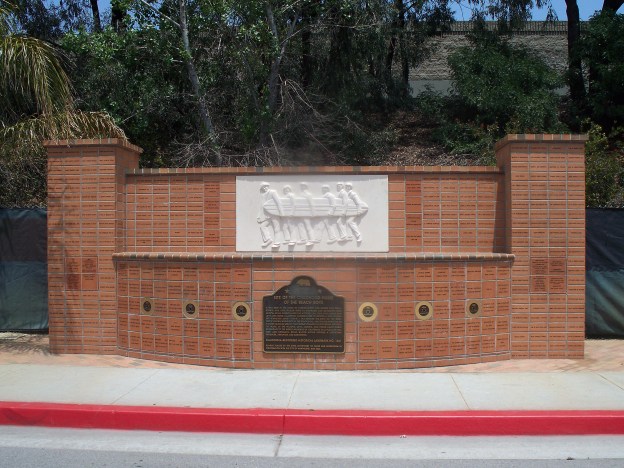

Feature image: The site of the Wilson family home in Hawthorne, California, at 3701 W. 119th Street where Brian Wilson composed Don’t Worry Baby with lyrics by Roger Christian (a DJ at KFWB in L.A.) over the course of a couple days in late 1963 or early 1964. With parents Murray and Audree Wilson, moved into the modest, single-story tract home in the 1940s where Brian, along with his brothers Carl and Dennis, lived throughout their entire childhood and teenage years. . In the mid-1980s, the property was demolished for the construction of the Century Freeway (I-105). The entire block was cleared, and the original address along with an important piece of music history, vanished overnight. PHOTO: “Beach Boys Landmark – Plano general I” by tkksummers is licensed under CC BY-SA 2.0.
“Don’t Worry Baby” was more than a hot-rod song or a B-side. It was Brian Wilson’s first fully realized emotional masterpiece, capturing vulnerability, romance, and sophisticated pop craftsmanship at the precise moment the Beatles and the British Invasion were transforming popular music.

Beach Boys in 1963. Brian Wilson, Carl Wilson, Dennis Wilson, David Marks, Mike Love. Since spring of 1963 they had 3 top-5 hits (and two more top-10 hits). “Surfin’ U.S.A.” peaked at no. 3 in May 1963 and became Billboard’s no.1 song for the year. “Little Saint Nick” released in December 1963 peaked at no. 3 on the Billboard Christmas Singles chart. It was in this time period that Brian Wilson with Roger Christian wrote “Don’t Worry Baby,” one of the Beach Boys’ finest songs pre-British Invasion about a guy who agrees to drag race but regrets it and, confiding his situation to his girlfriend, is tenderly consoled by her with the song’s title phrase. Public Domain.*
The Hawthorne House: Where the Beach Boys Began
The Wilson family home in Hawthorne was where Brian, Dennis, and Carl Wilson honed their musical skills and formed the Beach Boys in 1961 with cousin Mike Love and friend Al Jardine. It was within these walls that they created the group and famously recorded their first breakthrough single, Surfin’, in the living room over Labor Day weekend in 1961.
Brian Wilson lived at the family home into his early adulthood. By the time the Beach Boys became one of America’s most successful pop groups, the band’s success enabled family members to move on from the modest Hawthorne neighborhood where it had all started. Yet the house remained central to the Beach Boys story. It was there that Brian developed as a songwriter and, just a few years later, composed one of the group’s most enduring songs, Don’t Worry Baby.
Though the Beach Boys scored the No. 1 song of 1963 with Surfin’ U.S.A., the direction of popular music changed almost overnight following the Beatles’ first appearance on The Ed Sullivan Show on February 9, 1964. Seen by an estimated 73 million viewers, the broadcast launched the British Invasion and transformed rock and roll, challenging American artists such as the Beach Boys to evolve or risk being left behind.
Cars, California Youth, and Brian Wilson’s Imagination
Brian Wilson’s first car was a light burgundy Mercury passed down from his mother. He called it “the Merc.” After failing his first driver’s test, Wilson gained a reputation as an inattentive driver because his mind constantly wandered to other interests, especially music. His father eventually coached him through a second successful attempt.
Wilson later compared driving a car to playing a musical instrument. Both required touch, timing, and control to achieve the desired result. Yet he quickly realized that music offered infinitely more possibilities for creativity and self-expression. After a year behind the wheel of the Mercury, he purchased a used 1957 Ford Fairlane, a car he admired despite envying the more powerful machines driven by other Southern California teenagers.
The Fairlane became part of Beach Boys lore. Wilson later recalled hearing the group’s first single, Surfin’, on the radio while driving the car in 1962. He claimed he raced it enthusiastically, though few believed him. Cars, competition, and youthful bravado would soon become recurring themes in his songwriting.
Brian Wilson wrote “Don’t Worry Baby” as a response to the emotional power of the Ronettes’ “Be My Baby,” blending teenage themes with richer emotional depth.
From Be My Baby to Don’t Worry Baby
By 1963, Wilson had begun linking the imagery of cars and romance in his music while also developing a deeper understanding of how records could convey emotion. A crucial influence was Be My Baby by the Ronettes. Wilson became captivated by the song’s emotional impact, production, and vocal performance. He also admired how singers such as Aretha Franklin and Dionne Warwick could communicate profound feeling through the simplest vocal gestures.
Inspired by Be My Baby, Wilson wrote Don’t Worry Baby with Los Angeles disc jockey and lyricist Roger Christian. Initially intended for the Ronettes, the song was offered to the group but declined. The Beach Boys then recorded it themselves, producing what would become one of the defining tracks of their early career.
Written over several days at the Wilson family home in Hawthorne, Don’t Worry Baby borrowed the emotional spirit of Be My Baby while transforming it into something distinctly Wilson’s own. Ostensibly a story about a drag racer seeking reassurance from his girlfriend, the song elevated familiar hot-rod themes into a moving portrait of vulnerability, trust, and love. Looking back years later, Wilson described it simply: “It was a very simple and beautiful song. It’s a really heart and soul song. I really did feel that in my heart.”
At an August 1961 audition with Hite Morgan, a L.A. music publisher, Dennis Wilson said that Brian was working on a song about surfing. The truth was that no song existed. But the music publisher was intrigued and told the soon-to-be Beach Boys to come back when they had their new surfing song ready. “Surfin'” was recorded in October 1961 with Mike Love doing lead vocals, Brian on percussion/vocals, Carl Wilson on guitar/vocals, Al Jardine on acoustic bass/vocals and Dennis Wilson doing vocals. It was released in November 1961 on the independent label Candix. Though it peaked at no.75 on the Billboard Hot 100, its lyric which included the line”Surfin’ is the only life, the only way for me” capitivated listeners and was unique on the radio in late 1961.
LYRICS Surfin’ is the only life, the only way for me
Now surf
Surf with me
I got up this mornin’, turned on my radio (Ooh, surfin’)
I was checkin’ out the surfin’ scene to see if I would go (Ooh, surfin’)
And when the DJ tells me that the surfin’ is fine (Ooh, surfin’)
That’s when I know my baby and I will have a good time
We’re goin’ surfin’, surfin’
Surfin’, surfin’, surfin’
Surfin’, surfin’, surfin’
Surfin’ is the only life, the only way for me
Now surf
Surf with me
From the early mornin’ to the middle of the night (Ooh, surfin’)
Any time the surf is up, the time is right (Ooh, surfin’)
And when the surf is down to take its place (Ooh, surfin’)
We’ll do the Surfer’s Stomp, it’s the latest dance craze
We’re goin’ surfin’, surfin’
Surfin’, surfin’, surfin’
Surfin’, surfin’, surfin’
Surfin’ is the only life, the only way for me
Now surf
Surf with me
Now the dawn is breaking and we really gotta go (Ooh, surfin’)
But we’ll be back here very soon, that you better know (Ooh, surfin’)
Yeah, my surfer knots are rising and my board is losing wax (Ooh, surfin’)
But that won’t stop me, baby, ’cause you know I’m comin’ back
We’re goin’ surfin’, surfin’
Surfin’, surfin’, surfin’
Surfin’, surfin’, surfin’
Surfin’ is the only life, the only way for me
Now come on, pretty baby and surf with me, yeah
“Don’t Worry Baby” transformed a simple drag-racing narrative into a universal story about fear, reassurance, and love.
While the Beach Boys were known for cars, surfing, and California youth culture, Don’t Worry Baby revealed the deeper artistic direction that would soon define Brian Wilson’s greatness.

Feature Image: The Beach Boys in 1964; clockwise from left: Al Jardine, Mike Love, Brian Wilson, Carl Wilson, Dennis Wilson. Trade ad for The Beach Boys’s single “California Girls”/”Let Him Run Wild.” Public Domain.**
Although buried on a hot-rod-themed album and issued as the B-side to “I Get Around,” the song emerged as the album’s enduring masterpiece and a signpost toward Wilson’s later innovations.
The Masterpiece Hidden on Shut Down Volume 2
While the music industry was being transformed by the British Invasion, the Beach Boys were creating one of the defining pop records of the era. Recorded during sessions in early January and mid-February 1964, spanning the very weeks surrounding the Beatles’ landmark appearance on The Ed Sullivan Show, Shut Down Volume 2 introduced “Don’t Worry Baby.”
The track features one of Brian Wilson’s most tender and convincing lead vocal performances, supported by Mike Love’s resonant bass part and the rich harmonies of Al Jardine, Carl Wilson, and Dennis Wilson. Released on March 2, 1964, the Beach Boys’ fifth studio album followed the enormous success of Surfin’ U.S.A., Billboard’s No. 1 song of 1963 and the centerpiece of an album that reached No. 2 nationally. Although the hot-rod-themed Shut Down Volume 2 climbed only to No. 13 on the Billboard 200, “Don’t Worry Baby” quickly distinguished itself as the album’s emotional centerpiece.
A Hit in Its Own Right
Rather than retreating as Beatlemania swept America, Brian Wilson became even more determined to compete at the highest artistic level. Following the Top 5 success of “Fun, Fun, Fun” in March 1964, the Beach Boys released “I Get Around” in May with “Don’t Worry Baby” on the B-side.
The pairing proved remarkably strong. By July 4, 1964, “I Get Around” had become the Beach Boys’ first No. 1 hit on the Billboard Hot 100, while “Don’t Worry Baby” charted independently and reached the Top 30, peaking at No. 24. What began as a B-side had emerged as one of the group’s most beloved recordings.

The Beach Boys in concert in February 1965. PHOTO: “Les Beach Boys en concert à l’aréna Maurice-Richard. 19 février 1965. De gauche à droite : Al Jardine, Carl Wilson et Glen Campbell (en remplacement de Brian Wilson). VM94-S32-010. Archives de la Ville de Montréal.” by Archives de la Ville de Montréal is licensed under CC BY-NC-SA 2.0.
Brian Wilson’s Response to the Beatles
The Beatles’ arrival forced nearly every American act to reconsider its future, and Brian Wilson was no exception. With the British group setting new standards for songwriting and innovation, Wilson began drawing on older musical influences while experimenting more boldly with arrangements, harmonies, and instrumentation. His goal was not merely to keep pace with the changing musical landscape but to push the Beach Boys into new artistic territory.
Wilson set about reinventing the Beach Boys just as he had succeeded in inventing them. By year’s end, the Beatles occupied the top two positions on Billboard’s year-end singles chart with “I Want to Hold Your Hand” and “She Loves You.” Yet amid the British wave, the Beach Boys remained firmly in the conversation, placing “I Get Around” among the year’s five biggest hits. “Don’t Worry Baby” stands today as an early sign of the creative ambitions that would soon produce some of Brian Wilson’s most celebrated work.
Released during the weeks surrounding the Beatles’ arrival in America, “Don’t Worry Baby” demonstrated that the Beach Boys could compete artistically in a rapidly changing musical landscape.
This Foxes and Fossils rendition of the Beach Boys’ 1964 top‑40 hit “Don’t Worry Baby” is a fine one — faithful yet fresh. The song has been covered countless times, but Brian Wilson would likely appreciate this version: his original was inspired by, and meant for, a girl group. He might also smile because the Beach Boys always loved seeing a new generation discover their music and claim it as their own.
LYRICS Well, its been building up inside of me
For, oh, I don’t know how long
I don’t know why, but I keep thinking
Something’s bound to go wrong
But she looks in my eyes
And makes me realize
And she says (now don’t) (don’t worry, baby)
Don’t worry, baby (don’t you worry) (don’t worry, baby)
Everything will turn out alright (now don’t) (don’t worry, baby)
Don’t worry, baby (don’t you worry) (don’t worry, baby)
I guess I should’ve kept my mouth shut
When I started to brag about my car
But I can’t back down now, because
I pushed the other guys too far
She makes me come alive
And makes me wanna drive
When she says (now don’t) (don’t worry, baby)
Don’t worry, baby (don’t you worry) (don’t worry, baby)
Everything will turn out alright (now don’t) (don’t worry, baby)
Don’t worry baby (don’t you worry) (don’t worry, baby)
She told me, “Baby, when you race today
Just take along my love with you
And if you knew how much I loved you
Baby, nothing could go wrong with you”
Oh, what she does to me
When she makes love to me
And she says (now don’t) (don’t worry, baby)
Don’t worry, baby (don’t you worry) (don’t worry, baby)
Everything will turn out alright (now don’t) (don’t worry, baby)
Don’t worry, baby (don’t you worry) (don’t worry, baby)
Everything will turn out alright (now don’t) (don’t worry, baby)
Don’t worry, baby (don’t you worry) (don’t worry, baby)
*This is a publicity still taken and publicly distributed to promote the subject or a work relating to the subject.
As stated by film production expert Eve Light Honathaner in The Complete Film Production Handbook (Focal Press, 2001, p. 211.):
“Publicity photos (star headshots) have traditionally not been copyrighted. Since they are disseminated to the public, they are generally considered public domain, and therefore clearance by the studio that produced them is not necessary.”
Nancy Wolff, in The Professional Photographer’s Legal Handbook (Allworth Communications, 2007, p. 55.), notes:
“There is a vast body of photographs, including but not limited to publicity stills, that have no notice as to who may have created them.”
Film industry author Gerald Mast, in Film Study and the Copyright Law (1989, p. 87), writes:
“According to the old copyright act, such production stills were not automatically copyrighted as part of the film and required separate copyrights as photographic stills. The new copyright act similarly excludes the production still from automatic copyright but gives the film’s copyright owner a five-year period in which to copyright the stills. Most studios have never bothered to copyright these stills because they were happy to see them pass into the public domain, to be used by as many people in as many publications as possible.”
Kristin Thompson, committee chairperson of the Society for Cinema and Media Studies writes in the conclusion of a 1993 conference of cinema scholars and editors[1], that:
“[The conference] expressed the opinion that it is not necessary for authors to request permission to reproduce frame enlargements… [and] some trade presses that publish educational and scholarly film books also take the position that permission is not necessary for reproducing frame enlargements and publicity photographs.”
**Permission details The ad appeared in the 11 September 1965 issue of Billboard and can be dated from that publication; it is pre-1978. There are no copyright markings as can be seen at the full view link. The ad is not covered by any copyrights for Billboard. US Copyright Office page 3-magazines are collective works (PDF) “A notice for the collective work will not serve as the notice for advertisements inserted on behalf of persons other than the copyright owner of the collective work. These advertisements should each bear a separate notice in the name of the copyright owner of the advertisement.”
SOURCES:
Badman, Keith. The Beach Boys: The Definitive Diary of America’s Greatest Band on Stage and in the Studio. 1st ed. New York: Backbeat Books, 2004, p. 53.
Love, Mike. Good Vibrations: My Life as a Beach Boy. New York: Penguin Publishing Group, 2016, pp. 64-65, 96-97, and 248.
Morgan, Johnny. The Beach Boys: America’s Band. Illustrated ed. New York: Union Square & Co., 2015, p. 67.
Sharp, Ken. “Brian Wilson: God’s Messenger.” American Songwriter, January 2, 2009. https://americansongwriter.com/brian-wilson-gods-messenger/4/. Accessed February 24, 2025.
Stebbins, Jon. The Beach Boys FAQ: All That’s Left to Know about America’s Band. New York: Backbeat Books, 2011, pp. 8, 25-26, and 49. Wilson, Brian, with Ben Greenman. I Am Brian Wilson: A Memoir. Boston: Da Capo Press, 2016. pp. 115-116.