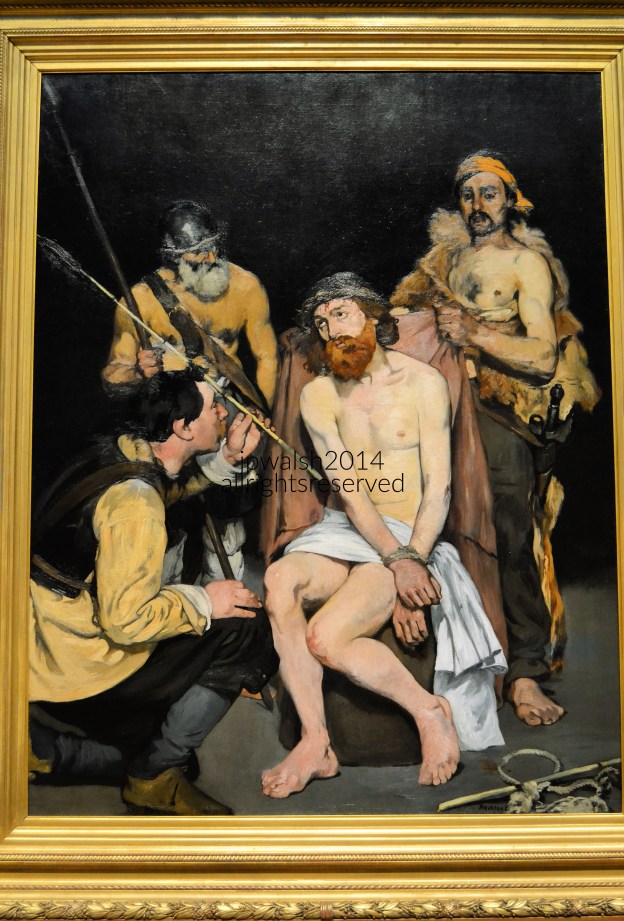
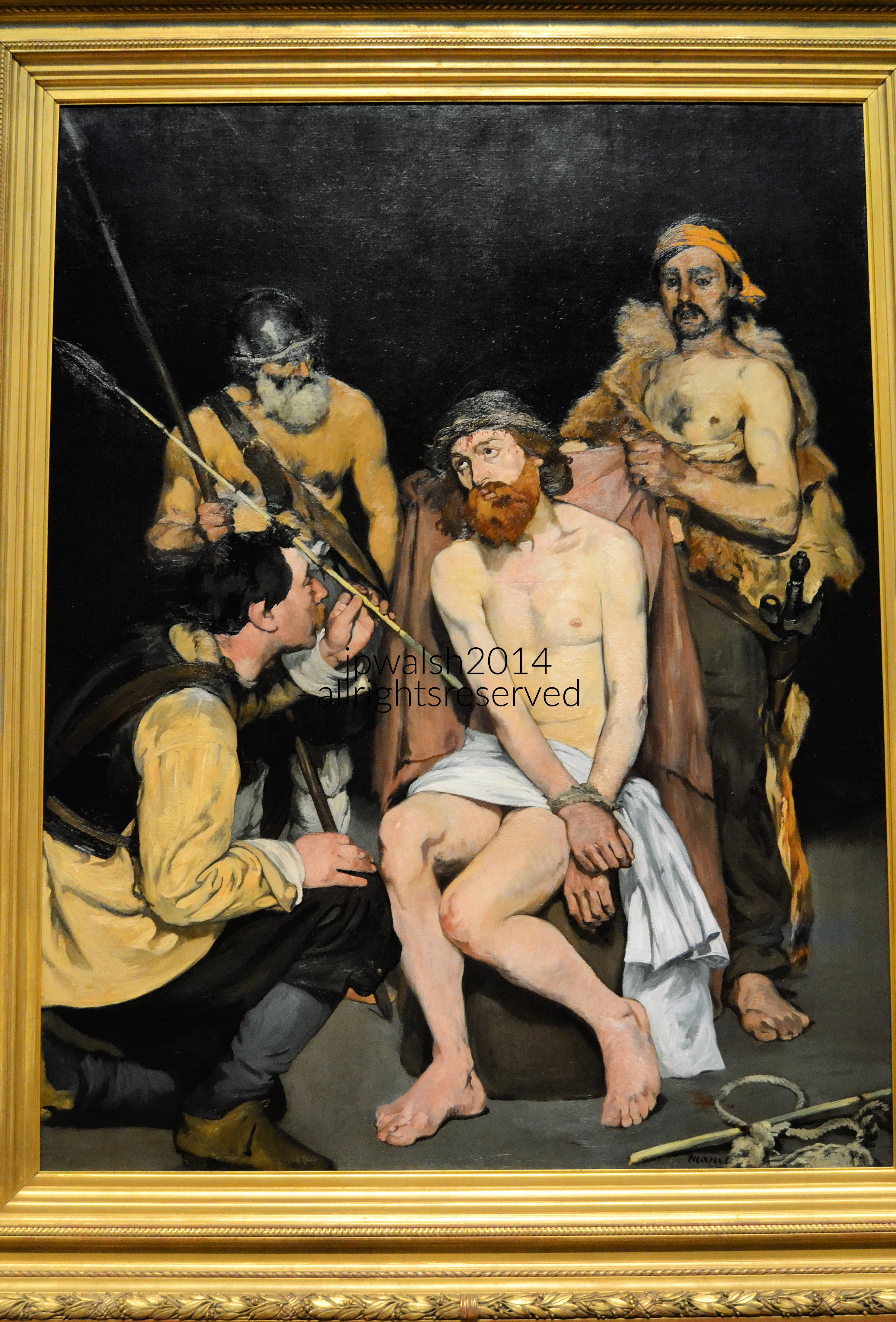
Feature image: Édouard Manet, Jesus Mocked by the Soldiers, 1865, oil on canvas, 190.8 × 148.3 cm (74 7/8 × 58 3/8 in.), transforms a traditional Passion scene into a striking meditation on artistic identity and public judgment. Rather than emphasizing spiritual transcendence, Manet presents Christ with an unsettling immediacy, drawing parallels between the mocked figure and the modern artist subjected to criticism, misunderstanding, and ridicule. Created during a period when Manet’s own work was regularly attacked by critics and rejected by academic convention, the painting blurs the boundary between religious narrative and contemporary experience, turning Christ’s humiliation into a powerful reflection on the costs of innovation and the burden of standing apart from public opinion. The Art Institute of Chicago. See – Jesus Mocked by the Soldiers | The Art Institute of Chicago – retrieved April 18, 2026. May 2014. Author’s photograph, 4.93mb DSC_0577 (1)
Christ as the Modern Artist
Even if Édouard Manet did not literally model Christ’s face on his own in Jesus Mocked by the Soldiers, the painting functions as an unmistakable act of self‑identification. Christ becomes a proxy for the embattled modern artist, a figure exposed, judged, and misunderstood by a hostile public. Manet selects the moment of Christ’s humiliation not to reenact a devotional scene but to stage a parallel between sacred suffering and his own experience before the Salon.
By mid‑century, French painting had turned decisively secular, yet Manet submitted two religious works to the Salons of 1864 and 1865, The Dead Christ with Angels and Jesus Mocked by the Soldiers. Both were accepted, and both were savaged. Critics called them vulgar, ignoble, even “contrary to art.” The public, accustomed to sentimentalized, idealized images of Jesus, recoiled from Manet’s starkly human Christ. Manet admitted to Baudelaire that the hostility unsettled him, even as Degas noted that the uproar made him famous. As Edmond Bazire observed, the Empire preferred idealized piety and bristled at seeing the Passion rendered with unvarnished realism, even when the scene followed Scripture closely.
Painting the Passion in a Secular Age
What, then, is a secular modern artist doing painting the Passion at all? Manet’s answer is to reframe Christ’s suffering as an analogue for the artist’s own embattled position, a truth‑teller punished by a complacent society. While many French moderns had drifted from Catholicism, Manet maintained ties to the faith, and he inherited a Renaissance tradition in which artists increasingly identified with Christ, blurring the line between human and divine as a form of imitatio Christi. By the 1860s this identification was a legitimate, if easily misunderstood, mode of artistic self‑expression. Manet was not conventionally pious, but he was close to several religious thinkers, and his engagement with sacred subjects was sincere enough that these works were conspicuously omitted from the 1884 retrospective after his death.
A Contemporary Christ
What makes Manet’s identification radical is the way he collapses the boundary between sacred history and modern experience. His Christ is rendered with the same realist immediacy, the same studio illumination, the same unidealized physicality that define his contemporary subjects. The result is a figure who is neither fully divine nor fully secular but unsettlingly both, a Christ startlingly contemporary. The frontal, confrontational composition intensifies this effect: Christ appears not as a distant theological symbol but as a vulnerable body exposed to judgment. The ambiguity, devotional image, critique of devotional imagery, or modern psychological drama, was precisely what scandalized a hierarchical society that depended on stable categories.
Édouard Manet’s Jesus Mocked by the Soldiers shocked 1865 Paris Salon critics with its radical portrayal of Christ. According to the Art Institute of Chicago, the painting’s profound ambiguity, heavy emphasis on Christ’s raw humanity, and Manet’s refusal to idealize the sacred figure ignited immediate controversy. Appearing deeply exhausted and vulnerable, Christ conspicuously lacks a traditional halo, forcing viewers to question whether they are looking at a divine being or merely an ordinary man.
Conservatives attacked the work as crude, irreverent, and a total violation of academic standards. Critics were particularly outraged that Manet treated a holy subject with the same blunt realism, flat lighting, and visible brushwork he used for modern, secular street scenes. Public and critical reception was so fiercely negative that the prominent critic Paul de Saint-Victor famously dismissed the masterpiece as “the horrible Ecce Homo by Monsieur Manet.”
The Passion as Artistic Self‑Portrait
The deeper provocation lies in Manet’s intervention into the history of painting. For a secular avant‑garde artist to take up a Passion subject in the 1860s was anomalous; to transform it into a conceptual self‑portrait was unprecedented. Manet’s Christ is not a theological claim but an artistic one: the modern painter, like the historical Jesus, confronts entrenched power, exposes uncomfortable truths, and endures public derision for doing so. The painting becomes a self‑portrait not of Manet’s face but of his artistic condition.
A Mockery of the Mockery
In this light, Jesus Mocked by the Soldiers is not a mockery of the sacred scene but a mockery of the mockery, a doubling of humiliation that implicates both Christ’s tormentors and Manet’s critics. The viewer’s unease arises from this conflation of registers: divine and human, biblical and modern, sacred narrative and artistic identity. Manet’s Christ stands under a bright studio light, stripped of idealization, exposed to judgment, just as Manet stood before the tribunal of the Salon.
The Suffering Artist
The scandal, then, lies not only in the subject but in the claim: that the modern artist, misunderstood and persecuted, belongs to a lineage of suffering truth‑tellers. If not a literal self‑portrait, the painting is unmistakably a portrait of artistic identity, asserting that the modern painter occupies a role once reserved for the sacred.
SOURCES:
Books: Brettell, Richard R. French Salon Artists, 1800–1900. New York: Harry N. Abrams, Inc.; Chicago: The Art Institute of Chicago, 1987. [See pp. 58–62.] Cachin, Françoise, and Charles S. Moffett. Manet, 1832–1883. New York: The Metropolitan Museum of Art and Harry N. Abrams, Inc., Publishers, 1983. [See pp. 226–229.]
Archival Documents & Reviews: Paris Salon of 1865. Historical Exhibition Records and Archives. Paris, 1865. Saint-Victor, Paul de. “Le Salon de 1865.” La Presse, May 28, 1865. Cited in the Bibliography Archives of the Art Institute of Chicago.
Websites: ArtWay. “Historical Essays on Manet.” Accessed September 2026. https://artway.eu. Wikipedia contributors. “Jesus Insulted by the Soldiers.” Wikipedia, The Free Encyclopedia. Accessed September 2026. https://wikipedia.org.
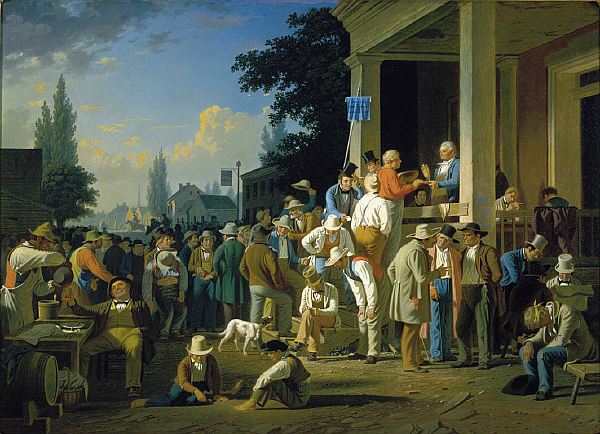
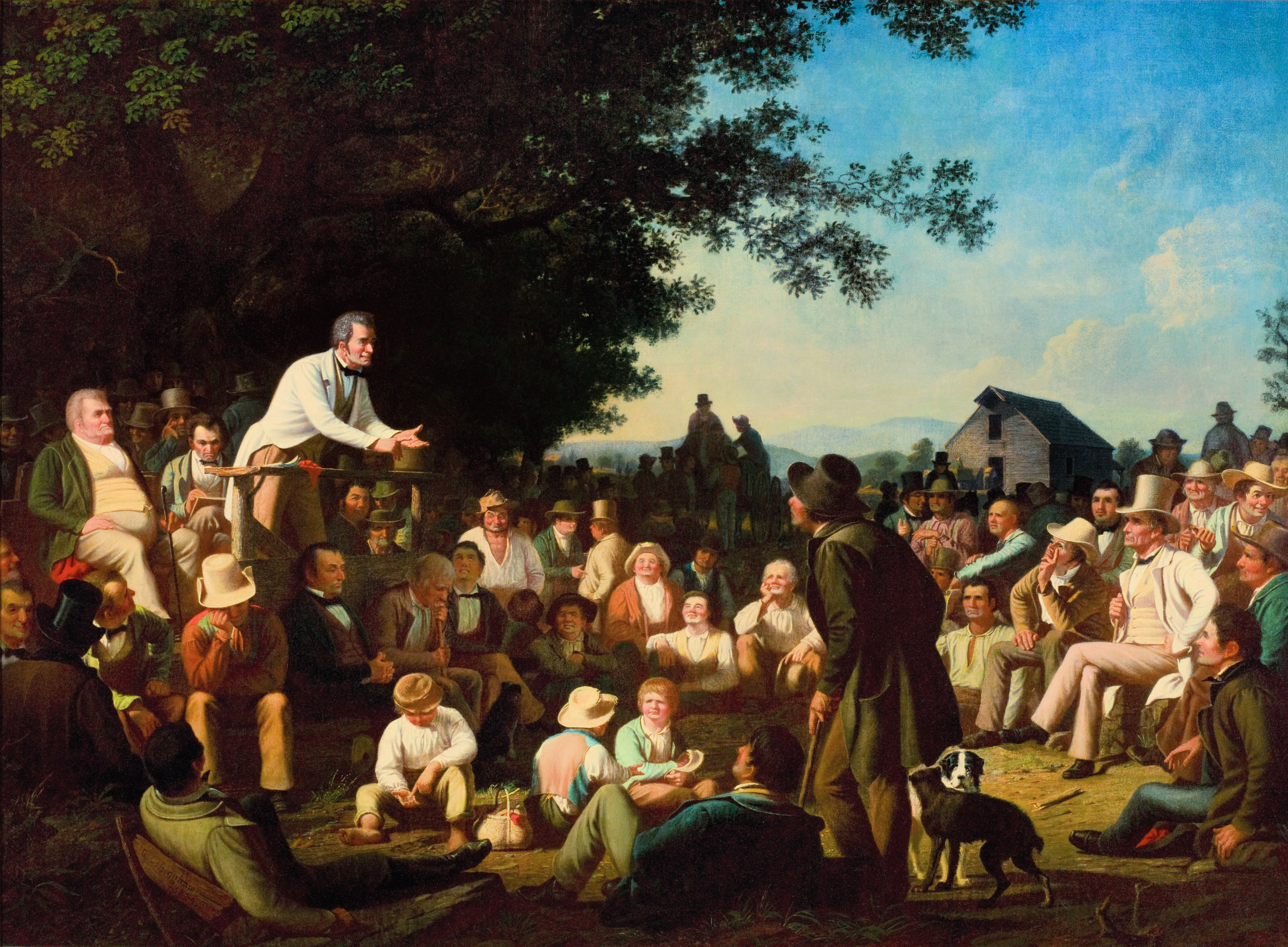
FEATURE IMAGE: George Caleb Bingham (1811-1879), Stump Speaking, 1854, oil on canvas, 42 1/2 x 58 in. (108 x 147.3 cm), St. Louis Art Museum. The painting begun by Bingham in November 1853 was completed in February 1854 in Philadelphia. Stump Speaking is one of three paintings in a series representing to a national audience the idea of the American democratic process. Bingham exhibited Stump Speaking in a series with his The County Election and The Verdict of the People at the influential (1856-1860) Washington Art Association, the Pennsylvania Academy of Art, and the Western Academy of Art in St. Louis. These election series paintings along with Bingham’s Jolly Flatboatmen in Port then went on view at the St. Louis Mercantile Library (founded 1846) until the 1930’s when the election series paintings were loaned to the City Art Museum (the future Saint Louis Art Museum). In 1941, The Mercantile Library sold Stump Speaking and The Verdict of the People to Boatmen’s National Bank of St. Louis (now Bank of America) and, in 2001, Bank of America gave Stump Speaking to the Saint Louis Art Museum. Public Domain. https://www.slam.org/collection/objects/29774/ – retrieved September 13, 2025.
George Caleb Bingham’s mid-19th-century masterpiece Stump Speaking presents a complex, dispassionate portrait of pre-Civil War frontier democracy, utilizing his distinct viewpoint as both a Whig politician and an American realist artist to visualize a civilized, orderly, and deeply participatory American electorate.
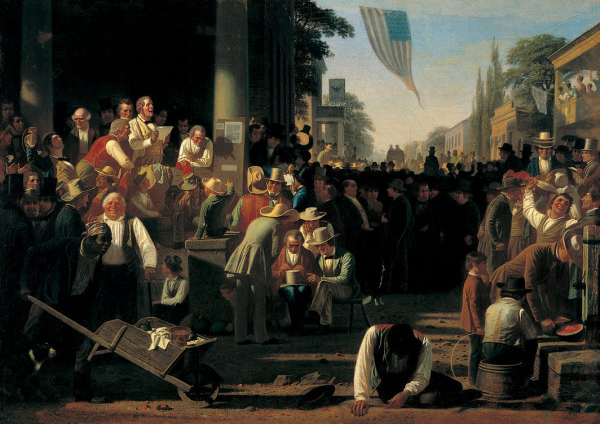
Bingham, The County Election, 1852, oil on canvas, 38 x 52 in. (96.5 x132 cm), St. Louis Art Museum. It depicts an election in 1850 in Saline County, Missouri, located between Columbia and Kansas City in central Missouri. Bingham’s paintings depict a dispassionate electorate before the Civil War reflecting the Founders’ ideals in challenging times. A staunch Unionist, George Caleb Bingham’s own political views rejected radical politics whether an unrestrained northern Abolitionist cause or that of Southern Fire-Eaters and strived toward negotiation and minimally Federal regulation of slavery. Bingham opposed the proslavery wing of Missouri politics represented by Gov. Clairborne Fox Jackson (1806-1862) who appears in Stump Speaking. Though Bingham’s election series is painted before the Lincoln-Douglas debates in 1858 in neighboring Illinois, Bingham, a Whig, tended towards Lincoln’s characterization of democracy that government should provide “a fair chance” to all. Though depicted at the periphery in service roles to whites, Bingham’s artwork presented slaves sympathetically encouraging his viewers to acknowledge the slaves’ existence and to recognize that they are being excluded from the noble American democratic process. Public Domain. See – https://www.nytimes.com/2025/09/15/books/review/born-equal-akhil-reed-amar.html – retrieved September 28, 2025.
Bingham, Verdict of the People, 1854, 74 cm × 93 cm (29 in × 36.5 in), St. Louis Art Museum. When Donald Trump was inaugurated as the 45th president of the United States on Jan. 20, 2017, The Verdict of the People was the chosen painting, hanging on a partition wall behind the ceremonial head table in the Capitol’s Statuary Hall. Public Domain.
Painted between November 1853 and February 1854, Stump Speaking is part of a celebrated three-painting “Election Series” designed to represent the reality and ideals of the American democratic process to a national audience.
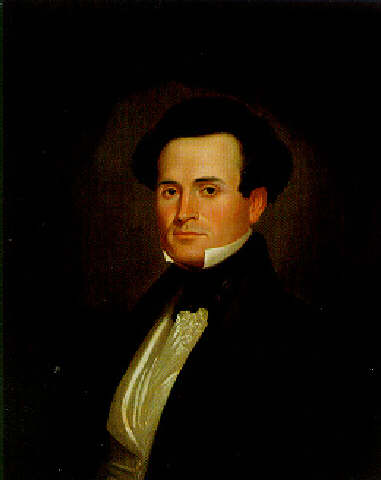
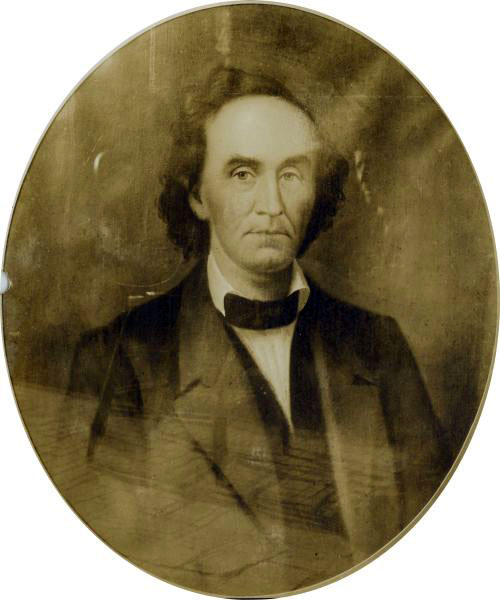
In Stump Speaking, Democrat Erasmus Darwin “E.D.” Sappington (1809-1858), born in Tennessee, is the main speaker shown leaning forward and pleading his case to a crowd of rural citizens. Behind him, with tablet in hand, sits his opponent taking notes in preparation conceivably for his turn at the make-shift podium. Candidate Sappington had married Penelope Breathitt (1822/3-1904), the eldest daughter of Kentucky Governor John Breathitt (1786-1834), and the couple had four children. Gov. Breathitt, a Jacksonian Democrat, had been elected as the Bluegrass State’s 11th Governor in 1832, serving until his death from tuberculosis at age 47. After his death, Breathitt County in Eastern Kentucky was created and named in his honor.
The three primary political figures anchoring the canvas—speaker Erasmus Darwin “E.D.” Sappington, former governor Meredith Miles Marmaduke, and future secessionist governor Claiborne Fox Jackson—were all brothers-in-law linked by marriage to the influential Sappington family.
Bingham – portrait of Erasmus Darwin “E.D.” Sappington, 1844. Public Domain.
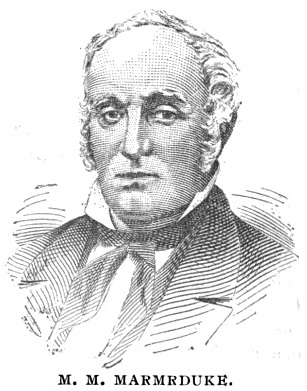
https://www.findagrave.com/memorial/86334793/penelope_c-sappington – retrieved September 26, 2025. https://www.findagrave.com/memorial/60353793/erasmus_darwin-sappington – retrieved September 26, 2025. The rotund man seated behind the speaker is Meredith Miles Marmaduke (1791-1864), part of the Missouri’s Democratic political machine. Born in Virginia, like Bingham, Marmaduke moved to Missouri in 1823 where he married Lavinia Sappington (1807-1885) whose mother, Jane Breathitt (1783-1852), was the older sister of Kentucky Governor Breathitt. The Marmadukes had 10 children together. Marmaduke was a trader on the Santa Fe Trail, surveyed and platted Arrow Rock in Saline County on the Missouri River where he had a plantation and was elected Lt. Governor of Missouri. When Governor Thomas Reynolds (1796-1844) died in office by suicide, Marmaduke assumed the Governorship from February 1844 until November 1844, finishing out the term. The Reynolds administration was heavily criticized by conservative Whigs for championing the abolition of debtor’s prisons in the state which the Missouri General Assembly accomplished in February 1843. Reynolds whom Marmaduke succeeded also freed up voting requirements to provide greater voting access to the state’s residents, another issue opposed by Whigs. When the University of Missouri in Columbia was established in 1839 and became the first public university west of the Mississippi River, the Reynolds Administration achieved the education milestone of enrolling its first class. Meredith Miles Marmaduke, a former slaveholder, was a staunch Unionist during the U.S. Civil War, although four of his sons fought for the Confederacy which was a typical outcome of the conflict in the Border States. After the war, one of those sons, in 1885, became Missouri’s 25th governor.
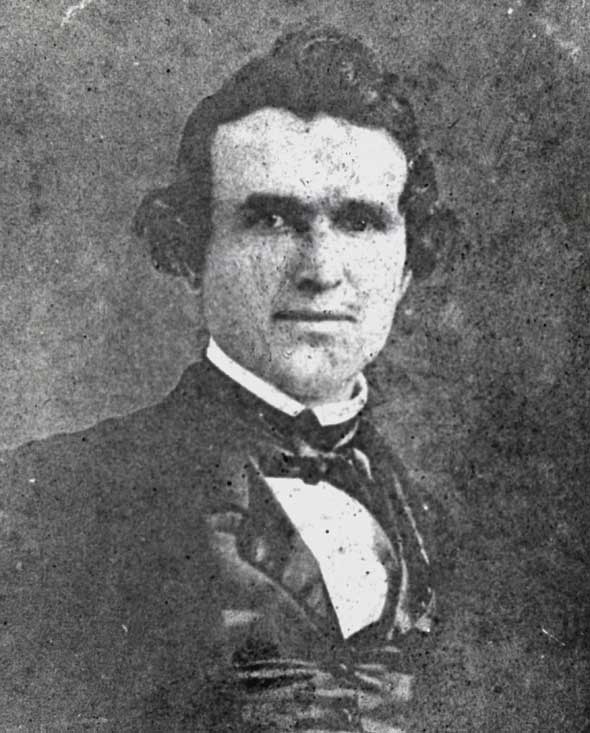
“Historical, Pictorial and Biographical Record, of Chariton County, Missouri”, p. 30 (1896). Public Domain.
At right in Stump Speaking the man in the white coat and top hat is then-state senator Clairborne Fox Jackson (1806-1862) who became the secessionist governor of Missouri in 1861. Jackson was forced out by the Missouri General Assembly’s Unionist majority on July 30, 1861, and replaced by a former Chief Justice of the State Supreme Court as provisional governor for the rest of the war. During these contentious deliberations, Bingham was in the state capitol to dedicate portraits of Henry Clay and President Andrew Jackson. Asked to say a few words, Bingham praised the seventh president’s suppressing nullifiers in 1832-1833 and called secession treason which almost blew the roof off the Missouri House. See- https://archive.nytimes.com/opinionator.blogs.nytimes.com/2013/09/06/an-artists-revenge/– retrieved September 27, 2025. Removed Gov. Jackson did not recognize the assembly’s actions and issued a proclamation on August 5, 1861, declaring that Missouri would secede from the Union. Jackson then traveled to Richmond, Virginia, to meet Confederate President Jefferson Davis and seek support of local Confederate militia forces and recognition by the Confederate government, both of which the Confederacy did. Union forces, however, had occupied most of Missouri and the state’s Unionist versus Secessionist political impasse was basically moot. Jackson withdrew to Arkansas with Confederate militia but was defeated by Union forces at the Battle of Pea Ridge in March 1862. Violent skirmishes, often savage attacks, continued in Missouri as Confederate guerrillas, called bushwhackers, caused random fear and havoc. Missouri bushwhackers included outlaws Jesse James and his older brother Frank James. Quantrill’s raid on Lawrence, Kansas, in August 1863 killed no less than 150 men and boys and inflamed the border. Fleeing further south to regroup, Jackson died at 56 years old of pneumonia and stomach cancer. Claiborne Fox Jackson having, in 1831, married Jane Breathitt Sappington (1813-1831) and, in 1833, Louisa Catherine Sappington (1814-1838), sisters of Lavina Sappington Marmaduke, was brother-in-law to Meredith Miles Marmaduke. As “E.D.” Sappington was brother to these women, all three men in Bingham’s painting were brothers-in-law.
In sharp contrast to the biting cynicism of William Hogarth’s 18th-century British election art, which depicted voters as corrupt fools, Bingham paints the American electorate as a calm, dignified, and inherently ethical collective carrying out a sacred civic duty.
Bingham’s lively crowd evokes William Hogarth’s mid-18th century Election series, but with little to none of the British artist’s turbulent depictions. The American Bingham’s election series is orderly in its business. Bingham’s Stump Speaking depicts none of Hogarth’s corruption where the voter or politician is pictured as an idiot and fool whose election requires that he be bribed, threatened, conned, intoxicated, or generally pushed around. One of Hogarth’s voters has to be carried to the ballot box to cast his vote because he is already dead. By contrast, in mid-19th century America, the democratic process, while popularly engaging and verbally contentious, is a pictorial pantheon of virtue: calm, dignified, respectful, decent, honest, ethical, and incorruptible. The American people carry out their sacred duty of democratic self-governance accompanied by earnest and sober demeanor as all Americans, North and South, as Lincoln observed “pray to the same God.” See – https://www.nytimes.com/2025/09/15/books/review/born-equal-akhil-reed-amar.html – retrieved September 28, 2025. While depicting politicians in American art and illustration had been typical from the Republic’s earliest days, Bingham casts them in a context with their voters laboring together in a noble field of American politics and democracy. In a painting that depicts the nation’s spread of universal suffrage for adult white males in the pre-Civil War era and the mobilization by party organizations of popular politics, Bingham neither depicts an anonymous crowd nor one restricted in social type. It is a real, breathing American landscape attracting and engaging a variety of ages and occupations. One does not find a shouting match, let alone some kind of melée in Bingham’s American electorate. It is quite the opposite: the crowd is civilized. Though assembled haphazardly, they are seated in peaceable order where some, amused by the proceedings, can share their laughter good-naturedly. Bingham’s figures are stalwart and reliable who come to attentively learn and independently decide among candidates. For Americans, listening to and questioning what each candidate has to say, and then voting, is a sacred civic duty since 1789 that Bingham updates to his present day.
Public Domain.
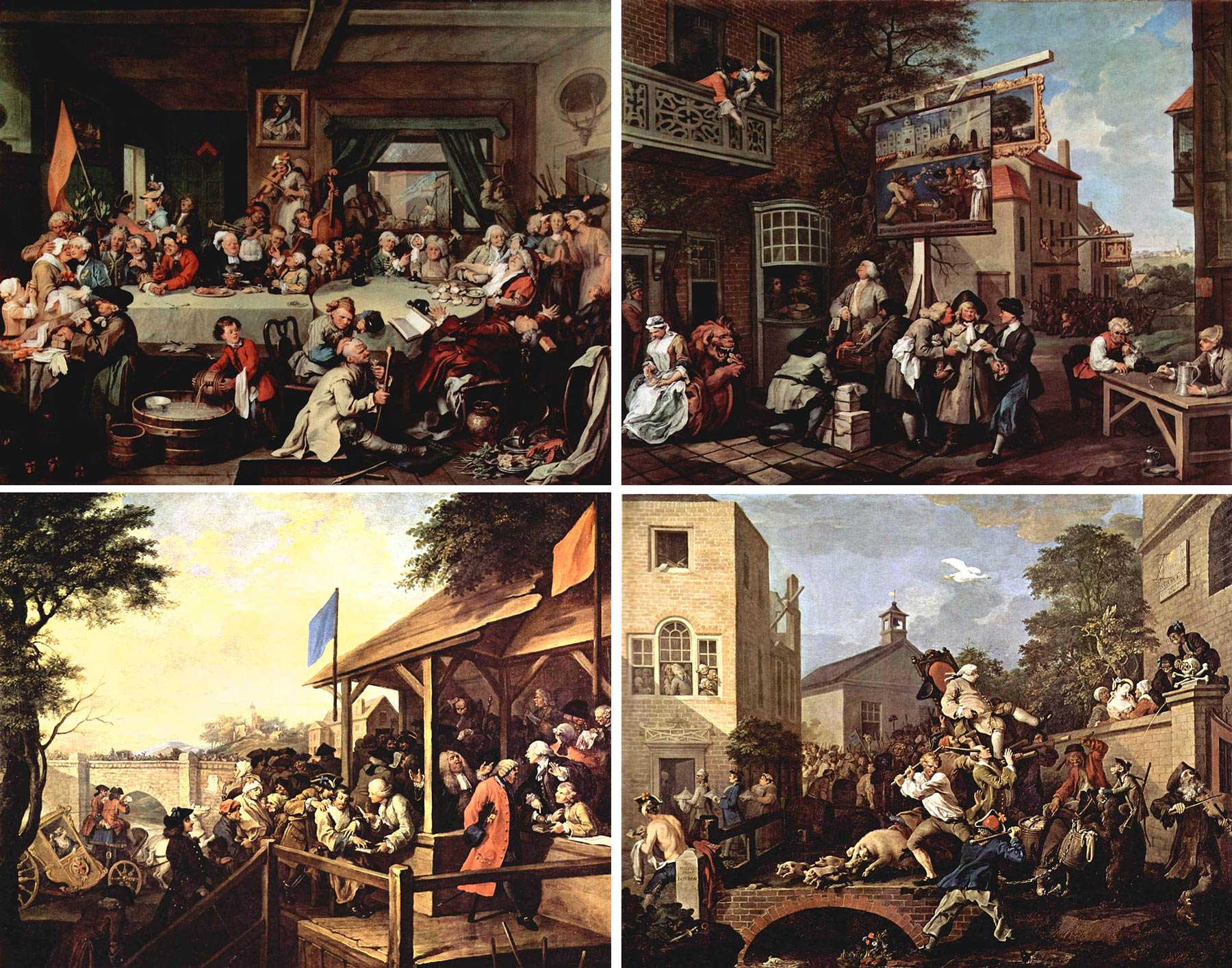
The four panels represent the chronological stages of the election process. Top Left:An Election Entertainment depicts a chaotic banquet staged by the Whig candidates to win over local voters. The room is crowded with gluttony, drunkenness, and political excess. Top Right:Canvassing for Votes shows Whig and Tory agents competing for support outside a local inn, where the innkeeper casually accepts bribes from both sides while a mob tears down the opposition’s sign. Bottom Left:The Polling portrays voters climbing the steps of a makeshift wooden polling station to publicly cast their oral ballots. Hogarth highlights the absurdity and corruption of the electoral system, as the sick, the elderly, and the vulnerable are paraded to the polls in an effort to influence the count. Bottom Right:Chairing the Member depicts the victory procession of the successful Tory candidate, carried triumphantly through the streets in a chair. As so often in Hogarth’s work, the celebration quickly descends into chaos and violence, dissolving into a street brawl.
The Contrast to Bingham
Missouri artist George Caleb Bingham explicitly modeled his own 1850s Election Series on these works. However, while Hogarth viewed democracy as a cynical, corrupted circus of fools, Bingham reimagined the concept for the American frontier as an orderly, civilized field of civic virtue.
About the Artist.
George Caleb Bingham (1811-79), an artist and politician. Born in Virginia, Bingham grew up on the frontier land of the Missouri River, and he was largely self-taught. He is famous for his scenes of manly, everyday life, showing work and play, mostly along the Missouri and Mississippi Rivers. His most celebrated picture is Fur Traders Descending the Missouri. Public Domain.
After his first wife, Sarah Elizabeth Hutchinson Bingham, died in November 1848 at 28 years old following 12 years of marriage, she was buried in Sunset Hills Cemetery in Boonville, Missouri. The next year, on December 3, 1849, Bingham married Eliza Thomas of Columbia, Missouri. Bingham had one child each with both his first and second wife. In 1876, Eliza having developed mental health issues, Bingham was forced to commit her to a state mental institution in Fulton, Missouri. She died there later that same year. Eliza was buried next to her parents in Mount Washington Cemetery in Independence, Missouri. Now 55-year-old Bingham was a two-time widower with a 15-year-old son. Unfortunately, the artist, too, would not be long for this world.
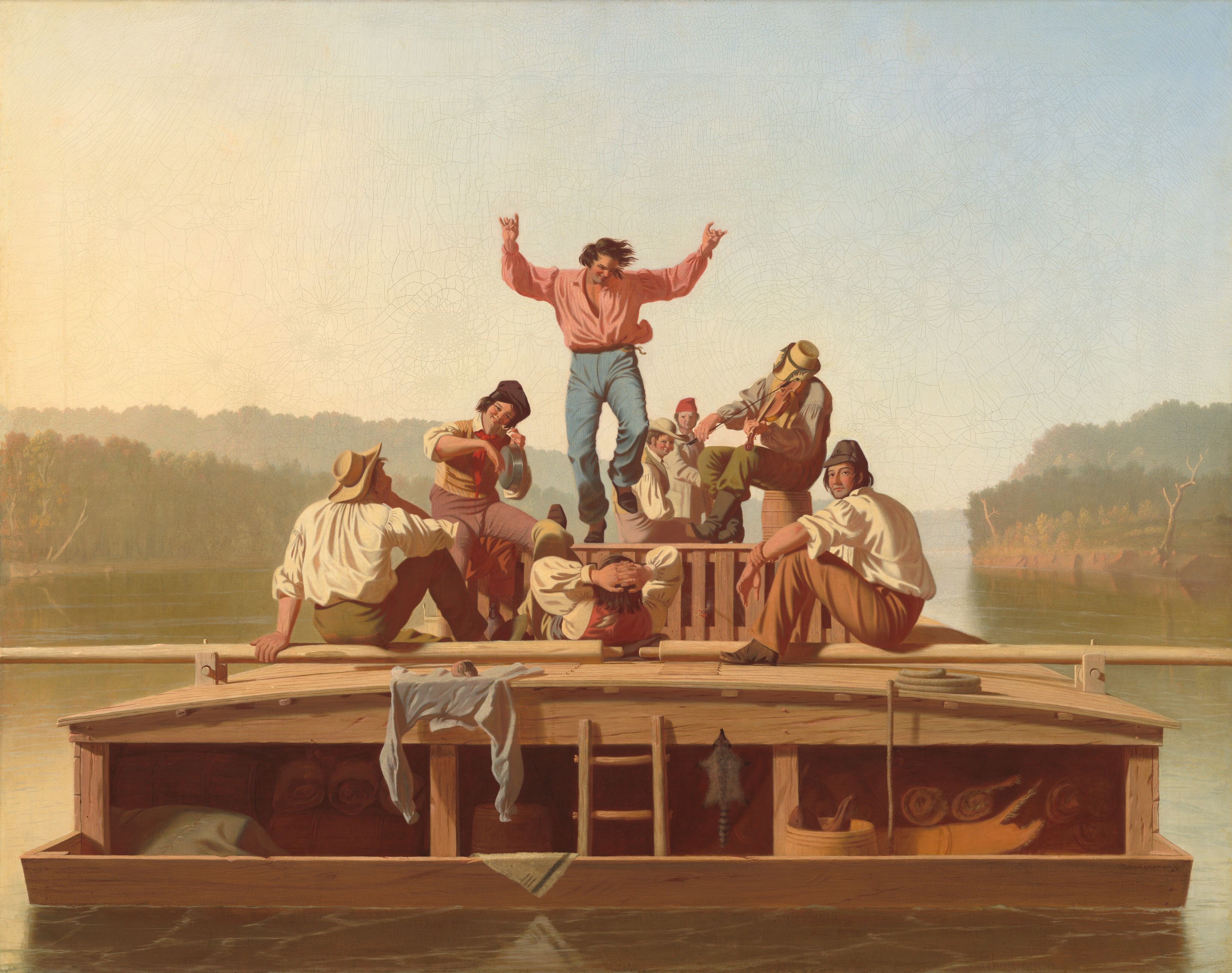
Bingham’s broader frontier scenes mirrored his alignment with Whig Party principles, specifically emphasizing the vital national importance of regional commerce and the critical necessity of federal funding for internal structural improvements.
Bingham – The Jolly Flatboatmen, 1846, 96.8 x 123.2 cm (38 1/8 x 48 1/2 in.), National Gallery of Art, Washington, D.C. https://www.nga.gov/artworks/75206-jolly-flatboatmen – retrieved September 26, 2025. Scholars observe that Bingham’s paintings before the Civil War embody his partisan political views as a Whig Party politician with “his Western scenes a commentary on the importance of commerce and the need for federal funding for internal improvements.” Public Domain. See – https://archive.nytimes.com/opinionator.blogs.nytimes.com/2013/09/06/an-artists-revenge/ – retrieved September 27, 2025.
Bingham – Fur Traders Descending the Missouri, 1845, 29 x 36 1/2 in. (73.7 x 92.7 cm), The Metropolitan Museum of Art, New York, NY. The painting is Bingham’s most celebrated work. Public Domain.https://www.metmuseum.org/art/collection/search/10159 – retrieved September 26, 2025.
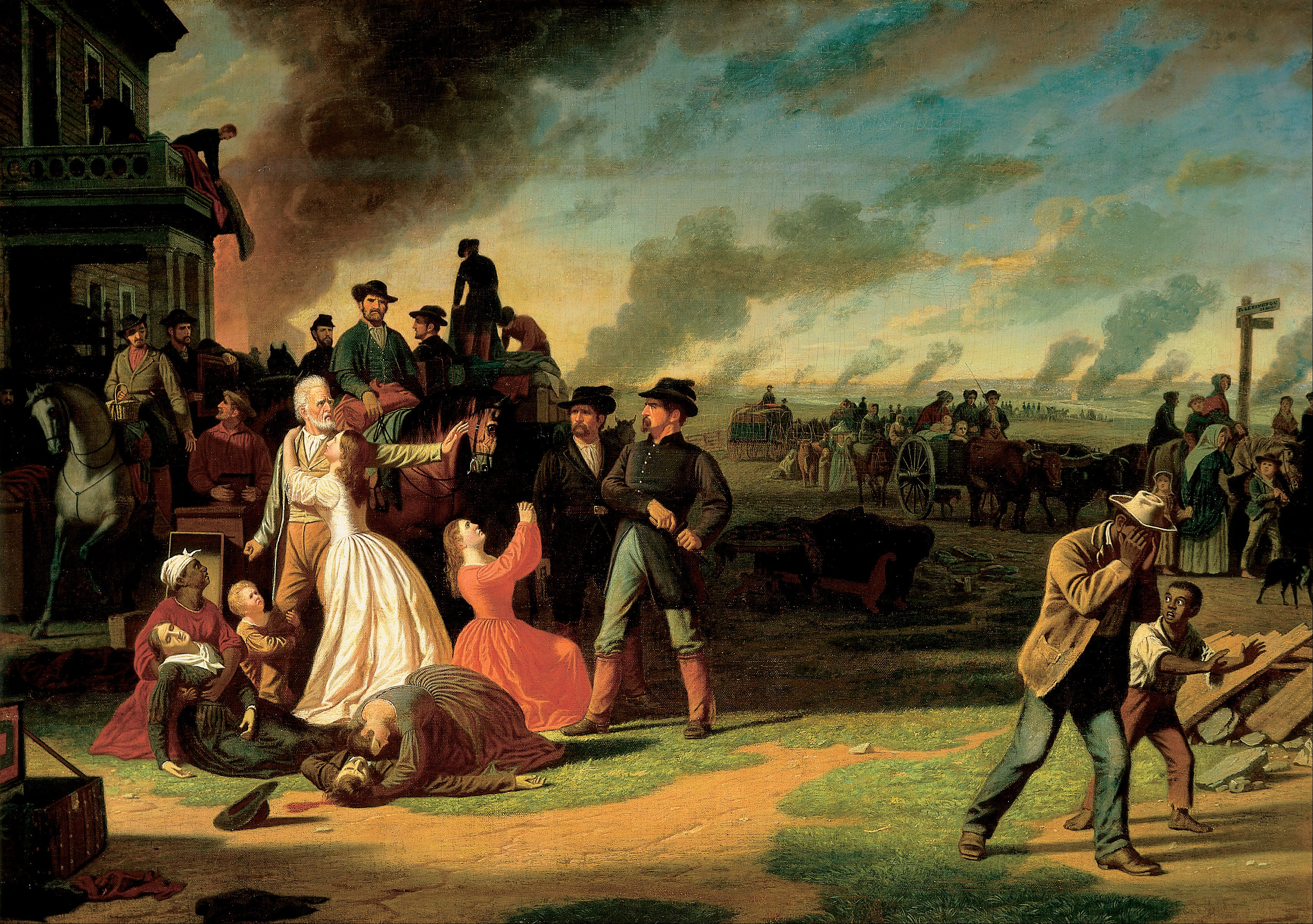
After the death of Eliza, Bingham married a third time in 1878. Martha Ann “Mattie” Livingston Lykins-Bingham (1824-1890) was a recent widow of one of Bingham’s friends in Kansas City. Mattie was a capable and dignified businesswoman with a big personality. Born in Kentucky and living In Lexington until she married Dr. Lykins, the Lykins’ were one of Kansas City’s power couples. At the outbreak of the Civil War, she and Dr. Lykins, along with a large swath of the local population in that part of western Missouri, were southern sympathizers. They and thousands more were expelled from the city by Order No. 11 of Brig. Gen. Thomas Ewing Jr., commander of the District of the Border, to rid Missouri of their political persuasion. The displacement caused tremendous suffering for Missouri civilians and Order No. 11 was very controversial. Bingham, then-state treasurer of Missouri who swore a loyalty oath to the Union, was appalled by the “military tyranny” of Order No. 11 where the refugees’ farms and fields were pillaged and burned. Many of its victims viewed the action as simply anti-American government retribution for the local population’s political beliefs. See – https://archive.nytimes.com/opinionator.blogs.nytimes.com/2013/09/06/an-artists-revenge/ – retrieved September 27, 2025.
As state treasurer and a staunch Unionist, Bingham aggressively opposed military tyranny during the Civil War, channeling his outrage over the forced relocation of civilians into his highly controversial propaganda painting, Order No. 11.
Mattie and Dr. Lykins returned to Kansas City after the war and made a life there until Dr. Lykins’ death in 1876, the same year Eliza Bingham died. Two years later, Mattie married George Caleb Bingham. After Bingham’s death in 1879 from stomach flu, Mattie lived with his young son James Rollins Bingham (1861-1910) who never married. In 1890, following years of trouble with her health, Mattie died following surgery for a stomach tumor. Mrs. Lykins-Bingham was buried In Union Cemetery in Kansas City, Missouri, in the Bingham family plot.
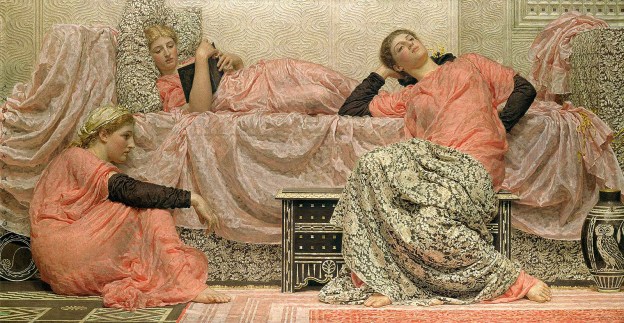
FEATURE image: Albert Joseph Moore (1841-1893), READING ALOUD, 1884, oil on canvas, 42.24 x 81 in., Glasgow Art Gallery & Museum.
The artist: Albert Joseph Moore (1841-1893).
Albert Joseph Moore was one of the leading figures of the British Aesthetic Movement, creating meticulously crafted paintings that placed beauty, harmony, color, form, and decoration above narrative or moral instruction. His idealized female figures inhabit timeless settings that blend classical inspiration with Victorian artistic experimentation, making him a unique voice in nineteenth-century British art.
Albert Moore: Life and Artistic Legacy
Albert Joseph Moore was born in 1841 into a family of artists in North Yorkshire in England. Moore through his own advanced aesthetic experiments in the milieu of theoretical and practical advancements of mid-to-late 19th century modern art in England and France – such as a systematic analysis of nature, mathematical plotting, and principles for quintessential combinations of color, line and form – created art that was, in formal terms, in its conception and execution, on the cutting edge of abstraction that would continue to develop and blossom into early 20th century Cubism. Moore’s art gained the respect of other progressive artists (Moore was called “a painter’s painter”), patrons and collectors, if not always the critics and contemporaries who viewed Moore’s work as merely decorative. Moore was actively collected in his lifetime and exhibited regularly in major venues such as the Royal Academy. Unmarried and of a lifelong independent disposition, Moore died in 1893 at 52 years old, having just completed his last monumentally ambitious artwork (“The Loves of the Winds and the Seasons,” Blackburn Museum and Art Gallery, posted below) a handful of days before. Several of Moore’s pictures are now in public collection throughout the UK, including the Tate and the British Museum in London.
Moore became a major representative of the Aesthetic Movement, often summarized by the ideal of “art for art’s sake.”
Azaleas (1867-1868)
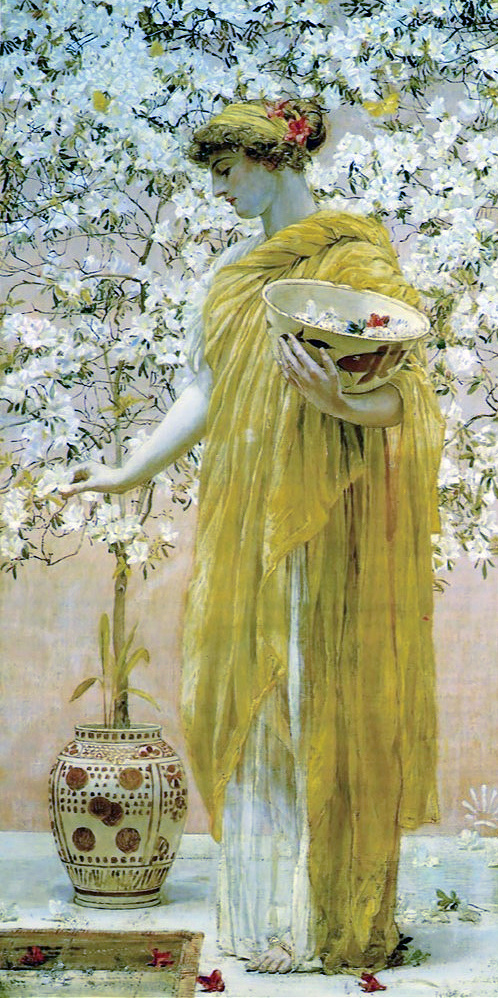
Albert Joseph Moore (1841-1893), AZALEAS, 1867, Hugh Lane Municipal Gallery of Modern Art, Dublin, Ireland.
Azaleas was a popular artwork by Albert Moore for its harmonies of color and the “Greek refinement” that the artist infused into his work. This bigger-than-life-size canvas called Azaleas was painted in 1867, exhibited in 1868 and demonstrates the artist’s ability to represent the human figure on a grand scale.
The featured works depict idealized women in dreamlike environments that feel both classical and modern. His paintings emphasize decorative harmony, color relationships, pattern, and graceful composition rather than storytelling.
Geometry and Preparation
The 26-year-old artist had some architectural design experience in theory and practice and used this in his preparatory process. This artwork incorporated ideal geometry along with typical academic methods.
Moore’s process followed, first, making studies of the nude figure and draped figure. Moore next made a larger-than-life-sized full-scale nude figure cartoon which, at this stage, was informed by geometric abstraction of the figure in a setting guided by, or through, the milieu of the object in the artist’s hands.
The geometric quality guided the composition rather than was externally imposed by the artist. Moore’s “system of line arrangement” sought the directions of the prominent lines of the composition so to plot parallels of them throughout the drawing resulting in a statuesque yet corporeally vivacious figure.
Nature, specifically the landscape, ultimately served as the inspiration for the manifestation of line parallels and optical balance rather than the mathematically ideal. Moore’s geometric construct and its interplay determined every element of the composition – from the position and placement of the figure to the location of accessories, such as wall hangings, distribution of drapery folds, and architectural elements. The canvas’s shape and size also were ultimately determined by this idiosyncratic geometric arrangement.
Traces of Moore’s preparatory practice are in evidence in Azaleas’ full size nude cartoon with its vestiges of diagonal and horizontal lines through the midsection of the figure and near to her feet. Using these lines in the nude drawing it is apparent that Moore experimented with the placement of the figure’s head, the extended hand, and a raised heel which was ultimately hidden under opaque drapery. Moore used a live model for his figure.
Technique and Execution
The final nude cartoon was transferred to the canvas and this outline was built up with oil colors. A drapery cartoon was then transferred on top of the transferred, built-up nude figure cartoon. Using this method Moore rendered greater transparency of the fabric since the underlying nude cartoon showed through faintly. This painstaking preparation was masked by Moore’s fresh and free style of painting. For instance, the drape folds of the left shoulder are painted in long, fluent, and elegant strokes while the azaleas are rendered in energetic strokes. Moore’s objective was for the final painting to look like an impromptu and expressive sketch when, in fact, it was carefully planned and executed.
About painting Moore taught his students to think long about it but execute with quickness and determination. This technique aided in transforming oil painting into the manner of Graeco-Roman fresco in that Moore’s working method allowed for painting only what could be finished in a day.
Japonisme and Color Harmony
Moore’s careful planning, rapid execution, and brush technique also suggested the influence of Japonisme. Asian influences in Azaleas included the carp bowl held in the women’s arm (an actual studio prop) and the geometric pattern in the azalea pot whose symmetry Moore saw as part of both Greek and Japanese art. To integrate and transition the predominantly yellow figure in the predominantly white background Moore used a device taken from Japanese art of painting flitting butterflies around the azalea bush. Moore also painted russet blossoms in the woman’s hair and bowl and on the floor that further unites the monumental composition.
Moore’s observation of Japanese prints also likely influenced the English artist’s color scheme in Azaleas. This is identifiable in its limited schematic of hues. The color placement, however, was also subject to the geometric practices in the whole composition.
Critical Reception
When Azaleas was exhibited at the Royal Academy in 1868 it was consigned to an out of the way place on the wall of its North Room. It was observed that Moore’s canvas looked more like a tapestry than an oil painting. In this way, Moore anticipated James McNeill Whistler’s comment about color in that it should appear “embroidered” on the canvas, in the same way a thread is embroidered on fabric. Whistler attributed this color quality to Japanese art in that those artists looked for repetition in color application and not contrast.
Architecture critics in 1868 noticed and especially admired Moore’s Azaleas. Its systematic repetitions and geometric construction were labeled the only “decorative” painting in the 1868 English exhibition. Art critics were less generous. Straining with opera glasses just to see the work they recognized its beauty and Moore’s talent but called its design and execution eccentric. Others turned up their critical nose to the new decorative work as “curious” and little more than a luxurious indulgence of art for art’s sake. Art critics were unhappy with the paintings’ colors as they found they lacked the requisite black that marked contemporary French art and, instead, opted for a quiet and delicate dreamscape.
English writer William Michael Rossetti (1829-1919) declared Azaleas one of the most important English pictures of 1868 and decried those looking to judge it by way of actual historical pictures from Greek antiquity. With Algernon Swinburne (1837-1909), Rossetti compared Moore’s artwork to another painting in the 1868 exhibition: “The Wife of Pygmalion, A Translation from the Greek” by the older George Frederic Watts (1817-1904). In that work Watts sought to create a painterly equivalent of classical sculpture. William Gladstone (1809-1898) wanted to purchase Watts’ picture after seeing it at the Academy in 1868. In a letter to Gladstone in May 1868 Watts informed Gladstone that it had been “claimed” but invited Gladstone to visit him in his studio to see the cast of the fragmentary Greek original from which the painting was derived.
Swinburne saw the poetry and musicality of Moore’s artwork .While most art critics snubbed the painting (and by extension the painter) for its art for art’s sake qualities, Swinburne praised them. Of Azaleas, Swinburne wrote: “The melody of color, the symphony of form is complete: one more beautiful thing is achieved, one more delight is born into the world; and its meaning is beauty; and its reason for being is to be.”
Sea-gulls (1871)
Albert Joseph Moore (1841-1893), SEA-GULLS, 1870/71, oil on canvas, 27 x 61 inches (68.5 x 154.8 cm), Williamson Art Gallery & Museum, Birkenhead, UK.
The Whistler Controversy
Sea-gulls was accepted for the 1871 Royal Academy exhibition. It was the third painting for Albert Moore to exhibit at the Royal Academy. Moore was absorbed in painting Sea-gulls, a major work, for British shipping magnate Frederic Leyland (1831-1892) and this work occupied him up to the Royal Academy Exhibition that spring.
Its creation by the 36-year-old Moore was not without headaches owing to controversy. Moore’s friend and admirer, American ex-patriate artist, James Abbott McNeill Whistler (1834-1903), had learned of Moore’s preliminary work on the painting through Leyland, a major art collector and the artists’ mutual friend.
Whistler expressed concern that Moore’s work perhaps overlapped adversely with some of Whistler’s own preliminary sketches for a painting. Whistler saw a pair of sketches Moore had sent to Leyland as potential commissions. Whistler felt that Moore’s sketch may have been influenced by seeing one of Whistler’s sketches. Whistler feared that if Moore’s painting was exhibited first, it would reflect badly on Whistler as an imitator when in fact the artwork Whistler was working on ante-dated Moore’s conceptions. This was a mortifying prospect for Whistler who prided himself on originality.
Whistler’s anxiety may have also stemmed from the fact that with Sea-gulls, Moore would fulfill his second commission for Leyland, while Whistler who introduced them had yet to complete a picture for Leyland that had been commissioned in 1867.
To ease Whistler’s fears, the American artist proposed that Moore accompany another mutual friend, architect William Nesfield (1835-1888), to Whistler’s studio in Chelsea to inspect his older original sketch that Moore had seen.
Nesfield, acting as mediator, concluded in September 1870 that the recent work of the two artists shared themes, but each maintained their own artistic originality. The crisis was averted and led to Moore exhibiting Sea-gulls.
Completion and Artistic Development
During this crisis and shortly thereafter, Moore did not finish to his satisfaction his painting when it was time for its exhibition in April 1871. A major effort required to complete Sea-gulls had deeply undermined Moore’s health. After the exhibition the painting was returned to the artist, but he could not yet immediately set to work on it to completion. Months later it was finished and sold to Leyland.
Nature, Movement, and Surface Effects
In Sea-gulls Moore introduced obvious analogies between the liquid patterns of the sea and the rippling and splashing motion of the figure’s hair and drapery. Moore’s intention was to discern patterns inherent in nature. The drawings also suggest that he exaggerated the effect of air currents by employing the revolving fans that were simultaneously in use for Sea-gulls and another painting titled Shells.
Much of Moore’s work to complete the painting after the exhibition revolved around redressing the picture surface. Moore had been experimenting for some time with the surface quality of his paintings. In the early 1870s, Moore’s technique had developed to combine transparent and opaque fabrics that created unusual layering effects. Following the 1871 exhibition, Moore seemed to apply this technique in Sea-gulls that involved unusually thick paint layers.
Grosvenor Gallery and Lasting Friendship with Whistler
Much later, during the winter of 1880, Sir Coutts Lindsay (1824-1913) – the British artist and watercolorist founded Grosvenor Gallery on Bond Street as an alternative exhibition space to the Royal Academy which became a venue for avant-garde artists, particularly those associated with art for art’s sake – mounted a show on the subject of artists’ working sketches. Moore contributed the preparatory studies for Sea-gulls to the show that included his sketches of hands, heads, drapery, plants and flowers, as well as the painting’s cartoon.
Although biographers of Whistler and Moore have attached no importance to their friendship, particularly after the September 1870 controversy over Sea-gulls which they claim ended it, the artists in fact remained on intimate terms unbroken until Moore’s death in 1893. In the later 1870s they again were thrust together in a contentious situation but this time on the same side of sorts. When Whistler became involved in libel proceedings against Ruskin in later 1878 Albert Moore was the only artist who the American ex-patriate artist could rely on to both publicly attend the proceedings and actually give evidence on Whistler’s behalf.
Albert Joseph Moore was highly admired by James McNeill Whistler, who regarded him as his favorite contemporary British artist.
Reading Aloud (1884)
Albert Joseph Moore (1841-1893), READING ALOUD, 1884, oil on canvas, 42.24 x 81 in., Glasgow Art Gallery & Museum.
Conception and Working Method
Reading Aloud was one of three large-format paintings Albert Moore completed in the 1880s. Completed in 1884, Moore had been working on Reading Aloud for years – at least since 1881. Moore had drawn a chalk sketch of the geometrically designed composition over which the artist would lay a piece of translucent glass. By painting directly on the glass, he could experiment with colors without redrawing the picture. He then could transfer the trial color experiment on glass (as well as a final drawing) onto tracing paper by which the final artwork was then made by pinning the tracing paper to the canvas. The artist then painted the composition directly to the canvas, section by section, working as he painted to unify color scheme and, as figural poses and other details are different in the final artwork than surviving preparatory materials, drawing. It was meticulous organizing and harmonizing creative work that helps to explain why Moore labored for years on the almost 7×4 foot oil on canvas.
Works such as Reading Aloud demonstrate his pursuit of beauty through carefully controlled arrangements of figures, fabrics, colors, and space.
Composition and Symbolism
While these three reclining figures are static their contrasting drapery folds whether they are swirls, zigzags or sweeping diagonals – with the sofa’s swags to unite them – enliven the picture. As classicism revivalists are noted for their mere realism and moralistic anecdote, Moore’s evocation of classicism, though containing allegorical qualities, belies a modernity by way of its abstract combination of line and form in the depiction of languid female figures in a neutral setting. The black-and-white owl vase that Moore included in the lower right corner of the painting had been absent from previous studies (originally it was a seated cat) and provides a narrative sign. It connotes the quality of wisdom as well as perhaps the goddess Athena with which the owl is associated so to apply it to the various states of the readers though the overall picture with its fascination with repose is more subtly mysterious than anecdotal. Yet the classicism/modernity enigma continues as the honey bee which Moore paints on the face of the owl vase was the symbol used by the picture’s purchaser, pig iron industrialist William Connal (1819-1898), for himself.
After his wife of 25 years Emelia Jessie (Campbell) Connal died in 1877, 56-year-old industrialist William Connal faced life alone at Solsgirth, his Scottish country manor. Connal turned his attention to the arts and, in addition to Moore, became an avid collector of contemporary art by such painters as Edward Burne Jones (1833-1898), Edward Poynter (1836-1919), Frederick Sandys (1829-1904), Roddam Spencer Stanhope (1829-1908), Fernand Knopff (1858-1921) and Adolphe Monticelli (1824-1886) along with the Old Masters. Connal owned Symphony in Silver and Grey by American artist James McNeill Whistler (1834-1903) who greatly admired Moore. In 1883, Connal invited Moore to stay at Solsgirth House in Perthshire for a month allowing the artist to recuperate after a serious illness. It was during this stay that Connal commissioned Moore to paint his portrait that shows him wearing a honeybee brooch, the emblem that Connal used on his personal items (Connal’s portrait today is in York Art Gallery).
Geometry, Abstraction, and Critical Response
Moore’s pictorial methodology which he continued to develop over his artistic career is in evidence in Reading Aloud. Moore works out and unifies various and moving parts depicting a scene’s animating personality based in psychology with its physical forms that are mathematically contrived by way of lines and curves and, ultimately, color and texture, and whose impact on the viewer of the completed artwork is allowed to be emotional rather than cerebral. In Reading Aloud Moore constructed the image based on two pairs of diagonals that intersect into a pattern. Though the geometric system is visually subdued, it is evident in the figure on the right whose arms coincide with a set of diagonals. It is obvious also in the picture’s overall use of contrasting bold colors – the fabrics’ pinks and creams are integrated to, though angularly distinct from, the charcoal greys of the covered limbs and book cover. The edges of the book cover also coincide with some of the complex design of diagonal lines whose subliminal quality is an intrinsic expression of the psychic nature of the artwork. This angularity based on diagonals was a deliberate strategy for Moore when he painted the final artwork. There is also the horizontal lines component in the painting manifested in the outstretched arms of the crouching figure at left and the table and vase. Moore’s design strategies were innovative in 1884 startling contemporary viewers approaching to what Cubism would accomplish 25 years later. Critics when viewing Reading Aloud, being neither particularly understanding nor sympathetic to Moore’s methods or intentions, praised the picture’s overall gracefulness but impugned his drawing skills and identified the painting as mostly static decoration. Yet the static figures form part of a complex array of abstract and naturalistic patterns that fill every inch of canvas. Reading Aloud is a testament to the artist’s ability to translate such natural phenomena into a stylized form. Most prominent among them is a fabric effect found in other of Moore’s paintings of the period, in which white lace is layered over cloth of a darker color. Reading aloud was exhibited at the Royal Academy where, starting in 1883, Moore chose to exhibit annually.
The Loves of the Winds and the Summer (1893)
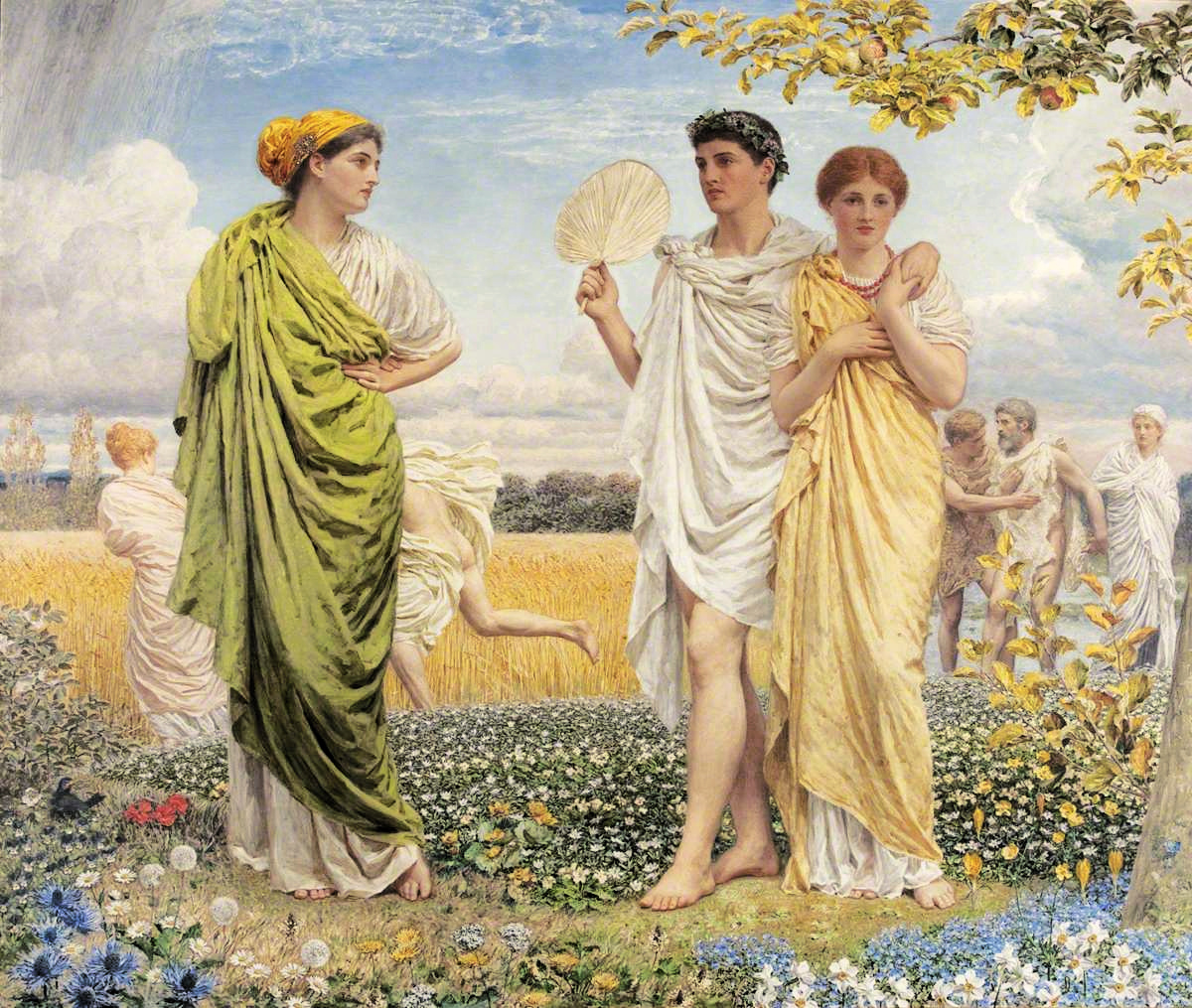
Albert Joseph Moore (1841-1893), The Loves of the Winds and the Seasons, 1893, oil on canvas, Blackburn Museum and Art Gallery, Blackburn, UK.
Moore’s Final Masterpiece
The Loves of the Winds and the Summer was English artist Albert Moore’s final and largest artwork of his career. It is 6 feet tall and 7 feet wide and is the jewel in the crown of the Blackburn Museum and Art Gallery near Manchester, England. It is the result of Moore’s study of the psychology of his subject matter, that of love. Love begins to manifest formally for Moore by the expression of soft bodily postures, changing and harmonious curves, and piercing gazes expressed in deep coral colors. The male figure of the Wind is flanked by the spurned female figure of Summer to the left and the embraced female figure of Autumn to the right. Moore was so enveloped in his amorous themes that while working on this picture he was writing poetry about what the human face was like when in love – and it is found in his picture. The Love of the Winds and the Seasons is Moore’s fullest expression of animating personality united to depicted physical forms that are first lines, curves and color, with the result being an emotional impact on the viewer who encounters the artwork.
Moore drew inspiration from ancient Greek sculpture and classical forms but was not attempting archaeological reconstruction.
Art in the Face of Terminal Illness
This exquisite artistic sensitivity by Moore is made more remarkable since the artist was dying in 1893. In the company of his young and attractive live models in his new capacious art studio, Moore worked day after day on this work. Moore had cancer (a tumor on his thigh) and had submitted to three operations to keep ahead of it. When his doctors told him they could operate no more, and that the cancer continued to spread throughout his body, Moore was resigned to his situation. He is reported to have said: “Well, there’s an end of it.” In the limited time left to him Moore intended to finish his painting of love, The Loves of the Winds and the Seasons. The artist did not want to lose any time. His legs had swollen to twice their size and had to be drained. In acute pain he worked around the clock for the next six months. His friends thought the intense work as well as the cancer was killing Moore but as the painting progressed to completion, they observed that the artist’s personal tranquility and happiness became apparent.
Geometry, Design, and Creative Process
The project was monumental – numerous preparatory studies, drapery studies, full scale and life-sized cartoons (i.e., 4’ 9” tall by 1’4” wide for Autumn) , nude studies – all technically meticulous and versatile- and that underwent the artist’s elaborate and idiosyncratic geometric platting system that he began in the late 1870s. Moore was the consummate auteur that slightly older American ex-patriate painter James Abbott McNeill Whistler (1834-1904) most admired in England. Moore conceived his paintings from start to finish – and The Loves of the Winds and the Seasons was at once its pinnacle and completion. Moore, as Whistler aspired to be, was sole master of his work. In 1893 Moore now expanded this mathematical process to amalgamate his diagonals with horizontals so that his creative process could not suffer the critique that Ruskin hurled at Whistler of “ask(ing) 200 guineas for flinging a pot of paint in the public’s face.” The painting was a commission for the Australian mine-owner George McCulloch (1848-1907). Moore’s calculations included various adjustments of the models’ natural poses to submit to the mathematical formulas on the canvas. This formal submission of subjects to linear construction extended to each detail in the entire composition, such as the flowers for which also study drawings were made. Within these design rigidities, the preparatory drawings of the live models and subjects were transferred to the artwork with little idealization though slight but important adjustments were made, such as to Summer’s hairstyle. Knowing his own time was short, Moore made his cartoons in color so that his transfer to the canvas was as efficient as possible as he painted the final artwork. Critics have observed that despite the intense planning and preparation, the final artwork is executed unevenly – parts are meticulous and vigorous, mostly in the foreground, while others in the background are loose and crude. To what degree this is the artist’s intention or the result of his declining health, is a matter for speculation. During the artistic process the terminally ill artist isolated himself mostly. His handful of visitors remarked that the artist was cheerful, cracked jokes, told funny stories, and smoked his pipe. These select parties knew, however, that their social calls were in the context of final good-byes. In those last days and months of Moore’s life, the artist’s mind, by evidence of the art from his past that he referenced in 1893, stretched back to an earlier career which shared long-held important aspects with The Loves of the Winds and the Summer.
Poetry and Meaning
For his last artwork. Albert Moore glossed the picture’s narrative in verses he wrote to accompany it:
Lo! fickle Zephyr chaseth wayward Spring, It is a merry race; Flowers laugh to birds that sing, Yet frequent tears shall cloud her comely face. The South Wind shall with blushing Autumn mate, Contented with her lot; Summer sigheth – such her fate She and her burning kisses are forgot. Two lovers rough for shudd’ring Winter strive, Beneath a shroud of snow; Heaven haply shall contrive Their violence she may not further know.
Legacy and Death
Through its figural and intellectual prism of ancient classical mythology, Moore worked in his career to update the complex equation of the natural world’s varying and transitory seasons to human life’s copious physical, emotional, and spiritual expressions and contradictions. With their immersion in Moore’s modern art, the painter achieved a graciously-contrived visual dramatic interplay of nature and humanity, ancient and present-day, whose quest is eternal in time and space.
Albert Joseph Moore passed away in the middle of the night on September 25, 1893. He died 9 days after finishing his last painting, The Loves of the Winds and the Summer. Moore was 52 years old.
Albert Joseph Moore’s art transformed Victorian classicism into a sophisticated decorative vision that influenced later developments in modern art and design.