
Tag Archives: #EuropeanArt

Luminosity and Realism: The Revolution of 15th-Century Flemish Painting.

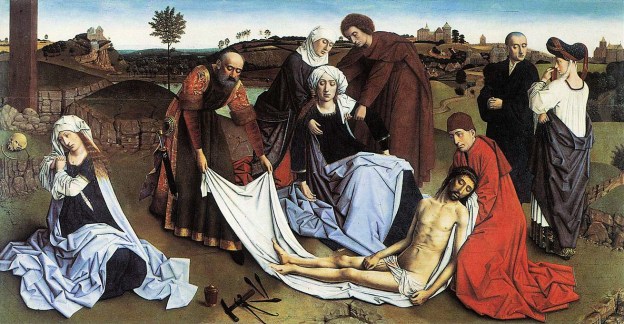
FEATURE Image: Petrus Christus (c. 1395-1472), Pietà, c. 1455–60. 39 ¾ x 75 ½ inches, Royal Museums of Fine Arts of Belgium, Brussels.

Fueled by the immense wealth of maritime trade hubs like Bruges and Antwerp, 15th-century Flemish art catalyzed the Northern European Renaissance by perfecting oil painting techniques, introducing brilliant surface luminosity, and blending meticulous naturalism with profound emotional realism.

Jan Van Eyck (or John of Bruges) (c. 1385-1441), detail, Marriage of Giovanni Arnolfini and Giovanna Cenami, 1434; National Gallery, London.

Introduction: The Wealth and Innovation of the Flemish School in the 15th century

Flemish art, as the name suggests, originates in Flanders which includes the Low Countries (Netherlands and Belgium) as well as northeastern France. The centers of Flemish art in the 15th century are Brussels, Bruges, and, later, Antwerp as well as other cities such as Liège and Tournai. Though the area had been settled as early as the 6th century, great growth and prosperity came to the region starting in the 14th century. As an international trade center centered in Bruges and, following the silting up of Bruges’ port, in Antwerp starting around 1525, Flanders experienced an influx of tremendous wealth joined to its attendant political connections and power. Such factors led to a high demand for Flemish art locally and far beyond its borders to royal courts, churches and other public and private patrons having marked influence on the European Renaissance. These rich cultural conditions in and around Flanders provided incentive for leading Flemish art masters to perfect their art technique and create magnificent pictures, particularly altarpieces, and display the latest naturalist styles, delineated forms, and bright colors within a European context. Flemish art developed systematically including its use of oil painting. This newly discovered and controversial medium greatly affected Flemish paintings’ surface luminosity by way of its range of cool colors and its ability to be applied in smooth facile layers. Most of these noteworthy Flemish painters in the 15th century found positions at court or as officials in prosperous urban centers. They became leading citizens whose workshops trained artists and made artwork for public and private consumption which worked to assure Flemish art’s primacy for the Northern European Renaissance into the 16th century.

International Gothic and the Burgundian Court
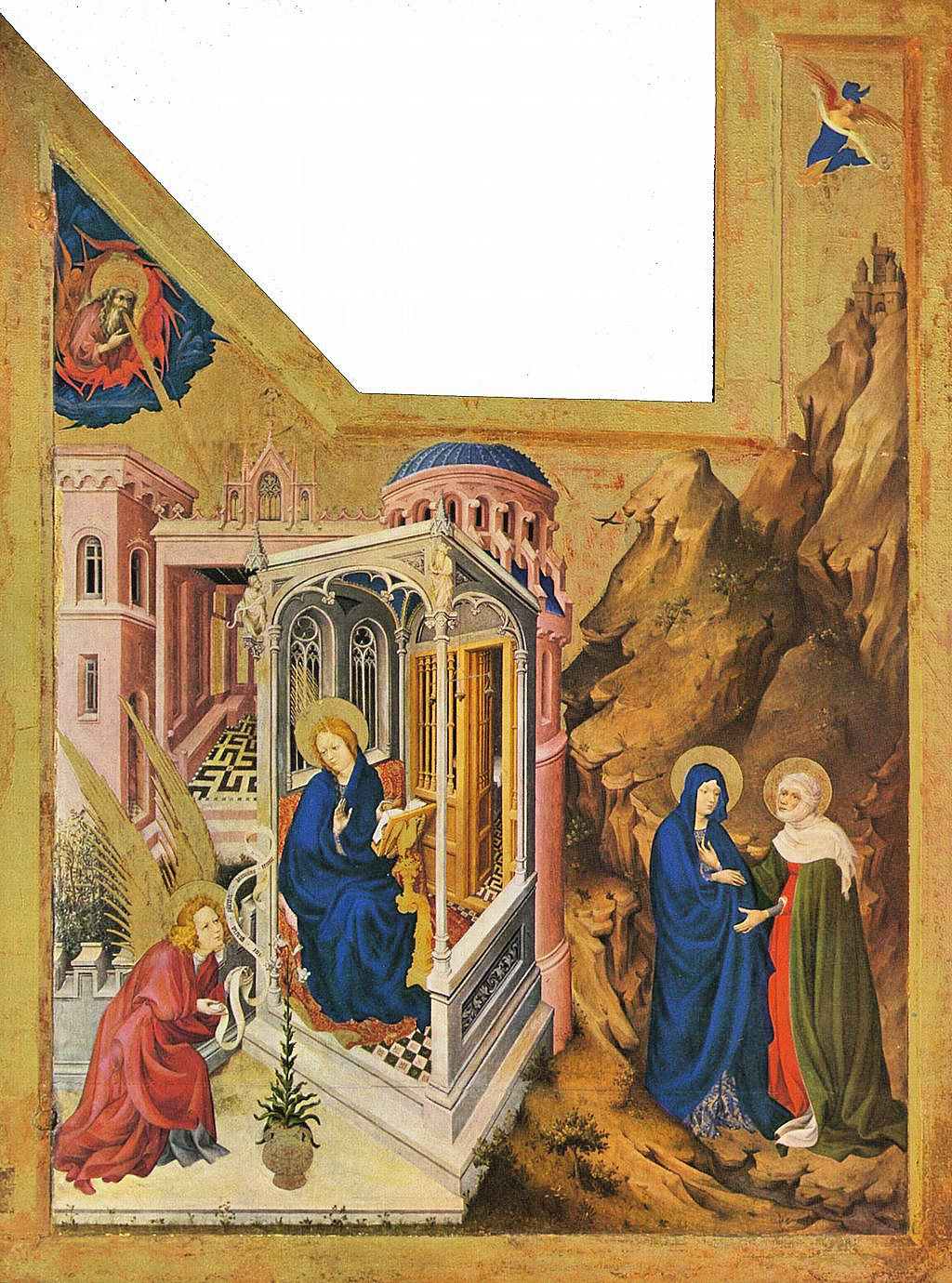
1 – Melchior Broederlam (c. 1350-1409), Champmol Altarpiece (The Annunciation and Meeting of Mary and Elizabeth), oil on wood, 1399, 65 ½ x 48 ¼ inches and 66 3/8 x 511/4 inches. Musée des Beaux-Arts de Dijon, France.
1 – Melchior Broederlam (c. 1350-1409), Champmol Altarpiece (The presentation in the Temple and Flight Into Egypt), oil on wood, 1399, 65 ½ x 48 ¼ inches and 66 3/8 x 511/4 inches. Musée des Beaux-Arts de Dijon, France.

This large diptych done for Philip the Bold, Duke of Burgundy (1342-1402) around 1399 is certainly painted over 600 years ago by Melchior Broederlam (c.1350-1409?). Broederlam was a painter in Ypres, Belgium, who entered the service as painter to Philip the Bold in 1385 and was in Paris by the early 1390’s. In the Champmol altarpiece – considered the earliest example of International Gothic in painting – Broederlam presents four stories in the life of the Virgin, some of which are contained in Luke themselves as scriptural diptychs including the Annunciation and the Birth stories of John the Baptist and Jesus. The first panel of the altarpiece presents the Annunciation (Luke 1:26–38) and the Visitation (Luke 1:39-56) while the second panel depicts the Presentation in the Temple (Luke 2:22-40) and The Flight into Egypt (Matthew 2:13-23). In the Champmol Altarpiece there is an attempt at realism by its placid gesturing figures in a landscape of crags and paths and also flowers at the foot of the picture’s imposing structures. At the same time there is a sense of unreality in the sense of it being a theatrical or stage setting in its flat, unitive display.

Sacred Narrative: The Presentation in the Temple

The Presentation of the Temple is the climax of the birth narratives. Up to now Luke and Matthew recounted the annunciations of Jesus and John, the Visitation of Mary to Elizabeth, the births of John and Jesus as well as the star, the stable, the Magi, the shepherds, the angels, surrounding Jesus’s birth in Bethlehem. The Presentation in the Temple was the highly anticipated strictly required formal religious ceremony for the “redemption of the firstborn” male and the first communal recognition and capstone of all these dramatic birth events described so far in Luke. Further, the setting is the Temple in Jerusalem, the very center of Jewish worship and life. This exciting and important place is where the infant Jesus and his mother are each presented for their purification in accordance with Mosaic Law. Jesus had been circumcised eight days after his birth and is now publicly presented to Yahweh in Jerusalem and formally stamped as a member of God’s chosen people. It is through the Jews that the salvation of the world is to be achieved, and Luke’s Gospel announces such hopes as fulfilled in Jesus. Though Mary’s purification at the Temple is ceremonial, it publicly reveals its agreement with what was told to her by the angel Gabriel at the Annunciation: that she is the symbol of the Jerusalem Temple (Luke 1:35).

Prophetic Witness: Simeon and Anna in the Temple

Also featured in this episode is Simeon, a righteous and devout man living in Jerusalem who, according to Luke 2:25-35, was promised by the Holy Spirit that he would not die until he had seen the Lord’s Messiah. Guided by the Spirit into the Temple, he recognized the infant Jesus during his presentation, took him up in his arms, and praised God, proclaiming Jesus as the savior for both Gentiles and Israel, a dramatic public witness to these public events whose testimony about the child “amazed” Mary and Joseph (Luke 2:33). Also present is Anna, an old prophetess, an honorable role found in both Jewish and Christian tradition who typically was a widow in service to the community. Both Anna with Judith, a devout widow in the Old Testament, are over 100 years old. Anna “never left the temple, but worshiped night and day with fasting and prayer” (Luke 2: 37). In the Rabbinic literature seven prophetesses are recognized – namely, Sarah; Miriam (Ex. 15); Deborah (Jgs. 4); Samuel’s mother, Hannah (1 Sm. 2); David’s wife, Abigail (1 Sm. 25); Huldah (2 Kgs 2); and Esther. Isaiah’s wife is also mentioned as a prophetess (Is. 8). With Anna, all these women were recognized for at least their holy lives, sometimes speaking in God’s name, as well as often their advanced years. At the Presentation Anna “gave thanks to God and spoke about the child to all who were awaiting the redemption of Jerusalem” (Lk 2:35).
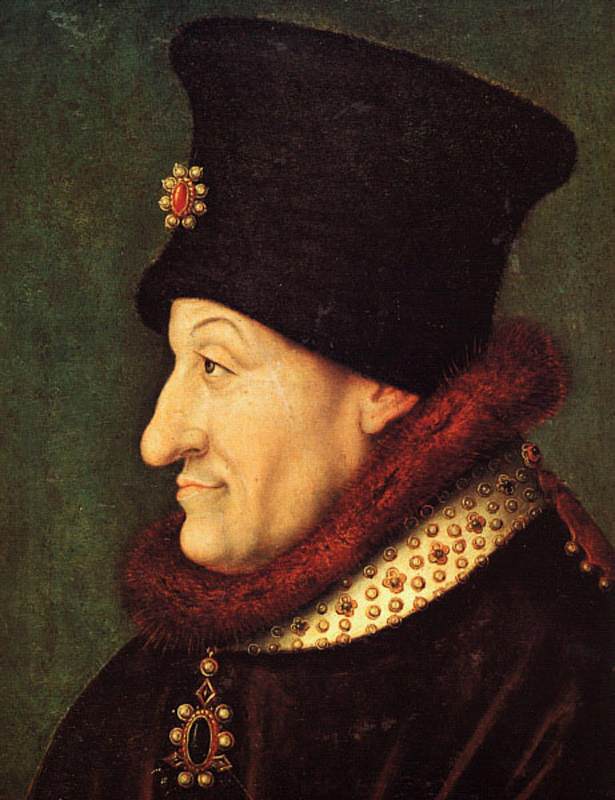
Philip II the Bold, anonymous, 16th century, 40 cm (15.7 in); width: 30 cm (11.8 in), Palace of Versailles, oil on wood.

Jan Van Eyck and the Burgundian Court

From 1422 to 1424 Jan Van Eyck (or John of Bruges) worked for John III the Pitiless (1374–1425) of the House of Wittelsbach, who was bishop of Liège (1389–1418) as well as duke of Bavaria-Straubing and count of Holland and Hainaut (1418–1425). The artist was appointed court painter to Philip III the Good (1396-1467) who was born in Dijon and died in Bruges and who founded the Burgundian state that was France’s rival in the 15th century. Philip III was the most important of the Valois dukes of Burgundy.

Philip III wearing the chain of office. Copy of painting by Rogier Van der Weyden, c, 1450.

The Mastery of Light: The Madonna of Chancellor Rolin

2 – Jan Van Eyck (c. 1385-1441), Madonna of Chancellor Rolin (or The Virgin of Autun), Oil on wood, c. 1435, 26 x 24 ¾ inches (66x 62 cm), Musée du Louvre, Paris.

Van Eyck lived in Lille between 1425 and 1429 but relocated to bustling Bruges in 1430 where he bought a house and lived until his death in 1441. On behalf of the Duke’s business concerns (including a secret marriage), Jan Van Eyck made trips to Spain and Portugal in 1427-28, and several others into the mid1430’s. There are many authenticated paintings by Jan Van Eyck, although Madonna of Chancellor Rolin is considered highly likely. The concept of composing the work to be divided into a shadowed interior and bright exterior landscape – and unified in the picture – is original. The contrasts of light, subject and form and their relation is appealing to the eye. The figures of the Virgin and the Child are delineated gently and beautifully for the donor, who is depicted behind a prayer desk, to adore. Like Italian master Leonardo da Vinci (1452-1519), Van Eyck had many cultural interests and talents in the service of Philip III such as studies in anatomy, cartography, geometry and perspective that created the illusion of three-dimensional space. These artists’ common preoccupations and concerns in the arts united the Northern and Italian Renaissance more closely. If Van Eyck did not actually invent oil painting, his work perfected its techniques. Van Eyck’s abilities make him the major artist of the Early Netherlandish School whose position is challenged only by the Master of Flémalle (Robert Campin). It was painted for the chancellor of Philip III, Nicolas Rolin (c. 1376/80-1462) to decorate a personal chapel (Saint-Sébastien chapel) that he decided to build in 1426-1428 (completed in 1430) in the church of Notre-Dame-du-Châtel in Autun, a church destroyed in 1793.

The Monumental Legacy of the Ghent Altarpiece
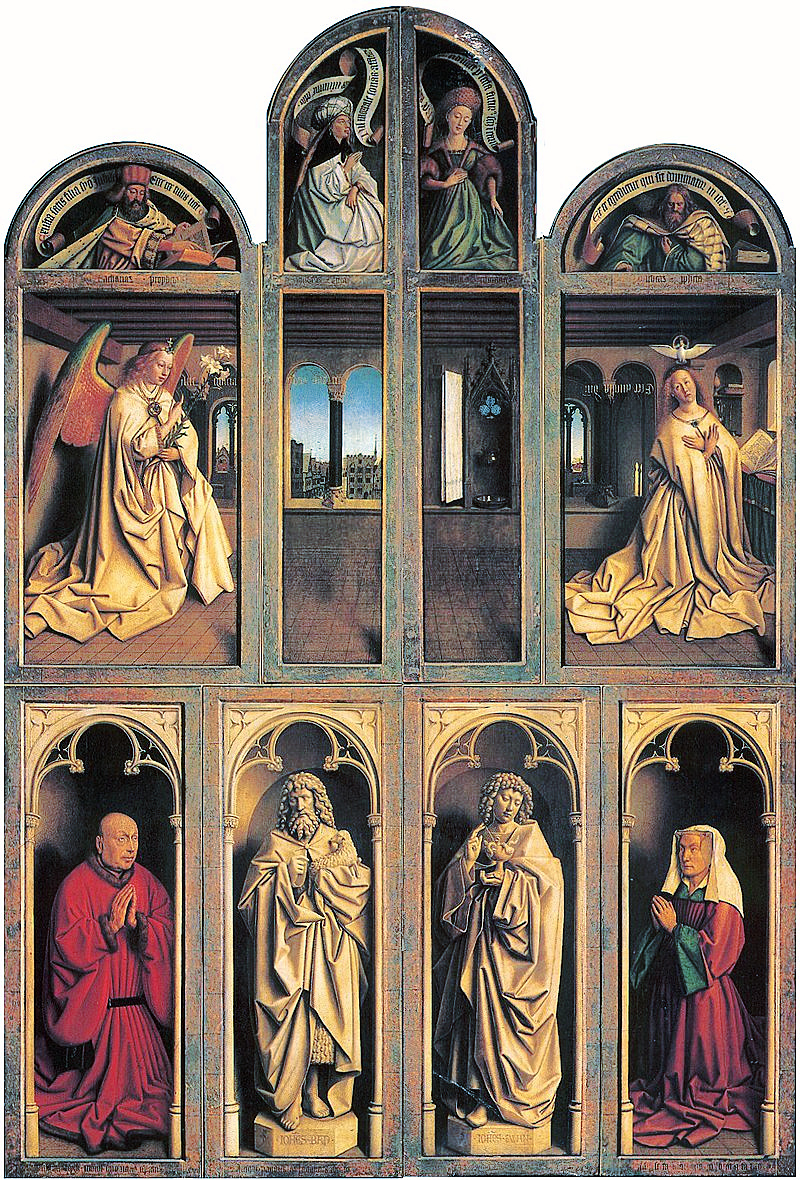
3 – 4 Hubert Van Eyck (c. 1370-1426) and Jan Van Eyck (c. 1385-1441), Closed (above) and open panel of The Ghent Altarpiece, also called the Adoration of the Mystic Lamb, c. 1425, 53 ¾ x 93 ¼ inches, Saint Bavo’s Cathedral, Ghent.
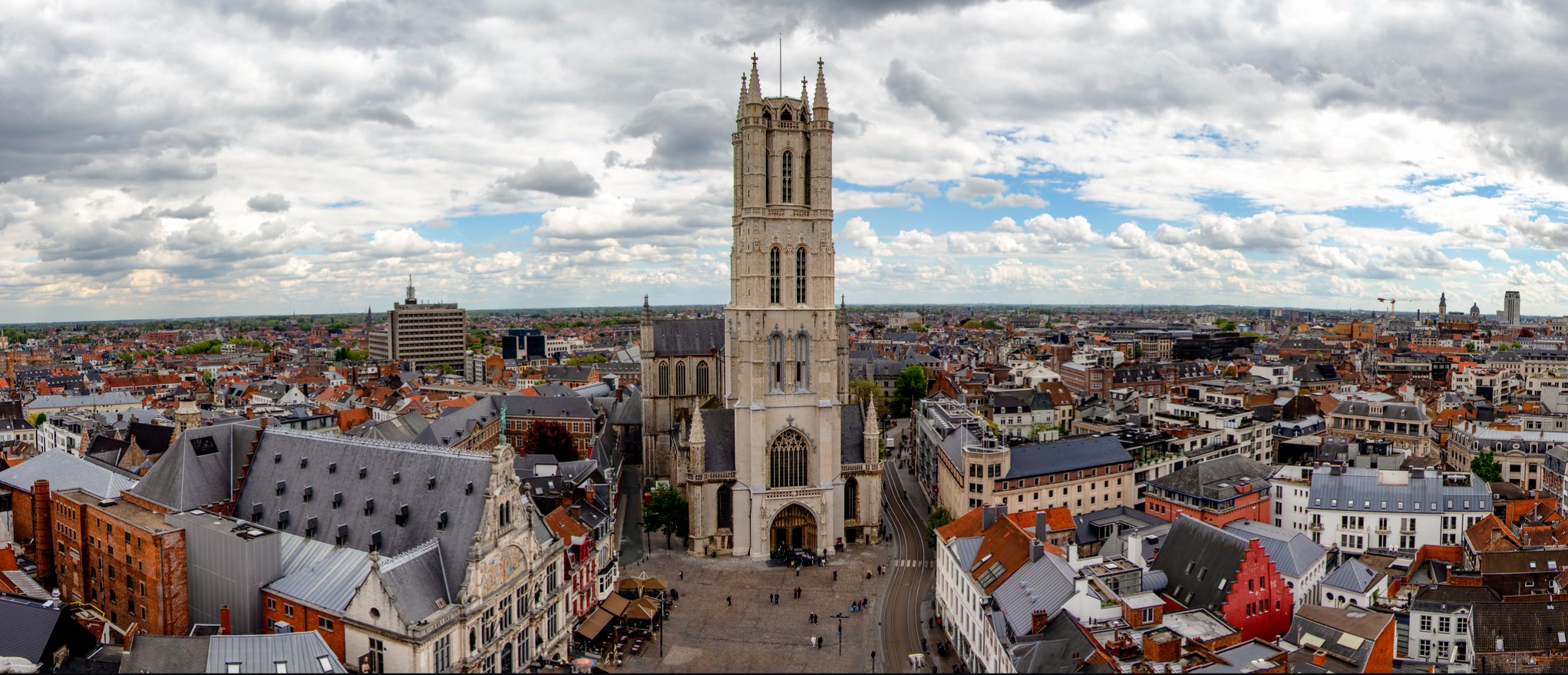
St. Bavo’s Cathedral, Ghent, houses the Van Eyck brothers’ Ghent altarpiece. “Saint Bavo’s Cathedral, Ghent” by Arran Bee is licensed under CC BY 2.0.

Jan Van Eyck’s masterpiece is Adoration of the Mystic Lamb (1432), known as the Ghent Altarpiece, which he painted with his brother Hubert Van Eyck (c. 1370–1426). The Van Eycks’ artwork is known for its technical brilliance, intellectual complexity, and rich symbolism of which this very large (almost eight feet wide) and complex 15th-century polyptych is a prime testament. It was begun in the mid-1420s and completed by 1432. It marks a transition from the Middle Ages to the Renaissance in Northern European art. Its 22 panels opens and closes. When open, inside there are two rows of paintings. The middle section is Christ the King flanked by the Virgin and Saint John the Baptist. Other panels depict musicians, singing angels, and Adam and Eve. The center lower row depicts the Adoration of the Lamb with knights, hermits. judges and pilgrims who stream to behold the Lamb. In its 600-year history, there have been re-paintings, restorations and modern replacements (the original Judges panel was stolen in 1934). Little is known about Hubert Van Eyck to the point where he has been speculated in his obscurity to be a mythical figure, though this is quite unfounded. The painting was done for a nobleman’s family chapel in what become St. Bavo’s church in Ghent. The Eycks’ detail, fullness of form and luminous colors presents the mystery of the Mass whose subject is the miracle of the unity of heaven and earth in eternity. In contrast, the closed panel is beautifully calm and restrained in colors and composition. But it is just as masterful and, as it sits closed, offers a different mood for devotion.

Precursors to the Mona Lisa: Portrait of the Artist’s Wife

5 – Jan Van Eyck (c. 1385-1441), Portrait of Margaret van Eyck, 12 7/8 x 11 ½ inches (41.2cm x 34.6 cm), 1439, oil on wood, Groeningemuseum, Bruges, Belgium.

The portrait is of the artist’s wife executed in Bruges. The Van Eycks married in 1439. Like his other portraits the sitter is turned three-quarters to the left. Painted 60 years before Leonardo Da Vinci’s Mona Lisa (1503), there are affinities between them – a placid enigmatic female sitter, leftward turn, hands crossed at the lap, a possible landscape background that in the Van Eyck has been repainted.

Leonardo da Vinci, Mona Lisa (1503), Musée du Louvre, Paris.

The Next Generation: Petrus Christus and Flemish Genre Art

6 – Petrus Christus (c. 1395-1472), The Legend of Saints Eligius and Godeberta, 38 5/8 x 33 ½ inches, 1449, The Metropolitan Museum of Art, New York.

Following the death of Jan Van Eyck, Petrus Christus became the most important modern painter in Bruges who had settled there in 1444. The artwork was commissioned by the jewelers’ corporation in Bruges and depicts seventh century Saints Godeberta being given a ring by Saint Eligius to marry the Lord God as she decided to enter religious life. Though a religious painting, it is essentially a 15th century Flemish genre painting. And while not as graceful as Van Eyck’s artwork, the painting holds interest for its bold forms of figures and objects and the authority of a well-observed still life.

Landscape and Lamentation: The Deposition
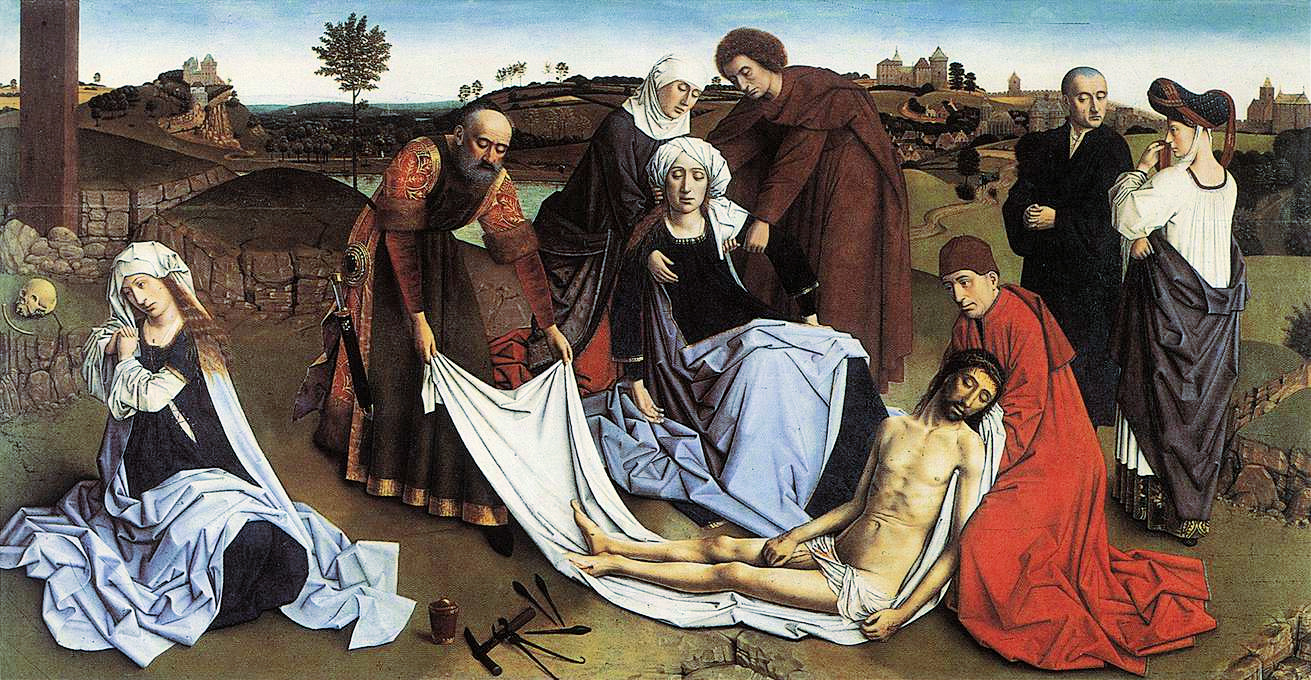
7 – Petrus Christus (c. 1395-1472), Pietà, c. 1455–60. 39 ¾ x 75 ½ inches, Royal Museums of Fine Arts of Belgium, Brussels.

One of Petrus Christus’s most important works, the scene of the Deposition is poetically rendered in a mother’s lamentation over the dead Christ, her son, within the setting of a late afternoon landscape which is also perfectly rendered. The figures in the foreground are large and emphasize their placement in the space. The face of the Virgin constitutes the painting’s center. Holding the dead Christ in a sheet is NIcodemus and Joseph of Arimathea who asked Pilate for the body of Jesus so to bury him. The three figures who stand apart from the narrative’s central figures are depicted with equal stylistic power and whose strained grief they share.

Gustave Courbet, 1849-50, A Burial at Ornans, 315 cm × 660 cm (124 in × 260 in), Musée d’Orsay, Paris. The 19th century French realist artist made a trip to Amsterdam before he painted The Burial at Ornans and was likely influenced by Netherlandish painting he had seen on that trip.

Unwavering Physicality: The Master of Flémalle

8 – Master of Flémalle/Robert Campin (1375-1444), workshop, The Bad Thief (fragment), c. 1420, 56 ¾ x 20 3/8, Städel Museum, Frankfurt am Main, Germany.

The painterly style of the Master of Flémalle is earlier than Jan Van Eyck yet also progressing a naturalism that is realistic and of ordinary folk. The Master of Flémalle has been identified by consensus as Robert Campin whose pupils were Rogier van der Weyden (1399-1464)  and Jacques Daret (c. 1404- c. 1470). Campin is known to have lived and worked in Tournai, Belgium. This imposing, cruelly exact image depicts the corpse of one of the two criminals crucified with Jesus. Executed in the workshop of Robert Campin in Tournai around 1420 – around the same time as the Van Eycks’ Ghent Altarpiece – the fragment is all that remains though copies of the rest exist that show the Deposition and John the Baptist. The painting presents the bad thief in a corporeal monumentality next to an embossed gold background which is a legacy of medieval art. The painting’s unwavering physicality, however, is 15th century modern. The well-constructed faces of the two observers are modeled by shadows as foreshortening suggests movement. The lower left of the picture at the thief’s broken legs reveals, as Delevoy states, “the perspective of a landscape that is concisely constructed, geometric, and intellectual.”

Synthesizing Narrative and Observation: Campin’s Nativity
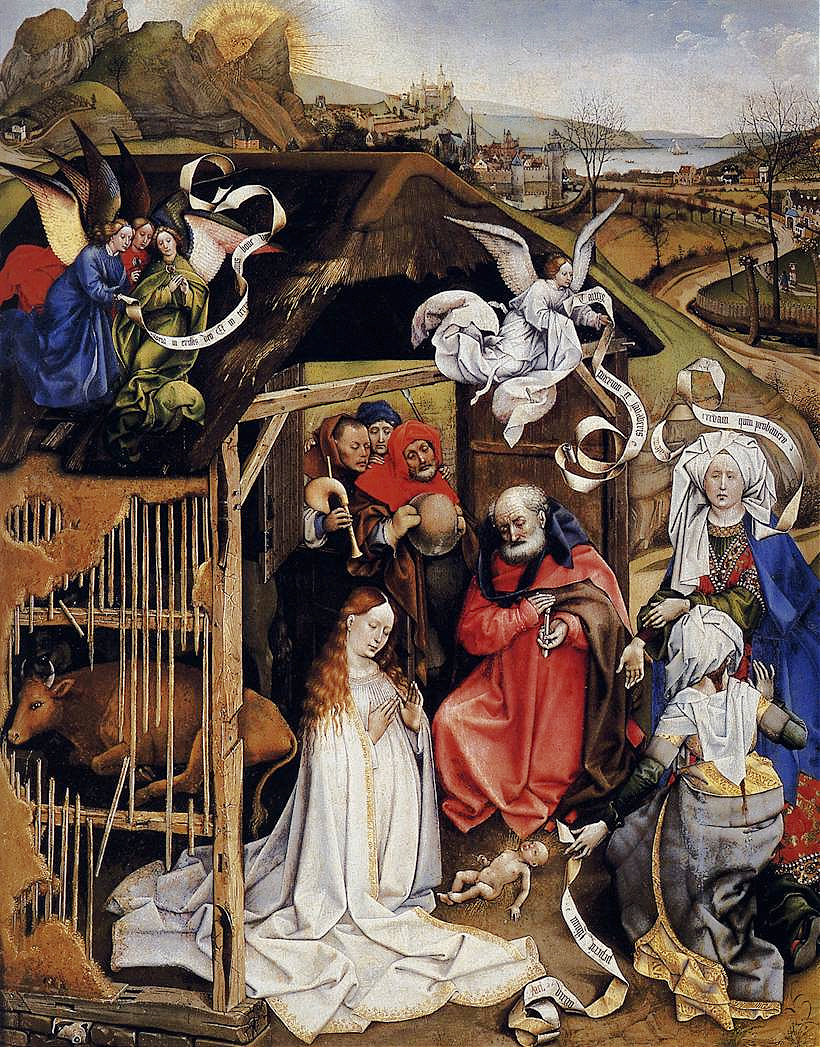
9 – Master of Flémalle/Robert Campin (1375-1444), The Nativity, c. 1420, oil on wood 87 x 70 cm, 32 5/8 x 27 ½, Musée des Beaux-Arts de Dijon, France.

The Nativity is the most famous work of the Master of Flémalle (Robert Campin). The single panel combines dreamed up images, and meticulous objective observation and rational knowledge to depict three episodes – (1) the legend of the midwives, (2) adoration of the shepherds, (3) the Nativity. The wooden stable, with its ox and ass, has a broken wall and holes in the roof. The Virgin dressed in white is kneeling with her hands held up in adoration as the Christ Child lies naked on the ground. Joseph is depicted as an old man and holds a lit candle that he shelters. The legend of the midwives is an apocryphal Gospel tale regarding Joseph’s anxiety during the birth and summoning these midwives with complicated headdresses. The stable door is swung open and three shepherds enter behind Mary and Joseph. Four angel figures hover above the scene holding strips of parchment with messages. There is an extensive, condensed, and detailed winter landscape in the background with a wide, curving road and castle perched on a hill.

Spatial Complexity and Symbolism: The Merode Annunciation
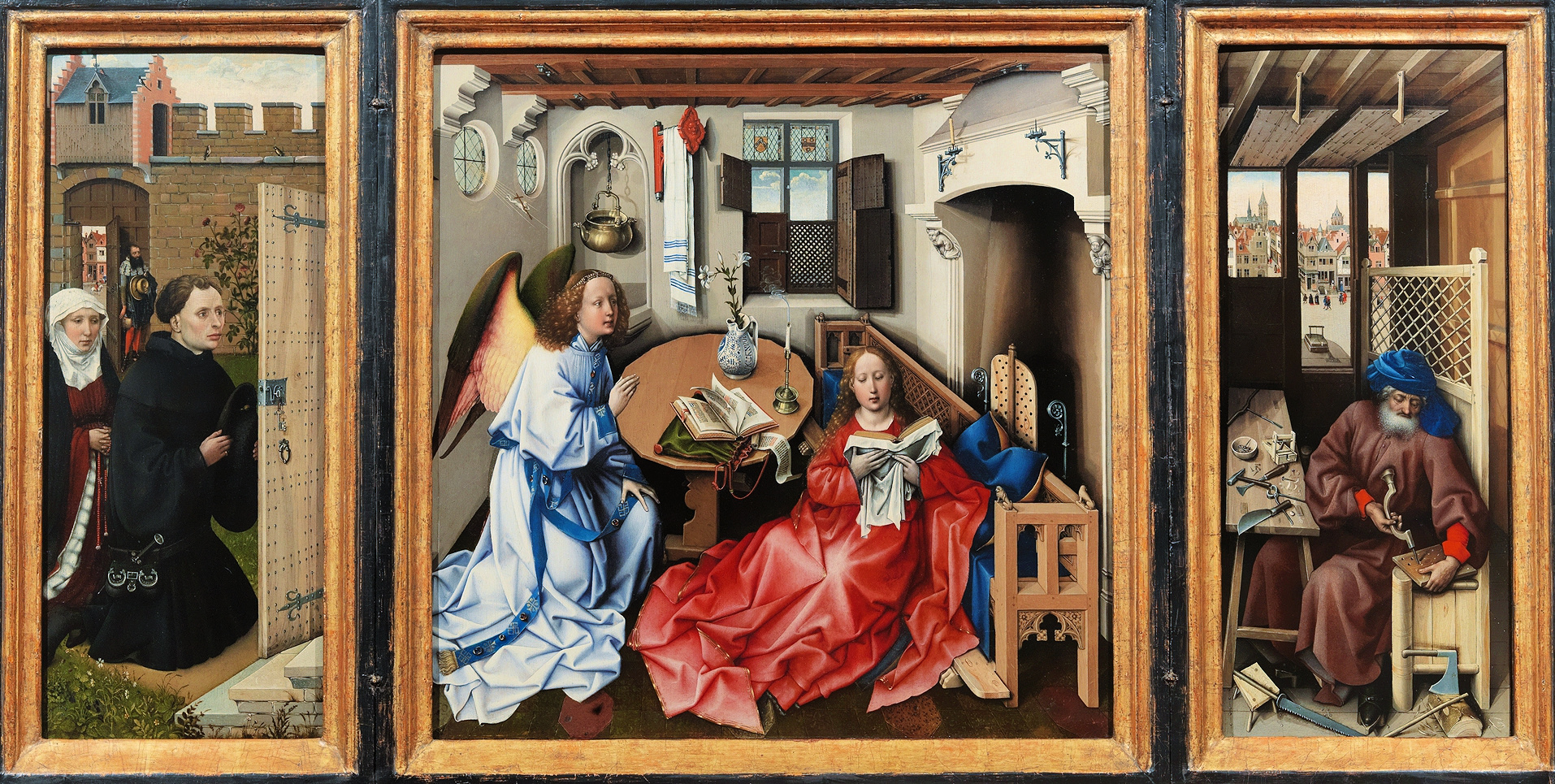
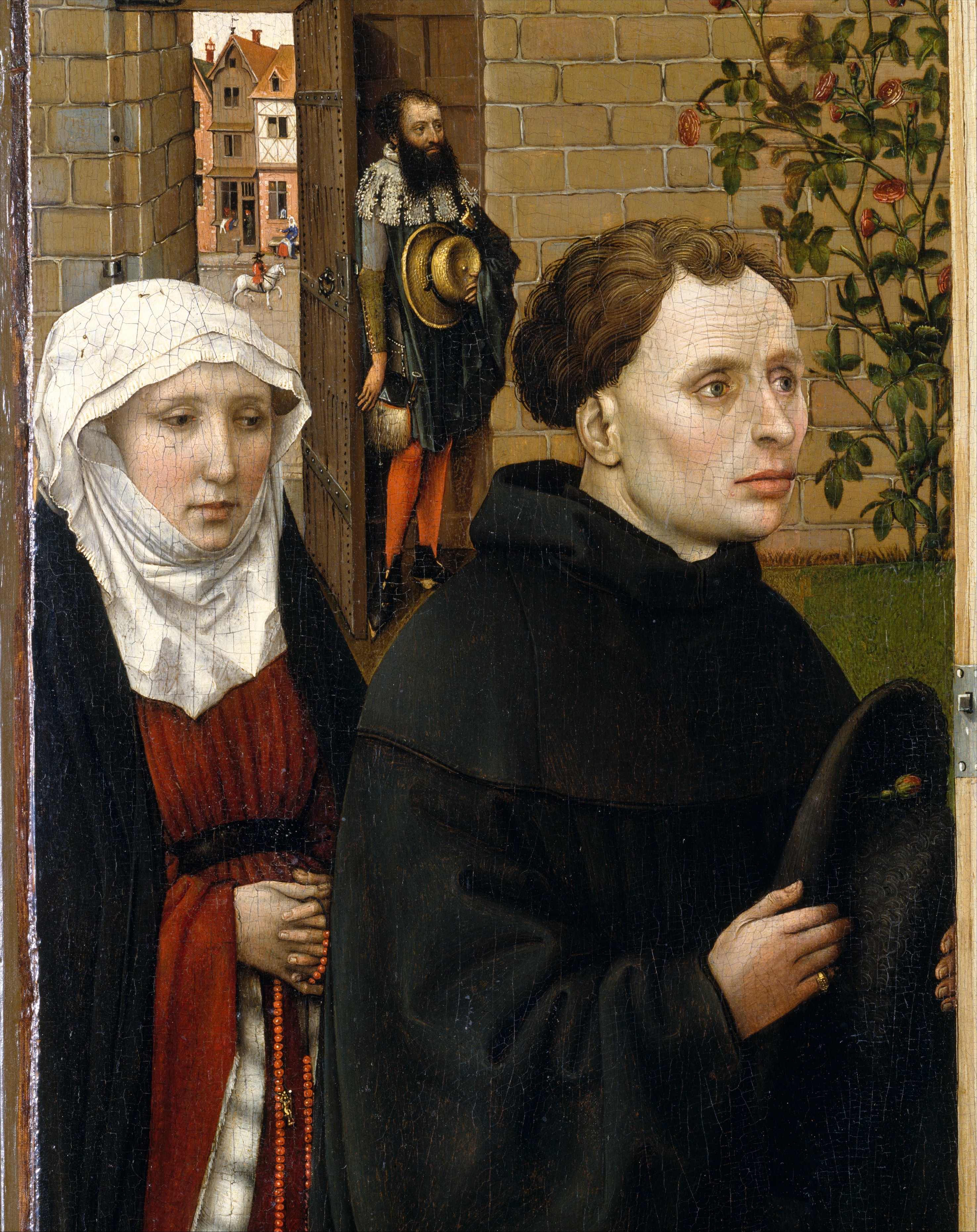
10– Master of Flémalle/Robert Campin (1375-1444), Annunciation Triptych (Merode Altarpiece), c. 1427-32, The Cloisters (Metropolitan Museum of Art), New York.

St. Luke 1: 26-29. “In the sixth month, the angel Gabriel was sent from God to a town of Galilee called Nazareth, to a virgin betrothed to a man named Joseph, of the house of David, and the virgin’s name was Mary. And coming to her, he said, “Hail, favored one! The Lord is with you.” Placid depiction of the Annunciation at the moment when the angel Gabriel alights in the Virgin’s chamber. The setting is a middle-class home and Mary is, for the moment, still completely unaware of the mystery that will now be told to her. A miniature figure with a cross comes through the oculus above the angel. The objects in the room– a lily, an immaculate towel, an extinguished taper– may be symbolic but certainly work to hold realistic tactile value. The robes in the foreground, one red, the other light blue, provide focus for the painting’s harmony and color. The Master of Flémalle experiments with Renaissance applications of perspective, depth, proportion (foreshortening) with material objects such as open shutters, an open door (left panel), and an unforgiving diagonal of the room’s bench. These material objects in varying perspectival space as well as varying light sources give the painting complexity. The right panel depicts old Joseph in his carpenter workshop. The left panel shows the painting’s donors on their knees witnessing this remarkable scene through the open door. There is speculation that the Master of Flémalle had painted the center panel and, as buyers showed interest, these donors commissioned the wings that were painted by workshop artists such as, likely, young Rogier van der Weyden (ca. 1400–1464) and Jacques Daret (ca. 1404–1468).

The Master of Emotion: Rogier Van der Weyden
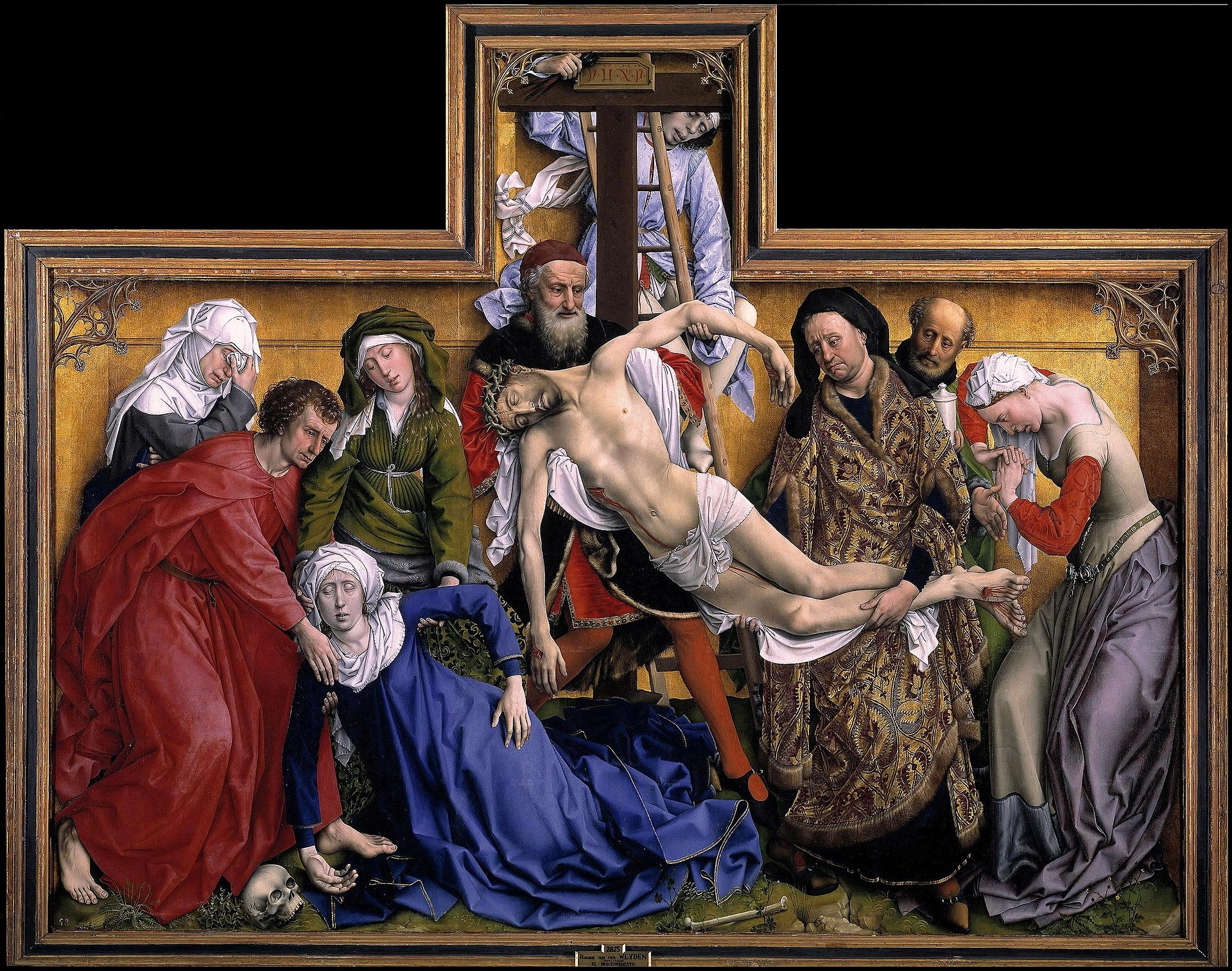
11-Rogier Van der Weyden (1399-1464), The Deposition or The Descent from the Cross, c. 1435, oil on oak panel, 86 ¾ x 110 inches, 220 × 262 cm. El Museo Nacional del Prado, Madrid.

Rogier Van der Weyden was a major artist in Flanders in the mid15th century. He was a pupil of Robert Campin, the Master of Flémalle, from which he imbued his realistic, ordinary naturalism with, what Murray said, was “more emotion, warmth and sensitiveness.” Insofar as the power of his artistic technique, Van der Weyden is a peer of Jan Van Eyck. Van der Weyden’s colors are cooler than Van Eyck’s and he subordinates his technical abilities to display the feelings of his paintings’ subject matter, typically religious. In terms of composition the striking difference between Van Eyck and Van der Weyden is that Van Eyck crafts a setting for his panorama of iconic vignettes while Van der Weyden paints flat-on action, often intensely emotional – all of which contributes to the artwork as a whole. Both Van Eyck’s Adoration of the Lamb and Van der Weyden’s The Deposition or Descent from the Cross are the most influential Flemish paintings of the mid15th century. Van der Weyden’s overall oeuvre makes him, arguably, 15th century Flemish art’s most influential figure.
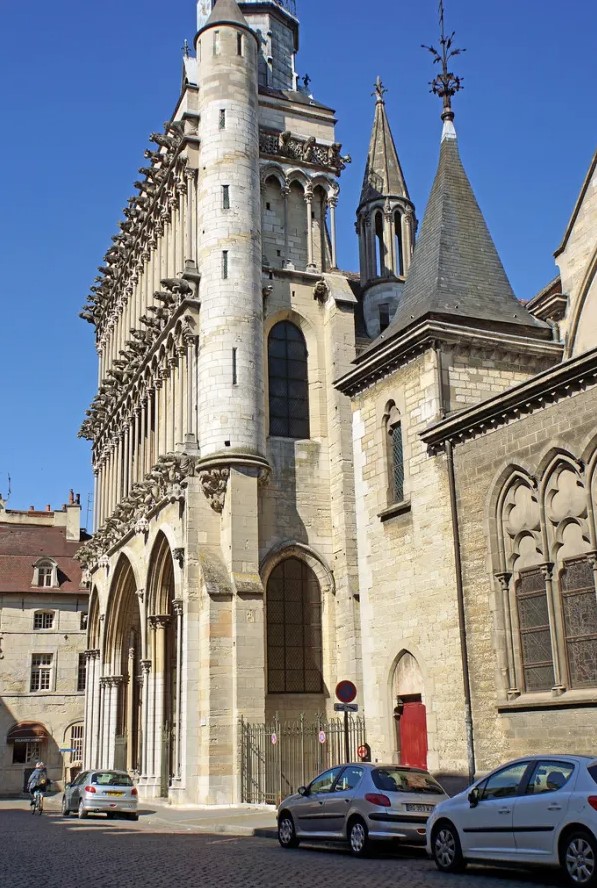
Van der Weyden’s The Deposition or Descent from the Cross are the most influential Flemish paintings of the mid15th century. The altarpiece was commissioned by the Grand Order of Crossbowman for the Church of Notre-Dame-Outside-the Walls of Dijon (13th century). PHOTO CREDIT: “France-003095 – Notre-Dame of Dijon” by archer10 (Dennis) is licensed under CC BY-SA 2.0.

Monumental Devotion: The Triptych of the Seven Sacraments

12- Rogier Van der Weyden (1399-1464), Triptych of the Seven Sacraments Altarpiece, c. 1445–1450, 78 ¾ x 87 ¾ inches. Royal Museum of Fine Arts, Antwerp.
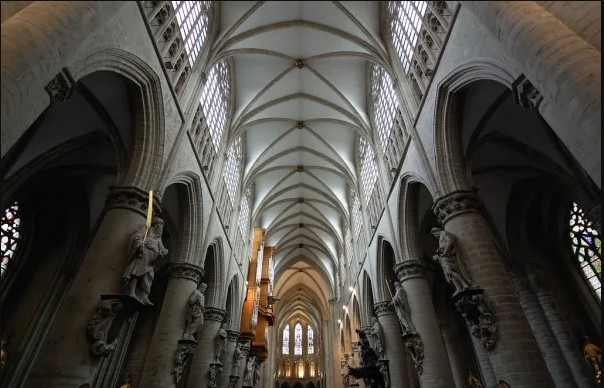
Van de Weyden’s painting, The Seven Sacraments, set in St. Gudule Church in Brussels, makes evident that the purpose for this grand and modern building is to manifest the presence of Jesus Christ in the sacraments.  “St. Michael and St. Gudula Cathedral, Brussels” by tabula_electronica is licensed under CC BY-NC 2.0.

Van der Weyden married a woman from Brussels and relocated to that growing and prosperous city in the marshes of Flanders in 1426. By the mid1430’s Van der Weyden was the City Painter and did work for the Burgundian Court. In 1450 the artist traveled to Rome and Florence where the early Italian Renaissance was in full swing and whose art greatly influenced the Flemish master’s art through the 1450s and into the 1460’s. The Triptych of the Seven Sacraments Altarpiece was a return to the artist’s native city as it was painted for the Bishop of Tournai whose coat of arms appear on the upper portions of each panel. Set in the impressive Cathedral of St. Michael and St. Gudula in Brussels, the painting presents profound religious content in a finely drafted and colorful work – the left panel depicting the sacraments of initiation (baptism, confession and confirmation), the center of the Eucharist under a giant cross, and the right panel depicting the sacraments of ordination, marriage, and last rites.

Courtly Elegance: The Late Portraits of Van der Weyden
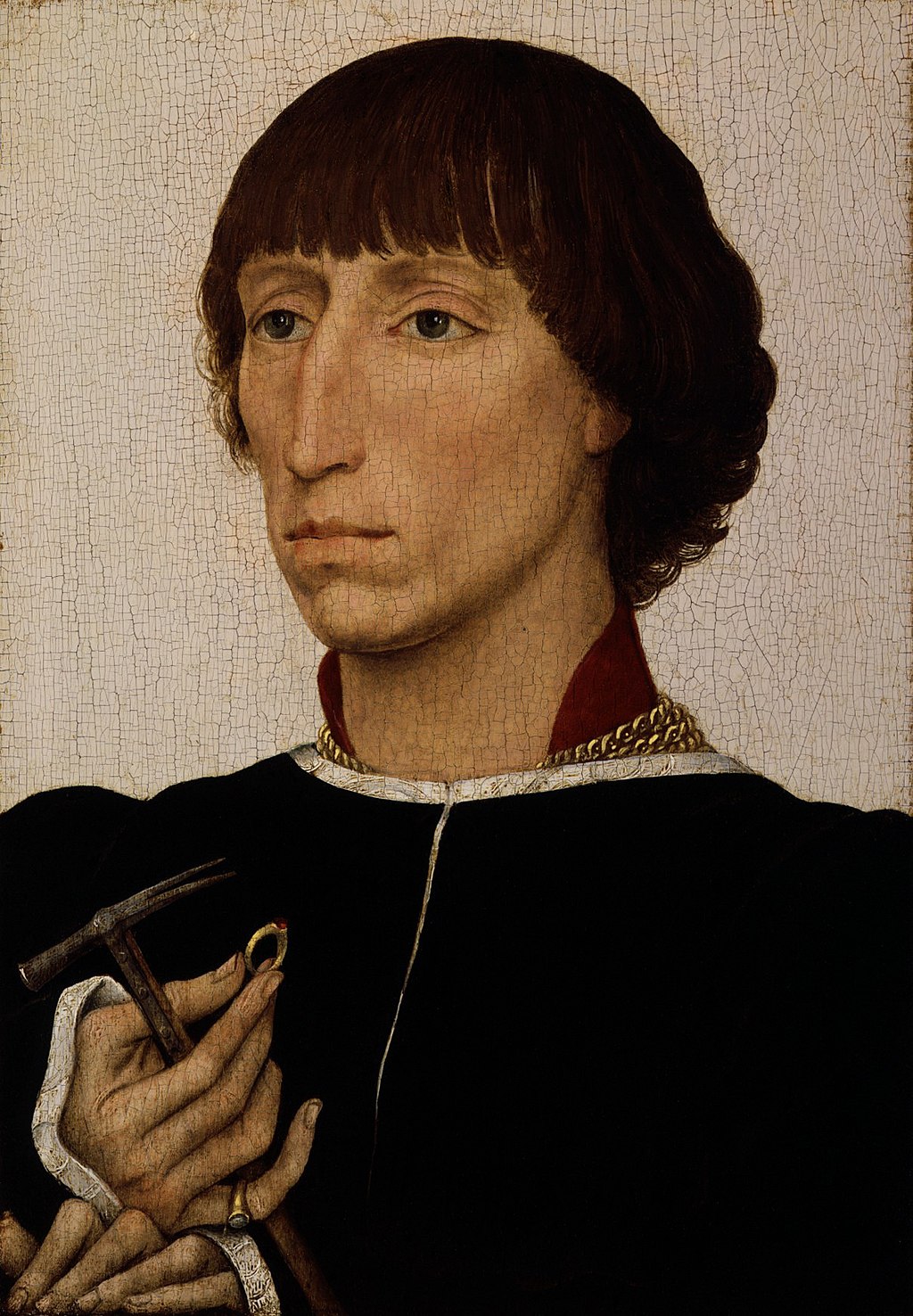
13- Rogier Van der Weyden (1399-1464), Portrait of Francesco d’Este (c. 1429-1476), ca. 1460, Oil on wood, 11 9/16 x 7 7/8 inches, The Metropolitan Museum of Art, New York.

Rogier van der Weyden painted several superb and sensitive portraits including Charles the Bold (Berlin), Le Grand Bâtard of Burgundy (Brussels), a Lady (National Gallery of Art, D.C.). Francesco d’Este was an Italian who received an education at the Burgundian Court. The d’Este family in Ferrara, Italy, was all-powerful when Rogier Van der Weyden visited there in 1450, though this portrait is done later. The sitter holds a hammer and ring whose significance is not explained with certainty.

Emotional Serenity and Architectural Precision: Dieric Bouts
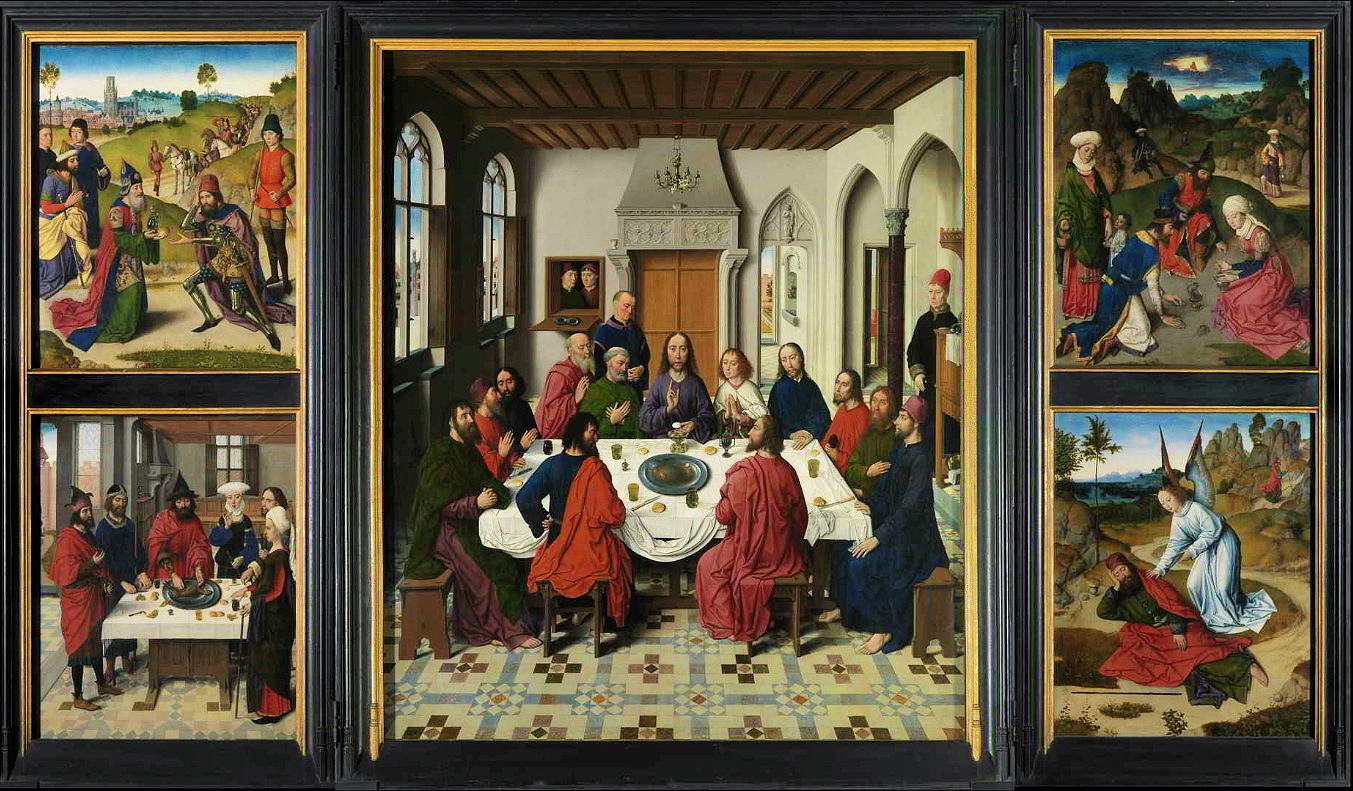
14 – Dieric Bouts (c. 1415-1475), The Altarpiece of the Last Supper or Five Mystic Meals, 1464-67, 70 ¾ x 114 inches, Church of St. Peter, Louvain, Belgium.

Dieric Bouts was born in Haarlem, the Netherlands, around 1415, where little is known of his early life. Before 1448 Bouts was working in Louvain where he married a wealthy Catharina Van der Brugghen and would work there until his death in 1475. Bouts’ finest paintings are characterized by their subtle depiction of colors and light on semi-inert and dignified and emotionally calm figures in detailed and delicately beautiful landscapes. Rogier van der Weyden influenced Bouts’ earlier work (Bouts may have trained with him in Brussels) in its greater emotionalism. In the year of Van der Weyden’s death the Brotherhood of the Blessed Sacrament of Louvain commissioned an altarpiece to place in St. Peter’s Church in Louvain. The artist worked with theologians to establish an iconography for the Eucharist which he then translated to contemporary Louvain with an exceptional plasticity whose result is that it is one of 15th century Europe’s greatest artworks. Jan Van Eyck’s influence is manifest in Bouts’ elegant intellectuality (in turn, Bouts was influential on 15th century German painting). Its perspectival calculus is matched to shapes and forms that convey emotion within the work’s compositional rigor. The head of Christ whose raised hand blesses the bread occupies the center of the artwork as the apostles gather in groupings around a table which itself develops within the room’s structure. The four side panels are scenes from the Old Testament transmitted likely by those same Catholic theologians who advised Bouts as to Biblical precedents to Christ’s Last Supper – here, the Feast of the Passover, Elijah in the Desert, the Gathering of Manna, and Abraham and Melchizedek. In 1472, Bouts was appointed city painter in Louvain, an honorary title at a time when the city was undergoing massive urban development. After Bouts’ wife died in 1473, the artist remarried in 1474 but died himself in 1475. Bouts was buried beside his first wife in the Franciscan church in Louvain. His sons, Dieric and Albrecht, were artists who continued the family tradition into the 16th century.
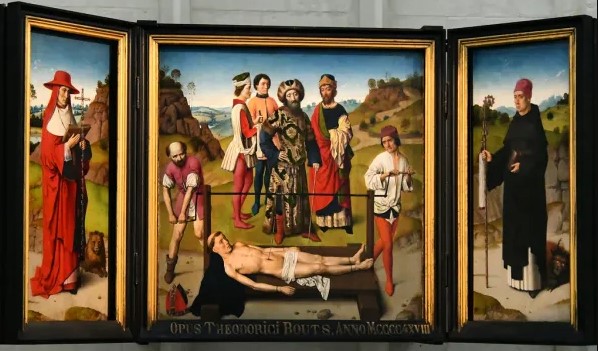
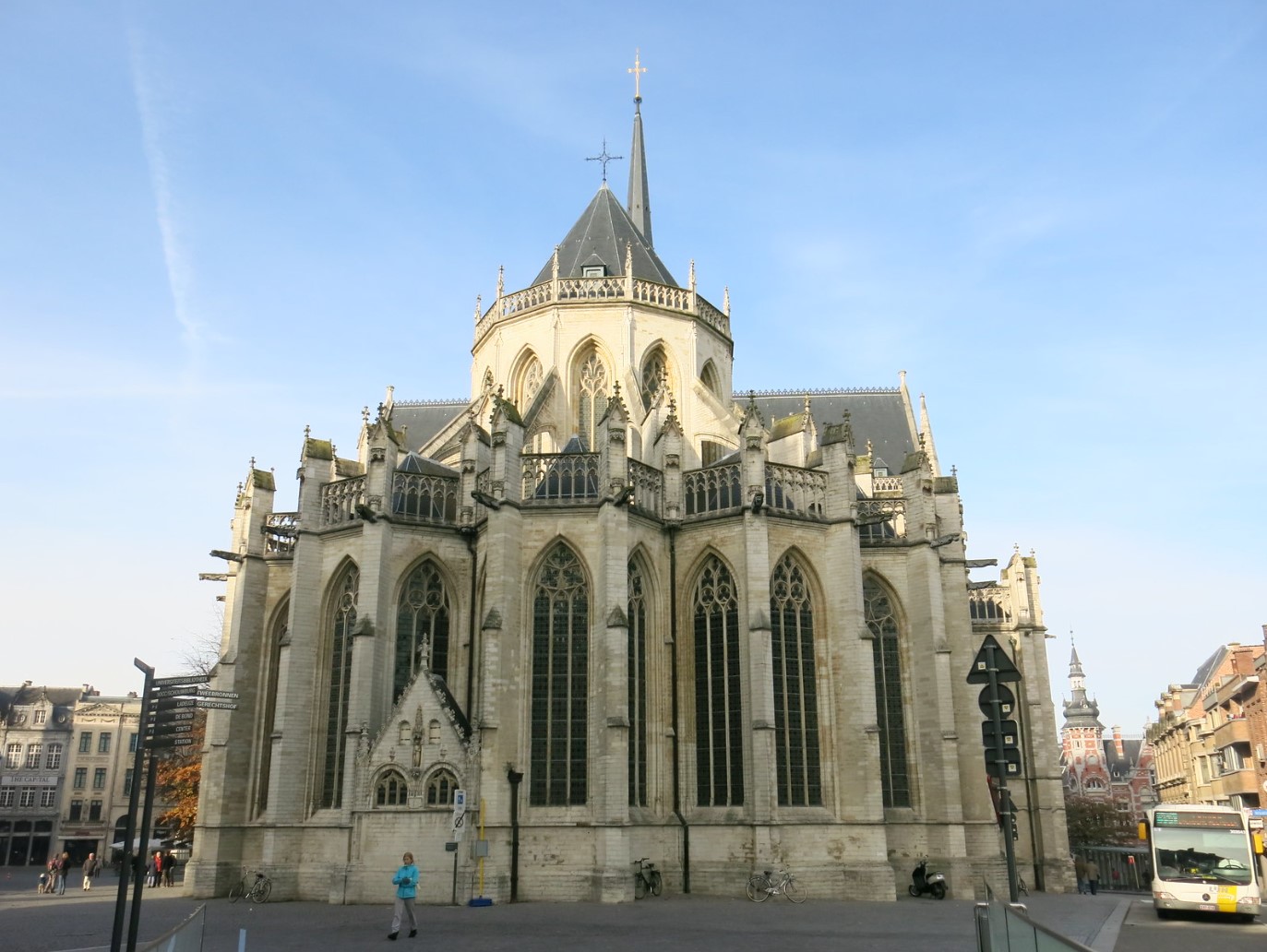
Bouts’ The Altarpiece of the Last Supper of Five Mystic Meals was to be placed in a chapel across from Bouts’ The Martyrdom of St. Erasmus in St. Peter’s, Louvain. Both artworks are hanging in the same place where it was intended for almost 600 years. “BELGIUM – LEUVEN – St Peter’s Church (7)” by eso2 is licensed under CC BY-NC-ND 2.0.
St. Peter’s, Louvain. Choir and ridge 15th century. “St. Peter’s Church, Leuven” by dungodung is licensed under CC BY-SA 2.0.

Innovation in Movement: The Martyrdom of Saint Hippolytus

15 – Dieric Bouts (c. 1415-1475), The Martyrdom St. Hippolytus Triptych, 1470 – 1475 oil on wood, 35 ¾ x 35 ¾“ Groeningemuseum, Bruges, Belgium.

Unusual for Bouts this painting depicts the torture of martyrdom. There are many figures named Hippolytus in the early church. According to Prudentius’ 5th century account, one was the martyr Hippolytus who was dragged to his death by wild horses. The account led to this Hippolytus being considered the patron saint of horses. The square format panel preferred by Bouts depicts the martyrdom from above with foreshortened horsemen shown from the front. It is the first Flemish painting to depict movement not simply by using gesture. As Delevoy assesses, “The success of the picture lies in its timeless definition, its iconographic originality, its pictorial poetry, its popular feeling, its anecdotal interest.”

Civic Drama and Legal Moralism: The Justice of Emperor Otto III
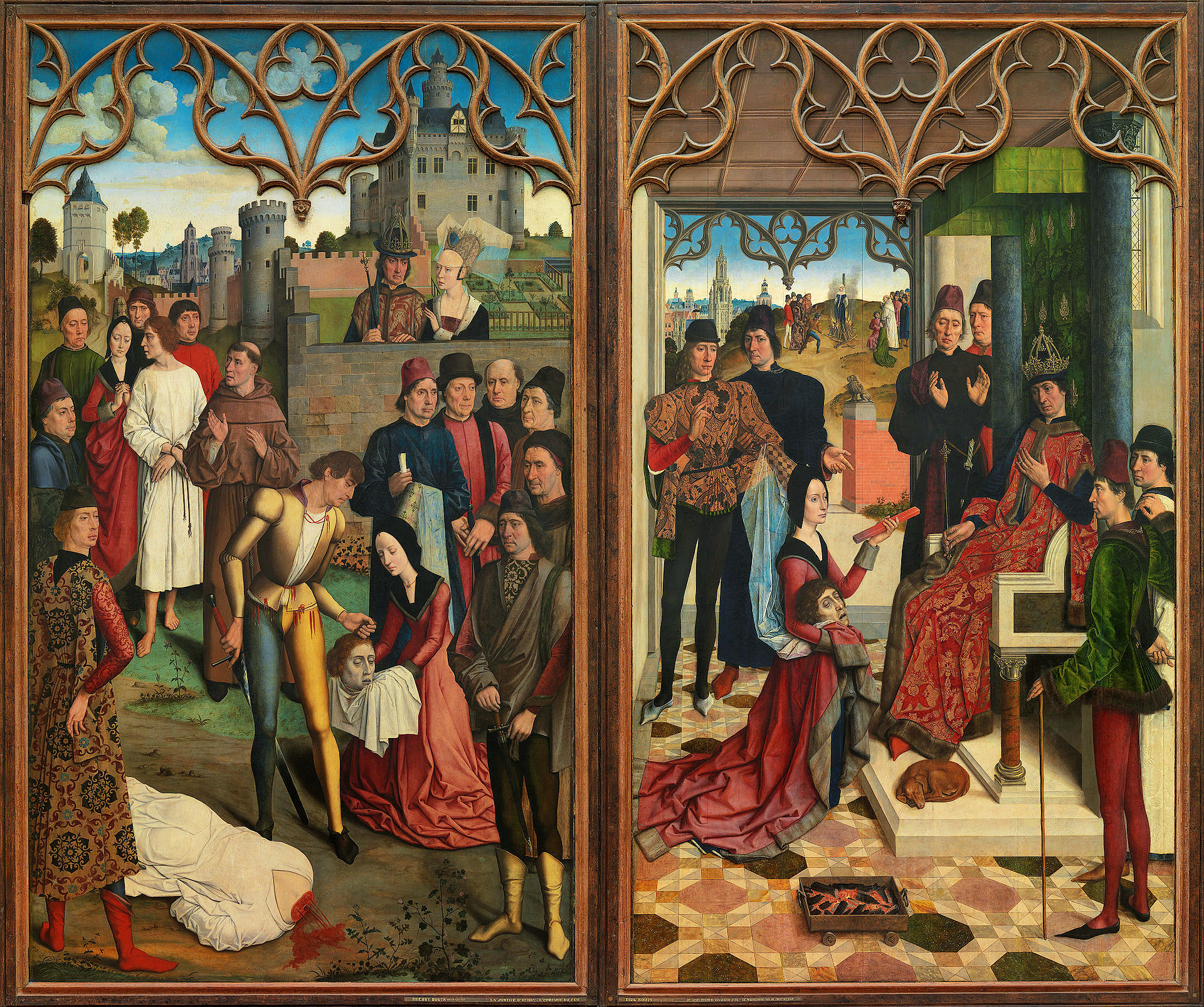
16 – Dieric Bouts (c. 1415-1475), Justice of Emperor Otto III Beheading of the Innocent Count and Ordeal by Fire, 1470 – 1475. oil on wood, 127 ½ x 72 ¼ inches, Royal Museums of Fine Arts, Brussels.

This is one of two paintings that is certain to be by Bouts (the other is Five Mystic Meals). It was commissioned in 1468 by a Louvain magistrate for the new city hall and intended to be an ambitious project on the Last Judgment. But it remained uncompleted at Bouts’s death. Panels representing heaven and hell survive and these two thematically related panels illustrating an episode from the legend of the Holy Roman emperor Otto III (980-1002). A 13th century chronicle tells how the Empress falsely accused an innocent man of a crime and persuades Otto and his court to behead him (left panel). The second panel shows the beheaded man’s wife, convinced of her husband’s innocence, approaching Otto’s throne with his head and a hot iron. Calling on God as judge, the Empress’s guilt is revealed and the royal is burned at the stake depicted in the distance. There is no lack of drama in the skillfully drawn episodes with elongated bodies, fanciful clothes, and unique facial expressions. The central focus of the panels is neither Otto nor his court but the put-upon widow of the innocent man murdered by the state through duplicity.

Edgy Mysticism and Monumental Contrast: Hugo Van Der Goes

17 – Hugo Van Der Goes (c.1440-1482), Portinari Altarpiece: The Adoration of the Shepherds, 1476-78, 96 ½ x228 Inches, Le Gallerie degli Uffizi, Florence, Italy.

Hugo Van Der Goes (c.1440-1482) was the most important Netherlandish painter working in Ghent after Jan Van Eyck. A Ghent native, Van der Goes was in a guild there in 1467 and rose to its leadership between 1473 and 1475. Soon afterwards, the artist completed the Portinari Altarpiece for an Italian who was then residing in the Netherlands. The painting was sent immediately to Florence. Though not having the opportunity to have any great influence in the Netherlands, the Flemish 15th century art practice of cool colors and exquisite oil technique impressed the Renaissance Italians, notably Domenico Ghirlandaio (1448-1494). Also, its immense size – eight feet tall and 19 feet wide – and its virtuosity made an impact. By synthesizing Van der Weyden’s drama and sensuous expression and Bouts’ three-dimensional space, Van der Goes gives increased everyday tangible reality to his sacred subjects. Sharing Broederlam’s inquiries for visual appearances, Van Der Goes’ artwork creates new forms, types, and the impetus behind them based in popular sentiments and an edgy mysticism. So, in a 15th century sort of way, this is not your father’s Nativity (i.e, Master of Flémalle’s in 1420). It is ponderable, dense, significantly tactile and spatially voluminous. The Virgin, in prayer and in maternal caress, is in the exact center of the immense triptych. Also in the circle are St. Joseph, the shepherds, angels in the air and the Christ Child. The painting is a masterpiece of contrasts – between religious, secular, and rustic architectures; heavenly and earthly figures; peace and agitation; filled space and void; warm tones and cool colors.

Hugo Van Der Goes (c.1440-1482), Portinari Altarpiece (detail).
Hugo Van Der Goes (c. 1440-1482), Detail, Portinari Altarpiece, 1476-78, Uffizi Gallery, Florence, Italy.

Creative Solitude: The Later Years at Roode Cloister
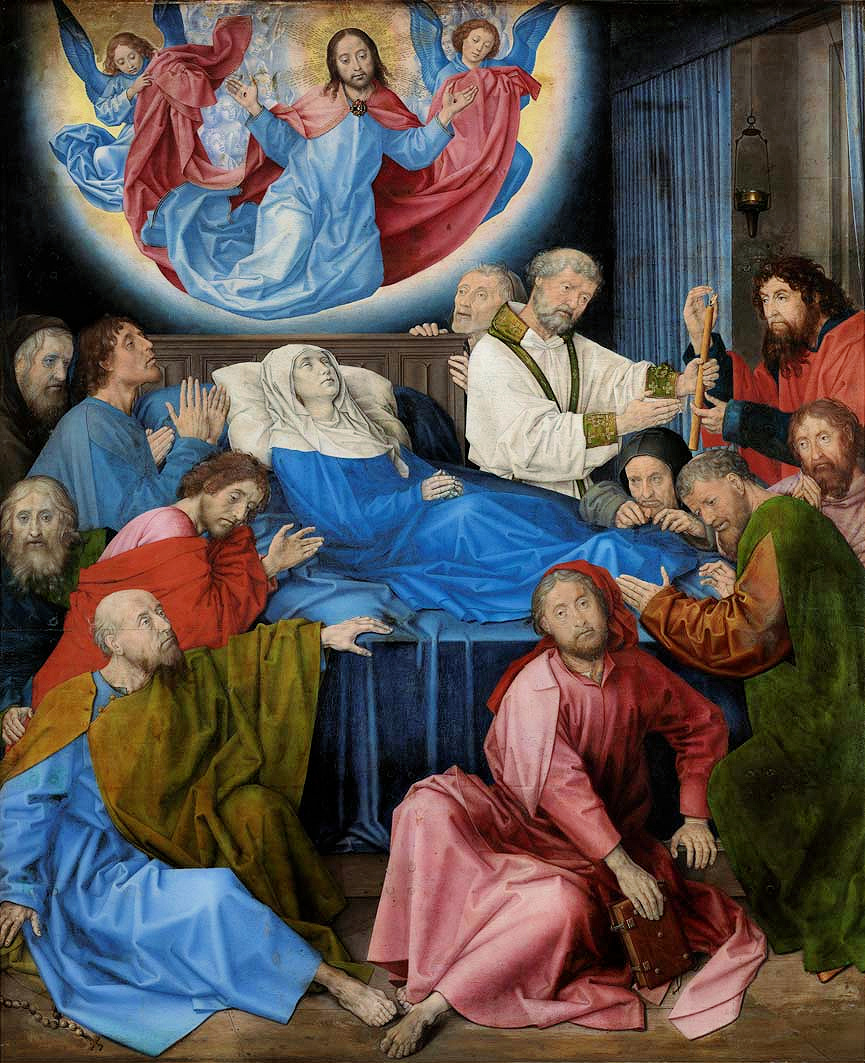
18 – Hugo Van Der Goes (c.1440-1482), The Death of the Virgin, c 1472–1480. 58 ½ x 47 ¾  inches, 147.8cm x 122.5cm. Groeningemuseum, Bruges, Belgium.

Around 1475 Hugo Van Der Goes became a lay brother in an Augustinian Priory, the Roode Cloister. Founded in 1367, the cloister is on the southeastern edge of modern Brussels. The artist continued to paint and receive visitors there, traveled to Louvain and Cologne, and died in 1482.

Global Exchange: Justus van Gent in Urbino
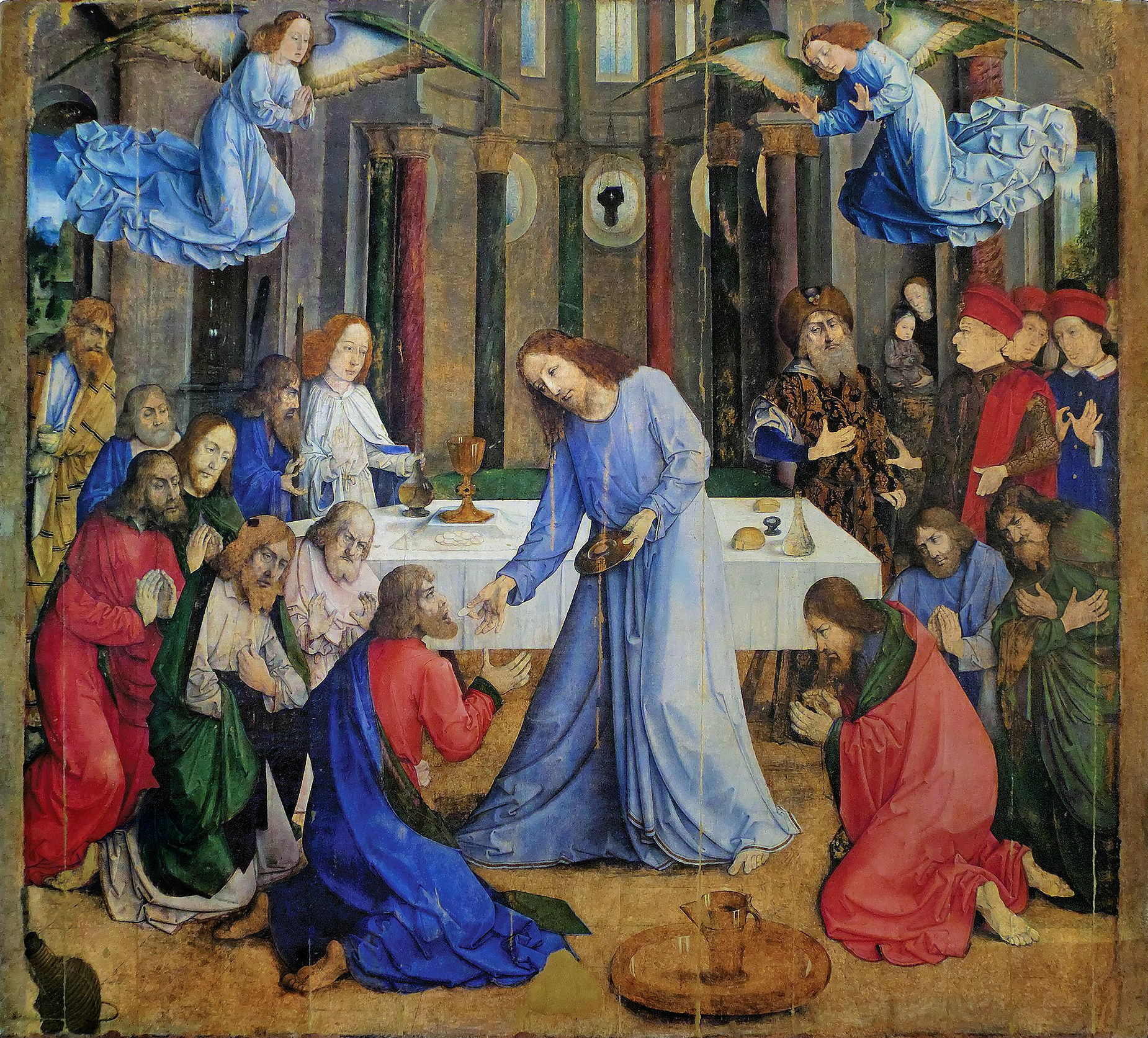
19 – Justus (Joos) van Gent (c.1435-1475), Communion of the Apostles or Institution of the Eucharist, 1473-75, 113 x125 inches, Ducal Palace, Urbino, Italy.

Justus van Ghent was a master in Antwerp in 1460 and in Ghent four years later where he met Hugo van der Goes. By the time of his death Justus van Ghent was in Rome, a city that was increasingly attracting international artists, including from northern Europe. Van Ghent was in Urbino where he painted Institution of the Eucharist in Urbino. The commission was originally given to Italian artist Piero della Francesca (1415-1492) and its predella (the altarpiece’s painting at its lower edge) was completed by Uccello (1397-1475).

Serene Piety and Commercial Success: Hans Memling
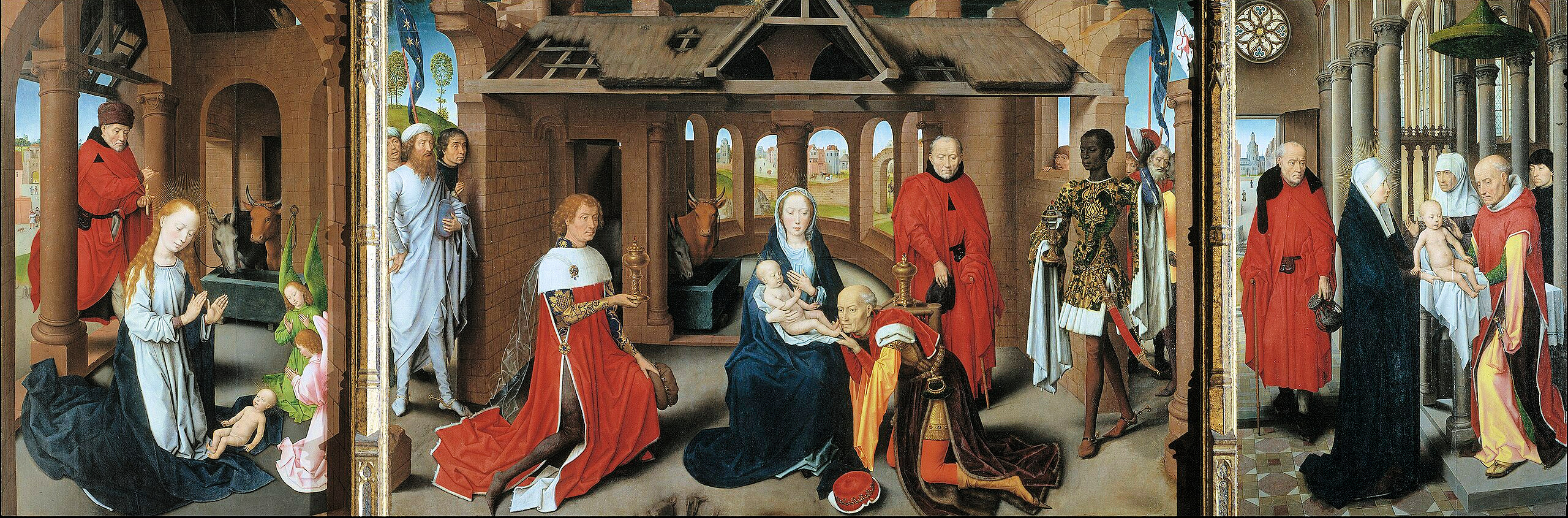
20 – Hans Memling (c. 1433-1494), The Adoration of the Magi (c. 1470), 37 ¼ x 57 inches, c. 1480, oil on panel, El Museo Nacional del Prado, Madrid.

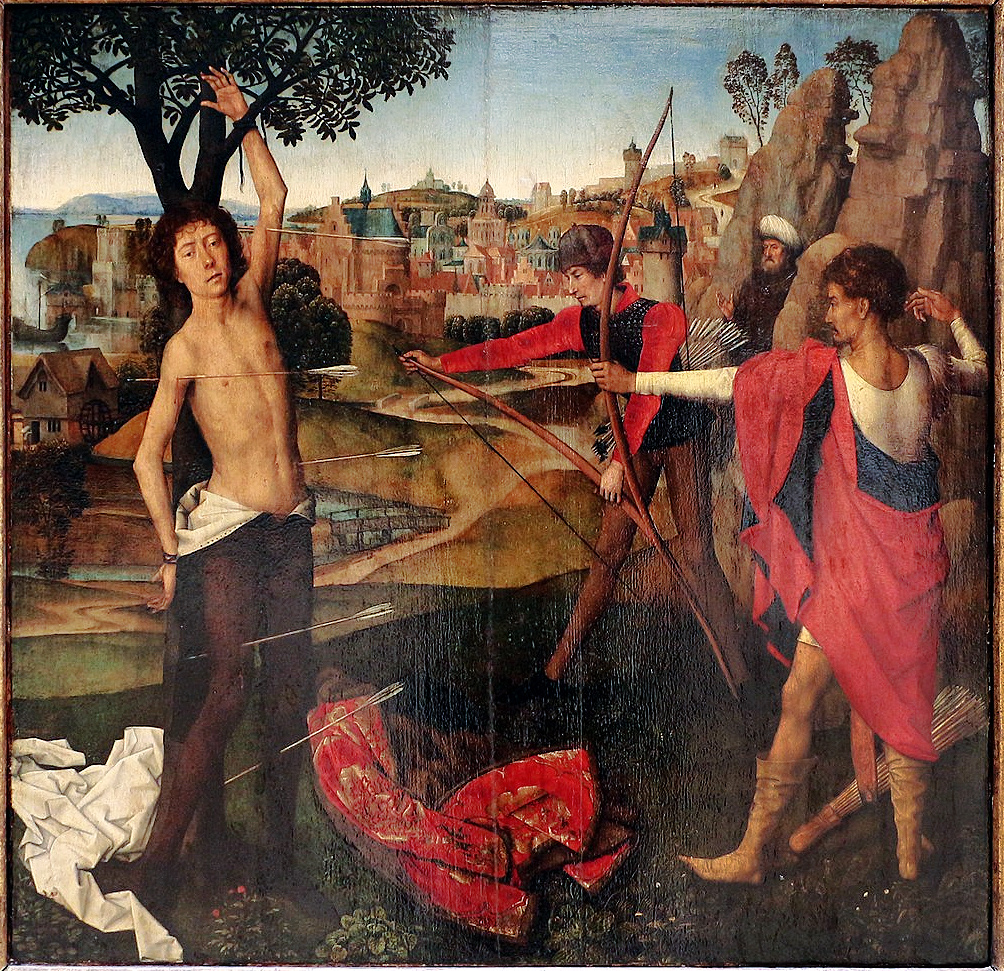
Hans Memling was a German, born near Frankfurt-am-Main. Memling was likely a student of Rogier van der Weyden and completely Netherlandish in his artistic style. Memling lived in Bruges and became a citizen in 1465. By 1480 the successful artist was one Bruges denizen who was paying the city’s largest amount of taxes. Though not innovative, Memling’s artwork depicts calm and peaceful figures full of piety. Memling also painted portraits successfully. Examples of his artwork are in collections all over the world.
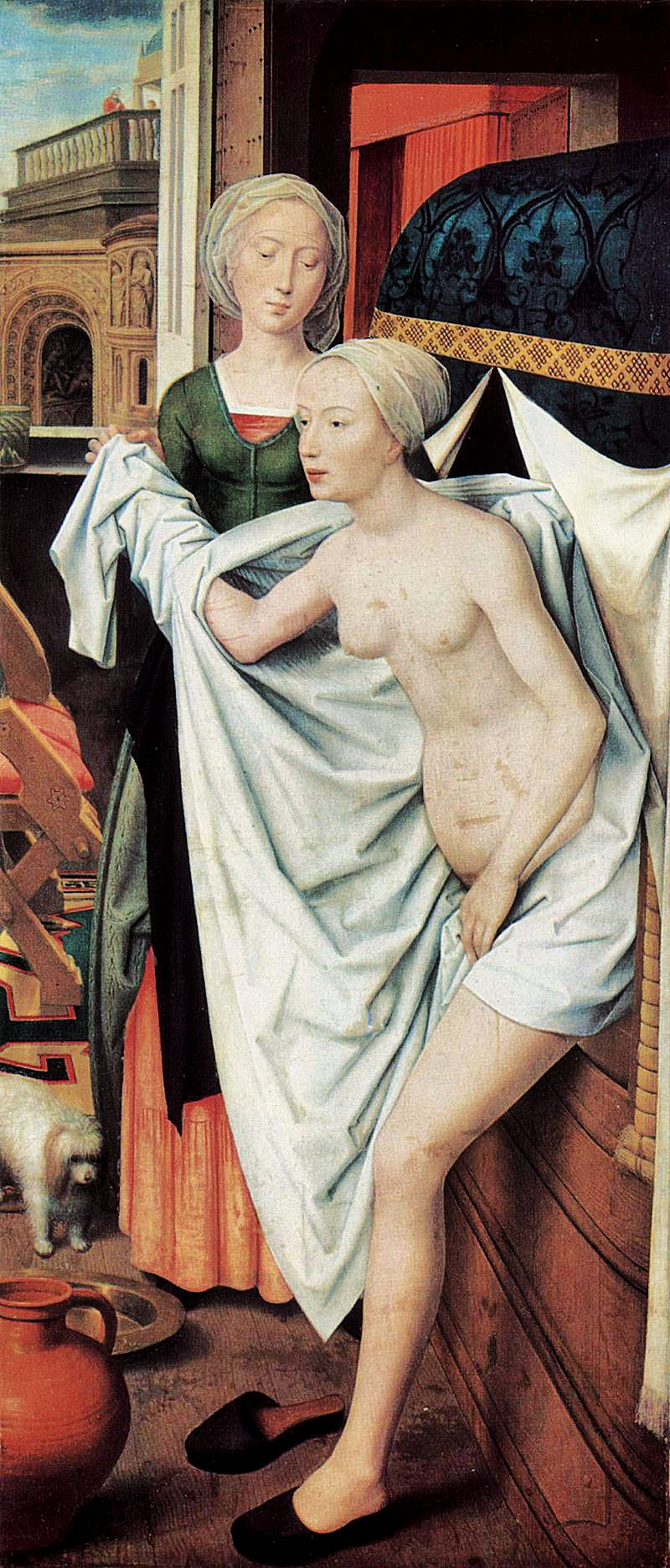
21 – Hans Memling (c. 1433-1494), Bathsheba at her Bath, c. 1480-1485, 37 ¾ x 33 inches, Staatsgalerie Stuttgart, Germany.
22 – Hans Memling (c. 1433-1494), The Martyrdom of Saint Sebastian, c. 1475, 26 ¼ x 25 ½ (67.4 x 67.7 cm), oil on wood, Royal Museums of Fine Arts of Belgium, Brussels.

The Culmination of the Bruges School: Gerard David

23 – Gerard David (c.1460-1523), The Justice of Cambyses: the arrest of the Dishonest Judge, 1498, Groeningemuseum, Bruges, Belgium.

Gerard David was a Dutch painter born in Oudewater. David was in Bruges by 1484. He was the last major painter from Bruges and painted pious pictures in a gentle Netherlandish style right before the rise of a new Italianate style in Antwerp. David traveled to Antwerp in 1515 and joined the Guild but returned to Bruges and died there in 1523. Though many pictures are attributed to David, the pair of Justice paintings are certainly his.
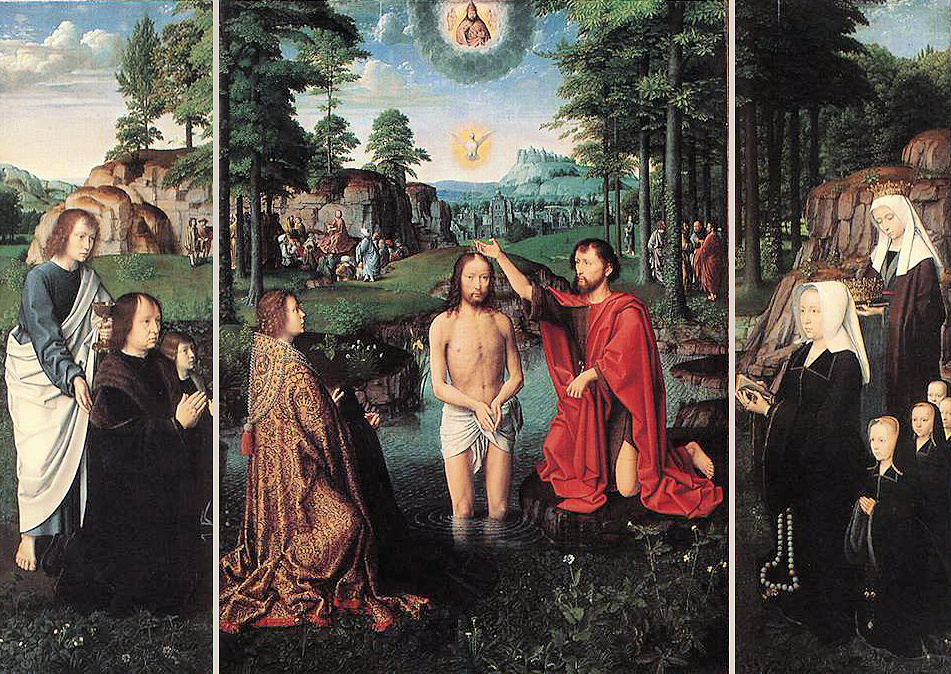
24 – Gerard David (c.1460-1523), Altarpiece of the Baptism of Christ, 1502-1508, 52 ¾ x 73 ½ inches, Groeningemuseum, Bruges, Belgium.

Conclusion: A Lasting Legacy of Northern Realism

Through this sweeping northern tier, the 15th-century Flemish School completely redefined the boundaries of Western art. Fueled by the immense mercantile wealth of trade hubs like Bruges and Antwerp, these masters looked beyond the rigid traditions of southern courtly capitals to capture the world as it was truly seen—perfecting the luminous magic of oil painting, pioneering deep three-dimensional space, and infusing sacred narratives with raw, human emotion.

From the early, groundbreaking naturalism of Robert Campin and the Van Eyck brothers to the emotional intensity of Rogier van der Weyden and Hugo van der Goes, Flemish innovation did not remain confined to the Low Countries. Its profound influence rippled across Europe, fundamentally altering artistic practices in Germany and captivating the master painters of Renaissance Italy. By marrying a meticulous observation of daily life with a powerful, independent spirit, the early Netherlandish masters created an enduring, cohesive artistic ecosystem whose brilliant light continues to fascinate and inspire the world today.

SOURCES:

A Dictionary of Art and Artists, Peter and Linda Murray, Penguin Books; Revised,1998.

Early Flemish Painting, Robert L. Delevoy, New York: McGraw-Hill Book Company, Inc., 1963.

https://www.britannica.com/summary/Jan-van-Eyck –  retrieved February 5, 2024.

https://www.britannica.com/summary/Philip-III-duke-of-Burgundy – retrieved February 5, 2024.

https://www.uffizi.it/en/online-exhibitions/portinari-triptych#2 – retrieved February 6, 2024.

https://www.youtube.com/watch?v=e5I_MKCs8Zo – retrieved February 7, 2024.

https://sammlung.staedelmuseum.de/en/work/the-bad-thief-to-the-left-of-christ – retrieved February 4, 2024.

 https://www.mleuven.be/en/even-more-m/last-supper – retrieved February 2, 2024.

https://collections.louvre.fr/en/ark:/53355/cl010061856 – retrieved January 29, 2024

https://www.codart.nl/guide/agenda/dieric-bouts-creator-of-images/ – retrieved January 29, 2024

https://collectie.museabrugge.be/en/collection/work/id/O_SJ0188_I – retrieved January 29, 2024

https://www.metmuseum.org/art/collection/search/110001938?rndkey=20120109&pos=145&pg=10&rpp=15&ft=*&high=on– retrieved January 29, 2024

https://www.wga.hu/html_m/m/master/flemalle/nativity/nativi_.html – retrieved January 29, 2024

Both above: detail, Master of Flémalle, Annunciation Triptych (Merode Altarpiece), c. 1427-32, The Cloisters (Metropolitan Museum of Art), New York.

The Melody of Color and Symphony of Form: Albert Joseph Moore’s Art of Pure Beauty.

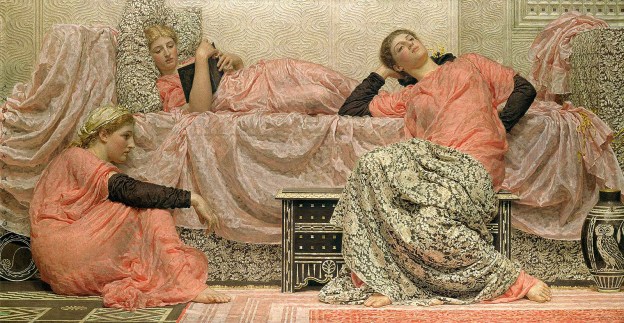
FEATURE image: Albert Joseph Moore (1841-1893), READING ALOUD, 1884, oil on canvas, 42.24 x 81 in., Glasgow Art Gallery & Museum.

The artist: Albert Joseph Moore (1841-1893).

Albert Joseph Moore was one of the leading figures of the British Aesthetic Movement, creating meticulously crafted paintings that placed beauty, harmony, color, form, and decoration above narrative or moral instruction. His idealized female figures inhabit timeless settings that blend classical inspiration with Victorian artistic experimentation, making him a unique voice in nineteenth-century British art.

Albert Moore: Life and Artistic Legacy

Albert Joseph Moore was born in 1841 into a family of artists in North Yorkshire in England. Moore through his own advanced aesthetic experiments in the milieu of theoretical and practical advancements of mid-to-late 19th century modern art in England and France – such as a systematic analysis of nature, mathematical plotting, and principles for quintessential combinations of color, line and form – created art that was, in formal terms, in its conception and execution, on the cutting edge of abstraction that would continue to develop and blossom into early 20th century Cubism. Moore’s art gained the respect of other progressive artists (Moore was called “a painter’s painter”), patrons and collectors, if not always the critics and contemporaries who viewed Moore’s work as merely decorative. Moore was actively collected in his lifetime and exhibited regularly in major venues such as the Royal Academy. Unmarried and of a lifelong independent disposition, Moore died in 1893 at 52 years old, having just completed his last monumentally ambitious artwork (“The Loves of the Winds and the Seasons,” Blackburn Museum and Art Gallery, posted below) a handful of days before. Several of Moore’s pictures are now in public collection throughout the UK, including the Tate and the British Museum in London. 

Moore became a major representative of the Aesthetic Movement, often summarized by the ideal of “art for art’s sake.”

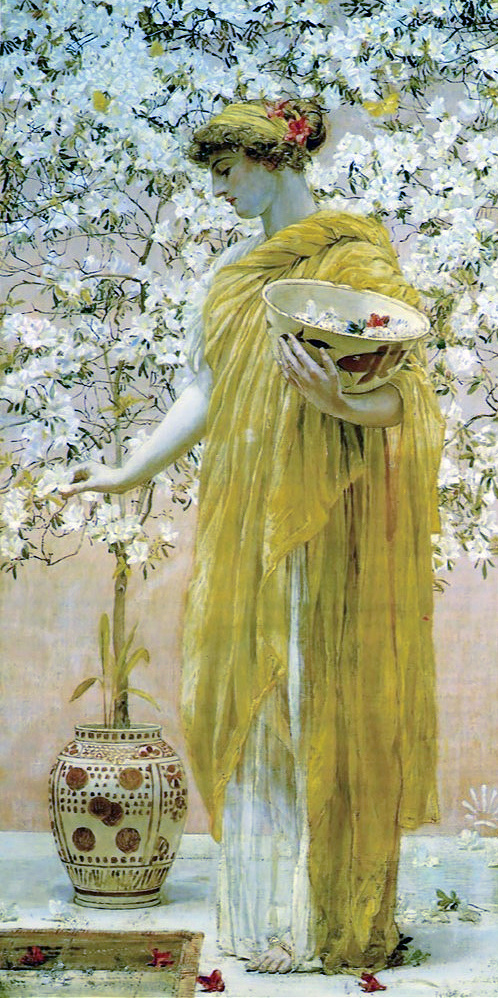
Azaleas (1867-1868)

Albert Joseph Moore (1841-1893), AZALEAS, 1867, Hugh Lane Municipal Gallery of Modern Art, Dublin, Ireland.

Azaleas was a popular artwork by Albert Moore for its harmonies of color and the “Greek refinement” that the artist infused into his work. This bigger-than-life-size canvas called Azaleas was painted in 1867, exhibited in 1868 and demonstrates the artist’s ability to represent the human figure on a grand scale.

The featured works depict idealized women in dreamlike environments that feel both classical and modern. His paintings emphasize decorative harmony, color relationships, pattern, and graceful composition rather than storytelling.

Geometry and Preparation

The 26-year-old artist had some architectural design experience in theory and practice and used this in his preparatory process. This artwork incorporated ideal geometry along with typical academic methods.

Moore’s process followed, first, making studies of the nude figure and draped figure. Moore next made a larger-than-life-sized full-scale nude figure cartoon which, at this stage, was informed by geometric abstraction of the figure in a setting guided by, or through, the milieu of the object in the artist’s hands.

The geometric quality guided the composition rather than was externally imposed by the artist. Moore’s “system of line arrangement” sought the directions of the prominent lines of the composition so to plot parallels of them throughout the drawing resulting in a statuesque yet corporeally vivacious figure.

Nature, specifically the landscape, ultimately served as the inspiration for the manifestation of line parallels and optical balance rather than the mathematically ideal. Moore’s geometric construct and its interplay determined every element of the composition – from the position and placement of the figure to the location of accessories, such as wall hangings, distribution of drapery folds, and architectural elements. The canvas’s shape and size also were ultimately determined by this idiosyncratic geometric arrangement.

Traces of Moore’s preparatory practice are in evidence in Azaleas’ full size nude cartoon with its vestiges of diagonal and horizontal lines through the midsection of the figure and near to her feet. Using these lines in the nude drawing it is apparent that Moore experimented with the placement of the figure’s head, the extended hand, and a raised heel which was ultimately hidden under opaque drapery. Moore used a live model for his figure.

Technique and Execution

The final nude cartoon was transferred to the canvas and this outline was built up with oil colors. A drapery cartoon was then transferred on top of the transferred, built-up nude figure cartoon. Using this method Moore rendered greater transparency of the fabric since the underlying nude cartoon showed through faintly. This painstaking preparation was masked by Moore’s fresh and free style of painting. For instance, the drape folds of the left shoulder are painted in long, fluent, and elegant strokes while the azaleas are rendered in energetic strokes. Moore’s objective was for the final painting to look like an impromptu and expressive sketch when, in fact, it was carefully planned and executed.

About painting Moore taught his students to think long about it but execute with quickness and determination. This technique aided in transforming oil painting into the manner of Graeco-Roman fresco in that Moore’s working method allowed for painting only what could be finished in a day.

Japonisme and Color Harmony

Moore’s careful planning, rapid execution, and brush technique also suggested the influence of Japonisme. Asian influences in Azaleas included the carp bowl held in the women’s arm (an actual studio prop) and the geometric pattern in the azalea pot whose symmetry Moore saw as part of both Greek and Japanese art. To integrate and transition the predominantly yellow figure in the predominantly white background Moore used a device taken from Japanese art of painting flitting butterflies around the azalea bush. Moore also painted russet blossoms in the woman’s hair and bowl and on the floor that further unites the monumental composition.

Moore’s observation of Japanese prints also likely influenced the English artist’s color scheme in Azaleas. This is identifiable in its limited schematic of hues. The color placement, however, was also subject to the geometric practices in the whole composition.

Critical Reception

When Azaleas was exhibited at the Royal Academy in 1868 it was consigned to an out of the way place on the wall of its North Room. It was observed that Moore’s canvas looked more like a tapestry than an oil painting. In this way, Moore anticipated James McNeill Whistler’s comment about color in that it should appear “embroidered” on the canvas, in the same way a thread is embroidered on fabric. Whistler attributed this color quality to Japanese art in that those artists looked for repetition in color application and not contrast.

Architecture critics in 1868 noticed and especially admired Moore’s Azaleas. Its systematic repetitions and geometric construction were labeled the only “decorative” painting in the 1868 English exhibition. Art critics were less generous. Straining with opera glasses just to see the work they recognized its beauty and Moore’s talent but called its design and execution eccentric. Others turned up their critical nose to the new decorative work as “curious” and little more than a luxurious indulgence of art for art’s sake. Art critics were unhappy with the paintings’ colors as they found they lacked the requisite black that marked contemporary French art and, instead, opted for a quiet and delicate dreamscape.

English writer William Michael Rossetti (1829-1919) declared Azaleas one of the most important English pictures of 1868 and decried those looking to judge it by way of actual historical pictures from Greek antiquity. With Algernon Swinburne (1837-1909), Rossetti compared Moore’s artwork to another painting in the 1868 exhibition: “The Wife of Pygmalion, A Translation from the Greek” by the older George Frederic Watts (1817-1904). In that work Watts sought to create a painterly equivalent of classical sculpture. William Gladstone (1809-1898) wanted to purchase Watts’ picture after seeing it at the Academy in 1868. In a letter to Gladstone in May 1868 Watts informed Gladstone that it had been “claimed” but invited Gladstone to visit him in his studio to see the cast of the fragmentary Greek original from which the painting was derived.

Swinburne saw the poetry and musicality of Moore’s artwork .While most art critics snubbed the painting (and by extension the painter) for its art for art’s sake qualities, Swinburne praised them. Of Azaleas, Swinburne wrote: “The melody of color, the symphony of form is complete: one more beautiful thing is achieved, one more delight is born into the world; and its meaning is beauty; and its reason for being is to be.”

Sea-gulls (1871)

Albert Joseph Moore (1841-1893), SEA-GULLS, 1870/71, oil on canvas, 27 x 61 inches (68.5 x 154.8 cm), Williamson Art Gallery & Museum, Birkenhead, UK.

The Whistler Controversy

Sea-gulls was accepted for the 1871 Royal Academy exhibition. It was the third painting for Albert Moore to exhibit at the Royal Academy. Moore was absorbed in painting Sea-gulls, a major work, for British shipping magnate Frederic Leyland (1831-1892) and this work occupied him up to the Royal Academy Exhibition that spring.

Its creation by the 36-year-old Moore was not without headaches owing to controversy. Moore’s friend and admirer, American ex-patriate artist, James Abbott McNeill Whistler (1834-1903), had learned of Moore’s preliminary work on the painting through Leyland, a major art collector and the artists’ mutual friend.

Whistler expressed concern that Moore’s work perhaps overlapped adversely with some of Whistler’s own preliminary sketches for a painting. Whistler saw a pair of sketches Moore had sent to Leyland as potential commissions. Whistler felt that Moore’s sketch may have been influenced by seeing one of Whistler’s sketches. Whistler feared that if Moore’s painting was exhibited first, it would reflect badly on Whistler as an imitator when in fact the artwork Whistler was working on ante-dated Moore’s conceptions. This was a mortifying prospect for Whistler who prided himself on originality.

Whistler’s anxiety may have also stemmed from the fact that with Sea-gulls, Moore would fulfill his second commission for Leyland, while Whistler who introduced them had yet to complete a picture for Leyland that had been commissioned in 1867.

To ease Whistler’s fears, the American artist proposed that Moore accompany another mutual friend, architect William Nesfield (1835-1888), to Whistler’s studio in Chelsea to inspect his older original sketch that Moore had seen.

Nesfield, acting as mediator, concluded in September 1870 that the recent work of the two artists shared themes, but each maintained their own artistic originality. The crisis was averted and led to Moore exhibiting Sea-gulls.

Completion and Artistic Development

During this crisis and shortly thereafter, Moore did not finish to his satisfaction his painting when it was time for its exhibition in April 1871. A major effort required to complete Sea-gulls had deeply undermined Moore’s health. After the exhibition the painting was returned to the artist, but he could not yet immediately set to work on it to completion. Months later it was finished and sold to Leyland.

Nature, Movement, and Surface Effects

In Sea-gulls Moore introduced obvious analogies between the liquid patterns of the sea and the rippling and splashing motion of the figure’s hair and drapery. Moore’s intention was to discern patterns inherent in nature. The drawings also suggest that he exaggerated the effect of air currents by employing the revolving fans that were simultaneously in use for Sea-gulls and another painting titled Shells.

Much of Moore’s work to complete the painting after the exhibition revolved around redressing the picture surface. Moore had been experimenting for some time with the surface quality of his paintings. In the early 1870s, Moore’s technique had developed to combine transparent and opaque fabrics that created unusual layering effects. Following the 1871 exhibition, Moore seemed to apply this technique in Sea-gulls that involved unusually thick paint layers.

Grosvenor Gallery and Lasting Friendship with Whistler

Much later, during the winter of 1880, Sir Coutts Lindsay (1824-1913) – the British artist and watercolorist founded Grosvenor Gallery on Bond Street as an alternative exhibition space to the Royal Academy which became a venue for avant-garde artists, particularly those associated with art for art’s sake – mounted a show on the subject of artists’ working sketches. Moore contributed the preparatory studies for Sea-gulls to the show that included his sketches of hands, heads, drapery, plants and flowers, as well as the painting’s cartoon.

Although biographers of Whistler and Moore have attached no importance to their friendship, particularly after the September 1870 controversy over Sea-gulls which they claim ended it, the artists in fact remained on intimate terms unbroken until Moore’s death in 1893. In the later 1870s they again were thrust together in a contentious situation but this time on the same side of sorts. When Whistler became involved in libel proceedings against Ruskin in later 1878 Albert Moore was the only artist who the American ex-patriate artist could rely on to both publicly attend the proceedings and actually give evidence on Whistler’s behalf. 

Albert Joseph Moore was highly admired by James McNeill Whistler, who regarded him as his favorite contemporary British artist.

Reading Aloud (1884)

Albert Joseph Moore (1841-1893), READING ALOUD, 1884, oil on canvas, 42.24 x 81 in., Glasgow Art Gallery & Museum.

Conception and Working Method

Reading Aloud was one of three large-format paintings Albert Moore completed in the 1880s. Completed in 1884, Moore had been working on Reading Aloud for years – at least since 1881. Moore had drawn a chalk sketch of the geometrically designed composition over which the artist would lay a piece of translucent glass. By painting directly on the glass, he could experiment with colors without redrawing the picture. He then could transfer the trial color experiment on glass (as well as a final drawing) onto tracing paper by which the final artwork was then made by pinning the tracing paper to the canvas. The artist then painted the composition directly to the canvas, section by section, working as he painted to unify color scheme and, as figural poses and other details are different in the final artwork than surviving preparatory materials, drawing. It was meticulous organizing and harmonizing creative work that helps to explain why Moore labored for years on the almost 7×4 foot oil on canvas.

Works such as Reading Aloud demonstrate his pursuit of beauty through carefully controlled arrangements of figures, fabrics, colors, and space.

Composition and Symbolism

While these three reclining figures are static their contrasting drapery folds whether they are swirls, zigzags or sweeping diagonals – with the sofa’s swags to unite them – enliven the picture. As classicism revivalists are noted for their mere realism and moralistic anecdote, Moore’s evocation of classicism, though containing allegorical qualities, belies a modernity by way of its abstract combination of line and form in the depiction of languid female figures in a neutral setting. The black-and-white owl vase that Moore included in the lower right corner of the painting had been absent from previous studies (originally it was a seated cat) and provides a narrative sign. It connotes the quality of wisdom as well as perhaps the goddess Athena with which the owl is associated so to apply it to the various states of the readers though the overall picture with its fascination with repose is more subtly mysterious than anecdotal. Yet the classicism/modernity enigma continues as the honey bee which Moore paints on the face of the owl vase was the symbol used by the picture’s purchaser, pig iron industrialist William Connal (1819-1898), for himself.

Moore, Albert Joseph; William Connal; York Museums Trust; http://www.artuk.org/artworks/william-connal-8009

William Connal and the Painting’s Patronage

After his wife of 25 years Emelia Jessie (Campbell) Connal died in 1877, 56-year-old industrialist William Connal faced life alone at Solsgirth, his Scottish country manor. Connal turned his attention to the arts and, in addition to Moore, became an avid collector of contemporary art by such painters as Edward Burne Jones (1833-1898), Edward Poynter (1836-1919), Frederick Sandys (1829-1904), Roddam Spencer Stanhope (1829-1908), Fernand Knopff (1858-1921) and Adolphe Monticelli (1824-1886) along with the Old Masters. Connal owned Symphony in Silver and Grey by American artist James McNeill Whistler (1834-1903) who greatly admired Moore. In 1883, Connal invited Moore to stay at Solsgirth House in Perthshire for a month allowing the artist to recuperate after a serious illness. It was during this stay that Connal commissioned Moore to paint his portrait that shows him wearing a honeybee brooch, the emblem that Connal used on his personal items (Connal’s portrait today is in York Art Gallery).

Geometry, Abstraction, and Critical Response

Moore’s pictorial methodology which he continued to develop over his artistic career is in evidence in Reading Aloud. Moore works out and unifies various and moving parts depicting a scene’s animating personality based in psychology with its physical forms that are mathematically contrived by way of lines and curves and, ultimately, color and texture, and whose impact on the viewer of the completed artwork is allowed to be emotional rather than cerebral. In Reading Aloud Moore constructed the image based on two pairs of diagonals that intersect into a pattern. Though the geometric system is visually subdued, it is evident in the figure on the right whose arms coincide with a set of diagonals. It is obvious also in the picture’s overall use of contrasting bold colors – the fabrics’ pinks and creams are integrated to, though angularly distinct from, the charcoal greys of the covered limbs and book cover. The edges of the book cover also coincide with some of the complex design of diagonal lines whose subliminal quality is an intrinsic expression of the psychic nature of the artwork. This angularity based on diagonals was a deliberate strategy for Moore when he painted the final artwork. There is also the horizontal lines component in the painting manifested in the outstretched arms of the crouching figure at left and the table and vase. Moore’s design strategies were innovative in 1884 startling contemporary viewers approaching to what Cubism would accomplish 25 years later. Critics when viewing Reading Aloud, being neither particularly understanding nor sympathetic to Moore’s methods or intentions, praised the picture’s overall gracefulness but impugned his drawing skills and identified the painting as mostly static decoration. Yet the static figures form part of a complex array of abstract and naturalistic patterns that fill every inch of canvas. Reading Aloud is a testament to the artist’s ability to translate such natural phenomena into a stylized form. Most prominent among them is a fabric effect found in other of Moore’s paintings of the period, in which white lace is layered over cloth of a darker color. Reading aloud was exhibited at the Royal Academy where, starting in 1883, Moore chose to exhibit annually.

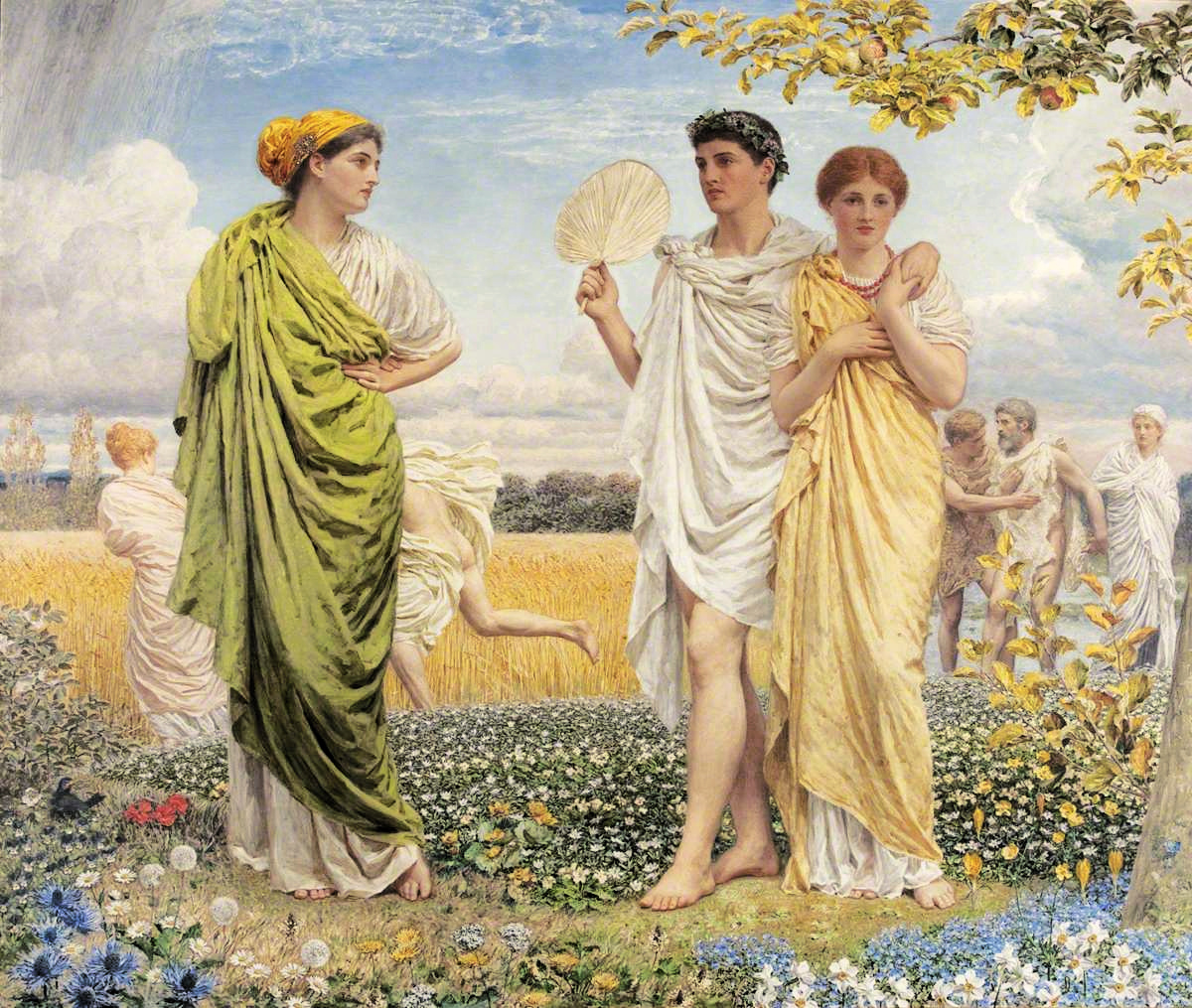
The Loves of the Winds and the Summer (1893)

Albert Joseph Moore (1841-1893), The Loves of the Winds and the Seasons, 1893, oil on canvas, Blackburn Museum and Art Gallery, Blackburn, UK.

Moore’s Final Masterpiece

The Loves of the Winds and the Summer was English artist Albert Moore’s final and largest artwork of his career. It is 6 feet tall and 7 feet wide and is the jewel in the crown of the Blackburn Museum and Art Gallery near Manchester, England. It is the result of Moore’s study of the psychology of his subject matter, that of love. Love begins to manifest formally for Moore by the expression of soft bodily postures, changing and harmonious curves, and piercing gazes expressed in deep coral colors. The male figure of the Wind is flanked by the spurned female figure of Summer to the left and the embraced female figure of Autumn to the right. Moore was so enveloped in his amorous themes that while working on this picture he was writing poetry about what the human face was like when in love – and it is found in his picture. The Love of the Winds and the Seasons is Moore’s fullest expression of animating personality united to depicted physical forms that are first lines, curves and color, with the result being an emotional impact on the viewer who encounters the artwork.

Moore drew inspiration from ancient Greek sculpture and classical forms but was not attempting archaeological reconstruction.

Art in the Face of Terminal Illness

This exquisite artistic sensitivity by Moore is made more remarkable since the artist was dying in 1893. In the company of his young and attractive live models in his new capacious art studio, Moore worked day after day on this work. Moore had cancer (a tumor on his thigh) and had submitted to three operations to keep ahead of it. When his doctors told him they could operate no more, and that the cancer continued to spread throughout his body, Moore was resigned to his situation. He is reported to have said: “Well, there’s an end of it.” In the limited time left to him Moore intended to finish his painting of love, The Loves of the Winds and the Seasons. The artist did not want to lose any time. His legs had swollen to twice their size and had to be drained. In acute pain he worked around the clock for the next six months. His friends thought the intense work as well as the cancer was killing Moore but as the painting progressed to completion, they observed that the artist’s personal tranquility and happiness became apparent.

Geometry, Design, and Creative Process

The project was monumental – numerous preparatory studies, drapery studies, full scale and life-sized cartoons (i.e., 4’ 9” tall by 1’4” wide for Autumn) , nude studies – all technically meticulous and versatile- and that underwent the artist’s elaborate and idiosyncratic geometric platting system that he began in the late 1870s. Moore was the consummate auteur that slightly older American ex-patriate painter James Abbott McNeill Whistler (1834-1904) most admired in England. Moore conceived his paintings from start to finish – and The Loves of the Winds and the Seasons was at once its pinnacle and completion. Moore, as Whistler aspired to be, was sole master of his work. In 1893 Moore now expanded this mathematical process to amalgamate his diagonals with horizontals so that his creative process could not suffer the critique that Ruskin hurled at Whistler of “ask(ing) 200 guineas for flinging a pot of paint in the public’s face.” The painting was a commission for the Australian mine-owner George McCulloch (1848-1907). Moore’s calculations included various adjustments of the models’ natural poses to submit to the mathematical formulas on the canvas. This formal submission of subjects to linear construction extended to each detail in the entire composition, such as the flowers for which also study drawings were made. Within these design rigidities, the preparatory drawings of the live models and subjects were transferred to the artwork with little idealization though slight but important adjustments were made, such as to Summer’s hairstyle. Knowing his own time was short, Moore made his cartoons in color so that his transfer to the canvas was as efficient as possible as he painted the final artwork. Critics have observed that despite the intense planning and preparation, the final artwork is executed unevenly – parts are meticulous and vigorous, mostly in the foreground, while others in the background are loose and crude. To what degree this is the artist’s intention or the result of his declining health, is a matter for speculation. During the artistic process the terminally ill artist isolated himself mostly. His handful of visitors remarked that the artist was cheerful, cracked jokes, told funny stories, and smoked his pipe. These select parties knew, however, that their social calls were in the context of final good-byes. In those last days and months of Moore’s life, the artist’s mind, by evidence of the art from his past that he referenced in 1893, stretched back to an earlier career which shared long-held important aspects with The Loves of the Winds and the Summer.

Poetry and Meaning

For his last artwork. Albert Moore glossed the picture’s narrative in verses he wrote to accompany it:

Lo! fickle Zephyr chaseth wayward Spring,
It is a merry race;
Flowers laugh to birds that sing,
Yet frequent tears shall cloud her comely face.
The South Wind shall with blushing Autumn mate,
Contented with her lot;
Summer sigheth – such her fate
She and her burning kisses are forgot.
Two lovers rough for shudd’ring Winter strive,
Beneath a shroud of snow;
Heaven haply shall contrive
Their violence she may not further know.

Legacy and Death

Through its figural and intellectual prism of ancient classical mythology, Moore worked in his career to update the complex equation of the natural world’s varying and transitory seasons to human life’s copious physical, emotional, and spiritual expressions and contradictions. With their immersion in Moore’s modern art, the painter achieved a graciously-contrived visual dramatic interplay of nature and humanity, ancient and present-day, whose quest is eternal in time and space.

Albert Joseph Moore passed away in the middle of the night on September 25, 1893. He died 9 days after finishing his last painting, The Loves of the Winds and the Summer. Moore was 52 years old.

Albert Joseph Moore’s art transformed Victorian classicism into a sophisticated decorative vision that influenced later developments in modern art and design.

SOURCES: ALBERT MOORE, Robyn Asleson, Phaidon, 2000, pgs. 70, 97-100, 104, 108. 164, 166-168, 177, 179, 185, 199-202; https://houseandheritage.org/2017/05/19/solsgirth-house/ – retrieved September 5, 2023.

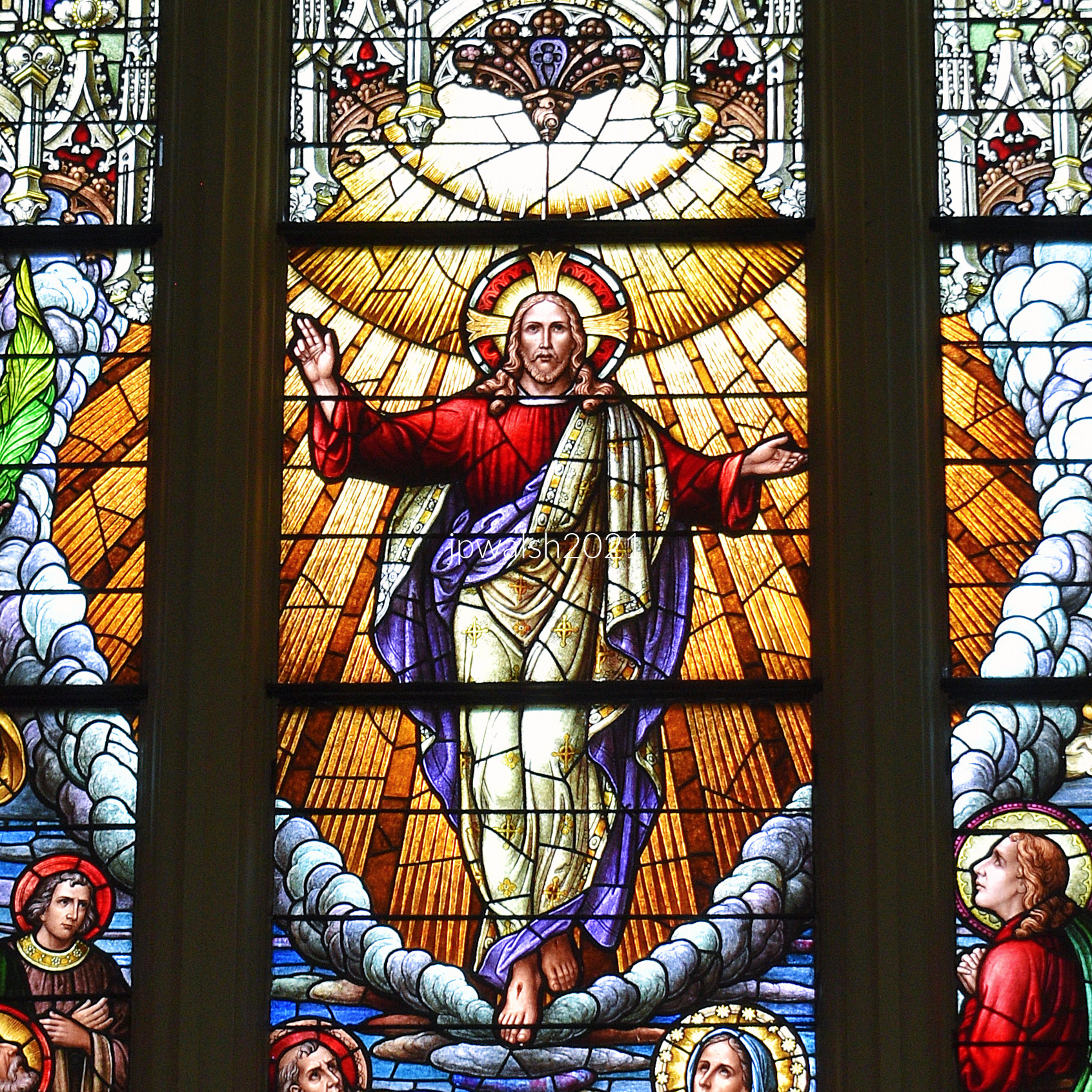
Austrian Stained Glass and the Visual Language of Faith: The Ascension and Assumption Windows (1927) at Sts. Peter and Paul Church, Naperville, Illinois.

Feature Image: Detail, Ascension of Christ window, Sts. Peter and Paul, Naperville, IL. Author’s photograph

Thee 1927 Tyrol Art Glass Company windows at Sts. Peter and Paul Church in Naperville, Illinois, are not simply decorative religious artworks but important examples of European ecclesiastical craftsmanship that combine theology, biblical storytelling, symbolism, local Catholic history, and immigrant heritage. Through the major Ascension of Christ and Assumption of Mary windows, the stained glass served as a visual catechism and artistic legacy in this and other American Catholic churches during the great era of German and Austrian church art.

Saints Peter and Paul Catholic Church in Naperville, Illinois, a western suburb of Chicago, in July 2021. Looking to the northeast from Central Park, the church building seats 1000 people and was dedicated in September 1927. In 2021 the parish marked its 175th anniversary. Founded in 1846, the parish is the oldest continuously operating Catholic parish in DuPage County. Down the decades its pastors (Frs. Rainaldi, Zuker, Wenker, Stenger, Lennon, Milota, and others) led Saints Peter and Paul adjacent to Naperville’s Historic District to where the parish with its school today serves 4,000 families. Author’s photograph.

Sts. Peter and Paul Church in Naperville was dedicated in 1927 and contains significant stained-glass windows produced by the Tyrol Art Glass Company of Innsbruck, Austria.


A magnificent church building sits on Ellsworth Street in Naperville, Illinois, close by the Historic District. With an orientation out of the darkness of the west into the light of the east, Saints Peter and Paul greets worshippers with two soaring steeples. The neo-Gothic red brick and limestone structure was commissioned in 1922 by the parish’s 350 families and dedicated five years later. Today the parish in Chicago’s western suburb serves 4.000 families and contains historically significant bright colored traditional European painted stained-glass windows from Innsbruck, Austria. In this archival photograph, the view of the church building from around the time of its dedication is looking towards the southeast. Public Domain.

The windows were created during the peak period (1870-1930) when German and Austrian stained-glass studios supplied churches throughout Chicago and the Midwest.

The colorful stained-glass windows in Saints Peter and Paul Catholic Church in Naperville, Illinois, a western suburb of Chicago, were ordered, produced, and installed towards the end of a 60-year-long run for the predominance of German and Austrian-made stained glass found in heritage Chicagoland churches today.

With only a couple of exceptions, the stained glass in Naperville’s historically pioneer and, later, German Catholic parish church was created in the mid1920s in Innsbruck, Austria. Innsbruck at the time was one of the European centers of stained-glass making. It is about 100 miles south of Munich, Germany, the home base of two other popular and well-regarded stained-glass studios – that of Franz Mayer & Company and F.X Zettler Company. These art glass manufacturers notably filled many Chicagoland Catholic churches starting in the 1870s. After the Great Chicago Fire in 1871, a building and population boom commenced in the city and its surrounding communities that went on for over a century unabated. In addition, from the 1870s to the 1920s, Chicago became the most influential center of Catholic culture in the United States.1

It was a unique period of history for Catholic churches in America whose state-of-the-art church design usually included brightly colored art (stained) glass windows. These windows often displayed action-packed scenes from the Bible, including episodes from the life of Christ, His Blessed Mother, or a patron saint.

This continuous appeal over multiple generations for the purchases of vast orders of Munich and Austrian style glass in U.S. Catholic churches declined greatly starting in the 1930’s with the onset of the Great Depression. The European traditional glass market did not recover its former popularity making its stained-glass windows from 1870 to 1930 in Chicagoland churches – including Saints Peter and Paul Church in Naperville – increasingly rare and valuable to preserve and appreciate.

Stained glass made by Tyrol Art Glass Company of Innsbruck, Austria, and Franz Mayer and F.X. Zettler of Munich, Germany, was characterized by its traditional painted stained glass. This style fit into the traditional-style church architecture that Catholic parishes, such as Saints Peter and Paul in Naperville, and many others, built between 1870 and 1930. By the mid20th century these European traditional glass makers faced competition from the rise of American glass manufacturers such as Louis Comfort Tiffany (1848-1933) which extended to quality, price, and style. Tiffany stained glass which frequently incorporated natural scenery elements, contained intricately cut opaque and opalescent glass, overlaid with wide varieties in thickness. This product became better fitted into modern worship spaces which were often smaller. Such modern art and architectural trends worked to displace traditional glass made in Europe used for grandiose classically styled houses of worship that were from an earlier historical period.

In the late 19th century, Tyrol Art Glass Company of Innsbruck, Austria, with the Munich studios of Franz Mayer and F.X. Zettler, began to send representatives to sell their new patterns for churches in Chicago and around the United States. These three studios often worked together and their style is basically interchangeable. In Saints Peter and Paul Church – as well as many other churches with classically-styled  architecture – traditional painted stained glass was the stand-out choice, It is usually very colorful whose iconography often depicts highly recognizable religious, often biblical, scenes and religious symbolism. This is definitely the situation with the beautiful stained-glass windows of Saints Peter and Paul in Naperville, including the Ascension of Jesus into Heaven and the Assumption of Mary into Heaven windows.

HOW SAINTS PETER AND PAUL CATHOLIC CHURCH GOT STARTED AND GREW IN NAPERVILLE, ILLINOIS

Naperville, Illinois, a western suburb of Chicago, was founded in 1831 – the oldest town in DuPage County.2 With its origins as a mixed settlement of Easterners and Hoosiers, Naperville’s strong religious character was established starting in the 1830s.3 Today it boasts a population of around 150,000 and is one of Illinois’s largest cities. The downtown area is bustling with shops and motor vehicle and foot traffic, yet Naperville’s 19th century origins can still be found in and around the DuPage River with its River Walk and its Historic District that maintain much of the suburb’s original charm and historic significance.

Saints Peter and Paul Catholic Church in Naperville was founded in 1846 and is the oldest continuously operating Catholic parish in DuPage County. The county was established in 1839 with Naperville originally as the county seat. This changed in 1867 when, by county referendum, Wheaton became the county seat which it remains today. Naperville’s first religious institutions were the East Branch Settlement, Congregationalist, Evangelical, and Baptist churches. These churches were all established in Naperville between 1833 and 1843.4

The Catholic parish was originally founded as a mission of the Joliet Catholic Church – Joliet, Illinois, about 20 miles to the south of Naperville is its Diocese headquarters today. In the 1840s, when Illinois was the edge of the frontier, a priest traveled the rigorous 20-mile journey – Naperville did not get a railroad for another 30 years (1864) – once a month to say mass in pioneers’ homes. The first church, named St. Raphael’s for Fr. Raphael Rainaldi, the first pastor, was a small frame structure with a lean-to across the street from today’s church building. In the 1840s the church served about 25 families – 175 years later it serves 4,000 families.5

The first official act at Saints Peter and Paul Church was a festive event – the wedding of Mr. Robert Le Beau to Miss Emily Beaubien, recorded on Tuesday, September 8, 1846. The parish also purchased an acre of land for a cemetery.

In 1852 the church was enlarged by a frame addition and Fr. Charles Zuker established a parish school in the lean-to with a lay headmaster. In 1855 the first school building was built. By 1864 the first frame church building was used for school purposes as the cornerstone was laid for a new stone church on the site of the present church building. By this time the parish was renamed to Saints Peter & Paul by Fr. Peter Fisher and the parish had grown to about 250 families. The stone had been obtained locally from the parish’s own quarry along the DuPage River. The new stone church building was dedicated in 1866 and the school now served around 100 students.6

Continual improvements were made to the parish church and grounds in the 1870s and 1880s so that by the start of the 1890s, following Naperville’s incorporation as a city, the parish launched significant building projects. In 1892, a year where it rained almost all that spring, a new brick school building for the parish’s 200 students was built that cost $30,000. Saints Peter and Paul also built a new rectory in anticipation of the new century.

The history of Sts. Peter and Paul Parish is traced from its 1846 frontier origins to its emergence as one of DuPage County’s most important Catholic parishes.

c. 1874, looking west, the corner of Ellsworth Street and Benton Avenue. the complex of buildings of Saints Peter and Paul parish, Naperville, Illinois. Public Domain.

In the 1880’s Naperville, illinois, like much of the rest of the country, expanded its industrial base, grew its city services, such as the fire department and city hall, and established new utilities including the first public telephone service.

With its new wealth generated by industry, Naperville built some of its first impressive homes. Shops and stores were established to service them. While agrarian in flavor, by the end of the 1880’s and into the early 1890s Naperville was already a bustling, modern, forward-thinking city. In 1893 Naperville hosted its first “Bicycle Parade” – a big public affair whose purpose was to “show our citizens the increased interest lately in this comparatively new mode of locomotion.”

In the 1890s the area that included Saints Peter and Paul Church, other denominational churches, and Northwestern College (renamed North Central College in 1926) affiliated with the United Methodist Church, came to be known around town as “Piety Corners.”

With the appearance of the first cars in the 1900s, Naperville was well on its way to an era of accelerated expansion and growth that continues in the 21st century.7

Saints Peter and Paul’s old stone church is to the far right. In the background left is the belfry of the Main Building at North Western College built in 1870. North Western College was founded in 1861 as Plainfield College in Plainfield, Illinois. It was renamed to North Western College in 1864 and, with the enticement of 8 acres of donated land and $25,000 from Naperville, relocated to Naperville in 1870. In 1926 it was again renamed to today’s North Central College. For over 140 years the college has had a great deal of influence on the educational and cultural life of Naperville. In 2021, with an enrollment of 3,000 students and 700 employees, North Central College is one of Naperville’s top ten employers.8 Public Domain.

c. 1904, view of Sts. Peter and Paul stone church building from the belfry of the College’s Main Building. Public Domain.

In 1911 the school was badly damaged by fire. When a new school opened the next year, 250 students were enrolled.9

In the 1920’s Naperville boasted around 5,000 residents. In June 1922 (sources vary whether it was on June 4 or June 8) the old stone church quarried from the parish’s own quarry and dedicated in 1866 was destroyed by an arsonist’s fire. By this time, the parish’s 350 Naperville families were from mostly German-speaking countries in Europe. Naperville’s quarries had brought waves of German immigrants to the city since the 1850’s since they knew how to mine and cut stone. After the devastating 1922 fire, the parish chose to rebuild their church in a magnificent red brick traditional cruciform-shape. It was dedicated on Sunday, September 25, 1927. The half German, half Irish Cardinal-Archbishop of Chicago, George Mundelein (1872-1939), participated in the dedication ceremony. This remains the church building that exists today and which contains its lovely and historically significant stained glass from Innsbruck, Austria. In 1927 the cost of the church building was $407,785 – or about $6.5 million today.10

WHO WERE SAINTS PETER AND PAUL?

El Greco (1541-1641), Saint Peter in Tears, 1587-1596, oil on canvas, 109 cm (42.9 in) x 88 cm (34.6 in), Toledo, Spain.

St. Peter is the Rock, or “Cephas,” of Jesus Christ’s church. In Matthew 16 Jesus tells Simon, son of John, brother to Andrew the apostle and a married fisherman by trade: “I say to you, you are Peter, and upon this rock I will build my church, and the gates of the netherworld shall not prevail against it. I will give you the keys to the kingdom of heaven. Whatever you bind on earth shall be bound in heaven; and whatever you loose on earth shall be loosed in heaven” (Mt 16: 18-19). Peter denied Christ three times before the crucifixion that is described in all four New Testament Gospels.

After Jesus Christ’s Resurrection (Mark 16, Matthew 28, Luke 24, Acts 1, John 20 and 1 Corinthians 15) and Ascension into Heaven (Luke 24:50. Acts 1, John 3:13, John 6:62, John 20:17, Romans 8:34, Ephesians 1:19-20, Colossians 3:1, Philippians 2:9-11, 1 Timothy 3:16, and 1 Peter 3:21-22) and following the events of Pentecost (Acts 2), Peter led an important life as a Christian evangelist and Church leader.

Though St. Paul’s pastoral heritage in his 13 letters were highly influential for the early church where he writes on church structure, the theology of the Body of Christ, and the nature of the Holy Spirit, St. Peter also has an epistemological heritage which explores the People of God.11 These best-known apostles also both died in the 60s. For the rest of that critical first century of Christianity – until when John’s Gospel was written in the 90s – the churches had to go without two of its greatest authoritative figures who had seen the risen Jesus.

St. Peter was martyred by crucifixion in 64 A.D. in Rome. He requested he be crucified upside down on an x-shaped cross, as witness to the apostle’s prolonged sorrow over his denial of Christ. On the church calendar, St. Peter’s feasts are June 29 and February 22.

Rembrandt, The Apostle Paul, oil on canvas, 1633.

St. Paul is one of Church history’s most significant figures. As Saul of Tarsus, the scholar, rabbi, and Roman citizen, zealously persecuted the first Christians and was personally present at the stoning of the first Christian martyr, Stephen (Acts 7: 54-60). On the road to Damascus making “murderous threats” towards Christians (Acts 9:1), Paul encounters the risen Jesus. The passage reads: “Suddenly a light from heaven flashed around him. He fell to the ground and heard a voice say to him, “Saul, Saul, why do you persecute me?” “Who are you, Lord?” Saul asked. “I am Jesus, whom you are persecuting,” he replied. “Now get up and go into the city, and you will be told what you must do.” (Acts 9:4-6).

The jolting event changed Paul’s life and outlook. More than anyone else in the Church’s first years, Paul realized Christianity’s universal message. Paul’s letters to various Christian communities in Corinth, Ephesus, and Rome, show him to be a solicitous and sometimes stern and exhorting pastor who had a deeply personal spiritual experience of the Lord. About half of the books of the New Testament are Paul’s writings that  express his profound openness to humanity and its cultures which made him “Apostle of the Gentiles” and “Teacher of the Nations.”

Paul was martyred somewhere between 64 and 68 A. D. The circumstances of his death are not entirely known, although early Christian writers related that Paul was beheaded. St. Paul shares a feast with St. Peter on June 29.

THE WINDOWS: The Ascension of Jesus into Heaven.

North Transept, Ascension of Christ into Heaven, 1927, Tyrol Art Glass Company, Innsbruck, Austria. Sts. Peter and Paul Church, Naperville, Illinois. Author’s photograph.

The Ascension of Jesus is recounted twice in the New Testament  – and both times by Luke the Evangelist. One account is in his Gospel (Luke 24:50-53) and a second is in his Book of Acts of the Apostles (Acts 1: 6-12).

One significant difference in Acts is that Luke sets a time frame of 40 days (1;3) for Jesus’s sustained manifold appearances to the apostles after the Resurrection until His Ascension. The account in Acts also situates the apostles and Christian community into salvation history’s imagery of Israel’s covenant.12 Luke’s tradition would likely not have separated the Resurrection and Ascension events in time except that it was used to give clarity to a narrative purpose.13

The account of the Ascension in Acts 1:6-12 reads:

6 ”When they had gathered together they asked him, “Lord, are you at this time going to restore the kingdom to Israel?”

7 He answered them: “It is not for you to know the times or seasons that the Father has established by his own authority.

8 But you will receive power when the Holy Spirit comes upon you, and you will be my witnesses in Jerusalem, throughout Judea and Samaria, and to the ends of the earth.”

9 When he had said this, as they were looking on, he was lifted up, and a cloud took him from their sight.

10 While they were looking intently at the sky as he was going, suddenly two men dressed in white garments stood beside them.

11 They said, “Men of Galilee, why are you standing there looking at the sky? This Jesus who has been taken up from you into heaven will return in the same way as you have seen him going into heaven.”j

12 Then they returned to Jerusalem from the mount called Olivet, which is near Jerusalem, a sabbath day’s journey away. (New American Bible)

When Jesus rose from the dead it became clear to the disciples that he is the Messiah so it was not illogical that they would ask him in Acts when he will restore political self-rule to Israel. Since Luke was writing with future Christians in mind, Jesus‘s reply is indeterminate. Jesus tells them (Acts: 7-8) that the Second Coming (“parousia”) is not a question for them to be asking of God. Rather, it is important for them to bear witness to Him by ways of the power of the Holy Spirit that Jesus will send to them and for whom they should wait. Lastly, as Jerusalem is the Holy City and the place of Jesus’s Paschal Mystery this is the place where the Christian church will start their mission that will reach to the ends of the earth.14

Another important detail Luke includes in Acts is that when Jesus is lifted up into heaven a cloud has intervened to take him from the apostles’ sight. Further, the Ascension takes place on Mount Olivet, which had eschatological (“end times”) meaning. After Jesus is lifted up two figures appear in dazzling garments signaling angels who also appeared at the birth of Jesus (Luke 2:9) and at the Resurrection (Luke 24:4-7). The cloud image Luke uses is also linked to end times (Luke 21:27) or parousia so that Jesus who is bodily taken up to heaven in the Ascension “will come (again) in the same way that you saw him going” (Acts1:11).

The Ascension window presents Christ rising into heaven surrounded by angels, apostles, and elaborate theological symbolism drawn from Scripture and Christian tradition.

Detail, Christ, Ascension window, Sts. Peter and Paul, Naperville, IL. Author’s photograph.

In the Ascension of Christ into Heaven window, Christ is surrounded by a band of clouds and yet remains in a golden area representing the fiery light of God. Christ wears a multi-colored robe – red representing his death by crucifixion; purple representing his Divinity; and white representing martyrdom emblazoned with four-lobed crosses representing the four Gospels or the four corners of the earth.

Christ’s halo is elaborated in three parts. There are usually three Greek letters found in Christ’s cruciform halo that in translation spell out “He Who is” or “ I Am Who Am.” These are absent, however, in this stained-glass window’s cruciform halo.

87% 7.5mb

Hierarchy of angels

There are eight angels in the window representing the hierarchy of angels. The baby heads of the cherubim – the lowest tier of angels – are accompanied by seraphim, the highest order of angels. Their name “archangel” literally means “chief angel.” Traditionally these highest order of angels are warlike in appearance and bear a sword, This is especially the case with the iconography of St. Michael the Archangel who leads God’s angels in battle to cast Satan and his angels out of heaven as told in the New Testament Book of Revelation.

The seraphim in this stained-glass depiction, however, carry palm branches in place of swords. In the years following World War I when this stained glass was made, the Austrian art glass manufacturer may have sought to symbolize angelic power by ways of symbols of peace. The fact that the range of angels from lowest to highest is present in the window appears to signal the presence of the whole choir of angels present at the Ascension of Jesus into heaven.15

Detail, angel, Ascension window, Sts. Peter and Paul, Naperville, IL. Author’s photograph.

Iconographic details such as halos, angels, clouds, stars, crowns, colors, and symbols that enrich the theological meaning of the windows.

Detail, angel, Ascension window, Sts. Peter and Paul, Naperville, IL. Author’s photograph.

Depicted at the bottom of the window is Mary and the 12 apostles. This was not precisely accurate to the New Testament for at the Ascension there were only 11 apostles. However, the replacement of Judas by Matthias took place almost immediately following the Ascension narrative (Acts of the Apostles 1:21–26).

In the center of the window at the bottom between Mary and a kneeling apostle with his right arm stretched out is an interesting detail. It is the outline of Christ’s feet showing where his resurrected body stood and was lifted directly from earth into heaven. This is significant beyond a souvenir of Jesus’s earthly memory, in that Mount Olivet from which the resurrected Jesus was lifted into heaven is exact the place to which “the Son of Man coming in a cloud with power and great glory” (Luke 21:27) will return at the end of the world. In that way, the window is a depiction of the Ascension and one that points to the Second Coming of Christ.

Detail, outline of Jesus’s pierced feet, Ascension window, Sts. Peter and Paul, Naperville, IL. Author’s photograph.

Each of the apostle’s halos are unique. Mary’s halo has 12 stars as she is often pictured with a circle of stars. The Zodiac is an ancient circle of stars where some are symbolically combined into 12-star signs or constellations.

Detail, apostles, Ascension window, Sts. Peter and Paul, Naperville, IL. Author’s photograph.

Detail, apostles, Ascension window, Sts. Peter and Paul, Naperville, IL. Author’s photograph.

Jesus’ Ascension – his going “up” to heaven – is the same imagery used for the Assumption of Mary. It is figurative to express the spiritual. The biblical heaven is mysterious. It is the intimate reserve of God and as God is pure spirit (John 4:24), the question arises, how does Heaven incorporate the resurrected fleshly body of Christ at His Ascension?

It is explained starting with the Incarnation at the Annunciation to Mary (Luke 1:26-38) where the divine humanity of Jesus, the Word who was “with God, and…was God (John 1:1) begins. In the Ascension, the Person of Christ is fulfilled where the “new, saved man” enters heaven into the intimacy of the Father, and becomes the perfect God-Man. As “God is love” (I John 4:16), the manner of being of the body in Christ in heaven, the perfect God-man, is love.16

The Ascension is followed by Pentecost when the Apostles receive the Holy Spirit from Heaven and will speak thereafter of “Christ (in Heaven) in us.”

The window’s imagery emphasizes Christ’s divinity, resurrection, kingship, and future return.

Detail, rondelle, Christ the King, Ascension window, Sts. Peter and Paul, Naperville, IL. Author’s photograph.

The upper rondelle represents Christ the King. Christ’s crown obscures his elaborate three-part halo. The Greek letters on either side represent the “alpha” (“the beginning”) and the “omega” (“the ending”) which indicates Christ’s Godhead. Christ the King holds in his hands the symbols of the sacrament of the Holy Eucharist in the consecration of the Mass. in his right hand is the species of bread and wine that become the Body and Blood of Christ and in his left hand is the wood beam of the cross whose sacrifice on Calvary the Eucharist memorializes. Christ the King also reveals his Sacred Heart – a popular Catholic devotion- inside his chest. His heart is depicted as aflame encircled by a crown of thorns signifying his agape (or sacrificial) love. The entire Ascension window was the gift of Mr. and Mrs. William David Callender, parish members in the mid1920s.

Detail, halo of stars, Ascension window, Sts. Peter and Paul, Naperville, IL. Author’s photograph.

In the New Testament, the Woman of the Apocalypse and the battle of St. Michael the Archangel against the Dragon are bound together in the same dramatic narrative in the Book of Revelation (Rev.12:1-9). The Woman with a crown of 12 stars who is against the Dragon in the Book of Revelation has been identified with Mary, particularly as the Immaculate Conception. This is how Mary is depicted in the Ascension of Christ into Heaven window at Sts. Peter and Paul.

The New Testament passage setting out these images is in Revelation 12:1-9:

1 A great sign appeared in the sky, a woman clothed with the sun, with the moon under her feet, and on her head a crown of twelve stars.

2 She was with child and wailed aloud in pain as she labored to give birth.

3 Then another sign appeared in the sky; it was a huge red dragon, with seven heads and ten horns, and on its heads were seven diadems.

4 Its tail swept away a third of the stars in the sky and hurled them down to the earth. Then the dragon stood before the woman about to give birth, to devour her child when she gave birth.

5 She gave birth to a son, a male child, destined to rule all the nations with an iron rod. Her child was caught up to God and his throne.

6 The woman herself fled into the desert where she had a place prepared by God, that there she might be taken care of for twelve hundred and sixty days.

7 Then war broke out in heaven; Michael and his angels battled against the dragon. The dragon and its angels fought back,

8 but they did not prevail and there was no longer any place for them in heaven.

9 The huge dragon, the ancient serpent, who is called the Devil and Satan, who deceived the whole world, was thrown down to earth, and its angels were thrown down with it.

EXPLANATION OF IMAGERY IN THE NARRATIVE OF REVELATION 12-14

About the middle of the Book of Revelation (Chapters 12-14), the author portrays the power of evil as represented by the figure of the Dragon who is opposed to God and his people. This Dragon pursues the woman about to give birth to devour the child but the child is born. Then St. Michael and his angels expel the Dragon and the Dragon’s angels out of heaven (Rev. 12:5-9). Adorned with the Old Testament images of sun, moon, and stars (Genesis 37:9-10), the woman symbolizes God’s people. As Israel gave birth to the Messiah (Rev.12:5) and the church suffers persecution by the Dragon (Rev 12: 6, 13-17), the Woman corresponds to an archetype of a pregnant goddess bearing a savior who is pursued by a monster looking to destroy the offspring. But her offspring, a son, in his turn, destroys the monster.

The huge red Dragon is a symbol of the forces of evil – the Devil or Satan (Rev. 12:9, 20:2), or the mythical Leviathan (Ps, 74:13-14) or Rahab (Job 26:12-13; Ps 89:11). It is also the ancient serpent who seduced Eve, the mother of the whole world (Gen 3:1-6).17

THE WINDOWS: The Assumption of Mary into Heaven.

South Transept, Assumption of Mary into Heaven, 1927, Tyrol Art Glass Company, Innsbruck, Austria. Sts. Peter and Paul Church, Naperville, Illinois. Author’s photograph.

There is no mention of the Assumption of Mary into Heaven in the New Testament. There are biblical texts used frequently to point to the doctrine whose imagery is related to the Ascension of Christ into Heaven.

The Assumption of Mary in theology is the doctrine that Mary as Theotokos, or Mother of God, was taken (“Assumed”) into heaven, body and soul, at the moment, or what would be the moment, of her death. This phenomenon is not unprecedented in the Bible. It occurred in the Old Testament to Moses and Elijah who were pivotally important as Old Testament figures and who were present at Christ’s Transfiguration in the New Testament (Matt 17:1-9; Mk 9:2-10: Lk 9:28-36; and 2 Peter 1:16-21).

There has been debate whether Mary was assumed into heaven at death or after death – that is, whether Mary, the Mother of the Savior, experienced death at all. It is a debate not resolved even with the doctrine of the Mary’s Assumption into Heaven declared a dogma of the faith by Pope Pius XII (1876-1958) on November 1, 1950 in the apostolic constitution Munificentissimus Deus.

What is depicted in the window is biblical in the sense that it is the dogmatic theology deduced from it. The Assumption as a theme in Christian art originated in western Europe during the late Middle Ages—starting in the 12th and 13th centuries – a period when devotion to the Virgin Mary was growing in importance. It would be renewed vigorously again in the 16th century during the Protestant Reformation. Before this Renaissance and Reformation period, Mary is represented surrounded by a mandorla, or almond-shaped aureole. But starting in the 16th century the mandorla was replaced by a cluster of clouds as depicted in the window.

•The Assumption window depicts Mary assumed body and soul into heaven and draws upon biblical imagery, Catholic doctrine, and centuries of Marian devotion in Christian art.

Detail. Mary, Assumption window, Sts. Peter and Paul Church, Naperville, Illinois. Author’s photograph.

The window depicts Mary standing upon a brightly-lit crescent moon reflected in imagery from Revelation 12.

Mary wears a blue cloak with a red shirt underneath as seen in the stained glass window by her right arm’s sleeve. The blue of her cloak is interpreted to represent the Virgin’s purity, symbolize the cosmos, and identify Mary as a Queen as blue was associated with royalty.

The red garment color signifies traits connected with motherhood as well as Mary’s presence on Calvary at her son’s crucifixion, particularly her traits of love and devotion.

These symbolic colors Mary wears expresses a universal definition of motherhood for her.

The Virgin Mary is mother to Jesus which expands to the whole of humanity. On Calvary, standing by the cross of Jesus were three Marys – Mary, his mother, Mary, the wife of Clopas, and Mary of Magdala. From the cross, Jesus said in John 19:

26 When Jesus saw his mother and the disciple there whom he loved, he said to his mother, “Woman, behold, your son.”

27 Then he said to the disciple, “Behold, your mother.” And from that hour the disciple took her into his home. (New American Bible)

Mary wears a white robe representing her purity. Her halo has seven eight-pointed stars. In numerology the number 7 represents “perfection” and the number 8 represents “regeneration or rebirth.”


Detail. angels, Assumption window, Sts. Peter and Paul Church, Naperville, Illinois. Author’s photograph

Detail. angels, Assumption window, Sts. Peter and Paul Church, Naperville, Illinois. Author’s photograph.

There are 12 angels, some carrying palms representing peace and victory, others carry lilies representing Mary’s virginity. Angels wear laurels of hyacinths (prudence, peace, and desire for heaven) and of roses (heavenly joy). Another angel holds out a bouquet of thornless roses signifying purity and the triumph of love. Mary will be crowned Queen of Heaven and the angels hold her crown.

God the Father wears a triangular halo as He blesses the scene. The Holy Spirit in the symbol of the dove emanates.18

Detail. rondelle, The Trinity, Assumption window, Sts. Peter and Paul Church, Naperville, Illinois. Author’s photograph.

FOOTNOTES:

1  https://www.kingrichards.com/news/Church-Stained-Glass/79/Historic-Stained-Glass-Companies/ – retrieved 12.7.21.  

2 DuPage Roots, Richard A. Thompson, et.al., DuPage County Historical Society, 1985, p. 200.

3 DuPage Roots, p.203.

4 DuPage Roots, p.203-4.

5 http://www.idaillinois.org/digital/collection/npl/id/7507/ – p. 18 retrieved 12.7.21.

https://sspeterandpaul.net/our-church -retrieved 12.7.21.

DuPage Roots, p.203.

6  http://www.idaillinois.org/digital/collection/npl/id/7507/ p.23 – retrieved 12.7.21.

https://sspeterandpaul.net/our-church – retrieved 12.9.21.

7 DuPage Roots, pp. 204-5.

http://www.idaillinois.org/digital/collection/npl/id/7507/ p. 38- retrieved 12.7.21.

8 https://en.wikipedia.org/wiki/Naperville,_Illinois – retrieved 12.9.21.
DuPage Roots p. 204.

9 https://sspeterandpaul.net/our-church – retrieved 12.9.21.

10 DuPage Roots p 205.

11 see Raymond E. Brown, The Churches The Apostles Left Behind, Paulist Press, NY, 1984.

12 Raymond E. Brown, A Risen Christ at Eastertime, The Liturgical Press, Collegeville, Minnesota, 1991, p. 60.

13 “Acts of the Apostle, “ Richard J. Dillon and Joseph A. Fitzmyer, S.J, The Jerome Biblical Commentary, Prentice Hall Englewood Cliffs, NJ, p.169.

14 https://bible.usccb.org/bible/acts/1 – . retrieved 11.17.21.

Raymond E. Brown, A Risen Christ at Eastertime, The Liturgical Press, Collegeville, Minnesota, 1991, p. 60.

15 see – https://www.beyondtheyalladog.com/2016/06/winged-heads-a-key-to-the-heirarchy-of-angels/ – retrieved 12.11.2021.

16 Romano Guardini, The Lord, Regnery Publishing, inc. Washington, D.C., pp. 501-503.

17 https://bible.usccb.org/bible/revelation/12 – Retrieved11.17.21.

Stained Glass Windows Tour at Saints Peter and Paul Church – Parts 1 and 2

18 Ibid.  

SOURCES:

http://www.idaillinois.org/digital/collection/npl/id/7507/

https://bible.usccb.org/bible/acts/1

https://bible.usccb.org/bible/revelation/12

https://en.wikipedia.org/wiki/Naperville,_Illinois

https://sspeterandpaul.net/our-church

https://www.britannica.com/topic/Assumption-Christianity

https://www.kingrichards.com/news/Church-Stained-Glass/79/Historic-Stained-Glass-Companies/

Raymond E. Brown, A Risen Christ at Eastertime, The Liturgical Press, Collegeville, Minnesota, 1991.

Raymond E. Brown, Joseph A. Fitzmyer, S.J,  and Roland E. Murphy, O. Carm.,The Jerome Biblical Commentary, Prentice Hall Englewood Cliffs, NJ, 1968.

Raymond E. Brown, The Churches The Apostles Left Behind, Paulist Press, NY, 1984.

Richard A. Thompson, et.al., DuPage Roots, DuPage County Historical Society, 1985.

Romano Guardini, The Lord, Regnery Publishing, inc. Washington, D.C.

Stained Glass Windows Tour at Saints Peter and Paul Church – Part 1 and 2 https://www.youtube.com/watch?v=L5mUrOH1Ze4

(Color) photographs and text:

The Painter of Anxiety: Edvard Munch, The Scream, and the Psychology of Modern Life.

FEATURE image: Edvard Munch, The Scream, 1895, pastel on cardboard, private collection.

Edvard Munch transformed modern art by moving beyond naturalism and Impressionism to create a deeply personal Symbolist and Expressionist visual language that explored anxiety, love, death, loneliness, desire, and the psychological realities of human existence.

By John P. Walsh


Edvard Munch, Self-portrait, oil on canvas, 1886.

Edvard Munch: Symbolism, Expressionism, and Artistic Vision

Edvard Munch (1863-1944) was a Symbolist and Expressionist artist from Norway.

In the 1890s, anti-naturalism mainly took the form of Symbolism – that is, the fascination with many types of literature and the inclination to draw upon these sources for inspiration in dreams and visions. This movement informed the art of Edvard Munch throughout that decade and into the twentieth century. Inspiration from literature, however, was not illustration. By the 1890s the younger generation of modern artists saw that by giving the artist an example of constructing an irrational logic, the artist’s dream, or more specific to Munch, psychology, had been freed not only from the restrictions of nature in terms of form, line, color and subject but also its potentially literary or ideological sources. It manifests as a style of drawing that the imagination has liberated from the concern of natural details in order that it might freely serve only as the representation of conceived things.

For Edvard Munch, this resulted in the creation of several fantastic scenarios which are designed and constructed as the artist deems them necessary to be. The distinction between Impressionism and Symbolism is the difference emanating from the tradition of naturalism and the expression of ideas by means of its symbol that is searching beyond naturalism.

The Scream became the defining image of modern psychological anxiety and one of the most recognizable paintings in Western art.


Edvard Munch, The Scream, crayon, 1893.

Edvard Munch is a precursor and practitioner of Expressionism. Although the major portion of Munch’s artwork lies outside this classification, his expressionist paintings are some of his best-known works.

The Scream and Modern Anxiety

The Scream is Munch’s most famous work, and is widely interpreted as representing the universal anxiety of modern man. It is one of modern art’s most iconic paintings along with Whistler’s mother (Arrangement in Grey and Black, Number One, D’Orsay), Da Vinci’s Mona Lisa (Louvre), and Grant Wood’s American Gothic (Chicago).

Expressionism was a movement that was a combination of Symbolism, ideals of the human spirit, often confined in solitude, and poetical lyricism laced with emotion.1

Early Life and Artistic Training and “the Seeds of Madness”

In an artistic career that spanned from the early 1880s until his death in 1944 at 80 years old, Edvard Munch experimented within painting, graphic art, drawing, sculpture, photography and film.

Growing up in Kristiania (today’s Oslo) Munch decided at 17 years old that he was going to be a painter. Munch’s family encouraged his artistic pursuits so that in 1880 Munch enrolled at the Royal School of Art and Design in Kristiania where he expanded his drawing repertoire to include live models and en pleine aire (out of doors).

Often ill as a child, Munch believed that in his experiences growing up, “…I inherited the seeds of madness. The angels of fear, sorrow, and death stood by my side since the day I was born.”

In his career, Munch painted mania in several pictures, including Melancholy (1901). It depicted his younger sister Laura who suffered from schizophrenia, and was hospitalized regularly for what was diagnosed as “hysteria” and “melancholia.”2


Edvard Munch, Melancholy, Laura, 1901.

Edvard Munch, Self-portrait, 1882, Munch Museum, Oslo.

Edvard Munch, Interior Pilestredet, oil on canvas, 1881, Munch Museum, Oslo.

Edvard Munch, Still Life with Jar, Apple, Walnut and Coconut, 1881, Munch Museum, Oslo.

Edvard Munch, From Saxegårdsgate, c. 1882, oil on canvas, Lillehammer Art Museum.

Edvard Munch, Laura, both 1882, oil on paper (top) and oil on cardboard (below), Munch Museum, Oslo.

Edvard Munch, Andreas Studying Anatomy, 1883, Oil on Cardboard, Munch Museum, Oslo.

Early Subjects and Bohemian Influences

Between 1884 and 1889 young Munch made a range of drawing and paintings that was extensive and meaningful. His portfolio included landscapes, domestic environments, portraits, self-portrait, still life, and fictional motifs. Munch’s drawings included industrial sites along the Akerselva River, and promenading denizens and local farmers at work.

In Munch’s early work there is a hint of his wrestling with eros and the nature of woman that became a lifelong obsession.

In Kristiania Munch began to live a bohemian life under the influence of anti-establishment writer Hans Jaeger (1854-1910). Jaeger urged Munch to paint his own emotional and psychological state called “soul painting.”

The Sick Child (1886) and the Birth of “Soul Painting”

Munch’s first “soul painting” was The Sick Child (1886). The artist produced five versions over decades. Munch’s freedom of treatment and color – also found in the painting Tête-à-Tête in 1885 – is largely owed to Impressionism. In 1886, Munch participated in the Artists’ Autumn Exhibition in Kristiania and exhibited The Sick Child. It met with very negative reaction. The motif of the sick was popular but Munch’s hasty Impressionistic treatment was seen as insensitive. It was the first breakthrough for Munch’s art.

Childhood illness, family tragedy, mental illness within his family, and personal loss profoundly shaped his artistic vision. Influenced by writers, philosophers, and Symbolist artists, Munch developed what he called “soul painting.”


Edvard Munch, Tête-à-tête, oil on canvas, 1885, Munch Museum, Oslo.

Early works such as The Sick Child marked a decisive break from conventional academic painting.


Edvard Munch, The Sick Child (original version), 1885-86, National Gallery, Oslo. Other versions are in the Konstmuseet Gothenberg (1896), Tate London (1907), Thiel Gallery (1907) and Munch Museum (1925).

Munch later painted Hans Jaeger’s portrait in Oslo in 1889 after Jaeger lost his job and had to flee Norway one step ahead of the law. This was after Jaeger published a novel about local Bohemian life that the authorities considered inflammatory. Young Munch began to explore in his art personal situations, emotions, and states of mind. He wrote in his “soul” diary: ” I attempt In my art to explain life and its meaning to myself.”3


Edvard Munch, Hans Jæger, 1889, National Gallery, Oslo.

Edvard Munch, Night on the Beach, 1889, Bergen Art Museum. Known also as Inger on the Beach, it was painted in the summer of 1889 at Åsgårdstrand. The sitter is Munch’s youngest sister Inger. The artwork created a storm of confusion and controversy. Its simplified forms, thick outlines, contrasting colors and shades, and subtle emotional content signaled the direction of Munch’s developing style.

Edvard Munch, Self Portrait, c. 1888, Munch Museum, Oslo.

Paris (1885), French Modernism, and First Love

With friends, Munch rented a studio in Kristiania. His mentor, established artist Christian Krohg (1852-1925), encouraged Munch to conform to his own artistic vision.

In 1885, 22-year-old Munch traveled to Paris for the first time to explore the world’s art capital. During his three-week stay in Paris Munch visited the Louvre and the Salon and was particularly impressed by French Modernist painter, Édouard Manet (1832-1883). Munch began to incorporate those ideas and techniques of French Modernism into his artistic vision. In the same year Munch produced his full-length Portrait of the Painter Jensen -Hjell to the derision of critics in Kristiania. The penchant for Manet’s artwork continued for Munch into the new century with a full-length portrait called The Frenchman (Monsieur Archimard) in 1901.

In summer of 1885 Munch had his first love affair which affected him deeply. It occurred in the coastal resort town of Åsgårdstrand when Munch met Milly Thaulow (1860-1937), a fashion model and singer.

Milly had been married since 1881 when she met Munch and they had a passionate affair. The short, secret relationship filled Munch with mixed feelings of love and shame. Its inevitable ending produced melancholy that affected Munch’s artmaking.

Milly Thaulow remained active in the arts, translating Maurice Maeterlinck’s French play, Pelléas et Mélisande, into Norwegian in 1906. She went on to divorce her husband in 1891 and remarry that same year. Her second marriage ended in divorce. In the end, Munch justified his experience with Milly as part of radical bohemian artist culture which Hans Jaeger preached where love is free and self-expression is paramount.


Edvard Munch, Portrait of the Painter Jensen -Hjell, 1885, National Gallery, Oslo.

Paris (1889-91), Loss, and the Origins of The Frieze of Life

In 1889 Munch rented exhibition space in Kristiania to display 110 of his artworks. His entrepreneurship resulted in receiving state grant funds that led to a second, yet back and forth, stay to Paris whose time amounted overall to about two years.

In Paris, Munch took drawing lessons, explored art galleries, and networked with expatriate artists, especially at the venerable 17th-century Café de la Régence near the Palais-Royal.

In his study, Munch became inspired by the rhythmical and decorative art of Paul Gauguin (1847-1903), several of the Nabis, Japonisme, and the Symbolist drawing of Odilon Redon (1840-1916).

Though Munch rejected Realism in art, he embraced Impressionism, particularly the technique of Claude Monet (1840-1926) and Camille Pissarro (1830-1903) and Thomas Couture (1815-1879). Munch was particularly impressed by Vincent Van Gogh (1853-1890) and Henri de Toulouse-Lautrec (1864-1901) and their unnatural use of color to express sensory perception and emotion. In this milieu Munch painted Rue Lafayette (1891).

The 26-year-old Munch had just arrived into Paris when his father died, an event which devastated the artist. Running low on money, Munch left the city and, with Danish poet Goldstein, rented a small apartment in the suburb of St. Cloud.

Munch’s experiences of relative poverty and the death of a loved one offered new insights and impetus for his art in terms of seeking to understand and express the memory of his human existence.

He painted Night In St. Cloud (1890) and Evening on the Karl Johan (1889) in this time period. Munch also conceived the idea of The Frieze of Life, a series of paintings exploring human existence from a range of pathos, terror, desire, dread, nightmare, and anxiety, to other fascinations, so to include The Dance of Life, The Scream, The Vampire, Madonna, and Death and the Maiden.

In 1891 Munch had exhibitions in Kristiania, Berlin, and Munich. He returned to Paris several times in the next decade for short term visits as in 1899 which included a trip to Italy.4

His experiences in Paris exposed Munch to Impressionism, Post-Impressionism, Gauguin, Van Gogh, Redon, and modern artistic experimentation. Munch pioneered a highly personal form of art that sought to express inner states rather than external appearances.


Edvard Munch, Night In St. Cloud, 1890, oil on canvas, National Gallery, Oslo.

Edvard Munch, Evening on the Karl Johan, 1889, oil, Bergen Art Museum.

Munch emerged from the Symbolist movement of the 1890s, which rejected strict naturalism in favor of dreams, psychology, emotion, and imagination.


Edvard Munch, Kiss by the Window, 1891, Munch Museum, Oslo.

Edvard Munch, Evening Melancholy, 1891, oil, crayon, pencil on canvas, Munch Museum, Oslo.

Edvard Munch, Rue Lafayette, 1891, oil on canvas, National Museum, Oslo.

Edvard Munch, Rue de Rivoli, 1891, oil on canvas, Fogg Art Museum, Harvard University, Cambridge, Massachusetts.

Edvard Munch, Inger in a White Blouse, 1891, Munch Museum, Oslo.

Edvard Munch, Pleine-aire, 1891, oil on canvas, 60 x 120 cm, Munch Museum, Oslo.

Berlin Breakthrough (1892-1895) and Symbolist Fame

In 1892, Munch’s pictures were again exhibited at the Autumn Exhibition in Oslo (it was his final time)–and led to the 29-year-old artist being invited to exhibit at the Verein der Berliner Künstler (Association of Berlin Artists) in Germany in November 1892 for a one-man exhibition.

Munch’s exhibition of Melancholy (1891) in Oslo was called Norway’s “first Symbolist painting.” His exhibition of 55 pictures in Berlin proved another breakthrough for Munch’s reputation in Europe: it made him infamous. The critical reaction to his artwork was divided. Critics described Munch’s art as “repugnant, ugly and mean.” As it shocked the Berlin public, German artists Max Liebermann (1847-1935) and Ludwig von Hofmann (1861-1945) setting up a dissident “Group of XI” that led to the establishment of the Berlin Secession later on May 2, 1898.

The government of Kaiser Wilhelm II (1859-1941) set the mood for the public reaction in that art which “presumes to overstep the limits and rules” which Wilhelm had set, “is no longer art.” In the eyes of German society, Munch’s artwork “misused the word ‘freedom’ and (with) a total loss of restraint and excess of self-esteem.”

Later, by around 1910, that same Emperor in his constant pursuit of cultural influence, mostly supported the Berlin Secession. Yet the Secession’s public and financial success which Wilhelm II eventually helped to build, came at the price of a benevolent autocrat’s constant interference, particularly in the modern art group’s jury process.

The Frieze of Life and the Berlin Circle

Munch stayed in Berlin until 1895. In the Berlin exhibitions of 1893 and 1895 Munch presented a sequence of pictures he called Man’s Life, From the Modern Life of the Soul and, simply, Love. These all contained artwork that contributed to The Frieze which Munch intended to be a symbolic expression of reality and not a mere symbol of or for reality.

Munch’s bohemian circle in Berlin included editors of the magazine Pan, the German arts publication analogous to France’s La Revue Blanche. It also included Swedish avant-garde writer, August Strindberg (1849-1912) who would soon provide Munch with influential introductions to the Berlin and Paris art worlds. In 1890 Strindberg broke with naturalism and was in his own artistic and personal crisis as he sought new art forms within an emerging Symbolism. Munch met German art critic Julius Meier-Graefe (1867-1935) and socialized with Polish decadent naturalist and Symbolist novelist, dramatist, and poet Stanisław Przybyszewski (1868-1927) along with Przybyszewski’s paramour and later short-term wife, Dagny Juel (1867-1901). Munch painted both of these friends’ portraits.

Munch’s Berlin friends understood what Munch was doing with symbolism though the German critics did not. Przybyszewski wrote: “The old kind of art and psychology was an art and psychology of the conscious personality, whereas the new art is the art of the individual. Men dream and their dreams open up vistas of a new world to them.”

In addition to exhibiting in Berlin in both 1893 and 1894, Munch exhibited in Copenhagen, Dresden and Munich in 1893 and in Stockholm in 1894.

Symbolist Masterpieces of the 1890s

Working on the Frieze of Life, Munch created painting with turbulent, ambiguous and morose themes with titles such as Despair (1892), The Girl and Death (1893), Stormy Night (1893), The Voice (1893), Anxiety (1894), The Three Stages of Woman (1894), Ashes (1894), Death Struggle (1895), and Jealousy (1895). Aspects of Symbolism extended to romantic aspects of nature in paintings such as Coastal Mysticism (1892), Evening (Melancholy) (1893), Moonlight (1893), Starlit Night (1893), Sunrise at Åsgårdstrand (1893) and The Evening Star (1894). He painted many portraits in this period, in addition to those in his Berlin Bohemian circle, including Sister Inger (1892). Other iconic, overtly anecdotal Munch paintings were created such as Self Portrait in Hell (1895), Self Portrait under a female mask (1892), and Self portrait with Burning Cigarette (1895).

Other paintings, including casino scenes, showed Munch’s simplification of form and detail. The artist favored shallow pictorial space and a minimal backdrop for his foreground figures. Poses, forms, colors, lines and subjects were carefully constructed images that expressed psychological and emotional states, and often appear monumental as if they were playing a role on the stage of life.5


Edvard Munch, Melancholy, 1893, oil, Munch Museum.

Edvard Munch, Melancholy (The Yellow Boat), 1891, oil, National Gallery, Oslo.

Edvard Munch, Kiss by the window, 1892, oil, National Gallery, Oslo.

Edvard Munch, The Kiss, 1892, oil, Private Collection.

Edvard Munch, The Girl by the Window, 1893, oil, Art Institute of Chicago.

Edvard Munch, Separation, 1893-94, Gouache, watercolor and crayon on paper, Munch Museum.

Edvard Munch, Parting, 1894, oil on canvas, 67 x 128 cm, Munch Museum.

Edvard Munch, Three Stages of Women (Sphinx), c. 1894, Bergan. Munch painted woman as dreaming, hungry for life, and as a nun.

Edvard Munch, Puberty, 1894–1895, oil on canvas, 151.5 x 110 cm, National Gallery, Oslo.

Edvard Munch, Anxiety, 1894, Munch Museum. Art critics see the painting as closely related to The Scream (1893). The faces show despair and the colors impress a depressed state showing emotions of heartbreak and sorrow.

Edvard Munch, Despair, 1893, oil on canvas, Munch Museum.
Edvard Munch, Inger in Black and Violet, 1892, oil on canvas, National Museum, Oslo.

Edvard Munch, The Storm, oil on canvas, 1893, Museum of Modern Art, New York.

Edvard Munch, Summer Night’s Dream The Voice, 1893, Museum of Fine Arts, Boston, Massachusetts.

Edvard Munch, Coastal Mysticism, 1892.
Edvard Munch, Sketch of the Model Posing, 1893, pastel on cardboard, The Solomon R. Guggenheim Museum, New York.

Edvard Munch, The Hands, 1893, oil on canvas, 91 x 77 cm, Munch Museum, Oslo.

Edvard Munch, At the Roulette Table in Monte Carlo, 1892, oil, Munch Museum.

Edvard Munch, Self-Portrait Under the Mask of the Woman, 1893, oil, Munch Museum, Oslo.

Edvard Munch, Self Portrait with Burning Cigarette, 1895, oil,  Munch Museum, Oslo.

Edvard Munch, Self-portrait in Hell, c. 1895, oil on canvas, 82 x 60 cm, Munch Museum, Oslo.

Edvard Munch, Stanislaw Przybyszewski,1895, pastel, 62x55cm, Munch Museum.
Edvard Munch, The Scream, 1893, oil, tempera, pastel on cardboard, National Museum, Oslo.

Paris (1895-1897). Munch Adopts “Idea” Painting: The Scream, Printmaking, and International Recognition

Until 1870, young artists from Norway went to Dűsseldorf to study and pursue an art career though sometimes to Berlin, Paris, Munich and Karlesruhe. By 1880, Paris was the center of the art world and Munch returned to Paris in 1895, 1896, and 1897 for extended visits (he also visited Nice in 1897).

Thadée Nathanson’s La Revue Blanche published Munch’s lithograph The Scream in December 1895. The Scream exists in four versions: two pastels (1893 and 1895) and two paintings (1893 and 1910). There are several lithographs of The Scream from 1895 and later.

With The Scream, Munch met his stated goal in his diary of his art expressing “the study of the soul, that is to say the study of my own self.” Philippe Jullian argues that it had been the combination of influences of Strindberg, Redon, and Gauguin that explained Munch’s conversion from Naturalism and Impressionism to “Idea” painting expressed in Symbolism. Munch was the first to express the individual’s anguish in modern society and facing death. He was an inventor of the ectoplasm line (“ectoplasm” is a spiritualism term first used in 1894). Munch’s figures, including The Scream, emerges from pastel, oil, or ink like an apparition, yet to be identified with the “souls” of ordinary persons.

Anxiety, jealousy, loneliness; Munch illustrates people who pictorially express Symbolism’s darkest visions and themes.


Edvard Munch, The Scream, 1895. Ink.

In Paris Munch exhibitions were organized at the Salon des Indépendents and Siegfried Bing’s Salon de L‘Art Nouveau. Young avant-garde art dealer Ambroise Vollard (1866-1939) included Munch in his first Album des Peintres Graveurs. Munch was commissioned by the Cent Bibliophiles to illustrate Baudelaire’s Flowers of Evil. Like young Nabis Édouard Vuillard (1868-1940) and Pierre Bonnard (1867-1947), Munch designed programs for Symbolist theatre (Ibsen’s Peer Gynt at the Théâtre de l’Oeuvre). He did portraits of Symbolist poet Stéphane Mallarmé (1842-1898) and August Strindberg. Munch created some of his most iconic motifs, including The Scream (pastel version), Vampire (a woman seductive and destructive), Puberty (an anxious girl seated naked on a bed), and Madonna (a synthesis of the mystical and erotic).

MUNCH MASTERS MODERN EXPERIMENTAL PRINTMAKING

In Berlin in 1894 Munch had produced his first dry point etchings. In Paris in 1896, following the explosion of color printing in the 1890’s, Munch produced his first color lithographs and woodcuts (Vampire was his first woodcut). Influenced by Gauguin and Max Klinger (1857-1920), printmaking allowed Munch to be highly experimental in the creation of an image. Particular to Munch as an artist, the subject of the artwork determined which of the various styles to be deployed. At his death Munch retained over 15,000 prints in his Oslo studios. During his lifetime, inspired importantly by his work in mid-1890’s Paris, Munch became a master of all graphic techniques, such as color, volume, and line. Munch’s production of an immense portfolio of graphic art sought to create images which are subordinated to the experiences of the self’s impulses and drives.

Munch’s attempts to market his new artwork in Paris as he did in Berlin to acceptance and fame resulted in relative failure in the world’s art capital. His parting milestone in Paris in this period was in the 1897 Salon des Artistes Indépendants where Munch displayed in the main hall his ever-augmenting Frieze of Life. The cycle was characterized by continuous reworkings as new paintings; versions that replaced paintings which had sold; and, new compositions added to the series.

In terms of public acclaim, the effort appeared for naught. French resistance to Munch’s “repugnant, ugly and mean” art endured. French critics decried Munch’s art as “violent and brutal” and, when they weren’t chastising him, they ignored him—and this attitude lasted deep into the 20th century. However, another exhibition in Munch’s native Oslo of 85 paintings was well received.6

Edvard Munch, The Scream, 1895, pastel on cardboard, private collection.

Edvard Munch, The Kiss, 1895, Dry-point and aquatint, 34.8 x 28 cm, Munch Museum, Oslo.

Edvard Munch, The Kiss, woodcut, n.d., 44.7 x 44.7. cm, Munch Museum, Oslo.

His turbulent relationships, especially with women, heavily informed recurring themes of love, desire, attraction, fear, and loss.


Edvard Munch, Jealousy, 1896, Lithograph, 46.5 x 56.5 cm, Munch Museum, Oslo.


Edvard Munch, Death and the Maiden, 1894, Dry-point, 30.2 x 22 cm, Munch Museum, Oslo.  


Edvard Munch, Melancholy (Evening),1896, woodcut, 37.6 x 45.5.  cm, Munch Museum, Oslo.

Edvard Munch, Attraction, 1896, Lithograph, 47.2 x 35.5 cm, Munch Museum, Oslo.


Edvard Munch, The Sick Child, 1896, Lithograph, 42.1 x 56.5 cm, The Munch Museum, Oslo.


Edvard Munch, Evening, Melancholy I, woodcut, 1896.


Edvard Munch, Stéphane Mallarmé, 1896, lithograph.


Edvard Munch, August Strindberg, 1896, lithograph.


Edvard Munch, Self-portrait, 1895, Lithograph, 45.5×31.7 cm, Museum of Modern Art, New York.  Munch was 31 years when he produced this self-portrait. It is a memento mori – a reminder of death. The bones at the bottom of the image are paired with the artist’s name and the date of the lithograph’s creation at the top. The floating head in a sea of darkness was a familiar motif in art in the 1890’s expressing in part the cosmic and ontological realities of humanity.

Edvard Munch, Lady From the Sea (detail), 1896, oil on canvas. 100 cm × 320 cm, The Munch Museum, Oslo.

Edvard Munch, The Voice Summer Night, 1896, 90 cm × 119 cm, Munch Museum, Oslo

Edvard Munch, Paris Boulevard, 1896, oil on canvas, 96.5 x 130 cm, Munch Museum, Oslo.

Love, Women, and the Femme Fatale

In 1898 Munch met Tulla (Mathilde Larsen) and they became lovers. Munch continued a productive period of art-making as he continually refused to marry Tulla. Munch portrayed many artworks displaying his view of life and death and the destructive force of love where both man and woman suffer– Madonna (1893), Salome, The Maiden and the Heart (1896), Under the Yoke (1896), Cruelty, The Woman and the Urn (1896), and, later, his Alpha and Omega lithograph series (1909). Munch remained fascinated by women as expressed in The Kiss (1892), The Three Stages of Women (1894), and The Dance of Life (1900).

One explanation of the ambivalent relationship of Munch the artist and Woman as artistic subject may be understood through the Symbolist art aesthetic. Symbolism connoted the idea of a desirable union of the human being with a philosophic ideal. In its view, Woman, though called real is a false appearance, and thereby not ideal. Further, Woman acts mainly as a temptress, the then-popular notion of a femme fatale, as she reveals man’s animal nature which obscures and prevents the desirable union to the ideal. Woman must be avoided and, if engaged by man, done so with peril.

Munch was an idealist before he became a Symbolist, and, as Christian Krohg ominously wrote about him in 1892: “dares to subordinate Nature, his model, to the mood.“

Edvard Munch, Lonely People, 1899.

Expressionism and Personal Crisis

In 1899 Munch exhibited at the Venice Biennale and in Dresden. The Berlin Secession held its first exhibition in 1899 on its own premises but did not invite Edvard Munch. Though the Berlin group invited no foreigners that year, Munch’s art continued to be viewed by status quo cognoscenti as “undesirable.” Yet, at the same time, Munch’s art was beginning to influence young Expressionist artists in Germany. In artworks such as The Voice and Summer’s Night, Munch appealed to these younger avant-garde artists for his illustrating the upsurge and resonance of raw emotion.


Edvard Munch, The Inheritance, 1897-99, oil on canvas, 141 x 121 cm, The Munch Museum, Oslo.

Edvard Munch, Two people, 1899, oil on canvas, 175 x 143 cm, Munch Museum, Oslo


Edvard Munch, Amor and Psyche, 1907, oil on canvas, 118 x 99 cm, Munch Museum, Oslo.

Edvard Munch, Marat’s death, 1907, oil on canvas, 151 x148 cm, Munch Museum.

Edvard Munch, The Murderess, 1906, Munch museum.


Edvard Munch, Death of Marat I, 1907, 150 x 199 cm, Munch Museum, Oslo.

Edvard Munch, Kiss by the Window, 1897, oil on canvas, 99 x 80.5 cm, The Munch Museum, Oslo.

Edvard Munch, Death and the Maiden, 1893, oil on canvas, 128 x 86 cm, The Munch Museum, Oslo.
Edvard Munch, Man and Woman, 1898, oil on canvas, Bergen.

Edvard Munch, Stanislaw Przybyszewski (The Vampire), Oil and/or tempera on unprimed cardboard, 1893.
Edvard Munch, Weeping Nude, 1913–1914, 110 cm × 135 cm, Munch Museum, Oslo.

Love, Tulla Larsen, and Personal Turmoil

Little is known about Munch’s personal relationships with individual women that would greatly enlighten the artist’s overall character and how these relationships’ impacted his artwork in his adult years. Fantastic stories are told. How, in his room at Åsgårdstrand with an unknown woman (likely Tulla), did a gunshot go off in Fall 1902 from a revolver that injured Munch’s hand? Munch successfully chased Tulla out of his life, though after she married another man, the artist felt betrayed by Love and brooded over it. Even as Munch had numerous short-lived affairs with beautiful women who wanted to marry him, he fled them all and verbally expressed no known regrets. Throughout his life, Edvard Munch never married.

The Frieze of Life and Growing Recognition

Munch started the year 1900 in Gudbrandsdalen and moved on to Berlin. In 1901 he painted in Nordstrand and in 1902 returned to Berlin. Along with artwork of Édouard Manet, Wassily Kandinsky (1866-1944), and Claude Monet, Munch exhibited at the Berlin Secession in 1902. He had continually worked at the Frieze of Life, the group of images representing human existence, a subject that fascinated the artist. He exhibited 22 paintings from the completed Frieze at that year’s Berlin Secession. Though the Berlin critics began to appreciate Munch’s art, the public continued to view him as warped and weird. In 1902 he met ophthalmologist Dr. Max Linde (1862-1940), an art collector and author of a Munch study while Hamburg judge and art collector Gustav Schiefler (1857-1935) started a catalogue of Munch’s voluminous graphic art that year.


Edvard Munch, Self Portrait Against a Green Background and Caricature Portrait of Tulla Larsen, 1905.

Edvard Munch, Ashes, 1893,

Edvard Munch, The Dance of Life, 1899-1900.

The concept of The Frieze of Life became his lifelong artistic project examining love, desire, anxiety, jealousy, suffering, and death.


Edvard Munch, Madonna, 1894, Munch Museum, Oslo.
Edvard Munch, Gustav Schiefler, 1906/06, Ketterer Kunst, Munich. A judge and avid print collector, Gustav Schiefler compiled a catalog on the prints of Edvard Munch as well as Emile Nolde (18967-1956), Max Liebermann, and Ernst Ludwig Kirchner (1880-1938).

Eva Mudocci and Artistic Inspiration

In 1903 Munch visited Dr. Max Linde in Lübeck and painted a frieze for his house though Dr. Linde ended up rejecting Munch’s work. Munch exhibited in Berlin at Paul Cassirer modern art gallery.

That same year, Munch met British violinist Eva Mudocci (1872-1953) in Paris where Munch had an exhibition. Fully aware of his commitment only to art, Eva Mudocci reportedly became Munch’s mistress, and Munch soon immortalized her in The Woman with the Brooch.

Edvard Munch, The Brooch, 1903, lithograph, 60×46 cm.

International Success and New Commissions

In this period, Munch received several commissions for portraits and prints. In 1904 the German rights to his graphic art and paintings was sold to two prominent galleries. Munch exhibited in Vienna and Paris and became a member of the Berlin Secession. In 1905 Munch exhibited 75 paintings in Prague at the Manés Gallery and in 1906 was invited to exhibit with the Fauves in Paris. In Berlin, Munch painted stage sets for Henrik Ibsen plays (Ghosts and Hedda Gabler) at the Max Reinhardt Theatre. A frieze that was commissioned for the Reinhardt Theatre was sold by its director before the frieze was unveiled to the public.

Warnemünde (1907), Eva Mudocci, and Unanswered Questions

In 1907 Munch summered in Warnemünde as he turned his attention to human figures and situations. He exhibited with Henri Matisse and Paul Cézanne at Cassirer Gallery, the purchaser of the German rights to Munch’s graphic art. In November 1907 Eva Mudocci went on a concert tour in Norway for three weeks where She and Munch spent time together in Åsgårdstrand and Oslo. In early 1908 Eva Mudocci was pregnant and gave birth to twins in Denmark at the end of the year. Friends insisted that Munch must have been the father but Mudocci never said who the father was.


Edvard Munch, Salome, 1903, lithograph.

Nervous Breakdown and Treatment

Almost simultaneous with Mudocci’s pregnancy, 45-year-old Edvard Munch had a nervous breakdown. In December 1908 he checked himself into a clinic in Copenhagen for several month’s treatment for alcoholism and exhaustion. Munch later wrote: “My condition was verging on madness—it was touch and go.”

Recovery and a Turning Point in Art

In 1909, Mudocci and Munch parted ways though they stayed in touch for the next 18 years, until 1927. At the clinic, Munch painted portraits of his doctor (Dr. Daniel Jacobsen, 1909) and a nurse as well as close friends and a self-portrait using short, thick, and forceful brushstrokes—it was a watershed moment in Munch’s life and art.7


Edvard Munch, Fertility, 1898, woodcut, 42 x 51.7 cm, The Munch Museum, Oslo.

Edvard Munch, Women on the Beach, 1898, woodcut, 45.5 x 50.8 cm, The Munch Museum, Oslo.

Edvard Munch, Red and White, 1899–1900, 93 cm × 129 cm, Munch Museum, Oslo.


Edvard Munch, Portrait of Friedrich Nietzsche, 1906, Thiel Gallery, Stockholm.

Edvard Munch, Red Virginia Creeper, 1900, oil on canvas, 120 x 120 cm.

Edvard Munch, Young People on the Beach, 1902, oil on canvas, 90 x 174 cm.

Edvard Munch, On the beach, 1905, oil on canvas, 81x 121 cm.

Edvard Munch, Bathing Boys, c. 1904, oil on canvas, 194 x 294 cm.


Edvard Munch, Shore with Red House, 1904, oil on canvas, 69 × 109 cm, Munch Museum.

Edvard Munch, Train Smoke,1900, 84 cm × 109  cm, Munch Museum, Oslo.

Munch’s emotional intensity and expressive use of color and form helped lay the foundations for German Expressionism.

Edvard Munch, At The Sign of the Sweet Girl, 1907, oil on canvas, 85 x 130 cm.

Edvard Munch, Nude by the bed, c. 1907, oil on canvas, 120×121 cm


Edvard Munch, Nude by the bed, c.1907, oil on canvas 120×121 cm

Edvard Munch, Four Girls Åsgårdstrand, 1905, oil on canvas, 87x111cm


Edvard Munch, Avenue in the snow, 1906, oil on canvas, 80 x100 cm,

Edvard Munch, Self-Portrait with Brushes, 1904, 197×91 cm, Munch Museum, Oslo.

Edvard Munch, Self-Portrait with a Bottle of Wine, 1906, 110 cm × 120, The Munch Museum, Oslo.
Edvard Munch, Jealousy, 1907, oil on canvas, 75 x 98 cm, The Munch Museum, Oslo.

Edvard Munch, Deathbed, 1900, oil on canvas, 100 x 110 cm.

Edvard Munch, Village Street, 1905, oil on canvas, 100×100 cm.

Edvard Munch, Prayer, 1902, woodcut, 45.8 x32.5 cm.

Edvard Munch, Dr. Daniel Jacobson, 1909, oil on canvas, 204 x 112 cm.

Edvard Munch, Nurse, 1909, dry point, 20.5×15.2  cm.
Edvard Munch, Reclining woman, pencil and watercolor, 17.3 x 25 cm. (6.8 x 9.8 in.).see – https://www.artnet.com/artists/edvard-munch/reclining-woman-fTQcrFe4Y0qTp8QEmczZyQ2

Return to Norway (1909) and Public Recognition

Following his recuperation at the clinic, Munch was sober for the first time in years. In 1907 and 1908 he created Bathing Men, a scene of cleansing by immersion reminiscent of Paul Cézanne (1839-1906). Suddenly the totality of Munch’s art of the 1890’s and early 1900’s, where he explored his dark and tormented feelings, thoughts, and experiences, became passé for the artist. With the same vigorous brushwork and unnatural, expressionistic colors, Munch turned to painting everyday subjects.

Renting a house in Kragerø, a fishing village in Norway, Munch permanently settled in his homeland. In 1912 he exhibited in Cologne at the Sonderbund exhibition where he was ranked with Van Gogh, Gauguin and Cézanne. That year Munch had his first American exhibition In New York City. In 1913, the 50-year-old artist traveled extensively, had tributes paid to him, and rented larger quarters at Jeløya.

Murals, Museums, and National Honors

Munch turned to landscapes and large-scale art projects as he continued the murals for Oslo University which were, after lengthy controversy, finally accepted in 1914. Already a Knight of the Royal Order of St. Olaf since 1909, the Oslo National Gallery began buying some of Munch’s most important works – The Day After, Ashes, Puberty, Two Girls at the Verandah, and The Frenchman. The State museum received gifts from collectors as well. Olaf Schou (1861-1925) gave them Madonna, The Sick Child, Mother and Daughter, Girls on the Bridge and, later, The Scream, Death in the Sick Chamber, The Dance of Life, Girl at her Toilet, Betsy, Moonlight in Nice, and others.

Meanwhile, Munch decided to turn for inspiration to some of the outward obsessions of a new 20th century: its advancing technologies, mass media, high-speed transportation and urban life. 8

Edvard Munch, The Scream, 1910, oil, Munch Museum, Oslo.
Edvard Munch, Self Portrait Bergen, 1916, oil on canvas, 90 x 60 cm.

Edvard Munch, Bathing Men, 1907–1908, oil on canvas, 206 x 227.5 cm, Atheneum, Helsinki.
Edvard Munch, The Seducer, 1913 Munch Museum, Oslo, Norway.

Edvard Munch, The Day After, 1894/5, oil on canvas, National Gallery, Oslo.

Edvard Munch, Moonlight in Nice, 1895, oil, National Gallery, Oslo.

Edvard Munch, Death in the Sickroom, 1893, pastel on canvas, Munch Museum.

Edvard Munch, Girls on the Bridge,1899-1901, National Gallery, Oslo.
 
Edvard Munch, Mother and Daughter, 1897, Thyssen-Bornemisza National Museum, Madrid.
Edvard Munch, Crouching Nude, 1919, oil on canvas, Munch Museum.
Edvard Munch, Artist and his Model, 1919-1921, Thyssen-Bornemisza National Museum, Madrid.

Ekely, Isolation, and the Munch Museum Legacy

From 1914 until his death in January 1944, Munch sold nearly nothing but pictures bought by museums and new, commissioned work. Until then Munch had to sell pictures to live though he was reluctant and made replicas for himself. He did not sell works closely aligned to his emotional life. In 1916, Munch, now a famous artist, had finished the murals in the assembly Hall of Oslo University and purchased Ekely at Skøyen just outside the city. The artist constructed fences, let hedges and weeds grow tall, and closed off his residence to onlookers. Not strictly a misanthrope, Munch chose to live in glorious isolation. He hardly stayed in contact with family or relatives and permitted few friends to visit.

At Ekely Munch constructed interior and exterior studio spaces where, situated among works, Munch stored The Frieze of Life. At his death in January 1944 at Ekely, Munch bestowed all works in his possession to the city of Oslo– more than 1000 paintings, 15,000 prints, and about 500 watercolors and drawings. There was also some sculpture. These artworks comprise most of today’s Munch Museum – see https://www.munchmuseet.no/

Late Work and Final Years

In 1922 Munch painted 12 murals for a chocolate factory in Oslo. In the 1920’s and 1930’s he exhibited his art frequently— in Zurich, Basel, Berne, Berlin, Mannheim, Dresden. In 1936 and 1937, he exhibited in London, Amsterdam and Stockholm. There were major shows and retrospectives.

Edvard Munch, Modellen kler av seg (Model undressing), 1919-1924. Akvarell, fargestift (Watercolor, crayon). Munchmusee, Oslo.

LAST PAINTINGS RETURN TO EARLIER DARKER SUBJECTS AND THEMES

Besides monumental work for public projects, Munch late paintings included almost genre-type scenes such as horses and workers in the field, fishermen, an elm forest, fruit trees and a garden. While the main mural for Festival Hall at Oslo University is mostly decorative, The Sun (1909-11) recalls aspects of Symbolism that Munch depicted in his darker pictures of the 1890s. Some late pictures stirred with the memory of past, darker experiences such as The Death of the Bohemian (1926) and The Bohemian’s Wedding (1926). In 1915 he painted a new version of the Death Struggle from 1895.

After contracting Spanish Flu in 1919, Munch painted his self-portrait as a convalescent from sickness and death. Twenty years later the artist painted a self portrait as an insomniac in The Night Wanderer (1939). Munch produced paintings and graphic work in great number. There are self-portraits; portraits; beach motifs; motifs from life of workers, fishermen, and farmers; garden scenes; nudes; landscapes; the theme of Faust, etc.

When Norway was invaded by Nazi Germany in April 1940 during World War II, Munch’s exhibitions outside Norway ceased by 1942. In 1937 the Nazis had labeled 37 of Munch’s paintings as “degenerate art” and they were removed and sold. After the invasion of Norway, Munch refused to have anything to do with the German occupiers. Munch stayed in Norway where he died at Ekely on January 23. 1944, at 80 years old.9

Edvard Munch, Uninvited Guests, 1932-1935, oil on canvas, 75 x 101 cm, Munch Museum, Oslo.

Following a nervous breakdown in 1908-09, his art evolved toward brighter subjects, landscapes, workers, nature, and monumental mural projects.

The Sun, 1909-11.

FOOTNOTES

1. Odilon Redon, To Myself, translated by Mira Jacob and Jeanne L. Wasserman, New York: George Braziller, Inc., 1986, p. 23.

Quoted in Martha Kapos, The Post-Impressionists: A Retrospective, London: Beaux Arts Editions, 1993, pp. 175-180.

Jean Selz, Edvard Munch, New York: Crown Publishers, Inc., 1974, p. 6 and 24

2. Sue Prideaux, Edvard Munch: Behind the Scream, New Haven, CT: Yale University Press, 2005, p. 2.

https://munch.emuseum.com/objects/5801/laura-munch – retrieved September 4, 2021.

3. Fra Kristiania-Bohêmen is a novel from 1885 by Norwegian writer Hans Jaeger.

J.P. Hodin, Edvard Munch, Thames & Hudson, 1972, p 41.

Sue Prideaux, Edvard Munch: Behind the Scream, New Haven, CT: Yale University Press, 2005, p. 35.

Jean Selz, Edvard Munch, New York: Crown Publishers, Inc., 1974, p. 12

4. J.P. Hodin, Edvard Munch, Thames & Hudson, 1972, p 45 and p.50-52.

Arne Eggum, Edvard Munch: Paintings, Sketches, and Studies, , New York: C.N. Potter, 1984, p.61 and p. 305.

Jean Selz, Edvard Munch, New York: Crown Publishers, Inc., 1974, p. 93.

Robert L. Delevoy, Symbolists and Symbolism, New York: Rizzoli, 1982, p. 100.

http://dwardmac.pitzer.edu/anarchist_archives/worldwidemovements/hansjaeger.html  -retrieved September 4, 2021.

5. Wolf-Dieter Dube, Expressionism, New York: Oxford University Press, 1972, p.157.

J.P. Hodin, Edvard Munch, Thames & Hudson, 1972, p .55; p. 61; p. 70. Pp. 51, 61, 70

Arne Eggum, Edvard Munch: Paintings, Sketches, and Studies, , New York: C.N. Potter, 1984, p.47 and p. 75.

Nancy Mowll Mathews, Paul Gauguin: An Erotic Life, Yale University Press, New Haven, 2001, p. 207.

Robert L. Delevoy, Symbolists and Symbolism, New York: Rizzoli, 1982, p. 98.

Robert Goldwater, Symbolism, New York: Westview Press, 1998, p.227.

Peter Paret, The Berlin Secession, Cambridge, MA: Harvard University Press, 1980, pp.79-80.

6. Arne Eggum, Edvard Munch: Paintings, Sketches, and Studies, , New York: C.N. Potter, 1984, p.10 and p. 152.

J.P. Hodin, Edvard Munch, Thames & Hudson, 1972, p 169.

https://theibtaurisblog.com/2012/08/06/the-graphic-works-and-prints-of-edvard-munch/ – retrieved September 4, 2021.

Jean Selz, Edvard Munch, New York: Crown Publishers, Inc., 1974, pp. 18, 37, 45.

Philippe Jullian, Dreams of Decadence: Symbolist painters of the 1890s, New York: Praeger Publishers, 1971. Pp 88-91

Michael Gibson, Symbolism, Cologne: Taschen, 1999, p.144.

Robert L. Delevoy, Symbolists and Symbolism, New York: Rizzoli, 1982, p. 97.

Rodolphe Rapetti, Symbolism, Paris: Flammarion, 2005.p. TBA

7. Robert Goldwater, Symbolism, New York: Westview Press, 1998, p.216. and 279.

J.P. Hodin, Edvard Munch, Thames & Hudson, 1972, p. 81; 88-89; 103; 123. .

https://www.nrk.no/urix/korrespondentbrevet-30.-mars-1.10964285 – retrieved September 3, 2021.

Arne Eggum, Edvard Munch: Paintings, Sketches, and Studies, , New York: C.N. Potter, 1984, pp. 196, 203, 228, 236.

Edward Lucie-Smith, Symbolist Art, Thames & Hudson, 1972, p. 189.

8. J.P. Hodin, Edvard Munch, Thames & Hudson, 1972, pp. 127-128.

Sue Prideaux, Edvard Munch: Behind the Scream, New Haven, CT: Yale University Press, 2005, p. 373.
9. J.P. Hodin, Edvard Munch, Thames & Hudson, 1972, p. 167.

Michael Gibson, Symbolism, Cologne: Taschen, 1999, p.149.

Munch, Langarred, Johan H., Revold, Residar, New York: Universe Books, 1964,  p. i-ii; 1.

BIBLIOGRAPHY

Bischoff, Ulrich, Edvard Munch 1863-1944, Cologne: Taschen, 2000.
Delevoy, Robert L., Symbolists and Symbolism, New York: Rizzoli, 1982.
Dube, Wolf-Dieter, Expressionism, New York: Oxford University Press, 1972.
Eggum, Arne, Edvard Munch: Paintings, Sketches, and Studies, New York: C.N. Potter, 1984.
Gibson, Michael, Symbolism, Cologne: Taschen, 1999.
Goldwater, Robert, Symbolism, New York: Westview Press, 1998.
Hodin, J.P., Edvard Munch, Thames & Hudson, 1972.
Jullian, Philippe, Dreams of Decadence: Symbolist Painters of the 1890s, New York: Praeger Publishers, 1971.
Kapos, Martha, The Post-Impressionists: A Retrospective, London: Beaux Arts Editions, 1993.
Langarred, Johan H., Revold, Residar, Munch, New York: Universe Books, 1964.
Lucie-Smith, Edward, Symbolist Art, Thames & Hudson, 1972.
Mathews, Nancy Mowll, Paul Gauguin: An Erotic Life, Yale University Press, New Haven, 2001, p. 207.
Paret, Peter, The Berlin Secession, Cambridge, MA: Harvard University Press, 1980.
Prideaux, Sue, Edvard Munch: Behind the Scream, New Haven, CT: Yale University Press, 2005.
Rapetti, Rodolphe, Symbolism, Paris: Flammarion, 2005.
Redon, Odilon, To Myself, translated by Mira Jacob and Jeanne L. Wasserman, New York: George Braziller, Inc., 1986.
Selz, Jean, Edvard Munch, New York: Crown Publishers, Inc., 1974.

LIST OF WORKS BY EDVARD MUNCH

Edvard Munch, Self-portrait, oil on canvas, 1886.

Edvard Munch, The Scream, crayon, 1893.

Edvard Munch, Melancholy, Laura.

Edvard Munch, Self-portrait, 1882, Munch Museum, Oslo.

Edvard Munch, Interior Pilestredet, oil on canvas, 1881, Munch Museum, Oslo.

Edvard Munch, Still Life with Jar, Apple, Walnut and Coconut, 1881, Munch Museum, Oslo.

Edvard Munch, From Saxegårdsgate, c. 1882, oil on canvas, Lillehammer Art Museum.

Edvard Munch, Laura, 1882, oil on paper (top) and oil on cardboard, Munch Museum, Oslo.

Edvard Munch, Andreas Studying Anatomy, 1883, Oil on Cardboard, Munch Museum, Oslo.

Edvard Munch, Tête-à-tête, oil on canvas, 1885, Munch Museum, Oslo.

Edvard Munch, The Sick Child (original version), 1885-86, National Gallery, Oslo.

Edvard Munch, Hans Jæger, 1889, National Gallery, Oslo.

Edvard Munch, Night on the Beach, 1889, Bergen Art Museum.

Edvard Munch, Self Portrait, c. 1888,  Munch Museum, Oslo.

Edvard Munch, Portrait of the Painter Jensen -Hjell, 1885, National Gallery, Oslo.

Edvard Munch, Night In St. Cloud, 1890, oil on canvas, National Gallery, Oslo.

Edvard Munch, Evening on the Karl Johan, 1889, oil, Bergen Art Museum.

Edvard Munch, Kiss by the Window, 1891, Munch Museum, Oslo.

Edvard Munch, Evening Melancholy, 1891, oil, crayon, pencil on canvas, Munch Museum, Oslo.

Edvard Munch, Rue Lafayette, 1891, oil on canvas, National Museum, Oslo.

Edvard Munch, Rue de Rivoli, 1891, oil on canvas, Fogg Art Museum, Harvard University, Cambridge, Massachusetts.

Edvard Munch, Melancholy, 1893, oil, Munch Museum.

Edvard Munch, Melancholy (The Yellow Boat), 1891, oil, National Gallery, Oslo.

Edvard Munch, Kiss by the window, 1892, oil, National Gallery, Oslo.

Edvard Munch, The Kiss, 1892, oil, Private Collection.

Edvard Munch, The Girl by the Window, 1893, oil, Art Institute of Chicago.

Edvard Munch, Separation, 1893-94, Gouache, watercolor and crayon on paper, Munch Museum, Oslo.

Edvard Munch, Parting, 1894, oil on canvas, 67 x 128 cm, Munch Museum, Oslo.

Edvard Munch, Three Stages of Women (Sphinx), c. 1894, Bergan.

Edvard Munch, Puberty, 1894–1895, oil on canvas, 151.5 x 110 cm, National Gallery, Oslo.

Edvard Munch, Anxiety, 1894, Munch Museum, Oslo.

Edvard Munch, Despair, 1893, oil on canvas, Munch Museum, Oslo.

Edvard Munch, Inger in Black and Violet, 1892, oil on canvas, National Museum, Oslo.

Edvard Munch, The storm, oil on canvas, 1893, Museum of Modern Art, New York.

Edvard Munch, Summer Night’s Dream The Voice, 1893, Museum of Fine Arts, Boston, Massachusetts.

Edvard Munch, Coastal Mysticism, 1892.

Edvard Munch, Sketch of the Model Posing, 1893, pastel on cardboard, The Solomon R. Guggenheim Museum, New York.

Edvard Munch, The Hands, 1893, oil on canvas, 91 x 77 cm, Munch Museum, Oslo.

Edvard Munch, At the Roulette Table in Monte Carlo, 1892, oil, Munch Museum, Oslo.

Edvard Munch, Self-Portrait Under the Mask of the Woman, 1893, oil, Munch Museum, Oslo.

Edvard Munch, Self Portrait with Burning Cigarette, 1895, oil,  Munch Museum, Oslo.

Edvard Munch, Self-portrait in Hell, c. 1895, oil on canvas, 82 x 60 cm, Munch Museum, Oslo.

Edvard Munch, Stanislaw Przybyszewski,1895, pastel, 62x55cm, Munch Museum, Oslo.

Edvard Munch, The Scream, 1893, oil, tempera, pastel on cardboard, National Museum, Oslo.

Edvard Munch, The Scream, 1895. Ink.

Edvard Munch, The Kiss, 1895, Dry-point and aquatint, 34.8 x 28 cm, Munch Museum, Oslo.

Edvard Munch, The Kiss, woodcut, n.d., 44.7 x 44.7. cm, Munch Museum, Oslo.

Edvard Munch, Jealousy, 1896, Lithograph, 46.5 x 56.5 cm, Munch Museum, Oslo.

Edvard Munch, Death and the Maiden, 1894, Dry-point, 30.2 x 22 cm, Munch Museum, Oslo.  

Edvard Munch, Melancholy (Evening),1896, woodcut, 37.6 x 45.5.  cm, Munch Museum, Oslo.

Edvard Munch, Attraction, 1896, Lithograph, 47.2 x 35.5 cm, Munch Museum, Oslo.

Edvard Munch, The Sick Child, 1896, Lithograph, 42.1 x 56.5 cm, The Munch Museum, Oslo.

Edvard Munch, Evening, Melancholy I, woodcut, 1896.

Edvard Munch, Stéphane Mallarmé, 1896, lithograph.

Edvard Munch, Auguste Strindberg, 1896, lithograph.

Edvard Munch, Self-portrait, 1895, Lithograph, 45.5×31.7 cm, Museum of Modern Art, New York.

Edvard Munch, Lady From the Sea (detail), 1896, oil on canvas. 100 cm × 320 cm, The Munch Museum, Oslo.

Edvard Munch, The Voice Summer Night, 1896, 90 cm × 119 cm, Munch Museum, Oslo

Edvard Munch, Paris Boulevard, 1896, oil on canvas, 96.5 x 130 cm, Munch Museum, Oslo.

Edvard Munch, The Inheritance, 1897-99, oil on canvas, 141 x 121 cm, The Munch Museum, Oslo.

Edvard Munch, Two people, 1899, oil on canvas, 175 x 143 cm, Munch Museum, Oslo.

Edvard Munch, Amor and Psyche, 1907, oil on canvas, 118 x 99 cm

Edvard Munch, Marat’s death, 1907, oil on canvas, 151 x148 cm, Munch Museum.

Edvard Munch, The Murderess, 1906, Munch museum.

Edvard Munch, Death of Marat I, 1907, 150 x 199 cm, Munch Museum, Oslo.

Edvard Munch, Kiss by the Window, 1897, oil on canvas, 99 x 80.5 cm, The Munch Museum, Oslo.

Edvard Munch, Death and the Maiden, 1893, oil on canvas, 128 x 86 cm, The Munch Museum, Oslo.

Edvard Munch, Man and Woman, 1898, oil on canvas, Bergen.

Edvard Munch, Stanislaw Przybyszewski (The Vampire), Oil and/or tempera on unprimed cardboard, 1893.

Edvard Munch, Weeping Nude, 1913–1914, 110 cm × 135 cm, Munch Museum, Oslo.

Edvard Munch, Self Portrait Against a Green Background and Caricature Portrait of Tulla Larsen, 1905.

Edvard Munch, Ashes, 1893,

Edvard Munch, The Dance of Life, 1899-1900.

Edvard Munch, Madonna, 1894, Munch Museum, Oslo.

Edvard Munch, The Brooch, 1903, lithograph, 60×46 cm.

Edvard Munch, Salome, 1903, lithograph.

Edvard Munch, Fertility, 1898, woodcut, 42 x 51.7 cm, The Munch Museum, Oslo.

Edvard Munch, Women on the Beach, 1898, woodcut, 45.5 x 50.8 cm, The Munch Museum, Oslo.

Edvard Munch, Red and White, 1899–1900, 93 cm × 129 cm, Munch Museum, Oslo.

Edvard Munch, Portrait of Friedrich Nietzsche, 1906, Thiel Gallery, Stockholm.

Edvard Munch, Red Virginia Creeper, 1900, oil on canvas, 120 x 120 cm.

Edvard Munch, Young People on the Beach, 1902, oil on canvas, 90 x 174 cm.
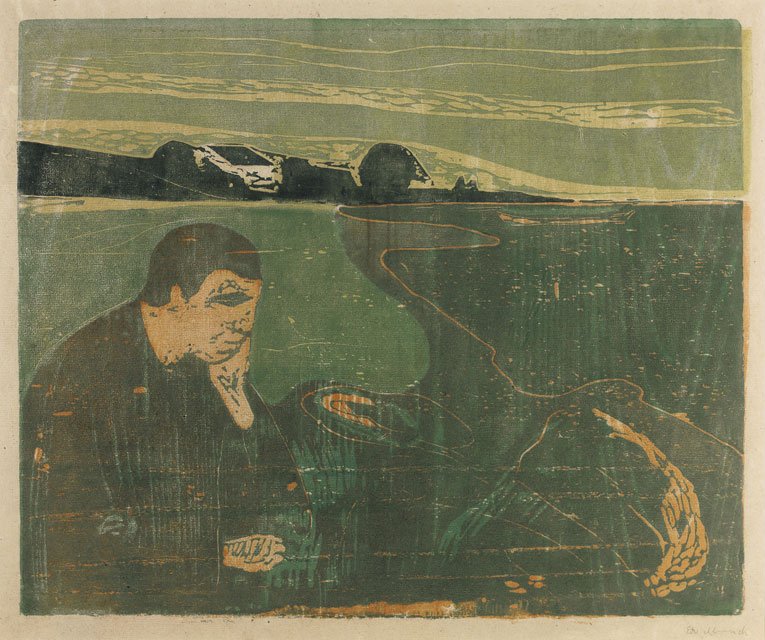
Edvard Munch, On the beach, 1905, oil on canvas, 81x 121 cm.

Edvard Munch, Bathing Boys, c. 1904, oil on canvas, 194 x 294 cm.

Edvard Munch, Shore with Red House, 1904, oil on canvas, 69 × 109 cm, Munch Museum.
Edvard Munch, Train Smoke,1900, 84 cm × 109  cm, Munch Museum, Oslo.

Edvard Munch, At The Sign of the Sweet Girl, 1907, oil on canvas, 85 x 130 cm.

Edvard Munch, Nude by the bed, c. 1907, oil on canvas, 120×121 cm.

Edvard Munch, Nude by the bed, c. 1907, oil on canvas, 120×121 cm.

Edvard Munch, Four Girls Åsgårdstrand, 1905, oil on canvas, 87x111cm.

Edvard Munch, Avenue in the snow, 1906, oil on canvas, 80 x100 cm.

Edvard Munch, Self-Portrait with Brushes, 1904, 197×91 cm, Munch Museum, Oslo.

Edvard Munch, Self-Portrait with a Bottle of Wine, 1906, 110 cm × 120, The Munch Museum, Oslo.

Edvard Munch, Deathbed, 1900, oil on canvas, 100 x 110 cm.

Edvard Munch, Village Street, 1905, oil on canvas, 100×100 cm.

Edvard Munch, Prayer, 1902, woodcut, 45.8 x32.5 cm.

Edvard Munch, Dr. Daniel Jacobson, 1909, oil on canvas, 204 x 112 cm.

Edvard Munch, Nurse, 1909, dry point, 20.5×15.2  cm.

Edvard Munch, The Scream, 1910, oil, Munch Museum, Oslo.

Edvard Munch, Self Portrait Bergen, 1916, oil on canvas, 90 x 60 cm.

Edvard Munch, Bathing Men, 1907–1908, oil on canvas, 206 x 227.5 cm, Atheneum, Helsinki.

Edvard Munch, The Day After, 1894/5, oil on canvas, National Gallery, Oslo.

Edvard Munch, Moonlight in Nice, 1895, oil, National Gallery, Oslo.

Edvard Munch, Death in the Sickroom, 1893, pastel on canvas, Munch Museum, Oslo.

Edvard Munch, Girls on the Bridge,1899-1901, National Gallery, Oslo.

Edvard Munch, Mother and Daughter, 1897, Thyssen-Bornemisza National Museum, Madrid.

Edvard Munch, Crouching Nude, 1919, oil on canvas, Munch Museum.

Edvard Munch, Artist and his Model, 1919-1921, Thyssen-Bornemisza National Museum, Madrid.

A Less Anxious Edvard Munch New York Times July 26, 2023