FEATURE Image: The Beatles – The Beatles Book no. 64 (November 1968). For Yellow Submarine the voices of the cartoon Beatles’ characters were provided by professional actors. Wanting no involvement with the film project, the Beatles were available to appear for the project only at the last minute and at the fade-out of the 1968 landmark animation film. PHOTO credit:”68-1115-02 – The Beatles – The Beatles Book 64 (November 1968)” by Bradford Timeline is licensed under CC BY-NC 2.0.
“When I’m Sixty-Four” demonstrates how one of Paul McCartney’s earliest teenage compositions evolved from a youthful music hall-inspired song into a significant Beatles recording, revived by the personal milestone of his father turning 64 and ultimately becoming part of both Sgt. Pepper’s Lonely Hearts Club Band and the landmark animated film Yellow Submarine.
Yellow Submarine was a British cartoon feature film in 1968 starring comic strip figures of the Beatles in a colorful and surrealistic musical adventure featuring Beatles hits. Though it was a box office flop in the U.K., it was wildly successful in the U.S. The film title and concept were based on the Lennon-McCartney song of the same name and the screenplay was by Al Brodax, Jack Mendelsohn, Erich Segal (who did Love Story in 1970) and Lee Monoff. In the kingdom of Pepperland that is being attacked by the Blue Meanies, Fred, the conductor of Sgt. Pepper’s Lonely Hearts Club Band, escapes in a yellow submarine. He surfaces in Liverpool where he meets the Beatles and they set off together in the yellow submarine through the Seas of Time, Monsters and Holes to restore music and color to Pepperland. With 11 Beatles’ tunes and eye-popping animation in a host of styles, the De Luxe Color film from United Artists and King Features Syndicate epitomized the pop music culture of the late 1960’s.

The iconic yellow submarine floating against a deep blue background, features the stylized, psych-pop typography of The Beatles’ 1968 animated film and album, Yellow Submarine.
The groundbreaking aesthetic was a collaborative triumph led by director George Dunning, a Canadian animator with a background in experimental, non-commercial filmmaking, and art director and chief designer Heinz Edelmann, a German graphic artist and illustrator who was responsible for the movie’s “visual overload” style, character designs, and the creation of the villainous Blue Meanies. The visual style of the film famously rejected the traditional, realism-focused style of standard mid-century animation—such as Disney—and instead took inspiration from a vast melting pot of artistic and cultural movements.
To mimic the dizzying, kinetic energy of the 1960s counterculture movement, the creators utilized highly unconventional techniques like rotoscoping and mixed media. The film’s distinct look heavily integrated the flat, bold colors, heavy black outlines, and commercial graphics popularized by Pop Art and psych-pop. This was paired with the mind-bending, illogical sequences characteristic of Surrealism and Dada, the elegant, curving, organic line-work of Art Nouveau, and the geometric patterns, black-and-white illusions, and vibrating colors of Op-art. PHOTO credit: “yellow submarine” by youngdoo is licensed under CC BY-NC 2.0.
Paradoxically, When I’m Sixty-Four about relationships as one grows older, is probably one of the first songs Paul McCartney ever wrote. He was 13 or 14 years old when he composed it sometime in late spring 1956 although, in the mid-1960’s, it fit into the current fashion of rock music looking back to emulate pre-war English pop music hall styles (i.e., New Vaudeville Band’s “Winchester Cathedral” in 1966). In 1967 and credited to Lennon–McCartney, the song was released on the Sgt. Pepper’s Lonely Hearts Club Band studio album. When I’m Sixty-Four was also included in the Beatles’ 1968 animated film and pop phenomenon, Yellow Submarine that is a landmark of the genre.

Released in June 1967, Sgt. Pepper’s Lonely Hearts Club Band included When I’m 64. One of Paul McCartney’s earliest compositions from the mid-1950’s was used by the Beatles as filler during their club days and emerged again in July 1966. PHOTO Credit: “The Beatles” by John Oxton is licensed under CC BY-NC-SA 2.0.
The song’s importance lies not only in its melody and lyrics but also in its journey across time, its connection to McCartney’s family history, its innovative studio production, and its role in late-1960s Beatles culture.
When I’m Sixty-Four, while seemingly just a cute and simple ditty, was the result of several recordings and mixing stages before it reached the album. It was recorded by the Beatles on December 6, 1966. Two days later, alone, McCartney dubbed his lead vocal onto a December 6 take. Two weeks later, the Beatles dubbed backing vocals and the sound of bells. A new mix of the song was then created by producer (and later Sir) George Martin (1926-2016). The next day, 3 session musicians overdubbed the clarinets which added a fuller and fatter focal point for the song. The magic of mixing carried forward until the end of the year when 24-year-old McCartney suggested speeding up the track, which raised the key, in an attempt to make him sound “younger” and enliven the tune. Released during the Summer of Love in 1967, this was at the height of the LSD influence around music culture so that some viewed the song’s lyric “digging the weeds” as another possible dope allusion.

In Yellow Submarine the cartoon characters (voiced by professional actors, not the Beatles) appealed to audiences as the artistic expression of their mythic celebrity status which was, as Jonathan Gould identified in Can’t Buy Me Love, “droll, mod, mock-heroic saviors, appearing out of nowhere to free a beleaguered population from the grip of repression and fear…” PHOTO Credit: “beatles-yellow-submarine-characters” by anathea is licensed under CC BY 2.0.
The animated film, Yellow Submarine, released in the U.S. in November 1968, had already caused a stir in London that July. With its 11 Beatles’ tunes, solid script, and direction by Canadian animation producer George Dunning (1920-1979), the United Artists’ and King Features Syndicate’s production was an almost effortlessly surreal animation and music experience. The film, originally intended for a juvenile audience, was attracting instead full-grown Flower Children which shocked its marketeers who now wanted to cancel, and, ultimately, delayed, its general release. Yet, unlike in Britain where the film was a box office failure – as the UK’s homegrown pop entertainments often were (even the Beatles wanted nothing much to do with the animated film project) – it was an immediate success at its release Stateside in November 1968.
In the U.S. there were more tickets sold for Yellow Submarine that year than any other film except The Sound Of Music. Though U.S. critics were unimpressed with Yellow Submarine, the film’s core audience of American teenagers and twenty-somethings bought tickets to see it over and over again and escaped for a time some of the late 1960’s turmoil of war, riots, assassinations as well as 1968’s divisive, razor-close presidential election. Over 55 years after its initial release, Yellow Submarine remains one of cartoon history’s landmark entertainments.
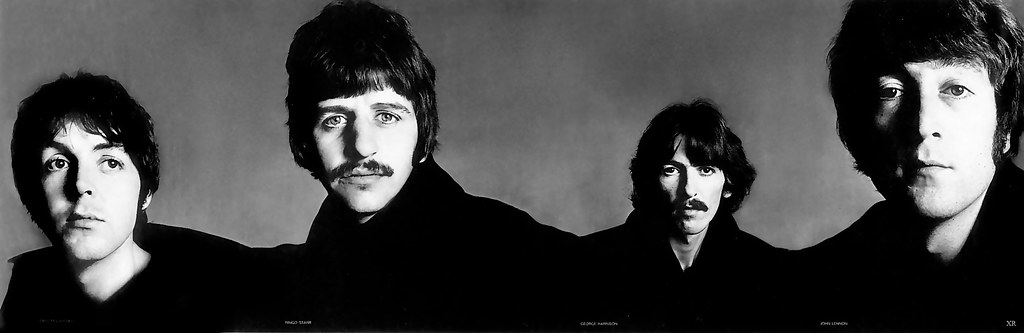
Captured by legendary American fashion and portrait photographer Richard Avedon, the “Mount Rushmore” banner portrait of The Beatles was taken on Friday, August 11, 1967, at a penthouse photographic studio inside Thompson House on Gray’s Inn Road in London. The band and their manager, Brian Epstein, commissioned Avedon to design a visual layout that would translate the boundary-pushing, psychedelic spirit of their latest musical innovations into a commercial art project. The final composite was famously published in January 1968 inside Look magazine. PHOTO: “1968 … the Beatles – by Avedon” by x-ray delta one is licensed under CC BY-NC-SA 2.0.
While the photo session did not yield the actual sleeve art for either release, it stands as the ultimate aesthetic connective tissue between the June 1967 album Sgt. Pepper’s Lonely Hearts Club Band and the 1968 animated film Yellow Submarine. Avedon’s main objective for this August session was to visually anchor the bold new era the album introduced. The portrait showcases the band mid-transformation: shedding their clean-cut “mop-top” personas, embracing facial hair, and displaying the mature, artistic independence that defined the Sgt. Pepper countercultural movement.
Furthermore, the physical appearance of the band members during this photo session served as the direct visual blueprint for their animated character designs in Yellow Submarine. John Lennon’s distinct circular spectacles and sideburns, Paul McCartney’s clean-shaven look, and the specific mustache shapes worn by Ringo Starr and George Harrison were precisely illustrated by the film’s animation team. This ensured the cartoon Beatles perfectly mirrored their real-world counterparts during this exact window of time.
SOURCES:
Bergan, Ronald. The United Artists Story. New York: Crown Publishers, Inc., 1986, p. 243.
Gould, Jonathan. Can’t Buy Me Love: The Beatles, Britain, and America. New York: Harmony Books, 2007, pp. 484-486 and 505-507.
MacDonald, Ian. Revolution in the Head: The Beatles’ Records and the Sixties. 3rd ed. Chicago: Chicago Review Press, 2007, pp. 220-221