

FEATURE image: Chicago Loop Synagogue with stained glass window, Let There Be Light (1960) by American Expressionist artist Abraham Rattner (1895-1978). The synagogue was built in 1957 with this wall of stained glass. The colorful and semi-abstract artwork contrasts and complements with the architectural minimalism of the rest of the sanctuary. October 2015. Author’s photograph.
The Chicago Loop Synagogue is a remarkable fusion of mid-century modern architecture, Jewish religious symbolism, and monumental art, demonstrating how modern design can create a powerful expression of faith, identity, and spiritual experience.

Chicago Loop Synagogue, exterior. May 2024. Author’s photograph. 97% 7.89 mb

Chicago Loop Synagogue on Clark Street in downtown Chicago. PHOTO: “Chicago Loop Synagogue” by _jjph is licensed under CC BY-NC-SA 2.0.
Chicago Loop Synagogue was a midcareer project for a pair of leading Chicago Jewish architects of Modernism — Jerrold Loebl (1899–1978) and Norman Schlossman (1901– 1990). Loeble was a son of Hungarian immigrants and Schlossman was the grandson of immigrants from Germany. Both graduated from the Armour Institute (today’s Illinois Institute of Technology) and became partners in 1925. The third partner changed over the decades and in 2024 the firm is Loebl, Schlossman, & Hackl. Following World War II, the firm was Loebl, Schlossman & Bennett and the team created influential examples of Chicago’s mid-century Modernism. Richard Marsh Bennett (1907-1996) had been chairman of the Yale Architecture Department and stayed with the firm until 1974 when he returned to teach at the Harvard Graduate School of Design. The architectural firm’s designs included Weiss Memorial Hospital (4646 N Marine Drive) and The Darien (3100 N. Lake Shore Drive ) also built in the 1950s.

Chicago Loop Synagogue: Exterior Façade. May 2014. Author’s photograph. 4.58mb DSC_0057 (1).
Above: The exterior of the Chicago Loop Synagogue (above), located at 16 South Clark Street in downtown Chicago. Designed by the prominent mid-century modernist architectural firm Loebl, Schlossman & Bennett, the building was completed in 1957–1958 and occupies a compressed, mid-block urban footprint of roughly 5,000 square feet. Hemmed in closely by soaring office buildings, the synagogue makes a deliberate statement of scale and transparency rather than sheer height. The front wall embraces reserved mid-century minimalism. At street level, it features clear floor-to-ceiling storefront glass that allows a seamless view into the stone-lined lobby. Above the ground floor rises a monumental grid wall of muted, industrial-scale metal and glass framing panels. Capping the massive glass wall is a distinctive, jagged tripartite metal cornice or canopy. These three structural gables jut outward over the sidewalk, adding a playful, geometric crown to an otherwise stark grid facade. The copper/bronze material has weathered into a deep green verdigris hue.
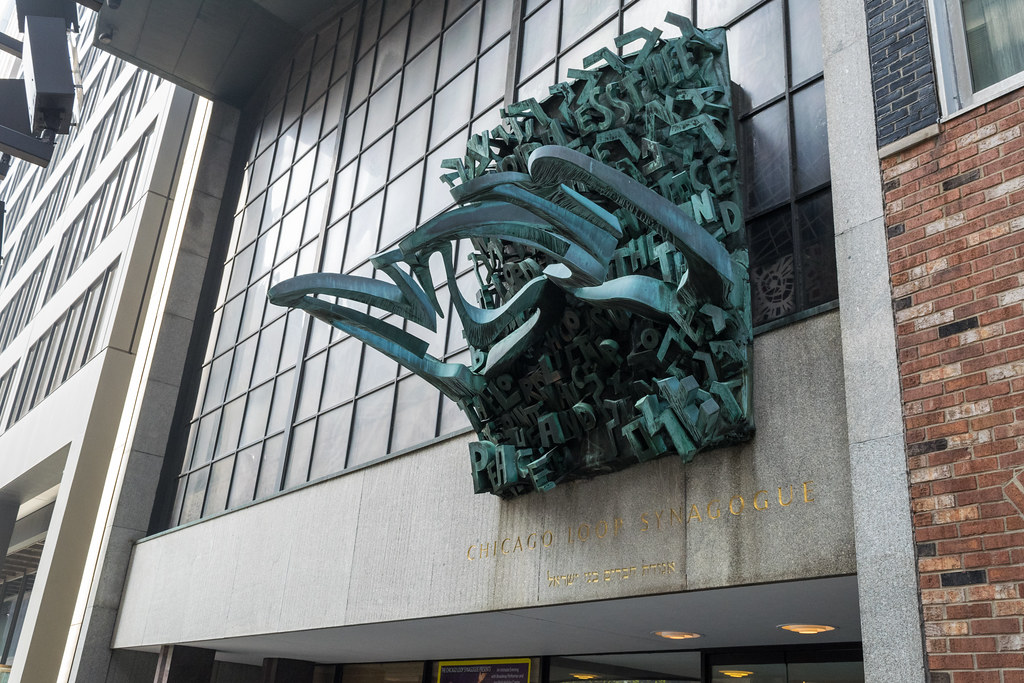
PHOTO: “Hands of Peace | Chicago Loop Synagogue” by _jjph is licensed under CC BY-NC-SA 2.0.
Above and below: Perched directly over the main entry doors is a two-ton bronze sculpture titled Hands of Peace (1963), created by the acclaimed Israeli sculptor Henri Azaz (Nehemia Azaz). The abstract composition features a jumble of bold letters cascading over one another. Emerging directly from the text is a massive pair of stylized, open human hands sloping down toward the street.
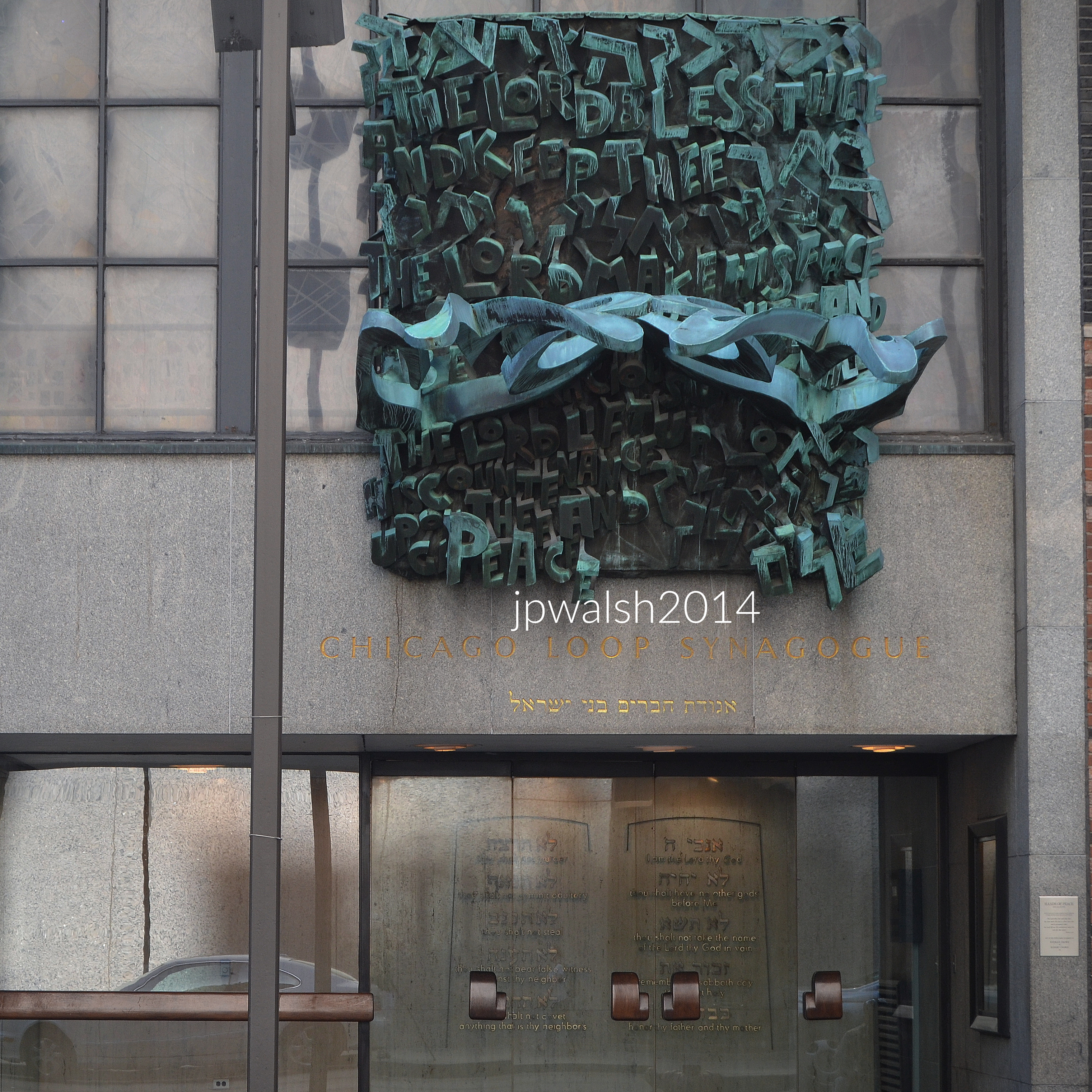
Chicago Loop Synagogue: Hands of Peace. May 2014. Author’s photograph. 4.28mb DSC_0055 (3).
Above: The tumbled letters shape the words of the priestly benediction (the Birkat Kohanim) from the Book of Numbers (6:24–26) in both English and Hebrew. The sculpture spells out: “The Lord bless thee and keep thee; the Lord make His face to shine upon thee… and give thee peace.” The pair of down-sloping bronze hands mimic the physical stance used by the Kohanim (priests) when delivering a blessing over a congregation. By suspending this gesture directly over the sidewalk, the architecture acts as an open, perpetual blessing bestowed upon all downtown workers, visitors, and passersby stepping into or walking past the sanctuary.
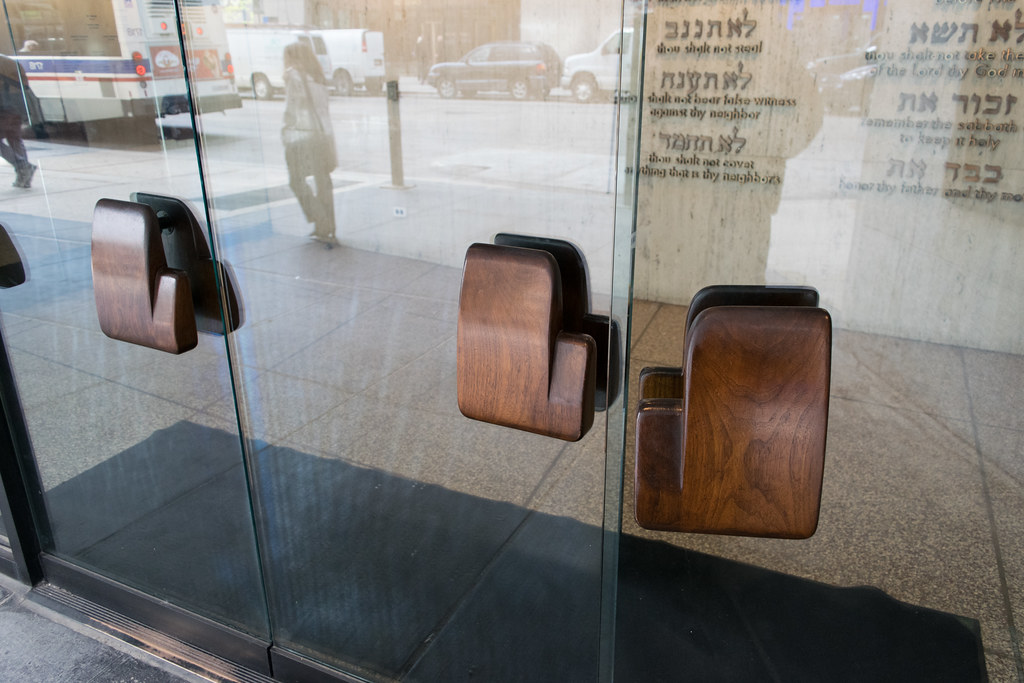
Glass doors with wooden handles define the main entrance into Loop Synagogue off busy Clark Street in Downtown Chicago. PHOTO: “Chicago Loop Synagogue” by _jjph is licensed under CC BY-NC-SA 2.0
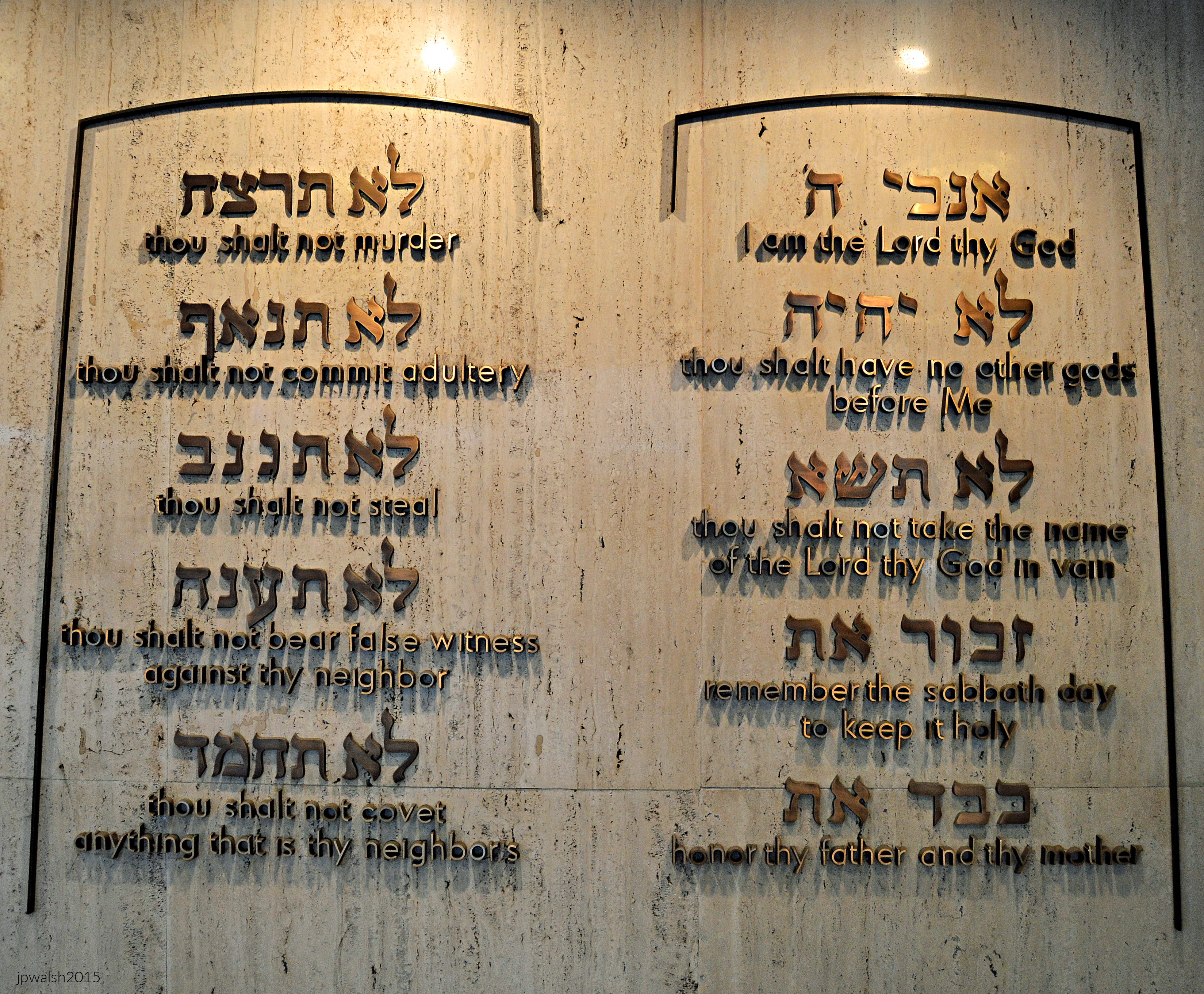
Chicago Loop Synagogue. September 2015. Author’s photograph. 4.73 mb
Above: The Ten Commandments meet the visitors in the foyer upon entering synagogue. For Jews, the Ten Commandments found in Exodus 20:2-17 and Deuteronomy 5: 6-21 are a special set of spiritual laws that the LORD Himself wrote on two stone tablets (luchot) that Moses brought down from Mount Sinai. In the Scriptures these laws are called the “Aseret Ha Devarim,” the “ten words” or “ten utterances.” In rabbinical writings, they are usually referred to as “Aseret Ha Dibrot,” and in Christian theological writings they are called the Decalogue which is derived from the Greek name “dekalogos” (“ten statements”) found in the Septuagint (Exodus 34:28 and Deuteronomy 10:4), which is the Greek translation of the Hebrew name. To the Jews the Torah has a total of 613 commandments which includes the ten from the Decalogue.
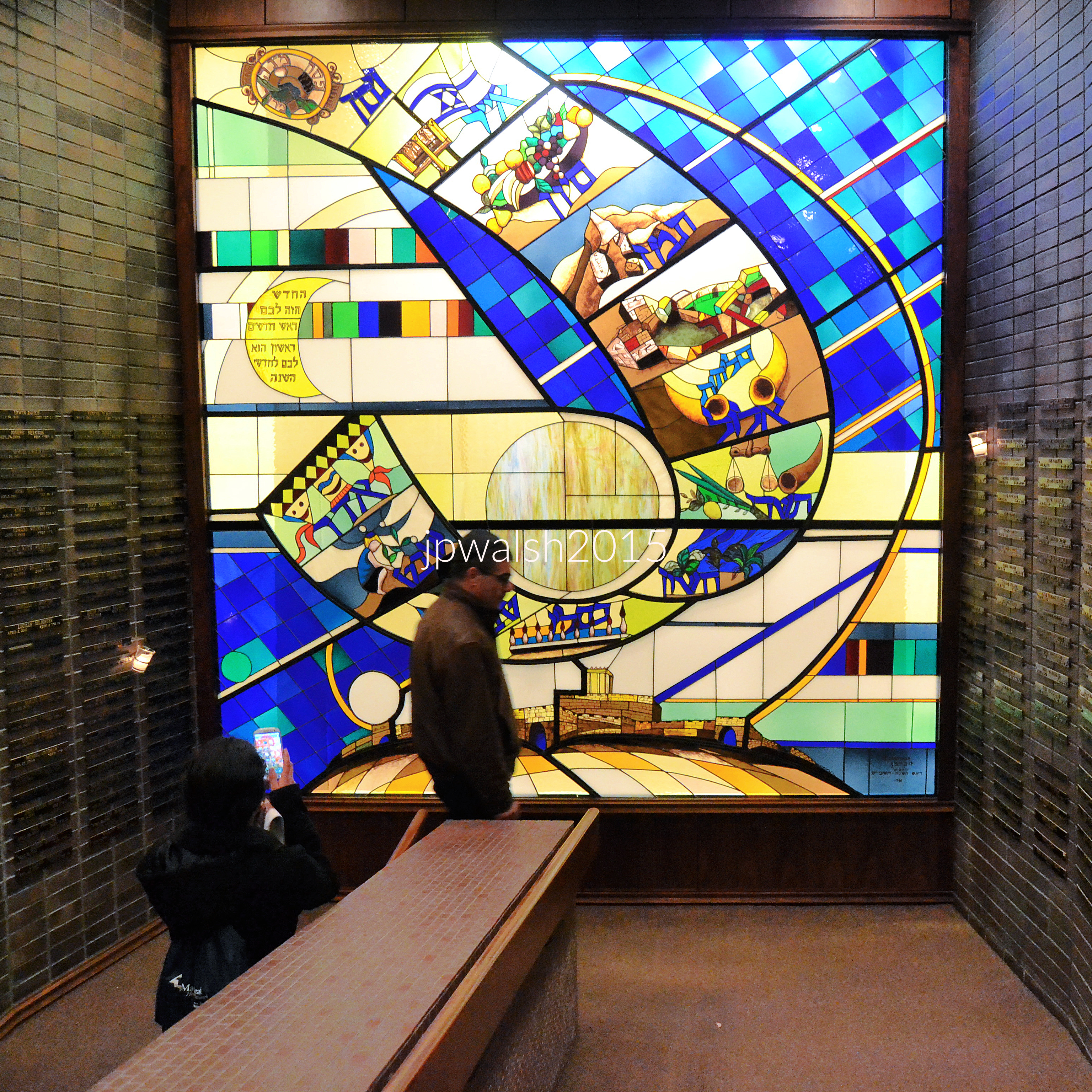
Chicago Loop Synagogue. October 2015. Author’s photograph.5.04mb DSC_0034 (1)
Above: The synagogue’s Memorial space centers on the Memorial Window, a stained-glass work designed by American Expressionist artist Abraham Rattner (1895–1978). Created around 1960–1961, it coincided with the design and installation of his monumental three-story masterpiece, Let There Be Light, in the main sanctuary. Rendered in brilliant blues, golds, and emerald greens, the window presents a dynamic composition of symbolic Jewish imagery and occupies the landing of the main staircase and ramp system connecting the street-level lobby with the lower-level Beit Midrash (house of study) and social hall.
The walls on both sides are lined with illuminated Yahrzeit plaques commemorating past members of the congregation. Within this contemplative setting, Rattner’s window introduces a radiant note of hope, evoking eternal life, cosmic time, and the enduring cycles of Jewish tradition.
The window’s imagery incorporates a wide range of Jewish symbols. At left, a Hebrew inscription quotes Exodus 12:2 concerning the renewal of months: “This month shall be unto you the beginning of months…” Circular medallions depict symbols associated with major Jewish festivals, including the shofar of Rosh Hashanah, a basket representing the Seven Species, and the Lulav and Etrog used during Sukkot. In the upper left section, the Magen David (Star of David) appears alongside stylized references to the modern State of Israel. The lower portions of the composition incorporate views of ancient Jerusalem and the Western Wall, linking the themes of memory and renewal to Judaism’s historic spiritual center.
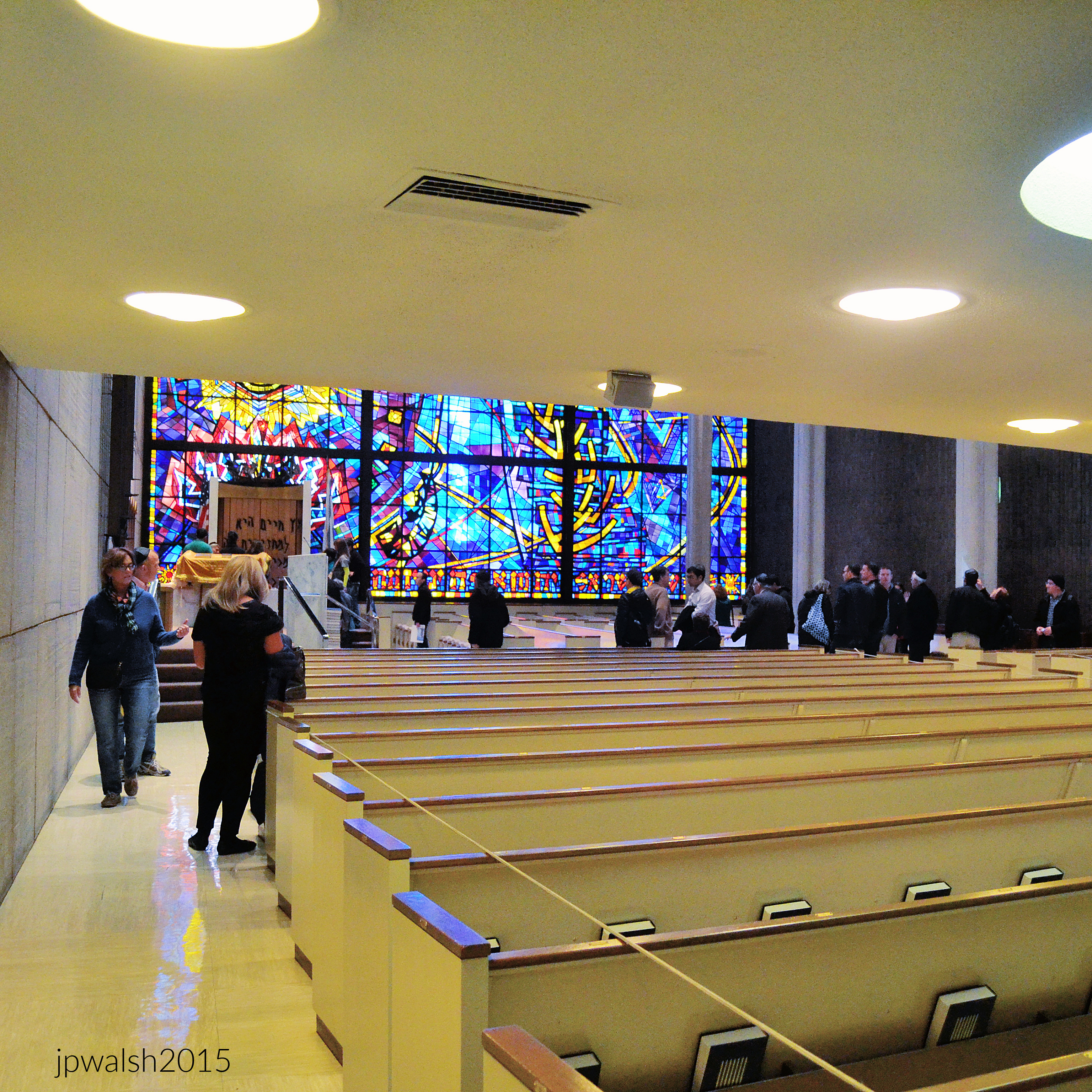

PHOTO: “Chicago Loop Synagogue” by _jjph is licensed under CC BY-NC-SA 2.0.
Above: The dramatic contrasts and geometric rigor of The Chicago Loop Synagogues’ Mid-Century Modernist design are evident throughout the sanctuary. Long, sweeping rows of custom-designed wooden pews extend the length of the space, reflecting the era’s characteristic blend of corporate efficiency and spiritual order. A massive floating balcony cantilevers boldly over the rear portion of the sanctuary, emphasizing the building’s structural daring.
The wall beneath and behind the balcony is clad in dark, vertically grooved wood paneling, creating a rich visual counterpoint to the monumental sanctuary wall beyond. Rising to its full height, this soaring surface is constructed of large, ashlar-patterned stone blocks, whose rough, matte texture provides a powerful sense of permanence. The monolithic masonry evokes the ancient stone architecture of Jerusalem while remaining firmly rooted in a clean Modernist aesthetic.
Overhead, a matte-black, non-reflective ceiling seems to hover above the congregation, punctuated by precisely placed recessed spotlights. Their pinpoints of light resemble a star-filled night sky, dissolving the boundaries of the ceiling and enhancing the sanctuary’s remarkable sense of height and openness.

The limestone blocks of the North wall are cut at an angle to evoke the Western Wall of the Temple in Jerusalem. The Hebrew text inscribed on the wall is the Shema Yisrael, which is the central prayer and declaration of faith in Judaism. In English, it translates to: “Hear, O Israel: The Lord our God, the Lord is One.” October 2015. Author’s photograph. 4.41mb DSC_0970
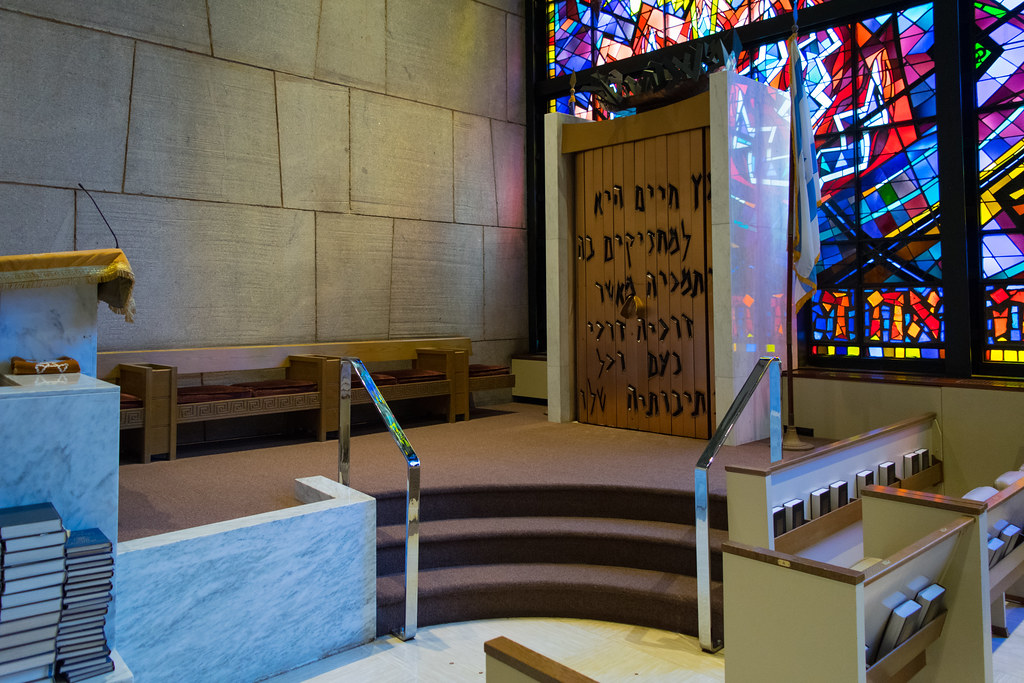
The Holy Ark is made by Israeli sculptor and ceramicist Henri Azaz (1923-2008). Jutting into the prayer space from the far-left corner of the window, Rattner incorporated the ark that would house the Torah scrolls. The artist surrounded the ark with flames, integrated into the glass. leaping up and out, drawing attention to the presence of God in the very heart of the sanctuary. PHOTO: “Chicago Loop Synagogue” by _jjph is licensed under CC BY-NC-SA 2.0.

Chicago Loop Synagogue is a house of worship that is three floors, 450 seats, six Torahs, and a 40-foot-tall stained-glass window that fills the Eastern façade and congregation with filtered sunlight. October 2015. Author’s photograph. 5.25 mb DSC_0990

The Chicago Loop Synagogue was founded in 1929 to serve the religious needs of those whose business activities brought them downtown. October 2015. Author’s photograph. 3.43 mb DSCN1463 (1)
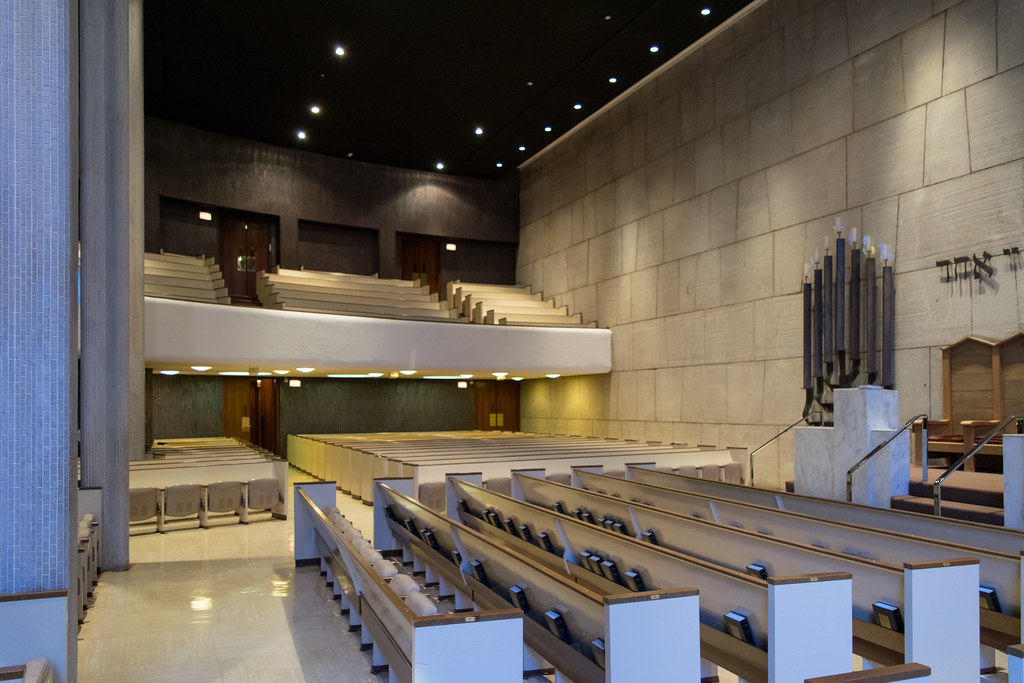
PHOTO: “Chicago Loop Synagogue” by _jjph is licensed under CC BY-NC-SA 2.0.

Visitors to the Chicago Loop Synagogue in the Main Sanctuary are guided by one of its members. October 2015. Author’s photograph. 4.26mb DSC_0019

Main Sanctuary. October 2015. Author’s photograph. 91% 7.77mb DSC_0969 (1)
Abraham Rattner, the Expressionist artist of the wall-filling colorful stained-glass window was born in Poughkeepsie, New York to a Russian-Jewish father and a Romanian-Jewish mother. Rattner studied to be architect but turned to painting studying at the Corcoran School of Art in Washington D.C. and the Pennsylvania Academy of the Fine Arts in Philadelphia. Rattner served as a camouflage artist in France during World War I and, after the war, joined many of “the Lost Generation” that writer and critic Gertrude Stein spoke about when referencing the post- war Ernest Hemingway and many others who lived in Europe, mainly Paris, in the 1920s. Rattner lived in Paris for 20 years, from 1920 until late 1939 where, during that extensive time period, he met Claude Monet (1840-1926). To avoid the coming Nazi invasion of France, Rattner and his wife Bettina Bedwell (1889-1947), a journalist and fashion illustrator from Nebraska who studied at the School of the Art Institute of Chicago and who married in 1924, returned to America, where they lived in New York City. Rattner was known for his rich use of color and abstraction in his artwork and whose subject matter often had to do with religion. In the post-World War II era he taught at several schools, including New York’s The New School (1947–55) and at Yale University (1952-1953). In 1949 Rattner married Esther Gentle (1899 – 1991), an artist and art dealer, and was a friend of writer Henry Miller (1891-1980) who wrote about their friendship in 1968 in A Word About Abraham Rattner.

October 2015. Author’s photograph. 7.77 mb 91% DSC_0977
The colors and design elements of this 31 x 40-foot glass artwork signify God’s relationship with the cosmos, humanity, and the Jewish people. After two years working on conceptual and design schemes, the artist Abraham Rattner spent a year fabricating the window – a presentation of cool blues and warm red and yellows studded with purples that take on shapes of planets, trees, Hebrew letters and the Israelite tribes. It was made in Paris’s 15th arrondissement at Atelier Barillet, the house and workshop of master glassmaker Louis Barillet (1880-1948). The artwork was the subject of a 1976 exhibition at the Smithsonian American Art Museum and a 1978 exhibit at the Skirball Cultural Center in Los Angeles. The window was made to fit inside the prayer space for which it was created. To create the stained-glass work, Rattner drew inspiration from the opening passages of Genesis, focusing on the hidden meanings of the words “And there was light” to channel cosmic creative energies of the Divine.
October 2015. Author’s photograph. 5.62 mb DSC_0023 (1)
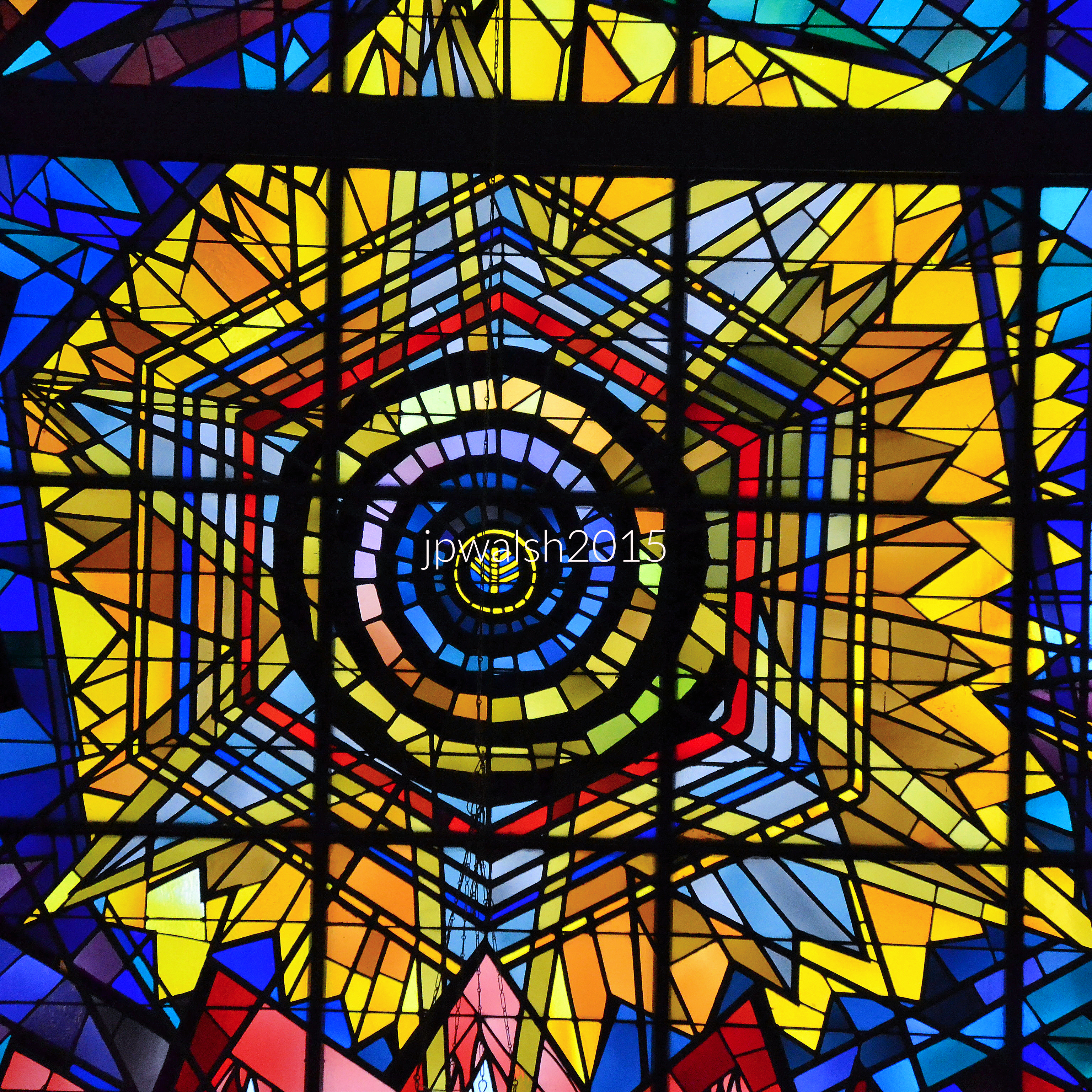
Above: The Tree of Life is also visaged as the Menorah and is identified with the light of innermost perception – the spirit; thought; ideas; life; and of knowledge. This Primal Light, God’s light, radiates outward, extending and expanding throughout the universe.
October 2015. Author’s photograph. 4.68mb DSC_0026
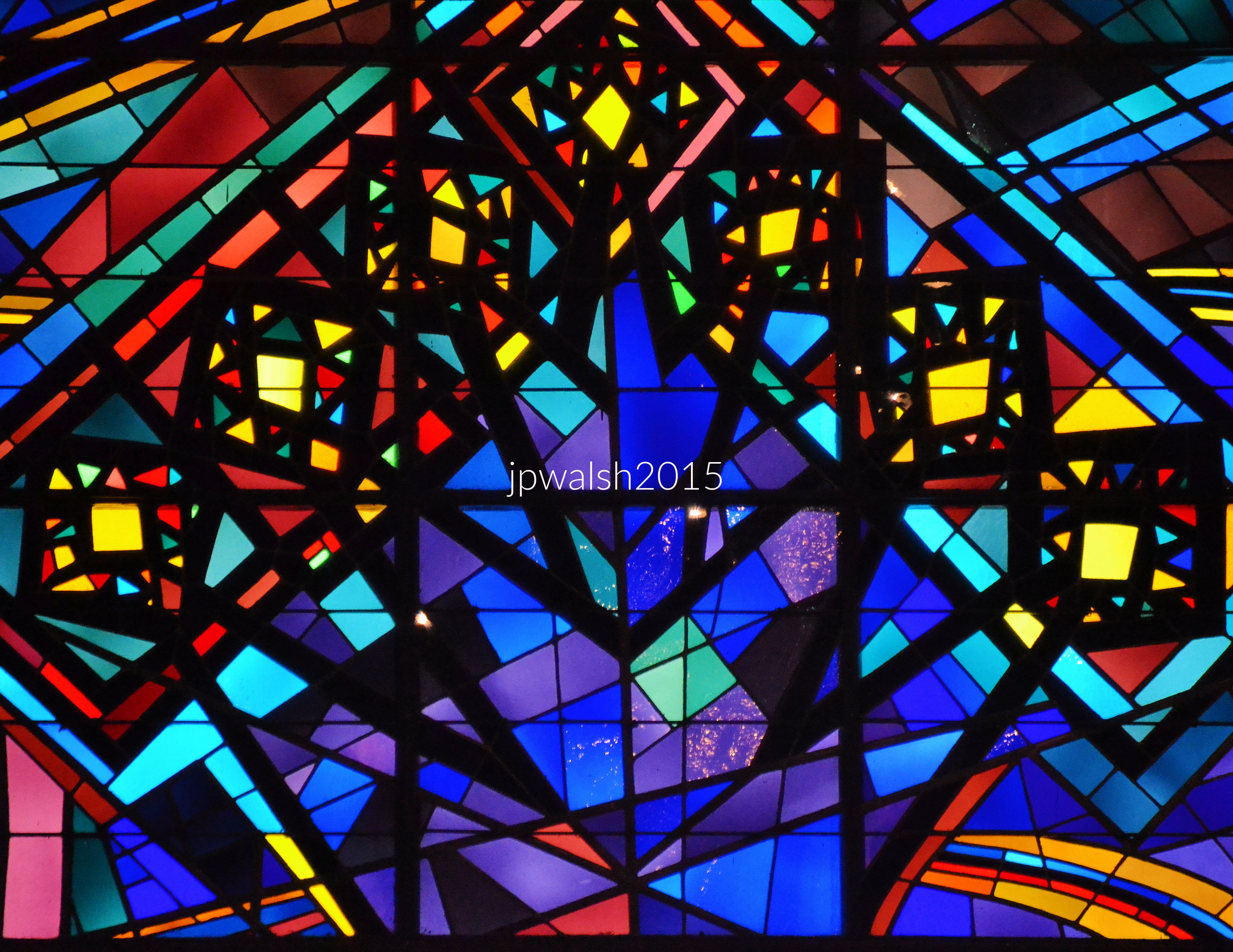
Above: The Menorah poetically conceived as a tree of life and of light. The Menorah is the classic symbol of Judaism.

October 2015. Author’s photograph. 7.77mb DSC_0027
Above: The Star of David and the palm branch used on the Sukkot (Feast of Booths) harvest festival.

October 2015. Author’s photograph. 7.77mb DSC_0027
Above: The shofur or ram’s horn (above) is an ancient instrument used on High Holidays to call the people to repentance. In close proximity to the shofur is the etrog which is a fruit of the Holy Land which expresses earth’s bounty as well as the overflowing love of a human being’s heart for God.
Designed by Loebl, Schlossman & Bennett, the Chicago Loop Synagogue stands as one of Chicago’s most significant modern religious buildings, where architectural restraint is transformed by Abraham Rattner’s monumental stained-glass masterpiece into a profound visual statement of Jewish faith and heritage.

October 2015. Author’s photograph. 6.13mb DSC_0999 (1)
Above: View of the sanctuary from the balcony. The near perfect beauty of the Chicago Loop Synagogue is self-evident.
October 2015. Author’s photograph. 3.14mb DSC_0037 (1)
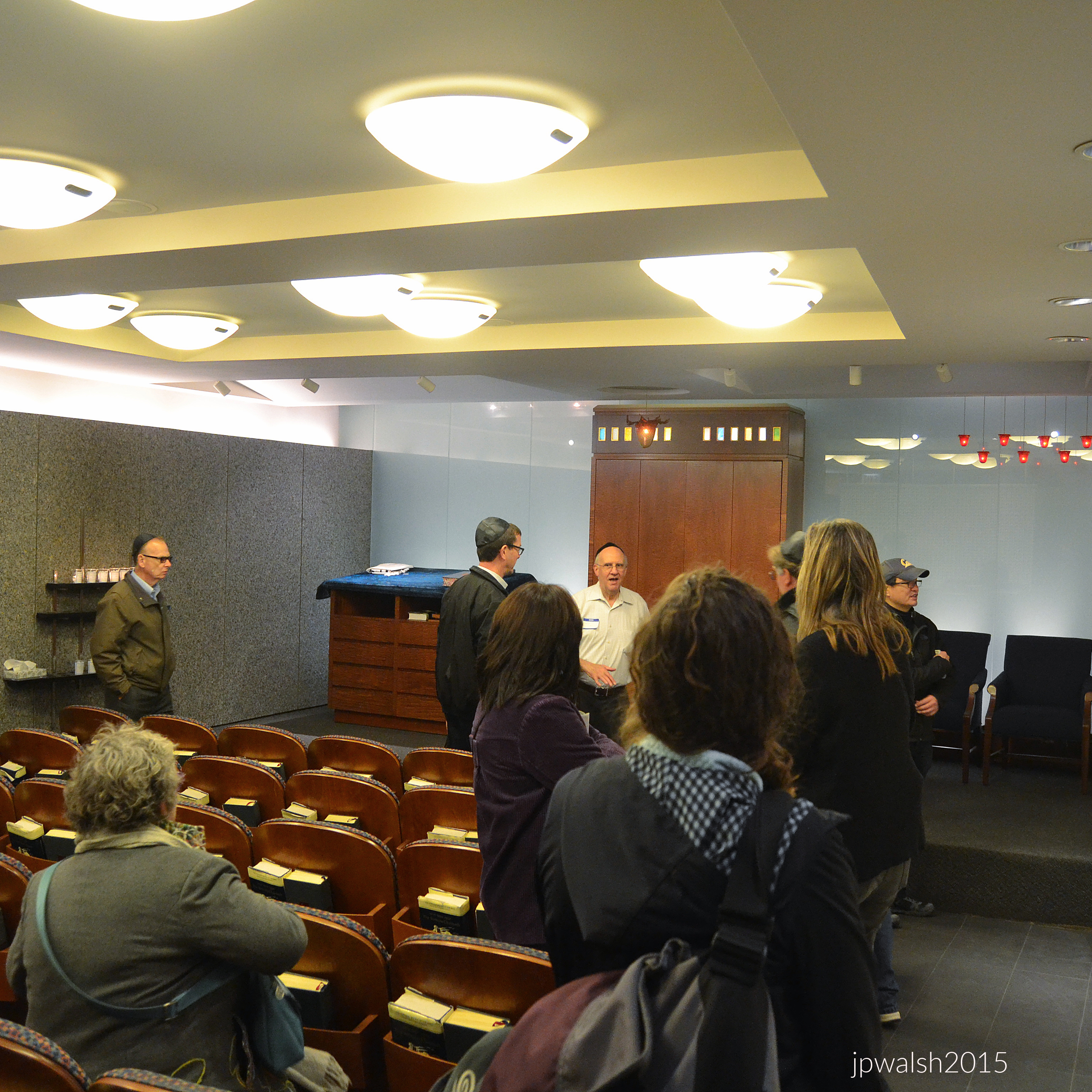
The prayer room on the first floor is used for daily prayer and other gatherings. Author’s photograph.
SOURCES AND FURTHER READING:
AIA Guide to Chicago. 2nd ed. Edited by Alice Sinkevitch. Orlando: Harcourt, Inc., 2004.
Bachrach, Julia. “Chicago’s Jewish Architects: A Legacy of Modernism.” Julia Bachrach Consulting (blog). February 1, 2018. https://www.jbachrach.com/blog/2018/1/30/chicagos-jewish-architects-a-legacy-of-modernism.
Chicago Loop Synagogue. Home page. https://www.chiloopsyn.org/.
Cooper, Alanna E. “Future in Question for Chicago Loop Synagogue and Its Monumental Stained-Glass Window.” Jewish Telegraphic Agency, April 14, 2021.
Lane, George, S.J., and Algimantas Kezys. Chicago Churches and Synagogues: An Architectural Pilgrimage. Chicago: Loyola University Press, 1981.
“Let There Be Light: The Chicago Loop Synagogue.” Chicago Modern: More than Mies (blog).
Preservation Chicago. “Chicago Loop Synagogue.” Accessed January 18, 2024. https://www.preservationchicago.org/.
Preservation Chicago. “THREATENED: Chicago Loop Synagogue Faces Uncertain Future.” April 30, 2021. https://www.preservationchicago.org/threatened-chicago-loop-synagogue-faces-uncertain-future/.
Smithsonian American Art Museum. “Abraham Rattner.” Accessed January 18, 2024. https://americanart.si.edu/artist/abraham-rattner-3946.
The Ten Commandments. “The Ten Commandments Bible List — What Are the Ten Commandments?” Accessed December 4, 2023. https://www.the-ten-commandments.org/the-ten-commandments.html.
Wikipedia, s.v. “Loebl Schlossman & Hackl.” Last modified January 3, 2026, 15:21. https://en.wikipedia.org/wiki/Loebl_Schlossman_%26_Hackl.
Wikipedia (français), s.v. “Louis Barillet.” Last modified April 21, 2026, 17:19. https://fr.wikipedia.org/wiki/Louis_Barillet.
Zolros, Peter. “A Sacred Spot in Chicago’s Loop.” Chicago History Museum (blog).

Chicago Loop Synagogue. ”In the beginning God created…” Author’s photograph.
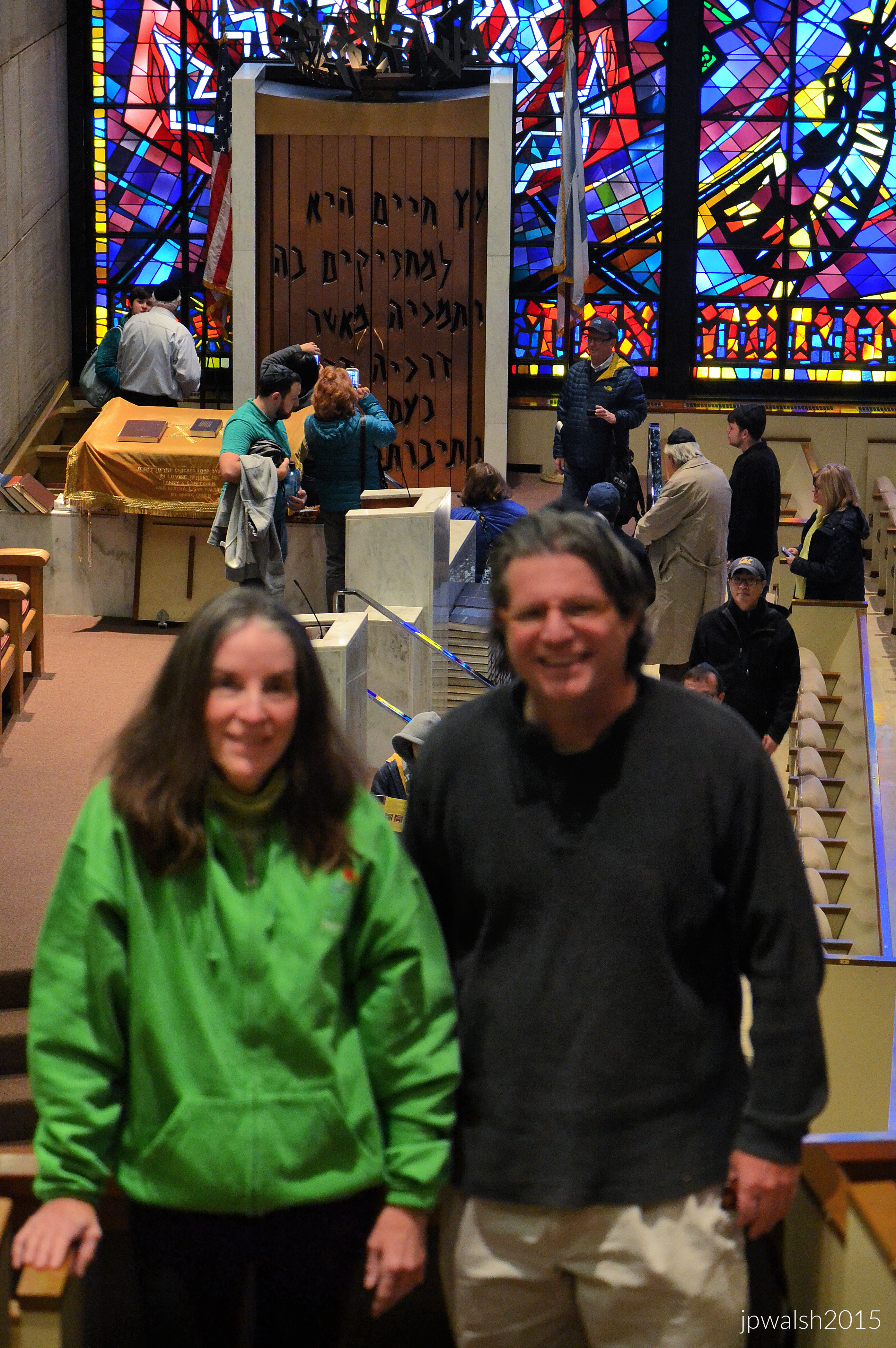
Chicago Loop Synagogue. Author & wife. October 2015. Author’s photograph.

