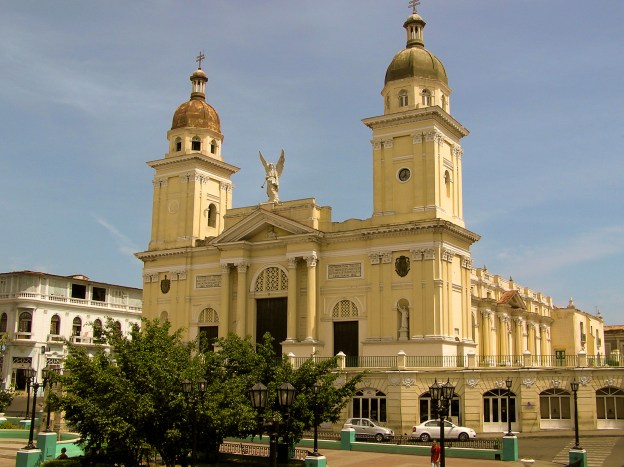
The neoclassical facade of the colonial-era Catedral Nuestra Señora de la Asunción in Santiago de Cuba, southeastern Cuba. As Archbishop of Santiago de Cuba from 1851 to 1857, St. Anthony Mary Claret used this cathedral as his primary pastoral seat, tirelessly preaching to the public and overseeing structural recovery efforts after a devastating earthquake left the building in ruins in 1852. Faced with widespread poverty, illness, and systemic inequalities, he championed the people’s well-being by establishing hospitals, schools, and diverse family-owned farms to combat the economic hardships of the local populations and enslaved workers. Photo Credit: BluesyPete / CC BY-SA 3.0
St. Anthony Mary Claret (1807-1870) combined intense personal holiness with tireless missionary activity, becoming one of the nineteenth century’s most influential Catholic reformers. From preaching missions and extensive pamphlet writing across Spain and the Canary Islands to servingas Archbishop of Santiago de Cuba, Claret devoted his life to evangelization, education, social justice, and the reform of Church and society.
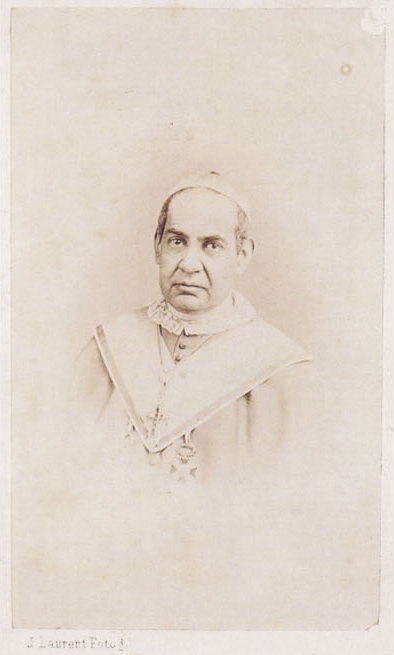
Photograph of Saint Anthony Mary Claret taken by Jean Laurent in 1862. At the time, Claret was serving as personal confessor to Queen Isabella II of Spain. The year marked a particularly productive period in his ministry, including the completion of his celebrated Autobiography in May, an intensive six-week preaching campaign during which he delivered more than 200 sermons to laypeople, clergy, seminarians, and charitable communities, and important developments in the growth of the Claretian order he had founded. Public Domain.
Early Spiritual Awakening
St. Anthony Mary Claret (1807-1870), whose feast day is October 24, was one of the great missionaries and social reformers of the nineteenth-century Catholic Church.
Born in Sallent, Catalonia, Spain, Anthony grew up in a devout Catholic family. At the age of five, lying awake one night, he reflected on God, judgment, Heaven, and Hell, lessons he had learned from his parents. As he tried to comprehend eternity, he became deeply troubled by the thought of souls separated forever from God’s love. The experience left a profound impression on him and inspired a lifelong desire to bring others closer to Christ.
Devotion to Mary and Extraordinary Graces
Throughout his life, Anthony reported receiving visions and special spiritual consolations, although he spoke of them only when doing so might strengthen the faith of others.
In his autobiography, he recounts an incident from his youth when he was swept out to sea by a powerful wave while wading near a beach with friends. Unable to swim and facing almost certain death, he prayed to the Blessed Virgin Mary for help. Moments later, he found himself safely on shore. Anthony viewed the event as a sign of Mary’s maternal protection and frequently encouraged others to seek her intercession in times of danger and distress.
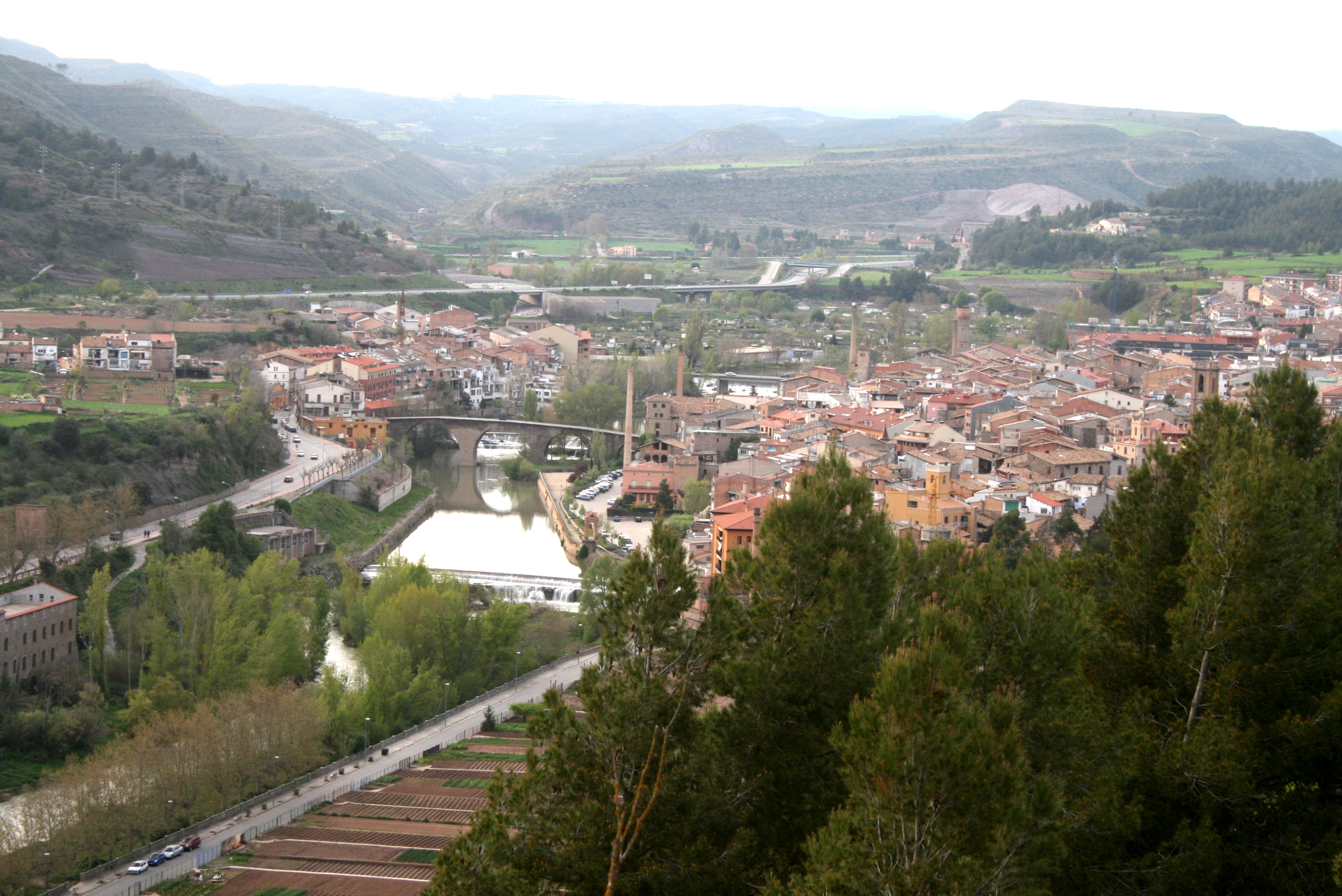
A panoramic view of Sallent from the castle, located in Catalonia, Spain, the historic birthplace of St. Anthony Mary Claret. Anthony Mary Claret was born in this small manufacturing town on December 23, 1807. The Llobregat River running through the town powered the local textile industry. Claret spent his youth here working as a weaver in his father’s textile mill, mastering the trade before moving to Barcelona to further his studies in manufacturing.Photo Credit: Joan / CC BY 3.0
Missionary Across Spain and the Canary Islands
Ordained a priest in 1835, Anthony quickly became known as one of Spain’s most dynamic and effective preachers. Unable to enter the foreign missions because of poor health, he instead devoted himself to missionary work throughout Catalonia and the Canary Islands, often traveling on foot from town to town. His powerful sermons attracted enormous crowds, and he became renowned for his ability to communicate Catholic teaching in a direct and compelling manner.
Recognizing the growing influence of the printed word, he also published books, pamphlets, and catechetical materials on a massive scale, making religious instruction accessible to ordinary people. In 1849, he founded the Missionary Sons of the Immaculate Heart of Mary, today known as the Claretians.
A Lifelong Admiration for the Jesuits
As a young priest, Anthony Mary Claret felt strongly drawn to the missionary spirit of the Society of Jesus. In 1839, he traveled to Rome and entered the Jesuit novitiate, hoping to dedicate himself to missionary work abroad. Although recurring health problems forced him to leave before completing his formation, the experience left a lasting mark on him.
Claret never lost his admiration for the Jesuits. He was deeply influenced by their discipline, intellectual rigor, missionary zeal, and devotion to the service of the Church. Throughout his life, he maintained close relationships with members of the order and frequently recommended the Spiritual Exercises of St. Ignatius Loyola as a means of spiritual growth. The Jesuit emphasis on evangelization, education, and obedience to the Church resonated strongly with Claret’s own vocation and would help shape his ministry as a preacher, founder, bishop, and reformer. Even though he did not remain a Jesuit, he carried many Ignatian ideals into the missionary work that made him one of the most influential Catholic figures of nineteenth-century Spain and Cuba.
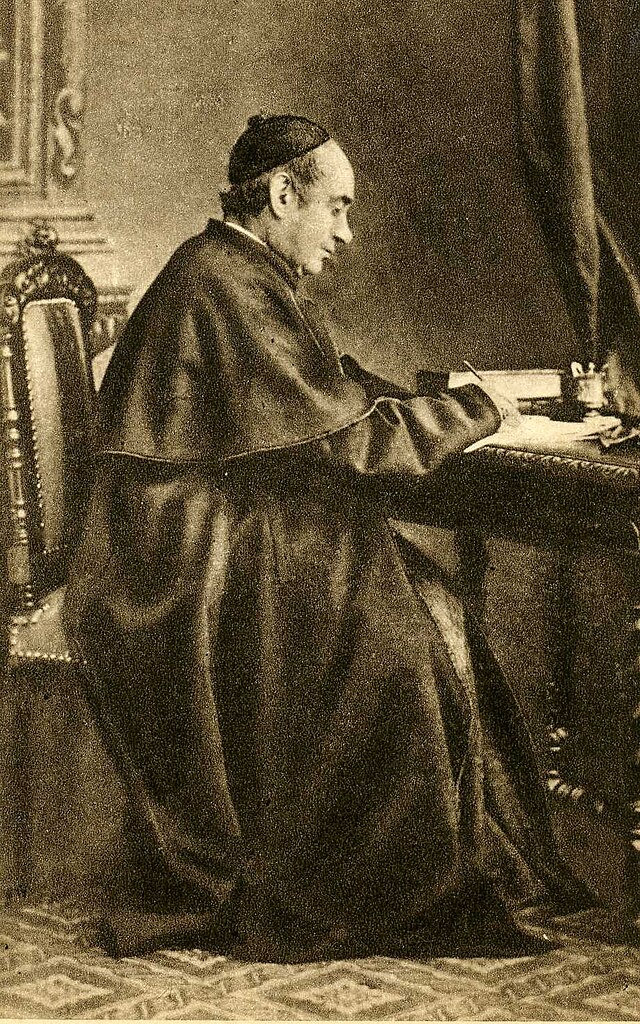
Historic photograph depicts St. Anthony Mary Claret engaged in his extensive writing ministry, commonly referred to as his “apostolate of the pen.” It was taken by French photographer Antoine René Trinquart in Paris in December 1868. Public Domain.
Archbishop and Reformer in Cuba
Later in 1849, Pope Pius IX appointed Anthony Archbishop of Santiago de Cuba, a position he held until 1857. His years in Cuba were among the most demanding and fruitful of his ministry.
He traveled tirelessly throughout his vast archdiocese, preaching missions, hearing confessions, founding schools, and promoting religious education. Determined to improve both the spiritual and material conditions of the people, he established savings banks, supported agricultural initiatives, aided the poor, and spoke out against abuses associated with slavery. Local, wealthy landowners and plantation owners reacted to St. Anthony Mary Claret’s reforms with intense and often violent hostility. Because Cuba’s wealthy elite relied heavily on a rigid, slave-reliant agricultural monopoly, they viewed his social and economic initiatives as an existential threat to their power. By dividing land, teaching modern agricultural techniques, and encouraging poor peasants and enslaved workers to run self-sufficient family farms, he threatened the cheap labor supply that major sugar plantations depended on.
Preaching Human Dignity
His fierce advocacy for racial equality, the defense of enslaved workers, and his efforts to legitimize marriages across racial lines directly disrupted the social order the plantation owners fought to maintain control over.
Anthony also undertook sweeping reforms of the clergy. Priests were required to demonstrate their ability to celebrate Mass properly and to fulfill their pastoral duties. He famously argued that it was better for a village to have no priest than to have an unworthy one. In his records explaining why he refused to ordain or assign substandard candidates, he wrote his full reasoning: “If God does not send me men who are truly called, God himself will have to take care of the men and souls by means of his angels. A call is God’s gift. I must not bring the unworthy into the sheepfold to destroy it instead of tending it.” His insistence on moral reform extended to society at large as he preached forcefully against adultery, concubinage, and other practices he believed undermined Christian family life.
His efforts won him widespread admiration among the faithful but also powerful enemies among those whose interests were threatened. The elite tried to silence him by launching a series of smear campaigns, labeling him a dangerous subversive, and hiring hitmen to eliminate him. In 1856, he survived a violent assassination attempt in Holguín, Cuba, where an assassin slashed his face and arm with a knife. Yet he responded with forgiveness and mercy toward his attacker and later successfully advocated to commute his attacker’s death sentence to a prison term.
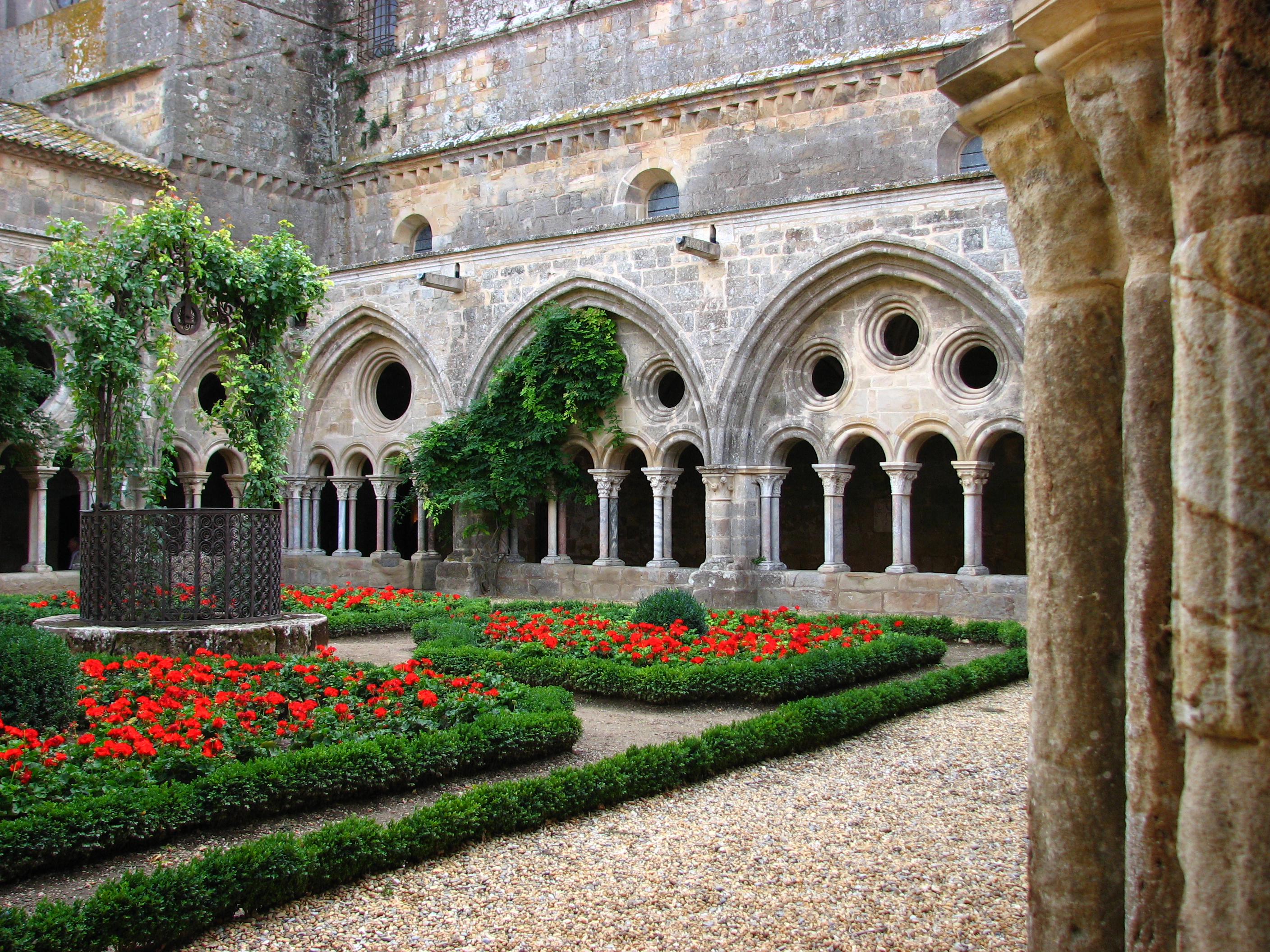
Cloister garden of Fontfroide Abbey, founded in 1093 by Aymeric I, Viscount of Narbonne. In 1870, St. Anthony Mary Claret found refuge here after fleeing political persecution in Spain. Sheltered by the abbey’s Cistercian monks and hidden for his own safety within these ancient walls, Claret spent his final weeks walking, praying, and preparing for death among these Gothic cloisters constructed largely in the late twelfth and thirteenth centuries. He died peacefully at Fontfroide on October 24, 1870. Photo Credit: Nancy / CC BY-SA 4.0
First Vatican Council, Exile, and Death (1870)
St. Anthony Mary Claret died in exile on October 24, 1870, at the Cistercian Monastery of Fontfroide near Narbonne in southern France at the age of 62. Following the Glorious Revolution of 1868, which deposed Queen Isabella II, Claret fled Spain alongside the royal family. After spending time in Paris and attending the First Vatican Council in Rome—where he spoke ardently in favor of Papal Infallibility—his presence continued to draw intense hostility from his Spanish political enemies, a powerful coalition of anticlerical revolutionaries, radical liberals, and Freemasons.
Because Claret was the Queen’s personal confessor, the new radical secular government viewed him as a dangerous political opponent and a symbol of the monarchy they were determined to destroy. They weaponized the legal system against him, trumping up political charges of treason and subversion to justify his arrest, suppress his religious orders, and seize Church property. Suffering from rapidly failing health, Claret initially sought peace with an exiled Claretian community in Prada de Conflent in the French Pyrenees. However, when Spanish government agents and diplomats tracked him there to execute the warrant, he was forced to flee once more in the middle of the night.
He found his final sanctuary at the isolated Cistercian Abbey of Sainte-Marie de Fontfroide near Narbonne and the Spanish border, where the monks shielded him under practical house arrest for his own safety. He passed away peacefully at the monastery shortly after his arrival, succumbing to his illnesses. Although he was initially buried in France, his remains were later returned to his homeland and are entombed today at the Claretian sanctuary in Vic, Spain.
Legacy of a Missionary Saint
St. Anthony Mary Claret was officially recognized by the Catholic Church as Venerable in 1899 by Pope Leo XIII; Beatified in 1934 by Pope Pius XI; and formally canonized a saint on May 7, 1950, by Pope Pius XII.
St. Anthony Mary Claret was a preacher, publisher, missionary, bishop, social reformer, and founder. Whether traveling through rural Spain, evangelizing in the Canary Islands, or reforming the Church in Cuba, he was driven by a profound concern for the salvation of souls and the welfare of the poor. Remembered as the “Spiritual Father of Cuba,” he remains a powerful example of missionary zeal, devotion to Mary, and courageous Christian leadership.
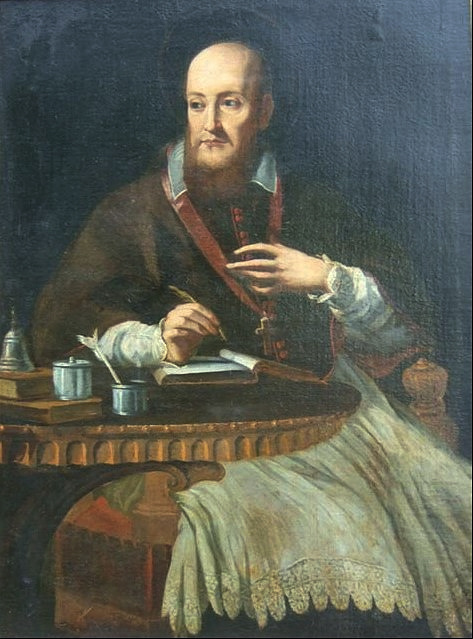
FEATURE Image: St. Francis de Sales, 18th c, Besançon, 96 x 131 cm. Public Domain.
St. Francis de Sales stands as one of Christianity’s most practical and accessible spiritual teachers because he showed that holiness is attainable in ordinary daily life through love, gentleness, humility, perseverance, and faithful acceptance of God’s will. His enduring importance lies not only in his role as Bishop of Geneva and founder of the Visitation Order, but in his ability to translate Catholic doctrine into practical spiritual guidance for everyday people.
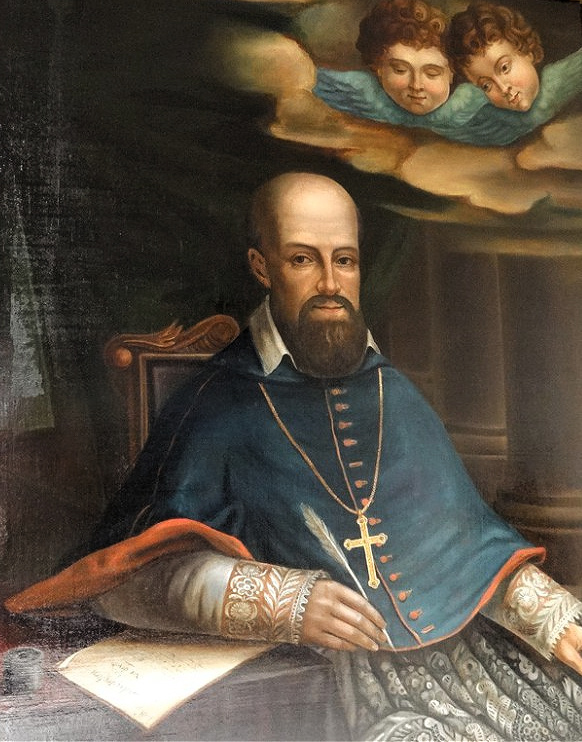
Saint Francis de Sales sitting in front of a copy of his work, “Introduction to the Devout Life,” oil on canvas, c.1790s, 77 cm x 99.5 cm, unknown artist. Hovering above the 17th century French Catholic bishop, saint, and Doctor of the Church are two cherubs who regard him with kindness. Public Domain. Francis de Sales became one of the most respected theologians in Christianity. A great preacher and writer, Francis de Sales ascended the seat of Bishop of Geneva, Switzerland, and, with widowed Baroness Jeanne de Chantal (1571-1641), founded the religious order of the Visitation. As a diplomat and man of prayer, Francis de Sales exerted a significant influence within the Catholic Church and among the temporal powers of the day. https://www.antiques-delaval.com/en/paintings/7068-hst-large-portrait-saint-francois-dirty-life-devote-cherubs-xviiieme.html -retrieved January 24, 2023. Public Domain.
CANONIZED ON APRIL 8, 1665, IN ROME BY POPE ALEXANDER VII, ST. FRANCIS DE SALES IS THE PATRON OF WRITERS, JOURNALISTS, THE CATHOLIC PRESS, CONFESSORS, THE DEAF AND EDUCATORS. ST. FRANCIS WAS DECLARED A DOCTOR OF THE CHURCH IN 1877 BY PIUS IX.
INTRODUCTION.
By all accounts, St. Francis de Sales (1567-1622), whose feast day is January 24, was a gracious and holy man. His writings were, similar to the Jesuits of whom Francis was a student, admirer and close friend, directed to society’s well-to-do and concerned with how, as society’s current elites, they can practice, most basically, Christian “noblesse oblige” within their privileged social station. St. Francis de Sales’ writing defended and explained Catholic doctrine to a Europe which, in an age of Renaissance and Reformation, was very much in revolt against it. To preserve and endorse (1) a social order and (2) perfect belief in doctrine, St. Francis de Sales communicated in everything that both were attainable simultaneously, and did so famously in his book, Introduction to the Devout Life (1608).
Like the sons of St. Ignatius of Loyola, St. Francis de Sales was active in the direction of souls. For Introduction to the Devout Life, Jesuit father Jean Fourier, S.J. strongly encouraged a noble lady around 1607 to prevail upon her local bishop (de Sales) to have his personal writings of spiritual direction to her and others printed to reach a wider audience at court and elsewhere among the ruling class. St. Francis de Sales was also eager to have his personal instructions in print for the advancement and perfection of individual souls. Introduction to the Devout Life became an instant international bestseller and, over 400 years later, remains a spiritual classic. As John K. Ryan, S.J. observed, “Its greatness lies in many things: in its originality, its completeness, its sincerity, its balance, its penetration and its style…(and) as such it is beyond adverse criticism in any important way.”1
His spiritual classic, Introduction to the Devout Life (1608), taught that holiness is not reserved for priests or religious but can be pursued by people living ordinary lives in the world. His writings emphasized gentleness over harshness, love over fear, and steady spiritual growth rather than dramatic religious experiences.
Francis Bonaventure was born into nobility in August 1567 in Sales castle in Savoy, France, where there were tremendous social pressures to marry and settle into a life of wealth and prestige. Sent to Paris by his family, they wanted him to attend the prestigious College of Navarre in the fine hôtel de Navarre with its renowned library in rue Saint André des Arts, but Francis chose to attend the new Jesuit College of Clermont, which at that time was known for its religious and moral vision as much as its academic achievement.2 At the Jesuit school St. Francis de Sales came into contact with the post-Tridentine humanism taught by faculty such as Father Possevin, S.J. and Francis took to it like a duck to water so that he could express its intellectual tenets afterwards quite well.3 St. Francis de Sales worked out his spiritual life in prayer in Saint-Étienne-des-Grès in the Latin Quarter. The church (now demolished) on Rue Saint-Jacques was the center for Christianity among students. Another saintly Frenchman who later frequented Saint-Étienne-des-Grès was St. Vincent de Paul (1581-1660). Francis de Sales as a college-age layman was finding he had serious religious scruples and temptations to lust.4 it was in Saint-Étienne-des-Grès that St. Francis de Sales ultimately took a personal vow of chastity before a statue of the Virgin Mary which allowed him to pursue his spiritual desires.
After studying for five more years at the University of Padua, St. Francis de Sales emerged in 1591 with the equivalent of a J.D.- Ph.D. and was ordained a priest in 1593. In those years the young nobleman was surrounded by the Renaissance writings of philosophers and poets such as Marsiglio Ficino (1433-1499), Giovanni della Casa (1503-1556) and contemporary French theologian Pierre Charron (1541-1603).5 Now in his mid-20’s Francis was given by his bishop the nearly impossible task to reconvert John Calvin’s citizens of Geneva to Catholicism. Needless to say, Francis’s efforts failed. In fact, the Wars of Religion (1562-1598) were in full swing and made for impassioned attitudes on all sides and complicated factors in politics. An individual, Protestant or Catholic, had to practice their faith in a fragmented society.6
In 1602 St. Francis de Sales was sent to Paris to negotiate the condition of Catholics in reconverted territories in France. As a diplomat St. Francis de Sales was smooth – peaceful, positive, charitable and temperate in his words and persona. At meetings taking place at the court of French King Henry IV ( (1553-1610), St. Francis de Sales met some of the great figures of the religious and mystical revival occurring in France including Henri, Duc de Joyeuse (1563–1608), a General commander in the Wars of Religion and member of the Catholic League who became a Capuchin Franciscan after the death of his wife, Catherine de La Valette; Pierre de Bérulle (1575-1629), one of the most important mystics of 17th century France and, later, a Catholic cardinal; and Madame Acarie (1566-1618), mother of seven children, and foundress and lay sister of the Discalced Carmelites in France. She was perhaps the most widely respected religious person in Paris and certainly the go-to contact for the wealthy whenever they desired to help the poor because she made sure their alms got to the poor and not the professional charitable class. St. Francis de Sales, a respected theologian, also influenced the temporal powers – the dukes of Savoy, Charles Emmanuel I (1562-1630) and Victor Amadeus I (1587-1637), the regent of Savoy Christine de France and kings Henry IV and Louis XIII of France.
Charles Emmanuel I. Duke of Savoy (1562-1630) by Jan Kraeck. Public Domain.
Victor Amadeus I (1587-1637), artist unknown. Public Domain.
St. Francis de Sales (1567-1622) became one of the most respected Catholic theologians, writers, preachers, and spiritual directors of the Counter-Reformation era.
In July 1602 following the death of Bishop Grenier, St. Francis de Sales became Bishop of Geneva. Francis de Sales traveled ceaselessly around the diocese and beyond, preaching and hearing confessions, and the people quickly realized they had a holy bishop. It was by way of one of his penitents, St. Jeanne-Françoise de Chantal (1572-1641), that St. Francis de Sales worked his vision of the foundation of a new order, the Visitation, whose charism was to serve the sick and the poor with “the charity and gentleness of Jesus Christ.”7
St. Francis de Sales with Sisters of the Visitation, Francisco Bayeu y Subias (1734-1795), c. 1760, oil on canvas, 56 x 34 cm, Prado, Madrid, Spain. The 18th century painting, once in the Royal Collection, is today housed in a regional art museum in Salamanca. Public Domain.It was by way of one of his penitents, St. Jeanne-Françoise de Chantal (1572-1641), that St. Francis de Sales worked his vision of the foundation of a new order, the Visitation, whose charism was to serve the sick and the poor with “the charity and gentleness of Jesus Christ.” https://www.museodelprado.es/coleccion/obra-de-arte/san-francisco-de-sales/540cb0b9-ca15-4c43-b011-d2d71f7c5820?searchMeta=san%20francis – retrieved January 24, 2023. Francisco Bayeu y Subías (1734-1795) is one of the leading of Spanish late Baroque painters using quick and fluid touches and vivid and exquisite colors though later assuming neoclassicism with formal, sometimes cold, pictures based rigorous observation of nature. Bayeu, born in Zaragoza, trained there in the workshop of Danish painter Juan Andrés Merklein (1716-1797) and in the drawing classes of José Luzán Martínez (1710-1785). In 1758 at 24 years old he obtained a two-year scholarship to the Academy of San Fernando in Madrid, but left two months later because of disputes with the professor Antonio González Velázquez (1723–1793). Bayeu returned to Zaragoza and painted several commissions for churches and convents. In 1762 he was helping German painter Anton Raphael Mengs (1728-1779) in the decoration of the Palacio Nuevo. Thanks to Mengs’ influence, Bayeu started his decorative collaborative undertakings that earned him the appointment of court painter in 1767. He worked mainly as a fresco painter. In addition to his courtly commissions, he did church commissions such as of the vaults of the Holy Chapel of the Basilica of Nuestra Señora del Pilar completed in 1776. He painted 11 scenes for the the cloister of the Cathedral of Toledo between 1776 and 1787. He was then entrusted with the decoration of the royal chapel in the Palace of Aranjuez. After Mengs’s departure in 1777 for Rome, Francesco Bayeu assumed all Mengs’ duties as first painter, though not obtaining the appointment. Like other Spanish artists he worked developing cartoons for Real Fábrica de Tapices de Santa Bárbara (Royal tapestry Factory). Bayeu supervised the work of a talented newcomer, Francisco Goya (1746- 1828) who was Bayeu’s brother-in-law since 1773. In 1785 Charles III entrusted Bayeu and Mariano Salvador Maella Pérez (1739 –1819) with the restoration of the paintings in the royal collections. When he fell ill in 1786, Goya replaced Bayeu at the Academy of San Fernando, which Bayeu had been director of painting. Despite declining health from overwork, the commissions kept coming in. The Prince and Princess of Asturias hired Bayeu for the decoration of the dining room vault in the Palace of El Pardo. Bayeu returned to Zaragoza in 1788 until he was called again in 1791 to Aranjuez where he painted for the oratory of the Royal Palace and the vault of the King’s bedroom. This would be his last work when he died, in Madrid, in 1795. see – https://www.museodelprado.es/coleccion/artista/bayeu-y-subias-francisco/b218fee4-053b-4656-8577-9aa001ad1989 – retrieved January 24, 2025.
It was in this first decade of the 17th century amidst this flurry of evangelizing and other activity that the 40-something bishop wrote the Introduction to the Devout Life (1608). The book, written in short chapters with titles on topical challenges, problems, and opportunities in the Christian life in the world, provides its responses based on practical counsels. The Introduction to the Devout Life much as his later work, On Love of God, are very reliant on the Bible for its teaching and sprang directly from the bishops’ care of souls that he was doing actively and sacramentally from his diocese in southeastern France. Francis’s generous range of literary sources reflected his education in Renaissance humanism and included classical authors, Montaigne, contemporary poets as well as medieval saints and spiritual writers such as Sts. Anselm, Bonaventure and Bernard. Francis was also familiar with the writings and religious vision of the 16th century Spanish mystics and saints such as Teresa of Avila and Ignatius of Loyola.8
The exceedingly practical St. Vincent de Paul observed about St. Francis de Sales’ On the Love of God: “A truly admirable book, which has as many admirers of the sweetness of its author as it has readers. I have carefully arranged that it shall be read throughout our Society [the Vincentians], as the universal remedy for all feeble ones, the good of slothful ones, the stimulus of love, and the ladder of those who are tending to perfection. Oh! that all would study it as it deserves! There should be no one to escape its heat.”9
A recurring theme in his counsel is that Christians should focus on today’s duties, trust in divine providence, and avoid anxiety about the future. He taught that charity and love are the measure of all Christian action, giving value even to the smallest tasks when performed for God.
St. Francis de Sales by J. J. Owens. c. 1905, based on the Turin portrait. Public Domain.
St. Francis de Sales, now in his early 50s, visited Paris in 1618 where he preached sometimes twice each day. His great work was to show how ordinary daily life, particularly a busy and successful life, could be a path of holiness. No issue was too large or small for the saint to address – from parties, clothes, flirtations, daily life among marrieds – but all directed to the purpose of imitation of Christ and the love of God. St. Francis takes for granted one’s daily life in French society and proposes no maxim which involves any violent upheavals from it. Part of the saint’s genius is to see that there can be no dispute between the social order and the Christian life. At the same time, St. Francis is no easy teacher or grader – he asks that the Christian virtues be upheld and practiced. That insistence on Christian virtue informing one’s daily life is also the genius of his doctrine. While highly educated and imbued with the grace of mind of the Renaissance, St. Francis carried naturally within himself and conveyed the wisdom of the French soil of Savoy, its terroir. As Francis took one’s daily life in French society for granted, he took Catholic doctrine as if for granted. He then explained it with a highly cultivated mind and gracious spirit that expressed itself with a sweetness and gentleness of style that expounded it as “the universal remedy…the stimulus of love…the ladder …to perfection” as St. Vincent de Paul recognized to those with faith or not, or in trouble in day-to-day life.
St. Francis de Sales perhaps speaks to the 21st century most clearly by way of his theology that is presented without sentimentality or melodrama and is clearly explained and lived to be particularly possible and desirable. Francis said: “He who lives for God, frequently thinks of Him during all the occupations of life.”12
January 24 is the memorial feast day of St. Francis de Sales on the General Roman Calendar of 1969. St. Francis de Sales is the patron of writers, journalists, the Catholic press, confessors, the deaf and educators. He was proclaimed a saint and doctor of the Catholic Church. The following quotes are taken from his many published works of spiritual edification, counsel, exhortation, and solace.
Canonized in 1665 and declared a Doctor of the Church in 1877, St. Frances De Sales remains the patron saint of writers, journalists, educators, confessors, and the Catholic press.
NOTES:
Introduction to the Devout Life, St. Francis de Sales, trans. and edited by John K. Ryan, Image books (Doubleday) Garden City New York, 1955, p.11.
Francis de Sales and Jane de Chantal: Letters of Spiritual Direction, trans. by Péronne Marie Thibert, V.H.M. and selected and introduced by Wendy M. Wright and Joseph F. Power, O.S.F.S. Paulist Press New York, 1988 p.19.
CF. Elisabeth Stopp, “St. Francis de Sales at Clermont College,” in Salesian Studies, 6 (Winter 1969). pp. 42-43.
Wright & Power, p. 20.
Wright & Power, p. 22.
The Saints: A Concise Biographical Dictionary, edited by John Coulson, Guild Press, New York, 1957, p. 305.
Maxims and counsels of St. Francis de Sales for every day in the year, Ella McMahon, M.H. Gill & Son, Dublin, 1884, p. 12.
QUOTATIONS.
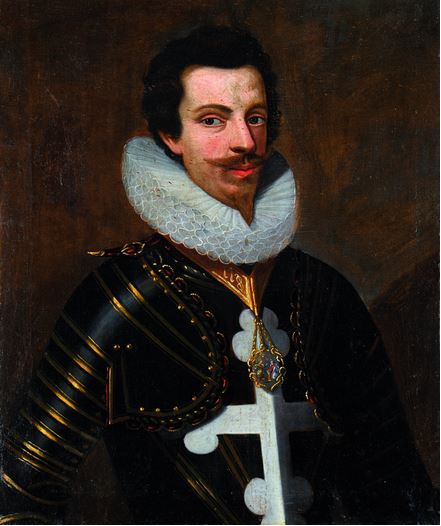
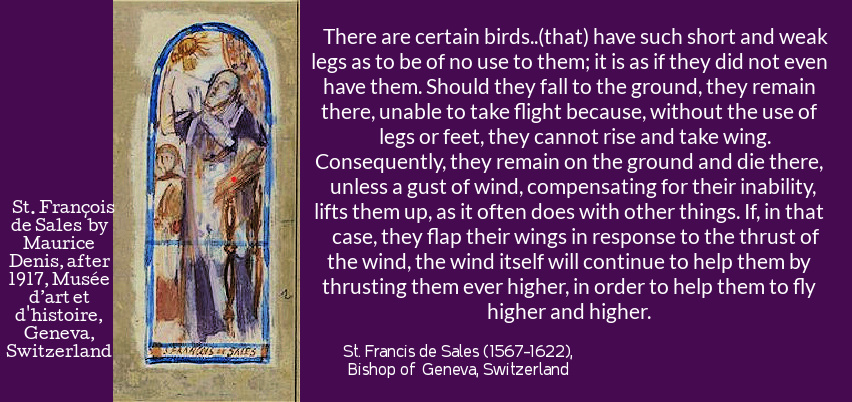
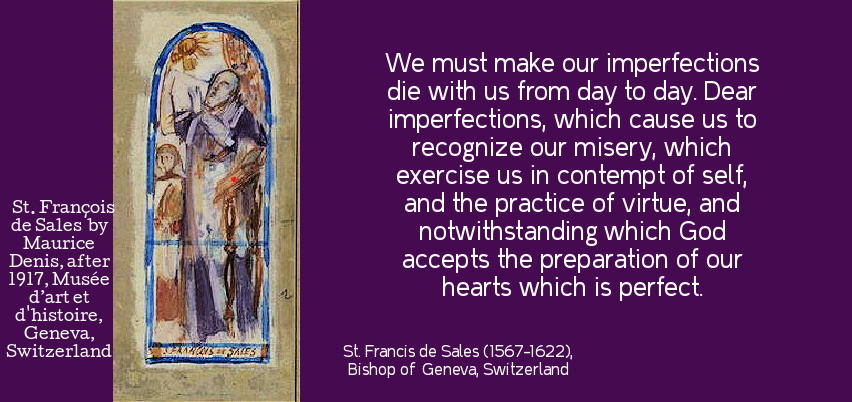
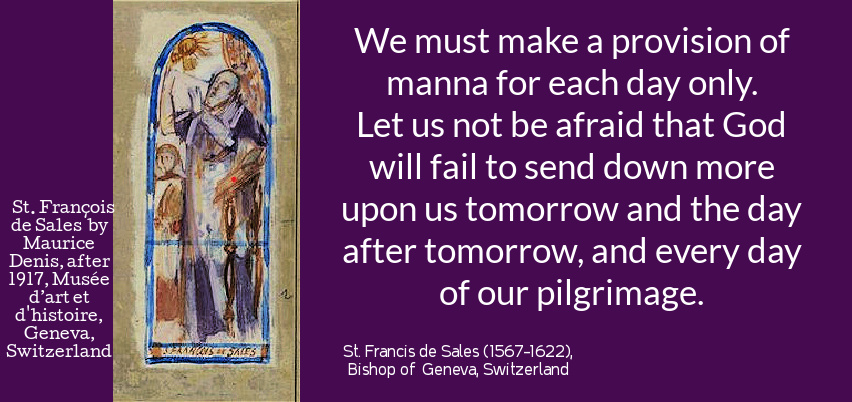
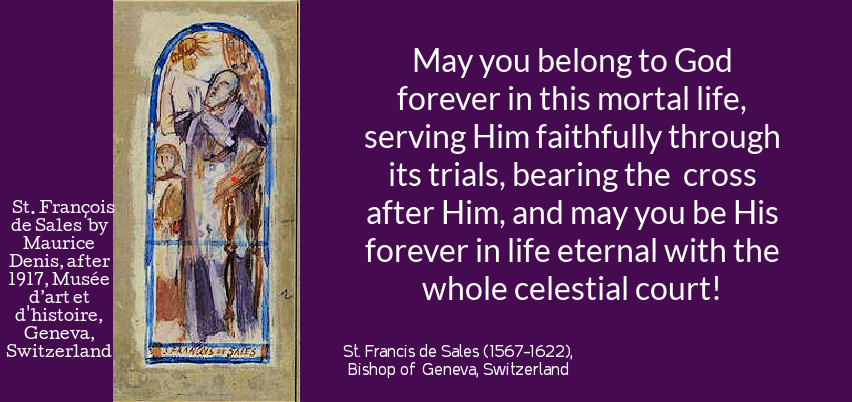
There are certain birds..(that) have such short and weak legs as to be of no use to them; it is as if they did not even have them. Should they fall to the ground, they remain there, unable to take flight because, without the use of legs or feet, they cannot rise and take wing. Consequently, they remain on the ground and die there, unless a gust of wind, compensating for their inability, lifts them up, as it often does with other things. If, in that case, they flap their wings in response to the thrust of the wind, the wind itself will continue to help them by thrusting them ever higher, in order to help them to fly higher and higher.Keep yourself faithfully in the presence of God. Avoid hurry and anxiety, for there are no greater obstacles to our progress in perfection.Cast your heart gently, not violently, into the wounds of our Savior and have an unlimited confidence in his mercy and goodness.To make good progress we must devote ourselves to getting over that portion of the path which lies close before us, and not amuse ourselves with the desire to attain the last step before we have accomplished the first.We must make our imperfections die with us from day to day. Dear imperfections, which cause us to recognize our misery, which exercise us in contempt of self, and the practice of virtue, and notwithstanding which God accepts the preparation of our hearts which is perfect.I recommend simplicity to you; look before you, and not at the dangers which you behold in the distance. Keep your will firmly bent upon serving God with your whole heart. While you are thus occupied in forecasting the future you expose yourself to some false step.Have no care for tomorrow. Think only of doing well today. And when tomorrow shall have become today, then we shall think about it.We must make a provision of manna for each day only. Let us not be afraid that God will fail to send down more upon us tomorrow and the day after tomorrow, and every day of our pilgrimage.Since the Heart of our Lord has no more loving law than meekness, humility, and charity, we must firmly maintain these dear virtues in us.True sanctity lies in love of God, and not in foolish imaginings, raptures, &c. Let us devote ourselves to the practice of true meekness and submission, to renouncement of self, to docility of heart, to love of abjection, to consideration for the wishes of others : this is true sanctity and the most amiable ecstasy of the children of God.May you belong to God forever in this mortal life, serving Him faithfully through its trials, bearing the cross after Him, and may you be His forever in life eternal with the whole celestial court!
Saint Francis gives the rule to Saint Jeanne de Chantal (Study for the Chapel of the Visitation at Nantes), 19th century, Elie Delaunay (1828-1891), Louvre. Public Domain.
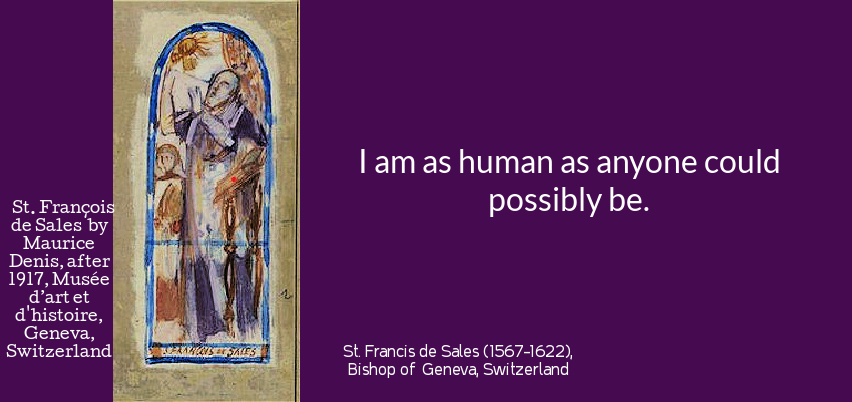
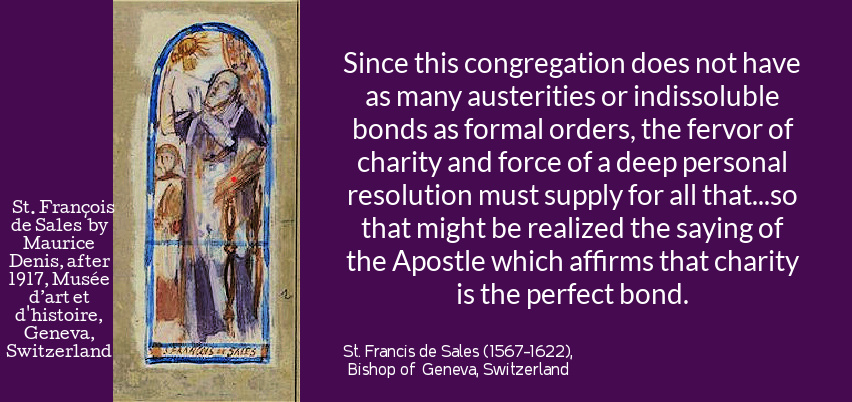
The reason persons are in the world is to receive and carry the gentle Jesus: on our tongue by proclaiming him and in our arms by doing good works.I am as human as anyone could possibly be.See the divine lover at the gate. He does not simply knock once. He continues to knock. He calls the soul: come, arise my beloved, hurry!…In short, this divine Savior forgets nothing to show that his mercies are above all his works, are greater than his judgment.Solitude has its assaults, the world its busyness – in either place we must be courageous since in either place divine help is available to those who trust God and humbly and gently ask for his fatherly assistance.Since this congregation does not have as many austerities or indissoluble bonds as formal orders, the fervor of charity and force of a deep personal resolution must supply for all that…so that might be realized the saying of the Apostle which affirms that charity is the perfect bond.
Saint François de Sales blesses Saint Jeanne de Chantal, Chapelle de la Visitation at Nantes n° 61 XIXe siècle. Elie Delaunay (1828-1891), Musée d’Arts de Nantes. Public Domain.
It is the height of holy disinterestedness to be content with naked, dry, and insensible acts carried out by the superior will alone….In the end, the savior wants us to be His so perfectly that nothing else remains for us, and to abandon ourselves to His providence without reservation.Since the heart is the source of all our actions, as the heart is, so are they.For myself, I cannot approve the methods of those who try to reform a person by beginning with external things, such as bearings, dress or hair. On the contrary, it seems to me that we should begin inside.I beg you, my dear Sister, govern your community with a great expansiveness of heart…The more solicitous, open, and supportive you are with them, the more you will win their hearts.I had the courage to my give [my own dying mother] the last blessing, to close her eyes and mouth and to give her the last kiss of peace at the moment she passed away; after which my heart swelled and I wept….
Saint Francis de Sales healing a lame man, Chapelle de la Visitation at Nantes n° 61 XIXe siècle. Elie Delaunay (1828-1891), Musée d’Arts de Nantes. Public Domain.
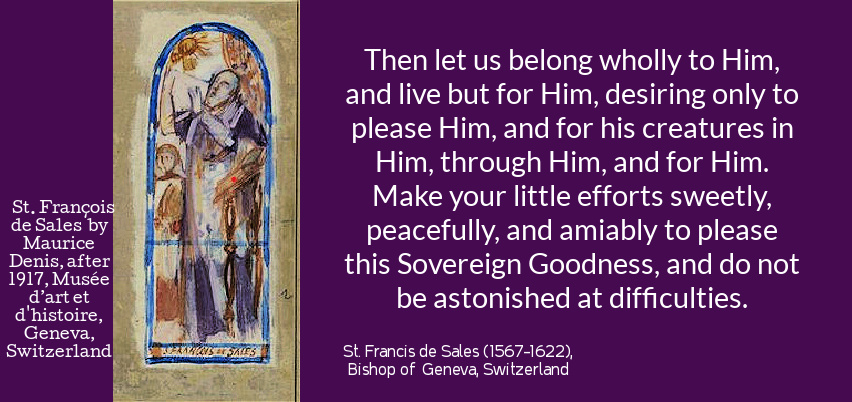
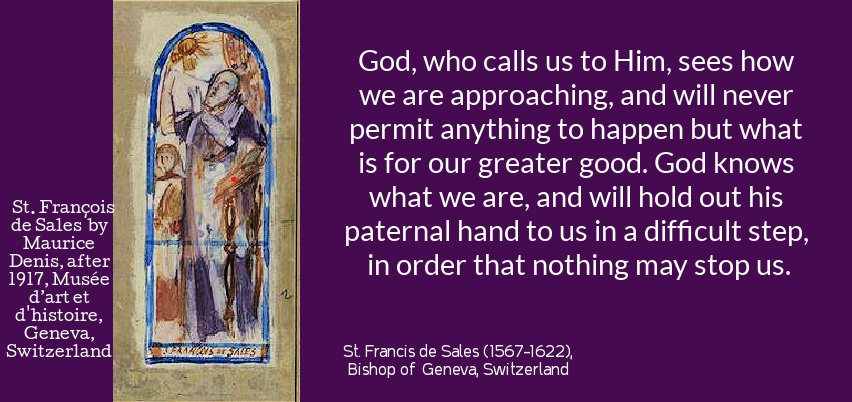
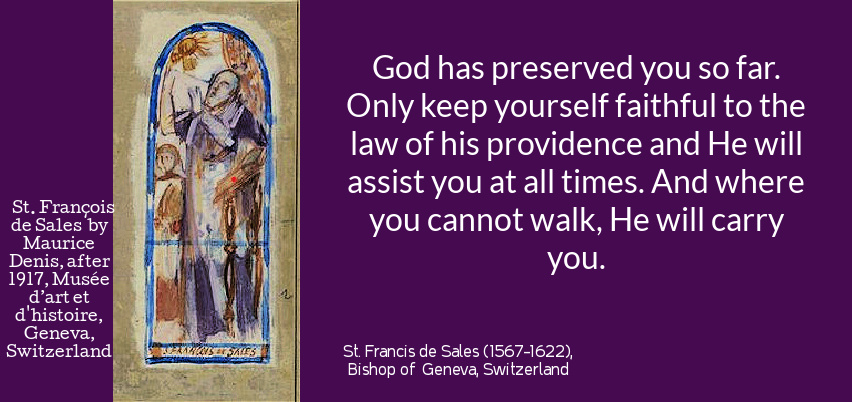
Then let us belong wholly to Him, and live but for Him, desiring only to please Him, and for his creatures in Him, through Him, and for Him. Make your little efforts sweetly, peacefully, and amiably to please this Sovereign Goodness, and do not be astonished at difficulties.We must be constant in aspiring to the perfection of holy love, in order that love may be perfect. For the love which seeks anything less than perfection cannot fail to be imperfect.Never permit your soul to be sad and live in bitterness of spirit or scrupulous fear, since He who loved it and died to give it life is so good, so sweet, so amiable.God, who calls us to Him, sees how we are approaching, and will never permit anything to happen but what is for our greater good. God knows what we are, and will hold out his paternal hand to us in a difficult step, in order that nothing may stop us.God has preserved you so far. Only keep yourself faithful to the law of his providence and He will assist you at all times. And where you cannot walk, He will carry you.
Saint Francis de Sales healing a lame man, Chapelle de la Visitation at Nantes n° 61 XIXe siècle. Elie Delaunay (1828-1891), Musée d’Arts de Nantes. Public Domain.
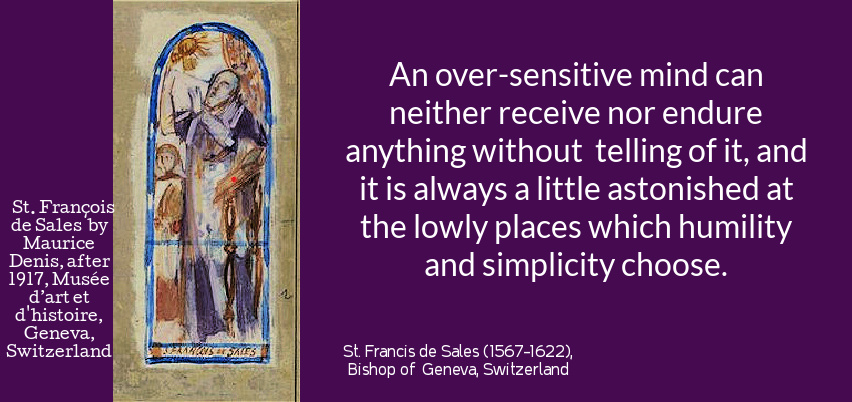
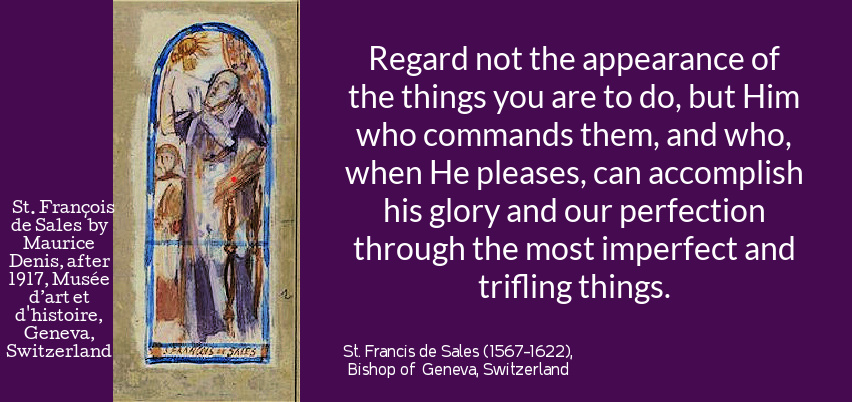
An over-sensitive mind can neither receive nor endure anything without telling of it, and it is always a little astonished at the lowly places which humility and simplicity choose.I see you with your vigorous heart which loves and wills powerfully. I like it, for what are those half -dead hearts good for? We must make a particular exercise once every week of willing to love the will of God more tenderly, more affectionately than anything in the world, and that, too, not only in bearable but in the most unbearable events.Plant in your heart Jesus Christ Crucified, and all the crosses of this world will seem to you like roses.Lord Jesus, without reserve, without an if, or a but, without exception or limitation, may you holy will be done in all things and at all times.Regard not the appearance of the things you are to do, but Him who commands them, and who, when He pleases, can accomplish his glory and our perfection through the most imperfect and trifling things.
Painting of St. Francis de Sales in Don Bosco’s rooms at the Oratory of St. Francis de Sales in Turin. Public Domain.
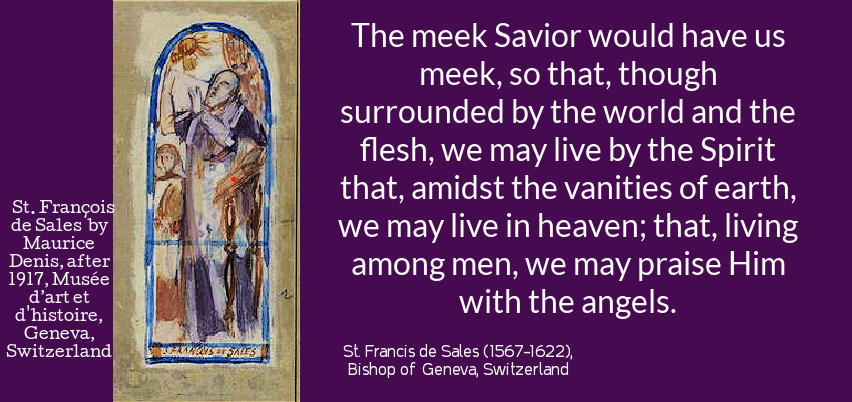
Behold this great Artisan of mercy. He converts our miseries into graces and our iniquities into salutary remedies for our souls. Tell me, I pray, what will He not do with the afflictions, the labors, the persecutions which assail us?Never think you have attained the purity of heart which you owe to God until your will is freely and joyfully resigned to his holy will in all things, even in the most repugnant.Daily strengthen yourself more and more in the resolution, which you formed with so much affection, of serving God according to his good pleasure. Regard Him who commands them and, when He pleases, can accomplish his glory and our perfection through the most imperfect and trifling things.A true servant of God has no care for tomorrow, but performs faithfully what is required today, and tomorrow will do what is required without a word.The meek Savior would have us meek, so that, though surrounded by the world and the flesh, we may live by the Spirit that, amidst the vanities of earth, we may live in heaven; that, living among men, we may praise Him with the angels.
St. Francis de Sales, 18th c, Besançon, 96 x 131 cm. Public Domain.
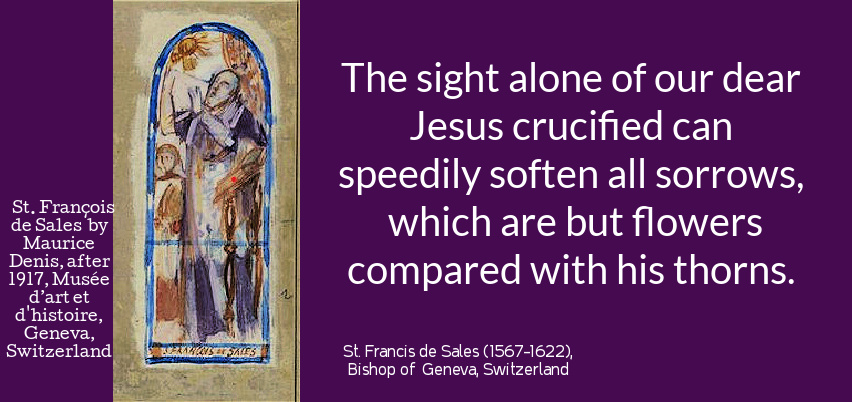
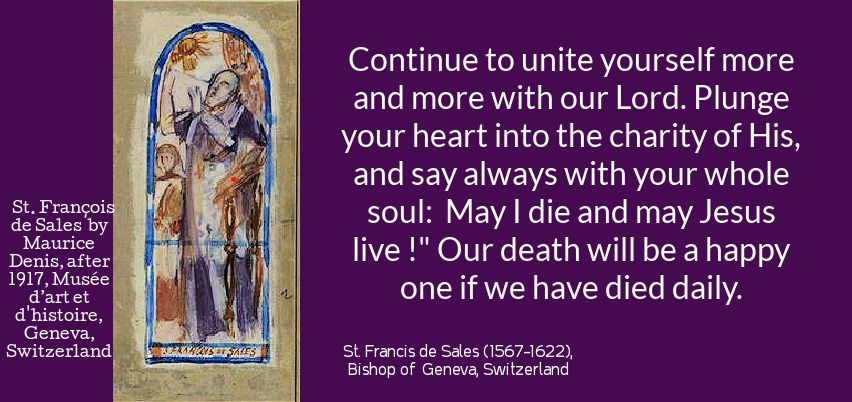
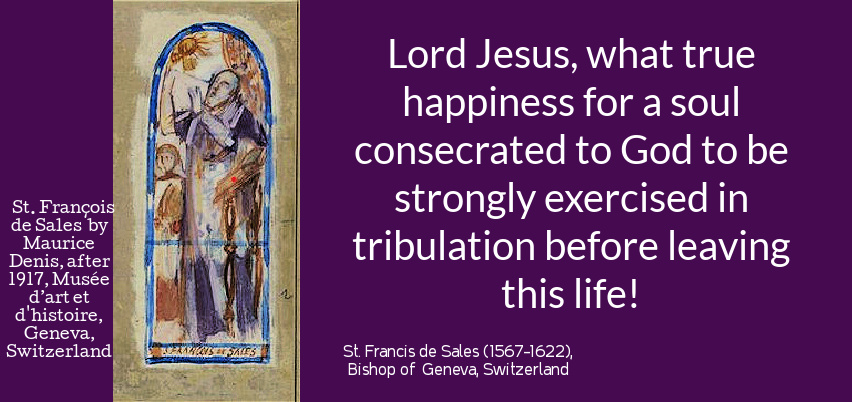
Here is the great lesson – we must discover God’s will, and, recognizing it, endeavor to do it joyfully, or at least courageously.The sight alone of our dear Jesus crucified can speedily soften all sorrows, which are but flowers compared with his thorns.Our great rendezvous is an eternal heaven and compared with the price of eternity, what are the things which end with time?Continue to unite yourself more and more with our Lord. Plunge your heart into the charity of His, and say always with your whole soul: May I die and may Jesus live !” Our death will be a happy one if we have died daily.Lord Jesus, what true happiness for a soul consecrated to God to be strongly exercised in tribulation before leaving this life!
Saint Francis Sales, antique pendant, Lyon, France. Public Domain.
Nothing can give us deeper peace in this world than to frequently contemplate our Lord in all the afflictions He endured from his birth to his death. Contempt, calumnies, poverty, abjection, weariness, suffering, nakedness, wrongs, and grief of every kind.Let us faithfully cultivate that resignation and pure love of God which is never wholly practiced but amid sufferings. For to love God, when He feeds us with sweetness is nothing more than children do. But to love God when He feeds us with gall is to offer Him the cup of our loving fidelity.It is not in my power to propose to Him anything for you, save that He may, according to his holy will, fashion your heart for his dwelling, and reign there eternally. And whether He fashion it with the brush, hammer, or chisel, must be according to his good pleasure.I desire that your cross and mine should be wholly the cross of Jesus. This or that burden, or making any choice, God knows what He is doing and why He does it. It is certainly for our good.God wishes that, like Job, I should serve Him in the midst of dryness, suffering, and temptation. Like St Paul, that I serve Him according to His desire. You will see that one day He will do all and even more than you can desire.
St. Francis de Sales. medallion. Public Domain.
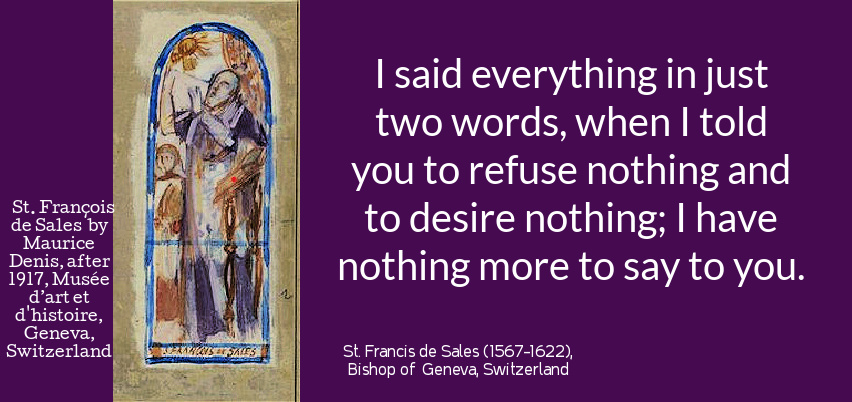
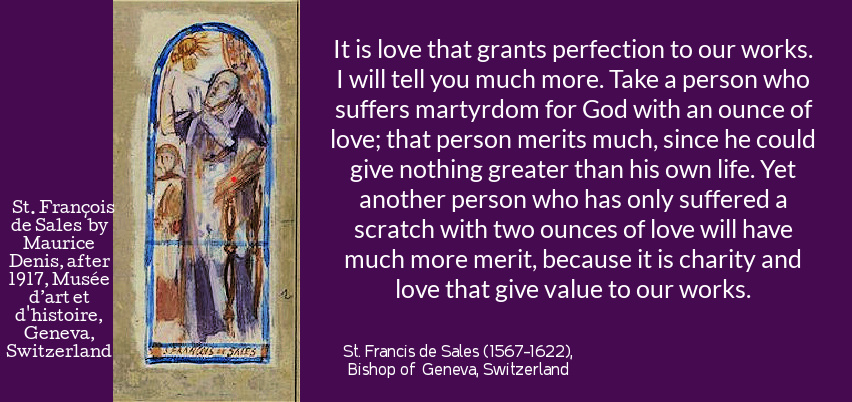
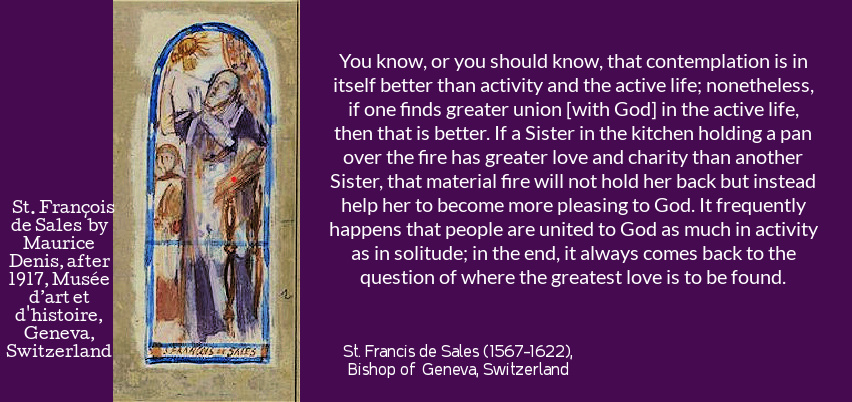
At the very thought of God, one immediately feels a certain delightful emotion of the heart, which testifies that God is God of the human heart.I said everything in just two words, when I told you to refuse nothing and to desire nothing; I have nothing more to say to you.Do you see the baby Jesus in the crib? He accepts all the discomforts of that season, the bitter cold and everything that the Father lets happen to him. He does not refuse the small consolations that his Mother gives him; we are not told that he ever reached out for his Mother’s breast, but left everything to her care and concern. So too, we ourselves should neither desire nor refuse anything, but accept all that God sends us, the bitter cold and the discomforts of the season.It is love that grants perfection to our works. I will tell you much more. Take a person who suffers martyrdom for God with an ounce of love; that person merits much, since he could give nothing greater than his own life. Yet another person who has only suffered a scratch with two ounces of love will have much more merit, because it is charity and love that give value to our works.You know, or you should know, that contemplation is in itself better than activity and the active life; nonetheless, if one finds greater union [with God] in the active life, then that is better. If a Sister in the kitchen holding a pan over the fire has greater love and charity than another Sister, that material fire will not hold her back but instead help her to become more pleasing to God. It frequently happens that people are united to God as much in activity as in solitude; in the end, it always comes back to the question of where the greatest love is to be found.In Holy Church, everything pertains to love, lives in love, is done for love and comes from love.Whatever may happen, Lord, you who hold everything in your hands and whose ways are all justice and truth, … I will love you, Lord, … I will love you here, O my God; I will hope always in your mercy and ever repeat your praise… O Lord Jesus, you will always be my hope and my salvation in the land of the living.I wonder whether another difficulty can also be raised concerning your reform: perhaps those who imposed it on you have treated the wound too harshly… I appreciate their method, although it is not what I am in the habit of using, especially with regard to noble and cultivated spirits like yours. I believe it is better simply to indicate the disease and put the scalpel in their hands, so that they themselves can make the necessary incision. Yet do not for this reason neglect the reform that you need.
Saint Jeanne de Chantal. antique pendant, Lyon, France. Public Domain.
The world is becoming so delicate that, in a little while, no one will dare any longer to touch it except with velvet gloves, or tend its wounds except with perfumed bandages; yet what does it matter, if only men and women are healed and finally saved? Charity, our queen, does everything for her children.My intention is but to represent, with simplicity and straightforwardly, without artifice and certainly without false colors, the history of the birth, progress, decline, operations, properties, advantages and sublime qualities of divine love.The power of grace does not constrain the heart, but attracts it. Grace possesses a holy violence, not to violate our liberty but to guide it to love. Grace acts strongly, yet in such a pleasing way that our will is not overwhelmed by so powerful a force; while pressing us, it does not oppress our liberty. Consequently, we are able, before all its might, to consent to or resist its promptings at our pleasure.God’s inspirations, Theotimos, anticipate us and make themselves felt before we are even aware of them, but once we become aware of them, it is up to us either to consent and follow their lead, or to refuse and reject them. They make themselves felt by us without us; yet without us they do not bring about our consent.All these fine people, commonly considered devout, most surely are not.In the end, charity and devotion can be said to differ from one another as fire from a flame. Charity is a spiritual fire that, when fanned into flame, is called devotion. Devotion thus adds nothing to the fire of charity but the flame that makes charity prompt, active and diligent, not only in the observance of God’s commandments but also in the exercise of his divine counsels and inspirations.Almost all those who have treated of devotion have sought to instruct persons living apart from the world, or at least they have taught a kind of devotion that leads to such isolation. I intend to offer my teachings to those who live in cities, in families, at court and who, by virtue of their state in life, are obliged to live in the midst of others.
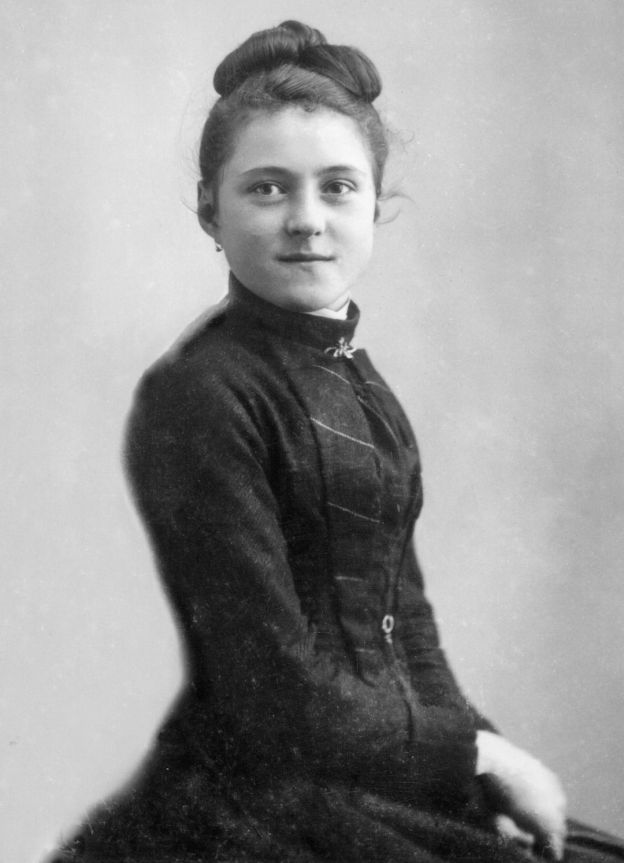
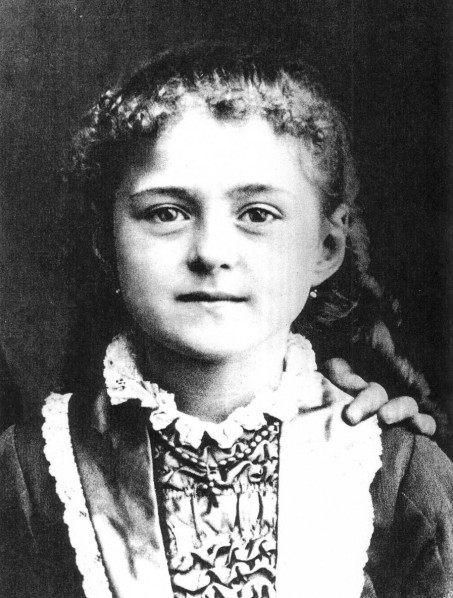
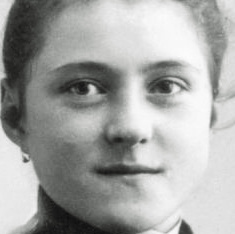
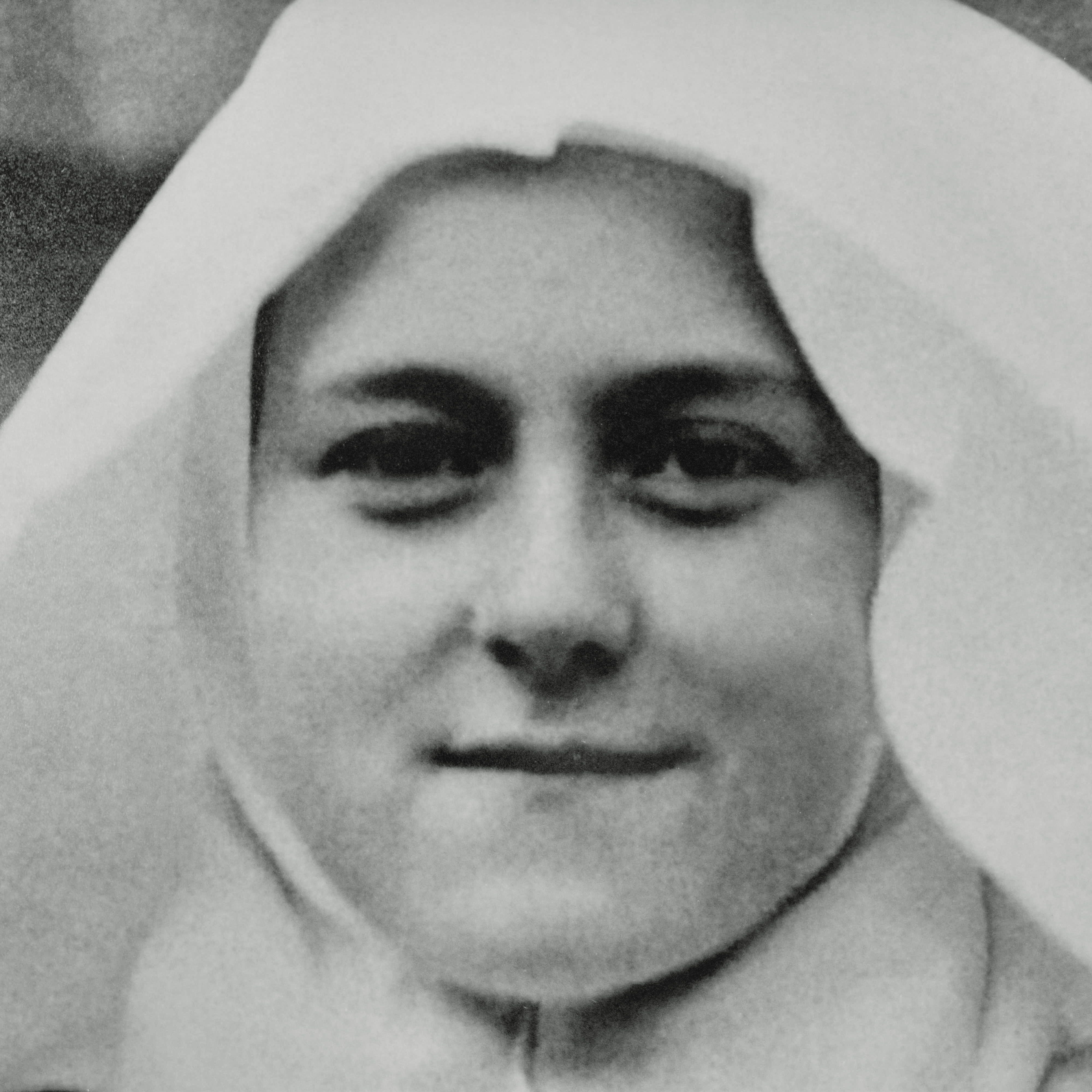
FEATURE image: Thérèse Martin (St. Thérèse of Lisieux) at 15 years old in a photograph taken in October 1887.
Saint Thérèse of Lisieux demonstrated that sanctity is achieved not through dramatic achievements but through humility, trust, suffering accepted with love, and fidelity to ordinary daily life, a spiritual vision that transformed an unknown Carmelite nun into one of the most influential figures in modern Christianity.
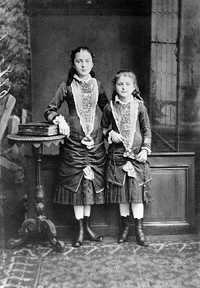
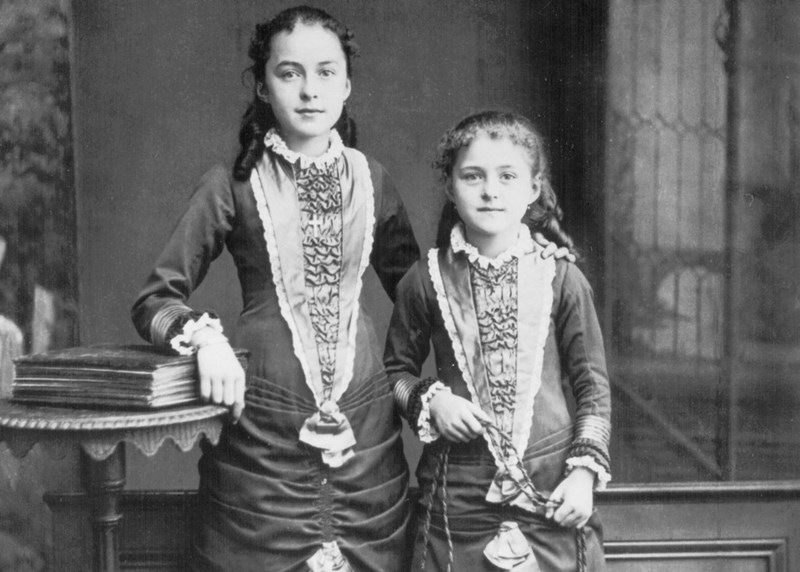
Thérèse Martin at 8 years old in 1881.
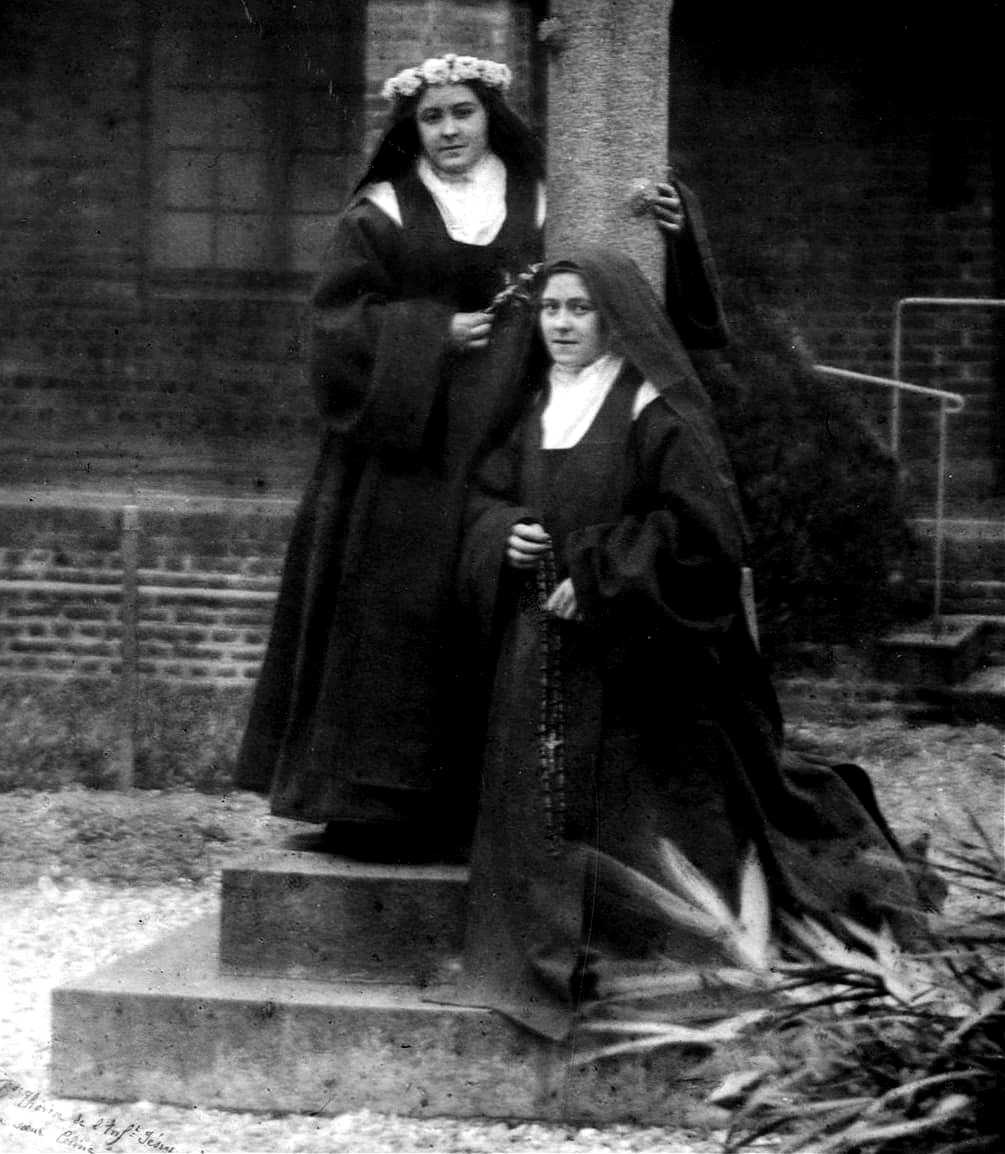
Thérèse Martin at 8 years old in 1881 with her sister Céline. The Martin family had moved from Alençon to Lisieux to be with the Guerin relatives. Zélie Martin had died four years before.
By John P. Walsh
October 1 is the feast day of Saint Thérèse of Lisieux (French, 1873-1897), one of only four women “doctors” in the Roman Catholic Church, and popularly known as The Little Flower of Jesus. Her religious name is Thérèse of the Child Jesus and the Holy Face and, with St. Francis of Assisi, she is one of today’s most popular saints. For a young Norman woman who died at 24 years old in an obscure convent in northern France that is a surprisingly solid list of titles and accolades.
Yet, when she died on September 30, 1897, the Carmelite nuns in her community at the Carmel in Lisieux didn’t think they had any accomplishments to cite for her obituary. Her sister Céline (1869-1959), a nun in the same convent as Thérèse, observed: “In general, even in the last years, she continued to lead a hidden life, the sublimity of which was known more to God than to the Sisters around her.”1
Born Marie-Françoise-Thérèse Martin in 1873, she was the youngest of five sisters and lively and precocious. She lost her mother Zélie Martin (née Guérin, 1831-1877) to breast cancer as a four-year-old. The next decade – according to Thérèse’s journal (The Story of a Soul, begun in 1895) – was the most “distressing” years of her life.2
Thérèse’s mother was the breadwinner in the Martin house and after she died little Thérèse naturally turned to her father Louis (1823-1894) for nurturing along with her four older sisters — especially the second eldest, Pauline.
For the rest of the 1870s and into the 1880s, Thérèse was the high-spirited baby sister in the family home called Les Buissonnets in the Normandy town of Lisieux.
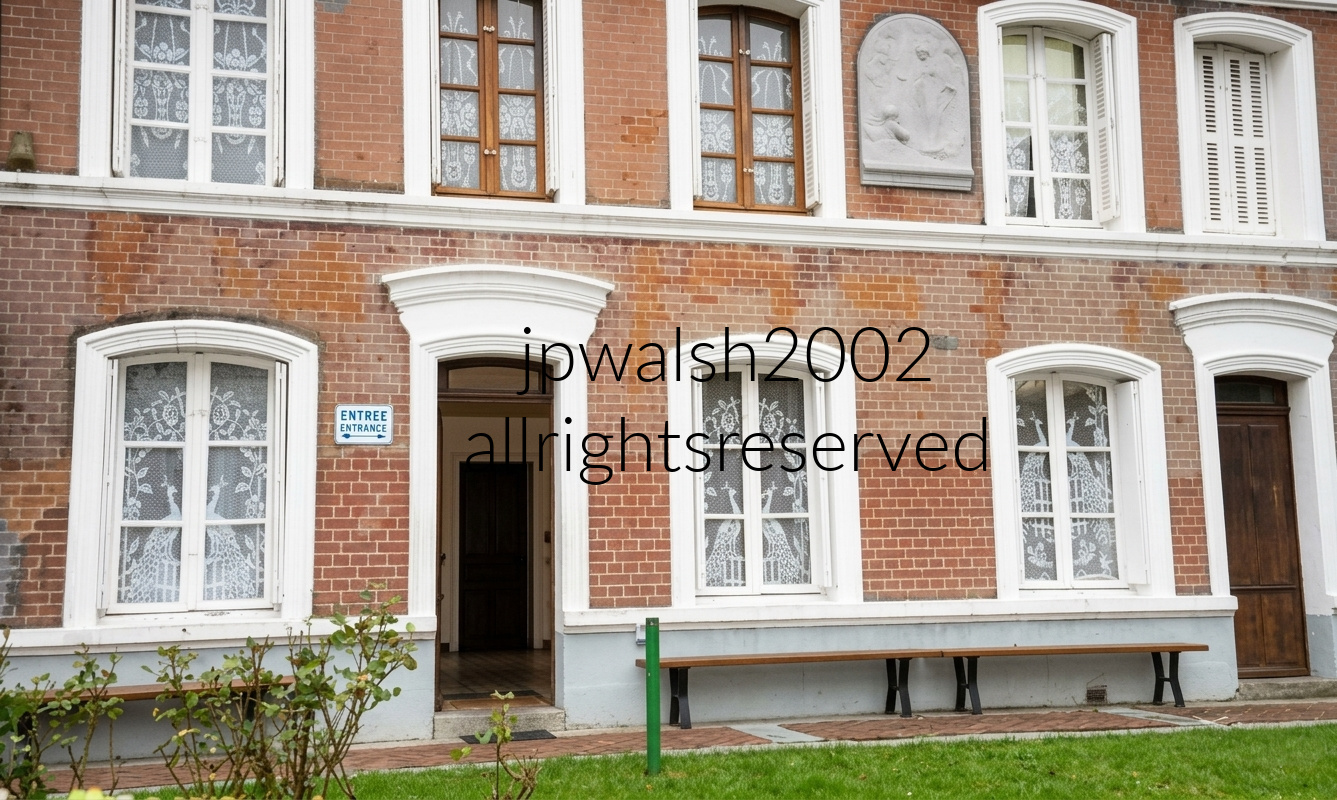
Les Buissonnets, at 22 Chemin des Buissonnets in Lisieux, Normandy, is the historic brick home where St. Thérèse of Lisieux spent her childhood. The Martin family moved here in November 1877 after the death of her mother, Zélie Martin, in Alençon. Thérèse lived in this house from age four until she left at fifteen to enter the Carmel of Lisieux in 1888, beginning the religious life that would define her legacy.
Thérèse was born in Alençon in 1873 and raised in Lisieux after the death of her mother.
Les Buissonnets, St. Thérèse of Lisieux’s childhood home in Lisieux, France. October 2002. Author’s photograph.
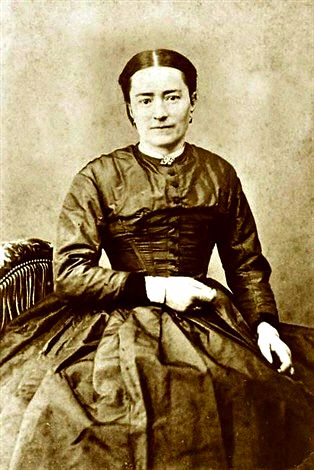
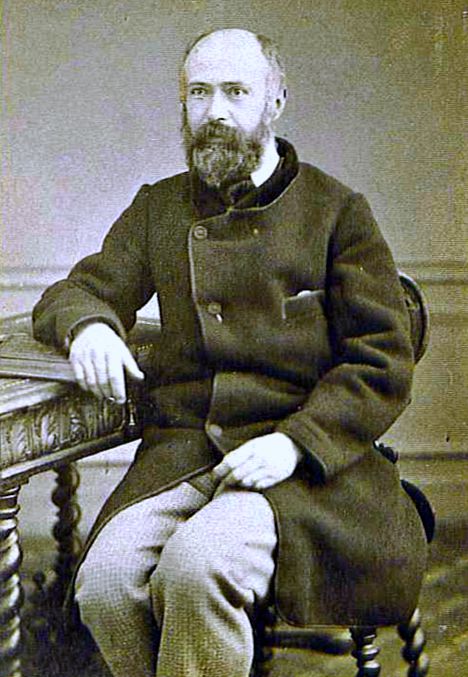
St. Azélie-Marie “Zélie” Martin née Guérin (1831 -1877) and St. Louis Martin (1823 –1894), the mother and father of Saint Thérèse of Lisieux. The married couple were canonized together in the Catholic Church by Pope Francis on October 18, 2015.
As three of Thérèse’s sisters left the family homestead to enter convents -– two of them to a Carmelite convent (“Carmel”) in Lisieux and another later to a Visitation convent in Caen– the two youngest sisters, Céline and Thérèse, remained at home with their father.
Although Louis adored Thérèse and called her his “little flower,” Thérèse was headstrong and obstinate and she seemed to do chores with the attitude like she was doing the household a big favor. The young child also began to have panic attacks. Though intelligent and educated, at ten years old Thérèse believed she saw a statue of the Blessed Virgin given to her by her mother in her bedroom smile at her. While unusual, from that point forward, the girl’s nerves calmed. These early tantrums left a mark on her reputation. They, along with some of her later writings in journals, letters, and poems, left the future saint prey for others in her lifetime and after her death to be called “immature” and “sentimental,” even “neurotic.”3
Doubtless some of Thérèse’s thoughts sound naïve, though she writes profoundly: “At times when I am reading certain spiritual treatises in which perfection is shown through a thousand obstacles…my poor little mind quickly tires; I close the learned book that is breaking my head and drying up my heart and I take up Holy Scripture. Then all seems luminous to me; a single word uncovers for my soul infinite horizons, perfection seems simple to me, I see it is sufficient to recognize one’s nothingness and to abandon oneself as a child into God’s arms.”4
Marie.
Marie (1860-1940), the eldest Martin sister. After she entered the Carmel in Lisieux, she was called Sister Marie of the Sacred Heart.
Pauline.
Pauline (1861- 1951). Thérèse’s “favorite” sister. When Pauline entered the Carmel in Lisieux her name was Mother Agnes of Jesus.
Léonie.
Léonie (1863-1941). She entered the Visitation Sisters in Caen and took the name Sister Françoise-Thérèse.
Céline.
Céline (1869-1959) was four years older than Thérèse and closest in age. She entered the Carmel in Lisieux after Thérèse and took the name Sister Geneviève of the Holy Face.
On April 9, 1888, a 15-year-old Thérèse entered the Carmel de Lisieux on Rue du Carmel, less than a one-half mile walk from Les Buissonnets. Younger than a typical postulant, exceptions had to be made. She received the habit after some delay mostly because of her father’s declining health in January 1890. Although her profession was also postponed, Thérèse’s spiritual life was deepening through her reading of another Carmelite, St. John of the Cross (1542-1591).
St. Thérèse of Lisieux as a young nun read deeply of Saint John of the Cross who said many beautiful things about having a close relationship with Jesus.
In due time, despite difficulty in prayer and doubts about becoming a nun, Thérèse received the black veil in September 1890. In early 1891 the 18-year-old Thérèse was made sacristan’s aide, a duty she carried into 1892 as her father lay slowly dying. During this time her reading and prayer transitioned to the Gospels and she began to write poems for which she had talent. Founded in 1838 as a “progressive” convent so that by the 1890’s the nuns were allowed to practice photography within its walls, the Carmel was also a working-class foundation comprised of daughters of shop-keepers and craftspeople brought up to expect a day’s work for a day’s wage. Thérèse, like another young French mystic saint, St. Bernadette Soubirous, sought to be useful.
When Thérèse’s favorite sister Pauline was elected prioress in early 1893, Thérèse was appointed novice master (though a novice herself) and embarked on her artistic avocation of picture painting. Scheduled to graduate from the novitiate in September 1893 it was postponed in part due to convent politics. The duty of doorkeeper’s aide was added to Thérèse’s tasks.
In the spring of 1894 Thérèse began to experience chest pains and a hoarse throat that grew worse by that summer. After her father died in July 1894, Céline entered the Carmel six weeks later. It was at that time that Thérèse began to seriously formulate her “little way” of seeking holiness of life based on scripture passages. Before 1894 had ended, her sister Pauline (Mother Agnes Of Jesus) ordered her to begin to record her life story in a journal (The Story of a Soul). The novice composed her journal in segments in her free time over the next two and a half years.
Early in 1895 Thérèse voiced the first prediction of her death as her prayer life was working out an idea for what she would dedicate her life to. It would be a life with God whom she called Merciful Love. On June 9, 1895, the Feast of the Holy Trinity, during Mass, Thérèse decided to offer herself to Merciful Love who is the Lord. Thérèse confided these spiritual developments to Céline so that by summer 1895 Thérèse recommended the same devotion to more nuns in the community.
Sister Geneviève recounted later in her memoirs: “Coming out of Mass, eyes all on fire, breathing holy enthusiasm, Thérèse dragged me without saying a word to follow our Mother who was then Mother Agnes of Jesus. She told him in front of me how she had just offered herself as a Holocaust Victim to Merciful Love, asking her permission to deliver us together. Our Mother, in a great hurry at the moment, allowed everything without really understanding what it was about. Once alone, Thérèse confided in me the grace she had received and began to compose an act of offering.” (”Au sortir de la messe, l’œil tout enflammé, respirant un saint enthousiasme, Thérèse m’entraîna sans mot dire à la suite de notre Mère qui était alors Mère Agnès de Jésus. Elle lui raconta devant moi comment elle venait de s’offrir en Victime d’Holocauste à l’Amour Miséricordieux, lui demandant la permission de nous livrer ensemble. Notre Mère, très pressée en ce moment, permit tout sans trop comprendre de quoi il s’agissait. Une fois seule, Thérèse me confia la grâce qu’elle avait reçue et se mit à composer un acte d’offrande.”)
June 11, 1895.
Céline (Sister Geneviève) and Thérèse, June 11, 1895.
Throughout 1895 Thérèse continued to write–composing poems and giving them as gifts on special occasions, writing plays and painting pictures. Her spirit was characterized by humility.
Thérèse wrote: “How shall she prove her lovesince love is proved by works? Well, the little child will strew flowers, she will perfume the royal throne with their sweet scents, and she will sing in her silvery tones the canticle of Love.”5 (the emphases are Thérèse’s).
July 1876, Thérèse.
Taken in the first part of July 1876, Thérèse is 3 1/2 years old. As a child she was stubborn and headstrong. For this photography sitting, Thérèse was fidgety and ill at ease. Looking as if she might cry, the photographer had to take her photograph several times so to achieve this image of Thérèse with a pouting look. Thérèse’s mother, Zélie Martin, accompanied her youngest child during the photography session and had to reassure her throughout.
February 1886.
Thérèse was 13 years old in this photograph taken in February 1886. Just months later, at Christmas 1886, Thérèse made her first Holy Communion and at once her nervous childhood sensitivity stopped. That December 1886 she wrote about these occurrences, stating: “I felt love enter my soul, and the need to forget myself and please others, and since then I have been happy.”
October 1887.
Pretty and well-dressed Thérèse at 15 years old in a photograph taken in October 1887. At the time this photograph was taken Thérèse was seeking the permission of Bishop at Bayeux, Flavien-Abel-Antoinin Hugonin (1823-1898), to enter the convent of Carmel. She entered on April 9, 1888.
Thérèse 1887.
Thérèse entered the Carmelite convent in Lisieux at age fifteen after obtaining special permission because of her youth.
Above: Recent photograph of the Carmelite convent (Carmel) where Thérèse Martin entered at Lisieux in April 1888 and photograph of Carmel taken in September 1894 by Céline. Thérèse stands on the steps, third from the right.
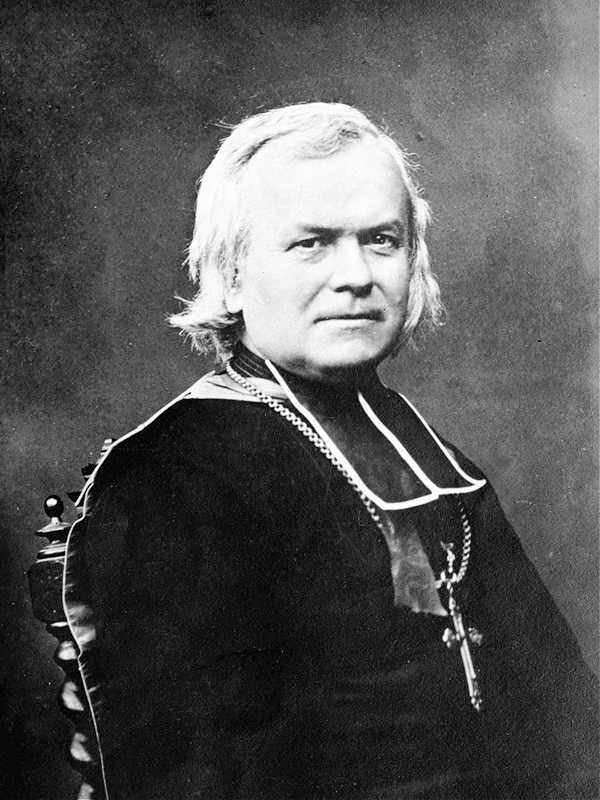
Bishop Flavien-Abel-Antoine Hugonin (July 3, 1823 – May 2, 1898).
Bishop Hugonin of Bayeux and Lisieux had confirmed Thérèse on June 14, 1884. Nearly four years later, he authorized, with some reluctance on account of her young age, Thérèse’s entrance in Carmel at 15 years old. Soon after, Bishop Hugonin presided over her clothing on January 10, 1889 as he showed continued solicitude for the young Carmelite novice he had specially approved. Less than two months before his own death in May 1898, Bishop Hugonin, on March 7, 1898, gave his verbal imprimatur to Thérèse’s Story of a Soul.
Thérèse January 1889.
Above: Thérèse as a novice in Carmel in January 1889. She was 16 years old and in the convent nine months. The photographs were taken by Fr. Gombault, the bursar of the minor seminary.
Late 1894.
Thérèse (right) was one of five Martin sisters who became religious nuns. The photograph was taken by Céline in late 1894 or early 1895.
Original oil oval portrait painting of Thérèse by Céline based on her photograph of Thérèse around Christmas 1894. Céline later claimed that this image captured the real Thérèse. National Shrine & Museum of St. Thérèse, Darien. Author’s photograph.
Detail of a photograph of Thérèse taken by Céline in late 1894 or early 1895. The photographic image was the basis for an oval portrait painting done by Céline in the same time period.
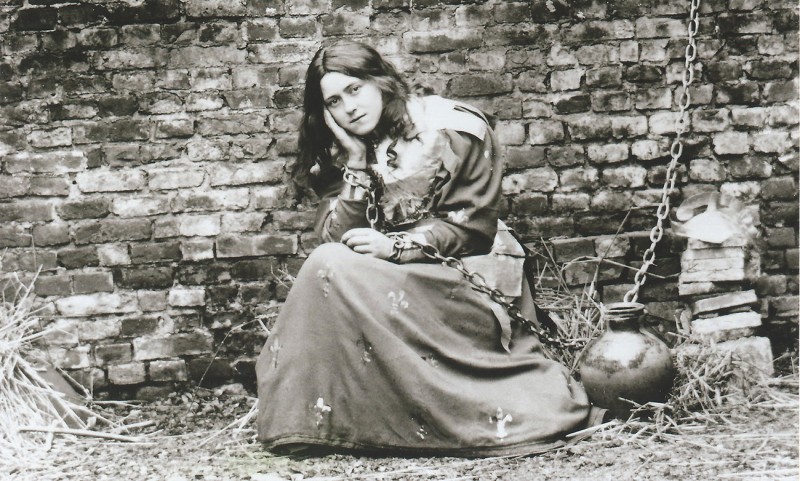
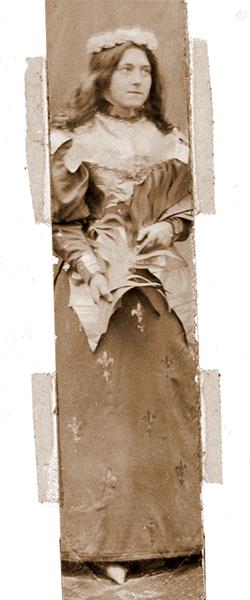
Thérèse dressed as Joan of Arc in winter 1895.
A series of photographs taken by Céline from January 21 to March 25, 1895, in the convent courtyard. Thérèse is dressed as Joan of Arc. Thérèse played the part of La Pucelle in a play Thérèse had written called Joan of Arc Accomplishing Her Mission.
A longtime revered figure in France, Joan of Arc was not yet a canonized saint in late winter 1895 (Joan became a saint in 1920 and is today patron of France).
In March 1895 Thérèse was 22 years old. In a little over a year Thérèse’s symptoms of tuberculosis indicated a serious turn for the worse in her health. Over the next two years, her health continued to decline so that by summer 1897 Thérèse was on her death bed.
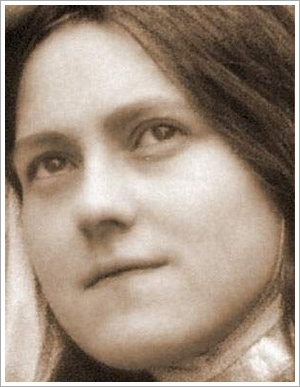
Close up of a photograph taken by Céline of Thérèse dressed as Joan of Arc in 1895.
Thérèse developed her famous spiritual philosophy known as the “Little Way,” rooted in humility, simplicity, and complete trust in God and love of Him.
Thérèse knew her great desire to be a missionary to Vietnam was now impractical. In June 1895 Thérèse decided to have an earthly mission within convent walls of “merciful love” and the “little way.” Like young Joan of Arc, Thérèse’s spiritual mission began on earth and would continue in heaven. So that a little over 6 months before her early death at 24 years old, Thérèse implored the favor by the command of Our Lord and of the Angels of “spending her heaven doing good on earth.”
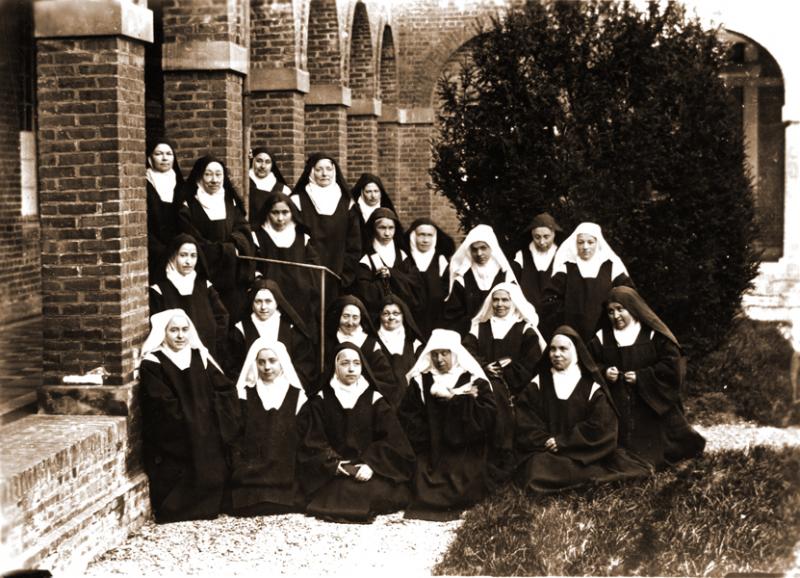
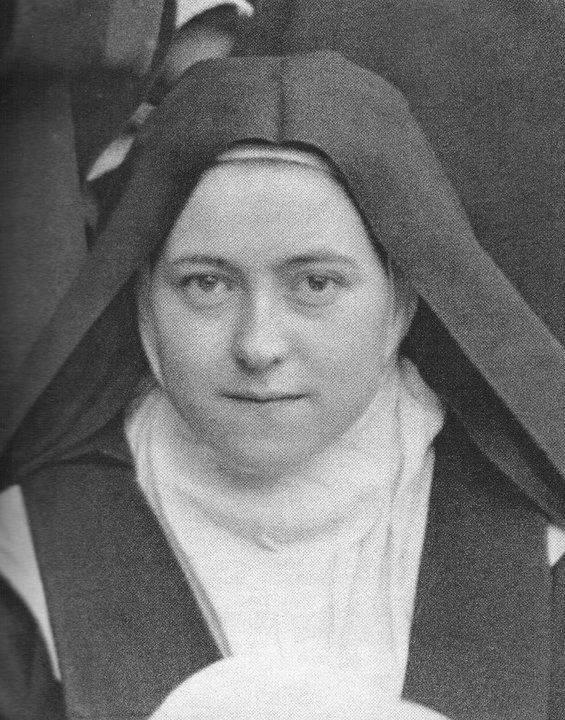
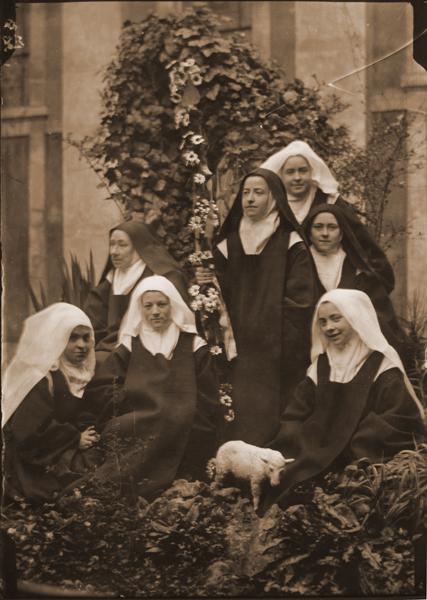
Community of 22 Carmelite nuns in a photograph taken by Céline on Easter Monday, April 15th, 1895. First row left to right: Geneviève of the Holy Face (Céline). Second row left to right: Mother Agnès of Jesus (Pauline) and Thérèse of the Child Jesus.
Easter Monday, April 15, 1895.
Photograph taken by Céline for the feast of the Good Shepherd, April 27 or 28, 1895. Thérèse is at right between two of her white-veiled novices.
Above photograph (including close-up) was taken by Céline in July 1896. Thérèse had been ill for several months.
After July 3, 1896, photograph taken by Céline.
Thérèse 1896.
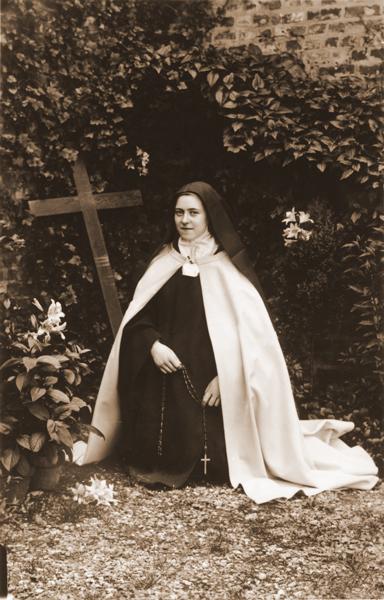
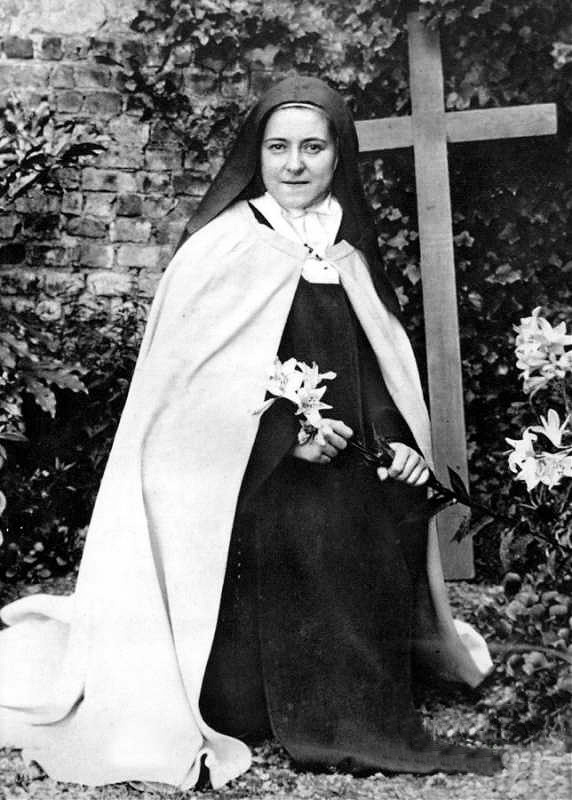
Thérèse holds a lily in a photograph taken by Céline in the convent garden in July 1896.
Carmel, July 1896.
Photograph of the community taken by Céline. July 1896.
November 1896.
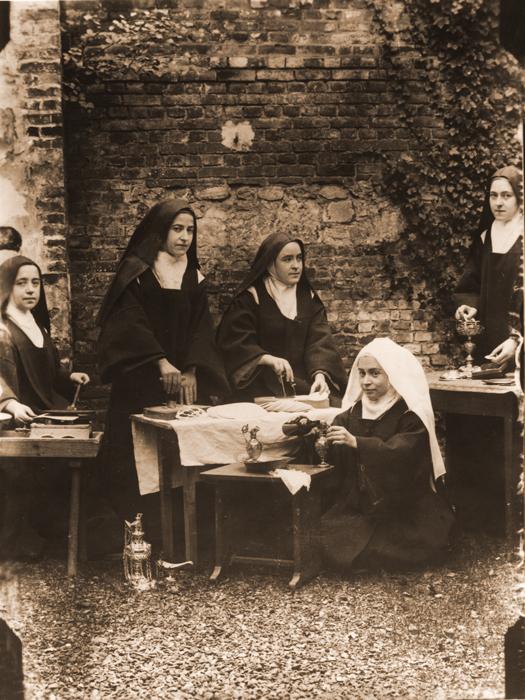
Photograph taken by Céline in early-mid November 1896 of her sisters and cousin showing the work of the sacristan. Thérèse stands at right. In September 1896 Thérèse wrote a letter to her sister Marie whose text called Manuscript B became part of The Story of a Soul.
Thérèse recorded her spiritual experiences in The Story of a Soul, one of the most influential religious autobiographies of the modern age.
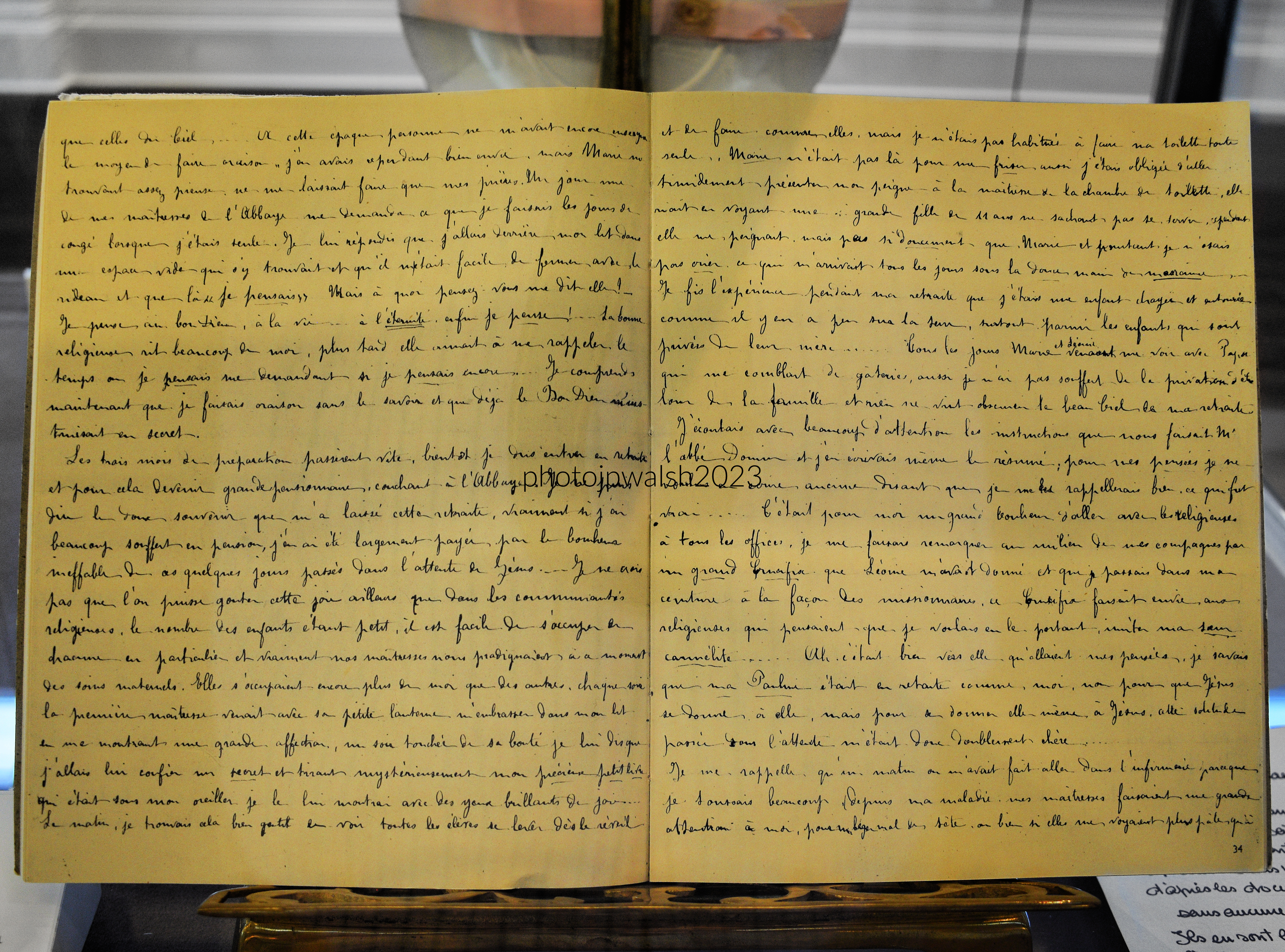
Photocopied pages of Thérèse’s original notebook entries in Thérèse’s own handwriting. National Shrine & Museum of St. Thérèse, Darien. Author’s photograph.
Published transcriptions of The Story of a Soul (“HISTOIRE D’UNE AME”) have varied over the years by way of editorial additions, omissions or consolidations that have taken liberties with Thérèse’s original notebook entries whose form can be like a shower of roses of her memory. One version of the spiritual classic that was updated to 1911 had followed her second exhumation in 1910 in the presence of the bishop of Bayeux which led to the start of her canonization process in 1914 (Thérèse of Lisieux was canonized in Rome on May 17, 1925). The text provides in French the following transcription of these photocopied pages in Thérèse’s own handwriting. They appear in chapter 4 (“CHAPITRE IV”) of the 1911 publication where Thérèse discusses her life in the mid-1880s as a child and teenager which includes her first Communion, Confirmation, and her personal experiences of light and darkness. Thérèse relates her deliverance from her interior pains which left her with an indescribably deep sweet peace that followed her into the convent of Carmel in Lisieux in 1888 and stayed with her in that place amid the greatest trials until her death there in 1897. These pages are part of the display at the National Shrine and Museum of St. Therese in Darien, Illinois.
French:
A cette époque, il m’eût été bien doux de faire oraison; mais Marie, me trouvant assez pieuse, ne me permettait que mes seules prières vocales. Un jour, à l’Abbaye, une de mes maîtresses me demanda quelles étaient mes occupations les jours de congé, quand je restais aux Buissonnets. Je répondis timidement: «Madame, je vais bien souvent me cacher dans un petit espace vide de ma chambre, qu’il m’est facile de fermer avec les rideaux de mon lit, et là, je pense…—Mais à quoi pensez-vous? me dit en riant la bonne religieuse.—Je pense au bon Dieu, à la rapidité de la vie, à l’éternité; enfin, je pense!» Cette réflexion ne fut pas perdue, et plus tard ma maîtresse aimait à me rappeler le temps où je pensais, me demandant si je pensais encore… Je comprends aujourd’hui que je faisais alors une véritable oraison, dans laquelle le divin Maître instruisait doucement mon cœur. Les trois mois de préparation à ma première communion passèrent vite; bientôt je dus entrer en retraite et pendant ce temps devenir grande pensionnaire. Ah! quelle retraite bénie! Je ne crois pas que l’on puisse goûter une semblable joie ailleurs que dans les communautés religieuses: le nombre des enfants étant petit, il est d’autant plus facile de s’occuper de chacune. Oui, je l’écris avec une reconnaissance filiale: nos maîtresses de l’Abbaye nous prodiguaient alors des soins vraiment maternels. Je ne sais pour quel motif, mais je m’apercevais bien qu’elles veillaient plus encore sur moi que sur mes compagnes. Chaque soir, la première maîtresse venait avec sa petite lanterne ouvrir doucement les rideaux de mon lit, et déposait sur mon front un tendre baiser. Elle me témoignait tant d’affection, que, touchée de sa bonté, je lui dis un soir: «O Madame, je vous aime bien, aussi je vais vous confier un grand secret.» Tirant alors mystérieusement le précieux petit livre du Carmel, caché sous mon oreiller, je le lui montrai avec des yeux brillants de joie. Elle l’ouvrit bien délicatement, le feuilleta avec attention et me fit remarquer combien j’étais privilégiée. Plusieurs fois, en effet, pendant ma retraite, je fis l’expérience que bien peu d’enfants, comme moi privées de leur mère, sont aussi choyées que je l’étais à cet âge. J’écoutais avec beaucoup d’attention les instructions données par M. l’abbé Domin, et j’en faisais soigneusement le résumé. Pour mes pensées, je ne voulus en écrire aucune, disant que je me les rappellerais bien; ce qui fut vrai. Avec quel bonheur je me rendais à tous les offices comme les religieuses! Je me faisais remarquer au milieu de mes petites compagnes par un grand crucifix donné par ma chère Léonie; je le passais dans ma ceinture à la façon des missionnaires, et l’on crut que je voulais imiter ainsi ma sœur carmélite. C’était bien vers elle, en effet, que s’envolaient souvent mes pensées et mon cœur! Je la savais en retraite aussi; non pas, il est vrai, pour que Jésus se donnât à elle, mais pour se donner elle-même tout entière à Jésus, et cela le jour même de ma première communion. Cette solitude passée dans l’attente me fut donc doublement chère. Enfin le beau jour entre tous les jours de la vie se leva pour moi! Quels ineffables souvenirs laissèrent dans mon âme les moindres détails de ces heures du ciel! Le joyeux réveil de l’aurore, les baisers respectueux et tendres des maîtresses et des grandes compagnes, la chambre de toilette remplie de flocons neigeux, dont chaque enfant se voyait revêtue à son tour; surtout l’entrée à la chapelle et le chant du cantique matinal: O saint autel qu’environnent les anges!*
At that time, it would have been very sweet for me to make prayers; but Mary, finding me quite pious, allowed me only my vocal prayers. One day, at the Abbey, one of my mistresses asked me what my occupations were on my days off, when I stayed at Les Buissonnets. I replied timidly: “Madam, I often go to hide in a small empty space in my room, which it is easy for me to close with the curtains of my bed, and there, I think…—But what are you thinking? said the good nun, laughing.—I think of God, of the rapidity of life, of eternity; well, I think!” This reflection was not lost, and later my mistress liked to remind me of the time when I thought, asking me if I still thought… I understand today that I was then making a true prayer, in which the divine Master gently instructed my heart. The three months of preparation for my First Communion passed quickly; Soon I had to retire and during this time become a boarder. Ah! What a blessed retreat! I do not believe that one can taste such joy anywhere else than in religious communities: the number of children being small, it is all the easier to take care of each one. Yes, I write it with filial gratitude: our mistresses of the Abbey then provided us with truly maternal care. I do not know for what reason, but I could see that they watched over me even more than my companions. Every evening, the first mistress came with her little lantern gently to open the curtains of my bed, and placed on my forehead a tender kiss. I listened very carefully to the instructions given by Father Domin, and I carefully summarized them. For my thoughts, I would not write any, saying that I would remember them well; which was true. With what happiness I went to all the services like the nuns! I was noticed in the midst of my little companions by a large crucifix given by my dear Léonie; I put it in my belt like missionaries, and it was thought that I wanted to imitate my Carmelite sister in this way. It was to her, indeed, that my thoughts and my heart often flew away! I knew she was retired too; not, it is true, so that Jesus might give himself to her, but to give herself entirely to Jesus, and that on the very day of my First Communion. This solitude spent waiting was therefore doubly dear to me. At last the beautiful day between all the days of life dawned for me! What ineffable memories left in my soul the smallest details of those hours of heaven! The joyful awakening of dawn, the respectful and tender kisses of mistresses and great companions, the washroom filled with snowflakes, with which each child saw himself clothed in turn; especially the entrance to the chapel and the singing of the morning hymn: O holy altar that surrounds the angels!
June 7, 1897.
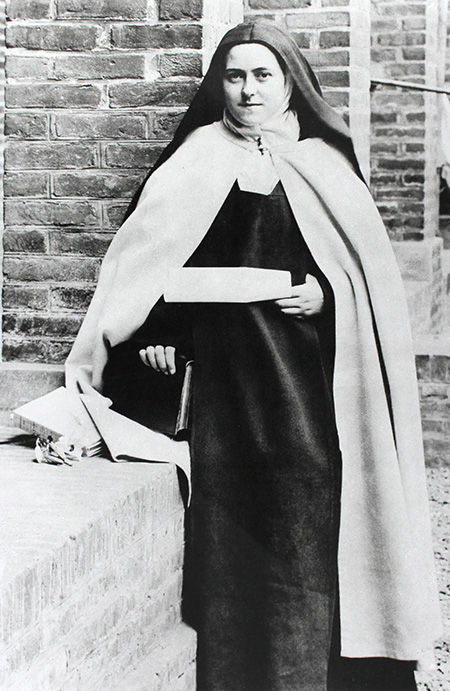
The second pose of three posed photographs taken by Céline in the sacristy courtyard on June 7th, 1897. It was taken 4 days after Thérèse had been asked to complete the last section of A Story of a Soul. Thérèse, who holds the image of the “Holy Face” of Jesus, was in the midst of her 18-month “dark night” of faith. She knew she would die soon and Céline made these photographs intentionally as a “final remembrance” of her 24-year-old sister. After many months of sickness and suffering, Thérèse died on Thursday, September 30, 1897.
Thérèse desired missionary service and ultimately viewed prayer and sacrifice as her missionary vocation.
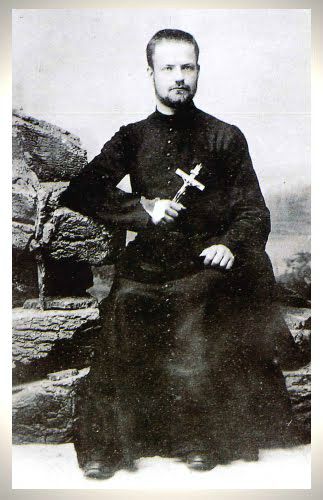
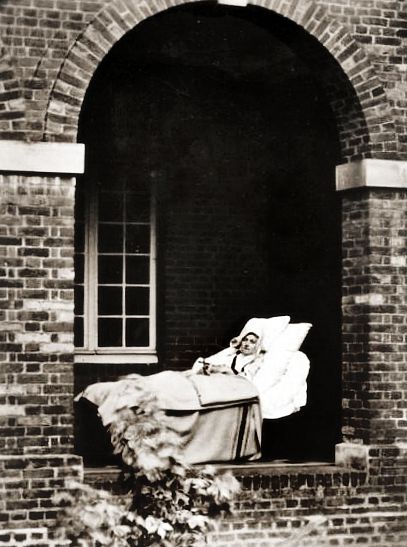
Circumstances were growing more difficult for Thérèse in terms of her health and spirituality. In 1896 a new prioress of Carmel confirmed Thérèse’s role in the novitiate where she could continue to teach her “little way” and work in the sacristy and the laundry room. In addition to finding it difficult to pray, in April 1896 she began to spit blood, a sure sign of the seriousness of her illness. These last eighteen months of her life proved a dark period for the normally vivacious five-foot three-inch Norman young woman. Her physical pain was often unrelenting and the dreams she had of becoming a foreign missionary to Vietnam had to be abandoned. Yet, the priest in charge of foreign missions, Father Adolphe Roulland (1870–1934) whom Thérèse had met in July 1896 as he was going to China, asked her to be a “spiritual sister” to the mission priests. This charge meant not only to pray for the priests but in her correspondence with them to “console and warn, encourage and praise, answer questions, offer corroboration, and instruct them in the meaning of her little way.”6
In 1896 Father Adolphe Roulland (1870-1934) of the Society of Foreign Missions asked the Carmel of Lisieux for a “spiritual sister.”
In a letter from Thérèse to Fr. Roulland she wrote: “Reverend Father… I feel very unworthy to be associated in a special way with one of the missionaries of our adorable Jesus, but since obedience entrusts me with this sweet task, I am assured my heavenly Spouse will make up for my feeble merits (upon which I in no way rely), and that He will listen to the desires of my soul by rendering fruitful your apostolate. I shall be truly happy to work with you for the salvation of souls. It is for this purpose I became a Carmelite nun; being unable to be an active missionary, I wanted to be one through love and penance just like Saint Teresa, my seraphic Mother….I beg you, Reverend Father, ask for me from Jesus, on the day He deigns for the first time to descend from heaven at your voice, ask Him to set me on fire with His Love so that I may enkindle it in hearts. For a long time I wanted to know an Apostle who would pronounce my name at the holy altar on the day of his first Mass….I wanted to prepare for him the sacred linens and the white host destined to veil the King of heaven…The God of Goodness has willed to realize my dream and to show me once again how pleased He is to grant the desires of souls who love Him alone.”7
Thérèse endured illness, spiritual darkness, and tuberculosis during her final years while continuing to write, pray, and encourage others.
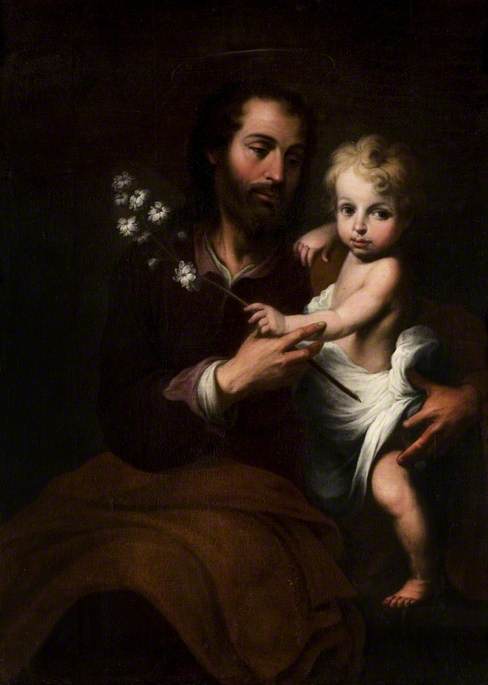
The year 1897 was defined on the one hand by Thérèse’s physical decline because of tuberculosis and, on the other hand, her personal joy expressed in her conversations and poems. It was on the feast day of St. Joseph, March 19, 1897, during a personal novena to St. Francis Xavier (1506-1552), that Thérèse asked St. Joseph to obtain from God the favor of “spending her heaven doing good on earth.” She asked St. Francis Xavier for the same intercession.8
Bartolomé Esteban Murillo (1617-1682), St. Joseph and the Child Jesus, Glasgow.
By April 1897 Thérèse was gravely ill and in May 1897 was relieved of all work duties and community prayer. Thérèse continued to write in her journal but abadoned it, too weak to write. In August 1897 Thérèse’s suffering was so great she confessed to the temptation of suicide. After August 19, 1897 Thérèse was too physically weak to even ingest the consecrated communion wafer. On September 30, 1897, Thérèse died in the convent infirmary. She was 24 years old.
In her last hours Thérèse said: “Oh! It is pure suffering because there are no consolations. No, not one! O my God…Good Blessed Virgin, come to my aid! My God…have pity on me! I can’t take it anymore! I can’t take it anymore!…I am reduced…No, I would never have believed one could suffer so much…never! never!…I no longer believe in death for me…I believe in suffering…O I love Him. My God I love you…”9 These last words of the dying nun were reported by more than one witness.
At the centenary of her death in 1997, St. Pope John Paul II (1920-2005) made Thérèse a “Doctor of the Church,” one of only thirty-three such credentialed. By elevating Thérèse’s example of simple love, the Polish pope, himself called out from behind an Iron Curtain and lived to see it fall, clarified what may constitute a Church Doctor’s character and purpose.
Thérèse died in 1897 at only twenty-four years old after prolonged suffering.
August 30, 1897.
Sick Thérèse one month before her death, August 30, 1897. she promised, “After my death, I will let fall a shower of roses,” which is a sign of her own crucifixion and martyrdom in union with the crucifixion and resurrection of her mystically beloved Jesus Christ. The rose is an expression of the divine love linked to this faith-filled action of oblation that is shared with others in the Holy Spirit who ask for it.
St. Thérèse of Lisieux was beatified on April 29, 1923 and canonized on May 17, 1925. She is co-patron saint of all church missions with St. Francis Xavier and co-patron saint of France with St. Jeanne d’Arc (1412-1431). Thérèse is patron saint of AIDS sufferers, pilots, florists, bodily ills (particularly tuberculosis), and the loss of parents.
Saint Thérèse of Lisieux’s obituary (above) was written by the nuns of her community and printed in Le Normand. In an English translation it reads:“It is with a spirited feeling of sadness that we learned Thursday evening of the death at the Monastery of Our Lady of Mount Carmel of a young person who gave the most beautiful years of youth to a life of prayer and sacrifice. Miss Marie-Francoise-Thérèse Martin, renounced the world at fifteen years of age and consecrated herself to God as Sister Thérèse of the Child Jesus. She departed after ten years of angelic life in the shadow of the cloister, and we have sweet confidence that death which put an end to long and cruel sufferings has come to take this youth in her bloom and already placed on her head the immortal crown, the goal of all our earthly aspirations. The funeral will be celebrated Monday morning at 9 o’clock in the Carmel chapel. Le Normand offers to the family of Sister Thérèse of the Child Jesus and to the Prioress and all the Carmelite sisters the tribute of its respectful condolences.”
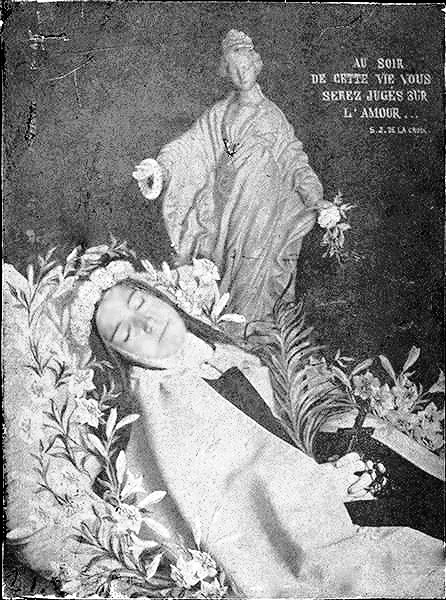
Thérèse in death, October 1, 1897.
Thérèse died in the evening of September 30, 1897. The next morning, October 1, 1897, before her body left the infirmary where she died, Céline (Sister Geneviève), deeply impressed by Thérèse’s peaceful countenance in death, took one final photograph of her sister.
Sister Thérèse of the Child Jesus was buried in the Carmelite section at the municipal cemetery at Lisieux on the morning of October 4, 1897 after a funeral Mass at the Carmel. An obscure figure at the time of her death, the funeral procession which followed her body to the cemetery was small that day. It was to this municipal cemetery grave that pilgrims first came. Miracles began to be reported to have taken place at her tomb through her intercession. One notable miracle was that of Reine Fauquet, a four-year-old girl from Lisieux, who was blind. On May 25, 1908, the child was brought by her mother to the tomb of Sister Thérèse of the Child Jesus where the child’s sight was suddenly restored. A medical doctor who was not in favor of making Sister Thérèse of the Child Jesus a saint, signed the medical documents attesting to the cure.10
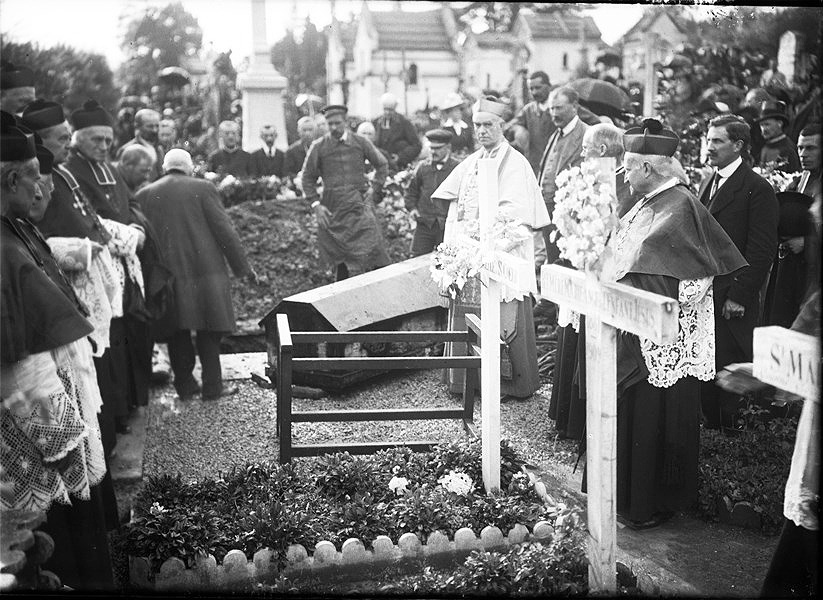
Because of these events, a tribunal was convened by the bishop of Bayeux in August 1910 to interview witnesses at Lisieux. To investigate the corporeal remains of Sister Thérèse of the Child Jesus for its condition, the body was exhumed on September 6, 1910. The exhumation took place in the presence of the bishop of Bayeux, Thomas-Paul-Henri Lemonnier (1853-1927) and scores of others. The doctors who treated Thérèse before her death confirmed that the body decayed in the usual manner, finding only bones and bits of clothes.
The site of Therese’s first grave from 1897 to 1910 continues to be marked by the same cross. The site of her second grave in the same Carmelite section of the municipal cemetery is also marked. The second grave held her bodily remains in a cemented vault from 1910 until 1923. When Sister Thérèse of the Child Jesus was declared a “servant of God,” the first step on the road to sainthood, there was a second exhumation. It was to the second grave site that large and growing numbers of pilgrims came to implore the Little Flower’s intercessions. The cross that marked the second grave was completely covered by prayers and tributes to Sister Thérèse of the Child Jesus by pilgrims.
Sister Thérèse of the Child Jesus rapidly became the focus of international devotion, with reported miracles associated with her intercession.
Second exhumation of Thérèse of the Child Jesus, August 1917.
On the occasion of her beatification, Sister Thérèse of the Child Jesus’s remains were transferred for a third time on March 26, 1923 to the Carmelite Chapel at Lisieux. Saint Thérèse was canonized on May 17, 1925 by Pope Pius XI (1922-1939) and declared Doctor of the Church by Pope John Paul II (1978-2005) in 1997. Her feast day is October 1.
Reine Fauquet was 4 years old when she visited Thérèse’s grave in Lisieux and her eyesight was cured.
It is recorded that on May 26, 1908, Reine Fauquet who lived in Lisieux was cured of an eye disease following her visit to Thérèse’s grave in Lisieux. The 4-year-old child explained to her sister that she had an apparition of Thérèse: “I saw little Thérèse, right next to my bed, she took my hand, she laughed at me, she was beautiful, she had a veil, and it was all lit around her head” (“J’ai vu la petite Thérèse, là, tout près de mon lit, elle m’a pris la main, elle me riait, elle était belle, elle avait un voile, et c’était tout allumé autour de sa tête“). When Reine Fauquet met Thérèse’s sisters at the Carmel they asked her how Thérèse had been dressed in the vision. The child replied: “The same as you!′′ (“Pareille à vous!“).
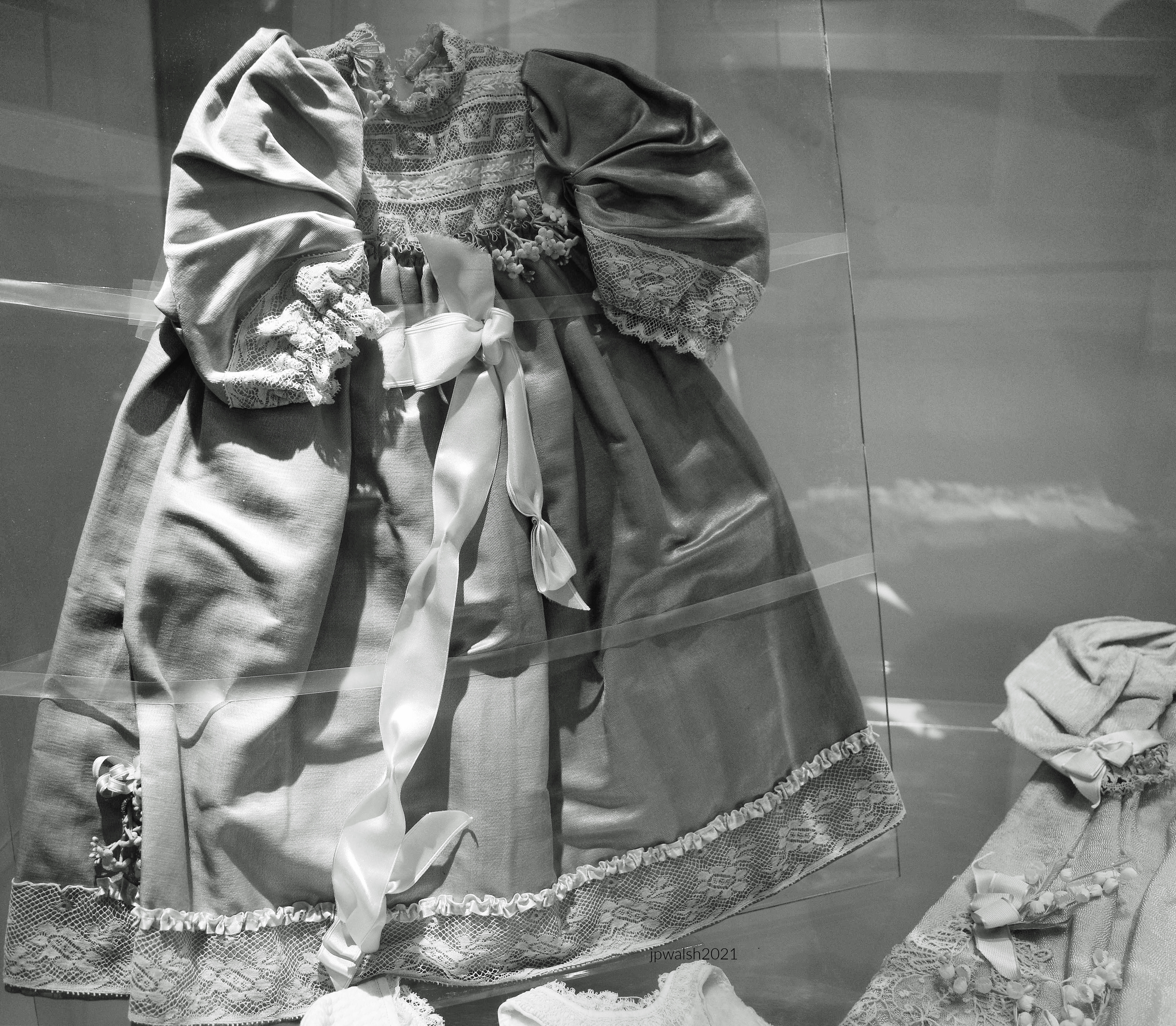
Thérèse hand-made costumes for Christmas crèche. National Shrine & Museum of St. Thérèse, Darien. Spring 2018. Author’s photograph.
Using this light-blue dress with lace trim, on the evening of December 25, 1895, Thérèse created a ceremony for her community of sisters that celebrated the birthday of the Christ Child.
During the celebration each sister selected a folded note from a basket and handed it to an “angel” (one of the other sisters). The “angel” opened the note and sang its prayerful verse.
Each sister was then asked to offer to Jesus her best self in the coming year. Thérèse’s ceremony included a crib and wax figure of the infant Jesus for which Thérèse and her novice designed these hand-made costumes.
Sister Thérèse of the Child Jesus was canonized in 1925 and declared a Doctor of the Church in 1997.
Papal decree, August 14, 1921.
The papal decree of August 14, 1921 declaring Thérèse of the Child Jesus a “Venerable” of the Church. It was promulgated by Benedict XV.
Saint Thérèse of Lisieux (1873-1897) was beatified in 1923 and canonized in 1925 by Pope Pius XI (1857-1939). The bishop of Bayeux, Thomas-Paul-Henri Lemonnier (1853-1927) decided to build a large basilica dedicated to her in Lisieux, France. The cornerstone was laid after his death in 1929 by then-bishop of Bayeux-Lisieux, Emmanuel Célestin Suhard (1874-1949), soon to be named cardinal archbishop of Reims, both appointments by Pope Pius XI. The basilica project had the full support of that indomitable Roman pontiff who had placed his pontificate which began in 1922 under the sign of Saint Thérèse of Lisieux. Funded completely by private donations received worldwide, construction started in 1929 and continued unto its dedication in 1954.https://youtu.be/4uCfaHOy4KE?si=LsFactM78MBy8euY – retrieved January 27, 2026.
Basilica of Sainte-Thérèse in Lisieux, France. October 2002. Author’s photograph.
Architecture and Style
The Basilica of Sainte‑Thérèse in Lisieux is built in a Neo‑Byzantine–Romano style closely inspired by the Sacré‑Cœur in Paris. Its exterior is defined by massive towers, intricate arcade arches, and a monumental central dome that dominates the surrounding hillside.
Pilgrimage Significance
Drawing roughly 2 million visitors and pilgrims each year, it is the second most important pilgrimage destination in France after Lourdes. Though St. Thérèse of Lisieux is not buried here—her primary tomb is at the nearby Carmel of Lisieux where she lived—one of her arm bones, a major relic, is permanently enshrined in a reliquary in the basilica’s south transept.
Family Legacy
The basilica also houses the tombs of Saints Louis and Zélie Martin, Thérèse’s parents, who are buried in the crypt, making the site a central locus of devotion for pilgrims honoring the Martin family.
Completed and released in 2001, Thérèse de Lisieux, une course de géant (translated as “Thérèse of Lisieux, a giant’s race”) is a 35-minute documentary directed by Fabrice Maze and produced by Seven Doc. For decades, this film has served as the official introduction for visitors, screening on a continuous loop in the auditorium at the Centre d’Accueil Pastoral International Saint Jean-Paul II—the international visitor center located directly across from the Basilica. The title is inspired by a phrase describing St. Thérèse’s rapid spiritual journey, and the documentary beautifully traces her childhood, her life inside the Carmel convent, and her vast global legacy. Filmed entirely on-site in Lisieux and inside the Basilica throughout 2001, this video serves as a brief trailer for the feature.
Stained glass.
ENDNOTES:
St. Thérèse of Lisieux: her last conversations, translated by John Clarke O.C.D., ICS Publications, Institute of Carmelite Studies, Washington, D.C., 1977, pp. 18-19. Her complete obituary printed in Le Normand reads: “It is with a spirited feeling of sadness that we learned Thursday evening of the death at the Monastery of Our Lady of Mount Carmel of a young person who gave the most beautiful years of youth to a life of prayer and sacrifice. Miss Marie-Francoise-Thérèse Martin, renounced the world at fifteen years of age and consecrated herself to God as Sister Thérèse of the Child Jesus. She departed after ten years of angelic life in the shadow of the cloister, and we have sweet confidence that death which put an end to long and cruel sufferings has come to take this youth in her bloom and already placed on her head the immortal crown, the goal of all our earthly aspirations. The funeral will be celebrated Monday morning at 9 o’clock in the Carmel chapel. Le Normand offers to the family of Sister Thérèse of the Child Jesus and to the Prioress and all the Carmelite sisters the tribute of its respectful condolences.”
see Story of a Soul: the Autobiography of St. Thérèse of Lisieux, translated by John Clarke O.C.D., ICS Publications, Institute of Carmelite Studies, Washington, D.C., 1996, pp. 51-67.
The Hidden Face: A Study of St. Thérèse of Lisieux, Ida Friederike Görres, London, 2003, p. 83.
Letter from Thérèse to Father Roulland, LT 226, dated May 9, 1897, Letters of St. Thérèse of Lisieux, Volume II, translated by John Clarke O.C.D., ICS Publications, Institute of Carmelite Studies, Washington, D.C., 1974, p. 1094.
Story of a Soul, p. 196. For this paragraph’s chronology see Letters of St. Thérèse of Lisieux, Volume II, 1297-1329.
Görres, p.189.
Letter from Thérèse to Father Roulland, LT 189, dated June 23, 1896, Letters of St. Thérèse of Lisieux, Volume II, translated by John Clarke O.C.D., ICS Publications, Institute of Carmelite Studies, Washington, D.C., 1974, pp. 956-957.
see footnote 11 in Letters of St. Thérèse of Lisieux, Volume II, p. 1074.
Last conversations, pp. 204-205; 230; 243.
Thérèse and Lisieux, Pierre Descouvement and Helmut-Nils Loose, Toronto: Novalis, 1996, p. 316.
BIBLIOGRAPHY:
Story of a Soul: the Autobiography of St. Thérèse of Lisieux, translated by John Clarke O.C.D., ICS Publications, Institute of Carmelite Studies, Washington, D.C., 1996;
Light of the Night: The Last Eighteen Months in the Life of Thérèse of Lisieux, Jean-François Six, University of Notre Dame Press, South Bend, Indiana, 1996;
St. Thérèse of Lisieux: her last conversations, translated by John Clarke O.C.D., ICS Publications, Institute of Carmelite Studies, Washington, D.C., 1977;
Letters of St. Thérèse of Lisieux,Volumes I and II, translated by John Clarke O.C.D., ICS Publications, Institute of Carmelite Studies, Washington, D.C., 1974;
The Hidden Face: A Study of St. Thérèse of Lisieux, Ida Friederike Görres, London, 2003;