Tag Archives: #BritishHistory

Halfway Between Two Cathedrals: Archbishop Derek Worlock (1920-1996) and the Christian Unity That Changed Liverpool.

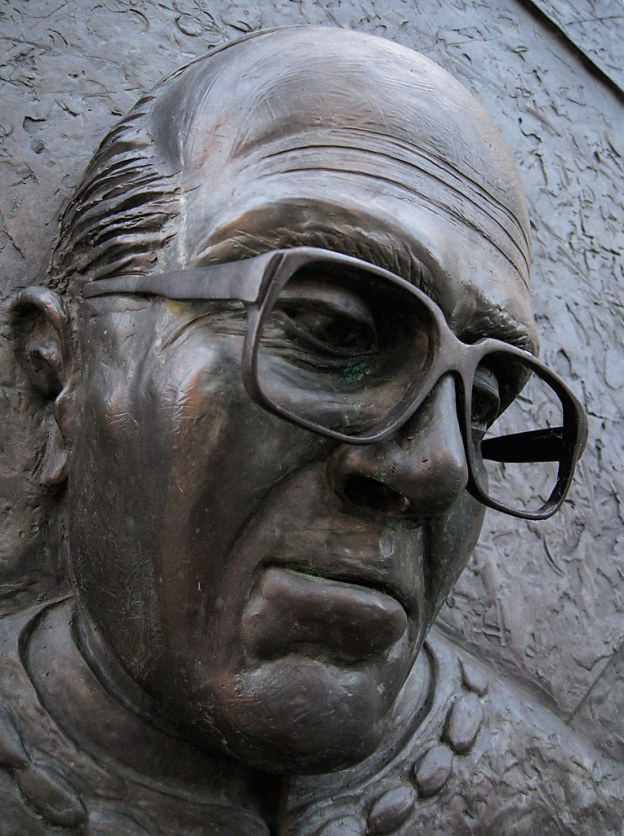
FEATURE image: Archbishop Derek Worlock, sculpture Liverpool. “Archbishop Derek Worlock, sculpture Liverpool” by mira66 is licensed under CC BY-NC-SA 2.0.

Derek Worlock was one of the most important ecumenical church leaders in modern Britain, whose lasting legacy was not simply his role as Roman Catholic Archbishop of Liverpool but his determined effort to bridge historic divisions between Catholics and Anglicans through friendship, collaboration, social engagement, and practical Christian unity.

Derek Worlock: Archbishop of Liverpool

Derek Worlock (February 4, 1920 – February 6, 1996) was an English priest of the Roman Catholic Church who served as Archbishop of Liverpool. A leading figure in post‑war British Catholicism, he became known for his pastoral warmth, public presence, and commitment to unity among Christians.

A Ministry Shaped by Collaboration

Worlock devoted his episcopal life to fostering cooperation across Christian traditions. His partnership with Anglican Bishop of Liverpool David Sheppard became one of the most celebrated ecumenical friendships in modern Britain. Together they co‑authored Better Together and With Hope in our Hearts (both 1995), works that embodied their shared vision for a reconciled, outward‑facing Church. His episcopal motto, Caritas Christi eluceat—“For the Shining Light of Christ”—captured the spirit of his ministry.

His partnership with Anglican Bishop David Sheppard became one of Britain’s most influential and visible examples of Christian cooperation. Their efforts sought to overcome centuries of Catholic-Anglican rivalry and demonstrate that reconciliation between churches could help foster reconciliation within society.

Bishop Worlock’s mitre, placed at his tomb, recalls a pivotal moment in his early episcopal ministry. In 1973, while serving as Bishop of Portsmouth, Worlock was preparing to attend the upcoming Roman Synod of Bishops. Asked to suggest a theme for the Synod’s work, he proposed “Evangelization”—a choice Pope Paul VI accepted. Worlock’s proposal did more than set the agenda for a major global gathering. It highlighted two convictions that shaped his entire episcopate:

  • that evangelization is rooted in the Church’s ancient mission shared by all the baptized, and
  • that the spirit of Vatican II’s outreach to others—its ecumenical openness, its desire for dialogue, its pastoral warmth—must animate that mission.

In many ways, the theme anticipated the hallmark of Worlock’s later ministry as Archbishop of Liverpool: a commitment to opening outward, building bridges, and embodying the Gospel through collaboration with other Christians, especially his Anglican counterpart David Sheppard. https://www.independent.co.uk/news/people/obituary-the-most-rev-derek-worlock-1318052.html – retrieved May 27, 2025. PHOTO: “Derek Worlocks Mitre” by James O’Hanlon is licensed under CC BY-NC-ND 2.0.

Honors and Public Recognition

In 1994, Worlock received the Freedom of the City of Liverpool, a civic acknowledgment of his decades of service to the city. Two years later, in 1996, he was appointed a Companion of Honour, one of the United Kingdom’s most distinguished awards.

A Memorial on Hope Street

After his death in 1996, plans began for a public memorial. Commissioned in 2005 and funded through widespread public donations, the sculpture was created by British artist Stephen Broadbent (b. 1961). Placed at the midpoint of Liverpool’s Hope Street, the memorial stands symbolically between the city’s Anglican and Roman Catholic cathedrals—an architectural embodiment of the unity Worlock championed throughout his life.See it here: https://www.flickr.com/photos/newfolder/2535308455

Worlock and Sheppard worked together through joint pastoral letters, civic leadership, public appearances, and shared responses to social crises, giving Liverpool a united Christian voice. The Hope Street memorial sculpture symbolizes their shared ministry, standing midway between Liverpool’s Anglican and Catholic cathedrals.

David Sheppard and Derek Worlock memorial, Hope Street, Liverpool. The placement is deliberate: halfway between the two cathedrals, exactly where their work met with space between them for everyone. PHOTO: “DSCF0029” by geraldmurphyx is licensed under CC BY-ND 2.0.

A Shared Mission of Reconciliation

The statue commemorates the extraordinary partnership between Archbishop Derek Worlock and Bishop David Sheppard, two churchmen who refused to let centuries of division define Liverpool’s Christian life. At a time when Catholic–Anglican relations still could be frosty and suspicious, they pointed to a a different path of public friendship, joint action, and a united moral voice for their city.

Their collaboration was not symbolic but deeply practical. They issued joint pastoral letters, appeared together at civic events, and spoke with one voice during moments of crisis. In a city marked by economic hardship, sectarian memory, and social fragmentation, they insisted that Christian leadership must be shared leadership. Their partnership became a model for ecumenical cooperation across Britain.

Healing Historic Divisions

Worlock and Sheppard understood that Liverpool’s religious landscape had long been shaped by rivalry—Catholic and Anglican identities often hardened by class, migration, and political history. Their work aimed to soften those boundaries. They promoted joint prayer services, encouraged cooperation between parishes, and supported community initiatives that crossed denominational lines.

Their message was simple but radical: unity was not an optional ideal but a pastoral necessity. They believed that reconciliation between churches could help foster reconciliation within the city itself.

A Memorial to Unity

The statue’s purpose was to create a permanent reminder of this shared ministry. It honors not only two individual leaders but the ecumenical vision they embodied. Positioned on Liverpool’s Hope Street—linking the Anglican Cathedral at one end and the Catholic Cathedral at the other—the memorial stands as a physical metaphor for the bridge they built.
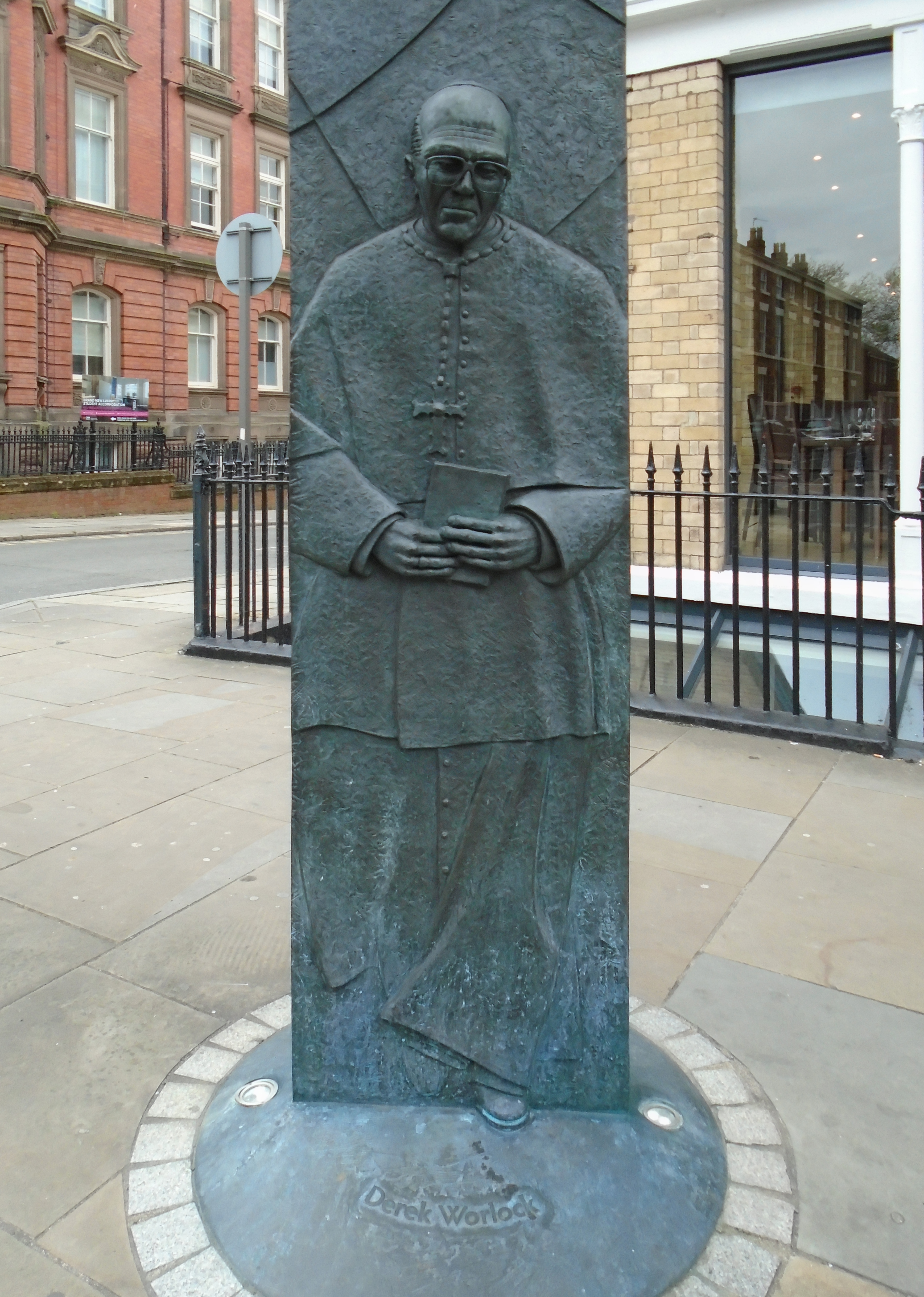
Above: Archbishop Derek Worlock London‑born Derek Worlock was ordained a Catholic priest in 1944 and began his ministry as curate at Our Lady of Victories, Kensington, then London’s wartime pro‑cathedral. For nearly two decades he served at the heart of English Catholic leadership as private secretary to three Archbishops of Westminster, a role that shaped his administrative skill and national profile. He later spent a year as Rector and Rural Dean of the Church of SS Mary and Michael—one of London’s historically largest parishes—before being appointed Bishop of Portsmouth, serving the English Channel region for eleven years. In 1976 he became Metropolitan Archbishop of Liverpool, the post that defined his public legacy. PHOTO: “File:Sheppard-Worlock Statue 2017-2.jpg” by Rodhullandemu is licensed under CC BY-SA 4.0.

Detail from the Sheppard-Worlock statue Liverpool. Anglican Bishop David Sheppard was Worlock’s closest ecumenical partner and the other half of Liverpool’s most influential Christian alliance. Before Derek Worlock’s appointment as Roman Catholic Archbishop of Liverpool in 1976, the Anglican archbishop of Liverpool, David Sheppard, was consulted over a meal together with Pope Paul VI’s Papal Nuncio in Britain, Archbishop Bruno Heim. Before he became one of Liverpool’s most respected church leaders, David Sheppard was a national sporting hero—a stylish right‑handed batsman whose cricketing career made him a household name across Britain. His cricketing fame gave him a public platform long before he entered the clergy, and he later used that visibility to speak on issues of poverty, racial justice, and urban renewal. Public Domain (Man vyi – Self-photographed. Own work, all rights released).

The ecclesiastical Coat of Arms of Archbishop Derek Worlock, Metropolitan Archbishop of Liverpool. The green galero with fifteen tassels and the golden double-barred cross denote his rank as an archbishop. The shield combines the pallium and Lancaster Rose of Lancashire with a fleur-de-lis and blazing sunburst. The scroll below bears his motto, + CARITAS + CHRISTI + ELUCEAT + (“May the love of Christ shine forth”), expressing the pastoral vision that guided his ministry. PHOTO: “Uk rc liverpool worlock” by EborArmorist is licensed under CC BY 3.0.

Influenced by the reforms of Vatican II, Derek Worlock viewed Christian unity as a pastoral duty rather than an abstract theological goal.
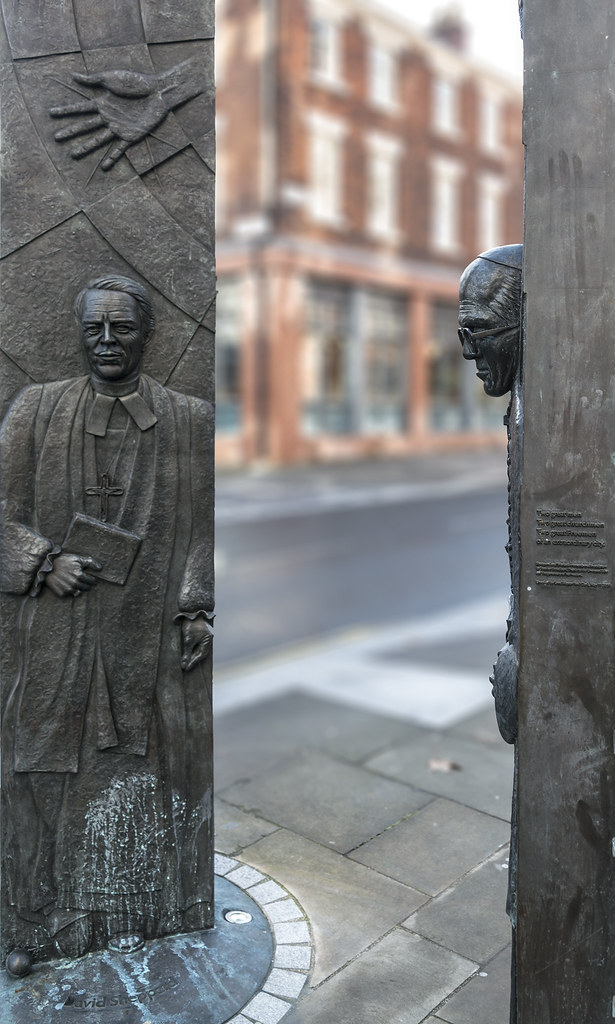
This striking bronze monument honors the powerful ecumenical alliance between Bishop David Sheppard (left) and Archbishop Derek Worlock (right), whose joint leadership provided comfort and unity to Liverpool during severe social and economic hardships in the late 20th century. Designed by sculptor Stephen Broadbent and unveiled on Hope Street in 2008, the statue features two bronze panels facing each other across the sidewalk, symbolizing their historic partnership in building bridges across deep religious and political divides. PHOTO: “5783 Sheppard Worlock Statue” by steeljam is licensed under CC BY-NC-ND 2.0.

Worlock’s commitment to ecumenism predated his Liverpool years. As Bishop of Portsmouth, he developed practical approaches to interchurch cooperation, including the famous “Portsmouth solution” involving a Catholic-Anglican marriage.

Worlock’s Early Ecumenical Leadership

Archbishop Derek Worlock served as bishop and archbishop from 1965 to 1996—years that spanned the close of the Second Vatican Council and the unfolding of its new teaching on ecumenism. From the beginning of his episcopal ministry, he treated the Council’s call to Christian unity not as an abstract ideal but as a pastoral responsibility.

The Portsmouth Years: Learning to Live Together in Love

As Bishop of Portsmouth, Worlock was already experimenting with practical ways for Catholics and Anglicans to share life, sacraments, and community with greater charity. His most famous initiative, later nicknamed the “Portsmouth solution,” emerged in the early 1970s when the daughter of a local Anglican bishop wished to marry a Catholic.Worlock crafted a pastoral compromise that honored both traditions:

  • The marriage rite and promises were celebrated first in the Catholic church, fulfilling canonical requirements.
  • Later that same day, the couple’s marriage was celebrated again in the bride’s Anglican parish, with her father—the Anglican bishop—presiding.

This arrangement was bold for its time. It respected Catholic sacramental discipline while acknowledging the Anglican family’s pastoral and emotional needs. More importantly, it modeled the kind of mutual recognition, goodwill, and shared joy that Worlock believed should characterize Christian life.

Worlock played a significant role in broader Church leadership, supporting evangelization, lay participation, justice, peace initiatives, and advocacy for the poor and homeless.

A Foreshadowing of His Liverpool Partnership

The Portsmouth solution was not an isolated gesture but an early sign of the ecumenical instincts that would later define his partnership with David Sheppard in Liverpool. It showed Worlock’s willingness to take risks, to trust the good faith of other Christians, and to build unity through concrete acts rather than theoretical statements.
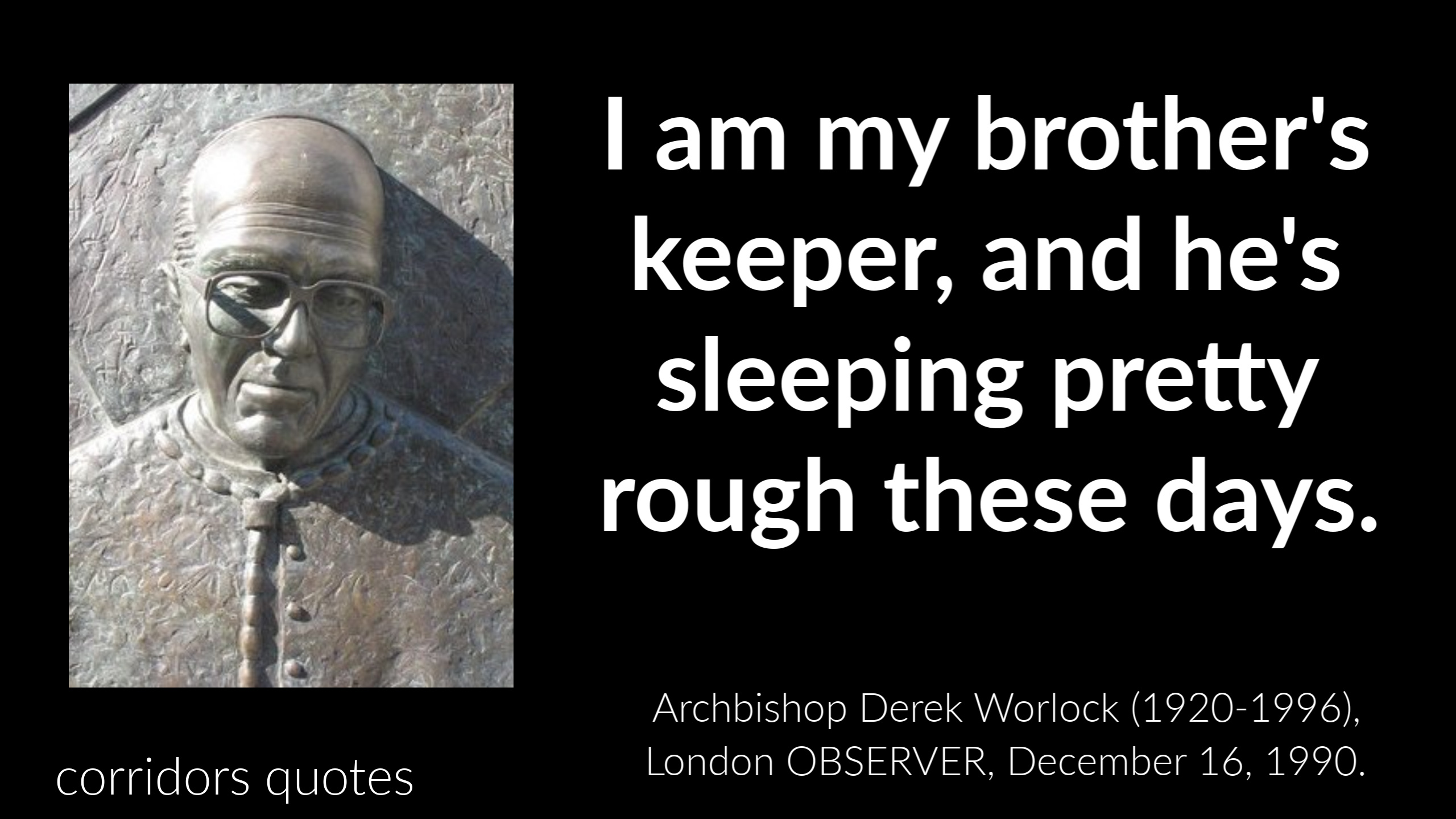
The precise source for this quote is an interview published in the London Observer newspaper on December 16, 1990. In the article, Archbishop Derek Worlock used this poignant phrasing to address the growing homelessness and poverty crisis in the United Kingdom during the winter of 1990. He directly reframed the biblical “brother’s keeper” concept to highlight the urgent moral duty society has toward marginalized individuals struggling with homelessness (“sleeping rough”). This sentence distills the core of his ministry: the conviction that Christian leadership must be measured by its solidarity with the most vulnerable. 

Building bridges across historic divisions

Archbishop Worlock’s mitre, resting at his tomb, evokes a churchman whose influence extended far beyond Liverpool. Over more than three decades as bishop and archbishop, he became a driving force within the episcopal conference, shaping how the Catholic Church in Britain engaged with the modern world.

He helped lead national initiatives on the media, the laity, and justice and peace, urging the Church to speak with clarity, courage, and compassion. His advocacy for the poor was especially memorable. When drawing attention to Britain’s growing homelessness crisis, he captured the moral urgency in a single, searing line: “I am my brother’s keeper, and he’s sleeping pretty rough these days.” London OBSERVER, December 16, 1990. (on the homeless).

From Oxford to Rome: How St. John Henry Newman (1801-1890) Followed Conscience in Search of Religious Truth.

N.B. – Vatican City, July 31, 2025 (UPI) — Pope Leo XIV will bestow St. John Henry Newman, the influential 19th-century Anglican convert, with the honor of “Doctor of the Church” [today].” Cardinal Newman was beatified by Pope Benedict XVI in 2010 and canonized by Pope Francis in 2019. With Pope Leo XIV’s action Card. St. Newman is now one of 38 “Doctors of the Church” whose ranks include four women. St. John Henry Newman became the first saint canonized from Britain since 1976.

FEATURE image: Photographic portrait, John Henry Cardinal Newman, 1880.

Canonized in 2019 and later declared a Doctor of the Church, Newman is a thinker whose relevance extends well beyond the 19th century.

 John Henry Newman, Oratory of St. Philip Neri, Birmingham, England.  London; New York; Bombay; Calcutta: Longmans, Green. Newman’s method of composing a sermon was to do so by heart and then write it down afterwards. English theologian James Mozley (1813-1878) who was active in the Oxford Movement, observed about these sermons: “A sermon of Mr. Newman’s enters into our feelings, ideas, and modes of viewing things. Persons look into Mr. Newman’s sermons and see their own thoughts in them.”

John Henry Newman was one of the most influential Christian thinkers of the modern era, whose journey from Anglican leader to Catholic cardinal, combined with his profound writings on truth, conscience, faith, reason, and holiness, continues to offer a model for navigating religious, intellectual, and cultural divisions.

Introduction by John P. Walsh

John Henry Newman (1801-1890) was a theologian and poet who was first an Anglican priest and later a Roman Catholic priest and cardinal. In the 1830’s and until his conversion to Catholicism in 1845, Newman was a leading figure in the Oxford Movement. They were a group of Anglicans who looked to create a bridge between the Church of England and the Catholic Church by adopting many Catholic beliefs and liturgical rituals from before the English Reformation. Newman eventually came to believe for himself that these religious efforts proved insufficient and he left the Anglican Communion for the Catholic Church in 1845. Already an articulate and influential religious leader in Britain, Newman’s decision brought with it the burden of having upset his friends as well as being challenged by them and others for his changed religious opinions on polemical grounds. Newman, a longtime writer and speaker, responded after a while with his now-celebrated Apologia Pro Vita Sua (1865–1866), which served as a defense of his religious opinions after he quit his position as Anglican vicar at Oxford. Newman, a 19th-century master of English prose and poetry, had already published The Idea of a University (1852) and went on to publish Grammar of Assent (1870) as well as several poems, some of which were set to music or served as hymns. In 1879, at the age of 78 years old, Pope Leo XIII named Newman a cardinal for his work on behalf of the Catholic Church in England as well as his having co-founded the Catholic University of Ireland in 1854, which today as University College Dublin is Ireland’s largest institution of higher learning. On October 13, 2019, John Henry Newman was canonized a Catholic saint at the Vatican by Pope Francis. St. John Henry Newman became the first saint canonized from Britain since 1976. In remarks by Prince Charles who led the British delegation to the Vatican for Newman’s canonization, the Prince of Wales said: “In the age in which he [Newman] attains sainthood, his example is needed more than ever – for the manner in which, at his best, he could advocate without accusation, could disagree without disrespect and, perhaps most of all, could see differences as places of encounter rather than exclusion.” London-born Cardinal Newman died in England in 1890 at 89 years old. He founded the Oratory at Birmingham in 1848 and through his writings spoke to many about the issues of faith, education, and conscience.

John Henry Newman began as an Anglican priest and leading figure in the Oxford Movement before converting to Catholicism in 1845. Newman became a major Catholic intellectual, publishing influential works on education, belief, doctrine, and the development of Christian thought.

A given opinion, as held by several individuals, even when of the most congenial views, is as distinct as are their faces. Oxford University sermons, 1843.

It is as absurd to argue men, as to torture them, into believing. Oxford University sermon, December 11, 1831.

His conversion cost him friendships and provoked controversy, prompting him to write Apologia Pro Vita Sua, one of the great religious autobiographies and defenses of conscience.

From the age of fifteen, dogma has been the fundamental principle of my religion: I know of no other religion; I cannot enter into the idea of any other sort of religion; religion, as a mere sentiment, is to me a dream and a mockery. Apologia Pro Vita Sua, 1864.

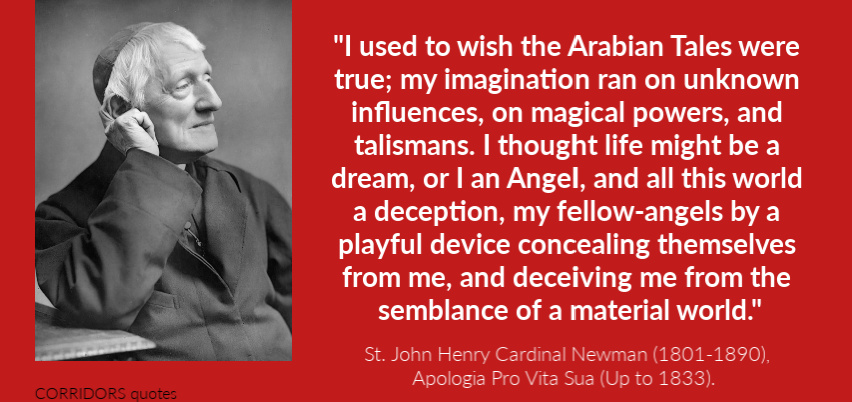
I used to wish the Arabian Tales were true; my imagination ran on unknown influences, on magical powers, and talismans. I thought life might be a dream, or I an Angel, and all this world a deception, my fellow-angels by a playful device concealing themselves from me, and deceiving me from the semblance of a material world. Apologia Pro Vita Sua (Up to 1833).

I was brought up from a child to take great delight in reading the Bible; but I had formed no religious convictions till I was fifteen. Of course I had perfect knowledge of my Catechism. Apologia Pro Vita Sua (Up to 1833).

I read Joseph Milner’s Church History, and was nothing short of enamoured of the long extracts from St. Augustine and the other Fathers which I found there. I read them as being the religion of the primitive Christians. Apologia Pro Vita Sua (Part III).

I read Newton on the Prophecies, and in consequence became most firmly convinced that the Pope was the Antichrist predicted by Daniel, St. Paul and St. John. My imagination was stained by the effects of this doctrine up to the year 1843. Apologia Pro Vita Sua (Part III).

There are virtues indeed, which the world is not fitted to judge about or to uphold, such as faith, hope and charity; but it can judge about Truthfulness; it can judge about the natural virtues, and truthfulness is one of them. Natural virtues may also become supernatural; Truthfulness is such… Apologia Pro Vita Sua (Part II).

Newman sought truth above party loyalty, holiness above comfort, and intellectual honesty above ideological conformity.

John Newman, 1841, Thomas Robinson Green?, collotype, 7 5/8 in. x 10 in. (195 mm x 255 mm). National Portrait Gallery, St Martin’s Place, London. https://www.npg.org.uk/collections/search/portrait/mw39717/John-Newman?LinkID=mp03281&wPage=1&role=sit&rNo=21

Catholics on the other hand shade and soften the awful antagonism between good and evil, which is one of their dogmas, by holding that there are different degrees of justification, that there is a great difference in point of gravity between sin and sin, that there is a possibility and the danger of falling away, and that there is no certain knowledge given to anyone that he is simply in a state of grace, and much less that he is to persevere to the end. Apologia Pro Vita Sua (Part III).

Let us seek the grace of a cheerful heart, an even temper, sweetness, gentleness, and brightness of mind, as well as walking in His light, and by His grace. Let us pray to Him to give us the ever-abundant, ever-springing love, which overpowers and sweeps away the vexations of life by its own richness and strength, and which above all unites us to Him, Who is the fountain and center of all mercy, loving kindness and joy. 17, Religious Joy (Sermon for Christmas Day), 1868.

Ex Umbris et Imaginibus in Veritatem! (From shadows and symbols into the truth!) Epitaph at Edgbaston.

He believed faith and reason worked together and rejected both blind skepticism and rigid rationalism. His writings emphasize the importance of truthfulness, conscience, reverence, humility, and intellectual integrity. His famous hymn Lead, Kindly Light emerged from a difficult period of illness, uncertainty, and spiritual reflection.

Lead, kindly Light, amid the encircling gloom; Lead thou me on! The night is dark, and I am far from home; Lead thou me on! Keep thou my feet: I do not ask to see the distant scene; one step enough for me. The Pillar of the Cloud, 1833.

Lead, Kindly Light is a hymn with words written in 1833 by Saint John Henry Newman as a poem titled “The Pillar of the Cloud.” The impetus for the poem was that young Newman, traveling in Italy, became ill and found himself stranded in Palermo, Sicily, without any passage out for almost a month.

To occupy his time, the 32-year-old Newman visited the many churches in Palermo but only when they were dark, abandoned and silent. Newman, then still an Anglican, didn’t attend any services.

Newman finally got a ship to England that sailed direct for Marseilles yet, between Corsica and Sardinia, the ship lay idle for a week from lack of wind. It was just at that point in his far-flung journey that the words, Lead Kindly Light, articulated themselves in Newman’s mind as he ached to go home.

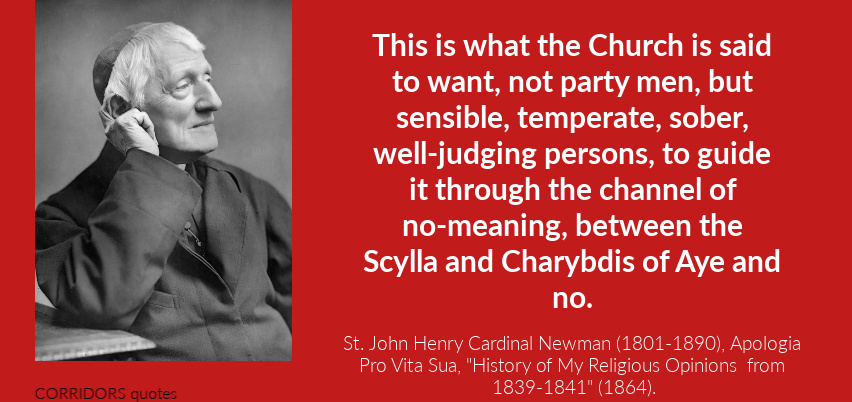
This is what the Church is said to want, not party men, but sensible, temperate, sober, well-judging persons, to guide it through the channel of no-meaning, between the Scylla and Charybdis of Aye and no. St. John Henry Cardinal Newman (1801-1890), Apologia Pro Vita Sua, “History of My Religious Opinions from 1839-1841” (1864).

John Henry Cardinal Newman, 1881, Sir John Everett Millais, 1st Baronet, President Royal Academy of Arts (1829-1896). National Portrait Gallery, London: https://www.npg.org.uk/collections/search/portrait/mw07727/John-Newman

Nature was a parable: Scripture was an allegory: pagan literature, philosophy, and mythology, properly understood, were but a preparation for the Gospel. St. John Henry Cardinal Newman (1801-1890), Apologia Pro Vita Sua, “History of My Religious Opinions from 1839-1841” (1864).

The Greek poets and sages were in a certain sense prophets; for “thoughts beyond their thought to those high bards were given.” St. John Henry Cardinal Newman (1801-1890), Apologia Pro Vita Sua, “History of My Religious Opinions from 1839-1841” (1864).

Holy Church in her sacraments and her hierarchical appointments, will remain even to the end of the world. Her mysteries are but expressions in human language of truths to which the human mind is unequal. St. John Henry Cardinal Newman (1801-1890), Apologia Pro Vita Sua, “History of My Religious Opinions from 1839-1841” (1864).

We may not speak of [Jesus] as we speak of any individual man, acting from and governed by a human intelligence within Him, but He was God, acting not only as God, but now through the flesh also, when He would. St. John Henry Cardinal Newman (1801-1890), Parochial and Plain Sermons, volume 6.

[Prophetic tradition] permeates the Church like an atmosphere, irregular in shape from its very profusion and exuberance. St. John Henry Cardinal Newman (1801-1890), Lectures on the Prophetical Office of the Church (1837).

Newman viewed disagreement as an opportunity for encounter rather than exclusion, a theme highlighted by then-Prince Charles at his canonization.

John Newman by George Richmond, chalk, 1844, 16 1/4 in. x 13 1/4 in. (413 mm x 337 mm), National Portrait Gallery, St Martin’s Place, London. https://www.npg.org.uk/collections/search/portrait/mw04655/John-Newman

John Henry Newman, after 1844. https://archive.org/details/newmanfran00barruoft/page/48/mode/2up?view=theater

The more claim an idea has to be considered living, the more various will be its aspects; and the more social and political is its nature, the more complicated and subtle will be its issues. St. John Henry Cardinal Newman (1801-1890), An Essay on the Development of Christian Doctrine.

And such mainly is the way in which all men, gifted or not gifted, commonly reason – not by rule, but by an inward faculty. St. John Henry Cardinal Newman (1801-1890), Fifteen Sermons preached before the University of Oxford.

If we insist upon being as sure as is conceivable, in every step of our course, we must be content to creep along the ground, and can never soar. St. John Henry Cardinal Newman (1801-1890), Fifteen Sermons preached before the University of Oxford.

If we are intended for great ends, we are called to great hazards; and, whereas we are given absolute certainty in nothing, we must in all things choose between doubt and inactivity. St. John Henry Cardinal Newman (1801-1890), Fifteen Sermons preached before the University of Oxford.

I am what I am, or I am nothing. I cannot think, reflect, or judge about my being, without starting from the very point which I am concluding…I cannot avoid being sufficient for myself, for I cannot make myself anything else, and to change me is to destroy me. St. John Henry Cardinal Newman (1801-1890), The Grammar of Assent (1870).

John Newman, 1864, McLean & Haes, albumen carte-de-visite, 3 5/8 in. x 2 1/4 in. (93 mm x 57 mm). National Portrait Gallery, St Martin’s Place, London. https://www.npg.org.uk/collections/search/portrait/mw125777/John-Newman?LinkID=mp03281&role=sit&rNo=10

A man who said “I cannot trust a cable, I must have an iron bar,” would, in certain given cases, be irrational and unreasonable: so too is a man who says I must have a rigid demonstration, not moral demonstration, of religious truth. St. John Henry Cardinal Newman (1801-1890), Letters & Diaries, volume 21.

We differ in our sense and use of the word “certain.” I use it of minds, you of propositions. I fully grant the uncertainty of all conclusions in your sense of the word, but I maintain that minds may in my sense be certain of conclusions which are uncertain in yours. St. John Henry Cardinal Newman (1801-1890), Letter to William Froude, April 29, 1879.

There is a great attempt to bring a new theory of Papal Infallibility, which would make it a mortal sin not to hold the Temporal Power necessary to the papacy. No one answers them and multitudes are being carried away. The pope gives ear to them and the consequence is there is a very extreme prejudice in the highest quarters at Rome against such as me. St. John Henry Cardinal Newman (1801-1890), Letter to James Hope Scott, April 11, 1867.

Really and truly I am NOT a theologian. A theologian is one who has mastered theology…and a hundred things besides. And this I am not and never shall be. St. John Henry Cardinal Newman (1801-1890), Letter to Maria Giberne, February 10, 1869.

To write theology is like dancing on the tight-rope some hundred feet above ground: it is hard to keep from falling, and the fall is great. St. John Henry Cardinal Newman (1801-1890), Letter to Emily Bowles, April 16, 1866.

Cardinal Henry Edward Manning is not a theologian, the pope is not a theologian, and therefore theology has gone out of fashion. I don’t profess to be a theologian, but at all events I should have been able to show a side of the Catholic religion more theological, more exact, than theirs. St. John Henry Cardinal Newman (1801-1890), Letter to Lord Blatchford, February 5, 1875.

There was true private judgment in the primitive and medieval schools. There are no schools now, no private judgment (in the religious sense of the phrase), no freedom of opinion. That is, no exercise of the intellect. This is a way of things which in God’s own time, will work its own cure of necessity. St. John Henry Cardinal Newman (1801-1890), Letter to Emily Bowles, May 19, 1863.

John Newman, c. 1845, Richard Woodman, after Sir William Charles Ross, stipple engraving, 11 1/2 in. x 9 1/2 in. (291 mm x 241 mm) plate size, National Portrait Gallery, St Martin’s Place, London. https://www.npg.org.uk/collections/search/portrait/mw198540/John-Newman?LinkID=mp03281&wPage=1&role=sit&rNo=24

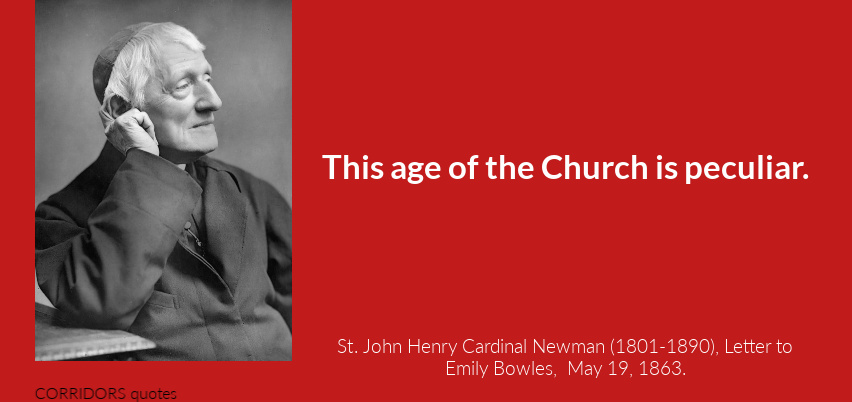
This age of the Church is peculiar. St. John Henry Cardinal Newman (1801-1890), Letter to Emily Bowles, May 19, 1863.

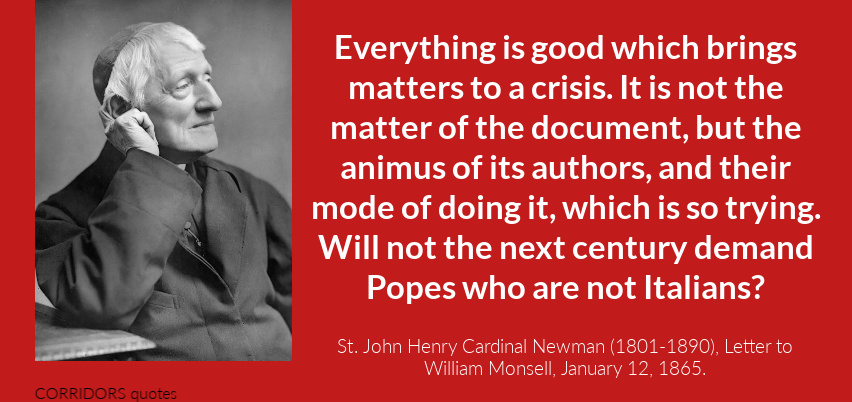
Everything is good which brings matters to a crisis. It is not the matter of the document, but the animus of its authors, and their mode of doing it, which is so trying. Will not the next century demand Popes who are not Italians? St. John Henry Cardinal Newman (1801-1890), Letter to William Monsell, January 12, 1865.

The Fathers made me a Catholic, and I am not going to kick down the ladder by which I ascended into the Church. It is a ladder quite as serviceable for that purpose now, as it was twenty years ago. St. John Henry Cardinal Newman (1801-1890), Letter to Rev. E. B. Pusey, D.D.

He maintained an independent mind, sometimes criticizing excesses and abuses within church governance while remaining deeply loyal to Catholic doctrine.

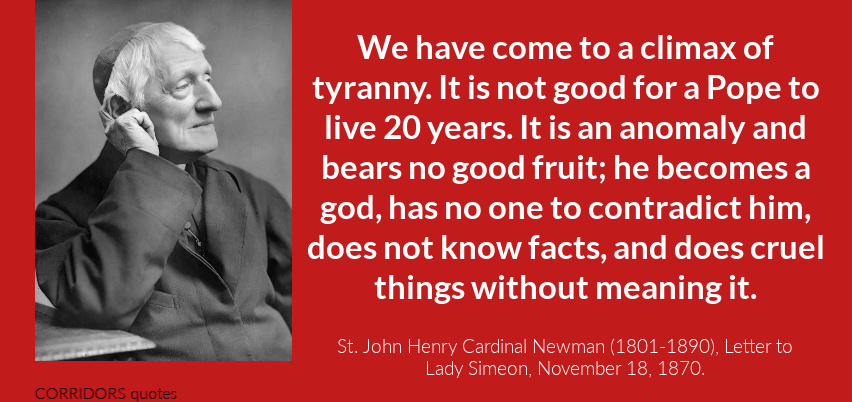
We have come to a climax of tyranny. It is not good for a Pope to live 20 years. It is an anomaly and bears no good fruit; he becomes a god, has no one to contradict him, does not know facts, and does cruel things without meaning it. St. John Henry Cardinal Newman (1801-1890), Letter to Lady Simeon, November 18, 1870.

There is no evil without its alleviation. St. John Henry Cardinal Newman (1801-1890), Letter to Bishop David Moriarty, November 14, 1866.

To be at once infallible in religion and a despot in temporals is perhaps too great for mortal man. St. John Henry Cardinal Newman (1801-1890), Letter to Mrs. William Frounde, January 2, 1871.

Truth is the guiding principle of theology and theological inquiries; devotion and edification, of worship; and of government, expedience. St. John Henry Cardinal Newman (1801-1890), The Via Media of the Anglican Church Illustrated in Lectures, Letters and Tracts written between 1830 and 1841.

The instrument of theology is reasoning; of worship, our emotional nature; of rule, command and coercion. Further, as man is, reasoning tends to rationalism; devotion to superstition and enthusiasm; and power to ambition and tyranny. St. John Henry Cardinal Newman (1801-1890), The Via Media of the Anglican Church Illustrated in Lectures, Letters and Tracts written between 1830 and 1841.

Now all of us are sinners, all of us have need to come to God as the Publican did; every one, if he does but search his heart, and watch his conduct, and try to do his duty, will find himself to be full of sins which provoke God’s wrath. I do not mean to say that all men are equally sinners; some are wilful sinners, and of them there is no hope, till they repent; others sin, but they try to avoid sinning, pray to God to make them better, and come to church to be made better; but all men are quite sinners enough to make it their duty to behave as the Publican. Every one ought to come into Church as the Publican did, to say in his heart, “Lord, I am not worthy to enter this sacred place; my only plea for coming is the merits of Jesus Christ my Saviour.” St. John Henry Cardinal Newman (1801-1890), Sermon, Reverence in Worship, October 30, 1836 (PPS-8).

To believe and not to revere, to worship familiarly and at one’s ease, is an anomaly and a prodigy unknown even to false religions, to say nothing of the true one…Worship, forms of worship — such as bowing the knee, taking off the shoes, keeping silence, a prescribed dress and the like — are considered as necessary for a due approach to God. Parochial and Plain Sermons, Vol. VIII — “Reverence in Worship,” October 30, 1836.

[Christ] is not past, He is present now. And though He is not seen, He is here. The same God who walked the water, who did miracles, etc., is in the Tabernacle. We come before Him, we speak to Him just as He was spoken to 1800 years ago, etc. This [is] how He counteracts time and the world… It is this that makes devotion in lives. It is the life of our religion. We are brought into the unseen world. St. John Henry Cardinal Newman (1801-1890), SN 127: May 25, 1856.

To consider the world in its length and breadth, its various history, the many races of man, their starts, their fortunes, their mutual alienation, their conflicts; and then their ways, habits, governments, forms of worship; their enterprises, their aimless courses, their random achievements and acquirements, the impotent conclusion of long-standing facts, the tokens so faint and broken of a superintending design, the blind evolution of what turn out to be great powers or truths, the progress of things, as if from unreasoning elements, not towards final causes, the greatness and littleness of man, his far-reaching aims, his short duration, the curtain hung over his futurity, the disappointments of life, the defeat of good, the success of evil, physical pain, mental anguish, the prevalence and intensity of sin, the pervading idolatries, the corruptions, the dreary hopeless irreligion, that condition of the whole race, so fearfully yet exactly described in the Apostle’s words, “having no hope and without God in the world,”—all this is a vision to dizzy and appal; and inflicts upon the mind the sense of a profound mystery, which is absolutely beyond human solution. St. John Henry Cardinal Newman (1801-1890), Apologia Pro Vita Sua, Chapter 5: Position of My Mind Since 1845.

What shall be said to this heart-piercing, reason-bewildering fact? I can only answer, that either there is no Creator, or this living society of men is in a true sense discarded from His presence. Did I see a boy of good make and mind, with the tokens on him of a refined nature, cast upon the world without provision, unable to say whence he came, his birth-place or his family connections, I should conclude that there was some mystery connected with his history, and that he was one, of whom, from one cause or other, his parents were ashamed. Thus only should I be able to account for the contrast between the promise and the condition of his being. And so I argue about the world;—if there be a God, since there is a God, the human race is implicated in some terrible aboriginal calamity. It is out of joint with the purposes of its Creator. This is a fact, a fact as true as the fact of its existence; and thus the doctrine of what is theologically called original sin becomes to me almost as certain as that the world exists, and as the existence of God. St. John Henry Cardinal Newman (1801-1890), Apologia Pro Vita Sua, Chapter 5: Position of My Mind Since 1845.

On October 13, 2019 in Rome then-Prince Charles attended the canonization of St. John Henry Newman (1801-1890) by Pope Francis. On July 31, 2025 Cardinal Newman—English Catholic theologian, academic, philosopher, historian, writer, and poet—was declared Doctor of the Church by Pope Leo XIV. On September 4, 2025, King Charles III became the first British monarch to visit the Oratory of St. Philip Neri in Birmingham which served as headquarters for the 19th century Catholic cardinal’s life and activities. On his visit, Charles III viewed the cardinal’s library as well as his personal items and the room where Newman died which has remained unchanged. John Henry Newman was born in London and grew up in the Church of England. He became an Anglican priest in 1825 and a leader of the Oxford Movement which sought affinities with Roman Catholicism. In 1845, in his mid-40’s, Newman became a Catholic and studied in Rome where he became a Catholic priest. Newman was always a prolific writer of letters, sermons and articles, and this continued throughout his life. The Cardinal often fell between the cracks – Anglicans mistrusting his Catholic “betrayal” and Catholics mistrusting his having been an Anglican. A cloud lifted in 1879 when Newman was named a cardinal of the Roman Church by Pope Leo XIII (1878-1903). After Rome, Newman returned to England in 1847 and founded the first English Oratory in 1848 here in Birmingham. Newman was soon joined by other English converts, including Father Wilfrid Faber (1814-1863) who Newman sent to London to establish its Oratory in 1849. After Newman was made a Cardinal in 1879, he lived at the Birmingham Oratory and died there in 1890. In 2008 Newman’s grave was opened so to move his remains into the Birmingham Oratory. But his wooden coffin was found to have disintegrated and no bones were found.

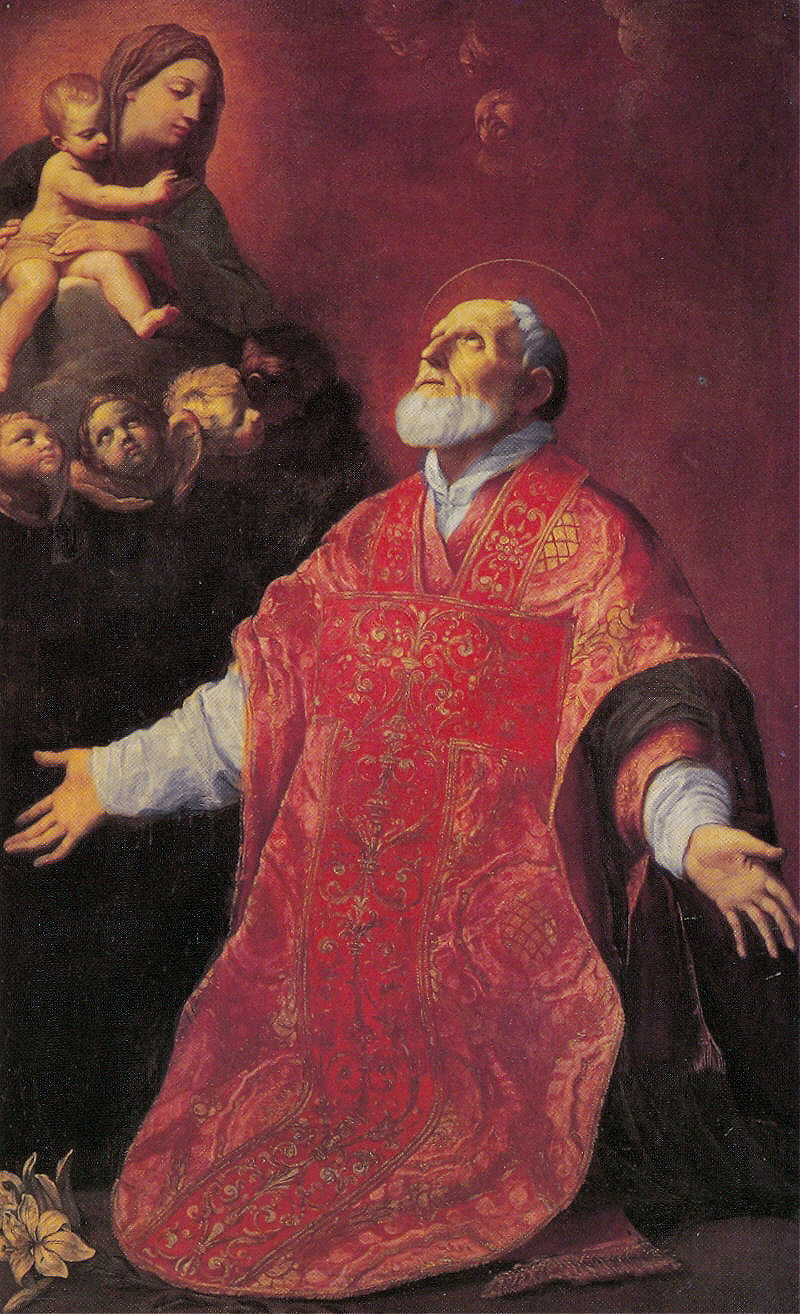
St. Philip Neri, Birmingham Oratory.

St. Philip Neri (1515-1595) who founded the Oratory in Rome in 1550 came from Florence where his family were Tuscan nobles who practicied the learned professions. Like some saints do, Philip tore up these family pedigrees in preference for the poor and itinerant. Once in Rome Philip never made study his central occupation and was reticent to talk about it, but he surprised professional scholars not only by his natural wit and humor but his learned depth and the clearness of his theological thinking and knowledge.

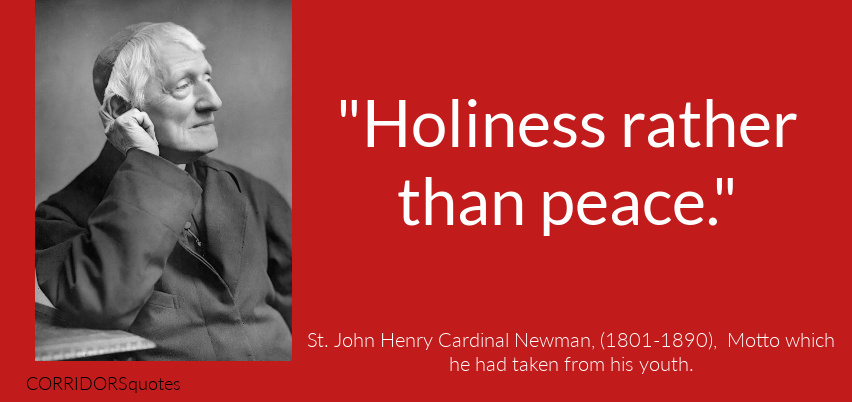
“Holiness rather than peace.” St. John Henry Cardinal Newman, (1801-1890), Motto which he had taken from his youth.

His lifelong motto was “Holiness rather than peace,” reflecting his belief that truth and sanctity mattered more than comfort or popularity.

This explanatory article may be periodically updated.