Tag Archives: #RoadsideAmerica

A Taste of Milwaukee Nostalgia: Leon’s (1942), Happy Days (1974), and an Enduring American Tradition.

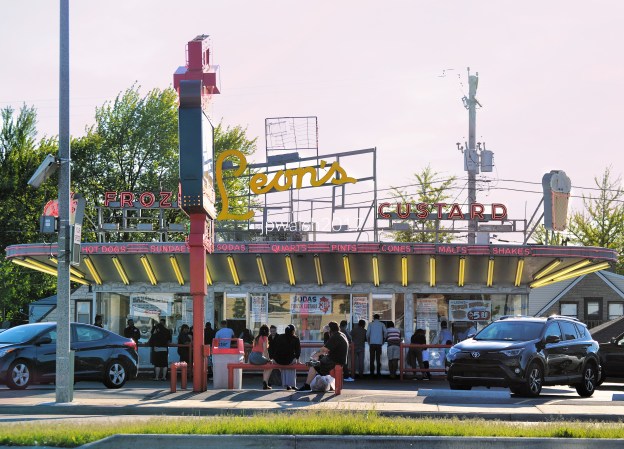
FEATURE image: Late afternoon at Leon’s Frozen Custard in Milwaukee, Wisconsin. June 2017. Author’s photograph. (4.53mb, DSC_0728).

Leon’s Frozen Custard is more than a beloved Milwaukee drive-in. Its remarkable continuity since 1942 and its influence on the creation of Arnold’s Drive-In in television’s Happy Days make it a living link between mid-century Americana, local business history, and popular culture.
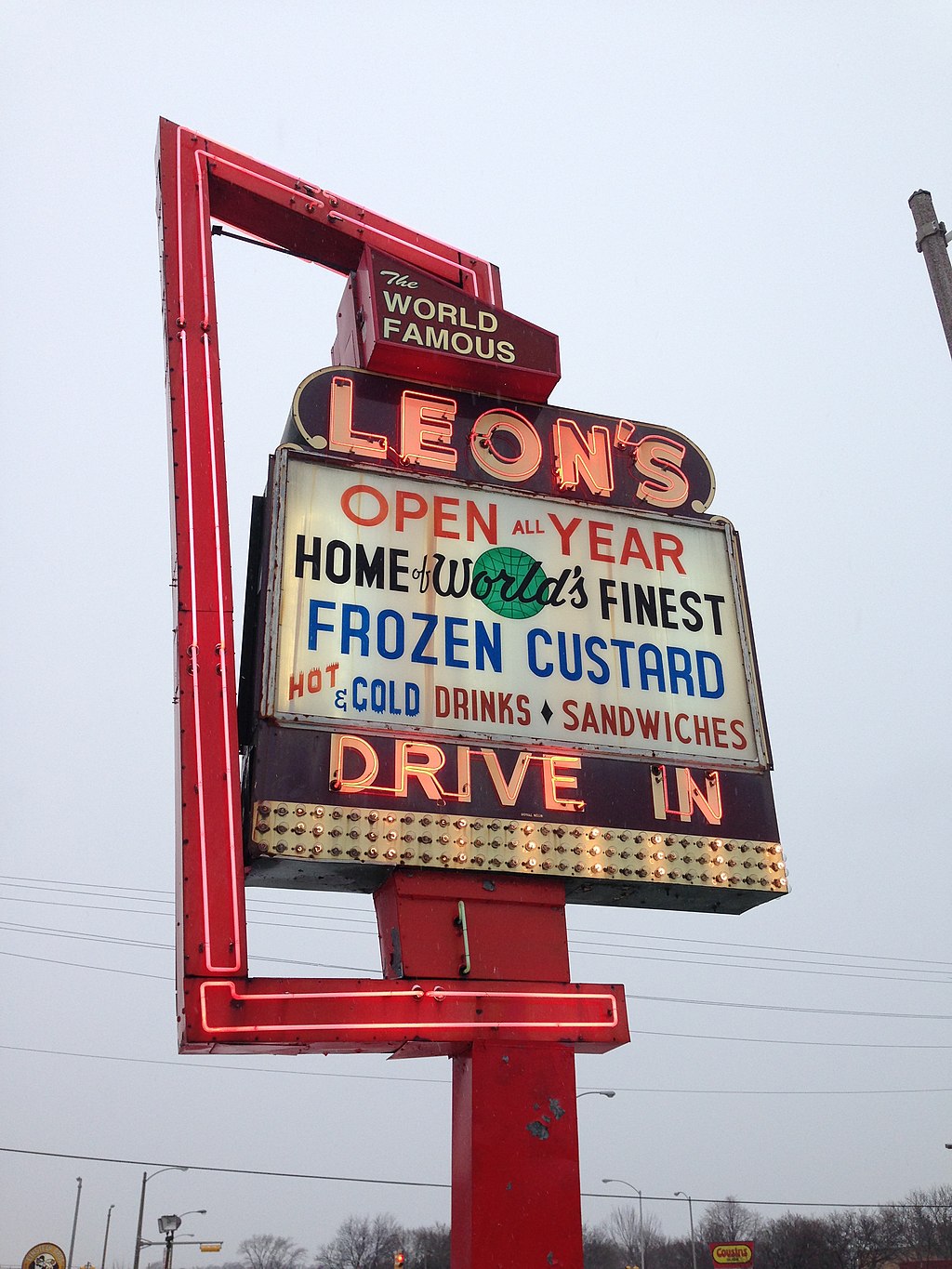
Leon’s original sign. By victorgrigas – Own work, CC BY-SA 3.0.

Leon’s is a family-owned drive-in in Milwaukee, Wisconsin, that opened 83 years ago – in 1942. The building was remodeled in the early 50’s and is what is seen today. Leon’s was inspiration for the original Arnold’s Drive-In in the 1970’s ABC television sitcom, Happy Days, that was also set during the 1950’s in Milwaukee, Wisconsin.

The building was remodeled in the early 1950s, giving it much of the appearance it maintains today.
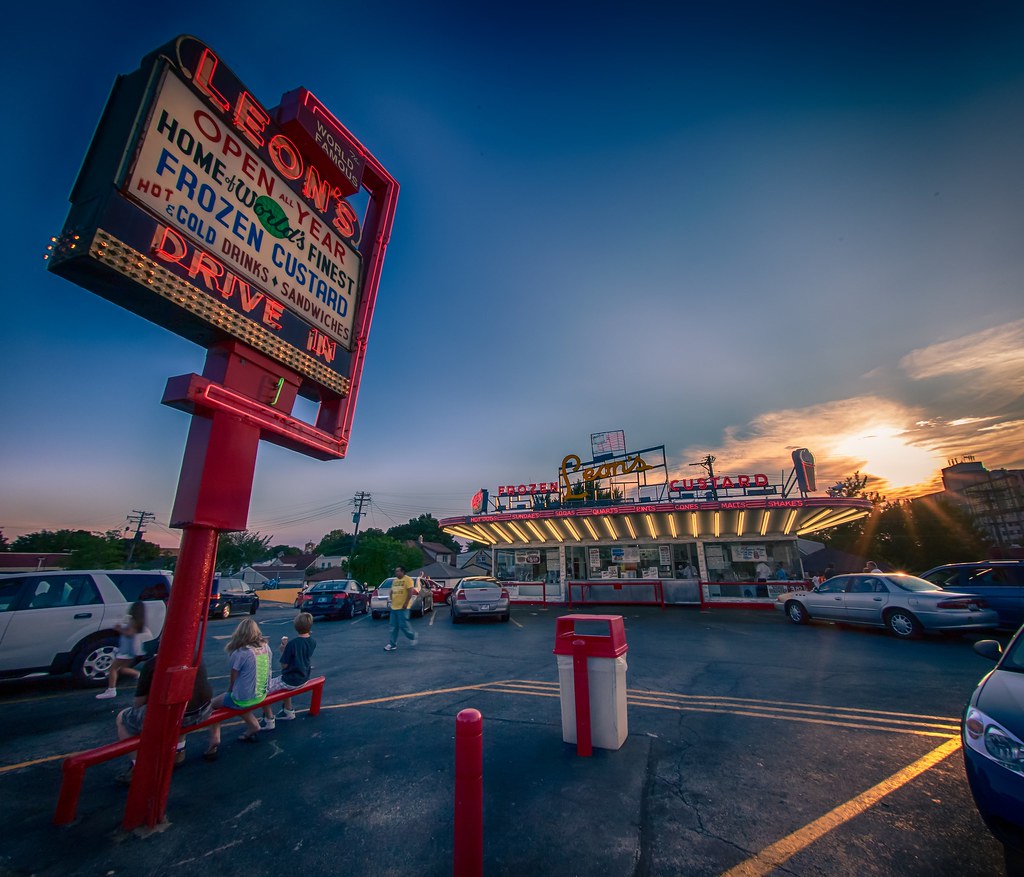
The World Famous Leon’s. “The World Famous Leon’s” by nixter is licensed under CC BY-NC 2.0.

Leon’s served as the inspiration for Arnold’s Drive-In, the iconic gathering place featured in Happy Days, the hit television series set in 1950s Milwaukee.

The Happy Days season 2 intro settles into the warm glow of Arnold’s Drive‑In, where the cast dances, jokes, and moves through the set like regulars in a familiar hangout. The sequence plays over a freshly recorded version of “Rock Around the Clock”, a choice that instantly anchors the show in a 1950s jukebox mood. The season 2 also marks a shift in the show’s rising star power: Henry Winkler’s Arthur “Fonzie” Fonzarelli steps into the opening credits beside Ron Howard, reflecting what would be his iconic popularity with viewers.

Although the tune is the same one Bill Haley & His Comets first cut in 1954, the version heard in Happy Days wasn’t that original hit. The song had begun modestly as the B‑side of a single that only reached No. 23, but everything changed when it blasted through the opening credits of Blackboard Jungle in 1955. Practically overnight, it became a cultural earthquake, soaring to No. 1 that July and helping ignite the rock‑and‑roll era.

Nearly twenty years later, in the fall of 1973, ABC asked the band to re‑record the song specifically for the new TV series. When Happy Days became an instant sensation, viewers went hunting for the version they heard each week—only to discover it wasn’t sold in stores. Their search sent them back to the original 1954 single instead, giving that two‑decades‑old record an unexpected second wind and pushing it back into the Top 40 in 1974, a rare encore for a rock‑and‑roll classic.

Leon’s is a gateway into the broader cultural phenomenon of Happy Days, including its Milwaukee setting, characters, theme song, and enduring popularity.
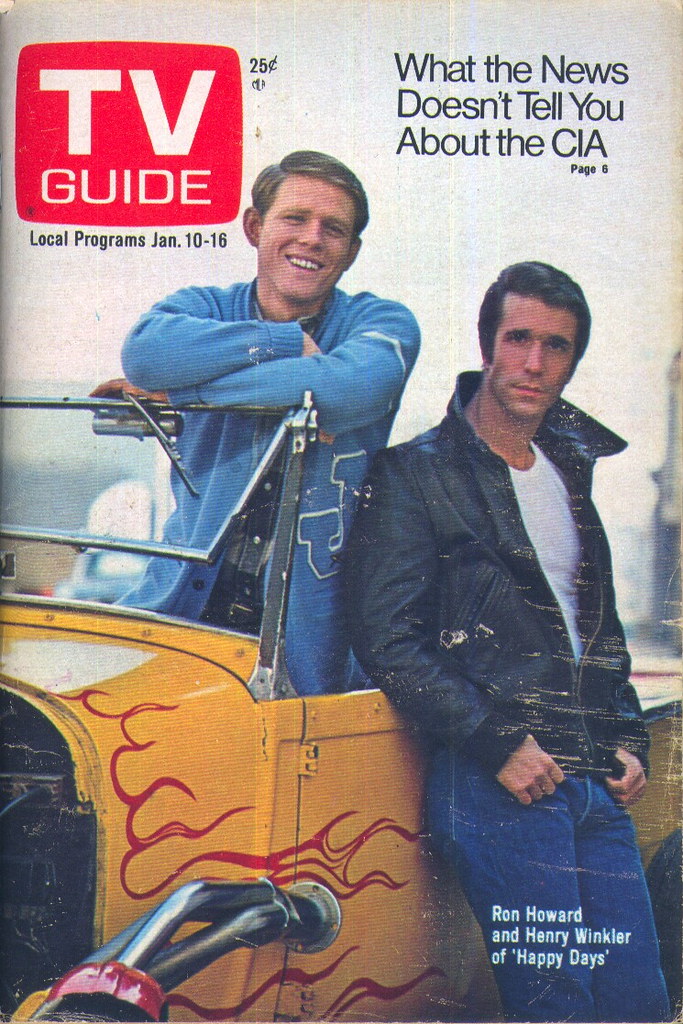
Fonzi played by Henry Winkler was a new character for the ABC TV series. He had just 6 lines in the first episode of “Happy Days” whose debut broadcast was January 15, 1974. In the series, Fonzie’s full name was Arthur Fonzarelli and called that by Richie’s mom. The original family name of series’ creator Garry Marshall (1923-2016) was Masciarelli and changed before Garry was born by his father, a man of Italian descent. “TV Guide #1189” by trainman74 is licensed under CC BY-NC 2.0.

At the 2024 Emmy Awards on September 15, Ron Howard and Henry Winkler reunited to mark Happy Days’ 50th anniversary. The longtime friends presented the award for Outstanding Directing for a Comedy Series from a lovingly recreated Arnold’s Drive‑In set, complete with a vintage jukebox, red‑leather booths, and classic sports pennants.
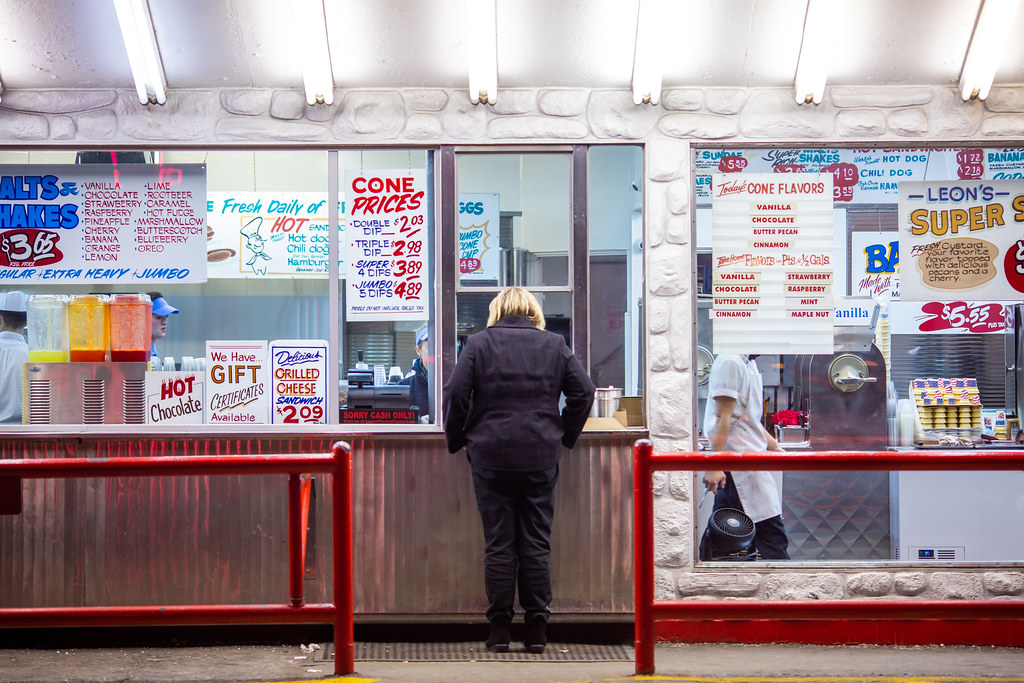
Ordering at Leon’s. “World Famous Leon’s Frozen Custard” by Thomas Hawk is licensed under CC BY-NC 2.0.

Leon’s is still owned and operated by the original family. The main focus of the business is, and always has been, to serve the freshest and finest frozen custard available anywhere. The business is open all year round and they have full soda fountain service, a sandwich menu, daily special flavors and take-out service.
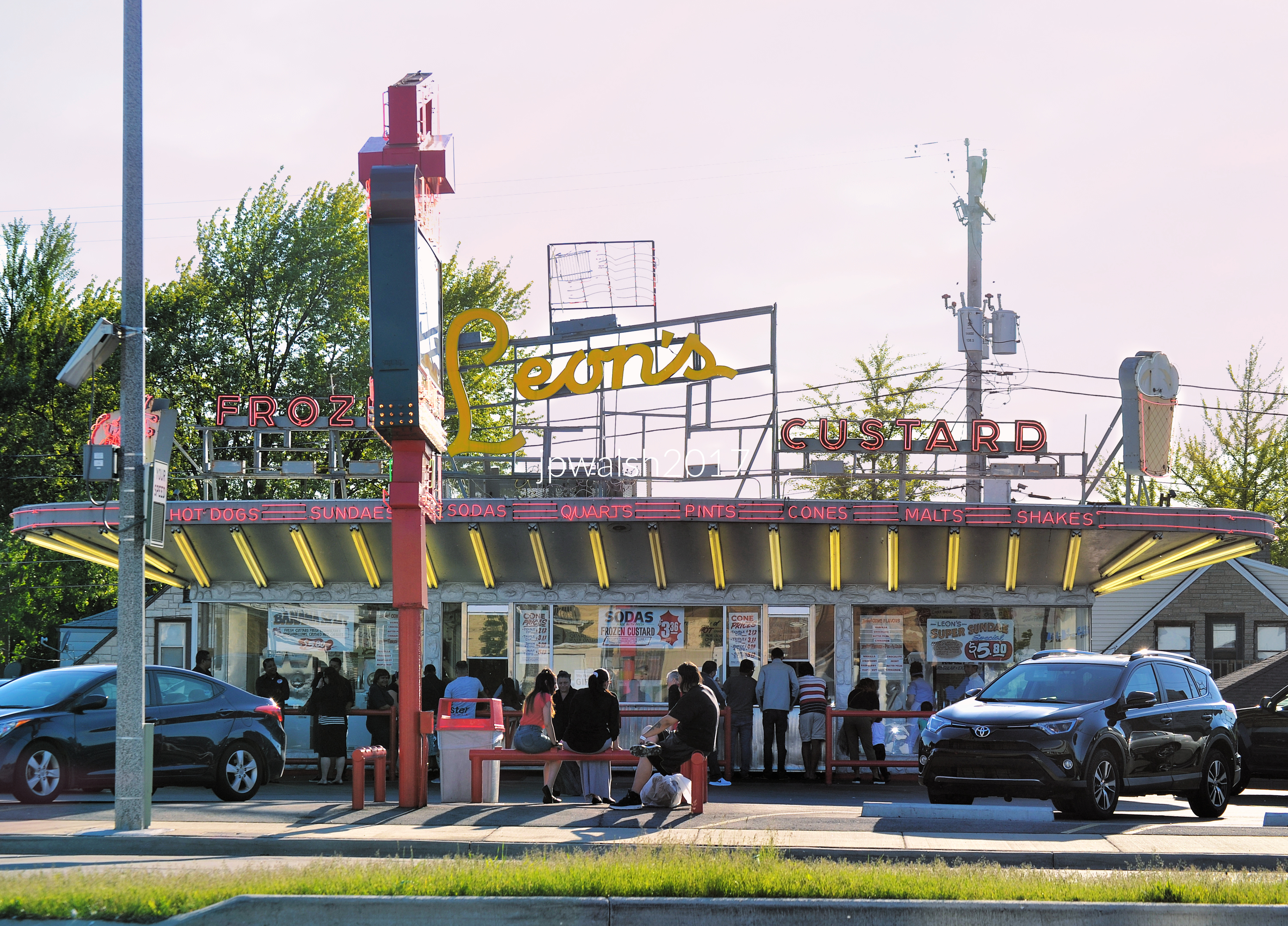
June 2017. Late afternoon at Leon’s, Milwaukee, Wisconsin. Leon’s was inspiration for Arnold’s on Happy Days, a popular 1970’s TV series set in Milwaukee in the 1950’s. Author’s photograph. 4.53 mb
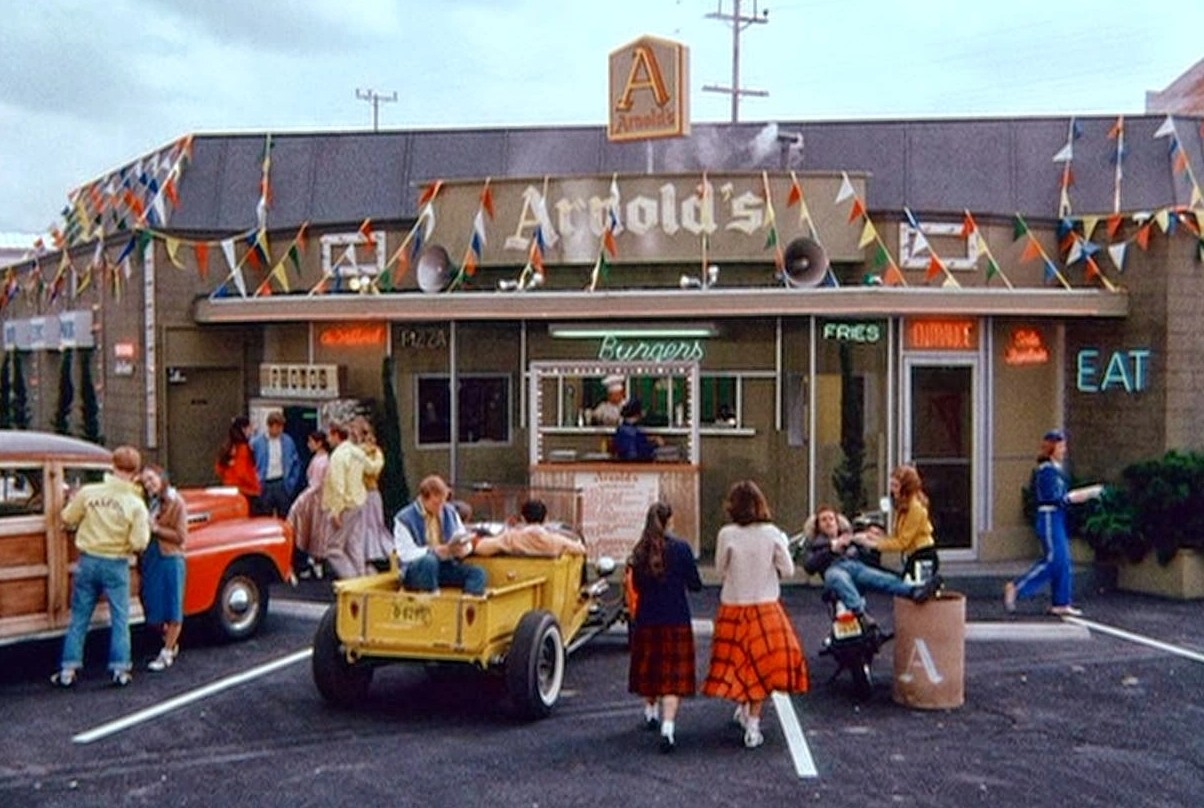
Arnold’s was the name of the local Milwaukee drive-in hang out for most of the characters in Happy Days. Fair Use.

Ron Howard Signs On (1973)

At just 19 years old, Ron Howard signed a seven‑year contract to star in Happy Days. At the time, he was juggling an unusually heavy load: filming American Graffiti, attending USC, and mapping out an early directing career.

Becoming Richie Cunningham

Cast as Richie Cunningham, Howard earned $3,500 per episode—roughly $25,000 in 2025 dollars. He had already played Richie once before, in the February 1972 Love, American Style segment that inspired the new series, but still had to audition again for the TV version. At the first read‑through, Howard reunited with Anson Williams (“Potsie”) and Marion Ross (Richie’s mother)—both of whom had appeared with him in the Love, American Style pilot. He also met the rest of the soon‑to‑be iconic cast: Tom Bosley (“Richie’s dad”), Donny Most (“Ralph Malph”), and Henry Winkler, a 28‑year‑old Yale School of Drama graduate who would become “Fonzie”

A 1970s TV Powerhouse

Alongside M*A*S*H, All in the Family, The Mary Tyler Moore Show, and The Bob Newhart Show, Happy Days became one of the defining sitcoms of the 1970s. It aired for 11 seasons from January 15, 1974, to July 19, 1984 on the ABC network. There was a total of 255 half-hour episodes.

The enduring success of Leon’s reflects the survival of a classic American drive-in tradition that has largely disappeared elsewhere.

Leon’s at night. “Leon’s” by joseph a is licensed under CC BY-NC-SA 2.0.

SOURCES:

Ron Howard & Clint Howard , The Boys A Memoir of Hollywood and Family, William Morrow, 2021, pp. 275-277.

https://leonsfrozencustardmke.com/ – retrieved March 2, 2025.

https://happydays.fandom.com/wiki/Arnold%27s_Drive-In – retrieved March 20, 2025.

The Carhop and the Camera: Blonde Bombshell Dane Arden/Elsa Sørensen at the 1950’s Drive-In.

FEATURE image: A life-sized fiberglass roadside statue standing outside the retro Galaxy Diner near Bryce Canyon in Utah replicates Arden’s playful carhop posture—balancing on roller skates with her knees bent inward, one arm resting confidently on her hip, and the other raised to balance a serving tray. The fiberglass statue is directly modeled after the likeness, pose, and specific clothing worn by Danish model Dane Arden/Elsa Sørensen in one of her most famous 1950s non-nude glamour photography sets. While Dane Arden famously posed for indoor adult publications like Playboy and Adam, her wholesome outdoor “blonde bombshell” imagery became embedded in mid-century pop culture, eventually transforming her iconic 1956 image into an enduring piece of physical American roadside art. PHOTO: “Galaxy Carhop” by JackAZ Photo is marked with CC BY-NC-SA 2.0.

A single 1956 glamour photograph of Dane Arden dressed as an American carhop explores the intersection of mid-century modeling, roadside consumer culture, and the creation of the blonde bombshell image that defined a significant strand of postwar popular culture.

Dane Arden (Elsa Sørensen) in 1956 in her carhop uniform. The photograph was created by renowned glamour photographer Peter Gowland, whose work appeared on hundreds of magazine covers over a long career. Arden is captured mid-stride balancing on one leg with her left arm extended for balance. She holds a small serving tray with two green milk glass tumblers in her right hand. Her outfit consists of a red-and-white gingham print bikini top and high-waisted bottoms with white eyelet trim, a small matching sheer white half-apron around her waist, a ruffled hair accessory, gingham wrist cuffs, and black open-toe high-heeled sandals.

By John P. Walsh

Dane Arden (1934-2013) was an international magazine model in the 1950’s and 1960’s. She was born Elsa Sørensen on March 25, 1934 in Copenhagen, Denmark. Following her win of the title of Miss Denmark as a teenager she went to live with her family in Vancouver, Canada.

Her debut in the September 1956 issue of Playboy magazine gave her much publicity. Elsa Sørensen went on to appear multiple times in that American men’s entertainment/lifestyle publication. As Dane Arden, she modeled for other magazines such as the U.S. versions of Australia’s Adam magazine and Milan, Italy’s illustrated weekly news magazine, Tempo, among others.

Elsa moved to Los Angeles, California and married twice. She died at 79 years old on April 18, 2013 from complications following a bicycle accident in Vero Beach, Florida.

In one favorite set of non-nude color photographs of Dane Arden—this from 1956, the same time as her Playboy shoot— the 22-year-old Danish model expresses her beauty, physical dynamism and engaging personality as she poses as a carhop bringing fast food to people in their cars at drive-in restaurants.

Working carhops first appeared in the early 1920’s along expanding and popular interstate roads. In the 1920’s the carhops were mostly boys and men. During and after World War II, the service role was increasingly performed by women.

By the mid1950’s, abundant drive-ins had to compete for customers in fast-moving automobiles and so carhop uniforms had to be eye catching. Uniforms on busy roads would often be creatively thematic with military, airline, space age, and cheerleader uniforms predominating.

The 1956 color photograph of Dane Arden as a carhop (or waitress) is by Los Angeles-based glamour photographer Peter Gowland (1916-2010), the son of a Hollywood film actor and actress. In a photography career spanning over six decades and characterized by technical innovation, Gowland’s glamour and celebrity photography appeared on over one thousand magazine covers.

Dane Arden is an especially alluring carhop who wears a skimpy plaid-patterned matching fringed halter top and short shorts with fringed apron cut to size. Wearing the typical flat shoes and head gear worn by many female car hops at the time, Dane Arden proffers the perfect uniform to greet her customers with their lime-green cups of hot coffee.

Dane Arden embodied the “blonde bombshell” ideal that became highly popular in American mass culture during the 1950s and 1960s.

Elsa Sørensen

Her appearance in the September 1956 issue of Playboy and other classic mid-20th century men’s magazines brought Dane Arden (Elsa Sørensen) widespread publicity and launched her American modeling profile.

Dane Arden Tempo Oct 30 1956

Published out of Atlanta and New York City by Sports Report, Inc., Tempo belonged to a highly popular post-WWII publishing phenomenon known as men’s pocket digests. Measuring just 4-by-6 inches, these micro-magazines were designed to be cheap ($0.15), highly portable, and easily read on a commute or tucked away out of sight.  

During the mid-1950s, the publishing industry was navigating a massive cultural shift. Playboy had launched in late 1953, completely disrupting the market by moving erotic “cheesecake” imagery into mainstream consumer culture. Pocket digests like Tempo adapted by blending mild pin-up photography with compelling articles such as Hollywood celebrity gossip, political scandals, sports writing, and provocative relationship columns to maximize mass appeal on crowded newsstands.

This particular issue capitalized heavily on Arden’s rising star power. When it hit stands in October 1956, Elsa Sørensen had just debuted as Playboy’s high-profile centerfold the previous month (September 1956). Because she used her real name for Playboy and the name Dane Arden for Tempo.

Instead of a natural beach setting, Sørensen is posed inside a studio designed to look like a lavish, exotic harem room (below). She sits on plush red pillows against a sharp blue-and-white striped background.

Dane Arden is featured on the cover of Adam magazine (Vol. 4, No. 9), published in September 1960 by Knight Publishing Corp. Unlike the tiny, cheap pocket digests of the mid-50s (like Tempo), by 1960 Adam had transitioned into a full-sized, standard 8″ x 10.5″ glossy format. To justify its higher price tag (50 cents, compared to Tempo’s 15 cents), the magazine included more color photography, adult humor comics, and short fiction. The covers feature a small print warning label: “Adults Only!”. As the 1960s began, men’s magazines aggressively pushed boundaries by transitioning away from the safer, outdoor “bikini/cheesecake” themes of the 50s into more explicit, indoor erotic pin-ups.

In the mid-1950’s and early 1960’s Dane Arden posed in American men’s entertainment and lifestyle publications in the nude and non-nude.

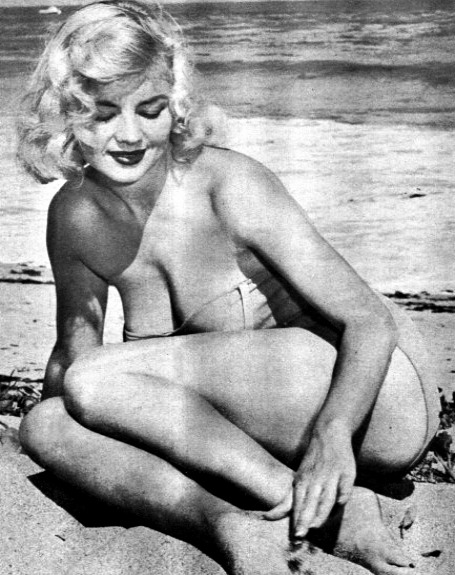
In her magazine spreads, Dane Arden shared with its mainly male readership that it took her longer to achieve an attractive “disheveled look” in a swimsuit for a beach shoot (below) than if she was preparing for a fancy dress-up costume ball.

During the mid-1950s, pocket digests like Tempo relied heavily on these outdoor, natural-light beach shoots. They offered an easy-to-carry format that blended casual “cheesecake” photography with Hollywood gossip, appealing to the post-war American men’s publishing market that was rapidly expanding into the mainstream.

Dane Arden good-humoredly believed there was no “nuttier business” to be in than posing for cheesecake pictures in these popular magazines.

There is a short color documentary filmed in the mid 1970’s at the legendary Keller’s Drive-In in Dallas, Texas. Shot at the end of an era for drive-in car hops along America’s open roads since the 1920’s, the film works to make it easier to imagine the pace and purpose of Dane Arden’s 1956 glamour photograph of a female carhop at a popular mid20th century American roadside eatery.

The documentary about carhops and American Graffiti-style drive-in culture which once littered America’s roads coast to coast–and Dane Arden’s glamour photograph dressed as a car hop–placed the model’s photographic career smack dab in the middle of mainstream American culture.

Keller’s Drive-In which is featured in the film is a classic spot to enjoy a no-frills burger and cold beer. Its founder Jack Keller once worked at Kirby’s Pig Stand which became the nation’s first drive-in restaurant empire. Keller passed away in 2016 at 88 years old.

Keller’s original location opened in 1950 and closed in 2000. The oldest restaurant in the American chain today is the one that opened in 1955 on Northwest Highway in Dallas. There are two other Keller’s restaurants in Dallas.

In addition to Playboy, Elsa Sørensen appeared in the U.S. version of Adam magazine using the name Dane Arden which she used for all her non-Playboy modeling assignments.

Famously appearing nude as Playboy magazine’s Miss September 1956, it was a breakout year for Sørensen, who moved to Los Angeles and became highly sought after by American glamour photographers.

Sources:
Dane Arden biography – Lentz III, Harris M., Obituaries in the Performing Arts, McFarland, 2013 and http://www.pulpinternational.com/pulp/entry/1960-photo-of-Danish-model-Elsa-Sorensen-aka-Dane-Arden.html (retrieved Aug. 28, 2017); women carhops – Koutsky, Kathryn Strand, Koutsky, Linda, and Ostman, Eleanor, Minnesota Eats Out: An Illustrated History, Minnesota Historical Society Press, 2003, p. 134; carhops history – http://www.history.com/this-day-in-history/last-day-for-texas-celebrated-drive-in-pig-stands (retrieved Aug. 28, 2017); story of Keller’s – http://res.dallasnews.com/interactives/kellers/ published on March 18, 2015 and http://www.dallasobserver.com/restaurants/the-man-who-brought-us-one-of-dallas-greatest-burgers-has-died-8271874 (retrieved Aug. 28, 2017).