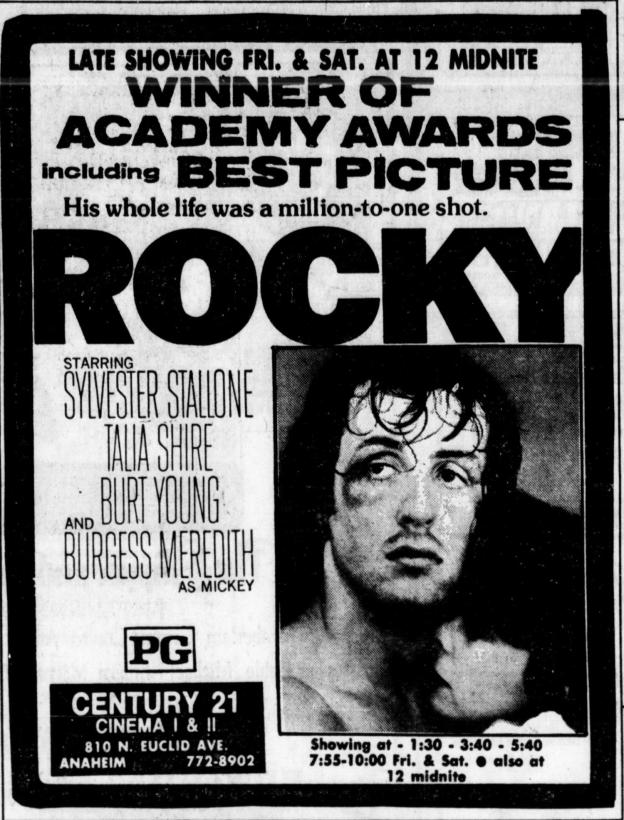
FEATURE image: Newspaper advertisement for the 1976 film Rocky, published shortly after its Academy Award triumphs in March 1977. Dominating the page is the bold proclamation “WINNER OF ACADEMY AWARDS including BEST PICTURE,” paired with the now-iconic tagline, “His whole life was a million-to-one shot.” Above it, theatergoers are enticed with a “LATE SHOWING FRI. & SAT. AT 12 MIDNITE,” while the massive ROCKY logo anchors the advertisement below. The cast, headed by Sylvester Stallone, Talia Shire, Burt Young, and Burgess Meredith, is listed in tall, condensed type along the left side. At right, a grainy publicity still captures the film’s emotional climax as a battered Rocky Balboa embraces Adrian following the fight with Apollo Creed. Celebrating its 50th anniversary, the Best Picture winner, rated PG, remains one of cinema’s most enduring underdog stories. PHOTO: Advertisement for Rocky (1976), Santa Ana Orange County Register, April 1, 1977, p. 102. Public domain, via Wikimedia Commons.
Celebrating its 50th anniversary, Rocky, like its title character, was a long shot that defied expectations. Written by and starring an unknown Sylvester Stallone, the low-budget film became a cultural phenomenon, won Best Picture, launched one of cinema’s most successful franchises, and remains a defining expression of the American belief in perseverance, opportunity, and personal triumph.
By John P. Walsh
Stallone Still Going Strong at 80
Still active in Hollywood at 80 and headlining Paramount+’s Tulsa King, Sylvester Stallone released his memoir, The Steps: A Memoir, in September. Published by William Morrow to coincide with the 50th anniversary of Rocky, the book recounts his difficult childhood, his years struggling in New York after arriving in 1969, and the uphill battle to write, star in, and bring Rocky to the screen before its eventual triumph at the Academy Awards.
The Ultimate Underdog Arrives
Premiering in New York City on November 20, 1976—a whopping 50 years ago today when a standard adult admission was around $2.50— pugnacious Rocky’s blue-collar lug brings shivers of pride to the American viewer as he heroically battles the establishment’s sure bet Apollo Creed in the World Heavyweight boxing ring. It’s the story of American chance, individual determination and prowess, and that diffracted grating offered within a competitive socioeconomic system for what the ultimate meaning of personal victory may be.
A Million-Dollar Long Shot
Like its title character, Rocky was itself an underdog. Written and starring 30-year-old Sylvester Stallone, it was made in 28 days for one million dollars, far below the industry norm of the era of 4 to 6 million. The gamble paid off spectacularly, with the film becoming the highest-grossing movie of 1976 and earning roughly $225 million worldwide.
From Philadelphia Streets to the Academy Awards
Four months after its release – and with a newly-elected president in the White House (Jimmy Carter) – Rocky went on to receive ten Oscar nominations and win three: including Best Director (John G. Avildsen), Best Film Editing (Richard Halsey and Scott Conrad) and Best Picture (Irwin Winkler and Robert Chartoff of United Artists). In later years, the Library of Congress’s National Film Registry recognized the film as one of America’s most significant motion pictures, while critics and audiences alike continued to rank the gritty and, at the same time, clichéd outsider-made film Rocky among the greatest sports films of all time.
A Franchise Built to Last
Out of Stallone’s initial one-million-dollar investment, his nine Rocky films which constitute this all-American boxing saga (the latest, Creed III, released in 2023) have earned almost $2 billion worldwide, ranking this film franchise as the most profitable cinematic exercise in history. What began as a modest independent production evolved into one of cinema’s most enduring franchises. From the original Rocky through the Creed series, the saga has spanned nearly five decades and introduced the Rocky Balboa story to multiple generations.
‘Gonna Fly Now’
The film’s impact extended beyond the screen as Bill Conti’s iconic “Gonna Fly Now (Theme from Rocky)” became an anthem of perseverance and triumph. Nominated for Best Original Song and released exactly one month before the Oscars, the recording reached No. 1 on the Billboard Hot 100 in 1977 and spent 8 weeks in the top 10 (20 weeks on the pop chart overall) and remains one of the most recognizable pieces of music ever associated with a motion picture.
Rocky premiered on November 20, 1976, and remains a defining American underdog story both on screen and behind the scenes.
This explanatory article may be periodically updated.
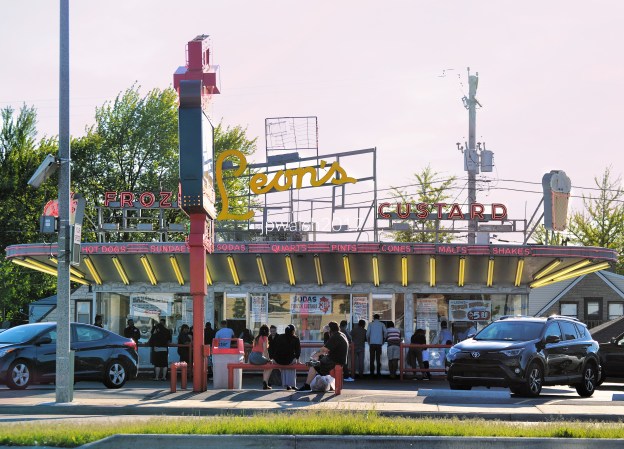
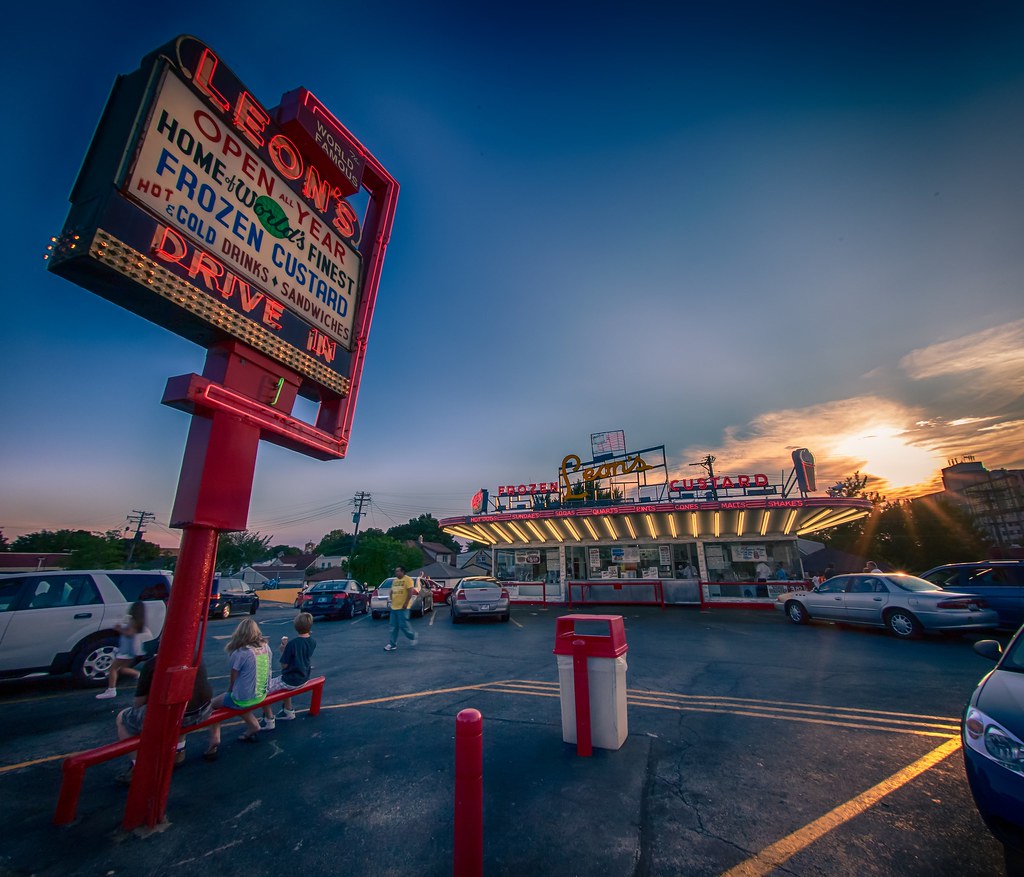
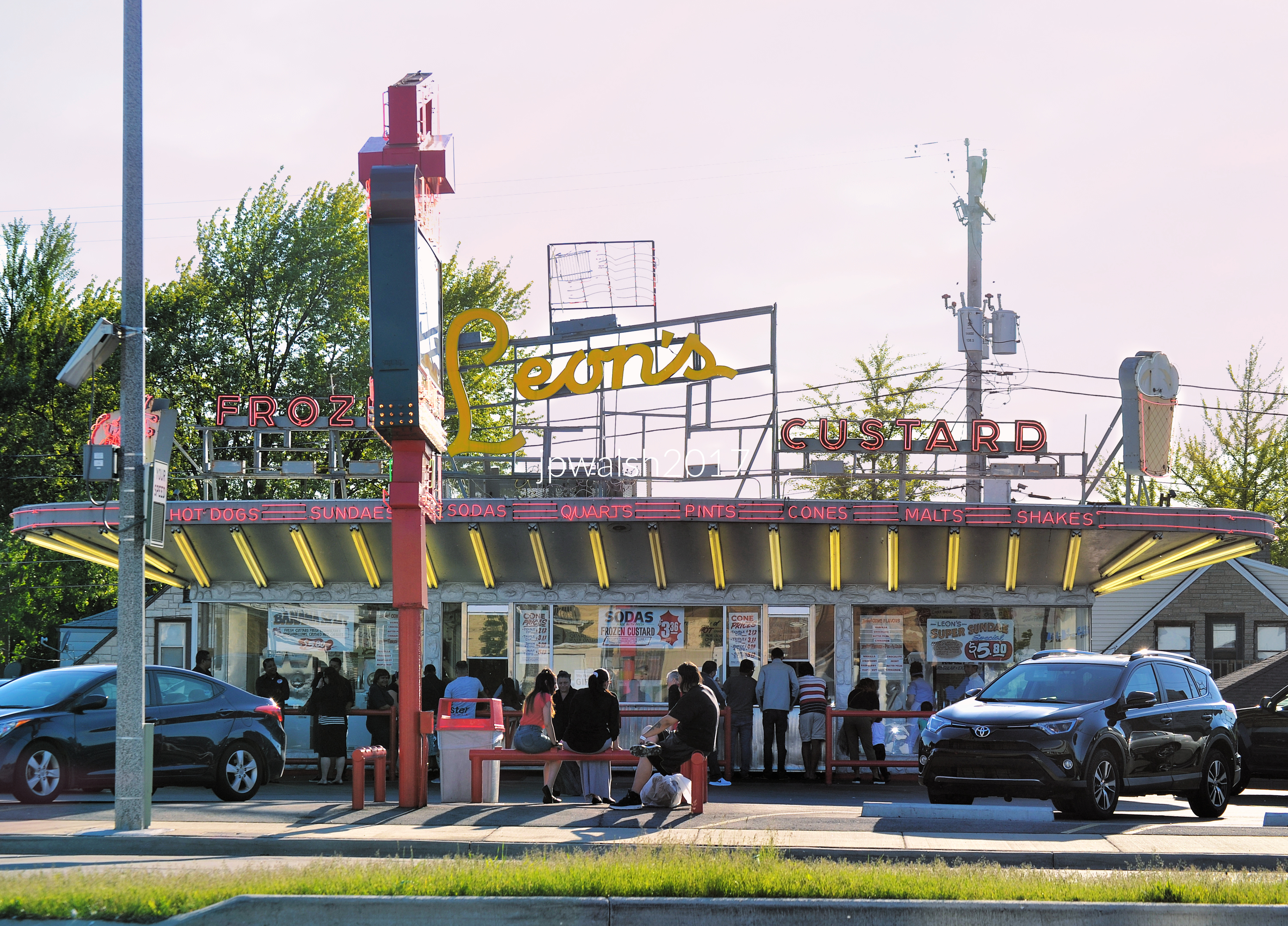
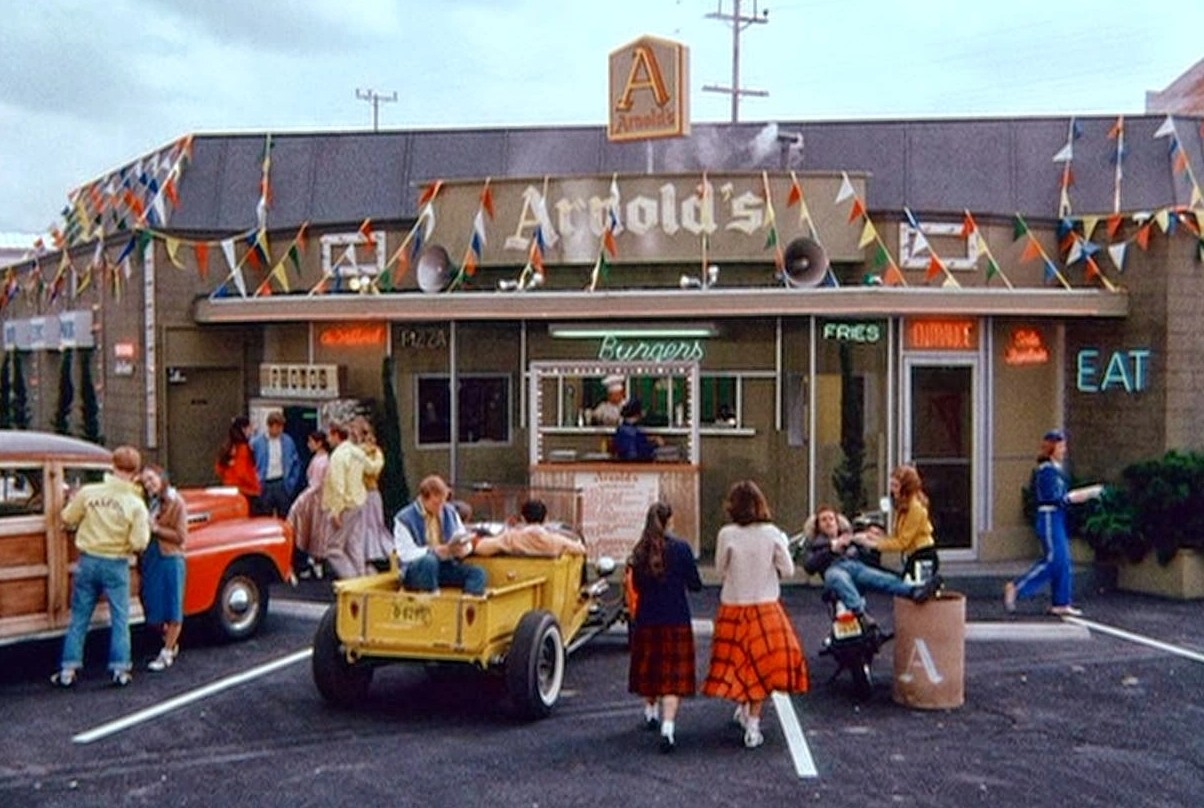
FEATURE image: Late afternoon at Leon’s Frozen Custard in Milwaukee, Wisconsin. June 2017.Author’s photograph. (4.53mb, DSC_0728).
Leon’s Frozen Custard is more than a beloved Milwaukee drive-in. Its remarkable continuity since 1942 and its influence on the creation of Arnold’s Drive-In in television’s Happy Days make it a living link between mid-century Americana, local business history, and popular culture.
Leon’s original sign. By victorgrigas – Own work, CC BY-SA 3.0.
Leon’s is a family-owned drive-in in Milwaukee, Wisconsin, that opened 83 years ago – in 1942. The building was remodeled in the early 50’s and is what is seen today. Leon’s was inspiration for the original Arnold’s Drive-In in the 1970’s ABC television sitcom, Happy Days, that was also set during the 1950’s in Milwaukee, Wisconsin.
The building was remodeled in the early 1950s, giving it much of the appearance it maintains today.
Leon’s served as the inspiration for Arnold’s Drive-In, the iconic gathering place featured in Happy Days, the hit television series set in 1950s Milwaukee.
The Happy Days season 2 intro settles into the warm glow of Arnold’s Drive‑In, where the cast dances, jokes, and moves through the set like regulars in a familiar hangout. The sequence plays over a freshly recorded version of “Rock Around the Clock”, a choice that instantly anchors the show in a 1950s jukebox mood. The season 2 also marks a shift in the show’s rising star power: Henry Winkler’s Arthur “Fonzie” Fonzarelli steps into the opening credits beside Ron Howard, reflecting what would be his iconic popularity with viewers.
Although the tune is the same one Bill Haley & His Comets first cut in 1954, the version heard in Happy Days wasn’t that original hit. The song had begun modestly as the B‑side of a single that only reached No. 23, but everything changed when it blasted through the opening credits of Blackboard Jungle in 1955. Practically overnight, it became a cultural earthquake, soaring to No. 1 that July and helping ignite the rock‑and‑roll era.
Nearly twenty years later, in the fall of 1973, ABC asked the band to re‑record the song specifically for the new TV series. When Happy Days became an instant sensation, viewers went hunting for the version they heard each week—only to discover it wasn’t sold in stores. Their search sent them back to the original 1954 single instead, giving that two‑decades‑old record an unexpected second wind and pushing it back into the Top 40 in 1974, a rare encore for a rock‑and‑roll classic.
Leon’s is a gateway into the broader cultural phenomenon of Happy Days, including its Milwaukee setting, characters, theme song, and enduring popularity.
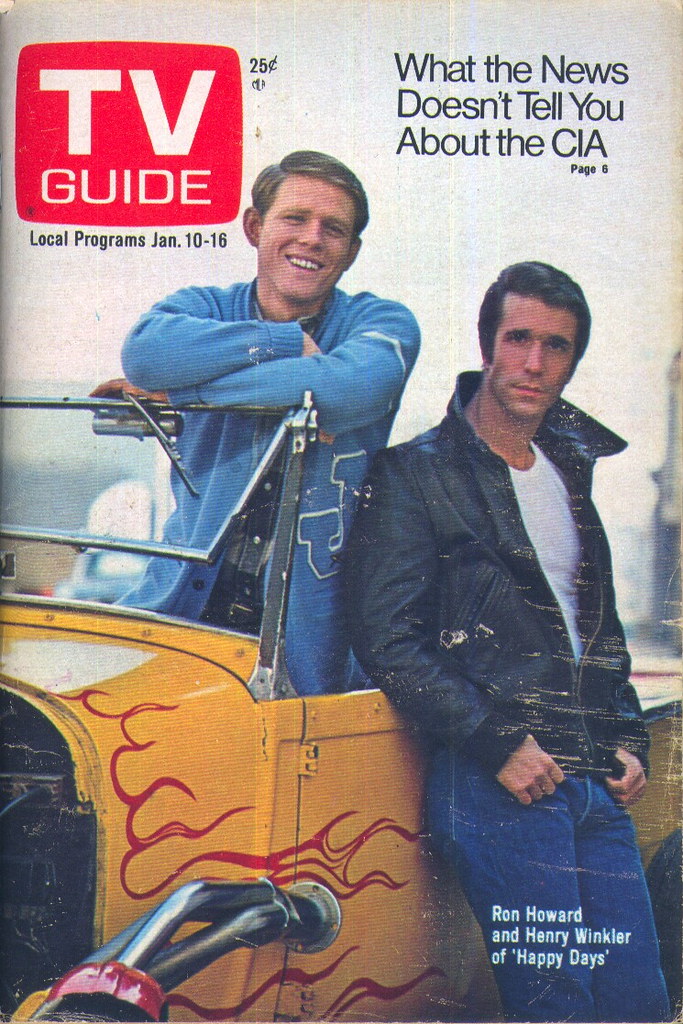
Fonzi played by Henry Winkler was a new character for the ABC TV series. He had just 6 lines in the first episode of “Happy Days” whose debut broadcast was January 15, 1974. In the series, Fonzie’s full name was Arthur Fonzarelli and called that by Richie’s mom. The original family name of series’ creator Garry Marshall (1923-2016) was Masciarelli and changed before Garry was born by his father, a man of Italian descent.“TV Guide #1189” by trainman74 is licensed under CC BY-NC 2.0.
At the 2024 Emmy Awards on September 15, Ron Howard and Henry Winkler reunited to mark Happy Days’ 50th anniversary. The longtime friends presented the award for Outstanding Directing for a Comedy Series from a lovingly recreated Arnold’s Drive‑In set, complete with a vintage jukebox, red‑leather booths, and classic sports pennants.
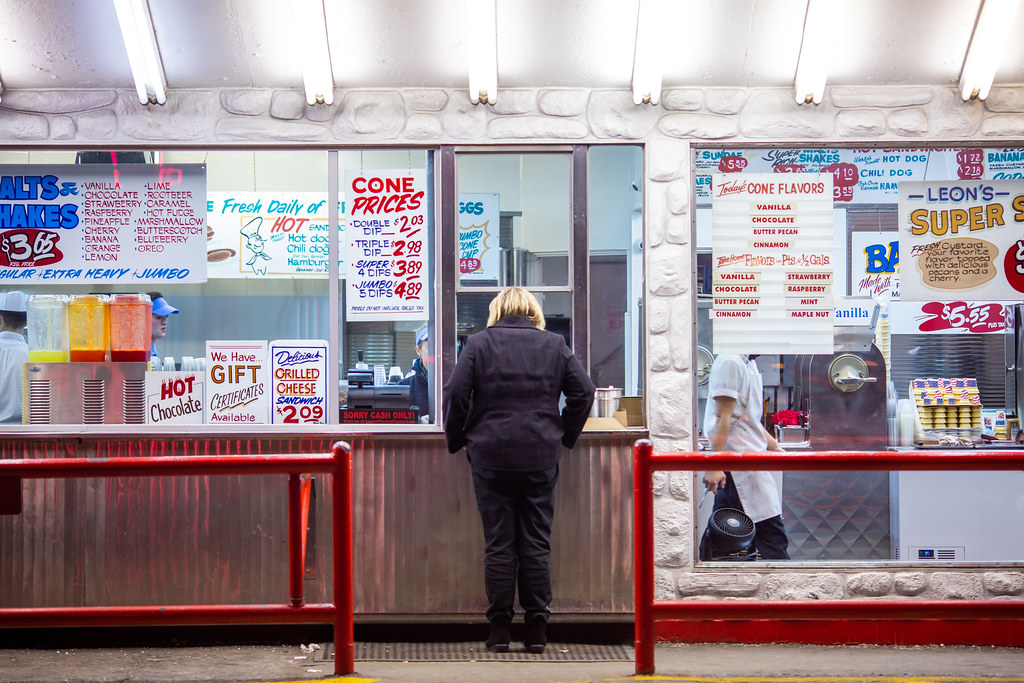
Leon’s is still owned and operated by the original family. The main focus of the business is, and always has been, to serve the freshest and finest frozen custard available anywhere. The business is open all year round and they have full soda fountain service, a sandwich menu, daily special flavors and take-out service.
June 2017. Late afternoon at Leon’s, Milwaukee, Wisconsin. Leon’s was inspiration for Arnold’s on Happy Days, a popular 1970’s TV series set in Milwaukee in the 1950’s. Author’s photograph. 4.53 mb
Arnold’s was the name of the local Milwaukee drive-in hang out for most of the characters in Happy Days. Fair Use.
Ron Howard Signs On (1973)
At just 19 years old, Ron Howard signed a seven‑year contract to star in Happy Days. At the time, he was juggling an unusually heavy load: filming American Graffiti, attending USC, and mapping out an early directing career.
Becoming Richie Cunningham
Cast as Richie Cunningham, Howard earned $3,500 per episode—roughly $25,000 in 2025 dollars. He had already played Richie once before, in the February 1972 Love, American Style segment that inspired the new series, but still had to audition again for the TV version. At the first read‑through, Howard reunited with Anson Williams (“Potsie”) and Marion Ross (Richie’s mother)—both of whom had appeared with him in the Love, American Style pilot. He also met the rest of the soon‑to‑be iconic cast: Tom Bosley (“Richie’s dad”), Donny Most (“Ralph Malph”), and Henry Winkler, a 28‑year‑old Yale School of Drama graduate who would become “Fonzie”
A 1970s TV Powerhouse
Alongside M*A*S*H, All in the Family, The Mary Tyler Moore Show, and The Bob Newhart Show, Happy Days became one of the defining sitcoms of the 1970s. It aired for 11 seasons from January 15, 1974, to July 19, 1984 on the ABC network. There was a total of 255 half-hour episodes.
The enduring success of Leon’s reflects the survival of a classic American drive-in tradition that has largely disappeared elsewhere.
FEATURE Image: This color photograph of Marilyn Monroe was made by Bruno Bernard — Bernard of Hollywood — on August 3, 1952, during the poolside press party at bandleader Ray Anthony’s California home. Co‑organized by 20th Century‑Fox, the event was engineered to showcase Monroe’s rapid ascent and to promote Anthony’s novelty song, Marilyn. She is wearing the same dress used in her Niagara publicity stills and scenes, a deliberate continuity meant to reinforce her emerging screen persona. Bernard had known her since 1946, when she was still Norma Jeane, and he remained one of the few photographers able to catch her in genuinely relaxed, luminous moments. His poolside images from this period are among the most candid records of her early stardom. PHOTO: “Marilyn Monroe – 1952, Niagara” by Movie-Fan is licensed under CC BY-NC-SA 2.0.
The 1952 hit single “Marilyn” was more than a popular song. It was part of the carefully coordinated Hollywood publicity machinery that helped transform Marilyn Monroe from a rising actress into a national celebrity. The song, the media campaign surrounding it, and the highly publicized poolside event at bandleader Ray Anthony’s home illustrate how Hollywood, popular music, photography, and publicity worked together to build Monroe’s emerging star image.
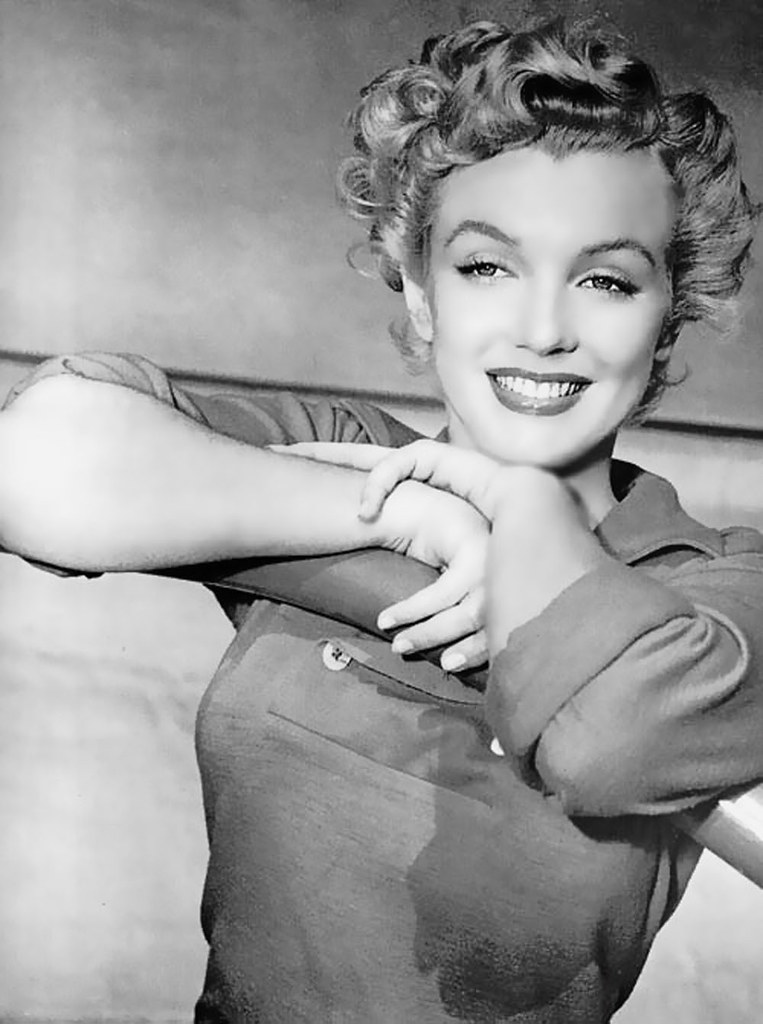
Marilyn Monroe in 1951 was emerging fast, already drawing notice from critics who tagged her as “the new blonde bombshell.” The black‑and‑white portrait of Marilyn Monroe was made in late 1951 by Ernest Bachrach, RKO’s chief portrait photographer, and syndicated widely through 1952. Shot both on location and in the studio spaces at RKO Radio Pictures in Los Angeles, the session was designed as a high‑visibility publicity campaign for Fritz Lang’s Clash by Night (1952). Monroe had pushed hard to be loaned out from 20th Century‑Fox for the supporting role of Peggy, a confident, blue‑collar cannery worker — a part she knew could shift how Hollywood viewed her.
Bachrach, a master of glamour portraiture, photographed her with the explicit aim of presenting her as a credible dramatic actress alongside veterans like Barbara Stanwyck. The film ultimately altered the trajectory of her career: for the first time, Monroe received billing above the title in a major motion picture. Bachrach’s photo campaign amplified that breakthrough, making her a household name even before the film reached theaters. It also demonstrated to studio executives that her magnetism held just as strongly in casual, sporty attire as in tight, high‑glamour wardrobe — a fusion that helped define the emerging “girl next door” aesthetic of 1950s Hollywood photography.PHOTO: “Marilyn Monroe, por Ernest Bachrach, 1951” by Antonio Marín Segovia is licensed under CC BY-NC-ND 2.0.
A widely publicized August 1952 poolside party at bandleader Ray Anthony’s California home was organized partly to promote both Monroe and the song. Hollywood had never seen an actress command the cultural conversation in one year like this. She was the original high-concept, serial franchise film star. Her face and body sold newspapers, magazines, makeup, and movie tickets at an unprecedented velocity.
Marilyn Monroe started 1953 as Hollywood’s “It” girl. The photograph shows Marilyn in a cropped frame from late 1953, captured at the Hollywood film premiere for How to Marry a Millionaire. She is wearing a famous custom white lace gown designed by William Travilla. It does relate to the August 1952 “Marilyn” party in that it is bound together by the explosive phenomenon of her meteoric rise.
In early 1953, Marilyn Monroe transitioned from a hard-working studio starlet into the absolute, undisputed “It Girl” of global popular culture. This specific phenomenon changed her life, transformed Hollywood marketing, and left a permanent mark on entertainment history.
Before 1953, 20th Century Fox viewed Marilyn as a profitable novelty. By January 1953, a perfect storm of media alignment occurred. The groundwork laid by those 1952 events—like the Ray Anthony party, the LIFE magazine cover, and the continuous press blitzes— culminated in a box-office avalanche.
In a single twelve-month span, Monroe released three consecutive, massive cinematic triumphs: Niagara in January 1953 where she starred as a dark, dangerous femme fatale; Gentlemen Prefer Blondes in July 1953 where she cemented her legendary comedic timing and musical icon status in the shocking pink Travilla gown; and How to Marry a Millionaire in November 1953 where she solidified her mass commercial appeal as a whispery “dumb blonde” comedic character.
Marilyn redefined what an “It Girl” could be. It Girls came in all types previously—from the aloof, untouchable elegance of stars like Greta Garbo or Joan Crawford to the gritty, working-class, uninhibited trail that Clara Bow and Jean Harlow blazed. Marilyn introduced a radiant, highly accessible, and deeply vulnerable form of sexuality. She projected a playful, “wink-at-the-camera” warmth that made audiences feel like she was letting them in on the fun.
A tragic irony of Marilyn becoming the ultimate 1953 “It Girl” is that the very phenomenon that made her immortal also trapped her in her “dumb blonde” or “glamour queen” roles and persona, so that in late 1954 she walked away from Hollywood temporarily after refusing typecasting roles and, when she came back, things were never quite the same. Decades later, the visual shorthand established during her 1953 peak remains the definitive blueprint for modern celebrity culture. The hyper-focus on her hair, her outfits, her dating life, and her physical form set the stage for how modern pop stars and icons are scrutinized by the media today. PHOTO: “Marilyn Monroe 1953” by Movie-Fan is licensed under CC BY-NC-SA 2.0.
Bandleader Ray Anthony released the two-minute single Marilyn in 1952 with rising film star Marilyn Monroe definitely in mind. Born Raymond Antonini to an Italian family in Bentleyville, Pennsylvania, in 1922, Ray Anthony is a living bridge to the Big Band era, the last surviving member of the original Glenn Miller Orchestra and the world’s oldest living recorded musician. After serving in the U.S. Navy during World War II, he launched the wildly successful Ray Anthony Orchestra, scoring early 1950s hits with “Marilyn,” “The Bunny Hop,” and “The Hokey Pokey,” while also topping the charts with his iconic instrumental themes for Dragnet and Peter Gunn. Now retired in the Hollywood Hills, Anthony remains one of the last direct links to the golden age of American popular music.
Hollywood mythology claims Marilyn Monroe n a bright pink dress swept into the August 1952 release party for the song Marilyn, touching down in a helicopter before exiting just as theatrically. In reality she arrived by car. The helicopter, brought in separately, became a convenient prop once publicists realized its value: they had her climb aboard and pose with Ray Anthony to manufacture the impression of a dramatic aerial entrance. The afternoon itself had the usual Hollywood chaos — Lassie trotted up to greet her, and Mickey Rooney jumped behind the drums with Anthony’s orchestra to play for her.
By the end of 1951 Marilyn had completed thirteen films, most for 20th Century‑Fox, and by 1952 she was poised on the threshold of major stardom. In 1952 she added five more. In Clash by Night (RKO), Kate Cameron of the New York News tagged her as “the new blonde bombshell.” In Fox’s We’re Not Married, Alton Cook of the New York World‑Telegram wrote that “Marilyn supplies beauty. She is Hollywood’s foremost expert.” Fox’s Monkey Business prompted Paul C. Beckley of the New York Herald Tribune to note the shift underway: “Not seen her before. I now know what’s that about.” She finished the year in Fox’s anthology O. Henry’s Full House, where Archer Winston of the New York Post singled out her “stunning proportions.”
This iconic black‑and‑white close‑up of Marilyn Monroe (above) was made in early 1953 by 20th Century‑Fox’s chief portrait photographer, Frank Powolny, as a publicity image for her breakthrough film Niagara. The styling, the expression, the heavy‑lidded “bedroom eyes” — all echo the Philippe Halsman Life magazine portrait from January 1952 (published April 7, 1952), because both sessions caught her at the exact moment she was standardizing and weaponizing her look.
The 1953 shoot took place at the Fox studios in Los Angeles, a high‑glamour promotional session meant to generate marketing material also for Gentlemen Prefer Blondes. Used widely in posters, press kits, and magazine syndication, the portrait is historically important because it crystallized her trademark expression: head tipped slightly back, eyes half‑closed, lips parted just enough to show her teeth.
Its impact was immediate. The image fixed her aesthetic in the public imagination and helped shift her from rising starlet to fully recognized global symbol of Hollywood glamour. Decades later, the tight crop — platinum curls, parted lips, beauty mark, and that unmistakable gaze — remains one of the most reproduced portraits in pop culture. It was this Powolny series that Andy Warhol appropriated for his 1962 silkscreens after her death. Marilyn didn’t merely suggest the look she had explored with Halsman; she executed it so precisely that the studio seized it and mass‑marketed its power. PHOTO: “Marilyn Monroe – 1952 / fotografiada por Philippe Halsman para LIFE” by Antonio Marín Segovia is licensed under CC BY-NC-ND 2.0.
Monroe’s public image was being carefully shaped through studio publicity, photography, magazine coverage, and promotional appearances.
Taken by Canadian journalist‑photographer Jock Carroll in June 1952 on location in Niagara Falls, Canada, this candid portrait comes from his two‑week assignment for Weekend Magazine, which had commissioned him to profile the 26‑year‑old rising actress as she filmed her breakthrough thriller Niagara. The image captures a candid, windswept moment during one of their informal walks along the Niagara River: Monroe in a simple white sleeveless top, her small medallion pendant visible, her blonde curls blown out by the mist and wind rolling off the falls.
Across the assignment Carroll shot more than 400 candid photographs. The easy rapport they developed allowed him to capture unguarded moments — including the now‑famous sequence of Monroe practicing how to smoke in her room at the General Brock Hotel for an upcoming role. A selection of his images ran with his profile in the August 9, 1952 issue of Weekend Picture Magazine.
Most of the negatives remained unseen for decades until they resurfaced in 1996 in Falling for Marilyn: The Lost Niagara Collection, which established the set as a major historical record. Today, this windswept portrait is celebrated for stripping away the studio‑manufactured bombshell veneer, offering instead an unfiltered, radiant glimpse of Norma Jeane at her most natural and effortlessly charming. PHOTO: “Marilyn Monroe by Jock Carroll, June, 1952” by thefoxling is licensed under CC BY-NC-SA 2.0.
One of Jock Carroll’s 400 candid photographs of Marilyn on location in June 1952 for Niagara, catches her from behind as she breaks into a light jog in her high heels along the concrete pier toward the Maid of the Mist as Niagara Falls thunders behind. Carroll wanted movement rather than a stiff publicity pose, something that showed her responding naturally to the environment. She wears a button‑back, off‑the‑shoulder top and a pale pencil skirt, the outfit emphasizing the clean, unforced lines of her stride.
In the finished 1953 film, director Henry Hathaway devoted 116 uninterrupted feet of film to a single shot of Monroe walking away from the camera in a tight pencil skirt — one of the longest “walking‑away” shots in cinema history. It permanently established her swinging gait as a defining element of her star power, a signature that audiences recognized instantly and never forgot.
Marilyn Monroe’s performance and appearance in Niagara in 1953 from 20th Century-Fox were highly praised. One critic observed: “Seen from any angle…Marilyn Monroe leaves little to be desired.” (A.H. Weiler, New York Times). Public Domain. in the United States. Because it was an uncopyrighted promotional still distributed freely to the public by the movie studio between 1931 and 1963, its copyright was never registered or renewed.
Publicity portrait of Marilyn Monroe as Rose Loomis in the 1953 film Niagara. By Gene Kornman (1897-1978). This work is in the public domain because it was published in the United States between 1931 and 1963, and although there may or may not have been a copyright notice, the copyright was not renewed.
Marilyn Monroe’s momentum in 1953 never faltered. Her three Twentieth Century‑Fox releases that year — Niagara, praised as “seductive,” Gentlemen Prefer Blondes, deemed “alluring,” and How to Marry a Millionaire, celebrated for her “magnificent proportions” — collectively cemented her acting career and her place as America’s enduring screen symbol.
Ray Anthony (b. 1922), one of the last living figures from post‑war Old Hollywood, belongs to the same generation whose era effectively closed with Marilyn’s death in 1962. Four years her senior, he reached his hundredth birthday in California on January 20, 2022.
Most of that remarkable cohort born in 1922 — Ava Gardner, Jason Robards, Betty White, Judy Garland, Doris Day, Cyd Charisse, Kim Hunter, Eleanor Parker, Veronica Lake, and many others — has now passed, leaving only a few witnesses to that vanished world.
Marilyn Monroe and Joe DiMaggio — the movie star and the former major‑league baseball great — married in 1954. PHOTO: “Evan Esar” by Peter K. Levy is marked with Public Domain Mark 1.0.
Ray Anthony’s rise in the early 1950s came through a wildly popular dance band that kept producing records that instantly entered American social life. Numbers like The Hokey Pokey and The Bunny Hop became fixtures at wedding receptions throughout the 1960s and 1970s, part of the soundtrack of mid‑century celebration.
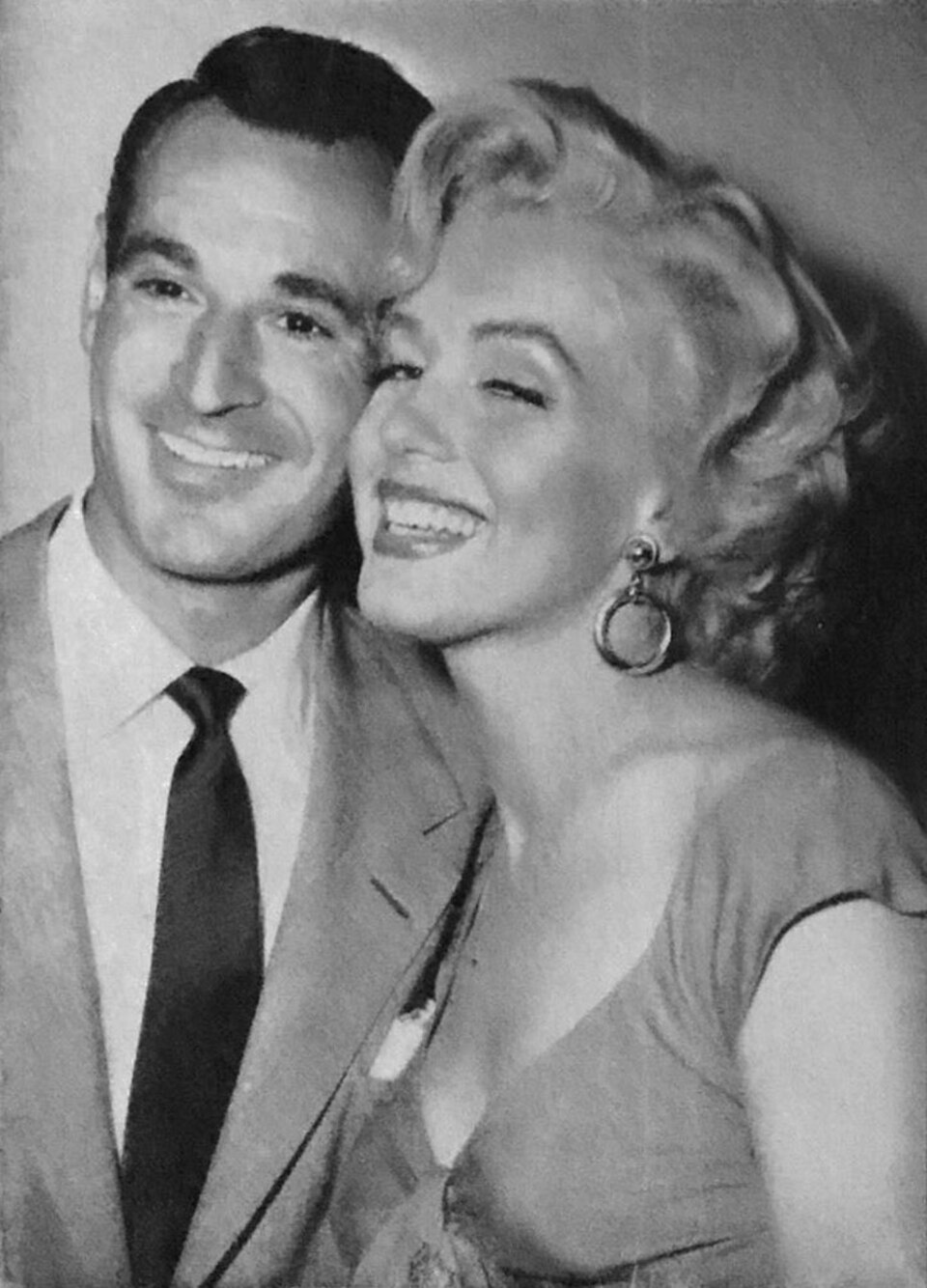
When Anthony released his single Marilyn, the world’s most famous sex symbol was still unattached, though being actively courted by New York Yankees legend Joe DiMaggio. They would marry in 1954. By then Marilyn had already been declared Hollywood’s “It Girl” of 1952, her career hovering at the edge of full stardom — an excitement that made the Marilyn release party crackle.
Photo of musician Ray Anthony and Marilyn Monroe from the cover of Down Beat magazine in 1952.This work is in the public domain because it was published in the United States between 1931 and 1963, and although there may or may not have been a copyright notice, the copyright was not renewed.
Anthony had a particular fondness for glamorous Hollywood blondes. He married one in 1955: Mamie Van Doren, with whom he had a son before divorcing in 1961. In 1956 he appeared alongside another blonde bombshell, Jayne Mansfield, in the musical comedy The Girl Can’t Help It.
Surrounded by beauty, music, and the energy of post‑war Hollywood, Anthony reached a fitting milestone in 1957 when he received his star on the Hollywood Walk of Fame. Marilyn Monroe received her Hollywood Walk of Fame star on February 8, 1960.
This explanatory article may be periodically updated.
FEATURE image: A life-sized fiberglass roadside statue standing outside the retro Galaxy Diner near Bryce Canyon in Utah replicates Arden’s playful carhop posture—balancing on roller skates with her knees bent inward, one arm resting confidently on her hip, and the other raised to balance a serving tray. The fiberglass statue is directly modeled after the likeness, pose, and specific clothing worn by Danish model Dane Arden/Elsa Sørensen in one of her most famous 1950s non-nude glamour photography sets. While Dane Arden famously posed for indoor adult publications like Playboy and Adam, her wholesome outdoor “blonde bombshell” imagery became embedded in mid-century pop culture, eventually transforming her iconic 1956 image into an enduring piece of physical American roadside art. PHOTO: “Galaxy Carhop” by JackAZ Photo is marked with CC BY-NC-SA 2.0.
A single 1956 glamour photograph of Dane Arden dressed as an American carhopexplores the intersection of mid-century modeling, roadside consumer culture, and the creation of the blonde bombshell image that defined a significant strand of postwar popular culture.
Dane Arden (Elsa Sørensen) in 1956 in her carhop uniform. The photograph was created by renowned glamour photographer Peter Gowland, whose work appeared on hundreds of magazine covers over a long career. Arden is captured mid-stride balancing on one leg with her left arm extended for balance. She holds a small serving tray with two green milk glass tumblers in her right hand. Her outfit consists of a red-and-white gingham print bikini top and high-waisted bottoms with white eyelet trim, a small matching sheer white half-apron around her waist, a ruffled hair accessory, gingham wrist cuffs, and black open-toe high-heeled sandals.
By John P. Walsh
Dane Arden (1934-2013) was an international magazine model in the 1950’s and 1960’s. She was born Elsa Sørensen on March 25, 1934 in Copenhagen, Denmark. Following her win of the title of Miss Denmark as a teenager she went to live with her family in Vancouver, Canada.
Her debut in the September 1956 issue of Playboy magazine gave her much publicity. Elsa Sørensen went on to appear multiple times in that American men’s entertainment/lifestyle publication. As Dane Arden, she modeled for other magazines such as the U.S. versions of Australia’s Adam magazine and Milan, Italy’s illustrated weekly news magazine, Tempo, among others.
Elsa moved to Los Angeles, California and married twice. She died at 79 years old on April 18, 2013 from complications following a bicycle accident in Vero Beach, Florida.
In one favorite set of non-nude color photographs of Dane Arden—this from 1956, the same time as her Playboy shoot— the 22-year-old Danish model expresses her beauty, physical dynamism and engaging personality as she poses as a carhop bringing fast food to people in their cars at drive-in restaurants.
Working carhops first appeared in the early 1920’s along expanding and popular interstate roads. In the 1920’s the carhops were mostly boys and men. During and after World War II, the service role was increasingly performed by women.
By the mid1950’s, abundant drive-ins had to compete for customers in fast-moving automobiles and so carhop uniforms had to be eye catching. Uniforms on busy roads would often be creatively thematic with military, airline, space age, and cheerleader uniforms predominating.
The 1956 color photograph of Dane Arden as a carhop (or waitress) is by Los Angeles-based glamour photographer Peter Gowland (1916-2010), the son of a Hollywood film actor and actress. In a photography career spanning over six decades and characterized by technical innovation, Gowland’s glamour and celebrity photography appeared on over one thousand magazine covers.
Dane Arden is an especially alluring carhop who wears a skimpy plaid-patterned matching fringed halter top and short shorts with fringed apron cut to size. Wearing the typical flat shoes and head gear worn by many female car hops at the time, Dane Arden proffers the perfect uniform to greet her customers with their lime-green cups of hot coffee.
Dane Arden embodied the “blonde bombshell” ideal that became highly popular in American mass culture during the 1950s and 1960s.
Her appearance in the September 1956 issue of Playboy and other classic mid-20th century men’s magazinesbrought Dane Arden (Elsa Sørensen) widespread publicity and launched her American modeling profile.
Published out of Atlanta and New York City by Sports Report, Inc., Tempo belonged to a highly popular post-WWII publishing phenomenon known as men’s pocket digests. Measuring just 4-by-6 inches, these micro-magazines were designed to be cheap ($0.15), highly portable, and easily read on a commute or tucked away out of sight.
During the mid-1950s, the publishing industry was navigating a massive cultural shift. Playboy had launched in late 1953, completely disrupting the market by moving erotic “cheesecake” imagery into mainstream consumer culture. Pocket digests like Tempo adapted by blending mild pin-up photography with compelling articles such as Hollywood celebrity gossip, political scandals, sports writing, and provocative relationship columns to maximize mass appeal on crowded newsstands.
This particular issue capitalized heavily on Arden’s rising star power. When it hit stands in October 1956, Elsa Sørensen had just debuted as Playboy’s high-profile centerfold the previous month (September 1956). Because she used her real name for Playboy and the name Dane Arden for Tempo.
Instead of a natural beach setting, Sørensen is posed inside a studio designed to look like a lavish, exotic harem room (below). She sits on plush red pillows against a sharp blue-and-white striped background.
Dane Arden is featured on the cover of Adam magazine (Vol. 4, No. 9), published in September 1960 by Knight Publishing Corp. Unlike the tiny, cheap pocket digests of the mid-50s (like Tempo), by 1960 Adam had transitioned into a full-sized, standard 8″ x 10.5″ glossy format. To justify its higher price tag (50 cents, compared to Tempo’s 15 cents), the magazine included more color photography, adult humor comics, and short fiction. The covers feature a small print warning label: “Adults Only!”. As the 1960s began, men’s magazines aggressively pushed boundaries by transitioning away from the safer, outdoor “bikini/cheesecake” themes of the 50s into more explicit, indoor erotic pin-ups.
In the mid-1950’s and early 1960’s Dane Arden posed in American men’s entertainment and lifestyle publications in the nude and non-nude.
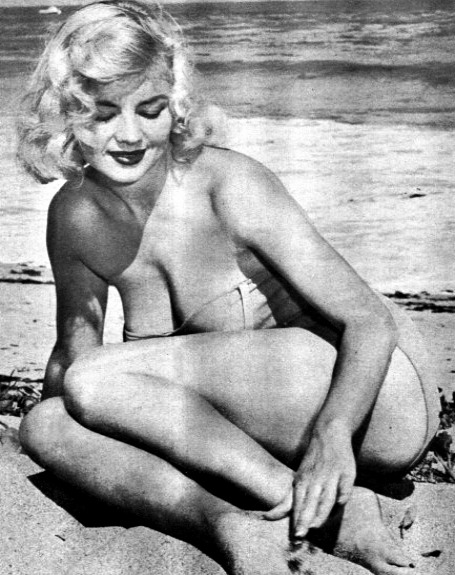
In her magazine spreads, Dane Arden shared with its mainly male readership that it took her longer to achieve an attractive “disheveled look” in a swimsuit for a beach shoot (below) than if she was preparing for a fancy dress-up costume ball.
During the mid-1950s, pocket digests like Tempo relied heavily on these outdoor, natural-light beach shoots. They offered an easy-to-carry format that blended casual “cheesecake” photography with Hollywood gossip, appealing to the post-war American men’s publishing market that was rapidly expanding into the mainstream.
Dane Arden good-humoredly believed there was no “nuttier business” to be in than posing for cheesecake pictures in these popular magazines.
There is a short color documentary filmed in the mid 1970’s at the legendary Keller’s Drive-In in Dallas, Texas. Shot at the end of an era for drive-in car hops along America’s open roads since the 1920’s, the film works to make it easier to imagine the pace and purpose of Dane Arden’s 1956 glamour photograph of a female carhop at a popular mid20th century American roadside eatery.
The documentary about carhops and American Graffiti-style drive-in culture which once littered America’s roads coast to coast–and Dane Arden’s glamour photograph dressed as a car hop–placed the model’s photographic career smack dab in the middle of mainstream American culture.
Keller’s Drive-In which is featured in the film is a classic spot to enjoy a no-frills burger and cold beer. Its founder Jack Keller once worked at Kirby’s Pig Stand which became the nation’s first drive-in restaurant empire. Keller passed away in 2016 at 88 years old.
Keller’s original location opened in 1950 and closed in 2000. The oldest restaurant in the American chain today is the one that opened in 1955 on Northwest Highway in Dallas. There are two other Keller’s restaurants in Dallas.
In addition to Playboy, Elsa Sørensen appeared in the U.S. version of Adam magazine using the name Dane Arden which she used for all her non-Playboy modeling assignments.
Famously appearing nude as Playboy magazine’s Miss September 1956, it was a breakout year for Sørensen, who moved to Los Angeles and became highly sought after by American glamour photographers.