Tag Archives: #BiblicalHistory

The Biblical Roots of Yom Kippur: From the Golden Calf to the Day of Atonement.

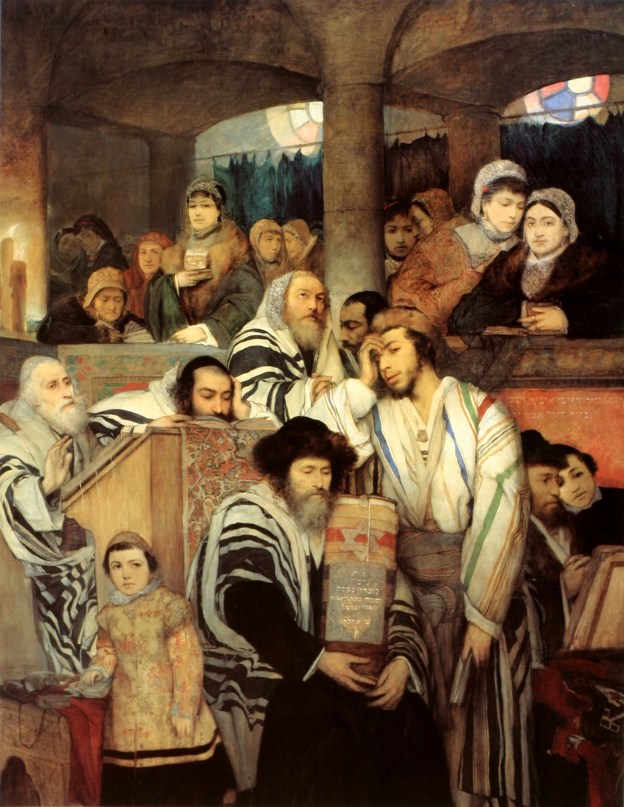
Feature Image: Maurycy Gottlieb, 1878, oil on canvas, 243 cm × 190 cm (96 in × 75 in), Tel Aviv Museum of Art, Tel Aviv, Israel. Jews Praying in the Synagogue on Yom Kippur (cataloged as Jews Praying on the Day of Atonement) serves as a literal flagship masterpiece of the museum’s 16th–19th Century European Art Galleries in the Main Building. Maurycy Gottlieb’s 1878 masterpiece, Jews Praying in the Synagogue on Yom Kippur, captures a pervasive melancholy blending spiritual solemnity with deep personal and historical anguish. Set during Judaism’s holiest day of judgment, the painting lacks religious ecstasy, opting instead for sadness and nostalgia. This somber tone reflects the systemic antisemitism and instability faced by Jews within the Russian Empire’s Pale of Settlement. For Jewish-Polish painter Gottlieb personally, the work serves as tragic farewell; haunted by depression and a broken engagement, he painted a prophetic memorial inscription to himself on the central Torah scroll shortly before his untimely death. Public Domain. see – 16th–19th c. European Art \ Tel Aviv Museum of Art – accessed September 21, 2026.

How Israel’s greatest act of covenant betrayal led to one of the Bible’s most enduring lessons on repentance, forgiveness, and renewal.

The Holiest Day in Judaism

As the Day of Atonement, Yom Kippur is the holiest day in Judaism, marked by prayer, fasting, repentance, and reflection. Every year, Yom Kippur falls on the exact same day of the Hebrew calendar, the 10th day of the seventh month of Tishrei. In 2026, Yom Kippur begins at sundown on Sunday, September 20, and concludes at nightfall on Monday, September 21. The origins of the holy day are rooted in the aftermath of the Golden Calf incident described in Exodus 32, while its formal observance and rituals were established in Leviticus 16.

An overhead view captures a contemporary Jewish congregation preparing for Yom Kippur services inside a historic sanctuary. The vibrant crowd consists of diverse community members of all ages, gathered together in the pews and aisles. Men and women are seen donning traditional kippot (headcoverings) and white tallitot (prayer shawls) while conversing, finding their seats, and entering a collective space for prayer. This bustling preparation signifies the deep community bond and shared responsibility of entering the Day of Atonement, uniting individuals in reflection before the solemnity of the holiday begins. PHOTO:”Preparing for Yom Kippur” by wordsnpix is licensed under CC BY-NC 2.0.

The Golden Calf and Israel’s Great Betrayal

According to Jewish tradition, the first Yom Kippur occurred in the wilderness after the Israelites had left Egypt. While Moses was atop Mount Sinai receiving the Ten Commandments, the Israelites built and worshiped a Golden Calf. This was not merely an act of disobedience. It represented a catastrophic collapse of trust between God and Israel at the very moment their covenant relationship was being established.

Building and worshiping the Golden Calf in Moses’s absence was a direct violation of God’s commandments and an attempt to create a deity that could be more easily controlled, understood, and managed. It was an example of, if not outright idol worship, then the dangerous blending of pagan beliefs and practices with the worship of the God of Israel, a phenomenon known as syncretism. The calf itself was inspired by the bull imagery and deities of the Egyptian pantheon, the very religious system from which the Israelites had recently been delivered.

Breaking the Covenant at Sinai

The magnitude of the offense is difficult to overstate. Just weeks earlier, at the foot of Mount Sinai, the entire nation had heard God audibly proclaim the Ten Commandments, including the first two: Have no other gods before Me and Do not make any graven images. Having witnessed the miracles of the Exodus, crossed the Red Sea, and heard the voice of God for themselves, the people almost immediately reversed course and recreated an image drawn from the religious world they had left behind.

By building and worshiping the calf, the nation shattered the covenant they had just sworn to uphold, breaking the contract almost as soon as it was made. Throughout Scripture, God frequently compares His covenant with Israel to a marriage. Within that framework, the Golden Calf was viewed as nothing less than the spiritual equivalent of committing adultery on a wedding night, a devastating betrayal immediately after the vows had been exchanged.

A Return to Egypt’s Ways

Exodus 32:6 notes how quickly the incident descended into pagan revelry:

“So the next day the people rose early and sacrificed burnt offerings and presented fellowship offerings. Afterward they sat down to eat and drink and got up to indulge in revelry.”

The episode revealed just how rapidly the people reverted to the mindset of Egypt. No sooner had they received God’s commandments than they abandoned them, embracing the revelry, excess, and spiritual chaos associated with pagan worship. By turning to the calf, the people rejected the moral order embodied in the Ten Commandments and drifted back toward the culture where they were slaves and from which God had rescued them.

Yom Kippur’s origins are rooted in the Golden Calf incident, Israel’s repentance, Moses’ intercession, and God’s restoration of the covenant.

Moses Intercedes for the Nation

When Moses descended from Mount Sinai and witnessed the scene, his anger led him to smash the original stone tablets, symbolizing the covenant that the people themselves had broken. Yet Moses did not abandon them. For months he acted as an intercessor, pleading with God to spare the nation from destruction and seeking reconciliation on their behalf.

Forgiveness and the Renewal of the Covenant

When Moses descended the mountain a second time carrying a new set of tablets (Exodus 34:29-35), it signified far more than a replacement of the originals. It represented God’s mercy toward a repentant people and the restoration of the covenant itself (Exodus 34:6-10).

Jewish tradition holds that this reconciliation occurred on the 10th of Tishrei, the very date later designated as Yom Kippur, the Day of Atonement. The holiday therefore commemorates not only repentance but also one of the Bible’s greatest examples of divine forgiveness and covenant renewal.

The Establishment of Yom Kippur

Following this restorative event, God formally established the observance of Yom Kippur in Leviticus 16. It was instituted as a day to cleanse the Tabernacle, and later the Temple, along with the people themselves, from the accumulated sins of the previous year. It was the one day annually when the High Priest could enter the Holy of Holies, the innermost chamber of the sanctuary where God’s presence dwelled.

A unique ritual was performed in which the High Priest symbolically placed the sins of the nation upon a goat, which was then driven into the wilderness. God also commanded the people to “afflict their souls” by fasting and to refrain from all work, a decree intended to endure throughout every generation.
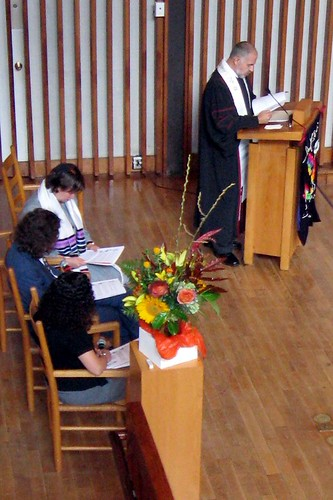
A congregation gathered for a Yom Kippur synagogue service, with a spiritual leader leading the community from a wooden podium. Facing the bimah, congregants wearing white prayer shawls follow along closely in their prayer books. The day is marked by prayer, self-examination and reflection in a synagogue service. This quiet, intimate setting underscores the profound individual and collective introspection core to the Day of Atonement. The service serves to distance worshippers from daily distractions, offering a sacred space to seek forgiveness, realign their morals, and renew their spiritual focus for the year ahead. PHOTO: “Yom Kippur service” by runneralan2004 is licensed under CC BY 2.0.

How Yom Kippur Is Observed Today

The observance of Yom Kippur today includes twenty-five consecutive hours of fasting, intensive prayer, and attendance at synagogue services. Many Jews also dress in white, symbolizing both burial shrouds and the purity of angels, serving as reminders of human mortality, humility, and the need for repentance.

Individuals are expected to seek out those they have wronged during the previous year and ask for forgiveness directly before the holiday begins, because sins committed against another person cannot be resolved without first seeking reconciliation. In the days leading up to Yom Kippur, it is also customary to give Tzedakah (charity) as an expression of repentance and compassion.

From Atonement to Celebration

Once night falls on September 21, 2026, the shofar is sounded and the fast comes to an end. Families and communities gather for a festive meal, and the atmosphere dramatically shifts from solemn introspection to celebration. After a day devoted to repentance, self-examination, and prayer, worshipers emerge with the conviction that God has granted forgiveness, renewed the covenant, and provided a clean slate with which to begin anew.

A large community of students and other members of the community gather around a festive buffet table for a joyous Break-the-Fast celebration following Yom Kippur. Inside a modern communal hall, a diverse group of Jewish youth and adults look on as a woman holds up a traditional Havdalah candle, signaling the official end of the holy day. In the foreground, an abundant spread of bagels, lox, and fresh vegetables awaits the hungry crowd. This celebratory gathering signifies the transition from solemn affliction to communal joy, relief, and renewed life as the community breaks their 25-hour fast together in shared warmth. PHOTO: “Students at Chabad at Texas A&M University Breaking the Yom Kippur Fast in 2019” by AriH972 is licensed under CC BY-SA 4.0.


A Journey Through the Passion, Resurrection, and Ascension: A Visit to Indiana’s Shrine of Christ’s Passion.

FEATURE image: (detail) Jesus Appears to Mary Magdalene, John 20:11-18.

The Shrine of Christ’s Passion in St. John, Indiana is much more than a sculpture park or roadside attraction. Through life-sized bronze sculptures, landscaped surroundings, Scripture, and meditation, it offers visitors an immersive experience of Christ’s Passion, Death, Resurrection, and Ascension while serving as a major regional destination for prayer, reflection, and religious art.

INTRODUCTION

A Serene Oasis in Northwest Indiana

The Shrine of Christ’s Passion is located on busy U.S. 41 at 10630 Wicker Avenue in St. John, Indiana—just a one-hour drive (about 40 miles) south of downtown Chicago and 90 minutes from the University of Notre Dame. Settled as a pioneer town in 1837, St. John still sits among rolling farm fields despite increasing modern development near the Indiana-Illinois state line.

Situated on the historic Wachter family farm, the 30-acre site features an array of multimedia and interactive attractions. Most visitors come to traverse the half-mile winding concrete pathway, which beautifully showcases over 40 life-sized bronze sculptures that dramatize the biblical Passion of Jesus Christ.

Journeying Through the Stations of the Cross

The journey begins inside a well-stocked gift shop before leading directly outdoors to the first dramatic scenes: Jesus at the Last Supper and praying in the Garden of Gethsemane. From there, visitors follow the 14 traditional Stations of the Cross. The trail concludes at the empty tomb, Jesus’s appearance to Mary Magdalene, and a dramatic depiction of the Ascension of the Risen Jesus into Heaven on Mount Olivet.

To build this massive spiritual destination, it required a decade of planning and over $10 million. To enhance the experience, each station features an orientation kiosk. At the push of a button, visitors can listen to a clear, brief English description and short meditation narrated by famed American television journalist Bill Kurtis.

The shrine opened in 2011 and added its latest attraction– namely, a re-creation of the rock-filled path up Mount Sinai to where Moses has received the 10 Commandments –in 2017.

Immersive Landscapes of the Holy Land

The broad concrete pathway is designed for an easy, meditative progression that fosters quiet reflection and personal discovery. The landscape architecture incorporates formed hills, carefully planted trees, bushes, grasses, and large boulders. This self-contained design effectively blocks out the outside world, beautifully evoking the arid climate and terrain of the Holy Land.

Upon exiting the gift shop—where all proceeds fund the upkeep of the shrine—the transition into the pastoral, biblical setting is immediate. While visitors share the trail with pilgrims from around the world, the layout provides ample space and freedom for a deeply personal, intimate experience.

A Space for Reflection and Exploration

Open 361 days a year, the prayer trail maintains a quiet, respectful atmosphere year-round. A large and impressive place, there are plenty of places to sit, rest, and take in the realistic sculpture art detailing “the greatest story ever told.” While a quick visit can be completed in about 30 minutes, visitors should allow at least an hour to fully savor the experience.

Beyond the main prayer trail, the grounds feature several other major attractions:

  • The Moses, Mount Sinai, and the 10 Commandments Trail
  • The Sanctity of Life Shrine
  • Our Lady of The New Millennium: A monumental, 34-foot-tall statue of the Virgin Mary crafted from over 8,000 pounds of stainless steel.

Visitor Information and Hours

The shrine is operated by a non-denominational, nonprofit private foundation, and admission to all attractions is completely free.

The Prayer Trail: Open year-round (weather permitting).

General Hours: Daily from 10:00 a.m. to 5:00 p.m.

Extended Hours: Thursdays until 8:00 p.m.

Sources –
The Shrine of Christ’s Passion Official website – http://shrineofchristspassion.org/
Our Lady of the New Millennium – https://www.chicagotribune.com/news/ct-xpm-2011-03-04-ct-talk-mary-statue-0305-20110304-story.html

IMAGES FROM THE PRAYER TRAIL:

Main Entrance on U.S. 41 at 10630 Wicker Avenue in St. John, Indiana, minutes from the Illinois-Indiana state line. Just 40 minutes from downtown Chicago, there is ample free parking and tour buses are welcome.

The Gift Shoppe.

The Last Supper Luke 22:19

“And he took bread, gave thanks and broke it, and gave it to them, saying, “This is my body given for you; do this in remembrance of me.”

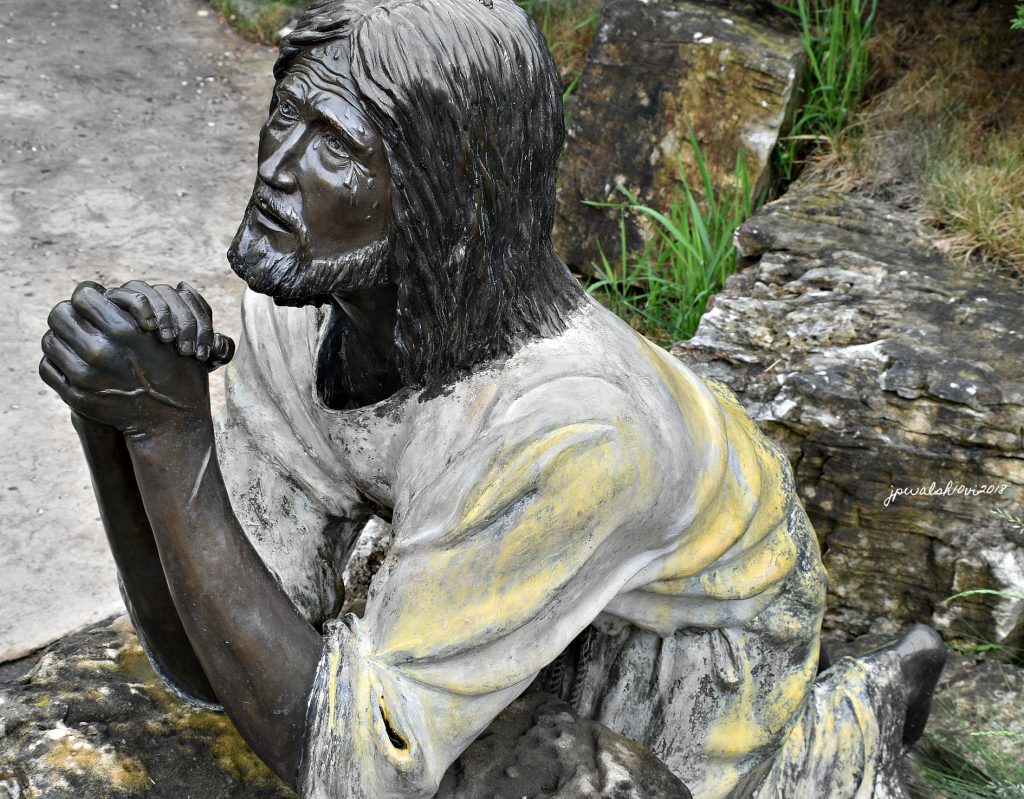
Garden of Gethsemane Mark 14:34

“My soul is overwhelmed with sorrow to the point of death,” Jesus said to them. “Stay here and keep watch.”

THE 14 STATIONS OF THE CROSS AT THE SHRINE OF CHRIST’S PASSION, ST. JOHN, INDIANA.

1. Jesus is condemned to death Matthew 27: 19-26.

“When Pilate saw that he was not succeeding at all, but that a riot was breaking out instead, he took water and washed his hands in the sight of the crowd, saying, “I am innocent of this man’s blood. Look to it yourselves.”…Pilate had Jesus flogged, and handed him over to be crucified.”

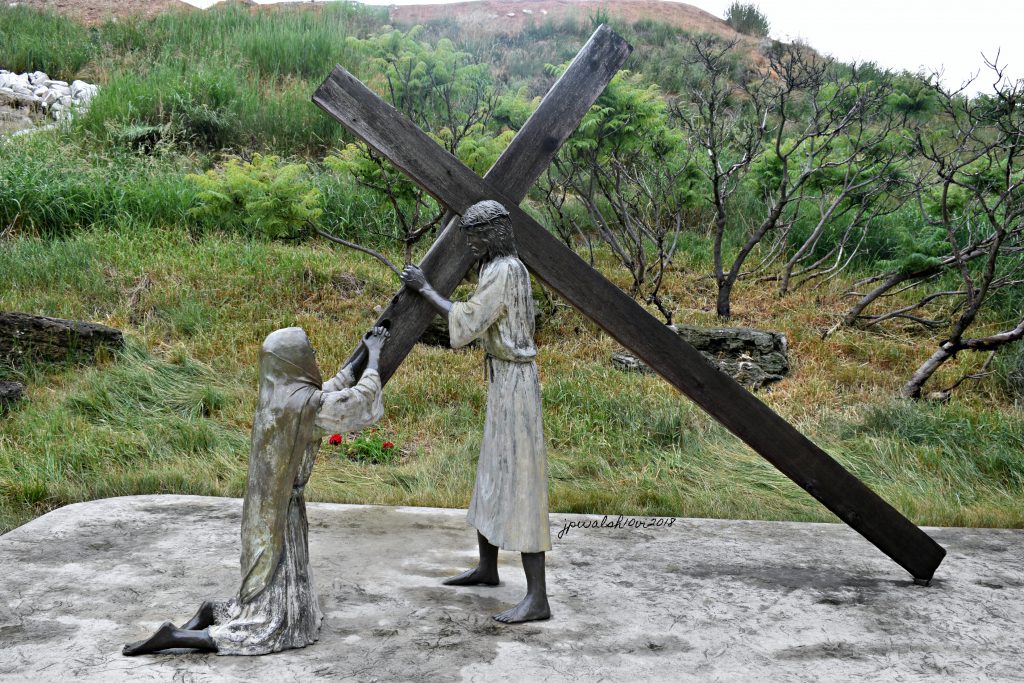
2. Jesus carries His cross John 19:16-17

“Then Pilate handed him over to be crucified. The soldiers took charge of Jesus, who carried his own cross to a location called “The Place of a Skull,” known in Aramaic as Golgotha.” 

3. Jesus falls for the first time Isaiah 53:1-3

“He was despised and rejected by mankind,
    a man of suffering, and familiar with pain.
Like one from whom people hide their faces
    he was despised, and we held him in low esteem.”

4. Jesus meets His mother, Mary Lamentations 1:12

“Is it nothing to you, all you who pass by?
    Look around and see.
Is any suffering like my suffering
    that was inflicted on me..?”

5. Simon of Cyrene helps Jesus carry the cross Luke 23:26

“They seized Simon from Cyrene, who was on his way in from the country, and put the cross on him and made him carry it behind Jesus.”

6. Veronica wipes the face of Jesus Psalm 17:15

“As for me, I will be vindicated and will see your face;
    when I awake, I will be satisfied with seeing your likeness.”

7. Jesus falls for the second time   Isaiah 53:4-6

“Surely he took up our pain
    and bore our suffering,
yet we considered him punished by God,
    stricken by him, and afflicted.”

8. Jesus meets the women of Jerusalem Luke 23:27-31

“A large number of people followed him, including women who mourned and wailed for him. 28 Jesus turned and said to them, “Daughters of Jerusalem, do not weep for me; weep for yourselves and for your children.”

9. Jesus falls for the third time Isaiah 53:10-11

“Yet it was the Lord’s will to crush him and cause him to suffer,
    and though the Lord makes his life an offering for sin,
he will see his offspring and prolong his days,
    and the will of the Lord will prosper in his hand….”

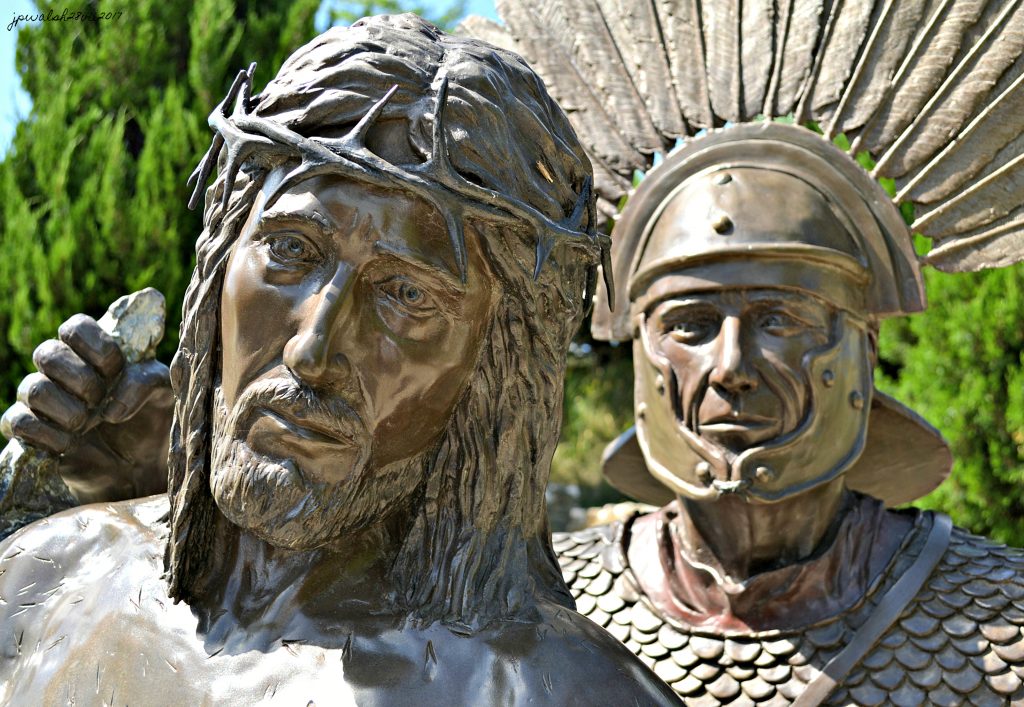
10. Jesus is stripped of His clothes Matthew 27:27-31

“They stripped him and put a scarlet robe on him, and then twisted together a crown of thorns and set it on his head. They put a staff in his right hand. Then they knelt in front of him and mocked him.”

11. Jesus is nailed to the cross Luke 23:33-34

“When they came to the place called the Skull, they crucified him there, along with the criminals—one on his right, the other on his left.”

12. Jesus dies on the cross­ Luke 23:44-49

 “Jesus called out with a loud voice, “Father, into your hands I commit my spirit.” When he had said this, he breathed his last.”

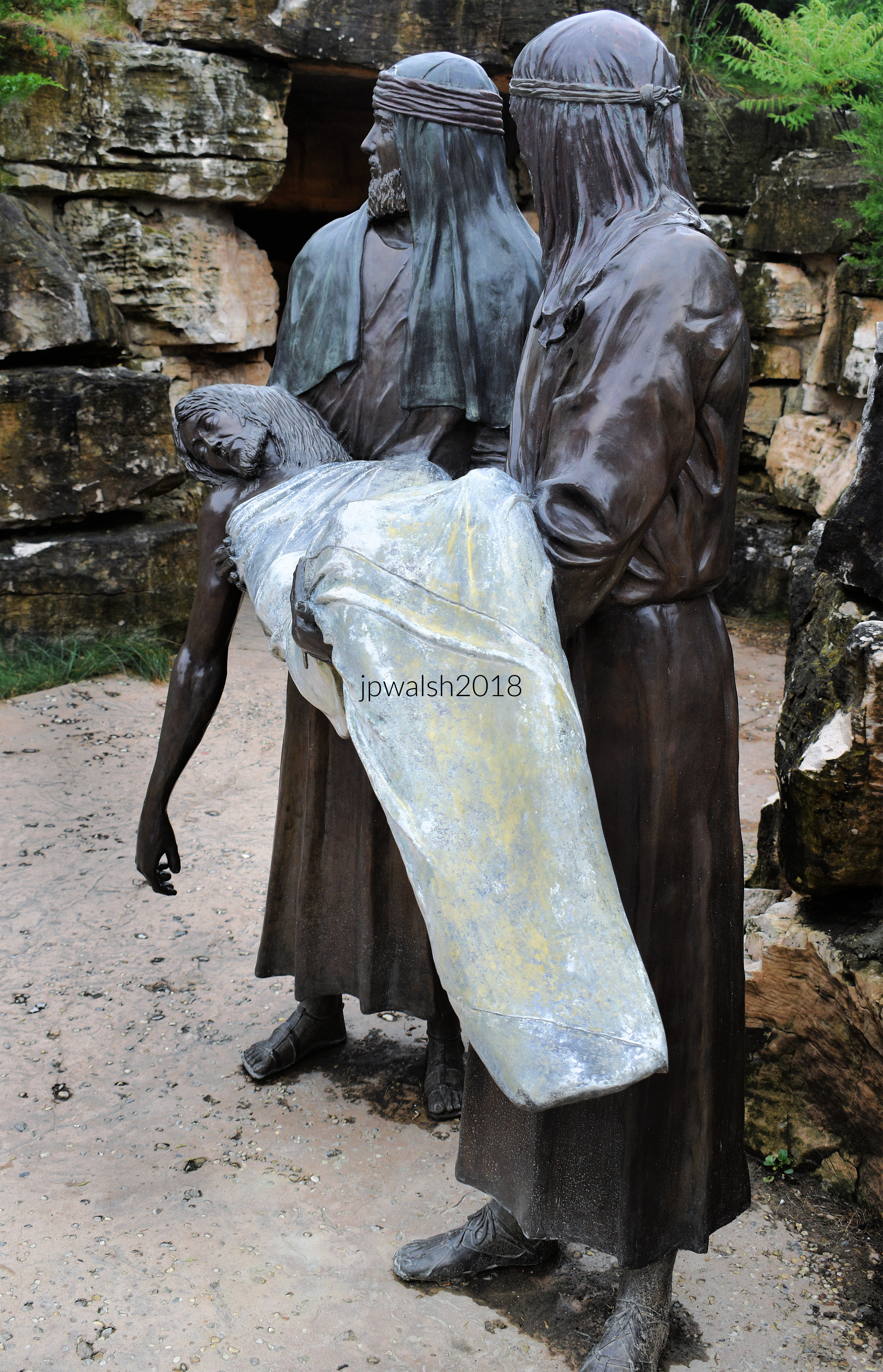
13. Jesus is taken down from the cross Mark 15:39

“When the centurion who stood facing him saw how Jesus breathed his last he said, ‘Truly this man was the Son of God!'”

14. Jesus is placed in the tomb Luke 23:50-53

“Going to Pilate, Joseph of Arimathea asked for Jesus’ body. Then he took it down, wrapped it in linen cloth and placed it in a tomb cut in the rock, one in which no one had yet been laid.”

June 2018. 87% 7.94mb DSC_9082

The Resurrection of Jesus. Matthew 28.

1 After the sabbath, as the first day of the week was dawning,* Mary Magdalene and the other Mary came to see the tomb.

2 And behold, there was a great earthquake; for an angel of the Lord descended from heaven, approached, rolled back the stone, and sat upon it.

3 His appearance was like lightning and his clothing was white as snow.

4 The guards were shaken with fear of him and became like dead men.

5 Then the angel said to the women in reply, “Do not be afraid! I know that you are seeking Jesus the crucified.

6 He is not here, for he has been raised just as he said. Come and see the place where he lay.

Jesus Appears to Mary Magdalene John 20:16

 “Jesus said to her, “Mary.” She turned toward him and cried out in Aramaic, “Rabboni!” 

MORE of the Prayer Trail:

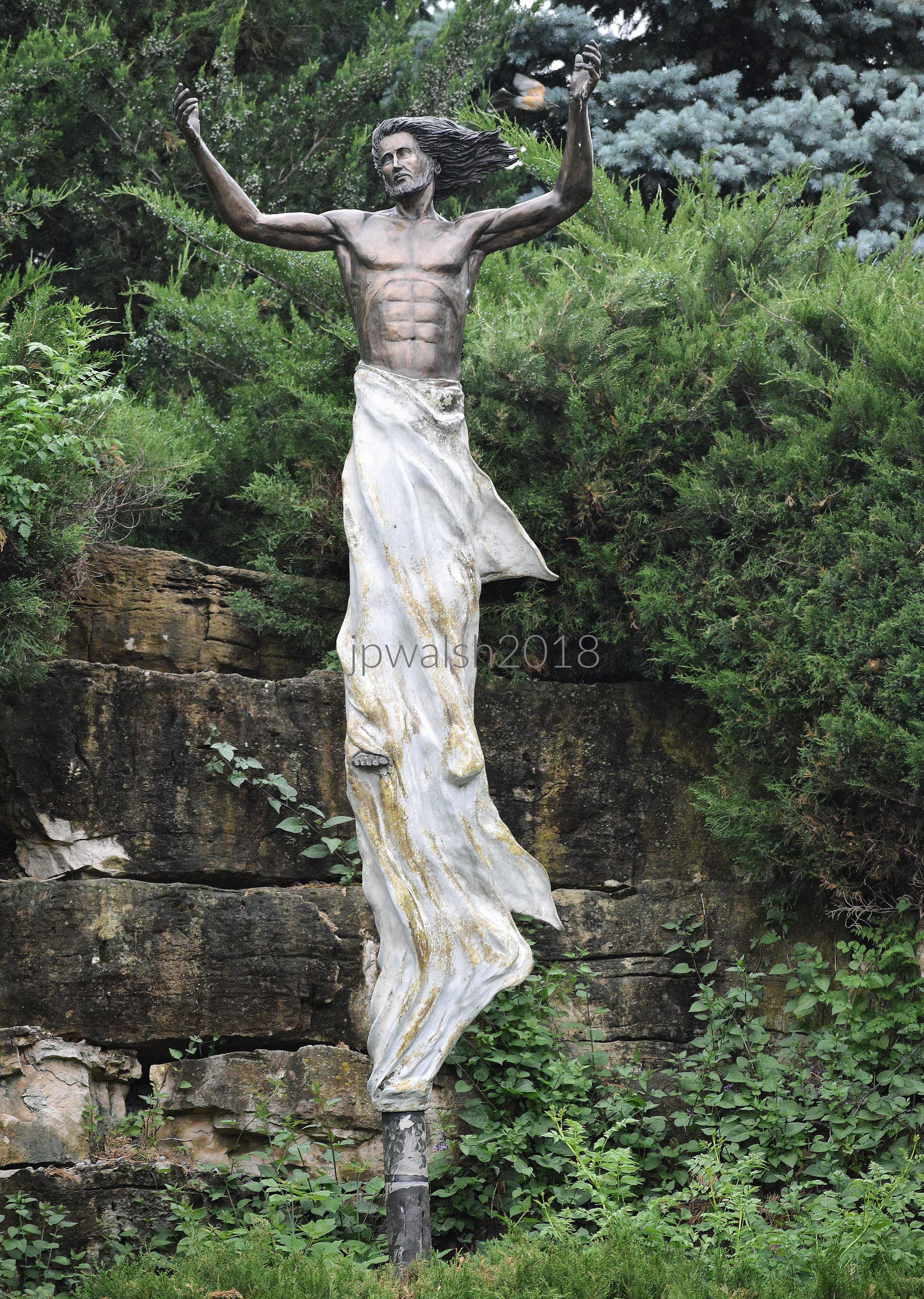
The Ascension Acts of the Apostles 1:9

“…Jesus was taken up before their very eyes, and a cloud hid him from their sight.”

June 2018. 68% 7.90mb DSC_0310

The Ascension of Jesus: The Double Account of Luke the Evangelist

The Ascension of Jesus is described twice in the New Testament, with both accounts originating from Luke the Evangelist. The first description appears at the very end of his Gospel (Luke 24:50–53), while the second opens the Acts of the Apostles (Acts 1:6–12).

In Acts, Luke introduces a crucial narrative element: a forty‑day period (Acts 1:3) during which the risen Jesus appears to the apostles, teaches them, and prepares them for their upcoming mission. This specific timeframe is not emphasized in the Gospel account. This suggests that Luke separates the Resurrection and the Ascension in Acts not because he inherited conflicting traditions, but because it serves a distinct narrative purpose. Acts utilizes these forty days to firmly situate the apostles within the larger framework of Israel’s covenant history, framing the early Church as the direct continuation of God’s saving work.

Reorienting the Expectations of the Kingdom

Once Jesus rises from the dead, the disciples fully recognize him as the Messiah. It is therefore understandable that, in Acts, they ask whether he will now restore Israel’s political kingdom. Luke, writing for future generations of Christians, places a deliberately open‑ended reply in Jesus’s mouth.

The exact timing of the parousia—the Second Coming—is not for them to know. Instead, their task is entirely different: to wait for the Holy Spirit, whose power will transform them into witnesses “to the ends of the earth.” Jerusalem, the central site of Jesus’s Passion and Resurrection, thus becomes the launching pad for this worldwide mission.

Symbolism and Eschatology on Mount Olivet

Acts adds further symbolic depth to the Ascension through specific biblical motifs:

  • The Cloud: Jesus is taken from their sight by a cloud, a classic biblical sign of the divine presence and a motif heavily associated with end‑times imagery (Luke 21:27).
  • The Location: The event occurs on the Mount of Olives, a location already deeply charged with eschatological expectation.
  • The Two Figures: As Jesus is lifted up, two figures in dazzling garments appear. They match the same angelic type who initially announced his birth (Luke 2:9) and later proclaimed his Resurrection (Luke 24:4–7).

The message delivered by these figures directly links the Ascension to the Second Coming, promising that the Jesus who is taken up in glory “will return in the same way you saw him go” (Acts 1:11).

From Incarnation to Glorification

Christian tradition understands the mystery of Christ by tracing a single, unbroken arc from the Incarnation to the Ascension. This trajectory begins at the Annunciation (Luke 1:26–38), when the eternal Word—the One who “was with God and…was God” (John 1:1)—takes on human nature in the womb of Mary. In this pivotal moment, the divine and human are permanently united in the Person of Jesus.

The Ascension brings this union to its ultimate fulfillment. Here, the “new, saved man” enters into the very life of the Father, revealing the ultimate destiny of redeemed humanity. Christ’s glorified body becomes the perfect expression of what humanity is truly meant to be in God: a life whose very mode of existence is love, for “God is love” (1 John 4:16). In heaven, the God‑Man embodies this reality completely.

Pentecost and the Indwelling Presence

The Ascension is immediately followed by Pentecost, the moment when the apostles receive the promised Holy Spirit from the risen Christ. From that historic day forward, the early believers speak not only of Christ exalted in heaven, but of “Christ in us”—the indwelling presence that dynamically makes all believers active participants in his risen life.