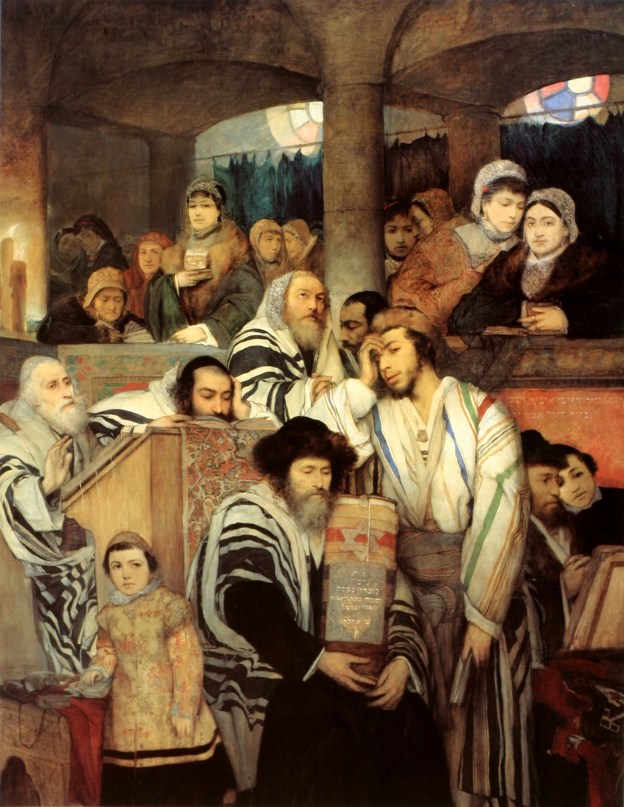
Feature Image: Maurycy Gottlieb, 1878, oil on canvas, 243 cm × 190 cm (96 in × 75 in), Tel Aviv Museum of Art, Tel Aviv, Israel. Jews Praying in the Synagogue on Yom Kippur (cataloged as Jews Praying on the Day of Atonement) serves as a literal flagship masterpiece of the museum’s 16th–19th Century European Art Galleries in the Main Building. Maurycy Gottlieb’s 1878 masterpiece, Jews Praying in the Synagogue on Yom Kippur, captures a pervasive melancholy blending spiritual solemnity with deep personal and historical anguish. Set during Judaism’s holiest day of judgment, the painting lacks religious ecstasy, opting instead for sadness and nostalgia. This somber tone reflects the systemic antisemitism and instability faced by Jews within the Russian Empire’s Pale of Settlement. For Jewish-Polish painter Gottlieb personally, the work serves as tragic farewell; haunted by depression and a broken engagement, he painted a prophetic memorial inscription to himself on the central Torah scroll shortly before his untimely death. Public Domain. see – 16th–19th c. European Art \ Tel Aviv Museum of Art – accessed September 21, 2026.
How Israel’s greatest act of covenant betrayal led to one of the Bible’s most enduring lessons on repentance, forgiveness, and renewal.
The Holiest Day in Judaism
As the Day of Atonement, Yom Kippur is the holiest day in Judaism, marked by prayer, fasting, repentance, and reflection. Every year, Yom Kippur falls on the exact same day of the Hebrew calendar, the 10th day of the seventh month of Tishrei. In 2026, Yom Kippur begins at sundown on Sunday, September 20, and concludes at nightfall on Monday, September 21. The origins of the holy day are rooted in the aftermath of the Golden Calf incident described in Exodus 32, while its formal observance and rituals were established in Leviticus 16.

An overhead view captures a contemporary Jewish congregation preparing for Yom Kippur services inside a historic sanctuary. The vibrant crowd consists of diverse community members of all ages, gathered together in the pews and aisles. Men and women are seen donning traditional kippot (headcoverings) and white tallitot (prayer shawls) while conversing, finding their seats, and entering a collective space for prayer. This bustling preparation signifies the deep community bond and shared responsibility of entering the Day of Atonement, uniting individuals in reflection before the solemnity of the holiday begins. PHOTO:”Preparing for Yom Kippur” by wordsnpix is licensed under CC BY-NC 2.0.
The Golden Calf and Israel’s Great Betrayal
According to Jewish tradition, the first Yom Kippur occurred in the wilderness after the Israelites had left Egypt. While Moses was atop Mount Sinai receiving the Ten Commandments, the Israelites built and worshiped a Golden Calf. This was not merely an act of disobedience. It represented a catastrophic collapse of trust between God and Israel at the very moment their covenant relationship was being established.
Building and worshiping the Golden Calf in Moses’s absence was a direct violation of God’s commandments and an attempt to create a deity that could be more easily controlled, understood, and managed. It was an example of, if not outright idol worship, then the dangerous blending of pagan beliefs and practices with the worship of the God of Israel, a phenomenon known as syncretism. The calf itself was inspired by the bull imagery and deities of the Egyptian pantheon, the very religious system from which the Israelites had recently been delivered.
Breaking the Covenant at Sinai
The magnitude of the offense is difficult to overstate. Just weeks earlier, at the foot of Mount Sinai, the entire nation had heard God audibly proclaim the Ten Commandments, including the first two: Have no other gods before Me and Do not make any graven images. Having witnessed the miracles of the Exodus, crossed the Red Sea, and heard the voice of God for themselves, the people almost immediately reversed course and recreated an image drawn from the religious world they had left behind.
By building and worshiping the calf, the nation shattered the covenant they had just sworn to uphold, breaking the contract almost as soon as it was made. Throughout Scripture, God frequently compares His covenant with Israel to a marriage. Within that framework, the Golden Calf was viewed as nothing less than the spiritual equivalent of committing adultery on a wedding night, a devastating betrayal immediately after the vows had been exchanged.
A Return to Egypt’s Ways
Exodus 32:6 notes how quickly the incident descended into pagan revelry:
“So the next day the people rose early and sacrificed burnt offerings and presented fellowship offerings. Afterward they sat down to eat and drink and got up to indulge in revelry.”
The episode revealed just how rapidly the people reverted to the mindset of Egypt. No sooner had they received God’s commandments than they abandoned them, embracing the revelry, excess, and spiritual chaos associated with pagan worship. By turning to the calf, the people rejected the moral order embodied in the Ten Commandments and drifted back toward the culture where they were slaves and from which God had rescued them.
Yom Kippur’s origins are rooted in the Golden Calf incident, Israel’s repentance, Moses’ intercession, and God’s restoration of the covenant.
Moses Intercedes for the Nation
When Moses descended from Mount Sinai and witnessed the scene, his anger led him to smash the original stone tablets, symbolizing the covenant that the people themselves had broken. Yet Moses did not abandon them. For months he acted as an intercessor, pleading with God to spare the nation from destruction and seeking reconciliation on their behalf.
Forgiveness and the Renewal of the Covenant
When Moses descended the mountain a second time carrying a new set of tablets (Exodus 34:29-35), it signified far more than a replacement of the originals. It represented God’s mercy toward a repentant people and the restoration of the covenant itself (Exodus 34:6-10).
Jewish tradition holds that this reconciliation occurred on the 10th of Tishrei, the very date later designated as Yom Kippur, the Day of Atonement. The holiday therefore commemorates not only repentance but also one of the Bible’s greatest examples of divine forgiveness and covenant renewal.
The Establishment of Yom Kippur
Following this restorative event, God formally established the observance of Yom Kippur in Leviticus 16. It was instituted as a day to cleanse the Tabernacle, and later the Temple, along with the people themselves, from the accumulated sins of the previous year. It was the one day annually when the High Priest could enter the Holy of Holies, the innermost chamber of the sanctuary where God’s presence dwelled.
A unique ritual was performed in which the High Priest symbolically placed the sins of the nation upon a goat, which was then driven into the wilderness. God also commanded the people to “afflict their souls” by fasting and to refrain from all work, a decree intended to endure throughout every generation.
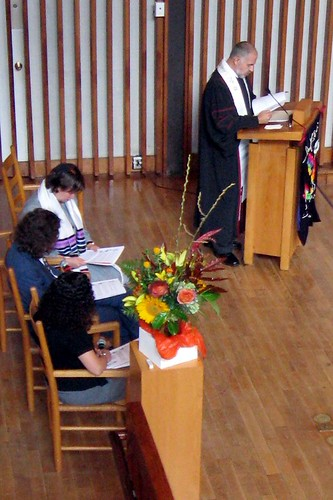
A congregation gathered for a Yom Kippur synagogue service, with a spiritual leader leading the community from a wooden podium. Facing the bimah, congregants wearing white prayer shawls follow along closely in their prayer books. The day is marked by prayer, self-examination and reflection in a synagogue service. This quiet, intimate setting underscores the profound individual and collective introspection core to the Day of Atonement. The service serves to distance worshippers from daily distractions, offering a sacred space to seek forgiveness, realign their morals, and renew their spiritual focus for the year ahead. PHOTO: “Yom Kippur service” by runneralan2004 is licensed under CC BY 2.0.
How Yom Kippur Is Observed Today
The observance of Yom Kippur today includes twenty-five consecutive hours of fasting, intensive prayer, and attendance at synagogue services. Many Jews also dress in white, symbolizing both burial shrouds and the purity of angels, serving as reminders of human mortality, humility, and the need for repentance.
Individuals are expected to seek out those they have wronged during the previous year and ask for forgiveness directly before the holiday begins, because sins committed against another person cannot be resolved without first seeking reconciliation. In the days leading up to Yom Kippur, it is also customary to give Tzedakah (charity) as an expression of repentance and compassion.
From Atonement to Celebration
Once night falls on September 21, 2026, the shofar is sounded and the fast comes to an end. Families and communities gather for a festive meal, and the atmosphere dramatically shifts from solemn introspection to celebration. After a day devoted to repentance, self-examination, and prayer, worshipers emerge with the conviction that God has granted forgiveness, renewed the covenant, and provided a clean slate with which to begin anew.

A large community of students and other members of the community gather around a festive buffet table for a joyous Break-the-Fast celebration following Yom Kippur. Inside a modern communal hall, a diverse group of Jewish youth and adults look on as a woman holds up a traditional Havdalah candle, signaling the official end of the holy day. In the foreground, an abundant spread of bagels, lox, and fresh vegetables awaits the hungry crowd. This celebratory gathering signifies the transition from solemn affliction to communal joy, relief, and renewed life as the community breaks their 25-hour fast together in shared warmth. PHOTO: “Students at Chabad at Texas A&M University Breaking the Yom Kippur Fast in 2019” by AriH972 is licensed under CC BY-SA 4.0.