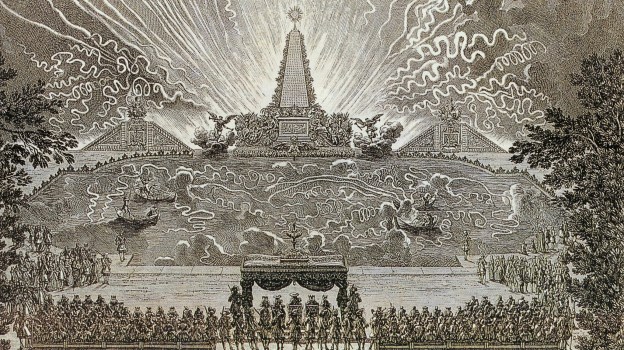
Feature image: 18 août 1674: feu d’artifice sur le Canal, 1676, by French Academy designer and engraver Jean Le Pautre (1618-1682). Flamboyant ephemeral architectures were erected at Versailles for a 17th century summer evening on the Canal that forms the base of elaborate pyrotechnics. Public Domain.
When the French Sun King, Louis XIV (reign, 1638-1715) made his decision to build a palace complex at Versailles, surrounded by the greatest gardens and waterworks the world had ever seen, fireworks (feux d’artifices), were an essential part of the grand entertainments which the king put on for the French court and the thousands of visitors who assembled to celebrate for various special occasions.
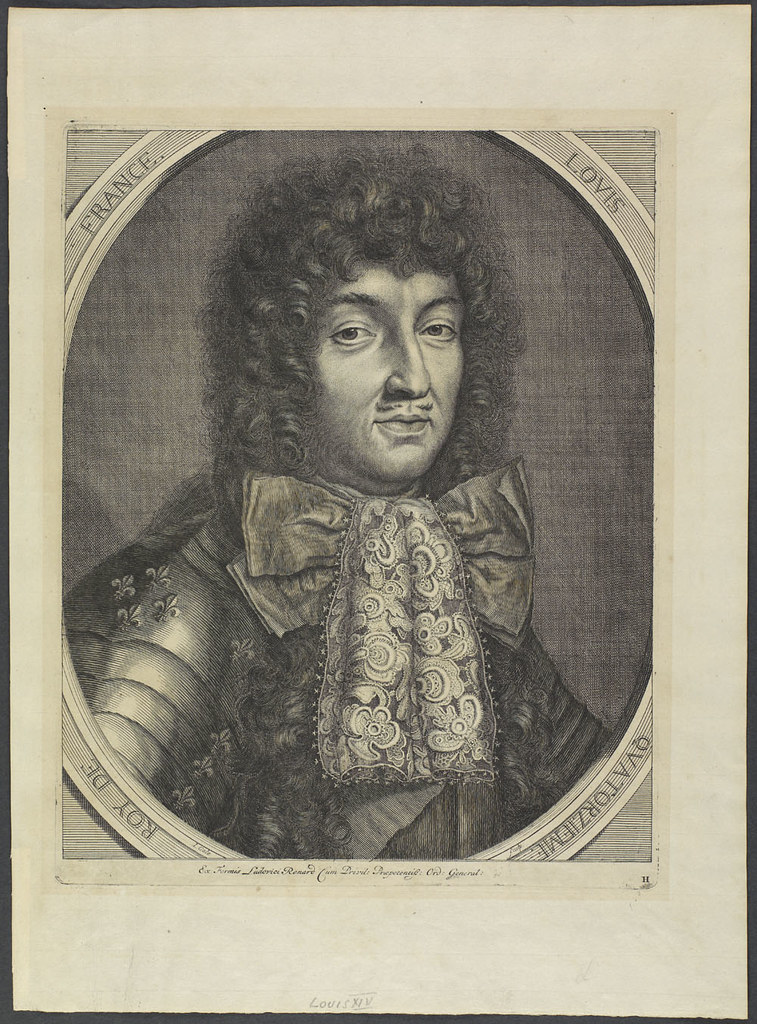
Louis XIV’s reign fused monarchy with light, a 17th‑century symbol of order, power, and divine radiance. The young king chose Versailles not because the marshy valley naturally suited his vision of a court devoted to spectacle, but because it carried the intimate imprint of his father, Louis XIII — the hunting lodge, the modest garden, the remembered landscape of childhood. What followed was not a palace adapted to its terrain, but a terrain forced to yield to an unprecedented royal design. The site’s limitations were absorbed, reshaped, and ultimately overwhelmed by the scale of the Sun King’s project, turning an unremarkable valley into the stage for absolute monarchy. PHOTO credit: “King Louis XIV, 1638-1715 / Roi Louis XIV, 1638-1715” by BiblioArchives / LibraryArchives is marked with CC BY 2.0.
For the next century, Versailles became the premier stage for royal light shows — vast productions of fireworks, illuminations, and night‑time spectacle. Though fireworks were first invented in China, it was Rome that embraced them in the 14th century and launched Europe’s courtly tradition of celebratory rockets. France quickly followed, importing Italian artists, architects, and pyrotechnic masters whose displays soon surpassed anything on the continent.
A key reason Louis XIV moved his court out of cramped Paris and the Louvre was to gain the space required for these grand outdoor entertainments. At Versailles, the king could stage the full range of divertissements du Roi — not only fireworks and illuminations, but elaborate festivals of music, dance, and theater that turned the gardens into a glowing extension of royal power.
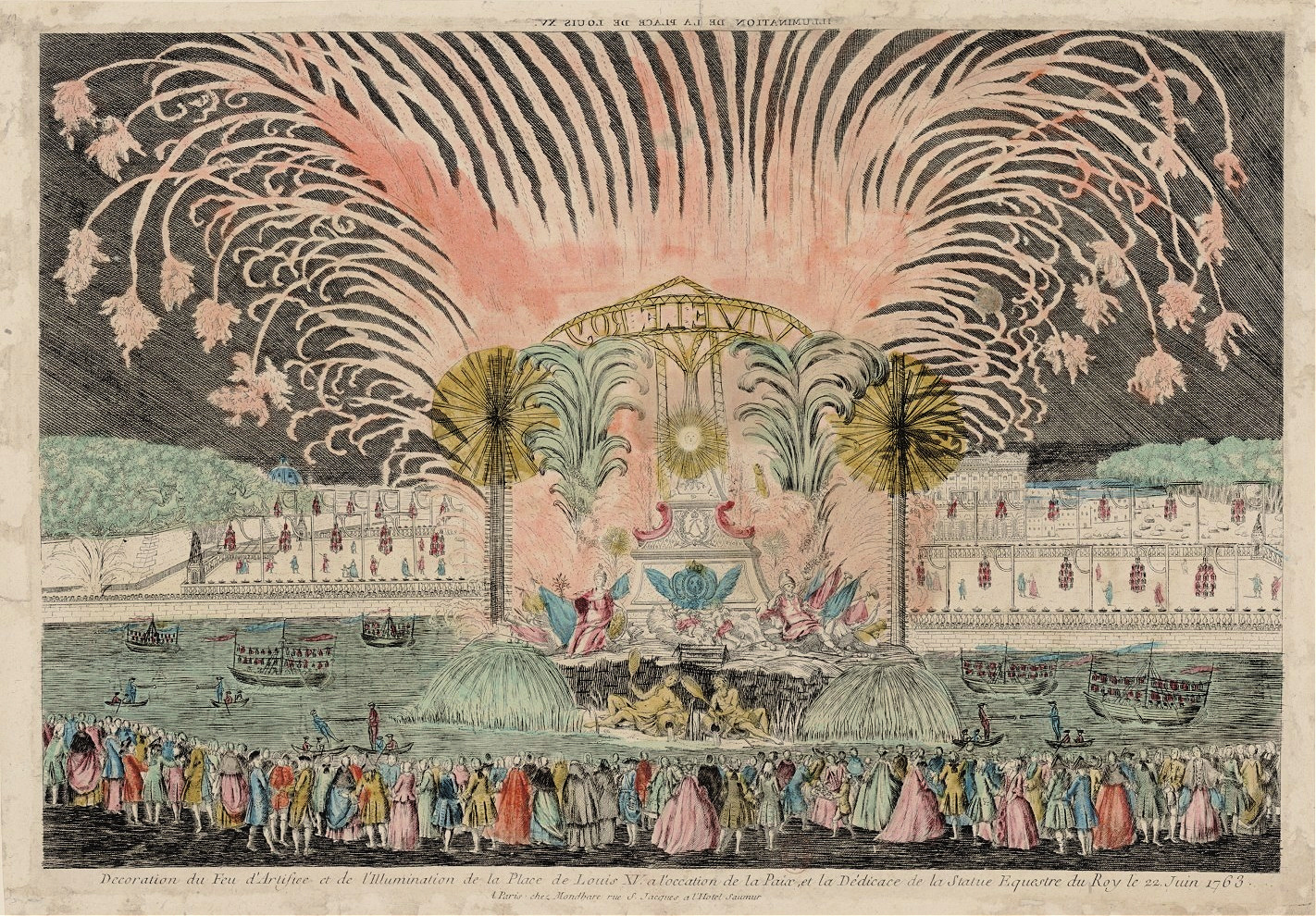
Décoration du feu d’artifice et de l’illumination de la place de Louis XV, à l’occasion de la paix, et la dédicace de la statue équestre du Roi, le 22 juin 1763. Chez Louis-Joseph Mondhare (1734-1799), rue S. Jacques à l’hotel Saumur. Bibliothèque nationale de France, département Estampes et photographie. Public Domain.See – https://www.europeana.eu/en/item/9200518/ark__12148_btv1b8409645h?q=paix%20paris%201763 – retrieved July 14, 2024.
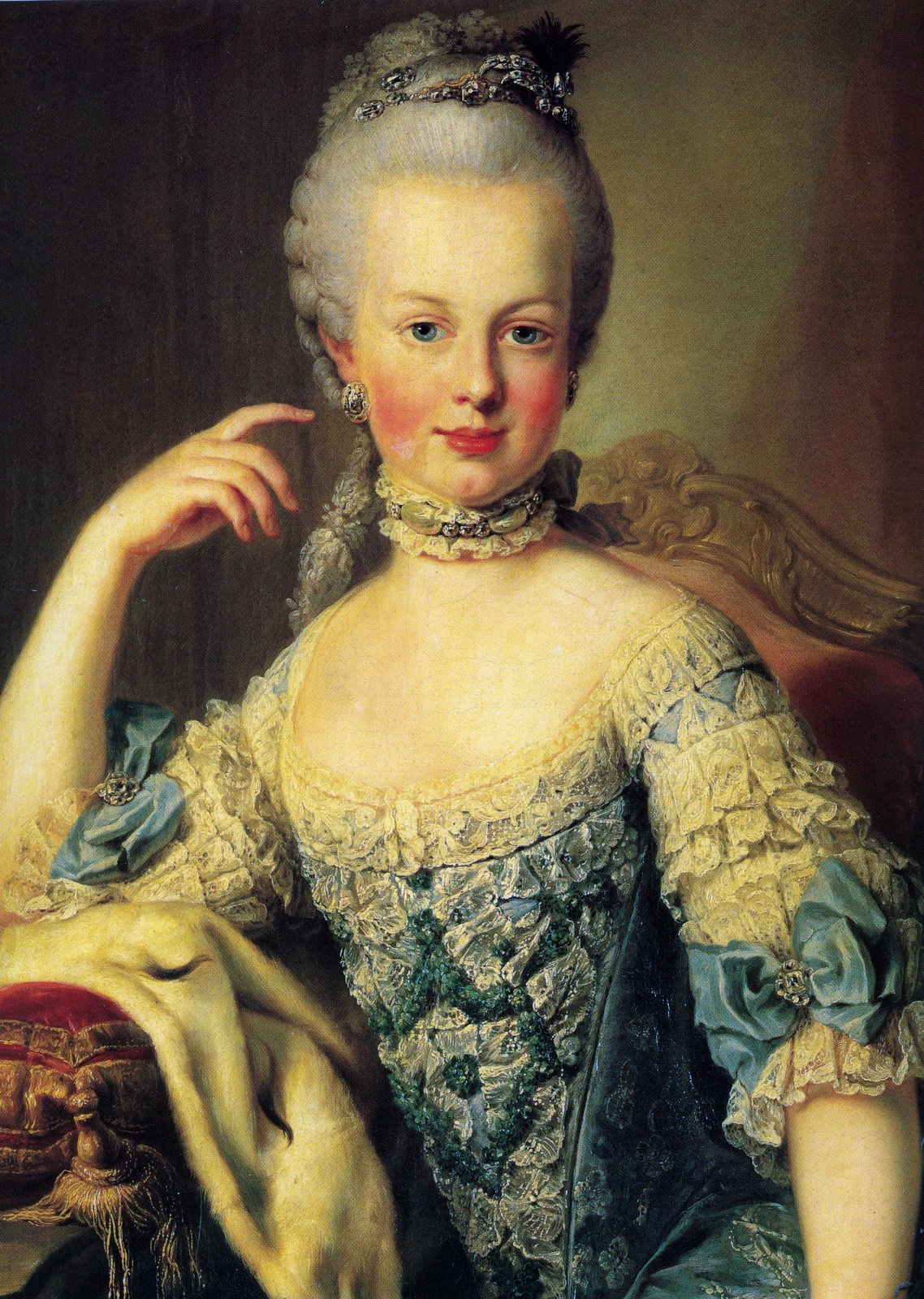
One of Versailles’ most spectacular celebrations came in 1770, when fourteen‑year‑old Marie Antoinette arrived from Austria to marry the heir to the French throne. Louis XV marked the occasion with days of festivities and a guest list numbering in the thousands. The scale was unprecedented: the French Academy of Sciences collaborated with the king’s bureau de Menus‑plaisirs to engineer a display capable of launching 20,000 rockets at once, followed by the coordinated illumination of 15,000 lanterns across the gardens. It was court spectacle elevated to scientific precision — a fusion of dynastic celebration, technological ambition, and the theatrical grandeur that defined Versailles.
Portrait of Archduchess Marie Antoinette, by Swedish-Austrian Martin van Meylens the Younger (1698-1770), c. 1768, Schönbrunn Palace, Vienna. Public Domain.
Les Grandes Eaux Nocturnes de Feu — Versailles’ midsummer night spectacular — turn the gardens into a blazing stage of water, light, music, and fire. A 2½‑hour promenade of illuminated fountains and baroque soundscapes builds toward the “de Feu” climax: monumental flame effects and a full pyrotechnic performance by Groupe F, France’s world‑renowned masters of fireworks.
Even today, crowds stream to Versailles just west of Paris, gathering to watch cutting‑edge pyrotechnics ignite the night above the palace. The modern displays play off the same elements that once dazzled the Sun King: the vast pools, canals, and fountains that mirror every burst of color and amplify the spectacle across the gardens’ sweeping geometry. In these moments, the waterworks and the fireworks merge into a single theatrical composition — a living continuation of the courtly entertainments that defined Versailles at its height.
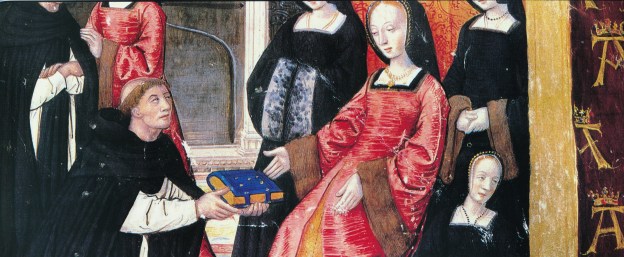
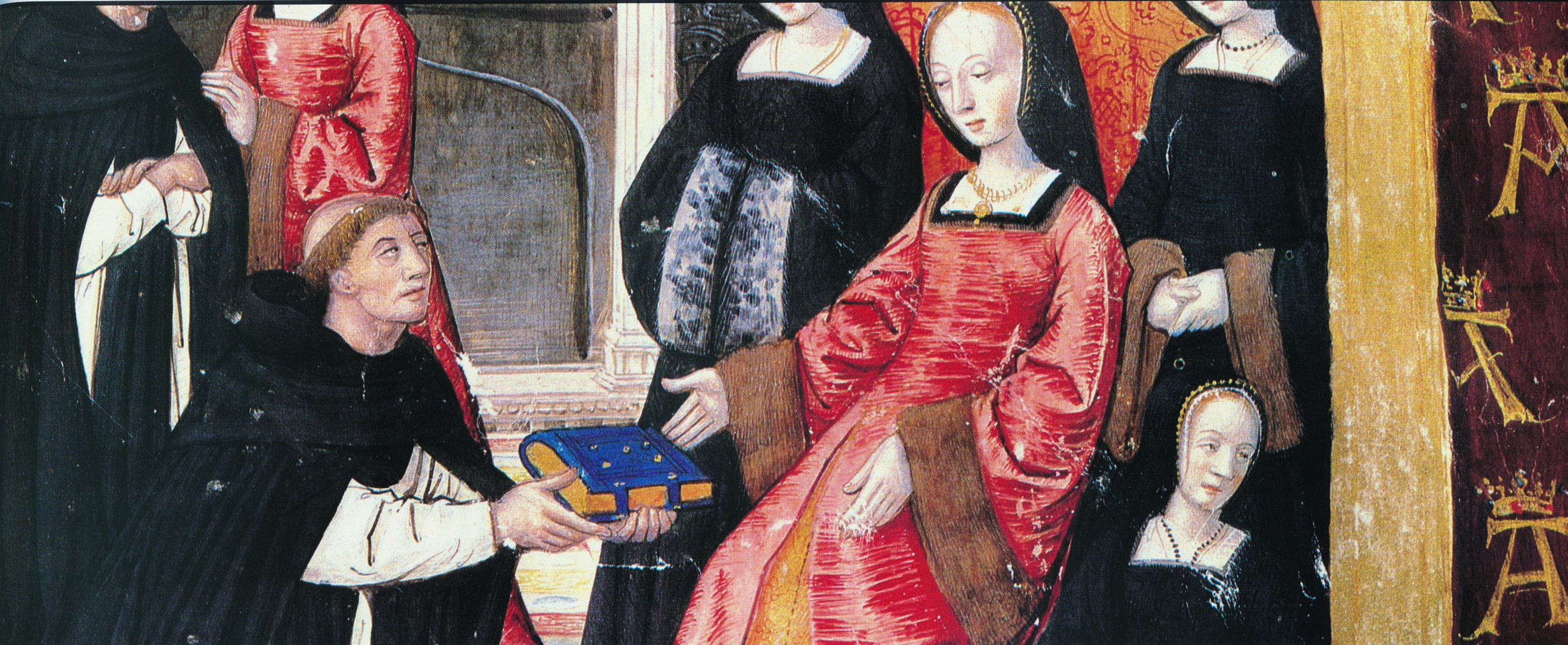
FEATURED image: Manuscript 16th century (detail): Queen consort Anne of Brittany (1477-1514) receiving a Book of Hours from her Dominican confessor, Antoine Dufour (d.1509). Montfort L’Amaury returned to the crown of France after Anne of Brittany married Charles VIII “the Affable” (1470-1498) in 1491.
Thirty miles from Paris, Montfort-l’Amaury condenses a thousand years of French history into one small town, where medieval fortifications, Renaissance religious art, royal patronage, and modern cultural figures reveal the continuous evolution of France from the age of crusaders to the twenty-first century.
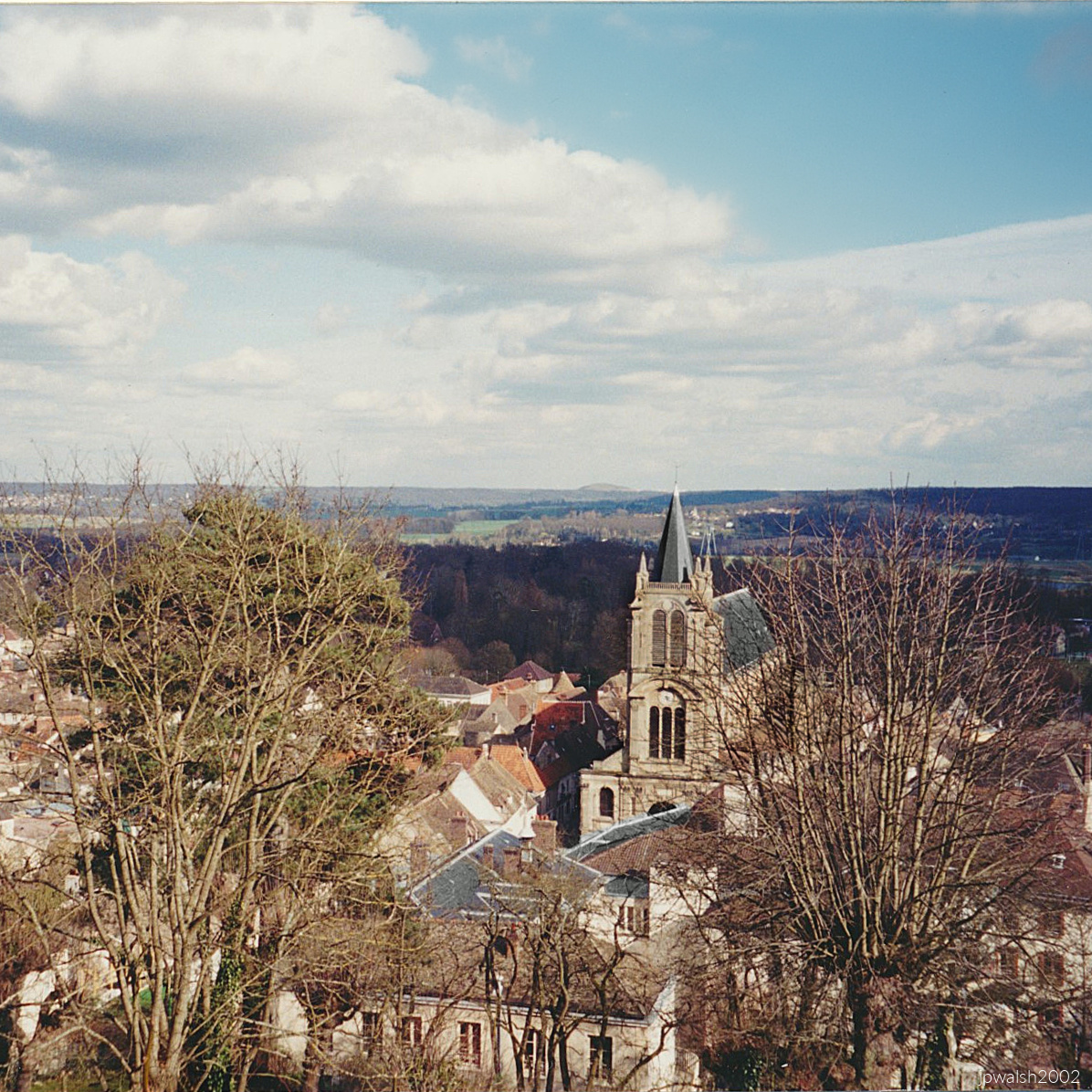
Started in the 11th century, L’Église St. Pierre anchors part of the centre ville of Montfort L’Amaury, a town in France about 30 miles west of Paris. The photograph is taken from the ruins of the chateau on the town’s heights. The late 10th century Frankish king Robert II built a castle in the hills of Montfort. From the start of the 11th century, Montfort-l’Amaury was the stronghold of the Montfort family. March 2002. Author’s photograph.
At the north edge of the Rambouillet forest the city of Montfort L’Amaury spreads along the restored ruins of its ancient fortified castle. Founded under the Capetian kings, the city owes its fame to Simon de Montfort (1208-1265), Anne de Bretagne (1477-1514), the Valois royal dynasty, and Henry IV (1553-1610). Its monuments begin in the 11th century, stretch towards exceptional Renaissance stained-glass windows and half-timbered houses as its civilization has attracted writers, artists, and musicians to live there. This would include the house of Maurice Ravel (1875-1937) called Le Belvédère where he lived from 1921 until his death and where we were invited to sit at, and play, the piano where Ravel composed Boléro. It was in March 2002 during a visit to Paris and the Île-de France that we ventured through Yvelines by train to Montfort-L’Amaury for a day trip which included a memorable déjeuner in a restaurant that has since disappeared.
L’Église Saint-Pierre
Interior, L’Église Saint-Pierre (Church of St. Peter), late 15th century, Montfort L’Amaury, France. March 2002. Author’s photograph.
The interior of Saint Pierre church is bright and intimate. Like other French monuments, today’s Saint-Pierre was completed over many centuries. Its origin is in the 11th century. A notable reconstruction of the edifice began in the late 15th century by initiative of Queen Consort, Anne of Bretagne. There is a vast ambulatory around both sides of the nave. Since 1840, the church has been an historic monument because of its unique ensemble of 37 stained glass windows. The oldest date from the 1540s and 1570s. The others were installed in the late16th century. That ecclesial project was started by Catherine de Medicis (1519-1589) in 1562. The windows were installed during the time of the Council of Trent (1545-1563) and some of the glass commemorates that event. As none of the glasswork is signed, it is not known whether its painters are from Montfort L’Amaury or elsewhere.
South exterior of L’Église Saint-Pierre along Rue de Dion in Montfort L’Amaury. March 2002. Author’s photograph.
The exterior wall shows flying buttresses designed in the French Renaissance style as well as gargoyles that were sculpted in the late 15th century. The building is constructed of calcified stone that came from towns to the north, precisely, Maule, and a more distant Vernon on the Seine. The interior ambulatory that surrounds the nave on both sides and ends at the chevet expresses the building’s gothic aspect. Street lamps and a narrow street with tight parking has room for a small tree next to the church.
St. Peter Window. L’Église Saint-Pierre, Montfort L’Amaury, France. Public Domain.
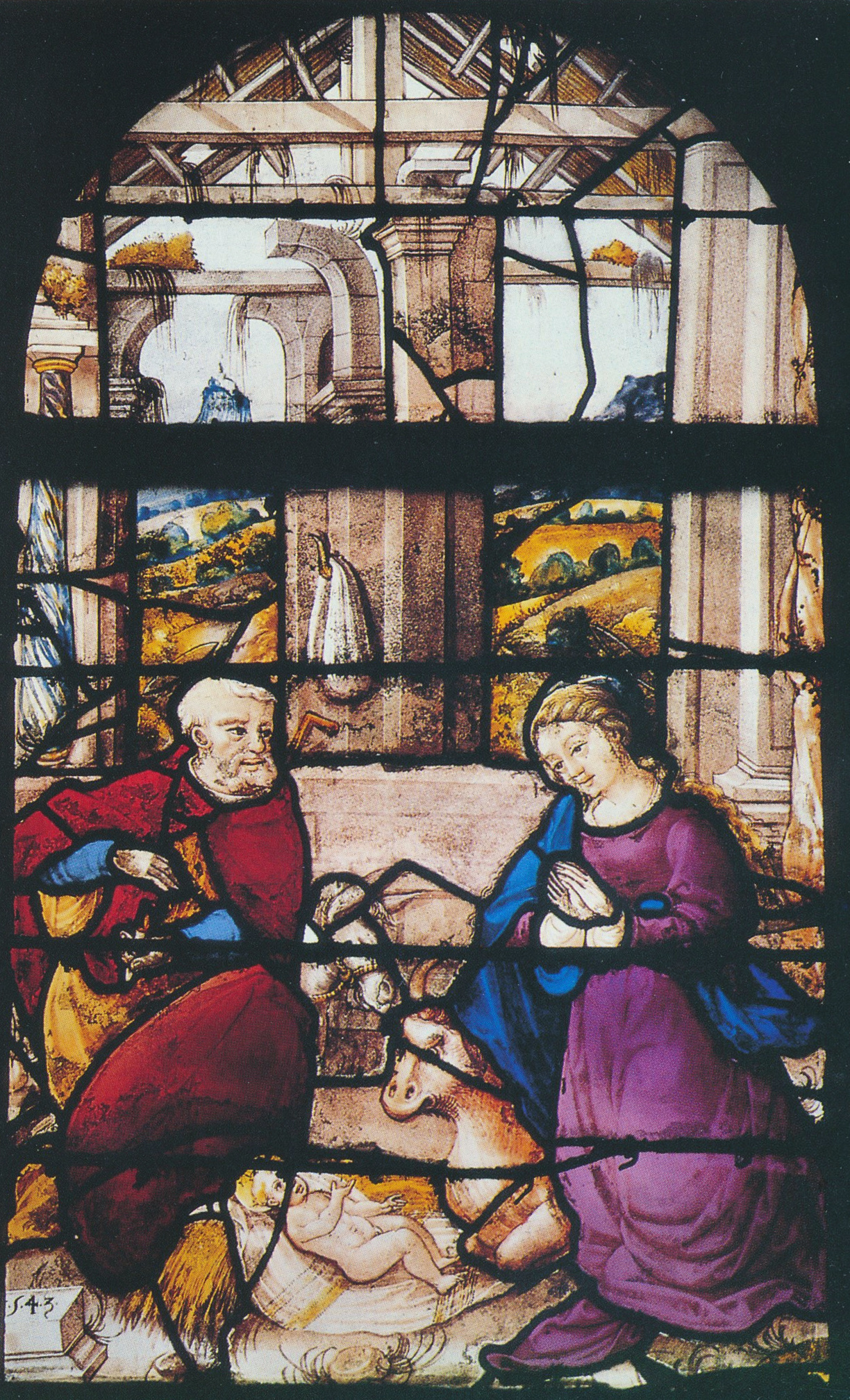
Throughout France starting in the 1540s there was a growing taste and demand for stained glass windows in their local churches. The experimentation in glasswork and painting by the middle of the 16th century allowed for the iconography in these stained glass windows to express numerous details and refined techniques.
Detail. St. Peter Window. Public Domain.
Detail. Nativity Window. Public Domain.
Historic 16th-century half-timbered house located in Montfort-l’Amaury
Montfort L’Amaury has half-timbered houses dating to the 16th century. March 2002. Author’s photograph.
This is no. 16, Place de la Libération, just steps from the front entrance of Église St. Pierre. The building features a classic colombage (half-timbered) facade with vertical wood beams, diagonal braces, and traditional window shutters. Houses like this were common during the 15th and 16th centuries in the region.
Victor Hugo
At the beginning of October 1825 young Victor Hugo (1802-1885) lived in Montfort L’Amaury for a few days. He wrote a letter to his father in Paris and described it as “a charming little town ten leagues from Paris, where there are ruins, woods, and one of my friends…”
Victor Hugo stayed in Montfort-l’Amaury primarily to visit his close friend, the poet Adolphe de Saint-Valry. At the beginning of October 1825, a young, 23-year-old Victor Hugo and his wife, Adèle, spent several days at Saint-Valry’s family home located on Rue de la Treille. Saint-Valry was a fellow literary intellectual and one of the co-founders of the conservative romantic journal La Muse française.
The trip profoundly influenced French literature in two major ways: first, upon returning to Paris, Hugo wrote a letter to his father describing Montfort-l’Amaury as described above; and second, during Hugo’s wanderings through the village, the future author of The Hunchback of Notre Dame (1831) became captivated by the crumbling medieval fortifications and the 12th-century castle keep (The Tower of Anne de Bretagne). This inspired him to write his famous poem, “Aux ruines de Montfort-L’Amaury” (published in his 1828 collection Odes et Ballades). It marks the very first time Hugo integrated the romantic grandeur of medieval ruins into his poetry—a thematic hallmark he would develop extensively throughout the rest of his legendary career.
View of the church from the east. March 2002, Author’s photograph.
The church of Saint Pierre is of late gothic origin. It was rebuilt and decorated in the 15th, 16th, and early 17th centuries. Following the French Revolution and its aftermath, the church building received an extensive restoration in the mid19th century, including a new steeple. Except for one stained glass window that was restored in situ, all the 16th century stained-glass windows were taken out, restored, and reinstalled by a master painter in Metz between 1851 and 1857.
Chevet. L’Église Saint-Pierre. Public Domain.
Taken from Rue Pétau de Maulette, the historic photograph captures the apse and side facade of the Church of Saint-Pierre de Montfort-l’Amaury. Built largely under the patronage of Queen Anne of Brittany in the late 15th and early 16th centuries, the lower structure features the dramatic flying buttresses, pointed arches, and intricate stone tracery characteristic of late Flamboyant Gothic architecture. The upper galleries and the grand rounded apse roof visible in the foreground display the classical proportions, decorative balustrades, and orderly lines of the French Renaissance style of the later 16th century. The building is a remarkable architectural hybrid, illustrating the transition between two major eras in French history. It also houses one of France’s most important and complete collections of Renaissance stained-glass, dating from 1530 to 1580. These 37 monumental windows are celebrated for their vivid colors, exceptional draftsmanship, and richly detailed biblical and historical narratives.
Place de la Libération with Rue de la Libération just beyond. March 2002. Author’s photograph.
On Saint Pierre’s front stoop is busy Place de la Libération. Like many town squares throughout France, this area was renamed to commemorate the town’s liberation from Nazi occupation during World War II. Montfort-l’Amaury was officially liberated on August 18, 1944, when American military forces entered the village center. Following a brief firefight with a heavily armed detachment of retreating German soldiers, the town was successfully freed, bringing an end to the local German Kommandantur. Prior to this 20th-century renaming, the historic area was known as the Place Normande—the dark site where the municipal guillotine was briefly erected during the height of the French Revolution. At the end of the street is the rounded 16th century La Porte Bardoul, one of gateways to the chateau. It was named in the 16th century for the captain who built the ramparts of Montfort L’Amaury in the 11th century (Hugues Bardoul).
Charles Aznavour (1924-2018), dubbed France’s Frank Sinatra, didn’t live in Montfort L’Amaury but for 60 years, the singer lived a five–minute car ride away in neighboring Galluis. In those many years, Aznavour frequently came to Montfort L’Amaury, sometimes to go shopping or visit friends or eat at one of its restaurants. In 2018 Aznavour was buried in the cemetery in Montfort L’Amaury and it has become a pilgrimage site for his many fans. PHOTO: “Charles Aznavour – Disque D’Or” by Piano Piano! is licensed under CC BY 2.0.
The cemetery at Montfort-l’Amaury. Fair Use.
The cemetery at Montfort-l’Amaury dates to the sixteenth century and is a fascinating site for its history, architecture, and the notable individuals buried there. For centuries, the dead were interred in the ground as they are today, but as burial space became scarce, especially during recurring epidemics, older graves were exhumed and the bones transferred to ossuaries to make room for the newly deceased. Built to resemble the arcades of a cloister, these elegant galleries are in fact a vast communal repository of human remains. The contrast between their graceful architecture and their somber purpose gives the cemetery a distinctive atmosphere, combining historical necessity with the melancholy charm of a Romantic-era bone yard.
The initial fortified stronghold on this strategic hill was erected by Amaury I of Montfort around the turn of the 11th century under the orders of King Robert II of France.
Ruins of the castle of Montfort-l’Amaury. The Tour d’Anne de Bretagne (the castle keep) stands as the focal point of the medieval Château. In the foreground is Le Belvédère, the house of Maurice Ravel. PHOTO: Montfort-l’Amaury Donjon by ℍenry Salomé(Jaser !) 08:12, 21 November 2006 (UTC) – Cliché personnel, own work is licensed under CC BY-SA 3.0
The role of Montfort l’Amaury as a town began to develop in the High Middle Ages when Capetian king, Robert II (976-1031), built a castle there in the forest of Yvelines which was then a royal prerogative. William of Hainaut built the castle whose walls were finished around 1050. Hugues Bardoule was captain of the castle and thus a later 16th century gateway is named after him. It is in the 11th century that L’Église Saint-Pierre and L’Église Saint Laurent begin to be built. Robert II was married three times, and excommunicated by the Catholic Church – one of the early examples of French royals who married as they wished.
In the twelfth century, Bertrade de Montfort (1070-1117), after giving birth to a boy who would become King of Jerusalem, left her husband, the Duke of Anjou, Fulk IV (1043-1109) in 1092. She married the king of France, Philip I “the Amorous” whose spouse, Bertha of Holland, was also still living.
Philip was so in love with Bertrade that he refused to leave her even when threatened and finally excommunicated by Pope Urban II (1035-1099) in 1095. Because of his excommunication Philip was prevented from taking part in the First Crusade (1096-1099).
Montfort-l’Amaury reflects major themes in French history, including crusading movements, dynastic politics, the Wars of Religion, and the growth of royal power.
The ramparts and castle. The specific, octagonal brick-and-stone residential keep tower in the photo were erected by Queen Anne of Brittany in the late 1490s. She added the elegant Renaissance-style tower to make the defensive castle a comfortable royal manor. When the castle was dismantled and blown apart in the 1600s, the front and back walls of the tower collapsed entirely, leaving only the structural core intact giving appearance of two towers. March 2002. Author’s photograph.
The ramparts and castle were destroyed by the English during the Hundred Years’ War in the 15th century. After the battle of Agincourt in 1419, the English occupied the French domain and it was during this time that the castle at Montfort was destroyed. The two rebuilt towers were named for Anne of Brittany after she assisted in the castle’s restoration. From this height, the fort overlooked the old Roman road from Beauvais to Chartres.
Also from this place, troops assembled at Montfort L’Amaury in the 12th century as Amaury III raised lords and knights to fight alongside Louis VI (1081-1137) against the Emperor of Germany. Simon IV fought alongside Philippe II Auguste (1165-1223) against the English as well as to the Crusades in the Middle East and the Albigensian Crusade in southern France. The Montforts distinguished themselves especially in this crusade against the Cathars.
At the beginning of the Third Crusade (1189-1192), not wanted by King Philippe Auguste (1165-1223), the future Louis VIII “the Lion” (1187-1226) was looking for companions. Simon IV, Lord of Montfort (1175-1218), embarked on the crusade where victory was equalled by its terror.
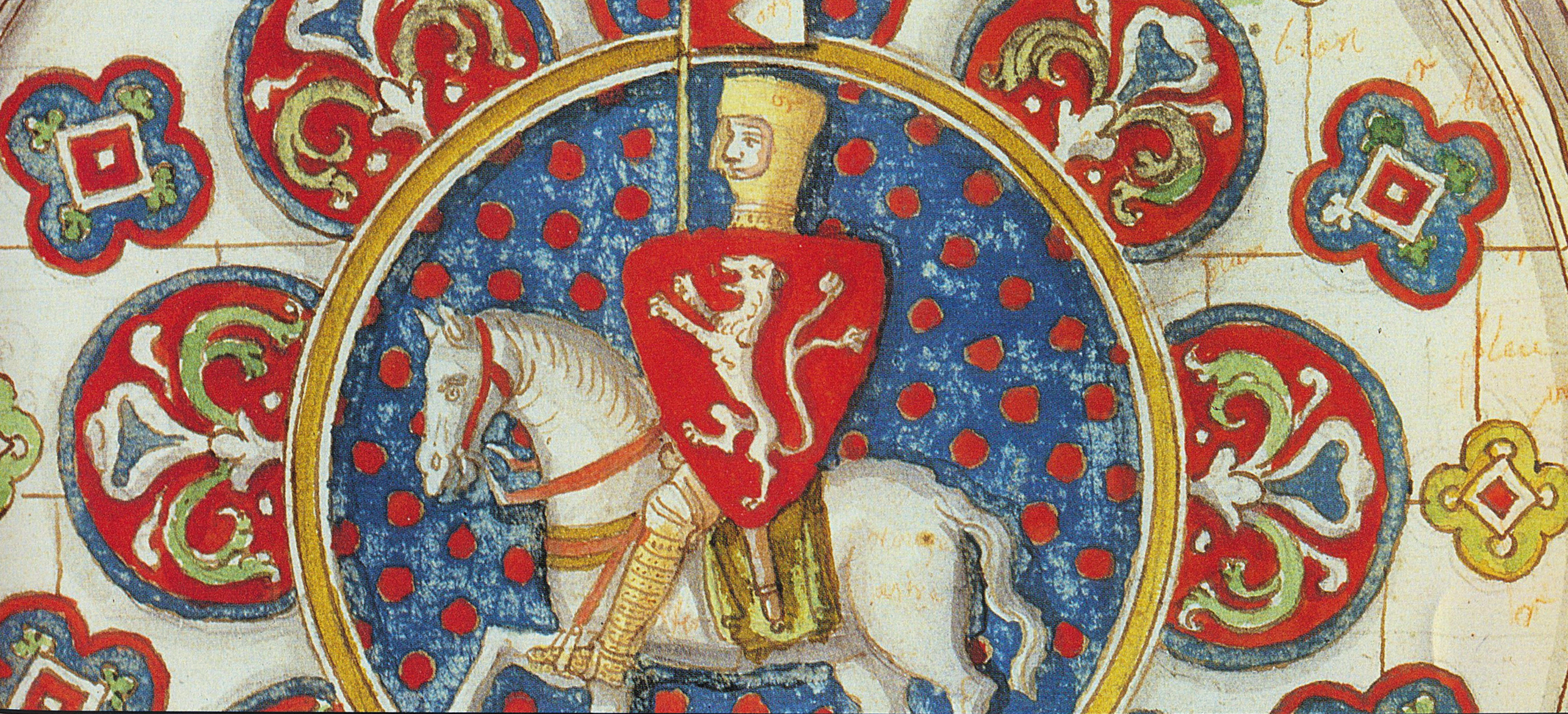
Stained glass (detail) Chartres cathedral: Simon de Montfort V (1208-1265). Simon was born in the chateau in 1208. Whereas his brother Amaury V (1191-1241) inherited his father’s French properties, including in the south of France owing to his father’s Cathar crusade, Simon V is known to history as having a major role in the constitutional development of England where he successfully led the barons’ opposition to the absolute rule of King Henry III (1207-1272) of England. During his rule of England Simon de Montfort V called two famous parliaments, one of which recognized the voices of ordinary town citizens in the affairs of government making him one of the progenitors of modern parliamentary democracy. Public Domain.
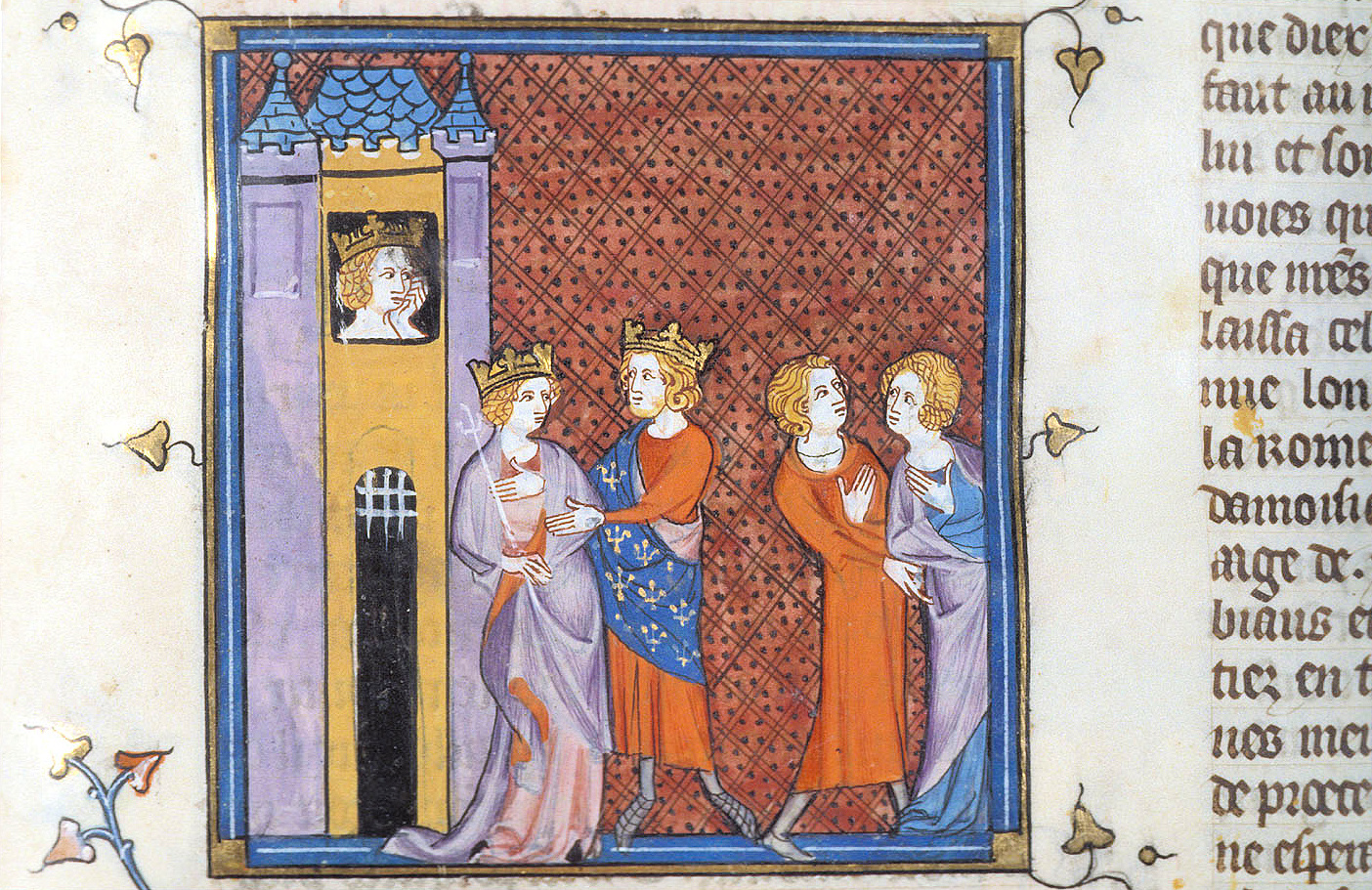
In January 1238, Montfort married Eleanor of England, daughter of King John and Isabella of Angoulême and sister of English King Henry III. While this marriage took place with the king’s approval, the act itself was performed secretly and without consulting the great barons. Eleanor had previously been married and swore a vow of perpetual widowhood after her husband died. This vow was broken when she married Montfort and, for that reason, the Archbishop of Canterbury condemned it. The English nobles protested the marriage of the king’s sister to a foreigner who was only of modest rank. Most notably, Richard, 1st Earl of Cornwell, the king’s and Eleanor’s brother, rose up in revolt over the marriage. King Henry III eventually bought off his brother and peace was restored. The marriage brought property to Montfort and when a child was born of the union in late 1238, he was baptized Henry, in honor of his uncle, the king. In February 1239, Montfort was finally invested as Earl of Leicester where he acted as the king’s advisor and became godfather to Henry’s eldest son, Edward, who became King Edward I (“Longshanks”).
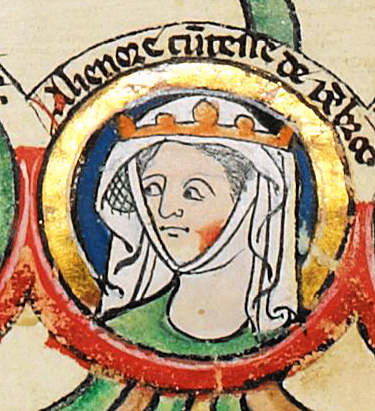
Eleanor of England who married Simon de Montfort V in 1238 in an early-fourteenth-century Genealogical Roll of the Kings of England. Public Domain.
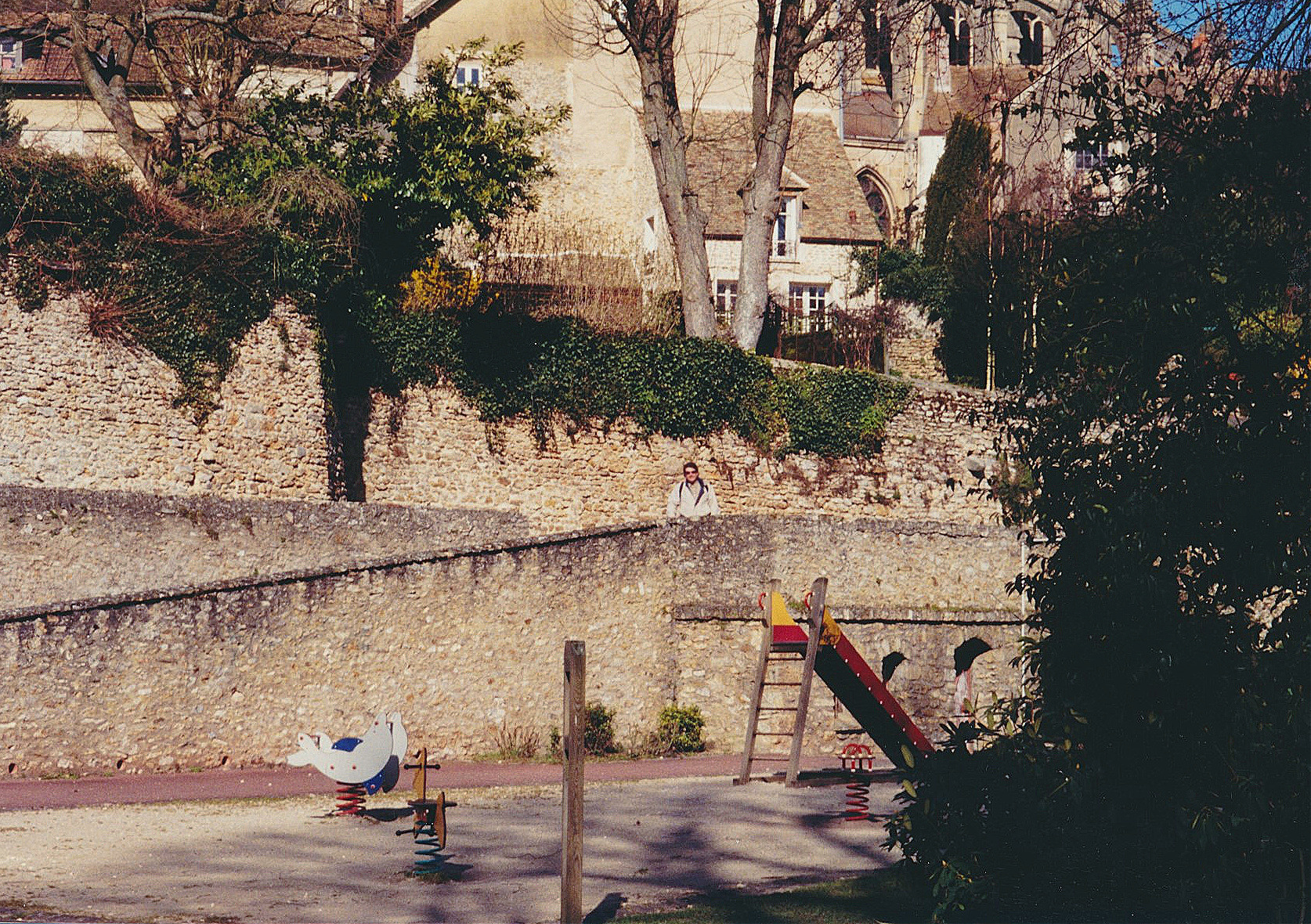
The author at the ramparts. March 2002. Author’s collection.
These fortifications were originally built over 1000 years ago in the early 11th century by Amaury I. The walls run from east to west creating a superficial size of Montfort at about 4 to 5 hectares (one hectare equals about two and a half acres). Portions of the wall were dismantled during the 100 Years War but rebuilt during the Wars of Religion (1562-1598) as well as Montfort’s reception of a royal charter by Charles IX in the mid16th century. The rebuilt wall had to expand to meet the development of Montfort under Anne de Bretagne a half a century before, though substantial portions of the original 11th century wall were incorporated into the construction.
Manuscript 16th century (detail): Queen consort Anne of Brittany (1477-1514) receiving a Book of Hours from her Dominican confessor, Antoine Dufour (d.1509). Montfort L’Amaury returned to the crown of France after Anne of Brittany married Charles VIII “the Affable” (1470-1498) in 1491.
From Montfort L’Amaury, the lords continued to assist the French kings in the crusades. After John I, only a daughter allowed the continuity of the Montfort family. Beatrice d’Albidon married Robert, Count of Dreux. The Comté de Montfort was related to the Duchy of Brittany following the marriage of Yolande de Dreux-Montfort (1263-1330) with Arthur II of Brittany (1261-1312) in 1294. With their marriage in February 1492, Anne of Brittany became the first Queen of France crowned in St. Denis basilica. The marriage contract of Anne to Charles VIII “the Affable” stipulated a union of France and Brittany though the ruthless Charles forbade her to reign with her title, “Duchess of Brittany.” The contract also stated that if the queen were to die first and was childless, the king would inherit all her property. In this pre-nuptial agreement, it further stipulated that if Charles VIII died first Anne must marry his successor. This would be his cousin and brother-in-law, the handsome and seductive Louis II of Orléans, later, Louis XII (1462-1515). Though Charles and Anne often lived apart, she was pregnant for most of her married life with a child on average every fourteen months that produced two sons who died and two daughters who lived. After the accidental death of warring Charles in April 1498 (he hit his head on a door lintel), there was no male heir and 22-year-old Anne duly married Louis. Before she married French kings, Anne was engaged 8 times and briefly was married in 1490 to the Holy Roman Emperor, Maximilian, which the French did not like. Anne was still a married woman when she and Charles the Affable exchanged vows in December 1491. To prevent scandal the marriage had to be regularized by the pope who annulled Anne’s marriage to Maximilian in February 1492 and granted the royal couple a dispensation for each marrying their relative. Before new king Louis XII could marry Anne he had his 22-year marriage to Joan of France – a marriage of longer duration than Anne was then alive – annulled. In 1476 Louis believed he had had Joan forced on him by Louis XI (“The Universal Spider”) and never really cared for her. In what has been described as one of the seamiest lawsuits of the Middle Ages, Joan went on childless from her disappeared marriage to die in a nunnery. In 1499 it was the king’s second marriage and Anne’s third. Anne was quite aware that she was no longer a child but a 33-year-old woman, divorced and widowed with two children. She proceeded to actively insist at court on her rights and prerogatives. Though King Louis XII ruled Brittany, he officially recognized Anne’s title Charles had forbade and Louis promulgated decisions in her name. Their contract stipulated that Anne’s second child with Louis XII would rule Brittany. But with Anne’s death at 36 years old in 1514 this was not honored. Anne was coronated again in St. Denis basilica in 1504. She lived mostly at Blois and was an important patron of the Italian and French fine arts. Louis XII died the next year without a legitimate heir and his cousin and son-in-law Francis I mounted the throne. The couple were buried in St. Denis basilica. During the French Revolution in the wake of the frenzy of having decapitated the king in January 1793, revolutionaries made their way to St. Denis basilica and desecrated the graves of Anne of Brittany and Louis XII and threw their remains into a mass grave. This 15-16th century union of Brittany and France brought increased benefits to Montfort L’ Amaury compared to a union with Brittany alone. The new period saw the town’s castle ruins restored and there was new construction everywhere. The cemetery was relocated outside city walls. Churches were rebuilt and enhanced with that day’s art. While reaping these material improvements from its royal benefactors, Montfort maintained a semi-autonomy from the crown of France that would not be changed until 1550 when Brittany and the French Crown finally united under a single sovereign, Henry II (1519-1559).
Jean Perréal (1455-1529), Portrait Louis XII, c. 1514, Windsor collections de S.M. la Reine d’Angleterre. Jean Perréal’s most important attribution is this portrait of Louis XII who was King of France from 1498 to 1515. Louis XII was married three times – the first annulled; the second leaving the king a widower, and, in his last three months of life, to Mary Tudor (1496-1533), the favorite sister of King Henry VIII of England. Despite these wives, the king had no living sons. The Salic Law prohibited his line to continue on the French throne through his daughters. When Louis died in 1515, his throne eventually passed to his cousin, Francis I.
Under the Valois the Yvelines region of which Montfort is a central part received royal favor. Catherine de Medici (1519-1589) was named the Lady of Montfort in 1561. When the Wars of Religion broke out (1562-1598), the king, Charles IX (1550-1574), offered to the city home-rule in exchange for the reconstruction of its medieval ramparts at his expense. At the end of these wars, the passage of the future king, Henry IV (1553-1610) on the road that led him to Paris to take power, allowed Montfort L’Amaury to prove its loyalty to the new king. Montfort provided Henry Navarre with weapons and later obtained special rights in exchange. During the reigns of the first two Bourbon kings of France, Henry IV and Louis XIII (1601-1643), there are frequent royal visits to Montfort L’Amaury.
A canonized Catholic saint: Joan of Valois (1464 – 1505), sister of Charles VIII, and betrothed of Louis XII.
Portrait of Joan of Valois as abbess by Jean Perréal (1455-1530).
The second daughter of Louis XI (1423-1483) and Charlotte of Savoy (1411-1483), Joan of Valois was a fleeting Queen of France as the wife of King Louis XII following the death of her brother, King Charles VIII. Her marriage was soon annulled so that Louis could, as pre-arranged by contract, marry Charles VIII’s widow, Anne of Brittany.
Joan’s demeanor was characterized by an accepting and placid countenance. When she retired from court politics to become Duchess of Berry, the former Queen of France remarked: “If so it is to be, praised be the Lord.”
In Bourges, Joan of Valois founded a monastic order of sisters and served them as their abbess. In terms of her personality, Joan could be autocratic as an administrator of her nuns, which may have been a vestige of her former high-born role. Joan was canonized in May 1950, almost 450 years after her death.
Anne of Brittany, Catherine de’ Medici, and other royal figures helped shape the town’s development during the Renaissance.
Workshop of François Clouet. Catherine de’ Medici wears the black cap and veil of widow, after 1559. Upon seeing Catherine in the flesh, an Italian diplomat noted that “her mouth is too large and her eyes too prominent and colorless for beauty. But she is very distinguished-looking, has beautiful skin, a shapely figure, and exquisitely made hands.”
Marie de’ Medici, 1616, Frans Pourbus the Younger (Flemish, 1569-1622), oil on canvas, The Art Institute of Chicago. Marie de Medici (1575-1642) married Henry IV of France in 1600. After the king was assassinated in Paris in 1610, Marie de Medici served as the regent for their young son, Louis XIII. Marie de Medici brought Frans Pourbus to the French court to make regal portraits of the royal family.
Le Belvédère at Montfort L’Amaury: the House of Maurice Ravel from 1921 to his death in 1937. The coexistence of castle ruins, Gothic architecture, Renaissance art, historic houses, and literary and musical associations makes the town an unusually rich historical destination.
The author in front of Le Belvédère, the house of Maurice Ravel, and ready to go inside for a visit. March 2002. Author’s collection.
InsideLe Belvédère. The salon. March 2002. Author’s photograph.
Pianist Jacques Février with Maurice Ravel in 1925 in Le Belvédère, the house of the composer in Montfort-l’Amaury. Public Domain.
Ravel’s house sits on an ascent from the centre ville where Ravel could look out his garden-side window to back towards town and south and east to the green countryside between Montfort and Paris. March 2002. Author’s photograph.
Classic theater paperback anthology titled Jean Anouilh: Five Plays published as part of the celebrated Mermaid Dramabook series by Hill and Wang in 1958. He lived in Montfort-l’Amaury for roughly a decade, from 1951 to the early 1960s. PHOTO: “George Maas” by Crossett Library Bennington College is licensed under CC BY-NC-SA 2.0.
A master stylist, Jean Anouilh lived in Montfort-L’Amaury as he rejected the conventional realism that dominated much of contemporary theater, instead treating the stage as an elaborate and self-conscious game, an approach reflected in the categories and cycles into which he organized his plays. His dramas became powerful psychological mirrors of the moral and political trauma left by the German occupation of France. Drawing on classical mythology, Anouilh explored themes of moral purity, compromised integrity, and the devastating cost of saying “no” to corrupt authority. He possessed a rare gift for transforming ancient Greek myths into modern drama, replacing epic poetry with sharp, colloquial, and psychologically charged dialogue that resonated deeply with twentieth-century audiences.
Anouilh’s 1944 play, Antigone, was an adaptation play of Sophocles’ play of the same name. The 34-year-old Anouilh’s work was seen as an attack on the Vichy government of Marshal Pétain (1856-1951) in World War II.
This anthology is particularly important to theater history because it gathers the landmark works that introduced Anouilh’s genius to English-speaking audiences, foremost among them Antigone, his crowning achievement. For many French spectators, the defiant Antigone embodied the spirit of the French Resistance, while the pragmatic and authoritarian Creon evoked the collaborationist Vichy regime. By recasting an ancient conflict as a modern moral dilemma, Anouilh created one of the most enduring and controversial dramas of the twentieth century, a work that continues to challenge audiences with its unsettling questions about conscience, obedience, and resistance.
Anouiih also wrote Becket. The original French play is titled Becket ou l‘Honneur de Dieu. It was staged in Paris at the Théâtre Montparnasse-Gaston Baty in October 1959 and directed by Anouilh. The play dramatizes historical martyr and Catholic saint Thomas Becket (1120-1170), the Archbishop of Canterbury In England.
Anouilh’s Becket became an international sensation. Successive productions in English translation were mounted in London (starring Christopher Plummer and Eric Porter) and in New York City (starring Laurence Olivier and Anthony Quinn). In 1964 Becket became a major motion picture starring Richard Burton and Peter O’Toole which won the Academy Award for Best Screenplay.
SOURCES:
Comité d’organisation des fêtes. 1972. Montfort-L’Amaury. Montfort-l’Amaury: Le Syndicat d’Initiative des Fêtes et des Arts de Montfort-L’Amaury et ses Environs.
Coulson, John, dir. 1957. The Saints: A Concise Biographical Dictionary. New York: Guild Press.
De Finance, Laurence, et Marie-Huguette Hadrot. 1994. Montfort-L’Amaury : Les verrières de l’église paroissiale Saint-Pierre (Yvelines). Paris: Centre de Documentation du Patrimoine.
FEATURE Image: Simon Vouet (1590-1649), Self-portrait, c. 1626–1627, Musée des Beaux-arts de Lyon. https://www.mba-lyon.fr/fr/article/simon-vouet In Simon Vouet’s self portrait painted in his final years in Rome he displays his signature rapid brushwork and desire for movement in the picture.
Simon Vouet revolutionized 17th-century French art by translating, tempering, and synthesizing Italian Renaissance realism, Caravaggesque naturalism, and Baroque elements into a distinct French classical style. By bringing these foreign innovations back to Paris in 1627 under King Louis XIII, Vouet effectively dismantled the dominant Late Mannerism style and established an influential, decorative academic school of painting that defined French artistic taste for generations.
Simon Vouet was born into modest circumstances in Paris on January 9, 1590. After stays in England in 1604, Constantinople in 1611 and Venice in 1613 of which little is known, the French painter Simon Vouet (1590-1649) spent nearly 15 years in Rome starting around 1614. In 1624 Vouet was elected to lead the Accademia di San Luca, an artists’ association founded in 1593 by Federico Zuccari (1539-1609).
Most French painters born in the 1590s made a stay in Rome which influenced art in France in the 17th century. Vouet was in Italy, primarily in Rome, between around 1613 until 1627 and received a special privilege from the French crown in 1617. It was this traffic of young French, Flemish and other international artists between Italy and their home countries in the first third of the 17th century that, for France, helped revolutionize French art. This was achieved by way of the contemporary application of ideas and styles influenced by late Renaissance Italian realist artists such as the aesthetic of Caravaggio (1571-1610) and the history painting method of Annibale Carracci (1560-1609), among many others, to which French artists were exposed while in Italy. In Rome Vouet, like other French artists such as Valentin de Boulogne (1591-1632), was patronized by Cardinal Francesco Barberini (1597-1679) and Cavaliere del Pozzo (1588-1657), among others. In 1624 Vouet was commissioned to paint the fresco to accompany Michelangelo’s Pietà in St. Peter’s and while greatly admired it was destroyed in the 18th century.
In addition to Rome, Vouet traveled to Naples, Genoa in 1620 and 1621, and, in 1627, Modena, Florence, Parma, Milan, Piancenza, Bologna and again Venice where he copied Titian (1488-1576), Tintoretto (1518-1594) and Paolo Veronese (1528-1588). During these visits Vouet studied the chief art collections that informed Vouet’s own style which amounted to a free form of temperate, classicized Baroque. This is the style, along with the latest Venetian-influenced brighter colors, vivid light, and painterly execution that Vouet returned and introduced to France in the 1630s. In France, Vouet had taken to himself as a painter his particular appreciation for the classicized compositions of Nicolas Poussin (1594-1665) and the cool colors of Philippe de Champaigne (1602-1674).
In 1627, King Louis XIII (1601-1643) called Vouet back to Paris to be his court painter. Vouet refined Caravaggio’s innovations into a style that would become the French school of painting starting in the 1630s and extending into the middle of the 18th century. Until about 1630 it was Late Mannerism which dominated in French painting and included unnatural physiognomy, strained poses, and untenable draperies. This changed with Vouet’s return who brought back from Italy a style with classical, realist, and Baroque painting components that was unknown in France until then and which Vouet stamped with his own style.
This painting entered the Louvre as a work of the Neapolitan school. It was recent scholarship that attributed it to Vouet which would make it one of his earliest portraits in Rome. Building on the premise, scholars have proposed Francesco Maria Maringhi (1593-1653), a Florentine patrician and lover and protector of Italian Baroque painter Artemisia Gentileschi (1593-1656), as the model.
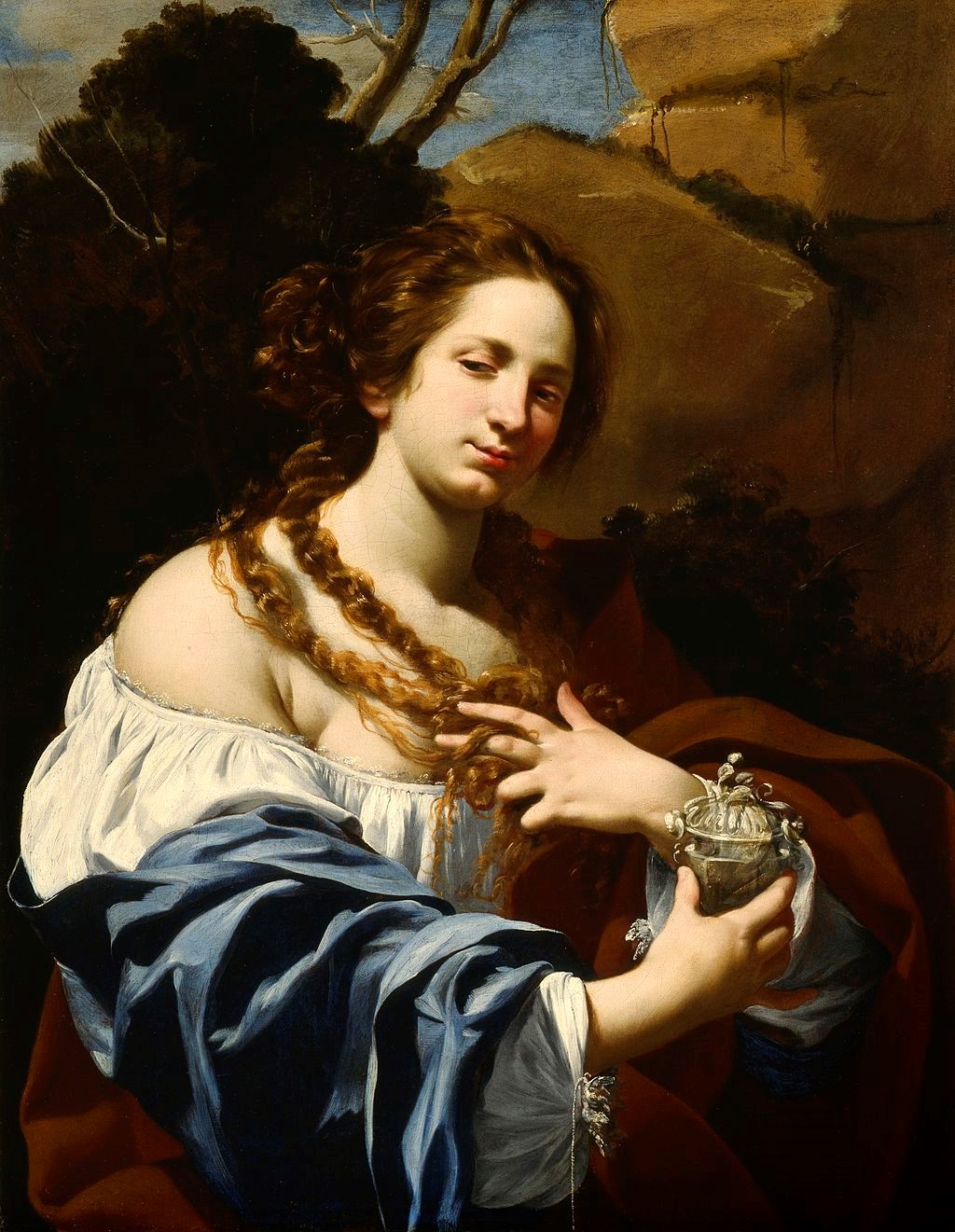
Vouet married twice. His first wife was a young Italian woman he met in 1625 – Virginia da Vezzo (1600–1638). In France Vouet’s wife, who bore him 4 children, was well received by the French court. After Virginia died in 1638, Vouet married Radegonde Béranger (b. 1615), a young beauty from Paris, in July 1640. Radegonde bore Vouet another 3 children (one died in infancy), and survived him.
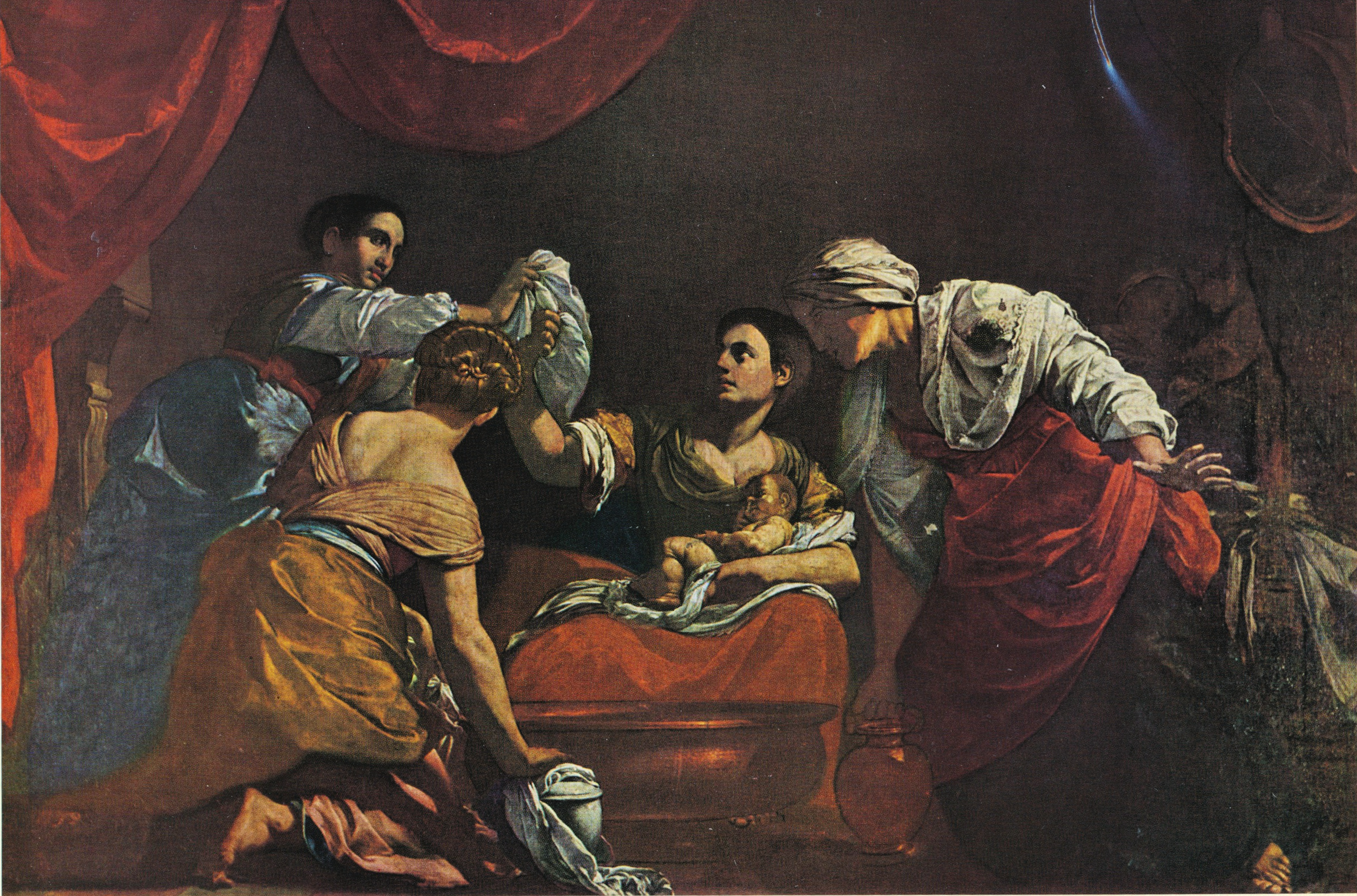
Simon Vouet (1590-1649), Virginia da Vezzo, the Artist’s Wife, as the Magdalen, oil on canvas, 40 × 31 in. (101.6 × 78.7 cm), oil on canvas, c. 1627, Los Angeles County Museum of Art. https://collections.lacma.org/node/247903Simon Vouet (1590-1649), Judith with the head of Holofernes, 1620/1625, 97 x 73,5 cm, oil on canvas, Bayerische Staatsgemäldesammlungen München-Alte Pinakothek, https://www.sammlung.pinakothek.de/de/artwork/jWLpZea4KY/simon-vouet/judith-mit-dem-haupt-des-holofernesSimon Vouet (1590-1649), The Birth of the Virgin c. 1620 Rome S. Francesco a Ripa.Detail: The Birth of the Virgin.
The Birth of the Virgin was one of many paintings in a somber palette that Vouet produced in Rome influenced by Caravaggio though its mood is more vibrant. The composition is broad, low and somewhat setback from the picture plane. Amidst the swirling movement and vitality of the drawing and figures, including sumptuous draperies, it is observed that the head of the maid servant in the middle of the composition is modeled on one by Michelangelo Buonarroti (1475-1564). These early qualities that Vouet had taken from Italian painting were, when he returned to France, taken over by a heightened decorative style in the 1630s and 1640s.
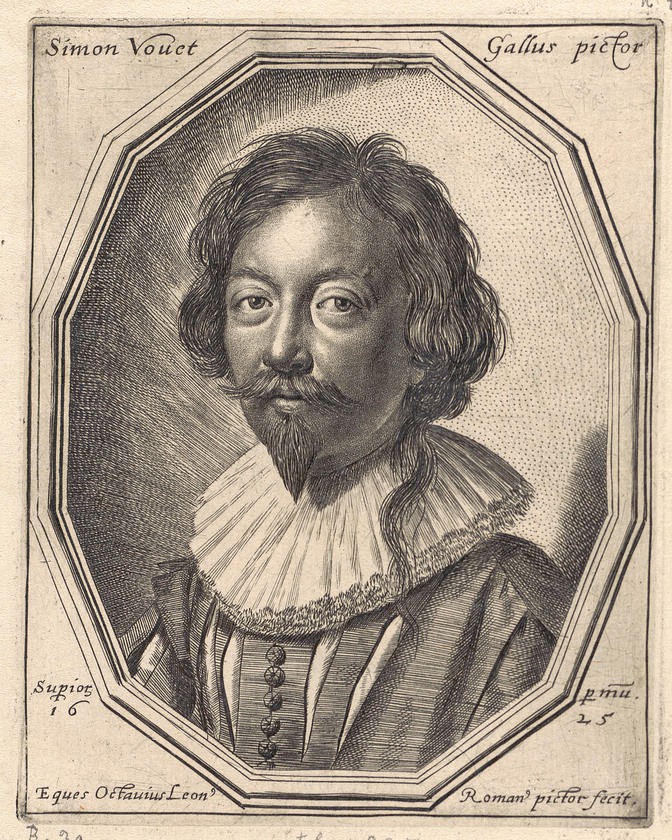
Ottavio Leoni (1578–1630), Simon Vouet in Italy, engraving, sheet 9 3/8 × 7 1/16 in. (23.34 × 17.94 cm), Carnegie Museum of Art, Pittsburgh.Simon Vouet (1590-1649), Portrait presumed of Aubin Vouet, c.1625. Musée Réattu, Arles. Attributed to Vouet, Annunciation, Uffizi, c. 1621. oil on canvas 1.20 x 0.86m (see Crelly, pp. 162-63). Simon Vouet (1590-1649), The Circumcision, oil on canvas, Church of Sant’ Angelo a Segno Naples.Simon Vouet (1590-1649), The Crucifixion with Mary and John, oil on canvas, Church of Jesus and Saints Ambrogio and Andrea GenoaSimon Vouet (1590-1649), Appearance of the Virgin to St Bruno, c. 1624, Naples, S. Martino.
As Vouet stayed in Italy he increasingly turned to a Baroque style of which The Crucifixion with Mary and John in Genoa is an early example. The Appearance of the Virgin to St. Bruno in the Carthusian monastery of San Martino in Naples is a later and more fully realized Baroque style example. The atmosphere of each showing saints in ecstasy is a clear element in Baroque’s intensified and elaborated religious representation. In Italy Vouet’s paintings are more restrained than the full contemporary Baroque art of Pietro da Cortona (1597-1669) and his followers such that the French painter’s figure of the Virgin in his Naples’ picture tends towards a classical Renaissance tradition that would be an important part of the expression of French taste in the 1630s and 1640s.
Simon Vouet (1590-1649), Modelli for Altarpiece St-Peters Rome, 1625, Los Angeles County Museum of Art.Simon Vouet, The Clothing of St. Francis of Assisi, Rome, S. Lorenzo in Lucina, Alaleoni Chapel, 1624.
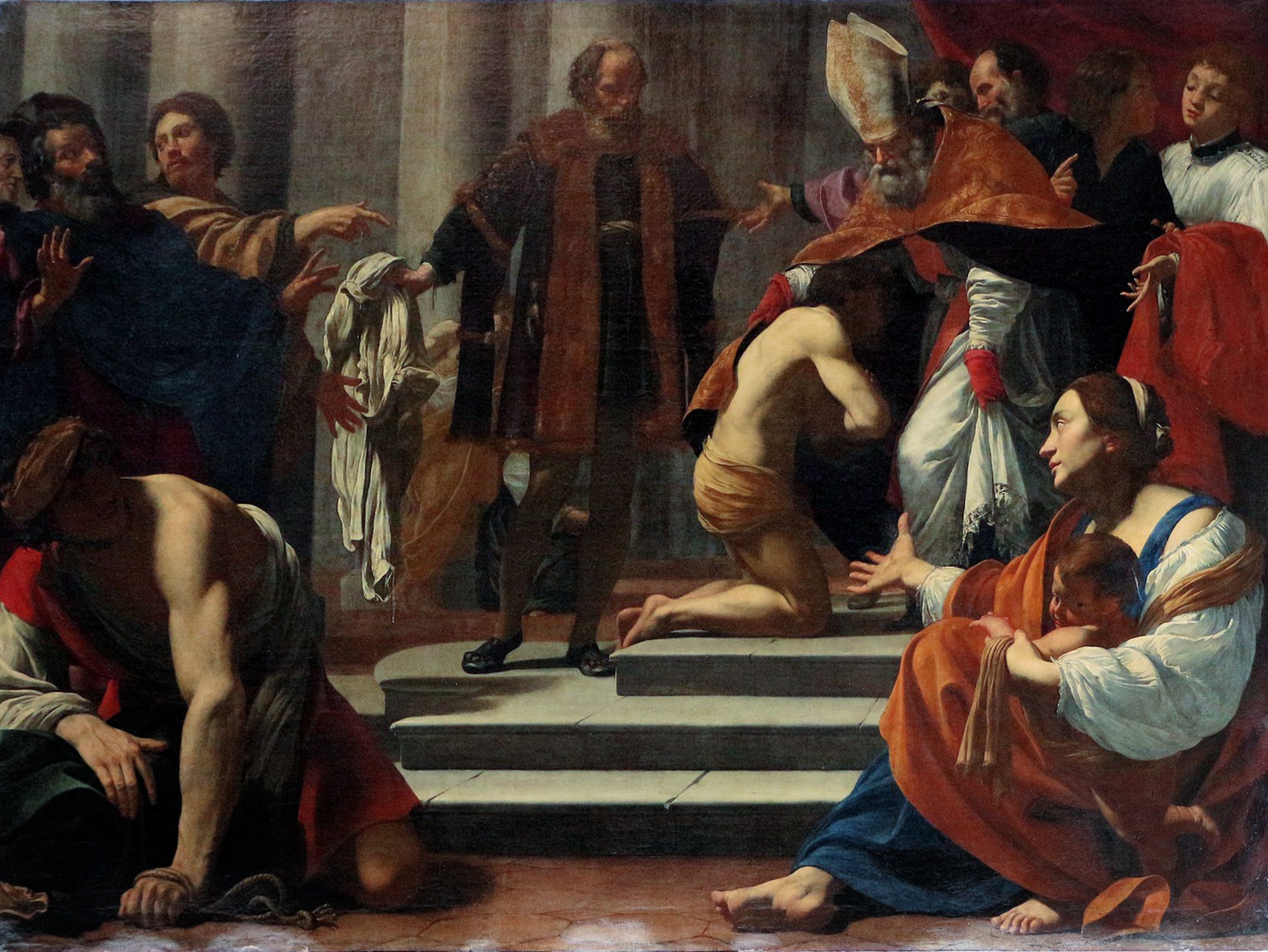
Simon Vouet’s The Clothing of St. Francis of Assisi (also known as the Vestizione di San Francesco) is a masterpiece of the Roman Baroque period. Painted in 1624, this canvas adorns the left wall of the Alaleoni Chapel, a private family burial space located inside the historic Basilica of Saint Lawrence in Lucina (San Lorenzo in Lucina) in Rome. Originally consecrated in 440 AD by Pope Sixtus III, the church underwent a profound Baroque transformation centuries later.
The year 1624 marked a major pinnacle of Vouet’s Roman sojourn. At 34 years old, he had been living and working in Rome for a decade, having arrived in 1614 after traveling through England, Constantinople, and Venice. His immense success in the city culminated that same year in his election as the President of the Accademia di San Luca, concurrent with his completion of the prestigious Alaleoni Chapel commission, which featured a complete decorative cycle of canvases and frescoes.
Vouet’s canvas captures a foundational turning point in the life of Saint Francis of Assisi: his public renunciation of his wealthy father and his forfeiture of worldly goods. The event took place between 1205 and 1206, when Francis was approximately 24 years old. Stripped of his sumptuous secular life, a youthful Francis kneels humbly on the steps before the bishop. To maintain the strict religious decorum of 17th-century Roman church art, Vouet does not paint Francis completely naked, as historical accounts suggest; instead, he depicts the saint with his back bare, his lower half modestly draped, as Bishop Guido wraps a heavy cloak around his shoulders. In the center background stands Francis’s father, Pietro di Bernardone, holding the rich garments his son has just rejected. Pietro’s posture reflects deep disappointment and anger at his son’s public forfeiture of his inheritance.
This dramatic confrontation was the climax of months of intense family crisis. Pietro could not accept Francis’s bizarre and erratic behavior. No longer living the life expected of Assisi’s nouveaux riches, Francis had isolated himself, walking among lepers and poor priests. Francis had even traveled to Rome on a pilgrimage to the tomb of Saint Peter before returning to Assisi completely changed. Moving out of the family home, he took up residence in the dilapidated church of San Damiano, praying intensely before its now-famous crucifix.
To the citizens of Assisi, Francis had become a well-known oddball whose behavior was distracted, withdrawn, and self-destructive. When he appeared in town, locals called him insane and threw mud at him. In response, his reactionary, self-made father locked him in the house, debating with him for weeks to come to his senses, get a job, find a wife, and embrace the comfortable merchant life to which they had become accustomed. After a month of captivity, while Pietro was away on business, Francis’s French mother, Pica, let him out of the cage. Francis immediately fled back to San Damiano.
Upon his return, Pietro exploded with fury, realizing his son was a lost cause. Preoccupied with gold and the future of his business—which Francis was meant to split with his brother, Angelo—Pietro took his son to court to cut Francis out and reclaim his money. Pietro initially approached civil authorities, but Francis cleverly claimed ecclesiastical jurisdiction as a man dedicated to God. This legal maneuver dragged the dispute before Bishop Guido, whom Francis already knew, and addressed as the “father of souls.”
The relationship between Francis and the bishop was complex. Bishop Guido, who came from an elite family, knew that Pietro made generous donations to church coffers, and he had initially listened to Francis’s desires for prayer and self-mortification with reluctance. Yet, during the trial, when the bishop urged Francis to return his father’s money and renounce his claim to the family fortune, Francis readily agreed. Stripping off his fine clothes, Francis famously declared: “I have called Pietro di Bernardone my father. But from now on I say, Our Father Who art in heaven.”
Vouet brilliantly captures the exact moment Bishop Guido wraps his cloak around Francis—a ritual that mirrored the welcoming of any religious penitent into the protection of the Church. This act symbolized the Church validating and shielding Francis’s radical new mission. It foreshadowed the events of 1209, when Francis would return to Rome to seek Pope Innocent III’s formal sponsorship for his new order, a move that Bishop Guido, protective of his own office, would ultimately have to support. Following the trial of 1206, Pietro and his family picked up the discarded garments and walked away; there is no historical record that father and son ever spoke again. Francis was now free to follow his own path – and did.
To heighten the narrative impact, Vouet surrounds this core legal and spiritual action with dynamic onlookers who display a range of Baroque emotional reactions—from confusion and judgment to intense theological contemplation. In the foreground, a woman holding a young child gazes directly up toward the scene, acting as a dramatic focal point to guide the viewer’s eyes.
Artistically, the artwork conveys the deep impact of Vouet’s time in Rome. He heavily employs Caravaggesque lighting, a masterful chiaroscuro technique that highlights the pale, bare back of the kneeling Saint and emphasizes the high-stakes human drama of the event. Yet, the canvas also signals a distinct transition to the High Baroque. The monumental classical architecture and the elegant, fluid movements of the figures show Vouet blending Roman naturalism with the classical grace of the Bolognese school, championed by masters like Annibale Carracci and Guido Reni.
This specific commission solidified Vouet’s reputation as one of the most prominent painters in Rome before French King Louis XIII ultimately recalled him to Paris to become the First Painter to the King.
The Alaleoni Chapel is celebrated in Baroque art history as one of the most ambitious commissions entrusted to French master Simon Vouet. Rather than supplying a single altarpiece, Vouet was commissioned to transform the entire chapel into a unified visual environment. On the left wall hangs The Clothing of St. Francis of Assisi (1624), depicting the saint’s dramatic public renunciation of wealth and worldly status. Its companion on the right wall, The Temptation of St. Francis (1624), presents a strikingly theatrical scene in which Francis throws himself naked into a briar patch of roses to resist the advances of a courtesan sent to test his resolve. Vouet completed the ensemble with frescoes, decorative painting, and numerous ornamental details, creating a fully integrated Baroque space in which architecture, painting, and religious narrative work together as a single immersive experience.
Simon Vouet (1590-1649), The Temptation of Saint Francis, c. 1620 Rome Basilica of Saint Lawrence in Lucina.
Simon Vouet (1590-1649), The Temptation of Saint Francis, c. 1620, Basilica of Saint Lawrence in Lucina, Rome. In Rome Frenchman Simon Vouet adopted a Caravaggesque style coupled with elements from Michelangelo such as in this painting for an ancient (4th century) church in Rome. While Vouet worked directly from the model and used closely observed poses from reality, the head of St. Francis of Assisi seems to be taken from one by Michelangelo. In Franciscan spirituality and tradition there is much greater emphasis on the presence of God and the joys of living the evangelical counsels (poverty, chastity, and obedience) in community and in nature than there is on the vocation’s temptations, trials or penances that could only be part of any religious saint’s story. While the early Franciscans tell tales of the devil, these are always quickly resolved as they relate the saint’s or another Franciscan brother’s beautiful victories over the Tempter by prayer, fasting and humility. Simon Vouet’s early painting in Rome presents an ostensibly Franciscan subject but with a Renaissance modern sensibility focusing on the twisting bodies of the figures of a contemporary woman presenting herself to the young Italian 13th century saint who, himself half naked, is all muscles and who gestures at the moment of first encounter with fleshly temptation to an unresolved ending adding to the painting’s worldly intrigue. see –https://www.finestresullarte.info/en/works-and-artists/-almost-as-unbelievable-as-a-church-painting–simon-vouet-and-his-saint-francis-tempted
Simon Vouet, Allegory of the Human Soul, Rome, Capitoline Musem, 1.79 x 1.44 m. It probably entered the collection of the Capitoline Museum in the 17th century (See Crelly, p.213). Simon Vouet (1590-1649), The ill-matched couple (Vanitas), c. 1621.Simon Vouet (1590-1649), David with the Head of Goliath, c. 1621,Palazzo Bianco, Genoa.Simon Vouet (1590-1649), St. Catherine, c. 1621. Simon Vouet (1590-1649), Young Man wearing armor, c. 1625/271,165 m x .91 m, oil on canvas. Musée du Louvre. https://collections.louvre.fr/en/ark:/53355/cl010061299
The painting by Vouet towards the end of his Roman period, the identity of the young man above is unknown though speculation by modern scholars is impressive (i.e., St. Thomas Aquinas, among others). The painting’s copies are numerous which points to the composition’s success. These copies can be found in major museums throughout Europe.
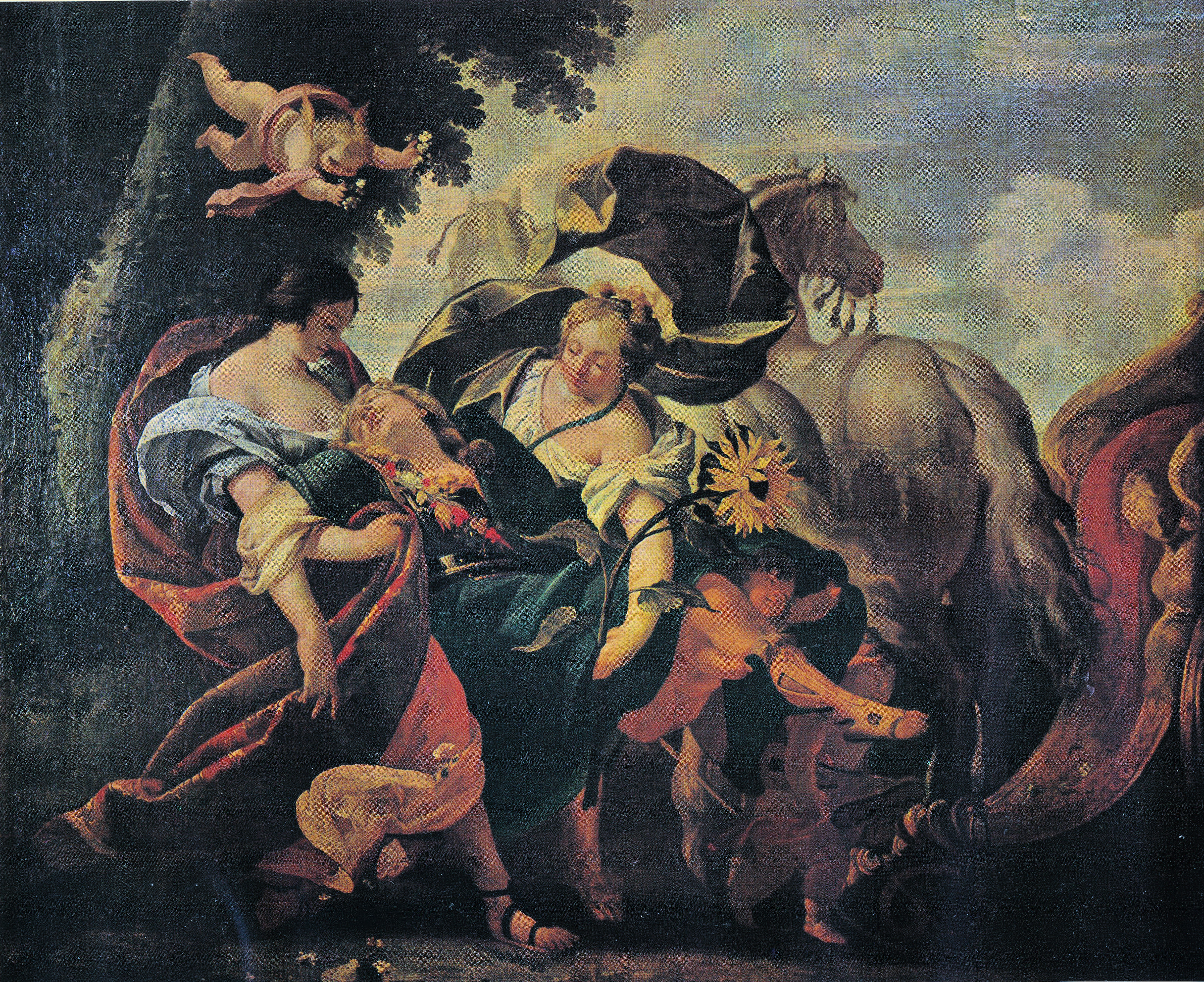
Vouet, Sophonisbe receives the poison cup through a messenger, c. 1623, oil on canvas, 125,5 x 156,5 cm, Kassel, Staatliche Gemäldegalerie. The painting was previously attributed to Guido Reni (1575-1642). The painting was in Kassel by 1738. (see Crelly, p. 167). https://altemeister.museum-kassel.de/33982/0/0/147/s1/0/100/objekt.html. The tragic events are condensed in the expressive eye contact. Sophonisbe, the patriotic daughter of the Carthaginian general Hasdrubal, knew how to keep her husband Syphax on the Carthaginian side in the war with Rome. He was captured by the Numidian prince Masinissa, who was allied with Rome, and Sophonisbe threatened with extradition to the Romans. When she begged Masinissa for protection, he fell in love with her and married her. Now the Romans sensed betrayal and demanded the surrender of the dangerous enemy. Masinissa did not dare to resist, but he sent Sophonisbe a servant with a poisoned cup, which she drank (Livy 30:15). The subject topic could also be Agrippina receives the poison cup sent by Nero.Simon Vouet (1590-1649), Saint Jerome and the Angel, c. 1622/1625, 144.8 x 179.8 cm (57 x 70 13/16 in.), oil on canvas, The National Gallery of Art, Washington D.C. https://www.nga.gov/collection/art-object-page.46151.html
In 1627 Vouet painted Saint Jerome and the Angel featuring an elderly bearded saint and a winged curly-haired angel holding a trumpet that signifies the Last Judgment. While the composition is Caravaggesque in its naturalistic depiction of half figures, stark lighting, and dark-brown palette, Vouet’s painting features brighter colors in the robes and clothes which was a departure from the Caravaggesque tradition and, among some contemporary artists in Rome in the late 1620s, an aesthetic innovation. The painting demonstrates Vouet’s superb fluid handling of paint which he brought back to and deployed in France starting in the 1630s.
Vouet was a leading French artist in Rome when asked to return to France by the king in 1627. At his arrival, though embraced by King Louis XIII and his mother, Marie de’ Medici, Vouet was kept at a distance by Cardinal Richelieu (1585-1642) who viewed the ambitious artist as a social climber. Though modest compared to the great collections in London and Madrid, Cardinal Richelieu collected about 272 pictures, the canvasses listed in an inventory compiled by Vouet and his student, Laurent de la Hyre. Though Richelieu succeeded in getting Poussin to return to France from Rome in 1641and as “First Painter,” this direct competition to Vouet was short-lived. Richelieu died in 1642 and Poussin left for Italy the same year.
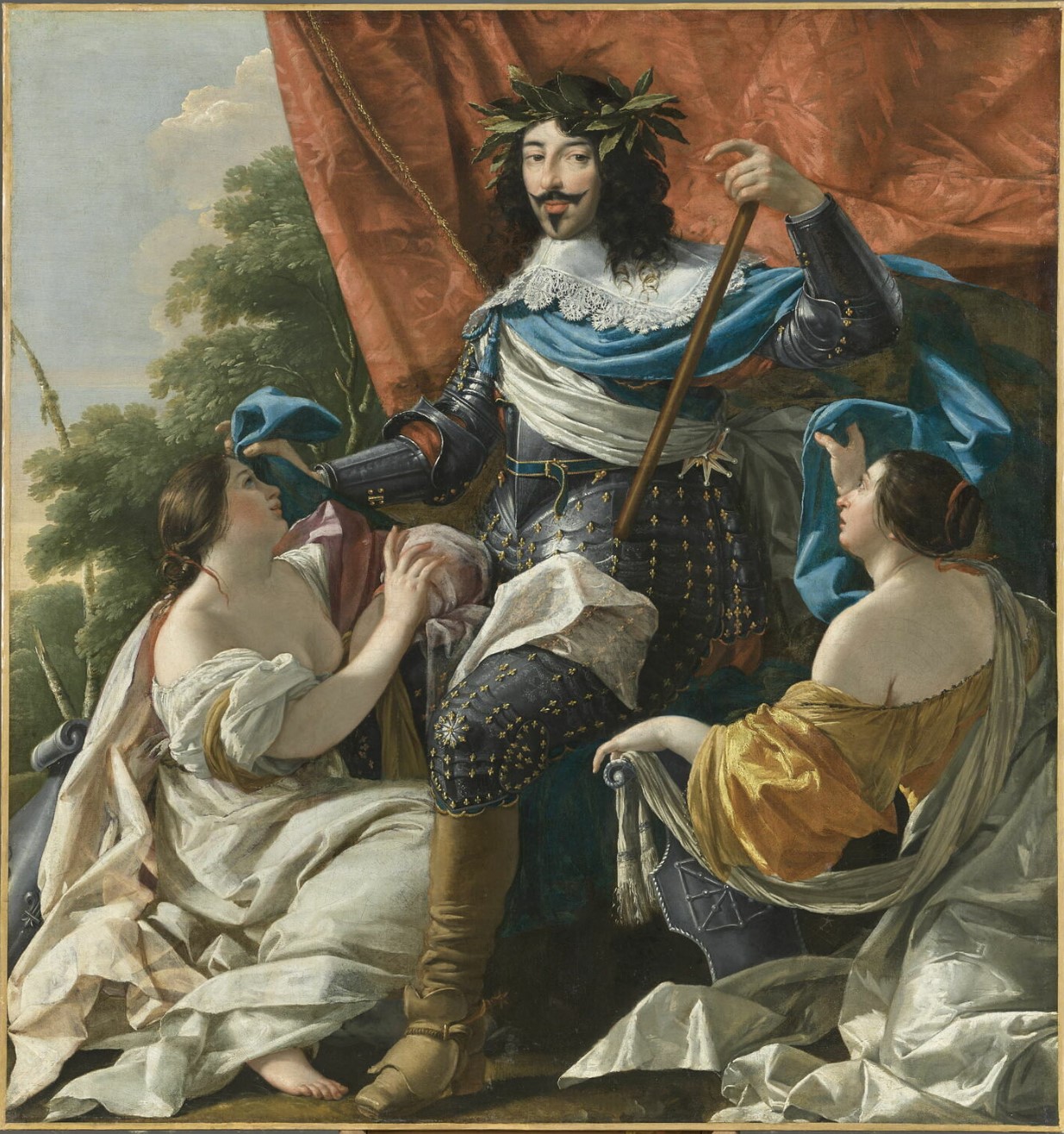
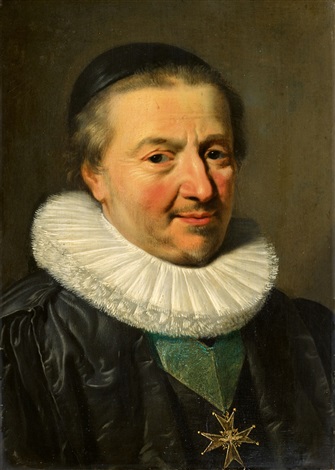
The king set Vouet to the task of painting portraits of the court nobility though just one survives today – that of Richelieu’s secretary. In 1648, when the Académie Royale de Peinture et de Sculpture was established – an organization that held monopoly power over the arts in France for the next 150 years – Vouet was not invited to join. Vouet understood that the academy, which included his pupils Le Brun and Le Sueur, was established in part as a generational shift that challenged his influence and authority. Vouet countered by modernizing the old painter’s guild but did not live to see the battle joined. He died of exhaustion in June 1649. The Academy went on to school artists, provide access to prestigious commissions, and hosted the Salon to exhibit their work. After Vouet’s death, the Académie soon rose to prominence with Jean-Baptiste Colbert, First Minister of State from 1661 until his death in 1683 under Louis XIV, as its protector and Charles Le Brun as First Painter and the Académie’s director.
Atelier of Simon Vouet (1590-1649), Michel le Masle (1573-1662), 1628,, oil on canvas, musée Carnavalet, Paris.
Upon Vouet’s return to France in late November 1627, his French style set to work mainly on religious subjects which were admired by the public, particularly in diocesan and religious orders’ churches of Paris. As late as 1630, the eye of the Paris art consumer was used to prevailing late 16th century mannerism. It took time for the French to better accept Vouet’s new Caravaggesque naturalism. Further, while France was a so-called eldest daughter of the Catholic Church, Parisians did not share the intense religious enthusiasm that was the art expression in the papal states. Parisians did not fully accept the swirling heavenly masses found in Italian Baroque. In France Vouet had to temper his stylistic synthesis of classicism, naturalism and baroque as the French expression of and contribution to a great international style.
Vouet’s new and tempered French style is exquisitely represented in Madonna and Child (1633). During the religious reformation period in the 16th century one of the Catholic Church’s responses was the renewal of devotion to the Virgin Mary. This cult of the Virgin, once blossomed in the 12th century, was in renewed full maturity in the 1630s and even inspired the French king to dedicate his North American empire to her in 1638. Vouet painted more than a dozen compositions of the Virgin and her son at half-length. While the blank background and figurative monumentality remain from his Roman days, Vouet’s mastery of light and use of bright colors signal the realization of the new French style. The monumental figure of the seated Virgin depicted in a Mannerist and Classical synthesis holds her son on her lap and looks at him with drooping eyes.Her arm supported by the foundation of a classical column, Mary’s dark hair is held back by a fabric band as her neck and shoulder are exposed. The Christ child reaches up to kiss his mother, his body in a Baroque twist as he caresses her face. The brilliantly executed moment expresses intimacy and tenderness while maintaining religious seriousness.
The Bible story of depravity that Vouet depicts is that of Lot and his daughters found in Genesis 19. The angels have warned Lot who is an upright man that Sodom and Gomorrah are to be destroyed for its sins. As Lot’s family escapes, they are warned not to look back on the Divine destruction. Lot’s wife disobeys and is turned into a pillar of salt. Despairing of finding husbands where they are going and so carry on their own people, Lot’s daughters devise to get their father drunk and lie with him. Both daughters become pregnant in this way.
Vouet depicts Lot of the Old Testament story as they break the taboo of incest to carry on the race in desperate times using Renaissance artistic language of a god from pagan mythology. In place of moralizing, Vouet composes a sensual scene showing Lot, a male figure of late middle age, tasting the company of two nymph-like young women in a canvas filled with the attraction of the flesh and drunken debauchery. The lines and forms of Vouet’s new painting give priority to its narrative power which will be the manner of his artwork following his return to France. It is noted that Vouet used a contemporary engraving of an ancient relief to model the figure of the seated daughter.
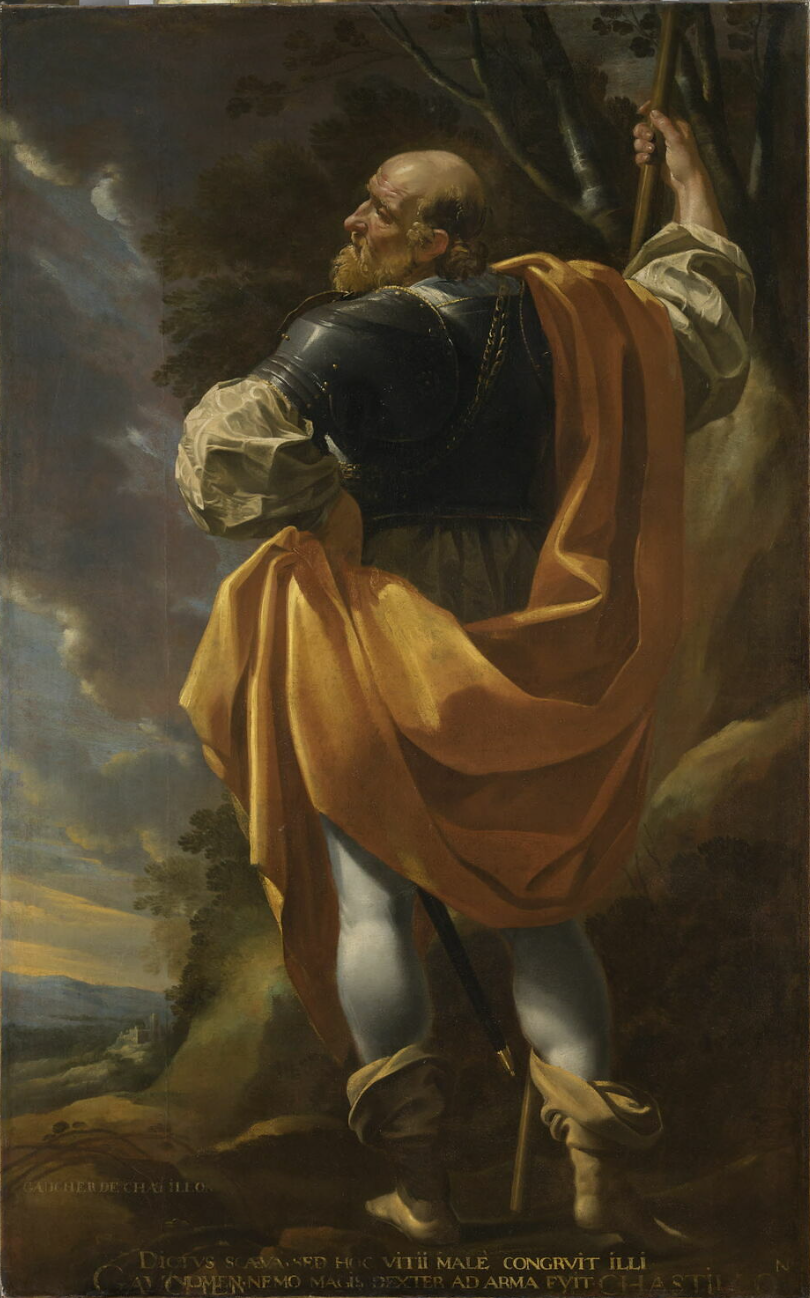
Commissioned by Cardinal Richelieu for his Palais Royal’s Gallery of Illustrious Men the painting ofGaucher de Châtillon was set into one of its bays. The portrait was greatly admired in that generation for the figure’s resolute pose as well as the execution of Vouet’s drawing and painting. Critics assessed that since the pose and head were so artistically beautiful Vouet’s subject was not modeled from life but inspired by Carracci. Seeing the subject turned and from behind was in the Mannerist tradition that Vouet loved and adopted for this historical figure of Gaucher de Châtillon (1250-1328), a constable of France and advisor to Capet kings, Philip IV the Fair (1268-1314), and then to his sons, Louis X the Quarreler (1289-1316), Philip V the Tall (1293-1322) and Charles IV the Bald (1294-1328). The Louvre’s picture has been restored.
Back in France Vouet had a successful career as the painter of large decorations and religious and allegorical paintings. His studio was the largest international workshop and school in Paris. Vouet was a most sought-after and beloved teacher and his art collaborators were numerous (Le Brun, Le Sueur, Mignard, Du Fresnoy, Le Nostre, among others). Per usual practice among professional artists in Europe, those with talent were encouraged to marry into the master’s family so to keep the training, skill and social connections “in house.”
The 1630’s began an age of cultural realignment and reorientation in France that would remain until about the French Revolution. In 1634 the Académie Française was founded under Cardinal Richelieu. In 1637 René Descartes published in French his Discourse on Method (“Je pense, donc je suis” “I think, therefore I am”) ushering in radical subjectivity in philosophical thought. That same year Peter Corneille’s Le Cid was produced, the first great stage play. In 1640 the Imprimerie Royale was founded to publish scholarly books and improve societal erudition. The decade’s innovations continued to transform culture over the next 30 years. By the 1660s French artists, writers and others in France viewed their language, thought, and artistic culture as the world’s most refined and unparalleled in history. Vouet’s return in 1627 was well situated for him to contribute to this prolonged period of interest in artistic matters in France.
In the mid17th century, wealthy French patrons began to collect Italian and Italian-inspired art. This included Louis Phélypeaux de La Vrillière (1599-1681) who collected 240 major paintings for his house in Paris. Critics have observed about Vouet that as he played the role of art functionary by importing and translating Italian art tradition into France, he remained less of a truly profound original artist.
Louis Phélypeaux de La Vrillière, secrétaire d’Etat de la religion prétendue réformée. He built the Hôtel de la Vrillière in 1st arrondissement in Paris designed by François Mansart (1598-1666) between 1635 and 1650.
In the 1630s, classical understanding of Carraci from Domenichino (1581-1641) was giving way to a different understanding of history painting from Giovanni Lanfranco (1582-1647). Lanfranco viewed Caracci’s legacy as decoration in search of vitality more than a spatial or formal articulation which extended to include figures in action. Vouet worked rapidly to populate the churches, monasteries and abbeys, royal palaces and private mansions, many newly built, of Paris, with his artwork. Vouet also produced large public commissions, all of which expressed a prevailing Baroque potpourri.
Vouet’s most significant contribution to French painting is his innovations in decorative painting whose influence was felt in France into the mid18th century. Vouet’s influence may be out sized to his intellectual quality and artistic originality but he made a tremendous impression on his contemporaries and was the artist, in a city of intense competition, who was the leading figure of the new Italian art manner for the French public and in many different projects for over 20 years. Vouet’s position as painter is on par with architects Jacques Lemercier (c.1585-1654) and Louis Le Vau (1612-1660) as part of that same generation in France who formed the classicizing French Baroque. They used French art practice since King Francis I (1494-1547) and solid current Roman practice forged into a French synthesis associated with Cardinal Richelieu and Louis XIII. Vouet’s pupils, Charles Le Brun (1619-1690), Pierre Mignard (1612-1695), Nicolas Mignard (1606-1668). Le Sueur (1617-1655), and François Perrier (1590–1650) carried on the tradition of Vouet’s artwork.
Philippe de Champaigne (1602-1674), Jacques Lemercier with dome of Sorbonne.Louis le Vau.Philippe de Champaigne (1602-1674), Cardinal Richelieu, 1642, Musée des Beaux-Arts de Strabourg.Peter Paul Rubens (1577-1640), Young Louis XIII.
For his decorative work Vouet collaborated with artists in other media such as sculptor Jacques Sarrazin (1592-1660). Vouet painted large-scale decorations for royal patrons such as Anne of Austria (1601-1666), wife and mother of French Kings, at Fontainebleau in 1644 and at the Palais Royal between 1643 and 1647. Vouet did a decorative series at the Arsenal. At Hôtel Séguier (no. 16 rue Séguier) in Paris for the chancellor of France, Pierre Séguier (1588-1572), Vouet painted the chapel, library, and lower gallery. In these projects, Vouet reintroduced forgotten French painting traditions of illusionism practiced by Italian artists at Fontainebleau in the 1530s. Vouet synthesized it with the new Italian style in the 1630s, including imitating the use of gold mosaic and big oval designs derived from Venice. Today these decorations survive only by others’ engravings of them.
Pierre Séguier.
Some of Vouet’s decorative schemes survive at the Château de Wideville west of Paris. The castle was originally built in the late 16th century and sold to King Louis XIII’s minister of finances, Claude de Bullion (1569-1640), in 1630. Starting in 1632, the new owner set about building and expanding the castle in the Louis XIII style, with red bricks, white quoins and a pair of chimneys. Bullion involved the best decorators including Vouet for painting as well as Jacques Sarrazin (1591-1660) and Philippe de Buyster (1595-1653) for sculpture. Château de Wideville later became base for Louise de La Vallière (1644-1710), maitresse d’amour of King Louis XIV.
Claude de Bullion, oil on panel, 33 x 23,5 cm.
Vouet completed a later decorative panel, Muses Urania and Calliope in or around 1640, with the help of his studio. Likely commissioned as an altarpiece for the private chapel of a wealthy Parisian, the painting depicts porcelain skin women, bejeweled drapery, and putti in a classical architecture setting.
With his patrons Vouet was an amenable creator and he was a facile painter. His wealthy and powerful patrons wanted showy decorative artwork painted in the modern Italian manner without very serious religious or political messages for their often newly-acquired or built residences. The Toilet of Venus is exuberant and intriguing though based on the latest Italian art of the day – the theme is inspired by a treatment of Francesco Albani (1578-1660) while the figure of Venus is derived from Annibale Carracci. Though the figures remain weighty in the mode of Italian Naturalism, Vouet transforms the group into curvaceous polished and floating interlocking forms.
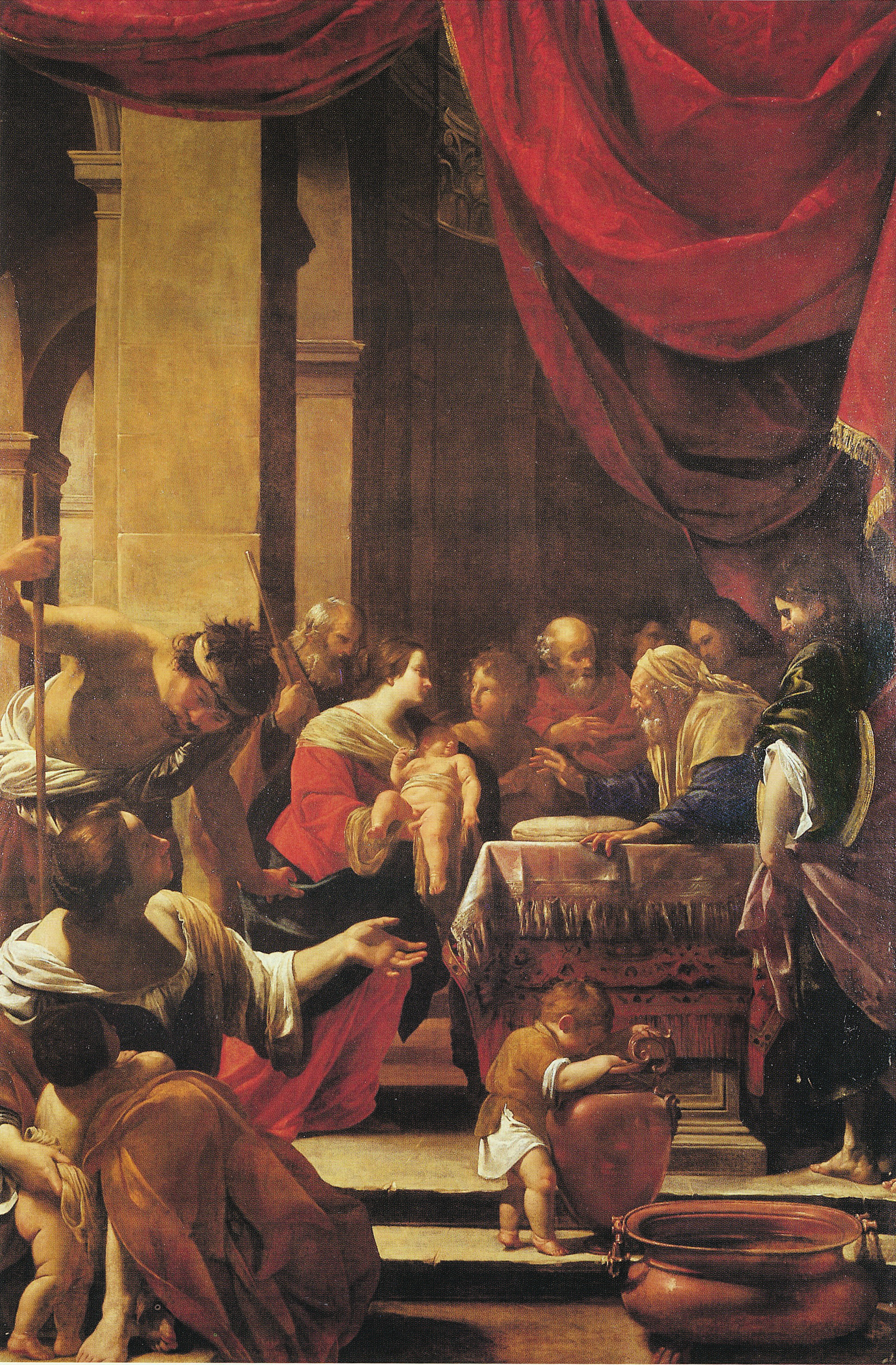
As many of Vouet’s large-scale decorative and other works were virtually systematically destroyed in the Revolution so that the connoisseur must assess Vouet’s artistic merit by way of surviving decorative schemes more than individual canvases or fragments, The Presentation in the Temple is an important extant painting by the hand of Vouet that allows qualitative comparisons to other 17th century French artists such as Laurent de La Hyre (1606-1656), Eustache Le Sueur, Charles Le Brun, and Jean-Baptiste Jouvenet (1644-1717). Commissioned for the Jesuits by Richelieu in 1641 for what is today’s Saint-Paul-Saint Louis in Paris’s Marais it was part of a rich ensemble of artifacts whose overall artistic scheme was dedicated to Christ and the French monarchy. Vouet’s presentation theme evokes the birth of Louis XIV and the painting was flanked by sculptures of Jesuit saints and French political figures.
There remains some similarity to what Vouet had produced in Italy in the mid1620s, particularly in The Appearance of the Virgin to St Bruno in Naples, such as his use of diagonals. Yet 15 years later in France Vouet’s composition is more classical in orientation including a rational not emotional or supernatural treatment of the subject more in the style of Nicolas Poussin who was called back to France from Italy the year before.
To give the illusion of grandeur, Vouet provides a very low position at the bottom of the stairs surrounded by gigantic religious architecture of which he paints a fragmentary synecdoche. For depth, Vouet interposes firmly-modeled foreground figures that partly mask more distant such figures in statuesque draping. Vouet’s cool colors reflect the influence of Philippe de Champaigne and the Baroque turning movement extends into the entablature of the architecture of the temple of Jerusalem, as well as the inclined position of the two angels painted in the upper portion.
By 1762, 20 years after Vouet painted The Presentation, politics changed unpleasantly for the Jesuits as they were suppressed by the Pope and their Paris flagship church’s high altar ensemble was dismantled. The painting was housed in the Royal Academy of Painting and Sculpture and later transferred to the Louvre during the French Revolution.
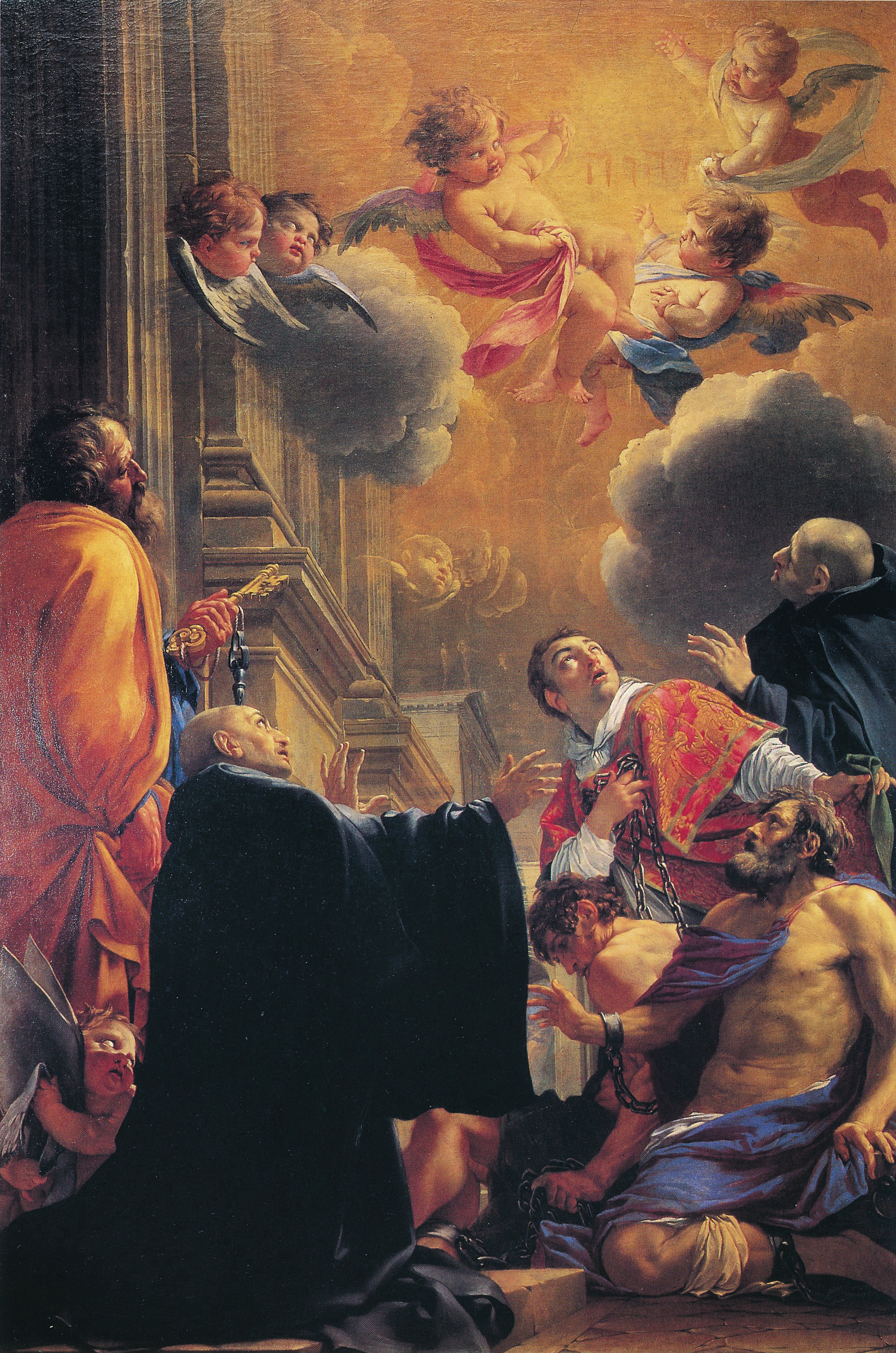
Simon Vouet (1590-1649), The Adoration of the Holy Name by Four Saints, oil on canvas,265 x176 cm, Église Saint Merri, Paris.Simon Vouet (1590-1649), Altar piece, Église Saint-Nicolas-des-Champs, Paris.Simon Vouet (1590-1649), Virgin with oak branch, known as Madonna Hesselin, c. 1640/1645, Musée du Louvre. https://collections.louvre.fr/en/ark:/53355/cl010067259
In 1651, two years after the death of Vouet, the painting above was inscribed in Latin to state that Vouet had painted the artwork and in the house of “very noble lord” Louis de Hesselin, one of the king’s advisors. The inscription also gives the meaning of the palm branch the Virgin holds – it is a sign of the means of her effectual assistance to the afflicted. Sieur Hesselin was a confident to the artist who was both godfather to Vouet’s eldest son in 1638 and witness to the marriage of Vouet’s daughter 10 years later. Two other known versions of the painting are found in the United States and in England. X-rays revealed that Vouet fully completed the neckline of the virgin before he added the painted golden robe upon it.
Simon Vouet (workshop), Christ at the Column, c. 1635/40, 1.28 m x .66m, oil on canvas. Musée du Louvre.
Louis XIV owned this painting of Christ being scourged by Roman soldiers at the pillar during his Passion. In the 18th century the painting was attributed to Eustache Le Sueur which still has its defenders today. Attribution to Simon Vouet began in the 20th century among scholars. In the 21st century scholars have proposed Charles le Brun (1619-1690) and the “Workshop of Simon Vouet” which the Louvre has settled upon. Preparatory drawings for the painting exist at the Bayerische Staatsbibliothek in Munich and at the Musée des Beaux-Arts in Besançon. The artwork may have come from a chapel of the Château in Saint-Germain-en-Laye. The painting was restored twice in the 18th century and in the 1960s.
At the same time that Vouet was painting religious subjects for churches in Paris he was painting allegorical and poetical artwork. For these paintings Vouet’s designs are freer, modeling looser and, in the Venetian style, the composition determined more by color and light.
Vouet painted this artwork and two other allegorical paintings for the decoration of the châteauneuf of Saint-Germain-en-Laye. In the 17th century the painting was known as “Seated Victory.” The female figure holds a flaming heart in her right hand and palm leaf in her left hand as a Cupid-like figure of love places a laurel wreath on her head. Later, the allegorical figure was called “Faith.” The painting was heavily restored in the mid1960s.
The painting was made for the decoration of the Château Neuf de Saint-Germain-en-Laye. In the 18th century the female figure wearing a laurel was described as “Victory” and holding Louis XIV in her arms. In the 19th century the female figure was viewed as an allegory for “Wealth” though other attributes such as the main figure’s foot resting on a cornerstone and strewn open books point to a figure representing “Christian Faith.” The standing cherub who offers her sparkling necklaces and the child on her lap have been interpreted as figures representing earthly and heavenly love, respectively.
Vouet depicts a scene on the standing silver vase of the nymph Daphne being pursued by Apollo, god of the arts. It is a classical mythological story which, despite aid from Cupid, the god of love, relates the vanity of earthly goods and pleasures. The scholarly theory of what is depicted in Vouet’s painting adds up to “Christian Faith” holding onto the figure of heavenly love as she is being tempted by baubles and pleasures of earthly love. The painting was restored in the 1950s and 1980s.
Beyond the thoughtful allegorical presentation, Vouet’s innovative style and reliance on lyrical emotion and sentiment more than ordered arrangement is in evidence as he presents a sensual winged goddess with healthy, chubby children in a fantasia of rich draperies and elegant linear architecture amid a metallic treasure hoard, all of which together enlivens the picture. Its languorous elegance derives from the Italian Baroque. Though a dictatorial teacher, unrivaled ambitious artist, and living in Paris during the grim era of the Thirty Years’ War, in Vouet’s painting for the French nobility there is no sense of unease and any subject’s forthrightness is tempered by superficiality.
Simon Vouet (1590-1649),The Three Marys at the Tomb, n.d., 52 1/4 x 66 1/2” Église Sainte Marie Madeleine de Davron Seine-et-Oise (11th century).
A chasm of space between the two angels holding up the shroud and the three women at the tomb before dawn on the third day delineates the heavenly from the earthly although all these figures are linked by vibrant colors and a reflective animation of spirals. Detailed drawing is forgone for conventional pose and vague, mannered forms. Inasmuch as Vouet is interested in the Biblical story or its meaning he is involved with the vivacity of the narrative by way of its stylistic elements. In contrast to Nicolas Poussin’s statuesque figures or Le Valentin’s introspective art, Vouet introduced Baroque lyricism and fancy into French art.
Saturn who represents Time in Roman mythology has tumbled next to a scythe and hourglass, his attributes. Holding him by the hair the bare breasted figure has been identified as Beauty but also Truth and is likely a portrait of Vouet’s Italian wife. Virginia da Vezzo. She holds a lance over him. To the left is Hope who holds out a hook, her symbol, as a trio of cupids pluck feathers from Time’s wings. The allegorical message may be that Love defies Time.
Simon Vouet (1590-1649), Saturn Conquered by Love, Venus and Hope, 1643/45, , Musée de Berry, Bourges.
In another allegorical painting of the same theme, Saturn is Father Time. The old man is overcome by Love (Cupid), Beauty or Truth (a bare breasted figure, perhaps Venus), and Hope (holding an anchor, her traditional symbol). Above these in colorful robes is Fama, the figure of fame, who announces herself blowing her trumpet. Fama embraces Occasio, her hair traditionally blowing forward, holding an emblem of wealth, and signifying the fortunate occasion. In Vouet’s picture which synthesizes classical elements such as statuesque figures in the style of Poussin and swirling masses and vibrant colors of the international Baroque style, Time is the victim of what he usually despoils. The large painting originally hung in the Hôtel de Bretonvilliers in Paris.
Simon Vouet (1590-1649), Allegory of Good Government, 1644/45, oil on canvas, 2.37 m x 2.71 m, Musée du Louvre.
In the collection of Louis-Philippe d’Orléans (1725-1785) in the Palais-Royal in Paris before 1785, it entered the collection of Louis Philippe Joseph d’Orléans (1747-1793), known as Philippe Égalité afterwards, and was sold in 1800. In 1961 Friends of the Louvre acquired it in New York City and donated it to the Louvre that same year.
The young woman seated on an elevated throne wearing armor is, according to the influential Iconologia of 1593 by Cesare Ripa (1555-1622), the allegory for Reason. The pair of young women, one offering an olive branch and the other a palm branch, are allegories for Peace and Prosperity. The golden vase is decorated with a bacchanalia. Above the main scene are two cherubs bringing a palm frond and laurel with a twisted column wrapped with a vine that symbolizes Friendship.
Vouet painted this allegory of good government about Anne of Austria as she cooperated with Cardinal Mazarin’s peace policies. The painting was probably commissioned for the decoration of Anne of Austria’s apartment at the Palais-Royal around 1645. It was kept in the collection of the Dukes of Orleans at the Palais-Royal in the 18th century. and moved to London after the death of Philippe Égalité. It was purchased in New York by the Société des Amis du Louvre in 1961. The work was re-oiled with glue by Jacques Joyerot and restored in a pictorial layer by Jeanine Roussel-Nazat between 1979 and 1981.
Simon Vouet died in Paris on June 30, 1649 at 59 years old. His burial details are unknown.
17th and 18th Century Art Baroque Painting Sculpture Architecture, Julius S. Held, Donald Posner, H.W. Janson, editor, Englewood Cliffs, N.J.: Prentice-Hall, Inc. and New York: Harry N. Abrams, Inc., 1972.
French Painting in the Seventeenth Century, Alain Mérot, trans. by Caroline Beamish, New Haven and London: Yale University Press, 1995.
Kings & Connoisseurs Collecting Art in Seventeenth-Century Europe, Jonathan Brown, The National Gallery of Art, Washington, D.C. and Princeton, NJ: Princeton University Press, 1995.
Mannerism: The Painting and Style of The Late Renaissance, Jacques Bousquet, trans, by Simon Watson Taylor, Braziller, 1964.
Valentin de Boulogne: Beyond Caravaggio, Annick Lemoine, Keith Christiansen, Patrizia Cavazzini, Jean Pierre Cuzin, Gianni Pappi, Metropolitan Museum of Art; 2016.